Effect of Perceived Value of Smart Governance on City Demographic Sustainability: Youth Retention in Busan


Abstract
1. Introduction
2. Literature Review and Hypotheses
2.1. Youth Mobility and Urban Attractiveness in Developed Cities
2.2. Smart Governance and Perceived Value
2.3. Demographic Sustainability Challenge of Developed Cities
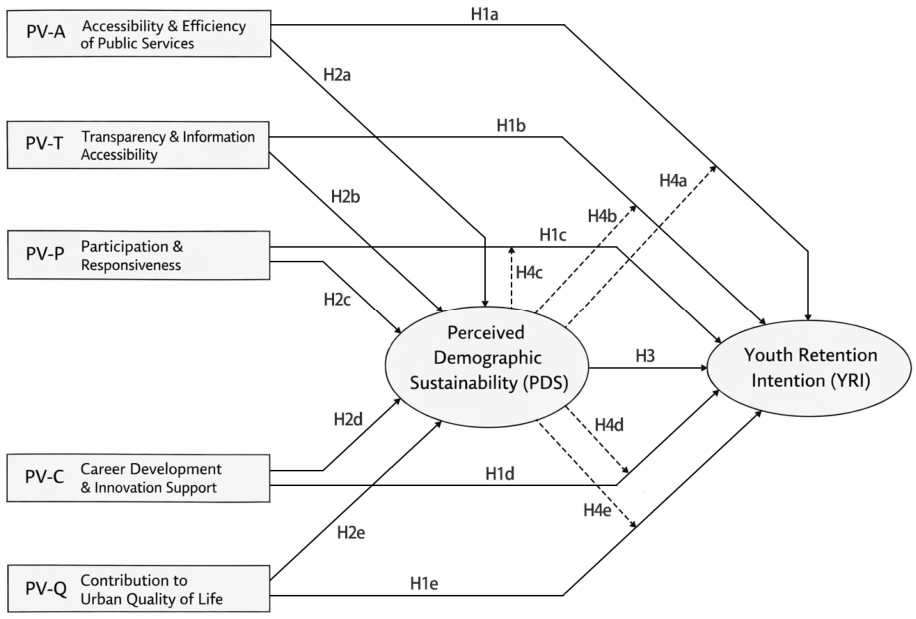
2.4. Research Gap and Hypotheses in the Busan Case
3. Research Methods
3.1. Target Population and Sampling
3.2. Questionnaire Design and Variable Measurement
3.3. Data Analysis Methods
4. Research Results
4.1. Sample Characteristics and Descriptive Statistics
4.2. Measurement Model Testing: Reliability and Validity
4.2.1. Internal Consistency and Construct Reliability
4.2.2. Convergent Validity and Discriminant Validity
4.2.3. Measurement Model Fitting
4.3. Structural Model and Hypothesis Testing
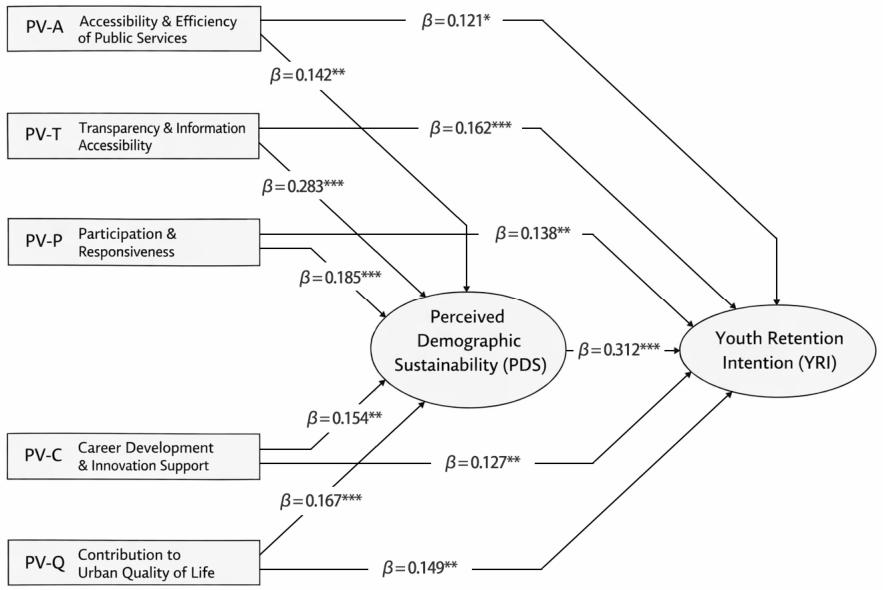
4.3.1. Model Fitting and Overall Structural Relationship
4.3.2. Direct Effects of Governance Dimensions
4.3.3. Mediating Effect of Perceived Demographic Sustainability
5. Discussion
5.1. Theoretical Significance and Academic Contribution
5.2. Dialog with Existing Studies
5.3. Policy Implications and Practical Significance
5.4. Research Constraints and Future Research Directions
6. Conclusions
Author Contributions
Funding
Institutional Review Board Statement
Informed Consent Statement
Data Availability Statement
Acknowledgments
Conflicts of Interest
Appendix A

| Construct | Code | Measurement Item | Reference |
|---|---|---|---|
| Accessibility and Efficiency of Public Services (PV-A) | PV-A1 | Public services in this city are easily accessible through digital or smart platforms. | [23,26] |
| PV-A2 | Smart governance has improved the efficiency of public service delivery. | [23,28] | |
| PV-A3 | Government services can be obtained conveniently and quickly in daily life. | [23,26] | |
| Transparency and Information Accessibility (PV-T) | PV-T1 | Government information and policy updates are easily accessible to the public. | [23,25] |
| PV-T2 | Smart governance improves the transparency of urban governance and public decision-making. | [23,24] | |
| PV-T3 | I can clearly understand urban development plans and policies through public information channels. | [24,26] | |
| Participation and Responsiveness (PV-P) | PV-P1 | The city provides opportunities for citizens to participate in public affairs and decision-making. | [25] |
| PV-P2 | Government departments respond effectively to citizens’ suggestions and feedback. | [23,25] | |
| PV-P3 | I feel that citizens’ voices can influence urban governance decisions. | [25,28] | |
| Career Development and Innovation Support (PV-C) | PV-C1 | The city provides sufficient support for career development and innovation activities. | [31,40] |
| PV-C2 | Urban governance policies encourage innovation and entrepreneurial opportunities for young people. | [31,40] | |
| PV-C3 | The innovation environment in this city is favorable for long-term professional development. | [40] | |
| Contribution to Urban Quality of Life (PV-Q) | PV-Q1 | Smart governance contributes to improving the overall quality of urban life. | [26,39] |
| PV-Q2 | Digital governance initiatives make daily life in the city more convenient and comfortable. | [23,26] | |
| PV-Q3 | Smart city development enhances the attractiveness of the city as a place to live. | [39,40] | |
| Perceived Demographic Sustainability (PDS) | PDS1 | I believe this city has the potential to attract and retain young people in the future. | [47,48] |
| PDS2 | The demographic structure of the city is likely to remain balanced in the long term. | [47,48] | |
| PDS3 | The city will continue to maintain social vitality through a stable young population. | [47,48] | |
| PDS4 | The long-term development prospects of the city’s population are positive. | [47,48] | |
| PDS5 | The city has the capacity to sustain its demographic vitality in the future. | [47,48] | |
| PDS6 | The future demographic development of the city is sustainable. | [47,48] | |
| Youth Retention Intention (YRI) | YRI1 | I intend to continue living in this city for a long period of time. | [6,41] |
| YRI2 | I plan to develop my career in this city. | [6,41] | |
| YRI3 | I prefer to stay in this city rather than move to another city. | [6,41] | |
| YRI4 | I am willing to build my future life in this city. | [6,41] | |
| YRI5 | I would recommend this city as a place for young people to live and work. | [6,41] | |
| YRI6 | I am unlikely to migrate to another city in the near future. | [6,41] |
References
- United Nations Human Settlements Programme (UN-Habitat). World Cities Report 2020: The Value of Sustainable Urbanization; UN-Habitat: Nairobi, Kenya, 2020. [Google Scholar]
- OECD. Measuring the Attractiveness of Regions; OECD Publishing: Paris, France, 2022. [Google Scholar]
- Florida, R. Cities and the creative class. City Community 2003, 2, 3–19. [Google Scholar] [CrossRef] [Scilit]
- Glaeser, E.L. Triumph of the City; Penguin Press: New York, NY, USA, 2011. [Google Scholar]
- OECD. Rethinking Regional Attractiveness in the New Global Environment; OECD Publishing: Paris, France, 2023. [Google Scholar]
- Lee, E.S. A theory of migration. Demography 1966, 3, 47–57. [Google Scholar] [CrossRef] [Scilit]
- Coulter, R.; van Ham, M.; Findlay, A.M. Re-thinking residential mobility: Linking lives through time and space. Prog. Hum. Geogr. 2016, 40, 352–374. [Google Scholar] [CrossRef] [Scilit]
- Faggian, A.; McCann, P. Human Capital and Regional Development; Edward Elgar: Cheltenham, UK, 2017. [Google Scholar]
- Storper, M. Keys to the City; Princeton University Press: Princeton, NJ, USA, 2013. [Google Scholar]
- Statistics Korea. Population and Housing Census: Population Distribution and Migration Trends; Statistics Korea: Daejeon, Republic of Korea, 2024. [Google Scholar]
- Busan Metropolitan City. Busan Urban Master Plan 2040; Busan Metropolitan Government: Busan, Republic of Korea, 2023.
- Korean Statistical Information Service (KOSIS). Youth Migration Statistics by Region. Available online: https://kosis.kr/statHtml/statHtml.do?orgId=101&tblId=DT_1YL21201 (accessed on 9 March 2026).
- Korean Statistical Information Service (KOSIS). Youth Population by Age and Region. Available online: https://kosis.kr/statHtml/statHtml.do?orgId=101&tblId=DT_1B040A3 (accessed on 9 March 2026).
- Korean Statistical Information Service (KOSIS). Single-Person Households by Age and Region. Available online: https://kosis.kr/statHtml/statHtml.do?conn_path=I2&language=en&orgId=101&tblId=DT_1BPA001 (accessed on 9 March 2026).
- Busan Metropolitan City. Busan Youth Panel Survey Report 2023; Busan Metropolitan Government: Busan, Republic of Korea, 2024.
- Ma, K.R.; Kang, E.T.; Kwon, O.K. Migration behavior of students and graduates under regional dualism in Korea. Ann. Reg. Sci. 2017, 58, 191–208. [Google Scholar] [CrossRef] [Scilit]
- Kim, H.; Yang, J. Analysis of Changes in Human Capital Characteristics in Occupational Mobility of College Graduates. Korea Spat. Plan. Rev. 2024, 121, 43–58. [Google Scholar]
- Nam, T.; Pardo, T.A. Conceptualizing smart cities with dimensions of technology, people, and institutions. In Proceedings of the 12th Annual International Conference on Digital Government Research, College Park, MD, USA, 12–15 June 2011; pp. 282–291. [Google Scholar]
- Caragliu, A.; Del Bo, C.; Nijkamp, P. Smart cities in Europe. J. Urban Technol. 2011, 18, 65–82. [Google Scholar] [CrossRef] [Scilit]
- Chourabi, H.; Nam, T.; Walker, S.; Gil-Garcia, J.R.; Mellouli, S.; Nahon, K.; Pardo, T.A.; Scholl, H.J. Understanding smart cities: An integrative framework. In Proceedings of the 2012 45th Hawaii International Conference on System Science, Maui, HI, USA, 4–7 January 2012; pp. 2289–2297. [Google Scholar]
- Hollands, R.G. Will the real smart city please stand up? City 2008, 12, 303–320. [Google Scholar] [CrossRef] [Scilit]
- Kitchin, R. The real-time city? Big data and smart urbanism. GeoJournal 2014, 79, 1–14. [Google Scholar] [CrossRef] [Scilit]
- Meijer, A.; Bolívar, M.P.R. Governing the smart city: A review of the literature on smart urban governance. Int. Rev. Adm. Sci. 2016, 82, 392–408. [Google Scholar] [CrossRef] [Scilit]
- Bolívar, M.P.R.; Meijer, A.J. Smart governance: Using a literature review and empirical analysis to build a research model. Soc. Sci. Comput. Rev. 2016, 34, 673–692. [Google Scholar] [CrossRef] [Scilit]
- Pereira, G.V.; Parycek, P.; Falco, E.; Kleinhans, R. Smart governance in the context of smart cities: A literature review. Inf. Polity 2018, 23, 143–162. [Google Scholar] [CrossRef] [Scilit]
- OECD. Rethinking Regional Attractiveness for Resilient and Competitive Places; OECD Publishing: Paris, France, 2025. [Google Scholar]
- Nguyen, T.T. The Impact of Place Attractiveness and Social Supports on Internal Return Migration. J. Asian Financ. Econ. Bus. 2020, 7, 305–314. [Google Scholar] [CrossRef] [Scilit]
- Mora, L.; Deakin, M.; Reid, A. Strategic principles for smart city development: A multiple case study analysis of European best practices. Technol. Forecast. Soc. Change 2019, 142, 70–97. [Google Scholar] [CrossRef] [Scilit]
- Bibri, S.E.; Krogstie, J. Smart sustainable cities literature review. Sustain. Cities Soc. 2017, 31, 183–212. [Google Scholar] [CrossRef] [Scilit]
- Rodríguez-Pose, A. The revenge of the places that don’t matter. Camb. J. Reg. Econ. Soc. 2018, 11, 189–209. [Google Scholar] [CrossRef] [Scilit]
- Moretti, E. The New Geography of Jobs; Houghton Mifflin Harcourt: Boston, MA, USA, 2012. [Google Scholar]
- OECD. Regional Attractiveness Compass; OECD Publishing: Paris, France, 2026. [Google Scholar]
- Callinan, N. Exploring the effects of demographic transitions in Korea on migrant worker usage. J. Ind. Distrib. Bus. 2020, 11, 7–16. [Google Scholar] [CrossRef] [Scilit]
- Park, B.; Hong, C.Y. Fostering a young city in Busan. Asia Study 2025, 28, 225–250. [Google Scholar] [CrossRef] [Scilit]
- Busan Metropolitan City. Busan Smart City Plan (2024–2028); Busan Metropolitan Government: Busan, Republic of Korea, 2024.
- Busan Metropolitan City. Smart City Vision and Strategy; Busan Metropolitan Government: Busan, Republic of Korea, 2020.
- Busan Metropolitan City. Busan Youth Policy Implementation Plan 2025; Busan Metropolitan Government: Busan, Republic of Korea, 2025.
- Florida, R. The Rise of the Creative Class; Basic Books: New York, NY, USA, 2002. [Google Scholar]
- Clark, T.N.; Lloyd, R.; Wong, K.K.; Jain, P. Amenities drive urban growth. J. Urban Aff. 2002, 24, 493–515. [Google Scholar] [CrossRef] [Scilit]
- Storper, M.; Scott, A.J. Rethinking human capital, creativity and urban growth. J. Econ. Geogr. 2009, 9, 147–167. [Google Scholar] [CrossRef] [Scilit]
- Faggian, A.; McCann, P.; Sheppard, S. Human capital, higher education and graduate migration. Urban Stud. 2007, 44, 2511–2528. [Google Scholar] [CrossRef] [Scilit]
- Venhorst, V.; van Dijk, J.; van Wissen, L. Spatial flexibility of highly educated graduates. Tijdschr. Econ. Soc. Geogr. 2011, 102, 571–588. [Google Scholar]
- Rodríguez-Pose, A.; Ketterer, T.D. Institutional change and regional development. Reg. Stud. 2020, 54, 974–986. [Google Scholar] [CrossRef] [Scilit]
- Heo, N. Investigating the distribution of university alumni populations within South Korea and Taiwan based on data from the LinkedIn advertising platform. Cities 2023, 140, 104440. [Google Scholar] [CrossRef] [Scilit]
- Zeithaml, V.A. Consumer perceptions of price, quality, and value. J. Mark. 1988, 52, 2–22. [Google Scholar] [CrossRef] [Scilit]
- Sweeney, J.C.; Soutar, G.N. Consumer perceived value: The development of a multiple item scale. J. Retail. 2001, 77, 203–220. [Google Scholar] [CrossRef] [Scilit]
- Bongaarts, J. Human population growth and demographic transition. Philos. Trans. R. Soc. B 2009, 364, 2985–2990. [Google Scholar] [CrossRef] [Scilit]
- Lee, R.; Mason, A. Fertility, human capital and economic growth. Eur. J. Popul. 2010, 26, 159–182. [Google Scholar] [CrossRef] [Scilit]
- Seo, J.; Yoon, S.; Kim, J.; Kwon, K. Regional Youth Population Prediction Using LSTM. Sustainability 2025, 17, 6905. [Google Scholar] [CrossRef] [Scilit]
- Mora, L.; Bolici, R.; Deakin, M. The first two decades of smart city research: A bibliometric analysis. J. Urban Technol. 2017, 24, 3–27. [Google Scholar] [CrossRef] [Scilit]
- Oh, J.; Li, M.; Jung, J. Response to shrinking cities: Cultural urban regeneration. Cities 2024, 155, 105447. [Google Scholar] [CrossRef] [Scilit]
- Dillman, D.A.; Smyth, J.D.; Christian, L.M. Internet, Phone, Mail, and Mixed-Mode Surveys: The Tailored Design Method; Wiley: Hoboken, NJ, USA, 2014. [Google Scholar]
- Podsakoff, P.M.; MacKenzie, S.B.; Lee, J.Y.; Podsakoff, N.P. Common method biases in behavioral research. J. Appl. Psychol. 2003, 88, 879–903. [Google Scholar] [CrossRef] [Scilit] [PubMed]
- Etikan, I.; Musa, S.A.; Alkassim, R.S. Comparison of convenience sampling and purposive sampling. Am. J. Theor. Appl. Stat. 2016, 5, 1–4. [Google Scholar] [CrossRef] [Scilit]
- Bentler, P.M.; Chou, C.P. Practical issues in structural modeling. Sociol. Methods Res. 1987, 16, 78–117. [Google Scholar] [CrossRef] [Scilit]
- Hair, J.F.; Black, W.C.; Babin, B.J.; Anderson, R.E. Multivariate Data Analysis, 8th ed.; Pearson: London, UK, 2019. [Google Scholar]
- Nunnally, J.C.; Bernstein, I.H. Psychometric Theory, 3rd ed.; McGraw-Hill: New York, NY, USA, 1994. [Google Scholar]
- Kaiser, H.F. An index of factorial simplicity. Psychometrika 1974, 39, 31–36. [Google Scholar] [CrossRef] [Scilit]
- Fornell, C.; Larcker, D.F. Evaluating structural equation models with unobservable variables. J. Mark. Res. 1981, 18, 39–50. [Google Scholar] [CrossRef] [Scilit]
- Kline, R.B. Principles and Practice of Structural Equation Modeling; Guilford Press: New York, NY, USA, 2016. [Google Scholar]
- Preacher, K.J.; Hayes, A.F. Asymptotic and resampling strategies for assessing indirect effects. Behav. Res. Methods 2008, 40, 879–891. [Google Scholar] [CrossRef] [Scilit]
- Leong, L.Y.; Hew, T.S.; Tan, G.W.H.; Ooi, K.B. Predicting the determinants of the NFC-enabled mobile credit card acceptance: A neural networks approach. Expert Syst. Appl. 2020, 40, 560–569. [Google Scholar] [CrossRef] [Scilit]
- Ministry of Digital Development and Information. Smart Nation 2.0: A Thriving Digital Future for All; Government of Singapore: Singapore, 2024. Available online: https://file.go.gov.sg/smartnation2-report.pdf (accessed on 16 April 2026).
- Ajuntament de Barcelona. Mesura de Govern: Barcelona Digital City Plan (2017–2020); Barcelona City Council: Barcelona, Spain, 2017. Available online: https://bcnroc.ajuntament.barcelona.cat/jspui/bitstream/11703/115020/1/LE_MesuradeGovern_EN.pdf (accessed on 16 April 2026).


| Variable | Distribution (%) |
|---|---|
| Age | 20–24 (9.37), 25–29 (54.21), 30–34 (26.62), 35–40 (9.80) |
| Gender | Male (59.11), Female (40.89) |
| Education | High school or below (9.05), Junior college (33.65), Bachelor (39.83), Master (10.54), Doctoral or above (6.92) |
| Employment | Full-time employee (54.95), Part-time/freelance (22.90), Student (7.99), Unemployed/job seeking (13.84), Other (0.32) |
| Residence length in Busan | <1 year (7.56), 1–3 years (36.32), 4–6 years (33.12), 7–10 years (12.99), >10 years (10.01) |
| Construct | Item | Cronbach’s α | CR | AVE |
|---|---|---|---|---|
| Accessibility and Efficiency of Public Services (PV-A) | 3 | 0.752 | 0.754 | 0.505 |
| Transparency and Information Accessibility (PV-T) | 3 | 0.808 | 0.809 | 0.586 |
| Participation and Responsiveness (PV-P) | 3 | 0.832 | 0.832 | 0.623 |
| Career Development and Innovation Support (PV-C) | 3 | 0.785 | 0.786 | 0.552 |
| Contribution to Urban Quality of Life (PV-Q) | 3 | 0.824 | 0.825 | 0.611 |
| Perceived Demographic Sustainability (PDS) | 6 | 0.893 | 0.893 | 0.582 |
| Youth Retention Intention (YRI) | 6 | 0.895 | 0.895 | 0.587 |
| Construct | PV-A | PV-T | PV-P | PV-C | PV-Q | PDS | YRI |
|---|---|---|---|---|---|---|---|
| PV-A | 0.711 | ||||||
| PV-T | 0.265 | 0.766 | |||||
| PV-P | 0.377 | 0.3 | 0.789 | ||||
| PV-C | 0.184 | 0.327 | 0.251 | 0.743 | |||
| PV-Q | 0.185 | 0.422 | 0.303 | 0.392 | 0.781 | ||
| PDS | 0.308 | 0.45 | 0.385 | 0.334 | 0.4 | 0.763 | |
| YRI | 0.342 | 0.464 | 0.415 | 0.379 | 0.441 | 0.549 | 0.766 |
| Hypothesis | Path | Standardized β | t-Value | p-Value |
|---|---|---|---|---|
| H1a | PV-A → YRI | 0.121 | 2.984 | <0.01 |
| H1b | PV-T → YRI | 0.162 | 3.981 | <0.001 |
| H1c | PV-P → YRI | 0.138 | 3.214 | <0.01 |
| H1d | PV-C → YRI | 0.127 | 3.006 | <0.01 |
| H1e | PV-Q → YRI | 0.149 | 3.475 | <0.01 |
| H2a | PV-A → PDS | 0.142 | 3.316 | <0.01 |
| H2b | PV-T → PDS | 0.283 | 6.535 | <0.001 |
| H2c | PV-P → PDS | 0.185 | 4.542 | <0.001 |
| H2d | PV-C → PDS | 0.154 | 3.628 | <0.01 |
| H2e | PV-Q → PDS | 0.167 | 3.879 | <0.001 |
| H3 | PDS → YRI | 0.312 | 7.021 | <0.001 |
| Path | Indirect Effect (β) | Boot SE | 95% CI Lower | 95% CI Upper | Result |
|---|---|---|---|---|---|
| PV-A → PDS → YRI | 0.044 | 0.012 | 0.021 | 0.069 | Significant |
| PV-T → PDS → YRI | 0.07 | 0.015 | 0.043 | 0.101 | Significant |
| PV-P → PDS → YRI | 0.058 | 0.014 | 0.033 | 0.086 | Significant |
| PV-C → PDS → YRI | 0.034 | 0.01 | 0.016 | 0.056 | Significant |
| PV-Q → PDS → YRI | 0.052 | 0.013 | 0.028 | 0.079 | Significant |
Disclaimer/Publisher’s Note: The statements, opinions and data contained in all publications are solely those of the individual author(s) and contributor(s) and not of MDPI and/or the editor(s). MDPI and/or the editor(s) disclaim responsibility for any injury to people or property resulting from any ideas, methods, instructions or products referred to in the content. |
© 2026 by the authors. Licensee MDPI, Basel, Switzerland. This article is an open access article distributed under the terms and conditions of the Creative Commons Attribution (CC BY) license.
Share and Cite
Peng, Y.; Nah, K.; Pak, K.-C. Effect of Perceived Value of Smart Governance on City Demographic Sustainability: Youth Retention in Busan. Sustainability 2026, 18, 4055. https://doi.org/10.3390/su18084055
Peng Y, Nah K, Pak K-C. Effect of Perceived Value of Smart Governance on City Demographic Sustainability: Youth Retention in Busan. Sustainability. 2026; 18(8):4055. https://doi.org/10.3390/su18084055
Chicago/Turabian StylePeng, Yuhao, Ken Nah, and Ki-Cheol Pak. 2026. "Effect of Perceived Value of Smart Governance on City Demographic Sustainability: Youth Retention in Busan" Sustainability 18, no. 8: 4055. https://doi.org/10.3390/su18084055
APA StylePeng, Y., Nah, K., & Pak, K.-C. (2026). Effect of Perceived Value of Smart Governance on City Demographic Sustainability: Youth Retention in Busan. Sustainability, 18(8), 4055. https://doi.org/10.3390/su18084055