Quantifying Sustainability in Transportation Asset Management: A Review of Environmental, Social, and Governance (ESG) Metrics


Abstract
1. Introduction
2. Methods
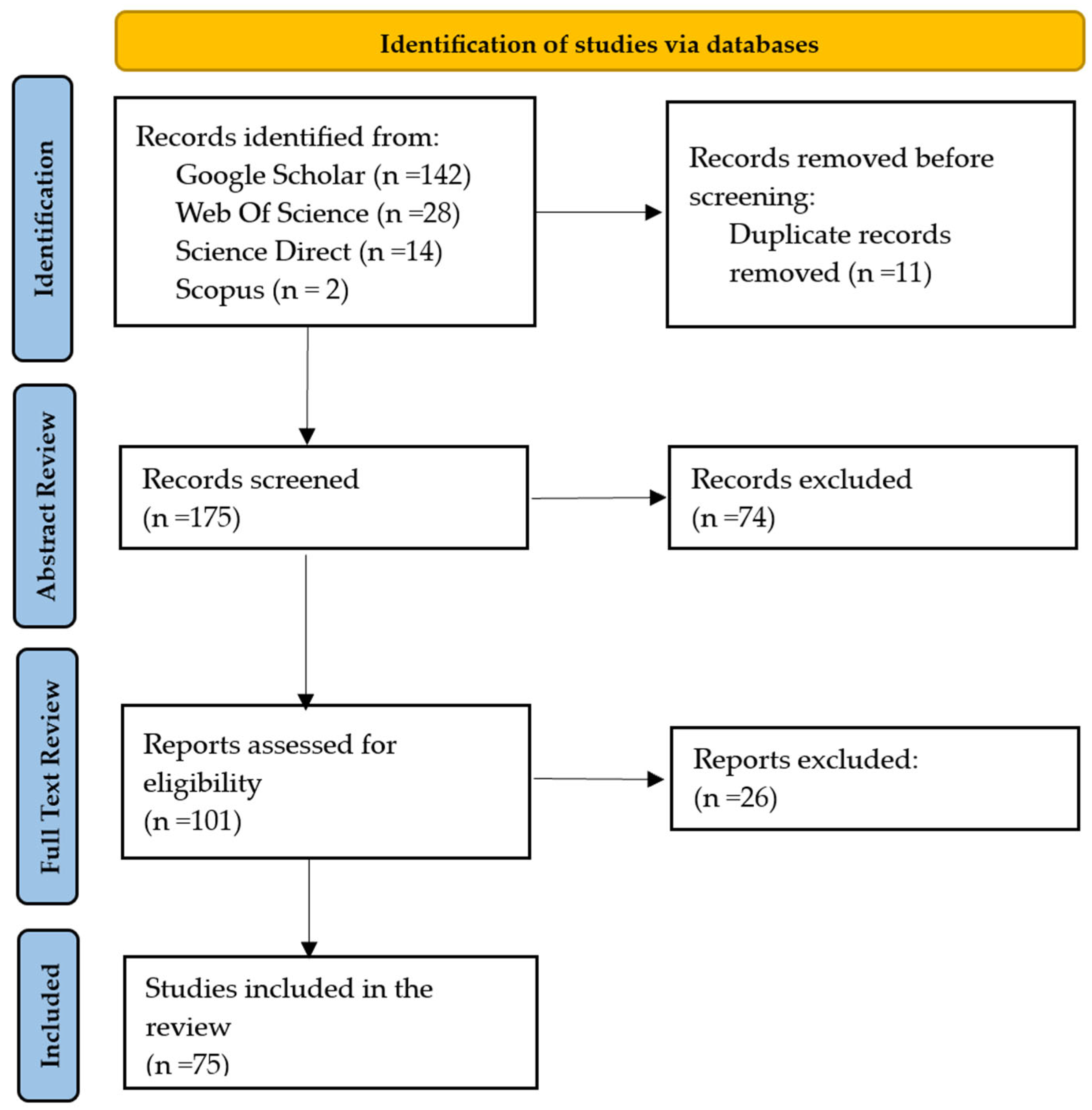
2.1. Paper Selection Methodology
2.2. Summary of Results
2.3. Study Coding and Classification
3. Findings and Discussion
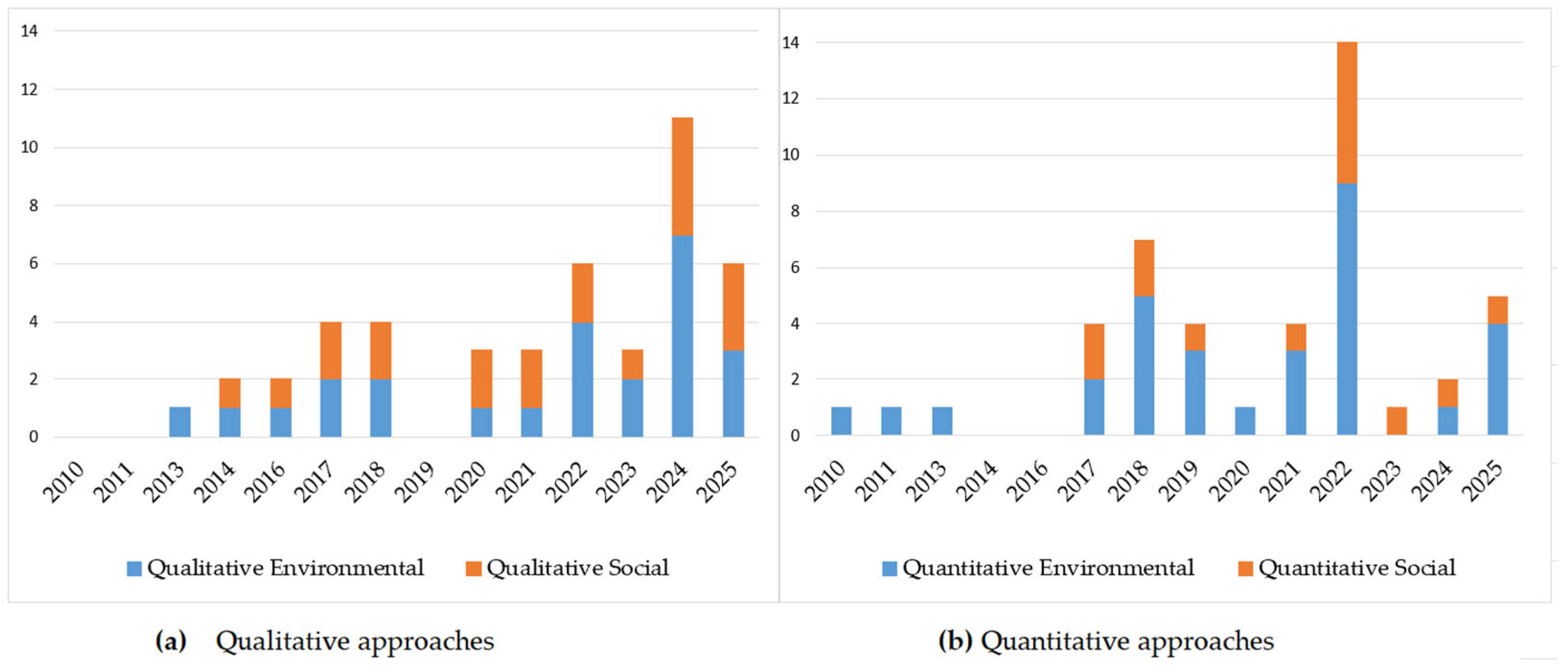
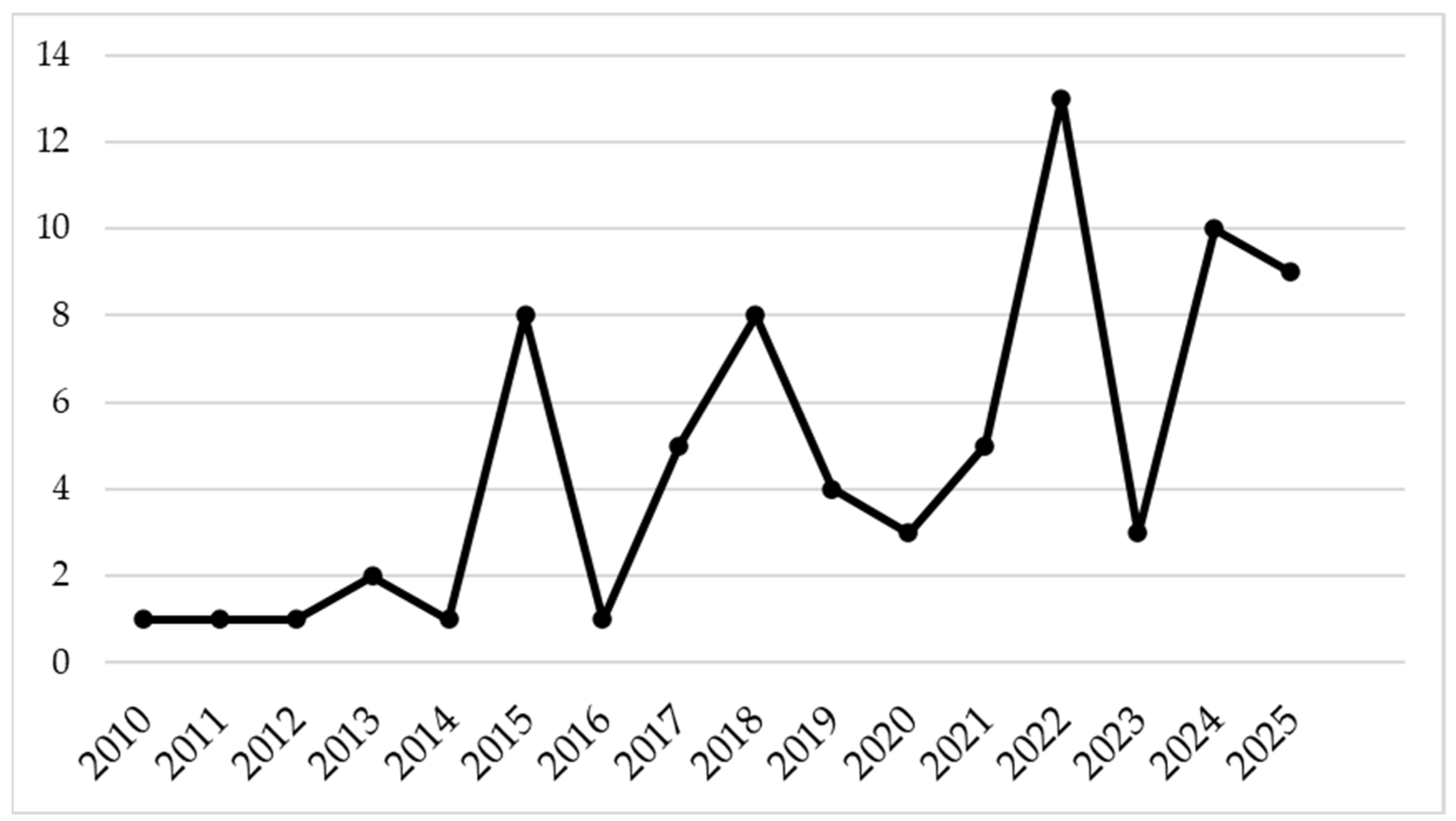
3.1. Descriptive Characteristics of the Reviewed Studies
3.2. Quantitative Metrics for Optimization and Prioritization
3.2.1. Environmental Indicators
3.2.2. Social Indicators
3.2.3. Governance Indicators
3.3. Qualitative and Framework-Based Metrics in TAM
4. Discussion and Future Research Directions
5. Conclusions
Author Contributions
Funding
Data Availability Statement
Conflicts of Interest
Abbreviations
| ESG | Environmental, Social, and Governance |
| PRISMA | Preferred Reporting Items for Systematic Reviews and Meta-Analyses |
| LCA | Life-Cycle Assessment |
| LCCA | Life-Cycle Cost Analysis |
| TAM | Transportation Asset Management |
| M&R | Maintenance and Rehabilitation |
References
- Mehraban, R.A.; Tsantilis, L.; Riviera, P.P.; Santagata, E. Comprehensive Analysis of Sustainability Rating Systems for Road Infrastructure. Infrastructures 2025, 10, 17. [Google Scholar] [CrossRef] [Scilit]
- Jaramillo, P.; Kahn Ribeiro, S.; Newman, P.; Dhar, S.; Diemuodeke, O.E.; Kajino, T.; Lee, D.S.; Nugroho, S.B.; Ou, X.; Hammer Strømman, A. Transport (chapter 10). In IPCC 2022: Climate Change 2022: Mitigation of Climate Change. Contribution of Working Group III to the Sixth Assessment Report of the Intergovernmental Panel on Climate Change; Cambridge University Press: Cambridge, UK; New York, NY, USA, 2023; pp. 1049–1160. [Google Scholar]
- Akiyama, M. Life-cycle approaches to sustainable and resilient infrastructure: Innovations in multi-hazard frameworks. Struct. Infrastruct. Eng. 2025, 21, 1756–1781. [Google Scholar] [CrossRef] [Scilit]
- Hong, T.; Chae, M.J.; Kim, D.; Koo, C.; Lee, K.S.; Chin, K.H. Infrastructure asset management system for bridge projects in South Korea. KSCE J. Civ. Eng. 2013, 17, 1551–1561. [Google Scholar] [CrossRef] [Scilit]
- Santos, J.; Ferreira, A.; Flintsch, G.; Cerezo, V. A multi-objective optimisation approach for sustainable pavement management. Struct. Infrastruct. Eng. 2018, 14, 854–868. [Google Scholar] [CrossRef] [Scilit]
- Miller, M.C.; Gransberg, D. Measuring users’ impact to support economic growth through Transportation Asset Management planning. Int. J. Public Policy 2017, 13, 323–336. [Google Scholar] [CrossRef] [Scilit]
- Chamorro, A.; Tighe, S.L. Development of a management framework for rural roads in developing countries: Integrating socioeconomic impacts. Transp. Res. Rec. 2009, 2093, 99–107. [Google Scholar] [CrossRef] [Scilit]
- Torres Machí, C.; Chamorro, A.; Yepes Piqueras, V.; Pellicer Armiñana, E. Current models and practices of economic and environmental evaluation for sustainable network-level pavement management. Rev. Constr. 2014, 13, 49–56. [Google Scholar] [CrossRef] [Scilit]
- Delucchi, M.A. The annualized social cost of motor-vehicle use in the US, 1990–1991: Summary of theory, data, methods, and results. In Social Costs and Sustainability; Springer: Berlin/Heidelberg, Germany, 1997. [Google Scholar]
- Wu, Z.; Flintsch, G.W. Pavement preservation optimization considering multiple objectives and budget variability. J. Transp. Eng. 2009, 135, 305–315. [Google Scholar] [CrossRef] [Scilit]
- Santos, J.; Cerezo, V.; Flintsch, G.; Ferreira, A. A many-objective optimization model for sustainable pavement management considering several sustainability metrics through a multi-dimensionality reduction approach. In Life-Cycle Analysis and Assessment in Civil Engineering: Towards an Integrated Vision; CRC Press: Boca Raton, FL, USA, 2019; pp. 1451–1457. [Google Scholar]
- Santos, J.; Ferreira, A.; Flintsch, G. A multi-objective optimization-based pavement management decision-support system for enhancing pavement sustainability. J. Clean. Prod. 2017, 164, 1380–1393. [Google Scholar] [CrossRef] [Scilit]
- Brundtland, G.H. Our common future—Call for action. Environ. Conserv. 1987, 14, 291–294. [Google Scholar] [CrossRef] [Scilit]
- Rarasati, A.D.; Iskandar, T.R. Integrated sustainability for transportation infrastructure development in Indonesia: A case study of Karawang region. In Proceedings of the MATEC Web of Conferences; EDP Sciences: Les Ulis, France, 2017. [Google Scholar]
- Zuluaga, S.; Karney, B.W.; Saxe, S. The concept of value in sustainable infrastructure systems: A literature review. Environ. Res. Infrastruct. Sustain. 2021, 1, 022001. [Google Scholar] [CrossRef] [Scilit]
- Qi, X.; Wang, B.; Gao, Q. Environment, social and governance research of infrastructure investment: A literature review. J. Clean. Prod. 2023, 425, 139030. [Google Scholar] [CrossRef] [Scilit]
- Page, M.J.; McKenzie, J.E.; Bossuyt, P.M.; Boutron, I.; Hoffmann, T.C.; Mulrow, C.D.; Shamseer, L.; Tetzlaff, J.M.; Akl, E.A.; Brennan, S.E. The PRISMA 2020 statement: An updated guideline for reporting systematic reviews. BMJ 2021, 372, 71. [Google Scholar] [CrossRef] [Scilit] [PubMed]
- Lee, B.X.; Kjaerulf, F.; Turner, S.; Cohen, L.; Donnelly, P.D.; Muggah, R.; Davis, R.; Realini, A.; Kieselbach, B.; MacGregor, L.S. Transforming our world: Implementing the 2030 agenda through sustainable development goal indicators. J. Public Health Policy 2016, 37, 13–31. [Google Scholar] [CrossRef] [Scilit] [PubMed]
- Pearson, Y.E.; Alexander, Q.G.; Cropps, T.A.; Walker Thornton, T.A. Opportunities for Advancing ESG Principles through Academic–Workforce Collaborations. J. Manag. Eng. 2025, 41, 05025003. [Google Scholar] [CrossRef] [Scilit]
- Kothari, C.; France-Mensah, J.; O’Brien, W.J. Developing a Sustainable Pavement Management Plan: Economics, Environment, and Social Equity. J. Infrastruct. Syst. 2022, 28, 04022009. [Google Scholar] [CrossRef] [Scilit]
- France-Mensah, J.; O’brien, W.J. Developing a sustainable pavement management plan: Tradeoffs in road condition, user costs, and greenhouse gas emissions. J. Manag. Eng. 2019, 35, 04019005. [Google Scholar] [CrossRef] [Scilit]
- Santos, J.; Ferreira, A.; Flintsch, G. A life cycle assessment model for pavement management: Methodology and computational framework. Int. J. Pavement Eng. 2015, 16, 268–286. [Google Scholar] [CrossRef] [Scilit]
- Negishi, K.; Fishcer, L.; De Montaignac, R. A systematic digitalization for climate mitigation and adaptation measures in long-term road planning. In Proceedings of the International Symposium on Pavement, Roadway, and Bridge Life Cycle Assessment; Springer: Berlin/Heidelberg, Germany, 2024. [Google Scholar]
- Torres-Machí, C.; Chamorro, A.; Pellicer, E.; Yepes, V.; Videla, C. Sustainable pavement management: Integrating economic, technical, and environmental aspects in decision making. Transp. Res. Rec. 2015, 2523, 56–63. [Google Scholar] [CrossRef] [Scilit]
- Li, J.; Pitt, M.; Ma, L.; Jia, J.; Jiang, F. A multi-objective differential evolutionary algorithm for optimal sustainable pavement maintenance plan at the network level. J. Clean. Prod. 2022, 381, 135212. [Google Scholar] [CrossRef] [Scilit]
- de Bortoli, A.; Féraille, A.; Leurent, F. Towards road sustainability—Part I: Principles and holistic assessment method for pavement maintenance policies. Sustainability 2022, 14, 1513. [Google Scholar] [CrossRef] [Scilit]
- Kleizienė, R.; van de Beek, M.; Zofka, A.; Karbočius, M. Application of single score methods for environmental impact assessment to compare pavement technologies. Road Mater. Pavement Des. 2025, 26, 503–524. [Google Scholar] [CrossRef] [Scilit]
- Ni, C.; Li, Y.; Su, H.; Zeng, S. Evaluation Method for Sustainability of Linear Infrastructure Projects in Complex Environment Based on Pythagoras Fuzzy AHP. In Proceedings of the International Conference on Construction and Real Estate Management 2021 (ICCREM 2021), Beijing, China, 16–17 October 2021; pp. 655–665. [Google Scholar]
- Zhao, Y.; Goulias, D.; Peterson, D. Recycled Asphalt Pavement materials in transport pavement infrastructure: Sustainability analysis & metrics. Sustainability 2021, 13, 8071. [Google Scholar] [CrossRef] [Scilit]
- Akbas, M.; Akin, F.D. A Comparative Weighting Analysis Using AHP and CRITIC for Recycled Pavement Material Selection: A Case Study from Istanbul. Results Eng. 2025, 27, 106837. [Google Scholar] [CrossRef] [Scilit]
- Jamieson, S.; White, G.; Verstraten, L. Principles for incorporating recycled materials into airport pavement construction for more sustainable airport pavements. Sustainability 2024, 16, 7586. [Google Scholar] [CrossRef] [Scilit]
- Pulecio-Díaz, J. Curing Sustainability Assessment in Concrete Pavements: A 20-Year Simulation-Based Analysis in Urban Road Contexts. Sustainability 2025, 17, 5299. [Google Scholar] [CrossRef] [Scilit]
- Gilbert, H.E.; Rosado, P.J.; Ban-Weiss, G.; Harvey, J.T.; Li, H.; Mandel, B.H.; Millstein, D.; Mohegh, A.; Saboori, A.; Levinson, R.M. Energy and environmental consequences of a cool pavement campaign. Energy Build. 2017, 157, 53–77. [Google Scholar] [CrossRef] [Scilit]
- Pittenger, D.M. Evaluating Sustainability of Selected Airport Pavement Treatments with Life-Cycle Cost, Raw Material Consumption, and Greenroads Standards. Transp. Res. Rec. 2011, 2206, 61–68. [Google Scholar] [CrossRef] [Scilit]
- Torres-Machi, C.; Osorio, A.; Godoy, P.; Chamorro, A.; Mourgues, C.; Videla, C. Sustainable Management Framework for Transportation Assets: Application to Urban Pavement Networks. KSCE J. Civ. Eng. 2018, 22, 4095–4106. [Google Scholar] [CrossRef] [Scilit]
- Oswald Beiler, M.R.; Treat, C. Integrating GIS and AHP to prioritize transportation infrastructure using sustainability metrics. J. Infrastruct. Syst. 2015, 21, 04014053. [Google Scholar] [CrossRef] [Scilit]
- Zhang, H.; Keoleian, G.A.; Lepech, M.D. Network-level pavement asset management system integrated with life-cycle analysis and life-cycle optimization. J. Infrastruct. Syst. 2013, 19, 99–107. [Google Scholar] [CrossRef] [Scilit]
- Reger, D.; Madanat, S.; Horvath, A. The effect of agency budgets on minimizing greenhouse gas emissions from road rehabilitation policies. Environ. Res. Lett. 2015, 10, 114007. [Google Scholar] [CrossRef] [Scilit]
- Zhang, H.; Keoleian, G.A.; Lepech, M.D.; Kendall, A. Life-cycle optimization of pavement overlay systems. J. Infrastruct. Syst. 2010, 16, 310–322. [Google Scholar] [CrossRef] [Scilit]
- Santos, J.; Torres-Machi, C.; Morillas, S.; Cerezo, V. A fuzzy logic expert system for selecting optimal and sustainable life cycle maintenance and rehabilitation strategies for road pavements. Int. J. Pavement Eng. 2022, 23, 425–437. [Google Scholar] [CrossRef] [Scilit]
- Chen, W.; Zheng, M.; Ding, X.; Zhang, W.; Wang, F. Multiobjective optimization model to coordinate between segment and network level for managing pavement and sustainability. J. Transp. Eng. Part B Pavements 2022, 148, 04021074. [Google Scholar] [CrossRef] [Scilit]
- Mosier, R.D.; Adhikari, S.; Mohanty, S.K. A comparison of the carbon footprint of pavement infrastructure and associated materials in Indiana and Oklahoma. Int. J. Adv. Appl. Sci. 2020, 9, 227–239. [Google Scholar] [CrossRef] [Scilit]
- Fenton, M. Carbon dioxide management in a major UK infrastructure project: High Speed Two. In Proceedings of the Institution of Civil Engineers-Civil Engineering; Thomas Telford Ltd.: London, UK, 2019. [Google Scholar]
- de Bortoli, A.; Féraille, A.; Leurent, F. Towards road sustainability—Part II: Applied holistic assessment and lessons learned from french highway resurfacing strategies. Sustainability 2022, 14, 7336. [Google Scholar] [CrossRef] [Scilit]
- Goulias, D.; Zhang, Y.; Aydilek, A. Sustainability Assessment of Roadways through Economic and Environmental Impact Life Cycle Analysis. Int. J. Comput. Eng. Res 2018, 8, 1–8. [Google Scholar]
- Torres-Machi, C.; Nasir, F.; Achebe, J.; Saari, R.; Tighe, S.L. Sustainability evaluation of pavement technologies through multicriteria decision techniques. J. Infrastruct. Syst. 2019, 25, 04019023. [Google Scholar] [CrossRef] [Scilit]
- Hong, F.; Prozzi, J.A. Evaluation of recycled asphalt pavement using economic, environmental, and energy metrics based on long-term pavement performance sections. Road Mater. Pavement Des. 2018, 19, 1816–1831. [Google Scholar] [CrossRef] [Scilit]
- Amarh, E.A.; Santos, J.; Flintsch, G.W.; Diefenderfer, B.K. Evaluating the potential environmental benefits of cold recycling-based methods for flexible pavement rehabilitation in Virginia. Transp. Res. Rec. 2022, 2676, 75–86. [Google Scholar] [CrossRef] [Scilit]
- Hernando, D.; Moins, B.; Van den Bergh, W.; Audenaert, A. Identification of the main environmental impact categories over the life cycle of hot mix asphalt: An application to green public procurement. Transp. Res. Rec. 2022, 2676, 322–335. [Google Scholar] [CrossRef] [Scilit]
- Zhao, Y.; Goulias, D.; Tefa, L.; Bassani, M. Life cycle economic and environmental impacts of CDW recycled aggregates in roadway construction and rehabilitation. Sustainability 2021, 13, 8611. [Google Scholar] [CrossRef] [Scilit]
- Ziyadi, M.; Ozer, H.; Kang, S.; Al-Qadi, I.L. Vehicle energy consumption and an environmental impact calculation model for the transportation infrastructure systems. J. Clean. Prod. 2018, 174, 424–436. [Google Scholar] [CrossRef] [Scilit]
- Chen, W.; Zheng, M.; Lu, C.; Tian, N.; Ding, X.; Li, N. Multi-objective decision support system for large-scale network pavement maintenance and rehabilitation management to enhance sustainability. J. Clean. Prod. 2022, 380, 135028. [Google Scholar] [CrossRef] [Scilit]
- Okte, E.; Boakye, J.; Behrend, M. Quantitative Measures of Social Sustainability for Pavements: Future Directions for Implementation. In Proceedings of the Pavement, Roadway, and Bridge Life Cycle Assessment 2024, ISPRB LCA 2024; Springer: Cham, Switzerland, 2024; pp. 1–8. [Google Scholar]
- Miller, M.C.; Gransberg, D.D. Integrating social impact to bridge’s asset management plans. Infrastruct. Asset Manag. 2015, 2, 3–14. [Google Scholar] [CrossRef] [Scilit]
- Karner, A.; London, J.; Rowangould, D.; Manaugh, K. From transportation equity to transportation justice: Within, through, and beyond the state. J. Plan. Lit. 2020, 35, 440–459. [Google Scholar] [CrossRef] [Scilit]
- Furman, E.; Kye, Y.; Su, J. Computing the Gini index: A note. Econ. Lett. 2019, 185, 108753. [Google Scholar] [CrossRef] [Scilit]
- France-Mensah, J.; Kothari, C.; O’Brien, W.J.; Jiao, J.F. Integrating social equity in highway maintenance and rehabilitation programming: A quantitative approach. Sustain. Cities Soc. 2019, 48, 101526. [Google Scholar] [CrossRef] [Scilit]
- Gandy, C.A.; Armanios, D.E.; Samaras, C. Social equity of bridge management. J. Manag. Eng. 2023, 39, 04023027. [Google Scholar] [CrossRef] [Scilit]
- Santos, B.; Picado-Santos, L.; Cavaleiro, V.; Neves, J. User costs in road life-cycle cost evaluation and optimisation. In Proceedings of the 4th European Pavement and Asset Management Conference, Malmö, Sweden, 5–7 September 2012. [Google Scholar]
- Dong, Y.; Frangopol, D.M.; Sabatino, S. Optimizing bridge network retrofit planning based on cost-benefit evaluation and multi-attribute utility associated with sustainability. Earthq. Spectra 2015, 31, 2255–2280. [Google Scholar] [CrossRef] [Scilit]
- Terry, J.R. Improving the Fiscal Transparency and Sustainability of Public-Sector Transportation Infrastructure; University of Waterloo: Waterloo, ON, Canada, 2017. [Google Scholar]
- Seyedshohadaie, S.R.; Damnjanovic, I.; Butenko, S. Risk-based maintenance and rehabilitation decisions for transportation infrastructure networks. Transp. Res. Part A Policy Pract. 2010, 44, 236–248. [Google Scholar] [CrossRef] [Scilit]
- Guo, F.; Chang-Richards, Y.; Wilkinson, S.; Li, T.C. Effects of project governance structures on the management of risks in major infrastructure projects: A comparative analysis. Int. J. Proj. Manag. 2014, 32, 815–826. [Google Scholar] [CrossRef] [Scilit]
- Turner, R. How does governance influence decision making on projects and in project-based organizations? Proj. Manag. J. 2020, 51, 670–684. [Google Scholar] [CrossRef] [Scilit]
- Zhang, R.; Fu, Y.; Chen, Y.; Du, B. Down to earth: Implementing project-level ESG metrics in Chinese AEC firms’ practices. J. Manag. Eng. 2024, 40, 04024035. [Google Scholar] [CrossRef] [Scilit]
- ul Musawir, A.; Abd-Karim, S.B.; Mohd-Danuri, M.S. Project governance and its role in enabling organizational strategy implementation: A systematic literature review. Int. J. Proj. Manag. 2020, 38, 1–16. [Google Scholar] [CrossRef] [Scilit]
- Derakhshan, R.; Turner, R.; Mancini, M. Project governance and stakeholders: A literature review. Int. J. Proj. Manag. 2019, 37, 98–116. [Google Scholar] [CrossRef] [Scilit]
- Sowerby, C.; Langstraat, J.; Harmer, C.; Folkeson, L.; Gudmundsson, H. SUNRA-a sustainability rating system framework for National Road Administrations. In Proceedings of the Transport Research Arena 2014, Paris, France, 14–17 April 2014. [Google Scholar]
- Anderson-Sköld, Y.; Afridi, M.A.; Nordin, L.; Patricio, J.; Lindgren, Å.; Johansson, C.-M.; Olofsson, A.; Andersson, A.; Erlingsson, S. Development of the SUNRA tool to improve regional and local sustainability of the transportation sector. Sustainability 2022, 14, 11275. [Google Scholar] [CrossRef] [Scilit]
- Szpotowicz, R.; Tóth, C. Revision of sustainable road rating systems: Selection of the best suited system for Hungarian road construction using TOPSIS method. Sustainability 2020, 12, 8884. [Google Scholar] [CrossRef] [Scilit]
- Asres, E.; Ghebrab, T.; Ekwaro-Osire, S. Framework for design of sustainable flexible pavement. Infrastructures 2021, 7, 6. [Google Scholar] [CrossRef] [Scilit]
- Li, J.; Pitt, M.; Ma, L. A Framework of Gis-Based Decision Support System for Highway Pavement Maintenance Management at the Network Level. In Proceedings of the 29th Annual Pacific Rim Real Estate Society Conference, Sydney, Australia, 15–17 January 2023. [Google Scholar]
- de Medeiros Pereira, H.; Júnior, J.E.B.; de Albuquerque Nóbrega, R.A. Geospatial-based decision support system for prioritizing road segments for maintenance and rehabilitation. Case Stud. Transp. Policy 2024, 16, 101170. [Google Scholar] [CrossRef] [Scilit]
- Rexhaj, G. The role of Building Information Modelling in the implementation of sustainable, environmentally friendly, and social infrastructure projects. Archit. Stud. 2024, 1, 69–78. [Google Scholar] [CrossRef] [Scilit]
- Lei, X.; Dong, Y.; Frangopol, D.M. Integration of inspection and monitoring data for RL-enhanced sustainable life-cycle management of infrastructure networks. Struct. Infrastruct. Eng. 2025, 21, 1288–1302. [Google Scholar] [CrossRef] [Scilit]
- Rehman, A. The role of building information modeling (BIM) in risk management for sustainable bridge projects: A systematic review and meta-analysis. J. Sustain. Dev. Policy 2025, 1, 198–223. [Google Scholar] [CrossRef]
- Ng, S.T.; Xu, F.J.; Yang, Y.; Li, H.; Li, J. A social networking enabled crowdsourcing system for integrated infrastructure asset management. In Proceedings of the Construction Research Congress 2018, New Orleans, LA, USA, 2–4 April 2018. [Google Scholar]
- Vieira, J.; Poças Martins, J.; Marques de Almeida, N.; Patrício, H.; Gomes Morgado, J. Towards resilient and sustainable rail and road networks: A systematic literature review on digital twins. Sustainability 2022, 14, 7060. [Google Scholar] [CrossRef] [Scilit]
- Schneider, F.A.; Epel, E.; Middel, A. A disconnect in science and practitioner perspectives on heat mitigation. npj Urban Sustain. 2024, 4, 17. [Google Scholar] [CrossRef] [Scilit]
- Manaugh, K.; Badami, M.G.; El-Geneidy, A.M. Integrating social equity into urban transportation planning: A critical evaluation of equity objectives and measures in transportation plans in North America. Transp. Policy 2015, 37, 167–176. [Google Scholar] [CrossRef] [Scilit]
- Ramani, T.; Zietsman, J.; Pryn, M.R. Towards Sustainable Transport Planning in the United States. Eur. J. Transp. Infrastruct. Res. 2018, 18, 276–294. [Google Scholar] [CrossRef] [Scilit]
- Fidan, F.Ş.; Aydoğan, E.K.; Uzal, N. Comprehensive analysis of social subcategories throughout life cycle assessment approach for the textile industry. Int. J. Life Cycle Assess. 2025, 30, 1464–1479. [Google Scholar] [CrossRef] [Scilit]
- Pollok, L.; Spierling, S.; Endres, H.-J.; Grote, U. Social life cycle assessments: A review on past development, advances and methodological challenges. Sustainability 2021, 13, 10286. [Google Scholar] [CrossRef] [Scilit]
- Targett, M. PANYNJ Sustainable Design Guidelines and Envision. In Proceedings of the International Conference on Sustainable Infrastructure 2017, New York, NY, USA, 26–28 October 2017. [Google Scholar]
- Griffiths, K.; Boyle, C.; Henning, T.F.P. Sustainability rating tools for highway projects: The nature and outcomes of use. Infrastruct. Asset Manag. 2018, 5, 35–44. [Google Scholar] [CrossRef] [Scilit]
- Shaw, G.; Walters, R.; Kumar, A.; Sprigg, A. Sustainability in Infrastructure Asset Management. In Proceedings of the 7th World Congress on Engineering Asset Management (WCEAM 2012); Springer: Cham, Switzerland, 2015; pp. 525–534. [Google Scholar]
- Adzar, J.A.; Zakaria, R.; Aminudin, E.; Raj, D.R.; Ishak, R.; Sahadan, M.F.; Radzi, R.M.; Rashid, M.H.S.A.; Munikan, V.; Shamsudin, S.M. Managing Damages Recovery: Adopting Green Road Operation and Maintenance Index Criteria. In Proceedings of the Symposium on Damage Mechanism in Materials and Structures; Springer: Berlin/Heidelberg, Germany, 2020. [Google Scholar]
- Myakala, R.; Shankar, S. Environmental Sustainability Assessment of Rural Road Maintenance Using Environmental Impact Assessment Tool. In Proceedings of the International Conference on Structural Engineering and Construction Management; Springer: Berlin/Heidelberg, Germany, 2023. [Google Scholar]
- Lew, J.B.; Anderson, J.L.; Muench, S.T. Informing roadway sustainability practices by using greenroads certified project data. Transp. Res. Rec. 2016, 2589. [Google Scholar] [CrossRef] [Scilit]
- Myakala, R.R.; Sabavath, S. Sustainable performance evaluation of low-volume rural roads using the analytic hierarchy process. Innov. Infrastruct. Solut. 2024, 9, 358. [Google Scholar] [CrossRef] [Scilit]
- Tighe, S.; Gransberg, D. Demonstrating how sustainability can effectively be incorporated into pavement engineering and management. In Proceedings of the Airfield and Highway Pavement 2013: Sustainable and Efficient Pavements, Los Angeles, CA, USA, 9–12 June 2013; pp. 76–91. [Google Scholar]
- Dokyi, G.O.; Tookey, J.; Rotimi, F.E.; Osei, K.K. A framework of indicators for sustainable road and highway infrastructure development in developing countries: The Ghana context. J. Constr. Dev. Ctries. 2024, 29, 257–287. [Google Scholar] [CrossRef] [Scilit]
- Mandi, J.V.S.; Hasanah, A.; Henning, T.F. Innovation pathways within road performance management to upgrade investment analysis: A walkthrough of New Zealand and Philippine resilience landscapes. In Roads and Airports Pavement Surface Characteristics; CRC Press: Boca Raton, FL, USA, 2023; pp. 500–512. [Google Scholar]
- Boakye, J.; Okte, E. Which impacts matter for pavement management decisions? Quantifying social sustainability based on a capability approach. Transp. Res. Interdiscip. Perspect. 2025, 29, 101312. [Google Scholar] [CrossRef] [Scilit]
- Dostál, I.; Anděl, P.; Jedlička, J.; Havlíček, M. A methodological framework for addressing environmental problems on aged transport infrastructure. Nat. Conserv. 2024, 57, 69–88. [Google Scholar] [CrossRef] [Scilit]



| Metric | Description | Unit | Application in TAM | References |
|---|---|---|---|---|
| Emissions and Consumption Category | ||||
| GHG Emissions | Minimization of GHG emissions from materials and construction and traffic disruptions | kg | M&R Optimization/Prioritization, LCA, and LCCA | [5,12,20,36,37,38,39] |
| Carbon Emissions | Minimization of carbon emissions based on each treatment type due to materials, transportation, and on-site work. | kg | M&R Optimization/Prioritization, LCA, and LCCA | [23,24,25,40,41,42,43] |
| Energy Consumption | Minimizing total energy use across the lifecycle | MJ | M&R Optimization/Prioritization, LCA, and LCCA | [11,26,37,39,44] |
| Material Choice | ||||
| Raw Material Consumption (RMC) | Measures total material mass used per treatment | kg | Material selection | [34] |
| RAP material usage | Energy and water consumption, life cycle cost, and global warming potential can be reduced significantly by increasing the percentage of RAP. | percentage | Material selection and LCA | [29,45,46,47,48,49] |
| Cool pavement | Changes in building energy use due to ambient temperature changes | - | Material selection and LCA | [33] |
| RCA material usage | Increasing the percentage of RCA usage leads to a reduction in CO2 emissions, lower energy consumption, and overall improvement in environmental impacts. | Percentage | Material selection and LCA and LCCA | [30,45,50] |
| Indices | ||||
| The life cycle environmental burdens arising | Environmental impacts are obtained by employing the US-based impact assessment methodology, the Tool for the Reduction and Assessment of Chemical and Other Environmental Impacts. | Index | LCA | [12] |
| Roughness speed index (RSI) | The RSI model accounts for the additional rolling resistance of vehicles resulting from pavement surface properties measured in terms of smoothness as well as vehicle efficiency improvements over time. | Index | M&R Optimization/Prioritization | [22,51] |
| Environmental coefficient (βenv) | By using this environmental coefficient, maintenance alternatives producing lower GHG emissions will receive lower penalizations and thus better evaluations than those alternatives producing higher GHG emissions. | Score | M&R Optimization/Prioritization | [35] |
| Minimization of seven life cycle impact category indicators | They are as follows: (1) climate change (CC); (2) acidification (AC); (3) eutrophication (EU); (4) human toxicity (HT); (5) abiotic resources depletion (ARD); (6) terrestrial ecotoxicity (TE); and (7) particulate matter | Score | LCA | [11] |
| Environmental burden | Emissions from construction equipment and on-road vehicles in operating conditions | Index | M&R Optimization/Prioritization | [22,26] |
| Greenroads Score | Sustainability score combining material use, energy, emissions, equity, governance, etc. | Score | M&R Optimization/Prioritization | [34] |
| LSEI (life cycle environmental impacts) | Emissions or resource use per M&R strategy | Index | M&R Optimization/Prioritization | [52] |
| Metric | Definition/Description | Unit | Application in TAM | References |
|---|---|---|---|---|
| GINI Index | It measures income inequality, and the goal is to minimize the difference between the disadvantaged group and the rest of the network. | Score | M&R Optimization/Prioritization | [20,53,57] |
| Theil index | Score | M&R Optimization/Prioritization | [53,57] | |
| Benefit Distribution Ratio | Compares the benefits received vs. the needs in underserved communities | Ratio | M&R Optimization/Prioritization | [57] |
| User Costs | Includes delay, accident, and vehicle operating costs | USD | Budget allocation and LCCA | [52,59,60] |
| Long-term pavement performance (LTPP) | Pavements in better condition can provide road users with better service and produce more benefits to society. Therefore, given a maintenance plan, its social benefit can be evaluated by the LTPP | Index | M&R Optimization/Prioritization | [25] |
| Present value of the total life cycle road user costs (LCRUC) | USD | LCCA | [5,12] | |
| Social Return on Investment (SROI) | The SROI is a framework based on ‘social generally accepted accounting principles’ that can be used to quantify and understand the social, economic, and environmental outcomes | Index | M&R Optimization/Prioritization | [54] |
| Sociopolitical Factor (SPF) | Assesses the relevance of the section of the network in socio-political terms | Index | M&R Optimization/Prioritization | [35] |
| Road Noise Health Impact Indicator | Indicator of the impact of road noise on local residents | Index | M&R Optimization/Prioritization, and LCCA | [26,44] |
| Users’ Time Saving Indicator | Time loss for a vehicle | Index | M&R Optimization/Prioritization, and LCCA | [26] |
| Climate and Economic Justice Screening Tool (CEJST) | Identifies “disadvantaged communities” based on environmental, health, and economic indicators. Used in the Justice40 initiative. | Binary (Disadvantaged/Not Disadvantaged) | M&R Optimization/Prioritization | [58] |
| Demographic Indicators | Census-based racial and ethnic composition, including majority Black or African American and Hispanic or Latino tracts. | Percentage | M&R Optimization/Prioritization | [58] |
| Median Household Income | Socioeconomic indicator measuring the median income of households in a given census tract. | US Dollars ($) | M&R Optimization/Prioritization | [58] |
| Envision | Ceequal | Green Roads | IS | |
|---|---|---|---|---|
| Environmental | Natural world; climate change and risk | Physical resources; land use and landscape; ecology and biodiversity; the water environment; the historic environment | Material and resources; pavement technologies; environment and water | Using resources, materials, and waste; ecology |
| Social | Quality of life | People and communities | Access and equity | People and places |
| Governance | Leadership; resource allocation | Project strategy; project management | Project requirements; construction activities; custom credits | Management and governance; innovation |
Disclaimer/Publisher’s Note: The statements, opinions and data contained in all publications are solely those of the individual author(s) and contributor(s) and not of MDPI and/or the editor(s). MDPI and/or the editor(s) disclaim responsibility for any injury to people or property resulting from any ideas, methods, instructions or products referred to in the content. |
© 2026 by the authors. Licensee MDPI, Basel, Switzerland. This article is an open access article distributed under the terms and conditions of the Creative Commons Attribution (CC BY) license.
Share and Cite
Ahmadi, L.; Demetracopoulou, V.; Maher, A. Quantifying Sustainability in Transportation Asset Management: A Review of Environmental, Social, and Governance (ESG) Metrics. Sustainability 2026, 18, 4051. https://doi.org/10.3390/su18084051
Ahmadi L, Demetracopoulou V, Maher A. Quantifying Sustainability in Transportation Asset Management: A Review of Environmental, Social, and Governance (ESG) Metrics. Sustainability. 2026; 18(8):4051. https://doi.org/10.3390/su18084051
Chicago/Turabian StyleAhmadi, Loqman, Vassiliki Demetracopoulou, and Ali Maher. 2026. "Quantifying Sustainability in Transportation Asset Management: A Review of Environmental, Social, and Governance (ESG) Metrics" Sustainability 18, no. 8: 4051. https://doi.org/10.3390/su18084051
APA StyleAhmadi, L., Demetracopoulou, V., & Maher, A. (2026). Quantifying Sustainability in Transportation Asset Management: A Review of Environmental, Social, and Governance (ESG) Metrics. Sustainability, 18(8), 4051. https://doi.org/10.3390/su18084051