1. Introduction
According to estimates by CLIA (Cruise Lines International Association), the organization that oversees the value of the cruise industry, by the end of 2024, approximately 34.6 million passengers had been transported by sea on large passenger ships.
Such intense and constantly increasing traffic places significant pressures on ports of origin and destination, which in turn produce contrasting effects on the cities in which they are located. Most of the literature on cruise tourism tends to focus on two main areas: on-board research, which analyzes aspects such as accommodation, catering, entertainment, and recreational activities offered by cruise ships, and onshore research, which focuses mainly on tourist attractions and passenger satisfaction in ports of call [
1,
2,
3]. However, there are still relatively few studies that address in depth the external influences of cruise tourism flow within port cities themselves, and how these pressures are spatially distributed and may affect the socio-environmental conditions of neighborhoods.
Economy, society, and environment are the three main areas in which the most relevant impacts are observed. Among these, only economic impacts seem to present a dual nature, where positive and negative aspects tend to balance each other. By contrast, in the social and environmental spheres, negative impacts tend to clearly prevail over the others.
These impacts tend to concentrate in space and time, leaving a marked footprint on port areas and, more generally, on port cities. The main reasons for this concentration can be traced back to three principal factors. First, the similarity between the schedules organized by different shipping companies leads to large cruise ships arriving in port in the morning and departing in the afternoon, sailing at night toward the next destination. This homogeneous scheduling results in a temporal concentration of port activities and, consequently, possible congestion in port areas themselves, surrounding cities, and major attractions, a factor that may prove disturbing both for residents and for tourists [
4,
5,
6].
Second, the length of a cruise ship’s stay in a port often leads cruise passengers to form only a superficial impression of a destination’s culture and nature. In this context, organized cultural events and “folkloristic” shows can be described as a “staging of authenticity” [
7], encouraging the homogenization and trivialization of culture. Promotional strategies and tourism narratives tend to emphasize accessibility, cultural appeal, and waterfront experiences, thereby reinforcing patterns of short-term visitation and the concentration of tourism-related activities in specific urban areas. In particular, the space–time compression generated by pre-defined itineraries promoted by cruise companies fosters the formation of highly structured tourist pathways, which may contribute to intensifying the socio-cultural impacts associated with this segment of tourism [
8,
9].
Finally, the seasonality of cruise tourism. Shipping companies seasonally change the distribution areas of cruise ships to meet passengers’ tourism demands and attempt to optimize the use of their resources throughout the year by repositioning themselves to exploit market seasonality [
10,
11]. Considering the two main cruise markets, namely the Mediterranean and the Caribbean [
12], it can be stated that when one season ends, the other begins, and vice versa. In the Mediterranean region, there is a concentration of port calls between May and October. As a result, pressure on ports increases even further.
These effects, accumulating over time, tend to stratify, generating a footprint that can compromise the balance and livability of the affected areas.
While in recent years great attention has been given to recognizing the environmental, social, and economic impacts of cruise tourism at the city scale, less attention has been paid to the distribution of these impacts within cities themselves. In particular, few studies have investigated whether cruise-related environmental pressures have the capacity to disproportionately affect urban areas and how peaks in cruise activity may intensify existing socio-environmental inequalities at the neighborhood level. Moreover, existing studies often rely on aggregated indicators or annual averages, overlooking the spatial heterogeneity of urban contexts and the role of short-term concentration effects.
To fill these gaps, this study presents the GIS-based PRISM (an acronym for Port-city Risk Integrated Spatial Method) approach and applies it to the port city of Malaga, in southern Spain, with the aim of assessing the spatial relationship between the environmental impacts of cruises and urban socio-environmental complexity.
To develop this approach, a methodological framework was adopted that links principles of environmental justice with a risk-oriented interpretation, conceived not in a predictive sense but as an interpretative lens useful for highlighting the spatial distribution of urban pressures and fragilities. From this perspective, socio-environmental inequality emerges from the interaction between social vulnerability, population exposure levels, urban capacity, and tourism-related pressures, providing a baseline on which to overlay cruise-related emissions. The risk lens therefore operates as a heuristic device that guides the selection of indicators, the construction of the composite Urban Socio-Environmental Complexity Index, and the interpretation of results, without constituting a risk assessment in a strict sense. The index represents the synthetic outcome of the analytical process and allows the cumulative interaction between the different dimensions considered to be returned in spatialized form.
For the construction of the approach, a methodological framework combining risk and environmental justice was adopted, in which socio-environmental inequality emerges from the spatial interaction between social vulnerability, population exposure, urban capacity, and tourism-related pressures, providing a baseline upon which cruise-related emissions can be overlaid. The risk lens thus acts as an interpretative device, guiding the selection of indicators, the construction of the composite index, and the interpretation of results.
This paper contributes to the existing literature in three main ways. First, it shifts the focus from city-scale assessments of cruise tourism impacts to their intra-urban distribution, highlighting how environmental pressures intersect with localized patterns of vulnerability. Second, it proposes the PRISM framework as an interpretative and spatially explicit approach that integrates environmental justice principles within a risk-informed, yet non-predictive, analytical structure. Third, it incorporates peak emission scenarios into the analysis, allowing the identification of temporary but spatially concentrated stress conditions that may amplify existing socio-environmental inequalities.
This article is structured as follows:
Section 2 reviews the existing literature on the environmental impacts of cruises and environmental justice in Mediterranean port cities;
Section 3 describes the methodological approach and the tools used for the analysis, with particular attention to the PRISM methodology applied to the Malaga case study;
Section 4 presents the initial results of this study;
Section 5 discusses the opportunities and limitations of the work and provides the final conclusions.
2. From Growth to Burden: Cruise Tourism and Socio-Environmental Pressures on Port Cities
With the outbreak of the COVID-19 pandemic, the almost idyllic narrative of an ever-expanding cruise industry, characterized by steady growth in passenger numbers, increasing ship sizes, and continuous technological innovation, gave way to a growing awareness of the problems associated with this development. Bringing the issue systematically to global attention was the United Nations World Tourism Organization [
13], which highlighted the urgency for the cruise tourism sector to develop policies aimed at reducing environmental impacts, delivering social and economic benefits to host destinations and their communities, and promoting awareness of responsible cruise tourism. In recent years, the sector has remained at the center of intense debate, emerging as an emblematic example of unsustainable tourism from environmental, economic, and social perspectives. Regarding economic impacts, taking 2023 as a reference year, it is estimated that in Europe the sector contributed to the creation of a total economic value of nearly €60 million, supporting approximately 440,000 jobs across the continent [
14]. Several studies have shown that the economic benefits generated by cruise tourism in a port of call are linked to passenger spending [
15,
16,
17], and that, on average, each passenger spends €660 in the destinations visited during a seven-day cruise. Some researchers, however, agree that the advantages generated by cruises are much more pronounced in homeports than in ports of call [
18]. This advantage stems from the fact that cruise companies are more inclined to purchase raw materials from suppliers in the port of origin and that passengers are more likely to extend their stay, thereby supporting local hotels. Indeed, while cruise passengers spend on average 8–10 h in a port of call, in a homeport this period tends to lengthen, as a significant share of travelers spend one or more nights in the city before embarking [
19,
20,
21].
From the perspective of social impacts, as a direct consequence of the exponential growth of the cruise sector, several port cities are now affected by issues perceived as negative by resident populations. Among these is the phenomenon of overtourism, now a mature process in major European cities, which the UNWTO defines as “the impact of tourism on a destination, or parts thereof, that excessively influences the perceived quality of life of citizens and/or the quality of visitors’ experiences in a negative way” [
13].
This phenomenon is closely related to overcrowding, namely congestion linked to the notion of carrying capacity, which produces externalities on the physical, economic, and sociocultural environment, reducing visitor satisfaction [
22,
23,
24,
25] and becoming a nuisance for both residents and other tourists. At the urban level, overtourism leads to the homogenization of local commercial and cultural activities, resulting in loss of identity and cultural erosion of the urban fabric, to the extent that about 37% of European residents believe tourism represents a threat to cultural heritage sites [
26,
27], giving rise to the phenomenon of touristification [
28]. As scholars explain, while overtourism is generated by an impact of tourism that leads the host society to be perceived as an inert object passively subjected to exogenous forces of change, the touristification of a society proceeds from within, transforming it and blurring the boundaries between what belongs to culture and what belongs to tourism. Hutama & Negoro [
29] agree with this view and suggest that “massive growth in the cruise ship sector will cause various problems related to cultural differences between tourists and residents, land use, community creativity, and innovation.”
Attention is paid to the environmental impacts of cruise ships which, due to their energy demand, consume more fuel than any other type of vessel, making them among the most polluting [
30,
31]. Exhaust gases from ship engines and generators include nitrogen oxides (NOx), sulfur oxides (SOx), carbon dioxide (CO
2), and fine particulate matter (PM), all produced in significant quantities.
The impact of ship emissions on air quality has multiple dimensions and can be analyzed at both global and local scales [
32], often assuming transboundary characteristics. At the global scale, effects are linked to emissions produced during navigation, while at the local scale reference is made to emissions generated during maneuvering and berthing phases. During these phases, engines cause high levels of pollution and noise not only within port areas but also in surrounding zones, especially considering that over 70% of emissions can spread up to 400 km inland from the ship [
33,
34].
The hazard becomes particularly evident when considering the specific operating mode of cruise ships moored in port, characterized by the continuous supply of fossil-fuel energy to power onboard services and comforts during the stopover—the so-called hoteling phase [
35,
36]. By comparison with other phases of ship activity, it is estimated that the average energy consumption used during maneuvering amounts to only about 5% of that used at berth to provide lighting, heating, ventilation, air conditioning, refrigeration, kitchens, and other services [
37].
Various solutions have been adopted so far by European ports to reduce their environmental impacts, among which the most widespread is cold ironing, namely the provision of shore-side electricity to power vessels moored at berth [
38], used as a substitute for electricity generated by auxiliary engines (AE) [
39]. According to CLIA estimates, today about 60% of cruise ships are already equipped with this technology, while most European ports still lack electrified quays. A study by Transport & Environment [
40] highlighted that out of thirty-one ports analyzed, only four had installed or contracted more than half of the required connections.
Taken together, the contributions outlined above highlight how cruise tourism generates a plurality of impacts that manifest differently across urban space. However, despite the growing attention devoted to the environmental and social effects of cruise activities, the literature still tends to treat these impacts in an aggregated manner, rarely questioning how they are distributed within the city itself. This gap opens the way to interpreting the impacts of cruise tourism not only in terms of environmental sustainability but also in terms of socio-spatial equity, directly recalling the debate on environmental justice in port cities.
While the economic benefits of the port are widely distributed across different scales, the pollution and pressures generated by the activities carried out there tend to concentrate on the port area itself and the surrounding zones [
41,
42,
43,
44]. In recent years, what has significantly affected the lifestyle of residents in port cities has not been so much as the growth of cargo flows as the expansion of cruise tourism, which has introduced new forms of environmental and social pressure unevenly distributed across urban space [
2]. Driving the global growth of cruise tourism in recent decades have been Mediterranean destinations, which recorded an 8% increase in international arrivals compared to 2016. While on the one hand this growth stimulates Mediterranean economies, on the other it fuels urgent environmental and socioeconomic challenges. It is not difficult to imagine how the entry of such large flows of people for short periods can affect relatively small urban environments, offering few opportunities for meaningful cultural interaction between guests and hosts [
45,
46]. Tourism generates increasing exploitation of resources that threatens fragile Mediterranean ecosystems, produces job insecurity and social exclusion, while tourist overcrowding and seasonal pressures intensify local resentment and destabilize traditional economic sectors [
47,
48].
The rapid growth of cruise tourism in the Mediterranean has intensified socio-environmental pressures in port cities, raising critical questions about the spatial distribution of environmental burdens and the fairness of transitions toward urban sustainability. Unlike cargo flows, which are relatively invisible in urban space, passenger flows translate into a presence concentrated in time and space, directly affecting the use of public spaces, the structure of local economic activities, and the quality of the urban environment.
Considering the above, it becomes clear that Mediterranean port cities constitute privileged contexts for analyzing the intersections between environmental pressures, socioeconomic dynamics, and tourist flows. Nevertheless, the ability to measure and represent how emissions generated by cruise activities interact with these variables within urban neighborhoods, producing differentiated exposure patterns across the city, remains limited.
In this context, the present work proposes an integrated approach based on GIS tools and multi-criteria analysis to construct a spatial index of socio-environmental complexity, applied to the case study of the port city of Málaga. The objective is to identify urban areas where the convergence of environmental pressures related to cruise traffic, conditions of social vulnerability, degree of exposure, and capacity to respond to stress is most critical, thereby contributing to the debate on planning strategies and transition policies toward greater environmental equity in Mediterranean port cities.
Building on the reviewed literature, the following section presents the methodological approach adopted to investigate the spatial distribution of socio-environmental pressures in the case study of Málaga.
3. Materials and Methods
3.1. The Case Study: The Port City of Málaga
Capital of the Costa del Sol and the main urban hub of the area, Málaga today represents one of the preferred destinations for cruise traffic in the western Mediterranean and a reference point within the system of medium-sized Spanish cities. Its strategic position along the Andalusian arc, near the Strait of Gibraltar and the main Euro-Atlantic commercial and tourist routes, has historically favored the development of a multifunctional port capable of integrating commercial, fishing, and passenger activities. Passenger traffic includes both regular connections with Melilla and the Iberian islands, and tourist cruises with scheduled itineraries covering the Mediterranean and the Atlantic arc, contributing to consolidating the city’s image as an internationally relevant maritime tourism hub.
A study conducted by Chamizo-Nieto et al. [
49] highlights that between 2009 and 2019 Málaga climbed nine positions in the national ranking of Spanish cruise ports, reaching fourth place and recording almost constant growth, while Barcelona fell from first to second place in the same period. This dynamic is not attributable solely to increased tourism demand but is closely linked to the urban and port policies adopted since the 1980s, aimed at strengthening the city-port relationship through waterfront regeneration projects and the opening of port spaces to public use.
Within this context fits the port expansion process that began in 1985 and continued for about twenty years, involving the seaward extension of piers 3 and 4 and the gradual release of areas closest to the historic center, in particular Muelle 1 and Muelle 2. A decisive acceleration occurred with the approval of the Plan Especial del Puerto in 1998, which envisaged interventions along the entire port perimeter for a total of approximately 4000 linear meters and 200,000 m
2 of new urban spaces [
50]. The objective was to transform these areas into an active component of the city, assigning them cultural, commercial, and recreational functions while maintaining port traffic calibrated for each zone and thus fostering genuine integration between the port and the urban fabric. In parallel, logistical activities progressively moved away from the center through the construction of new quays and connection infrastructures less visible from the historic core [
51].
These interventions have supported the transformation of the Port of Málaga into one of the city’s main tourist attractions, which recorded a flow of 572,877 passengers in 2025 in a city with a population of 578,460 inhabitants [
52,
53,
54].
The downside of this growth is represented by the emergence of issues related to tourist overcrowding and urban gentrification processes, such as the progressive disappearance of traditional shops, rising real estate prices, the loss of local cultural heritage, and the transformation of entire neighborhoods into spaces primarily oriented toward tourist consumption [
55,
56]. Tourism thus tends to replace traditional urban functions, reconfiguring public space as a commercial and recreational venue and generating, according to various testimonies from residents, an urban experience perceived as more impersonal and alienating, in which cultural practices are progressively readapted to visitors’ expectations [
57,
58].
In this scenario, the coexistence of operational port functions, intensive tourist flows, waterfront transformations, and socio-economic restructuring dynamics makes Málaga a particularly significant context for analyzing the interactions between economic development, environmental pressure, and socio-spatial vulnerability. The strong proximity between port areas, the historic center, and residential neighborhoods amplifies the local effects of cruise activities, configuring the city as a privileged laboratory for observing how environmental and tourist pressures are distributed across urban space and interact with pre-existing inequalities.
3.2. PRISM (Port-City Risk-Informed Spatial Method): A Conceptual Framework
Building on the reflections that emerged in the previous sections, the research adopts the risk lens as an interpretative device to analyze intra-urban variations in the socio-environmental conditions of the city of Málaga. Unlike part of the recent literature [
59,
60,
61], the methodology does not aim to define the risk posed by climate change to ports in a strict sense, but rather to explore the extent to which port activities—and cruise traffic in particular—contribute to reinforcing or revealing socio-environmental inequality patterns already present within the urban fabric. In this sense, risk is not treated as a probabilistic or predictive quantity, but as an interpretative key for understanding the interaction between environmental pressures and socio-spatial conditions.
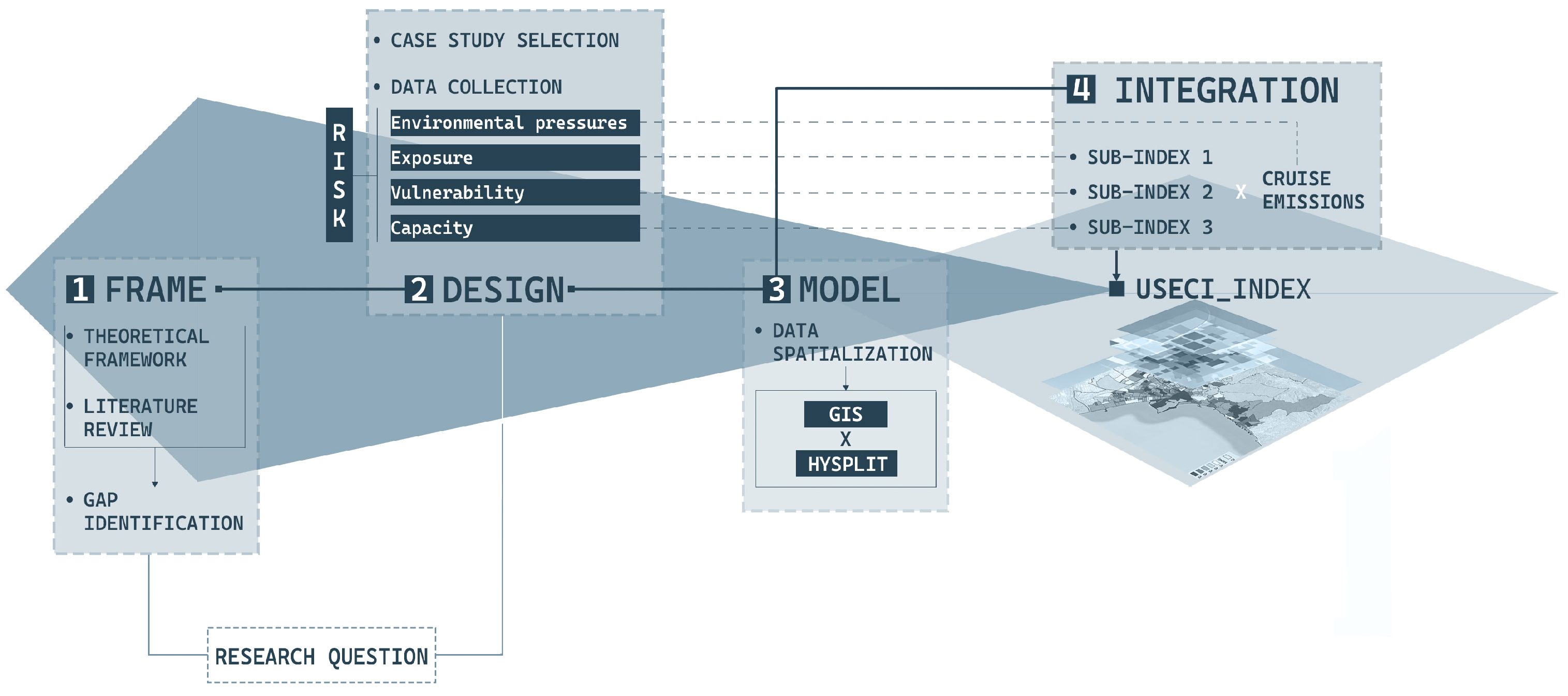
To operate this framework, the research develops the PRISM (Port-city Risk-Informed Spatial Method) methodology structured into four steps: Frame, Design, Model, and Integration (
Figure 1). The term PRISM is used here as an acronym to structure the analytical workflow, rather than to denote a standalone methodological framework. This choice is intended to improve readability and coherence in presenting the analytical steps.
The main output is the construction of a composite index designed to capture the spatial interaction among the previously defined variables, providing a baseline upon which cruise-related emissions can be overlaid. Composite indices are widely used in spatial vulnerability and environmental justice studies to integrate heterogeneous indicators and represent complex socio-environmental dynamics [
62,
63]. The aim is the identification of socio-environmental complexity hotspots, understood as spatial units falling within the highest quantile of the overall index.
The first phase of the work involved an in-depth analysis of the scientific literature, with the objective of contextualizing the reference system and the interdisciplinary fields influencing it (environmental justice, urban studies, spatial analysis, and tourism studies). This review made it possible to identify fundamental information needs, assess the availability and quality of data from accredited sources, and reorganize the collected information in line with the specific objectives of the research. Following the literature review, the identified keywords guided the analysis toward the detection of major knowledge gaps, which in turn led to the formulation of the central research question: to what extent do the impacts generated by cruise traffic contribute to the formation of socio-environmental inequality patterns in the port city of Málaga?
The second phase involved defining the boundaries of the case study and collecting and selecting primary data, a fundamental step for understanding the context and highlighting the main local challenges. The collected data were organized into thematic sets following the classic risk equation framework, in which socio-environmental inequality emerges from the interaction between environmental pressure, population exposure, social vulnerability, and adaptive capacity. For each indicator, the spatialization criteria, bibliographic reference, coordinate system, unit of measurement, and direction were specified (
Table 1).
In the third phase, Model, the indicators were spatialized using as a base the census section boundaries provided by the Spanish Instituto Nacional de Estadística (INE) [
64]. Environmental data on emissions produced by cruise ships were then overlaid, estimated for peak scenarios and spatialized through atmospheric dispersion models.
Finally, in the Map phase, a multi-criteria analysis was conducted using a Weighted Linear Combination (WLC) approach. GIS-based multi-criteria analysis, and in particular WLC, is widely used to integrate heterogeneous spatial variables in environmental and urban studies, allowing the combination of different dimensions into a single evaluative framework [
65,
66]. All indicators were normalized using a min-max scale and combined through equal weights to ensure transparency and replicability of the analysis. The decision to assign equal weights to the indicators responds to the need to ensure methodological transparency and replicability, particularly in exploratory studies where robust empirical or participatory weighting schemes are not available. Equal weighting is widely adopted in composite index construction as a neutral assumption that avoids introducing subjective bias into the analysis [
67,
68].
The selection of indicators was partly constrained by data availability at the required spatial scale but was guided by their theoretical relevance within environmental justice and urban vulnerability literature. This balance between conceptual robustness and data accessibility reflects the aim of constructing a framework that is both analytically meaningful and practically applicable.
The goal is the identification of socio-environmental complexity hotspots, defined as spatial units falling within the highest quantile of the overall index.
Unlike conventional risk assessment models, PRISM does not aim to quantify risk in probabilistic terms, but rather to interpret the spatial co-occurrence of environmental pressures and socio-spatial fragilities. In this sense, the framework positions itself at the intersection between environmental justice and spatial risk analysis, contributing a perspective that is both integrative and explicitly intra-urban.
More specifically, each component of the framework can be associated with key dimensions of environmental justice: exposure and environmental pressure reflect the spatial distribution of burdens, vulnerability captures the differentiated capacity of social groups to cope with such pressures, and urban capacity represents the availability of mitigating resources. This structure allows for the translation of abstract justice principles into a spatially operational framework.
It is important to note that the proposed framework operates at the level of spatial analysis based on secondary data and is not intended to directly capture lived experiences or subjective perceptions of environmental conditions. Rather, it identifies potential configurations of socio-environmental inequality that can inform further investigation. In this sense, the approach should be understood as complementary to qualitative and participatory methods, which are essential.
The following paragraphs describe the implementation steps in detail, with particular attention to the construction of indicator sets, the methods of data spatialization, and the integration criteria used to define the indices.
3.3. Operational Implementation
3.3.1. Exposure, Vulnerability, and Capacity
Within the analytical framework, the dimension of exposure plays a central role, as it makes it possible to identify not only the presence of the resident population but, more broadly, the set of people, urban functions, and activities located within a given territory that may potentially be affected by impacts generated by environmental pressures. In this context, the selected indicators are:
Resident population;
Population density;
Schools;
Healthcare facilities.
To capture the exposure component linked to the temporary presence of population, a subset of indicators was constructed as proxies for tourist concentration. In particular:
These were used to represent urban areas characterized by a high intensity of non-resident attendance. The inclusion of these last two groups of indicators makes it possible to detect a form of non-residential exposure that is difficult to capture through demographic data alone, providing more consistent reading with the seasonal and daytime dimension of tourist pressure.
Socioeconomic and demographic indicators were included in the Vulnerability set, which expresses the differentiated capacity of local populations to cope with or adapt to environmental stress factors. Data collection assumed that vulnerable segments of society are more exposed to risks [
69]. For example, poverty and old age can contribute to increased vulnerability, not only because these groups may be less prepared to face emergencies, but also because they often live in the most hazardous areas of the urban fabric and/or in less secure settlements. In this context, the selected indicators were:
Finally, the Capacity dimension is interpreted primarily as the spatial and environmental ability of the urban system to absorb, mitigate, or redistribute the pressures generated by cruise flows and port emissions. From this perspective, attention focuses on the availability of urban decompression spaces, understood as elements capable of offering margins of everyday resilience to communities allowing temporary redistribution of flows and encouraging collective uses of urban space. This category includes accessible public spaces such as:
Squares
Urban parks
Beaches
Public sports facilities
Tree canopy coverage
The last two indicator sets made it possible to broaden the interpretation of urban capacity beyond the mere areal dimension of open spaces, introducing a more diffuse and capillary component linked to everyday environmental quality that contributes to the creation of more resilient and inclusive urban environments.
All indicators were selected based on data availability and the need for an adequate spatial and representative scale. To build a durable and updatable monitoring system, data were collected, selected, and processed starting from the “Censo Nacional de Población y Vivienda” [
64]—the national census—provided by the Spanish Instituto Nacional de Estadística (INE) and from the data supplied by the Ayuntamiento de Málaga through the “Datos Abiertos” portal [
70]. With regard to the data provided by the “Datos Abiertos” portal, updated to 2017, a careful verification was carried out to assess the accuracy and reliability of the dataset. It should be noted that some datasets (e.g., public spaces and urban infrastructure) refer to 2017, as they are derived from the official planning framework (Plan General de Ordenación Urbana). These elements represent relatively stable structural components of the urban system, which have not undergone significant changes in the study area over the period considered. Outdated or no longer valid data were updated by the authors.
For this reason, their use is considered appropriate for capturing the spatial configuration of urban capacity, which is less sensitive to short-term transformations compared to other dimensions such as tourism-related exposure.
The census data was aggregated at the census section scale, which was considered appropriate for the construction of the index.
3.3.2. Environmental Pressures
Environmental indicators relating to cruise ship emissions were grouped into the “Hazard” set, representing the sources of environmental pressure derived from cruise traffic. The selected indicator used to express this concept is “Passenger transport GHG emissions.” The reference year chosen was 2025, which saw the arrival of 331 large ships in port [
71]. Among the various pollutants emitted by cruise ships (e.g., SOx, PM, CO
2), NOx was selected and treated as a passive tracer due to its relevance in maritime emission studies, the availability of standardized emission factors, and its widespread use in atmospheric dispersion modeling. This choice allows for a consistent representation of emission patterns, although it does not capture the full spectrum of pollutants associated with cruise activities.
The estimation of ship-related emissions follows approaches commonly used in port and coastal studies to assess localized environmental pressures [
72,
73].
Environmental data were processed starting from the official website of the Port of Málaga, which contains all information related to ship arrivals and their length of stay in port [
71].
To make the analysis more manageable and focus on the scenarios of greatest pressure, only peak days were selected and modeled, assuming them as proxies for maximum environmental stress conditions. In addition, RO-PAX vessels (roll-on/roll-off passenger ships designed to transport both passengers and vehicles) that reach and remain in port daily were included in the calculation. This strategy makes it possible to highlight the most critical spatial configurations while at the same time reducing the computational complexity of the analysis.
Emission estimation was carried out using the European reference methodology described in the “EMEP/EEA air pollutant emission inventory guidebook” for estimating air pollutants from maritime transport [
74]. The adopted methodology follows a bottom-up approach and is based on reliable indicators and estimation methods consistent with major international guidelines. The method defines three levels of detail depending on the information available. For the present study, the Tier 3 estimation methodology was used, applicable when ship movements are available disaggregated by engine type and maneuver type.
From the Port of Málaga website, information was obtained regarding arrival day and ship type, along with statistics on ship length of stay for each quay. Through Excel software, it was possible to integrate basic ship information with all data relating to main engine power, obtained by consulting open-source naval registers and official shipping company websites. Subsequently, starting from the analysis of typical engine–fuel pairings, the fuel consumption of each vessel was calculated. Large cruise ships are typically powered by diesel engines and use MDO-type fuels. Once engine and fuel types were established, the procedure provides specific consumption values and allows estimation of the total power of the main and auxiliary onboard systems. The power of the main engines is generally known, while the auxiliary power was derived by multiplying the propulsion power by coefficients established according to vessel category, which for cruise ships equals 0.16.
To characterize the power of main and auxiliary engines during the two main phases of a ship’s stay in port, the procedure suggests considering load factors used in the various phases for main engines (ME) and auxiliary engines (AE), as reported in reference tables. At this point, to calculate the amount of fuel burned, the power values emitted in port were multiplied by the specific consumption suggested by the procedure—203 g/kWh for cruise ships. For calculating energy consumption in kWh, the same power data were multiplied by berth time. Once the database was completed, the NOx emission rate—treated as a passive tracer—was calculated. Emissions for each ship and for each operational phase in port were estimated using the emission factors reported in
Table 1. Starting from the power values of main and auxiliary engines delivered in port for each vessel and using the specific fuel consumption (g/kWh), it was possible to obtain an estimate of the average hourly NOx emission rate (kg/h) for each ship during port operations.
At a later stage, the estimated data were spatialized using HYSPLIT software (Version 5.4.2), employed not as a tool for the precise quantification of concentrations, but rather as an exploratory device capable of returning recurring dispersion and directionality patterns, functional to the spatial framing of environmental risk and its subsequent integration with socio-territorial indicators.
Dispersion modeling is used here as an exploratory tool rather than a predictive one. The objective is not to provide precise estimates of pollutant concentrations, but to identify recurring spatial patterns and directional trends of emission dispersion. This approach allows the integration of environmental pressure into the spatial framework while acknowledging the limitations associated with modelling assumptions and data inputs.
4. Results
The operational implementation described in the previous sections produced a coherent information base for the distributive analysis of environmental pressures and urban socio-spatial conditions. This section presents the results of the processing phase, focusing on the identification of emerging spatial configurations, the localization of socio-environmental complexity hotspots, and the interactions between port emissions, exposure patterns, and urban vulnerability.
After the data collection phase, all datasets were processed using the open-source software Q-GIS 3.38.3. The resulting shapefiles were georeferenced to a common coordinate system (EPSG:32630—WGS 84/UTM zone 30 N) to enable overlay and further processing. All data were rescaled to the census section level and subsequently classified using the Natural Breaks (Jenks) method, which aims to identify natural groupings within the data in order to create interval classes [
75].
To avoid informational fragmentation that could have compromised the systemic understanding of the investigated phenomenon, sub-indices of exposure, vulnerability, and capacity were constructed. In this way, the sub-index maps act as interpretative devices capable of highlighting significant territorial patterns without sacrificing the complexity of the underlying data.
Indicator integration was carried out through a multi-criteria analysis based on a Weighted Linear Combination (WLC) approach. All layers were preliminarily normalized using a min–max transformation, to make heterogeneous variables comparable in terms of units of measurement and statistical distribution. The decision to assign equal weights to the indicators responds to the need to ensure methodological transparency and procedural replicability, avoiding the introduction of subjective evaluations not supported by empirical evidence or participatory processes.
To refine the investigation, a port influence area was defined by constructing a 5 km buffer from the centroid of the port’s cruise terminal. Spatial units were selected through a select by location operation within the GIS environment. The spatialization of environmental data was treated independently and subsequently overlaid onto the previously generated layers.
Overall, the results highlight not only the presence of socio-environmental inequalities, but also their spatial structuring in relation to both long-term urban dynamics and short-term environmental pressures. This dual dimension suggests the need for interpretative frameworks capable of capturing both persistent and episodic components of urban inequality.
4.1. Exposure Sub-Index Map
As highlighted in
Section 3.3.1. for the construction of the exposure sub-index the following data were collected and georeferenced:
Resident population;
Population density;
Schools;
Healthcare facilities.
Accommodation facilities;
Currency exchange services;
Tourism-oriented commercial activities.
The first three indicators were populated using data provided by INE and the Ayuntamiento de Málaga. Regarding accommodation facilities, B&B data were compiled by consulting and querying the Inside Airbnb platform. In order to obtain a less random dataset, only entire apartment rentals were selected, excluding private room rentals in shared apartments. For the same reason, only recently booked and reviewed listings were considered. Hotel data, as well as those related to the category “tourism-oriented commercial activities,” were obtained by querying the OpenStreetMap database through targeted thematic queries. Point-based indicators were aggregated to the census section scale through spatial join operations.
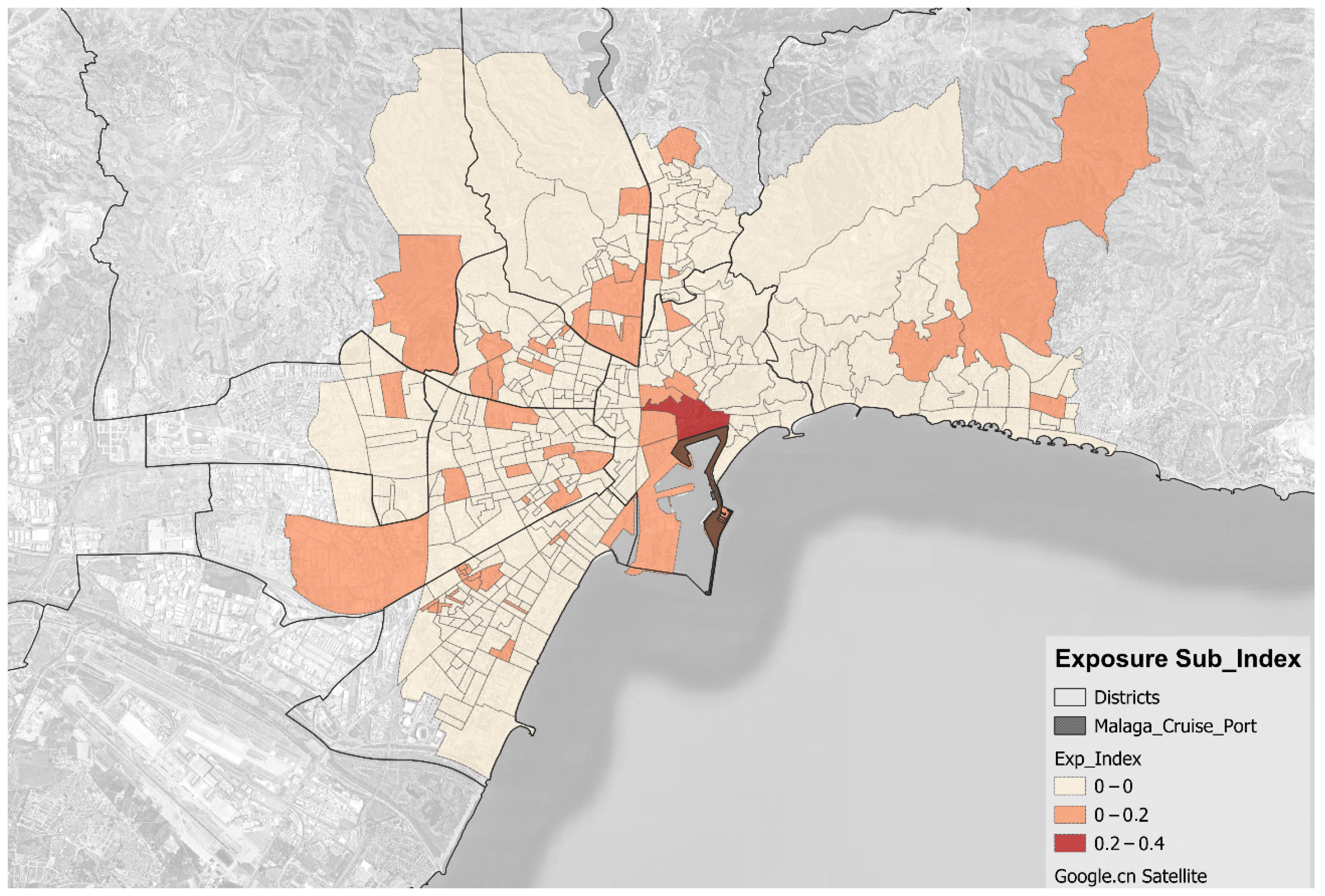
The spatialization of the exposure sub-index highlights a heterogeneous distribution of potential impact conditions within Málaga’s urban fabric (
Figure 2).
Census sections characterized by the highest values are mainly concentrated in the central and coastal areas of the city, where a lower density of resident population is accompanied by a greater presence of attractive urban functions such as accommodation facilities, healthcare services, and tourism-oriented commercial activities. Conversely, peripheral areas show medium or low index values, reflecting lower settlement intensity and a reduced concentration of services and temporary population flows. This pattern suggests that exposure is strongly influenced by the coexistence of temporary population and highly frequented urban functions. The index therefore reveals a geography of exposure that overlaps with areas of greatest urban and tourist vitality, providing an initial interpretative basis for subsequent integration with the vulnerability and capacity dimensions.
4.2. Vulnerability Sub-Index Map
For the construction of the vulnerability sub-index, the following data were collected and georeferenced:
Also in this case, the data were provided or derived from information supplied by INE and the Ayuntamiento de Málaga.
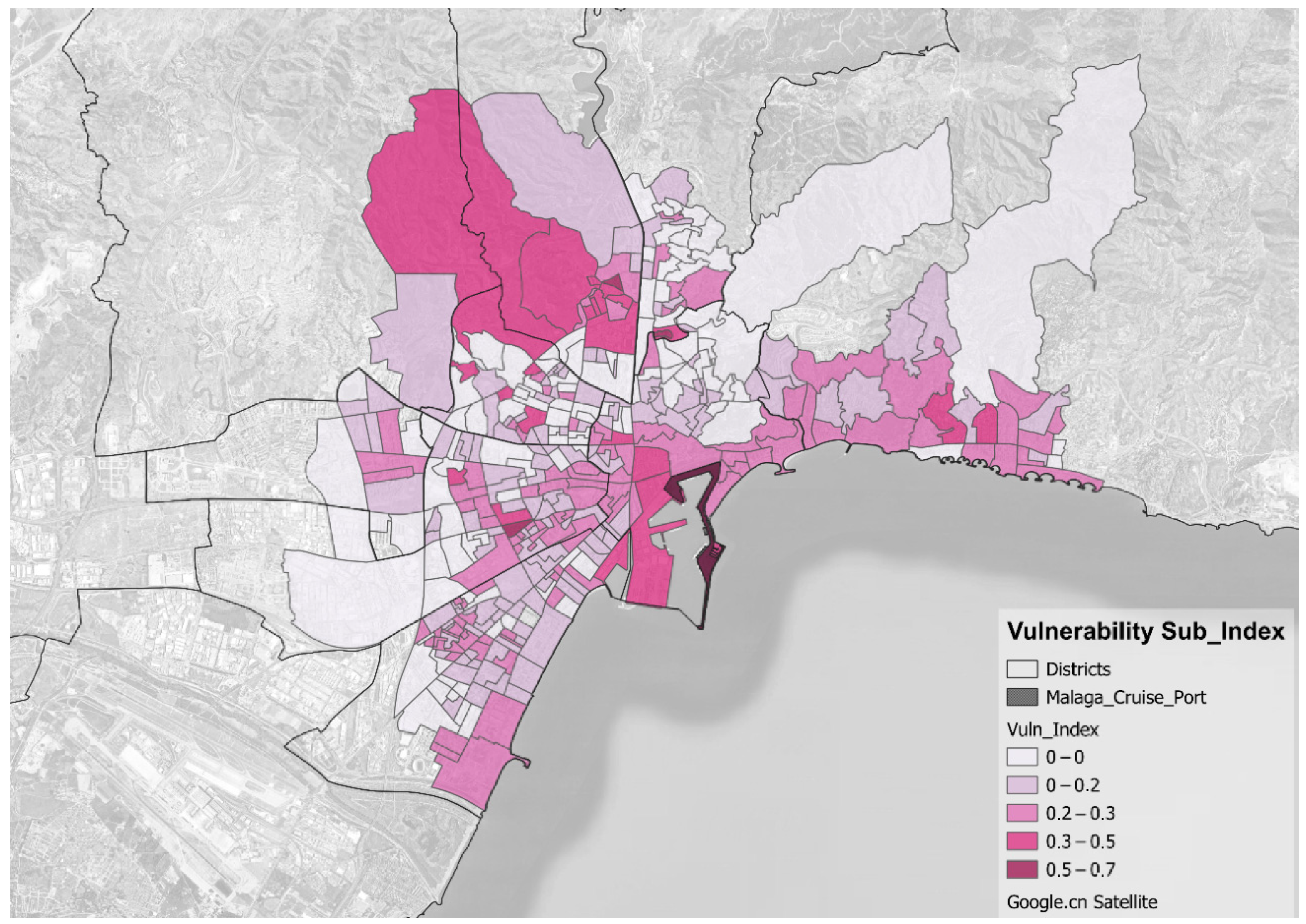
The spatial representation of the vulnerability sub-index returns an urban geography slightly different from that observed for exposure, highlighting how conditions of socioeconomic fragility do not necessarily coincide with the areas characterized by the highest tourist intensity (
Figure 3).
The map displays a patchy distribution pattern, reflecting intra-urban differences in communities’ capacity to absorb or mitigate the impacts generated by environmental pressures. The mapping of the composite index highlights a critical concentration of vulnerability in the northern and north-western districts (such as the Palma-Palmilla area), where the overlap of low educational attainment, high unemployment, and reduced average income outlines a condition of structural marginality.
At the same time, the map also reveals peaks of high vulnerability in the historic city center and in the port area. This phenomenon suggests the persistence of pockets of urban fragility, where elevated index values are driven in most cases by the aging of the resident population and by the concentration of foreign citizens within historic building stock not yet affected by gentrification processes. The proximity between high- and low-vulnerability census sections in the city center points to a pronounced socio-spatial fragmentation, making Málaga a complex case study of coexistence between tourism-driven economies and urban marginality.
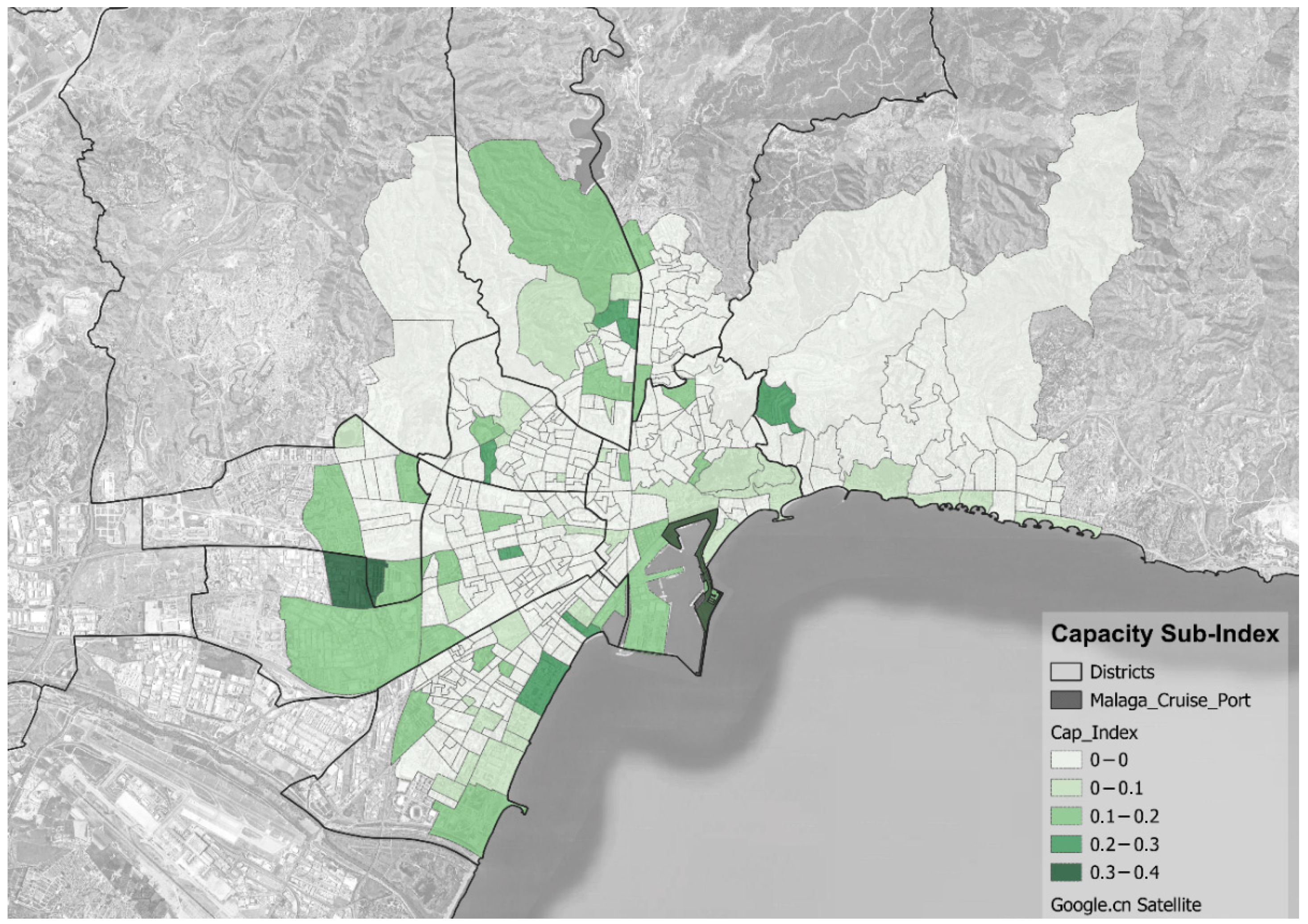
4.3. Capacity Sub-Index Map
The last calculated and mapped sub-index is capacity, interpreted as the set of physical and environmental resources that help reduce daily exposure to socio-environmental stresses. The selected indicators are:
Green spaces
Urban beaches
Squares
Public sports facilities
Tree canopy
The first, second, fourth, and fifth indicators were populated using data from the Ayuntamiento de Málaga, while squares were derived from OpenStreetMap through targeted thematic queries.
Integration of these variables showed that capacity is not concentrated solely in large parks or along the coastline but is also expressed through a network of micro-spaces and small-scale amenities scattered across the urban fabric. Interpretatively, the resulting map highlights significant differences between central and peripheral areas, not only in terms of the quantity of green space, but particularly in the quality and frequency of urban relief opportunities available to residents (
Figure 4).
Peaks are observed in large suburban green areas and in newly developed western areas, where urban planning integrated generous sports facilities and open spaces. However, comparison with the vulnerability sub-index reveals critical overlaps: areas near the port and dense central districts, which present medium-high vulnerability, also show limited capacity. This overlap highlights a “resilience gap”, where high residential density and socio-economic fragility are not compensated by sufficient green infrastructure or public spaces, thereby exacerbating residents’ exposure to environmental stressors such as urban heat islands and limited social aggregation spaces.
4.4. The Environmental Pressures
Cruise-related emissions were estimated for peak scenarios and spatialized through atmospheric dispersion models using HYSPLIT (HYbrid Single-Particle Lagrangian Integrated Trajectory), a numerical model developed by the Air Resources Laboratory of National Oceanic and Atmospheric Administration (NOAA) and the Australian Bureau of Meteorology Research Center.
Using the arrival/departure schedules provided by the Port of Málaga for 2025, the peak day selected was 4 November, when six large passenger ships docked, each remaining in hoteling for an average of twelve hours.
The selection of a single peak day is intended to represent a condition of maximum environmental stress, allowing the identification of critical spatial configurations. However, atmospheric dispersion is inherently influenced by meteorological variability, including wind direction, temperature, and seasonal conditions.
As such, the simulated dispersion patterns should be interpreted as indicative rather than fully generalizable.
The model was configured using the cruise terminal as the emission source, employing GDAS (Global Data Assimilation System) meteorological datasets and forward simulations of trajectory and dispersion over time windows representing the peak day. Each ship was georeferenced in HYSPLIT according to its docking point, and the emission rates calculated as described in
Section 3.3.2 were applied.
Different release heights (0, 50, 100 m) were considered to account for vertical emission variability and atmospheric mixing dynamics. The model outputs (trajectories and relative concentration maps) were imported into a GIS environment to interpret the potential spatial extent of pollutant plumes and their overlap with the urban fabric.
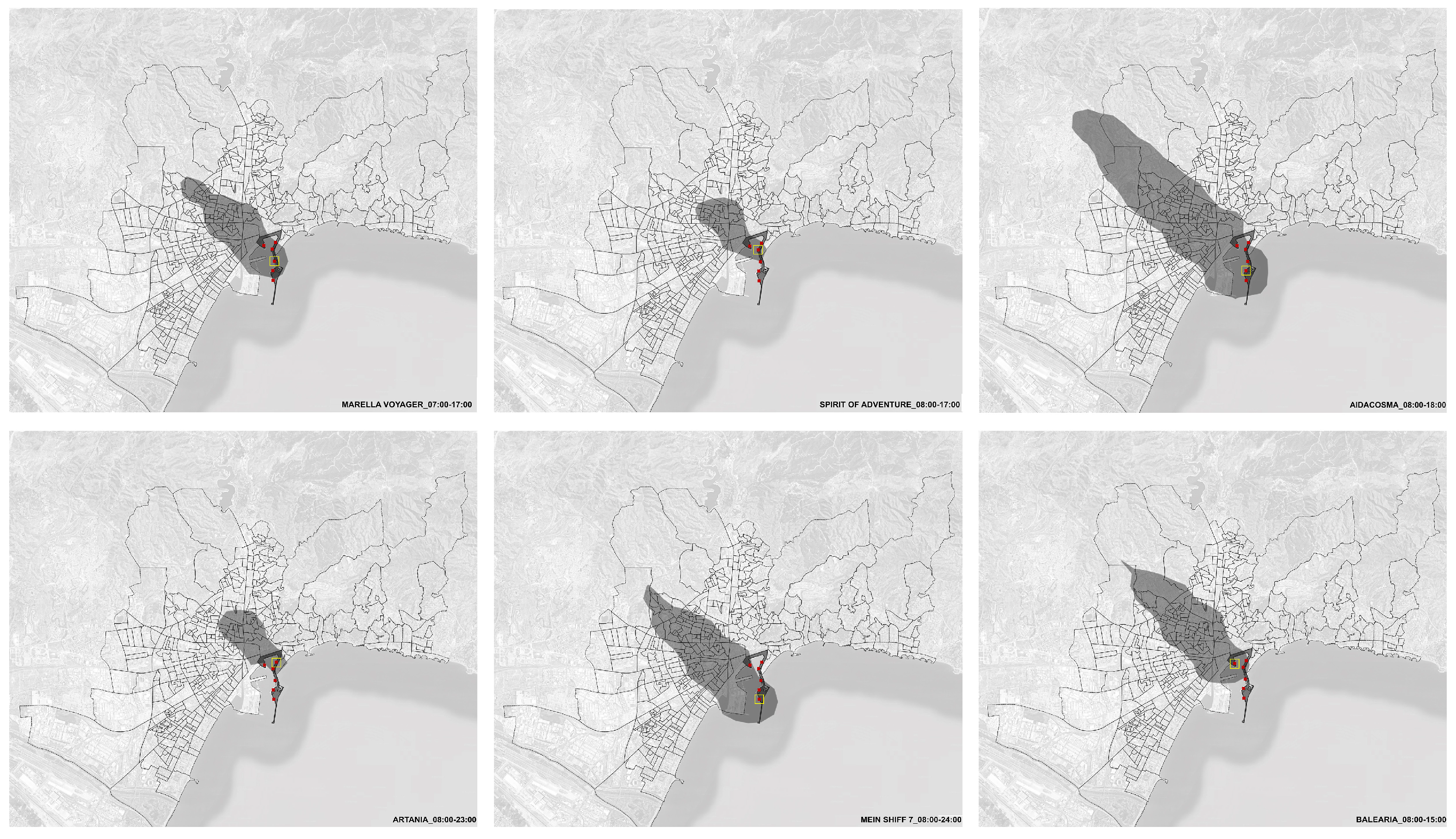
Simulations (
Figure 5) show pollutant flows trending toward the northwest inland, indicating preferential atmospheric corridors. Six ships were analyzed: Marella Voyager, Spirit of Adventure, Aidacosma, Artania, Mein Schiff 7, and Balearia.
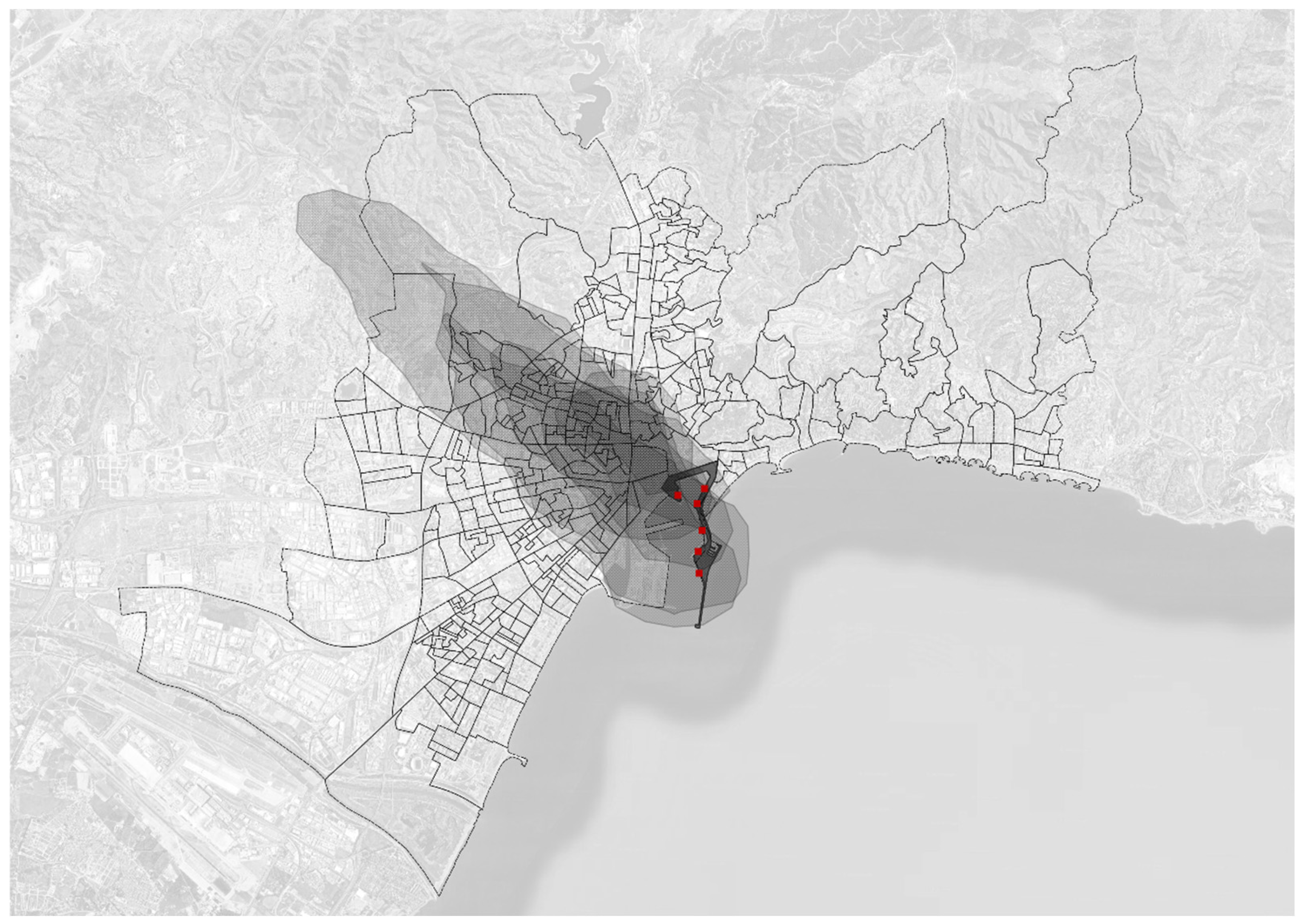
For each simulation, only the portion of the trajectory characterized by the maximum estimated concentration of pollutants was represented. This methodological choice responds to the need to avoid excessive overlap of plumes and to provide a more concise and comparable reading between the different scenarios (
Figure 6).
4.5. The Urban Socio-Environmental Complexity Index of Malaga
Following the analyses carried out and described in the previous paragraphs, the Urban Socio-Environmental Complexity Index (USECI) of Malaga was constructed, intended as a summary measure of the interaction between exposure, vulnerability, capacity, and environmental pressures arising from cruise ships.
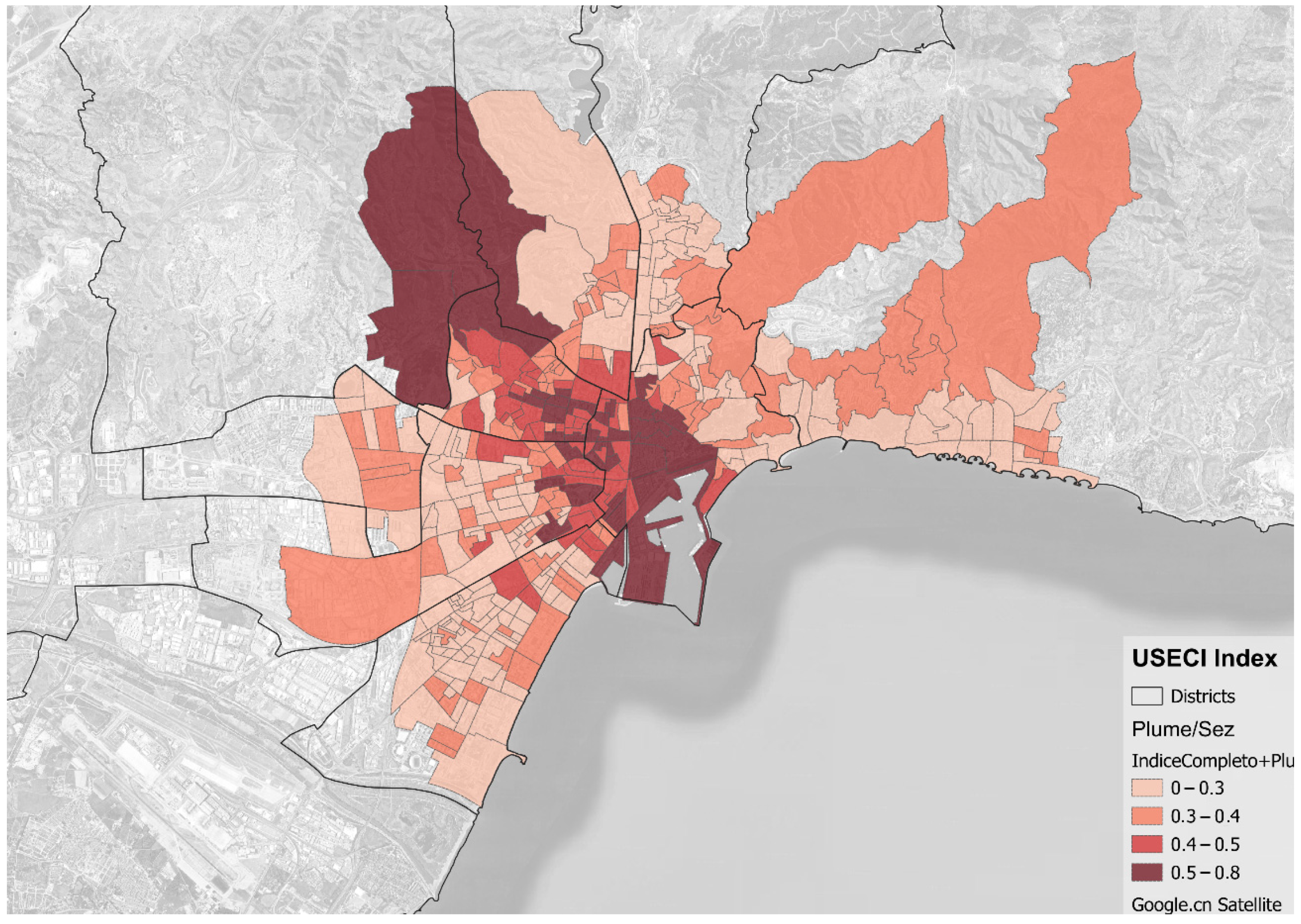
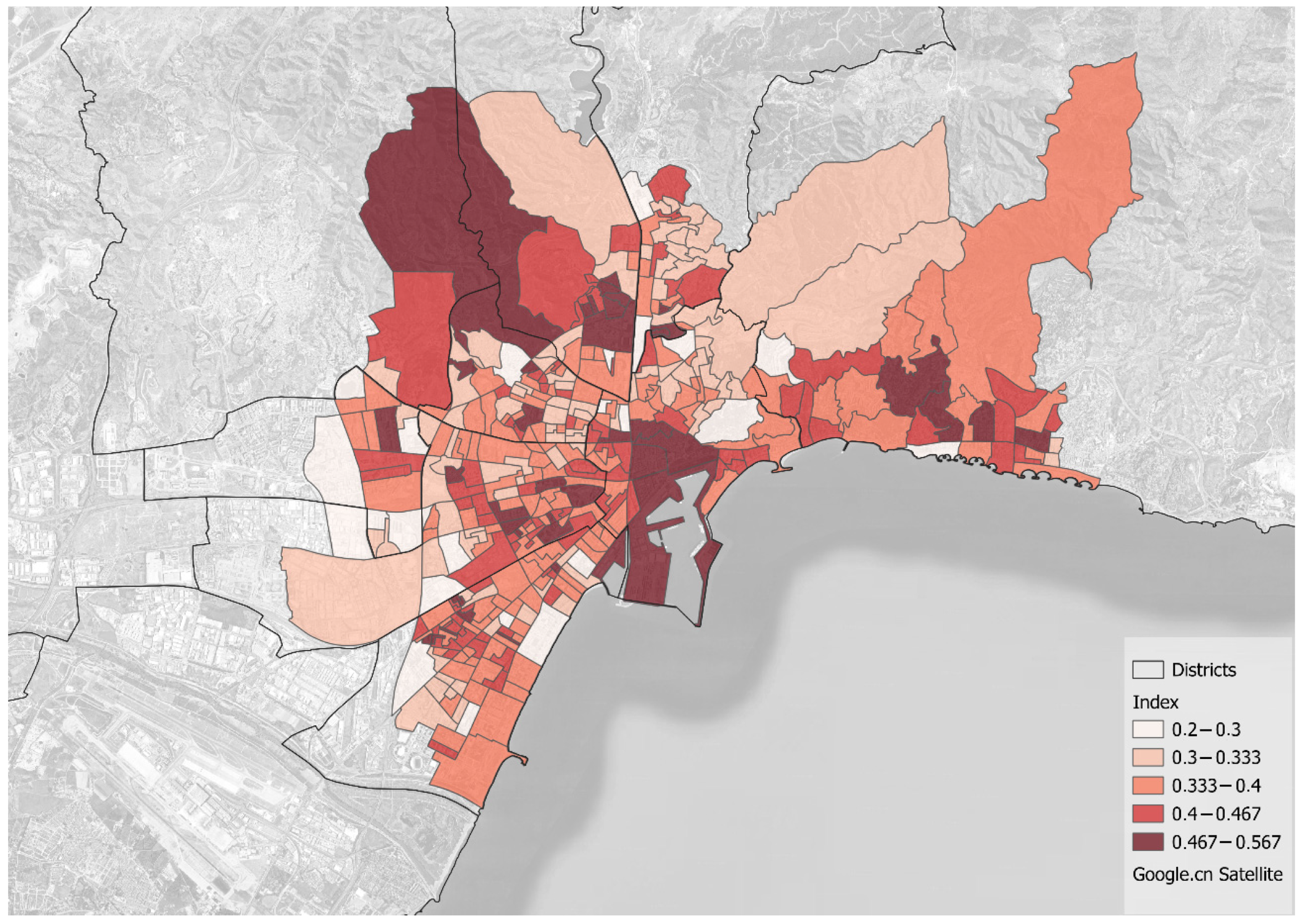
Firstly, the combination of exposure, vulnerability, and capacity sub-indices provides a summary reading of urban socio-environmental complexity, highlighting marked spatial heterogeneity within the municipal territory (
Figure 7). The highest values of the index are mainly concentrated in the central area and in the coastal sector immediately behind the port, outlining a compact core of sections characterized by high levels of exposure and vulnerability and fewer mitigation resources.
Moving towards the peripheral areas, however, there is a gradual decrease in the index values, with sections presenting relatively more favorable conditions in terms of adaptive capacity or lower settlement pressure. However, this center-periphery gradient is not uniform: some peripheral areas show medium-high values, indicating that socio-environmental complexity is not exclusively linked to geographical centrality, but rather reflects historical dynamics of urbanization, unequal distribution of services, and differences in the availability of urban decompression spaces.
Finally,
Figure 8 shows the mapping of the comprehensive index of the results obtained from the estimate of emissions produced by cruise ships.
A comparison between the exposure-vulnerability-capacity index map and the map obtained by integrating the values derived from the dispersion plumes shows a significant difference in the spatial distribution of the highest classes. While in the first representation socio-environmental complexity appears to be linked mainly to established urban dynamics, in the second map the additive effect of specific environmental pressures linked to cruise traffic emerges more clearly.
The inclusion of the plumes produces an intensification of values in the sections immediately behind the port area and along the main dispersion routes, transforming some areas previously classified as medium-high into real hotspots of complexity. This phenomenon not only amplifies the critical issues already present in the urban center but also contributes to partially redefining the geography of socio-environmental risk, extending the darker classes to sectors that were relatively more stable in the previous map.
The overall result shows dual dynamic. On the one hand, there is the persistence of a structure of inequality linked to long-term socio-spatial factors; on the other, there is the emergence of a cyclical and localized component directly attributable to ship emissions. In this sense, the second map does not replace the first, but rather emphasizes it, making it clear how temporary environmental pressures can overlap with pre-existing vulnerabilities and accentuate their effects, contributing to the formation of more marked and territorially concentrated patterns of inequality.
The resulting hotspots do not exclusively represent areas of maximum pollutant concentration but rather portions of territory where environmental pressure is combined with socio-spatial conditions of greater fragility and lower mitigation capacity, providing a summary map of cumulative urban risk.
5. Discussion
There is a growing awareness in the literature that the construction and operation of civil infrastructures supporting contemporary societies often generate disproportionate burdens on disadvantaged populations [
76,
77,
78,
79]. Among these infrastructures, ports represent one of the land uses that have attracted increasing scholarly attention over time [
80,
81]. In Mediterranean tourist contexts, the condition of disadvantage associated with port areas is today largely linked to tourism dynamics and to the pressures that this sector exerts on urban systems. Cruise tourism, in particular, by fostering forms of short-term and high-intensity visitation, tends to simplify and standardize the representation of local urban life. In areas adjacent to heavily visited tourist zones, the lack of urban improvements, unemployment, social discontent, and displacement processes have contributed to placing residents in conditions of vulnerability that local administrations have often struggled to address over time [
82].
Rising housing prices and changes in commercial land use are among the processes that have fostered gentrification and a broader transformation of urban identity [
3,
83]. These dynamics have progressively displaced residents from central neighborhoods, redistributing socio-economic vulnerability profiles and contributing to the formation of complex urban fabrics characterized by strong internal differentiation despite their spatial proximity. In this sense, tourism-driven transformations interact with pre-existing socio-spatial structures, reinforcing rather than replacing existing patterns of inequality.
Within this context, the need for effective monitoring tools and spatially informed land-management instruments becomes particularly relevant, especially in port cities exposed to processes of touristification. The results of this study contribute to this debate by providing a multiscalar and systemic reading of intra-urban inequalities in the port-city of Málaga. By combining socio-demographic indicators, spatial endowment data, and environmental pressures generated by cruise traffic, the analysis highlights how environmental and social pressures are unevenly distributed and tend to overlap with pre-existing conditions of vulnerability, contributing to the formation of cumulative risk hotspots.
Importantly, the findings suggest that cruise-related impacts do not generate entirely new socio-environmental inequalities but rather amplify and spatially concentrate existing vulnerability patterns. This amplification is particularly evident in areas adjacent to the port waterfront and along prevailing inland dispersion corridors during peak days, where environmental exposure intersects with limited urban capacity and higher levels of social fragility.
The results reveal marked territorial heterogeneity and confirm the usefulness of the composite index as an interpretative tool capable of integrating environmental and socio-spatial dimensions within a single analytical framework. In this regard, the proposed approach allows not only the identification of critical areas, but also the visualization of cumulative processes that are often difficult to capture through traditional sectoral analyses.
From a planning perspective, these findings suggest that cruise-related environmental pressures should be addressed not only through sectoral policies targeting emission reduction, but also through spatially sensitive strategies capable of accounting for intra-urban inequalities. The identification of cumulative risk hotspots can support the prioritization of interventions in areas where environmental burdens and social vulnerability overlap, thereby contributing to more targeted and context-aware urban policies.
More broadly, the study contributes to the environmental justice debate by showing how tourism-driven development may reinforce existing socio-spatial disparities, raising critical questions about the distribution of benefits and burdens within port cities. In this sense, the proposed approach can be interpreted as a decision-support tool that supports a more equitable and context-sensitive governance of port-city systems, where environmental, social, and economic dimensions are addressed in an integrated manner.
6. Conclusions
Several sources of uncertainty should be acknowledged. These include limitations related to data availability and updating, assumptions embedded in the dispersion modeling, and the adoption of equal weighting in the multi-criteria analysis. While these choices are consistent with the exploratory nature of the study, they may influence the precision of the results. At the same time, in the absence of validated weighting criteria or participatory inputs, alternative weighting configurations could introduce additional sources of arbitrariness, thus justifying the adoption of a transparent and replicable baseline approach.
The main limitations of the study also concern the use of dispersion models with exploratory rather than predictive purposes and the reliance on a single peak emission scenario, which may affect the generalizability of the results across different temporal conditions. In this sense, the findings should be interpreted as indicative of potential spatial configurations of environmental pressure rather than as precise measurements of air quality conditions.
Sensitivity analysis therefore represents a key direction for future research, particularly in view of applications oriented toward decision-making processes. The adoption of stakeholder-driven or empirically calibrated weighting schemes could contribute to testing the robustness of the results and to refining the identification of socio-environmental hotspots.
Further developments could also involve the integration of data collected through questionnaires administered to residents and tourists, in order to support differentiated weighting strategies and to encourage broader public participation in decision-making processes. In this perspective, the combination of quantitative spatial analysis and qualitative approaches would allow for a more comprehensive understanding of socio-environmental inequalities.
A further limitation concerns the absence of qualitative validation based on residents’ perceptions. While spatial analysis identifies areas characterized by overlapping environmental pressures and social vulnerability, it does not directly capture how these conditions are experienced by local populations. Future research could integrate participatory approaches, such as surveys, interviews, or community-based mapping, to validate the identified hotspots and enrich the interpretation of socio-environmental inequalities through situated knowledge.
The applicability of the proposed approach to other contexts depends on the availability of spatially disaggregated data, access to port activity and emission-related information, and the adaptability of the indicator set to local conditions. While the specific variables may vary, the overall structure of the approach is designed to be transferable across different port-city environments.
In conclusion, this study is not intended as a mere mapping exercise, but as a replicable knowledge device capable of supporting more equitable and context-sensitive urban and port governance strategies. By making the often less visible geographies of urban inequality more explicit, it contributes to informing policy debates on who benefits from and who bears the costs of cruise-tourism-driven development, and highlights the need for more inclusive and spatially aware approaches to urban transformation.