1. Introduction
Recent global challenges, such as the pandemic, disruptions on energy market, rising geopolitical tensions and military conflicts, the transition towards a more sustainable energy system, and evolution of regulatory frameworks at the EU level have had a profound impact on companies and on how consumers perceive the integration of environmental, social and governance (ESG) principles into the business strategies. From an ESG perspective, organizational performance is regarded as a holistic concept encompassing multiple dimensions related to consumer expectations [
1]. Integrating ESG principles is particularly pertinent in the oil and gas industry, where sustainability-related issues play a central role in assessing corporate performance. These principles are not just buzzwords, but fundamental pillars for economic development and long-term value creation.
To communicate their achievement across areas such as environment performance, labor practices, and customer relations companies have increasingly begun to use reports. Sustainability reporting is defined as the practice of publicly communicating an organization’s economic, environmental, and social impacts [
2]. Reporting related to the Sustainable Development Goals refers to how a company integrates these goals into its activities [
3,
4]. Although considerable efforts have been made by organizations, companies, and governments to develop methodologies for quantifying social responsibility and sustainability actions, things are still in their infancy [
5,
6,
7,
8,
9,
10]. For this reason, sustainability reporting by companies does not always address major sustainability challenges at the sector level or generate results that can be analyzed comparatively [
11,
12,
13,
14]. This leads to a lack of transparency regarding each industry’s contribution to global sustainability [
15].
The results of a longitudinal content analysis of sustainability reports produced by 15 large organizations in Norway between 2010 and 2020 showed a 90% increase in the volume of report content and only an 18% increase in transparency. At the same time, the content of GRI standards in terms of the number of indicators and details of requirements increased by over 500% [
16]. The authors of the study show that multiple interactions can generate unforeseen results, and many standards can make transparent reporting difficult for companies, which has the potential consequence of reducing the consumers’ ability to accurately assess sustainability [
16].
The European Commission has introduced a package to simplify EU regulations to increase competitiveness and attract investment [
17]. Among other legislative measures, the package targets regulations on sustainable finance, the carbon border adjustment mechanism, and investments. The simplification initiative is part of the Commission’s commitment to reduce administrative burdens by 25% for all companies and by 35% for small and medium-sized enterprises [
17].
In recent years, rating agencies evaluate companies and provide data on specific attributes in the environmental (E), social (S), and governance (G) categories [
18]. They also, invariably, provide an overall assessment of companies’ performance based on a composite score of individual ESG indicators. At the same time, agencies have developed ESG, or sustainability-themed indices based on the fulfillment of thresholds, which are like targets that move annually. The Dow Jones Sustainability Index (DJSI), FTSE4Good Index, and MSCI ESG Indices are currently the most relevant agencies and indices in the ESG rating market [
19].
The increase in investor demand for ESG data over the last decade comes in response, among other factors, to growing awareness of the financial significance of ESG factors and increased demand from customers and investors [
20]. As investments in the energy sector play a very important role in ensuring energy efficiency [
21], companies report their corporate social responsibility initiatives to consumers to demonstrate their commitment. Consequently, data publicizing can also help companies identify areas where they can improve their corporate social responsibility programs. Thus, ESG ratings are used in different ways, such as managing exposure to sustainability-related risks and assessing the performance of responsible companies against a broader set of comparable factors, but also to build responsible investment products [
22].
There are many supporters of the ESG assessment process by specialized agencies, as they play an important role in helping different stakeholders, including consumers, understand, evaluate, and manage the increasingly complex nature of corporate social responsibility and sustainability for publicly traded companies [
23]. Although the reporting offers important insights for stakeholders, there are also considerable criticisms regarding data quality [
24,
25] and the validity of ESG ratings, with studies documenting differences in how the three factors are conceptualized and the weights used to compile scores and make comparisons [
26,
27]. Supporting these ideas, statistical analysis by Slager and Chapple (2016) finds that firms facing exclusion from the FTSE4Good index following the introduction of new criteria are more likely to improve their performance in the following year, as are firms that have actively promoted their inclusion in the index [
28]. Other authors [
29] take a broader view, providing evidence from large samples showing that US companies with initially low scores in environmental assessments, improved their performance more than companies that were either never assessed or received favorable initial evaluations. Thus, Dupire and M’Zali (2018) stated that there is no single response by companies to ESG ratings, just as there is no single way for companies to respond more generally to sustainability pressures [
30]. This reaction is driven by managers’ perceptions of the value that integrating and adapting to ESG ratings can generate for the company” [
31].
Consumer perceptions of a company are influenced by the environmental, social and governance (ESG) information provided [
32], particularly when consumers are more aware of the impact of businesses have on society. Corporate social responsibility disclosures can lead to positive consumers perception of a company’s image and organizational reputation, whereas negative perceptions of CSR activities can have an adverse effect on corporate evaluation [
33,
34]. Moreover, consumers’ perceptions of CSR and ESG initiatives play a significant role on improving reputation and contributing to competitive advantage [
35]. Thus, it is important to understand how CSR and ESG reporting influence consumers’ perceptions.
While prior studies [
36] have examined ESG reporting from organizational or investor perspectives, limited research has explored how consumers interpret ESG disclosures as signals of internal organizational qualities. This study addresses this gap by linking ESG communication to perceived organizational attributes and behavioral outcomes.
Besides regulatory compliance, the more ESG becomes present in companies’ activity, the more important it is to investigate its impact on consumers. This is especially important in the context of consumer perceptions, as these perceptions play a main role in determining trust, loyalty and customer acquisition behavior. Regardless of the dimensions of ESG, the consumers will evaluate the company’s actions and develop their own perceptions about the company [
37,
38].
This research aims to increase knowledge on consumers’ perception about ESG reporting in the oil and gas industry. This study adopts a consumer-centric perspective and conceptualizes organizational constructs such as transparency, organizational culture, and employee engagement as perceived attributes inferred by consumers based on ESG-related disclosures and communication. Most of the related literature [
39,
40] focuses on employees’ perceptions about a company’s corporate social responsibility, and few on the consumers or other stakeholders’ perceptions. To close this gap, the purpose of the research is to analyze the influence of ESG reporting on consumer perceptions related to organizational transparency, internal culture, effective communication and employee engagement.
To achieve the proposed goal, the research aims to accomplish the following specific objectives:
Objective 1 (O1). To investigate to which extent consumers perceive ESG reporting practices as a driver of organizational transparency.
Objective 2 (O2). To analyze how consumers perceive the relationship between ESG reporting and organizational culture.
Objective 3 (O3). To examine consumer perception of the connection between ESG practices and the effectiveness of the communication within oil and gas companies.
Objective 4 (O4). To determine how consumers perceive the influence of organizational transparency on employee engagement in oil and gas industry.
Objective 5 (O5). To examine whether consumers perceive the ESG reporting as having a direct effect on the employee engagement in oil and gas industry.
Objective 6 (O6). To identify to which extent consumers perceive the organizational culture, effective communication, and the implementation of ESG principles significantly influence the perception on employee engagement.
This paper has the following structure. First, the authors present the theoretical basis of ESG reporting, hypotheses development, and model construction. Then, we describe the research methodology, followed by a presentation of the analysis results. Finally, we discuss the study’s results compared to the existing literature, acknowledge its limitations, and outline potential directions for future research.
2. Hypotheses Development and Model Construction
The P-ESG scale contains three factors: environmental, social, and governance. Existing research shows that the P-ESG scale correlates significantly with the corporate social responsibility scale, which are important predictive indicators for attitudinal outcomes as well as major behaviors such as purchase intention [
41]. The scale can also be used to evaluate ESG performance and measure communication efforts. We used these already tested scales to measure consumer perceptions of ESG efforts and performance by gas stations. The practical utility is related to the fact that the P-ESG scale can bridge the communication gap between the public and the company by indicating the consumer perception with ESG communication efforts [
41].
The term “sustainability reporting” has been recognized as an integrated reporting mechanism that encompasses environmental, economic, and social performance [
36]. Sustainability reporting is becoming increasingly relevant as ESG factors grow in importance in terms of their diverse value to stakeholders, especially consumers. Moreover, from a signaling theory perspective [
42], ESG reporting serves as an external signal through which stakeholders infer internal organizational characteristics [
43,
44]. Consumers, although external to the organization, form perceptions regarding employee engagement and organizational culture based on the credibility, consistency, and transparency of corporate disclosures. In a study on Taiwanese consumers, Cheng and Huang (2025) reported that the transparency and quality of ESG information directly influences brand credibility [
32], which in turn leads to positive perceptions of the company and higher purchase intentions. Moreover, Waites (2025) stated that ESG reporting functions as a signal of perceived transparency, directly influencing consumer behavior [
37]. Therefore, we stated the following hypothesis:
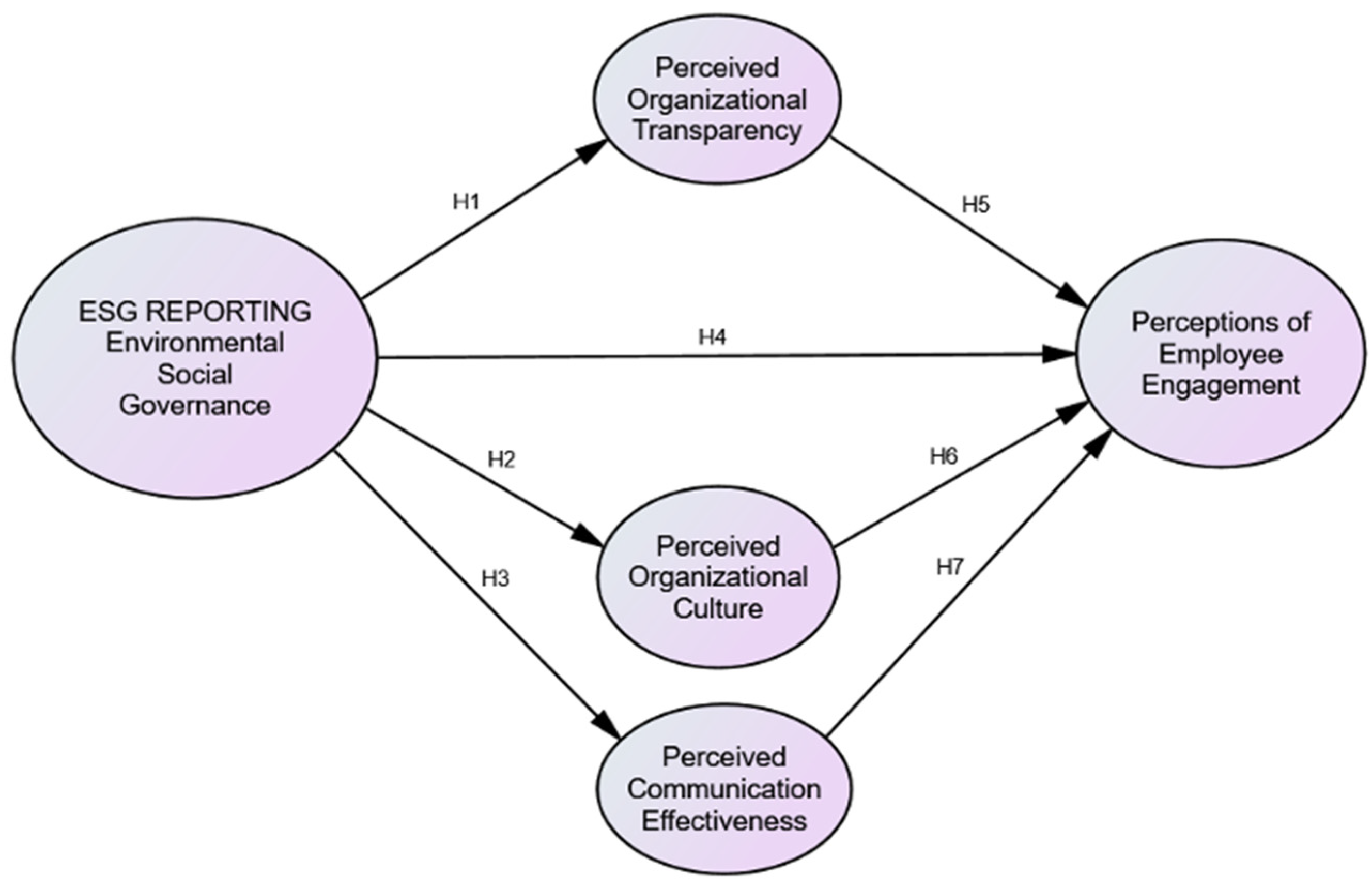
Hypothesis 1 (H1). ESG reporting significantly influences consumer perceptions of organizational transparency.
Consumer perception on organizational culture is an important factor for integrating the ESG framework by promoting responsibility, transparency, and innovation. Studies show that effective implementation of ESG practices requires deep alignment with the organization’s internal values and norms, and organizational culture acts as a control and discipline mechanism that supports sustainable behaviors among employees and managers [
45]. Furthermore, organizations that cultivate a collaborative and adaptive culture demonstrate a greater ability to generate sustainable innovations, reduce environmental impact, and increase employee engagement in ESG initiatives [
46]. Moreover, integrating ESG principles into organizational culture requires a transformation of internal values, norms, and behaviors. This process is facilitated by ethical leadership that acts as a catalyst for cultural change and collective commitment to sustainability. Furthermore, recent research highlights that business ethics, fair labor practices, and responsible governance are among the most influential ESG variables that contribute to the achievement of sustainability goals, especially when supported by a coherent organizational culture and leaders who act as role models for sustainable behavior [
46].
Waites (2025) affirmed that ESG reporting is perceived by consumers as a signal of the company’s internal values [
37]. Thus, its social and governance components reflect organizational ethics, and how employees are treated. Consequently, consumers infer from ESG what the internal culture is like, even without direct access to it. Thus, the way consumers perceive organizational culture and ethical leadership not only support ESG performance but also transform it into a sustainable competitive advantage. Therefore, we suggest the following:
Hypothesis 2 (H2). ESG reporting significantly influences consumer perceptions of organizational culture.
In the current context of ESG discussions and practices, communication becomes very important in strengthening consumer’s perception of a company’s ESG performance. Recent studies show that clear, consistent, and transparent communication about ESG initiatives not only reflects organizational commitment but also amplifies its impact on reputation among consumers [
31]. This association suggests that organizations that effectively communicate their sustainable values and actions are perceived by consumers as more responsible, transparent, and committed to achieving sustainable development goals. Furthermore, research shows that positive perceptions of ESG practices directly influence consumer loyalty by improving consumer relationships and increasing brand satisfaction and trust [
47]. Corporate reputation, mediated by the consumers’ perception on social responsibility, also plays a key role in strengthening their loyalty, especially in industries where ethics and sustainability are key competitive factors [
48]. Sustainability is becoming an essential differentiator, and a company’s ESG performance is increasingly influencing consumer purchasing behaviors. Recent studies show that effective communication of ESG initiatives not only helps strengthen corporate reputation but also increases consumer loyalty and influences purchasing decisions [
49]. Consumers who perceive companies as authentic in their sustainability commitments are more likely to show brand loyalty and choose their products over others, even at similar or higher prices [
50]. Furthermore, the direct involvement of consumers in companies’ sustainability initiatives—through participatory campaigns or transparency in reporting—generates a sense of belonging and responsibility, which strengthens purchase intent and reduces the gap between intent and behavior [
49]. Thus, ESG becomes not only a compliance tool, but also a strategic vector for influencing the market and building consumer trust. In this context, we formulate the following:
Hypothesis 3 (H3). ESG reporting significantly influences consumer perceptions of effective organizational communication.
Currently, consumers increasingly appreciate fair workplaces that treat employees with respect and offer good work conditions [
35]. Consumers’ expectations can further be justified by the connection between employee engagement and customer satisfaction- the more engaged employees are, the more satisfied the customer will be [
51]. In addition, studies revealed that CSR determines a high level of employee engagement [
52]. Therefore, consumers pay attention relate companies’ involvement in CSR or ESG activities with a fair labor policy [
35].
The implementation of ESG practices has a direct impact on consumer perception on employee engagement, as consumers who are employees themselves tend to identify more strongly with the company’s values and mission when it demonstrates social and environmental responsibility. In line with this, ESG reporting directly influences consumers’ perceptions of a company and its values [
53] and has a direct and significant impact on customer engagement [
54]. Moreover, ESG reporting influences consumer attitudes and behavior, including assessments related to values, ethics, and credibility [
37]. Thus, ESG is not just a compliance strategy, but a strategic factor that shapes the consumers perception on staff engagement.
In a social and economic climate increasingly concerned with sustainability, organizational transparency is an important pillar for consumer perceptions of employee engagement and trust building. Organizational transparency and employee engagement are both good management practices influencing consumers’ perception in understanding the transition of a business towards a sustainable market approach. Transparency is a catalyst for accountability because it is closely linked to leadership style and organizational culture [
55].
The consumers evaluate a company’s CSR reporting based on their own values and they expect for the company to act accordingly. Thus, proactive, transparent and planned CSR leads to trustiness among consumers. More than that, in the digital era, consumers are exposed to multiple information sources with a high level of persuasive messages, which can develop skepticism about organizational communication, including CSR reporting [
56]. Oil and gas companies’ lack of real involvement and transparency in CSR reporting also generates frustration among local communities, which are waiting for corporate actions to meet their needs [
57]. Hence, this frustration generated by lack of real social responsibility can also nurture consumers’ skepticism towards the entire organization, including internal aspects such as organizational culture and even employee engagement. Therefore, we formulate the following:
Hypothesis 4 (H4). ESG reporting has a direct effect on consumer perceptions of employee engagement.
Hypothesis 5 (H5). Organizational transparency significantly influences consumer perceptions of employee engagement.
Organizational culture plays an important role in employee engagement, influencing how employees think, relate, and behave in the workplace [
58]. In a study conducted with top management employees from a range of service industries operating in Australia, Buttery et al. (2023) highlighted that employees are on the front line of customer interactions, and their behavior directly shapes the consumer experience [
59]. Moreover, organizational culture influences the perception of organizational support, which in turn boosts employee motivation, engagement, and performance [
60]. In addition, studies [
61] revealed a strong connection between organizational culture and employee happiness. The positive work culture positively influences employee–customer interactions. Lee et al. (2023) emphasized that there is a clear link between the employees’ internal experience and customers’ external perceptions of a company [
62]. Thus, we formulate the following hypothesis:
Hypothesis 6 (H6). Organizational culture significantly influences consumer perceptions of employee engagement.
Effective communication is essential for successfully conveying ESG initiatives to stakeholders, in general, and to customers, in particular [
63]. In a study conducted in Taiwan, Lee et al. (2025) stated that ESG practices influence employees’ perception of value when communicated internally, and employees who perceive value in ESG tend to be more engaged and contribute to sustainable results [
38]. Moreover, if ESG is communicated effectively, consumers develop a more positive perception of employee engagement [
54]. Therefore, we state the following:
Hypothesis 7 (H7). Effective communication positively influences consumer perceptions of employee engagement.
The graphical representation of the research model is presented in
Figure 1.
3. Research Methodology
The data for this research were collected through a structured online questionnaire distributed to Romanian consumers. Given the scope of the study and the exploratory nature of the model, a convenience sampling strategy was employed. The purpose, objectives, hypotheses, and questionnaire were developed by the authors, and the data was collected using the consumers panel of the research company iSense Solutions according to the partnership agreement with the Bucharest University of Economic Studies.
The data collection procedure and the research was conducted in compliance with the ICC/ESOMAR Code on Market, Opinion and Social Research and Data Analytics and with the Code of Ethics and University Deontology of the Bucharest University of Economic Studies (ASE), as part of the ASE Charter, which governs the ethical standards applicable to scientific research, publication, and dissemination of results within the academic community.
Considering the scope of the research and the exploratory nature of the research model, a convenience sampling method was used. This approach was selected for pragmatic reasons and specifically targeted consumers relevant to ESG reporting in the oil and gas industry.
The questionnaire was designed in February–March 2025. It was applied online, and data were collected in April 2025, during which 400 Romanian respondents, aged between 18 and 65, from urban and rural areas completed the questionnaire. While the sample is not representative on the Romanian market, it accurately represents it in terms of age and gender quotas. A detailed description of the sample is provided in
Table 1.
The questionnaire was designed to capture both demographic and attitudinal data [
64]. The attitudinal items were measured using a five-point Likert scale ranging from “strongly disagree” to “strongly agree.” The rating scales used in the questionnaire were developed based on an extensive review of the literature. In total, the questionnaire included 33 measurement items operationalizing seven constructs on consumers perception regarding environmental, social, and governance dimensions of ESG reporting (based on the P-ESG scale), as well as perceived organizational transparency [
65], perceived communication effectiveness [
58], perceived organizational culture [
66], and perceived employee engagement [
67]. The P-ESG model developed by Oh et al. (2024) served as the foundational framework, and it was adapted to fit the specific context and objectives of the study by incorporating additional organizational-level constructs identified in prior research [
41].
The questionnaire consisted of two sections. The first section captured respondents’ socio-demographic characteristics, including gender, age, geographical location, and income. The second section included the 33 items measuring consumer perceptions on ESG-related practices, organizational transparency, communication effectiveness, corporate culture, and employee engagement. In the questionnaire, the term “gas station” was used to represent companies in the oil and gas industry, as it reflects the primary point of direct interaction between consumers and these firms.
4. Results
Before testing the research hypotheses, a confirmatory factor analysis (CFA) was conducted to assess the reliability and validity of the measurement model. ESG reporting was conceptualized as a multidimensional construct; therefore, a second-order latent variable (ESG) was specified to capture the aggregate effect of its first-order dimensions (environmental, social, and governance). During the CFA process, model fit was improved by allowing covariances between the error terms of two items within the environmental reporting construct and two items within the perceived employee engagement construct. These modifications were theoretically justified, as the items involved capture closely related aspects of the same underlying dimensions and may share measurement-specific variance. No items were removed from the model.
Following these modifications, the second-order CFA was conducted using IBM SPSS Statistics (version 25) and AMOS (version 26). The global fit indices indicate a good fit to the data: χ
2 = 1113.735 (
p < 0.05), χ
2/df = 2.320, CFI = 0.952, IFI = 0.952, NFI = 0.919, and TLI = 0.947. Additionally, RMSEA is 0.058 and SRMR is 0.03, both within acceptable thresholds. Convergent validity is supported, with standardized factor loadings ranging from 0.744 to 0.876. All average variance extracted (AVE) values exceed 0.50 and composite reliability (CR) values are above 0.70.
Table 2 presents descriptive statistics, factor loadings, and reliability coefficients. Overall, the measurement model demonstrates satisfactory reliability and validity.
Given that the data were collected by using a single self-reported questionnaire, common method bias was assessed. To check potential common method bias, Harman’s single-factor test was conducted. The results indicated that the first factor accounted for less than 50% of the total variance, suggesting that common method bias is not a serious concern in this study. Additionally, a single-factor CFA model was tested, in which all items were loaded onto a single latent factor. The model exhibited poor fit compared to the proposed measurement model, further indicating that common method bias is unlikely to significantly affect the results. Procedural remedies (e.g., anonymity assurance, careful item wording) were also applied during survey design to minimize common method bias.
Next, we examined the direct and indirect effects of ESG Reporting 2nd order construct on perceived Organizational Transparency, perceived Effective Communication, perceived Organizational Culture and consumer perceptions on Employee Engagement by conducting a path analysis.
Table 3 presents the results of the path analysis, including the standardized regression weights derived from the structural model output in AMOS.
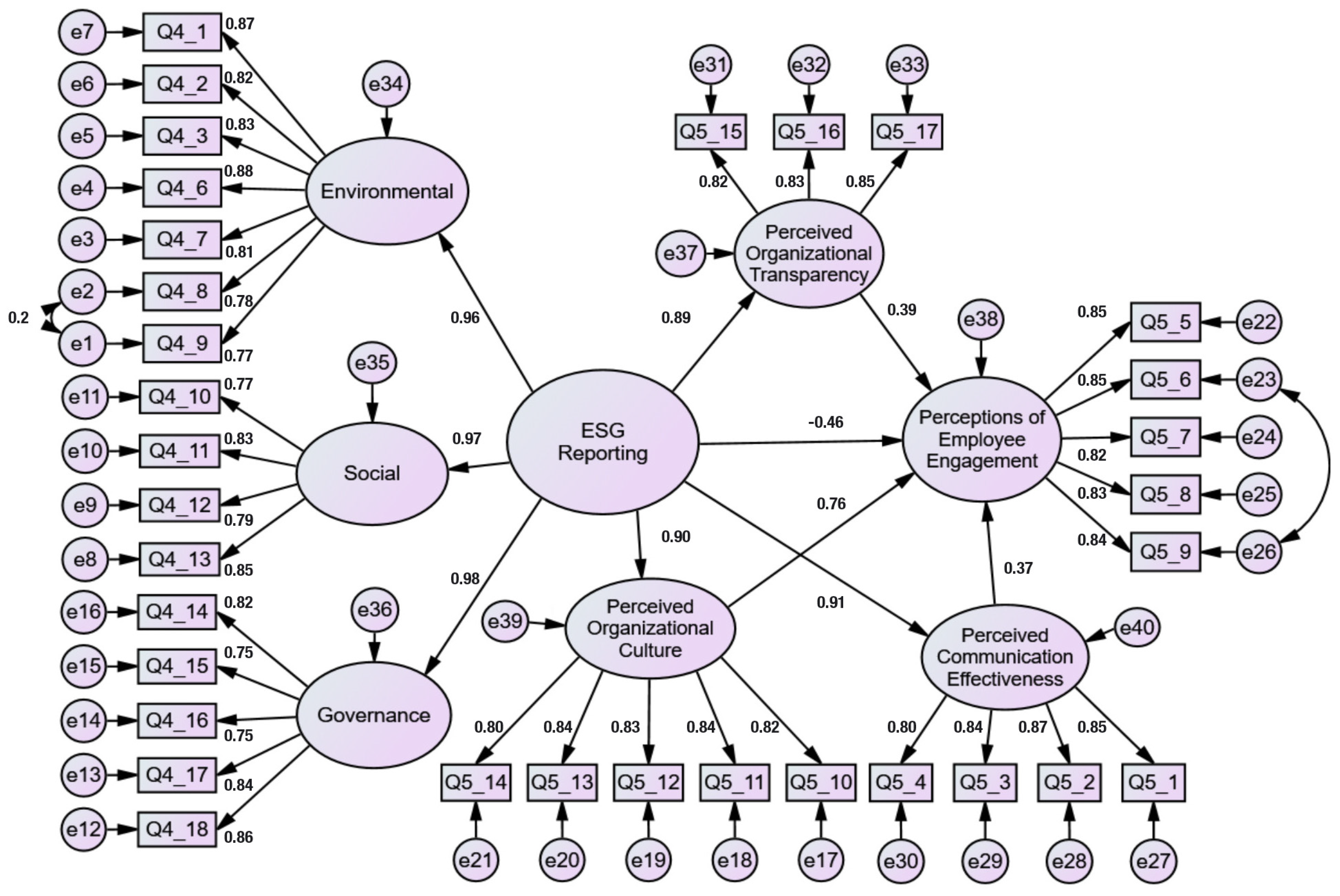
The path coefficients from the first-order ESG dimensions (environmental, social, and governance) to the second-order ESG construct are relatively high. This is expected, as the second-order construct is specified as a reflective higher-order factor that captures the shared variance among its dimensions. High loadings indicate that these dimensions strongly contribute to the overall ESG construct.
The analysis shows that ESG reporting has significantly positive effects on perceptions of organizational transparency, communication effectiveness, and organizational culture. However, there is an inverse relationship between ESG and perceived employee engagement (−0.458). It is also relevant to mention the strong effect of perceived organizational culture on perceived employee engagement (0.762). We observe significant positive effects of perceived organizational transparency and perceived communication effectiveness on perceptions of employee engagement. The results of the path analysis reveal a well-fitting structural model in which governance, social, and environmental dimensions exert strong and statistically significant influences on ESG reporting. Specifically, governance (β = 0.978, p < 0.001), social (β = 0.971, p < 0.001), and environmental (β = 0.964, p < 0.001) components contribute substantially to the development of effective perception on ESG reporting systems, highlighting the multidimensional nature of sustainability disclosure. ESG reporting, in turn, demonstrates a strong positive effect on perceived organizational transparency (β = 0.891, p < 0.001), perceived communication effectiveness (β = 0.909, p < 0.001), and perceived organizational culture (β = 0.898, p < 0.001).
From a consumer perspective, ESG reporting exhibits a negative direct association with perceived employee engagement (β = –458, p < 0.001). These findings suggest that when ESG disclosures are evaluated in isolation, consumers may question their authenticity or interpret them as symbolic rather than substantive practices, potentially leading to skepticism regarding their impact on employees.
However, this negative direct effect is offset by significant positive indirect effects through perceived organizational transparency (β = 0.387, p < 0.001), effective communication (β = 0.368, p < 0.001), and organizational culture (β = 0.762, p < 0.001). The indirect effect of ESG reporting on perceived employee engagement (β = 1.364, p = 0.007) reflects the combined influence of multiple mediating variables. Although the magnitude exceeds 1, this is attributable to the aggregation of three strong indirect pathways via organizational transparency, effective communication, and organizational culture. When combined with the negative direct effect (β = –0.458, p < 0.001), the total effect remains positive and significant (β = 0.906, p < 0.001), suggesting that ESG communication contributes positively to employee-related perceptions when supported by credible organizational mechanisms. These findings indicate that consumers do not evaluate ESG disclosures independently; rather, they interpret them through broader organizational signals. When ESG reporting is perceived as transparent, well-communicated, and embedded in organizational culture, it enhances consumers’ perceptions of employee engagement.
As Grigore et al. (2024) mention, there is a paradox among Romanian managers—although they feel the need „to do good”, they also prioritize personal interest [
68]. This tendency can lead to CSR practices which involve short-term promotional actions, instead of improving working conditions. Romanians’ tendency to think CSR is carried out at the expense of employees can be explained by another study [
69] that highlights how CSR is perceived in Romania. The study showed that managers are using corporate social responsibility programs only to create personal and corporate reputation, especially when companies’ interests are not linked with consumers’ expectations.
In Romania, CSR practices involve a transfer of ethical responsibility to the employees, as Grigore et al. (2021) [
69] (p. 778) highlighted: “...we heard of employees encouraged to consider what they might do in the name of the organization (not what the organization might do for them or for society)”. Romanian people tend to be concerned on work stress often determined by workload, work demands or work conditions [
70,
71]. Another research [
72] highlighted that in Romanian organizations, workload is well-known as a main factor of occupational stress. In this context, we consider it highly important to investigate the consumers’ perception about CSR and companies that are doing CSR, especially when it comes to a criticized sector, such as the oil and gas industry.
Overall, the model underscores ESG reporting as a pivotal mechanism linking perceived corporate sustainability governance to internal organizational outcomes. The analysis resulted in the structural model is presented below (
Figure 2):
5. Discussion
The present research aimed to investigate the influence of ESG reporting on consumer perception regarding organizational transparency, organizational culture, employee engagement, and effective communication. Sustainability reporting is no longer a voluntary choice but has become an obligation. Thus, companies must continue to pay close attention to ESG reporting because, as can be seen in consumer perception, this increases the organizational transparency, builds trust and supports purchasing decisions.
The results of the study confirmed the validity of the first hypothesis (H1) and displayed the fact that ESG reporting significantly influences the perception on the organizational transparency. This finding is consistent with prior studies showing that positive consumer perceptions of sustainable practices influence the company’s image, especially in retail, where consumers are more open to understanding social impact [
50,
73,
74]. Moreover, a recent study, Hu et al. (2026) stated that information transparency and corporate reputation are mediators between ESG reporting quality and investment decisions [
75].
The second research hypothesis (H2) posits that the ESG framework exerts a strong influence on consumer perceptions regarding the organizational culture. Empirical evidence supports this result. For example, in a study investigating how consumers respond to company’s communication related to the ESG dimensions, Waites (2025) demonstrated that consumers perceive organizational culture through the lens of ethics and values, and ESG serves as a direct indicator of these values [
37]. Another study indicates that ESG influences customer satisfaction, which in turn mediates the firm’s value; thus, consumer perceptions are closely linked to how stakeholders perceive the organization’s culture [
76]. These findings support the second hypothesis (H2).
Our results confirm the third hypothesis (H3) and support that ESG reporting has a direct and strong connection to perceived effective communication. In this line, Lajó (2025) [
77] and Wu et al. (2025) [
78] highlighted that social communication is a critical element in ESG reporting. Moreover, in a study regarding the activity of companies on Twitter, other scholars show that ESG reporting needs to be expanded beyond simple static disclosures and integrated into an interactive communication strategy to build reputational capital and dialog with stakeholders [
79].
The fourth hypothesis (H4) affirmed that ESG reporting has a direct (but negative) effect on perceptions of employee engagement. The negative direct relationship between ESG reporting and perceived employee engagement, as evaluated by consumers, offers an important insight into how external stakeholders interpret sustainability communication. One possible explanation is that consumers may perceive ESG disclosures—particularly those emphasizing community involvement—as impression management tools if they are not supported by clear evidence of internal organizational alignment. This perception may lead to skepticism about whether such initiatives genuinely benefit employees. However, the strong positive indirect effects observed in this study highlight the critical mediating role of organizational transparency, communication quality, and corporate culture. These findings suggest that consumers rely on contextual organizational cues when forming judgments about employee-related outcomes. In other words, ESG reporting becomes credible and meaningful only when it is perceived as part of a transparent, consistently communicated, and culturally embedded organizational approach. This pattern can be interpreted as a form of perception-based suppression effect, where the direct pathway captures initial skepticism, while the indirect pathways reflect trust-building mechanisms. From a theoretical standpoint, this aligns with signaling theory, which suggests that stakeholders evaluate corporate disclosures based not only on the signal itself but also on the credibility of the signaling environment. Another possible explanation for the negative effect may lie in the high volume of work required by ESG reporting. In an online survey conducted on 228 employees with more than 5 years’ experience on ESG reporting, Han and Lee (2024) demonstrated that the responsibility associated with ESG reporting can lead to workplace stress, especially when there are not enough employees to meet the requirements [
80]. Moreover, the work stress caused by a high workload has a negative impact on employee engagement and contributes to their tendency to leave the organization [
81].
The fifth hypothesis (H5) stated that perceived organizational transparency influences consumer perceptions regarding employee engagement. In a study examining the CSR gaps perceived by employees and customers of fashion firms, it was found that consumers form their perceptions based on how employees are treated within the company [
62]. Moreover, if organizational transparency makes CSR visible, it can influence consumers’ perceptions regarding employee engagement [
82]. Therefore, H2 is confirmed.
Perceived organizational culture strongly influences consumer perceptions of employee engagement (H6). In a systematic literature review based on the PRISMA framework, Nursalimah et al. (2025) identified that open communication and inclusive leadership are cultural elements that stimulate engagement [
83]. Moreover, organizational culture has been shown to influence employee engagement and behavior [
84]. As employees act as the primary interface between organizations and customers, their behaviors transmit cultural values externally [
59]. Consequently, consumers form perceptions about employee engagement based on the observable cues [
62]. The empirical findings confirm hypothesis H6.
Perceived communication effectiveness influences consumer perceptions of employee engagement (H7). In a systematic literature review on employee engagement and internal communication, Nadales-Gallego et al. (2025) showed that employees perceive clear communication as a key predictor of motivation, satisfaction, and commitment of work [
85]. A study on Bhutanese enterprises indicated the effects of effective internal communication (e.g., clarity, regular updates, freedom of expression) are associated with greater motivation, commitment, and intention to remain in the organization [
86]. Effective organizational communication has been shown to enhance employee engagement and trust [
87], while also shaping consumer perceptions through signaling organizational values and practices [
88]. As consumers evaluate employee engagement through observable behaviors and organizational cues, perceived communication effectiveness may indirectly shape perceptions of employee engagement. Thus, the hypothesis H7 was validated.
6. Conclusions
From a theoretical point of view, the present study contributes to the enrichment of the literature on ESG reporting in the oil and gas industry. It provides a theoretical framework that explains some correlations between ESG reporting and consumer perceptions regarding organizational transparency, organizational culture, employee engagement, and effective communication. The analysis showed that ESG factors are strongly associated with consumer perceptions on organizational transparency, effective communication, and organizational culture, but there is an inverse relationship between ESG and employee engagement. A strong relationship between ESG reporting and organizational transparency leads to trust for stakeholders including investors, authorities or consumers. Thus, it creates a competitive advantage for the company. Moreover, using the P-ESG scale, the research extends the stakeholder theory, by integrating perception as a critical variable between reporting and its effects.
From a practical point of view, the study shows that the information consumers receive from companies through ESG reporting is important and represents one of the key elements contributing to the formation of consumer perception. In this regard, our study concludes that it is important for companies to expand the scope of ESG reporting communication beyond shareholders and public authorities. To enhance relevance in market relationships, companies need to adapt the information available in the ESG reports to address the consumes as well. By doing so, overall consumer perceptions of the company are likely to improve, and the results of our study identified several specific dimensions in which such communication has a direct impact. These include improvements in consumer perceptions of corporate transparency, organizational culture and the effectiveness of corporate communication. We consider all these factors important in building the consumer trust in organization.
7. Limitations and Future Research Directions
This study has several limitations. First, the use of a convenience sample from a single country (Romania) limits the generalizability of the findings. Second, the study relies on self-reported, perception-based data collected from consumers, which may not fully reflect actual organizational practices or employee attitudes. Constructs such as organizational culture and employee engagement are evaluated indirectly through consumer perceptions rather than internal organizational data.
Third, the cross-sectional design does not allow for causal inference. Future research could address these limitations by employing multi-source data (e.g., combining consumer and employee perspectives), longitudinal designs, and cross-country comparisons to enhance external validity. This study does not explicitly test moderating variables such as organizational trust or perceived authenticity, which may influence how consumers interpret ESG disclosures.
Future research is encouraged to incorporate these factors to better understand the conditions under which ESG reporting leads to favorable or unfavorable employee-related perceptions.
Author Contributions
Conceptualization, A.S., M.S., Ș.-A.C. and A.F.; methodology, A.S., M.S., U.A. and A.I.; software, U.A.; validation, A.S., M.S., U.A., Ș.-A.C., O.C.M., A.F. and A.I.; formal analysis, U.A.; investigation, A.S., M.S. and A.F.; resources, A.S., M.S., Ș.-A.C. and A.F.; data curation, M.S.; writing—original draft preparation, A.S., M.S., U.A., Ș.-A.C., O.C.M., A.F. and A.I.; writing—review and editing, A.S., M.S., U.A., Ș.-A.C., O.C.M., A.F. and A.I.; visualization, A.S. and A.F.; supervision, A.S.; project administration, A.S. All authors have read and agreed to the published version of the manuscript.
Funding
This research received no external funding.
Institutional Review Board Statement
Ethical review and approval were waived for this study due to the study being conducted in accordance with the Ethical Code of Bucharest University of Economic Studies, chapter XV from the University Charter (received legal notice from the Romanian Ministry of Education by means of Ministerial Notice no. 30421/10 June 2020).
Informed Consent Statement
Informed consent was obtained from all subjects involved in the study.
Data Availability Statement
The original contributions presented in this study are included in the article. Further inquiries can be directed to the corresponding author.
Acknowledgments
We would like to thank Andrei Cânda from iSense Solutions company for helping us collect the data. Also, we would like to thank Mihai Roșca and Ștefan Boboc for their feedback on the early version of this paper. This paper was supported by The Bucharest University of Economic Studies during the PhD program.
Conflicts of Interest
The authors declare no conflicts of interest.
References
- Barbu, A.; Militaru, G.; Deselnicu, D.C.; Catană, Ş.-A. Key Success Factors That Enable IT Service Providers to Achieve Organizational Performance: Evidence from Romania. Sustainability 2021, 13, 10996. [Google Scholar] [CrossRef]
- GRI. Global Reporting Initiative (GRI) Index 2016. 2016. Available online: https://documents.worldbank.org/pt/publication/documents-reports/documentdetail/en/891531474280784830 (accessed on 26 August 2025).
- Rosati, F.; Faria, L.G.D. Business contribution to the Sustainable Development Agenda: Organizational factors related to early adoption of SDG reporting. Corp. Soc. Responsib. Environ. Manag. 2019, 26, 588–597. [Google Scholar] [CrossRef]
- García-Sánchez, I.-M. Corporate social reporting and assurance: The state of the art: Información social corporativa y aseguramiento: El estado de la cuestión. Rev. Contab.-Span. Account. Rev. 2021, 24, 241–269. [Google Scholar] [CrossRef]
- Reyers, M. Corporate Sustainability Consciousness: A Climate Change Perspective. 2009. Available online: https://search.proquest.com/openview/a6b38870b4a2742dc39a08389f67349e/1?pq-origsite=gscholar&cbl=2026366&diss=y (accessed on 26 August 2025).
- Hák, T.; Janoušková, S.; Moldan, B. Sustainable Development Goals: A need for relevant indicators. Ecol. Indic. 2016, 60, 565–573. [Google Scholar] [CrossRef]
- Rayer, Q.G. Exploring ethical and sustainable investing. CISI Rev. Financ. Mark. 2017, 12, 4–10. [Google Scholar]
- Meyer, A.L. Corporate Political Responsibility and Climate Change: Exploring Barriers to Strategy Alignment Among Major U.S. Food and Beverage Companies. 2019. Available online: https://dspace.mit.edu/handle/1721.1/123972 (accessed on 26 August 2025).
- Reyers, B.; Selomane, O.; Biggs, R.; Hamann, M. Harnessing Insights from Social-Ecological Systems Research for Monitoring Sustainable Development. Sustainability 2019, 11, 1190. [Google Scholar] [CrossRef]
- Saad, S.M.; Yaaqoob, I.I. Building a Corporate Social Responsibility Indicator in View of the COVID-19 Pandemic Based on Selected International Experiences. Int. J. Prof. Bus. Rev. 2022, 7, 20. [Google Scholar] [CrossRef]
- Bravo, F.; Reguera-Alvarado, N. Sustainable development disclosure: Environmental, social, and governance reporting and gender diversity in the audit committee. Bus. Strategy Environ. 2019, 28, 418–429. [Google Scholar] [CrossRef]
- Fernández-Vázquez, J.-S.; Sancho-Rodríguez, Á. Critical Discourse Analysis of Climate Change in IBEX 35 Companies. Technological Forecasting and Social Change. 2020. Available online: https://ideas.repec.org//a/eee/tefoso/v157y2020ics0040162520300433.html (accessed on 26 August 2025).
- GRI. GRI-GRI Standards English Language. 2020. Available online: https://www.globalreporting.org/how-to-use-the-gri-standards/gri-standards-english-language/ (accessed on 26 August 2025).
- Nirino, N.; Santoro, G.; Miglietta, N.; Quaglia, R. Corporate controversies and company’s financial performance: Exploring the moderating role of ESG practices. Technol. Forecast. Soc. Change 2021, 162, 120341. [Google Scholar] [CrossRef]
- Caiado, R.G.G.; Leal Filho, W.; Quelhas, O.L.G.; de Mattos Nascimento, D.L.; Ávila, L.V. A literature-based review on potentials and constraints in the implementation of the sustainable development goals. J. Clean. Prod. 2018, 198, 1276–1288. [Google Scholar] [CrossRef]
- van Oorschot, K.E.; Aas Johansen, V.; Lynes Thorup, N.; Aspen, D.M. Standardization cycles in sustainability reporting within the Global Reporting Initiative. Eur. Manag. J. 2024, 42, 492–502. [Google Scholar] [CrossRef]
- European Commission. Corporate Sustainability Reporting Directive—European Commission. 2025. Available online: https://finance.ec.europa.eu/regulation-and-supervision/financial-services-legislation/implementing-and-delegated-acts/corporate-sustainability-reporting-directive_en (accessed on 26 August 2025).
- Avetisyan, E.; Hockerts, K. The Consolidation of the ESG Rating Industry as an Enactment of Institutional Retrogression. Bus. Strategy Environ. 2017, 26, 316–330. [Google Scholar] [CrossRef]
- Searcy, C.; Elkhawas, D. Corporate sustainability ratings: An investigation into how corporations use the Dow Jones Sustainability Index. J. Clean. Prod. 2012, 35, 79–92. [Google Scholar] [CrossRef]
- Van Duuren, E.; Plantinga, A.; Scholtens, B. ESG Integration and the Investment Management Process: Fundamental Investing Reinvented. J. Bus. Ethics 2016, 138, 525–533. [Google Scholar] [CrossRef]
- Barbu, A.; Tiganoaia, B. Romania’s energetic system. J. Inf. Syst. Oper. Manag. 2018, 12, 372–382. [Google Scholar]
- Slager, R.; Gond, J.-P.; Moon, J. Standardization as Institutional Work: The Regulatory Power of a Responsible Investment Standard. Organ. Stud. 2012, 33, 763–790. [Google Scholar] [CrossRef]
- Cappucci, M. The ESG integration paradox. J. Appl. Corp. Financ. 2018, 30, 22–28. [Google Scholar] [CrossRef]
- Doyle, T.M. Ratings that don’t rate: The subjective world of ESG ratings agencies. Am. Counc. Cap. Form. 2018, 65–71. Available online: https://accf.org/wp-content/uploads/2018/07/071818_ACCF_RatingsESGReport_PUB01.pdf (accessed on 26 August 2025).
- Drempetic, S.; Klein, C.; Zwergel, B. The influence of firm size on the ESG score: Corporate sustainability ratings under review. J. Bus. Ethics 2020, 167, 333–360. [Google Scholar] [CrossRef]
- Semenova, N.; Hassel, L.G. On the Validity of Environmental Performance Metrics. J. Bus. Ethics 2015, 132, 249–258. [Google Scholar] [CrossRef]
- Chatterji, A.K.; Durand, R.; Levine, D.I.; Touboul, S. Do ratings of firms converge? Implications for managers, investors and strategy researchers. Strateg. Manag. J. 2016, 37, 1597–1614. [Google Scholar] [CrossRef]
- Slager, R.; Chapple, W. Carrot and Stick? The Role of Financial Market Intermediaries in Corporate Social Performance. Bus. Soc. 2016, 55, 398–426. [Google Scholar] [CrossRef]
- Chatterji, A.K.; Toffel, M.W. How firms respond to being rated. Strateg. Manag. J. 2010, 31, 917–945. [Google Scholar] [CrossRef]
- Dupire, M.; M’Zali, B. CSR Strategies in Response to Competitive Pressures. J. Bus. Ethics 2018, 148, 603–623. [Google Scholar] [CrossRef]
- Clementino, E.; Perkins, R. How Do Companies Respond to Environmental, Social and Governance (ESG) ratings? Evidence from Italy. J. Bus. Ethics 2021, 171, 379–397. [Google Scholar] [CrossRef]
- Cheng, L.K.; Huang, H.-L. Influence of environmental, social and governance (ESG) disclosures on consumer brand perceptions and behavioral intentions. Asia Pac. J. Mark. Logist. 2025, 37, 1955–1971. [Google Scholar] [CrossRef]
- Cazacu, M.; Dumitriu, S.; Georgescu, I.; Berceanu, D.; Simion, D.; Vărzaru, A.A.; Bocean, C.G. A Perceptual Approach to the Impact of CSR on Organizational Financial Performance. Behav. Sci. 2023, 13, 359. [Google Scholar] [CrossRef]
- Öberseder, M.; Schlegelmilch, B.B.; Murphy, P.E. CSR practices and consumer perceptions. J. Bus. Res. 2013, 66, 1839–1851. [Google Scholar] [CrossRef]
- Tai, V.P. General consumer perceptions and their impact on corporate social responsibility (CSR) and environmental, social, and governance (ESG) in Vietnam. Int. J. Multidiscip. Res. Growth Eval. 2024, 5, 912–920. [Google Scholar] [CrossRef]
- Eccles, R.G.; Inoannou, I.; Serafeim, G. The Impact of Corporate Sustainability on Organizational Processes and Performance. Manag. Sci. 2014, 60, 2835–2857. [Google Scholar] [CrossRef]
- Waites, S.F. Decoding ESG: Consumer Perceptions, Ethical Signals and Financial Outcomes. J. Risk Financ. Manag. 2025, 18, 361. [Google Scholar] [CrossRef]
- Lee, C.-Y.; Fan, W.-S.; Tsai, M.-C. The Mediating Role of Employee Perceived Value in the ESG–Sustainability Link: Evidence from Taiwan’s Green Hotel Industry. Tour. Hosp. 2025, 6, 153. [Google Scholar] [CrossRef]
- Rahman Khattak, S.; Nouman, M.; Fayaz, M.; Cismaș, L.M.; Negruț, L.; Negruț, C.V.; Salem, S. Corporate Social Responsibility and Employee Green Behavior in the Hospitality Industry: A Cross-Country Study. Sustainability 2021, 13, 10534. [Google Scholar] [CrossRef]
- Mughal, Y.H.; Nair, K.S.; Arif, M.; Albejaidi, F.; Thurasamy, R.; Chuadhry, M.A.; Malik, S.Y. Employees’ Perceptions of Green Supply-Chain Management, Corporate Social Responsibility, and Sustainability in Organizations: Mediating Effect of Reflective Moral Attentiveness. Sustainability 2023, 15, 10528. [Google Scholar] [CrossRef]
- Oh, H.J.; Lee, B.; Ma, H.H.; Jang, D.; Park, S. A preliminary study for developing perceived ESG scale to measure public perception toward organizations’ ESG performance. Public Relat. Rev. 2024, 50, 102398. [Google Scholar] [CrossRef]
- Connelly, B.L.; Certo, S.T.; Ireland, R.D.; Reutzel, C.R. Signaling theory: A review and assessment. J. Manag. 2011, 37, 39–67. [Google Scholar] [CrossRef]
- Handajani, L.; Sokarina, A.; Hamdani Husnan, L. Signaling sustainability: The impact of ESG risk and sustainability awards on the performance of ESG-leader firms. Cogent Bus. Manag. 2026, 13, 2627674. [Google Scholar] [CrossRef]
- Gong, Q.; Gu, J.; Kong, Z.; Shen, S.; Dong, X.; Li, Y.; Li, C. The Impact of ESG Ratings on Corporate Sustainability: Evidence from Chinese Listed Firms. Sustainability 2025, 17, 5942. [Google Scholar] [CrossRef]
- Fietz, B.; Günther, E. Changing Organizational Culture to Establish Sustainability. Control Manag. Rev. 2021, 65, 32–40. [Google Scholar] [CrossRef]
- Ispiryan, A.; Atkociuniene, V.; Makstutiene, N.; Sarkinas, A.; Salaseviciene, A.; Urbonaviciene, D.; Viskelis, J.; Pakeltiene, R.; Raudone, L. Correlation between Antimicrobial Activity Values and Total Phenolic Content/Antioxidant Activity in Rubus idaeus L. Plants 2024, 13, 504. [Google Scholar] [CrossRef]
- Baykal, E.; Divrik, B. Employee Involvement in Sustainability Projects in Emergent Markets: Evidence from Turkey. Sustainability 2023, 15, 13929. [Google Scholar] [CrossRef]
- Aramburu, I.A.; Pescador, I.G. The effects of corporate social responsibility on customer loyalty: The mediating effect of reputation in cooperative banks versus commercial banks in the Basque Country. J. Bus. Ethics 2019, 154, 701–719. [Google Scholar] [CrossRef]
- Reppmann, M.; Harms, S.; Edinger-Schons, L.M.; Foege, J.N. Activating the sustainable consumer: The role of customer involvement in corporate sustainability. J. Acad. Mark. Sci. 2024, 53, 310–340. [Google Scholar] [CrossRef]
- Khalufi, N.A.M.; Sheikh, R.A.; Khan, S.M.F.A.; Onn, C.W. Evaluating the Impact of Sustainability Practices on Customer Relationship Quality: An SEM-PLS Approach to Align with SDG. Sustainability 2025, 17, 798. [Google Scholar] [CrossRef]
- Cain, L.; Tanford, S.; Shulga, L. Customers’ Perceptions of Employee Engagement: Fortifying the Service–Profit Chain. Int. J. Hosp. Tour. Adm. 2018, 19, 52–77. [Google Scholar] [CrossRef]
- Turker, D. Measuring Corporate Social Responsibility: A Scale Development Study. J. Bus. Ethics 2009, 85, 411–427. [Google Scholar] [CrossRef]
- MSCI. Available online: https://www.msci.com/data-and-analytics/sustainability-solutions/esg-ratings-climate-search-tool (accessed on 18 January 2026).
- Tripopsakul, S.; Puriwat, W. Understanding the Impact of ESG on Brand Trust and Customer Engagement. J. Hum. Earth Future 2022, 3, 430–440. [Google Scholar] [CrossRef]
- Chib, S. Facilitating Employee Retention through Employee Engagement and Organization Commitment. J. Inf. Comput. Sci. 2019, 9, 478–488. [Google Scholar]
- Nguyen, N.; Priporas, C.-V.; McPherson, M.; Manyiwa, S. CSR-related skepticism: A review of literature and future research directions. J. Bus. Res. 2023, 169, 114294. [Google Scholar] [CrossRef]
- Khudir, I.M.; Rahman, A.; Farooq, M.B.; Momin, M. Evaluating the sustainability reporting of oil and gas companies in post-conflict regions: The case of Kurdistan. J. Account. Emerg. Econ. 2025, 1–21. [Google Scholar] [CrossRef]
- Hasijani, G.; Kumar, I. A study on examining the role of Organizational Culture in driving Employee Engagement. J. Mark. Soc. Res. 2025, 2, 463–467. Available online: https://www.jmsr-online.com/article/a-study-on-examining-the-role-of-organizational-culture-in-driving-employee-engagement-98 (accessed on 26 August 2025).
- Buttery, M.; Johnson, L.W.; Campbell, G.E. How Does Organizational Culture Affect Employees’ Perception of the Brand in Service Industries? Businesses 2023, 3, 52–66. [Google Scholar] [CrossRef]
- José, D.; Palma-Moreira, A.; Au-Yong-Oliveira, M. Organizational Culture and Perceived Performance: Mediation of Perceived Organizational Support and Moderation of Motivation. Adm. Sci. 2025, 15, 307. [Google Scholar] [CrossRef]
- Manzoor, F.; Wei, L.; Asif, M.; Siraj, M. Unpacking the impact of organizational culture and CSR on happiness management: Effects on consumer happiness. BMC Psychol. 2025, 13, 621. [Google Scholar] [CrossRef]
- Lee, S.H.; Jung, S.; Ha-Brookshire, J. “We are watching you”: Investigation of consumer-employee perception gaps and the employee expectations-employer performance gaps. Fash. Text. 2023, 10, 34. [Google Scholar] [CrossRef]
- Ganeshan, M.K. Employee Engagement in Environmental, Social, and Governance (ESG) Initiatives in Organizations. In Global Summit on ESG and Sustainability-AAROHAN 2024; Eureka Publications: Pune, India, 2024; pp. 155–166. Available online: https://www.researchgate.net/publication/387772749_Employee_Engagement_in_Environmental_Social_and_Governance_ESG_Initiatives_in_Organizations (accessed on 26 August 2025).
- Mouton, J. Understanding Social Research; Van Schaik Publishers: Pretoria, South Africa, 1996. [Google Scholar]
- Alvarado-Herrera, A.; Bigne, E.; Aldas-Manzano, J.; Curras-Perez, R. A Scale for Measuring Consumer Perceptions of Corporate Social Responsibility Following the Sustainable Development Paradigm. J. Bus. Ethics 2017, 140, 243–262. [Google Scholar] [CrossRef]
- Koh, H.-K.; Burnasheva, R.; Suh, Y.G. Perceived ESG (Environmental, Social, Governance) and Consumers’ Responses: The Mediating Role of Brand Credibility, Brand Image, and Perceived Quality. Sustainability 2022, 14, 4515. [Google Scholar] [CrossRef]
- Walsh, G.; Beatty, S.E. Customer-based corporate reputation of a service firm: Scale development and validation. J. Acad. Mark. Sci. 2007, 35, 127–143. [Google Scholar] [CrossRef]
- Grigore, G.; Chapleo, C.; Homberg, F.; Alniacik, U.; Stancu, A. Employer branding dimensions: An adapted scale for Eastern Europe. J. Strateg. Mark. 2024, 32, 447–466. [Google Scholar] [CrossRef]
- Grigore, G.; Molesworth, M.; Vontea, A.; Basnawi, A.H.; Celep, O.; Jesudoss, S.P. Corporate Social Responsibility in Liquid Times: The Case of Romania. J. Bus. Ethics 2021, 174, 763–782. [Google Scholar] [CrossRef]
- Petreanu, V.; Iordache, R.; Seracin, M. Assessment of Work Stress Influence on Work Productivity in Romanian Companies. Procedia Soc. Behav. Sci. 2013, 92, 420–425. [Google Scholar] [CrossRef]
- Țuclea, C.E.; Țigu, G.; Țală, M.-L.; Iorgulescu, M.-C. Work life balance among Romanian employees: An empirical study. New Trends Sustain. Bus. Consum. 2017, 26, 709–716. [Google Scholar]
- Brate, A. Diagnosing Occupational Stress in Romanian Organizations. Procedia-Soc. Behav. Sci. 2014, 124, 559–564. [Google Scholar] [CrossRef][Green Version]
- Barbu, A.; Catană, Ș.-A.; Deselnicu, D.C.; Cioca, L.-I.; Ioanid, A. Factors Influencing Consumer Behavior toward Green Products: A Systematic Literature Review. Int. J. Environ. Res. Public Health 2022, 19, 16568. [Google Scholar] [CrossRef]
- Filip, A.; Stancu, A.; Onișor, L.-F.; Mogoș, O.C.; Catană, Ș.-A.; Goldbach, D. Drivers of Purchase Intentions of Generation Z on Eco-Products. Sustainability 2025, 17, 629. [Google Scholar] [CrossRef]
- Hu, H.; Zhang, T.; Dong, H. The signaling power of ESG reports: How corporate sustainability disclosure shapes investment decisions in China. Int. Rev. Financ. Anal. 2026, 109, 104691. [Google Scholar] [CrossRef]
- Seok, J.; Kim, Y.; Oh, Y.K. How ESG shapes firm value: The mediating role of customer satisfaction. Technol. Forecast. Soc. Change 2024, 208, 123714. [Google Scholar] [CrossRef]
- Lajó, A. The ethics of social communication in performance ESG reporting: A multi-dimensional approach. Soc. Commun. Ethics 2025, 1, 9–30. [Google Scholar] [CrossRef]
- Wu, L.; Sun, H.; Chen, L. The Impact of ESG Information Disclosure on Corporate Environmental Performance: Evidence from China’s Shanghai and Shenzhen A-Share Listed Companies. Sustainability 2025, 17, 10583. [Google Scholar] [CrossRef]
- Zhong, M.; Wang, M. Corporate Sustainability Disclosure on Social Media and its Difference from Sustainability Reports: Evidence from the Energy Sector. Front. Environ. Sci. 2023, 11, 1147191. [Google Scholar] [CrossRef]
- Han, G.R.; Lee, J.E. Does ESG Affect Mental Health of Employees? Focusing on the Moderating Effects of Job Crafting and Relationship Conflict. Sustainability 2024, 16, 6076. [Google Scholar] [CrossRef]
- Dinh, L.N. Determinants of employee engagement mediated by work-life balance and work stress. Manag. Sci. Lett. 2020, 10, 923–928. [Google Scholar] [CrossRef]
- Tran, N.T. Exploring the moderating role of corporate reputation and work autonomy, the mediating role of organizational trust and work satisfaction through the relationship between CSR and work engagement. Discov. Sustain. 2025, 6, 1317. [Google Scholar] [CrossRef]
- Nursalimah, S.; Rachman, G.I.K.; Andriyani, A.; Darmastuti, I. Organizational Culture as a Driver of Employee Engagement: A Systematic Review. Econ. Bus. Horiz. 2025, 4, 479–488. [Google Scholar] [CrossRef]
- Srimulyani, V.A.; Hermanto, Y.B. Organizational culture as a mediator of credible leadership influence on work engagement: Empirical studies in private hospitals in East Java, Indonesia. Humanit. Soc. Sci. Commun. 2022, 9, 274. [Google Scholar] [CrossRef]
- Nadales-Gallego, A.; Galindo-Reyes, F.; Garrido-Moreno, A. Connecting Internal Communication and Employee Engagement in Organisation: A Systematic Literature Review. Sage Open 2025, 15, 21582440251399773. [Google Scholar] [CrossRef]
- Sharma, D.; Dhakal, H.; Sharma, A. Role of Internal Communication in Fostering Employee Engagement, Retention, and Organizational Commitment: A Case of Bhutanese Industries. Asian J. Econ. Bus. Account. 2025, 25, 156–177. [Google Scholar] [CrossRef]
- Mishra, K.; Boynton, L.; Mishra, A. Driving Employee Engagement: The Expanded Role of Internal Communications: The Expanded Role of Internal Communications. Int. J. Bus. Commun. 2014, 51, 183–202. [Google Scholar] [CrossRef]
- Du, S.; Bhattacharya, C.B.; Sen, S. Maximizing Business Returns to Corporate Social Responsibility (CSR): The Role of CSR Communication. Int. J. Manag. Rev. 2010, 12, 8–19. [Google Scholar] [CrossRef]
| Disclaimer/Publisher’s Note: The statements, opinions and data contained in all publications are solely those of the individual author(s) and contributor(s) and not of MDPI and/or the editor(s). MDPI and/or the editor(s) disclaim responsibility for any injury to people or property resulting from any ideas, methods, instructions or products referred to in the content. |





 ,
,