Article

Deep Learning-Based Distributed Photovoltaic Power Generation Forecasting and Installation Potential Assessment


1
School of Electrical and Electronic Engineering, Hubei University of Technology, Wuhan 430068, China
2
Normal School of Vocational Techniques, Hubei University of Technology, Wuhan 430068, China
*
Author to whom correspondence should be addressed.
Sustainability 2026, 18(8), 3859; https://doi.org/10.3390/su18083859
Submission received: 6 March 2026 / Revised: 30 March 2026 / Accepted: 8 April 2026 / Published: 14 April 2026
(This article belongs to the Section Energy Sustainability)

Abstract

Against the backdrop of the global energy structure accelerating its transition towards a clean and low-carbon model, rooftop-distributed photovoltaic (PV) systems are playing an increasingly prominent strategic role in urban energy supply systems, owing to their notable advantages such as environmental friendliness and high spatial utilization efficiency. Consequently, they are becoming a critical pillar in advancing urban energy transformation and enhancing sustainable development. This paper aims to explore deep learning-based techniques for assessing the potential of large-scale distributed PV installations. To accurately evaluate their dynamic power generation capability, a hybrid prediction model integrating variational mode decomposition (VMD), the mutual information (MI) method, and a cascaded xLSTM-Informer network is proposed. Firstly, the model preprocesses key meteorological sequences using VMD, decomposing them into modal components of different frequencies. Subsequently, the MI method is employed to extract critical sequences. Then, the xLSTM module is utilized to learn the long-term complex dependencies between meteorological conditions and PV power output, while the Informer network captures key global temporal patterns, achieving high-precision time-series forecasting of PV generation. Finally, employing the forecasted time-series power curve as the core input, a comprehensive analytical framework for PV installation potential is constructed, integrating assessments of technical feasibility, economic viability, and environmental performance. This framework aims to scientifically estimate the admissible installed capacity and system value of distributed PV systems, thereby providing a dynamic basis for decision-making in urban planning.

1. Introduction

Amid the accelerating global transition towards a cleaner and lower-carbon energy structure, solar energy, as a sustainable and widely distributed renewable resource, plays a pivotal role in achieving carbon peak and carbon neutrality goals. Within this context, distributed PV systems, owing to their advantages such as high flexibility, ease of grid integration, and strong capacity for local consumption, have become a vital component of both urban and rural energy networks [1]. Accurately assessing the installation potential of distributed PV systems at a regional scale not only aids governments in formulating sound energy development plans but also provides essential data support for grid dispatch, investment decisions, and carbon emission accounting. Traditional research on distributed PV potential assessment has primarily relied on geographic information systems and remote sensing technologies [2,3,4,5], focusing on calculating the static theoretical installation capacity of physical spaces such as rooftops and estimating power generation using long-term average climate data. Although such methods establish a “spatial framework” for potential assessment, they exhibit three prominent limitations in practical applications. First, at the data level, they depend on long-term average meteorological parameters and fail to capture the instantaneous impacts of weather processes such as rapid cloud movement and short-duration severe convection on PV output. This results in relatively static electricity generation estimates that cannot meet the refined requirements of grid dispatch for time-series output characteristics. Second, in terms of modeling approaches, traditional statistical models and shallow machine learning methods have limited capability in fitting the strongly non-linear and highly volatile characteristics of the relationship between meteorological conditions and PV output. Prediction errors increase significantly under extreme weather or atypical operating conditions, compromising the reliability of the potential assessment. Third, regarding the evaluation dimension, conventional methods largely remain at the level of static estimates, such as annual totals or average utilization hours. They lack a coupled analysis of dynamic factors, including the alignment between PV generation and regional load profiles, the risk of voltage violations in distribution networks after grid connection, and the system’s lifecycle economic performance. Consequently, they are unable to provide a scientific basis for determining the accommodatable installed capacity under grid security constraints.
Short-term PV generation forecasting can accurately depict the trend of PV output variations over the forthcoming hours to days, thereby providing critical support for assessing the effective output potential, accommodation capacity, and grid impact of distributed PV systems under actual operating conditions. Accurate generation forecasts not only assist investors and decision-makers in evaluating the economic viability of projects, facilitating the rational allocation of PV modules, inverters, and energy storage capacity, but are also essential for grid dispatch, load balancing, and the stability of distribution networks.
From a technical principle perspective, PV power forecasting methods can be categorized into physical model methods, traditional statistical methods, machine learning methods, and deep learning methods. Physical model methods are based on the physical mechanism of PV power generation. They calculate power output using energy conversion formulas, integrating meteorological data with the technical parameters of the PV system. These methods are suitable for medium- to long-term potential assessment and theoretical maximum output estimation [6]. While they do not rely on historical power output data and offer strong interpretability, the accuracy of their short-term forecasts is significantly affected by errors in meteorological data, making them less effective at capturing short-term fluctuations such as rapid cloud movement. Traditional statistical methods predict future trends through statistical modeling based on the time-series patterns of historical power output data. These methods are suitable for scenarios with relatively stable output fluctuations. Commonly used approaches include the autoregressive integrated moving average (ARIMA) model [7], seasonal ARIMA (SARIMA) [8], exponential smoothing [9], and moving average [10]. Although computationally simple and efficient, they cannot handle non-linear relationships and adapt poorly to sudden output changes caused by extreme weather. Machine learning methods learn the non-linear mapping relationship between input features and power output by training on historical data. They are suitable for refined forecasting that integrates multiple features. Common methods include Support Vector Machines (SVMs) [11], Random Forest (RF) [12], and K-Nearest Neighbors (KNNs) [13]. These methods possess strong non-linear fitting capabilities and effectively capture local fluctuations. However, their performance relies heavily on large amounts of high-quality historical data and is sensitive to changes in data distribution. Deep learning methods, based on deep neural network structures, automatically extract complex features from data. They excel at complex feature extraction and achieve high prediction accuracy, making them suitable for ultra-short-term or short-term high-precision forecasting, as well as spatiotemporal correlation forecasting for distributed PV clusters. The Long Short-Term Memory (LSTM) network [14] addresses the gradient vanishing problem of Recurrent Neural Networks (RNNs) [15] and is adept at capturing long-term time-series dependencies in power output.
Since the 1990s, recurrent error-checking and gating mechanisms have been incorporated into the core design philosophy of the Long Short-Term Memory (LSTM) network. Since the introduction of this design, LSTM has demonstrated robust stability in long-term practice, becoming a key pillar driving breakthroughs in numerous deep learning fields. However, the emergence of Transformer technology, centered on a parallelizable self-attention mechanism, has inaugurated a new phase in deep learning development, with its performance in large-scale scenarios comprehensively surpassing that of LSTM.
Reference [16] proposed the Extended Long Short-Term Memory Network (xLSTM) model, which builds upon the foundational LSTM framework by scaling its parameter count to the billion level while integrating cutting-edge techniques from contemporary large language models (LLMs). This approach effectively overcomes the inherent limitations of LSTM. By leveraging an innovative exponential gating mechanism and an optimized memory structure, the model significantly enhances its modeling efficacy for long-sequence data. This design enables xLSTM to demonstrate clear advantages in both performance and scalability for complex time-series forecasting tasks, compared to current mainstream Transformer models and state-space models.
On the other hand, the conventional Transformer architecture generally suffers from high computational complexity and substantial memory consumption when processing long-sequence data. To address this issue, a research team from Peking University proposed Informer [17], a time-series forecasting model based on the Transformer architecture. This model innovatively incorporates the ProbSparse self-attention mechanism and a distillation mechanism, significantly optimizing computational efficiency and memory utilization. It not only excels in processing long-sequence data, accurately capturing long-range dependencies, but also achieves superior performance metrics across multiple time-series forecasting tasks.
PV power generation data, typically influenced by weather conditions, exhibits high volatility and non-stationary characteristics. Using such raw data directly for forecasting can severely impact model performance. Consequently, many researchers preprocess the data prior to forecasting to enhance prediction accuracy. Reference [18] proposed a short-term PV power forecasting model algorithm based on EMD-KPCA-BiLSTM, capable of accurately predicting PV power output. Compared to the EMD method, VMD inherently suppresses endpoint distortion and constrains the bandwidth of each mode through variational constraints. It demonstrates a superior ability to mitigate endpoint effects and achieves precise separation of frequency components without the issue of mode mixing.
Reference [19] proposed a wind–solar hybrid power forecasting model based on MI coupled with DBO-BiLSTM-Attention. Prior to forecasting, the structure of the wind–solar hybrid system and its operational mode were analyzed. Subsequently, the MI coupling method was employed to investigate the correlations among influencing factors of wind and PV power. A DBO-BiLSTM-Attention hybrid model was then constructed, establishing the foundation for wind–solar hybrid power forecasting. Finally, case studies incorporating scenario analysis, comparative method analysis, and sensitivity analysis were conducted to validate the model’s effectiveness and validity. Experiments indicated that MI can effectively interpret the correlation between feature factors and power output, thereby reducing forecasting errors and randomness.
Based on the above analysis, this study constructs a framework for assessing the installation potential of distributed photovoltaics, which integrates high-precision PV power generation forecasting. This framework comprehensively considers rooftop physical characteristics, local meteorological conditions, component technical parameters, and system operation mechanisms. By employing a hybrid modeling approach that combines physical principles and data-driven techniques, a scientific evaluation of the theoretical power generation capacity of rooftop PV systems is achieved. The framework is designed to provide urban planners and energy policymakers with dynamic, time-series assessment results to optimize the siting, capacity configuration, and grid coordination planning of PV systems. From a technical implementation perspective, the proposed hybrid forecasting and assessment framework mainly comprises the following core steps:
  • Data Acquisition: Information such as available rooftop area, orientation, and tilt angle is extracted using Geographic Information Systems (GIS), remote sensing imagery, or Light Detection and Ranging (LiDAR) data. Concurrently, long-term historical and short-to-medium-term forecasted meteorological data for the assessment area are obtained. Key parameters include total irradiance on the inclined plane, diffuse irradiance, ambient temperature, and humidity.
  • Data Acquisition: PV Power Generation Forecasting Model Construction: A hybrid forecasting model, namely VMD-MI-xLSTM-Informer, is employed for prediction, yielding the final accurate PV power output forecast. This hybrid strategy effectively captures the complex non-linear relationships and rapid fluctuations that physical models are unable to describe.
  • Dynamic Installation Potential Assessment: The forecasted power output, Ppredict(t), is utilized to calculate the time-series theoretical annual generation curve, Eannual(t), for the rooftop, encompassing all 8760 h of the year. Eannual(t) is then compared with the typical regional load curve, Eload(t), over the same temporal scale. This comparison facilitates the calculation of the self-consumption rate, the proportion of surplus electricity fed into the grid, and the potential for reducing the regional peak load. Furthermore, the analysis investigates the spatiotemporal aggregation effect, the volatility of collective output from numerous grid-connected rooftop PV systems, and the subsequent impact on the risk of voltage violations within the regional distribution network. To address the volatility and intermittency of photovoltaic output, the rational deployment of energy storage systems has been proven to be an effective means of enhancing the economic viability and low-carbon benefits of system operation, particularly in scenarios involving coordinated scheduling with flexible loads such as electric buses [20].
  • Result Analysis and Optimization: Based on the forecast results, optimization recommendations are proposed. These may include determining the appropriate capacity and operation strategy for energy storage systems, or implementing PV penetration limits and active power control strategies in areas with weak grid infrastructure. Such measures aim to enhance the efficiency of distributed PV systems and improve the overall stability of the power system.

2. Basic Principles of the Model

2.1. Variational Mode Decomposition

The goal of VMD is to decompose an original signal into K amplitude-modulated-frequency-modulated (AM-FM) modes with limited bandwidth. Each mode satisfies
u k ( t ) = A k ( t ) cos ( ϕ k ( t ) )
where A k ( t ) is the instantaneous amplitude, ϕ k ( t ) is the instantaneous phase, and the center frequency ω k = d ϕ k ( t ) / d t is strictly increasing. By minimizing the sum of the bandwidths of all modes, VMD achieves the separation of frequency components without mode mixing.
The variational optimization framework of VMD is defined as follows:
min { u k } , { ω k } k = 1 K t δ ( t ) + j π t u k ( t ) e j ω k t 2 2
s . t .   k = 1 K u k ( t ) = f ( t )
where δ ( t ) is the Dirac function, is the convolution operation, and δ ( t ) + j π t corresponds to the analytic signal construction kernel derived from the Hilbert transform H [ ] . The objective function extracts the analytic signal of each mode via the Hilbert transform, which is then shifted to its baseband frequency. The bandwidth is constrained using the L2 norm. The constraint condition requires that the sum of all modes equals the original signal f ( t ) .
To transform this constrained optimization problem into an unconstrained one, a Lagrangian multiplier λ ( t ) and a quadratic penalty factor α are introduced to formulate the augmented Lagrangian function:
L { u k } , { ω k } , λ = α k = 1 K t δ ( t ) + j π t u k ( t ) e j ω k t 2 2 + f ( t ) k = 1 K u k ( t ) 2 2 + λ ( t ) , f ( t ) k = 1 K u k ( t )
The Alternating Direction Method of Multipliers (ADMM) is employed to iteratively solve the aforementioned variational problem. The steps are as follows:
  • Update modes u k The problem is transformed into a system of linear equations in the frequency domain via the Fourier transform, solving for the optimal solution of each mode.
  • Update center frequencies ω k : The center frequencies ω ˜ k = 0 ω u ^ k ( ω ) 2 d ω 0 u ^ k ( ω ) 2 d ω are calculated by minimizing the bandwidth of each mode.
  • Update Lagrangian multiplier λ : The multiplier is adjusted based on the reconstruction error to accelerate convergence.
  • Repeat steps 1–3 until the convergence criteria k = 1 K u k n + 1 u k n 2 2 u k n 2 2 < τ are met.

2.2. Mutual Information Method

MI essentially measures the amount of information one variable contains about another, reflecting the degree of statistical dependence between them. For continuous random variables X and Y, their mutual information is defined as follows:
I ( X , Y ) = X Y p ( x , y ) log p ( x , y ) p ( x ) p ( y ) d x d y
where p ( x ) and p ( y ) are the marginal probability density functions of X and Y, respectively, and p ( x , y ) is their joint probability density function. The value of mutual information is always non-negative, I ( X , Y ) 0 . If X and Y are completely independent, then I ( X , Y ) = 0 ; a stronger statistical dependence between them results in a larger mutual information value.
From the perspective of entropy, mutual information can be equivalently expressed as
I X , Y = H X + H Y H X , Y
where H ( X ) = X p ( x ) log p ( x ) d x is the marginal entropy of X, and H ( X , Y ) = X Y p ( x , y ) log p ( x , y ) d x d y is the joint entropy of X and Y. This formulation intuitively illustrates that mutual information represents the difference between the sum of marginal entropies and the joint entropy, quantifying the amount of information shared between the variables.

2.3. Extended Long Short-Term Memory Network

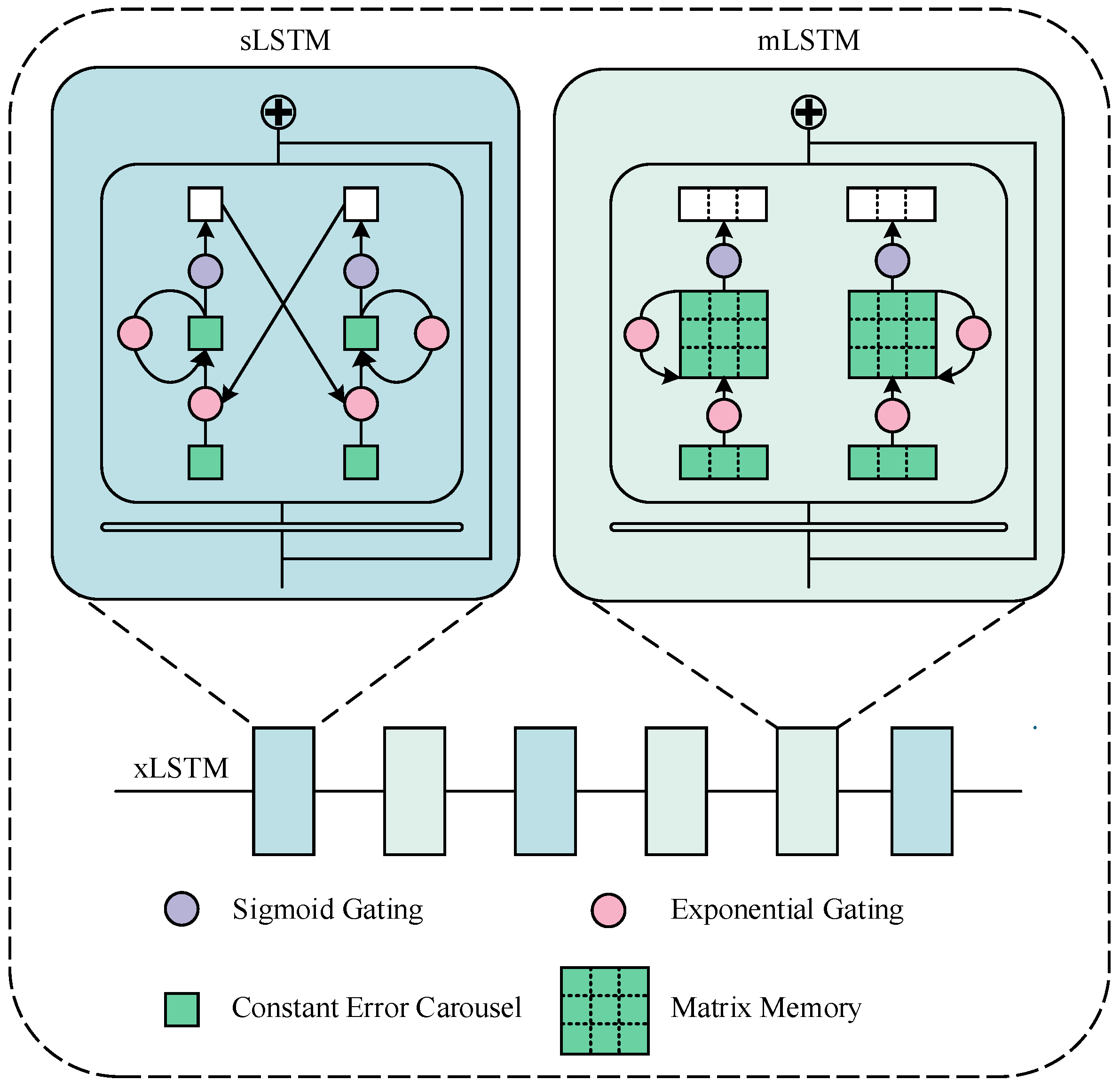
xLSTM is an extension of the traditional LSTM. It addresses the issues of gradient vanishing and feature forgetting in long-sequence prediction through a restructured gating mechanism and enhanced state propagation. Figure 1 shows the key structural elements of xLSTM and the key improvements are as follows:
  • Expanded Memory Cells: xLSTM introduces several enhancements to enable more flexible and efficient memory cell operation. Specifically, xLSTM comprises two LSTM variants: sLSTM and mLSTM. sLSTM adopts a scalar memory updating mechanism, simplifying memory operations to achieve faster and more efficient computation. In contrast, mLSTM employs a matrix memory structure, enabling it to handle complex dependencies within longer sequences. This matrix memory mechanism facilitates parallel computation within the model, significantly enhancing its ability to manage and retain information over extended sequences.
  • Multi-Layer Gating Mechanism: The gating mechanism is central to the operation of LSTM networks, controlling the information flow through input, forget, and output gates. In xLSTM, these gating mechanisms have been enhanced by introducing exponential gating and advanced normalization techniques. The formulation is as follows:
g t = exp W g x t + U g h t 1 + b g
where g t represents the input gate or forget gate at time step t , while W g and U g are weight matrices, and b g is the bias term. The exponential function enables more flexible and dynamic adjustment of gate values, leading to more stable gradient flow during training. By dynamically regulating the amount of historical information to be retained or forgotten throughout the training process, the exponential gating mechanism more effectively mitigates the vanishing gradient problem. This mechanism ensures that relevant information over long sequences is preserved while filtering out less significant data, thereby enhancing the model’s efficiency in learning and predicting complex patterns [21].

2.4. Informer Network

Informer is an improved model based on the Transformer architecture, specifically designed to address the issues of high computational complexity and substantial memory consumption encountered by the conventional Transformer when processing long-sequence data.
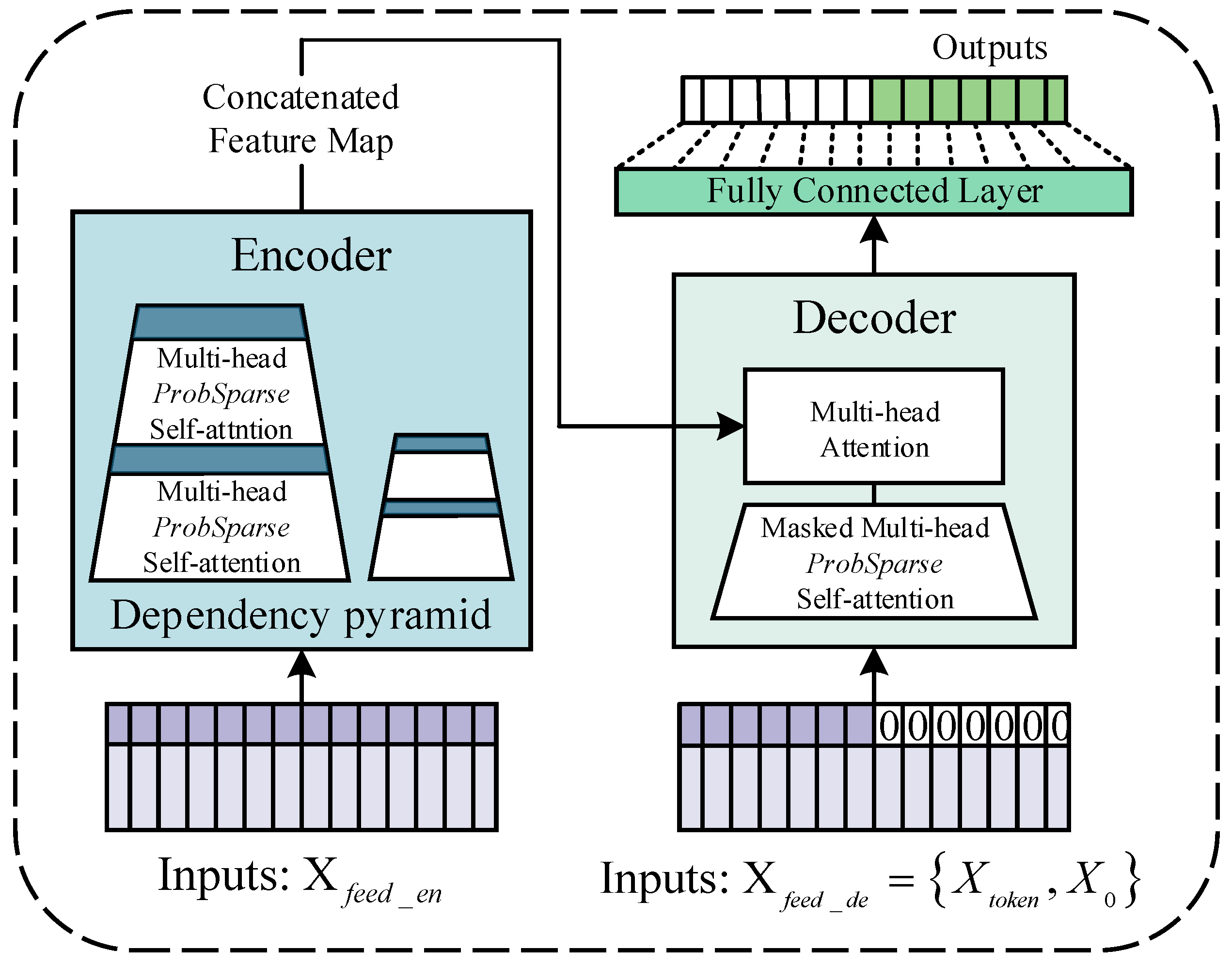
The Informer architecture, as illustrated in Figure 2, comprises an encoder and a decoder, and its unified attention mechanism is primarily composed of Q (query matrix), K (key matrix), and V (value matrix). In Figure 2, the variable feed-en is the abbreviation of feed-forward network in encoder, which is a standard fully connected feed-forward module embedded in the Informer encoder layer. It is responsible for further feature transformation and nonlinear fitting of the output features of the ProbSparse self-attention mechanism, enhancing the model’s ability to extract long-sequence time-series features. In the encoder layer, the ProbSparse self-attention mechanism is employed in place of the conventional attention mechanism, with the formulation as follows:
A ( Q , K , V ) = Softmax Q K T d V
where A represents the sparse attention mechanism used for probabilistic computation; K T is the transpose of the key matrix K ; d is the input dimension; and Q contains only the query vectors ‘u’.
In the conventional attention mechanism, each input element must be computed against all other elements, resulting in a computational complexity of O ( L 2 ) . When processing long sequences, this high complexity increasingly becomes a burden, exacerbating resource allocation challenges. The ProbSparse self-attention mechanism addresses this issue by selectively computing attention. Its core idea is that not all attention scores contribute equally to the final result; therefore, a probabilistic approach is adopted to compute only a critical subset of the scores. This method incorporates mechanisms such as random sampling and score matrix construction, focusing on high-scoring elements to substantially reduce computational demands. By employing the ProbSparse self-attention mechanism, Informer significantly enhances computational efficiency for long-sequence data. Compared to the standard self-attention mechanism, Informer drastically reduces both computation and memory requirements while maintaining high prediction accuracy, lowering the complexity from O ( L 2 ) to O ( L ln L ) [22].
The encoder assigns higher weights to dominant features through a distillation operation and generates focused self-attention feature maps in the next layer. The encoder aims to mine the correlations among time-series parameters and is internally composed of two identical modules. The operational process from layer j to layer j + 1 is formulated as follows:
X j + 1 t = MaxPool ELU Conv 1 d X j t AB
where [.]AB denotes the attention module; Conv1d denotes a one-dimensional convolution operation applied to the time-series; and ELU is the activation function.
The Transformer decoder architecture typically consists of stacking more than two identical attention layers and operates as a dynamic decoding process, generating predictions step by step. In contrast, Informer directly outputs multi-step forecasts by generating predictions in a batch. The key differences in the decoder are as follows:
X feed _ de t = Concat X token t , X 0 t L token + L y × d model
where X feed _ de t is divided into two parts: X token t is the known sequence prior to the forecasting point, and X 0 t is the masked data used for forecasting future values.

2.5. Integration of Photovoltaic Forecasting and Assessment of Distributed Photovoltaic Installation Potential

Achieving efficient operation of power systems and the accommodation of a high proportion of renewable energy necessitates the deep integration of high-precision PV power generation forecasting with distributed PV installation potential assessment. By leveraging accurate time-series generation forecasts derived from deep learning hybrid models, combined with geospatial information, meteorological data, and rooftop physical constraints, the planning, layout, and sizing of PV systems can be optimized. This approach not only enhances the predictability and coordination of distributed PV generation but also significantly improves the grid’s hosting capacity for variable renewable energy. Consequently, it maximizes the substitution benefits of clean energy while ensuring energy security, thereby promoting a green and low-carbon transition of the energy system.
Traditional assessment methods typically provide only the average annual power generation. In contrast, forecasts based on hybrid models can deliver power generation curves ranging from the next few hours to several years. This enables assessors to precisely analyze the matching degree between PV output and regional load curves and evaluate the risks of voltage fluctuation and reverse power flow imposed on the local distribution network. Consequently, the actual installable capacity can be determined under grid security constraints. Furthermore, integrating the forecasted generation curve with electricity pricing mechanisms allows for an accurate calculation of a project’s peak–valley arbitrage revenue, thereby providing a direct basis for investment decisions. Under the time-of-use electricity pricing policy in particular, the coordinated integration of optimized charging strategies with distributed photovoltaic output can further unlock the economic potential of the system [23].
Furthermore, this assessment framework enables a detailed lifecycle economic and environmental benefit evaluation of distributed PV projects. By forecasting long-term power generation under different scenarios and incorporating variables such as initial investment, operation and maintenance costs, degradation rate, financing costs, and policy incentives, the levelized cost of energy of the project can be dynamically calculated. This analysis provides decision-making support for investors and policymakers that goes beyond static valuations. The formulas for assessing the installation potential are as follows:
  • The formula for the technically feasible annual energy generation potential is as follows:
E annual = k = 1 K 0 8760 P predict , k ( t ) d t
where K is the number of modes decomposed by VMD, and P predict , k ( t ) is the time-series generation forecast of the K -th VMD mode.
  • Levelized Cost of Energy:
L C O E = t = 0 n I t + O t + M t / ( 1 + r ) t t = 0 n E annual , t / ( 1 + r ) t
where I t , O t , and M t are the investment, operation and maintenance, and other costs in year t , respectively; E annual , t is the forecasted annual energy generation in year t ; r is the discount rate; and n is the project lifetime.
  • Annual Emission Reduction:
Δ C annual = E annual λ grid
where Δ C annual is the annual CO2 emission reduction, and λ grid is the average carbon emission factor of the regional grid.

3. Construction of the Evaluation Model

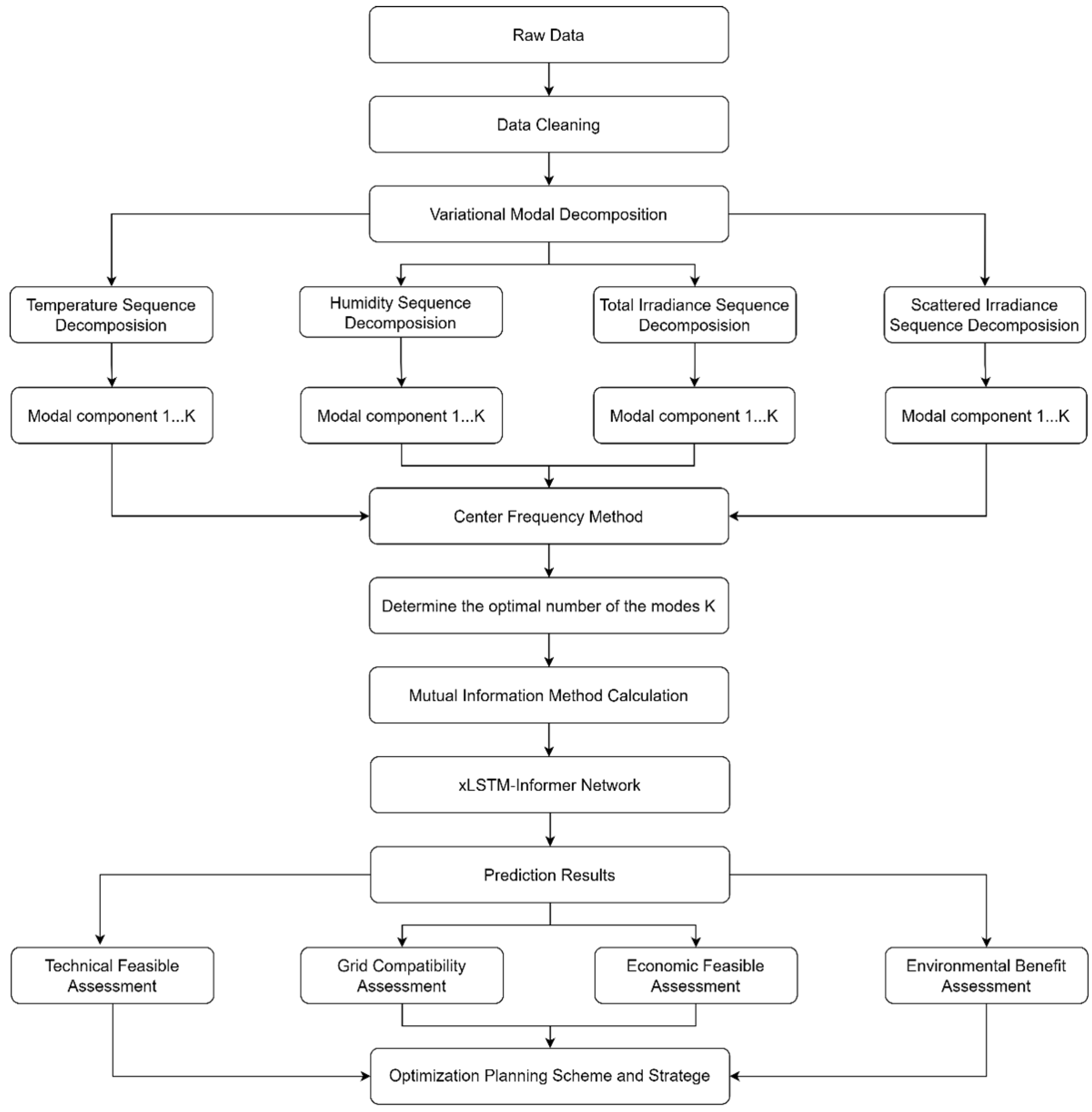
In this paper, we propose a method for assessing the installation potential of distributed PV systems based on deep learning. Its core lies in dynamically evaluating the technical potential through high-precision power generation forecasting. The overall architecture of the proposed model is shown in Figure 3.
In the VMD decomposition, the parameter K is determined by observing the center frequencies [24]. After the meteorological data are decomposed using VMD, intrinsic mode function (IMF) components at different frequencies are obtained. Subsequently, the MI values between the power data and each IMF component are calculated to derive their respective correlation relationships. The primary feature sequences are then extracted based on this analysis and reconstructed. Finally, these reconstructed sequences are input into the xLSTM-Informer network to generate the forecast results.
In the deep learning-based forecasting module, a hybrid neural network architecture is established that cascades xLSTM with Informer. This design synergistically captures both the long-term temporal dependencies and critical sequential patterns inherent in PV power generation sequences. Specifically, the xLSTM, through its refined gating mechanisms and scalable memory states, efficiently learns and encodes the complex long-term spatiotemporal dependencies between meteorological conditions and power output. To explicitly clarify the cascading mechanism, the high-order feature sequences extracted by the xLSTM are directly employed as the input sequence of the subsequent Informer network. These compact feature representations preserve the long-term memory information captured by the xLSTM, providing a distilled and semantically rich input for the Informer’s attention-based modeling. Leveraging its ProbSparse self-attention mechanism and distillation encoder structure, the Informer further identifies and emphasizes the global temporal patterns most critical for long-sequence power generation forecasting from the enhanced feature inputs, thereby generating the final prediction results. This cascaded architecture effectively integrates the robust sequential memory modeling capability of xLSTM with the superior efficiency of Informer in capturing long-range temporal dependencies, yielding more accurate and stable forecasting performance.
When assessing the installation potential of distributed PV based on the forecast results, the predicted time-series power generation curve is compared with the regional historical load curve to generate a net load curve. Through power flow calculation or simplified rules, the risks of voltage violations and line overloading in the distribution network caused by PV integration are evaluated, thereby determining the upper limit for recommended installed capacity under grid security constraints. By incorporating initial investment, operation and maintenance costs, financing rates, and electricity pricing policies, the forecasted time-series generation curve is input into a financial model to dynamically calculate the project’s levelized cost of energy and assess its economic viability. Finally, based on the total forecasted generation and the regional grid carbon emission factor, the project’s annual CO2 emission reduction is quantified.

4. Experimental Results and Analysis

4.1. Experimental Datasets

To verify the generalization capability of the proposed model, two publicly available PV power generation datasets were utilized in this experiment. The first dataset originates from Linzhou City, Anyang City, Henan Province, China, which is situated in a warm temperate semi-humid continental monsoon climate zone characterized by distinct seasons, concentrated precipitation, frequent cloudy conditions, and short-duration severe convective weather. In this region, PV output is highly susceptible to rapid cloud movements, exhibiting the typical fluctuating output characteristics of cloudy conditions in monsoon areas. The dataset spans from 30 June 2018 to 9 June 2019, with a sampling interval of 15 min, encompassing seven indicators, namely temperature, humidity, global horizontal irradiance, diffuse horizontal irradiance, air pressure, wind speed, and wind direction, totaling 33,120 samples. The second dataset originates from a typical arid and semi-arid region in Northwest China, which features a temperate continental arid climate characterized by scarce precipitation, abundant sunshine, large diurnal temperature variations, and minimal cloud interference. PV output in this region is relatively stable but is significantly influenced by sandstorms and intense solar radiation, representing the PV output characteristics of arid or desert-type climates. The dataset spans from 1 March 2019 to 28 February 2023, with a sampling interval of 60 min, encompassing four indicators, namely temperature, humidity, global horizontal irradiance, and diffuse horizontal irradiance, totaling 35,064 samples. During data preprocessing, missing values in the datasets were imputed, and outliers were removed to ensure that data quality positively contributed to model training. To fully simulate real-world forecasting scenarios, each dataset was chronologically divided into training and test sets at an 8:2 ratio, where the first 80% of the data were used for training, and the remaining 20% were used for testing. The training set serves as the foundational data for model parameter learning; the model adjusts weights and biases through a backpropagation algorithm to minimize prediction error, thereby capturing the underlying patterns in the data. The test set, being an unseen dataset independent of the training set, was used to evaluate the model’s performance on new data, providing an objective basis for the model’s practical deployment. The main model parameters were configured as follows: the input sequence length was set to 5, the output prediction sequence length was 1, the number of training epochs was 20, and the initial learning rate was 0.0001.

4.2. Evaluation Criteria

This study employs the root mean square error (RMSE), mean absolute error (MAE), and coefficient of determination (R2) as evaluation metrics for the model’s forecasting results. RMSE measures the deviation between predicted and actual values, offering an intuitive interpretation of the model’s prediction error magnitude. MAE represents the arithmetic mean of the absolute errors between predictions and actual values, robustly reflecting the model’s average prediction bias. For both metrics, smaller values indicate smaller deviations between the model’s forecasts and the actual data. R2 quantifies the proportion of variance in the target variable that is explained by the model; a value closer to 1 signifies a stronger explanatory power of the model. Their mathematical expressions are defined as follows:
R M S E = 1 n i = 1 n y i y ^ i 2
M A E = 1 n i = 1 n y i y ^ i
R 2 = 1 i = 1 n ( y i y ^ i ) 2 i = 1 n ( y i y ¯ ) 2
where n is the number of samples, y i is the actual value of the i -th sample, y ^ i is the predicted value of the i -th sample, and y ¯ is the mean value.

4.3. Variational Mode Decomposition

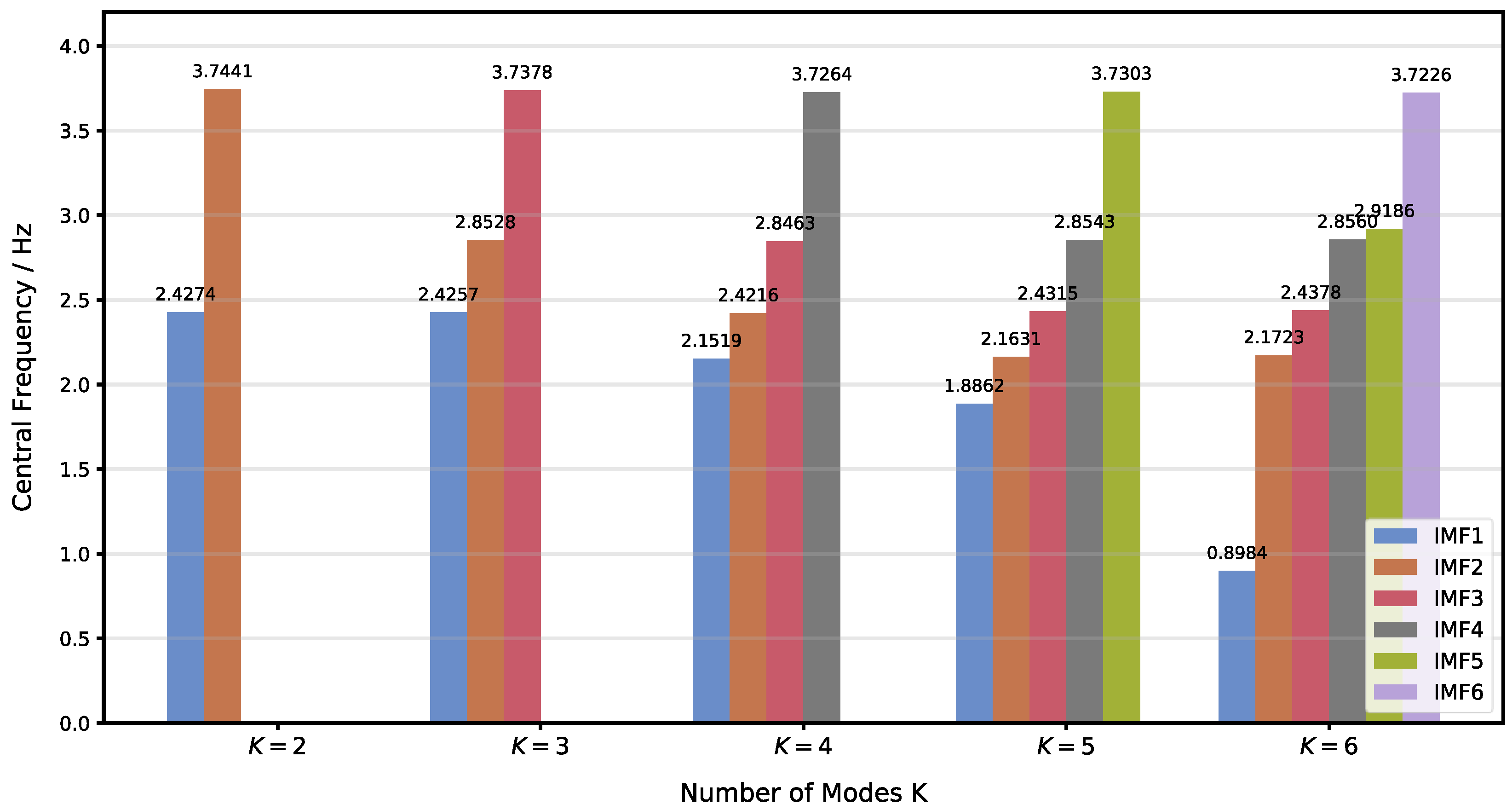
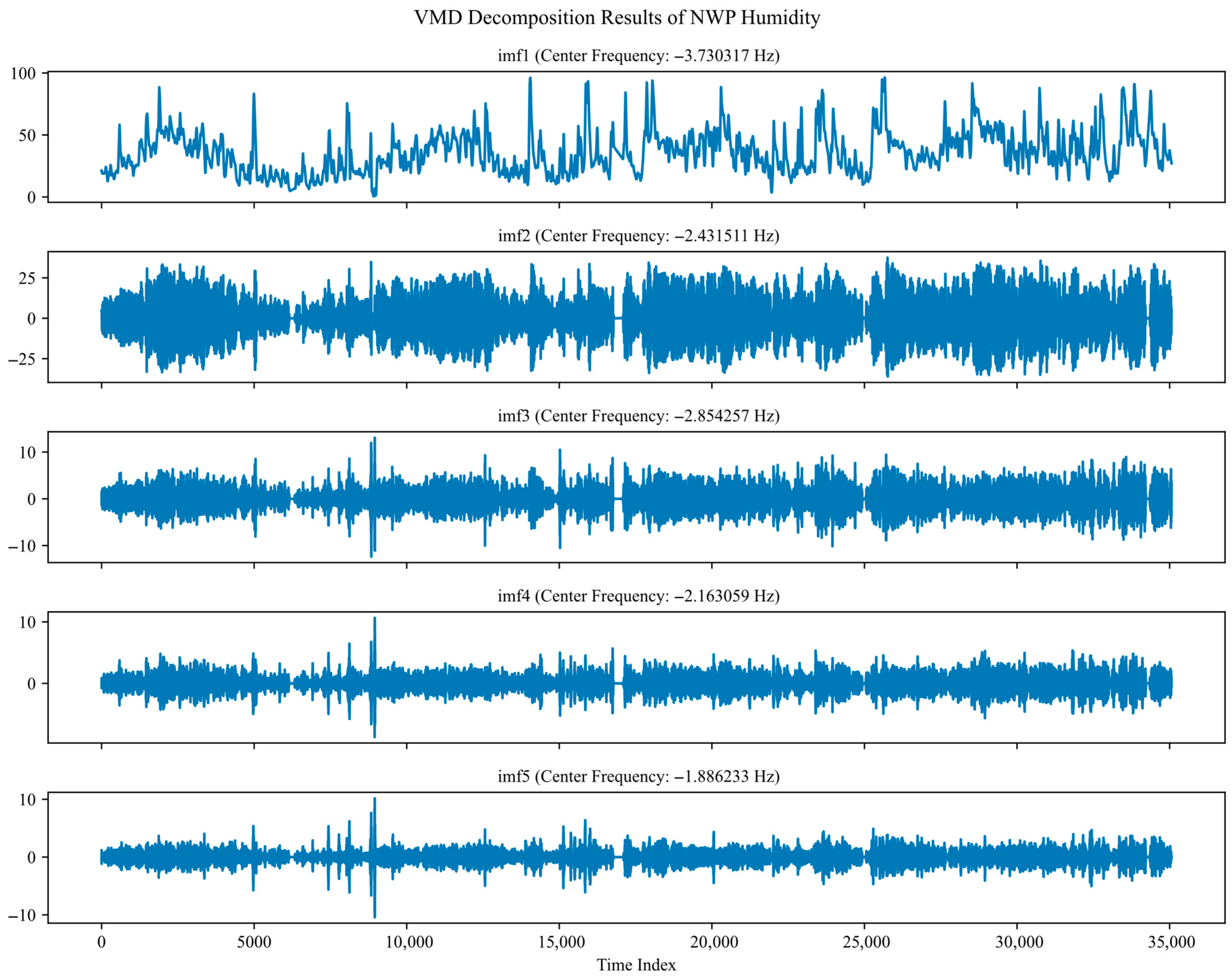
Selecting an appropriate K value is crucial when applying VMD to meteorological data sequences for PV power generation. A K value that is too large may introduce extraneous noise, whereas a value that is too small may lead to insufficient decomposition. One method for determining the K value involves checking whether each mode possesses a similar center frequency. The number of decomposition modes, K, is determined by observing the center frequencies. First, a candidate range of K values is determined, after which the original data are decomposed, and the differences in central frequencies among the resulting modes are examined. Upon completion of the decomposition, the degree of proximity between the central frequencies of the modes is compared, and the first K value at which the frequency similarity exceeds 0.9 is selected as the final number of decomposition modes. This approach preserves the key information within the data to the greatest extent, ensuring that the decomposed modes avoid over-decomposition while effectively suppressing mode mixing, thereby providing a more accurate and stable data foundation for subsequent PV power generation forecasting [25]. Taking the humidity data from Dataset 2 as an example, the decomposition results for the central frequencies of each mode are shown in Figure 4. Starting from K = 2, VMD gradually increases the value of K, analyzes the decomposition results for each K value, and calculates the central frequency of each mode. In the experiments conducted in this study, when K = 6, the ratio of the central frequencies of Mode 4 and Mode 5 exceeded 0.9, indicating that the frequencies of these two modes were already very close. Therefore, K = 5 was ultimately selected as the optimal decomposition parameter for this dataset, and the resulting sequence decomposition is shown in Figure 5. Accordingly, for the meteorological data in Dataset 1, the optimal K values for temperature, humidity, global horizontal irradiance, diffuse horizontal irradiance, air pressure, wind speed, and wind direction are 2, 3, 4, 6, 2, 2, and 4, respectively; for the meteorological data in Dataset 2, the optimal K values for temperature, humidity, global horizontal irradiance, and diffuse horizontal irradiance are 2, 5, 4, and 2, respectively.

4.4. Mutual Information Analysis

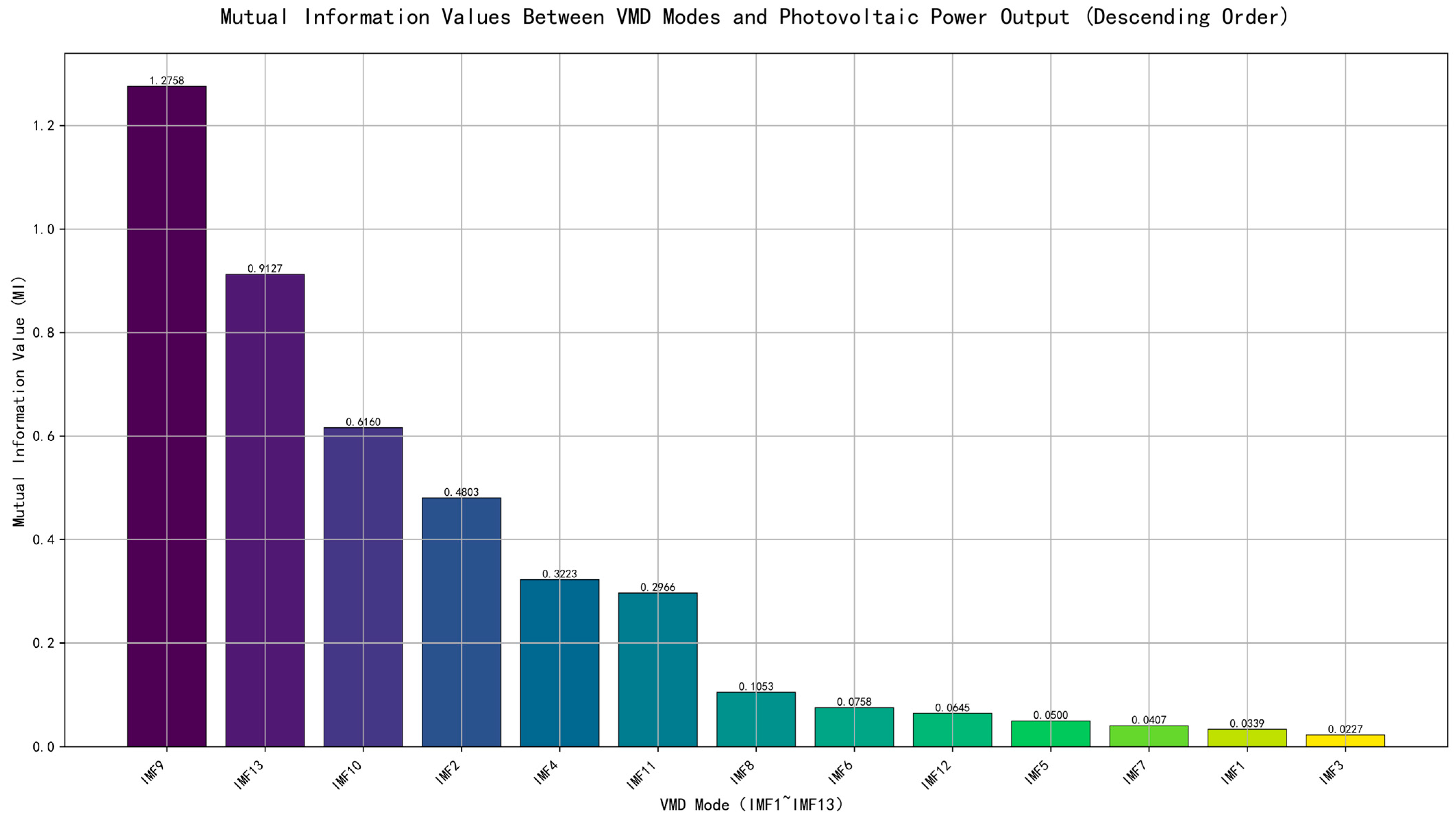
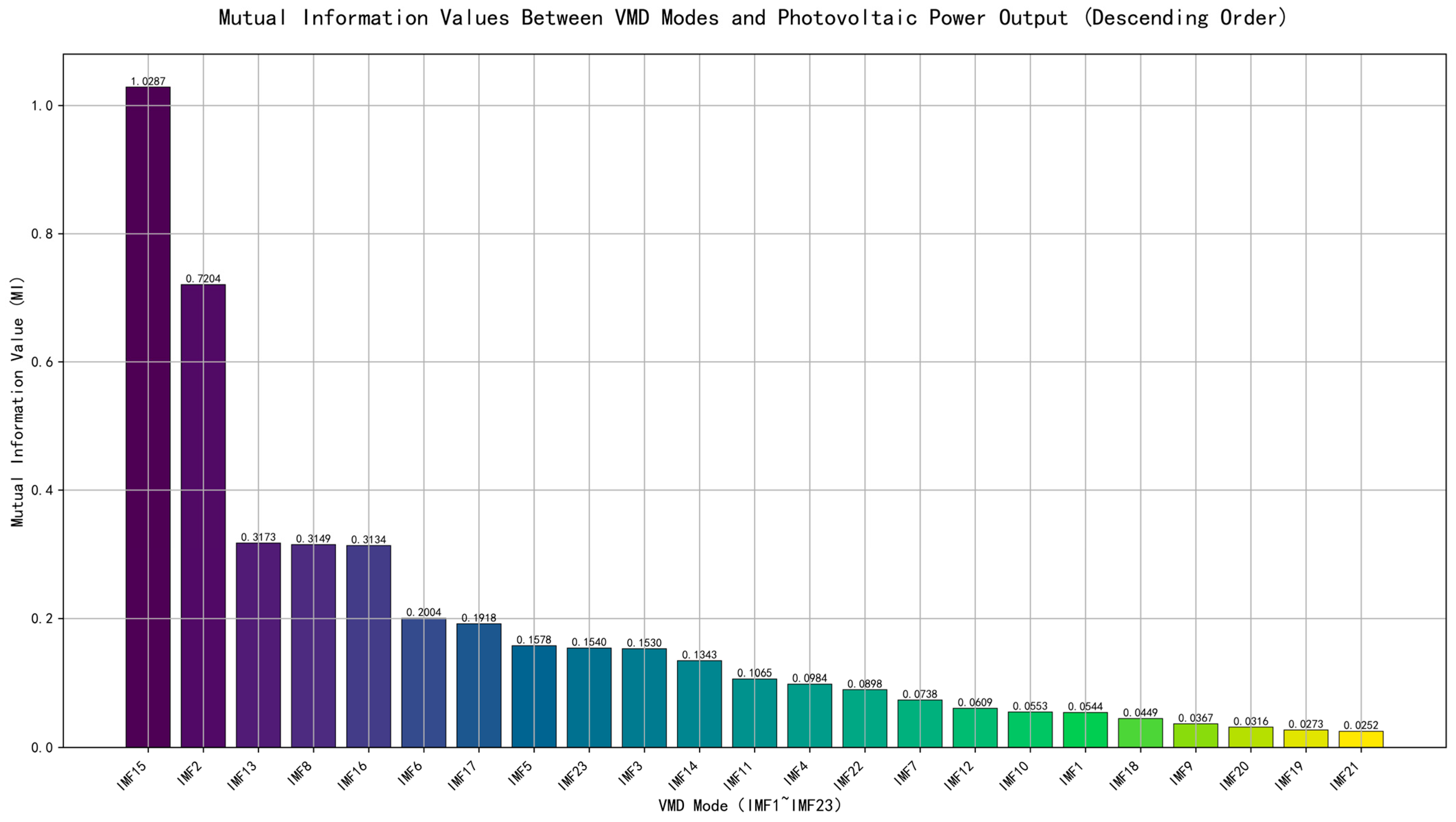
To reduce model complexity and enhance prediction accuracy, this study employs the MI method to process the components of the meteorological data. Mutual information values for each meteorological data component are calculated and ranked, and the sequences with the highest MI values are selected as input feature vectors. Through experimentation, the top three sequences with the highest mutual information values were ultimately chosen as the model’s input data. This approach reduces computational complexity while retaining physically relevant features strongly correlated with power output, effectively reducing redundancy and noise. Consequently, it improves the model’s accuracy, generalization capability, and efficiency, providing technical support for the efficient operation of PV systems. Figure 6 and Figure 7 present the mutual information values between each mode and the photovoltaic power generation after VMD decomposition for Dataset 1 and Dataset 2, respectively.

4.5. Experiment Result Analysis

To validate the superiority of the proposed model, comparative experiments were conducted under identical conditions between the model presented in this paper and the BiGRU-Attention [26], CNN-GRU [27], VMD-MI-BiLSTM [28], VMD-MI-xLSTM, and VMD-MI-Informer models. The experimental results are shown in Table 1. The results indicate that, compared to the other five forecasting methods, the VMD-MI-xLSTM-Informer model achieves the lowest RMSE and MAE, and its R2 is the closest to 1 on both Dataset 1 and Dataset 2. Specifically, compared to BiGRU-Attention, CNN-GRU, and VMD-MI-BiLSTM, the proposed model reduces RMSE by 0.0584 kW to 0.6185 kW, reduces MAE by 0.0168 kW to 0.6337 kW, and increases R2 by 0.0026 to 0.0890 on Dataset 1. On Dataset 2, it reduces RMSE by 0.0031 kW to 0.0285 kW, reduces MAE by 0.001 kW to 0.0773 kW, and increases R2 by 0.0008 to 0.0081.
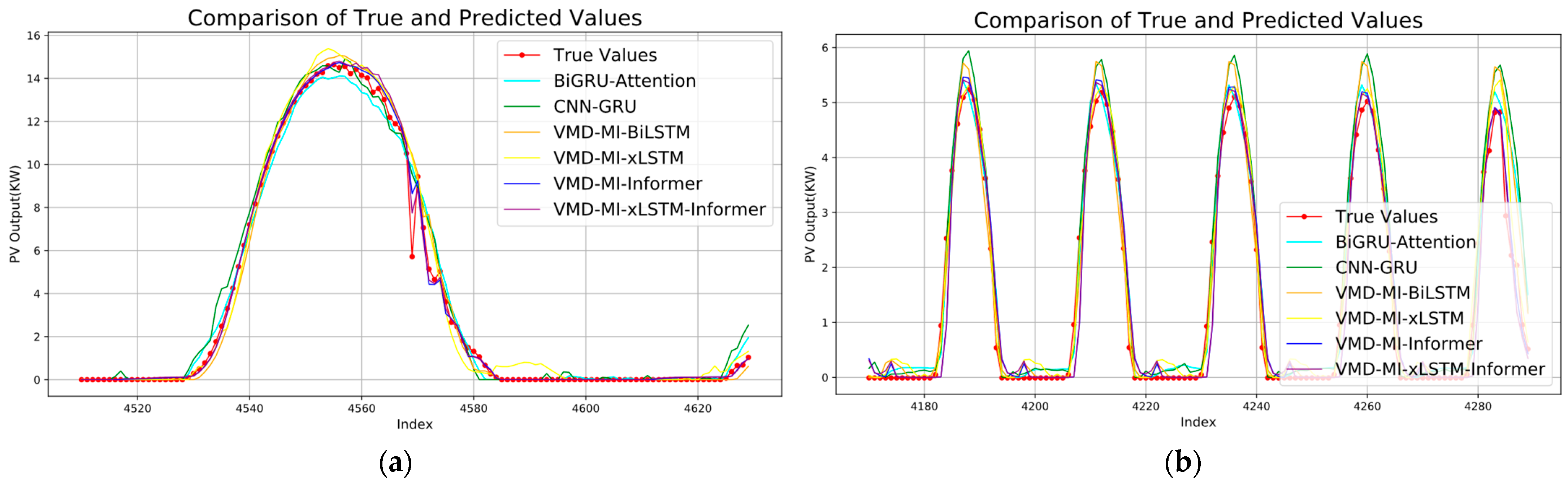
Figure 8 presents the experimental results for 120 samples, providing a visual comparison of the prediction outcomes from different modules. It can be observed that when PV power generation data fluctuates or reaches peak values, the VMD-MI-Informer network struggles to precisely capture these rapidly changing trends. In contrast, VMD-MI-xLSTM can more accurately reflect the variation trends at rapidly changing peaks. By employing xLSTM to preprocess the input data and subsequently feeding the processed data into the encoder and decoder of Informer, the advantages of both methods can be fully leveraged, thereby improving prediction accuracy. This combined approach effectively utilizes xLSTM’s adaptability to multi-scale characteristics and Informer’s capability to model long-term dependencies, significantly enhancing the overall performance of the model. The CNN-GRU model’s predicted values deviate significantly from the actual values at the peaks of the PV generation data, indicating its limited capability to capture sudden, large fluctuations. The BiGRU-Attention model shows insufficient refinement of details in regions with minor fluctuations, suggesting a limited capacity for modeling low-magnitude components. In contrast, compared to the VMD-MI-BiLSTM model, the VMD-MI-xLSTM-Informer demonstrates a better fit during the end phase of the cycle. This underscores the Informer’s proficiency in processing long sequences; combined with the decomposition capability of VMD and the memory capability of xLSTM, the proposed model is well-suited for complex scenarios involving significant fluctuations and long time spans.
Taking the prediction results of Dataset 2 as an example, the technically feasible maximum annual power generation for this region is calculated to be approximately 11,983.4 kWh using Equation (11). Assuming a lifecycle of 25 years for the PV project, the initial investment is 2.8 RMB/Wp, the operation and maintenance costs are 0.042 RMB/Wp/year for years 1 to 3, 0.045 RMB/Wp/year for years 4 to 8, 0.048 RMB/Wp/year for years 9 to 14, and 0.051 RMB/Wp/year for years 15 to 25. Other costs, including inverter replacement, grid connection fees, and line maintenance, are approximately 0.225 RMB/Wp [29]. The total installed capacity is 6.10 kWp, the annual PV degradation rate is 0.5%/year in accordance with industry standards, the discount rate is 7%, and the average carbon emission factor for the regional power grid is 0.0214 tCO2/MWh [30]. Based on these parameters, the levelized cost of energy is calculated to be approximately 0.148 RMB/kWh using Equation (12), and the annual CO2 emission reduction is calculated to be approximately 0.256 tCO2/year using Equation (13). From the above calculation results, it can be observed that conducting technical, economic, and environmental benefit assessments based on the annual power generation obtained from the proposed prediction model can comprehensively reflect the practical application value of distributed PV systems. The technically feasible annual power generation reflects the theoretical power generation potential of PV resources under local meteorological conditions, providing foundational data for system installed capacity configuration and operational boundary determination. The levelized cost of energy quantifies the economic viability of the project from a full lifecycle perspective, demonstrating strong market competitiveness under current PV investment and electricity pricing mechanisms, thereby offering reliable economic decision-making references for investors and planning departments. The annual CO2 emission reduction intuitively reveals the project’s contribution to low-carbon emission reduction, aligning with the development requirements for clean energy substitution under the “dual carbon” goals.

5. Conclusions

This study proposes a hybrid model for forecasting PV power generation based on VMD, the MI method, and a cascaded xLSTM-Informer network. Building upon this model, a framework for assessing the installation potential of distributed PV systems is constructed. Centered on the forecasted time-series power generation capacity, this framework enables a dynamic evaluation of the installation potential for distributed PV systems. Experimental results demonstrate that the proposed hybrid forecasting model significantly outperforms traditional methods in terms of prediction accuracy. The assessment framework exhibits high practical value, providing scientific support for urban energy planning and the efficient accommodation of clean energy. The experimental study yields the following conclusions:
  • In processing long-term meteorological data, this study adopts a feature extraction strategy that combines variational mode decomposition with the mutual information method. VMD effectively suppresses mode mixing and endpoint effects by decomposing non-stationary meteorological sequences into multiple band-limited modal components, thereby providing a stable data foundation for subsequent modeling. The mutual information method further screens out the key components that are strongly correlated with PV output, reducing the input dimensionality of the model while retaining the core physical features. Experimental results demonstrate that this combined preprocessing mechanism significantly enhances the adaptability of the forecasting model to complex meteorological conditions.
  • In terms of applying deep learning models to PV forecasting, a hybrid neural network architecture is constructed that cascades xLSTM with Informer. xLSTM, through its exponential gating mechanism and matrix memory structure, enhances the capability to model long-term dependencies in meteorological output sequences. Informer, leveraging the ProbSparse self-attention mechanism and a distillation encoder, achieves efficient extraction of global key temporal patterns. The tandem integration of these two models fully leverages the strengths of both. On measured datasets from two distinct climate zones, this model outperforms the comparative models in terms of RMSE, MAE, and R2 metrics, demonstrating particularly stronger fitting capability during periods of severe output fluctuations and peak hours, thereby validating the effectiveness and robustness of the hybrid architecture in PV time-series forecasting.
  • For the first time, a framework that integrates PV power generation forecasting into the assessment of PV installation potential is proposed, overcoming the limitations of static estimation. By incorporating a high-precision time-series power generation curve, this framework enables a multidimensional, comprehensive assessment covering technical installability, economic viability, and environmental performance. The evaluation results provided by this framework are more scientific and realistic, offering significant guidance value for the planning and investment decisions related to distributed photovoltaics.
Although the proposed model has achieved satisfactory results, several directions warrant further in-depth investigation. For instance, the model’s predictive performance and generalization capability under extreme weather events require enhancement. The assessment framework could be further refined by coupling it with more detailed grid power flow models and market policy models. Furthermore, leveraging the forecast results to achieve coordinated optimization and intelligent control of distributed PV clusters is also crucial for improving the overall system benefits. Future research will focus on these directions to promote the high-quality development of distributed PV systems.

Author Contributions

Conceptualization, J.C. and J.Y.; methodology, J.C.; software, J.Y.; validation, J.C., J.Y. and H.C.; formal analysis, H.C.; investigation, J.Y.; resources, J.Y.; data curation, J.C.; writing—original draft preparation, J.Y.; writing—review and editing, H.C.; visualization, J.Y.; supervision, J.C.; project administration, J.C.; funding acquisition, H.C. All authors have read and agreed to the published version of the manuscript.

Funding

This research was funded by State Grid Hubei Electric Power Co., Ltd. (Wuhan, China), grant number 5215C0240001.

Institutional Review Board Statement

Not applicable.

Informed Consent Statement

Not applicable.

Data Availability Statement

The original contributions presented in this study are included in the article. Further inquiries can be directed to the corresponding author.

Conflicts of Interest

The authors declare that this study received funding from State Grid Hubei Electric Power Co., Ltd.

References

  1. Xu, W.; Wang, W. Assessment of rooftop photovoltaic power generation potential and environmental benefits in central urban districts under different climatic conditions. J. Environ. Eng. Technol. 2025, 15, 1502–1512. [Google Scholar]
  2. Chen, M.; Zhang, K.; Zhu, R. Photovoltaic potential assessment based on remote sensing and GIS. Natl. Remote Sens. Bull. 2025, 29, 2289–2303. [Google Scholar]
  3. Tro-Cabrera, A.; Lago-Aurrekoetxea, R.; Martínez-de-Alegría, I.; Villamor, E.; Campos-Celador, A. A methodology for assessing rooftop solar photovoltaic potential using GIS open-source software and the EROI constraint. Energy Build. 2025, 331, 115401. [Google Scholar] [CrossRef]
  4. Jiang, H.; Yao, L.; Bai, Y.; Zhou, C. Assessment of rooftop photovoltaic power generation potentials by using multisource remote sensing data. Natl. Remote Sens. Bull. 2024, 28, 2801–2814. [Google Scholar]
  5. Rane, N.L.; Günen, M.A.; Mallick, S.K.; Rane, J.; Pande, C.B.; Giduturi, M.; Bhutto, J.K.; Yadav, K.K.; Tolche, A.D.; Alreshidi, M.A. GIS-based multi-influencing factor (MIF) application for optimal site selection of solar photovoltaic power plant in Nashik, India. Environ. Sci. Eur. 2024, 36, 5. [Google Scholar] [CrossRef]
  6. Tian, X.; Wang, J.; Lu, G.; Jiang, M.; Khan, S.A.; Ji, J. Optical-electrical-thermal model of flexible non-planar photovoltaic modules: Decoupling, validation, and photoelectric performance analysis. Energy 2025, 318, 134843. [Google Scholar] [CrossRef]
  7. Sapundzhi, F.; Chikalov, A.; Georgiev, S.; Georgiev, I. Predictive Modeling of Photovoltaic Energy Yield Using an ARIMA Approach. Appl. Sci. 2024, 14, 11192. [Google Scholar] [CrossRef]
  8. Barik, A.K.; Malakar, S.; Goswami, S.; Ganguli, B.; Roy, S.S.; Chakrabarti, A. Advances in Intelligent Systems and Computing. In Data Management, Analytics and Innovation; Sharma, N., Chakrabarti, A., Balas, V.E., Martinovic, J., Eds.; Springer: Singapore, 2021; Volume 1175, pp. 55–69. [Google Scholar]
  9. Matushkin, D.; Zaporozhets, A.; Babak, V.; Kulyk, M.; Denysov, V. Hourly Photovoltaic Power Forecasting Using Exponential Smoothing: A Comparative Study Based on Operational Data. Solar 2025, 5, 48. [Google Scholar] [CrossRef]
  10. Pedregal, D.J.; Trapero, J.R. Adjusted combination of moving averages: A forecasting system for medium-term solar irradiance. Appl. Energy 2021, 298, 117155. [Google Scholar] [CrossRef]
  11. Alabdeli, H.; Rafi, S.; Naveen, I.G.; Rao, D.D.; Nagendar, Y. Photovoltaic Power Forecasting Using Support Vector Machine and Adaptive Learning Factor Ant Colony Optimization. In Proceedings of the 2024 Third International Conference on Distributed Computing and Electrical Circuits and Electronics (ICDCECE), Ballari, India, 26–27 April 2024. [Google Scholar]
  12. Villegas-Mier, C.G.; Rodriguez-Resendiz, J.; Álvarez-Alvarado, J.M.; Jiménez-Hernández, H.; Odry, Á. Optimized Random Forest for Solar Radiation Prediction Using Sunshine Hours. Micromachines 2022, 13, 1406. [Google Scholar] [CrossRef]
  13. Saxena, N.; Kumar, R.; Rao, Y.K.S.S.; Mondloe, D.S.; Dhapekar, N.K.; Sharma, A.; Yadav, A.S. Hybrid KNN-SVM machine learning approach for solar power forecasting. Environ. Chall. 2024, 14, 100838. [Google Scholar] [CrossRef]
  14. Yan, C.; Li, L.; Xu, H.; Zhuang, S.; Zhang, Z. Photovoltaic Output Prediction Based on Improved Long Short-Term Memory Network Using White Shark Optimization Algorithm. Power Gener. Technol. 2025, 46, 778–787. [Google Scholar]
  15. Husein, M.; Chung, I.-Y. Day-Ahead Solar Irradiance Forecasting for Microgrids Using a Long Short-Term Memory Recurrent Neural Network: A Deep Learning Approach. Energies 2019, 12, 1856. [Google Scholar] [CrossRef]
  16. Beck, M.; Poppel, K.; Spanring, M.; Auer, A.; Prudnikova, O.; Kopp, M.K.; Klambauer, G.; Brandstetter, J.; Hochreiter, S. xLSTM: Extended Long Short-Term Memory. arXiv 2024, arXiv:2405.04517. [Google Scholar]
  17. Haoyi, Z.; Shanghang, Z.; Jieqi, P.; Shuai, Z.; Jianxin, L.; Hui, X.; Wancai, Z. Informer: Beyond Efficient Transformer for Long Sequence Time-Series Forecasting. In Proceedings of the AAAI Conference on Artificial Intelligence, San Francisco, CA, USA, 2–9 February 2021; pp. 11106–11115. [Google Scholar]
  18. Zhong, W.; Zheng, T. Short-term Photovoltaic Power Prediction Based on EMD-KPCA-BiLSTM Model Algorithm. Chang. Inf. Commun. 2025, 38, 65–68. [Google Scholar]
  19. Li, Y.; Liu, J.; Lu, Y.; Sun, J. Model of wind-photovoltaic synergy power forecasting based on mutual information coupling DBO-BiLSTM-Attention. J. Electr. Power Sci. Technol. 2025, 40, 134–149. [Google Scholar]
  20. Xiao, Y.; Xiao, G.; Li, J. Photovoltaic-energy storage systems empowered: Low-carbon and economic scheduling for electric buses. Transp. Res. Part D Transp. Environ. 2026, 150, 105082. [Google Scholar] [CrossRef]
  21. Fan, X.; Tao, C.; Zhao, J. Advanced stock price prediction with xlstm-based models: Improving long-term forecasting. In Proceedings of the 2024 11th International Conference on Soft Computing & Machine Intelligence (ISCMI), Melbourne, Australia, 22–23 November 2024; pp. 117–123. [Google Scholar]
  22. Jin, Z.; Fu, X.; Xiang, L.; Zhu, G.; Hu, A. Informer learning framework based on secondary decomposition for multi-step forecast of ultra-short term wind speed. Eng. Appl. Artif. Intell. 2025, 139, 109702. [Google Scholar] [CrossRef]
  23. Lu, Z.; Xing, T.; Li, Y. Optimization of electric bus vehicle scheduling and charging strategies under Time-of-Use electricity price. Transp. Res. Part E Logist. Transp. Rev. 2025, 196, 104021. [Google Scholar] [CrossRef]
  24. Ma, H.; Cheng, G.; Wang, H.; Zhao, J. Combinatorial Prediction Method Based on Meteorological Irradiation Data and GSA-optimized VMD-BiLSTM. Mod. Electr. Power 2026, 43, 213–222. [Google Scholar]
  25. Gong, X.; Qiu, W.; Lv, K.; Zhang, T.; Zhang, R.; Luo, S. A Combined Traffic Flow Prediction Model Based on Variational Mode Decomposition and Adaptive Graph Convolutional Gated Recurrent Network. Geomat. Inf. Sci. Wuhan Univ. 2024, 49, 2329–2341. [Google Scholar]
  26. Zhu, H.; Wang, Y.; Sun, S.; Zhang, D.; Hu, S.; Chen, W. Meteorological information calculation and power forecasting for regional distributed photovoltaic power based on information fusion and deep learning. Int. J. Electr. Power Energy Syst. 2025, 172, 111189. [Google Scholar] [CrossRef]
  27. Gao, C.; Zhang, S.; Li, Z.; Zhou, B.; Guo, D.; Shao, W.; Li, H. Photovoltaic Power Prediction Based on Similar Day Clustering Combined with CNN-GRU. Sustainability 2025, 17, 7383. [Google Scholar] [CrossRef]
  28. Zhang, L.; Liu, L.; Chen, W.; Lin, Z.; He, D.; Chen, J. Photovoltaic Power Generation Forecasting Based on Secondary Data Decomposition and Hybrid Deep Learning Model. Energies 2025, 18, 3136. [Google Scholar] [CrossRef]
  29. Li, K. Research and Reflection on LCOE for PV Power Generation Projects. Sol. Energy 2024, 4, 5–10. [Google Scholar] [CrossRef]
  30. Wang, H. Life Cycle Carbon Footprint and Carbon Emission Reduction Potential of Photovoltaic Power Generation. Res. Discuss. 2023, 45, 34–44. [Google Scholar]
Figure 1. Key structural elements of xLSTM, featuring sigmoid gating for gating mechanism regulation, exponential gating for dynamic information control, a constant error carousel for stable error propagation, and matrix memory for efficient information storage and retrieval.
Sustainability 18 03859 g001
Figure 2. The basic architecture of the Informer network, which consists of an encoder and a decoder, is specifically designed to address long-sequence time-series forecasting problems.
Sustainability 18 03859 g002
Figure 3. The framework structure of the evaluation model.
Sustainability 18 03859 g003
Figure 4. Central frequencies of decomposition modes under the same K value.
Sustainability 18 03859 g004
Figure 5. Schematic diagram of the decomposition results for the humidity sequence of Dataset 2.
Sustainability 18 03859 g005
Figure 6. Schematic diagram of mutual information values between each VMD mode and PV power output for Dataset 1.
Sustainability 18 03859 g006
Figure 7. Schematic diagram of mutual information values between each VMD mode and PV power output for Dataset 2.
Sustainability 18 03859 g007
Figure 8. Comparison of prediction results from different models: (a) for Dataset 1; (b) for Dataset 2.
Sustainability 18 03859 g008
Table 1. Comparative experiments with different models: (a) for Dataset 1; (b) for Dataset 2.
(a)
ModelRMSE/KWMAE/KWR2
BiGRU-Attention1.13690.52690.9497
CNN-GRU1.13420.51890.9500
VMD-MI-BiLSTM0.94330.40410.9639
VMD-MI-xLSTM1.56970.86470.9001
VMD-MI-Informer0.57680.24780.9865
VMD-MI-xLSTM-Informer0.51840.23100.9891
(b)
ModelRMSE/KWMAE/KWR2
BiGRU-Attention0.39290.24440.9456
CNN-GRU0.41150.26920.9404
VMD-MI-BiLSTM0.39560.27180.9449
VMD-MI-xLSTM0.39280.28280.9457
VMD-MI-Informer0.41820.20560.9384
VMD-MI-xLSTM-Informer0.38970.20550.9465
Disclaimer/Publisher’s Note: The statements, opinions and data contained in all publications are solely those of the individual author(s) and contributor(s) and not of MDPI and/or the editor(s). MDPI and/or the editor(s) disclaim responsibility for any injury to people or property resulting from any ideas, methods, instructions or products referred to in the content.