Integrating Creative Problem Solving and Generative AI in Animation Education: Advancing Sustainability-Related Competencies in Higher Education


Abstract
1. Introduction
1.1. Background and Motivation
1.2. Research Gap and Rationale
1.3. Research Objectives and Questions
2. Literature Review
2.1. The Evolution of Creative Problem Solving and Solution Development
2.2. Visual Thinking and Resemiotization
2.3. Character Arcs as Cognitive Reframing Processes
2.4. Integrating CPS and GenAI as a Scaffold for Animation and Sustainability Education
2.5. Research Hypotheses
3. Methods
3.1. Research Design
3.2. Participants and Context
3.3. CPS-Based Course Design and Implementation
3.4. Scaffolded Assignments and Cognitive Scaffolding
3.5. Measures and Data Collection
3.5.1. CPS Cognition and Affect Scale
3.5.2. CPS Self-Assessment of Assignments
3.5.3. Reflective Journals
- Cognitive Engagement: evidence of applying specific CPS stages (e.g., problem restatement, criteria-based selection) to narrative tasks.
- Affective Shift: descriptions of emotional regulation and persistence in overcoming creative bottlenecks or “blank page” anxiety.
- Technical Mediation: reflections on the utility and limitations of specific GenAI tools in the story development process.
3.5.4. Expert Evaluation of Final Prototypes (CAT)
3.6. Data Analysis
4. Results
4.1. Perceptions of Course Instruction and Learning Environment (RQ1)
4.2. CPS-Related Engagement Across Assignments (RQ2; H2)
4.3. Pre–Post Changes in CPS-Related Cognition and Affect (RQ1; H1)
4.4. Creative Performance and Expert Evaluation (RQ2; RQ3; H3)
4.5. Model Refinement and Pedagogical Implications
5. Discussion and Conclusions
5.1. CPS–AI Integration as a Metacognitive Mechanism
5.2. CPS as a Cognitive Bridge for Heterogeneous Learners (RQ1)
5.3. Transformative Mechanisms in CPS- and AI-Supported Learning (RQ2; RQ3)
5.4. Theoretical and Practical Implications: Bridging CPS, AI, and Sustainability
5.5. Conclusions
6. Limitations and Future Directions
6.1. Limitations
6.2. Future Research Directions
Funding
Institutional Review Board Statement
Informed Consent Statement
Data Availability Statement
Acknowledgments
Conflicts of Interest
Abbreviations
| CPS | Creative Problem Solving |
| GenAI | Generative artificial intelligence |
Appendix A

| No | Item |
|---|---|
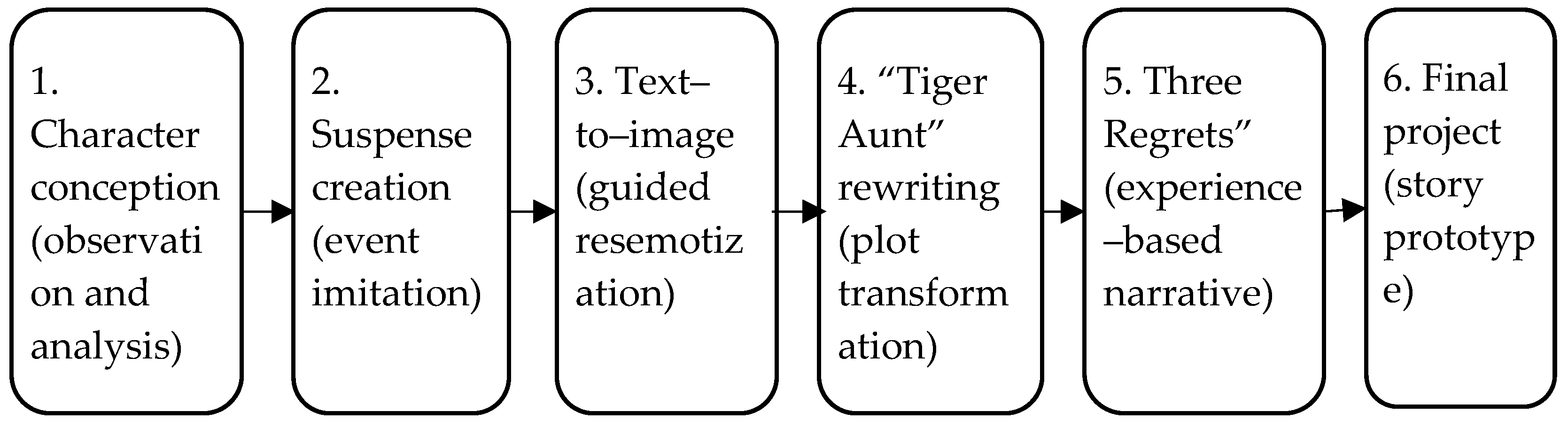
| 1 | After taking this course, to what extent did Assignment 1 (writing character conflict settings) help you with animation pre-production? |
| 2 | After taking this course, to what extent did Assignment 2 (designing suspense) help you with animation pre-production? |
| 3 | After taking this course, to what extent did Assignment 3 (“Who Took My Pencil?” text-to-image practice) help you with animation pre-production? |
| 4 | After taking this course, to what extent did Assignment 4 (scene outline practice for “Tiger Aunt”) help you with animation pre-production? |
| 5 | After taking this course, to what extent did Assignment 5 (your most unforgettable regret in life) help you with animation pre-production? |
| 6 | After taking this course, to what extent did the final project help you with animation pre-production? |
Appendix B
| Constructs | No. | Items |
|---|---|---|
| Narrative cognition items | 1 | Before/after taking this course, my capability regarding character conflict types is adequate. |
| 2 | Before/after taking this course, my capability regarding character construction techniques is adequate. | |
| 3 | Before/after taking this course, my capability regarding suspense techniques is adequate. | |
| 4 | Before/after taking this course, my capability regarding story message and theme is adequate. | |
| 5 | Before/after taking this course, my capability regarding the design of complication and resolution is adequate. | |
| 6 | Before/after taking this course, my capability regarding setup, foreshadowing, and suspense is adequate. | |
| 7 | Before/after taking this course, my capability regarding character arcs is adequate. | |
| 8 | Before/after taking this course, my capability regarding writing scene outlines is adequate. | |
| Affective attitude items | 1 | Before/after taking this course, I feel confident in my capability for storytelling and scriptwriting. |
| 2 | Before/after taking this course, when I encounter complex creative problems, I am willing to persistently search for information to identify the key issues. | |
| 3 | Before/after taking this course, I can regulate my emotions and behavior when facing creative problems (for example, even if I cannot immediately find the key point, I do not feel discouraged). |
Appendix C
| Section | Focus | Guiding Questions |
|---|---|---|
| 1 | Overall course experience | 1. Looking back on this course, what kinds of changes (if any) do you feel in your overall approach to developing an animated story idea? 2. Can you describe one moment in the course that felt especially helpful or memorable for your storytelling process? |
| 2 | CPS phases and narrative cognition | 3. In this course, we often used steps such as clarifying the problem, generating ideas, and developing solutions. Which step (or steps) influenced your storytelling the most, and why? |
| 3 | Visual resemiotization and cognitive load | 4. How did the text-to-image assignment (transforming textual prompts into visual panels or sketches) affect your ideas for characters and scenes? 5. Did this kind of visual transformation help you deal with “blank page” feelings or reduce the difficulty of starting a story? Please explain with an example. |
| 4 | AI-supported creativity | 6. In what ways did AI tools (for example, text-to-image or sketch generation) help you during idea generation or solution development? 7. Were there situations where AI suggestions felt limiting, repetitive, or too similar to other works? How did you respond to that? |
| 7 | Course design suggestions | 8. Which assignment or activity was most helpful for your learning, and why? 9. If you could adjust one part of the course or the way AI is used, what would you change to better support your storytelling and creative problem solving? |
References
- Beghetto, R.A.; Karwowski, M. Toward untangling creative self-beliefs. In The Creative Self: Effect of Beliefs, Self-Efficacy, Mindset, and Identity; Karwowski, M., Kaufman, J.C., Eds.; Academic Press: Cambridge, MA, USA, 2017; pp. 3–22. [Google Scholar] [CrossRef]
- Vincent-Lancrin, S.; González-Sancho, C.; Bouckaert, M.; de Luca, F.; Fernández-Barrerra, M.; Jacotin, G.; Urgel, J.; Vidal, Q. Fostering Students’ Creativity and Critical Thinking: What It Means in School; Educational Research and Innovation; OECD Publishing: Paris, France, 2019. [Google Scholar] [CrossRef]
- Lin, W.-W.; Liu, C.-Y. On exploring factors for creative science teaching. Bull. Educ. Psychol. 2016, 48, 1–14. [Google Scholar]
- Wiek, A.; Withycombe, L.; Redman, C.L. Key competencies in sustainability: A reference framework for academic program development. Sustain. Sci. 2011, 6, 203–218. [Google Scholar] [CrossRef]
- Redman, A.; Wiek, A. Competencies for advancing transformations towards sustainability. Front. Educ. 2021, 6, 785163. [Google Scholar] [CrossRef]
- Sá, P.; Lourenço, M.; Carlos, V. Sustainability competencies in higher education research: An analysis of doctoral theses in Portugal. Eur. J. Investig. Health Psychol. Educ. 2022, 12, 387–399. [Google Scholar] [CrossRef]
- Chen, S.S.; Lin, H.J. Animation industry analysis and research of adaption from picture books to animations and investigation of related techniques. J. Natl. Taichung Univ. Sci. Technol. 2017, 4, 187–208. Available online: https://otc.nutc.edu.tw/var/file/23/1023/img/1697/183777994.pdf (accessed on 2 February 2026).
- Getzels, J.W.; Csikszentmihalyi, M. The Creative Vision: A Longitudinal Study of Problem Finding in Art; Wiley: New York, NY, USA, 1976. [Google Scholar]
- Redvall, E.N. Scriptwriting as a creative, collaborative learning process of problem finding and problem solving. MedieKultur J. Media Commun. Res. 2009, 25, 34–55. [Google Scholar] [CrossRef]
- Chen, H.L.; Chen, T.Y. Effects of Integrating Design Thinking Into Creative Teaching on Creative Tendencies, Creative Teaching Self-Efficacy, and Design Thinking Skills Among Preservice Teachers. J. Res. Educ. Sci. 2024, 69, 243–273. [Google Scholar]
- Prayan Animation. Gen Z’s New Media Era: How Friendship and Animation Are Changing Digital Media Trends in 2025. Prayan Animation Blog, 2025. Available online: https://www.prayananimation.com/blog/digital-media-trends-in-2025/ (accessed on 5 February 2026).
- UCLA Center for Scholars & Storytellers. Get Real! Teens Still Watch TV and Movies, but Want to See More Mixed-Gender Friendships; Press Release; University of California: Los Angeles, CA, USA, 2025; Available online: https://newsroom.ucla.edu/releases/teens-screens-traditional-media-friendship-storylines-center-scholars-storytellers (accessed on 6 February 2026).
- Klapwijk, R. Creativity in design. In Teaching Design and Technology Creatively; Benson, C., Lawson, S., Eds.; Routledge: Abingdon, UK, 2017. [Google Scholar] [CrossRef]
- Snyder, L.G.; Snyder, M.J. Teaching critical thinking and problem solving skills. Delta Pi Epsil. J. 2008, 50, 90–99. [Google Scholar]
- Amabile, T.M. Creativity in Context; Westview Press: Boulder, CO, USA, 1996. [Google Scholar]
- Osborn, A.F. Applied Imagination: Principles and Procedures of Creative Problem Solving; Charles Scribner’s Sons: New York, NY, USA, 1953. [Google Scholar]
- Isaksen, S.G.; Dorval, K.B.; Treffinger, D.J. Creative Approaches to Problem Solving: A Framework for Innovation and Change, 3rd ed.; SAGE: Thousand Oaks, CA, USA, 2011. [Google Scholar]
- Hu, R.; Su, X.; Shieh, C.-J. A study on the application of creative problem solving teaching to statistics teaching. Eur. J. Math. Sci. Technol. Educ. 2017, 13, 3139–3149. [Google Scholar] [CrossRef]
- Khalid, M.; Saad, S.; Abdul Hamid, S.R.; Abdullah, M.R.; Ibrahim, H.; Shahrill, M. Enhancing creativity and problem solving skills through creative problem solving in teaching mathematics. Creat. Stud. 2020, 13, 270–291. [Google Scholar] [CrossRef]
- Campbell, J. The Hero with a Thousand Faces; Pantheon Books: New York, NY, USA, 1949. [Google Scholar]
- Propp, V.I. Morphology of the Folktale, 2nd ed.; University of Texas Press: Austin, TX, USA, 1968; Volume 9. [Google Scholar]
- Manovich, L. The Language of New Media; MIT Press: Cambridge, MA, USA, 2001. [Google Scholar]
- Wagler, A. Exploring generative AI as part of the design and creative process. J. Advert. Educ. 2025, 29, 118–132. [Google Scholar] [CrossRef]
- Bartlett, K.A.; Camba, J.D. Generative artificial intelligence in product design education: Navigating concerns of originality and ethics. Int. J. Interact. Multimed. Artif. Intell. 2024, 8, 55–64. [Google Scholar] [CrossRef]
- Fang, Y. Multimodal discourse analysis of English reading and writing classes from the perspective of systemic functional linguistics. Curric. Teach. Methodol. 2025, 8, 9–20. [Google Scholar] [CrossRef]
- Medel-Vera, C.; Britton, S.; Gates, W.F. An exploration of the role of generative AI in fostering creativity in architectural learning environments. Comput. Educ. Artif. Intell. 2025, 9, 100501. [Google Scholar] [CrossRef]
- Hwang, Y.; Wu, Y. The influence of generative artificial intelligence on creative cognition of design students: A chain mediation model of self-efficacy and anxiety. Front. Psychol. 2025, 15, 1455015. [Google Scholar] [CrossRef] [PubMed]
- Arnheim, R. Visual Thinking; Faber: London, UK, 1969. [Google Scholar]
- McKim, R.H. Experiences in Visual Thinking, 2nd ed.; Brooks/Cole: Monterey, CA, USA, 1980. [Google Scholar]
- Wu, P.-F.; Yen, J.; Fan, K.-Y. An expert’s conceptual map developing mode of character animation story ideation. J. Sci. Technol. Humanit. Sociol. 2009, 18, 35–50. [Google Scholar]
- Holzner, N.; Maier, S.; Feuerriegel, S. Generative AI and creativity: A systematic literature review and meta-analysis. arXiv 2025, arXiv:2505.17241. [Google Scholar] [CrossRef]
- Kaufman, J.C.; Xie, L.; Baer, J. The consensual assessment technique. In Handbook of Creativity Assessment; Runco, M.A., Acar, S., Eds.; Edward Elgar: Cheltenham, UK, 2024; pp. 320–333. [Google Scholar] [CrossRef]
- Hayes, J.R.; Flower, L. Identifying the organization of writing processes. In Cognitive Processes in Writing: An Interdisciplinary Approach; Gregg, L.W., Steinberg, E.R., Eds.; Lawrence Erlbaum: Hillsdale, NJ, USA, 1980; pp. 3–30. [Google Scholar]
- Mayer, R.E. The Cambridge Handbook of Multimedia Learning, 2nd ed.; Cambridge University Press: Cambridge, UK, 2014. [Google Scholar] [CrossRef]
- Zhan, L. Multimodal discourse analysis and communication of “Digital Dunhuang” in the age of artificial intelligence. In Proceedings of the ICELA 2024; Atlantis Press: Paris, France, 2025. [Google Scholar] [CrossRef]
- McKee, R. Story: Substance, Structure, Style, and the Principles of Screenwriting; HarperCollins: New York, NY, USA, 1997. [Google Scholar]
- Ellithorpe, M.E.; Bleakley, A. Wanting to see people like me? Racial and gender diversity in popular adolescent television. J. Youth Adolesc. 2016, 45, 1426–1437. [Google Scholar] [CrossRef]
- Juthamongkol, N.; Prasertsang, N.; Pitisin, P.; Chandraramya, L.; Ingard, A. The phenomenon of animated characters: A Generation Z perspective. Humanit. Arts Soc. Sci. Stud. 2025, 25, 91–101. [Google Scholar] [CrossRef]
- Lu, A.S.; Green, M.C.; Alon, D. The effect of animated Sci-Fi characters’ racial presentation on narrative engagement, wishful identification, and physical activity intention among children. J. Commun. 2024, 74, 160–172. [Google Scholar] [CrossRef]
- Doshi, A.R.; Hauser, O.P. Generative AI enhances individual creativity but reduces the collective diversity of novel content. Sci. Adv. 2024, 10, eadn5290. [Google Scholar] [CrossRef] [PubMed]
- Carr, W.; Kemmis, S. Becoming Critical: Education Knowledge and Action Research; Routledge: Abingdon, UK, 2003. [Google Scholar]
- McNiff, J. You and Your Action Research Project; Routledge: Abingdon, UK, 2016. [Google Scholar]
- Fraenkel, J.R.; Wallen, N.E.; Hyun, H.H. How to Design and Evaluate Research in Education; McGraw-Hill: Columbus, OH, USA, 2012. [Google Scholar]
- Denzin, N.K. The Research Act: A Theoretical Introduction to Sociological Methods; Routledge: Abingdon, UK, 2009. [Google Scholar] [CrossRef]
- Patton, M.Q. Qualitative Research & Evaluation Methods; SAGE: Thousand Oaks, CA, USA, 2014. [Google Scholar]
- Creswell, J.W.; Miller, L.D. Determining validity in qualitative inquiry. Theory Pract. 2000, 39, 124–130. [Google Scholar] [CrossRef]
- Braun, V.; Clarke, V. Using thematic analysis in psychology. Qual. Res. Psychol. 2006, 3, 77–101. [Google Scholar] [CrossRef]
- Amabile, T.M. The social psychology of creativity. J. Pers. Soc. Psychol. 1982, 43, 997–1013. [Google Scholar] [CrossRef]
- Baer, J.; McKool, S.S. Assessing creativity using the Consensual Assessment Technique. In Handbook of Research on Assessment Technologies, Methods, and Applications in Higher Education; IGI Global Scientific Publishing: Hershey, PA, USA, 2009; pp. 65–77. [Google Scholar] [CrossRef]
- Li, B.; Lin, Z.; Pathak, D.; Li, E.J.; Xia, X.; Neubig, G.; Zhang, P.; Ramanan, D. GenAI-Bench: A Holistic Benchmark for Compositional Text-to-Visual Generation. In Proceedings of the Synthetic Data for Computer Vision Workshop, Seattle, WA, USA, 17–21 June 2024; Available online: https://openreview.net/forum?id=hJm7qnW3ym (accessed on 20 March 2026).
- Geertz, C. The Interpretation of Cultures; Basic Books: New York, NY, USA, 1973. [Google Scholar]

| CPS Phase | Core CPS Function | Role of GenAI | Animation Learning Outcomes |
|---|---|---|---|
| Clarify | Defining narrative “pain points” and story goals. | Analytical Support: Assisting in research and context analysis. | Enhancing narrative coherence and thematic depth. |
| Ideate | Generating diverse narrative possibilities. | Divergent Tool: Generating character/setting prototypes (Resemiotization) [29]. | Expanding creative breadth and visual imagination. |
| Develop | Selecting and optimizing AI-generated outputs. | Iterative Tool: Rapidly refining and modifying visual drafts. | Strengthening critical thinking and narrative detail. |
| Implement | Final visual transformation and execution. | Production Tool: Generating final keyframes and multimodal assets. | Improving artifact quality and technical integration. |
| Teaching Unit | Unit Title | Key Examples and Strategies | Duration | CPS Phase Mapping |
|---|---|---|---|---|
| Unit 1 | Character Conflict and Construction | Personality mismatch in “Shark Tale” | 2 weeks | Clarifying |
| Unit 2 | Suspense Design | “Barber shop” narrative drive case | 2 weeks | Problem–Finding |
| Unit 3 | Foreshadowing and Setup | Prop–driven causality in “Up” | 2 weeks | Generate Ideas |
| Unit 4 | Theme and Message | Environmental themes in “Nausicaä of the Valley of the Wind” | 2 weeks | Idea Finding |
| Unit 5 | Complications and Resolutions | Short–film reversal matrix design | 2 weeks | Develop Solutions |
| Unit 6 | Character Growth Curve | Transformation indicators in “Thor” | 2 weeks | Implement & Evaluate |
| CPS Phase | Instructional Mechanism (Teaching Activities) | GenAI Practical Application | Narrative Artifact (Output) |
|---|---|---|---|
| Clarify | “5W1H” mapping and stakeholder analysis of socio-environmental issues (SDGs) [16,17]. | Using LLMs (e.g., ChatGPT-5.3) for stakeholder empathy mapping and theme exploration. | Problem Statement & Theme. |
| Ideate | “SCAMPER” brainstorming for character arcs [16,17]. | Text-to-Image (e.g., Leonardo.ai) for visual prototyping and character resemiotization. | Character Bios & Concept Art. |
| Develop | Peer-review via “Plus-Minus-Interesting” (PMI) framework for iterative refinement [16,17]. | Image-to-Video for testing scene transitions. | Storyboard & Script Draft. |
| Implement | Final “Resemiotization” workshop and expert-led CAT evaluation [28,29,30]. | Using AI tool chains for final rendering/editing. | Final Animated Prototype. |
| Main Theme | Sub-Themes | Initial Codes (Deductive/Inductive) | Sample Student Reflection |
|---|---|---|---|
| Intentional Co-creation | From Prompt-dependency to Narrative Agency | [Crit-AI], [Self-Reflect], [Goal-Align] | “Initially I just copied what AI gave me, but through CPS I learned to treat AI as a mirror to refine my own story logic.” |
| Affective Resilience | Navigating Creative Blockages | [Persistence], [Frustration-Mgmt] | “When the AI output was ‘hallucinating’, I used the ‘Develop’ phase to debug the narrative rather than giving up.” |
| Sustainability Reflection | Ethical Judgment in Storytelling | [SDG-Context], [Value-Judgment] | “I used the ‘Clarify’ phase to ensure the ‘Tiger Aunt’ story truly reflected cultural heritage (SDG 11.4).” |
| Initial Codes (Open Coding) | Categories (Axial Coding) | Overarching Themes |
|---|---|---|
| “Restating the problem,” “Defining constraints,” “SDG goal alignment.” | Problem reframing | Cognitive scaffolding via CPS |
| “Overcoming fear of starting,” “AI as a partner,” “Persistence after failure.” | Affective resilience | Psychological empowerment |
| “Prompt engineering,” “Visualizing metaphors,” “Iterative refining.” | Technical mediation | Human-AI co-creativity |
| Assignment (Core Task) | Fact Finding (M/SD) | Problem Finding (M/SD) | Idea Finding (M/SD) | Solution Finding (M/SD) | Acceptance Finding (M/SD) | (p) |
|---|---|---|---|---|---|---|
| Assignment 1 Character conflict | 6.13/ 0.72 | 6.18/ 0.65 | 6.28/ 0.58 | 6.28/ 0.60 | 6.18/ 0.70 | <0.001 |
| Assignment 2 Suspense imitation | 6.10/ 0.75 | 6.23/ 0.68 | 6.20/ 0.62 | 6.20/ 0.65 | 6.18/ 0.72 | <0.001 |
| Assignment 3 Text–to–image | 6.23/ 0.68 | 6.23/ 0.65 | 6.23/ 0.60 | 6.28/ 0.55 | 6.28/ 0.58 | <0.001 |
| Assignment 4 “Tiger Aunt” rewriting | 6.10/ 0.78 | 6.15/ 0.72 | 6.05/ 0.81 | 6.08/ 0.75 | 6.10/ 0.78 | <0.001 |
| Assignment 5 “Three Regrets” | 6.08/ 0.82 | 6.08/ 0.78 | 6.15/ 0.75 | 6.08/ 0.72 | 6.08/ 0.80 | <0.001 |
| Final project (Assignment 6): Story prototype | 6.40/ 0.55 | 6.33/ 0.58 | 6.38/ 0.52 | 6.38/ 0.50 | 6.33/ 0.60 | <0.001 |
| Dimension | Pre–Test (M/SD) | Post–Test (M/SD) | t Value | Significance (p) |
|---|---|---|---|---|
| Narrative cognition | 2.31/1.05 | 4.02/0.71 | −12.57 | <0.001 |
| Affective attitude | 2.44/1.08 | 4.09/0.75 | −11.45 | <0.001 |
Disclaimer/Publisher’s Note: The statements, opinions and data contained in all publications are solely those of the individual author(s) and contributor(s) and not of MDPI and/or the editor(s). MDPI and/or the editor(s) disclaim responsibility for any injury to people or property resulting from any ideas, methods, instructions or products referred to in the content. |
© 2026 by the author. Licensee MDPI, Basel, Switzerland. This article is an open access article distributed under the terms and conditions of the Creative Commons Attribution (CC BY) license.
Share and Cite
Lee, J.-H. Integrating Creative Problem Solving and Generative AI in Animation Education: Advancing Sustainability-Related Competencies in Higher Education. Sustainability 2026, 18, 3858. https://doi.org/10.3390/su18083858
Lee J-H. Integrating Creative Problem Solving and Generative AI in Animation Education: Advancing Sustainability-Related Competencies in Higher Education. Sustainability. 2026; 18(8):3858. https://doi.org/10.3390/su18083858
Chicago/Turabian StyleLee, Jui-Hsiang. 2026. "Integrating Creative Problem Solving and Generative AI in Animation Education: Advancing Sustainability-Related Competencies in Higher Education" Sustainability 18, no. 8: 3858. https://doi.org/10.3390/su18083858
APA StyleLee, J.-H. (2026). Integrating Creative Problem Solving and Generative AI in Animation Education: Advancing Sustainability-Related Competencies in Higher Education. Sustainability, 18(8), 3858. https://doi.org/10.3390/su18083858