1. Introduction
Contemporary building operation management is increasingly based on digital technologies that enable not only data collection but also advanced data analysis. The digitalization of operational processes is reflected in the growing use of Building Information Modeling (BIM), which provides an integrated data environment supporting facility management throughout the entire life cycle [
1]. In this context, BIM is no longer merely a design tool but is becoming a foundation for creating digital representations of real assets, enabling the dynamic representation of their technical and functional condition in real time [
2,
3,
4].
Despite ongoing digitalization, one of the key challenges remains the effective analysis of data derived from technical inspections, periodic reports, and maintenance documentation. These data, often stored in unstructured formats, are difficult to process automatically and to use in decision-making processes. As a result, many renovation decisions are still based on the experience of technicians or inspectors, which may lead to subjective assessments and suboptimal planning of technical interventions. In response to these challenges, increasing attention is being paid to artificial intelligence tools, particularly machine learning techniques, which enable the analysis of large datasets, identification of deterioration patterns, and failure prediction [
5].
The article refers to building stock in Polish conditions, characterized by a specific structure of residential resources and technical management practices. A significant portion of the national housing stock still consists of large-panel buildings, constructed on a mass scale in the second half of the 20th century, which are currently entering an advanced stage of operation and in some cases even approaching the end of their service life. Most of these buildings are managed by housing cooperatives, often with limited financial and technical resources. Despite structural differences, these buildings share common features that allow for the standardization of approaches to technical condition assessment and renovation planning.
This paper proposes an approach based on the development of simplified BIM models for large-panel buildings and their integration with operational documentation and diagnostic data. Such an integrated, virtual documentation framework enables the creation of a shared knowledge base on the technical condition of buildings, supporting the automation of renovation needs identification and the planning of technical interventions. Through the application of machine learning, it becomes possible to generate renovation recommendations based on historical data, while also accounting for local variables such as usage intensity, environmental conditions, and the occurrence of defects characteristic of specific building typologies.
The application of machine learning in the context of building operation is supported by scientific literature describing integrated Decision Support Systems (DSS) that utilize data from BIM models and inspection documentation [
6,
7,
8,
9,
10,
11,
12,
13]. These solutions enable technical risk assessment, renovation planning based on actual needs, and failure prediction using classification and regression algorithms. Particularly important is the integration of predictive models with continuously updated operational data such as periodic inspections, defect reports, or ad hoc diagnostics allowing for the development of dynamic decision-making scenarios supporting facility managers and investors [
14].
The aim of this paper is to present the concept of a renovation decision support system that integrates data from operational documentation with a BIM model and applies machine learning techniques to assess technical condition and plan repair activities.
The novelty of the proposed approach lies in the integration of simplified BIM models with operational documentation and predictive machine learning models within a unified decision-support framework tailored to the specific conditions of large-panel residential buildings. Unlike existing BIM-based DSS solutions, the proposed system combines condition assessment, prediction, and optimization in a single workflow adapted to limited data availability and practical constraints of building management.
The proposed solution is intended not only to automate the analysis of historical data but also to improve the transparency and efficiency of the decision-making process. The paper discusses system architecture, key analytical components, the potential application of artificial intelligence algorithms, and example use cases illustrating the benefits of implementing such an approach in building operation management.
2. Literature Review
In recent years, scientific literature has shown significant interest in the use of BIM technology as a tool supporting building operation management. El-Baz and Alavi (2022) [
12] presented a model integrating technical condition risk assessment with BIM models, enabling better coordination of renovation activities and earlier detection of potential hazards. Similarly, Cheng et al. (2016) proposed a conceptual framework for a BIM-based decision support system for building maintenance, emphasizing the benefits of predictive maintenance planning [
14].
Research on predictive maintenance is reflected in studies addressing the application of machine learning and deep learning methods for forecasting time to failure, anomaly detection, and estimation of Remaining Useful Life (RUL). A review conducted by Serradilla et al. (2020) [
15] provides a detailed classification of neural network architectures and evaluates their applicability across different phases of predictive maintenance. Cummins et al. (2024) [
5], in turn, highlights the need to incorporate interpretability and trust into predictive analytics, presenting a review of Explainable AI methods applied in predictive maintenance systems.
One of the most recent trends is the integration of digital twin technology with physics-based models and machine learning to support real-time decision-making and automated diagnostics. Ritto and Rochinha (2020) [
16] presented such a model in which ML classifiers cooperate with physics-based models to enable rapid damage detection. Yang, Lee, and Kim (2025) [
17] proposed and tested an operational monitoring system based on a digital twin, using IoT sensors to continuously track the condition of, among others, an acoustic tunnel; the system demonstrated the ability to detect deviations and support real-time renovation decisions.
In the context of building management and Building Management Systems (BMS), Mshragi (2025) [
18] conducted a review of Fast Machine Learning (FastML) techniques, including the application of LSTM networks and hardware accelerators, aimed at improving operational efficiency under limited computational resources. Finally, Gispert et al. (2025) presented an ontology-based solution for Asset Information Management (AIM), enabling proactive renovation decision-making based on semantic data [
19].
The literature thus indicates several converging directions in the development of decision support systems for building management. First, there is a growing emphasis on integrating geometric and semantic data contained in BIM models with diagnostic and operational data. Second, increasing attention is being paid to adapting predictive models to the specific technical and environmental conditions of buildings. Third, a strong trend can be observed toward developing systems that not only predict failure events but also actively support users in decision-making by identifying priority actions and optimal timing for inspections or renovations.
In the Polish context, there is a particular need to develop solutions tailored to large-panel residential buildings, which dominate many housing stocks managed by cooperatives. These buildings are characterized by repetitive structural layouts, which facilitate the application of automated methods for generating simplified BIM models. Linking these models with inspection databases, technical documentation, and diagnostic results enables the creation of a unified system for technical condition assessment.
Despite the significant body of research on integrating BIM with ML methods and predictive systems, a gap remains in the full-scale implementation of such solutions in the context of residential building stock in Central and Eastern Europe. There is a lack of operational models that account for the degree of data availability, varying quality of archival documentation, and limited staffing resources on the part of property managers. Therefore, this article seeks to address these challenges by proposing a decision support system based on the integration of simplified BIM models, operational data analysis, and machine learning in a manner feasible for practical application in building management in Poland.
However, most existing approaches focus on selected aspects of building management (e.g., prediction or scheduling) and do not provide an integrated framework combining data acquisition, prediction, and optimization adapted to real operational constraints.
3. Description of the Renovation Decision Support System Architecture (RDSS)
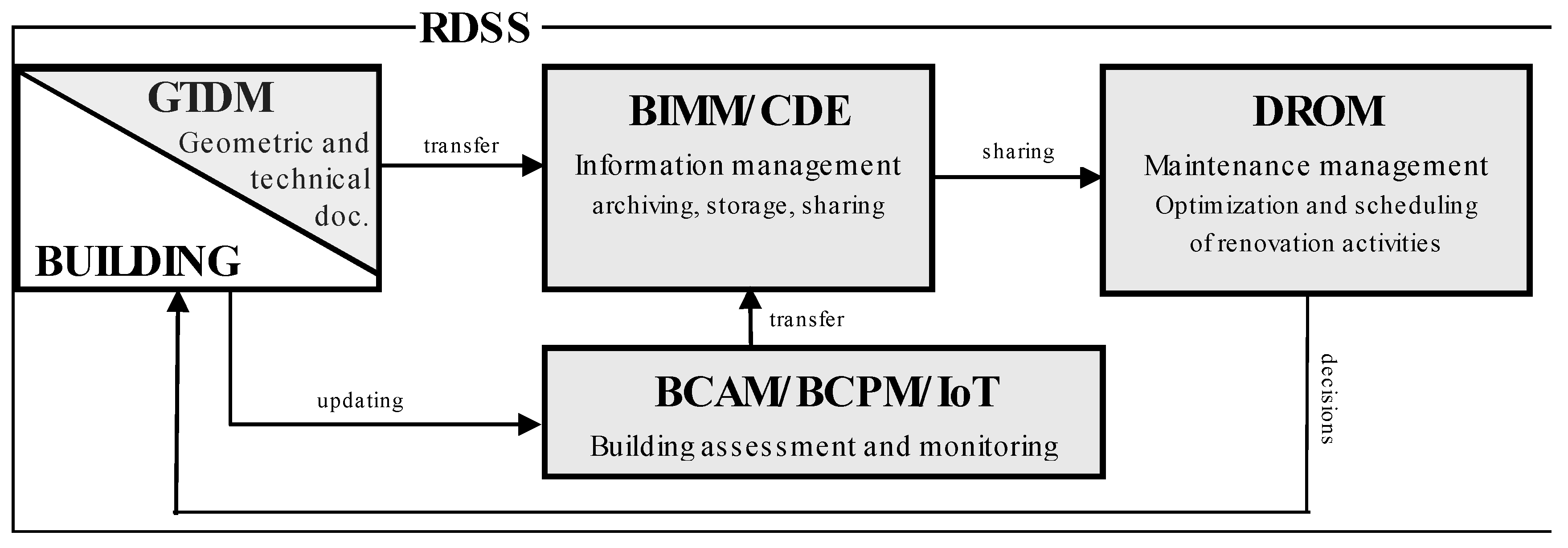
The proposed concept of the Renovation Decision Support System (RDSS) consists of five core modules, each forming an integral part of the system.
The first key module, the Building Information Modeling Module (BIMM), integrates structured, multidisciplinary data to create a digital representation of the building. Its operation is based on an intelligent model supported by a cloud-based platform, enabling the creation and management of building information. It serves data visualization and analysis, providing access to, browsing, and updating of the model and its associated records. The BIM module assumes integration with a wide range of information sources that supply the knowledge necessary to ensure efficient maintenance and renovation processes.
One of these sources is the Geometric and Technical Documentation Module (GTDM), which is responsible for providing digital building documentation obtained through scanning tools applied to both physical building and its paper-based documentation. This data are further supplemented with additional technical information and linked to specific building components.
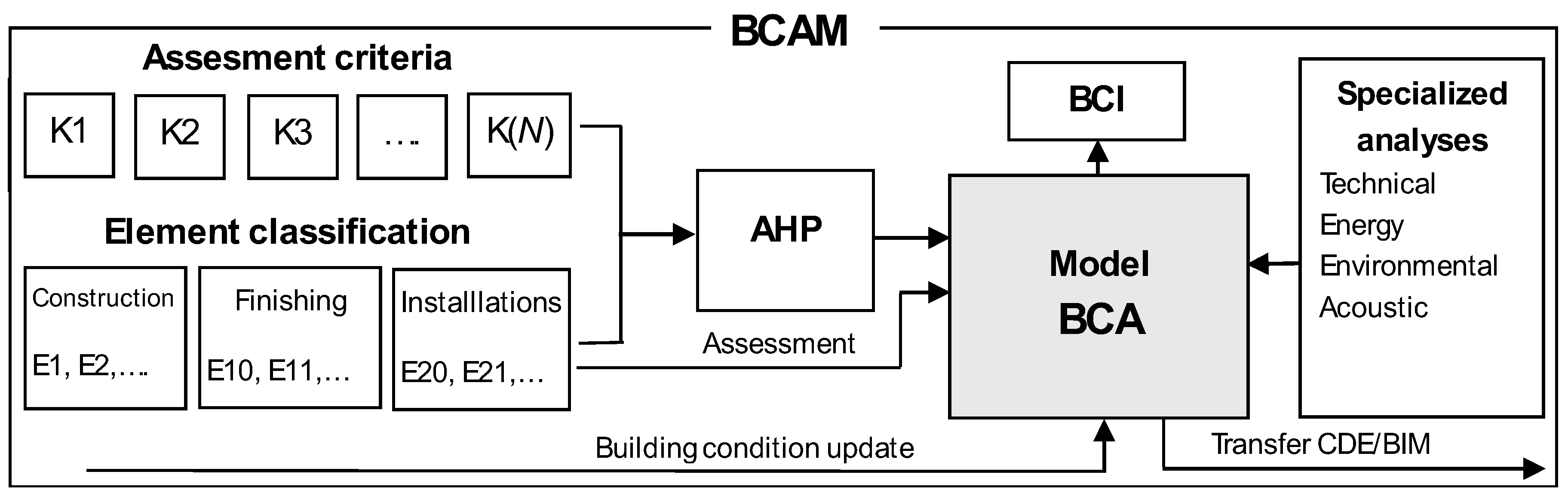
The BIM module also expands the knowledge base with information derived from building condition assessments. These are obtained from the Building Condition Assessment Module (BCAM), which provides real-time data from periodic building inspections as well as specialized analyses, audits, and expert evaluations. For improved assessment, this module is based on an extended method that includes environmental, visual, and functional–operational aspects.
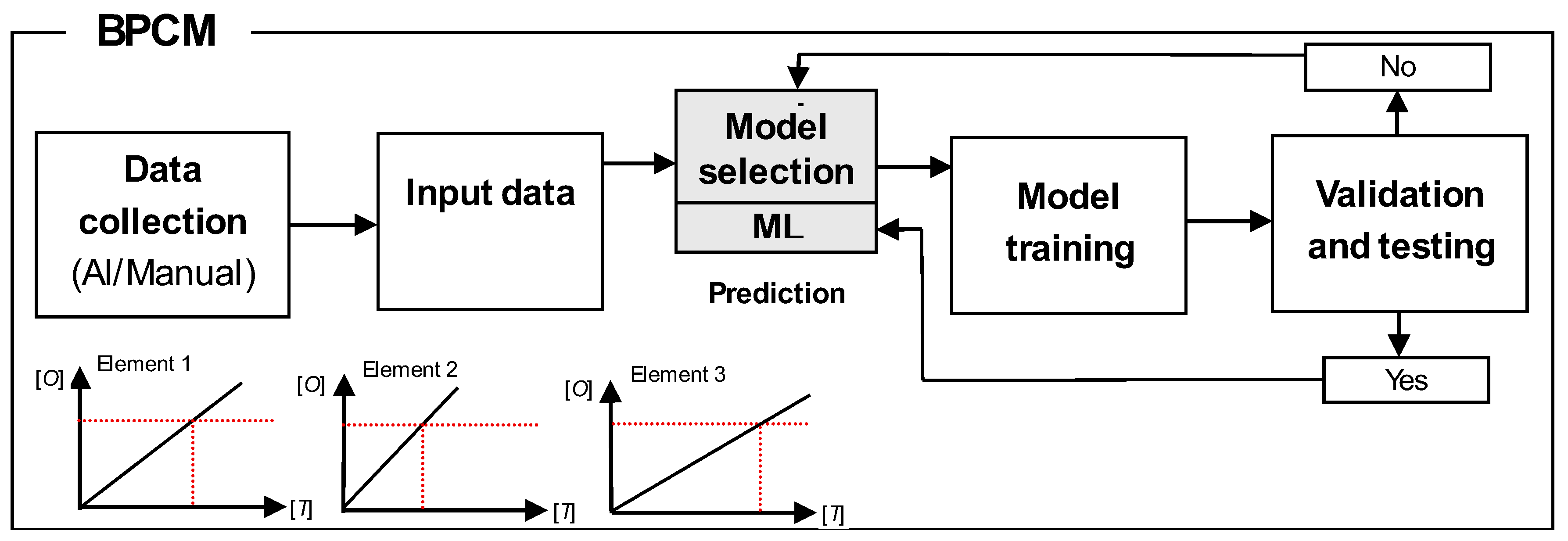
An advanced extension of the BIM module is its integration with the Building Performance and Condition Prediction Module (BPCM), which provides key information for maintenance and operation regarding the degradation processes of building components. This knowledge is generated using Machine Learning (ML) methods based on historical data processed with Artificial Intelligence (AI) techniques.
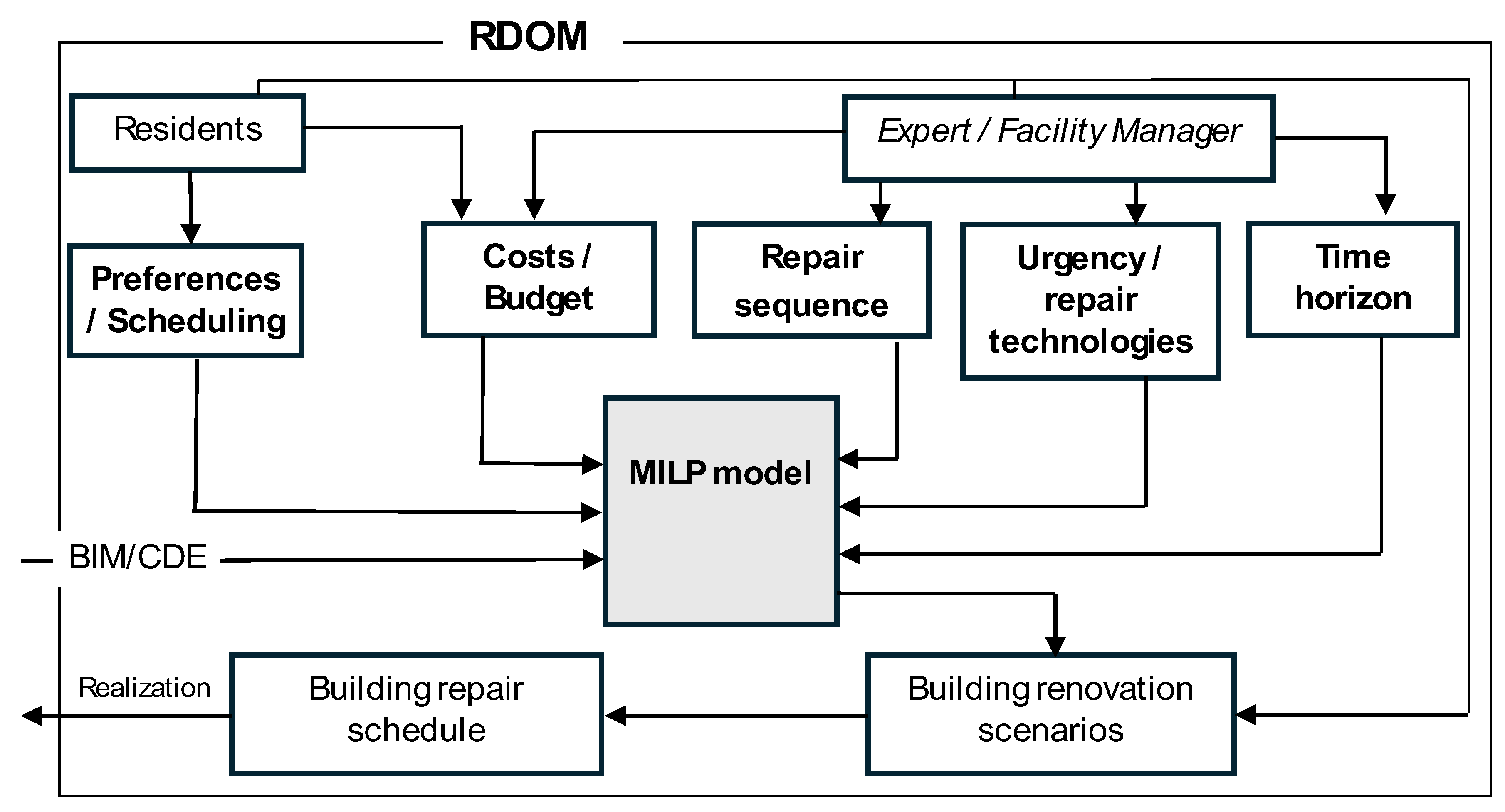
The fifth module of the proposed system is the Renovation Decision Optimization Module (RDOM), designed to support efficient and effective long-term management of schedules and costs related to building maintenance. The tasks performed within this module form part of a broader scope of Facility Management (FM) services, enabling the generation of various time–cost scenarios and the selection of the most optimal solution, covering maintenance, repair, and modernization activities. Its operation is based on data obtained from the BIMM and shared through a digital Common Data Environment (CDE) platform.
The BIM module (BIMM) serves as a central data repository integrating information from all system components. Data from the Building Condition Assessment Module (BCAM), including current condition scores and inspection results, are continuously stored and updated within the BIM environment.
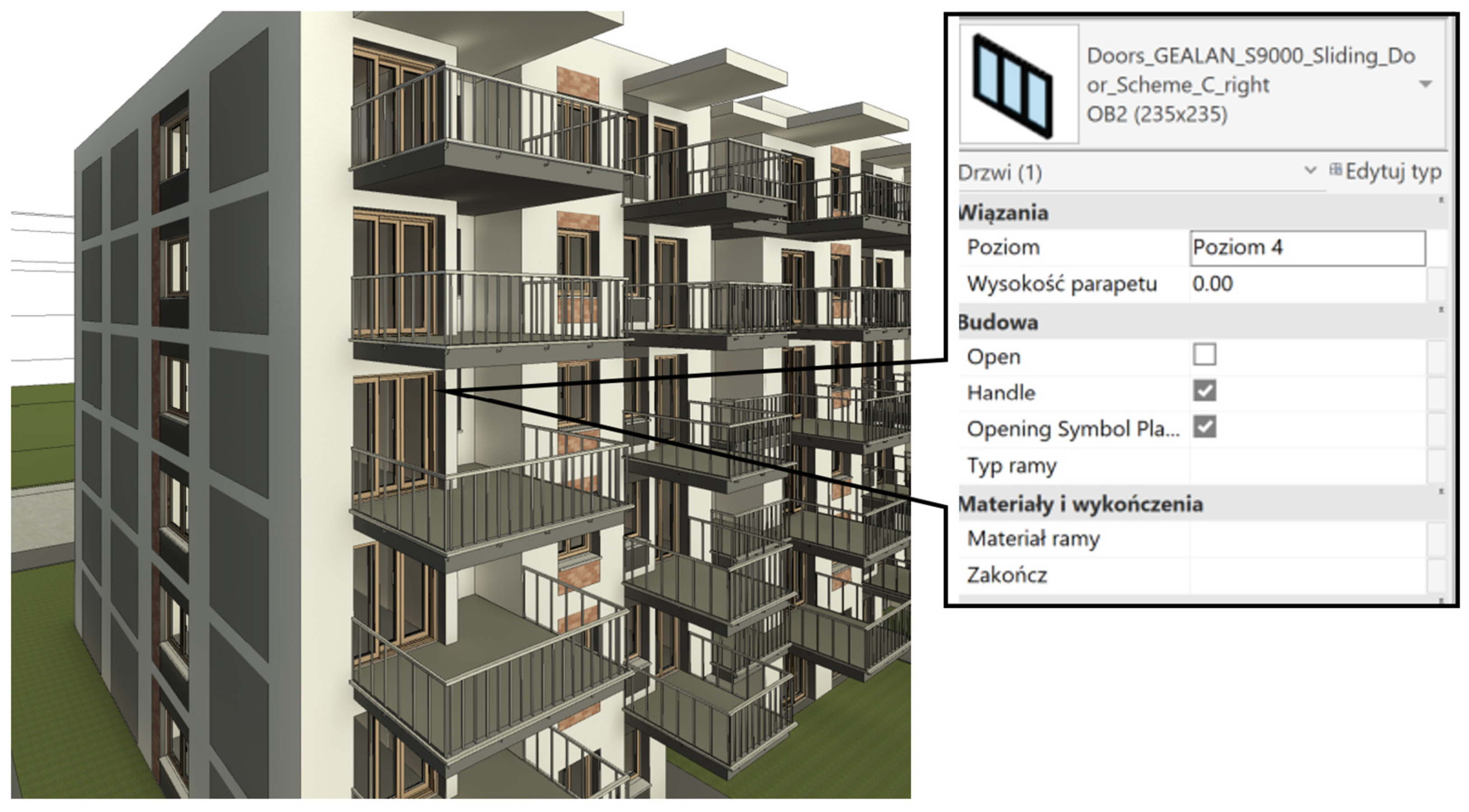
To better illustrate the structure and informational richness of the BIM model used in the proposed RDSS,
Figure 1 presents an example of a simplified BIM representation of a residential building fragment. The model integrates not only geometric information but also a set of parametric attributes assigned to individual building components. These parameters include, among others, element type, spatial location, functional characteristics, and material properties.
Such parameterization enables the transformation of the BIM model from a purely geometric representation into a structured database supporting analytical processes. In the context of the proposed system, these attributes constitute a key input for subsequent modules, particularly for condition assessment (BCAM) and predictive analysis (BPCM), where they are used as explanatory variables in machine learning models.
The use of parameterized BIM elements allows for consistent data structuring and facilitates interoperability between system modules within the Common Data Environment (CDE). This approach is particularly important in the context of integrating heterogeneous data sources, such as inspection reports and operational records, into a unified decision-support framework.
The Building Performance and Condition Prediction Module (BPCM) uses these data as input for machine learning models, generating predictions of degradation processes, failure risks, and future performance of building components. The results of these analyses are then fed back into the BIM model, enriching it with predictive information.
The Renovation Decision Optimization Module (RDOM) utilizes both current and predicted data stored in BIM to generate optimal renovation schedules using MILP-based optimization. The output includes decision scenarios, scheduling plans, and budget allocation strategies.
The results of the optimization process are subsequently stored in the BIM model, creating a feedback loop that enables continuous updating of the building knowledge base and supports long-term, data-driven decision-making.
The diagram of the proposed RDSS concept is presented in
Figure 2.
3.1. Conceptual Application of the RDSS
This example does not represent a real case study but is intended as an illustrative scenario demonstrating the workflow of the proposed system. To illustrate the practical operation of the proposed RDSS, a simplified conceptual example is presented, referring to a representative large-panel residential building characterized by typical structural and installation components subject to degradation processes during the operation phase. In the first stage, the Building Condition Assessment Module (BCAM) provides condition scores for selected building components (e.g., façade, roof, installations), which are then aggregated using the Analytic Hierarchy Process (AHP) to determine their relative importance in the context of overall building performance. For example, façade condition may be assessed at a level of 0.45, roof at 0.60, and installations at 0.35, indicating varying urgency levels of intervention expressed as a normalized condition index (e.g., BCI) in the range from 0 (poor condition) to 1 (excellent condition). Based on these values and predefined fuzzy inference rules, urgency levels of renovation interventions are determined, enabling the prioritization of maintenance needs while considering both technical and functional aspects. In the next stage, the Building Performance and Condition Prediction Module (BPCM) generates forecasts of degradation processes and failure risks for selected components using machine learning models trained on historical inspection and operational data. The obtained results enrich the BIM model with predictive information, supporting long-term decision-making and enabling more efficient planning of renovation activities. In the final stage, the Renovation Decision Optimization Module (RDOM) utilizes both current and predicted data to develop an optimal renovation schedule under budgetary, technological, and organizational constraints using a MILP-based model. The output consists of alternative renovation scenarios, including prioritized actions distributed over the defined planning horizon.
From a sustainability perspective, the proposed approach supports more rational resource use by optimizing financial expenditures, reducing inefficient renovation activities, and extending the lifecycle of building components. At the same time, it enhances decision-making by incorporating user-related aspects, thereby addressing the social dimension of sustainable building management. It should be emphasized that the presented example is conceptual and serves to demonstrate the logical workflow of the RDSS. A full-scale implementation and validation using real building data will be the subject of future research focused on the practical application of the proposed approach.
3.2. Building Information Modeling Module (MBIMM)
3.2.1. Building Information Modeling (BIM)
Building Information Modeling (BIM) is a comprehensive process for creating and managing building information. A BIM model integrates structured, multidisciplinary data, enabling the creation of detailed digital representations of assets required during the operation phase [
20,
21,
22]. To achieve sustainable outcomes focused on renovation projects, it provides essential information at the decision-making stage.
Managing sustainable building operation requires the development of an appropriate BIM model, which involves acquiring critical information necessary for operational decision-making, as well as managing the real-time transfer of information from various systems. The BIM model represents the physical and functional characteristics of a building stored within a single dataset. It serves as a platform for collecting, managing, and visualizing relevant data, forming a comprehensive digital representation of the building.
In the proposed approach, an integral part of the BIM model is a 3D model enriched with additional attributes and parameters related to building assessment and the results of analyses (e.g., energy, structural, acoustic, and environmental). The BIM database is also supplemented with knowledge derived from predictive Machine Learning (ML) models, which, based on historical data, provide essential insights for making timely renovation decisions.
It is important that data from predictive models are continuously updated with operational data and stored in dynamic databases. All this information is transferred in the form of data or databases to the BIM model, enhancing its level of detail. The integration of BIM with the Internet of Things (IoT) should also be emphasized as a fundamental requirement for smart building management, particularly for acquiring data from Building Automation Systems (BAS).
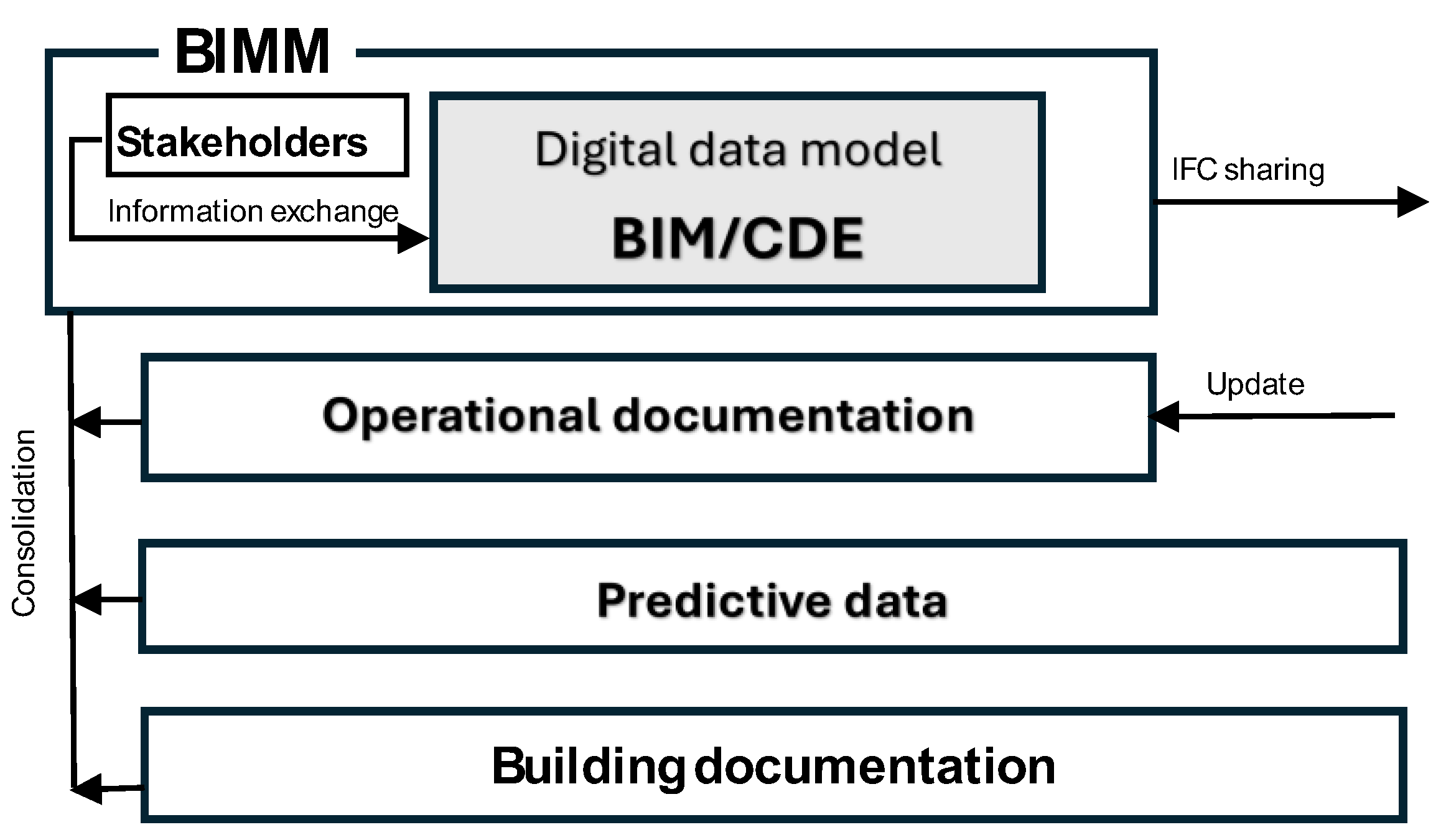
Thanks to the comprehensive datasets contained within the BIM module, it becomes a complete source of information about the building during its operation phase, providing a holistic view of its properties and parameters. The integrated and structured multidisciplinary data, forming detailed digital asset representations, are continuously updated and shared via a Common Data Environment (CDE) platform, enabling seamless information exchange between system modules and stakeholders. The information flow between the BIM model and RDSS modules is illustrated in
Figure 3.
3.2.2. Common Data Environment (CDE)
Information management plays a key role in renovation decisions, particularly given the complexity and volume of data generated throughout the building’s operational lifecycle [
23,
24]. Digital data originating from various sources are stored in different formats and are often characterized by a lack of interoperability, which prevents their seamless exchange between different systems/modules (including those that may no longer exist) without additional processing and limits their reuse.
Facilitating smooth information exchange can be achieved through the use of dedicated platforms that ensure the integration of data and processes in multidisciplinary environments. These assumptions, in line with the process defined in the BIM methodology, are implemented through Common Data Environment (CDE) platforms, which serve as a shared, agreed, and managed source of information about the asset.
The centralization of information in the form of a database ensures interoperability between data and cooperating systems through controlled information exchange among system components. The use of the open IFC format facilitates information management and sharing, enabling seamless data exchange between different software tools. This solution ensures secure storage, collection, management, updating, and flow of information.
The maintenance process may also involve a wide range of stakeholders, for whom the CDE platform provides continuous access to up-to-date and verified information throughout the building’s lifecycle. This approach eliminates issues related to lack of synchronization between stakeholders, as each party has access to current and validated data from individual modules of the decision support system.
The implementation of a CDE helps to overcome interoperability challenges and, by improving information flow, significantly enhances maintenance processes. Moreover, by enabling real-time collaboration, it allows for tracking issues and centralized sharing of up-to-date project information, ensuring alignment with sustainable development objectives.
3.3. Geometric and Technical Documentation Module (GTDM)
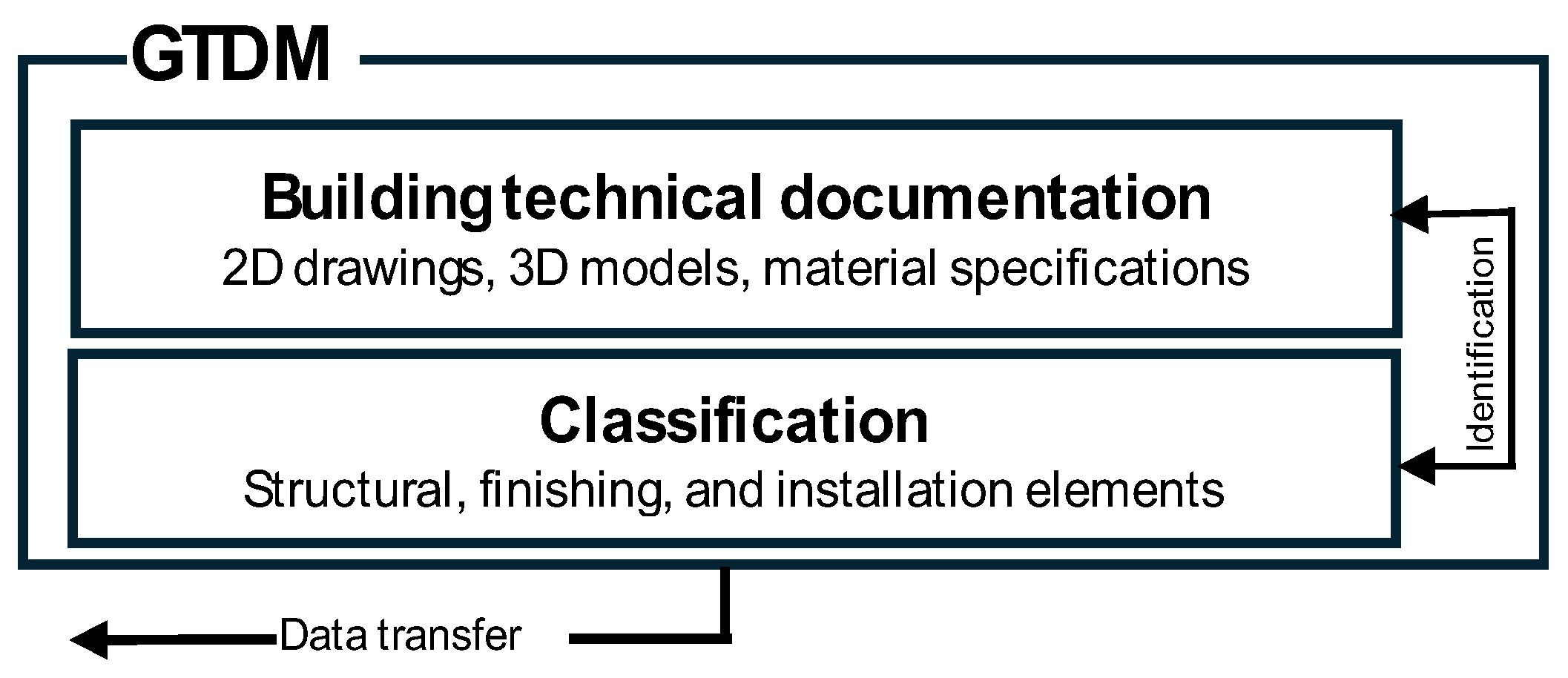
Digital building documentation for BIM aims to create a three-dimensional model that integrates both geometric and technical data of the asset. Geometric information includes the location, shape, and dimensions of elements such as wall outlines, column positions, or floor boundaries. Technical information refers to the identification of element types and their structural functions (e.g., beam, wall, or slab).
This approach is intended to develop digital building models based on 2D construction drawings, including architectural, structural, and MEP (Mechanical, Electrical, Plumbing) layouts. The main challenge lies in extracting geometric and technical information from these drawings. Typically stored in vector or raster formats, these drawings provide a structured but incomplete representation of the building.
The extracted data are stored in an intelligent BIM model, where the three-dimensional building geometry is enriched with information about materials, installations, structure, and parameters, serving as an as-built inventory. The scanning process is carried out automatically, enabling integration with BIM (Building Information Modeling) software Revit 2025. In the generated 3D models, all information is automatically recognized and assigned to individual components within the model.
This allows for the creation of a comprehensive digital representation, enabling the digital management of these assets. Furthermore, storing data in an editable and widely accessible format facilitates sharing information with other systems for further processing.
The diagram of the Geometric and Technical Documentation Module (GTDM), in which geometric and technical data are linked to building elements, is presented in
Figure 4.
3.4. Building Performance and Condition Prediction Module (BPCM)
Information on the degradation of building components forms the basis for effective maintenance of residential buildings. Based on enough historical and real-time data, it is possible to apply deep learning techniques to predict maintenance and renovation issues. An essential tool supporting the acquisition of predictive knowledge is the use of Machine Learning (ML) methods, which, within the BPCM module, provide the necessary insights for forecasting renovation needs.
The application of ML enables the processing and interpretation of data, effectively supporting users in the management of residential building maintenance [
25]. Its predictive capabilities, particularly in analyzing degradation processes, can be used, among others, to prioritize renovation tasks. The use of machine learning also allows for rapid response to changes in the condition of building elements due to its ability to adapt and learn from new data. The process of developing a machine learning model begins with data acquisition. The data are divided into training and testing datasets, which are used to train the selected model and subsequently validate its predictive performance. The selected ML model is an appropriate algorithm that best represents the prediction task, for example, based on regression, classification, or clustering.
In the context of the proposed system, several machine learning approaches may be considered depending on the type of available data and prediction objectives. For regression-based prediction of degradation processes and performance indicators, algorithms such as Random Forest Regression, Gradient Boosting, or Artificial Neural Networks may be applied.
In classification tasks related to failure occurrence or condition states, methods such as Support Vector Machines (SVM), decision trees, or ensemble classifiers can be used. In cases where time-dependent data are available, recurrent neural networks (e.g., LSTM) may be considered to capture temporal patterns in degradation processes.
The structure of input data may include parameters derived from BIM (e.g., material properties, geometry, age of components), inspection records (e.g., condition scores, defect types), and environmental or operational factors. The output of the models may consist of predicted degradation levels, probability of failure, or estimated remaining service life of building components.
In the current stage of research, due to limited availability of long-term, structured operational datasets, the proposed machine learning module is presented at a conceptual level. Its full implementation will require the systematic collection and standardization of historical inspection and maintenance data.
It is then evaluated by comparing its predictions with actual values using various evaluation metrics.
Thanks to its ability to learn from historical data, the algorithm enables the extraction of knowledge useful for forecasting and further analysis of data patterns to predict failures of building components or structural degradation. Its application allows for pattern discovery, outcome prediction, and automation of analytical processes, resulting in significant benefits for maintenance management. The block diagram of the BPCM module operation is presented in
Figure 5.
3.5. Building Condition Assessment Module (BCAM)
The Building Condition Assessment Module (BCAM) is responsible for providing up-to-date information on the current condition of the building. This includes data derived from Building Condition Assessment (BCA), as well as information obtained from other sources such as analyses, audits, expert evaluations, and reports.
The collected information is archived to ensure a digital flow of information, thereby improving the efficiency, quality, and speed of maintenance and facility management processes within the entire decision support system. The integration of BCAM with the BIM database enables the acquired knowledge to be transferred, updated, and shared in real time with other systems and stakeholders.The block diagram of the BCAM operation is presented in
Figure 6.
3.5.1. Building Condition Assessment (BCA)
Ensuring continuous building functionality through the optimization of renovation activities over the entire lifecycle requires a shift in the traditional approach to building condition assessment. The purpose of assessing of condition is to provide information necessary for decision-making, i.e., determining when and what preventive or corrective actions are required to maintain the intended level of service.
Knowledge of the current condition of a building, including its physical components and systems, is crucial for developing effective maintenance plans that ensure timely repairs and upgrades. Moreover, identifying potential risks and weaknesses through condition assessment supports the implementation of preventive measures.
Building condition assessment covers structural elements, interior finishes, external envelopes, roofing systems, fire protection systems, safety systems, electrical and mechanical systems, installations, and equipment. The assessment can be conducted in various ways; however, in the proposed approach, it is performed at the component level, where each element is evaluated to determine its value and remaining service life.
After conducting the BCA, the collected information is analyzed and transformed into an index known as the Building Condition Index (BCI), which is used to compare building conditions and assess whether it is economically viable to replace the existing building or to carry out comprehensive modernization and renovation.
The proposed condition assessment is based on direct evaluation of building elements through visual inspection, according to a defined set of criteria, enabling a relatively quick and reasonably accurate assessment. The first step involves identifying the roles and functions of individual building components, which are categorized into six areas: environmental protection, energy efficiency, safety, functionality, esthetics, and comfort.
To develop an effective and reliable assessment system, it is necessary to apply an appropriate evaluation mechanism for building elements combined with a well-defined building hierarchy. To determine both the importance of each assessment criterion and the influence of individual building elements, the Analytic Hierarchy Process (AHP) is proposed.
The actual condition assessment of building components is carried out using linguistic evaluations, which are assigned corresponding numerical values. As a result of periodic building inspections and completed renovation activities, condition assessment reports are recorded in an appropriate digital format and transferred and updated in BIM databases in real time.
The calculation of the condition assessment of building O assumes that the decision-maker first selects the evaluation criteria and subsequently, using the Analytic Hierarchy Process (AHP), performs pairwise comparisons of their relative impact on the overall building condition with respect to each criterion. For the assessment of the condition of structural elements, it is proposed to apply a linguistic ordinal scale, which can be transformed into an interval scale, for example: very good (VG, 10 points), good (G, 8 points), average (A, 6 points), poor (B, 4 points), and very poor (VB, 2 points). For the overall assessment of the building condition, the use of an additive function is proposed:
where
—the weight of element i respect with the criterion j,
—rating of current condition of element according to criterion .
After completing the assessment of the building condition, the decision-maker must consider the possibilities of improving the results obtained through renovation measures that affect the building’s performance to a specified extent. Preparation for this stage requires compiling a comprehensive set of all renovation actions related to all building components, along with an estimation of their costs. This stage provides a complete set of actions from which selections can be made in subsequent analyses. If a given action is implemented, it leads to an improvement in the building condition rating. The increase in the building condition rating,
, resulting from the implementation of renovation variant
, is calculated in accordance with the following formula:
where:
—the maximum score for element i corresponding to its ideal state,
—indicates the shortfall between element i and criterion j and their ideal states,
—the impact of renovation variant r on the rating of element i according to criterion j, assessed using an ordinal scale, for example: very high (VB, 5 pts), large (B, 4 pts), medium (A, 3 pts), small (S, 2 pts), very small (VS, 1 pt), or none (0 pts).
—the maximum impact value according to the adopted rating scale .
3.5.2. Specialized Analyses
Incorporating environmental analysis of a building through Life Cycle Assessment (LCA) enriches BIM with a comprehensive evaluation of the building’s impact on the natural environment across all stages of its lifecycle [
26]. This analysis provides information on the extent to which a building contributes to climate change (resource consumption and CO
2 emissions) and enables the identification of opportunities for reducing greenhouse gas emissions. Integrating LCA data into BIM allows for the consideration of a wide range of environmental impacts and serves as a valuable source of information during renovation processes aimed at achieving more sustainable, energy-efficient, and environmentally friendly buildings.
Energy analysis of a building involves detailed assessments determining its energy demand and overall energy performance. This includes evaluating the thermal insulation of building envelopes, the efficiency of systems (such as heating and ventilation), and the analysis of systems responsible for energy consumption. It enables the identification of areas where energy savings can be achieved and indicates specific solutions for improving energy efficiency. Information derived from energy audits and incorporated into BIM is used in planning and implementing thermal modernization measures.
Equally important from the perspective of user comfort is the analysis of acoustic comfort levels. This includes an assessment of external noise levels and the analysis of the acoustic insulation performance of building elements (walls, floors, windows, and doors). The results of this analysis provide additional knowledge integrated into BIM, which should be considered when selecting repair technologies and construction materials to ensure acoustic comfort and compliance with applicable standards.
3.6. Renovation Decision Optimization Module (RDOM)
The Renovation Decision Optimization Module (RDOM) constitutes an integral part of the proposed decision support system and is responsible for providing the knowledge necessary to ensure proper building maintenance. The module operates based on data derived from the BIM module as well as knowledge obtained from residents, experts, and facility managers.
Information from residents makes it possible to determine the most convenient timing for carrying out repairs, while input from experts and managers helps establish the appropriate sequence of activities. Maintenance and renovation decision support is carried out based on either basic or extended information.
In the basic variant, the module enables the development of a renovation plan aimed at maximizing the improvement of the building’s technical condition while considering predefined budget constraints. In this case, its operation is based on assumed budget limits, and the planned duration of renovation works.
However, the basic scope does not exhaust the capabilities of RDOM. By incorporating additional data into the optimization process such as inputs from residents, experts, and managers, it becomes possible to develop a renovation plan that reflects these requirements. In this extended approach, factors such as residents’ preferences, technologies, urgency, sequence of repairs, budget, and implementation time are all considered.
Considering that such a wide range of data enables advanced modeling of the maintenance and renovation process in terms of both cost and scheduling. The module operates using simple, efficient, and effective computational methods, including Mixed Integer Linear Programming (MILP).
Its functioning is based on comprehensive and continuously updated information from BIM, particularly regarding building performance levels, including both deterioration and improvement over successive renovation periods. The block diagram of the RDOM operation is presented in
Figure 7.
3.6.1. Repair Scheduling
Preferences regarding repair timelines, obtained from residents, aim to improve the quality of services in the field of maintenance and renovation. The ability to incorporate this knowledge into the planning of maintenance and renovation works allows residents to actively influence the selection of convenient repair periods, thereby minimizing disruptions during building use.
By expressing their preferences, residents indicate time intervals that are most suitable for them, during which construction works will be least disruptive. In the optimization process, this information is treated as a priority, though not as a strict constraint it serves as a recommendation. Nevertheless, in the final decision-making process, alternative scheduling options are also considered when searching for the most optimal renovation schedules.
Renovation scenarios—both those aligned with residents’ preferences and alternative options—may significantly affect the timing of planned works. Therefore, they should be presented to residents and subject to their approval prior to implementation.
3.6.2. Urgency Levels and Repair Technologies
Predictive data, combined with information derived from building condition assessment—specifically at the level of building components and stored in the BIMM, are used in the proposed approach to determine the urgency level of renovation works.
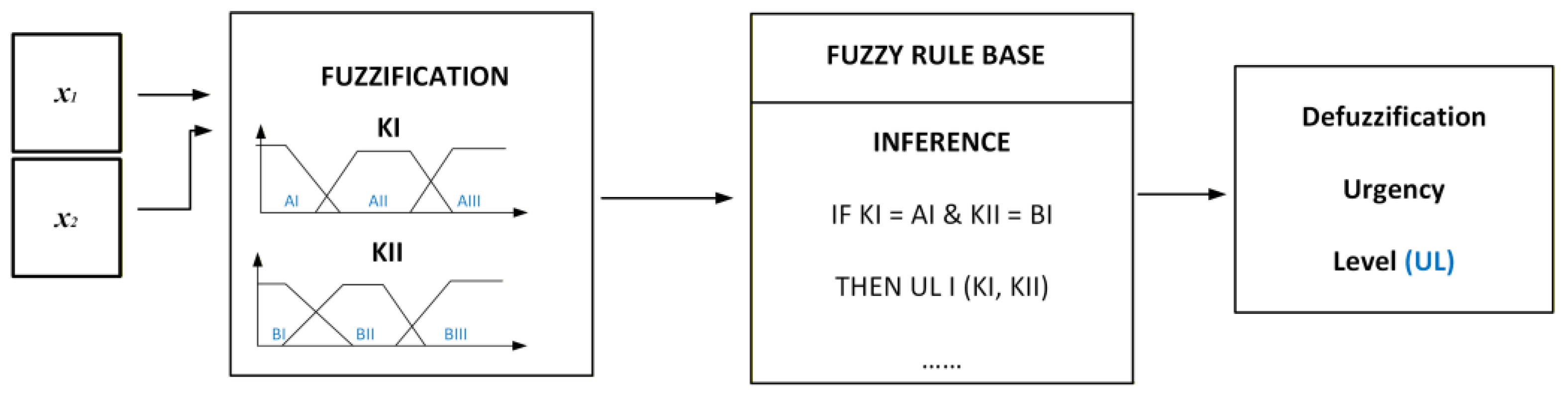
The proposed solution is based on a fuzzy rule-based decision-making method. The inference process is expressed through formal rules, ensuring consistency and logical correctness in decision-making. The knowledge required to construct the rule base is obtained from experts, who define urgency levels based on identified diagnostic indicators. Two levels of urgency (UL) are proposed:
Accordingly, repairs must be carried out within specified timeframes either within one year or no later than within three years. The results obtained from this method may be adjusted at later stages of the optimization process if they cannot be accepted due to budget constraints.
For the construction of the rule base, an Adaptive Neuro-Fuzzy Inference System (ANFIS) is proposed. It allows for the tuning of the fuzzy system using a learning method based on multilayer neural networks. A hybrid method (combining the backpropagation of error with gradient descent and the least squares method) is used to train the network. The ANFIS system training process requires specifying the number of fuzzy sets and determining the characteristics and shape of the membership functions describing them. The output value (rule conclusion) in the adopted Takagi–Sugeno model is expressed as a functional relationship between inputs and outputs, whereas in the antecedent part, the rule is fuzzy in nature, as expressed as follows:
The calculation of the urgency level (UL) is the result of the activation of the conclusions of individual system rules. In the defuzzification process, the Takagi-Sugeno model uses a “weighted sum” method based on the values obtained from the activated rules:
The inference process for determining urgency levels is illustrated in
Figure 8.
The basis for selecting appropriate technological and material solutions for the building is the urgency level of improving its technical condition in relation to the adopted assessment criteria. The selection of repair technologies considers both the condition assessment of building elements and recommendations resulting from additional analyses, audits, and expert evaluations.
Proposed repair solutions may include alternative technological variants that differ in terms of performance and cost, allowing for better alignment with technical and budgetary requirements. Each repair variant, to ensure benefits across different assessment categories, should demonstrate varying levels of improvement, as well as different implementation times and costs.
The impact of proposed repairs within a given category is evaluated using a scale that reflects their contribution to improving specific criteria.
3.6.3. Repair Sequence
Standard optimization approaches used in selecting repair actions typically aimed at minimizing maintenance or renovation costs while improving building performance often do not consider technological constraints related to the proper sequence of repair works. As a result, such approaches frequently lead to illogical sequences of renovation activities and, consequently, unnecessary and often higher costs.
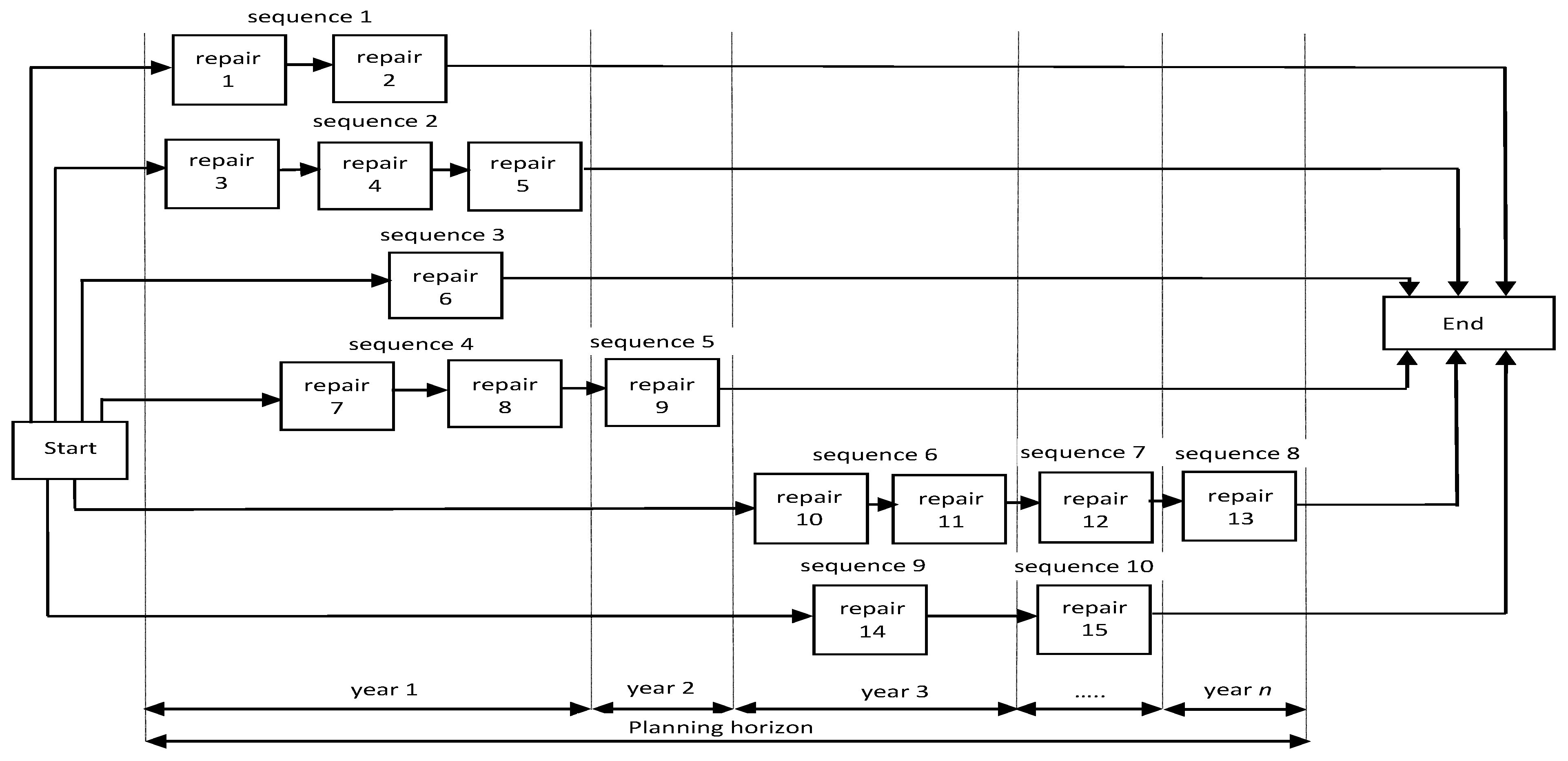
To avoid these issues, the proposed approach assumes grouping repair actions according to their association with specific building elements or spaces. For example, groups of activities may relate to the renovation or modernization of staircases, roofs, basements, or façades. Each group may include any number of actions; however, each action can belong to only one group.
If these actions are to be implemented, they should be carried out in a specific sequence, consistent with the logic of construction processes and their complementary nature. For instance, it is not possible to select only certain actions from a sequence if preceding actions have not been selected or completed in earlier renovation stages (e.g., cracks in structural walls should be repaired before façade works are performed).
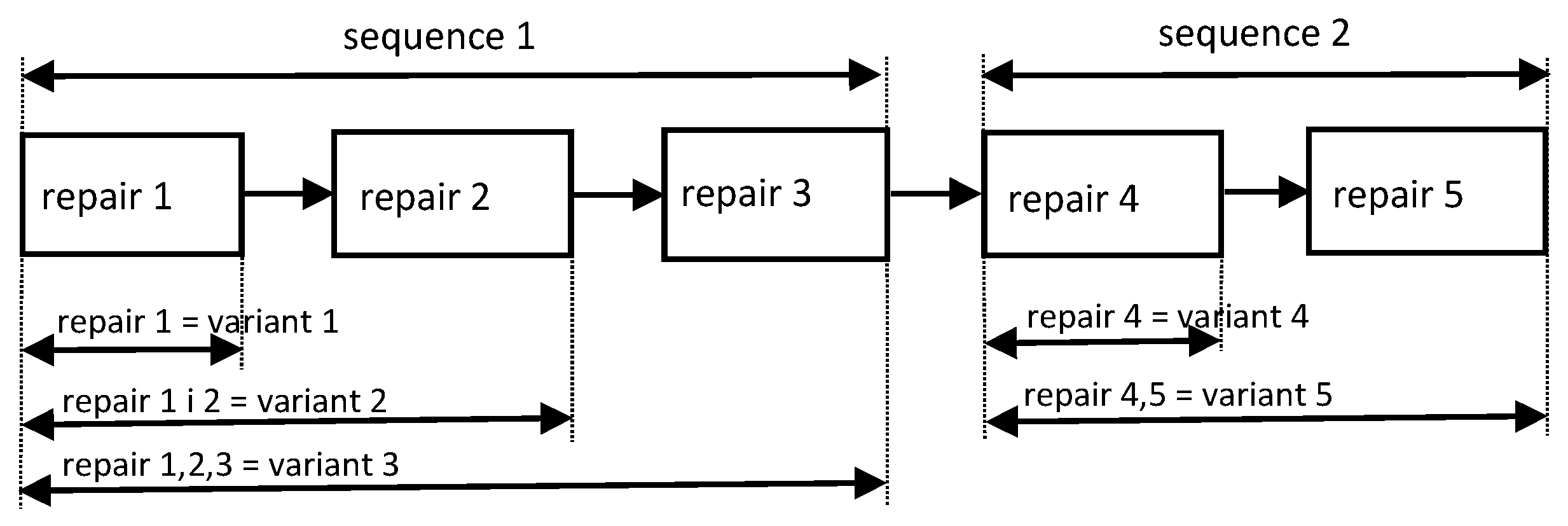
This approach is enabled using so-called binary constraint matrices, which define the required order of repair execution. These constraints reflect sequential technological and functional dependencies between individual repair variants, resulting from their complementary nature and the logic of implementation processes. The concept of repair sequence variants is illustrated in
Figure 9.
The number of the
r-th variants of each
a-th sequence is equal to the number of the
q-th repairs. The first variant of the sequence contains the first repair, while each subsequent variant adds the next repair in a fixed order. Thus, the number of sequence variants is equal to the number of all repairs assigned to it. In the example from
Figure 8, the sequence a = 1 consists of repair variants r = 1, 2, 3 with their
q-th repairs ordered accordingly. The sequence variants include performing one, two, or three repairs in total. It is not possible to select two or more variants of a given sequence at the same time. It is also not possible to select any repair from a sequence if its predecessors were not selected in the previous
h-th stage of renovation. Subsequences are subject to selection in the optimization procedure, during which the
r-th variant of the sequence is selected in each successive
h-th stage of renovation. The mathematical representation of the matrix containing the constraints resulting from the discussed sequences is expressed by the following equations:
3.6.4. Maintenance Costs/Budget
Cost management aims to optimize the long-term costs of building maintenance, including expenses related to servicing, repairs, and modernization. It is assumed that the funds allocated to budget
come from contributions to the renovation fund, i.e., from the portion of monthly maintenance fees paid by tenants or co-owners of residential units. In this case, the budget available for use at each of the
-th stages throughout the entire renovation planning horizon is calculated as follows:
where:
—the total cost of activities carried out in the h-th period.
The monthly contribution is determined by the decision-maker in cooperation with residents. This value can be adjusted to find a balance between residents’ willingness to pay and the achievable improvement in building conditions by the end of the planning horizon. The model also allows for consideration of different operational strategies and financing schemes, such as using loans for “major modernization projects,” which can be implemented quickly instead of relying solely on gradually accumulated funds over many years.
3.6.5. Planning Horizon
A common approach in residential building maintenance is to ensure funding for current repair needs. However, renovation budgets planned in this way are typically short-term and do not account for potentially high maintenance costs that may arise in the future. Therefore, long-term planning becomes essential, even if it requires higher contributions from the outset, despite repairs being scheduled for later stages of the planning horizon.
Nevertheless, increasing residents’ contributions to the renovation fund must be justified by clearly estimating future needs within a defined planning horizon. When determining this horizon, factors such as residents’ preferences, costs, repair sequences, and urgency levels must be considered.
The developed optimization module based on Mixed Integer Linear Programming (MILP) enables experimentation with different parameter settings to generate various building maintenance scenarios. Such analyses can be conducted at any time, using different planning horizons, allowing adjustments to residents’ financial capacities and enabling final decisions to be subject to their approval.
3.6.6. Optimization of Selection and Scheduling
At each stage of the planning horizon, divided into time periods (years), the optimization algorithm identifies variants that provide the greatest improvement in building performance indicators, while ensuring that the maximum monthly contribution to the renovation fund remains acceptable to residents.
The model for selecting and scheduling actions covers all stages of planning from building performance assessment, through identification of potential interventions, to the selection and scheduling of the most beneficial repair, renovation, and modernization activities. Its objective is to achieve the desired level of building performance by the end of the planning horizon.
The model accounts for the multi-criteria nature of maintenance decisions. It supports long-term planning of residential building maintenance within a defined decision-making environment, including optimization of incremental improvements distributed over time due to budget constraints.
The model allows planners to easily experiment with various parameters, such as criterion weights, scheduling preferences, planning horizon length, and budget.
To improve the transparency of the proposed Renovation Decision Optimization Module (RDOM), the optimization problem may be formulated in a simplified form as a Mixed-Integer Linear Programming (MILP) model.
Let:
- –
denote renovation variants,
- –
denote time periods within the planning horizon,
- –
denote sequence of variants,
- –
be a binary decision variable equal to 1 if variant is selected in period , and 0 otherwise,
- –
denote the cost of repair variant ,
- –
denote the available budget in period ,
- –
denote the expected improvement in the building condition resulting from variant .
The objective function is defined as the maximization of the total improvement in building condition over the entire planning horizon:
subject to budget constraints for each period:
assessment of the building’s condition at step
of the renovation:
Such a formulation allows the model to identify renovation schedules that improve the technical performance of the building while respecting financial and organizational constraints. In the full implementation of the RDSS, the model may be extended to include additional factors such as urgency levels, residents’ preferences, alternative technological variants, and multi-criteria weights derived from the assessment process. The presented formulation is intentionally simplified and serves to illustrate the decision logic of the RDSS. A more detailed parameterization of the MILP model will depend on the availability and structure of building-specific operational data and will be addressed in future implementation-oriented studies.
The resulting renovation scenarios, including estimated costs and benefits associated with selected repair and improvement strategies, can then be accepted or rejected for implementation.
These scenarios may play a crucial role in justifying changes to monthly renovation fund contributions, which must be agreed upon with members of the housing community. An example of a selected scenario in the form of a schedule, showing the planned increase in building condition assessment over the entire renovation period, is presented in
Figure 10.
4. Implementation Challenges of RDSS
The application of new methods in building maintenance, aimed at meeting information needs within digitized information flows, introduces several challenges. These arise from the implementation of Building Information Modeling (BIM) systems and digital information platforms such as Common Data Environments (CDE). Data and information generated during building operations are crucial for ensuring an appropriate level of maintenance originates from multiple sources and systems and are stored in various formats. Their large volume and diversity (e.g., drawings, data from assessment systems, predictive systems, operation and maintenance (O&M), etc.) may create difficulties in their effective use.
Managing such information requires the development of appropriate frameworks responsible for modeling data from various sources, validating them against requirements, and enabling their effective utilization. In the context of data management, it is essential to adopt suitable supporting formats that facilitate the exchange of building information between different systems and stakeholders. It should be emphasized that there is still a lack of research systematically analyzing which standards can be adopted as data sources within BIM. Therefore, it appears necessary to examine the applicability of appropriate open standards in terms of their ability to support both structured and unstructured information.
The concept of adopting and using a single central model or a publicly accessible database based on open standards may help address these challenges. The most appropriate solution seems to be the implementation of a Common Data Environment (CDE) fully based on open standards and the integration of existing technologies. Furthermore, the use of a CDE platform ensures data flows supported by Industry Foundation Classes (IFC), enabling efficient data exchange management throughout the building operation phase.
The design of the RDSS concept also encounters challenges related to selecting an appropriate method for building condition assessment. While improving defect inspection processes through scan-to-BIM technologies and automated defect classification based on image analysis appears to be an optimal solution, it is not yet fully feasible in practice. Therefore, the visual assessment approach adopted in the Building Condition Assessment Module relies on labor-intensive methods that are largely based on the subjective nature of most input data, such as criterion weights, evaluation scores for individual criteria, and the expected impact of implemented actions on building performance.
The subjectivity in selecting criteria and assigning their weights is intentional, allowing flexibility in defining their type, number, and relative importance. As a result, different experts or decision-makers may provide different input data for the analysis of the same building. Regarding the measurement of criteria values and the impact of actions, the proposed approach is based on expert judgment using linguistic assessments, which are linearly scaled into numerical scores.
The selection of appropriate tools for predicting future degradation states of building components may also raise concerns. The historical lack of interest in collecting and storing such data currently poses a significant challenge in designing decision support systems. Unfortunately, acquiring such data is a long-term process that requires the gradual accumulation of historical records, which can then be used for machine learning purposes.
Although the Machine Learning (ML) method proposed in the RDSS offers clear advantages, it requires access to data whose acquisition involves either manual data collection or automated knowledge extraction using AI tools, semantic networks (ontologies), or other web-based technologies.
5. Conclusions
The application of new, efficient operational methods in the maintenance and management of residential buildings is becoming a necessity. Literature studies indicate approaches supported by BIM tools and digital platforms such as the Common Data Environment (CDE). The capabilities are presented in building management approaches described in scientific publications. These include methods and models, most of which provide partial rather than comprehensive solutions dedicated to the maintenance and renovation of residential buildings.
The Renovation Decision Support System (RDSS) proposed in this paper has been developed as a concept of a simple and effective tool based on digital technologies supporting building renovation. The proposed system covers all stages of the renovation process from the preparation of digital data, predictive assessment, and evaluation of building performance, through the identification of potential interventions, to the selection and scheduling of the most effective repair, renovation, and modernization actions.
The proposed system integrates cooperating methods (modules) developed to perform specific tasks. A key element of the system is the BIM model, which serves as an evolving and continuously updated database providing knowledge for building renovation. The information stored in the BIM module includes both geometric data and technical specifications obtained from various sources.
The integration of Machine Learning (ML) with BIM plays a crucial role in modern data analysis approaches, offering capabilities beyond traditional analytical tools. In this way, the value of BIM is enhanced by additional knowledge related to building degradation processes, derived from operational data. Enriching BIM with the knowledge necessary for effective maintenance is also supported by a new approach to Building Condition Assessment (BCA), which serves as a key tool for evaluating the level of sustainability of the building. This approach not only broadens the scope of assessment by incorporating new criteria but also enables a rapid evaluation of building conditions.
The knowledge derived from BCA, considering the multi-criteria nature of decision-making, allows for the development of capital budgets for the most necessary maintenance and replacement activities within a defined time frame.
However, integrating various methods with BIM to provide up-to-date knowledge for optimizing renovation activities introduces certain challenges related to data operability. To address this, tools enabling the creation of data models and the effective use of detailed information in ongoing operation and maintenance activities have been proposed. This task is supported by the CDE platform, which ensures data accessibility by storing information in a centralized environment throughout the entire lifecycle, as well as managing its recording and storage within an integrated system.
The information supplied to the optimization module is used to develop strategies and long-term schedules defining the scope of incremental improvements that can be planned and distributed over time. The Renovation Decision Optimization Module (RDOM), as part of Facility Management (FM), is responsible for maintenance planning, including renovation scheduling. It is a flexible tool that allows experimentation with different parameters such as residents’ preferences, urgency of repairs, planning horizon length, and budget to estimate the costs and benefits associated with selecting a particular maintenance strategy. Such analyses may play a key role in justifying changes to the monthly contributions to the renovation fund.
The proposed system contributes to sustainable building management by supporting environmentally responsible renovation decisions (e.g., reduction in resource consumption and emissions), improving economic efficiency through optimized budget allocation, and enhancing social aspects by incorporating user preferences into the decision-making process.