Circular Economy Strategies in Sustainable Agriculture: Pathways to Climate Resilience and Decarbonization

 ,
,  , ,
, ,
Abstract
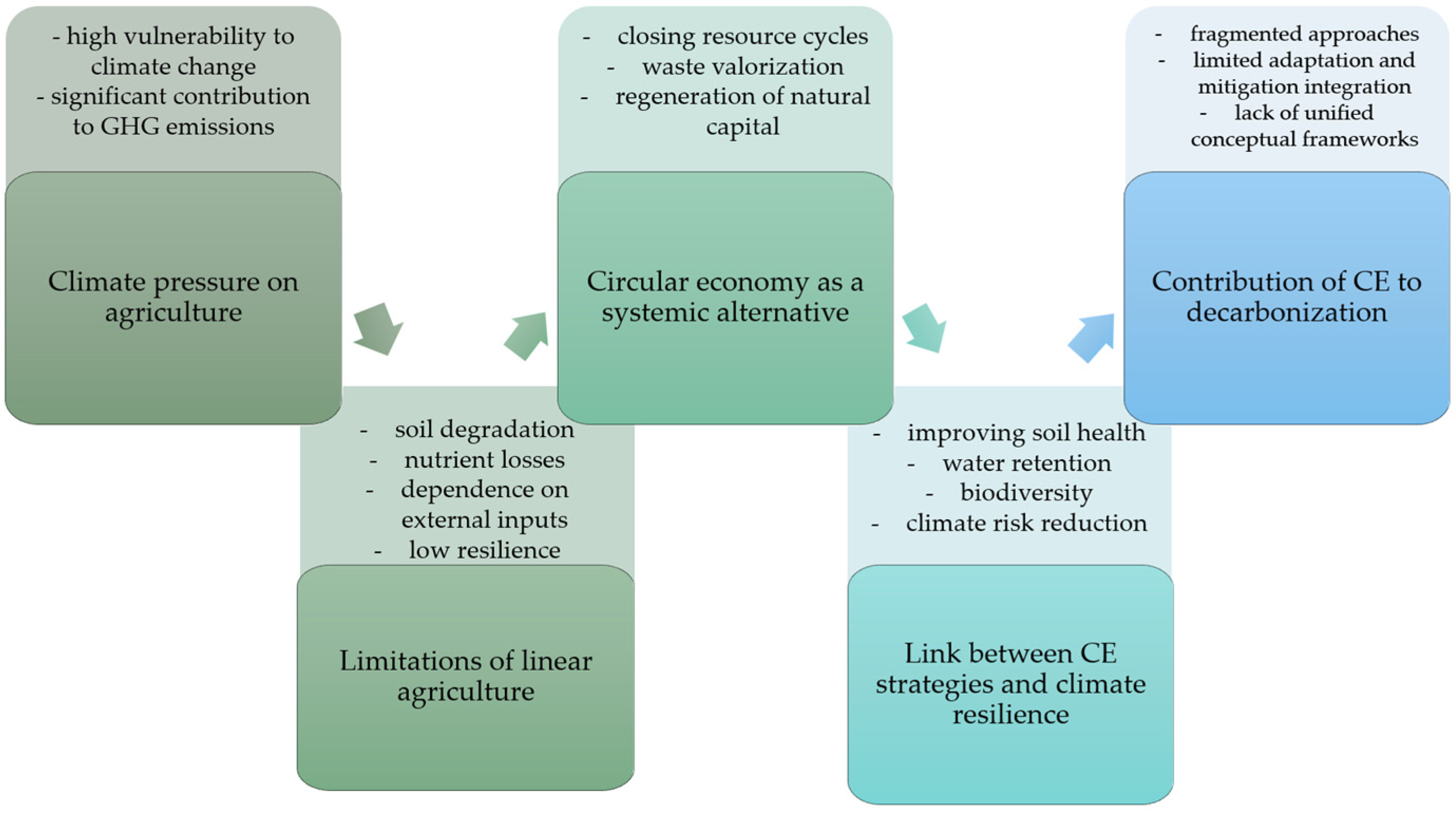
1. Introduction
- (i)
- What types of circular economy strategies are most frequently applied in agricultural systems?
- (ii)
- Through which mechanisms do these strategies contribute to climate resilience?
- (iii)
- How do circular economy strategies support decarbonization processes in agri-food systems?
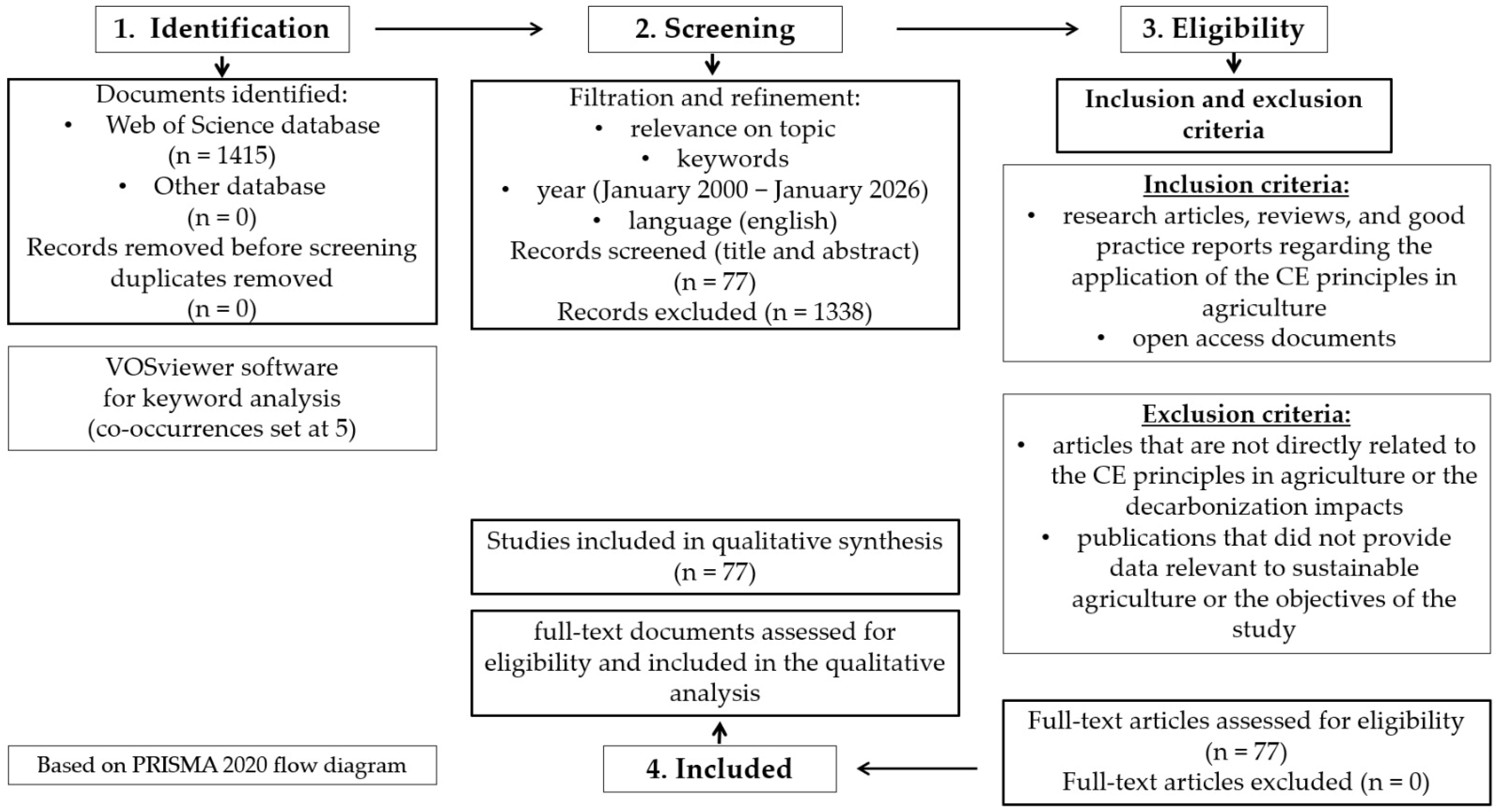
2. Methodology of Research
3. Results
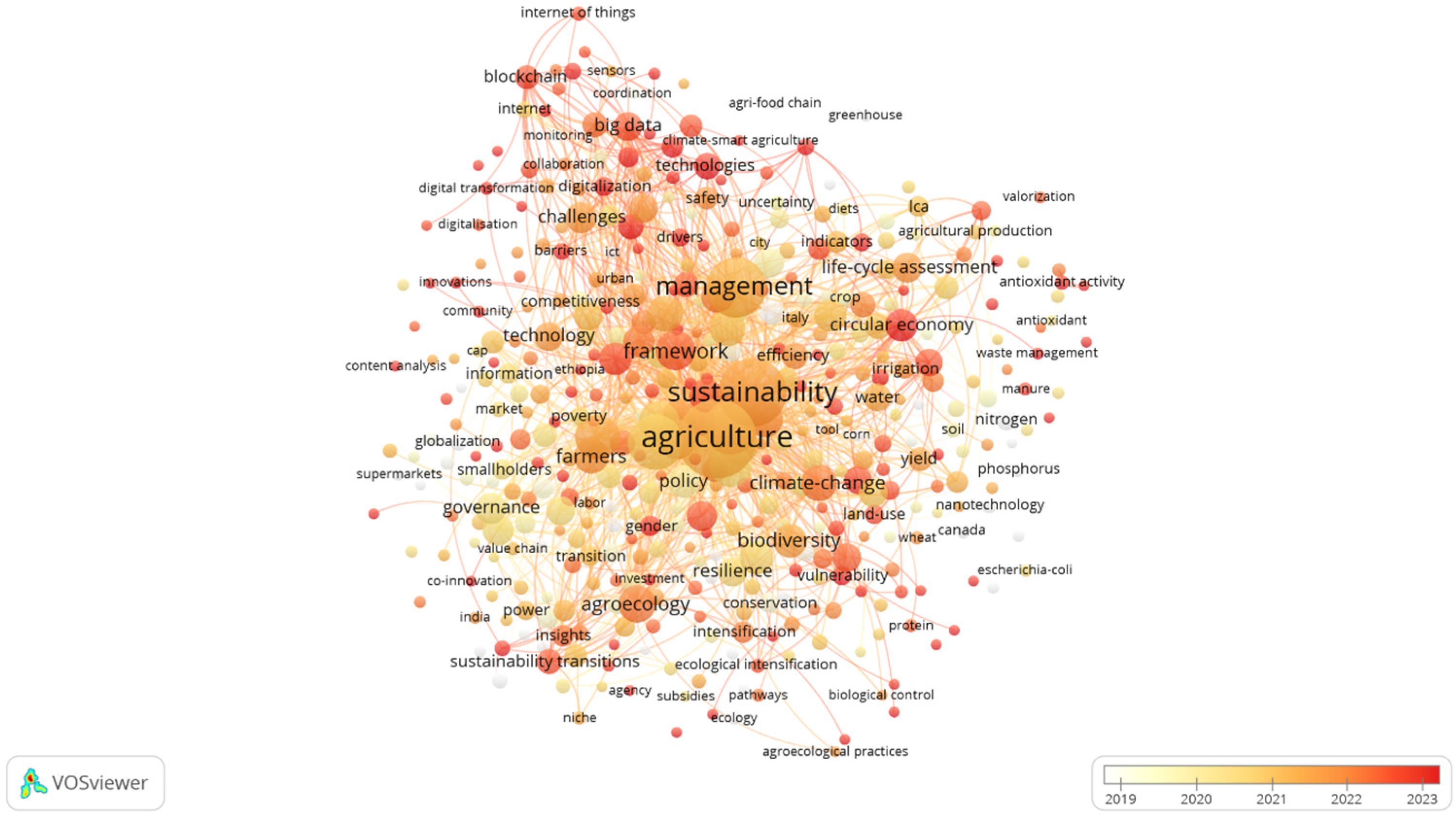
3.1. General Characteristics of the Analyzed Literature
3.2. Types of Circular Economy Strategies and Trends Identified in Agriculture
3.3. Comparative Insights and Implementation Challenges of Circular Strategies
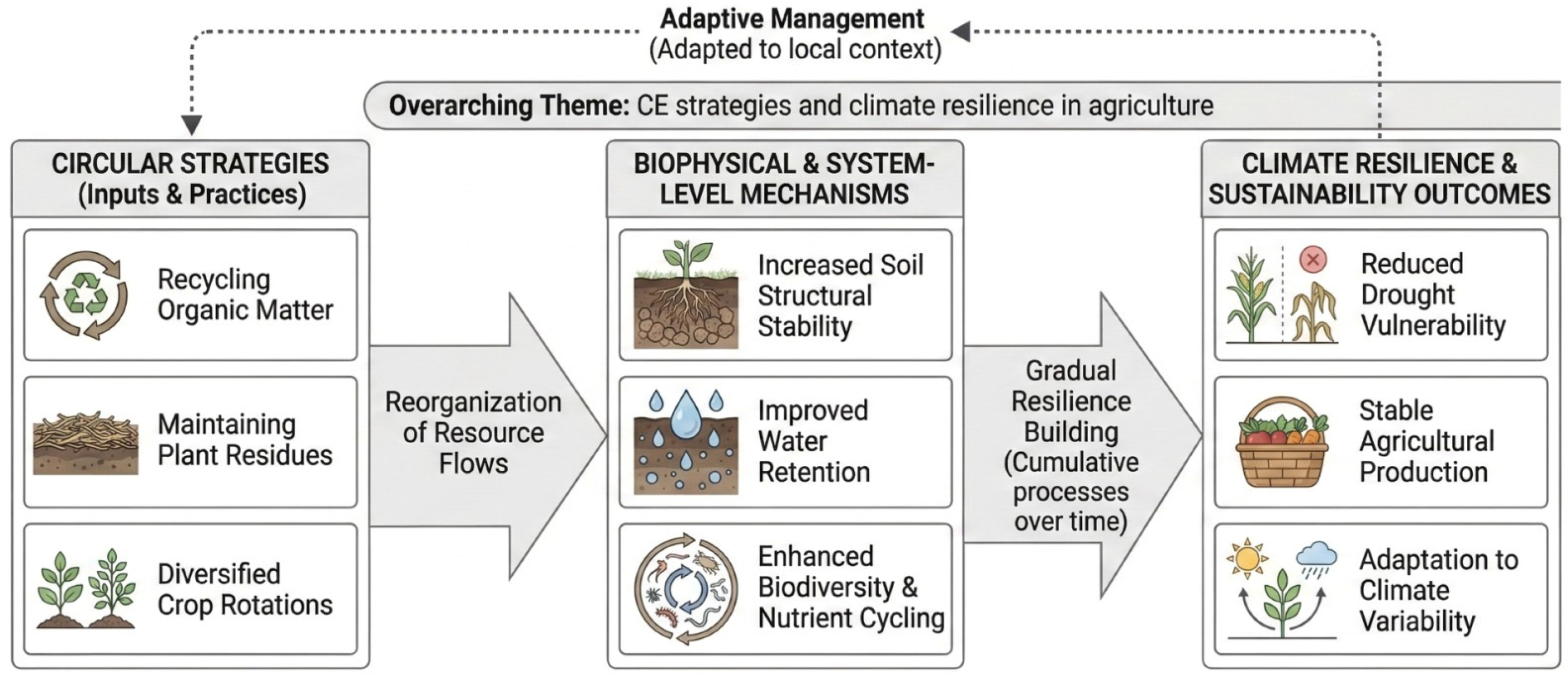
3.4. Assessment of Circular Strategies to Climate Resilience
3.5. Indicators for Assessing Climate Resilience in Circular Systems
3.5.1. Soil-Related Indicators
3.5.2. Water-Related Indicators
3.5.3. Crop and System Performance Indicators
3.5.4. Environmental Indicators
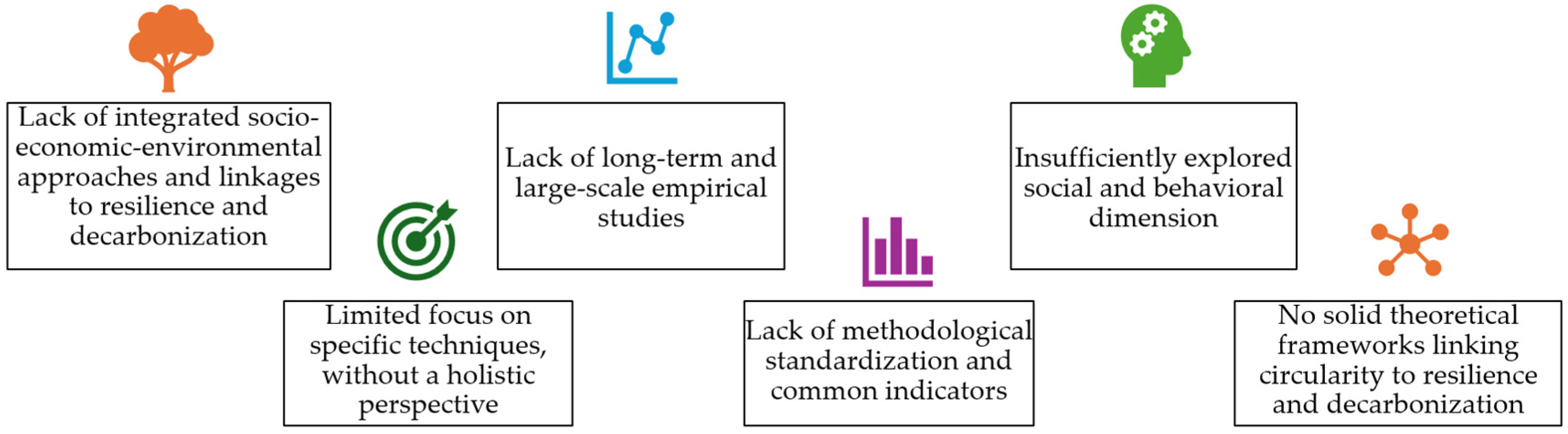
3.6. Gaps Identified in the Literature
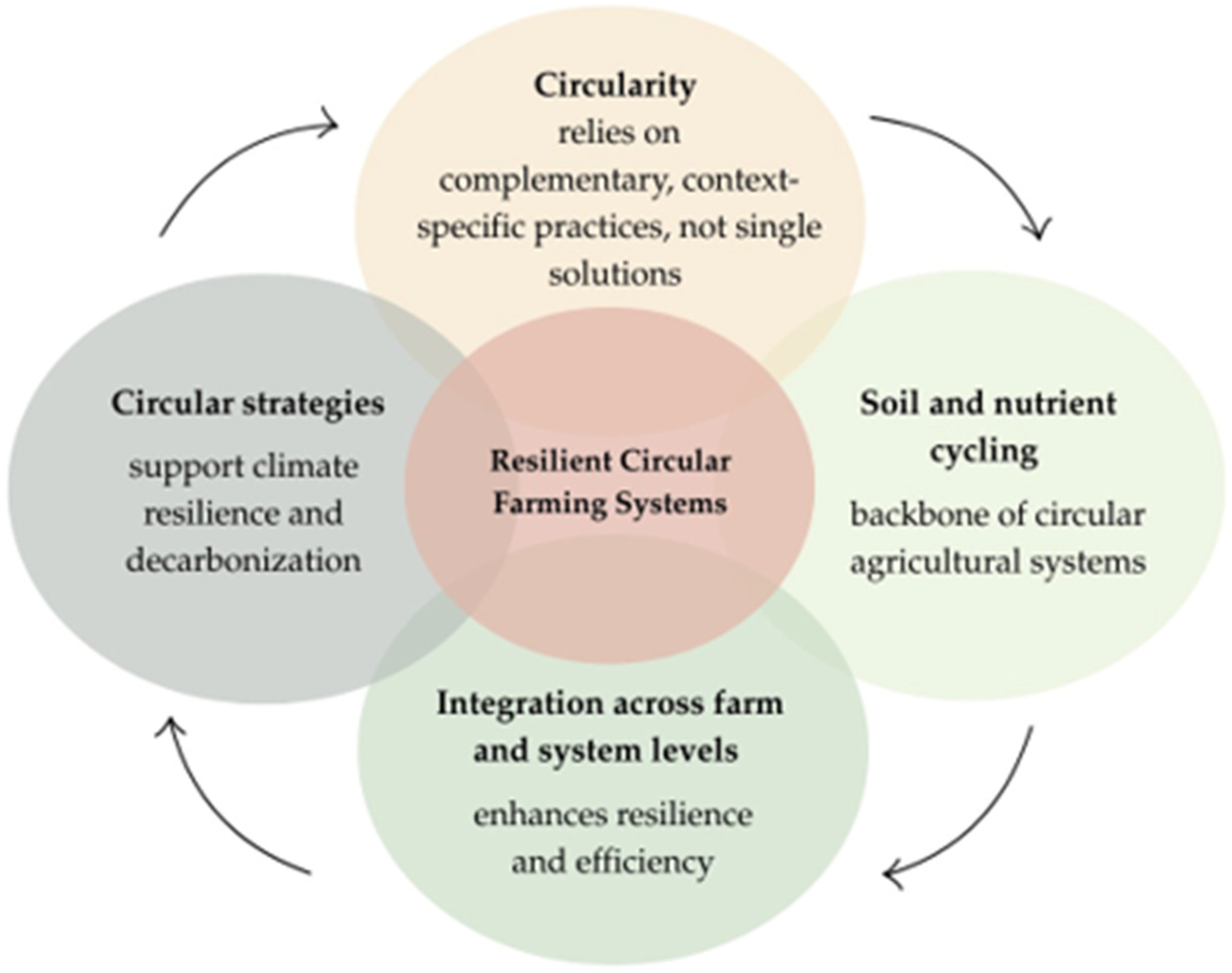
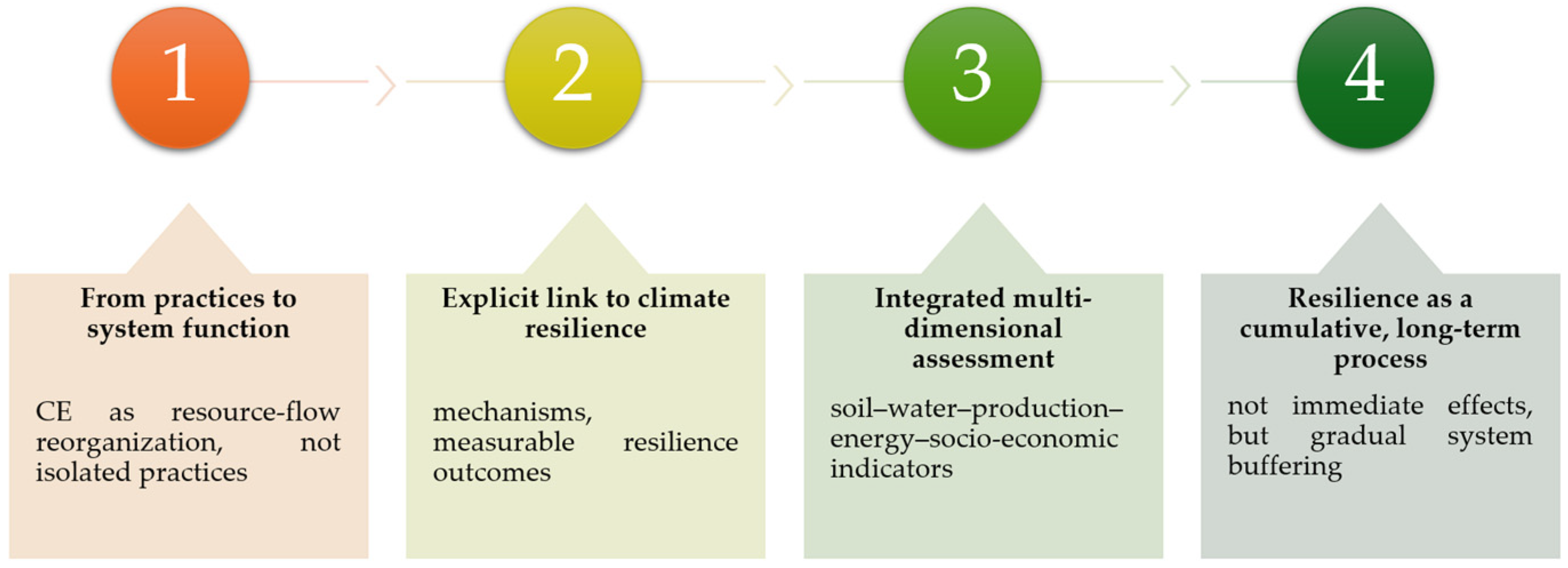
3.7. Proposed Conceptual Framework and Original Contribution of the Study
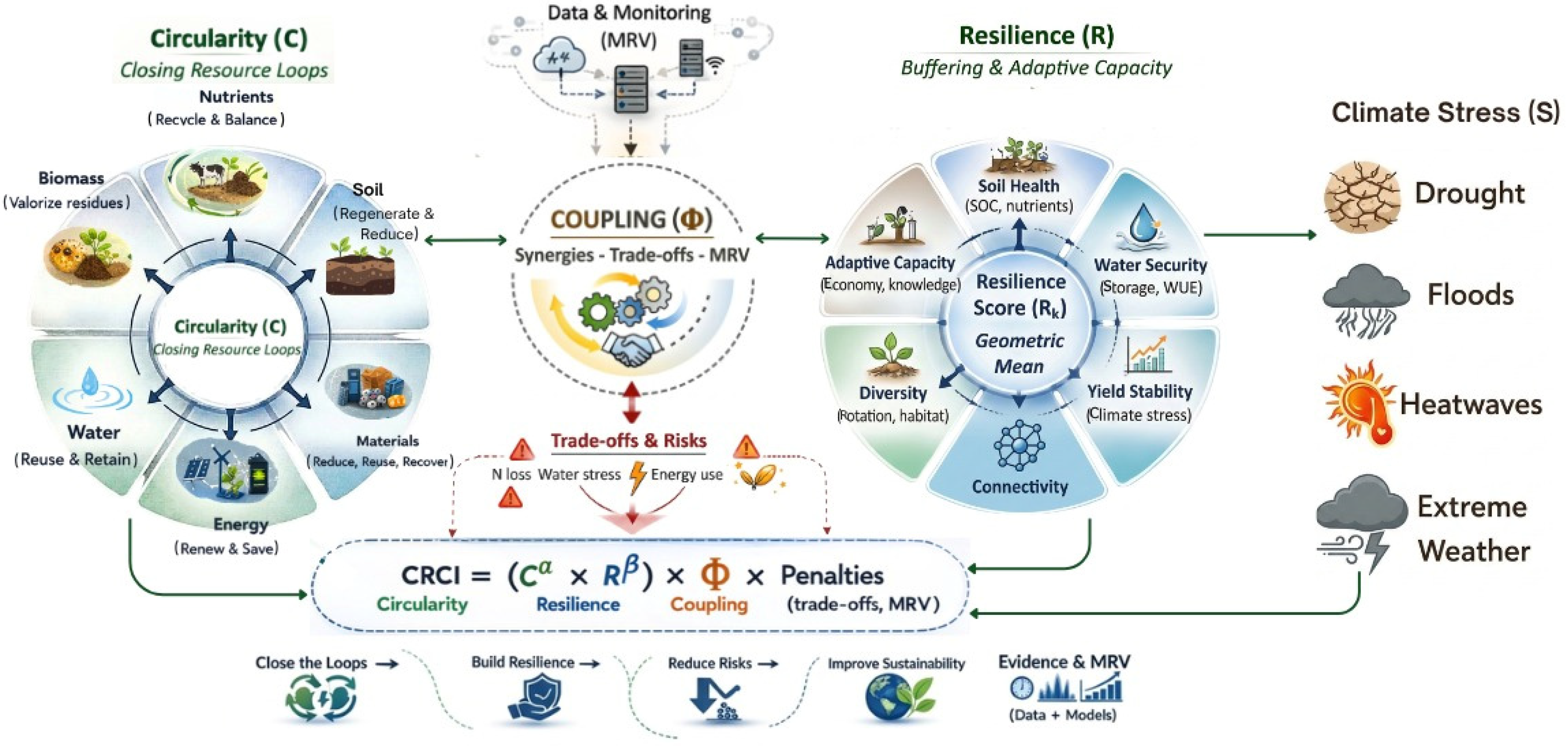
3.8. Conceptual Operationalization of the Circularity–Resilience Coupling Index (CRCI)
- C = Circularity sub-index ∈ [0, 1]
- R = Resilience sub-index ∈ [0, 1]
- α, β = importance exponents (default 1)
- Φ = coupling factor ∈ [0, 1] penalizing weak translation + trade-offs
3.8.1. Construction of the Circularity Sub-Index (C)
3.8.2. Construction of the Resilience Sub-Index (R)
- where:
- S: Soil buffering—SOC, structure, infiltration,
- H: Hydrological buffering—PAW, WHC, WUE stability,
- Y: Yield stability under variable climate,
- D: Diversity/functional redundancy—rotations, livestock integration, habitat,
- A: Adaptive and socio-economic capacity—input dependence, liquidity, knowledge access).
3.8.3. Coupling Factor (Φ)
3.8.4. Full CRCI Expression
3.8.5. Reporting and Replicability Protocol
4. Discussion
5. Conclusions
Supplementary Materials
Author Contributions
Funding
Institutional Review Board Statement
Informed Consent Statement
Data Availability Statement
Conflicts of Interest
Appendix A

| Nr. | Ref. | Author | Title |
|---|---|---|---|
| 1 | [20] | Boincean et al., 2026 | Circular Economy and Sustainable Practices in Regenerative Agricultural Productivity |
| 2 | [28] | Thierfelder et al., 2018 | Complementary Practices Supporting Conservation Agriculture in Southern Africa |
| 3 | [29] | Dagevos et al. 2021, | Circular Business Models and Circular Agriculture: Perceptions and Practices of Dutch Farmers |
| 4 | [30] | Velten et al. 2015 | What Is Sustainable Agriculture? A Systematic Review |
| 5 | [31] | Nkoa, 2014 | Agricultural Benefits and Environmental Risks of Soil Fertilization with Anaerobic Digestates: A Review |
| 6 | [34] | Paradelo et al., 2024 | Potential and Constraints of Use of Organic Amendments from Agricultural Residues for Improvement of Soil Properties |
| 7 | [36] | Mehdizadeh et al., 2025 | Agri-Waste Valorization: Pathways to Sustainable Bioenergy and Biochemical Innovation |
| 8 | [2] | Kabato et al., 2025 | Towards Climate-Smart Agriculture: Strategies for Sustainable Agricultural Production, Food Security, and Greenhouse Gas Reduction |
| 9 | [3] | Sarfraz et al. 2023 | Role of Agricultural Resource Sector in Environmental Emissions and Its Explicit Relationship with Sustainable Development: Evidence from Agri-Food System in China |
| 10 | [5] | Lakatos et al., 2025 | Standardized Metrics in Regenerative Agriculture for Climate Change Adaptation and Mitigation |
| 11 | [6] | Telo da Gama et al., 2021 | Assessing the Long-Term Impact of Traditional Agriculture and the Mid-Term Impact of Intensification in Face of Local Climatic Changes |
| 12 | [8] | Morseletto., 2020 | Restorative and Regenerative: Exploring the Concepts in the Circular Economy |
| 13 | [12] | Selvan et al., 2023 | Circular Economy in Agriculture: Unleashing the Potential of Integrated Organic Farming for Food Security and Sustainable Development |
| 14 | [14] | Schreefel et al., 2020 | Regenerative Agriculture—the Soil Is the Base. |
| 15 | [17] | Sadiq et al., 2025 | Conservation Agriculture for Sustainable Soil Health Management: A Review of Impacts, Benefits and Future Directions |
| 16 | [18] | Telo da Gama, 2023 | The Role of Soils in Sustainability, Climate Change, and Ecosystem Services: Challenges and Opportunities. |
| 17 | [22] | Kazimierczuk et al., 2023 | Decarbonization of Agriculture: The Greenhouse Gas Impacts and Economics of Existing and Emerging Climate-Smart Practices |
| 18 | [24] | Peng et al., 2025. | Circular Economy in Agriculture: A Systematic Literature Review |
| 19 | [26] | Kamyab et al., 2024 | Carbon Dynamics in Agricultural Greenhouse Gas Emissions and Removals: A Comprehensive Review |
| 20 | [38] | Paini et al. 2022 | Valorization of Wastes from the Food Production Industry: A Review Towards an Integrated Agri-Food Processing Biorefinery |
| 21 | [40] | Gupta et al., 2022 | Biomass Conversion of Agricultural Waste Residues for Different Applications: A Comprehensive Review |
| 22 | [43] | Shanmugam et al., 2024 | Crop–Livestock-Integrated Farming System: A Strategy to Achieve Synergy between Agricultural Production, Nutritional Security, and Environmental Sustainability |
| 23 | [44] | Lemaire et al., 2014 | Integrated Crop–Livestock Systems: Strategies to Achieve Synergy between Agricultural Production and Environmental Quality |
| 24 | [45] | Farias et al., 2020 | Integrated Crop-Livestock System with System Fertilization Approach Improves Food Production and Resource-Use Efficiency in Agricultural Lands |
| 25 | [47] | Getahun et al., 2024 | Application of Precision Agriculture Technologies for Sustainable Crop Production and Environmental Sustainability: A Systematic Review |
| 26 | [48] | Aarif et al., 2025 | Smart Sensor Technologies Shaping the Future of Precision Agriculture: Recent Advances and Future Outlooks |
| 27 | [52] | Cardenete et al., 2014 | Agri-Food and Bio-Based Analysis in the Spanish Economy Using a Key Sector Approach |
| 28 | [60] | Al-Musawi, et. al., 2025 | Utilizing Different Crop Rotation Systems for Agricultural and Environmental Sustainability: A Review |
| 29 | [61] | Puech, Stark, 2023 | Diversification of an Integrated Crop-Livestock System: Agroecological and Food Production Assessment at Farm Scale |
| 30 | [74] | Sarker et al., 2018 | Agricultural Management Practices Impacted Carbon and Nutrient Concentrations in Soil Aggregates, with Minimal Influence on Aggregate Stability and Total Carbon and Nutrient Stocks in Contrasting Soils |
| 31 | [87] | Dziedzic et al., 2022 | International Circular Economy Strategies and Their Impacts on Agricultural Water Use |
| 32 | [91] | Mihrete, and Mihretu, 2025 | Crop Diversification for Ensuring Sustainable Agriculture, Risk Management and Food Security |
| 33 | [92] | Sridhar et al., 2026 | Crop Diversification Strategies for Sustainable Agriculture and Climate-Resilient Ecosystems |
| 34 | [95] | Matysik-Pejas et al., 2023 | An Assessment of the Spatial Diversification of Agriculture in the Conditions of the Circular Economy in European Union Countries |
| 35 | [99] | Hassan et al., 2022 | Improved and Sustainable Agroecosystem, Food Security and Environmental Resilience through Zero Tillage with Emphasis on Soils of Temperate and Subtropical Climate Regions: A Review. |
| 36 | [101] | Francaviglia et al., 2023 | Conservation Agriculture and Soil Organic Carbon: Principles, Processes, Practices and Policy Options |
| 37 | [107] | Filonchyk et al., 2024 | Greenhouse Gases Emissions and Global Climate Change: Examining the Influence of CO2, CH4, and N2O |
| 38 | [108] | Xing, Y. and Wang, X, 2024 | Impact of Agricultural Activities on Climate Change: A Review of Greenhouse Gas Emission Patterns in Field Crop Systems |
| 39 | [110] | Ma et al., 2024 | Nexus between Climate Change, Agricultural Output, Fertilizer Use, Agriculture Soil Emissions: Novel Implications in the Context of Environmental Management |
| 40 | [111] | Bathaei, and et Štreimikienė, 2023 | Renewable Energy and Sustainable Agriculture: Review of Indicators. |
| 41 | [112] | Méndez Rodríguez et al., 2022 | A Multidisciplinary Approach Integrating Emergy Analysis and Process Modeling for Agricultural Systems Sustainable Management—Coffee Farm Validation |
| 42 | [113] | Bergez et al., 2022 | Integrating Agri-Environmental Indicators, Ecosystem Services Assessment, Life Cycle Assessment and Yield Gap Analysis to Assess the Environmental Sustainability of Agriculture |
| 43 | [120] | Murtaza et al., 2025 | Biochar from Agricultural Waste as a Strategic Resource for Promotion of Crop Growth and Nutrient Cycling of Soil under Drought and Salinity Stress Conditions: A Comprehensive Review with Context of Climate Change |
| 44 | [115] | Silvestri et al., 2022 | A Review of Energy-Based Indicators for Assessing Sustainability and Circular Economy in the Agri-Food Production |
| 45 | [126] | Whitton, and Carmichael, 2025 | Systemic Barriers Preventing Farmer Engagement in the Agricultural Climate Transition: A Qualitative Study |
| 46 | [125] | Hilmi et al., 2024 | Farmers’ Resilience to Climate Change through the Circular Economy and Sustainable Agriculture: A Review from Developed and Developing Countries |
| 47 | [123] | Sgroi, 2022 | The Circular Economy for Resilience of the Agricultural Landscape and Promotion of the Sustainable Agriculture and Food Systems |
| 48 | [124] | Atanasovska et al., 2022 | A. Research Gaps and Future Directions on Social Value Stemming from Circular Economy Practices in Agri-Food Industrial Parks: Insights from a Systematic Literature Review |
| 49 | [122] | Yang et al., 2023 | Circular Economy Strategies for Combating Climate Change and Other Environmental Issues |
| 50 | [119] | Boudjabi et al., 2023 | Enhancing Soil Resilience and Crop Physiology with Biochar Application for Mitigating Drought Stress in Durum Wheat (Triticum Durum) |
| 51 | [4] | Menegat et al., 2022 | Greenhouse Gas Emissions from Global Production and Use of Nitrogen Synthetic Fertilisers in Agriculture |
| 52 | [7] | IaCOVIDou et al., 2021 | A Systems Thinking Approach to Understanding the Challenges of Achieving the Circular Economy. |
| 53 | [10] | Apolo-Romero et al., 2025 | Circular Economy Assessment of Biochar-Enhanced Compost in Viticulture Using Ecocanvas |
| 54 | [13] | Tindwa et al., 2024 | Circular Regenerative Agricultural Practices in Africa: Techniques and Their Potential for Soil Restoration and Sustainable Food Production |
| 55 | [15] | Newton et al., 2020 | What Is Regenerative Agriculture? A Review of Scholar and Practitioner Definitions Based on Processes and Outcomes |
| 56 | [16] | Anikwe, and Ife, 2023 | The Role of Soil Ecosystem Services in the Circular Bioeconomy |
| 57 | [19] | Khan et al., 2024 | Innovative Organic Fertilizers and Cover Crops: Perspectives for Sustainable Agriculture in the Era of Climate Change and Organic Agriculture |
| 58 | [104] | Landmann et al., 2023 | Insect Diversity Is a Good Indicator of Biodiversity Status in Africa |
| 59 | [23] | Sroufe, and Watts, 2022 | Pathways to Agricultural Decarbonization: Climate Change Obstacles and Opportunities in the US |
| 60 | [37] | Rațu et al., 2023 | Application of Agri-Food By-Products in the Food Industry |
| 61 | [39] | Klein et al., 2021 | Towards a Circular Bioeconomy? Pathways and Spatialities of Agri-Food Waste Valorisation |
| 62 | [46] | Ali et al., 2025 | Circular Economy Advances with Artificial Intelligence and Digital Twin: Multiple-Case Study of Chinese Industries in Agriculture |
| 63 | [53] | Zucaro et al., 2017 | Greenhouse Gas Emissions and Non-Renewable Energy Use Profiles of Bio-Based Succinic Acid from Arundo Donax L. Lignocellulosic Feedstock |
| 64 | [57] | Turmel et al., 2015 | Crop Residue Management and Soil Health: A Systems Analysis |
| 65 | [58] | Liang et al., 2025 | Integrated Management Practices Foster Soil Health, Productivity, and Agroecosystem Resilience. |
| 66 | [63] | Li et al., 2022 | Enhancing Crop Productivity and Resilience by Promoting Soil Organic Carbon and Moisture in Wheat and Maize Rotation |
| 67 | [80] | Alharbi et al., 2024 | Agricultural and Technology-Based Strategies to Improve Water-Use Efficiency in Arid and Semiarid Areas |
| 68 | [83] | Prasad, 2023 | Sustainable Water Use in Agriculture—Circular Economy Approach |
| 69 | [90] | Vernooy, 2022 | Does Crop Diversification Lead to Climate-Related Resilience? Improving the Theory through Insights on Practice. |
| 70 | [93] | Alletto et al., 2022 | Crop Diversification Improves Cropping System Sustainability: An 8-Year on-Farm Experiment in South-Western France |
| 71 | [98] | Quintarelli et al., 2022 | Cover Crops for Sustainable Cropping Systems: A Review. |
| 72 | [100] | Wang, 2022 | Managing Land Carrying Capacity: Key to Achieving Sustainable Production Systems for Food Security. |
| 73 | [102] | Martínez-Mena et al., 2021 | Long-Term Effects of Sustainable Management Practices on Soil Properties and Crop Yields in Rainfed Mediterranean Almond Agroecosystems |
| 74 | [106] | Zavalloni et al., 2025 | Technological Innovations for Biodiversity Monitoring and the Design of Agri-Environmental Schemes. |
| 75 | [109] | Lin et al., 2025 | Renewable Energy Consumption Efficiency, Greenhouse Gas Emission Efficiency, and Climate Change in Europe |
| 76 | [114] | Porter et al., 2009 | The Value of Producing Food, Energy, and Ecosystem Services within an Agro-Ecosystem |
| 77 | [121] | Li et al., 2021 | Role of Biochar in Improving Sandy Soil Water Retention and Resilience to Drought |
References
- Thakur, A.; Kumari, D.; Kumar, P. Climate Change and Agriculture: Assesing the Relationship between Agricultural Practices, Greenhouse Gas Emissions, and Climate Change. In A Comprehensive Exploration of Soil, Water, and Air Pollution in Agriculture; Kumar, A., Kumar, D., Singh, J., Kumar, R., Eds.; BFC Publications: Lucknow, India, 2024; pp. 155–169. [Google Scholar]
- Kabato, W.; Getnet, G.T.; Sinore, T.; Nemeth, A.; Molnár, Z. Towards Climate-Smart Agriculture: Strategies for Sustainable Agricultural Production, Food Security, and Greenhouse Gas Reduction. Agronomy 2025, 15, 565. [Google Scholar] [CrossRef]
- Sarfraz, M.; Iqbal, K.; Wang, Y.; Bhutta, M.S.; Jaffri, Z.u.A. Role of Agricultural Resource Sector in Environmental Emissions and Its Explicit Relationship with Sustainable Development: Evidence from Agri-Food System in China. Resour. Policy 2023, 80, 103191. [Google Scholar] [CrossRef]
- Menegat, S.; Ledo, A.; Tirado, R. Greenhouse Gas Emissions from Global Production and Use of Nitrogen Synthetic Fertilisers in Agriculture. Sci. Rep. 2022, 12, 14490. [Google Scholar] [CrossRef]
- Lakatos, E.S.; Vatca, S.D.; Cioca, L.-I.; Rhazzali, A.L.; Kis, E.; Boinceanu, B.; Perciun, R. Standardized Metrics in Regenerative Agriculture for Climate Change Adaptation and Mitigation. Agriculture 2025, 15, 2278. [Google Scholar] [CrossRef]
- Telo da Gama, J.; Loures, L.; Lopez-Piñeiro, A.; Quintino, D.; Ferreira, P.; Nunes, J.R. Assessing the Long-Term Impact of Traditional Agriculture and the Mid-Term Impact of Intensification in Face of Local Climatic Changes. Agriculture 2021, 11, 814. [Google Scholar] [CrossRef]
- Iacovidou, E.; Hahladakis, J.N.; Purnell, P. A Systems Thinking Approach to Understanding the Challenges of Achieving the Circular Economy. Environ. Sci. Pollut. Res. 2021, 28, 24785–24806. [Google Scholar] [CrossRef] [PubMed]
- Morseletto, P. Restorative and Regenerative: Exploring the Concepts in the Circular Economy. J. Ind. Ecol. 2020, 24, 763–773. [Google Scholar] [CrossRef]
- Salah Uddin, M.; Kabasakal, A. Achieving Sustainable Development: Integrating Circular Economy and Natural Capital for Environmental Sustainability in Europe. Sustain. Dev. 2025, 33, 7259–7278. [Google Scholar] [CrossRef]
- Apolo-Romero, A.; García-Casarejos, N.; Gargallo, P. Circular Economy Assessment of Biochar-Enhanced Compost in Viticulture Using Ecocanvas. Agriculture 2025, 15, 1932. [Google Scholar] [CrossRef]
- Jimenez-Lopez, C.; Fraga-Corral, M.; Carpena, M.; García-Oliveira, P.; Echave, J.; Pereira, A.G.; Lourenço-Lopes, C.; Prieto, M.A.; Simal-Gandara, J. Agriculture Waste Valorisation as a Source of Antioxidant Phenolic Compounds within a Circular and Sustainable Bioeconomy. Food Funct. 2020, 11, 4853–4877. [Google Scholar] [CrossRef]
- Selvan, T.; Panmei, L.; Murasing, K.K.; Guleria, V.; Ramesh, K.R.; Bhardwaj, D.R.; Thakur, C.L.; Kumar, D.; Sharma, P.; Digvijaysinh Umedsinh, R.; et al. Circular Economy in Agriculture: Unleashing the Potential of Integrated Organic Farming for Food Security and Sustainable Development. Front. Sustain. Food Syst. 2023, 7, 1170380. [Google Scholar] [CrossRef]
- Tindwa, H.J.; Semu, E.W.; Singh, B.R. Circular Regenerative Agricultural Practices in Africa: Techniques and Their Potential for Soil Restoration and Sustainable Food Production. Agronomy 2024, 14, 2423. [Google Scholar] [CrossRef]
- Schreefel, L.; Schulte, R.P.O.; de Boer, I.J.M.; Schrijver, A.P.; van Zanten, H.H.E. Regenerative Agriculture—The Soil Is the Base. Glob. Food Secur. 2020, 26, 100404. [Google Scholar] [CrossRef]
- Newton, P.; Civita, N.; Frankel-Goldwater, L.; Bartel, K.; Johns, C. What Is Regenerative Agriculture? A Review of Scholar and Practitioner Definitions Based on Processes and Outcomes. Front. Sustain. Food Syst. 2020, 4, 577723. [Google Scholar] [CrossRef]
- Anikwe, M.a.N.; Ife, K. The Role of Soil Ecosystem Services in the Circular Bioeconomy. Front. Soil Sci. 2023, 3, 1209100. [Google Scholar] [CrossRef]
- Sadiq, F.K.; Anyebe, O.; Tanko, F.; Abdulkadir, A.; Manono, B.O.; Matsika, T.A.; Abubakar, F.; Bello, S.K. Conservation Agriculture for Sustainable Soil Health Management: A Review of Impacts, Benefits and Future Directions. Soil Syst. 2025, 9, 103. [Google Scholar] [CrossRef]
- Telo da Gama, J. The Role of Soils in Sustainability, Climate Change, and Ecosystem Services: Challenges and Opportunities. Ecologies 2023, 4, 552–567. [Google Scholar] [CrossRef]
- Khan, M.T.; Aleinikovienė, J.; Butkevičienė, L.-M. Innovative Organic Fertilizers and Cover Crops: Perspectives for Sustainable Agriculture in the Era of Climate Change and Organic Agriculture. Agronomy 2024, 14, 2871. [Google Scholar] [CrossRef]
- Boincean, B.; Pacurariu, R.L.; Rhazzali, A.L.; Cebanu, D. Circular Economy and Sustainable Practices in Regenerative Agricultural Productivity. Econ. Ecol. Socium 2025, 9, 1–19. [Google Scholar] [CrossRef]
- Mohammadi, N.; Arabzai, G.; Niaz, M. Advancing Nutrient Management In Integrated Crop Livestock Systems: Pathways Toward Sustainable Agricultural Development. Nat. Resour. Sustain. Dev. 2025, 15, 415–446. [Google Scholar] [CrossRef]
- Kazimierczuk, K.; Barrows, S.E.; Olarte, M.V.; Qafoku, N.P. Decarbonization of Agriculture: The Greenhouse Gas Impacts and Economics of Existing and Emerging Climate-Smart Practices. ACS Eng. Au 2023, 3, 426–442. [Google Scholar] [CrossRef]
- Sroufe, R.; Watts, A. Pathways to Agricultural Decarbonization: Climate Change Obstacles and Opportunities in the US. Resour. Conserv. Recycl. 2022, 182, 106276. [Google Scholar] [CrossRef]
- Peng, J.; Baležentis, T.; Streimikiene, D.; Dabkiene, V.; Agnusdei, G.P. Circular Economy in Agriculture: A Systematic Literature Review. Sustain. Dev. 2025, 33, 501–516. [Google Scholar] [CrossRef]
- Ghosh, S.K.; Ghosh, S.K. Circular Economy Catalysing Decarbonization. In Circular Economy Adoption: Catalysing Decarbonisation Through Policy Instruments; Ghosh, S.K., Ghosh, S.K., Eds.; Springer Nature: Singapore, 2023; pp. 3–33. [Google Scholar]
- Kamyab, H.; SaberiKamarposhti, M.; Hashim, H.; Yusuf, M. Carbon Dynamics in Agricultural Greenhouse Gas Emissions and Removals: A Comprehensive Review. Carbon Lett. 2024, 34, 265–289. [Google Scholar] [CrossRef]
- Page, M.J.; McKenzie, J.E.; Bossuyt, P.M.; Boutron, I.; Hoffmann, T.C.; Mulrow, C.D.; Shamseer, L.; Tetzlaff, J.M.; Akl, E.A.; Brennan, S.E.; et al. The PRISMA 2020 statement: An updated guideline for reporting systematic reviews. BMJ 2021, 372, n71. [Google Scholar] [CrossRef] [PubMed]
- Thierfelder, C.; Baudron, F.; Setimela, P.; Nyagumbo, I.; Mupangwa, W.; Mhlanga, B.; Lee, N.; Gérard, B. Complementary Practices Supporting Conservation Agriculture in Southern Africa. A Review. Agron. Sustain. Dev. 2018, 38, 16. [Google Scholar] [CrossRef]
- Dagevos, H.; de Lauwere, C. Circular Business Models and Circular Agriculture: Perceptions and Practices of Dutch Farmers. Sustainability 2021, 13, 1282. [Google Scholar] [CrossRef]
- Velten, S.; Leventon, J.; Jager, N.; Newig, J. What Is Sustainable Agriculture? A Systematic Review. Sustainability 2015, 7, 7833–7865. [Google Scholar] [CrossRef]
- Nkoa, R. Agricultural Benefits and Environmental Risks of Soil Fertilization with Anaerobic Digestates: A Review. Agron. Sustain. Dev. 2014, 34, 473–492. [Google Scholar] [CrossRef]
- Goldan, E.; Nedeff, V.; Barsan, N.; Culea, M.; Panainte-Lehadus, M.; Mosnegutu, E.; Tomozei, C.; Chitimus, D.; Irimia, O. Assessment of Manure Compost Used as Soil Amendment—A Review. Processes 2023, 11, 1167. [Google Scholar] [CrossRef]
- Kovačić, Đ.; Lončarić, Z.; Jović, J.; Samac, D.; Popović, B.; Tišma, M. Digestate Management and Processing Practices: A Review. Appl. Sci. 2022, 12, 9216. [Google Scholar] [CrossRef]
- Paradelo, R.; Navarro-Pedreño, J.; Glaser, B.; Grobelak, A.; Kowalska, A.; Singh, B.R. Potential and Constraints of Use of Organic Amendments from Agricultural Residues for Improvement of Soil Properties. Sustainability 2024, 16, 158. [Google Scholar] [CrossRef]
- Manea, E.E.; Bumbac, C.; Dinu, L.R.; Bumbac, M.; Nicolescu, C.M. Composting as a Sustainable Solution for Organic Solid Waste Management: Current Practices and Potential Improvements. Sustainability 2024, 16, 6329. [Google Scholar] [CrossRef]
- Mehdizadeh, M.; Omidi, A.; Matindike, R.; Nigussie, Z.G.; Ikegwu, T.M.; Agu, H.O.; Onen, P.; Gumula, I.; Ezzat, S.M.; Merghany, R.M. Agri-Waste Valorization: Pathways to Sustainable Bioenergy and Biochemical Innovation. Circ. Econ. Sust. 2025, 5, 5247–5277. [Google Scholar] [CrossRef]
- Rațu, R.N.; Veleșcu, I.D.; Stoica, F.; Usturoi, A.; Arsenoaia, V.N.; Crivei, I.C.; Postolache, A.N.; Lipșa, F.D.; Filipov, F.; Florea, A.M.; et al. Application of Agri-Food By-Products in the Food Industry. Agriculture 2023, 13, 1559. [Google Scholar] [CrossRef]
- Paini, J.; Benedetti, V.; Ail, S.S.; Castaldi, M.J.; Baratieri, M.; Patuzzi, F. Valorization of Wastes from the Food Production Industry: A Review Towards an Integrated Agri-Food Processing Biorefinery. Waste Biomass Valor. 2022, 13, 31–50. [Google Scholar] [CrossRef]
- Klein, O.; Nier, S.; Tamásy, C. Towards a Circular Bioeconomy? Pathways and Spatialities of Agri-Food Waste Valorisation. Tijdschr. Econ. Soc. Geogr. 2021, 113, 194–210. [Google Scholar] [CrossRef]
- Gupta, N.; Mahur, B.K.; Izrayeel, A.M.D.; Ahuja, A.; Rastogi, V.K. Biomass Conversion of Agricultural Waste Residues for Different Applications: A Comprehensive Review. Environ. Sci. Pollut. Res. 2022, 29, 73622–73647. [Google Scholar] [CrossRef]
- Lee, J.-Y.; Lee, S.-E.; Lee, D.-W. Current Status and Future Prospects of Biological Routes to Bio-Based Products Using Raw Materials, Wastes, and Residues as Renewable Resources. Crit. Rev. Environ. Sci. Technol. 2022, 52, 2453–2509. [Google Scholar] [CrossRef]
- Reddy, P.P. Integrated Crop–Livestock Farming Systems. In Sustainable Intensification of Crop Production; Reddy, P.P., Ed.; Springer: Singapore, 2016; pp. 357–370. [Google Scholar]
- Shanmugam, P.M.; Sangeetha, S.P.; Prabu, P.C.; Varshini, S.V.; Renukadevi, A.; Ravisankar, N.; Parasuraman, P.; Parthipan, T.; Satheeshkumar, N.; Natarajan, S.K.; et al. Crop–Livestock-Integrated Farming System: A Strategy to Achieve Synergy between Agricultural Production, Nutritional Security, and Environmental Sustainability. Front. Sustain. Food Syst. 2024, 8, 1338299. [Google Scholar] [CrossRef]
- Lemaire, G.; Franzluebbers, A.; Carvalho, P.C.d.F.; Dedieu, B. Integrated Crop–Livestock Systems: Strategies to Achieve Synergy between Agricultural Production and Environmental Quality. Agric. Ecosyst. Environ. 2014, 190, 4–8. [Google Scholar] [CrossRef]
- Farias, G.D.; Dubeux, J.C.B.; Savian, J.V.; Duarte, L.P.; Martins, A.P.; Tiecher, T.; Alves, L.A.; de Faccio Carvalho, P.C.; Bremm, C. Integrated Crop-Livestock System with System Fertilization Approach Improves Food Production and Resource-Use Efficiency in Agricultural Lands. Agron. Sustain. Dev. 2020, 40, 39. [Google Scholar] [CrossRef]
- Ali, Z.A.; Zain, M.; Hasan, R.; Al Salman, H.; Alkhamees, B.F.; Almisned, F.A. Circular Economy Advances with Artificial Intelligence and Digital Twin: Multiple-Case Study of Chinese Industries in Agriculture. J. Knowl. Econ. 2025, 16, 2192–2228. [Google Scholar] [CrossRef]
- Getahun, S.; Kefale, H.; Gelaye, Y. Application of Precision Agriculture Technologies for Sustainable Crop Production and Environmental Sustainability: A Systematic Review. Sci. World J. 2024, 2024, 2126734. [Google Scholar] [CrossRef]
- Mohammed Aarif, K.O.; Alam, A.; Hotak, Y. Smart Sensor Technologies Shaping the Future of Precision Agriculture: Recent Advances and Future Outlooks. J. Sens. 2025, 2025, 2460098. [Google Scholar] [CrossRef]
- Xing, Y.; Wang, X. Precise Application of Water and Fertilizer to Crops: Challenges and Opportunities. Front. Plant Sci. 2024, 15, 1444560. [Google Scholar] [CrossRef]
- Oleszek, M.; Witorożec-Piechnik, A.; Radzikowski, P.; Matyka, M. Current Status and Prospects for the Development of Renewable Energy Sources in the Agricultural Sector in Poland. Energies 2025, 18, 4276. [Google Scholar] [CrossRef]
- Mehariya, S.; Iovine, A.; Casella, P.; Musmarra, D.; Chianese, S.; Marino, T.; Figoli, A.; Sharma, N.; Antonio, M. Bio-Based and Agriculture Resources for Production of Bioproducts. In Current Trends and Future Developments on (Bio-) Membranes; Elsevier: Amsterdam, The Netherlands, 2020; pp. 263–282. [Google Scholar]
- Cardenete, M.A.; Boulanger, P.; Del Carmen Delgado, M.; Ferrari, E.; M’Barek, R. Agri-Food and Bio-Based Analysis in the Spanish Economy Using a Key Sector Approach. Rev. Urban Reg. Dev. Stud. 2014, 26, 112–134. [Google Scholar] [CrossRef]
- Zucaro, A.; Forte, A.; Fierro, A. Greenhouse Gas Emissions and Non-Renewable Energy Use Profiles of Bio-Based Succinic Acid from Arundo Donax L. Lignocellulosic Feedstock. Clean Techn. Environ. Policy 2017, 19, 2129–2143. [Google Scholar] [CrossRef]
- Franko, U.; Witing, F.; Volk, M. Climate Change Induced Carbon Competition: Bioenergy Versus Soil Organic Matter Reproduction. In Atlas of Ecosystem Services: Drivers, Risks, and Societal Responses; Schröter, M., Bonn, A., Klotz, S., Seppelt, R., Baessler, C., Eds.; Springer International Publishing: Cham, Switzerland, 2019; pp. 257–262. [Google Scholar]
- Lal, R. Restoring Soil Quality to Mitigate Soil Degradation. Sustainability 2015, 7, 5875–5895. [Google Scholar] [CrossRef]
- Edeh, I.G.; Mašek, O.; Buss, W. A Meta-Analysis on Biochar’s Effects on Soil Water Properties—New Insights and Future Research Challenges. Sci. Total Environ. 2020, 714, 136857. [Google Scholar] [CrossRef]
- Turmel, M.-S.; Speratti, A.; Baudron, F.; Verhulst, N.; Govaerts, B. Crop Residue Management and Soil Health: A Systems Analysis. Agric. Syst. 2015, 134, 6–16. [Google Scholar] [CrossRef]
- Liang, X.; Yu, S.; Ju, Y.; Wang, Y.; Yin, D. Integrated Management Practices Foster Soil Health, Productivity, and Agroecosystem Resilience. Agronomy 2025, 15, 1816. [Google Scholar] [CrossRef]
- Ansari, A.A.; Ori, L.; Ramnarain, Y.I. An Effective Organic Waste Recycling Through Vermicompost Technology for Soil Health Restoration. In Soil Health Restoration and Management; Meena, R.S., Ed.; Springer: Singapore, 2020; pp. 83–112. [Google Scholar]
- Al-Musawi, Z.K.; Vona, V.; Kulmány, I.M. Utilizing Different Crop Rotation Systems for Agricultural and Environmental Sustainability: A Review. Agronomy 2025, 15, 1966. [Google Scholar] [CrossRef]
- Puech, T.; Stark, F. Diversification of an Integrated Crop-Livestock System: Agroecological and Food Production Assessment at Farm Scale. Agric. Ecosyst. Environ. 2023, 344, 108300. [Google Scholar] [CrossRef]
- Devkota, M.; Frija, A.; Dhehibi, B.; Rudiger, U.; Alary, V.; M’hamed, H.C.; Louahdi, N.; Idoudi, Z.; Rekik, M. Better Crop-Livestock Integration for Enhanced Agricultural System Resilience and Food Security in the Changing Climate: Case Study from Low-Rainfall Areas of North Africa. In Food Security and Climate-Smart Food Systems: Building Resilience for the Global South; Behnassi, M., Baig, M.B., Sraïri, M.T., Alsheikh, A.A., Abu Risheh, A.W.A., Eds.; Springer International Publishing: Cham, Switzerland, 2022; pp. 263–287. [Google Scholar]
- Li, Y.; Feng, X.; Huai, Y.; Hassan, M.U.; Cui, Z.; Ning, P. Enhancing Crop Productivity and Resilience by Promoting Soil Organic Carbon and Moisture in Wheat and Maize Rotation. Agric. Ecosyst. Environ. 2024, 368, 109021. [Google Scholar] [CrossRef]
- Nair, P.K.R.; Kumar, B.M.; Nair, V.D. Soil Organic Matter (SOM) and Nutrient Cycling. In An Introduction to Agroforestry: Four Decades of Scientific Developments; Nair, P.K.R., Kumar, B.M., Nair, V.D., Eds.; Springer International Publishing: Cham, Switzerland, 2021; pp. 383–411. [Google Scholar]
- Pandao, M.R.; Thakare, A.A.; Choudhari, R.J.; Navghare, N.R.; Sirsat, D.D.; Rathod, S.R. Soil Health and Nutrient Management. Int. J. Plant Soil Sci. 2024, 36, 873–883. [Google Scholar] [CrossRef]
- Almås, Å.R.; Eich-Greatorex, S.; Sogn, T.; Mulder, J.; Pandey, M.K.; Dauby, V.; Powlson, D.S.; Farina, R.; Watté, J.; Rasse, D. Preliminary Assessment of the Knowledge Gaps to Conserve and Increase Soil Organic Carbon Stocks. Soils Eur. 2024, 1, e118635. [Google Scholar] [CrossRef]
- Panagea, I.S.; Berti, A.; Čermak, P.; Diels, J.; Elsen, A.; Kusá, H.; Piccoli, I.; Poesen, J.; Stoate, C.; Tits, M.; et al. Soil Water Retention as Affected by Management Induced Changes of Soil Organic Carbon: Analysis of Long-Term Experiments in Europe. Land 2021, 10, 1362. [Google Scholar] [CrossRef]
- Lu, C.; Zhu, Q.; Qiu, M.; Fan, X.; Luo, J.; Liang, Y.; Ma, Y. Effects of Different Soil Water Holding Capacities on Vegetable Residue Return and Its Microbiological Mechanism. Front. Microbiol. 2023, 14, 1257258. [Google Scholar] [CrossRef]
- Martínez-Vidaurre, J.M.; Pérez-Álvarez, E.P.; García-Escudero, E.; Ramos, M.C.; Peregrina, F. Differences in Soil Water Holding Capacity and Available Soil Water along Growing Cycle Can Explain Differences in Vigour, Yield, and Quality of Must and Wine in the DOCa Rioja. Horticulturae 2024, 10, 320. [Google Scholar] [CrossRef]
- Imran. Strategies for Sustainable Crop Production and Arid Land Management. Commun. Soil Sci. Plant Anal. 2025, 56, 671–685. [Google Scholar] [CrossRef]
- Hamza, A.; Karčauskienė, D.; Mockevičienė, I.; Repšienė, R.; Tahir, M.A.; Manzoor, M.Z.; Kousar, S.; Lodhi, S.S.; Rasool, N.; Ullah, I. Soil Aggregate Dynamics and Stability: Natural and Anthropogenic Drivers. Agriculture 2025, 15, 2500. [Google Scholar] [CrossRef]
- Okolo, C.C.; Gebresamuel, G.; Zenebe, A.; Haile, M.; Eze, P.N. Accumulation of Organic Carbon in Various Soil Aggregate Sizes under Different Land Use Systems in a Semi-Arid Environment. Agric. Ecosyst. Environ. 2020, 297, 106924. [Google Scholar] [CrossRef]
- Pan, Z.; Cai, X.; Bo, Y.; Guan, C.; Cai, L.; Haider, F.U.; Li, X.; Yu, H. Response of Soil Organic Carbon and Soil Aggregate Stability to Changes in Land Use Patterns on the Loess Plateau. Sci. Rep. 2024, 14, 31775. [Google Scholar] [CrossRef] [PubMed]
- Sarker, J.R.; Singh, B.P.; Cowie, A.L.; Fang, Y.; Collins, D.; Badgery, W.; Dalal, R.C. Agricultural Management Practices Impacted Carbon and Nutrient Concentrations in Soil Aggregates, with Minimal Influence on Aggregate Stability and Total Carbon and Nutrient Stocks in Contrasting Soils. Soil Tillage Res. 2018, 178, 209–223. [Google Scholar] [CrossRef]
- Zhong, Z.; Wu, S.; Lu, X.; Ren, Z.; Wu, Q.; Xu, M.; Ren, C.; Yang, G.; Han, X. Organic Carbon, Nitrogen Accumulation, and Soil Aggregate Dynamics as Affected by Vegetation Restoration Patterns in the Loess Plateau of China. Catena 2021, 196, 104867. [Google Scholar] [CrossRef]
- Andualem, A.; Wato, T.; Asfaw, A.; Urgi, G. Improving Primary Nutrients (NPK) Use Efficiency for the Sustainable Production and Productivity of Cereal Crops: A Compressive Review. J. Agric. Sustain. Environ. 2024, 3, 271X. [Google Scholar] [CrossRef]
- Govindasamy, P.; Muthusamy, S.K.; Bagavathiannan, M.; Mowrer, J.; Jagannadham, P.T.K.; Maity, A.; Halli, H.M.; Sujayanand, G.K.; Vadivel, R.; Das, T.K.; et al. Nitrogen Use Efficiency—A Key to Enhance Crop Productivity under a Changing Climate. Front. Plant Sci. 2023, 14, 1121073. [Google Scholar] [CrossRef] [PubMed]
- Barłóg, P.; Grzebisz, W.; Łukowiak, R. Fertilizers and Fertilization Strategies Mitigating Soil Factors Constraining Efficiency of Nitrogen in Plant Production. Plants 2022, 11, 1855. [Google Scholar] [CrossRef] [PubMed]
- Deb, P.; Mandal, A.; Harendra; Choudhury, S.R.; Das, A.; Hazra, S.; Mukherjee, A.; Ghosh, D.; Choudhury, S.; Santra, S.C.; et al. Improving Plant Nutrient Use Efficiency for Climate-Resilient Agriculture. In Climate-Resilient Agriculture, Vol 2: Agro-Biotechnological Advancement for Crop Production; Hasanuzzaman, M., Ed.; Springer International Publishing: Cham, Switzerland, 2023; pp. 209–243. [Google Scholar]
- Alharbi, S.; Felemban, A.; Abdelrahim, A.; Al-Dakhil, M. Agricultural and Technology-Based Strategies to Improve Water-Use Efficiency in Arid and Semiarid Areas. Water 2024, 16, 1842. [Google Scholar] [CrossRef]
- Liu, M.; Wang, G.; Liang, F.; Li, Q.; Tian, Y.; Jia, H. Optimal Irrigation Levels Can Improve Maize Growth, Yield, and Water Use Efficiency under Drip Irrigation in Northwest China. Water 2022, 14, 3822. [Google Scholar] [CrossRef]
- André, F.J.; Buendía, A.; Santos-Arteaga, F.J. Efficient Water Use and Reusing Processes across Spanish Regions: A Circular Data Envelopment Analysis with Undesirable Inputs. J. Clean. Prod. 2024, 434, 139929. [Google Scholar] [CrossRef]
- Prasad, M.N.V. Sustainable Water Use in Agriculture—Circular Economy Approach. In Water in Circular Economy; Smol, M., Prasad, M.N.V., Stefanakis, A.I., Eds.; Springer International Publishing: Cham, Switzerland, 2023; pp. 51–65. [Google Scholar]
- Almendra-Martín, L.; Martínez-Fernández, J.; Piles, M.; González-Zamora, Á.; Benito-Verdugo, P.; Gaona, J. Influence of Atmospheric Patterns on Soil Moisture Dynamics in Europe. Sci. Total Environ. 2022, 846, 157537. [Google Scholar] [CrossRef]
- Duarte, E.; Hernandez, A. A Review on Soil Moisture Dynamics Monitoring in Semi-Arid Ecosystems: Methods, Techniques, and Tools Applied at Different Scales. Appl. Sci. 2024, 14, 7677. [Google Scholar] [CrossRef]
- Singh, A.; Gaurav, K.; Sonkar, G.K.; Lee, C.-C. Strategies to Measure Soil Moisture Using Traditional Methods, Automated Sensors, Remote Sensing, and Machine Learning Techniques: Review, Bibliometric Analysis, Applications, Research Findings, and Future Directions. IEEE Access 2023, 11, 13605–13635. [Google Scholar] [CrossRef]
- Dziedzic, M.; Gomes, P.R.; Angilella, M.; Asli, A.E.; Berger, P.; Charmier, A.J.; Chen, Y.-C.; Dasanayake, R.; Dziedzic, R.; Ferro, F.; et al. International Circular Economy Strategies and Their Impacts on Agricultural Water Use. Clean. Eng. Technol. 2022, 8, 100504. [Google Scholar] [CrossRef]
- Burak, S.; Margat, J. Water Management in the Mediterranean Region: Concepts and Policies. Water Resour. Manag. 2016, 30, 5779–5797. [Google Scholar] [CrossRef]
- Estrela, T.; Vargas, E. Drought Management Plans in the European Union. The Case of Spain. Water Resour. Manag. 2012, 26, 1537–1553. [Google Scholar] [CrossRef]
- Vernooy, R. Does Crop Diversification Lead to Climate-Related Resilience? Improving the Theory through Insights on Practice. Agroecol. Sustain. Food Syst. 2022, 46, 877–901. [Google Scholar] [CrossRef]
- Mihrete, T.B.; Mihretu, F.B. Crop Diversification for Ensuring Sustainable Agriculture, Risk Management and Food Security. Glob. Chall. 2025, 9, 2400267. [Google Scholar] [CrossRef]
- Sridhar, R.; Longkumer, L.T.; Pilla, A.; Bharteey, P.K.; Jatav, H.S.; Hareesh, D.; Vilakar, K.; Singh, A.P.; Srikar, K.; Aruna, K.; et al. Diverse Fields for Stronger Yields: Crop Diversification Strategies for Sustainable Agriculture and Climate-Resilient Ecosystems. Front. Agron. 2026, 7, 1746895. [Google Scholar] [CrossRef]
- Alletto, L.; Vandewalle, A.; Debaeke, P. Crop Diversification Improves Cropping System Sustainability: An 8-Year on-Farm Experiment in South-Western France. Agric. Syst. 2022, 200, 103433. [Google Scholar] [CrossRef]
- Douyon, A.; Worou, O.N.; Diama, A.; Badolo, F.; Denou, R.K.; Touré, S.; Sidibé, A.; Nebie, B.; Tabo, R. Impact of Crop Diversification on Household Food and Nutrition Security in Southern and Central Mali. Front. Sustain. Food Syst. 2022, 5, 751349. [Google Scholar] [CrossRef]
- Matysik-Pejas, R.; Bogusz, M.; Daniek, K.; Szafrańska, M.; Satoła, Ł.; Krasnodębski, A.; Dziekański, P. An Assessment of the Spatial Diversification of Agriculture in the Conditions of the Circular Economy in European Union Countries. Agriculture 2023, 13, 2235. [Google Scholar] [CrossRef]
- Zhu, X.; Liu, T.; Xu, K.; Chen, C. The Impact of High Temperature and Drought Stress on the Yield of Major Staple Crops in Northern China. J. Environ. Manag. 2022, 314, 115092. [Google Scholar] [CrossRef] [PubMed]
- dos Santos, T.B.; Ribas, A.F.; de Souza, S.G.H.; Budzinski, I.G.F.; Domingues, D.S. Physiological Responses to Drought, Salinity, and Heat Stress in Plants: A Review. Stresses 2022, 2, 113–135. [Google Scholar] [CrossRef]
- Quintarelli, V.; Radicetti, E.; Allevato, E.; Stazi, S.R.; Haider, G.; Abideen, Z.; Bibi, S.; Jamal, A.; Mancinelli, R. Cover Crops for Sustainable Cropping Systems: A Review. Agriculture 2022, 12, 2076. [Google Scholar] [CrossRef]
- Hassan, W.; Li, Y.; Saba, T.; Jabbi, F.; Wang, B.; Cai, A.; Wu, J. Improved and Sustainable Agroecosystem, Food Security and Environmental Resilience through Zero Tillage with Emphasis on Soils of Temperate and Subtropical Climate Regions: A Review. Int. Soil Water Conserv. Res. 2022, 10, 530–545. [Google Scholar] [CrossRef]
- Wang, X. Managing Land Carrying Capacity: Key to Achieving Sustainable Production Systems for Food Security. Land 2022, 11, 484. [Google Scholar] [CrossRef]
- Francaviglia, R.; Almagro, M.; Vicente-Vicente, J.L. Conservation Agriculture and Soil Organic Carbon: Principles, Processes, Practices and Policy Options. Soil Syst. 2023, 7, 17. [Google Scholar] [CrossRef]
- Martínez-Mena, M.; Perez, M.; Almagro, M.; Garcia-Franco, N.; Díaz-Pereira, E. Long-Term Effects of Sustainable Management Practices on Soil Properties and Crop Yields in Rainfed Mediterranean Almond Agroecosystems. Eur. J. Agron. 2021, 123, 126207. [Google Scholar] [CrossRef]
- Reginald, P.J. Evaluating Climate-Resilient Agroecosystems Through Soil Health, Water Efficiency, and Biodiversity Indicators. J. Environ. Sustain. Clim. Resil. Agro-Ecosyst. 2024, 1, 1–7. [Google Scholar]
- Landmann, T.; Schmitt, M.; Ekim, B.; Villinger, J.; Ashiono, F.; Habel, J.C.; Tonnang, H.E.Z. Insect Diversity Is a Good Indicator of Biodiversity Status in Africa. Commun. Earth Environ. 2023, 4, 234. [Google Scholar] [CrossRef]
- Chowdhury, S.; Dubey, V.K.; Choudhury, S.; Das, A.; Jeengar, D.; Sujatha, B.; Kumar, A.; Kumar, N.; Semwal, A.; Kumar, V. Insects as Bioindicator: A Hidden Gem for Environmental Monitoring. Front. Environ. Sci. 2023, 11, 1146052. [Google Scholar] [CrossRef]
- Zavalloni, M.; Targetti, S.; Viaggi, D. Technological Innovations for Biodiversity Monitoring and the Design of Agri-Environmental Schemes. Biol. Conserv. 2025, 305, 111069. [Google Scholar] [CrossRef]
- Filonchyk, M.; Peterson, M.P.; Zhang, L.; Hurynovich, V.; He, Y. Greenhouse Gases Emissions and Global Climate Change: Examining the Influence of CO2, CH4, and N2O. Sci. Total Environ. 2024, 935, 173359. [Google Scholar] [CrossRef] [PubMed]
- Xing, Y.; Wang, X. Impact of Agricultural Activities on Climate Change: A Review of Greenhouse Gas Emission Patterns in Field Crop Systems. Plants 2024, 13, 2285. [Google Scholar] [CrossRef]
- Lin, T.-Y.; Chiu, Y.; Chen, C.-H.; Ji, L. Renewable Energy Consumption Efficiency, Greenhouse Gas Emission Efficiency, and Climate Change in Europe. Geoenergy Sci. Eng. 2025, 247, 213665. [Google Scholar] [CrossRef]
- Ma, B.; Karimi, M.S.; Mohammed, K.S.; Shahzadi, I.; Dai, J. Nexus between Climate Change, Agricultural Output, Fertilizer Use, Agriculture Soil Emissions: Novel Implications in the Context of Environmental Management. J. Clean. Prod. 2024, 450, 141801. [Google Scholar] [CrossRef]
- Bathaei, A.; Štreimikienė, D. Renewable Energy and Sustainable Agriculture: Review of Indicators. Sustainability 2023, 15, 14307. [Google Scholar] [CrossRef]
- Méndez Rodríguez, C.; Salazar Benítez, J.; Rengifo Rodas, C.F.; Corrales, J.C.; Figueroa Casas, A. A Multidisciplinary Approach Integrating Emergy Analysis and Process Modeling for Agricultural Systems Sustainable Management—Coffee Farm Validation. Sustainability 2022, 14, 8931. [Google Scholar] [CrossRef]
- Bergez, J.-E.; Béthinger, A.; Bockstaller, C.; Cederberg, C.; Ceschia, E.; Guilpart, N.; Lange, S.; Müller, F.; Reidsma, P.; Riviere, C.; et al. Integrating Agri-Environmental Indicators, Ecosystem Services Assessment, Life Cycle Assessment and Yield Gap Analysis to Assess the Environmental Sustainability of Agriculture. Ecol. Indic. 2022, 141, 109107. [Google Scholar] [CrossRef]
- Porter, J.; Costanza, R.; Sandhu, H.; Sigsgaard, L.; Wratten, S. The Value of Producing Food, Energy, and Ecosystem Services within an Agro-Ecosystem. AMBIO J. Hum. Environ. 2009, 38, 186–193. [Google Scholar] [CrossRef]
- Silvestri, L.; Silvestri, C.; Forcina, A.; Luca, C.D. A Review of Energy-Based Indicators for Assessing Sustainability and Circular Economy in the Agri-Food Production. Procedia Comput. Sci. 2022, 200, 1756–1765. [Google Scholar] [CrossRef]
- Farm to Fork Strategy—Food Safety—European Commission. Available online: https://food.ec.europa.eu/system/files/2020-05/f2f_action-plan_2020_strategy-info_en.pdf (accessed on 8 February 2026).
- The European Green Deal—European Commission. Available online: https://commission.europa.eu/strategy-and-policy/priorities-2019-2024/european-green-deal_en (accessed on 8 February 2026).
- CAP at a Glance—Agriculture and Rural Development—European Commission. Available online: https://agriculture.ec.europa.eu/common-agricultural-policy/cap-overview/cap-glance_en (accessed on 8 February 2026).
- Boudjabi, S.; Ababsa, N.; Chenchouni, H. Enhancing Soil Resilience and Crop Physiology with Biochar Application for Mitigating Drought Stress in Durum Wheat (Triticum durum). Heliyon 2023, 9, e22909. [Google Scholar] [CrossRef]
- Murtaza, G.; Ahmed, Z.; Iqbal, R.; Deng, G. Biochar from Agricultural Waste as a Strategic Resource for Promotion of Crop Growth and Nutrient Cycling of Soil under Drought and Salinity Stress Conditions: A Comprehensive Review with Context of Climate Change. J. Plant Nutr. 2025, 48, 1832–1883. [Google Scholar] [CrossRef]
- Li, L.; Zhang, Y.-J.; Novak, A.; Yang, Y.; Wang, J. Role of Biochar in Improving Sandy Soil Water Retention and Resilience to Drought. Water 2021, 13, 407. [Google Scholar] [CrossRef]
- Yang, M.; Chen, L.; Wang, J.; Msigwa, G.; Osman, A.I.; Fawzy, S.; Rooney, D.W.; Yap, P.-S. Circular Economy Strategies for Combating Climate Change and Other Environmental Issues. Environ. Chem. Lett. 2023, 21, 55–80. [Google Scholar] [CrossRef]
- Sgroi, F. The Circular Economy for Resilience of the Agricultural Landscape and Promotion of the Sustainable Agriculture and Food Systems. J. Agric. Food Res. 2022, 8, 100307. [Google Scholar] [CrossRef]
- Atanasovska, I.; Choudhary, S.; Koh, L.; Ketikidis, P.H.; Solomon, A. Research Gaps and Future Directions on Social Value Stemming from Circular Economy Practices in Agri-Food Industrial Parks: Insights from a Systematic Literature Review. J. Clean. Prod. 2022, 354, 131753. [Google Scholar] [CrossRef]
- Hilmi, Y.S.; Tóth, J.; Gabnai, Z.; Király, G.; Temesi, Á. Farmers’ Resilience to Climate Change through the Circular Economy and Sustainable Agriculture: A Review from Developed and Developing Countries. Renew. Agric. Food Syst. 2024, 39, e15. [Google Scholar] [CrossRef]
- Whitton, J.; Carmichael, A. Systemic Barriers Preventing Farmer Engagement in the Agricultural Climate Transition: A Qualitative Study. Sustain. Sci. 2025, 20, 1667–1680. [Google Scholar] [CrossRef]
- Volkov, A.; Morkūnas, M. Uneven Transitions Toward Circular Agriculture in the EU: Regulatory Drivers, Structural Barriers, and the Role of Policy Implementation Heterogeneity. Sustainability 2026, 18, 379. [Google Scholar] [CrossRef]


| CE Strategy | Practices Involved | Agricultural Context | Climate Resilience Contribution | Relevance for Decarbonization | Ref. |
|---|---|---|---|---|---|
| Diversified crop rotations | -crop diversification -inclusion of legumes | -low-input and smallholder systems | -improved soil structure -enhanced nutrient availability -reduced vulnerability to climate variability | -reduced dependence on synthetic fertilizers -lower indirect GHG emissions | [20,28] |
| Organic matter recycling | -composting -use of crop residues -manure application | -mixed farming systems | -increased soil organic carbon -better water retention and drought tolerance | -carbon sequestration in soils -reduced emissions from waste disposal | [20,31,32,33,34,35] |
| Integrated crop–livestock systems | -nutrient recycling manure management | -extensive and mixed systems | -enhanced nutrient cycling -improved system stability | -lower fertilizer-related emissions -improved resource efficiency | [42,43,44,45] |
| Residue retention and soil cover | -mulching -residue incorporation -reduced soil disturbance | -conservation agriculture systems | -protection against erosion | -increased soil carbon stocks -reduced fuel use | [31,32,33,34,35] |
| Renewable energy integration | -on-farm renewable energy use -bioenergy from residues | -medium- to large-scale farms -regional agri-food systems | -reduced exposure to energy price volatility | -direct reduction in fossil fuel use and CO2 emissions | [50,51,52,53] |
| System-level circular coordination | -regional nutrient loops -cooperation between farms and processors | -agro-food value chains and regional systems | -increased adaptive capacity through systemic resilience | -emission reductions through optimized material and energy flows | [30] |
| Category | Indicator | Evaluation | Main Relevance | Typical Evidence Type | Strengths | Limitations |
|---|---|---|---|---|---|---|
| Soil-related indicators | soil organic carbon content | analysis of total or particulate organic carbon; changes monitored over multi-year experiments | soil fertility, carbon sequestration, soil health | long-term field experiments, soil sampling studies | widely accepted, standardized, strong link to sustainability | slow to change, spatially variable, influenced by climate and management |
| soil water holding capacity and plant-available water | soil moisture retention curves; field capacity and wilting point measurements | water regulation, drought resilience | laboratory soil physics analyses, field measurements | soil water regulation and plant drought resilience | requires controlled measurements, site-specific | |
| soil aggregate stability and bulk density | wet sieving methods for aggregate stability; core sampling for bulk density | soil structure, erosion resistance | physical soil analyses | good indicator of soil structure and erosion risk | sensitive to sampling methods and temporal variability | |
| nutrient availability (N, P, K) and nutrient use efficiency | soil nutrient tests; partial nutrient balances; yield-based nutrient efficiency indicators | nutrient cycling, productivity efficiency | soil testing, field trials, nutrient budgeting | direct agronomic relevance | nutrient availability fluctuates seasonally and spatially | |
| Water-related indicators | water use efficiency (yield per unit of water input) | ratio of crop yield to total water input (rainfall + irrigation); field-scale water balance | water productivity, drought adaptation | field experiments, irrigation studies | simple, widely used, comparable across systems | does not capture temporal variability of water stress |
| soil moisture dynamics under drought conditions | continuous soil moisture monitoring using sensors; comparison between management systems | drought resilience, water availability dynamics | sensor-based field monitoring | high temporal resolution | requires instrumentation, data-intensive | |
| irrigation water savings | comparison of irrigation volumes before and after adoption of water-saving practices | water conservation efficiency | farm-level comparisons | direct practical relevance | context-dependent, influenced by climate variability | |
| Crop and system performance indicators | yield stability across years with variable climate conditions | multi-year yield datasets analyzed across contrasting climatic conditions | production stability, resilience | long-term field datasets | strong indicator of resilience | requires long-term datasets |
| yield variability and coefficient of variation | statistical analysis of interannual yield variability | risk and stability of production | statistical analysis of yield records | quantitative and comparable | does not explain mechanisms | |
| crop productivity under stress conditions (drought, heat) | yield response measured under experimentally or naturally occurring stress events | adaptive capacity to climate extremes | experimental or observed stress conditions | direct measure of stress response | limited generalizability | |
| Environmental indicators | reduction in soil erosion rates | field measurements or model-based estimates of erosion under different management practices | land degradation, soil conservation | field measurements, erosion models | important for long-term sustainability | model uncertainty |
| biodiversity indicators (pollinators, soil biota, functional diversity) | species richness, abundance, and functional diversity indices at field or landscape level | ecosystem stability and services | field surveys, ecological assessments | captures ecological dimension | methodologically complex | |
| greenhouse gas emissions (CO2, N2O) per unit of output | Life Cycle Assessment, emissions intensity per unit of agricultural product | climate impact mitigation | lca studies | standardized methodology | requires assumptions and system boundaries | |
| Resource and energy indicators | reduction in synthetic fertilizer and energy inputs | comparison of input quantities before and after adoption of circular practices | resource efficiency, input dependency | farm-level data analysis | simple and practical | does not capture indirect effects |
| share of renewable energy in farm energy use | energy balance analysis, percentage of renewable sources in total farm energy consumption | energy sustainability, decarbonization | energy balance analysis | clear and interpretable metric | data availability dependent | |
| energy self-sufficiency of farming systems | ratio between on-farm energy production and total energy demand | system autonomy, resilience | energy accounting studies | reflects independence from external energy | sensitive to system boundaries | |
| Socio-economic resilience indicators | dependence on external inputs | quantification of purchased inputs relative to total production costs | economic vulnerability | farm economic analysis | direct indicator of resilience | simplified representation of economic systems |
| economic stability and cost variability over time | long-term analysis of production costs, income variability, and profitability | financial resilience | time-series economic data | captures long-term trends | requires longitudinal data | |
| adaptive capacity to climate and market shocks | farm-level resilience assessments during extreme climate events or market volatility | system resilience and adaptability | case studies, resilience assessments | integrates multiple dimensions | difficult to quantify consistently |
| CRCI Component | Indicator (x_j) | Metric (Definition) | Unit | Type | Benchmarks (L_j; U_j) | Illustrative Weights |
|---|---|---|---|---|---|---|
| C: Nutrients (N) | x1 | Nutrient circularity ratio = (recycled N + P)/(total N + P inputs) | – | Benefit | L = 0; U = 1 | ωN1 = 1.00; ωN = 0.20 |
| C: Biomass/OM (B) | x2 | Organic matter recycling rate (share of residues/organic amendments returned to soil) | – | Benefit | L = 0; U = 1 | ωB1 = 1.00; ωB = 0.20 |
| C: Water (W) | x3 | Water circularity ratio = (reused + captured water)/(total irrigation water) | – | Benefit | L = 0; U = 1 | ωW1 = 1.00; ωW = 0.20 |
| C: Energy (E) | x4 | Renewable energy share = renewable energy/total farm energy | – | Benefit | L = 0; U = 1 | ωE1 = 1.00; ωE = 0.20 |
| C: Materials/by-products (M) | x5 | By-product valorization rate = valorized by-products/total by-products | – | Benefit | L = 0; U = 1 | ωM1 = 1.00; ωM = 0.20 |
| R: Soil buffering (S) | x6 | Soil organic carbon (SOC) stock or concentration (site-specific) | % or g kg−1 | Benefit | L = SOCP10; U = SOCP90 | vS1 = 1.00; ηS = 0.20 |
| R: Hydrological buffering (H) | x7 | Plant-available water (PAW) in root zone (site-specific) | mm or vol.% | Benefit | L = PAWP10; U = PAWP90 | vH1 = 1.00; ηH = 0.20 |
| R: Yield stability (Y) | x8 | Yield variability (CVy = YS1, YS2, YS3) across years (lower is better) | – | Cost | L = CVyP10; U = CVyP90 | vY1 = 1.00; ηY = 0.20 |
| R: Diversity/redundancy (D) | x9 | Normalized diversification index (e.g., crop diversity/rotation complexity) | – | Benefit | L = 0; U = 1 | vD1 = 1.00; ηD = 0.20 |
| R: Adaptive and socio-economic capacity (A) | x10 | Input dependence ratio = purchased inputs/total costs (lower is better) | – | Cost | L = 0; U = 1 | vA1 = 1.00; ηA = 0.20 |
Disclaimer/Publisher’s Note: The statements, opinions and data contained in all publications are solely those of the individual author(s) and contributor(s) and not of MDPI and/or the editor(s). MDPI and/or the editor(s) disclaim responsibility for any injury to people or property resulting from any ideas, methods, instructions or products referred to in the content. |
© 2026 by the authors. Licensee MDPI, Basel, Switzerland. This article is an open access article distributed under the terms and conditions of the Creative Commons Attribution (CC BY) license.
Share and Cite
Lakatos, E.S.; Rhazzali, A.L.; Nan, L.M.; Portik-Szabó, R.; Sim, A.; Cioca, L.-I. Circular Economy Strategies in Sustainable Agriculture: Pathways to Climate Resilience and Decarbonization. Sustainability 2026, 18, 3838. https://doi.org/10.3390/su18083838
Lakatos ES, Rhazzali AL, Nan LM, Portik-Szabó R, Sim A, Cioca L-I. Circular Economy Strategies in Sustainable Agriculture: Pathways to Climate Resilience and Decarbonization. Sustainability. 2026; 18(8):3838. https://doi.org/10.3390/su18083838
Chicago/Turabian StyleLakatos, Elena Simina, Andreea Loredana Rhazzali, Ligia Maria Nan, Ráhel Portik-Szabó, Anamaria Sim, and Lucian-Ionel Cioca. 2026. "Circular Economy Strategies in Sustainable Agriculture: Pathways to Climate Resilience and Decarbonization" Sustainability 18, no. 8: 3838. https://doi.org/10.3390/su18083838
APA StyleLakatos, E. S., Rhazzali, A. L., Nan, L. M., Portik-Szabó, R., Sim, A., & Cioca, L.-I. (2026). Circular Economy Strategies in Sustainable Agriculture: Pathways to Climate Resilience and Decarbonization. Sustainability, 18(8), 3838. https://doi.org/10.3390/su18083838