1. Introduction
Antimony is a crucial additive in industrial manufacturing, extensively utilized in sectors such as aviation, automotive, electronics, and energy. China once held the core of global antimony resources and was the largest producer, benefiting from superior resource advantages. Both antimony ore and its processed products were significant export commodities for China [
1]. However, since 2012, the Chinese government has implemented stringent environmental regulation measures, coupled with policy factors such as total mining output controls [
2,
3]. This has led to varying degrees of production reduction or shutdowns in domestic mines [
4]. Concurrently, the government has continuously reduced investment in the exploration and development of new mines, resulting in a further contraction of antimony ore production and contributing to global supply shortages [
5,
6]. As the global energy transition and industrial structural upgrading deepen, the international market still faces a significant gap in demand for metallic minerals, particularly critical metals [
7,
8,
9]. In the absence of viable alternative raw materials, antimony remains an essential requirement for green, low-carbon transition and sustainable development.
Mineral resources serve as vital raw materials supporting the operation and development of human socio-economic systems. In recent years, countries and regions including the United States, China, Australia, and the European Union have successively released critical (or strategic) metal lists and assessment reports. These documents select minerals crucial to national development based on criteria such as economic importance, substitutability, supply vulnerability, feasibility of exploration and mining technologies, and environmental impact [
10,
11]. Notably, the United States, Canada, Australia, the European Union, Japan, and other nations and regions have all included antimony in their critical metal (or critical raw material) lists [
12,
13]. China classified antimony as a strategic mineral in 2016, fully underscoring its significant status. Since many countries and regions depend on China for their antimony supplies, antimony is regarded as an advantageous mineral for China. The definition of an advantageous mineral is generally based on a country’s resource endowment and exploration and mining capabilities [
14]. However, some studies argue that mineral resources are not isolated entities; rather, they undergo processing and transformation through industrial chains to ultimately support and serve socio-economic development [
15,
16]. The characteristics of an advantageous mineral should not only be reflected in upstream mineral reserves and production but should also highlight the development of midstream and downstream industries and the circulation of high-end products in the global market [
17]. If there is insufficient industrial chain resilience or low product value, this advantage can be significantly weakened [
18]. Although global antimony resources are unevenly distributed, granting a competitive market position to a few countries with high resource endowments (such as China and Russia), the downstream deep-processing segments exhibit strong technological dependency. This results in a global market trade structure that gradually diverges from resource endowment constraints as the industrial chain extends downward [
19,
20]. Consequently, as China’s antimony production declines and technological advancements progress in other countries, China’s antimony resource advantage may be continuously diminishing alongside its reduced output.
Existing research on mineral resource trade is extensive, with scholars widely investigating aspects such as supply–demand dynamics, risk transmission, import–export patterns, trade dependency, and industrial competitiveness [
21,
22,
23]. Some scholars focus on direct trade relationships or derived relationships constructed upon trade ties, defining quantitative relationships from different dimensions [
24,
25]. Their research methods have gained broad recognition. Among these, trade relationships can measure whether bilateral trade channels exist between countries; trade volume can measure resource flow; and trade value considers both volume and price attributes, facilitating cross-country comparisons [
26,
27]. Copper, lithium, rare earth elements, and many fossil energy resources are popular subjects in such studies, given their close ties to global energy transition and industrial upgrading. Each critical (or strategic) metal possesses unique characteristics that warrant dedicated analytical attention. Antimony is no exception. It holds significant strategic importance in defense applications: lead–antimony alloys are used in military ammunition, antimony trioxide serves as a critical flame retardant in military equipment, and compound materials such as indium antimonide are essential components in infrared sensors. Moreover, antimony exhibits extremely low substitution elasticity. While potential alternatives exist in certain applications—such as phosphorus-based flame retardants—these substitutes often entail considerable trade-offs in performance, cost, safety, and compatibility, making large-scale, commercially viable substitution difficult. Although the overall demand for antimony is lower than that for critical metals such as copper and lithium, its supply chain displays a high degree of concentration, similar to rare earth elements, creating pronounced supply chain vulnerabilities and strategic dependencies. Furthermore, antimony production generates antimony-containing waste, which is highly toxic to surrounding communities and ecosystems. These pronounced environmental externalities further constrain antimony industry development. Thus, antimony is a uniquely sensitive critical metal warranting greater attention.
It is noteworthy that existing research remains relatively scarce on minerals like antimony, which receive less attention but are of high importance. Therefore, analyzing the evolution of China’s antimony trade position and competitive edge from a global trade pattern perspective holds significant value. This study aims to address the following research questions: (1) How has China’s position in the global antimony trade network evolved over the past three decades? (2) In which segments of the trade chain does China’s competitive edge manifest? (3) What are the key factors driving the transformation of its competitive edge? This study integrates industrial analysis with network topology indicators to examine the evolution of the global antimony trade landscape. It compares major exporting countries in terms of export oligopoly levels, intermediary control capacity, and export structure, thereby clarifying China’s evolving trade position and competitive edge. The findings offer scientific recommendations for the sustainable development of the antimony industry and provide practical guidance for resource-rich countries in managing their advantageous mineral resources.
2. Literature Review and Theoretical Analysis
2.1. Critical Metal Trade and Related Theories
Both comparative advantage theory and factor endowment theory are key concepts in international trade theory. They are notably applicable to the study of mineral resource trade issues for the following reason: Due to the uneven global distribution of mineral resources, countries with superior resource endowments can leverage their factor cost advantages to become major exporters [
28]. Conversely, countries with scarce resources but high demand become import-dependent [
29]. Differences in resource endowments naturally shape trade patterns between nations. Particularly for mineral resources with more concentrated distribution (such as copper, petroleum, and rare earths), trade becomes essential for optimal resource allocation [
30]. In such cases, resource endowments largely determine the fundamental flow of trade. Taking cobalt as an example, the Democratic Republic of Congo (DRC) possesses approximately 90% of the world’s cobalt reserves and is the world’s largest cobalt exporter. Driven by strong demand from its new energy industry, China is a major importer of cobalt ore [
31]. The trade pattern between the DRC and China exemplifies a typical division of labor: “resource-exporting countries export primary products—manufacturing countries import for processing.” However, driven by continuous technological breakthroughs in China’s new energy battery sector, China now accounts for over 60% of the global export share in high-value-added processed products like cobalt compounds and ternary cathode materials. This has formed a reverse trade pattern: “importing primary products—exporting high-end products.” Consequently, existing research generally acknowledges the decisive role of resource endowments in shaping mineral resource trade patterns while also pointing out its limitations. Specifically, traditional comparative advantage theory struggles to explain how resource-poor countries can develop competitive edges in high-end processed product trade through technological innovation.
The scarcity, non-renewability, and geographically uneven distribution of mineral resources endow their trade networks with distinct characteristics compared to general commodities. These are mainly reflected in three aspects: the centrality of network structure, the rigidity of node dependency, and sensitivity to policies of resource-rich countries [
32]. Regarding network centrality, mineral resource trade networks typically exhibit a “core–periphery” structure [
33]. A few major resource-rich and consumer countries form the core nodes, dominating trade flows and pricing power. The high substitution difficulty and significant industrial chain adaptation costs for mineral resources, especially critical metals, lead to a path-locking effect in importers’ dependency on core exporters. Simultaneously, the stability of mineral resource trade networks is vulnerable to policy shifts in resource-rich countries [
34]. Environmental policies, tariff adjustments, and similar measures can profoundly impact the strength of connections between nodes. Based on these fundamental characteristics, the mineral resource industrial chain displays a clear value chain gradient. From upstream mining, through midstream smelting, to downstream deep processing, value-added increases progressively. The upstream mining segment has the lowest value-added, relying primarily on resource endowment and extraction costs, with competitive edge concentrated in resource-abundant countries. The midstream smelting segment has moderate value-added, influenced significantly by technological equipment and environmental costs. The downstream deep processing segment offers the highest value-added, with its core competitiveness lying in technological R&D and product adaptation capabilities.
2.2. Resource Dependency Theory and Global Value Chain Theory
Drawing on resource dependency theory, the scarcity, low substitutability, and geographically uneven distribution of antimony resources create a situation in which countries, economies, and industry actors exhibit high dependence on the supply side of antimony. This dependency further generates power asymmetry—countries with concentrated antimony reserves (such as China, Bolivia, and Viet Nam) hold dominant positions in resource supply, while resource-poor but demand-driven countries and downstream processing enterprises remain in a position of passive dependence. This dependency directly shapes how governments manage antimony resources. For example, resource-poor countries mitigate dependency risks through supply diversification, strategic stockpiling, and technological R&D, whereas resource-rich countries enhance their bargaining power by optimizing resource allocation and strengthening industrial linkages.
From the perspective of global value chain (GVC) theory, the antimony industry has formed a complete global value chain encompassing exploration, mining, beneficiation, smelting, deep processing, and recycling. Upstream segments—exploration and mining—derive core competitiveness from resource endowments and capture relatively high value within the value chain. Midstream smelting, characterized by moderate technological barriers and advantages in labor and cost, is concentrated primarily in developing countries and captures relatively lower value. Downstream deep processing and application segments, driven by technological R&D and brand advantages, are dominated by technologically advanced countries and capture high value. Resource dependency shapes the governance structure of the global antimony value chain, while the division of labor within the value chain further reinforces antimony-related dependencies among economies. The evolution of antimony trade patterns thus offers a lens for understanding power distribution and development dynamics within the global value chain, while also providing important empirical support for interpreting the development pathways and global governance of the antimony industry.
2.3. Complex Network Theory and Industrial Analysis
Traditional trade studies often rely on indicators like trade value, trade growth rate, and market concentration to analyze trade patterns. However, such indicators fail to capture the relational structure between trade entities and the overall characteristics of the network [
35]. Complex network theory addresses this shortcoming by constructing network models where countries (regions) are nodes and trade relationships are edges [
36]. By applying topological indicators such as degree centrality, betweenness centrality, clustering coefficient, and network density, it enables multi-dimensional and precise characterization of trade patterns. Degree centrality reflects the coreness of a node within the network, helping identify key countries. Betweenness centrality measures a node’s intermediary role in trade pathways, revealing its “bridge” value in resource allocation. Clustering coefficient indicates the clustering degree among nodes, reflecting regionalization features of the trade network [
37]. Network density measures the overall connectivity tightness of the network, assessing its efficiency and resilience. In mineral resource trade research, the complementary role of topological indicators has been well validated. These indicators can capture the dynamic evolutionary features of trade networks, providing a novel perspective for studying the laws governing trade pattern evolution [
38]. Network analysis does not negate the value of traditional trade indicators; rather, it builds upon them to achieve a paradigm shift from “quantity” to “structure,” from “individual” to “system,” from “static” to “dynamic,” and from “direct relationships” to “global propagation.” In the field of critical metals, which are characterized by strategic importance, geopolitical sensitivity, and supply chain rigidity, network analysis enables a more precise identification of trade power structures, supply chain security logics, and pattern evolution mechanisms, thereby offering more systematic decision-making support for trade policy and supply chain strategy.
While complex network theory effectively depicts the structural features of trade networks, it often falls short in explaining the underlying drivers behind the formation and evolution of these structures. The industrial analysis framework, focusing on core industrial development factors such as resource endowment, technological level, and policy institutions, provides a systematic explanation for the evolutionary logic of network structures. This achieves an organic integration of “structural depiction” and “mechanistic explanation.” In the study of mineral resource trade networks, the evolution of network structure can be effectively explained through industrial policy analysis, primarily in three aspects: First, differences in resource endowment determine the initial node distribution and connection directions, forming the basis of the network structure. Second, technological progress drives industrial chain upgrading, affecting the core competitiveness of nodes and their positional changes within the network. Third, policy adjustments directly impact the connection relationships within the trade network.
In recent years, many scholars have attempted to combine complex network methods with traditional industrial analysis to conduct research in the field of mineral resource trade. This has provided a scientific basis for analyzing mineral resource trade patterns and yielded a body of valuable results. However, gaps remain in existing research: First, antimony, as a relatively niche mineral species, has received less scholarly attention, and the characteristics of the global antimony trade pattern warrant further exploration. Second, there is a lack of research on the role evolution of major antimony trading countries, making it difficult to quantitatively analyze the driving factors behind these role changes. Third, the guiding value of existing research conclusions for managing advantageous mineral species needs enhancement. The view of antimony as a Chinese advantageous resource is primarily based on a resource endowment perspective. Existing research has yet to provide corroboration from an industrial chain perspective, which offers a clear entry point for this study. As an advantageous mineral resource for China, the evolution of its trade pattern directly relates to the development of its industrial chain and the enhancement of its international competitiveness. Existing recommendations for antimony resource management are mostly based on traditional trade data, lacking systematic consideration from a network structure perspective. This study, by integrating complex network and industrial analysis methods, analyzes the evolution of the global antimony trade network and proposes management strategies for advantageous mineral species. It aims to provide a new perspective for elevating the level of China’s antimony industrial chain and resource security. The research conclusions are not only applicable to reforming China’s antimony resource industrial policies but can also serve as a reference for other countries managing their advantageous mineral resources.
In this study, “trade position” refers to the role a country plays in a specific segment of the antimony trade chain, measured through network topology indicators. “Competitive edge” refers to a country’s dominant advantage in antimony trade, assessed comprehensively through industrial concentration indices, oligopoly indices, and C8 member rankings.
3. Materials and Methods
3.1. Data Sources
This study used the keyword “Antimony” to search the UN Comtrade database. Four representative traded commodities were selected and identified: “Antimony ores and concentrates” (HS code 261710, hereafter referred to as antimony ores), “Antimony oxides” (HS code 282580), “Unwrought lead-antimony alloys” (HS code 780191, hereafter referred to as lead–antimony alloy), and “Antimony and articles thereof” (HS code 8110, hereafter referred to as antimony products). Corresponding international trade data from 1994 to 2024 were selected as the research objects. To ensure consistency, we used exporter-reported data, minimizing discrepancies arising from differences in reporting practices between exporters and importers. We tracked the historical classification of the selected antimony products. The four HS codes used in this study (261710, 282580, 780191, 8110) remained stable throughout the study period, with no major revisions or changes. For missing observations in specific years and countries, we treated these as zero trade flows, without interpolation or imputation, to avoid introducing artificial patterns. In this study, “upstream” products refer to antimony ores and concentrates (HS 261710); “midstream” products include antimony oxides (HS 282580) and lead–antimony alloys (HS 780191); and “downstream” products refer to antimony and articles thereof (HS 8110). This classification follows the industry chain logic: upstream products require minimal processing, midstream products involve smelting and basic processing, and downstream products represent high-value-added manufacturing. To standardize units of measurement, and given the significant variations in quality and grade among different commodity types across countries, this study used trade value (in US dollars) to represent trade relationships between nations, ensuring data comparability. While trade value combines volume and price effects, this is appropriate for network analysis that aims to capture the economic significance of trade relationships rather than physical flows. Price fluctuations over the study period may influence absolute values, but the normalization procedure (min-max) and the focus on relative rankings within each year mitigate potential biases.
Furthermore, to highlight major trade relationships, we excluded insignificant trade flows where the traded quantity was below 100 kg. As the customs statistics for Hong Kong (China), Macao (China), and Taiwan (China) are reported separately from mainland China, this study utilized data for mainland China only.
Regarding re-exports and transit trade, the UN Comtrade database records trade flows based on the reported origin and destination, but does not systematically distinguish direct exports from re-exports. In our analysis, we retain the reported trade flows as recorded, meaning that countries with significant re-export activities may appear as major exporters even if they are not primary producers.
3.2. Analytical Methods
We employed total trade volume and the Industrial Concentration Ratio to analyze the evolution of trade patterns. Based on the classification standards for industrial concentration established by American economist Bain and Japan’s Ministry of International Trade and Industry (MITI), this study uses the trade share of the top 8 importing and exporting countries to calculate the Industrial Concentration Ratio (CR). This indicator is widely used for analyzing market concentration across various industries. The calculation method is shown in Formula (1).
In Formula (1): represents the Industrial Concentration Ratio for product in year ; denotes the rank; is the export volume of country ranked for product in year ; and is the total number of trading countries for product in year . A ≥ 0.7 indicates a highly oligopolistic market. A between 0.4 and 0.7 indicates a low-concentration oligopolistic market. A < 0.4 indicates a competitive market. These thresholds, originally proposed by Bain and adopted by Japan’s Ministry of International Trade and Industry, are widely used in industrial economics. While they were not specifically calibrated for mineral markets, they provide a consistent benchmark for comparing concentration levels across industries and over time. For each year and product , we ranked all exporting countries by total export value (in USD) and selected the top 8 as the C8 oligopoly members for that year. This selection is updated annually, meaning that the composition of the C8 may change over time as countries enter or exit the top ranks. This dynamic approach captures shifts in market leadership and ensures that the oligopoly analysis reflects the most current market structure each year.
We used the Export Oligopoly Index (EOI) as a competitiveness analysis indicator to assess the positional advantage of major oligopoly member countries in trade. The EOI primarily measures the competitiveness of an exporting country within an oligopolistic market. The calculation method is shown in Formula (2).
In Formula (2): represents the EOI of country for product in year . is the total export value of product by country in year . The denominator represents the average export value of the top 8 oligopoly member countries (C8). A > 1 indicates that the country holds a more prominent position within the oligopoly, occupying a certain degree of dominance, and significantly exceeding the other seven oligopoly members.
To ensure comparability across different types of antimony products and countries, all trade values were normalized by year prior to constructing the trade network. Specifically, for each product
in year
, the export value from country
to country
was normalized using the min-max normalization method. The calculation method is shown in Formula (3).
In Formula (3): and represent the minimum and maximum export values among all country pairs for product in year , respectively. This scaling transforms all trade flows into the range [0, 1], preserving the relative differences between trade relationships while eliminating the influence of absolute value magnitudes in network topology calculations.
To conduct an in-depth analysis of China’s current competitive edges, this study further employed Social Network Analysis (SNA). In the trade network, each node represents a country or region. Using export value as the weight for edges between country nodes, we constructed a directed, weighted trade network matrix composed of major oligopoly members. The expression is shown in Formula (4).
In Formula (4): represents the directed, weighted trade network, where denotes the product; denotes the year; and denotes the export value from country to country . If the export value is 0, then is 0.
After establishing the trade network, we used betweenness centrality and closeness centrality indicators to measure the control capacity of major exporting countries within the oligopolistic market.
Betweenness centrality equals the number of all shortest paths between any two vertices that pass through the node. It represents the competitive edge of a country occupying an intermediary position in trade. A higher value indicates stronger intermediary control power. This suggests that the country may not necessarily possess strong resource endowment but plays an irreplaceable bridging role in trade interactions. The calculation method is shown in Formula (5).
In Formula (5): is the betweenness centrality index of country for product in year . is the total number of shortest paths between countries and in the trade network for product in year . is the number of those shortest paths that pass through country . is the total number of trading countries. For betweenness centrality, the shortest paths between all pairs of nodes () were identified using the Dijkstra algorithm, where the path length is defined as the sum of edge weights (inverse of normalized trade value). This ensures that stronger trade relationships correspond to shorter paths.
Closeness centrality reflects the connectivity of a node within the network, i.e., its ability to remain less influenced or controlled by other nodes. In a trade network, a higher closeness centrality for a node country indicates it can more easily establish trade relations with other countries. The calculation method is shown in Formula (6).
In Formula (6): is the closeness centrality index of country for product in year . is the length of the shortest path from country to country for product in year ; is the total number of countries. For closeness centrality, the distance between nodes and is computed as the harmonic sum of inverse edge weights along the shortest path, reflecting the efficiency of a node in reaching all other nodes in the network.
Network density was calculated based on the directed trade network among the top-8 oligopoly members. The normalized density is defined as:
where
is the number of nodes,
is an indicator function, and the denominator represents the maximum possible number of directed connections. This normalized density provides a comparable measure of connectivity across years and product categories.
Given that China’s significant resource advantage in the early period (from the 1990s to the early 2000s) is well-established fact, this study focuses solely on analyzing China’s current competitive edges. Therefore, the data used in Formulas (3)–(5) is limited to the years 2022–2024 as the reference period. This approach is justified by the study’s primary objective: to assess China’s current competitive edge rather than to trace the year-by-year evolution of the network. Using a three-year window reduces annual fluctuations and provides a more stable representation of the current structure of the global antimony trade network.
To assess whether changes in trade patterns across periods are statistically significant, we employed the Mann–Whitney U test for non-normally distributed indicators and Welch’s t-test for normally distributed indicators, with significance set at .
4. Results
4.1. Market Characteristics of Global Antimony Trade
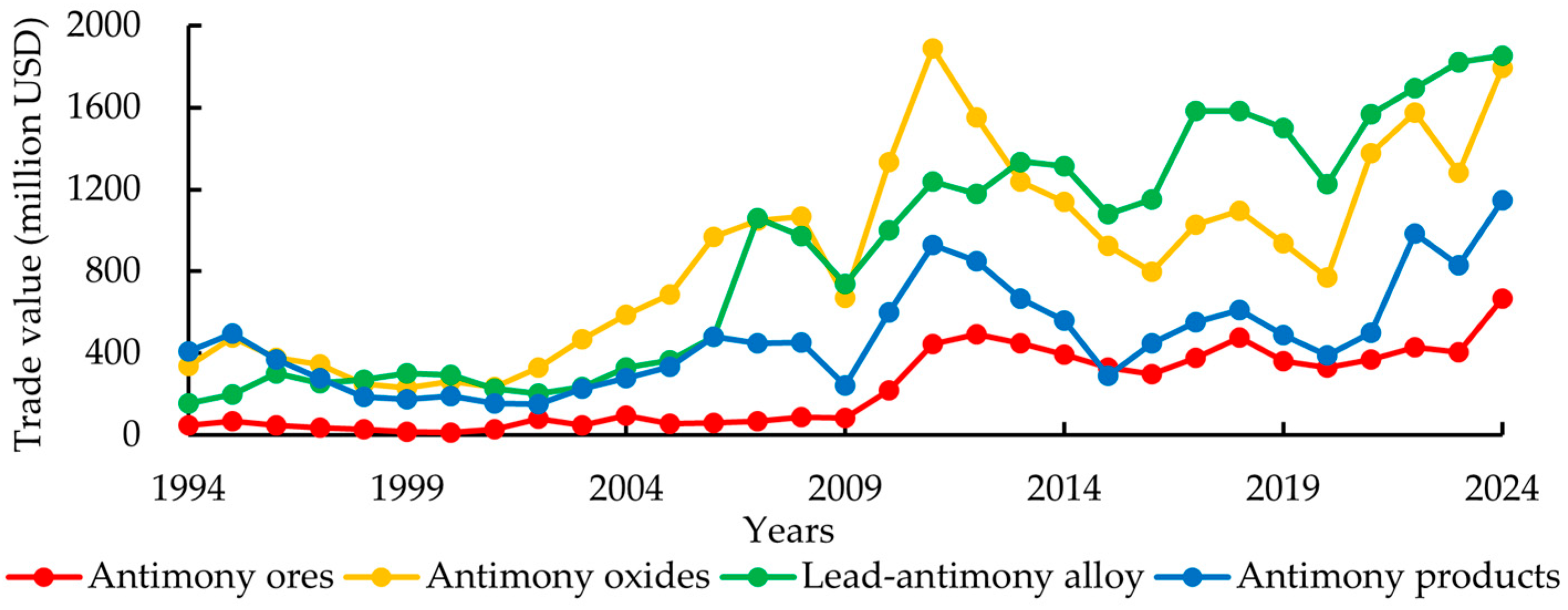
In terms of trade value, antimony ores, antimony oxides, lead–antimony alloys, and antimony products overall exhibited similar fluctuation patterns (see
Figure 1; trade value refers to total global exports, i.e., the sum of exports from all countries for each product category). From 1994 to 2001, the trade value of these four commodities declined slowly amidst fluctuations. During 2002–2008, the trade value entered an upward cycle, experienced a sudden significant drop in 2009, then saw substantial growth for two consecutive years, reaching a historical peak in 2011. From 2011 to 2015, trade value entered a period of continuous decline. Starting in 2016, after minor fluctuations, trade value increased noticeably again in 2021. Among them, the trade value of antimony oxides and lead–antimony alloys was significantly higher than that of the other two products, and their fluctuations were also more pronounced. The trade value of antimony ores was more stable and remained at a low level over the long term. The fluctuation pattern of antimony product trade value was similar to that of antimony oxides, but the absolute trade value was relatively lower.
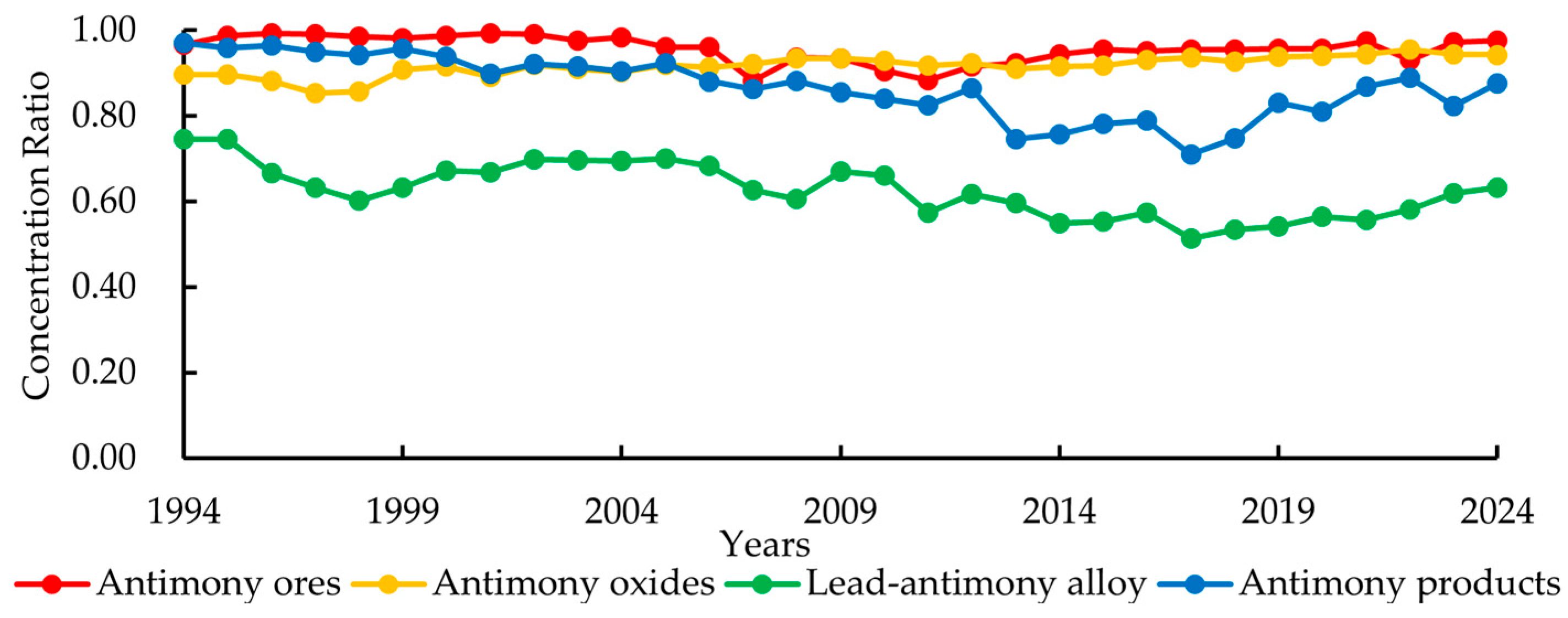
In terms of industrial concentration, antimony ores, antimony oxides, lead–antimony alloys, and antimony products all exist within an oligopolistic market environment (see
Figure 2). Antimony ores, a typical upstream product in the industrial chain, exhibited characteristics of a highly oligopolistic market. Antimony oxides and lead–antimony alloys are typical midstream products. Among these, antimony oxides showed features of a highly oligopolistic market, while lead–antimony alloys exhibited characteristics of a low-concentration oligopolistic market. Antimony products are typical downstream products. During the period 2010–2018, antimony products showed a tendency to shift from a highly oligopolistic market towards a low-concentration oligopolistic market. However, after 2018, the industrial concentration of antimony products increased again, becoming a highly oligopolistic market. This indicates that for all four typical products, a small number of countries control a very large share of the trade volume. Moreover, this concentration phenomenon is more pronounced in the trade relationships of the three products: antimony ores, antimony oxides, and antimony products.
4.2. Evolutionary Characteristics of the Global Antimony Trade Pattern
In the evolution of C8 for antimony ores, Australia, Russia, Türkiye, and Bolivia are all persistent high-export members, consistently ranking at the top of the C8 oligopoly member list. This indicates that these countries are either endowed with high resources or act as intermediary re-export hubs. Their antimony ore reserves are relatively stable, granting them a certain oligopolistic advantage in the export of upstream products. The United States ranked high in exports from 1994 to 2001 but has not re-entered the C8 oligopoly member list since 2002. China ranked high in exports from 1994 to 1998, but its export performance was not prominent between 1998 and 2016, only re-emerging as a C8 oligopoly member in 2017. This unstable performance may be due to the combined effects of changes in domestic policy environment and industrial restructuring. Once policies and market demand became relatively stable, China’s position in antimony ore trade rose again, leveraging its resource endowment. Additionally, Canada and Viet Nam occasionally ranked high in specific years, indicating that these countries also possess certain antimony ore reserves and are important forces in stabilizing the antimony ore market.
The oligopoly members in antimony oxide trade are relatively stable, with China, Japan, the United States, and France being the main members. Clearly, China is a major exporter of antimony oxides, consistently ranking first. Belgium, since becoming an oligopoly member in 2003, has long held the second or third position, demonstrating stable export performance. The United States and Japan, as intermediary re-export countries, although not ranking at the very top, have consistently remained on the oligopoly list, showing overall stable performance.
The oligopoly members for lead–antimony alloys are less stable, with only Canada consistently ranking high on the list. Countries like Belgium, Germany, and Sweden, while consistently on the list, experienced significant annual ranking fluctuations. Countries such as Republic of Korea, India, and Viet Nam have shown prominent performance in recent years, becoming important oligopoly members. This indicates fiercer global market competition in lead–antimony alloy trade, with many countries possessing certain export capabilities. Notably, China has consistently remained outside the list, indicating that China holds no advantage in lead–antimony alloy trade.
China’s antimony products have long ranked first among oligopoly members, making it the largest exporter of antimony products. The United States has long been on the oligopoly list, ranking high among members from 1994 to 2010, but showing a declining ranking trend after 2011. Around 2015, countries such as Viet Nam, India, and Tajikistan became important oligopoly members, ranking relatively high.
Overall, China, Russia, and Australia all possess superior resource endowments and primary product production capacities, holding important positions in the export trade of upstream antimony products. Developing countries like Viet Nam, Thailand, and India inherently possess certain resource advantages. In recent years, with rapid development in their mining and industrial sectors, these countries have gradually acquired sound extraction and processing capabilities, becoming important players in the trade of upstream and midstream antimony products. Although countries like the United States, Japan, and Republic of Korea lack resource advantages in antimony ore, they possess more complete industrial chains. Their processing capabilities and technological levels for antimony far exceed those of developing countries, making them major members in midstream and downstream product trade. China possesses a relatively complete antimony industrial chain, but its export advantage in antimony products is mainly concentrated in downstream products. However, its export advantages in upstream and midstream products are gradually weakening.
4.3. Analysis of China’s Competitive Edge
4.3.1. Results of the Export Oligopoly Index Analysis
To further our analysis, we selected countries (regions) that have consistently ranked among the leading oligopoly members in the trade of the four typical products over an extended period, using them as benchmarks for comparison with China. This allows for an assessment of the export competitiveness of key oligopoly members. Apart from China, the following countries were selected: Australia, Russia, Türkiye, and Bolivia for antimony ore trade; Japan, the United States, and France for antimony oxides trade; Belgium, Canada, Germany, and Sweden for lead–antimony alloy trade; and the United States, Viet Nam, India, and Tajikistan for antimony product trade.
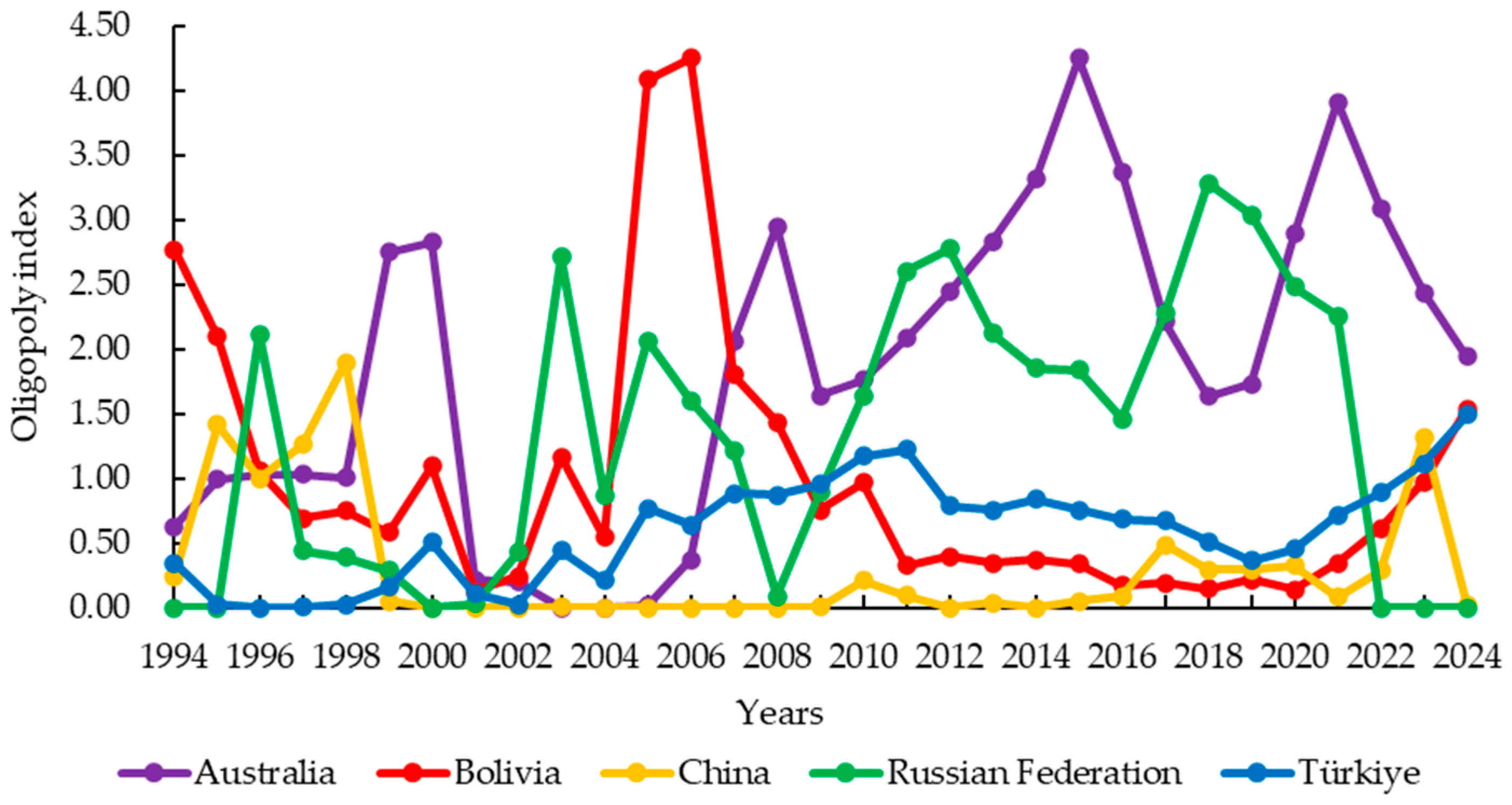
The oligopoly membership for antimony ore trade is relatively large, with Australia, Russia, Türkiye, and Bolivia all exhibiting a certain degree of export competitiveness. Examining the EOI of major antimony ore exporters (see
Figure 3), Australia’s competitive edge has remained relatively stable, with its index consistently surpassing that of other member countries since 2007, except for a few years when it fell behind Russia. Russia and Australia have alternately occupied the competitive high ground, displaying a pattern of ebb and flow. This suggests a potential competitive relationship between Russia and Australia in antimony ore trade; however, this competitive effect has gradually weakened since 2022, with Russia losing its oligopolistic advantage and Australia’s index also declining. Türkiye’s performance has been more stable, consistently ranking third over the past three decades and showing a gradual upward trend. Bolivia exhibited a prominent EOI prior to 2009, occasionally ranking first in a few years, but experienced a significant decline thereafter. Around 2019, the EOI of both Türkiye and Bolivia rose steadily. This may be attributed to surging global demand for critical metals, which stimulated mining activities in these resource-rich countries and prompted them to intensify antimony ore development and trade. In contrast, China’s EOI for antimony ores has not been particularly prominent. Prior to 1998, China leveraged its antimony reserve advantage to dominate the market, but starting in 1999, China’s index remained at a relatively low level for an extended period, only briefly ranking second in 2023. China’s market performance in 2023 may reflect short-term fluctuations resulting from multiple resource-rich countries vying for market share following Russia’s loss of oligopolistic advantage. By 2024, China’s EOI for antimony ores declined again, indicating a return to market stability. Evidently, China does not possess an oligopolistic advantage in antimony ore export trade.
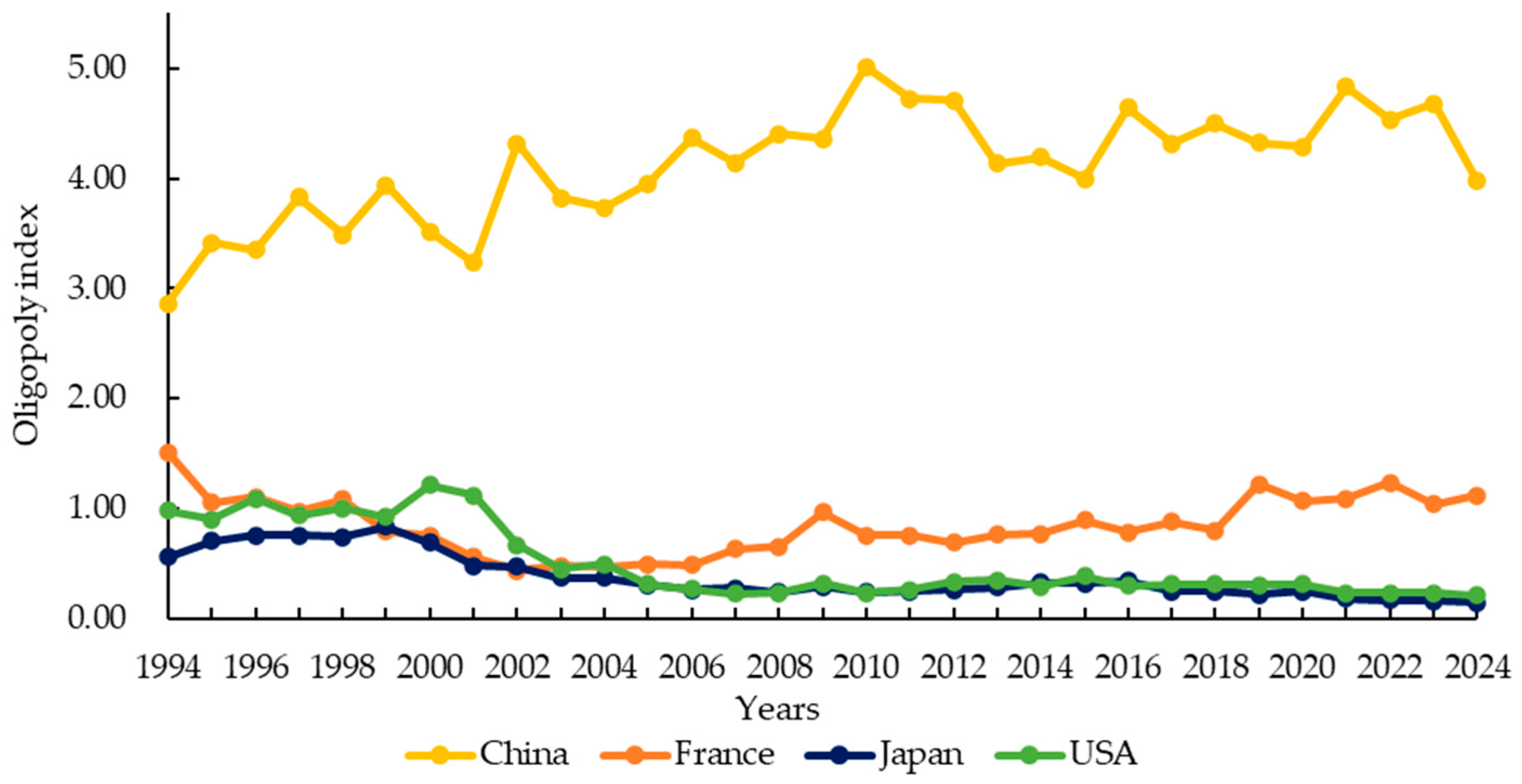
The oligopoly membership for antimony oxides trade is relatively limited, with China, France, Japan, and the United States as the primary members (see
Figure 4). Examining the EOI of major antimony oxides exporters, China’s index has been substantially higher than that of other countries since 1994, securing an overwhelmingly dominant position in antimony oxides trade. France, Japan, and the United States have exhibited relatively stable performance, with France’s index slightly exceeding those of Japan and the United States since 2003, ranking second. Japan and the United States have maintained largely comparable index levels.
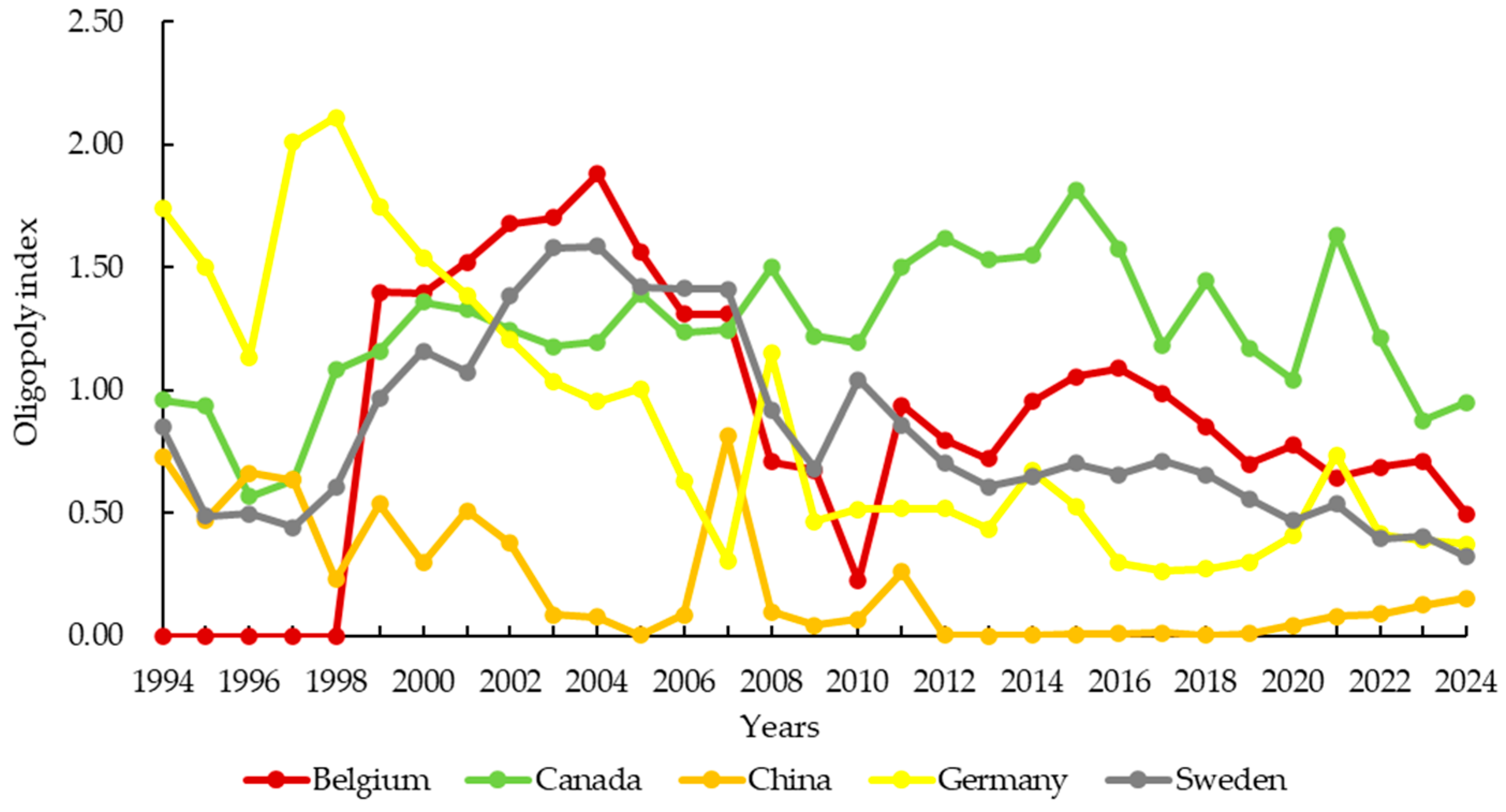
The oligopoly membership for lead–antimony alloy trade is relatively extensive, with Belgium, Canada, Germany, and Sweden as key oligopoly members (see
Figure 5). Examining the EOI of major lead–antimony alloys exporters, competition in this trade sector was highly intense prior to 2011, with the index values of the five countries fluctuating considerably each year, each possessing the potential to claim the top rank. This indicates that the market for lead–antimony alloys is more fragmented, with many countries possessing production and processing capabilities and remaining actively engaged in global trade. This dynamic shifted in 2012, as Canada and Belgium demonstrated increasingly stable performance, consistently securing the first and second rankings. Sweden and Germany generally occupied the third and fourth positions, with minimal disparity between them. Meanwhile, China’s EOI declined substantially, signaling a loss of competitiveness. This may be directly related to China’s progressively stringent domestic environmental policies implemented since 2012, when the Chinese government intensified environmental regulations, forcing many ore processing enterprises to shut down and thereby affecting China’s position in lead–antimony alloy trade to a certain extent.
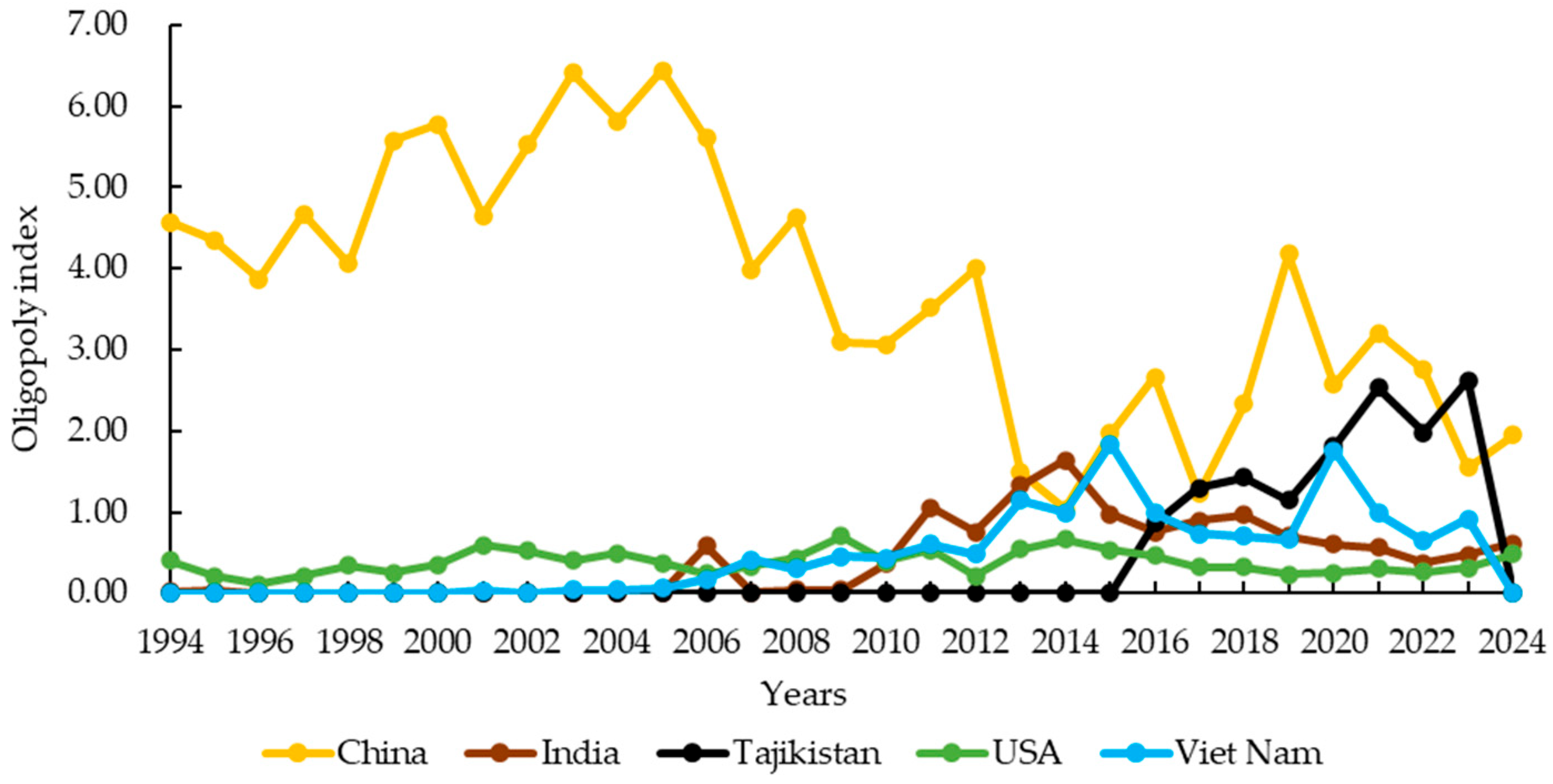
The oligopoly membership for antimony product trade is relatively broad, with China, India, Tajikistan, the United States, and Viet Nam serving as major oligopoly members (see
Figure 6). Examining the EOI of major antimony products exporters, it is evident that prior to 2012, China held a long-standing export advantage in antimony product trade, with its index far exceeding those of other countries. Similar to lead–antimony alloys, antimony products exports were also affected to a certain extent after 2012. As downstream industrial products with the highest added value and superior economic returns, antimony products underwent a period of adjustment. After 2016, China’s EOI for antimony products rose again, though its advantage was no longer as pronounced as before 2012. During this period, India, Tajikistan, and Viet Nam rapidly captured market share, emerging as significant exporters of antimony products with steadily increasing oligopoly indices. The United States maintained a relatively stable EOI over the long term, reflecting the stability of the downstream segment of the U.S. antimony industrial chain.
4.3.2. Results of Network Topology Indicator Analysis
From the perspective of betweenness centrality among major exporters of antimony ores, Australia, Russia, Türkiye, and Bolivia all exhibit very low betweenness centrality, indicating that their export channels are relatively concentrated, primarily exporting antimony ores through direct transactions with buyers. However, China has relatively high betweenness centrality, playing a “bridging” role in the trade network and exerting a certain degree of control over the trade relations of other countries (regions) within the network, with phenomena such as intra-industry processing or re-export trade present. From the perspective of closeness centrality among major exporters of antimony ores, the differences in closeness centrality among the five countries are minimal, with only China’s closeness centrality index being slightly higher. This suggests that these countries generally have good trade connectivity within the trade network, are relatively able to achieve “trade freedom,” and there are also certain trade linkages among the oligopoly members.
The closeness centrality and betweenness centrality values reported in
Table 1,
Table 2,
Table 3 and
Table 4 are raw values calculated from the directed, weighted trade networks using the formulas described in
Section 3.2.
From the perspective of betweenness centrality among major exporters of antimony oxides, the United States plays a significant intermediary role, whereas China serves as an originating node for net exports of antimony oxides, lacking intra-industry trade relationships and exhibiting weaker intermediary control capacity. From the perspective of closeness centrality among major exporters of antimony oxides, the performance of the four countries is generally at the same level, indicating close trade relationships among oligopoly members in antimony oxides trade. Although China holds a substantial export share, products circulate smoothly among countries, and market performance remains stable.
From the perspective of betweenness centrality among major exporters of lead–antimony alloys, Germany exhibits greater activity and stability, indicating that the country serves as a key hub for transit trade in lead–antimony alloys. From the perspective of closeness centrality among major exporters of lead–antimony alloys, with the exception of Canada, the performance of the other four countries tends to be consistent. This suggests that Canada’s lead–antimony alloy trade may be more independent, with a relatively narrow buyer base. In contrast, trade linkages among Belgium, Germany, and Sweden in lead–antimony alloys are closer, reflecting more extensive trade in this critical material among EU member states.
From the perspective of betweenness centrality among major exporters of antimony products, both China and the United States play significant intermediary roles, with their intermediary positions displaying a pattern of ebb and flow. This indicates a potential competitive relationship between China and the United States in the transit trade of antimony products. Given that antimony is a scarce mineral in the United States, the U.S. government, facing the reality of being unable to expand domestic raw ore production capacity, has intensified support for the downstream segment of the industrial chain, compensating for resource endowment deficiencies through the export of downstream products. From the perspective of closeness centrality among major exporters of antimony products, Tajikistan exhibits poor connectivity within the trade network, suggesting that its export destinations may be limited to a few countries. In contrast, China, India, the United States, and Viet Nam actively participate in the global trade of antimony products.
4.4. Robustness Checks
To assess the robustness of our findings, we conducted a series of sensitivity analyses.
First, based on the fluctuation patterns observed in trade value and market concentration, the full study period (1994–2024) was divided into three sub-periods: 1994–2001, characterized by sluggish global demand and slow trade growth; 2002–2011, marked by rapid industrial development and an upward trade cycle; and 2012–2024, during which China’s tightening environmental policies and industrial restructuring led to market fluctuations and structural adjustment. The results of the period-difference significance tests (Mann–Whitney U test for non-normally distributed indicators and Welch’s t-test for normally distributed indicators) confirm that the observed shifts in market concentration and trade patterns across these three periods are statistically significant (p < 0.05).
Second, we tested alternative quantity thresholds for excluding small trade flows (10 kg, 100 kg, 1000 kg). The composition of the top-8 oligopoly members remained stable for thresholds up to 100 kg, supporting the validity of our chosen threshold.
Collectively, these sensitivity analyses support the robustness of our main findings.
5. Discussion
5.1. Evolutionary Trends in China’s Trade Position
As a major country in global antimony resource reserves and smelting processing, China’s role in global antimony trade has undergone multiple transformations since the 1990s, while its resource advantages have also experienced profound evolution driven by domestic policy adjustments, environmental pressures, and industrial upgrading. The trade of the four core categories—antimony ores (upstream), antimony oxides (midstream), lead–antimony alloys (midstream), and antimony products (downstream)—all exhibit oligopolistic market characteristics, with significant differences in China’s trade position and competitive edge across different categories. From 1994 to 2001, global demand for antimony resources was sluggish, and the trade value of China’s antimony commodities declined slowly amid fluctuations. During 2002–2008, driven by rapid global industrial development, the market entered an upward cycle, and China’s export scale of antimony commodities continued to expand. In 2009, affected by the global financial crisis, the trade value of antimony commodities dropped sharply. From 2011 to 2021, the market entered a period of fluctuating decline, primarily due to the dual impact of tightened environmental protection policies in China and weak global demand. In 2021, driven by demand for antimony from the development of global emerging industries, the trade value of antimony commodities rose significantly again.
From the perspective of category differences, the four core commodities in global antimony trade are all in oligopolistic market environments, with a small number of countries controlling the core trade share. In the upstream sector, Australia, Russia, Türkiye, Bolivia, and other countries have long held dominant positions. After 1998, China’s oligopoly index remained low for an extended period, with only a short-term rebound in 2023 due to reduced supply from Russia, followed by a rapid decline again in 2024, failing to establish a stable oligopolistic advantage. In the midstream sector, China has long held the top position in global exports of antimony oxides, with an oligopoly index far exceeding that of France, Japan, and other members. However, competition in lead–antimony alloys is intense globally, with Belgium, Canada, Germany, and other countries alternately occupying dominant positions. Due to production technology and environmental constraints, China has not formed a competitive edge in this field and has long remained outside the C8 members. In the downstream sector, from 2010 to 2018, influenced by the global manufacturing shift and competition from emerging countries, China’s oligopolistic advantage gradually weakened. After 2018, China’s industrial upgrading and stricter environmental standards led to the phase-out of some small and medium-scale production capacity, and industrial concentration increased again. China remains the world’s largest exporter, but the rise of emerging countries such as India, Vietnam, and Tajikistan has posed certain challenges to China’s dominant position.
From the perspective of trade network characteristics, China exhibits high betweenness centrality in antimony ore trade, playing a “bridging” role, with phenomena such as intra-industry processing or re-export trade. In antimony oxides trade, China is primarily a net exporter serving as an originating node, with weak intermediary control capacity. In antimony product trade, both China and the United States play significant intermediary roles, with their intermediary positions displaying a pattern of ebb and flow, indicating a certain competitive relationship. In terms of closeness centrality, China demonstrates high connectivity in both antimony ore and antimony product trade, facilitating its participation in the global trade network. However, its connectivity in lead–antimony alloy trade is relatively weak, furthering its competitive disadvantage.
5.2. Changes in China’s Trade Competitive Edge
The evolution of China’s competitive edge in antimony trade is closely related to global antimony industry development trends, domestic policy adjustments, changes in resource endowments, and environmental constraints, exhibiting an overall shift from a “resource-dominated” model to a “processing-dominated” model. China was once the world’s most resource-rich country in antimony ore, with reserves in Hunan, Guangxi, and other regions long ranking among the top globally. Before 1998, China occupied an important position in global antimony ore trade by virtue of its abundant resource endowment. However, long-term excessive mining led to a rapid decline in antimony ore reserves and a continuous decrease in resource grade. In recent years, China’s antimony ore mining output has continued to decline, from a peak of 180,000 tons in 2008 (accounting for 91.4% of global production) to approximately 40,000 tons in 2024 (accounting for 60% of global production), indicating a marked weakening of its resource advantage. This decline reflects a reduction in primary mining output rather than a decline in smelting and processing capacity, which remains substantial. Meanwhile, the global supply pattern of antimony ore resources has shifted, with countries such as Australia, Russia, Turkey, and Bolivia leveraging their stable resource reserves to become core forces in global antimony ore exports. Although China still maintains a certain antimony ore reserve base, it has gradually transitioned from a “resource exporter” to a “resource importer.” In 2024, China’s imports of antimony ores and concentrates reached 52,900 tons, a year-on-year increase of 46%, with major import sources including Thailand, Myanmar, Tajikistan, and other countries, reflecting a growing dependence on imported resources.
China possesses the world’s most complete antimony industrial chain, covering antimony ore mining, midstream smelting and processing, and downstream product manufacturing. However, its industrial competitive edge has gradually shifted from full-chain coverage to concentration in downstream high-value-added segments. In the midstream smelting and processing segment, China still holds an advantage in antimony oxides, leveraging mature smelting technologies and large-scale production capacity to maintain its long-standing position as the world’s largest exporter. However, in lead–antimony alloys, China’s industrial competitiveness is continuously weakening, and it is gradually withdrawing from the core global competition arena. After 2016, countries such as India, Viet Nam, and Tajikistan rapidly rose with low-cost advantages, and China’s absolute dominant position no longer exists. Notably, in recent years, some Chinese mining companies have actively invested in overseas antimony projects, which has, to some extent, compensated for the domestic resource endowment deficiency and ensured the security and stability of the industrial chain.
The evolution of China’s competitive edge in antimony trade is the result of the synergistic effects of policy regulation, environmental constraints, and market demand. From a policy perspective, China has listed antimony as a nationally protected specific mineral since 1991 and has successively introduced a series of policies, including total mining output controls, prohibition of foreign investment in exploration and mining, and export controls, effectively curbing excessive mining and low-cost exports but also leading to a contraction in antimony ore export scale. In recent years, China’s environmental policies have become increasingly stringent, leading to the closure of numerous antimony mining and processing enterprises that fail to meet environmental standards, which has also accelerated the concentration of the industrial structure in technologically advanced downstream product segments. From a market demand perspective, stable growth in demand from traditional fields (such as flame retardants) has supported the export scale of antimony oxides and antimony products; the rapid rise in demand from emerging fields (such as photovoltaic glass) has further stimulated demand for antimony products, promoting the upgrading of China’s antimony industrial chain toward high-value-added segments aligned with new energy development trends.
Geopolitical factors are increasingly shaping the global antimony trade landscape. The concentration of upstream resources and China’s long-standing dominance in downstream segments have rendered antimony a potential instrument of geopolitical leverage. Export controls, as a policy tool, illustrate how resource-rich countries can deploy trade policies to pursue strategic objectives. Such measures, while intended to ensure domestic supply security and curb low-value exports, can generate ripple effects across global markets, prompting import-dependent countries to diversify supply sources or explore substitution alternatives. The period analyzed in this study spans multiple phases of geopolitical transition, including the integration of global markets after the Cold War and, more recently, supply chain decoupling and regional conflicts. These macro-level shifts have influenced the strategic calculus of both exporting and importing countries, affecting investment decisions, trade flows, and industrial policy. These geopolitical developments interact with the economic and environmental drivers identified in this study, collectively shaping the evolving trade positions and competitive edges of key actors.
5.3. Transformation of Competitive Edge Driven by Sustainable Development Goals
The evolution of China’s antimony trade position reflects the Chinese government’s particular attention to sustainable development. Upstream mining activities in the antimony industry cause severe pollution to surrounding soil and water sources, while smelting processes release sulfur dioxide and particulate matter, posing threats to the health of neighboring communities. Since 2012, China’s stringent environmental regulations have become a key driver of production declines and global trade pattern restructuring. This policy shift prioritizes environmental sustainability over short-term output maximization. However, this transformation entails complex trade-offs. While it alleviates China’s domestic environmental burden, it may also lead to the relocation of environmental impacts to other producing countries (e.g., Tajikistan, Viet Nam), a phenomenon sometimes referred to as the “pollution haven” effect.
Currently, antimony recycling rates remain low, largely due to the difficulty of separating antimony from complex end-of-life products and the lack of dedicated recycling infrastructure. China’s downstream processing advantage positions it to take a leading role in developing circular economy models for antimony. This suggests that the reshaping of competitive edge driven by sustainable development goals is exerting a profound influence on the global antimony trade landscape. For resource-rich countries, prioritizing sustainable development over short-term gains will be a key driver of competitive edge transformation and an important means of enhancing governance capacity for critical minerals.
5.4. Implications for the Management of Advantageous Mineral Resources
As a typical advantageous mineral resource in China, the trade performance and resource endowment evolution of antimony provide important practical experience for the sustainable management of advantageous mineral resources.
First, the weakening upstream advantage and persistent downstream strength suggest that the concept of “advantageous minerals” should be reconceptualized from a value-chain perspective rather than solely from a resource-endowment perspective. Policy frameworks that focus exclusively on upstream reserves may overstate a country’s strategic position and underinvest in downstream capabilities. For China, this implies the need to maintain support for downstream R&D and high-value-added manufacturing even as upstream production declines.
Second, the contrasting trajectories of antimony oxides and lead–antimony alloys demonstrate that different segments of the same mineral may require differentiated policy approaches. For segments where technological barriers and environmental costs are high, policies that support cleaner production technologies and economies of scale may be necessary to sustain competitiveness. For segments where China retains advantage, policies should focus on maintaining technological leadership and exploring circular economy opportunities.
Third, the emergence of new exporting countries in both midstream and downstream segments highlights that trade positions are dynamic and that countries with strong initial advantages cannot assume permanence. This underscores the importance of continuous monitoring of global trade networks to anticipate competitive threats and identify opportunities for strategic positioning. The network topology indicators employed in this study offer a useful tool for such monitoring.
Fourth, the role of environmental regulation in reshaping China’s antimony trade position illustrates that sustainability and industrial competitiveness are not inherently contradictory. While stringent environmental policies contributed to the decline in China’s upstream and midstream export shares, they also accelerated the transition toward higher-value-added downstream segments and improved the overall environmental performance of the industry. For other resource-rich countries, this suggests that environmental upgrading can be an integral component of industrial upgrading strategies.
6. Conclusions
Our primary conclusions are summarized as follows:
(1) Global antimony trade as a whole exhibits oligopolistic market characteristics, with pronounced differentiation across various segments of the industrial chain. Upstream antimony ores constitute a highly oligopolistic market, with countries such as Australia and Russia maintaining long-term dominance. Midstream antimony oxides form a highly oligopolistic market; lead–antimony alloys represent a low-concentration oligopolistic market with increasingly intense competition. Downstream antimony products exhibit the characteristics of a highly oligopolistic market, following a pattern of “dispersion first, concentration later,” with continuous increasing participation from emerging countries. The trade value of all four antimony product categories has undergone multiple cycles of fluctuation, with antimony oxides and lead–antimony alloys showing the most significant scale and amplitude of volatility.
(2) China presents a differentiated competitive landscape in global antimony trade. In the fields of antimony oxides and antimony products, China has consistently ranked first in global exports, demonstrating a significant oligopolistic advantage. However, in antimony ore trade, China’s advantage has gradually weakened since 1998, with only short-term fluctuating recoveries, characterized by intermediary re-export trade. In the lead–antimony alloy sector, China has long remained outside the C8 members, possessing no competitive edge. Trade network characteristics indicate that China exhibits strong connectivity in antimony ore and antimony product trade, but relatively weak connectivity in lead–antimony alloy trade.
(3) China’s competitive edge in antimony resources has shifted from upstream to downstream, representing a transformation from a “resource-dominated” model to a “processing-dominated” model. Before 2012, excessive mining led to a continuous weakening of China’s antimony resource endowment advantage. The sustainable development goals have driven China’s transition from resource exports to high-end product processing. Currently, China maintains a competitive edge in downstream high-value-added product segments.
Although this study systematically analyzes the changes in China’s antimony resource advantages and the global trade pattern, the following limitations remain: First, as this research focuses on countries (regions) with large trade volumes, it may have overlooked the impact of some regional small-scale trade. Second, constrained by the research perspective, this study does not fully account for the impact of unforeseen events such as international geopolitical conflicts and global supply chain restructuring on the antimony trade pattern. In response to the above limitations, future research can be expanded in the following directions: First, broaden the research perspective to more comprehensively depict the completeness and complexity of the global antimony trade network, focusing on small-scale trade relationships and regional trade agreements. Second, future research may introduce scenario analysis methods to simulate the potential impacts of unforeseen events such as geopolitical conflicts and trade frictions on the antimony trade pattern and resource security, proposing more targeted risk response strategies. Third, the research framework can be extended to other critical metals such as rare earth elements and tungsten, summarizing the common patterns in the management of advantageous mineral resources, thereby providing more comprehensive theoretical support for resource-rich countries in managing their advantageous mineral resources. Fourth, future research may more systematically examine the causal mechanisms linking geopolitical shifts to observed changes in trade networks, potentially through event-based analysis, qualitative case studies, or econometric approaches.