Article

Study on the Structural Evolution and Mechanical Behavior of Soils in Archaeological Sites Under Wet–Dry Cycling

1
The Fourth Geological Brigade of Jiangsu Geological Bureau, Suzhou 215129, China
2
School of Rail Transportation, Soochow University, Suzhou 215131, China
3
Suzhou Institute of Archaeology, Suzhou 215005, China
*
Author to whom correspondence should be addressed.
Sustainability 2026, 18(8), 3775; https://doi.org/10.3390/su18083775
Submission received: 28 February 2026 / Revised: 23 March 2026 / Accepted: 1 April 2026 / Published: 10 April 2026

Abstract

Archeological sites in humid regions are particularly susceptible to mechanical degradation induced by rainfall-driven wet–dry (W-D) cycles after excavation. In this study, representative archeological soils from the Suzhou region were investigated to quantify strength attenuation and pore structure evolution under cyclic moisture disturbance. Laboratory W-D cycling tests were conducted on samples prepared using static compaction and layered compaction methods, with cycle numbers up to nine and cycle amplitudes of 1–4 days. Unconfined compressive strength (UCS), direct shear strength, scanning electron microscopy, and mercury intrusion porosimetry were used for multiscale characterization. Results show that UCS decreases by approximately 40–50% after six to nine W-D cycles, accompanied by a porosity increase of 4.0–5.5% for statically compacted samples and 6.5–8.0% for layered-compacted samples. Layered-compacted specimens exhibit an average strength reduction of about 20% within the first three cycles, significantly higher than that of statically compacted soils. Microstructural observations reveal a progressive transformation from micropore-dominated structures (<10 μm, initially 70–80%) to interconnected meso- and macropores (>50 μm, up to 30–40%), leading to increased permeability (from ~10−8 to 10−6 cm/s). A semi-empirical model incorporating cycle number and amplitude successfully captures the non-linear evolution of porosity and strength degradation. These findings provide quantitative criteria for assessing excavation stability and long-term deterioration risks of archeological sites in humid environments.

1. Introduction

Archeological sites represent a vital category of China’s cultural heritage. However, long-term exposure to natural environments makes them highly susceptible to deterioration processes such as wind erosion, water scouring, and cyclical temperature/moisture fluctuations [1,2]. Typical pathological features, including flaking, basal sapping, collapses, and local defects, significantly threaten their structural integrity [3]. According to the core conservation principles of “minimal intervention” and “maintaining the original state,” using traditional materials and techniques to repair these sites—ensuring that the reinforcement remains compatible with the original soil in both mechanical performance and appearance—has become a focal point in heritage science [4,5].
As earthen sites are predominantly constructed from local soils, their engineering properties exhibit pronounced regional variations and environmental sensitivity [6]. In regions characterized by humid or semi-humid climates, rainfall is the primary driver of site instability. During excavation processes, such as the widely used “test pit excavation” (small-scale sloped excavation), the freshly exposed soil profiles are subjected to intense wet–dry (W-D) alternations caused by intermittent precipitation and subsequent evaporation [7,8]. This hydraulic loading triggers complex water–soil interactions: rainfall infiltration increases pore water pressure and reduces suction, while rapid drying leads to desiccation cracking and bond degradation [9]. Consequently, the structural stability of the excavated slopes (test pits) decreases over time, often resulting in superficial slumping or deep-seated failure [10].
To quantify these deterioration mechanisms, researchers rely on laboratory-reconstituted specimens. However, the reliability of experimental data is highly dependent on the preparation method, as different compaction techniques result in distinct soil fabrics [11,12]. While some studies have compared kneading, static, and dynamic compaction [13,14], the specific influence of static pressure molding (S) versus layered compaction (L) on the long-term durability of site soils remains inadequately understood. Furthermore, although moisture effects on pore-size distribution and water retention have been explored [15,16], most research has focused on the arid regions of Northwest China [17]. Quantitative studies on the strength attenuation and pore restructuring of archeological soils in humid regions under realistic rainfall-induced W-D cycles are still sparse [18,19].
Specifically, existing literature often describes moisture migration patterns but fails to provide a robust predictive framework for strength loss under actual stress conditions [20]. There is a critical need for a theoretical bridge that connects microscopic structural evolution with macroscopic mechanical response to evaluate the stability of archeological excavations effectively.
In this study, representative soil strata from archeological sites in the Suzhou region were selected. By employing both static pressure (S) and layered compaction (L) methods, a series of laboratory W-D cycling tests were conducted to simulate various rainfall intensities and frequencies. The research systematically analyzes the effects of cycle number (N) and amplitude (T) on the unconfined compressive strength and microscopic pore structure (via SEM and MIP). Moving beyond empirical description, this paper establishes a semi-empirical, semi-theoretical model based on the experimental results. This model is designed to predict the porosity evolution and strength degradation of site soils under diverse rainfall scenarios. The findings provide a scientific basis for stability assessment and in situ conservation strategies for archeological sites in humid environments.

2. Materials and Methods

The soil samples used in this study were obtained from boreholes at typical archeological sites in the Suzhou area, China. The stratigraphy of the study region is well developed, with a considerable thickness of Quaternary deposits, exhibiting a spatial distribution pattern characterized by being thinner in the west and thicker in the east. From top to bottom, the strata mainly consist of the Holocene, Upper Pleistocene, Middle Pleistocene, and Lower Pleistocene deposits. Among these, the Upper and Middle Pleistocene strata are the most widely distributed and representative sedimentary layers associated with archeological sites in the Suzhou region.
To ensure the representativeness of the site soils, undisturbed clay, silty clay, and silty fine sand were selected from the Upper Pleistocene, Middle Pleistocene, and Lower Pleistocene strata. The sampling depths ranged from 19.8 m to 137.9 m. The Upper Pleistocene layer is mainly composed of bluish-gray silty clay and silt, corresponding to the aquitard and the roof of the first confined aquifer. The Middle Pleistocene layer primarily consists of gray-green silty clay interbedded with silt, corresponding to the second confined aquifer and its overlying aquitard. The Lower Pleistocene layer is dominated by dark gray clay with a relatively dense structure, corresponding to the third confined aquifer and its overlying aquitard.
According to borehole records and laboratory test results, as listed in Table 1, the physical properties of soils from different strata exhibit clear stratified characteristics. The shallow Upper Pleistocene soils have a relatively high-water content, with an average of 30.5%, a liquid limit of 35.6%, a plastic limit of 21.9%, a liquidity index of 13.7, and a void ratio of 0.80. These soils are classified as moderately compressible and are in a plastic state. The Middle Pleistocene soils at intermediate depths show water contents ranging from 23.3% to 28.1%, liquid limits of 26–27%, plastic limits of approximately 19–20%, void ratios of 0.63–0.70, and a liquidity index of about 7. These soils are moderately to highly compressible and range from plastic to stiff states. The deep Lower Pleistocene soils have a water content of 19.9%, a liquid limit of 21.5%, a plastic limit of 18.1%, a void ratio of about 0.49, and a liquidity index of 3.4. They are classified as low- to moderately compressible stiff soils. Overall, the soil profile exhibits a typical vertical pattern characterized by “soft upper layers, transitional middle layers, and relatively stable lower layers.”
To systematically investigate the evolution of the pore characteristics and mechanical properties of archeological site soils under cyclic moisture disturbances, as well as the corresponding changes in their microstructure, laboratory tests were conducted based on the site-specific geological conditions. These tests included W-D cycling tests, unconfined compressive strength (UCS) tests, and direct shear tests. All experiments were performed under controlled temperature and humidity conditions, using either undisturbed or remolded samples from the representative soil strata. The testing procedures and parameter settings followed the Standard for Geotechnical Testing Methods (GB/T 50123-2019) [21].

2.1. Wet–Dry Cycling Tests

To further analyze the response of soil pore structure and mechanical properties to W-D cycles, a laboratory simulation system was established based on the hydrogeological background and environmental evolution characteristics of the Suzhou archeological site strata. The aim of the test was to reproduce the natural process of periodic wetting and drying that soils experience during long-term exposure or burial, thereby elucidating the dynamic evolution mechanisms of their pore structure and strength parameters [22,23].
Two representative sample preparation methods were employed: static compaction and layered tamping. These methods differ significantly in their ability to preserve the integrity and uniformity of the original soil structure [24]. Static compaction effectively maintains structural uniformity and integrity, making it suitable for analyzing the regularity of soil strength and deformation characteristics. In contrast, layered tamping better reflects field construction conditions, though the presence of interfaces between layers may increase variability in soil strength [25]. By comparing differences in porosity, volumetric water content, and strength indices between the two preparation methods, the influence of sample preparation on experimental results can be assessed, ensuring the scientific validity and applicability of the findings.
Furthermore, the Suzhou region is located at the southern margin of the East Asian monsoon zone and belongs to the humid subtropical climate. The annual average precipitation is approximately 1000–1200 mm, with 70–80% concentrated in the rainy season from June to September, associated with the plum-rain and typhoon periods. During the rainy season, precipitation is frequent and intense (single events can reach 50–100 mm), whereas in the autumn and winter months, rainfall is sparse and evaporation is high (daily evaporation of 5–8 mm), resulting in alternating “concentrated rainfall-rapid drying” cycles. The frequency of W-D cycles can reach 15–20 times per year. To systematically investigate the effects of the number of cycles and the amplitude of moisture variation on archeological site soils, multiple test scenarios with different cycle numbers and amplitudes were designed, as summarized in Table 2.
The dry density of the samples was controlled within a range of 1.4–1.7 g/cm3, corresponding to an initial water content range of 15–30%, to match the natural water content conditions of different soil strata at the site. The number of W-D cycles was set to 0, 3, 6, and 9 to simulate the degradation process of archeological site soils under multiple W-D cycles. The cycle duration was set to 1, 2, and 4 days (where “d” represents the number of days required for a single W-D cycle, reflecting the intensity of moisture migration during each cycle), aiming to reproduce the extreme W-D disturbances caused by alternating heavy rainfall and strong evaporation in the Suzhou region. This systematic experimental design allows for a comprehensive simulation of the evolution mechanisms of pore structure and mechanical properties of the site soils under cyclic wetting and drying [26].

2.2. Unconfined Compressive Strength (UCS) Tests

After completion of the W-D cycles and subsequent equilibration under natural conditions, the samples were subjected to UCS tests to evaluate the degradation of compressive performance. The tests were performed using a UTM5105 electronic universal testing machine at a loading rate of 0.15 mm/min, and loading was terminated upon reaching the peak stress on the stress–strain curve [27,28].

2.3. Direct Shear Tests

To further investigate the variation in shear strength of the archeological soils under cyclic W-D conditions, rapid direct shear tests were conducted on each sample group. A ZJ-type quadruple direct shear apparatus was used, with normal stresses of 50, 100, 200, and 300 kPa and a shear rate of 0.8 mm/min [29,30].
Each sample was sheared under the corresponding number of W-D cycles and cycle durations. The shear force–displacement curves were recorded, and the peak shear strength at failure was determined. Based on the results at different cycle numbers, the variation trends of cohesion (c) and internal friction angle (φ) were calculated to analyze the influence of W-D cycles on the particle structure and frictional properties of cohesive soils.

3. Results

3.1. Typical Mechanical Properties of Archeological Site Soils

The archeological site soils in the Suzhou region are mainly composed of Upper and Middle Pleistocene Quaternary deposits, originating from lacustrine and fluvio-lacustrine environments. These soils exhibit complex stratification, widespread distribution, and pronounced heterogeneity in their physical and mechanical properties. The engineering behavior of the site soils is jointly controlled by multiple factors, including depositional environment, water content, and burial depth, leading to considerable variation in their response to deformation and surface settlement.
To analyze the geotechnical characteristics of the archeological soils, undisturbed samples from different strata were subjected to laboratory unconfined compressive strength (UCS) tests and direct shear tests. The test results are summarized in Table 3.
Analysis of the test results indicates that the physical and mechanical properties of typical archeological soils in the Suzhou region exhibit clear regularities as well as significant differences. The unconfined compressive strength (UCS) of cohesive soil samples is generally high and increases with dry density. For example, samples S3 and S10 show UCS values of 280 kPa and 320 kPa, respectively, indicating that higher compaction enhances the stability of the soil structure, strengthens interparticle contact and cementation, and thus forms a more stable soil skeleton. This phenomenon suggests that the bearing capacity of cohesive soils depends not only on particle gradation but is also significantly influenced by water content and microstructural arrangement.
Silty fine sand samples (S4-S6) exhibit low UCS values (50–80 kPa), which are consistent with the inherent characteristics of sandy soils, where strength is primarily controlled by interparticle friction and lacks significant cohesive bonding. This behavior also reflects the tendency of sandy soils to experience particle sliding and pore reorganization under unconfined conditions, with overall stability largely dependent on compaction and effective stress. Mixed soil samples (S7-S9) show intermediate UCS values of 100–140 kPa. These soils retain some cementation effects from the cohesive fraction, but the high silt content reduces overall strength, indicating that the proportion of silt and clay particles regulates the macroscopic strength mechanism of the soil.
Direct shear test results further reveal the differences in physical and mechanical behavior among soil types. Cohesive soils generally exhibit high cohesion (70–150 kPa) but low internal friction angles (approximately 16°), indicating that shear strength is primarily governed by cementation and adsorption at the microstructural level. For instance, sample S10 shows a high cohesion of 150 kPa with a relatively low friction angle, reflecting that under high plasticity or high-water content conditions, soil strength is dominated by cohesion while the contribution of friction is limited. In contrast, silty fine sand displays low cohesion (3–8 kPa) and high friction angles (30–34°), with shear strength largely controlled by interparticle friction.
By integrating the UCS and direct shear results, it is evident that the strength evolution mechanisms differ significantly among soil types. Cohesive soils are highly sensitive to water content and structural characteristics: at higher water contents, soils exhibit soft-plastic or liquid-plastic behavior, with a pronounced reduction in strength; when water content falls below the plastic limit, the soil gradually stiffens, with marked improvements in both compressive and shear strength. Sandy soils, on the other hand, are primarily controlled by compaction and effective stress; in saturated conditions, poor drainage or accumulation of excess pore water pressure can reduce effective stress, leading to rapid strength degradation, which in practice often necessitates reinforcement or drainage measures. Mixed soils exhibit more complex engineering behavior, as varying silt-to-clay ratios can result in cohesive soil-like compressibility and shrinkage, while the sand skeleton can impart higher frictional resistance, producing transitional mechanical characteristics.
From the perspective of soil deformation and compressibility, the test results further reveal trends associated with dry density and water content. High water content samples (e.g., S2, w = 40%) exhibit low compressive and shear strength due to weakened interparticle contacts and reduced cementation, resulting in a loose structure. Conversely, highly compacted samples (e.g., S10, ρd = 1.70 g/cm3) show significantly improved strength parameters, demonstrating that densification effectively enhances the stability of the soil skeleton and mitigates pore compression and particle sliding.
In summary, the typical mechanical characteristics of Suzhou archeological soils can be categorized into three types: cohesive soils, characterized by high cohesion and low friction, with mechanical behavior governed by their structure and water content; silty fine sands, with low cohesion and high friction, whose strength primarily depends on compaction and effective stress; and mixed soils, exhibiting intermediate behavior with a combined cohesion-friction strength mechanism.

3.2. Effects of Wet–Dry Cycle Frequency on Mechanical and Pore Properties

3.2.1. Sample Preparation Under Static Compaction

The primary characteristic of static compaction sample preparation is the gradual densification of the soil through a controlled loading process. Its advantage lies in preserving the original interparticle contacts and pore structure to a large extent. Consequently, in the initial state, the unconfined compressive strength (UCS) is typically high, and porosity and volumetric water content closely approximate those of the undisturbed soil, allowing for an accurate reflection of the response of archeological site soils to W-D cycles under natural consolidation conditions.
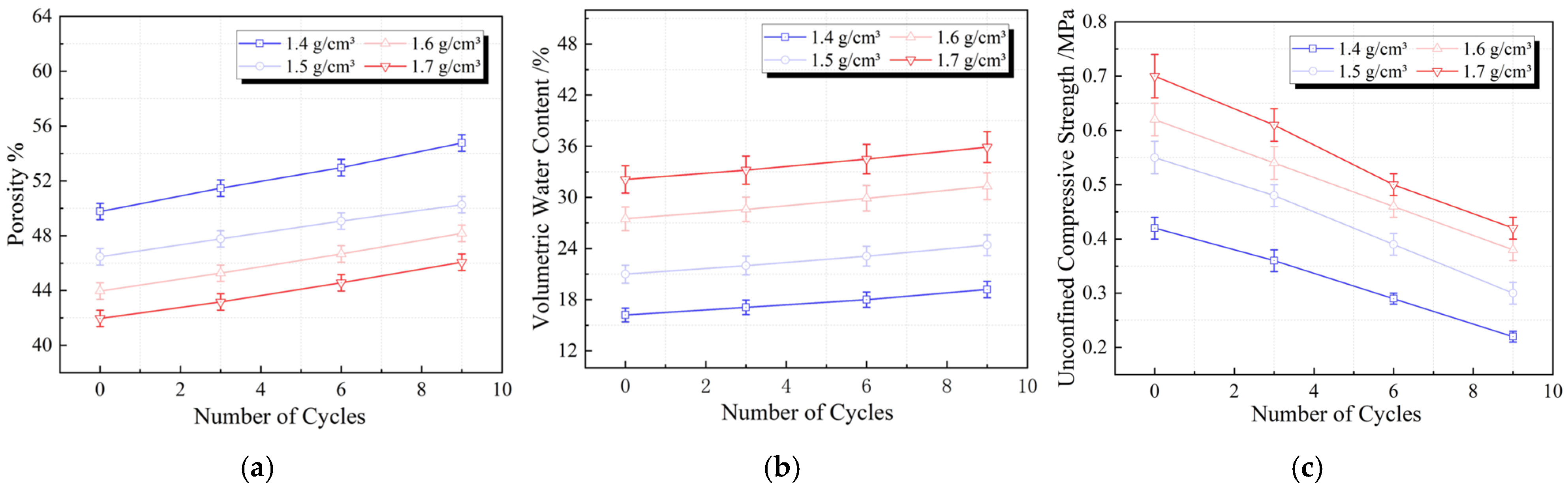
The test results indicate that with increasing numbers of W-D cycles, the UCS of the samples exhibits a pronounced decreasing trend (Table 4 and Figure 1). In the initial state (0 cycles), the internal structure of the soil is intact, with relatively few pores, and strength remains at a high level. After three cycles, repeated infiltration and evaporation of water induce microcracks, weakening interparticle bonding and resulting in a 10–15% reduction in strength. With six to nine cycles, soil porosity further increases, microcracks become interconnected, structural stability deteriorates significantly, and the rate of strength reduction accelerates. Beyond nine cycles, the soil pore structure gradually reorganizes and stabilizes, and the rate of strength declines slowly, indicating that the soil has undergone irreversible degradation of its internal structure.
Corresponding to the changes in strength, the porosity of statically compacted samples exhibits an initial slight decrease followed by a gradual increase. During the early stages of a few W-D cycles, residual compaction from the loading process causes partial particle rearrangement, resulting in local pore compression and a slight reduction in porosity. As the number of cycles increases, repeated swelling and shrinkage gradually relax interparticle bonds, and new microcracks continuously develop, causing porosity to shift from a decreasing to an increasing trend and remain elevated in later stages. The volumetric water content exhibits a trend closely consistent with that of porosity; that is, the more cycles the soil experiences, the more pronounced the increase in volumetric water content. This behavior is primarily attributed to the additional water storage capacity provided by newly formed pores and microcracks, which facilitates water uptake and maintains the soil in a relatively high moisture state.
In summary, although static compaction preserves a relatively stable structure during the early stages of W-D cycling, the mechanical performance and structural integrity of the soil are still unable to resist cumulative environmental effects as the number of cycles increases, ultimately exhibiting a regular pattern of strength reduction accompanied by increases in porosity and volumetric water content.

3.2.2. Sample Preparation Under Layered Compaction

Under layered compact conditions, the samples achieve relatively high formation density and improved structural uniformity. Consequently, in the initial state, the unconfined compressive strength (UCS) of these samples is generally higher than that of statically compacted samples, while porosity is comparatively lower. However, this method introduces greater artificial disturbance during sample preparation, disrupting the natural soil structure and making interparticle bonding reliant on external compaction rather than natural cementation, thereby rendering the samples more sensitive to W-D cycling [31].
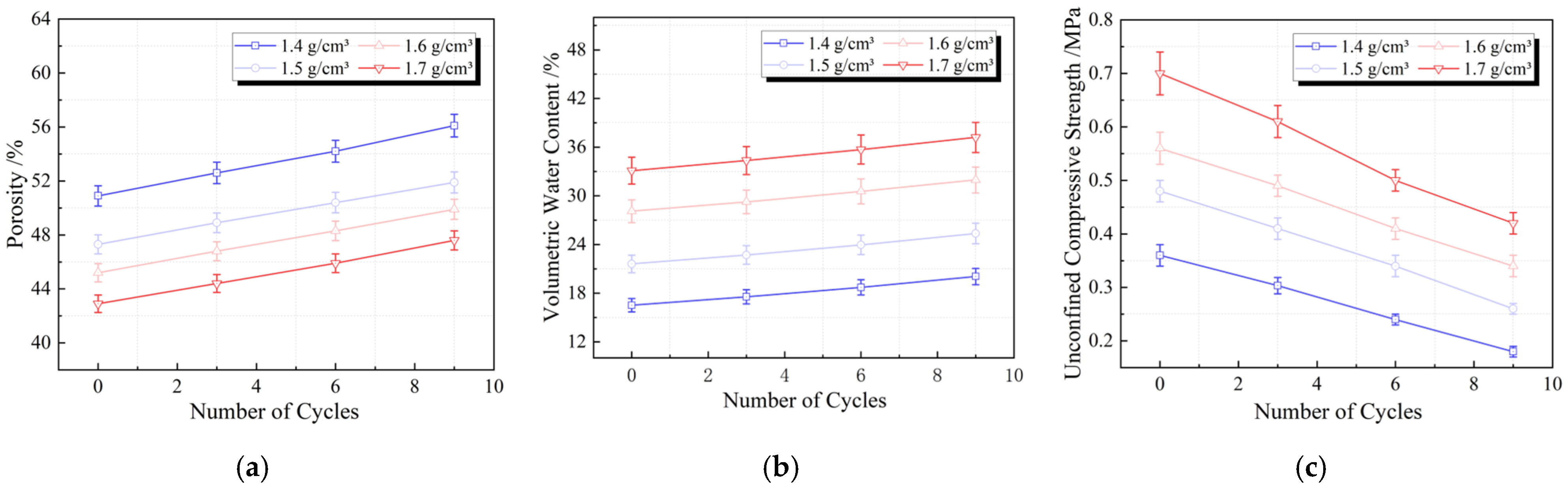
The experimental results listed in Table 5 show that sample strength continuously decreases with increasing cycle numbers, and the rate of degradation is significantly greater than that observed for statically compacted samples. During the first three cycles, structural looseness at interface pores and layer contact surfaces allows water infiltration and evaporation to rapidly expand pore spaces, resulting in an average strength reduction of approximately 20%. In the subsequent cycles, the connectivity of cracks and pore rearrangement intensifies, gradually destroying the soil structure and causing further strength deterioration.
From the perspective of pore characteristics, layered-compacted samples exhibit pronounced fluctuations in volumetric water content during W-D cycling, accompanied by a significant increase in void ratio, as shown in Figure 2. This indicates that the internal structure of such soils undergoes redistribution and a reduction in compaction degree under cyclic moisture variations.
Combined with SEM observations, after W-D cycling, interparticle bonding becomes loosened, and the pore morphology evolves from a discontinuous distribution to a more interconnected network, leading to a marked increase in porosity. Compared with statically compacted samples, layered-compacted specimens experience more severe structural damage and faster deterioration under W-D cycles. This suggests that their strength is primarily governed by physical compaction and interparticle friction, while lacking a stable cemented structure.
In summary, an increase in the number of W-D cycles leads to a reduction in strength for archeological soils prepared under both methods; however, statically compacted samples exhibit markedly better structural stability and resistance to degradation than layered-compacted samples. Even after six to nine cycles, statically compacted specimens retain relatively high residual strength, whereas layered-compacted samples under the same conditions already show significant pore expansion and structural damage.
These results indicate that the inherent soil structure and compaction state play a crucial role in governing mechanical behavior under W-D cycling. Archeological soils with intact structure and higher density demonstrate stronger resistance to moisture-induced disturbances, while loosely compacted soils are more prone to pore connectivity, particle sliding, and strength deterioration.

3.3. Effects of Wet–Dry Cycle Amplitude on Mechanical and Pore Characteristics

3.3.1. Sample Preparation Under Static Compaction

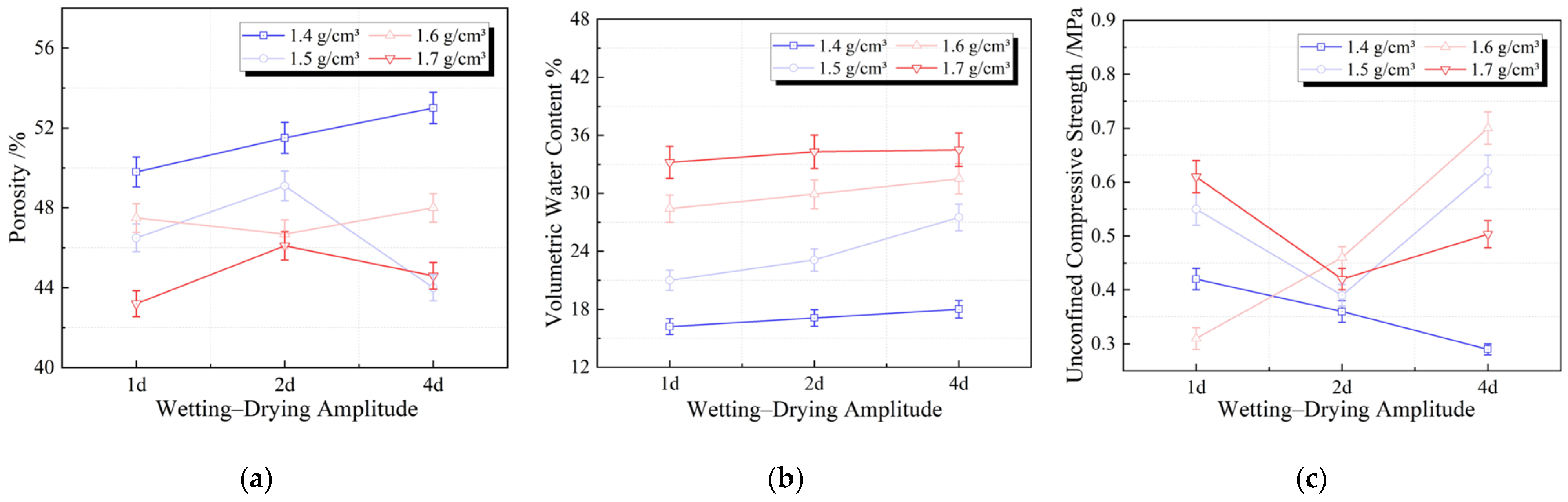
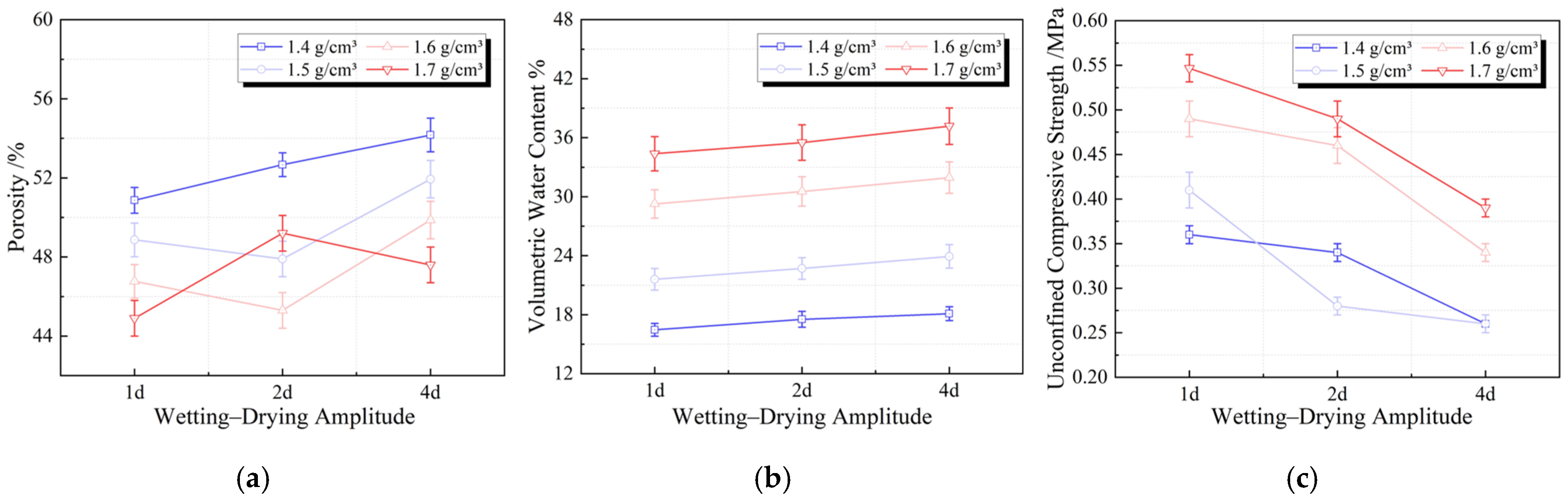
The results for statically compacted samples under different W-D cycle amplitudes are presented in Table 6 and Figure 3. Analysis of the data indicates that under low-amplitude cycling conditions (1d), the reduction in unconfined compressive strength (UCS) is relatively small, and changes in porosity and volumetric water content occur at a comparatively slow rate. However, as the cycle amplitude increases, strength degradation becomes significantly more pronounced. Under the 4d condition, the cemented structure of the soil is severely damaged, resulting in a substantial decline in strength.
The variation in porosity corresponds closely with the observed strength changes: the greater the W-D cycle amplitude, the more intense the moisture migration and pore reorganization within the soil. Under high-amplitude cycling, the void ratio increases markedly, and the volumetric water content fluctuates more frequently. The repeated breakdown and reformation of adsorbed water films between particles lead to progressive loosening of the soil microstructure.
Overall, it can be concluded that under static compaction conditions, the influence of cycle amplitude is not significant at low amplitudes but becomes extremely pronounced at high amplitudes. This indicates that even soil structures relatively close to the undisturbed state struggle to maintain stability under intense alternating wetting and drying.

3.3.2. Sample Preparation Under Layered Compaction

The results for layered-compacted samples under varying W-D cycle amplitudes are presented in Table 7 and Figure 4.
The results in Table 7 show that the amplitude of W-D cycles determines the intensity of damage induced during each cycle. A larger cycle amplitude leads to more pronounced moisture exchange and volumetric changes during both the wetting and drying stages, thereby imposing stronger disturbances on the soil structure.
A comparison of the two sample preparation methods shows that increasing the W-D cycle amplitude accelerates structural degradation and strength reduction in both cases, but the rate of deterioration is significantly higher for layered-compacted samples than for statically compacted ones. In statically compacted samples, interparticle cementation and a denser structure can, to some extent, resist high-intensity moisture disturbances. In contrast, layered-compacted samples, characterized by larger initial pores and structural discontinuities, are more prone to particle sliding and pore expansion under repeated wetting and drying, demonstrating greater sensitivity to moisture variations. Overall, a larger W-D cycle amplitude corresponds to poorer structural stability of archeological soils, with both mechanical performance and pore structure exhibiting pronounced degradation trends.

3.4. Microstructural Changes

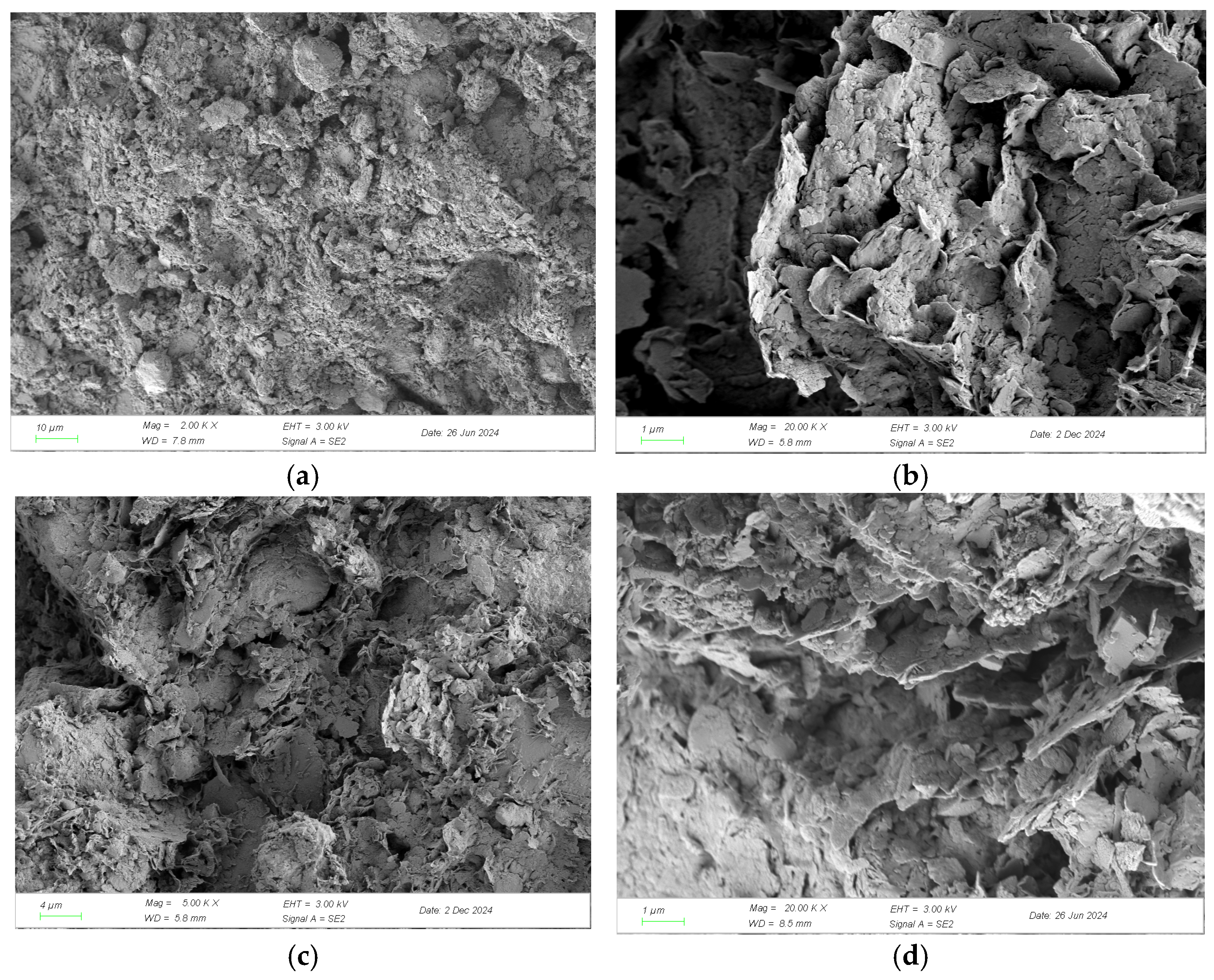
The structural degradation of archeological soils induced by W-D cycling is essentially a progressive process involving the reconstruction of the micropore system and the destabilization of the macroscopic particle skeleton [32]. Figure 5 presents SEM images of cohesive soils before and after W-D cycling at different magnifications. The images show that with increasing numbers of cycles, the soil undergoes continuous deterioration: initially, particles are closely bonded; subsequently, larger pores emerge and gradually develop into cracks; ultimately, the soil fabric becomes loose, with particles exhibiting a dispersed arrangement.
Combined observations from scanning electron microscopy (SEM) and mercury intrusion porosimetry (MIP) (Figure 5 and Figure 6) indicate that the microstructure of the archeological soil prior to W-D cycling exhibits an “aggregate-pore” mosaic fabric. The pore system is dominated by small pores with diameters < 10 μm, accounting for approximately 70–80% of the total pore volume. Aggregates are tightly bonded by cementing substances such as iron oxides and organic matter, resulting in relatively high overall structural stability.
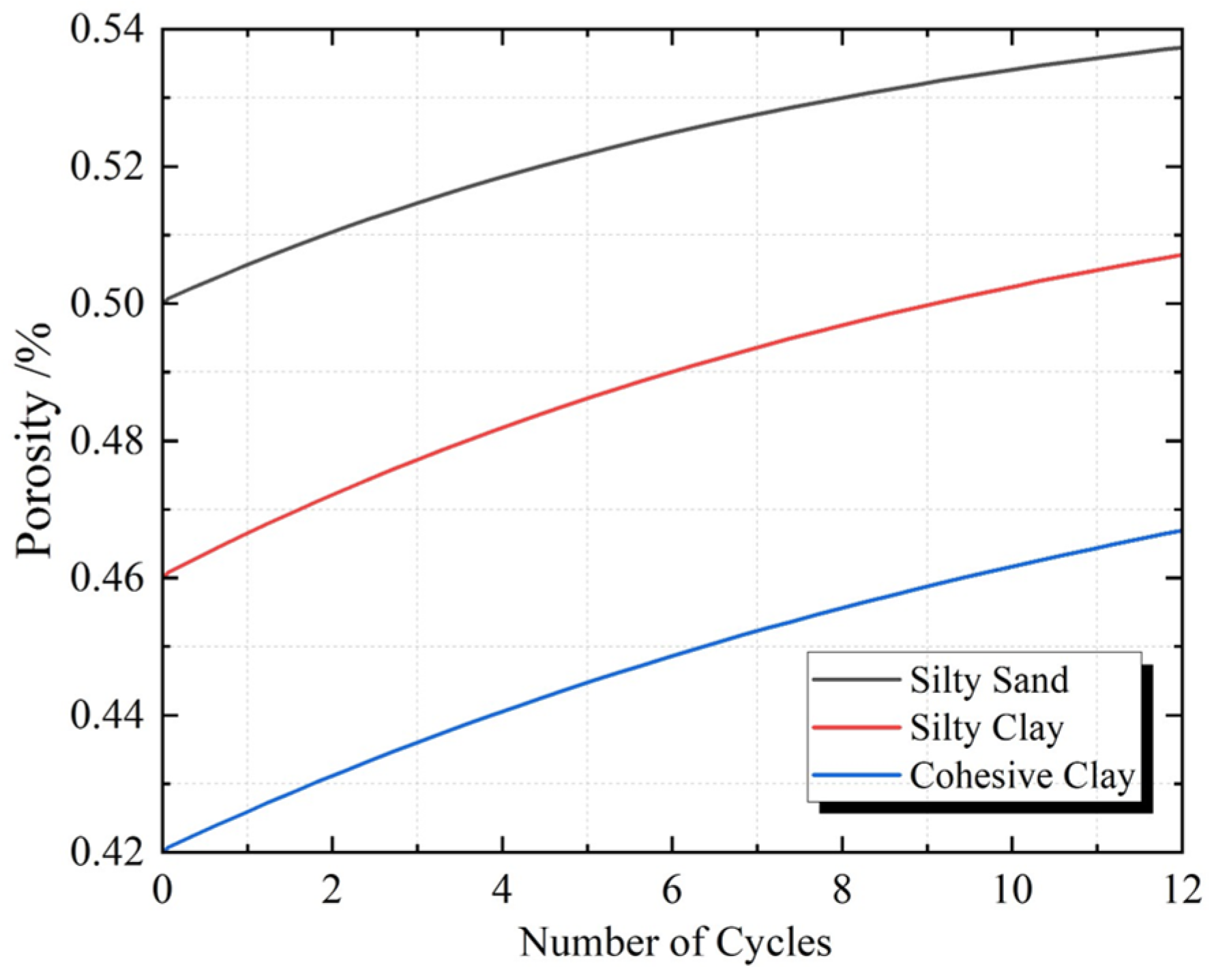
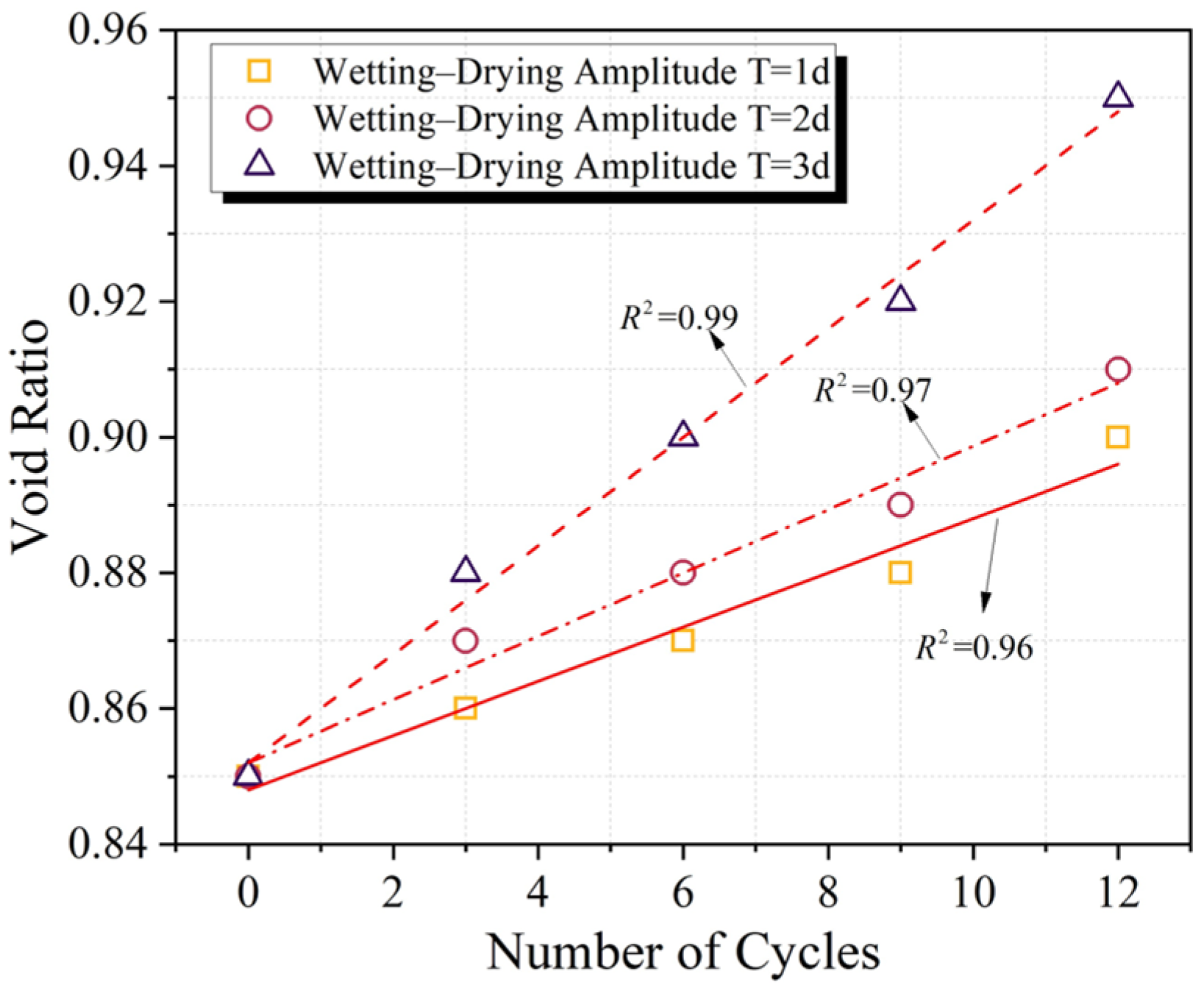
After three W-D cycles, noticeable microstructural changes begin to emerge. Initially, aggregates undergo repeated swelling and shrinkage, leading to fragmentation and the formation of secondary small pores with diameters of 1–5 μm. As the number of cycles increases, cementing materials between particles gradually soften and leach under repeated wetting, causing partial breakage of cementation bridges and a reduction in inter-aggregate bonding strength. Consequently, mesopores with diameters of 10–50 μm begin to develop. As shown in Figure 6, the void ratio increases significantly with the number of W-D cycles, and the rate of increase becomes greater with larger cycle amplitudes (T = 1d, 2d, and 4d). This indicates that higher-amplitude cycling accelerates pore development and structural degradation of the archeological soil. A strong correlation is observed between the void ratio and cycle number under all amplitude conditions.
When the number of cycles exceeds 12, mesopores further expand and interconnect, forming macropores with diameters > 50 μm, whose proportion rises to 30–40%. The soil microstructure consequently transforms from an “aggregate-embedded” fabric to a “loosely packed particle” structure, accompanied by a sharp increase in void ratio. The quantitative changes in void ratio shown in Figure 6 thus directly reflect the continuous damage to pore development and structural stability of the archeological soil under W-D cycling.
Moreover, deterioration of the microstructure directly leads to a decline in macroscopic engineering performance. On the one hand, the increase in porosity results in a 1–2-order-of-magnitude rise in the permeability coefficient, from approximately 10−8 cm/s to 10−6 cm/s. This allows rainfall to infiltrate more rapidly in subsequent events, thereby accelerating both physical and chemical weathering processes. On the other hand, the loosening of the particle skeleton reduces the compression modulus (Es) by about 30–40% and decreases the unconfined compressive strength (σc) by 40–50%. Under self-weight or external loading, such weakened soils are more prone to uneven settlement, which may induce deep-seated cracks (depth > 20 cm) or localized collapse.
For example, at the Sui Yangdi Mausoleum site in Yangzhou, Jiangsu Province, the rammed-earth foundation platform has been exposed to long-term W-D cycling. The upper 30 cm of soil has evolved into a loose, powdery state, and the compressive strength has decreased from an initial 1.5 MPa to 0.6 MPa, necessitating periodic reinforcement measures.


3.5. Semi-Empirical Model for Predicting Structural and Mechanical Evolution

Based on the observed non-linear deterioration trends (Table 4, Table 5, Table 6 and Table 7), the following models were formulated to describe the structural and mechanical evolution of the soils:
The porosity evolution reflects the irreversible transition from microscopic cementation failure to macroscopic crack propagation:
n ( N , T ) = n 0 + Δ n m a x ( 1 e x p   ( α N T b ) )
To capture the micro-mechanism where pore rearrangement leads to strength reduction, qu is expressed as a function of evolving porosity and hydraulic cycling parameters:
q u ( N , T ) = q u 0 e x p   ( β N T ) ( 1 n ( N , T ) ) k ( 1 n 0 ) k

3.5.1. Parameter Definition and Calibration

Initial state parameters (n0, qu0): Initial porosity n0 and UCS qu0 were derived from Table 2 and Table 4, corresponding to dry densities of 42.0–50.9% and UCS values of 0.36–0.70 MPa, respectively.
Structural deterioration parameters (Δnmax, α, b): Δnmax represents the maximum porosity increment, with layered-compacted specimens exhibiting higher Δnmax (6.5–8.0%) than static-pressure specimens (S, 4.0–5.5%). α (0.03–0.06) and b (0.4–0.6) quantify the sensitivity to N and T.
Mechanical decay parameters (β, k): β (0.05–0.09) reflects the vulnerability of cementation, while k (2.5–3.5) accounts for strength reduction specifically caused by the enlargement of medium-to-large pores, as evidenced by MIP analyses.

3.5.2. Model Validation

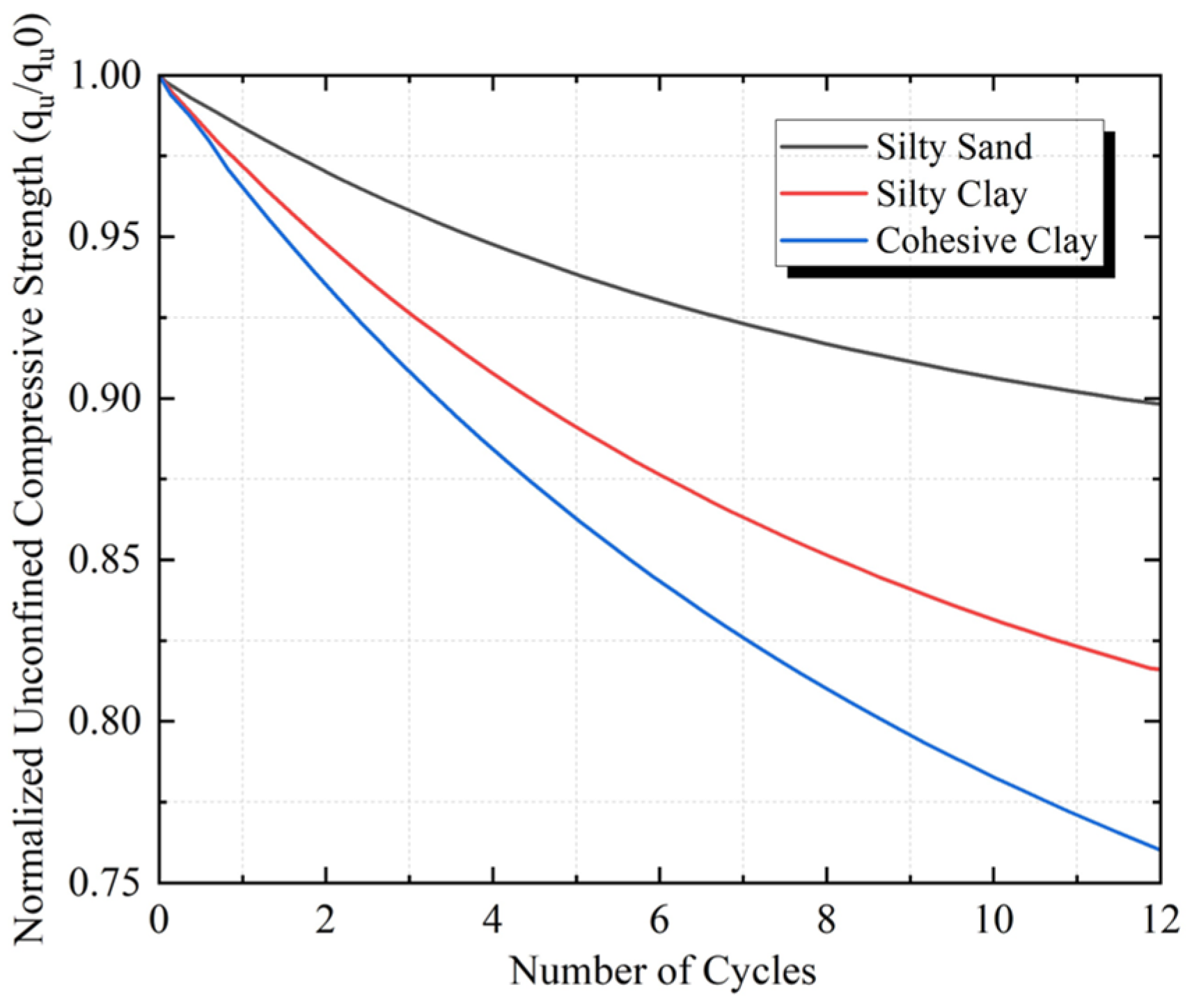
The predictive performance of the models is compared with experimental data from static-pressure specimens (ρd = 1.5 g/cm3, w0 = 20%) in Figure 7 and Figure 8.
As shown in Figure 7, porosity exhibits a typical “rapid-then-slow” growth pattern. In the initial one to six cycles, n increases sharply due to moisture-induced disruption of the primary soil fabric. Beyond N = 9, n approaches a plateau near Δnmax, indicating a new structural equilibrium. Higher α values at larger T confirm that intensified moisture migration accelerates pore expansion.
Figure 8 shows the predicted reduction in UCS. The model accurately captures the pronounced early-cycle strength loss. Incorporation of the porosity term n(N, T) reflects the microstructural reality: as N increases, the effective load-bearing area of the soil skeleton decreases, resulting in a synergistic drop in qu. The strong agreement between model predictions and experimental data confirms the robustness of this coupled approach.

3.5.3. Engineering Implications and Literature Comparison

These models enable site-specific stability assessments under realistic environmental conditions (e.g., N = 15–20/year in Suzhou). For example, with T = 2d, a nearly 50% reduction in UCS is predicted within two years if no protective measures are implemented. The deterioration patterns align with previous studies. Tang et al. [32] demonstrated that moisture conditions govern the stress–strain behavior of stabilized soils, supporting the inclusion of T in the models. The sensitivity of strength to void distribution corroborates Zhao [33], who highlighted the influence of clay fraction. Moreover, the non-linear formulations are consistent with Guo et al. [34] and Li [35], both of whom emphasized rapid structural changes during early-stage environmental cycling.

4. Discussion

The experimental results clearly demonstrate that W-D cycling is a dominant driver of mechanical degradation in archeological soils from humid regions. Both unconfined compressive strength and shear strength exhibit a non-linear decreasing trend with increasing cycle number and amplitude, which is consistent with observations reported for earthen heritage materials and natural soils subjected to cyclic moisture disturbances [10,11]. The pronounced early-stage strength loss indicates that initial wetting–drying events play a critical role in disrupting soil cementation and interparticle bonding.
The sample preparation method exerts a significant influence on degradation behavior. Statically compacted specimens show comparatively higher resistance to W-D cycling than layered-compacted ones, retaining greater residual strength after multiple cycles. This difference can be attributed to the more uniform pore distribution and better preservation of interparticle contacts under static compaction, as also noted by Seed and Chan [1] and Delage et al. [7]. In contrast, layered compaction introduces artificial interfaces and larger initial pores, which serve as preferential pathways for moisture migration and crack propagation, thereby accelerating structural deterioration.
From a microstructural perspective, SEM and MIP analyses reveal that W-D cycling induces a progressive transformation of pore systems. Initially dominant micropores gradually evolve into interconnected meso- and macropores as cementing materials soften and detach during repeated moisture fluctuations. Similar pore restructuring mechanisms have been reported in residual soils and earthen heritage materials under cyclic environmental loading [4,18]. The strong correlation observed between porosity increase and strength reduction confirms that microstructural damage is the fundamental cause of macroscopic mechanical degradation.
The influence of cycle amplitude further highlights the importance of rainfall intensity and drying rate. Larger amplitudes generate stronger hydraulic gradients and volumetric strain during each cycle, resulting in more severe pore expansion and bond breakage. This finding aligns with previous studies emphasizing that moisture migration intensity, rather than cycle number alone, governs deterioration rates [20,26]. For humid regions such as Suzhou, where concentrated rainfall events are followed by rapid evaporation, high-amplitude W-D cycles pose a particularly serious threat to excavated archeological slopes.
The semi-empirical model proposed in this study effectively links porosity evolution to strength attenuation by incorporating both cycle number and amplitude. Compared with purely empirical formulations, the model captures the underlying microstructural mechanisms and shows good agreement with experimental data. Similar non-linear degradation trends have been reported by Guo et al. [34] and Li [35], supporting the applicability of such coupled structural-mechanical approaches. Overall, the results highlight that soil structure, compaction state, and environmental loading jointly control the long-term stability of earthen archeological sites. These findings provide a quantitative framework for evaluating excavation-induced risks and designing targeted conservation measures under humid climatic conditions.
Based on the experimental results, controlling moisture disturbance intensity is critical for mitigating structural degradation of archeological soils after excavation. The findings demonstrate that both the number and, more importantly, the amplitude of W-D cycles significantly accelerate strength loss and pore expansion, particularly during the early stages of exposure. In humid regions such as Suzhou, high-intensity rainfall followed by rapid evaporation produces large-amplitude W-D cycles that can result in a 40–50% reduction in unconfined compressive strength within several cycles. Therefore, an effective and practical conservation measure is the installation of temporary rain shelters (rain canopies) over excavation test pits during field investigations. By directly isolating the soil surface from rainfall, rain shelters can substantially reduce moisture infiltration and suppress high-amplitude wetting events, thereby lowering the effective W-D cycle amplitude experienced by the exposed soil. This measure helps maintain pore structure stability, limits crack initiation and propagation, and slows down strength attenuation during the critical early excavation period. Compared with post-damage reinforcement, rain shelter installation represents a low-intervention, reversible, and preventive strategy that aligns well with the conservation principles of minimal intervention and original-state preservation for earthen archeological sites.

5. Conclusions

This study systematically examined the effects of rainfall-induced W-D cycles on the mechanical properties and microstructure of archeological soils from the Suzhou region. Based on experimental observations, a semi-empirical model was established to predict porosity growth and unconfined compressive strength attenuation under realistic humid climatic conditions. The main conclusions are as follows:
(1)
W-D cycles cause significant strength attenuation and irreversible structural damage to archeological soils. After six to nine cycles, the unconfined compressive strength decreases by approximately 40–50%, while porosity increases by 4.0–5.5% in statically compacted samples and 6.5–8.0% in layered-compacted samples. Strength loss is most pronounced during the initial one to three cycles, indicating that early exposure after excavation is a critical risk stage for site instability.
(2)
The sample preparation method strongly influences the degradation rate and residual strength. Layered-compacted soils exhibit faster deterioration, with an average UCS reduction of about 20% within the first three cycles, compared with 10–15% for statically compacted soils. This difference is attributed to larger initial pores and interlayer discontinuities, which promote moisture migration, pore connectivity, and crack development under cyclic wetting and drying.
(3)
Microstructural evolution governs macroscopic mechanical behavior. W-D cycling drives a transformation from an aggregate-pore mosaic structure dominated by micropores (<10 μm, initially 70–80%) to a loose particle framework with a macropore proportion of 30–40%. This pore restructuring results in a permeability increase of 1–2 orders of magnitude (from ~10−8 to 10−6 cm/s) and a 30–40% reduction in compression modules. The proposed semi-empirical model effectively links porosity evolution to strength degradation and can be applied to predict long-term stability under regional rainfall scenarios (e.g., 15–20 cycles per year in Suzhou).

Author Contributions

Conceptualization and methodology, Q.T.; formal analysis, software, and writing—original draft preparation, Y.W. and X.P.; validation, Y.N., W.C., Z.Z. and J.Q.; writing, review and editing, W.C. and Y.W. All authors have read and agreed to the published version of the manuscript.

Funding

The research presented here is supported by the National Natural Science Foundation of China (52478352), National Key Research and Development Program of China (2023YFC3707801), The 2024 Annual Geological Exploration Fund Project of Jiangsu Geological Bureau (2024-SGH006), and The 2024 Annual Geological Science and Technology Project of Jiangsu Geological Bureau (2024KJ06).

Institutional Review Board Statement

Not applicable.

Informed Consent Statement

Not applicable.

Data Availability Statement

The data presented in this study are available upon request from the corresponding authors.

Acknowledgments

Thanks to all authors’ efforts and contributions.

Conflicts of Interest

The authors declare no conflicts of interest.

References

  1. Seed, H.B.; Chan, C.K. Structure and strength characteristics of compacted clays. J. Soil Mech. Found. Div. 1959, 85, 87–128. [Google Scholar] [CrossRef]
  2. Papadimitriou, A.G.; Dafalias, Y.F.; Yoshimine, M. Plasticity modeling of the effect of sample preparation method on sand response. Soils Found. 2005, 45, 109–123. [Google Scholar] [CrossRef]
  3. Li, G.X. Advanced Soil Mechanics; Tsinghua University Press: Beijing, China, 2019; pp. 180–260. [Google Scholar]
  4. Xu, X.T.; Chen, X.L.; Cai, Y.Q.; Xu, X. Microstructure and macro-mechanical properties of residual soil subjected to repeated hygroscopic cycles. Front. Earth Sci. 2025, 13, 1528098. [Google Scholar] [CrossRef]
  5. Li, X.; Zhang, H.; Guo, Y.; Yin, S.; Ren, K. Effect of Dry-Wet Cycles on Strength Properties and Microstructure of Lime-Metakaolin-Modified Soil. Adv. Civ. Eng. 2022, 2022, 1296288. [Google Scholar] [CrossRef]
  6. An, R.; Kong, L.; Li, C. Effects of Drying-Wetting Cycles on the Microstructure and Mechanical Properties of Granite Residual Soils. Soil Mech. Found. Eng. 2022, 58, 474–481. [Google Scholar] [CrossRef]
  7. Delage, P.; Audiguier, M.; Cui, Y.J.; Howat, M.D. Microstructure of a compacted silt. Can. Geotech. J. 1996, 33, 150–158. [Google Scholar] [CrossRef]
  8. Oualmakran, M.; Mercatoris, B.C.N.; François, B. Pore-size distribution of a compacted silty soil after compaction, saturation, and loading. Can. Geotech. J. 2016, 53, 1902–1909. [Google Scholar] [CrossRef]
  9. Lambe, T.W. The engineering behavior of compacted clay. J. Soil Mech. Found. Div. 1958, 84, 1655-1–1655-35. [Google Scholar] [CrossRef]
  10. Zhang, Q.; Guo, Q.; Zhang, H.; Wang, Y.; Li, P.; Zhang, B.; Tang, C.A. Surface weathering process of earthen heritage under dry-wet cycles: A case study of Suoyang City, China. J. Rock Mech. Geotech. Eng. 2025, 17, 5224–5239. [Google Scholar] [CrossRef]
  11. Ren, K.B.; Wang, B.; Li, X.M.; Yin, S. Effect of dry-wet cycles on the mechanical properties of earthen archaeological site under low stresses. J. Rock Mech. Eng. 2019, 38, 376–385. [Google Scholar]
  12. Zhang, X.; Huang, T.; Ge, Z.; Man, T.; Huppert, H.E. Infiltration characteristics of slurries in porous media based on the coupled Lattice-Boltzmann discrete element method. Comput. Geotech. 2025, 177, 106865. [Google Scholar] [CrossRef]
  13. He, J.; Zhu, Y.; Long, S.; Luo, S.; Li, W. Dry-Wet Durability of Solidified Sludge under Capillary Immersion. Chin. J. Undergr. Space Eng. 2025, 21, 1576–1584. [Google Scholar]
  14. Tang, Q.; Liu, W.; Wang, H.Y.; Cheng, R.; Qian, Y.F. Membrane behavior of bentonite-amended Fukakusa clay in K, Na and Ca solutions. J. Cent. South Univ. 2016, 23, 3122–3131. [Google Scholar] [CrossRef]
  15. Xu, H.; Huang, C. Stiffness Degradation of Expansive Soil Stabilized with Construction and Demolition Waste Under Wetting-Drying Cycles. Coatings 2025, 15, 1154. [Google Scholar] [CrossRef]
  16. Lv, H.; Bao, H.; Lan, H.; Li, L.; Chen, W.; Liu, J.; Liu, C.; Li, C.; Wang, Y. The effect of dry-wet cycles in sodium sulfate solution on the thermal effusivity of grotto sandstone. Herit. Sci. 2025, 13, 2077. [Google Scholar] [CrossRef]
  17. Man, T.; Wang, Z.; Huppert, H.; Ren, S.; Galindo-Torres, S.A.; Zhang, X.; Zhou, A. Propagation scaling and micromechanics of buoyant granular column collapses. J. Geophys. Res. Earth Surf. 2026, 131, e2025JF008812. [Google Scholar] [CrossRef]
  18. Luo, Y.; Zhou, P.; Ni, P.; Peng, X.; Ye, J. Degradation of rammed earth under soluble salts attack and drying-wetting cycles: The case of Fujian Tulou, China. Appl. Clay Sci. 2021, 212, 106202–106215. [Google Scholar] [CrossRef]
  19. Nie, Y.; Ni, W.; Tuo, W.; Wang, H.; Yuan, K.; Zhao, Y. Microstructure and compressibility evolution of sulfate saline compacted loess under drying-wetting cycles. Quat. Int. 2022, 625, 96–106. [Google Scholar] [CrossRef]
  20. Yue, J.; Huang, X.; Zhao, L.; Wang, Z. Study on the factors affecting cracking of earthen soil under dry shrinkage and freeze-thaw conditions. Sci. Rep. 2022, 12, 15802. [Google Scholar] [CrossRef]
  21. GB/T 50123-2019; Standard for Geotechnical Test Methods. Ministry of Housing and Urban-Rural Development of the People’s Republic of China: Beijing, China; China Planning Press: Beijing, China, 2019.
  22. Ma, D.; Yao, H.; Xiong, J.; Zhu, D.; Lu, J. Experimental study on the deterioration mechanism of sandstone under wetting–drying cycles. KSCE J. Civ. Eng. 2022, 26, 2685–2694. [Google Scholar] [CrossRef]
  23. Monghassem, M.; Ajdari, M.; Binesh, S.M.; Vahedifard, F. Effects of suction and drying–wetting cycles on shearing response of adobe. J. Mater. Civ. Eng. 2021, 33, 04021173. [Google Scholar] [CrossRef]
  24. Hafhouf, I.; Abbeche, K. Impact of drying–wetting cycles on shear properties, suction, and collapse of sebkha soils. Heliyon 2023, 9, e13594. [Google Scholar] [CrossRef]
  25. Pedreño-Rojas, M.A.; Morales-Conde, M.J.; Rubio-de-Hita, P.; Pérez-Gálvez, F. Impact of wetting–drying cycles on the mechanical properties and microstructure of wood waste–gypsum composites. Materials 2019, 12, 1829. [Google Scholar] [CrossRef] [PubMed]
  26. Shaker, A.A.; Dafalla, M.; Al-Mahbashi, A.M.; Al-Shamrani, M.A. Effect of drying and wetting cycles on surface cracking and hydro-mechanical behavior of expansive clays. Buildings 2024, 14, 1908. [Google Scholar] [CrossRef]
  27. Sasar, M.; Aryal, R.; Lamsal, A.; Abdelaziz, S.L. Mechanisms of compacted soil deterioration in biopolymer-treated sands under cyclic wetting and drying. Bull. Eng. Geol. Environ. 2026, 85, 105. [Google Scholar] [CrossRef]
  28. Tang, C.S.; Wang, D.Y.; Shi, B.; Li, J. Effect of wetting–drying cycles on profile mechanical behavior of soils with different initial conditions. Catena 2016, 139, 105–116. [Google Scholar] [CrossRef]
  29. Soldo, A.; Miletic, M. Durability against wetting-drying cycles of sustainable biopolymer-treated soil. Polymers 2022, 14, 4247. [Google Scholar] [CrossRef]
  30. Zhang, X.; Takai, A.; Kato, T.; Katsumi, T. Interface clogging between soil and attenuation layer of embankment based on LBM-DEM coupled numerical method. Soils Found. 2025, 65, 101697. [Google Scholar] [CrossRef]
  31. Tang, C.S.; Zhu, C.; Leng, T.; Shi, B.; Cui, Y.J.; Kong, F.Y. Three-dimensional characterization of desiccation cracking behavior of compacted clayey soil using X-ray computed tomography. Eng. Geol. 2019, 255, 1–10. [Google Scholar] [CrossRef]
  32. Zhang, X.; Ye, P.; Wu, Y.; Zhai, E. Experimental study on simultaneous heat-water-salt migration of bare soil subjected to evaporation. J. Hydrol. 2022, 609, 127710. [Google Scholar] [CrossRef]
  33. Li, Z.Y.; Chu, S.H.; Qian, S.Z. Physical-chemical modeling of alkali-activated calcined marine clay via particle packing and reactivity. J. Build. Eng. 2025, 118, 114881. [Google Scholar] [CrossRef]
  34. Wang, C.; Gao, Y.; Guo, C.; Wei, K. Experimental study on the influence of moisture content on soft coal strength characteristics. Int. J. Min. Miner. Eng. 2021, 12, 163–180. [Google Scholar] [CrossRef]
  35. Li, Y.S. Research on the fissure development indoor test of expansive soil cracks under the action of dry-wet circulation. J. Hebei Univ. Eng. 2018, 35, 32–37. [Google Scholar]
Figure 1. Test Results of Silty Clay, Soft Clay and Mixed Soil under Static Compaction: (a) Porosity; (b) Water Content; (c) UCS.
Sustainability 18 03775 g001
Figure 2. Test Results of Silty Clay, Soft Clay and Mixed Soil under Layered Compaction: (a) Porosity; (b) Water Content; (c) UCS.
Sustainability 18 03775 g002
Figure 3. Test Results of Silty Clay, Soft Clay, and Mixed Soil under Static Compaction: (a) Porosity; (b) Water Content; (c) UCS.
Sustainability 18 03775 g003
Figure 4. Test Results of Silty Clay, Soft Clay, and Mixed Soil under Layered Compaction: (a) Porosity; (b) Water Content; (c) UCS.
Sustainability 18 03775 g004
Figure 5. SEM Images of Cohesive Soil before and after Wetting–Drying Cycles: (a) Before cycles Mag = 2.00 KX; (b) Before cycles Mag = 20.00 KX; (c) After cycles Mag = 5.00 KX; (d) After cycles Mag = 20.00 KX.
Sustainability 18 03775 g005
Figure 6. Variation in Porosity with the Number of Wetting–Drying Cycles.
Sustainability 18 03775 g006
Figure 7. Influence of Rainfall-Induced Wet–Dry Cycles on Different Soil Types.
Sustainability 18 03775 g007
Figure 8. Variation in Soil Porosity under Rainfall-Induced Wet–Dry Cycles.
Sustainability 18 03775 g008
Table 1. Physical and Mechanical Parameters of Soil Layers.
NumberDepth/mWater Content/%wL/%wP/%Consistency
I6.4~35.830.535.621.9Plastic
II35.8~42.323.326.419.1Liquid-Plastic
III-188.9~95.938.237.327.4Medium
III-295.9~139.128.127.120.1Plastic-Hard
III-3149.8~166.433.143.318.8Plastic-Hard
IV166.4~201.219.921.518.1Hard
Table 2. Experimental Program.
Dry Density/(g/cm3)Initial w0/%Number of Cycles/NCycle Amplitudes/T
1.4150, 3, 6, 91d, 2d, 4d
1.5200, 3, 6, 91d, 2d, 4d
1.6250, 3, 6, 91d, 2d, 4d
1.7300, 3, 6, 91d, 2d, 4d
Table 3. Unconfined and Direct Shear Mechanical Properties of Selected Soil Layers.
Numberw0/%ρd/(g/cm3)qu/(kPa)cu/(kPa)c/kPaφ
S1351.45224.4111.39220.5
S2401.38163.25847118.6
S3301.55281.514512122.3
S4121.76233.3532.1
S5101.7581.440.5834.6
S6141.6852.525.7330.2
S7281.6147.4725324.2
S8221.62123.560.44126.1
S9181.6510151.23228.1
S10151.7325.6161.115516.4
Table 4. Cyclic Test Results for Static-Compacted Samples.
Dry Density/(g/cm3)Initial w0/%Nw/%Porosity/%UCS/MPa
1.4015016.249.80.42
1.4015317.151.50.36
1.4015618.053.00.29
1.4015919.254.80.22
1.5020021.046.50.55
1.5020322.047.80.48
1.5020623.149.10.39
1.5020924.450.30.30
1.6025027.544.00.62
1.6025328.645.30.54
1.6025629.946.70.46
1.6025931.348.20.38
1.7030032.142.00.70
1.7030333.243.20.61
1.7030634.544.60.50
1.7030935.946.10.42
Table 5. Cyclic Test Results for Layered-Compacted Samples.
Dry Density/(g/cm3)Initial w0/%Nw/%Porosity/%UCS/MPa
1.4015016.5050.900.36
1.4015317.5552.600.30
1.4015618.7054.200.24
1.4015920.0556.100.18
1.5020021.6047.300.48
1.5020322.7048.900.41
1.5020623.9550.400.34
1.5020925.3551.900.26
1.6025028.1045.200.56
1.6025329.2546.800.49
1.6025630.5548.300.41
1.6025931.9549.900.34
1.7030033.1042.900.63
1.7030334.3544.400.55
1.7030635.7045.900.47
1.7030937.2047.600.39
Table 6. Cycle Amplitude Test Results for Static-Compacted Samples.
Dry Density/(g/cm3)Initial w0/%Nw/%Porosity/%UCS/MPa
1.4151d16.249.80.42
1.4152d17.151.50.36
1.4154d18.053.00.29
1.5201d21.046.50.55
1.5202d23.149.10.39
1.5204d27.544.00.62
1.6251d28.447.50.31
1.6252d29.946.70.46
1.6254d31.548.00.70
1.7301d33.243.20.61
1.7302d34.346.10.42
1.7304d34.544.60.50
1.4151d16.249.80.42
1.4152d17.151.50.36
1.4154d18.053.00.29
1.5201d21.046.50.55
Table 7. Cycle Amplitude Test Results for Layered-Compacted Samples.
Dry Density/(g/cm3)Initial w0/%Nw/%Porosity/%UCS/MPa
1.4151d16.550.90.36
1.4152d17.5552.60.34
1.4154d18.154.20.26
1.5201d21.648.90.41
1.5202d22.747.90.28
1.5204d23.9551.90.26
1.6251d29.2546.80.49
1.6252d30.5545.30.46
1.6254d31.9549.90.34
1.7301d34.3544.90.55
1.7302d35.549.20.49
1.7304d37.247.60.39
1.4151d16.550.90.36
1.4152d17.5552.60.34
1.4154d18.154.20.26
1.5201d21.648.90.41
Disclaimer/Publisher’s Note: The statements, opinions and data contained in all publications are solely those of the individual author(s) and contributor(s) and not of MDPI and/or the editor(s). MDPI and/or the editor(s) disclaim responsibility for any injury to people or property resulting from any ideas, methods, instructions or products referred to in the content.