Energy Management Technologies for All-Electric Ships: A Comprehensive Review for Sustainable Maritime Transport

 ,
,  ,
,  ,
,
Abstract
1. Introduction
2. Electric Ship Energy Systems and Operational Characteristics
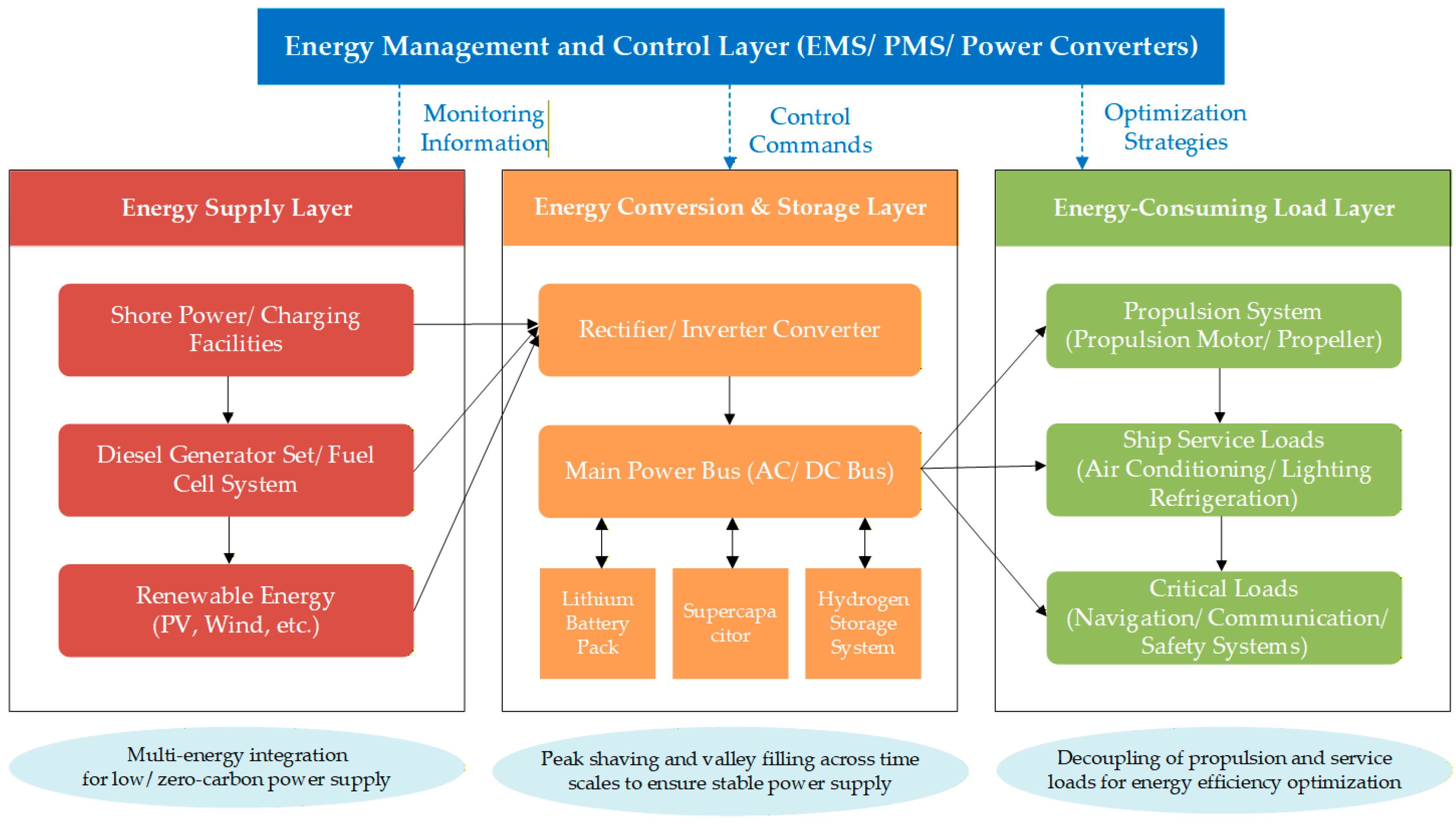
2.1. Overall Architecture of Electric Ship Energy Systems
2.2. Characteristics of Main Energy-Conversion and Energy-Storage Units
2.3. Operating Conditions and Energy-Demand Characteristics of Ships
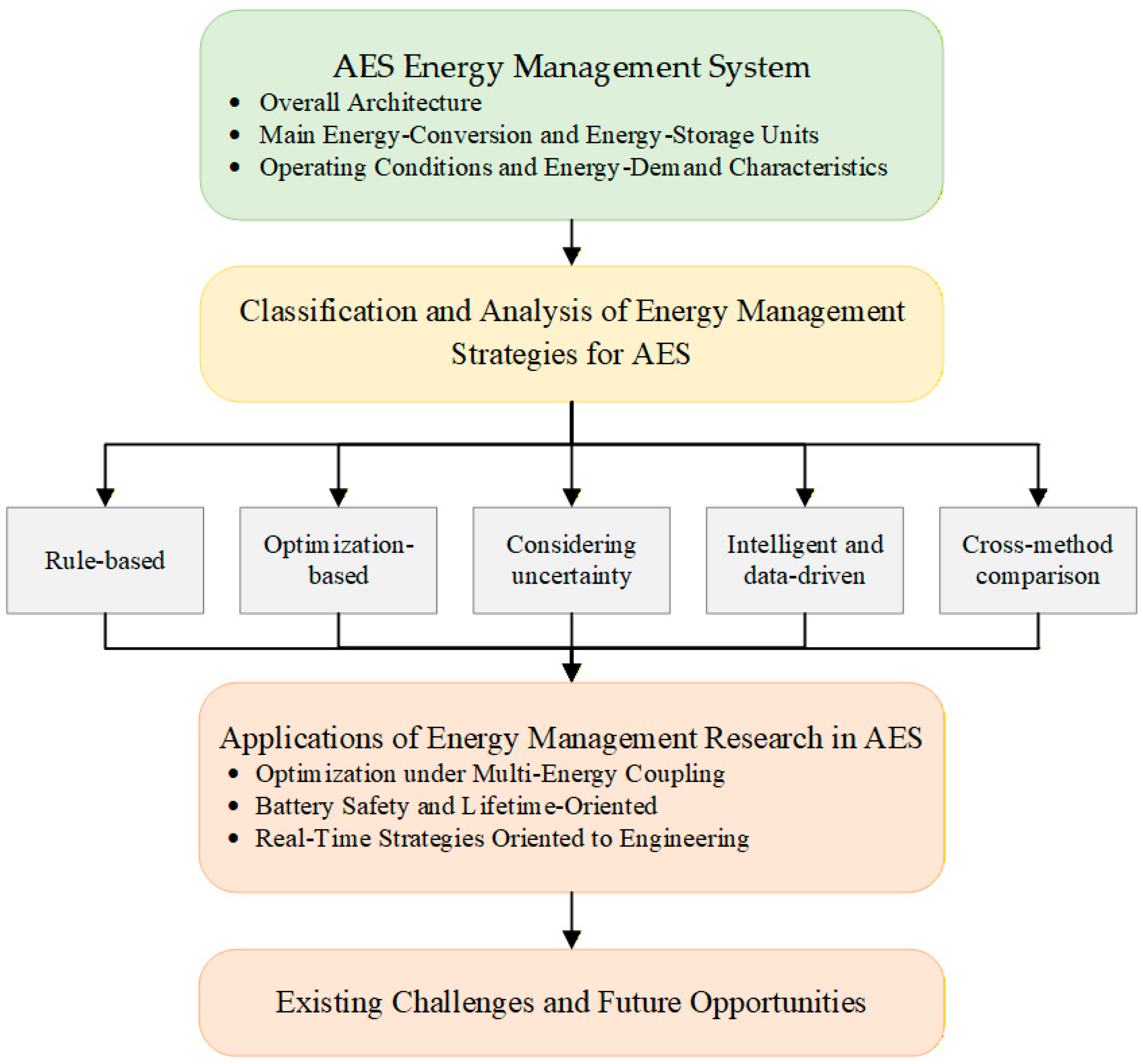
3. Classification and Analysis of Energy Management Strategies for All-Electric Ships
3.1. Rule-Based Energy Management Strategies
3.2. Optimization-Based Energy Management Strategies
3.3. Energy Management Methods Under Uncertainty
3.4. Intelligent and Data-Driven Energy Management Strategies
3.5. Cross-Method Comparison and Research Gaps
4. Applications of Energy Management Research in All-Electric Ships
4.1. Energy Management and System Optimization Under Multi-Energy Coupling
4.1.1. System Architecture and Configuration Optimization of Multi-Energy Ships
4.1.2. Evolution of Energy Management Strategies and Control Methods
4.1.3. Ship-Port-Microgrid Coordinated Energy Management
4.1.4. Typical Application Scenarios and Progress in Engineering Validation
4.2. Battery Safety Management and Lifetime-Oriented Energy Management
4.2.1. Energy Management Strategies Considering Battery Degradation
4.2.2. Battery Safety Management and Coordinated Control with BMS
4.2.3. Impacts of Uncertainty on Battery Performance and Energy Management
4.3. Real-Time Energy Management Strategies Oriented to Engineering Applications
4.3.1. Rule- and Experience-Based Real-Time Control Methods
4.3.2. Real-Time Energy Management Based on Optimization and Model Predictive
4.3.3. Real-Time Scheduling Under Engineering Constraints and Application Scenarios
5. Existing Challenges for AES
5.1. System-Level Complexity and Lifecycle Co-Optimization
5.2. Energy Storage Safety, Reliability, and Uncertainty Management
5.3. Intelligence-Driven Energy Management and Green Port Synergy
6. Conclusions
- System-Level Lifecycle Co-Optimization. Current research predominantly focuses on operational energy management, while the coordination between planning decisions (e.g., component sizing, route scheduling) and real-time control remains fragmented. Future work should develop holistic optimization frameworks that integrate lifecycle cost, carbon footprint, and component degradation into a unified decision-making architecture. Such frameworks would enable systematic trade-offs between economic performance, environmental impact, and long-term system reliability.
- Energy Storage Safety, Reliability, and Uncertainty Management. Lithium-ion batteries remain a critical operational risk factor under complex maritime conditions. Although degradation-aware and safety-constrained EMS formulations have been proposed, their validation is largely limited to simulations or short-term laboratory tests. Future research should focus on long-duration, real-vessel validation of aging-aware and safety-constrained EMS, incorporating the full range of operational uncertainties—sea-state variability, load fluctuations, and battery state-estimation errors—into robust, stochastic, or distributionally robust optimization frameworks.
- Intelligence-Driven Energy Management and Green Port Synergy. The integration of artificial intelligence, digital twins, and next-generation communication technologies offers new opportunities for predictive and adaptive energy management. However, most intelligent EMS applications remain limited to individual vessels or subsystems, with insufficient coordination with port energy infrastructure. Future work should advance ship-port-microgrid co-management platforms that enable information sharing, coordinated dispatch, and real-time optimization across heterogeneous energy assets. Methods such as multi-agent reinforcement learning and digital-twin-enabled predictive control are promising directions for achieving adaptive, scalable, and resilient energy management.
Author Contributions
Funding
Institutional Review Board Statement
Informed Consent Statement
Data Availability Statement
Conflicts of Interest
References
- Hou, J.; Sun, J.; Hofmann, H.F. Mitigating power fluctuations in electric ship propulsion with Hybrid Energy Storage System: Design and analysis. IEEE J. Ocean. Eng. 2018, 43, 93–107. [Google Scholar] [CrossRef]
- Hou, J.; Sun, J.; Hofmann, H. Control development and performance evaluation for battery/flywheel hybrid energy storage solutions to mitigate load fluctuations in all-electric ship propulsion systems. Appl. Energy 2018, 212, 919–930. [Google Scholar] [CrossRef]
- Fang, S.; Xu, Y. Multi-objective robust energy management for all-electric shipboard microgrid under uncertain wind and wave. Int. J. Electr. Power Energy Syst. 2020, 117, 105600. [Google Scholar] [CrossRef]
- Wen, S.; Zhao, T.; Tang, Y.; Xu, Y.; Zhu, M.; Huang, Y. A joint photovoltaic-dependent navigation routing and energy storage system sizing scheme for more efficient All-Electric Ships. IEEE Trans. Transp. Electrif. 2020, 6, 1279–1289. [Google Scholar] [CrossRef]
- Zhao, T.; Qiu, J.; Wen, S.; Zhu, M. Efficient onboard energy storage system sizing for All-Electric Ship microgrids via optimized navigation routing under onshore uncertainties. IEEE Trans. Ind. Appl. 2022, 58, 1664–1674. [Google Scholar] [CrossRef]
- Kim, Y.-R.; Kim, J.-M.; Jung, J.-J.; Kim, S.-Y.; Choi, J.-H.; Lee, H.-G. Comprehensive design of DC shipboard power systems for pure electric propulsion ship based on battery energy storage system. Energies 2021, 14, 5264. [Google Scholar] [CrossRef]
- Hein, K. Emission-aware and data-driven many-objective voyage and energy management optimization of solar-integrated all-electric ship. Electr. Power Syst. Res. 2022, 213, 108718. [Google Scholar] [CrossRef]
- Cao, W.; Geng, P.; Xu, X.; Tarasiuk, T. Energy Management strategy considering energy storage system degradation for hydrogen fuel cell ship. Pol. Marit. Res. 2023, 30, 95–104. [Google Scholar] [CrossRef]
- Jung, W.; Chang, D. Deep Reinforcement Learning-Based Energy Management for Liquid Hydrogen-Fueled Hybrid Electric Ship Propulsion System. J. Mar. Sci. Eng. 2023, 11, 2007. [Google Scholar] [CrossRef]
- Chen, W.; Tai, K.; Lau, M.W.S.; Abdelhakim, A.; Chan, R.R.; Ådnanes, A.K.; Tjahjowidodo, T. Robust Real-Time Shipboard Energy Management System With Improved Adaptive Model Predictive Control. IEEE Access 2023, 11, 110342–110360. [Google Scholar] [CrossRef]
- Pang, B.; Liu, S.; Zhu, H.; Feng, Y.; Dong, Z. Real-time optimal control of an LNG-fueled hybrid electric ship considering battery degradations. Energy 2024, 296, 131170. [Google Scholar] [CrossRef]
- Nivolianiti, E.; Karnavas, Y.L.; Charpentier, J.-F. Fuzzy logic-based energy management strategy for hybrid fuel cell electric ship power and propulsion system. J. Mar. Sci. Eng. 2024, 12, 1813. [Google Scholar] [CrossRef]
- Li, X.; Pan, L.; Zhang, J.; Jin, Z.; Jiang, W.; Wang, Y.; Liu, L.; Tang, R.; Lai, J.; Yang, X.; et al. A novel capacity allocation method for hybrid energy storage system for electric ship considering life cycle cost. J. Energy Storage 2025, 116, 116070. [Google Scholar] [CrossRef]
- Liu, S.; Wang, Y.; Liu, Q.; Panchal, S.; Zhao, J.; Fowler, M.; Fraser, R.; Yuan, J. Thermal equalization design for the battery energy storage system (BESS) of a fully electric ship. Energy 2024, 312, 133611. [Google Scholar] [CrossRef]
- Duranti, L.; Panunzi, A.P.; Draz, U.; D’Ottavi, C.; Licoccia, S.; Di Bartolomeo, E. Pt-doped lanthanum ferrites as versatile electrode material for solid oxide cells. ECS Trans. 2023, 111, 2425–2433. [Google Scholar] [CrossRef]
- Marino, F.; Loreti, G.; Della Pietra, M.; Cigolotti, V.; Monteleone, G.; Jannelli, E. Experimental investigation of reversible solid oxide fuel cells coupled with a domestic load and a photovoltaic system for seasonal storage purposes. Int. J. Hydrogen Energy 2026, 220, 154111. [Google Scholar] [CrossRef]
- Park, M.-H.; Yeo, S.; Kim, J.-H.; Choi, J.-H.; Lee, W.-J. Comprehensive review on recent progress in renewable and sustainable energy applications in shipping industry, and suggestions for future developments. Renew. Sustain. Energy Rev. 2026, 225, 116152. [Google Scholar] [CrossRef]
- Sutikno, T.; Arsadiando, W.; Wangsupphaphol, A.; Yudhana, A.; Facta, M. A review of recent advances on hybrid energy storage system for solar photovoltaics power generation. IEEE Access 2022, 10, 42346–42364. [Google Scholar] [CrossRef]
- Sahraie, E.; Kamwa, I.; Moeini, A.; Mohseni-Bonab, S.M. Component and system levels limitations in power-hydrogen systems: Analytical review. Energy Strategy Rev. 2024, 54, 101476. [Google Scholar] [CrossRef]
- Alhousni, F.K.; Okonkwo, P.C.; Barhoumi, E. Review of optimal design and enhanced hybrid energy systems using energy management strategies. Energies 2025, 18, 5652. [Google Scholar] [CrossRef]
- Zhou, R.L.; Yang, L.; Fan, A.L.; Liu, Q.; Wang, L.; Yang, J.Z.; Vladimir, N. Systematic review of battery electric ship safety: Risk factors, assessment methods, and preventive measures. Int. J. Nav. Archit. Ocean Eng. 2025, 17, 100710. [Google Scholar] [CrossRef]
- Razmjoo, A.; Ghazanfari, A.; Østergaard, P.A.; Jahangiri, M.; Sumper, A.; Ahmadzadeh, S.; Eslamipoor, R. Moving toward the expansion of energy storage systems in renewable energy systems—A techno-institutional investigation with Artificial Intelligence consideration. Sustainability 2024, 16, 9926. [Google Scholar] [CrossRef]
- Chen, X.; Xin, Z.; Zhang, H.; Wu, Y.; Wei, C.; Postolache, O. Vision transformer-based image dehazing for climate-resilient maritime navigation. IEEE Trans. Intell. Transp. Syst. 2026, 1–13. [Google Scholar] [CrossRef]
- Guo, X.D.; Lang, X.; Yuan, Y.P.; Tong, L.; Shen, B.Y.; Long, T.; Mao, W.A. Energy management system for hybrid ship: Status and perspectives. Ocean Eng. 2024, 310, 118638. [Google Scholar] [CrossRef]
- Ma, Z.; Chen, H.; Han, J.; Chen, Y.; Kuang, J.; Charpentier, J.-F.; Aϊt-Ahmed, N.; Benbouzid, M. Optimal SOC control and rule-based energy management strategy for fuel-cell-based hybrid vessel including batteries and supercapacitors. J. Mar. Sci. Eng. 2023, 11, 398. [Google Scholar] [CrossRef]
- Choi, E.; Kim, H. Advanced energy management system for generator-battery hybrid power system in ships: A novel approach with optimal control algorithms. J. Mar. Sci. Eng. 2024, 12, 1755. [Google Scholar] [CrossRef]
- Yuan, Y.P.; Zhang, T.D.; Shen, B.Y.; Yan, X.P.; Long, T. A fuzzy logic energy management strategy for a photovoltaic/diesel/battery hybrid ship based on experimental database. Energies 2018, 11, 2211. [Google Scholar] [CrossRef]
- Zhao, Z.-H. Improved fuzzy logic control-based energy management strategy for hybrid power system of FC/PV/battery/SC on tourist ship. Int. J. Hydrogen Energy 2022, 47, 9719–9734. [Google Scholar] [CrossRef]
- Xiao, Y.; Xiao, G.; Li, J. Photovoltaic-energy storage systems empowered: Low-carbon and economic scheduling for electric buses. Transp. Res. Part D Transp. Environ. 2026, 150, 105082. [Google Scholar] [CrossRef]
- Wang, X.; Li, Z.; Luo, X.; Chang, S.; Zhu, H.; Guan, X.; Wang, S. A novel bi-level optimization model-based optimal energy scheduling for hybrid ship power system. MRS Energy Sustain. 2023, 10, 247–260. [Google Scholar] [CrossRef]
- Xu, L.; Wen, Y.T.; Luo, X.Y.; Lu, Z.G.; Guan, X.P. A modified power management algorithm with energy efficiency and GHG emissions limitation for hybrid power ship system? Appl. Energy 2022, 317, 119114. [Google Scholar] [CrossRef]
- Coraddu, A.; Tamburello, S.; Löffler, C.; Ceyhun, H.E.; van Biert, L.; Oneto, L. State-of-art energy management strategies for hybrid fuel cell applications for ships. In Fuel Cell and Hydrogen Technologies in Maritime Transportation; Colpan, C.O., Korkmaz, S.A., Konur, O., Eds.; Springer Nature: Cham, Switzerland, 2025; pp. 121–178. [Google Scholar]
- Ge, Y.Q.; Zhang, J.D.; Zhou, K.X.; Zhu, J.T.; Wang, Y.K. Research on energy management for ship hybrid power system based on adaptive equivalent consumption minimization strategy. J. Mar. Sci. Eng. 2023, 11, 1271. [Google Scholar] [CrossRef]
- Antonopoulos, S.; Visser, K.; Kalikatzarakis, M.; Reppa, V. MPC framework for the energy management of hybrid ships with an energy storage system. J. Mar. Sci. Eng. 2021, 9, 993. [Google Scholar] [CrossRef]
- Chen, L.; Gao, D.J.; Xue, Q.M. Energy management strategy for hybrid power ships based on nonlinear model predictive control. Int. J. Electr. Power Energy Syst. 2023, 153, 109319. [Google Scholar] [CrossRef]
- Brancato, V.; Esposito, G.; Coppola, L.; Cavaliere, C.; Mirabelli, P.; Scapicchio, C.; Borgheresi, R.; Neri, E.; Salvatore, M.; Aiello, M. Standardizing digital biobanks: Integrating imaging, genomic, and clinical data for precision medicine. J. Transl. Med. 2024, 22, 136. [Google Scholar] [CrossRef]
- Mushtaq, R.; Iqbal, M.; Khaliq, A.; Iqbal, J. Optimal design of a hybrid ship energy management system under various sea conditions using Model Predictive Control. PLoS ONE 2025, 20, e0326969. [Google Scholar] [CrossRef] [PubMed]
- Yan, Y.C.; Chen, Z.C.; Gao, D.J. Nonlinear model predictive control energy management strategy for hybrid power ships based on working condition identification. J. Mar. Sci. Eng. 2025, 13, 269. [Google Scholar] [CrossRef]
- Hooshmand, H.; Nasiri, N.; Ravdanegh, S.N. Sustainable power management solutions for shipboard power systems: Incorporating CHP, hydrogen fuel cells, battery, and solar energy. J. Energy Storage 2025, 131, 115789. [Google Scholar] [CrossRef]
- Kim, G.; Lee, M.; Chung, I.-Y. Robust optimal power scheduling for fuel cell electric ships under marine environmental uncertainty. Energies 2025, 18, 2837. [Google Scholar] [CrossRef]
- Markhorst, B.; Berkhout, J.; Zocca, A.; Pruyn, J.; Van Der Mei, R. Future-proof ship pipe routing: Navigating the energy transition. Ocean Eng. 2025, 319, 120113. [Google Scholar] [CrossRef]
- Mitsuyuki, T.; Kuribayashi, K.; Fernandez, R.F.S.; Shimozawa, H.; Kakuta, R.; Niki, R.; Matsushita, R. MMG 3DOF model identification with uncertainty of observation and hydrodynamic maneuvering coefficients using MCMC method. J. Mar. Sci. Technol. 2024, 29, 668–682. [Google Scholar] [CrossRef]
- Banaei, M.; Boudjadar, J.; Khooban, M.-H. Stochastic model predictive energy management in hybrid emission-free modern maritime vessels. IEEE Trans. Ind. Inform. 2021, 17, 5430–5440. [Google Scholar] [CrossRef]
- Kafali, M.; Aydin, N.; Genç, Y.; Çelebi, U.B. A two-stage stochastic model for workforce capacity requirement in shipbuilding. J. Mar. Eng. Technol. 2022, 21, 146–158. [Google Scholar] [CrossRef]
- Dhingra, V.; Roy, D.; De Koster, R.B.M. A cooperative quay crane-based stochastic model to estimate vessel handling time. Flex. Serv. Manuf. J. 2017, 29, 97–124. [Google Scholar] [CrossRef]
- Li, J.; Han, Y.; Li, K.; Gong, Q.; Teng, Y.; Chu, S. WT-A-LSTM-KAN: A novel hybrid deep learning framework for high-precision short-term prediction of moored ship roll and pitch motions. Ocean Eng. 2026, 346, 123968. [Google Scholar] [CrossRef]
- Chen, X.; Liu, X.; Luo, Y.; Zeng, X. Exploring time-series deep learning models for ship fuel consumption prediction. J. Mar. Sci. Eng. 2025, 13, 2102. [Google Scholar] [CrossRef]
- Han, P.; Li, S.; Liu, Z.; Sun, Z.; Yan, C. Ship fuel oil consumption prediction at sea and in port considering sustainable maritime industry: A comparative study of machine learning and deep learning approaches. Proc. Inst. Mech. Eng. Part M J. Eng. Marit. Environ. 2025, 239, 868–883. [Google Scholar] [CrossRef]
- Lan, T.; Huang, L.; Cao, J.; Ma, R.; Zhao, H.; Ruan, Z.; Wu, J.; Li, X.; Wang, K. A pioneering approach for improving ship operational energy efficiency: The quantitative application of deep learning interpretable results. Appl. Energy 2025, 400, 126554. [Google Scholar] [CrossRef]
- Vu, H.T.; Mai, V.T.; Nguyen, T.T.D.; Yoon, H.K.; Choi, H. A hybrid statistical and neural network method for detecting abnormal ship behavior using leisure boat sea trial data in a marina port. J. Mar. Sci. Eng. 2025, 13, 2391. [Google Scholar] [CrossRef]
- Li, F.; Fu, L.; Du, X.; Zhang, X.; Cheng, H.; Tong, N.; Xu, F. Large model-driven physical neural network architecture: Coupled multi-environmental factors for vessel drift trajectory prediction. Ocean Eng. 2026, 343, 123560. [Google Scholar] [CrossRef]
- Qi, Y.; Shang, S.; Li, H. Dynamic inverse control of ship rudder roll/ yaw stabilization based on neural network disturbance observer. J. Mar. Sci. Technol. 2025, 31, 24–39. [Google Scholar] [CrossRef]
- Meighani Nejad, A.; Hosseini, S.M.; Sobhani, B.; Harifi, A. Fault-tolerant controller based on artificial intelligence combined with terminal sliding mode and pre-described performance function applied on ship dynamic position stabilization systems. Eng. Appl. Artif. Intell. 2024, 132, 107890. [Google Scholar] [CrossRef]
- Mutarraf, M.U.; Terriche, Y.; Niazi, K.A.; Vasquez, J.C.; Guerrero, J.M. Energy storage systems for shipboard microgrids—A review. Energies 2018, 11, 3492. [Google Scholar] [CrossRef]
- Guo, S.; Wang, Y.; Dai, L.; Hu, H. All-electric ship operations and management: Overview and future research directions. eTransportation 2023, 17, 100251. [Google Scholar] [CrossRef]
- Aziz, A.S.; Tajuddin, M.F.; Adzman, M.R.; Ramli, M.A.M.; Mekhilef, S. Energy management and optimization of a PV/diesel/battery hybrid energy system using a combined dispatch strategy. Sustainability 2019, 11, 683. [Google Scholar] [CrossRef]
- Fang, S.; Xu, Y.; Li, Z.; Zhao, T.; Wang, H. Two-step multi-objective management of hybrid energy storage system in All-Electric Ship microgrids. IEEE Trans. Veh. Technol. 2019, 68, 3361–3373. [Google Scholar] [CrossRef]
- Zou, Y.; Yang, Y.; Zhang, Y. Configuration and parameter design of electrified propulsion systems for three-dimensional transportation: A comprehensive review. Green Energy Intell. Transp. 2025, 5, 100286. [Google Scholar] [CrossRef]
- Kolodziejski, M.; Michalska-Pozoga, I. Battery energy storage systems in ships’ hybrid/ electric propulsion systems. Energies 2023, 16, 1122. [Google Scholar] [CrossRef]
- Fang, S.; Xu, Y.; Wang, H.; Shang, C.; Feng, X. Robust operation of shipboard microgrids with multiple-battery energy storage system under navigation uncertainties. IEEE Trans. Veh. Technol. 2020, 69, 10531–10544. [Google Scholar] [CrossRef]
- Huang, Y.; Lan, H.; Hong, Y.-Y.; Wen, S.; Fang, S. Joint voyage scheduling and economic dispatch for all-electric ships with virtual energy storage systems. Energy 2020, 190, 116268. [Google Scholar] [CrossRef]
- Hein, K.; Murali, R.; Xu, Y.; Aditya, V.; Gupta, A.K. Battery thermal performance oriented all-electric ship microgrid modeling, operation and energy management scheduling. J. Energy Storage 2022, 48, 103970. [Google Scholar] [CrossRef]
- Fang, H.; Zhang, H.; Wen, S.; Li, Z.; Zeng, Z.; Zhu, M.; Lin, P. A reinforcement learning based real-time energy management method for mobile microgrid considering photovoltaic uncertainty. Int. J. Electr. Power Energy Syst. 2025, 170, 110844. [Google Scholar] [CrossRef]
- Guo, Y.; Dai, X.; Jermsittiparsert, K.; Razmjooy, N. An optimal configuration for a battery and PEM fuel cell-based hybrid energy system using developed Krill herd optimization algorithm for locomotive application. Energy Rep. 2020, 6, 885–894. [Google Scholar] [CrossRef]
- Alafnan, H.; Zhang, M.; Yuan, W.; Zhu, J.; Li, J.; Elshiekh, M.; Li, X. Stability improvement of DC power systems in an All-Electric Ship using hybrid SMES/battery. IEEE Trans. Appl. Supercond. 2018, 28, 5700306. [Google Scholar] [CrossRef]
- Hou, J.; Song, Z.; Hofmann, H.; Sun, J. Adaptive model predictive control for hybrid energy storage energy management in all-electric ship microgrids. Energy Convers. Manag. 2019, 198, 111929. [Google Scholar] [CrossRef]
- Abkenar, A.T.; Nazari, A.; Jayasinghe, S.D.G.; Kapoor, A.; Negnevitsky, M. Fuel cell power management using genetic expression programming in All-Electric Ships. IEEE Trans. Energy Convers. 2017, 32, 779–787. [Google Scholar] [CrossRef]
- Zhang, D.; Chen, Z.; Cai, L.X.; Zhou, H.; Duan, S.; Ren, J.; Shen, X.; Zhang, Y. Resource allocation for green cloud radio access networks with hybrid energy supplies. IEEE Trans. Veh. Technol. 2018, 67, 1684–1697. [Google Scholar] [CrossRef]
- Peng, B.; Sun, R.; Chen, Y. The Application and prospects of electric ships in the maritime industry. Acad. J. Sci. Technol. 2024, 12, 6–9. [Google Scholar] [CrossRef]
- Kong, L.; Luo, Y.; Fang, S.; Niu, T.; Chen, G.; Yang, L.; Liao, R. State estimation of lithium-ion battery for shipboard applications: Key challenges and future trends. Green Energy Intell. Transp. 2025, 4, 100192. [Google Scholar] [CrossRef]
- Ye, H.; Wen, S.; Yan, L.; Huang, Y.; Zhu, M.; Dong, Z. Optimal energy efficiency management strategy for All-Electric Shipboard microgrid. In Proceedings of the 2023 8th Asia Conference on Power and Electrical Engineering (ACPEE), Tianjin, China, 14–16 April 2023; pp. 234–239. [Google Scholar]
- Farman, M.K.; Nikhila, J.; Sreeja, A.; Roopa, B.; Sahithi, K.; Gireesh Kumar, D. AI-enhanced battery management systems for electric vehicles: Advancing safety, performance, and longevity. E3S Web Conf. 2024, 591, 04001. [Google Scholar] [CrossRef]
- Rui, X.; Weixiang, S. Battery management systems in electric vehicles. In Advanced Battery Management Technologies for Electric Vehicles; Wiley: New York, NY, USA, 2019; pp. 231–248. [Google Scholar]
- Vanem, E.; Salucci, C.B.; Bakdi, A.; Alnes, Ø.Å.S. Data-driven state of health modelling—A review of state of the art and reflections on applications for maritime battery systems. J. Energy Storage 2021, 43, 103158. [Google Scholar] [CrossRef]
- Zhu, T.; Cruden, A.; Peng, Q.; Liu, K. Enabling extreme fast charging. Joule 2023, 7, 2660–2662. [Google Scholar] [CrossRef]
- Chen, R.; Yu, W.; Zhu, Y.; Wang, J. Energy management strategy of marine lithium batteries based on cyclic life. IOP Conf. Ser. Earth Environ. Sci. 2020, 467, 012204. [Google Scholar] [CrossRef]
- Chen, K.; Xie, H.; Yang, H.; Han, G.; Chen, J.; Liu, H. Construction of crystalline/ amorphous heterostructures to enhance the supercapacitor performance of a high-entropy sulfide. J. Alloys Compd. 2025, 1015, 178921. [Google Scholar] [CrossRef]
- Lai, K.; Illindala, M.S. A distributed energy management strategy for resilient shipboard power system. Appl. Energy 2018, 228, 821–832. [Google Scholar] [CrossRef]
- Bahri, R.; Zeynali, S.; Nasiri, N.; Keshavarzi, M.R. Economic-environmental energy supply of mobile base stations in isolated nanogrids with smart plug-in electric vehicles and hydrogen energy storage system. Int. J. Hydrogen Energy 2023, 48, 3725–3739. [Google Scholar] [CrossRef]
- Luo, Y.; Fang, S.; Kong, L.; Niu, T.; Liao, R. Dynamic power management of shipboard hybrid energy storage system under uncertain navigation conditions. IEEE Trans. Transp. Electrif. 2024, 10, 3138–3152. [Google Scholar] [CrossRef]
- Qu, X.; Shao, H.; Wang, S.; Wang, Y. Are more charging piles imperative to future electrified transportation system? Fundam. Res. 2024, 4, 1009–1016. [Google Scholar] [CrossRef]
- Pattanayak, T.; Gautier, R.; Mavris, D. Hybrid-electric turboprop performance under battery degradation: An uncertainty quantification study. Aerosp. Sci. Technol. 2026, 168, 111243. [Google Scholar] [CrossRef]
- Sanjari, M.J.; Karami, H.; Yatim, A.H.; Gharehpetian, G.B. Application of Hyper-Spherical Search algorithm for optimal energy resources dispatch in residential microgrids. Appl. Soft Comput. 2015, 37, 15–23. [Google Scholar] [CrossRef]
- Adefarati, T.; Bansal, R.C.; Shongwe, T.; Naidoo, R.; Bettayeb, M.; Onaolapo, A.K. Optimal energy management, technical, economic, social, political and environmental benefit analysis of a grid-connected PV/WT/FC hybrid energy system. Energy Convers. Manag. 2023, 292, 117390. [Google Scholar] [CrossRef]
- Shang, C.; Srinivasan, D.; Reindl, T. Economic and environmental generation and voyage scheduling of All-Electric Ships. IEEE Trans. Power Syst. 2016, 31, 4087–4096. [Google Scholar] [CrossRef]
- Bazdar, E.; Nasiri, F.; Haghighat, F. An improved energy management operation strategy for integrating adiabatic compressed air energy storage with renewables in decentralized applications. Energy Convers. Manag. 2023, 286, 117027. [Google Scholar] [CrossRef]
- Lagorse, J.; Simoes, M.G.; Miraoui, A. A multiagent fuzzy-logic-based energy management of hybrid systems. IEEE Trans. Ind. Appl. 2009, 45, 2123–2129. [Google Scholar] [CrossRef]
- Torreglosa, J.P.; González-Rivera, E.; García-Triviño, P.; Vera, D. Performance analysis of a hybrid electric ship by real-time verification. Energies 2022, 15, 2116. [Google Scholar] [CrossRef]
- Li, Y.; Pu, Z.; Liu, P.; Qian, T.; Hu, Q.; Zhang, J.; Wang, Y. Efficient predictive control strategy for mitigating the overlap of EV charging demand and residential load based on distributed renewable energy. Renew. Energy 2025, 240, 122154. [Google Scholar] [CrossRef]



| Title | Year | Topic | Core Content | Coverage | Difference |
|---|---|---|---|---|---|
| A review of recent advances on Hybrid Energy Storage System for solar photovoltaics power generation [18] | 2022 | HESS for Solar PV | Capacity sizing, power converter topologies, energy management strategies for HESS in PV power generation | Focuses on HESS for PV; limited to grid-connected/off-grid PV applications | Does not address all-electric ships or multi-energy coordination with fuel cells |
| Component and system levels limitations in power-hydrogen systems: Analytical review [19] | 2024 | Hydrogen Energy Systems (HES) | Component-level limitations (production, storage, transportation) and system-level integration challenges with electric power systems | Comprehensive on hydrogen technology; focuses on hydrogen as energy carrier | Lacks integration with shipboard power systems and energy management strategies specific to AES |
| Review of optimal design and enhanced Hybrid Energy Systems using Energy Management Strategies [20] | 2025 | HES Design and EMS | Optimal system design, modeling approaches, energy management strategies (rule-based, MPC, AI-based) for hybrid renewable systems | Broad coverage of hybrid systems; includes both standalone and grid-connected applications | Does not specifically address all-electric ships; limited focus on ship-port-microgrid coordination |
| Systematic review of battery electric ship safety: risk factors, assessment methods, and preventive measures [21] | 2025 | Battery Electric Ship (BES) Safety | Risk factors (seafarer, ship, environment, management), risk assessment methods, preventive measures for BES safety | Systematic review of BES safety; covers risk identification and mitigation | Focuses on safety rather than energy management optimization; lacks EMS strategy classification |
| Parameter | Content |
|---|---|
| Database | Web of Science Core Collection—SCI-EXPANDED and SSCI |
| Time range | 2002–2025 |
| Document type | journal article OR review article English |
| Language | |
| Search formula | Topics = (“new energy ship” OR “electric ship” OR “All-Electric Ship” OR “AES” OR “Hybrid Electric Ship” OR “HES”) Topics = (“Energy management” OR “Energy management strategy” OR “EMS” OR “Energy storage system” OR “ESS” OR “Hybrid Energy Storage System” OR “HESS” OR “Battery energy storage system” OR “BESS” OR “Battery Management System” OR “BMS”) |
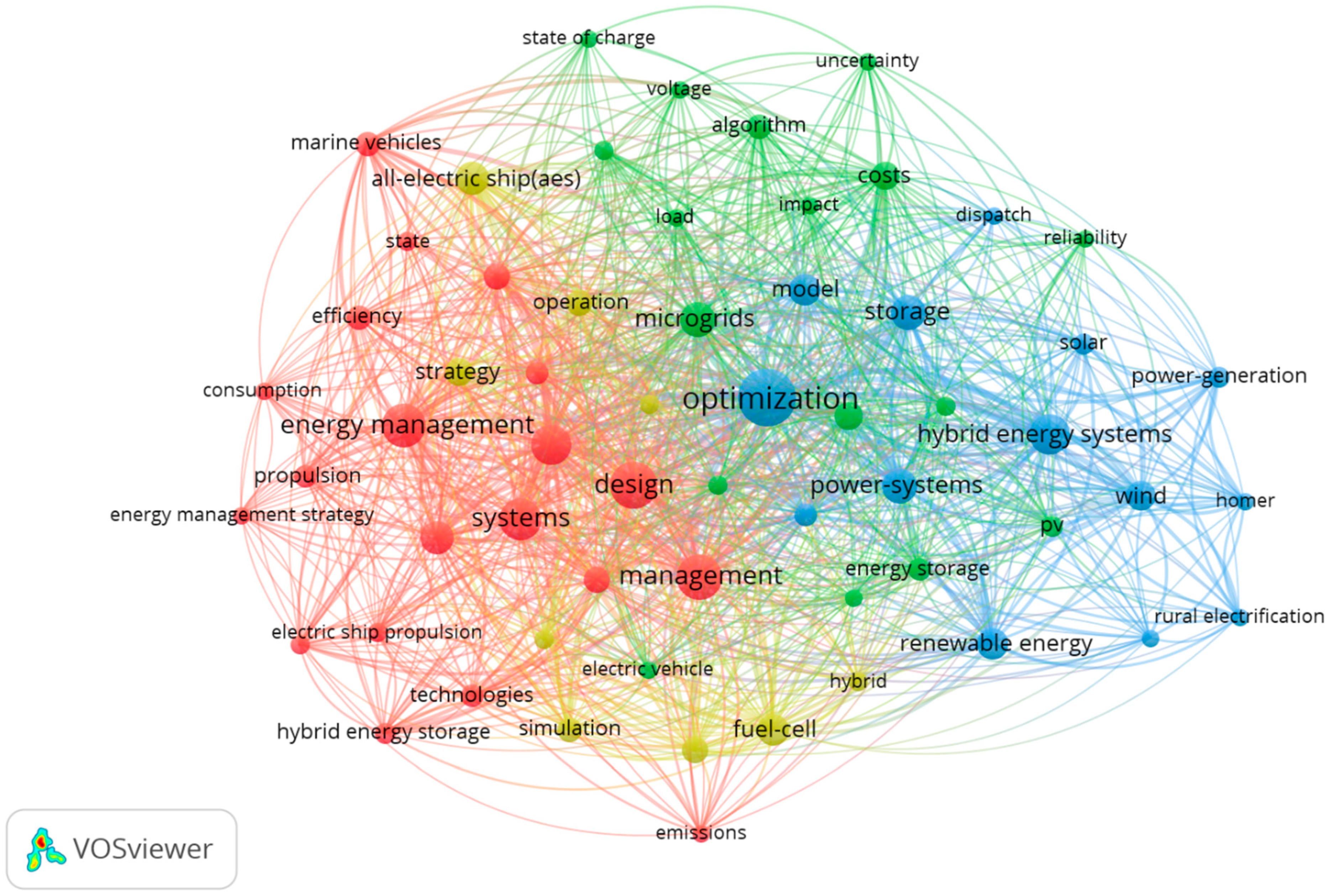
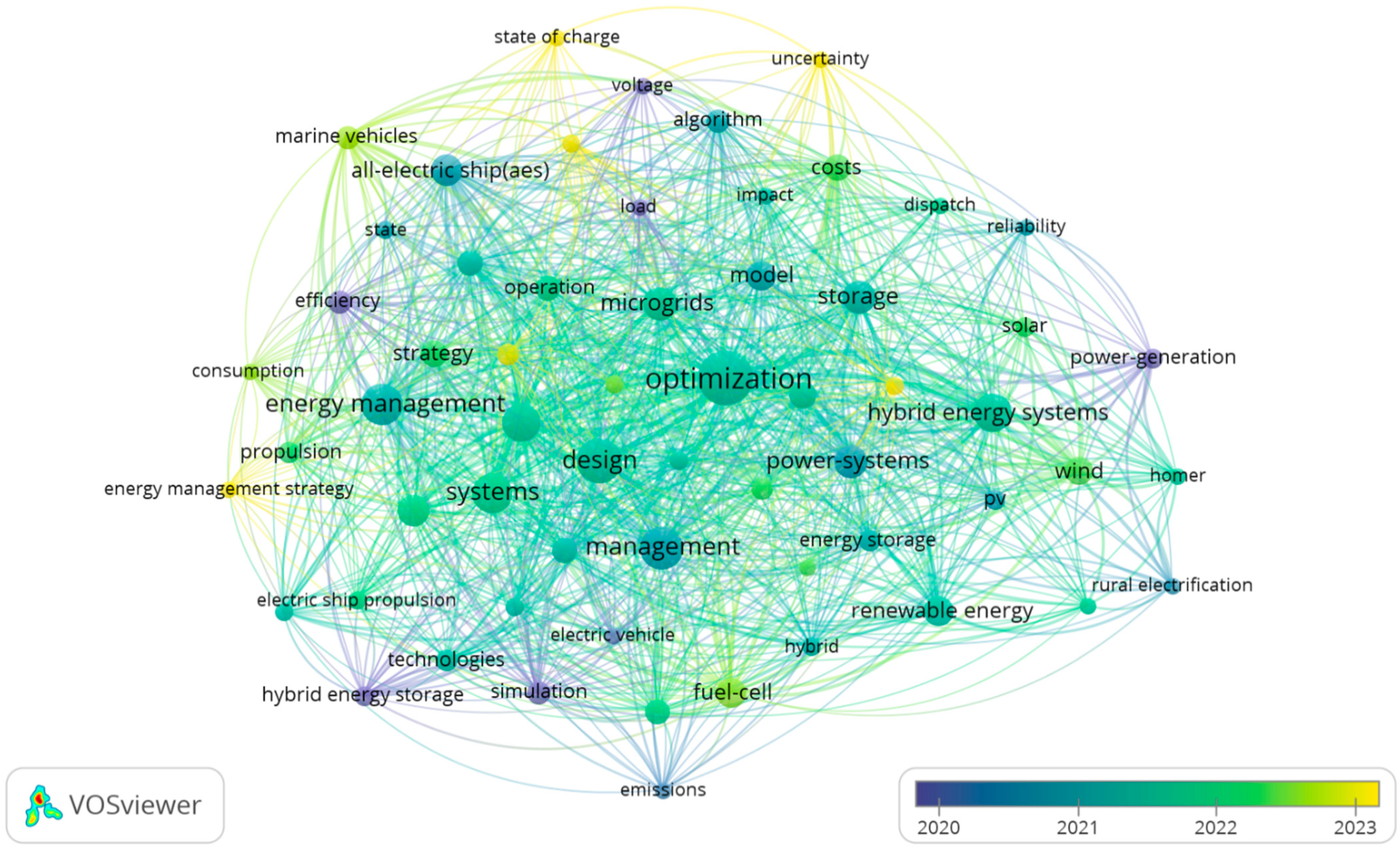
| Keyword | Share (%) |
|---|---|
| Optimization | 13.99% |
| Energy Management | 8.11% |
| Batteries | 6.68% |
| Storage | 5.41% |
| Microgrids | 5.09% |
| Power Systems | 5.09% |
| All-Electric Ships (AES) | 4.93% |
| Fuel Cell | 4.13% |
| Renewable Energy | 4.45% |
| Representative Method | Vessel/Application | Validation Level | Computational Burden | Main Strength | Main Limitation |
|---|---|---|---|---|---|
| SOC/Power Threshold EMS | Small passenger ships, inland vessels, hybrid retrofit projects | Simulation/Case-based engineering studies | Low | Simple structure, fast response, easy integration with existing PMS, reduced start-stop frequency | Thresholds are often empirical, with limited optimization capability and weak adaptability to complex operating conditions |
| Fuzzy-Logic EMS | Passenger ferries and tourist ships with PV or fuel cells | Simulation/Limited experimental studies | Low–Medium | Flexible representation of operator knowledge, low model dependence, mitigates hard switching | Requires extensive tuning, rule design is experience-dependent, and generalization is limited |
| Hierarchical rule-based EMS | Medium and large commercial ships with strict safety and economy requirements | Simulation/Engineering-oriented case studies | Medium | Balances economy and dynamic response, highly interpretable, suitable for layered shipboard control architecture | More complex control structure and calibration burden than simple threshold-based strategies |
| Representative Method | Vessel/Application | Validation Level | Computational Burden | Main Strength | Main Limitation |
|---|---|---|---|---|---|
| Bi-level/Multi-objective optimization | Configuration design and offline scheduling of novel hybrid ships | Simulation/Design-stage optimization studies | High | Supports lifecycle and voyage-scale trade-off analysis for cost, emissions, and configuration design | Computationally intensive and generally unsuitable for direct real-time control |
| ECMS/Adaptive ECMS | Operational EMS for fuel-cell or diesel–battery–supercapacitor ships | Simulation/Controller-oriented case studies | Low–medium | Low computational cost and good real-time applicability for instantaneous power split | Performance is sensitive to equivalence-factor calibration and does not guarantee global optimality |
| MPC/NMPC | Online energy management of medium-to-large hybrid ships | Simulation/Hardware-in-the-loop/Limited engineering validation | Medium–high | Systematic multi-constraint handling, natural feedback capability, suitable for rolling-horizon coordination | Sensitive to model fidelity and prediction quality, with relatively high computational burden |
| Multi-layer MPC + data-driven coordination | Ferries and special-purpose ships with large load fluctuations | Simulation/Integrated control case studies | High | Supports long-short-term coordination and improved robustness to stochastic load variation | High implementation complexity and stronger hardware/Software integration requirements |
| Representative Method | Vessel/Application | Validation Level | Computational Burden | Main Strength | Main Limitation |
|---|---|---|---|---|---|
| Robust optimization for generation–voyage co-scheduling | PEMFC + BESS electric propulsion under wind/current effects | Simulation | High | Provides reliable and cost-controllable scheduling across varying sea states and mission conditions | High modeling and solving complexity; conservatism may increase under wide uncertainty sets |
| Robust optimization for shipboard multi-energy power management | PV-enabled shipboard grids and integrated multi-energy dispatch | Simulation | High | Improves worst-case operational performance and supports coordinated dispatch under renewable uncertainty | Requires comprehensive system-level modeling and strong solver support |
| Stochastic modeling/stochastic MPC | Zero-emission FC/ESS/Shore-power EMS with weather uncertainty | Simulation/rolling-horizon case studies | Medium–high | Enables adaptive and aging-aware decisions under uncertain operating inputs | Strongly depends on the quality of the adopted uncertainty model and prediction framework |
| Distributionally robust optimization | Hybrid-ship microgrid dispatch and emission reduction under joint uncertainty | Simulation | High | Less conservative than classical robust optimization while retaining uncertainty resilience | High formulation complexity and limited evidence of broad real-time shipboard implementation |
| Representative Method | Vessel/Application | Validation Level | Computational Burden | Main Strength | Main Limitation |
|---|---|---|---|---|---|
| Data-driven EMS via energy-use prediction | Fuel-use forecasting and sailing/Berthing management | Data-driven case studies/Simulation-based validation | Medium | Captures temporal dependence and provides predictive inputs for operational decision support | Mainly prediction-oriented rather than direct power allocation; strongly data-dependent |
| Multi-scenario fuel prediction | Company-level or port-level fuel management and emissions reduction | Multi-ship data analysis/Case-based validation | Medium | Broad comparative coverage and useful managerial insights across multiple operating scenarios | Best-performing model may vary by vessel and scenario, making transfer and deployment more difficult |
| Predict-and-optimize integrated framework | Operating-parameter tuning for fuel saving and emissions reduction | Case-based predictive optimization studies | Medium–high | Forms a closed loop from interpretable prediction to operational optimization with quantified gains | Multi-step workflow increases implementation complexity and integration burden |
| State prediction with uncertainty quantification | Sea-state-dependent roll/Pitch forecasting to support operation adjustment | Data-driven prediction studies | Medium–high | Provides forward-looking system states and uncertainty information to support adaptive strategy adjustment | Focuses on motion prediction rather than direct energy allocation; requires stable feature extraction and sufficient data support |
| Anomaly detection and condition-aware monitoring | Port and sea-trial monitoring, anomaly warning for (semi-) autonomous navigation | Monitoring-oriented case studies/Experimental data validation | Medium | Supports early fault/Anomaly detection and condition-aware operational monitoring | False alarms and noise discrimination remain important challenges in practical deployment |
| Method Classification | Computational Complexity | Real-Time Feasibility | Uncertainty Handling | Engineering Readiness |
|---|---|---|---|---|
| Rule-based | Low | High | Low | High |
| ECMS/A-ECMS | Low–Medium | High | Low–Medium | Medium–High |
| MPC/NMPC | Medium–High | Medium | Medium | Medium |
| Robust/Stochastic/DRO | High | Low–Medium | High | Low–Medium |
| Data-driven/AI-assisted | Medium–High | Medium | Medium–High | Low–Medium |
Disclaimer/Publisher’s Note: The statements, opinions and data contained in all publications are solely those of the individual author(s) and contributor(s) and not of MDPI and/or the editor(s). MDPI and/or the editor(s) disclaim responsibility for any injury to people or property resulting from any ideas, methods, instructions or products referred to in the content. |
© 2026 by the authors. Licensee MDPI, Basel, Switzerland. This article is an open access article distributed under the terms and conditions of the Creative Commons Attribution (CC BY) license.
Share and Cite
Xing, L.; Wang, Y.; Zhang, H.; Xiao, G.; Chen, X.; Li, Q.; Mu, L.; Cai, L. Energy Management Technologies for All-Electric Ships: A Comprehensive Review for Sustainable Maritime Transport. Sustainability 2026, 18, 3778. https://doi.org/10.3390/su18083778
Xing L, Wang Y, Zhang H, Xiao G, Chen X, Li Q, Mu L, Cai L. Energy Management Technologies for All-Electric Ships: A Comprehensive Review for Sustainable Maritime Transport. Sustainability. 2026; 18(8):3778. https://doi.org/10.3390/su18083778
Chicago/Turabian StyleXing, Lyu, Yiqun Wang, Han Zhang, Guangnian Xiao, Xinqiang Chen, Qingjun Li, Lan Mu, and Li Cai. 2026. "Energy Management Technologies for All-Electric Ships: A Comprehensive Review for Sustainable Maritime Transport" Sustainability 18, no. 8: 3778. https://doi.org/10.3390/su18083778
APA StyleXing, L., Wang, Y., Zhang, H., Xiao, G., Chen, X., Li, Q., Mu, L., & Cai, L. (2026). Energy Management Technologies for All-Electric Ships: A Comprehensive Review for Sustainable Maritime Transport. Sustainability, 18(8), 3778. https://doi.org/10.3390/su18083778