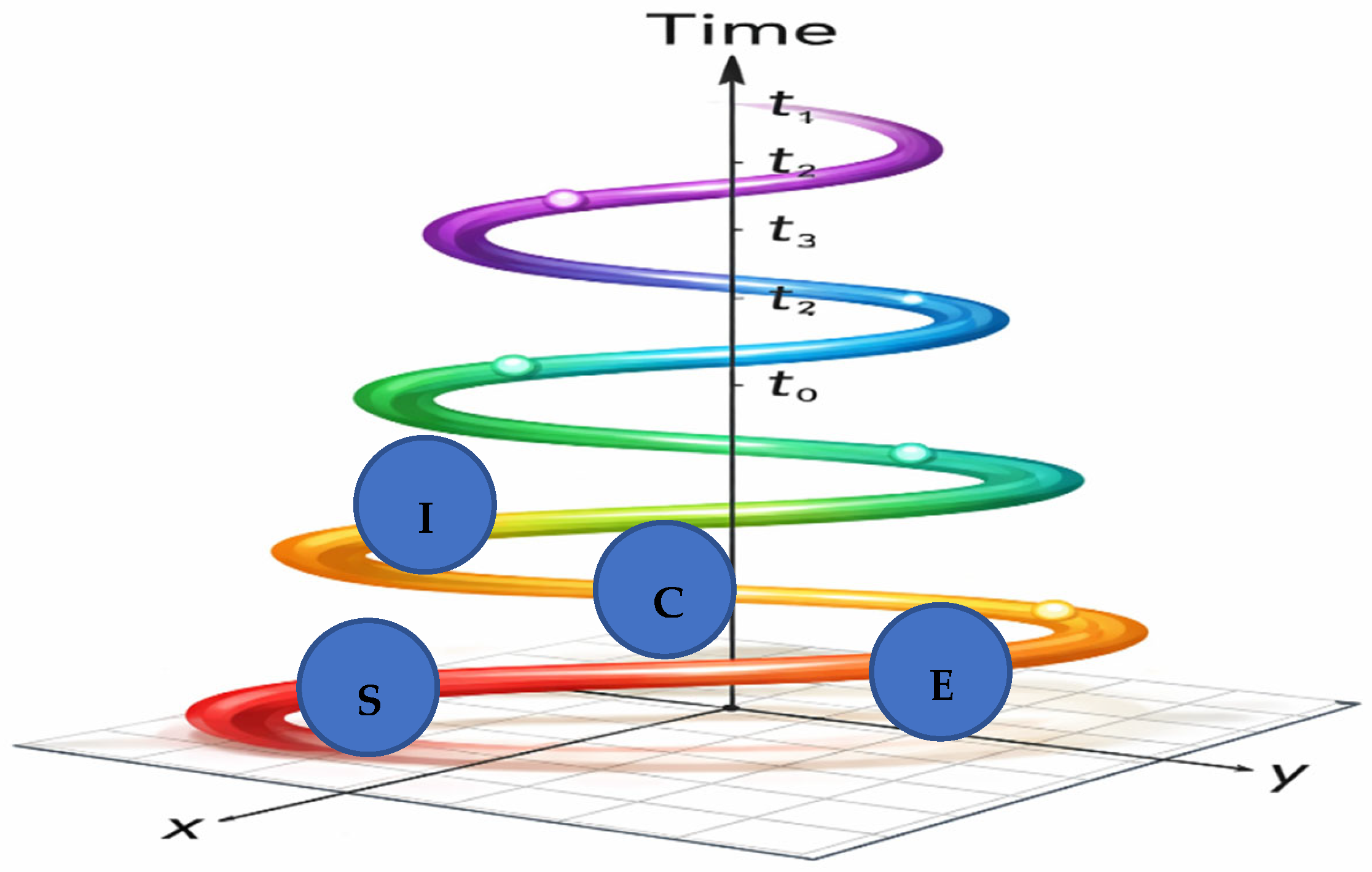
Möbius Strip Model for Augmenting Organizational Knowledge Creation Dynamics by Integrating Human and Artificial Knowledge: A New Driving Force for Business Sustainability


Abstract
1. Introduction
2. Literature Review
2.1. Human Knowledge Creation Dynamics
2.2. Augmenting the SECI Model with Artificial Knowledge
2.3. GenAI and Sustainable Business Development
3. Methodology
4. Results and Discussion
5. Conclusions
6. Limitations and Directions for Future Research
Author Contributions
Funding
Institutional Review Board Statement
Informed Consent Statement
Data Availability Statement
Acknowledgments
Conflicts of Interest
References
- Nonaka, I. A Dynamic Theory of Organizational Knowledge Creation. Organ. Sci. 1994, 5, 14–37. [Google Scholar] [CrossRef]
- Nonaka, I.; Takeuchi, H. The Knowledge Creation Company: How Japanese Companies Create the Dynamics of Innovation; Oxford University Press: Oxford, UK, 1995. [Google Scholar]
- Nonaka, I.; Takeuchi, H. The Wise Company: How Companies Create Continuous Innovation; Oxford University Press: Oxford, UK, 2019. [Google Scholar]
- Nonaka, I.; Toyama, R.; Hirata, T. Managing Flow: A Process Theory of the Knowledge-Based Firm; Palgrave Macmillan: New York, NY, USA, 2008. [Google Scholar]
- Polanyi, M. The Tacit Dimension; Peter Smith: Gloucester, UK, 1983. [Google Scholar]
- Kolb, D.A. Experiential Learning: Experience as the Source of Learning and Development, 2nd ed.; Pearson: Upper Saddle River, NJ, USA, 2015. [Google Scholar]
- Davenport, T.H.; Prusak, L. Working Knowledge: How Organizations Manage What They Know; Harvard Business School Press: Boston, MA, USA, 2000. [Google Scholar]
- Massingham, P. Knowledge Management: Theory in Practice; SAGE: Los Angeles, CA, USA, 2020. [Google Scholar]
- Konno, N. Kōsō-Ryoku: Conceptualizing Capability: For Innovation and Management in the Age of Para-Existence; Springer Nature: Singapore, 2024. [Google Scholar]
- Tsoukas, H. How Should We Understand Tacit Knowledge? A Phenomenological View. In Handbook of Organizational Learning and Knowledge Management, 2nd ed.; Easterby-Smith, M., Lyles, M.A., Eds.; John Wiley & Sons: New York, NY, USA, 2011; pp. 453–476. [Google Scholar]
- Hadjimichael, D.; Tsoukas, H. Towards a Better Understanding of Tacit Knowledge in Organizations: Taking Stock and Moving Forward. Acad. Manag. Ann. 2019, 13, 672–703. [Google Scholar] [CrossRef]
- Hadjimichael, D.; Pyrko, I.; Tsoukas, H. Beyond Tacit Knowledge: How Michael Polanyi’s Theory of Knowledge Illuminates Theory Development in Organizational Research. Acad. Manag. Rev. 2024, 49, 919–934. [Google Scholar] [CrossRef]
- Hadjimichael, D.; Ribeiro, R.; Tsoukas, H. How Does Embodiment Enable the Acquisition of Tacit Knowledge in Organizations? From Polanyi to Merleau-Ponty. Organ. Stud. 2024, 45, 545–570. [Google Scholar] [CrossRef]
- Audi, R. A Contemporary Introduction to the Theory of Knowledge, 3rd ed.; Routledge: London, UK, 2011. [Google Scholar]
- Russell, B. A History of Western Philosophy; Simon and Schuster: New York, NY, USA, 1972. [Google Scholar]
- Russell, B. Human Knowledge: Its Scope and Limits; Routledge: London, UK, 2009. [Google Scholar]
- Bratianu, C. Changing Paradigm for Knowledge Metaphors from Dynamics to Thermodynamics. Syst. Res. Behav. Sci. 2011, 28, 160–169. [Google Scholar] [CrossRef]
- Bratianu, C.; Bejinaru, R. The Theory of Knowledge Fields: A Thermodynamics Approach. Systems 2019, 7, 20. [Google Scholar] [CrossRef]
- Bratianu, C.; Bejinaru, R. Knowledge Dynamics: A Thermodynamics Approach. Kybernetes 2020, 49, 6–21. [Google Scholar] [CrossRef]
- Pinker, S. The Stuff of Thought: Language as a Window into Human Nature; Pinguin Books: New York, NY, USA, 2008. [Google Scholar]
- Kahneman, D. Thinking, Fast and Slow; Strauss, Giroux, and Farrar: New York, NY, USA, 2011. [Google Scholar]
- Damasio, A. Self Comes to Mind: Constructing the Conscious Brain; Vintage Books: New York, NY, USA, 2012. [Google Scholar]
- Hill, D. Emotionomics: Leveraging Emotions for Business Success; Revised edition; Kogan Page: London, UK, 2008. [Google Scholar]
- Gladwell, M. Blink: The Power of Thinking Without Thinking; Back Bay Books: New York, NY, USA, 2005. [Google Scholar]
- Bratianu, C.; Bejinaru, R. From Knowledge to Wisdom: Looking Beyond the Knowledge Hierarchy. Knowledge 2023, 3, 196–214. [Google Scholar] [CrossRef]
- Kaiser, A. Spiritual Knowledge Management: Managing the Learning Process Towards the Best Version of the Self. In Spirituality and Knowledge Dynamics: New Perspectives for Knowledge Management and Knowledge Strategies; Rocha, R.G., Pinheiro, P., d’Angelo, M., Bratianu, C., Eds.; De Gruyter: Berlin, Germany, 2024. [Google Scholar]
- Floridi, L. The Ethics of Artificial Intelligence: Principles, Challenges, and Opportunities; Oxford University Press: Oxford, UK, 2023. [Google Scholar]
- Aristotle. Nicomachean Ethics, 2nd ed.; Hackett Publishing Company: Indianapolis, IN, USA, 1999. [Google Scholar]
- Rocha, R.G.; Pinheiro, P.; Kragulj, F.; Nunes, C.; d’Angelo, M.J. Doing Well by Doing Right: Where is Practical Wisdom in Business? Soc. Responsib. J. 2024, 20, 1868–1890. [Google Scholar] [CrossRef]
- Baker, P. ChatGPT for Dummies; John Wiley & Sons: Hoboken, NJ, USA, 2023. [Google Scholar]
- Baker, P. Generative AI for Dummies; John Wiley & Sons: Hoboken, NJ, USA, 2025. [Google Scholar]
- Kurzweil, R. The Singularity Is Near: When We Merge with AI; The Bodley Head: London, UK, 2024. [Google Scholar]
- Russell, S.; Norvig, P. Artificial Intelligence: A Modern Approach, 4th ed.; Pearson: Upper Saddle River, NJ, USA, 2023. [Google Scholar]
- Simon, H. The Sciences of the Artificial, 3rd ed.; The MIT Press: Boston, MA, USA, 1996. [Google Scholar]
- Cegarra-Navarro, J.G.; Wensley, A. Promoting Intentional Unlearning Through an Unlearning Cycle. J. Organ. Change Manag. 2019, 32, 67–79. [Google Scholar] [CrossRef]
- Di Vaio, A.; Latif, B.; Gunarathne, N.; Gupta, M.; D’Adamo, I. Digitalization and Artificial Knowledge for Accountability in SCM: A Systematic Literature Review. J. Enterp. Inf. Manag. 2024, 37, 606–672. [Google Scholar] [CrossRef]
- Saviano, M.; Del Prete, M.; Caputo, F. The Challenging Meet Between Human and Artificial Knowledge: A Systems-based View of Its Influences on Firms-Customers Interaction. J. Knowl. Manag. 2023, 27, 101–111. [Google Scholar] [CrossRef]
- Lee, K.F.; Qiufan, C. AI 2041: Ten Versions for Our Future; Penguin Random House: New York, NY, USA, 2024. [Google Scholar]
- Jebari, J.; Greenberg, A.M. Machine Understanding of Harms: Theory and Implementation. Knowledge 2026, 6, 3. [Google Scholar] [CrossRef]
- Berthelot, A.; Caron, E.; Jay, M.; Lefevre, L. Understanding the Environmental Impact of Generative AI Services. Commun. ACM 2025, 68, 46–53. [Google Scholar] [CrossRef]
- Faria, B.M.; Trocin, C. GenAI for Sustainable Development: An Inductive Analysis of International Organizations. In Proceedings of the SIG SVC Pre-ICIS Workshop 2024, Bangkok, Thailand, 15 December 2024; pp. 1–8. [Google Scholar]
- Van Wynsberghe, A. Sustainable AI: AI for Sustainability and the Sustainability of AI. AI Ethics 2021, 1, 213–218. [Google Scholar] [CrossRef]
- Maddukuri, N. The Transformative Impact of AI on Modern System Integration. Int. J. Sci. Res. Comput. Sci. Eng. Inf. Technol. 2025, 11, 229–236. [Google Scholar] [CrossRef]
- Pinker, S. The Language Instinct: How the Mind Creates Language; Harper Perennial: New York, NY, USA, 1994. [Google Scholar]
- Harfouche, A.; Quinto, B.; Saba, M.; Saba, P.B. The Recursive Theory of Knowledge Augmentation: Integrating Human Intuition and Knowledge in Artificial Intelligence to Augment Organizational Knowledge. Inf. Syst. Front. 2022, 25, 55–70. [Google Scholar] [CrossRef]
- Böhm, K.; Durst, S. Knowledge Management in the Age of Generative Artificial Intelligence—From SECI to GRAI. VINE J. Inf. Knowl. Manag. Syst. 2025, 56, 106–121. [Google Scholar] [CrossRef]
- Van Laarhoven, A. Embedding Environmental Sustainability in GenAI Usage: A Design Science Approach to Explore Interventions for Sustainable AI Interaction. Master’s Thesis, Delft University of Technology, Delft, The Netherlands, August 2025. [Google Scholar]
- Bolisani, E.; Bratianu, C. Emergent Knowledge Strategies: Strategic Thinking in Knowledge Management; Springer International: Cham, Switzerland, 2018. [Google Scholar]
- Teece, D.J. Dynamic Capabilities & Strategic Management: Organizing for Innovation and Growth; Oxford University Press: Oxford, UK, 2009. [Google Scholar]
- Spender, J.-C. Business Strategy: Managing Uncertainty, Opportunity, & Enterprise; Oxford University Press: Oxford, UK, 2014. [Google Scholar]
- Lakoff, G.; Johnson, M. Philosophy in the Flesh: The Embodied Mind and Its Challenge to Western Thought; Basic Books: New York, NY, USA, 1999. [Google Scholar]
- Bird, R.J. Chaos and Life: Complexity and Order in Evolution of Thought; Colombia University Press: New York, NY, USA, 2003. [Google Scholar]
- Al Halbusi, H.; Al-Sulaiti, K.I.; Alawan, A.A.; Al-Busaidi, A.S. AI Capability and Green Innovation Impact on Sustainable Performance: Moderating Role of Big Data and Knowledge Management. Technol. Forecast. Soc. Change 2025, 210, 123897. [Google Scholar] [CrossRef]
- Mustafa, F.; Smolarski, J.; Elamer, A.A. The Convergence of Artificial Intelligence and Sustainability Reporting: A Systematic Review of Applications, Challenges and Future Directions. Bus. Strategy Environ. 2025, 34, 9761–9784. [Google Scholar] [CrossRef]
- Zu, X.; Ni, G.; Hu, R. AI Technology Innovation, Knowledge Management and Corporate Environmental Sustainability: Evidence from Chinese Patient Data. Technol. Soc. 2025, 83, 102984. [Google Scholar] [CrossRef]
- Alshammakhi, Q.M.; Alan, M.M.; Hossain, M.A.; Hossain, S.F.A.; Mamun, A.A. Driving Sustainable Entrepreneurship Through AI and Knowledge Management: Evidence from SMEs in Emerging Economics. Sustainability 2025, 17, 10928. [Google Scholar] [CrossRef]
- Badghish, S.; Soomro, Y.A. Artificial Intelligence Adoption by SMEs to Achieve Sustainable Business Performance: Application of Technology-organization-environment framework. Sustainability 2024, 16, 1864. [Google Scholar] [CrossRef]
- Kulkov, I.; Kulkova, J.; Rohrbeck, R.; Menvielle, I.; Kaartemo, V.; Makkonen, H. Artificial Intelligence Driven Sustainable Development: Examining Organizational, Technical and Processing Approaches to Achieving Global Goals. Sustain. Dev. 2024, 32, 2253–2267. [Google Scholar] [CrossRef]
- Hevner, A.R.; March, S.T.; Park, J.; Ram, S. Design Science in Information System Research. MIS Q. 2004, 28, 75–105. [Google Scholar] [CrossRef]
- Gregor, S. Building Theory in the Sciences of the Artificial. In Proceedings of the DESRIST’09: Design Science Research in Information Systems and Technologies, Philadelphia, PA, USA, 7–8 May 2009. [Google Scholar]
- Gregor, S.; Hevner, A. Positioning and Presenting Design Science Research for Maximum Impact. MIS Q. 2013, 37, 337–355. [Google Scholar] [CrossRef]
- Pries-Heje, J.; Baskerville, R.; Venable, J.R. Strategies for design science research evaluation. In Proceedings of the ECIS 2008 Proceedings, Philadelphia, PA, USA, 7–8 May 2009; Available online: http://aisel.aisnet.org/ecis2008/87 (accessed on 16 February 2026).



| Models | Authors | Main Features | Validation |
|---|---|---|---|
| SECI | Nonaka, I. & Takeuchi, H. [1,2,3] | Designed for human knowledge and human knowledge management systems. It generates a knowledge spiral. | Analytical and practice validation |
| GRAI | Böhm, K. & Durst, S. [46] | Designed for human and artificial knowledge, as well as for hybrid knowledge management systems. It keeps the structure of SECI and expands each stage with artificial knowledge. It ignores the specific nature of tacit knowledge. | No validation |
| KAM | Harfouche, A., Quito, B., Saba, M. & Saba, P.B. [45] | Designed for human and artificial knowledge, as well as for hybrid knowledge management systems. It extends the 2 × 2 SECI matrix into a 3 × 3 matrix by integrating artificial knowledge. It ignores the specific nature of tacit knowledge. | No validation |
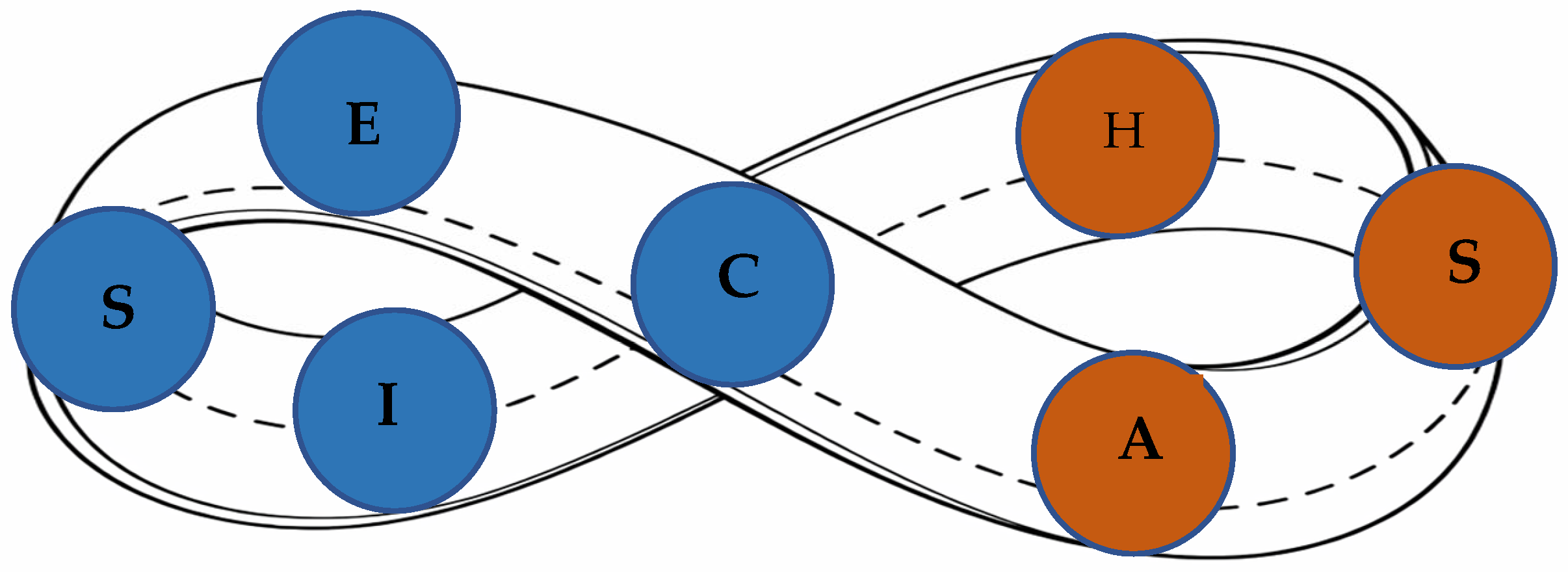
| MSM | Bratianu, C., Bejinaru, R. & Banciu, D. | Designed for human and artificial knowledge, as well as for hybrid knowledge management systems. It contains the SECI model for human knowledge and the CASH model for artificial knowledge. Both cycles are connected through the combination process. It allows a continuous flow of knowledge alongside a Möbius strip. | Analytical validation |
Disclaimer/Publisher’s Note: The statements, opinions and data contained in all publications are solely those of the individual author(s) and contributor(s) and not of MDPI and/or the editor(s). MDPI and/or the editor(s) disclaim responsibility for any injury to people or property resulting from any ideas, methods, instructions or products referred to in the content. |
© 2026 by the authors. Licensee MDPI, Basel, Switzerland. This article is an open access article distributed under the terms and conditions of the Creative Commons Attribution (CC BY) license.
Share and Cite
Bratianu, C.; Bejinaru, R.; Banciu, D. Möbius Strip Model for Augmenting Organizational Knowledge Creation Dynamics by Integrating Human and Artificial Knowledge: A New Driving Force for Business Sustainability. Sustainability 2026, 18, 3774. https://doi.org/10.3390/su18083774
Bratianu C, Bejinaru R, Banciu D. Möbius Strip Model for Augmenting Organizational Knowledge Creation Dynamics by Integrating Human and Artificial Knowledge: A New Driving Force for Business Sustainability. Sustainability. 2026; 18(8):3774. https://doi.org/10.3390/su18083774
Chicago/Turabian StyleBratianu, Constantin, Ruxandra Bejinaru, and Doina Banciu. 2026. "Möbius Strip Model for Augmenting Organizational Knowledge Creation Dynamics by Integrating Human and Artificial Knowledge: A New Driving Force for Business Sustainability" Sustainability 18, no. 8: 3774. https://doi.org/10.3390/su18083774
APA StyleBratianu, C., Bejinaru, R., & Banciu, D. (2026). Möbius Strip Model for Augmenting Organizational Knowledge Creation Dynamics by Integrating Human and Artificial Knowledge: A New Driving Force for Business Sustainability. Sustainability, 18(8), 3774. https://doi.org/10.3390/su18083774