Measuring the Coordinated Development of Urban Agglomerations from the Perspective of New Quality Productive Forces: Evidence from the Beijing–Tianjin–Hebei Region
Abstract
1. Introduction
- This study operationalizes the core connotation of new quality productive forces into a four-dimensional evaluation framework consisting of economic, social, ecological, and technological dimensions. It breaks through the limitations of studies that have predominantly measured the coordinated development of urban agglomerations from a single dimension or a traditional industrial structure perspective, thereby providing an actionable theoretical analytical tool for the high-quality development of urban agglomerations.
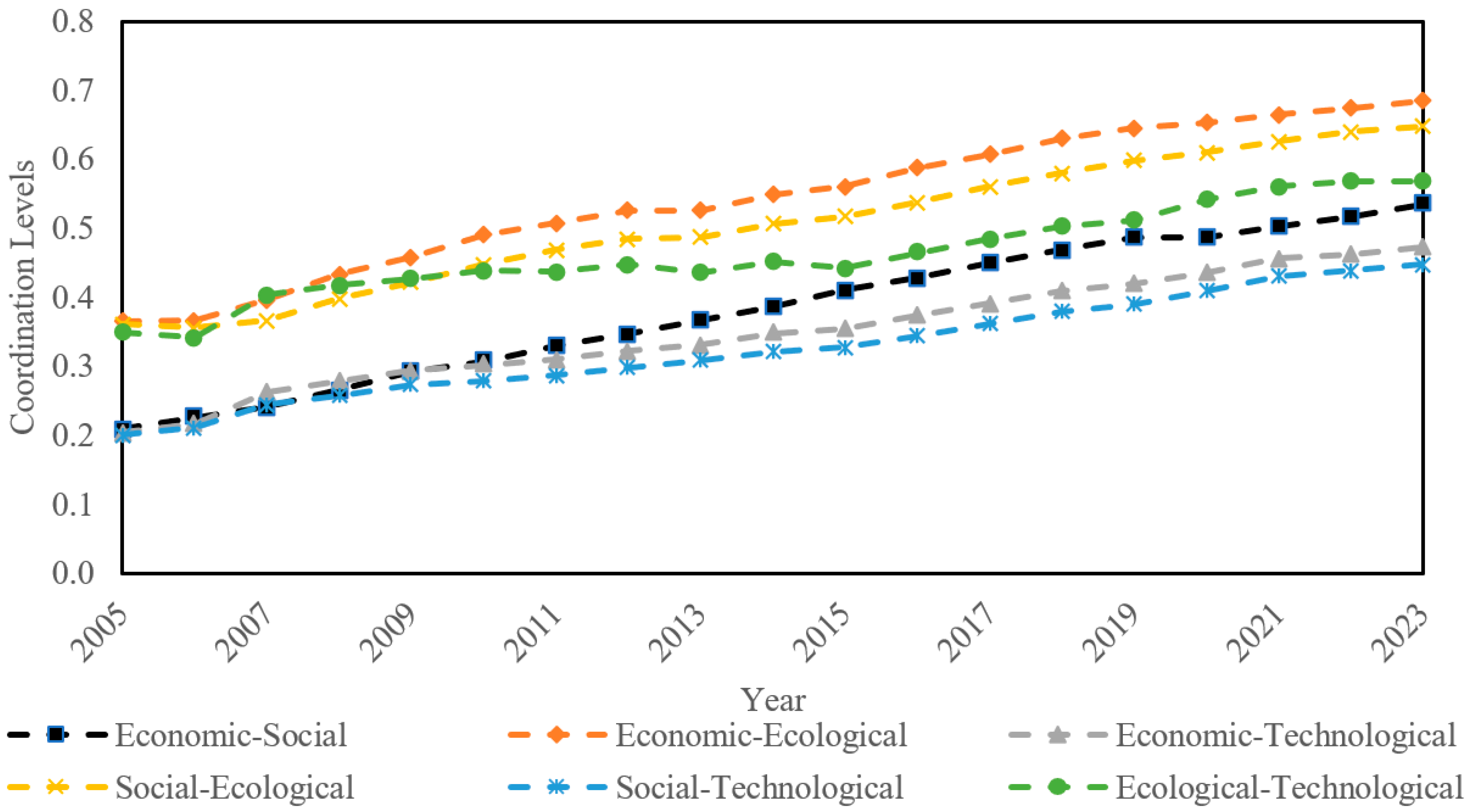
- Using a long-term panel dataset from 2005 to 2023, this study not only measures the overall level of coordinated development but also innovatively introduces a pairwise coupling analysis among subsystems. It identifies that the structural bottlenecks in the coordinated development of the BTH urban agglomeration lie in developmental technological–economic and technological–social imbalances. This addresses the gap in previous research, which mostly focused on the overall coordination degree while neglecting the structural matching characteristics among internal subsystems.
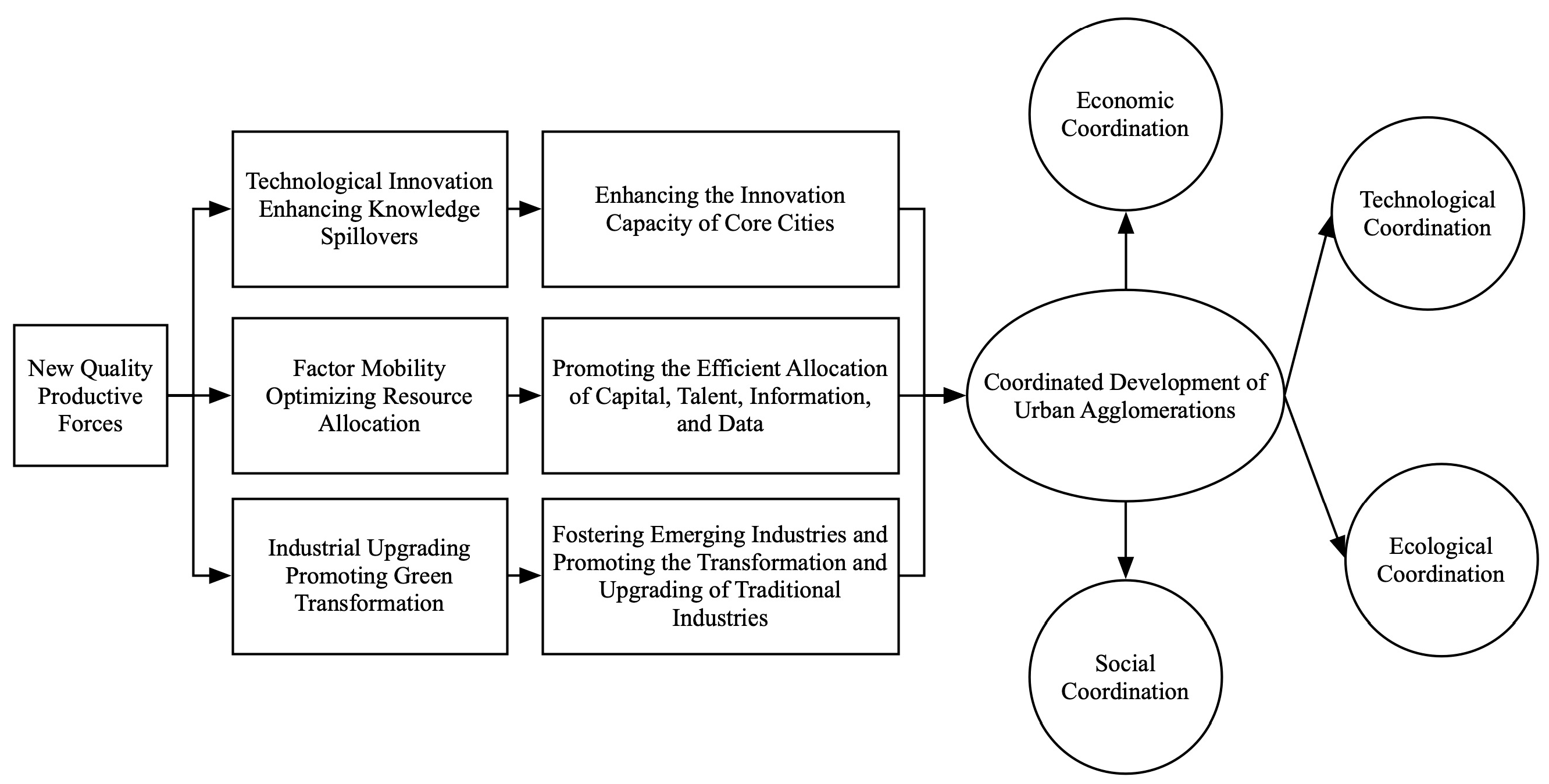
- This study reveals the mutually reinforcing mechanism between the technological divide and the core–periphery spatial structure. Specifically, the high concentration of technological factors in core cities, combined with insufficient cross-regional mobility, constrains the quality of coordination among subsystems. These findings provide important policy implications for breaking administrative barriers and promoting the efficient cross-regional flow of advanced production factors.
2. Literature Review and Theoretical Framework
2.1. Literature Review
2.2. Theoretical Framework and Mechanism Analysis
3. Research Area, Methods, and Data
3.1. Research Area Summary
3.2. Source of Data
3.3. Research Methods
3.3.1. Entropy Method
3.3.2. Indicator System for New Quality Productive Forces
3.3.3. Coupling Coordination
4. Measurement of Coordinated Development in the BTH Urban Agglomeration
4.1. Overall Coordination Degree of Cities in the BTH Urban Agglomeration
4.2. Spatiotemporal Evolution of Coordinated Development in the BTH Urban Agglomeration
4.2.1. Temporal Evolution of Coordinated Development in the BTH Urban Agglomeration
4.2.2. Spatial Evolution of Coordinated Development in the BTH Urban Agglomeration
5. Evolution of the Pairwise Coupling Coordination Degree Among Subsystems in the BTH Urban Agglomeration
5.1. Temporal Trends of Pairwise Coupling
5.2. Spatial Disparities in Subsystem Coupling
6. Discussion
7. Conclusions and Policy Recommendations
7.1. Conclusions
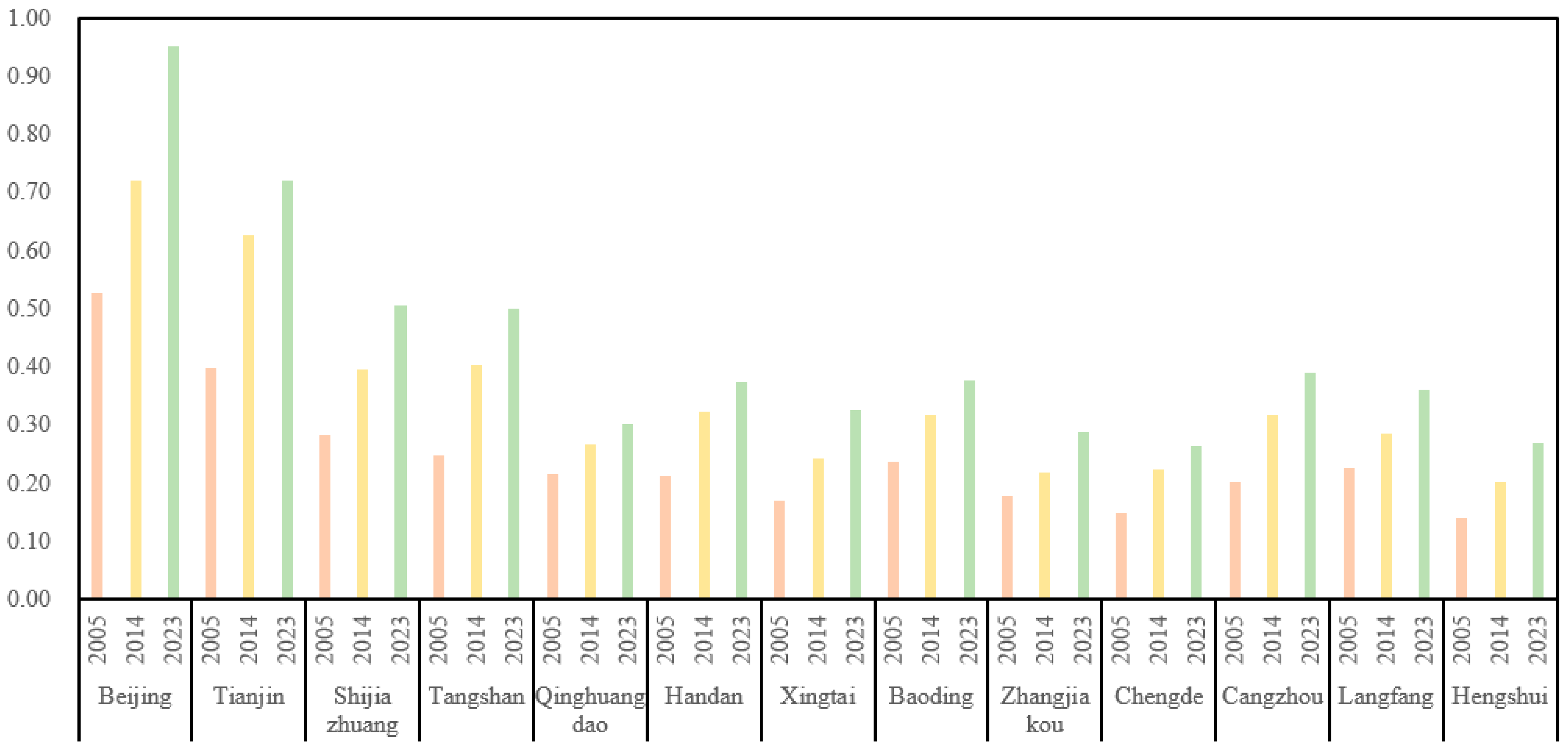
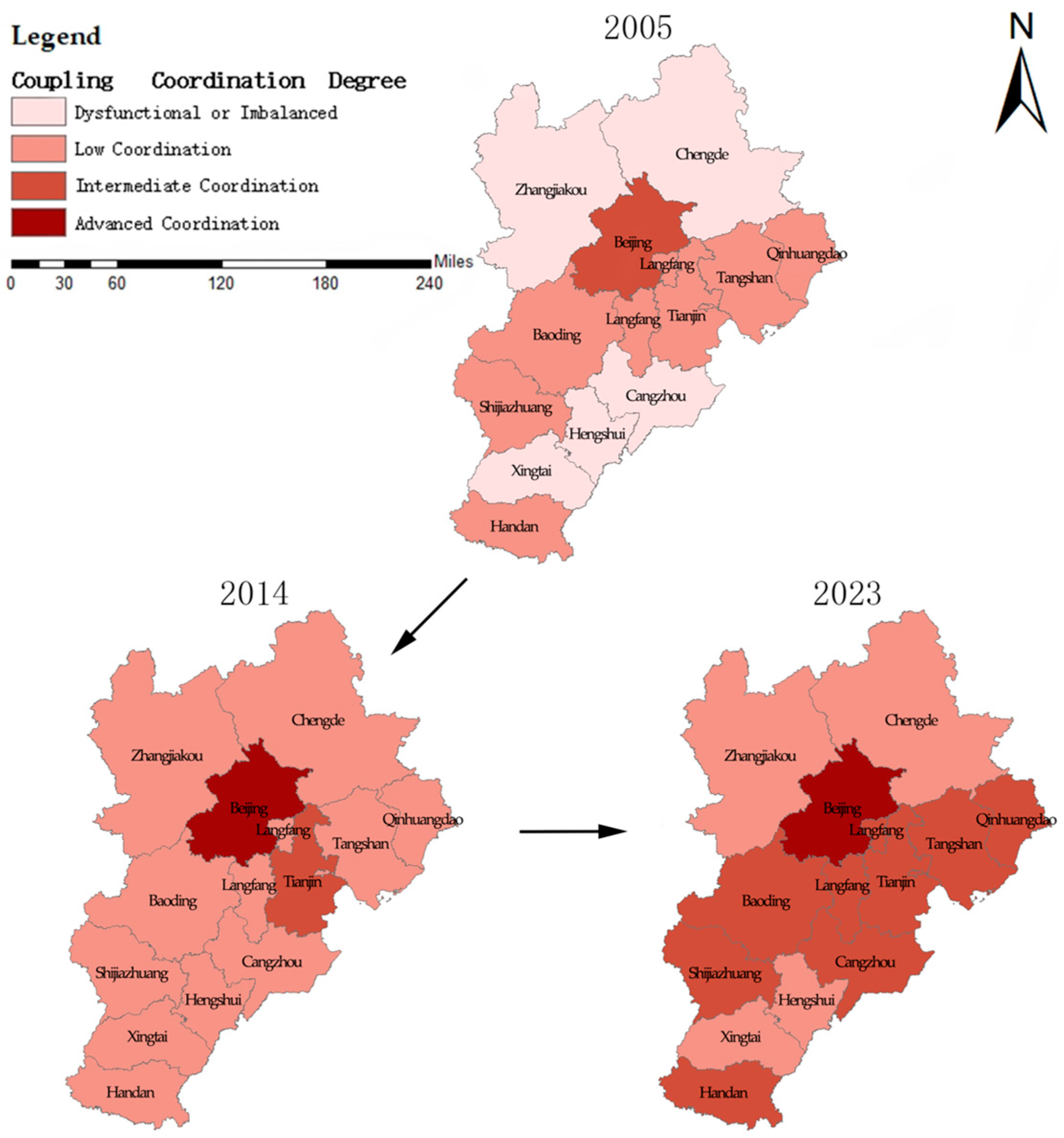
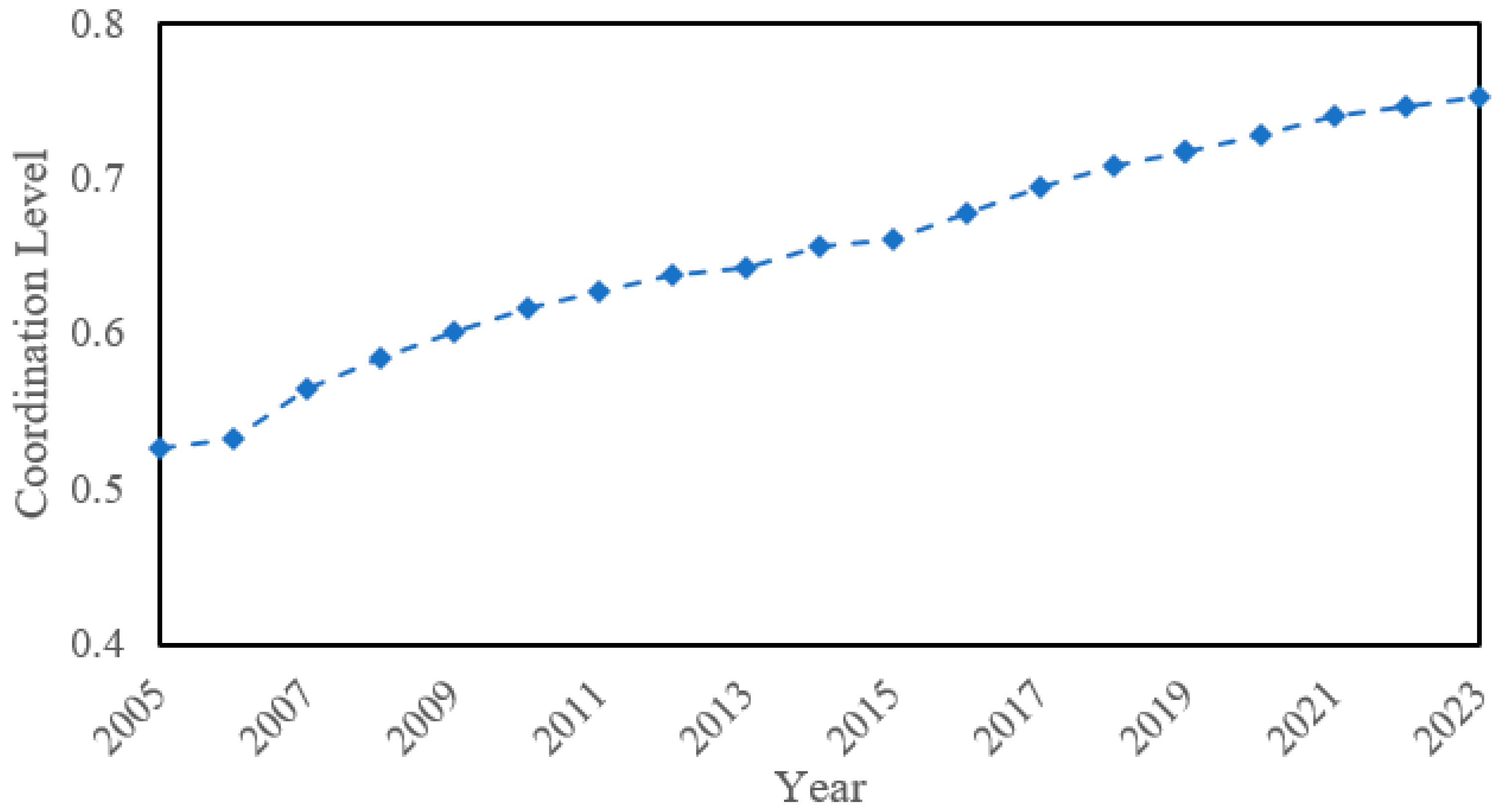
- The overall coordination level has steadily improved, but its growth has slowed down, indicating that coordinated development has entered a critical stage. From 2005 to 2023, the coordination level of the BTH urban agglomeration showed a continuous upward trend, achieving a transition from low-level to moderate coordination. However, the growth of the coupling coordination degree has decelerated, making it increasingly difficult to further enhance regional coordinated development.
- The spatial pattern exhibits a core–periphery structure, while its dynamic evolution presents the dual characteristics of catching up and differentiation. In terms of absolute levels, Beijing consistently maintains a leading position, and the core–periphery gradient gap remains evident. Nevertheless, from a dynamic perspective, the disparity between leading and lagging cities has gradually narrowed. Peripheral cities such as Xingtai and Hengshui have achieved high-speed leaps, demonstrating a significant catch-up effect among peripheral nodes.
- The synergy among subsystems is imbalanced, with technological shortcomings acting as the core constraint. The economic–ecological coordination degree is relatively high and shows a clear upward trend, reflecting the positive results of the green development strategy. In contrast, the coordination degrees between the technology subsystem and both the economic and social subsystems are significantly lower and improving slowly. This has become a key bottleneck restricting the high-quality coordinated development of the BTH urban agglomeration.
7.2. Policy Recommendations
- To address the mismatch between technological and economic development, it is essential to promote the deep integration of innovation chains and industrial chains across regions. The results indicate that the coupling coordination between technology and the economy remains low and improves more slowly than other subsystem combinations. It is recommended to further relieve Beijing of functions non-essential to its role as the capital and deepen the collaborative model of “R&D in Beijing and Tianjin, transformation in Tianjin and Hebei”. Focusing on the digital and intelligent upgrading needs of Hebei’s traditional manufacturing industry, core technologies should be transferred to build a mechanism for transmission from technological R&D to industrial transformation and ultimately to economic contribution.
- To mitigate core–periphery polarization, it is necessary to innovate mechanisms that promote cross-regional mobility and benefit-sharing among advanced production factors. The findings reveal that the coordinated development of BTH exhibits a core–periphery characteristic, where advanced production factors such as technology and talent are highly concentrated in Beijing but insufficiently diffused outward. Thus, the establishment of a cross-regional benefit-sharing mechanism should be explored. For scientific and technological achievement transformation projects flowing from Beijing to Hebei, a mechanism for returning the incremental tax revenue from industrial transfer should be promoted to reasonably distribute benefits such as employment and tax revenue. Simultaneously, the mutual recognition mechanism of sci-tech innovation vouchers in the BTH region should be deepened to further reduce the institutional transaction costs for enterprises utilizing cross-regional R&D resources.
- To address the weak coupling between technological and social subsystems, equalization of public services should be strengthened to support talent absorption and technology diffusion. The low level of coordination between technology and society indicates that technological progress has not been effectively translated into the optimization of the employment structure and the improvement of public services. Therefore, efforts should be made to extend high-quality educational and medical resources from Beijing and Tianjin to Hebei through mechanisms such as school alliances and medical consortiums. This will enhance the attractiveness of peripheral regions for skilled labor and provide the necessary human capital and social infrastructure to support the effective implementation of technological innovation.
7.3. Limitations and Future Research
Author Contributions
Funding
Institutional Review Board Statement
Informed Consent Statement
Data Availability Statement
Conflicts of Interest
References
- Zhong, Y.; Lai, H.; Zhang, L.; Guo, L.; Lai, X. Does public data openness accelerate new quality productive forces? Evidence from China. Econ. Anal. Policy 2025, 85, 1409–1427. [Google Scholar] [CrossRef]
- Liu, Y.; He, Z. Synergistic industrial agglomeration, new quality productive forces and high-quality development of the manufacturing industry. Int. Rev. Econ. Financ. 2024, 94, 103373. [Google Scholar] [CrossRef]
- Cui, J.; Du, D. New quality productive forces, urban-rural integration and industrial chain resilience. Int. Rev. Econ. Financ. 2025, 102, 104245. [Google Scholar] [CrossRef]
- Sjöstedt, E.C.; Fowler, K.F.; Rushforth, R.R.; McManamay, R.A.; Ruddell, B.L. Sustainability and resilience through connection: The economic metacommunities of the western USA. Ecol. Soc. 2025, 30, 4. [Google Scholar] [CrossRef]
- Dawkins, C.J. Regional development theory: Conceptual foundations, classic works, and recent developments. J. Plan. Lit. 2003, 18, 131–172. [Google Scholar] [CrossRef]
- Huggins, R.; Dixon, L.; Thompson, P. The behavioural-institutional dimensions of regional development: Values, personality psychology and culture. Eur. Plan. Stud. 2025, 33, 2207–2235. [Google Scholar] [CrossRef]
- Luo, K.; Lee, C.; Zhuo, C. A pathway to coordinated regional development: Energy utilization efficiency and green development-evidence from China’s major national strategic zones. Energy Econ. 2024, 131, 107402. [Google Scholar] [CrossRef]
- Shi, Y.; Wang, X.; Zhang, T. Dynamic evolution and trend forecasting of new quality productive forces development levels in Chinese urban agglomerations. Sustainability 2025, 17, 1559. [Google Scholar] [CrossRef]
- Yang, T.; Zhou, K.; Zhang, C. Spatiotemporal patterns and influencing factors of green development efficiency in China’s urban agglomerations. Sustain. Cities Soc. 2022, 85, 104069. [Google Scholar] [CrossRef]
- Fang, C.; Liang, L.; Wang, Z. Quantitative simulation and verification of upgrade law of sustainable development in Beijing-Tianjin-Hebei urban agglomeration. Sci. China Earth Sci. 2019, 62, 2031–2049. [Google Scholar] [CrossRef]
- Liu, Z.; Zhang, H.; Guo, C.; Yang, Y. New quality productive forces enabling high-quality development: Mechanism, measurement, and empirical analysis. Sustainability 2025, 17, 8146. [Google Scholar] [CrossRef]
- Zhang, L.; Fang, C.; Zhu, C. Coupling coordination and decoupling effects: Measuring the interaction between urban agglomeration ecosystems and urbanization. Cities 2026, 171, 106788. [Google Scholar] [CrossRef]
- Liu, R.; Zhang, R.; Lv, M. Digital transformation, technological innovation, and employment structure change: A panel analysis of Chinese Cities from the perspective of new quality productive forces. Financ. Res. Lett. 2026, 88, 109097. [Google Scholar] [CrossRef]
- Su, Y.; Huang, B.; Pan, W. The Multidimensional Implications, Measurement Indicators and Development Measures of New Quality Productivity. East China Econ. Manag. 2026, 40, 11–20. (In Chinese) [Google Scholar]
- Xu, Y.; Wang, R.; Zhang, S. Digital economy, green innovation efficiency, and new quality productive forces: Empirical evidence from Chinese provincial panel data. Sustainability 2025, 17, 633. [Google Scholar] [CrossRef]
- Liu, C.; Wu, T. Spatiotemporal Evolution of China’s New Quality Productivity Level and Its Spatial Spillover Effects. Geogr. Res. 2025, 45, 13–24. (In Chinese) [Google Scholar]
- Yin, H.; Zhang, Z.; Wan, Y.; Gao, Z.; Guo, Y.; Xiao, R. Sustainable network analysis and coordinated development simulation of urban agglomerations from multiple perspectives. J. Clean. Prod. 2023, 413, 137378. [Google Scholar] [CrossRef]
- Jia, P.; Tian, Y.; Yang, J.; Ren, X.; Zhao, R.; Liang, H.; Xing, Y. Spatial structure evolution characteristics and optimization strategies of urban agglomerations in the Yellow River Basin. Geogr. Res. 2025, 44, 1908–1924. (In Chinese) [Google Scholar]
- Kerner, P.; Kalthaus, M.; Wendler, T. Economic growth and the use of natural resources: Assessing the moderating role of institutions. Energy Econ. 2023, 126, 106942. [Google Scholar] [CrossRef]
- Zhao, X.; Liu, J. The impact of digital infrastructure on labor productivity. Econ. Anal. Policy 2025, 86, 274–287. [Google Scholar] [CrossRef]
- Färe, R.; Grosskopf, S.; Pasurka, C.A. Pollution abatement activities and traditional productivity. Ecol. Econ. 2007, 62, 673–682. [Google Scholar] [CrossRef]
- Cheng, D.; Guo, X.; Guo, Y. Research on the mechanism of digital economy enabling the conversion of new and old kinetic energy. Energy Policy 2025, 202, 114590. [Google Scholar] [CrossRef]
- Ji, J.; Wang, S.; Zhou, Y.; Liu, W.; Wang, L. Spatiotemporal change and coordinated development analysis of “population-society-economy-resource-ecology-environment” in the Jing-Jin-Ji urban agglomeration from 2000 to 2015. Sustainability 2021, 13, 4075. [Google Scholar] [CrossRef]
- Kong, D.; Xiang, G.; Zhu, L. Innovation-driven development and corporate green innovation. Financ. Res. Lett. 2024, 68, 106008. [Google Scholar] [CrossRef]
- Jiang, L.; Zuo, Q.; Ma, J.; Zhang, Z. Evaluation and prediction of the level of high-quality development: A case study of the Yellow River Basin, China. Ecol. Indic. 2021, 129, 107994. [Google Scholar] [CrossRef]
- Ahmad, N.; Liu, Y.; Žiković, S.; Belyaeva, Z. The effects of technological innovation on sustainable development and environmental degradation: Evidence from China. Technol. Soc. 2023, 72, 102184. [Google Scholar] [CrossRef]
- Gu, J. New quality productive forces and rural China’s clean cooking transition: A spatial analysis. Energy Policy 2026, 208, 114908. [Google Scholar] [CrossRef]
- Zhu, F.; Li, R.; Xu, X.; Sun, J. Construction and spatiotemporal evolution of new productivity indicators of China. J. Ind. Technol. Econ. 2024, 43, 44–53. [Google Scholar]
- Wang, F.; Tu, X.; Yang, Z.; Tian, Z.; Yin, Q. Spatial and temporal characteristics and differentiation mechanisms of new quality productive forces development in China. Environ. Sustain. Indic. 2025, 27, 100645. [Google Scholar] [CrossRef]
- Hu, H.; Liu, C. Statistical Measurement and Dynamic Evolution of China’s New Quality Productivity Development Level. Stat. Decis. 2024, 14, 5–10. (In Chinese) [Google Scholar]
- Xu, A.; Dai, Y.; Liu, Z. New-Quality Productive Forces in China’s Provincial Regions: Statistical Measurement, Dynamic Evolution and Correlation Network. Stat. Res. 2025, 42, 3–18. [Google Scholar]
- Wu, R.; Mao, Y. Theoretical Logic, Framework, and Future Pathways of Empowering Libraries Through New Quality Productive Forces. Libr. Inf. Serv. 2026, 70, 55–65. [Google Scholar]
- Yu, D.; Yu, J.; Chen, M. The spatiotemporal evolution and influencing factors of the coupling coordination level between China’s new quality productivity and carbon emission. China Environ. Sci. 2025, 45, 4107–4113. [Google Scholar]
- Chen, D.; Li, Y.; Zhang, C.; Zhang, Y.; Hou, J.; Lin, Y.; Wu, S.; Lang, Y.; Hu, W. Regional coordinated development policy as an instrument for alleviating land finance dependency: Evidence from the urban agglomeration development. Land Use Policy 2024, 143, 107182. [Google Scholar] [CrossRef]
- Li, X.; Zhang, Y.; Zhou, S.; Zhao, Z.; Zhao, Y. Exploration and future trends on spatial correlation of green innovation efficiency in strategic emerging industries under the digital economy: A social network analysis. J. Environ. Manag. 2024, 359, 121005. [Google Scholar] [CrossRef]
- Zeng, G. The Evaluation of the Coordinated Development Ability of the Yangtze River Delta and the Path of Regionl Integration. J. East China Norm. Univ. Philos. Soc. Sci. 2021, 53, 226–236. (In Chinese) [Google Scholar]
- Zhu, C.; Fang, C.; Zhang, L. Analysis of the coupling coordinated development of the Population–Water–Ecology–Economy system in urban agglomerations and obstacle factors discrimination: A case study of the Tianshan North Slope Urban Ag-glomeration, China. Sustain. Cities Soc. 2023, 90, 104359. [Google Scholar] [CrossRef]
- Chen, J.; Wang, M.; Zong, H. Research on the measurement and linkage potential of regional industrial synergy development: Take “one region, two clusters” in Chongqing as an example. World Reg. Stud. 2026, 1–14. (In Chinese) [Google Scholar]
- Wang, J.; Li, J. The Evaluation and Analysis on the Development of New Urbanization: Based on the Coordinated Development for the Beijing-Tianjin-Hebei Region. Popul. Econ. 2017, 6, 58–70. (In Chinese) [Google Scholar]
- Gang, H.; Zhao, F. Research on the coupling and harmonization degree of new productive force and high-quality economic development. Financ. Res. Lett. 2025, 84, 107684. [Google Scholar] [CrossRef]
- Yue, H.; Gao, D.; Gao, J.; Wei, C.; Duan, J.; Mei, S. Decoupling and driving forces in economic growth, energy consumption, and carbon emissions: Evidence from China’s BTH region. Energy Eng. 2025, 122, 5091–5109. [Google Scholar] [CrossRef]
- Sun, J.; Zhai, N.; Mu, H.; Miao, J.; Li, W.; Li, M. Assessment of urban resilience and subsystem coupling coordination in the Beijing-Tianjin-Hebei urban agglomeration. Sustain. Cities Soc. 2024, 100, 105058. [Google Scholar] [CrossRef]
- Yu, Q.; Li, M.; Li, Q.; Wang, Y.; Chen, W. Economic agglomeration and emissions reduction: Does high agglomeration in China’s urban clusters lead to higher carbon intensity? Urban Clim. 2022, 43, 101174. [Google Scholar] [CrossRef]
- Mu, J.; Wang, J.; Liu, B.; Yang, M. Spatiotemporal dynamics and influencing factors of CO2 emissions under regional collaboration: Evidence from the Beijing-Tianjin-Hebei region in China. Environ. Pollut. 2024, 357, 124403. [Google Scholar] [CrossRef] [PubMed]
- Lin, M.; Peng, B. Does regional coordinated development enhance urban resilience? Evidence from China’s Beijing-Tianjin-Hebei region. Econ. Anal. Policy 2025, 87, 1232–1261. [Google Scholar] [CrossRef]
- He, X.; Shui, X. The Measurement of Coordinated Development of Urban Systems in Wuhan Metropolitan Area and the Evolution of Spatial and Temporal Differences. Urban Dev. Stud. 2022, 29, 11–16. (In Chinese) [Google Scholar]
- Li, F.; Du, J.; Li, H.; Du, X.; Xu, X. Analysis of coupling coordination and spatio-temporal of water resource carrying capacity and regional economic development–taking Henan Province as an example. Environ. Dev. Sustain. 2024, 1–33. [Google Scholar] [CrossRef]
- Zhao, Y.; Hou, P.; Jiang, J.; Zhai, J.; Chen, Y. Temporal and spatial analysis of coupling coordination in Beijing–Tianjin–Hebei urban agglomeration: Ecology, environment and economy. Land 2024, 13, 512. [Google Scholar] [CrossRef]
- Han, H.; Guo, L.; Zhang, J.; Zhang, K.; Cui, N. Spatiotemporal analysis of the coordination of economic development, resource utilization, and environmental quality in the Beijing-Tianjin-Hebei urban agglomeration. Ecol. Indic. 2021, 127, 107724. [Google Scholar] [CrossRef]
- Xu, S.; Liu, Q.; Sun, H. Economic coordination development from the perspective of cross-regional urban agglomerations in China. Reg. Sci. Policy Pract. 2022, 14, 36–60. [Google Scholar] [CrossRef]
- Fang, C.; Chen, R.; Zhou, L.; Liu, X.; Ge, S. Utilizing complex networks and multi-scale analysis for spatial coordination and regional integration: Insight from the Pearl River Delta, China. Habitat Int. 2025, 161, 103409. [Google Scholar] [CrossRef]





| System | Subsystem | Evaluation Indicators | Indicator Attributes | Weight |
|---|---|---|---|---|
| Evaluation Index System for New Quality Productivity in Urban Agglomerations | Economic | Citywide per capita GDP | Positive indicator | 0.22 |
| Share of the tertiary sector in GDP | Positive indicator | 0.13 | ||
| Average employee wage | Positive indicator | 0.16 | ||
| Total social retail sales | Positive indicator | 0.49 | ||
| Social | Year-end registered urban unemployment rate | Negative indicator | 0.10 | |
| Fixed asset investment amount | Positive indicator | 0.20 | ||
| Internet penetration rate | Positive indicator | 0.11 | ||
| Deposit balance of financial institutions | Positive indicator | 0.59 | ||
| Ecological | Green space per capita | Positive indicator | 0.34 | |
| Energy consumption intensity | Negative indicator | 0.15 | ||
| Household waste treatment rate | Positive indicator | 0.14 | ||
| Annual average concentration of PM2.5 | Negative indicator | 0.37 | ||
| Technological | Number of patents authorized | Positive indicator | 0.50 | |
| Share of science and technology expenditures in general budget expenditures | Positive indicator | 0.17 | ||
| Percentage of university faculty among employed individuals | Positive indicator | 0.10 | ||
| Public library holdings per 100 people | Positive indicator | 0.24 |
| City | Year | Economic–Social | Economic–Ecological | Economic–Technological | Social–Ecological | Social–Technological | Ecological–Technological |
|---|---|---|---|---|---|---|---|
| Beijing | 2005 | 0.48 | 0.61 | 0.49 | 0.58 | 0.46 | 0.58 |
| Tianjin | 2005 | 0.32 | 0.47 | 0.33 | 0.45 | 0.31 | 0.46 |
| Shijiazhuang | 2005 | 0.23 | 0.40 | 0.26 | 0.38 | 0.24 | 0.43 |
| Tangshan | 2005 | 0.20 | 0.41 | 0.18 | 0.36 | 0.16 | 0.32 |
| Qinhuangdao | 2005 | 0.21 | 0.45 | 0.24 | 0.35 | 0.19 | 0.40 |
| Handan | 2005 | 0.19 | 0.36 | 0.15 | 0.36 | 0.15 | 0.28 |
| Xingtai | 2005 | 0.10 | 0.20 | 0.09 | 0.28 | 0.12 | 0.26 |
| Baoding | 2005 | 0.18 | 0.33 | 0.17 | 0.34 | 0.18 | 0.34 |
| Zhangjiakou | 2005 | 0.12 | 0.32 | 0.17 | 0.21 | 0.11 | 0.29 |
| Chengde | 2005 | 0.12 | 0.33 | 0.14 | 0.31 | 0.13 | 0.36 |
| Cangzhou | 2005 | 0.18 | 0.31 | 0.14 | 0.29 | 0.13 | 0.23 |
| Langfang | 2005 | 0.22 | 0.31 | 0.19 | 0.45 | 0.27 | 0.38 |
| Hengshui | 2005 | 0.17 | 0.23 | 0.10 | 0.33 | 0.14 | 0.20 |
| Beijing | 2014 | 0.74 | 0.80 | 0.75 | 0.75 | 0.71 | 0.77 |
| Tianjin | 2014 | 0.57 | 0.65 | 0.55 | 0.61 | 0.52 | 0.59 |
| Shijiazhuang | 2014 | 0.42 | 0.57 | 0.41 | 0.53 | 0.38 | 0.51 |
| Tangshan | 2014 | 0.40 | 0.59 | 0.34 | 0.52 | 0.30 | 0.44 |
| Qinhuangdao | 2014 | 0.34 | 0.57 | 0.35 | 0.50 | 0.30 | 0.52 |
| Handan | 2014 | 0.34 | 0.52 | 0.29 | 0.50 | 0.27 | 0.42 |
| Xingtai | 2014 | 0.30 | 0.46 | 0.24 | 0.44 | 0.22 | 0.35 |
| Baoding | 2014 | 0.32 | 0.48 | 0.27 | 0.45 | 0.25 | 0.38 |
| Zhangjiakou | 2014 | 0.29 | 0.50 | 0.25 | 0.44 | 0.22 | 0.39 |
| Chengde | 2014 | 0.31 | 0.54 | 0.26 | 0.52 | 0.25 | 0.44 |
| Cangzhou | 2014 | 0.34 | 0.49 | 0.28 | 0.44 | 0.25 | 0.37 |
| Langfang | 2014 | 0.38 | 0.49 | 0.34 | 0.47 | 0.32 | 0.41 |
| Hengshui | 2014 | 0.28 | 0.45 | 0.19 | 0.41 | 0.18 | 0.28 |
| Beijing | 2023 | 0.96 | 0.94 | 0.97 | 0.90 | 0.94 | 0.92 |
| Tianjin | 2023 | 0.66 | 0.75 | 0.65 | 0.70 | 0.61 | 0.69 |
| Shijiazhuang | 2023 | 0.56 | 0.70 | 0.54 | 0.65 | 0.51 | 0.62 |
| Tangshan | 2023 | 0.56 | 0.71 | 0.49 | 0.68 | 0.46 | 0.59 |
| Qinhuangdao | 2023 | 0.47 | 0.67 | 0.42 | 0.61 | 0.38 | 0.55 |
| Handan | 2023 | 0.48 | 0.64 | 0.37 | 0.62 | 0.36 | 0.49 |
| Xingtai | 2023 | 0.44 | 0.61 | 0.36 | 0.59 | 0.35 | 0.49 |
| Baoding | 2023 | 0.47 | 0.63 | 0.42 | 0.60 | 0.40 | 0.53 |
| Zhangjiakou | 2023 | 0.45 | 0.63 | 0.36 | 0.59 | 0.33 | 0.47 |
| Chengde | 2023 | 0.44 | 0.65 | 0.35 | 0.61 | 0.33 | 0.48 |
| Cangzhou | 2023 | 0.50 | 0.65 | 0.40 | 0.63 | 0.39 | 0.50 |
Disclaimer/Publisher’s Note: The statements, opinions and data contained in all publications are solely those of the individual author(s) and contributor(s) and not of MDPI and/or the editor(s). MDPI and/or the editor(s) disclaim responsibility for any injury to people or property resulting from any ideas, methods, instructions or products referred to in the content. |
© 2026 by the authors. Licensee MDPI, Basel, Switzerland. This article is an open access article distributed under the terms and conditions of the Creative Commons Attribution (CC BY) license.
Share and Cite
Mei, S.; Meng, C.; Zhang, J.; Li, S. Measuring the Coordinated Development of Urban Agglomerations from the Perspective of New Quality Productive Forces: Evidence from the Beijing–Tianjin–Hebei Region. Sustainability 2026, 18, 3769. https://doi.org/10.3390/su18083769
Mei S, Meng C, Zhang J, Li S. Measuring the Coordinated Development of Urban Agglomerations from the Perspective of New Quality Productive Forces: Evidence from the Beijing–Tianjin–Hebei Region. Sustainability. 2026; 18(8):3769. https://doi.org/10.3390/su18083769
Chicago/Turabian StyleMei, Shaocheng, Chengyu Meng, Jian Zhang, and Shanshan Li. 2026. "Measuring the Coordinated Development of Urban Agglomerations from the Perspective of New Quality Productive Forces: Evidence from the Beijing–Tianjin–Hebei Region" Sustainability 18, no. 8: 3769. https://doi.org/10.3390/su18083769
APA StyleMei, S., Meng, C., Zhang, J., & Li, S. (2026). Measuring the Coordinated Development of Urban Agglomerations from the Perspective of New Quality Productive Forces: Evidence from the Beijing–Tianjin–Hebei Region. Sustainability, 18(8), 3769. https://doi.org/10.3390/su18083769