Industrial Waste Salts: Characteristics, Impurity-Oriented Treatment Pathways, and Resource Utilization Strategies

Abstract
1. Introduction
2. IWS Generation and Characteristics
2.1. Pesticide Industry
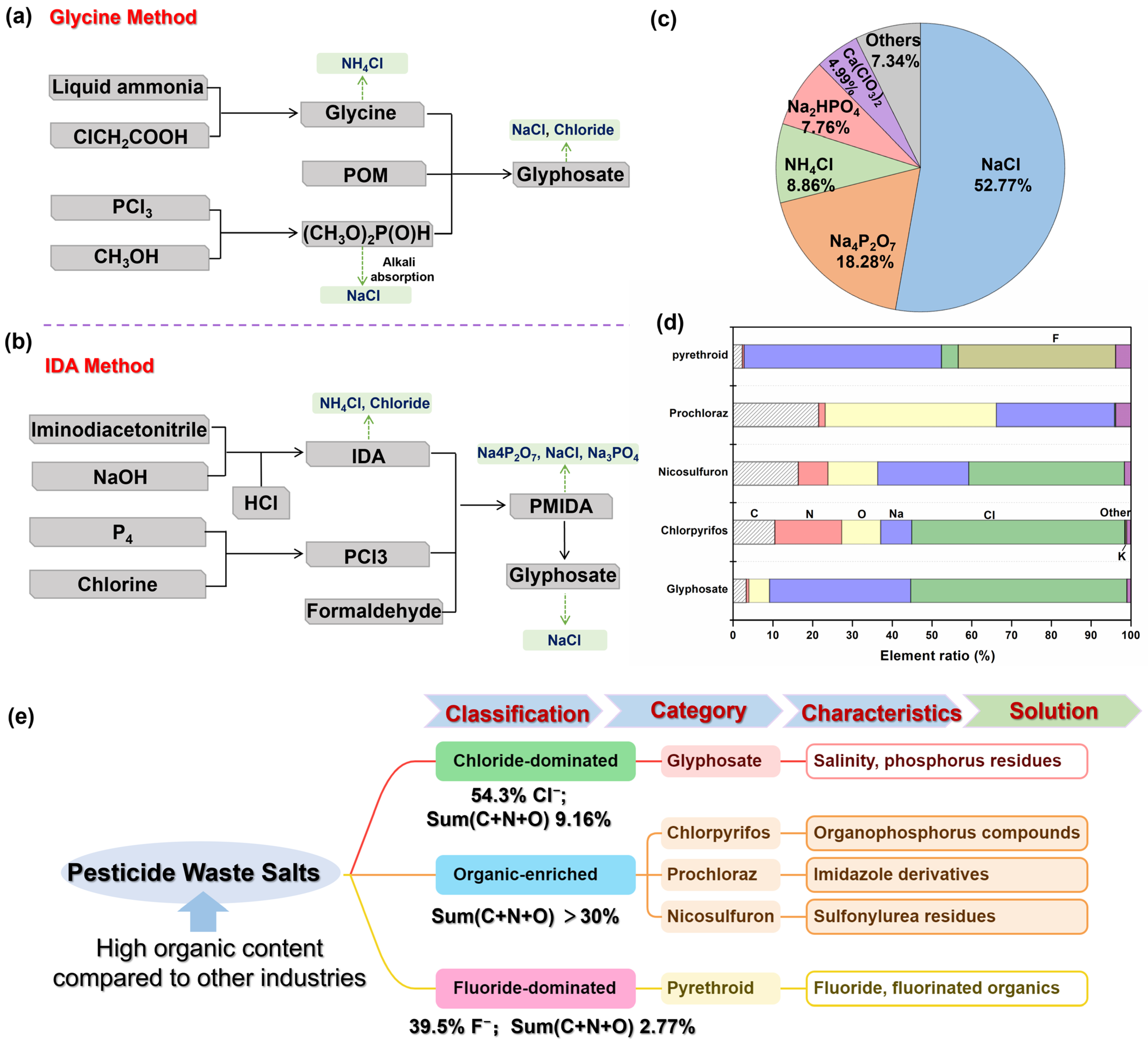
- High-chloride salts (e.g., glyphosate), characterized by high Cl− content (e.g., 54.3%) and low organic residues (C+N+O ≤ 10%);
- High-organic-content salts (e.g., prochloraz), with significant organic loads (C+N+O = 36.35–66.16%) dominated by complex compounds such as imidazoles or sulfonylureas;
- High-fluoride salts (e.g., fluorinated insecticides), featuring elevated fluoride levels (e.g., 39.52% F−) and minimal organic matter (C+N+O ≤ 2.77%).
2.2. Pharmaceutical Industry
2.3. Coal Chemical Industry
- Sulfate-dominant mixed salts, where Na2SO4 is the major phase;
- Chloride-dominant mixed salts, primarily composed of NaCl;
- High-impurity mixed salts, containing heavy metals or toxic residues requiring special handling.

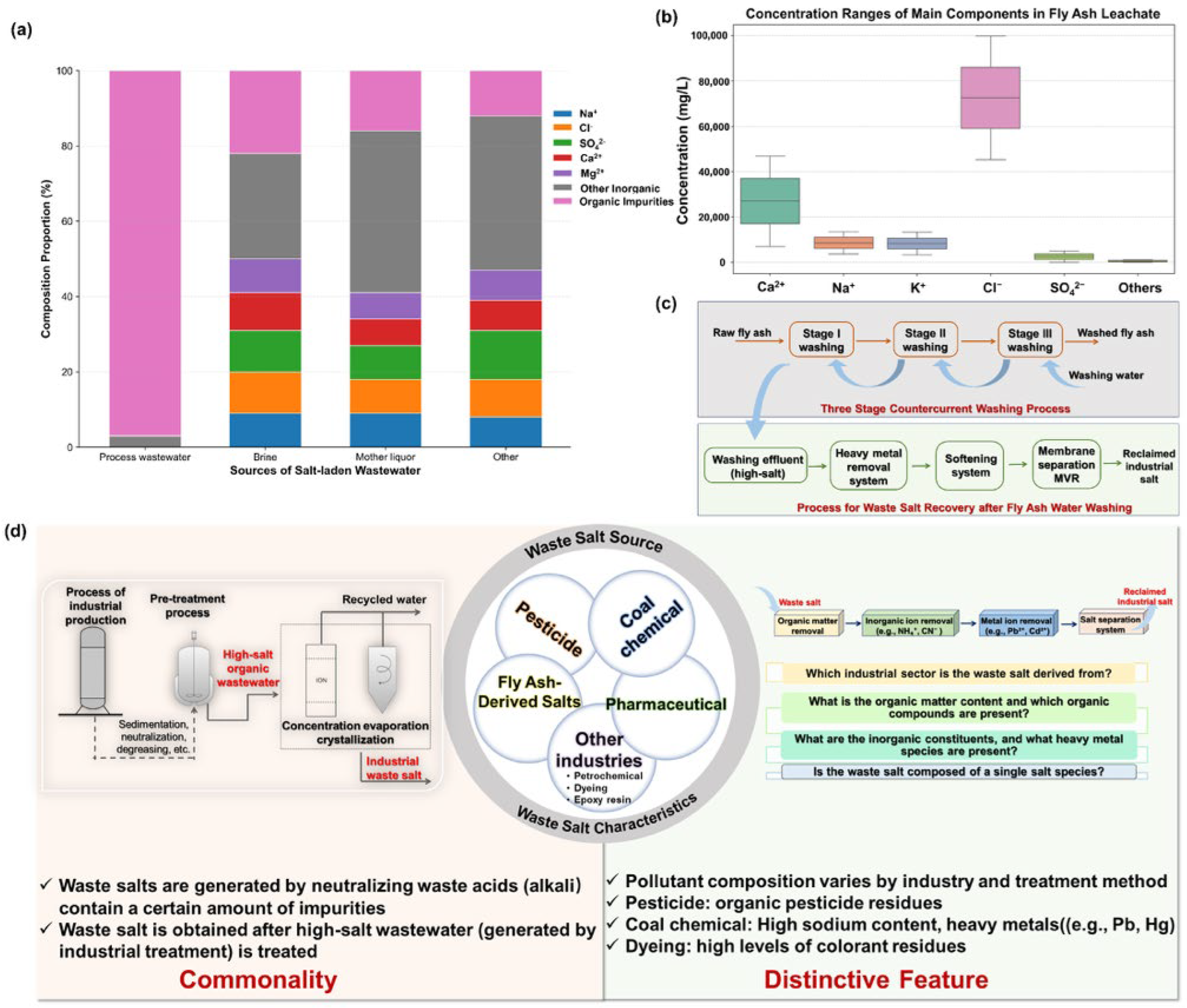
2.4. Municipal Solid Waste (MSW) Incineration—Fly Ash-Derived Salts
2.5. Other Industries
2.6. Summary of IWS Sources and Characteristics
3. Technologies for IWS Treatment and Resource Utilization: A Pollutant-Oriented Perspective
3.1. Removal of Organic Pollutants
3.1.1. Thermal Treatment
3.1.2. Biological Treatment
3.1.3. Advanced Oxidation Processes (AOPs)
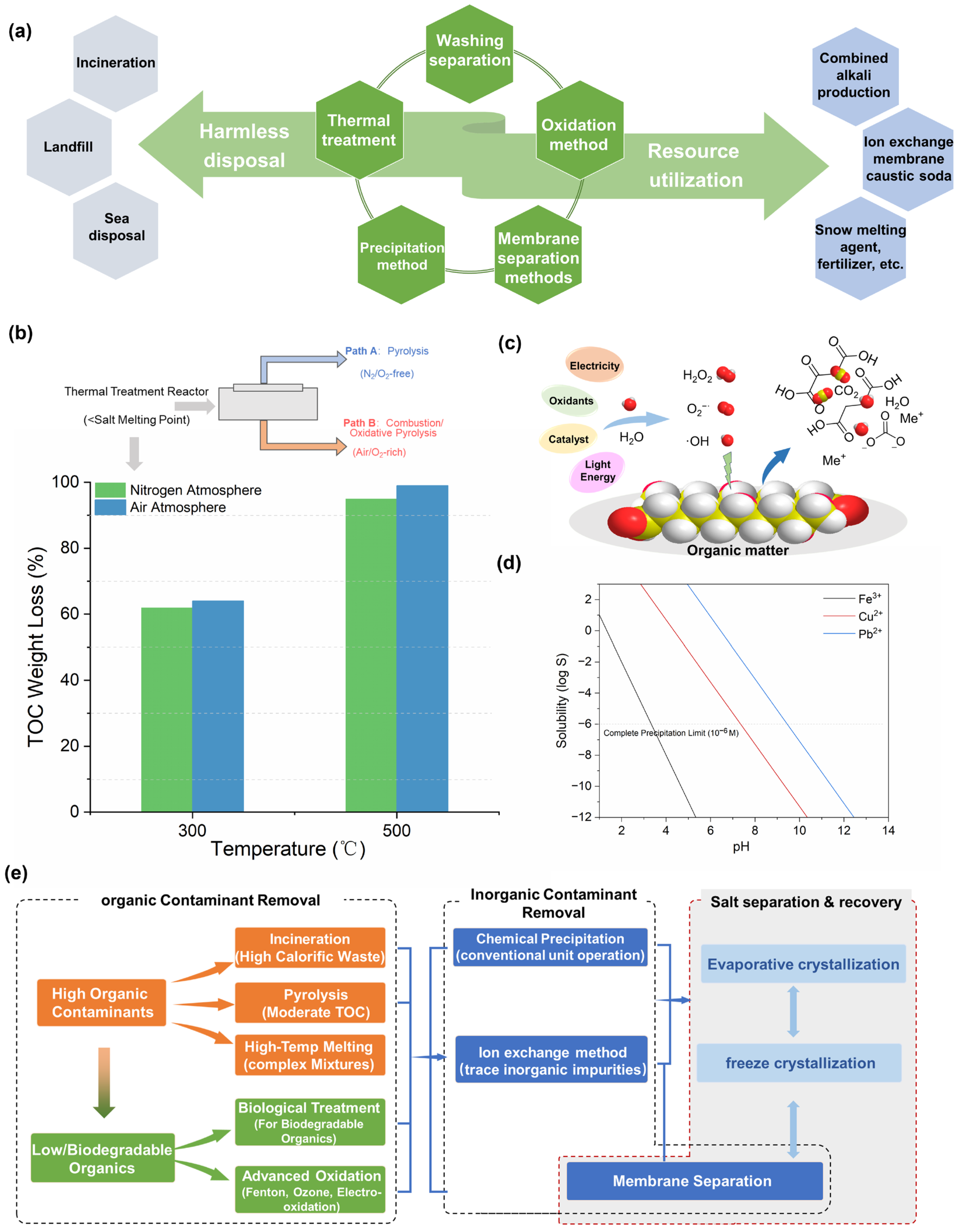
3.1.4. Organic Matter Removal Strategy
3.2. Removal of Inorganic Impurities
3.2.1. Precipitation Method
3.2.2. Ion Exchange Method
3.2.3. Other Methods
3.3. Salt Separation and Recovery
3.4. Pollutant-Oriented Treatment Framework
4. Resource Utilization of Treated IWS
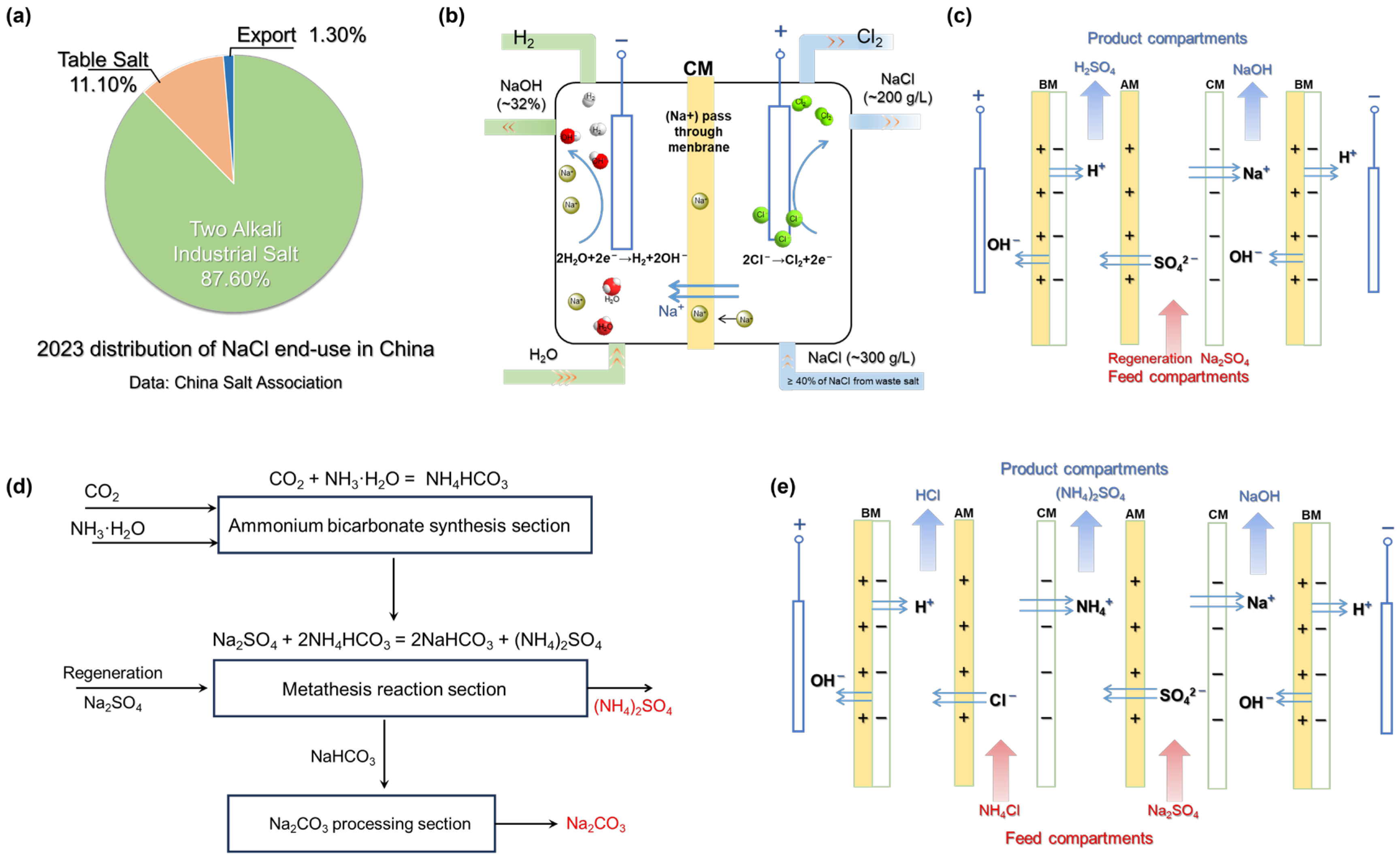
4.1. Utilization Pathways of Sodium Chloride (NaCl)
4.2. Utilization Pathways of Sodium Sulfate (Na2SO4)
5. Standards and Technical Requirements for Reuse of Reclaimed IWS
6. Conclusions and Future Perspectives
Research Methodology
Supplementary Materials
Author Contributions
Funding
Institutional Review Board Statement
Informed Consent Statement
Data Availability Statement
Conflicts of Interest
References
- Xu, X.; Zuo, W.; Wu, Q.; Lv, Y.; Zhou, H.; Yao, H. Modeling evaluation and analysis of harmless technology of industrial waste salt. Environ. Sci. Technol. 2023, 36, 12–16. [Google Scholar] [CrossRef]
- Peng, Q.; Yu, J.; Pang, Y.; Deng, L.; Tang, J.; Wang, J.; Wu, N.; Tang, L. Prospects of advanced oxidation processes for high-salinity coking wastewater treatment: A strategy to support sustainable management. Resour. Conserv. Recycl. 2025, 212, 107880. [Google Scholar] [CrossRef]
- GB 18599-2020; Standard for Pollution Control on the Non-Hazardous Industrial Solid Waste Storage and Landfill. Ministry of Ecology and Environment: Beijing, China, 2020.
- GB 18598-2019; Standard for Pollution Control on the Hazardous Waste Landfill. Ministry of Ecology and Environment: Beijing, China, 2019.
- Ruan, X.; Song, M.; Fang, Z.; Wang, H.; Zhang, C.; Chen, W. Methods to treat industrial salted waste: A review. Environ. Chem. Lett. 2024, 22, 2035–2053. [Google Scholar] [CrossRef]
- He, C.; Xu, D.; Luo, C.; Liu, Z. Review on wastewater treatment technology in coal-fired power plants towards zero liquid discharge in China. Desalination 2025, 601, 118520. [Google Scholar] [CrossRef]
- Tong, T.; Elimelech, M. The Global Rise of Zero Liquid Discharge for Wastewater Management: Drivers, Technologies, and Future Directions. Environ. Sci. Technol. 2016, 50, 6846–6855. [Google Scholar] [CrossRef]
- Li, Y.; Chen, H.; Zhang, S.; Liang, R. Analysis of waste salt disposal process and equipment. New Technol. New Prod. China 2021, 2, 122–124. [Google Scholar] [CrossRef]
- Liu, S.; Zhang, T.; Yang, Q.; Li, H. Synergistic promotion of low-temperature pyrolysis and chloride complexation in waste salt purification process. J. Mater. Cycles Waste Manag. 2024, 26, 2435–2444. [Google Scholar] [CrossRef]
- Carliell, C.M.; Barclay, S.J.; Shaw, C.; Wheatley, A.D.; Buckley, C.A. The Effect of Salts Used in Textile Dyeing on Microbial Decolourisation of a Reactive Azo Dye. Environ. Technol. 1998, 19, 1133–1137. [Google Scholar] [CrossRef]
- Wang, J.; Hong, X.; Fang, G.; Zhang, X. Deep purification of pesticide waste salt containing high-concentration organic pollutants by ethanol solvents washing and heating treatment. J. Environ. Chem. Eng. 2024, 12, 112480. [Google Scholar] [CrossRef]
- Hao, Y.; Liu, H.; Die, Q.; Huang, Q.; Yang, Y. Present situation and countermeasures of waste salt production, utilization and disposal in pesticide industry. Environ. Eng. 2021, 39, 148–152. [Google Scholar] [CrossRef]
- Feng, D.; Soric, A.; Boutin, O. Treatment technologies and degradation pathways of glyphosate: A critical review. Sci. Total Environ. 2020, 742, 140559. [Google Scholar] [CrossRef]
- Yushchenko, D.Y.; Khlebnikova, T.B.; Pai, Z.P.; Bukhtiyarov, V.I. Glyphosate: Methods of Synthesis. Kinet. Catal. 2021, 62, 331–341. [Google Scholar] [CrossRef]
- Chen, L. Research progress on pesticide waste salt treatment and resource utilization. In Proceedings of the 2019 Annual Scientific and Technical Conference of the Chinese Society of Environmental Sciences—Environmental Engineering Branch of the Chinese Society of Environmental Science, Xi’an, China, 23–25 August 2019; pp. 562–565. [Google Scholar]
- Tu, Y.; Chen, Y.; Zhang, X.; Xu, Y.; Zhang, Y.; Cui, T.; Fu, B. Integrated electrodialysis/electro-oxidation process for the treatment of chlorpyrifos wastewater with high energy efficiency. Water Sci. Technol. 2025, 91, 639–653. [Google Scholar] [CrossRef]
- Lacson, C.F.Z.; Lu, M.-C.; Huang, Y.-H. Chemical precipitation at extreme fluoride concentration and potential recovery of CaF2 particles by fluidized-bed homogenous crystallization process. Chem. Eng. J. 2021, 415, 128917. [Google Scholar] [CrossRef]
- Wang, X.; Gong, Y.; Qin, J.; Cheng, J.; Gong, C.; Jiang, D. Deep removal of organic matter in glyphosate contained industrial waste salt by dielectric barrier discharge plasma. J. Environ. Chem. Eng. 2021, 9, 106295. [Google Scholar] [CrossRef]
- Gao, R.; Yin, J.; Zhang, N.; Gao, T.; Liu, R. Current situation of waste salt generation and research progress on resourceutilization in chemical industry. Inorg. Chem. Ind. 2022, 54, 25–31. [Google Scholar] [CrossRef]
- Han, G.; Wang, Z.; Liu, B.; Sun, H.; Huang, Y. Research progress and outlook of refractory materials for high-salt organic liquid waste incinerators. Chin. J. Eng. 2023, 45, 1353–1363. [Google Scholar] [CrossRef]
- Zuo, W.; Zhou, Y.; Ge, S.; Zhu, H.; Zhu, C.; Cui, L.; Wu, Q. Development of thermal treatment of high-salt organic wastewater. Environ. Eng. 2018, 36, 47–51. [Google Scholar] [CrossRef]
- Ai, X.; Zhang, X.; Tian, Y.; Lu, M.; Wang, W. Research status, key technologies and development trends of pharmaceutical waste salt treatment technology: A review. Waste Manag. Res. 2025, 43, 1525–1547. [Google Scholar] [CrossRef]
- Yang, W.; Xiong, P.; Sun, X.; Han, W. Study on combustion characteristics of waste pharmaceutical Na2SO4 and impurity removal by low-temperature carbonization. Inorg. Chem. Ind. 2021, 53, 76–82. [Google Scholar] [CrossRef]
- Dong, J.; Liu, Z.; Wang, L.; Cao, J.; Liu, B.; Xu, X.; Xu, Y. Combustion/pyrolysis characteristics and kinetics of pharmaceutical waste salt residues. Environ. Pollut. Control 2019, 41, 6. [Google Scholar] [CrossRef]
- Zhao, W.; Yang, D.; Duan, Y. Measuring zero-waste city performance of a coal resource-based area in China with MCDM approach. Math. Probl. Eng. 2022, 2022, 8479760. [Google Scholar] [CrossRef]
- Shi, J.; Huang, W.; Han, H.; Xu, C. Pollution control of wastewater from the coal chemical industry in China: Environmental management policy and technical standards. Renew. Sustain. Energy Rev. 2021, 143, 110883. [Google Scholar] [CrossRef]
- Li, A. Development status of coal chemical technology and analysis of new coal chemical technology. Chem. Eng. Manag. 2023, 70–72. [Google Scholar] [CrossRef]
- Xin, H.; Chen, X.; Lin, S.; Luo, H.; Cao, Y.; Tang, C.Y.; Liu, G. Resource utilization of coal chemical waste salt by bipolar membrane electrodialysis with thermal pretreatment. Desalination 2024, 580, 117553. [Google Scholar] [CrossRef]
- Hu, Q.; Zhao, M. Thinking on the development of modern coal chemical industry during the 14th Five-Year Plan period. China Coal 2021, 47, 2–8. [Google Scholar] [CrossRef]
- Kong, X.; Li, J.; Zhang, L.; Zhang, X.; Cheng, D.; Gao, Y.; Shi, K.; Wang, B. Study on the Effect of Complex Organics on the Phase Equilibrium of the Multicomponent Salt Systems in the High Saline Wastewater of Coal Chemical Industry. J. Chem. Eng. Data 2024, 69, 4071–4078. [Google Scholar] [CrossRef]
- Sai, S. Research on the salt separation performance of nano-filtration membrane in high salinity wastewater zero discharge field. Ind. Water Treat. 2017, 37, 75–78. [Google Scholar] [CrossRef]
- Zhang, Z.; Zhao, D.; Xu, G.; Ning, P.; Zhao, Y.H.; Cao, H. Influence of impurities on dissolution behavior of sodium sulfate in coal chemical industry saline wastewater. Environ. Eng. 2024, 42, 156–166. [Google Scholar] [CrossRef]
- He, Y.; Zhang, J.; Yue, Y.; Qian, G. Research progress on treatment technology and resource utilization of waste solution used in fly ash water-washing. Environ. Prot. Sci. 2024, 50, 13–20. [Google Scholar] [CrossRef]
- Li, S.; Chen, F.; Xu, Y.; Zhang, X.; Liu, Y.; Qian, C.; Liu, J. The Occurrence Characteristics, Governance Status and Treatment Path Suggestions of Stock Hazardous Waste in China. Res. Environ. Sci. 2025, 38, 1838–1847. [Google Scholar] [CrossRef]
- Huang, W.; Liu, F.; Duan, L.; Wu, R.; Liu, L. Prediction and implications of washing salt generation from municipal solid waste incineration fly ash for sustainable resource utilization. Chin. J. Environ. Eng. 2023, 17, 2728–2735. [Google Scholar]
- Ma, B.; Yang, H.; Sun, Z.; Wang, Y. Research progress on separation and extraction technologies of chlorine salts and heavy metals from municipal solid waste incineration fly ash. Environ. Chem. 2024, 43, 790–805. [Google Scholar]
- Long, J.; Yao, T. Investigation on Physicochemical Properties and PCDD/Fs Distribution Patterns of MSWI Fly Ash During Water Washing Process. Environ. Sanit. Eng. 2022, 30, 41–45. [Google Scholar] [CrossRef]
- Fan, Q.; Guo, X.; Yuan, J. Purification and inorganic salts separation of waste incineration fly ash water washing solution. Inorg. Chem. Ind. 2019, 51, 67–71. [Google Scholar]
- Wang, K.; Zhang, S.; Xu, Q.; Lian, T.; Xu, Z.; Jiang, M.; Liu, P. Fabrication of salt-tolerant chitosan-based polyelectrolyte flocculant through enhancing H-bond hydration effect for treating and recycling of highly saline dyeing wastewater. Sep. Purif. Technol. 2023, 307, 122786. [Google Scholar] [CrossRef]
- Sun, G.; Gu, Y.; Yao, D.; Dong, X. Study on waste salt resource utilization engineering. China Resour. Compr. Util. 2023, 41, 81–83. [Google Scholar]
- Feng, L.; Tian, B.; Chen, L.; Yang, M. Purification and recovery of NaCl from epoxy resin waste salt through an integrated process based on aqueous two-phase systems (ATPS). J. Environ. Chem. Eng. 2024, 12, 113091. [Google Scholar] [CrossRef]
- Cipolletta, G.; Lancioni, N.; Akyol, Ç.; Eusebi, A.L.; Fatone, F. Brine treatment technologies towards minimum/zero liquid discharge and resource recovery: State of the art and techno-economic assessment. J. Environ. Manag. 2021, 300, 113681. [Google Scholar] [CrossRef] [PubMed]
- Zhang, S.; Wang, J.; Chen, T.; Dong, S.; Xu, L.; Li, Y.; Zhao, Y. Research on heat treatment of NaCl-KCl waste salt in pesticide industry. Inorg. Chem. Ind. 2023, 55, 106–112. [Google Scholar] [CrossRef]
- Kočí, V.; Šesták, J.; Černý, R. Thermal inertia and evaluation of reaction kinetics: A critical review. Measurement 2022, 198, 111354. [Google Scholar] [CrossRef]
- Jiang, H.; Shen, Y.; Chen, X.; Liu, Y.; Zhang, X.; Cheng, L.; Hu, Y. Experimental study on high temperature oxidation removal of impurities in cyanide-contained industrial waste salts. Inorg. Chem. Ind. 2020, 52, 62–64. [Google Scholar]
- Tang, T. Research status of resource utilization technology for pyrolysis of industrial waste salt. Chem. Eng. Manag. 2024, 32, 75–77. [Google Scholar] [CrossRef]
- Zhao, Z.; Qin, W.; Long, J.; Lei, J.; Xu, W.; Wang, Z. The removal of organic impurities from industrial waste salt by pyrolysis. Environ. Sci. Pollut. Res. 2023, 30, 21671–21682. [Google Scholar] [CrossRef] [PubMed]
- Ministry of Ecology and Environment. National Advanced Pollution Control Technology Catalog (Solid Waste and Soil Pollution Control Sector, 2023); Ministry of Ecology and Environment: Beijing, China, 2023.
- Wu, Q.; Yuan, W.; Wang, J.; Zhang, K.; Tian, S.; Li, M. Research progress of industrial waste salt thermal treatment technologies. J. Environ. Eng. Technol. 2022, 12, 1668–1680. [Google Scholar] [CrossRef]
- Dong, H.; Chen, X.; Zhao, L.; Jia, F.; Zhang, J. A Kind of Industrial Waste Salt Efficient Fusion Incinerator. CN109579025A, 5 April 2019. [Google Scholar]
- Wang, L.; Wang, Z.; Ma, T.; Zhao, Y. High-temperature treatment of simulated sodium chloride salt slag. Environ. Prot. Chem. Ind. 2014, 34, 419–422. [Google Scholar]
- Song, Y.; Gu, X.; He, D. Experimental study and molecular dynamics simulation:Thermal behaviors, volatile products and chlorine migration characteristics during pyrolysis and combustion of 2,4-dichlorophenoxyacetic acid waste salt. J. Environ. Manag. 2025, 382, 125277. [Google Scholar] [CrossRef]
- Wu, S.; Wu, S.; Tang, X. Deep removal method of organic matter from industrial waste salt. Chem. Eng. Manag. 2020, 36, 140–142. [Google Scholar] [CrossRef]
- Luo, Y.; Guo, W.; Ngo, H.H.; Nghiem, L.D.; Hai, F.I.; Zhang, J.; Liang, S.; Wang, X.C. A review on the occurrence of micropollutants in the aquatic environment and their fate and removal during wastewater treatment. Sci. Total Environ. 2014, 473–474, 619–641. [Google Scholar] [CrossRef]
- Mo, B.; Cao, C.; Chen, H.; Zhong, Y.; Wang, M. A biochemical treatment process for high concentration organic, high ammonia nitrogen, and high salt wastewater. China Environ. Prot. Ind. 2025, 3, 49–51. [Google Scholar]
- HJ 576-2010; Technical specifications for Anaerobic-Anoxic-Oxic activated sludge process. Ministry of Ecology and Environment: Beijing, China, 2010.
- Guo, C.; Zhang, X.; Wang, Y.; Hong, F.; Jia, J.; Chen, J.; Zhao, L. A/O-MBR process debugging for enhancing denitrification and decarbonization of refining wastewater and simulation research. Ind. Water Treat. 2025, 45, 96–103. [Google Scholar] [CrossRef]
- Ran, J.; Duan, H.; Yao, J.; Li, Y.; Yin, S. Recent progress in the removal of organic matter from Bayer liquor by advanced oxidation processes. J. Beijing Univ. Chem. Technol. (Nat. Sci. Ed.) 2022, 49, 1–12. [Google Scholar] [CrossRef]
- Xu, W. Chlorine-based advanced oxidation process for degradation of pollutants in water, wastewater and sludge: A comprehensive review. J. Water Process Eng. 2025, 70, 106890. [Google Scholar] [CrossRef]
- Walling, S.A.; Um, W.; Corkhill, C.L.; Hyatt, N.C. Fenton and Fenton-like wet oxidation for degradation and destruction of organic radioactive wastes. npj Mater. Degrad. 2021, 5, 50. [Google Scholar] [CrossRef]
- Ateş, A.E.; Bektaş, S.; Zengin, Ş.; Araz, Y.; Ateş, S.; Selçuk, H. Integrated salt and energy recovery from dyeing wastewater via fenton and photo-fenton oxidation: Industrial approach. J. Environ. Chem. Eng. 2025, 13, 115930. [Google Scholar] [CrossRef]
- Qiu, S.; Han, X.; Zhang, M.; Guo, M. Research progress and development trends in heterogeneous Fenton-like catalysts for degradation of antibiotics in wastewater. Chin. J. Eng. 2021, 43, 460–474. [Google Scholar] [CrossRef]
- Yu, X.; Lin, X.; Feng, W.; Li, W. Effective Removal of Tetracycline by Using Bio-Templated Synthesis of TiO2/Fe3O4 Heterojunctions as a UV–Fenton Catalyst. Catal. Lett. 2019, 149, 552–560. [Google Scholar] [CrossRef]
- Lim, S.; Shi, J.L.; von Gunten, U.; McCurry, D.L. Ozonation of organic compounds in water and wastewater: A critical review. Water Res. 2022, 213, 118053. [Google Scholar] [CrossRef]
- Wang, Y.; Zhang, Q. Research on the deep treatment process of coking wastewater. Clean. World 2025, 41, 149–151. [Google Scholar]
- Chen, S. Experimental study on treatment of coal chemical wastewater by ozone flotation enhanced electrocoagulation process. Clean. World 2025, 41, 37–39. [Google Scholar]
- Chen, X. Study on influencing factors of advanced treatment of chemical wastewater by catalytic ozone oxidation. Energy Conserv. 2025, 44, 116–118. [Google Scholar] [CrossRef]
- Xiao, X.; Liang, M.; Yuan, W.; Zhang, F.; Chen, Z.; Wei, L. Progress of electrochemical technology in chemical wastewater treatment. Water Purif. Technol. 2024, 43, 39–47. [Google Scholar] [CrossRef]
- Yu, P.; Qin, L. Research progress on the application of advanced oxidation processes in the treatment of refractory organic wastewater. China Resour. Compr. Util. 2025, 43, 123–125. [Google Scholar]
- Chavalparit, O.; Ongwandee, M. Optimizing electrocoagulation process for the treatment of biodiesel wastewater using response surface methodology. J. Environ. Sci. 2009, 21, 1491–1496. [Google Scholar] [CrossRef]
- Lin, B. Application of advanced oxidation composite processes in wastewater treatment. Shanxi Chem. Ind. 2025, 45, 192–194+237. [Google Scholar] [CrossRef]
- Desai, K.S.; Chatake, V.S.; Pandit, A.B.; Holkar, C.R. Life Cycle Assessment of Different Advanced Oxidation Processes (AOPs) for Mineralization of Alkyd Resin Wastewater. Water Conserv. Sci. Eng. 2026, 11, 10. [Google Scholar] [CrossRef]
- Rocha, R.S.; Silva, F.L.; Valim, R.B.; Barros, W.R.P.; Steter, J.R.; Bertazzoli, R.; Lanza, M.R.V. Effect of Fe2+ on the degradation of the pesticide profenofos by electrogenerated H2O2. J. Electroanal. Chem. 2016, 783, 100–105. [Google Scholar] [CrossRef]
- Patil, P.N.; Gogate, P.R. Degradation of methyl parathion using hydrodynamic cavitation: Effect of operating parameters and intensification using additives. Sep. Purif. Technol. 2012, 95, 172–179. [Google Scholar] [CrossRef]
- Pourehie, O.; Saien, J. Homogeneous solar Fenton and alternative processes in a pilot-scale rotatable reactor for the treatment of petroleum refinery wastewater. Process Saf. Environ. Prot. 2020, 135, 236–243. [Google Scholar] [CrossRef]
- Gogate, P.R.; Patil, P.N. Combined treatment technology based on synergism between hydrodynamic cavitation and advanced oxidation processes. Ultrason. Sonochem. 2015, 25, 60–69. [Google Scholar] [CrossRef]
- Luu, T.L. Post treatment of ICEAS-biologically landfill leachate using electrochemical oxidation with Ti/BDD and Ti/RuO2 anodes. Environ. Technol. Innov. 2020, 20, 101099. [Google Scholar] [CrossRef]
- Mirzaee, S.A.; Jaafarzadeh, N.; Jorfi, S.; Gomes, H.T.; Ahmadi, M. Enhanced degradation of Bisphenol A from high saline polycarbonate plant wastewater using wet air oxidation. Process Saf. Environ. Prot. 2018, 120, 321–330. [Google Scholar] [CrossRef]
- Scandelai, A.P.J.; Zotesso, J.P.; Jegatheesan, V.; Cardozo-Filho, L.; Tavares, C.R.G. Intensification of supercritical water oxidation (ScWO) process for landfill leachate treatment through ion exchange with zeolite. Waste Manag. 2020, 101, 259–267. [Google Scholar] [CrossRef] [PubMed]
- Uozumi, K.; Iizuka, M.; Omori, T. Removal of rare-earth fission products from molten chloride salt used in pyroprocessing by precipitation for consolidation into glass-bonded sodalite waste form. J. Nucl. Mater. 2021, 547, 152784. [Google Scholar] [CrossRef]
- Rao, M.N.; Sultana, R.; Kota, S.H. Chapter 5—Hazardous Waste. In Solid and Hazardous Waste Management; Rao, M.N., Sultana, R., Kota, S.H., Eds.; Butterworth-Heinemann: Oxford, UK, 2017; pp. 159–207. [Google Scholar]
- Ye, M.; Li, G.; Yan, P.; Ren, J.; Zheng, L.; Han, D.; Sun, S.; Huang, S.; Zhong, Y. Removal of metals from lead-zinc mine tailings using bioleaching and followed by sulfide precipitation. Chemosphere 2017, 185, 1189–1196. [Google Scholar] [CrossRef] [PubMed]
- Yao, L.-w.; Min, X.-b.; Xu, H.; Ke, Y.; Wang, Y.-y.; Lin, Z.; Liang, Y.-j.; Liu, D.-g.; Xu, Q.-j.; He, Y.-y. Physicochemical and environmental properties of arsenic sulfide sludge from copper and lead−zinc smelter. Trans. Nonferrous Met. Soc. China 2020, 30, 1943–1955. [Google Scholar] [CrossRef]
- Chen, Z.; Fang, J.; Qi, H.; Guo, M.; Lv, L.; Du, X. Resource recovery of high-salt wastewater from fluorine chemical industry of fuxin. Mod. Chem. Res. 2022, 6, 75–77. [Google Scholar]
- Zhao, J. Comprehensive utilization of chlorinated waste salt residue in titanium dioxide production. Environ. Prot. Circ. Econ. 2003, 6, 28–29. [Google Scholar]
- Zou, M.; Li, Q.; Li, N.; Han, W.; Sun, X.; Wang, L. Application of hydroxyapatite precipitation method in the recycling of waste phosphate from pharmaceutical intermediates. Environ. Pollut. Control 2020, 42, 1232–1237. [Google Scholar] [CrossRef]
- Shaidan, N.H.; Eldemerdash, U.; Awad, S. Removal of Ni(II) ions from aqueous solutions using fixed-bed ion exchange column technique. J. Taiwan Inst. Chem. Eng. 2012, 43, 40–45. [Google Scholar] [CrossRef]
- Zewail, T.M.; Yousef, N.S. Kinetic study of heavy metal ions removal by ion exchange in batch conical air spouted bed. Alex. Eng. J. 2015, 54, 83–90. [Google Scholar] [CrossRef]
- Chu, S.; Feng, X.; Liu, C.; Wu, H.; Liu, X. Advances in Chelating Resins for Adsorption of Heavy Metal Ions. Ind. Eng. Chem. Res. 2022, 61, 11309–11328. [Google Scholar] [CrossRef]
- Zhou, J.; Li, X.; Tian, M.-G.; Yan, W.; Zhang, D.-M.; Xu, H. Research Progress on Treatment and Recovery of Metals in Wastewater by Electrodeposition. Chin. J. Anal. Chem. 2023, 51, 1735–1746. [Google Scholar] [CrossRef]
- Guan, W.; Tian, S.; Cao, D.; Chen, Y.; Zhao, X. Electrooxidation of nickel-ammonia complexes and simultaneous electrodeposition recovery of nickel from practical nickel-electroplating rinse wastewater. Electrochim. Acta 2017, 246, 1230–1236. [Google Scholar] [CrossRef]
- Zhang, H.; Yang, J.; Wu, J.; Lu, X. Study on Treatment of Electroplate Wastewater with Copper by Ion-Exchange and Electrodeposition. Technol. Water Treat. 2013, 39, 95–98+107. [Google Scholar] [CrossRef]
- Dai, M.; Bian, H.; Liu, X.; Rong, R.; Song, D.; Peng, C. Feasibility of effective separation of NaCl and Na2SO4 after simultaneous crystallization from solution. Powder Technol. 2024, 444, 120053. [Google Scholar] [CrossRef]
- Li, T.; Li, S.; Pei, C.; Qi, Z.; Zheng, C.; Fang, W.; Xu, Z.; Zhang, S. Analysis on Evaporative Crystallization and Separation of Potassium and Sodium in MVR System. J. Salt Sci. Chem. Ind. 2021, 50, 21–25. [Google Scholar] [CrossRef]
- Jiao, C.; An, L. A project example of thermal salt separation crystallization process treating coal chemical industrial wastewater. Ind. Water Wastewater 2024, 55, 81–84+90. [Google Scholar]
- Wang, C.; Huang, X.; Wang, H.; Chen, R.; Ruan, X. Combined Frozen Crystallization and Stepwise Decompression Evaporation for Na2SO4/NaCl Separation from Mixed Salts. Recycling 2025, 10, 106. [Google Scholar] [CrossRef]
- More, K.S.; Maree, J.P.; Mahlangu, M. Optimising Salt Recovery—Four-Year Operational Insights into Na2SO4 Recovery from Saline Waters Using Pipe Freeze-Crystallization. Water 2025, 17, 101. [Google Scholar] [CrossRef]
- Liu, X.; Wang, J.; Li, J.; Zhang, Z.; Bao, X. Research progress of zero discharge salt separation technology for high-salinity wastewater. Appl. Chem. Ind. 2021, 50, 3468–3471. [Google Scholar] [CrossRef]
- Kavitha, E.; Poonguzhali, E.; Nanditha, D.; Kapoor, A.; Arthanareeswaran, G.; Prabhakar, S. Current status and future prospects of membrane separation processes for value recovery from wastewater. Chemosphere 2022, 291, 132690. [Google Scholar] [CrossRef]
- Tsai, J.-H.; Perrotta, M.L.; Gugliuzza, A.; Macedonio, F.; Giorno, L.; Drioli, E.; Tung, K.-L.; Tocci, E. Membrane-Assisted Crystallization: A Molecular View of NaCl Nucleation and Growth. Appl. Sci. 2018, 8, 2145. [Google Scholar] [CrossRef]
- Huang, X.; Wang, H.; Song, M.; Chen, R.; Lv, S.; Zhang, H.; Wang, C.; Ramirez, J.; Ruan, X. Comparative organic pollutants removal efficiency and life cycle assessment of pyrolysis and solvent elution for industrial waste salt recycling. J. Environ. Manag. 2024, 371, 123218. [Google Scholar] [CrossRef]
- Xu, X.; Wu, F.; Li, H. Properties of eco-cementitious materials prepared by mixing cement with high-salt wastewater from coal chemical industry. Chin. J. Environ. Eng. 2022, 16, 1909–1916. [Google Scholar]
- Zhang, P. Economic operation analysis of China’s chlor-alkali industry in 2024 and its prospects in 2025. China Chlor-Alkali 2025, 3, 1–4. [Google Scholar]
- National Development and Reform Commission of China. Industrial Structure Adjustment Guidance Catalogue (2024 Edition). Available online: https://www.ndrc.gov.cn/xxgk/zcfb/fzggwl/202312/t20231229_1362999.html (accessed on 1 April 2026).
- Ma, P.; Tang, H.; Xu, Y.; Zhou, J.; Chen, S.; Hou, X. Application of composite membrane electrolysis process inresource utilization of industrial by-product salt. China Chlor-Alkali 2023, 7, 43–48. [Google Scholar] [CrossRef]
- Liang, Z.; Xie, Y.; Ji, Q.; Ma, J.; Cao, H. Application and challenges of recycling waste salt in the ionic membrane-based Chlor-alkali industry. Energy Environ. Prot. 2023, 37, 125–133. [Google Scholar] [CrossRef]
- Liang, Z.; Yang, W.; Yin, Z.; Wang, X.; He, Y.; Yang, K.; Ma, J. Chlor-alkali membrane cell process for industrial waste salt utilization: Fundamentals and challenges. Desalination 2024, 587, 117921. [Google Scholar] [CrossRef]
- Yin, W.; Pu, R.; Zhang, Y.; Zou, G.; Nie, B. Industrial application of vanadium and titanium waste salt inchlor-alkali production. China Chlor-Alkali 2023, 3, 1–7+12. [Google Scholar] [CrossRef]
- Li, G.; Zeng, Y. Resource utilization and electrolysis experience of industrial waste salt. China Chlor-Alkali 2021, 12, 5–10. [Google Scholar] [CrossRef]
- Luo, J.; Peng, Y.; Cui, H.; Li, Y.; Fu, X. Application of regenerated salt as raw material for ion-exchange membrane caustic soda using SPI waste salt treatment technology. Mod. Salt Chem. Ind. 2023, 50, 1–3. [Google Scholar] [CrossRef]
- Li, B.; Dong, Y.; Ding, Z.; Xu, Y.; Zou, C. Renovation and Reuse of Reactive Dyeing Effluent by a Novel Heterogeneous Fenton System Based on Metal Modified PTFE Fibrous Catalyst/H2O2. Int. J. Photoenergy 2013, 2013, 169493. [Google Scholar] [CrossRef]
- Yanmei, G.; Shaofei, S. The effect on the Performance of Cement Grinding Aid Components. In Proceedings of the 4th Workshop on Advanced Research and Technology in Industry (WARTIA 2018), 2018/09; Atlantis Press: Dordrecht, The Netherlands, 2018; pp. 258–265. [Google Scholar]
- Gao, W.; Yang, X.; Cheng, Y.; Ji, X.; Li, Z.; Yang, H.; Liang, Q.; Yue, T. The Resourceful Synthesis Process of α-Hemihydrate Gypsum Using Sodium Sulfate. Shandong Chem. Ind. 2022, 51, 1–3. [Google Scholar] [CrossRef]
- Liu, M.; Han, Y.; Zhang, W. Recycling Research of Sodium Sulfate Waste Salt. Shanghai Chem. Ind. 2024, 49, 16–20. [Google Scholar] [CrossRef]
- Joo, J.; Moon, J.-k.; Jang, Y. A study on the desalination process for high-concentration Na2SO4 using pilot-scale bipolar membrane electrodialysis. Desalination Water Treat. 2025, 322, 101222. [Google Scholar] [CrossRef]
- Zhu, M.; Tian, B.; Luo, S.; Chi, Y.; Aishajiang, D.; Zhang, Y.; Yang, M. High-value conversion of waste Na2SO4 by a bipolar membrane electrodialysis metathesis system. Resour. Conserv. Recycl. 2022, 186, 106556. [Google Scholar] [CrossRef]
- State Council of the People’s Republic of China. Reform Plan for Hazardous Waste Management Capacity. Available online: https://www.mee.gov.cn/zcwj/gwywj/202105/t20210525_834448.shtml (accessed on 1 April 2026).
- Ministry of Ecology and Environment of China. Major Hazardous Waste Infrastructure Plan (2023–2025). Available online: https://www.mee.gov.cn/xxgk2018/xxgk/xxgk03/202305/t20230509_1029446.html (accessed on 1 April 2026).
- GB/T 5462-2015; Industrial Salt. General Administration of Quality Supervision, Inspection and Quarantine: Beijing, China, 2015.
- GB/T 6009-2014; Anhydrous Sodium Sulfate for Industrial Use. General Administration of Quality Supervision, Inspection and Quarantine: Beijing, China, 2014.
- T/ZGZGS 0302-2023; Reclaimed Industrial Salt—Sodium Chloride. China Resources Recycling Association: Beijing, China, 2023.
- T/ZGZGS 0303-2023; Reclaimed Industrial Salt—Sodium Sulfate. China Resources Recycling Association: Beijing, China, 2023.
- T/CPCIF 0068-2020; Epoxy Resin By-Product Sodium Chloride. China Petroleum and Chemical Industry Federation: Beijing, China, 2020.
- QB/T 5270-2018; Salt for Ion-Exchange Membrane Caustic Soda. Ministry of Industry and Information Technology: Beijing, China, 2018.
- HG/T 5531.1-2019; Glyphosate By-Product Industrial Salt Part 1: Sodium Chloride. China Petroleum and Chemical Industry Federation: Beijing, China, 2019.
- T/CAPDA 058-2023; Dicamba By-Product Industrial Salt of Sodium Chloride. China Crop Protection Industry Association: Beijing, China, 2023.
- T/CCT 002-2019; Coal Chemical Industry—By-Product Industrial Sodium Chloride. China Coal Processing and Utilization Association: Beijing, China, 2019.
- T/CCT 001-2019; Coal Chemical Industry—By-Product Industrial Sodium Sulfate. China Coal Processing and Utilization Association: Beijing, China, 2019.
- QB/T 4890-2015; Salt for Printing and Dyeing. Ministry of Industry and Information Technology of China: Beijing, China, 2015.
- QB/T 5685-2022; Salt for Water Treatment. Ministry of Industry and Information Technology of China: Beijing, China, 2022.
- GB 18597-2023; Standard for Pollution Control on Hazardous Waste Storage. Ministry of Ecology and Environment of China: Beijing, China, 2023.
- GB 18484-2020; Standard for Pollution Control on Hazardous Waste Incineration. Ministry of Ecology and Environment of China: Beijing, China, 2020.
- HJ 1259-2022; Technical Guideline for Deriving Hazardous Waste Management Plans and Records. Ministry of Ecology and Environment of China: Beijing, China, 2022.
- HJ 561-2010; Technical Specification of Performance Testing for Facilities of Hazardous Waste (including Medical Waste) Incineration. Ministry of Ecology and Environment of China: Beijing, China, 2010.
- HJ/T 176-2005; Technical Specifications for Centralized Incineration Facility Construction on Hazardous Waste. Ministry of Ecology and Environment of China: Beijing, China, 2005.
- T/ZGZS 0312-2024; Technical Specification for Pollution Control of Utilizing and Disposing Waste Salts from Chemical Industry. China Resources Recycling Association: Beijing, China, 2024.
- T/CTES 1049-2022; Regenerated Sodium Chloride for Printing and Dyeing Using Waste Salt as Raw Material. Chinese Textile Engineering Society: Beijing, China, 2022.
- T/SDSCCE 002-2021; Technical Specification for Chlor-Alkali Industry Using Waste Salt (Sodium Chloride) from Chemical Industry and Related Industries. Shandong Society of Chemical Industry and Engineering: Jinan, China, 2021.
- T/CPCIF 0130-2021; Technical Specification for Waste Salt Incineration Treatment in Chemical Industry. China Petroleum and Chemical Industry Federation: Beijing, China, 2021.
- T/CPCIF 0188-2022; Technical Specification for Thermochemical Treatment of Waste Salts in Chemical Industry. China Petroleum and Chemical Industry Federation: Beijing, China, 2022.
- T/SDEPI 027-2022; Technical Specification for Microwave Pyrolysis Disposal of Chemical Waste Salt. Shandong Environmental Protection Industry Association: Jinan, China, 2022.
- T/ACEF 115-2023; Technical Application Guidelines for the Treatment of High-Salt Organic Wastewater. All-China Environment Federation: Beijing, China, 2023.
- T/CSES 48-2022; Technical Guidelines for Salt Fractionation Using Nanofiltration-Reverse Osmosis for High-Salinity Industrial Wastewater Treatment. Chinese Society for Environmental Sciences: Beijing, China, 2022.



| Incineration | Pyrolysis | High-Temperature Melting | |
|---|---|---|---|
| Applicable conditions a | TOC > 100,000 mg/kg (or >10 wt%) | TOC > 5000 mg/kg | Complex waste salts with high organic loading |
| Key parameters & TOC removal rate b | Temperature 600–650 °C → TOC removal rate 98.5% [53] | ||
| Energy consumption c | High energy demand, requiring auxiliary fuel supply | Moderate energy input | Very high (energy-intensive operation) |
| Environmental risks | Risk of dioxin/furan formation under high chlorine conditions; flue gas treatment required | Low dioxin formation (anaerobic conditions); risk of toxic gas release (e.g., HCN) under incomplete pyrolysis | Potential formation of flue gas-borne pollutants (e.g., dioxins); risk of secondary pollution; strict gas treatment required |
| Advantages | Significant volume reduction; effective organic destruction; applicable to complex waste compositions; reduced secondary contamination | Mature and industrially proven; energy recovery from organics; high thermal efficiency; moderate energy demand; resistance to salt caking; broad applicability | High organic removal efficiency; high-purity recrystallized salts; low sensitivity to feed composition and morphology |
| Limitations | High capital and maintenance costs; corrosion risk; complex flue gas treatment; high auxiliary fuel demand | Temperature constraints (below salt melting point); variable process stability; limited removal of refractory organics (e.g., polymerized/coked species); potential incomplete detoxification | High energy consumption; lower thermal efficiency; risk of secondary pollution from flue gas; high equipment requirements; corrosion and slagging/agglomeration issues; limited large-scale application |
| Technology | Reaction Conditions & Removal Efficiency | Energy Consumption | Advantages | Limitations |
|---|---|---|---|---|
| Fenton/Fenton-like | FeSO4 = 5.0 × 10³ mg/L, H2O2, 2 h; TOC removal = 28.70% [72] | Electricity = 96.12 kWh/kg TOC | Well-established, simple operation; Moderate energy input for basic configurations | Iron sludge production and disposal burden; Potential formation of toxic chlorinated by-products |
| FeSO4·7H2O = 0.15 mmol/L, CoPc-modified electrode; TOC removal = 89.9% [73] | Energy = 1013 kWh/kg organic matter | |||
| pH = 3, 4 bar, H2O2 = 100 mg/L, H2O2: FeSO4= 1:4; TOC removal = 76% [74] | — | |||
| H2O2 694.7 mg/L, Fe2 + = 67.3 mg/L, pH = 3, COD removal 79.6%, TOC removal 73.2% [75] | Electric energy per order EE/O (oxidant) = 6.97 kWh/m3 | |||
| Ozonation | O3 = 5.00 g/h, 8 h; TOC removal = 6.20% [72] | Electricity = 611.05 kWh/kg TOC | No chemical sludge generation | Low TOC mineralization efficiency in non-optimized configurations |
| O3 = 1.95 g/h, pH = 3–5, 5 bar; TOC removal = 96% [76] | — | |||
| Electrooxidation (EO) | Ru-Ir/Ti-EO (83 mA/cm2, 8 h); COD = 92.57%, TOC = 78.76% [77] | — | Excellent compatibility with high-Cl− matrices | Electrode fouling and degradation over time |
| Electricity = 100.80 Wh, 2 h; TOC removal = 11.30% [72] | Electricity = 82.03 kWh/kg TOC | |||
| Wet air oxidation (WAO) | O2 = 160.00 g/h, 2 h; TOC removal = 49.30% [72] | Electricity = 364.55 kWh/kg TOC | Minimal sludge production; Compatible with neutral pH operation | High pressure and temperature requirements; material corrosion |
| pH = 8.5, 150 °C, 3 MPa, 24 h; COD removal 62%, TOC removal 37% [78] | — | |||
| Supercritical Water Oxidation (SCWO) | 23 MPa, 600–700 °C; TOC removal 81%, COD removal 74% [79] | — | Near-complete mineralization of refractory organics | Extreme operating conditions; Prohibitive capital and operational costs |
| Standards Name | Graded Specifications | Basic Indicators | Extended Indicators |
|---|---|---|---|
| General Industrial Salt Standard | |||
| Industrial salt GB/T 5462-2015 [119] | Industrial Dried Salt (Grade 2) | NaCl ≥ 97.50; Moisture Content ≤ 0.80; Water Insolubles ≤ 0.20; Ca2++Mg2+ ≤ 0.60; SO42− ≤ 0.90 | — |
| Anhydrous sodium sulfate for industrial use GB/T 6009-2014 [120] | Type II Qualified Product | Na2SO4 ≥ 97.0; Moisture Content ≤ 1.0; Water Insolubles ≤ 0.20; Ca2++Mg2+ ≤ 0.40; Cl− ≤ 0.90; Fe ≤ 0.004 | — |
| Cross-Industry Reclaimed Salt Standards | |||
| Reclaimed industrial salt-Sodium chloride T/ZGZS 0302-2023 [121] | Industrial Dried Salt | NaCl ≥ 97.50; Moisture Content ≤ 0.80; Water Insolubles ≤ 0.20; Ca2++Mg2+ ≤ 0.60; SO42− ≤ 0.90 | pH 6–9; TOC ≤ 8.0 mg/L; NH3-N ≤ 1.0 mg/L; Total Phosphorus ≤ 0.2 mg/L; F− ≤ 1.0 mg/L; CN− ≤ 0.2 mg/L; Volatile Phenols ≤ 0.005 mg/L; Cu ≤ 1.0 mg/L; Zn ≤ 1.0 mg/L; Se ≤ 0.01 mg/L; As ≤ 0.05 mg/L; etc. |
| Reclaimed industrial salt-Sodium sulfate T/ZGZS 0303-2023 [122] | Industrial Sodium Sulfate | Na2SO4 ≥ 98; Moisture Content ≤ 0.5; Water Insolubles ≤ 0.10; Ca2++Mg2+ ≤ 0.30; Cl− ≤ 0.70; Fe ≤ 0.010; Whiteness (R457) ≥ 82 | pH 6–9; TOC ≤ 8.0 mg/L; NH3-N ≤ 1.0 mg/L; Total Phosphorus ≤ 0.2 mg/L; F− ≤ 1.0 mg/L; CN− ≤ 0.2 mg/L; Volatile Phenols ≤ 0.005 mg/L; Cu ≤ 1.0 mg/L; Zn ≤ 1.0 mg/L; Se ≤ 0.01 mg/L; As ≤ 0.05 mg/L; etc. |
| Industry-specific Reclaimed Salt Standard | |||
| Glyphosate by-product industrial salt Part 1: Sodium chloride HG/T 5531.1-2019 [125] | — | NaCl ≥ 94.0; Moisture Content ≤ 5.50; Water Insolubles ≤ 0.30; | Glyphosate (C3H8NO5P) ≤ 0.05 w/%; Dimglyphosate (C5H10NO7P) ≤ 0.1 w/%; Total Phosphorus ≤ 0.15 w/%; TOC ≤ 0.03 w/% |
| Dicamba by-product industrial salt of sodium chloride T/CAPDA 058-2023 [126] | — | NaCl ≥ 98.50; Moisture Content ≤ 0.50; Water Insolubles ≤ 0.10; Ca2+ ≤ 0.15; Mg2+ ≤ 0.10; SO42− ≤ 0.50 | Dicamba ≤ 0.05%; 2,5-Dichlorophenol ≤ 0.01%; 3,6-Dichlorosalicylic Acid ≤ 0.01%; TOC ≤ 0.01% |
| Coal chemical industry—By-product industrial sodium chloride T/CCT 002-2019 [127] | Industrial Dried Salt (Grade 2) | NaCl ≥ 97.5; Moisture Content ≤ 0.8; Water Insolubles ≤ 0.20; Ca2++Mg2+ ≤ 0.60; SO42− ≤ 0.90; Whiteness (R457) ≥ 67 | TOC ≤ 40 mg/kg |
| Coal chemical industry—By-product industrial sodium sulfate T/CCT 001-2019 [128] | Type A Qualified Product | Na2SO4 ≥ 97.0; Moisture Content ≤ 1.0; Water Insolubles ≤ 0.20; Ca2++Mg2+ ≤ 0.40; Cl− ≤ 0.90; Fe ≤ 0.04 | TOC ≤ 50 mg/kg |
| Industrial sodium chloride produced by epoxy resin T/CPCIF 0068-2020 [123] | Type II | NaCl ≥ 93.3; Moisture Content ≤ 4; Water Insolubles ≤ 0.20; Whiteness (R457) ≥ 60 | TOC ≤ 800 mg/kg; pH 7.0–10.0; Epichlorohydrin ≤ 30 mg/kg; Toluene ≤ 1.0 mg/kg |
| Sector-Specific Application Standards | |||
| Salt for ion-exchange membrane caustic soda QB/T 5270-2018 [124] | Refined Dry Salt | NaCl ≥ 98.5; Moisture Content ≤ 0.3; Water Insolubles ≤ 0.10; Ca2+ ≤ 0.15; Mg2+ ≤ 0.10; SO42− ≤ 0.30; | I ≤ 2.0 mg/kg; Ba ≤ 15 mg/kg; Fe ≤ 2 mg/kg; NH4+ ≤ 4 mg/kg; Potassium Ferrocyanide ≤ 2 mg/kg |
| Salt for printing and dyeing QB/T 4890-2015 [129] | — | (NaCl + Na2SO4) ≥ 98.0; Moisture Content ≤ 0.8; Water Insolubles ≤ 0.20; Ca2++Mg2+ ≤ 0.30; | Fe ≤ 50mg/kg; I ≤ 5.0 mg/kg; Potassium Ferrocyanide ≤ 10 mg/kg |
| Salt for water treatment QB/T 5685-2022 [130] | Environmental Grade (Class 1) | NaCl ≥ 98.5; Moisture Content ≤ 1.0; Water Insolubles ≤ 0.10; Ca2++Mg2+ ≤ 0.06; SO42− ≤ 0.50; | I ≤ 5.0 mg/kg; Potassium Ferrocyanide ≤ 10 mg/kg |
Disclaimer/Publisher’s Note: The statements, opinions and data contained in all publications are solely those of the individual author(s) and contributor(s) and not of MDPI and/or the editor(s). MDPI and/or the editor(s) disclaim responsibility for any injury to people or property resulting from any ideas, methods, instructions or products referred to in the content. |
© 2026 by the authors. Licensee MDPI, Basel, Switzerland. This article is an open access article distributed under the terms and conditions of the Creative Commons Attribution (CC BY) license.
Share and Cite
Yang, J.; He, Y.; Liu, Y.; Wang, N.; Zheng, Y.; Wei, H. Industrial Waste Salts: Characteristics, Impurity-Oriented Treatment Pathways, and Resource Utilization Strategies. Sustainability 2026, 18, 3761. https://doi.org/10.3390/su18083761
Yang J, He Y, Liu Y, Wang N, Zheng Y, Wei H. Industrial Waste Salts: Characteristics, Impurity-Oriented Treatment Pathways, and Resource Utilization Strategies. Sustainability. 2026; 18(8):3761. https://doi.org/10.3390/su18083761
Chicago/Turabian StyleYang, Jun, Yi He, Yanping Liu, Nianxi Wang, Yang Zheng, and Honglian Wei. 2026. "Industrial Waste Salts: Characteristics, Impurity-Oriented Treatment Pathways, and Resource Utilization Strategies" Sustainability 18, no. 8: 3761. https://doi.org/10.3390/su18083761
APA StyleYang, J., He, Y., Liu, Y., Wang, N., Zheng, Y., & Wei, H. (2026). Industrial Waste Salts: Characteristics, Impurity-Oriented Treatment Pathways, and Resource Utilization Strategies. Sustainability, 18(8), 3761. https://doi.org/10.3390/su18083761