Article

Depiction of Energy-Conservation Behaviors and the Related Attributes: Reflections from Value–Belief–Norm Theory †

1
Department of Mathematics and Science Education, Faculty of Education, Middle East Technical University, 06800 Ankara, Türkiye
2
Department of Mathematics and Science Education, Dede Korkut Faculty of Education, Kafkas University, 36040 Kars, Türkiye
*
Author to whom correspondence should be addressed.
The study was conducted at Middle East Technical University as part of a master’s thesis requirement.
Sustainability 2026, 18(8), 3737; https://doi.org/10.3390/su18083737
Submission received: 6 February 2026 / Revised: 20 March 2026 / Accepted: 7 April 2026 / Published: 9 April 2026

Abstract

Previous research provides valuable insight into energy knowledge, attitudes, and behavior in the context of energy literacy. However, a research gap exists in dealing with a comprehensive understanding of complex relationships on energy-related attributes for adolescents. In this aspect, utilizing the framework of the Value–Belief–Norm (VBN) theory, this study highlighted these complex relationships for the selected adolescents as potential future energy consumers and future decision makers. Participants of the study were a total of 530 8th-grade students attending public schools located in a district of Istanbul, Türkiye. To test the hypothesized connections among the latent constructs, Structural Equation Modeling (SEM) was performed. This dataset demonstrates that altruistic values develop pro-environmental beliefs and awareness of consequences directly, but ascribed responsibility indirectly. Interestingly, biospheric and egoistic values showed no significant influence. In line with VBN theory, these students with more strong beliefs about human-nature interdependence develop an awareness of the consequences of their own actions and ascribed responsibility. The finalized model reveals that the relevant behaviors were linked to personal norms that could be positively explained by pro-environmental beliefs, awareness of consequences, and ascribed responsibility. These adolescents believing in the severity of global warming, while focusing on human well-being could be active in creating sustainable energy consumption patterns. This research provides valuable insight into strategies for promoting behavior aimed at reducing the persistent rise in energy consumption.

1. Introduction

Energy is crucial to our daily lives [1]. As technology and industrialization continue to expand, energy demand is also increasing [2,3,4,5]. It is well recognized that this growing demand has resulted in increased consumption of fossil fuels to fulfill growing energy requirements [5,6]. The global rise in population has also led to higher energy demands, leading to a greater reliance on fossil fuels [7]. This reliance on fossil fuels has contributed to global warming (Intergovernmental Panel on Climate Change [IPCC], 2018 [8]), with households playing a significant role in driving this demand up, thereby increasing the consumption of fossil fuels to meet the escalating energy requirements [6,9,10,11,12,13,14,15,16].
Türkiye is no exception with its growing population and rapid urbanization [17,18,19,20,21]. According to the report released by the Ministry of Foreign Affairs in 2022, Türkiye has experienced the fastest-growing energy demand among the Organization for Economic Co-operation and Development (OECD) countries over the past two decades [22]. During this period, Türkiye ranks second to China in the increase in electricity and natural gas demand worldwide [22]. It is also highlighted that national energy demand relies on imports for 74% of its needs. Accordingly, Türkiye’s reliance on imports has also grown in recent years (e.g., Demircioglu & Eşİyok, 2022 [17], and references therein). Examining the nationwide energy sector and projecting the country’s gross energy consumption from 2021 to 2025, Ref. [17] indicated Türkiye’s energy consumption as 316,431.76 GWh in 2021. It is, however, expected to reach 358 347.54 GWh by 2025—an increase of 13.25% (41,915.78 GWh) over five years. Therefore, to reduce the problems arising from domestic energy use, or at least raise awareness about this issue, it is crucial to identify the factors influencing energy-conservation behavior, especially among young people whose lives will be more affected by environmental problems and climate change than those of previous generations [23,24,25,26]. Accordingly, this research focused on young people as participants and examined the factors that affect their energy-conservation behavior. To uncover the possible factors shaping energy-conservation behavior, studies generally drew on the Theory of Planned Behavior [14,16,27,28] and Value–Belief–Norm theory [13,29,30,31,32,33]. Although both theories help identify pro-environmental actions, the Value–Belief–Norm theory (hereafter VBN) offers a specific framework for understanding the drivers of such behavior [29,34]. To this end, for this study, the VBN theory has been adopted as the theoretical framework [33,35,36].

1.1. Theoretical Framework

The VBN theory, developed by Stern and his colleagues, integrates values and beliefs and infers a causal relationship between them [33,35]. The theory suggests that an individual’s behavior is determined by their awareness of the consequences of their actions (AC), their ascribed responsibility (AR) for environmental problems associated with their behavior, and their personal norms (PN). These three attributes are influenced by value orientations (egoism, biospherism, and altruism), beliefs on human-nature relationships (New Environmental Paradigm; NEP, [37,38]), and beliefs about the general conditions in the biophysical environment. The VBN theory proposes that AC and AR are linked to general beliefs on human-nature interdependence, which ultimately activate personal norms to predict the target behavior. Thus, acting pro-environmentally requires the induction of ascribed responsibility through awareness of consequences. This leads to forming personal norms for the related behavior [35,36].
This theory has been successfully applied to various pro-environmental behaviors [33,39,40,41], including energy conservation [13,42,43,44,45,46,47,48]. On the whole, the VBN theory appears to provide a good theoretical starting point for understanding energy-conservation behavior. Accordingly, the present research investigated the 8th-grade middle school students in terms of their energy-conservation behavior within the framework of VBN theory.

1.2. Research on Energy-Conservation Behaviors

Research into possible antecedents of energy-conservation behavior is not new; it has occupied a prominent role in the related literature for years and produced important findings [9,13,29,30,49,50,51,52,53]. Still, it is receiving continuous attention across countries mainly due to its close link with climate change and sustainability [14,16,54,55,56]. However, most current studies have focused on adults, mainly households’ perceptions and inclinations relevant to energy conservation.
In one particular study, Steg et al. (2005) [13] proposed that VBN theory effectively explains judgments on the acceptability of energy policies. All variables were found to have significant relationships with the subsequent variable in the causal chain, with biospheric values being particularly related to a moral obligation to reduce household energy consumption. Specifically, the variation in personal norms was better explained when other predictor variables, especially biospheric values, were included in the regression model alongside AR beliefs. These beliefs, in turn, are connected to behavior-specific beliefs and norms for taking corrective actions and judgments of acceptability, respectively. Furthermore, Mamun and his colleagues conducted a series of research studies on energy-conservation behavior in Malaysia. One study found that biospheric values significantly predict pro-environment beliefs and awareness of consequences [46]. This research also noted that pro-environment beliefs influence awareness of consequences and social norms, which impact energy-conservation behavior in the workplace. Another study identified the ascribed responsibility, biospheric, and altruistic values as the most significant predictors of energy-conservation behavior [46]. In a separate study by Shi et al. (2019) [48], it was found that altruistic and biospheric values were directly associated with actual energy-conservation behavior, while egocentric values did not impact energy-conservation responsibility. The study also noted that personal energy-conservation norms alone do not lead to energy-saving actions, which require the development of habits and external conditions.

Energy-Conservation Behavior of Adolescents

Within the last several years, the interest of researchers has turned to adolescents [6,11,55,57,58,59,60,61,62,63,64,65]. Their focus has primarily centered on energy literacy, encompassing knowledge of energy, attitudes toward energy, and energy-conservation behavior, without touching upon behavioral theories in the field of environmental psychology. To illustrate, in a study on high school students in Taiwan, Lee et al. (2015) [61] showed that energy-saving behavior was more strongly linked to energy-related affect (i.e., concern about global energy issues, positive attitudes, and values) rather than knowledge. In a similar study by Lee et al. (2022) [11], factors such as energy knowledge, value, attitude, and intention were examined in terms of their impact on energy-saving behavior among 12th-grade Vietnamese students. It was reported that energy knowledge did not directly affect the students’ intention or behavior to save energy. However, an indirect effect was observed when the students’ values and attitudes toward energy-saving were considered to be mediators. Briefly, these research studies intended to investigate the explanatory power of attitudes and values, as well as knowledge of energy, on energy-saving behavior or intentions for adolescents. Policy and instructional implications provided in this context were centralized around a nonsignificant relationship between knowledge and behavior, leaving a gap in the role of different value orientations (altruism, egoism, biospherism) and beliefs reflecting ascribed responsibilities and awareness of consequences on energy conservation.
Another line of research sampling adolescents from different countries put an emphasis on describing attitudes, emotions, awareness, and behavior on energy conservation. To illustrate, Pearce et al.’s 2020 study on Flemish children [55] showed that while they had a relatively positive attitude toward energy conservation, they mainly reduced energy usage based on personal preference or conformity rather than considering the environmental impact. Children also exhibited strong negative emotions, such as sadness, anger, or fear, in response to excessive energy use and the consequences of climate change. Ntona, Arabatzis, and Kyriakopoulos (2015) [66], focusing on high school students’ perspectives regarding energy and its impact on the environment, highlighted the urgent need for a significant shift in human behavior towards environmental sustainability, with a focus on the crucial role of environmental education in driving this change. The research also emphasized the importance of instilling energy-saving habits not only in schools but also within families. Following a similar research line, a group of Greek researchers studied the energy-saving behavior of students and explored the possible role of school and home culture in shaping students’ energy-conserving behavior. For example, Dumciuviene, Cibinskiene, and Andrijauskiene (2019) [67] emphasized the importance of sustainable energy consumption in schools and argued that energy-saving in schools could be achieved by changing the behavior of students, teachers, and administrative staff. In particular, they reported that high school students’ intention to conserve energy in schools increased when students felt a moral obligation to consider the environment and nature, and when they were confident in their ability to prevent unnecessary consumption at school. Their intention was further enhanced by the people in the school environment, such as teachers, other students in classes, etc. Another factor that significantly influences students’ behavior was pointed out as their parents [65]. Zerinou and her colleagues investigated the attitudes and opinions of Greek 5th- and 6th-grade students and their parents regarding energy and water conservation and environmental protection. Their findings indicated that both students and their parents demonstrated awareness of environmental issues and translated their perspectives into action, adopting energy-saving practices to a considerable extent.

1.3. Significance and Purpose of This Study

Overall, the research studies concerning energy consumption issues provide valuable insight into energy knowledge, attitudes, and behavior [58,60,64]. However, there is a need to gain a comprehensive understanding of the complex relationships influencing the energy-conservation behavior of younger generations, which could be achieved by utilizing the framework of the Value–Belief–Norm theory [68]. From another point of view, targeting the 8th-grade students from adolescence stage of development in terms of their energy conservation makes this research worth investigating. To begin with, it is important to study with adolescents as present and potential future energy consumers and future decision makers [5,50,69]. Considering their present preferences, these individuals are regarded as significant household energy users since their actions have the potential to increase residential energy consumption [64]. Furthermore, as Isabelle (2011) [70] and Otto et al. (2019) [71] assert, this period is a critical developmental stage for developing a relationship with energy and forming an identity through it since their inclinations are considerably adaptive. This situation underscores the importance of identifying the attributes that influence behavior and can be leveraged when developing and implementing interventions during this developmental period. As another rationale for selecting the 8th-grade students from adolescence stage of development in this research, they can demonstrate considerable influence on parents and other family members through frequent interactions and the attention they naturally command. Their pro-environmental behavior may serve as a model, prompting adults to adopt similar practices either through imitation or direct encouragement. Despite the substantial potential of engaging children in energy conservation, causal evidence on the effectiveness of interventions specifically targeting this demographic remains limited, highlighting a critical gap for future research.
In the present study, the students reflecting the case of the research were selected from a district in a country, Türkiye, that still depends on nonrenewable energy in its production and consumption patterns (https://enerji.gov.tr). The distribution of the installed capacity according to energy resources consists of 23.3% natural gas and 20.3% coal as the fossil fuels. This country, which has ratified the Kyoto Protocol and the Paris Agreement, aims to use energy resources effectively, efficiently, and in a way that causes the least environmental harm. Thus, the present study utilizing VBN theory stands out in the energy-conservation behavior of middle school students who appear as both victims and warriors of anthropogenic climate change.
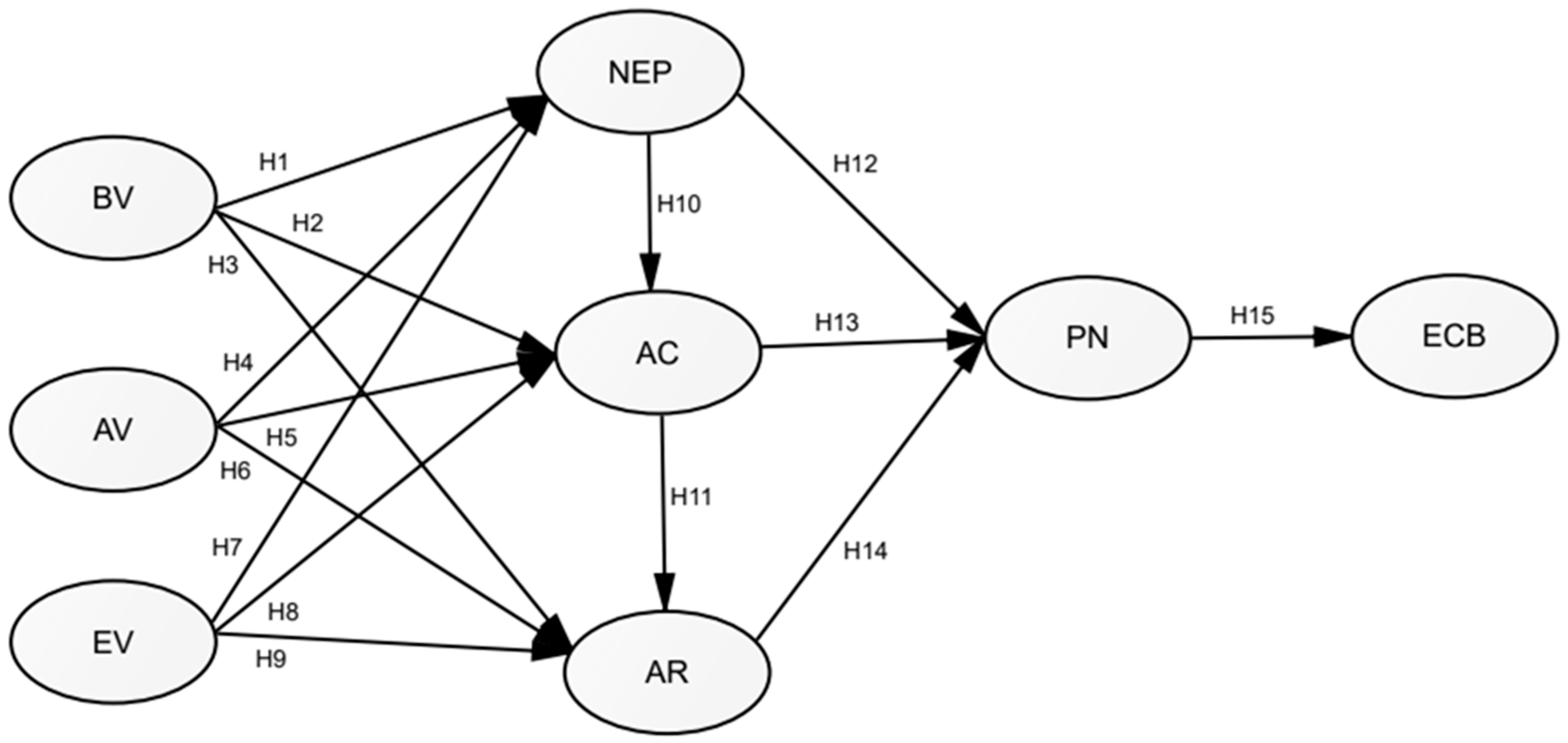
Accordingly, in this study, we empirically tested all value–belief–norm theory constructs in explaining energy-conservation behavior among Turkish adolescents living in a district of a metropolitan city. We proposed a conceptual model (see Figure 1) to display the associations among values, pro-environmental beliefs, awareness of consequences, a sense of responsibility, personal norms, and energy-conservation behavior. The proposed model hypothesizes both direct and indirect relationships among the variables. Specifically, it is hypothesized that universal values of AV, BV, and EV directly influence AC, AR, and NEP. Furthermore, these values are expected to have an indirect effect on the ECB through the mediating roles of AC, AR, and NEP. The model suggests that NEP, as a reflection of individuals’ broader pro-environmental beliefs, directly impacts AC, which in turn influences AR and PN, ultimately leading to ECB. Additionally, the model posits that AR and PN may also act as mediators in the relationship between NEP and ECB, creating a complex network of pathways through which universal values translate into energy-conservation behavior.

2. Method

2.1. Study Context

This research study was conducted in Sarıyer, one of the districts of İstanbul, Türkiye. As a metropolitan city, İstanbul, which ranks fifteenth on the list of the world’s most populated cities (https://worldpopulationreview.com/world-cities, accessed on 5 February 2026), places a high demand on energy production. Residential housing accounts for approximately 20–25% of the city’s total energy use. Natural gas is the dominant source for heating, while electricity consumption is increasingly driven by cooling in the summer and a high density of electronic appliances. Residents of Sarıyer are often exposed to high-technology environments but may also live in homes with varying levels of energy efficiency. According to the Sustainable Energy and Climate Action Plan of İstanbul (2023) [72], environmental degradation has become more severe for Sarıyer in recent years. Furthermore, this district is designated with transition areas between locations where the natural habitat has completely disappeared due to intense urbanization and the locations where the habitat is relatively good. In other words, citizens observe the beauty of natural areas, but at the same time are exposed to the destruction of nature as an adverse consequence of human activities. It was also reported that Sarıyer recorded the highest monthly electricity consumption per household among other districts of İstanbul.

2.2. Sample

The sample of the study includes 530 8th-grade public school students as being in the last year of middle school education in Sarıyer, İstanbul. Of the 530 students, 52.5% were female (N = 278), and 47.2% were male (N = 250). Table 1 presents the participants’ demographic characteristics, including the size of family members and the education level of their parents. As shown in Table 1, the participants’ families mainly consisted of four members. The percentage of parents who attained an undergraduate education was low. Generally, it was presented that mothers and fathers had primary, middle, or high school education levels. Regarding the sources of information on energy-related issues, the Internet (28.0%) and television (20.6%) constituted the major information sources of the students. On the other hand, teachers (15.8%), textbooks (13.6%), and science journals (8.6%) were not considered to be used as frequently as passive media.

2.3. Procedure

The data of this study were collected by the first author after having the necessary approvals from the ethical committee and the Ministry of National Education. Prior to the administration of the measuring tools, all participating students were informed about the purpose and scope of the research. They were provided with detailed information regarding the aims of the study, ensuring that they fully understood the significance of their participation. Additionally, students were assured of the confidentiality of their identities. It was explicitly explained that all data collected would be kept strictly anonymous and would not be shared with any third parties under any circumstances. A total of 549 questionnaires were collected during the data collection process. After the data preparation and screening procedures, 530 questionnaires were retained for the final analyses.

2.4. Instruments

The measuring tool employed in this study consisted of a demographic information questionnaire and the scales prepared in the context of VBN theory. The demographic information questionnaire included questions relevant to gender, grade level, and socioeconomic status. In addition, they were asked to assess their school environment in terms of energy conservation and to reveal their source of information regarding energy-related issues. The scales used in this study encompassed universal values, new environmental paradigm, awareness of consequences, ascribed responsibility, personal norms, and energy-conservation behavior.
Confirmatory factor analysis was conducted for each scale to establish construct validity of the instruments. In the realm of validity, the use of various fit indices to assess scale fitness is prevalent. There is also a lack of consensus regarding the definitive choice of fit indices. However, Hair et al. (2010) [73] proposed that, for assessing the fit of a scale, it is sufficient to report at least one incremental index and one absolute index along with χ2 and degrees of freedom. In line with this recommendation, this study utilized χ2 and degrees of freedom in conjunction with CFI, RMSEA, GFI, and AGFI values to assess model fit. It is essential to note that all the model’s variables were designated as reflective inside the VBN (Value-Belief-Norms) framework. Certain items were eliminated from consideration because their factor loadings were below the necessary cutoff of 0.6, thus ensuring the measurement model’s validity and reliability. While this refinement process strengthened construct validity through improved factor loadings and model fit, it resulted in shorter scales and some Cronbach’s alpha values below 0.70. This is a well-documented consequence of scale brevity [74,75]. The use of shortened scales is well-established in VBN research [29,39,76], particularly when construct validity evidence is strong.

2.4.1. Energy-Conservation Behaviors Scale

The Energy-Conservation Behaviors Scale was administered to assess the behavior of middle school students regarding household energy conservation. The scale was initially designed by Ibtissem (2010) [30] and adapted into Turkish by Sahin (2013) [42]. Both the adapted and the original versions of the scale were unidimensional and covered nine items on a rating scale ranging from 1 (never) to 5 (always). As the initial development of the scale primarily targeted university-level students, certain adjustments were made to better align the scale with middle school students’ daily routines and experiences. The confirmatory factor analysis (CFA) was performed to assess the fit of the proposed model. Upon closer examination, it was observed that the three items displayed low factor loadings and were subsequently excluded from the scale. In the subsequent analysis, the CMIN/DF value was 4.263, CFI was 0.961, RMSEA was 0.088, AGFI was 0.929, and GFI was 0.970, all of which support the adequacy of the model fit. The internal consistency was evaluated using Cronbach’s alpha, resulting in a value of 0.817.

2.4.2. Scales on Ascribed Responsibility, Personal Norms, and Awareness of Consequences

Ascribed responsibility, personal norms, and awareness of consequences scales were initially developed by Steg, Dreijerink, and Abrahamse in 2005 [13]. These scales were adapted into the Turkish context by Sahin (2013) [42]. The “Ascribed Responsibility” dimension, including six items, assesses individuals’ beliefs regarding their responsibility for issues related to energy consumption and commitment to act. In addition, “Awareness of Consequences” intends to assess individuals’ awareness of the adverse consequences of their behaviors relevant to the environment or other people. This dimension consists of ten items. Lastly, “Personal Norms” represents the norms that individuals hold concerning energy conservation and is composed of nine items. The validation of these measurement tools involved conducting confirmatory factor analyses on the scales.
Upon examining the standardized regression weights, it was determined that six items from the scale on “Awareness of Consequences” and six items from the scale on “Personal Norms” exhibited loading below 0.6. Consequently, these items were removed from the scales. It is noteworthy to mention that shorter versions of these scales, consisting of as few as 3 or 4 items, have also been utilized in previous studies [29,76]. Thus, we encountered no hesitation in item reduction from our scale, given the existence of previous studies that have successfully employed shorter versions of these scales. Subsequent reanalysis revealed that all remaining items (six from Ascribed Responsibility, three from Personal Norms, and four from Awareness of Consequences) significantly loaded onto their respective factors. Furthermore, the obtained fit indices, which included CMIN/DF = 2.707, AGFI = 0.930, GFI = 0.952, CFI = 0.939, and RMSEA = 0.057, indicated the scales’ effectiveness in measuring the intended constructs among middle school students. Moreover, the internal consistency of the scales was calculated using Cronbach’s alpha and found to be 0.71 for “Awareness of Consequences”, 0.78 for “Ascribed Responsibility”, and 0.69 for “Personal Norms”.

2.4.3. Universal Values

The Universal Values Scale was designed by Schwartz (1992) [77] to serve as a means of assessing the values that function as guiding principles in individuals’ lives. For this study, the abbreviated version of the scale, containing 12 items, as devised by Stern, Dietz, and Guagnano (1998) [78], was employed. This short version was subsequently adapted to Turkish by Sahin (2013) [42]. The scale encompasses three distinct value orientations: biospheric, altruistic, and egocentric, with each value orientation being evaluated through four items. Confirmatory factor analysis revealed that the item “A world in peace (a world without war)” failed to demonstrate a sufficiently high factor loading on the “altruistic” value orientation. Consequently, this item was removed from the scale, resulting in the “altruistic” value dimension being assessed by three items.
The analysis revealed the following fit indices: CMIN/DF = 2.076, AGFI = 0.955, GFI = 0.968, CFI = 0.957, and RMSEA = 0.045. These indices affirm the goodness of fit. Moreover, the internal consistency of the scales was evaluated using Cronbach’s alpha, resulting in values of 0.80 for the “biospheric” value, 0.61 for the “altruistic” value, and 0.61 for the “egocentric” value.

2.4.4. New Environmental Paradigm (NEP)

In the current study, Dunlap et al.’s (2000) [38] adapted New Ecological Paradigm (NEP) scale, comprising 15 items, was employed to explore middle school students’ perceptions of their connection with the environment. The scale was adapted for use in the Turkish context by Özsoy in 2010 [79]. Responses were collected using a 5-point Likert-type format, with options ranging from 1 (“strongly disagree”) to 5 (“strongly agree”).
After analyzing the results obtained from the confirmatory factor analysis applied to the scale, items that displayed nonsignificant loadings and factor loadings falling below the threshold of 0.6 were systematically removed from the scale. Consequently, the final iteration of the scale consisted of six items. Following the elimination of specific items from the scale, subsequent analyses produced values, including CMIN/DF = 2.437, AGFI = 0.970, GFI = 0.987, CFI = 0.963, and RMSEA = 0.052. Furthermore, the reliability of the scale was assessed using Cronbach’s alpha, resulting in a value of 0.643. Reduction in the number of items for the NEP scale was also observed in previous research studies [68,80] sampling students from urban China (age 10 to 13). The Chinese short version of the NEP scale for use with children showed an acceptable level of model fit for a unidimensional model. The Cronbach’s alpha coefficients were reported as 0.62 [68] and 0.65 [80] in these studies.

2.5. Data Analysis

Before conducting the main analysis, the data were screened for potentially problematic cases through fundamental descriptive analyses, including frequency distribution, means, standard deviations, skewness, kurtosis, and normal probability plots. Z-scores were also computed to detect potential univariate outliers. Following these preliminary steps, bivariate correlations among the variables were subsequently calculated using SPSS version 25 to explore their interrelationships. These results served to assess the appropriateness of the variables for inclusion in the hypothesized model. Additionally, Harmans’ single-factor test was performed to evaluate common method bias since all variables were measured using self-report instruments administered to the same participants [81]. To test the hypothesized connections among the latent constructs, Structural Equation Modeling (SEM) was performed using Amos version 24 with the maximum likelihood estimation method. SEM is particularly advantageous for this purpose, as it not only allows for the assessment of these relationships but also accounts for measurement errors, thereby enhancing the accuracy and reliability of the results [73]. Model fit was evaluated using several fit indices, including the chi-square to degrees of freedom ratio (CMIN/DF), Goodness-of-Fit Index (GFI), Comparative Fit Index (CFI), and Root Mean Square Error of Approximation (RMSEA). Furthermore, the explanatory power of the structural model was evaluated using the R2 coefficients for the latent variables. To test for mediation effects, the bootstrapping method was employed, utilizing 5000 bootstrap samples and a 95% bias-corrected bootstrap confidence interval, providing a reliable basis for assessing these effects with a reasonable degree of confidence.

3. Results

3.1. Structural Model Assessment

Before testing the hypothesized model presented in Figure 1, bivariate correlations among the constructs were examined to determine the extent to which each predictor variable can be used to explain the criterion variable in this statistical model. In addition to Pearson correlation coefficients, the corresponding t values and significance levels were also examined. As presented in Table 2, intercorrelations between the constructs were statistically significant, but not higher than 0.70. Pearson correlation also indicated that associations among AV, NEP, AC, AR, PN, and ECB were positive and in the expected direction. However, it is noteworthy that egocentric values did not demonstrate a significant correlation with other variables and were consequently excluded from further analysis. Therefore, the remaining variables could be used as effective distinct predictors in the model.
Following the exclusion of egocentric values, common method bias was assessed through Harman’s single-factor test using the indicators retained in the final SEM model. The first unrotated factor explained 22.28% of the total variance, which is below the commonly used 50% threshold [82,83]. This result suggested that common method bias was unlikely to be a concern in this study.
Structural Equation Modeling (SEM) was employed to validate the extended VBN model and to examine the establishment of causal relationships among the theoretical variables. The analysis revealed that statistical indicators of CMIN/DF = 1.910, GFI = 0.911, CFI = 0.909, AGFI = 0.895, and RMSEA = 0.041.
The path coefficients derived from the hypothesis tests showed the relationships between the variables. A comprehensive presentation of the hypotheses can be found in Table 3. The structural equation model analysis revealed significant relationships among various constructs. However, biospheric values were found not to significantly predict students’ NEP scores (β = 0.099; t = 1.170; p > 0.05), AC scores (β = 0.074; t = 0.981; p > 0.05), and AR scores (β = 0.107; t = 0.1533; p > 0.05). Similarly, altruistic values were not found to predict students’ AR scores (β = 0.097; t = 1.188; p > 0.05). Notably, PN was significantly predicted by NEP (β = 0.221; t = 2.801; p < 0.05), AR (β = 0.406; t = 4.998; p < 0.05) and AC (β = 0.245; t = 2.462; p < 0.05). Students’ altruistic value scores predicted their NEP scores (β = 0.313; t = 3.221; p < 0.05) and AC scores (β = 0.179; t = 2.016; p < 0.05). Furthermore, AR were significantly predicted by AC (β = 0.577; t = 7.074; p < 0.05) and AC were significantly predicted by NEP (β = 0.534; t = 6.469; p < 0.05). Finally, ECB was significantly predicted by PN (β = 0.587; t = 8.222; p < 0.05).
Nonsignificant paths were removed from the initial model, and the analysis was subsequently rerun. The modified model exhibited a good fit with the research data, as demonstrated by the following fit indices: CMIN/DF = 1.954, GFI = 0.917, AGFI = 0.902, CFI = 0.911, and RMSEA = 0.042.
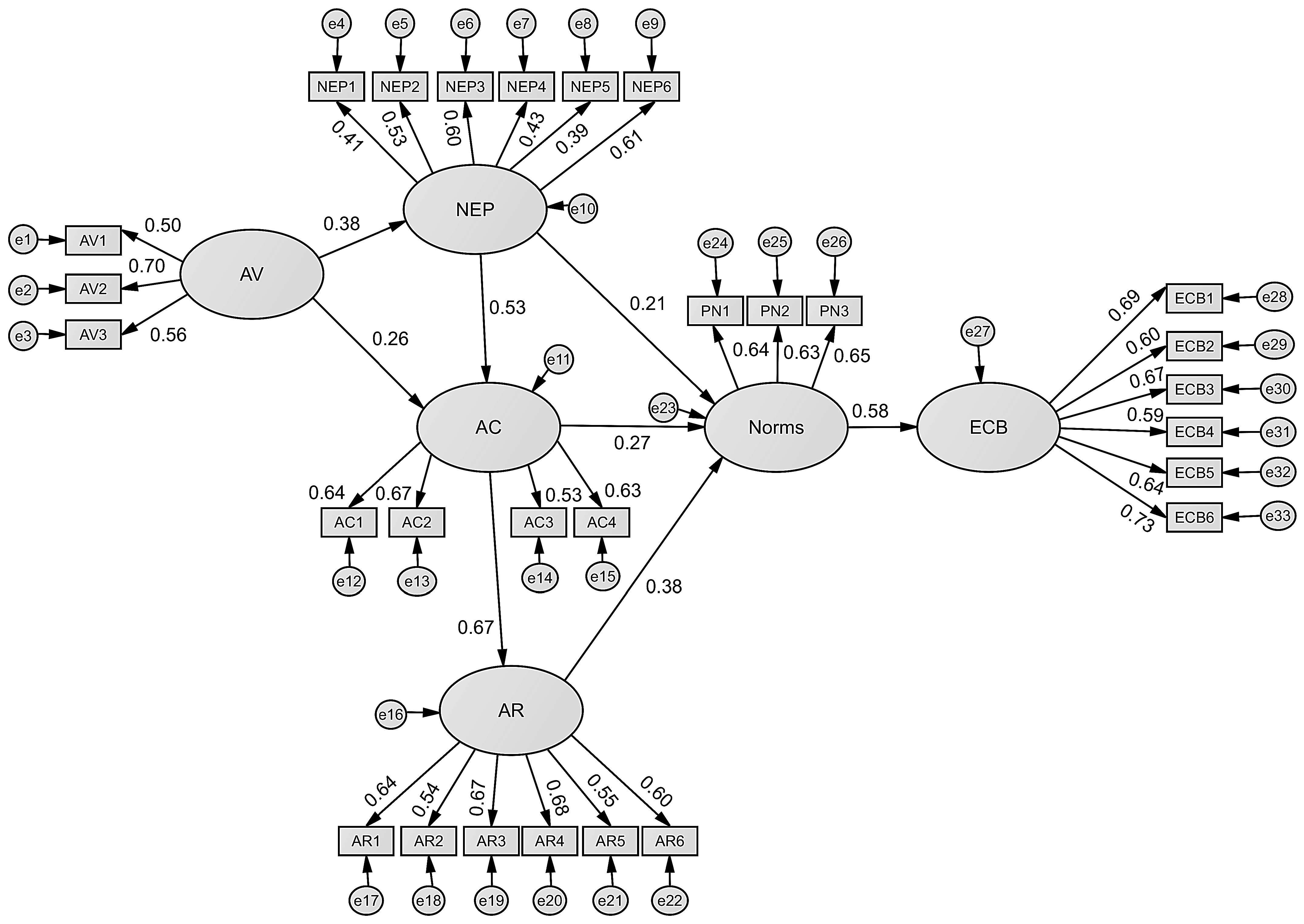
Table 4 and Figure 2 show path coefficients of the final model, where all the interconnections were found to be significant. Consequently, altruistic values significantly predicted NEP (β = 0.380; t = 5.056, p < 0.05) with a medium effect size, and AC (β = 0.261; t = 3.730; p < 0.05) with a small effect size when Cohen’s interpretation on the absolute magnitudes of standardized path coefficients is considered. Regarding the causal link between the belief constructs of VBN theory, it was found that the path coefficients from NEP to AC (β = 0.529) and from AC to AR (β = 0.668) demonstrated large effects for these latent variables. Examining the personal norms, it was shown that this latent variable was significantly and positively linked to NEP (β = 0.212; t = 2.635; p < 0.05) and AC (β = 0.267; t = 2.553; p < 0.05) with small effect size and AR (β = 0.379; t = 4.598; p < 0.05) with a medium effect size. Furthermore, the influence of PN on ECB was statistically and positively significant with a standardized coefficient of β = 0.584, indicating a large effect size.
The explanatory power of the final model was further evaluated using the R2 coefficients for the latent variables as presented in Table 5. Considering these explained variances, the linear combination of AV and NEP accounted for 46% of the variance in AC, with a larger contribution of NEP. AC of energy consumption could explain about 45% of the variance in AR. Regarding the influences of belief constructs in VBN theory, the linear combination of NEP, AC, and AR accounted for 53% of the variance in PN, also reflecting the larger contribution of AR for energy conservation. As the latest criterion variable of VBN theory, 34% variance in the ECB of middle school students could be explained by their moral obligations to conserve energy.

3.1.1. Additional Analysis of Biospheric Values

Biospheric values were positively associated with the other constructs in the bivariate correlation analysis; however, they did not show significant direct effects in the initial structural model. To better understand this inconsistency, additional analyses were conducted. First, a nested model comparison was performed by constraining the direct paths from biospheric values to NEP, AC, and AR to zero while retaining the remaining model structure (Kline, 2016) [84]. The constrained model showed a highly similar fit to the less restricted model, χ2(424) = 809.48, CMIN/DF = 1.91, GFI = 0.910, AGFI = 0.895, CFI = 0.909, RMSEA = 0.041, compared with χ2(421) = 803.94, CMIN/DF = 1.91, GFI = 0.911, AGFI = 0.895, CFI = 0.909, RMSEA = 0.041. The chi-square difference was not significant, Δχ2(3) = 5.54, p = 0.136, suggesting that these direct biospheric value paths did not provide substantial incremental explanatory power in the model.
Further analysis also showed that when biospheric values were modeled alone, they significantly predicted NEP (β = 0.282, p < 0.001), AC (β = 0.169, p = 0.003), and AR (β = 0.152, p = 0.004). Taken together, these findings suggest that the apparent contribution of biospheric values became weaker in the broader structural model.

3.1.2. Evaluation of Indirect Effects

The mediation relationships between variables in the proposed model were examined using bootstrapping analysis (Table 6). Then, the study conducted a further analysis to determine whether there was a partial or full mediation effect among the variables for which an indirect relationship was significant, as seen in Table 7.
Considering the findings presented in Table 6 and Table 7, it is observed that numerous indirect effects exist, some of which demonstrate full mediation, while others show partial mediation. Among these, the indirect effect of altruistic values on ascribed responsibility is especially notable. Although no direct path from AV to AR was retained in the final model, this relationship was fully mediated through two sequential pathways: AV → AC → AR, and AV → NEP → AC → AR. In both cases, awareness of consequences (AC) serves as the proximal mediator, suggesting that altruistic values activate a sense of responsibility by first heightening individuals’ awareness of the negative consequences of energy use. Similarly, the absence of a direct significant path from AV to ECB indicates that this relationship was fully mediated through belief- and norm-related pathways, most centrally AV → NEP → AC → AR → PN → ECB, which is consistent with the sequential structure proposed by VBN theory. Additional indirect paths involving other combinations of these mediators are presented in Table 6 and Table 7 for completeness.

4. Conclusions and Discussion

This research study employed VBN theory to investigate the household energy-conservation behavior of a sample of Turkish middle school students. Considering the causal chain with respect to VBN theory, our findings revealed that the energy-conservation behavior of the students could be accounted for by their personal moral obligations pertinent to such behavior. It is also noteworthy to highlight that, considering the strength of path coefficients, this theory offers valuable in-depth insight for explaining these students’ energy-conservation behavior as our criterion variable in VBN theory. Testing the mediation effects helps us to clarify associations among certain energy-related attributes for the students. To be more specific, this study showed that understanding the impacts of energy consumption drives students to take collective responsibility for climate change. Furthermore, the students feel guilty about wasting energy, which motivates them to conserve energy. The present study supported Al Mamun et al.’s (2022) [46] findings, concluding that personal norms influence energy-conservation behavior in the workplace for a Chinese sample. Consistently, previous research studies conducted in various populations, such as American [56] and Mongolian [45] adults, reflected a positive and significant direct impact of personal norms on pro-environmental behavior. Previous research [67,68,85] sampling adolescents in their country provided further support for the pertinent to the role of personal norms on energy-conservation behavior, as previously found in adults. Notably, their assessment and analyses did not include all VBN theory variables, which do not provide insight into the complete causal chain required in the theory.
Our findings demonstrated that personal norms, as the significant precursor of behavior, could be positively predicted by pro-environmental beliefs, awareness of consequences, and ascribed responsibility, supporting both VBN and NAM Theory [35,86]. The central finding from the mediation analysis is the full sequential chain (AV → NEP → AC → AR → PN → ECB), which mirrors the causal structure proposed by VBN theory and shows that altruistic values translate into energy-conservation behavior through belief- and norm-related pathways. Having a closer look at the present results, as suggested by Liu, Zou, and Wu (2018) [45], the indirect effects indicate that pro-environmental beliefs may serve as a filter between altruism and behavioral norms when the students deal with an issue based on human and nature interactions. Furthermore, the constructs under the belief domain of VBN theory have been found to mediate the relationship between altruistic values and personal norms to conserve energy. In other words, when a student’s altruistic values are stimulated more, it may develop moral obligations to conserve energy through beliefs on human-nature connections, awareness of consequences in terms of global warming and other environmental problems, and finally ascribed responsibility for tackling climate change and exhaustion of energy resources. Thus, it could be inferred that when these individuals are faced with an issue in line with their own values devoted to other humans’ well-being, personal norms are more likely to be cultivated through specific beliefs around energy resources, global warming, and climate change.
Having a closer look at significant causal links between belief-related constructs, the results of our study support that the pro-environmental beliefs (NEP) of these students were associated with awareness of the consequences of energy-saving on the environment. Furthermore, the students who were more aware of the consequences of energy-saving felt more responsible for engaging in actions in this context. These results were consistent with previous research [46,47,87], as in line with VBN theory, which asserts that people with more strong beliefs about human-nature interdependence develop an awareness of the consequences of their own actions and ascribe responsibility. Therefore, this study implied that the students’ positive views on human-nature interrelationships promote their awareness of energy-saving and environmental problems, which in turn leads to the formation of ascribed responsibility.
The present dataset demonstrates that altruistic values develop pro-environmental beliefs and awareness of consequences directly, but ascribed responsibility indirectly. On the contrary, biospheric and egoistic values were found to have no significant unique direct influence on pro-environmental beliefs, awareness of consequences, and ascribed responsibility in the broader structural model. Although the structural path from biospheric values to NEP was not supported in the latent model, the correlation between these constructs was positive and significant. When value orientations are considered together, the influence of biospheric values weakens, whereas altruistic values appear to play a more central role in shaping environmental beliefs. The nonsignificant direct effect of biospheric values is consistent with previous findings, where biospheric values similarly failed to make a unique contribution to energy conservation-related beliefs [30,88]. For Tunisian consumers, Ibtissem (2010) [30] reported that biospheric values appeared to have no potential to impact energy conservation-related attributes, although there is a growing concern about environmental problems. This pattern was attributed to the high correlation between biospheric and altruistic values, which suppresses their independent contributions when both were included in the same model [88,89]. The finding that altruistic values play a more central role than biospheric ones is in line with developmental research on early adolescence. At this stage, adolescents tend to prioritize human welfare over more abstract ecological values [90]. Therefore, students were more likely to relate energy conservation to the well-being of people around them than to the intrinsic value of the biosphere. A similar pattern was documented by previous research studies [55,91]. Kahn (1997) [91], conducting a structural analysis of children’s environmental moral reasoning, indicated that homocentric justifications grounded in human welfare predominate in early adolescence. In contrast, biocentric orientations emerge more gradually. Accordingly, the fact that biospheric values remained nonsignificant in the present study may not indicate an absence of environmental concern. Rather, it may suggest that 8th-grade students were more responsive to human-centered reasoning at this stage of development. In other words, concern for the well-being of others appears to be a more accessible and motivationally effective foundation for energy-conservation behavior than abstract ecological values at this age. Supportive evidence was also reported by Pearce et al. (2020) [55] investigating Flemish children’s energy usage. Accordingly, these students might develop beliefs about human-nature interdependence and awareness of reducing energy usage due to preserving natural resources for future generations or for social welfare, rather than considering the value of nature for its own sake strongly.

5. Implications

The present research empirically tested the role of domains of social-psychological attributes on energy-conservation behavior of Turkish middle school students utilizing the Value–Belief–Norm theory. This research could be considered original in the field of environmental psychology and education, with its target audience participating in the research. Previous research has been conducted to explain various types of pro-environmental behavior, including consumers’ decisions about green hotels [92], acceptability of energy policies [13], complying with the carry bag fee ordinance [93], and support for car use reduction policies in Russia [94] for citizens of different nations but leaving us with research gaps regarding young people. This research focused on the 8th-grade students, acknowledging also their unique capacity to influence the habits of their parents and other family members through regular family engagement and the natural influence they hold within the household [64]. By modeling green habits or advocating for change, young people can motivate adults to adopt more sustainable lifestyles, including energy conservation. Thus, assessing behavior as reflected by direct energy-saving actions and encouragement of others to engage in wise energy-related actions, the present study provides valuable hints to develop effective educational programs designed specifically for this age group. Furthermore, adolescents are at a developmental point where they are more likely to let their internal moral judgments —rather than just external forces—guide their behavior compared to younger children. It is noteworthy to recall the study setting, Sariyer District, with the highest monthly electricity consumption per household recorded in İstanbul. To mitigate energy demand in the district, further attempts should focus on the students identified as significant energy users [64], specifically by reinforcing their positive personal norm and behavioral precursors that drive energy-conservation behavior.
In contrast to some research studies [45,46,68], we assessed each cluster of the model without excluding any attribute of the VBN theory. Our findings revealed a significant explanatory power of altruistic values, beliefs, and norms for the further attribute as depicted in the hypothesized model. Our research findings reveal significant practical implications for sustainability education and the related policies. Considering the direct and indirect effects of VBN variables on ECB verified in this study, sustainability-related education programs stimulating students’ altruist values while underlining interrelations between human and nature may promote their beliefs on the adverse consequences of environmentally unsustainable use of energy. It was shown that these students believing in the severity of global warming while focusing on human well-being could be active in creating sustainable energy consumption patterns. Furthermore, our data from the students in this research confirmed that increasing awareness of consequences pertinent to energy consumption might stimulate their sense of responsibility and activate moral norms required to induce energy-conservation behavior. As suggested by Schultz and Zelezny (2003) [95], education programs and every teaching material, specifically textbooks, games, simulations, and images pertinent to energy issues, should deliver some messages framed to appeal to the values and beliefs of these individuals. These programs and materials need to be empowered with relevant scientific information on behavioral changes they could engage in for energy conservation. In line with Schultz and Zelezny’s (2003) [95] implications, Kaplowitz et al. (2009) [96] and Yeboah and Kaplowitz (2016) [56] pointed out that individuals should be equipped with the why, what, and how of the behavior in question in order for the desired behavioral change to occur.
Educational programs covering energy-related issues should associate the outcomes and content more with social justice, equal opportunities, and the welfare of society within this context. To exemplify, this country still has ongoing arguments about accelerating energy production by constructing more hydroelectric power stations rather than focusing on energy conservation. This issue could be evaluated with its diverse aspects, such as the expropriation of personal property, including agricultural lands and hometowns, possible unemployment problems, and environmental deterioration. Furthermore, this research indicates that we must build communities of practice with special emphasis on the co-operation of schools with non-governmental organizations, local governments, and communities representing different stakeholders [97]. The students may perceive energy problems not just as an environmental issue but also as a societal or maybe a political issue when also considering their main source of information as the Internet and television. They seem to be dealing with information from both passive media and the school. Thus, every stakeholder disseminating the relevant information using various media sources may reflect their own point of view in the context of energy issues. However, schools enhancing their co-operation with different stakeholders may provide various forms of education based on a complex systems approach touching on dynamic systems [98]. Challenges in sustainability, including energy, climate change, food production, health, and well-being, are dominated by natural, social, political, or technological systems that force educators to design educational programs around real-world complex systems [99]. Such sustainability education programs and practices might be influential in reinforcing strong values, beliefs, and personal norms that could lead to sustainable energy-related behavior. As highlighted by Wu (2018) [68], adolescents are at a developmental stage where we can shape their moral considerations, values, and beliefs as guiding principles of their lives, which in turn could facilitate sustainable behavior.

6. Limitations and Recommendations

The present study was framed based on the VBN theory, utilizing quantitative research. Thus, the results were discussed using the self-reported attributes as reflected by the middle school students. Self-report measures available in any format, open-ended or closed, regardless of the subject, may pose several major difficulties [100]. To exemplify, open-ended ones require too much effort to analyze data. In addition, constructs including values, beliefs, and behavior could be under the influence of social desirability or social pressure that should be considered to be a limitation in terms of appropriateness of judgments [101]. Accordingly, further evidence could be presented while taking into account some measures provided in previous studies, such as face-to-face interviews [102], meter reading, and use of previous studies [103].
In this research, the items for each assessment were selected since they offered the best fit to reach reliability and validity standards. However, the Cronbach’s alpha coefficients for the NEP scale and the Universal Values Scale remained relatively low, indicating that the items did not align perfectly with the underlying attributes. This could be due to a lack of conceptual clarity among the items or variations in how participants responded to different items within the same dimensions. Regarding this limitation, it is noteworthy to emphasize the urgent need for future studies to focus on developing age-appropriate instruments specifically for young people rather than adapting adult-centric tools. Improving these instruments is essential for more accurately and precisely evaluating the values and beliefs of young populations [68].
Considering the generalizability of the findings, we must highlight that middle school students in rural areas or regions of the country with different socioeconomic characteristics may have different inclinations regarding energy conservation. Further research investigating samples from different settings may facilitate our in-depth understanding of the energy-conservation behavior of these adolescents.

Author Contributions

Conceptualization, D.O., A.S., E.S. and C.O.; Methodology, D.O., A.S., E.S. and C.O.; Software, D.O. and A.S.; Validation, D.O., A.S., E.S. and C.O.; Formal analysis, D.O., A.S., E.S. and C.O.; Investigation, D.O., A.S., E.S. and C.O.; Resources, D.O., A.S., E.S. and C.O.; Data curation, D.O., A.S. and E.S.; Writing—original draft, D.O., A.S., E.S. and C.O.; Writing—review & editing, D.O., A.S., E.S. and C.O.; Supervision, E.S. All authors have read and agreed to the published version of the manuscript.

Funding

This research received no external funding.

Institutional Review Board Statement

The study was conducted in accordance with the Declaration of Helsinki and approved by the Middle East Technical University Human Subjects Ethics Committee. (Approval Code: 2017EGT021, Date of Approval: 27 February 2018).

Informed Consent Statement

Informed consent was obtained from all subjects involved in the study.

Data Availability Statement

The original contributions presented in this study are included in the article. Further inquiries can be directed to the corresponding author.

Conflicts of Interest

The authors declare no conflicts of interest.

References

  1. Gladwin, D.; Ellis, N. Energy literacy: Towards a conceptual framework for energy transition. Environ. Educ. Res. 2023, 29, 1515–1529. [Google Scholar] [CrossRef]
  2. Ilham, Z.; Zulkifli, N.E.I.; Ismail, N.F.; Danik, A.S.; Halim-Lim, S.A.; Wan-Mohtar, W.A.A.Q.I.; Jamaludin, A.A. Energy conservation: Awareness analysis among secondary school students. Environ. Educ. Res. 2022, 28, 925–947. [Google Scholar] [CrossRef]
  3. Jakučionytė-Skodienė, M.; Dagiliūtė, R.; Liobikienė, G. Do general pro-environmental behaviour, attitude, and knowledge contribute to energy savings and climate change mitigation in the residential sector? Energy 2020, 193, 116784. [Google Scholar] [CrossRef]
  4. Sadorsky, P. Do urbanization and industrialization affect energy intensity in developing countries? Energy Econ. 2013, 37, 52–59. [Google Scholar] [CrossRef]
  5. Si, H.; Yu, Z.; Jiang, Q.; Shu, Y.; Hua, W.; Lv, X. Better future with better us: Exploring young people’s energy-saving behavior based on norm activation theory. Front. Public Health 2022, 10, 1042325. [Google Scholar] [CrossRef]
  6. Gladwin, D.; Karsgaard, C.; Shultz, L. Collaborative Learning on Energy Justice: International Youth Perspectives on Energy Literacy and Climate Justice. J. Environ. Educ. 2022, 53, 251–260. [Google Scholar] [CrossRef]
  7. Carrus, G.; Tiberio, L.; Mastandrea, S.; Chokrai, P.; Fritsche, I.; Klöckner, C.A.; Masson, T.; Vesely, S.; Panno, A. Psychological Predictors of Energy Saving Behavior: A Meta-Analytic Approach. Front. Psychol. 2021, 12, 648221. [Google Scholar] [CrossRef]
  8. Intergovernmental Panel on Climate Change (IPCC). Global Warming of 1.5 °C: IPCC Special Report; IPCC: Geneva, Switzerland, 2018. [Google Scholar]
  9. Abrahamse, W.; Shwom, R. Domestic energy consumption and climate change mitigation. WIREs Clim. Change 2018, 9, e525. [Google Scholar] [CrossRef]
  10. Jorgenson, S.N.; Stephens, J.C.; White, B. Environmental education in transition: A critical review of recent research on climate change and energy education. J. Environ. Educ. 2019, 50, 160–171. [Google Scholar] [CrossRef]
  11. Lee, Y.F.; Nguyen, H.B.N.; Sung, H.T. Energy literacy of high school students in Vietnam and determinants of their energy-saving behavior. Environ. Educ. Res. 2022, 28, 907–924. [Google Scholar] [CrossRef]
  12. Marchi, L.; Gaspari, J. Energy Conservation at Home: A Critical Review on the Role of End-User Behavior. Energies 2023, 16, 7596. [Google Scholar] [CrossRef]
  13. Steg, L.; Dreijerink, L.; Abrahamse, W. Factors influencing the acceptability of energy policies: A test of VBN theory. J. Environ. Psychol. 2005, 25, 415–425. [Google Scholar] [CrossRef]
  14. Tessema, G.A.; Chani, P.S.; Rajaseka, E. Modelling energy-saving behaviour in Ethiopian urban households: Integrating personal norms and demographic moderators to the theory of planned behaviour. Energy Build. 2026, 351, 116709. [Google Scholar] [CrossRef]
  15. Yue, T.; Li, M.; Wang, Q.; Long, R.; Chen, H.; Liu, J.; Chen, F. Will Residents’ Energy-Conservation Behavior Be Continued under Perception of Behavior Outcome? The Moderating Role of Attribution Style. Resour. Conserv. Recycl. 2023, 189, 106745. [Google Scholar] [CrossRef]
  16. Wang, Y.; Zhang, W. A study about the impact of energy saving climate on college students’ energy saving behavior: Based on analysis using the hierarchical linear model. J. Environ. Plan. Manag. 2023, 66, 2943–2961. [Google Scholar] [CrossRef]
  17. Demircioglu, M.; Eşİyok, S. Energy consumption forecast of Turkey using artificial neural networks from a sustainability perspective. Int. J. Sustain. Energy 2022, 41, 1127–1141. [Google Scholar] [CrossRef]
  18. Kaytez, F. A Hybrid Approach Based on Autoregressive Integrated Moving Average and Least-Square Support Vector Machine for Long-Term Forecasting of net Electricity Consumption. Energy 2020, 197, 117200. [Google Scholar] [CrossRef]
  19. Kavaklioglu, K. Modeling and Prediction of Turkey’s Electricity Consumption Using Support Vector Regression. Appl. Energy 2011, 88, 368–375. [Google Scholar] [CrossRef]
  20. Sen, D.; Tunç, K.M.; Günay, M.E. Forecasting electricity consumption of OECD countries: A global machine learning modeling approach. Util. Policy 2021, 70, 101222. [Google Scholar] [CrossRef]
  21. Özcan, B.; Tzeremes, P.; Doğan, E. Re-estimating the interconnectedness between the demand of energy consumption, income, and sustainability indices. Environ. Sci. Pollut. Res. 2019, 26, 26500–26516. [Google Scholar] [CrossRef] [PubMed]
  22. Ministry of Foreign Affairs. Türkiye’s International Energy Strategy. 2022. Available online: https://www.mfa.gov.tr/turkeys-energy-strategy.en.mfa (accessed on 5 February 2026).
  23. Corner, A.; Roberts, O.; Chiari, S.; Völler, S.; Mayrhuber, E.S.; Mandl, S.; Monson, K. How do young people engage with climate change? The role of knowledge, values, message framing, and trusted communicators. Wiley Interdiscip. Rev. Clim. Change 2015, 6, 523–534. [Google Scholar] [CrossRef]
  24. Moser, S.C. Reflections on climate change communication research and practice in the second decade of the 21st century: What more is there to say? WIREs Clim. Change 2016, 7, 345–369. [Google Scholar] [CrossRef]
  25. Ojala, M. Hope and climate change: The importance of hope for environmental engagement among young people. Environ. Educ. Res. 2012, 18, 625–642. [Google Scholar] [CrossRef]
  26. Wallis, H.; Klöckner, C. The Transmission of Energy-Saving Behaviors in the Family: A Multilevel Approach to the Assessment of Aggregated and Single Energy-Saving Actions of Parents and Adolescents. Environ. Behav. 2020, 52, 275–304. [Google Scholar] [CrossRef]
  27. Alomari, M.M.; El-Kanj, H.; Topal, A.; Alshdaifat, N.I. Energy conservation behavior of university occupants in Kuwait: A multigroup analysis. Sustain. Energy Technol. Assess. 2022, 52, 102198. [Google Scholar] [CrossRef]
  28. Kaplowitz, S.A.; Boucher, J.L. Energy Conservation Behaviors, Climate Change Attitudes, Income, and Behavioral Plasticity. Hum. Ecol. 2022, 50, 937–952. [Google Scholar] [CrossRef]
  29. Abrahamse, W.; Steg, L. Factors related to household energy use and intention to reduce it: The role of psychological and socio-demographic variables. Hum. Ecol. Rev. 2011, 18, 30–40. [Google Scholar]
  30. Ibtissem, M.H. Application of value beliefs norms theory to the energy conservation behavior. J. Sustain. Dev. 2010, 3, 129–139. [Google Scholar] [CrossRef]
  31. Liobikiene, G.; Juknys, R. The role of values, environmental risk perception, awareness of consequences, and willingness to assume responsibility for environmentally-friendly behaviour: The Lithuanian case. J. Clean. Prod. 2016, 112, 3413–3422. [Google Scholar] [CrossRef]
  32. Webb, D.; Soutar, G.N.; Mazzarol, T.; Saldaris, P. Self-determination theory and consumer behavioral change: Evidence from a household energy-saving behavior study. J. Environ. Psychol. 2013, 35, 59–66. [Google Scholar] [CrossRef]
  33. Stern, P.C.; Dietz, T.; Abel, T.; Guagnano, G.A.; Kalof, L. A Value-Belief-Norm Theory of support for social movements: The case of environmentalism. Res. Hum. Ecol. 1999, 6, 81–97. [Google Scholar]
  34. Balundė, A.; Poškus, M.S.; Jovarauskaitė, L.; Sarid, A.; Farangitakis, G.; Knippels, M.-C.; Hadjichambis, A.C.; Paraskeva-Hadjichambi, D. Values Beliefs Environmental Citizenship. In Conceptualizing Environmental Citizenship for 21st Century Education, Environmental Discourses in Science Education; Hadjichambis, A.C., Paraskeva-Hadjichambi, D., Reis, P., Činčera, J., Pauw, J.B.-D., Gericke, N., Knippels, M.-C., Eds.; Springer: Cham, Switzerland, 2020; Volume 4, pp. 83–96. [Google Scholar] [CrossRef]
  35. Stern, P.C. New Environmental Theories: Toward a Coherent Theory of Environmentally Significant Behavior. J. Soc. Isssues 2000, 56, 407–424. [Google Scholar] [CrossRef]
  36. Stern, P.C.; Dietz, T.; Kalof, L. Value orientations, gender, and environmental concern. Environ. Behav. 1993, 25, 322–348. [Google Scholar] [CrossRef]
  37. Dunlap, R.; Van Liere, K. Moral Norms and Environmental Behavior: An Application of Schwartz’s Norm-Activation Model to Yard Burning. J. Appl. Soc. Psychol. 1978, 8, 174–188. [Google Scholar]
  38. Dunlap, R.; Van Liere, K.; Mertig, A.; Jones, R. New Trends in Measuring Environmental Attitudes: Measuring Endorsement of the New Ecological Paradigm: A Revised NEP Scale. J. Soc. Issues 2000, 56, 425–442. [Google Scholar] [CrossRef]
  39. De Groot, J.I.; Steg, L. Value orientations to explain beliefs related to environmental significant behavior: How to measure egoistic, altruistic, and biospheric value orientations. Environ. Behav. 2008, 40, 330–354. [Google Scholar] [CrossRef]
  40. Nordlund, A.M.; Garvill, J. Effects of values, problem awareness, and personal norm on willingness to reduce personal car use. J. Environ. Psychol. 2003, 23, 339–347. [Google Scholar] [CrossRef]
  41. Momenpour, Y.; Sadighi, H.; Choobchian, S.; Lebailly, P.; Dogot, T.; Viira, A.-H.; Azadi, H. Towards predicting the pro-environmental behaviour of wheat farmers by using the application of value-belief-norm theory. Environ. Dev. Sustain. 2025, 27, 27851–27881. [Google Scholar] [CrossRef]
  42. Sahin, E. Predictors of Turkish Elementary Teacher Candidates’ Energy Conservation Behaviors: An Approach on Value-Belief-Norm Theory. Int. J. Environ. Sci. Educ. 2013, 8, 269–283. [Google Scholar] [CrossRef]
  43. Hartmann, C.; Siegrist, M. Consumer perception and behaviour regarding sustainable protein consumption: A systematic review. Trends Food Sci. Technol. 2017, 61, 11–25. [Google Scholar] [CrossRef]
  44. Hori, S.K.; Kondo, D.; Nogata, H.B. The determinants of household energy-saving behavior: Survey and comparison in five major Asian cities. Energy Policy 2013, 52, 354–362. [Google Scholar] [CrossRef]
  45. Liu, X.; Zou, Y.; Wu, J. Factors Influencing Public-Sphere Pro-Environmental Behavior among Mongolian College Students: A Test of Value–Belief–Norm Theory. Sustainability 2018, 10, 1384. [Google Scholar] [CrossRef]
  46. Al Mamun, A.; Hayat, N.; Masud, M.M.; Yang, Q.; Salameh, A.A.; Salleh, M.F.M. Energy Conservation Behaviour Among the Malaysian Youth: A Study Under the Premises of Value-Belief Norm Model. Front. Energy Res. 2022, 10, 902619. [Google Scholar] [CrossRef]
  47. Fornara, F.; Molinario, E.; Scopelliti, M.; Bonnes, M.; Bonaiuto, F.; Cicero, L.; Admiraal, J.; Beringer, A.; Dedeurwaerdere, T.; de Groot, W.; et al. The extended Value–Belief–Norm theory predicts committed action for nature and biodiversity in Europe. Environ. Impact Assess. Rev. 2020, 81, 106338. [Google Scholar] [CrossRef]
  48. Shi, D.; Wang, L.; Wang, Z. What affects individual energy conservation behavior: Personal habits, external conditions or values? An empirical study based on a survey of college students. Energy Policy 2019, 128, 150–161. [Google Scholar] [CrossRef]
  49. Abrahamse, W.; Steg, L. How do socio-demographic and psychological factors relate to households’ direct and indirect energy use and savings? J. Econ. Psychol. 2009, 30, 711–720. [Google Scholar] [CrossRef]
  50. Boudet, H.S.; Flora, J.A.; Armel, K.C. Clustering household energy-saving behaviours by behavioural attribute. Energy Policy 2016, 92, 444–454. [Google Scholar] [CrossRef]
  51. Le-Anh, T.; Nguyen, M.D.; Nguyen, T.T.; Duong, K.T. Energy saving intention and behavior under behavioral reasoning perspectives. Energy Effic. 2023, 16, 8. [Google Scholar] [CrossRef]
  52. Liu, S.; Zheng, C.; Song, J. Accessed but unsustainable? The impact of access-based consumption on energy conservation behavior. Transp. Res. Part D Transp. Environ. 2024, 132, 104271. [Google Scholar]
  53. Steg, L. Promoting household energy conservation. Energy Policy 2008, 36, 4449–4453. [Google Scholar] [CrossRef]
  54. Jan, B.; Asif, M. Energy conservation research trajectories: A systematic analysis of methods, technologies, and knowledge gaps. Energy Build. 2025, 330, 115304. [Google Scholar] [CrossRef]
  55. Pearce, H.; Hudders, L.; Van de Sompel, D. Young energy savers: Exploring the role of parents, peers, media and schools in saving energy among children in Belgium. Energy Res. Soc. Sci. 2020, 63, 101392. [Google Scholar] [CrossRef]
  56. Yeboah, F.K.; Kaplowitz, M.D. Explaining energy conservation and environmental citizenship behaviors using the Value-Belief-Norm Framework. Hum. Ecol. Rev. 2016, 22, 137–159. [Google Scholar]
  57. Aguirre-Bielschowsky, I.; Lawson, R.; Stephenson, J.; Todd, S. Energy literacy and agency of New Zealand children. Environ. Educ. Res. 2017, 23, 832–854. [Google Scholar] [CrossRef]
  58. Corbos, R.A.; Bunea, O.I.; Jiroveanu, D.C. The effects of the energy crisis on the energy-saving behavior of young people. Energy Strategy Rev. 2023, 49, 101184. [Google Scholar] [CrossRef]
  59. DeWaters, J.; Powers, S. Establishing measurement criteria for an energy literacy questionnaire. J. Environ. Educ. 2013, 44, 38–55. [Google Scholar] [CrossRef]
  60. Dai, M.; Chen, T. They are just light bulbs, right? The personality antecedents of household energy-saving behavioral intentions among young millennials and gen Z. Int. J. Environ. Res. Public Health 2021, 18, 13104. [Google Scholar] [CrossRef] [PubMed]
  61. Lee, L.S.; Lee, Y.F.; Altschuld, J.W.; Pan, Y.J. Energy Literacy: Evaluating Knowledge, Affect, and Behavior of Students in Taiwan. Energy Policy 2015, 76, 98–106. [Google Scholar] [CrossRef]
  62. Lefkeli, S.; Manolas, E.; Ioannou, K.; Tsantopoulos, G. Socio-cultural impact of energy saving: Studying the behaviour of elementary school students in Greece. Sustainability 2018, 10, 737. [Google Scholar] [CrossRef]
  63. Lusinga, S.; de Groot, J. Energy consumption behaviours of children in low-income communities: A case study of Khayelitsha, South Africa. Energy Res. Soc. Sci. 2019, 54, 199–210. [Google Scholar] [CrossRef]
  64. Wang, Y.; Xu, H.; Xu, X.; Zhou, Y. The power of children in energy conservation: Evidence from a randomized controlled trial. J. Dev. Econ. 2025, 174, 103439. [Google Scholar] [CrossRef]
  65. Zerinou, I.; Karasmanaki, E.; Ioannou, K.; Andrea, V.; Tsantopoulos, G. Energy saving: Views and attitudes among primary school students and their parents. Sustainability 2020, 12, 6206. [Google Scholar] [CrossRef]
  66. Ntona, E.; Arabatzis, G.; Kyriakopoulos, G.L. Energy Saving: Views and Attitudes of Students in Secondary Education. Renew. Sustain. Energy Rev. 2015, 46, 1–15. [Google Scholar] [CrossRef]
  67. Dumciuviene, D.; Cibinskiene, A.; Andrijauskiene, M. Determinants of energy saving: Evidence from a vocational school in Greece. Energies 2019, 12, 3647. [Google Scholar] [CrossRef]
  68. Wu, L. The relationships between environmental sensitivity, ecological worldview, personal norms and pro-environmental behaviors in Chinese children: Testing the value–belief–norm model with environmental sensitivity as an emotional basis. Psych. J. 2018, 7, 111–121. [Google Scholar] [CrossRef]
  69. Gródek-Szostak, Z.; Malinowski, M.; Suder, M.; Kwiecień, K.; Bodziacki, S.; Vaverková, M.D.; Maxianová, A.; Krakowiak-Bal, A.; Ziemiańczyk, U.; Uskij, H.; et al. Energy Conservation Behaviors and Awareness of Polish, Czech and Ukrainian Students: A Case Study. Energies 2021, 14, 5599. [Google Scholar] [CrossRef]
  70. Isabelle, G.-M. Energy-related logics of action throughout the ages in France: Historical milestones, stages of life and intergenerational transmissions. Energy Effic. 2011, 4, 493–509. [Google Scholar] [CrossRef]
  71. Otto, S.; Evans, G.W.; Moon, M.J.; Kaiser, F.G. The development of children’s environmental attitude and behavior. Glob. Environ. Change 2019, 58, 101947. [Google Scholar] [CrossRef]
  72. Sustainable Energy and Climate Action Plan of İstanbul. 2023. Available online: https://cevre.ibb.istanbul/wp-content/uploads/2024/04/ENG-SECAP-v04.pdf (accessed on 5 February 2026).
  73. Hair, J.F.; Black, W.C.; Babin, B.J.; Anderson, R.E. Multivariate Data Analysis; Prentice-Hall: Hoboken, NJ, USA, 2010. [Google Scholar]
  74. Cortina, J.M. What is coefficient alpha? An examination of theory and applications. J. Appl. Psychol. 1993, 78, 98–104. [Google Scholar] [CrossRef]
  75. Streiner, D.L. Starting at the beginning: An introduction to coefficient alpha and internal consistency. J. Personal. Assess. 2003, 80, 99–103. [Google Scholar] [CrossRef]
  76. Onel, N.; Mukherjee, A. Why do consumers recycle? A holistic perspective encompassing moral considerations, affective responses, and self-interest motives. Psychol. Mark. 2017, 2, 956–971. [Google Scholar] [CrossRef]
  77. Schwartz, S.H. Universals in the content and structure of values: Theoretical advances and empirical tests in 20 countries. In Advances in Experimental Social Psychology; Zanna, M.P., Ed.; Academic Press: Cambridge, MA, USA, 1992; Volume 25, pp. 1–65. [Google Scholar]
  78. Stern, P.C.; Dietz, T.; Guagnano, G.A. A brief inventory of values. Educ. Psychol. Meas. 1998, 58, 984–1001. [Google Scholar] [CrossRef]
  79. Özsoy, S. Effects of Eco-School Application on Elementary School Students’ Environmental Literacy Levels. Doctoral Dissertation, Middle East Technical University, Ankara, Turkey, 2010. [Google Scholar]
  80. Wu, L. Exploring the New Ecological Paradigm Scale for gauging children’s environmental attitudes in China. J. Environ. Educ. 2012, 43, 107–120. [Google Scholar] [CrossRef]
  81. Podsakoff, P.M.; Organ, D.W. Self-reports in organizational research: Problems and prospects. J. Manag. 1986, 12, 531–544. [Google Scholar] [CrossRef]
  82. Aulakh, P.S.; Gencturk, E.F. International principal–agent relationships—Control, governance and performance. Ind. Mark. Manag. 2000, 29, 521–538. [Google Scholar] [CrossRef]
  83. Podsakoff, P.M.; MacKenzie, S.B.; Lee, J.-Y.; Podsakoff, N.P. Common method biases in behavioral research: A critical review of the literature and recommended remedies. J. Appl. Psychol. 2003, 88, 879–903. [Google Scholar] [CrossRef]
  84. Kline, R.B. Principles and Practice of Structural Equation Modeling, 4th ed.; Guilford Press: New York, NY, USA, 2016. [Google Scholar]
  85. Zeiske, N.; Venhoeven, L.; Steg, L.; van der Werff, E. The normative route to a sustainable future: Examining children’s environmental values, identity, Personal norms to conserve energy. Environ. Behav. 2021, 53, 1118–1139. [Google Scholar] [CrossRef]
  86. Schwartz, S.H. Are there universal aspects in the structure and contents of human values? J. Soc. Issues 1994, 50, 19–46. [Google Scholar] [CrossRef]
  87. Zhang, L.; Ruiz-Menjivar, J.; Luo, B.; Liang, Z.; Swisher, M.E. Predicting climate change mitigation and adaptation behaviors in agricultural production: A comparison of the theory of planned behavior and the value-belief-norm theory. J. Environ. Psychol. 2020, 68, 101408. [Google Scholar] [CrossRef]
  88. De Groot, J. Mean or Green? Value Orientations, Morality and Prosocial Behaviour. Doctoral Dissertation, University of Groningen, Groningen, The Netherlands, 2008. [Google Scholar]
  89. Çakır Yıldırım, B.; Karaaslan Semiz, G. Future teachers’ sustainable water consumption behavior: A test of the value-belief-norm theory. Sustainability 2019, 11, 1558. [Google Scholar] [CrossRef]
  90. Kellert, S.R. The Value of Life: Biological Diversity and Human Society; Island Press: Washington, DC, USA, 1996. [Google Scholar]
  91. Kahn, P.H. Developmental psychology and the biophilia hypothesis: Children’s affiliation with nature. Dev. Rev. 1997, 17, 1–61. [Google Scholar] [CrossRef]
  92. Choi, H.; Jang, J.; Kandampully, J. Application of the extended VBN theory to understand consumers’ decisions about green hotels. Int. J. Hosp. Manag. 2015, 51, 87–95. [Google Scholar] [CrossRef]
  93. Yakut, E. A VBN theory view on pro-environmental behavior and life satisfaction: Turkey’s recent legislation on plastic carry bags. Curr. Psychol. 2021, 40, 1567–1579. [Google Scholar] [CrossRef]
  94. Unal, A.B.; Steg, L.; Granskaya, J. To support or not to support, that is the question. Testing the VBN theory in predicting support for car use reduction policies in Russia. Transp. Res. Part A Policy Pract. 2019, 119, 73–81. [Google Scholar] [CrossRef]
  95. Schultz, P.W.; Zelezny, L.C. Reframing Environmental Messages to Be Congruent with American Values. Hum. Ecol. Rev. 2003, 10, 126–136. [Google Scholar]
  96. Kaplowitz, M.D.; Yeboah, F.K.; Thorp, L.; Wilson, A. Garnering input for recycling communication strategies at a big ten university. Resour. Conserv. Recycl. 2009, 53, 612–623. [Google Scholar] [CrossRef]
  97. Lave, J.; Wenger, E. Situated Learning: Legitimate Peripheral Participation; Cambridge University Press: Cambridge, UK, 1991. [Google Scholar]
  98. Weber, J.M.; Lindenmeyer, C.P.; Liò, P.; Lapkin, A.A. Teaching sustainability as complex systems approach: A sustainable development goals workshop. Int. J. Sustain. High. Educ. 2021, 22, 25–41. [Google Scholar] [CrossRef]
  99. Barabasi, A.L. Network Science; Cambridge University Press: Cambridge, UK, 2016. [Google Scholar]
  100. Stirratt, M.J.; Dunbar-Jacob, J.; Crane, H.M.; Simoni, J.M.; Czajkowski, S.; Hilliard, M.E.; Aikens, J.E.; Hunter, C.M.; Velligan, D.I.; Huntley, K.; et al. Self-report measures of medication adherence behavior: Recommendations on optimal use. Transl. Behav. Med. 2015, 5, 470–482. [Google Scholar] [CrossRef] [PubMed]
  101. Hollweg, K.S.; Taylor, J.R.; Bybee, R.W.; Marcinkowski, T.J.; McBeth, W.C.; Zoido, P. Developing a Framework for Assessing Environmental Literacy; North American Association for Environmental Education: Washington, DC, USA, 2011. [Google Scholar]
  102. Whitmarsh, L. Behavioural responses to climate change: Asymmetry of intentions and impacts. J. Environ. Psychol. 2009, 29, 13–23. [Google Scholar] [CrossRef]
  103. Gatersleben, B.; Steg, L.; Vlek, C. Measurement and Determinants of Environmentally Significant Consumer Behavior. Environ. Behav. 2002, 34, 335–362. [Google Scholar] [CrossRef]
Figure 1. Proposed model for testing middle school students’ energy-conservation behavior and its associated variables through VBN theory (AV: Altruistic Values, EV: Egoistic Values, BV: Biospheric Values, NEP: New Environmental Paradigm, AC: Awareness of Consequences, AR: Ascribed Responsibility, PN: Personal Norms, ECB: Energy-Conservation Behaviors).
Sustainability 18 03737 g001
Figure 2. Finalized model of energy-conservation behavior of the students.
Sustainability 18 03737 g002
Table 1. Demographic Characteristics of the Participants.
NPercent
Number of members in family
2112.1
36412.1
425347.7
515028.3
more than 5529.8
Mother’s education level
Primary16531.1
middle school16731.5
high school14727.7
University519.6
Father’s education level
Primary10419.6
middle school17432.8
high school18134.2
University7113.4
Table 2. Pearson correlations and t values among the constructs in the hypothesized model.
AVEVNEPACARPNECB
rtrtrtrtrtrtrt
BV0.455 *11.74−0.114 *−2.630.247 *5.850.282 *6.750.307 *7.410.315 *7.620.356 *8.75
AV1-−0.083−1.910.218 *5.130.270 *6.440.270 *6.440.218 *5.130.221 *5.20
EV 1-−0.073−1.680.0260.59−0.058−1.33−0.046−1.05−0.045−1.03
NEP 1-0.436 *11.130.300 *7.220.362 *8.920.197 *4.61
AC 1-0.486 *12.770.444 *11.380.265 *6.31
AR 1-0.440 *11.250.369 *9.12
PN 1-0.424 *10.75
* p < 0.05, two-tailed.
Table 3. Hypothesis testing results for the initial model.
PathHypothesisStandardized CoefficientUnstandardized CoefficientS.E.C.R
BV → NEPH1: Not Supported0.0990.1120.0951.170
BV → ACH2: Not Supported0.0740.0560.0570.981
BV → ARH3: Not Supported0.1070.1260.0820.1533
AV→ NEPH4: Supported0.313 *0.3510.1093.221
AV → ACH5: Supported0.179 *0.1350.0672.016
AV → ARH6: Not Supported0.0970.1150.0971.188
NEP → ACH10: Supported0.534 *0.3590.0556.469
AC → ARH11: Supported0.577 *0.9040.1287.074
NEP → PNH12: Supported0.221 *0.2230.0802.801
AC → PNH13: Supported0.245 *0.3690.1502.462
AR → PNH14: Supported0.406 *0.3900.0784.998
PN → ECBH15: Supported0.587 *0.6830.0838.222
* = p < 0.05.
Table 4. Hypothesis testing results for the final model.
PathHypothesisStandardized CoefficientUnstandardized CoefficientS.E.C.R
AV→ NEPH4: Supported0.380 *0.3970.0785.056
AV → ACH5: Supported0.261 *0.1810.0483.730
NEP → ACH10: Supported0.529 *0.3510.0546.454
AC → ARH11: Supported0.668 *1.0650.1318.186
NEP → PNH12: Supported0.212 *0.2130.0812.635
AC → PNH13: Supported0.267 *0.4060.1592.553
AR → PNH14: Supported0.379 *0.3610.0794.598
PN → ECBH15: Supported0.584 *0.6770.0838.186
* = p < 0.05.
Table 5. Explained Variances for the Latent Variables in VBN theory.
#Items of the ScalesR2β
AV (M = 4.57; SD = 0.61)
AV1Charity (Striving for the welfare of others) 0.50
AV2Equality (Providing equal opportunities for all) 0.70
AV3Social justice (Correcting injustices, helping the weak) 0.56
NEP (M = 4.26; SD = 0.60)0.14
NEP1Humans are seriously abusing the environment. 0.41
NEP2The Earth has plenty of natural resources if we just learn how to develop them. 0.52
NEP3Plants and animals have as much right as humans to exist. 0.60
NEP4The balance of nature is very delicate and easily upset. 0.43
NEP5Humans will eventually learn enough about how nature works to be able to control it. 0.40
NEP6If things continue on their present course, we will soon experience a major ecological catastrophe. 0.61
AC (M = 4.42; SD = 0.60)0.46
AC1Energy-saving will contribute to the reduction of global warming. 0.64
AC2Saving energy contributes to the solution of environmental problems. 0.67
AC3The exhaustion of energy resources is a serious problem. 0.52
AC4I’m sure that global warming is really a problem. 0.63
AR (M = 4.10; SD = 0.67)0.45
AR1I’m responsible for energy issues with other people. 0.64
AR2I am responsible for the exhaustion of energy resources with other people. 0.54
AR3I have my own responsibilities with other people in the fight against climate change. 0.67
AR4I also have a responsibility in solving energy problems. 0.68
AR5Our individual measures also contribute to the solution of energy problems. 0.55
AR6I’m responsible for the global warming problem with other people. 0.60
PN (M = 4.00; SD = 0.74)0.53
PN1I feel I am obliged to save as much energy as possible. 0.64
PN2Regardless of what others are doing, I feel a moral obligation to save energy. 0.63
PN3Everyone like me should do anything they can do to reduce energy use. 0.65
ECB (M = 2.80; SD = 0.89)0.34
ECB1I encourage others (e.g., my family, my friends) to take an action on behalf of the energy conservation. 0.69
ECB2I make an effort to use less energy. 0.60
ECB3I encourage my parents to use energy-efficient products. 0.67
ECB4I turn off lights I’m not using. 0.59
ECB5I make an effort to learn energy-related topics at school. 0.64
ECB6I share my thoughts about energy resources and conservation with others. 0.73
Note: M = Mean, SD = Standard deviation, # = item code.
Table 6. Results of Indirect Effect.
PathsDecisionIndirect Effectp95% Confidence Interval
LowerUpper
AV → NEP → PNFull Mediation0.0850.0270.0080.208
AV → NEP → PN → ECBFull Mediation0.0650.0270.0050.167
AV → NEP → AC → PNFull Mediation0.0570.0370.0060.137
AV → NEP → AC → PN → ECBFull Mediation0.0570.0380.0040.155
AV → NEP → AC → ARFull Mediation0.1480.0010.0880.258
AV → NEP → AC → AR → PNFull Mediation0.0540.0010.0240.118
AV → NEP → AC → AR → PN → ECBFull Mediation0.0440.0280.0080.105
AV → AC → PNFull Mediation0.0730.0330.0050.205
AV → AC → PN → ECBFull Mediation0.0410.0010.0170.092
AV → AC → ARFull Mediation0.1930.0030.0670.365
AV → AC → AR → PNFull Mediation0.0700.0020.0230.171
AV → AC → AR → PN → ECBFull Mediation0.0540.0020.0190.138
NEP → AC → PN → ECBFull Mediation0.1100.0400.0090.253
NEP → AC → PNNot Supported0.1430.057−0.0160.309
NEP → AC → ARFull Mediation0.3740.0020.2290.609
NEP → AC → AR → PNPartial Mediation0.1350.0020.0580.286
NEP → AC → AR → PN → ECBFull Mediation0.1040.0020.0430.227
NEP → PN → ECBFull Mediation0.1650.0360.0060.404
AC → AR → PNPartial Mediation0.3850.0010.2120.713
AC → AR → PN → ECBFull Mediation0.2970.0010.1370.573
AC → PN → ECBNot Supported0.3140.065−0.0580.663
AR → PN → ECBPartial Mediation0.2790.0020.1250.489
Results of the analysis showed that NEP did not reveal an indirect effect on PN through AC, and AC did not reveal an indirect effect on ECB through PN. In the conducted analyses, it has been found that all pathways except for these two relationships were significant, and 95% confidence intervals for all indirect effects did not include zero.
Table 7. Supplementary tests of direct effects for mediation analysis.
PathDirect EffectStandardized CoefficientUnstandardized CoefficientS.E.C.R
AV → ARNot Supported0.1510.1680.0732.305
AV → PNNot Supported0.0670.0390.0720.543
AV → ECBNot Supported0.1170.1650.0941.749
NEP → ARNot Supported−0.008−0.0090.084−0.102
NEP → PNSupported0.2350.2380.0852.794
NEP → ECBNot Supported−0.106−0.1410.113−1.249
AC → ECBNot Supported−0.109−0.2160.210−1.026
AC → PNSupported0.2730.4130.1612.573
AR → ECBSupported0.2230.2820.1082.609
Disclaimer/Publisher’s Note: The statements, opinions and data contained in all publications are solely those of the individual author(s) and contributor(s) and not of MDPI and/or the editor(s). MDPI and/or the editor(s) disclaim responsibility for any injury to people or property resulting from any ideas, methods, instructions or products referred to in the content.