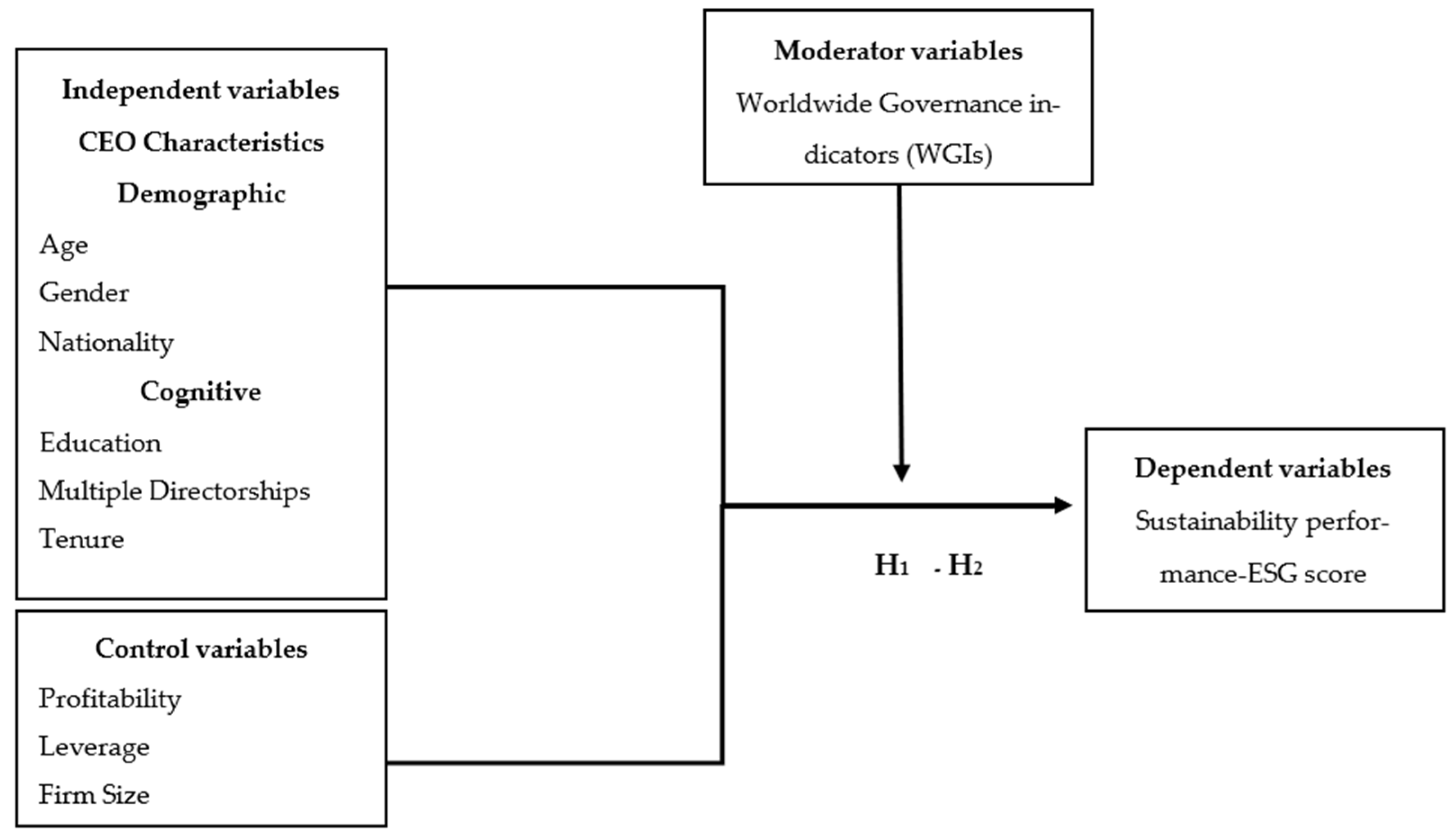


When Leadership Meets Worldwide Governance: The Role of CEO Characteristics in Environmental, Social, and Governance Performance
 , ,
, , 
Abstract
1. Introduction
2. Theoretical Background and Hypothesis Development
2.1. Theoretical Background
2.2. Hypothesis Development
2.2.1. Direct Effects of CEO Demographic Characteristics on ESG Performance
2.2.2. Moderating Role of WGIs for the Relationship Between CEO Demographic Characteristics and ESG
2.2.3. Direct Effects of CEO Cognitive Characteristics on ESG Performance
2.2.4. The Moderating Role of WGIs for the Relationship Between CEO Cognitive Characteristics and ESG
3. Research Methodology
3.1. Sampling and Data Collection
3.2. Variable Measurement
3.3. Research Model
3.3.1. The Model
3.3.2. Estimation Strategy and Hypothesis Testing
4. Empirical Results and Discussion
4.1. Descriptive Statistics
4.2. Correlation Analysis
4.3. Result, Analysis, and Discussion
Fixed-Effect Model
5. Conclusions
Author Contributions
Funding
Institutional Review Board Statement
Informed Consent Statement
Data Availability Statement
Acknowledgments
Conflicts of Interest
Abbreviations
| WGIs | Worldwide Governance Indicators |
| CEOs | Chief Executive Officers |
| ESG | Environmental, social, and governance |
| CSR | Corporate social responsibility |
Appendix A

| PolSt | RuLaw | VoAc | ConCo | GoEf | RegQu | |
|---|---|---|---|---|---|---|
| 0.61 *** | 0.86 *** | 0.86 *** | 0.89 *** | 0.86 *** | 0.87 *** | |
| −0.03 *** | −0.06 *** | −0.06 *** | −0.01 *** | −0.02 *** | −0.05 *** | |
| 0.24 *** | 0.28 *** | 0.27 *** | 0.16 *** | 0.21 *** | 0.27 *** |
| PolSt | RuLaw | VoAc | ConCo | GoEf | RegQu | |
|---|---|---|---|---|---|---|
| 0.59 *** | 0.85 *** | 0.86 *** | 0.88 *** | 0.86 *** | 0.87 *** | |
| −0.03 *** | −0.06 *** | −0.06 *** | −0.01 *** | −0.02 *** | −0.05 *** | |
| 0.24 *** | 0.28 *** | 0.28 *** | 0.17 *** | 0.22 *** | 0.27 *** |
| PolSt | RuLaw | VoAc | ConCo | GoEf | RegQu | |
|---|---|---|---|---|---|---|
| 0.65 *** | 0.88 *** | 0.88 *** | 0.91 *** | 0.89 *** | 0.89 *** | |
| −0.03 *** | −0.05 *** | −0.05 *** | −0.01 *** | −0.02 *** | −0.05 *** | |
| 0.24 *** | 0.27 *** | 0.26 *** | 0.12 *** | 0.20 *** | 0.26 *** |
References
- Wang, N.; Pan, H.; Feng, Y.; Du, S. How do ESG practices create value for businesses? Research review and prospects. Sustain. Account. Manag. Policy J. 2024, 15, 1155–1177. [Google Scholar] [CrossRef]
- Camilleri, M.A. Environmental, social and governance disclosures in Europe. Sustain. Account. Manag. Policy J. 2015, 6, 224–242. [Google Scholar] [CrossRef]
- Pacces, A.M. Will the EU taxonomy regulation foster sustainable corporate governance? Sustainability 2021, 13, 12316. [Google Scholar] [CrossRef]
- Allgeier, S.; Feldmann, R. CSRD Sustainability Reporting for Non-listed SMEs: European Regulators Remain Challenged. Eur. Co. Financ. Law Rev. 2023, 20, 438–446. [Google Scholar] [CrossRef]
- Carnini Pulino, S.; Ciaburri, M.; Magnanelli, B.S.; Nasta, L. Does ESG Disclosure Influence Firm Performance? Sustainability 2022, 14, 7595. [Google Scholar] [CrossRef]
- Wu, W.; Tian, Z.; Wang, G. Does CEO social capital affect corporate ESG performance? PLoS ONE 2024, 19, e0300211. [Google Scholar] [CrossRef] [PubMed]
- Hummel, K.; Jobst, D. An Overview of Corporate Sustainability Reporting Legislation in the European Union. Account. Eur. 2024, 21, 320–355. [Google Scholar] [CrossRef]
- Engelhardt, N.; Ekkenga, J.; Posch, P. ESG Ratings and Stock Performance during the COVID-19 Crisis. Sustainability 2021, 13, 7133. [Google Scholar] [CrossRef]
- Aabo, T.; Giorici, I.C. Do female CEOs matter for ESG scores? Glob. Financ. J. 2023, 56, 100722. [Google Scholar] [CrossRef]
- Saha, R.; Kabir, N.; Chowdhury, A.H. The impact of CEO attributes on sustainability performance: Evidence from an emerging economy. Account. Res. J. 2023, 36, 539–557. [Google Scholar] [CrossRef]
- Mahran, K.; Elamer, A.A. Chief Executive Officer (CEO) and corporate environmental sustainability: A systematic literature review and avenues for future research. Bus. Strategy Environ. 2024, 33, 1977–2003. [Google Scholar] [CrossRef]
- Sandretto, D.; Rizzi, A.; Esposito, G. Gender Diversity Leadership and ESG Performance: The Influence of Women on Boards and in Management. Bus. Strategy Environ. 2025, 34, 5075–5094. [Google Scholar] [CrossRef]
- Tu, K.; Guo, Y. How higher education affects corporate ESG performance: Empirical evidence from Chinese listed companies. Financ. Res. Lett. 2024, 68, 105812. [Google Scholar] [CrossRef]
- Alrobai, F.; Albaz, M.M. The Impact of CEO and Firm Attributes on ESG Performance: Evidence from an Emerging Market. J. Risk Financ. Manag. 2025, 18, 268. [Google Scholar] [CrossRef]
- Belenzon, S.; Shamshur, A.; Zarutskie, R. CEO’s age and the performance of closely held firms. Strateg. Manag. J. 2019, 40, 917–944. [Google Scholar] [CrossRef]
- Liu, Y.; Zhang, F.; Zhang, H. CEO foreign experience and corporate environmental, social, and governance (ESG) performance. Bus. Strategy Environ. 2024, 33, 3331–3355. [Google Scholar] [CrossRef]
- Deng, M.; Tang, H.; Luo, W. Can the green experience of CEO improve ESG performance in heavy polluting companies? Evidence from China. Manag. Decis. Econ. 2024, 45, 2373–2392. [Google Scholar] [CrossRef]
- Sun, X.; Zhou, C.; Gan, Z. Green Finance Policy and ESG Performance: Evidence from Chinese Manufacturing Firms. Sustainability 2023, 15, 6781. [Google Scholar] [CrossRef]
- Mooneeapen, O.; Abhayawansa, S.; Mamode Khan, N. The influence of the country governance environment on corporate environmental, social and governance (ESG) performance. Sustain. Account. Manag. Policy J. 2022, 13, 953–985. [Google Scholar] [CrossRef]
- Liu, M.; Lu, J.; Liu, Q.; Wang, H.; Yang, Y.; Fang, S. The impact of executive cognitive characteristics on a firm’s ESG performance: An institutional theory perspective. J. Manag. Gov. 2025, 29, 145–173. [Google Scholar] [CrossRef]
- Elmagrhi, M.H.; Ntim, C.G. Non-financial reporting in non-profit organisations: The case of risk and governance disclosures in UK higher education institutions. Account. Forum 2023, 47, 223–248. [Google Scholar] [CrossRef]
- Hambrick, D.C.; Mason, P.A. Upper Echelons: The Organization as a Reflection of Its Top Managers. Acad. Manag. Rev. 1984, 9, 193. [Google Scholar] [CrossRef]
- DiMaggio, P.J.; Powell, W.W. The Iron Cage Revisited: Institutional Isomorphism and Collective Rationality in Organizational Fields. Am. Sociol. Rev. 1983, 48, 147. [Google Scholar] [CrossRef]
- Scott, W.R. Institutions and Organizations; Sage Publications: Thousand Oaks, CA, USA, 1995. [Google Scholar]
- Freeman, R.E. Strategic Management: A Stakeholder Approach; Pitman: Boston, MA, USA, 1984. [Google Scholar]
- Demiraj, R.; Demiraj, E.; Dsouza, S. The Moderating Role of Worldwide Governance Indicators on ESG–Firm Performance Relationship: Evidence from Europe. J. Risk Financ. Manag. 2025, 18, 213. [Google Scholar] [CrossRef]
- EmadEldeen, R.; Elbayuomi, A.F.; Elmoursy, H.; Bouaddi, M.; Basuony, M.A.K. Does Board Diversity Drive Sustainability? Evidence from UK-Listed Companies. Sustainability 2025, 17, 1177. [Google Scholar] [CrossRef]
- Bouaddi, M.; Basuony, M.A.K.; Noureldin, N. The Heterogenous Effects of Carbon Emissions and Board Gender Diversity on a Firm’s Performance. Sustainability 2023, 15, 14642. [Google Scholar] [CrossRef]
- Hambrick, D.C. Upper Echelons Theory: An Update. Acad. Manag. Rev. 2007, 32, 334–343. [Google Scholar] [CrossRef]
- Calori, R.; Johnson, G.; Sarnin, P. Ceos’ cognitive maps and the scope of the organization. Strateg. Manag. J. 1994, 15, 437–457. [Google Scholar] [CrossRef]
- Aguilera, R.V.; Aragón-Correa, J.A.; Marano, V.; Tashman, P.A. The Corporate Governance of Environmental Sustainability: A Review and Proposal for More Integrated Research. J. Manag. 2021, 47, 1468–1497. [Google Scholar] [CrossRef]
- Venugopal, A.; Nerur, S.; Yasar, M.; Rasheed, A.A. CEO personality and corporate sustainability performance. Manag. Decis. 2023, 61, 3691–3716. [Google Scholar] [CrossRef]
- Zhang, Y.; Zhang, X. Top management team functional diversity and ESG performance. Financ. Res. Lett. 2024, 63, 105362. [Google Scholar] [CrossRef]
- Manner, M.H. The Impact of CEO Characteristics on Corporate Social Performance. J. Bus. Ethics 2010, 93, 53–72. [Google Scholar] [CrossRef]
- Elsayih, J.; Datt, R.; Hamid, A. CEO characteristics: Do they matter for carbon performance? An empirical investigation of Australian firms. Soc. Responsib. J. 2021, 17, 1279–1298. [Google Scholar] [CrossRef]
- Tran, N.M. CEO and Chairperson Characteristics and Corporate Environmental Performance: A Study of Cooperatives in Vietnam. Sage Open 2022, 12, 21582440221129241. [Google Scholar] [CrossRef]
- Liu, Y.; Zhang, H.; Zhang, F. The power of CEO growing up in poverty: Enabling better corporate environmental, social, and governance ESG performance. Corp. Soc. Responsib. Environ. Manag. 2024, 31, 1610–1633. [Google Scholar] [CrossRef]
- Lewis, B.W.; Walls, J.L.; Dowell, G.W.S. Difference in degrees: CEO characteristics and firm environmental disclosure. Strateg. Manag. J. 2014, 35, 712–722. [Google Scholar] [CrossRef]
- Ghardallou, W. Corporate Sustainability and Firm Performance: The Moderating Role of CEO Education and Tenure. Sustainability 2022, 14, 3513. [Google Scholar] [CrossRef]
- Wang, G.; Holmes, R.M.; Oh, I.; Zhu, W. Do CEOs Matter to Firm Strategic Actions and Firm Performance? A Meta-Analytic Investigation Based on Upper Echelons Theory. Pers. Psychol. 2016, 69, 775–862. [Google Scholar] [CrossRef]
- Shahab, Y.; Ntim, C.G.; Chen, Y.; Ullah, F.; Li, H.; Ye, Z. Chief executive officer attributes, sustainable performance, environmental performance, and environmental reporting: New insights from upper echelons perspective. Bus. Strategy Environ. 2020, 29, 1–16. [Google Scholar] [CrossRef]
- Brough, A.R.; Wilkie, J.E.B.; Ma, J.; Isaac, M.S.; Gal, D. Is Eco-Friendly Unmanly? The Green-Feminine Stereotype and Its Effect on Sustainable Consumption. J. Consum. Res. 2016, 43, 567–582. [Google Scholar] [CrossRef]
- Martínez-Ferrero, J.; García-Meca, E.; Ramón-Llorens, M.C. What if my boss is a narcissist? The effects of chief executive officer narcissism on female proportion in top management teams. Bus. Ethics Environ. Responsib. 2023, 32, 1201–1216. [Google Scholar] [CrossRef]
- Orazalin, N.; Baydauletov, M. Corporate social responsibility strategy and corporate environmental and social performance: The moderating role of board gender diversity. Corp. Soc. Responsib. Environ. Manag. 2020, 27, 1664–1676. [Google Scholar] [CrossRef]
- Gibson, K. The Moral Basis of Stakeholder Theory. J. Bus. Ethics 2000, 26, 245–257. [Google Scholar] [CrossRef]
- Freeman, R.E.; Harrison, J.S.; Wicks, A.C. Managing for Stakeholders: Survival, Reputation, and Success; Yale University Press: New Haven, CT, USA, 2007. [Google Scholar]
- Freeman, R.E.; Harrison, J.S.; Zyglidopoulos, S. Stakeholder Theory; Cambridge University Press: Cambridge, UK, 2018. [Google Scholar]
- Donaldson, T.; Preston, L.E. The Stakeholder Theory of the Corporation: Concepts, Evidence, and Implications. Acad. Manag. Rev. 1995, 20, 65. [Google Scholar] [CrossRef]
- Freudenreich, B.; Lüdeke-Freund, F.; Schaltegger, S. A Stakeholder Theory Perspective on Business Models: Value Creation for Sustainability. J. Bus. Ethics 2020, 166, 3–18. [Google Scholar] [CrossRef]
- Hörisch, J.; Freeman, R.E.; Schaltegger, S. Applying Stakeholder Theory in Sustainability Management. Organ. Environ. 2014, 27, 328–346. [Google Scholar] [CrossRef]
- Key, S. Toward a new theory of the firm: A critique of stakeholder “theory”. Manag. Decis. 1999, 37, 317–328. [Google Scholar] [CrossRef]
- Jensen, M.C. Value Maximization, Stakeholder Theory, and the Corporate Objective Function. Bus. Ethics Q. 2002, 12, 235–256. [Google Scholar] [CrossRef]
- Shun, H.C.; Hung, L.W.; Hui, Y.S. Boardroom Diversity and Operating Performance: The Moderating Effect of Strategic Change. Emerg. Mark. Financ. Trade 2019, 55, 2448–2472. [Google Scholar]
- Chams, N.; García-Blandón, J. On the importance of sustainable human resource management for the adoption of sustainable development goals. Resour. Conserv. Recycl. 2019, 141, 109–122. [Google Scholar] [CrossRef]
- Naciti, V. Corporate governance and board of directors: The effect of a board composition on firm sustainability performance. J. Clean. Prod. 2019, 237, 117727. [Google Scholar] [CrossRef]
- Rahman, H.U.; Zahid, M.; Al-Faryan, M.A.S. ESG and firm performance: The rarely explored moderation of sustainability strategy and top management commitment. J. Clean. Prod. 2023, 404, 136859. [Google Scholar] [CrossRef]
- Wang, Y.; Oliver, J. Board composition and firm performance variance: Australian evidence. Account. Res. J. 2009, 22, 196–212. [Google Scholar] [CrossRef]
- Campbell, J.L. Why would corporations behave in socially responsible ways? An institutional theory of corporate social responsibility. Acad. Manag. Rev. 2007, 32, 946–967. [Google Scholar] [CrossRef]
- Oliver, C. Strategic Responses to Institutional Processes. Acad. Manag. Rev. 1991, 16, 145–179. [Google Scholar] [CrossRef]
- Gauthier, J. Institutional Theory and Corporate Sustainability: Determinant Versus Interactive Approaches. Organ. Manag. J. 2013, 10, 86–96. [Google Scholar] [CrossRef]
- Hoch, F.; Seyberth, L.; Faherty, C.M.; Clinton, E.; Sharma, P. Can Women Save a Man’s World? The Influence of Gender-Discriminating Institutions on Female Family CEOs’ CSR Performance. J. Bus. Ethics 2025, 202, 357–376. [Google Scholar] [CrossRef]
- Ben Fatma, H.; Chouaibi, J. Corporate governance and firm value: A study on European financial institutions. Int. J. Product. Perform. Manag. 2023, 72, 1392–1418. [Google Scholar] [CrossRef]
- Fayyaz, U.; Jalal, R.N.; Venditti, M.; Minguez-Vera, A. Diverse boards and firm performance: The role of environmental, social and governance disclosure. Corp. Soc. Responsib. Environ. Manag. 2023, 30, 1457–1472. [Google Scholar] [CrossRef]
- Pucheta-Martínez, M.C.; Gallego-Álvarez, I.; Bel-Oms, I. Board structures, liberal countries, and developed market economies. Do they matter in environmental reporting? An international outlook. Bus. Strategy Environ. 2019, 28, 710–723. [Google Scholar] [CrossRef]
- Kim, K.; Kim, T.N. CEO career concerns and ESG investments. Financ. Res. Lett. 2023, 55, 103819. [Google Scholar] [CrossRef]
- Lin, S.; Zhang, Y.; Wang, Y.; Geng, H. The impact of CEO reputation on ESG performance in varying managerial discretion contexts. Financ. Res. Lett. 2024, 70, 106368. [Google Scholar] [CrossRef]
- Romano, M.; Cirillo, A.; Favino, C.; Netti, A. ESG (Environmental, Social and Governance) Performance and Board Gender Diversity: The Moderating Role of CEO Duality. Sustainability 2020, 12, 9298. [Google Scholar] [CrossRef]
- Chebbi, K.; Ammari, A.; Athari, S.A.; Ben Arfa, N. The impact of firm-level political risk on ESG practices: Does CEO Duality Matter? J. Clean. Prod. 2024, 480, 144096. [Google Scholar] [CrossRef]
- Abdullah; Zhu, N.; Hashmi, M.A.; Shah, M.H. CEO power, board features and ESG performance: An extensive novel moderation analysis. Corp. Soc. Responsib. Environ. Manag. 2024, 31, 5627–5655. [Google Scholar] [CrossRef]
- Abdul Majid, J.; Che Adam, N.; Ab Rahim, N.; Razak, R. CEO power, regulatory pressures, and carbon emissions: An emerging market perspective. Cogent Bus. Manag. 2023, 10, 2276555. [Google Scholar] [CrossRef]
- Fu, C.; Indiran, L.; Kohar, U.H.A. CEO Power and Environmental, Social, Governance (ESG): A Systematic Review. Int. J. Acad. Res. Bus. Soc. Sci. 2024, 14, 597–616. [Google Scholar] [CrossRef] [PubMed]
- Velte, P. Does CEO power moderate the link between ESG performance and financial performance? Manag. Res. Rev. 2019, 43, 497–520. [Google Scholar] [CrossRef]
- Seow, R.Y.C. Environmental, social, and governance reporting in family firms: The critical role of CEO attributes. Bus. Strategy Environ. 2025, 34, 70–87. [Google Scholar] [CrossRef]
- Safitri, I.; Hakim, M.S.; Dewangga, L.A.; Jauhari, M.H. The Influence of CEO Characteristics On Environmental, Social, & Governance (ESG) Strategies In Non-Financial Sector Companies Listed On The Indonesian Stock Exchange (IDX). Eduvest-J. Univers. Stud. 2024, 4, 6129–6145. [Google Scholar]
- Remo-Diez, N.; Mendaña-Cuervo, C.; Arenas-Parra, M. A Fuzzy-Set Qualitative Comparative Analysis for Understanding the Interactive Effects of Good Governance Practices and CEO Profiles on ESG Performance. Mathematics 2024, 12, 2726. [Google Scholar] [CrossRef]
- Jarboui, A.; Bouzouitina, A. How do the CEO demographic characteristics affect CSR commitment in European firms? Soc. Bus. Rev. 2025, 20, 347–368. [Google Scholar] [CrossRef]
- Bhaskar, R.; Li, P.; Bansal, S.; Kumar, S. A new insight on CEO characteristics and corporate social responsibility (CSR): A meta-analytical review. Int. Rev. Financ. Anal. 2023, 89, 102815. [Google Scholar] [CrossRef]
- Al-Shaer, H.; Zaman, M.; Albitar, K. CEO gender, critical mass of board gender diversity and ESG performance: UK evidence. J. Account. Lit. 2024, 48, 76–110. [Google Scholar] [CrossRef]
- Jouber, H. Women leaders and corporate social performance: Do critical mass, CEO managerial ability and corporate governance matter? Manag. Decis. 2022, 60, 1185–1217. [Google Scholar] [CrossRef]
- Heubeck, T. Walking on the gender tightrope: Unlocking ESG potential through CEOs’ dynamic capabilities and strategic board composition. Bus. Strategy Environ. 2024, 33, 2020–2039. [Google Scholar] [CrossRef]
- Sannino, G.; Di Carlo, F.; Lucchese, M. CEO characteristics and sustainability business model in financial technologies firms. Manag. Decis. 2020, 58, 1779–1799. [Google Scholar] [CrossRef]
- Scott, W.R. Approaching adulthood: The maturing of institutional theory. Theory Soc. 2008, 37, 427–442. [Google Scholar] [CrossRef]
- Garcia-Blandon, J.; Argilés-Bosch, J.M.; Ravenda, D. Exploring the Relationship Between CEO Characteristics and Performance. J. Bus. Econ. Manag. 2019, 20, 1064–1082. [Google Scholar] [CrossRef]
- Oyinlola, B. Do CEO and board characteristics matter in the ESG performance of their firms? Corp. Gov. Int. J. Bus. Soc. 2025, 25, 21–39. [Google Scholar] [CrossRef]
- Alsaleh, M.; Abdul-Rahim, A.S. The Nexus Between Worldwide Governance Indicators and Hydropower Sustainable Growth in EU 28 Region. Int. J. Environ. Res. 2021, 15, 1001–1015. [Google Scholar] [CrossRef]
- Alsaleh, M.; Abdul-Rahim, A.S.; Abdulwakil, M.M. The importance of worldwide governance indicators for transitions toward sustainable bioenergy industry. J. Environ. Manag. 2021, 294, 112960. [Google Scholar] [CrossRef] [PubMed]
- Luo, Z. CEO Career Concern and Corporate ESG Performance: Evidence from China. Adv. Econ. Manag. Res. 2023, 7, 283. [Google Scholar] [CrossRef]
- Liu, E.X.; Zhou, S.; Mi, J. Diversity Breeds Strength: CEO Functional Experience Diversity and Corporate ESG Performance. Bus. Strategy Environ. 2025, 34, 4832–4852. [Google Scholar] [CrossRef]
- Wagner, A.; Fischer-Kreer, D. The role of CEO regulatory focus in increasing or reducing corporate carbon emissions. Bus. Strategy Environ. 2024, 33, 1051–1065. [Google Scholar] [CrossRef]
- Ma, L.; Yuan, X.; Lu, J.; Li, Y.; Gao, W.; Yan, H.; Zhang, X. The ESG performance influence mechanism analysis-based on empirical analysis. PLoS ONE 2024, 19, e0295548. [Google Scholar] [CrossRef]
- Cambrea, D.R.; Quarato, F.; D’Allura, G.M.; Paolone, F. Driving ESG performance: CEO succession impact in European listed firms. Manag. Decis. 2025, 63, 512–530. [Google Scholar] [CrossRef]
- Sang, S.; Yan, A.; Ahmad, M. CEO Experience and Enterprise Environment, Social and Governance Performance: Evidence from China. Sustainability 2024, 16, 4403. [Google Scholar] [CrossRef]
- Huang, S.K. The Impact of CEO Characteristics on Corporate Sustainable Development. Corp. Soc. Responsib. Environ. Manag. 2013, 20, 234–244. [Google Scholar] [CrossRef]
- Katsikas, E.; Fang, Y.; Athanasiadis, K.A.; Chantziaras, A.; Koufopoulos, D.N. Does CEOs’ Educational Background Influence Firms’ ESG Performance? Int. J. Bus. Econ. Sci. Appl. Res. 2024, 17, 27–37. [Google Scholar] [CrossRef]
- Almulhim, A.A.; Aljughaiman, A.A. Corporate Sustainability and Financial Performance: The Moderating Effect of CEO Characteristics. Sustainability 2023, 15, 12664. [Google Scholar] [CrossRef]
- Choi, J.H.; Kim, S.; Lee, A. CEO Tenure, Corporate Social Performance, and Corporate Governance: A Korean Study. Sustainability 2019, 12, 99. [Google Scholar] [CrossRef]
- Karasamani, I.; Magidou, M.; Stylianou, I.; Christofi, M.; Tarba, S. Industry-Specific CEO Experience on Boards and Environmental Innovation. Corp. Gov. Int. Rev. 2025, 34, 96–127. [Google Scholar] [CrossRef]
- Peng, M.; Li, D.; Zhang, C. Do CEOs with government work experience foster enterprise investment in pollution control? PLoS ONE 2025, 20, e0317903. [Google Scholar] [CrossRef] [PubMed]
- Saeed, A.; Sarang, A.A.A.; Rind, A.A. Co-opted Independent Directors and Firms’ Environmental Performance. Corp. Gov. Int. Rev. 2025, 33, 73–102. [Google Scholar] [CrossRef]
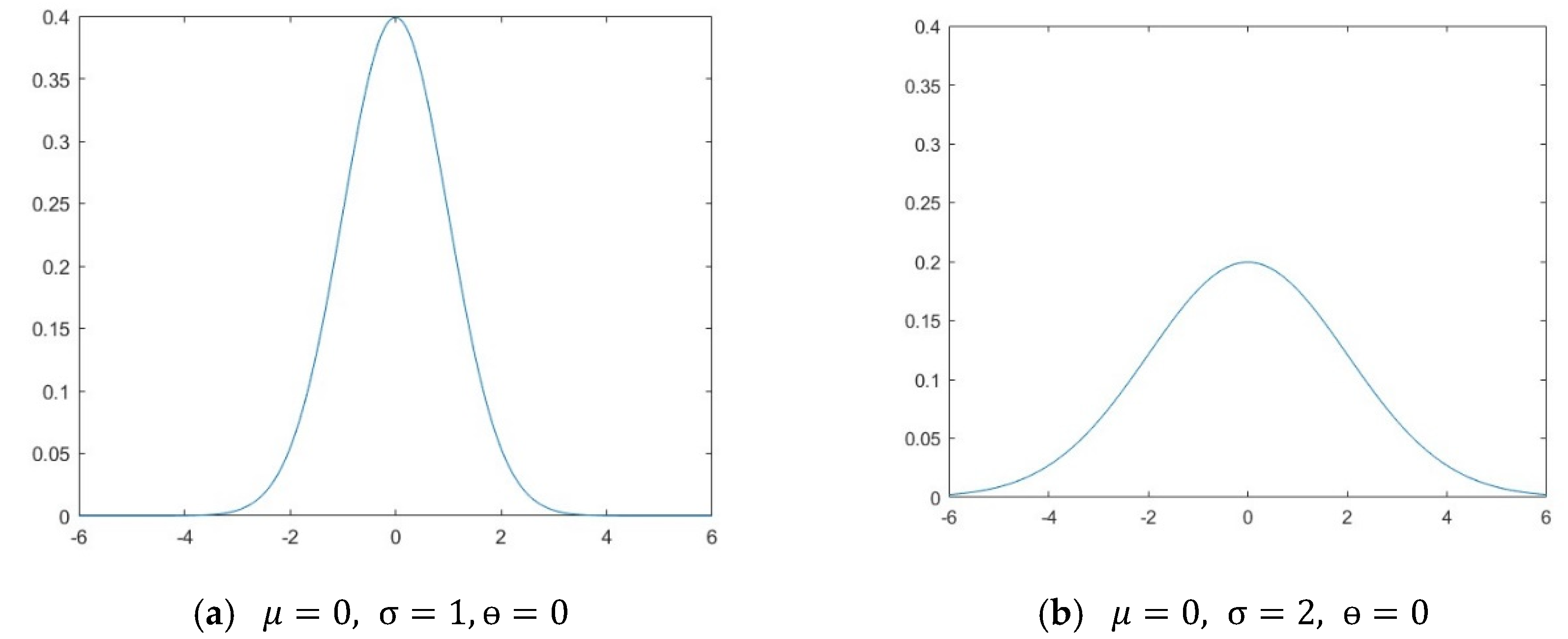
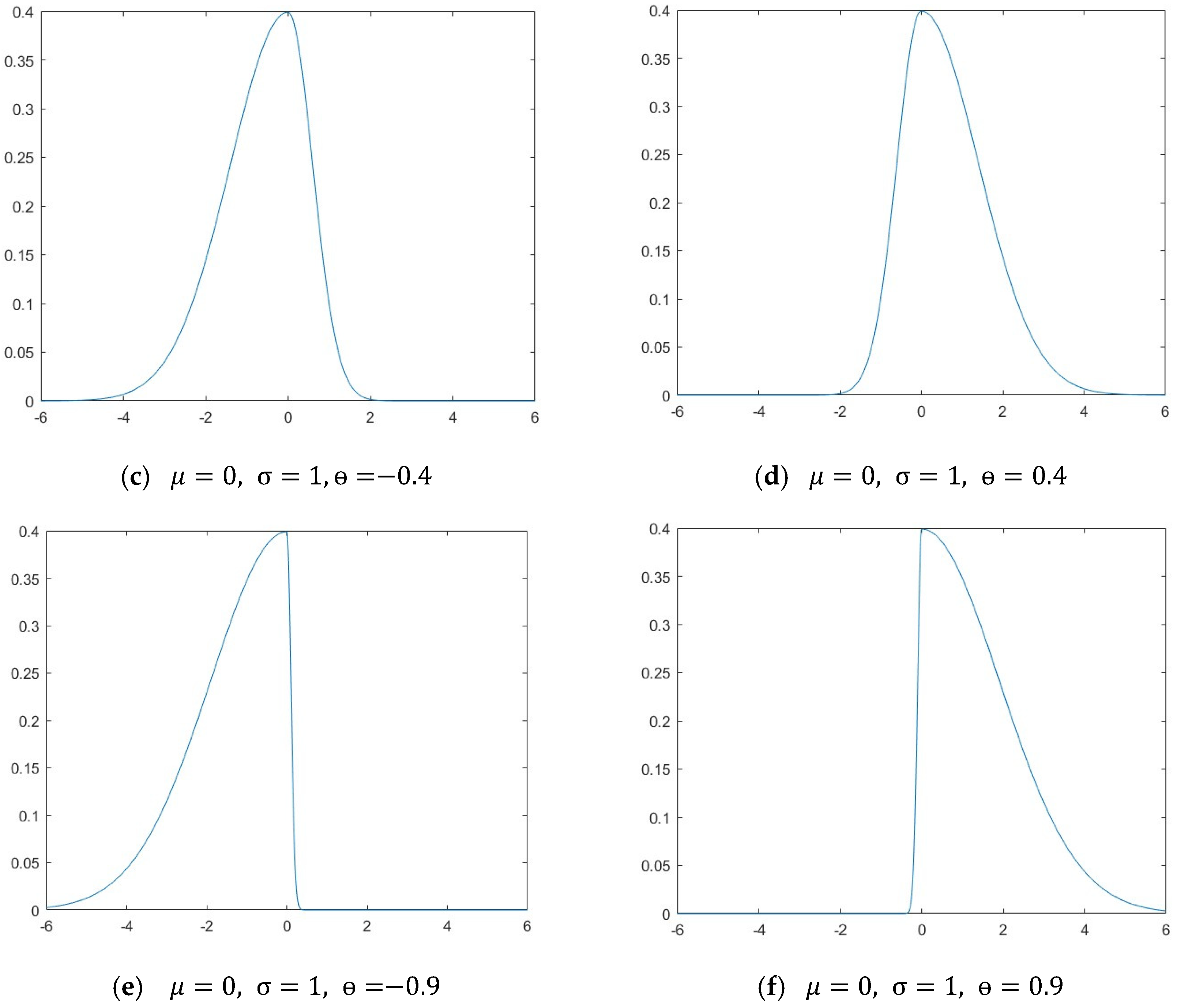
- John, S. The three-parameter two-piece normal family of distributions and its fitting. Commun. Stat.-Theory Methods 1982, 11, 879–885. [Google Scholar] [CrossRef]
- Sulistiyanti, U.; Setiawan, D. CEO Characteristics, Sustainability Committee, and Carbon Emission Disclosure: New Evidence From Energy Industries Across ASEAN Countries. Bus. Strategy Dev. 2025, 8, e70182. [Google Scholar] [CrossRef]
- Kandil, N.; Basuony, M.A.K.; Bouaddi, M.; Elmoursy, H.; Elbayuomi, A.F. Examining CEO Characteristics and Carbon Emissions: A Quantile Approach to UK-Listed Firms. Sustainability 2025, 17, 5732. [Google Scholar] [CrossRef]
- Tahat, Y.A.; Hassanein, A. Exploring the synergy of corporate gender diversity, sustainability committee, and reporting ESG practices: An international evidence. J. Environ. Manag. 2024, 371, 123093. [Google Scholar] [CrossRef]
- Gavana, G.; Gottardo, P.; Moisello, A.M. The impact of board gender diversity on ESG disclosure. A contingency perspective. Meditari Account. Res. 2025, 33, 1–29. [Google Scholar] [CrossRef]
- Saeed, U.F.; Wiredu, I. Optimizing Business Strategy for Sustainability: Probing the Effects of CEO Features, and Corporate Reputation in Driving ESG Outcomes. Bus. Strategy Dev. 2025, 8, e70156. [Google Scholar] [CrossRef]
- Tornjanski, V.; Knežević, S.; Mirčetić, V.; Drinkwater, K.; Alzoubi, H.M.; Juraev, D.A.; Yalouli, T. The role of Green Society in Society 5.0: Tango diamond in a collective intelligence (hybrid) ecosystem founded on human-centricity and sustainability. J. Bus. Soc. Sci. 2024. [Google Scholar] [CrossRef]

| Variables | Abbreviations | Measurement | Source |
|---|---|---|---|
| Panel A: dependent variables: | |||
| Sustainability performance | ESG | ESG index | Refinitiv DataStream |
| Panel B: independent variables: | |||
| CEO Demographic Characteristics | |||
| Age | Age | Years from birth | Board EX |
| Gender | Gen | A dummy variable indicating CEO gender (assigned a value of 1 if the CEO is female, and 0 if male). | Board EX |
| Nationality | Nat | A dummy variable indicating CEO nationality (assigned a value of 1 if the CEO is foreign, and 0 if domestic). | Board EX |
| CEO Cognitive Characteristics | |||
| Tenure | Ten | Number of years since the CEO has been in his/her current position. | Board EX |
| Multiple directorship | Multip | Number of quoted boards the director has served on over their career. | Board EX |
| Education | Edu | Number of qualifications CEO has obtained. | Board EX |
| Panel C: moderating variables (Worldwide Governance Indicators): | |||
| Political stability | PolSt | Measures the perceived likelihood of political unrest, violence, or terrorism within a country. | World bank |
| Rule of law | RuLaw | Measures perceived confidence in and adherence to societal rules, especially regarding contract enforcement and property rights. | World bank |
| Voice and accountability | VoAc | Measures perceptions of citizens’ ability to choose their government and enjoy freedoms of expression, association, and access to free media. | World bank |
| Control of corruption | ConCo | Measures perceptions of the extent to which public power is used for private gain, including petty and grand corruption and state capture by elites or private interests. | World bank |
| Government effectiveness | GoEf | Measures perceptions of public service quality, civil service independence, policy formulation and implementation, and the government’s credibility in committing to policies. | World bank |
| Regulatory quality | RegQu | Measures perceptions of the government’s ability to design and implement effective policies and regulations that support private sector development. | World bank |
| Panel D: control variables: | |||
| Profitability | Prof | The company’s Return on Assets (ROA) ratio. | Refinitiv DataStream |
| Firm size | Fsize | The natural logarithm of the company’s total assets. | Refinitiv DataStream |
| Leverage | Lev | The ratio of total debt to total assets. | Refinitiv DataStream |
| Mean | Median | Maximum | Minimum | Std. Dev. | |
|---|---|---|---|---|---|
| ESG | 46.133 | 46.020 | 95.100 | 1.230 | 18.332 |
| Ten | 4.856 | 3.600 | 31.900 | 0.000 | 4.544 |
| Multip | 2.371 | 2.000 | 17.000 | 1.000 | 1.879 |
| Age | 53.008 | 53.000 | 76.000 | 31.000 | 6.276 |
| Edu | 1.846 | 2.000 | 8.000 | 0.000 | 1.145 |
| Gen | 0.042 | 0.000 | 1.000 | 0.000 | 0.201 |
| Nat | 0.462 | 0.000 | 1.000 | 0.000 | 0.499 |
| PolSt | 61.906 | 61.058 | 100.000 | 0.000 | 13.026 |
| RuLaw | 89.371 | 92.381 | 100.000 | 0.000 | 12.230 |
| VoAc | 89.635 | 92.019 | 100.000 | 0.000 | 11.697 |
| ConCo | 89.849 | 93.333 | 100.000 | 0.000 | 12.722 |
| GoEf | 88.632 | 90.909 | 100.000 | 0.000 | 10.373 |
| RegQu | 91.584 | 94.737 | 99.524 | 0.000 | 11.176 |
| Prof | 6.159 | 5.520 | 269.110 | −138.230 | 14.501 |
| Fsize | 14.686 | 14.462 | 22.164 | 7.428 | 1.947 |
| Lev | 26.083 | 24.240 | 167.240 | 0.000 | 20.160 |
| Ten | Multip | Age | Edu | Gen | Nat | Prof | Fsize | Lev | |
|---|---|---|---|---|---|---|---|---|---|
| Ten | 1 | ||||||||
| Multip | −0.002 | 1 | |||||||
| Age | 0.218 | 0.169 | 1 | ||||||
| Edu | −0.011 | 0.189 | −0.023 | 1 | |||||
| Gen | −0.042 | 0.032 | −0.028 | 0.063 | 1 | ||||
| Nat | −0.044 | 0.165 | 0.047 | 0.193 | 0.008 | 1 | |||
| Prof | 0.047 | −0.027 | 0.000 | −0.071 | −0.041 | −0.046 | 1 | ||
| Fsize | −0.055 | 0.346 | 0.195 | 0.219 | 0.022 | 0.413 | 0.059 | 1 | |
| Lev | −0.037 | 0.093 | 0.012 | 0.079 | 0.004 | 0.136 | −0.030 | 0.297 | 1 |
| Constant | Cognitive CEO Characteristics | Demographic CEO Characteristics | Prof | Fsize | Lev | ||||||
|---|---|---|---|---|---|---|---|---|---|---|---|
| Ten | Multip | Edu | Age | Gen | Nat | ||||||
| PolSt | Low | −91.72 *** | −0.72 | 2.71 | 28.86 *** | −2.17 ** | −171.96 *** | 19.69 | −0.58 | 9.622 ** | −0.56 |
| High | 0.88 | −2.50 | −29.42 *** | 2.67 ** | 191.85 *** | −17.61 | 0.57 | 7.33 * | 0.63 | ||
| RuLaw | Low | −93.10 *** | −0.57 | −0.73 | 6.05 ** | −0.69 | −54.46 ** | 13.53 ** | −0.10 | 10.08 *** | −0.06 |
| High | 0.74 | 1.02 | −6.16 ** | 1.18 *** | 73.89 *** | −11.78 * | 0.08 | 7.01 *** | 0.11 | ||
| VoAc | Low | −93.60 *** | −0.53 | −1.45 | 6.49 ** | −0.78 * | −53.67 ** | 14.74 ** | −0.15 | 10.66 *** | −0.11 |
| High | 0.70 | 1.79 | −6.61 ** | 1.28 *** | 72.97 *** | −13.2 ** | 0.13 | 6.47 *** | 0.17 | ||
| ConCo | Low | −94.12 *** | −3.15 | 12.95 | 12.03 | 5.25 ** | −186.81 ** | 42.59 | 0.36 | −10.16 | 0.97 ** |
| High | 3.32 | −12.66 | −12.10 | −4.79 * | 206.63 *** | −41.38 | −0.39 | 27.56 *** | −0.93 * | ||
| GoEf | Low | −92.95 *** | −0.96 | −0.86 | 10.39 ** | −0.96 | −102.34 ** | 22.09 ** | −0.27 | 9.86 *** | −0.28 |
| High | 1.13 | 1.13 | −10.48 ** | 1.44 * | 121.62 *** | −20.27 * | 0.25 | 7.25 *** | 0.33 | ||
| RegQu | Low | −93.05 *** | −0.33 | −0.72 | 6.42 ** | −1.01 ** | −53.35 ** | 14.79 *** | −0.10 | 11.28 *** | −0.13 |
| High | 0.50 | 1.04 | −6.56 ** | 1.52 *** | 73.02 *** | −13.06 ** | 0.08 | 5.78 *** | 0.18 | ||
| Constant | Cognitive CEO Characteristics | Demographic CEO Characteristics | Prof | Fsize | Lev | ||||||
|---|---|---|---|---|---|---|---|---|---|---|---|
| Ten | Multip | Edu | Age | Gen | Nat | ||||||
| PolSt | Low | −79.88 *** | −1.51 | 3.33 | 35.66 *** | −1.73 | −177.83 *** | 35.41 ** | −0.41 | 6.52 | −0.97 ** |
| High | 2.04 | −3.33 | −35.99 *** | 2.10 * | 196.04 *** | −35.65 ** | 0.38 | 9.07 ** | 1.06 ** | ||
| RuLaw | Low | −80.60 *** | −0.80 | −1.05 | 7.96 *** | −0.43 | −62.48 ** | 21.31 *** | −0.01 | 7.96 *** | −0.08 |
| High | 1.35 * | 1.13 | −7.78 ** | 0.79 | 80.31 *** | −21.93 *** | −0.02 | 7.69 *** | 0.17 | ||
| VoAc | Low | −81.26 *** | −0.73 | −1.72 | 8.38 *** | −0.56 | −61.33 ** | 21.94 *** | −0.06 | 8.66 *** | −0.13 |
| High | 1.26 * | 1.87 | −8.20 *** | 0.93 * | 78.97 *** | −22.84 *** | 0.03 | 7.03 *** | 0.22 | ||
| ConCo | Low | −81.70 *** | −5.83 * | 0.46 | −14.66 | 10.82 *** | −164.06 ** | 61.71 | 0.51 | −17.49 * | 0.76 |
| High | 6.39 * | −0.32 | 14.93 | −10.55 *** | 181.95 ** | −62.59 | −0.56 | 33.52 *** | −0.69 | ||
| GoEf | Low | −80.37 *** | −1.45 | −1.11 | 14.27 *** | −0.55 | −114.78 ** | 36.37 *** | −0.15 | 6.86 ** | −0.34 |
| High | 1.99 | 1.17 | −14.06 ** | 0.90 | 132.37 *** | −36.88 *** | 0.13 | 8.79 *** | 0.42 | ||
| RegQu | Low | −80.49 *** | −0.48 | −1.01 | 8.30 *** | −0.91 * | −59.26 ** | 21.75 *** | −0.02 | 9.65 *** | −0.14 |
| High | 1.02 | 1.12 | −8.16 *** | 1.28 *** | 77.31 *** | −22.375 *** | −0.01 | 5.93 *** | 0.22 | ||
| Constant | Cognitive CEO Characteristics | Demographic CEO Characteristics | Prof | Fsize | Lev | ||||||
|---|---|---|---|---|---|---|---|---|---|---|---|
| Ten | Multip | Edu | Age | Gen | Nat | ||||||
| PolSt | Low | −126.54 *** | 6.52 | −14.75 | 25.82 | −0.14 | 193.27 | −158.61 *** | −2.37 * | 3.79 | 2.72 * |
| High | −7.34 | 17.11 | −26.63 | 0.80 | −165.52 | 172.21 *** | 2.40 * | 18.21 * | −2.82 * | ||
| RuLaw | Low | −124.34 *** | 1.90 | −2.14 | 35.43 ** | −1.51 | 1061.13 * | −84.12 *** | −0.92 | 5.21 | 3.00 ** |
| High | −2.65 | 4.00 | −36.09 ** | 2.16 * | −1032.90 * | 95.19 *** | 0.89 | 16.55 *** | −3.09 ** | ||
| VoAc | Low | −124.24 *** | 1.81 | −4.87 | 23.16 * | −1.04 | 1338.42 ** | −70.67 *** | −1.15 | 8.55 * | 1.88 * |
| High | −2.56 | 6.82 | −23.76 * | 1.69 | −1311.10 ** | 81.75 *** | 1.14 | 13.16 ** | −1.95 * | ||
| ConCo | Low | −125.37 *** | −9.74 | −295.22 | 350.63 | 1.45 | −533.88 | 2125.34 | 0.59 | −161.12 * | 13.34 |
| High | 8.98 | 297.24 | −351.41 | −0.75 | 563.44 | −2116.22 | −0.62 | 183.02 ** | −13.43 | ||
| GoEf | Low | −125.68 *** | 11.89 | −20.83 | 92.65 ** | −1.41 | 1693.22 | −173.03 *** | −6.70 | −7.26 | 6.07 * |
| High | −12.64 * | 22.73 | −93.20 ** | 2.02 | −1663.98 | 184.07 *** | 6.69 | 29.26 ** | −6.14 * | ||
| RegQu | Low | −124.23 *** | 2.02 | −3.48 | 30.10 * | −1.20 | 534.36 | −77.18 *** | −1.07 | 6.25 | 2.52 * |
| High | −2.77 | 5.39 | −30.80 * | 1.84 | −506.11 | 88.53 *** | 1.05 | 15.51 *** | −2.60 * | ||
| Full Sample | Sensitive Industries | Non-Sensitive Industries | |||||
|---|---|---|---|---|---|---|---|
| Cognitive | Demographic | Cognitive | Demographic | Cognitive | Demographic | ||
| PolSt | Low | 19.015 *** | 14.092 *** | 23.070 *** | 14.049 *** | 2.420 | 14.205 *** |
| High | 19.051 *** | 17.774 *** | 23.328 *** | 16.593 *** | 2.840 | 16.600 *** | |
| RuLaw | Low | 6.218 | 12.580 *** | 8.896 ** | 16.586 *** | 6.782 * | 16.575 *** |
| High | 6.746 * | 20.465 *** | 10.314 ** | 22.450 *** | 7.230 * | 21.097 *** | |
| VoAc | Low | 8.402 ** | 15.569 *** | 11.195 ** | 19.931 *** | 4.127 | 14.619 *** |
| High | 9.191 ** | 24.157 *** | 12.484 *** | 26.694 *** | 4.636 | 19.139 *** | |
| ConCo | Low | 1.397 | 11.873 *** | 3.146 | 19.140 *** | 1.736 | 1.961 |
| High | 1.452 | 12.359 *** | 3.728 | 19.290 *** | 1.746 | 1.943 | |
| GoEf | Low | 5.438 | 10.782 ** | 8.413 ** | 15.023 *** | 6.966 * | 13.737 *** |
| High | 5.652 | 14.421 *** | 8.989 ** | 17.884 *** | 7.252 * | 15.185 *** | |
| RegQu | Low | 6.977 * | 18.763 *** | 9.618 ** | 23.272 *** | 4.599 | 10.357 ** |
| High | 7.378 * | 28.687 *** | 0.333 ** | 31.058 *** | 5.060 | 13.437 *** | |
Disclaimer/Publisher’s Note: The statements, opinions and data contained in all publications are solely those of the individual author(s) and contributor(s) and not of MDPI and/or the editor(s). MDPI and/or the editor(s) disclaim responsibility for any injury to people or property resulting from any ideas, methods, instructions or products referred to in the content. |
© 2026 by the authors. Licensee MDPI, Basel, Switzerland. This article is an open access article distributed under the terms and conditions of the Creative Commons Attribution (CC BY) license.
Share and Cite
Basuony, M.A.K.; Bouaddi, M.; El Kolaly, H.; ElShinnawy, M.; EmadEldeen, R. When Leadership Meets Worldwide Governance: The Role of CEO Characteristics in Environmental, Social, and Governance Performance. Sustainability 2026, 18, 3736. https://doi.org/10.3390/su18083736
Basuony MAK, Bouaddi M, El Kolaly H, ElShinnawy M, EmadEldeen R. When Leadership Meets Worldwide Governance: The Role of CEO Characteristics in Environmental, Social, and Governance Performance. Sustainability. 2026; 18(8):3736. https://doi.org/10.3390/su18083736
Chicago/Turabian StyleBasuony, Mohamed A. K., Mohammed Bouaddi, Hoda El Kolaly, Maha ElShinnawy, and Rehab EmadEldeen. 2026. "When Leadership Meets Worldwide Governance: The Role of CEO Characteristics in Environmental, Social, and Governance Performance" Sustainability 18, no. 8: 3736. https://doi.org/10.3390/su18083736
APA StyleBasuony, M. A. K., Bouaddi, M., El Kolaly, H., ElShinnawy, M., & EmadEldeen, R. (2026). When Leadership Meets Worldwide Governance: The Role of CEO Characteristics in Environmental, Social, and Governance Performance. Sustainability, 18(8), 3736. https://doi.org/10.3390/su18083736