1. Introduction
Sustainability assessment is now a cornerstone of industrial decision-making, especially for emerging technologies like Additive Manufacturing (AM) [
1]. Life Cycle Assessment (LCA) is the standard for quantifying environmental impacts [
2]. However, many data-driven manufacturing assessments focus almost exclusively on greenhouse gas emissions and energy consumption [
3].
This limited scope risks overlooking critical dimensions such as water scarcity, occupational health, and social conditions. These areas are increasingly prioritized by international frameworks, including the UN Sustainable Development Goals (SDGs) and the UNEP/SETAC Social LCA guidelines [
4]. Relying solely on carbon and energy metrics provides an incomplete picture of ecological and human pressures. Integrated indicator frameworks show that no single metric can capture the multifaceted impacts on planetary systems and societal wellbeing [
5].
Specifically, water scarcity is a vital concern due to its link to human health, economic activity, and social equity. This is intensified by climate change and the uneven distribution of freshwater [
6]. Recent reviews indicate that social dimensions of water use—such as livelihoods and community wellbeing—are under-represented in existing LCA studies. This highlights a clear research gap for integrated approaches that capture social sustainability [
7].
Knowledge Graphs (KGs) have recently emerged as a promising solution for fragmented sustainability data [
3]. By enabling semantic integration and traceable linking of diverse sources, KG-based approaches offer more transparency than traditional data silos [
3,
8]. While studies show KGs can effectively structure LCA data for manufacturing [
3,
9,
10,
11], most frameworks remain restricted to carbon-related metrics [
8]. Water impacts and social indicators are often excluded from the graph structure and handled separately, limiting the integrative potential of these assessments.
Furthermore, uncertainty and data incompleteness are rarely addressed in sustainability models [
12]. Indicators often stem from sources with varying reliability and regional specificity. Although techniques like pedigree matrices and Monte Carlo simulations are established in conventional LCA [
13], their integration into KG-based models is rare. Consequently, many approaches provide point estimates that ignore data gaps, potentially leading to misleading decision support.
This study addresses these limitations by extending a sustainability KG framework [
3] toward a comprehensive, uncertainty-aware approach. Our methodology integrates environmental, water-related, and social indicators within a unified KG architecture. It explicitly models uncertainty and completeness at the indicator level. We demonstrate the approach through an Additive Manufacturing case study focusing on selective laser sintering (SLS).
The main contributions of this paper are:
Multidimensional Sustainability Schema: We extend prior KG models by integrating ontologies for water scarcity and social indicators (e.g., occupational health), moving beyond the typical CO2 focus.
Uncertainty and Integrity Modeling: We introduce a formal approach to represent data reliability and completeness. This distinguishes “missing data” from “zero impact,” marking a novel advancement over deterministic sustainability KGs.
Decision-Oriented Querying in AM: We demonstrate how the integrated KG enables SPARQL queries that correlate AM process parameters with cross-domain indicators, providing a holistic basis for manufacturing trade-offs.
Empirical Validation: A case study on Selective Laser Sintering (SLS) quantifies how uncertainty propagates from raw materials to the final sustainability score.
To quantify the incremental value, we compare the framework against the CO
2-only baseline in [
3]. By integrating water and social dimensions, the current methodology identifies hotspots—such as regional water stress in post-processing—that go undetected in traditional pipelines. This expansion allows for a granular identification of trade-offs typically lost in aggregated models.
3. Methodology
This section presents an extension of the knowledge-graph-based sustainability assessment methodology introduced in [
3]. While retaining the core principles—semantic representation of manufacturing systems and query-based retrieval—this work introduces three specific extensions: (i) the integration of water-related and social sustainability indicators, (ii) explicit uncertainty modeling at the indicator level, and (iii) the systematic treatment of data completeness and provenance.
Following a design science–oriented approach, we develop and validate a hybrid framework that combines semantic modeling with established sustainability standards. The goal is to enable structured, uncertainty-aware, and decision-oriented analysis.
The framework is process-agnostic by design. The Selective Laser Sintering (SLS) case study in
Section 4 serves as a demonstrative instantiation rather than a requirement for the framework itself. Consequently, the methodology is transferable to other AM processes with minimal schema adaptation.
3.1. Overview of the Knowledge-Graph-Based Sustainability Assessment Workflow
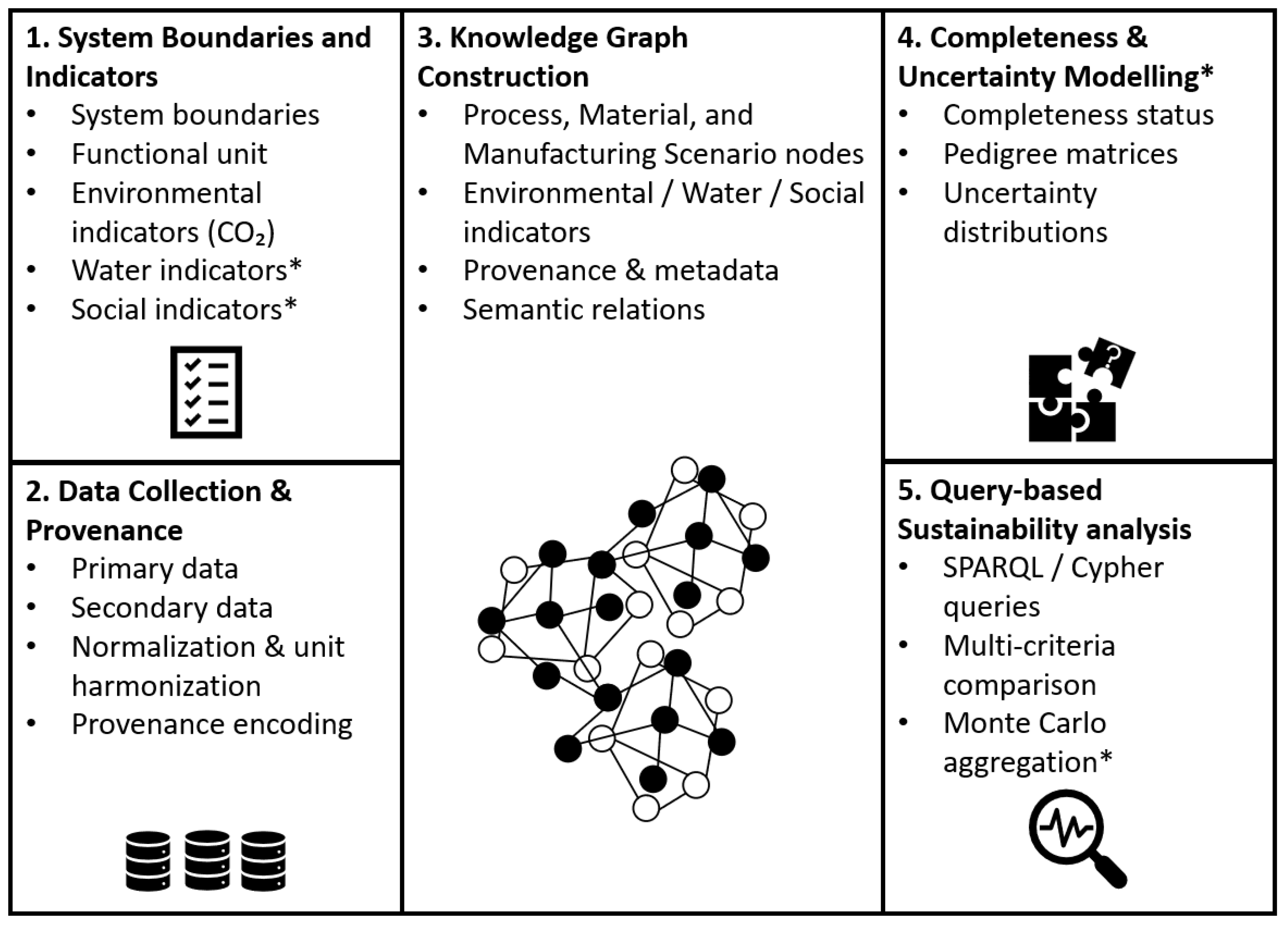
The proposed framework uses a modular, data-driven design to integrate heterogeneous sustainability data into a unified semantic representation. This structured, step-wise workflow ensures reproducible assessments across different manufacturing contexts through five sequential steps:
Definition of system boundaries and sustainability indicators
Data collection, normalization, and provenance encoding
Semantic modeling and KG construction
Modeling of data completeness and uncertainty
Query-based sustainability analysis and uncertainty propagation
The overall workflow is illustrated in
Figure 1.
Each step produces intermediate artifacts—such as indicator definitions or uncertainty distributions—integrated directly into the KG. This modularity allows for the adaptation of individual steps without compromising overall consistency.
Building upon the baseline in [
3], which focused on energy and greenhouse gas emissions, this approach expands the assessment scope in two key areas. First, the indicator definition stage now includes water-related metrics (e.g., freshwater consumption and regional stress) and social indicators derived from S-LCA guidelines. This expansion introduces additional classes and relationships into the semantic model (Stages 1 and 3).
Second, the treatment of uncertainty is fundamentally revised. While the baseline framework assumed deterministic values, the present methodology treats uncertainty and data completeness as first-class elements of the KG. Uncertainty is represented through distribution-based models at the indicator level. Additionally, completeness information is encoded to highlight missing or partial data, allowing users to assess the robustness and quality of the sustainability results.
Note that this work does not aim to redesign the fundamental mechanisms of KG construction or query logic established in [
3]. Instead, those components serve as a stable foundation. Our contribution lies in enriching the indicator space and embedding considerations of completeness and uncertainty. These extensions enhance multiple workflow stages while leaving the underlying data integration and graph mechanisms unchanged.
By integrating these elements directly into the KG architecture, the framework supports transparent, uncertainty-aware assessments throughout the entire evaluation workflow, moving beyond simple post-processing analysis.
3.2. Step 1: Definition of System Boundaries and Sustainability Indicators
System boundaries follow a life cycle perspective, covering the manufacturing and post-processing stages most relevant to Additive Manufacturing (AM). The functional unit is defined as one manufactured part to ensure consistent comparisons across all indicators.
Environmental indicators include conventional LCA metrics like cumulative energy demand and CO
2-emissions [
13], serving as a baseline for extended sustainability dimensions. Water-related indicators, based on ISO 14046, distinguish between volumetric use and context-sensitive impacts. By incorporating regional scarcity factors, the model differentiates between identical consumption volumes in regions with varying water stress [
29,
30,
51].
Social indicators, derived from S-LCA frameworks, focus on occupational health, safety, and worker exposure [
4]. To handle the qualitative nature of social data, the KG supports ordinal scales and risk categories alongside quantitative metrics, preserving contextual interpretation within a structured format.
3.3. Step 2: Data Collection, Normalization, and Provenance Encoding
Data acquisition follows a hybrid strategy combining empirical primary data and literature-based secondary data sources in order to ensure comprehensive coverage of environmental, water-related, and social sustainability indicators. This dual approach addresses known data gaps in conventional life cycle inventories, particularly for social and water-related dimensions.
Primary data were collected through observational studies and semi-structured interviews conducted in Selective Laser Sintering (SLS) laboratory environments. These data focus on operator-intensive process steps and include information on ergonomic strain, personal protective equipment (PPE) usage, training requirements, and process water consumption during cooling and post-processing stages. Primary data collection was used to capture context-specific operational characteristics that are typically underrepresented in generic LCA databases.
Secondary data sources include standardized sustainability datasets and guidelines, such as ISO 14046 for water footprint assessment, UNEP/SETAC Social Life Cycle Assessment (S-LCA) indicators, and life cycle inventory databases, including Ecoinvent and GaBi. These sources provide quantitative baseline values and contextual reference ranges for environmental and social indicators.
All collected data are normalized to a common functional unit (per manufactured part) to ensure comparability across manufacturing scenarios. Prior to integration into the KG, raw data are preprocessed to harmonize units, temporal references, and geographical scope. Where multiple data sources provide values for the same indicator, all values are retained and associated with explicit provenance metadata.
Provenance information is encoded directly within the KG and includes data source references, geographical applicability, temporal validity, and methodological assumptions. This explicit provenance encoding ensures traceability and supports subsequent uncertainty modeling and data triangulation.
3.4. Step 3: Semantic Modeling and Knowledge Graph Construction
The sustainability KG uses a labeled property graph paradigm for flexible data representation and efficient querying. The core ontology extends the classes from [
3] to accommodate new dimensions and uncertainty attributes.
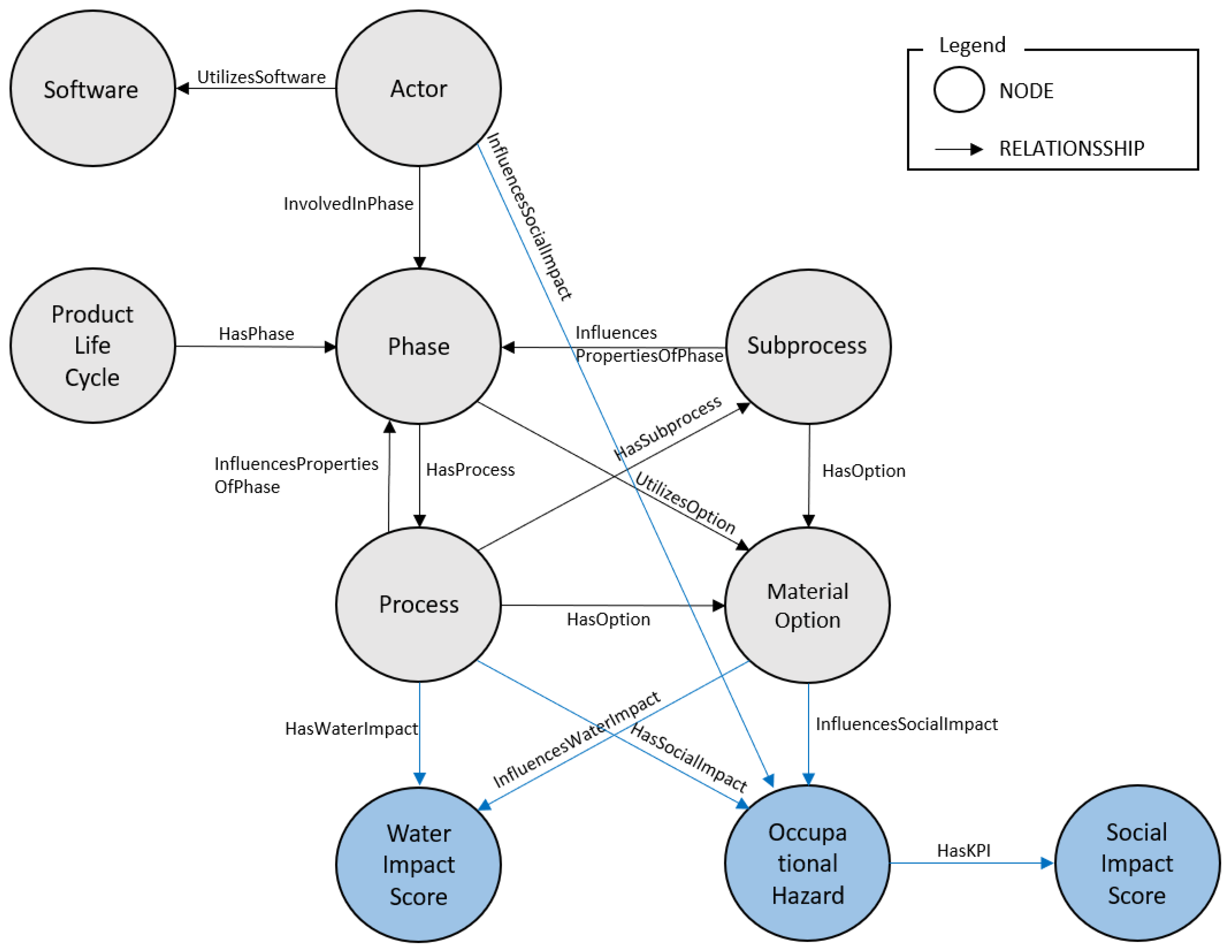
Figure 2 provides a conceptual overview of the semantic structure of the sustainability KG, illustrating how the baseline entities are extended by water and social impact indicators while preserving the original integration logic.
Specifically, new indicator entities are introduced to represent water-related and social sustainability dimensions that were not explicitly modeled in the baseline framework. Water-related indicators are represented as dedicated Water Impact Score nodes and are parametrized with context-sensitive attributes such as water intensity, regional scarcity indices, reuse rates, and adjusted impact scores in accordance with ISO 14046 principles. These nodes are semantically linked to relevant process and material entities to capture both direct and indirect water dependencies within additive manufacturing systems.
Social sustainability is integrated through dedicated indicators and risk entities, including Social Impact Score and Occupational Hazard nodes. Social indicators are modeled using semi-quantitative scoring approaches derived from UNEP/SETAC S-LCA guidelines and are stored as explicit properties of indicator nodes, together with methodological references, temporal validity, and weighting factors. This structure enables traceable linking from materials and processes to specific social risk factors and aggregated social impact scores.
In addition to extending the indicator domain, the KG is augmented with indicator-level metadata required for completeness and uncertainty modeling. For each sustainability indicator, the nodes are enriched with statistical attributes (e.g., mean values and standard deviations) and are linked to pedigree values capturing data quality dimensions such as reliability, completeness, temporal, geographical, and technological representativeness. These additions do not alter the original graph topology but complement existing entities with additional attributes that support uncertainty propagation and completeness assessment in subsequent methodological steps.
The central entity types include Process, Material, and ManufacturingScenario, which represent the physical system under assessment. Sustainability indicators are modeled as dedicated entities and categorized into EnvironmentalIndicator, WaterIndicator, and SocialIndicator. Each indicator entity is linked to the corresponding process or material node through explicit semantic relations such as hasImpact and InfluencesImpact.
To ensure traceability and reproducibility, provenance information is encoded using metadata attributes that capture data source, geographical scope, temporal validity, and methodological assumptions. Units and measurement consistency are enforced through standardized vocabularies, enabling consistent aggregation and comparison across indicators. The semantic modeling principles, graph structure, and query mechanisms remain consistent with the baseline framework presented in [
3]. Extensions introduced in this work are limited to the inclusion of additional indicator classes and metadata attributes required for water-related, social, completeness, and uncertainty modeling.
3.5. Step 4: Modeling of Data Completeness and Uncertainty
Data completeness is addressed by explicitly modeling the availability of required sustainability indicators for each process and manufacturing scenario. Indicator requirements are derived from established LCA and S-LCA guidelines, which define a minimum set of indicators for environmental, water-related, and social dimensions. This process is formalized using SHACL-inspired validation rules that categorize indicators into four states: available, partial (e.g., secondary data only), missing, and out-of-scope.
Completeness information is encoded directly within the KG using dedicated properties. This explicit representation prevents the misinterpretation of missing data as zero impact and allows users to assess the informational robustness of sustainability results. To handle missingness in aggregation, we apply an Analytical Hierarchy Process (AHP) to derive global weights for each KPI. If an indicator is missing, its weight is redistributed proportionally among the remaining indicators within the same category to avoid zero-impact bias while maintaining methodological consistency. By treating completeness as a first-class modeling dimension, the framework supports transparent sustainability assessments under conditions of incomplete data.
In addition to completeness, uncertainty is explicitly modeled and propagated throughout the sustainability assessment. Each sustainability indicator is associated with an uncertainty representation derived from data quality information, including source reliability, temporal validity, and geographical specificity. Provenance metadata is stored for each data point, enabling traceability and supporting uncertainty-aware interpretation of results.
Uncertainty modeling follows pedigree-matrix-based approaches adapted from ISO 14044 [
13], with uncertainty distributions represented as structured metadata within the KG. Propagation is performed via Monte Carlo simulation (
iterations) using log-normal distributions parametrized by mean (
) and standard deviation (
) derived from these pedigree scores. Indicator-specific uncertainty distributions stored in the KG are sampled repeatedly, and aggregated sustainability impacts are calculated for each manufacturing scenario across environmental, water-related, and social dimensions. We report the 95% confidence intervals (p05, p95) and the standard deviation to quantify result robustness. Statistical significance is assessed by the non-overlap of these intervals between manufacturing scenarios.
The resulting probabilistic impact distributions are subsequently linked back into the KG. By reintegrating these results into the semantic model, the framework enables queries that retrieve not only expected indicator values but also confidence intervals, variance measures, and probability distributions. This enables a transparent comparison of alternative manufacturing scenarios under uncertainty, supporting the evaluation of decision and data robustness rather than relying solely on deterministic point estimates. This integrated treatment extends conventional post-processing approaches by enabling uncertainty-aware assessment directly at the semantic modeling level.
3.6. Step 5: Query-Based Sustainability Analysis and Uncertainty Propagation
The final methodological step focuses on the analytical use of the KG for sustainability assessment and decision support. Sustainability analysis is performed through structured, query-based retrieval of indicator values and aggregated impact scores across environmental, water-related, and social dimensions.
Queries are formulated to support both single-indicator inspection and multi-criteria analysis across manufacturing scenarios. Typical query patterns include the comparison of alternative process configurations, identification of sustainability trade-offs between indicator categories, and ranking of scenarios based on composite sustainability scores. Indicator weights derived from multi-criteria decision methods can be incorporated directly into query logic, enabling weighted aggregation and prioritization.
Uncertainty-aware analysis is supported by integrating probabilistic information into query results. For each sustainability indicator, expected values, confidence intervals, and distribution characteristics obtained from the Monte Carlo simulation are stored as node properties within the KG. Queries can therefore retrieve not only deterministic point estimates but also uncertainty ranges and probability-based comparisons.
This approach enables the evaluation of decision robustness under uncertainty. Rather than selecting scenarios based solely on mean indicator values, the framework allows users to assess the likelihood that one manufacturing scenario outperforms another across sustainability dimensions. By embedding uncertainty propagation results directly into the semantic model, the framework supports transparent, uncertainty-aware sustainability decision-making.
3.7. Methodological Validation Strategy
The validation of the proposed methodology is performed through its application to a real-world manufacturing case study, presented in
Section 4. Validation focuses on three aspects: (i) structural validity of the KG schema, (ii) analytical expressiveness of query-based sustainability assessment under uncertainty, and (iii) robustness of sustainability rankings under incomplete data conditions.
Quantitative validation results and their interpretation are deliberately deferred to the case study section to maintain a clear separation between methodological design and empirical evaluation.
4. Case Study: Additive Manufacturing
The proposed knowledge-graph-based sustainability assessment methodology is demonstrated through a case study in Additive Manufacturing (AM). AM is selected due to its increasing industrial relevance and its frequently claimed sustainability advantages, such as reduced material waste and high design flexibility. At the same time, prior research has shown that the actual sustainability performance of AM strongly depends on process parameters, material choices, energy supply, and post-processing requirements, making it a suitable application domain for integrated and uncertainty-aware sustainability assessment.
The case study serves as a demonstrative instantiation of the methodology described in
Section 4, without restricting the general applicability of the framework to other additive or conventional manufacturing processes.
Regarding implementation, the sustainability KG is implemented using Neo4j (version 5.26.0). Data preprocessing, uncertainty modeling, and Monte Carlo simulation are performed using Python (version 3.14.0)-based scripts, while sustainability analyses are executed through Cypher queries within Neo4j.
4.1. Step 1: Case Study System Boundaries, Sustainability Indicators and Manufacturing Scenarios
In accordance with Step 1 of the proposed methodology, system boundaries and sustainability assessment scenarios are defined following a life cycle perspective. The case study focuses on polymer-based Additive Manufacturing using Selective Laser Sintering (SLS) using Polyamide 12 (PA12).
A cradle-to-gate system boundary is adopted, encompassing material production, the additive manufacturing process, and relevant post-processing steps. The sampling strategy focuses on steady-state manufacturing conditions to ensure internal validity for these specific stages. Use-phase and end-of-life stages are excluded, as the objective of the case study is to assess manufacturing-related sustainability trade-offs under uncertainty rather than full product life cycles. This approach captures the primary environmental drivers of the printing process. However, the limited sampling may not fully reflect long-term temporal variability or seasonal shifts in grid carbon intensity. Furthermore, emissions are primarily attributed to material synthesis and energy-intensive printing, while downstream factors such as transportation or environmental deposition remain a subject for future inventory expansions.
The functional unit is defined as the production of one polymer component with fixed geometry and mass, ensuring a consistent baseline for all environmental, water-related, and social indicators. Instead of comparing hypothetical scenarios, this study focuses on the uncertainty-aware evaluation of this specific manufacturing configuration to demonstrate the framework’s analytical depth.
4.2. Step 2: Data Collection, Normalization, and Provenance in the Case Study
Following Step 2 of the methodology, sustainability data are collected using a hybrid approach combining primary and secondary data sources.
Environmental indicators, including cumulative energy demand and greenhouse gas emissions, are derived from established life cycle assessment databases and manufacturer specifications. Water-related indicators are based on literature-derived water use factors and regional water scarcity indices, following ISO 14046 principles [
29,
30].
To reflect regional water scarcity, we calculate the Water Stress Index (WSI) following Hoekstra (2016) [
29]:
This factor is used to calculate an
Adjusted Water Score (AWS):
where Effective Water Use accounts for reuse rates (
).
These indicators allow for the differentiation between identical water consumption volumes occurring in regions with varying water stress levels.
Social sustainability indicators are derived from Social Life Cycle Assessment (S-LCA) databases and guidelines and focus on occupational health and safety aspects, worker exposure risks, and training requirements [
4]. Given the qualitative and semi-quantitative nature of social indicators, ordinal scales and risk categories are used where appropriate. The social impact is quantified using a scoring rubric ranging from 0 (no risk/best practice) to 100 (maximum risk). This semi-quantitative approach follows a standardized normalization where qualitative assessments of occupational hazards and fine particle emissions are mapped to this scale based on literature-derived risk categories. The total Social Impact Score (
) is calculated using weights (
) derived from an Analytical Hierarchy Process (AHP), prioritizing Occupational Health and Safety (
) and Fine Particle Exposure (
). Evidence sources include S-LCA databases and industry-specific safety guidelines. A sensitivity analysis on these weights shows that even a 20% variation in the prioritization of occupational hazards does not alter the risk category, confirming the robustness of the identified hotspots.
All data are normalized to the defined functional unit (one manufactured part). Where multiple data sources provide values for the same indicator, all values are retained and explicitly linked to their respective data sources and assumptions.
4.3. Step 3: Knowledge Graph Construction for the Case Study
In alignment with Step 3 of the methodology, the collected sustainability data are instantiated within the sustainability KG.
Manufacturing processes, materials, and manufacturing scenarios are represented as interconnected entities. Sustainability indicators are modeled as dedicated entities and categorized into environmental, water-related, and social indicator classes. Indicators are linked to the corresponding process and scenario entities using explicitly defined semantic relationships.
The population of the KG follows a semi-automated pipeline that combines automated data ingestion from structured sources with manual validation steps to ensure semantic correctness and consistency. Units, geographical scope, temporal validity, and methodological assumptions are encoded using standardized vocabularies to enable consistent aggregation and querying.
This structured instantiation enables the representation of heterogeneous sustainability information within a unified semantic framework and forms the basis for subsequent uncertainty modeling and analysis.
4.4. Step 4: Modeling of Data Completeness and Uncertainty in the Case Study
Consistent with Step 4 of the proposed methodology, data completeness and uncertainty are explicitly modeled for all sustainability indicators included in the case study. The availability of required indicators is assessed based on established LCA and S-LCA guidelines, with the KG recording whether data are available, partially available, or missing.
Uncertainty is represented at the indicator level using distribution-based representations derived from provenance metadata and data quality information. Following ISO 14044, each KPI is assigned a pedigree profile to determine its geometric standard deviation (). We model each indicator using a log-normal distribution, as is standard for LCA data, to prevent negative values. The parameters are calculated as , where represents the quality scores for reliability, completeness, and geographical, temporal, and technological correlation.
Uncertainty propagation is performed using a Monte Carlo simulation. The simulation was executed with iterations to ensure convergence (mean stability ). For this study, indicators were assumed to be non-correlated to maintain a conservative estimate of total variance. The resulting probabilistic impact distributions are subsequently linked back into the KG as semantic properties, allowing deterministic values and uncertainty information to coexist within the same structure.
4.5. Step 5: Query-Based Sustainability Analysis and Uncertainty Propagation in the Case Study
In accordance with Step 5 of the methodology, the populated KG is used as the analytical backbone for sustainability assessment and decision support.
Query-based analysis is performed using the Cypher query language to retrieve and aggregate sustainability indicators across environmental, water-related, and social dimensions. Queries support the comparison of alternative manufacturing scenarios, identification of sustainability trade-offs, and the evaluation of composite sustainability profiles.
Uncertainty-aware analysis is enabled by storing expected values, confidence intervals, and distribution characteristics directly within the KG. Queries can therefore retrieve not only mean indicator values but also uncertainty ranges and probability-based comparisons.
This setup enables the evaluation of decision robustness under uncertainty and supports transparent, uncertainty-aware sustainability assessment within the case study.
5. Results
This section presents the results of the integrated sustainability assessment for the defined Additive Manufacturing scenarios. The results are structured to highlight (i) the structural properties and queryability of the populated sustainability KG, (ii) the calculated environmental, water-related, and social sustainability impacts, and (iii) the effects of uncertainty on scenario ranking and decision robustness.
5.1. Knowledge Graph Coverage and Queryability
The resulting sustainability KG contains entities representing the SLS process, materials, and multidimensional indicators across environmental, water-related, and social dimensions. By utilizing a semantic structure, the framework enables complex queries that simultaneously retrieve indicator values, associated uncertainty distributions, and provenance metadata. As illustrated by the query patterns in
Table 1, this allows for a comprehensive assessment of the sustainability profile of the SLS process. Specifically, the framework supports: (i) the retrieval of expected indicator values alongside their confidence intervals, (ii) the systematic identification of data gaps to assess completeness, and (iii) the extraction of provenance information to evaluate data reliability and temporal validity.
These query capabilities allow users to not only compare sustainability performance but also to explicitly assess data completeness and uncertainty. Compared to the baseline framework presented in [
3], the extended KG provides substantially improved coverage of sustainability dimensions and enables uncertainty-aware sustainability analysis rather than purely deterministic evaluations.
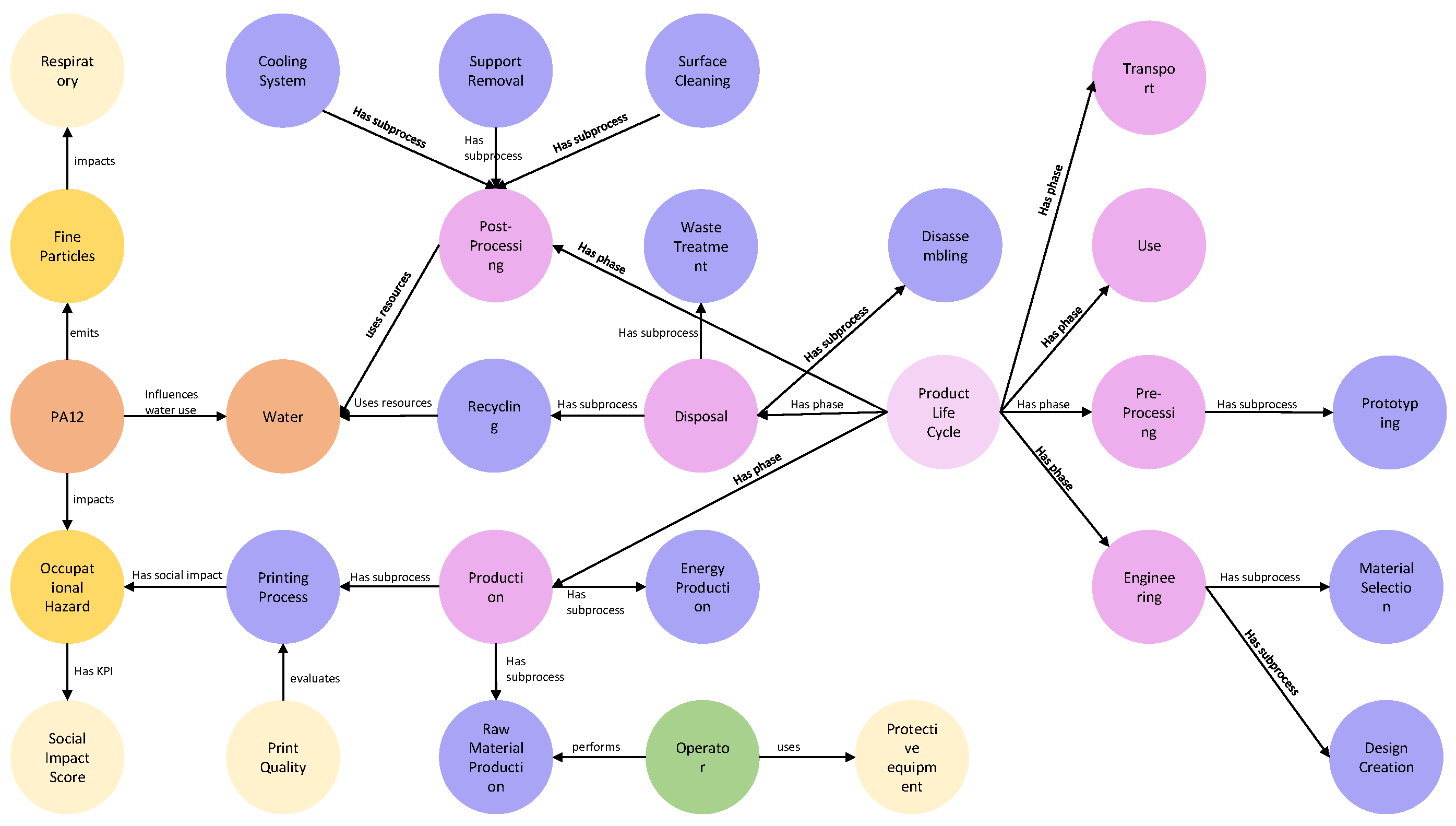
The resulting sustainability KG (see
Figure 3) contains entities representing manufacturing processes, materials, scenarios, and sustainability indicators across environmental, water-related, and social dimensions. The visualization illustrates the semantic interlinking of the sustainability model: Pink nodes represent the Product Life Cycle (PLC) and its respective phases (e.g., production phase), while purple nodes denote the processes and sub-processes (e.g., the printing process). Additional nodes for specific water-related and social indicators are integrated into this structure to provide a multidimensional sustainability profile (nodes in yellow and orange). The relationships (edges) define the impact flow and data provenance, linking process-specific data with their respective sustainability impacts and uncertainty metadata.
Regarding computational performance, the KG for the case study comprises approximately 150 nodes and 400 relationships. Query execution times for completeness validation and multidimensional indicator retrieval averaged less than 50 ms on a standard workstation (8-core CPU, 16 GB RAM). The uncertainty propagation, performed via a Python-Neo4j driver, scales linearly () with the number of indicators. For the current dataset, the full Monte Carlo cycle and reintegration of probabilistic metadata were completed in under 12 s, suggesting that the workflow is scalable for larger manufacturing systems with several hundred process steps.
5.2. Environmental, Water, and Social Impact Results
The assessment reveals a multifaceted sustainability profile for the Selective Laser Sintering (SLS) process. By integrating diverse indicator sets, the framework highlights how specific process parameters and regional contexts shape the overall footprint of PA12-based manufacturing.
The environmental analysis identifies the printing and material production phases as the primary hotspots. For Polyamide 12 (PA12), the production of 1 kg of polymer granulate requires approximately 220 L of water and significant energy input. Based on the case study’s functional unit (0.1 kg part), the baseline water consumption for material production is 22 L/part. The inventory analysis confirms that while upstream activities remain dominated by generic GHG emission values, the actual printing phase allows for the extraction of specific technical KPIs like Print Quality, which serves as a critical proxy for product performance and material efficiency.
The integration of water metrics reveals a total estimated use of 23.5 L per PA12 part, comprising 22 L for material production and 1.5 L for post-processing (cleaning and surface finishing). A key finding is the impact of circular practices: with an assumed industrial water reuse rate of 30%, the effective water use is significantly reduced. However, the sustainability profile is highly sensitive to regional context. Applying a Water Stress Index (WSI)—which, for the German context, was calculated at 40%—the framework adjusts the water score to reflect local scarcity. The KG successfully contextualizes these volumes by linking process nodes to a water risk zone (1.0 to 5.0), demonstrating that the same 23.5 L consumption carries a much higher sustainability risk in high-stress regions compared to the German baseline.
Social impact results differentiate the SLS process through a semi-quantitative risk matrix. The total Social Impact Score for the PA12 process chain was calculated at 50.6, indicating a significant risk level.
The assessment identifies two primary hotspots:
Occupational Hazards: Scoring the highest at 25.0, driven by potential machinery risks.
Fine Particle Emissions: Scoring 20.0, reflecting the risks of operator exposure to polyamide powders during handling and sieving.
To enhance data clarity and support the interpretation of the Monte Carlo results,
Table 2 summarizes the key statistical parameters for the Adjusted Water Score and Social Impact Score. The reported values (Mean ± SD) and the 95% confidence intervals (p05, p95) provide a measure of result robustness.
The analysis shows that while the requirement for PPE and specialized training is a necessity, the availability of high-quality protective equipment acts as a mitigating factor (reducing the risk by −6.4 points). By formalizing these risks as semantic nodes (e.g., Occupational Hazard, PPE, Training), the framework ensures that operator-related risks are captured as primary sustainability data rather than secondary observations.
Ultimately, the SLS case study demonstrates that sustainability is not a static value. The integration of these indicators confirms that while PA12 production is resource-intensive, the sustainability profile can be improved through high reuse rates and rigorous social safety protocols. The KG provides the necessary structure to balance these quantitative water volumes against semi-quantitative social risks, enabling a holistic and transparent process evaluation.
5.3. Effects of Uncertainty on Scenario Ranking
The reliability of the sustainability assessment is intrinsically linked to the quality and completeness of the underlying data. By implementing automated validation and uncertainty propagation, the framework provides a transparent measure of how much confidence can be placed in the SLS sustainability profile.
To ensure structural integrity, the expanded KG uses a context-aware validation logic. Given the absence of native SHACL in Neo4j, a Cypher-based constraint system was implemented. For the Production Phase, the graph requires a mandatory link to at least one KPI, one Water node, and one Social Factor node. The validation query successfully identifies incomplete process nodes. This ensures that the “hidden” dimensions—water and social impacts—are not omitted, maintaining a comprehensive life cycle representation.
Uncertainty analysis reveals that for the SLS process, deterministic point estimates alone are insufficient for robust decision-making. To address this, each KPI (e.g., water use) was assigned a pedigree profile based on ISO 14044. For the PA12 water usage, a baseline standard deviation of 20 L was refined using five quality indicators: reliability, completeness, temporal correlation, geographical relevance, and technological applicability.
By mapping scores from official sources like the Umweltbundesamt (UBA) and the EPA, a refined standard deviation of 24.2 L was calculated. The subsequent Monte Carlo simulation (10,000 iterations) propagates these uncertainties, resulting in an adjusted Water Score that accounts for industrial realities like the 30% water reuse rate.
For water-related and social indicators, the resulting impact distributions exhibit high variability, reflecting regional data gaps and the semi-quantitative nature of social metrics (e.g., the total social score of 50.6). The simulation demonstrates that the “true” impact of the SLS process should be viewed as a probability range rather than a fixed value.
This allows users to identify which parameters—such as fine particle emissions or regional water scarcity—require more precise primary data collection to reduce the variance of the overall sustainability profile. By explicitly representing these confidence intervals within the KG, the framework enables more informed and transparent decision-making under uncertainty, moving beyond unstable point estimates.
6. Discussion
This section discusses the results of the proposed methodology in relation to existing research on knowledge-graph-based sustainability assessment, with a focus on environmental, water, and social indicators as well as the treatment of uncertainty and data completeness.
The results of this study confirm and extend findings from previous research on knowledge-graph-based sustainability assessment. Existing approaches have demonstrated the feasibility of representing environmental indicators such as energy consumption and greenhouse gas emissions within semantic models [
3], confirming that KGs can indeed support the representation of environmental aspects. However, most current implementations remain largely CO
2-centric and provide limited support for multidimensional sustainability assessment [
23,
27].
By integrating water-related and social sustainability indicators into the KG, the present study addresses this key limitation of existing KG-based approaches. The results demonstrate that water and social indicators can substantially alter the perceived sustainability performance of process configurations. In particular, configurations that appear favorable from a carbon perspective may exhibit increased water-related impacts or social risks, confirming concerns raised in earlier LCA studies regarding the limitations of single-indicator assessments [
23,
27].
Compared to the baseline framework presented in [
3], the extended methodology enables integrated querying and comparison across environmental, water, and social dimensions. While the earlier framework focused primarily on environmental indicators, this study demonstrates that the methodology can be extended beyond CO
2 to capture additional sustainability aspects in a structured manner. The inclusion of water and social indicators—here exemplified by post-processing water use and occupational health and safety—illustrates how the approach moves toward more holistic, multidimensional sustainability KGs.
Additionally this discussion gives particular attention to the integration of water and social indicators, the treatment of uncertainty and completeness, and the implications for sustainability decision-making in Additive Manufacturing.
6.1. Integration of Water Indicators and Regional Context
The inclusion of water-related indicators reveals sustainability trade-offs that are not captured by conventional CO
2-focused assessments. The case study results show that water-related impacts are strongly influenced by regional water scarcity and post-processing requirements, consistent with findings from water footprint literature [
29,
30,
51]. This highlights the importance of considering regional context in sustainability assessment.
Uncertainty analysis demonstrates that water-related indicators exhibit higher variability compared to energy and carbon metrics, reflecting both data limitations and the inherent complexity of water footprint assessment [
31]. The results underscore the importance of explicitly modeling uncertainty when water indicators are included in decision-making.
Methodologically, integrating water indicators into the KG demonstrates that semantic models can support context-sensitive sustainability assessment. By linking water use data to regional scarcity factors and provenance metadata, the proposed framework enables a more nuanced interpretation of water-related impacts than is possible with aggregated or decontextualized indicators.
6.2. Integration of Social Sustainability Indicators
Social sustainability remains one of the most challenging dimensions to operationalize. The results illustrate the potential and limitations of integrating social indicators into knowledge-graph-based frameworks. The results illustrate that social indicators can be meaningfully differentiated across process stages, particularly highlighting the contrast between the highly automated printing phase and the risk-intensive manual post-processing, aligning with recent studies emphasizing social impacts in Additive Manufacturing [
38].
High uncertainty associated with social indicators reflects persistent data gaps and contextual variability. While the KG allows structured representation and comparison of social risks, results must be interpreted cautiously. This limitation is not unique to the proposed framework but reflects broader challenges in S-LCA practice [
14,
37]. Nonetheless, the explicit representation of uncertainty and data provenance enhances transparency compared to purely deterministic or qualitative assessments.
6.3. Uncertainty, Completeness, and Robust Decision-Making
A central contribution of this study is the explicit treatment of uncertainty and completeness within the sustainability KG. Our results demonstrate that uncertainty significantly affects sustainability profiling, particularly when multiple indicators are evaluated simultaneously.
Monte Carlo simulations reveal that overlapping probability distributions often preclude a simple “sustainable vs. unsustainable” verdict. This emphasizes the necessity of probabilistic analysis, as deterministic point estimates may overstate the robustness of sustainability conclusions. While this aligns with prior LCA research [
41,
42], our approach extends these insights specifically to knowledge-graph-based models.
By embedding uncertainty metadata directly into the graph, the framework enables uncertainty-aware queries for more informed decision-making. Furthermore, the explicit modeling of data completeness prevents missing indicators from being misinterpreted as zero impact. Together, these features enhance both the transparency and the reliability of the entire assessment.
6.4. Implications for Sustainable Manufacturing Practice
The findings of this study offer practical implications for manufacturing. For product designers and process planners, the integrated KG provides early-stage feedback on environmental, water-related, and social impacts, supporting a more nuanced trade-off analysis. For sustainability managers, the framework enables the transparent documentation of assumptions, data gaps, and uncertainties, which facilitates stakeholder communication.
Furthermore, the presented methodology is not restricted to applications with a high Technology Readiness Level (TRL). It can be directly applied to emerging and innovative technologies that currently rely solely on lab-scale results. In early developmental stages, data gaps and parameter variances are inherently large. However, our framework is specifically designed to handle such variability through the explicit modeling of uncertainty and the use of Monte Carlo simulations. Consequently, the KG can process lab-scale data to generate robust probability distributions rather than potentially misleading deterministic point estimates. Managing the social impact at a lab-scale level, however, presents a distinct challenge, as full-scale industrial supply chains and labor structures do not yet exist. To address this, the methodology can integrate prospective or ex ante Social Life Cycle Assessment (S-LCA) approaches. Within the KG, social indicators for low-TRL applications can be modeled using proxy data—for instance, by evaluating occupational health and safety risks associated with handling novel materials in the lab or by anticipating the regional labor conditions of future raw material extraction. The correspondingly high uncertainty of these early-stage social estimations is captured transparently as metadata within the graph model, ensuring that the limits of the lab-scale assessment are explicitly communicated to decision-makers.
The practical implications of our uncertainty-aware framework extend beyond static sustainability reporting toward dynamic decision support. As highlighted by recent research on energy flexibility [
50], the ability to adapt production schedules to fluctuating energy markets or diverse control strategies is becoming a key requirement for modern manufacturing. Our KG provides the semantic foundation to align Additive Manufacturing (AM) production schedules with such operational flexibility requirements. By providing a transparent and probabilistic representation of environmental impacts, the methodology enables manufacturers to move beyond static assessments toward data-driven decision support that accounts for both operational variability and informational robustness.
In the context of Additive Manufacturing (AM), our results suggest that sustainability cannot be judged solely by carbon emissions. Water use and social impacts can represent critical hotspots, especially in regionally constrained or labor-intensive scenarios. The observed correlations between process parameters and environmental impacts reflect underlying thermal and physical mechanisms in SLS, such as material oxidation and energy-to-melt ratios. However, we acknowledge that these correlations do not necessarily imply direct causality, as compounding variables like machine-specific cooling cycles or powder aging may also influence results. Consequently, the identified trends are statistical associations that warrant further mechanistic investigation in diverse manufacturing environments. Overall, the proposed framework supports comprehensive evaluations that align with emerging regulatory and reporting requirements.
7. Conclusions and Outlook
This paper presents an extended knowledge-graph-based methodology for integrated sustainability assessment, incorporating environmental, water-related, and social indicators alongside uncertainty and data completeness. By building upon an existing sustainability KG, this approach addresses the limitations of current models—specifically their reliance on CO2-centric indicators and deterministic assessments.
The Additive Manufacturing case study demonstrates that including water and social metrics reveals trade-offs hidden in conventional evaluations. Furthermore, explicit uncertainty modeling shows that conclusions based on point estimates can be unstable, emphasizing the need for uncertainty-aware decision-support tools.
Despite these advancements, several limitations remain. Data availability and quality, particularly for water scarcity and social indicators, continue to constrain the precision of the results. While this study demonstrates uncertainty propagation for a single process chain, it does not yet perform a full comparative assessment of alternative manufacturing routes.
To address these gaps, future work should leverage this framework for uncertainty-aware scenario rankings between different AM technologies (e.g., SLS vs. Multi Jet MJF). By comparing probabilistic distributions, the framework could report the ’probability-of-superiority’—the likelihood of one configuration outperforming another. This would significantly enhance the robustness of decision support for complex manufacturing trade-offs.
Beyond process-level comparisons, the proposed framework provides a foundation for data-driven sustainability management. Integrating environmental and social indicators into a unified semantic model allows for extensions into waste mitigation or powder recycling strategies. Such a structured representation of process-specific data is a prerequisite for developing targeted emission mitigation measures and supporting the transition toward transparent manufacturing standards.
Overall, this study contributes a methodological advancement toward holistic, transparent, and robust sustainability KGs, supporting their application in sustainable manufacturing decision-making.