1. Introduction
Africa’s journey toward the Sustainable Development Goals (SDGs) is characterized by uneven progress and a widening implementation gap, raising serious concerns about the continent’s ability to meet the 2030 targets [
1]. While improvements have been recorded in areas such as health outcomes [
2] and access to clean water, the overall pace of progress remains insufficient [
3]. The COVID-19 pandemic further compounded these challenges, reversing development gains and pushing millions of Africans back into extreme poverty [
4]. A central obstacle to progress is the persistent financing gap—estimated at hundreds of billions of dollars annually—exacerbated by illicit financial flows that continue to drain critical resources from the continent [
5]. Progress across the SDGs also varies significantly by sub-region: North Africa generally outperforms other regions, while Central and Southern Africa lag due to structural differences in economic capacity, governance quality, and infrastructure [
6]. These disparities underscore the need for a differentiated and context-sensitive SDG 17 partnership framework rather than a uniform continental model. These challenges are further intensified by persistent data gaps, which hinder effective monitoring and evidence-based policymaking [
7].
The development discourse in Africa is further complicated by the paradox of substantial aid inflows yielding limited and often disappointing outcomes. Despite receiving over US
$1.2 trillion in foreign aid over the past five decades, poverty rates have increased from approximately 11% in the 1960s to nearly 38% today [
8,
9]. This disconnect has fueled a long-standing debate on aid effectiveness [
10,
11]. While some studies argue that aid can stimulate growth through increased investment, critics contend that aid often fosters dependency, distorts local markets, and remains vulnerable to corruption, with estimates suggesting that up to 30% of aid resources may have been misappropriated [
12]. The structural design of aid relationships—marked by donor dominance and external conditionalities—has thus been identified as a major constraint on sustainable, self-reliant development in Africa [
10].
Within this context, Sustainable Development Goal 17 (SDG 17), which seeks to revitalize global partnerships for sustainable development, emerges as both the weakest link and the most critical enabler of Africa’s development agenda [
13]. Progress on SDG 17 has been notably sluggish, threatening the achievement of the entire 2030 Agenda on the continent [
14]. Challenges include declining official development assistance [
15], limited access to affordable finance [
16], inadequate data systems [
17], and persistent political instability in some regions [
18]. Yet SDG 17 remains foundational: without effective partnerships to mobilize finance, technology, trade, and capacity building, progress on poverty reduction, health, education, and environmental sustainability becomes unattainable [
16].
Efforts to operationalize SDG 17 are further undermined by the fragmentation of global development governance. The proliferation of bilateral donors, multilateral institutions, private foundations, and non-governmental organizations has resulted in overlapping mandates, coordination failures, and complex aid architectures that overwhelm the administrative capacity of recipient countries [
19,
20]. Such fragmentation has been shown to reduce aid effectiveness and, in extreme cases, contribute to what [
21] termed “institutional destruction.” Consequently, African governments often struggle to assert ownership over development priorities, with short-term, donor-driven projects displacing long-term national development strategies [
22].
These structural challenges are compounded by a convergence of global crises. The intersection of pandemics, climate change, and armed conflict has created a “polycrisis” that has significantly derailed SDG progress in Africa [
23]. COVID-19 disrupted supply chains and strained health systems, while climate change has intensified droughts, floods, food insecurity, and displacement [
24,
25,
26]. Ongoing conflicts further exacerbate instability, generating humanitarian crises and eroding development gains [
27]. Although emergency responses are essential, the growing reliance on crisis-driven interventions has diverted attention away from long-term structural transformation.
Against this backdrop, there is a growing consensus on the urgent need to rethink global development partnerships before the 2030 deadline [
28]. Existing financial models and partnership structures are increasingly viewed as inadequate for addressing Africa’s multidimensional development challenges [
29]. Scholars and policymakers alike call for partnerships that are transformative, inclusive, and accountable—moving beyond aid dependency toward collaboration models that unlock Africa’s domestic resources and institutional potential [
30]. Learning from past successes and failures is therefore essential as the international community begins to shape a post-2030 development agenda [
30].
Building on these debates, this study aims to conceptually reimagine SDG 17 in Africa through the Marshall Plan paradigm. By synthesizing development partnership theory, historical analysis of the Marshall Plan, and contemporary SDG governance discourse, the paper develops a non-empirical framework that reframes SDG 17 from a fragmented, aid-centric mechanism into a coordinated, equitable, and capacity-oriented partnership model. The study contributes to SDG scholarship by offering an Africa-centered framework capable of informing design of governance architectures under the emerging Post-2030 Development Agenda, particularly in relation to coordination, institutional capacity, and equitable partnership models. Also, this paper’s central contribution is the development of a Marshall-style conceptual framework that reconceptualizes SDG 17 as a system of coordinated, trust-based partnership governance rather than a fragmented aid mechanism. By integrating historical governance principles with contemporary African development challenges, the study provides a theoretically grounded and policy-relevant model for restructuring global partnerships in Africa and informing post-2030 development governance.
2. Literature Review
The evolution of development cooperation reflects a shift from donor–recipient aid models toward partnership-based approaches. The Marshall Plan is often cited as a benchmark of coordinated development, though its effectiveness remains debated. While some argue recovery was already underway, others highlight its role in resolving coordination failures and stabilizing markets [
31,
32]. At the same time, its geopolitical objectives—particularly during the Cold War—underscore that development cooperation is inherently political [
33]. Contemporary debates on aid in Africa reflect similar tensions, with proponents emphasizing targeted investment for poverty reduction and critics highlighting dependency and governance failures [
34]. These debates suggest that effective development requires a shift from transactional aid toward cooperative development logic grounded in shared ownership and coordinated governance.
A central theme in the literature is the fragmentation of global development governance. The proliferation of institutions, overlapping mandates, and diverse actors has produced coordination failures and weakened policy coherence [
22,
35,
36]. Donor dominance further reinforces these dynamics by centralizing decision-making and marginalizing recipient countries [
37,
38]. The resulting governance complexity—characterized by fractured accountability and competing institutional logics—undermines the effectiveness of development partnerships [
39,
40]. These findings highlight the need for structured coordination mechanisms that align actors, institutions, and resources within a coherent governance architecture.
The literature consistently identifies weak accountability and power asymmetries as core constraints on development effectiveness. Traditional aid models often rely on unilateral conditionality, which undermines domestic ownership and distorts policy priorities [
10,
41]. Multi-stakeholder partnerships, while intended to improve inclusivity, frequently reproduce these asymmetries due to unequal agenda-setting power and weak enforcement mechanisms [
42,
43]. These dynamics suggest that accountability must be reconceptualized as mutual and institutionalized, rather than donor-driven, to support equitable and effective partnerships.
Development partnerships in Africa are further constrained by collective action problems, including free-rider dynamics and coordination failures among multiple actors. The presence of numerous donors and agencies often leads to duplication, inefficiency, and fragmented interventions [
44,
45]. Limited ownership by recipient countries exacerbates these challenges, reducing incentives for active participation [
46,
47]. These issues reflect broader collective action dilemmas, where weak coordination and misaligned incentives undermine shared development objectives, highlighting the need for governance structures that incentivize cooperation and align stakeholder interests.
The political economy of development cooperation reveals tensions between market-oriented reforms and state-led development strategies. The Marshall Plan combined liberal economic integration with strong institutional coordination and public investment, reflecting principles of embedded liberalism [
48,
49]. In contrast, contemporary aid architectures often emphasize liberalization without sufficient institutional support, contributing to uneven outcomes in Africa [
50]. Critics argue that development models must balance market mechanisms with state capacity and social protection to achieve sustainable outcomes, reinforcing the need for governance frameworks that integrate economic and institutional dimensions.
A consistent finding across the literature is that development outcomes depend critically on domestic institutional capacity. The effectiveness of both the Marshall Plan and contemporary aid interventions is closely linked to the strength of recipient-country institutions [
51]. Weak institutions in Africa—characterized by limited administrative capacity, fragmented governance, and weak enforcement mechanisms—undermine accountability and policy implementation [
45,
52]. This underscores the importance of institutional strengthening as a core component of development partnerships.
Decolonial and post-development critiques highlight the importance of trust, legitimacy, and epistemic justice in development partnerships. Western-centric knowledge systems continue to dominate development discourse, marginalizing African perspectives and reinforcing dependency [
53,
54]. Scholars advocate for epistemic pluralism and the recognition of indigenous knowledge systems as central to sustainable development [
55]. These perspectives emphasize that trust and legitimacy are not only political but epistemic, requiring inclusive governance structures that value diverse knowledge systems and support genuine co-creation.
Emerging models such as South–South and Triangular Cooperation (SSTC) and regional initiatives like NEPAD and AfCFTA represent attempts to address limitations in traditional aid models. While SSTC emphasizes solidarity and shared experience, it faces coordination challenges, transparency deficits, and geopolitical constraints [
56,
57]. Similarly, African-led initiatives aim to strengthen ownership and regional coordination but remain constrained by institutional limitations and external dependencies [
58,
59]. These approaches highlight both the potential and limitations of alternative partnership models.
Taken together, the literature reveals a consistent pattern of governance failures—fragmentation, weak coordination, power asymmetries, and limited institutional capacity—that undermine development partnerships in Africa. While existing studies provide valuable insights, they remain fragmented across theoretical and empirical domains, with limited integration into a coherent governance framework. This gap underscores the need for a system-level conceptual model that integrates coordination, accountability, institutional capacity, and power dynamics. This study addresses this gap by developing a Marshall-style SDG 17 framework that reinterprets historical governance principles within a contemporary African context. To address this gap, this study develops a Marshall-style SDG 17 framework grounded in the reinterpretation—rather than replication—of historical governance principles.
While the Marshall Plan provides a valuable historical reference for development coordination, its direct transferability to Africa is limited. First, key structural conditions underlying its success—strong state capacity, cohesive political settlements, and Cold War geopolitical alignment—are not present in contemporary African contexts, making replication infeasible [
49,
52,
60]. Second, this study extracts not the historical model itself but its underlying governance principles, including coordinated planning, institutionalized accountability, collective action incentives, state capacity, and trust-building [
61,
62]. Third, these principles are systematically adapted to Africa’s institutional realities through a structured adaptation logic that incorporates constraints such as fragmentation, dependency risks, and uneven capacity, resulting in context-sensitive governance mechanisms aligned with SDG 17 [
63].
Section 3 summarizes this adaptation by linking original principles, contextual constraints, and their reconfigured forms for Africa.
3. Theoretical Framework: Reinterpreting and Adapting the Marshall Plan for SDG 17 in Africa
The Marshall Plan (European Recovery Program) represents one of the most successful historical examples of coordinated development governance, characterized not merely by financial transfers but by the strategic alignment of institutions, policies, and long-term reconstruction objectives [
61,
64]. Rather than functioning as a traditional aid program, it operated as a system of governance built on coordination, mutual accountability, and institutional strengthening, supported by mechanisms such as the Organisation for European Economic Co-operation (OEEC), which facilitated joint planning, peer review, and policy alignment [
62,
65]. Embedded within a broader framework of embedded liberalism, the Marshall Plan balanced market integration with domestic policy autonomy and social stability, enabling participating states to pursue economic recovery while maintaining political legitimacy [
66]. This combination of cooperative governance, institutional capacity, and long-term orientation provides a foundational theoretical lens for rethinking contemporary development partnerships, particularly under Sustainable Development Goal 17 (SDG 17), which similarly emphasizes coordination, capacity-building, and global cooperation. The study employs a structured adaptation logic, whereby each governance mechanism derived from the Marshall Plan is systematically re-specified in relation to African institutional constraints, rather than directly transferred.
At its core, the Marshall Plan can be understood as an integrated system of development governance composed of interrelated mechanisms, including cooperative development logic, institutional coordination, conditional accountability, collective action incentives, embedded liberalism, strategic state capacity, and trust-building [
49,
61,
62]. These mechanisms functioned synergistically to align national policies, mobilize resources, and sustain long-term reconstruction across Western Europe. Cooperative development logic ensured that recovery was pursued as a shared regional objective rather than fragmented national efforts, while institutional coordination enabled joint planning and policy alignment through centralized yet collaborative structures [
67]. Conditional accountability mechanisms linked financial support to performance expectations, fostering implementation discipline without excessive coercion [
68]. Collective action was facilitated through shared incentives and coordinated decision-making, reducing free-rider problems and enhancing efficiency [
69]. Embedded liberalism balanced economic openness with social protection, while relatively strong state capacity enabled effective policy execution [
70]. These processes were sustained by trust-building mechanisms rooted in transparency, shared governance, and geopolitical alignment.
While the Marshall Plan provides valuable theoretical insights, its direct application to Africa is constrained by fundamental contextual differences, including uneven state capacity, fragmented institutional landscapes, colonial legacies, and diverse political and economic systems [
52,
71]. Unlike postwar Europe—characterized by relatively strong bureaucracies, cohesive political settlements, and a shared geopolitical imperative—Africa’s development context involves heterogeneous institutional capabilities, limited coordination capacity, and complex governance environments [
60]. These differences necessitate not replication but systematic adaptation of the Marshall Plan’s governance logic.
3.1. Adaptation of Core Governance Mechanisms
3.1.1. Cooperative Development Logic → Co-Development
Under the Marshall Plan, cooperative development was grounded in a shared reconstruction agenda among relatively cohesive European states with aligned geopolitical incentives [
67]. In Africa, however, divergent national priorities, asymmetrical power relations, and external influence constrain collective development strategies [
72]. Consequently, this principle is reinterpreted as co-development, where African actors retain agenda-setting authority, policy space, and co-design rights, ensuring partnerships are jointly constructed rather than externally imposed [
63,
73].
3.1.2. Institutional Coordination → Polycentric Coordination
The Marshall Plan relied on centralized coordination through strong institutions such as the OEEC [
65]. In contrast, Africa’s development landscape is marked by institutional fragmentation, overlapping mandates, and uneven administrative capacity [
74]. This necessitates a shift toward polycentric and capacity-sensitive coordination, where national, regional, and non-state actors operate within structured yet flexible governance systems.
3.1.3. Conditional Accountability → Mutual Accountability
Marshall Plan accountability mechanisms combined financial support with performance expectations within a cooperative framework [
68,
75]. In Africa, however, externalized accountability systems and weak domestic oversight create risks of inefficiency and elite capture [
21,
76]. Accordingly, accountability is redefined as mutual and enforceable, combining peer review, domestic accountability institutions, and transparent monitoring systems.
3.1.4. Collective Action → Institutionalized Regional Cooperation
The Marshall Plan facilitated collective action through shared incentives and coordinated decision-making under common geopolitical pressures [
69]. In Africa, collective action is hindered by fragmented markets, uneven benefits, and coordination failures. This principle is adapted into institutionalized regional cooperation, where regional bodies play a central role in aligning policies, reducing free-rider problems, and strengthening collective bargaining power [
58].
3.1.5. Embedded Liberalism → Context-Sensitive Development
Embedded liberalism in postwar Europe balanced market integration with domestic social protection [
48,
70]. In Africa, exposure to global markets often occurs without sufficient policy space or social buffers [
63,
77]. Thus, this principle is adapted into context-sensitive embedded development, emphasizing industrial policy, social protection, and strategic economic governance tailored to local conditions.
3.1.6. State Capacity → Capacity-First Sequencing
The Marshall Plan operated within contexts of relatively strong bureaucratic systems capable of implementing complex policies [
65,
78]. In Africa, uneven state capacity limits policy execution and coordination. Therefore, partnerships must adopt a capacity-first sequencing approach, prioritizing institutional strengthening as a prerequisite for effective development outcomes [
79].
3.1.7. Trust-Building → Institutionalized Trust
Trust under the Marshall Plan was supported by shared geopolitical interests, transparency, and collaborative governance [
61,
80]. In Africa, trust deficits stem from historical conditionalities and asymmetric partnerships. This requires institutionalized trust-building, embedded in transparency, shared decision-making, and culturally grounded governance norms such as Ubuntu [
81,
82].
3.2. Conceptual Clarification and Analytical Boundaries
To strengthen analytical precision, this study clarifies the core concepts underpinning the proposed framework—namely the “Marshall Plan paradigm,” “meta-governance,” and “embedded liberalism”—and delineates their specific meaning within the African SDG 17 context.
First, the Marshall Plan paradigm is conceptualized not as a historical blueprint or policy template, but as a governance paradigm defined by three core dimensions: (i) coordinated multi-actor development planning, (ii) institutionalized accountability and conditionality, and (iii) long-term, state-supported structural transformation [
49,
65]. These dimensions constitute the analytical core of the paradigm and provide the basis for its reinterpretation. In this study, the paradigm operates as a theoretical lens for examining how development partnerships can be structured, rather than as a prescriptive model to be replicated.
Second, SDG 17 is reconceptualized as a form of meta-governance, understood as the “governance of governance” that shapes how multiple actors, institutions, and sectors interact within a broader development system [
83,
84]. In the African context, meta-governance refers to the coordination of states, regional bodies (e.g., African Union, AfCFTA institutions), multilateral organizations, private actors, and civil society within structured partnership frameworks. Its operational mechanisms include rule-setting, institutional alignment, performance monitoring, and incentive coordination, enabling SDG implementation to move from fragmented initiatives to system-wide governance.
Third, the concept of embedded liberalism is reinterpreted to reflect African development realities. Originally associated with post-war Europe as a compromise between open markets and social protection [
48]), embedded liberalism in this framework is adapted as context-sensitive developmental integration, where market-oriented reforms are embedded within institutional strategies that prioritize structural transformation, regional integration, and social inclusion. Unlike the European case—characterized by strong welfare states—its African manifestation emphasizes developmental states, regional coordination, and capacity-building institutions that mediate between global economic integration and domestic development priorities [
79].
By explicitly defining these concepts and their analytical boundaries, the framework avoids conceptual ambiguity and ensures internal coherence. The Marshall Plan paradigm is thus treated as a structured governance theory, meta-governance as its coordinating logic, and embedded liberalism as a contextually adapted principle guiding the relationship between markets, states, and development outcomes.
3.3. Contextual Constraints and Principal Adaptation
The adaptation of Marshall Plan governance mechanisms to the African SDG 17 context is not merely a matter of contextual translation but is fundamentally shaped by structural constraints that differentiate Africa from postwar Europe. While development models must be context-sensitive and institutionally grounded rather than universally transferable [
63], Africa’s institutional diversity, political fragmentation, and exposure to polycrisis conditions impose specific constraints that must be explicitly incorporated into theory construction. Unlike the relatively cohesive, high-capacity institutional environment of postwar Europe, Africa’s development landscape is characterized by uneven state capacity, fragmented governance systems, colonial legacies, and diverse political settlements [
52,
53,
85].
These conditions introduce binding constraints—including the non-transferability of historical models, risks of dependency, elite capture, institutional overload, and political instability—which cannot be treated as external limitations but must shape the design of partnership governance. The Marshall Plan cannot function as a blueprint given its unique geopolitical context [
60,
86], necessitating selective institutional adaptation [
87]. At the same time, externally driven partnerships risk reinforcing dependency and weakening domestic accountability [
10,
76], while weak governance environments create vulnerabilities to elite capture and implementation failure [
21]. Fragmented institutional architectures further generate coordination overload [
19,
22,
88], and political instability constrains long-term, trust-based cooperation [
23,
27].
Incorporating these constraints directly into the theoretical framework shifts the analysis from simple adaptation to constraint-responsive design. Each governance mechanism is therefore reinterpreted not only to reflect African realities but to actively mitigate these structural risks, enabling a contextually grounded and operationally viable model of SDG 17 partnership governance. Consequently, the framework should be interpreted as a differentiated governance model in which the effectiveness, sequencing, and prioritization of partnership mechanisms vary across subregions depending on institutional capacity, political stability, and regional integration dynamics.
The following adaptations (
Table 1) therefore reflect not only contextual differences but deliberate theoretical modifications designed to resolve these structural constraints within the SDG 17 partnership architecture.
Table 1 summarizes the systematic adaptation of Marshall Plan governance principles to African institutional realities, illustrating how the proposed framework moves from historical abstraction to context-sensitive application. The table demonstrates that the Marshall Plan’s relevance lies not in its historical form but in the adaptability of its governance logic. Each principle is transformed to address Africa’s institutional constraints, ensuring that the framework is grounded, context-sensitive, and policy-relevant.
3.4. Theoretical Implications for SDG 17
Building on these adaptations, the Marshall-style reinterpretation of SDG 17 reconceptualizes global partnerships as systems of coordinated, trust-based development governance rather than fragmented aid arrangements. This perspective repositions SDG 17 as a form of meta-governance that structures how development is organized, coordinated, and implemented across sectors [
30]. It shifts analytical focus from aid effectiveness to partnership governance, emphasizing institutional design, coordination capacity, and accountability mechanisms as key determinants of development outcomes [
42,
43]. Moreover, it underscores the necessity of context-sensitive adaptation, demonstrating that development frameworks must align with local institutional realities rather than replicate historical models [
63]. Ultimately, this approach advances the argument that sustainable development in Africa is fundamentally a governance challenge, requiring coordinated, system-wide partnership architectures that integrate finance, institutions, and knowledge while addressing power asymmetries and building trust [
53].
4. Methodology
4.1. Research Design and Methodological Orientation
This study employs a conceptual research design focused on theory building and the development of a novel analytical framework. Conceptual research is essential for synthesizing disparate bodies of literature, reinterpreting existing theories, and generating new conceptual systems to understand complex phenomena where empirical testing is premature or insufficient [
89]. Given that Sustainable Development Goal 17 (SDG 17) involves intricate dynamics of partnership governance, institutional architecture, and financing models, a conceptual approach allows for a deeper investigation of the underlying mechanisms that shape development outcomes. The objective is not to test hypotheses empirically but to construct a robust theoretical framework by integrating historical analysis, documentary evidence, and multi-disciplinary theory [
90]. This study therefore adopts a theory-building approach appropriate for under-theorized, system-level phenomena, where empirical testing remains premature without prior conceptual specification of mechanisms and relationships. Empirical studies at this stage would risk measuring fragmented partnership outcomes without capturing the underlying governance architecture, thereby limiting explanatory depth. The methodological purpose of this design is therefore to clarify constructs, specify causal mechanisms, and build an analytically coherent framework that can later be subjected to empirical testing.
4.2. Unit of Analysis and Analytical Scope
The primary unit of analysis for this study is development partnership governance mechanisms, specifically cooperation, institutional coordination, accountability, collective action, state capacity, embedded liberalism, and trust. The analysis is anchored in two complementary contexts: first, the Marshall Plan (European Recovery Program), which serves as a historically grounded case through which core governance mechanisms are identified and theorized; and second, the SDG 17 partnership ecosystem in Africa, which provides the contemporary normative and policy context for adapting and applying these mechanisms. By focusing on governance mechanisms rather than specific countries, sectors, or projects, the study enables the development of transferable conceptual insights that are applicable across diverse institutional and geographic settings, consistent with a theory-building approach to comparative and historical analysis [
91].
Importantly, these insights are not assumed to be uniformly applicable across the continent. Africa’s subregional diversity—reflected in variations in institutional capacity, political settlements, and regional integration—constitutes theoretical boundary conditions that shape how SDG 17 governance mechanisms operate in practice. These differences require a context-sensitive interpretation of the framework, rather than a uniform application across all African settings.
The connection between historical and contemporary contexts is established through a mechanism-based comparative logic. Rather than comparing outcomes, the analysis focuses on identifying functional governance mechanisms within the Marshall Plan and assessing their presence, absence, or distortion within the SDG 17 partnership ecosystem in Africa. This approach enables the systematic abstraction of transferable principles while ensuring that their adaptation remains grounded in contemporary institutional realities.
This multi-scalar orientation ensures that the framework operates as an adaptable governance model rather than a fixed continental blueprint, with scope conditions explicitly defined by institutional capacity, regional integration dynamics, and political context.
4.3. Guiding Analytical Questions
To structure the inquiry, the research is guided by the following analytical questions:
What core governance mechanisms, beyond financial transfers, contributed to the effectiveness of the Marshall Plan?
How do these historical mechanisms correspond to the contemporary challenges and targets of SDG 17 in Africa?
What institutional and structural constraints in the African context necessitate an adaptation, rather than a replication, of these mechanisms?
How can theories of collective action, embedded liberalism, state capacity, and trust enrich a reinterpretation of the Marshall Plan as a governance framework for SDG 17?
4.4. Data Sources: Documentary and Historical Corpus
In line with conceptual and documentary research methods, this study relies on a curated corpus of documents as its primary evidence base [
92,
93]. The corpus is organized into three interrelated categories: first, historical and analytical literature on the Marshall Plan, including official histories, declassified policy documents, and peer-reviewed scholarship examining its governance structure, institutional arrangements, and political economy; second, policy and institutional documents on SDG 17 in Africa, comprising reports, strategy papers, and evaluations produced by key development actors such as the United Nations (UN), African Union (AU), United Nations Economic Commission for Africa (UNECA), Organisation for Economic Co-operation and Development (OECD), and the World Bank; and third, theoretical and scholarly literature drawn from peer-reviewed journals and academic books on development cooperation, collective action theory, embedded liberalism, developmental states, and trust in international relations, sourced primarily from databases such as Scopus and Google Scholar. Document selection was guided by relevance to partnership governance, institutional credibility, and conceptual contribution, following a systematic and transparent approach to ensure analytical rigor, breadth of coverage, and theoretical coherence [
94]. Data collection was therefore conducted through a structured documentary compilation and screening process, in which relevant historical, policy, and theoretical sources were identified, assessed against explicit inclusion criteria, and organized into an analytical corpus for subsequent coding and interpretation.
To enhance methodological transparency, document selection followed explicit inclusion and exclusion criteria. Inclusion criteria required that sources (i) directly address development partnership governance, institutional coordination, or SDG 17-related mechanisms; (ii) provide either historical insight into the Marshall Plan or contemporary analysis of African development partnerships; and (iii) contribute theoretically or empirically to understanding coordination, accountability, or institutional capacity. Exclusion criteria removed sources that were purely descriptive, lacked analytical relevance to governance mechanisms, or focused narrowly on sectoral outcomes without institutional implications. This approach ensured that the corpus remained analytically focused and theoretically coherent.
4.5. Analytical Procedure
The analysis was conducted in three iterative stages:
Historical Analysis of the Marshall Plan: The first stage employed process tracing to analyze the Marshall Plan as a historical case [
95,
96]. This involved identifying the causal mechanisms through which the Plan’s inputs (e.g., financing and technical assistance) translated into both economic outcomes (such as increased industrial output and economic recovery) and institutional outcomes (such as the strengthening of regional coordination and the establishment of cooperative governance structures among European states). The analysis focused on abstracting functional principles—such as institutional coordination, mutual accountability, and trust-building—that solved specific problems like fragmentation and free-riding.
Documentary Analysis of SDG 17 in Africa: The second stage involved a systematic documentary analysis of the contemporary SDG 17 landscape in Africa [
92]. A structured deductive coding framework was applied, where documents were systematically coded according to predefined governance mechanisms derived from the Marshall Plan—namely coordination, accountability, collective action, state capacity, embedded liberalism, and trust. Each document was analyzed to identify (i) the presence or absence of these mechanisms, (ii) the institutional conditions shaping their effectiveness, and (iii) the governance gaps in the African SDG 17 context. This coding process enabled the systematic mapping of problem-mechanism mismatches, forming the analytical basis for adapting historical governance principles into context-specific partnership mechanisms.
Theory Synthesis: The third stage of the methodology involved theory synthesis, an integrative analytical approach that systematically combines multiple theoretical perspectives into a single, coherent explanatory framework [
97,
98]. Rather than privileging a single theory, this study synthesized four complementary bodies of theory to capture the multidimensional nature of SDG 17 partnerships in Africa. Collective Action Theory [
69] was used to explain persistent coordination failures among diverse development actors and to identify institutional arrangements capable of overcoming free-rider problems. Embedded Liberalism [
48] provided a lens for understanding how global market integration can be reconciled with social reconstruction and domestic policy space, a tension central to Africa’s development experience. Strategic State Capacity [
52] highlighted the role of capable, developmental institutions in steering long-term transformation and managing partnerships effectively. Finally, Trust Theory [
99] was incorporated to explain the relational foundations of sustained cooperation, emphasizing credibility, reciprocity, and legitimacy in partnership governance. Together, these theories were synthesized to construct a robust conceptual framework that explains not only why SDG 17 partnerships often underperform, but also how coordinated, trust-based, and institutionally grounded partnerships can generate durable development outcomes in Africa. Together, these stages establish a sequential pathway from conceptual validation to causal analysis and generalizable testing, ensuring that the framework is empirically actionable rather than purely theoretical.
4.6. Conceptual Model Construction
The final output of this methodology is a conceptual framework that reinterprets the Marshall Plan as a theory of coordinated, trust-based development governance for SDG Africa. The framework is composed of the core pillars identified through the analysis and articulates the logical relationships between them. Instead of testable hypotheses, the framework advances conceptual propositions intended to guide future empirical research and inform policy design [
100]. This framework can serve as the foundation for a structured and theoretically informed future empirical research agenda. Future empirical work could benefit from advanced analytical approaches capable of capturing interdependencies among heterogeneous governance variables. For example, recent methodological advances such as the surrogate method for partial association between mixed data types provide a promising basis for analyzing complex, multidimensional development systems in which governance quality, institutional coordination, and social outcomes interact dynamically [
101].
4.7. Rigor and Credibility
In conceptual research, rigor is established through trustworthiness, which encompasses credibility, transferability, dependability, and confirmability [
102]. To ensure this, several strategies were employed. Theoretical triangulation was used to ground each governance mechanism in historical evidence, contemporary policy analysis, and established theory. Transparency was maintained by creating a clear audit trail of the analytical process, from document selection to framework construction. Finally, the study explicitly acknowledges its boundary conditions, emphasizing the need for adaptation rather than direct replication of the Marshall Plan, thereby enhancing the credibility and practical relevance of the proposed framework [
103]. Consequently, the framework should be interpreted as a differentiated governance model in which the effectiveness, sequencing, and prioritization of partnership mechanisms vary across subregions depending on institutional capacity, political stability, and regional integration dynamics.
5. Conceptual Framework: A Marshall-Style SDG 17 Model for Africa
Sustainable development in Africa requires a coordinated, system-wide partnership architecture rather than fragmented, project-based interventions, reflecting persistent challenges of aid fragmentation, weak institutional alignment, and limited SDG progress [
19,
20,
30]. Building directly on the adapted governance mechanisms outlined in
Section 3, this conceptual framework operationalizes a Marshall-style reinterpretation of SDG 17 as an integrated system that aligns finance, institutions, technology, and knowledge to enable long-term structural transformation [
48,
61,
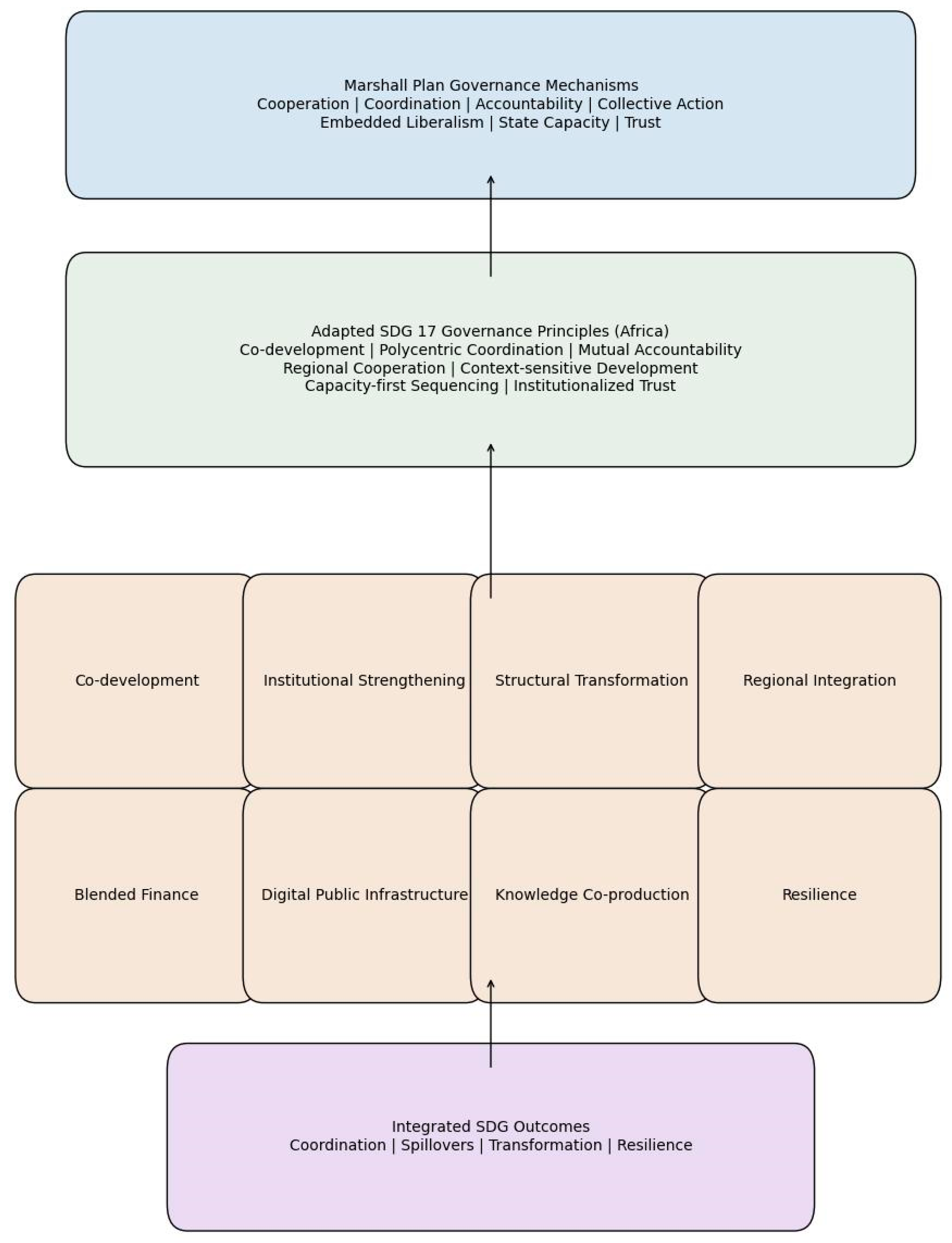
62]. The framework, as shown in
Figure 1, is structured around eight mutually reinforcing pillars, each corresponding to the adapted principles derived from the Marshall Plan and redesigned for African institutional realities. However, without clearly defined governance mechanisms, such principles risk remaining normative aspirations rather than operational solutions. These pillars are operationalized through specific governance mechanisms—including co-governance structures, mutual accountability systems, regional bargaining platforms, and developmental financing rules—which collectively function as constraint-responsive instruments designed to address power asymmetries embedded in global development partnerships.
5.1. Co-Development (From Cooperative Development Logic)
Consistent with the shift from cooperative development to co-development, this pillar positions African actors as co-designers of development priorities, instruments, and governance rules. Unlike traditional aid models characterized by donor dominance and distorted incentives [
10], co-development emphasizes shared ownership, mutual benefit, and policy autonomy. Partnerships are structured to protect African agenda-setting authority while enabling external partners to contribute finance, technology, and market access in alignment with national and regional strategies [
73].
5.2. Institutional Strengthening (From Capacity-First Sequencing + Coordination)
Reflecting the adaptation toward capacity-first sequencing and polycentric coordination, institutional strengthening is treated as the core engine of SDG implementation. Given persistent governance weaknesses, overlapping mandates, and coordination failures in Africa [
21,
22], partnerships prioritize building administrative capacity, planning systems, revenue institutions, and monitoring frameworks. This aligns with developmental state perspectives emphasizing capable institutions as prerequisites for transformation [
79].
5.3. Structural Transformation (From Long-Horizon Reconstruction Logic)
Derived from the Marshall Plan’s long-term reconstruction logic, this pillar emphasizes sustained investment in productive capacity, industrialization, infrastructure, and human capital. Short-term, project-based interventions are replaced with long-horizon development compacts designed to expand fiscal space and economic resilience (Bhattacharya & Khan, 2020 [
28]; Kedir et al., 2017 [
29]). This approach is particularly critical in Africa’s polycrisis context, where shocks repeatedly disrupt development gains [
23].
5.4. Regional Integration (From Collective Action Adaptation)
Building on the adaptation of collective action into institutionalized regional cooperation, this pillar positions regional integration as a governance strategy to overcome scale constraints, coordination failures, and weak bargaining power. Continental and regional frameworks enhance policy coherence, facilitate cross-border infrastructure and trade, and strengthen Africa’s collective negotiating position in global partnerships [
69].
5.5. Blended Finance (From Adapted Financing Architecture + Accountability)
Aligned with the adapted financing logic in
Section 3, this pillar emphasizes blended and diversified financing mechanisms combining public, private, and concessional resources. Given persistent financing gaps and capital constraints [
5], blended finance is deployed to mobilize long-term investment. However, to avoid financialization without development, governance rules must ensure transparency, developmental additionality, and alignment with African priorities [
42,
43].
5.6. Digital Public Infrastructure (From Institutional + Accountability Adaptation)
Digital public infrastructure (DPI) functions as a cross-cutting enabler of state capacity, coordination, and accountability. By addressing persistent data gaps and weak monitoring systems [
7,
17], DPI enhances service delivery, public financial management, and SDG tracking. Its effectiveness, however, depends on institutional safeguards ensuring inclusion, data governance, and accountability.
5.7. Knowledge Co-Production (From Trust + Epistemic Adaptation)
This pillar operationalizes the adaptation of trust-building and epistemic justice by embedding knowledge co-production within partnership governance. It challenges the dominance of external expertise and addresses epistemic injustice in development [
53,
104,
105]. Partnerships are structured to ensure joint problem definition, shared research governance, and local knowledge integration, thereby enhancing legitimacy, ownership, and sustainability.
5.8. Resilience and Shock Absorption (From Adaptive Governance Logic)
Reflecting the need for flexible, adaptive governance under conditions of polycrisis, this pillar embeds resilience as a core design feature rather than a reactive measure. Partnerships incorporate diversified financing buffers, adaptive institutions, regional risk-pooling mechanisms, and shock-responsive systems to sustain development progress amid pandemics, climate shocks, and conflict [
23,
27].
5.9. Systemic Integration of the Framework
The defining feature of the Marshall-style SDG 17 model is its systemic integration. The framework is structured as a multi-level causal system rather than a set of parallel pillars. At the foundational level, background conditions—particularly state capacity, institutional quality, and political stability—shape the feasibility and effectiveness of partnership governance. These conditions influence the operation of core governance mechanisms, including coordination, mutual accountability, collective action, and co-governance structures, which function as the primary drivers of partnership performance. These mechanisms generate intermediate institutional effects, such as improved policy coherence, reduced fragmentation, enhanced trust, and strengthened bargaining power, with trust emerging as an outcome of repeated, accountable interactions and state capacity reinforced through institutional learning processes. At the outcome level, these effects translate into long-term development results, including structural transformation, resilience, and sustained SDG progress.
Within this causal structure, the framework’s pillars operate as mutually reinforcing components of a coordinated governance architecture: co-development establishes ownership and legitimacy; institutional strengthening enables implementation; structural transformation defines long-term outcomes; regional integration provides scale and coordination; blended finance mobilizes resources; digital public infrastructure and knowledge co-production enhance capacity and learning; and resilience ensures continuity under shocks. Together, these elements operationalize SDG 17 as an integrated system of governance rather than a collection of fragmented partnerships.
This systemic approach directly addresses critiques of existing SDG partnerships as fragmented, donor-driven, and insufficiently transformative by aligning governance mechanisms, institutional capacity, and long-term incentives within a coherent architecture [
19,
20]. In doing so, the framework repositions SDG 17 as a form of meta-governance capable of coordinating actors, institutions, and resources to drive integrated and sustainable development outcomes across Africa [
30].
The proposed framework is not intended as a uniform continental model or a one-size-fits-all policy template. Rather, it functions as a flexible, multi-scalar governance heuristic that operates at continental, regional, and national levels, with its effectiveness contingent on contextual conditions. At the continental level, it provides a strategic architecture for coordinating partnerships and aligning development priorities. At the regional level, it supports collective action, policy harmonization, and bargaining power through regional institutions. At the national level, it requires context-specific adaptation based on institutional capacity, political settlements, and development priorities. These scope conditions position the framework as a modular and adaptive system, thereby avoiding overgeneralization and ensuring analytical precision across diverse African contexts.
Importantly, the relative emphasis and operational sequencing of these components will differ across African subregions, reflecting variations in institutional capacity, governance structures, and development priorities. This reinforces the framework’s modular and context-sensitive design, ensuring that it functions as a differentiated and scalable governance architecture rather than a uniform continental blueprint, with configurations varying across national and regional contexts.
6. Sectoral and Cross-Sectoral Applications
This section illustrates how the proposed Marshall-style SDG 17 partnership framework can be applied across key development sectors in Africa and how it generates inter-sectoral spillovers that amplify sustainable development outcomes. Rather than offering sector-specific blueprints, the analysis demonstrates the policy relevance of treating SDG 17 as a system-wide coordination mechanism capable of aligning finance, institutions, digital infrastructure, and knowledge across sectors, addressing long-standing problems of aid fragmentation and partnership inefficiencies [
19,
20]. Africa’s SDG implementation has been hindered by compartmentalized approaches to health, education, infrastructure, climate, and migration, despite their deep interdependence [
29,
30]. The Marshall-style framework reconceptualizes partnerships as horizontal coordination platforms, enabling integrated investments that simultaneously advance multiple SDGs, echoing the economy-wide reconstruction logic of the Marshall Plan [
61,
62]. Human capital development emerges as a foundational accelerator, with coordinated investments in health, education, skills, and social protection transforming demographic growth into a driver of productivity and structural change [
58]. Digital public infrastructure functions as a cross-sectoral multiplier, strengthening efficiency, transparency, and SDG monitoring across health, education, and finance [
7,
17]. Migration is reframed as a development system rather than a crisis, with policy coherence across mobility, skills, and labor markets enhancing shared prosperity [
27,
106]. Overall, the framework’s defining contribution lies in its ability to generate inter-sectoral spillovers that enhance resilience and accelerate SDG progress under polycrisis conditions, reinforcing the case for coordinated, system-wide partnership architectures over fragmented interventions [
23,
42].
The practical relevance of the proposed framework can be illustrated through its application to key African development initiatives, including the New Partnership for Africa’s Development (NEPAD), Agenda 2063, AUDA-NEPAD, and the African Continental Free Trade Area (AfCFTA). While these initiatives represent important steps toward African-led development and regional integration, they continue to face persistent challenges such as coordination failures, limited institutional capacity, fragmented implementation, and external dependency [
58,
107]. NEPAD and AUDA-NEPAD, for example, have encountered implementation gaps and weak alignment between continental strategies and national policies, reflecting deficiencies in institutional coordination and accountability, while Agenda 2063, despite its long-term vision, remains constrained by financing, execution capacity, and monitoring limitations. Similarly, AfCFTA faces barriers related to uneven state capacity, regulatory fragmentation, and infrastructure deficits. The proposed framework addresses these constraints by aligning each initiative with specific governance mechanisms and pillars: co-development and regional integration enhance African ownership and collective bargaining power; institutional strengthening and digital public infrastructure improve implementation, coordination, and monitoring; blended finance and developmental additionality rules address financing gaps while supporting long-term transformation; and mutual accountability systems alongside co-governance structures reduce fragmentation and improve transparency. Through this lens, the framework does not replace existing initiatives but provides a coordinated governance architecture capable of strengthening their effectiveness by directly addressing the structural constraints that have historically limited their impact.
7. Governance and Institutional Architecture
Effective implementation of Sustainable Development Goal 17 (SDG 17) in Africa depends fundamentally on the quality of its governance and institutional architecture, as partnerships without robust institutional design risk remaining symbolic rather than transformative [
19,
21,
30]. Existing SDG 17 partnerships are often governed through voluntary and weakly enforced arrangements, leading to fragmentation, duplication, and uneven power relations [
42,
43]. In contrast, a Marshall-style approach emphasizes structured partnership compacts embedded within institutional frameworks, treating partnerships as long-term governance arrangements rather than ad hoc projects [
61,
62,
108]. Institutional design is therefore central to translating commitments into outcomes, particularly in Africa where overlapping mandates and fragmented aid architectures undermine coordination and policy coherence [
20,
22]. Drawing on historical lessons from the Marshall Plan’s cooperative institutions such as the OEEC [
65], the framework underscores the need for dedicated SDG coordination bodies that function as system integrators across finance, policy, and data, consistent with calls for coordinated polycentric governance [
109]. Regional and continental leadership through frameworks such as NEPAD, Agenda 2063, AUDA-NEPAD, and AfCFTA is critical for collective sovereignty and overcoming scale and bargaining constraints [
58,
69,
107,
110]. The framework further advocates public–private–civil society compacts with shared decision-making authority [
111], strengthened by mutual accountability mechanisms, digital public infrastructure, and enforceable transparency [
7,
68,
112,
113]. Finally, trust and legitimacy—rooted in shared decision-making, respect for domestic policy space, and relational principles such as Ubuntu—are essential for sustaining political buy-in and long-term cooperation [
61,
81,
114].
8. Power, Equity, and Ethical Dimensions
Power relations and ethical considerations lie at the heart of global development partnerships and are central to understanding why SDG 17 has struggled to deliver transformative outcomes in Africa. Despite the rhetorical shift from aid to partnership, many SDG 17 arrangements continue to reproduce asymmetric power structures rooted in historical, economic, and epistemic inequalities, with donors, multilateral institutions, and private actors retaining disproportionate influence over agenda-setting, resource allocation, and evaluation criteria [
19,
42,
43,
50,
115]. These asymmetries are amplified in Africa by fiscal dependence, limited bargaining power, and fragmented institutional capacity, constraining genuine ownership of development priorities [
9,
10]. Reimagining SDG 17 through a Marshall-style governance framework therefore requires confronting power imbalances directly by emphasizing collective governance, regional coordination, and mutual accountability, rather than bilateral dominance [
30]. Equity and inclusion, though frequently invoked, remain insufficiently operationalized, with women, youth, and informal-sector actors often excluded from decision-making despite bearing disproportionate development costs [
116]. Treating equity as a design principle rather than an outcome aligns with justice frameworks that emphasize recognition and representation alongside redistribution [
117]. Moreover, Africa’s development challenges are shaped by historical legacies of colonial extraction and structural adjustment, necessitating ethical recognition and reparative justice within partnerships [
52,
53]. Distinguishing ethical conditionality from coercive conditionality further reinforces legitimacy and shared responsibility [
41,
118]. By institutionalizing voice, agenda-setting power, and gender- and youth-inclusive governance, a Marshall-style SDG 17 architecture can transform partnerships from technocratic arrangements into ethically grounded frameworks for sustainable development [
30,
73,
105,
119].
While the framework emphasizes equity, mutual accountability, and collective sovereignty, these principles must be translated into concrete governance mechanisms to effectively address power asymmetries in practice. This study therefore specifies four operational mechanisms through which SDG 17 partnerships can rebalance power relations in the African context: first, the institutionalization of co-governance decision structures, such as joint steering committees with equal representation from African governments, regional bodies, and external partners, ensuring that strategic priorities, resource allocation, and evaluation criteria are collectively determined rather than donor-driven; second, the establishment of binding mutual accountability frameworks to replace unilateral conditionality, incorporating jointly agreed performance indicators, peer review systems, and transparent reporting platforms supported by digital public infrastructure to reduce information asymmetries; third, the strengthening of regional bargaining platforms, whereby institutions such as the African Union, AUDA-NEPAD, and AfCFTA secretariats act as centralized coordination nodes for collective negotiation of financing, technology transfer, and partnership terms; and fourth, the implementation of developmental additionality rules governing blended finance and private sector engagement, ensuring alignment with African-defined development priorities and measurable contributions to structural transformation. Together, these mechanisms translate normative principles into enforceable governance practices, enabling SDG 17 partnerships to move beyond rhetorical commitments toward structurally balanced and operationally effective collaboration.
9. Risks, Limitations, and Counterarguments
To strengthen analytical rigor, the framework is evaluated through counterfactual reasoning, examining how SDG 17 outcomes would evolve in the absence of coordinated governance mechanisms. In the absence of institutional coordination, development partnerships would likely remain fragmented, reinforcing duplication, inefficiency, and weak policy alignment. Without mutual accountability systems, asymmetrical power relations would persist, enabling donor dominance and reducing domestic ownership. Similarly, in the absence of regional coordination, African states would continue to negotiate individually, limiting bargaining power and reinforcing dependency dynamics. These counterfactual scenarios highlight that the risks identified are not external to the framework but emerge precisely where governance mechanisms are weak or absent, thereby reinforcing the necessity of the proposed architecture.
While the Marshall Plan paradigm offers valuable insights for reimagining SDG 17 in Africa, its application is neither straightforward nor without significant risks, making it essential for any rigorous conceptual framework to acknowledge limitations, unintended consequences, and counterarguments. A central critique concerns the non-transferability of historical models, as the Marshall Plan emerged in postwar Europe under conditions of strong state capacity, cohesive political settlements, and Cold War geopolitics that differ markedly from Africa’s contemporary development context, shaped by colonial legacies, institutional diversity, and uneven state capacity [
49,
60]. Critics therefore caution against treating the Marshall Plan as a blueprint rather than a historical reference [
86], underscoring the need for context-sensitive and institutionally adapted approaches [
63]. A further risk is renewed dependency, as large-scale externally supported partnerships may reinforce reliance on external finance and expertise, echoing long-standing critiques of aid dependency [
9,
10], particularly where accountability is externalized [
76]. Elite capture also remains a persistent threat in contexts of weak institutions and patronage politics [
21], highlighting the importance of broader political settlements for inclusive institutions [
120]. Additional constraints include institutional overload from fragmented aid architectures [
19,
22], political instability and conflict [
23,
27], and donor fatigue amid intensifying geopolitical competition [
28,
50,
121]. Taken together, these risks reinforce the central insight that the Marshall Plan paradigm must be flexible, adaptive, and locally grounded, with its value lying in the reinterpretation of governance principles rather than historical replication, thereby strengthening both analytical credibility and policy relevance [
30].
However, these risks are not treated as external limitations but as conditions that inform the design and robustness of the framework itself. Accordingly, the proposed model incorporates internal mitigation mechanisms that directly address these structural constraints. The non-transferability of historical models is addressed through a modular and context-sensitive design that allows adaptation across subregions. Dependency risks are mitigated through co-development principles, regional bargaining platforms, and developmental additionality rules that prioritize African ownership and long-term capacity building. Elite capture is countered through transparency mechanisms, digital monitoring systems, and mutual accountability frameworks that distribute oversight across multiple actors. Institutional overload is mitigated through coordination platforms that prioritize alignment over proliferation, while political instability is addressed through resilience mechanisms, including flexible financing structures and shock-responsive institutional design. Through these embedded safeguards, the framework advances from risk identification to a structurally resilient model of partnership governance.
10. Discussion
This study set out to conceptually reimagine Sustainable Development Goal 17 (SDG 17) in Africa through a reinterpretation of the Marshall Plan paradigm, developing a coherent analytical narrative that moves from Africa’s persistent SDG implementation gaps and critiques of aid and partnership models to a reconstructed theoretical and conceptual framework grounded in coordination, trust, and long-term structural transformation. A central contribution is the repositioning of SDG 17 not merely as a technical “means of implementation,” but as a system architect for sustainable development that shapes how finance, institutions, knowledge, and partnerships are organized and deployed. This reframing responds directly to persistent challenges of fragmentation, short-termism, and donor dominance, reinforcing the argument that Africa’s SDG challenges are fundamentally governance and coordination failures rather than simple resource constraints. The study advances development theory by shifting the analytical focus from debates on aid effectiveness toward partnership governance, integrating collective action theory, embedded liberalism, state capacity, and trust to conceptualize partnerships as governance systems rather than financial instruments. It further foregrounds the normative dimensions of SDG 17, emphasizing that partnerships are inherently political and ethical arrangements shaped by power asymmetries, historical legacies, and epistemic injustice, and that equity, inclusion, and ethical conditionality are central rather than optional. From a policy perspective, the analysis highlights the importance of moving from fragmented initiatives to strategic, long-term partnership compacts aligned with national and regional priorities, while acknowledging limitations related to contextual diversity and the need for empirical testing. Overall, the discussion reinforces the paper’s core argument that Africa’s sustainable development challenge is a governance challenge, and that reimagined, Marshall-style SDG 17 partnerships can serve as a transformative lever for aligning institutions, partnerships, and long-term development trajectories beyond the 2030 Agenda.
This study makes several interrelated theoretical contributions to the literature on sustainable development, global partnerships, and African development theory by reinterpreting the Marshall Plan paradigm through the lens of Sustainable Development Goal 17 (SDG 17). It advances SDG partnership theory beyond predominantly descriptive accounts of multi-stakeholder engagement that emphasize typologies, participation, or resource mobilization while paying limited attention to governance mechanisms and institutional design [
30,
42]. By shifting the analytical focus from partnership presence to partnership architecture, the study conceptualizes SDG 17 partnerships as coordinated governance systems rather than project-based collaborations, directly addressing critiques of conceptual thinness and operational fragmentation in existing SDG partnerships [
43]. The paper also bridges historical and contemporary development models by abstracting the Marshall Plan’s governance logic—coordination, mutual accountability, long-term reconstruction, and trust-building—and adapting it to present-day African contexts, avoiding simplistic historical replication [
49,
86]. In line with context-sensitive institutional learning, history is treated as a source of transferable principles rather than fixed templates [
63,
122]. Further, the study repositions SDG 17 as a form of meta-governance, challenging views of the SDGs as largely independent goals and instead conceptualizing SDG 17 as an enabling architecture that governs interactions across actors, institutions, and sectors [
69,
84]. Finally, the framework contributes to African development theory by foregrounding agency, institutional capacity, and regionalism, while advancing a governance-based understanding of partnership effectiveness focused on systemic and transformative impacts rather than short-term outputs [
52,
58].
The relevance of the proposed Marshall-style SDG 17 framework extends beyond the 2030 Agenda and aligns closely with emerging priorities in the Post-2030 Development Agenda, where the focus is expected to shift from goal proliferation toward governance quality, system integration, and resilience [
30]. The framework’s emphasis on meta-governance and system-wide coordination directly addresses growing demands for policy coherence and institutional alignment in an increasingly interconnected development landscape spanning climate, health, migration, and digital transformation. Its focus on long-term structural transformation and institutional capacity responds to calls for moving beyond short-term project cycles toward sustainable, endogenous development pathways supported by resilience and domestic resource mobilization. At the same time, the framework’s emphasis on equity, power redistribution, and ethical partnerships aligns with ongoing debates on reforming global development governance, particularly through principles of mutual accountability, co-development, and regional collective sovereignty. Furthermore, the integration of digital public infrastructure and knowledge co-production reflects emerging priorities related to data governance, technological sovereignty, and inclusive innovation ecosystems. Taken together, these areas of convergence demonstrate that the framework is not only relevant for strengthening SDG 17 implementation but also provides a forward-looking governance model for shaping the Post-2030 Development Agenda, suggesting that future development effectiveness will depend less on new targets and more on redesigning partnership architectures to enhance coordination, accountability, and resilience in an increasingly complex global system.
11. Conclusions
In conclusion, this study argues that the effectiveness of SDG 17 in Africa depends fundamentally on the quality of partnership governance rather than the scale of resources mobilized. Persistent challenges—fragmentation, weak coordination, power asymmetries, and limited institutional capacity—reflect systemic governance failures that cannot be resolved through incremental reforms or isolated interventions. By reinterpreting the governance logic of the Marshall Plan, this study develops a structured and context-sensitive framework that identifies core mechanisms—coordination, mutual accountability, collective action, state capacity, and trust—and translates them into eight interrelated pillars of partnership design.
Rather than replicating a historical model, the framework applies a systematic adaptation logic to align these mechanisms with African institutional realities. In doing so, it reconceptualizes SDG 17 as a meta-governance system capable of coordinating actors, institutions, and resources across sectors. This approach shifts the focus from fragmented partnerships toward an integrated governance architecture that enhances coherence, strengthens implementation capacity, and supports long-term structural transformation.
By advancing an Africa-centered and analytically grounded model, the study contributes to both theory and policy, offering a practical foundation for improving partnership effectiveness and informing the evolution of development governance beyond the 2030 Agenda.