1. Introduction
Climate change is a critical global challenge, and China plays an important role in decarbonization for global climate governance [
1]. As the transport sector contributes approximately 24% of energy-related carbon emissions globally, China’s transport sector presents a significant battleground [
2,
3]. Then, China faces urgency in decarbonizing its transport system as the world’s largest carbon emitter. Over the past two decades, China’s transport structure has undergone a significant transformation. The most substantial change is in freight turnover, where water transport’s share surged from 45.6% to 53.9%, establishing it as the dominant mode. Road freight share remained high but stable (29.8% to 29.3%), while rail’s share declined considerably (22.8% to 13.7%). This shift towards water transport has significantly moderated the growth of the sector’s carbon emissions due to its higher energy efficiency compared to other modes of transport. However, the relative decline in rail freight also presents a challenge for achieving decarbonization in the current freight system because there is a total growth of 137% in freight volume from 2008 to 2024 [
4]. Due to the higher carbon emission intensity of road transport compared with rail or water transport, the dominance of road transport in the modal structure strengthens the pressure for carbon emission governance. However, reducing carbon emissions merely from modal structure adjustment is insufficient. Transportation systems evolve alongside economic development, driven by technological advancement and logistics needs [
5]. Considering changes in economic structure and improvements in energy efficiency is, therefore, essential for investigating the determinants of carbon emissions in the transport sector. Therefore, the research question arises: (1) How do road transport share and economic growth moderate the impact of economic structure and energy efficiency on transportation carbon emissions in China? (2) Which of these moderating effects plays a dominant role?
While the existing literature provides deep insights into the direct effects of modal structure, economic growth, and energy consumption on transport emissions, it predominantly examines these factors independently [
6,
7,
8]. The current studies have validated interrelationships among these factors and explored mediation effects [
9,
10,
11]. However, a critical gap remains that the moderating role of modal structure and economic growth in the relationship between core economic dimensions, including economic structure and energy efficiency, and emissions has been conceptually underexplored and empirically untested. Furthermore, it remains unclear whether a high road transport share or rapid economic growth strengthens or weakens the decarbonization effect of improvements in economic structure and energy efficiency. Therefore, this study’s objective is to investigate the moderating role of road transport share and economic growth as it pertains to the impact of economic structure and energy efficiency on transportation carbon emissions in China.
While prior studies have established direct and indirect impacts on carbon emissions [
9,
10], this research introduces a novel contingency framework. It posits that the environmental impact of economic dimensions, including economic structure and energy efficiency, is not fixed but is filtered by the transport system’s configuration. Specifically, the current study investigates road transport share as a critical moderator that is rarely applied in research on sectoral carbon emission. This framework connects structural economics and transportation systems theory and offers a more nuanced explanation for why similar economic inputs yield divergent emission outcomes across different contexts. The finding also extends theories of technological lock-in and provides a systemic explanation for the different outcomes of structural policies.
Methodologically, this study integrates several advances to address limitations in prior research. Principal component analysis (PCA) is employed to overcome severe multicollinearity. Thus, it extracts two economically meaningful dimensions from correlated macroeconomic drivers, including fixed investment, energy intensity, and industrial structure. This method separates growth into its structure and efficiency parts, which have not been commonly used in previous research. Furthermore, it utilizes a quarterly dataset from 2008 to 2024 that captures short-term dynamics and policy effects that may be neglected in annual data. Third, robust moderation models are applied with interaction terms and comprehensive diagnostics to credibly estimate the conditional relationships. This integrated methodological design enables a more precise and dynamic way to test the theoretical proposals than was possible before.
The empirical findings would provide new and actionable insights. Economic growth has demonstrated that there is no significant direct or moderating effect in our model. It challenges the conventional views on transport decarbonization. Conversely, road transport share is identified as a powerful and negative moderator that means high road dependence systematically undermines the emission benefits of both structural change and efficiency improvements. This leads to key policy insights that decarbonization requires moving beyond standalone modal shift or efficiency policies. Therefore, policy must be context-sensitive; for instance, road expansion in a high-intensity economic region may be less harmful, whereas in inefficient regions, it must be coupled with strict controls. Moreover, the findings suggest focusing on improving structural energy efficiency in the long run, since it is stable and sustainable. For proactively shaping transport systems, the stakeholders should be active as emission reducers rather than merely reacting to economic changes. Thus, investigating these moderations is urgent for China, which is under the “Dual Carbon” and “Transportation Power” goals [
12]. This research fills the identified gap by examining how road transport share and economic growth moderate the impact of economic structure and energy efficiency on transport emissions. It provides a foundation for more effective, targeted decarbonization strategies.
The remaining sections are structured as follows.
Section 2 reviews the relevant literature on transportation carbon emissions, highlights empirical evidence for theoretical and conceptual frameworks, and summarizes the research gap at the same time.
Section 3 develops research hypotheses based on theoretical analysis.
Section 4 describes the data sources, model construction, and variable explanation.
Section 5 reports the empirical results, including model selection, regression analysis, and robustness tests.
Section 6 concludes with the main findings, policy implications, and suggestions for future research.
2. Literature Review
Measures to decarbonize transport have attracted the attention of several scholars, as the existing studies provide a crucial foundation but often conduct the analysis independently. This review summarizes theoretical frameworks, direct drivers, the moderating role of modal structure, economic growth, and current research gaps. Building on this, this paper proposes a more integrated and contingent framework.
2.1. Theoretical and Conceptual Framework
Research on transportation carbon emissions draws on interdisciplinary approaches that combine environmental economics, systems theory, and sustainability transitions. Among them, there are two particularly relevant theories: socio-technical transition theory and structural contingency theory. For example, Ferrer and Thome systematically reviewed the literature on carbon mitigation in global transport. Their analysis is based on 30 review papers that covered 3561 original studies in total [
13]. They identify key driving factors in the decarbonization process. And they also emphasize that effective strategies depend on context and must be adapted to specific countries and transport modes. Due to the complex determinants for carbon emissions in the transport sector, methods such as PCA are employed in several studies. Wanke et al. investigate the drivers of sustainability in China’s transportation sector using a PCA method and neural network approach using monthly data from 1999 to 2017 [
14]. Their analysis links energy consumption and carbon emissions to macroeconomic variables and modal usage. The findings also reveal that fixed investments have a significant positive impact on transportation carbon emissions. Furthermore, waterways and airways are identified as having a more critical role in fostering sustainable development compared to road transport, which highlights the importance of modal shift [
15].
The methodological frameworks in the previous studies, such as decomposition analysis, have been instrumental in isolating the effects of structural and efficiency factors. Liu et al. analyze the driving factors of carbon emissions in China’s transport sector by employing a Cobb–Douglas production function based on a Logarithmic Mean Divisia Index (LMDI) decomposition model [
16]. They found that investment is the primary driver of emissions, while technology is the most significant restraining factor. But the relationship between carbon emissions and economic growth exhibited either weak decoupling or expansive coupling. Based on this, Su and Ang advanced the methodological frameworks by applying Structural Decomposition Analysis (SDA) based on monthly data. They addressed that traditional annual input–output models are limited by their temporal granularity [
17]. This methodological innovation is crucial for capturing highly frequent fluctuations in economic structure and energy efficiency, which are often neglected in annual aggregates.
The analysis of the decoupling relationship between economic growth and carbon emissions is important in assessing the progress of sustainability. Li, Li, and Wang examined the non-linear relationship between energy efficiency and carbon emissions across 30 Chinese provinces. They also found that improved energy efficiency consistently reduces transport emissions using a Tapio decoupling index and panel threshold model [
18]. However, income growth, private car ownership, and cargo turnover promote emissions, leading to overall poor decoupling states in the sector. This analysis is extended to the urban scale by Zhang and Sharifi, who applied the Tapio model to China’s provincial capital cities. They revealed significant heterogeneity in decoupling statuses and highlighted the critical role of energy technology and economic structure in promoting decoupling, particularly when faced with external shocks like the COVID-19 pandemic [
19].
In the previous studies on transport-related emissions, most researchers examined the Environmental Kuznets Curve (EKC) hypothesis, which means the emissions first rise but then decline as income levels increase when exploring the determinants of carbon emissions from both the national level and sectoral level. Pata et al. investigate the EKC hypothesis across four transport modes, including road, water, rail, and air, in 13 EU countries from 1995 to 2019 [
20]. They find that the EKC hypothesis holds inconsistently across modes and countries, with the strongest support in air and road transport. Another study examines the EKC in the transport sectors of 28 OECD countries during the period from 1990 to 2019. It uses a dynamic panel threshold regression model. Their findings confirm an inverted U-shaped relationship between GDP and carbon emissions. This supports the EKC hypothesis. And their analysis also found that economic growth tends to increase emissions before a certain income level is reached, while it helps lower them beyond that threshold. This pattern implies that higher incomes can support investment in cleaner technologies. Thus, this study concludes that sustainable growth is essential for meeting decarbonization targets in the transport sector [
21].
2.2. Determinants of Transportation Carbon Emissions
The existing literature has established several direct drivers of transportation emissions. Among these, economic growth and industrial structure are presented as major macroeconomic drivers. While economic growth generally increases transport demand due to the development stage and the sectoral economic structure, the elasticity of emissions with respect to growth varies significantly across countries. And the impact of energy intensity on transportation carbon emissions has declined faster than that of GDP over time [
22] since the sectoral composition of an economy fundamentally shapes its emission trajectory. Dong et al. examined China’s heterogeneous industries and found that carbon emissions, industrial structure, and economic growth exhibit significant bidirectional long-term causal relationships. Their study demonstrates that while industrial improvement generally promotes emission reductions, the effect varies across sectors. And heavy industries show a significant relationship between economic growth and carbon emissions [
23]. This heterogeneity underscores the importance of moving beyond analysis at the aggregate level. Furthermore, Duan et al. provide a perspective that investigates how carbon emission peaks depend on the interaction between economic scale and industrial structure. Their findings suggest that achieving a timely peak requires actively transforming the economic structure, as the sector’s demand is derived from the broader economy’s production and consumption patterns; this is a critical insight for long-term transportation decarbonization [
24].
The modal structure, particularly the dominance of road transport, is consistently identified as a major contributor. The shift towards road transportation has profoundly increased carbon emissions because of the higher average energy intensity compared to rail or water modes [
25]. As the fundamental engine of transportation demand, economic growth is another important driver. The large-scale infrastructure investment in transportation is necessary for economic development because of the need for the movement of people and the exchange of goods [
26]. This means investment has a significant indirect impact on carbon emissions because of the relationship between economic growth and carbon emissions in the transport sector, as validated by Pata et al. and Catik et al. [
20,
21]. Furthermore, a dynamic computable general equilibrium model is established to assess the environmental and economic impacts of shifting freight from road to rail in China, and it found that initiating a rapid modal shift early yields the greatest carbon reductions while minimizing long-term economic losses, underscoring the importance of timing in policy implementation for net benefits [
9].
Furthermore, industrial structure, investment, and energy intensity are recognized as structural drivers. In China, reductions in transport energy intensity have largely resulted from strict fuel economy standards, the shift toward electric vehicles, and improved logistics [
27]. However, this relationship is moderated by structural shifts, which means improvements in energy efficiency could lower the service cost and may lead to additional demand. Furthermore, high investment tends to drive industrial expansion and greater energy use. This might lead to strong multicollinearity and make it difficult to separate their individual impacts in regression models because it may be statistically troublesome and theoretically misleading. Thus, many earlier studies have examined these drivers separately or relied on simplified composite indices but have overlooked how they interact as part of the economic structure.
2.3. The Moderating Role of Macroeconomic Factors
Statistical moderation provides a useful way to analyze complex system interactions. It shows that the relationship between two variables can change direction depending on a moderator [
28]. The direct effects of economic factors like GDP growth and modal share on transport emissions are well-established in theory. However, the actual impact of these drivers might not be fixed but contingent on the broader context. For example, Liu et al. directly address this systemic perspective by exploring the dual role of renewable energy and energy use efficiency. They analyzed the mediation effects on carbon intensity and highlighted the non-linear and conditional nature of how technological factors influence emissions in their findings [
29].
Socio-technical theories support the potential for a dominant transport mode, such as road transport, to act as a powerful moderator. Against this background, Klitkou et al. detailed the “lock-in” mechanisms in road transport systems. Since entrenched technologies, infrastructures, and user practices create path dependencies. These constraints likely mediate how economic changes translate into environmental outcomes [
30]. Similarly, Soni et al. investigated behavioral adaptations in transport systems and presented how user interactions with new technologies can lead to unexpected outcomes that are offset by theoretical efficiency gains [
31]. Köseoğlu further contextualized this within the road sector. They analyzed the rationales and management strategies for energy efficiency and highlighted the sector-specific conditions that moderate efficiency’s impact on decarbonization [
32].
Furthermore, the policy and growth dynamics also shape the moderating context. Zhang et al. found that government intervention in China influences structural transformation and carbon emissions. This position’s policy is a key moderator of the relationship between economy and environment [
33]. Manu et al. analyzed the drivers of China’s expansion. They emphasized factor substitution and technical progress, which are defined by the qualitative character of growth and thus shaped their interaction with the structural drivers of emissions [
34]. Yan et al. added to this by demonstrating how the setting of economic growth targets affects carbon emissions. This indicates that growth objectives and strategies can moderate environmental outcomes.
Previous empirical studies have confirmed the utility of moderation analysis. For example, Sardar et al. [
35] investigated how transportation competitiveness moderates the EKC. Their analysis of 121 countries from 2008 to 2018 shows that this moderating effect exists and alters the curve’s turning point. Similarly, Chen and Zhang proposed a comprehensive freight structure index to assess the freight structure in 16 provinces of China during the period between 2005 and 2019. They found that the freight structure has both a positive direct effect on transport carbon emissions and an indirect impact on carbon emissions through the scale effect [
36].
Despite its conceptual relevance, explicit empirical testing of modal structure or economic factors as a moderator in the relationship between transportation carbon emissions and their drivers remain scarce. The existing literature has explored how other factors, such as urbanization or digitalization, moderate the relationship between economic growth and carbon emissions [
37]. However, no study has systematically investigated whether and how aggregate economic growth and modal structure moderate the specific impact of economic structure, industrial structure, and energy intensity on sectoral carbon emissions. This gap defines the core theoretical proposition and empirical focus of the present research.
2.4. Research Gaps and Contribution
Several research papers have examined the drivers behind transportation decarbonization, but two important gaps remain. The first gap exists because factors such as economic growth, investment, and modal share are widely recognized but are often studied as separate. This neglects how they are interconnected with each other. Therefore, to capture these synergistic dimensions, such as “economic structure” and “energy efficiency”, applying methods like PCA has been largely absent in sectoral emission studies. More fundamentally, the literature has seldom examined how the influence of these underlying economic structures is conditioned by the transport structure. While the moderating role of external factors like urbanization has been explored, the potential moderating effects of structural features have not been systematically examined, for example, the dominance of road transport and the pace of economic growth. Thus, the second gap exists, as it remains empirically unclear whether a road-intensive transport system or a high-growth economy strengthens or weakens the emission impact under the given economy. This study bridges these gaps based on a framework that investigates economic structure and energy efficiency, not independently but as a mediation effect through the critical moderators of modal share and economic growth.
To fill these gaps, this study makes three specific contributions. Firstly, it empirically tests a novel moderation framework that positions economic structure and energy efficiency as conditioning the impact on carbon emissions from changes in the transport modal structure. Moreover, this study uses a distinctive high-frequency quarterly dataset covering China’s transportation sector from 2008 to 2024. This approach captures dynamic effects and short-term variations that annual data cannot. Finally, it applies robust econometric methods designed for interaction analysis, such as variance inflation factor (VIF) diagnostics, to evaluate multicollinearity. By combining these elements, the research offers a more focused and integrated perspective on pathways to transport decarbonization. It also provides evidence to make context-sensitive policies.
3. Theoretical Analysis and Research Hypotheses
This study proposes a theoretical framework to explore how two dimensions, economic structure and energy efficiency, moderate the relationship between key economic factors and transportation carbon emissions in China. Since previous research has typically examined structural, investment, and growth effects separately, this framework will introduce these two core dimensions that reflect capital intensity, energy intensity, and industrial structure and explore the direct and indirect impact of economic growth and road transport share on them. This study also hypothesizes that the road transport share and economic growth moderate how these structural dimensions influence emissions. By examining these interactions, the analysis moves beyond standalone efficiency metrics to help explain why similar economic inputs can lead to different environmental outcomes under a different economic context. The results are intended to offer more targeted, context-dependent evidence based on designing targeted strategies to support China’s “dual carbon” goals in the transport sector.
3.1. Direct Effects on Transportation Carbon Emissions
Transportation carbon emissions can be explained by the interplay of economic, structural, and technological factors. A common view holds that modal structure, especially the share of road transport, directly causes emission intensity because of the varying energy efficiency across modes. Generally, road freight uses more energy than rail or water transport; therefore, the share of road transport positively affects carbon emissions in the transport sector through more energy consumption. This gap arises from several features of road transport, such as lower average load factors, higher air resistance, and greater rolling friction with the road surface [
38].
However, there is uncertainty about the overall carbon impact of expanding road transport because of the advancement in energy efficiency. For instance, the average fuel consumption of private cars dropped significantly from 2008 to 2024 [
4]. Carbon emissions can be reduced by improving energy efficiency, especially in the transport sector because transportation demand patterns are affected by modal preference, shipment scale, and travel distance. All of those shape the long-term development of transport systems and can influence carbon emissions due to the technological progress. By refining technological progress into technological innovation and energy efficiency, carbon emissions can be affected positively, and, compared to the technological innovation, energy efficiency can provide a more substantial boost to carbon emissions [
39].
Furthermore, economic growth presents both challenges and opportunities for reducing emissions by affecting the resource availability, technological innovation, and the industrial structure transition. Based on classical economic and development theory, manufacturing growth tends to relate to industrial output, capital intensity, and energy consumption together, alongside economic scale and complementary investment [
40]. The EKC hypothesis offers a foundation for understanding its negative relationship with transport emissions, as the economic growth effects may be countered later in development by advancement in energy efficiency and technology [
41]. Transport economics indicate that infrastructure investment and industrial development can optimize logistics, cut costs, and raise modal efficiency, thereby reducing carbon intensity systematically [
42]. At the same time, energy efficiency is the capacity to sustain industrial output with lower capital intensity, which relates to induced innovation theories [
3]. The induced innovation hypothesis proposes that firms innovate to use relatively cheaper inputs, which can steer technical change toward green technologies. Efficiency improvements in industry create spillover effects through lean manufacturing and digitalization practices. These can reduce investment needs, streamline supply chains, and cut freight demand, helping to reduce transport emissions. Porter’s hypothesis further suggests that the pressure to improve efficiency can drive innovations that also support systems like transportation, indirectly affecting emission reductions by modal structure [
43].
Since the economic growth has a fundamental impact on carbon emissions in the transport sector, and its relevance to GDP is higher than that of other industries due to its huge infrastructure investment and high dependence on energy [
23]. Thus, the improvement in economic structure, as reflected through fixed investment, energy structure, and secondary industrial output, negatively affects transportation carbon emissions. It also plays a predominant role in peaking carbon emissions, as the economic structure consists of economic scale and industrial structure [
24].
H1a. Road transport share positively affects transportation carbon emissions.
H1b. Economic growth negatively affects transportation carbon emissions.
H1c. Economic structure negatively affects transportation carbon emissions.
H1d. Energy efficiency negatively affects transportation carbon emissions.
3.2. The Moderating Effect on Transportation Carbon Emissions
The economic structure acts as a critical factor that might be moderated because the sectoral makeup of an economy determines the carbon intensity of its output. When an economy develops while relying heavily on carbon-intensive industry, it tends to produce more emissions. This is because industrial activities are typically more intensive in carbon emissions. Conversely, when growth occurs within the services sector, it exerts a negative moderating effect. Moreover, the carbon emission would increase when the economic growth increases in those economies with high-emission infrastructure. While a structure oriented towards knowledge-intensive sectors promotes innovation and investment in green technologies, thereby strengthening its negative impact [
24]. Furthermore, energy efficiency also functions as a determinant that might be moderated for influencing carbon emissions, primarily by altering the energy intensity of human activities. Specifically, higher energy efficiency reduces the amount of energy required to produce a given unit of output or service. It would directly lower the related carbon emissions for that activity, which represents the foundational negative moderating effect. However, the realized impact of energy efficiency is not uniform and is subject to significant contextual differences [
29].
3.2.1. Road Transport Share as a Moderator
The modal structure of transportation acts as an important role through the effect of economic and structural drivers on environmental outcomes, which is particularly highly relevant to road transport. From a transportation system perspective, a dominant road share reflects a specific configuration of mobility networks, vehicle fleets, and logistics patterns, with all of these mediating the environmental impact of economic activity.
A traditional view suggests that road-dominant systems develop alongside spatial forms, production networks, and consumption habits. This development creates path dependencies that influence how structural economic shifts translate into emissions. Furthermore, from a network topology standpoint, road-dominated transport produces distinct connectivity patterns and accessibility structures compared to multimodal systems [
44]. Consequently, this can magnify the environmental effects of freight-intensive economic structures or weaken the benefits of efficiency gains. A technological lock-in perspective argues that investments in road infrastructure and vehicles create long-term transition. These constrain the ability of an economy to change the structure, making emissions more sensitive to some economic drivers while buffering them from others [
30]. In contrast, a behavioral adaptation lens suggests that road-intensive systems may encourage specific patterns of vehicle use, trip chaining, and modal substitution in response to economic signals, thereby altering the relationship between structural factors and environmental performance [
31]. Thus, the moderated effect of road transportation share between economic structure and carbon emissions creates uncertainty. Furthermore, the share of road freight serves as a critical moderating variable in the relationship between energy efficiency and carbon emissions. Within knowledge-intensive sectors, an efficient transportation network can amplify the systemic benefits of green technologies, thereby strengthening the decarbonization effect of efficiency gains, which can be regarded as negative moderation. Conversely, its dominance tends to induce significant rebound effects in the capital-intensive sector due to the greater transport demand, thus weakening the emission reduction gains from improved efficiency, which can be regarded as positive moderation [
32]. Consequently, although the moderating role of road transportation is not fixed in theory, the persistent, heavy investment in transportation infrastructure within a given economy can predispose the system towards a positive moderating effect. This leads to the following hypotheses about its moderating role:
H2a. Road transport share positively moderates the relationship between the economic structure and transportation carbon emissions.
H2b. Road transport share positively moderates the relationship between energy efficiency and transportation carbon emissions.
3.2.2. Economic Growth as a Moderator
Theoretically, economic growth serves as a critical macroeconomic context. It can fundamentally reshape how an economy’s structural characteristics influence environmental outcomes. From a dynamic growth perspective, expansion accelerates capital turnover, intensifies production, and expands markets. All of these can alter the relationship between economic structure and its transport-related effects [
45]. In other words, economic growth can strengthen the impact of the economic structure on carbon emissions. A co-evolutionary view further suggests that growth drives development in production systems and technology. Consequently, the environmental impact of structural patterns, such as economic structural intensity or energy efficiency, might be transformed [
34]. Structurally, economic expansion can amplify the scale effects and resource use of existing systems, thereby increasing their environmental impact. At the same time, growth can lead to changes in policies and regulations, which can change how efficiency improvements are implemented in transport [
33]. Conversely, another perspective holds that growth in the economy can supply the capital and technology needed to ease structural constraints, and it can weaken the direct impact on increasing emissions. In this sense, economic growth can positively moderate the impact of energy efficiency on transportation carbon emissions by accelerating investment in conventional infrastructure, or it can open opportunities toward cleaner systems. Thus, this leads to the following hypotheses:
H3a. Economic growth positively moderates the relationship between the economic structure and transportation carbon emissions.
H3b. Economic growth positively moderates the relationship between energy efficiency and transportation carbon emissions.
3.3. Theoretical Integration and Conceptual Framework
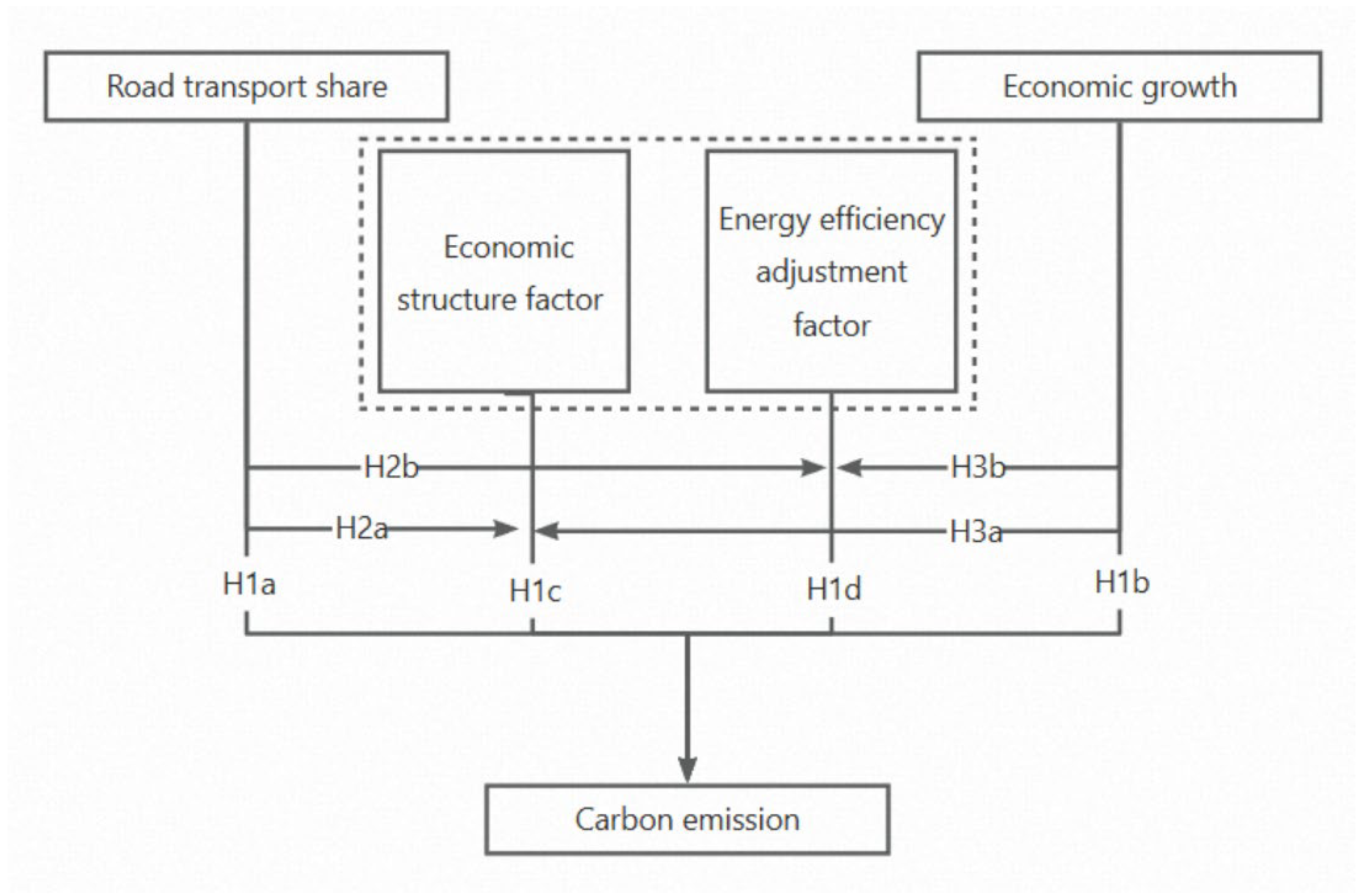
This study builds a conceptual framework that presented in
Figure 1, by combining two theoretical perspectives: SDA theory and Tapio decoupling theory. Since the SDA theory breaks down the changes in carbon emissions into scale, structure, and technology effects [
44], the framework extends this and selects economic structure and transport structure as moderating factors. This refines SDA by focusing on the interactions between these drivers, not just their separate impacts. Moreover, the research objective aligns with the Tapio decoupling theory, which measures whether economic growth and transport emissions are linked or separated [
45]. Furthermore, the framework extends this theory by exploring how decoupling happens. It argues that achieving decoupling depends significantly on how economic and transport structures evolve together. Therefore, the framework in this study examines how different combinations of these factors change the relationship between energy efficiency, economic structure, and carbon emissions. This approach helps identify which structural pathways can lead to a strong moderating impact in the transport sector. Thus, these theories provide a clear basis for analyzing the combined and conditional role of structural factors in reducing transport emissions.
The theoretical framework outlined above proposes that transportation carbon emissions arise from multiple interacting factors. Within this system, economic growth and road transportation share are viewed as critical mediating variables. They moderate how economic structure and energy efficiency translate into environmental outcomes. It proposes that the direct effects of various determinants on transportation carbon emissions are dependent on context. And only the direct relationships fail to capture the multifaceted nature of environmental interactions in dynamic settings like China’s transport sector. Furthermore, economic growth and road transportation share act as fundamental moderators. They systematically shape how other factors affect emissions. The contextual economic structure and transport structure can strengthen or weaken environmental impacts through technological, institutional, and systemic channels. Lastly, the moderating effects are examined under the hypothesis that the moderating effect on the carbon emissions of all variables should be positive in the transport sector.
4. Research Design
4.1. Data and Sampling
This study uses quarterly time series data from 2008 to 2024, with 68 observations. This period covers several critical periods in China, including the economic stimulus and infrastructure expansion before 2008; the 12th, 13th, and 14th Five-Year Plans; the mobility disruptions of the COVID-19 pandemic; and the intensified policy drive under the national “Dual Carbon” goals, which are aimed at achieving carbon peak by 2030 and carbon neutrality by 2060. The data were collected from several authoritative national sources to ensure consistency and reliability. Transportation carbon emissions come from the China Transportation Emissions Database (CTED) and are calculated by applying IPCC-recommended factors to detailed fuel consumption statistics provided by the Ministry of Transport. Total energy consumption for the sector is from the China Energy Statistical Yearbook. Data on the freight turnover share of road transport are also from the Ministry of Transport, while macroeconomic indicators, including GDP, GDP growth, fixed asset investment, and the value-added share of the secondary industry, are sourced from the NBSC.
The statistical analysis in this research was implemented through Python 3.9 using Statsmodels, Scikit-learn, Pandas, and SciPy. The workflow followed four main stages. The first stage is data preprocessing. It involves logarithmic transformations of emission and energy variables, minimizing extreme values, and mean-centering variables to construct interaction terms. Then, PCA was used to extract two unrelated factors from the original and highly correlated variables, including investment, energy intensity, and industrial structure. This step effectively addressed severe multicollinearity. Next, multiple OLS models were specified with Newey–West HAC standard errors and compared using AIC/BIC criteria. After that, post-estimation diagnostics are conducted, including tests for the unit root test, cointegration test, heteroskedasticity, autocorrelation, and normality, along with robustness checks using subsamples, outlier treatment, and bootstrap resampling. The moderating effects of road transport share and economic growth on how principal components influence carbon emissions were examined through significance tests on interaction terms and calculations of conditional marginal effects. This approach provided a robust and transparent empirical basis for testing this study’s hypotheses.
4.2. Model Construction
To test the proposed hypotheses about direct and moderating effects, a series of regression models was developed. The baseline specification (Model 1) estimates the direct effects of the core explanatory variables:
where
is the log of quarterly transportation carbon emissions,
is the road transport share as a percentage of total turnover, and
is the quarterly GDP growth.
denotes the economic structure factor, extracted as the first principal component from the correlated variables of investment intensity, energy consumption, and industrial structure.
denotes the energy efficiency adjustment factor, extracted as the second principal component, capturing the orthogonal dimension of structural decoupling. α is the constant term, and
is the error term. The logarithmic specification for carbon emissions allows for elasticity interpretation, while the percentage forms for structural and economic variables maintain their natural measurement scales and facilitate the semi-elastic interpretation of coefficients. The orthogonal principal components (
and
) resolve multicollinearity while preserving interpretable economic dimensions of the original correlated variables.
The core analytical focus is on testing the moderating role of economic growth and road transportation share on the impact of the economic structure factor and the energy efficiency adjustment factor. Accordingly, three nested moderation models are sequentially estimated. The first moderation model, Model 2, tests the moderating effect of economic growth
on the relationship between the two principal components and carbon emissions:
In this specification, the coefficients δ1 and δ2 capture whether the effect of the economic structure factor () and the energy efficiency adjustment factor () on transportation emissions is contingent upon the prevailing rate of economic growth. A significant and positive δ1 would indicate that the negative effect of on emissions is weakened during periods of high economic growth, supporting hypothesis H3a. Similarly, a significant δ2 would test hypothesis H3b regarding the moderating effect of growth on the relationship between and carbon emissions.
The second moderation model, Model 3, tests the moderating effect of road transport share (
):
Here, the coefficients θ1 and θ2 estimate the conditional effect of the two principal components at different levels of road transport dominance. Specifically, a significant and negative θ1 would support hypothesis H2a, suggesting that a high road transport share weakens the negative effect of the economic structure factor () on emissions. A significant and positive θ2 would support hypothesis H2b, indicating that a high road transport share strengthens the negative effect of the energy efficiency adjustment factor () on emissions. And the marginal effects of and can be calculated by the observed range of .
Finally, Model 4, which is the full moderation model, integrates both interaction terms to test their potentially moderating influences:
This comprehensive specification allows testing of whether the moderating effects of economic growth and road transport share interact independently. By comparing the AIC, BIC, R2, and coefficient stability across four models, it provides the empirical basis for model selection. All models are estimated by Ordinary Least Squares (OLS) with Newey–West heteroskedasticity and autocorrelation consistent (HAC) standard errors to account for potential serial correlation in the quarterly time series data.
4.3. Variable Setting
4.3.1. Explained Variable
Transportation carbon emissions are measured by the quarterly carbon emissions in million metric tons from fossil fuel combustion within China’s national transportation system. The measure is constructed by combining detailed fuel consumption data from the Ministry of Transport with IPCC emission factors, ensuring coverage across road, rail, water, and air. For the econometric analysis, the natural logarithm of emissions is used as the dependent variable. This logarithmic transformation serves statistical and economic purposes. It normalizes the right-skewed distribution of the emissions data, reduces the influence of outliers, and allows for an elasticity interpretation of the regression coefficients. Consequently, coefficients on logged explanatory variables can be regarded as the percentage change in emissions resulting from a one percent change in that driver. The coefficients of variables in percentages represent semi-elasticities. This specification is helpful in assessing how structural, investment, and efficiency factors affect the carbon intensity of transport. Thus, tracking carbon emissions is essential for evaluating China’s progress toward its “Dual Carbon” goals and for informing targeted decarbonization strategies in a high-growth sector, such as the transport sector.
4.3.2. Explanatory Variable
Road transport share is measured as the percentage of total transportation turnover, including both freight and passenger activity, accounted for by road-based modes. The data are sourced from China’s Ministry of Transport. The turnover rate measures the physical output of the transportation system, making this share a direct indicator of modal structure and dependence. A higher road transport share is generally associated with greater system-wide energy intensity and emissions, given the relatively lower efficiency of road vehicles compared to rail or water alternatives. In China, this share has risen sharply over the last two decades, reflecting massive highway investment, rapid motorization, and the logistics patterns of a manufacturing-led economy. Within the regression framework, St is included in its percentage form. This allows its coefficient to be interpreted as a semi-elasticity. It also estimates the percentage change in carbon emissions resulting from a one percentage point increase in the road transport share. This is central to evaluating the carbon consequences of modal shifts and the potential impact of policies promoting a shift to greener modes.
Economic growth is measured as the quarterly year-on-year growth rate of real GDP in percentage terms from the NBSC. This variable is a core macroeconomic driver, as economic expansion stimulates production, consumption, trade, and mobility—all of which raise demand for freight and passenger transport. The relationship between GDP growth and transportation carbon emissions is complex. It may reflect scale, composition, and technique effects due to the EKC theory. In the initial stages of development, growth often leads to a more than proportional increase in transportation activity and emissions. The coefficient of Gt is expected to be positive, reflecting this scale effect. However, its magnitude and significance can help explain the relationship between economic growth and transportation carbon emissions in China.
4.3.3. Composite Factors
As shown in the theoretical analysis, the original candidate explanatory variables, including transportation investment (T), energy intensity (E), and industrial structure (I), exhibit severe multicollinearity. To address this, the PCA was employed. It extracts uncorrelated linear combinations that retain most of the variance from the original, correlated variables. This procedure produced two principal components, which are used in place of the original collinear variables in the regression models.
The first principal component is economic structure (PC1), composed of T, E, and I. Economically, a high value of PC1 represents an economic structure pattern characterized by high capital investment, high energy consumption, and high secondary industrial output. It serves as a composite indicator of intensive development in capital, energy, and investment. And the second principal component is energy efficiency. It captures the variance that is irrelevant to PC2, representing a structural configuration where a high industrial share is achieved with relatively lower capital intensity. Economically, a high value of PC2 represents an energy efficiency pattern indicative of an industrial structure that maintains output while demonstrating capital efficiency; this is aligned with “weak decoupling” in ecological economics. They are used as regressors that completely eliminate the multicollinearity diagnosed in the original model while allowing the analysis to test the distinct and theoretically meaningful influences of the composite economic structure and energy efficiency dimensions of the economy on transportation emissions.
4.3.4. Moderation Variables
The core analytical focus is on testing the direct effects for examining how modal structure and macroeconomic factors moderate the impact of PC1 and PC2 on carbon emissions. Therefore, in the extended models, S and G also function as moderating variables. On the one hand, a high share of road transport is theorized to act as an important moderator. It may fundamentally affect how economic structures create environmental pressure. And its interaction with PC1 and PC2 tests whether the emissions impact of economic structure and energy efficiency depends on the dominance of road transport. On the other hand, the rate of economic expansion sets a dynamic macroeconomic context. The high growth periods can accelerate capital turnover and intensify production, potentially changing how the underlying economic structures captured by PC1 and PC2 influence transport emissions. Its interaction with PC1 and PC2 tests whether the emission effects of economic structure vary with the prevailing growth rate.
Table 1 shows the symbol and definition of variables involved in each variable type, including explained variable, explanatory variables, composite factors, and original variables for composite factors.
5. Empirical Analysis
5.1. Descriptive Statistics
Table 2 presents descriptive statistics for the main variables based on the analysis of 68 quarterly observations. The transportation carbon emissions range from 356.628 to 499.032 million metric tons, with a standard deviation of 23.140. To normalize the distribution and stabilize the variance, C is processed by a logarithmic transformation that is represented by LGC in the following analysis. Economic growth varies from −17.9% to 33.4%, with substantial volatility reflected in a standard deviation of 6.8 percentage points. The distributions of most variables are relatively symmetric due to the close means and medians. Economically, the average quarterly GDP growth of 8.7% points to sustained expansion. Transportation investment is around 16.4% of GDP, which indicates a strong infrastructure commitment. Road transport share has a mean of 32.2% and limited variation, suggesting a persistent modal structure despite policy efforts. Industrial structure shows a narrow range, consistent with gradual economic transformation. The average of energy intensity is 1.191, with a standard deviation of 0.263, which captures both technological progress and operational differences in energy use per unit of economic output. Collectively, these patterns provide an empirical basis for examining how moderating factors interact with composited factors to influence transport emissions. The findings offer relevant insights for making decarbonization policies in rapidly growing economies.
5.2. Correlation Analysis
Table 3 presents the results of the correlation analysis for the investigated variables. The explanatory variable carbon emissions exhibit a significant positive correlation with industrial structure at the 5% significance level, preliminarily validating that the share of secondary industrial output positively influences carbon emissions. Moreover, a high level of correlation exists among investment, energy intensity, and industrial structure. This is validated by the variance inflation factor (VIF) test, which shows significant multicollinearity issues in the model, with the maximum VIF and average VIF both above the threshold of 10.
Thus, to address the severe multicollinearity indicated in
Table 3, particularly among T, E, and I, this study employs PCA. Specifically, the three variables were standardized and subjected to PCA. The analysis extracted two principal components, PC1 and PC2.
Table 4 presents the correlation analysis results for the variables in the baseline model. The dependent variable, C, shows a significant negative correlation with PC2 at the 1% significance level, preliminarily validating the potential of an improvement in economic structure to reduce transportation carbon emissions. Notably, C exhibits a negative but statistically insignificant correlation with PC1, a weak positive correlation with G, and a very weak correlation with S. These findings indicate that the moderation effect is meaningful in investigating their complex relationships.
The PCA approach effectively addressed the multicollinearity issues of the original model. And the VIF values for the PCA-based models are well below the conventional threshold of 10. The baseline model exhibits a maximum VIF of only 1.04, indicating that the orthogonality of the principal components has completely eliminated multicollinearity among the variables. Similarly, the economic growth moderation model exhibits a maximum VIF of only 1.32, further supporting the effectiveness of PCA even with interaction terms. While the road transport moderation and dual-factor moderation show higher VIF values (3.00 and 3.84, respectively), they remain well below the critical threshold of 10. Furthermore, the interaction terms followed the mean-centering principle, further reducing collinearity risks. These results indicate that the PCA approach successfully resolved the initial multicollinearity issue and provided a stable basis for estimating more complex models that include interaction terms.
5.3. PCA Results
The PCA approach was conducted to resolve multicollinearity among T, E, and I. The
Table 5 presents that, PC1 explains 83.15% of the total variance and represents the economic structure. It exhibits strong positive loadings between 0.56 and 0.60 on all three original variables. This pattern suggests that PC1 primarily represents the common underlying dimension of overall economic scale and activity intensity, where higher values correspond to a larger economic volume coupled with higher resource and energy use intensity. Meanwhile, PC2 explains 11.47% of the variance and represents the energy efficiency. It is characterized by a strong positive loading on T, which is 0.758, and a strong negative loading on I, which is −0.646, with a loading that is nearly zero on E. This loading structure indicates that PC2 differentiates economic profiles that are high in T but low in I from those with the opposite pattern. Therefore, PC2 essentially reflects the compositional efficiency of the economy. More importantly, the two components explain 94.62% of the variance in the original variables. This high cumulative variance explained indicates that the two extracted components satisfactorily capture the essential information from the original three variables. It also confirms the appropriateness of the dimensionality reduction. Thus, these two components will be used in further regressions to study how economic structure and energy efficiency affect emissions.
5.4. Unit Root Test Results
Table 6 presents the unit root test results. The ADF test indicates that all variables are non-stationary at the level, with the exception of variables C and I. However, they become stationary after first differencing. In contrast, the PP test suggests that variables G and E are also non-stationary at the level, while all variables become stationary after first differencing. The findings from the two tests are not entirely consistent, particularly regarding the stationarity of variables T and S at the level. Thus, it is necessary to test the cointegration relationship.
5.5. Cointegration Test Results
The Johansen cointegration test results are presented in
Table 7. The trace test statistic for the null hypothesis of no cointegration (r = 0) is 117.18, which leads to the rejection of H0 because it exceeds the 5% critical value of 95.75. However, the test statistic for the hypothesis of at most one cointegrating relation (r ≤ 1) is 58.99, which is less than the critical value of 69.82. Therefore, the null hypothesis of r ≤ 1 is not rejected. This indicates that there is no statistically significant long-run equilibrium relationship among the variables, as the system contains zero cointegrating vectors (r = 0). The initial model’s finding of no long-run relationship is confirmed.
The unit root tests are conducted among the original variables excluding PC1 and PC2. Since principal components are linear combinations of T, E, and I, the stationarity of PC1 and PC2 is directly dependent on the stationarity of these underlying variables. Therefore, the unit root tests are sufficient to enhance the reliability of subsequent regression analysis, and the cointegration test is unnecessary.
5.6. Benchmark Regression Analysis
Table 8 presents the results of the benchmark regression analysis across four model specifications. Model 3 is selected as the optimal model according to the Akaike Information Criterion (AIC). It penalizes model complexity to mitigate overfitting. Among the four candidate models, Model 3 attains the lowest AIC value, which is −335.89. Although Model 4 exhibits a marginally higher R-squared, its AIC is −333.99, which is larger than that of Model 3. This suggests that the marginal gain in explanatory power does not justify the increased model complexity. Therefore, Model 3 strikes the best balance between explanatory power and parsimony, as it effectively captures the significant mediating role of S without introducing redundant parameters that would compromise estimation efficiency.
5.7. Moderation Analysis
Table 9 presents the estimation results for the road transport moderation model. It examines the moderating role of S on the impact of PC1 and PC2 on carbon emissions. The model explains approximately 34% percent of the variance in quarterly transportation carbon emissions. And its results reveal a complex pattern of both direct and indirect effects, with the moderating role of modal structure emerging as particularly important. This suggests that PC1, PC2, and S and their interactions are statistically significant and economically meaningful. However, a substantial portion, which is about two-thirds of the emission fluctuations, remains unexplained by this specification. This is expected and highlights the complexity of transport emissions that are influenced by a broader set of factors not captured here, such as technological change, fuel mix variations, driving behaviors, logistics efficiency, and unobserved policy or seasonal effects. Therefore, while the model successfully confirms the specific conditional mechanisms proposed in the hypotheses, the primary contribution of this analysis lies not in providing a complete predictive model. However, it robustly identifies how the emission impact of road transport dominance is systematically moderated by the underlying economic structure and energy efficiency.
Specifically, the coefficient for road transport share is estimated at 0.1058 and is statistically significant at the 10% level. This finding supports hypothesis H1a. It suggests that a percentage point increase in the S is associated with an approximate 0.11% rise in quarterly transportation carbon emissions when other factors are constant. This result aligns with the established literature, which emphasizes the direct positive impact of road transport dependence on emissions [
38]. And the finding also quantifies this relationship within the specific context of China’s recent development. It confirms that the modal shift toward road transport continues to exert upward pressure on emissions, even after accounting for structural changes. In contrast, the coefficient for G is not statistically significant, which does not support hypothesis H1b. It indicates that the direct effect of economic growth on transport emissions is not detectable in this model. This finding is inconsistent with the classical view that economic growth drives transport emissions and does not align with the EKC theory [
23,
41]. This suggests that the effect of economic growth may be offset or mediated by other forces in a certain development stage or when structural factors are controlled, such as technological progress or structural change, making its direct net effect unclear.
However, both extracted principal components show significant negative direct effects. These results strongly support hypotheses H1c and H1d. The PC1 has a coefficient of −0.0029, with a significance level of 5%, and indicates that a percentage point increase in the PC1 is associated with an approximate 0.0029% decline in quarterly transportation carbon emissions. This indicates that a shift toward a more intensive economic structure is associated with a decline in transport emissions. This finding connects to the theoretical perspective that advanced industrial development can optimize logistics and systematize supply chains, thereby reducing the carbon intensity of supporting transport activities [
24,
42]. Similarly, a percentage point increase in the PC2 is associated with an approximate 0.0181% decline in quarterly transportation carbon emissions due to a coefficient of −0.0181 with a significance level of 5%. This supports the induced innovation and Porter’s hypothesis frameworks [
3,
43], which posit that innovation generates spillover effects that streamline production and logistics. Ultimately, it could reduce freight demand and associated transport emissions. The coefficient for PC2 underscores the pivotal role of efficiency gains, comparing the impacts of technological innovation versus energy efficiency, as highlighted in the literature [
39].
The model’s highly significant interaction terms reveal important conditional relationships. The interaction between S and PC1 has a coefficient of −0.1055, which is significant at the 1% level. This negative sign means the adverse effect on carbon emissions by PC1 weakens as road transport becomes more dominant. This finding contradicts hypothesis H2a, which predicted a positive moderating effect. At the same time, the interaction between road transport share and energy efficiency is also negative and significant due to a coefficient of –0.1312, with a significance level of 5%. It shows that the negative effect of energy efficiency on emissions is also weakened under high road transport dominance. This result does not support hypothesis H2b, which also anticipated positive moderation. But it aligns with theories of technological lock-in and path dependency in transport systems [
30]. The consistent weakening effect across both moderation pathways suggests that road-dominated systems are insensitive to structural transformation. This limits an economy’s ability to translate structural improvements into emissions reductions. The result supports the concept that large-scale infrastructure investment creates long-term dependencies [
30]. This can cancel out the potential benefits of economic restructuring. Furthermore, user behavior in such systems may also adapt in ways that offset efficiency gains, for example, through increased demand or changes in travel patterns. Thus, while some research suggests efficient transport networks could enhance green technology benefits, our findings show the opposite. It can also be explained by rebound effects and system inefficiencies caused by road dominance, which would weaken decarbonization gains. This difference may be due to contextual factors, such as a high degree of infrastructure lock-in in the studied economy. Moreover, the model’s constant term is precisely estimated, and the overall significance of the regressors is confirmed by a robust F-statistic, supporting the reliability of these findings for both policy and theory.
The results of Model 2 and Model 4 simultaneously test the moderating roles of economic growth and provide clear evidence regarding hypotheses H3a and H3b. They reveal that the interaction terms involving economic growth, specifically G × PC1 and G × PC2, are statistically insignificant. Consequently, the empirical analysis provides no support for hypothesis H3a, which indicates that economic growth positively moderates the relationship between the economic structure and carbon emissions. Similarly, hypothesis H3b also finds no empirical validation, as it proposes a positive moderating effect of economic growth on the relationship between energy efficiency and emissions. While the literature suggests that growth can fundamentally reshape how structural characteristics influence environmental outcomes [
34,
45], our findings indicate that in the specific context of China’s transport sector from 2008 to 2024, growth did not systematically alter the strength or direction of these relationships. Several theoretical perspectives may explain this finding. First, growth’s potential amplifying effects may have been counterbalanced by opposing forces, such as accelerating capital turnover and intensifying production [
45]. For instance, growth may simultaneously enable both infrastructure expansion, which could increase emissions, and technological upgrading, which could reduce emissions. It creates offsetting effects that result in net statistical insignificance. Then, the co-evolutionary view suggests that growth drives development in production systems and technology [
34], but this transformation may occur at a different pace or through different mechanisms than those captured in our quarterly data. Structural changes in how efficiency improvements are implemented in transport may require longer timeframes to manifest as significant moderating effects [
33].
5.8. Marginal Analysis
Table 10 presents the contextual marginal effects based on the significant interaction terms in Model 3. This model quantifies the impact of road transport share on carbon emissions across different levels of PC1 and PC2. The results reveal a statistically significant moderating pattern. In Panel A, which is moderated by PC1, the marginal effect of road transport share highly contingent on the level of low and mean context. Under a low PC1 context, a one percentage point increase in road share is associated with a 0.2479% increase in carbon emissions at a significance level of 5%. At the mean level of PC1, the marginal effect is 0.1058% and significant at the 10% level. Notably, under a high PC1 context, when PC1 level arrives at 1.309, the effect becomes −0.0323% and is statistically insignificant. It suggests the marginal effect of road share not only diminishes but becomes negative and statistically insignificant. This indicates that in economies with an intensive economic structure, further road expansion does not exert a significant positive pressure on carbon emissions and may even be associated with a slight reduction.
Panel B, which is moderated by PC2, demonstrates a moderating dynamic under different levels of energy efficiency. In this context, the marginal effect of road transportation share remains positive across all contexts but diminishes in magnitude as PC2 improves. Under a low PC2 context, when the level of PC2 is −0.347, a one percentage point increase in road share is associated with a 0.1520% increase in emissions, which is significant at the 10% level. At the mean level of PC2, the effect is 0.1058% with the same significance level as low as the PC2 context. In a high PC2 context, the marginal effect decreases to 0.0640% and loses statistical significance. This suggests that improvements in energy efficiency, as captured by PC2, reduce the carbon penalty due to the road dependence but do not eliminate it. Lastly, these results highlight that the environmental impact of road transport expansion is conditional on PC1 and PC2. A high PC1 can neutralize the emissions increase associated with road expansion, whereas a high PC2 only moderates its magnitude.
5.9. Robustness Tests
To assess the reliability of model estimates, a series of robustness checks is conducted, including sub-sample analysis, outlier treatment, and bootstrap resampling. The results are summarized below.
Table 11 presents the results of a sub-sample analysis. It compares the coefficients from the first and second halves of the sample period in order to test model stability. The main effect variables, including G, S, PC1, and PC2, are structurally unstable because their signs and statistical significance change between the two periods. G shifts from positive to negative. PC1 changes from negative to positive. Although S remains positive, its magnitude increases substantially from 0.0204 to 0.2955. PC2 remains negative, but its effect weakens from −0.0187 to −0.0015. Moreover, statistical significance also deteriorates in the second half; for example, G loses significance, and PC1 becomes insignificant. This suggests the direct effects of these variables on the outcome are not consistent over time and sensitive to the sample period. This instability may result from a change in the economic context. In contrast, the interaction terms, S × PC1 and S × PC2, are more consistent because they maintain the same negative sign across both periods. Their magnitudes change, but the direction of the conditional relationships is stable. This indicates that the moderating effects are more persistent in the process.
In the first half, the positive coefficient for G may indicate an economic driver, while the negative coefficients for PC1 and PC2 suggest constraints exist when economic structure or energy efficiency improves. In the second half, the negative coefficient for G reflects a change in the driver. The near-zero coefficients for PC1 and PC2 indicate that structural and efficiency factors became less influential as the economy developed. China’s development from 2008 to 2024 was shaped by a confluence of structural transitions, including industrial restructuring, shifts in transport and energy systems, the pursuit of national “dual carbon” targets, and the disruptive effects of the COVID-19 pandemic. Consequently, the mechanisms through which economic structure influences transportation carbon emissions have themselves undergone transformation over this period, rather than remaining static. The empirical results presented in this study are, therefore, closely aligned with China’s recent development context. The associated policy implications for emission reduction are primarily relevant to the current and short-term circumstances and should not be generalized as universally or permanently applicable across all periods or regions.
The outlier treatment is also conducted because there is an extreme observation whose residual is higher than 2.5σ. The adjusted model, when this extreme observation is removed, presents an improved fit as the adjusted R2 decreased from 0.3382 to 0.3079. The coefficient for G underwent a substantial reversal that changed from 0.0312 to −0.0092, with a −129.4% decline. It indicates that the original positive estimate was highly sensitive. In contrast, the coefficients for S, PC1, and PC2 exhibited notable robustness. To be specific, S increased from 0.1058 to 0.1257, with only an 18.9% increase, while PC1 remained unchanged from −0.0029 to −0.0030, with only a −1.2% change. PC2 also showed relative stability, changing from −0.0181 to −0.0104. This sensitivity analysis confirms that the results for the structural variables, including S, PC1, and PC2, are stable, whereas the initial positive association of G was driven primarily by a single outlying observation.
Table 12 performed a non-parametric bootstrap with 500 replications. The bootstrap mean coefficients are close to the original OLS estimates. Since the 95% confidence intervals for S, PC1, and PC2 do not include zero, this supports their significance. Moreover, the intervals for G contain zero, which aligns with their statistical insignificance in the baseline model. Lastly, the result for PC2 is marginal, as its interval just includes zero at the upper bound. Thus, the coefficients for G and S are robust to bootstrap resampling
6. Conclusions
6.1. Main Findings
This study investigates the impact of economic growth, road transportation share, energy intensity, investment, and industrial structure on carbon emissions in China’s transport sector using a principal component analysis framework and moderation models based on quarterly data from 2008 to 2024. The findings reveal three key points. First, road transportation share positively significantly influences transportation carbon emissions, and it also serves as a powerful moderator, while economic growth shows no significant direct impact or moderating effect. Second, through principal component analysis, the economic structure and the energy efficiency negatively affect transportation carbon emissions. Both factors demonstrate significant negative direct effects on transportation carbon emissions. This suggests that patterns of intensive growth, investment, and industry, along with industrial structures that feature high energy efficiency, are associated with lower transportation emissions. However, the energy efficiency demonstrates higher temporal stability compared to the economic structure factor and represents a more consistent pathway for transportation decarbonization, which may be more sensitive to policy intervention. Third, the road transport share negatively moderates the relationships between both PC1 and PC2 and transportation carbon emissions. It implies that the environmental impact of road expansion is dependent on the underlying economic structure. In particular, the marginal effect analysis is relevant in highly economic structure contexts, and the increase might be a negligible or even slightly negative effect.
6.2. Theoretical Implications
The empirical findings presented in this study contribute to the theoretical understanding of the relationship between transportation carbon emissions and macroeconomic factors. Based on the Structural Decomposition Analysis, Tapio decoupling theory, principal component analysis, and marginal effect in contextual structure, this research makes the following three theoretical contributions.
First, this study identifies two driving factors that affect carbon emissions in China’s transport sector, which are the economic structure factor and the energy efficiency adjustment factor. These factors enrich the framework of carbon emission analysis, which can be measured in a dual dimension. And the theoretical distinction resolves the common scale and efficiency effects in the prior literature. The significant negative direct effect of PC1 suggests that a certain pattern of intensive economic growth, investment, and secondary output can be associated with lower transportation carbon emissions, which is contrary to the traditional pollution haven hypothesis. The negative effect of PC2 demonstrates the importance of improving structural efficiency, which aligns with the ecological economics concept of “weak decoupling” between economic growth and environmental pressure. This framework provides a specific insight for analyzing the relationship between economic development and environmental influences.
Second, this study identifies a significant moderating role of modal structure on carbon emissions in China’s transport sector. It reveals how it mediates the relationship between economic structure and environmental outcomes. Furthermore, the significant negative moderation effect of road transport share demonstrates that the influence of economic dimensions depends critically on the economic and environmental context. This finding provides a theoretical bridge between the literature on economic structural transformation and transportation systems theory. It also posits that the transportation structure acts as a moderator that could strengthen or weaken the environmental consequences of economic activity. Moreover, the variation in marginal effects implies that building more roads does not always cause higher emissions. It depends on the specific situation, which means a possible “tipping point” for environmental impact. Thus, the infrastructure and economy should be paid attention to work together in complex ways in order to create environmental outcomes.
Third, this study differentiates the impact of industrial structure and macroeconomic factors on carbon emissions, providing a powerful moderator, which is road transport share, while economic growth is not. It highlights the key difference that the structure of the transport sector provides a more stable ability to face the change of economic and environmental context compared to short-term economic structure adjustment. Furthermore, the two principal components present differences in temporal stability. Specifically, PC2 has a high stability, while PC1 has a low one, which indicates the advancement in the intensity of economic structure, investment, and energy efficiency is a more consistent and reliable approach for long-term decarbonization with technological and organizational improvement, while the outcome of decarbonization appears more sensitive to policy transformation and economic development. This distinction provides a refined theoretical basis for designing targeted and resilient transportation decarbonization policies.
6.3. Policy Implications
Based on our findings, which highlight the complex relationship between transportation structure, economic structure, energy efficiency, transportation, and carbon emission, more effective decarbonization policies can be designed. The key implications are outlined below.
Firstly, the transport infrastructure policy should be different across regions and depend on the local economic structure. In regions with a high-intensity economic structure, policymakers could evaluate road investments with greater flexibility as part of integrated logistics plans. They should focus on how to manage the induced demand through road pricing, such as congestion changes and carbon-inclusive tolls, and strict vehicle efficiency standards to lock in any potential benefits. In regions with less efficient economic structures where road expansion strongly increases emissions, the approvals for new road infrastructure projects should be made conditional. Specifically, such approvals must be paired with mandated parallel investments in competitive rail and waterway alternatives, as well as the establishment of binding freight shift targets for key transport corridors. Fiscal instruments and regulatory measures should be deployed to systematically lower the cost and enhance the attractiveness of cleaner transport modes, making them the default logistical choice.
Secondly, the transport system planners and infrastructure investors should prioritize interventions that enhance systemic efficiency over those targeting short-term growth. For example, invest in digital logistics platforms and smart freight hubs to reduce empty trips and optimize load factors. Then, mandate the development of multimodal freight terminals in new industrial parks that are designed as the default logistical choice. Moreover, it is recommended to revise project appraisal frameworks to explicitly value long-term emission savings from efficiency gains, not just short-term economic throughput.
Thirdly, the Ministry of Transport should reshape the transport system in order to make it an active emissions reducer rather than reacting to economic changes passively. By combining transport, industry, ecology, and finance, a transport system could be established to ensure new industrial zones are sited near efficient transport nodes. Policy should avoid unnecessary travel through spatial planning, shift traffic to efficient modes through pricing and regulation, and improve vehicle technology. Furthermore, the logistics companies should be favored with longer-term partnerships that allow for investment in modal shift.
6.4. Limitations and Future Research
This study has several limitations due to the data limitations and model construction. First, the analysis is conducted at the national level. China exhibits significant regional heterogeneities in economic development, industrial structure, and transportation infrastructure endowment. The relationships and moderating effects identified in this study represent national averages. These average effects could potentially mask important provincial or regional differences. For instance, the moderating role of road transport share or the impact of the economic structure factor might be stronger in coastal provinces with heavy manufacturing compared to less developed inland regions. Therefore, the findings and policy implications should be interpreted at the macro-level; thus, the localized application can be carefully considered. Moreover, the temporal instability of the economic structure reflected different phases of China’s development strategy. This indicates a limitation that the high-intensity in investment, energy consumption, and secondary output cannot be regarded as a transferable policy target because its environmental outcomes may be specific to a certain period. Furthermore, the adoption of aggregated quarterly data limits our ability to investigate mechanisms at the micro-level. Specifically, road transportation share is identified to moderate the relationship between economic structure and carbon emission, but it cannot precisely explain the detailed changes, such as vehicle fleet composition, logistics optimization, or shifts in the types of goods being transported.
These limitations directly point out the orientation of future research. To address the issue of aggregation, subsequent studies should employ provincial or city-level panel data. This would allow for testing whether the moderating role of road transport and the conditional marginal effects are consistent across different regional development contexts, such as coastal manufacturing hubs versus inland agricultural regions. Furthermore, future research should focus on more specific principal components by integrating sub-sector data, as more specific industries could reveal which sub-sectors drive the observed relationships. Most importantly, to move from correlation to causation and mechanism, qualitative case studies or analyses of firm-level logistics data are needed. Such research could investigate how firms, in regions characterized by high capital and energy intensity, organize their supply chains differently. And it could also investigate how road network utilization patterns evolve when embedded in capital-intensive versus efficiency-focused economic structures. All of these would provide more targeted infrastructure planning. Then, micro-level operational data would be integrated into the analytical framework in future research. This could significantly advance the structural model proposed in this paper, such as vehicle fleet composition, specific logistics optimization practices, and commodity flow details. Furthermore, such data can illuminate the precise behavioral and technological channels through which macro-level moderators like road transport share exert their influence. For instance, whether the effect operates through fleet electrification, load factor optimization, or shifts in the type of goods transported. Then, a multi-level analytical framework could be developed to bridge a macroeconomic structure with micro-level operational mechanisms. This is a crucial next step for deepening the theoretical and practical understanding of the complex interplay between transportation systems and economic development.