Article

An Empirical Study of TPACK Development Through Transnational Online Continuing Professional Development Programs

1
Southampton International College, Dalian Polytechnic University, Dalian 116034, China
2
School of Knowledge Science, Japan Advanced Institute of Science and Technology, Nomi 923-1292, Japan
*
Authors to whom correspondence should be addressed.
Sustainability 2026, 18(8), 3682; https://doi.org/10.3390/su18083682
Submission received: 20 February 2026 / Revised: 23 March 2026 / Accepted: 7 April 2026 / Published: 8 April 2026

Abstract

This study examines how transnational online continuing professional development (CPD) supports language instructors’ technological pedagogical content knowledge (TPACK) in transnational higher education (TNHE). To assess this development, an existing TPACK self-report instrument was adapted to reflect cross-border online delivery, platform-mediated assessment and feedback, and collaborative course preparation. Survey data were collected from instructors at University of Southampton partner institutions in China (n = 431). Using exploratory factor analysis (EFA), confirmatory factor analysis (CFA), structural equation modeling (SEM), and paired-samples t-tests, the study examined the instrument’s measurement properties, the structural relations among knowledge domains, and changes over time. Results supported a stable four-factor structure—technological knowledge, content knowledge, pedagogical knowledge, and TPACK—with good model fit and acceptable reliability and validity. SEM showed that pedagogical knowledge and technological knowledge significantly predicted TPACK, whereas content knowledge did not directly predict it. Longitudinal analyses of matched pre–post responses (n = 172) indicated significant increases in technological knowledge, pedagogical knowledge, and TPACK after CPD participation, while content knowledge remained statistically stable. These findings suggest that routine online CPD is most responsive in strengthening instructors’ technology-related and pedagogical capacities, which in turn support integrative teaching competence in TNHE language teaching.

1. Introduction

The increasing digitalization of education has reshaped how instructors engage in professional development, particularly in transnational higher education (TNHE), where teaching and course preparation often involve cross-border collaboration. In this context, instructors work with geographically distributed colleagues, shared platform ecosystems, and differing institutional expectations, which increases the demand for professional learning that is flexible, scalable, and immediately applicable to daily teaching practice. Consequently, online continuing professional development (CPD) has become a prevalent mode of in-service teacher training, offering structured opportunities that can be adapted to instructors’ needs, goals, and teaching contexts [1,2,3].
Online CPD typically integrates synchronous and asynchronous modalities—such as training modules, webinars, virtual workshops, and collaborative tasks—enabling instructors to engage with content, apply new ideas, and reflect with peers over time [4]. For TNHE instructors, online CPD is not only convenient but also functionally important: it can reduce the constraints created by technological disparities, distributed teacher locations, and varied instructional expectations across international boundaries, thereby supporting coordination and professional learning across institutions [5].
Technological Pedagogical Content Knowledge (TPACK) provides a widely used framework for understanding technology integration in teaching [6]. It emphasizes the interaction among technology, pedagogy, and content knowledge, suggesting that effective digital teaching depends on coordinated development across these domains [7]. This framework is particularly relevant to language teachers, whose work often centers on interaction design, scaffolding, collaborative learning, and iterative feedback rather than simple content transmission. In digital language teaching, technology functions not merely as a delivery tool, but as a medium for communication, drafting, feedback, and assessment. TPACK therefore provides a useful lens for understanding whether instructors can align technological tools with pedagogical purposes and language-learning goals. This relevance has also been recognized in prior language education research. Studies in language teaching and EFL contexts have used TPACK to examine teachers’ technology integration, develop context-sensitive assessment, and support professional learning for technology-enhanced instruction [8,9,10,11]. However, evidence remains limited on how routine online CPD supports TPACK development specifically in TNHE language teaching, where instructors work across institutional boundaries, shared platforms, and distributed teaching teams. It also remains unclear whether existing TPACK measures can adequately capture this kind of development in cross-border online teaching settings. Although online CPD is often designed to strengthen technology-integrated instruction, empirical evidence on whether and how routine online CPD supports TPACK development remains limited, particularly in TNHE language teaching contexts.
To address this gap, the present study conceptualizes transnational online CPD as a professional learning system in which program design features shape instructors’ TPACK through identifiable learning processes. Compared with domestic CPD, TNHE CPD requires instructors to negotiate shared teaching standards, platform practices, and pedagogical expectations with colleagues across institutional and national boundaries [12]. In the present study, the online CPD program combined synchronous webinars and workshops with asynchronous LMS-based activities over an extended cycle. Core activities included platform-oriented training, collaborative lesson and task design, online assessment and feedback practice, peer exchange, and structured reflection on teaching artifacts. We therefore propose a feature–process–outcome framework: (a) these CPD features provide repeated opportunities to enact technology-integrated teaching; (b) they activate learning processes such as technology appropriation, pedagogical reasoning, collaborative problem solving, and boundary-crossing negotiation; and (c) these processes are expected to support short-cycle development particularly in TK, PK, and the integrative construct of TPACK.
To investigate how transnational online CPD supports TNHE language instructors’ TPACK development, a context-sensitive way of assessing teachers’ knowledge is first required. Because existing TPACK instruments were largely developed for other teaching environments, the present study adapts an established TPACK-EFL instrument to reflect the realities of online, cross-border language instruction. In this study, instrument adaptation and validation serve as a necessary methodological step for examining CPD-related development, rather than as the primary aim of the research. Accordingly, the study addresses the following questions:
RQ1: Does the adapted TPACK instrument provide an acceptable four-factor measurement model (TK, PK, CK, and TPACK) for assessing TNHE language instructors in online CPD contexts?
RQ2: To what extent do TK, PK, and CK predict instructors’ TPACK in TNHE online CPD contexts?
RQ3: Do instructors’ TK, PK, CK, and TPACK change from pre- to post-CPD participation?

2. Literature Review

2.1. Continuing Professional Development in TNHE

Continuing Professional Development (CPD) refers to structured and ongoing learning opportunities that support teachers in refining instructional practice, integrating new technologies, and responding to evolving educational demands [12,13]. Evidence-based CPD is typically characterized by coherence with teachers’ instructional needs, sustained duration, and opportunities for collaboration and active learning [14]. Online CPD has expanded alongside the rise of digital learning. One key reason is flexibility: participants can access training materials and communicate with experts and colleagues without being limited by time or location [15]. In language education specifically, technology-related professional development has been associated with greater teacher readiness for technology integration and more purposeful use of digital tools in instruction [8,9,11]. These findings suggest that the value of CPD lies not only in its format or accessibility, but also in its capacity to support measurable teacher development over time.

2.2. CPD in Transnational Higher Education

TNHE refers to cross-border higher education delivered via international institutional collaboration [16]. Examples include joint programs and branch campuses, among other partnership-based formats. Compared with domestic contexts, instructors in TNHE often face additional demands, such as working with culturally and linguistically diverse cohorts, aligning teaching and assessment expectations across partner institutions, and navigating uneven technological infrastructures. These complexities have intensified with the widespread adoption of online and hybrid delivery, which requires instructors to coordinate teaching through shared platforms and distributed teaching teams [17].
In TNHE, CPD therefore serves not only as skill upgrading but also as a coordination mechanism that supports shared standards and consistent instructional practices across borders. Research on teacher development in TNHE has highlighted the importance of structured induction, ongoing professional learning, and cross-institutional collaboration in helping instructors navigate the pedagogical and organizational complexity of transnational teaching [17]. Related work on cross-boundary collaboration in online higher education also suggests that teaching quality increasingly depends on instructors’ ability to coordinate knowledge, practices, and resources across institutional and technological boundaries [18]. Online CPD may be particularly well suited to TNHE because it can connect geographically dispersed instructors, support collaborative planning, and enable shared access to digital tools and teaching resources. These demands are not only organizational; they are also pedagogical and technological. Instructors in TNHE must often design learning tasks across shared platforms, align online feedback and assessment practices, and maintain instructional coherence with colleagues working in distributed teams. For this reason, TNHE teaching increasingly requires technology-integrated teaching knowledge rather than content or pedagogical knowledge alone, which makes TPACK a particularly relevant framework for understanding teacher development in this context [18]. However, despite increased availability of online training, research remains limited on how TNHE instructors develop technology-integrated teaching competence through CPD, and on whether such programs produce measurable changes in key teaching knowledge domains within TNHE environments.

2.3. TPACK Development and Measurement in TNHE Contexts

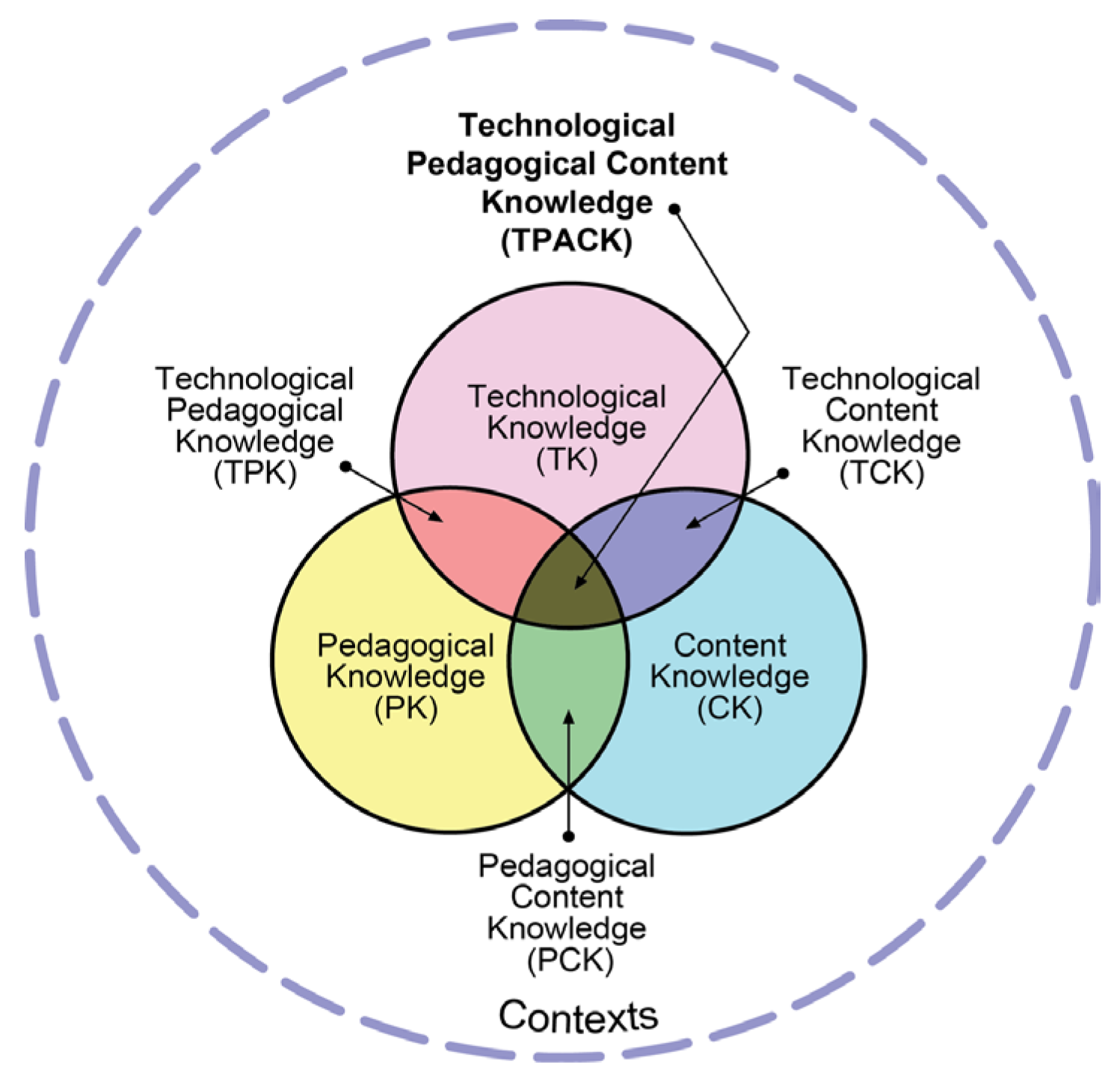
The Technological Pedagogical Content Knowledge (TPACK) framework conceptualizes teachers’ technology-integrated teaching as the interaction of three knowledge domains—technological knowledge (TK), pedagogical knowledge (PK), and content knowledge (CK)—and their intersections, including the integrative construct of TPACK (Figure 1) [19]. TPACK extends Shulman’s (1986) [19] notion of pedagogical content knowledge by highlighting that technology integration is not simply tool use, but the ability to select and apply technologies in ways that align with pedagogical intentions and content goals [6,20].
A major challenge in TPACK research is measurement. Schmidt et al.’s self-report survey remains widely used [21], but subsequent studies suggest that validity and reliability can vary across educational levels, subject areas, and teaching contexts, making contextual adaptation necessary [22]. In TNHE settings, language instructors often must coordinate teaching work across partners and systems [23,24]. For example, lesson planning may be shared among geographically separated colleagues, classes are frequently delivered through institutional platforms, and assessment criteria must be negotiated so that grading and feedback remain consistent across institutions. These routine practices are closely tied to technology use, yet they may be underrepresented in instruments originally developed for domestic contexts. This points to the need for context-sensitive measurement that accounts for online delivery, collaborative course design, and platform-based assessment and feedback processes.
Previous studies indicate that professional development can improve teachers’ TPACK, particularly when CPD requires participants to do more than listen—such as working with peers, designing teaching materials, and reflecting in a structured way [25,26]. However, research remains limited on routine online CPD in TNHE language teaching. Specifically, insufficient evidence exists regarding its association with instructors’ TPACK development, the relative roles of TK, PK, and CK in shaping TPACK, and the suitability of context-adapted measurement for this setting. These gaps justify the need for this study.

3. Methodology

This study investigates instructors’ TPACK development through an online CPD program in TNHE institutions. To assess CPD-related development in this context, an existing TPACK-EFL instrument [9] was adapted for TNHE online teaching and then examined through EFA and CFA before being used for structural and longitudinal analyses.
This study adopts a quantitative, longitudinal survey design, integrating quantitative techniques, including Exploratory Factor Analysis (EFA), Confirmatory Factor Analysis (CFA), and Structural Equation Modeling (SEM) to examine structural relations among TK, CK, PK, and TPACK [27,28,29]. Additionally, a paired t-test examines changes in TPACK competencies over two time points [30].

3.1. Participants

Participants were language instructors working at Chinese TNHE partner institutions that participated in a Southampton University co-designed online CPD program. The study used an email-based convenience sampling approach: instructors who were enrolled in or affiliated with the CPD program were invited to complete an online questionnaire between August 2024 and July 2025. Participation was voluntary, and only valid responses retained after data screening were included in the analysis. A total of 431 valid responses were kept after data screening and were used to describe the overall demographic profile in Table 1. For scale validation, the full dataset was randomly split into two independent subsamples: 221 responses were allocated to EFA and 210 responses to CFA and SEM. For longitudinal analysis, a subset of instructors completed both the pre- and post-surveys; 172 matched cases were used for the paired-samples t-test. The reduction in the sample from pre-survey (n = 210) to post-survey (n = 172) was due to job transitions and voluntary withdrawal.
As shown in Table 1, the sample was predominantly female (68.68%) and largely between 31 and 40 years of age (65.43%). Most participants had 5–10 years of TNHE experience (56.84%) and held a master’s degree (63.11%). The sample was also internationally diverse, with the largest nationality groups being Chinese (38.52%) and British (22.74%), alongside Canadian, Russian, American, Irish, and Singaporean instructors.

3.2. Online CPD Program Description

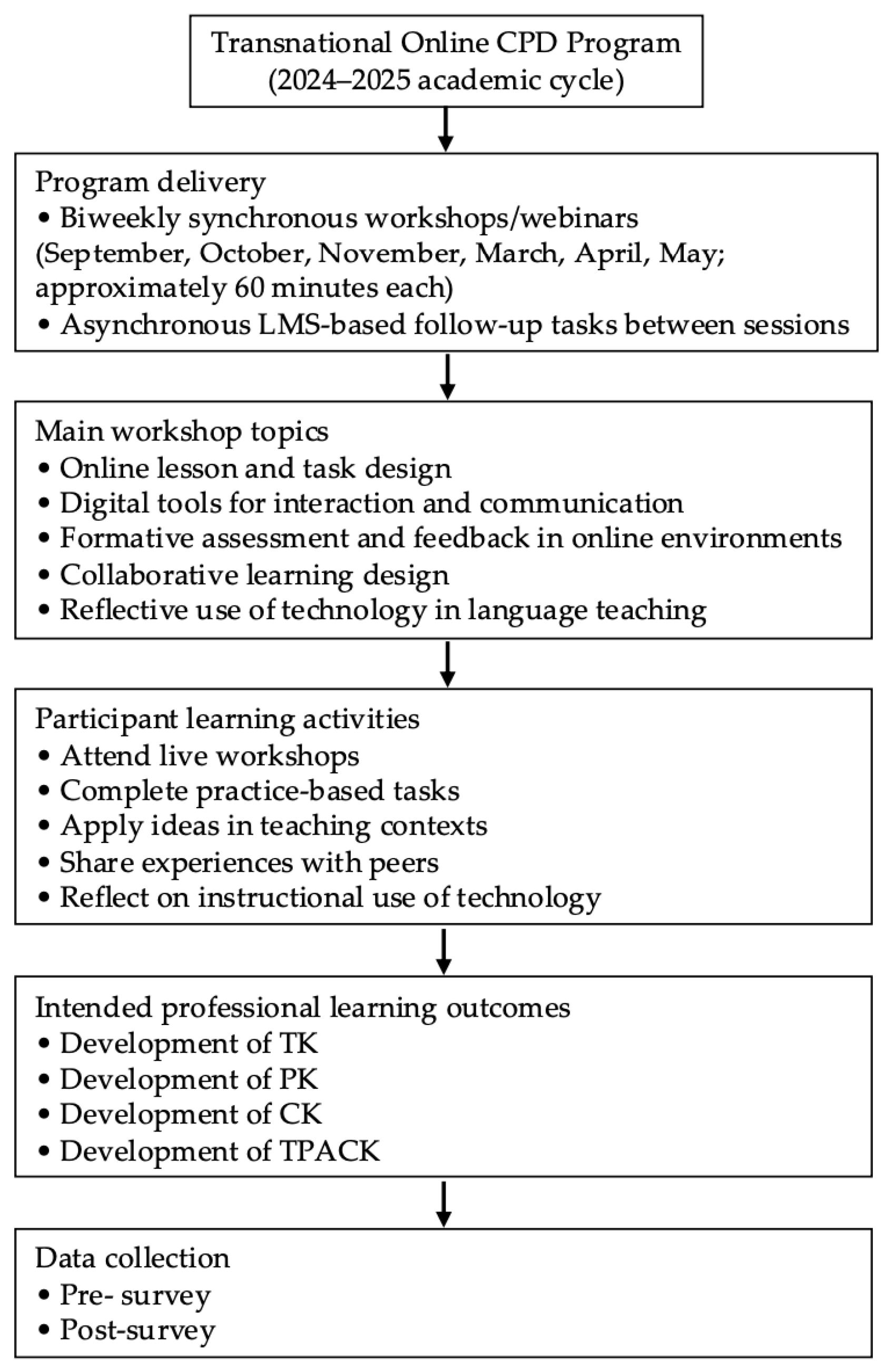
The online CPD program was co-designed and delivered by the University of Southampton team with TNHE partner institutions in China (August 2024–July 2025). Figure 2 is the diagram that summarizes the structure of the CPD program. The program included both synchronous webinars/workshops and asynchronous learning through an LMS. Live sessions were held once a week in March, April, May, September, October, and November, and each session lasted about 60 min. Over these six months, participants took part in around 24 live sessions, amounting to approximately 24 h of synchronous CPD. They also completed follow-up tasks and reflection activities asynchronously through the LMS. The CPD focused on technology-integrated language teaching in TNHE. Workshop topics included platform-based course delivery, online task and interaction design, formative assessment and online feedback, and cross-institutional collaboration in course preparation. To support the application of these ideas in teaching practice, participants also completed practical activities such as lesson and task design, assessment and feedback tasks, peer sharing, and structured reflection through the LMS. Participants completed practical tasks (e.g., lesson/task design and assessment/feedback activities), engaged in peer sharing/reflection, and completed the pre- and post-surveys at designated time points.

3.3. Instrument Adaptation and Data Collection

This study adapted the TPACK self-report instrument developed by Baser et al. [9] to fit the transnational higher education (TNHE) context. Wording changes were made to reflect (a) online instructional tools, (b) task-based professional learning activities, and (c) transnational teaching constraints. The adapted questionnaire targeted four constructs: TK, CK, PK, and TPACK. TK assesses instructors’ ability to use and troubleshoot digital tools for instruction; PK reflects knowledge of teaching strategies and learning design; CK captures subject-related expertise relevant to language teaching; and TPACK reflects the integrated use of technology, pedagogy, and content in instructional practice. The initial adapted pool contained 25 items. Participants responded using a five-point Likert scale (1 = strongly disagree, 5 = strongly agree).
Survey data were collected online between August 2024 and July 2025. Instructors from TNHE partner institutions in China were invited via email, which ensured access across geographically distributed sites. Following item analysis and factor-based screening, two items with weak psychometric performance (<0.40) were removed [29]. The final instrument comprised 23 items: TK (6 items), CK (6 items), PK (6 items), and TPACK (5 items). This revised instrument was used to assess instructors perceived knowledge for technology-integrated language teaching in TNHE online CPD settings.

3.4. Data Analysis

To identify the four factors influencing the variables and analyze which variables are correlated, this study first used an EFA, assembling common variables into descriptive data on TPACK development. Then, CFA is conducted to test and confirm the hypothesized factor structure. EFA (n = 221) and CFA (n = 210) were separately conducted by using SPSS 29 and Mplus 8.11. Following the two-step approach to scale development, EFA was first conducted by SPSS to explore the latent structure of the items and remove poorly performing indicators. CFA was then run in Mplus to confirm the factor structure identified in EFA and to evaluate the measurement model using standard fit indices [31]. To address RQ1 (measurement validity), this study conducted EFA to explore the latent structure of the adapted items and CFA to confirm the four-factor measurement model (TK, CK, PK, and TPACK). To address RQ2 (structural relations), it used SEM to test whether TK, CK, and PK predict TPACK. To address RQ3 (change over time), it conducted paired-samples t-tests on matched pre–post responses to examine mean differences in each construct.

4. Results and Discussion

4.1. Exploratory Factor Analysis

EFA was conducted to examine the latent structure of the adapted TPACK instrument and to screen for poorly performing items (n = 221). Because TK, PK, CK, and TPACK are conceptually related, an oblique rotation (Promax) was applied to allow correlations among factors [30,31]. Sampling adequacy was acceptable (KMO = 0.880), and Bartlett’s test of sphericity was significant (χ2 (253) = 1416.343, p < 0.001), indicating that the data were suitable for factor analysis (Table 2) [32,33].
Table 3 presents the Promax-rotated pattern matrix for the revised instrument. Items loaded cleanly on four interpretable factors aligned with the theoretical framework: TK, CK, PK, and TPACK. Most loadings were moderate to strong, with values ≥ 0.50 indicating robust associations with the intended factor [27]. The final four-factor solution explained 46.74% of the total variance, and factor correlations were moderate (r = 0.306–0.479), supporting the use of an oblique rotation [34,35].

4.2. Confirmatory Factor Analysis

The second subsample (n = 210) was used to test the four-factor measurement model (TK, CK, PK, and TPACK) based on the 23-item instrument retained from the EFA. The CFA results supported the four-factor structure and indicated good model fit.
As shown in Table 4, the chi-square test was significant (χ2(224) = 285.981, p < 0.05), which is common in CFA due to the sensitivity of χ2 to sample size and minor model misfit [26]. Therefore, model evaluation relied primarily on approximate fit indices. The four-factor model demonstrated good fit (CFI = 0.953; TLI = 0.946; RMSEA = 0.036, 90% CI [0.022, 0.048]; SRMR = 0.055), supporting the construct validity of the adapted TPACK instrument in the TNHE context [36].
Table 5 presents the standardized factor loadings and latent correlations. All indicators loaded significantly on their intended constructs (p < 0.001), with standardized loadings ranging from 0.423 to 0.774, indicating satisfactory item–factor relations. Latent correlations were moderate [27,28]. The strongest association was between CK and PK (r = 0.641), while TPACK showed moderate correlations with TK (r = 0.445) and PK (r = 0.502) and a weaker but significant correlation with CK (r = 0.313), consistent with TPACK as an integrative yet distinct construct [6].
To further evaluate measurement quality, internal consistency and construct validity were examined (Table 6). Cronbach’s α was computed in SPSS, and McDonald’s ω, composite reliability (CR), and average variance extracted (AVE) were computed from standardized CFA loadings following established procedures [37,38,39,40]. Internal consistency was acceptable across constructs (α = 0.755–0.791; ω = 0.764–0.795), and CR values were satisfactory (0.764–0.795). AVE values were below the conventional 0.50 threshold (0.357–0.427); however, given adequate CR and strong overall model fit, convergent validity was considered acceptable for this adapted instrument.
Discriminant validity was assessed using the heterotrait–monotrait ratio (HTMT). As shown in Table 7, all HTMT values were below 0.85 (0.319–0.650), supporting discriminant validity and indicating that the four constructs are related yet empirically distinguishable [41].
Overall, the CFA results provide evidence that the adapted instrument demonstrates a stable four-factor structure with acceptable reliability and validity in TNHE online CPD settings.

4.3. Structural Equation Modeling

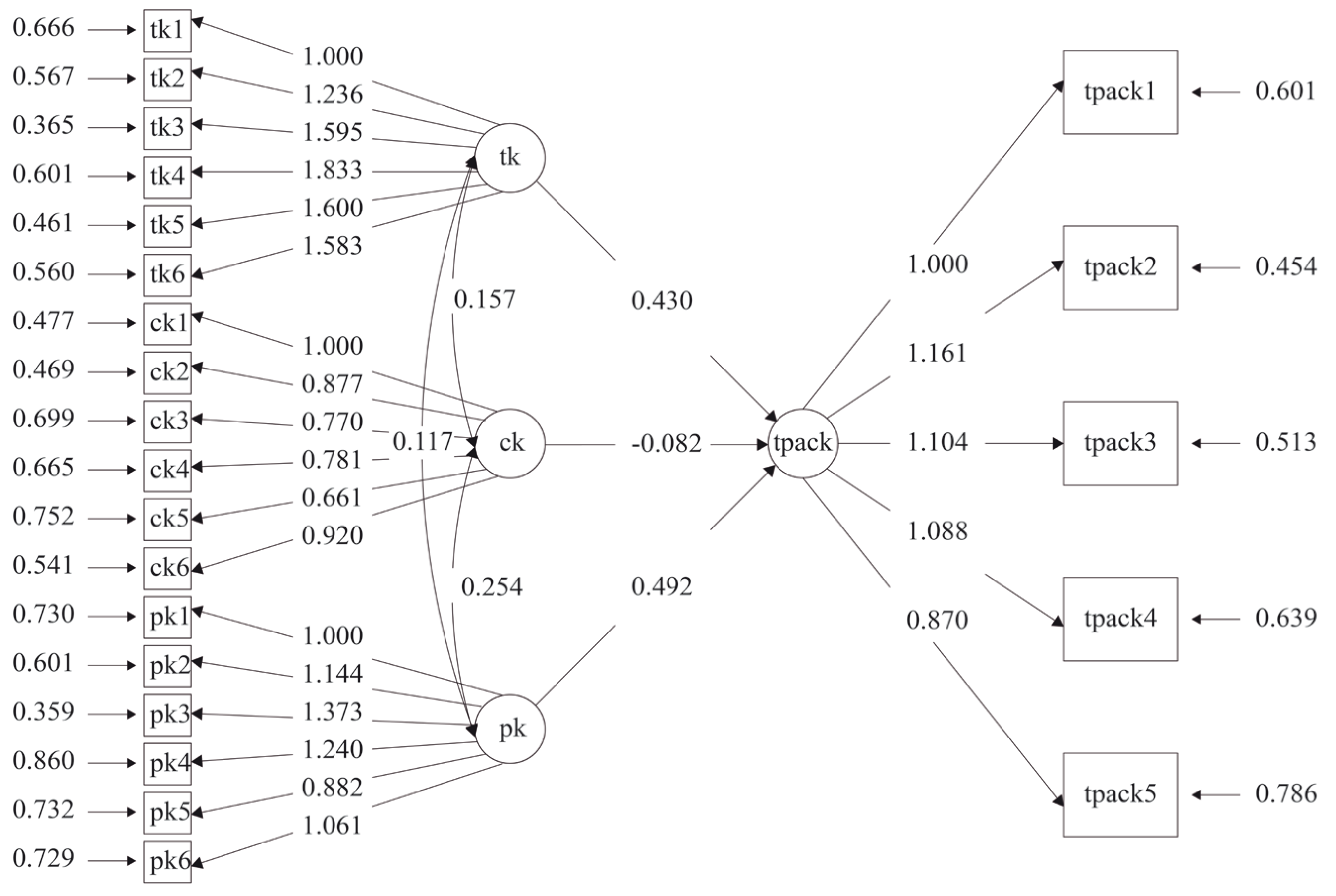
Building on the validated measurement model, an SEM was estimated to examine whether TK, CK, and PK predict TPACK [26]. As shown in Figure 3, PK was a significant positive predictor of TPACK (β = 0.492, SE = 0.171, p = 0.004), and TK also showed a significant positive effect (β = 0.430, SE = 0.197, p = 0.029). In contrast, the direct path from CK to TPACK was not significant (β = −0.082, SE = 0.105, p = 0.432). Overall, the results indicate that, in this TNHE online CPD sample, TPACK is more closely associated with pedagogical and technological knowledge than with content knowledge [6].

4.4. Paired-Samples t-Test Analysis

To examine changes in instructors’ competencies over time, paired-samples t-tests were conducted using matched pre- and post-survey responses (n = 172) [30]. Before comparing pre- and post-survey scores, the study tested longitudinal measurement invariance of the four-factor measurement model across the paired sample (n = 172). As shown in Table 8, the four-factor model demonstrated acceptable configural fit across pre- and post-surveys (CFI = 0.932; RMSEA = 0.031). Constraining factor loadings to equality did not meaningfully affect model fit (ΔCFI = 0.0001; ΔRMSEA = −0.0003), supporting metric invariance [42,43]. Therefore, pre–post differences reported in Table 9 are interpreted on a comparable measurement scale.
As indicated Table 9, TK, PK, and TPACK increased greatly from pre- to post-survey (all p < 0.001), whereas CK did not change significantly (p = 0.546) (Table 9). Specifically, TK increased from M = 3.75 (SD = 0.67) to M = 3.96 (SD = 0.61), PK from M = 3.81 (SD = 0.66) to M = 4.01 (SD = 0.58), and TPACK from M = 3.83 (SD = 0.71) to M = 4.06 (SD = 0.67).

4.5. Discussion

This study investigated language instructors’ TPACK development in transnational higher education (TNHE) through a routine (non-pandemic) online continuing professional development (CPD) program and validated an adapted TPACK instrument for this instructional setting. Findings from EFA, CFA, SEM, and matched pre–post comparisons converge on three points. First, instructors’ technology-related teaching knowledge is best represented as four correlated but distinguishable dimensions—technological knowledge (TK), pedagogical knowledge (PK), content knowledge (CK), and the integrative construct of TPACK—consistent with the original theorization of TPACK as a multidimensional knowledge base for technology integration [6]. Second, PK and TK directly predict TPACK, with PK showing the strongest association. Third, instructors reported significant gains in TK, PK, and TPACK after CPD participation, whereas CK remained statistically stable over the same period. Together, these results strengthen the measurement foundation for TPACK research in TNHE language instruction and offer a clearer account of which knowledge domains are most responsive to online CPD. More broadly, the findings align with prior TPACK research in language education showing that technology-integrated teaching competence is multidimensional and that professional learning often influences pedagogical and technology-related knowledge more directly than content knowledge alone [8,9,10,11].

4.5.1. TPACK as Four Correlated Factors in TNHE Instruction

A central outcome of this study is the empirical confirmation of a four-factor TPACK measurement model in TNHE teaching. The adapted instrument functions well in this population and context and that the measurement model is sufficiently stable to support further inferential analyses.
We found significant positive associations among the latent factors, which suggests that TK, PK, CK, and TPACK move together while still representing distinct dimensions. This is consistent with Mishra and Koehler’s (2006) [6] argument that integration knowledge comes from the interaction of knowledge domains rather than from a single “integration skill”. The TNHE context provides a practical explanation as well: instructors often coordinate teaching and assessment across institutions, rely on shared platforms for delivery and resources, and teach diverse cohorts with varied linguistic and cultural backgrounds [44]. Under these conditions, decisions about pedagogy and technology use are not peripheral; they are embedded in routine instructional planning and delivery. A four correlated-factor model therefore provides a useful diagnostic lens for TNHE administrators and teacher educators who aim to identify strengths and gaps in instructors’ knowledge profiles and to target CPD support accordingly [45].
Methodologically, the split-sample validation strategy strengthens the evidential basis for these conclusions. Establishing a satisfactory measurement structure via EFA and confirming it through CFA/SEM on an independent subsample is a widely recommended approach in scale adaptation work (e.g., Schmidt et al., 2009 [21]). This is particularly important for TNHE research, where instruments developed in other educational contexts often require contextual specification—such as references to cross-border course delivery, online collaboration, and platform-mediated teaching routines—before they can be interpreted meaningfully.

4.5.2. Differential Contributions of PK and TK to TPACK

Beyond the measurement model, the structural analysis provides insight into the knowledge bases most closely linked to instructors perceived capacity for technology-integrated teaching. In the SEM, both PK and TK positively predicted TPACK, whereas CK did not significantly predict TPACK. The pattern points in the same direction: teachers who report stronger pedagogy and technology skills also tend to report higher integration knowledge. By contrast, content expertise by itself shows a weaker direct link in this routine TNHE online CPD context. This pattern is broadly consistent with prior work suggesting that technology-integrated teaching depends especially on teachers’ capacity to make pedagogical decisions and to use digital tools purposefully, rather than on content knowledge in isolation [6,9,10,20]. It also complements studies in language education showing that teachers’ technology-related pedagogical competence is shaped less by disciplinary content alone and more by how technology is mobilized to support interaction, feedback, and learning design in actual classroom practice [8,11].
PK stands out as a strong predictor, and this fits the realities of teaching languages online. In TNHE academic English classes, instructors have to plan task sequences, scaffold learning, differentiate for mixed proficiency levels, and give repeated feedback on student production. Those are teaching problems first. Tools matter only when they help solve those problems—by keeping interaction on track, making formative assessment manageable, supporting collaborative drafting, and handling iterative feedback. If an instructor has solid PK, it is easier to decide when a tool is worth using, which tool matches the goal, and how to build it into an activity that still makes pedagogical sense [45]. In this sense, pedagogy is what makes digital resources instructional.
Practically, this means CPD should not be reduced to “how to use a platform” training. It is likely to be more effective when the focus stays on pedagogical decisions and classroom enactment. Lesson-design workshops, feedback/assessment clinics, lesson study cycles, and artifact-based reflection can be productive formats because they force instructors to connect what they want students to learn with what they actually do on the platform, and to justify those decisions in relation to learning goals and learner needs.
TK also predicted TPACK. This makes sense because, in TNHE digital teaching, instructors cannot integrate technology effectively if they are not comfortable with the platforms they use [46]. Cross-border language programs often rely on a set of shared systems—an LMS, live-class platforms, common resource repositories, and collaborative writing tools. When instructors are fluent with these tools, they can keep materials organized, communicate efficiently, manage assessment tasks, troubleshoot in real time, and sustain class interaction. Routine online CPD can build this fluency by letting teachers practice the same workflows repeatedly and apply them directly to their teaching.
At the same time, TK’s predictive strength was weaker than PK’s. This difference may reflect a familiar development gap: instructors can learn to operate tools yet still find it difficult to integrate them in ways that clearly serve pedagogy [47]. From a CPD perspective, this suggests that TK development should be designed in tandem with pedagogical design. When technology training is treated as isolated “tool instruction”, improvements may not reliably transfer to TPACK-level integration. By contrast, when technology use is embedded in task design, assessment routines, and feedback practices, TK is more likely to function as a resource for pedagogical decision-making and thereby strengthen the TK-to-TPACK pathway.
The non-significant CK-to-TPACK path requires careful interpretation and should not be read as evidence that content knowledge is unimportant. CK may contribute indirectly via PK; future work should test CK to PK to TPACK mediation and examine whether this pathway varies by course type or teaching role. It should not be read as evidence that content knowledge is irrelevant. Rather, it suggests that CK may not have a direct effect on instructors perceived technology integration capability within the current sample and timeframe [47]. The weak role of CK can be interpreted in several ways. In this study, all participants were language instructors, so their CK (e.g., academic discourse conventions, curriculum standards, and alignment requirements) may not have differed much; with limited variation, CK would be less likely to predict TPACK. Another possibility is that CK works through other domains. Knowing the content helps instructors pick appropriate texts and set learning targets, but integration depends on whether they turn that knowledge into pedagogy and platform-supported activity. Finally, language teaching typically targets complex processes—critical reading, argumentation, and writing development—that require time on task and multiple cycles of practice. In that kind of instruction, technology often acts as infrastructure that makes the work possible and manageable, instead of reshaping the content itself. Therefore, instructors may associate successful integration more strongly with pedagogical strategy and tool fluency than with content expertise alone.
These interpretations point to a productive direction for future work: testing indirect effects (e.g., CK to PK to TPACK), exploring moderation by course type (e.g., academic writing vs. general English vs. content-based language instruction), and examining longer-term CK trajectories that may emerge over extended periods of curriculum work and professional collaboration.

4.5.3. Evidence of TPACK Growth Through Routine Online CPD

The paired-samples analysis complements the SEM findings by providing time-based evidence of change associated with CPD participation. Instructors reported significant increases in TK, PK, and TPACK from pre- to post-survey, while CK did not change significantly. This pattern is internally consistent: the two domains that predict TPACK (PK and TK) are also the domains that show measurable growth over the CPD interval, and this co-occurs with an increase in the integrative construct (TPACK). The longitudinal pattern also resonates with previous research on teacher professional development, which has often found that sustained, practice-oriented CPD is more likely to affect teachers’ technology use, pedagogical reasoning, and integrative teaching competence than their underlying content knowledge [8,14]. In this sense, the stability of CK in the present study should not be read as a weak outcome; rather, it is consistent with the expectation that routine online CPD is more likely to influence how instructors teach with technology than what they know about their disciplinary content.
The results also align with how professional learning tends to produce change. TK and PK can often be developed through shorter-cycle opportunities that emphasize practice, feedback, and application [48]. Instructors may improve platform management, digital resource organization, and troubleshooting through guided rehearsal, while pedagogical growth can be supported through structured reflection, peer discussion, lesson design tasks, and feedback on teaching artifacts. When CPD explicitly models integration practices—showing how technology supports instructional purposes—improvements in TK and PK are likely to be accompanied by higher perceived TPACK.
CK staying stable is consistent with what we would expect from routine CPD [49]. Among experienced language instructors, content-related expertise usually grows gradually and often depends on sustained work—developing curricula, calibrating assessment standards, learning discipline-specific discourse features, or co-developing teaching materials. If the CPD program mostly targeted technology-enhanced delivery and pedagogical design, then immediate CK gains would be unlikely. Short-interval self-report surveys may also be too blunt to capture small changes in CK.
For TNHE administrators, this suggests a practical implication: CPD planning may benefit from distinguishing domains that are realistically changeable in the short-to-medium term (TK, PK, and TPACK) from those that may require longer cycles and different professional learning structures (CK). Short- to mid-term CPD can focus on strengthening pedagogical design for online language learning and improving technology fluency for consistent delivery. CK growth may be better supported through complementary initiatives such as communities of practice in academic writing instruction, discipline-oriented teaching teams, collaborative syllabus and assessment development, and sustained cross-institutional moderation activities.

4.5.4. Implications for TNHE Professional Development and Research

Several implications follow for CPD design and for research on teacher development in TNHE language education.
First, CPD should prioritize integrated pedagogy–technology work rather than stand-alone tool training. Given the strong role of PK and the significant role of TK, CPD activities should begin with pedagogical problems that matter in language teaching (e.g., supporting interaction, developing writing, providing formative feedback) and then demonstrate how technology can be used to address these problems within TNHE delivery constraints. Approaches such as design-based tasks, lesson study cycles, peer review of teaching artifacts, and structured reflection can be particularly valuable because they make the integration logic explicit and produce tangible evidence of professional learning [50].
Second, not all domains respond at the same pace. Within routine online CPD cycles, TK, PK, and TPACK seem more sensitive to short-term change and can therefore be used to capture immediate outcomes. CK may require a longer horizon and alternative indicators to show development.
Third, for future TNHE research, scale validation should go beyond overall fit and include tests of measurement invariance. Checking invariance across institutions, nationalities, teaching roles, and delivery modes would ensure that the instrument works equivalently for different subgroups and would make cross-group comparisons more defensible.
Taken together, the study offers a validated model for assessing TPACK in TNHE language teaching. It also points to PK and TK as key contributors to perceived integration knowledge and provides evidence that routine online CPD may support growth in TK, PK, and TPACK, refining both measurement and developmental understanding in cross-border digital instruction.

5. Conclusions and Limitations

This study examined language instructors’ TPACK development in TNHE in the context of a routine online CPD program, and we tested an adapted TPACK self-report instrument designed for this setting. Validation relied on a split-sample strategy. The analyses supported a four-factor model (TK, CK, PK, and TPACK). Both EFA and CFA provided convergent evidence that the 23-item scale performs adequately in TNHE online teaching, with good model fit and acceptable internal consistency. The domains were moderately associated, which suggests that they move together conceptually but are still distinguishable as separate constructs, in line with TPACK’s multidimensional view of integration knowledge.
The study also goes beyond instrument validation by showing which domains matter most in TNHE online teaching. In the SEM, PK and TK both predicted TPACK, with PK emerging as the strongest predictor, while CK did not have a significant direct effect. The implication is that, within routine online CPD for language instructors, perceived integration competence is driven more by pedagogical design and technology fluency than by content expertise alone [50]. At the same time, the absence of a direct CK effect does not mean CK is irrelevant. CK may work through other domains, or it may simply change too slowly to be detected over a short CPD cycle among experienced teachers. Future research should therefore test mediated pathways (for example, CK influencing TPACK through PK) and explore whether the CK–TPACK link varies by course type or by instructors’ roles.
The longitudinal part of the study provides direct evidence of change over time. Based on matched pre–post data, instructors reported higher TK, PK, and TPACK after the CPD program, while CK remained stable. Longitudinal invariance testing further supported at least metric invariance, which means the construct structure and the item loadings were broadly consistent across the two measurement points. Taken together, these results suggest that routine online CPD may be particularly effective for strengthening instructors’ technology-related and pedagogical capacities, which in turn support growth in the integrative construct of TPACK [51]. In contrast, CK may require longer-term, content-focused professional learning structures or different indicators to detect meaningful change.
These findings have practical implications for CPD design and evaluation in TNHE language education. First, CPD initiatives may yield stronger impact when they are organized around pedagogical problems of practice (e.g., online interaction design, scaffolding, formative assessment, and feedback workflows) and demonstrate how specific digital tools serve those pedagogical intentions, rather than focusing on isolated tool training. Second, because TK and PK appear both predictive of TPACK and responsive to change over the CPD interval, they can serve as useful short-term indicators for monitoring CPD effectiveness in TNHE settings. Third, the validated four-factor instrument can support diagnostic use by TNHE administrators and teacher educators: it can help identify instructors’ strengths and gaps across domains, guide differentiated support and evaluate whether CPD activities are improving targeted competencies.
Several limitations should be acknowledged. First, the study relies on self-report measures, which may reflect changes in confidence or perceived competence rather than enacted teaching practice. Future studies should triangulate survey evidence with external indicators such as teaching artifacts, observation protocols, peer review, learning analytics, or student learning outcomes. Second, EFA, CFA/SEM, and the pre–post analysis were conducted on different subsamples, and the matched longitudinal sample was smaller due to attrition. Although this approach follows standard scale validation practice, future research should report institutional composition more explicitly and, where possible, use fully matched longitudinal panels for structural modeling. Third, while configural and metric invariance were supported, scalar invariance was not examined here; therefore, mean-change results should be interpreted cautiously. Future work should test scalar (or partial scalar) invariance and conduct latent mean comparisons to strengthen inference about change over time. Finally, the sample was drawn from TNHE partner institutions in China and from a specific CPD model, which may limit generalizability to other TNHE contexts.
Overall, this study contributes an empirically supported measurement framework for assessing TPACK in TNHE language instruction, clarifies the relative roles of PK and TK as predictors of integrative competence, and provides longitudinal evidence that routine online CPD is associated with growth in instructors’ TK, PK, and TPACK. These findings can inform the design of more targeted, pedagogy-driven CPD interventions and support more rigorous evaluation of teacher development in transnational digital learning environments.


Author Contributions

Conceptualization, J.W. and E.K.; methodology, J.W.; formal analysis, J.W.; investigation, J.W.; writing—original draft preparation, J.W.; writing—review and editing, E.K.; supervision, E.K. All authors have read and agreed to the published version of the manuscript.

Funding

This research was partially funded by China Association of Higher Education, grant number 25ZH0301; Liaoning Provincial Education Science Planning Management Office, grant number JG25DB044; Dalian Polytechnic University Social Science Association, grant number GDSKLYB202523, China.

Institutional Review Board Statement

This study is waived for ethical review as this research was conducted in established or commonly accepted educational settings and it does not include any information that human subjects can be identified, directly, or through identifiers linked to the subjects.

Informed Consent Statement

The informed consent for participation obtained from the participants of this study.

Data Availability Statement

The data will be available upon reasonable request from the corresponding author.

Conflicts of Interest

The authors declare no conflicts of interest.

Abbreviations

The following abbreviations are used in this manuscript:
TNHETransnational Higher Education
TKTechnological Knowledge
PKPedagogical Knowledge
CKContent Knowledge

References

  1. Berhanu, K.Z. The Implementation of Teachers’ Continuous Professional Development (CPD): The Role of Teachers’ Personal Characteristics, Perception towards CPD, and Support of School Leaders. Res. Educ. Adm. Leadersh. 2024, 9, 282–320. [Google Scholar] [CrossRef]
  2. Kabilan, M.K.; Annamalai, N.; Md Yunus, Y. Navigating Policy and Practice: Examining the Realization of Malaysia’s Education Blueprint (2013–2025) for English Teachers’ Continuous Professional Development. Tesol J. 2025, 16, e70062. [Google Scholar] [CrossRef]
  3. Sifakis, N.; Bayyurt, Y.; Cavalheiro, L.; Fountana, M.; Lopriore, L.; Tsagari, D.; Kordia, S. Developing English language teachers’ and learners’ ELF awareness: The background, design and impact of the ENRICH project’s continuous professional development programme. J. Engl. Ling. Fr. 2022, 11, 255–279. [Google Scholar] [CrossRef]
  4. British Council. Continuing Professional Development (CPD) for Teachers. Available online: https://www.teachingenglish.org.uk/professional-development/teachers (accessed on 10 December 2025).
  5. Simelane-Mnisi, S. Academics’ perceptions on online continuous professional development in higher education. Independ. J. Teach. Learn. 2023, 18, 65–77. [Google Scholar] [CrossRef]
  6. Mishra, P.; Koehler, M.J. Technological pedagogical content knowledge: A framework for teacher knowledge. Teach. Coll. Rec. 2006, 108, 1017–1054. [Google Scholar] [CrossRef]
  7. Koehler, M.; Mishra, P. What is technological pedagogical content knowledge (TPACK)? Contemp. Issu. Technol. Teach. Educ. 2009, 9, 60–70. [Google Scholar] [CrossRef]
  8. Ansyari, M.F. Designing and evaluating a professional development programme for basic technology integration in English as a foreign language (EFL) classrooms. Australas. J. Educ. Technol. 2015, 31, 699–712. [Google Scholar] [CrossRef]
  9. Baser, D.; Kopcha, T.J.; Ozden, M.Y. Developing a technological pedagogical content knowledge (TPACK) assessment for preservice teachers learning to teach English as a foreign language. Comput. Assist. Lang. Learn. 2016, 29, 749–764. [Google Scholar] [CrossRef]
  10. Tseng, J.-J.; Chai, C.S.; Tan, L.; Park, M. A critical review of research on technological pedagogical and content knowledge (TPACK) in language teaching. Comput. Assist. Lang. Learn. 2022, 35, 948–971. [Google Scholar] [CrossRef]
  11. Zhang, Y. Developing EFL teachers’ technological pedagogical knowledge through practices in virtual platform. Front. Psychol. 2022, 13, 916060. [Google Scholar] [CrossRef]
  12. Darling-Hammond, L.; Hyler, M.E.; Gardner, M. Effective Teacher Professional Development; Learning Policy Institute: Palo Alto, CA, USA, 2017. [Google Scholar]
  13. Day, C.; Acp, S. International Handbook on the Continuing Professional Development of Teachers; Open University Press: Maidenhead, UK, 2004. [Google Scholar]
  14. Desimone, L.M. Improving impact studies of teachers’ professional development: Toward better conceptualizations and measures. Educ. Res. 2009, 38, 181–199. [Google Scholar] [CrossRef]
  15. Trust, T.; Krutka, D.G.; Carpenter, J.P. “Together we are better”: Professional learning networks for teachers. Comput. Educ. 2016, 102, 15–34. [Google Scholar] [CrossRef]
  16. Knight, J. Better Conversations: Coaching Ourselves and Each Other to Be More Credible, Caring, and Connected; Corwin Press: Marlborough, UK, 2015. [Google Scholar]
  17. Keevers, L.M.; Bell, M.; Ganesharatnam, S.; Sultan, F.K.P.D.; Lim, J.S.Y.; Loh, V.C.; Lefoe, G.; Hall, C.; Scholz, C. Transnational Teaching Teams: Professional Development for Quality Enhancement of Learning and Teaching; Australian Government Office for Learning and Teaching: Canberra, Australia, 2014.
  18. Belay, S.; Melesse, T. Exploring the link between teachers’ motivation for continuous professional development and professional learning communities: A structural equation modeling approach. Sage Open 2024, 14, 1–17. [Google Scholar] [CrossRef]
  19. Shulman, L.S. Those who understand: Knowledge growth in teaching. Educ. Res. 1986, 15, 4–14. [Google Scholar] [CrossRef]
  20. Koehler, M.J.; Mishra, P.; Kereluik, K.; Shin, T.S.; Graham, C.R. The technological pedagogical content knowledge framework. In Handbook of Research on Educational Communications and Technology; Spector, J.M., Merrill, M.D., Elen, J., Bishop, M.J., Eds.; Springer: New York, NY, USA, 2014; pp. 101–111. [Google Scholar] [CrossRef]
  21. Schmidt, D.A.; Baran, E.; Thompson, A.D.; Mishra, P.; Koehler, M.J.; Shin, T.S. Technological pedagogical content knowledge (TPACK) the development and validation of an assessment instrument for preservice teachers. J. Res. Technol. Educ. 2009, 42, 123–149. [Google Scholar] [CrossRef]
  22. Voogt, J.; Fisser, P.; Pareja Roblin, N.; Tondeur, J.; van Braak, J. Technological pedagogical content knowledge–a review of the literature. J. Comput. Assist. Learn. 2013, 29, 109–121. [Google Scholar] [CrossRef]
  23. Wang, J.; Kim, E. Exploring changes in epistemological beliefs and beliefs about teaching and learning: A mix-method study among Chinese teachers in transnational higher education institutions. Sustainability 2023, 15, 12501. [Google Scholar] [CrossRef]
  24. Vartiainen, H.; Vuojärvi, H.; Saramäki, K.; Eriksson, M.; Ratinen, I.; Torssonen, P.; Vanninen, P.; Pöllänen, S. Cross-boundary collaboration and knowledge creation in an online higher education course. Brit. J. Educ. Technol. 2022, 53, 1304–1320. [Google Scholar] [CrossRef]
  25. Chai, C.S.; Koh, J.H.L.; Tsai, C.-C. A review of technological pedagogical content knowledge. J. Educ. Technol. Soc. 2013, 16, 31–51. [Google Scholar]
  26. Krauskopf, K.; Foulger, T.S.; Williams, M.K. Prompting teachers’ reflection of their professional knowledge. A proof-of-concept study of the Graphic Assessment of TPACK Instrument. Teach. Dev. 2018, 22, 153–174. [Google Scholar] [CrossRef]
  27. Black, W.C.; Babin, B.J.; Anderson, R.E. Multivariate Data Analysis: A Global Perspective; Pearson: Upper Saddle River, NJ, USA, 2010. [Google Scholar]
  28. Kline, R.B. Principles and Practice of Structural Equation Modeling; Guilford Publications: New York, NY, USA, 2023. [Google Scholar]
  29. Worthington, R.L.; Whittaker, T.A. Scale development research: A content analysis and recommendations for best practices. Couns. Psychol. 2006, 34, 806–838. [Google Scholar] [CrossRef]
  30. Field, A. Discovering Statistics Using IBM SPSS Statistics; Sage: London, UK, 2024. [Google Scholar]
  31. Hinkin, T.R. A brief tutorial on the development of measures for use in survey questionnaires. Organ. Res. Methods 1998, 1, 104–121. [Google Scholar] [CrossRef]
  32. Fabrigar, L.R.; Wegener, D.T.; MacCallum, R.C.; Strahan, E.J. Evaluating the use of exploratory factor analysis in psychological research. Psychol. Methods 1999, 4, 272–299. [Google Scholar] [CrossRef]
  33. Costello, A.B.; Osborne, J. Best practices in exploratory factor analysis: Four recommendations for getting the most from your analysis. Pract. Assess. Res. Eval. 2005, 10, 7. [Google Scholar] [CrossRef]
  34. Kaiser, H.F. An index of factorial simplicity. Psychometrika 1974, 39, 31–36. [Google Scholar] [CrossRef]
  35. Tabachnick, B.G.; Fidell, L.S. Using Multivariate Statistics; Pearson: Boston, MA, USA, 2019; Volume 5. [Google Scholar]
  36. Hu, L.-t.; Bentler, P.M. Cutoff criteria for fit indexes in covariance structure analysis: Conventional criteria versus new alternatives. Struct. Equ. Model. 1999, 6, 1–55. [Google Scholar] [CrossRef]
  37. McDonald, R.P. Test Theory: A Unified Treatment; Lawrence Erlbaum Associates: Mahwah, NJ, USA, 1999. [Google Scholar]
  38. Raykov, T. Estimation of composite reliability for congeneric measures. Appl. Psych. Meas. 1997, 21, 173–184. [Google Scholar] [CrossRef]
  39. Fornell, C.; Larcker, D.F. Evaluating structural equation models with unobservable variables and measurement error. J. Market. Res. 1981, 18, 39–50. [Google Scholar] [CrossRef]
  40. Dunn, T.J.; Baguley, T.; Brunsden, V. From alpha to omega: A practical solution to the pervasive problem of internal consistency estimation. Brit. J. Psychol. 2014, 105, 399–412. [Google Scholar] [CrossRef]
  41. Henseler, J.; Ringle, C.M.; Sarstedt, M. A new criterion for assessing discriminant validity in variance-based structural equation modeling. J. Acad. Market. Sci. 2015, 43, 115–135. [Google Scholar] [CrossRef]
  42. Cheung, G.W.; Rensvold, R.B. Evaluating goodness-of-fit indexes for testing measurement invariance. Struct. Equ. Model. 2002, 9, 233–255. [Google Scholar] [CrossRef]
  43. Chen, F.F. Sensitivity of goodness of fit indexes to lack of measurement invariance. Structu. Equ. Model. 2007, 14, 464–504. [Google Scholar] [CrossRef]
  44. Fang, W. The development of transnational higher education in China: A comparative study of research universities and teaching universities. J. Stud. Int. Educ. 2012, 16, 5–23. [Google Scholar] [CrossRef]
  45. Tran, L.T.; Le, T.T.T.; Phan, H.L.T.; Pham, A. “Induction and off you go”: Professional development for teachers in transnational education. Oxf. Rev. Educ. 2021, 47, 529–547. [Google Scholar] [CrossRef]
  46. Kaya, D.; Ursavaş, Ö.F.; Yildiz Durak, H. Examining the Relationships Among Teacher Characteristics, Collaboration, AI-Integrated TPACK, and Teacher Enthusiasm: A Multi-Group Analysis by Gender. Eur. J. Educ. 2025, 60, e70216. [Google Scholar] [CrossRef]
  47. Njiku, J. Attitude and technological pedagogical and content knowledge: The reciprocal predictors? J. Res. Technol. Educ. 2023, 55, 1020–1035. [Google Scholar] [CrossRef]
  48. Cerbin, W.; Kopp, B. Lesson study as a model for building pedagogical knowledge and improving teaching. Int. J. Teach. Learn. High. Educ. 2006, 18, 250–257. [Google Scholar]
  49. Hino, K.; Funahashi, Y. Teachers’ guidance of students’ focus toward lesson objectives: How does a competent teacher make decisions in the key interactions? ZDM-Math. Educ. 2022, 54, 343–357. [Google Scholar] [CrossRef]
  50. Friesen, S.; Brown, B. Design-based professional learning: A promising approach to continuous professional learning. Internat. J. Leader. Learn. 2022, 22, 218–251. [Google Scholar] [CrossRef]
  51. Hava, K.; Babayiğit, Ö. Exploring the relationship between teachers’ competencies in AI-TPACK and digital proficiency. Educ. Inf. Technol. 2025, 30, 3491–3508. [Google Scholar] [CrossRef]
Figure 1. TPACK Framework.
Sustainability 18 03682 g001
Figure 2. Design of the online CPD program in TNHE.
Sustainability 18 03682 g002
Figure 3. Structural model of TK, CK, PK, and TPACK.
Sustainability 18 03682 g003
Table 1. Demographic Profile.
VariableCategoryn%
Age21–30204.64
31–4028265.43
41–5011927.61
51–60102.32
GenderFemale29668.68
Male13531.32
Years in TNHE1–511225.99
5–1024556.84
10–157016.24
15–2040.93
Highest educationBachelor’s degree194.41
Master’s degree27263.11
PhD degree14032.48
NationalityCanadian5512.76
Chinese16638.52
Irish61.39
Russian4911.37
Singaporean122.78
British9822.74
American4510.44
Total431100
Table 2. KMO and Bartlett’s test of sphericity for EFA.
Test Results
KMO0.880
Bartlett testApprox. chi-square1416.343
df253
p value<0.001
Table 3. EFA pattern matrix with Promax rotation.
ItemTKTPACKPKCK
TK1 I feel confident using e-learning platforms (e.g., Blackboard, Zoom) for cross-border course delivery in transnational continuing professional development programs0.764
TK2 I can effectively manage and organize my teaching files using personal information management tools in an online, international teaching context.0.781
TK3 I frequently participate in online forums and discussion groups to share teaching resources with team members across different regions.0.711
TK4 I can quickly adapt to newly introduced online or hybrid teaching tools and incorporate them into my daily teaching activities.0.743
TK5 I know how to troubleshoot basic technical problems when conducting online courses with international collaborators.0.567
TK6 I feel comfortable exploring and experimenting with emerging digital technologies to improve my teaching strategies.0.631
CK1 I have a solid understanding of the academic subject matter that I teach and can accurately align my teaching objectives with assessment criteria in an international setting. 0.735
CK2 I can effectively discuss specialized academic knowledge with colleagues during virtual class preparation, ensuring the accuracy of course content. 0.557
CK3 I actively share content-based materials to maintain professional and academic standards within cross-border teaching teams. 0.575
CK4 I am adept at reviewing and updating my subject knowledge to reflect the latest research or developments, especially for online or hybrid classes. 0.538
CK5 I confidently handle in-depth questions about the subject matter raised by students or co-teachers during online meetings. 0.709
CK6 I can adapt my course content to meet the diverse needs of transnational learners, taking into account linguistic or cultural differences. 0.577
PK1 I often reflect on my teaching experiences and beliefs, sharing them with colleagues to improve instructional approaches in online or hybrid environments. 0.633
PK2 I am comfortable collaborating with team members to develop effective course outlines and teaching strategies suitable for transnational learners. 0.525
PK3 I know how to address different learning styles and needs by adjusting my teaching methods, based on insights from online professional development. 0.604
PK4 I seek clarification or initiate discussions when I disagree or feel uncertain about course design, assessment strategies, or teaching methods in online collaboration meetings. 0.571
PK5 I can effectively integrate new pedagogical ideas or methods introduced by co-teachers into my classes, aiming for better student engagement. 0.675
PK6 I share challenges or difficulties in my teaching process with others during collaborative meetings and welcome their input to refine my pedagogical approaches. 0.661
TPACK1 I regularly integrate digital tools and subject knowledge in my teaching, ensuring alignment with pedagogical principles and students’ needs in an international online context. 0.504
TPACK2 I actively explore and adapt hybrid teaching techniques, combining technology use and content delivery to enhance the learning experience. 0.669
TPACK3 I can effectively design course activities that merge relevant content, appropriate pedagogical strategies, and suitable technology to engage transnational students. 0.758
TPACK4 Collaborative online preparation helps me blend new digital resources, teaching methods, and subject content, thereby elevating the team’s overall teaching quality. 0.740
TPACK5 After online collaborative meetings, I can seamlessly incorporate feedback on technological tools, content requirements, and pedagogical approaches into my own teaching plan. 0.741
The four-factor solution explained 46.74% of the total variance. Loadings < 0.30 are suppressed. Factor correlations ranged from r = 0.306 to 0.479.
Table 4. CFA model fit indices for the four-factor measurement model.
χ2 df CFI TLI RMSEA 90%CI SRMR
4-factors 285.9812240.9530.9460.036[0.022, 0.048] 0.055
Table 5. Standardized CFA parameter estimates for the four-factor model.
EstimateS.E.Est./S.E.p (2-Tailed)
TK10.4230.0656.5370
TK20.5280.0589.0340
TK30.710.04515.930
TK40.670.04814.0470
TK50.6690.04813.9520
TK60.6280.05112.3460
CK10.7320.04217.2830
CK20.6890.04615.1380
CK30.5650.05610.1640
CK40.580.05410.7750
CK50.4930.068.2090
CK60.6810.04614.7630
PK10.530.0589.1090
PK20.6190.05112.0260
PK30.7740.0419.3910
PK40.5810.05410.7150
PK50.4820.0617.9290
PK60.5520.0569.820
TPACK10.6320.05112.3280
TPACK20.7360.04416.8490
TPACK30.6980.04714.8950
TPACK40.6520.0513.0340
TPACK50.5270.0598.9110
TK-CK0.5540.0678.3150
TK-PK0.5740.0668.6760
CK-PK0.6410.06110.5790
TPACK-TK0.4450.0746.0110
TPACK-CK0.3130.083.9160
TPACK-PK0.5020.0717.0910
Estimates for TK1–TPACK5 are standardized factor loadings; estimates for TK–CK through TPACK–PK are standardized latent correlations. S.E. = standard error. All estimates are significant at p < 0.001.
Table 6. Reliability and convergent validity of the adapted TPACK instrument based on CFA results.
ConstructItemsCronbach’s αMcDonald’s ωCRAVE
TK60.7710.7760.7760.374
CK60.7910.7950.7950.396
PK60.7550.7640.7640.357
TPACK50.7830.7870.7870.427
α is Cronbach’s alpha; ω is McDonald’s omega-total; CR is composite reliability; AVE is average variance extracted. CR and AVE were computed from standardized CFA loadings within each construct.
Table 7. Discriminant validity of the adapted TPACK instrument using HTMT ratios.
TKCKPKTPACK
TK1.0000.5810.6060.455
CK0.5811.0000.6500.319
PK0.6060.6501.0000.490
TPACK0.4550.3190.4901.000
HTMT = heterotrait–monotrait ratio. Values below 0.85 indicate adequate discriminant validity.
Table 8. Longitudinal measurement invariance across pre- and post-surveys.
Modelχ2dfCFITLIRMSEA
Configural1118.0359610.93250.92730.0309
Metric (loadings equal)1136.7609800.93260.92880.0306
Δ (Metric − Configural)+19+0.0001+0.0015−0.0003
Invariance was evaluated using changes in approximate fit indices (e.g., ΔCFI ≤ 0.010 and ΔRMSEA ≤ 0.015) between nested models.
Table 9. Paired-samples t-test results for construct mean scores.
ConstructPre M (SD)Post M (SD)tSig. (2-Tailed)
TK (mean)3.75 (0.67)3.96 (0.61)−5.376<0.001
CK (mean)3.80 (0.72)3.78 (0.67)0.6050.546
PK (mean)3.81 (0.66)4.01 (0.58)−5.284<0.001
TPACK (mean)3.83 (0.71)4.06 (0.67)−6.172<0.001
TK, CK, and PK scores represent the mean of 6 items in each construct; TPACK represents the mean of 5 items. Pre/post indicate measurements before and after the CPD program.
Disclaimer/Publisher’s Note: The statements, opinions and data contained in all publications are solely those of the individual author(s) and contributor(s) and not of MDPI and/or the editor(s). MDPI and/or the editor(s) disclaim responsibility for any injury to people or property resulting from any ideas, methods, instructions or products referred to in the content.