1. Introduction
1.1. Background
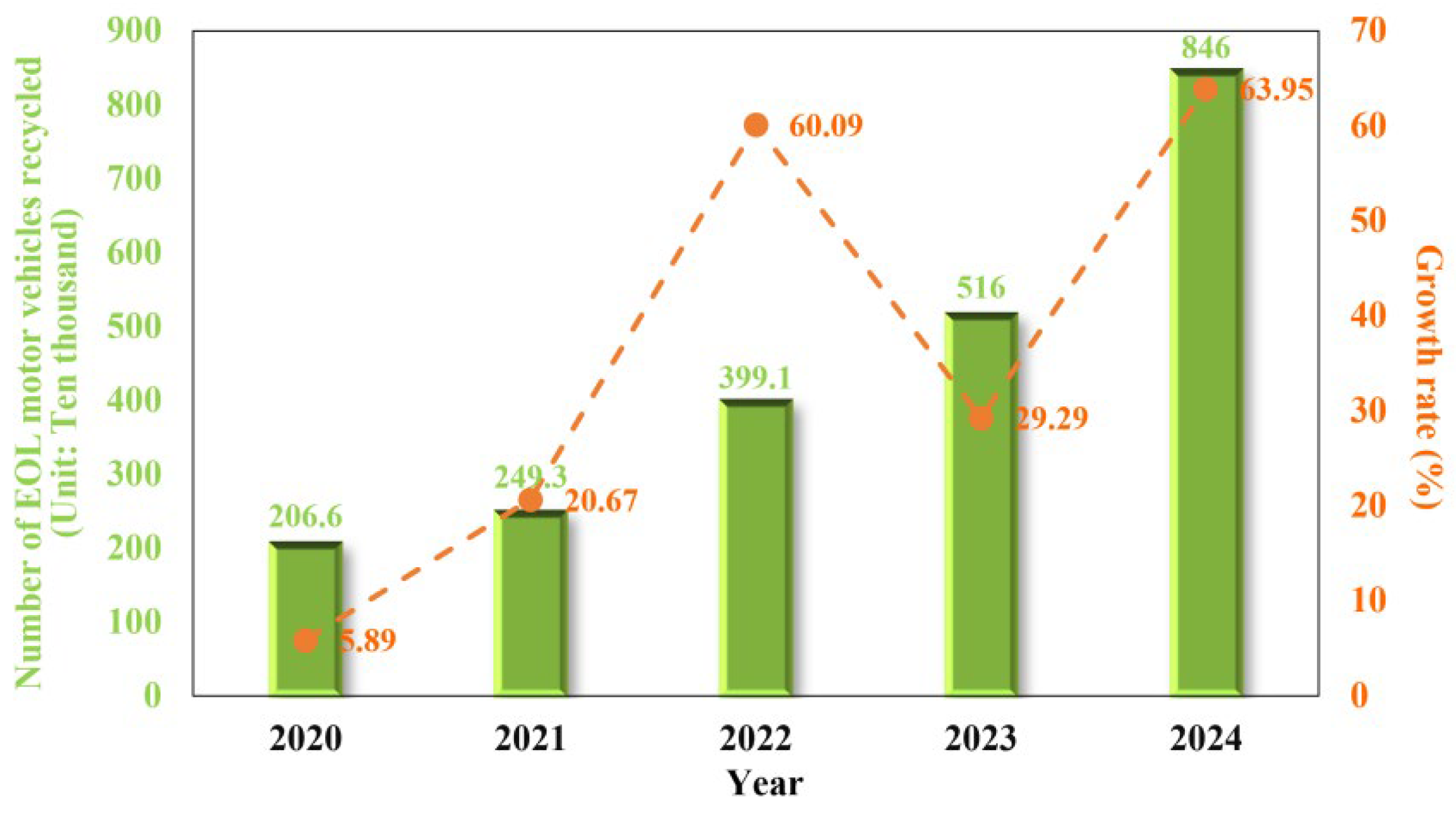
The manufacturing industry is the pillar industry of the national economy, which not only faces the development bottleneck of resource conservation and environmental protection, but also confronts the urgent need to extend the service life and improve the performance of equipment. While manufacturing has brought great convenience to people’s lives, it has also led to a surge in the number of end-of-life (EOL) products. Industry statistics show that China has entered the mechanical equipment and household appliances scrap peak. More than 5 million old-style machine tools have been in service for more than 10 years, and more than 80% of the in-service construction machinery has exceeded its shelf life. As shown in
Figure 1, China’s recycled EOL motor vehicles surged between 2020 and 2024. Most importantly, improper handling of them will lead to a series of serious problems, such as environmental pollution, resources waste and land occupation.
As a natural extension of the manufacturing industry, the remanufacturing industry makes the whole life cycle of products from open-loop to closed-loop, significantly reducing the adverse impact on environment, and gradually becoming an important part of circular economy and green economy. With the expansion of market demand and industrial scale, advanced green and intelligent equipment and technology have been continuously innovated and applied, and the development of remanufacturing industry has entered a new and promising stage.
According to documents released by the State Council of China, it is explicitly stated that pilot projects for the import of remanufactured products will be carried out in six locations: Shanghai, Guangdong, Tianjin, Fujian, Beijing Pilot Free Trade Zone, and Hainan Free Trade Port. The new national standard ‘Remanufacturing, terminology’ [
1] (GB/T 28619-2024) was released in September 2024, covering the whole life cycle of products. The European Union’s Sustainable Product Eco-design Regulation for the first time includes ‘Remanufacturing’ as a mandatory requirement for eco-design. It is also stipulated that the construction machinery with more than a certain power must reserve the detachable interface and provide related remanufacturing technical documents. In 2023, construction machinery and industrial robots were included in the ‘Designated remanufactured products’ in Japan’s newly revised ‘Law on the promotion of efficient utilization of resources’, and manufacturers were required to submit annual remanufacturing plans to the government. The US federal government’s 2024 fiscal year defense authorization bill for the first time includes ‘Remanufactured aircraft engines’ as a safety inventory, allowing the Department of Defense to directly sign five-year procurement contracts.
1.2. Relationship Between Remanufacturing and Traditional Manufacturing
1.2.1. Nature of Remanufacturing Is the Same as That of Manufacturing
Manufacturing is the process of turning raw materials into products, and its essence is to produce products to meet people’s living needs. Remanufacturing is a manufacturing process that utilizes EOL products and their parts as raw materials, and uses professional repair or upgrading to make their performance not lower than that of the original new products. Its essence is also to obtain products that meet people’s living needs. Remanufacturing has the essential characteristics of manufacturing, including engineering integrity, replicability and operability.
1.2.2. Remanufacturing Is the Supplement and Improvement to Manufacturing
Broadly speaking, manufacturing encompasses the whole life cycle of products, but lacks specialized processing links for EOL products and their parts. Remanufacturing aims at the EOL products and their components, and adopts different remanufacturing methods of repairing or upgrading according to their different life characteristics, so as to maximize the added value of materials, energy and labor costs of EOL products and their parts during the manufacturing stage.
1.2.3. Production Organization of Remanufacturing and Manufacturing Is Different
The raw materials obtained by the manufacturing system are generally produced by the enterprise and can be supplied in lots, with relatively certain time and quality. The remanufacturing system needs to start from the recovery of EOL products. Due to the dispersion of EOL products among users in various places, users have uncertainty about the supply quantity and time of the EOL products. Therefore, in terms of raw material acquisition, the two have different organizational methods. Secondly, due to the highly personalized life characteristics of EOL products, remanufacturing, repair or upgrading requires personalized customization, making it difficult to form mass production, resulting in remanufacturing having the production characteristics of multiple varieties and small lots.
1.2.4. Process Technology of Remanufacturing and Manufacturing Is Different
The raw materials used in manufacturing are mostly stable in performance, and the supply quality is stable and reliable. The production of qualified parts mainly targets raw materials such as bars, which are obtained through mechanical manufacturing technologies such as casting, forging, milling, planing, and grinding. Remanufacturing focuses on the application of surface engineering technology and additive manufacturing technology, using physical, chemical, mechanical manufacturing and other technologies to change the surface state, chemical composition, organization structure or form special surface coatings of the substrate material. Therefore, there are significant differences in the process technology between the two.
1.3. Connotation and Composition of Remanufacturing Scheduling
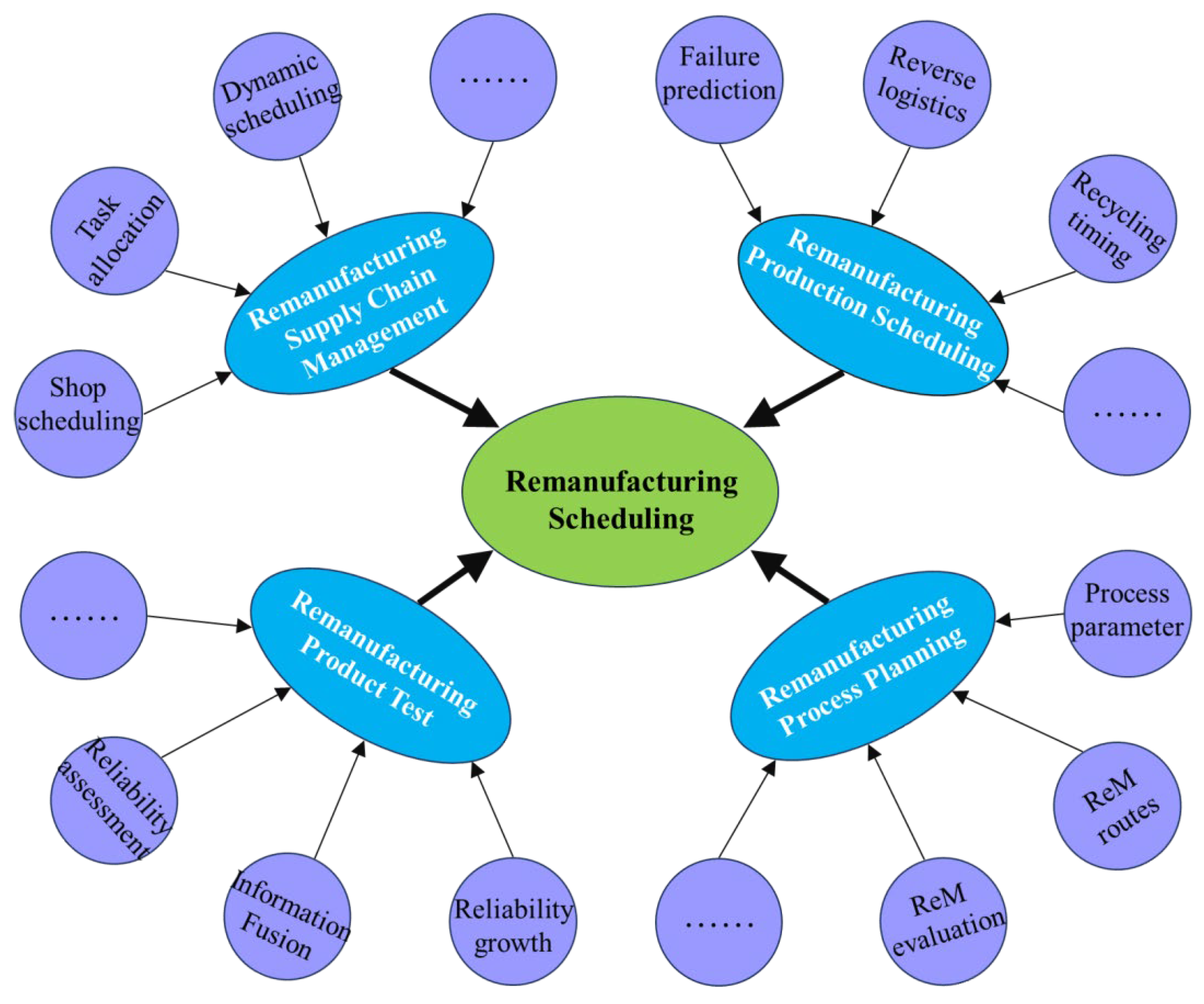
Remanufacturing scheduling (RS) is a process of designing and optimizing the operational plans of multiple subsystems, including waste product recycling, remanufacturing process design, remanufacturing processing, and remanufacturing product testing, by comprehensively considering the material, energy, information, and other elements in the remanufacturing production system. Its purpose is to organize, standardize and drive the operation of remanufacturing production, and improve the economic, social, and link benefits of the remanufacturing production process, and it is essentially a multi-stage decision-making process for continuous improvement and enhancement of the operation status of remanufacturing production. As shown in
Figure 2, RS involves four aspects: remanufacturing supply chain management, remanufacturing process planning, remanufacturing production scheduling, and remanufacturing product testing.
Remanufacturing supply chain management is the design and optimization of the logistics operation plans in the remanufacturing production system, which mainly includes three channels: manufacturers, retailers and third-party recycling. Due to the diversity and variability of the service environment of EOL products, the quality and quantity of remanufacturing blanks are uneven. By predicting the timing of recycling and conducting ‘early remanufacturing’, the remanufacturing rate of EOL products can be greatly improved, effectively reducing the cost and resource energy consumption of the entire product life cycle.
Remanufacturing product testing is positioned at the end of the scheduling flow. It evaluates the quality and reliability of remanufactured products, thereby verifying the effectiveness of all preceding stages. More importantly, the quality bottlenecks and failure patterns identified during testing can serve as feedback to improve supply chain management (e.g., refining recycling grading criteria) and process planning (e.g., optimizing process routes), forming a data-driven closed-loop optimization mechanism.
In summary, the four components of remanufacturing scheduling exhibit a hierarchical “input–transformation–execution–feedback” relationship along the vertical dimension, while interacting through bidirectional information and decision flows along the horizontal dimension. This structure reflects the multi-stage, multi-agent complexity of remanufacturing systems and provides a unified analytical framework for the subsequent discussion of modeling approaches, optimization objectives, and scheduling strategies in later sections.
Remanufacturing process planning is the design and optimization of the overall processing plan of recycled parts (EOL products and their parts) in the remanufacturing production system, which mainly includes the classification scheme of EOL parts and the process scheme of raw materials, such as process route, process parameters, and so on. Due to the uncertainty of the service condition and failure mode of EOL products, whether the EOL products and their components can be remanufactured and how to remanufacture them have great ambiguity.
Remanufacturing production scheduling is the design and optimization of the production operation plan for remanufacturing system/shop, which plays a key role in reducing remanufacturing cost, improving production efficiency and saving energy consumption. It mainly includes lot division, task allocation, task sequencing, disturbance response and so on. The production process of the remanufacturing system/shop is long and has many variable factors. Under such complex production conditions, how to reasonably allocate production resources is the key core of remanufacturing production scheduling.
Remanufacturing product test is the design and optimization of the product quality improvement plan in the remanufacturing production system, which aims to identify the bottleneck and key factors affecting the reliability of remanufactured products, provide the reliability growth plan of remanufactured products, predict the future failure time, ensure the excellent performance and durability of remanufactured products, improve the public acceptance of remanufactured products, and improve the reliability prediction accuracy and reliability allocation strategies of remanufactured products.
As shown in
Figure 2, these components are not independent but instead form a multi-layered, interactive framework in which information and decision-making are closely integrated. Specifically, remanufacturing supply chain management resides at the upstream level of the scheduling architecture, responsible for recycling forecasting, channel selection, and inventory control, thereby providing input-side constraints on the quantity and quality of EOL products. The timing and scale of recycling determined at this stage directly influence the classification schemes and process routes in subsequent planning. Remanufacturing process planning serves as a bridge between supply chain management and production execution; based on quality information obtained from recycled components, it defines component-level grading strategies and process routes, the outputs of which—such as processing sequences, equipment requirements, and process parameters—constitute the input boundaries for production scheduling. Remanufacturing production scheduling lies at the core of execution, using the processing tasks and resource requirements defined in process planning, and incorporating real-time shop-floor conditions, to perform lot division, task allocation, and operation sequencing. The resulting schedule determines production efficiency and resource utilization while also providing traceable manufacturing data for downstream product testing. Finally, remanufacturing product testing provides quality feedback that validates the outputs of the scheduling layer and generates information for refining supply chain predictions and process parameters, thereby closing the loop in this collaborative decision-making hierarchy.
1.4. Characteristics of RS
1.4.1. Multi-Factor Dynamic Coordination
RS is a multi-factor dynamic coordination process. The material elements, energy elements and information elements of remanufacturing system are always interrelated, interactive and influence each other. RS is always in the dynamic process of the continuous input of these elements and the continuous output of tangible and intangible value. When any element of the system changes, other elements change accordingly. Through RS, these elements are acted upon to maintain the optimal state of remanufacturing production, thereby maximizing the comprehensive benefits of the remanufacturing enterprise. For example, the source form and damage situation of EOL products and their components exhibit highly personalized and uncertain characteristics, which bring strong uncertainty to RS.
1.4.2. Multi-Stage Collaborative Decision-Making
RS is a multi-stage collaborative decision-making process. RS involves the continuous decision-making of multiple links or subsystems, such as EOL product recovery, remanufacturing process design, remanufacturing production planning, and remanufacturing product test. By considering the influence of current-stage decision-making on the final goal, the global optimal decision is made.
1.4.3. Multi-Objective Contradiction Matching
RS is a multi-objective contradiction matching process. Decision-makers must consider multi-dimensional indicators such as economy, environmental protection, time, quality, resources and so on, but these indicators often fluctuate and cannot be fully characterized by a single objective function. For example, the processing time of remanufacturing jobs is highly uncertain due to the unknown damage degree of EOL products. If we blindly compress the maximum completion time, it may force the shop to assign the jobs to the equipment with fast processing speed and high-quality risk, thereby increasing the rework rate.
1.5. Research Gap and Contributions of This Review
Despite the growing body of literature on RS, existing review papers have predominantly focused on isolated technical perspectives—such as individual optimization algorithms or specific production environments—without providing a holistic, systematic synthesis of the field. Notably, a critical gap persists in the explicit delineation between academic simulation studies and real-world industrial implementations, particularly regarding the ‘last-mile’ barriers hindering the translation of theoretical models to shop-floor practice. Distinct from extant reviews, this paper makes four specific contributions:
1.5.1. A Hierarchical, Multi-Dimensional RS Taxonomy
We construct a comprehensive classification framework encompassing product-level, shop-level, and system-level RS problems, systematically reviewing the literature across four analytical dimensions: modeling paradigms, optimization objectives, solution methodologies, and production scenarios. This addresses the limitation of previous studies characterized by unidimensional categorizations and narrow technical scopes.
1.5.2. A Systematic Taxonomy and Comparative Analysis of Modeling Methodologies
We delineate five primary modeling strategies—graph theory, mixed-integer linear programming (MILP), Petri nets, stochastic/robust programming, and digital twins—and critically examine their respective capabilities in uncertainty quantification, computational complexity, and industrial implementability. This provides evidence-based guidelines for researchers in selecting appropriate modeling approaches based on problem characteristics and scalability requirements.
1.5.3. Integration and Frontier Tracking of AI-Driven Scheduling Methodologies
We specifically consolidate emerging artificial intelligence approaches, including deep reinforcement learning (DRL), multi-agent systems, and generative adversarial networks (GANs), within the RS context. Furthermore, we articulate the convergence pathways between data-driven methodologies and traditional optimization theory, reflecting technological evolution within Industry 4.0 and intelligent manufacturing frameworks.
1.5.4. A Novel Comparative Analysis of Academic Simulation Versus Industrial Practice
For the first time, we explicitly distinguish between academic simulation cases and authentic industrial implementations (e.g., China National Heavy Duty Truck Group, Yuchai Suzhou). We systematically dissect the implementation gap between theoretical optimization models and industrial realities, elucidating critical barriers including data scarcity and quality uncertainty, real-time algorithmic responsiveness, legacy system integration, and human-factor constraints. This offers actionable insights for the industrialization of RS technologies.
Through these contributions, this review not only presents a panoramic academic mapping of the RS domain from 2010 to 2025 but also establishes a robust translational bridge between theoretical research and industrial practice, thereby providing methodological foundations and practical pathways for advancing sustainable remanufacturing systems.
2. Literature Search and Bibliometric Methods
By setting the keywords as ‘remanufacturing scheduling’, a set of 72 publications are eventually searched through Web of Science (WOS), Scopus and IEEE XPLORE databases after excluding irrelevant studies and duplicate publications. To ensure transparency and reproducibility, this review follows the PRISMA (Preferred Reporting Items for Systematic Reviews and Meta-Analyses) 2020 guidelines [
2].
2.1. Search Strategy
Systematic searches were conducted across three major databases: Web of Science (WOS) Core Collection, Scopus, and IEEE Xplore.
While broader terms such as ‘circular economy scheduling’ or ‘closed-loop supply chain scheduling’ were suggested during peer review, pilot analyses revealed that these terms predominantly capture strategic supply chain coordination rather than operational shop-floor scheduling decisions. Therefore, to maintain technical focus on manufacturing system optimization, the search string was restricted to ‘remanufacturing scheduling’ as the core keyword, supplemented by manual screening of reference lists to identify peripheral contributions.
2.2. Inclusion and Exclusion Criteria
2.2.1. Inclusion Criteria
Topic: Must address operational scheduling decisions (task sequencing, resource allocation, or timing) in remanufacturing systems covering disassembly, reprocessing, or reassembly stages;
Methodology: Must present quantitative optimization models (MILP, stochastic programming, etc.) or computational algorithms (meta-heuristics, exact methods, AI-based approaches);
Publication Type: Peer-reviewed journal articles published between 2011 and 2025;
Language: English.
2.2.2. Exclusion Criteria
Conference proceedings and book chapters (limited peer-review rigor);
Review articles and editorials (to avoid circular referencing);
Pure conceptual frameworks without mathematical formulations or algorithmic implementations;
Studies focused exclusively on strategic supply chain design without shop-floor scheduling components;
Studies with insufficient methodological transparency preventing reproduction of results.
2.3. Screening Process and Rationale for Sample Size
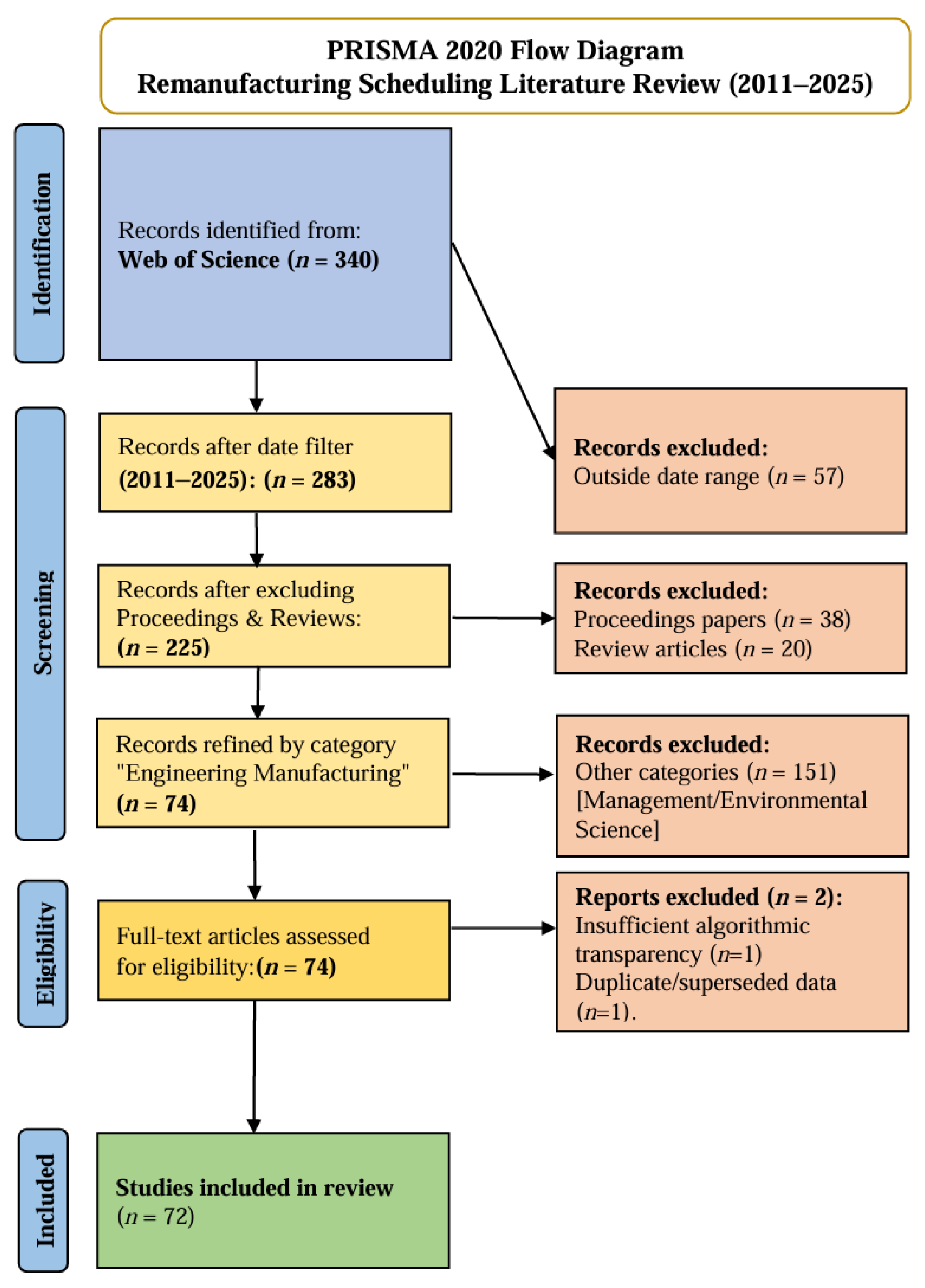
The systematic screening process is illustrated in
Figure 3 (PRISMA flow diagram). The WOS initial search yielded 340 records. Applying publication year filters (2011–2025) resulted in 283 articles. After excluding conference proceedings (
n = 38) and review articles (
n = 20), 225 original research articles remained.
To ensure domain relevance, articles were further refined using the WOS category ‘Engineering Manufacturing’, yielding 74 core articles. During full-text eligibility assessment, 2 articles were excluded: “one due to insufficient algorithmic transparency, and one due to duplicate or superseded data”.
The final dataset comprises 72 high-quality publications. While this sample size may appear modest, it reflects the emerging nature of RS as a distinct research frontier—evidenced by the exponential growth post-2021 (65.3% of total publications,
Figure 3).
Note that while the reference list contains 75 entries, three citations serve distinct methodological purposes and are excluded from the core dataset of RS publications: one provides the national standard for remanufacturing terminology (GB/T 28619-2024), one provides the PRISMA 2020 guidelines for systematic review methodology, and one supports future perspectives in
Section 9 (published in 2026, outside the 2011–2025 review scope). These are cited in their respective sections. The final dataset comprises 72 high-quality RS publications that form the basis of our systematic analysis and bibliometric statistics.
2.4. Statistical Analysis in Time Dimension
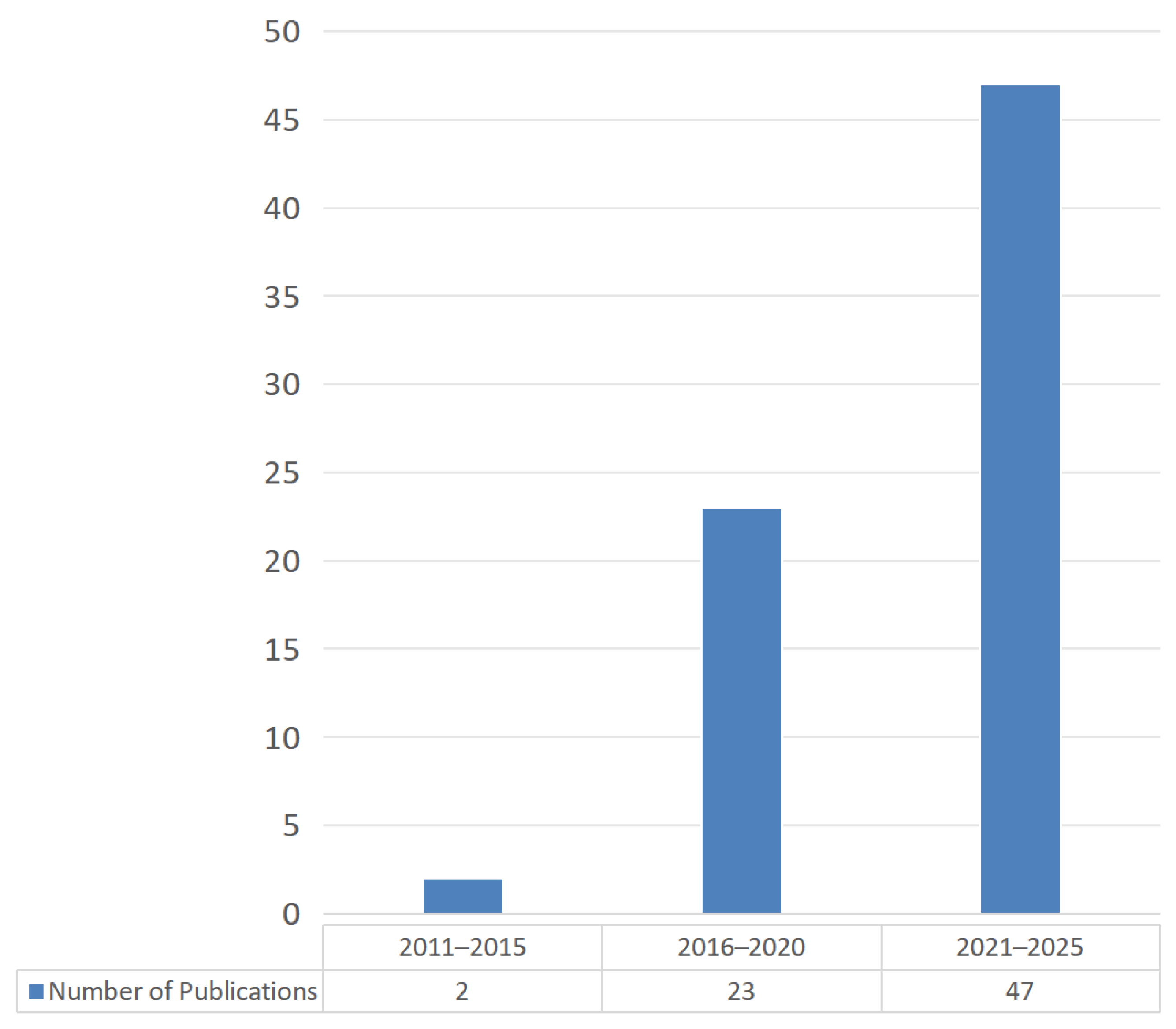
Based on the retrieval results, it can be seen from the trend chart of publication year (
Figure 4) and
Table 1 that the research on RS shows significant stage growth characteristics. Detailedly, from 2011 to 2015, the field is still in its infancy, and only two studies have been published. From 2016 to 2020, another 23 articles were published. After 2021, the related research grew rapidly, and 47 articles were published from 2021 to 2025, accounting for 65.3% of the total amount of literature. In addition, remanufacturing supply chain management and remanufacturing process planning showed a growth trend. The related research on RS has been improved year by year, especially in the past five years, which has shown explosive growth and has become a research hotspot.
2.5. Statistical Analysis in Country Dimension
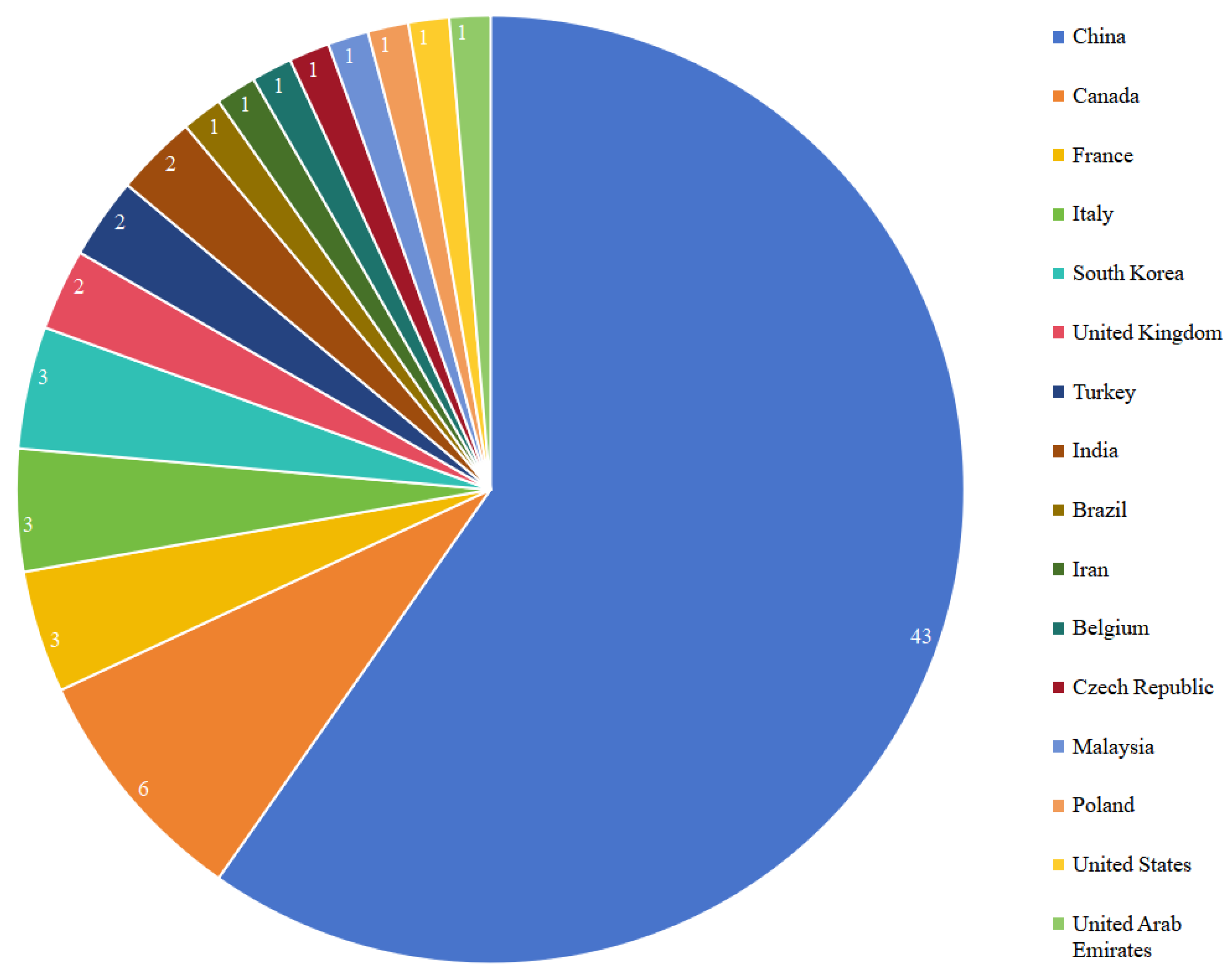
Authors in the 72 searched publications come from many countries such as China, the United States, the United Kingdom, Canada, France, South Korea and so on. These authors come from 16 countries and regions, and their geographical distribution is characterized by a significant non-uniform concentration, as shown in
Figure 5. In terms of the number of papers published, China has an absolute dominant position in this field, with a total of 43 papers published, accounting for 59.7%, which shows the strong output and continuous attention of Chinese scholars in RS studies. Canada ranks second with 6 articles, forming the second research echelon. France, Italy and South Korea are tied for third place with 3 articles each, forming the third research echelon. In addition, two papers were published in the United Kingdom, India and Turkey. One paper was from Iran, Belgium, the Czech Republic, Brazil, Malaysia, Poland, the United States and the United Arab Emirates.
From the analysis of geographical distribution pattern, Asian countries (China, South Korea, India, Turkey, Iran, Malaysia, and the United Arab Emirates) contribute a total of 53 articles, accounting for 73.6%, and the results show that the research on RS has a significant academic clustering effect in the Asia-Pacific region. European countries (France, Italy, the United Kingdom, Belgium, the Czech Republic, Poland) have published a total of 11 articles, accounting for 15.3%, which reflects the continuous attention of traditional manufacturing powers to the optimization of remanufacturing system. Canada, Brazil and the United States contribute to RS, accounting for 11.1%. This distribution not only reflects the degree of attention to circular economy and sustainable manufacturing policies in various countries, but also is closely related to the practical needs of China as a large country in the remanufacturing industry. It is worth noting that although the number of publications in this field in the United States is relatively small, considering the early start of its remanufacturing industry, relevant research may be scattered in other disciplines such as operational research and industrial engineering. In general, the distribution of RS research forces in the world still shows obvious geographical concentration. In the future, it is urgent to strengthen transnational academic cooperation to promote the balanced development of this field.
2.6. Statistical Analysis in Keyword Dimension
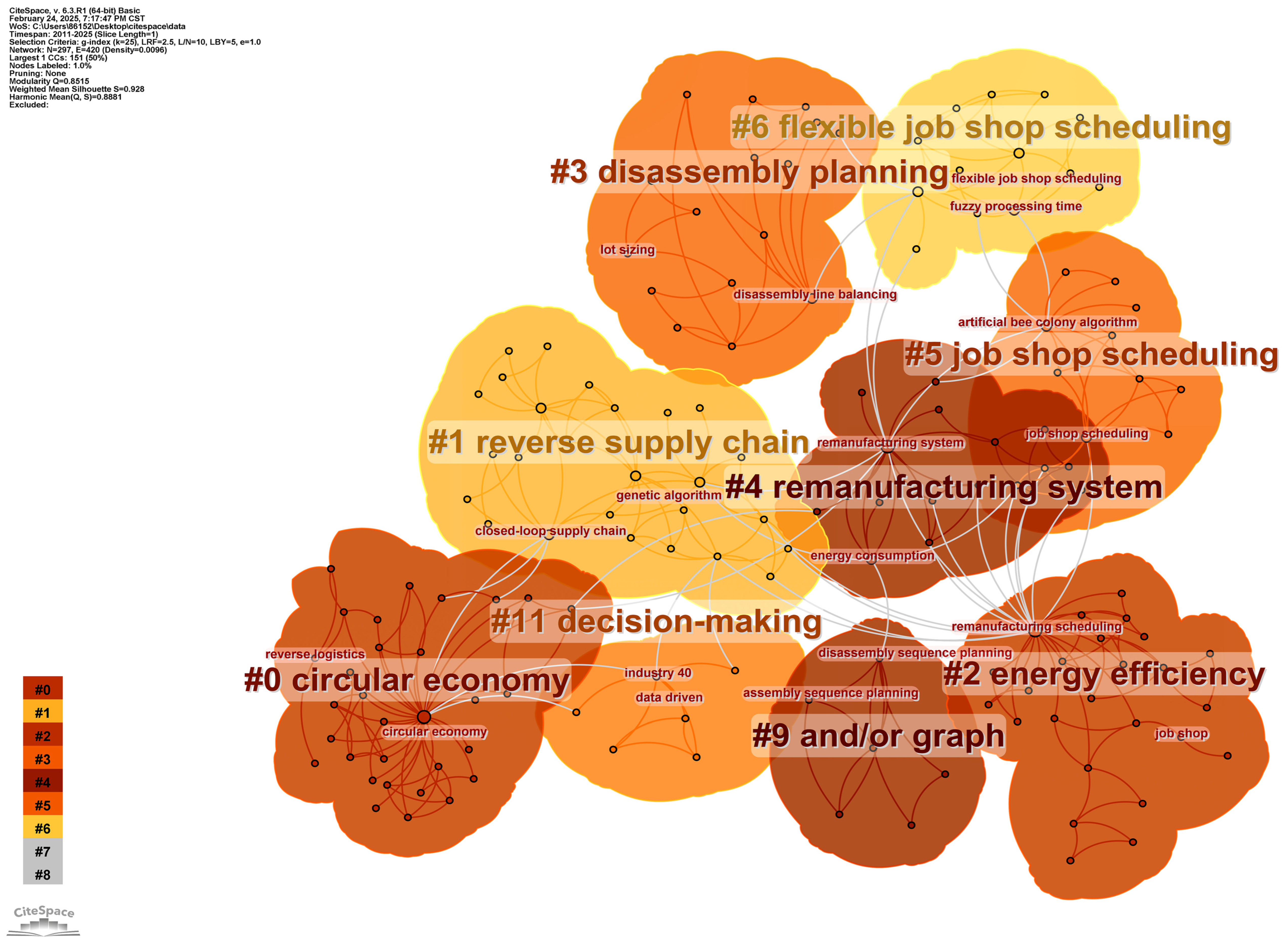
The keyword clustering module in CiteSpace 6.3.R1 software is used to cluster the keywords of ‘Remanufacturing scheduling’, and the keyword clustering map of the RS research field in WOS database is obtained, as shown in
Figure 6. The keyword clustering map (
Figure 5) visualizes eleven research clusters arranged in a hierarchical knowledge structure with color gradients indicating temporal evolution from established foundations (deep orange) to emerging fronts (bright yellow). The foundational layer comprises Cluster #0 (circular economy) and Cluster #1 (reverse supply chain), which establish systemic constraints propagating through Cluster #3 (disassembly planning) toward production execution clusters #5 and #6 (job shop scheduling). Cluster #2 (energy efficiency) occupies a peripheral yet strongly connected position, reflecting the field’s shift from single-objective time optimization toward multi-criteria sustainability frameworks. Cluster #4 (remanufacturing system) functions as a central bridge between methodological clusters—such as #9 (and/or graph modeling)—and application-focused research, while peripheral nodes indicating digital twins and deep reinforcement learning suggest current AI-driven technological infusion. This topology reveals a vertical integration pathway from supply chain logistics through disassembly to scheduling, a horizontal axis connecting graph-theoretic methods with environmental optimization, and an emerging diagonal trajectory linking traditional scheduling with intelligent decision-making, collectively indicating that contemporary RS research increasingly treats system configuration, optimization algorithms, and sustainability constraints as simultaneous rather than sequential design considerations. As a result, in the following, 72 publications will be systematically analyzed from various aspects such as the modeling strategies, intelligent optimization algorithms, uncertainty processing methods, collaborative optimization of energy-efficiency and economic benefits and so on.
3. Involving Levels in RS
Studies on RS can be further divided into three levels: product level, shop level and system level. Among them, product-level RS focuses on a single remanufactured/EOL product, and pays attention to how to optimize the remanufacturing process to meet the requirements of quality, cost and delivery time. Shop-level RS focuses on multiple remanufacturing/EOL products or lots in the shop, which needs to reasonably arrange equipment, personnel, materials and other resources to improve the overall production efficiency and resource utilization. System-level RS concentrates on the collaborative operation and overall optimization of remanufacturing components to achieve the efficient operation and sustainable development of the whole remanufacturing system.
3.1. Product-Level RS
Product-level RS needs to solve the remanufacturing process of a single remanufactured/EOL product, the specific operation method of each process, the procurement or repair decision of the required parts/components, and the arrangement of production time nodes, to find the optimal remanufacturing plan for the product. Terrin Pulikottil et al. [
18] focused on the key disassembly steps in flexible remanufacturing systems and proposed a robotic disassembly difficulty metric for a single product, which could be used to measure the disassembly difficulty of a product. They evaluated and optimized the design of the product by using the information in the digital product passport to reduce the disassembly time and cost, to find a more efficient remanufacturing plan for the product.
Cui et al. [
19] focused on the robot disassembly sequence planning considering the failure characteristics of components and proposed a disassembly information model and sequence optimization method for a single EOL product. They evaluated and optimized the disassembly sequence of the product by using fuzzy model and deep reinforcement learning to reduce the increased disassembly time due to component failure. Similarly, Fabiana Tornese et al. [
3] examined the remanufacturing process of a single wooden pallet, for which an integer linear programming model was established to optimize the preventive maintenance and replacement plan, thereby minimizing the carbon footprint.
3.2. Shop-Level RS
Shop-level remanufacturing scheduling needs to solve the task allocation of different equipment in the shop, the division and sequencing of production lots, the scheduling of personnel, the distribution plan of materials, and the control of work-in-process inventory level. By considering the production capacity and resource constraints, a reasonable production schedule was formulated. Jin et al. [
41] constructed an uncertain scheduling model for remanufacturability evaluation considering the characteristics of quality uncertainty and reprocessing time fluctuation of scrap products in the remanufacturing shop. In the model, the decision tree method was used to realize the dynamic allocation and selection of multi-quality grade EOL products among non-equivalent parallel remanufacturing lines.
Regarding the RS in a flexible job shop environment, Wang et al. [
20] constructed an integrated model that combined process planning and shop scheduling. The model considered machine flexibility, process route flexibility and process sequence flexibility.
To address the quality uncertainty and multi-mode process characteristics of components in the remanufacturing shop, Liu et al. [
42] proposed a job family-oriented job shop scheduling model, which further expanded the research depth of shop-level RS problem. This study not only focused on equipment allocation and process sequencing but also incorporated the dynamic selection of replacement mode and repair mode into the decision-making framework, which made it possible to realize the collaborative optimization of total completion time and total cost.
3.3. System-Level RS
System-level RS involves the layout of the whole remanufacturing system, capacity planning, supply chain network design, logistics node location and transportation path planning, and information sharing mechanism establishment. It is necessary to plan and control the whole remanufacturing system from a strategic perspective. Behdin Vahedi-nouri et al. [
43] focused on a hybrid manufacturing–remanufacturing system (HMRS) consisting of non-identical parallel reconfigurable machines, and proposed a logic-based Benders decomposition (LBBD) method to solve the lot scheduling problem. By simultaneously optimizing the assignment of orders to the machine-configuration combination, lot formation, and lot scheduling across machines, an efficient collaboration at the system level was realized.
On this basis, Caterino et al. [
44] further expanded the research boundary of system-level RS and proposed a scheduling framework for cloud remanufacturing in a distributed network environment. The study constructed a cross-regional remanufacturing ecosystem composed of cloud service providers, customers, and brokers to integrate geographically dispersed remanufacturing resources and capabilities through cloud platforms. Aiming at the complex scheduling challenges faced by multi-agent collaboration in this system, a mathematical optimization model considering processing time, logistics transfer time and resource waiting time was established, and the Tabu Search and bee colony algorithm were used to solve the task allocation problem. This study provided a new theoretical perspective for the networked and service-oriented transformation of remanufacturing systems.
Different from the previous cloud remanufacturing mode focusing on distributed network architecture, Yu and Lee [
25] studied the scheduling problem of job shop remanufacturing system with component matching requirements from the perspective of internal collaboration of the system. For a three-level series system consisting of a parallel disassembly workstation, a job shop-type reprocessing shop, and a parallel reassembly workstation, this study characterized the component matching constraints by grouping the reprocessing jobs into a family of operations, and finally a mixed-integer programming model was established. Two types of heuristic algorithms were proposed to collaboratively optimize the job assignment and sequencing decisions of the three subsystems, which achieved the goal of minimizing the total tardiness at the system level.
Later, Kim et al. [
24] further focused on remanufacturing system configurations with parallel flow-shop-type reprocessing lines. An integer programming model with the objective of minimizing the total flow time was established for a three-stage series system consisting of a single disassembly workstation, multiple parallel dedicated flow shop reprocessing lines and a single reassembly workstation. Based on priority rule, NEH heuristic and iterative greedy algorithm, a solution framework was also proposed.
4. Optimization Objectives in RS
The RS’s optimization objectives can be divided into four categories: economic benefits, environmental benefits, social benefits and human benefits. Among them, the economic benefits type mainly focuses on production cost and production efficiency. The environmental benefits type focuses on energy consumption and carbon emissions. The social benefits type focuses on employment and economic development, while the human factor benefits type mainly focuses on the physical and mental health of workers and labor intensity.
4.1. Economic Benefits
Economic benefits objectives focus on production cost and production efficiency. Gong et al. [
16] constructed a multi-objective mixed-integer linear programming (MILP) model for remanufacturing from the perspective of integrated process planning and shop scheduling, and economic benefits such as makespan, total tardiness, flow time and machine load were also considered.
Aiming at the remanufacturing system with different quality return levels, Sun et al. [
26] established an economic lot-sizing scheduling model whose core optimization objective was to minimize the average total cost per unit time, including ordering, acquiring, sorting, production and inventory holding costs.
Aiming at the 4–5 level maintenance scheduling problem of a railway remanufacturing system, Tigazoui et al. [
45] constructed a MILP model for flexible job shop with the objective of minimizing the makespan of train remanufacturing. By optimizing the operation sequencing of multiple cars (operations) on multiple workstations (stages), the in-plant maintenance cycle of trains was significantly reduced, and the associated costs such as equipment occupation and labor were also decreased. This study provides an operational decision-making framework for time–cost collaborative optimization in high-value equipment remanufacturing.
4.2. Environmental Benefits
Environmental benefits objectives focus on energy consumption and carbon emissions. The goal of ‘Peak carbon’ and ‘Carbon neutrality’ by 2020 promotes the transformation and upgrading of high-end, intelligent and green production in traditional manufacturing. Therefore, energy consumption, carbon emissions and other indicators of environmental benefits were also included in RS studies. To realize higher environmental benefits of remanufacturing systems, Wang and Tian [
46] paid attention to the energy consumption of remanufacturing systems earlier, and an improved genetic algorithm (IMGA) was designed by them to solve the mathematical model with the objective of minimizing the total energy consumption. Besides energy consumption, carbon emissions are also crucial environmental indicators in remanufacturing systems. To address the gap between energy efficiency and carbon reduction, Liu et al. [
47] established a multi-objective remanufacturing process planning model that simultaneously optimizes time, cost, energy consumption, and carbon emissions. They employed fault tree analysis to extract failure characteristics of used parts and constructed a comprehensive carbon emission calculation framework covering processing machines and auxiliary materials. An improved teaching–learning-based optimization (TLBO) algorithm integrating Pareto optimality and elite retention strategies was proposed to solve this complex model. Through a case study on worm gear remanufacturing, the study demonstrated that the proposed approach can effectively identify low-carbon and high-efficiency process schemes, providing a more comprehensive environmental benefit optimization framework that extends beyond single-objective energy minimization. Subsequently, to seek the trade-off relationship between main energy consumption (MEC) and makespan, Wang et al. [
48] proposed a multi-objective invasive weed optimization algorithm. Finally, the effectiveness of the proposed algorithm was verified by a case study on gearbox remanufacturing. These studies systematically construct the environmental benefit optimization framework of RS from single energy consumption minimization to multi-objective energy-efficient optimization.
In addition to energy consumption, the control of environmental emissions in the remanufacturing process is also a key link to achieve green manufacturing. From the perspective of multi-process routes, Liu et al. [
17] incorporated environmental benefits into the remanufacturing evaluation system and proposed an environmental emission index to quantify the environmental impacts such as waste liquid, waste gas and noise. A comprehensive decision-making model integrating four-dimensional indicators of economy, quality, resources and environment was constructed.
To address the integrated problem of process planning and scheduling in the remanufacturing system, Zhang et al. [
15] established a bi-objective optimization model to minimize the makespan and the total performance score. In the model, performance scores were defined to quantify the environmental impacts of different processes (such as power consumption or pollutant emissions).
4.3. Social Benefits
In addition to economic indicators and environmental factors, considering the impact of production and manufacturing on society is also one of the optimization objectives of remanufacturing scheduling. For example, considering the influence of social factors such as enterprise production, employee welfare, and working environment, Fathollahi et al. [
49] transformed the energy-efficient distributed permutation flow shop scheduling problem into a sustainable scheduling issue on the basis of the concept of triple bottom line. In the study, the social factors mainly considered the influence of social welfare, and finally a multi-objective MILP model was established to minimize the completion time, minimize the total energy consumption and maximize the social benefits.
Singhal et al. [
4] pointed out that remanufacturing can bring significant benefits to society by extending the life cycle of the product over its useful life. The process was labor-intensive in nature, and it involved a series of operations such as disassembly, cleaning, sorting and assembly, thereby creating employment opportunities for both skilled and unskilled labor. This suggests that incorporating social benefits objectives, especially employment generation, into the planning and optimization objectives of RS is key to achieving overall sustainable value.
Niu et al. [
21] further concretized the social benefit objectives as promoting employment for disadvantaged groups and social inclusiveness. By considering the task allocation issues of Workers with Government Benefits (WGBs), they constructed a multi-factory remanufacturing mixed disassembly line balancing optimization model. This study, under the constraint of profit maximization as the economic objective, designed suitable disassembly task allocation strategies for WGBs with different ability characteristics, such as the visually impaired, hearing impaired, disabled individuals, and veterans. This not only ensured the economic feasibility of enterprises but also created employment opportunities for disadvantaged groups, achieving a synergistic optimization of social responsibility and economic benefits in the remanufacturing industry, and providing a new technical path for the quantification and practice of social benefit objectives in remanufacturing scheduling.
4.4. Human Benefits
The core of the human benefits objectives is to directly incorporate the factors such as workers’ physical and mental health, job satisfaction and labor intensity into the production scheduling model, rather than only focusing on traditional economic indicators. For example, in project portfolio scheduling involving multiskilled human resource constraints, the study executed by Bocewicz et al. [
50] showed that a reasonable job rotation was the key means to maintain their skill level and avoid forgetting to lead to additional training. It was essentially about the sustainable maintenance and development of human resources while ensuring on-time project delivery through forward-looking workplans such as periodic rotation scheduling, which was a key component of human resource management, embodying the ‘human-oriented’ modern management philosophy.
From the perspective of workers’ load balancing, Zhang et al. [
27] cut into the optimization goal of human factor benefit and constructed a human factor optimization index with the minimum worker load rate as the core, when solving the problem of uneven distribution of workers’ labor intensity in an automobile engine remanufacturing shop. Experimental results showed that the method made the distribution of workers’ load rate more balanced, significantly improves the labor humanity level of remanufacturing shop, and reflected the comprehensive consideration of workers’ physical and mental health.
Li et al. [
28] further deepened the human factors benefit-oriented optimization objective from the perspective of work-rest scheduling. They constructed a single-employee scheduling model that considers real-time fatigue effects and recovery mechanisms, addressing the issue of fatigue accumulation among employees in remanufacturing workshops due to continuous work. This study optimized the allocation strategy of multiple rest periods with the goal of minimizing actual completion time by characterizing the exponential decay of work rate and the linear recovery process during rest periods. The research indicates that reasonably setting short breaks not only significantly enhances work efficiency but also effectively alleviates the potential harm of long-term fatigue on workers’ physical and mental health, reflecting a scientific concern for workers’ physiological rhythms and recovery needs in production scheduling, thereby enriching the optimization connotation of human factors benefit-oriented objectives in the time domain.
5. Modeling Ideas for RS
Modeling ideas of RS can be divided into graph theory, MILP, Petri net, stochastic programming/robust programming, and digital twin.
5.1. Graph Theory
Disjunctive graph, directed graph and Gantt chart are the most-used graph theories when formulating models. Among them, the directed graph shows unique advantages by explicitly describing the dynamic dependencies between processes, especially when considering the unique rework cycle and multiple uncertainty coupling characteristics of remanufacturing systems.
Liu and Urgo [
51] constructed a directed acyclic graph model based on Activity-on-Arc representation for the gas turbine blade repair scheduling problem, in which the laser welding and grinding processes and their reworking operations were abstracted as network nodes and directed arcs. By introducing the method of combining phase-type distribution with Markovian activity networks, the laser welding and grinding process was modeled as a network of nodes and directed arcs, continuous-time Markov chain was used to describe the state transition process of the system.
From the perspective of circular economy, Singhal et al. [
4] used the fuzzy DEMATEL method to construct a directed graph causal network model of key influencing factors of remanufacturing. In this study, 19 key factors were abstracted as network nodes, and the fuzzy directed relationship matrix between factors was established by expert evaluation, and then the total relationship matrix was generated to quantify the comprehensive influence strength between factors. Different from the traditional directed graph to describe the rework path of a single factory, this modeling idea calculated the centrality and caused degree indicators.
However, the traditional directed graph model still has limitations in dealing with the high-order uncertainty and multi-layer feedback structure of remanufacturing systems. Aiming at the complex equipment remanufacturing scheduling problem, Zhang and Liu [
29] constructed a multi-layer random network model based on graph review technology. The probabilistic output node and XOR input node were introduced to explicitly describe the multiple probabilistic branches and loop characteristics of ‘Inspection-rework-scrap’ in the remanufacturing process. Compared with the deterministic directed graph, the proposed model could effectively capture the dynamic path evolution caused by the quality difference in parts in the remanufacturing process.
5.2. MILP
MILP is an effective modeling strategy to deal with complex decisions and uncertainties. For example, Zhang et al. [
52] constructed a new uncertain RS model to deal with the processing time uncertainty and rework risk caused by the quality difference in EOL products. The core of the RS model was a typical MILP framework. In the model, the decision variables included Boolean variables that indicated whether to choose a reprocessing route to process a certain type of product, and Boolean variables that indicated whether a certain type of product was preferentially processed along a certain route.
Different from the above ideas of dealing with uncertainty, Wang et al. [
53] constructed a MILP model based on the adjacent-sequence modeling idea for the three-stage RS problem. By defining a series of 0–1 variables to represent the precedence relationship of adjacent operations, the model effectively described the complicated production environment with unrelated parallel disassembly/reassembly workstations and parallel flow-shop reprocessing lines. On this basis, Wang et al. [
54] further systematically compared the performance differences in four MILP modeling ideas, i.e., sequence-based, position-based, time-based and adjacent sequence-based, in RS problems. Through the quantitative analysis of scale complexity and computational complexity, they found that the sequence-based modeling idea was superior to the other three ideas.
Guo et al. [
55] constructed a multi-objective MILP model for the remanufacturing system with time window constraint outsourcing. By defining the product-workstation assignment variables, the processing priority variables and the outsourcing decision variables, the model systematically depicted the three-stage integrated RS process of parallel disassembly, flexible shop reprocessing and parallel reassembly.
5.3. Petri Net
By introducing place, transition, directed arc matrix and initial mark, the job shop scheduling problem can be transformed into a Petri net model. In solving the heterogeneous multi-plant RS problem, Qi et al. [
56] used Petri nets to model the product disassembly process. They defined the disassembly Petri net as a six-tuple, which included places, transitions, directed arcs, markers, component values and disassembly task costs. Through this modeling idea, the precedence and conflict relationships among the disassembly steps were clearly described.
Based on this principle, Peng et al. [
30] constructed a transition time Petri net and combined it with heuristic A* algorithm to deal with the RS problem. Taking engine cylinder block remanufacturing as the research object, the production process was formalized as a Petri net model, and the optimal or near-optimal feasible schedule was searched through the reachability graph.
Li et al. [
31] introduced colored time Petri nets (CTPN) to model the dynamic characteristics of uncertain process paths, random operation times, and resource conflicts in the RS problem. By introducing color and time attributes, CTPN extended the description ability of ordinary Petri nets and can explicitly describe different recovery paths, random operation times and real-time machine resource conflicts.
5.4. Stochastic Programming/Robust Programming
Stochastic programming is an important modeling strategy to deal with the uncertainty of disassembly and reprocessing time in the RS problem. For example, Fu et al. [
57] formulated a stochastic programming model for an integrated scheduling problem with product mix and stochastic processing times. The objective was to minimize the expected maximum completion time and total delay time. This modeling idea dealt with the randomness of time parameters through the expected value, which provided a theoretical basis for seeking efficient and reliable schedules in uncertain environments. Similarly, in the integrated scheduling of disassembly, reprocessing, and reassembly, authors in [
58] adopted random numbers to represent the uncertainty of the time parameter and dealt with the random variables through mathematical expectations. The modeling idea of stochastic programming can be extended to deal with more complex systems with multi-source uncertainties like quality and demand.
To manage the remanufacturing system, Li et al. [
8] developed a stochastic discrete-time dynamic model integrating production and inventory planning. The model utilized Gaussian distribution to describe the market demand and inventory disturbance, and used chance constraint to deal with the uncertainty of product quality. Improving remanufacturing efficiency and meeting the preset service level were selected as the optimization objectives.
In contrast, robust programming provides another way to deal with such uncertainties, which focuses on finding the most robust solution in the possible distribution set of uncertain parameters. For example, Liu et al. [
32] developed a min–max optimization model to determine the planned lead time for the case where the remanufacturing time distribution was unknown but its moment information was known. The model did not presuppose the specific distribution of time, but minimized the worst-case expected total cost (including holding cost and shortage cost) based on the known first-order moment and second-order moment. Therefore, robust programming could avoid the decision-making bias caused by mis-estimating the distribution, and it was especially suitable for remanufacturing environments with scarce historical data and severe fluctuations.
To deal with the uncertainty of arrival time and processing time of EOL products, Zhang et al. [
59] proposed a scenario-based robust remanufacturing scheduling model. The model adopted a discrete set of scenarios to describe these uncertain variables, which avoided the dependence of traditional stochastic methods on the exact probability distribution. Its objective was to minimize the average completion time (reflecting efficiency) and the variance of completion time (reflecting stability) in all scenarios. To balance the relationship between the two objectives, a mean-variance function was introduced.
5.5. Digital Twins
The digital twin is a virtual model corresponding to the physical entity. Through data acquisition means such as sensors, various data from the physical entity are transmitted to the virtual model in real time, and the virtual model can reflect the state and behavior of the physical entity in real time. In the RS field, Schlecht et al. [
60] proposed a data-driven decision-making process to generate and evaluate schedules by constructing a digital factory simulation model to deal with uncertainty in the system. It used the data obtained from the shop to automatically create a discrete event simulation model, which was utilized to generate and evaluate robust schedules in uncertain environments.
Garrido-hidalgo et al. [
74] noted that the creation of independent virtual representations (i.e., digital twins) for each electric vehicle battery enabled the utilization of fine-grained real-time sensor data to construct and train high-precision prediction models. Such digital twins are crucial in the EOL monitoring and remanufacturing scenario. By integrating precise sensors, the battery’s state of health, state of charge, ambient temperature, humidity and other key indicators can be monitored in time. These real-time data were transmitted wirelessly over low-power wide-area networks, enabling remote server-side fault detection and preventive maintenance. As a result, the digital twins framework provides a key technical path for realizing a sustainable closed-loop production system and improving the level of data-driven decision-making in RS.
6. Solution Methods for RS
Solution methods for solving the RS problem can be divided into: exact algorithm, heuristic algorithm, meta-heuristic algorithm, and artificial intelligence algorithm. Among them, exact method mainly uses the mathematical programming and the branch and bound method to solve the problem. Although these methods can obtain the optimal solution in theory, they are only suitable for small-scale scheduling problems. Although the heuristic algorithm can deal with large-scale scheduling problems, the quality of its solution is relatively low. With the increasing complexity of application scenarios, optimization objectives and constraints, solving the RS problem becomes increasingly difficult. Traditional heuristics and meta-heuristics cannot meet the requirements of the RS problem, and machine learning algorithms such as reinforcement learning are applied.
Given the diversity of solution paradigms and their varying capabilities in handling the triad of uncertainties—quality stochasticity, temporal variability, and demand fluctuation—systematic comparison is essential for methodological selection.
Table 2 delineates the applicability boundaries of each algorithmic category across multiple dimensions including uncertainty accommodation, scalability, optimality guarantees, and computational characteristics.
This comparative taxonomy reveals fundamental trade-offs among solution methodologies. Exact methods provide theoretical benchmarks for static, small-scale problems with well-characterized uncertainty distributions but fail to accommodate dynamic environments due to computational intractability. Heuristic algorithms offer practical solutions for large-scale industrial applications with real-time response requirements yet lack solution quality guarantees and systematic improvement mechanisms. Meta-heuristic approaches balance solution quality and computational tractability for medium-scale problems exhibiting multi-objective constraints but require careful parameter calibration and lack robustness across problem instances. Artificial intelligence methods demonstrate superior capability in handling multi-source dynamic uncertainties through learning-based adaptation and end-to-end decision-making, though their black-box nature, data dependency, and transferability limitations pose challenges for industrial adoption. The following subsections provide detailed examination of each methodological category.
6.1. Exact Algorithm
Current Chinese and international scholars have conducted extensive research on the exact algorithm, which focuses mainly on deterministic problems and developing exact solutions for shop scheduling issues based on constructed mathematical programming models. Kausar et al. [
9] established a nonlinear programming model for the inventory and pricing issues of closed-loop supply chains in manufacturing and remanufacturing systems. They utilized professional optimization software LINGO 17.0 and Mathematica 11.3 for precise solutions and optimality verification.
Li et al. [
10] proposed an integrated stochastic dynamic model for the high-uncertainty management problem in remanufacturing systems and constructed the corresponding stochastic model predictive control optimization framework. In this study, the decisions on production, inventory, resource allocation and acquisition were integrated into a MILP model, and the CPLEX was used to solve it accurately.
In scheduling problems with relatively certain parameters and precisely quantifiable objective functions and constraints, the exact algorithm can give full play to its advantage of seeking the global optimal solution. For example, for the recovery scheduling problem with spare parts supply disruption in a remanufacturing production system, a nonlinear constrained quadratic programming model was constructed by Matropi et al. [
11] to minimize the total cost (including shortage cost and out-of-stock cost). The branch and bound algorithm was used to accurately solve the remanufacturing lot and production plan in the recovery cycle, and the LINGO software is used to obtain the global optimal recovery plan.
Different from the above research focusing on the management of old parts with a single quality level, Zhu et al. [
12] focused on a remanufacturing supply chain with two types of old parts: high-quality and low-quality. A MILP model was constructed under a consignment inventory protocol, and the branch and bound algorithm framework was adopted. Finally, the Bonmin solver was used to accurately solve the three operation policies of continuous/batch production and equal/unequal batch delivery.
6.2. Heuristic Algorithm
Unlike exact algorithms, which seek global optimal but face the ‘dimension curse’, heuristic algorithms can quickly construct satisfactory solutions through problem-specific experience rules, which are especially suitable for stochastic dynamic environments requiring real-time decision-making. In the field of remanufacturing lot planning, Kilic and Tunc [
5] designed three heuristic strategies with different levels of flexibility for a hybrid manufacturing/remanufacturing system with stochastic time-varying demand and returns. Experimental results showed designing specific heuristic rules for different uncertainty levels is an effective way to solve the economic lot-sizing problem of remanufacturing system.
Assid et al. [
33] further extended the above research to the joint production and setup control problem of an unreliable hybrid manufacturing/remanufacturing system. The study adopted a simulation-based optimization framework, combined with design of experiments and response surface methodology, to systematically evaluate and improve three parametric control strategies (i.e., Polotski strategy, variable manufacturing rate strategy, and maximum manufacturing rate strategy).
Different from the simulation optimization framework adopted by Assid et al. [
33], Kilic et al. [
6] proposed a heuristic parameter solving method based on the deterministic equivalent MIP model for the stochastic economic lot-sizing remanufacturing problem. They transformed the complex stochastic dynamic programming into an efficiently solvable static optimization problem by constructing a deterministic equivalent mixed-integer programming model with All-or-Nothing and Threshold policies.
6.3. Meta-Heuristic Algorithm
Meta-heuristic optimization algorithms are a class of global optimization strategies inspired by natural phenomena or social behaviors. Representative algorithms include genetic algorithm (GA), particle swarm optimization (PSO) and artificial bee colony algorithm (ABC). For example, Jin et al. [
61] proposed an improved ABC for the scheduling problem of a lot recovery product remanufacturing system considering dynamic changes in machine efficiency. This study constructed a BRMSS-DCME model, which considered the synergy of disassembly, reprocessing and reassembly, as well as the dynamic impact of machine deterioration effect and human learning effect. To solve the model effectively, several improvements were made on the ABC algorithm. A three-level solution representation scheme is designed. In the employed bee phase, the extended opposition learning mechanism with piecewise probability was introduced to increase the diversity of the population. To accelerate the convergence, an elitist strategy was also used.
Similarly, Zhou et al. [
62] proposed a discrete combat royal optimization algorithm for the multi-plant remanufacturing process optimization problem with worker scheduling. The algorithm designed a novel five-segment coding structure to represent complex schedules and introduced three soldier search strategies of reconnaissance, supply and ambush to enhance the ability of global exploration and local development.
Zhang et al. [
63] proposed an improved whale optimization algorithm (IWOA) for the multi-stage integrated scheduling problem in cloud remanufacturing systems. In this study, a scheduling model covering five macro-stages of initial inspection, disassembly, reprocessing, reassembly and final testing was constructed, and a solution representation scheme based on floating-point number encoding was designed to deal with task sequencing and service selection simultaneously. Experimental results demonstrated that IWOA was superior to its peers in solving accuracy, computational efficiency and convergence speed.
Guo et al. [
64] proposed an improved multi-objective genetic algorithm (IMOGA) for the integrated scheduling problem of remanufacturing systems considering component commonality. A three-stage collaborative scheduling model of disassembly–reprocessing–reassembly is constructed, and a two-layer coding scheme was designed to represent discrete and continuous decision variables. Notably, the idle time of workstations was exploited by a left-shift strategy contained in IMOGA, and the component relinking strategy was proposed to solve the common part reassembly decision problem.
Zhang et al. [
22] focused on the integrated process planning and scheduling problem for a flexible job shop remanufacturing system and proposed an improved spider monkey optimization (SMO) algorithm. A multi-objective MILP model considering parallel disassembly, flexible reprocessing and parallel reassembly was constructed to minimize the total energy consumption and completion time simultaneously. To solve this NP-hard problem effectively, the dynamic adaptive inertia weight mechanism was embedded in the basic SMO algorithm, and the local neighborhood search strategies such as mapping, insertion and inversion were specially designed.
6.4. Artificial Intelligence Algorithm
Artificial intelligence algorithm is an interdisciplinary subject involving probability theory, algorithm complexity, statistics and other fields. It specializes in how to make computers competent for some complex tasks that require human intelligence to complete. Representative artificial intelligence algorithms include expert system, multi-agent system, neural network and so on.
Yazdanparast et al. [
65] proposed and designed a multi-agent deep Q network method for the real-time scheduling problem of collaborative customization remanufacturing. The method defined independent agents and neural networks for each remanufacturing department, such as disassembly, cleaning maintenance, and assembly, by defining required elements such as state, action and reward. It enabled agents to make decisions considering the state of other departments to achieve cross-department collaboration. Experiments were conducted in a real smartphone assembly environment, and results showed that the proposed multi-agent deep Q network could reduce the total cost of the factory and optimize the product delivery matching rate.
Unlike deep reinforcement learning that uses a trial-and-error mechanism for policy optimization, supervised learning achieves intelligent decision-making by mining the mapping relationship in historical data. Peng et al. [
34] proposed an adaptive rescheduling strategy based on conditional generative adversarial network (CGAN) and improved random forest (IRF) for the frequent disturbance problem of an aircraft parts remanufacturing system in a dynamic environment. Firstly, CGAN was used to enhance the historical scheduling data to solve the problem of data imbalance between different rescheduling method categories Then, the nonlinear mapping model between the system state characteristics and the optimal rescheduling method was established by IRF, and the intelligent decision of the rescheduling trigger time and method selection was thus realized. The experimental results show that the data-driven method can effectively reduce the number of rescheduling triggers and improve the system performance.
7. Production Scenarios for RS
According to the production scenarios, RS can be divided into: static scheduling, dynamic scheduling, fuzzy scheduling, and lot-streaming scheduling. In the static scheduling environment, all operating parameters are known and remain unchanged, which is the main research direction. The remanufacturing process in the dynamic scheduling environment will face various unexpected external disturbances, and RS needs to provide reasonable and effective response strategies. In the fuzzy scheduling environment, the process time of EOL products is no longer a specific number, but a fuzzy number or a random number with certain fuzziness. In the lot-streaming scheduling environment, EOL products will enter the remanufacturing system/shop to complete a series of operations in the form of lots, so the formulation of lot strategy is particularly important.
7.1. Static Scheduling
In the static scheduling production scenario, all operating parameters are known in advance and remain unchanged throughout the planning cycle, which provides the basis for building a deterministic optimization model. Lage Junior and Costa [
13] examined a typical static scheduling framework to solve the remanufacturing disassembly lot-sizing problem. Their simulation model set the fixed disassembly cost, inventory holding cost and the processing cost and probability distribution of the four remanufacturing paths, while the demand quantity was also fixed. Obviously, the limitation was that it could not directly deal with the dynamic and uncertain disturbances that were prevalent in actual production.
Chu and Chen [
23] studied the human–machine collaborative disassembly planning problem of EOL power batteries in a static scheduling environment. Their work was also based on the premise that all operating parameters were known in advance and remained constant. Under this deterministic framework, the authors constructed a MILP model with the objective of minimizing the makespan, and a hybrid particle swarm optimization algorithm combined with Q Learning was designed. However, the model assumptions were also difficult to directly adapt to the uncertain factors such as task time fluctuations or sudden equipment failures that may occur in the actual disassembly process.
Similarly, Huang and Zhou [
66] studied the integration balancing and preventive maintenance problem for semi-automated disassembly lines. They constructed a MILP model to optimize the long-term weighted cycle time and energy consumption based on a series of static assumptions, such as the undivided disassembly task, the fixed priority relationship, and the predictable robot maintenance plan.
Kim et al. [
35] studied the RS problem with a flow-shop-type production line in a static deterministic environment. They considered a three-stage remanufacturing system consisting of a single disassembly workstation, a parallel flow-shop reprocessing line, and a parallel reassembly workstation, assuming that all the products to be processed were available at time 0, and the key parameters such as disassembly, reprocessing and reassembly times were predetermined constants. Under this static framework, without any dynamic disturbance or uncertainty, a MILP model was constructed to minimize the total delay.
7.2. Dynamic Scheduling
Different from the premise that the parameters are fixed and constant in static scheduling, the remanufacturing system in a dynamic scheduling environment must deal with various sudden external disturbances and uncertainties, and it requires the system to have the ability of real-time response and dynamic adjustment. Turki, Sauvey, and Rezg [
7] conducted an in-depth study under a dynamic scheduling framework for a hybrid manufacturing/remanufacturing system with storage facilities. They fully considered the multiple uncertainties in the actual production, such as the stochastic failure of the machine, the randomness of the repair time, and the varying recycling quantity of EOL products. In this dynamic environment, the discrete flow model was used to characterize the remanufacturing system. By tracking the flow of items and the change in inventory state one by one, the dynamic characteristics of the system over time were accurately captured.
Goodall et al. [
36] proposed a data-driven simulation architecture for the Waste Electrical and Electronic Equipment remanufacturing scenario, which was based on the simulation model of the waste electrical and electronic equipment. Dynamic data such as WIP status, resource availability and process parameters were collected in real time by RFID traceability system, and an integrated framework including an adaptive simulation algorithm, remanufacturing information model and information service layer was constructed.
Instead of focusing on system-level inventory and cycle time optimization, Gao et al. [
37] focused on the dynamic rescheduling problem at the job shop level. They constructed a dynamic scheduling model based on experience interval for the dynamic disturbance caused by the uncertainty of processing time and the random insertion of new jobs in the remanufacturing process. When the actual processing time exceeded the estimated upper limit or the newly returned products arrive, the system triggered the rescheduling mechanism to dynamically adjust the non-started jobs. A discrete harmony search algorithm with local search strategy was designed to maximize the makespan and average earliness/tardiness.
7.3. Fuzzy Scheduling
In a fuzzy scheduling environment, the key process parameters, especially the operation time, are often difficult to accurately predict or measure, and the traditional exact value cannot accurately describe its fluctuation range. Therefore, scholars turn to use fuzzy mathematics theory to express the uncertain processing time as a fuzzy set, so as to construct a more suitable scheduling model for the actual production complexity. For example, focusing on the disassembly scheduling problem in remanufacturing systems, Yuan et al. [
67] explicitly pointed out that the disassembly time quota was not always determined accurately. On this basis, a multi-objective scheduling model considering fuzzy processing time was proposed, where the time of each disassembly operation was modeled as triangular fuzzy numbers that were used to characterize its possible best, most likely, and worst cases. The core of this approach was to integrate the fuzzy time parameters into the mathematical programming framework by introducing the ranking and operation method of triangular fuzzy numbers.
The complexity of the fuzzy scheduling environment is not only reflected in the fuzziness of single parameter, but also lies in the possible and interrelated double uncertainties among multiple key parameters. In RS, it is difficult to accurately evaluate the quality of EOL products, and this quality uncertainty will further lead to fluctuations in their processing time, processing cost and even task completion reliability. A typical dual-uncertainty problem is formed. To address this challenge, Shi et al. [
68] proposed a new bi-fuzzy remanufacturing scheduling model. The model adopted bi-fuzzy variables to describe multiple uncertain parameters and thus more accurately characterize the ‘how long it will consume, what is the possibility’ fuzzy evaluation information from expert experience.
Unlike Shi et al. [
68] who focused on the associated uncertainty among parameters, Zhang et al. [
38] further incorporated the uncertainty of quality assessment into scheduling decision-making. A remanufacturing production scheduling model integrating rough set theory and bi-fuzzy algorithm was constructed. The bi-fuzzy variables were used to describe the complex environment with randomness and fuzziness, and the hybrid strategy of BP neural network and genetic algorithm was used to solve the problem. This proposed method effectively coped with the practical challenges of ‘parameters are fuzzy and difficult to accurately quantify’ in remanufacturing production.
7.4. Lot-Streaming Scheduling
In a lot-streaming scheduling environment, EOL products will enter the remanufacturing system in lot, where a lot contains many identical products. Its core is to significantly speed up the flow of material between processes by breaking down large lots into sub-lots that can be processed in parallel or overlapping. Therefore, additional effort should be paid to lot-splitting strategy and sub-lot-processing strategy. For example, Tian et al. [
69] explicitly studied an energy-efficient RS problem integrating disassembly, reprocessing, and reassembly over three stages and introduced a lot-streaming production model. In the study, each EOL product batch was pre-divided into multiple sub-lots by using an equal-sized consistent splitting strategy, and the number and size of sub-lots remained unchanged in all subsequent processes.
Shi et al. [
39] proposed a novel lot-streaming model for a RS system consisting of three collaborative subsystems, i.e., disassembly, reprocessing, and reassembly. EOL product lots were first disassembled in parallel in the disassembly workshop, and the defective components obtained were classified and assigned to the corresponding reprocessing lines according to their recycling quality grades. The reprocessed components were reassembled into new products in the reassembly shop. It is especially suitable for the remanufacturing of high-volume and low-variability products such as automobile parts.
Wang et al. [
70] further expand the study of Tian et al. [
69] in RS systems by adopting an unequal uniform splitting strategy. They allowed for differences in the size of sub-lots within the same lot, but required that each sub-lot maintained the same number and size. This flexible splitting method not only meets the demand of multi-variety and small-lot remanufacturing, but also realizes the collaborative optimization of the production cycle and energy consumption by optimizing the sub-lot scale configuration.
8. Case Study
To validate the effectiveness of RS methodologies and reveal the gap between theoretical models and industrial practice, this section categorizes existing case studies into academic simulation studies and real-world industrial cases. Through comparative analysis, critical insights regarding the implementation barriers and practical requirements of RS in industrial environments are provided.
8.1. Academic Simulation Studies
Academic simulation studies typically construct idealized models under controlled environments to validate algorithmic performance and theoretical frameworks. These studies focus on complex scenario modeling, multi-objective optimization, and novel scheduling paradigms such as cloud remanufacturing and stochastic optimization.
Peng et al. [
30] established a stochastic Petri net scheduling model for the WD615-87 diesel engine cylinder block remanufacturing. This academic case involved mixed-flow processing of three severely damaged and six slightly damaged jobs, encompassing nine parallel processes including cleaning, inspection, grinding, and spraying. The cleaning equipment possessed batch processing capabilities, while other machines handled single jobs. To address uncertainties in remanufacturing paths and processing times caused by damage severity differences, the study employed a transition time delay Petri net to avoid deadlocks and designed a heuristic A* algorithm search strategy with dynamic window technology to alleviate state space explosion.
Caterino et al. [
44] proposed the concept of cloud remanufacturing from a distributed manufacturing network perspective, taking the disassembly process of a Mitsubishi engine cylinder block as a typical academic case. The study considered 34 sub-activities with complex precedence constraints involving 20 cloud service providers distributed across different geographical regions. Unlike traditional centralized job shop scheduling, this case introduced logistics transportation time and resource waiting time, establishing a mathematical model for makespan minimization. Two metaheuristics—Tabu Search (TS) and artificial bee colony (ABC)—were designed and compared at the regional scale (13,590 km
2) and national scale (301,340 km
2). Results demonstrated that ABC outperformed TS in convergence speed and solution quality, achieving an optimal completion time of 1111.4 min.
Zhou and Xiao [
71] conducted an academic simulation on engine crankshaft remanufacturing, providing a paradigm for understanding core RS challenges under uncertainty. The remanufacturing process comprised multiple series-parallel stages, with each stage containing multiple workstations processing multiple types of EOL parts from the recycling market. This simulation addressed three simultaneous uncertainties: (1) random fluctuations in the quantity and type of recycled products, (2) variable working condition loads caused by different products, and (3) dynamic deterioration of workstation reliability with production. To address these complexities, the authors established a dynamic production priority-based scheduling method, comprehensively weighing product profit, system bottleneck, and inventory cost. They further developed an opportunistic maintenance model based on two-production-cycle optimization, formulating optimal collaborative maintenance plans by evaluating the impact of advancing or postponing maintenance activities on adjacent production cycles.
Aminipour et al. [
14] presented an academic simulation of automotive aftermarket components (vacuum pumps, brake master cylinders, and water pumps) within a closed-loop supply chain. A MILP model integrating manufacturing and remanufacturing operations was constructed for a two-stage closed-loop supply network with periodic delivery protocols between manufacturers and customers. The model optimized weekly cyclic production plans to match given periodic delivery demands. Comparative analysis between pure manufacturing systems and manufacturing–remanufacturing integrated systems revealed that remanufacturing implementation could achieve cost savings of
$6139 per week.
8.2. Industrial Case Studies
Real-world industrial cases differ significantly from academic simulations, featuring fragmented data availability, legacy equipment constraints, and complex stakeholder requirements. These cases demonstrate the practical implementation of RS theories in actual production environments.
Zhao et al. [
40] investigated the energy-efficiency optimization scheduling problem of engine crankshaft remanufacturing at Jinan Fuqiang Power Co., Ltd. of China National Heavy Duty Truck Group, Jinan, China, based on actual production data. This industrial case specifically addressed processing time ambiguity and process path uncertainty caused by quality differences in recycled EOL parts. EOL parts were classified into two types: slight damage (five actual processes) and severe damage (seven processes). The cleaning equipment could process multiple jobs simultaneously, while fine grinding and polishing processes could be flexibly selected on parallel machines. Triangular fuzzy numbers were employed to describe uncertain processing times, and an improved adaptive genetic algorithm based on hormone regulation mechanism was designed to balance global and local search capabilities. This case validated the applicability of fuzzy scheduling models in heavy-duty automotive remanufacturing enterprises.
Zhang et al. [
72] conducted a systematic study on gear pump remanufacturing at Yuchai (Suzhou) Remanufacturing Industry Co., Ltd., Suzhou, China, representing a typical case of cloud RS considering quality uncertainty. Key components after disassembly (pump body, driving shaft, driven shaft, etc.) were divided into five quality grades according to failure characteristics, corresponding to five differentiated remanufacturing lines: direct reuse, high/medium/low-quality reprocessing lines, and brand-new replacement. This quality-classification-based routing mechanism enabled random selection of remanufacturing lines during task decomposition, demonstrating how cloud manufacturing concepts can be implemented in state-owned remanufacturing enterprises with diversified product portfolios.
Zhang et al. [
73] examined automobile parts remanufacturing scheduling at Shanghai Hongxi Automobile Parts Remanufacturing Company, based on actual production data for five typical EOL automobile parts: automobile differential, gear pump, gearbox, starter, and alternator. A multi-objective scheduling model integrating parallel disassembly/reassembly shops and flexible job shop reprocessing shops was proposed. This industrial case specifically focused on energy consumption optimization during remanufacturing, simultaneously minimizing total energy consumption and total completion time. The coupling effect of equipment selection and process sequencing on energy consumption performance in flexible job shop environments was revealed, providing practical guidance for small-batch, multi-variety automotive remanufacturing operations.
8.3. Comparative Discussion: From Academic Simulation to Industrial Implementation
While academic simulation studies provide methodological foundations and algorithmic innovations, industrial cases reveal the practical constraints and implementation barriers that differentiate theoretical RS from shop-floor reality. This section analyzes the critical gaps and proposes pathways for translational research.
Academic simulations [
14,
30,
71] typically assume complete information availability regarding processing times, quality grades, and resource capabilities, often representing uncertainties through probability distributions or fuzzy numbers with predefined parameters. In contrast, industrial cases [
40,
72,
73] demonstrate that real remanufacturing shops face severe data scarcity regarding EOL product conditions. At Jinan Fuqiang Power [
40], quality assessment relied on manual inspection rather than automated sensing, while Yuchai Suzhou [
72] required iterative calibration of quality classification thresholds based on historical rework rates. Future research should focus on data-driven uncertainty modeling using limited historical data and real-time quality sensing technologies rather than assuming perfect distribution knowledge.
Academic cloud remanufacturing studies [
44] assume seamless information sharing among distributed service providers through standardized APIs. However, industrial implementations [
72,
73] reveal significant information silos between disassembly shops, reprocessing lines, and reassembly stations. At Shanghai Hongxi [
73], equipment data was collected through standalone SCADA systems without unified MES (Manufacturing Execution System) integration, necessitating manual data transcription for scheduling decisions. The realization of true cloud remanufacturing requires overcoming legacy equipment retrofitting costs and developing lightweight IIoT (Industrial Internet of Things) middleware compatible with diverse machine controllers.
Meta-heuristic algorithms proposed in academic studies [
44,
71] typically require substantial computational time for convergence (often minutes to hours), which is acceptable for offline planning. However, industrial cases [
40,
73] demonstrate that remanufacturing shops require real-time rescheduling capabilities (seconds to milliseconds) to respond to machine breakdowns and quality inspection failures. The hormone-regulated genetic algorithm at Jinan Fuqiang [
40] had to be simplified through response surface methodology to meet real-time decision requirements, sacrificing optimality for responsiveness. This suggests that future research should prioritize hybrid approaches combining offline optimization for baseline schedules with lightweight heuristics or reinforcement learning for real-time disturbances.
While academic studies [
14] quantify economic benefits through idealized cost models (e.g., weekly savings of
$6139), industrial cases reveal that actual economic performance is influenced by hidden factors including inventory holding costs for irregular EOL product arrivals, penalty costs for delivery delays, and certification costs for remanufactured products. Furthermore, industrial implementations [
73] demonstrate that energy savings achieved through scheduling optimization (typically 6–15%) are often overshadowed by process technology improvements (e.g., laser cladding versus traditional welding). Comprehensive cost–benefit analysis frameworks that incorporate organizational learning curves and customer acceptance dynamics are essential for justifying RS system investments.
Academic simulations often assume automatic execution of optimized schedules. However, industrial cases highlight the critical role of human expertise and resistance to automation. At Yuchai Suzhou [
72], experienced technicians frequently overrode algorithmic scheduling decisions based on tacit knowledge regarding machine-tool compatibility that was not encoded in the mathematical model. Successful industrial implementation requires human-in-the-loop scheduling systems that combine algorithmic optimization with expert validation interfaces, rather than fully automated black-box optimizers.
Based on the comparative analysis, four critical barriers hinder the transition from academic RS models to industrial practice. First, unlike traditional manufacturing with consistent raw materials, EOL products exhibit extreme variability. Industrial cases [
40,
72] required extensive preprocessing standardization before scheduling algorithms could be applied, suggesting the need for automated disassembly and inspection technologies as prerequisites for advanced RS. Second, while academic studies propose digital twin frameworks [
60,
74], industrial cases reveal that constructing high-fidelity virtual models requires multi-physics modeling capabilities (thermal, mechanical, chemical) for remanufacturing processes that are currently unavailable or computationally prohibitive for real-time applications. Third, RS implementation requires not only software algorithms but also organizational capabilities for cross-functional coordination between recycling, quality control, production planning, and logistics departments—capabilities often underdeveloped in traditional remanufacturing enterprises. Fourth, academic cloud remanufacturing [
44] explores national-scale optimization, whereas industrial cases [
72,
73] focus on single-factory implementations. Scaling RS systems to multi-factory environments requires addressing data sovereignty concerns, competitive information sharing barriers, and heterogeneous IT infrastructure standardization across organizational boundaries.
The analysis reveals that while academic simulations provide methodological rigor and algorithmic innovation, industrial cases highlight the necessity of robustness over optimality, data quality over algorithm sophistication, and organizational integration over technical performance. Future RS research should prioritize industrially relevant benchmarks incorporating realistic uncertainty models, legacy equipment constraints, and human-factor considerations to bridge the prevailing theory–practice gap in remanufacturing scheduling.
9. Perspective
9.1. Problem Dimension: Toward Industry 4.0/5.0 and Sustainable Manufacturing
RS is undergoing a paradigm shift from deterministic optimization toward intelligent, human-centric, and sustainability-oriented systems. The evolution from Industry 4.0 to Industry 5.0 frameworks emphasizes not merely technological automation but the harmonious integration of economic viability, environmental stewardship, and social welfare within remanufacturing ecosystems. Future RS research must therefore transcend traditional efficiency metrics to embrace the triple bottom line framework, wherein scheduling decisions simultaneously optimize economic performance (cost minimization, resource efficiency), environmental indicators (carbon footprint, energy consumption, waste reduction), and social dimensions (worker well-being, employment quality, and equitable labor practices). This transition requires redefining RS as a socio-technical system where human factors, collaborative robotics, and cognitive ergonomics are as critical as algorithmic efficiency. The integration of RS with Industry 5.0 principles necessitates resilient, sustainable, and human-centric production scheduling that prioritizes adaptability over rigid optimality, enabling rapid response to disruptions while maintaining sustainability performance.
Concurrently, the proliferation of Industrial Internet of Things (IIoT) and cyber-physical systems has rendered remanufacturing environments increasingly data-rich yet information-complex. Data-driven RS represents a fundamental departure from model-centric approaches, wherein scheduling decisions are derived from real-time data streams, historical operational databases, and predictive analytics rather than static mathematical models. This evolution demands new methodological frameworks capable of handling high-dimensional, heterogeneous data sources—including sensor networks, quality inspection systems, and supply chain traceability platforms—to generate adaptive scheduling policies that evolve with system dynamics.
9.2. Problem Formulation Dimension: Deep Integration, Uncertainty, and Multi-Objective Sustainability
While existing research has addressed the collaboration of disassembly–reprocessing–reassembly stages, future work must establish life cycle, multi-stage deep integrated scheduling frameworks that extend from recycling prediction through intelligent disassembly, flexible reprocessing, and precise reassembly to quality traceability. This requires breaking through traditional stage boundaries to construct closed-loop decision architectures where information flows bidirectionally across the entire product life cycle, enabled by blockchain-enabled traceability and real-time quality feedback mechanisms.
The uncertainty of EOL product quality, recovery timing, and processing paths constitutes an essential characteristic of RS. Most existing studies adopt passive coping strategies such as stochastic programming, fuzzy programming, or robust optimization. Future research should explore active uncertainty management through data-driven modeling approaches that leverage machine learning for predictive quality assessment and dynamic processing time estimation. Specifically, surrogate models trained on limited historical data can predict remanufacturing path probabilities and processing time distributions without requiring rigid distributional assumptions, enabling more flexible and realistic uncertainty characterization.
Furthermore, future formulations must systematically incorporate multi-objective optimization frameworks that balance economic benefits (makespan, cost), environmental impacts (energy consumption, carbon emissions, resource depletion), and social sustainability (worker load balancing, skill development, and labor safety). Unlike conventional weighted-sum approaches, advanced multi-criteria decision analysis (MCDA) methods—such as fuzzy TOPSIS, AHP, and compromise programming—should be integrated with life cycle assessment (LCA) and techno-economic analysis (TEA) to navigate trade-offs among conflicting objectives [
75]. This integration enables the identification of Pareto-optimal scheduling solutions that are not merely mathematically efficient but socio-economically viable and environmentally responsible. Special attention should be directed toward human factors benefits, including cognitive load management, ergonomic task allocation, and worker skill retention through intelligent job rotation strategies.
Additive–subtractive hybrid repair process scheduling represents another frontier, wherein the alternating execution of additive and subtractive processes introduces thermal cycle constraints, clamping fixture positioning challenges, and collaborative optimization of process parameters that current scheduling models inadequately address. The thermal deformation and residual stress accumulation during additive manufacturing phases alter the geometric references required for subsequent subtractive finishing operations, necessitating adaptive fixture planning and in-process metrology integration that existing RS formulations do not accommodate.
9.3. Solution Algorithm Dimension: AI-Driven Optimization and Digital Twin Integration
Deep reinforcement learning (DRL) exhibits unique advantages in handling dynamic disturbances by continuously interacting with the environment to learn optimal strategies. Beyond current applications using discrete action spaces, future research should explore end-to-end scheduling decisions in continuous action spaces that simultaneously output operation sequencing and equipment allocation schemes. The integration of DRL with multi-agent systems (MAS) offers promise for distributed remanufacturing environments, wherein autonomous agents representing disassembly cells, reprocessing lines, and reassembly stations collaboratively negotiate scheduling decisions through decentralized reinforcement learning protocols.
Digital twin (DT)-driven real-time scheduling optimization represents a transformative technological trajectory. Future research should focus on developing DT architectures specifically for remanufacturing scheduling that realize bidirectional data synchronization and state mapping between physical shops and virtual models. These digital twins should integrate dynamic LCA engines that continuously update environmental impact assessments based on real-time operational data, enabling impact-aware control systems where sustainability metrics directly steer production decisions. The coupling of DTs with AI surrogate models—such as neural network-based proxies for process simulation—can reduce computational burdens while maintaining predictive accuracy, facilitating real-time optimization of energy integration strategies, solvent recirculation ratios, and emission control parameters.
The design and fusion of hybrid intelligent optimization algorithms will address the complexity of RS through two primary directions. First, meta-heuristic algorithms should be combined with machine learning, using neural networks to predict algorithm performance or guide search directions. Second, the advantages of different meta-heuristic algorithms—such as the global exploration capability of genetic algorithms and the local development ability of variable neighborhood search—should be fused. Furthermore, AI-assisted LCA workflows using interpretable machine learning frameworks (SHAP, LIME) can identify environmental hotspots and optimize process parameters simultaneously for cost and impact reduction.
Quantum computing presents emerging potential for combinatorial optimization in RS. As quantum annealing and variational quantum algorithms mature, their application to small- and medium-scale remanufacturing scheduling problems should be explored, particularly for NP-hard variants involving multi-objective constraints and stochastic parameters.
The convergence of these technologies—DRL for adaptive decision-making, DTs for real-time synchronization, and MCDA for sustainability trade-offs—establishes a unified, data-driven framework for continuous environmental improvement. This integration transforms RS from static planning to dynamic, prescriptive optimization capable of operating within sustainability limits while adapting to real-time disturbances in material flows, energy availability, and quality conditions.
10. Conclusions
As a core research domain within green manufacturing and the circular economy, remanufacturing scheduling possesses substantial theoretical value and practical significance for advancing sustainable industrial development and efficient resource utilization. This review systematically synthesizes RS research from 2010 to 2025, analyzing developments across hierarchical levels, optimization objectives, modeling paradigms, solution algorithms, production scenarios, and industrial applications. In conjunction with emerging trends in Industry 4.0/5.0 and intelligent manufacturing, this paper derives five principal conclusions.
The research landscape exhibits distinct stage evolution characteristics, progressing from early deterministic single-objective optimization toward multi-objective collaborative optimization under uncertainty, from isolated job shop scheduling to supply chain system integration, and from static planning to dynamic response and real-time decision-making. This trajectory reflects deepening academic recognition of remanufacturing system complexity and continuous adaptation to practical production demands. The core challenges of RS fundamentally stem from the high uncertainty of end-of-life products and the intrinsic complexity of remanufacturing processes. The interweaving of quality uncertainty, temporal uncertainty, and path uncertainty constitutes the essential characteristics distinguishing RS from conventional manufacturing scheduling. Effective management of multiple uncertainties, achievement of multi-stage collaborative decision-making, and balancing of multi-dimensional optimization objectives remain critical issues requiring sustained research attention.
Solution methodologies demonstrate a clear trend toward diversification and integration. Exact algorithms, heuristic methods, meta-heuristic approaches, and artificial intelligence techniques each offer distinct advantages, forming a hierarchical solution framework adapted to different problem scales and characteristics. Particularly in recent years, the integration of deep reinforcement learning and digital twin technologies has established novel technical pathways for addressing dynamic and uncertain environments, exhibiting broad application prospects. Concurrently, optimization objectives have transitioned from singular economic orientations toward multi-dimensional sustainability frameworks. Under carbon neutrality imperatives, environmental indicators including energy consumption, carbon emissions, and resource efficiency have received heightened attention. The incorporation of social benefits and human factors reflects the RS research community’s response to human-centric manufacturing paradigms, establishing economy–environment–society coordinated development as a consensus across academia and industry.
Empirical case studies validate theoretical methodologies while highlighting implementation gaps. Practical applications involving high-value components such as engine blocks, crankshafts, and automotive parts provide rich application scenarios and data support for theoretical research, yet simultaneously reveal persistent disparities between theoretical models and industrial practice, indicating directions for subsequent investigation. Ultimately, remanufacturing scheduling stands at a critical juncture of rapid development and profound transformation. Confronted with severe resource constraints, environmental pressures, and industrial upgrading demands, RS bears the vital mission of facilitating manufacturing’s green transition and advancing high-quality circular economy development. It is anticipated that expanded research engagement will continue contributing theoretical innovations and practical explorations toward constructing sustainable manufacturing systems.
Author Contributions
Conceptualization, W.Z., W.W. and H.Z.; methodology, W.Z., Z.L. and Y.W.; software, W.Z., Y.W. and X.L.; validation, W.Z., Z.Y. and K.C.; formal analysis, W.Z. and Z.L.; investigation, W.Z., Z.L., Y.W., X.L., K.C. and Z.Y.; resources, W.W., G.Y. and Z.T.; data curation, W.Z. and Y.W.; writing—original draft preparation, W.Z.; writing—review and editing, W.W., H.Z., Z.T. and G.Y.; visualization, W.Z. and X.L.; supervision, W.W. and H.Z.; project administration, W.W.; funding acquisition, W.W., H.Z., Z.T. and G.Y. All authors have read and agreed to the published version of the manuscript.
Funding
This work is supported in part by the Natural Science Foundation of Henan Province (Grant No. 252300423459), the Postdoctoral Fellowship Program of CPSF (Grant No. GZC202323942394), the Key Research Development and Promotion Project of Henan Province (Grant Nos. 242102220117 and 262102221037), the Open Project of Key Laboratory of High-efficiency and Clean Mechanical Manufacture (Grant No. 2025-SDU-ME-29), and the College Students’ Innovative Entrepreneurial Training Plan Program (Grant No. S202510459166).
Institutional Review Board Statement
Not applicable.
Informed Consent Statement
Not applicable.
Data Availability Statement
No new data were created in this study. This review is based on publicly available academic publications between 2010 and 2025, as cited in the reference list.
Conflicts of Interest
The authors declare no conflict of interest.
References
- GB/T 28619-2024; Remanufacturing—Terminology. China Standard Press: Beijing, China, 2024.
- Page, M.J.; McKenzie, J.E.; Bossuyt, P.M.; Boutron, I.; Hoffmann, T.C.; Mulrow, C.D.; Shamseer, L.; Tetzlaff, J.M.; Akl, E.A.; Brennan, S.E.; et al. The PRISMA 2020 statement: An updated guideline for reporting systematic reviews. BMJ-Br. Med. J. 2021, 372, n71. [Google Scholar] [CrossRef] [PubMed]
- Tornese, F.; Carrano, A.L.; Thorn, B.K.; Pazour, J.A.; Roy, D. Carbon footprint analysis of pallet remanufacturing. J. Clean. Prod. 2016, 126, 630–642. [Google Scholar] [CrossRef]
- Singhal, D.; Tripathy, S.; Jena, S.K. Remanufacturing for the circular economy: Study and evaluation of critical factors. Resour. Conserv. Recycl. 2020, 156, 104681. [Google Scholar] [CrossRef]
- Kilic, O.A.; Tunc, H. Heuristics for the stochastic economic lot sizing problem with remanufacturing under backordering costs. Eur. J. Oper. Res. 2019, 276, 880–892. [Google Scholar] [CrossRef]
- Kilic, O.A.; Tunc, H.; Tarim, S.A. Heuristic policies for the stochastic economic lot sizing problem with remanufacturing under service level constraints. Eur. J. Oper. Res. 2018, 267, 1102–1109. [Google Scholar] [CrossRef]
- Turki, S.; Sauvey, C.; Rezg, N. Modelling and optimization of a manufacturing/remanufacturing system with storage facility under carbon cap and trade policy. J. Clean. Prod. 2018, 193, 441–458. [Google Scholar] [CrossRef]
- Li, X.; Li, N.; Kolmanovsky, I.; Epureanu, B.I. Stochastic Model Predictive Control for remanufacturing system management. J. Manuf. Syst. 2021, 59, 355–366. [Google Scholar] [CrossRef]
- Kausar, A.; Jaggi, C.K.; Maheshwari, S. Optimizing inventory and pricing decisions in a closed-loop supply chain: A sustainable approach towards manufacturing and remanufacturing. Clean. Logist. Supply Chain 2025, 16, 100223. [Google Scholar] [CrossRef]
- Wang, G.; Wang, Y.; Li, X.; Lu, S. Design of closed-loop manufacturing-remanufacturing system network considering uncertain defect and waste rate: Scenario-based chance-constrained programming. Expert Syst. Appl. 2025, 259, 125262. [Google Scholar] [CrossRef]
- Mat Ropi, N.; Hishamuddin, H.; Abd Wahab, D.A.; Jauhari, W.A.; Rashid, F.A.A.; Khamis, N.K.; Mohamed, I.F.; Mohd Sabri, M.A.; Abu Mansor, M.R. Optimal lot-sizing decisions for a remanufacturing production system under spare parts supply disruption. Mathematics 2023, 11, 4053. [Google Scholar] [CrossRef]
- Zhu, X.; Zhang, T.; Cao, Y. Managing production and inventory in a remanufacturing supply chain with two classes of cores under consignment stock agreement. Int. Trans. Oper. Res. 2024, 31, 1232–1269. [Google Scholar] [CrossRef]
- Lage Junior, M.; Costa, L.R. Disassembly lot sizing I in remanufacturing with stochastic process routes a simulation study. Int. J. Interact. Des. Manuf. 2025, 19, 6093–6105. [Google Scholar] [CrossRef]
- Zhao, J.; Peng, S.; Li, T.; Lv, S.; Li, M.; Zhang, H.C. Energy-aware Fuzzy job-shop scheduling for engine remanufacturing at the multi-machine level. Front. Mech. Eng. 2019, 14, 474–488. [Google Scholar] [CrossRef]
- Zhang, R.; Ong, S.K.; Nee, A.Y.C. A simulation-based genetic algorithm approach for remanufacturing process planning and scheduling. Appl. Soft Comput. 2015, 37, 521–532. [Google Scholar] [CrossRef]
- Gong, G.; Deng, Q.; Chiong, R.; Gong, X.; Zhang, H. Remanufacturing-oriented process planning and scheduling: Mathematical Modelling and evolutionary optimisation. Int. J. Prod. Res. 2020, 58, 3781–3799. [Google Scholar] [CrossRef]
- Liu, Q.; Shang, Z.; Ding, K.; Guo, L.; Zhang, L. Multi-process routes based remanufacturability assessment and associated application on production decision. J. Clean. Prod. 2019, 240, 118114. [Google Scholar] [CrossRef]
- Pulikottil, T.; Boix Rodríguez, N.; Sterkens, W.; Peeters, J.R. Ease of robotic disassembly metric and information for digital product passports in flexible remanufacturing systems. Sustain. Prod. Consum. 2025, 58, 123–139. [Google Scholar] [CrossRef]
- Cui, J.; Yang, C.; Zhang, J.; Tian, S.; Liu, J.; Xu, W. Robotic disassembly sequence planning considering parts failure features. IET Collab. Intell. Manuf. 2023, 5, E12074. [Google Scholar] [CrossRef]
- Wang, J.; Zheng, H.; Zhao, S.; Zhang, Q. Energy-aware remanufacturing process planning and scheduling problem using reinforcement learning-based particle swarm optimization algorithm. J. Clean. Prod. 2024, 476, 143771. [Google Scholar] [CrossRef]
- Niu, X.; Guo, X.; Liu, P.; Wang, J.; Qin, S.; Qi, L.; Hu, B.; Ji, Y. Hybrid Disassembly Line Balancing of Multi-Factory Remanufacturing Process Considering Workers with Government Benefits. Mathematics 2025, 13, 880. [Google Scholar] [CrossRef]
- Zhang, W.; Zheng, Y.; Ahmad, R. An energy-efficient multi-objective integrated process planning and scheduling for a flexible job-shop-type remanufacturing system. Adv. Eng. Inform. 2023, 56, 102010. [Google Scholar] [CrossRef]
- Chu, M.; Chen, W. Human-robot collaboration disassembly planning for end-of-life power batteries. J. Manuf. Syst. 2023, 69, 271–291. [Google Scholar] [CrossRef]
- Kim, M.G.G.; Yu, J.M.; Lee, D.H. Scheduling algorithms for remanufacturing systems with parallel flow-shop-type reprocessing lines. Int. J. Prod. Res. 2015, 53, 1819–1831. [Google Scholar] [CrossRef]
- Yu, J.M.; Lee, D.H. Scheduling algorithms for job-shop-type remanufacturing systems with component matching requirement. Comput. Ind. Eng. 2018, 120, 266–278. [Google Scholar] [CrossRef]
- Sun, H.; Chen, W.; Liu, B.; Chen, X. Economic lot scheduling problem in a remanufacturing system with returns at different quality grades. J. Clean. Prod. 2018, 170, 559–569. [Google Scholar] [CrossRef]
- Zhang, Y.; Liu, S.; Liu, Y.; Zhang, F.; Zhang, L. The ‘Internet of Things’ enabled real-time scheduling for remanufacturing of automobile engines. J. Clean. Prod. 2018, 185, 562–575. [Google Scholar] [CrossRef]
- Li, K.; Xu, S.; Fu, H. Work-break scheduling with real-time fatigue effect and recovery. Int. J. Prod. Res. 2020, 58, 689–702. [Google Scholar] [CrossRef]
- Zhang, X.; Liu, W. Complex equipment remanufacturing schedule management based on multi-layer Graphic Evaluation and review technique network and critical chain method. IEEE Access 2020, 8, 108972–108987. [Google Scholar] [CrossRef]
- Peng, S.; Li, T.; Zhao, J.; Guo, Y.; Lv, S.; Tan, G.Z.; Zhang, H. Petri net-based scheduling strategy and energy modeling for the cylinder block remanufacturing under uncertainty. Robot. Comput.-Integr. Manuf. 2019, 58, 208–219. [Google Scholar] [CrossRef]
- Li, L.L.; Li, C.B.; Li, L.; Tang, Y.; Yang, Q.S. An integrated approach for remanufacturing job shop scheduling with routing alternatives. Math. Biosci. Eng. 2019, 16, 2063. [Google Scholar] [CrossRef]
- Liu, B.; Chen, W.; Segerstedt, A.; Yang, H.; Zhang, Q. A min-max solution to optimise planned lead time in a remanufacturing system. Int. Trans. Oper. Res. 2019, 26, 485–506. [Google Scholar]
- Assist, M.; Gharbi, A.; Hajji, A. Production and setup control policy for unreliable hybrid manufacturing-remanufacturing systems. J. Manuf. Syst. 2019, 50, 103–118. [Google Scholar] [CrossRef]
- Zheng, P.; Wang, J.; Zhang, J.; Yang, C.; Jin, Y. An adaptive CGAN/IRF-based rescheduling strategy for aircraft parts remanufacturing system under dynamic environment. Robot. Comput.-Integr. Manuf. 2019, 58, 230–238. [Google Scholar] [CrossRef]
- Kim, J.M.; Zhou, Y.D.; Lee, D.H. Priority scheduling to minimize the total tardiness for remanufacturing systems with flow-shop-type reprocessing lines. Int. J. Adv. Manuf. Technol. 2017, 91, 3697–3708. [Google Scholar] [CrossRef]
- Goodall, P.; Sharpe, R.; West, A. A data-driven simulation to support remanufacturing operations. Comput. Ind. 2019, 105, 48–60. [Google Scholar] [CrossRef]
- Gao, K.; Wang, L.; Luo, J.; Jiang, H.; Sadollah, A.; Pan, Q. Discrete Harmony search algorithm for scheduling and rescheduling the reprocessing problems in remanufacturing: A case study. Eng. Optim. 2018, 50, 965–981. [Google Scholar] [CrossRef]
- Zhang, H.P. Optimization of remanufacturing production scheduling considering uncertain factors. Int. J. Simul. Model. 2019, 18, 344–354. [Google Scholar] [CrossRef]
- Shi, J.; Zhang, W.; Zhang, S.; Wang, W.; Lin, J.; Feng, R. A new environment-aware scheduling method for remanufacturing system with non-dedicated reprocessing lines using improved flower pollination algorithm. J. Manuf. Syst. 2020, 57, 94–108. [Google Scholar] [CrossRef]
- Zhang, W.; Zheng, Y.; Ma, W.; Ahmad, R. Multi-task scheduling in cloud remanufacturing system integrating reuse, reprocessing, and replacement under quality uncertainty. J. Manuf. Syst. 2023, 68, 176–195. [Google Scholar] [CrossRef]
- Jin, Q.; Xu, J.; Huang, X.; Liu, X.; Huang, L.; Jiang, K. Remanufacturing scheduling under uncertainty considering remanufacturability assessment with adaptive hybrid optimization algorithm. Swarm Evol. Comput. 2025, 96, 101990. [Google Scholar] [CrossRef]
- Liu, X.; Chen, J.; Huang, X.; Guo, S.; Zhang, S.; Chen, M. A new job shop scheduling method for remanufacturing systems using extended artificial bee colony algorithm. IEEE Access 2021, 9, 132429–132441. [Google Scholar] [CrossRef]
- Vahedi-nouri, B.; Rohaninejad, M.; Hanzálek, Z.; Foumani, M. A batch production scheduling problem in a reconfigurable hybrid manufacturing-remanufacturing system. Comput. Ind. Eng. 2025, 204, 111099. [Google Scholar] [CrossRef]
- Caterino, M.; Fera, M.; Macchiaroli, R.; Pham, D.T. Cloud Remanufacturing: Enhanced Remanufacturing through Cloud Technologies. J. Manuf. Syst. 2022, 64, 133–148. [Google Scholar]
- Tighazoui, A.; Schlecht, M.; de Guio, R.; Rose, B.; Köbler, J. Mathematical Model for the Maintenance Activities Scheduling in the Case of Railway Remanufacturing Systems; IEEE: New York, NY, USA, 2022. [Google Scholar]
- Wang, W.; Tian, G.; Zhang, H.; Li, Z.; Zhang, L. A hybrid genetic algorithm with multiple decoding methods for energy-aware remanufacturing system scheduling problem. Robot. Comput.-Integr. Manuf. 2023, 81, 102509. [Google Scholar] [CrossRef]
- Liu, Y.; Tian, G.; Zhang, X.; Jiang, Z. Multi-Objective Remanufacturing Processing Scheme Design and Optimization Considering Carbon Emissions. Symmetry 2025, 17, 266. [Google Scholar] [CrossRef]
- Wang, W.; Tian, G.; Yuan, G.; Pham, D.T. Energy-time tradeoffs for remanufacturing system scheduling using an invasive weed optimization algorithm. J. Intell. Manuf. 2023, 34, 1065–1083. [Google Scholar] [CrossRef]
- Fathollahi-Fard, A.M.; Woodward, L.; Akhrif, O. Sustainable distributed permutation flow-shop scheduling model based on a triple bottom line concept. J. Ind. Inf. Integr. 2021, 24, 100233. [Google Scholar] [CrossRef]
- Bocewicz, G.; Golinska-Dawson, P.; Szwarc, E.; Banaszak, Z. Preventive maintenance scheduling of a multi-skilled human resource-constrained project’s portfolio. Eng. Appl. Artif. Intell. 2023, 119, 105725. [Google Scholar]
- Liu, L.; Urgo, M. Robust scheduling of remanufacturing processes for the repair of turbine blades. CIRP Ann. 2023, 72, 425–428. [Google Scholar] [CrossRef]
- Zhang, W.; Wang, J.; Liu, X.; Zhang, S. A new uncertain remanufacturing scheduling model with rework risk using hybrid optimization algorithm. Environ. Sci. Pollut. Res. 2023, 30, 62744–62761. [Google Scholar] [CrossRef]
- Wang, W.; Tian, G.; Zhang, H.; Li, Z.; Lv, L.; Li, C. Mixed-integer linear programming and composed heuristics for three-stage remanufacturing system scheduling problem. Eng. Appl. Artif. Intell. 2024, 137, 109257. [Google Scholar] [CrossRef]
- Wang, W.; Tian, G.; Luo, M.; Zhang, H.; Yuan, G.; Niu, K. More mixed-integer linear programming models for solving three-stage remanufacturing system scheduling problem. Comput. Ind. Eng. 2024, 194, 110379. [Google Scholar] [CrossRef]
- Guo, J.; Guo, W.; Du, B.; Zou, J.; Wang, K. A multi-objective integrated scheduling of remanufacturing system considering time window constrained outsourcing option. J. Clean. Prod. 2024, 468, 142916. [Google Scholar] [CrossRef]
- Qi, L.; Zeng, Q.; Liu, S.; Wang, J.; Qin, S.; Guo, X. Twin delayed deep deterministic policy gradient algorithm for a heterogeneous multifactory remanufacturing optimization problem. IEEE Trans. Comput. Soc. Syst. 2025, 12, 2864–2875. [Google Scholar] [CrossRef]
- Fu, Y.; Wang, F.; Li, Z.; Tian, G.; Pham, D.T.; Sun, H. Multiobjective integrated scheduling of disassembly and reprocessing operations considering product structures and stochastic processing time via reinforcement learning-based evolutionary algorithms. Complex Intell. Syst. 2025, 11, 292. [Google Scholar] [CrossRef]
- Fu, Y.; Zhou, M.C.; Guo, X.; Qi, L. Stochastic multi-objective integrated disassembly-reprocessing-reassembly scheduling via fruit fly optimization algorithm. J. Clean. Prod. 2021, 278, 123364. [Google Scholar] [CrossRef]
- Zhang, W.; Shi, J.; Zhang, S.; Chen, M. Scenario-based robust remanufacturing scheduling problem using improved biochemistry-based optimization algorithm. IEEE Trans. Syst. Man Cybern. Syst. 2022, 53, 3414–3427. [Google Scholar] [CrossRef]
- Schlecht, M.; Himmiche, S.; Goepp, V.; De Guio, R.; Köbler, J. Data-driven decision process for robust scheduling of remanufacturing systems. IFAC-PapersOnLine 2022, 55, 755–760. [Google Scholar] [CrossRef]
- Jin, Q.; Zhang, S.; Xu, J.; Zhang, Y.; Ma, S.; Song, X. Remanufacturing system scheduling of batch products with the consideration of dynamic changes in machine efficiency using an improved artificial bee colony algorithm. Comput. Ind. Eng. 2024, 187, 109817. [Google Scholar] [CrossRef]
- Zhou, L.; Guo, X.; Liu, Q.; Wang, J.; Qin, S.; Qi, L. Multifactory Remanufacturing Process Optimization Considering Worker Scheduling. IEEE Trans. Comput. Soc. Syst. 2025, 12, 3525–3536. [Google Scholar] [CrossRef]
- Zhang, W.; Zheng, Y.; Ma, Y.; Ahmad, R. A multi-phase integrated scheduling method for cloud remanufacturing systems. Adv. Eng. Inform. 2024, 62, 102802. [Google Scholar] [CrossRef]
- Guo, J.; Zou, J.; Du, B.; Wang, K. Integrated Scheduling for remanufacturing system considering component commonality using improved multi-objective genetic algorithm. Comput. Ind. Eng. 2023, 182, 109419. [Google Scholar] [CrossRef]
- Yazdanparast, S.A.; Zegordi, S.H.; Khatibi, T. Proposing a model based on deep reinforcement learning for real-time scheduling of collaborative customization remanufacturing. Robot. Comput.-Integr. Manuf. 2025, 94, 102980. [Google Scholar] [CrossRef]
- Huang, Y.; Zhou, B. Deep-q-network-enhanced aquila-equilibrium hyper-heuristic algorithm for preventive maintenance integrated disassembly line balancing involving worker redeployment. Comput. Ind. Eng. 2025, 204, 111113. [Google Scholar] [CrossRef]
- Yuan, G.; Yang, Y.; Tian, G.; Fathollahi-Fard, A.M. Capacitated multi-objective disassembly scheduling with fuzzy processing time via a fruit fly optimization algorithm. Environ. Sci. Pollut. Res. 2022. [Google Scholar] [CrossRef]
- Shi, J.; Zhang, W.; Zhang, S.; Chen, J. A new bifuzzy optimization method for remanufacturing scheduling using extended discrete particle swarm optimization algorithm. Comput. Ind. Eng. 2021, 156, 107219. [Google Scholar] [CrossRef]
- Tian, G.; Wang, W.; Zhang, H.; Zhou, X.; Zhang, C.; Li, Z. Multi-objective optimization of energy-efficient remanufacturing system scheduling problem with lot-streaming production mode. Expert Syst. Appl. 2024, 237, 121309. [Google Scholar] [CrossRef]
- Wang, W.; Yuan, G.; Pham, D.T.; Zhang, H.; Wang, D.; Tian, G. Lot-streaming in in energy-efficient three-stage remanufacturing system scheduling problem with inequal and consistent sublots. Comput. Electr. Eng. 2024, 120, 109813. [Google Scholar] [CrossRef]
- Zhou, X.; Xiao, C. Maintenance modeling for multi-station remanufacturing systems with interaction between production schedule and station reliability. CIRP J. Manuf. Sci. Technol. 2024, 50, 113–126. [Google Scholar] [CrossRef]
- Aminipour, A.; Bahroun, Z.; Hariga, M. Cyclic Manufacturing and remanufacturing in a closed-loop supply chain. Sustain. Prod. Consum. 2021, 25, 43–59. [Google Scholar] [CrossRef]
- Zhang, W.; Zheng, Y.; Ahmad, R. An energy-efficient multi-objective scheduling for flexible Job-shop-type remanufacturing system. J. Manuf. Syst. 2023, 66, 211–232. [Google Scholar] [CrossRef]
- Garrido-Hidalgo, C.; Roda-Sanchez, L.; Fernández-Caballero, A.; Olivares, T.; Ramírez, F.J. Internet-of-Things framework for scalable end-of-life condition monitoring in remanufacturing. Integr. Comput.-Aided Eng. 2024, 31, 1–17. [Google Scholar] [CrossRef]
- Kiskira, K.; Plakantonaki, S.; Gerolimos, N.; Kalkanis, K.; Sfyroera, E.; Coelho, F.; Priniotakis, G. Life cycle optimization of circular industrial processes: Advances in by-product recovery for renewable energy applications. Clean Technol. 2026, 8, 5. [Google Scholar] [CrossRef]
| Disclaimer/Publisher’s Note: The statements, opinions and data contained in all publications are solely those of the individual author(s) and contributor(s) and not of MDPI and/or the editor(s). MDPI and/or the editor(s) disclaim responsibility for any injury to people or property resulting from any ideas, methods, instructions or products referred to in the content. |





 ,
,