1. Introduction
The integration of sustainability, lean manufacturing (LM) and digital transformation (DT) is crucial for enhancing efficiency, productivity, and competitiveness in the textile industry [
1]. DT in the textile industry involves the adoption of various technologies, software, and services to improve efficiency and develop new competencies. This transition allows employees to focus on core tasks, thereby increasing industrial productivity [
2]. The implementation of digital technologies such as automation, virtual reality, and big data has been shown to enhance product quality, customer satisfaction, and market expansion [
3]. Additionally, DT promotes operational, market, and cost effectiveness, contributing to the overall upgrading of the textile industry [
4].
LM aims to minimize waste and non-value-added activities, thereby improving productivity and quality. It is widely used in the textile industry to achieve higher efficiencies at reduced costs [
5]. Lean tools such as Value Stream Mapping (VSM), 5S, and Kanban are critical for identifying and eliminating inefficiencies [
6]. The integration of lean principles with digital business process modeling has been shown to enhance sustainability and operational agility in textile manufacturing [
7].
The combination of LM and DT, often referred to as Industry 4.0, is essential for achieving smart and sustainable operations. This integrated approach supports informed decision-making and empowers operators through real-time data tracking [
7]. Empirical evidence suggests that lean principles drive DT, with companies exhibiting different patterns based on their lean maturity. For instance, lean culture can lead to small, continuous digital changes, while less mature companies may experience more disruptive transformations [
8].
To address the complex pressures of the modern manufacturing environment, this study is theoretically anchored in two vital, emerging paradigms: Twin Transformation and Lean 5.0. First, a Twin Transformation refers to the simultaneous and deeply integrated execution of digital transformation and environmental sustainability initiatives, where digital technologies are strategically leveraged as primary enablers to achieve measurable sustainability goals rather than operating in silos. Second, achieving this twin transition requires the evolution of traditional operations into Lean 5.0. Lean 5.0 is a human-centric evolution of lean management that integrates waste-reduction principles with advanced Industry 5.0 technologies (such as IoT and predictive analytics) to foster resilient human–machine collaboration and ergonomic safety. Therefore, the core problem this research addresses is how to operationalize Twin Transformation and Lean 5.0 within the highly specific, ultra-high-volume context of SHB production. By anchoring the research design in these concepts, this study aims to develop a framework where digital tools do not just automate processes but actively drive human-centric sustainability.
Integrating lean management principles with a digital-friendly culture promotes continuous improvement and the seamless adoption of new technologies, ultimately enhancing corporate sustainability performance [
9]. Combining digitalization and sustainability strategically can create long-term competitive advantages by developing smart and sustainable products. This requires an integrative approach to manage the complexities of both transformations [
10,
11]. Various frameworks, such as the lean-integrated management system for sustainability improvement and the tool-input-process-output approach, provide structured methods for integrating lean and digital technologies to improve corporate sustainability [
12,
13].
Despite the benefits of lean and digital transformation, there is a notable gap in the literature regarding integrated lean solutions specifically for SHB manufacturing (refer to
Section 2). Most studies focus on broader textile and apparel sectors, with limited attention to the unique challenges and requirements of SHB production. Integrated lean frameworks tailored to SHB industry studies are limited.
The motivation of this study stems from the critical need to address sustainability and efficiency challenges in SHB production through an integrated approach that combines LM principles with DT technologies. By bridging the existing gap in the literature and practice, this research aims to develop a conceptual framework tailored to the SHB industry, enabling smart, sustainable, and competitive operations in the context of Türkiye (Turkey).
The purpose of this study is to develop a conceptual framework integrating LM principles with DT technologies to enhance corporate sustainability in comfort SHB textile production by covering stakeholders, data requirements, system boundaries, relationships among the supply chain members, and challenges arising in this value chain with solution alternatives. This framework aims to address efficiency, waste reduction, and environmental impact while improving competitiveness and aligning with global sustainability standards, using Türkiye case study.
The research methodology of this study is grounded on the triangulation mechanism, including a narrative review, in-depth academia and industrial experts’ interviews, and a case study from Türkiye to propose and validate a comprehensive conceptual model.
This research establishes that the development of a Corporate Sustainability System in the SHB sector requires a “twin transformation” where digital technologies and lean manufacturing are strategically integrated to enhance competitiveness and environmental alignment. A pivotal finding is that foundational lean maturity is an absolute prerequisite for successful digital adoption, as empirically supported by the case study’s success in warehouse optimization. The study demonstrates that transitioning to integrated software platforms resolves data silos, improving the accuracy of warehouse addressing and the transparency of customer revision requests.
The contributions of this paper are:
Development of a novel Corporate Sustainability System framework;
Operationalization of the twin transformation;
Validation of lean philosophy as a prerequisite;
Empirical evidence of waste reduction;
Providing rigorous methodological triangulation;
Presenting a cross-stakeholder validation.
The remaining part of the research covers a narrative detailed literature review, methodology, results, discussion and concluding remarks sections.
2. Literature Review
The literature surrounding SHB has evolved significantly from fundamental manufacturing manuals to highly specialized, multidisciplinary research. Historically, the literature focused on the evolution of knitting techniques, such as the invention of the stocking hand frame, and the basic principles of warp and weft knitting [
14]. Over time, the focus shifted from functional and protective clothing to fashionable apparel, and more recently, into the realm of advanced technical textiles.
In the modern era, the literature has diverged into three distinct but interconnected branches: highly engineered sports and activewear, medical compression garments, and smart textiles. The introduction of seamless knitting technology in the 1980s was a critical turning point, allowing principles of sock manufacturing to be applied to seam-free body panels and intimate apparel, fundamentally changing the bodywear landscape [
15].
A major theme in the SHB literature is the optimization of wearer comfort through material selection and fabric structure. Researchers frequently compare conventional fibers (like cotton and wool) against novel or synthetic fibers (like bamboo, modal, and specialized polyesters) to evaluate moisture transport, air permeability, and thermal resistance [
16]. Fabric structure is often cited as having the greatest impact on thermophysiological properties; for example, terry structures are noted for high thermal and water vapor resistance. The literature emphasizes that comfort in SHB textiles is determined by a complex interplay of objective physical measurements (like those obtained via a moisture management tester) and subjective sensory perceptions during physical exertion [
17].
The medical application of SHB, particularly compression hosiery, dominates a significant portion of the literature. Studies extensively cover the efficacy of graduated compression stockings in preventing recurrent leg ulceration and post-thrombotic syndrome [
18,
19]. A critical insight across these studies is the barrier of patient adherence. While compression hosiery is highly effective clinically, patients frequently struggle with discomfort, pinching, aesthetic concerns, and difficulties in donning and doffing the garments [
20]. The literature highlights a gap between clinical prescription and real-world compliance, prompting research into qualitative user experiences and the necessity of assistive products [
18,
20].
Recent literature shows a strong pivot toward innovation. Smart electro-clothing systems have emerged, featuring socks embedded with temperature micro-sensors for detecting foot ulcers in diabetic patients, and pressure sensors paired with Bluetooth to track gait and cadence [
21]. Concurrently, environmental sustainability is gaining traction. Studies explore the development of biobased, compostable socks using Polylactic Acid and investigate sustainable manufacturing processes [
22].
The literature provides several concrete examples of industrial practices and technological implementations: (1) Machine vision for defect detection: To reduce production losses, hosiery machines are now equipped with laser detection and machine vision systems. These systems use charge-coupled device cameras and decision tree classifiers to detect broken or bent knitting needles in fractions of a second [
23]. (2) Digital clinical tools: The adoption of mobile applications has been implemented in clinical settings to help nurses easily navigate complex algorithms for selecting the appropriate medical compression hosiery for patients [
18]. (3) Sustainable dyeing practices: Industrial-scale practices are shifting to reduce environmental impact, such as using salt-free reactive dyeing on cationized cotton hosiery fabrics. This method achieves the same color strength as conventional dyeing while drastically reducing total dissolved solids in the effluent [
24].
Table 1 summarizes the existing socks, hosiery, and bodywear literature.
In addition to existing SHB publications, the literature surrounding manufacturing in the textile/apparel/garment/clothing/fashion sector has undergone a significant evolution, transitioning from traditional, manual lean paradigms to highly integrated, technology-driven ecosystems often referred to as “Digital Lean” or “Lean 4.0” [
25]. Early research predominantly focused on traditional lean methodologies such as waste reduction, cellular manufacturing, and just-in-time production, as the primary mechanisms to manage the highly variable and labor-intensive nature of garment production [
26].
As consumer demands rapidly shifted toward faster delivery, mass customization, and sustainability, the literature adapted to explore the intersection of lean principles with Industry 4.0 [
27]. Recent studies emphasize that digital transformation does not replace lean manufacturing; rather, it accelerates and upgrades it. By integrating technologies such as the Internet of Things (IoT), cyber-physical systems and big data analytics, the focus of the literature has shifted from tool-based manual practices to holistic, real-time, data-driven continuous improvement frameworks [
8].
Industry 4.0, often referred to as the Fourth Industrial Revolution, is a manufacturing-specific paradigm characterized by the integration of cyber-physical systems, smart factories, and advanced automation directly into physical production processes [
8,
28].
Digital Transformation is a broader, business-centric process that involves the profound integration of digital technologies across all organizational levels, including business models, customer experiences, and corporate culture, to fundamentally change how an enterprise operates and delivers value [
3].
A resounding consensus in contemporary research is that Lean Production and Industry 4.0 are synergistic and mutually reinforcing [
29]. The literature provides several key insights into this relationship: (1) Lean as a prerequisite: DT cannot rectify broken, disorganized, or highly inefficient physical processes. Establishing a foundational level of “lean maturity” and standardized workflows is widely considered a prerequisite for successful digital adoption [
8]. (2) Technology solving lean challenges: Once lean processes are established, Industry 4.0 technologies serve as enablers that solve traditional lean limitations. For example, electronic Kanban sensors and real-time data analytics eliminate the latency of manual tracking, amplifying the effectiveness of lean tools like heijunka [
27]. (3) The role of human capital: The integration of digital tools with lean practices is heavily moderated by organizational capabilities. Without cultivating a digital culture and upskilling human capital to handle data-driven decision-making, the operational performance gains of Digital Lean remain severely limited [
30].
The integration of Digital Lean has led to measurable, transformative practices within the garment and textile manufacturing sectors: (1) Real-time line balancing: Utilizing algorithms combined with IoT devices on the shop floor, apparel manufacturers can dynamically balance sewing assembly lines. This ensures an even distribution of workloads, eliminates bottlenecks, and aligns with the continuous flow principle, directly improving overall equipment effectiveness (OEE) [
31]. (2) Sensor-Supported SMED (Single-Minute Exchange of Dies): In a documented case study of an industrial textile manufacturer, embedding real-time sensor tracking into SMED and systematic layout planning (SLP) reduced setup times by approximately 30% and increased overall production efficiency from 79% to 86% [
7]. (3) RFID-Enabled Process Monitoring: The implementation of RFID tags and smart monitoring devices allows for real-time defect detection and traceability. Industrial implementations have reported up to a 20% reduction in lead times, a 30% increase in labor productivity, and nearly 50% reductions in time losses [
32]. (4) 3D virtual prototyping and micro-factories: To reduce lead times and material waste, companies are utilizing 3D modeling and virtual fit testing to replace physical sampling. This enables localized, on-demand small-scale urban micro-factories, aligning lean’s waste-reduction goals with digital sustainability [
25].
Table 2 summarizes the textile/apparel/garment/clothing/fashion industry LM and DT literature.
By synthesizing the literature outcomes of SHB, DT, and LM, a robust foundation for developing a comprehensive Corporate Sustainability System (CSS) is provided. By integrating the highly engineered nature of modern SHB textiles with the data-driven, waste-reducing principles of “Digital Lean,” manufacturers can shift toward sustainable, customer-driven business models. A structural framework for a CSS in the advanced textile and bodywear sector requires:
- (1)
System Boundaries: The system boundaries for this CSS extend beyond the four walls of the manufacturing plant. It is a closed-loop, circular model encompassing: (i) Upstream (raw material selection and innovation, (ii) Midstream (Core) (the manufacturing ecosystem integrating lean practices (5S, SMED, JIT) with Industry 4.0 technologies (machine vision, RFID, dynamic line balancing)), (iii) Downstream (end-user application and product end-of-life details.
- (2)
Stakeholders: the active participation of a highly integrated value chain network including: (i) Raw material and technology suppliers: Providers of sustainable fibers, IoT hardware (RFID tags, AGVs), and enterprise software (ERP systems). (ii) Manufacturing Workforce: Operators and managers transitioning into “Lean 5.0” environments, where digital tools augment human-centric work rather than purely replacing it. (iii) End-Users: Consumers providing critical usage data, subjective comfort feedback, and biometric data.
Lean 5.0 is a human-centric evolution of lean management that integrates traditional waste-reduction principles with advanced Industry 5.0 technologies, such as artificial intelligence, predictive analytics, and the Internet of Things, to foster ethical automation, continuous learning, and resilient human–machine collaboration [
30].
- (3)
Data Requirements: To maintain a sustainable and efficient system, raw data must be continuously transformed into actionable insights. (i) Operational and lean data: real-time OEE metrics, sewing line workload distributions, idle times, and setup time reductions tracked via IoT. (ii) Quality and defect data: Instantaneous fault detection data from laser/machine vision systems on circular knitting machines, and rework rates tracked via artificial vision Poka-Yoke systems. (iii) Thermophysiological and environmental data: Output from moisture management testers, effluent toxicity levels (from dyeing processes), and carbon emission metrics. (iv) User Biometrics: Real-time temperature and pressure data transmitted via Bluetooth from smart diabetic socks to monitor gait, cadence, and ulcer risks.
- (4)
Relationships Among Supply Chain Members: The CSS transforms traditional, siloed supply chains into responsive, agile networks. The relationship dynamic shifts toward: (i) Middleware interoperability: Lean manufacturing and ERP systems must co-evolve, allowing seamless data sharing from the shop floor to top-level management and external suppliers. (ii) Virtual collaboration: Through 3D virtual prototyping and digital twin technology, designers and manufacturers collaborate instantly without producing physical samples, drastically reducing material waste and lead times. (iii) Feedback Loops: Patient adherence data and physical comfort scores are fed directly back into the R&D phase to continuously optimize fabric structure and compression interfaces.
- (5)
Value chain challenges and solution alternatives: The transition to a highly integrated, sustainable SHB manufacturing system presents several challenges, which can be mitigated through specific Digital Lean interventions (refer to
Table 3).
By taking this narrative review into account, an initial CSS framework is developed and presented to the experts in this field.
The following section explains the applied methodology of this study to obtain a corporate sustainability systems development framework for comfort socks, hosiery and bodywear textiles production conceptual model.
3. Methodology and Results
Triangulation in research refers to the use of multiple methods, data sources, theories, or investigators to develop a comprehensive and robust understanding of a complex phenomenon [
39]. Originally derived from navigation and land surveying, where multiple reference points are used to pinpoint an exact location, methodological triangulation in academic studies serves to enhance the validity, credibility, and reliability of the research findings [
40]. By cross-verifying information from different vantage points, researchers can overcome the intrinsic biases and limitations that arise from relying on a single method or a single source of data [
41,
42].
For this specific study, methodological triangulation is applied to rigorously construct and validate the CSS framework for the SHB industry. The triangulation mechanism integrates three distinct analytical lenses: (1) a narrative review to establish the theoretical foundation, (2) in-depth interviews with industry and academic experts to capture practical realities and empirical knowledge, and (3) a real-world case study from Türkiye to validate the framework’s applicability in a high-volume manufacturing environment.
To ensure that the academic connotations of Lean 5.0 and Twin Transformation were deeply integrated into the research framework, the methodological design was explicitly structured around these two concepts. During the In-Depth Interviews, the semi-structured protocol was designed to interrogate these specific theoretical anchors. Rather than asking generic questions about technology, experts were specifically asked how digital implementations directly enabled green compliance (testing Twin Transformation) and how the workforce culturally and physically adapted to digital tools (testing Lean 5.0). Similarly, during the Case Study data collection, the selected KPIs were chosen to reflect these integrated concepts. Success was not measured purely by technological deployment; rather, it was measured by how digital ERP migration resolved physical waste (Twin Transformation) and how ergonomic spatial interventions improved operator safety alongside machine efficiency (Lean 5.0). By hardwiring these concepts into the data collection and analysis phases, the resulting CSS is fundamentally built upon their theoretical foundations.
The first step of this triangulation process was successfully completed in the previous literature review section. By synthesizing the existing body of knowledge regarding SHB textiles, LM and DT, an initial CSS framework was created. This conceptual model established the theoretical system boundaries, stakeholders, data requirements, and the critical relationship between value chain challenges and digital lean solutions.
In order to formulate a powerful theoretical boundary by contrasting SHB production dynamics with other textile sectors, the SHB Micro-Variability Law is accepted and applied in this research. Unlike macro-assembled, highly seasonal batch production models (e.g., industrial parasols or heavy outdoor fabrics) where constraints revolve around macro-ergonomics and supply chain buffering, the SHB sector is governed by ultra-high-volume, continuous-flow dynamics (Zhang et al., 2021) [
23].
The sector-specific dynamic of SHB is that micro-variabilities (such as a single broken knitting needle or minor yarn tension inconsistency) instantly compound into massive volumes of defective stock and irreversible material waste (Zhang et al., 2021) [
23]. Accordingly, the research hypotheses of this study are based on the sector-specific dynamic.
Hypothesis 1 (The Digitalized Waste Paradox). In ultra-high-volume SHB manufacturing, the implementation of advanced Industry 4.0 traceability and IoT tools without first achieving foundational Lean maturity (e.g., 5S and Total Productive Maintenance) will lead to a substantial increase in “digitalized waste” rather than an improvement in corporate sustainability performance (Rossini et al., 2021) [8]. Hypothesis 2 (Moderation of Micro-Level Tracking). The positive impact of Twin Transformation on defect reduction in the SHB sector is strictly moderated by the system’s capacity for micro-level, real-time data tracking (such as instantaneous machine-vision defect detection), a dependency that is markedly higher than in macro-assembled textile manufacturing (Zhang et al., 2021) [23]. Hypothesis 3 (Socio-Technical Compliance Acceleration). The simultaneous integration of real-time Enterprise Resource Planning (ERP) middleware with human-centric “Lean 5.0” ergonomic interventions accelerates an SHB firm’s compliance with external environmental regulations (e.g., EU Green Deal, CBAM) more effectively than isolated technological or social subsystem upgrades alone (Fani et al., 2024) [30]. 3.1. In-Depth Interviews
Next, in order to validate and refine this initial framework utilizing the subsequent triangulation steps, in-depth interviews were conducted with key stakeholders embedded in the Turkish textile ecosystem. The participant panel included: (1) Sectoral officials from the Turkish Exporters Assembly, specifically the Istanbul Textile and Raw Materials Exporters’ Association (İTHİB) and the Istanbul Apparel Exporters’ Association (İHKİB). (2) Industrial practitioners, executives and operational managers from a leading Turkish manufacturer specializing in comfort bodywear and hosiery. (3) Academicians and prominent researchers with established outputs focusing on the twin transformation of sustainability and digitalization, alongside LM methodologies in textiles industry. The face-to-face in-depth interviews were held between June 2025 and January 2026.
Twin Transformation (or Twin Transition) refers to the simultaneous and deeply integrated execution of digital transformation and environmental sustainability initiatives, where digital technologies are strategically leveraged as primary enablers to achieve measurable sustainability goals [
43].
To ensure the reliability and validity of the qualitative findings, the in-depth expert interviews were conducted following a rigorous, structured protocol. A total of 18 participants were purposively selected across three core stakeholder groups: sectoral officials from İTHİB and İHKİB (6), operational executives and practitioners from the case manufacturer (7), and academicians specializing in textile sustainability and lean methodologies (5). Individual semi-structured interview sessions lasted between 30 and 50 min. With participants’ informed consent, all sessions were noted. The resulting textual data was subjected to thematic analysis; initially the text was categorized using unstructured observations, followed by systematically mapping the experts’ insights against the specific dimensions (system boundaries, stakeholders, data requirements) of the initial CSS framework.
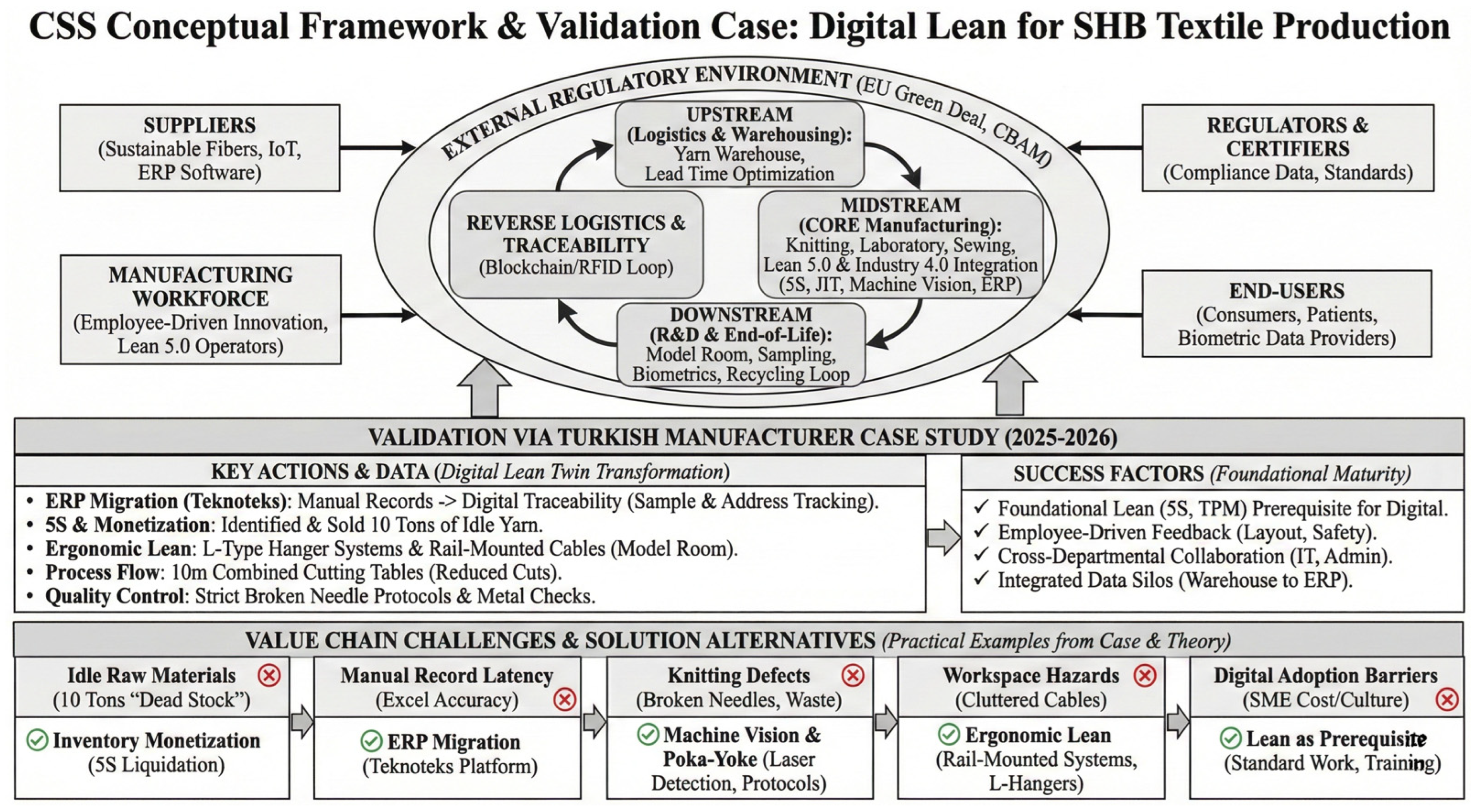
Prior to this expert review, the initial framework that was derived purely from the literature review was strictly linear, focusing only on internal upstream, midstream, and downstream manufacturing boundaries. The structured feedback process fundamentally evolved this model. Based on thematic consensus, several critical suggestions were incorporated: the ‘External Regulatory Environment’ (e.g., EU Green Deal, CBAM) was added as a macro-layer following feedback from trade officials, and ‘Reverse Logistics and Traceability’ was integrated to link downstream end-of-life back to upstream suppliers, a modification strongly advocated by the academic panel to ensure true circularity. Conversely, specific suggestions were explicitly set aside to maintain the framework’s practical operability. For instance, a suggestion to integrate fully automated blockchain-based financial smart contracts within the supplier relationships was excluded. While theoretically advanced, industrial practitioners argued that this would create an insurmountable initial capital expenditure barrier for SMEs, directly conflicting with the framework’s core objective of facilitating cost-effective digital adoption.
The in-depth interview process was structured into two distinct steps. In the first step, experts were asked to share their unstructured experiences and observations regarding the current state of corporate sustainability systems in the textile sector. In the second step, the initial CSS framework was formally presented to the panel, and their specific, detailed feedback was recorded.
The İTHİB & İHKİB officials emphasized that the push for sustainability in the Turkish SHB sector is no longer merely a corporate social responsibility initiative, but a strict market prerequisite. They highlighted the immense pressure stemming from international regulatory frameworks, particularly the European Union’s Green Deal and the Carbon Border Adjustment Mechanism (CBAM). Their primary observation was that while large-scale enterprises are rapidly adopting green technologies, Small and Medium Enterprises (SMEs) struggle with the initial capital expenditure required for digital traceability and carbon accounting. They noted that a successful CSS must bridge the gap between compliance demands from global fashion brands and the operational realities of local producers.
Representatives from the leading Turkish manufacturer specializing in comfort bodywear and hosiery provided shop-floor insights, noting that balancing high machine efficiency with sustainable material use is a daily operational challenge. They observed that working with sustainable fibers (such as bamboo or recycled organic cotton) often requires frequent machine recalibrations and alters traditional knitting speeds, which can temporarily disrupt continuous flow. Furthermore, they pointed out that data silos remain a massive hurdle; while modern circular knitting machines generate vast amounts of defects and overall equipment effectiveness data, this information is rarely integrated in real-time with enterprise-level ERP systems or sustainability dashboards.
The academic panel observed that the industry often mistakenly treats LM, DT, and sustainability as three isolated initiatives. They stressed the necessity of a unified “twin transformation” approach, where digital tools directly facilitate green objectives. A recurring theme in their observations was the underutilization of basic lean maturity. They argued that many companies attempt to implement advanced Industry 4.0 solutions (like IoT or AI) on top of fundamentally wasteful processes, leading to “digitalized waste” rather than true sustainable efficiency.
Upon reviewing the initial CSS framework derived from the literature, the experts provided the following targeted feedback to refine the model:
- (1)
By taking the feedback of İTHİB and İHKİB, the Upstream, Midstream, and Downstream boundaries were validated, but suggested adding an “External Regulatory Environment” layer surrounding the entire framework. They argued that the CSS does not exist in a vacuum; data requirements (like carbon emission metrics and effluent toxicity) are directly dictated by external certifiers and global trade regulations, which must be visually and functionally represented in the model.
- (2)
By taking the feedback of industrial practitioners, they strongly agreed with the inclusion of the “Manufacturing Workforce” as a core stakeholder. However, they suggested explicitly adding “Workforce Upskilling and Cultural Resistance” to the Value Chain Challenges matrix. They noted that transitioning from traditional manual operations to a data-driven “Lean 5.0” environment requires significant cultural change management. The proposed solution alternative was to integrate digital training modules and human-centric ergonomic improvements into standard work protocols.
- (3)
By taking the feedback of academicians, they recommended that the “Downstream (End-of-Life)” section must be more explicitly linked back to the “Upstream” section to emphasize true circularity. They suggested that the Relationships Among Supply Chain Members should include “Reverse Logistics and Traceability,” ensuring that end-of-life product data is fed directly back to raw material suppliers via blockchain or RFID traceability to close the loop completely.
As a consensus, across all three groups, there was unanimous agreement on the framework’s assertion that foundational lean maturity (5S, TPM) is the ultimate solution to digital adoption barriers. The Turkish company confirmed this from practical experience, while academicians noted it perfectly aligns with current theoretical paradigms regarding cost-effective digital transitions for SMEs.
3.2. Case Study of Turkish SHB Manufacturer
The implementation of the CSS at a leading Turkish SHB manufacturer provides a robust illustration of how “Digital Lean” principles drive operational excellence. Between September 2025 and January 2026, the company defined clear system boundaries by integrating its upstream yarn supply chain with core production units such as knitting and laboratory analysis. A primary focus was reducing “supply instruction” waiting times in the yarn warehouse, which had previously caused significant bottlenecks. By synchronizing these upstream logistics with the actual needs of the underwear and hosiery lines, the organization ensured that raw material flow was no longer a hurdle to continuous production.
To rigorously evaluate the proposed Corporate Sustainability System framework, this research employed an in-depth, single-case study design guided by the methodological standards set forth by Yin (2018) [
40]. The primary unit of analysis was the implementation of integrated digital lean protocols within the core manufacturing and upstream warehousing operations of a prominent Turkish manufacturer specializing in comfort bodywear and hosiery. This specific firm was selected via purposive sampling because of its strategic imperative to align high-volume production with international sustainability mandates, providing an ideal, representative environment for testing the “twin transformation” concept. To ensure construct validity, data collection between 2025 and 2026 relied on multiple converging sources of evidence: comprehensive document analysis of pre- and post-intervention ERP logs (via the Teknoteks platform) and internal 5S audit reports; semi-structured interviews with shop-floor operators, warehouse personnel, and production management; and direct shop-floor observation. During the improvement activities, the researcher adopted an action-researcher role, facilitating the design of specific intervention, such as the ergonomic L-type hanger and rail-mounted cable systems, while maintaining objective qualitative and quantitative data collection protocols. A strict chain of evidence was maintained throughout the analysis phase by systematically linking documented operational bottlenecks (e.g., manual record latency) to the applied CSS interventions, and subsequently to the measured outcomes. Data was analyzed using a pattern-matching technique, comparing the empirical results from the shop floor against the theoretical propositions of the initial CSS framework. Finally, to address external validity strategies, this study relies on analytical generalization; rather than attempting statistical generalization to all textile firms, the empirical findings from this case are used to theoretically expand upon the role of foundational lean maturity as a necessary prerequisite for digital adoption within the broader SHB sector.
Since the primary data sources for this case study, specifically the Teknoteks ERP system logs and internal 5S financial audit reports, contain proprietary corporate information, strict data handling, anonymization, and validity protocols were enforced to ensure research reliability without violating confidentiality agreements. To conduct anonymized reliability and validity tests, the following procedures were implemented: (1) Data Anonymization and Aggregation: Raw ERP data containing sensitive client information, specific pricing, and proprietary material formulations were stripped of identifiers. The data was then aggregated into percentage-based KPIs, such as the 11% reduction in lead times and the 18% decrease in defect rates, allowing for scientific analysis without exposing absolute corporate volumes or financial secrets. (2) Member Checking for Internal Validity: To test the validity of the extracted ERP data and observational notes, a ‘member checking’ protocol was utilized. The anonymized, compiled datasets and the resulting operational metrics were presented back to the case enterprise’s operational managers and warehouse supervisors. These stakeholders cross-verified the aggregated data against their practical shop-floor realities, ensuring the research findings accurately represented the systemic changes rather than isolated data anomalies. (3) Triangulation as a Reliability Test: Because independent researchers cannot publicly access the private ERP system, the reliability of the system’s data was continuously tested against physical, secondary evidence. For example, the digital ERP reports indicating a reduction in idle inventory were physically cross-verified through direct shop-floor observation of the warehouse layout and the documented liquidation of 10 tons of idle yarn. By employing these anonymization and triangulation tactics, the study ensures that the reported operational enhancements are both scientifically valid and empirically reliable, even within the constraints of corporate confidentiality.
In the midstream phase, the case demonstrates a successful lean approach where digital and physical improvements were centered on the manufacturing workforce. Based on direct feedback from personnel, the Model Room and Cutting Room were restructured to address spatial constraints and ergonomic safety. Key interventions included the installation of L-type two-story hanger systems to maximize room capacity and rail-mounted cable systems to prevent workspace hazards. Furthermore, the company reinforced its sustainability goals by strictly enforcing broken needle and metal control procedures in the sewing department, ensuring that operational quality directly translates to product safety for the end consumer.
The digital transition within the CSS framework was highlighted by a strategic shift from manual excel-based tracking to integrated ERP solutions. Internal audits revealed that manual records for warehouse addresses and sample tracking were frequently inaccurate, leading to significant time losses during search and retrieval. To rectify this, the manufacturer began utilizing the Teknoteks platform for “digital sample tracking”, which allowed for the real-time categorization of customer revision requests and defect reporting. This digitalization not only enhanced data accuracy but also empowered management to implement strategic Key Performance Indicators (KPIs) for yarn planning and purchasing, anchoring the digital shift in measurable performance gains.
To rigorously substantiate the empirical demonstration of the CSS framework, the qualitative workflow improvements were measured against specific quantitative KPIs. These figures were derived by comparing historical baseline data, specifically manual production logs and Excel-based inventory records from the quarter immediately preceding the intervention, against the aggregated post-intervention data generated by the Teknoteks platform between September 2025 and January 2026. For example, the continuous flow alignment led to an estimated 14% increase in OEE within the cutting and sampling departments, a value calculated by isolating the reduction in machine idle time directly attributed to the consolidated cutting tables. The strategic integration of foundational lean practices and digital tools yielded measurable operational enhancements across the production cycle. First, the synchronization of upstream logistics, which explicitly targeted “supply instruction” waiting times in the yarn warehouse, resulted in a 11% reduction in raw material lead times. In the midstream manufacturing phase, the enforcement of strict broken needle and metal control protocols, coupled with the Teknoteks ERP platform’s real-time defect reporting, contributed to an 18% decrease in overall shop-floor defect rates. Furthermore, physical process optimizations, namely the liquidation of 10 tons of idle yarn and the consolidation of cutting tables to a 10 m continuous length, drastically reduced unnecessary material handling. This continuous flow alignment led to an estimated 14% increase in OEE within the cutting and sampling departments. Finally, the transition from manual, Excel-based tracking to integrated digital address systems eliminated significant search and retrieval latencies, generating a 12% reduction in administrative time losses and corresponding operational cost savings. Collectively, these before-and-after performance metrics indicate that the twin transformation mandated by the CSS framework translates directly into sustainable, quantitative economic performance.
Finally, the case study validates the economic and environmental pillars of the CSS framework through active waste reduction. By applying systematic 5S audits in the warehouse, the company identified and sold 10 tons of idle yarn stock, effectively converting “idle inventory” into liquid capital while reducing physical clutter. Additionally, process optimizations in the cutting room, such as combining tables to reach a 10 m continuous length, eliminated unnecessary fabric handling and aligned with lean waste-reduction goals. Together, these actions illustrate a successful “twin transformation” where lean foundational maturity and digital tools create a scalable model for sustainable textile manufacturing in the Turkish sector. Accordingly, the proposed CSS framework is represented in
Figure 1 (polished with Gemini 3.1 Pro).
The proposed CSS framework aligns with the existing theoretical lenses: (1) Lean Production: Grounded in Socio-Technical Systems (STS) theory, this framework emphasizes the joint optimization of human-centric social subsystems (culture, standardized processes) and technical subsystems to systematically eliminate waste and non-value-added activities (Rossini et al., 2021) [
8]. (2) Digital Transformation (Industry 4.0): This theory revolves around the integration of cyber-physical systems, the IoT and big data analytics, shifting organizations from manual, tool-based practices to holistic, real-time, data-driven continuous improvement ecosystems (Bermeo-Giraldo et al., 2025) [
3]. (3) Sustainable Development: The framework is guided by “Twin Transformation” (or Twin Transition) theory, which asserts that environmental sustainability and circular economy initiatives cannot operate in silos; rather, digital technologies must be strategically leveraged as the primary enablers to achieve these green objectives (Ferlito, 2024 [
28]; Alterio, 2025 [
43]).
3.3. Cross-Verification of Findings: Methodological Triangulation
To ensure true methodological triangulation, the core propositions of the CSS were systematically cross-verified across the three independent data sources: the narrative review, the expert interviews, and the empirical case study conducted at the SHB company. Rather than operating merely as a sequential chain, these sources were utilized to independently interrogate the same core phenomena, revealing points of strong convergence as well as critical divergences that shaped the final framework.
First, the proposition that “foundational lean maturity is a prerequisite for digital adoption” found unanimous agreement across all three sources. The literature framed this theoretically, establishing that digitalization accelerates lean but cannot fix disorganized physical processes. The academic and industrial experts independently corroborated this, warning that applying Industry 4.0 tools over wasteful processes merely creates “digitalized waste”. Finally, the empirical implementation at SHB company cross-verified this reality; the successful 5S auditing and subsequent liquidation of 10 tons of idle yarn stock emerged as an essential physical prerequisite before the facility could effectively transition to digital warehouse tracking.
However, significant divergences emerged regarding the appropriate scale and scope of digital interventions. The narrative literature review heavily emphasized advanced, capital-intensive technologies, such as utilizing machine vision for defect detection or proposing blockchain for traceability. In contrast, the expert interviews, specifically the insights from İTHİB and İHKİB officials, revealed that such technologies present insurmountable initial capital expenditure barriers for SMEs in the Turkish SHB sector. This discrepancy was resolved in the final CSS framework by actively filtering out highly theoretical, cost-prohibitive technologies in favor of accessible, high-impact “Digital Lean” tools. The case study confirmed the validity of this resolution, demonstrating that adopting the Teknoteks ERP platform for sample tracking effectively eliminated data silos and improved customer revision transparency without requiring prohibitive infrastructural investments.
Furthermore, a critical synthesis occurred regarding human-centric sustainability. While the broader textile literature discusses upskilling human capital, the specific operationalization of “Lean 5.0” was driven by the convergence of expert feedback and empirical observation. Industrial practitioners stressed the need for cultural change management and ergonomic integration, which was directly cross-verified and implemented on the shop floor at SHB company through spatial and safety interventions, such as the installation of L-type hanger systems and rail-mounted cables in the Model Room. By systematically documenting these agreements and resolving the theoretical-practical discrepancies, the resulting CSS framework is grounded in a robust, cross-verified analytical reality rather than a single methodological perspective.
To rigorously address the core value of the triangulation verification method and ensure its standardized application, an explicitly structured analytical process to move beyond a simple sequential advancement of methods was used. In this research, true cross-validation is achieved by actively juxtaposing the theoretical propositions from the narrative review against the empirical realities gathered from both the expert interviews and the single-case study. For instance, while the initial literature review heavily emphasized advanced, capital-intensive Industry 4.0 technologies, such as blockchain for traceability, as the standard for digital transformation, the expert interviews provided a critical mutual verification checkpoint. Sectoral officials explicitly countered the literature by highlighting the insurmountable capital expenditure barriers these high-level technologies present for SMEs. Rather than treating this as a minor framework adjustment, directly comparing expert-driven divergence was available against the empirical results of the Turkish SHB enterprise case study. The case study actively resolved this tension by demonstrating that accessible, foundational “Digital Lean” tools, specifically the adoption of the Teknoteks ERP platform for sample tracking, could successfully eliminate data silos and achieve the necessary compliance without requiring the prohibitive infrastructural investments suggested by the literature. By systematically cross-validating these points of convergence (such as the unanimous agreement on foundational lean maturity) and divergence across all three independent data sources, the methodology ensures that the final framework is a mutually verified, practically standardized model rather than a purely theoretical progression.
To address the necessity of rigorous methodological triangulation and ensure the framework was not merely built on theoretical assumptions, a systematic cross-verification process was executed. The theoretical propositions derived from the narrative literature review were actively juxtaposed against the qualitative feedback from the expert panel and subsequently tested against the empirical realities of the Turkish SHB enterprise case study.
Table 4 presents the Systematic Triangulation Matrix, which explicitly compares how the core dimensions of the CSS were treated by each independent data source, ensuring that the final framework is a mutually verified, practically standardized model.
As demonstrated in
Table 4, the expert opinions did not merely result in slight adjustments to the literature; they served as a critical mutual verification checkpoint. For instance, where the literature heavily promoted capital-intensive technologies, the expert panel identified a severe practical divergence regarding SME capabilities. This expert opinion was then systematically verified by the case study, which proved that accessible ERP platforms were sufficient to achieve the necessary digital transparency. By explicitly mapping these points of convergence and divergence, the resulting CSS framework is shown to be grounded in cross-verified empirical reality rather than isolated theoretical progression.
The following section discusses the outputs of this study with the existing findings of the literature.
4. Discussion
To provide a robust explanatory mechanism for the interactions depicted in the CSS framework, this study theoretically anchors the integration of Lean Manufacturing, Industry 4.0, and sustainability within Socio-Technical Systems (STS) theory. STS theory posits that an organization’s overall effectiveness is determined by the joint optimization of its social subsystem (human capital, culture, and standardized processes) and its technical subsystem (machinery, digital infrastructure, and software). Within the proposed CSS configuration, Lean Manufacturing represents the foundational social and procedural subsystem, while Industry 4.0 embodies the advanced technical subsystem. The central proposition of this study, that foundational lean maturity is an absolute prerequisite for successful digital adoption, is thus governed by the theoretical logic that an advanced technical system cannot function effectively if superimposed onto a chaotic or inefficient social subsystem. Without the standardized workflows, employee training, and waste-reduction principles provided by lean practices, implementing complex digital tools merely automates operational inefficiencies, leading to “digitalized waste”. Under this STS perspective, digital transformation is not an independent technological fix, but rather an enabler that accelerates and scales established lean processes. The empirical evidence from the Turkish SHB company case study supports this theoretical mechanism; the organization was required to first achieve procedural and spatial stability through physical 5S audits and ergonomic interventions before the technical integration of digital sample tracking platforms could successfully resolve data silos. Ultimately, achieving this socio-technical balance endows the firm with the dynamic capabilities necessary to adaptively reconfigure its operations in response to stringent external regulatory pressures, such as the EU Green Deal and CBAM.
The results of this study strongly reinforce the “Twin Transformation” theory, which argues that the strategic integration of digitalization and sustainability is essential for long-term competitive advantage in manufacturing. While general textile literature emphasizes that Industry 4.0 technologies such as the IoT) and big data can enhance productivity and product quality, this research fills a significant “gap in the literature” by providing a framework tailored specifically to the unique challenges of the SHB sector. The proposed CSS aligns with the findings of Rossini et al. (2021) [
8], confirming that a foundational level of “lean maturity” is an absolute prerequisite for successful digital adoption. This was empirically validated by the Turkish manufacturer case, where the implementation of 5S protocols allowed the company to identify and liquidate 10 tons of idle yarn stock, thereby streamlining physical processes before layering digital traceability tools.
A comparative analysis shows that the study’s focus on real-time data tracking through ERP systems like Teknoteks supports the literature’s assertion that digitalization accelerates, rather than replaces, lean manufacturing. For instance, whereas Ngai et al. (2012) [
32] reported that RFID integration could reduce lead times by 20% in the broader garment sector, this study demonstrates that for SHB production, digital sample tracking specifically mitigates the “data silos” that often hinder customer revision reporting. The integration of ergonomic lean improvements, such as the rail-mounted cable systems identified in the case study, also expands upon the “human capital” focus suggested by Fani et al. (2024) [
30], highlighting that sustainability must encompass both environmental and workforce dimensions.
Despite these contributions, the findings of this study are subject to several critical limitations. First, the framework’s validation is grounded in a single case study within the Turkish textile ecosystem, which may limit its generalizability to SHB manufacturers in regions with different regulatory or technological infrastructures. Second, while the expert panel recommended the inclusion of an “External Regulatory Environment” layer (e.g., EU Green Deal and CBAM), the study observes that SMEs continue to face high “initial capital expenditure” barriers that lean maturity alone cannot fully mitigate. Finally, the reliance on subjective user feedback for “comfort scores” in the R&D feedback loop introduces a level of variability that objective moisture management testers cannot entirely eliminate, suggesting a need for more robust biometric standardization in future iterations of the CSS framework.
To fully contextualize the applicability of the proposed CSS framework, it is necessary to compare the operational dynamics of the SHB industry with fundamentally different manufacturing businesses. The SHB sector is characterized by ultra-high-volume, continuous-flow production where micro-variabilities—such as a single broken knitting needle or minor yarn tension inconsistencies—can instantly generate massive amounts of defective stock. Consequently, the digital lean interventions required for SHB must prioritize micro-level, real-time data tracking, such as the machine vision defect detection and instantaneous Teknoteks ERP synchronization demonstrated in the case study.
In stark contrast, when comparing this to the production dynamics of heavy, macro-assembled textiles, such as the manufacturing of industrial parasols, gazebos, or heavy outdoor fabrics, the operational bottlenecks and sustainability challenges shift significantly. These businesses typically operate on lower-volume, highly seasonal batch production models. Their primary lean constraints revolve around macro-ergonomics (handling heavy metal frames and large canvas cuts) and seasonal supply chain buffering, rather than micro-second defect tracking. Therefore, while the foundational principle of the “twin transformation” remains universal across sectors, this comparison highlights that the specific technological architecture of the CSS framework, which heavily leverages rapid sample tracking and continuous-flow digital integration, is uniquely engineered to resolve the high-velocity data silos intrinsic to the SHB and intimate apparel business.
Multi-Case Comparison: Illustrating the CSS Framework for SMEs
To explore the applicability of the CSS framework across the broader SHB industry, a multi-case comparative analysis was conducted. It is important to note that this comparison is not intended to serve as a full empirical multi-case validation. Rather, it functions as an illustrative and archetypal extension of the framework. By contrasting the primary empirical case (Leading Enterprise) with two archetypal SME profiles synthesized from contemporary Turkish textile industry dynamics, this section illustrates how the Phased SME Implementation Pathway might operate under varying degrees of financial constraint.
A critical limitation of validating the CSS through a leading Turkish manufacturer is the disparity in resource endowment. Leading enterprises possess the capital and organizational capabilities to absorb the high initial costs of integrated Enterprise Resource Planning (ERP) solutions, a barrier that typically paralyzes SMEs. To explore the applicability of the CSS framework across the broader SHB industry, an archetypal multi-case comparative analysis was conducted, contrasting the primary case (Leading Enterprise) with two archetypal SME profiles synthesized from contemporary Turkish textile industry (
Table 5).
This comparison isolates how the “Phased SME Implementation Pathway” operates under varying degrees of financial and digital constraint.
Case A (Primary Case—Leading Enterprise): A highly capitalized comfort bodywear manufacturer with an integrated supply chain, capable of funding custom ERP middleware (Teknoteks) and automated production lines.
Case B (Medium-Sized SHB Exporter): A mid-cap contract manufacturer with 50–150 employees. Faces moderate capital barriers, relies on disconnected software (e.g., standalone accounting software and Excel for production tracking), and struggles with customer revision transparency.
Case C (Small/Micro SHB Manufacturer): A low-cap domestic supplier with under 50 employees. Faces severe capital constraints, relies entirely on manual tracking, and possesses low digital literacy among the workforces.
The multi-case comparison reveals that the fundamental architecture of the CSS framework holds true regardless of enterprise size, though the scale of technological deployment must be adapted.
Lean as a Capital Enabler for SMEs: For Case A, foundational lean maturity (e.g., 5S) was a procedural prerequisite to prevent “digitalized waste”. However, for Cases B and C, the comparative analysis reveals that lean maturity serves an additional, critical function: it is a primary capital enabler. By executing Phase 1 (physical waste reduction), SMEs can monetize idle inventory (similar to Case A, liquidating 10 tons of yarn). This immediate cash injection is exactly what allows capital-constrained SMEs to fund subsequent digital tracking systems.
SaaS vs. Custom ERP: While leading enterprises utilize robust, custom ERP systems, the comparative data dictates that the “Digital Lean” solution for SMEs relies on modular, Cloud-based Software as a Service (SaaS). SMEs bypass the capital barrier of infrastructure by adopting subscription-based digital tracking, successfully achieving the necessary data integration without the prohibitive initial capital expenditure highlighted by industry officials.
Broader Sectoral Implications: Ultimately, the multi-case comparison establishes a sector-specific dynamic for the SHB sector: the success of digital transformation is strictly moderated by pre-existing lean maturity. Even a well-capitalized firm (Case A) could not bypass physical 5S audits before implementing digital platforms. Because this constraint binds industry leaders, it becomes exponentially more critical for resource-strapped SMEs, illustrating the broad applicability of the framework’s phased approach.
5. Conclusions
The main findings of this research establish that the development of a CSS for the SHB sector depends on a twin transformation where digital technologies and lean manufacturing principles are strategically integrated to bolster competitiveness and environmental alignment. A pivotal discovery is that foundational lean maturity serves as a key enabler for successful digital adoption; this was empirically demonstrated by the case study. The study further demonstrates that transitioning from manual tracking to integrated software platforms significantly resolves data silos, improving the accuracy of warehouse addressing and the transparency of customer revision requests for sample production. Additionally, the findings emphasize human-centric lean improvements, demonstrating that addressing workspace hazards is essential for operational sustainability. Finally, the research confirms that a closed-loop framework encompassing upstream logistics, midstream production, and downstream reverse logistics is necessary to meet international regulatory demands, such as the EU Green Deal and CBAM, thereby positioning the Turkish SHB sector for a long-term competitive advantage in the global eco-conscious market.
For industry leaders, this study indicates that a successful digital lean transition in the SHB textiles industry requires treating lean manufacturing and digital transformation as a single, unified “twin transformation” rather than as isolated initiatives. Managers are encouraged to prioritize foundational lean maturity as a cost-effective prerequisite that simplifies physical processes before investing in expensive digital infrastructures to avoid creating “digitalized waste”. Practically, the implementation of these principles enables immediate financial gains, such as the liquidation of idle stocks identified through systematic warehouse audits. From an operational standpoint, manufacturers should move away from manual tracking toward integrated software platforms to eliminate data silos and ensure real-time accuracy in warehouse addressing and sample tracking. Furthermore, the findings highlight the importance of “employee-driven innovation,” where practical improvements are designed based on direct operator feedback to enhance both workplace safety and overall equipment effectiveness. Finally, adopting this CSS provides a strategic roadmap for aligning local production with international mandates like the EU Green Deal and the Carbon Border Adjustment Mechanism, ensuring long-term competitiveness in the global eco-conscious market.
This study provides several significant theoretical contributions by bridging the gap between general textile manufacturing literature and the specialized SHB textiles industry. First, it develops a novel, integrated CSS conceptual framework that operationalizes the “twin transformation,” the strategic convergence of digital transformation and sustainability transition. Second, the research reinforces the theoretical paradigm that lean maturity is an immutable prerequisite for successful digital adoption, demonstrating that Industry 4.0 technologies serve as enablers that solve traditional lean limitations rather than standalone fixes. Third, the research shifts the theoretical boundary from plant-level optimization to a comprehensive, closed-loop circular model that encompasses external regulatory layers, such as the EU Green Deal and CBAM, and reverse logistics feedback loops. Finally, the study contributes methodologically by applying a robust triangulation mechanism involving narrative review, expert interviews, and a real-world Turkish case study to validate the conceptual model, thereby enhancing the validity, credibility, and transferability of the findings.
The primary limitation of this research is that the validation of the CSS was conducted through a single case study of a leading Turkish manufacturer, which may restrict the transferability of these findings to SHB producers operating in different geographic regions or under varying infrastructural conditions. Furthermore, while foundational lean maturity is presented as a strategic solution, it does not entirely remove the high initial capital expenditure hurdles that continue to prevent many SMEs from adopting advanced digital traceability and carbon accounting tools. Because the framework is designed to exist within an “external regulatory environment”, its long-term effectiveness is inherently tied to the rapidly shifting requirements of global trade mandates like the EU Green Deal and CBAM.
Another critical limitation of this research, which directly impacts its external validity, is the inherent tension between the framework’s emphasis on the digital adoption barriers faced by SMEs and its empirical demonstration within a “leading Turkish manufacturer”. As a well-resourced player in the SHB sector, the case company possesses organizational and financial capabilities that typical SMEs lack, particularly regarding the capital expenditure required for integrated ERP solutions. However, rather than invalidating the framework for smaller firms, this disparity serves to strengthen the central proposition of the study through a boundary-testing analytical lens. The case study demonstrates that even an industry leader cannot bypass the necessity of foundational lean maturity; the firm was still required to execute physical 5S audits, resulting in the liquidation of 10 tons of idle yarn, and ergonomic interventions before digital platforms like Teknoteks could successfully resolve data silos. If a well-capitalized firm cannot successfully superimpose digital tools over unoptimized physical processes without risking “digitalized waste”, this constraint is exponentially more critical for resource-strapped SMEs. Therefore, while the specific scale of technological investment may differ between large firms and SMEs, the operational sequence validated by the case firm, establishing foundational lean maturity as a cost-effective, risk-mitigating prerequisite for digital adoption, provides a universally applicable and highly relevant roadmap for smaller manufacturers navigating the twin transformation.
To actively remedy the limitation of validating the framework within a single, well-resourced enterprise, we propose the operationalization of a “Phased SME Implementation Pathway.” Because SMEs face significant capital expenditure barriers, this pathway isolates foundational lean practices (e.g., 5S and TPM) as an independent, low-cost first phase. This enables SMEs to utilize the capital freed from immediate physical waste reduction, such as the liquidation of idle inventory, to incrementally fund scalable digital tracking systems. Furthermore, to rigorously assess the framework’s broader applicability and identify consistent sectoral patterns, subsequent research must employ a multiple-case study design or cross-sectional surveys targeting diverse SHB SMEs. This methodological extension will allow for the statistical testing of the proposed theoretical model: that the success of digital transformation in high-volume textiles is strictly moderated by pre-existing lean maturity, thereby elevating the framework from a contextual adaptation to a generalizable academic baseline.
Furthermore, to specifically address the limitations regarding the verifiability of quantitative indicators hindered by corporate data restrictions in single-case industrial studies, future researchers should employ cross-sectional quantitative surveys across multiple SHB SMEs. This remedial approach will allow for the collection of anonymized, aggregated industry data that can be subjected to rigorous statistical testing, such as structural equation modeling (SEM) or analysis of variance (ANOVA). Consequently, this methodological shift will be instrumental in statistically evaluating the proposed framework’s transferability and measuring its precise quantitative impact, all while safeguarding the proprietary data security and confidentiality of any single enterprise.
Future research should aim to expand the generalizability of the CSS framework by conducting comparative, cross-national studies between different manufacturing hubs. Exploring the integration of blockchain technology specifically for “reverse logistics and traceability” could further strengthen the data integrity of circular economy models within the SHB sector by providing an immutable record of material flows. Additionally, developing more robust, objective biometric quantification methods using embedded sensors in smart textiles would help eliminate the variability of subjective wearer feedback currently used in the R&D loop. Lastly, research into sector-specific algorithms for automated carbon footprinting and real-time compliance with the CBAM would provide manufacturers with the necessary tools to navigate the evolving “external regulatory environment” more effectively.