Article

Wide-Band Harmonic Interaction and Characteristic Analysis of Flexible Cooperative Traction Power Supply System †
1
School of Electrical Engineering, Beijing Jiaotong University, Beijing 100044, China
2
China Shenhua Energy Company Limited, Beijing 100011, China
3
Guoneng Xinshuo Railway Co., Ltd., Ordos 611756, China
*
Author to whom correspondence should be addressed.
This paper is an extended version of a conference paper: Zhang, Y.; Wei, Y.; Cao, G. Wide-Band Harmonic Interaction and Characteristic Analysis of FCTPSS. In Proceedings of the 6th International Conference on Electrical Engineering and Information Technologies for Rail Transportation (EITRT) 2023, Beijing, China, 19–21 October 2023; Springer: Singapore, 2024; Volume 1135. Lecture Notes in Electrical Engineering. https://doi.org/10.1007/978-981-99-9307-9_1. This version includes significant additions in theoretical analysis, modeling, simulation results, and conclusions.
Sustainability 2026, 18(7), 3607; https://doi.org/10.3390/su18073607
Submission received: 22 February 2026 / Revised: 31 March 2026 / Accepted: 31 March 2026 / Published: 7 April 2026

Abstract

Integrating renewable energy systems (RES) and hybrid energy storage systems (HESS) into railway traction power supply systems represents a critical pathway toward low-carbon and sustainable railway transportation as it enables the utilization of clean energy and enhances energy efficiency. However, this integration introduces new harmonic resonance challenges that require systematic analysis. To quantitatively analyze these harmonic resonance issues, this paper studies a flexible cooperative traction power supply system (FCTPSS) integrated with RES and HESS. Based on harmonic transmission theory, mathematical models of harmonic transmission for both the traction power supply system (TPSS) and the FCTPSS are established. Simulation models of the TPSS and FCTPSS are developed in MATLAB2021b/Simulink. Using these simulation models, the harmonic transmission characteristics of the TPSS and FCTPSS are compared and analyzed. The results indicate that the position of the locomotive and the access position of RES and HESS influence the harmonic transmission characteristics. Importantly, integrating RES and HESS shifts the resonant frequency to higher orders and effectively alleviates resonance issues, thereby improving power quality and supporting the reliable operation of sustainable railway systems. These findings offer valuable design guidance for incorporating RES and HESS into traction power supply systems to facilitate the transition toward greener and more sustainable rail transportation.

1. Introduction

Currently, numerous studies have explored the integration of renewable energy systems (RES) and energy storage systems (ESS) into the grid [1,2,3,4,5]. RES can generate electricity in a green and clean manner, thereby reducing carbon emissions. ESS can mitigate the output volatility of renewable energy and improve power quality. Similarly, several studies have investigated the integration of RES and ESS into traction power systems (TPSS), which represents a crucial step toward decarbonizing railway transportation. For example, East Japan Railway Company has connected photovoltaic systems and energy storage to the traction power supply system [6,7,8,9,10]. Integrating RES and hybrid energy storage systems (HESS) into railways not only supports the green and sustainable development of the railway sector but also promotes the consumption of renewable energy, contributing to the low-carbon transformation of rail transit.
The integration of RES and HESS into TPSS is a new research direction, and most of the research is at present just starting. Reference [11] proposed a photovoltaic (PV) DC microgrid topology with HESS, which connected to TPSS through a railway power conditioner (RPC). This paper proposed the control strategy of the system and simulated the operation scheduling and energy flow of the system. Wu put forward a back-to-back PV power generation system for an electrified railway, designed its control strategy, established a simulation model and verified the feasibility of the system in [12]. In [13], Deng proposed a hybrid traction power supply system integrated with photovoltaic sources (HTPSS-PVSs), which can realize on-site access and consumption of PV power along the line without affecting the original structure of TPSS. In [14,15], the scheme of integrating RES and HESS into the TPSS was put forward, and by considering the uncertainty of RES output, the optimal solution of the power flow between RES, HESS, the power grid and the traction load was obtained, which reduced carbon emissions and the demand for power grid energy. In [16], Ying proposed a flexible intelligent traction power supply system that consisted of an AC–DC–AC traction substation and a microgrid along the railway, which can effectively alleviate the problem of negative sequence current and improve the utilization rate of regenerative braking energy and RES. These efforts collectively highlight the growing consensus that integrating distributed energy resources into railway systems is a promising pathway toward achieving sustainable and energy-efficient rail transportation.
Although the above references have done a lot of research on the topology and energy control strategy of the TPSS system accessed by RES and HESS, the research on the harmonic transmission characteristics of the new system is insufficient. Currently, AC–DC–AC an electric locomotive used in an electrified railway has the characteristics of a high power factor and low harmonic content, but its harmonic spectrum is relatively wide. Coupled with the spatiotemporal nature of locomotive movement mode, the introduced harmonics may appear as harmonic resonance and amplification in the propagation process of a traction network with a complex structure [17,18]. In addition, the access of RES and HESS will change the topology of TPSS, and new changes may appear in the harmonic interaction characteristics. Reference [19] has studied the distribution characteristics of harmonics in the power supply system running the super-capacitor tram and has proposed a new harmonic processing measure based on a notch high-pass filter. However, the topology of the TPSS remained unchanged in [19]. Therefore, to support the reliable and sustainable operation of future green railway systems, the objectives of this paper are to: (1) establish mathematical models for harmonic transmission in TPSS and FCTPSS; (2) develop a simulation model to validate the theoretical analysis; and (3) quantitatively compare locomotive current harmonic transmission and THD characteristics in traditional TPSS and CTPSS, providing a reference for future RES and HESS integration, thereby providing a technical foundation for the safe integration of RES and HESS in alignment with sustainable railway development goals.
This paper is organized as follows: Section 2 introduces the topology of FCTPSS and the mathematical models of harmonic transmission for TPSS and FCTPSS. Section 3 presents the simulation models of TPSS and FCTPSS developed in MATLAB2021b/Simulink. In Section 4, the harmonic transmission characteristics are simulated and verified, and the results are presented. Finally, Section 5 provides the conclusion and discussion for future work.

2. Topological Structure and Theoretical Analysis of Harmonic Characteristics of FCTPSS

2.1. Topology of FCTPSS

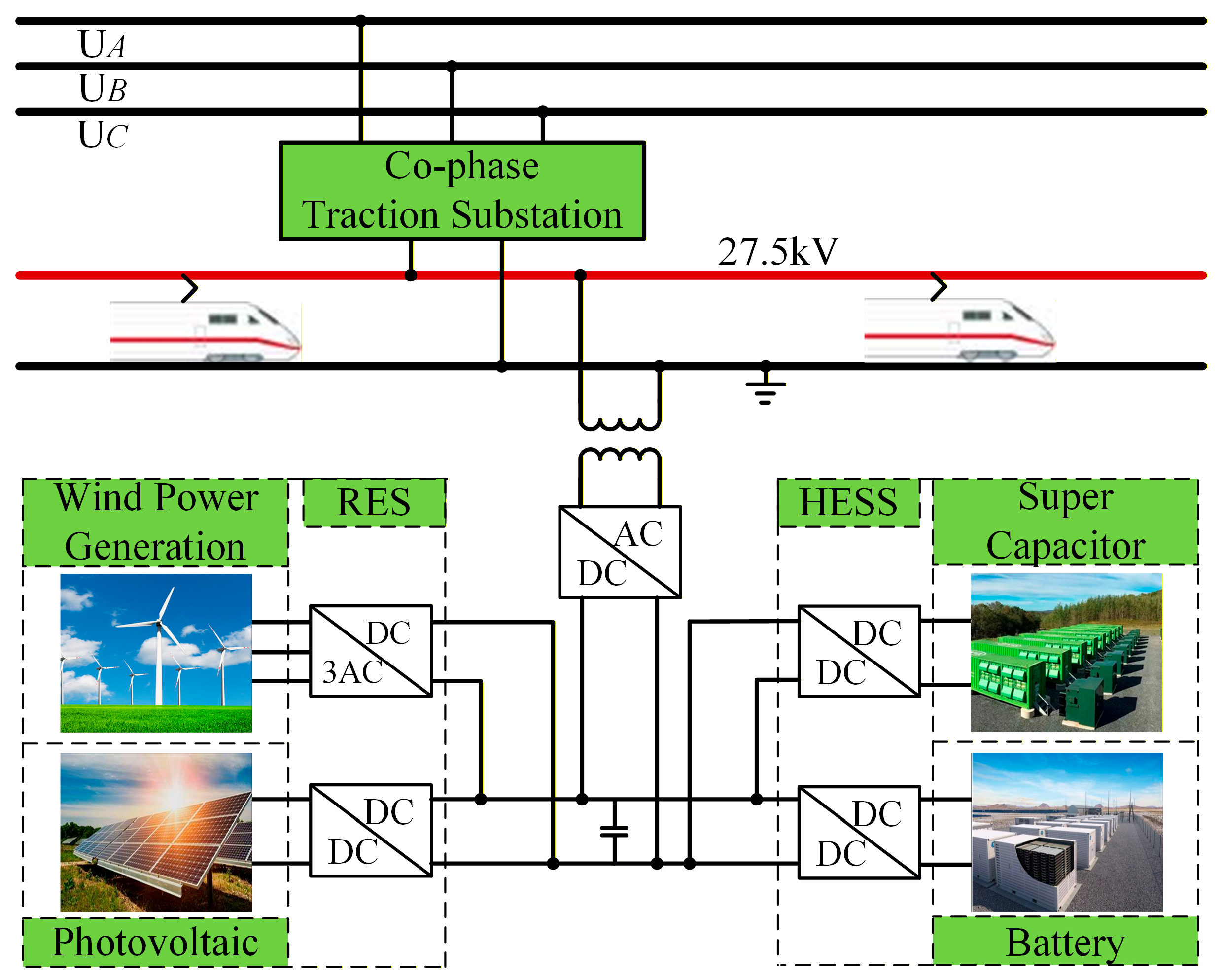
Co-phase power supply provides an idea to solve the power quality problem and the power phase separation problem of high-speed railway systems [20,21,22] and also provides a good integration method for the access of RES and HESS [16,23]. Co-phase power supply is the development direction of high-speed railway power supply systems in the future. Based on the scheme of co-phase power supply, this paper constructs a FCTPSS including wind power generation, photovoltaic power generation and HESS. The scheme proposed in this paper is to integrate wind power generation, photovoltaic power generation and HESS by connecting the converter to the DC bus, and then connect to TPSS through the DC/AC inverter connected to the step-down transformer, so as to supply power together with the power grid, as shown in Figure 1. The wind power generation is connected to the DC bus through the 3AC/DC converter, the photovoltaic power generation is connected to the DC bus through the DC/DC boost converter and the HESS is connected to the DC bus through the bidirectional DC/DC converter.
The advantages of the topological structure shown in Figure 1 are as follows: (1) the common DC bus provides a flexible interface for aggregating different RESs and HESS with different voltage and current characteristics; (2) it decouples the control of RES/HESS from the AC power grid, simplifying power management; (3) it is consistent with the architecture of the same phase traction power supply system, which is considered the future development direction of high-speed railway traction power supply systems.

2.2. Theoretical Modle of Harmonic Transmission in FCTPSS

The traction network includes two parts: the power supply network and the return network. The power supply network consists of a catenary (T), including contact wire, messenger wire, reinforcing wire, etc.; the return network consists of steel rail (R), negative feeder (NF), positive feeder (PF), protective wire (PW), etc. At present, there are two main power supply modes:a direct power supply with negative feeders and an autotransformer (AT) power supply, as shown in (a) and (b) of Figure 2 (single-wire traction network shown in the Figure 2). As a whole, the traction network is a parallel multi-conductor system. A power supply arm of a traction network is a chain network composed of series impedance elements and parallel admittance elements from the view of topology.
Both RES and the locomotive generate harmonics during operation. When the harmonic frequency matches the system parameters, a harmonic resonance phenomenon will occur [24,25,26,27]. In this section, the mathematical models of the harmonic characteristics of TPSS and FCTPSS are established, respectively, to analyze their harmonic transmission characteristics.
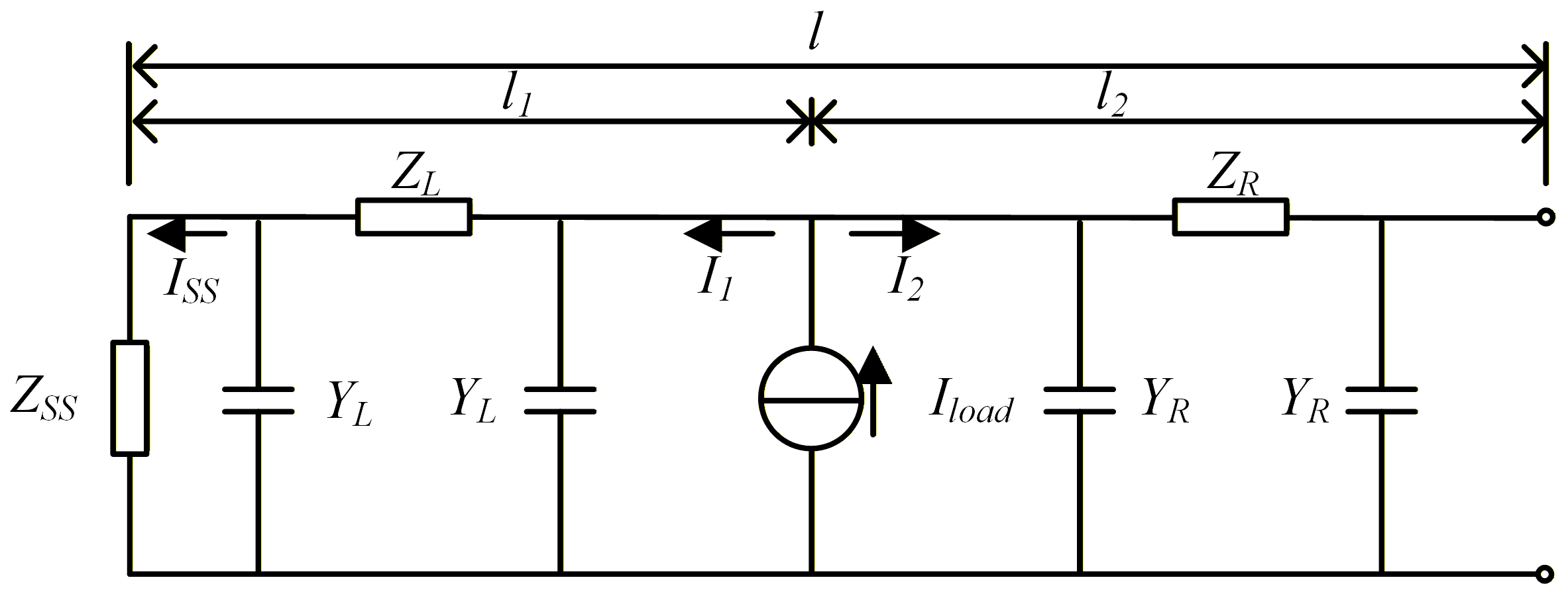
(1) The circuit network of the traction power supply system is equivalent to a π equivalent circuit model, as shown in Figure 3. Zss is the system impedance of traction substation, including power grid reactance and traction transformer reactance; I1 is locomotive current flowing to the traction substation; I2 is the locomotive current flowing to the section post; Iload is the locomotive current; l1 is the distance from locomotive to substation in kilometers; l2 is the distance from the locomotive to the section post, in kilometers. ZL and YL are the equivalent impedance between train and substation; ZR and YR are the equivalent impedance between the train and the section post.
The equivalent impedance of the traction network is:
Z L = Z 0 s h ( γ l 1 ) , Y L = ( c h ( γ l 1 ) 1 ) Z 0 s h ( γ l 1 ) Z R = Z 0 s h ( γ l 2 ) , Y R = ( c h ( γ l 2 ) 1 ) Z 0 s h ( γ l 2 ) ,
where, Z 0 = Z / Y is the characteristic impedance of traction network line, Z is the equivalent impedance per unit length of traction network line and Y is the equivalent admittance per unit length. γ = Z Y is the propagation coefficient of the traction network line. Assuming the contact network is a uniform transmission line, the actual line parameters Y = 17.96 × , Z = 0.106 + 0.0017 × (ω = 2πf) are used. The theoretical analysis in this section adopts this set of parameters.
From this point of the train, the equivalent input impedance Zq of the traction network is:
Z q = Z 0 c h γ l 2 ( Z s s c h γ l 1 + Z 0 s h γ l 1 ) Z s s s h γ l + Z 0 c h γ l ,
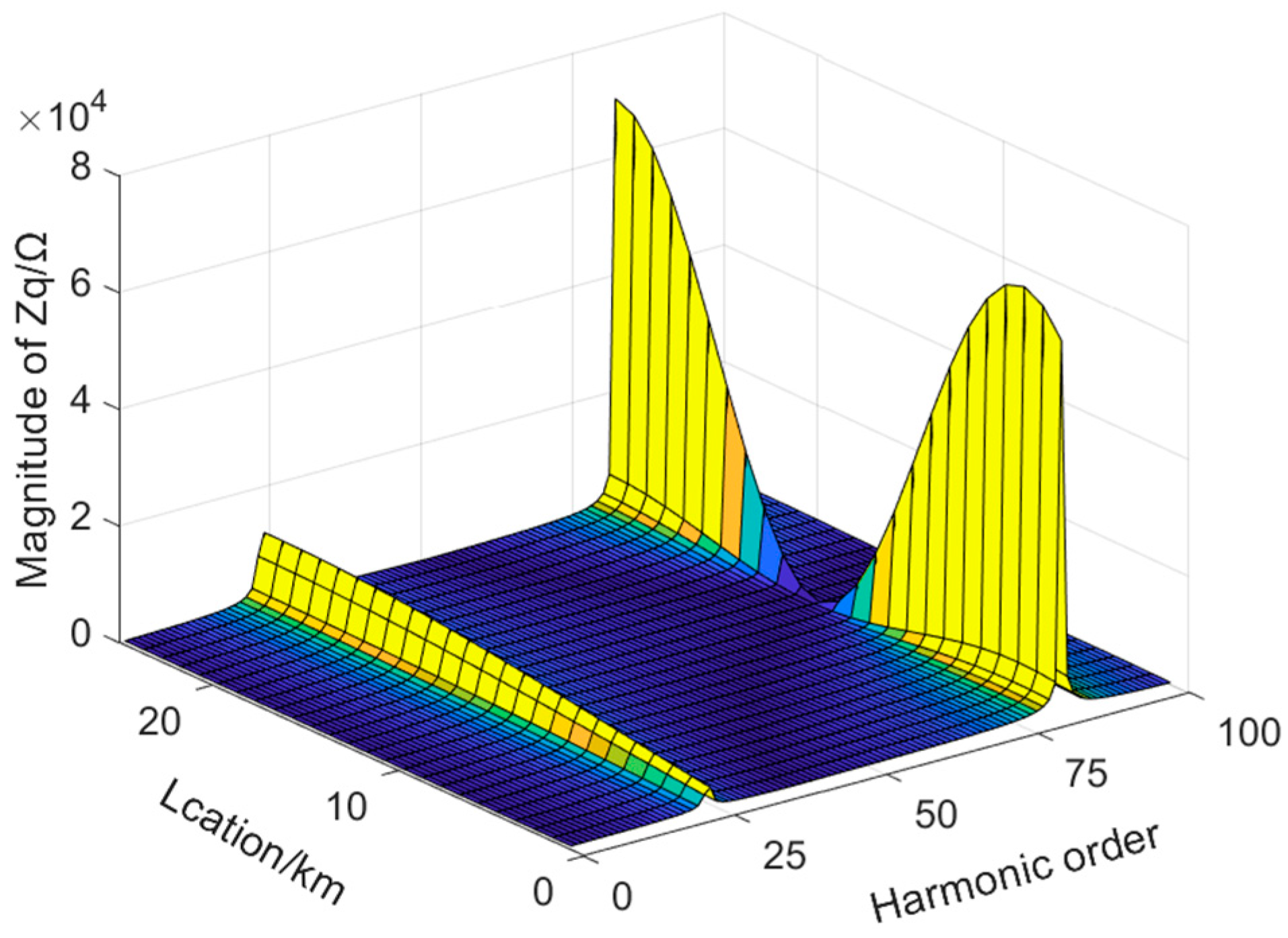
According to Formula (1), the image of the change of the equivalent input impedance Zq of the traction network with the locomotive position and harmonic frequency can be drawn as shown in Figure 4. It can be seen that Zq changes with the locomotive access location and harmonic frequency. The equivalent impedance Zq has a peak value around the 25th and 81st harmonic frequencies, which are resonant frequencies. And, at the 25th harmonic, the farther away from the substation, the greater the value of Zq.
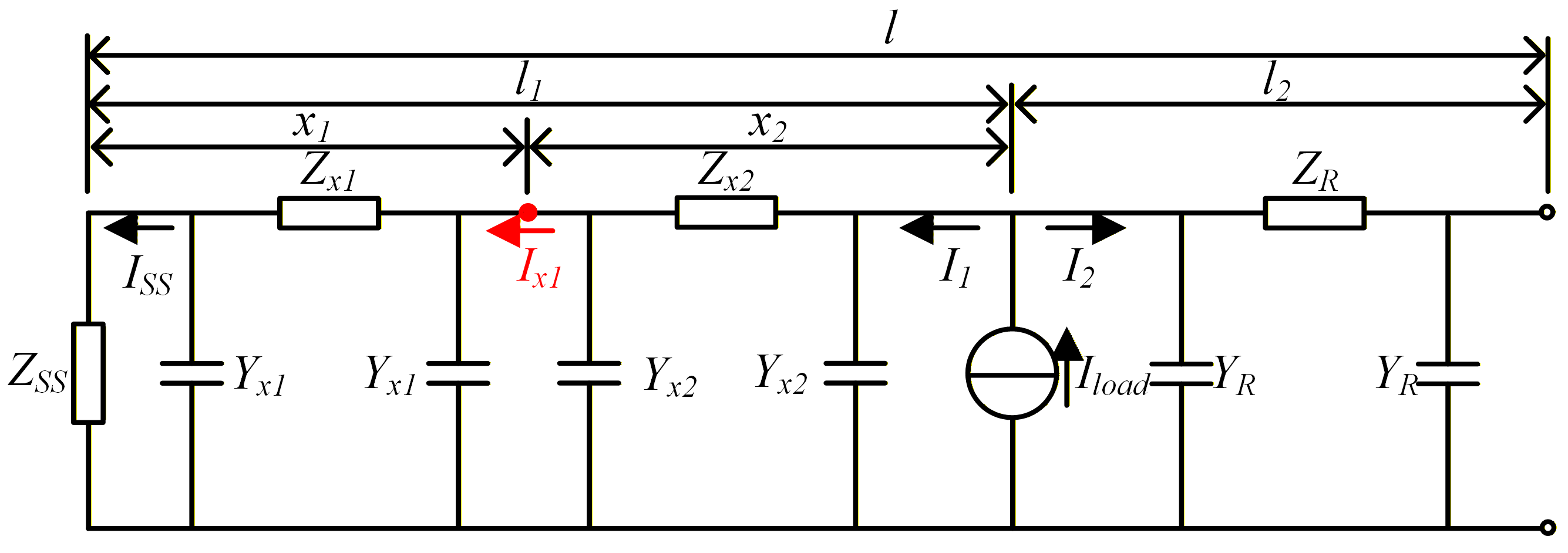
The locomotive harmonic current will change through the transmission of the traction network. Assume that the train current at x1 from the substation is Ix1, as shown in Figure 5.
Then I1 and Ix1 are, respectively:
I 1 = c h γ l 2 ( Z s s s h γ l 1 + Z 0 c h γ l 1 ) Z s s s h γ l + Z 0 c h γ l I l o a d I x 1 = ( Z s s s h γ x 1 + Z 0 c h γ x 1 ) Z s s s h γ l 1 + Z 0 c h γ l 1 I 1 = c h γ l 2 ( Z s s s h γ x 1 + Z 0 c h γ x 1 ) Z s s s h γ l + Z 0 c h γ l I l o a d ,
Qam is defined as the amplification factor of locomotive current amplified by the traction network, and the Qam of current Ix1 at distance x1 from substation is:
Q a m = I x 1 I l o a d = c h γ l 2 ( Z s s s h γ x 1 + Z 0 c h γ x 1 ) Z s s s h γ l + Z 0 c h γ l ,
According to Formula (4), when the denominator in the equation is 0 or close to 0, Qam reaches the maximum, that is, harmonic resonance occurs. The resonant condition is: Z s s s h γ l + Z 0 c h γ l = 0 , because γl << l, thγl ≈ γl, Z s s = Z 0 / ( γ l ) . Z s s is expressed by traction transformer inductance L s s as Z s s = ω L s s , and the resonant frequency f 0 = 1 / 2 π L s s C .
When x 1 = 0 , the current I s s flowing into the traction substation can be obtained, and the Qam of the current Iss at the substation is:
Q a m = I s s I l o a d = Z 0 c h γ l 2 Z s s s h γ l + Z 0 c h γ l ,
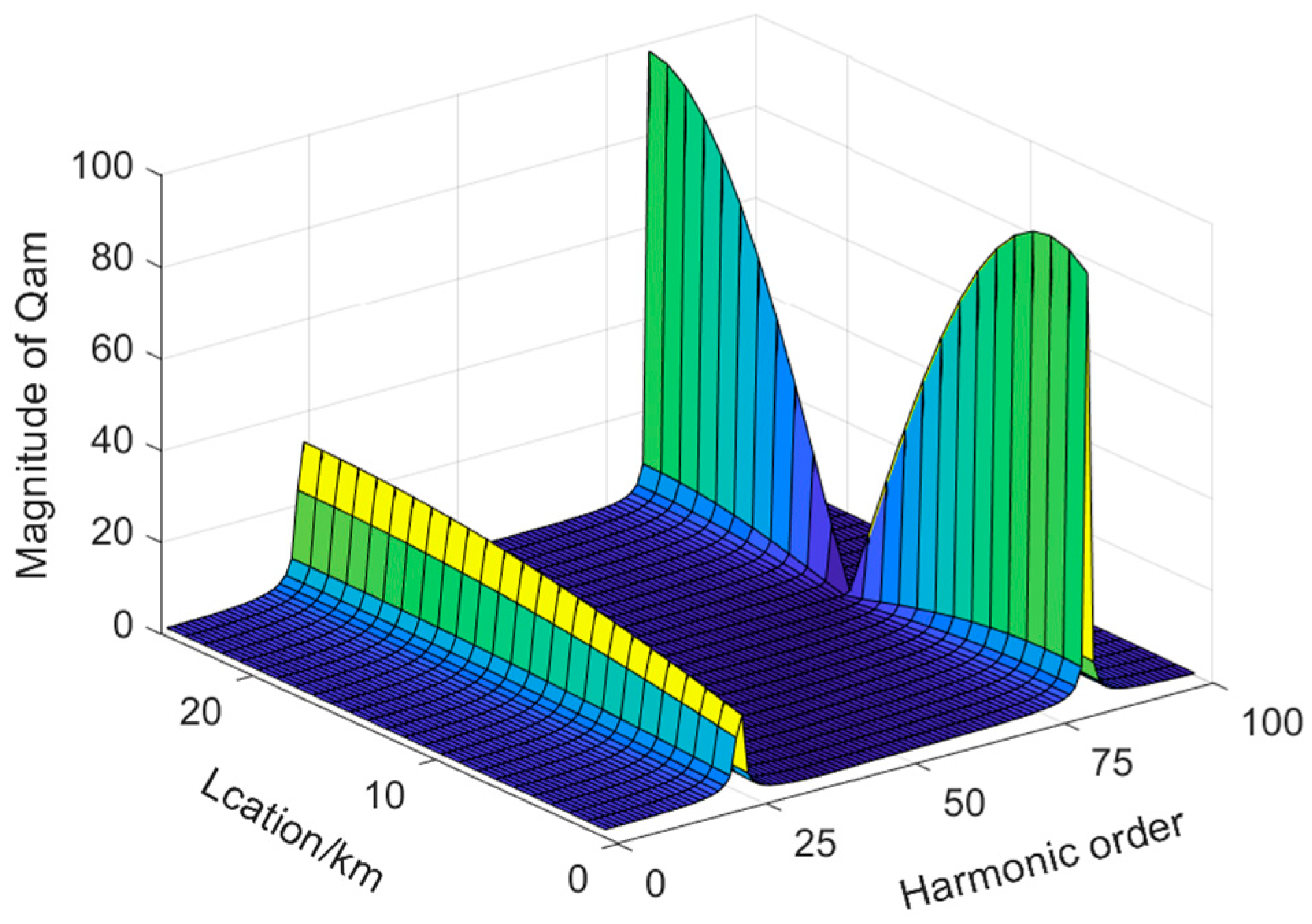
According to Formula (5), the Qam of Iss is shown in Figure 6. It is known that the peak value of Qam appears around the 25th and 81st harmonics like Zq. The variation of Qam is the same as Zq.
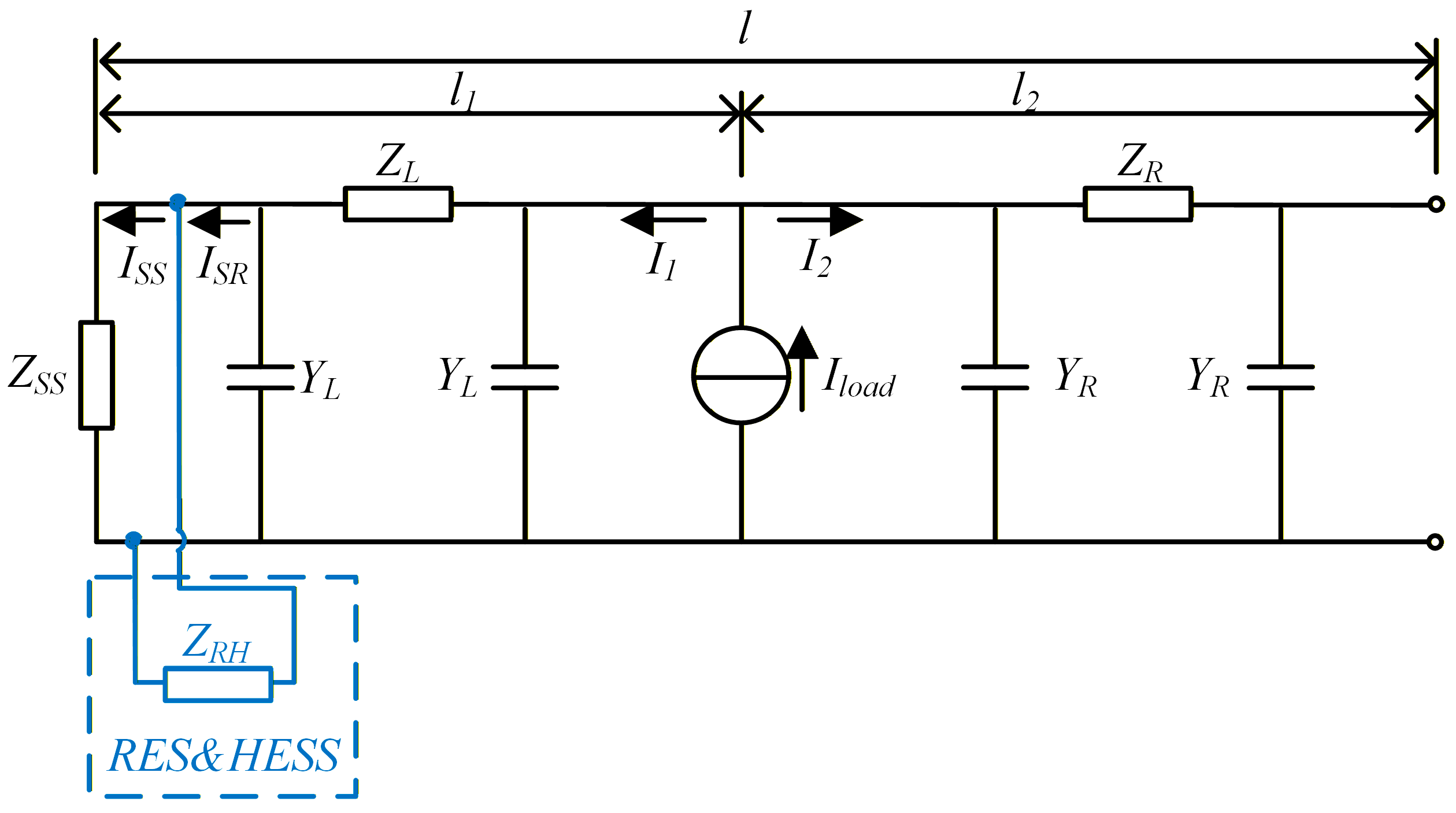
(2) Assume RES and HESS are connected to the traction power supply system of the traction substation. In order to decouple the influence of RES/HESS impedance from its harmonic emission, the DC side is represented by a constant voltage source, where RES and HESS can be equivalent to equivalent impedance. This enables us to isolate and study the impact of parallel converters as passive impedances on locomotive harmonic propagation. Therefore, the conclusion on power quality only specifically involves locomotive harmonics; the additional harmonic contribution of RES inverters is a separate issue that requires future research using detailed converter models. The equivalent circuit of FCTPSS can be simplified to the circuit structure shown in Figure 7.
Make 1 / Z S R = 1 / Z S S + 1 / Z R H , from this point of the train, the equivalent impedance Zq of the traction network connected to RES and HESS is as follows.
Z q = Z 0 c h γ l 2 ( Z S R c h γ l 1 + Z 0 s h γ l 1 ) Z S R s h γ l + Z 0 c h γ l ,
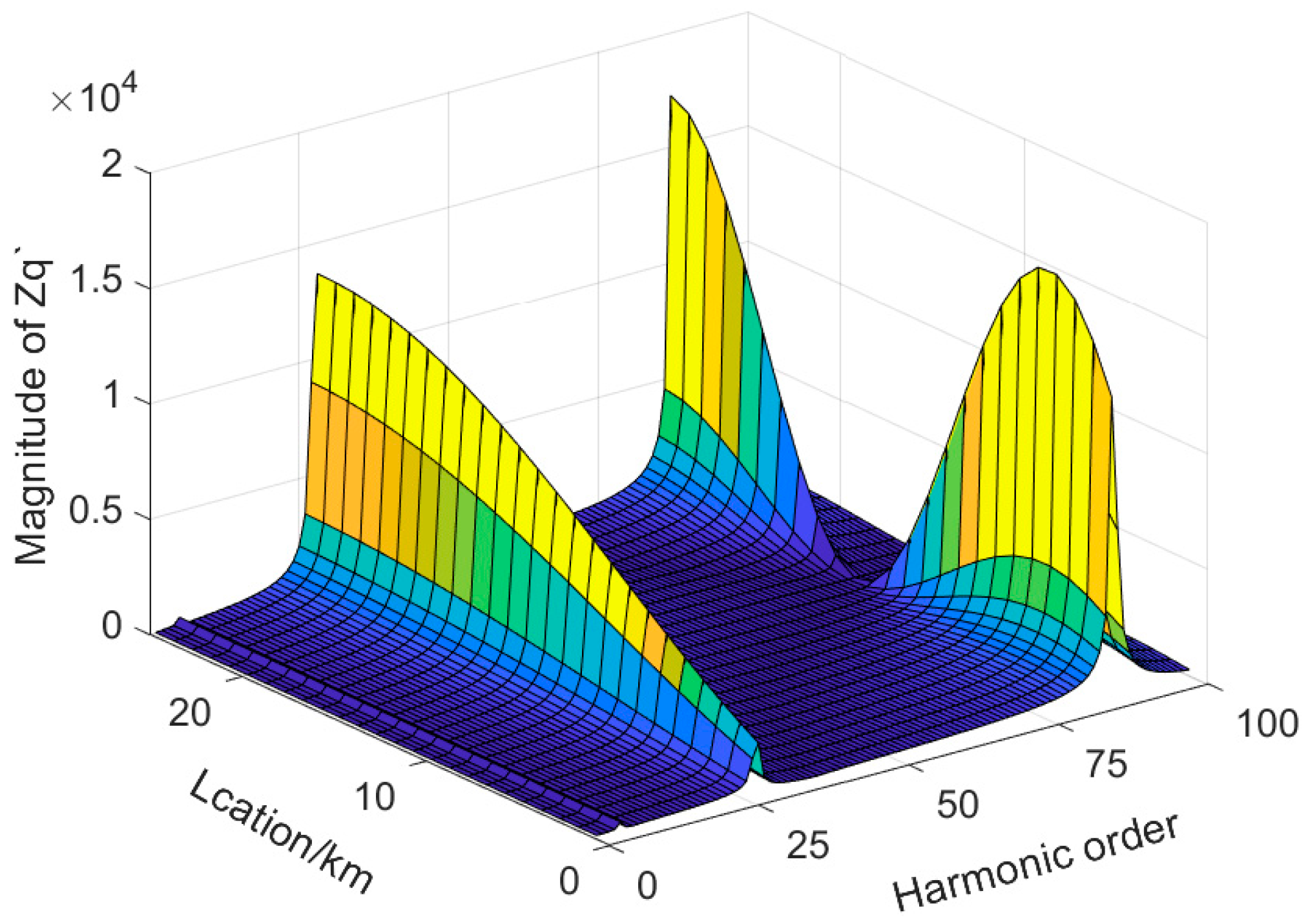
According to Formula (6), the image of Zq changing with locomotive location and harmonic frequency is shown in Figure 8. It can be seen from the image that when resonance occurs, the peak value of Zq is significantly lower than Zq of TPSS, and the resonance frequency shifts to the right and appears near the 27th and 87th harmonics. In addition, there is also a slight resonance at the 5th harmonic frequency.
At this point, Formula (7) can be derived.
I 1 = c h γ l 2 ( Z S R s h γ l 1 + Z 0 c h γ l 1 ) Z S R s h γ l + Z 0 c h γ l I l o a d I S R = Z 0 Z S R s h γ l 1 + Z 0 c h γ l 1 I 1 = Z 0 c h γ l 2 Z S R s h γ l + Z 0 c h γ l I l o a d I S S = Z R E S Z R E S + Z S S I S R = ( Z R E S Z R E S + Z S S ) ( Z 0 c h γ l 2 Z S R s h γ l + Z 0 c h γ l ) I l o a d ,
In this case, the harmonic Qam is,
Q a m = I s s I l o a d = ( Z R E S Z R E S + Z S S ) ( Z 0 c h γ l 2 Z S R s h γ l + Z 0 c h γ l ) ,
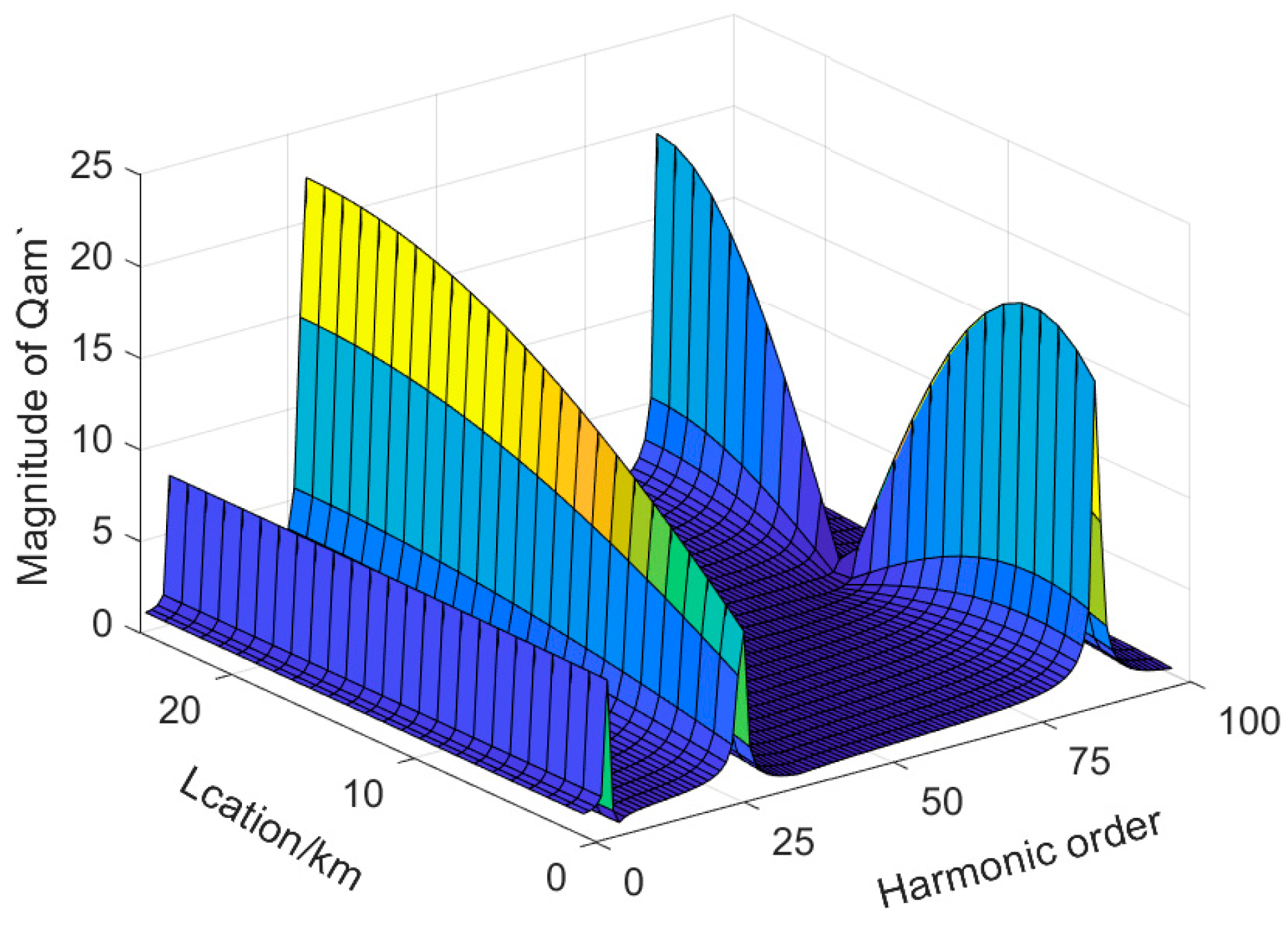
According to Formula (8), the image of Qam changing with locomotive location and frequency is drawn, as shown in Figure 9. It can be seen from the image that when resonance occurs, the peak value of Qam decreases obviously, the resonant frequency shifts to the right and resonance occurs near the 27th and 87th harmonics. In addition, a slight harmonic current amplification occurs near the 5th harmonic.
In order to verify the theoretical analysis in Section 2.2, a simulation model is established in Section 3.

3. Simulation Model of FCTPSS

3.1. Simulation Model of Traction Network

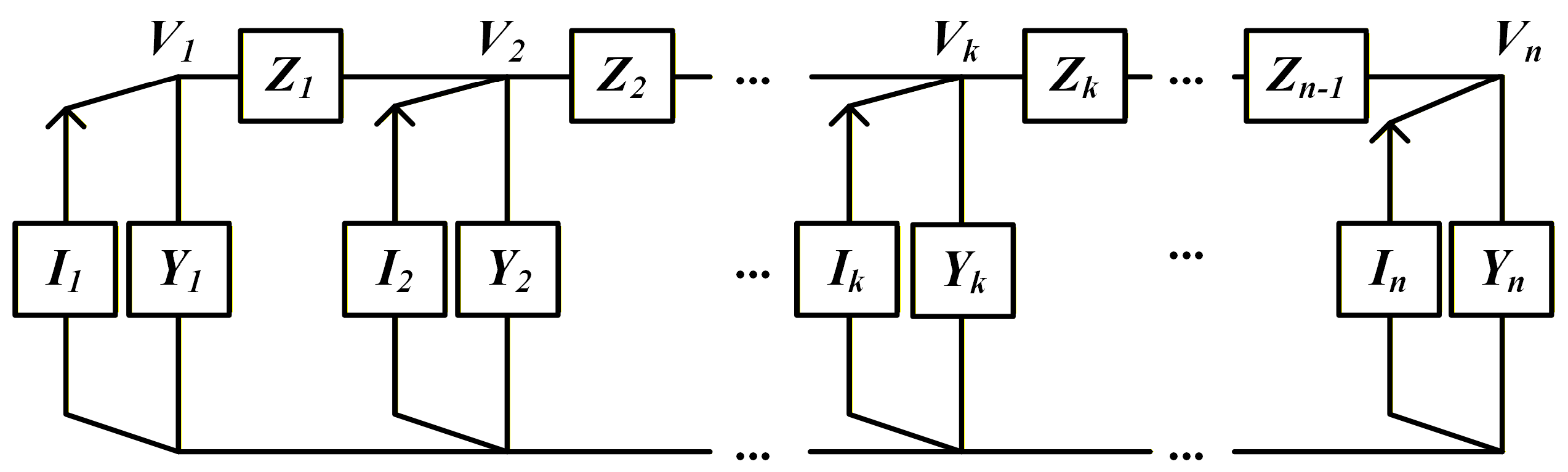
The traction network is a parallel multi-conductor system. In terms of topology, one power supply arm of the traction network forms a chain network. The chain network is composed of longitudinal series of impedance elements and transverse parallel admittance elements, as shown in Figure 10. The parallel multi conductor system is cut into different segments by the admittance elements in transverse parallel.
In Figure 10, the series impedance element Zk is the branch impedance between two adjacent sections; the parallel admittance element Yk is the admittance between the wires on section k; Ik is the injection current source of the wires on section k, which is used to simulate the harmonic current injected into the traction network by the train load at the position of the supply arm; Vk is the voltage of the wires on section k. From the chain network in the Figure 10, the node voltage equation can be listed as shown in Formula (9). According to Formula (9), the voltage and current at each node and the corresponding impedance at a specific frequency can be obtained.
Y 1 + Z 1 1 Z 1 1 Z 1 1 Z 1 1 + Y 2 + Z 2 1 Z 2 1 Z k 1 1 Z k 1 1 + Y k + Z k 1 Z k 1 Z n 2 1 Z n 2 1 + Y n 1 + Z n 1 1 Z n 1 1 Z n 1 1 Z n 1 1 + Y n V 1 V 2 V k V n 1 V n T = I 1 I 2 I k I n 1 I n T
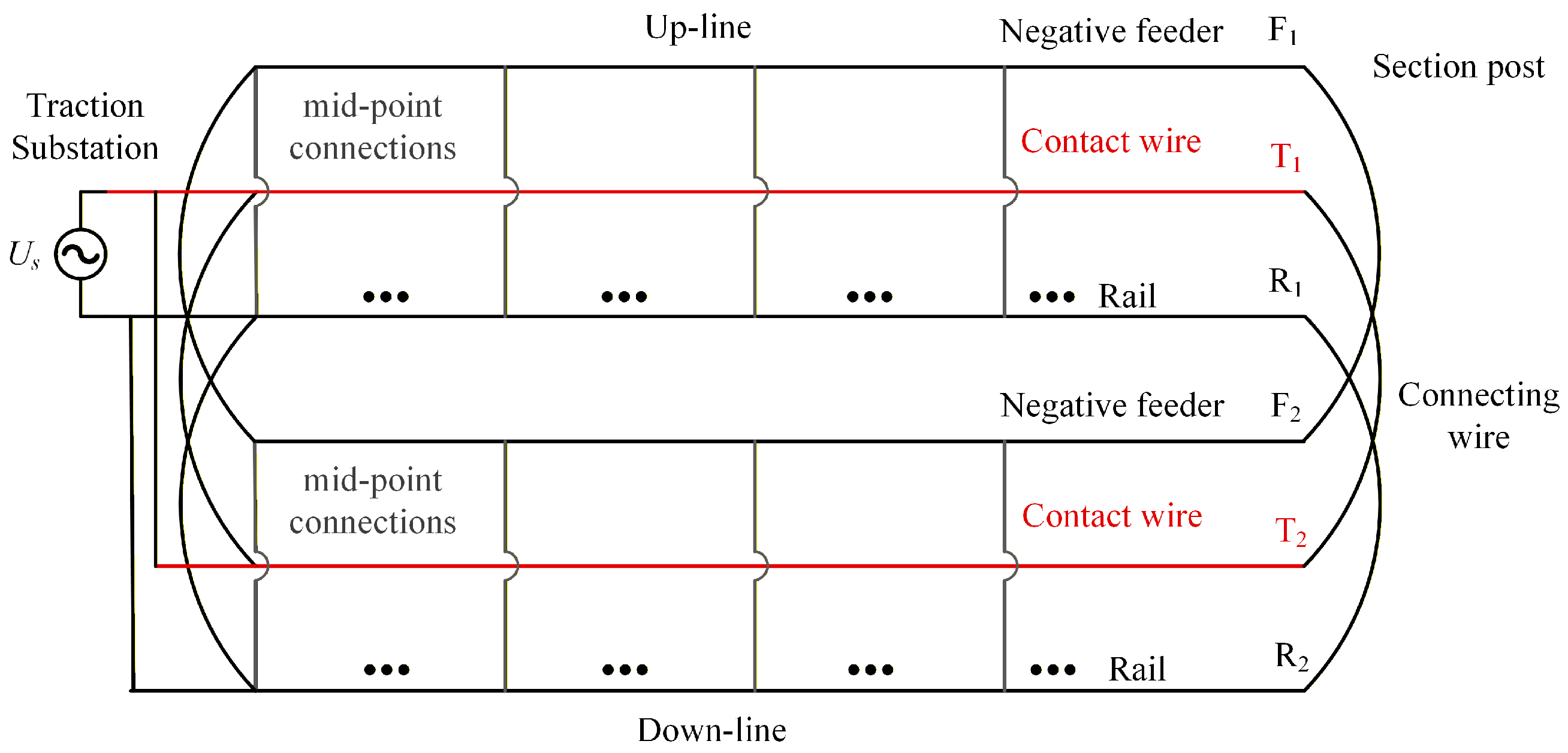
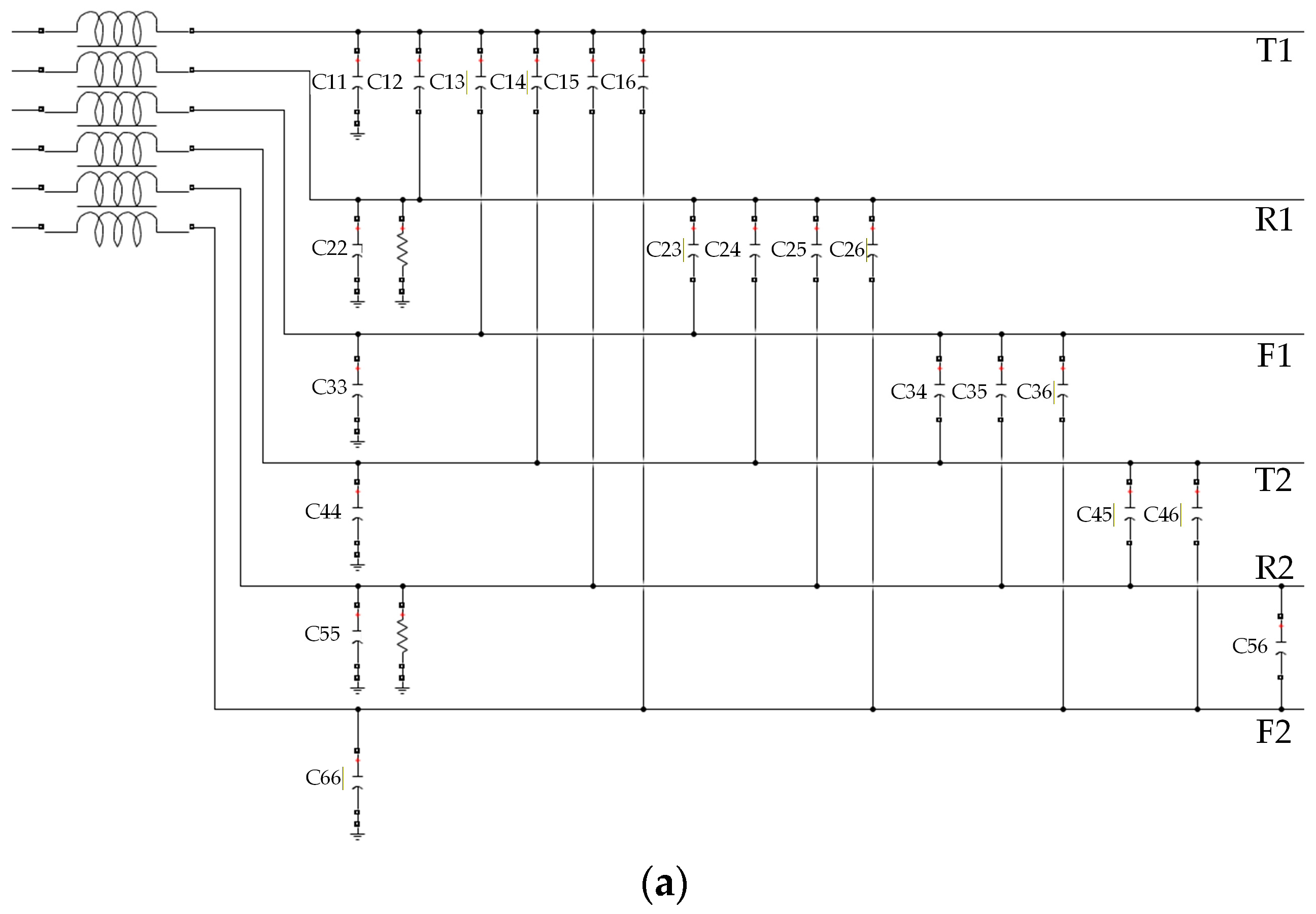
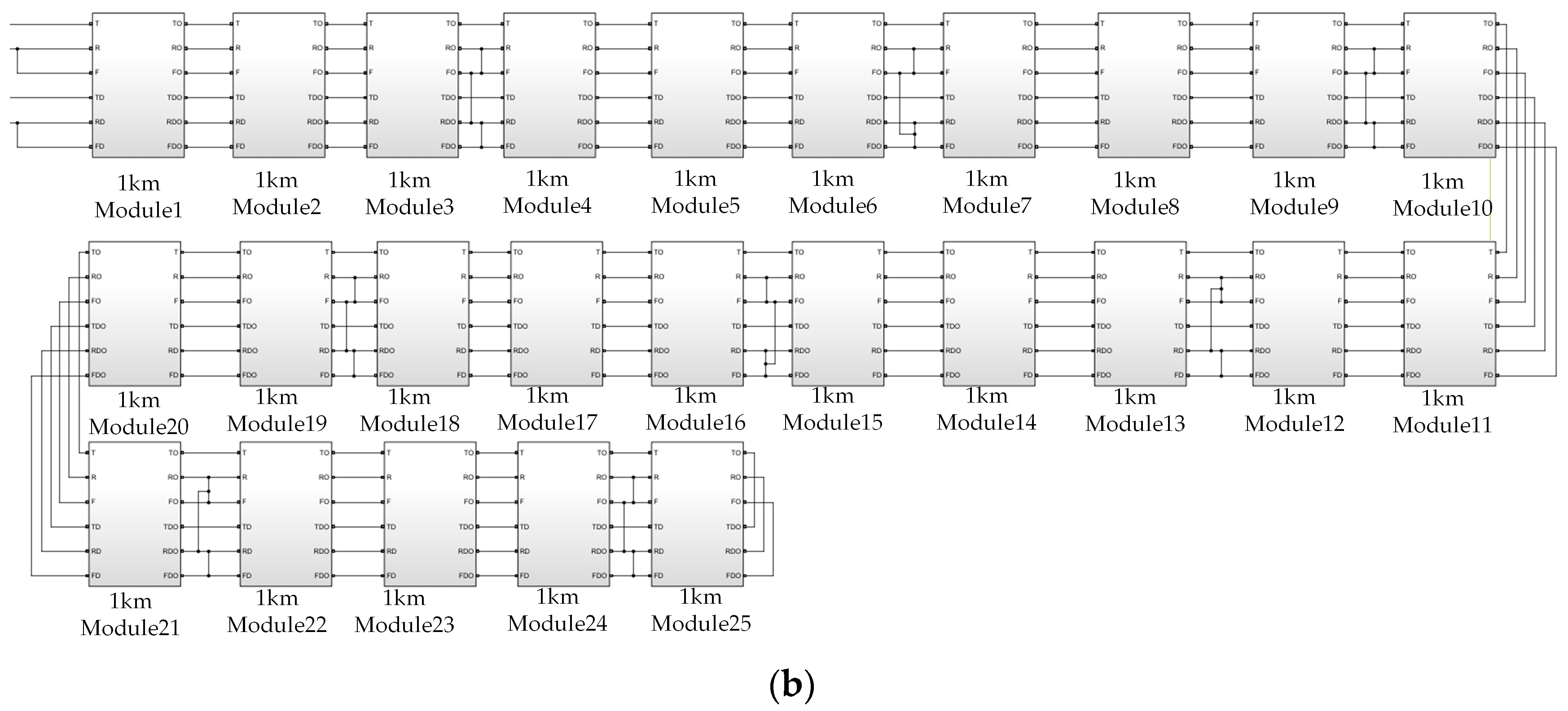
No matter what power supply mode is adopted for the traction network or whether the line is single line or double line, the essence of the traction network is a chain network composed of multi conductor transmission lines. In order to make the simulation model of the traction network more realistic, this chapter adopts a more accurate multi conductor transmission line structure to establish a simulation circuit, which can better simulate the real situation of the traction network. As shown in Figure 11, the structure diagram of the double line traction network with direct supply and return line power supply mode (T–R + NF) is presented. When modeling, the traction network is generally divided evenly according to the natural cutting of the transverse parallel elements. In order to simplify the modeling process, the wires are merged according to the parallel connection. The contact wire and catenary of the same traction network are equivalent to one conductor (T), and the rails of the same line are combined into one (R). When calculating the self-impedance, mutual impedance, self-admittance and mutual admittance coefficient matrix, the influence of other merged wires is also taken into account, so the accuracy of the model will not be reduced by merging wires for modeling. The number of conductors in Figure 11 is 6, which are the up and down contact wires T1 and T2, the up and down negative feeder lines F1 and F2 and the up and down rails R1 and R2. According to the distributed parameter method of traction networks proposed in reference [28], the simulation model of the T–R + NF power supply mode for double line traction network is established in Matlab2021b/Simulink software with a unit of 1 km, as shown in Figure A1 in Appendix A. Main system parameters of the traction network, external power supply and traction transformer are shown in Appendix A.

3.2. Simulation Model of RES and HESS

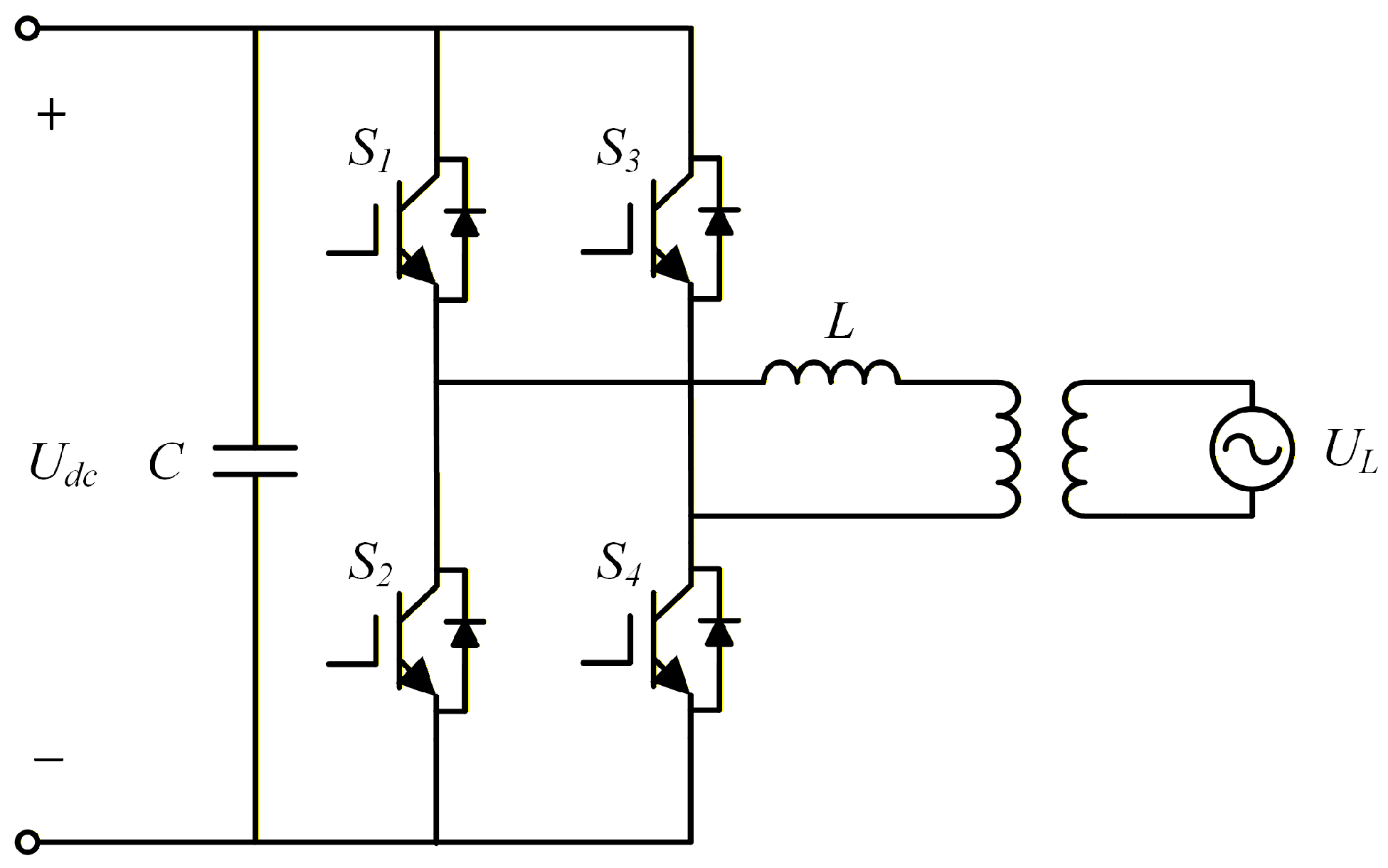
RES and HESS converters for FCTPSS are similar to converters commonly used in power systems. The core part is the single-phase DC/AC converter, which can convert the DC bus voltage to 27.5 kV AC voltage for the locomotive load. The converter used in this simulation system is a voltage-type bidirectional DC/AC converter, and its topology is shown in Figure 12.
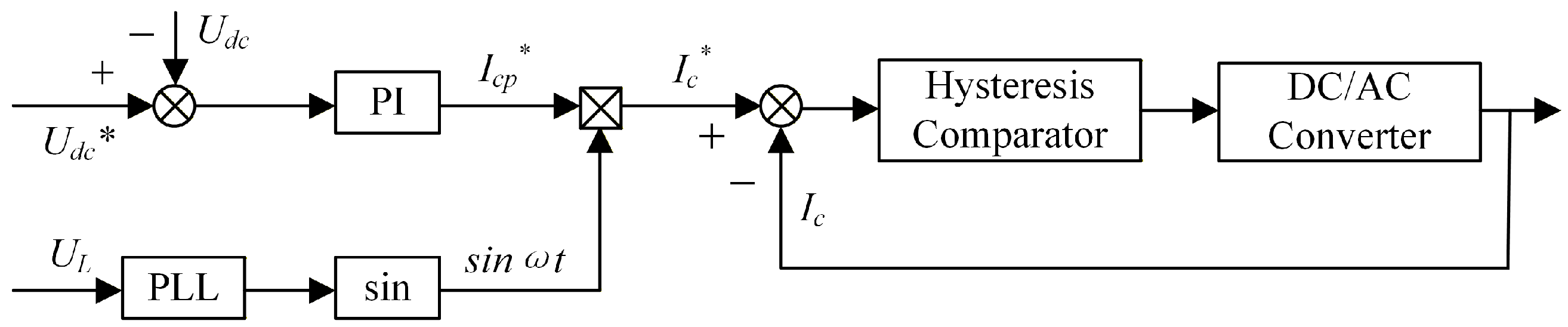
The DC/AC converter adopts a double closed loop control strategy, and its control block diagram is shown in Figure 13. The main control parameters are shown in Table 1. The outer voltage loop is used to stabilize the DC bus voltage, and the inner current loop is used to control the converter output grid connected current. The voltage outer loop compares the measured DC bus voltage with the reference voltage, and the error obtained is output as a DC flow Icp* through the PI regulator. The reference current Ic* is obtained by multiplying Icp* by the AC network voltage UL through the phase locked loop processing. In order to quickly track the current command value, the DC/AC converter is controlled by current hysteresis comparison tracking, so that the converter has a fast response speed. The hysteresis width will affect the response speed. When the hysteresis width is large, the switching frequency is low, the response speed is slow and the current tracking error is large; when the ring width is small, the switching frequency is high, the response speed is fast and the current tracking error is small. However, a smaller ring width will increase the switching loss, and when the ring width exceeds a certain range, the circuit will not work properly, so the selection of hysteresis width needs to be considered comprehensively. The inner current loop compares the measured current Ic with the reference current Ic* to obtain the error signal. The obtained error generates the control signal of DC/AC converter through the hysteresis comparator to ensure the converter can respond quickly, so as to achieve grid connected current tracking control.
This paper only explores the influence of the introduction of RES and HESS on the harmonic current transmission characteristics of the locomotive. In order to avoid the influence of the harmonic generated by RES, the DC side of the inverter (renewable energy system and hybrid energy storage system) is replaced by a constant DC source.

3.3. Simulation Model of Locomotive Load

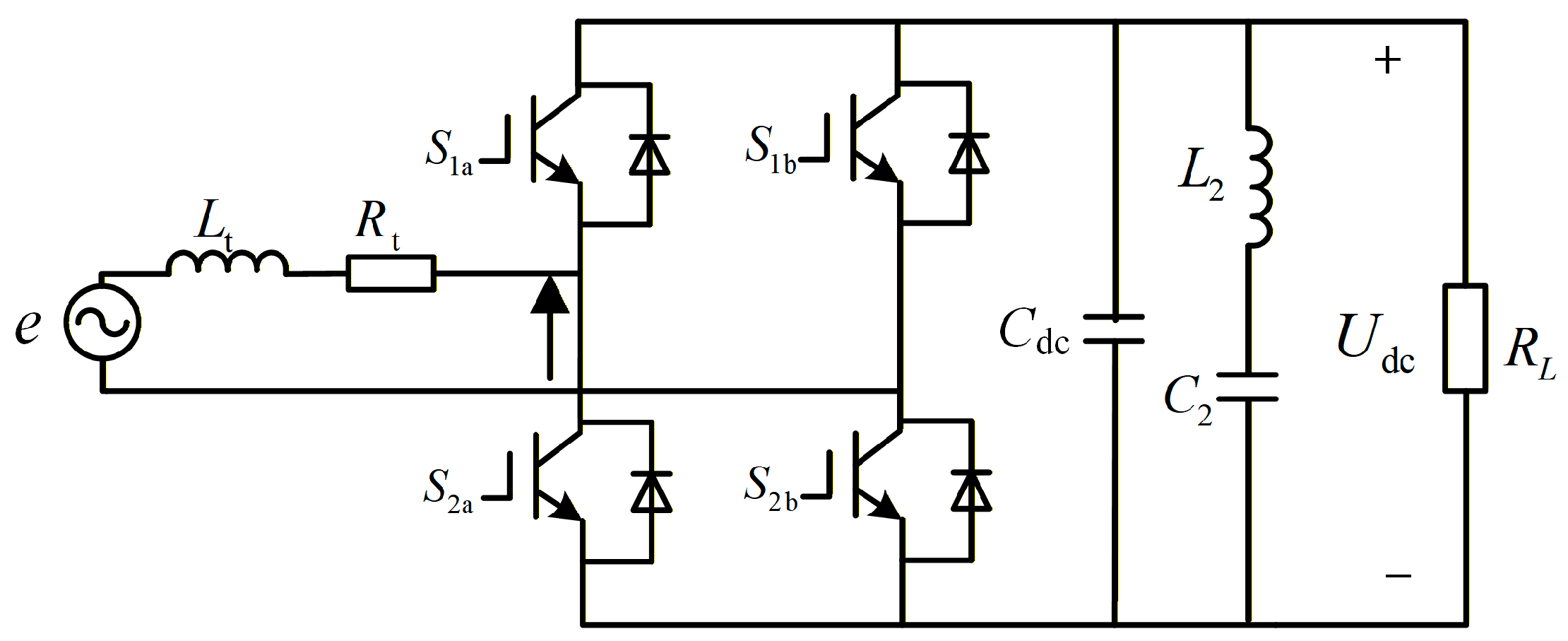
The locomotive is the main harmonic source of the traction power supply system. The simulation model of CRH3 EMU is established in this paper. The electric drive system of CRH3 EMU mainly includes a pantograph, on-board transformer, four quadrant converter, intermediate DC link, pulse width modulation (PWM) inverter, traction motor, etc. The intermediate DC link can effectively suppress the influence of the inverter side on the grid side system, that is, the high order harmonics on the locomotive grid side are mainly generated by the four quadrant converter modulation. During modeling, the PWM inverter and traction motor can be simplified and equivalent resistance can be used to simulate motor side load. The simplified model is shown in Figure 14, where e is the grid side power supply, Rt and Lt are the leakage impedances of the on-board transformer, Cdc is the DC support capacitor, C2 and L2 are the secondary filtering branches, Udc is the DC side voltage and RL is the equivalent load.
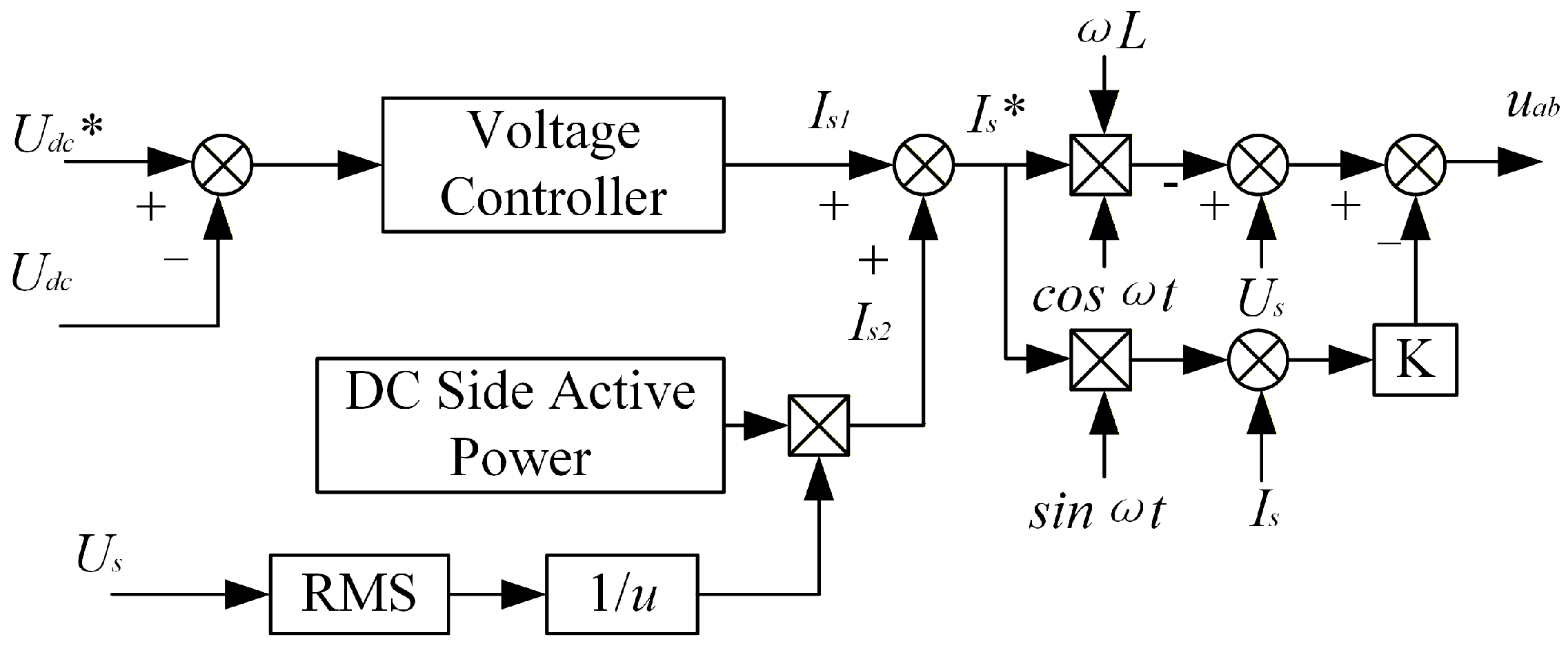
CRH3 EMU traction rectifier adopts transient current control strategy (TCCS), and the control block diagram is shown in Figure 15. The principle of transient current control is shown in Formula (10).
I s 1 = K p ( U d c * U d c ) + 1 / K i ( U d c * U d c ) dt I s 2 = I d c U d c / U s I s * = I s 1 + I s 2 u a b ( t ) = U s ( t ) ω L I s * cos ( ω t ) R t I s * sin ( ω t ) K I s * sin ( ω t ) i s ( t ) ,
where,   U d c * is the given value of DC side voltage, and U d c is the actual value of DC side voltage. Is* is the command value of network side current; is(t) is the actual current value of the network side; Kp, K and Ki are proportional integral coefficients; Idc indicates the DC load current. U s , Is and U d c are input signals of the control system.
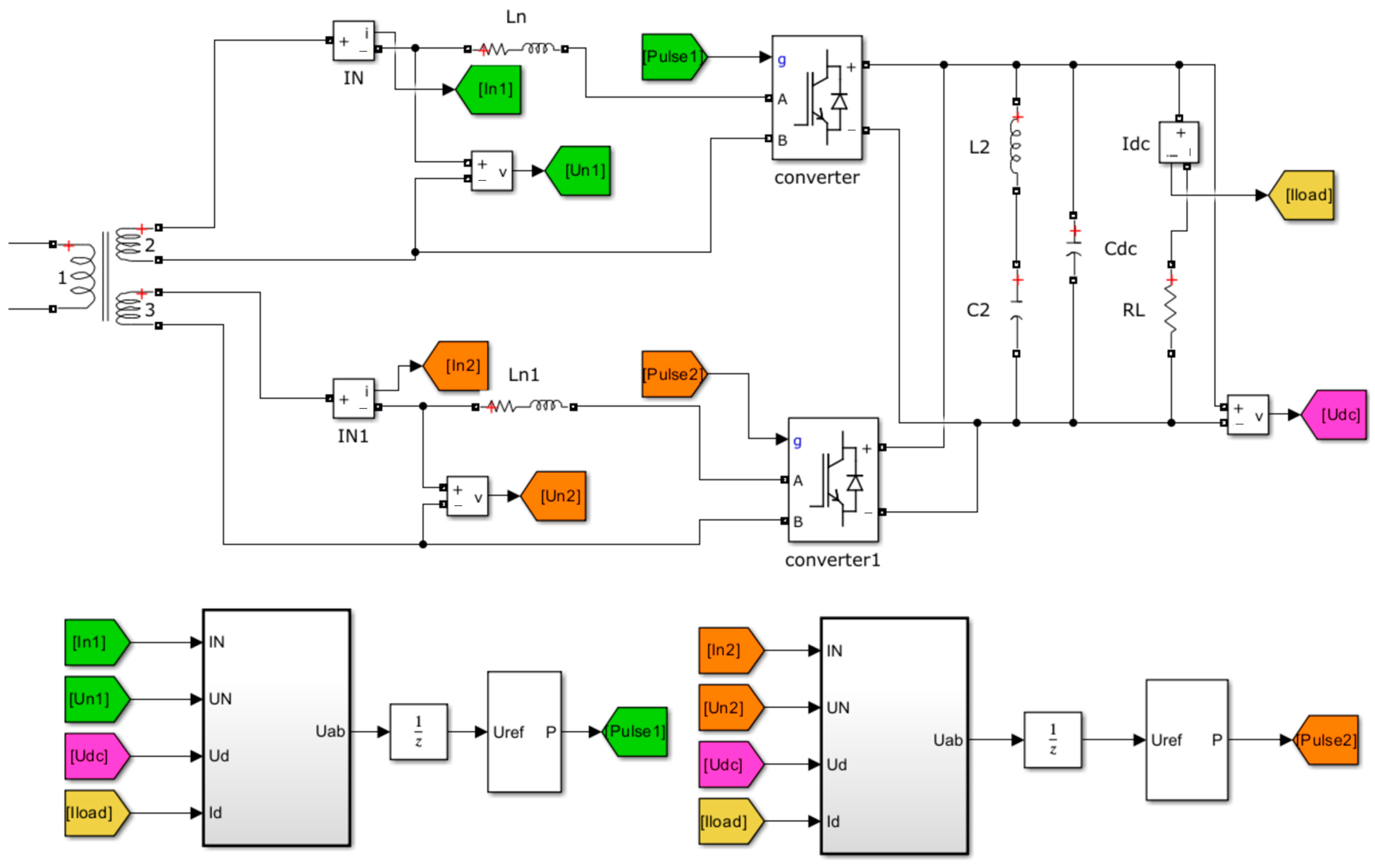
According to the control principle, the locomotive model is established in Matlab2021b/Simulink, as shown in Figure 16, and the main parameters are shown in Table 2. In order to verify the accuracy of CRH3 EMU load model, the harmonic output characteristics are simulated and analyzed in Appendix B.

4. Simulation Results and Analysis

4.1. Results and Analysis of Harmonic Current Transmission Characteristics

In the traction power supply system, the power and position of the locomotive change at any time, which leads to the constant change of impedance frequency characteristics and harmonic current amplification characteristics in the traction network under different space–time states. According to Section 2.2, when the length of traction network and other parameters are fixed, the harmonic transmission characteristics of traction power supply system are related to the access position of RES and HESS and the operating position of locomotive. Therefore, this part verifies the influence law of related factors of TPSS and FCTPSS harmonic transmission characteristics by simulation. The verification process and results are as follows.

4.1.1. Results and Analysis of Harmonic Transmission Characteristics of TPSS

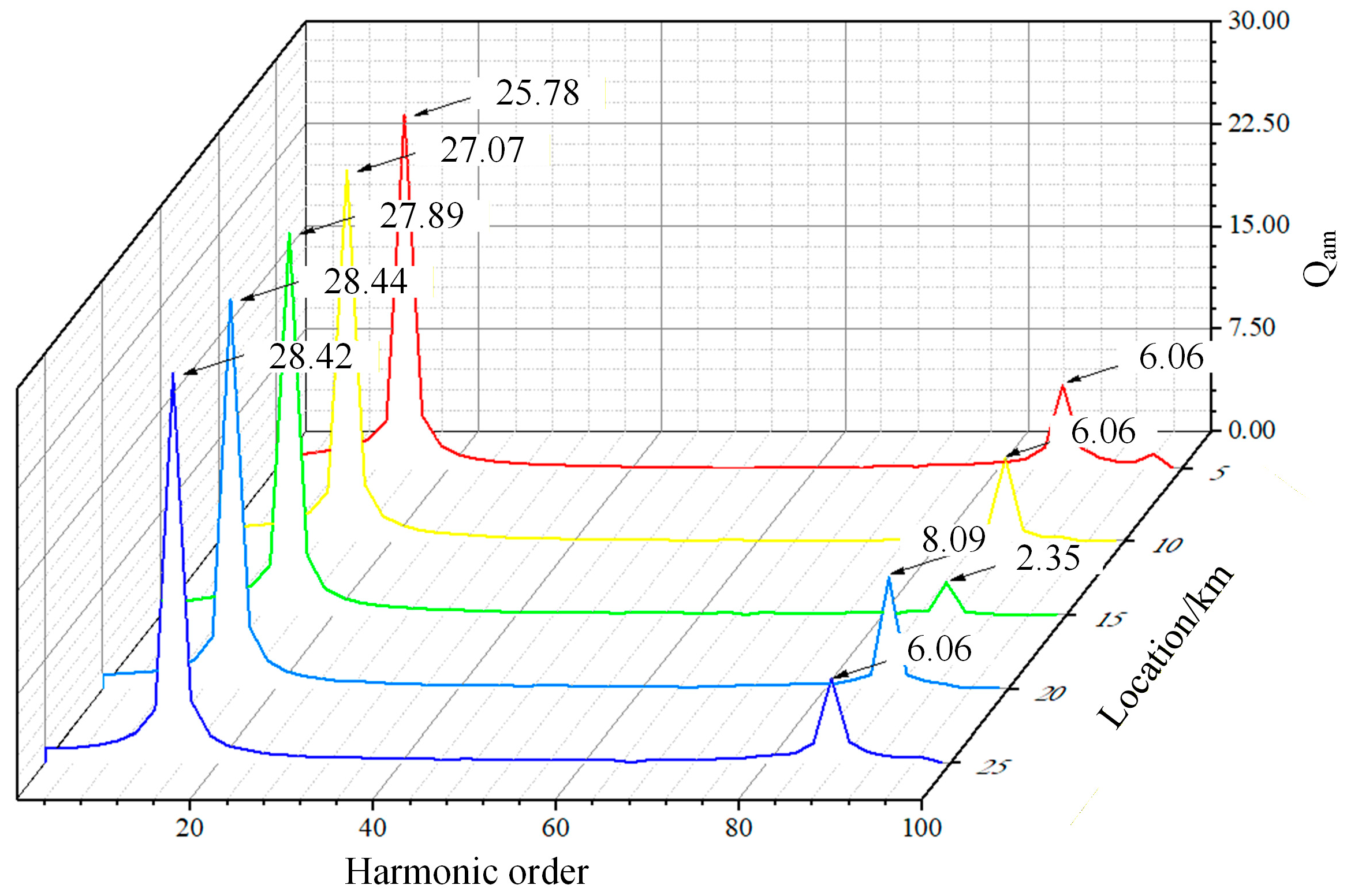
The change of locomotive location will cause the change of voltage and current distribution of traction network. A 25 km long traction network simulation model is established with a 1 km traction network as the basic unit. By changing the location where the locomotive is connected to the traction network, the harmonic current amplification characteristics of the traction power supply system at different locations are obtained as shown in Figure 17.
It can be seen from Figure 17 that when the traction network is 25 km long, Qam will have a peak value near the 15th and 87th harmonics, that is, harmonic resonance occurs; When the locomotive runs at 5 km, the Qam (near the 15th harmonic) is 25.78; when the locomotive runs at 25 km, the Qam (near the 15th harmonic) is 28.42; the further the locomotive is from the substation, the larger the Qam becomes. As the locomotive is far away from the substation, the longer the transmission distance of current on the traction network is, the more likely the resonance will occur. It can be seen that the simulation results are consistent with the theoretical model analysis results in Section 2.2.

4.1.2. Results and Analysis of Harmonic Transmission Characteristics of FCTPSS

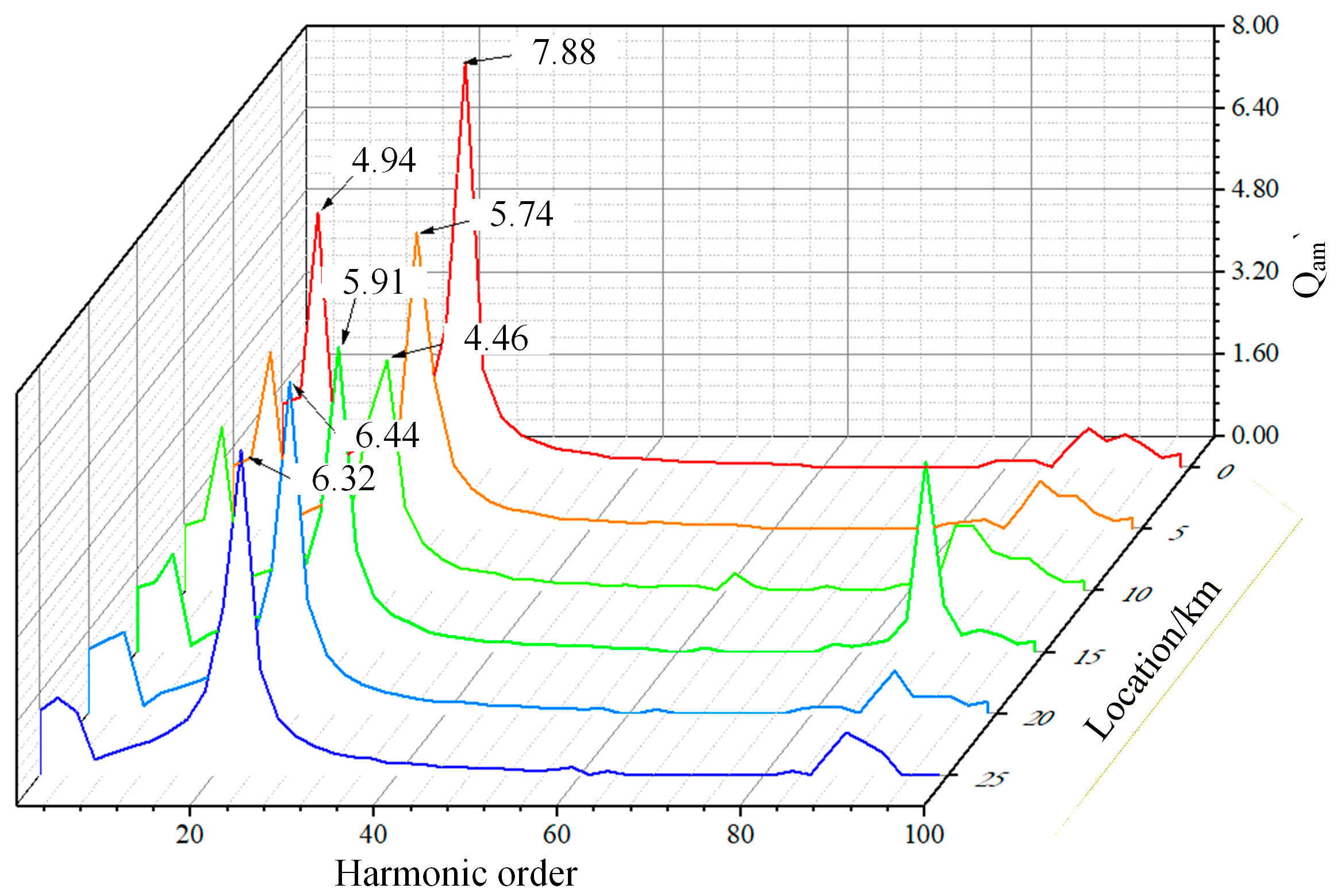
According to the theoretical analysis in Section 2.2, when RES and HESS are connected, the resonant frequency of the system will shift to the right, and the amplification of harmonic current will decrease. In this section, RES and HESS will be accessed at 0, 5, 10, 15, 20 and 25 km respectively, and the locomotive will be placed at a distance of 10 km from the substation. Figure 18 shows the harmonic current amplification characteristics of the FCTPSS.
As can be seen from Figure 18, the harmonic resonance phenomenon has been significantly weakened, and the harmonic resonance frequency has shifted to the right, transferring to the vicinity of the 23rd harmonic frequency, avoiding the harmonic characteristic range of the locomotive. In FCTPSS, the maximum Qam is only 7.88 times, which is about 3.6 times lower. In addition, it can be seen from the Figure 18 that under the FCTPSS, a slight resonance will be generated near the 5th harmonic, and the maximum Qam is 4.94 times, which is also consistent with the theoretical analysis in Section 2.2.

4.2. Power Quality Simulation Results

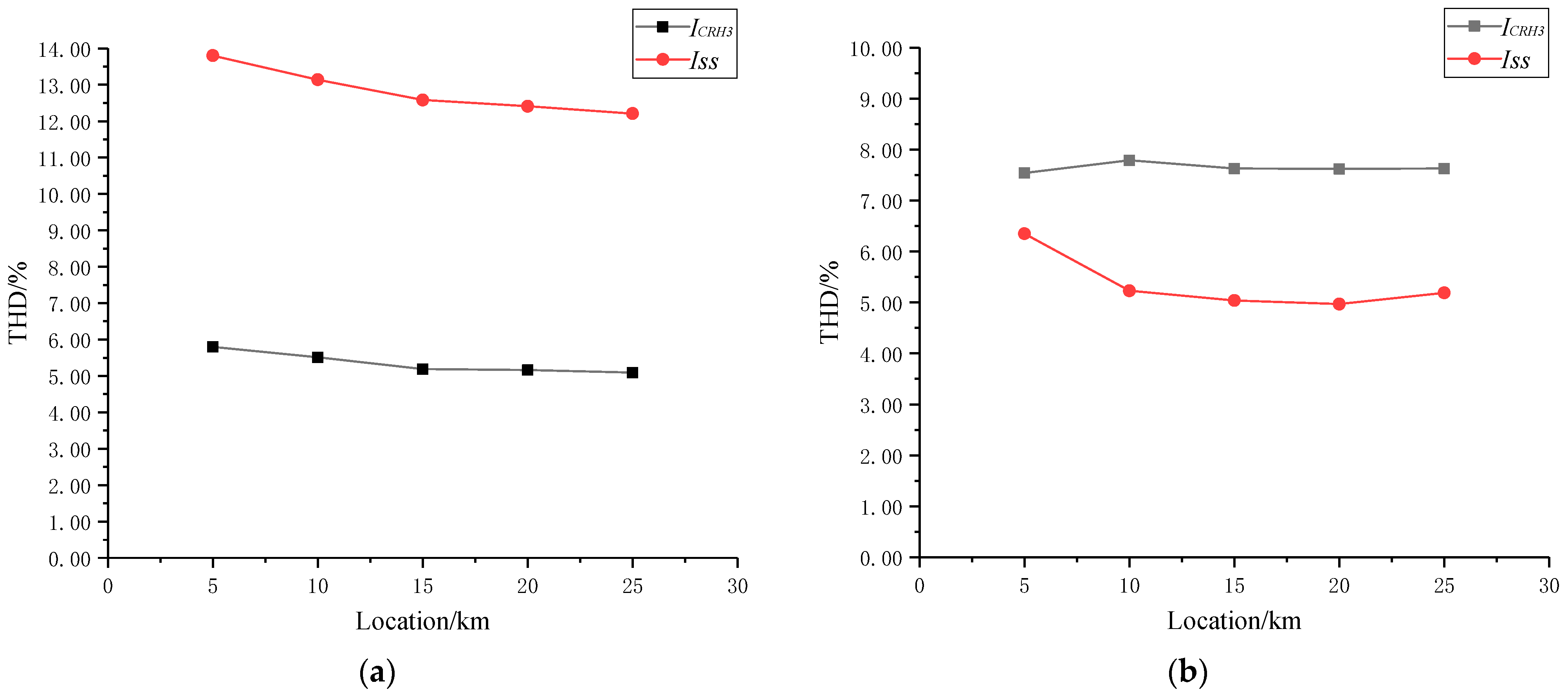
Harmonic current will increase the copper loss and stray loss of the traction transformer, cause the transformer temperature to rise and shorten the service life. The total harmonic current distortion (THD) is an index to measure the overall situation of harmonic current. IEEE 519 recommends a typical THD limit of 5% for general distribution systems [29]. This part analyzes the THD of ICRH3 generated by the locomotive and Iss under TPSS and FCTPSS. (1) In TPSS, the locomotives are, respectively, connected at 5, 10, 15, 20 and 25 km from the substation. The THD changes of ICRH3 and ISS are shown in Figure 19a. The THD of ISS has the same rule as that of ICRH3, but its amplitude is more than twice that of ICRH3. This is because the harmonic current is amplified by the traction network. (2) In FCTPSS (RES and HESS are connected to 5 km), locomotives are also connected 5 km, 10 km, 15 km, 20 km and 25 km away from the substation, respectively. The THD changes of ICRH3 and ISS are shown in Figure 19b. The THD of ICRH3 increases slightly, but the THD of ISS decreases significantly, which will improve the operation of the traction transformer, reduce copper loss and stray loss of the transformer, prolong its service life and reduce costs.

5. Conclusions and Discussion

5.1. Conclusions

In this paper, the harmonic transmission characteristics of TPSS and FCTPSS are analyzed theoretically, the simulation models of TPSS and FCTPSS are established in Matlab2021b/Simulink and the accuracy of the models is verified. The change of harmonic current amplification and THD with the locomotive access position under TPSS are simulated and analyzed. In addition, the variation of harmonic current amplification and THD are simulated and analyzed when RES and HESS are connected at different locations in FCTPSS. This work contributes to the reliable and sustainable development of green railway systems by providing a technical foundation for the safe integration of renewable energy and energy storage. The conclusions are as follows.
(1) The frequency spectrum characteristics (main frequency component) of locomotive harmonic current do not vary with the power and operating state of the locomotive, but, under traction conditions, the harmonic content decreases with the increase of the power of the locomotive.
(2) When the parameters and length of the traction network are fixed, the system resonance frequency is fixed, independently of the location of the locomotive. But the further the locomotive is from the substation, the stronger the resonance phenomenon will be.
(3) Compared to traditional TPSS, in FCTPSS, the resonant frequency of the system will shift to the right, and the overall amplification amplitude of harmonic currents will be reduced.
(4) In FCTPSS, THD of ISS will be significantly reduced, and the operation of traction transformer will be improved.

5.2. Discussion

The results of the simulation model established in this paper can be consistent with the theoretical analysis, and can be used to study the harmonic transmission characteristics of RES and HESS connected to TPSS. By elucidating the harmonic transmission characteristics of FCTPSS integrated with RES and HESS, this study provides valuable insights for the design of future sustainable railway power supply systems that aim to incorporate renewable energy while maintaining high power quality. However, the limitation of idealizing RES/HESS as a constant DC power source in simulation studies excludes their harmonic coupling effects. Future work should incorporate detailed RES/HESS models and validate the results through hardware in the loop or on-site testing.

Author Contributions

Conceptualization, Y.P., G.C., P.P. and D.K.; methodology, M.W. and T.H.; formal analysis, Q.L. and T.H.; data curation, Y.P., G.C. and P.P.; writing—original draft preparation Y.P. and G.C.; writing—review and editing, Q.L.; project administration, M.W. and D.K. All authors have read and agreed to the published version of the manuscript.

Funding

This research were funded by (1) Fundamental Research Funds for the Central Universities (Grant No. 2024JBMC023) and (2) Project of China Energy Investment Group Co., Ltd. under Grant GJNY-21-189.

Institutional Review Board Statement

Not applicable.

Informed Consent Statement

Not applicable.

Data Availability Statement

The data are not publicly available due to commercial confidentiality agreements with the funding organizations. A minimal dataset may be made available upon reasonable request, subject to institutional approval.

Acknowledgments

The authors acknowledge Yan Zhang and Yonggang Wei for their valuable contributions to the preliminary conference paper (Wide-Band Harmonic Interaction and Characteristic Analysis of FCTPSS; DOI: https://doi.org/10.1007/978-981-99-9307-9_1) upon which this work is based.

Conflicts of Interest

Author Ye Peng was employed by the China Shenhua Energy Company Limited. Author Dejian Kang was employed by the Guoneng Xinshuo Railway Co., Ltd. The remaining authors declare that the research was conducted in the absence of any commercial or financial relationships that could be construed as a potential conflict of interest.

Appendix A

(1)
Inductance matrix of traction network, H.
L l i n e = 1.55 × 10 3 9.82 × 10 4 1.14 × 10 3 9.52 × 10 4 9.24 × 10 4 9.03 × 10 4 9.82 × 10 4 1.72 × 10 3 9.99 × 10 4 9.24 × 10 4 1.04 × 10 3 9.07 × 10 4 1.13 × 10 3 9.99 × 10 4 2.33 × 10 3 9.03 × 10 4 9.07 × 10 4 8.67 × 10 4 9.52 × 10 4 9.24 × 10 4 9.03 × 10 4 1.55 × 10 3 9.82 × 10 4 1.13 × 10 3 9.24 × 10 4 1.04 × 10 3 9.07 × 10 4 9.82 × 10 4 1.72 × 10 3 9.99 × 10 4 9.03 × 10 4 9.07 × 10 4 8.67 × 10 4 1.13 × 10 3 9.99 × 10 4 2.33 × 10 3
(2)
Resistance matrix of traction network, Ω.
R l i n e = 1.06 × 10 1 4.97 × 10 2 4.88 × 10 2 4.91 × 10 2 4.95 × 10 2 4.80 × 10 2 4.97 × 10 2 1.07 × 10 1 4.90 × 10 2 4.95 × 10 2 4.98 × 10 2 4.85 × 10 2 4.88 × 10 2 4.90 × 10 2 2.07 × 10 1 4.80 × 10 2 4.85 × 10 2 4.73 × 10 2 4.91 × 10 2 4.95 × 10 2 4.80 × 10 2 1.05 × 10 1 4.97 × 10 2 4.88 × 10 2 4.95 × 10 2 4.98 × 10 2 4.85 × 10 2 4.97 × 10 2 1.07 × 10 1 4.90 × 10 2 4.80 × 10 2 4.85 × 10 2 4.73 × 10 2 4.88 × 10 2 4.90 × 10 2 2.07 × 10 1
(3)
The capacitance of the traction network, F.
C 11 = 1.80 × 10 8 ,   C 12 = 1.80 × 10 9 C 13 = 3.36 × 10 9 ,   C 14 = 2.99 × 10 9 C 15 = 8.15 × 10 10 ,   C 16 = 4.30 × 10 10 C 22 = 3.31 × 10 8 ,   C 23 = 6.65 × 10 10 C 24 = 8.15 × 10 10 ,   C 25 = 1.25 × 10 9 C 26 = 1.37 × 10 10 ,   C 33 = 8.61 × 10 9 C 34 = 1.30 × 10 10 ,   C 35 = 1.37 × 10 10 C 36 = 7.00 × 10 11 ,   C 44 = 1.79 × 10 8 C 45 = 1.80 × 10 9 ,   C 46 = 3.36 × 10 9 C 55 = 3.31 × 10 8 ,   C 56 = 6.65 × 10 10 C 66 = 8.61 × 10 9
(4)
The simulation model of traction network in Matlab2021b/Simulink.
Figure A1. (a) 1km traction network model; (b) 25 km traction network model.
Sustainability 18 03607 g0a1aSustainability 18 03607 g0a1b
(5)
Parameters of simulation models for external power grid and traction substations

Table A1. Main parameters of simulation models for external power grid and traction substations.
ParametersValue
External power gridRated voltage110 kV
Short-circuit capacity750 MVA
X/R ratio7
Traction transformerTransformation ratio110 kV/27.5 kV
Rated power31.5 MVA
Impedance voltage10.5%

Appendix B

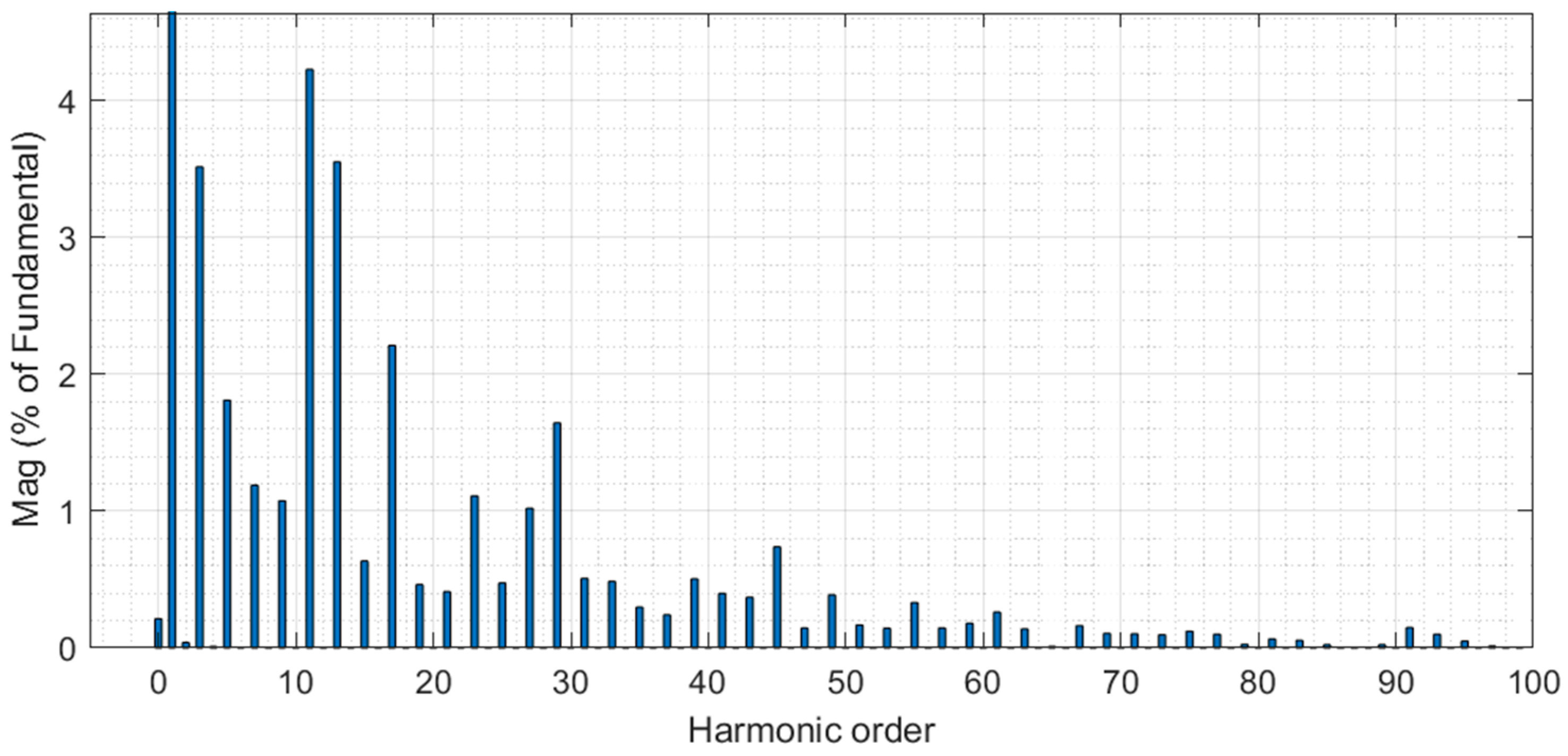
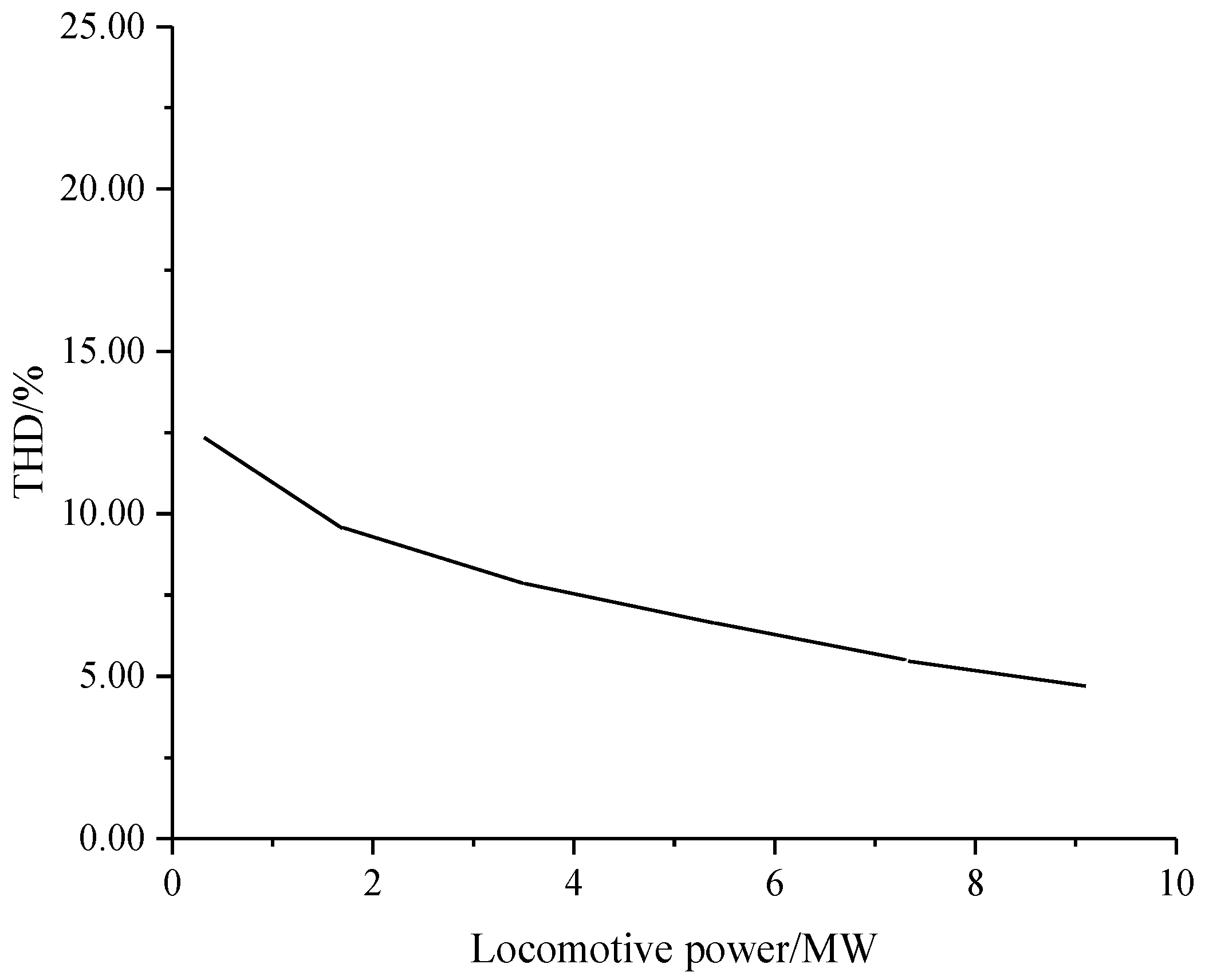
According to the established model, the harmonic characteristics of CRH3 EMU are analyzed. The power supply voltage is 27.5 kV ideal voltage source, and the switching frequency of converter is 350 Hz. The harmonic spectrum distribution of grid side current is shown in Figure A2. It can be seen from the figure that the low order harmonics are mainly distributed at the 3rd, 5th, 7th and 9th times, and the high order harmonics are mainly distributed near the even times of switching frequency (13th, 15th and 17th times), and they are mainly odd harmonics. In addition, it is verified that THD changes of locomotives under different power conditions are shown in Figure A3. It can be seen that THD gradually decreases with the increase of locomotive power. The simulation results are in good agreement with the actual situation, which verifies the accuracy of the locomotive model built in this paper.
Figure A2. Distribution diagram of harmonic characteristics of CRH3.
Sustainability 18 03607 g0a2
Figure A3. THD variation with power of CRH3.
Sustainability 18 03607 g0a3

References

  1. Bhim, S.; Munesh, K.S. Solar PV, PMSG—Wind Energy Conversion System and Battery Based Standalone DC Micro-Grid System. In 2022 5th International Conference on Power Electronics and their Applications (ICPEA); IEEE: New York, NY, USA, 2022; pp. 1–6. [Google Scholar]
  2. Roccotelli, M.; Mangini, A.M.; Fanti, M.P. Smart District Energy Management with Cooperative Microgrids. IEEE Access 2022, 10, 36311–36326. [Google Scholar] [CrossRef]
  3. Mustapha, A.; Mohammed, A.B.; Mourad, B.; Zakaria, K. Optimization of Photovoltaic System Modelling: A Comparative Study and Experimental Validation Using Bond Graph Methodology and a Genetic Algorithm. Appl. Math. Model. Comput. Simul. 2024, 61, 723–730. [Google Scholar]
  4. Wu, D.; Tang, F.; Dragicevic, T.; Vasquez, J.C.; Guerrero, J.M. A Control Architecture to Coordinate Renewable Energy Sources and Energy Storage Systems in Islanded Microgrids. IEEE Trans. Smart Grid 2015, 6, 1156–1166. [Google Scholar] [CrossRef]
  5. Huang, W.; Zhang, N.; Yang, J.; Wang, Y.; Kang, C. Optimal Configuration Planning of Multi-Energy Systems Considering Distributed Renewable Energy. IEEE Trans. Smart Grid 2019, 10, 1452–1464. [Google Scholar] [CrossRef]
  6. Hayashiya, H.; Suzuki, T.; Kawahara, K.; Yamanoi, T. Comparative study of investment and efficiency to reduce energy consumption in traction power supply: A present situation of regenerative energy utilization by energy storage system. In 2014 16th International Power Electronics and Motion Control Conference and Exposition; IEEE: New York, NY, USA, 2014; pp. 685–690. [Google Scholar]
  7. Suzuki, T.; Hayashiya, H.; Yamanoi, T.; Kawahara, K. Introduction and Practical Use of Energy Storage System with Lithium-ion Battery for DC Traction Power Supply System. IEEJ J. Ind. Appl. 2016, 5, 20–25. [Google Scholar] [CrossRef]
  8. Hitoshi, H.; Daisuke, H.; Masateru, T.; Koichi, W.; Masami, H.; Takashi, S. Lithium-ion battery installation in traction power supply system for regenerative energy utilization: Initial report of effect evaluation after half a year operation. In 2014 16th International Power Electronics and Motion Control Conference and Exposition; IEEE: New York, NY, USA, 2014; pp. 119–124. [Google Scholar]
  9. Hitoshi, H.; Shinya, K.; Kazushi, M.; Masami, H.; Masateru, T.; Tetsuya, K. Possibility of energy saving by introducing energy conversion and energy storage technologies in traction power supply system. In 2013 15th European Conference on Power Electronics and Applications (EPE); IEEE: New York, NY, USA, 2013; pp. 1–8. [Google Scholar]
  10. Hitoshi, H. Recent Trend of Regenerative Energy Utilization in Traction Power Supply System in Japan. Urban Rail Transit 2017, 3, 183–191. [Google Scholar] [CrossRef]
  11. Fei, S.; Wu, M. Photovoltaic DC Microgrid with Hybrid Energy Storage System Connected to Electrified Railway Traction Power Supply System. In Proceedings of the 5th International Conference on Electrical Engineering and Information Technologies for Rail Transportation (EITRT) 2021; Springer: Singapore, 2021; Volume 864. [Google Scholar]
  12. Wu, M.L.; Wang, W.Y.; Deng, W.L.; Chen, H.B.; Dai, C.H.; Chen, W.R. Back-to-back PV generation system for electrified railway and its control strategy. In 2017 IEEE Transportation Electrification Conference and Expo, Asia-Pacific (ITEC Asia-Pacific); IEEE: New York, NY, USA, 2017; pp. 1–6. [Google Scholar]
  13. Deng, W.L.; Dai, C.H.; Chen, W.R.; Gao, S.B. Experimental Investigation and Adaptability Analysis of Hybrid Traction Power Supply System Integrated with Photovoltaic Sources in AC-Fed Railways. IEEE Trans. Transp. Electrif 2021, 7, 1750–1764. [Google Scholar] [CrossRef]
  14. Tian, Z.B.; Nakaret, K.; Stuart, H. Integration of Energy Storage and Renewable Energy Sources into AC Railway System to Reduce Carbon Emission and Energy Cost. In 2020 IEEE Vehicle Power and Propulsion Conference (VPPC); IEEE: New York, NY, USA, 2020; pp. 1–6. [Google Scholar]
  15. José, A.A.; Antonio, J.S.R.; Sebastián, D.L.T. Optimal Operation of Electric Railways with Renewable Energy and Electric Storage Systems. IEEE Trans. Smart Grid 2018, 9, 993–1001. [Google Scholar]
  16. Ying, Y.C.; Liu, Q.J.; Wu, M.L.; Zhai, Y.T. The Flexible Smart Traction Power Supply System and Its Hierarchical Energy Management Strategy. IEEE Access 2021, 9, 64127–64141. [Google Scholar] [CrossRef]
  17. Hu, H.T.; Shao, Y.; Tang, L.; Ma, J.; He, Z.Y.; Gao, S.B. Overview of Harmonic and Resonance in Railway Electrification Systems. IEEE Trans. Ind. Appl. 2018, 54, 5227–5245. [Google Scholar] [CrossRef]
  18. Zhang, Y.; Wei, Y.G.; Cao, G.T. Wide-band harmonic interaction and characteristic analysis of fctpss. In Proceedings of the 6th International Conference on Electrical Engineering and Information Technologies for Rail Transportation (EITRT) 2023; EITRT 2023; Springer: Singapore, 2024; Volume 1135, pp. 1–10. [Google Scholar]
  19. Liao, P.Y.; Li, Y.P.; Ruan, C.; Zhao, Z.H.; Chang, Y. Research on the influence and measurement of harmonic in power supply system for super capacitor tram. In 2018 Annual IEEE International Systems Conference (SysCon); IEEE: New York, NY, USA, 2018; pp. 1–5. [Google Scholar]
  20. Xie, S.F.; Zhang, Y.M.; Wang, H. A Novel Co-Phase Power Supply System for Electrified Railway Based on V Type Connection Traction Transformer. Energies 2021, 14, 1214. [Google Scholar] [CrossRef]
  21. He, X.Q.; Shu, Z.L.; Peng, X.; Zhou, Q.; Zhou, Y.Y.; Zhou, Q.J.; Gao, S.B. Advanced Cophase Traction Power Supply System Based on Three-Phase to Single-Phase Converter. IEEE Trans. Power Electron. 2014, 29, 5323–5333. [Google Scholar] [CrossRef]
  22. Li, M.R.; Li, X.Q.; Lin, Y.Z.; Wei, Y.D.; Lu, C.; Shen, Z.X. Four-Port Modular Multilevel AC/AC Converter in Continuous Co-phase Traction Power Supply Application. In 2020 IEEE Energy Conversion Congress and Exposition (ECCE); IEEE: New York, NY, USA, 2020; pp. 1477–1481. [Google Scholar]
  23. Liu, Y.L.; Chen, M.W.; Cheng, Z.; Chen, Y.Y.; Li, Q.Z. Robust Energy Management of High-Speed Railway Co-Phase Traction Substation with Uncertain PV Generation and Traction Load. IEEE Trans. Intell. Transp. Syst. 2022, 23, 5079–5091. [Google Scholar] [CrossRef]
  24. He, Z.Y.; Hu, H.T.; Zhang, Y.F.; Gao, S.B. Harmonic Resonance Assessment to Traction Power-Supply System Considering Train Model in China High-Speed Railway. IEEE Trans. Power Deliv. 2014, 29, 1735–1743. [Google Scholar] [CrossRef]
  25. Chang, G.W.; Lin, H.W.; Chen, S.K. Modeling characteristics of harmonic currents generated by high-speed railway traction drive converters. IEEE Trans. Power Deliv. 2004, 19, 766–773. [Google Scholar] [CrossRef]
  26. Papathanassiou, S.A.; Papadopoulos, M.P. Harmonic analysis in a power system with wind generation. IEEE Trans. Power Deliv. 2006, 21, 2006–2016. [Google Scholar] [CrossRef]
  27. Rangarajan, S.S.; Collins, E.R.; Fox, J.C. Harmonic resonance repercussions of PV and associated distributed generators on distribution systems. In 2017 North American Power Symposium (NAPS); IEEE: New York, NY, USA, 2017; pp. 1–6. [Google Scholar]
  28. Liu, Q.J.; Zhang, W.Q.; Cao, G.T.; Liu, J.W.; Ye, J.J.; Wu, M.L.; Yang, S.B. Influence of the Catenary Distributed Parameters on the Resonance Frequencies of Electric Railways Based on Quantitative Calculation and Field Tests. Energies 2022, 15, 3752. [Google Scholar] [CrossRef]
  29. IEEE Std 519-2022; IEEE Standard for Harmonic Control in Electric Power Systems—Redline. Revision of IEEE Std 519-2014. IEEE: New York, NY, USA, 2022; pp. 1–52.
Figure 1. Topology structure of FCTPSS.
Sustainability 18 03607 g001
Figure 2. Single-wire traction network structure: (a) direct power supply mode; (b) AT power supply mode.
Sustainability 18 03607 g002
Figure 3. Equivalent circuit model of π type of TPSS.
Sustainability 18 03607 g003
Figure 4. Image of Zq changing with locomotive location and harmonic frequency.
Sustainability 18 03607 g004
Figure 5. Equivalent circuit model of Π type of TPSS at distance x1 from substation.
Sustainability 18 03607 g005
Figure 6. Image of Qam varying with locomotive location and harmonic frequency.
Sustainability 18 03607 g006
Figure 7. Equivalent circuit model of Π type of FCTPSS.
Sustainability 18 03607 g007
Figure 8. Image of Zq changing with locomotive location and harmonic frequency.
Sustainability 18 03607 g008
Figure 9. Image of Qam changing with locomotive location and harmonic frequency.
Sustainability 18 03607 g009
Figure 10. Chain network of traction network.
Sustainability 18 03607 g010
Figure 11. Structural diagram of traction network with double line T–R + NF power supply mode.
Sustainability 18 03607 g011
Figure 12. Topology of voltage-type bidirectional DC/AC converter.
Sustainability 18 03607 g012
Figure 13. Double closed loop control strategy diagram of DC/AC converter.
Sustainability 18 03607 g013
Figure 14. The circuit topology of CRH3.
Sustainability 18 03607 g014
Figure 15. Block diagram of TCCS for CRH3.
Sustainability 18 03607 g015
Figure 16. Simulation model of CRH3 in Matlab2021b/Simulink.
Sustainability 18 03607 g016
Figure 17. Change of Qam with locomotive location under TPSS.
Sustainability 18 03607 g017
Figure 18. Change of Qam with RES and HESS location under FCTPSS.
Sustainability 18 03607 g018
Figure 19. THD change diagram of ICRH3 and ISS: (a) In TPSS; (b) In FCTPSS.
Sustainability 18 03607 g019
Table 1. Main control parameters of DC/AC converter.
ParametersValue
Carrier frequency2000 Hz
DC-side capacitor20,000 μF
AC side filter inductor0.1 mH
Proportional coefficient of PI10
Integral coefficient of PI250
Table 2. Main parameters of locomotive CRH3.
ParametersValue
Carrier frequency350 Hz
DC capacitor1000 μF
Secondary filtering inductor1.9 mH
Secondary filtering capacitor1330 μF
Proportional coefficient of voltage loop0.5
Integral coefficient of voltage loop7
Proportional coefficient of current loop5
Integral coefficient of current loop0
Disclaimer/Publisher’s Note: The statements, opinions and data contained in all publications are solely those of the individual author(s) and contributor(s) and not of MDPI and/or the editor(s). MDPI and/or the editor(s) disclaim responsibility for any injury to people or property resulting from any ideas, methods, instructions or products referred to in the content.