Article

The Integration Between Green Marketing and Artificial Intelligence to Achieve Corporate Sustainability

by
Enas Alsaffarini
1 and
Bahaa Subhi Awwad
2,*
1
College of Economics and Business, Palestine Technical University—Kadoorie, Tulkarm P.O. Box 7, Palestine
2
College of Business and Finance, Ahlia University, Manama 10878, Bahrain
*
Author to whom correspondence should be addressed.
Sustainability 2026, 18(7), 3597; https://doi.org/10.3390/su18073597
Submission received: 16 January 2026 / Revised: 17 March 2026 / Accepted: 29 March 2026 / Published: 7 April 2026

Abstract

This research analyzed the role of Green Marketing (GM) and Artificial Intelligence (AI) in promoting Corporate Sustainability (CS) across the environmental, social, and economic dimensions within the industrial sector in the Palestinian territories. Given the limited empirical evidence from developing and resource-constrained contexts, an explanatory sequential mixed-methods design was employed. The quantitative phase involved a survey of 500 valid respondents, and the data were analyzed using Partial Least Squares Structural Equation Modeling (PLS-SEM). The quantitative findings were complemented by fifteen in-depth semi-structured interviews to further interpret and validate the survey results. The results indicate that GM showed the largest effect size and functions as a strategic approach for embedding sustainability values into organizational activities. AI also demonstrated a positive and supportive role by enhancing operational efficiency and monitoring capabilities within industrial processes. The interaction between AI and GM showed a statistically significant but relatively small effect, particularly in the social sustainability dimension, suggesting that AI may help reinforce the effectiveness of green marketing practices. The qualitative findings further illustrate how GM contributes to internal accountability, eco-design initiatives, stakeholder trust, and competitive positioning, while AI supports waste management, resource optimization, employee safety monitoring, forecasting accuracy, and sustainability reporting verification. Overall, the results suggest that GM and AI jointly contribute to improving corporate sustainability practices, with GM providing strategic direction and AI supporting operational implementation. This study contributes to the literature on sustainability, marketing, and digital transformation by providing empirical evidence on the interaction between green marketing and artificial intelligence in promoting corporate sustainability within a developing-country context.

1. Introduction

1.1. Background of the Study

In the contemporary business environment, organizations are increasingly required to develop strategies that extend beyond the traditional objective of profit maximization and instead focus on creating long-term value across environmental, social, and economic domains. The concept of corporate sustainability reflects this shift by emphasizing the alignment between economic performance, social responsibility, and environmental stewardship in order to achieve sustainable competitiveness. Recent studies indicate that modern organizations operate within highly complex and uncertain environments, which further increases the importance of adopting sustainability-oriented strategies that support long-term prosperity for firms, communities, and the broader ecological system (Florez-Jimenez, 2024) [1].
In recent years, the increasing convergence between digital transformation and sustainability has elevated the importance of examining the integration between artificial intelligence and green marketing. While green marketing has long been associated with environmentally responsible business practices, its effectiveness has become increasingly dependent on firms’ ability to process large volumes of data, understand dynamic consumer preferences, and respond to rapidly evolving sustainability expectations. At the same time, artificial intelligence has emerged as a key technological enabler that supports data-driven decision-making, predictive analytics, and real-time market responsiveness. Despite this parallel development, the intersection between AI capabilities and green marketing strategies remains relatively underexplored in the academic literature, particularly in the context of emerging economies. Therefore, investigating how AI can enhance the effectiveness of green marketing practices in achieving corporate sustainability outcomes has become both timely and necessary.
The growing relevance of sustainability strategies can also be understood in relation to increasing regulatory expectations and societal pressures on organizations. Contemporary research suggests that firms integrating sustainability policies into their strategic and governance frameworks tend to develop more advanced governance structures that support responsible and transparent business practices. Consequently, sustainability is no longer viewed as a peripheral organizational activity but rather as a core strategic orientation influencing decision-making processes across multiple functional areas.
Within this broader sustainability agenda, green marketing has emerged as a key mechanism through which organizations integrate environmental considerations into their business activities. Green marketing refers to marketing practices that incorporate environmental responsibility into product design, production processes, distribution systems, and promotional activities. By embedding environmental concerns into marketing strategies, organizations can align their operational practices with sustainability objectives while simultaneously responding to the increasing environmental awareness of consumers [2]. Moreover, recent research highlights that green marketing has evolved from a functional marketing activity into a broader organizational orientation that influences strategic planning and cross-departmental coordination.
Alongside the growing importance of sustainability-oriented marketing practices, artificial intelligence (AI) has become an increasingly influential technological driver in contemporary business and marketing environments. AI technologies enable organizations to process large volumes of data, improve customer engagement, and enhance the accuracy and efficiency of managerial decision-making processes. Prior research suggests that AI plays an important role in facilitating sustainability-related decision-making by improving analytical capabilities and supporting more efficient resource management [3]. In the marketing domain, AI applications such as predictive analytics, machine learning, and digital personalization tools are transforming traditional marketing approaches and supporting more sustainable management practices [4].
Considering these developments, the potential synergy between green marketing and artificial intelligence appears particularly promising. AI-driven marketing technologies can enhance the implementation of green marketing strategies by improving consumer targeting, monitoring environmental performance, and optimizing supply chain processes. Emerging research also indicates that AI-supported sustainability marketing may influence consumer perceptions and strengthen relationships between environmentally responsible organizations and their stakeholders.
In recent years, the convergence between digital transformation and sustainability strategies has attracted growing academic attention. Organizations are increasingly expected to combine technological innovation with environmentally responsible practices in order to respond to regulatory pressure, stakeholder expectations, and competitive market dynamics. Within this context, integrating artificial intelligence with green marketing strategies represents an emerging research domain, as AI technologies enable data-driven targeting, environmental monitoring, and more efficient resource utilization. Despite this growing relevance, empirical studies examining how AI enhances the effectiveness of green marketing strategies in promoting corporate sustainability remain relatively limited, particularly in emerging and resource-constrained contexts such as Palestine.

1.2. Problem Statement

In recent years, sustainability has received increasing attention within the Palestinian business environment as organizations face growing pressure to align their operations with global sustainability goals. Palestinian firms have gradually begun adopting environmentally oriented practices, including green marketing initiatives aimed at promoting environmentally responsible products and production processes. Prior research indicates a growing interest in green marketing practices in Palestine, particularly in relation to energy-efficient products and sustainable brand management [5]. However, the existing literature has largely concentrated on the adoption of individual sustainability practices, while limited empirical attention has been given to understanding how these practices translate into broader corporate sustainability outcomes.
At the same time, rapid technological developments, particularly in artificial intelligence, have created new opportunities for organizations to enhance marketing effectiveness and support sustainability-oriented decision-making. Artificial intelligence technologies enable firms to utilize advanced data analytics, predictive modeling, and automation tools that can improve resource efficiency, enhance the understanding of environmentally conscious consumers, and facilitate more effective marketing strategies. Despite these capabilities, research conducted within the Palestinian context has primarily focused on AI applications in areas such as customer relationship management, while its potential role in strengthening sustainability-oriented marketing strategies remains insufficiently examined [6].
Moreover, the Palestinian economic environment is characterized by several institutional and resource-related constraints that may influence the adoption and effectiveness of technology-driven sustainability initiatives. Challenges such as limited technological infrastructure, financial constraints, and market uncertainty may affect the ability of organizations to integrate artificial intelligence with sustainability-oriented marketing practices [5] Consequently, there remains a significant lack of empirical evidence explaining how green marketing and artificial intelligence interact to influence the environmental, social, and economic dimensions of corporate sustainability. Addressing this research gap, the present study investigates the direct and interaction effects of green marketing and artificial intelligence on corporate sustainability within Palestinian industrial firms.
Although prior studies have examined green marketing, artificial intelligence applications, and sustainability-related practices separately, limited empirical research has investigated their combined relationships within a single explanatory framework. In particular, previous studies have not sufficiently examined the direct effects of green marketing and artificial intelligence integration on the environmental, social, and economic dimensions of corporate sustainability, nor have they adequately explored the moderating role of artificial intelligence in strengthening the impact of green marketing on these dimensions. This study addresses this gap by empirically testing both the direct and interaction effects of green marketing and artificial intelligence on corporate sustainability in the Palestinian industrial context.

1.3. Research Objectives

This study examines the direct and interaction effects of green marketing and artificial intelligence on the environmental, social, and economic dimensions of corporate sustainability in Palestinian industrial firms.

1.4. Research Questions

To address these objectives, the study will be guided by the following main research questions:
  • How does green marketing influence corporate sustainability in Palestinian firms?
  • What is the impact of artificial intelligence integration on corporate sustainability?
  • How does the interaction between green marketing and artificial intelligence affect corporate sustainability outcomes?

1.5. Significance of the Study

This study is significant both theoretically and practically.
Theoretically, the contribution of this study to the growing literature of sustainability and marketing studies is its focus on the strategic utilization of technology, in particular the combined effect of green marketing and AI in the area of corporate sustainability. Diverging from the traditionally discrete treatment of the topics in many other studies in the past, this research work presents an alternative approach to scholarly studies in the area of marketing innovation and AI decision-making in the context of sustainability studies. The focus of the study on the Palestinian economy offers new and important perspectives to the global discussion on sustainability due to the unique economic environment in this region.
Practically speaking, the research has a number of implications for corporate executives and policymakers alike. The results of the study provide a basis for developing corporate strategies incorporating AI technology to improve the efficiency of green marketing campaigns, thus supporting corporate environmental performance and upgrading corporate reputation in the process. The results of the current study also provide policymakers with a basis for recommending initiatives to encourage sustainable practices in the Palestinian sectors through digital innovation, thus enabling an organization to balance profit and responsibility to the environment and communities in the process.

2. Literature Review and Hypotheses Development

2.1. Concept of Green Marketing

The last thirty years have seen a dramatic metamorphosis in the area of green marketing, with the evolving values of consumers and marketing trends aligning with business sustainability expectations and objectives. The following is a definition of green marketing made by Polonsky in the year 1994: “Green marketing encompasses all those activities performed to facilitate any exchange with the intent to satisfy human needs and wants in a manner that has a minimum destructive effect upon the environment”.
The development of this concept was further strengthened through the integration of environmental consciousness with entrepreneurial initiatives, emphasizing the importance of combining environmental stewardship with business opportunities. In contemporary times, the conceptual evolution of green marketing practices has progressed through distinct phases: the “ecological marketing phase” during the 1970s and 1980s, the “environmental marketing phase” during the 1990s, and the “sustainability marketing phase” in the 2000s.
The concept of green marketing has evolved significantly over time, moving from a narrow focus on environmentally friendly products to a broader strategic orientation that integrates environmental considerations into all aspects of marketing activities. Early studies emphasized environmental compliance and product-level adaptations, while more recent research conceptualizes green marketing as a comprehensive organizational philosophy embedded in strategic decision-making and sustainability initiatives [7,8,9,10,11,12].
Recent literature indicates that green marketing has evolved into an interdisciplinary research area that integrates insights from several academic fields, including consumer psychology, strategic management, and supply chain management. Early studies emphasized environmentally friendly products and promotional practices; however, more recent research has shifted attention toward broader organizational approaches that emphasize a firm-wide orientation toward sustainability [7,13]. Within this perspective, green marketing orientation is increasingly viewed as a long-term strategic commitment through which organizations align their marketing activities with principles of sustainable development.
Green marketing is also closely associated with the achievement of sustainable organizational performance, as it links environmental responsibility with economic and social outcomes. The natural resource-based view suggests that environmentally oriented organizational capabilities can serve as important sources of competitive advantage [14]. In this context, the integration of sustainability principles into marketing strategies may enable firms to improve environmental performance while simultaneously strengthening brand equity and market reputation. Empirical studies further indicate that green marketing initiatives contribute to the development of positive green brand images and customer trust, which in turn enhance customer loyalty and corporate reputation [15].
In addition, the adoption of environmentally responsible marketing practices is influenced by both internal and external organizational pressures. These pressures may include regulatory requirements, managerial commitment, and increasing consumer demand for environmentally responsible products and services [16]. As a result, organizations are increasingly required to operate within a marketing paradigm that balances economic profitability with environmental responsibility. The transition toward green marketing therefore involves organizational changes that extend beyond promotional communication and require adjustments in product development, supply chain processes, and overall strategic orientation [17].
The relevance of green marketing becomes particularly significant in developing and resource-constrained contexts such as Palestine. Firms operating in such environments often face multiple challenges related to resource scarcity, environmental pressures, and economic instability. These conditions may encourage organizations to adopt sustainability-oriented strategies, including green marketing practices, as a means of improving efficiency and responding to environmental challenges [8]. In this sense, sustainability practices may emerge not only as strategic business decisions but also as responses to broader societal and environmental responsibilities.
Building on these theoretical perspectives, green marketing can therefore be understood as more than a communication strategy focused on environmental messaging. Instead, it represents an organizational orientation that integrates environmentally responsible product design, promotion, and distribution practices into the firm’s overall strategy. Through this integration, firms may improve environmental performance while strengthening social legitimacy and long-term economic competitiveness. Accordingly, green marketing is expected to positively influence the environmental, social, and economic dimensions of corporate sustainability examined in this study.

2.2. Artificial Intelligence in Marketing

Artificial intelligence has emerged as a transformative innovation in modern marketing, fundamentally reshaping how organizations analyze data and understand consumer behavior. Traditional marketing approaches relied heavily on managerial intuition and conventional statistical techniques. In contrast, recent developments in AI technologies, including machine learning algorithms, predictive analytics, and conversational systems, enable firms to process vast volumes of data rapidly and support marketing decision-making in real-time [18,19]. These technologies allow organizations to improve the accuracy of market analysis and respond more effectively to evolving consumer preferences.
Several AI capabilities have become particularly influential in marketing applications. One important capability is machine learning and predictive analytics, which allow organizations to identify complex patterns in consumer data and forecast future behaviors such as purchase intentions, switching patterns, and customer lifetime value. Research suggests that machine learning models can enhance service quality, improve decision-making accuracy, and increase customer satisfaction while simultaneously reducing operational costs. In addition, recent studies highlight the growing role of AI-driven analytics in digital marketing environments where large-scale consumer data can be leveraged to optimize marketing strategies [20].
Another important AI application involves chatbots and conversational agents powered by natural language processing technologies. These systems enable firms to interact with customers continuously through automated responses, supporting activities such as customer service, lead generation, and product information delivery. Previous research indicates that AI-powered conversational technologies can significantly improve interaction quality while enabling marketing functions to shift toward more strategic and creative roles within organizations [21]. Emerging generative AI technologies have further expanded these capabilities by enabling systems to perform marketing-related communication tasks that previously required human representatives [22].
AI technologies also support recommendation systems and personalized marketing, where algorithms analyze customer browsing patterns, purchasing history, and interaction behavior to provide tailored product suggestions and marketing messages. Such applications are widely used in digital commerce environments and contribute to improved consumer engagement and purchase likelihood [23]. Furthermore, AI-based marketing automation systems assist firms in optimizing campaign timing, budget allocation, and advertising strategies. By automating routine marketing activities, these technologies allow managers to focus more on strategic decision-making and long-term marketing planning [24].
The analytical capabilities and autonomy of AI technologies make them particularly relevant for sustainability-oriented marketing strategies. Organizations can use AI tools to identify environmentally conscious consumer segments, evaluate demand for sustainable products, monitor environmental impacts across supply chains, and design targeted communication strategies emphasizing sustainability attributes. Through these capabilities, AI can support the implementation of marketing practices aligned with the principles of the triple bottom line by simultaneously addressing environmental, social, and economic considerations.
Despite these potential benefits, the use of AI in marketing also raises several concerns. Ethical issues related to consumer privacy, data security, and algorithmic transparency have been widely discussed in the literature [25]. In addition, scholars have questioned whether AI-driven efficiency improvements necessarily translate into genuine sustainability outcomes, as increased efficiency does not always guarantee reduced environmental impact [26].
As AI technologies continue to expand within marketing functions, they play a dual role. On the one hand, they improve operational efficiency and data-driven decision-making. On the other hand, they create new opportunities for organizations to develop more intelligent and sustainability-oriented marketing strategies. This dual role is particularly relevant in emerging economies such as Palestine, where digital transformation is gradually influencing organizational practices and market structures.
However, while artificial intelligence offers significant potential for supporting sustainability-oriented marketing practices, some scholars have also highlighted potential risks associated with its use. Advanced data analytics and targeted communication enabled by AI may unintentionally facilitate more sophisticated forms of greenwashing, where environmental claims are strategically framed or exaggerated to influence consumer perceptions. Consequently, the influence of AI in sustainability-related marketing practices may be both enabling and problematic depending on how organizations implement these technologies. This dual perspective reinforces the importance of examining artificial intelligence as a moderating factor in the relationship between green marketing practices and corporate sustainability outcomes.

2.3. Corporate Sustainability Frameworks

The concept of corporate sustainability has evolved from earlier discussions on corporate social responsibility toward a broader perspective in which organizations attempt to balance economic objectives with social responsibility and environmental protection. Within this perspective, the triple bottom line (TBL) framework provides a widely recognized foundation for understanding corporate sustainability. Originally introduced by [27], the TBL model proposes that organizational performance should not be evaluated solely in financial terms but should also consider social and environmental impacts. Accordingly, sustainable organizations are expected to create value across three interconnected dimensions: profit, people, and planet.
The TBL framework emphasizes the importance of generating long-term organizational value while simultaneously contributing positively to society and minimizing environmental harm. Empirical research indicates that organizations adopting the TBL perspective are often better equipped to manage regulatory, environmental, and social risks because sustainability considerations become integrated into managerial decision-making processes [28]. In addition, aligning corporate strategies with the TBL framework can strengthen relationships with key stakeholders, including employees, customers, and communities, thereby enhancing organizational credibility and legitimacy [29]. The framework also facilitates alignment with broader global initiatives such as the United Nations Sustainable Development Goals, which further reinforces the social relevance of sustainability-oriented corporate practices [30].
The relevance of the TBL approach is particularly pronounced in developing economies, where organizations frequently operate under conditions characterized by environmental challenges, resource constraints, and socio-political complexities. In such contexts, integrating environmental and social considerations into economic activities can contribute to more resilient and competitive business models. Recent research highlights that sustainability-oriented strategies may support long-term development objectives in countries such as Palestine by encouraging firms to balance economic growth with environmental protection and social well-being [31].
Innovation and technological development are increasingly recognized as critical enablers for implementing sustainability principles within the TBL framework. Technological and organizational innovations can facilitate the redesign of processes, products, and business models in ways that reduce environmental impacts while maintaining economic performance [32]. In particular, emerging digital technologies such as artificial intelligence provide organizations with advanced analytical capabilities that allow them to monitor and evaluate sustainability performance across the environmental, social, and economic dimensions of the TBL framework [33].
Innovation also plays an essential role in improving resource efficiency and supporting circular economy practices. Firms that invest in green innovation strategies can reduce waste generation, lower carbon emissions, and optimize the use of natural resources, thereby contributing to more sustainable production systems [34]. Moreover, sustainability-oriented innovation often involves the integration of technological advances with organizational and social innovations, enabling firms to develop solutions that respond to stakeholder expectations while creating long-term value [35].
Recent studies further emphasize the role of digital transformation in enhancing sustainability management and reporting practices. Technologies such as artificial intelligence, big data analytics, and the Internet of Things enable organizations to collect and analyze large volumes of environmental and operational data, which can support the development of more effective sustainability strategies and performance monitoring systems [36]. Through these capabilities, organizations can transform sustainability challenges into opportunities for innovation and competitive advantage.
Overall, sustainability frameworks such as the triple bottom line provide an important conceptual foundation for understanding how organizations create sustainable value. At the same time, technological innovation and digital transformation function as key mechanisms through which sustainability objectives can be implemented, measured, and continuously improved within organizational practices.
Consistent with the triple bottom line perspective, the present study conceptualizes corporate sustainability through three interrelated dimensions: environmental sustainability, social sustainability, and economic sustainability. These dimensions capture the various ways in which organizations generate sustainable value. Although these dimensions are often mutually reinforcing, prior research also acknowledges that trade-offs may occasionally arise, particularly when short-term economic objectives conflict with environmental or social priorities. Nevertheless, examining these dimensions simultaneously provides a comprehensive framework for understanding how managerial practices such as green marketing and artificial intelligence adoption contribute to overall corporate sustainability performance.

2.4. Integration of Green Marketing and AI

The relationship between green marketing practices and artificial intelligence integration can be interpreted through an integrated theoretical framework that combines the natural resource-based view (NRBV), dynamic capabilities theory, and stakeholder theory. The NRBV perspective suggests that environmentally oriented organizational capabilities, such as eco-friendly product design, sustainable logistics, and credible environmental communication, can generate sustainable competitive advantages. These capabilities enable firms to reduce environmental impacts while simultaneously generating sustainability-oriented competitive advantages that are difficult for competitors to replicate [13].
From the perspective of dynamic capabilities theory, firms operating in rapidly changing environments achieve superior performance when they are able to continuously sense environmental changes, seize emerging opportunities, and reconfigure organizational resources accordingly [37]. Within this context, artificial intelligence technologies can strengthen these capabilities by enabling firms to analyze large volumes of data, monitor market signals, and adapt marketing strategies more efficiently.
AI technologies enhance market sensing through tools such as predictive analytics and social listening systems, which allow firms to detect emerging consumer preferences and sustainability-related expectations. They also support opportunity seizing by enabling more precise targeting, personalized value propositions, and the development of environmentally oriented products and services. Furthermore, AI facilitates organizational reconfiguration through operational optimization mechanisms including efficient supply chain management and low-carbon logistics strategies [23,38]. These technological capabilities therefore enhance the effectiveness of green marketing initiatives by improving both decision-making accuracy and operational efficiency.
In addition, stakeholder theory emphasizes the importance of maintaining transparent and credible relationships with stakeholders including consumers, regulators, and broader societal groups. Organizations that provide reliable information regarding their environmental performance and sustainability initiatives are more likely to build trust and legitimacy among stakeholders [17,39]. In this regard, AI-supported analytics and monitoring systems can strengthen the credibility of sustainability-related communications by providing data-driven evidence regarding environmental performance.
Taken together, these theoretical perspectives suggest that artificial intelligence can function as a higher-order organizational capability that enhances the effectiveness of green marketing orientations. Through improved information processing, data analytics, and operational optimization, AI technologies may help translate sustainability ambitions into measurable environmental, social, and economic outcomes.
Taken together, the three theoretical perspectives form a unified explanatory mechanism rather than separate lenses. From the NRBV perspective, green marketing represents a sustainability-oriented strategic resource that helps firms embed environmental responsibility into products, processes, and market positioning. From the dynamic capabilities perspective, artificial intelligence operates as a higher-order capability because it enables firms to sense changes in stakeholder expectations, seize sustainability-related market opportunities, and reconfigure internal processes accordingly. Stakeholder theory complements this logic by explaining why AI-enabled transparency, monitoring, and data-driven communication can strengthen the credibility of green marketing claims and improve organizational legitimacy. Accordingly, AI is not conceptualized in this study merely as an independent technological input, but as an enabling capability that conditions how effectively green marketing initiatives are translated into environmental, social, and economic sustainability outcomes. This integrated logic provides the theoretical basis for modeling AI both as a direct predictor of corporate sustainability and as a moderator that strengthens the effectiveness of green marketing practices.
Previous research has consistently highlighted the positive relationship between green marketing implementation and organizational performance. Firms that integrate environmental considerations into their marketing strategies often experience improvements in market positioning, customer loyalty, and financial performance, particularly when sustainability initiatives are perceived as authentic and strategically integrated [16,40]. From a consumer perspective, environmentally responsible brand image and trust play important roles in strengthening long-term competitive advantage and customer satisfaction [16].
Similarly, studies examining artificial intelligence and data analytics capabilities suggest that advanced analytics can contribute to sustainability outcomes by improving operational efficiency and optimizing the use of organizational resources [20,41]. Within marketing contexts, AI applications such as targeting algorithms, personalization systems, and automated decision-support tools enable organizations to communicate sustainability value propositions more effectively to relevant consumer segments [9,42].
The literature on digital transformation further indicates that technologies such as big data analytics, artificial intelligence, and the Internet of Things can support the monitoring and reporting of sustainability performance indicators. These technologies allow organizations to track environmental impacts, optimize operational processes, and align managerial decision-making with the objectives of the triple bottom line framework [10,37,39]. In this way, AI technologies can help bridge the gap between sustainability-oriented marketing strategies and actual sustainability performance by enhancing information quality, operational efficiency, and environmental monitoring capabilities.
Based on these theoretical arguments, the present study conceptualizes corporate sustainability—measured through its environmental, social, and economic dimensions—as the dependent construct, while green marketing implementation and artificial intelligence integration are treated as key explanatory variables. Drawing on the natural resource-based view and dynamic capabilities perspectives, the study examines whether green marketing and artificial intelligence individually contribute to sustainability performance and whether their interaction further strengthens these relationships [14,15,22,38].
In particular, artificial intelligence is expected to play a moderating role by strengthening the relationship between green marketing practices and corporate sustainability outcomes. Through improved environmental market sensing, more precise targeting of sustainability-oriented consumers, enhanced credibility of environmental communications, and optimization of low-impact operational processes, AI technologies may amplify the effectiveness of green marketing strategies [37,39,43].
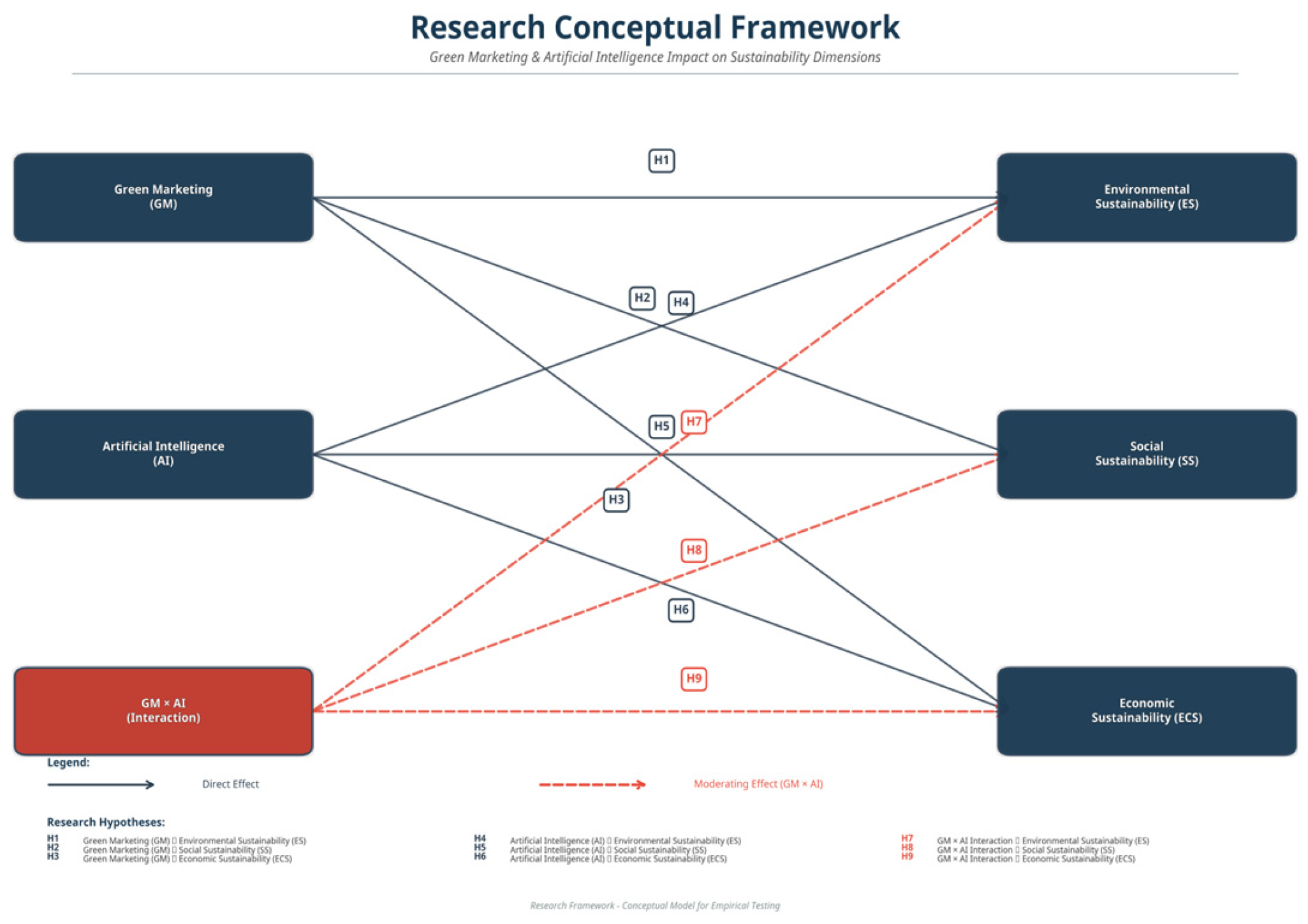
Figure 1 presents the conceptual research model illustrating the hypothesized relationships among green marketing (GM), artificial intelligence integration (AI), and the three dimensions of corporate sustainability: environmental sustainability (ES), social sustainability (SS), and economic sustainability (ECS).
Based on the above theoretical discussion and prior empirical studies, the following hypotheses are proposed to examine the relationships between green marketing, artificial intelligence integration, and corporate sustainability.

2.5. Research Hypotheses

Based on this integrated theoretical logic, green marketing is expected to exert direct positive effects on the three dimensions of corporate sustainability, as it reflects a sustainability-oriented strategic posture. Artificial intelligence integration is also expected to have both direct effects and a contingent strengthening role. Specifically, as a higher-order capability, AI enhances firms’ ability to sense, process, and act upon sustainability-related information, thereby improving the effectiveness of green marketing practices. Accordingly, AI is expected not only to directly influence corporate sustainability outcomes, but also to act as a moderator that strengthens the relationship between green marketing and the environmental, social, and economic dimensions of sustainability.
Green Marketing → Sustainability
Drawing on the natural resource-based view and prior research on sustainability-oriented marketing, green marketing is expected to enhance environmental, social, and economic sustainability outcomes by aligning organizational practices with environmental and stakeholder expectations.
H1: 
Green marketing positively influences environmental sustainability.
H2: 
Green marketing positively influences social sustainability.
H3: 
Green marketing positively influences economic sustainability.
AI → Sustainability
Based on dynamic capabilities theory, artificial intelligence is conceptualized as a higher-order capability that enables firms to sense, seize, and reconfigure resources, thereby contributing to sustainability performance.
H4: 
Artificial intelligence integration positively influences environmental sustainability.
H5: 
Artificial intelligence integration positively influences social sustainability.
H6: 
Artificial intelligence integration positively influences economic sustainability.
Interaction → Sustainability
From an integrated theoretical perspective, artificial intelligence is expected to strengthen the effectiveness of green marketing by enhancing firms’ ability to implement, monitor, and optimize sustainability-oriented practices.
H7: 
Artificial intelligence positively moderates the relationship between green marketing and environmental sustainability, such that the relationship becomes stronger at higher levels of AI integration.
H8: 
Artificial intelligence positively moderates the relationship between green marketing and social sustainability, such that the relationship becomes stronger at higher levels of AI integration.
H9: 
Artificial intelligence positively moderates the relationship between green marketing and economic sustainability, such that the relationship becomes stronger at higher levels of AI integration.

3. Materials and Methods

3.1. Research Design

This research utilizes a mixed-methods design with an explanatory sequence to offer a robust insight into the relationships of sustainable marketing practices, artificial intelligence, and corporate sustainability in Palestinian industries through the combination of results from the quantitative and qualitative methods of the research. The quantitative element of the design is the essential part and encompasses a structured format in the form of a questionnaire to test the relations of the study variables. Later, the qualitative section involves in-depth interviews based on the results of the quantitative component.
The explanatory sequential design was particularly suitable for this study because it allowed the quantitative data to reveal the main patterns and relationships among the study variables, while the qualitative phase provided deeper explanations of these findings within the organizational and sectoral contexts. The integration of both phases increased the validity of the study by enabling the results to be interpreted within their appropriate empirical context, as suggested by Refs. [40,44].

3.2. Population and Sampling

The study population included industrial and production units in the State of Palestine, along with the food sector, chemical and cleaning products, pharmaceuticals, and associated industries whose operations include sensitivities to the environment and are adopting marketing and technology practices characteristic of the commitment to the environment and sustainability objectives.
The population of this study consisted of industrial and production firms operating in Palestine. According to data reported by the Palestinian Central Bureau of Statistics (PCBS), the industrial sector includes several hundred active firms distributed across different manufacturing industries such as food processing, construction materials, textiles, and chemical products. The sample of this study includes firms of different sizes, including small and medium-sized enterprises as well as larger manufacturing firms. The participating organizations are primarily privately owned, reflecting the dominant ownership structure within the Palestinian industrial sector.
The 500 valid responses were obtained from respondents representing multiple industrial firms rather than a single organization. However, because the study focused on individual managerial perceptions and did not model firm-level nesting explicitly, potential clustering effects within firms were not statistically adjusted for. This should be considered when interpreting the findings.
The target audience in these organizations includes marketing managers, sustainability managers, production managers, and decision-makers in their organizations who are aware of their sustainability initiatives and the digital transformation process in their organizations.
The sampling process followed a structured yet practically constrained approach. Initially, purposive sampling was employed to identify industrial firms that are either adopting or planning to adopt sustainability strategies and artificial intelligence (AI) marketing practices, ensuring alignment with the objectives of the study. Subsequently, the questionnaire was distributed electronically through Google Forms and internal email channels to targeted managerial respondents across different industrial sub-sectors. Although the study aimed to achieve balanced representation across sectors, the realized sample was based on voluntary participation, implying a non-probability sampling approach with a self-selection component rather than a strictly random sampling design. This approach was considered appropriate given the limited accessibility to firms and the exploratory nature of the research within the Palestinian industrial context. Taking into consideration the requirements of the PLS-SEM model, particularly in studies involving multiple constructs and interaction effects, a target sample size of 500 respondents was established, consistent with the recommendations of Ref. [45]. The final dataset retained 500 valid responses for the structural model analysis.

3.3. Data Collection Instruments

For data collection, two instruments were involved. The first involved a research questionnaire designed and targeted for the quantitative approach. The research instrument consisted of close-ended variables measured through a five-point Likert scale ranging from strongly disagree to strongly agree to the questionnaires. The questionnaires sought the responses of the participants concerning the application of green marketing practices, the extent to which artificial intelligence has been adopted in the organization, and the dimensions of sustainability in terms of the company, including the environment, social issues, and economic aspects. All the survey variables involved the literature and were designed to fit the Palestinian industries setting.
The structured questionnaire was developed based on previously validated scales from prior studies and was contextually adapted to fit the Palestinian industrial setting. Each construct was measured using multiple items coded according to the latent variable that they represented (e.g., GM, AI, ES, SS, and ECS). Table 1 presents the measurement items, their corresponding codes, and the original sources from which they were adapted.
The second tool was a semi-structured guide for conducting an interview in the qualitative study. This guide consisted of a number of open-ended questions to gain insight into the respondent’s experience of AI application, the strategic integration of green marketing in their organization, and the risks and opportunities involved in aligning innovation and sustainability strategies. The interview guide was developed based on the study’s conceptual framework, particularly the constructs of green marketing, artificial intelligence integration, and corporate sustainability derived from the triple bottom line perspective. The qualitative sample size (15 interviews) was determined based on the principle of data saturation commonly used in qualitative research. Thematic analysis was conducted using NVivo 14 software to identify recurring themes and patterns in the interview data.
To minimize potential conceptual overlap between green marketing and corporate sustainability constructs, clear operational distinctions were maintained in the measurement design. Green marketing was operationalized as a set of strategic marketing practices related to environmentally oriented product development, promotion, pricing, and distribution activities. In contrast, corporate sustainability was measured as a multidimensional outcome variable reflecting environmental, social, and economic performance. This distinction ensures that green marketing represents an organizational strategic approach, while sustainability captures the resulting performance outcomes.

3.4. Data Collection Methodology

The data collection process began with the distribution of a web-based questionnaire through Google Forms and internal email channels to targeted respondents across various industrial sectors. Reminder messages were sent to improve the response rate. Because participation depended on the respondents’ willingness to complete the questionnaire after receiving the invitation, the final sample included a voluntary self-selection component. Following the completion of the quantitative phase, respondents who indicated their willingness to participate in the second phase were invited to take part in semi-structured interviews based on their availability and preference. These interviews were conducted either face-to-face or through electronic communication platforms. Prior to each interview, the participants’ consent was obtained for recording purposes, and all interviews were subsequently transcribed for analysis. The qualitative phase was designed to complement and further interpret the quantitative findings, thereby providing deeper contextual insights into the observed relationships.
Data were collected between March 2024 and July 2024. A total of 543 questionnaires were distributed to eligible respondents across the targeted industrial firms. Of these, 500 valid responses were retained for the final quantitative analysis, yielding a response rate of 92.1%. Questionnaires with substantial missing data or incomplete responses were excluded, while minor missing values were screened and handled prior to analysis to ensure data quality.
As the study relied on self-reported data, potential biases such as social desirability and common method bias cannot be entirely ruled out. However, several procedural steps were taken to enhance response quality, including ensuring respondent anonymity, using clear and concise measurement items, and targeting knowledgeable respondents within the organizations. In addition, multicollinearity was assessed using VIF values, which were found to be within the acceptable thresholds, indicating no serious collinearity concerns.

3.5. Data Analysis Techniques

Since the study involved the examination of complex relationships and moderation effects, the quantitative data were analyzed using Partial Least Squares Structural Equation Modeling (PLS-SEM) implemented in SmartPLS version 4. This software was selected because of its suitability for exploratory models, non-normal data, prediction-oriented analysis, and complex structural relationships among latent constructs.
The analytic process followed two major steps. Firstly, the assessment of the measurement model aimed to validate the reliability, internal consistency, convergent validity, and discriminant validity of the indicators. At this point, the following rules are applied in their respective steps: the evaluation of the measurement model, followed by the assessment of the structural model in terms of collinearity, the significance of the paths, the explained variance through the R-squared values, the effect size significance, and finally the significance of the hypothesized relationships by means of bootstrapping methods with a value of 5000 resamples [45]. The moderating effect was examined through an interaction term combining artificial intelligence integration and green marketing practices.
The qualitative data were analyzed using the theme analysis technique. The researcher went through the interview transcription to identify the themes associated with sustainability practices, AI, and marketing strategies and compiled the results to find where the results converge and diverge based on the two sources of data—qualitative and quantitative data.

3.6. Ethical Considerations

Ethical considerations were carefully observed throughout the entire research process. Participants were fully informed about the purpose, scope, and voluntary nature of the study prior to their participation. Informed consent was obtained from all respondents before completing the questionnaire and participating in the interview phase.
Participation was entirely voluntary, and respondents were free to withdraw at any stage without any consequences. Anonymity and confidentiality were strictly maintained, and no personally identifiable information was collected. All responses were used solely for academic research purposes and were not disclosed to any third party.
The study was conducted in accordance with standard ethical research practices applicable to survey-based and interview-based research in the field of management and social sciences.

4. Results

4.1. Sample Characteristics

This section describes the demographic and professional characteristics of the respondents included in the quantitative survey. The distribution is presented in Table 2.
The sample distribution reflects a balanced representation of respondents across different categories. Regarding organizational roles, marketing managers constituted 27.0% of the sample, followed by production managers at 25.6%, ensuring a strong representation of leaders responsible for making decisions related to sustainability and green marketing.
In terms of firm size, medium-sized enterprises represented the largest proportion (36.0%), followed by large enterprises (35.0%), while small enterprises accounted for 29.0% of the sample. This distribution reflects the economic reality of the Palestinian industrial sector.
Regarding industrial sectors, respondents are relatively evenly distributed among the food and beverage sector (25.0%), chemicals and pharmaceuticals (23.6%), construction and materials (26.4%), and other sectors (25.0%).

4.2. Descriptive Statistics

Descriptive statistics were calculated to summarize the distribution of the study constructs before conducting the structural equation modeling analysis. The results are presented in Table 3.
The high mean scores for all constructs (ranging between 4.18 and 4.46 on a 5-point scale) indicate strong positive attitudes toward green marketing, artificial intelligence, and sustainability in its various dimensions. The economic sustainability (ECS) construct achieved the highest mean (4.46), followed by environmental sustainability (4.35) and then green marketing (4.32).
The moderate standard deviations (ranging between 0.73 and 0.95) suggest a reasonable consensus in opinions among respondents, with a slight variance in artificial intelligence responses (SD = 0.95), which may reflect varying levels of awareness regarding AI applications within the Palestinian context.
The descriptive statistics reported in Table 3 are based on composite scores calculated by averaging the items corresponding to each construct. Since all items were measured using a five-point Likert scale, the resulting composite scores also ranged between 1 and 5. The presence of minimum and maximum values equal to the scale endpoints indicates that some respondents provided consistently low or high ratings across all items of specific constructs. This is not uncommon in perception-based survey data and reflects the variability in respondents’ evaluations.

4.3. Measurement Model Evaluation

Before examining the structural relationships among constructs, the reliability and validity of the measurement model were evaluated. This includes factor loadings, Cronbach’s alpha, composite reliability (CR), and average variance extracted (AVE). These indicators ensure that each latent construct, Green Marketing, AI Integration, Environmental Sustainability, Social Sustainability, and Economic Sustainability, is measured consistently and accurately.
Table 4 presents the reliability and convergent validity results of the study constructs, including Cronbach’s alpha, composite reliability, and average variance extracted (AVE).
The reliability and validity of the measurement model were assessed before testing the structural relationships. Table 4 reports the values of Cronbach’s alpha, rho_a, composite reliability (rho_c), and average variance extracted (AVE) for the constructs included in the measurement model: Artificial Intelligence (AI), Green Marketing (GM), Environmental Sustainability (ES), Social Sustainability (SS), and Economic Sustainability (ECS).
Cronbach’s alpha values ranged from 0.866 to 0.899, exceeding the recommended threshold of 0.70 [45], indicating acceptable internal consistency among the indicators of each construct. The composite reliability values (rho_c) ranged from 0.909 to 0.926, which also exceeded the recommended threshold and support the reliability of the constructs.
Convergent validity was assessed using the average variance extracted (AVE). All AVE values exceeded the recommended minimum threshold of 0.50, ranging from 0.700 for GM to 0.759 for ECS, indicating that the constructs explained a sufficient proportion of the variance in their indicators.
Overall, the reliability and validity statistics reported in Table 4 indicate that the measurement model satisfies the commonly recommended criteria for internal consistency and convergent validity.

4.4. Discriminant Validity (HTMT Criterion)

To confirm that each construct is empirically distinct, discriminant validity was assessed using the heterotrait–monotrait (HTMT) ratio. This method evaluates whether the correlations between constructs remain below the recommended threshold, ensuring that the constructs measure conceptually distinct phenomena such as green marketing, artificial intelligence integration, and the different dimensions of corporate sustainability.
Table 5 presents the HTMT ratios used to assess discriminant validity among the study constructs.
All HTMT values were below the recommended threshold of 0.90 [45], indicating adequate discriminant validity among the study constructs.

4.5. Collinearity Statistics (VIF)

To assess multicollinearity in both the measurement and structural models, variance inflation factor (VIF) values were examined at the indicator level (outer model) and at the latent variable level (inner model).
Following the suggestion put forward by Ref. [45], a VIF value less than 5.0 suggests the absence of multicollinearity issues, while values ranging from 3.3 to 5.0 indicate borderline multicollinearity in complex models. Moreover, a value less than 3.3 represents a more rigorous criterion, providing stronger assurance against common method variance and confirming the independence of the indicators.
Table 6 presents the VIFs, and as shown, the values were well within the acceptable levels, ranging from a low of 1.826 to a high of 2.960, well below the benchmark levels of 3.3 and the commonly cited 5.0 value. The results suggest the absence of multicollinearity and that the covariance was constant across the predictor variables. The moderate VIF values across each construct suggest that the indicators are unique and are not exhibiting uncharacteristic variability across their respective constructs.
Specifically, the VIF ranges for the AI construct ranged from 2.027 to 2.884, and the GM indicators ranged from 1.956 to 2.504, indicating a high level of independence for the indicators. The ES indicators ranged from 1.888 to 2.392, the SS indicators ranged from 1.826 to 2.323, while the ECS indicators ranged from 2.214 to 2.960. Moreover, no item was near the critical values, and they fell well below the low levels of the VIF for their respective constructs.
To further assess collinearity in the structural model, the variance inflation factor (VIF) values for the latent variables were also examined.
Table 7 presents the inner VIF values for the predictor constructs in the structural model.
All inner VIF values were below the recommended threshold of 3.3, indicating that multicollinearity is not a concern in the structural model.

4.6. Effect Size Assessment (f2 Analysis)

Effect sizes were calculated to assess the magnitude of each predictor’s contribution to the dependent variables. This allows for an interpretation beyond significance, identifying which constructs exert the strongest influence.
Table 8 presents the effect size (f2) values for the predictors on environmental, social, and economic sustainability.
The findings, based on the effect size, show that the strongest predictor for sustainability performance was the GM factor, and it had a very large effect size in terms of the economic sustainability (f2 = 0.368), environmental sustainability (f2 = 0.349), and social sustainability (f2 = 0.356) dimensions. Moreover, AI also plays an important part and showed medium effect sizes for each sustainability index: economic (f2 = 0.192), environmental (f2 = 0.199), and social sustainability (f2 = 0.221). This indicates a positive effect of AI, but to a lesser extent than that of GM.
The moderating effect of AI × GM had a very low effect size in the economic (f2 = 0.014), environmental (f2 = 0.013), and social sustainability (f2 = 0.040) aspects. The effect size values clearly acknowledge that AI enhances GM but the additional effect is quite low. Taken together, the f2 results suggest that green marketing is the strongest predictor of sustainability, followed by a moderate contribution from artificial intelligence and a small but positive interaction effect.

4.7. Structural Model Assessment and Hypothesis Testing

The structural model examines the relationships among the main study constructs: green marketing, artificial intelligence integration, and the three dimensions of corporate sustainability, namely environmental sustainability, social sustainability, and economic sustainability. The results indicate the presence of both direct and interaction effects among these variables. Both GM and AI showed positive associations with the three sustainability dimensions, with GM displaying slightly higher path coefficients across the model. The results suggest that organizations implementing green marketing practices tend to report higher levels of environmental, social, and economic sustainability outcomes, with the strongest relationship observed for economic sustainability.
Artificial intelligence integration also showed positive and statistically significant relationships with the sustainability dimensions, suggesting that AI-supported decision-making and analytical capabilities may contribute to sustainability-related organizational practices. The analytical model also includes an interaction term that examines the moderating role of AI in the relationship between green marketing and corporate sustainability. The results indicate a positive but relatively small moderating effect, suggesting that AI may reinforce the relationship between green marketing practices and sustainability outcomes. The moderating effect appears more noticeable in relation to social sustainability, indicating that the combined use of AI tools and green marketing practices may support stakeholder communication and engagement.
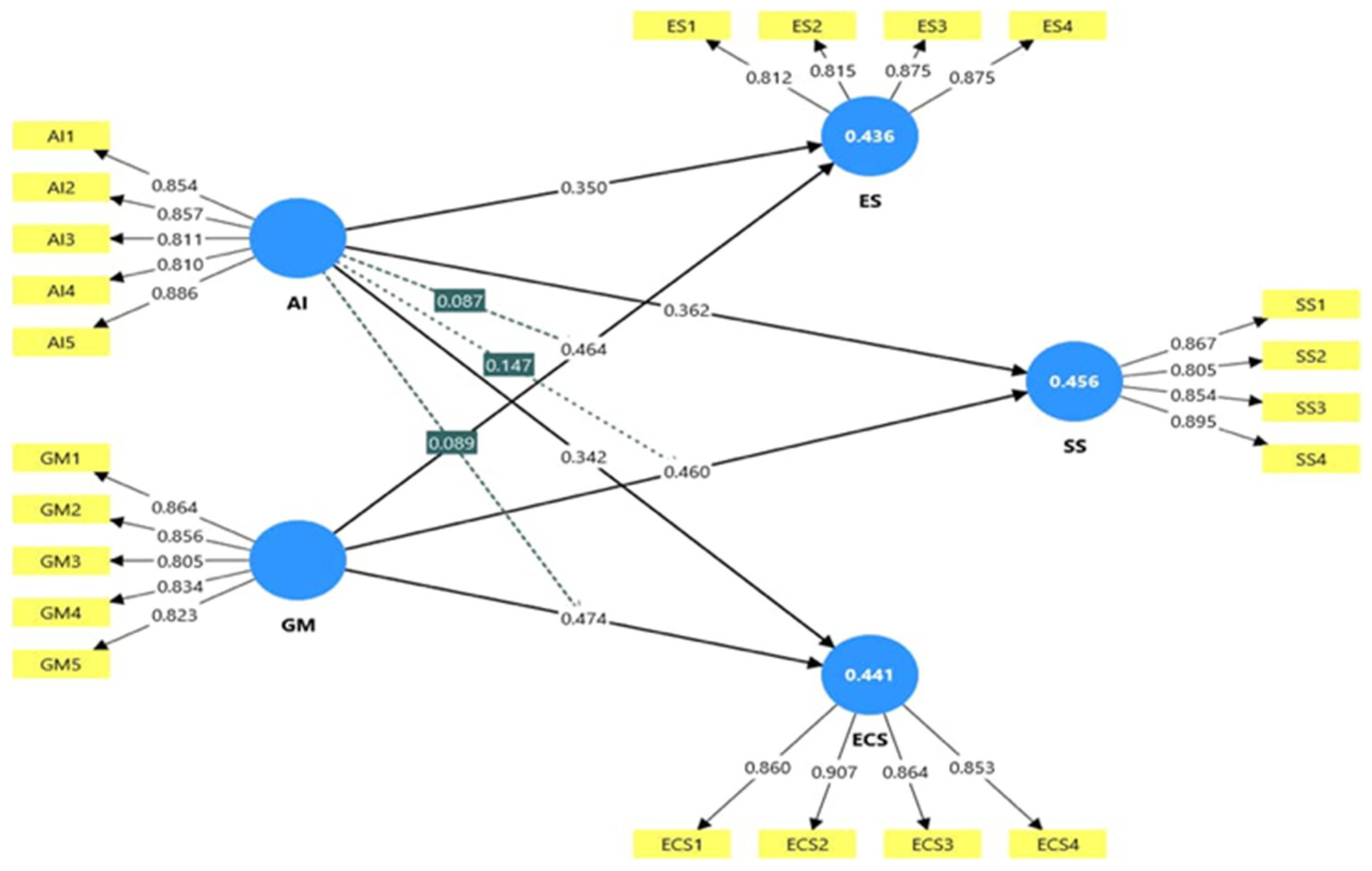
The R2 values of 0.436 for environmental sustainability (ES), 0.456 for social sustainability (SS), and 0.441 for economic sustainability (ECS) indicate a moderate level of explanatory power. These values suggest that the model explains a meaningful proportion of the variance in the sustainability dimensions. Overall, the results indicate that green marketing practices and AI integration are associated with corporate sustainability outcomes within the Palestinian industrial sector.

4.8. Bootstrapping Results for Path Coefficients and Hypothesis Evaluation

The structural model was analyzed through a bootstrapping test with a total of 5000 subsamples to determine the significance of the hypothesized paths relating to the relationships involving GM, AI, ES, SS, and ECS. Figure 2 illustrates the structural model and the estimated path relationships among the study constructs.
The results indicate that the direct effects of green marketing (GM) and artificial intelligence integration (AI) on the three sustainability dimensions were positive and statistically significant. Green marketing showed the strongest effect on economic sustainability (β = 0.474, p = 0.000), followed by environmental sustainability (β = 0.464, p = 0.000) and social sustainability (β = 0.460, p = 0.000).
Artificial intelligence integration also demonstrated positive and statistically significant effects on the sustainability dimensions, with path coefficients of β = 0.350 for environmental sustainability (ES), β = 0.362 for social sustainability (SS), and β = 0.342 for economic sustainability (ECS) (p = 0.000 in all cases).
The model also includes interaction terms to examine whether AI moderates the relationship between green marketing and the sustainability dimensions. The interaction effects were positive and statistically significant but relatively small. The interaction term AI × GM showed effects on ES (β = 0.089, p = 0.004), SS (β = 0.147, p = 0.000), and ECS (β = 0.087, p = 0.004).
The R2 values indicate a moderate level of explanatory power for the model, with GM and AI explaining 43.6% of environmental sustainability, 45.6% of social sustainability, and 44.1% of economic sustainability.
Table 9 summarizes the path coefficients and hypothesis testing results obtained from the bootstrapping analysis.
Overall, the results provide strong support for H1, H2, and H3, confirming the positive effect of green marketing on environmental, social, and economic sustainability.
Similarly, H4, H5, and H6 are supported, indicating that artificial intelligence integration has significant positive effects on all three sustainability dimensions.
Furthermore, the moderating hypotheses (H7, H8, and H9) are also supported, demonstrating that artificial intelligence strengthens the relationship between green marketing and corporate sustainability across its environmental, social, and economic dimensions.

4.9. Interviews Results

To complement the quantitative findings and gain a deeper understanding of how Green Marketing and Artificial Intelligence shape corporate sustainability practices within Palestinian industrial firms, a qualitative phase was conducted using semi-structured interviews with fifteen participants representing different managerial and operational roles across diverse industrial sectors. The purpose of this qualitative analysis was to explore the meanings, experiences, and organizational processes underlying the statistical relationships identified in the quantitative phase, allowing for richer interpretation and triangulation of results.
All interviewees were assigned anonymous participant codes to protect confidentiality while enabling the traceability of quotations throughout the analysis. These codes (e.g., MM-TX-007, PM-FM-015, SM-PL-014) corresponded to the participants’ roles and sectors, and the complete list of codes is provided in Appendix C.
The following sections present the qualitative findings organized around the three dimensions of corporate sustainability, environmental, social, and economic, demonstrating how the participants’ narratives converge with, extend, or contextualize the quantitative evidence.

4.9.1. Environmental Sustainability: Interview-Based Insights

Throughout the interviews, the factor that was cited by the participants consistently as the most observable and measurable outcome of incorporating green marketing and artificial intelligence in their organization was environmental sustainability. The descriptions suggest that the improvements in the environment are not random but a result of the interaction of sustainable expectations in the marketplace and the tools used to measure the environment.
Several participants noted that sustainability projects and initiatives came from the marketing area because of the commitments made to the consumer, especially in light of the fact that consumers value sustainable packaging and responsible products for the environment. The marketing activity precipitated an organizational need to undertake cleaner production in terms of processes in production. The point was clearly made by one participant: “When marketing tells the consumer that packaging waste has been reduced, the production side feels the responsibility to make the commitment a reality” (SM-PL-014).
This trend has been supported by evidence of changes in manufacturing processes and the use of resources consistent with sustainability agreements. Delegates from a variety of manufacturing industries explained changes in product and packaging designs that have decreased the use of raw materials. A delegate from a packaging company said, “We’ve evolved our designs of packaging in a way that are not material-driven. Marketing this for our consumers benefits us, but it also benefits our company internally, related to our own carbon footprint” (MM-PK-013). The key point all delegates agreed upon was that artificial intelligence software has been instrumental in providing environmentally positive advancements for their companies. Increased efficiency, accuracy, and precision, as well as early problem detection, were highlighted as being of high priority. The production manager at one of the institutions where AI was applied described the transformative effect of AI in the area of waste management: “AI will be able to detect even the slightest inefficiency… It detects problems early, and we don’t throw out the whole batch the way we used to” (DT-PH-010). Another supervisor in the food production sector described how AI prevented food wastage through the monitoring of the accuracy of their filling process: “AI analyzes the filling accuracy and alerts us if there’s a problem. Just that has prevented considerable food wastage” (PM-FM-015).
The second prominent theme was the added efficiency in the utilization of energy and water. For industries where there is a considerable amount of utilization of energy and water, AI allowed for the dynamic optimization process that resulted in a considerable elimination of wastage. “The AI system watches the utilization of energy and water in the production lines. Whenever there is an abnormality, it sends an instant notification… It has reduced our electricity and water utilization to a considerable extent” (PM-CH-009).
Water users from the water-intensive sector, such as the textiles sector, reported a significant reduction in their water use because of the application of AI in process optimization. A quality assurance manager of a textile company illustrated the dyeing process: “It helped us in optimizing our dyeing process. We significantly reduced our water usage because the AI tool pointed out wasteful processes” (QA-TX-012).
AI acts as both a diagnostic tool and a solution in such cases where it detects the inefficiency that human observation cannot easily identify. The interviewed people also linked the implementation of AI with enhanced pollution control and environmental regulation to be in line with the environment and its sustainability. Since the traditional monitoring involved samplings and the process involved monitoring the environment periodically, it was quite unsuccessful in identifying any problems within the required timeframe. “The digital sensors are monitoring the emissions second by second. If anything exceeds the limit, we get an instant notification. This will protect the environment and the company will always be in compliance”, said the sustainability officer at SM-FM (SM-FM-008).
Worth mentioning in this context is the fact that the participants viewed AI not only as a tool for improving operational efficiency but also as a trustworthy source of verified environmental information, which enhances the authenticity of the green marketing campaigns. The fact that the marketing function is employing AI-based information to validate environmentally related claims in its communications has been highlighted by a number of the people interviewed. As one of the participants said, “The marketing function can claim with confidence that it has reduced its emissions and waste because the metrics come from AI monitoring systems” (DT-PH-010).
Throughout the interviews conducted, a constant theme was the complementarities of the two: “Of course, AI and green marketing complement each other. Marketing defines the objectives, and AI contributes to their achievement and measurement”, said one participant (SM-PL-014).
This view tends to confirm the finding in the quantitative approach, where a slight positive moderating effect was found, despite the fact that this aspect was not explored in the interviews in any detail.
On the whole, the interviews conveyed a clear message: the achievement of environmentally sustainable practices in industrial enterprises within the Palestinian territories implies a comprehensive approach in which green marketing establishes the strategic roadmap and AI helps in the process and its validation. Waste minimization, resource management, pollution management, and sustainability reporting are no longer individual accomplishments but the sum total of strategic marketing processes and precise AI-driven actions.

4.9.2. Social Sustainability: Interview-Based Insights

Through the interviews, social sustainability has been noted to be a clearly human-focused theme in the practices of the organization, driven by the need to establish the implementation of strategic and targeted marketing activities oriented towards greening the organization, along with the application of AI solutions. Within the context of the study, social sustainability is viewed as a process where environmentally responsible activity has positive rippling effects associated with employee and stakeholder relations and the well-being of the surrounding communities.
Several people highlighted that the initiatives involving digital and green technologies directly addressed employee safety and working conditions in a manner that created a space where employees felt protected and taken care of in a way that was safer and more considerate of their well-being. One of the participants said, “AI alerts us when the temperature is rising and the emissions increase, thus ensuring the safety of the employees. Employees feel safer because AI alerts us to potential dangers before they cause any harm” (SM-PL-014).
The importance of converging green technology and digital technology that benefits employee morale and development has been highlighted in this text. Not only that, in various replies, it was established that training related to new technology has helped employees in developing their confidence and skills. “Employees feel valued now. They know that if the company is investing in technology and developing them, they feel that they are growing along with the company” (SM-FM-008).
Transparency has been pointed out as a determinant that has a great impact on consumers in terms of trust. Interviewees agreed that transparency, in partnership with effective green marketing with support from AI, promotes authenticity and reliability in any business transaction. With the increasing demands of consumers for responsible actions concerning ethical and environmental matters, transparency has become a necessity. According to a marketing manager, “Customers value our transparency. Transparency of our responsible production practices promotes trust and loyalty” (MM-TX-007).
Social sustainability, as reported in the interviews, has to consider the internal working environment and the way the company interacts with its consumers in an ethical manner. Through the stories, another theme came out: improvements in production processes and commitment to sustainability helped to neutralize consumer worries related to the safety and quality of a product. The application of AI in quality monitoring tools was viewed as a means to enhance social responsibility in the prevention of defects and the sustenance of a stable quality level. This was supported by a company official: “AI helps produce safer and more reliable products. Our consumers understand that our processes run in a socially responsible manner” (DT-PH-010).
The participants also noted the links to greener and digital projects and the positive impacts upon the communities. Industry operations will always affect the environment and the communities, and a number of participants noted the importance of practices related to the environment and how they assist in the well-being of the communities. “With the reduced emissions, the air will be cleaner in the areas where our trucks pass through, and this has a positive effect”, said a logistics manager (SC-FM-011).
Apart from the environmental changes that the companies implemented, some undertook corporate social responsibility programs that related to the sustainability initiatives they undertook. The programs included recycling initiatives, donations of recycled materials to the communities, and teaching the communities through programs in schools and centers. “We run programs in the communities: schools and centers, teaching about recycling and responsible consumption” said a respondent from a textile company (QA-TX-012).
Within the group, the participants shared an understanding that the marketing campaigns conducted by the company improved consumer acknowledgment of the social commitments of the organization, thus making the actions more visible to the consumers. The packaging manager explained, “When we emphasize sustainable and safe practices, our consumers recognize us as socially responsible. It has become a part of our identity now” (MM-PK-013).
Instead, according to this view, marketing goes well beyond the realm of stakeholder communication, and its function is to align the internal values of the company with the expectations of the outside environment, and thus its contribution to societal well-being. Many members also cited the subtle but significant cultural transformation that has resulted from the simultaneous application of AI and sustainable marketing strategies. The members said that the implementation of sustainable strategies has assisted in the development of a corporate culture that focuses on responsibility and transparency in the organization’s relations with its stakeholders. One of the members who put the issue of the cultural transformation into perspective said, “We are a company that derives value from our relations… We think differently than other companies because AI and sustainability have altered the way in which we think as a company. We understand our impacts on people, not simply profits” (PM-FM-015).
In light of the above, the interviews demonstrate that a number of ways in which social sustainability is enhanced include better working conditions, higher trust levels in consumers, stronger ties with the local communities, and the fostered responsible corporate culture. The commitment to social responsibility is made more transparent and feasible through the medium of green marketing, and the assistance required for the commitment is facilitated through the application of AI.

4.9.3. Economic Sustainability: Interview-Based Insights

The findings highlight the focus on economic sustainability, where the participants consistently linked improvements in economic performance to the application of green marketing and AI. The reflections suggest that financial benefits are achieved in terms of measurable results and not expectations in organizations where environmentally oriented strategies are combined with AI applications and practices.
One of the themes that ran through the interviews was the direct and positive effect of artificial intelligence in relation to reduced costs, in particular waste and resource optimization. Several of the participants discussed the significant financial benefits of early problem identification made possible through AI. “AI gives us an early indication of the possible failure of the machines, thus preventing machine downtime… Unforeseen machine breakdowns are expensive; wee incur them no more” (Production Supervisor, PM-FM-015).
Cost savings resulted from the optimized use of available resources. The participants explained how artificial intelligence assisted in the identification of processes where high water and energy use was prevalent, resulting in changes in the organization to ensure long-term economic savings. “AI watches the consumption of energy and water in the processes… We noted machines that consumed higher levels of energy, and through the machines, we realized a significant cut in costs”, said a chemical sector participant (PM-CH-009). The said quotations are an indication that monitoring and making changes to processes leads to resource optimization, confirming the assertion that sustainable technologies strengthen economic resilience.
At the same time, waste reduction has also been proven to be an environmental success and an important factor in economic performance. The importance of monitoring the system in real-time to avoid the production of defective goods, resulting in the loss of materials and production costs, has been emphasized by many participants in the study. The view was well-expressed by a pharmaceutical company representative: “Before AI, defects resulted in the disposal of a lot of material. This seldom happens nowadays… and this results in a huge cost-saving for the company” (DT-PH-010).
The semi-structured interviews also provide insight into the added advantage of green marketing in terms of the competitiveness of products, where consumers consistently show allegiance to environmentally sustainable products and services. According to a marketing manager in the textile industry: “Customer response to sustainable goods has been quite favorable… Such consumers usually stick to organizations that take an interest in the environment, and this reflects in our sales” (MM_TX_007).
The respondents also emphasized the importance of sustainability commitments in forming partnerships, especially when large clients require suppliers to meet their sustainability standards. “Large clients will only partner with suppliers who meet the sustainability criteria. Our sustainable practices assisted us in winning contracts”, added a manager in the packaging and printing industry (MM-PK-013). The best practices cited above demonstrate how sustainable marketing practices, made possible by credible sustainability information generated through AI, improve the economic prospects of a business by opening the marketplace and new clients to a company.
Additionally, artificial intelligence has made the economy sustainable through better planning and predictions. For industries that experience qualitative in demands and for produce with a short lifespan, AI analytics helps in reducing the loss through the production of excess goods that are then discarded. “It forecasts the demand levels more accurately; without it, we would produce excess and dispose of some of the produce to avoid financial losses”, said a logistics manager working in a food company (SC-FM-011).
Moreover, the positive effect of sustainability efforts regarding efficiency and productivity in production has been considerable. According to a respondent, “Machines work better now… less breakdowns, less delays. This alone will improve our productivity and profitability” (PM-FM-015). The results above show the economic value when variability and system reliability are improved in terms of the environment and technology initiatives.
The participants also stressed the monetary aspects of transparency and credibility in noting that the credibility of sustainability reporting backed by AI data leads to the firms appearing trustworthy and competitive in the marketplace. “AI offers marketing hard numbers… If we report our sustainability success, our client trusts us, and our business relations improve”, said a pharmaceutical representative (DT-PH-010). The combination of the digital world’s focus on precision and the sustainability reporting area blends well in the importance of corporate reputation, the value of which cannot be overlooked in the marketplace because it has a monetary value associated with it.
It is noteworthy that some of the people interviewed viewed green marketing in and of itself as a factor in internal economic change in a company. When a company commits to the environment, it has to work in an optimal manner to live up to that commitment. This was explained by a plastics industry manager: “Green marketing forces us to be more effective in what we do, to minimize waste and improve process technologies because we said to the marketplace that we will do this” (SM-PL-014).
Taken together, the results of the interviews shed light on a unified and synergistic dynamic between GM, AI, and the three dimensions of business sustainability. Representative interview quotations illustrating these themes are summarized in Table 10.
The importance of green marketing was perceived to be the strategic trigger that gives businesses the stimuli to reinvent their products, make the production processes cleaner, and be transparent in the way that the business interacts with its stakeholders. GM influences the organization’s strategic course in terms of setting expectations in the environment regarding its responsibility and ethics in creating value.
On the other hand, AI is the backbone that makes the commitments possible in terms of reducing waste, increasing efficiency, and improving safety through the provision of credible information that proves the company’s statements regarding the environment and social impacts. There was a clear pattern: GM presents the promise, while AI presents the performance. Improvements in environmental sustainability came from real-time monitoring, the prevention of defects, the control of pollution, and the efficiency of resource utilization, enforced by the strictures of sustainability messaging from the outside environment. Improvements in social sustainability, such as enhanced safety, transparency, and civic engagement, came from cleaner processes and the cultural change spawned by sustainability messaging. Economic sustainability was enforced through cost savings, competitiveness, and improved forecasts, where the message kept reiterating that sustainability and profitability are no longer at odds but march in parallel. Significantly, the message came that GM and AI are synergies and NOT solo actors in their respective domains but work together in harmony. This fits well into the results pattern where the direct effect and modest MIC pattern suggest a positive effect.


5. Discussion

5.1. Green Marketing and Corporate Sustainability

The findings show that the effect size values for GM in terms of its predictive capability in corporate sustainability across the environment (f2 = 0.349), social (f2 = 0.356), and economic (f2 = 0.368) dimensions were substantially higher than the effect size values of the remaining five variables, thus supporting the significance of the pivotal factor, green marketing, in corporate sustainability and confirming the existing literature regarding the nature of the phenomenon of green marketing, which encompasses the strategic perspective where the organization aligns its operations and activities through an environmental and ethical perspective [14,36,37].
The results from the qualitative data tend to confirm this qualitative inasmuch as commitments made through the lens of green marketing will provide the internal motivation to turn thoughts into action: “Once marketing announces that we’re reducing waste, we must make sure it actually happens” (SM-PL-014), and this reflects the tenets of stakeholder theory when it asserts that internal actions are shaped by the commitment made [26].
Environmentally, GM drove the following projects: sustainable packaging design, reducing the number of materials used, and cleaner production processes, in accordance with the natural resource-based view (NRBV), where sustainability projects improve the efficiency of operations [21]. Socially, the transparency in reporting sustainability performance improved trust and employee pride, based on the statement: “Customers appreciate the transparency… it builds trust” (MM-TX-007). Economically, GM helped to maintain and increase the flow of new customers and be competitive in their respective markets where meeting the standards of sustainability is the expected norm, based on the statement: “Big clients only work with suppliers who meet sustainability standards” (MM-PK-013).
In conclusion, GM plays the role of a strategic catalyst through the influence of expectations, internal priority setting, and relationship building with stakeholders, thus improving sustainability performance in the environment, social, and economic spheres.
While the results indicate that green marketing showed the strongest associations with the three sustainability dimensions, this finding should be interpreted with caution. In survey-based research, green marketing measures may partly reflect managerial perceptions and communication practices rather than fully capturing objective environmental performance. Previous literature has also highlighted that green marketing activities may involve symbolic or reputational elements, which could introduce social desirability bias in self-reported responses. Therefore, some of the observed relationships may reflect how firms communicate their sustainability orientation rather than purely operational environmental outcomes. This perspective aligns with the broader debate in the green marketing literature regarding the distinction between substantive environmental performance and symbolic sustainability communication [10,11,46].

5.2. Artificial Intelligence Integration and Corporate Sustainability

The results for AI demonstrated strong positive impacts in each area of sustainability, with medium effect sizes for environmental f2 = 0.199, social f2 = 0.221, and economic f2 = 0.192. The findings confirm the expectations of existing studies, defining AI as a capability in terms of its augmentative effect in environmental and social processes by its sense and respond capability to changes [16,19,23].
Qualitative evidence shows how AI promotes sustainability. The participants reported the positive impacts AI made in terms of waste reduction and the control of pollution through the early detection of anomalies. One of the production participants said, “It detects inefficiencies before they turn into waste” (DT-PH-010). Another participant said, “It tracks energy and water… adjusting them saved us a lot in the monthly bills” (PM-CH-009). This fits the finding that AI promotes environmental sustainability with a higher degree of process accuracy and efficiency in the utilization of resources [27].
AI was also reported to make a contribution to social sustainability, particularly in relation to the area of employment safety and quality. The AI system is referred to as an early warning system, which helps in ensuring the safety of employees: “AI warns us when the fumes rise… people feel safer” (SM-PL-014). This has helped in ensuring the safety and accountability of the organization [22].
Economically speaking, the results from the qualitative inquiry confirmed those of the quantitative results in the sense that AI reduced downtime, increased the forecasts, and enabled productivity. One of the participants noted, “Unexpected breakdowns costly… AI prevents that” (PM-FM-015). The above is in line with [15] because the authors asserted that the efficiency-driven results of AI activation directly translate to economic success. Altogether, AI provides a dynamic operational capability that allows an organization to turn their sustainability goals into tangible results [12,47].
More broadly, it is important to note that all core constructs in this study—including green marketing, artificial intelligence integration, and corporate sustainability dimensions—were measured based on managerial perceptions rather than objective performance indicators. While this approach is widely used in management and marketing research, it primarily captures perceived practices and outcomes rather than directly observed operational or financial performance. Nevertheless, the observed relationships are consistent with prior empirical studies that have documented positive associations between sustainability-oriented strategies, digital capabilities, and firm performance outcomes [18,20,37,42]. Therefore, the findings should be interpreted as reflecting perceptual alignment with established theoretical and empirical patterns rather than definitive evidence of objective performance effects.

5.3. Interaction Between Green Marketing and Artificial Intelligence

The moderation result showed a positive but relatively low interaction effect, demonstrating that AI tends to magnify but not significantly differently improve the effect of green marketing on sustainability issues. The interaction effect was strongest for social sustainability (β = 0.147), but it was also significantly positive for economic and environmental sustainability issues. All results confirmed marketing studies that suggest AI contributes to marketing activity by promoting the quality and measurability of information and the process of stakeholder communications [15,34].
The qualitative results provide an affirmation to the above conclusion. The value added by AI to the credibility of sustainability messaging was emphasized by the participants to the study. The quote by one of the participants: “Marketing can confidently say we reduced emissions because the numbers come from AI systems” (DT-PH-010), supports the fact that credibility has been enhanced [5].
The more robust moderating effect has a clear rationale in that the trust in the social factor is the strongest if the transparency in the social area is high, and increased AI-assisted monitoring fosters “transparency, safety, and stakeholder confidence” (PM-FM-015). Elaborations in relation to the economic factor include the combined effect of the two variables in the following way: “Green marketing pushes us to work smarter, and AI helps us do it efficiently” (SM-PL-014), illustrating the enabling effect of AI in the process of sustainable marketing practices.
Although the interaction effect between artificial intelligence integration and green marketing was found to be statistically significant, the relatively modest effect size (f2) suggests that the moderating role of AI is still emerging rather than fully established. This finding can be interpreted within the context of the Palestinian industrial sector, where the adoption of advanced digital technologies, including AI, is still in its early stages. In such environments, firms may face infrastructural, financial, and organizational constraints that limit the full exploitation of AI capabilities. Therefore, the observed effect size should not be viewed as a limitation, but rather as an indication of an evolving digital transformation process.
Furthermore, the results suggest that the relationship between green marketing and corporate sustainability may not be exclusively direct or moderated, but could also be influenced by additional mediating mechanisms. Future research may consider examining variables such as organizational learning, innovation capability, or environmental strategy implementation as potential mediators that further explain how green marketing translates into sustainability outcomes in the presence of artificial intelligence.
Taken together, the moderation results indicate that AI plays a supportive role in strengthening the relationship between green marketing practices and sustainability outcomes. Although the interaction effects were statistically significant, their magnitude remained relatively small, suggesting that AI functions primarily as an enabling technological capability rather than a dominant driver of sustainability performance. This interpretation is consistent with the empirical results, where green marketing showed stronger direct effects across the sustainability dimensions [48].

6. Conclusions and Future Research

The aim of the study was to explore the significance of GM and AI in the context of corporate sustainability and to analyze the moderating effect of AI in intensifying the effect of GM on sustainability performance. Using a mixed-methods design involving PLS-SEM in the quantitative phase and a theme-based approach in the qualitative phase, the findings suggest that the complementarity of GM and AI in the strategic and technological dimensions has a positive effect on sustainability performance in the industrial sector in the Palestinian environment.
The findings suggest that green marketing represents a key driving factor in corporate sustainability. The intensity of this driving factor, measured by the effect size, shows that the effect of GM in the three aspects of corporate sustainability is much larger than that of AI. Implications support a strategic perspective on marketing that integrates environmental stewardship with corporate identity [32,36]. Findings support the claim that sustainability strategies make a sustained competitive advantage, as suggested in the natural-resource-based view argument proposed by Ref. [21].
Artificial intelligence was noted as a key enabler, adding value in environmental, societal, and economic areas. The extent of value addition for all three areas remained moderate, as evidenced in the literature that suggests that AI can improve processes by increasing monitoring efficiency and enabling the optimization of processes [16,23]. Interview findings also support that AI adds value in areas of garbage management, energy conservation, water conservation, pollution control, and enhanced work environment and employee productivity.
Analysis of the findings on interaction effects shows that sustainable practices are linked as part of a system. Although the interaction between AI and green marketing had a small magnitude, it had a statistical significance in all sustainability factors, with a higher impact in social sustainability practices. The qualitative findings shed light on the integrative process: artificial intelligence has a credibility-building effect due to the enhanced accuracy and transparency of data, making “green marketing” practices less susceptible to the “green washing” criticism. The results confirm the assumption that strategic orientations are strengthened by augmented technological capabilities [15,44].
Overall, the findings from the mixed-methods design suggest that a sustainable corporation cannot be achieved solely through isolated initiatives. Instead, the results indicate that a strategic and operational fit was necessary, in which the setting of the sustainability roadmap and expectations through green marketing worked in tandem with artificial intelligence to help organizations accomplish their commitments through efficiency and transparency. The current research contributes to the ever-growing literature and popularity of sustainability in developing economies through the presentation of the Palestinian context as a developing economy in making effective and plausible sustainable steps, even in a resource-challenged environment.

6.1. Theoretical and Practical Contributions

This study contributes to the existing literature in several important ways. From a theoretical perspective, it integrates insights from the natural resource-based view, dynamic capabilities theory, and stakeholder theory to explain how green marketing and artificial intelligence jointly influence corporate sustainability outcomes. By examining both the direct and moderating effects of AI, the study extends prior research that has typically investigated green marketing and digital technologies separately. The findings therefore provide a more comprehensive understanding of how technological capabilities can enhance sustainability-oriented marketing strategies within the triple bottom line framework.
From a practical perspective, the study offers several implications for managers and policymakers. The results suggest that organizations can strengthen their sustainability performance by combining green marketing initiatives with AI-driven analytics and decision-support tools. AI technologies can help firms identify environmentally conscious consumers, optimize resource utilization, and improve transparency in sustainability reporting. For policymakers in emerging economies such as Palestine, the findings highlight the importance of supporting digital transformation initiatives that enable firms to adopt sustainability-oriented technologies and marketing practices.

6.2. Limitations

Despite the contributions of this study, several limitations should be acknowledged. One important limitation concerns the sampling process. Because the quantitative phase relied on web-based participation and the qualitative phase depended on respondent availability, the final sample included elements of self-selection and may not fully represent all firms in the Palestinian industrial sector. In addition, the analysis was conducted at the individual level without explicitly modeling the potential clustering of respondents within firms. Furthermore, the study relied on perception-based measures, which captured managerial evaluations rather than objective operational or financial performance indicators. These limitations should be considered when interpreting the findings and generalizing the results.

6.3. Future Research Directions

The present study offers a rich source of empirical data, but several lines of possible investigation appear promising in the future. The following topics are some examples:
(1)
Exploring Other Organizational Moderators and Mediators
Although the current study conceptualizes AI as a moderator, future studies might focus on the following additional determinants: the level of organizational support, the innovation climate, the organizational culture, and the environment regulations, and how they might moderate the relationship between green marketing and sustainability.
(2)
AI Adoption Stages and Maturity Levels Assessment
Since there will be variation across companies in their adoption and application of AI, the focus of future research studies could be to assess the effect of the level of AI maturity ranging from basic automation to predictive analytics to generative AI on sustainability results.
(3)
Extending the Model Within the Paradigm of the Circular Economy
Given the increasing global focus on the circular economy, a potential area of investigation in the future might be to explore how the circular economy and GM and AI interact in relation to sustainability in developing countries.
(4)
Carry Out Comparative Studies across Sectors or Countries
Though the current study focused on the industrial sector in the Palestinian context, inter-sectoral and inter-national studies might generate new insights on the application of sustainability practices in various settings and conditions.

Author Contributions

Conceptualization, B.S.A. and E.A.; methodology, E.A.; formal analysis, B.S.A.; investigation, E.A.; writing—original draft preparation, E.A.; writing—review and editing, B.S.A.; supervision, B.S.A. All authors have read and agreed to the published version of the manuscript.

Funding

This research received no external funding.

Institutional Review Board Statement

Ethical review and approval were waived by Ahlia University for this study in accordance with international ethical guidelines, including the principles of the Declaration of Helsinki (2013), as the research involved an anonymous, voluntary online survey with no collection of identifiable or sensitive personal data.

Informed Consent Statement

Informed consent was obtained from all subjects involved in the study.

Data Availability Statement

Data are available from the corresponding author upon reasonable request.

Conflicts of Interest

The authors declare no conflicts of interest.

Appendix A

SURVEY QUESTIONNAIRE
Scale: 1 = Strongly Disagree … 5 = Strongly Agree
Section A: Green Marketing (GM)
(Adapted from Chen 2010 [16]; Leonidou et al. 2013 [9]; Papadas et al. 2019 [14])
Please indicate the extent to which the following statements describe your organization’s marketing practices:
Our organization actively promotes environmentally friendly product strategies.
We emphasize eco-friendly attributes in our marketing and communication activities.
Our company develops packaging that minimizes environmental harm.
We implement marketing initiatives that encourage customers to make greener choices.
Environmental considerations play a central role in our promotional and branding decisions.
Section B: Artificial Intelligence Integration (AI)
(Adapted from Davenport et al. 2020 [39]; Dubey et al. 2019 [42]; Mustak et al. 2021 [43])
Please indicate the extent to which the use of AI technologies supports your organization:
Our organization uses AI systems to enhance decision-making accuracy.
AI-driven tools support operational efficiency across our processes.
We rely on AI to monitor resource use and identify inefficiencies.
AI technologies help improve product or service quality in our operations.
Our company integrates AI-based analytics to support strategic planning.
Section C: Environmental Sustainability (ES)
(Adapted from Goyal et al. 2013 [49]; Singh et al. 2020 [50]; NRBV literature)
Please indicate the extent to which your organization demonstrates environmental sustainability:
Our company actively reduces waste and prevents unnecessary resource loss.
We have implemented practices that reduce emissions and pollution.
Our operations focus on lowering energy and water consumption.
We adopt environmentally responsible production and packaging methods.
Our company continuously works to minimize its ecological footprint.
Section D: Social Sustainability (SS)
(Adapted from Elkington 1997 [28]; Jamali 2015 [51]; stakeholder-responsibility literature)
Please indicate the extent to which your organization contributes to social sustainability:
Our company ensures employee health, safety, and well-being through proactive practices.
We communicate transparently with stakeholders regarding our sustainability efforts.
Our organization contributes positively to the welfare of the local community.
We support fair treatment, training, and development opportunities for employees.
Our company maintains ethical and socially responsible business practices.
Section E: Economic Sustainability (ECS)
(Adapted from Elkington 1997 [28]; economic performance & sustainability research)
Please indicate the extent to which your organization enhances long-term economic sustainability:
Our company improves operational efficiency through sustainability-driven initiatives.
Sustainability practices contribute to improved financial performance in our firm.
Our environmental and social initiatives enhance our competitive advantage.
We achieve cost savings through waste reduction, efficiency, and innovation.
Our sustainability practices contribute to long-term business resilience and stability

Appendix B

Interview Question
Semi-Structured Interview
Thank you for agreeing to participate in this interview. The purpose of this study is to explore how green marketing practices and artificial intelligence integration influence corporate sustainability in Palestinian industrial firms. Your insights and experiences are extremely valuable in helping us understand how these concepts operate in real organizational contexts.
This interview will take approximately 30–40 min. There are no right or wrong answers, we are interested in your honest views and professional insights.”
Consent Statement
Before we begin, I would like to confirm that your participation is completely voluntary. Your identity and the name of your organization will remain confidential, and the information you provide will be used solely for academic research purposes. You may refuse to answer any question or withdraw from the interview at any time.
1.
Green Marketing (GM)
Can you describe how your company integrates environmental considerations into its marketing activities, such as product design, promotion, packaging, or communication with customers?
2.
Artificial Intelligence Integration (AI)
In what ways does your company use artificial intelligence or digital automation tools to support marketing, production, or decision-making processes?
3.
Environmental Sustainability (ES)
How have your company’s marketing or technological practices contributed to reducing environmental impact, for example, through waste reduction, resource efficiency, or pollution control?
4.
Social Sustainability (SS)
In your view, how do your firm’s green or digital initiatives affect employees, customers, and the local community in terms of social responsibility and stakeholder well-being?
5.
Economic Sustainability (ECS)
How have sustainability-oriented or AI-enhanced marketing practices influenced your company’s long-term financial performance, competitiveness, or operational efficiency?
6.
Interaction Between Green Marketing and AI (Moderation)
From your experience, how does using AI technologies enhance or change the effectiveness of your company’s green marketing efforts?

Appendix C

Coded list of 15 interviewees:
  • (MM-FM-001, Marketing Manager, 7 years’ service, Food Manufacturing Company);
  • (SM-CH-002, Sustainability Manager, 11 years’ service, Chemicals & Cleaning Products Company);
  • (PM-PH-003, Production Manager, 15 years’ service, Pharmaceutical Plant);
  • (DT-FM-004, Digital Transformation Manager, 6 years’ service, Food Manufacturing Company);
  • (SC-PK-005, Supply Chain Manager, 12 years’ service, Packaging & Printing Company);
  • (QA-PL-006, Quality & Environmental Compliance Manager, 9 years’ service, Plastics & Rubber Factory);
  • (MM-TX-007, Marketing Manager, 5 years’ service, Textiles & Garments Factory);
  • (SM-FM-008, CSR & Sustainability Officer, 13 years’ service, Food Manufacturing Company);
  • (PM-CH-009, Operations Manager, 18 years’ service, Chemicals & Cleaning Products Company);
  • (DT-PH-010, AI & Data Analytics Lead, 8 years’ service, Pharmaceutical Plant);
  • (SC-FM-011, Logistics & Distribution Manager, 10 years’ service, Food Manufacturing Company);
  • (QA-TX-012, Quality Assurance Manager, 14 years’ service, Textiles & Garments Factory);
  • (MM-PK-013, Brand & Marketing Manager, 9 years’ service, Packaging & Printing Company);
  • (SM-PL-014, Environmental & Sustainability Coordinator, 6 years’ service, Plastics & Rubber Factory);
  • (PM-FM-015, Production Line Supervisor, 20 years’ service, Food Manufacturing Company).

References

  1. Florez-Jimenez, M.P.; Lleó, Á.; Ruiz-Palomino, P.; Muñoz-Villamizar, A.F. Corporate Sustainability, Organizational Resilience, and Corporate Purpose: A Review of the Academic Traditions Connecting Them. Rev. Manag. Sci. 2024, 19, 67–104. [Google Scholar] [CrossRef]
  2. Mandina, S.P.; Giwa, S.; Chikwanha, M. Evaluating Green Marketing Strategies: Role of Sustainability Indicators. In Sustainable Green Marketing Strategies for a Circular Economy; Springer: Cham, Switzerland, 2025; pp. 39–61. [Google Scholar]
  3. Kar, A.K.; Choudhary, S.K.; Singh, V.K. How Can Artificial Intelligence Impact Sustainability: A Systematic Literature Review. J. Clean. Prod. 2022, 376, 134120. [Google Scholar] [CrossRef]
  4. Gündüzyeli, B. Artificial Intelligence in Digital Marketing within the Framework of Sustainable Management. Sustainability 2024, 16, 10511. [Google Scholar] [CrossRef]
  5. Saleh, Y.; Alawneh, T.; Assaf, R.; Attar, H.; Kanan, M. The Impact of Green Marketing Mix Practices on Customer’s Purchase Intention of Electric Vehicles in Palestine. Eng. Technol. Appl. Sci. Res. 2024, 14, 18234–18244. [Google Scholar] [CrossRef]
  6. Yahya, A.; Abulrub, S.; Alnaser, F.; Nour, A. The Impact of Artificial Intelligence on Customer Relationship Management in Insurance Companies in Palestine. In Achieving Sustainable Business Through AI, Technology Education and Computer Science; Springer: Cham, Switzerland, 2024; pp. 257–271. [Google Scholar]
  7. Leonidou, C.N.; Leonidou, L.C. Research into Environmental Marketing/Green Marketing: A Bibliographic Analysis. Eur. J. Mark. 2011, 45, 1425–1447. [Google Scholar] [CrossRef]
  8. Dangelico, R.M.; Vocalelli, D. Green Marketing: An Analysis of Definitions, Strategy Steps, and Tools through a Systematic Review. J. Clean. Prod. 2017, 165, 1263–1279. [Google Scholar] [CrossRef]
  9. Leonidou, C.N.; Katsikeas, C.S.; Morgan, N.A. Greening the Marketing Mix. J. Acad. Mark. Sci. 2013, 41, 151–170. [Google Scholar]
  10. Menon, A.; Menon, A. Enviropreneurial Marketing Strategy: The Emergence of Corporate Environmentalism as Market Strategy. J. Mark. 1997, 61, 51–67. [Google Scholar] [CrossRef]
  11. Peattie, K.; Crane, A. Green Marketing: Legend, Myth, Farce or Prophecy? Qual. Mark. Res. Int. J. 2005, 8, 357–370. [Google Scholar]
  12. Polonsky, M.J. An Introduction to Green Marketing. Electron. Green J. 1994, 1, 1–10. [Google Scholar] [CrossRef]
  13. Salah, O.H.; Ayyash, M.M. E-Commerce Adoption by SMEs and Its Effect on Marketing Performance. J. Open Innov. Technol. Mark. Complex. 2024, 10, 100183. [Google Scholar]
  14. Papadas, K.-K.; Avlonitis, G.J.; Carrigan, M. Green Marketing Orientation: Conceptualization, Scale Development and Validation. J. Bus. Res. 2019, 86, 101–112. [Google Scholar] [CrossRef]
  15. Hart, S.L. A Natural-Resource-Based View of the Firm. Acad. Manag. Rev. 1995, 20, 986–1014. [Google Scholar]
  16. Chen, Y.-S. The Drivers of Green Brand Equity: Green Brand Image, Green Satisfaction, and Green Trust. J. Bus. Ethics 2010, 93, 307–319. [Google Scholar]
  17. Banerjee, S.B.; Iyer, E.S.; Kashyap, R.K. Corporate Environmentalism: Antecedents and Influence of Industry Type. J. Mark. 2003, 67, 106–122. [Google Scholar] [CrossRef]
  18. Braik, A.; Saleh, Y.; Jaaron, A.A. Green Marketing Practices and Organizational Sustainable Performance in Developing Countries Context. J. Foodserv. Bus. Res. 2023, 27, 769–809. [Google Scholar] [CrossRef]
  19. Kietzmann, J.H.; Paschen, J.; Treen, E. Artificial Intelligence in Advertising. J. Advert. Res. 2018, 58, 263–267. [Google Scholar] [CrossRef]
  20. Wamba-Taguimdje, S.; Fosso Wamba, S.; Kala Kamdjoug, J.R.; Tchatchouang Wanko, C.E. Influence of Artificial Intelligence on Firm Performance. Bus. Process Manag. J. 2020, 26, 1893–1924. [Google Scholar]
  21. Spais, G.; Chryssochoidis, G. Trends and Future of Artificial Intelligence (AI), Machine Learning (ML) Algorithms, and Data Analytics for Digital Marketing. J. Mark. Anal. 2025, 13, 263–266. [Google Scholar]
  22. Huang, M.-H.; Rust, R.T. A Strategic Framework for Artificial Intelligence in Marketing. J. Acad. Mark. Sci. 2021, 49, 30–50. [Google Scholar]
  23. Prasanna, A.; Kushwaha, B.P. Transforming Marketing Landscapes: A Systematic Literature Review of Generative AI. Manag. Rev. Q. 2025. ahead of print. [Google Scholar]
  24. Ziakis, C.; Vlachopoulou, M. Artificial Intelligence in Digital Marketing: Insights from a Comprehensive Review. Information 2023, 14, 664. [Google Scholar] [CrossRef]
  25. Chatterjee, S.; Rana, N.P.; Dwivedi, Y.K.; Roy, S.K. AI Applications for Marketing in Emerging Markets. J. Bus. Res. 2021, 131, 252–265. [Google Scholar]
  26. Rust, R.T.; Huang, M.-H. Artificial Intelligence in Service. J. Serv. Res. 2018, 21, 155–172. [Google Scholar] [CrossRef]
  27. Delmas, M.; Burbano, V. The Drivers of Greenwashing. Calif. Manag. Rev. 2011, 54, 64–87. [Google Scholar] [CrossRef]
  28. Elkington, J. Cannibals with Forks: The Triple Bottom Line of 21st Century Business; Capstone Publishing: Oxford, UK, 1997. [Google Scholar]
  29. Slaper, T.F.; Hall, T.J. The Triple Bottom Line: What Is It and How Does It Work? Indiana Bus. Rev. 2011, 86, 4–8. [Google Scholar]
  30. Hubbard, G. Measuring Organizational Performance: Beyond the Triple Bottom Line. Bus. Strategy Environ. 2009, 18, 177–191. [Google Scholar] [CrossRef]
  31. Muff, K.; Dyllick, T.; Drewell, M.; North, J.; Shrivastava, P. Management Education for the World: A Vision for Business Schools Serving People and Planet; Edward Elgar: Cheltenham, UK, 2020. [Google Scholar]
  32. Al-Qudah, A.A.; Al-Okaily, M.; Shiyyab, F.S.; Taha, A.A.D.; Almajali, D.A.; Masa’deh, R.; Warrad, L.H. Determinants of Digital Payment Adoption among Generation Z: An Empirical Study. J. Risk Financ. Manag. 2024, 17, 521. [Google Scholar]
  33. Nidumolu, R.; Prahalad, C.K.; Rangaswami, M.R. Why Sustainability Is Now the Key Driver of Innovation. IEEE Eng. Manag. Rev. 2013, 41, 30–37. [Google Scholar] [CrossRef]
  34. George, G.; Merrill, R.K.; Schillebeeckx, S.J.D. Digital Sustainability and Entrepreneurship. Entrep. Theory Pract. 2021, 45, 999–1027. [Google Scholar] [CrossRef]
  35. Dangelico, R.M.; Pujari, D. Mainstreaming Green Product Innovation. J. Bus. Ethics 2010, 95, 471–486. [Google Scholar] [CrossRef]
  36. Adams, R.; Jeanrenaud, S.; Bessant, J.; Denyer, D.; Overy, P. Sustainability-Oriented Innovation: A Systematic Review. Int. J. Manag. Rev. 2016, 18, 180–205. [Google Scholar] [CrossRef]
  37. Katsamakas, E. Digital Transformation and Sustainable Business Models. Sustainability 2022, 14, 6414. [Google Scholar] [CrossRef]
  38. Teece, D.J. Explicating Dynamic Capabilities: The Nature and Micro-Foundations of Enterprise Performance. Strateg. Manag. J. 2007, 28, 1319–1350. [Google Scholar] [CrossRef]
  39. Davenport, T.; Guha, A.; Grewal, D.; Bressgott, T. How Artificial Intelligence Will Change the Future of Marketing. J. Acad. Mark. Sci. 2020, 48, 24–42. [Google Scholar] [CrossRef]
  40. Saunders, M.N.K.; Lewis, P.; Thornhill, A. Research Methods for Business Students, 8th ed.; Pearson: New York, NY, USA, 2019. [Google Scholar]
  41. Jones, T.M. Instrumental Stakeholder Theory: A Synthesis of Ethics and Economics. Acad. Manag. Rev. 1995, 20, 404–437. [Google Scholar] [CrossRef]
  42. Dubey, R.; Gunasekaran, A.; Childe, S.J.; Papadopoulos, T.; Luo, Z.; Wamba, S.F. Big Data and Predictive Analytics for Sustainability. J. Clean. Prod. 2019, 231, 262–275. [Google Scholar]
  43. Mustak, M.; Salminen, J.; Plé, L.; Wirtz, J. Artificial Intelligence in Marketing: Topic Modeling and Research Agenda. J. Bus. Res. 2021, 124, 389–404. [Google Scholar] [CrossRef]
  44. Creswell, J.W.; Plano Clark, V.L. Designing and Conducting Mixed Methods Research, 3rd ed.; Sage Publications: Thousand Oaks, CA, USA, 2018. [Google Scholar]
  45. Hair, J.F.; Hult, G.T.M.; Ringle, C.M.; Sarstedt, M. A Primer on Partial Least Squares Structural Equation Modeling (PLS-SEM), 3rd ed.; Sage Publications: Thousand Oaks, CA, USA, 2022. [Google Scholar]
  46. Ibrahim, M.M.; El-Awady, M.A.A.; El-Monsef, O.A. The Role of Green Marketing in Achieving Competitive Advantage: An Applied Study on Fast Food Industry in Egypt. Raya Int. J. Bus. Sci. 2025, 4, 1421–1474. [Google Scholar]
  47. Etikan, I.; Musa, S.A.; Alkassim, R.S. Comparison of Convenience Sampling and Purposive Sampling. Am. J. Theor. Appl. Stat. 2016, 5, 1–4. [Google Scholar] [CrossRef]
  48. Sekaran, U.; Bougie, R. Research Methods for Business: A Skill-Building Approach, 8th ed.; John Wiley & Sons: Hoboken, NJ, USA, 2019. [Google Scholar]
  49. Goyal, P.; Rahman, Z.; Kazmi, A.A. Corporate sustainability performance and firm performance research: Literature review and future research agenda. Manag. Decis. 2013, 51, 361–379. [Google Scholar] [CrossRef]
  50. Singh, S.K.; Del Giudice, M.; Chierici, R.; Graziano, D. Green innovation and environmental performance: The role of green transformational leadership and green human resource management. Technol. Forecast. Soc. Change 2020, 150, 119762. [Google Scholar] [CrossRef]
  51. Jamali, D. CSR in developing countries: A development-oriented approach. Corp. Soc. Responsib. Environ. Manag. 2015, 22, 1–14. [Google Scholar] [CrossRef]
Figure 1. Conceptual research model and hypothesized relationships. Source: Prepared by the authors.
Sustainability 18 03597 g001
Figure 2. Structural model (inner model) with path estimates. Source: Authors’ elaboration based on SmartPLS output.
Sustainability 18 03597 g002
Table 1. Measurement items, construct codes, and sources of the structured questionnaire.
ConstructCodeMeasurement Item (Example)Source
Green MarketingGM1–GM5Our company implements environmentally friendly marketing practices[9,14,16]
Artificial Intelligence IntegrationAI1–AI5Our company uses AI tools to support marketing decisions and customer engagement[20,22]
Environmental SustainabilityES1–ES4The company reduces environmental impact through sustainable practices[28,29]
Social SustainabilitySS1–SS4The company supports employee well-being and social responsibility[30,31]
Economic SustainabilityECS1–ECS4Sustainability practices contribute to the company’s long-term economic performance[33,35]
Note: The full questionnaire items are provided in Appendix A.
Table 2. Sample characteristics.
VariableCategoryFrequency%
PositionMarketing Managers13527.0
Production Managers12825.6
Operations Managers11723.4
Other Positions12024.0
Firm SizeSmall (<50 employees)14529.0
Medium (50–250 employees)18036.0
Large (>250 employees)17535.0
IndustryFood & Beverage12525.0
Chemical & Pharmaceuticals11823.6
Construction & Materials13226.4
Other Industries12525.0
Total 500100.0
Source: Prepared by the authors based on the study data.
Table 3. Descriptive statistics.
VariableMeanSDMinMax
GM (Green Marketing)4.320.8215
AI (Artificial Intelligence)4.180.9515
ES (Environmental Sustainability)4.350.7815
SS (Social Sustainability)4.280.8515
ECS (Economic Sustainability)4.460.7315
Source: Prepared by the authors based on the study data.
Table 4. Reliability and convergent validity of the constructs.
Cronbach’s AlphaComposite Reliability (rho_a)Composite Reliability (rho_c)Average Variance Extracted (AVE)
AI0.8990.9010.9250.713
ECS0.8940.9000.9260.759
ES0.8660.8710.9090.714
GM0.8930.8940.9210.700
SS0.8780.8820.9160.732
Source: Prepared by the authors, based on the study data.
Table 5. HTMT values for construct distinctiveness.
MeasuresAIECSESGMSS
AI
ECS0.529
ES0.5460.523
GM0.3230.6360.638
SS0.5530.5000.4890.633
AI × GM0.0240.0760.0760.0260.138
Source: Prepared by the authors, based on the study data.
Table 6. Collinearity statistics (outer VIF values for indicators).
ConstructsVIF
AI12.386
AI22.482
AI32.033
AI42.027
AI52.884
ECS12.264
ECS22.960
ECS32.508
ECS42.214
ES11.888
ES21.906
ES32.392
ES42.315
GM12.504
GM22.465
GM31.956
GM42.164
GM52.119
SS12.323
SS21.826
SS32.254
SS42.771
AI × GM1.000
Source: Prepared by the authors, based on the study data.
Table 7. Collinearity statistics (inner VIF values for latent variables).
PredictorESSSECS
GM1.841.911.88
AI1.761.831.79
AI × GM1.051.061.04
Table 8. Effect size (f2) for predictors on ES, SS, and ECS.
f-Square
AI → ECS0.192
AI → ES0.199
AI → SS0.221
AI × GM → ECS0.014
AI × GM → ES0.013
AI × GM → SS0.040
GM → ECS0.368
GM → ES0.349
GM → SS0.356
Source: Prepared by the authors, based on the effect size analysis.
Table 9. Path coefficients and hypothesis testing results.
HypothesisPathβp-ValueResult
H1GM → ES0.4640.000Supported
H2GM → SS0.4600.000Supported
H3GM → ECS0.4740.000Supported
H4AI → ES0.3500.000Supported
H5AI → SS0.3620.000Supported
H6AI → ECS0.3420.000Supported
H7AI × GM → ES0.0890.004Supported
H8AI × GM → SS0.1470.000Supported
H9AI × GM → ECS0.0870.004Supported
Source: Prepared by the authors based on the structural model bootstrapping results.
Table 10. Representative interview quotations and thematic interpretation from the qualitative analysis.
Sustainability DimensionParticipant CodeRepresentative QuoteInterpretation
Environmental SustainabilityDT-PH-010“AI will be able to detect even the slightest inefficiency… It detects problems early, and we don’t throw out the whole batch the way we used to.”AI helps reduce waste and improve production efficiency.
Environmental SustainabilityPM-CH-009“The AI system watches the utilization of energy and water in the production lines.”AI supports resource monitoring and environmental efficiency.
Social SustainabilitySM-PL-014“AI alerts us when the temperature rises and emissions increase, ensuring employee safety.”AI contributes to workplace safety and employee well-being.
Social SustainabilityMM-TX-007“Customers value our transparency. Transparency of our responsible production practices promotes trust and loyalty.”Transparency strengthens stakeholder trust and social responsibility.
Economic SustainabilityPM-FM-015“AI gives us early indications of machine failures… unexpected breakdowns are expensive.”AI improves operational efficiency and reduces financial losses.
Economic SustainabilityMM-PK-013“Large clients will only partner with suppliers who meet sustainability criteria.”Sustainability practices strengthen competitive advantage.
Source: Developed by the authors based on interview data.
Disclaimer/Publisher’s Note: The statements, opinions and data contained in all publications are solely those of the individual author(s) and contributor(s) and not of MDPI and/or the editor(s). MDPI and/or the editor(s) disclaim responsibility for any injury to people or property resulting from any ideas, methods, instructions or products referred to in the content.