1. Introduction
The growing interest in marketing’s role in addressing environmental and societal challenges has been driven by the growing concern for sustainability among firms, policymakers, and consumers [
1,
2]. In response to this, there has been a rapid expansion of research on green and sustainable marketing. The studies examined the impact of sustainability-oriented products, communications, and choice environments on consumer attitudes and behaviors [
3,
4]. Although this research has provided valuable insights, there is still a lack of clarity on how marketing-driven sustainability initiatives affect broader consumer well-being. The majority of current research focuses on proximal outcomes, such as buying intentions, willingness to pay, or pro-environmental behavior [
3,
5]. These studies typically involve influencing individual decisions at the point of choice regarding sustainability. In parallel, research on consumer well-being and life satisfaction has primarily developed independently, emphasizing the psychological, social, and experiential determinants of quality of life [
6,
7,
8]. The mechanisms by which green marketing practices shape consumption experiences, create value, and ultimately contribute to consumer life satisfaction remain only partially integrated and theorized. This fragmentation challenges both theory and practice. From a theoretical standpoint, it limits our understanding of how marketing can sustain development beyond short-term behavioral change [
9]. However, from a managerial standpoint, promoting sustainability strategies that are either symbolic or narrowly instrumental, such as isolated eco-labels or promotional claims, can be risky. These strategies often fail to generate meaningful consumer value or sustain engagement [
10,
11,
12].
Despite increasing pro-environmental attitudes, a persistent “green gap” remains [
3,
4]. The gap is between what consumers endorse and how they actually purchase, use, and dispose of products. Much of current green marketing efforts focuses on symbolic cues, claims, or point-of-purchase persuasion [
10,
12]. These may shape attitudes but often fail to be converted into sustained ‘behavior’ or meaningful consumption ‘experiences’. As a result, sustainability initiatives frequently remain cognitively endorsed but behaviorally weak. Hence, their capacity to generate enduring personal benefits is limited. When green marketing is experienced as effortful, morally prescriptive, or disconnected from everyday value, it is unlikely to enhance consumers’ overall life satisfaction. This disconnect highlights the need to critically examine why prevailing green marketing systems underperform in transforming sustainable intentions into well-being outcomes.
Significantly, green marketing does not uniformly enhance consumer well-being. In fact, it may, under certain conditions, produce adverse effects too! Prior research shows that sustainability appeals framed in moralistic or prescriptive terms can evoke green guilt, pressure, or psychological reactance, undermining positive consumption experiences [
3]. Similarly, sustainability initiatives involve price premiums or perceived sacrifices. This is because they generate financial stress or perceptions of unfairness. These steps will counteract potential gains in life satisfaction. These tensions suggest that green marketing can diminish well-being when sustainability is experienced as costly, effortful, or externally imposed rather than personally meaningful and value-enhancing.
Although the field of sustainability and green marketing research is expanding rapidly, two important aspects remain fragmented in terms of conceptual models. Prior frameworks typically examine green marketing practices, consumer value, and well-being outcomes separately. Firms’ sustainability practices, along with multidimensional consumer value creation and downstream life satisfaction, cannot be encompassed by a single process-oriented model. The majority of researchers focus on proximal outcomes, including attitudes, intentions, and pro-environmental behaviors. There is limited understanding of how sustainability-oriented marketing contributes to broader, longer-lasting consumer well-being. Despite its centrality in subjective well-being research, consumer life satisfaction is rarely considered a theoretically relevant outcome of marketing initiatives. Emphasizing life satisfaction beyond attitudinal or behavioral responses enables an examination of the impact of sustainable marketing practices on consumers’ overall assessment of life quality. To address these limitations, we must move beyond the notion of green marketing as a singular promotional activity and embrace a process-oriented perspective on how firms’ practices influence consumption environments and experiences over time. Therefore, this study proposes a novel conceptual framework that combines green marketing practices, sustainable value creation, and consumer life satisfaction. It addresses the limitations of prior models that examine these elements in isolation and fail to explain how sustainability-oriented marketing translates into enduring consumer well-being. Further, in doing so, the framework directly addresses the lack of an integrative theory linking marketing-driven sustainability initiatives to consumer life satisfaction. The framework supports three primary arguments.
First, green marketing practices are viewed as interventions initiated by firms that are embedded throughout the consumption cycle. They include product and service design, communication, distribution, and choice architecture [
13,
14]. These practices influence consumers’ perceptions, evaluations, and enactment of sustainable choices by altering decision contexts rather than just influencing attitudes. In the second part of the framework, sustainable value creation is described as a multidimensional outcome at the consumer level. It encompasses functional, environmental, social/moral, and psychological values [
9,
15]. Prior studies have often focused on environmental or moral values alone; however, new evidence suggests that sustainability initiatives are only effective if multiple value dimensions are activated simultaneously [
3,
16]. We believe that the failure of sustainability initiatives can be explained by a multidimensional approach that emphasizes both functional performance and psychological engagement.
The third point is that consumer life satisfaction is viewed as a distant outcome that arises indirectly through the creation of sustainable value, not as a direct response to marketing actions. Based on subjective well-being research, life satisfaction is conceived as a mental, overall assessment of the quality of life that is influenced by acquired knowledge and value alignment over time [
17,
18]. In accordance with that, the framework emphasizes experiential routes, such as value alignment, meaningful consumption experiences, and perceived contributions to personal well-being, which support life satisfaction through sustainable consumption [
19]. The study employs a two-phase integrative review design to create and verify this framework. Identifying key constructs and theoretical relationships is achieved by synthesizing the broader literature on sustainability marketing, consumer value, and well-being in the first phase. The transition from green marketing practices to sustainable value creation represents a deliberate theoretical boundary: firm-initiated practices shape consumption environments, while value emerges only when consumers experientially internalize these interventions during use, evaluation, and meaning-making.
The second phase involves systematically grounding and refining the initial framework using influential empirical research published between 2016 and 2025. For instance, the review tables that emerge are analytical tools that evaluate if the proposed construct roles and process logic are supported by dominant empirical patterns, rather than serving as descriptive summaries [
20]. This study combines insights from marketing, value creation, and well-being research to make three key contributions.
Additionally, it advances the sustainable marketing theory by clarifying how marketing practices can support consumer well-being without being used as a promotional claim. The central mechanism linking firm actions to life satisfaction is sustainable value creation, which contributes to consumer research. Additionally, it makes a methodological contribution by demonstrating how conceptual frameworks can be iteratively developed and refined through systematic engagement with influential empirical research.
2. Materials and Methods
The study employs an integrative review design that combines concepts with a systematic and trend-oriented analysis of current empirical research. The purpose of this design is not to test hypotheses; instead, in a fragmented research domain, theories are being built and refined in parallel. This is because green marketing practices, sustainable value creation, and consumer life satisfaction have mainly evolved in parallel rather than in a cohesive manner. The proposed conceptual framework was developed and refined through two analytically connected phases in the review process. The first phase involved examining the literature on sustainability, marketing, and consumer well-being to identify the most conceptually robust and recurring constructs relevant to sustainable marketing outcomes. The focus of this phase was to clarify the meanings, boundaries, and theoretical roles of constructs, based on established guidance for conceptual research in marketing [
20,
21,
22,
23]. This first-phase synthesis directly led to the identification of three core constructs: green marketing practices, sustainable value creation, and consumer life satisfaction. These constructs jointly capture firm-level interventions, consumer-level value formation, and downstream well-being outcomes. The construct selection followed explicit conceptual criteria. First, constructs had to recur consistently across sustainability marketing, consumer value, and well-being literature. Second, constructs had to play a clear process role rather than representing isolated outcomes. Third, constructs had to demonstrate theoretical stability across multiple frameworks. Fourth, constructs had to be supported by influential empirical research rather than single-study effects.
Through the process of synthesis, three core constructs were identified as crucial to comprehending how marketing can impact long-term societal well-being:
Incorporating sustainability considerations into product and service design, communication, distribution, and choice environments throughout the consumption cycle is how firms conceptualize green marketing practices [
3,
13,
14].
Sustainable value creation is a consumer construct with multiple dimensions, including functional, environmental, social/moral, and psychological values, created through consumption experiences [
15,
19,
24].
Consumer life satisfaction is defined as a cognitive, global evaluation of the overall quality of life that is not reducible to domain-specific satisfaction and reflects higher-order cognitive integration over time [
17].
Several related constructs were reviewed but not retained. Attitudes, intentions, and pro-environmental behaviors were excluded because they represent proximal outcomes. Firm-level sustainability indicators were excluded because the framework focuses on consumer-level processes. Affective well-being measures were excluded due to their transient nature.
The initial conceptual framework was developed by integrating insights from sustainable marketing theory [
13], perspectives on co-creation value [
15], and research on well-being [
25,
26]. At this stage, the framework outlines a process model grounded in the context of green marketing practices. In this, sustainable value develops through consumer experiences, and life satisfaction results from downstream well-being. The subsequent empirical grounding was grounded in this initial framework. This selection logic follows established guidance for conceptual and integrative research emphasizing parsimony, role clarity, and theoretical contribution.
The second phase involved a systematic assessment and refinement of the initial framework using influential empirical research published over the last decade (2016–2025). The objective of this phase was to evaluate the support, identify nuances, or challenge the construct roles and directional relationships proposed in Phase 1. In other words, Phase 1 involved clarifying the construct and setting boundaries for theory development, rather than empirical testing or variable enumeration. This is achieved by examining dominant empirical patterns, rather than relying solely on isolated empirical studies. Bibliographic data were collected from Scopus, Web of Science Core Collection, and Google Scholar, as these databases provide comprehensive coverage of high-quality journals in sustainability and marketing.
Phase 1: Conceptual Construct Identification (Theory-Building Phase)
Purpose: Identify recurring, theoretically stable constructs across sustainability marketing, value, and well-being literature.
Core Boolean String
(“green marketing” OR “sustainability marketing” OR “sustainable marketing”)
AND
(“consumer value” OR “value creation” OR “consumption value” OR “co-creation of value”)
AND
(“consumer well-being” OR “life satisfaction” OR “subjective well-being”)
Phase 2: Empirical Grounding and Framework Refinement (2016–2025)
Purpose: Identify influential empirical patterns supporting or challenging the construct roles and relationships.
A. Green Marketing Practices → Consumption Processes
(“green marketing” OR “sustainability marketing”)
AND
(“choice architecture” OR “nudging” OR “eco-label*” OR “green advertising”)
AND
(consum* OR decision* OR behavior*)
B. Sustainable Value Creation (Multidimensional Value)
(“sustainable value” OR “value creation”)
AND
(“functional value” OR “environmental value” OR “moral value” OR “social value” OR “psychological value”)
AND
(consum* OR experience*)
C. Consumer Life Satisfaction as a Distal Outcome
(“life satisfaction” OR “subjective well-being”)
AND
(“sustainable consumption” OR “ethical consumption” OR “green consumption”)
AND
(value OR meaning OR identity)
Explicit Exclusion String
NOT (“purchase intention” OR “willingness to pay” OR “attitude*” OR “behavioral intention”)
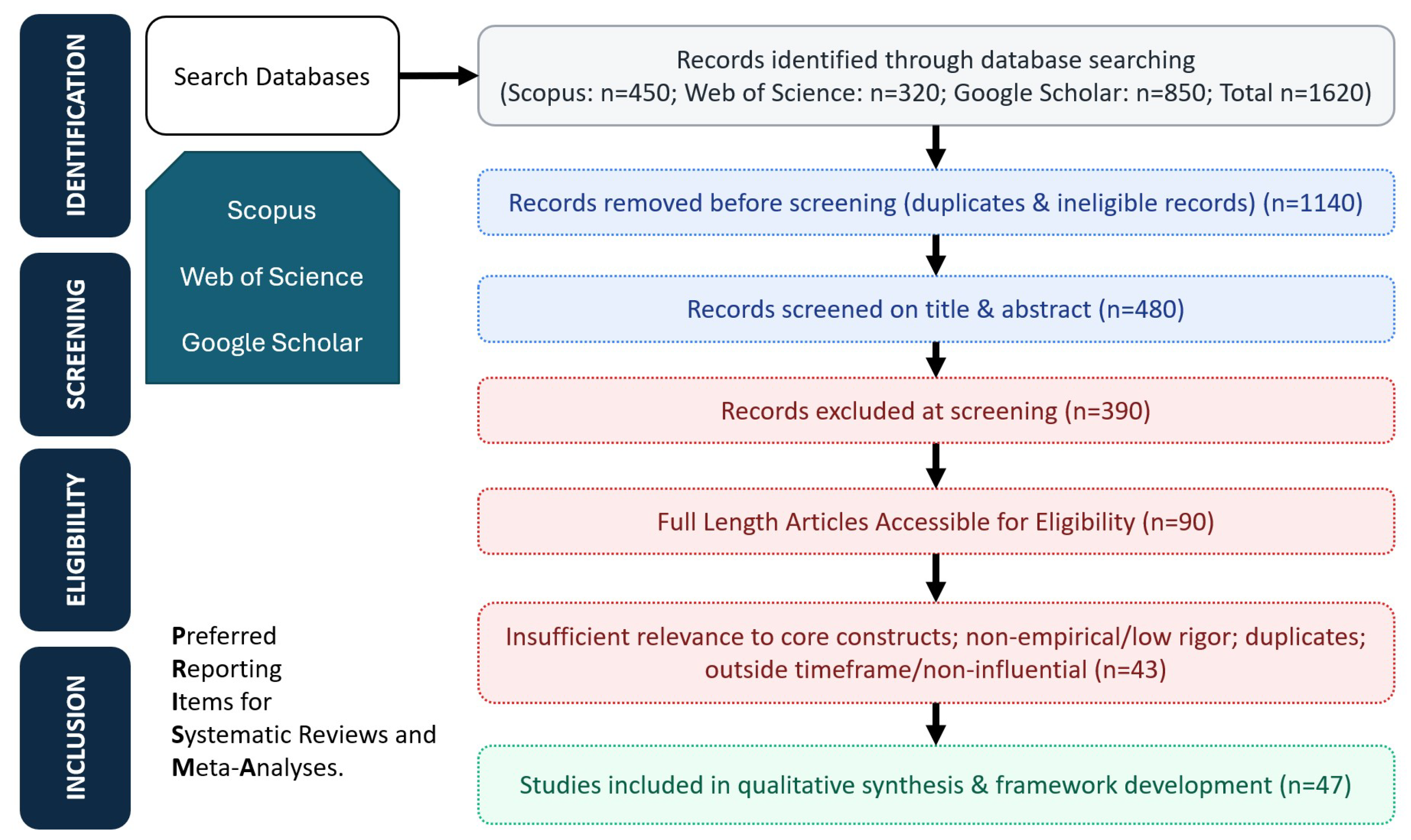
Figure 1 presents the review process followed. The study followed PRISMA-informed screening logic adapted for the integrative review objectives. Inclusion criteria were defined to support the development of the integrative theory. Only peer-reviewed empirical studies were considered. Publications had to address green marketing, value creation, or consumer well-being. Articles published in recognized marketing and sustainability journals were prioritized. Exclusion criteria included conceptual papers, editorials, and opinion pieces. Studies with limited methodological rigor were excluded. Duplicate records across databases were removed before screening. The selection emphasized influential studies rather than exhaustive coverage.
The study identified research streams on green marketing practices, sustainable value, and consumer well-being using a Boolean keyword strategy. To ensure methodological rigor and relevance to observable outcomes, the search was restricted to peer-reviewed empirical studies. The resultant corpus was screened and coded to pinpoint:
Different types of green marketing practices;
The activation of value dimensions through consumption;
The outcome of life satisfaction and well-being;
The process of mediating and moderating;
Contextual settings and methodological approaches.
This empirical synthesis was designed to ground and refine the framework rather than test it by identifying consistent patterns and boundary conditions across influential studies. The tables in
Section 4.4 were intentionally designed as analytical tools to assess the initial framework’s alignment with recent empirical evidence and to clarify where conceptual emphasis or adjustments are needed. Together, these two phases form the foundation of a coherent, integrative review process. First, the construction of key constructs and relationships is grounded in the existing literature. Then, their systematic empirical foundation is established using influential research from the past decade. The study determined influence based on journal quality rankings, citation impact, and relevance to sustainability marketing, value creation, or consumer well-being. By employing this approach, the proposed conceptual model is both theoretically and empirically grounded, thereby establishing a solid foundation for the propositions that follow.
3. Theoretical Foundations and Conceptual Approach
The theoretical approach employed in this study is integrative, combining insights from sustainability marketing, consumer value theory, behavioral decision-making, and research on subjective well-being. The framework employs multiple theoretical perspectives, rather than relying on a single one, to understand the complexity of how firms’ green marketing practices shape consumer experiences and generate sustainable value, ultimately contributing to consumer satisfaction. This approach addresses the need to integrate theory in sustainability research, as fragmented perspectives often hinder the development of cumulative knowledge [
13,
20,
25]. The framework is founded on the idea that green marketing practices are interventions initiated by firms that shape and influence consumption environments. Green marketing is viewed as a coordinated set of practices embedded throughout the consumption cycle, not a narrow promotional activity, according to contemporary sustainability marketing theory [
3]. According to behavioral terms, these practices are considered elements of choice architecture. They influence consumers’ perception, evaluation, and sustainability decisions by enhancing salience, reducing friction, and supporting self-determination [
27,
28].
Signaling theory provides further insight into how sustainability cues can signal unobservable attributes such as quality, credibility, and trustworthiness [
29,
30,
31,
32,
33]. The theory claims that the lack of clarity, consistency, or opportunism in sustainability signals can lead to a decrease in consumer trust and perceived value. Moreover, when consumers perceive product attributes as both functional and ethical, their interpretations will be enhanced [
34]. Credibility, transparency, and autonomy-supportive framing are the essential characteristics of effective green marketing practices, which are underpinned by theoretical insights within the framework. The framework posits that sustainable value creation results from multidimensional consumer experiences that occur at the consumer level, driven by firm-level interventions. In addition, by employing consumption value theory and value co-creation perspectives, value is seen as determined by experiential, contextual, and phenomenological factors rather than solely by products [
24,
34,
35]. In other words, Sustainable value creation is a collection of related value dimensions that consumers gain from engaging in sustainable consumption.
The central theme of this concept revolves around four value dimensions. Consumer acceptance of sustainable offerings is rooted in functional value, which reflects perceptions of quality, performance, durability, and price fairness [
36]. Environmental value is a measure of how consumers perceive their consumption choices as a means to reduce environmental harm, particularly when sustainability is more important than just purchasing and disposing [
3]. Ethical norms, social responsibility, and prosocial motivations are reflected by social and moral values, which are influenced by moral psychology and norm-activation theories [
37]. Ultimately, psychological value encompasses identity congruence, meaning, empowerment, and psychological ownership, which are derived from involvement, participation, and co-creation [
19,
38]. The framework treats these value dimensions as complements rather than substitutes. Multiple dimensions can be activated simultaneously to create sustainable value, allowing consumers to integrate sustainability into their functional needs, moral self-concept, and lived experiences. This multidimensional perspective explains why sustainability initiatives that are narrowly focused on environmental benefits often fail to generate lasting consumer engagement or better well-being outcomes.
The final piece of the puzzle is consumer life satisfaction, which is conceived as a cognitive, global assessment of the total quality of life worldwide [
17]. Life satisfaction, in line with research on subjective well-being, is contrasted with transient affective states and domain-specific satisfaction. Green marketing practices were retained as the initiating firm-level intervention. Sustainable value creation was retained as the central mediating mechanism. Consumer life satisfaction was retained as the distal well-being outcome. Together, the three constructs form a complete and non-overlapping process model. It is viewed as a distal outcome that is influenced by accumulated experiences and value perceptions over time [
39]. To explain the relationship between sustainable consumption and life satisfaction, the framework incorporates insights from self-determination theory, value congruence theory, and research on meaning in life [
18,
39,
40,
41].
According to the framework, sustainable value creation facilitates the emergence of life satisfaction through three experiential pathways. Sustainability and self-identity align with sustainable consumption to create value congruence, which in turn leads to coherence between behavior and life goals [
18]. When sustainability is perceived to contribute to a larger purpose or societal good, it can lead to meaningful consumption experiences that reinforce a sense of meaning in life [
37]. In the third place, how sustainable choices are perceived to improve one’s quality of life through ease, control, and reduced decision burden determines how much they contribute to personal well-being [
42]. It is crucial to note that this theoretical foundation does not assume that green marketing practices are directly related to life satisfaction. Alternatively, life satisfaction is considered a downstream outcome that depends on successfully creating and internalizing sustainable value through consumption experiences. This process-oriented logic provides the theoretical rationale for positioning sustainable value creation as a mediating construct within the framework.
The combination of these theoretical foundations creates a coherent conceptual logic that shapes consumption environments and emerges as sustainable value. Then, life satisfaction is determined by the cumulative integration of multidimensional consumer experiences into consumers’ more comprehensive life evaluations. The theoretical foundation for the conceptual model presented in
Section 4 stems from this integrated perspective, preparing the way for the empirical grounding and proposition development undertaken in the subsequent sections.
4. Conceptual Model and Propositions
After developing the conceptual framework in Stage 1, we further present, in
Section 4.1,
Section 4.2 and
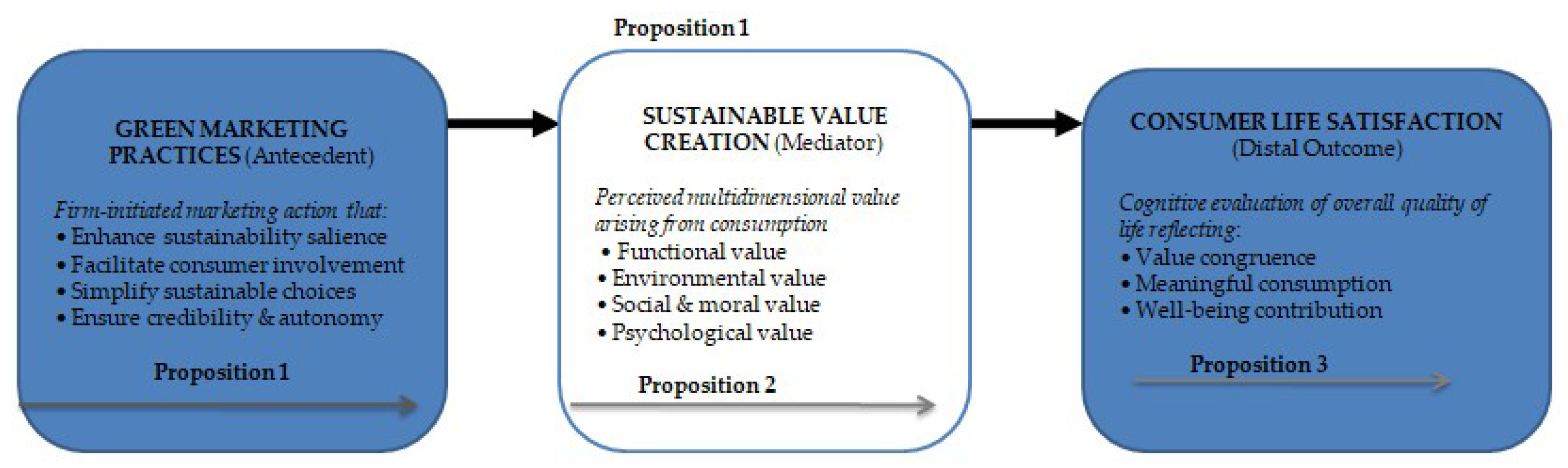
Section 4.3, the construction of the conceptual model and the propositions based on the three constructs presented above, to assess the alignment of the proposed relationships. The conceptualization of the core constructs and directional relationships is summarized in
Figure 2. In line with established guidance for conceptual research, three propositions (mentioned in the figure and explained in detail later in
Section 4.1,
Section 4.2 and
Section 4.3) represent the study’s primary findings by specifying testable relationships that future empirical research can validate.
Figure 2 illustrates the conceptual model as a framework for theory-building, explaining how firm-initiated green marketing practices influence consumer well-being outcomes over time. The model follows a sequential logic in which green marketing practices shape consumption environments and sustainable value emerges through consumer experiences. Consumer life satisfaction is treated as a primary outcome rather than a direct or immediate effect of marketing actions. It is essential to note that the model does not assume a direct connection between green marketing practices and life satisfaction. This reflects the theoretical arguments in subjective well-being research and consistent empirical evidence that show well-being outcomes are influenced by internalized values, meaning, and experiential alignment, not just marketing exposure. Moreover, the model is designed to apply across various sectors, cultures, and consumption domains, while also accounting for specific industries or contexts for future research.
4.1. Green Marketing Practices
Green marketing practices consist of intentional actions taken by firms to address environmental issues in product design, communication, distribution, and choice environments throughout the entire consumption cycle. Recent empirical research shows that green marketing is shifting from symbolic or claim-based approaches to behaviorally grounded and system-oriented practices [
3,
43]. Beyond the point of purchase, sustainability salience has emerged as a crucial factor in behavioral persistence. Unless firms actively intervene through reminders, feedback, and post-purchase touchpoints, environmental considerations decrease during product use and disposal, as evidenced by empirical studies [
44]. Consequently, it is essential to adopt green marketing practices that operate dynamically throughout the acquisition, usage, and end-of-life stages, as highlighted in this context.
Furthermore, marketing practices are linked to sustained behavior by the mechanisms of consumer involvement and psychological ownership. Identity-based engagement is strengthened, and participatory initiatives, such as co-creation, customization, and feedback systems, enhance perceived responsibility for outcomes [
45,
46]. Moreover, research indicates that choice architecture and simplification, including defaults, eco-labels, and product availability, have practical effects. Through these interventions, sustainable choices are more likely to be made due to reduced cognitive effort and reliance on pro-environmental attitudes [
47,
48].
Lastly, poorly designed green claims can harm trust and autonomy. Using excessive specificity without credibility can increase skepticism, while moralistic framing can provoke reactions [
49]. Hence, modern green marketing increasingly emphasizes messages that support autonomy, credibility, and transparency.
Proposition 1. Green marketing practices emphasize sustainability throughout the consumption cycle by encouraging consumer involvement and facilitating sustainable choices through supportive choice architectures. These practices make a positive contribution to the creation of sustainable value.
Example 1. Sustainability cues that are visible beyond the point of purchase are complemented by participatory initiatives and simplified choice environments. It is possible to enhance the functional, environmental, and psychological value that consumers derive from sustainable consumption.
4.2. Sustainable Value Creation
The perceived benefits that consumers derive from consumption, which simultaneously include functional, environmental, social/moral, and psychological value, are what sustainable value creation is about. Increasingly, empirical research acknowledges that environmental benefits alone are not sufficient to maintain perceived value [
50]. The literature repeatedly highlights the importance of value trade-offs. The use of sustainability cues can enhance moral or social value while also signaling a decline in performance or an increase in effort. The risk of diminishing overall value perceptions can arise from green initiatives if firms do not integrate sustainability with durability, usability, and performance [
51].
Furthermore, sustainable value is both relational and experiential, resulting from repeated interactions and noticeable impact. Additionally, sustainable consumption becomes meaningful rather than sacrificial when consumers can observe the results and understand their own contribution [
18]. Hence, the psychological link between marketing practices and well-being outcomes is critical as sustainable value acts as a bridge. Green claims do not lead to life satisfaction for consumers, but rather to practical, meaningful, and personally aligned consumption experiences.
Proposition 2. The impact of green marketing practices on consumer life satisfaction is mediated by sustainable value creation.
Example 2. Green marketing techniques that make sustainable consumption meaningful and advantageous do not, in and of themselves, lead to increased life satisfaction. Instead, they enhance life satisfaction by elevating the functional, environmental, and psychological value that consumers obtain from their consumption experiences.
4.3. Consumer Life Satisfaction
The synthesis views life satisfaction as a distant outcome that results from value alignment, meaningful consumption, and perceived contributions to personal well-being. It does not treat life satisfaction as a direct response to green marketing actions. Furthermore, the definition of life satisfaction entails evaluating the overall quality of life through cognitive assessments, which reflect the perceived alignment between lived experiences, personal values, and long-term goals [
17]. Similarly, life satisfaction is increasingly recognized as a legitimate outcome of market activity by recent sustainability research [
52,
53,
54].
According to Brown and Kasser [
55], sustainable consumption can lead to greater life satisfaction when it is perceived as voluntary, impactful, and consistent with one’s identity. This consumption enables moral self-expression, decreases dissonance between values and behavior, and fosters a sense of autonomy. Nonetheless, there are significant boundary conditions. If sustainable choices are labeled as restrictive, costly, or morally enforced, they may impact well-being [
56]. The role of marketing is crucial in determining whether sustainability is perceived as a burden or a source of fulfillment. The proposed model views life satisfaction as a distal outcome arising from sustained value creation rather than a direct effect of green marketing activities.
Proposition 3. Higher levels of sustainable value creation are associated with higher consumer life satisfaction.
Example 3. Consumers’ overall quality of life is more likely to be evaluated more positively when sustainable consumption experiences provide functional benefits, align with personal values, and support a sense of meaning.
In summary, we can state that sustainable marketing is a means to connect value and well-being within the proposed framework. The outcome of green marketing practices is increased life satisfaction, achieved through sustainable value that emerges from the consumer experience in consumption environments. Building on a structured foundation, this paper advances sustainable marketing theory by linking firm actions to consumer well-being through sustainable value creation.
4.4. Influential Research on Sustainanility Marketing
Following the initial development of the conceptual framework in Stage 1, we continue the analysis to assess the proposed relationships using influential empirical research from high-ranking journals over the past decade. The following three tables are used to evaluate the alignment of the initial framework with observed empirical data, rather than providing descriptive summaries.
Table 1 compiles significant empirical research on green marketing practices. It assesses whether recent studies support green marketing as a comprehensive system that shapes consumption, rather than as isolated promotional or communication activities.
Table 1 presents empirical data from regular practice categories, which encompass the importance of sustainability in the consumption process, consumer participation and ownership, decision-making frameworks, and reliability.
The reviewed studies suggest that sustainability claims do not directly affect life satisfaction. Instead, life satisfaction emerges through specific experiential paths. These paths include value alignment, meaningful consumption experiences, and perceived benefits to personal well-being. Collectively, these findings confirm that sustainable value creation acts as a mediator between firm actions and life satisfaction. When viewed as a whole, the three tables reveal an empirically grounded progression from green marketing practices to sustainable value creation and consumer life satisfaction, which is formally presented in the conceptual model and propositions. Similarly, the table compiles a decade of influential research on sustainability and green marketing. This research identifies a clear shift toward green marketing practices that are encompassing, behaviorally grounded, and system-oriented. These approaches contrast with narrow, purchase-focused strategies. Low cognitive salience beyond the point of purchase is often a factor limiting sustainability outcomes, not negative consumer attitudes. Recent empirical research consistently indicates that environmental considerations are often overlooked in the use and disposal of products, increasing the likelihood of sustainability failures unless firms intervene throughout the entire consumption cycle. The research has been directed toward dynamic, multi-stage decision models rather than static choice frameworks. Consumer involvement and psychological ownership are two significant insights that should be considered. Participatory green marketing practices, such as co-creation, feedback mechanisms, and empowerment, are identified in the table as mechanisms that activate identity-based engagement and maintain it over time. According to recent research, consumers who feel a sense of ownership over sustainability initiatives are more likely to maintain sustainable behavior than passive recipients of green messages.
Moral framing and prosocial motivation (i.e., the desire to take action to promote the well-being of individuals, groups, or society) are given nuanced treatment in the table. Empirical evidence cautions against overt moralization, while moral meaning can lead to sustainable behavior. Scholars have turned their attention to boundary conditions and heterogeneity in moral responses following the superior performance of autonomy-preserving frames over prescriptive or guilt-based appeals. Sustainability and perceived performance trade-offs are another key contribution. Studies have shown that green cues may unintentionally suggest reduced product efficacy, underscoring the importance of integrated signaling strategies that emphasize strength, durability, and functional value while also highlighting environmental benefits. Architectural choices, eco-label design, and product availability are increasingly important, as the table highlights. Research has consistently shown that defaults, simple labels, and mainstream availability have a greater effect than attitudinal persuasion alone (i.e., the act of modifying an individual’s evaluations and/or attitudes). Credibility, context, and structural support matter more than symbolic green claims in green marketing, according to recent empirical research redefining it as a behavioral design challenge.
The empirical basis for Proposition 1 is provided in
Table 1, which shows that green marketing practices primarily influence decisions by shaping decision contexts, reducing cognitive effort, and maintaining engagement over time. According to the table, sustainability failures are often attributed to declining importance beyond the point of purchase, rather than negative consumer attitudes. This suggests that the framework’s approach to green marketing practices should be dynamic and systemic, based on process-oriented thinking. Overall, it can be said that green marketing practices are being increasingly viewed as a combination of actions, such as eco-labeling, green advertising, and sustainable packaging, in recent empirical studies. For example, research on eco-labeling and green advertising indicates that their combined use significantly affects consumer perceptions and behavioral intentions. These findings suggest that coordinated practices enhance credibility and impact. Next,
Table 2 presents key research on sustainable value creation arising from multidimensional consumer decisions. This structure reflects the framework’s belief that sustainable value arises from the experience of consumption, not just from sustainability claims. The analysis in
Table 2 is a crucial analytical tool, as it demonstrates that green marketing practices consistently create bundles of value, rather than directly affecting well-being outcomes. The findings suggest that sustainable value creation acts as a proximal mediator, linking firm actions to downstream outcomes.
Table 2 summarizes influential empirical research from 2016 to 2025 that identifies sustainable value creation as a construct that involves multiple dimensions. The translation of green marketing practices into consumer-level outcomes is explained jointly by functional, environmental, social/moral, and psychological value dimensions. The results indicate that green marketing techniques consistently yield perceived multidimensional value from consumption, rather than directly related outcomes for well-being. The reviewed studies indicate that firm-initiated sustainability actions have the most tremendous impact on consumers across four value dimensions—functional, environmental, social/moral, and psychological. Functional value is a fundamental requirement for creating sustainable value, as demonstrated by the table. Repeated research suggests that consumer evaluations are enhanced by sustainability cues only when they align with core performance attributes, such as quality, durability, and price fairness. Without functional assurance, consumers may infer that performance trade-offs exist when communicating sustainability. The model’s assumption is supported by this evidence, which suggests that sustainable value is created by focusing on consumption-relevant benefits rather than abstract environmental claims. Consumers’ perceived effectiveness in reducing environmental harm influences environmental value.
Furthermore, the table suggests that environmental value is highest when sustainability is prioritized throughout the entire consumption cycle, including use and disposal, rather than just at the point of purchase. The model emphasizes the importance of sustainability beyond transactional communication, which aligns with this finding. The table points out that social and moral values are distinct dimensions that arise from conformity to ethical norms and prosocial motivations.
However, the evidence suggests that maximizing moral value is only possible when sustainability is framed in ways that support autonomy and meaning, rather than through prescriptive or guilt-inducing messages. The model’s core green marketing practices are centered on credibility and autonomy-supportive framing, as this supports. Also, identity alignment, psychological ownership, and participatory engagement are key factors in the development of psychological value. Research indicates that when consumers are involved in co-creation, sustainable value is enhanced by fostering self-congruence and promoting sustained engagement. When considered as a whole, the table strongly supports Proposition 1, which asserts that green marketing practices create sustainable value.
In
Table 3, the analysis goes beyond the most distal construct in the framework: consumer life satisfaction.
The table presents influential empirical research indicating that life satisfaction is not directly linked to green marketing practices, but instead occurs through specific experiential pathways centered on sustainable value creation. The table shows no consistent evidence of a direct correlation between green marketing and life satisfaction, empirically supporting the framework’s exclusion of a direct path and reinforcing Propositions 2 and 3. The only way to achieve life satisfaction is by internalizing sustainability as personally meaningful, identity-consistent, and experientially beneficial.
The table’s impactful research on consumer practices that prioritize congruence has consistently identified this as a crucial route to life satisfaction. The table indicates that when sustainable consumption aligns with personal values, moral identity, and self-concept, consumers experience greater life satisfaction. A positive cognitive evaluation of overall life quality is supported by this alignment, which creates coherence between consumption behavior and broader life goals. Therefore, this evidence confirms the model’s hypothesis that life satisfaction is based on internalized value alignment rather than external sustainability cues. A key experiential mechanism is the rise in meaningful consumption experiences. The reviewed studies found that sustainability enhances life satisfaction when perceived as meaningful or prosocial, rather than as an obligation or constraint. By interpreting sustainable choices as part of a purposeful life narrative, consumers can enhance subjective well-being through meaning-based consumption. This observation aligns with the model’s assertion that meaningful consumption experiences are a fundamental component of life satisfaction.
The perceived impact on personal well-being reflects how sustainable consumption is perceived to enhance one’s own quality of life. This pathway is often used to reduce decision burden, increase ease of choice, and enhance feelings of control, as shown in the table. Having sustainable options that are easy to integrate into daily routines can lead consumers to perceive them as personally beneficial, thereby contributing to life satisfaction. This pattern empirically validates Proposition 2, which posits that sustainable value creation serves as the mediating mechanism linking green marketing practices to life satisfaction. Similarly, Proposition 3 indicates a correlation between the creation of sustainable value and the fulfillment of consumers’ lives.
In aggregate,
Table 1 shows how firms influence consumption environments through environmentally friendly marketing strategies.
Table 2 presents, across multiple consumer-relevant dimensions, how these practices generate sustainable value, whereas
Table 3 shows that sustainable value ultimately leads to consumer life satisfaction through experiential and cognitive channels.
Although the framework follows a sequential logic from green marketing practices to sustainable value creation and life satisfaction, the empirical synthesis does not support a uniformly linear pathway. The reviewed studies repeatedly highlight internal conflicts that can disrupt value creation, particularly when sustainability is experienced as financially burdensome, morally prescriptive, or performance-compromising. Price sensitivity, perceived sacrifice, and the persistence of the green gap often weaken or negate the translation of marketing practices into perceived value. These tensions indicate that sustainable value creation is conditional rather than automatic. The failures in functional value, price fairness, or autonomy-supportive framing can interrupt the mechanism linking green marketing to life satisfaction. Accordingly, the results indicate that sustainable value creation operates as a fragile mediating mechanism that can be reinforced or disrupted depending on how sustainability is framed, priced, and experienced by consumers.
This unified study confirms that sustainable value creation is the primary mechanism connecting firm-initiated sustainability actions with consumer well-being outcomes. Hence, the results from this section confirm the model’s theoretical coherence and provide a transparent foundation for the three propositions.
5. Theoretical Contributions
This study makes three distinct theoretical contributions that extend existing frameworks in sustainability marketing and consumer well-being. These contributions are summarized below by explicitly contrasting prior approaches with the present framework.
Contribution 1: Reconceptualizing Green Marketing Practices: Prior frameworks typically conceptualized green marketing as a set of communication tactics, claims, or firm-level sustainability signals. These approaches fail to adequately explain how sustainability initiatives influence consumption experiences beyond the point of purchase. Hence, this framework reconceptualizes green marketing practices as systemic, firm-initiated interventions embedded across the entire consumption cycle, including design, choice architecture, use, and disposal.
Contribution 2: Advancing Sustainable Value Creation Theory: Prior frameworks commonly examined environmental or moral value in isolation when assessing sustainability outcomes. However, such approaches fail to explain why many sustainability initiatives generate limited engagement or inconsistent well-being outcomes. This study advances value creation theory by defining sustainable value creation as a multidimensional construct at the consumer level. It encompasses functional, environmental, social/moral, and psychological values that emerge through consumption experiences.
Contribution 3: Positioning Life Satisfaction as a distal outcome: Prior frameworks treat consumer well-being as implicit, affective, or directly influenced by marketing actions. This obscures the mechanisms through which market-based sustainability initiatives influence long-term well-being. In this study, the framework positions consumer life satisfaction as a distal outcome that arises indirectly through sustainable value creation. It emphasizes experiential pathways such as value congruence, meaning, and perceived personal benefit.
By presenting consumer life satisfaction as a distant outcome of sustainable consumption, the study contributes to consumer well-being research, rather than being directly influenced by marketing actions. The framework shows that life satisfaction results from internally endorsed and experiential pathways, as evidenced by the synthesis of evidence on value congruence, meaningful consumption experiences, and perceived contribution to personal well-being. This paper contributes to the well-being literature by clarifying how market-based sustainability initiatives can impact global life evaluations without relying on well-being as a marketing claim. Furthermore, the study demonstrates how integrative review tables can be utilized as analytical tools to assess and refine an initial conceptual framework, which is methodologically relevant to conceptual research.
6. Managerial Implications for Sustainable Marketing
Managerial implications should be interpreted as context-dependent rather than universally applicable. The framework guides managers seeking to design sustainability strategies that generate consumer value and support long-term well-being, rather than merely achieving short-term behavioral compliance. Firms should adopt green marketing practices throughout the entire consumption cycle, rather than treating sustainability as an add-on to communication, according to the framework.
Retaining perceived environmental and psychological value requires reinforcing sustainability during product use, maintenance, and disposal, as sustainability cues only at the point of purchase are unlikely to generate lasting value. Managers must understand that to create sustainable value, functional value must be present. Adverse inferences and consumer skepticism can arise from sustainability initiatives that fail to clearly communicate quality, performance, durability, and price fairness. Integrating sustainability with core performance propositions is crucial for effective green marketing, rather than treating it as a trade-off or sacrifice.
The results suggest that sustainability strategies that support autonomy and credibility are essential. Moralizing, guilt-based, or exaggerated green claims undermine consumer trust and erode perceived value. Instead, transparent information, verifiable claims, and choice architectures that preserve consumer autonomy are more likely to foster trust, psychological ownership, and long-term engagement. Fourth, the study demonstrates that sustainability strategies can enhance consumer life satisfaction by promoting value congruence and meaningful consumption experiences. Managers need to view sustainability not just as an environmental issue, but also as a way to align it with consumers’ identities, values, and aspirations for a meaningful life. Firms must refrain from directly asserting well-being benefits and instead prioritize generating consumption experiences that consumers perceive as meaningful and beneficial.
Overall, the implications suggest that sustainability-oriented marketing should not be evaluated solely based on short-term behavioral metrics. Instead, it should be assessed based on its ability to generate multidimensional value. It should also support enduring consumer relationships grounded in trust, meaning, and experiential quality.
7. Limitations and Future Research Agenda
This study, like other conceptual and integrative reviews, has its limitations, but it also points to promising directions for future research. The study adopts a conceptual approach to building theories rather than testing empirical hypotheses. While the framework is based on influential empirical research over the past decade, no statistical testing of the proposed relationships has been conducted within a single empirical model. In the future, researchers should empirically examine the proposed framework. They can use quantitative, qualitative, or mixed-method designs. These studies should evaluate the strength, direction, and boundary conditions of the relationships among the examined constructs.
The framework does not assume universal effects across contexts. Socioeconomic conditions are likely to moderate the impact of green marketing practices on sustainable value and life satisfaction. Income constraints, education, and market access may shape how sustainability is experienced. Cultural values influence moral meaning, identity alignment, and perceptions of well-being. Regulatory environments and market maturity may further condition observed outcomes. Future research should explicitly test these contextual moderators.
The integrative review focuses on high-impact journals and influential studies published between 2016 and 2025. While this approach guarantees conceptual rigor and relevance to current debates, it may potentially overlook emerging insights from newer journals, regional outlets, or practitioner-oriented research. Future reviews could expand the scope to include more databases, gray literature, and interdisciplinary sources to better understand the significance of sustainability and its effects on well-being. Future studies should investigate how different consumer segments prioritize values and how contextual factors, such as income, education, cultural norms, and regulatory environments, influence value creation processes.
Sustainability initiatives often involve price premiums. The proposed framework does not assume that such premiums are universally acceptable. When sustainability is perceived to create financial stress or compromise price fairness, sustainable value creation may be undermined rather than enhanced. This highlights affordability and perceived economic burden. So, they tend to become critical boundary conditions shaping whether green marketing practices support or detract from consumer well-being. Future research should explicitly examine income sensitivity, perceived price fairness, and cost–value trade-offs in sustainable consumption contexts.
Sustainability initiatives can yield unintended or negative consequences, including skepticism about greenwashing, moral licensing, decision fatigue, and sustainability fatigue. To gain a more precise and realistic understanding of the effects of sustainability marketing, future research should explicitly examine these potential tensions and adverse outcomes. Finally, the framework could be extended over time by examining longitudinal dynamics in future research. The outcome of life satisfaction is long-term and cumulative, with the effects of sustainable value creation being gradual rather than immediate. Researchers can gain insight into how repeated experiences of sustainable consumption affect values, perceptions, and well-being over time through longitudinal studies, experience sampling methods, and panel data.
8. Conclusions
Through the mediating mechanism of sustainable value creation, green marketing practices contribute to consumer life satisfaction in this study’s integrative conceptual framework. The study identifies the processes by which firms’ sustainability actions influence consumption experiences and, ultimately, broader evaluations of quality of life. Understanding is enhanced by the framework’s reconceptualization of green marketing as a system of practices embedded throughout the consumption cycle, rather than isolated communication efforts. Furthermore, it demonstrates that creating sustainable value is inherently multidimensional, encompassing functional, environmental, social/moral, and psychological values, as well as translating sustainability initiatives into meaningful consumer outcomes. Additionally, the study highlights that consumer life satisfaction is a distant outcome. It is influenced indirectly by how consumers respond to marketing actions. This influence occurs through value congruence, meaningful consumption experiences, and perceived contributions to personal well-being.
The study’s robust foundation for future empirical testing and theory refinement is built by integrating theory development with a systematic grounding in recent influential empirical research. For academics, the framework offers a coherent structure for advancing research that intersects marketing, sustainability, and well-being. It emphasizes the significance of creating sustainability strategies that generate genuine, multidimensional value rather than symbolic or short-term effects for practitioners. In conclusion, this study helps to redefine marketing as a force that not only drives market performance but also promotes sustainable consumption and long-term consumer well-being.