1. Introduction
The Common Agricultural Policy (CAP) is one of the European Union’s central policy frameworks shaping agricultural production, rural livelihoods, and territorial development. Historically focused on productivity growth and market stabilization, the CAP has gradually evolved from a predominantly productivist logic to a more multifunctional governance approach integrating sustainability, territorial cohesion, and innovation objectives [
1,
2,
3]. In this architecture, the first pillar covers direct payments and market measures, whereas the second pillar supports rural development interventions co-financed by Member States [
4].
The growing importance of the second pillar reflects concerns that intensive, subsidy-driven modernization can generate uneven benefits and produce environmental and social tensions, including rural depopulation, territorial disparities, and inequality [
2]. As a result, rural development measures were increasingly expected to support diversification, generational renewal, higher value-added activities (including agri-food processing), and local infrastructure and services [
1]. Nevertheless, the literature continues to debate whether the second pillar catalyzes structural transformation or primarily stabilizes existing production structures and reinforces path dependencies [
5,
6].
Lithuania provides an analytically informative case for examining this question. First, the pre-accession SAPARD program (2000–2003) and subsequent CAP programming periods coincided with major post-socialist restructuring in the agri-food sector. Second, agri-food has been identified as a priority area in Lithuania’s smart specialization (S3) strategy [
7], suggesting that public support should contribute not only to sectoral stabilization, but also to innovation-oriented value creation and upgrading. Third, recent climate, demographic, and geopolitical disruptions have increased the need to align public investment with resilience, sustainability, and competitiveness goals [
8,
9].
Despite the policy relevance of these developments, the long-run relationship between rural development support and agri-food transformation remains insufficiently clarified in the existing literature, especially in the context of Central and Eastern Europe. Previous research has examined CAP governance, stakeholder engagement, rural development, and smart specialization in Lithuania and comparable contexts, but less attention has been paid to how successive programming periods, changes in the rural development measure mix, and broader sectoral trajectories can be analyzed within a single long-term framework. This gap is particularly important because policy-related change may take different forms: it may reflect modernization and structural adjustment, deeper value-chain upgrading, partial innovation diffusion, or the continued reproduction of existing development paths.
Against this backdrop, this paper examines whether rural development financing in Lithuania during 2000–2025 was associated with broader transformation in the agri-food sector, or whether it mainly reinforced established production logics and path dependencies [
4]? More specifically, the analysis addresses three questions: (1) how did the scale and composition of rural development support change across successive CAP programming periods; (2) to what extent were these policy shifts associated with structural, market, productivity, innovation-related, and selected sustainability-related changes in Lithuania’s agri-food sector; and (3) is the observed trajectory more consistent with transformation, partial transformation, or path dependence?
To address these questions, the paper combines a long-run descriptive and dynamic analysis of Lithuania’s agri-food sector over 2000–2025 with an integrated conceptual framework linking CAP programming shifts, the composition of the rural development measure mix, and observable sectoral outcomes. Empirically, the analysis focuses on structural and market indicators, productivity proxies, a bounded sustainability dimension, and innovation indicators that distinguish between formal knowledge creation and broader innovation orientation. In this respect, formal R&D expenditure is treated as a narrow proxy for innovation creation, while the composition of the rural development measure mix is used as a complementary indicator of innovation orientation and diffusion capacity.
The paper makes three contributions. First, it develops an integrated analytical framework that connects CAP programming periods, smart specialisation-oriented innovation governance, food system transformation, and rural development within a single perspective. Second, it provides a rare long-run assessment of Lithuania’s agri-food sector spanning pre-accession adjustment, post-accession restructuring, successive rural development programming periods, and the early CAP Strategic Plan phase. Third, it contributes to current debates on CAP effectiveness in small open economies by assessing whether public support is more strongly associated with modernization and market upgrading, broader transformative change, or the persistence of established development paths.
2. Conceptual Framework
This section integrates three complementary perspectives—smart specialization (S3), food system transformation, and rural development/structural transformation—to frame the assessment of Lithuania’s agri-food sector change under successive CAP programming periods (2000–2025). The framework is designed to distinguish potentially transformative effects (innovation-led upgrading and sustainability-oriented reconfiguration) from stabilizing effects that reproduce existing development paths. To connect theory with evidence, we conceptualize a multi-level analytical model linking the political–institutional context (CAP programming periods and implementation arrangements, and the orientation of national innovation priorities relevant to agri-food), the implementation-level composition of the rural development measure mix (i.e., the set of measures and the allocation of budgets across intervention types), and observable sectoral outcomes. Given data availability, empirical operationalization emphasizes macro-level economic-structural and innovation proxies (output composition, farm consolidation, trade orientation, productivity, and R&D), while sustainability is interpreted primarily through the composition of the measure mix and the availability of long-run indicators.
Integrated policy–transformation logic. Rather than treating smart specialization, food system transformation, and rural development as parallel perspectives, this article conceptualizes them as a nested explanatory chain. First, CAP rural development establishes the institutional opportunity structure by defining eligible actions, budgetary priorities, and implementation arrangements across programming periods. Second, smart specialization provides a place-based steering mechanism that translates broad policy space into territorially prioritized innovation domains through entrepreneurial discovery and quadruple-helix coordination. Third, the food system transformation perspective specifies the direction against which policy effects should be judged: not only whether support stabilizes farm production, but whether it reconfigures value-chain relations, strengthens downstream processing, improves knowledge absorption, and advances environmental and social sustainability across the agri-food system. Rural development theory connects these perspectives territorially by explaining why identical policy instruments may generate different outcomes depending on local institutional capacity, stakeholder engagement, and the strength of extra-local linkages. In this logic, CAP support becomes transformative only when the measure mix aligns with place-based innovation priorities and when rural actors possess sufficient absorptive capacity to convert support into durable, system-wide change; otherwise, support is more likely to reproduce existing production routines and development paths [
10,
11,
12,
13].
Integrated policy–transformation logic is presented in
Table 1, synthesizing current CAP evaluation, S3 governance, and food-systems governance insights into a single framework.
Table 1 summarizes the integrated policy–transformation logic guiding this study by showing how CAP rural development, smart specialization, food system transformation, and structural transformation perspectives illuminate distinct but interrelated dimensions of agri-food change. On this basis, the empirical analysis examines whether shifts in Lithuania’s rural development measure mix were associated with broader structural, innovation, market, and sustainability-related changes over time.
2.1. CAP and Rural Development as the Institutional Context
The Common Agricultural Policy (CAP) is the EU’s central institutional framework for shaping agriculture and rural territories. Initially oriented towards productivity growth, market stabilization, and farm income support, the CAP has progressively evolved towards a more multifunctional governance logic that explicitly incorporates territorial cohesion, innovation, and sustainability objectives [
1,
2,
3,
16]. This shift has unfolded alongside broader transformations in European agricultural governance—from post-war technocratic modernization to increasingly complex, multi-level and performance-oriented policy regimes [
17]. Contemporary CAP objectives are closely linked to climate and biodiversity agendas, including the European Green Deal and the Farm to Fork strategy, which emphasize ecosystem services, reduced chemical inputs, and systemic sustainability targets [
3,
18].
CAP interventions operate through two pillars: Pillar I (direct payments and market measures) and Pillar II (rural development), the latter co-financed by Member States and intended to strengthen the economic, social, and environmental sustainability of rural areas [
4]. Pillar II emerged in response to the limitations of subsidy-driven modernization, including uneven distributional outcomes, persistent regional disparities, and negative environmental and demographic externalities such as rural depopulation [
2,
16]. While reforms have introduced greening and more decentralized planning via Strategic Plans, tensions remain between competitiveness and environmental stewardship, and implementation priorities differ across Member States [
5,
6]. At the same time, rural development remains a key policy lever for innovation, social cohesion, and resilience in rural areas, influencing value-chain organization and territorial development beyond farm-level income effects [
19,
20,
21].
The CAP may function both as a stabilizer of existing production logics and as a driver of structural and territorial change. Evidence from comparative EU research shows that CAP impacts vary substantially by region and farm type, and that policy effectiveness depends on how investments translate into upgrading, value added, and inclusive territorial outcomes [
22,
23]. Current pressures—climate disruptions, demographic change, and geopolitical instability—further increase the policy demand for resilience and food security, reinforcing the need to evaluate whether public funding supports long-term transformation rather than path dependence [
4,
8,
9,
24].
2.2. Smart Specialisation and Innovation-Led Upgrading in Agri-Food
Smart specialization (S3) is a place-based innovation policy approach that encourages regions to concentrate resources on a limited set of priority domains in which they have existing or potential comparative advantages [
25]. In EU cohesion policy, S3 became an ex-ante conditionality for accessing research and innovation funding, formalizing a governance logic that combines strategic prioritization with broad stakeholder involvement [
26]. Priority-setting is typically organized through the Entrepreneurial Discovery Process (EDP), which mobilizes business, academia, government, and civil society (the Quadruple Helix) to identify and refine transformation-oriented niches [
27,
28]. For less technologically advanced regions, S3 emphasizes co-invention and the adaptation of general-purpose technologies to local needs, supported by complementary infrastructure and coherent public policy [
25].
Applied to agri-food systems, S3 implies that public support should not only sustain production but also enable value-chain upgrading—through digitalization, knowledge transfer, processing capacity, and innovation ecosystem development, including organizational and ecological forms of innovation [
26,
29]. Lithuania has implemented S3 since 2012 and identified agri-food as a strategic bioeconomy domain [
7]. However, available assessments suggest that innovation-related support may drift towards incremental technology renewal or short-term market survival, rather than disruptive innovation and structural upgrading, especially where investment measures overlap with cost-compensation logics [
7,
30]. In this study, S3 therefore provides a lens for interpreting whether the rural development measure mixes and observed innovation proxies are consistent with innovation-led upgrading in primary production and/or processing [
28].
An important implication of this integrated framework is that innovation-led upgrading may be asymmetrically distributed across the agri-food chain. Primary agricultural production and food processing differ in their organisational density, market exposure, compliance requirements, and capacity to absorb new knowledge. Processing firms are often better positioned to translate investment and innovation support into product upgrading, export expansion, and value-added growth, whereas farms more frequently use public support for asset renewal, compliance, and risk reduction. For this reason, the present study does not assume that innovation effects should appear uniformly across all segments. Instead, it allows for the possibility of partial transformation, in which downstream processing exhibits clearer innovation deepening than primary production. This distinction is especially relevant in Lithuania, where current CAP programming explicitly links knowledge sharing, innovation, digitalisation, and value-added growth to broader agri-food competitiveness rather than to farm output alone [
14,
31,
32].
2.3. Food System Transformation Perspective
Food system transformation theories conceptualize agri-food change as a system-wide process spanning production, processing, distribution, consumption, and waste, and emphasize the interactions and feedback loops that shape outcomes across the value chain [
33]. This perspective is useful for interpreting policy effects that operate indirectly, for example, through processing development, market integration, and the emergence of new supply-chain configurations—rather than solely through farm-level production changes [
34,
35,
36]. It also stresses that transformation is not a single agreed pathway: competing theories of change range from technical optimization and nature-positive strategies to equity- and smallholder-oriented approaches and supply-chain innovation [
33,
37].
A central implication is that transformation is inherently political. Policy and market shifts redistribute costs and benefits, and the direction of change is shaped by power asymmetries among actors and scales [
38,
39,
40]. Complex systems can exhibit nonlinear dynamics, threshold effects, and unintended consequences, making outcomes difficult to infer from isolated interventions [
41,
42,
43]. Accordingly, food system scholarship advocates multi-criteria and participatory tools to visualize trade-offs and negotiate priorities across environmental, social, and economic objectives [
44,
45]. In this article, the food system lens motivates an empirical focus on value-chain deepening and market upgrading indicators (processing orientation and trade performance) and frames sustainability as an outcome domain that should be assessed alongside economic upgrading, subject to data constraints.
2.4. Rural Development and Structural Transformation Perspectives
Rural development and structural transformation perspectives address how public support instruments can reshape rural economies over the long run—through diversification, competitiveness, investment, and sustainable resource management [
46]. These approaches emphasize that rural development is context-specific and multidimensional, shaped by interdependent economic, social, and ecological processes rather than a universal linear trajectory [
47,
48,
49]. Concepts such as neo-endogenous development, rural resilience, and ‘smart rural areas’ highlight the interaction between top-down governance and bottom-up initiative, and the role of institutional capacity in driving convergence or divergence across territories [
50,
51].
Neo-endogenous logic combines external funding with local capability-building and networked learning, stressing the importance of extra-local linkages for activating place-based potential and adaptive capacity [
52,
53,
54]. At the same time, neo-productivism critiques warn that policy mixes can overemphasize agriculture and physical infrastructure while under-addressing deeper social and territorial needs [
55]. In this view, the key empirical question is whether support fosters self-sustaining development pathways or reproduces dependence on transfers and cost compensation [
54,
56]. Structural transformation theory further suggests that long-run development is typically accompanied by consolidation, specialization, and productivity growth, making farm structure, value added, and market integration relevant markers of change for this case [
47,
51].
2.5. Distinguishing Transformation, Partial Transformation, and Path Dependence
For the purposes of this study, transformation is defined as a durable and policy-aligned change in sectoral trajectory rather than a short-term fluctuation in output or prices. An observed change is interpreted as transformative when three conditions are jointly met: (1) a level shift and/or slope change appears around a CAP programming transition; (2) the post-shift movement is in the theoretically expected direction for at least three consecutive observations; and (3) the magnitude of change exceeds normal fluctuation, operationalized as either a statistically meaningful structural break in segmented time-series analysis or a change greater than 0.5 within-series standard deviations relative to the preceding programming period mean.
Path dependence is identified when no such break is detected, when changes remain within historical fluctuation bands, or when structural consolidation proceeds without accompanying gains in value-chain upgrading, innovation intensity, or sustainability performance. Partial transformation is identified when improvement is concentrated in selected domains—most plausibly processing, trade performance, or labour productivity—while farm-level innovation, environmental performance, or broader territorial outcomes remain weak or stagnant.
At the programming-period level, the sector is classified as showing transformation when at least half of the observed outcome domains meet the above criteria, and at least one of those domains belongs to innovation or sustainability. When positive change is confined mainly to the economic structure or to downstream upgrading, the result is interpreted as a partial transformation. This rule-based classification is preferred to a single composite index because it preserves analytically meaningful differences across structural, innovation, market, and sustainability domains [
13,
14,
57].
As a single-country longitudinal policy evaluation, this study does not aim to establish strict causal identification in the manner of a randomized or quasi-experimental design. Instead, it examines whether shifts in Lithuania’s agri-food sector are temporally and substantively consistent with successive CAP programming periods, while accounting for major exogenous shocks. To support this interpretation, the empirical analysis can apply interrupted time-series or segmented regression models with programming-period dummies, post-reform trend terms, and controls for the global financial crisis, Russia-related trade and geopolitical disruptions, the COVID-19 pandemic, and the 2022 energy and war shock. Where feasible, the analysis may also benchmark Lithuanian trajectories against Baltic or EU comparators and selected within-country reference sectors. While such an approach does not create a true counterfactual, it provides a more rigorous basis for interpreting the results as policy-consistent contributions to sectoral change.
2.6. Analytical Model and Indicator Operationalisation
Recent literature reveals two related gaps that clarify the position of this study. First, although CAP impacts on rural areas are widely discussed, robust evaluative evidence remains limited: a systematic review identified 59 publications estimating CAP socioeconomic impacts, while evaluation scholarship continues to highlight methodological heterogeneity and limited reliability for strong comparative inference. Second, research on post-accession agriculture in Central and Eastern Europe shows uneven, club-like convergence, but usually at a broad regional scale rather than through longitudinal linkage between national policy mixes and sectoral transformation mechanisms. Lithuanian scholarship has already illuminated complementary dimensions of this puzzle, including stakeholder engagement in CAP strategic planning, science–society–policy interfaces for rural development, and smart specialisation-based pathways for green transformation, but these studies do not evaluate how successive rural development measure mixes have translated into long-run structural change in Lithuania’s agri-food sector. The present article addresses that gap by linking CAP programming shifts, innovation-governance orientation, and observable agri-food trajectories over 2000–2025 within a single analytical framework [
11,
12,
15,
28,
32,
57].
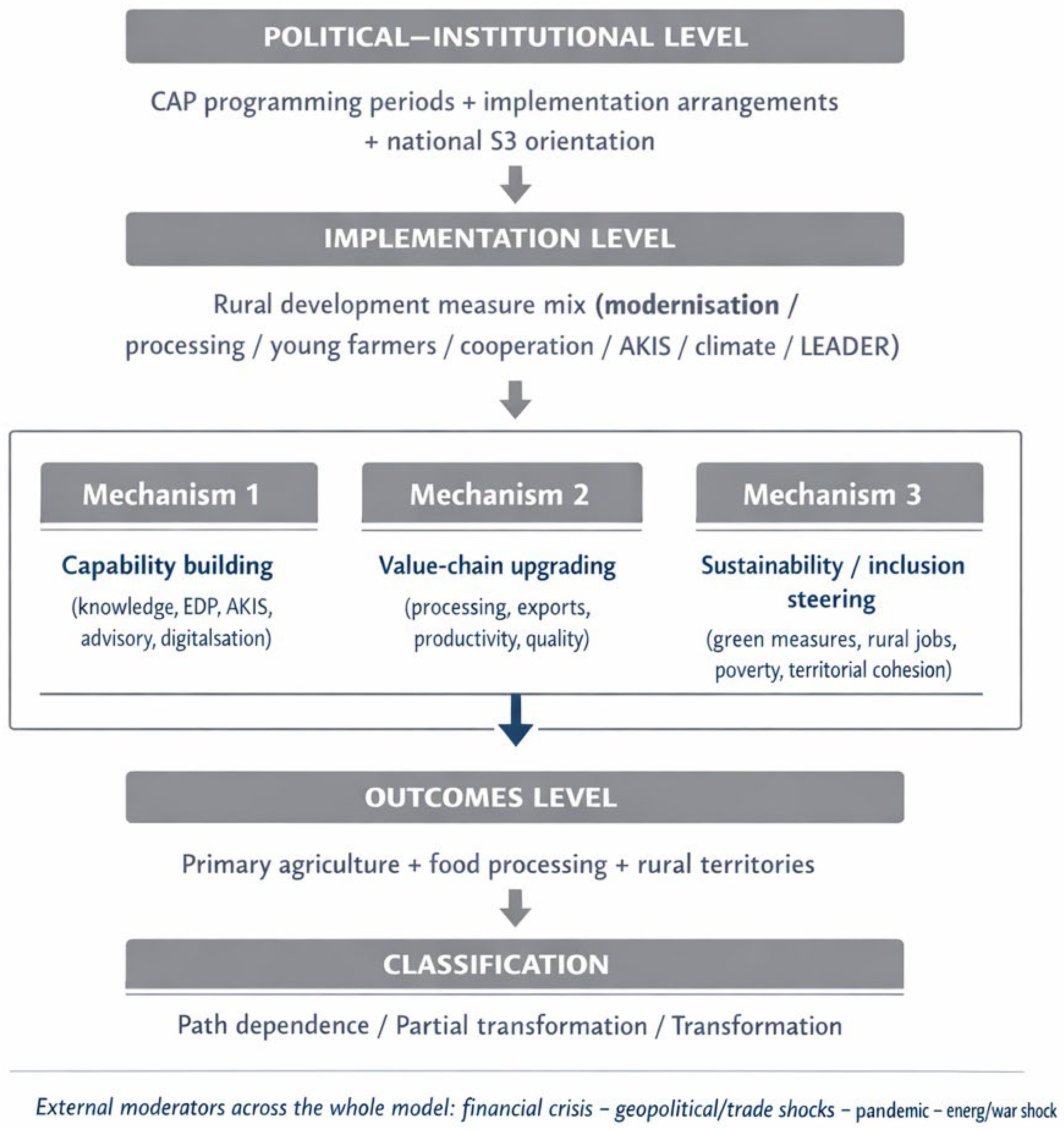
Synthesizing the three lenses above, we operationalize sector transformation through a three-level analytical model. At the political–institutional level, the model captures changes across CAP programming periods and their implementation arrangements, together with the orientation of agri-food-relevant innovation priorities (including S3). At the implementation level, it focuses on the rural development measure mix, defined as the set of measures available in each period and the allocation of budgets across intervention types. At the outcomes level, it evaluates whether the sector’s observed trajectory is consistent with structural transformation and upgrading.
To avoid equating innovation with formal R&D alone, this paper conceptualises innovation as a broader process encompassing not only knowledge creation, but also technology adoption, digitalisation, organisational change, and knowledge diffusion across the agri-food system. Empirically, the framework therefore distinguishes between innovation creation and innovation diffusion/absorption. Formal R&D expenditure in agriculture and food manufacturing is retained as a narrow indicator of knowledge creation, but it is not treated as the sole proxy for innovation, especially in primary agriculture, where innovation often takes the form of technology adoption, advisory uptake, organisational change, and digital diffusion. Accordingly, the composition of the rural development measure mix is interpreted not only as expenditure allocation, but also as a proxy for the policy’s innovation logic and absorptive capacity: support for processing, knowledge exchange, advisory services, cooperation, training, AKIS/EIP-type actions, and digitalisation is expected to signal a stronger transformative orientation than support concentrated primarily on asset renewal or cost compensation. This broader understanding is consistent with the Oslo Manual, the CAP’s current emphasis on knowledge exchange, innovation, and digitalisation, and Lithuania’s CAP Strategic Plan objective of promoting a more competitive, higher-value-added, and sustainable agriculture and food sector [
13,
14,
31].
The conceptual framework guiding the analysis is summarized in
Scheme 1, which presents an analytical model linking the institutional context, the composition of the rural development measure mix, and observable agri-food sector outcomes operationalized through structural, productivity, innovation-intensity, and market-upgrading indicators.
The sustainability aspect is embedded in both the CAP framework and Lithuania’s CAP Strategic Plan, which defines agricultural and rural development through environmental and social, as well as economic, objectives. In this study, sustainability is measured using available long-run indicators, including agricultural greenhouse gas emissions, gross nitrogen balance and/or ammonia emissions, organic farming area, rural employment rate, and rural poverty risk or another indicator of rural living conditions. It also notes the sustainability dimension based on available long-run measures, acknowledging limitations in consistent environmental time series for earlier periods.
3. Materials and Methods
3.1. Research Approach, Design and Periodisation
This study adopts a quantitative, longitudinal, descriptive–analytical research design to examine how rural development support is associated with structural, economic, innovation-related, and selected sustainability-related changes in Lithuania’s agri-food sector between 2000 and 2025. The unit of analysis is the national agri-food system, with separate attention to primary agriculture and food processing, where data are available. Given this design, the study is framed as a single-country longitudinal policy evaluation rather than as a randomized or quasi-experimental treatment study. Accordingly, the analysis does not seek to establish strict causal identification, but instead assesses whether observed shifts in sectoral trajectories are temporally and substantively consistent with successive CAP programming periods.
The analysis is structured around five policy phases: 2000–2003, corresponding to SAPARD and pre-accession adjustment; 2004–2006, the transitional post-accession framework; 2007–2013, the first full rural development program (RDP) cycle; 2014–2022, the second RDP cycle, including the extension through 2021–2022; and 2023–2025, the initial implementation phase of the 2023–2027 CAP Strategic Plan. These breakpoints are treated as institutionally defined policy interruptions because they correspond to formal changes in programme architecture, eligible measures, and implementation arrangements, rather than to statistically discovered turning points.
Building on the integrated conceptual framework, the study distinguishes among transformation, partial transformation, and path dependence as alternative types of sectoral trajectory (see
Table 2). While these categories were defined conceptually in the previous section, their empirical classification is operationalised in the methodological part through explicit indicator-based criteria and period-comparison rules.
3.2. Data Sources and Coverage
The study combines national administrative and official statistical data with harmonised European sources. Statistics Lithuania provides annual data on farm numbers and structure, average farm size, crop and livestock structure, and selected rural and organic farming indicators. The Ministry of Agriculture of Lithuania and the National Paying Agency provide administrative information on rural development measures, including budget allocations and composition of measure portfolios across programming periods. Eurostat complements national data with harmonised indicators for agriculture, trade, the environment, and rural development. In particular, Eurostat’s Economic Accounts for Agriculture provide annual series in both current and constant prices, while its agri-environmental and rural-development databases provide comparable indicators for selected environmental and social dimensions. Sources from the European Commission CAP indicator and the CAP Strategic Plan are used to assess the policy relevance of the selected variables and to align the empirical operationalisation with official CAP objectives.
Rural development support amounts are compiled as programming-period budgets, including EU and national co-financing. In completed periods, these allocations closely approximate realized expenditure and are therefore used as a proxy for the scale and orientation of support. The 2023–2025 phase is treated as a partial-period observation because implementation is still ongoing.
3.3. Indicator Domains, Construction, and Price Treatment
To align the empirical strategy with the paper’s conceptual framework, indicators are grouped into five domains. First, structural transformation is captured through the number of farms, average farm size, and the changing balance between crop and livestock activities. Second, market upgrading and value-chain deepening are assessed through trade performance, export orientation, and productivity indicators for agriculture and food processing. Third, innovation is measured using a dual-proxy strategy. Sectoral R&D expenditure in agriculture and food manufacturing is retained as a narrow proxy for knowledge creation, but it is not treated as the sole indicator of innovation intensity. Because annual sector-level data on technology adoption, digitalisation, organisational change, and ecosystem innovation are limited, the composition of the rural development measure mix is used as a complementary proxy for innovation orientation and absorptive capacity, especially where support is directed toward processing, cooperation, advisory services, training, knowledge exchange, and digitalisation-related actions. Fourth, sustainability is assessed using a bounded set of long-run environmental and social indicators, including agricultural greenhouse gas emissions, gross nitrogen balance and/or ammonia emissions, organic farming area, rural employment, and rural poverty risk or a comparable rural living-conditions measure. Fifth, policy scale and policy composition are captured through annualised support volumes and the distribution of support across intervention types.
Because annual disbursement profiles are not consistently available for the whole period, cumulative programming-period allocations are annualised to form a stepwise series:
This variable is interpreted as an indicator of the programmed annual scale of support rather than the exact within-period timing of payments.
Monetary variables are treated according to their analytical purpose. Policy allocations are retained in nominal euros because programme budgets and co-financing commitments are defined administratively in nominal terms, and the analysis is interested in the relative scale and composition of support across periods. By contrast, whenever output, value added, or productivity indicators are interpreted as evidence of economic performance over time, constant-price or volume-based series are preferred where available in order to distinguish real change from price inflation. If a monetary series is available only in current prices, it should be interpreted cautiously as a nominal trend rather than as evidence of real growth. The descriptive support-intensity indicator, defined as annualised support relative to agricultural output, is therefore used primarily as a normalization tool rather than as a measure of real policy effort.
3.4. Analytical Methods
The empirical strategy combines descriptive time-series reconstruction, comparative policy-cycle analysis, and segmented interrupted time-series modelling. Descriptive reconstruction is used to trace long-run movements in the main indicators and to relate them to successive CAP policy phases. Comparative policy-cycle analysis groups observations into the five programme phases in order to identify differences in the scale, orientation, and apparent outcomes of support across policy regimes.
For medium- and long-term comparisons, the analysis reports the growth multiplier
And the compound annual growth rate
While recognising that these measures should be interpreted in real terms only for constant-price or physical-volume series.
Annual indicators with sufficiently consistent time coverage are further analysed using segmented interrupted time-series models with policy breakpoints in 2004, 2007, 2014, and 2023:
where
from breakpoint year
onward. Coefficients
capture level shifts and
capture post-break trend changes. Because the breakpoints are institutionally defined by programme transitions, the ITS analysis is used to test whether these policy moments coincide with statistically detectable discontinuities, not to discover breakpoints endogenously.
To strengthen robustness, the ITS procedure includes standard time-series diagnostics appropriate to annual data and short series. These include visual inspection of the series, stationarity checks, residual autocorrelation diagnostics, and heteroskedasticity checks. Models are estimated with heteroskedasticity- and autocorrelation-consistent standard errors, and results are reported together with model-fit statistics and sensitivity checks. Where implementation lags are plausible, breakpoint sensitivity can also be examined by shifting selected intervention dates by ±1 year. In view of the single-country design and the limited number of annual observations, ITS results are interpreted as associational evidence consistent with policy timing rather than as definitive causal effects.
3.5. Data Processing and Visualisation
Data cleaning, transformation, and analysis were conducted using Microsoft Excel. Visualizations include line graphs, bar and stacked bar charts, and indexed trajectories to support the interpretation of nonlinear patterns and potential structural breaks.
3.6. Scope of Inference, Heterogeneity, and Limitations
The analytical focus of the study is intentionally macro-level. The objective is to evaluate whether successive CAP programming periods were associated with changes in the trajectory of Lithuania’s agri-food system as a whole, rather than to estimate heterogeneous treatment effects across individual farms, regions, or firms. Where data allow, the analysis distinguishes between primary agriculture and food processing in order to capture segment-specific dynamics, but it does not model within-sector heterogeneity by farm size, region, or beneficiary type. Conclusions are therefore limited to the national sectoral level and should not be read as evidence of uniform effects across all territorial or organisational contexts.
This macro-level design has both strengths and limits. It is appropriate for tracing long-run structural change across multiple policy cycles and for aligning national trajectories with major CAP transitions. At the same time, it cannot provide a full counterfactual for untreated Lithuania, and it cannot identify distributional effects across territories or farm categories. Innovation measurement also remains necessarily partial at annual sector level: formal R&D data are narrow and sometimes volatile, while broader innovation processes such as organisational change or technology uptake are only indirectly captured through policy-composition proxies. Likewise, environmental and social sustainability indicators are not available with equal depth over the full 2000–2025 period, so shorter series are treated as partial long-run evidence and interpreted transparently as such.
4. Empirical Results
This section presents empirical results on the scale and composition of rural development support and on selected structural, market, productivity, innovation, and sustainability-related trajectories in Lithuania’s agri-food sector. In line with the methodological approach, the results are interpreted primarily as descriptive and associational evidence across successive CAP policy phases. Monetary indicators reported in current prices are treated as nominal trends unless otherwise stated, while non-monetary indicators are used more directly to assess structural change.
4.1. Scale and Composition of Rural Development Support
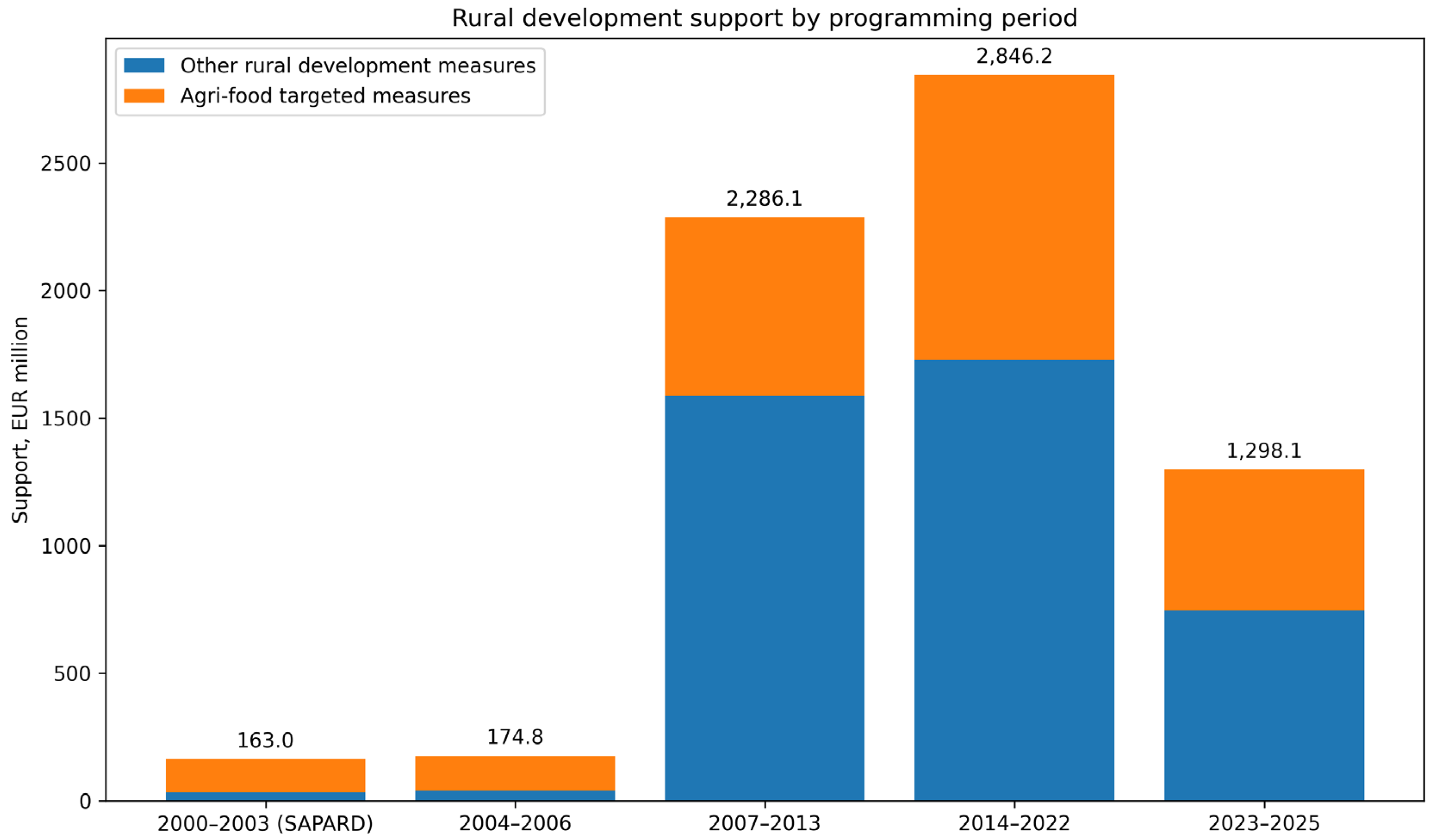
Across 2000–2025, total rural development financing under SAPARD and CAP second pillar amounted to EUR 6768.2 million. Agri-food targeted measures accounted for EUR 2633.4 million, or 38.9% of the total, while the remaining 61.1% was allocated to other rural development objectives (
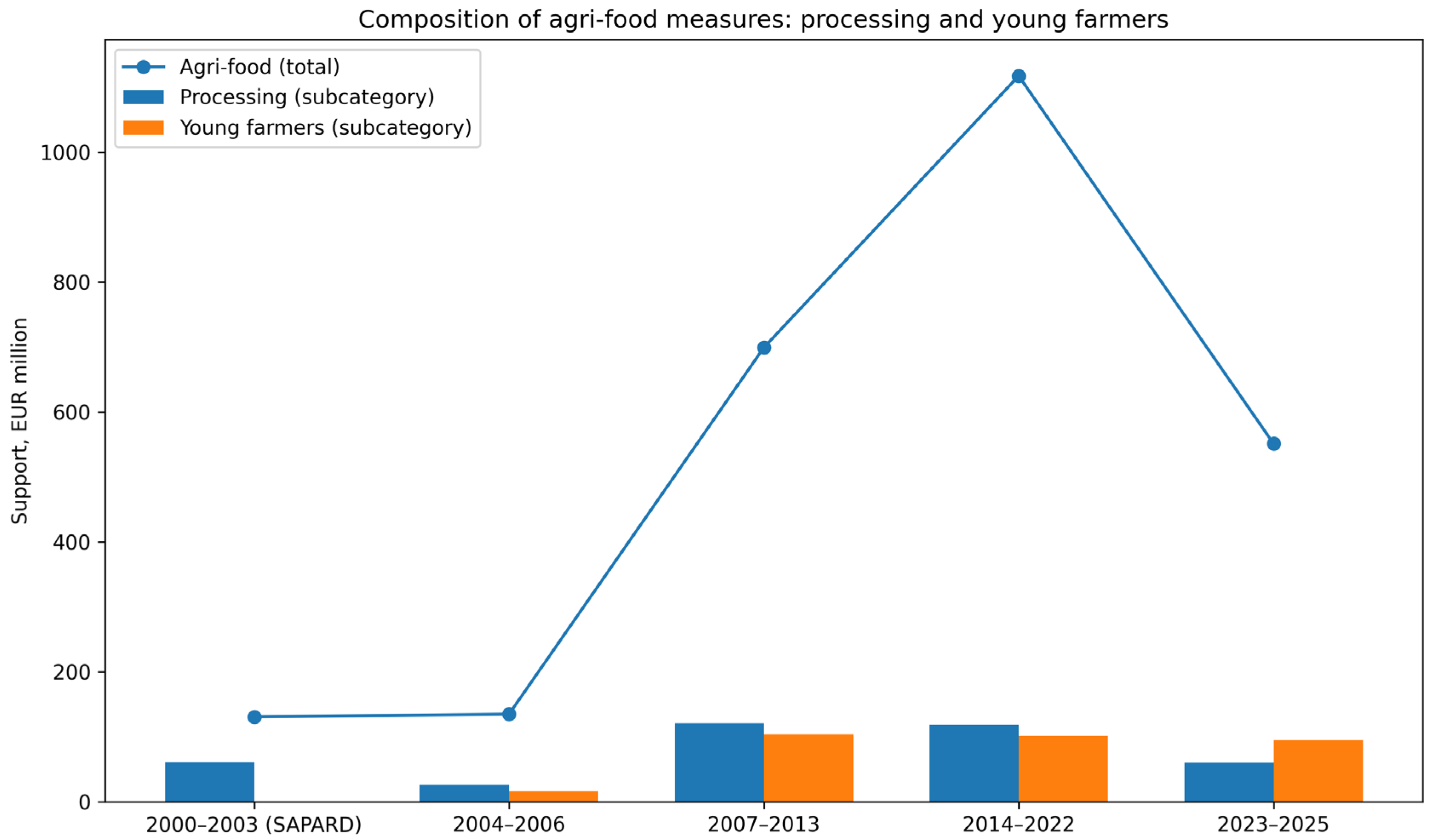
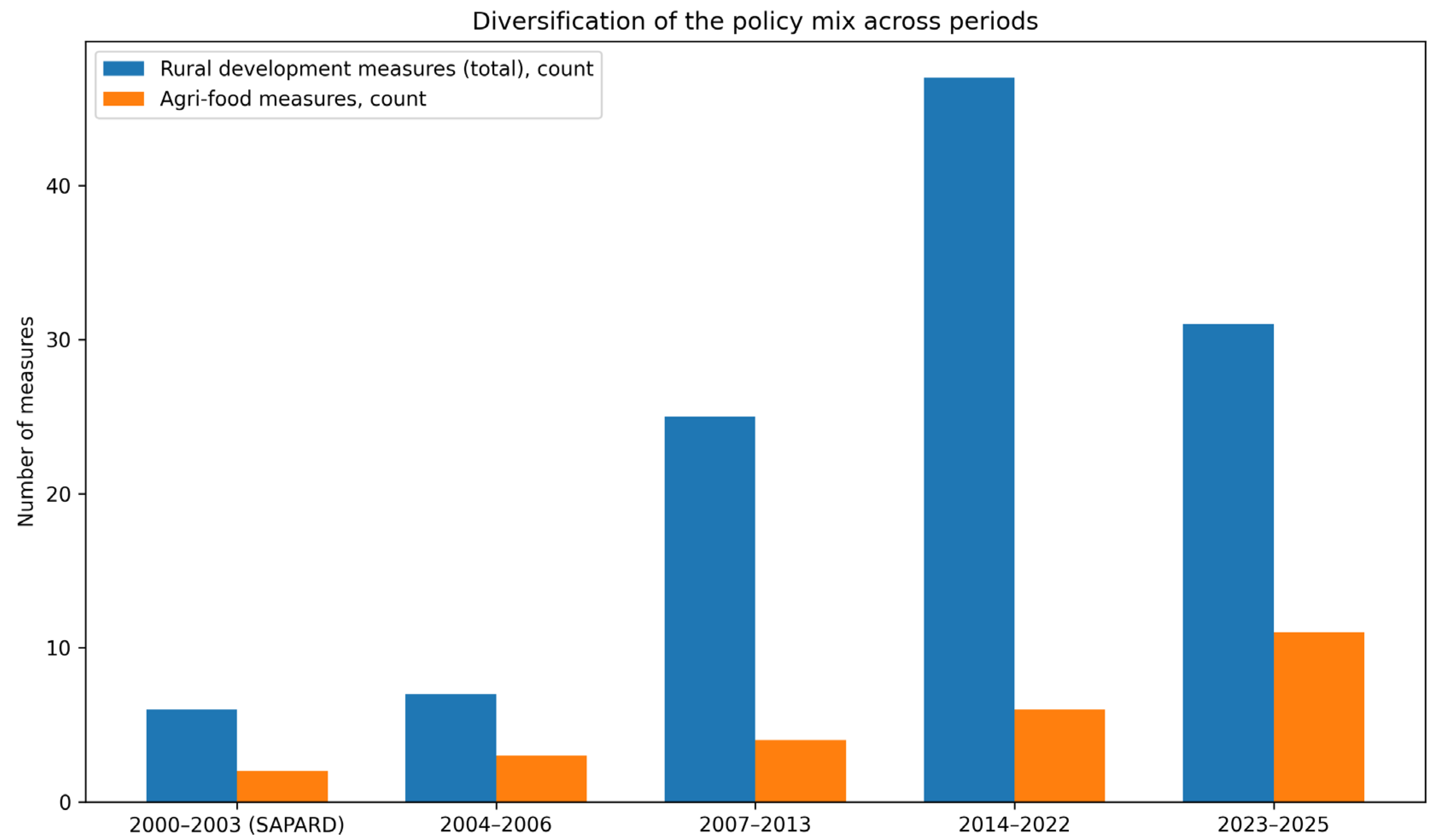
Table 3). The support portfolio expanded substantially after EU accession and diversified over time, as reflected in the growing number of measures and in the widening range of intervention types. The scale and composition of support are summarized in
Table 3 and illustrated in
Figure 1,
Figure 2 and
Figure 3.
4.2. Support Intensity Relative to Sector Size
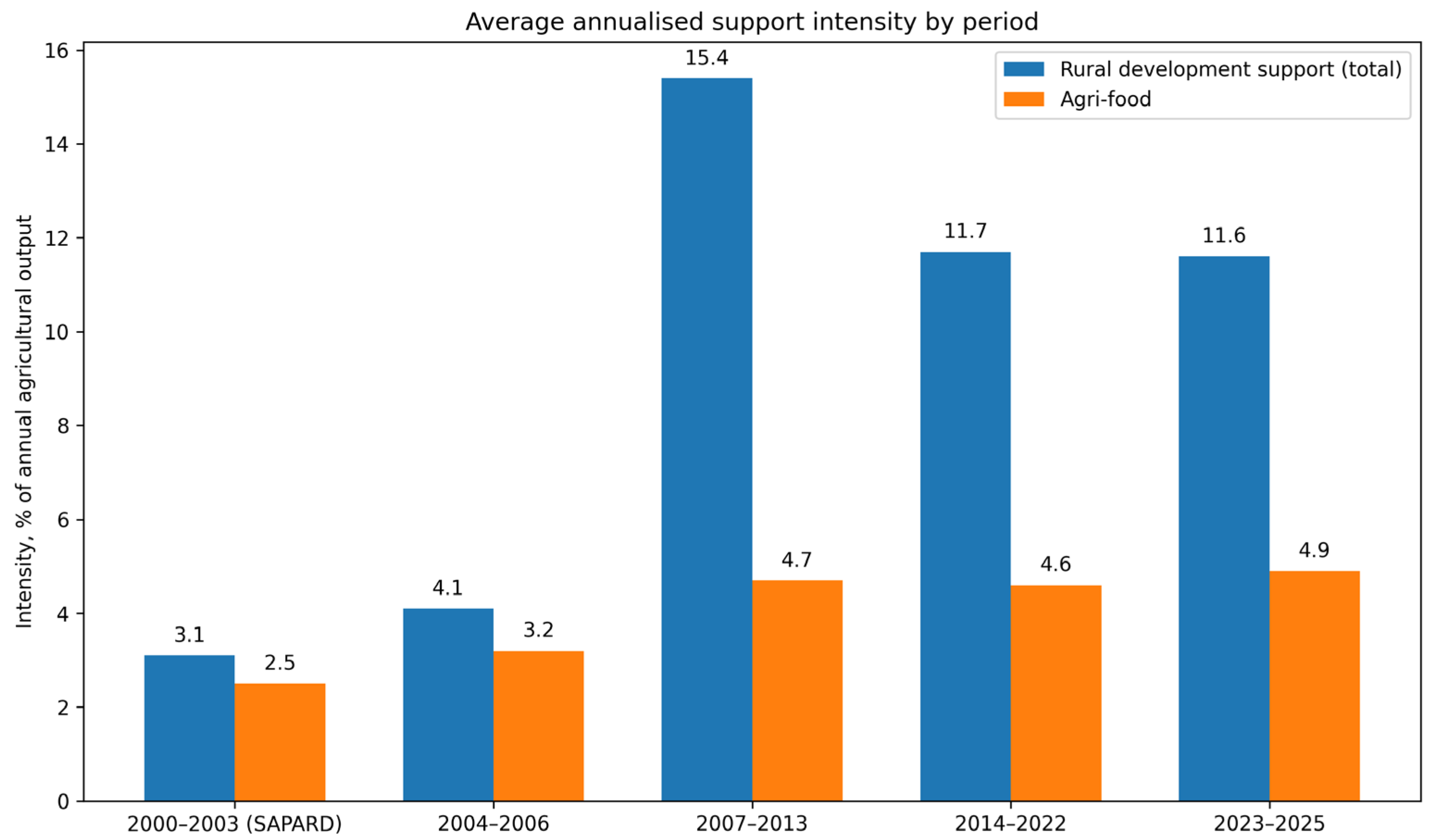
Normalizing annualized allocations by total agricultural output provides a descriptive indicator of policy scale relative to sector size. Average annualized rural development support intensity reaches its highest level in 2007–2013, at 15.4% of annual agricultural output, compared with 3.1–4.1% in the pre-accession and early post-accession phases (
Table 4). Agri-food-targeted measures show a smaller but relatively stable range of 2.5–4.9% across periods. Because both the numerator and denominator are expressed in nominal terms and the support series is annualized from programming-period allocations, this indicator should be interpreted as a descriptive normalization of policy scale rather than as a direct measure of real policy effort. These patterns are summarized in
Table 4 and
Figure 4.
4.3. Agricultural Output Dynamics and Specialisation
Between 2000 and 2025, the value of total agricultural output in current prices increased from EUR 1337.1 million to EUR 3817.5 million (K = 2.855; +185.5%), corresponding to a nominal CAGR of approximately 4.29% per year. Crop output increased faster than livestock output in nominal terms (K_crop = 3.092 vs. K_liv = 2.518), and the crop share rose from 58.7% to 63.6% over the period (
Table 5). Because these output values are reported in current prices, they reflect both quantity changes and price movements and should therefore be interpreted as nominal expansion rather than as evidence of real growth alone.
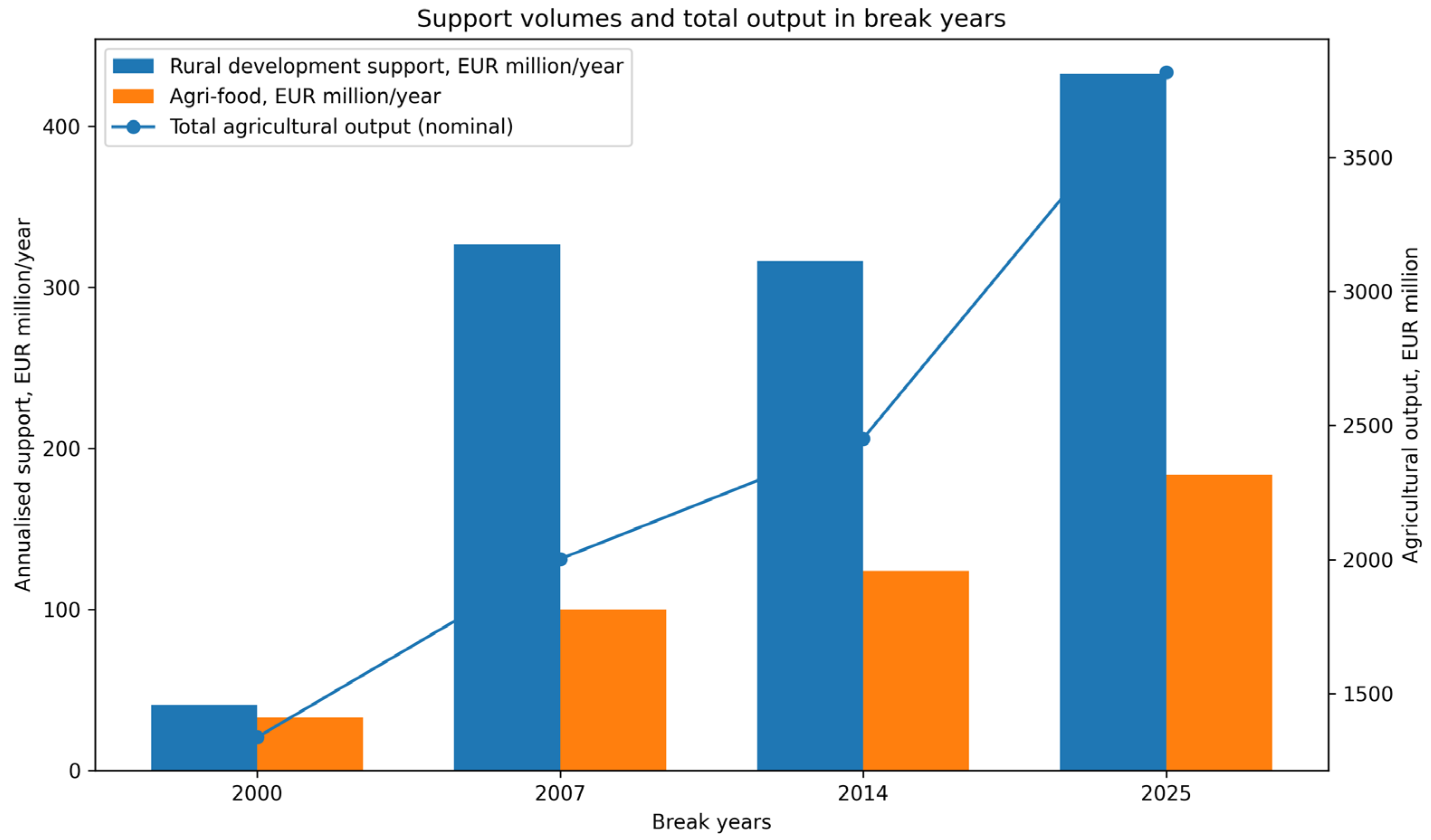
A break-year snapshot for 2000, 2007, 2014, and 2025 illustrates how changes in output composition occurred alongside stepwise changes in annualized support volumes after major policy transitions. In this sense, the descriptive evidence is consistent with a gradual strengthening of crop-oriented specialization, although it does not by itself establish a causal relationship between support and output dynamics. The relevant break-year values are reported in
Table 5 and
Figure 5.
4.4. Farm Structure: Consolidation
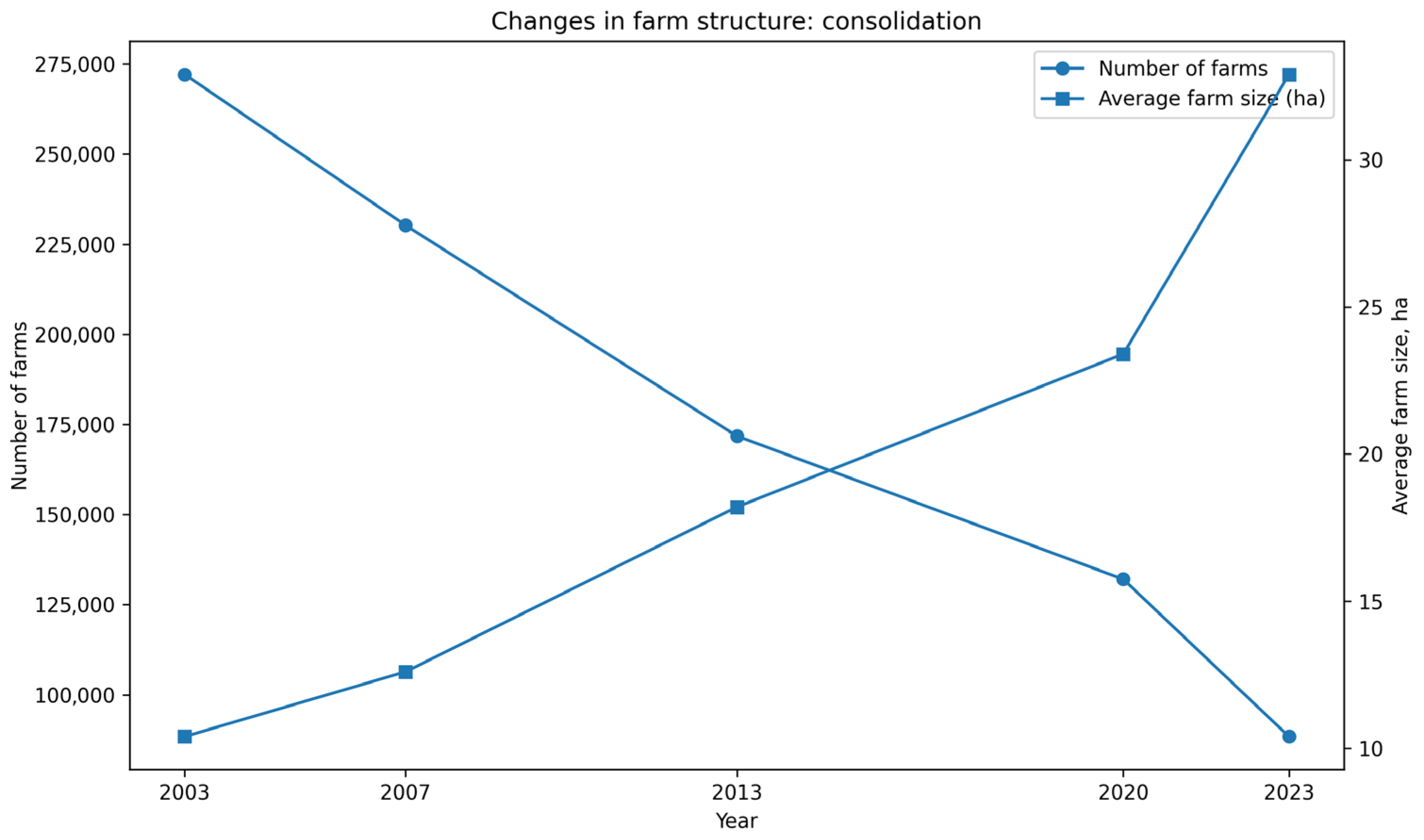
Farm-structure indicators reveal pronounced consolidation. The number of farms declined from 272,111 in 2003 to 88,425 in 2023 (−67.5%), while average farm size increased from 10.4 ha to 32.9 ha (K = 3.16; CAGR ≈ 5.93% per year). Taken together, these indicators provide strong evidence of long-run structural concentration in Lithuanian agriculture across successive CAP periods (
Table 6;
Figure 6).
4.5. Value-Chain Deepening: Agri-Food Trade Indicators
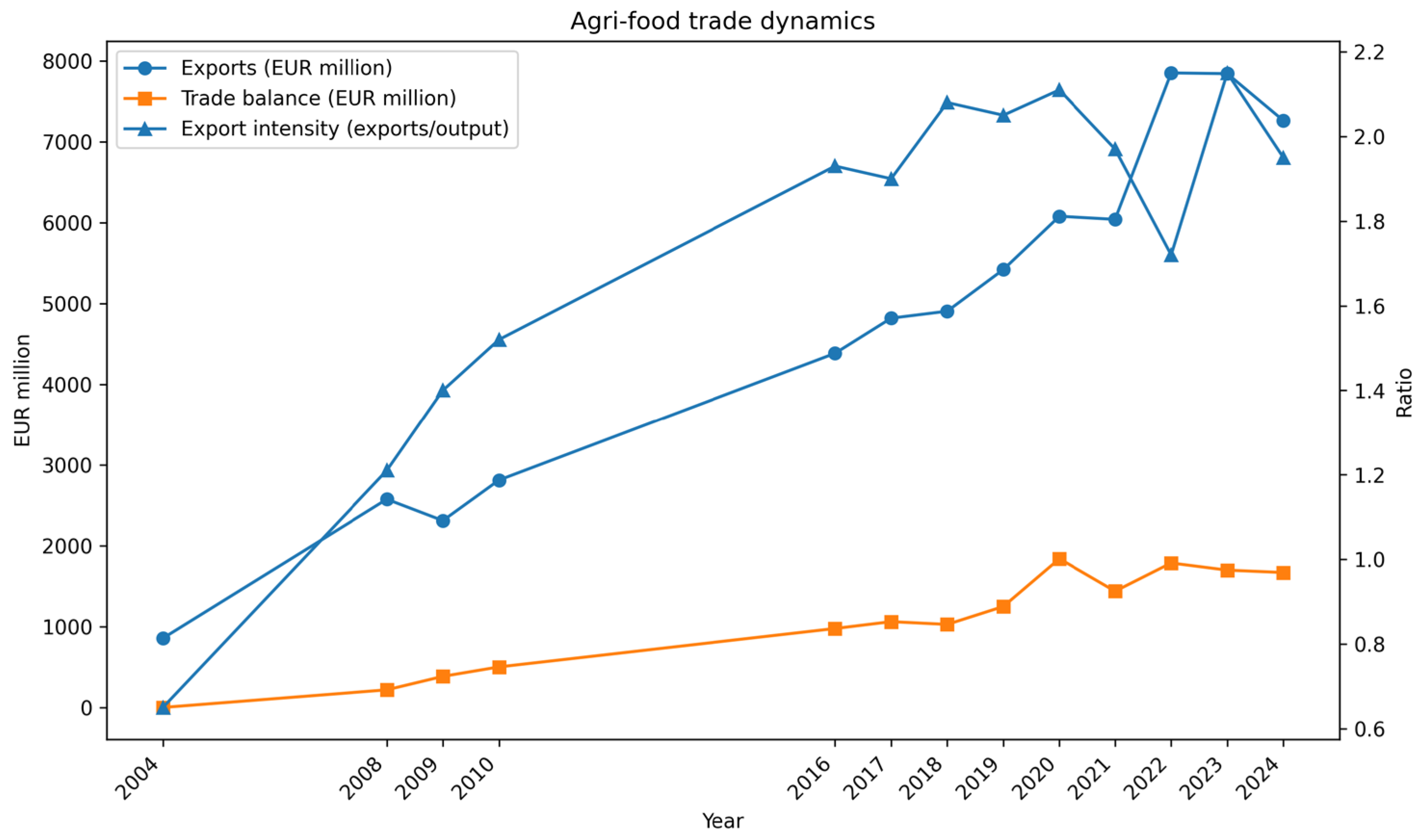
Trade indicators suggest strong market integration and value-chain expansion. Agri-food exports increased from EUR 856.3 million in 2004 to EUR 7263.4 million in 2024 (K = 8.48; CAGR ≈ 11.28% per year). Export intensity, measured as exports relative to total agricultural output, increased from 0.65 to approximately 1.95. Because exports refer to the broader agri-food sector whereas the denominator captures total agricultural output, the ratio may exceed 1 and should be interpreted primarily as a comparative proxy for trade orientation rather than as a literal output share. The trade dynamics are presented in
Table 7 and
Figure 7.
4.6. Productivity Proxies: Value Added per Employee
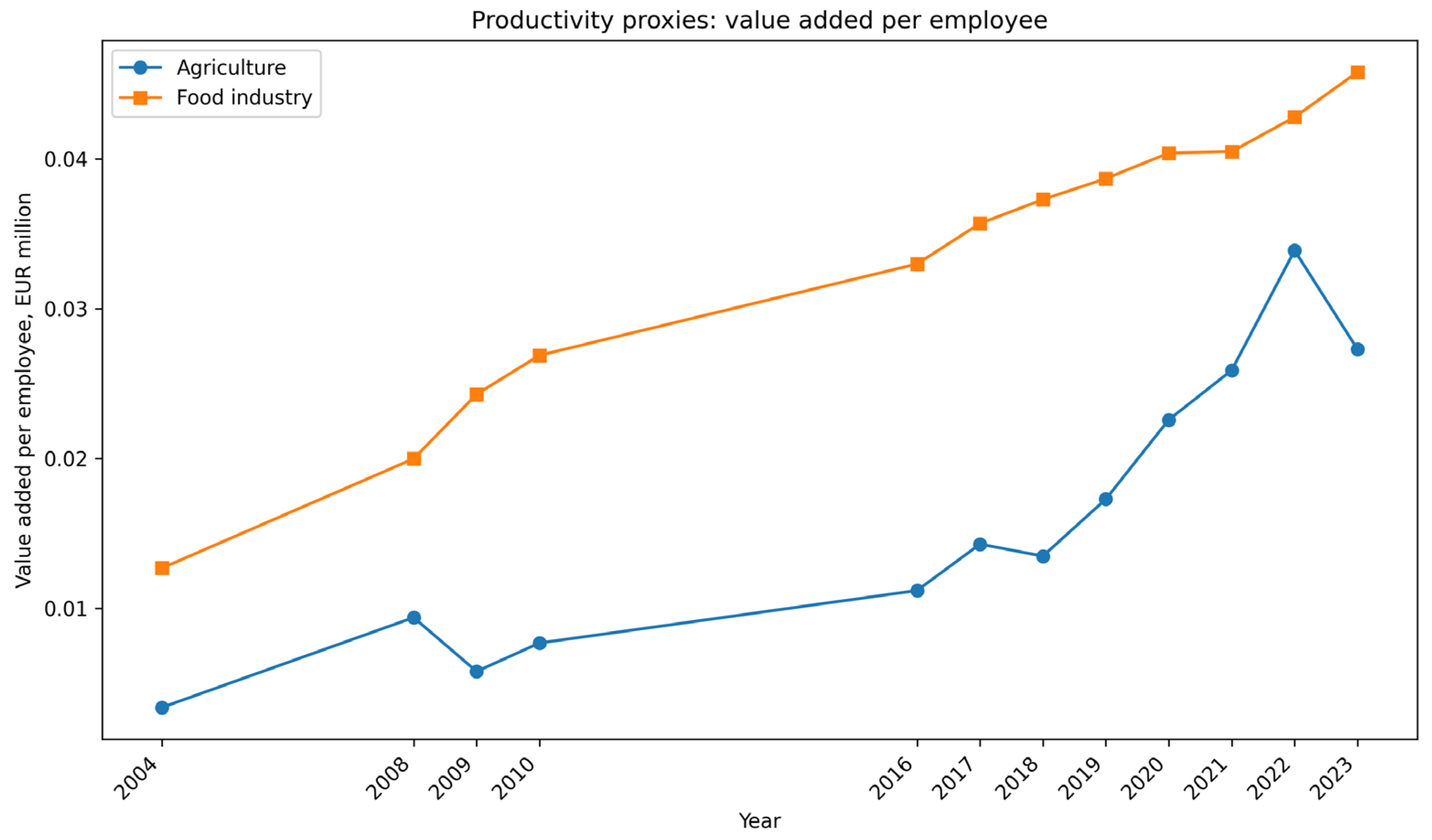
Nominal value added per employee increased in both agriculture and the food industry (
Table 8). In agriculture, the indicator rose from EUR 0.0034 million per employee in 2004 to EUR 0.0273 million in 2023 (K = 8.03; CAGR ≈ 11.59% per year), while in the food industry it increased from EUR 0.0127 million to EUR 0.0458 million (K = 3.61; CAGR ≈ 6.98% per year). The gap between the two sectors narrowed over time: in 2004, value added per employee in the food industry was 3.74 times higher than in agriculture, compared with 1.68 times in 2023. Since these indicators are reported in nominal terms, they should be interpreted as current-price productivity proxies rather than as pure measures of real labour-productivity growth independent of price effects. Nevertheless, the results suggest a relative narrowing of the productivity gap between primary agriculture and food processing. These results are summarized in
Table 8 and
Figure 8.
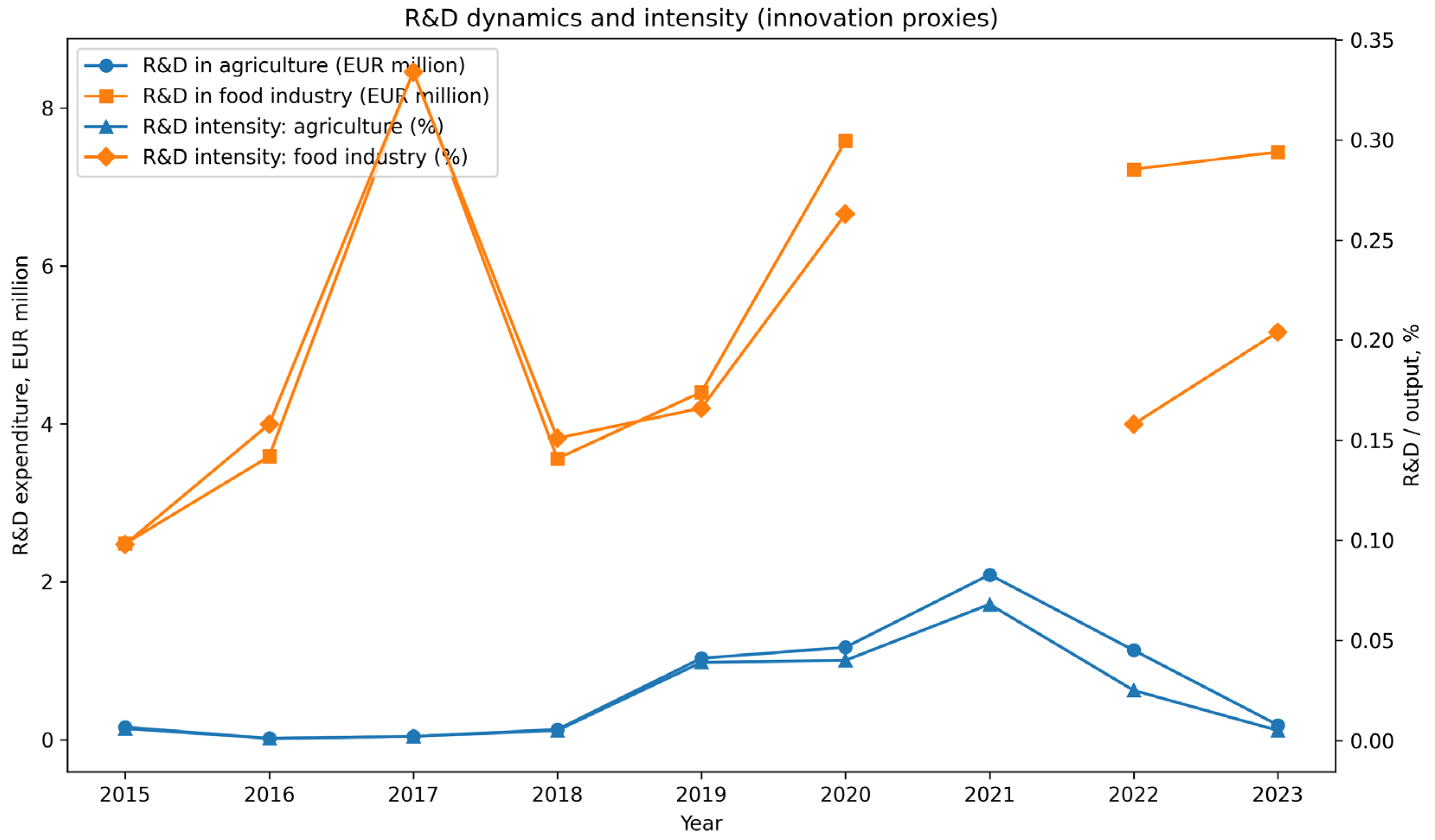
4.7. Formal R&D Expenditure as a Narrow Innovation Proxy
The available R&D expenditure data for 2015–2023 provide only a narrow and partial view of innovation dynamics in the agri-food sector. The recorded data show that formal R&D expenditure is more strongly concentrated in the food industry than in primary agriculture. Food-industry R&D ranges from approximately EUR 2.483 million to EUR 8.458 million, whereas agricultural R&D is substantially smaller and more volatile. Normalized R&D intensities remain below 0.1% in agriculture and below 0.35% in the food industry in the available series (
Table 9). Missing observations and year-to-year volatility further limit the robustness of this indicator, especially in agriculture. Accordingly, these figures should be interpreted as evidence on formal knowledge-creation activity rather than as comprehensive measures of innovation, which in agriculture may also take the form of technology adoption, digitalisation, advisory uptake, cooperation, and organisational change. The R&D results are reported in
Table 9 and
Figure 9.
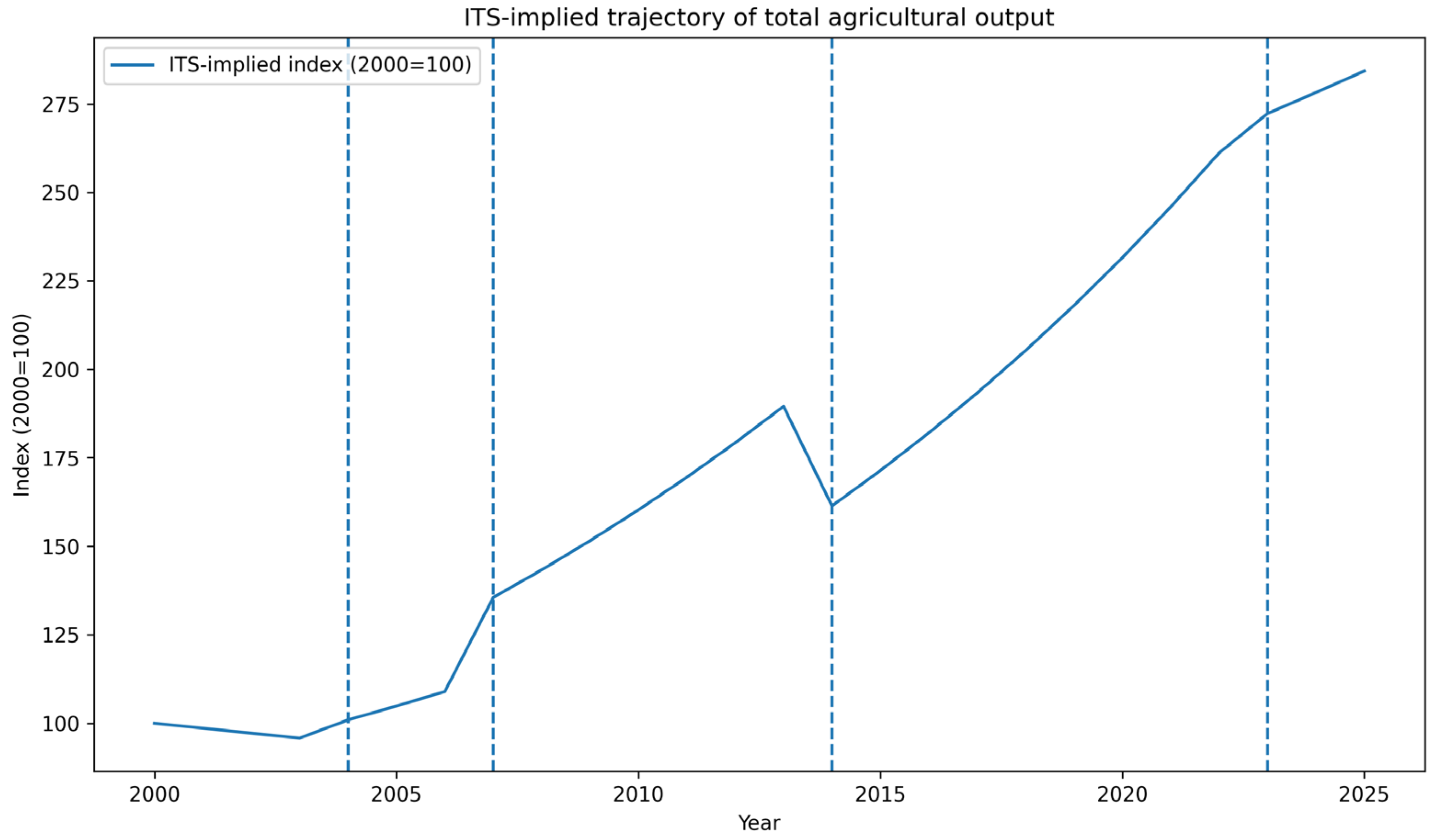
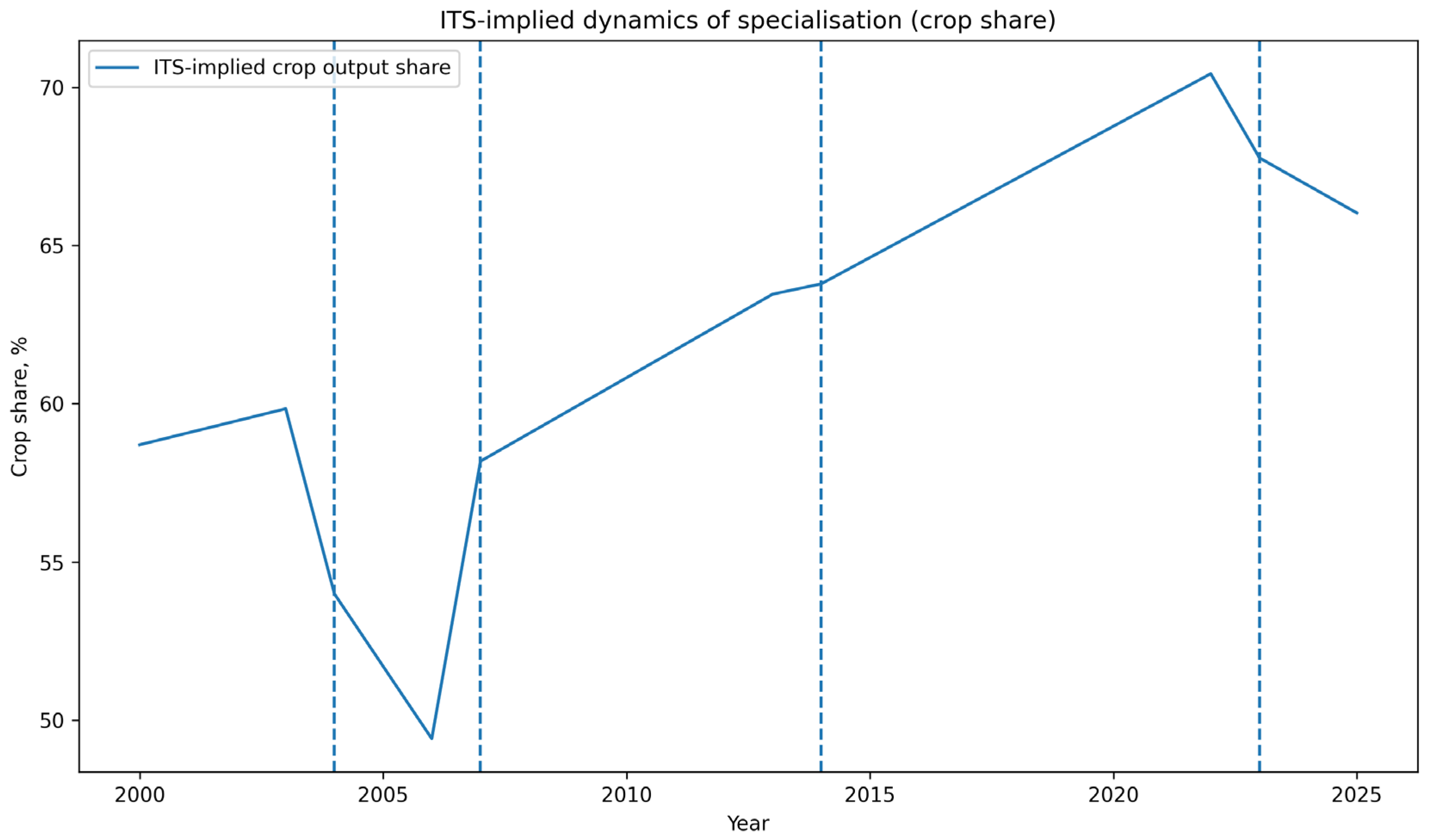
4.8. Interrupted Time Series Evidence of Breaks Across the CAP Programming Framework
To assess whether major CAP programming transitions coincided with statistically detectable discontinuities in selected annual indicators, segmented interrupted time-series models were estimated for the logarithm of total agricultural output and for crop share in total output. In line with the methodological rationale, the breakpoints are treated as institutionally defined policy transitions rather than statistically endogenised turning points. Because the agricultural output series is reported in current prices and because policy transitions overlap with major macroeconomic shocks, the ITS results are interpreted as associational evidence consistent with policy timing rather than as proof of causal effects. The corresponding estimates are presented in
Table 10 and
Table 11, and the model-implied trajectories are shown in
Figure 10 and
Figure 11.
Taken together, the ITS results suggest that selected shifts in sectoral trajectories were temporally aligned with major CAP programming transitions, although the strength and direction of these associations differ across indicators. The structural interpretation is more robust for crop share than for total agricultural output, since the latter reflects both nominal price dynamics and quantity-related change.
5. Discussion
The empirical results suggest that Lithuania’s agri-food sector experienced substantial structural transformation during 2000–2025, but only partial transformation in the stronger sense of innovation-led reconfiguration. The most robust evidence concerns modernization, consolidation, and market upgrading rather than broad-based innovation deepening across the entire value chain. This interpretation is consistent with the paper’s analytical distinction between transformation, partial transformation, and path dependence, and with the methodological caution that macro-level associations should not be read as strict causal effects. Although consolidation is consistent with modernization and structural adjustment, it may also carry social and territorial implications, including uneven effects across farm sizes, regions, and rural communities, which cannot be assessed in detail with the macro-level data used in this study.
Rural development support expanded sharply after EU accession, with the highest annualized support intensity observed in 2007–2013 and a similarly high level in 2023–2025. From the perspective of the support instrument portfolio, this indicates a substantial increase in the public resources available for structural adjustment, modernization, and rural development. At the same time, the internal composition of support matters as much as its scale. Under SAPARD, agri-food measures accounted for a dominant share of the rural development envelope, and processing support represented a relatively large component within it. After 2007, however, the share allocated to processing remained broadly stable at around 4–5% of total rural development budgets, even as total second-pillar financing expanded substantially. This suggests that downstream upgrading was supported, but not scaled in proportion to the overall growth of the policy envelope. Support for young farmers became more visible in 2023–2025, which is consistent with the stronger policy emphasis on generational renewal in recent CAP implementation.
Structural transformation in primary production is reflected most clearly in farm consolidation. The marked decline in farm numbers and the parallel increase in average farm size point to long-run concentration and capital deepening in Lithuanian agriculture. Together with the rise in nominal value added per employee, these patterns are consistent with modernization, although the monetary productivity indicators should be interpreted cautiously because they are reported in current prices and therefore reflect both real change and price effects. Moreover, the macro-level dataset does not permit an assessment of how these structural shifts were distributed across farm-size groups, territories, or social categories. For this reason, the results support a conclusion of sectoral restructuring, but not a claim of evenly shared gains.
Signals of market upgrading are stronger than those of innovation-led transformation. Agri-food exports increased sharply, the trade balance remained positive, and export intensity rose over time, indicating deeper integration into international markets and stronger value-chain expansion. The narrowing gap in nominal value added per employee between agriculture and the food industry also suggests some convergence in economic performance between primary production and downstream processing, even if this cannot be interpreted as pure real productivity convergence. Taken together, these findings are more consistent with successful market integration and value-chain deepening than with a uniform innovation transition across the agri-food system.
The evidence on innovation is more uneven. As acknowledged in the conceptual and methodological sections, formal R&D expenditure captures only a narrow dimension of innovation and does not fully reflect technology adoption, digitalisation, organisational change, cooperation, or advisory uptake. Even within this narrow measure, the observed pattern is asymmetric: R&D expenditure and intensity are clearly higher in the food industry than in agriculture, while agricultural R&D remains low, volatile, and partially affected by reporting gaps. This indicates that formal innovation capacity is more institutionalised downstream than in primary production. When these data are considered alongside the support composition results, the picture that emerges is not one of broad innovation-led transformation, but rather one of segmented upgrading, in which processing and trade performance show stronger innovation-related dynamism than agriculture itself.
From a smart-specialisation and food-systems perspective, this asymmetry is substantively important. If the policy goal is to move beyond stabilization and modernization toward more transformative change, then the issue is not simply the total volume of rural development support, but the extent to which the measure mix systematically strengthens knowledge creation, diffusion, and uptake in primary agriculture. In this respect, the results suggest that innovation support in Lithuania should be understood less as a matter of isolated R&D spending and more as a question of whether support instruments generate stronger links among advisory systems, training, cooperation, digital uptake, processing development, and value-chain coordination. Current CAP implementation explicitly provides tools in these areas through AKIS, knowledge exchange, advisory systems, training, and digitalisation support, which makes them more appropriate instruments for primary-sector innovation strengthening than a narrow reliance on formal R&D indicators alone.
The policy implications, therefore, need to be more specific than a general call to “strengthen innovation support.” First, innovation-related funding within the agri-food envelope should be more clearly ring-fenced for knowledge transfer, advisory services, training, on-farm digital uptake, and cooperation-based measures, rather than remaining embedded mainly in broad modernization expenditure. Second, support for processing should be linked more explicitly to new product development, higher value-added activities, resource efficiency, and stronger domestic value-chain integration, rather than being treated only as a conventional investment category. Third, implementation should rely more strongly on cooperation-oriented delivery mechanisms, such as AKIS-linked advisory packages, demonstration and pilot projects, producer–processor cooperation schemes, and competitive selection criteria that reward collaborative, innovation-oriented, and sustainability-relevant projects. Fourth, generational renewal support should be connected more systematically to training, digital skills, and innovation uptake, so that young farmer measures contribute not only to entry, but also to capability formation. In this way, policy design would better match the CAP’s cross-cutting objectives on knowledge, innovation, and digitalisation and Lithuania’s stated strategic orientation toward a more competitive, higher-value-added, and sustainable agri-food sector.
Finally, the interrupted time-series analysis provides only cautious dynamic support for the broader interpretation advanced here. The strongest statistical signal appears around the 2004 transition, while later breakpoints are weaker and overlap with major macroeconomic and geopolitical shocks. For this reason, the ITS findings should be interpreted as associations consistent with policy timing rather than as definitive proof of policy causality. The overall pattern is therefore best described as one in which CAP-related support contributed to modernization and market upgrading, while innovation-led transformation remained partial, uneven, and concentrated primarily in downstream segments of the agri-food chain.
6. Conclusions
Based on evidence for 2000–2025, the paper concludes that rural development support in Lithuania was associated most clearly with modernization, structural consolidation, and market upgrading, rather than with broad-based innovation-led transformation across the entire agri-food system. Rural development financing expanded substantially after EU accession, and the support portfolio became more diversified over time. At the same time, the composition of this support reveals that the strong growth of total funding was not matched by a proportional expansion of processing-oriented measures, while the evidence for innovation deepening in primary agriculture remained limited.
The empirical results point to several robust long-run tendencies. Farm numbers declined sharply and average farm size increased, indicating pronounced structural consolidation in primary production. Agri-food exports and the positive trade balance suggest deeper integration into international markets and stronger value-chain expansion. Monetary indicators of output and value added per employee also increased, although these trends should be interpreted cautiously because they are reported in current prices and therefore do not isolate real growth from price effects.
The evidence on innovation is more selective. Formal R&D expenditure is low and volatile in agriculture, while substantially higher in the food industry, indicating that formal innovation capacity is concentrated downstream. For this reason, the paper does not conclude that Lithuania experienced a fully innovation-led agri-food transformation. Instead, the findings are more consistent with partial transformation: modernization and market upgrading occurred at system level, but innovation-intensive change was more visible in processing and less developed in primary agriculture.
The policy implication is not simply that innovation support should be increased in general, but that its design and internal allocation should be adjusted more precisely. A stronger transformative orientation would require clearer ring-fencing of support for advisory services, training, cooperation, AKIS-type actions, on-farm digital uptake, and pilot or demonstration-based innovation projects in primary agriculture. Processing support should also be targeted more selectively toward higher value-added production, product development, and stronger domestic value-chain linkages. In addition, young farmer support would likely have greater long-term effect if it were combined more systematically with innovation-related capability building, including digital skills, advisory follow-up, and participation in cooperation-based schemes. These are more concrete implementation pathways than a generic call for innovation and are more closely aligned with current CAP policy tools.
Methodologically, the paper contributes a long-run macro-level assessment of how successive CAP programming periods relate to agri-food sector trajectories in Lithuania. However, it does not establish strict causal effects, and its conclusions apply to the national sectoral level rather than to heterogeneous effects across farm sizes, regions, or beneficiary types. Future research should therefore test these patterns at finer territorial and organisational scales and extend the analysis of sustainability outcomes where consistent long-run environmental and social series are available. Within these limits, the main conclusion is that CAP-related support in Lithuania functioned more as a driver of modernization and selective upgrading than as a uniform driver of innovation-led transformation.
7. Study Limitations and Future Research
This study has several limitations. First, rural development support is measured using programming-period allocations rather than actual annual disbursement flows. Although annualization enables cross-period comparison, it produces stepwise series that do not fully reflect the within-period timing of commitments, payments, and uptake. Second, several economic indicators are reported in current prices, meaning that observed changes capture both real developments and price effects. Third, innovation is measured only partially: formal R&D expenditure serves as a narrow proxy for knowledge creation, but it does not capture wider innovation processes such as technology adoption, digitalisation, organisational change, advisory uptake, or cooperation-based learning. Fourth, the study relies on aggregate time-series indicators at the macro level, which limits causal attribution and does not allow for the assessment of heterogeneous effects across farm sizes, regions, value-chain segments, or beneficiary groups. Finally, the sustainability dimension is constrained by uneven data availability, especially for long-run environmental and social indicators.
Future research should address these limitations by combining macro-level analysis with farm-level, firm-level, or regional panel data; reconstructing actual disbursement timing more precisely; using constant-price indicators more systematically; broadening innovation measurement beyond formal R&D; and extending the sustainability dimension as more consistent environmental and social series become available. Such advances would make it possible to assess not only whether rural development support is associated with structural change, but also how its effects differ across territories, production segments, and beneficiary groups.