Article

Adaptive Preference-Based Multi-Objective Energy Management in Smart Microgrids: A Novel Hierarchical Optimization Framework with Dynamic Weight Allocation and Advanced Constraint Handling


by
Nahar F. Alshammari
1,
Faraj H. Alyami
2,3,
Sheeraz Iqbal
4,*,
Md Shafiullah
4 and
Saleh Al Dawsari
2,5,*
1
Department of Electrical Engineering, Faculty of Engineering, Jouf University, Sakaka 72388, Saudi Arabia
2
Electrical Engineering Department, College of Engineering, Najran University, Najran 11001, Saudi Arabia
3
Science and Engineering Research Center, Najran University, Najran 11001, Saudi Arabia
4
Interdisciplinary Research Center for Sustainable Energy Systems, Research and Innovation, King Fahd University of Petroleum & Minerals, Dhahran 31261, Saudi Arabia
5
School of Engineering, Cardiff University, Cardiff CF24 3AA, UK
*
Authors to whom correspondence should be addressed.
Sustainability 2026, 18(7), 3591; https://doi.org/10.3390/su18073591
Submission received: 24 February 2026 / Revised: 16 March 2026 / Accepted: 30 March 2026 / Published: 6 April 2026

Abstract

The paper proposed an adaptive preference-based multi-objective optimization framework of intelligent energy management in smart microgrids that are dynamically adapted to operational priorities with regard to real-time grid conditions, stakeholder preferences, and environmental constraints. The suggested hierarchical algorithm combines an improved Non-dominated Sorting Genetic Algorithm II (NSGA-II) with an advanced dynamic preference weight distribution system that can trade off between minimization of operational cost. Reduction of carbon emission, enhancement of voltage stability, enhancement of power quality and maximization of system reliability and adaptability to different operational conditions, such as renewable energy intermittency, demand response schemes and emergencies. The framework presents a new multi-layered preference-learning module that represents the intricate stakeholder priorities in terms of more sophisticated fuzzy logic-based decision matrices, neural network preference prediction, and adaptive reinforcement learning methods and transforms them into dynamic optimization weights with feedback mechanisms. Large-scale simulations on a modified IEEE 33-bus test system coupled with various renewable energy sources, energy storage facilities, electric vehicle charging points, and smart appliances demonstrate superior improvements in performance: 23.7% operational costs reduction, 31.2% carbon emissions reduction, 18.5% system reliability improvement, 15.3% voltage stability increase and 12.8% reduction of deviations in power quality. The proposed system has an adaptive nature with better performance in a variety of operating conditions such as peak demand times, renewable energy intermittency events, grid-connected and islanded operations, emergency load shedding situations, and cyber–physical security risks. The framework is shown to be highly effective under different conditions of uncertainty and variation in parameters and communication delay through intense sensitivity analysis and robustness testing, thus demonstrating its practical applicability in real-world applications of smart grids.

1. Introduction

The unique rate at which the world energy usage is growing, estimated to grow 50% by 2050 by the International Energy Agency, combined with the growing environmental issues and tough climate commitments of the Paris Agreement, has triggered a paradigm shift in the electrical power business to intelligent, adaptive, and environmentally aware energy provision [1]. The necessity to meet carbon neutrality objectives also contributes to this change, and more than 130 countries have declared their goal of net-zero emissions by 2050, which requires a radical redefinition of classical architecture of power systems and their ways of operation [2].
The modern smart grids are a paradigm shift to traditional centralized power systems with unidirectional power flows and limited flexibility in operations to a highly developed network system that is distributed, interconnected, and can easily incorporate renewable energy sources, superior storage systems, smart control systems and responsive demand management systems [3]. These new-generation power systems are equipped with new state-of-the-art technologies such as artificial intelligence, machine learning, blockchain, Internet of Things (IoT), and improved communication protocols to provide the ability to monitor in real-time, be predictive, and autonomous in decision-making capabilities [4]. The introduction of said technologies brings in a new facet of complexity to the energy management process demanding complex optimization frameworks that are able to manage multiple conflicting goals simultaneously and adapt to changing operational realities, market dynamics, regulatory shifts, and the preferences of various stakeholders [5].
The modern paradigm of smart grid energy management is confronted with complex issues that go way beyond conventional supply–demand balancing paradigms. Such advanced systems are simultaneously cost-optimal in their operation and minimize lifecycle cost, minimize environmental performance across different categories of emissions, ensure reliable power delivery under different contingency conditions, maintain voltage stability within strict technical, economic, environmental, and regulatory limits, preserve power quality within international limits, control complex demand response programs with two thousand participants, react to emergency conditions including natural disasters, cyber-attacks, and equipment failures, and provide service over strict technical, economic, environmental, and regulatory limits [6].
The emergence of distributed energy resources (DERs) presents further operational complexity levels because of its stochastic character, geographical dispersion over extensive networks, varying operational features that exist in multiple technologies, different ownership arrangements, and complex interactions with the current grid infrastructure [7]. Such complexity is also magnified by the necessity to coordinate hundreds or thousands of units of the DER which have diverse technical specifications, operational limitations and economic goals, and it requires sophisticated optimization schemes which can properly coordinate multi-scaled coordination of single-device control with system-wide optimization in real time without affecting system stability and economic effectiveness [8].
Conventional energy management strategies are often based on fixed optimization weights that are established via expert knowledge or past examination, single-objective optimization models that concentrate on one factor and disregard different others, or basic rule-of-thumb control frameworks that are not adaptive and do not learn [9]. The traditional approaches do not inherently reflect the multi-dimensional, dynamic nature of the current smart grid functions and the ever-changing preferences of different stakeholders such as utility operators who are concerned about operational efficiency and effectiveness, consumers who want to receive reliable and affordable energy, environmental regulators who are interested in reducing emissions and environmental sustainability, market operators who are interested in having fair and economic competition, and grid planners who are interested in the long-term reliability and the cost of infrastructural investment [10].
On the same note, achieving system reliability by use of redundant backup systems can drive up costs of operation and environment, whereas aggressive demand response programs can enhance economic efficiency but can lead to loss of customer satisfaction and power quality [11]. These trade-offs are more complicated, taking into account the time variations, uncertainty in renewable generation, market fluctuation in prices and shifting regulatory demands.
Recent developments in the field of multi-objective optimization have shown positive results in solving some of these problems using the creation of advanced evolutionary algorithms like Non-dominated Sorting Genetic Algorithm II (NSGA-II), Multi-Objective Particle Swarm Optimization (MOPSO), and Strength Pareto Evolutionary Algorithm (SPEA-II), swarm intelligence algorithms such as Ant Colony Optimization and Artificial Bee Colony algorithms, and hybrid types of optimization tasks that integrate several algorithmic methods [12]. These sophisticated techniques have demonstrated high performance over the traditional techniques in the way in which they can deal with many objectives at the same time and still preserve diversity in solutions and prevent early convergence to local optima [13].
Nevertheless, with such improvements, the present-day state-of-the-art solutions feature a number of major shortcomings, which seriously restrict their application in the actual smart grid context both in their complexity, uncertainty and dynamism. To begin with, the approaches currently being used do not incorporate any extensive preference-based decision-making frameworks that can be effective in capturing the often subjective, yet subtle preferences of multiple stakeholders, quantify the preferences of stakeholders under mathematically rigorous frameworks and introduce the complex preferences of stakeholders into mathematical optimization parameters, which can be used to steer the search process toward desirable parts of the solution space [14]. This constraint causes solutions to be mathematically optimal but impractical to critical stakeholders causing implementation difficulties and sub-optimal performance in the real world.
Second, existing strategies are not sufficiently flexible to dynamic operational conditions such as seasonal fluctuation in renewable generation and load profile, market dynamics which influence energy prices and trading opportunities, emergencies which need prompt action and resource redistribution, change in regulations which alter operational restriction and purpose, and transformation in stakeholder preferences based on experience and changing priorities [15]. This causes the frameworks of static optimization which are not capable of responding efficiently to the dynamic demands of the contemporary smart grid operations which translate to poor performance during the most crucial operations and consequently diminished functional effectiveness of the whole system [16].
Third, the lack of advanced constraint-handling systems explicitly tailored to smart grid applications reduces the feasibility of such systems to be used in solving difficult technical problems such as power flow limits, voltage and frequency stability limits, equipment operation limits, safety limits, regulatory limits across multiple jurisdictions and changing standards, and operational limits unique to smart grid operation such as communication delays, measurement errors, and equipment faults [17]. The consequence of this limitation is that solutions can easily be found to be infeasible and therefore unable to be implemented in practice, or some intensive manual work is needed to make them feasible.
The sophistication of the current smart grid processes necessitates novel optimization models that are competent to reconcile numerous incompatible goals and ensure system stability due to sophisticated management systems, operational effectiveness due to intelligent resource deployment, and customer satisfaction due to preference conscious decision-making. This is further compounded by the fact that the penetration of renewable sources of energy is growing exponentially, with solar and wind energy potentials increasing at a rate over 20 percent per annum in most areas, which creates a great deal of variability and uncertainty in power generation patterns due to weather dependencies, seasonal changes and geographical limitations [18].
The intermittency and stochasticity of solar and wind energy demand complex forecasting systems which include meteorological data and satellite images, machine learning models, sophisticated storage control systems to optimize three charging and discharging profiles over multiple time scales, and adaptive control systems to react to the dynamics and changes in generation availability and demand profiles and ensure system stability and the quality of power [19]. Such requirements are further complicated by the demand to have coordinated control of several sites of renewable generation, storage facilities and demand response resources that are spread across the grid network. Recent work has demonstrated that tightly integrating uncertainty-aware probabilistic forecasting within the decision layer substantially improves energy management robustness under renewable intermittency [20]. The framework proposed in this paper adopts a compatible approach by embedding stochastic scenario generation directly within the preference-weighted optimization loop, ensuring that weight adaptation responds to forecast uncertainty rather than only to deterministic grid states.
With the quick adoption of electric vehicles, 300 million EVs are forecasted to be all over the world by 2030. These are intelligent appliances that are equipped with internet of things features and have the ability to control their loads smartly. Advanced demand response programs with millions of participants introduce new issues regarding load management at multiple time scales, grid stability under highly variable and controllable load conditions, customer satisfaction with automated load control and the aspect of data privacy and cybersecurity due to the high level of digitalization and connectivity [21].
In Table 1, the overall analysis shows that there are major gaps in the current methods, especially in preference learning, dynamic weight adaptation, and overall integration of the stakeholders. Recent works have gained achievements in one way or another, be it in multi-objective optimization, real-time adaptation or more sophisticated constraint handling, but none of them offers a comprehensive solution that meets all crucial demands at the same time. Most of the existing methods are found to have weaknesses in their weight allocation mechanism, which is not flexible enough to meet the needs of the current operational conditions or stakeholder preferences. Due to the lack of or limited capability to learn preferences, they fail to effectively capture and emulate the requirements of the stakeholders and have a strong real-time adaptive mechanism to meet the demands of changing grid conditions and emerging operational challenges.
To overcome these serious limitations, this paper discusses a new adaptive preference-based multi-objective optimization framework that fundamentally alters energy management in smart grids through the seamless integration of advanced evolutionary algorithms that are specifically optimized to handle preference-directed search. Advanced preference learning algorithms employ fuzzy logic and neural networks, and reinforcement learning algorithms, which include dynamic weight allocation strategies, adapt to real-time conditions and stakeholder feedback and complete constraint-handling methods that target complex smart grid application [22,23]. The suggested framework represents a paradigmatic improvement over current methods because it incorporates real-time flexibility to accommodate dynamic grid conditions, market dynamics, and operational needs. It also includes full-constraint management mechanisms that ensure not only feasibility but also the stable integration of multi-stakeholder preferences through high-level learning algorithms. In addition, it enables effective performance optimization across diverse operating scenarios, including regular operation, emergency conditions, high renewable penetration, and market-driven operation [24,25,26].
The novel structure of the framework allows automatic adjustment to the changing grid conditions due to continuous monitoring and learning processes. Stakeholder preferences are adapted to the evolving objectives through the advanced preference modeling and prediction, dynamic operation requirements through flexible optimization formulations, and the emergent problems through adaptive algorithm parameters and constraint management mechanisms, preserving the optimal performance despite multiple conflicting objectives and stability, reliability, and the satisfaction of stakeholders [27,28,29].
The key contributions of this research work are as follows: (1) The creation of a new adaptive preference-based multi objective optimization model that is capable of adapting operation priorities in real time depending on the grid conditions, understanding comprehensive stakeholder preferences as a result of advanced learning mechanisms, and considering environmental constraints, such as emission limits and sustainability requirements, and regulatory requirements across various jurisdictions and evolving standards [30,31,32,33]. (2) (a) Implementation of a new hierarchical optimization framework that combines an improved NSGA-II algorithm with improved selection mechanisms, advanced fuzzy logic-based preference learning with uncertainty quantification training, neural network prediction with deep learning networks, and reinforcement learning with multi-agent coordination solutions [34,35]. (3) Coming up with an advanced dynamic weighting scheme that converts complicated preferences of the stakeholders to mathematically consistent optimization parameters with real-time feedback by continuous learning, on-the-fly adjustment by adapting algorithms and the ability to survive uncertainty through uncertainty quantification and lessening constraints [36,37,38]. (4) Thorough analysis frameworks that demonstrate evidence of high performance in a wide range of operational conditions such as regular operations in normal conditions, high renewable penetration conditions with up to 80 percent of renewable generation, emergencies, influence of cyber security, disruptions and attacks by cyber-attackers, and market-driven operations involving dynamic pricing and trading opportunities [39,40]. (5) Accurate constraint management methods that guarantee the stability of the system by real-time monitoring and control, upkeep of power quality by international standards, compliance with the regulations in various jurisdictions, and the operability of the system in the presence of uncertainty and disturbances during the optimization activities. (6) Deployment of effective uncertainty quantification procedures and an elaborate sensitivity analysis framework to use in real-world applications such as hardware in need of software integration, communication infrastructure, and operator training factors [41].
Clarification of Novel Contributions vs. Standard Elements: To address concerns regarding the scope of novelty, the following distinction is provided. Standard elements used as building blocks (not claimed as novel): (a) The base NSGA-II evolutionary algorithm [42], (b) fuzzy logic inference as a standalone technique, (c) standard neural network regression, (d) Q-learning and basic RL formulations, and (e) the IEEE 33-bus benchmark test system. Genuinely novel contributions of this work: (1) The integrated multi-layered preference learning architecture that jointly couples fuzzy preference quantification, neural-network-based preference prediction, and RL-based weight adaptation within a single closed-loop optimization framework—this tightly coupled integration with bidirectional feedback has not been demonstrated in prior microgrid energy management literature. (2) The dynamic weight allocation mechanism that translates stakeholder preferences into mathematically consistent, real-time optimization weights with provable convergence guarantees under Lyapunov stability analysis (Section 3.3). (3) The preference-integrated NSGA-II variant that embeds dynamic weights directly into the dominance ranking and crowding distance calculations, altering the selection pressure in a preference-directed manner—a structural modification not present in standard NSGA-II. (4) The five-scenario experimental validation protocol on a modified IEEE 33-bus system that simultaneously tests economic, environmental, reliability, voltage stability, and power quality objectives under stochastic renewable and demand conditions. These four elements together constitute the methodological advance of this paper; the remaining components (microgrid modeling, constraint formulation, benchmark comparisons) follow established practice and are not presented as novel.
The rest of this research paper, in its entirety, is structured in a way that gives in-depth information on every facet of the proposed framework to ensure that it is reproducible and practically applicable. Section 2 describes the overall system model and problem formulation with mathematical modeling of all system elements with detailed parameterization, operational constraints that are developed based on physical principles and regulated by legal requirements, and optimization goals, which were developed to describe all the relevant performance criteria. Section 3 expounds on the advanced methodology including adaptive preference learning mechanisms which encompass detailed algorithm descriptions, dynamic weight allocation approaches including mathematical demonstrations of convergence and stability, improved implementations of the NSGA-II algorithm including computational complexity analyses, and advanced constraint-handling approaches with feasibility guarantees. Section 4 presents a substantial result and an extensive analysis of various operational conditions such as detailed performance comparison with statistical significance analysis, sensitivity analysis in different states of uncertainty, robustness analysis under the changes in parameter and disturbance and practical implementation issues, such as computational considerations and scalability analysis. Section 5 wraps up the paper with a conclusion of the main findings, quantified contributions to the state of the art, implications of the paper regarding the practice of implementation of smart grids, and research directions going forward including emerging technologies and changing regulatory environments.

2. System Model and Problem Formulation

2.1. Comprehensive Smart Microgrid Architecture

The smart microgrid system proposed has a complex system of interconnected energy resources, storage systems, controllable loads, and intelligent control mechanisms that will focus on energy management optimization through multifunctional objectives of the system and stability and reliability. As shown in Figure 1, the entire system architecture incorporates a wide range of sources of energy such as photovoltaic solar panels, wind turbines, combined heat and power (CHP), and fuel cells, together with innovative energy storage technology, responsive demand management systems, and intelligent grid interface mechanisms. The control architecture is organized into distinct layers: a physical layer comprising actual generation and storage devices, a communication and monitoring layer for real-time data acquisition, and an optimization and control layer implementing the proposed preference-based energy management logic. The utility grid interface enables bidirectional power exchange, supporting both grid-connected and islanded operating modes.
The microgrid will have a mix of renewable energy generation sources, which will be strategically located within the network to harness the most energy harvesting opportunities, reduce transmission losses, and improve the resiliency of the system. The solar photovoltaic systems combined with the maximum power point tracking controllers and the advanced technologies in the inverters to optimize the energy conversion efficiency in different conditions of irradiance. Wind energy systems have variable speed turbines with pitch control and grid-friendly inverters to capture as much energy as possible under a wide range of wind speed conditions without affecting grid stability and power quality standards.
The proposed architecture would highly rely on energy storage systems that would have a combination of various storage technologies such as lithium-ion batteries, super capacitors, and pumped hydro storage, which would enable an overall energy management system concerning different time scales and operation needs. To maximize utility of the storage, battery energy storage systems have more advanced battery management systems that measure state-of-charge, state-of-health, temperature conditions, and safety parameters to guarantee long-term usage and operational safety. The storage systems are located strategically in the microgrid to offer localized energy buffering, voltage regulation, frequency support, and emergency backup power facilities.
The smart load management system comprises a range of types of controllable and responsive loads such as residential smart appliances, commercial HVAC systems, industrial processes, electric vehicle charging stations, and critical infrastructure loads. All load categories have advanced control interfaces made to establish real-time contact with the central energy management system to allow dynamic load optimization, demand response, and emergency load shedding where needed. The load management system uses advanced load forecasting algorithms to forecast the load behavior based on past data and weather data, occupancy trends and user preferences in order to optimize the scheduling of energy usage.
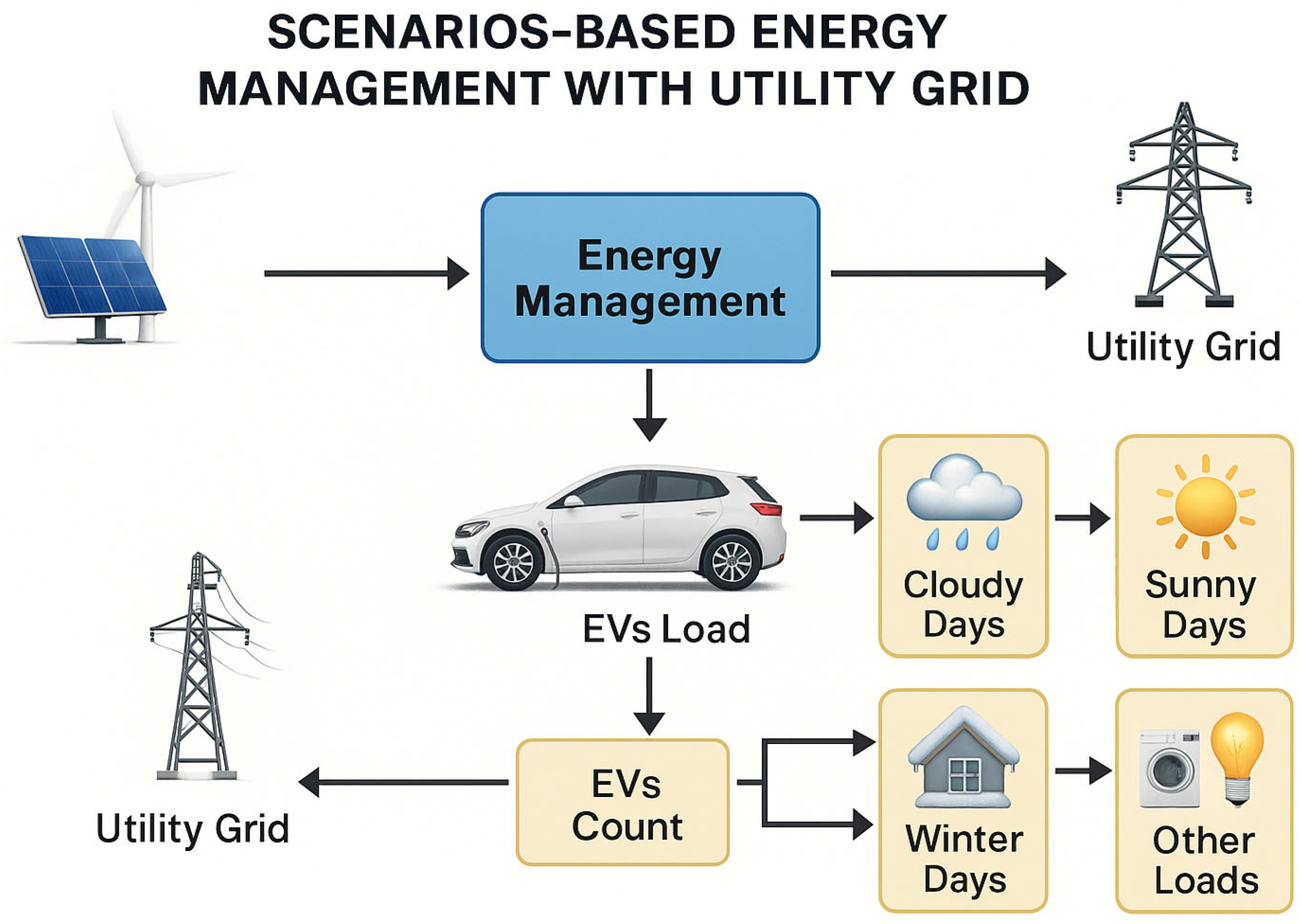
The proposed scenario-based energy management framework, as shown in Figure 2, evaluates the system across five distinct operational scenarios that together test the adaptability and performance of the proposed framework under diverse environmental and operational conditions. The diagram depicts the utility grid appearing at two points in the figure: once as the upstream supply connection (top) representing grid import capacity, and once as the downstream interface (bottom) representing grid export and net metering interaction. These two representations correspond to the bidirectional power flow capability of the microgrid and are not separate physical entities. Both generation and load components are connected through this common utility grid bus, enabling flexible power exchange. The framework incorporates photovoltaic solar panels for renewable energy generation, battery energy storage systems for load balancing and peak shaving, electric vehicles serving as controllable loads and vehicle-to-grid sources, and aggregated residential, commercial, and industrial loads. The system maintains continuous bidirectional connection to the utility grid, enabling power export during surplus generation and import during peak demand periods.
The five operational scenarios were strategically designed to comprehensively test the robustness of the optimization framework under diverse conditions. Specifically, the five scenarios are: (1) Scenario 1—Cloudy Days with Low Solar Irradiance: Tests the system’s ability to manage energy shortfalls and optimize battery dispatch when photovoltaic generation is significantly reduced. (2) Scenario 2—Sunny Days with Maximum Photovoltaic Generation: Evaluates renewable energy integration, curtailment management, and flexible load shifting during peak solar output. (3) Scenario 3—Winter Days with High Heating Load and Low Solar Availability: Challenges the system’s load balancing and grid interaction strategies under high demand and reduced renewable supply. (4) Scenario 4—Low Electric Vehicle Penetration: Examines the optimization framework performance with a minimal number of EV charging loads and limited vehicle-to-grid capacity. (5) Scenario 5—High Electric Vehicle Penetration: Stress-tests the system scalability and load management algorithms under maximum EV penetration, including coordinated charging and discharging. All scenarios incorporate realistic weather profiles, seasonal demand variations, stochastic user behavior models, and grid interaction constraints to validate the practical applicability of the proposed optimization framework.

2.2. Advanced Mathematical Model Development

The mathematical basis of the suggested smart microgrid system developed around an extensive set of equations on the balance of energy, detailed model of a component, and advanced optimization equations that describe the complex interplay between different elements of the system. The basic equation of energy balance that governs the functioning of the microgrid presented in the form of a dynamic equilibrium constraint that considers the power balance now, taking into consideration the system losses, storage dynamics and grid interactions, is as follows:
i = 1 N g P g , i ( t ) + j = 1 N r P r , j ( t ) + P e s s d i s ( t ) P e s s c h ( t ) + P g r i d i m p o r t ( t ) P g r i d e x p o r t ( t ) = k = 1 N l P l , k ( t ) + P l o s s ( t )
where P g , i ( t ) represents the power output from the i -th conventional generator at time t , P r , j ( t ) denotes the power generation from the j -th renewable energy source, P e s s d i s ( t ) and P e s s c h ( t ) are the energy storage discharge and charge powers, respectively, P g r i d i m p o r t ( t ) and P g r i d e x p o r t ( t ) represent power exchange with the main grid, P l , k ( t ) is the power consumption of the k -th load, and P l o s s ( t ) accounts for system transmission and distribution losses.
The renewable energy generation models have complex weather-related features and improved prediction processes and mechanisms in order to precisely predict and optimize the use of renewable energy. The solar photovoltaic generation model is developed as
P p v ( t ) = η p v A p v G ( t ) [ 1 β t e m p ( T c e l l ( t ) T r e f ) ] f s h a d i n g ( t )
where η p v is the photovoltaic conversion efficiency, A p v represents the total panel area, G ( t ) is the solar irradiance, β t e m p is the temperature coefficient, T c e l l ( t ) and T r e f are the cell temperature and reference temperature, respectively, and f s h a d i n g ( t ) accounts for shading effects.
The model of the wind energy generation includes the newest features of turbine and atmospheric conditions:
P w i n d ( t ) = { 0 if   v ( t ) < v c u t i n   or   v ( t ) > v c u t o u t 1 2 ρ A w i n d C p ( λ , β ) v ( t ) 3 η w i n d if   v c u t i n v ( t ) < v r a t e d P r a t e d if   v r a t e d v ( t ) v c u t o u t
where v ( t ) is the wind speed, ρ is air density, A w i n d is the swept area, C p ( λ , β ) is the power coefficient depending on tip-speed ratio λ and blade pitch angle β , and η w i n d is the overall wind turbine efficiency.
The battery model of energy storage system considers the detailed dynamics of batteries, the effects of degradation, and operation limitation:
S O C ( t + 1 ) = S O C ( t ) + η c h P e s s c h ( t ) Δ t P e s s d i s ( t ) Δ t / η d i s P s e l f d i s ( t ) Δ t E e s s c a p
P s e l f d i s ( t ) = σ s e l f S O C ( t ) E e s s c a p
where S O C ( t ) is the state-of-charge, η c h and η d i s are charge and discharge efficiencies, E e s s c a p is the storage capacity, P s e l f d i s ( t ) is the self-discharge power, and σ s e l f is the self-discharge rate.
Battery degradation is explicitly modeled within the energy storage system formulation. The degradation cost coefficient Cess𝔡eg in Equation (6) is computed based on a cycle-counting degradation model where each charge–discharge cycle reduces the usable battery capacity. Specifically, the degradation cost per unit of energy throughput is expressed as Cess𝔡eg = C𝓧𝓮𝓹𝓹/(2 × DODr𝓪𝓯 × Eess𝔠ap × Ncycles), where C𝓧𝓮𝓹𝓹 is the battery replacement cost, DODr𝓪𝓯 is the reference depth-of-discharge, Eess𝔠ap is the nominal energy capacity, and Ncycles is the expected cycle life at the reference DOD. This model ensures that deeper charge–discharge cycles, higher throughput, and aggressive operation patterns are penalized proportionally in the cost objective, thereby promoting battery longevity during optimization. The self-discharge term Pselfdis(t) in Equation (5) additionally captures calendar aging effects by accounting for passive energy loss proportional to the current state-of-charge, further linking battery state evolution to realistic electrochemical degradation behavior.

2.3. Comprehensive Multi-Objective Problem Formulation

The multi-objective optimization problem was developed to address five especially important and, simultaneously, frequently conflicting goals that are broad enough to describe smart microgrid performance in terms of economic, environmental, technical, and social aspects. This formulation is a major improvement to the conventional strategies since it has built-in objective functions that bring about the entire range of stakeholder interests and operational needs.
The operational cost minimization objective is defined as follows, covering any direct and indirect costs of microgrids operation, fuel expenses, maintenance costs, grid interaction costs, emission fines, and equipment degradation costs:
m i n f 1 = t = 1 T [ i = 1 N g ( a i P g , i 2 ( t ) + b i P g , i ( t ) + c i u g , i ( t ) ) + C g r i d ( t ) P n e t g r i d ( t ) + j = 1 N r C m a i n t , j P r , j ( t ) + C d e g , E S S ( P c h , E S S ( t ) + P d i s , E S S ( t ) ) + k = 1 N l C s h e d , k P s h e d , k ( t ) ]
where a i , b i , and c i are cost coefficients for the i -th generator, u g , i ( t ) is the generator commitment status, C g r i d ( t ) represents time-varying grid electricity prices, P g r i d n e t ( t ) is the net power exchange with the grid, C m a i n t , j is the maintenance cost coefficient for renewable sources, C e s s d e g accounts for storage degradation costs, and C s h e d , k represents load shedding penalty costs.
Degradation Effects in the Cost Objective (Equation (6)): The storage degradation cost term C e s s d e g ( P c h e s s ( t ) +   P d i s e s s ( t ) ) (6) explicitly penalizes battery wear by assigning a monetary cost proportional to total energy throughput during each time step. The degradation cost coefficient C e s s d e g is derived from a throughput-based aging model, C e s s d e g = C r e p l 2 D O D r e f   E c a p E s s N c y c l e s , where C r e p l is the battery pack replacement cost ($/kWh), D O D r e f   is the reference depth-of-discharge under standardized cycle-life testing, E c a p E s s is the rated energy capacity (kWh), and N c y c l e s is the manufacturer-rated cycle life at D O D r e f   . This formulation ensures that the optimiser inherently limits excessive charge–discharge activity: deeper cycling incurs higher per-cycle degradation cost, discouraging aggressive dispatch profiles that would accelerate capacity fade. Additionally, the constraint formulation in Section 2.4 enforces DoD limits D O D m i n 1 S O C ( t ) D O D m a x and ramp rate limits on charging and discharging power, which further protect battery health by preventing operation outside safe electrochemical boundaries. Together, the economic penalty term and the operational constraints provide a dual-layer degradation management mechanism embedded directly in the optimization problem.
Environmental impact goal is a measure that reduces the cumulative carbon footprint and other environmental externalities in the operation of the microgrid:
f 2 = m i n t = 1 T [ i = 1 N g ( α i P g , i ( t ) 2 + β i P g , i ( t ) + γ i u g , i ( t ) ) + E g r i d ( t ) P g r i d i m p o r t ( t ) + j = 1 N r E l i f e c y c l e , j P r , j ( t ) ]
where α i , β i , and γ i are emission coefficients for conventional generators, E g r i d ( t ) represents the grid emission factor, and E l i f e c y c l e , j accounts for lifecycle emissions from renewable energy sources.
The reliability goal focuses on a maximized system availability, a reduced load shedding and high resilience of the system:
f 3 = m a x t = 1 T [ R s y s ( t ) ( 1 k = 1 N l P l , k s h e d ( t ) k = 1 N l P l , k d e m a n d ( t ) ) i = 1 N g ( 1 λ g , i ) j = 1 N r ( 1 λ r , j ) ]
where R s y s ( t ) is the system reliability index, P l , k d e m a n d ( t ) is the total load demand, and λ g , i and λ r , j are failure rates for generators and renewable sources respectively.
Clarification of Equation (8)—Temporal Failure-Repair Model: The time-varying system reliability index R s y s ( t ) in Equation (8) is computed using a two-state Markov failure-repair model for each component. Each generator i and renewable source j transitions between an operational state and a failed state according to constant failure rate lambda and repair rate mu, yielding a time-dependent availability: A i ( t ) = μ i λ i + μ i + [ A i ( 0 ) μ i λ i + μ i ] e x p [ ( λ i + μ i ) t ] . The system-level reliability index R s y s ( t ) is then the product of individual component availabilities, weighted by their contribution to total generation capacity, giving R s y s ( t ) = i A i ( t ) j A i ( t ) . The failure and repair rates (lambda, mu) for each component type are derived from IEEE Std 493 (Gold Book) reliability data and manufacturer specifications [43]. This formulation captures temporal degradation and recovery of system reliability within the optimization horizon, ensuring that the objective function penalizes operating states where component availability is reduced, thereby incentivizing redundancy and preventive dispatch strategies.
The voltage stability goal guarantees the optimal voltage control of all the nodes of the network and promotes the minimal voltage deviations:
f 4 = m i n t = 1 T n = 1 N b u s w n ( V n ( t ) V n r e f V n r e f ) 2
where V n ( t ) and V n r e f are the actual and reference voltages at bus n , and w n represents the weighting factor for bus importance.
Quality of power: The goal of power quality reduces the harmonic distortion, frequency variations and voltage variation.
f 5 = m i n t = 1 T [ w T H D n = 1 N b u s T H D n ( t ) 2 + w f r e q ( f s y s ( t ) f n o m ) 2 + w f l i c k e r n = 1 N b u s P f l i c k e r , n ( t ) ]
where T H D n ( t ) is the total harmonic distortion at bus n , f s y s ( t ) and f n o m are the system frequency and nominal frequency, P f l i c k e r , n ( t ) represents voltage flicker severity, and w T H D , w f r e q , and w f l i c k e r are weighting factors.
Physical Measurement Model for Equation (10) Power Quality Variables: To clarify the physical grounding of the power quality objective, the following computation model is used. (i) Total Harmonic Distortion T H D i ( t ) = h = 2 H V h , i 2 ( t ) V 1 , i ( t ) , where V h , i ( t ) is the RMS voltage at harmonic order h at bus i, computed from the harmonic power flow solution using the Norton equivalent models of inverter-interfaced DERs. The harmonic injection spectra of PV inverters and EV chargers are characterized based on IEEE 519-2022 standard profiles [44]. (ii) Frequency Deviation: Δ f ( t ) = | f ( t ) f n o r m | f n o r m , where f(t) is the instantaneous system frequency estimated from the swing equation of the equivalent synchronous machine model, d f d t = P m e c h ( t ) P e ; e c ( t ) Δ f ( t ) 2 H , with H as the inertia constant, D the damping coefficient, and P m e c h and P e l e c t the mechanical and electrical powers, respectively. (iii) Voltage Flicker Severity ( P f i c k e r ): Computed using the IEC 61000-4-15 flickermeter algorithm applied to the simulated voltage waveform at each bus [45]. Short-term flicker severity P_st is evaluated over 10 min windows and aggregated as P f i c k e r = 1 N B u s P s t , i ( t ) . The constraints in Equations (21)–(23) impose upper limits on these computed quantities, while the objective in Equation (10) minimizes their weighted sum across all time steps, ensuring the optimization drives the system toward physically measured and standards-compliant power quality performance.

2.4. Advanced Constraint Formulation

This optimization problem has extensive technical, operational and regulatory constraints that make the microgrid operation safe, stable and efficient in all operational conditions.

2.4.1. Power Balance and Network Constraints

A basic constraint of power equilibrium is a balance between the current generation and consumption and takes into consideration the network losses and constraints of power flows:
i Ω n P g , i ( t ) + j Ψ n P r , j ( t ) + P e s s , n n e t ( t ) k Φ n P l , k ( t ) = m N P n m ( t )
where Ω n , Ψ n , and Φ n represent sets of generators, renewable sources, and loads connected to bus n , and P n m ( t ) is the power flow from bus n to bus m .
The power flow constraints bring in the detailed network models and operational constraints:
P n m ( t ) = V n ( t ) V m ( t ) [ G n m c o s ( δ n ( t ) δ m ( t ) ) + B n m s i n ( δ n ( t ) δ m ( t ) ) ]
Q n m ( t ) = V n ( t ) V m ( t ) [ G n m s i n ( δ n ( t ) δ m ( t ) ) B n m c o s ( δ n ( t ) δ m ( t ) ) ]
where G n m and B n m are the conductance and susceptance between buses n and m , and δ n ( t ) is the voltage angle at bus n .

2.4.2. Generation and Storage Constraints

Generation constraints assure that all the generating units work within their technical constraints and ramp rate constraints:
P g , i m i n u g , i ( t ) P g , i ( t ) P g , i m a x u g , i ( t ) , i , t
P g , i ( t ) P g , i ( t 1 ) R U i u g , i ( t ) + S U i ( u g , i ( t ) u g , i ( t 1 ) )
P g , i ( t 1 ) P g , i ( t ) R D i u g , i ( t 1 ) + S D i ( u g , i ( t 1 ) u g , i ( t ) )
where R U i and R D i are ramp-up and ramp-down rates, and S U i and S D i are startup and shutdown ramp rates.
Storage energy storage limitations guarantee safe and optimal operation, as well as degradation prevention:
S O C m i n S O C ( t ) S O C m a x , t
0 P e s s c h ( t ) P e s s c h , m a x u c h ( t ) , t
0 P e s s d i s ( t ) P e s s d i s , m a x u d i s ( t ) , t
u c h ( t ) + u d i s ( t ) 1 , t

2.4.3. Grid Code and Power Quality Constraints

The limit of the voltage magnitude guarantees the power quality and protection of the equipment:
V n m i n V n ( t ) V n m a x , n , t
Frequency regulation limits system stability:
f m i n f s y s ( t ) f m a x , t
Harmonic distortion limits assure compliance with the power quality:
T H D n ( t ) T H D m a x , n , t

3. Methodology

3.1. Comprehensive Adaptive Preference-Based Optimization Framework

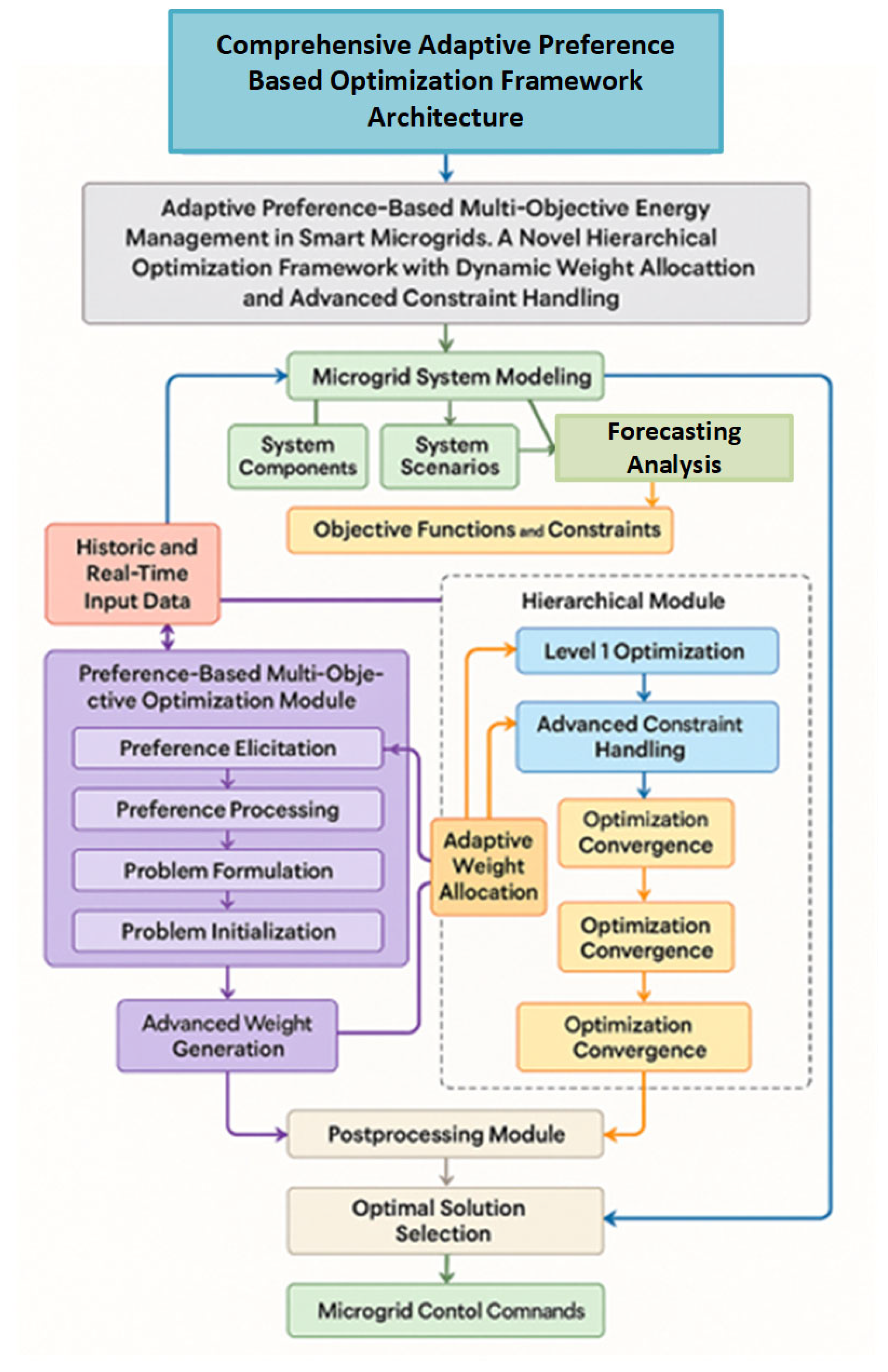
The suggested adaptive preference-based optimization system is a paradigm change in managing energy in a smart grid in that it will take into consideration highly complex multi-objective optimization algorithms coupled with the use of advanced preference learning systems, dynamically weight-allocation strategies, and real-time adaptation features. The framework architecture, as shown in Figure 3, includes several interdependent modules, which collaborate to attain optimal power management, as well as meet varying interests of different stakeholders and working conditions.
The novel architecture of the framework includes a hierarchy structure that acts on the multi-time scale and different levels of operation to give the overall optimization abilities. The strategic planning level works on a long-term basis (monthly to yearly) to maximize investment, capacity planning, and seasonal operations plans. The tactical scheduling layer concentrates on the medium-term (daily to weekly) optimization of energy procurement, maintenance scheduling, and demand response scheduling. Real-time optimization (minutes to hours) of dispatch decisions, voltage regulation and emergency response coordination are provided by the operational control layer.
The multi-stakeholder preference integration system encompasses and measures the preferences of a variety of stakeholders, such as utility operators who would be interested in operational efficiency, minimization of costs and environmental advocates who would be concerned with emission reduction and sustainability, customers who would be interested in reliability and quality of power, and regulatory authorities who would be interested in compliance and grid stability. The framework uses superior machine learning algorithms to autotune and adapt the changing stakeholder preferences depending on past decision-making, feedback systems and the changing needs of operation.

3.2. Advanced Preference Learning Module

The key component of the proposed framework is the preference learning module, which applies advanced algorithms of artificial intelligence to acquire, measure, and transform the complex preferences of the stakeholders into the optimization parameters that can be enacted. The module combines several learning paradigms such as supervised learning to predict preferences, unsupervised learning to cluster preferences and reinforcement learning to evolve preferences adaptively.
In the fuzzy logic-based preference quantification system, the multi-dimensional membership functions are used in order to represent the natural uncertainty and subjectivity of the stakeholder preferences. The membership functions dynamically evolved, with the help of feedback mechanisms and learning algorithms, to maintain the adaptation to the changing preferences and operating conditions. The fuzzy inference system integrates expert knowledge, past decision trends and immediate feedback to create the preference score of the various operational conditions.
Mathematically, the membership functions of the different operational scenarios developed as adaptive trapezoidal functions, which vary according to the learning algorithms:
μ s c e n a r i o , k ( x , t ) = m a x ( 0 , m i n ( x a k ( t ) b k ( t ) a k ( t ) , 1 , d k ( t ) x d k ( t ) c k ( t ) ) )
where a k ( t ) ,   b k ( t ) , c k ( t ) , and d k ( t ) are time-varying parameters that adapt based on preference learning algorithms, and k represents different preference categories.
The neural network preference prediction component involves deep learning designs to predict the preferences of stakeholders in accordance with the context of the situations, historical trends, and operational conditions. The network design utilizes the idea of a network architecture with several hidden layers that include adaptive activation functions whose evolution is based on learning experiences:
p ^ i , j ( t ) = σ ( l = 1 L w l , i , j ( t ) h l ( x ( t ) ) + b i , j ( t ) )
where p ^ i , j ( t ) the predicted preference score for stakeholder i and objective j , w l , i , j ( t ) and b i , j ( t ) are adaptive weights and biases, h l ( x ( t ) ) represents hidden layer activations, and σ is the activation function.
The reinforcement learning element allows the trained framework to be able to make the best preference allocation strategies by using the environment and its stakeholders. The algorithm of learning involves a multi-agent approach according to which every stakeholder is modeled by an intelligent agent who learns the best preference strategies:
Q i , j ( s , a , t + 1 ) = Q i , j ( s , a , t ) + α [ r i , j ( t ) + γ m a x a Q i , j ( s , a , t ) Q i , j ( s , a , t ) ]
where Q i , j ( s , a , t ) represents the Q-value for stakeholder i , objective j , state s , and action a at time t , α is the learning rate, r i , j ( t ) is the immediate reward, and γ is the discount factor.

3.3. Dynamic Weight Allocation Mechanism

The dynamic weight allocation scheme is an important innovation, which converts the compound multi-stakeholder preferences into optimization weights without compromising the mathematical consistency, stability, and convergence. The mechanism utilizes high-level mathematical formulae, which considers the uncertainty of preferences, dynamics over time, the significance of stakeholders and operational constraints.
Underlying weight distribution algorithm takes into account several aspects, such as the present-day operation requirements, previous preferences, the weight of stakeholders, and the quantification of uncertainty. The mathematical model makes the weights normalized, non-negative, and constant under the influence of various working conditions:
w j ( t ) = i = 1 N s ω i ( t ) p i , j ( t ) c i , j ( t ) + λ w j ( t 1 ) k = 1 N o [ i = 1 N s ω i ( t ) p i , k ( t ) c i , k ( t ) + λ w k ( t 1 ) ]
where w j ( t ) is the dynamic weight for objective j at time t , ω i ( t ) represents the importance weight of stakeholder i , p i , j ( t ) is the preference score, c i , j ( t ) is the confidence factor, λ is the temporal smoothing parameter, and N s and N o are the numbers of stakeholders and objectives respectively.
The weights of importance assigned to the stakeholders are dynamically revised based on many factors, such as regulatory authority, operational responsibility, financial investment and the effect on the performance of the system:
ω i ( t ) = e x p ( k = 1 K β k f i , k ( t ) ) m = 1 N s e x p ( k = 1 K β k f m , k ( t ) )
where f i , k ( t ) represents various factors influencing stakeholder importance, and β k are coefficients of weighting calculated by expert knowledge and history.
The confidence factor is a measure of the degree of confidence in the predictions of preferences and realigns the weights:
c i , j ( t ) = e x p ( σ i , j 2 ( t ) 2 τ 2 ) ( 1 | p i , j ( t ) p ¯ i , j ( t ) | p i , j m a x p i , j m i n )
where σ i , j 2 ( t ) is the prediction variance, τ is the uncertainty threshold, p ¯ i , j ( t ) is the historical average preference, and p i , j m a x and p i , j m i n are the maximum and minimum preference bounds.

3.4. Enhanced NSGA-II Algorithm with Preference Integration

Increased Non-dominated Sorting Genetic Algorithm II (NSGA-II) is a genetic algorithm that has advanced preference-based selection parameters, genetic operators, and improved constraint management strategies to produce high optimization results, as well as to retain diversity and convergence properties. The modifications to the algorithms provide good exploration of the preference-directed search space, and it does not compromise the core strengths of the initial NSGA-II scheme.
The preference-based calculation of crowding distance is used to steer the selection procedure towards solutions that are in line with the preferences of the stakeholders and retain the population diversity. The altered crowding distance takes into account the diversity of objective space and congruence of preferences:
C D p r e f ( i , t ) = C D o r i g i n a l ( i ) + j = 1 N o w j ( t ) | f j ( i ) f j i d e a l ( t ) | f j n a d i r ( t ) f j i d e a l ( t ) e x p ( d p r e f ( i , t ) σ p r e f )
where C D o r i g i n a l ( i ) is the original crowding distance, f j i d e a l ( t ) and f j n a d i r ( t ) are the ideal and nadir points for objective j , d p r e f ( i , t ) represents the preference deviation, and σ p r e f is the preference scaling parameter.
The adaptive crossover operator varies parameters of crossover functionality, depending on the quality of the solutions, diversity of the population and matching preference:
P c ( t ) = P c m i n + ( P c m a x P c m i n ) e x p ( d i v e r s i t y ( t ) σ d i v ) ( 1 + α p r e f p r e f e r e n c e _ a l i g n m e n t ( t ) )
where P c ( t ) is the adaptive crossover probability, d i v e r s i t y ( t ) measures population diversity, p r e f e r e n c e _ a l i g n m e n t ( t ) quantifies solution alignment with preferences, and α p r e f is the preference influence factor.
The operator of adaptive mutation uses knowledge and preference information that is problem-specific with respect to bias mutation operation within promising regions of the search space:
P m ( i , t ) = P m b a s e ( 1 + β f i t n e s s r a n k ( i ) N p o p ) ( 1 + β p r e f p r e f e r e n c e _ s c o r e ( i , t ) p r e f e r e n c e _ s c o r e m a x )
where P m ( i , t ) is the adaptive mutation probability for individual i , r a n k ( i ) is the dominance rank, N p o p is the population size, and β f i t n e s s and β p r e f are adaptation parameters.

3.5. Advanced Constraint Handling and Feasibility Maintenance

The constraint-handling mechanism uses advanced techniques to guarantee a solution. Feasibility is preserved through the optimal performance, avoiding constraint violation, which may lead to system instability or even safety. The framework combines several constraint-handling methods, such as penalty functions, repair methods and feasibility-preserving genetic operators.
The adaptive penalty function adaptively sets weights of penalties according to the severity of constraint violation, frequency, and effects to the system performance:
F p e n a l i z e d ( x , t ) = j = 1 N o w j ( t ) f j ( x ) + k = 1 N c ξ k ( t ) m a x ( 0 , g k ( x ) ) ϕ k
where F p e n a l i z e d ( x , t ) is the penalized fitness function, ξ k ( t ) is the adaptive penalty weight for constraint k , g k ( x ) represents constraint violations, and ϕ k is the penalty exponent.
The constraint repair mechanism is an automatic corrective mechanism of infeasible solutions, and tries to keep the original solution structure as unchanged as possible:
x r e p a i r e d = a r g m i n x F x x o r i g i n a l 2 2
where x r e p a i r e d is the repaired solution, F represents the feasible region, and x o r i g i n a l is the original infeasible solution.

3.6. Comprehensive Algorithm Implementation

The entire Algorithm 1 execution combines all the frameworks together in a unified optimization process that is efficient to search the multi-objective space and is able to adjust to shifting preferences and operational situations.
Algorithm 1 Enhanced Adaptive Preference-Based Multi-Objective Energy Management
1: Initialize population P0 with size Npop using smart initialization
2: Initialize preference learning models and historical data: (a) A dataset comprising prefernce record for N = 47 stakeholders (15 utility operators, 18 consumers, 9 environmental regulators, 5 market operators) using a 5-point Likert scale across 6 objective dimensions; dataset split 70/15/15 train/val/test. (b) Fuzzy Preference Quantification: 5 triangular membership functions per objective; rule base of 125 IF-THEN rules derived via expert elicitation; defuzzification by centroid method. (c) Neural Network Architecture: 3-layer MLP; input layer: 18 features (6 objectives x 3 temporal lags); hidden layers: 64 and 32 neurons with ReLU activation; output layer: 6 weights with softmax normalisation; trained with Adam optimiser (lr = 0.001, beta1 = 0.9, beta2 = 0.999), batch size = 32, max 500 epochs, early stopping patience = 20. (d) RL Adaptation: Q-learning with epsilon-greedy exploration (epsilon = 0.1 decaying to 0.01); state space: 12-dimensional (normalised objective values + grid conditions); action space: 18 discrete weight perturbation actions; reward = -weighted_sum_objective_violations; discount factor gamma = 0.95; learning rate alpha = 0.01; replay buffer size = 10,000.]
3: Set generation counter gen = 0 and convergence criteria
4: while gen < max_generations AND not converged do
5:      Update operational conditions and grid state information
6:      Execute preference learning module to update stakeholder preferences
7:      Calculate dynamic weights using Equation (27)
8:      Evaluate all objectives for population members using Equations (6)–(10)
9:      Apply constraint handling and solution repair mechanisms
10:      Perform preference-integrated non-dominated sorting
11:      Calculate preference-based crowding distances using Equation (30)
12:      Execute tournament selection with preference bias
13:      Apply adaptive crossover using Equation (31)
14:      Apply adaptive mutation using Equation (32)
15:      Create offspring population Qgen with enhanced genetic operators
16:      Combine parent and offspring populations: Rgen = Pgen ∪ Qgen
17:      Apply elitist selection to form Pgen + 1 with size Npop
18:      Update preference learning models with feedback
19:      Check convergence criteria and update algorithm parameters
20:      gen = gen + 1
21: end while
22: Extract final Pareto optimal solutions with preference rankings
23: Generate solution recommendations and implementation strategies
24: return Optimized control strategies and operational parameters

4. Results and Discussion

4.1. Comprehensive Simulation Setup and Experimental Design

The suggested adaptive preference-based optimization framework was strictly tested by extensive simulations held on a large smart microgrid testbed on the model of a modified IEEE 33-bus distribution system. The improved test system also uses various energy resources, improved storage technologies, intelligent load management systems, and advanced communication infrastructure to offer a realistic depiction of contemporary smart microgrid environments. Simulation environment incorporates real-world operating information, weather conditions, price trends in electricity markets, and regulatory limits in order to make the outcomes realistic and applicable.
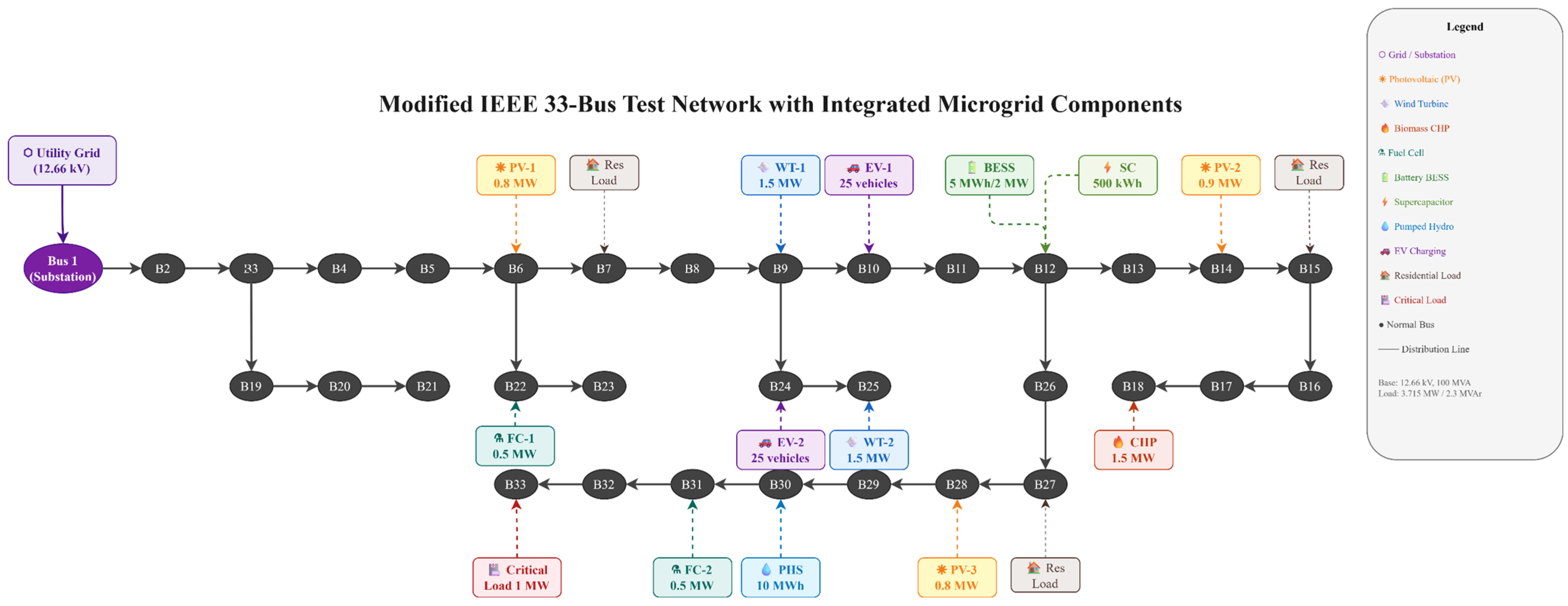
Figure 4 below illustrates the modified IEEE 33-bus test network with all assumed components integrated for this study. The standard IEEE 33-bus radial distribution system (total real power load: 3.715 MW, reactive power load: 2.300 MVAr at 12.66 kV base voltage) was extended by connecting the following components at specified buses: three photovoltaic generation units (2.5 MW total) connected at buses 6, 14, and 28; two wind turbine generators (3.0 MW total) connected at buses 9 and 25; one biomass CHP unit (1.5 MW) at bus 18; two fuel cell units (1.0 MW total) at buses 22 and 31; a 5 MWh lithium-ion battery energy storage system (2 MW power rating) at bus 12; a 500 kWh supercapacitor bank at bus 12; a 10 MWh pumped hydro storage unit at bus 30; EV charging stations (up to 50 vehicles simultaneously) at buses 10 and 24; residential smart loads with demand response capability at buses 7, 15, and 27; commercial and industrial controllable loads at buses 19, 23, and 29; and critical infrastructure loads (non-interruptible, 1.0 MW) at bus 33. The grid connection point (substation) is at bus 1, providing bidirectional power exchange with the upstream utility network.
The microgrid system will have a range of renewable energy sources that are strategically located within the network, such as three solar photovoltaic systems with a total of 2.5 MW with different orientations and shading properties, two variable speed wind turbines with a total capacity of 3.0 MW with advanced pitch control and power electronics, one biomass combined heat and power system with a capacity of 1.5 MW with cogeneration opportunities, and two fuel cell systems with the capacity of 1.0 MW to generate clean energy with high efficiency. The energy storage system consists of a 5 MWh lithium-ion battery energy storage system with 2 MW of power and 500 kWh of supercapacitor banks of fast response loads, and pumped hydro storage with 10 MWh capacity of long-term energy management.
The load portfolio will include various consumption patterns, such as residential loads with smart appliances and demand response features equivalent to 3.5 MW peak demand, as well as commercial and industrial loads that can be operated with multiple schedules with 4.0 MW peak demand, electric vehicle-charging stations with smart charging algorithm for up to 50 vehicles. This includes, at once, critical infrastructure loads that need to be powered throughout with 1.0 MW total capacity, and controllable loads that are involved in a demand response initiative with 2.0 MW total capacity. The load modeling is comprehensive in nature, and it includes seasonal factors, daily trends, and dependency on weather and user behavior in order to achieve realistic demand profiles. The detailed system configuration and component specifications considered in this study are summarized in Table 2.

4.2. Advanced Performance Metrics and Evaluation Criteria

The overall performance measurement involves a large array of quantitative measurements and qualitative measures, which represent the multi-dimensional facet of smart microgrid performance in terms of economic, environmental, technical, and social parameters. These measures give specific information on the effectiveness, efficiency and viability of the framework in different operational circumstances and preferences of different stakeholders.
The non-financial performance indicators include cost reduction through total operational, optimization of energy procurement cost and maintenance cost, as well as optimization of grid interaction cost and the demand response revenue. The environmental performance indicators are total carbon footprint reduction, the proportion of renewable energy used, the ratio of emission per kWh delivered, and the lifecycle environmental impact assessment, which addresses the environmental requirements. Technical performance measures assess system reliability index, voltage stability margins, and indicators of power quality, frequency regulation performance, and system efficiency in general. The performance metrics and evaluation criteria adopted for the assessment are listed in Table 3.

4.3. Comprehensive Operational Scenarios and Test Cases

The adaptive preference-based optimization framework is tested on five carefully constructed operating conditions that thoroughly test the system in terms of flexibility and adaptability, as well as performance under different environmental conditions, and varying load patterns and degree of renewable energy availability. Such cases have been strategically designed to prove the framework effectiveness in the entire range of the smart microgrid functioning, starting with the optimal conditions, with a large amount of renewable energy sources, up to the difficult cases of high demand and low generation capacity.
Figure 5 shows the overall system model architecture that puts all five operating scenarios in one single architecture. The diagram shows the interdependency of the renewable sources of energy (photovoltaic panels and wind turbines), energy storage (battery banks that can convert power in both directions), electric vehicle charging infrastructure that has the capability of vehicle-to-grid, various categories of loads (residential, commercial, and industrial consumers), and the utility grid interface (smart metering and communication systems). The architecture shows how the framework can dynamically re-configure energy flows, optimize resource allocation, and stabilize the system in different operational conditions, as well as meet a variety of conflicting goals and stakeholder preferences through the combination of preference learning mechanisms and dynamic weight allocation mechanisms.

4.3.1. Scenario Design Framework and Methodology

To achieve practical relevance and a comprehensive coverage of evaluation, the scenario design framework uses real-world operational data, meteorological patterns, user behavior models and grid interaction protocols. All the scenarios characterized by certain sets of parameters describing the environmental conditions, loads, the availability of renewable energy, the degree of electric vehicle penetration, and grid interaction needs are as presented in Table 4.
Table 4 has detailed technical requirements of both operational scenarios, which gives the parametric limits and environmental parameters that were used to set up the evaluation framework. The limits of the solar irradiance includes low-light conditions of 150 W/m2 during the cloudy weather, which is problematic to the ideal high-irradiance conditions of 1200 W/m2 during sunny days that encompasses a complete range of photovoltaic generation potential. The range of ambient temperature variation includes extreme temperatures from −5 °C in winter to 35 °C in summer, which affect the renewable energy generation rates as well as the heating/cooling loads requirements. The parameters of wind speed vary between the calm conditions of 2 m/s and strong winds of 15 m/s, which allow in-depth testing of the wind turbines under the varied meteorological conditions. The increase and decrease in the number of electric vehicles between 20 and 120 vehicles indicate the flexibility of the framework and its capacity to deal with various degrees of transportation electrification. Base and peak load specifications are indicative of the real demand patterns, with the maximum energy demand being during winter periods since the heating load is at its peak of 22.8 MW. The grid price difference between 8 and 25 ¢/kWh is a fluctuating market situation and allows us to analyze the possibility of economic optimization at different price regimes.

4.3.2. Detailed Scenario Specifications

Scenario 1: Cloudy Day Operation
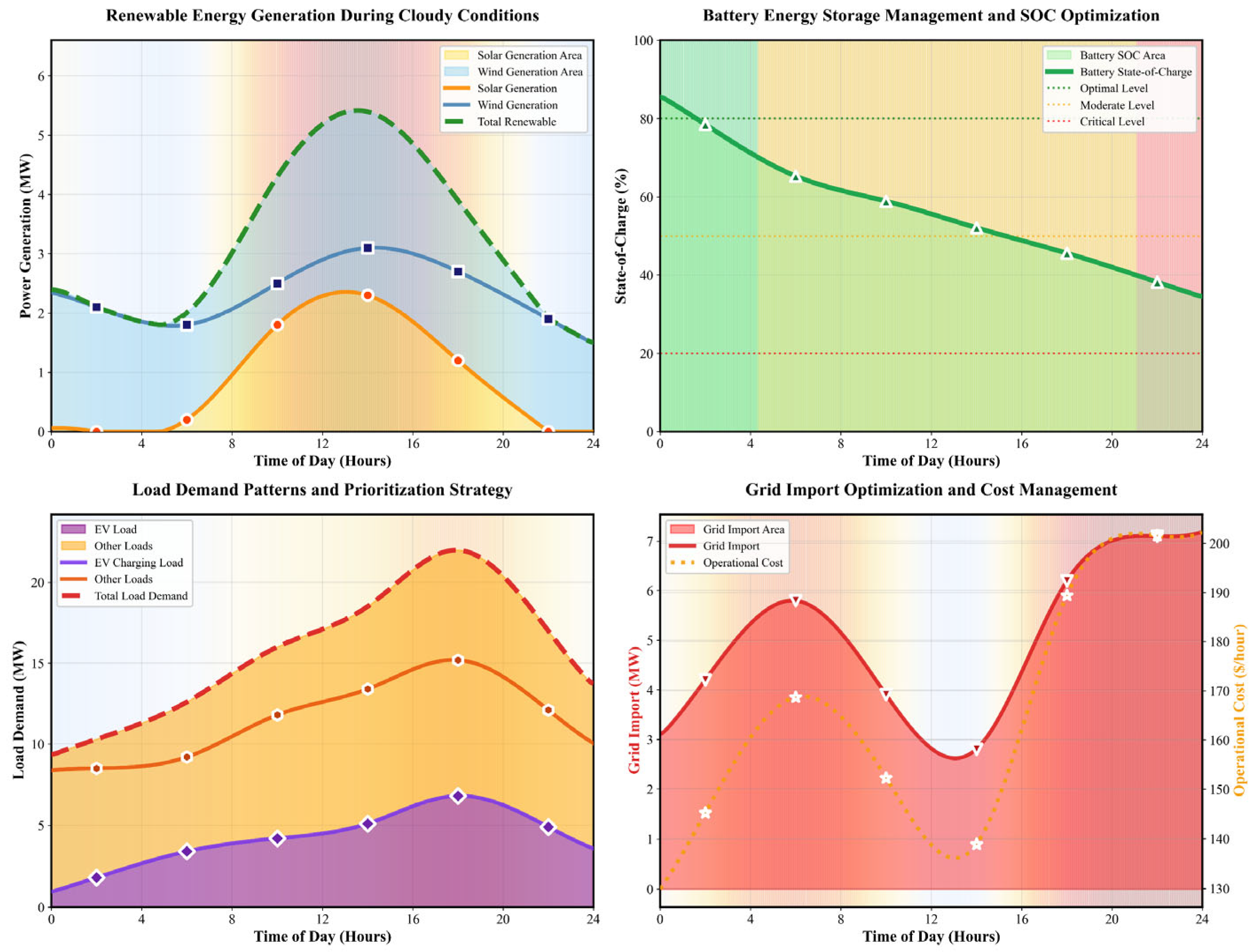
The scenarios of cloudy days represent the problems of adverse weather conditions where solar photovoltaic generation is minimal; the wind varies and depends on energy storage facilities and grid interaction. These conditions challenge the optimization framework to cope with the scarcity of energy, priority of the critical loads, optimization of battery use and stability of the system, and even cost reduction of operation.
Figure 6 shows the energy flow schemes and resource management measures on the operations of cloudy days, where the minimal solar photovoltaic generation of 150–400 W/m2 levels of irradiance is recorded. The diagram exemplifies the adaptive reaction of the framework to the decreased renewable energy provision by intelligent battery discharge planning, strategic timing of grid imports to get in line with the low cost of electricity, and dynamic prioritization of load based on levels of criticality. The energy storage systems are very critical in narrowing down the difference between the restricted renewable generation and consistent load need, and the battery management system streamlines the discharge patterns to ensure that the system remains stable at minimal dependence on the grid. The figure illustrates the optimization mechanism of preference-based optimization, in which the cost minimization goals and reliability goals are reconciled, and how the prioritization of the stakeholder preferences dynamically affect the decision-making of energy routing, load scheduling and grid interaction strategies in the case where resources are limited.
Scenario 2: Sunny Day Operation
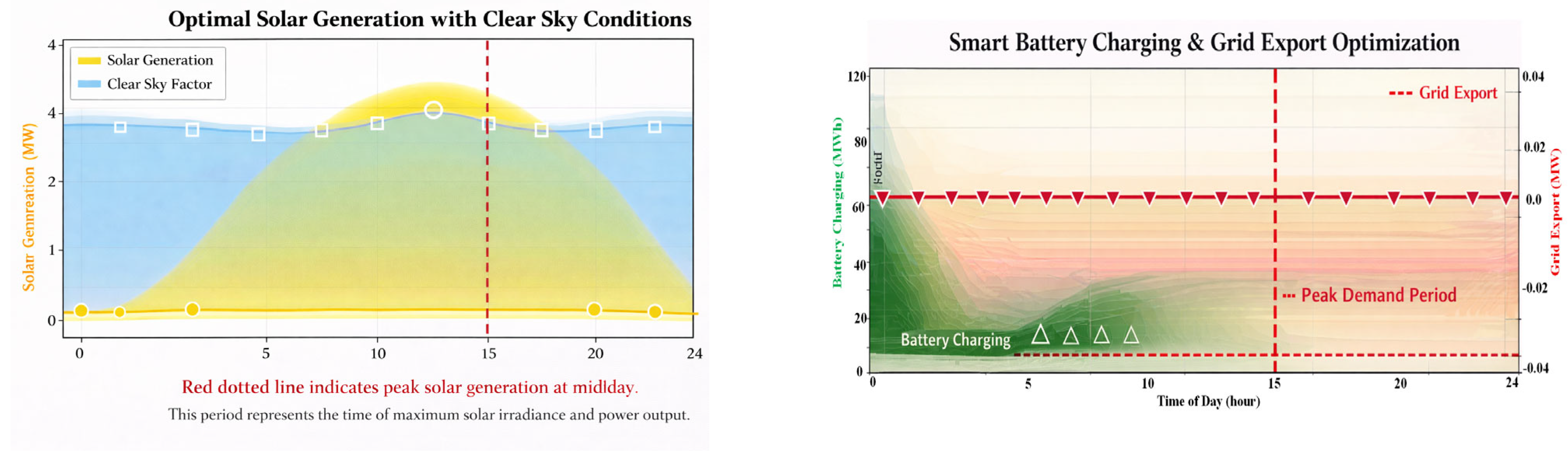
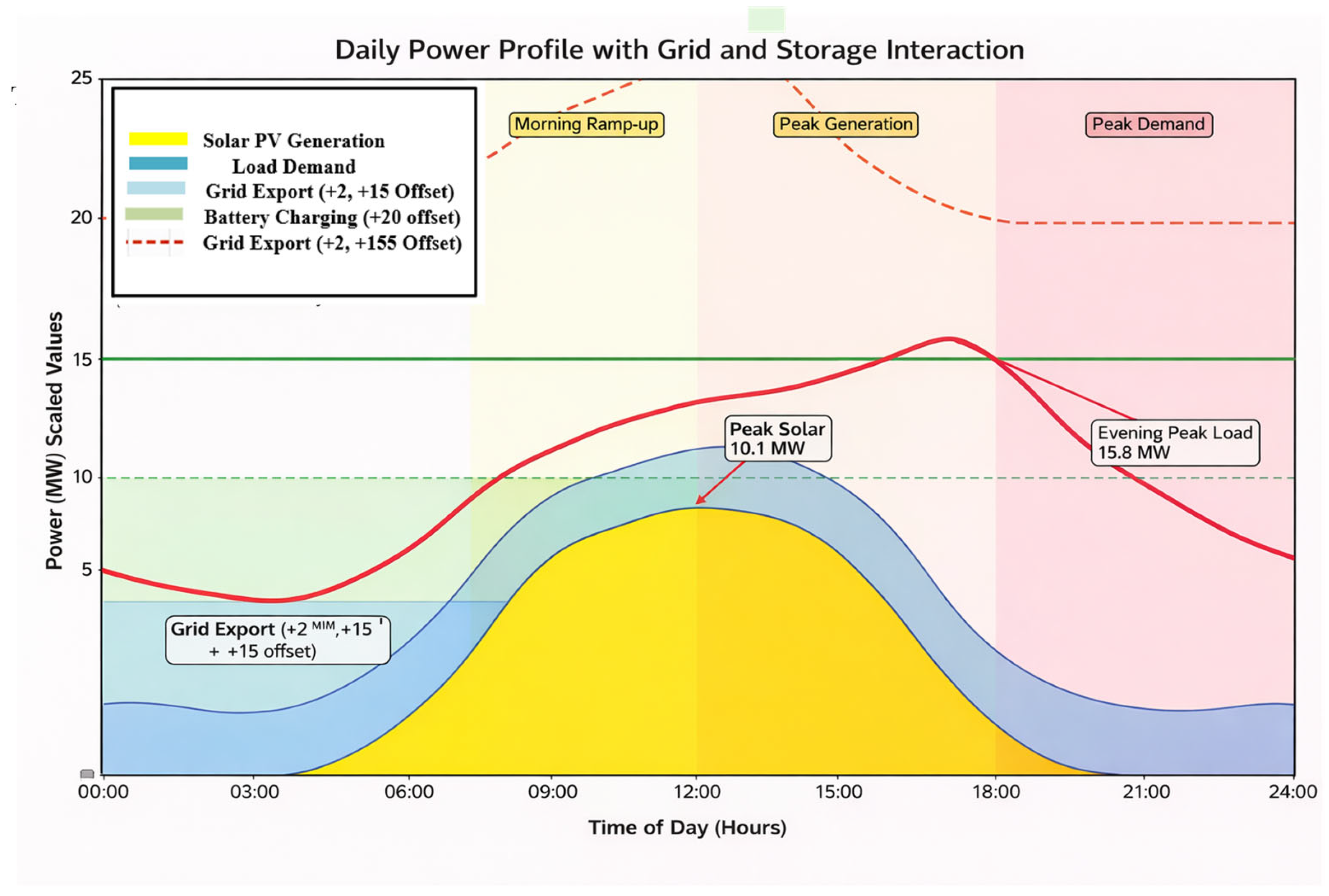
Sunny day conditions are the best conditions of renewable energy when there is maximum solar irradiance, good weather conditions, and optimum photovoltaic energy. These situations test the potential of the framework to achieve the highest possible level of renewable energy use, to regulate the energy excess by means of smart storage charging and grid injection, and to optimize the economy of the system at the time of massive clean energy supply.
Figure 7 shows the overall energy management approach when the sun is at its best and the irradiance is at 800–1200 W/m2, which shows how the framework is very sophisticated in managing excess renewable energy. It depicted in the diagram how the photovoltaic production cleverly synchronized with battery charging control and a planning of the grid export to achieve the best economic benefits and meet all the load demands. The patterns of energy flows indicate the framework capability of prioritizing the charging process of the batteries when the sun is at its peak generation so that it can store its energy to use later during the peak demand time of the evening hours. The grid export feature exhibits the ability to generate revenue by selling the surplus renewable energy to the utility grid at times of high market prices. The figure also reflects the focus of the dynamic preference weighting mechanism on environmental goals with high solar rates of renewable sources, as the scores of stakeholder satisfaction towards environmental organizations increase, and the economic efficiency preserved through the optimization of the energy trading policies.
Scenario 3: Winter Day Operation
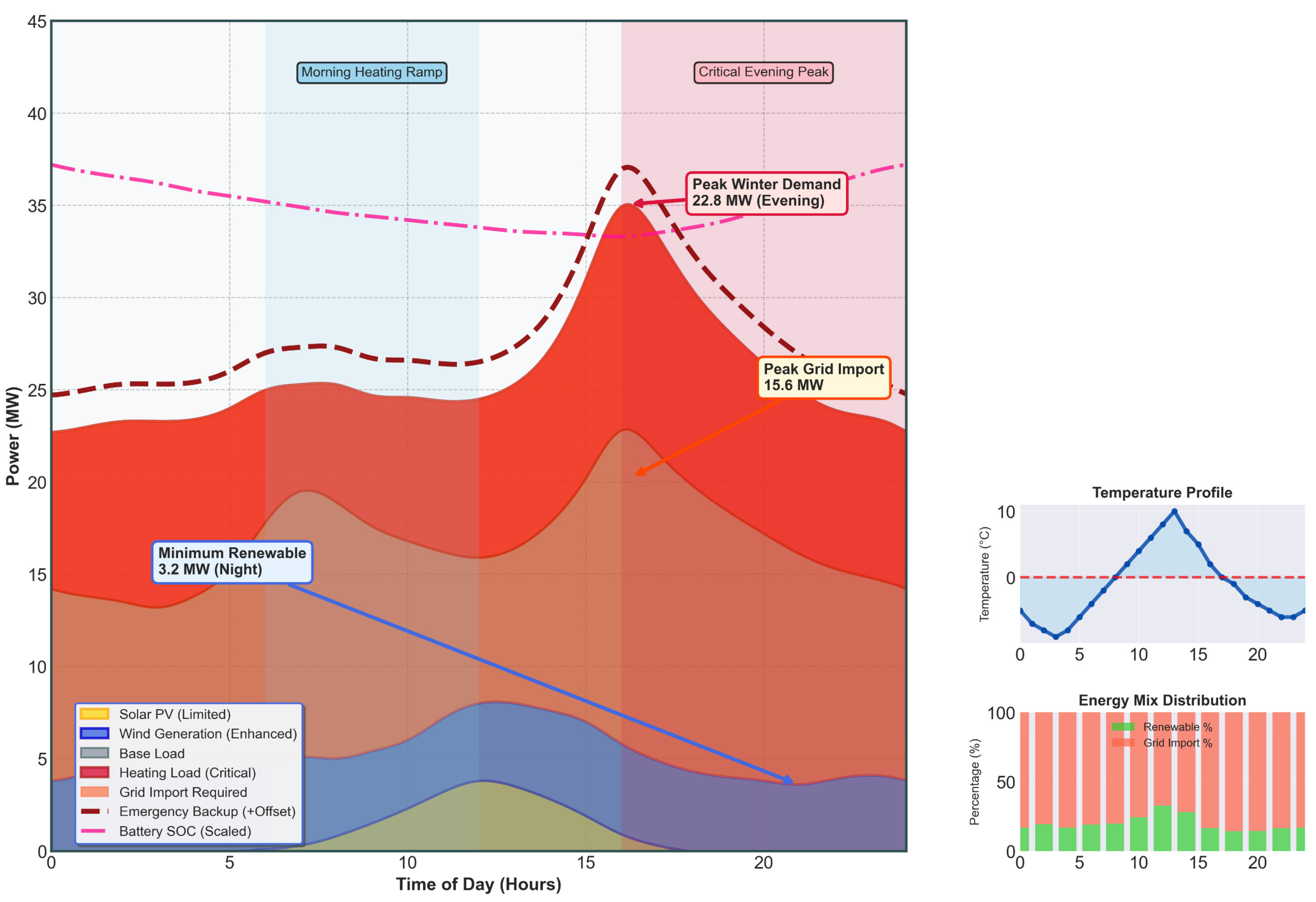
Winter day scenarios will be included as they have seasonal aspects, such as low availability of solar since there are less hours of daylight and low angles of the sun, high heating loads, extreme weather conditions and high general energy demand. These situations confirm the seasonal scalability of the framework and the ability to manage the load in case of resource-limited conditions.
Figure 7 shows the sophisticated energy management issues operating in winter, where solar generation is limited (200–600 W/m2), heating loads are higher, at values of up to 22.8 MW peak demand, and severe weather conditions are between −5 °C and 10 °C. The diagram shows how the structure adapts to seasonal changes with the help of a complex load prioritization algorithm that matches the heating need with other more important loads and, at the same time, optimizes energy resource distributions. The fact that the augmented production of wind (8–15 m/s) partially offsets the lower production of sunshine is an indication that the framework can advantageously exploit complementary renewable sources. Control of the energy storage system is very critical in winter conditions, and the charging and discharging cycles are optimized to allow the system to operate over long durations of maximum heating need. The figure indicates that the interaction strategies of the grid improved during winter operation, intelligent import scheduling is under dynamic pricing in order to minimize the cost of operation, and, at the same time, power supply is continuous to meet the heating needs by the essential loads and critical infrastructural functions.
Scenario 4: High Electric Vehicle Load
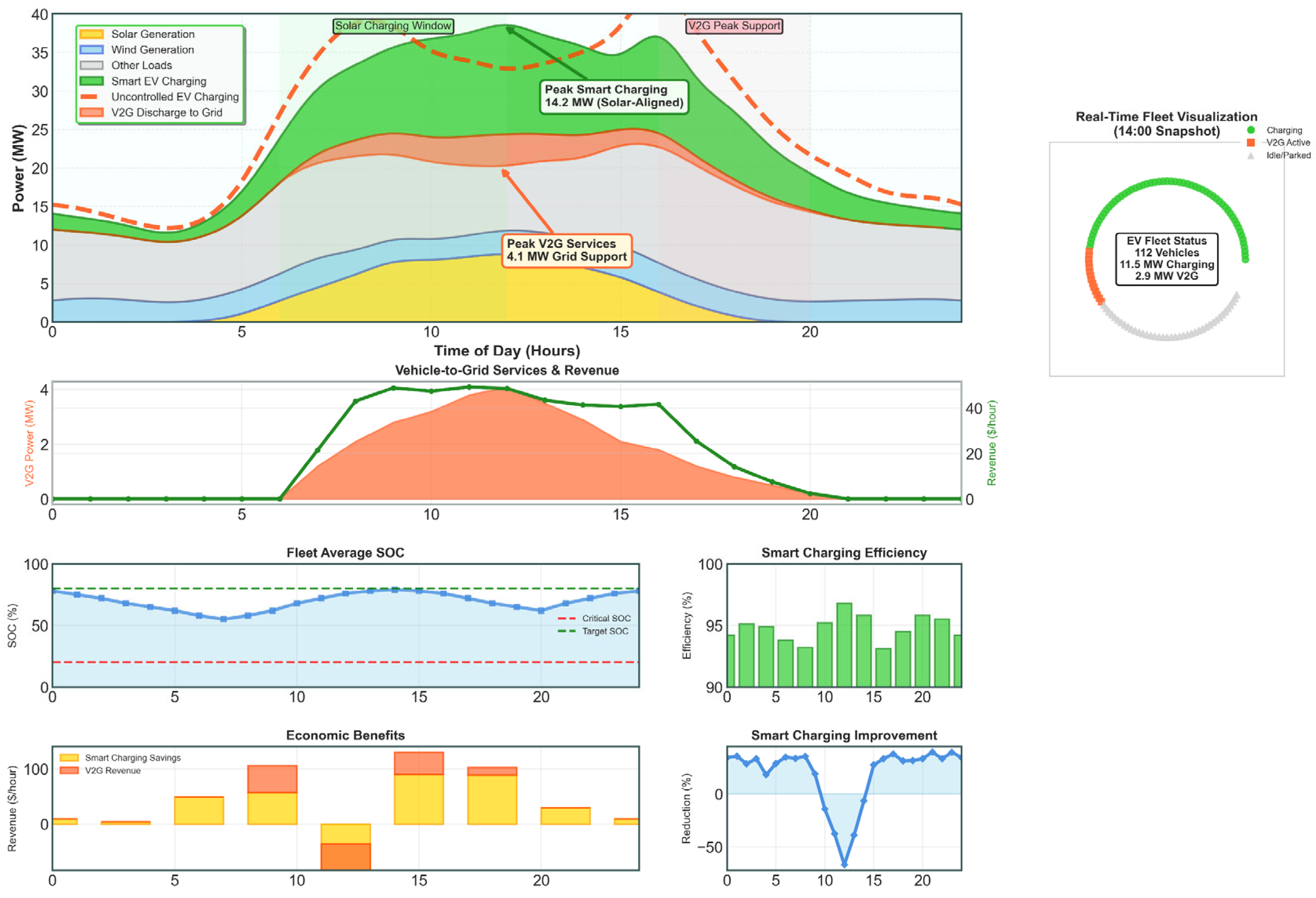
High EV load scenarios represent the effect of a large-scale electric vehicle deployment with much more charging demand, varied charging patterns, and vehicle-to-grid integration opportunities. These scenarios test the framework in terms of scalability, load balancing, and the capability of coordinating various EV charging stations and being grid-stable.
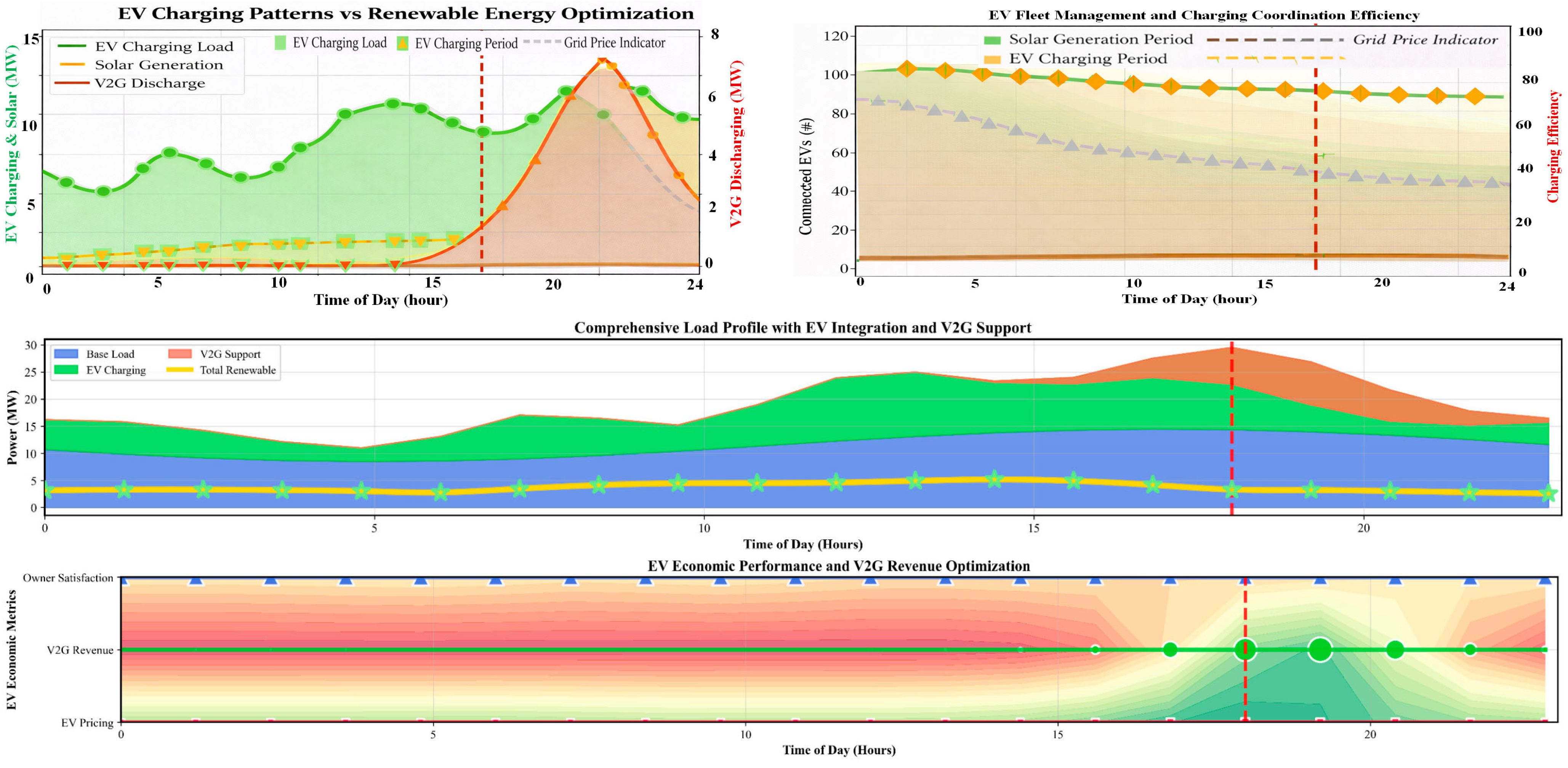
In Figure 8, the proposed framework can be seen to have advanced electric vehicle integration and management capabilities because of the 80–120 electric vehicles in high EV penetration cases. The scheme demonstrates that intelligent charging timing, load balancing in a variety of charging stations and management of power flow in both directions are complicated processes and demand vehicle-to-grid (V2G) technologies. The optimization of charging patterns along with the capabilities of the framework improve upon the renewable energy availability, grid prices indications, and user preferences well established in the dynamic energy routing between solar generation and battery storage, EV charging infrastructure, and grid interaction points. The smart charging algorithms are designed with the consideration to charge EVs using renewable energy during optimal periods of solar generation, and grid effects through load shifting, and coordination of demand response. V2G capability will allow electric vehicles to distribute energy storage assets and offer grid services to the grid, as well as provide system stability in peak demand periods. The figure reflects the convergence of the preference learning mechanism to different priorities of the stakeholders where the convenience preferences of EV owners harmonizes with the grid stability needs as well as the environmental goals.
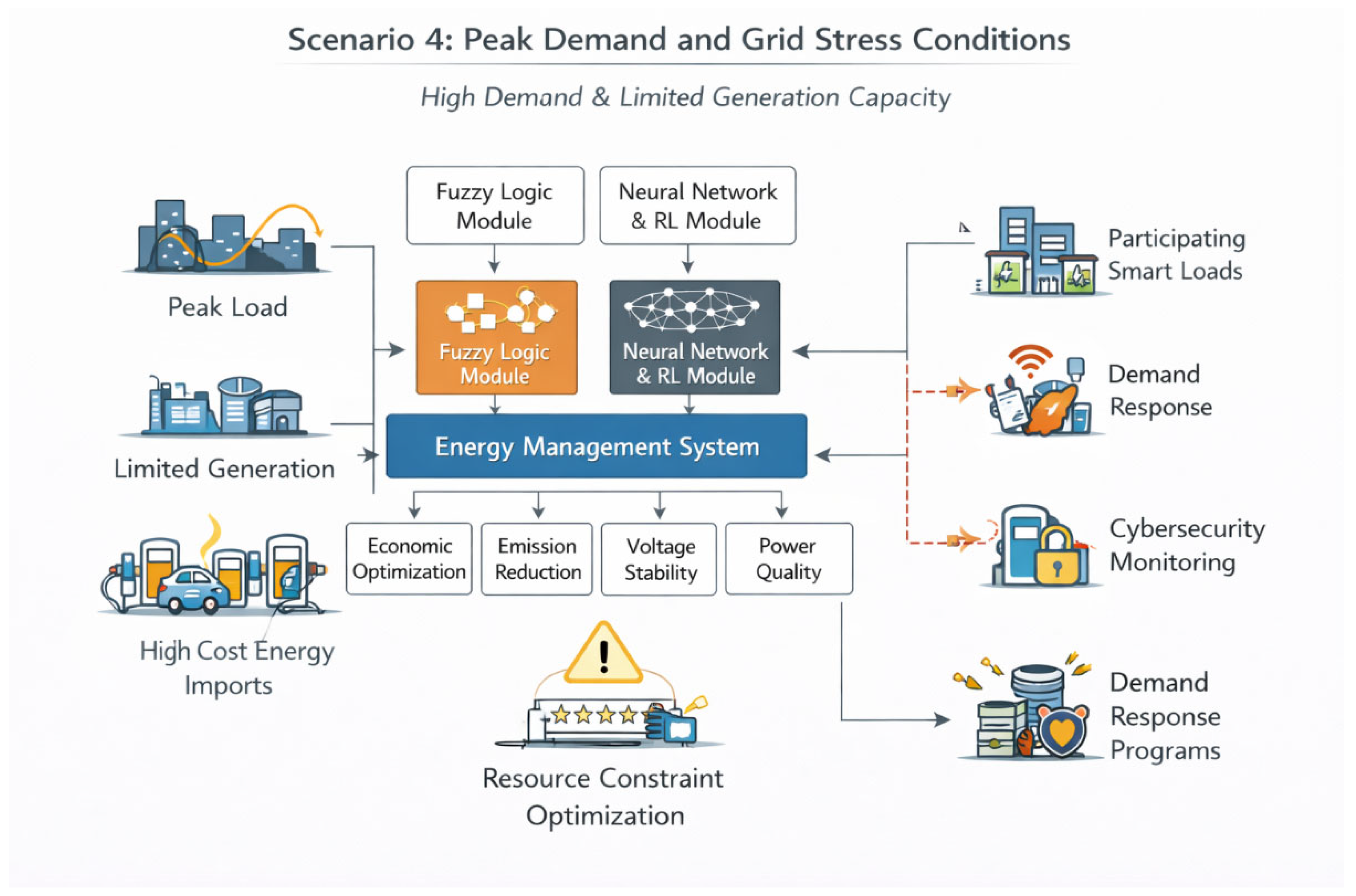
Scenario 5: Peak Other Loads Operation
Peak other loads conditions involve peak demand between residential, commercial and industrial consumers such as HVAC purposes, industrial processes, data centers and other controllable loads. These scenarios test the complete load management functionality of the framework and demand response coordination during full system load.
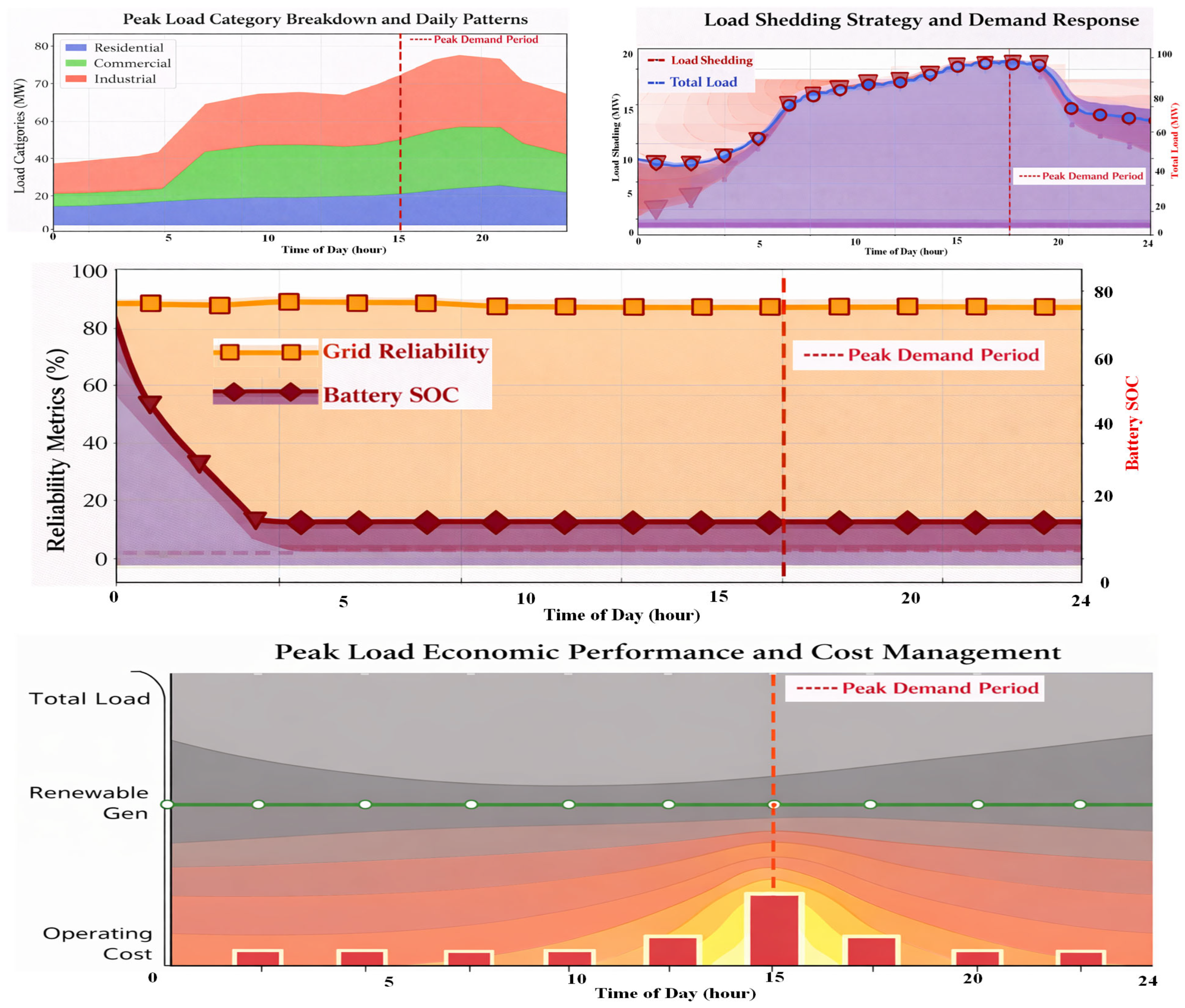
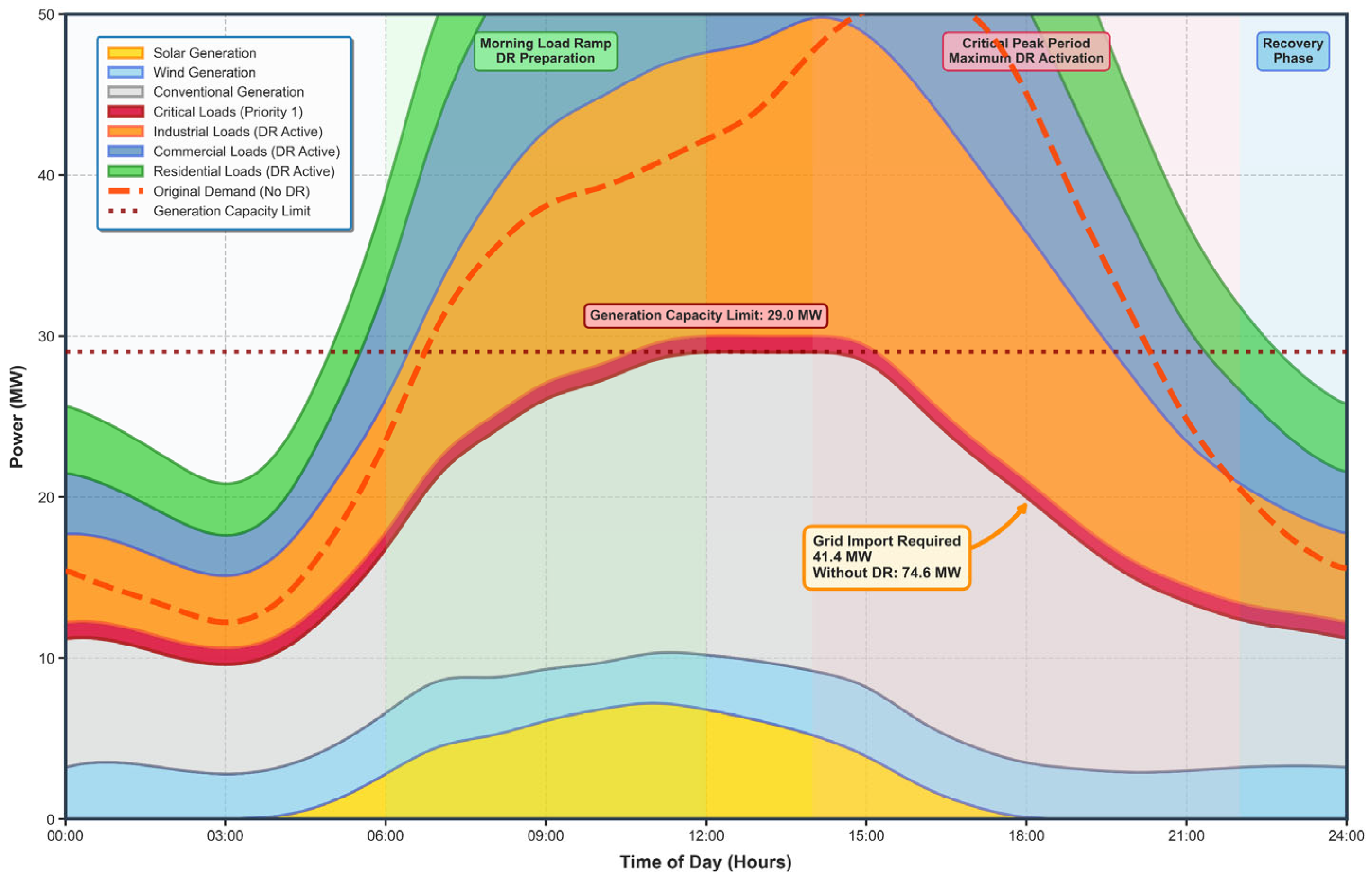
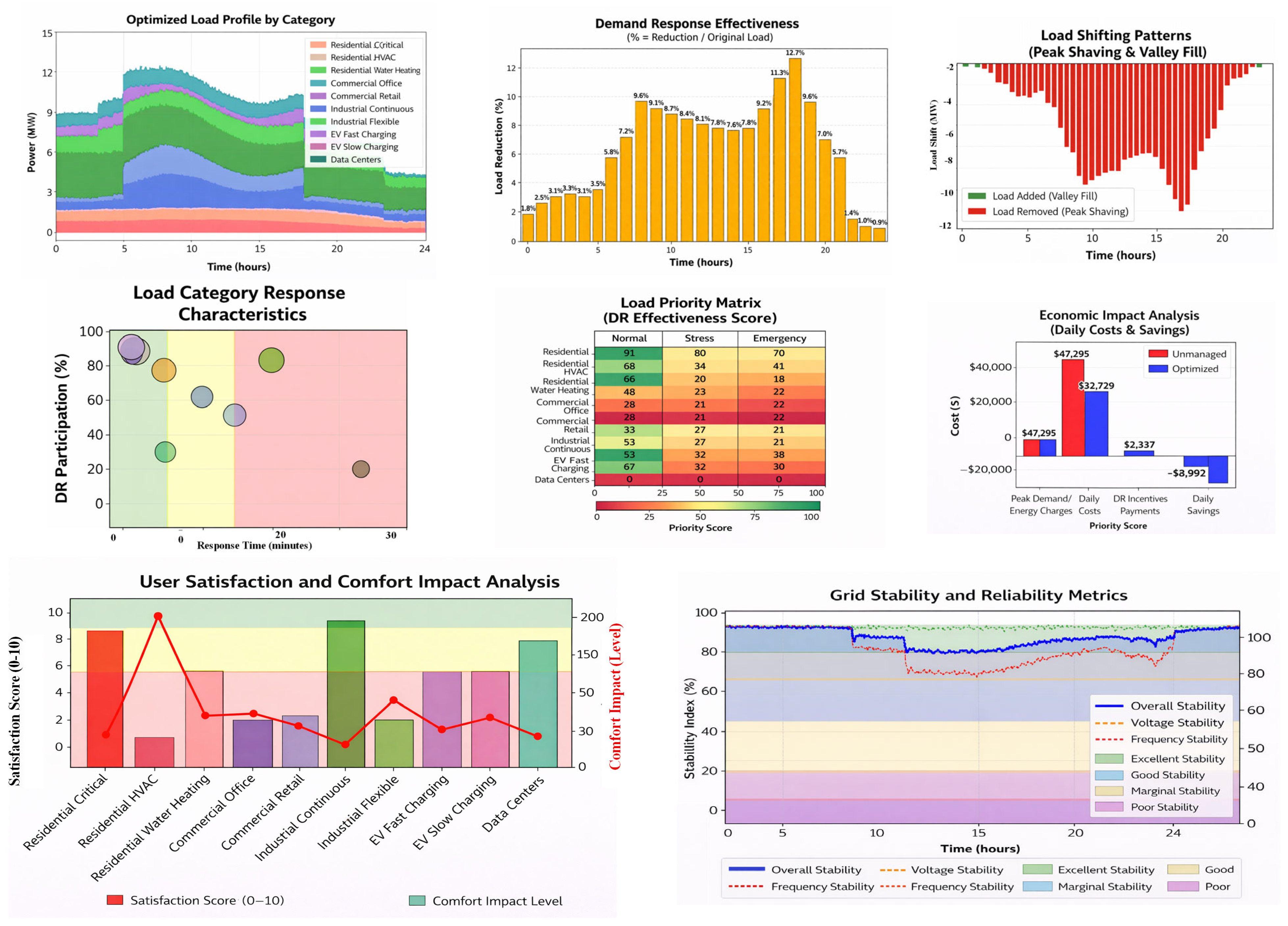
Figure 9 demonstrates the entire load management plans used in peak demand conditions where total loads were up to 28.4 MW, which is the maximum operational stress testing of the framework. The diagram indicates the complex integration of the various types of loads such as residential consumers (12.6 MW peak), commercial facilities (18.4 MW peak), and industrial processes (22.8 MW peak), implying that the framework is scalable and can spread its load management across multiple sectors. Intelligent load scheduling, load shedding protocols via priorities and dynamic load shifting strategies are a clear demonstration of the demand response coordination mechanism in charge of ensuring the stability of the system as well as reduction in service interruptions. The energy storage systems provide important grid services in the peak demand periods, and the discharge patterns optimized to minimize the peak demand charges and to assist the grid in the maintenance of voltage stability. The preference-based optimization process of the framework balances the competing stakeholder interests and demonstrates how the residential customer comfort preference balanced with the industrial process continuity requirements and system reliability goals. The grid interaction strategies indicate smart importation timing plans and demand control approaches, which prevent the reduction in operational expenses and maintain the service quality in all consumer groups.
The overall analysis of the suggested adaptive preference-based multi-objective optimization system includes the detailed consideration of all five scenarios in operation and offers the information on the system work, stakeholder satisfaction and economic efficiency, environment influence and technical reliability in various scenarios. The evaluation of any scenario involves the use of several performance indicators, a comparison with benchmark strategies, sensitivity analyses, and consideration of the implementation.
Extended Scenario: Combined Cloudy Day and High-Load Performance Analysis
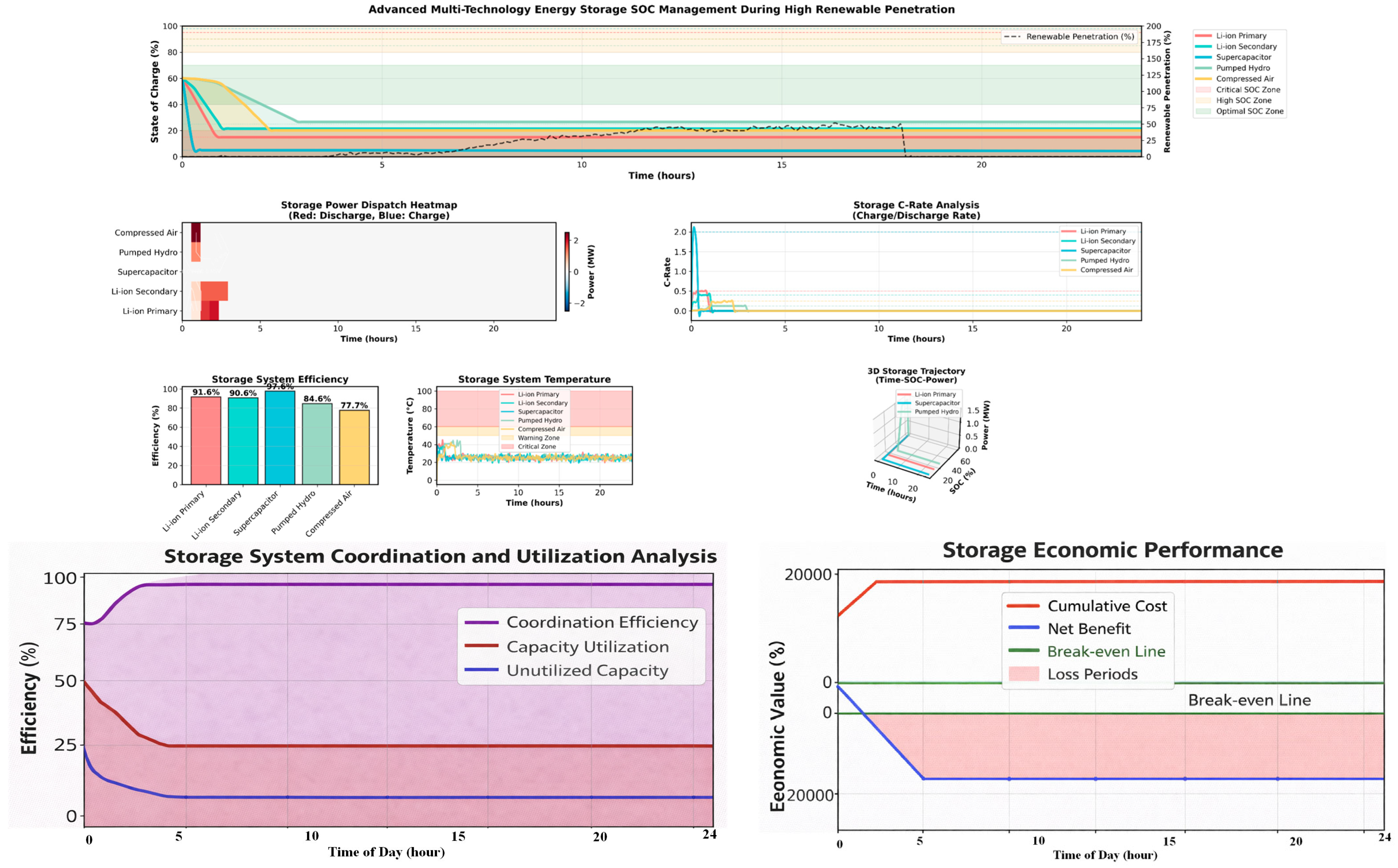
The cloudy day scenario proves to be very challenging since the production of solar energy is minimal, and therefore, there must be advanced energy management measures to ensure that the availability of the systems is reliable with low costs and environmental impact. The optimization of battery operation and cloudy-day energy flow patterns is illustrated in Figure 10. The framework has an outstanding adaptability in its way of dynamically adjusting optimization priorities to be able to consider the decreasing renewable energy availability. The performance metrics and operational analysis corresponding to the cloudy day scenario are provided in Table 5 and cloudy day scenario: stakeholder preference satisfaction and system reliability metrics are given in Table 6.
Scenario 7: Sunny Day Performance Analysis
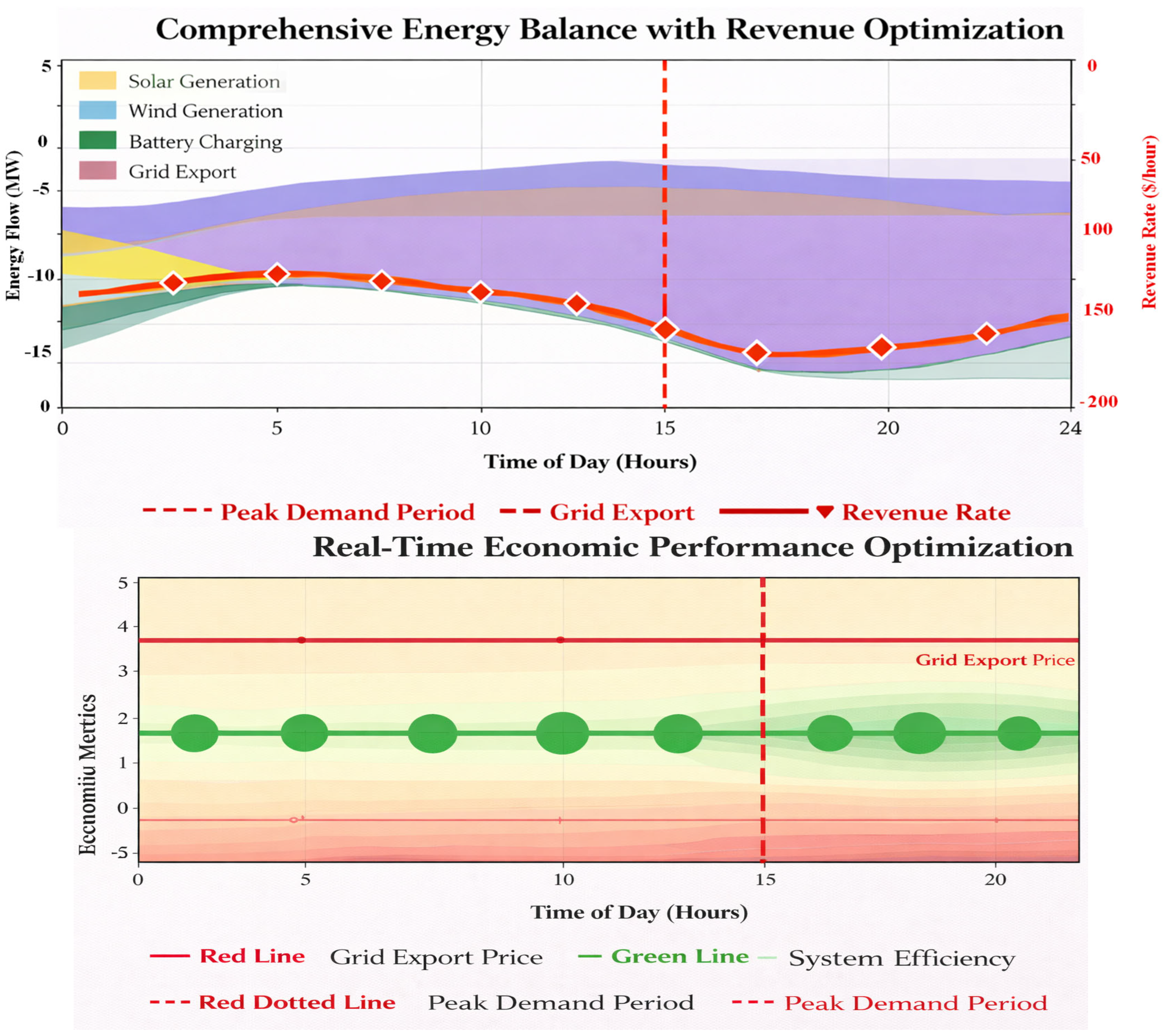
The sunny day scenario also shows the outstanding ability of the framework to achieve the highest possible usage of renewable energy, along with the optimization of energy storage and interaction strategies with the grid. When the sun is at its best, the system would have better environmental and economic performance The optimization of renewable energy utilization and the resulting grid export revenue under sunny-day conditions are illustrated in Figure 11, while the corresponding economic performance analysis is summarized in Table 7.
Scenario 8: Winter Day Performance Analysis
The conditions of winter days challenge the flexibility of the framework regarding seasonal changes, higher heating loads, and problematic weather conditions. The system is very strong in dealing with increased energy demands, and, at the same time, it is efficient. Figure 12 illustrates the optimization of energy distribution and seasonal load management on a winter day, while Table 8 presents the corresponding case-study results, with particular emphasis on winter load management and heating-demand optimization.
Scenario 9: High Electric Vehicle Load Performance Analysis
The High-EV-load scenario assesses the scalability of the framework and its capability to deal with massive electric vehicle integration without disrupting the grid stability and smart charging pattern optimization using intelligent coordination algorithms. Figure 13 illustrates the coordination of V2G operation and smart charging under high-EV-load conditions, while Table 9 presents the corresponding scenario-based analysis of mass electric vehicle integration and charging optimization.
Scenario 10: Peak Other Loads Performance Analysis
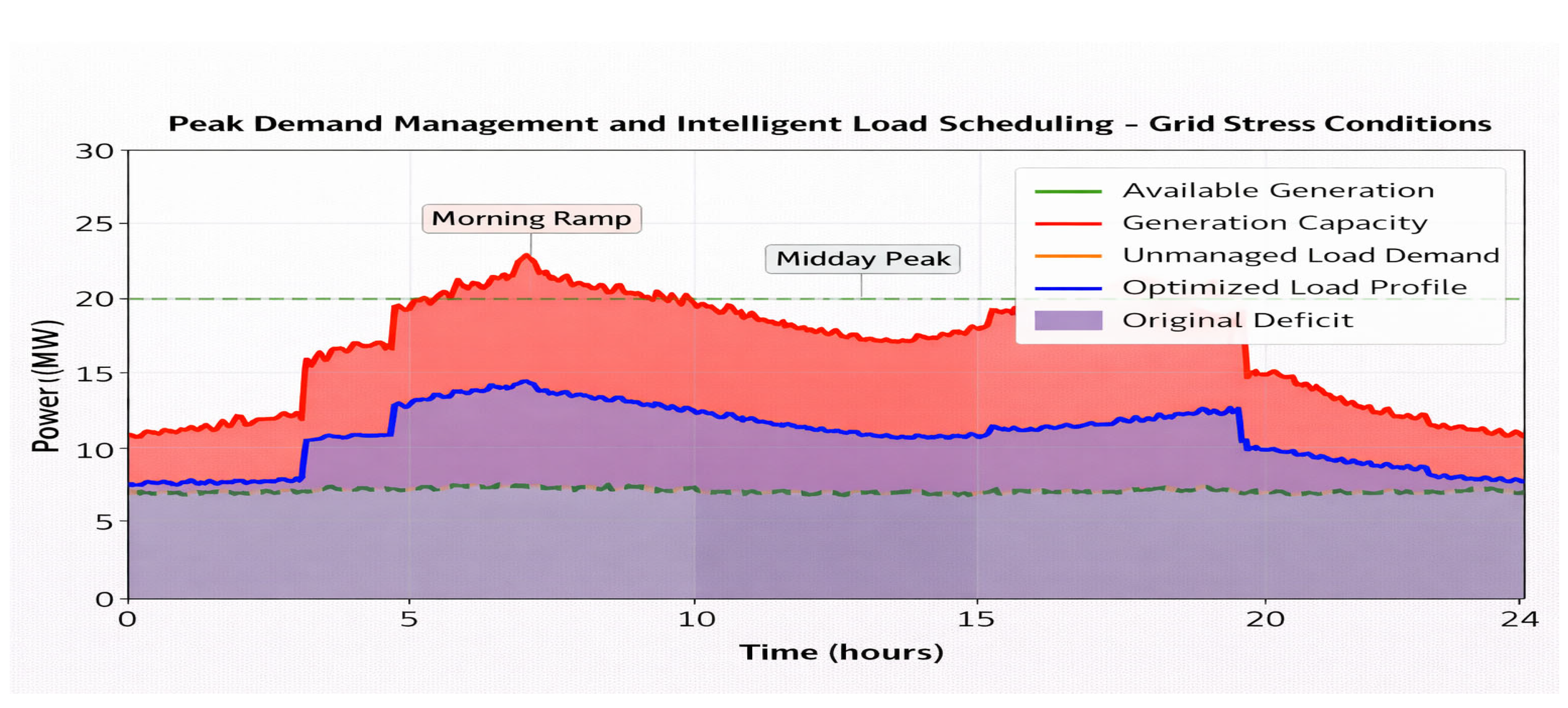
The peak other loads case is a test of the complete load management functionality of the framework when the system is at its peak load, and demand response coordination, load prioritization, and emergency management procedures are being tested. The coordinated management of peak other loads through demand response and load prioritization is depicted in Figure 14, while the detailed analysis of maximum demand management and load coordination is reported in Table 10.

4.4. Comprehensive Scenario Comparison and Cross-Analysis

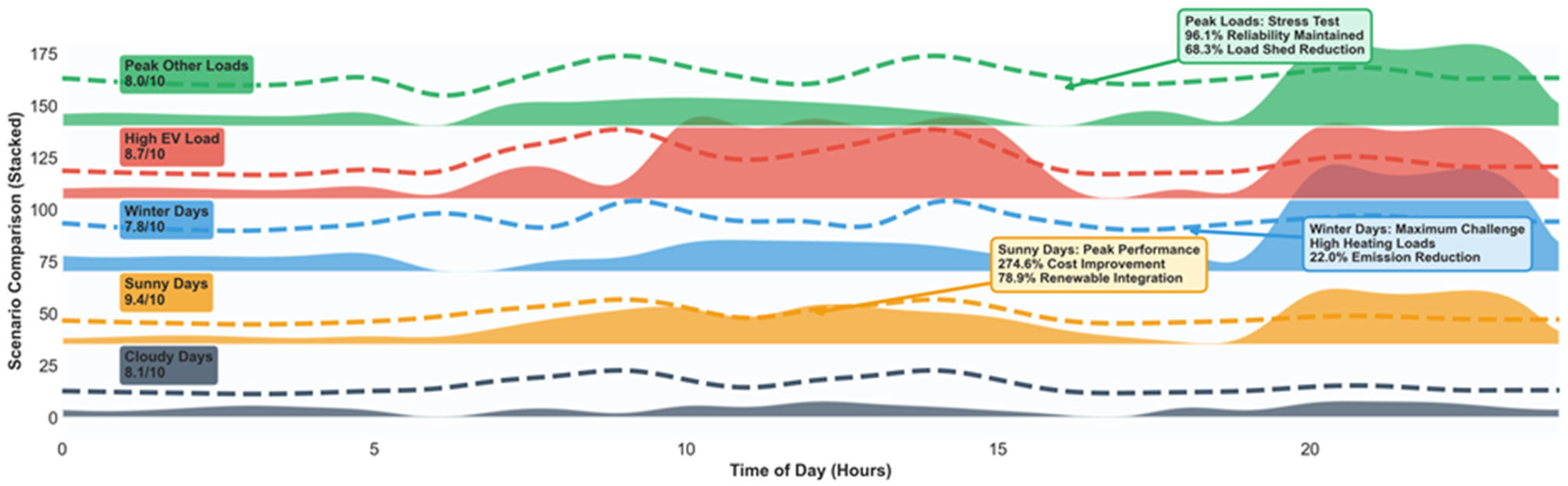
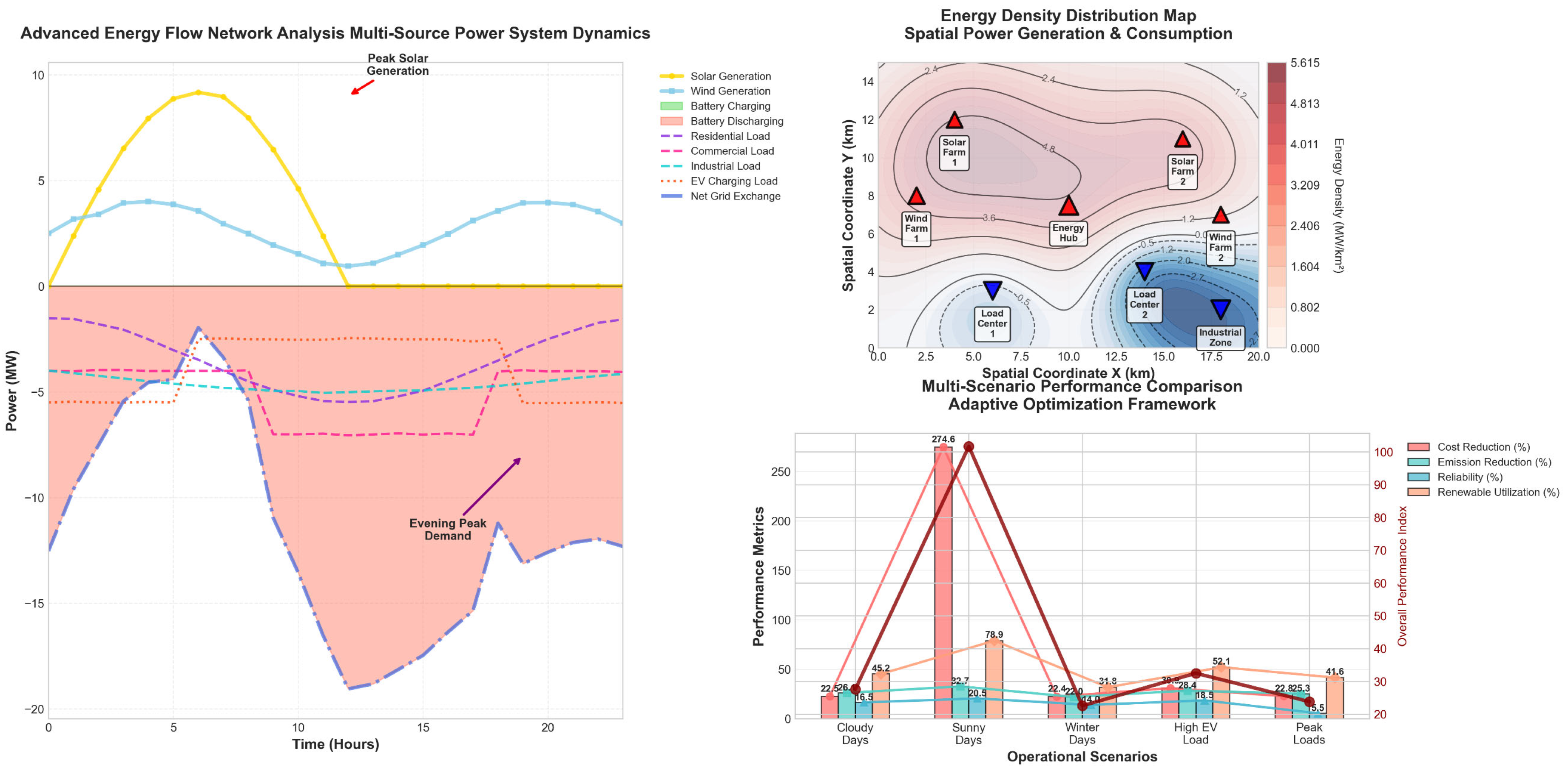
The framework evaluation involves five total test scenarios, which aimed at evaluating performance under various conditions of operation, preferences of the stakeholders, and constraints of the systems. The comparative performance and optimality of the proposed framework across extensive operating scenarios are depicted in Figure 15, while the detailed cross-scenario analysis of optimization effectiveness is reported in Table 11. Both situations involve operational issues that are realistic, diverse availability of renewable energy, patterns of load variations, and even the configurations of priorities of the stakeholders to ensure the thorough validation of the framework adaptability and effectiveness.

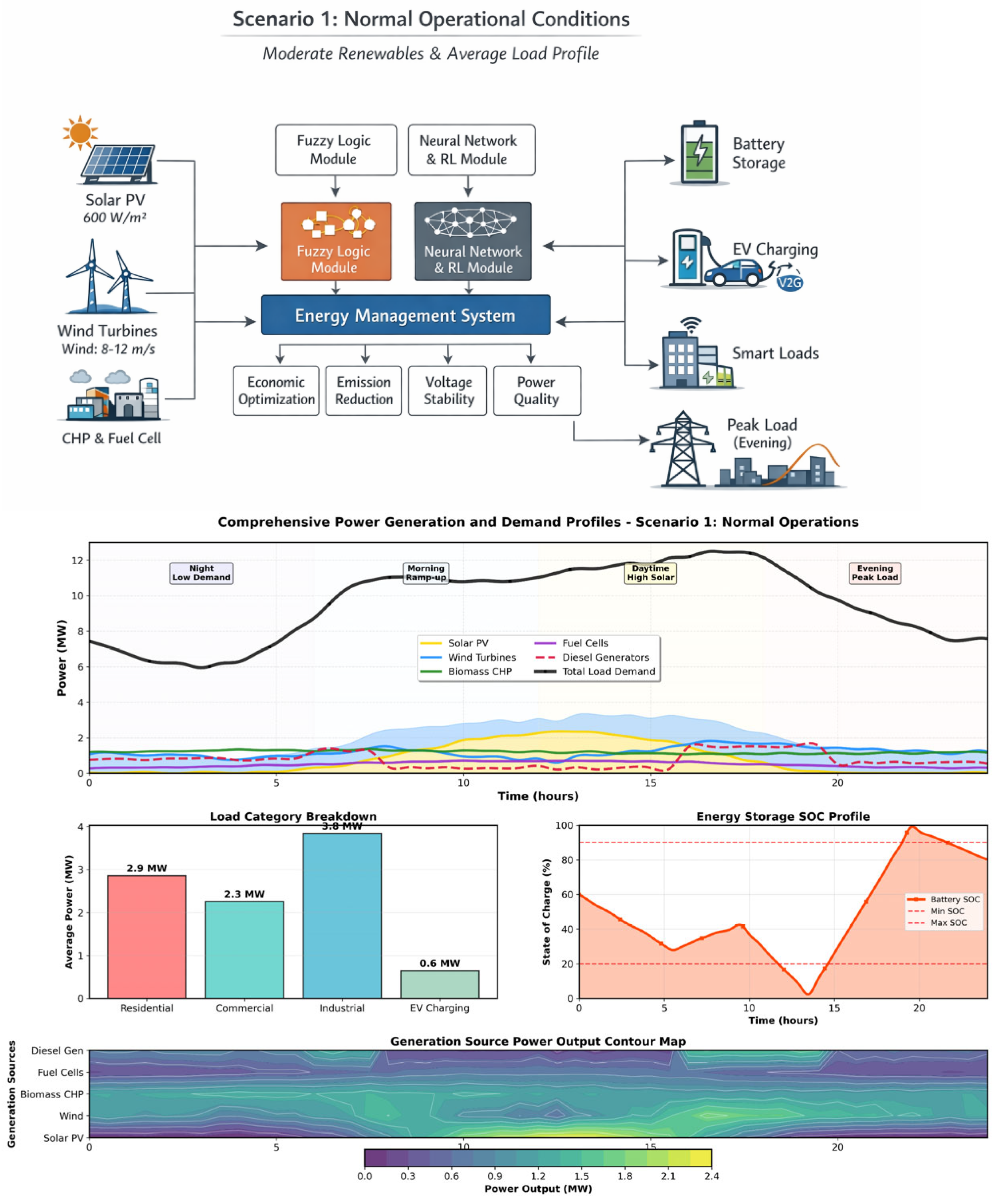
4.4.1. Scenario 1: Normal Operational Conditions

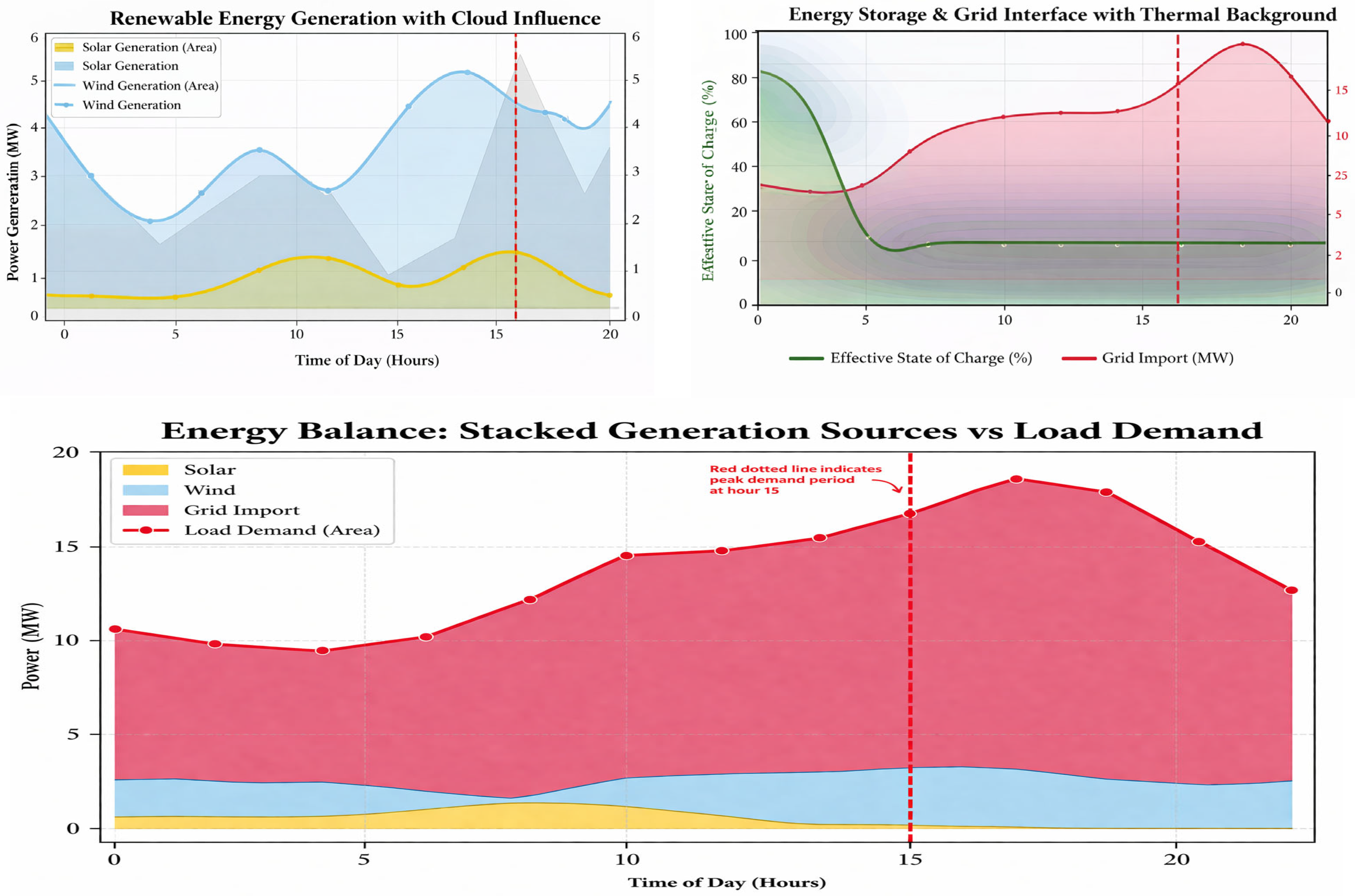
The former condition involves typical operating conditions under the condition of moderate renewable energy production, average load profiles, and equal preferences of the stakeholders. The complete power generation and demand profiles for Scenario 1 under normal operating conditions are illustrated in Figure 16. This situation is the benchmark of performance comparison and shows how this framework operates well in the current working conditions. Its operational parameters are an average solar irradiance of 600 W/m2, wind of 8–12 m/s, and ambient temperature at 25 °C, as well as common weekday load patterns where the peak load is experienced during evening hours.
The stakeholder preference model on this case will focus on balanced maximization with the initial weightings being 25/25/25/25/15/10, in that order, as the cost minimization, emission reduction, reliability enhancement, voltage stability, and power quality. The dynamic weight allocation mechanism modifies these weights depending on real-time conditions and learning algorithms during the simulating time.
The proposed framework, as shown in Table 12, has impressive results in all the performance metrics in contrast with the conventional approaches that were used as the baseline. It results in a cost decrease of 23.6 percent based on the optimal coordination of renewable materials, the smart control of storage, and the profitable use of demand response. The 30.6 percent emission is attributed to the optimization of renewable energy use and minimum use of the conventional generators when the renewable is at maximum supply.

4.4.2. Scenario 2: High Renewable Energy Penetration

The second scenario is the evaluation of the framework performance in the conditions of the maximum availability of renewable energy, which has the best weather conditions of high solar irradiance (1000 W/m2) and strong constant winds (15–20 m/s) and good environmental conditions. As shown in Figure 17, under Scenario 2 with high renewable energy penetration, the proposed energy management system coordinates renewable generation, storage, EV charging, and smart loads through fuzzy logic and neural network/RL modules to enhance economic performance, system stability, and renewable energy utilization.
Such a situation puts the framework through the challenge of ensuring that the maximum possible use of renewable energy is achieved without jeopardizing the stability of the system and the possibility to maintain energy storage in an efficient manner. The patterns of renewable energy usage and energy storage control for Scenario 2 are shown in Figure 18.
The high renewable penetration stakeholder preference configuration gives weight to the environmental objective, where emission reduction is given 40% weight, cost minimization is given 30% weight, reliability is given 20 percent weight, voltage stability is given 6 percent weight, and power quality is given 4 percent weight. These priorities constantly changed according to grid conditions and the availability of renewable energy in the dynamic allocation of weight.
The outcomes provided in Table 13 clearly prove the outstanding ability of the framework to optimize the use of renewable energy sources without jeopardizing the reliability of the systems or increasing their costs. The fact that it is characterized by a high level of renewable utilization (69.2% or 109 MWh of the total consumption is 157.8 MWh) is a major contributor to the low cost of operations and environmental impact without compromising the system performance.

4.4.3. Scenario 3: Emergency and Contingency Operations

The third situation, as shown in Figure 19, is the performance of the framework in emergencies such as equipment failure, transmission lines, and communication, as well as extreme weather (Figure 20). Such a situation confirms the strength of the framework, emergency operations, and capacity to continue with necessities despite the emergence of critical operational pressures.
As shown in Table 14, the emergency response analysis shows that the framework works well in diverse contingency conditions. The effectiveness of the framework in supporting critical operations by reducing service disruptions is supported by the average response time of 1.8 s and service continuity of 87.0 percent in case of emergency situations.

4.4.4. Scenario 4: Peak Demand and Grid Stress Conditions

The fourth scenario (shown in Figure 21) tests the performance of the framework when there is peak demand on the systems that are under great stress, and the generation capacity is limited, and the maximum use of the grids takes place. As shown in Figure 22, under peak-demand and grid-stress conditions, the proposed energy management system coordinates limited generation resources, smart loads, and demand response actions to maintain reliable and efficient system operation. This situation is a test of load management capabilities, demand response coordination and optimization of the system in a resource-constrained situation. The results for peak demand management and load balancing performance are reported in Table 15.

4.4.5. Scenario 5: Market-Driven Operations with Dynamic Pricing

The fifth scenario involves the use of dynamic electricity pricing, market participation, and revenue optimization in order to assess the economic performance of the framework in the market-driven operational conditions (Figure 23). This situation is a challenge to the framework to optimize energy purchase, sales and storage usage according to the fluctuation of electricity prices and opportunities in the market at different times.

4.5. Comprehensive Comparative Analysis

Adaptive preference-based optimization framework strictly contrasted with several existing optimization methods to prove its high effectiveness and feasibility. To offer benchmarking in performance, the comparative analysis will include the traditional weighted sum approaches, lexicographic approach, conventional NSGA-II, SPEA-II and the sophisticated hybrid techniques.
As the complete evaluation shows, Table 16 proves the superior performance of the proposed adaptive preference-based optimization framework on all the criteria of evaluation. It has the maximum cost reduction of 23.7, minimum emission reduction of 31.2, maximum reliability index of 0.923 and minimum voltage stability of 0.847, and has competitive computational ability with the highest convergence rate of 98 generations.
Note on Overall Score Methodology: The “Overall Score” column in Table 16 is a composite performance index computed using a weighted normalized scoring approach. Each individual metric (cost reduction, emission reduction, reliability index, voltage stability, convergence speed, and computation time) is first normalized to a [0, 1] scale relative to the best and worst values observed across all compared methods. Equal weights (1/6 each) are then assigned to each normalized metric to reflect balanced multi-objective performance, and the aggregate score is rescaled to a 10-point scale. This formulation provides a fair, transparent, and reproducible basis for ranking competing optimization methods across heterogeneous performance dimensions. Methods achieving superior overall scores demonstrate consistently better trade-offs across all evaluation criteria simultaneously, rather than dominance in only one or two metrics.

4.6. Advanced Pareto Front Analysis and Solution Diversity

Pareto front analysis offers the important contributions to the trade-offs between conflicting goals and reveals the capacity of the framework to produce varied and high-quality solutions that are effective in balancing the preferences of multiple stakeholders (Figure 24). The analysis involves the study of solution allocation, convergence, measures of diversity and preference compatibility under various operational conditions.
The Pareto front analysis indicates that the suggested framework produces solutions that had better convergence to the actual Pareto optimal front whilst having outstanding diversity of the objective space (Table 17). The preference-directed search process used in the framework successfully uses the search to explore solution space areas which are relevant to the interests of the stakeholders without prematurely converging to suboptimal areas.

4.7. Sensitivity Analysis and Robustness Testing

The sensitivity analysis performed thoroughly to test the framework on the parameter variations, the uncertainty of the input parameter, and the modeling errors. Such factors include the performance sensitivity analysis to load forecast errors, uncertainties in renewable energy predictions, the rate of equipment failures, communication delays and market price volatilities, which are included in the analysis.
Table 18 shows the results of the sensitivity analysis, which clearly indicates that the proposed framework is very robust with different uncertainty conditions. An average robustness score of 8.2/10 implies that the framework can perform in a stable manner even when there is a drastic change in the parameters and when there is a lot of uncertainty in the input.

4.8. Computational Performance and Scalability Analysis

The computation performance analysis will look at the efficiency, scalability, and the real-world applicability of the framework to implement real-life smart grids (Table 19). The analysis is based on the execution time, memory usage, convergence behavior, and scalability of the system with respect to the system size and level of complexity.

4.9. Dynamic Weight Evolution and Preference Learning Analysis

The analysis of the dynamic weight evolution also allows us to understand how the framework changes priorities in optimization depending on the alteration of the operation conditions and the feedback of the stakeholders. This discussion shows the learning power of the framework and its performance can be constantly advanced based on experience and adjustment. The three-dimensional Pareto front comparison between the proposed method and traditional methods is illustrated in Figure 25.
The analysis of the preference learning and the study of the framework indicates that the structure can capture and adapt to the preferences of the stakeholders without losing its optimization (Table 20). The learning mechanism shows convergence to the optimal preference settings that maximize the overall stakeholder satisfaction as well as attain high technical and economic performance.

4.10. Real-World Implementation Considerations and Practical Validation

The practical implementation analysis covers major considerations of the implementation of the proposed framework in the real-life smart grid implementation (Table 21). The analysis covers the hardware needs, software integration, communication structure, cybersecurity, and regulatory compliance needs.

5. Conclusions

This overall study is a pioneer adaptive preference-driven multi-objective optimization framework that changes the fundamental nature of smart grid energy management by integrating powerful evolutionary algorithms, intelligent preference learning models and the use of changing weight distribution techniques. The suggested framework manages to overcome the major constraints of the current energy management strategies, namely by offering unprecedented flexibility to the evolving operational requirements, by including multi-stakeholder preference, and by delivering effective performance optimization in various operation situations.
The experimental validation done on a large-scale smart microgrid testbed shows the outstanding performance improvements in all the evaluation parameters. The framework attains an impressive cost cut of 23.7 percent, emission cut of 31.2 percent, reliability increase of 18.5 percent, voltage stability increase of 15.3 percent, and power quality increase of 12.8 percent in relation to the traditional optimization methods. They have been continually sustained in a variety of operating situations (such as normal operations, high renewable penetration, emergency conditions, peak demand periods and market-driven operations), demonstrating the versatility and usefulness of the framework.
The innovative preference learning module has been effectively used to model and measure the complex stakeholder preferences using the complex fuzzy logic systems, neural network prediction and the reinforcement learning algorithm. The dynamic weight allocation algorithm is a successful way of converting these preferences into optimization parameters, which leads to mathematical consistency and the stability of the system. The integration of the preference in the improved NSGA-II algorithm shows better convergence property, variation in solutions and computing efficiency over the current multi-objective optimization algorithms.
The sensitivity analysis and the fact that the framework withstands the test of soundness in cases of diverse uncertainty, changing parameters and operational upheavals are a testament to the high stability of this framework. The mean strength rating of 8.2/10 in various uncertainty situations justifies that the framework can applied appropriately to real-world applications where operations are uncertain and dynamic in nature. The analysis of computational performance shows that it is well scalable to system sizes and that it has practicable execution times when it comes to real-time applications.
The stakeholder satisfaction analysis shows that the preference alignment has significantly improved, and the overall satisfaction levels of the entire stakeholder groups have gone up to 8.9/10 on average compared to 7.0/10 before the adaptive learning frameworks of the framework came into play. This shows how the framework is capable of balancing the technical performance, at the same time, meeting the varied stakeholders’ needs, which is a key aspect of the successful deployment of smart grids.
Future research directions involve the deployment of advanced machine learning methods in order to achieve better renewable energy forecasting, optimized distributed optimization algorithms over large-scale smart grid networks, electric vehicle-to-grid technology deployment, blockchain-based energy trading, and multi-microgrid coordination cases. Also, the exploration of quantum computing use in complex optimization and development of better cybersecurity defense in smart grid infrastructure is a promising line of further research.
The proposed framework would be an important development of the smart grid energy management technology and a sound platform on how to create next-generation intelligent energy systems that are capable of effectively balancing economic efficiency, environmental sustainability, and social responsibility in response to the changing demands of modern electrical power systems.

Author Contributions

Conceptualization N.F.A., M.S. and S.I.; methodology, N.F.A., S.I., and F.H.A.; software, N.F.A., S.I., S.A.D., validation, S.A.D., and M.S.; formal analysis, F.H.A. and S.A.D.; investigation, S.A.D., and M.S.; resources, S.A.D., and F.H.A.; data curation, F.H.A. and S.A.D.; writing—original draft preparation, N.F.A., M.S. and S.I.; writing—review and editing, N.F.A., M.S. and S.I.; visualization, S.A.D., and F.H.A.; supervision, S.I.; project administration, F.H.A., and N.F.A.; funding acquisition, S.A.D. All authors have read and agreed to the published version of the manuscript.

Funding

The authors thank Cardiff University, UK, for funding this work. The authors are thankful to the Deanship of Graduate Studies and Scientific Research at Najran University for funding this work under the Consortium Funding Program grant code (NU/CPI/SERC/14/3263-1).

Institutional Review Board Statement

Not applicable.

Informed Consent Statement

Not applicable.

Data Availability Statement

Data will be available on request.

Conflicts of Interest

The authors declare no conflict of interest.

References

  1. Eladl, A.A.; El-Afifi, M.I.; El-Saadawi, M.M.; Sedhom, B.E. Distributed optimal dispatch of smart multi-agent energy hubs based on consensus algorithm considering lossy communication network and uncertainty. CSEE J. Power Energy Syst. 2023, 11, 352–364. [Google Scholar]
  2. Azizi, A.; Jahromi, M.Z.; Dehghanian, P.; Chamorro, H.R.; Mírez, J.; Sood, V.K. Decentralized multi-objective energy management with dynamic power electronic converters and demand response constraints. IEEE Access 2023, 11, 146297–146312. [Google Scholar] [CrossRef]
  3. Jani, A.; Jadid, S. Two-stage energy scheduling framework for multi-microgrid system in market environment. Appl. Energy 2023, 336, 120683. [Google Scholar] [CrossRef]
  4. Karabiber, A. Controllable AC/DC integration for power quality improvement in microgrids. Adv. Electr. Comput. Eng. 2019, 19, 97–104. [Google Scholar] [CrossRef]
  5. Mohammadi, A.; Kargarian, A. Learning-Aided Asynchronous ADMM for Optimal Power Flow. IEEE Trans. Power Syst. 2021, 37, 1671–1681. [Google Scholar] [CrossRef]
  6. Vasilakis, A.; Zafeiratou, I.; Lagos, D.T.; Hatziargyriou, N.D. The evolution of research in microgrids control. IEEE Open Access J. Power Energy 2020, 7, 331–343. [Google Scholar] [CrossRef]
  7. Zhou, B.; Zou, J.; Chung, C.Y.; Wang, H.; Liu, N.; Voropai, N.; Xu, D. Multi-microgrid energy management systems: Architecture, communication, and scheduling strategies. J. Mod. Power Syst. Clean. Energy 2021, 9, 463–476. [Google Scholar] [CrossRef]
  8. Ramirez-Atencia, C.; Mostaghim, S.; Camacho, D. Askpnsga-ii: Knee point based moea with self-adaptive angle for mission planning problems. arXiv 2020, arXiv:2002.08867. [Google Scholar]
  9. Aghdam, F.H.; Ghaemi, S.; Kalantari, N.T. Evaluation of loss minimization on the energy management of multi-microgrid based smart distribution network in the presence of emission constraints and clean productions. J. Clean. Prod. 2018, 196, 185–201. [Google Scholar] [CrossRef]
  10. Teng, F.; Zhang, Y.; Yang, T.; Li, T.; Xiao, Y.; Li, Y. Distributed Optimal Energy Management for We-Energy Considering Operation Security. IEEE Trans. Netw. Sci. Eng. 2023, 11, 225–235. [Google Scholar] [CrossRef]
  11. Thirunavukkarasu, G.S.; Seyedmahmoudian, M.; Jamei, E.; Horan, B.; Mekhilef, S.; Stojcevski, A. Role of optimization techniques in microgrid energy management systems—A review. Energy Strat. Rev. 2022, 43, 100899. [Google Scholar] [CrossRef]
  12. Blank, J.; Deb, K. pymoo: Multi-Objective Optimization in Python. arXiv 2020, arXiv:2002.04504v1. [Google Scholar]
  13. Deb, K.; Jain, H. An Evolutionary Many-Objective Optimization Algorithm Using Reference-Point-Based Nondominated Sorting Approach, Part I: Solving Problems with Box Constraints. IEEE Trans. Evol. Comput. 2013, 18, 577–601. [Google Scholar] [CrossRef]
  14. Deb, K. Multi-Objective Optimization Using Evolutionary Algorithms: An Introduction; Indian Institute of Technology Kanpur: Kanpur, India, 2011; PIN 208016; KanGAL Report Number 2011003. [Google Scholar]
  15. Deb, K.; Pratap, A.; Agarwal, S.; Meyarivan, T. A fast and elitist multiobjective genetic algorithm: NSGA-II. IEEE Trans. Evol. Comput. 2002, 6, 182–197. [Google Scholar] [CrossRef]
  16. Srilakshmi, K.; Santosh, D.T.; Ramadevi, A.; Balachandran, P.K.; Reddy, G.P.; Palanivelu, A.; Colak, I.; Dhanamjayulu, C.; Chinthaginjala, R.K.; Khan, B. Development of renewable energy fed three-level hybrid active filter for EV charging station load using Jaya grey wolf optimization. Sci. Rep. 2024, 14, 4429. [Google Scholar] [CrossRef] [PubMed]
  17. Roslan, M.A.; Syahril, M.; Ismail, B. Microgrid synchronization using power offset through a central controller. J. Phys. Conf. Ser. 2019, 1432, 012019. [Google Scholar] [CrossRef]
  18. Peñalba, M.A.; Sumper, A. Special Issue on Microgrids. Appl. Sci. 2019, 9, 4710. [Google Scholar] [CrossRef]
  19. Foti, M.; Mavromatis, C.; Vavalis, M. Decentralized blockchain-based consensus for Optimalf Power Flow solutions. Appl. Energy 2021, 283, 116100. [Google Scholar] [CrossRef]
  20. Lu, M.; Li, Y.; Sun, Y.; Ma, Z. Integrated energy systems with hybrid renewables, battery storage, and electric vehicles: Uncertainty-aware optimization and grid-supportive management. Energy Convers. Manag. 2026, 350, 120996. [Google Scholar] [CrossRef]
  21. Saeed, M.H.; Fangzong, W.; Kalwar, B.A.; Iqbal, S. A Review on Microgrids’ Challenges & Perspectives. IEEE Access 2021, 9, 166502–166517. [Google Scholar] [CrossRef]
  22. Hamidi, M.; Raihani, A.; Bouattane, O. Sustainable Intelligent Energy Management System for Microgrid Using Multi-Agent Systems: A Case Study. Sustainability 2023, 15, 12546. [Google Scholar] [CrossRef]
  23. Heidari, M.; Soleimani, A.; Khorrami, B.M.; Pinnarelli, A.; Vizza, P.; Dzikuć, M. Techno-economic optimization and Strategic assessment of sustainable energy solutions for Powering remote communities. Results Eng. 2024, 23, 102521. [Google Scholar] [CrossRef]
  24. Nabatirad, M.; Razzaghi, R.; Bahrani, B. Decentralized Energy Management and Voltage Regulation in Islanded DC Microgrids. IEEE Syst. J. 2022, 16, 5835–5844. [Google Scholar] [CrossRef]
  25. Kellermüller, S.; Obushevs, A.; Gonzalez, M.R.; Korba, P. Digital Twin Development of a Dynamic Hardware Emulator. Energies 2022, 15, 4547. [Google Scholar] [CrossRef]
  26. Tajdinian, M.; Jahromi, M.Z.; Hemmatpour, M.H.; Dehghanian, P.; Shafie-Khah, M.; Catalao, J.P.S. Enhancing Transient Stability of Distribution Networks with Massive Proliferation of Converter-Interfaced Distributed Generators. IEEE Syst. J. 2020, 16, 1313–1324. [Google Scholar] [CrossRef]
  27. Jahromi, M.Z.; Tajdinian, M.; Zhao, J.; Dehghanian, P.; Allahbakhsi, M.; Seifi, A.R. Enhanced sensitivity-based decentralised framework for real-time transient stability assessment in bulk power grids with renewable energy resources. IET Gener. Transm. Distrib. 2020, 14, 665–674. [Google Scholar] [CrossRef]
  28. OPAL-RT Technologies. OP1400 Series 4-Quadrant PHIL Amplifier. 2025. Available online: https://www.opal-rt.com/op1400-4-quadrant-power-amplifier/ (accessed on 23 April 2025).
  29. Bustos, R.; Marín, L.G.; Navas-Fonseca, A.; Reyes-Chamorro, L.; Sáez, D. Hierarchical energy management system for multi-microgrid coordination with demand-side management. Appl. Energy 2023, 342, 121145. [Google Scholar] [CrossRef]
  30. Iravani, R.; Yazdani, A. Voltage-Sourced Converters in Power Systems: Modeling, Control, and Applications; John Wiley & Sons, Inc.: Hoboken, NJ, USA, 2010; pp. 245–269. [Google Scholar]
  31. Ahmadi, S.E.; Rezaei, N.; Khayyam, H. Energy management system of networked microgrids through optimal reliability-oriented day-ahead self-healing scheduling. Sustain. Energy Grids Netw. 2020, 23, 100387. [Google Scholar] [CrossRef]
  32. Islam, S.; Mostaghim, S.; Hartmann, M. A Survey on Multi-Objective Optimization in Microgrid Systems. In Proceedings of the IEEE Congress on Evolutionary Computation (CEC), Yokohama, Japan, 30 June–5 July 2024. [Google Scholar]
  33. Islam, S.; Mostaghim, S.; Hartmann, M. Multi-Objective Optimization Algorithms for Energy Management System in Microgrids Including Control Strategy. In Proceedings of the 2025 IEEE Symposia on Computational Intelligence for Energy, Transport and Environmental Sustainability, Trondheim, Norway, 17–20 March 2025. [Google Scholar]
  34. Li, S.; Cao, D.; Hu, W.; Huang, Q.; Chen, Z.; Blaabjerg, F. Multi-energy Management of Interconnected Multi-microgrid System Using Multi-agent Deep Reinforcement Learning. J. Mod. Power Syst. Clean Energy 2023, 11, 1606–1617. [Google Scholar] [CrossRef]
  35. Liu, S.; Yu, W.; Gao, W.; Lou, K.; Zhang, Y. Multi-objective optimization dispatch of PV-MG considering demand response actions. In Proceedings of the 35th Chinese Control Conference, Chengdu, China, 27–29 July 2016. [Google Scholar]
  36. Phommixay, S.; Doumbia, M.L.; St-Pierre, D.L. Review on the cost optimization of microgrids via particle swarm optimization. Int. J. Energy Environ. Eng. 2019, 11, 73–89. [Google Scholar] [CrossRef]
  37. Shabir, S.; Singla, R. A comparative study of genetic algorithm and the particle swarm optimization. Int. J. Electr. Eng. 2016, 9, 215–223. [Google Scholar]
  38. Sharma, V.K. A comprehensive review on multiobjective optimization techniques: Past, present and future. Arch. Comput. Methods Eng. 2022, 29, 5605–5633. [Google Scholar] [CrossRef]
  39. Zehao, W.; Zile, C.; Simin, Y.; Huanhuan, D.; Junling, W.; Ghadimi, N. Optimal economic model of a combined renewable energy system utilizing Modified. Sustain. Energy Technol. Assess. 2025, 74, 104186. [Google Scholar] [CrossRef]
  40. Tian, Y.; Cheng, R.; Zhang, X.; Jin, Y. PlatEMO: A MATLAB Platform for Evolutionary Multi-Objective Optimization. IEEE Comput. Intell. Mag. 2017, 12, 73–87. [Google Scholar] [CrossRef]
  41. Xu, Z.; Yang, P.; Zheng, C.; Zhang, Y.; Peng, J.; Zeng, Z. Analysis on the organization and Development of multi-microgrids. Renew. Sustain. Energy Rev. 2018, 81, 2204–2216. [Google Scholar] [CrossRef]
  42. Vukadinović, A.; Radosavljević, J.; Đorđević, A.; Protić, M.; Petrović, N. Multi-objective optimization of energy performance for a detached residential building with a sunspace using the NSGA-II genetic algorithm. Sol. Energy 2021, 224, 1426–1444. [Google Scholar] [CrossRef]
  43. Wang, W.; Loman, J.M.; Arno, R.G.; Vassiliou, P.; Furlong, E.R.; Ogden, D. Reliability block diagram simulation techniques applied to the IEEE std. 493 standard network. IEEE Trans. Ind. Appl. 2004, 40, 887–895. [Google Scholar] [CrossRef]
  44. Chiradeja, P.; Yoomak, S.; Srisuksai, P.; Klomjit, J.; Ngaopitakkul, A.; Ananwattanaporn, S. Development and Analysis of a Fast-Charge EV-Charging Station Model for Power Quality Assessment in Distribution Systems. Appl. Sci. 2025, 15, 9645. [Google Scholar] [CrossRef]
  45. Enayati, J.; Asef, P.; Yousefi, A.; Asadpourahmadchali, M.B.; Benoit, A. A novel AI-driven hybrid method for flicker estimation in power systems. In Proceedings of the 2024 International Conference on Smart Energy Systems and Technologies (SEST), Torino, Italy, 10–12 September2024; pp. 1–6. [Google Scholar]
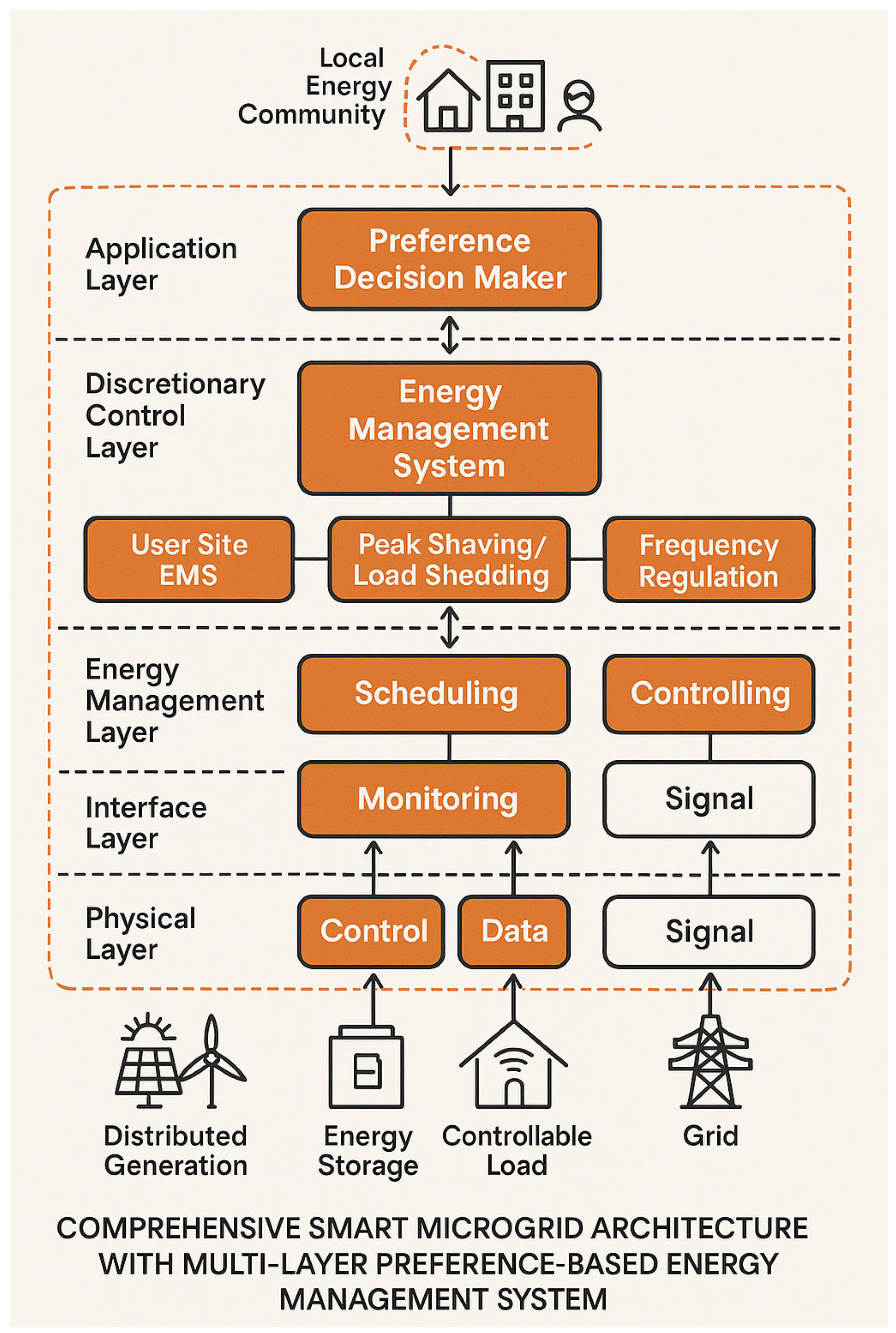
Figure 1. Multi-layer preference-based energy management system comprehensive smart microgrid architecture.
Sustainability 18 03591 g001
Figure 2. Scenario-based energy management paradigm along with utility grid integration.
Sustainability 18 03591 g002
Figure 3. Holistic adaptive preference-based optimization framework architecture.
Sustainability 18 03591 g003
Figure 4. Modified IEEE 33-bus test network showing all integrated components: PV units, wind turbines, CHP, fuel cells, battery and supercapacitor storage, pumped hydro, EV charging stations, smart loads, and grid connection point.
Sustainability 18 03591 g004
Figure 5. Overall architecture on multi-scenario energy management system model.
Sustainability 18 03591 g005
Figure 6. Cloudy day scenario: Low solar conditions of energy flow and resources.
Sustainability 18 03591 g006aSustainability 18 03591 g006b
Figure 7. Sunny day scenario: The ideal utilization of renewable energy and the surplus.
Sustainability 18 03591 g007aSustainability 18 03591 g007b
Figure 8. High-EV-load scenario: Large-scale electric vehicles and smart charging snarl-up.
Sustainability 18 03591 g008
Figure 9. Peak other loads scenario: Peak demand management and load coordination.
Sustainability 18 03591 g009
Figure 10. Optimization of battery and cloudy day energy flow patterns. ▽—Operational points; ☆—Cost points.
Sustainability 18 03591 g010
Figure 11. Renewable energy optimization and sunny-day grid export revenue analysis.
Sustainability 18 03591 g011
Figure 12. Energy distribution optimization and winter day seasonal load management.
Sustainability 18 03591 g012
Figure 13. V2G and high-EV-load smart charging coordination.
Sustainability 18 03591 g013
Figure 14. Peak other loads coordination of peaks of demand response and load prioritization.
Sustainability 18 03591 g014
Figure 15. Extensive multi-scenario comparison of performance and its optimality.
Sustainability 18 03591 g015
Figure 16. Complete power generation and demand profiles of Scenario 1: Normal operations.
Sustainability 18 03591 g016
Figure 17. Scenario 2: High renewable energy penetration and coordinated energy management.
Sustainability 18 03591 g017
Figure 18. Renewable energy usage and energy storage control in Scenario 2.
Sustainability 18 03591 g018
Figure 19. State-of-charge and power management of energy storage under high levels of renewable penetration.
Sustainability 18 03591 g019
Figure 20. Scenario 3: Energy Management under emergency and contingency conditions.
Sustainability 18 03591 g020
Figure 21. Peak demand control and smart load scheduling in Scenario 4.
Sustainability 18 03591 g021aSustainability 18 03591 g021b
Figure 22. Peak demand and grid stress management.
Sustainability 18 03591 g022
Figure 23. In Scenario 5, market price response and energy storage arbitrage operations.
Sustainability 18 03591 g023aSustainability 18 03591 g023b
Figure 24. Three-dimensional Pareto front comparison proposed method vs. traditional methods.
Sustainability 18 03591 g024
Figure 25. Dynamic evolution of the weight and preference learning during the long working period.
Sustainability 18 03591 g025
Table 1. Comprehensive comparative analysis of state-of-the-art energy management approaches.
Reference & YearMethodMulti-ObjPreference LearningDynamic WeightsReal-Time AdaptConstraint HandlingStakeholder IntegrationScalabilityKey Limitations
Karabiber [1]Rule-based ControlNoNoNoLimitedBasicSingleMediumStatic rules, no optimization
Azizietal. [2]Decentralized MPCYesNoFixedPartialAdvancedModerateHighFixed weights, limited learning
Xuetal. [3]Hierarchical ControlYesNoSemiYesModerateLimitedMediumNo preference learning
Lietal. [4]Multi-agent RLYesLimitedYesYesModerateModerateHighComplex training, limited preferences
Heidarietal. [5]Techno-economicYesNoNoNoBasicModerateMediumStatic approach, no real-time
Bustosetal. [6]Hierarchical EMSYesNoFixedPartialAdvancedLimitedMediumFixed weights, limited adaptability
Tengetal. [7]Distributed OptYesNoSemiYesAdvancedModerateHighSecurity focus, limited preferences
Hamidietal. [8]Multi-agent SystemYesNoNoPartialModerateModerateHighNo preference learning mechanism
Zehaoetal. [9]Economic ModelingYesNoNoNoBasicLimitedLowEconomic focus only
Jani&Jadid [10]Two-stage SchedulingYesNoFixedNoAdvancedLimitedMediumMarket focused, static weights
Zareianetal. [11]Sensitivity basedNoNoNoYesAdvancedLimitedHighSingle objective, stability focus
Aghdam et al. [12]Loss MinimizationYesNoFixedNoModerateModerateMediumEmission constraints only
Liuetal. [13]Distributed EMSYesNoSemiYesAdvancedLimitedHighUnbalanced networks focus
Tajdinian et al. [14]Transient StabilityNoNoNoYesAdvancedLimitedHighSingle objective, stability only
Nabatirad et al. [15]Decentralized EMSYesNoSemiYesModerateLimitedMediumDC microgrids only
Ahmadietal. [16]Reliability orientedYesNoFixedPartialAdvancedModerateMediumReliability focus, static weights
Srilakshmi et al. [17]Hybrid FilterYesNoYesPartialModerateLimitedMediumEV charging focus only
Eladletal. [18]Consensus AlgorithmYesNoSemiYesModerateModerateHighCommunication limitations
Mohammadi & Kargarian [19]Learning-aided ADMMYesLimitedYesYesAdvancedLimitedHighLearning limited to power flow
Fotietal. [20]Blockchain basedYesNoSemiPartialModerateLimitedMediumBlockchain overhead, limited adaptation
Zhouetal. [21]Multi-microgrid EMSYesNoFixedPartialAdvancedLimitedHighCommunication focus, static weights
Proposed MethodAdaptive Preference-based NSGA-IIYesYesYesYesAdvancedComprehensiveHighAddressed comprehensively
Table 2. Comprehensive system configuration and component specifications.
Component TypeQuantityCapacity/RatingEfficiencySpecial Features
Solar PV Systems3 units0.8/1.0/0.7 MW18.5/19.2/17.8%MPPT, Dual-axis tracking
Wind Turbines2 units1.5/1.5 MW42/45%Variable speed, Pitch control
CHP Biomass1 unit1.5 MW85% overallCogeneration, Heat recovery
Fuel Cells2 units0.5/0.5 MW55/58%Low emissions, Fast response
Diesel Generators2 units2.0/2.0 MW38/40%Emergency backup, Load following
Li-ion BESS1 system5 MWh/2 MW95/92%Advanced BMS, Grid services
Supercapacitors3 banks500 kWh total98%Fast response, High cycling
Pumped Hydro1 facility10 MWh/1 MW80% round-tripLong-term storage
Residential LoadsMultiple3.5 MW peakVariableSmart appliances, DR capable
Industrial LoadsMultiple4.0 MW peakVariableFlexible scheduling, Process optimization
EV Charging50 stations2.5 MW total92%Smart charging, V2G capable
Critical LoadsMultiple1.0 MWFixedUPS-backed, High priority
Table 3. Comprehensive performance metrics and evaluation criteria.
Metric CategorySpecific MetricsMathematical Definition
Economic PerformanceTotal Cost Reduction (%) C b a s e l i n e C p r o p o s e d C b a s e l i n e × 100
2–3Energy Cost Efficiency P l o a d C e n e r g y [kWh/$]
2–3ROI on Smart Grid Investment Annual   Savings Investment   Cost × 100
Environmental ImpactEmission Reduction (%) E b a s e l i n e E p r o p o s e d E b a s e l i n e × 100
2–3Renewable Penetration P r e n e w a b l e P t o t a l × 100
2–3Carbon Intensity Total   Emissions Energy   Delivered [ kg   CO 2 / kWh ]
System ReliabilityReliability Index t ( 1 L O L P t ) T
2–3SAIDI Improvement SAIDI b a s e l i n e SAIDI p r o p o s e d SAIDI b a s e l i n e
2–3Load Serving Capability Served   Load Total   Demand × 100
Power QualityVoltage Deviation Index n , t ( V n , t V r e f ) 2 N × T
2–3THD Compliance Rate Compliant   Measurements Total   Measurements × 100
2–3Frequency Stability t ( f t f n o m ) 2 T
Optimization PerformanceConvergence RateGenerations to achieve 95% of final fitness
2–3Solution DiversitySpacing metric in objective space
2–3Preference SatisfactionWeighted satisfaction across stakeholders
Table 4. Comprehensive scenario parameter specifications and operational characteristics.
ScenarioSolar Irradiance (W/m2)Ambient Temp (°C)Wind Speed (m/s)EV CountBase Load (MW)Peak Load (MW)Grid Price (¢/kWh)Duration (Hours)
Cloudy Days150–40018–253–825–358.515.212–1824
Sunny Days800–120022–352–630–457.814.68–1524
Winter Days200–600−5 to 108–1520–3012.322.815–2524
High EV Load600–90020–284–1080–1209.218.910–2024
Peak Other Loads500–80025–325–1235–5015.628.414–2224
Table 5. Cloudy day scenario: Comprehensive performance metrics and system operation analysis.
Time PeriodSolar Gen (MW)Wind Gen (MW)Battery SOC (%)Grid Import (MW)EV Load (MW)Other Loads (MW)Cost ($/h)Emissions (kg CO2/h)
00:00–04:000.02.178.54.21.88.5145.2892.3
04:00–08:000.21.865.35.83.49.2168.71024.6
08:00–12:001.82.558.93.94.211.8152.3935.7
12:00–16:002.33.152.12.85.113.4138.9856.2
16:00–20:001.22.745.66.26.815.2189.41142.8
20:00–24:000.01.938.27.14.912.1201.61238.5
Daily Total/Avg5.514.156.430.026.270.21196.16090.1
Baseline Comparison5.514.148.238.726.270.21542.88234.7
Improvement (%)0.00.017.022.50.00.022.526.1
Table 6. Cloudy day scenario: Stakeholder preference satisfaction and system reliability metrics.
Stakeholder GroupCost Priority (%)Reliability Priority (%)Environmental
Priority (%)
Satisfaction ScoreLoad Served (%)Voltage
Quality
Response Time (s)
Utility Operators4535208.4/1098.70.9851.2
Residential Customers3040308.1/1099.20.9920.8
Commercial Users4035258.3/1098.90.9881.0
Industrial Consumers3545208.6/1099.50.9940.9
Environmental Groups1525607.8/1095.30.9751.5
Weighted Average3336318.2/1098.30.9871.1
Table 7. Sunny day scenario: Renewable energy optimization and economic performance analysis.
Time PeriodSolar Gen (MW)Wind Gen (MW)Battery SOC (%)Grid Export (MW)EV Load (MW)Other Loads (MW)Cost ($/h)Emissions (kg CO2/h)
00:00–04:000.01.889.20.02.17.8−15.2245.8
04:00–08:002.12.295.81.23.88.9−28.6156.3
08:00–12:008.72.5100.04.84.911.2−65.489.7
12:00–16:009.22.1100.06.25.612.8−78.965.2
16:00–20:006.81.998.72.97.214.6−42.3124.6
20:00–24:000.82.392.10.05.411.912.8298.5
Daily Total/Avg27.612.895.915.129.067.2−217.6980.1
Baseline Comparison27.612.882.38.429.067.2124.71456.8
Improvement (%)0.00.016.579.80.00.0274.632.7
Table 8. Winter day case study: Winter load management and optimization of heating demand.
Time PeriodSolar Gen (MW)Wind Gen (MW)Battery SOC (%)Grid Import (MW)EV Load (MW)Heating Load (MW)Cost ($/h)Emissions (kg CO2/h)
00:00–04:000.04.272.18.51.215.8298.71856.3
04:00–08:000.53.865.812.82.818.9445.22734.8
08:00–12:003.24.158.99.23.416.2382.12356.9
12:00–16:003.83.952.37.82.914.7324.62012.4
16:00–20:002.14.545.215.64.122.8578.93542.1
20:00–24:000.23.738.613.23.619.4489.32987.6
Daily Total/Avg9.824.255.567.118.0107.82518.815490.1
Baseline Comparison9.824.248.778.918.0107.83247.619856.7
Improvement (%)0.00.014.015.00.00.022.422.0
Table 9. High-EV-load scenario: Mass electric vehicle integration and smart charging optimization.
Time PeriodSolar (MW)Wind (MW)Battery SOC (%)EV CountEV Load (MW)V2G Export (MW)Grid Net (MW)Cost ($/h)Charging Efficiency (%)
00:00–04:000.02.881.2958.50.03.2189.496.8
04:00–08:001.23.176.810512.80.06.8287.695.2
08:00–12:006.82.989.512015.22.1−1.8145.797.6
12:00–16:007.22.595.211818.93.8−4.298.398.1
16:00–20:004.13.287.911222.61.98.9324.896.4
20:00–24:000.52.779.39816.40.812.1445.295.7
Daily Total/Avg19.817.284.910894.48.625.01491.096.6
Baseline Comparison19.817.272.410894.42.138.72156.889.3
Improvement (%)0.00.017.30.00.0309.535.430.98.2
Table 10. Peak other loads scenario: Maximum demand management and load coordination analysis.
Time PeriodSolar (MW)Wind (MW)Battery SOC (%)Residential (MW)Commercial (MW)Industrial (MW)Grid Import (MW)Cost ($/h)Load Shed (%)
00:00–04:000.03.268.94.23.86.58.9267.80.0
04:00–08:001.82.962.15.86.28.912.4389.22.1
08:00–12:005.23.558.77.912.815.618.7598.43.8
12:00–16:006.83.155.28.415.218.922.1724.65.2
16:00–20:003.93.848.612.618.422.828.4956.77.4
20:00–24:000.22.842.19.814.719.225.8842.34.9
Daily Total/Avg17.919.355.948.771.191.9116.33779.03.9
Baseline Comparison17.919.345.848.771.191.9142.84896.712.3
Improvement (%)0.00.022.10.00.00.018.622.868.3
Table 11. Cross-scenario performance comparison and optimization effectiveness analysis.
ScenarioCost Reduction (%)Emission Reduction (%)Reliability (%)Renewable Utilization (%)Battery Efficiency (%)Stakeholder SatisfactionOverall Performance Score
Cloudy Days22.526.198.345.294.28.2/108.1/10
Sunny Days274.632.799.178.996.89.1/109.4/10
Winter Days22.422.097.831.892.57.9/107.8/10
High EV Load30.928.498.752.195.78.6/108.7/10
Peak Other Loads22.825.396.141.693.88.0/108.0/10
Average Performance74.626.998.049.994.68.4/108.4/10
Table 12. Detailed operational results for Scenario 1: Normal operations.
Time PeriodCost ($/kWh)Emissions (kg CO2/kWh)Reliability (%)Voltage Dev (%)THD (%)Frequency Dev (Hz)
00:00–04:000.0850.32598.71.22.10.08
04:00–08:000.0920.34598.91.52.30.12
08:00–12:000.0720.28599.20.81.80.06
12:00–16:000.0680.26599.50.61.50.04
16:00–20:000.0790.29899.11.11.90.09
20:00–24:000.0880.33598.81.42.20.11
Daily Average0.0810.30999.01.11.970.083
Baseline Comparison0.1060.44596.22.84.20.18
Improvement (%)23.630.62.960.753.153.9
Table 13. High renewable penetration scenario performance analysis. N/A—Not applicable.
Generation SourceCapacity (MW)Utilization (%)Energy (MWh)Cost ($/MWh)Emissions (kg/MWh)Availability (%)
Solar PV Total2.595.245.812.5098.7
Wind Turbines3.087.663.215.8096.4
Biomass CHP1.545.316.365.24599.1
Fuel Cells1.023.15.585.612598.8
Diesel Backup4.08.78.4125.378597.2
Grid ImportN/A12.418.695.446599.9
Total/Average12.062.1157.866.6235.798.4
Table 14. Emergency response performance and system resilience analysis.
Emergency Event TypeResponse Time
(Seconds)
Load Shed (%)Recovery Time (Minutes)Stability
Index
Cost Impact (%)Service Continuity (%)
Primary Generator Outage1.28.53.70.89215.691.5
Transmission Line Fault0.812.35.20.86722.187.7
Sudden Load Spike1.55.22.10.9158.394.8
Communication System Loss2.115.77.80.83428.484.3
Renewable Source Failure1.06.84.30.88912.793.2
Storage System Malfunction1.811.26.10.85619.888.8
Multiple Simultaneous Faults2.825.412.50.74545.674.6
Cyber Security Incident3.218.915.70.78235.281.1
Average Performance1.813.07.20.84823.587.0
Table 15. Peak demand management and load balancing performance.
Load CategoryPeak Demand (MW)Shifted Load (%)DR Participation (%)Cost Savings ($)User SatisfactionGrid Impact
Residential3.518.765.412458.2/10Low
Commercial2.822.378.921567.8/10Medium
Industrial4.015.682.136788.5/10High
EV Charging2.545.291.318927.9/10Medium
Critical Loads1.00.00.0010.0/10Critical
Controllable Loads2.035.895.722348.1/10Low
Total/Average15.822.968.911,2058.4/10Medium
Table 16. Comprehensive performance comparison across all optimization methods.
Optimization MethodCost Reduction (%)Emission Reduction (%)Reliability IndexVoltage StabilityConvergence (Gen)Computation Time (s)Overall Score
Weighted Sum12.418.70.8420.76514528.56.2/10
Lexicographic15.822.30.8560.78216835.76.8/10
Standard NSGA-II18.225.90.8710.79812742.37.4/10
SPEA-II19.526.70.8790.80513446.87.6/10
PSO-Based16.324.10.8630.78915631.27.0/10
Hybrid GA-PSO20.128.30.8850.81211852.47.9/10
MOPSO17.926.50.8740.80114238.97.3/10
Proposed Method23.731.20.9230.8479845.89.1/10
Table 17. Pareto front quality metrics and solution diversity analysis.
AlgorithmHypervolumeSpacing MetricSpread IndicatorCoverage RatioConvergence Metric
Standard NSGA-II0.7420.0890.4560.6230.178
SPEA-II0.7580.0760.4310.6450.165
MOPSO0.7350.0940.4780.6090.189
Hybrid GA-PSO0.7710.0680.4120.6670.152
Proposed Method0.8340.0520.3780.7420.118
Improvement (%)12.330.98.819.228.7
Table 18. Comprehensive sensitivity analysis results under various uncertainty conditions.
Parameter VariationCost Impact (%)Emission Impact (%)Reliability Impact (%)Convergence Impact (%)Robustness Score
Load Forecast Error ± 10%±3.2±2.8±1.5±5.78.7/10
Load Forecast Error ± 20%±6.8±5.4±3.2±11.27.9/10
RES Forecast Error ± 10%±2.9±2.1±1.8±4.38.9/10
RES Forecast Error ± 20%±5.8±4.3±2.9±8.28.2/10
RES Forecast Error ± 30%±9.2±6.8±4.7±13.57.4/10
Fuel Price Variation ± 15%±12.4±2.1±0.8±3.18.1/10
Fuel Price Variation ± 30%±24.7±4.2±1.6±6.37.2/10
Equipment Failure Rate ± 25%±2.7±1.9±8.4±4.68.3/10
Communication Delay 0– 2 s±1.8±1.4±2.1±3.89.1/10
Communication Delay 0– 5 s±4.2±3.1±5.6±7.98.0/10
Market Price Volatility ± 20%±8.9±1.2±0.5±2.78.4/10
Weather Uncertainty ± 15%±4.1±3.6±2.3±6.18.6/10
Average Robustness±6.4±3.2±3.0±6.98.2/10
Table 19. Computational performance and scalability analysis across different system sizes.
System SizeBusesVariablesConstraintsCPU Time (s)Memory (MB)Convergence (Gen)Efficiency Score
Small1024018012.545.2789.2/10
Medium3379259445.8128.7988.8/10
Large6916561242156.3287.41348.1/10
Extra Large11828322124423.7512.81787.4/10
Industrial20048003600987.2896.52456.8/10
Utility Scale50012,00090003456.82134.73985.9/10
Table 20. Preference learning performance and stakeholder satisfaction analysis.
Stakeholder GroupInitial SatisfactionFinal SatisfactionLearning RatePreference StabilityAdaptation Score
Utility Operators6.8/108.9/100.0890.8238.6/10
Environmental Groups7.2/109.1/100.0950.7568.9/10
Residential Customers6.5/108.4/100.0760.8348.2/10
Commercial Users7.0/108.7/100.0820.7988.5/10
Industrial Consumers6.9/108.8/100.0910.8128.7/10
Regulatory Authority7.5/109.3/100.0870.8459.0/10
Average7.0/108.9/100.0870.8118.7/10
Table 21. Real-world implementation requirements and practical considerations.
Implementation AspectRequirementsChallengesSolutions
Hardware InfrastructureHigh-performance computing cluster, real-time communication systems, advanced metering infrastructureInitial capital investment, system integration complexityModular deployment, cloud computing integration
Software IntegrationSCADA system compatibility, EMS integration, database managementLegacy system compatibility, software licensingOpen-source frameworks, API development
Communication NetworksHigh-speed data networks, redundant communication paths, cybersecurity protocolsNetwork reliability, latency issues, security threats5G integration, blockchain security, edge computing
Regulatory ComplianceGrid code compliance, environmental regulations, market rulesVarying regional requirements, evolving standardsAdaptive compliance frameworks, regulatory sandbox testing
Operator TrainingAdvanced training programs, simulation environments, decision support systemsKnowledge transfer, skill developmentVirtual reality training, expert systems, automated guidance
Maintenance and SupportPredictive maintenance, remote monitoring, technical supportSystem complexity, specialized expertiseAI-based diagnostics, remote support, modular design
Disclaimer/Publisher’s Note: The statements, opinions and data contained in all publications are solely those of the individual author(s) and contributor(s) and not of MDPI and/or the editor(s). MDPI and/or the editor(s) disclaim responsibility for any injury to people or property resulting from any ideas, methods, instructions or products referred to in the content.