Article

Climate-Driven Distribution of Edible Fungi in Central Mexico: Implications for Forest Sustainability

by
Amanda Solano-Gómez
1,
Cristina Burrola-Aguilar
2,*,
Carmen Zepeda-Gómez
1 and
Armando Sunny
3,*
1
Facultad de Ciencias, Universidad Autónoma del Estado de México, Carretera Toluca-Atlacomulco, Km14.5, Toluca 50200, Estado de México, Mexico
2
Centro de Investigación de Recursos Bióticos, Facultad de Ciencias, Universidad Autónoma del Estado de México, Instituto Literario 100, Colonia Centro, Toluca 50000, Estado de México, Mexico
3
Centro de Investigación en Ciencias Biológicas Aplicadas, Facultad de Ciencias, Universidad Autónoma del Estado de México, Instituto Literario 100, Colonia Centro, Toluca 50000, Estado de México, Mexico
*
Authors to whom correspondence should be addressed.
Sustainability 2026, 18(7), 3571; https://doi.org/10.3390/su18073571
Submission received: 26 February 2026 / Revised: 24 March 2026 / Accepted: 31 March 2026 / Published: 6 April 2026

Abstract

Climate change is reshaping climatic regimes worldwide, with direct consequences for species distributions and ecosystem services, including those provided by wild edible fungi. In Mexico, these fungi represent a resource of ecological, cultural, and economic importance, yet their vulnerability to future climate scenarios remains poorly understood. This study evaluated projected changes in the potential distributions of ten frequently consumed edible fungal species in central Mexico under current and future climate scenarios (2061–2080 and 2081–2100). Ecological niche models were performed using Maxent with 19 bioclimatic variables, spatial block cross-validation, and model tuning based on the AICc and partial ROC curves. Additionally, associations between species suitability and land use and vegetation variables were assessed through multivariate analyses. The most influential predictors were the mean temperature of the warmest quarter (71.929%), temperature seasonality (47.589%), and annual precipitation (41.962%). Current models identify high environmental suitability primarily within the TMVB, Sierra Madre Occidental, and southern mountainous regions such as Chiapas. Future projections revealed heterogeneous, species-specific responses. Suitability gains were projected for Cantharellus cibarius (21–50%), Infundibulicybe gibba (20–34%), Lactarius deliciosus (13–48%), and Lyophyllum decastes (8–141%), whereas Helvella crispa (1–99%), Agaricus campestris (2–88%), and Russula brevipes (74–100%) showed marked contractions under high-emission scenarios. These contrasting patterns suggest that climate change may restructure the spatial availability of edible fungi in Mexico, potentially affecting forest sustainability and the biocultural practices of communities that depend on these resources. Integrating species-specific climatic sensitivity into conservation and sustainable management strategies will be essential under future climate conditions.

1. Introduction

Climate change has intensified rapidly over the past few decades, becoming one of the main factors influencing biodiversity loss on a global scale [1,2,3]. Changes in climate patterns, particularly in temperature, precipitation, the increased frequency of extreme weather events, and greenhouse gas emissions, have altered environmental conditions [4,5,6]. These disturbances generate imbalances in ecological cycles, which in turn affect species distributions and compromise ecosystem stability [7,8].
According to the Sixth Assessment Report of the IPCC, a global increase in the average temperature of 1.5 °C has consequences for the structure and functioning of terrestrial ecosystems, especially in mountainous regions and temperate forests [9]. In these environments, organisms whose ecology depends closely on microclimatic conditions are sensitive to changes in temperature and humidity, as is the case for macroscopic fungi, since their development, reproduction and distribution are related to microhabitat characteristics such as vegetation type, altitude and topography [10,11].
Fungi perform essential functions by participating in the decomposition of organic matter, nutrient cycling and mycorrhiza formation [12,13]. In addition to their ecological relevance, wild edible fungi constitute a resource of cultural, nutritional and economic importance for indigenous communities in Mexico, where their use contributes to traditional knowledge and local livelihoods [14,15,16].
Mexico is characterized by pronounced environmental heterogeneity associated with its complex topography, altitudinal gradients, and latitudinal position, which generate a wide diversity of climates ranging from arid and semiarid regions to humid tropical zones and temperate mountain environments [17,18,19,20]. In this mountainous corridor, conifer forests, oak forests, cloud forests, shrublands and grasslands converge, which are environments that promote the development of fungal communities, including edible species [21,22,23,24].
However, the availability and persistence of fungal communities have been affected by climate change, resulting in shifts in phenology and changes in their altitudinal ranges [25,26]. In addition, many fungi show a strong dependence on moist and shaded microhabitats, as water availability is a key factor for spore germination, growth, and the maintenance of fungal diversity [27]. Therefore, reductions in environmental humidity and soil moisture, driven by increasing temperatures and changes in precipitation patterns, may limit the availability of suitable habitats for these communities [28]. Moreover, aridification and desertification processes have been linked to declines in fungal diversity and shifts in community composition, particularly in forest ecosystems [29].
In this context, species distribution models (SDMs) have been used as key tools for assessing the influence of climatic and environmental variables on the distribution and diversity of fungi [30,31]. By relating species occurrence records to environmental variables, these models allow the identification of areas with climatically suitable conditions, as well as the estimation of changes in potential distribution under different future climate change scenarios, providing information for the management and conservation of fungal species [32,33].
Some limitations of SDMs include the omission of species interactions, the reliability of occurrence data, and the uncertainty of future predictions under new environmental conditions [34,35,36]. They can be used for large-scale studies or in climate change scenarios, provided that the results can be validated with field data or scientific literature [37,38].
Several studies have employed SDMs to predict the current and future distributions of fungal species, assess the risk of expansion of nonnative species and analyze the potential effects of climate change on their geographic range [39,40]. The results of these studies indicate that future climate projections could lead to altitudinal shifts, reductions in local diversity or contractions in climatically favorable areas for the presence of fungi [41,42,43].
Despite these advances, studies focused on the potential distribution of edible fungi in Mexico are limited, highlighting the work of Sánchez-Ramírez, who used Maxent to model the distribution of the Amanita caesarea complex; however, their study focused mainly on historical and phylogenetic evolutionary processes [44]. This lack of information highlights the importance of expanding knowledge of the distribution of edible fungi, considering that approximately 371 species of wild edible fungi are consumed locally [45,46], and their conservation requires the incorporation of new techniques, such as spatial monitoring and modeling, to determine their diversity and actual distribution [47].
Therefore, the objective of this study was to evaluate the changes in the potential distributions of ten species of edible fungi from the Trans-Mexican Volcanic Belt (TMVB) under current and future climate change scenarios to analyze losses and gains in environmental suitability and to identify the climatic variables that influence their distributions. It is hypothesized that the potential distributions of the ten species of edible fungi will change in the future due to environmental modifications driven by climate change, resulting in reductions in suitable habitats. The analysis of the potential distribution of edible fungi under these scenarios provides a scientific basis for guiding conservation, restoration and sustainable use actions by identifying areas with potential expansions or reductions in environmental suitability.

2. Materials and Methods

2.1. Compilation and Cleaning of Records

A checklist of edible fungi from Mexico was created based on information obtained from fieldwork, a review of articles and previous checklists [48,49,50,51,52,53,54,55,56,57,58,59,60,61,62,63,64,65]. The dataset included a total of 1006 records of edible fungi. Ten species were selected based on their ecological and socioeconomic importance to local communities and the availability of at least 21 occurrence records in the Global Biodiversity Information Facility (GBIF) database [66,67,68,69,70,71,72,73,74,75,76,77,78] for the period 2000–2024. The minimum value was established to ensure reliable modeling [79]. The records were cleaned using the ntbox package (version 0.7.1) [80] in RStudio (version 4.4.1) to remove duplicate data, geographic coordinate errors and records outside the study area (Table 1).

2.2. Analyzed Species

The Amanita caesarea complex was treated as a group of species (A. caesarea, A. bassi, A. tecomate, A tullosi and A. yema) because its members exhibit high morphological similarity and overlapping diagnostic characteristics [81]. Similarly, data for Infundibulicybe gibba (including historical records from Clytocybe gibba) and Russula brevipes (including Russula delica) were combined due to morphological overlap [82,83,84,85]. Although these taxa are well known and widely consumed, reliable species-level identification in occurrence databases may be uncertain when based exclusively on morphological determinations.

2.3. Environmental Variables

Bioclimatic layer information was downloaded from the CMIP6 database of WorldClim (version 2) [86], with a resolution of 30 arcseconds, equivalent to 1 km2 spacing between pixels. The layers were clipped to the territory of Mexico using the raster package (version 3.6-31) [87] and the terra package (version 1.8-10) [88] in R software (version 4.4.1) [89]. All 19 bioclimatic variables were maintained to identify those with the highest contribution to the models, as any prior elimination could have excluded key factors determining the potential distribution of the species [90,91].
All 19 bioclimatic variables were retained for model calibration. Although multicollinearity among climatic predictors is frequently addressed through variable selection procedures, we opted not to exclude variables a priori. Macrofungal species are highly sensitive to seasonal climatic extremes, and removing correlated variables could eliminate ecologically meaningful gradients, particularly those related to seasonal temperature and precipitation. Model complexity was controlled through regularization multiplier tuning and feature class selection using ENMeval (version 4.0.3), with model selection based on Akaike Information Criteria corrected (AICc). This approach penalizes overparameterization and reduces overfitting, thereby mitigating potential issues associated with correlated predictors. Model performance metrics like Area Under the Curve and Partial Receiver Operating Characteristic (AUC and partial ROC) further supported the robustness of the selected models.

2.4. Present Distribution Modeling

Occurrence records were prepared as spatial objects, and presence-only data were used. A total of 1000 random background points were distributed homogeneously within the study area, and the set of bioclimatic layers was used as a reference. These background points represent the available environmental conditions and allow comparison of the observed presence with the accessible environmental space [92].
To evaluate the model and avoid overfitting, spatial cross-validation was performed through the block partitioning method [93,94], implemented in the ENMeval package (version 4.0.3) [95]. This method divides presence records and background points into four spatial blocks, defined based on their geographic position (latitude and longitude). Each block represents a subset of the study area, and blocks are alternately assigned to training and testing sets, such that in each iteration the model is trained on three blocks and tested on the remaining one. This approach reduces spatial autocorrelation between training and testing data, providing more realistic estimates of model performance. Blocks were defined considering the geographic extent of the study area and the distribution of occurrence records, ensuring that each block contained enough presence and background points to maintain evaluation robustness [96,97,98].
Modeling was performed using the maximum entropy (Maxent) algorithm (version 3.4.1) [99], which estimates species-related environmental variables. Within the ENMeval package, which compares different combinations of two parameters, the regularization multiplier (rm) has 1- and 2-step values, and the feature classes (fc) have the following functions: linear (L), quadratic (Q), product (P), threshold (T) and hinge (H). The combinations of these parameters include L, H, LQ, LQP, LQH, LQHP and LQHPT.
The optimal model was selected based on the Akaike information criterion (AICc), while predictive performance was evaluated using the area under the curve (AUC) and partial ROC scores [100], where values ≥0.9 indicate a well-configured model [101]. To identify the most important variables, those that together accounted for 80% of the total contribution to the potential distribution of each species were selected.

2.5. Future Distribution Modeling

To project climate conditions in Mexico, Global climate models (GCCs) from CMIP6 were downloaded from WorldClim for the periods 2061–2080 and 2081–2100, under high-emission scenarios SSP5-8.5, which correspond to scenarios with increased CO2. Two models were selected: HadGEM3-GC31-LL and MPI-ESM1-2-HR, which include projections of surface temperature (ST), precipitation, sea level pressure (PSL) and wind vectors. These models were used to characterize different aspects of Mexico’s tropical climate, such as variations in temperature, humidity, precipitation patterns, and atmospheric circulation [102].
Distribution models were generated using ENMeval with species records and 19 bioclimatic variable-ante climate models. The resulting maps were reclassified into a binary format to calculate the extent of territorial development and changes in environmental suitability using the EcoNicheS package (version 1.2.0) [103].
Different suitability thresholds (90%, 80%, 70%, 60% and 10th percentiles) were evaluated to identify the limits that would ensure the minimum presence of the species and estimate their environmental suitability [104]. The 70% threshold was ultimately selected as the strictest, and the 10th percentile was the least strict, allowing a broader projection of the potential area [105]. Additionally, the partial ROC was calculated, with 500 iterations and omission thresholds of 5% and 50%. Gains and losses of area were estimated by comparing the current suitability with future scenarios. We acknowledge that the selection of suitability thresholds can influence estimates of potential distribution. Therefore, results derived from different thresholds should be interpreted comparatively rather than as absolute predictions, allowing a more robust evaluation of uncertainty in projected distributional changes.
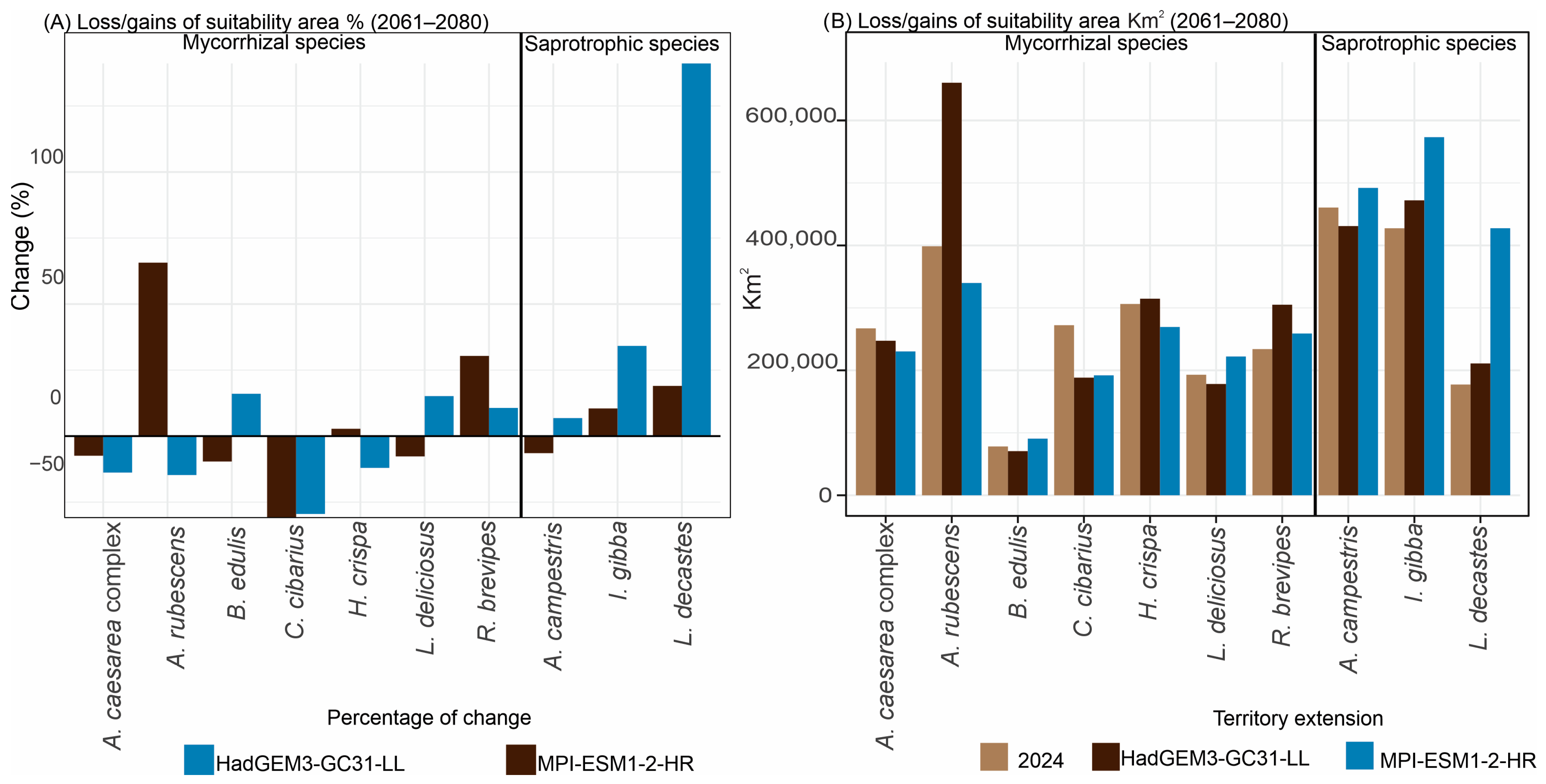
The results were represented through suitability maps, while bar plots created with ggplot2 (version 3.5.1) [106] show the partial ROC values obtained for each species in both the present and future models. The values of the bioclimatic variables with the highest contribution for each species, as well as the percentage and territory extension (Km2) of gains and losses with 70% and the 10th percentile thresholds, are also displayed for each model.
The following statistical analyses were conducted in RStudio, using the climate change scenarios and land use and vegetation variables. This unified approach enables the comparison of complex patterns across different ecological contexts through consistent methods for dimensionality reduction, classification, and statistical evaluation [107,108]. Although the same analysis (PCA, clustering, and heatmaps) were applied to both set of variables, they were analyzed separately due to the availability of future projections only for climate variables.

2.6. Statistical Analysis of Climate Change Scenarios

A multivariate data matrix was constructed from the percentage changes in the area of environmental suitability for ten edible fungal species estimated under different future climate scenarios. The matrix included 16 scenarios resulting from the combination of both time periods (2061–2080 and 2081–2100), suitability thresholds (70% and 10th percentiles) and climate scenarios (HadGEM3-GC31-LL and MPI-ESM1-2-HR).
The variables were standardized using the z-core transformation (mean = 0, standard deviation = 1), ensuring that the scenarios contributed equivalently to the analysis.
1.
Principal component analysis
The analysis was carried out using a standardized matrix to reduce data dimensionality [109] and to analyze the general patterns of species responses to projected changes in potential distribution. PCA allowed the identification of the main gradients of variation associated with changes in the environmental suitability thresholds.
2.
Cluster analysis
Cluster analyses were conducted based on the standardized matrix to group species according to their responses to climate models. Two complementary approaches were applied: a nonhierarchical clustering analysis through k-means, defining three groups; and a hierarchical analysis using Euclidean distance and Ward’s linkage method. The number of groups was established to distinguish species with contrasting responses, classified as “Resilient”, “Unstable” or “Highly sensitive”.
3.
Heatmaps
To facilitate visual interpretation, heatmaps were generated, allowing positive and negative deviations of each species across the different climate scenarios to be highlighted and enabling the identification of patterns of gain or loss in environmental suitability.
4.
PERMANOVA
To evaluate whether the species groups identified through cluster analysis exhibited statistically significant differences in their responses, a permutational multivariate analysis of variance (PERMANOVA) was performed. This analysis was applied to the matrix of percentage changes using Euclidean distance and 999 permutations, which allowed us to test whether the observed variation in changes in environmental suitability was associated with the assignment of species to the different defined groups.
These comparisons were represented using scatter plots and boxplots to evaluate general differences in the variability of the projections depending on the threshold employed.

2.7. Statistical Analysis of Land Use and Vegetation Variables

Additionally, the relationships between the potential distributions of species and 14 land cover variables were extracted from the vectorial product Soil Use and Vegetation Series VI at 1:250,000 by the National Institute of Statistics and Geography (INEGI) [110]. For each species, a suitability map of the current scenario was generated, and areas were reclassified into a binary format using a 70% suitability threshold to define environmentally suitable versus unsuitable zones.
To quantify the relation between species and land cover, the mean values of each variable within environmentally suitable areas were calculated. This procedure produced a species-variable matrix, where rows correspond to species and columns represent land use and vegetation variables. Each value in the matrix reflects the environmental conditions experienced by the species within its suitable habitat. Prior to multivariate analyses, all variables were standardized using a z-transformation (mean = 0, standard deviation = 1) to ensure equal contribution of each variable to subsequent analyses.
1.
Principal component analysis
A PCA was performed on the standardized species-variable matrix containing land use and vegetation variables along with species distribution, with the purpose of reducing data dimensionality and identifying patterns in species responses to land use conditions, showing which variables, most strongly influenced the distribution of species.
2.
Cluster analysis
Based on this matrix, species were grouped using a nonhierarchical analysis (k-means), defining three groups. Additionally, a hierarchical analysis was performed using Euclidean distance and Ward’s linkage method to evaluate the consistency of the obtained clusters. The resulting clusters reflect similarities in species’ ecological affinities to land cover types and vegetation conditions.
3.
Heatmap
Multivariate patterns were visualized through a heatmap constructed from species standardized values, which allowed the identification of environmental variables with marked positive or negative deviations among the groups.
4.
PERMANOVA
We evaluated whether the differences responses between land use variables and species were statistically significant using Euclidean distance and 999 permutations.

3. Results

3.1. Bioclimatic Variables

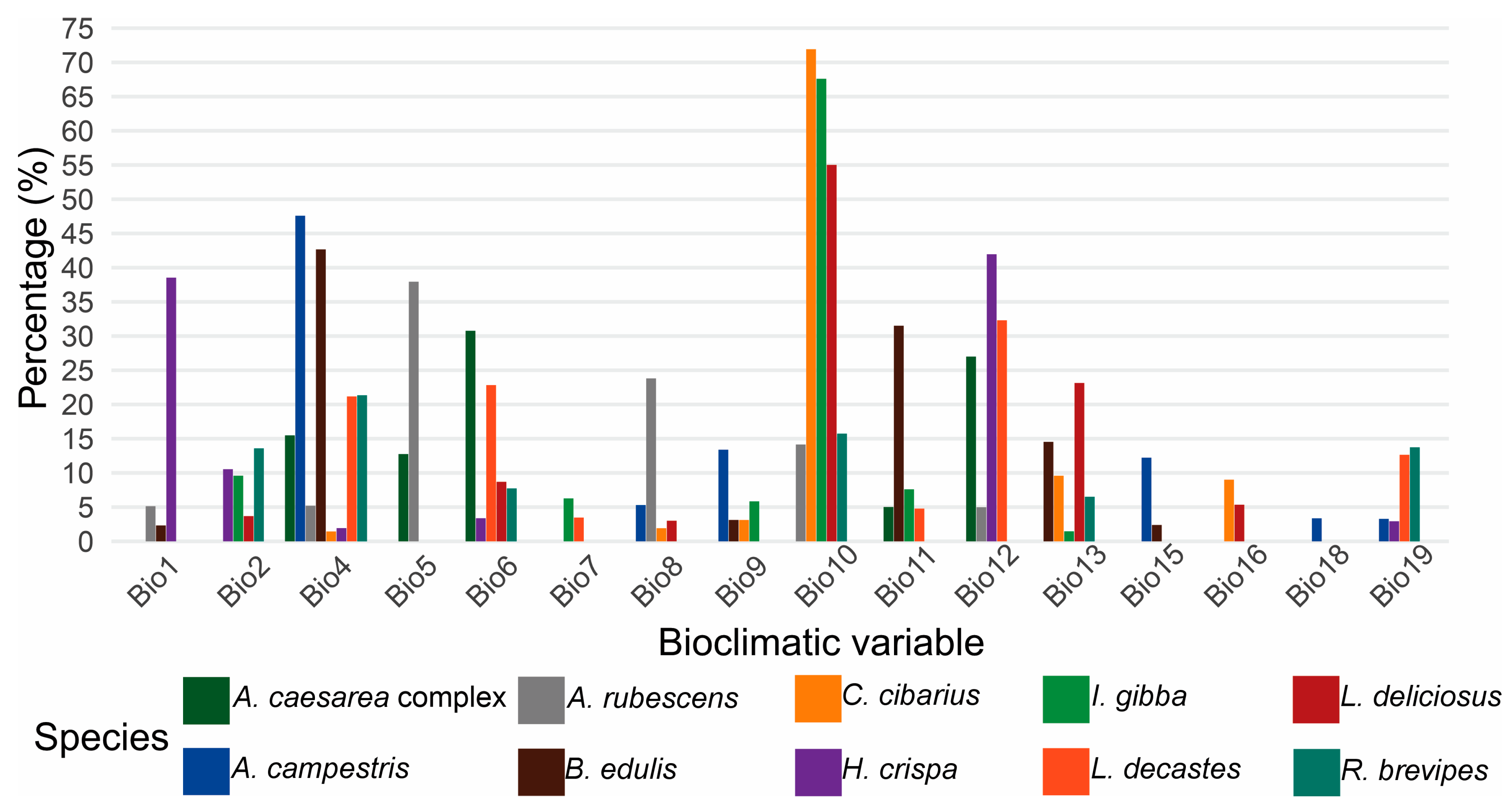
In general, seasonal temperature variables explain species distributions better than annual variables, particularly the mean temperature of the warmest quarter (BIO10) and temperature seasonality (BIO4). In contrast, annual variables such as annual mean temperature (BIO1), maximum temperature of the warmest month (BIO5), and temperature annual range (BIO7) had a less effect on species distributions.
Similarly, for precipitation, annual precipitation (BIO12) explained species distributions better than seasonal variables, such as the wettest month (BIO13) and precipitation of coldest quarter (BIO19) (Figure 1).
Among temperature variables, the mean temperature of warmest quarter (BIO10) explained the distribution of C. cibarius (71.929%), I. gibba (67.605%), L. deliciosus (55.019%), whereas R. brevipes (15.743%) and A. rubescens (14.153%) showed lower values.
Temperature seasonality (BIO4) was associated with a greater number of species, with high values for A. campestris (47.589%) and B. edulis (42%), intermediate values for L. decastes (21.182%), R. brevipes (21.349%), and low values for the Amanita caesarea complex (15.486%), A. rubescens (5.205%), C. cibarius (1.444%) and H. crispa (1.933%) (Table S1).
Annual mean temperature (BIO1) primarily explained the distribution of H. crispa (38.542%), whereas A. rubescens (5.137%) and B. edulis (2.322%) showed lower values. The maximum temperature in the warmest month (BIO5) was associated with A. rubescens (37.946%) and the A. caesarea complex (12.759%). The mean temperature of the coldest quarter (BIO11) influenced B. edulis (31.518%), I. gibba (7.604%), the A. caesarea complex (5.018%) and L. decastes (4.790%). The minimum temperature of the coldest month (BIO6) had an influence on the A. caesarea complex (30.774%), L. decastes (22.838%), L. deliciosus (8.703%), R. brevipes (7.739%) and H. crispa (3.378%).
The species associated with the mean temperature according to the Wettest Quarter (BIO8) were A. rubescens (23.818%), A. campestris (5.306%), L. deliciosus (3.014%) and C. cibarius (1.920%). For the mean diurnal range (BIO2), contributions were observed for R. brevipes (13.589%), H. crispa (10.545%), I. gibba (9.595%) and L. deliciosus (3.691%). The mean temperature of Driest Quarter (BIO9) explained the distribution of A. campestris (13.395%), I. gibba (5.845%), B. edulis (3.125%) and C. cibarius (3.125%). The temperature annual range (BIO7) influenced to I. gibba (6.279%) and L. decastes (3.476%).
With respect to the precipitation variables, the annual precipitation (BIO12) mainly explained the presence of H. crispa (41.962%), L. decastes (32.310%), the A. caesarea complex (27%) and with lower values for A. rubescens (4.988%). Precipitation in the wettest month (BIO13) was related to L. deliciosus (23.149%), B. edulis (14.539%), C. cibarius (9.592%), R. brevipes (6.517%) and I. gibba (1.462%).
Precipitation of Coldest Quarter (BIO19) was associated with R. brevipes (13.747%), L. decastes (12.650%), A. campestris (3.287%) and H. crispa (2.936%). Precipitation seasonality (BIO15) influenced A. campestris (12.228%) and B. edulis (2.390%). The species associated with the Precipitation of Wettest Quarter (BIO16) were C. cibarius (9.018%) and L. deliciosus (5.355%). Precipitation in the warmest quarter (BIO18) was associated with only A. campestris (3.362%). In contrast, isothermality (BIO3), Driest Month precipitation (BIO14) and Driest Quarter precipitation (BIO17) did not influence species presence.

3.2. Potential Distribution Modeling

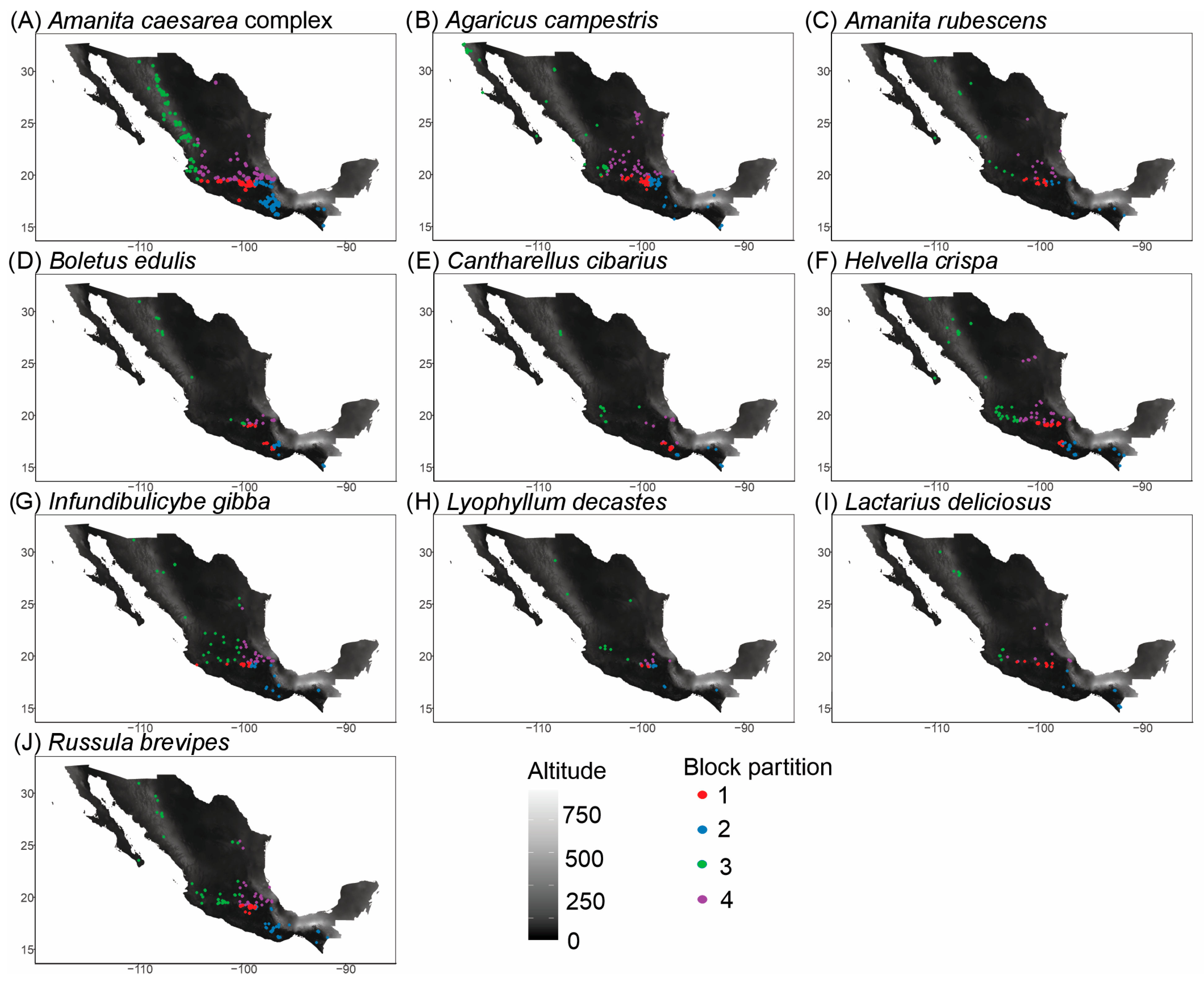
Spatial partitioning of the data using the block method allowed for a robust evaluation of model performance (Figure 2), as the four generated blocks homogeneously covered the study area. Occurrence points shown in the figure correspond to species presence records, while colors indicate the assignment of each record to the different spatial blocks used in the cross-validation procedure. Thus, the points represent species occurrences, whereas the colors denote the block to which each record was assigned.
The selection of block is not directly related to elevation but is based on the geographic distribution of occurrence records. Some blocks may exhibit a degree of spatial overlap or proximity, depending on the distribution of records within Mexico, as the blocks reflect the spatial structure of the data. Consequently, they may coincide with geographic regions or environmental gradients, such as mountainous, although they were not explicitly defined based on these characteristics.
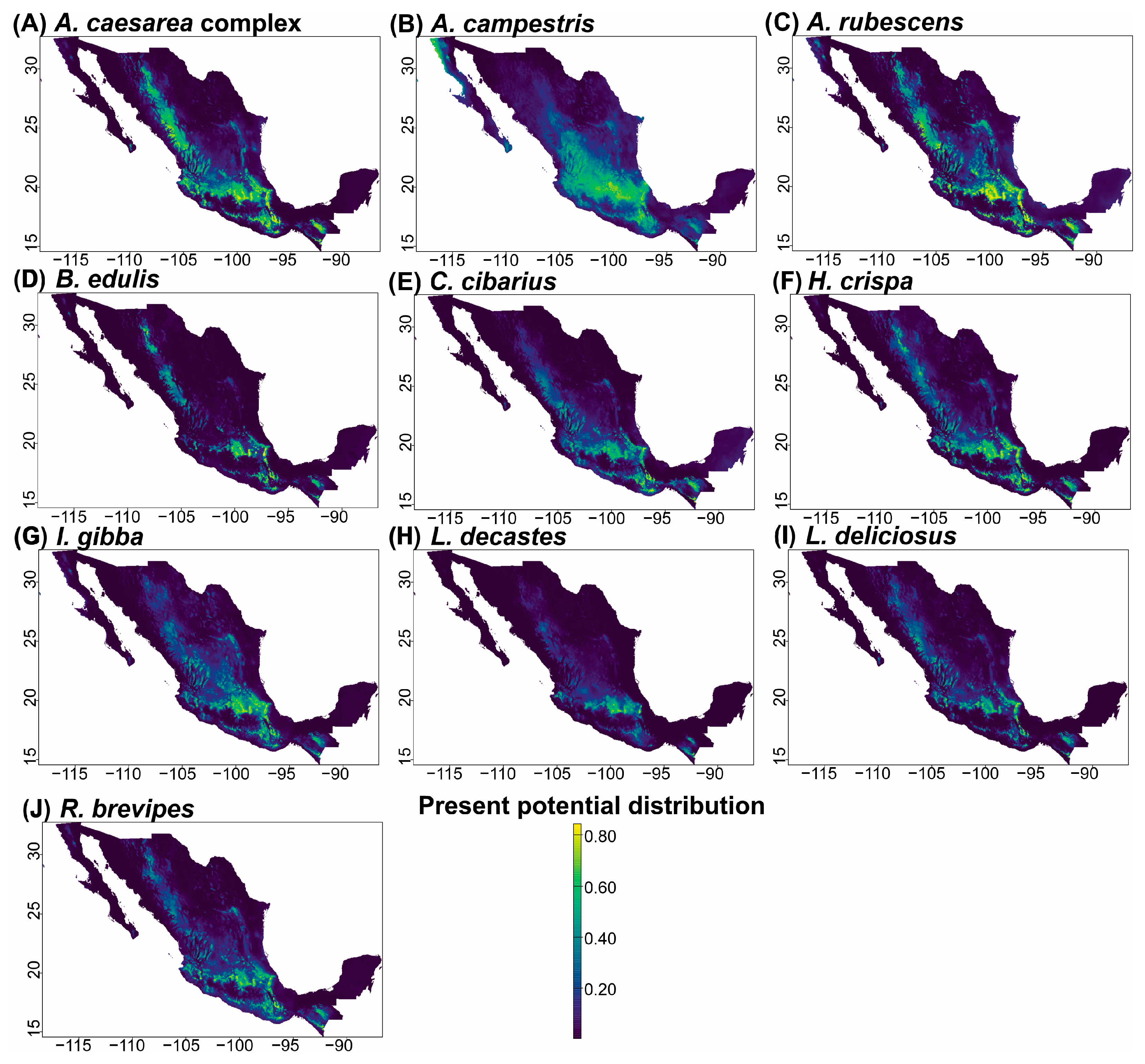
With respect to the biogeographic regions of Mexico, the ten species predominate in central-southern México, particularly within the Trans-Mexican Volcanic Belt. This pattern was especially evident in the central and eastern regions of the country, towards the Gulf of Mexico, where the states of Morelos, Puebla, Veracruz, Oaxaca and the State of Mexico exhibited the highest potential distributions (Figure 3). In northwestern Mexico, corresponding to the Sierra Madre Occidental Province in the states of Sonora, Sinaloa and Nayarit, the species A. caesarea complex, A. rubescens, and B. edulis exhibited high potential distributions compared to the other species.
In central Mexico, in an area corresponding to the southern Mexican Plateau (Altiplano Sur) A. campestris was highly prevalent in the states of Guanajuato, Aguascalientes and Zacatecas. In southern Mexico, within the Sierra Madre del Sur Province, Chiapas showed a high potential distribution for fungal species.
The combinations of the regularization multiplier (rm) and feature classes for each model were obtained according to ENMeval (Table S2). The models performed better than when randomized, as evidenced by the AUC values ranging from 0.90 to 0.99 and partial ROC values between 1.34 and 1.91 (Figure S1).

3.3. Future Distribution Modeling

In general, compared with the MPI-ESM1-2-HR model, which shows moderate changes, the HadGEM3-GC31-LL model tends to project more extreme changes in both losses and gains in suitable areas (Figures S2–S11). Regarding the suitability thresholds, two criteria were considered for comparison: the 70% threshold, as the most stringent, where at least one presence was recorded and which showed more pronounced losses; and the 10th percentile, as the more permissive threshold, where suitable habitat was higher, resulting in greater gains. In some cases, projected gains exceeded 100%, which reflects expansion into areas currently unsuitable rather than proportional increases within existing ranges. These values should therefore be interpreted as relative changes in environmental suitability rather than direct measures of population growth. The period with drastic changes in both losses and gains was 2081–2100.
Projected changes in environmental suitability varied considerably across climate models, temporal horizons, and threshold criteria, revealing strong species-specific responses (Figures S12–S21).

3.3.1. Period 2061–2080 (70% Threshold)

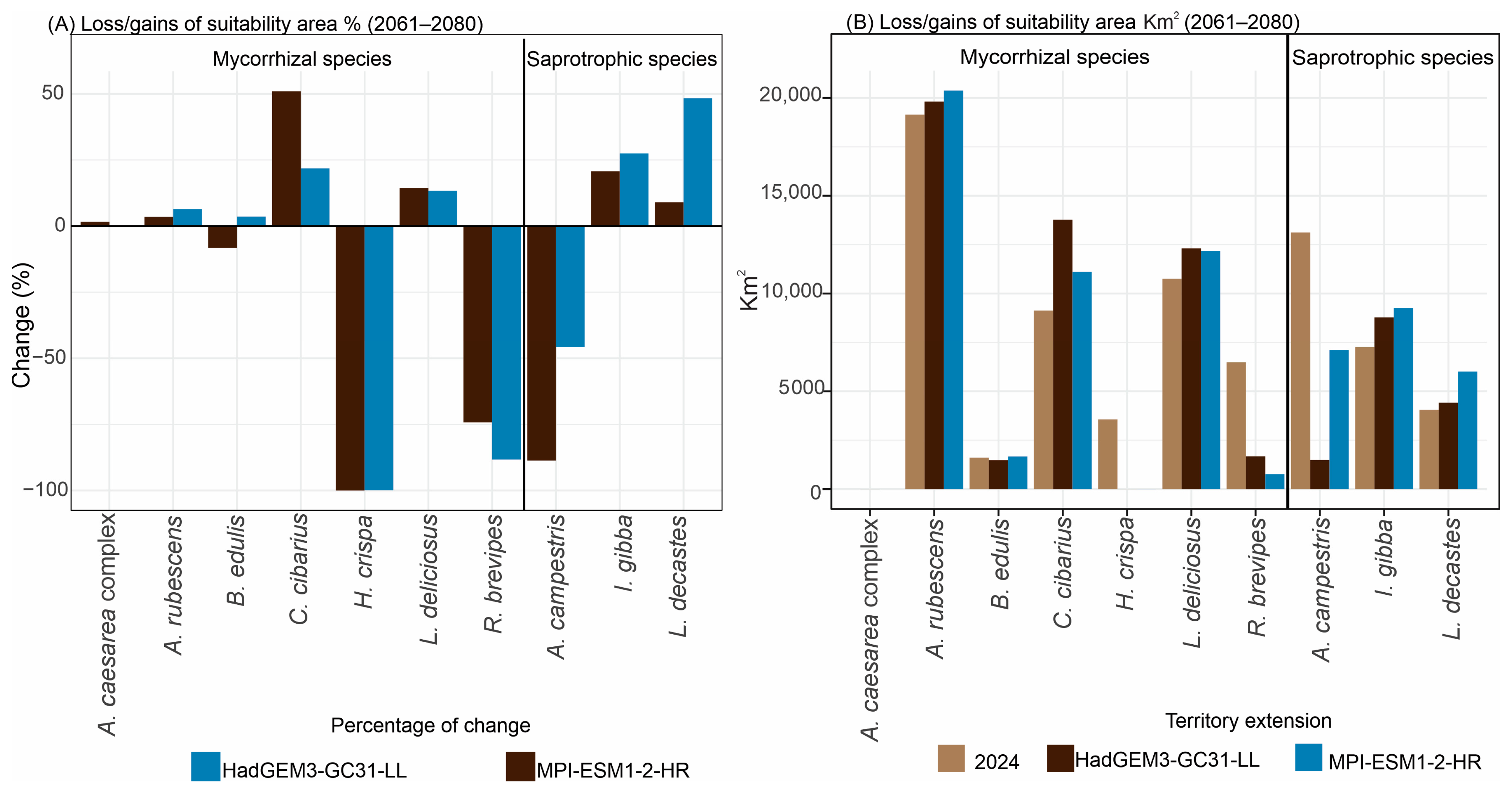
Under the HadGEM3-GC31-LL model, moderate gains were projected for C. cibarius (50.951%), I. gibba (20.710%), L. deliciosus (14.416%), and L. decastes (8.988%), while A. rubescens and the A. caesarea complex showed smaller expansions (3.494% and 1.610%, respectively). In contrast, substantial contractions were observed for H. crispa (99.977%), A. campestris (88.676%), and R. brevipes (74.244%), with a minor reduction in B. edulis (8.234%) (Figure 4).
The MPI-ESM1-2-HR model showed a similar pattern, with gains for L. decastes (48.352%), I. gibba (27.452%), and C. cibarius (21.797%), whereas H. crispa (99.916%) and R. brevipes (88.287%) again experienced marked losses. The A. caesarea complex remained stable under this model.

3.3.2. Period 2061–2080 (10th Percentile Threshold)

Using the more inclusive 10th percentile threshold, patterns shifted slightly. Under HadGEM3-GC31-LL, gains were recorded for A. rubescens (65.673%), R. brevipes (30.370%), and L. decastes (19.007%), whereas C. cibarius showed a contraction (30.839%). Under MPI-ESM1-2-HR, pronounced expansions were projected for L. decastes (141.112%) and I. gibba (34.158%), while contractions were observed for C. cibarius (29.474%) and A. rubescens (14.737%) (Figure 5). These results indicate that threshold selection substantially influences projected range dynamics.

3.3.3. Period 2081–2100 (70% Threshold)

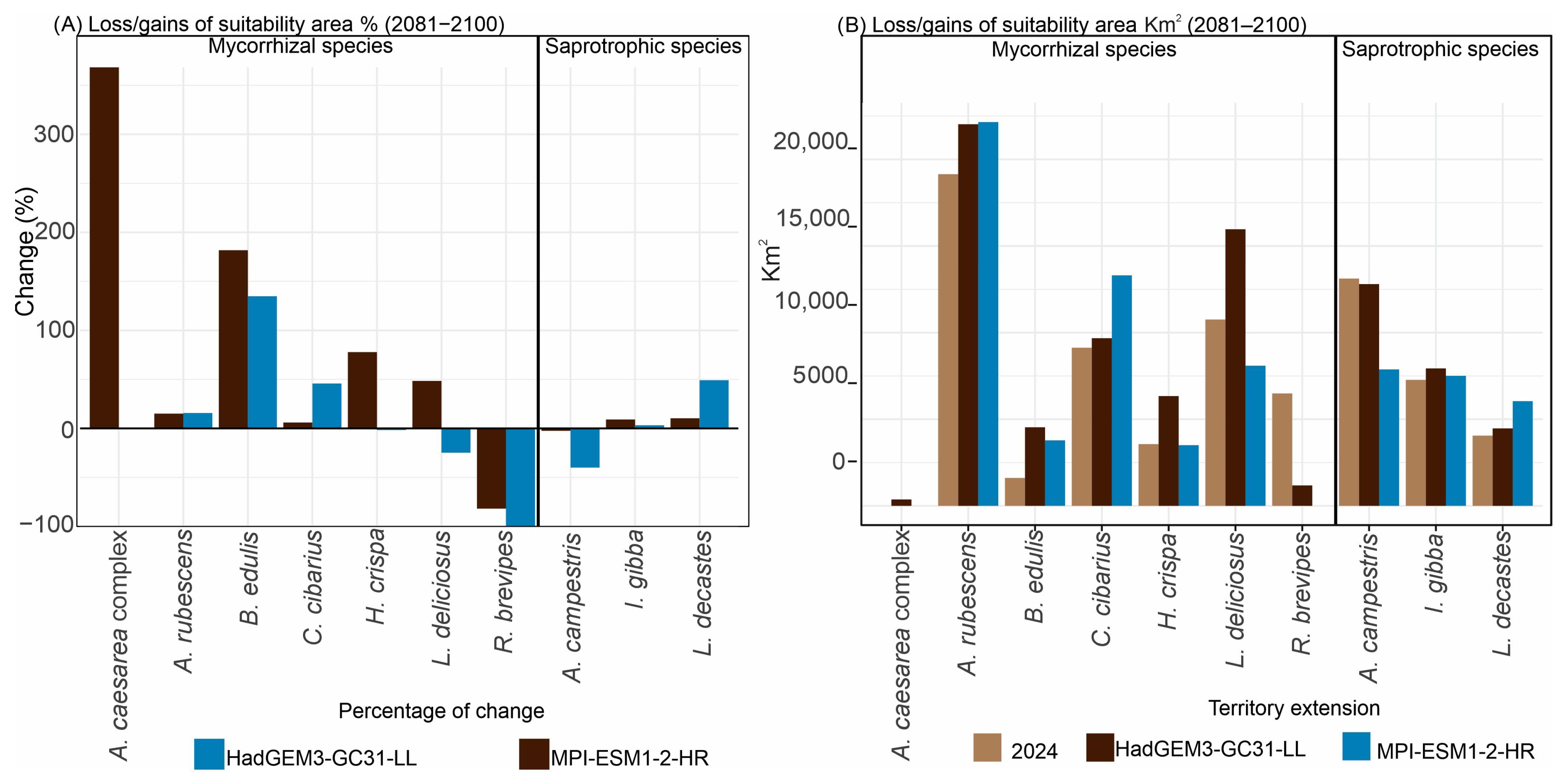
For the late-century period, the species that projected marked expansions of HadGEM3-GC31-LL were the A. caesarea complex (368.340%), B. edulis (181.755%), and H. crispa (77.826%), while R. brevipes experienced substantial losses (81.852%) (Figure 6). Under MPI-ESM1-2-HR, the gains were more moderate, primarily for B. edulis (134.839%), L. decastes (49.177%), and C. cibarius (45.789%), whereas R. brevipes showed complete contraction (100%).

3.3.4. Period 2081–2100 (10th Percentile Threshold)

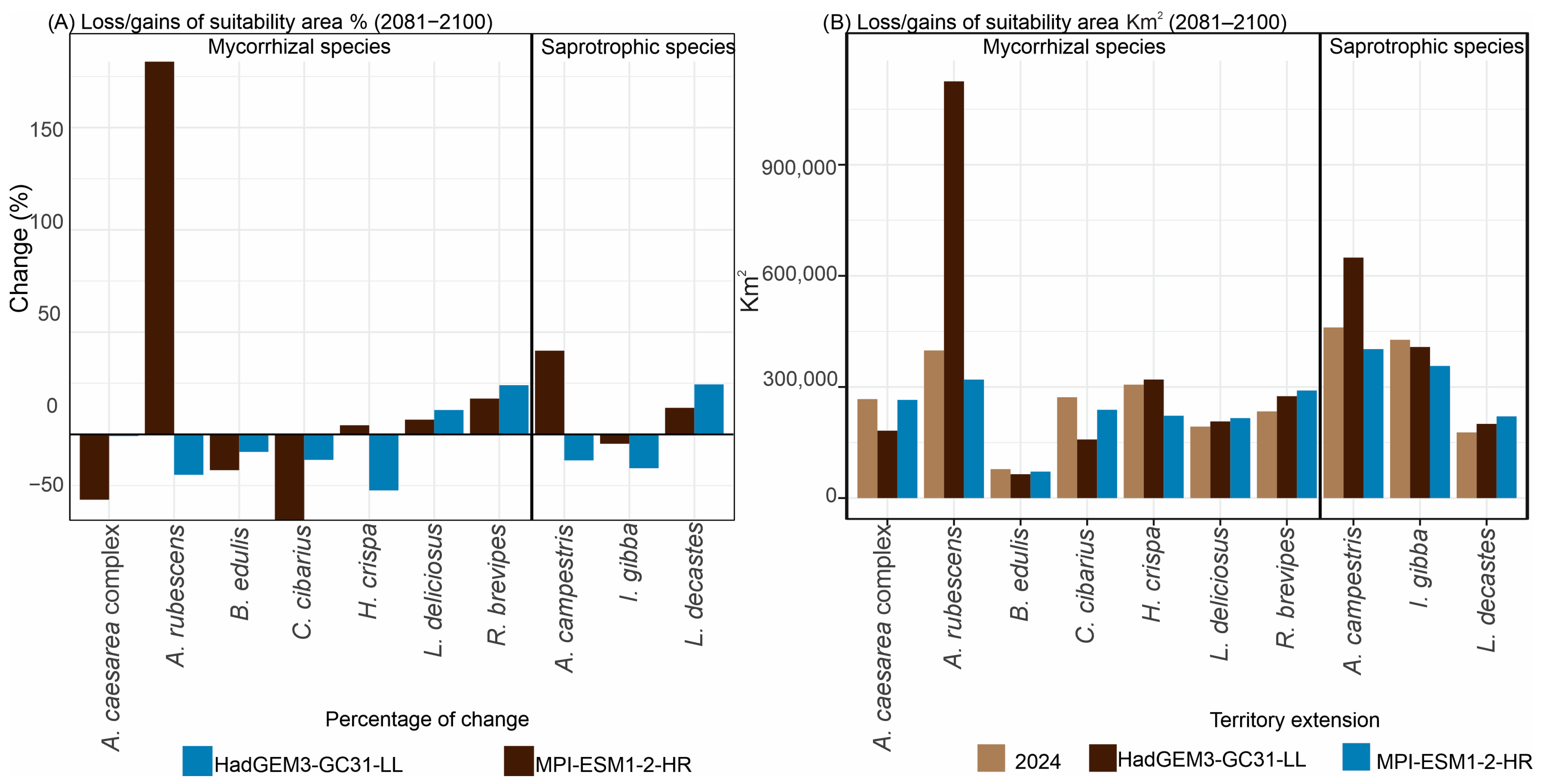
When the 10th percentile threshold was applied, large expansions of A. rubescens (182.225%) and moderate gains of A. campestris (40.925%) were projected in HadGEM3-GC31-LL, while losses were concentrated in C. cibarius (41.927%) and the A. caesarea complex (31.900%). In contrast, MPI-ESM1-2-HR projected limited gains, primarily for L. decastes (24.445%) and R. brevipes (24.094%), whereas most other species exhibited contractions (Figure 7).

3.4. Statistical Analysis of Climate Scenarios

1.
Principal component analysis (PCA)
Considering the changes in the area of environmental suitability under future climate scenarios, 59.6% of the total variation was explained by two components (PC1 = 34.1% and PC2 = 25.5%). The first component separated species according to the magnitude and direction of the projected changes across climate models, whereas the second component reflected differences in model responses. A separation was observed between species with extreme responses and those with moderate responses (Figure S22).
2.
Cluster analysis
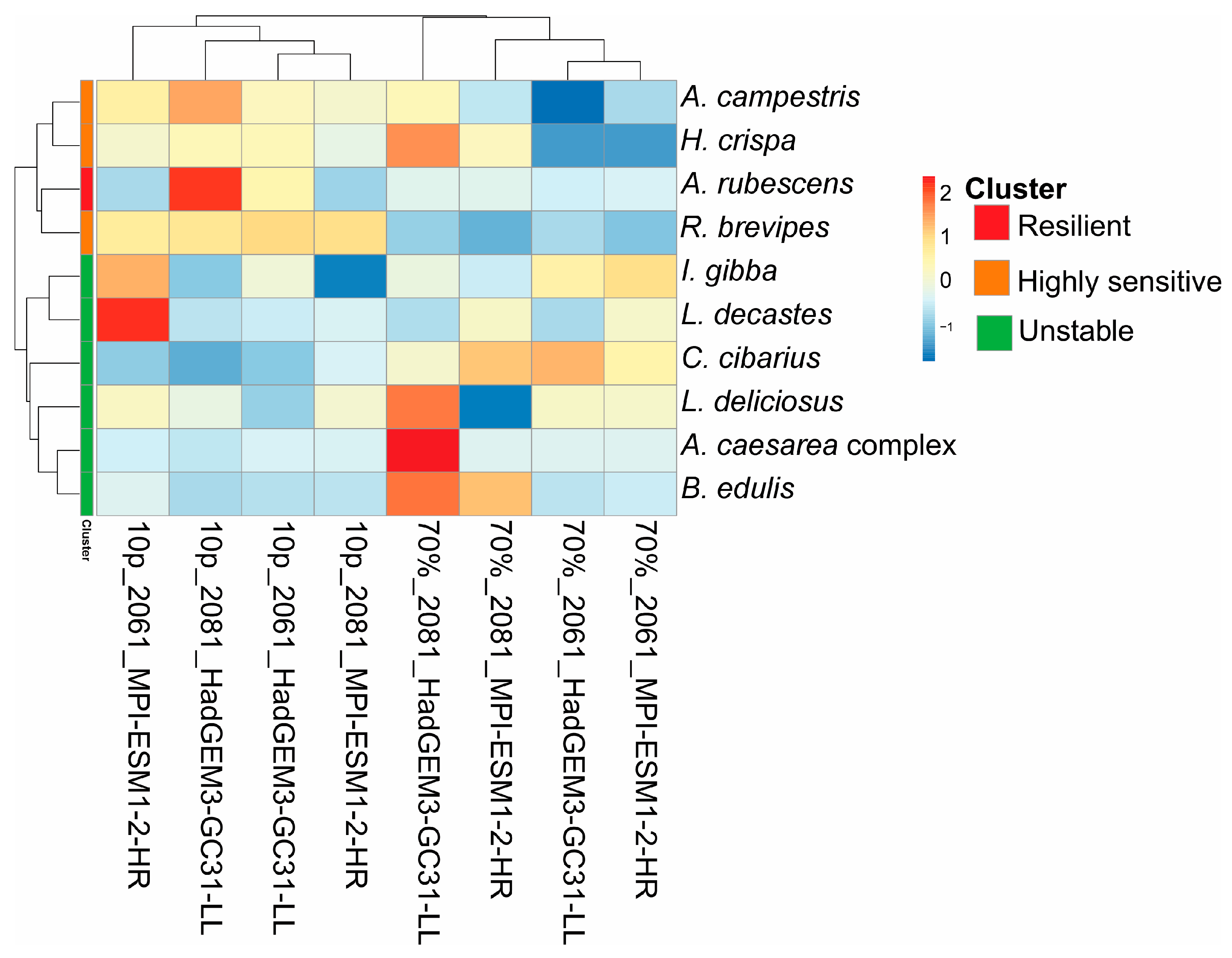
These analyses made it possible to identify three groups of species with different responses to future climate scenarios. Both the nonhierarchical analysis (k-means) and the hierarchical analysis (Ward’s method) showed consistent clustering patterns, allowing species to be assigned to the categories “Resilient”, “Unstable” and “Highly sensitive”.
The group of Resilient species corresponded to A. rubescens, as it showed moderate and stable changes in the area of environmental suitability.
The highly sensitive group included A. campestris, H. crispa and R. brevipes, which exhibited large-magnitude changes in environmental suitability under climate scenarios. These changes may involve losses or gains, with extreme values predominating rather than shifts in the direction of the response.
Finally, the unstable group was composed of the A. caesarea complex, B. edulis, C. cibarius, I. gibba, L. decastes and L. deliciosus, which exhibited alternating gains and losses in environmental suitability. They do not maintain a consistent trend, as they may benefit under some scenarios and be negatively affected by others. However, these changes do not always reach extreme values, suggesting that their main characteristic is a lack of consistency in the trend rather than the magnitude of change.
3.
Heatmap
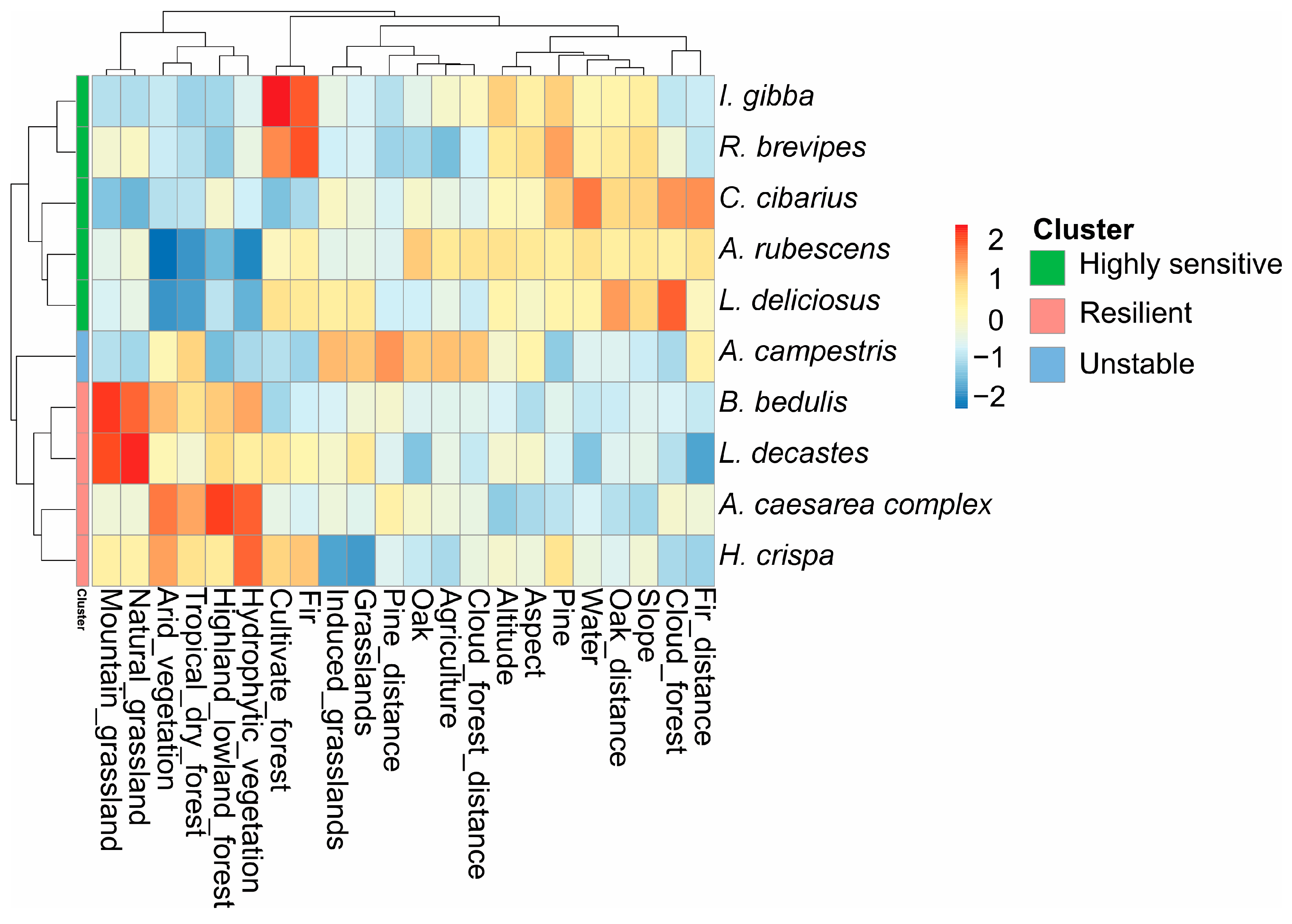
Each row corresponds to a species, and each column corresponds to a climate scenario; the results are expressed as a percentage gain or loss of area compared to the current scenario (Figure 8). Species showing gains in environmental suitability are shown in red-orange tones, whereas blue tones indicate negative values. When comparing the climate scenarios across both time periods, variation was driven more by the climate model than by the periods.
In addition, L. decastes increased its environmental suitability under the 10th percentile scenario for the 2061 period in MPI-ESM1-2-HR and A. rubescens under the 10th percentile scenario for the 2081 period in HadGEM3-GC31-LL. Species showing increased suitability under the 70% scenario for 2081 in HadGEM3-GC31-LL were the A. caesarea complex, L. deliciosus and B. edulis. In contrast, the species exhibiting decreased suitability were I. gibba under the 10th percentile scenario for 2081 in MPI-ESM1-2-HR, L. deliciosus under 70% for 2081 in MPI-ESM1-2-HR and A. campestris under 70% for 2061 in HadGEM3-GC31-LL.
4.
PERMANOVA
The analysis revealed statistically significant differences between the species groups according to the cluster analysis (F = 70.51; R2 = 0.95; p = 0.026), indicating that variations in environmental suitability were significantly associated with the classification of species as resilient, unstable or highly sensitive.

3.5. Statistical Analysis of Land Use and Vegetation Variables

1.
Principal component analysis (PCA)
The first two components together explained 79.5% of the total variation, with PC1 accounting for 52.6% and PC2 for 26.9%. Species responses along PC1 and PC2 showed clear separation. Negative PC1 values were observed for species in the A. caesarea complex, B. edulis, H. crispa and L. decastes, whereas R. brevipes, I. gibba C. cibarius, L. deliciosus and A. rubescens exhibited positive values. However, A. campestris displayed positive values on PC1 but extremely negative values on PC2, clearly separating it from the other species (Figure S23).
2.
Cluster analysis
The nonhierarchical analysis (k-means) grouped the species into three categories: “Resilient”, “Unstable” and “Highly sensitive”. The hierarchical analysis (Ward’s method) showed a clustering structure consistent with these groups.
The Resilient group consisted of species from the A. caesarea complex, B. edulis, H. crispa and L. decastes, which had homogeneous responses to land use and vegetation variables.
The highly sensitive group included A. rubescens and C. cibarius. I. gibba, L. deliciosus and R. brevipes exhibited more specific vegetation preferences.
The unstable group was composed of A. campestris and exhibited extreme responses to land use and vegetation variables.
3.
Heatmap
Positive values are shown in red, indicating above-average associations, while negative values are shown in blue, indicating below-average associations. The land use and vegetation variables exhibited distinct patterns among the species groups. The cover of cultivated forests, pine, oak and fir had positive values for species grouped as highly sensitive (I. gibba, R. brevipes, C. cibarius, A. rubescens and L. deliciosus). Similarly, topographic variables such as altitude, slope and aspect also contributed to positive associations but were weaker than those of cultivated forest and oak.
For the Resilient species, positive values were for hydrophilic vegetation, Tropical dry forest, highland and lowland forest, arid vegetation, and natural and mountain grassland.
In contrast, A. campestris had values above zero for induced grasslands and general grasslands; for the distance between pine trees; and for the distance between cloud forest trees, oak forests and agricultural areas (Figure 9).
4.
PERMANOVA
The analysis showed that differences in land use and vegetation variables among the species groups were statistically significant, as defined by the cluster analysis (F = 6.70; R2 = 0.66; p = 0.002). This indicates that multivariate variation in variables was significantly associated with the classification of species as resilient, highly sensitive or unstable.

4. Discussion

4.1. Climatic Determinants and Macrofungal Ecological Responses

Climatic factors such as temperature and precipitation are widely recognized as primary drivers of fungal distribution, development, and fruiting dynamics [111,112,113]. In this study, the mean temperature of the warmest quarter (BIO10), temperature seasonality (BIO4), and annual precipitation (BIO12) emerged as the most influential predictors of environmental suitability. These variables are ecologically meaningful because macrofungal productivity and mycelial growth are closely tied to seasonal thermal thresholds and soil moisture availability [114,115]. The strong contribution of BIO10 suggests that summer thermal regimes may function as physiological filters in mountainous systems such as the Trans-Mexican Volcanic Belt (TMVB), where steep altitudinal gradients generate rapid climatic transitions. Similar findings have been reported in fungal niche modeling studies showing that temperature extremes during the warmest periods significantly constrain macrofungal occurrence [116,117]. Species strongly associated with summer temperatures may therefore be particularly vulnerable under high-emission scenarios, where projected increases in heat intensity could exceed their tolerance limits. Precipitation-related variables further reinforce the importance of moisture-dependent processes in fungal ecology. Soil humidity regulates enzymatic activity, decomposition rates, and ectomycorrhizal symbiosis, and reductions in precipitation or altered rainfall seasonality can disrupt these interactions [118]. Taken together, these findings suggest that projected drought intensification may indirectly affect fungal distribution through substrate desiccation and changes in host plant dynamics. Taken together, these results confirm that the macrofungal distribution in central Mexico is structured by both thermal and hydric gradients, consistent with previous modeling efforts in Europe, Asia, and Africa [119,120,121].

4.2. Species-Specific Vulnerability and Niche Differentiation

Future projections revealed heterogeneous responses among species, allowing classification into resilient, unstable, and highly sensitive groups. This differentiation likely reflects variations in ecological strategy, niche breadth, and host specificity. Species categorized as highly sensitive (e.g., Helvella crispa, Agaricus campestris, and Russula brevipes) exhibited marked contraction under several scenarios. An additional ecological dimension that may explain these contrasting responses is the functional type of fungi. Ectomycorrhizal species, which depend on symbiotic associations with host trees, are more tightly linked to forest structure and composition, making them potentially more vulnerable to both climatic shifts and vegetation changes. In contrast, saprotrophic species, which rely on the decomposition of organic matter, may exhibit broader ecological tolerances and greater resilience to environmental variability. This functional differentiation may partly explain the higher sensitivity observed in species associated with forest ecosystems compared to those with more generalist ecological strategies. Such responses may indicate narrower climatic tolerances or stronger dependency on specific vegetation types, particularly temperate forest systems dominated by pine, oak, or fir species [122,123,124,125]. Fungal species with restricted ecological amplitudes have been shown to experience greater distributional shifts under climate change, particularly under high CO2 emission trajectories [126,127,128,129]. Conversely, species such as Lyophyllum decastes and Infundibulicybe gibba exhibited gains under multiple scenarios, suggesting broader climatic envelopes or greater ecological plasticity. Similar patterns of expansion under warming scenarios have been observed for fungal taxa with wider environmental tolerances [35,130,131]. These species may benefit from increased temperatures in currently cooler high-elevation areas, potentially expanding their suitable habitat range. The unstable group, characterized by alternating gains and losses, indicates redistribution rather than simple contraction or expansion. This pattern suggests that climate change may restructure spatial suitability rather than uniformly reduce it, shifting favorable conditions across mountain systems. Such redistribution dynamics have been documented in macrofungi responding to shifting temperature and precipitation gradients [132,133,134].

4.3. Climate Model Variability and Projection Uncertainty

Differences between the HadGEM3-GC31-LL and MPI-ESM1-2-HR projections highlight the influence of model-specific climatic assumptions on suitability outcomes. Global climate models differ in their representation of atmospheric circulation, precipitation variability, and temperature extremes, which can substantially affect regional projections in topographically complex areas [135,136,137]. In our results, variability between climate models appeared to influence projected changes more strongly than differences between temporal horizons (2061–2080 vs. 2081–2100). This emphasizes the importance of incorporating multiple GCMs to capture projection uncertainty and avoid overreliance on single-model outcomes. Similar variability among climate projections has been reported in fungal distribution studies across Mediterranean and tropical systems [135,138,139,140]. Rather than representing methodological limitations, projection variability should be interpreted as a range of plausible ecological features. From a sustainability perspective, adaptive management strategies must consider this uncertainty and incorporate flexible conservation planning.
The analysis with Maxent, using the ENMeval package, produces relatively stable models by selecting the optimal model according to variable complexity. However, because it relies only on presence data, uncertainties remain, as the environmental features may be inaccurate or change over time, raising questions about the suitability of the data for the predictors used [141,142,143]. The analysis of land use and vegetations was conducted independently, as no future projections are available and incorporating them into the model would add complexity, but since these variables are key for suitable habitat, they were included in the statistical analysis [144].

4.4. Interactions Between Climate, Land Use, and Vegetation Structure

The integration of land use and vegetation variables revealed that fungal suitability is not solely climate driven. Associations with pine, oak, fir forests, cultivated forests, and altitude indicate strong habitat dependency, particularly for species that form ectomycorrhizal relationships [126,127]. These findings suggest that climate-driven changes in environmental suitability are not acting in isolation but are strongly mediated by vegetation structure and land use patterns. Therefore, future distributions of edible fungi will likely depend on the interaction between climatic suitability and habitat availability, highlighting the importance of integrating both factors into predictive and conservation frameworks. Highly sensitive species exhibited stronger positive associations with specific forest types, suggesting limited tolerance to habitat alteration. Climate-induced stress combined with forest degradation or land use change could amplify vulnerability, particularly in fragmented landscapes within the TMVB [128]. Resilient species displayed broader associations across vegetation categories, including grasslands and hydrophilic vegetation, potentially reflecting more generalist ecological strategies. Such broader habitat associations may buffer species against localized disturbance, although this does not guarantee resilience under extreme climatic scenarios. These findings reinforce that the sustainable management of edible fungi must integrate both climatic suitability and forest integrity. Climatic projections alone cannot fully capture the ecological constraints governing fungal persistence.

4.5. Biocultural Implications and Sustainability Perspectives

Wild edible fungi in Mexico represent key components of socioecological systems, supporting food security, local economies, and traditional ecological knowledge in rural and indigenous communities [14,15,16,37,38,39]. Projected contractions in environmental suitability for certain species may translate into reduced availability for communities dependent on seasonal harvesting. Climate-driven distribution may alter the spatial availability of edible fungi, potentially shifting traditional harvesting zones or affecting accessibility. Similar concerns have been raised in studies linking climate change to biocultural resource vulnerability [25,26,126]. Conversely, projected gains in suitability for certain species suggest potential adaptive opportunities, provided that forest ecosystems remain structurally intact. Sustainable forest management, protection of high-elevation refugia, and maintenance of host tree diversity may enhance the resilience of fungal resources under future climate conditions. The incorporation of fungal species into climate adaptation frameworks aligns with broader sustainability goals, linking biodiversity conservation with ecosystem services and community livelihoods.

5. Conclusions

This study demonstrated that the potential distribution of edible fungi in the Trans-Mexican Volcanic Belt is strongly structured by seasonal thermal regimes and precipitation gradients, with the mean temperature of the warmest quarter emerging as a key determinant of environmental suitability. The influence of temperature seasonality and annual precipitation further highlights the sensitivity of macrofungi to climatic variability, particularly in mountainous systems characterized by steep environmental gradients. Current models confirm that the central and southern mountainous regions of Mexico represent core areas suitable for several culturally and ecologically important species. However, future projections under high-emission scenarios reveal heterogeneous and species-specific responses. While some taxa (Cantharellus cibarius, Infundibulicybe gibba, Lactarius deliciosus, and Lyophyllum decastes) may experience expansions in suitable habitats, others (Helvella crispa, Agaricus campestris, and Russula brevipes) experience substantial contractions, indicating differential climatic vulnerability. The variability observed between climate models and thresholds underscores the importance of incorporating projection uncertainty into conservation planning. Climate change is unlikely to produce uniform declines but may instead restructure the spatial configuration of suitable habitats, potentially shifting availability across elevational gradients and mountain systems. From a sustainability perspective, these findings suggest that the future availability of edible fungal resources will depend not only on climatic trends but also on the maintenance of forest integrity and vegetation structure. Integrating species-specific climatic sensitivity into adaptive forest management and regional conservation strategies will be essential for safeguarding both biodiversity and the biocultural practices that depend on these fungi under future climate scenarios.

Supplementary Materials

The following supporting information can be downloaded from https://www.mdpi.com/article/10.3390/su18073571/s1. Table S1. Bioclimatic variables with highest contribution for the fungi potential distribution. Table S2. Optimal model with regularization multiplier (rm) and combination of feature classes (fc) for the present and future (2061–2080 and 2081–2100) scenarios. Figure S1. Partial ROC analysis graph. Figure S2. Future modeling of Amanita caesarea complex. Figure S3. Future modeling of Agaricus campestris. Figure S4. Future modeling of Amanita rubescens. Figure S5. Future modeling of Boletus edulis. Figure S6. Future modeling of Cantharellus cibarius. Figure S7. Future modeling of Helvella crispa. Figure S8. Future modeling of Infundibulicybe gibba. Figure S9. Future modeling of Lyophyllum decastes. Figure S10. Future modeling of Lactarius deliciosus. Figure S11. Future modeling of Russula brevipes. Figure S12. PCA analysis comparing the HadGEM3-GC31-LL and MPI-ESM1-2-HR models. Figure S13. PCA analysis comparing the responses of the species with land use and vegetation variables. Figure S14. Territory loss model for Amanita caesarea complex. Figure S15. Territory loss model for Agaricus campestris. Figure S16. Territory loss model for Amanita rubescens. Figure S17. Territory loss model for Boletus edulis. Figure S18. Territory loss model for Cantharellus cibarius. Figure S19. Territory loss model for Helvella crispa. Figure S20. Territory loss model for Infundibulicybe gibba. Figure S21. Territory loss model for Lyophyllum decastes. Figure S22. Territory loss model for Lactarius deliciosus. Figure S23. Territory loss model for Russula brevipes.

Author Contributions

Conceptualization, A.S.-G., C.B.-A. and A.S.; methodology, A.S.-G. and A.S.; software, A.S.; validation, A.S.-G., C.Z.-G. and A.S.; formal analysis, A.S.; investigation, A.S.-G. and C.Z.-G.; resources, C.B.-A. and A.S.; data curation, A.S.-G.; writing—original draft preparation, A.S.-G. and A.S.; writing—review and editing, C.B.-A., C.Z.-G. and A.S.; visualization, A.S.; supervision, C.B.-A. and A.S.; project administration, C.B.-A.; funding acquisition, C.B.-A. and A.S. All authors have read and agreed to the published version of the manuscript.

Funding

This work was supported by the Secretary of Research and Advanced Studies (SYEA) of the Universidad Autónoma del Estado de México (grants to AS: 7194/2025CIB and CZG: 7443/2026CIB). The funders had no role in the study design, data collection and analysis, decision to publish, or preparation of the manuscript.

Institutional Review Board Statement

Not applicable.

Informed Consent Statement

Not applicable.

Data Availability Statement

The data that support the findings of this study are available from the corresponding author on request.

Acknowledgments

We sincerely thank the editors and anonymous reviewers for their valuable comments and suggestions, which greatly improved the quality of this manuscript. A.S. (Armando Sunny): Adahy Olun Contreras-García, te quiero mucho, y recuerda que soy tu papá.

Conflicts of Interest

The authors declare no conflicts of interest.

Abbreviations

The following abbreviations are used in this manuscript:
TMVBTrans-Mexican Volcanic Belt
AICcAkaike Information Criteria Corrected
AUCArea Under Curve
rmRegulation Multiplier
fcFeature Classes
GCMGlobal Climate Models
PCAPrincipal Components Analysis

References

  1. Weiskopf, S.R.; Rubenstein, M.A.; Crozier, L.G.; Gaichas, S.; Griffis, R.; Halofsky, J.E.; Hyde, K.J.W.; Morelli, T.L.; Morisette, J.T.; Muñoz, R.C.; et al. Climate change effects on biodiversity, ecosystems, ecosystem services, and natural resource management in the United States. Sci. Total Environ. 2020, 733, 137782. [Google Scholar] [CrossRef] [PubMed]
  2. Kumar, A.; Nagar, S.; Anand, S. Climate change and existential threats. In Global Climate Change; Elsevier: Amsterdam, The Netherlands, 2021; pp. 1–31. [Google Scholar] [CrossRef]
  3. Leemans, R.; Nunez, S.; Alkemade, R. Biological diversity and climate change. In Climate Change; Elsevier: Amsterdam, The Netherlands, 2021; pp. 541–559. [Google Scholar] [CrossRef]
  4. Jiménez, O.R.; Bornemann, A.C.; Medina, Y.E.; Romero, K.; Bravo, J.R. Prospects of biological inputs as a measure for reducing crop losses caused by climate change effects. J. Agric. Food Res. 2023, 14, 100689. [Google Scholar] [CrossRef]
  5. Podkolzina, I.; Tenishchev, A.; Gornostaeva, Z.; Tekeeva, H.; Tandelova, O. Assessment of threats to environmental security and climate change. In BIO Web of Conferences; EDP Sciences: Les Ulis, France, 2023; Volume 63, p. 04002. [Google Scholar] [CrossRef]
  6. Aliyeva, A. Conservation methods of some Brassicaceae Burnett species in the flora of Nakhchivan Autonomous Republic considering global climate change. Nat. Sci. 2024, 4, 51. [Google Scholar]
  7. Hegerl, G.C.; Brönnimann, S.; Cowan, T.; Friedman, A.R.; Hawkins, E.; Iles, C.; Müller, W.; Schurer, A.; Undorf, S. Causes of climate change over the historical record. Environ. Res. Lett. 2019, 14, 123006. [Google Scholar] [CrossRef]
  8. Mikhaylov, A.; Moiseev, N.; Aleshin, K.; Burkhardt, T. Global climate change and greenhouse effect. Entrep. Sustain. Issues 2020, 7, 2897. [Google Scholar] [CrossRef]
  9. IPCC. Sixth Assessment Report: Climate Change 2023; Synthesis Report; IPCC: Geneva, Switzerland, 2023; Available online: https://www.ipcc.ch/report/sixth-assessment-report-cycle/ (accessed on 25 February 2026).
  10. Bellard, C.; Bertelsmeier, C.; Leadley, P.; Thuiller, W.; Courchamp, F. Impacts of climate change on the future of biodiversity. Ecol. Lett. 2012, 15, 365–377. [Google Scholar] [CrossRef]
  11. Procházka, P.; Soukupová, J.; Tomšík, K., Jr.; Mullen, K.J.; Čábelková, I. Climatic factors affecting wild mushroom foraging in central Europe. Forests 2023, 14, 382. [Google Scholar] [CrossRef]
  12. Hyde, K.D.; Noorabadi, M.T.; Thiyagaraja, V.; He, M.Q.; Johnston, P.R.; Wijesinghe, S.N.; Armand, A.; Biketova, A.Y.; Chethana, K.W.T.; Erdoğdu, M.; et al. The 2024 outline of fungi and fungus-like taxa. Mycosphere 2024, 15, 5146–6239. [Google Scholar] [CrossRef]
  13. Wijayawardene, N.N.; Hyde, K.D.; Mikhailov, K.V.; Goto, B.T.; Santiago, A.L.C.M.A.; Tokarev, Y.S.; Elshahed, M.S.; Madrid, H.; Pires-Zottarelli, C.L.A.; Pawłowska, J.; et al. Families of non-Dikarya fungi. Mycosphere 2025, 16, 4063–4445. [Google Scholar] [CrossRef]
  14. Montoya, A.; Briones-Dumas, E.; Núñez-López, R.A.; Kong, A.; Ortíz-Hernández, V.; Moreno-Fuentes, Á. Los hongos conocidos por la comunidad Yuhmu de Ixtenco, Tlaxcala, México. Sci. Fungorum 2019, 49, 1230. [Google Scholar] [CrossRef]
  15. Molina-Castillo, E.; Thomé-Ortiz, H.; Espinoza-Ortega, A. Conocimiento ecológico tradicional y aprovechamiento de los hongos comestibles silvestres en el centro de México. Agro Prod. 2019, 12, 5. [Google Scholar] [CrossRef]
  16. Pérez-Moreno, J.; Guerin-Laguette, A.; Rinaldi, A.C.; Yu, F.; Verbeken, A.; Hernández-Santiago, F.; Martínez-Reyes, M. Edible mycorrhizal fungi of the world: What is their role in forest sustainability, food security, biocultural conservation and climate change? Plants People Planet 2021, 3, 471–490. [Google Scholar] [CrossRef]
  17. Villaseñor, J.L.; Meave, J.A. Floristics in Mexico today: Insights into a better understanding of biodiversity in a megadiverse country. Bot. Sci. 2022, 100, 14–33. [Google Scholar] [CrossRef]
  18. Mastretta-Yanes, A.; Moreno-Letelier, A.; Piñero, D.; Jorgensen, T.H.; Emerson, B.C. Biodiversity in the Mexican highlands and the interaction of geology, geography and climate within the Trans-Mexican Volcanic Belt. J. Biogeogr. 2015, 42, 1586–1600. [Google Scholar] [CrossRef]
  19. Pérez-Miranda, R. Distribución del Abies religiosa (Kunth) Schltdl. & Cham. bajo escenarios de cambio climático en el Eje Neovolcánico, México. Agro Prod. 2017, 10, 8. [Google Scholar]
  20. Díaz-Garcia, J.M.; de la Vega-Pérez, A.D.; Navarro-Noya, Y.; Ramírez-Ponce, A.; Guillén, S.; Esparza-Carlos, J.P.; Hereira-Pacheco, S.; Martínez y Pérez, J.L.; Moctezuma, V.; Juárez-Díaz, M.; et al. Biodiversity between volcanoes: A multitaxa analysis to identify priority conservation areas in a highly fragmented landscape of the Trans-Mexican Volcanic Belt. J. Nat. Conserv. 2025, 84, 126852. [Google Scholar] [CrossRef]
  21. Chanona-Gómez, F.; Andrade-Gallegos, R.H.; Castellanos-Albores, J.; Sánchez, J.E. Macrofungi from Parque Educativo Laguna Bélgica, Municipality of Ocozocoautla de Espinosa, Chiapas, Mexico. Rev. Mex. Biodivers. 2007, 78, 369–381. [Google Scholar]
  22. Reverchon, F.; María del Ortega-Larrocea, P.; Pérez-Moreno, J. Saprophytic fungal communities change in diversity and species composition across a volcanic soil chronosequence at Sierra del Chichinautzin, Mexico. Ann. Microbiol. 2010, 60, 217–226. [Google Scholar] [CrossRef]
  23. Arriola-Padilla, V.J.; Estrada-Martínez, E.; Ortega-Rubio, A.; Pérez-Miranda, R.; Gijón-Hernández, A.R. Deterioro en áreas naturales protegidas del centro de México y del Eje Neovolcánico Transversal. Investig. Cienc. 2014, 22, 37–49. [Google Scholar]
  24. Valenzuela, R.; Luna-Vega, I.; Martínez-Pineda, M.; Martínez-González, C.R.; García-Jiménez, J.; de la Fuente, J.; Bautista-Hernández, S.; Acosta-Castellanos, S.; Raymundo, T. Novelties in macrofungi of the tropical montane cloud forest in Mexico. J. Fungi 2023, 9, 477. [Google Scholar] [CrossRef]
  25. Diez, J.; Kauserud, H.; Andrew, C.; Heegaard, E.; Krisai-Greilhuber, I.; Senn-Irlet, B.; Høiland, K.; Egli, S.; Büntgen, U. Altitudinal upward shifts in fungal fruiting in the Alps. Proc. Biol. Sci. 2020, 287, 20192348. [Google Scholar] [CrossRef]
  26. Kauserud, H.; Heegaard, E.; Büntgen, U.; Halvorsen, R.; Egli, S.; Senn-Irlet, B.; Stenseth, N.C. Warming-induced shift in European mushroom fruiting phenology. Proc. Natl. Acad. Sci. USA 2012, 109, 14488–14493. [Google Scholar] [CrossRef]
  27. Faticov, M.; Amorim, J.H.; Abdelfattah, A.; van Dijk, L.J.; Carvalho, A.C.; Laforest-Lapointe, I.; Tack, A.J. Local climate, air quality and leaf litter cover shape foliar fungal communities on an urban tree. Ambio 2024, 53, 1673–1685. [Google Scholar] [CrossRef]
  28. Zhang, Y.; Xie, Y.; Ma, H.; Zhang, J.; Jing, L.; Wang, Y.; Li, J. The influence of climate warming and humidity on plant diversity and soil bacteria and fungi diversity in desert grassland. Plants 2021, 10, 2580. [Google Scholar] [CrossRef]
  29. Zhang, Y.; Li, X.; Zhang, J.; Hua, J.; Li, J.; Liu, D.; Bhople, P.; Ruan, H.; Yang, N. Desertification induced changes in soil bacterial and fungal diversity and community structure in a dry-hot valley forest. Appl. Soil Ecol. 2023, 189, 104953. [Google Scholar] [CrossRef]
  30. Wollan, A.K.; Bakkestuen, V.; Kauserud, H.; Gulden, G.; Halvorsen, R. Modeling and predicting fungal distribution patterns using herbarium data. J. Biogeogr. 2008, 35, 2298–2310. [Google Scholar] [CrossRef]
  31. Yu, H.; Wang, T.; Skidmore, A.; Heurich, M.; Bässler, C. 50 years of cumulative open-source data confirm stable and robust biodiversity distribution patterns for macrofungi. J. Fungi 2022, 8, 981. [Google Scholar] [CrossRef]
  32. Yu, H.; Wang, T.; Skidmore, A.; Heurich, M.; Bässler, C. The critical role of tree species and human disturbance in determining the macrofungal diversity in Europe. Glob. Ecol. Biogeogr. 2021, 30, 2084–2100. [Google Scholar] [CrossRef]
  33. Wang, X.W.; Zhou, L.W. Spatiotemporal pattern of a macrofungal genus Phylloporia (Basidiomycota) revealing its adaptive evolution in China. J. Fungi 2024, 10, 780. [Google Scholar] [CrossRef] [PubMed]
  34. Moullec, F.; Barrier, N.; Drira, S.; Guilhaumon, F.; Hattab, T.; Peck, M.A.; Shin, Y.J. Using species distribution models only may underestimate climate change impacts on future marine biodiversity. Ecol. Model. 2022, 464, 109826. [Google Scholar] [CrossRef]
  35. Vasconcelos, R.N.; Cantillo-Pérez, T.; Franca Rocha, W.J.; Aguiar, W.M.; Mendes, D.T.; de Jesus, T.B.; de Santana, C.O.; de Santana, M.M.M.; Oliveira, R.P. Advances and challenges in species ecological niche modeling: A mixed review. Earth 2024, 5, 963–989. [Google Scholar] [CrossRef]
  36. Tsiftsis, S.; Štípková, Z.; Rejmánek, M.; Kindlmann, P. Predictions of species distributions based only on models estimating future climate change are not reliable. Sci. Rep. 2024, 14, 25778. [Google Scholar] [CrossRef]
  37. Fiorentino, D.; Núñez-Riboni, I.; Pierce, M.E.; Oesterwind, D.; Akimova, A. Improving species distribution models for climate change studies: Ecological plausibility and performance metrics. Ecol. Model. 2025, 508, 111207. [Google Scholar] [CrossRef]
  38. Fois, M.; Cuena-Lombraña, A.; Fenu, G.; Bacchetta, G. Using species distribution models at local scale to guide the search of poorly known species: Review, methodological issues and future directions. Ecol. Model. 2018, 385, 124–132. [Google Scholar] [CrossRef]
  39. Kafash, A.; Ghobadnejhad, M. Modeling the impacts of climate change on geographic distribution of the genus Trametes. J. Clim. Reserch 2024, 1403, 1–9. [Google Scholar]
  40. Peng, Y.; Zhuo, Z.; Qian, Q.; Xu, D. Optimized Maxent model predicts future suitable habitats for Chinese caterpillar fungus under climate change. Agriculture 2025, 15, 1144. [Google Scholar] [CrossRef]
  41. Morera, A.; de Aragón, J.M.; De Cáceres, M.; Bonet, J.A.; de-Miguel, S. Historical and future spatially explicit climate change impacts on mycorrhizal and saprotrophic macrofungal productivity in Mediterranean pine forests. Agric. For. Meteorol. 2022, 319, 108918. [Google Scholar] [CrossRef]
  42. Pietras, M.; Kolanowska, M.; Selosse, M.A. Quo vadis? Historical distribution and impact of climate change on the worldwide distribution of the Australasian fungus Clathrus archeri (Phallales, Basidiomycota). Mycol. Prog. 2021, 20, 299–311. [Google Scholar] [CrossRef]
  43. Tiamiyu, B.B.; Lateef, A.A.; Ajadi, I.; Adeyemi, S.B.; Owolabi, P.O.; Sagaya, A.; AbdulSalam, M.; AbdulKareem, K.A.; Mustapha, O.T. Bioclimatic modeling of current geographic distribution and future range shifts of selected edible mushrooms in Nigeria. Sahel J. Life Sci. FUDMA 2024, 2, 51–61. [Google Scholar] [CrossRef]
  44. Sánchez-Ramírez, S.; Tulloss, R.E.; Guzmán-Dávalos, L.; Cifuentes-Blanco, J.; Valenzuela, R.; Estrada-Torres, A.; Ruán-Soto, F.; Díaz-Moreno, R.; Hernández-Rico, N.; Torres-Gómez, M.; et al. In and out of refugia: Historical patterns of diversity and demography in the North American Caesar’s mushroom species complex. Mol. Ecol. 2015, 24, 5938–5956. [Google Scholar] [CrossRef] [PubMed]
  45. Ruiz-Almenara, C.; Gándara, E.; Gómez-Hernández, M. Comparación de la diversidad y composición de especies de macrohongos entre áreas de recolección intensiva de hongos y áreas sin recolección en Oaxaca, Mexico. PeerJ 2019, 7, e8325. [Google Scholar] [CrossRef]
  46. López-García, A.; Pérez-Moreno, J.; Jiménez-Ruiz, M.; Ojeda-Trejo, E.; Delgadillo-Martínez, J.; Hernández-Santiago, F. Conocimiento tradicional de hongos de importancia biocultural en siete comunidades de la región chinanteca del estado de Oaxaca, México. Sci. Fungorum 2020, 50, e1280. [Google Scholar] [CrossRef]
  47. Santos-Silva, C.; Natário, B.; Pita, R. Fine-Scale Environmental Heterogeneity Shapes Post-Fire Macrofungal Richness in a Mediterranean Relict Forest. Fire 2025, 8, 438. [Google Scholar] [CrossRef]
  48. Montoya, A.; Hernández-Totomoch, O.; Estrada-Torres, A.; Kong, A.; Caballero, J. Traditional knowledge about mushrooms in a Nahua community in the state of Tlaxcala, México. Mycologia 2003, 95, 793–806. [Google Scholar] [CrossRef] [PubMed]
  49. Bautista-Nava, E. Taxonomía y Conocimiento Tradicional de Cantharellus Fr. (Fungi, Cantharellaceae) en el Nornoreste del Estado de Hidalgo. Bachelor’s Thesis, Universidad Autónoma del Estado de Hidalgo, Pachuca, Mexico, 2007. Available online: http://dgsa.uaeh.edu.mx:8080/bibliotecadigital/handle/231104/110 (accessed on 25 February 2026).
  50. Mora, V.M.; Martínez-Carrera, D. Investigaciones básicas, aplicadas y socioeconómicas sobre el cultivo de setas Pleurotus spp. en México. Ecosur 2007, 68–110. Available online: https://hongoscomestiblesymedicinales.com/Mexico/UAEM/P.pdf (accessed on 25 February 2026).
  51. Lorenzana-Fernández, A. Caracterización de Microhábitats de Hongos Comestibles Ectomicorrízicos en Bosques de Pino, Oyamel y Encino en los Parques Nacionales Izta-Popo y Zoquiapan. Master’s Thesis, Colegio de Postgraduados, Montecillo, Mexico, 2008. Available online: http://colposdigital.colpos.mx:8080/jspui/bitstream/handle/10521/1253/Lorenzana_Fernandez_A_MC_Edafologia_2008.pdf?sequence=1&isAllowed=y (accessed on 25 February 2026).
  52. Estrada-Martínez, E.; Guzmán, G.; Cibrián Tovar, D.; Ortega Paczka, R. Contribución al conocimiento etnomicológico de los hongos comestibles silvestres de mercados regionales y comunidades de la Sierra Nevada (México). Interciencia 2009, 34, 25–33. [Google Scholar]
  53. Hernández-Rico, G.N.; Moreno-Fuentes, Á. Hongos comestibles del género Amanita en el mercado de Acaxochitlán, Hidalgo, México. Etnobiología 2010, 8, 31–38. [Google Scholar]
  54. Isidoro-Reséndiz, D.G. Importancia Cultural de Los Hongos Comestibles en el Municipio de Tepehuacán de Guerrero, Hidalgo. Bachelor’s Thesis, Universidad Autónoma del Estado de Hidalgo, Pachuca, Mexico, 2011. Available online: http://dgsa.uaeh.edu.mx:8080/jspui/bitstream/231104/4070/1/AT15780.pdf (accessed on 25 February 2026).
  55. Burrola-Aguilar, C.; Montiel, O.; Garibay-Orijel, R.; Zizumbo-Villarreal, L. Conocimiento tradicional y aprovechamiento de los hongos comestibles silvestres en la región de Amanalco, Estado de México. Rev. Mex. Micología 2012, 35, 1–16. [Google Scholar]
  56. García-Jiménez, J.; Singer, R.; Estrada, E.; Garza-Ocañas, F.; Valenzuela, R. Two new species of the genus Boletus (Boletales: Agaricomycetes) in Mexico. Rev. Mex. Biodivers. 2013, 84, 152–162. [Google Scholar] [CrossRef]
  57. Jiménez-González, M.; Romero-Bautista, L.; Villavicencio-Nieto, M.A.; Pérez-Escandón, B.E. Los hongos comestibles de la región de Molango de Escamilla, Hidalgo, México. Estud. Científicos Estado Hidalgo Zonas Aledañas 2013, 2, 69–79. [Google Scholar]
  58. Lara-Vázquez, F.; Romero-Contreras, A.T.; Burrola-Aguilar, C. Conocimiento tradicional sobre los hongos silvestres en la comunidad otomí de San Pedro Arriba; Temoya, Estado de México. Agric. Soc. Desarro. 2013, 10, 305–326. [Google Scholar]
  59. del Moral Cervantes, P. Productividad y Estrategias de Aprovechamiento de Hongos Comestibles en Cafetales del Centro de Veracruz. Master’s Thesis, Universidad Veracruzana, Veracruz, Mexico, 2015. Available online: https://www.uv.mx/mcef/files/2018/04/Productividad-y-estrategias-de-aprovechamiento-de-hongos-comestibles-en-cafetales-de-Veracruz.pdf (accessed on 25 February 2026).
  60. Domínguez-Romero, D.; Arzaluz-Reyes, J.I.; Valdés-Valdés, C.; Romero-Popoca, N.P. Uso y manejo de hongos silvestres en cinco comunidades del municipio de Ocoyoacac, Estado de México. Trop. Subtrop. Agroecosyst. 2015, 18, 133–143. [Google Scholar]
  61. Servín Campuzano, L.S.; Alarcón-Cháires, P.E. Conocimiento tradicional de los hongos silvestres comestibles en la comunidad p’urhépecha de Comachuén, Nahuatzen, Michoacán. Acta Univ. 2018, 28, 15–29. [Google Scholar] [CrossRef]
  62. Jaime Salinas, M. Etnomicología y Taxonomía de Hongos Comestibles del Género Lyophyllum (P. Karst) en Tlaxcala. Master’s Thesis, Universidad Autónoma de Tlaxcala, Tlaxcala, Mexico, 2019. Available online: https://repositorio.uatx.mx:8443/bitstream/DSyTI_UATx/456/1/Jaime%20Salinas%20Maricarmen.pdf (accessed on 25 February 2026).
  63. Torres Preciado, C.O.; Rodríguez Alcántar, O.; Herrera-Fonseca, M.D.J.; Figueroa-García, D. Catálogo de la micobiota del Complejo Volcánico de Colima, México. Acta Bot. Mex. 2020. [Google Scholar] [CrossRef]
  64. Ramírez-Terrazo, A.; Montoya, A.; Kong, A. Conocimiento micológico tradicional en dos comunidades aledañas al Parque Nacional Lagunas de Montebello, Chiapas, México. Sci. Fungorum 2021, 51, 1–12. [Google Scholar] [CrossRef]
  65. Rescendiz, T. Propiedades Nutricionales y Potencial Nutracéutico de Hongos Comestibles del Municipio de Zaragoza, Puebla. Doctoral Dissertation, Universidad Autónoma Chapingo, Texcoco, Mexico, 2023. Available online: https://www.researchgate.net/profile/Tonathiu-Rescendiz/publication/379076803_Propiedades_nutricionales_y_potencial_nutraceutico_de_hongos_comestibles_del_municipio_de_Zaragoza_Puebla/links/65f9c759f3b56b5b2d14ddf9/Propiedades-nutricionales-y-potencial-nutraceutico-de-hongos-comestibles-del-municipio-de-Zaragoza-Puebla.pdf (accessed on 25 February 2026).
  66. GBIF.org. Cantharellus cibarius: (28 September 2024). GBIF Occurrence Download. Available online: https://doi.org/10.15468/dl.6ggyk3 (accessed on 25 February 2026).
  67. GBIF.org. Amanita rubescens: (28 September 2024). GBIF Occurrence Download. Available online: https://doi.org/10.15468/dl.4ghfah (accessed on 25 February 2026).
  68. GBIF.org. Helvella crispa: (28 September 2024). GBIF Occurrence Download. Available online: https://doi.org/10.15468/dl.4ghfah (accessed on 25 February 2026).
  69. GBIF.org. Boletus edulis: (28 September 2024). GBIF Occurrence Download. Available online: https://doi.org/10.15468/dl.5ufgyv (accessed on 25 February 2026).
  70. GBIF.org. Agaricus campestris: (29 September 2024). GBIF Occurrence Download. Available online: https://doi.org/10.15468/dl.hxtcfa (accessed on 25 February 2026).
  71. GBIF.org. Lactarius deliciosus: (29 September 2024). GBIF Occurrence Download. Available online: https://doi.org/10.15468/dl.zgudu8 (accessed on 25 February 2026).
  72. GBIF.org. Lyophyllum decastes: (2 October 2024). GBIF Occurrence Download. Available online: https://doi.org/10.15468/dl.rxpz4g (accessed on 25 February 2026).
  73. GBIF.org. Infundibulicybe gibba: (3 October 2024). GBIF Occurrence Download. Available online: https://doi.org/10.15468/dl.zvtb5u (accessed on 25 February 2026).
  74. GBIF.org. Russula brevipes: (3 October 2024). GBIF Occurrence Download. Available online: https://doi.org/10.15468/dl.m8h2dw (accessed on 25 February 2026).
  75. GBIF.org. Amanita caesarea sensu lato: (30 September 2024). GBIF Occurrence Download. Available online: https://doi.org/10.15468/dl.tvv7w9 (accessed on 25 February 2026).
  76. GBIF.org. Amanita bassii: (30 September 2024). GBIF Occurrence Download. Available online: https://doi.org/10.15468/dl.896daf (accessed on 25 February 2026).
  77. GBIF.org. Amanita tullossi: (30 September 2024). GBIF Occurrence Download. Available online: https://doi.org/10.15468/dl.3gpesu (accessed on 25 February 2026).
  78. GBIF.org. Amanita yema: (30 September 2024). GBIF Occurrence Download. Available online: https://doi.org/10.15468/dl.q4sjsr (accessed on 25 February 2026).
  79. Van Proosdij, A.S.; Sosef, M.S.; Wieringa, J.J.; Raes, N. Minimum required number of specimen records to develop accurate species distribution models. Ecography 2016, 39, 542–552. [Google Scholar] [CrossRef]
  80. Osorio-Olvera, L.; Lira-Noriega, A.; Soberón, J.; Peterson, A.T.; Falconi, M.; Contreras-Díaz, R.G.; Martinez-Meyer, E.; Barve, V.; Barve, N. Ntbox: An R package with graphical user interface for modeling and evaluating multidimensional ecological niches. Methods Ecol. Evol. 2020, 11, 1199–1206. [Google Scholar] [CrossRef]
  81. Guzmán, G.; Ramírez-Guillén, F. The Amanita Caesarea-Complex; Gebrüder Borntraeger Verlagsbuchhandlung: Stuttgart, Germany, 2001; Volume 187, p. v–66. ISBN 3-443-59089-6. [Google Scholar]
  82. Harmaja, H. Notes on Clitocybe s. lato (Agaricales). Ann. Bot. Fenn. 2003, 40, 213–218. [Google Scholar]
  83. Zhang, Y.; Mao, N.; Li, T.; Fan, L. Two new species of Infundibulicybe (Omphalinaceae, Agaricales) from northern China. Phytotaxa 2024, 649, 193–210. [Google Scholar] [CrossRef]
  84. Beel, F. A Big White Mess: Delimiting Species Within Russula Subgenus Brevipedum. Master’s Thesis, Ghent University, Ghent, Belgium, 2020. Available online: https://libstore.ugent.be/fulltxt/RUG01/002/945/573/RUG01-002945573_2021_0001_AC.pdf (accessed on 25 February 2026).
  85. Song, J.; Li, H.; Wu, S.; Chen, Q.; Yang, G.; Zhang, J.; Chen, B. Morphological and molecular evidence for two new species within Russula subgenus Brevipes from China. Diversity 2022, 14, 112. [Google Scholar] [CrossRef]
  86. Fick, S.E.; Hijmans, R.J. WorldClim 2: New 1 km spatial resolution climate surfaces for global land areas. Int. J. Climatol. 2017, 37, 4302–4315. [Google Scholar] [CrossRef]
  87. Hijmans, R.J. Raster: Geographic Data Analysis and Modeling. R Package version 3.6-32. Available online: https://github.com/rspatial/raster (accessed on 25 February 2026).
  88. Hijmans, R.J. Terra: Spatial Data Analysis. R Package version 1.8-29. Available online: https://cran.r-project.org/web/packages/terra (accessed on 25 February 2026).
  89. Posit Team. RStudio: Integrated Development Environment for R, Posit Software; PBC: Boston, MA, USA, 2024. Available online: http://www.posit.co/ (accessed on 25 February 2026).
  90. Yuan, H.-S.; Wei, Y.-L.; Wang, X.G. Maxent modeling for predicting the potential distribution of Sanghuang, an important group of medicinal fungi in China. Fungal Ecol. 2015, 17, 140–145. [Google Scholar] [CrossRef]
  91. Schnase, J.L.; Carroll, M.L.; Gill, R.L.; Tamkin, G.S.; Li, J.; Strong, S.L.; Spradlin, C.S. Toward a Monte Carlo approach to selecting climate variables in Maxent. PLoS ONE 2021, 16, e0237208. [Google Scholar] [CrossRef] [PubMed]
  92. Muscarella, R.; Galante, P.J.; Soley-Guardia, M.; Boria, R.A.; Kass, J.M.; Uriarte, M.; Anderson, R.P. ENM eval: An R package for conducting spatially independent evaluations and estimating optimal model complexity for Maxent ecological niche models. Methods Ecol. Evol. 2014, 5, 1198–1205. [Google Scholar] [CrossRef]
  93. Hijmans, R.J. Cross-validation of species distribution models: Removing spatial sorting bias and calibration with a null model. Ecology 2012, 93, 679–688. [Google Scholar] [CrossRef]
  94. Roberts, D.R.; Bahn, V.; Ciuti, S.; Boyce, M.S.; Elith, J.; Guillera-Arroita, G.; Hauenstein, S.; Lahoz-Monfort, J.J.; Thuiller, W.; Warton, D.I.; et al. Cross-validation strategies for data with temporal, spatial, hierarchical, or phylogenetic structure. Ecography 2017, 40, 913–929. [Google Scholar] [CrossRef]
  95. Kass, J.M.; Muscarella, R.; Galante, P.J.; Bohl, C.L.; Pinilla-Buitrago, G.E.; Boria, R.A.; Soley-Guardia, M.; Anderson, R.P. ENMeval 2.0: Redesigned for customizable and reproducible modeling of species’ niches and distributions. Methods Ecol. Evol. 2021, 12, 1602–1608. [Google Scholar] [CrossRef]
  96. Mushagalusa, C.A.; Fandohan, A.B.; Glèlè Kakaï, R. Random forest and spatial cross-validation performance in predicting species abundance distributions. Environ. Syst. Res. 2024, 13, 23. [Google Scholar] [CrossRef]
  97. Valavi, R.; Elith, J.; Lahoz-Monfort, J.J.; Guillera-Arroita, G. blockCV: An R package for generating spatially or environmentally separated folds for k-fold cross-validation of species distribution models. Methods Ecol. Evol. 2019, 10, 225–232. [Google Scholar] [CrossRef]
  98. Huang, H.; Zhang, Z.; Bede-Fazekas, Á.; Mammola, S.; Gu, J.; Zhou, J.; Qu, J.; Lin, Q. Cross-validation matters in species distribution models: A case study with goatfish species. Ecography 2025, 2025, e07354. [Google Scholar] [CrossRef]
  99. Phillips, S. Maxnet: Fitting ‘Maxent’ Species Distribution Models with ‘Glmnet’. R Package version 0.1.4. Available online: https://CRAN.R-project.org/package=maxnet (accessed on 25 February 2026).
  100. Cobos, M.E.; Peterson, A.T.; Barve, N.; Osorio-Olvera, L. kuenm: An R package for detailed development of ecological niche models using Maxent. PeerJ 2019, 7, e6281. [Google Scholar] [CrossRef] [PubMed]
  101. Martínez-Sifuentes, A.R.; Villanueva-Diaz, J.; Manzanilla-Quinones, U.; Becerra-Lopez, J.L.; Hernandez-Herrera, J.A.; Estrada-Avalos, J.; Velazquez-Perez, A.H. Spatial modeling of the ecological niche of Pinus greggii Engelm. (Pinaceae): A species conservation proposal in Mexico under climatic change scenarios. iForest Biogeosciences For. 2020, 13, 426. [Google Scholar] [CrossRef]
  102. Cavazos, T.; De Grau, P. Estudio Para la Incorporación de Nuevas Variables en los Escenarios de Cambio Climático Para México Utilizados en la Quinta Comunicación Nacional. Parte I: Análisis de Variables Atmosféricas (Históricas y Escenarios de Cambio Climático); Centro de Investigación Científica y de Educación Superior de Ensenada (CICESE)/Instituto Nacional de Ecología y Cambio Climático (INECC): Ensenada, Mexico, 2014; Available online: https://www.gob.mx/cms/uploads/attachment/file/658254/108_2014_Estudio_variables_Cambio_Climatico_Mexico_5CN_1.pdf (accessed on 25 February 2026).
  103. Sunny, A.; Marmolejo, C.; Vidal-López, R.; Falconi-Briones, F.A.; Cuervo-Robayo, Á.P.; Bolom-Huet, R. EcoNicheS: Enhancing ecological niche modeling, niche overlap and connectivity analysis using the shiny dashboard and R package. PeerJ 2025, 13, e19136. [Google Scholar] [CrossRef]
  104. de la Fuente, A.; Hirsch, B.T.; Cernusak, L.A.; Williams, S.E. Predicting species abundance by implementing the ecological niche theory. Ecography 2021, 44, 1723–1730. [Google Scholar] [CrossRef]
  105. Pearson, R.G.; Raxworthy, C.J.; Nakamura, M.; Townsend Peterson, A. Predicting species distributions from small numbers of occurrence records: A test case using cryptic geckos in Madagascar. J. Biogeogr. 2007, 34, 102–117. [Google Scholar] [CrossRef]
  106. Wickham, H. ggplot2: Elegant Graphics for Data Analysis; Springer: New York, NY, USA, 2016; ISBN 978-3-319-24277-4. Available online: https://ggplot2.tidyverse.org (accessed on 25 February 2026).
  107. Granato, D.; Santos, J.S.; Escher, G.B.; Ferreira, B.L.; Maggio, R.M. Use of principal component analysis (PCA) and hierarchical cluster analysis (HCA) for multivariate association between bioactive compounds and functional properties in foods: A critical perspective. Trends Food Sci Technol. 2018, 72, 83–90. [Google Scholar] [CrossRef]
  108. Tang, Z.Z.; Chen, G.; Alekseyenko, A.V. PERMANOVA-S: Association test for microbial community composition that accommodates confounders and multiple distances. Bioinformatics 2016, 32, 2618–2625. [Google Scholar] [CrossRef] [PubMed]
  109. Cayuela, L.; De la Cruz, R. Análisis de Datos Ecológicos en R.; Ediciones Mundi-Prensa: Madrid, Spain, 2022. [Google Scholar]
  110. National Institute of Statistics and Geography (INEGI). Vector Dataset of Land Use and Vegetation, Series VI (Union Layer), Scale 1:250,000; INEGI: Aguascalientes, Mexico, 2017; Available online: https://www.inegi.org.mx/app/biblioteca/ficha.html?upc=889463173359 (accessed on 25 February 2026).
  111. Janowski, D.; Leski, T. Factors in the distribution of mycorrhizal and soil fungi. Diversity 2022, 14, 1122. [Google Scholar] [CrossRef]
  112. Tuo, Y.; Rong, N.; Hu, J.; Zhao, G.; Wang, Y.; Zhang, Z.; Zhang, B. Exploring the relationships between macrofungi diversity and major environmental factors in Wunvfeng National Forest Park in Northeast China. J. Fungi 2022, 8, 98. [Google Scholar] [CrossRef]
  113. Guo, Y.; Li, X.; Zhao, Z.; Wei, H.; Gao, B.; Gu, W. Prediction of the potential geographic distribution of the ectomycorrhizal mushroom Tricholoma matsutake under multiple climate change scenarios. Sci. Rep. 2017, 7, 46221. [Google Scholar] [CrossRef] [PubMed]
  114. Li, X.; Rota, F.; Peter, M.; Gross, A.; Scherrer, D.; Baltensweiler, A. Integrating soil properties into species distribution models enhances predictive accuracy for terricolous macrofungi. J. Biogeogr. 2025, 52, e15124. [Google Scholar] [CrossRef]
  115. Wu, R.; Lyu, W.W.; Yu, F.; Fan, S.M.; Cui, S.P.; Gao, R.H. Predicting the suitable distribution of Russula griseocarnosa in China based on Maxent model. Ying Yong Sheng Tai Xue Bao (J. Appl. Ecol.) 2025, 36, 3105–3114. [Google Scholar] [CrossRef]
  116. Garza-Ocañas, F.; Carrillo-Parra, A. Climate change and its impact on future mycological panoramas in forest ecosystems in the North of Mexico. In Proceedings of the Gestión Forestal del Recurso Micológico, Simposio Internacional, Valladolid, Spain, 9–11 June 2011; Available online: https://www.researchgate.net/publication/273003898_Climate_change_and_its_impact_on_future_mycological_panoramas_in_forest_ecosystems_in_the_North_of_Mexico (accessed on 25 February 2026).
  117. Villegas-Gómez, F.G.; López-Caballero, I.; Fonseca-Alvarez, R. El hábitat de los hongos y su vulnerabilidad ante el cambio climático. Enseñanza Comun. Geocienc. 2023, 2, 33–37. [Google Scholar] [CrossRef]
  118. Cao, Y.T.; Lu, Z.P.; Gao, X.Y.; Liu, M.L.; Sa, W.; Liang, J.; Li, Z.H. Maximum entropy modeling the distribution area of Morchella dill. ex Pers. species in China under changing climate. Biology 2022, 11, 1027. [Google Scholar] [CrossRef]
  119. Cohen, S.D. Estimating the climate niche of Sclerotinia sclerotiorum using maximum entropy modeling. J. Fungi 2023, 9, 892. [Google Scholar] [CrossRef]
  120. Thornton, L.; da Cunha, K.M.; Drechsler-Santos, E.R.; Cristaldo, E.; Ortiz, A.; Urcelay, C.; Robledo, G. Mapping suitable habitat for the ‘Coco mushroom’, Phlebopus bruchii (Speg.) Heinem. & Rammeloo (Basidiomycota) in central Argentina: A case study integrating citizen science in fungal conservation. Discov. Conserv. 2025, 2, 48. [Google Scholar] [CrossRef]
  121. Aguirre-Acosta, E.; Ulloa, M.; Aguilar, S.; Cifuentes, J.; Valenzuela, R. Biodiversidad de hongos en México. Rev. Mex. Biodivers. 2014, 85, 76–81. [Google Scholar] [CrossRef]
  122. Del Olmo-Ruiz, M.; García-Sandoval, R.; Alcántara-Ayala, O.; Véliz, M.; Luna-Vega, I. Current knowledge of fungi from Neotropical montane cloud forests: Distributional patterns and composition. Biodivers. Conserv. 2017, 26, 1919–1942. [Google Scholar] [CrossRef]
  123. Sepúlveda, A.B.; Galicia, V.R.; Hudler, C.; Gallen, I.S.; Martínez, M.C.; Guzmán, G.B.; Sánchez, J.Á. La comunidad de hongos micorrizógenos arbusculares en diferentes usos de suelo del bosque tropical perennifolio de Veracruz, México. Rev. Mex. Biodivers. 2022, 93, 10. [Google Scholar] [CrossRef]
  124. Baeza-Guzmán, Y.; Vásquez-Jiménez, M.S.; Morgado-Viveros, E.; Sánchez-Landero, L.A.; Trejo-Aguilar, D. Ectomycorrhizal fungi associated with Pinus cembroides subsp. orizabensis, an endemic pine in the arid zones of the Oriental Basin, Puebla, Mexico. J. Fungi 2025, 11, 677. [Google Scholar] [CrossRef]
  125. Zamora-Martínez, M.C.; González Hernández, A.; Islas Gutiérrez, F.; Cortés Barrera, E.N.; López Valdez, L.I. Distribución geográfica y ecológica de 13 especies de hongos silvestres comestibles en Oaxaca. Rev. Mex. Cienc. For. 2014, 5, 76–93. [Google Scholar]
  126. Villagrán-Vázquez, A.; Garibay-Orijel, R.; Ureta, C. Distribution changes of the toxic mushroom Amanita phalloides under climate change scenarios and its potential risk over indigenous communities in Mexico. Atmósfera 2024, 38, 169–186. [Google Scholar] [CrossRef]
  127. Flores-Tolentino, M.; Ortiz, E.; Villaseñor, J.L. Ecological niche models as a tool for estimating the distribution of plant communities. Rev. Mex. Biodivers. 2019, 90. [Google Scholar] [CrossRef]
  128. Hao, T.; Guillera-Arroita, G.; May, T.W.; Lahoz-Monfort, J.J.; Elith, J. Using species distribution models for fungi. Fungal Biol. Rev. 2020, 34, 74–88. [Google Scholar] [CrossRef]
  129. Giraldo, D.C.; Kucuker, D.M. Ecological niche modeling of Lactarius deliciosus using the kuenm R package: Insights into habitat preferences. Fungal Biol. 2024, 128, 2022–2031. [Google Scholar] [CrossRef]
  130. Větrovský, T.; Kohout, P.; Kopecký, M.; Machac, A.; Man, M.; Bahnmann, B.D.; Brabcová, V.; Choi, J.; Meszárošová, L.; Human, Z.R.; et al. A meta-analysis of global fungal distribution reveals climate-driven patterns. Nat. Commun. 2019, 10, 5142. [Google Scholar] [CrossRef]
  131. Shiryaev, A.G. Uphill shifts of fungal fruiting due to climate change at the Polar Urals. Microorganisms 2021, 9, 1892. [Google Scholar] [CrossRef]
  132. Bahram, M.; Peay, K.G.; Tedersoo, L. Local-scale biogeography and spatiotemporal variability in communities of mycorrhizal fungi. New Phytol. 2015, 205, 1454–1463. [Google Scholar] [CrossRef]
  133. Li, S.A.; Yu, J.R.; Yuan, H.S. Climate change impacts on the distribution of valuable Thelephora fungi in China. iScience 2025, 28, 113522. [Google Scholar] [CrossRef]
  134. Zheng, Y.; Yuan, C.; Matsushita, N.; Lian, C.; Geng, Q. Analysis of the distribution pattern of the ectomycorrhizal fungus Cenococcum geophilum under climate change using the optimized Maxent model. Ecol. Evol. 2023, 13, e10565. [Google Scholar] [CrossRef]
  135. Bui, A.; Orr, D.; Lepori-Bui, M.; Konicek, K.; Young, H.S.; Moeller, H.V. Soil fungal community composition and functional similarity shift across distinct climatic conditions. FEMS Microbiol. Ecol. 2020, 96, fiaa193. [Google Scholar] [CrossRef]
  136. Soler Torres, E.; Lecha Estela, L.B. Efectos del calentamiento global sobre los procesos de la circulación atmosférica en el hemisferio Norte durante el periodo 1899–2019. Rev. Cuba. Meteorol. 2024, 30, 4. [Google Scholar]
  137. Cruz-González, A.; Arteaga-Ramírez, R.; Soria-Ruiz, J.; Sánchez-Cohen, I.; Monterroso-Rivas, A.I.; Quevedo-Nolasco, A. Proyecciones del cambio climático en temperatura y precipitación utilizando CMIP6 en el centro de México. Theor. Appl. Climatol. 2025, 156, 97. [Google Scholar] [CrossRef]
  138. Alkhalifah, D.H.M.; Damra, E.; Melhem, M.B.; Hozzein, W.N. Fungus under a changing climate: Modeling the current and future global distribution of Fusarium oxysporum using geographical information system data. Microorganisms 2023, 11, 468. [Google Scholar] [CrossRef] [PubMed]
  139. Toxqui-Munguía, M.; Romero-Natale, A.; Cid-Pérez, T.S.; Huerta-Lara, M.; Avelino-Flores, M.D.C.G.; Marín-Castro, M.A.; Avila-Sosa, R.; Munguía-Pérez, R. Ethnomycology as a biocultural preservation strategy for wild mushrooms in San Miguel Canoa, Puebla, México. Sustainability 2025, 17, 5852. [Google Scholar] [CrossRef]
  140. Villarruel-Ordaz, J.L.; Valera-Venegas, G.; Garibay-Orijel, R.; Álvarez-Manjarrez, J.; Maldonado-Bonilla, L.D.; Sánchez-Espinosa, A.C. Efecto de la altitud, orientación y pendiente del terreno sobre la distribución de macrohongos en un bosque tropical caducifolio de la costa de Oaxaca, México. Polibotánica 2024, 81–105. [Google Scholar] [CrossRef]
  141. Frans, V.F.; Liu, J. Gaps and opportunities in modelling human influence on species distributions in the Anthropocene. Nat. Ecol. Evol. 2024, 8, 1365–1377. [Google Scholar] [CrossRef]
  142. Chen, X.; Dimitrov, N.B.; Meyers, L.A. Uncertainty analysis of species distribution models. PLoS ONE 2019, 14, e0214190. [Google Scholar] [CrossRef]
  143. Tümer, Y.Ö.; Caglayan, I.; Yeşil, A.; Iverson, L. Two decades of species distribution modeling: A systematic review of methods and applications. Ecol. Model. 2026, 513, 111441. [Google Scholar] [CrossRef]
  144. Koç, D.E.; Ustaoğlu, B.; Biltekin, D. Effect of climate change on the habitat suitability of the relict species Zelkova carpinifolia Spach using ensembled species distribution modelling. Sci. Rep. 2024, 14, 27967. [Google Scholar] [CrossRef] [PubMed]
Figure 1. Relative contribution (%) of bioclimatic predictors (BIO1–BIO19) to the ecological niche models of nine edible fungal species. Differences among taxa highlighted species-specific climatic drivers shaping potential distribution patterns. The variable codes correspond to the WorldClim bioclimatic dataset.
Sustainability 18 03571 g001
Figure 2. Spatial block partitioning used for model calibration and evaluation in ENMeval using RStudio. Occurrence records for each edible fungal species were divided into four geographically structured blocks (1–4). The colors indicate block assignments, while the grayscale background represents the elevation (m a.s.l.) across Mexico.
Sustainability 18 03571 g002
Figure 3. Potential distributions of ten edible fungal taxa in Mexico derived from ecological niche models obtained using ENMeval in RStudio. The color gradients represent habitat suitability values ranging from low (0) to high (1). Maps corresponding to the (A) Amanita caesarea complex, (B) Agaricus campestris, (C) A. rubescens, (D) Boletus edulis, (E) Cantharellus cibarius, (F) Helvella crispa, (G) Infundibulicybe gibba, (H) Lyophyllum decastes, (I) Lactarius deliciosus, and (J) Russula brevipes.
Sustainability 18 03571 g003
Figure 4. Projected gains and losses of environmentally suitable area for ten edible fungal species under future climate scenarios (2061–2080) using a 70% suitability threshold. The data for this figure were obtained during ecological niche modeling using ENMeval and the graph was created in RStudio using ggplot2 package. (A) Percentage change in the suitable area relative to the current conditions. (B) Absolute extent (km2) of suitable habitat under present conditions (2024) and future projections derived from the HadGEM3-GC31-LL and MPI-ESM1-2-HR global climate models.
Sustainability 18 03571 g004
Figure 5. Projected gains and losses of environmentally suitable area for ten edible fungal species under future climate scenarios (2061–2080) according to the 10th percentile training presence threshold. (A) Percentage change in the suitable area relative to the current conditions. (B) Absolute extent (km2) of suitable habitat under present conditions (2024) and future projections derived from the HadGEM3-GC31-LL and MPI-ESM1-2-HR global climate models.
Sustainability 18 03571 g005
Figure 6. Projected gains and losses of environmentally suitable area for ten edible fungal species under future climate scenarios (2081–2100), applying a 70% suitability threshold. (A) Percentage change in the suitable area relative to the current conditions. (B) Absolute extent (km2) of suitable habitat under present conditions (2024) and future projections derived from the HadGEM3-GC31-LL and MPI-ESM1-2-HR global climate models.
Sustainability 18 03571 g006
Figure 7. Projected gains and losses of environmentally suitable area for ten edible fungal species under future climate scenarios (2081–2100), applying the 10th percentile training presence threshold. (A) Percentage change in the suitable area relative to the current conditions. (B) Absolute extent (km2) of suitable habitat under present conditions (2024) and future projections derived from the HadGEM3-GC31-LL and MPI-ESM1-2-HR global climate models.
Sustainability 18 03571 g007
Figure 8. Heatmap and hierarchical clustering of fungal species responses to future climate scenarios. Cells represent standardized changes in suitable area across combinations of time periods (2061–2080 and 2081–2100), suitability thresholds (70% and 10th percentiles), and global climate models (HadGEM3-GC31-LL and MPI-ESM1-2-HR). The color gradients indicate the relative magnitude and direction of change (blue = decrease; red = increase). Species were grouped through hierarchical clustering based on similarity in response patterns, identifying three response types: resilient, highly sensitive, and unstable.
Sustainability 18 03571 g008
Figure 9. Heatmap and hierarchical clustering of fungal species responses to land use and vegetation variables. Cells represent standardized values of species–environment associations across land cover classes and distance-based predictors. The color gradients indicate the direction and relative magnitude of association (blue = negative response; red = positive response). Species were grouped using hierarchical clustering based on similarity in response patterns, identifying three response types: highly sensitive, resilient, and unstable.
Sustainability 18 03571 g009
Table 1. Records downloaded from the GBIF database and records cleaned from the ntbox after cleaning that were used for niche modeling.
SpeciesGBIF RecordsNtbox Records
Amanita caesarea complex436328
Agaricus campestris239191
Amanita rubescens12150
Boletus edulis12074
Cantharellus cibarius28549
Helvella crispa212144
Infundibulicybe gibba137103
Lyophyllum decastes5241
Lactarius deliciosus7242
Russula brevipes201144
Disclaimer/Publisher’s Note: The statements, opinions and data contained in all publications are solely those of the individual author(s) and contributor(s) and not of MDPI and/or the editor(s). MDPI and/or the editor(s) disclaim responsibility for any injury to people or property resulting from any ideas, methods, instructions or products referred to in the content.