Climate-Driven Distribution of Edible Fungi in Central Mexico: Implications for Forest Sustainability




Abstract
1. Introduction
2. Materials and Methods
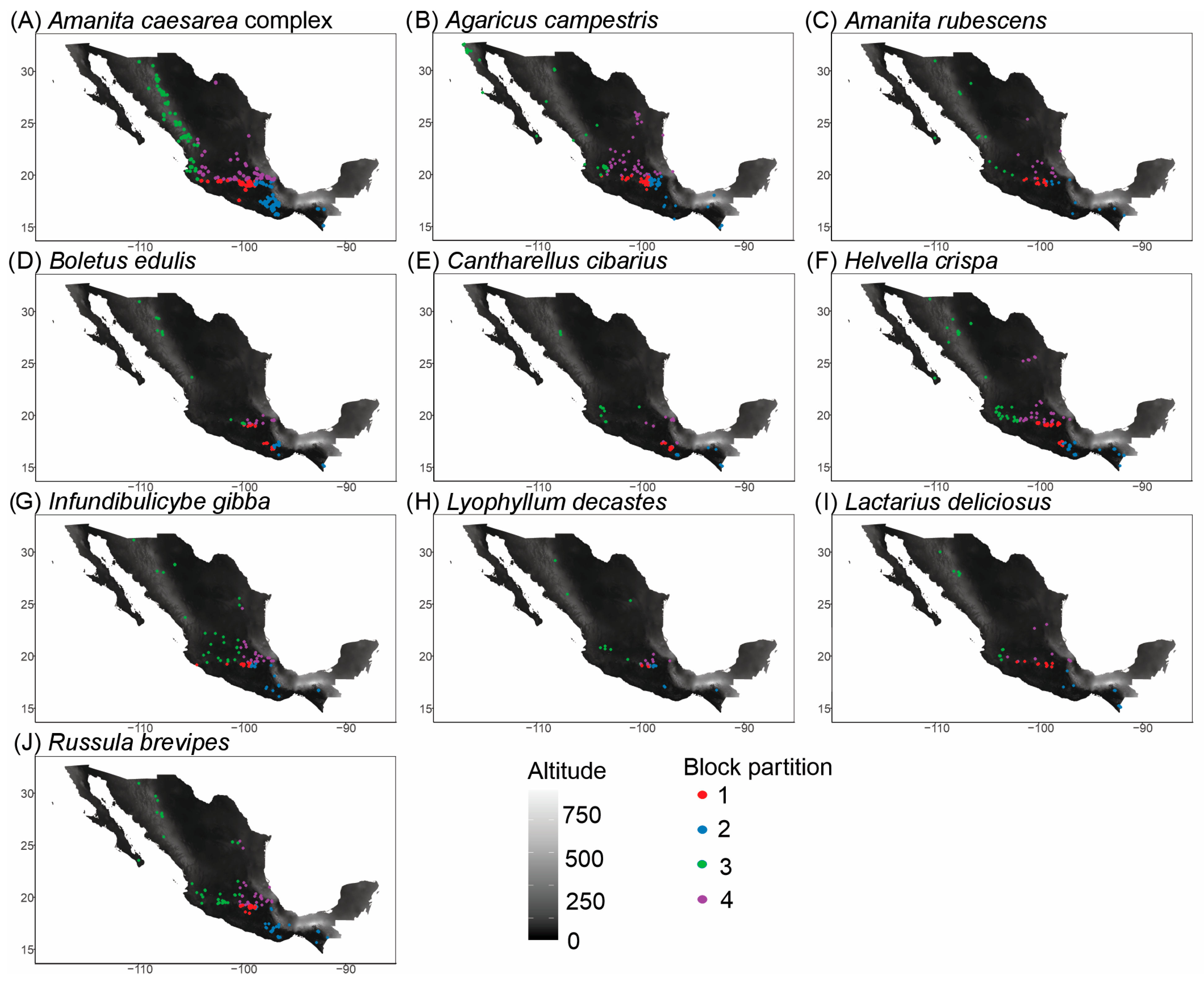
2.1. Compilation and Cleaning of Records
2.2. Analyzed Species
2.3. Environmental Variables
2.4. Present Distribution Modeling
2.5. Future Distribution Modeling
2.6. Statistical Analysis of Climate Change Scenarios
- 1.
- Principal component analysis
- 2.
- Cluster analysis
- 3.
- Heatmaps
- 4.
- PERMANOVA
2.7. Statistical Analysis of Land Use and Vegetation Variables
- 1.
- Principal component analysis
- 2.
- Cluster analysis
- 3.
- Heatmap
- 4.
- PERMANOVA
3. Results
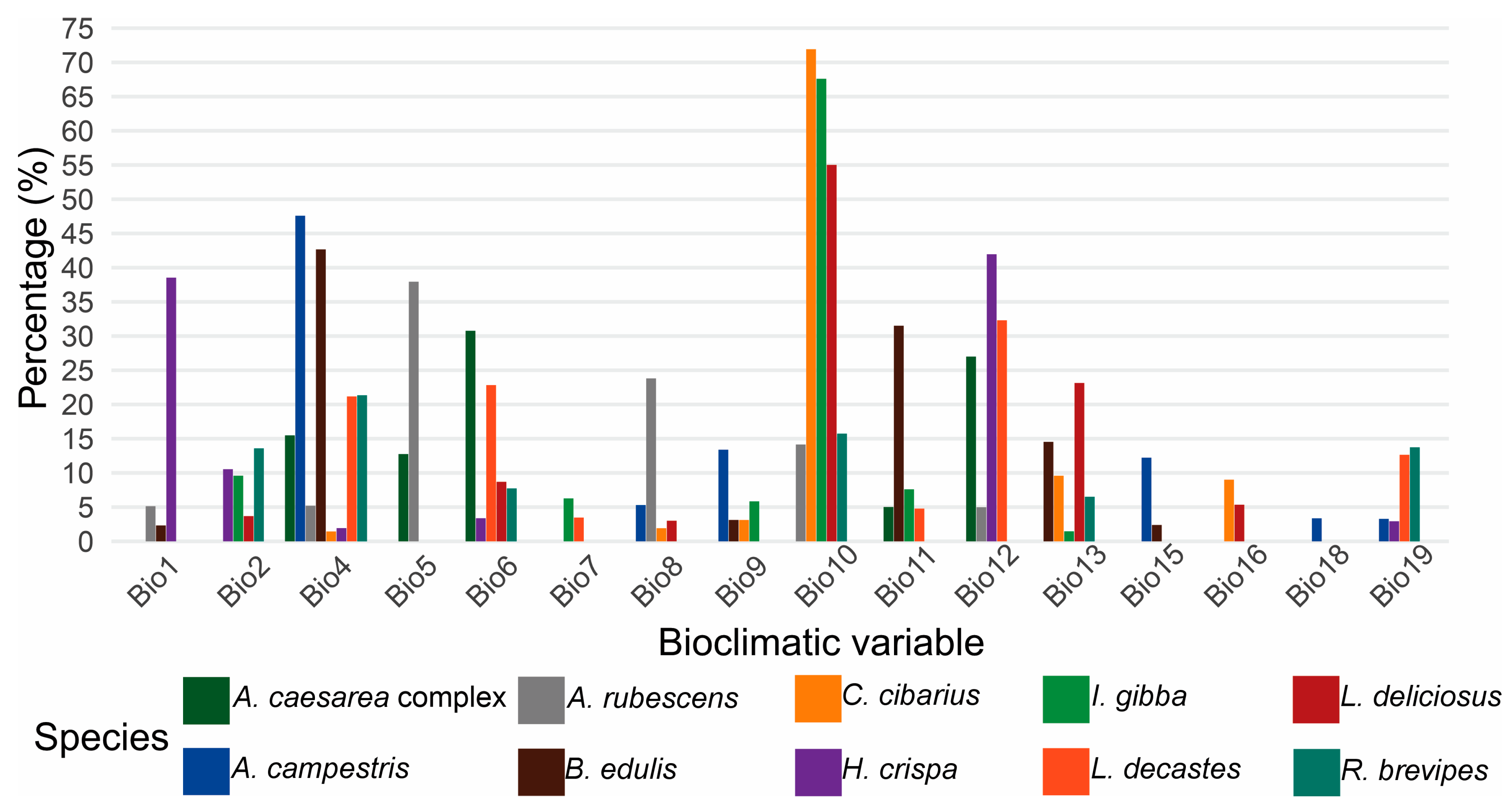
3.1. Bioclimatic Variables
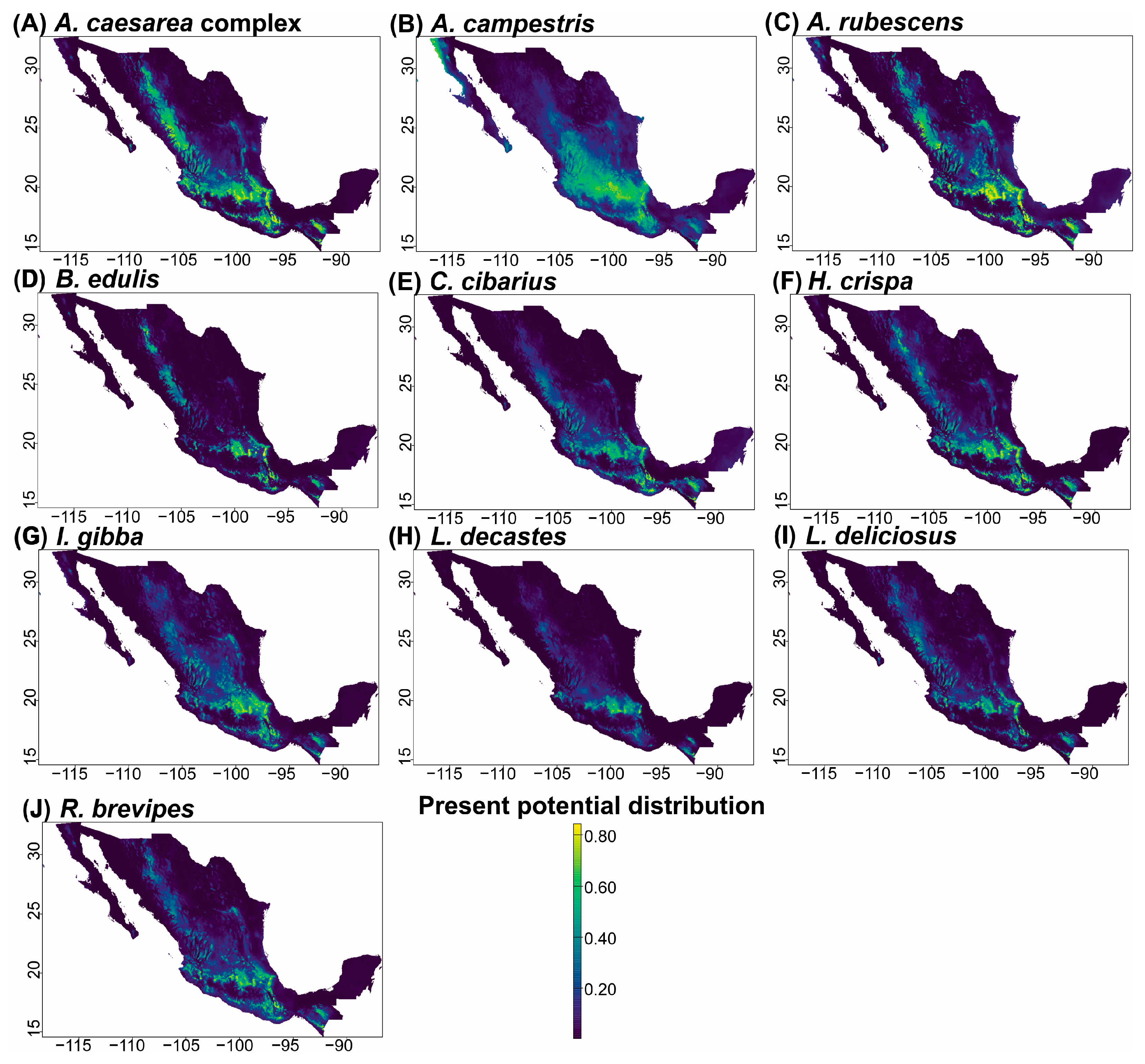
3.2. Potential Distribution Modeling
3.3. Future Distribution Modeling
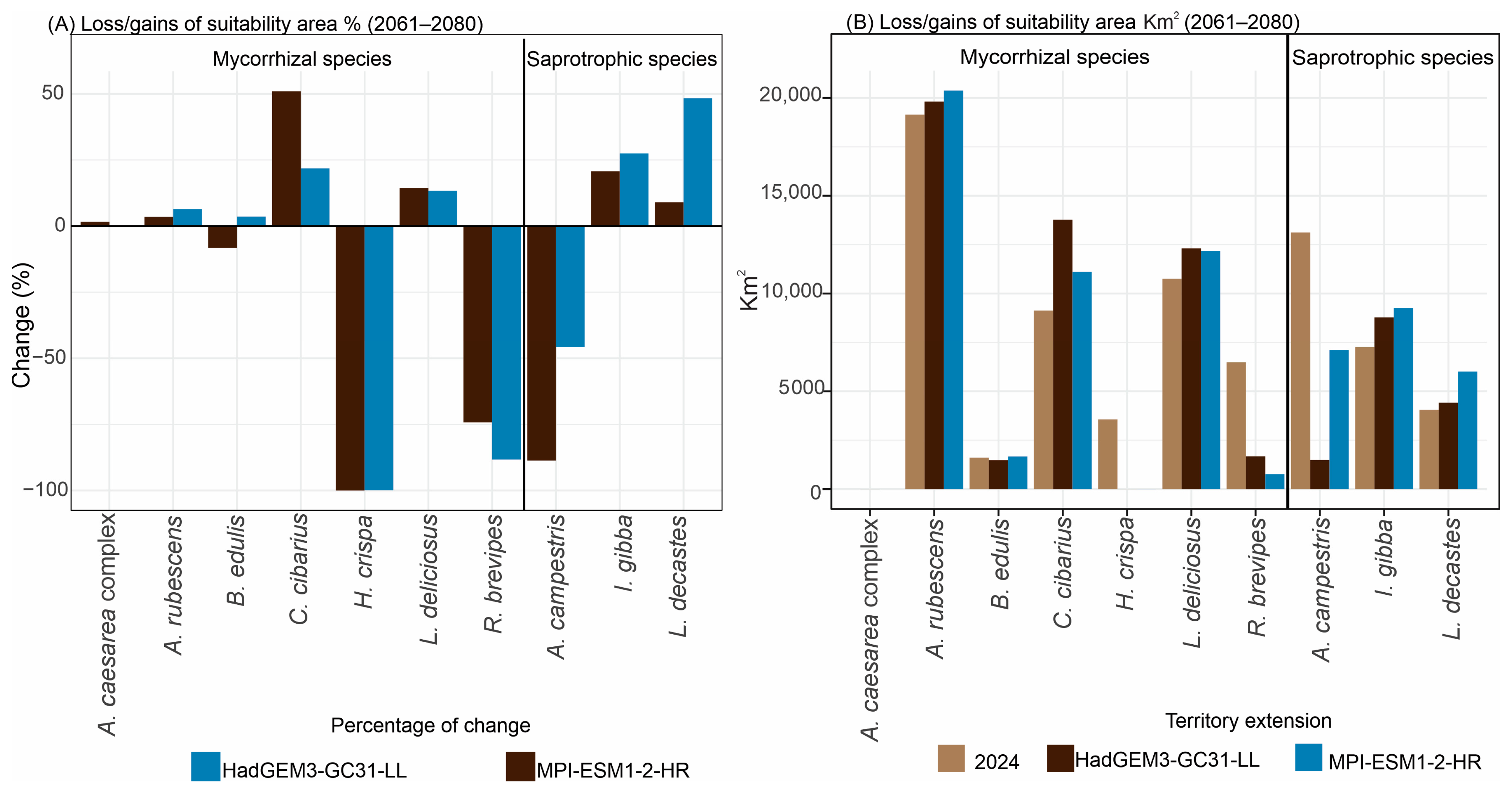
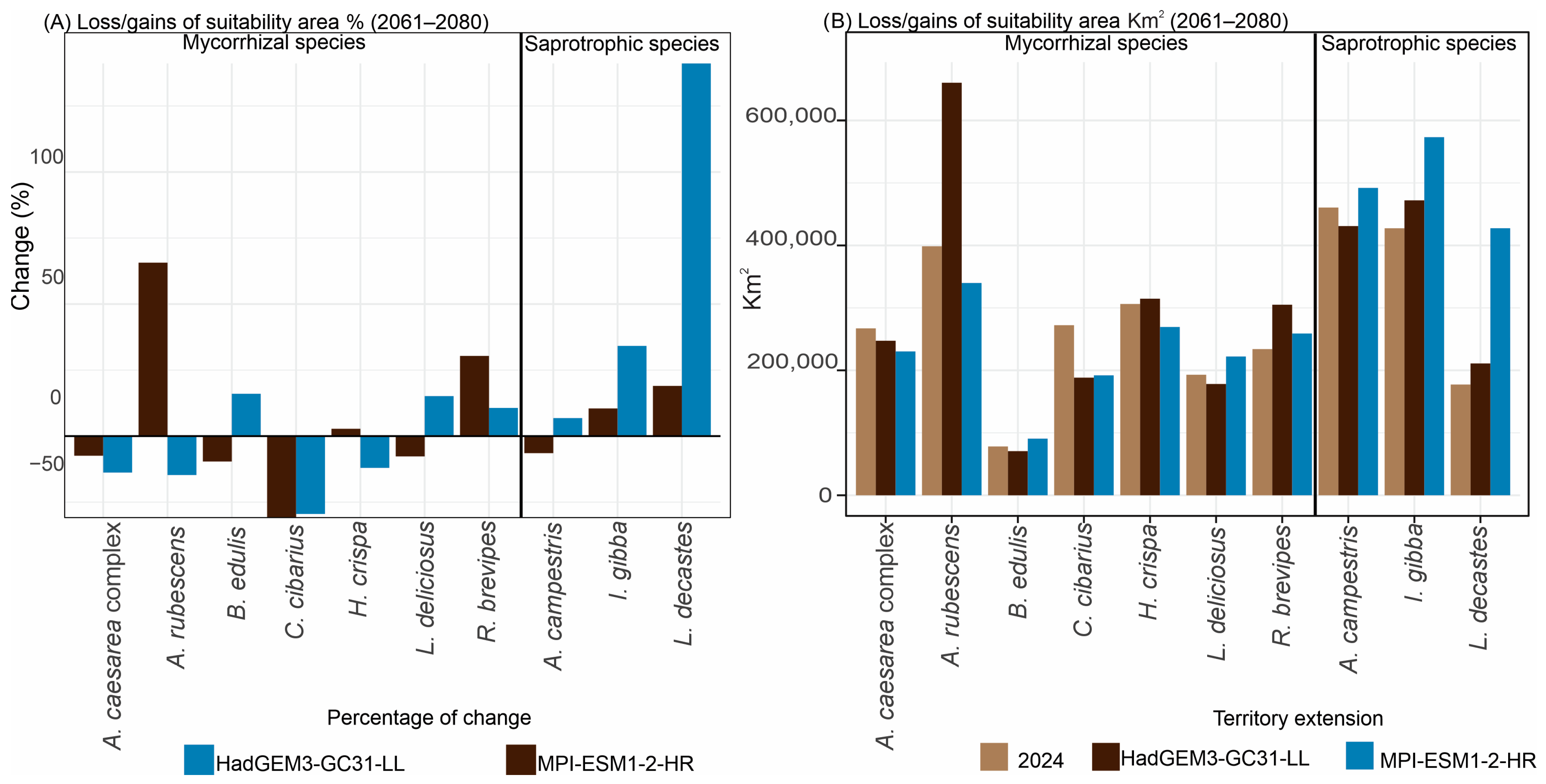
3.3.1. Period 2061–2080 (70% Threshold)
3.3.2. Period 2061–2080 (10th Percentile Threshold)
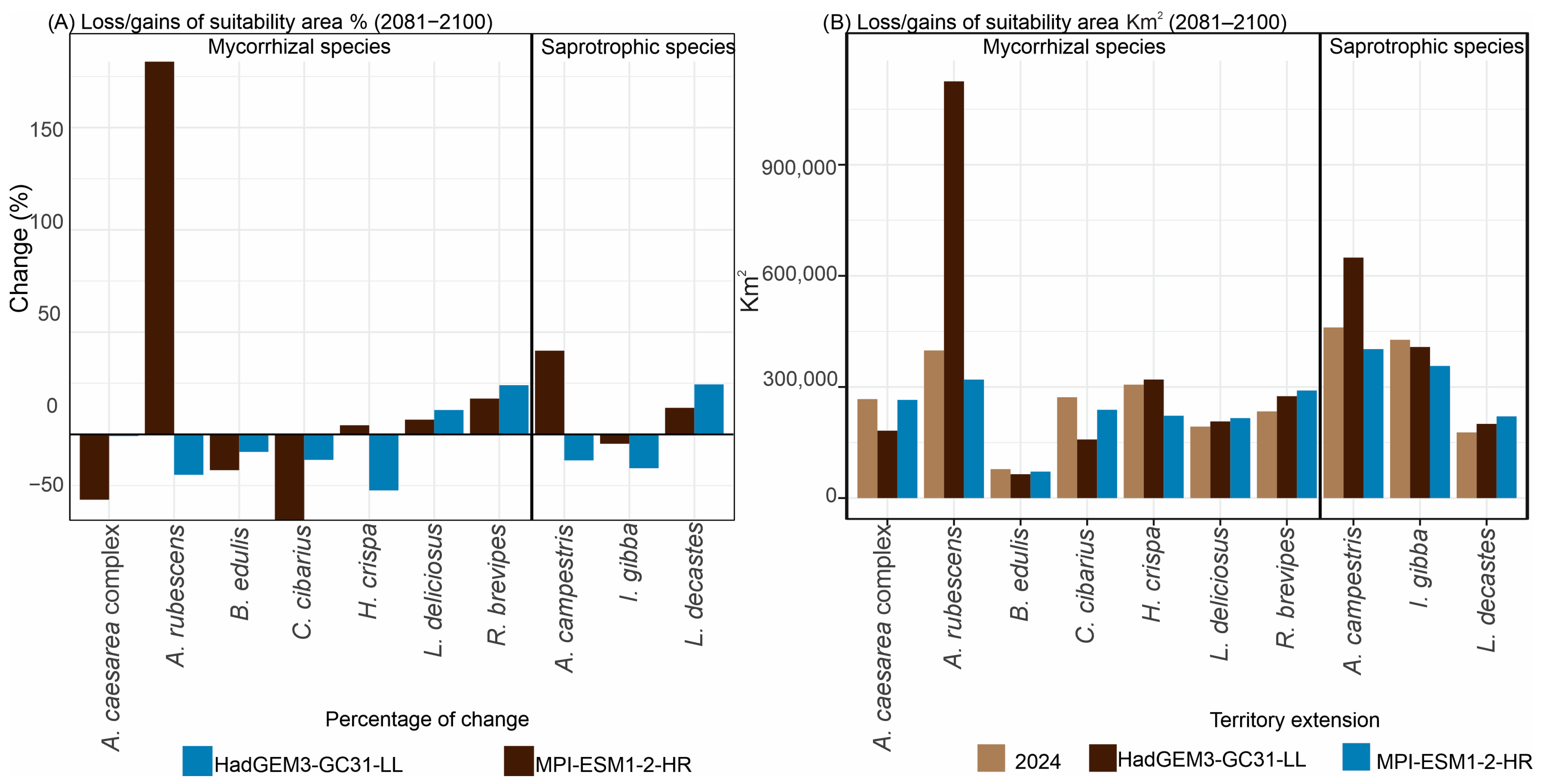
3.3.3. Period 2081–2100 (70% Threshold)
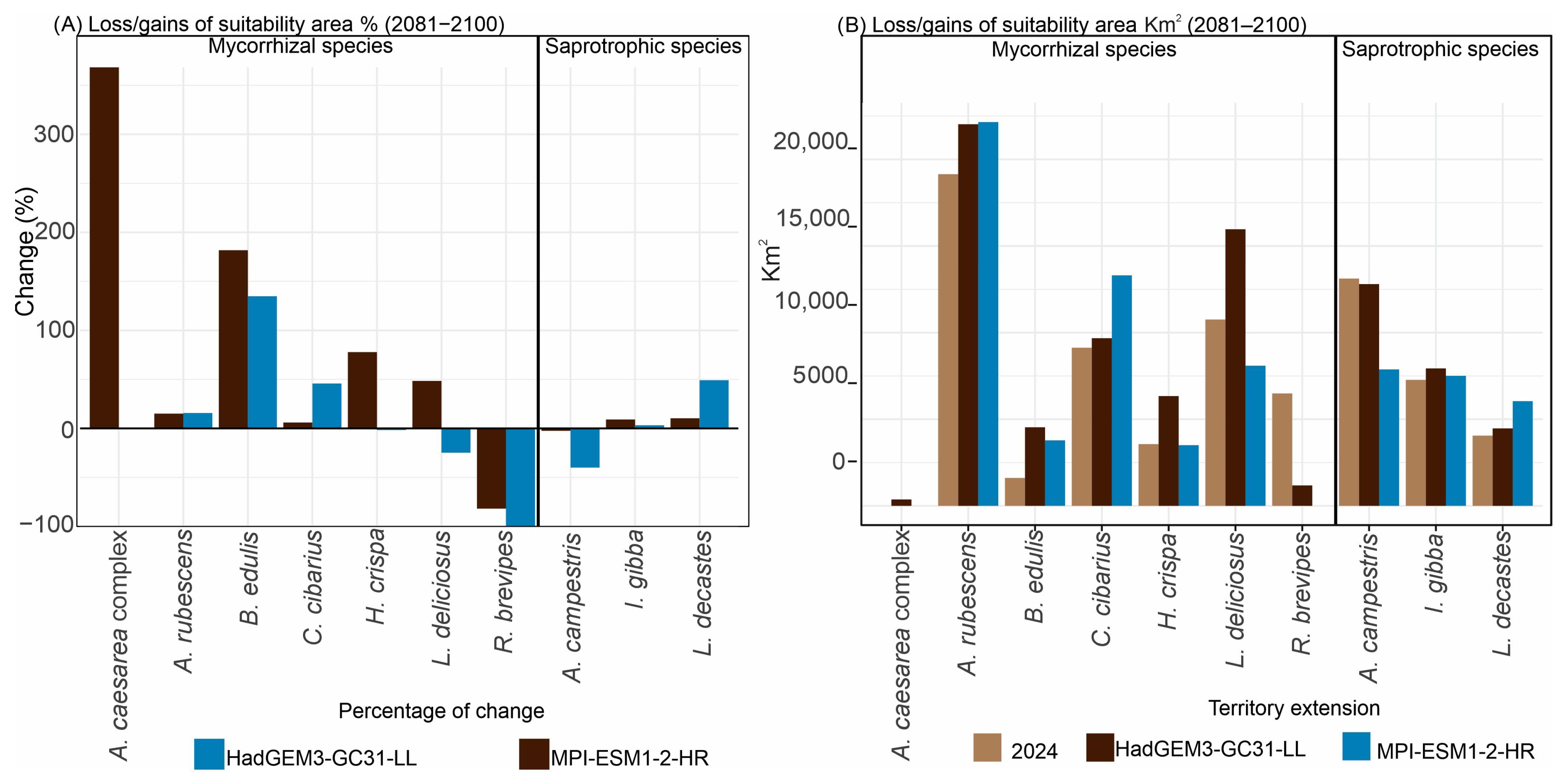
3.3.4. Period 2081–2100 (10th Percentile Threshold)
3.4. Statistical Analysis of Climate Scenarios
- 1.
- Principal component analysis (PCA)
- 2.
- Cluster analysis
- 3.
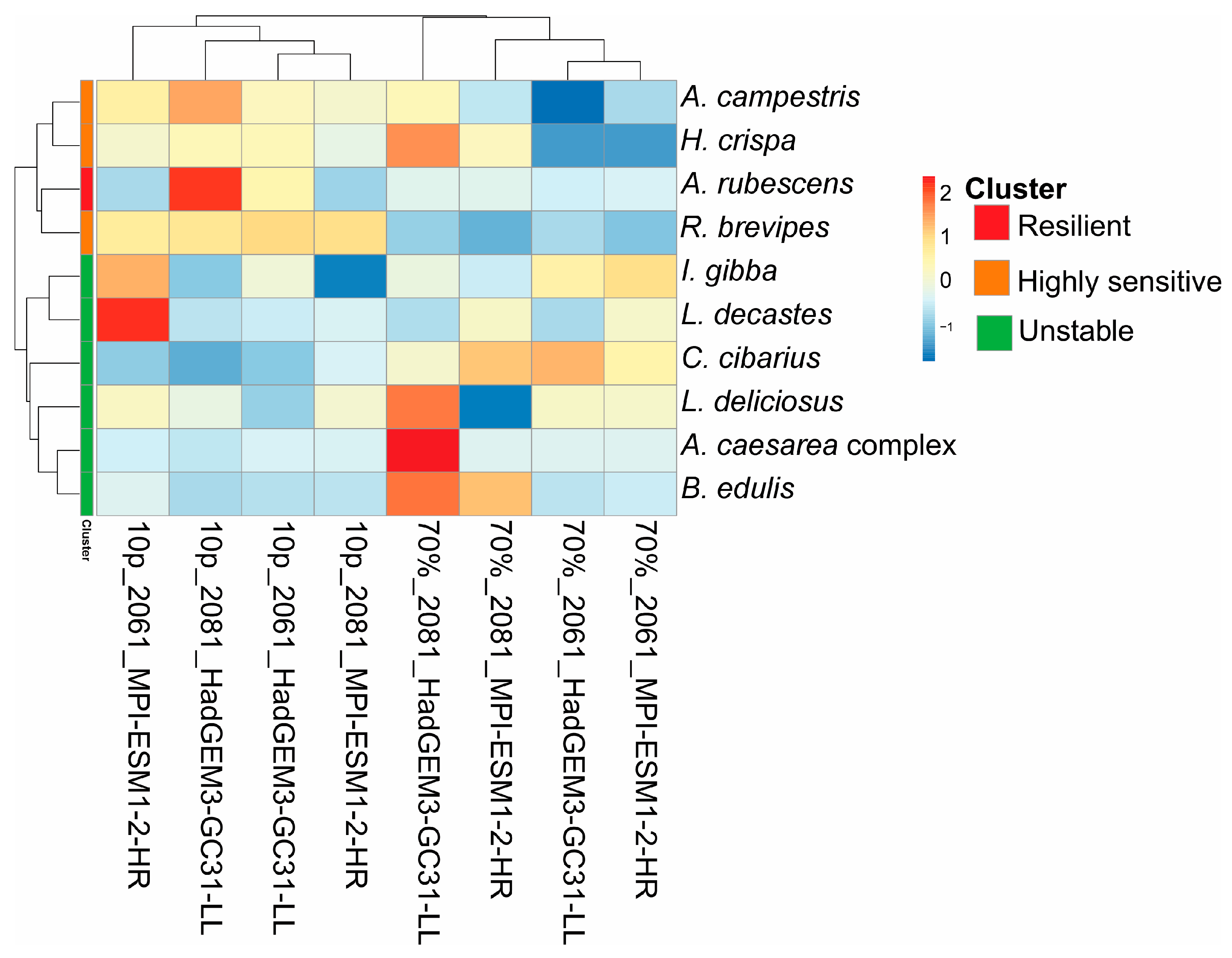
- Heatmap
- 4.
- PERMANOVA
3.5. Statistical Analysis of Land Use and Vegetation Variables
- 1.
- Principal component analysis (PCA)
- 2.
- Cluster analysis
- 3.
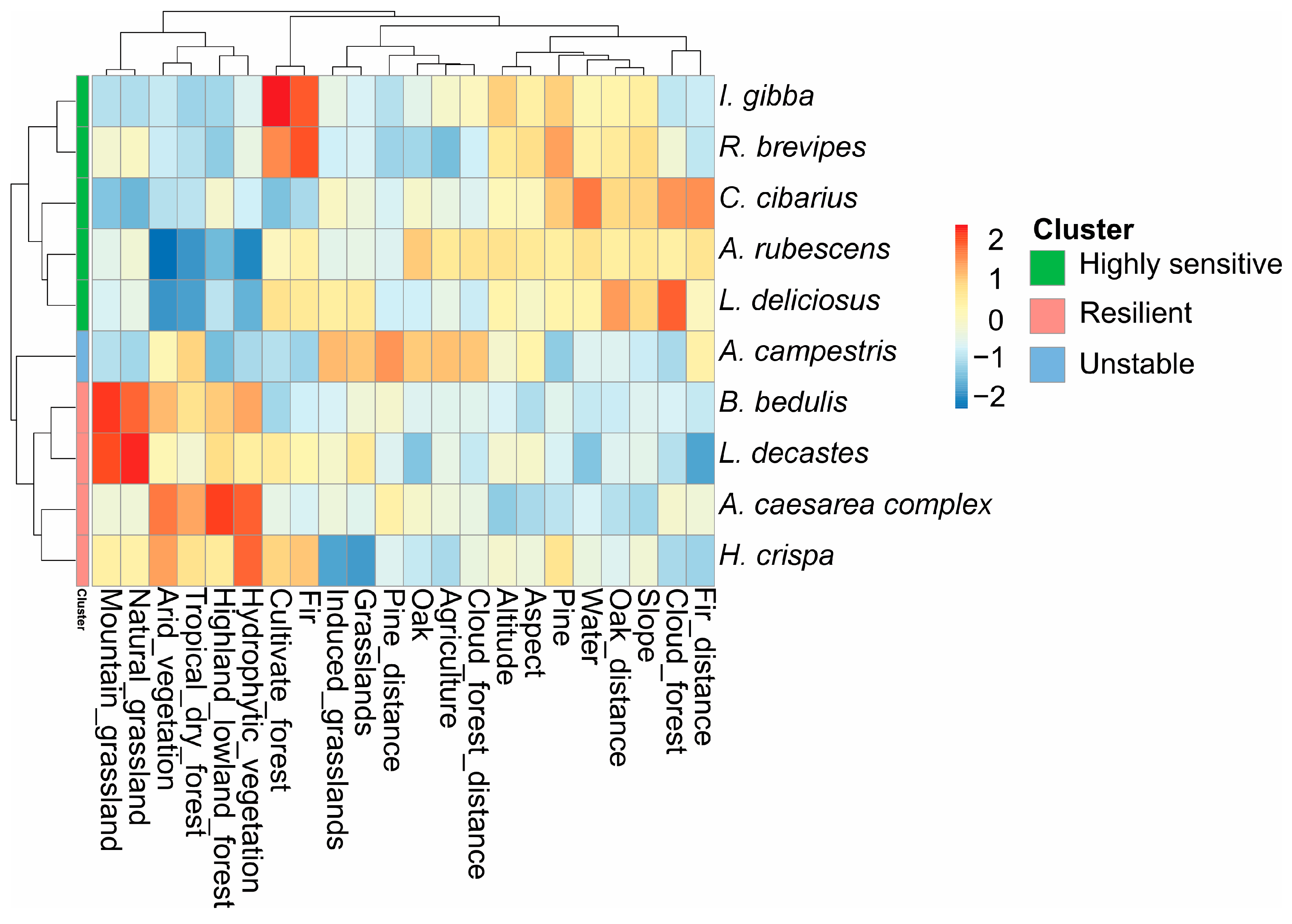
- Heatmap
- 4.
- PERMANOVA
4. Discussion
4.1. Climatic Determinants and Macrofungal Ecological Responses
4.2. Species-Specific Vulnerability and Niche Differentiation
4.3. Climate Model Variability and Projection Uncertainty
4.4. Interactions Between Climate, Land Use, and Vegetation Structure
4.5. Biocultural Implications and Sustainability Perspectives
5. Conclusions
Supplementary Materials
Author Contributions
Funding
Institutional Review Board Statement
Informed Consent Statement
Data Availability Statement
Acknowledgments
Conflicts of Interest
Abbreviations
| TMVB | Trans-Mexican Volcanic Belt |
| AICc | Akaike Information Criteria Corrected |
| AUC | Area Under Curve |
| rm | Regulation Multiplier |
| fc | Feature Classes |
| GCM | Global Climate Models |
| PCA | Principal Components Analysis |
References
- Weiskopf, S.R.; Rubenstein, M.A.; Crozier, L.G.; Gaichas, S.; Griffis, R.; Halofsky, J.E.; Hyde, K.J.W.; Morelli, T.L.; Morisette, J.T.; Muñoz, R.C.; et al. Climate change effects on biodiversity, ecosystems, ecosystem services, and natural resource management in the United States. Sci. Total Environ. 2020, 733, 137782. [Google Scholar] [CrossRef] [PubMed]
- Kumar, A.; Nagar, S.; Anand, S. Climate change and existential threats. In Global Climate Change; Elsevier: Amsterdam, The Netherlands, 2021; pp. 1–31. [Google Scholar] [CrossRef]
- Leemans, R.; Nunez, S.; Alkemade, R. Biological diversity and climate change. In Climate Change; Elsevier: Amsterdam, The Netherlands, 2021; pp. 541–559. [Google Scholar] [CrossRef]
- Jiménez, O.R.; Bornemann, A.C.; Medina, Y.E.; Romero, K.; Bravo, J.R. Prospects of biological inputs as a measure for reducing crop losses caused by climate change effects. J. Agric. Food Res. 2023, 14, 100689. [Google Scholar] [CrossRef]
- Podkolzina, I.; Tenishchev, A.; Gornostaeva, Z.; Tekeeva, H.; Tandelova, O. Assessment of threats to environmental security and climate change. In BIO Web of Conferences; EDP Sciences: Les Ulis, France, 2023; Volume 63, p. 04002. [Google Scholar] [CrossRef]
- Aliyeva, A. Conservation methods of some Brassicaceae Burnett species in the flora of Nakhchivan Autonomous Republic considering global climate change. Nat. Sci. 2024, 4, 51. [Google Scholar]
- Hegerl, G.C.; Brönnimann, S.; Cowan, T.; Friedman, A.R.; Hawkins, E.; Iles, C.; Müller, W.; Schurer, A.; Undorf, S. Causes of climate change over the historical record. Environ. Res. Lett. 2019, 14, 123006. [Google Scholar] [CrossRef]
- Mikhaylov, A.; Moiseev, N.; Aleshin, K.; Burkhardt, T. Global climate change and greenhouse effect. Entrep. Sustain. Issues 2020, 7, 2897. [Google Scholar] [CrossRef]
- IPCC. Sixth Assessment Report: Climate Change 2023; Synthesis Report; IPCC: Geneva, Switzerland, 2023; Available online: https://www.ipcc.ch/report/sixth-assessment-report-cycle/ (accessed on 25 February 2026).
- Bellard, C.; Bertelsmeier, C.; Leadley, P.; Thuiller, W.; Courchamp, F. Impacts of climate change on the future of biodiversity. Ecol. Lett. 2012, 15, 365–377. [Google Scholar] [CrossRef]
- Procházka, P.; Soukupová, J.; Tomšík, K., Jr.; Mullen, K.J.; Čábelková, I. Climatic factors affecting wild mushroom foraging in central Europe. Forests 2023, 14, 382. [Google Scholar] [CrossRef]
- Hyde, K.D.; Noorabadi, M.T.; Thiyagaraja, V.; He, M.Q.; Johnston, P.R.; Wijesinghe, S.N.; Armand, A.; Biketova, A.Y.; Chethana, K.W.T.; Erdoğdu, M.; et al. The 2024 outline of fungi and fungus-like taxa. Mycosphere 2024, 15, 5146–6239. [Google Scholar] [CrossRef]
- Wijayawardene, N.N.; Hyde, K.D.; Mikhailov, K.V.; Goto, B.T.; Santiago, A.L.C.M.A.; Tokarev, Y.S.; Elshahed, M.S.; Madrid, H.; Pires-Zottarelli, C.L.A.; Pawłowska, J.; et al. Families of non-Dikarya fungi. Mycosphere 2025, 16, 4063–4445. [Google Scholar] [CrossRef]
- Montoya, A.; Briones-Dumas, E.; Núñez-López, R.A.; Kong, A.; Ortíz-Hernández, V.; Moreno-Fuentes, Á. Los hongos conocidos por la comunidad Yuhmu de Ixtenco, Tlaxcala, México. Sci. Fungorum 2019, 49, 1230. [Google Scholar] [CrossRef]
- Molina-Castillo, E.; Thomé-Ortiz, H.; Espinoza-Ortega, A. Conocimiento ecológico tradicional y aprovechamiento de los hongos comestibles silvestres en el centro de México. Agro Prod. 2019, 12, 5. [Google Scholar] [CrossRef]
- Pérez-Moreno, J.; Guerin-Laguette, A.; Rinaldi, A.C.; Yu, F.; Verbeken, A.; Hernández-Santiago, F.; Martínez-Reyes, M. Edible mycorrhizal fungi of the world: What is their role in forest sustainability, food security, biocultural conservation and climate change? Plants People Planet 2021, 3, 471–490. [Google Scholar] [CrossRef]
- Villaseñor, J.L.; Meave, J.A. Floristics in Mexico today: Insights into a better understanding of biodiversity in a megadiverse country. Bot. Sci. 2022, 100, 14–33. [Google Scholar] [CrossRef]
- Mastretta-Yanes, A.; Moreno-Letelier, A.; Piñero, D.; Jorgensen, T.H.; Emerson, B.C. Biodiversity in the Mexican highlands and the interaction of geology, geography and climate within the Trans-Mexican Volcanic Belt. J. Biogeogr. 2015, 42, 1586–1600. [Google Scholar] [CrossRef]
- Pérez-Miranda, R. Distribución del Abies religiosa (Kunth) Schltdl. & Cham. bajo escenarios de cambio climático en el Eje Neovolcánico, México. Agro Prod. 2017, 10, 8. [Google Scholar]
- Díaz-Garcia, J.M.; de la Vega-Pérez, A.D.; Navarro-Noya, Y.; Ramírez-Ponce, A.; Guillén, S.; Esparza-Carlos, J.P.; Hereira-Pacheco, S.; Martínez y Pérez, J.L.; Moctezuma, V.; Juárez-Díaz, M.; et al. Biodiversity between volcanoes: A multitaxa analysis to identify priority conservation areas in a highly fragmented landscape of the Trans-Mexican Volcanic Belt. J. Nat. Conserv. 2025, 84, 126852. [Google Scholar] [CrossRef]
- Chanona-Gómez, F.; Andrade-Gallegos, R.H.; Castellanos-Albores, J.; Sánchez, J.E. Macrofungi from Parque Educativo Laguna Bélgica, Municipality of Ocozocoautla de Espinosa, Chiapas, Mexico. Rev. Mex. Biodivers. 2007, 78, 369–381. [Google Scholar]
- Reverchon, F.; María del Ortega-Larrocea, P.; Pérez-Moreno, J. Saprophytic fungal communities change in diversity and species composition across a volcanic soil chronosequence at Sierra del Chichinautzin, Mexico. Ann. Microbiol. 2010, 60, 217–226. [Google Scholar] [CrossRef]
- Arriola-Padilla, V.J.; Estrada-Martínez, E.; Ortega-Rubio, A.; Pérez-Miranda, R.; Gijón-Hernández, A.R. Deterioro en áreas naturales protegidas del centro de México y del Eje Neovolcánico Transversal. Investig. Cienc. 2014, 22, 37–49. [Google Scholar]
- Valenzuela, R.; Luna-Vega, I.; Martínez-Pineda, M.; Martínez-González, C.R.; García-Jiménez, J.; de la Fuente, J.; Bautista-Hernández, S.; Acosta-Castellanos, S.; Raymundo, T. Novelties in macrofungi of the tropical montane cloud forest in Mexico. J. Fungi 2023, 9, 477. [Google Scholar] [CrossRef]
- Diez, J.; Kauserud, H.; Andrew, C.; Heegaard, E.; Krisai-Greilhuber, I.; Senn-Irlet, B.; Høiland, K.; Egli, S.; Büntgen, U. Altitudinal upward shifts in fungal fruiting in the Alps. Proc. Biol. Sci. 2020, 287, 20192348. [Google Scholar] [CrossRef]
- Kauserud, H.; Heegaard, E.; Büntgen, U.; Halvorsen, R.; Egli, S.; Senn-Irlet, B.; Stenseth, N.C. Warming-induced shift in European mushroom fruiting phenology. Proc. Natl. Acad. Sci. USA 2012, 109, 14488–14493. [Google Scholar] [CrossRef]
- Faticov, M.; Amorim, J.H.; Abdelfattah, A.; van Dijk, L.J.; Carvalho, A.C.; Laforest-Lapointe, I.; Tack, A.J. Local climate, air quality and leaf litter cover shape foliar fungal communities on an urban tree. Ambio 2024, 53, 1673–1685. [Google Scholar] [CrossRef]
- Zhang, Y.; Xie, Y.; Ma, H.; Zhang, J.; Jing, L.; Wang, Y.; Li, J. The influence of climate warming and humidity on plant diversity and soil bacteria and fungi diversity in desert grassland. Plants 2021, 10, 2580. [Google Scholar] [CrossRef]
- Zhang, Y.; Li, X.; Zhang, J.; Hua, J.; Li, J.; Liu, D.; Bhople, P.; Ruan, H.; Yang, N. Desertification induced changes in soil bacterial and fungal diversity and community structure in a dry-hot valley forest. Appl. Soil Ecol. 2023, 189, 104953. [Google Scholar] [CrossRef]
- Wollan, A.K.; Bakkestuen, V.; Kauserud, H.; Gulden, G.; Halvorsen, R. Modeling and predicting fungal distribution patterns using herbarium data. J. Biogeogr. 2008, 35, 2298–2310. [Google Scholar] [CrossRef]
- Yu, H.; Wang, T.; Skidmore, A.; Heurich, M.; Bässler, C. 50 years of cumulative open-source data confirm stable and robust biodiversity distribution patterns for macrofungi. J. Fungi 2022, 8, 981. [Google Scholar] [CrossRef]
- Yu, H.; Wang, T.; Skidmore, A.; Heurich, M.; Bässler, C. The critical role of tree species and human disturbance in determining the macrofungal diversity in Europe. Glob. Ecol. Biogeogr. 2021, 30, 2084–2100. [Google Scholar] [CrossRef]
- Wang, X.W.; Zhou, L.W. Spatiotemporal pattern of a macrofungal genus Phylloporia (Basidiomycota) revealing its adaptive evolution in China. J. Fungi 2024, 10, 780. [Google Scholar] [CrossRef] [PubMed]
- Moullec, F.; Barrier, N.; Drira, S.; Guilhaumon, F.; Hattab, T.; Peck, M.A.; Shin, Y.J. Using species distribution models only may underestimate climate change impacts on future marine biodiversity. Ecol. Model. 2022, 464, 109826. [Google Scholar] [CrossRef]
- Vasconcelos, R.N.; Cantillo-Pérez, T.; Franca Rocha, W.J.; Aguiar, W.M.; Mendes, D.T.; de Jesus, T.B.; de Santana, C.O.; de Santana, M.M.M.; Oliveira, R.P. Advances and challenges in species ecological niche modeling: A mixed review. Earth 2024, 5, 963–989. [Google Scholar] [CrossRef]
- Tsiftsis, S.; Štípková, Z.; Rejmánek, M.; Kindlmann, P. Predictions of species distributions based only on models estimating future climate change are not reliable. Sci. Rep. 2024, 14, 25778. [Google Scholar] [CrossRef]
- Fiorentino, D.; Núñez-Riboni, I.; Pierce, M.E.; Oesterwind, D.; Akimova, A. Improving species distribution models for climate change studies: Ecological plausibility and performance metrics. Ecol. Model. 2025, 508, 111207. [Google Scholar] [CrossRef]
- Fois, M.; Cuena-Lombraña, A.; Fenu, G.; Bacchetta, G. Using species distribution models at local scale to guide the search of poorly known species: Review, methodological issues and future directions. Ecol. Model. 2018, 385, 124–132. [Google Scholar] [CrossRef]
- Kafash, A.; Ghobadnejhad, M. Modeling the impacts of climate change on geographic distribution of the genus Trametes. J. Clim. Reserch 2024, 1403, 1–9. [Google Scholar]
- Peng, Y.; Zhuo, Z.; Qian, Q.; Xu, D. Optimized Maxent model predicts future suitable habitats for Chinese caterpillar fungus under climate change. Agriculture 2025, 15, 1144. [Google Scholar] [CrossRef]
- Morera, A.; de Aragón, J.M.; De Cáceres, M.; Bonet, J.A.; de-Miguel, S. Historical and future spatially explicit climate change impacts on mycorrhizal and saprotrophic macrofungal productivity in Mediterranean pine forests. Agric. For. Meteorol. 2022, 319, 108918. [Google Scholar] [CrossRef]
- Pietras, M.; Kolanowska, M.; Selosse, M.A. Quo vadis? Historical distribution and impact of climate change on the worldwide distribution of the Australasian fungus Clathrus archeri (Phallales, Basidiomycota). Mycol. Prog. 2021, 20, 299–311. [Google Scholar] [CrossRef]
- Tiamiyu, B.B.; Lateef, A.A.; Ajadi, I.; Adeyemi, S.B.; Owolabi, P.O.; Sagaya, A.; AbdulSalam, M.; AbdulKareem, K.A.; Mustapha, O.T. Bioclimatic modeling of current geographic distribution and future range shifts of selected edible mushrooms in Nigeria. Sahel J. Life Sci. FUDMA 2024, 2, 51–61. [Google Scholar] [CrossRef]
- Sánchez-Ramírez, S.; Tulloss, R.E.; Guzmán-Dávalos, L.; Cifuentes-Blanco, J.; Valenzuela, R.; Estrada-Torres, A.; Ruán-Soto, F.; Díaz-Moreno, R.; Hernández-Rico, N.; Torres-Gómez, M.; et al. In and out of refugia: Historical patterns of diversity and demography in the North American Caesar’s mushroom species complex. Mol. Ecol. 2015, 24, 5938–5956. [Google Scholar] [CrossRef] [PubMed]
- Ruiz-Almenara, C.; Gándara, E.; Gómez-Hernández, M. Comparación de la diversidad y composición de especies de macrohongos entre áreas de recolección intensiva de hongos y áreas sin recolección en Oaxaca, Mexico. PeerJ 2019, 7, e8325. [Google Scholar] [CrossRef]
- López-García, A.; Pérez-Moreno, J.; Jiménez-Ruiz, M.; Ojeda-Trejo, E.; Delgadillo-Martínez, J.; Hernández-Santiago, F. Conocimiento tradicional de hongos de importancia biocultural en siete comunidades de la región chinanteca del estado de Oaxaca, México. Sci. Fungorum 2020, 50, e1280. [Google Scholar] [CrossRef]
- Santos-Silva, C.; Natário, B.; Pita, R. Fine-Scale Environmental Heterogeneity Shapes Post-Fire Macrofungal Richness in a Mediterranean Relict Forest. Fire 2025, 8, 438. [Google Scholar] [CrossRef]
- Montoya, A.; Hernández-Totomoch, O.; Estrada-Torres, A.; Kong, A.; Caballero, J. Traditional knowledge about mushrooms in a Nahua community in the state of Tlaxcala, México. Mycologia 2003, 95, 793–806. [Google Scholar] [CrossRef] [PubMed]
- Bautista-Nava, E. Taxonomía y Conocimiento Tradicional de Cantharellus Fr. (Fungi, Cantharellaceae) en el Nornoreste del Estado de Hidalgo. Bachelor’s Thesis, Universidad Autónoma del Estado de Hidalgo, Pachuca, Mexico, 2007. Available online: http://dgsa.uaeh.edu.mx:8080/bibliotecadigital/handle/231104/110 (accessed on 25 February 2026).
- Mora, V.M.; Martínez-Carrera, D. Investigaciones básicas, aplicadas y socioeconómicas sobre el cultivo de setas Pleurotus spp. en México. Ecosur 2007, 68–110. Available online: https://hongoscomestiblesymedicinales.com/Mexico/UAEM/P.pdf (accessed on 25 February 2026).
- Lorenzana-Fernández, A. Caracterización de Microhábitats de Hongos Comestibles Ectomicorrízicos en Bosques de Pino, Oyamel y Encino en los Parques Nacionales Izta-Popo y Zoquiapan. Master’s Thesis, Colegio de Postgraduados, Montecillo, Mexico, 2008. Available online: http://colposdigital.colpos.mx:8080/jspui/bitstream/handle/10521/1253/Lorenzana_Fernandez_A_MC_Edafologia_2008.pdf?sequence=1&isAllowed=y (accessed on 25 February 2026).
- Estrada-Martínez, E.; Guzmán, G.; Cibrián Tovar, D.; Ortega Paczka, R. Contribución al conocimiento etnomicológico de los hongos comestibles silvestres de mercados regionales y comunidades de la Sierra Nevada (México). Interciencia 2009, 34, 25–33. [Google Scholar]
- Hernández-Rico, G.N.; Moreno-Fuentes, Á. Hongos comestibles del género Amanita en el mercado de Acaxochitlán, Hidalgo, México. Etnobiología 2010, 8, 31–38. [Google Scholar]
- Isidoro-Reséndiz, D.G. Importancia Cultural de Los Hongos Comestibles en el Municipio de Tepehuacán de Guerrero, Hidalgo. Bachelor’s Thesis, Universidad Autónoma del Estado de Hidalgo, Pachuca, Mexico, 2011. Available online: http://dgsa.uaeh.edu.mx:8080/jspui/bitstream/231104/4070/1/AT15780.pdf (accessed on 25 February 2026).
- Burrola-Aguilar, C.; Montiel, O.; Garibay-Orijel, R.; Zizumbo-Villarreal, L. Conocimiento tradicional y aprovechamiento de los hongos comestibles silvestres en la región de Amanalco, Estado de México. Rev. Mex. Micología 2012, 35, 1–16. [Google Scholar]
- García-Jiménez, J.; Singer, R.; Estrada, E.; Garza-Ocañas, F.; Valenzuela, R. Two new species of the genus Boletus (Boletales: Agaricomycetes) in Mexico. Rev. Mex. Biodivers. 2013, 84, 152–162. [Google Scholar] [CrossRef]
- Jiménez-González, M.; Romero-Bautista, L.; Villavicencio-Nieto, M.A.; Pérez-Escandón, B.E. Los hongos comestibles de la región de Molango de Escamilla, Hidalgo, México. Estud. Científicos Estado Hidalgo Zonas Aledañas 2013, 2, 69–79. [Google Scholar]
- Lara-Vázquez, F.; Romero-Contreras, A.T.; Burrola-Aguilar, C. Conocimiento tradicional sobre los hongos silvestres en la comunidad otomí de San Pedro Arriba; Temoya, Estado de México. Agric. Soc. Desarro. 2013, 10, 305–326. [Google Scholar]
- del Moral Cervantes, P. Productividad y Estrategias de Aprovechamiento de Hongos Comestibles en Cafetales del Centro de Veracruz. Master’s Thesis, Universidad Veracruzana, Veracruz, Mexico, 2015. Available online: https://www.uv.mx/mcef/files/2018/04/Productividad-y-estrategias-de-aprovechamiento-de-hongos-comestibles-en-cafetales-de-Veracruz.pdf (accessed on 25 February 2026).
- Domínguez-Romero, D.; Arzaluz-Reyes, J.I.; Valdés-Valdés, C.; Romero-Popoca, N.P. Uso y manejo de hongos silvestres en cinco comunidades del municipio de Ocoyoacac, Estado de México. Trop. Subtrop. Agroecosyst. 2015, 18, 133–143. [Google Scholar]
- Servín Campuzano, L.S.; Alarcón-Cháires, P.E. Conocimiento tradicional de los hongos silvestres comestibles en la comunidad p’urhépecha de Comachuén, Nahuatzen, Michoacán. Acta Univ. 2018, 28, 15–29. [Google Scholar] [CrossRef]
- Jaime Salinas, M. Etnomicología y Taxonomía de Hongos Comestibles del Género Lyophyllum (P. Karst) en Tlaxcala. Master’s Thesis, Universidad Autónoma de Tlaxcala, Tlaxcala, Mexico, 2019. Available online: https://repositorio.uatx.mx:8443/bitstream/DSyTI_UATx/456/1/Jaime%20Salinas%20Maricarmen.pdf (accessed on 25 February 2026).
- Torres Preciado, C.O.; Rodríguez Alcántar, O.; Herrera-Fonseca, M.D.J.; Figueroa-García, D. Catálogo de la micobiota del Complejo Volcánico de Colima, México. Acta Bot. Mex. 2020. [Google Scholar] [CrossRef]
- Ramírez-Terrazo, A.; Montoya, A.; Kong, A. Conocimiento micológico tradicional en dos comunidades aledañas al Parque Nacional Lagunas de Montebello, Chiapas, México. Sci. Fungorum 2021, 51, 1–12. [Google Scholar] [CrossRef]
- Rescendiz, T. Propiedades Nutricionales y Potencial Nutracéutico de Hongos Comestibles del Municipio de Zaragoza, Puebla. Doctoral Dissertation, Universidad Autónoma Chapingo, Texcoco, Mexico, 2023. Available online: https://www.researchgate.net/profile/Tonathiu-Rescendiz/publication/379076803_Propiedades_nutricionales_y_potencial_nutraceutico_de_hongos_comestibles_del_municipio_de_Zaragoza_Puebla/links/65f9c759f3b56b5b2d14ddf9/Propiedades-nutricionales-y-potencial-nutraceutico-de-hongos-comestibles-del-municipio-de-Zaragoza-Puebla.pdf (accessed on 25 February 2026).
- GBIF.org. Cantharellus cibarius: (28 September 2024). GBIF Occurrence Download. Available online: https://doi.org/10.15468/dl.6ggyk3 (accessed on 25 February 2026).
- GBIF.org. Amanita rubescens: (28 September 2024). GBIF Occurrence Download. Available online: https://doi.org/10.15468/dl.4ghfah (accessed on 25 February 2026).
- GBIF.org. Helvella crispa: (28 September 2024). GBIF Occurrence Download. Available online: https://doi.org/10.15468/dl.4ghfah (accessed on 25 February 2026).
- GBIF.org. Boletus edulis: (28 September 2024). GBIF Occurrence Download. Available online: https://doi.org/10.15468/dl.5ufgyv (accessed on 25 February 2026).
- GBIF.org. Agaricus campestris: (29 September 2024). GBIF Occurrence Download. Available online: https://doi.org/10.15468/dl.hxtcfa (accessed on 25 February 2026).
- GBIF.org. Lactarius deliciosus: (29 September 2024). GBIF Occurrence Download. Available online: https://doi.org/10.15468/dl.zgudu8 (accessed on 25 February 2026).
- GBIF.org. Lyophyllum decastes: (2 October 2024). GBIF Occurrence Download. Available online: https://doi.org/10.15468/dl.rxpz4g (accessed on 25 February 2026).
- GBIF.org. Infundibulicybe gibba: (3 October 2024). GBIF Occurrence Download. Available online: https://doi.org/10.15468/dl.zvtb5u (accessed on 25 February 2026).
- GBIF.org. Russula brevipes: (3 October 2024). GBIF Occurrence Download. Available online: https://doi.org/10.15468/dl.m8h2dw (accessed on 25 February 2026).
- GBIF.org. Amanita caesarea sensu lato: (30 September 2024). GBIF Occurrence Download. Available online: https://doi.org/10.15468/dl.tvv7w9 (accessed on 25 February 2026).
- GBIF.org. Amanita bassii: (30 September 2024). GBIF Occurrence Download. Available online: https://doi.org/10.15468/dl.896daf (accessed on 25 February 2026).
- GBIF.org. Amanita tullossi: (30 September 2024). GBIF Occurrence Download. Available online: https://doi.org/10.15468/dl.3gpesu (accessed on 25 February 2026).
- GBIF.org. Amanita yema: (30 September 2024). GBIF Occurrence Download. Available online: https://doi.org/10.15468/dl.q4sjsr (accessed on 25 February 2026).
- Van Proosdij, A.S.; Sosef, M.S.; Wieringa, J.J.; Raes, N. Minimum required number of specimen records to develop accurate species distribution models. Ecography 2016, 39, 542–552. [Google Scholar] [CrossRef]
- Osorio-Olvera, L.; Lira-Noriega, A.; Soberón, J.; Peterson, A.T.; Falconi, M.; Contreras-Díaz, R.G.; Martinez-Meyer, E.; Barve, V.; Barve, N. Ntbox: An R package with graphical user interface for modeling and evaluating multidimensional ecological niches. Methods Ecol. Evol. 2020, 11, 1199–1206. [Google Scholar] [CrossRef]
- Guzmán, G.; Ramírez-Guillén, F. The Amanita Caesarea-Complex; Gebrüder Borntraeger Verlagsbuchhandlung: Stuttgart, Germany, 2001; Volume 187, p. v–66. ISBN 3-443-59089-6. [Google Scholar]
- Harmaja, H. Notes on Clitocybe s. lato (Agaricales). Ann. Bot. Fenn. 2003, 40, 213–218. [Google Scholar]
- Zhang, Y.; Mao, N.; Li, T.; Fan, L. Two new species of Infundibulicybe (Omphalinaceae, Agaricales) from northern China. Phytotaxa 2024, 649, 193–210. [Google Scholar] [CrossRef]
- Beel, F. A Big White Mess: Delimiting Species Within Russula Subgenus Brevipedum. Master’s Thesis, Ghent University, Ghent, Belgium, 2020. Available online: https://libstore.ugent.be/fulltxt/RUG01/002/945/573/RUG01-002945573_2021_0001_AC.pdf (accessed on 25 February 2026).
- Song, J.; Li, H.; Wu, S.; Chen, Q.; Yang, G.; Zhang, J.; Chen, B. Morphological and molecular evidence for two new species within Russula subgenus Brevipes from China. Diversity 2022, 14, 112. [Google Scholar] [CrossRef]
- Fick, S.E.; Hijmans, R.J. WorldClim 2: New 1 km spatial resolution climate surfaces for global land areas. Int. J. Climatol. 2017, 37, 4302–4315. [Google Scholar] [CrossRef]
- Hijmans, R.J. Raster: Geographic Data Analysis and Modeling. R Package version 3.6-32. Available online: https://github.com/rspatial/raster (accessed on 25 February 2026).
- Hijmans, R.J. Terra: Spatial Data Analysis. R Package version 1.8-29. Available online: https://cran.r-project.org/web/packages/terra (accessed on 25 February 2026).
- Posit Team. RStudio: Integrated Development Environment for R, Posit Software; PBC: Boston, MA, USA, 2024. Available online: http://www.posit.co/ (accessed on 25 February 2026).
- Yuan, H.-S.; Wei, Y.-L.; Wang, X.G. Maxent modeling for predicting the potential distribution of Sanghuang, an important group of medicinal fungi in China. Fungal Ecol. 2015, 17, 140–145. [Google Scholar] [CrossRef]
- Schnase, J.L.; Carroll, M.L.; Gill, R.L.; Tamkin, G.S.; Li, J.; Strong, S.L.; Spradlin, C.S. Toward a Monte Carlo approach to selecting climate variables in Maxent. PLoS ONE 2021, 16, e0237208. [Google Scholar] [CrossRef] [PubMed]
- Muscarella, R.; Galante, P.J.; Soley-Guardia, M.; Boria, R.A.; Kass, J.M.; Uriarte, M.; Anderson, R.P. ENM eval: An R package for conducting spatially independent evaluations and estimating optimal model complexity for Maxent ecological niche models. Methods Ecol. Evol. 2014, 5, 1198–1205. [Google Scholar] [CrossRef]
- Hijmans, R.J. Cross-validation of species distribution models: Removing spatial sorting bias and calibration with a null model. Ecology 2012, 93, 679–688. [Google Scholar] [CrossRef]
- Roberts, D.R.; Bahn, V.; Ciuti, S.; Boyce, M.S.; Elith, J.; Guillera-Arroita, G.; Hauenstein, S.; Lahoz-Monfort, J.J.; Thuiller, W.; Warton, D.I.; et al. Cross-validation strategies for data with temporal, spatial, hierarchical, or phylogenetic structure. Ecography 2017, 40, 913–929. [Google Scholar] [CrossRef]
- Kass, J.M.; Muscarella, R.; Galante, P.J.; Bohl, C.L.; Pinilla-Buitrago, G.E.; Boria, R.A.; Soley-Guardia, M.; Anderson, R.P. ENMeval 2.0: Redesigned for customizable and reproducible modeling of species’ niches and distributions. Methods Ecol. Evol. 2021, 12, 1602–1608. [Google Scholar] [CrossRef]
- Mushagalusa, C.A.; Fandohan, A.B.; Glèlè Kakaï, R. Random forest and spatial cross-validation performance in predicting species abundance distributions. Environ. Syst. Res. 2024, 13, 23. [Google Scholar] [CrossRef]
- Valavi, R.; Elith, J.; Lahoz-Monfort, J.J.; Guillera-Arroita, G. blockCV: An R package for generating spatially or environmentally separated folds for k-fold cross-validation of species distribution models. Methods Ecol. Evol. 2019, 10, 225–232. [Google Scholar] [CrossRef]
- Huang, H.; Zhang, Z.; Bede-Fazekas, Á.; Mammola, S.; Gu, J.; Zhou, J.; Qu, J.; Lin, Q. Cross-validation matters in species distribution models: A case study with goatfish species. Ecography 2025, 2025, e07354. [Google Scholar] [CrossRef]
- Phillips, S. Maxnet: Fitting ‘Maxent’ Species Distribution Models with ‘Glmnet’. R Package version 0.1.4. Available online: https://CRAN.R-project.org/package=maxnet (accessed on 25 February 2026).
- Cobos, M.E.; Peterson, A.T.; Barve, N.; Osorio-Olvera, L. kuenm: An R package for detailed development of ecological niche models using Maxent. PeerJ 2019, 7, e6281. [Google Scholar] [CrossRef] [PubMed]
- Martínez-Sifuentes, A.R.; Villanueva-Diaz, J.; Manzanilla-Quinones, U.; Becerra-Lopez, J.L.; Hernandez-Herrera, J.A.; Estrada-Avalos, J.; Velazquez-Perez, A.H. Spatial modeling of the ecological niche of Pinus greggii Engelm. (Pinaceae): A species conservation proposal in Mexico under climatic change scenarios. iForest Biogeosciences For. 2020, 13, 426. [Google Scholar] [CrossRef]
- Cavazos, T.; De Grau, P. Estudio Para la Incorporación de Nuevas Variables en los Escenarios de Cambio Climático Para México Utilizados en la Quinta Comunicación Nacional. Parte I: Análisis de Variables Atmosféricas (Históricas y Escenarios de Cambio Climático); Centro de Investigación Científica y de Educación Superior de Ensenada (CICESE)/Instituto Nacional de Ecología y Cambio Climático (INECC): Ensenada, Mexico, 2014; Available online: https://www.gob.mx/cms/uploads/attachment/file/658254/108_2014_Estudio_variables_Cambio_Climatico_Mexico_5CN_1.pdf (accessed on 25 February 2026).
- Sunny, A.; Marmolejo, C.; Vidal-López, R.; Falconi-Briones, F.A.; Cuervo-Robayo, Á.P.; Bolom-Huet, R. EcoNicheS: Enhancing ecological niche modeling, niche overlap and connectivity analysis using the shiny dashboard and R package. PeerJ 2025, 13, e19136. [Google Scholar] [CrossRef]
- de la Fuente, A.; Hirsch, B.T.; Cernusak, L.A.; Williams, S.E. Predicting species abundance by implementing the ecological niche theory. Ecography 2021, 44, 1723–1730. [Google Scholar] [CrossRef]
- Pearson, R.G.; Raxworthy, C.J.; Nakamura, M.; Townsend Peterson, A. Predicting species distributions from small numbers of occurrence records: A test case using cryptic geckos in Madagascar. J. Biogeogr. 2007, 34, 102–117. [Google Scholar] [CrossRef]
- Wickham, H. ggplot2: Elegant Graphics for Data Analysis; Springer: New York, NY, USA, 2016; ISBN 978-3-319-24277-4. Available online: https://ggplot2.tidyverse.org (accessed on 25 February 2026).
- Granato, D.; Santos, J.S.; Escher, G.B.; Ferreira, B.L.; Maggio, R.M. Use of principal component analysis (PCA) and hierarchical cluster analysis (HCA) for multivariate association between bioactive compounds and functional properties in foods: A critical perspective. Trends Food Sci Technol. 2018, 72, 83–90. [Google Scholar] [CrossRef]
- Tang, Z.Z.; Chen, G.; Alekseyenko, A.V. PERMANOVA-S: Association test for microbial community composition that accommodates confounders and multiple distances. Bioinformatics 2016, 32, 2618–2625. [Google Scholar] [CrossRef] [PubMed]
- Cayuela, L.; De la Cruz, R. Análisis de Datos Ecológicos en R.; Ediciones Mundi-Prensa: Madrid, Spain, 2022. [Google Scholar]
- National Institute of Statistics and Geography (INEGI). Vector Dataset of Land Use and Vegetation, Series VI (Union Layer), Scale 1:250,000; INEGI: Aguascalientes, Mexico, 2017; Available online: https://www.inegi.org.mx/app/biblioteca/ficha.html?upc=889463173359 (accessed on 25 February 2026).
- Janowski, D.; Leski, T. Factors in the distribution of mycorrhizal and soil fungi. Diversity 2022, 14, 1122. [Google Scholar] [CrossRef]
- Tuo, Y.; Rong, N.; Hu, J.; Zhao, G.; Wang, Y.; Zhang, Z.; Zhang, B. Exploring the relationships between macrofungi diversity and major environmental factors in Wunvfeng National Forest Park in Northeast China. J. Fungi 2022, 8, 98. [Google Scholar] [CrossRef]
- Guo, Y.; Li, X.; Zhao, Z.; Wei, H.; Gao, B.; Gu, W. Prediction of the potential geographic distribution of the ectomycorrhizal mushroom Tricholoma matsutake under multiple climate change scenarios. Sci. Rep. 2017, 7, 46221. [Google Scholar] [CrossRef] [PubMed]
- Li, X.; Rota, F.; Peter, M.; Gross, A.; Scherrer, D.; Baltensweiler, A. Integrating soil properties into species distribution models enhances predictive accuracy for terricolous macrofungi. J. Biogeogr. 2025, 52, e15124. [Google Scholar] [CrossRef]
- Wu, R.; Lyu, W.W.; Yu, F.; Fan, S.M.; Cui, S.P.; Gao, R.H. Predicting the suitable distribution of Russula griseocarnosa in China based on Maxent model. Ying Yong Sheng Tai Xue Bao (J. Appl. Ecol.) 2025, 36, 3105–3114. [Google Scholar] [CrossRef]
- Garza-Ocañas, F.; Carrillo-Parra, A. Climate change and its impact on future mycological panoramas in forest ecosystems in the North of Mexico. In Proceedings of the Gestión Forestal del Recurso Micológico, Simposio Internacional, Valladolid, Spain, 9–11 June 2011; Available online: https://www.researchgate.net/publication/273003898_Climate_change_and_its_impact_on_future_mycological_panoramas_in_forest_ecosystems_in_the_North_of_Mexico (accessed on 25 February 2026).
- Villegas-Gómez, F.G.; López-Caballero, I.; Fonseca-Alvarez, R. El hábitat de los hongos y su vulnerabilidad ante el cambio climático. Enseñanza Comun. Geocienc. 2023, 2, 33–37. [Google Scholar] [CrossRef]
- Cao, Y.T.; Lu, Z.P.; Gao, X.Y.; Liu, M.L.; Sa, W.; Liang, J.; Li, Z.H. Maximum entropy modeling the distribution area of Morchella dill. ex Pers. species in China under changing climate. Biology 2022, 11, 1027. [Google Scholar] [CrossRef]
- Cohen, S.D. Estimating the climate niche of Sclerotinia sclerotiorum using maximum entropy modeling. J. Fungi 2023, 9, 892. [Google Scholar] [CrossRef]
- Thornton, L.; da Cunha, K.M.; Drechsler-Santos, E.R.; Cristaldo, E.; Ortiz, A.; Urcelay, C.; Robledo, G. Mapping suitable habitat for the ‘Coco mushroom’, Phlebopus bruchii (Speg.) Heinem. & Rammeloo (Basidiomycota) in central Argentina: A case study integrating citizen science in fungal conservation. Discov. Conserv. 2025, 2, 48. [Google Scholar] [CrossRef]
- Aguirre-Acosta, E.; Ulloa, M.; Aguilar, S.; Cifuentes, J.; Valenzuela, R. Biodiversidad de hongos en México. Rev. Mex. Biodivers. 2014, 85, 76–81. [Google Scholar] [CrossRef]
- Del Olmo-Ruiz, M.; García-Sandoval, R.; Alcántara-Ayala, O.; Véliz, M.; Luna-Vega, I. Current knowledge of fungi from Neotropical montane cloud forests: Distributional patterns and composition. Biodivers. Conserv. 2017, 26, 1919–1942. [Google Scholar] [CrossRef]
- Sepúlveda, A.B.; Galicia, V.R.; Hudler, C.; Gallen, I.S.; Martínez, M.C.; Guzmán, G.B.; Sánchez, J.Á. La comunidad de hongos micorrizógenos arbusculares en diferentes usos de suelo del bosque tropical perennifolio de Veracruz, México. Rev. Mex. Biodivers. 2022, 93, 10. [Google Scholar] [CrossRef]
- Baeza-Guzmán, Y.; Vásquez-Jiménez, M.S.; Morgado-Viveros, E.; Sánchez-Landero, L.A.; Trejo-Aguilar, D. Ectomycorrhizal fungi associated with Pinus cembroides subsp. orizabensis, an endemic pine in the arid zones of the Oriental Basin, Puebla, Mexico. J. Fungi 2025, 11, 677. [Google Scholar] [CrossRef]
- Zamora-Martínez, M.C.; González Hernández, A.; Islas Gutiérrez, F.; Cortés Barrera, E.N.; López Valdez, L.I. Distribución geográfica y ecológica de 13 especies de hongos silvestres comestibles en Oaxaca. Rev. Mex. Cienc. For. 2014, 5, 76–93. [Google Scholar]
- Villagrán-Vázquez, A.; Garibay-Orijel, R.; Ureta, C. Distribution changes of the toxic mushroom Amanita phalloides under climate change scenarios and its potential risk over indigenous communities in Mexico. Atmósfera 2024, 38, 169–186. [Google Scholar] [CrossRef]
- Flores-Tolentino, M.; Ortiz, E.; Villaseñor, J.L. Ecological niche models as a tool for estimating the distribution of plant communities. Rev. Mex. Biodivers. 2019, 90. [Google Scholar] [CrossRef]
- Hao, T.; Guillera-Arroita, G.; May, T.W.; Lahoz-Monfort, J.J.; Elith, J. Using species distribution models for fungi. Fungal Biol. Rev. 2020, 34, 74–88. [Google Scholar] [CrossRef]
- Giraldo, D.C.; Kucuker, D.M. Ecological niche modeling of Lactarius deliciosus using the kuenm R package: Insights into habitat preferences. Fungal Biol. 2024, 128, 2022–2031. [Google Scholar] [CrossRef]
- Větrovský, T.; Kohout, P.; Kopecký, M.; Machac, A.; Man, M.; Bahnmann, B.D.; Brabcová, V.; Choi, J.; Meszárošová, L.; Human, Z.R.; et al. A meta-analysis of global fungal distribution reveals climate-driven patterns. Nat. Commun. 2019, 10, 5142. [Google Scholar] [CrossRef]
- Shiryaev, A.G. Uphill shifts of fungal fruiting due to climate change at the Polar Urals. Microorganisms 2021, 9, 1892. [Google Scholar] [CrossRef]
- Bahram, M.; Peay, K.G.; Tedersoo, L. Local-scale biogeography and spatiotemporal variability in communities of mycorrhizal fungi. New Phytol. 2015, 205, 1454–1463. [Google Scholar] [CrossRef]
- Li, S.A.; Yu, J.R.; Yuan, H.S. Climate change impacts on the distribution of valuable Thelephora fungi in China. iScience 2025, 28, 113522. [Google Scholar] [CrossRef]
- Zheng, Y.; Yuan, C.; Matsushita, N.; Lian, C.; Geng, Q. Analysis of the distribution pattern of the ectomycorrhizal fungus Cenococcum geophilum under climate change using the optimized Maxent model. Ecol. Evol. 2023, 13, e10565. [Google Scholar] [CrossRef]
- Bui, A.; Orr, D.; Lepori-Bui, M.; Konicek, K.; Young, H.S.; Moeller, H.V. Soil fungal community composition and functional similarity shift across distinct climatic conditions. FEMS Microbiol. Ecol. 2020, 96, fiaa193. [Google Scholar] [CrossRef]
- Soler Torres, E.; Lecha Estela, L.B. Efectos del calentamiento global sobre los procesos de la circulación atmosférica en el hemisferio Norte durante el periodo 1899–2019. Rev. Cuba. Meteorol. 2024, 30, 4. [Google Scholar]
- Cruz-González, A.; Arteaga-Ramírez, R.; Soria-Ruiz, J.; Sánchez-Cohen, I.; Monterroso-Rivas, A.I.; Quevedo-Nolasco, A. Proyecciones del cambio climático en temperatura y precipitación utilizando CMIP6 en el centro de México. Theor. Appl. Climatol. 2025, 156, 97. [Google Scholar] [CrossRef]
- Alkhalifah, D.H.M.; Damra, E.; Melhem, M.B.; Hozzein, W.N. Fungus under a changing climate: Modeling the current and future global distribution of Fusarium oxysporum using geographical information system data. Microorganisms 2023, 11, 468. [Google Scholar] [CrossRef] [PubMed]
- Toxqui-Munguía, M.; Romero-Natale, A.; Cid-Pérez, T.S.; Huerta-Lara, M.; Avelino-Flores, M.D.C.G.; Marín-Castro, M.A.; Avila-Sosa, R.; Munguía-Pérez, R. Ethnomycology as a biocultural preservation strategy for wild mushrooms in San Miguel Canoa, Puebla, México. Sustainability 2025, 17, 5852. [Google Scholar] [CrossRef]
- Villarruel-Ordaz, J.L.; Valera-Venegas, G.; Garibay-Orijel, R.; Álvarez-Manjarrez, J.; Maldonado-Bonilla, L.D.; Sánchez-Espinosa, A.C. Efecto de la altitud, orientación y pendiente del terreno sobre la distribución de macrohongos en un bosque tropical caducifolio de la costa de Oaxaca, México. Polibotánica 2024, 81–105. [Google Scholar] [CrossRef]
- Frans, V.F.; Liu, J. Gaps and opportunities in modelling human influence on species distributions in the Anthropocene. Nat. Ecol. Evol. 2024, 8, 1365–1377. [Google Scholar] [CrossRef]
- Chen, X.; Dimitrov, N.B.; Meyers, L.A. Uncertainty analysis of species distribution models. PLoS ONE 2019, 14, e0214190. [Google Scholar] [CrossRef]
- Tümer, Y.Ö.; Caglayan, I.; Yeşil, A.; Iverson, L. Two decades of species distribution modeling: A systematic review of methods and applications. Ecol. Model. 2026, 513, 111441. [Google Scholar] [CrossRef]
- Koç, D.E.; Ustaoğlu, B.; Biltekin, D. Effect of climate change on the habitat suitability of the relict species Zelkova carpinifolia Spach using ensembled species distribution modelling. Sci. Rep. 2024, 14, 27967. [Google Scholar] [CrossRef] [PubMed]





| Species | GBIF Records | Ntbox Records |
|---|---|---|
| Amanita caesarea complex | 436 | 328 |
| Agaricus campestris | 239 | 191 |
| Amanita rubescens | 121 | 50 |
| Boletus edulis | 120 | 74 |
| Cantharellus cibarius | 285 | 49 |
| Helvella crispa | 212 | 144 |
| Infundibulicybe gibba | 137 | 103 |
| Lyophyllum decastes | 52 | 41 |
| Lactarius deliciosus | 72 | 42 |
| Russula brevipes | 201 | 144 |
Disclaimer/Publisher’s Note: The statements, opinions and data contained in all publications are solely those of the individual author(s) and contributor(s) and not of MDPI and/or the editor(s). MDPI and/or the editor(s) disclaim responsibility for any injury to people or property resulting from any ideas, methods, instructions or products referred to in the content. |
© 2026 by the authors. Licensee MDPI, Basel, Switzerland. This article is an open access article distributed under the terms and conditions of the Creative Commons Attribution (CC BY) license.
Share and Cite
Solano-Gómez, A.; Burrola-Aguilar, C.; Zepeda-Gómez, C.; Sunny, A. Climate-Driven Distribution of Edible Fungi in Central Mexico: Implications for Forest Sustainability. Sustainability 2026, 18, 3571. https://doi.org/10.3390/su18073571
Solano-Gómez A, Burrola-Aguilar C, Zepeda-Gómez C, Sunny A. Climate-Driven Distribution of Edible Fungi in Central Mexico: Implications for Forest Sustainability. Sustainability. 2026; 18(7):3571. https://doi.org/10.3390/su18073571
Chicago/Turabian StyleSolano-Gómez, Amanda, Cristina Burrola-Aguilar, Carmen Zepeda-Gómez, and Armando Sunny. 2026. "Climate-Driven Distribution of Edible Fungi in Central Mexico: Implications for Forest Sustainability" Sustainability 18, no. 7: 3571. https://doi.org/10.3390/su18073571
APA StyleSolano-Gómez, A., Burrola-Aguilar, C., Zepeda-Gómez, C., & Sunny, A. (2026). Climate-Driven Distribution of Edible Fungi in Central Mexico: Implications for Forest Sustainability. Sustainability, 18(7), 3571. https://doi.org/10.3390/su18073571