Spatio-Temporal Evolution Characteristics and Driving Mechanisms of River Systems in Typical Plain River Network Region

Abstract
1. Introduction
2. Materials and Methods
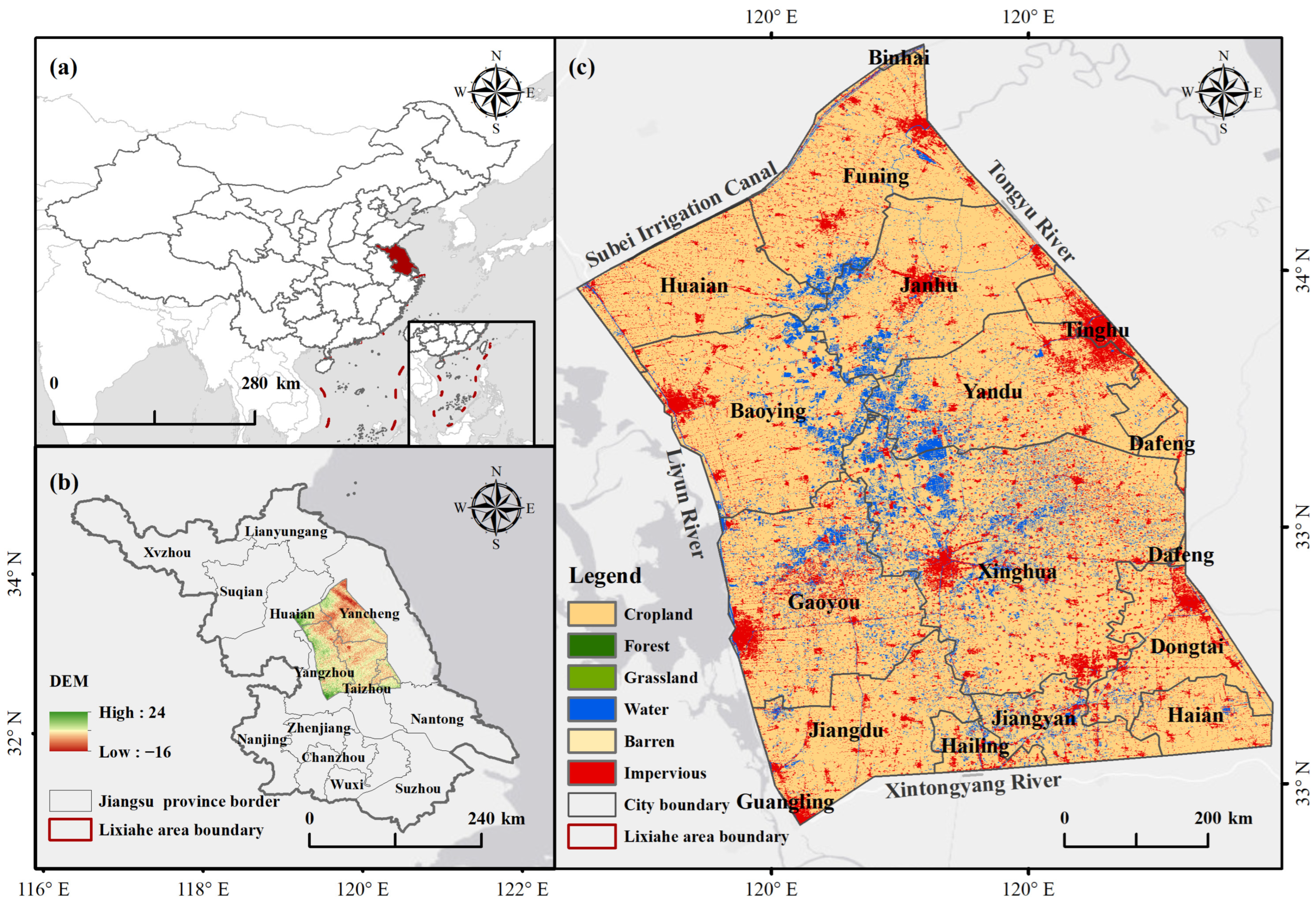
2.1. Study Area and Data Sources
2.2. Analysis of River Network
2.2.1. Characteristics Analysis of River Network
2.2.2. Spatial Pattern Analysis of the River Network
2.3. Driving Forces Analysis for Spatial Characteristics of the River Network
2.3.1. Random Forest Variable Importance Assessment
2.3.2. RF Model Validation
2.3.3. Granger Causality Testing of Key Drivers
3. Results
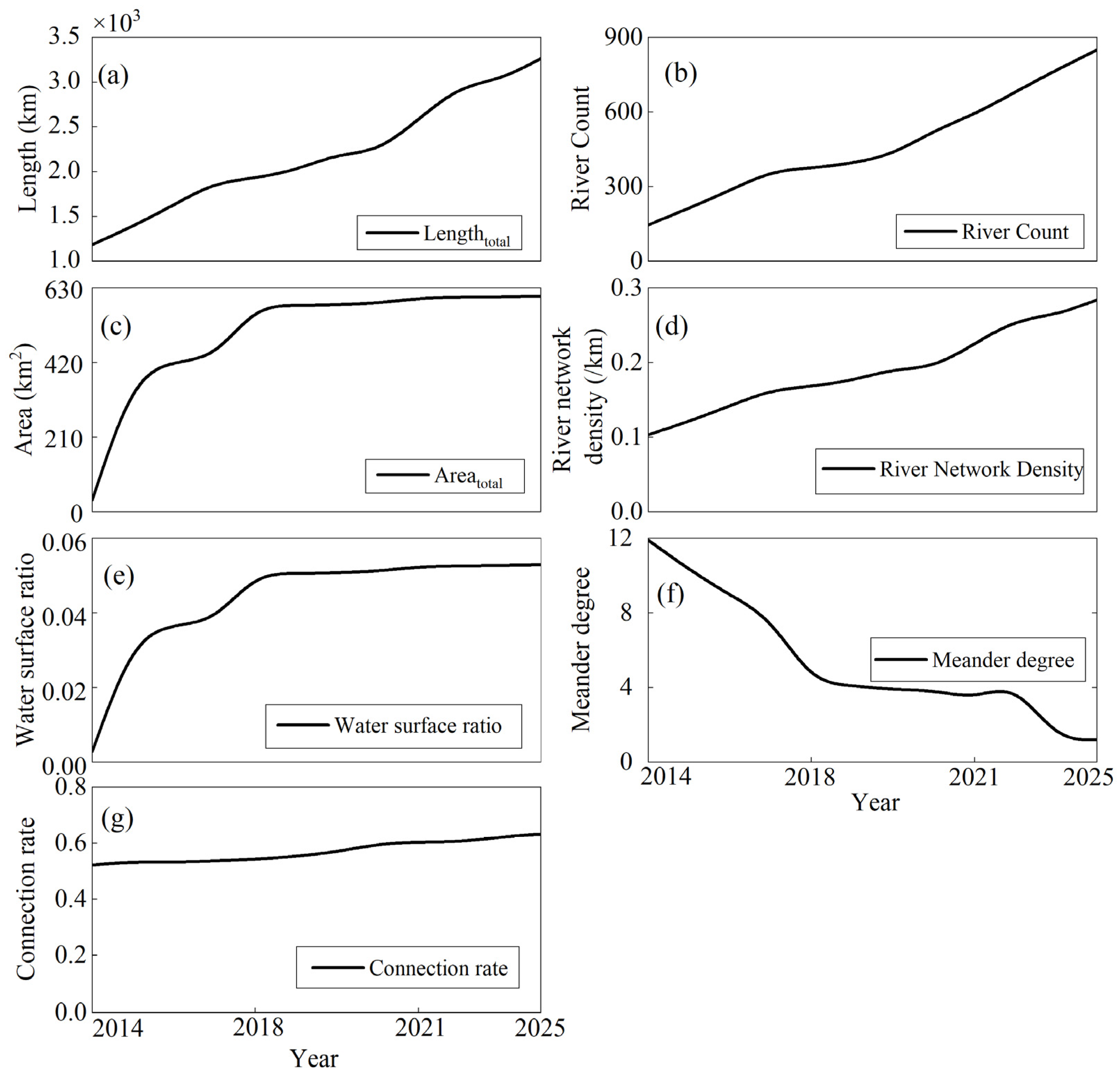
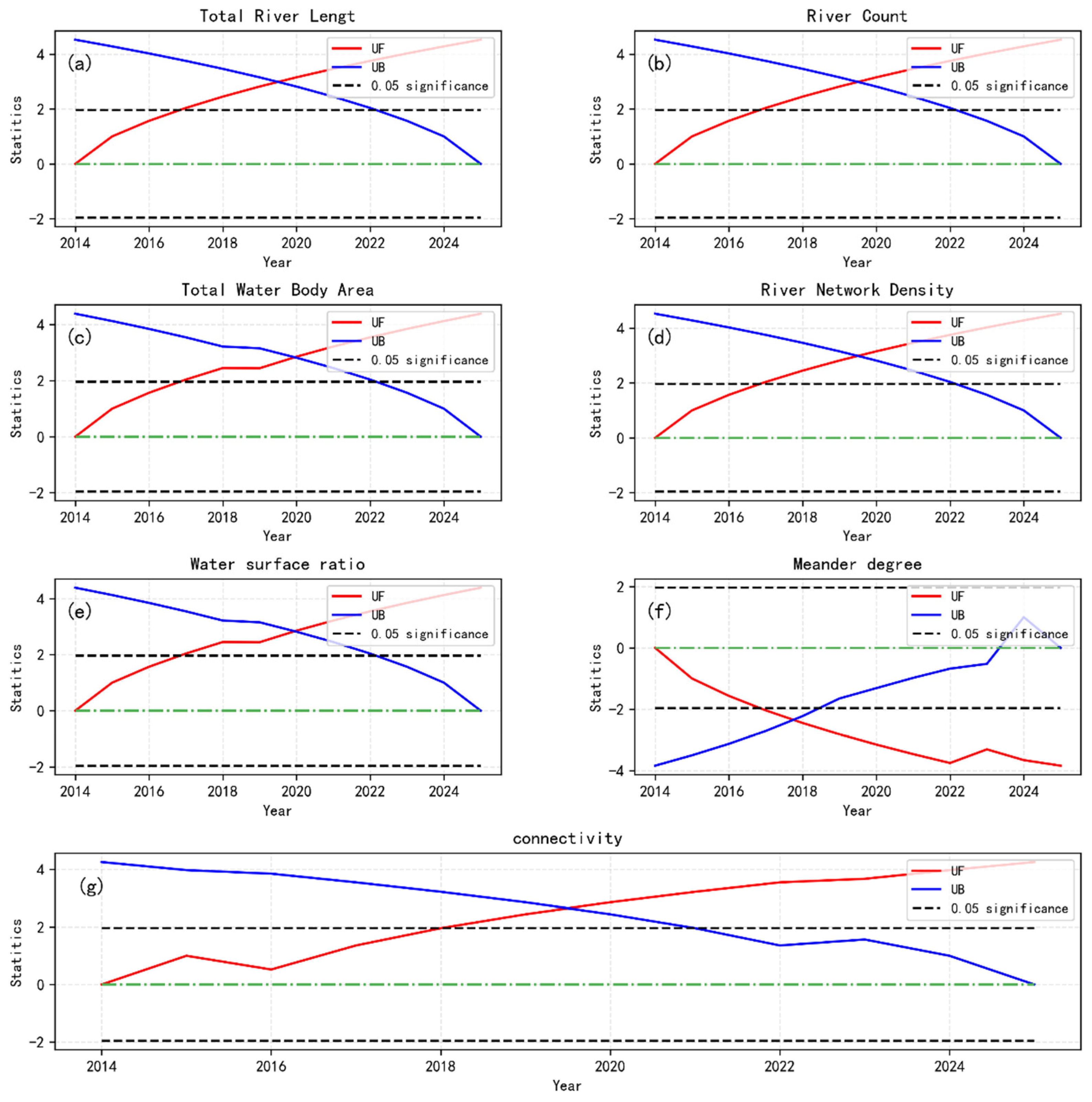
3.1. Overall Variation in Hydrological Indicators
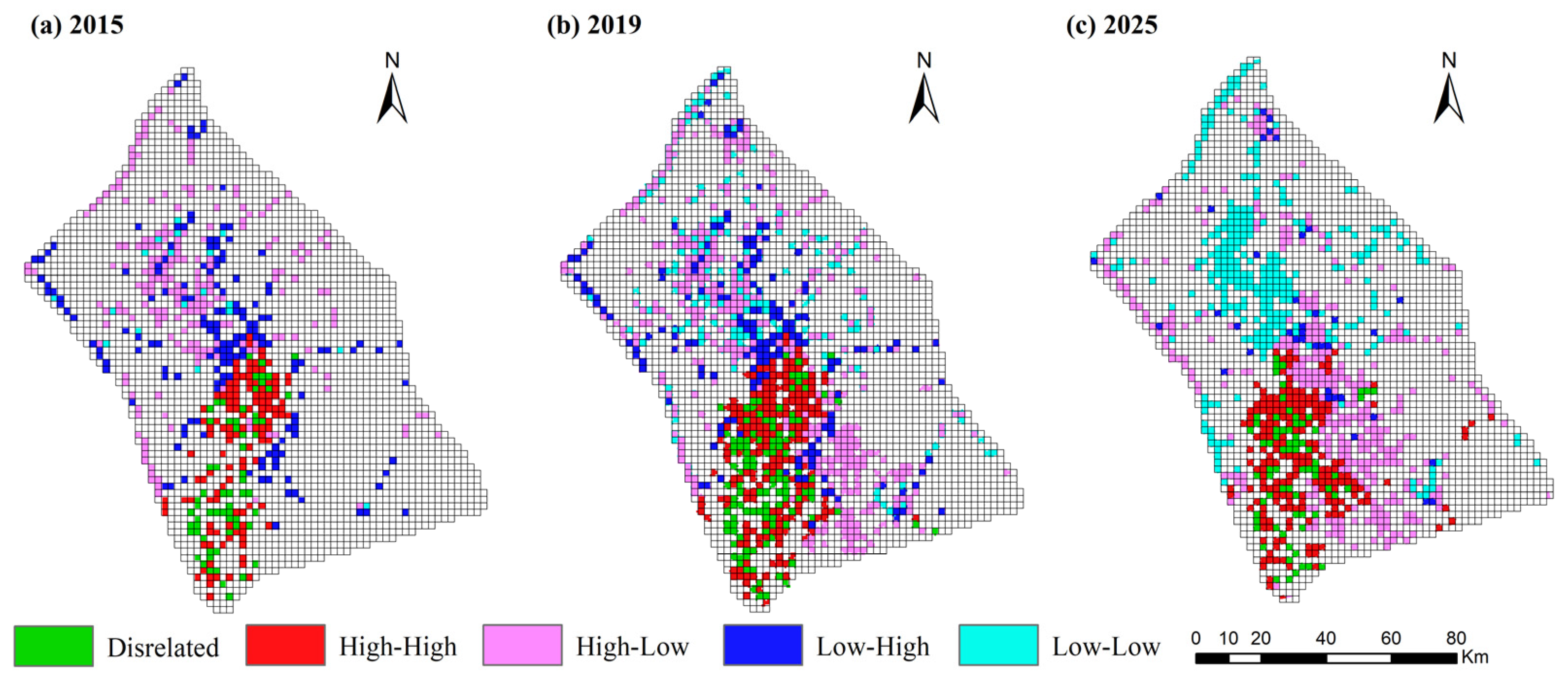
3.2. Spatial Autocorrelation Change in the River Network
3.3. Driving Forces for Spatial and Temporal Change in the River Network
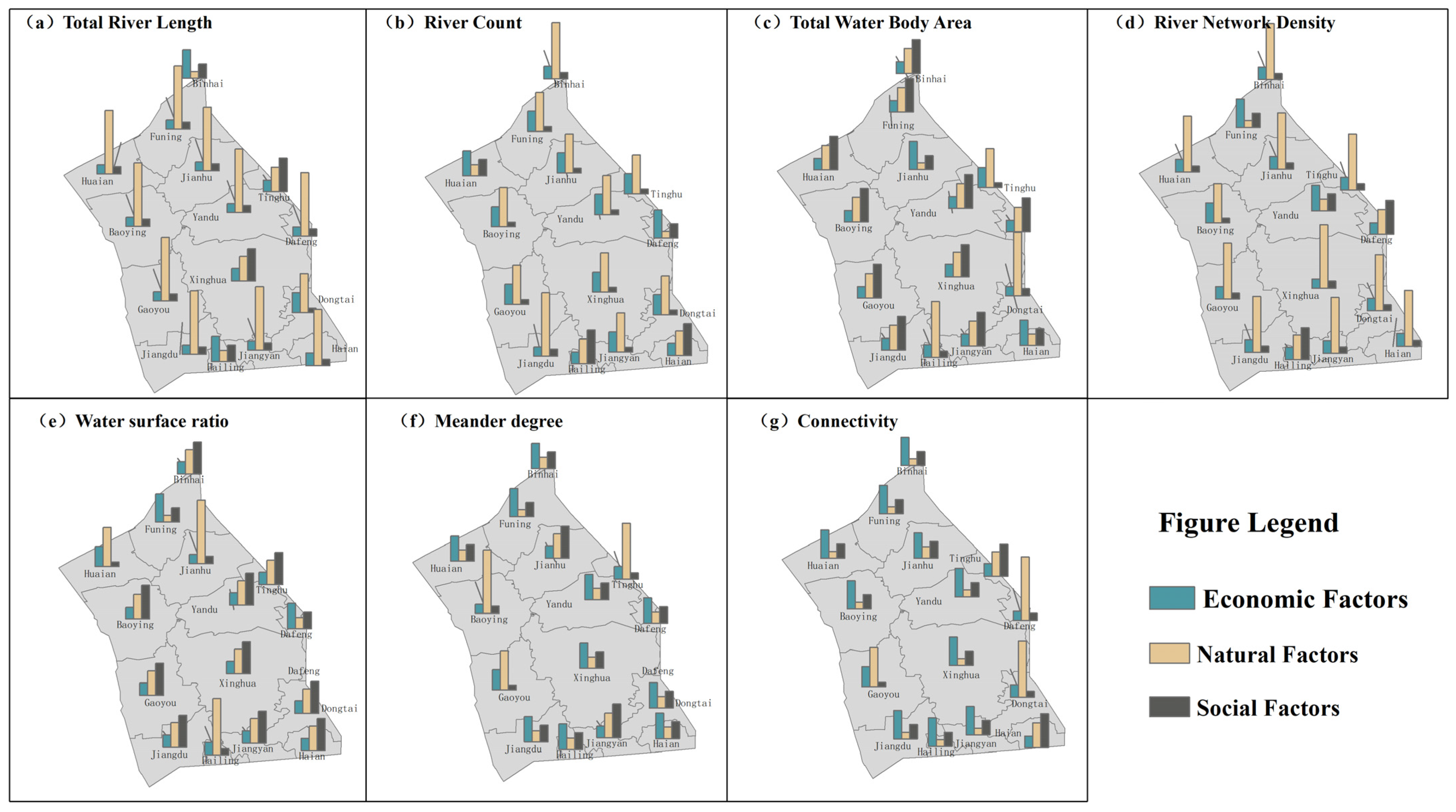
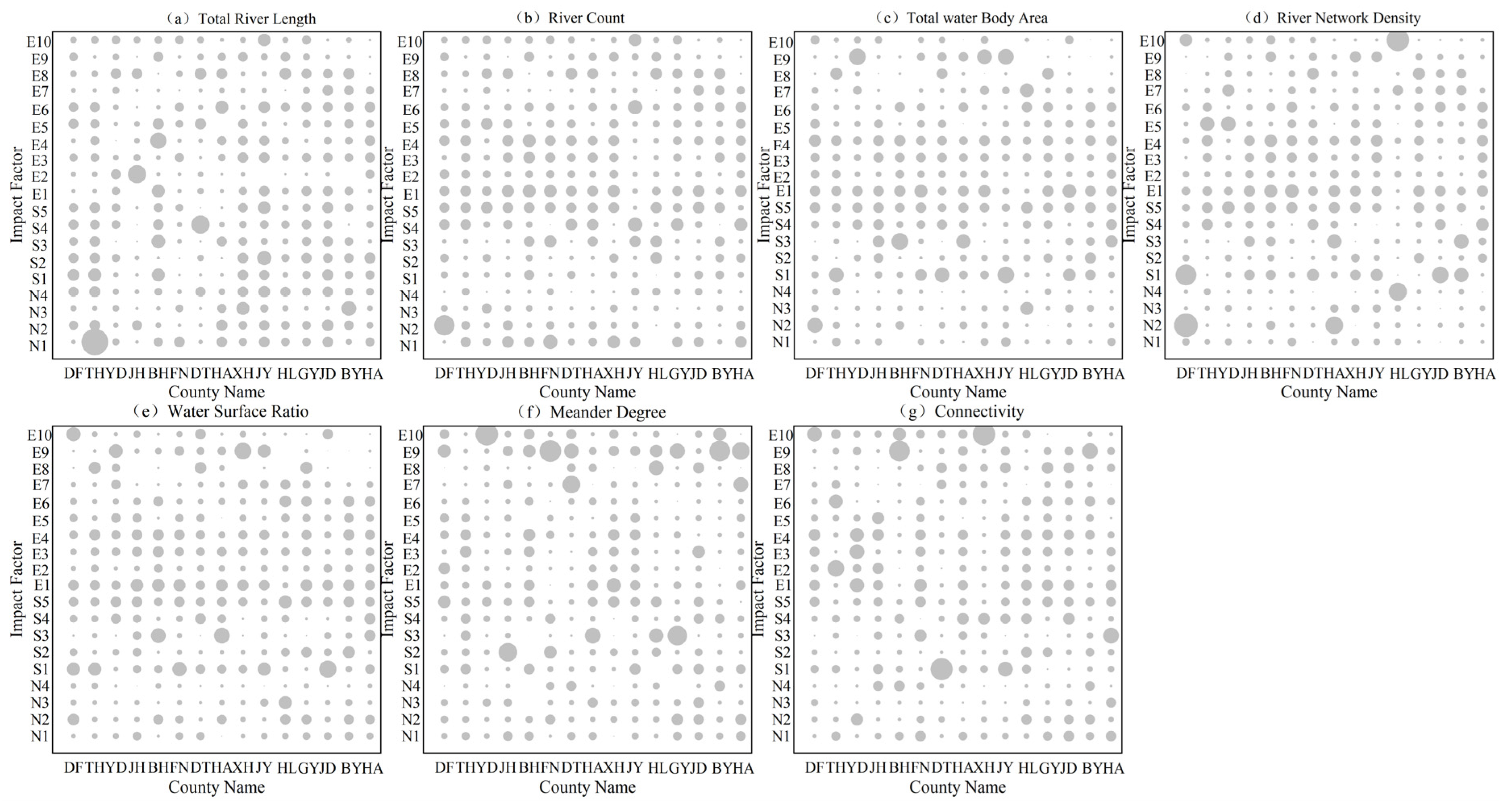
3.3.1. Random Forest Variable Importance Analysis
3.3.2. Validation Results of the RF Model
3.3.3. Results of Granger Causality Testing of Key Drivers
4. Discussion
5. Conclusions
Author Contributions
Funding
Institutional Review Board Statement
Informed Consent Statement
Data Availability Statement
Conflicts of Interest
References
- Wu, L.; Zhu, Q.; Zhang, L.; Wang, L.; Xu, Y. Interaction Between Urbanization and River System in a Plain River Network Region. J. Am. Water Resour. Assoc. 2025, 61, e70012. [Google Scholar] [CrossRef]
- Zhang, T.; Wang, W.; Emmer, A.; Jin, G.; Liu, K.; An, B.; Yao, T. Ecohydrological and Geomorphological Importance of Glacial Lakes. Earth-Sci. Rev. 2026, 273, 105356. [Google Scholar] [CrossRef]
- Liu, J.; Pei, X.; Zhu, W.; Jiao, J. Water-Related Ecosystem Services Interactions and Their Natural-Human Activity Drivers: Implications for Ecological Protection and Restoration. J. Environ. Manag. 2024, 352, 120101. [Google Scholar] [CrossRef] [PubMed]
- Taniguchi, K.T.; Biggs, T.W. Regional Impacts of Urbanization on Stream Channel Geometry: A Case Study in Semiarid Southern California. Geomorphology 2015, 248, 228–236. [Google Scholar] [CrossRef]
- Sear, D.A.; Newson, M.D. Environmental Change in River Channels: A Neglected Element. Towards Geomorphological Typologies, Standards and Monitoring. Sci. Total Environ. 2003, 310, 17–23. [Google Scholar] [CrossRef]
- Shang, S.; Wang, L.; Li, X.; Wu, L.; Liu, Y.; Su, X.; Wang, L.; Liu, G. Understanding Cross-Regional Mutual Influence Mechanisms Driven by Polder Drainage Capacity Changes in Plain River Network Areas. Geomat. Nat. Hazards Risk 2025, 16, 2582027. [Google Scholar] [CrossRef]
- Segura, J.L.A. Optimisation of Monitoring Networks for Water Systems: UNESCO-IHE PhD Thesis, 1st ed.; IHE Delft PhD Thesis Series; Taylor & Francis Group: Milton, UK, 2010; ISBN 978-0-415-61580-8. [Google Scholar]
- Wang, Y.; Xiao, Z.; Wu, H.; Xu, Y. Flood Response to Complex Underlying Surface Changes in the Urbanized Plain River Network Regions. J. Am. Water Resour. Assoc. 2025, 61, e70060. [Google Scholar] [CrossRef]
- Abed-Elmdoust, A.; Miri, M.; Singh, A. Reorganization of River Networks under Changing Spatiotemporal Precipitation Patterns: An Optimal Channel Network Approach. Water Resour. Res. 2016, 52, 8845–8860. [Google Scholar] [CrossRef]
- Ju, Y.; Yang, X.; Wang, D.; Wang, Y.; Tao, R. Spatiotemporal Variation of Extreme Precipitation in the Lixia River Basin, China, between 1960 and 2019 under Global Warming, Atmospheric Circulation, and Local Effects. J. Hydrol. Eng. 2023, 28, 05023016. [Google Scholar] [CrossRef]
- Heaney, J.P. Evolution of Urban Water Systems Analysis. J. Water Resour. Plann. Manag. 2014, 140, 1–2. [Google Scholar] [CrossRef]
- Yu, H.; Yu, B.; Zhang, X.; Fan, Y.; Wen, S.; Jiao, S. Spatiotemporal Evolution of the Water System’s Structure and Its Relationship with Urban System Based on Fractal Dimension: A Case Study of the Huaihe River Basin, China. Entropy 2025, 27, 92. [Google Scholar] [CrossRef]
- Qin, J.; Ma, Y.; Wang, X.; Zhou, J.; Wen, H.; Wang, G.; Dai, L.; Gao, S.; Zhang, T.; Wei, B. Spatial and Temporal Evolution Characteristics and Influencing Factors of Carbon Emissions in the Whole Life Cycle of Urban Water System: Based on the Perspective of 265 Cities in China. J. Clean. Prod. 2025, 531, 146900. [Google Scholar] [CrossRef]
- Xiao, Y.; Lan, G.; Ou, Y.; Zhang, L.; Xia, J. Impact of Urbanization on the Spatial and Temporal Evolution of the Water System Pattern: A Study of the Wuhan Metropolitan Area in China. Ecol. Indic. 2023, 153, 110408. [Google Scholar] [CrossRef]
- Chen, Z.; Zhu, Z.; Zhang, X.; Jiao, Y.; Cheng, Y.; Wang, S.; Zhang, H. Study on Spatio-Temporal Evolution of Ecosystem Services, Spatio-Temporal Pattern of Tradeoff/Synergy Relationship and Its Driving Factors in Shendong Mining Area. Front. Environ. Sci. 2024, 12, 1445833. [Google Scholar] [CrossRef]
- Wang, J.; Fu, L.; Lu, C.; Wang, S.; Zhu, Y.; Xu, Z.; Gui, Z. Study on River Protection and Improvement Based on a Comprehensive Statistical Model in a Coastal Plain River Network. Sustainability 2024, 16, 3518. [Google Scholar] [CrossRef]
- Yun, J.; Liu, H. Spatial Syntax Analysis of the Evolution of the Water System and Garden Distribution Relationship in Suzhou: 13th–20th Centuries. Buildings 2023, 13, 1703. [Google Scholar] [CrossRef]
- Yang, L.; Li, H.; Feng, C.; Peng, L.; Sun, R. Study on the Evolution and Adaptability of the River Network System under Rapid Urbanization in the Xiangjiang River Basin, China. Water 2023, 15, 3768. [Google Scholar] [CrossRef]
- Vanacker, V.; Molina, A.; Govers, G.; Poesen, J.; Dercon, G.; Deckers, S. River Channel Response to Short-Term Human-Induced Change in Landscape Connectivity in Andean Ecosystems. Geomorphology 2005, 72, 340–353. [Google Scholar] [CrossRef]
- Islam, M.S.; Sams, S.U.; Malitha, S.B.; Alam, M.Z. Trend Analysis of Reaction Parameters and Properties of Plant-Mediated Green Synthesized Selenium Nanoparticles Using Non-Parametric Statistical Methods (Mann–Kendall Trend Test, Sen’s Slope Estimator, ANOVA) and Their Applications in the Modern World: A Critical Perspective. RSC Adv. 2025, 15, 28155–28180. [Google Scholar]
- Furtner, M.J.; Anemone, R.L.; Wang, L.; Brophy, J.K. Evaluating Random Forest Model Performance for Cave and Sinkhole Prediction in the Cradle of Humankind, South Africa: Preliminary Analysis and Variable Importance Assessments. J. Archaeol. Method Theory 2026, 33, 34. [Google Scholar] [CrossRef]
- Chaumont-Frelet, T. Asymptotically Constant-Free and Polynomial-Degree-Robust a Posteriori Error Estimates for Time-Harmonic Maxwell’s Equations. Numer. Math. 2026, 1–33. [Google Scholar] [CrossRef]
- Malakouti, S.M.; Menhaj, M.B.; Suratgar, A.A. The Usage of 10-Fold Cross-Validation and Grid Search to Enhance ML Methods Performance in Solar Farm Power Generation Prediction. Clean. Eng. Technol. 2023, 15, 100664. [Google Scholar] [CrossRef]
- Rozos, E.; Dimitriadis, P.; Bellos, V. Machine Learning in Assessing the Performance of Hydrological Models. Hydrology 2021, 9, 5. [Google Scholar] [CrossRef]
- Duy, D.N.; Himmelbauer, J. A Two-Step Approach for Trend Detection in Injection Molding: Mann-Kendall Test and Decision Trees. Procedia Comput. Sci. 2025, 253, 2003–2013. [Google Scholar] [CrossRef]
- Tsui, T.; Derumigny, A.; Peck, D.; Van Timmeren, A.; Wandl, A. Spatial Clustering of Waste Reuse in a Circular Economy: A Spatial Autocorrelation Analysis on Locations of Waste Reuse in the Netherlands Using Global and Local Moran’s I. Front. Built Environ. 2022, 8, 954642. [Google Scholar] [CrossRef]
- Hornung, R.; Hapfelmeier, A. Class-Focused Variable Importance in Random Forests for Multi-Class Outcomes. J. Classif. 2026. [Google Scholar] [CrossRef]
- Şanlıtürk, D. The Causal Link Between Air Pollution and Respiratory Diseases: Evidence from Granger Causality Test. Thorac. Res. Pract. 2025, 26, 314. [Google Scholar] [CrossRef]
- Boccard, J.; Rudaz, S. Assessing Variable Importance Stability Using Resampling Strategies to Enhance Model Interpretability and Reliability in Metabolomics. Anal. Chim. Acta 2026, 1397, 345258. [Google Scholar] [CrossRef]
- Mohammadi, B. Application of Machine Learning and Remote Sensing in Hydrology. Sustainability 2022, 14, 7586. [Google Scholar] [CrossRef]
- Wang, X.-J.; Wei, X.; Chen, X. Morphological Suitability Analysis of Urban Greenspaces with Rivers: A Case Study of the Lixiahe Riverine Area. Sustainability 2022, 14, 13266. [Google Scholar] [CrossRef]
- Guo, T.; Zhu, C.; Li, K.; Wu, L. Early–Middle Holocene Marine–Terrestrial Changes in the Southeastern Lixiahe Plain, East China: Land-Forming Mechanisms, Regional Significance, and Implications for Neolithic Cultural Origins. Mar. Geol. 2021, 438, 106518. [Google Scholar] [CrossRef]
- Sun, R.; Yang, L.; Feng, C.; Xiang, J.; Liu, C.; Zhou, J.; Liu, Y. Spatiotemporal Heterogeneity of Temperature Change and Its Dynamic Response to River Network System Evolution in the South China. Nat. Hazards 2025, 121, 18651–18684. [Google Scholar] [CrossRef]
- Jiang, H.; Ji, L.; Yu, K.; Zhao, Y. Analysis of the Substantial Growth of Water Bodies during the Urbanization Process Using Landsat Imagery—A Case Study of the Lixiahe Region, China. Remote Sens. 2024, 16, 711. [Google Scholar] [CrossRef]
- Magara, G.; Okrah, A.; Yao, Y.I.S.; Yeboah, E.; Darko, G.; Akimana, D.; Awuku, V.; Quist, I.; Sarfo, I. A Quantitative Assessment of Drought Trends in Uganda Using Statistical Models for Hydrological Indicators. Int. J. Environ. Clim. Change 2025, 15, 517–537. [Google Scholar] [CrossRef]
- Wagner, A.Z. Constructions in Combinatorics via Neural Networks. arXiv 2021, arXiv:2104.14516. [Google Scholar] [CrossRef]
- Ren, J.; Ling, F.; Liu, Y.; Sun, J. Chikungunya in Zhejiang Province, Southeast China. Infect. Med. 2023, 2, 315–323. [Google Scholar] [CrossRef]
- Lu, Y.; Zhou, Y.; Zhou, W. Spatial Correlation Analysis of Multimode Fiber Speckles Generated from Different Modes. Opt. Commun. 2025, 596, 132539. [Google Scholar] [CrossRef]
- Tobore, A.O.; Nkwunonwo, U.C.; Abdussalaam, S.A.; Oyerinde, G.; Samson, V.M.; Adeoba, A.Q.; Adedeji, H.O.; Odebode, A.M.; Adelana, A.O. Random Forest Algorithm and Remote Sensing Techniques for Wetland Soil Organic Carbon Prediction towards Environmental Sustainability. Discov. Environ. 2025, 3, 222. [Google Scholar] [CrossRef]
- Hu, J. A Study of Accounting Teaching Feature Selection and Importance Assessment Based on Random Forest Algorithm. Appl. Math. Nonlinear Sci. 2024, 9, 20242540. [Google Scholar] [CrossRef]
- Du, W.; Tong, S.; Zhang, M.; Xin, Y.; Zhang, D.; Xing, X.; An, Y.; Cui, G.; Liu, G. Revealing the Spatiotemporal Dynamics and Nonlinear Interaction-Driven Mechanisms of Wetland Ecosystem Health in Northeast China Using Interpretable Machine Learning. Ecol. Indic. 2025, 178, 113878. [Google Scholar] [CrossRef]
- Ontivero-Ortega, M.; Iovino, M.; Pernice, R.; Barà, C.; Javorka, M.; Faes, L.; Stramaglia, S. Assessment of Sex-Related Differences in Cardiovascular Control Using High-Order Feature Importance. Eur. Phys. J. Spec. Top. 2025. [Google Scholar] [CrossRef]
- Ji, L.; Zhang, L.; Wylie, B. Analysis of Dynamic Thresholds for the Normalized Difference Water Index. Photogramm. Eng. Remote Sens. 2009, 75, 1307–1317. [Google Scholar] [CrossRef]
- Xu, H.; Cheng, J.; Guo, Y.; Zhong, T.; Zhang, J. Deciphering the Spatiotemporal Trade-Offs and Synergies between Ecosystem Services and Their Socio-Ecological Drivers in the Plain River Network Area. Front. Ecol. Evol. 2023, 11, 1212088. [Google Scholar] [CrossRef]
- Biedunkova, O.; Kuznietsov, P.; Korbutiak, V.; Petruk, A.; Gabrielyan, B.; Andreji, J.; Grokhovska, Y.; Konontsev, S. Dominant Meristic Traits of Fish and Their Association with Habitat Water Quality Parameters: A Case Study. Fishes 2025, 10, 561. [Google Scholar] [CrossRef]
- Xu, H.; Wang, P.; Lu, K.; Hao, J.; Feng, L.; Li, R.; Zhang, Y. From Cropland to Marginal Farmland: Spatial Heterogeneity of Soil Organic Carbon and Multi-Pathway Driving Mechanisms in Arid Inland River Basins. Agronomy 2026, 16, 533. [Google Scholar] [CrossRef]
- Pfaff, P.J.; Coulter, A.A.; Schall, B.J.; Davis, T.; Chipps, S.R.; Coulter, D.P. Predicting Aquatic Habitat Connectivity across Watershed Boundaries: Implications for Interbasin Spread of Nonindigenous Aquatic Species. Front. Environ. Sci. 2025, 13, 1646017. [Google Scholar] [CrossRef]





| Data | Period | Type | Source | |
|---|---|---|---|---|
| Hydrological | Annual data from 2013 to 2025 | Vector data (line and polygon) | https://doi.org/10.5281/zenodo.18899379 (accessed on 1 April 2026). | |
| Land Cover | Annual data from 2013 to 2025 | Raster data (30 m) | ||
| Climate | Temperature | Annual data from 2013 to 2025 | Raster data (30 m) and Tabular data | |
| Precipitation | Annual data from 2013 to 2025 | |||
| Topography | DEM | 2025 | Raster data (30 m) | |
| Society | Population density | Annual data from 2013 to 2025 | Tabular | |
| Urbanization rate | ||||
| Cropland area | ||||
| Economy | GDP per capita | |||
| Variable | Category | Driving Factor | |
|---|---|---|---|
| Independent variable | Natural factors | N1 | DEM (m) |
| N2 | Slope (-) | ||
| N3 | Average temperature (°C) | ||
| N4 | Precipitation (mm) | ||
| Social factors | S1 | Population density (person/km2) | |
| S2 | Urbanization rate (%) | ||
| S3 | Freshwater aquaculture area (ha) | ||
| S4 | Effective irrigated area (ten thousand mu) | ||
| S5 | Road network density (km/km2) | ||
| Economic factors | E1 | GDP (100 million yuan) | |
| E2 | Gross product of primary industry (100 million yuan) | ||
| E3 | Gross product of secondary industry (100 million yuan) | ||
| E4 | Gross product of tertiary industry (100 million yuan) | ||
| E5 | GDP per capita (yuan) | ||
| E6 | Gross output value of agriculture, forestry, animal husbandry, and fishery (100 million yuan) | ||
| E7 | Cultivated area (Ten thousand mu) | ||
| E8 | Average distance to farmland (m) | ||
| E9 | Average distance to road (m) | ||
| E10 | Average distance to construction land (m) | ||
| Dependent variable | Hydrological indicators | Quantitative characteristic indicators | River count (-) |
| Total river length (km) | |||
| Total water body area (km2) | |||
| River network density (km/km2) | |||
| Water surface ratio (-) | |||
| Structural indicators | Meander degree (-) | ||
| Connectivity indicators | Connectivity (-) | ||
| Category | Indicator | Formula | Indicator Meaning |
|---|---|---|---|
| Quantitative characteristic indicators | River network density () | = / | River network density refers to the total length of rivers per unit area, characterizing the degree of development and distribution density of a river network. |
| Water surface ratio () | 100% | Water surface ratio refers to the proportion of water area within a given unit area, representing the ratio of rivers and lakes to the total land area. | |
| Structural indicators | River meander degree () | = / | River meander degree is the ratio of the river’s (chain’s) length to the straight-line distance between its starting and ending points, characterizing the degree of natural meandering in the river. |
| Connectivity indicators | Connection rate () | = L/V | The ratio of river chain number L to river network system node number V measures the ease with which a node connects to other nodes. |
| Variable | Z Statistic | Slope Estimate |
|---|---|---|
| Total river length | 4.457 | 181.783 |
| River count | 4.457 | 61.389 |
| Total water body area | 4.320 | 23.716 |
| River network density | 4.457 | 0.016 |
| Water surface ratio | 4.320 | 0.002 |
| Meander degree | −3.771 | −0.921 |
| Connectivity | 4.183 | 0.010 |
| Year | Irrelevant and Proportion | High-Value Aggregation and Proportion | High Values Surrounded by Low Values and Proportion | Low Values Surrounded by High Values and Proportion | Low-Value Aggregation and Proportion |
|---|---|---|---|---|---|
| 2015 | 210 | 322 | 543 | 385 | 43 |
| 13.97% | 21.42% | 36.13% | 25.62% | 2.86% | |
| 2019 | 406 | 381 | 649 | 60 | 777 |
| 17.86% | 16.76% | 28.55% | 2.64% | 34.19% | |
| 2025 | 366 | 329 | 782 | 50 | 714 |
| 16.33% | 14.68% | 34.9% | 2.23% | 31.86% |
| Metric | River Network Density | Water Surface Ratio | Connectivity | Meander Degree | River Count | Total River Length | Total Water Body Area |
|---|---|---|---|---|---|---|---|
| OOB R2 | 0.8995 | 0.8635 | 0.7763 | 0.8567 | 0.9167 | 0.9266 | 0.8848 |
| Test-set R2 | 0.8363 | 0.8210 | 0.8495 | 0.8686 | 0.9033 | 0.8957 | 0.8837 |
| Test RMSE | 0.0249 | 0.9066 | 0.0214 | 0.0128 | 11.3937 | 40.6699 | 13.6301 |
| Test MAE | 0.0173 | 0.5997 | 0.0170 | 0.0086 | 7.3785 | 27.5181 | 9.6425 |
| 10-fold CV R2 (mean) | 0.8827 | 0.8362 | 0.7151 | 0.7972 | 0.8584 | 0.8919 | 0.7830 |
| 10-fold CV R2 (std) | 0.0749 | 0.0814 | 0.2755 | 0.1623 | 0.1069 | 0.0871 | 0.2783 |
| 10-fold CV RMSE (mean) | 0.0212 | 0.7706 | 0.0260 | 0.0143 | 11.5150 | 36.4326 | 14.3033 |
| Driving Factors | Category | River Network Density (χ2/p/Number of Significant Counties) | Water Surface Ratio (χ2/p/Number of Significant Counties) | Connectivity (χ2/p/Number of Significant Counties) |
|---|---|---|---|---|
| GDP | Economy | 60.1/0.0004 *** 3 counties are significant | 51.2/0.0092 *** 1 county is significant | 40.1/0.0049 *** 2 counties are significant |
| Gross output of the secondary sector | Economy | 48.4/0.0098 *** 3 counties are significant | 42.1/0.0701 * 1 county is significant | 28.3/0.1020 n.s. 0 counties are significant |
| Freshwater aquaculture area | Economy | 42.3/0.0119 ** 1 county is significant | 29.0/0.3121 n.s. 1 county is significant | 53.1/0.0000 *** 4 counties are significant |
| Road network density | Society | 75.5/0.0000 *** 5 counties are significant | 88.7/0.0000 *** 6 counties are significant | 34.9/0.0208 ** 1 county is significant |
| Year-end registered population | Society | 69.3/0.0000 *** 3 counties are significant | 69.2/0.0001 *** 5 counties are significant | 42.8/0.0022 *** 3 counties are significant |
| Population density | Society | 49.2/0.0079 *** 3 counties are significant | 90.1/0.0000 *** 7 counties are significant | 38.0/0.0090 *** 3 counties are significant |
| Annual precipitation | Nature | 36.1/0.1393 n.s. 1 county is significant | 31.2/0.4041 n.s. 0 counties are significant | 24.0/0.2412 n.s. 1 county is significant |
| Average annual temperature | Nature | 35.2/0.1632 n.s. 0 counties are significant | 43.9/0.0489 ** 1 county is significant | 24.0/0.2428 n.s. 0 counties are significant |
| Total output value of agriculture, forestry, animal husbandry, and fisheries | Economy | 51.2/0.0048 *** 2 counties are significant | 103.1/0.0000 *** 7 counties are significant | 37.5/0.0103 ** 1 county is significant |
| Target Variable | Driving Variable | Forward p-Value (Driving to Indicator) | Reverse p-Value (Indicator to Driving) | Causality Direction |
|---|---|---|---|---|
| River network density | GDP | 0.0004 | 0.0361 | Bidirectional causality |
| River network density | Gross output of the secondary sector | 0.0098 | 0.0018 | Bidirectional causality |
| River network density | Freshwater aquaculture area | 0.0119 | 0.0097 | Bidirectional causality |
| River network density | Road network density | 0.0000 | 0.0002 | Bidirectional causality |
| River network density | Total output value of agriculture, forestry, animal husbandry, and fisheries | 0.0048 | 0.0000 | Bidirectional causality |
| Water surface ratio | Road network density | 0.0000 | 0.2930 | Unidirectional causality |
| Water surface ratio | Total output value of agriculture, forestry, animal husbandry, and fisheries | 0.0000 | 0.0007 | Bidirectional causality |
| Water surface ratio | GDP | 0.0049 | 0.3508 | Unidirectional causality |
| Connectivity rate | Freshwater aquaculture area | 0.0000 | 0.1079 | Unidirectional causality |
| Connectivity rate | Road network density | 0.0208 | 0.1014 | Unidirectional causality |
Disclaimer/Publisher’s Note: The statements, opinions and data contained in all publications are solely those of the individual author(s) and contributor(s) and not of MDPI and/or the editor(s). MDPI and/or the editor(s) disclaim responsibility for any injury to people or property resulting from any ideas, methods, instructions or products referred to in the content. |
© 2026 by the authors. Licensee MDPI, Basel, Switzerland. This article is an open access article distributed under the terms and conditions of the Creative Commons Attribution (CC BY) license.
Share and Cite
Niu, M.; Yan, Q.; Wang, L.; Liang, M.; Liu, H. Spatio-Temporal Evolution Characteristics and Driving Mechanisms of River Systems in Typical Plain River Network Region. Sustainability 2026, 18, 3556. https://doi.org/10.3390/su18073556
Niu M, Yan Q, Wang L, Liang M, Liu H. Spatio-Temporal Evolution Characteristics and Driving Mechanisms of River Systems in Typical Plain River Network Region. Sustainability. 2026; 18(7):3556. https://doi.org/10.3390/su18073556
Chicago/Turabian StyleNiu, Mengjie, Qiao Yan, Lei Wang, Mengran Liang, and Haoxuan Liu. 2026. "Spatio-Temporal Evolution Characteristics and Driving Mechanisms of River Systems in Typical Plain River Network Region" Sustainability 18, no. 7: 3556. https://doi.org/10.3390/su18073556
APA StyleNiu, M., Yan, Q., Wang, L., Liang, M., & Liu, H. (2026). Spatio-Temporal Evolution Characteristics and Driving Mechanisms of River Systems in Typical Plain River Network Region. Sustainability, 18(7), 3556. https://doi.org/10.3390/su18073556