Article

Spatio-Temporal Evolution Characteristics and Driving Mechanisms of River Systems in Typical Plain River Network Region

1
College of Hydraulic and Environmental Engineering, Three Gorges University, Yichang 443002, China
2
Department of Water Resources, China Institute of Water Resources and Hydropower Research, Beijing 100048, China
*
Author to whom correspondence should be addressed.
Sustainability 2026, 18(7), 3556; https://doi.org/10.3390/su18073556
Submission received: 2 March 2026 / Revised: 31 March 2026 / Accepted: 2 April 2026 / Published: 4 April 2026

Abstract

The plain river network region is faced with ecological and environmental challenges such as insufficient hydrological connectivity and degradation of ecosystem services under the influence of urbanization and human activities, and therefore attention needs to be paid to river network changes in this region and the synergistic benefits of natural–social–economic multidimensional factors. This study took the Lixiahe region, a typical plain river network region, as the research object, using Mann–Kendall, spatial autocorrelation analysis, random forest, multiple validation and Granger causality test of key drivers to analyze the spatiotemporal evolution of its river network from 2013 to 2025 and quantify driving mechanisms from natural, social and economic factors. The results showed that: (1) From 2013 to 2025, the Lixiahe Plain river network region tended to be trunk and artificial, with the number and connectivity of river networks showing an upward trend while the curvature of river network decreased significantly. (2) The Global Moran’s I index of the Lixiahe Plain river network decreased from 0.612 to 0.534, indicating a continued weakening of spatial agglomeration in the water area and exhibiting characteristics of edge fragmentation. (3) Random forest analysis showed that socioeconomic factors dominated recent river network change in the Lixiahe Plain. Economic factors mainly influenced quantity-related indicators, while social factors were more important for meander degree and connectivity in several ecologically sensitive counties. Multilevel validation demonstrated the robustness and generalization ability of the model. Granger causality analysis further indicated that GDP, road network density, freshwater aquaculture area, and agricultural output statistically preceded changes in key hydrological indicators. These findings suggest that river network management in plain river network regions should move beyond quantity-based engineering expansion and adopt a multi-indicator, spatially differentiated approach. Integrating river quantity, morphology, and connectivity into management can better support the balance between socioeconomic development and ecological protection and promote the sustainable optimization of river network.

1. Introduction

The geographical morphology formation of plain river network regions, as typical natural–artificial complex systems [1], can be traced back to the combined effects of long-term hydrological cycles and human activities [2,3,4]. Natural geographical processes have shaped the spatial framework of the original river network [2,5], which has gradually been formed as significant artificial regulation characteristics with the transformation of human activities [6,7,8]. The plain river network, characterized by low and flat terrain and abundant water resources, plays multiple key roles in ecological services, such as flood control, waterlogging drainage, water supply, irrigation, navigation, and ecological maintenance, which has become a core ecological region of the economic belt [2,9]. Under the dual pressures of climate change (rising temperatures, changes in precipitation patterns, etc.) and high-intensity basin development, the plain river network region has faced a significant decrease in the hydrological connectivity [10,11], the degradation of ecological service capacity, and prominent increase in systematic risks [1,12]. Thus, monitoring the spatiotemporal evolution trend of plain river network provides key scientific basis for optimizing river network connectivity and ecological restoration [8,13,14], and is important for ensuring regional water security and achieving high-quality sustainable development [15].
River evolution in plain river network regions is jointly influenced by long-term natural constraints and increasingly intensive human activities [1,3,7,12]. Meanwhile, the spatial characteristics of river networks is subject to the combined influence of natural constraints from rivers and lakes and socio-economic driving forces [6,16]. Existing studies have examined temporal trends, spatial patterns, and selected driving factors, but several limitations remain. In many cases, changes in river quantity, morphology, and driving factors are analyzed separately, which makes it difficult to build an integrated understanding of river network evolution [3]. In addition, natural, social, and economic drivers are often discussed independently, which weakens the explanation of their combined effects [6,17]. Moreover, driver analysis is frequently based on correlation alone, with limited attention to temporal leading relationships. These issues are particularly important in highly engineered plain river networks, where artificial channels, land-use conversion, and drainage infrastructure can rapidly alter water patterns [4,18,19]. Therefore, interpretations of the spatio-temporal evolution characteristics of plain river networks and diagnosis conflicts between river network evolution and socioeconomic development relationship have been conducted [1,20,21]. It holds practical significance for steering the coordinated development of plain river networks and socio-economics [8].
To address these gaps, this study develops a sequential analytical framework that integrates temporal trend detection [22], spatial clustering analysis, driving factors screening [23], model validation [24,25] and temporal precedence testing [18,26]. Mann–Kendall analysis is used to detect the direction and significance of hydrological changes [27]. Moran’s I is applied to identify the spatial aggregation and fragmentation of water areas [28]. Random forest is used to rank the importance of multi-dimensional driving factors [23,29], and Granger causality testing [30,31] is further employed to examine whether key drivers statistically precede changes in core hydrological indicators [17]. The main contribution of this framework is that it provides a stepwise inference path from what changed, to where it changed, to which factors were most important, and finally to which factors showed temporal leading relationships [32].
The Lixiahe Plain is a typical low-lying plain river network region that has experienced continuous river regulation, land-use adjustment, and rapid socioeconomic development in recent years [12,19,33]. These characteristics make it a representative area for exploring the interaction between human intervention and natural background conditions [3]. Therefore, this study takes the Lixiahe Plain river network as the study area. This study aims to: (1) quantify the temporal evolution of river quantity, structure, and connectivity indicators; (2) identify the spatial clustering and fragmentation characteristics of water areas; and (3) determine the major driving factors and their temporal leading relationships. The period 2013–2025 was selected because river network data and socioeconomic statistics are relatively continuous and reliable during this period, and because it captures a recent stage of intensified river engineering and urban expansion under strong human influence.

2. Materials and Methods

2.1. Study Area and Data Sources

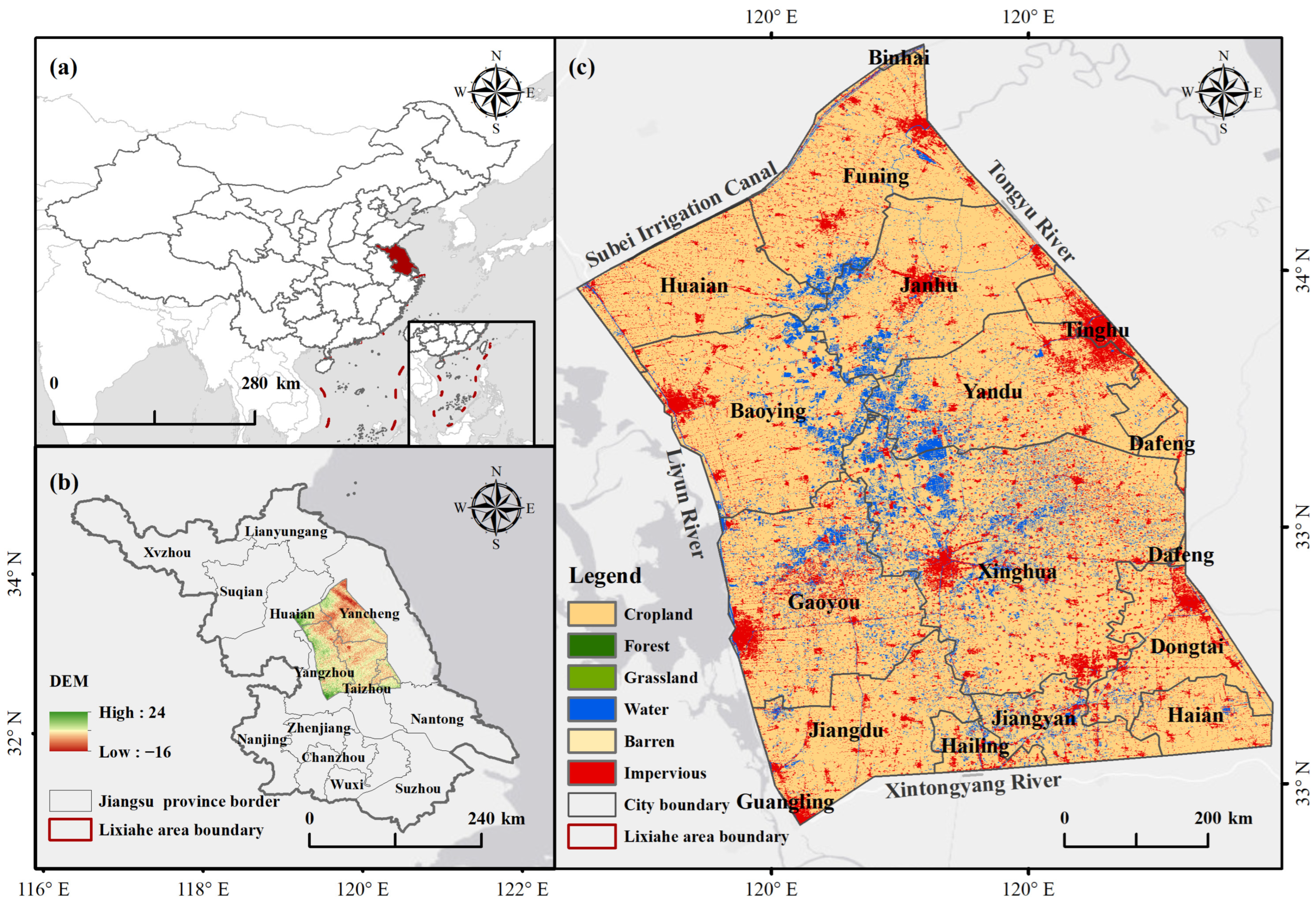
Lixiahe Plain river network region (32°12′–34°10′ N, 119°08′–120°56′ E) is located in the central Jiangsu Province, downstream of the Huai River. It represents the largest and lowest-lying plain depression within the Huai River Basin (Figure 1). The area covers a total of 11,722 km2, which is bounded by the eastern dyke of the Liyun Canal in the west, the southern dyke of the Northern Jiangsu Irrigation Main Canal in the north, the Xintongyang Canal in the south, and the Tongyu River in the east. Characterized by a subtropical monsoon climate, the area has an average annual temperature of 14–15 °C and precipitation of approximately 1000 mm (65% occurring during flood seasons), with an annual evaporation rate of 960 mm. The terrain is low-lying and flat, with areas below 3 m in elevation accounting for 80.2% of the total area, exhibiting characteristics of a dish-shaped depression. The river network density reaches 0.8 km/km2, and the lake ratio rate is 5.9% (including over 40 lakes such as Sheyang Lake and Dayong Lake). As a strategic convergence zone between the Yangtze River Economic Belt and Coastal Economic Belt, Lixiahe basin spans five cities (Yancheng, Taizhou, Nantong, Huaian, Yangzhou), which serves as Jiangsu’s key grain-producing base and ecological water transfer hub, supporting the South-to-North Water Diversion Project’s eastern route. The river network systems in the study area provide flood control, irrigation, water supply, navigation, and ecological conservation. Moreover, this area has a dense population and a developed economy, and it demonstrates enormous development potential amid the advancement of the Beijing-Hangzhou Grand Canal Economic Belt and Coastal Economic Belt development initiatives in Jiangsu Province [34]. It is worth noting that the rapid economic development and high-intensity development demands of this area will exert significant pressure on the structural stability and service function sustainability of the river network, imposing stringent requirements on the coordinated development of the human–land–river network [19].
This study employed annual vector-based hydrological data (12 periods, 2014–2025), annual land cover data with 30 m resolution (10 periods, 2014–2023), DEM data with 30 m resolution, annual temperature and precipitation data, and county-level socio-economic statistics for 15 counties (2013–2023) (Table 1 and Table 2). All spatial datasets were projected to a consistent coordinate system, clipped to the study boundary, and checked for topology, attribute completeness, and spatial overlap [32]. Hydrological line and polygon layers were further cleaned to remove duplicated features and obvious geometry errors. Missing socio-economic records were filled by linear interpolation only when adjacent-year observations were available, and the interpolated values were cross-checked against municipal yearbooks to reduce bias in trend analysis. Because interpolation may smooth abrupt year-to-year fluctuations, the related results are interpreted as medium-term tendencies rather than exact annual shocks.

2.2. Analysis of River Network

2.2.1. Characteristics Analysis of River Network

Hydrological characteristic indicators are essential for elucidating the historical evolution patterns of plain river network systems. This study established an evaluation framework for hydrological indicators across quantitative, structural, and connectivity characteristics, comprising four key indicators in total (Table 3). Based on existing historical structural research and the current hydrological context of the study area [35] and the data of hydrological quantity, structure, and connectivity indicators in the plain river network region of the Lixiahe region, this study employs a high-order polynomial fitting method to construct trend lines and conducts an in-depth analysis of the changing trends and characteristics of these river network indicators. Because a region-wide reference dataset of pre-disturbance natural channels is unavailable, this indicator is interpreted as a temporal measure of morphological simplification rather than an absolute deviation from pristine river form. Trend lines were fitted to summarize long-term variation, while formal significance was evaluated with the Mann–Kendall test. This approach quantitatively reveals the evolutionary patterns of these indicators throughout the study period [14,36].
This study utilized 12 time periods of historical hydrological vector data, encompassing both linear features (rivers, canals) and areal features (lakes, reservoirs) [37]. The original data underwent spatial registration and format conversion, followed by topological error detection and repair, along with standardized integration of attribute fields. Based on the preprocessed hydrological line and polygon data, the quantitative characteristic, structural and connectivity indicators of Lixiahe Plain river network were assessed. A graph theory model implemented via GeoDataFrame enabled digital representation of the river system topological structure, with comprehensive network analysis calculating annual indicators of hydrological quantity, structure, and connectivity [38] (Table 3).
Mann–Kendall (M-K) nonparametric statistical test was adopted in this study [27]. This method, as a standard tool for hydrological time series analysis, requires no strict assumptions about data distribution and effectively minimizes outlier interference. The Mann–Kendall (M-K) test identifies data discontinuities by comparing statistical variables U F k and U B k . When the statistical variables were compared with the confidence interval (u = ±1.96) at a significance level (α = 0.05), the significance of river network index change trend in time series and the location of mutation year could be judged [22]. In this study, the multivariate M-K test was used to evaluate the trend of hydrological index time series changes from 2013 to 2025. Because the study period is relatively short, the M-K results are interpreted together with slope estimates and the observed time-series curves rather than in isolation. To ensure the statistical reliability.

2.2.2. Spatial Pattern Analysis of the River Network

This study employed spatial autocorrelation analysis to systematically evaluate the spatial characteristics of the river systems in Lixiahe Plain [39]. As a core tool in spatial statistics, this method quantitatively assesses the correlation between spatial units and their neighbors, effectively revealing the spatial dispersion or clustering patterns of river system features [28]. Specifically, Global Moran’s I was applied to identify whether water surface ratio showed overall clustering or dispersion across the study region, and Local Moran’s I was used to locate high–high clusters, low–low clusters, and spatial outliers. This combination makes it possible to distinguish regional aggregation from local fragmentation, which is necessary for interpreting where river network change is concentrated rather than only whether change exists.
Spatial autocorrelation analysis comprises global and local dimensions [40]: the Global Moran’s Index (Global Moran’s I) comprehensively evaluates the spatial clustering characteristics of variables, Equation (1), while the Local Moran’s Index (Anselin Local Moran’s I) identifies local clustering patterns or outlier distributions, Equations (2) and (3).
I = m i = 1 m j = 1 m w i j x i x ¯ x j x ¯ i = 1 m   j = 1 m w i j   i = 1 m   x i x 2
I i = x i x ¯ s i 2 j = 1 , j i m w i j x j x ¯
s i 2 = j = 1 , j i m x j x ¯ 2 / m 1
where I is the Global Moran’s I; m is the total number of spatial units in the area; x i and x j are the attribute values of the random variable x at geographic units i and j, respectively; x ¯ =   1 m   i = 1 m x i is the average attribute value across m spatial unit samples; w i j is the adjacency weight matrix between areas i and j , reflecting spatial object adjacency relationships. If areas i and j are adjacent, w i j = 1; otherwise, w i j = 0. The value of I ranges from [−1, 1]. I > 0 indicates positive spatial autocorrelation, i.e., spatial clustering; I < 0 indicates negative spatial autocorrelation, i.e., spatial dispersion; I close to 0 suggests no spatial autocorrelation, implying a random spatial pattern; I i is the Local Moran′s I. A positive value signifies spatial clustering of similar values (i.e., high–high or low–low aggregation), whereas a negative value indicates the clustering of dissimilar values (i.e., spatial outliers).
The study area was divided into 2 × 2 km grid cells (2944 units) for water surface ratio calculation and spatial autocorrelation analysis. This grid size was selected as a compromise between the 30 m land-cover resolution, the average size of water patches, and the need to maintain stable spatial statistics over the whole plain. A finer grid would amplify noise from very small and discontinuous water features, whereas a coarser grid would mask boundary fragmentation around lakes and channels. Therefore, the spatial results in this study are interpreted at the meso-scale, and local variation in very small tributaries may still be underestimated.

2.3. Driving Forces Analysis for Spatial Characteristics of the River Network

2.3.1. Random Forest Variable Importance Assessment

The Random forest (RF) algorithm, leveraging its capability to handle high-dimensional data, has emerged as a standard tool for omics data analysis [26,32]. This algorithm performs variable screening through the Variable Importance Measurement (VIM), and as an efficient ensemble learning method [23], it constructs multiple decision trees for classification, playing a critical role in feature importance analysis [31,41]. Specifically, a higher feature importance score indicates a greater predictive contribution of that feature to the target variable [42].
The hydrological characteristics of plain river network regions result from the combined effects of natural forces and human activities [43]. To investigate the driving mechanisms behind their distribution, this study established a multidimensional indicator system (Table 2 and Table 3), including natural, social, and economic factors [14,29,44]. The random forest algorithm analyzed the influence of these factors on hydrological quantitative, structural, and connectivity characteristics within the study area. Based on the RE algorithm’s statistical formula, importance scores of 19 factors on 7 hydrological parameter indicators were calculated. After normalizing the input variables (with the maximum value set to 1), variable permutation importance analysis was conducted, generating an influence factor importance distribution map where circle sizes represent importance levels to enable an analysis of how different factors affect the plain river system [45].
Random forest was employed as an interpretable screening tool throughout the analysis of the driving mechanisms [23]. Subsequently, statistical analyses were conducted to estimate model errors [24] and assess model stability through stratified training and cross-validation. Finally, the Granger causality test was used to identify the causal relationships among the main driving factors [30].

2.3.2. RF Model Validation

Because random forest importance measures reflect predictive relevance rather than causal effect size, model robustness was evaluated before interpretation [31]. Three complementary procedures were used: (1) out-of-bag (OOB) estimation, which provides an internal generalization error without setting aside an independent validation set [24]; (2) a random 80/20 train-test split to evaluate out-of-sample predictive performance; (3) 10-fold cross-validation (K = 10, shuffle = True) to assess performance stability under repeated sample partitioning [25]. Consistent results across these three procedures indicate that the rankings are not driven by obvious overfitting. Nevertheless, the RF results are interpreted as relative importance rather than as direct marginal effect size.

2.3.3. Granger Causality Testing of Key Drivers

Based on the random forest screening results, this study further used panel Granger causality testing to examine whether selected drivers statistically preceded changes in three core hydrological indicators: river network density, water surface ratio, and connectivity rate [17,30]. The test does not prove strict physical causality, but it provides additional evidence on temporal leading relationships and helps distinguish one-way from reciprocal associations in short panel data from 15 counties in the Lixiahe Plain for 2013–2023.
The test is conducted in three steps. First, ADF unit root tests (maximum lag = 2, AIC for automatic order selection) are performed on the time series of all variables for each county to assess stationarity; non-stationary series are differenced once to ensure the validity of the Granger causality test. Second, Granger causality tests are independently conducted for each paired driver-target variable sequence, with optimal lag order determined by the AIC criterion (maximum lag = 2). To enhance test power in the short panel with T = 11, Fisher’s combined test is applied to aggregate county-level p-values into a panel-level composite statistic (χ2 statistic, degrees of freedom = 2 × effective number of counties). Finally, reverse Granger causality tests [30] are performed for causally marginally significant relationships (p < 0.10) in the forward test to determine whether the relationship is unidirectional or bidirectional, thereby further clarifying the causal direction.

3. Results

3.1. Overall Variation in Hydrological Indicators

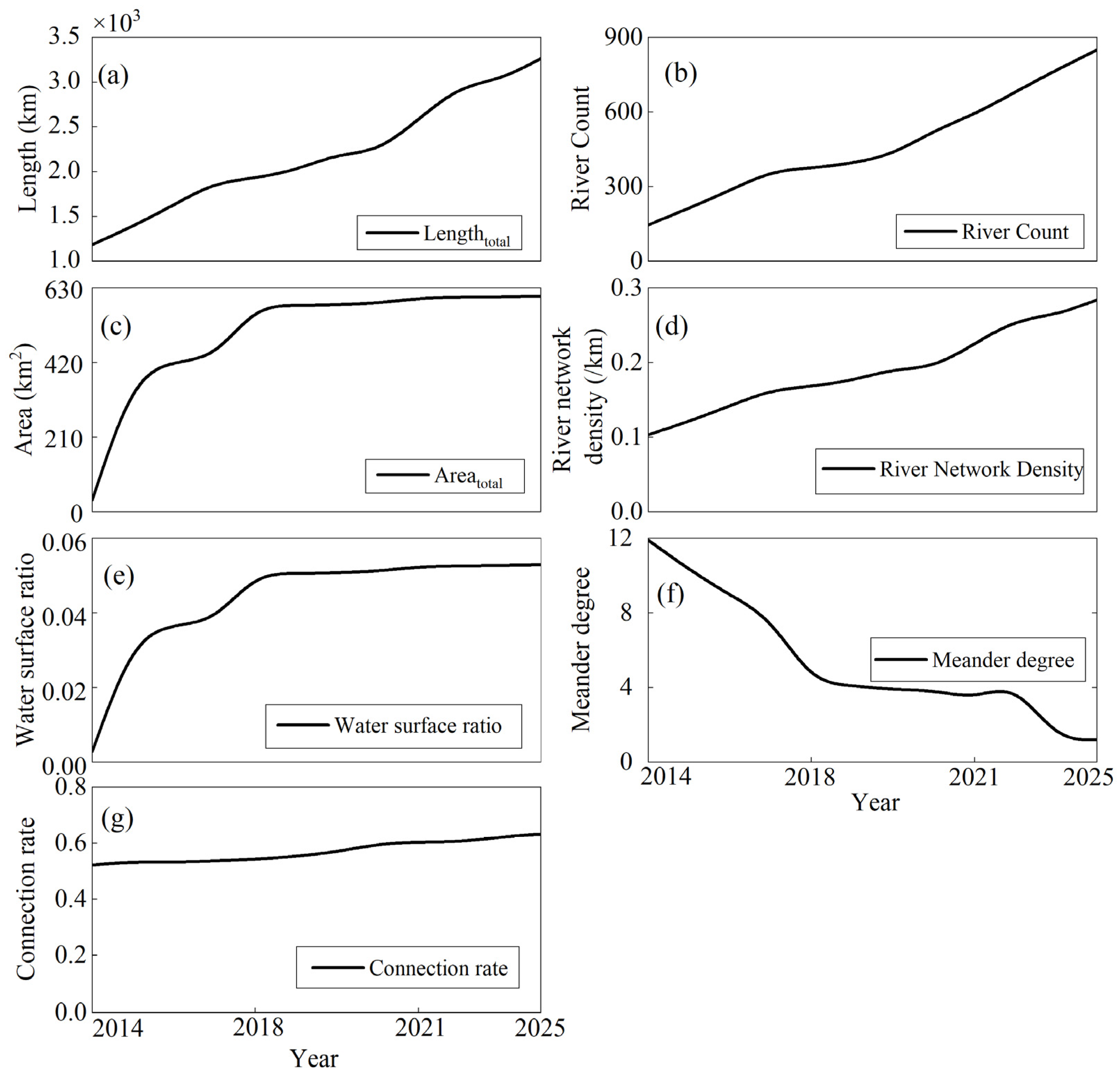
The river system morphological structure of Lixiahe Plain river network system underwent significant changes from 2014 to 2025 (Figure 2). Overall, all six indicators except river network system sinuosity exhibited a significant increasing trend, with particularly pronounced increases in total river length (Figure 2a) and river network density (Figure 2d). The total river length increased from 1185.8 km in 2014 to 3263.4 km in 2025, with an average annual accelerated increase of 181.8 km (Figure 2a). The number of rivers surged from 146 to 850, with an average annual exponential increase of 61.4 (Figure 2b). This indicated a trend toward increasing hydrological complexity and remarkable river network densification during the study period. Concurrently, the total water area expanded from 34.2 to 607.7 km2, with the first significant surge (345 km2) occurring in 2015, followed by fluctuating increases (Figure 2c). In contrast, river sinuosity showed a significant decreasing trend, dropping sharply from 11.89 to 1.20, indicating a rapid transition from natural meandering to straightened and channelized river forms (Figure 2f). The connectivity indicators exhibited a significant but relatively gradual upward trend, increasing from 0.52 to 0.63 (Figure 2g), suggesting improved connectivity between hydrological nodes and a trend toward more complex network structures as river density increased.
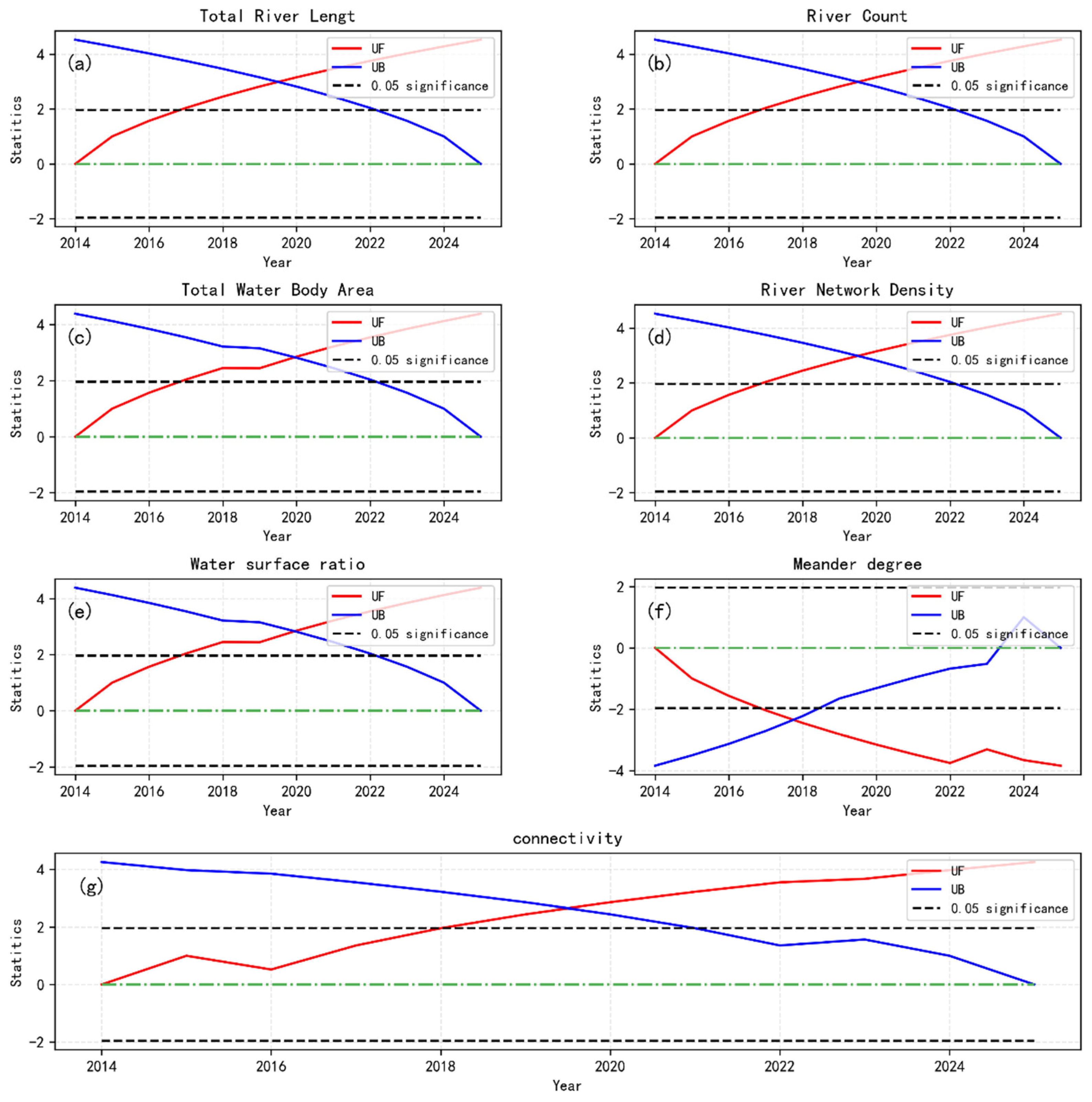
The results showed that meander degree exhibited a significant decreasing trend (Z = −3.77, p < 0.001) (Table 4), while the remaining six indicators all showed statistically significant increasing trends (|Z| > 4.18, p < 0.001) (Table 4). The trend test slopes were consistent with the line chart slopes, confirming the robustness of the temporal trends. For hydrological quantity and connectivity indicators, the Z statistics were all greater than 0 and significantly exceeded the critical value (about 2.56) at the 0.01 significance level (Table 4), with p-values far below 0.01, indicating statistically significant upward trends. Meander degree showed a statistically significant decreasing trend (Z = −3.77, p < 0.001) (Table 4), with a slope estimate (SE) of −0.92 per year (Table 4). The abrupt change test results based on the UF statistic (Figure 3f) showed that multiple indicators, including total river length, river count, and water area, exceeded the significance level critical line (α = 0.05) around 2016, signaling that subsequent changes in these hydrological indicators were no longer slow and gradual but had shifted to a pronounced leap.

3.2. Spatial Autocorrelation Change in the River Network

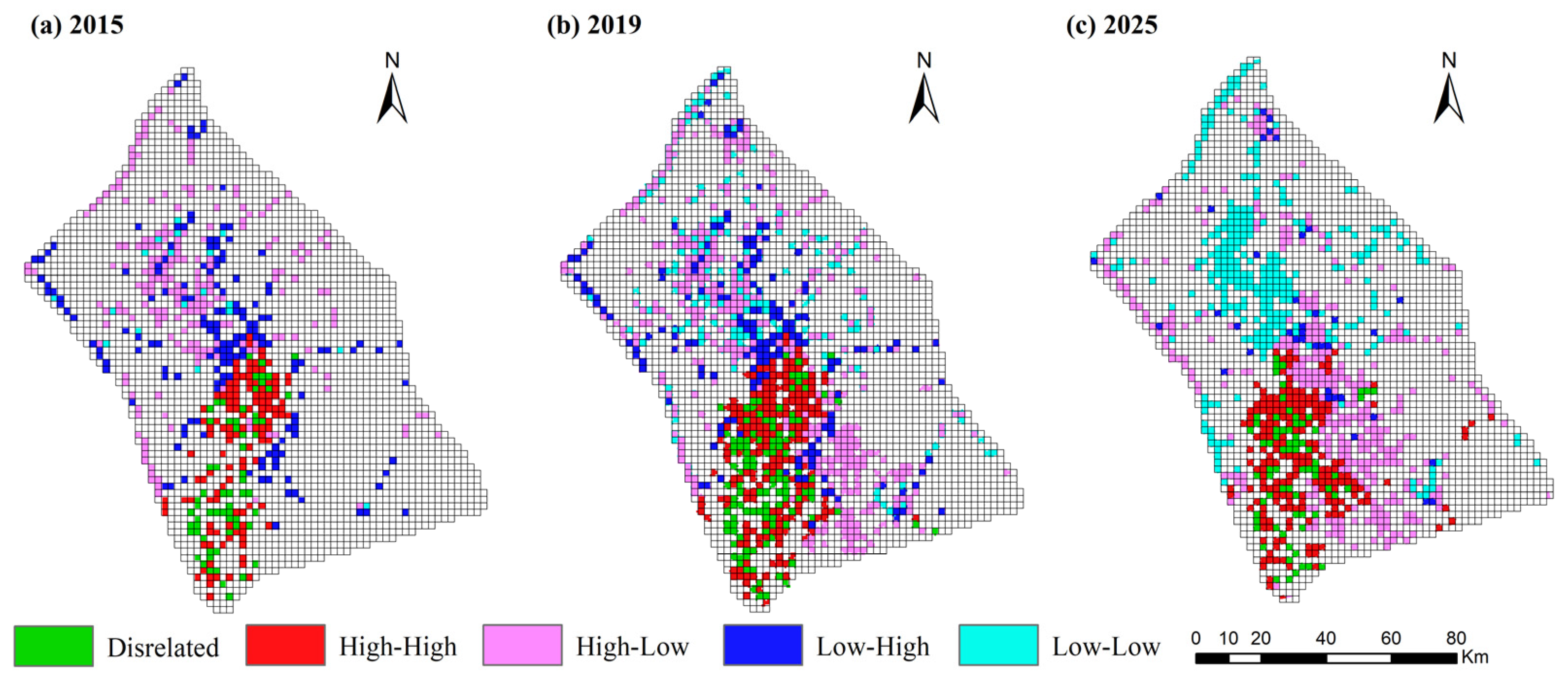
The Global Moran’s I values for water area ratio in 2015, 2019, and 2025 were 0.612, 0.589, and 0.534 respectively (p < 0.01) (Figure 4 and Table 5). The Global Moran’s Index exhibited a continuous declining trend, indicating a gradual weakening of the spatial positive correlation between high-value and high-value clusters, as well as between low-value and low-value clusters, and a significant reduction in the overall clustering of water spatial distribution.
From the perspective of local spatial autocorrelation type evolution, the number of high–high (HH) clusters first increased and then stabilized, with the count rising from 322 in 2015 to 381 in 2019 before decreasing to 329 in 2025 (Table 5). The core hotspots remained distributed in the lake-dense central area of Lixiahe basin, while peripheral fragmentation emerged. Low–low (LL) clusters expanded dramatically, increasing from 43 in 2015 to 777 in 2019 and maintaining 714 in 2025 (Table 5), indicating the fragmentation of continuous water bodies. The number of low–high (LH) outlier clusters decreased sharply from 385 to 50 (Table 5). High–low (HL) clusters increased persistently from 543 to 782, accounting for 29% to 42% of all grids, reflecting increasingly complex boundaries between hydrological hotspots and coldspots with significantly elevated edge fragmentation.

3.3. Driving Forces for Spatial and Temporal Change in the River Network

3.3.1. Random Forest Variable Importance Analysis

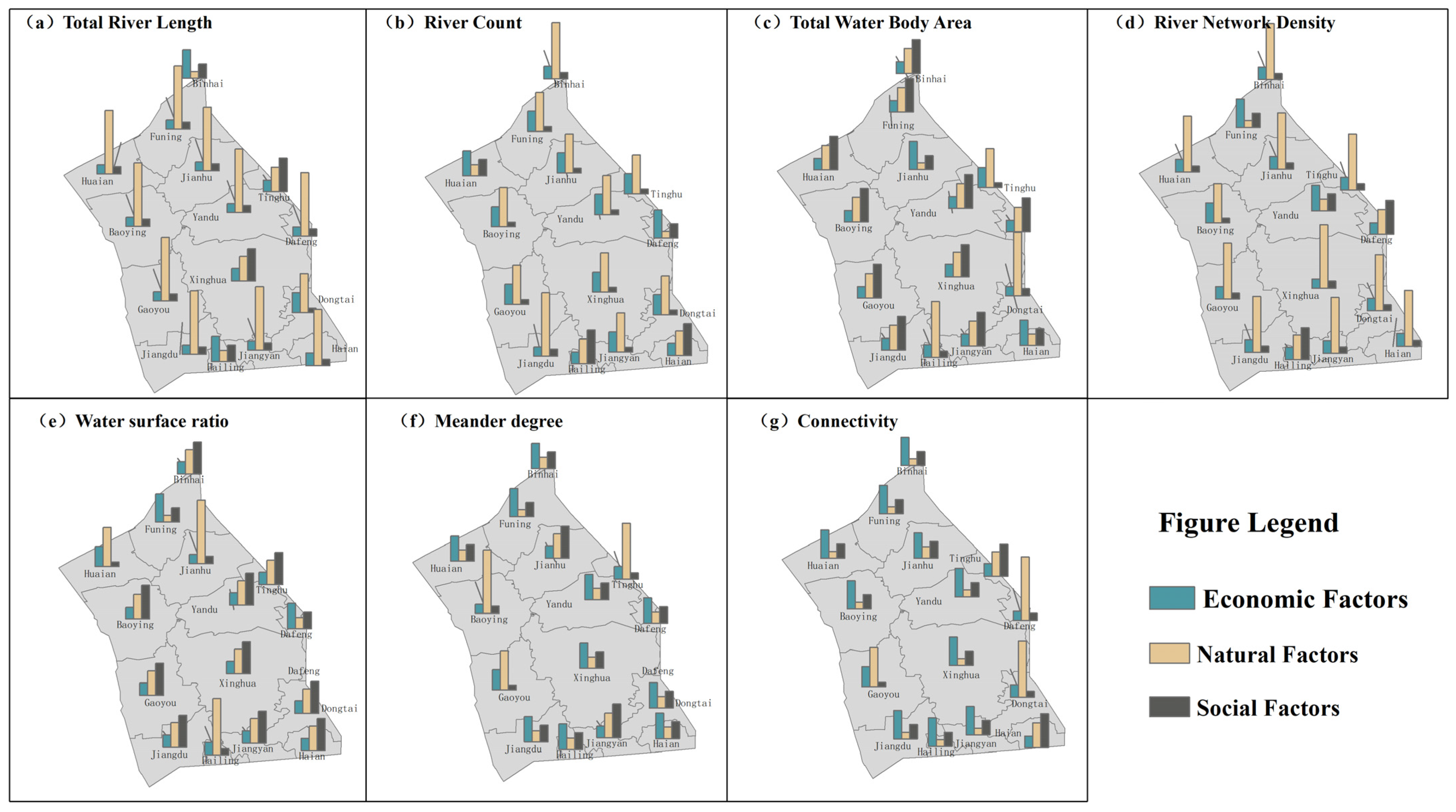
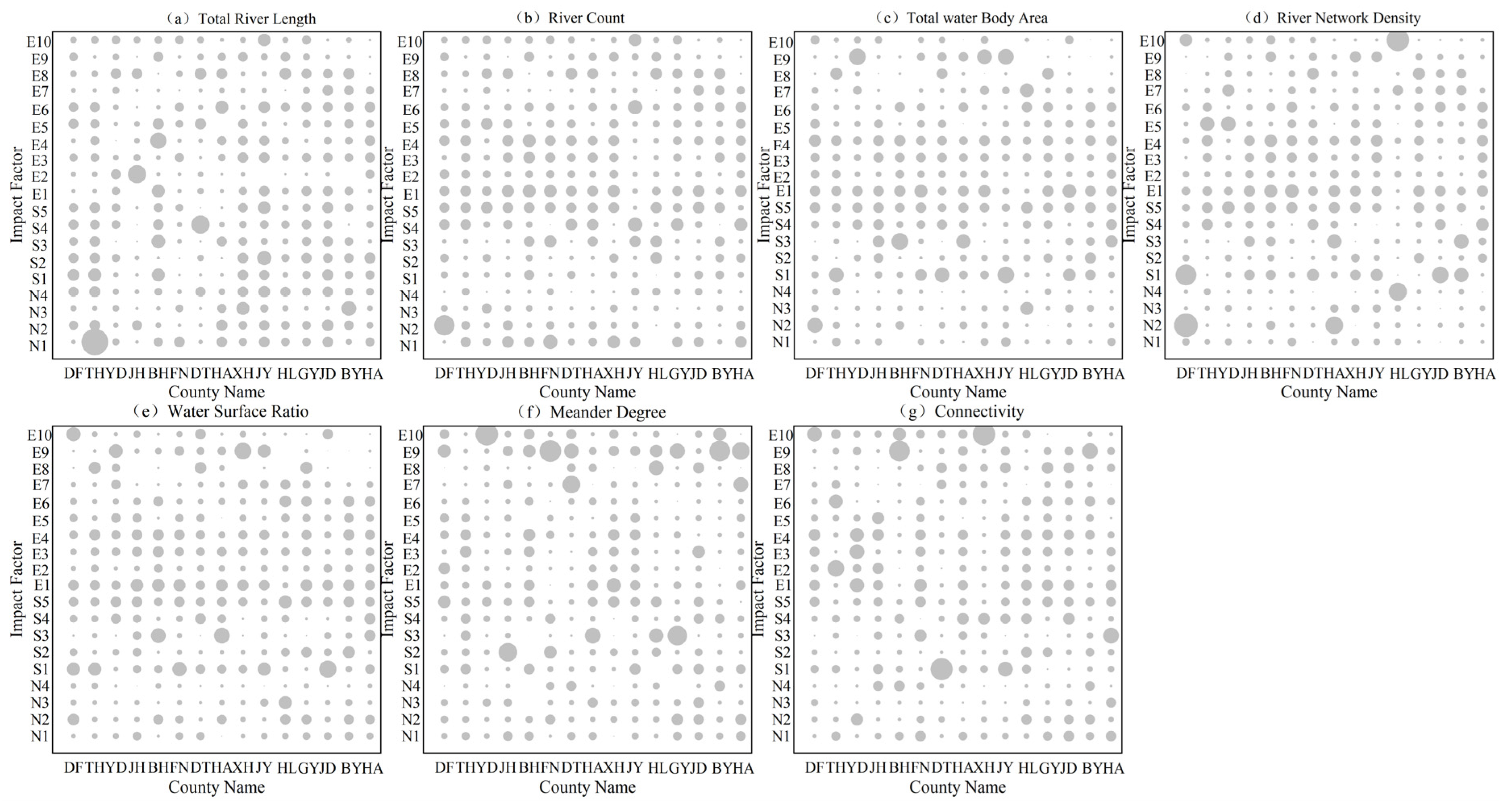
The calculation results of the three categories of influencing factors (Figure 5 and Figure 6) indicated that in Lixiahe Plain river network region, economic factors maintained a high level of importance. From a regional perspective, economic factors were the dominant drivers influencing the quantitative characteristics of the river network (Figure 6b). Their average contribution to indicators, such as river count, total length, water area, river network density, and water surface ratio, exceeded that of social factors by 30–50% (Figure 6). Social factors only surpassed economic influences in specific areas, such as the ecological conservation units of Xinghua, Jianhu, and Jiangyan, particularly in terms of river network sinuosity and connectivity (Figure 5), with impact values reaching 0.107–0.108, approximately 50% higher than those of economic factors (Figure 5b,f). Natural factors remained below 0.02 across the region, consistently playing a background constraining role.
The three categories of influencing factors could be summarized as a three-tiered driving mechanism (Figure 6). The first tier was economically driven, where factors such as the GDP growth rate and gross domestic product contributed an average of 0.11–0.16 to quantitative river network indicators (Figure 6b,f), directly affecting the dynamics of water bodies. For example, a one-percentage-point increase in GDP led to a 0.795-percentage-point decrease in the water surface ratio (Figure 6e). The second tier was socio-ecological regulation, which elevated the influence on river network sinuosity and connectivity to 0.21–0.41 in localized areas (Figure 6f,g). The third tier was a natural background constraint, where factors such as annual rainfall and temperature generally exhibited impacts below 0.03 (Figure 6). Only coastal wetlands in Binhai exerted a weak influence on the water surface ratio, positioning natural factors overall in a secondary, background role.

3.3.2. Validation Results of the RF Model

As shown in the model validation results (Table 6), the outcomes of OOB estimation, independent test set, and 10-fold cross-validation are generally consistent. No significant discrepancy where in-training performance is obviously higher than out-of-sample performance is observed, indicating that the model has no significant overfitting issue. Among all indicators, river network density, number of rivers, and total river length exhibit the most stable performance, with their OOB R2, test set R2, and 10-fold CV R2 (mean) remaining at high levels: 0.8995, 0.8363, and 0.8827 for river network density; 0.9167, 0.9033, and 0.8584 for number of rivers; and 0.9266, 0.8957, and 0.8919 for total river length, respectively (Table 6). Meanwhile, their corresponding CV standard deviations are low (ranging from 0.0749 to 0.1069) (Table 6), suggesting that the model is insensitive to different sample partitions. In contrast, although connectivity rate and water body area achieve high single-test accuracy, their 10-fold CV R2 standard deviations reach 0.2755 and 0.2783 (Table 6), respectively, indicating that these two indicators are more susceptible to sample partitioning and spatial heterogeneity. The test set R2 of river network sinuosity is 0.8686, but its CV standard deviation is 0.1623 (Table 6), with stability slightly lower than that of quantity-based indicators. Overall, the random forest model demonstrates good stability and generalization ability for most hydrological network indicators.

3.3.3. Results of Granger Causality Testing of Key Drivers

In the Granger causality test, GDP, road network density, and total output value of agriculture, forestry, animal husbandry, and fishery exhibited highly significant leading relationships with both river network density and water surface ratio (p < 0.01) (Table 7), with Fisher’s combined statistics being 60.08, 75.54, and 103.10 respectively (Table 8). These results indicate that changes in economic variables temporally precede changes in river network structure indicators. The causal relationship from road network density to water surface ratio was significantly positive in the forward Granger test (p < 0.001) (Table 7), while the reverse test was not significant (p = 0.293) (Table 8). This represents the most unambiguous causal direction in this study, statistically supporting the development logic that road infrastructure expansion precedes the shrinkage of natural water surfaces. The unidirectional causality from freshwater aquaculture area to connectivity rate also has a clear physical interpretation (forward p < 0.001, reverse p = 0.108) (Table 7). A unidirectional Granger relationship was also observed from GDP to connectivity rate (forward p = 0.005, reverse p = 0.351) (Table 7 and Table 8). Different from the unidirectional results for connectivity rate, nearly all significant relationships in the Granger test for river network density were bidirectional (Table 7). GDP, road network density, population, and agricultural output were significant in the forward Granger test for river network density, and the reverse tests were also significant (all reverse p < 0.05) (Table 7). Population density passed the Granger significance test for all three target variables (p < 0.01) (Table 7), with the reverse tests also being significant, showing a typical bidirectional Granger relationship. Precipitation and average temperature showed no significant results in the Granger tests for river network density and connectivity rate (p > 0.14) (Table 7), which is fully consistent with the results of RF analysis, where the importance of natural factors was generally below 0.03. Average temperature showed weak Granger precedence for water surface ratio (p = 0.049) (Table 7), but the reverse test was also highly significant (p < 0.001) (Table 8). Since this relationship was significant in only one county, it should be interpreted as local covariation rather than a robust causal relationship, which is mutually corroborated by the RF analysis.

4. Discussion

Recent changes in the Lixiahe Plain river network reflect the combined effects of engineering intervention, land-use restructuring, and a low-relief geomorphic setting [2,19]. As shown, river count, total river length, and connectivity increased, whereas meander degree declined sharply (Figure 2a,b,f,g). This indicates that river restoration and regulation projects mainly increased the extent of mapped water bodies, but at the same time simplified channel morphology [4,46]. This pattern is consistent with previous studies showing that plain river networks may gain artificial channels while losing natural curvature and lateral continuity [1,8,16]. In addition, the declining Global Moran’s I and the expansion of high–low and low–low clusters suggest that new water bodies were not added evenly across space (Table 5). Instead, fragmentation increased around lake margins and transition zones (Figure 4a–c). Therefore, the recent evolution of the Lixiahe river network is better characterized as quantitative expansion accompanied by morphological simplification, rather than uniform ecological recovery.
These structural changes have important ecological implications. A straighter and more fragmented river network usually reduces habitat heterogeneity (Figure 4c and Table 5) [47]. It also weakens water retention and exchange between main channels and adjacent water bodies. In turn, this may constrain aquatic movement, even when total river length increases. In other words, more channels do not necessarily indicate better hydrological or ecological function. For river management, this means that restoration success should not be evaluated only by river count, water area, or engineering length. More attention should be given to preserving meandering reaches, reconnecting lake–river corridors, and protecting key nodes that maintain both lateral and longitudinal continuity [2,47].
The analysis of driving mechanisms suggests that river network change in the Lixiahe Plain over the past decade has been dominated by socioeconomic processes, whereas natural factors mainly act as background constraints. Economic variables showed the highest and most stable importance for quantity-related indicators (Figure 5f,g and Table 7). Several of these variables also displayed significant Granger precedence (Table 8). This suggests that capital investment, industrial expansion, transport infrastructure, and agricultural production are not only associated with river network change, but in some cases also precede it statistically in time [16,20]. By contrast, precipitation and temperature [10] showed weak or locally limited effects in both the random forest and Granger results (Table 8). This does not mean that climate and geomorphology are unimportant [5]. Rather, within a relatively short period and in a highly engineered plain region, terrain inheritance changes slowly and climate signals may be partly masked by intensive human regulation [3]. Extreme rainfall may still influence short-term waterlogging, drainage pressure, and local connectivity [11]. However, these effects are less visible than those of socioeconomic restructuring in the annual data used here (Table 7 and Table 8). Accordingly, management strategies should be spatially differentiated. In economic development zones, stricter control is needed over channel occupation, road–river conflicts, and construction encroachment [4]. In ecological conservation zones, priority should be given to continuity protection, lake-margin buffering, and the maintenance of natural river form [18,47].
This study has several limitations that should be acknowledged. First, the 2 × 2 km grid is suitable for regional comparison, but it may smooth the variation in very small tributaries and narrow artificial ditches (Figure 4a–c). Second, meander degree is used here as a comparative temporal indicator because a consistent basin-wide baseline of natural pre-disturbance channels is unavailable [46]. Third, missing socioeconomic observations were filled by linear interpolation and cross-checked with yearbooks. Although this improves data completeness, it may reduce the visibility of abrupt annual fluctuations. Fourth, random forest can rank variable importance and Granger testing can evaluate temporal precedence, but neither method alone can fully identify structural causality or quantify marginal ecological effect sizes [30,31]. Future research should use longer time series, finer hydromorphological data, policy variables, and ecological response indicators, such as water quality, habitat connectivity, and aquatic biodiversity [47]. This would improve our understanding of river network evolution and its ecological consequences.

5. Conclusions

This study developed a stepwise framework to reveal the spatio-temporal evolution of a typical plain river network system and its dominant drivers. In the Lixiahe Plain, river quantity and connectivity increased from 2013 to 2025, while meander degree declined, indicating a shift toward a denser but straighter and more engineered river network. The decrease in Global Moran’s I and the expansion of boundary-type clusters further suggest increasing fragmentation of water areas. Economic factors mainly drove quantity-related indicators, whereas social factors were more important for meander degree and connectivity in several ecologically sensitive counties. Granger causality results further showed that GDP, road network density, freshwater aquaculture area, and agricultural output statistically preceded changes in key hydrological indicators.
These findings suggest that river network management should move beyond quantity-based restoration targets and adopt a multi-indicator framework that integrates morphology and connectivity. In rapidly urbanizing areas, priority should be given to reducing road–river conflicts and protecting natural channel space. In ecologically sensitive areas, restoration should focus on reconnecting tributaries and lakes, conserving meandering reaches, and protecting highly connected nodes. Overall, river network governance should shift from engineering expansion toward ecological and functional optimization.

Author Contributions

Conceptualization, Q.Y. and M.N.; data curation, M.N. and L.W.; funding acquisition, Q.Y.; investigation, M.L. and H.L.; methodology, M.N. and L.W.; project administration, H.L.; software, M.N.; supervision, Q.Y.; visualization, M.N. and L.W.; writing—original draft, M.N.; writing—review and editing, M.N. and Q.Y. All authors have read and agreed to the published version of the manuscript.

Funding

This work was supported by the College of Hydraulic and Environmental Engineering, Three Gorges University, with no other funding involved.

Institutional Review Board Statement

Not applicable.

Informed Consent Statement

Not applicable.

Data Availability Statement

The original data presented in the study are openly available in Zenodo at https://doi.org/10.5281/zenodo.18899379 (accessed on 1 April 2026).

Conflicts of Interest

The authors declare no conflicts of interest.

References

  1. Wu, L.; Zhu, Q.; Zhang, L.; Wang, L.; Xu, Y. Interaction Between Urbanization and River System in a Plain River Network Region. J. Am. Water Resour. Assoc. 2025, 61, e70012. [Google Scholar] [CrossRef]
  2. Zhang, T.; Wang, W.; Emmer, A.; Jin, G.; Liu, K.; An, B.; Yao, T. Ecohydrological and Geomorphological Importance of Glacial Lakes. Earth-Sci. Rev. 2026, 273, 105356. [Google Scholar] [CrossRef]
  3. Liu, J.; Pei, X.; Zhu, W.; Jiao, J. Water-Related Ecosystem Services Interactions and Their Natural-Human Activity Drivers: Implications for Ecological Protection and Restoration. J. Environ. Manag. 2024, 352, 120101. [Google Scholar] [CrossRef] [PubMed]
  4. Taniguchi, K.T.; Biggs, T.W. Regional Impacts of Urbanization on Stream Channel Geometry: A Case Study in Semiarid Southern California. Geomorphology 2015, 248, 228–236. [Google Scholar] [CrossRef]
  5. Sear, D.A.; Newson, M.D. Environmental Change in River Channels: A Neglected Element. Towards Geomorphological Typologies, Standards and Monitoring. Sci. Total Environ. 2003, 310, 17–23. [Google Scholar] [CrossRef]
  6. Shang, S.; Wang, L.; Li, X.; Wu, L.; Liu, Y.; Su, X.; Wang, L.; Liu, G. Understanding Cross-Regional Mutual Influence Mechanisms Driven by Polder Drainage Capacity Changes in Plain River Network Areas. Geomat. Nat. Hazards Risk 2025, 16, 2582027. [Google Scholar] [CrossRef]
  7. Segura, J.L.A. Optimisation of Monitoring Networks for Water Systems: UNESCO-IHE PhD Thesis, 1st ed.; IHE Delft PhD Thesis Series; Taylor & Francis Group: Milton, UK, 2010; ISBN 978-0-415-61580-8. [Google Scholar]
  8. Wang, Y.; Xiao, Z.; Wu, H.; Xu, Y. Flood Response to Complex Underlying Surface Changes in the Urbanized Plain River Network Regions. J. Am. Water Resour. Assoc. 2025, 61, e70060. [Google Scholar] [CrossRef]
  9. Abed-Elmdoust, A.; Miri, M.; Singh, A. Reorganization of River Networks under Changing Spatiotemporal Precipitation Patterns: An Optimal Channel Network Approach. Water Resour. Res. 2016, 52, 8845–8860. [Google Scholar] [CrossRef]
  10. Ju, Y.; Yang, X.; Wang, D.; Wang, Y.; Tao, R. Spatiotemporal Variation of Extreme Precipitation in the Lixia River Basin, China, between 1960 and 2019 under Global Warming, Atmospheric Circulation, and Local Effects. J. Hydrol. Eng. 2023, 28, 05023016. [Google Scholar] [CrossRef]
  11. Heaney, J.P. Evolution of Urban Water Systems Analysis. J. Water Resour. Plann. Manag. 2014, 140, 1–2. [Google Scholar] [CrossRef]
  12. Yu, H.; Yu, B.; Zhang, X.; Fan, Y.; Wen, S.; Jiao, S. Spatiotemporal Evolution of the Water System’s Structure and Its Relationship with Urban System Based on Fractal Dimension: A Case Study of the Huaihe River Basin, China. Entropy 2025, 27, 92. [Google Scholar] [CrossRef]
  13. Qin, J.; Ma, Y.; Wang, X.; Zhou, J.; Wen, H.; Wang, G.; Dai, L.; Gao, S.; Zhang, T.; Wei, B. Spatial and Temporal Evolution Characteristics and Influencing Factors of Carbon Emissions in the Whole Life Cycle of Urban Water System: Based on the Perspective of 265 Cities in China. J. Clean. Prod. 2025, 531, 146900. [Google Scholar] [CrossRef]
  14. Xiao, Y.; Lan, G.; Ou, Y.; Zhang, L.; Xia, J. Impact of Urbanization on the Spatial and Temporal Evolution of the Water System Pattern: A Study of the Wuhan Metropolitan Area in China. Ecol. Indic. 2023, 153, 110408. [Google Scholar] [CrossRef]
  15. Chen, Z.; Zhu, Z.; Zhang, X.; Jiao, Y.; Cheng, Y.; Wang, S.; Zhang, H. Study on Spatio-Temporal Evolution of Ecosystem Services, Spatio-Temporal Pattern of Tradeoff/Synergy Relationship and Its Driving Factors in Shendong Mining Area. Front. Environ. Sci. 2024, 12, 1445833. [Google Scholar] [CrossRef]
  16. Wang, J.; Fu, L.; Lu, C.; Wang, S.; Zhu, Y.; Xu, Z.; Gui, Z. Study on River Protection and Improvement Based on a Comprehensive Statistical Model in a Coastal Plain River Network. Sustainability 2024, 16, 3518. [Google Scholar] [CrossRef]
  17. Yun, J.; Liu, H. Spatial Syntax Analysis of the Evolution of the Water System and Garden Distribution Relationship in Suzhou: 13th–20th Centuries. Buildings 2023, 13, 1703. [Google Scholar] [CrossRef]
  18. Yang, L.; Li, H.; Feng, C.; Peng, L.; Sun, R. Study on the Evolution and Adaptability of the River Network System under Rapid Urbanization in the Xiangjiang River Basin, China. Water 2023, 15, 3768. [Google Scholar] [CrossRef]
  19. Vanacker, V.; Molina, A.; Govers, G.; Poesen, J.; Dercon, G.; Deckers, S. River Channel Response to Short-Term Human-Induced Change in Landscape Connectivity in Andean Ecosystems. Geomorphology 2005, 72, 340–353. [Google Scholar] [CrossRef]
  20. Islam, M.S.; Sams, S.U.; Malitha, S.B.; Alam, M.Z. Trend Analysis of Reaction Parameters and Properties of Plant-Mediated Green Synthesized Selenium Nanoparticles Using Non-Parametric Statistical Methods (Mann–Kendall Trend Test, Sen’s Slope Estimator, ANOVA) and Their Applications in the Modern World: A Critical Perspective. RSC Adv. 2025, 15, 28155–28180. [Google Scholar]
  21. Furtner, M.J.; Anemone, R.L.; Wang, L.; Brophy, J.K. Evaluating Random Forest Model Performance for Cave and Sinkhole Prediction in the Cradle of Humankind, South Africa: Preliminary Analysis and Variable Importance Assessments. J. Archaeol. Method Theory 2026, 33, 34. [Google Scholar] [CrossRef]
  22. Chaumont-Frelet, T. Asymptotically Constant-Free and Polynomial-Degree-Robust a Posteriori Error Estimates for Time-Harmonic Maxwell’s Equations. Numer. Math. 2026, 1–33. [Google Scholar] [CrossRef]
  23. Malakouti, S.M.; Menhaj, M.B.; Suratgar, A.A. The Usage of 10-Fold Cross-Validation and Grid Search to Enhance ML Methods Performance in Solar Farm Power Generation Prediction. Clean. Eng. Technol. 2023, 15, 100664. [Google Scholar] [CrossRef]
  24. Rozos, E.; Dimitriadis, P.; Bellos, V. Machine Learning in Assessing the Performance of Hydrological Models. Hydrology 2021, 9, 5. [Google Scholar] [CrossRef]
  25. Duy, D.N.; Himmelbauer, J. A Two-Step Approach for Trend Detection in Injection Molding: Mann-Kendall Test and Decision Trees. Procedia Comput. Sci. 2025, 253, 2003–2013. [Google Scholar] [CrossRef]
  26. Tsui, T.; Derumigny, A.; Peck, D.; Van Timmeren, A.; Wandl, A. Spatial Clustering of Waste Reuse in a Circular Economy: A Spatial Autocorrelation Analysis on Locations of Waste Reuse in the Netherlands Using Global and Local Moran’s I. Front. Built Environ. 2022, 8, 954642. [Google Scholar] [CrossRef]
  27. Hornung, R.; Hapfelmeier, A. Class-Focused Variable Importance in Random Forests for Multi-Class Outcomes. J. Classif. 2026. [Google Scholar] [CrossRef]
  28. Şanlıtürk, D. The Causal Link Between Air Pollution and Respiratory Diseases: Evidence from Granger Causality Test. Thorac. Res. Pract. 2025, 26, 314. [Google Scholar] [CrossRef]
  29. Boccard, J.; Rudaz, S. Assessing Variable Importance Stability Using Resampling Strategies to Enhance Model Interpretability and Reliability in Metabolomics. Anal. Chim. Acta 2026, 1397, 345258. [Google Scholar] [CrossRef]
  30. Mohammadi, B. Application of Machine Learning and Remote Sensing in Hydrology. Sustainability 2022, 14, 7586. [Google Scholar] [CrossRef]
  31. Wang, X.-J.; Wei, X.; Chen, X. Morphological Suitability Analysis of Urban Greenspaces with Rivers: A Case Study of the Lixiahe Riverine Area. Sustainability 2022, 14, 13266. [Google Scholar] [CrossRef]
  32. Guo, T.; Zhu, C.; Li, K.; Wu, L. Early–Middle Holocene Marine–Terrestrial Changes in the Southeastern Lixiahe Plain, East China: Land-Forming Mechanisms, Regional Significance, and Implications for Neolithic Cultural Origins. Mar. Geol. 2021, 438, 106518. [Google Scholar] [CrossRef]
  33. Sun, R.; Yang, L.; Feng, C.; Xiang, J.; Liu, C.; Zhou, J.; Liu, Y. Spatiotemporal Heterogeneity of Temperature Change and Its Dynamic Response to River Network System Evolution in the South China. Nat. Hazards 2025, 121, 18651–18684. [Google Scholar] [CrossRef]
  34. Jiang, H.; Ji, L.; Yu, K.; Zhao, Y. Analysis of the Substantial Growth of Water Bodies during the Urbanization Process Using Landsat Imagery—A Case Study of the Lixiahe Region, China. Remote Sens. 2024, 16, 711. [Google Scholar] [CrossRef]
  35. Magara, G.; Okrah, A.; Yao, Y.I.S.; Yeboah, E.; Darko, G.; Akimana, D.; Awuku, V.; Quist, I.; Sarfo, I. A Quantitative Assessment of Drought Trends in Uganda Using Statistical Models for Hydrological Indicators. Int. J. Environ. Clim. Change 2025, 15, 517–537. [Google Scholar] [CrossRef]
  36. Wagner, A.Z. Constructions in Combinatorics via Neural Networks. arXiv 2021, arXiv:2104.14516. [Google Scholar] [CrossRef]
  37. Ren, J.; Ling, F.; Liu, Y.; Sun, J. Chikungunya in Zhejiang Province, Southeast China. Infect. Med. 2023, 2, 315–323. [Google Scholar] [CrossRef]
  38. Lu, Y.; Zhou, Y.; Zhou, W. Spatial Correlation Analysis of Multimode Fiber Speckles Generated from Different Modes. Opt. Commun. 2025, 596, 132539. [Google Scholar] [CrossRef]
  39. Tobore, A.O.; Nkwunonwo, U.C.; Abdussalaam, S.A.; Oyerinde, G.; Samson, V.M.; Adeoba, A.Q.; Adedeji, H.O.; Odebode, A.M.; Adelana, A.O. Random Forest Algorithm and Remote Sensing Techniques for Wetland Soil Organic Carbon Prediction towards Environmental Sustainability. Discov. Environ. 2025, 3, 222. [Google Scholar] [CrossRef]
  40. Hu, J. A Study of Accounting Teaching Feature Selection and Importance Assessment Based on Random Forest Algorithm. Appl. Math. Nonlinear Sci. 2024, 9, 20242540. [Google Scholar] [CrossRef]
  41. Du, W.; Tong, S.; Zhang, M.; Xin, Y.; Zhang, D.; Xing, X.; An, Y.; Cui, G.; Liu, G. Revealing the Spatiotemporal Dynamics and Nonlinear Interaction-Driven Mechanisms of Wetland Ecosystem Health in Northeast China Using Interpretable Machine Learning. Ecol. Indic. 2025, 178, 113878. [Google Scholar] [CrossRef]
  42. Ontivero-Ortega, M.; Iovino, M.; Pernice, R.; Barà, C.; Javorka, M.; Faes, L.; Stramaglia, S. Assessment of Sex-Related Differences in Cardiovascular Control Using High-Order Feature Importance. Eur. Phys. J. Spec. Top. 2025. [Google Scholar] [CrossRef]
  43. Ji, L.; Zhang, L.; Wylie, B. Analysis of Dynamic Thresholds for the Normalized Difference Water Index. Photogramm. Eng. Remote Sens. 2009, 75, 1307–1317. [Google Scholar] [CrossRef]
  44. Xu, H.; Cheng, J.; Guo, Y.; Zhong, T.; Zhang, J. Deciphering the Spatiotemporal Trade-Offs and Synergies between Ecosystem Services and Their Socio-Ecological Drivers in the Plain River Network Area. Front. Ecol. Evol. 2023, 11, 1212088. [Google Scholar] [CrossRef]
  45. Biedunkova, O.; Kuznietsov, P.; Korbutiak, V.; Petruk, A.; Gabrielyan, B.; Andreji, J.; Grokhovska, Y.; Konontsev, S. Dominant Meristic Traits of Fish and Their Association with Habitat Water Quality Parameters: A Case Study. Fishes 2025, 10, 561. [Google Scholar] [CrossRef]
  46. Xu, H.; Wang, P.; Lu, K.; Hao, J.; Feng, L.; Li, R.; Zhang, Y. From Cropland to Marginal Farmland: Spatial Heterogeneity of Soil Organic Carbon and Multi-Pathway Driving Mechanisms in Arid Inland River Basins. Agronomy 2026, 16, 533. [Google Scholar] [CrossRef]
  47. Pfaff, P.J.; Coulter, A.A.; Schall, B.J.; Davis, T.; Chipps, S.R.; Coulter, D.P. Predicting Aquatic Habitat Connectivity across Watershed Boundaries: Implications for Interbasin Spread of Nonindigenous Aquatic Species. Front. Environ. Sci. 2025, 13, 1646017. [Google Scholar] [CrossRef]
Figure 1. Location of the Lixiahe Plain region. (a) The location of the study area within China.; (b) the location of the study area within Jiangsu Province; (c) land cover map of the Lixiahe plain.
Sustainability 18 03556 g001
Figure 2. Temporal variation in Lixiahe Plain river network region hydrological indicators from 2014 to 2025. (a) Total river length; (b) river count; (c) river area; (d) river network density; (e) water surface ratio; (f) meander degree; (g) connectivity rate.
Sustainability 18 03556 g002
Figure 3. Mutation testing results of hydrological indicators in the Lixiahe Plain river network from 2014 to 2025. (a) Total river length; (b) river count; (c) total water body area; (d) river network density; (e) water surface ratio; (f) meander degree; (g) connectivity.
Sustainability 18 03556 g003
Figure 4. LISA aggregation map of water space in the Lixiahe Plain river network region from 2014 to 2025. (a) 2015; (b) 2019; (c) 2025.
Sustainability 18 03556 g004
Figure 5. Bar charts and maps of zoning classification factors importance for hydrological indicators in the Lixiahe Plain river network. (a) Total river length; (b) river count; (c) water area; (d) river network density; (e) water surface ratio; (f) meander degree; (g) connectivity. Note: The bar charts show the variable importance of the three categories of driving factors. The results were normalized, with the maximum value set to 1. Bar height represents the level of importance, and values below the axis indicate negative effects.
Sustainability 18 03556 g005
Figure 6. Importance distribution map of hydrological indicators in the Lixiahe Plain river network. (a) Total river length; (b) river count; (c) water area; (d) river network density; (e) water surface ratio; (f) meander degree; (g) connectivity. Where circle sizes represent importance levels. Note: 1. The horizontal axis shows the initials of the 15 counties (cities/districts), and the vertical axis represents the types of driving factors; 2. The results were normalized, with the maximum value set to 1, and circle size indicates the level of importance.
Sustainability 18 03556 g006
Table 1. Data sources and basic information.
DataPeriodTypeSource
HydrologicalAnnual data from 2013 to 2025Vector data (line and polygon)https://doi.org/10.5281/zenodo.18899379 (accessed on 1 April 2026).
Land CoverAnnual data from 2013 to 2025Raster data (30 m)
ClimateTemperatureAnnual data from 2013 to 2025Raster data (30 m) and Tabular data
PrecipitationAnnual data from 2013 to 2025
TopographyDEM2025Raster data (30 m)
SocietyPopulation densityAnnual data from 2013 to 2025Tabular
Urbanization rate
Cropland area
EconomyGDP per capita
Table 2. Driving factors and hydrological response indicators.
VariableCategoryDriving Factor
Independent variableNatural factorsN1DEM (m)
N2Slope (-)
N3Average temperature (°C)
N4Precipitation (mm)
Social factorsS1Population density (person/km2)
S2Urbanization rate (%)
S3Freshwater aquaculture area (ha)
S4Effective irrigated area (ten thousand mu)
S5Road network density (km/km2)
Economic factorsE1GDP (100 million yuan)
E2Gross product of primary industry (100 million yuan)
E3Gross product of secondary industry (100 million yuan)
E4Gross product of tertiary industry (100 million yuan)
E5GDP per capita (yuan)
E6Gross output value of agriculture, forestry, animal husbandry, and fishery (100 million yuan)
E7Cultivated area (Ten thousand mu)
E8Average distance to farmland (m)
E9Average distance to road (m)
E10Average distance to construction land (m)
Dependent variableHydrological indicatorsQuantitative characteristic indicatorsRiver count (-)
Total river length (km)
Total water body area (km2)
River network density (km/km2)
Water surface ratio (-)
Structural indicatorsMeander degree (-)
Connectivity indicatorsConnectivity (-)
Table 3. Quantitative indicator system of the river network.
CategoryIndicatorFormulaIndicator Meaning
Quantitative characteristic indicatorsRiver network density ( R d ) R d =   L R / A River network density refers to the total length of rivers per unit area, characterizing the degree of development and distribution density of a river network.
Water surface ratio ( W p ) W p = A w / A × 100%Water surface ratio refers to the proportion of water area within a given unit area, representing the ratio of rivers and lakes to the total land area.
Structural indicatorsRiver meander degree ( S ) S = L s i / L a i River meander degree is the ratio of the river’s (chain’s) length to the straight-line distance between its starting and ending points, characterizing the degree of natural meandering in the river.
Connectivity indicatorsConnection rate ( β ) β = L/VThe ratio of river chain number L to river network system node number V measures the ease with which a node connects to other nodes.
Note: 1. L R   represents the total length of rivers within the study area; A represents the total area of the study area; river network density R d , where higher values indicate a more developed and densely distributed river system. 2. A w represents the total area of rivers within the area. 3. L si represents the actual length of the river channel, while L ai denotes the straight-line distance between the channel’s starting and ending points; S between 1.0 and 1.3 indicates a straight channel; 1.3–1.5, a low-sinuosity channel; 1.5–2.0, a moderate-sinuosity channel; and S > 2.0, a high-sinuosity channel. 4. The parameter β , ranging from 0 to 3, describes river network connectivity based on the number of river chains (L) and network nodes (V): a β value of 0 indicates no network exists; β < 1 signifies a dendritic (tree-like) network pattern; β = 1 corresponds to a single loop; and β > 1 reflects a more complex, interconnected network with a higher level of connectivity.
Table 4. Results of hydrological indicators in the Lixiahe Plain river network by Mann–Kendall test.
VariableZ StatisticSlope Estimate
Total river length4.457181.783
River count4.45761.389
Total water body area4.32023.716
River network density4.4570.016
Water surface ratio4.3200.002
Meander degree−3.771−0.921
Connectivity4.1830.010
Table 5. Statistical results of spatial autocorrelation types in water space of the Lixiahe Plain river network region from 2014 to 2025.
YearIrrelevant and ProportionHigh-Value Aggregation and ProportionHigh Values Surrounded by Low Values and ProportionLow Values Surrounded by High Values and ProportionLow-Value Aggregation and Proportion
201521032254338543
13.97%21.42%36.13%25.62%2.86%
201940638164960777
17.86%16.76%28.55%2.64%34.19%
202536632978250714
16.33%14.68%34.9%2.23%31.86%
Table 6. Random forest model performance metrics.
MetricRiver Network DensityWater Surface RatioConnectivityMeander DegreeRiver CountTotal River LengthTotal Water Body Area
OOB R20.89950.86350.77630.85670.91670.92660.8848
Test-set R20.83630.82100.84950.86860.90330.89570.8837
Test RMSE0.02490.90660.02140.012811.393740.669913.6301
Test MAE0.01730.59970.01700.00867.378527.51819.6425
10-fold CV R2 (mean)0.88270.83620.71510.79720.85840.89190.7830
10-fold CV R2 (std)0.07490.08140.27550.16230.10690.08710.2783
10-fold CV RMSE (mean)0.02120.77060.02600.014311.515036.432614.3033
Note: 1. OOB: Out-of-bag error R2 (no independent test set required); 2. Test set: 20% random partition; 3. 10-fold CV with shuffle: True; 4. RMSE: Root Mean Squared Error; 5. MAE: Mean Absolute Error.
Table 7. Summary of Granger causality test.
Driving FactorsCategoryRiver Network Density
2/p/Number of Significant Counties)
Water Surface Ratio
2/p/Number of Significant Counties)
Connectivity
2/p/Number of Significant Counties)
GDPEconomy60.1/0.0004 ***
3 counties are significant
51.2/0.0092 ***
1 county is significant
40.1/0.0049 ***
2 counties are significant
Gross output of the secondary sectorEconomy48.4/0.0098 ***
3 counties are significant
42.1/0.0701 *
1 county is significant
28.3/0.1020 n.s.
0 counties are significant
Freshwater aquaculture areaEconomy42.3/0.0119 **
1 county is significant
29.0/0.3121 n.s.
1 county is significant
53.1/0.0000 ***
4 counties are significant
Road network densitySociety75.5/0.0000 ***
5 counties are significant
88.7/0.0000 ***
6 counties are significant
34.9/0.0208 **
1 county is significant
Year-end registered populationSociety69.3/0.0000 ***
3 counties are significant
69.2/0.0001 ***
5 counties are significant
42.8/0.0022 ***
3 counties are significant
Population densitySociety49.2/0.0079 ***
3 counties are significant
90.1/0.0000 ***
7 counties are significant
38.0/0.0090 ***
3 counties are significant
Annual precipitationNature36.1/0.1393 n.s.
1 county is significant
31.2/0.4041 n.s.
0 counties are significant
24.0/0.2412 n.s.
1 county is significant
Average annual temperatureNature35.2/0.1632 n.s.
0 counties are significant
43.9/0.0489 **
1 county is significant
24.0/0.2428 n.s.
0 counties are significant
Total output value of agriculture, forestry, animal husbandry, and fisheriesEconomy51.2/0.0048 ***
2 counties are significant
103.1/0.0000 ***
7 counties are significant
37.5/0.0103 **
1 county is significant
Note: 1. *** p < 0.01, ** p < 0.05, * p < 0.10, n.s. not significant; 2. Fisher’s combined test, χ 2 = −2 ln P i , with a maximum lag of 2.
Table 8. Reverse Granger causality test results and causality direction determination.
Target VariableDriving VariableForward p-Value (Driving to Indicator)Reverse p-Value (Indicator to Driving)Causality Direction
River network densityGDP0.00040.0361Bidirectional causality
River network densityGross output of the secondary sector0.00980.0018Bidirectional causality
River network densityFreshwater aquaculture area0.01190.0097Bidirectional causality
River network densityRoad network density0.00000.0002Bidirectional causality
River network densityTotal output value of agriculture, forestry, animal husbandry, and fisheries0.00480.0000Bidirectional causality
Water surface ratioRoad network density0.00000.2930Unidirectional causality
Water surface ratioTotal output value of agriculture, forestry, animal husbandry, and fisheries0.00000.0007Bidirectional causality
Water surface ratioGDP0.00490.3508Unidirectional causality
Connectivity rateFreshwater aquaculture area0.00000.1079Unidirectional causality
Connectivity rateRoad network density0.02080.1014Unidirectional causality
Note: 1. Unidirectional causality indicates forward Granger significance (p < 0.10) and non-significant reverse (p ≥ 0.10), providing strong evidence for causal direction; 2. Bidirectional causality means both directions are significant, requiring economic theory to determine the dominant direction.
Disclaimer/Publisher’s Note: The statements, opinions and data contained in all publications are solely those of the individual author(s) and contributor(s) and not of MDPI and/or the editor(s). MDPI and/or the editor(s) disclaim responsibility for any injury to people or property resulting from any ideas, methods, instructions or products referred to in the content.