


Driving Stadium Performance Improvements by Optimising Sustainability Certification Systems and Green Building Rating Schemes


 , , and
Abstract
1. Introduction
2. Literature Review
2.1. Environmentally Sustainable Stadiums (ESSs)
2.2. Sustainability Certifications and Green Building Rating Schemes (GBRSs)
2.3. Practical Context
3. Materials and Methods
3.1. Research Approach
3.2. Participant Selection
3.3. Data Collection
3.4. Data Analysis
4. Results and Discussion
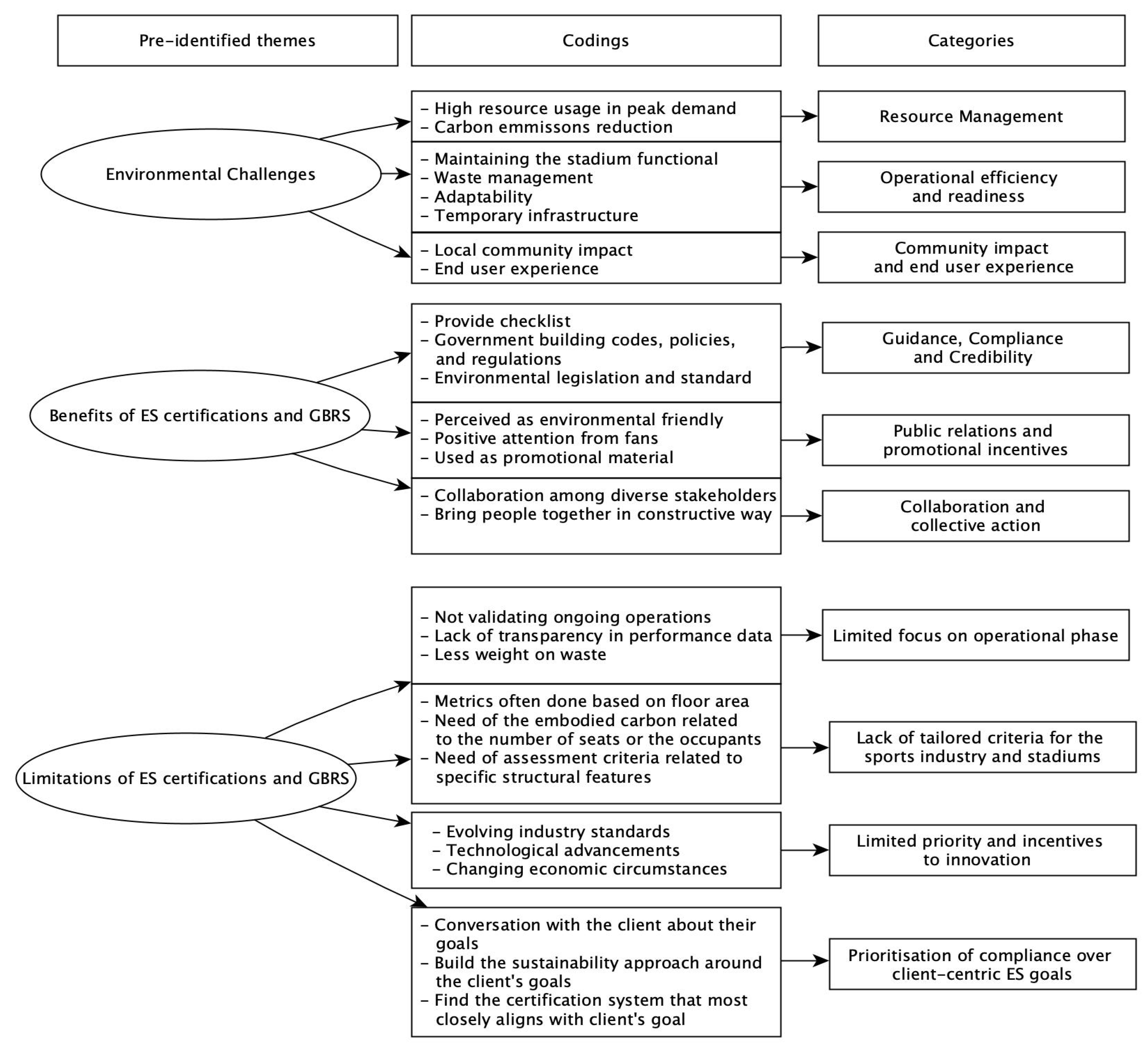
4.1. Key ES Challenges in Stadiums
4.1.1. Resource Management
- High resource usage in peak demand
“One thing that is interesting is that how to manage the peak. So you will have in our case, hottest day of the year with full capacity. How do we make sure that we don’t build all of our system be designed against that. You know what I mean? And we gonna have humongous systems. Can we somehow come up with a way to meet that demand without necessarily having to build like that?”—P18
- Carbon emissions reduction
“The hard bit is stadiums are enormously resource intensive you know, in their embodied and operational energy and carbon. So that tends to sort of overrun everything else. If you can’t get that right, then the rest of it’s really difficult.”—P3
4.1.2. Operational Efficiency and Readiness
- Keeping the stadium functional
“So, the primary points of consideration for the decision making on all this is, what’s broken that needs to be fixed right now? What can I afford financially? Do I have the time to actually get this done? Because if I run, let’s say an indoor arena and I have a basketball game tonight and then I have a hockey game tomorrow and then a concert 2 days from now. At what point in that, in that time slot am I actually going to be able to change things within the building without, you know, having to shut down for a week. So, it’s kind of like, replaces as you go if what for technology, it’s like replaces as you go. And if you can buy a replacement part that’s more sustainable then you would go for that. But what matters first and foremost is just that the building is functional.”—P20
“I had someone asked me why our backup power in our venues aren’t electric or powered by biodiesel, and the answer is if you know in our industry, they can’t be. It’s illegal right now for an emergency system to only be powered by batteries or and they don’t make generators that use biodiesel that are big enough to power one of these buildings. So, it’s literally not possible. But someone, you know, in an ivory tower far away might say, oh, you should do this. You have to do this. And it’s like, well. We need a lot of help before we can do that.”—P2
- Waste management
“I see a huge focus on energy and water and of course that’s important, but I see less weight put on some of the other areas like for example, waste. Waste is something I think is left behind a little bit and is extremely crucial, so that could be your construction waste. It could be how you design to avoid construction waste. It could be how you actually handle that construction waste, it could be, have you designed this facility in a way that allows a whole bunch of different users to come in and recycle efficiently? Or is there anything you can do to help the eventual user avoid generation of waste in the first place.”—P17
- Adaptability
“Keeping the building and keeping it up as long as possible is the most the sustainable thing you can do. It’s this constant tearing down in the [XXX], we have this huge problem that the lifespan of stadiums is getting smaller and smaller. And so we have to do what we can to reverse that trend. And again, that’s not a question of, you know, materials, that’s a question of political will and kind of innovative thinking about business models and so on. So that means stadiums, they have to be built to be adaptable, they have to be capable of responding to market shifts, the changing face of the consume”—P19
- Temporary infrastructure
“Guidance and requirements are needed for sporting federations or whoever is coming in to you, the users of the stadiums. Let’s say, so my example is obviously World Cup. So FIFA comes in and they need an enormous amount of temporary infrastructure around that stadium and they need a huge amount of temporary power. So that’s, you know, diesel generators, they bring in all sorts of furniture, fixtures and equipment that doesn’t go back to FIFA, it’s up to the host country to then disseminate it to charities or whatever. All the packaging that comes with that there are so many different levels of catering, food and beverage you have for the spectators and all the waste that comes from that food waste as well as packaging. You have tens of thousands of people every day being served that in back of house canteens and so much food waste and packaging waste comes from that. And broadcasters coming in and you can end up with hundreds or thousands of tons of copper cables leftover that have to be dealt with, and the list just goes on and on”—P17
“There’s a massive opportunity around the whole temporary piece, which no one has talked into it. So, the temporary build that is coming with every event, go to music festival, go to state of origin, go to IPL cricket. That is not managed. It’s usually relatively low-quality bills, often rented equipment, often high use of energy, water, diesel generators. All this stuff that is not managed properly through green building certification schemes. A lot of waste, a lot of inefficient operations, a lot of last-minute decisions. Lot of single use items via chair, throw it out by banners, throw it out by flag… Big opportunity there. I think sometimes in sports I call that overlay, that whole temporary construction.”—P18
4.1.3. Community Impact and End User Experience
- Local community impact
“Just a recent project that we did with [XXX]. And this one is again, it’s structural. So, it’s got an embodied carbon focus. The replacement of the existing stands that we’re looking to come up with the solutions that use local products, so Victorian ash timber and locally supplied steel and concrete just to engage the local community and building it. So that they’re engaged inbuilding it, but also it’s a community asset. So, they get it for the pride for the years to come.”
- End user experience
“How do you get to the stadium? how do you get food and drink? How do you get out of the stadium quickly and efficiently so that they can clean up the stadium and whatnot. So there’s a number of things that play there somewhere around simply the experience”.
4.2. Benefits of ES Certifications and GBRSs
4.2.1. Guidance, Compliance and Credibility
“We are driven by the requirements to host the FIFA World Cup, and the stadiums were in someway built towards that standard. One of the requirements to host the FIFA World Cup was to have a green building certification of the stadium.”—P17
“It’s so much easier when there’s an independent verification to say, well, you know, here’s the standard. You have to meet that when you go through independent verification because they are assessing you against that standard. That’s it. Whereas if there is no independent verification, therefore there is no standard, then you get arguments about me saying, well, I think that’s more sustainable. You know, option one more sustainable than option two and they go why, and you go, oh it’s just my experience. That’s a lot harder to defend. Then here’s a tool developed by the market, everybody understands it. There’s no argument. And then at the end of the project, you can actually sit back with confidence and say it was designed well. It was actually constructed well and I know that because I’ve got the evidence and it’s been verified”—P3
4.2.2. Public Relations and Promotional Incentives
“If you hear the term [XX] certified, you at least tend to know that means something good for the environment. And it gets a lot of positive attention what I think the advantage or the incentive for teams is that the [XX certification] name carries a lot of weight and so there is a public relations incentive for teams to pay the extra money to get the certification so that they can put this in the promotional material and it’s, you know, using this kind of household name to promote sustainability within the organization”—P19
4.2.3. Collaboration and Collective Action
“I think the thing about this is it’s really tricky is you’ve got many, many, many decision makers involved. And so, I think that certifications bring people together in a constructive way initially.”
4.3. Limitations in Current Certifications and GBRSs
4.3.1. Limited Tracking and Evaluation of Operational Phase
“I think that’s been the problem is that that most facilities don’t have anything, they just have, you know, promises that they’ve made which are not necessarily worth a lot or they may have a certification for their building as it was designed, but not as it’s operated that you know. So the cutting edge of course is to be tracking everything and transparently reporting you know your data and your performance…”
“I see a huge focus on energy and water and of course that’s important, but I see less weight put on some of the other areas like for example [pause] what I don’t see, waste.”—P11
4.3.2. Lack of Tailored Criteria for the Sports Industry and Stadiums
“I think that there does need to be something on specifically the embodied carbon, related to the number of seats or the occupants. Because it’s so skewed at the moment comparing stadium, you know, we’ve tried comparing stadium based on the current areas and that it’s very skewed and it would also reveal some of the things that have been done recently on some of the sort of mega projects that have, you know, where a club has decided they want to have a pitch that’s for tracks so that they can have two different types of sport, and it’s meant that the whole grandstand has been spanning over a pitch that has to be stored underneath it. And at the moment all the impacts of that aren’t really captured. And they’re huge. So I think we need something that does relate to the specific structural features of stadiums and then it’s about something that looks at the uses of the building and these spikes and acknowledges that there’s these special things around grow lamps and hot water usage.”—P10
4.3.3. Limited Priority and Incentives to Innovation
“The tools themselves become a box ticking exercise and you can find the easiest path there. And sometimes those paths are not overly beneficial, they’re already part of an existing building. And so it’s not doing anything beneficial necessarily, but it’s easy box to tick and you get points for that where it’s almost like those tools need to come and say, well, that’s part of an inherent part of that design type. You don’t get those with block them out. I don’t know that the ratings tools are trying to be as conducive to use as possible. But sometimes by doing that they can fall short of the ambition of about the tools trying to achieve and also what the designers are trying to achieve and it becomes an easy low hanging fruit situation where more impactful items are removed for the sake of something that’s inherent to the design outcome. So in that sense that the tools don’t get you where we need to get to”—P9
4.3.4. Prioritisation of Compliance over Client-Centric ES Goals
“I think you need to have the conversation with the client about what are their goals and build our sustainability approach around that. Yeah, because they’re going to be more invested in that than if I come and say we’re going to do [XXX certification], by the way, you know, you have to go do this thing over here because that’s what you need to get [XXX], even if you don’t believe in it, even if it’s not something you want to invest in. I think we’ve gotten everything backwards. So have the conversation first. Understand what the client’s true goals and interests are, and then build your sustainability approach around that. Find the certification system that most closely aligns with it and then go forward. Our industry is backwards in that respect”—P7
4.4. GOAL’s Contributions and Limitations
5. Recommendations for Optimising Sustainability Certifications and GBRSs
- Inspire Innovation: Sustainability certifications and GBRSs themselves are tools that do not inherently drive ES improvements. The expertise and dedication of the teams utilising them determine their effectiveness. Therefore, these tools should provide a platform to anticipate emerging problems and imagine solutions that can address future needs. Emphasising innovation or leadership in these tools is one way to encourage innovation and adoption of cutting-edge ES features and initiatives in stadiums that can raise the bar. This also help stadiums to adapt to evolving ES priorities and regulations, extending their lifespan and functionality while causing a ripple effect in the whole built environment.
- 2.
- Enhance Supply Chain and Procurement: The cost, availability and required machinery or technique for the construction and maintenance of ES materials can be complex and limited to specific suppliers. Additionally, the ES characteristics of many materials and products are still relatively unknown to people who are not experts in the field.
- 3.
- Assess temporary infrastructure: There are only limited requirements for constructing and operating temporary infrastructure (e.g., diesel generators, furniture, tents, fixtures, security offices, etc.) around stadiums during events, which often do not go back to the users instead stay with the host stadium. The current versions of sustainability certifications or GBRSs are not effective in assessing the ES of temporary infrastructure, which often consists of low-quality equipment and resource-inefficient or environmentally unsustainable materials that are often not included in the initial planning. ES certifications can address this by incorporating ES requirements and protocols for temporary infrastructure, encouraging collaborations on ES goals and regular audits to ensure that all actions are aligned.
- 4.
- Identify users and their stakeholders: Stadiums users can be called as forgotten stakeholders in stadium operations. There is no ES framework, requirements or guideline set for the users such as sports federations and their stakeholders (e.g., sponsors, partners, broadcasters, etc.) that use stadiums to run their event. By setting criteria for the ultimate users and stakeholders, sustainability certifications and GBRSs can encourage a more environmentally sustainable operation of stadiums and running of events. As hosting mega-events are getting expensive and countries are increasingly not wanting to host big events, stadium owners possess higher ability to establish guidelines and requirements for the federations that want to host their event. It is important to use this opportunity to reduce environmental impacts that come with these events.
- 5.
- Enable more performance-based tools: Opportunities for continuous evaluation and real-time monitoring of stadium performance is limited in current ES certifications and GBRS. Performance-based metrics that focus on actual outcomes rather than prescriptive measures will help to identify success areas and areas of improvement, which can lead to continuous improvement. As stadiums have intermittent usage with fluctuating resource and occupancy demands, ongoing performance-based programmes that can assess stadiums’ performance over different types of events, occupancy rate, time and location are important to manage peak demand and to enable comparisons to create stadium-specific benchmarking.
- 6.
- Enhance transparency through communication: The current sustainability certifications and GBRSs lack transparent communication of ES outcomes to stakeholders and the public. Information is shared only between the stadium and the certification body, apart from GOAL, which facilitates data sharing between similar stadiums. Tools that enable transparent reporting and data sharing are important for informing the industry about the current best practices. This will help to identify areas of improvement and support collaborative action towards the common ES goals. Communicating ES outcomes and the impact generated by stadiums’ ES efforts and successes with the public are important to increase reputation, positive behaviours and more environmentally sustainable partnerships. Telling the story of how the stadiums’ ES efforts support the community and local ecosystem can enhance positive perception towards stadiums.
- 7.
- Assess community usage of stadiums: Assessing stadiums’ impact on and usage by the community beyond hosting sports events are important for transforming them into community infrastructure. This includes assessing stadium’s role in meeting community resource needs such as water and energy and how they serve the public during non-event days. Additionally, stadiums should be examined for their potential to enhance inclusivity, accessibility, local culture and community development, which can lead to increased functionality and financial gains. It is also important to examine how stadiums and their platforms like social media or broadcasting opportunities are utilised to engage with fans to promote ES initiatives and positive behavioural changes.
- 8.
- Include categories for sponsors and partnerships: Stadiums and events are closely linked to brand sponsorships and partnerships. Identifying stadium and event sponsors and partners and evaluating their ES are lacking in the current ES tools and GBRSs. It is important to assess and set ES requirements for sponsors and partners of stadiums and events. The existing commercial relationships with sponsors and suppliers with different ES goals can hinder stadiums from adopting new ES features. Partnering with environmentally sustainable companies helps stadiums to adopt ES features more effectively while sending positive messages to the community and other infrastructure.
6. Conclusions
Supplementary Materials
Author Contributions
Funding
Institutional Review Board Statement
Informed Consent Statement
Data Availability Statement
Acknowledgments
Conflicts of Interest
Abbreviations
| ES | Environmental Sustainability |
| ESSs | Environmentally Sustainable Stadiums |
| FIFA | Fédération Internationale de Football Association |
| GBRSs | Green Building Rating Schemes |
| GOAL | Green Operations and Advanced Leadership |
| LEED | Leadership in Energy and Environmental Design |
| LBC | Living Building Challenge |
| UN | United Nations |
| SDGs | Sustainable Development Goals |
Appendix A

| Criteria | Rationale | Examples of Evidence to be Considered |
|---|---|---|
| Core Criteria (CC) | Interviewees Meet Each of These Criteria | |
| CC1: (by sector) experience in one of the four sectors of interest | Extensive experience in either: (1) Stadium design, construction and operation; (2) Environmental sustainability consultation for stadiums; (3) Stadium ownership, operation and management; (4) Green building certification systems or assessment tools. | Over 5 years of experience in any of these sectors and/or involved in mega-event projects and/or state, federal or internationally recognised citations or awards, and/or major contribution to policy development, frameworks, or guidelines related to stadiums |
| CC2: (by leadership) leadership in their field/s of experience | Demonstrated leadership role in any of the above sectors | Awards, publications, holds or recently held senior positions in construction and design firms, stadium management, environmental consulting firms or green building councils or certification systems; recognised on state, federal or international level, featured in media, etc. |
| CC3: (by project) experience in stadium projects | Experience in stadium design and construction projects and/or experience in planning and hosting of mega-events | More than 5 years of experience in stadium projects or mega-events, or currently part of any upcoming mega-events |
| Desirable criteria (DC) | ||
| DC1: (by knowledge) subject matter expert | Advanced knowledge in one or more of the sectors noted in Core Criteria 1 or other field of expertise and projects important to these sectors | Academic experts from universities or other research institutions; frequently cited in academic publications |
| Participant | Role | Core Criteria | Desirable Criteria | ||
|---|---|---|---|---|---|
| CC1 (By Sector) | CC2 (By Leadership) | CC3 (By Project) | DC1 (By Knowledge) | ||
| Sustainability in the Built Environment Experts | |||||
| P1 | Sustainability Advisor | X | X | - | - |
| P2 | Head of Sustainability | X | X | - | - |
| P3 | Sustainability Leader | X | X | - | - |
| P4 | Sustainability Consultant | X | - | - | - |
| P5 | Sustainability Consultant | X | - | - | - |
| P6 | Sports Sustainability and Climate Consultant | X | X | - | - |
| Built Environment Experts | |||||
| P7 | Architect | X | X | X | - |
| P8 | Architect | X | X | X | - |
| P9 | Architect | X | - | X | - |
| P10 | Engineer | X | - | X | - |
| P11 | Engineer | X | - | X | - |
| Stadium Management Experts | |||||
| P12 | Group Executive, Assets and Facilities | X | - | - | - |
| P13 | Asset and Environmental Management Specialist | X | - | - | - |
| P14 | Facility Manager | X | - | - | - |
| Mega-event planning and management Experts | |||||
| P15 | Director | X | - | X | - |
| P16 | Manager | - | - | X | - |
| P17 | Sustainability Manager | X | - | X | - |
| P18 | Sustainability Manager | X | - | X | - |
| Research Experts | |||||
| P19 | Academic | - | - | - | X |
| P20 | Academic | - | - | - | X |
References
- Lemke, W. The Role of Sport in Achieving the Sustainable Development Goals. Available online: https://www.un.org/en/chronicle/article/role-sport-achieving-sustainable-development-goals (accessed on 3 November 2016).
- Morgan, H.; Bush, A.; McGee, D. The contribution of sport to the sustainable development goals: Insights from commonwealth games associations. J. Sport Dev. 2021, 9, 14–29. [Google Scholar]
- Westerbeek, H.; Smith, A.; Turner, P.; Emery, P.; Green, C.; Van Leeuwen, L. Managing Sport Facilities and Major Events: Allen & Unwin; Taylor & Francis: Abingdon, UK, 2005. [Google Scholar]
- Çevik, H. The effect of stadium atmosphere on the satisfaction and behavioral intention of spectators: New Eskişehir Stadium case. Sport. Bakış Spor Ve Eğitim Bilim. Derg. 2020, 7, 75–92. [Google Scholar]
- Kellison, T.; Orr, M.; Watanabe, N.M. The nonexcludable function of sports stadiums in climate-changed cities. Sport Soc. 2023, 26, 1979–1998. [Google Scholar] [CrossRef] [Scilit]
- Setterwall, S. Greenhouse Gas Accounting Report: FIFA World Cup 2022™; South Pole Carbon Asset Management Ltd.: Zurich, Switzerland, 2021. [Google Scholar]
- Zafari, Z.; Golzary, A.; Rouhi, K.; Mansourihanis, O. From conventional approaches to circular systems: Evolution of waste management in mega-sporting events. J. Air Waste Manag. Assoc. 2025, 75, 368–386. [Google Scholar] [CrossRef] [Scilit]
- Francis, A.E.; Webb, M.; Desha, C.; Rundle-Thiele, S.; Caldera, S. Environmental Sustainability in Stadium Design and Construction: A Systematic Literature Review. Sustainability 2023, 15, 6896. [Google Scholar] [CrossRef] [Scilit]
- Francis, A.E.; Desha, C.; Caldera, S.; Rundle-Thiele, S. Environmental Sustainability in Stadiums: Harnessing Industry Drivers and Priorities for Improved Outcomes. Smart Sustain. Built Environ. 2024, ahead-of-print.
- Centobelli, P.; Cerchione, R.; Esposito, E. Pursuing supply chain sustainable development goals through the adoption of green practices and enabling technologies: A cross-country analysis of LSPs. Technol. Forecast. Soc. Change 2020, 153, 119920. [Google Scholar] [CrossRef] [Scilit]
- Saviolidis, N.M.; Cook, D.; Davíðsdóttir, B.; Jóhannsdóttir, L.; Ólafsson, S. Challenges of national measurement of environmental sustainability in tourism. Curr. Res. Environ. Sustain. 2021, 3, 100079. [Google Scholar] [CrossRef] [Scilit]
- Ross, W.J.; Leopkey, B. The adoption and evolution of environmental practices in the Olympic Games. Manag. Sport Leis. 2017, 22, 1–18. [Google Scholar] [CrossRef] [Scilit]
- Mallen, C.; Stevens, J.; Adams, L.; McRoberts, S. The assessment of the environmental performance of an international multi-sport event. Eur. Sport Manag. Q. 2010, 10, 97–122. [Google Scholar] [CrossRef] [Scilit]
- Mallen, C.; Chard, C. A framework for debating the future of environmental sustainability in the sport academy. Sport Manag. Rev. 2011, 14, 424–433. [Google Scholar] [CrossRef] [Scilit]
- Mallen, C.; Chard, C. “What could be” in Canadian sport facility environmental sustainability. Sport Manag. Rev. 2012, 15, 230–243. [Google Scholar] [CrossRef] [Scilit]
- McCullough, B. Advancing sport ecology research on sport and the natural environment. Sport Manag. Rev. 2023, 26, 813–833. [Google Scholar] [CrossRef] [Scilit]
- McCullough, B.P.; Orr, M.; Kellison, T. Sport ecology: Conceptualizing an emerging subdiscipline within sport management. J. Sport Manag. 2020, 34, 509–520. [Google Scholar] [CrossRef] [Scilit]
- Kellison, T.B.; Hong, S. The adoption and diffusion of pro-environmental stadium design. Eur. Sport Manag. Q. 2015, 15, 249–269. [Google Scholar] [CrossRef] [Scilit]
- Bunds, K.S. Water and sports facilities: Usage, issues, and solutions. In Routledge Handbook of Sport and the Environment; Routledge: Oxfordshire, UK, 2017; pp. 351–361. [Google Scholar]
- Lee, J.W. A thin line between a sport mega-event and a mega-construction project: The 2018 Winter Olympic Games in PyeongChang and its event-led development. Manag. Sport Leis. 2021, 26, 395–412. [Google Scholar] [CrossRef] [Scilit]
- Ntoutsos, G.; Doulos, L.; Zerefos, S.; Papalambrou, A.; Balafoutis, T. Light pollution and sports lighting in dense urban areas: Early results in a case study of a stadium. IOP Conf. Ser. Earth Environ. Sci. 2021, 899, 012038. [Google Scholar] [CrossRef] [Scilit]
- Kellison, T. Sport Stadiums and Environmental Justice; Taylor & Francis: Abingdon, UK, 2022. [Google Scholar]
- Lee, D.; Han, W. Noise levels at baseball stadiums and the spectators’ attitude to noise. Noise Health 2019, 21, 47–54. [Google Scholar]
- Abraham, Y.; Greenwood, L.; Schneider, J. Sustainable building without certification: An exploration of implications and trends. J. Sustain. Res. 2022, 4, e220007. [Google Scholar] [CrossRef] [Scilit]
- Lamy, R.; Dziedzic, R.M.; Rauen, W.B.; Dziedzic, M. Potential contribution of environmental building certifications to urban sustainability—Curitiba case study. Sustain. Cities Soc. 2021, 73, 103131. [Google Scholar] [CrossRef] [Scilit]
- Wen, B.; Musa, N.; Onn, C.C.; Ramesh, S.; Liang, L.; Wang, W. Evolution of sustainability in global green building rating tools. J. Clean. Prod. 2020, 259, 120912. [Google Scholar] [CrossRef] [Scilit]
- He, Y.; Kvan, T.; Liu, M.; Li, B. How green building rating systems affect designing green. Build. Environ. 2018, 133, 19–31. [Google Scholar] [CrossRef] [Scilit]
- Doan, D.T.; Ghaffarianhoseini, A.; Naismith, N.; Zhang, T.; Ghaffarianhoseini, A.; Tookey, J. A critical comparison of green building rating systems. Build. Environ. 2017, 123, 243–260. [Google Scholar] [CrossRef] [Scilit]
- Marchi, L.; Antonini, E.; Politi, S. Green Building Rating Systems (GBRSs). Encyclopedia 2021, 1, 998–1009. [Google Scholar] [CrossRef] [Scilit]
- Yüce, A.; Katırcı, H.; Yüce, S.G. Examination of sustainable features of stadiums as an integral part of sustainable urban development: The case of Turkey. Int. J. Sports Mark. Spons. 2021, 22, 142–163. [Google Scholar] [CrossRef] [Scilit]
- Tang, S.; Fan, Z.; Zong, X.; Zhang, D.; Liu, M. Evaluation platform for sustainable operation of stadiums integrating multidimensional data: Based on a multifunctional perspective. Energy Build. 2023, 287, 112957. [Google Scholar] [CrossRef] [Scilit]
- Costello, C.; McGarvey, R.G.; Birisci, E. Achieving sustainability beyond zero waste: A case study from a college football stadium. Sustainability 2017, 9, 1236. [Google Scholar] [CrossRef] [Scilit]
- Naseri, A.; Saffari, L.; Majedi, N. Green Operations in Sports Facilities: A Review of Technological Implementation. AI Tech Behav. Soc. Sci. 2025, 3, 74–91. [Google Scholar]
- Mazurkiewicz, P. Corporate environmental responsibility: Is a common CSR framework possible. World Bank 2004, 2, 1–18. [Google Scholar]
- FIFA. Introduction to FIFA Stadium Guidelines—Global Framework for Stadium Standards. Available online: https://inside.fifa.com/innovation/stadium-guidelines (accessed on 7 January 2025).
- Liu, X.-Q.; He, L.-N.; Chen, N.-Y.; Chen, K.-L. Land redevelopment based on sports and cultural projects: A study on the regeneration of old industrial areas in Dortmund, Germany. J. Nat. Resour. 2025, 40, 181–194. [Google Scholar] [CrossRef] [Scilit]
- Méndez, C.; Bicer, Y. Towards a sustainable 2022 FIFA World Cup in Qatar: Evaluation of wind energy potential for three football stadiums. Energy Explor. Exploit. 2020, 38, 1893–1913. [Google Scholar] [CrossRef] [Scilit]
- Zaizen, M.; Urakawa, T.; Matsumoto, Y.; Takai, H. The collection of rainwater from dome stadiums in Japan. Urban Water 2000, 1, 355–359. [Google Scholar] [CrossRef] [Scilit]
- Orejón-Sánchez, R.D.; Hermoso-Orzáez, M.J.; Gago-Calderón, A. LED lighting installations in professional stadiums: Energy efficiency, visual comfort, and requirements of 4K TV broadcast. Sustainability 2020, 12, 7684. [Google Scholar] [CrossRef] [Scilit]
- Francis, A.E.; Desha, C.; Caldera, S.; Peerun, M.I. The Role of Human-Building Interaction in Enhancing Environmental Sustainability in Sports Stadiums. In Human-Building Interaction: The Nexus of Architecture, Building Science & Interaction Design; Hansen, V.G., Cushing, D.F., Caldwell, G.A., Foth, M., Eds.; Springer: Cham, Switzerland, 2026; ISBN 978-3-032-16863-4. [Google Scholar]
- Ade, R.; Rehm, M. The unwritten history of green building rating tools: A personal view from some of the ‘founding fathers’. Build. Res. Inf. Int. J. Res. Dev. Demonstr. 2020, 48, 1–17. [Google Scholar] [CrossRef] [Scilit]
- Matisoff, D.C.; Noonan, D.S.; Mazzolini, A.M. Performance or marketing benefits? The case of LEED certification. Environ. Sci. Technol. 2014, 48, 2001–2007. [Google Scholar] [CrossRef] [Scilit]
- Almeida, L.; Bamdad, K.; Razavi, M.R. A Comparative Case Study of Certified and Non-Certified Green Buildings and Their Response to Climate Change. Buildings 2023, 13, 977. [Google Scholar] [CrossRef] [Scilit]
- Holmgren, M.; Kabanshi, A.; Sörqvist, P. Occupant perception of “green” buildings: Distinguishing physical and psychological factors. Build. Environ. 2017, 114, 140–147. [Google Scholar] [CrossRef] [Scilit]
- Shan, M.; Hwang, B.-G. Green building rating systems: Global reviews of practices and research efforts. Sustain. Cities Soc. 2018, 39, 172–180. [Google Scholar] [CrossRef] [Scilit]
- Cordero, A.S.; Melgar, S.G.; Márquez, J.M.A. Green Building Rating Systems and the New Framework Level(s): A Critical Review of Sustainability Certification within Europe. Energies 2020, 13, 66. [Google Scholar]
- Lyu, S.O. Unveiling willingness to pay for green stadiums: Insights from a choice experiment. J. Clean. Prod. 2024, 434, 139985. [Google Scholar] [CrossRef] [Scilit]
- Hanif, H. Towards achieving Platinum standards for Green Building certification: A case study using Jakarta International Stadium (JIS) design. IOP Conf. Ser. Earth Environ. Sci. 2022, 997, 012006. [Google Scholar] [CrossRef] [Scilit]
- Stadium, M.-B. Sustainability at MBS. Available online: https://www.mercedesbenzstadium.com/sustainability (accessed on 25 March 2026).
- Cooper, D.R.; Schindler, P.S.; Sun, J. Business Research Methods; McGraw Hill: New York, NY, USA, 2003. [Google Scholar]
- Caldera, H.T.S.; Desha, C.; Dawes, L. Exploring the characteristics of sustainable business practice in small and medium-sized enterprises: Experiences from the Australian manufacturing industry. J. Clean. Prod. 2018, 177, 338–349. [Google Scholar] [CrossRef] [Scilit]
- Jayarathna, C.P.; Agdas, D.; Dawes, L. Exploring sustainable logistics practices toward a circular economy: A value creation perspective. Bus. Strategy Environ. 2023, 32, 704–720. [Google Scholar] [CrossRef] [Scilit]
- Flick, U. An Introduction to Qualitative Research; SAGE: Thousand Oaks, CA, USA, 2018. [Google Scholar]
- Liamputtong, P. Qualitative Research Methods; Oxford University Press: Oxford, UK, 2020. [Google Scholar]
- Burmeister, E.; Aitken, L.M. Sample size: How many is enough? Aust. Crit. Care 2012, 25, 271–274. [Google Scholar] [CrossRef] [Scilit] [PubMed]
- Rameezdeen, R.; Chileshe, N.; Hosseini, M.R.; Lehmann, S. A qualitative examination of major barriers in implementation of reverse logistics within the South Australian construction sector. Int. J. Constr. Manag. 2016, 16, 185–196. [Google Scholar] [CrossRef] [Scilit]
- Given, L.M. 100 Questions (And Answers) About Qualitative Research; SAGE Publications: Thousand Oaks, CA, USA, 2015. [Google Scholar]
- Fusch, P.I.; Ness, L.R. Are we there yet? Data saturation in qualitative research. Qual. Rep. 2015, 20, 1408–1416. [Google Scholar] [CrossRef] [Scilit]
- Pillay, P.; Mafini, C. Supply chain bottlenecks in the South African construction industry: Qualitative insights. J. Transp. Supply Chain Manag. 2017, 11, 1–12. [Google Scholar] [CrossRef] [Scilit]
- Thurmond, V.A. The Point of Triangulation. J. Nurs. Scholarsh. 2001, 33, 253–258. [Google Scholar] [CrossRef] [Scilit]
- Braun, V.; Clarke, V. Thematic analysis. In APA Handbook of Research Methods in Psychology. Research Designs: Quantitative, Qualitative, Neuropsychological, and Biological; American Psychological Association: Washington, DC, USA, 2012; Volume 2, pp. 57–71. [Google Scholar]
- Al-Hamrani, A.; Kim, D.; Kucukvar, M.; Onat, N.C. Circular economy application for a Green Stadium construction towards sustainable FIFA world cup Qatar 2022™. Environ. Impact Assess. Rev. 2021, 87, 106543. [Google Scholar] [CrossRef] [Scilit]
- Burszta-Adamiak, E.; Spychalski, P. Water savings and reduction of costs through the use of a dual water supply system in a sports facility. Sustain. Cities Soc. 2021, 66, 102620. [Google Scholar] [CrossRef] [Scilit]
- Manni, M.; Coccia, V.; Nicolini, A.; Marseglia, G.; Petrozzi, A. Towards zero energy stadiums: The case study of the Dacia arena in Udine, Italy. Energies 2018, 11, 2396. [Google Scholar] [CrossRef] [Scilit]
- Manni, M.; Petrozzi, A.; Coccia, V.; Nicolini, A.; Cotana, F. Investigating alternative development strategies for sport arenas based on active and passive systems. J. Build. Eng. 2020, 31, 101340. [Google Scholar] [CrossRef] [Scilit]
- Sofotasiou, P.; Hughes, B.; Ghani, S.A. CFD optimisation of a stadium roof geometry: A qualitative study to improve the wind microenvironment. Sustain. Build. 2017, 2, 8. [Google Scholar] [CrossRef] [Scilit]
- Kucukvar, M.; Kutty, A.A.; Al-Hamrani, A.; Kim, D.; Nofal, N.; Onat, N.C.; Ermolaeva, P.; Al-Ansari, T.; Al-Thani, S.K.; Al-Jurf, N.M.; et al. How circular design can contribute to social sustainability and legacy of the FIFA World Cup Qatar 2022™? The case of innovative shipping container stadium. Environ. Impact Assess. Rev. 2021, 91, 106665. [Google Scholar] [CrossRef] [Scilit]
- Ramage, M.; Hall, T.J.; Gatóo, A.; Al Asali, M.W. Rwanda Cricket Stadium: Seismically stabilised tile vaults. Structures 2019, 18, 2–9. [Google Scholar] [CrossRef] [Scilit]
- Liang, H. Modern stadium design: An adaptive renovation or urban renewal. Open House Int. 2017, 42, 50–54. [Google Scholar] [CrossRef] [Scilit]
- Stefanovska Cvetkovska, I. Promoting inclusivity and accessibility in sports facilities. Res. Phys. Educ. Sport Health 2024, 13, 183–188. [Google Scholar] [CrossRef] [Scilit]
- Parry, K.D.; George, E.S.; Richards, J.; Stevens, A. Watching Football as Medicine: Promoting health at the football stadium. In Football as Medicine; Routledge: Oxfordshire, UK, 2019; pp. 183–200. [Google Scholar]
- Nygaard, A. Is sustainable certification’s ability to combat greenwashing trustworthy? Front. Sustain. 2023, 4, 1188069. [Google Scholar] [CrossRef] [Scilit]
- BREEAM. About BREEAM. Available online: https://breeam.com/about/ (accessed on 18 April 2024).
- USGBC. LEED Rating System. Available online: https://www.usgbc.org/leed (accessed on 14 April 2024).
- WELL. 24 April 2024. Available online: https://www.wellcertified.com/ (accessed on 31 March 2026).
- WELL. WELL v2™. Available online: https://v2.wellcertified.com/en/wellv2/overview/ (accessed on 21 April 2024).
- ILFI. Living Bulding Challenge. Available online: https://living-future.org/lbc/ (accessed on 14 May 2024).
- ILFI. Living Future Challenge. Available online: https://living-future.org/programs-overview/ (accessed on 6 May 2024).
- Fitwel. Solutions: What Is the Fitwel Standard? Available online: https://www.fitwel.org/fitwel-certification (accessed on 31 March 2026).
- GOAL. GOAL Impact Report 2024. Available online: https://www.goalstandard.com/ (accessed on 30 May 2024).
| Stadium | Certification |
|---|---|
| Climate Pledge Arena, Seattle | International Living Future Institute—Zero Carbon Certification |
| Mercedes-Benz Stadium, Atlanta | LEED Platinum, TRUE Zero Waste |
| Samara World Cup Stadium, Russia | BREEAM Excellent |
| Lincoln Financial Field | LEED Platinum |
| Levi’s Stadium, San Francisco | LEED Gold |
| Eden Park, Auckland | WELL Health-Safety Rating |
| U.S. Bank Stadium, Minneapolis | LEED Platinum |
| CommBank Stadium, Sydney | LEED Gold |
| Q2 Stadium, Austin | LEED Gold |
| Certification or Green Building Rating System | Primary Focus | Country/Region of Origin | Stadium or Sports Infrastructure-Specific Category | Category for Stadiums | Coverage of Temporary Facilities | Weighing of Operational Phases |
|---|---|---|---|---|---|---|
| BREEAM | Sustainable built environment and infrastructure | United Kingdom | No | Non-standard building type—Bespoke assessment criteria | No | Strong focus on design and construction and post occupancy (in-use) |
| LEED | Sustainable buildings and communities | United States | No | Hospitality | No | Major focus on design and construction credits; O + M exists but less widely used. |
| Green Star | Sustainability | Australia | No | Green Star Buildings | No | Mix of design and operational phases, but certification is awarded largely at completion based on design evidence; O&M exists separately. |
| WELL | Health and wellbeing | International | No | WELL Health-Safety Rating | No | Strong emphasis on operational performance, health, safety, and facility management; also evaluates building systems in use |
| LBC | Regenerative built environment | International | No | Landscape or infrastructure | No | Highly weighted towards operational performance over a 12-month period; requires proof of in-use regenerative outcomes |
| Fitwel | Health and wellbeing | United States | No | Retail | No | Strong emphasis on operations, health, and user wellbeing |
| GOAL | Environmental and social sustainability | International (launched in the United States) | Yes | The tool is created specifically for sports and entertainment venues. | No | Primarily focused on operations, continuous performance tracking, monthly benchmarking, and real-time data |
Disclaimer/Publisher’s Note: The statements, opinions and data contained in all publications are solely those of the individual author(s) and contributor(s) and not of MDPI and/or the editor(s). MDPI and/or the editor(s) disclaim responsibility for any injury to people or property resulting from any ideas, methods, instructions or products referred to in the content. |
© 2026 by the authors. Licensee MDPI, Basel, Switzerland. This article is an open access article distributed under the terms and conditions of the Creative Commons Attribution (CC BY) license.
Share and Cite
Francis, A.E.; Desha, C.; Caldera, S.; Peerun, M.I.; Jayarathna, C. Driving Stadium Performance Improvements by Optimising Sustainability Certification Systems and Green Building Rating Schemes. Sustainability 2026, 18, 3550. https://doi.org/10.3390/su18073550
Francis AE, Desha C, Caldera S, Peerun MI, Jayarathna C. Driving Stadium Performance Improvements by Optimising Sustainability Certification Systems and Green Building Rating Schemes. Sustainability. 2026; 18(7):3550. https://doi.org/10.3390/su18073550
Chicago/Turabian StyleFrancis, Annes Elsa, Cheryl Desha, Savindi Caldera, Mohammud Irfaan Peerun, and Chamari Jayarathna. 2026. "Driving Stadium Performance Improvements by Optimising Sustainability Certification Systems and Green Building Rating Schemes" Sustainability 18, no. 7: 3550. https://doi.org/10.3390/su18073550
APA StyleFrancis, A. E., Desha, C., Caldera, S., Peerun, M. I., & Jayarathna, C. (2026). Driving Stadium Performance Improvements by Optimising Sustainability Certification Systems and Green Building Rating Schemes. Sustainability, 18(7), 3550. https://doi.org/10.3390/su18073550

