Article

Design and Implementation of a Sustainable Engineering Education Model Based on the Integration of Lean Management Within Outcome-Based Engineering Education (OBEE): A Performance-Driven Approach


by
Fatima-Ezzahra Afif
* and
Fatima Bouyahia
Engineering Systems and Applications (LISA), Cadi Ayyad University, Marrakech 40000, Morocco
*
Author to whom correspondence should be addressed.
Sustainability 2026, 18(7), 3515; https://doi.org/10.3390/su18073515
Submission received: 21 February 2026 / Revised: 20 March 2026 / Accepted: 1 April 2026 / Published: 3 April 2026

Abstract

Outcome-Based Engineering Education (OBEE), a performance-driven approach at the forefront of curriculum design, offers a reliable and scalable framework for reforming engineering education. This research examines the industrial and logistics engineering major at the National School of Applied Sciences of Marrakesh as a case study to develop and implement a new hybrid model that merges the OBEE approach and Lean Management principles and methods through five layers. This paper presents the second and third layers of the Lean-OBEE architecture: the Target layer and Assessment layer, respectively. The target layer employs Hoshin Kanri’s X-Matrix in the OBEE process as a Lean strategic planning tool for visual and efficient management of the educational outcomes. Teachers and academic staff used the X-Matrix to monitor the unfolding of strategic educational objectives and progress throughout the course and curriculum. The assessment layer integrates a set of Lean principles, including PDCA (Plan-Do-Check-Act) cycles, Poka-Yoke, Flow, Muri, Standard Work, Takt Time, and Collective Intelligence, to design and assess the course session. The findings of this study provide preliminary evidence that the proposed Lean-OBEE model supports the development of sustainable engineering education by continuously improving the relevance and efficiency of the curriculum and teaching practices to meet the dynamic needs of industry and all stakeholders. This study serves as a practical reference for achieving the stated outcomes.

1. Introduction

The rapid scientific and technological change constantly challenges higher education, in general, and engineering education in particular, to embrace reforms that make engineering graduates more employable [1]. Providing students with just updated scientific and technical knowledge is no longer sufficient. It is necessary to develop more interactive, competency-based teaching approaches to foster professional and personal skills aligned with labor-market demands [2,3].
In the Moroccan context, engineering education has a significant role in developing the economy [4]. The initiation of the 10,000 engineers per year program in 2007 emphasizes this priority. Currently, the total number of engineering graduates is around 11,000 each year across all Moroccan engineering schools. The aim was to overcome the increasing demand for skilled engineers in the job market. However, quantitative growth has not solved the problem of engineers’ employability, as the industry requires proficient engineers with both technical and soft skills to address the complex, interdisciplinary problems of professional practice [5,6]. In recent years, Morocco has given significant attention to higher education. The National Agency for Evaluation and Quality Assurance was established in 2014 and has demonstrated a strong commitment to promoting quality standards and practices in Higher Education Institutions (HEIs) [7]. This paves the path for broader reforms outlined in the Education Reform Strategic Plan 2015–2030. The next step focuses on advancing higher education governance with better performance metrics. Innovative educational approaches that promise optimization, efficiency, and sustainability should be developed.
Beyond the Moroccan context, the disconnect between program learning outcomes and changing labor-market expectations has also been extensively reported across various higher education systems [8,9,10]. This ongoing challenge underlines the necessity for a structured approach to strengthen the coherence of educational objectives, competency development, and industry requirements [11].
In industry, especially in manufacturing systems, structured approaches such as Lean Management, which focus on process optimization, product quality, and customer satisfaction, enhance efficiency and sustainability [12]. Our study aims to transpose these approaches from the industrial sector to the educational context. This paper builds on our earlier work, which introduced a Lean Waste Assessment Model (WAM) as a diagnostic tool designed to identify waste in the existing educational system. Based on the WAM results, an innovative hybrid Lean-OBEE model, structured into five layers, is proposed [13]. The model merges the Outcome-Based Engineering Education (OBEE) approach and Lean Management. This integration of OBEE and Lean Management as a structured, multi-layered model is a novel concept that has not been explored in earlier literature. The study provides a practical framework for implementation and a theoretical contribution by incorporating the principles of Lean into the pedagogical core of OBEE, thus advancing the understanding of process-oriented design in engineering education. The first layer, the Build Layer, which focuses on developing Course Outcomes (COs), has been presented previously [13].
OBEE is a student-centered approach to the modern educational system that requires shifting the curriculum, evaluation methods, and learning processes to foster content knowledge, higher-order thinking, and functional abilities [14]. It provides a structured method of transforming and managing engineering education. The primary claim of the OBEE approach is to design and implement a curriculum that focuses on professional practice. The key to OBEE’s effectiveness is to identify and articulate measurable outcomes (what students know and can do), and then align all processes of the educational activity to achieve them.
Lean Management is a comprehensive management approach that aims to streamline workflows, match resources to customer value, and foster a culture of continuous improvement [12]. It employs a set of management techniques to increase profits by eliminating waste [15]. Although Lean Management has its roots in the manufacturing processes with the Toyota Production System (TPS), several successful Lean implementation studies suggest that the approach can be adopted in such sectors, including healthcare, construction, finance, and banking [16,17,18,19,20,21]. Education is no exception [22,23,24]. This growing interest has prompted HEIs to integrate Lean Management in their processes. The focus of these studies has primarily been on administrative activities and resource management. The proposed model, however, focuses on the academic and pedagogical core, with particular attention to instructional and learning activities, rather than the other components of education.
In addition, based on the literature review conducted, a few studies have incorporated Lean Management into the OBEE framework [25,26]. These studies indirectly performed this integration by using the Lean principle “pursuit of perfection” through PDCA (Plan-Do-Check-Act) cycles to support iterative refinement of the educational system. Based on the conceptual analogies between Lean Management and OBEE [13], both of which emphasize value creation, process alignment, and outcome-oriented performance, the research suggests that the potential of Lean can be used more extensively. In this perspective, Lean could be applied through the full OBEE deployment process, including strategic planning, operational implementation, evaluation, and continuous improvement. Shifting away from traditional, narrow approaches to Lean tools, the study proposed a holistic integration framework to build an efficient and coherent teaching–learning process. Overall, the Lean-OBEE model aims to prepare competent engineering graduates equipped with the professional capabilities required by the evolving labor market, thereby helping to address long-standing concerns about the employability of engineering graduates and the alignment between engineering education and industry expectations.
This paper presents the second and third layers of the Lean-OBEE architecture developed: The Target layer and the Assessment layer. The Target layer outlines the systematic alignment between Program Educational Outcomes (PEOs), Program Outcomes (POs), and Course Outcomes (COs). This mapping guides the achievement of the desired educational outcomes in a clear and structured manner. The Assessment layer consists of identifying practices that make the delivery of the course materials effective. Content delivery and assessment tools are the key components of this layer. This serves to assess student progress and course performance towards the defined outcomes.
X-Matrix, as a Lean Management method, is adopted to coordinate and manage COs, POs, and PEOs, providing students, teachers, and administrators with a structured, streamlined tool to monitor progress through Key Performance Indicators (KPIs) and identify areas for continuous improvement in real time. In addition, a set of Lean methods and principles, including PDCA cycles, Poka yoke, Flow, Muri, Standard Work, Takt Time, and Collective Intelligence, is integrated to ensure that educational programs and teaching methods adequately contribute to achieving the stated outcomes of the second layer. These two layers address the strategic deployment of educational outcomes in line with the OBEE system and their operational application in course sessions and learning activities to ensure an effective and sustainable educational program [27].

2. Literature Review

2.1. OBEE Approach

OBEE refers to methods for designing, developing, implementing, and assessing the educational process to achieve desired outcomes. In fact, outcomes are the focal point for curriculum development and students’ success [14]. The educational outcomes should be clearly defined and communicated to relevant stakeholders (students, academic staff, and industry partners). Moreover, the curriculum, course content, session structure, teaching methods, learning activities, and assessment tools must be developed in sync with the educational outcomes [28]. The learning environment should be supportive and aligned with the defined outcomes, and the improvement process should be well-planned and thoroughly documented [28]. Therefore, OBEE provides a systematic approach to delivering and monitoring all skills that require mastery. The OBEE framework emphasizes three key outcomes/objectives: PEOs, POs, and COs [29].
  • Program Educational Objectives (PEO): The intended achievements of engineering graduates during their professional career, and specifically what they should demonstrate and achieve in the first few years following their graduation.
  • Program Outcomes (POs): Detailed statements explicitly outline what is expected from engineering graduates upon graduation. POs are supposed to be closely aligned with Graduate Attributes.
  • Course Outcomes (COs): describe the significant and fundamental knowledge and skills mastered by students and reliably demonstrated upon completion of the course. COs support and correlate with POs.
Several implementations of the OBBE system were developed. Xugang Zhang et al. proposed a design-based learning (DBL) and OBEE framework that helps industrial engineering students develop their innovative skills, practical experience, and ability to learn independently [30]. Wei Zheng et al. integrated the OBE and the TSEM (Teach, Study, Evaluate, and Manage) framework to study sustainable educational models [31]. Ying Wu et al. investigated how communication skills affect the employability of engineering students across four key elements of OBEE theory [32]. Qi Yan et al. integrated the OBEE concept with the PDCA model to promote sustainable improvement of the Chemical Engineering and Technology major [26]. Based on OBE and the five-color psychological theory, Ankui Hu et al. suggested a teaching framework for the course “Hydraulic Engineering Construction and Management” to foster students’ abilities and ethical standards [33].
The principles of OBEE form the core of the guidelines for implementing education programs [34,35]. OBEE is founded on four principles that, taken together, determine the conditions for students and teachers to optimize success (Table 1).

2.2. Lean Management

Lean Management uses specific methods to achieve better operational results and sustainable process development. The Lean methodology, which originates from Toyota’s production system, requires organizations to streamline their business operations, work processes, and resource allocation. The aim is to remove waste in the form of excessive expenses, lost time, overproduction, or mistakes [36]. The five Lean Management principles include defining the product value, based on the analysis of customer value, identifying the customer value stream of the existing process, maintaining a constant flow of value, customer feedback (pull system), and the pursuit of perfection [37]. Lean management identifies eight categories of waste known as Muda: Overproduction, Waiting, Transportation, Extra Processing, Inventory, Motion, Defects, and Non-Utilization of Talent [38]. The lean methods and principles used in the current study are as follows:
  • X-Matrix: is used as a pivotal tool for strategy deployment. It is a Lean Management method that provides a systematic, rational, and visual framework for organizing, communicating, and evaluating the mission, vision, objectives, members responsible, and measures of organizational projects/initiatives [39]. The X-matrix serves as the primary document for monitoring the implementation of strategies grounded in Hoshin Kanri [40]. Hoshin Kanri is a Japanese concept that can be interpreted as “a ship navigating through a storm in the right direction,” a Lean approach that aligns strategy with implementation at all levels of an organization [41,42]. The following are the main steps to develop an X-matrix [43,44]:
    • Define the main strategic objectives;
    • Outline the key initiatives required to meet the objectives;
    • Describe the tactical actions to undertake the primary initiatives;
    • Identify the important metrics to measure tactical actions.
  • PDCA cycles: are a core tool of Lean Management that promotes continuous improvement (Kaizen). The PDCA is a four-step cycle that uses a structured, effective process for problem-solving, testing ideas, learning from results, and putting changes into successful practices [45].
  • Poka Yoke: is one of the most effective mistake-proofing techniques in Lean Management. Poka-Yoke has been used as one of the tools to overcome challenges that can affect errors and defects in the process. The concept consists of a thinking method that has been proven to deliver substantial outcomes for organizations that seek to decrease operational mistakes [46,47].
  • Flow: one of the Lean concepts, it indicates the creation of a smooth, continuous workflow of products, information, or tasks that adds value to customers without waiting, batching, or bottlenecks [48].
  • Takt Time: In Lean Management, Takt Time enables organizations to decrease waste production. Takt Time defines the production rate needed to satisfy customer demand for a particular product or service. Manufacturing systems that manage production rates based on consumer requirements can avoid overproduction, reduce inventory costs, and improve process efficiency [49].
  • Muri: stands for overload, excess. The concept refers to the overload on equipment or personnel, which may result in errors, fatigue, and reduced efficiency. Poor planning or unrealistic expectations may lead to employee overload and poor performance [50].
  • Standard: Lean production is based on “Standard Work,” which defines documented standards, discovers best practices, and identifies the most effective activities or operations to ensure quality, safety, and efficiency. Thus, it forms the cornerstone of continuous improvement by reducing variation and enabling problem-solving [51,52].
  • Collective Intelligence: In Lean Management, the collective intelligence of an entire workforce mobilizes their knowledge, creativity, and problem-solving skills to foster a culture of continuous improvement. Instead of a top-down approach to decision-making, the focus is on frontline teams identifying constraints and providing innovative solutions [53].

2.3. Lean Management in Higher Education

The Lean philosophy has been thoroughly documented and successfully applied across sectors such as construction, banking, and healthcare. In HEIs, Lean Management has been integrated primarily to improve student satisfaction, administrative processes, and community engagement. The adoption of Lean Management in HEIs is still in its early stages, and the use of Lean principles and tools varies across studies. Emiliani highlighted the relevance of applying Lean Management principles and methods to develop and implement a graduate business school course. The study aims to improve the consistency and quality of course materials, eliminate waste in course delivery, and increase students’ perceived value [54]. Emiliani has extended Lean Management with Kaizen to upgrade the business school’s graduate degree programs to ten courses. Kaizen is recognized as an effective approach to enhance the value and effectiveness of graduate business courses [55]. The benefits of the Lean philosophy for HEIs and the difficulties involved in establishing a Lean culture are presented by Hines and Lethbridge. Such Lean tools suggested by Alagaraja to enhance the process of developing teaching materials, the study also examines the relevance of adapting Lean methods to adult education [56]. Doman demonstrated that Lean concepts and practices might enhance administrative operations in HEIs through a unique, interactive learning experience with undergraduate students [57]. Dinis-Carvalho and Fernandes introduced a model based on Lean concepts, particularly the PDCA cycles, into the teaching process in higher education. Céspedes-Mota et al. applied Value Stream Mapping (VSM) to analyze engineering education, identify waste, and propose solutions to streamline the educational process [58]. Several studies highlighted the relevance of Lean Management in HEIs, particularly in eliminating waste and addressing educational issues [13,59,60,61,62,63].

3. Materials and Methods

3.1. Research Methodology

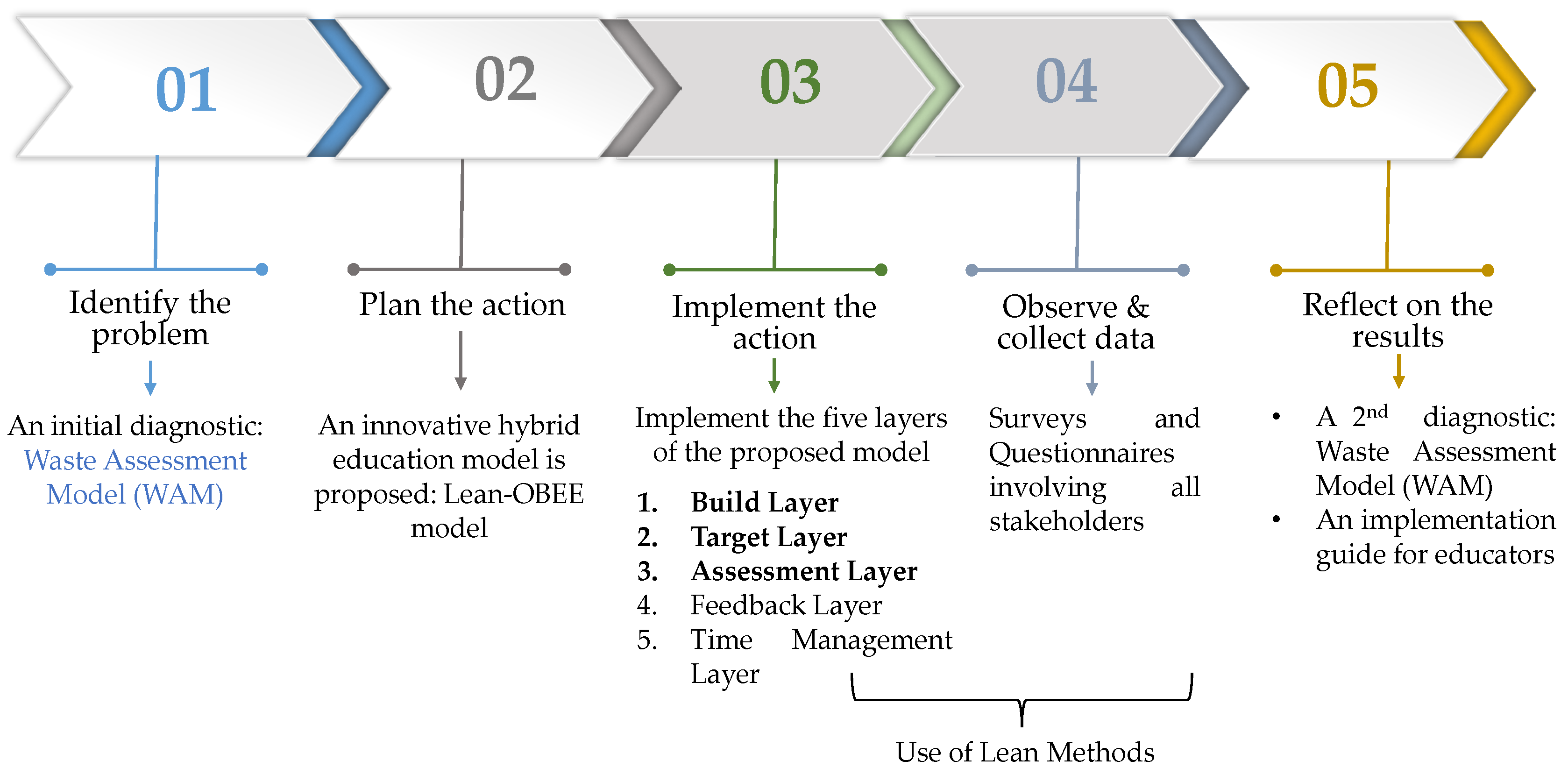
In this study, the action research methodology is adopted. Action research is a cyclic and collaborative research process designed to solve practice-based problems through cycles of planning, action, observation, and reflection, as shown in Figure 1 [64]. It is a common research method in pedagogical innovation research [65]. The methodology emphasizes the iterative use, observation, and reflection of pedagogical interventions in real learning environments rather than controlled experimentation. The initial phase involves both identifying the practical problem and collaboratively defining its scope. This has been presented previously through WAM, which examined competency gaps between industrial expectations and graduate capabilities within the industrial engineering program. This diagnostic stage included professionals from the industry who had recruited graduates from the program. They had provided structured feedback about the competency gaps observed. Major inefficiencies are related to the following areas [13]:
  • Strategic alignment of educational content to current and future labor market requirements;
  • Relevance of the curriculum and competency mapping;
  • Industry-University collaboration mechanisms;
  • Technological adaptation and pedagogical optimization.
Figure 1. Action Research process.
Sustainability 18 03515 g001
To bridge these gaps, the hybrid Lean-OBEE model is suggested as a sustainable engineering education framework that seeks to develop relevant and reliable engineering programs and pedagogical methods.
During the second phase, the planned interventions and activities are implemented. The first layer concerns the process of developing COs for all courses. In this paper, the designs and implementations of the second and third layers are presented.

3.2. The Proposed Framework: LEAN-OBEE Design

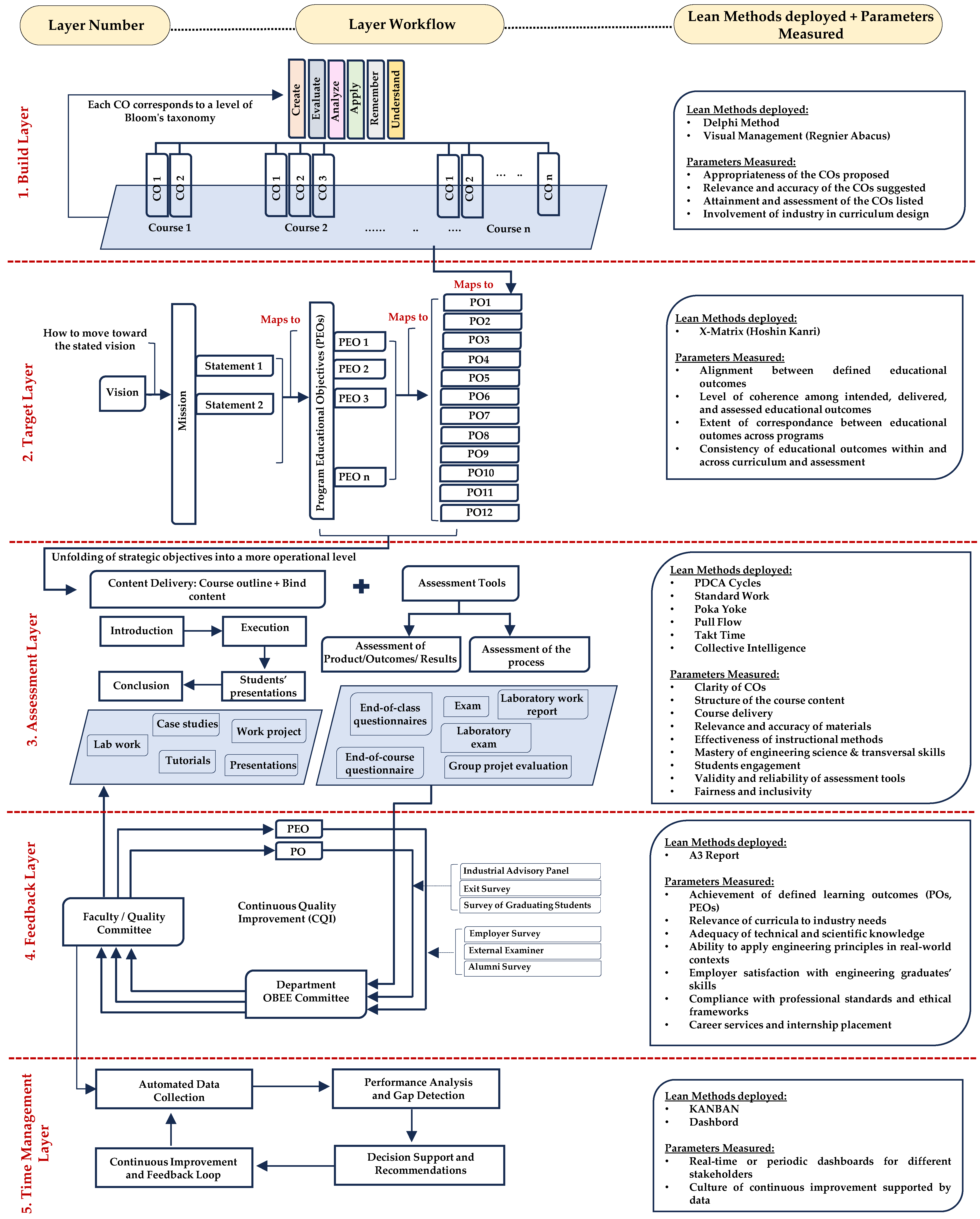
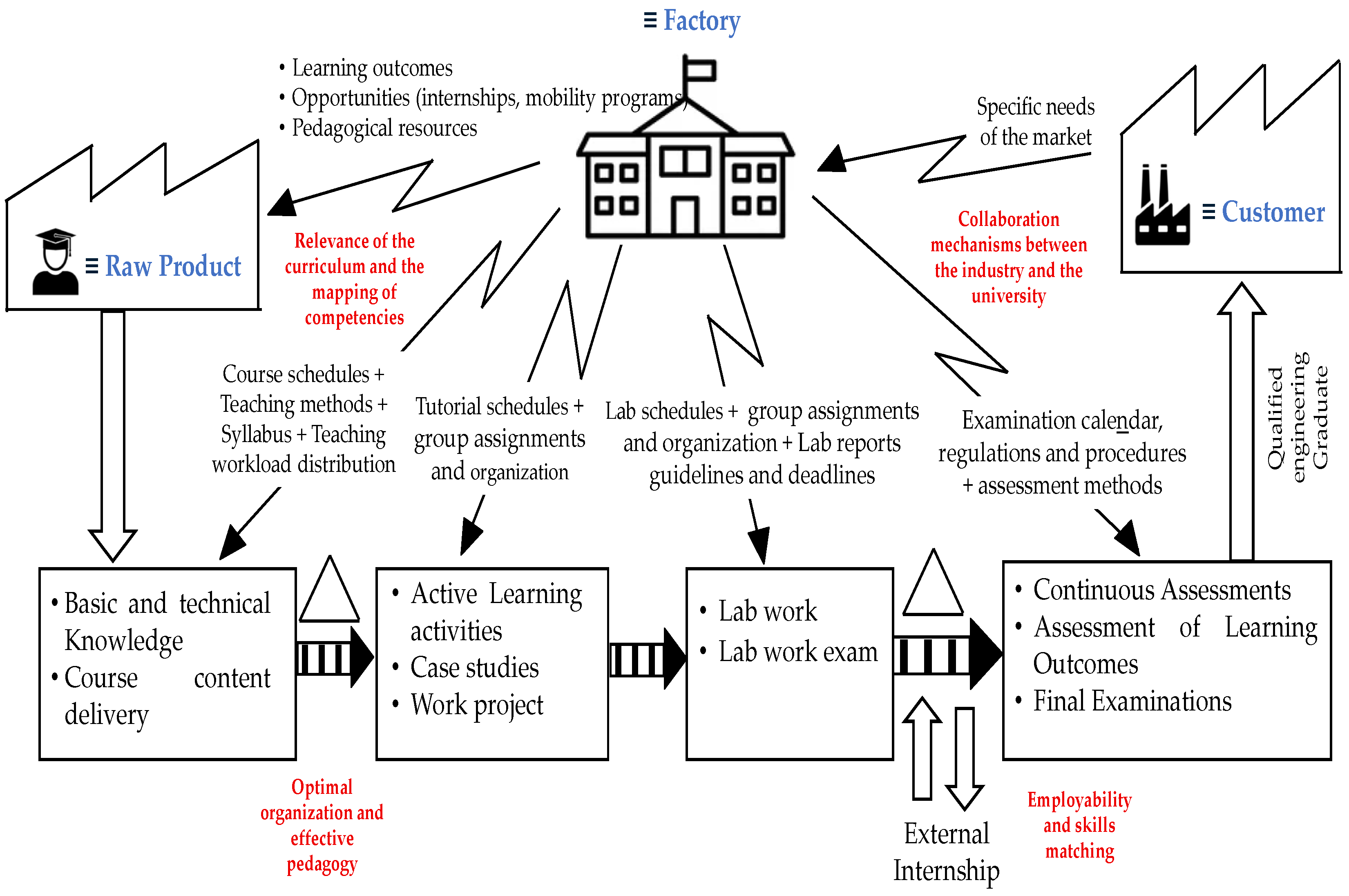
The proposed framework was fundamentally based on adapting Lean Management principles and methods to make the design and implementation of the OBEE approach effective and sustainable. In this context, VSM is employed to provide a clearer picture of this transposition. VSM is a visual Lean method used to analyze the flow of raw materials and information across processes [66]. Educational institutions were considered a dynamic “factory,” where the engineering graduate is the final “product” and the job market is the first “customer.” Figure 2 illustrates a VSM tailored to educational settings, including the main issues previously identified [13]. As manufacturing systems, the effectiveness and sustainability of the educational model depend on how clearly and consistently the processes for curriculum design, course delivery, assessment, and practical training are defined, tracked, and continually developed. The Lean-OBEE, structured into five layers, as shown in Figure 3, allows a systematic and thorough approach that encompasses each aspect of the learning experience from strategic planning through learning activities, assessments, and continuous improvement, with participation of all stakeholders throughout all levels. After developing the COs for each course (first layer) [13], the second and third layers focus on implementing the proposed model effectively. The target layer emphasizes how long-term educational objectives are translated into more specific, operational outcomes at the course level. It provides an unfolding of strategic objectives into a more operational level, enabling a comprehensive overview and effective management of the educational components and their interconnections. The assessment layer proposes a standardized operational structure for efficient, sustainable planning, as well as the effective organization of the course and content delivery to meet the stated outcome.
Figure 3 presents the overall Lean-OBEE architecture of the proposed model. The Lean-OBEE implementation process is built on multiple interconnected five layers, which extend from educational outcomes, teaching design, student learning activities, assessment, feedback mechanisms, and institutional support. The figure offers insight into five layers, their specific workflows, the Lean methods deployed, and the measured elements, enabling systematic monitoring and supporting continuous improvement in outcome achievement.

3.3. Target Layer

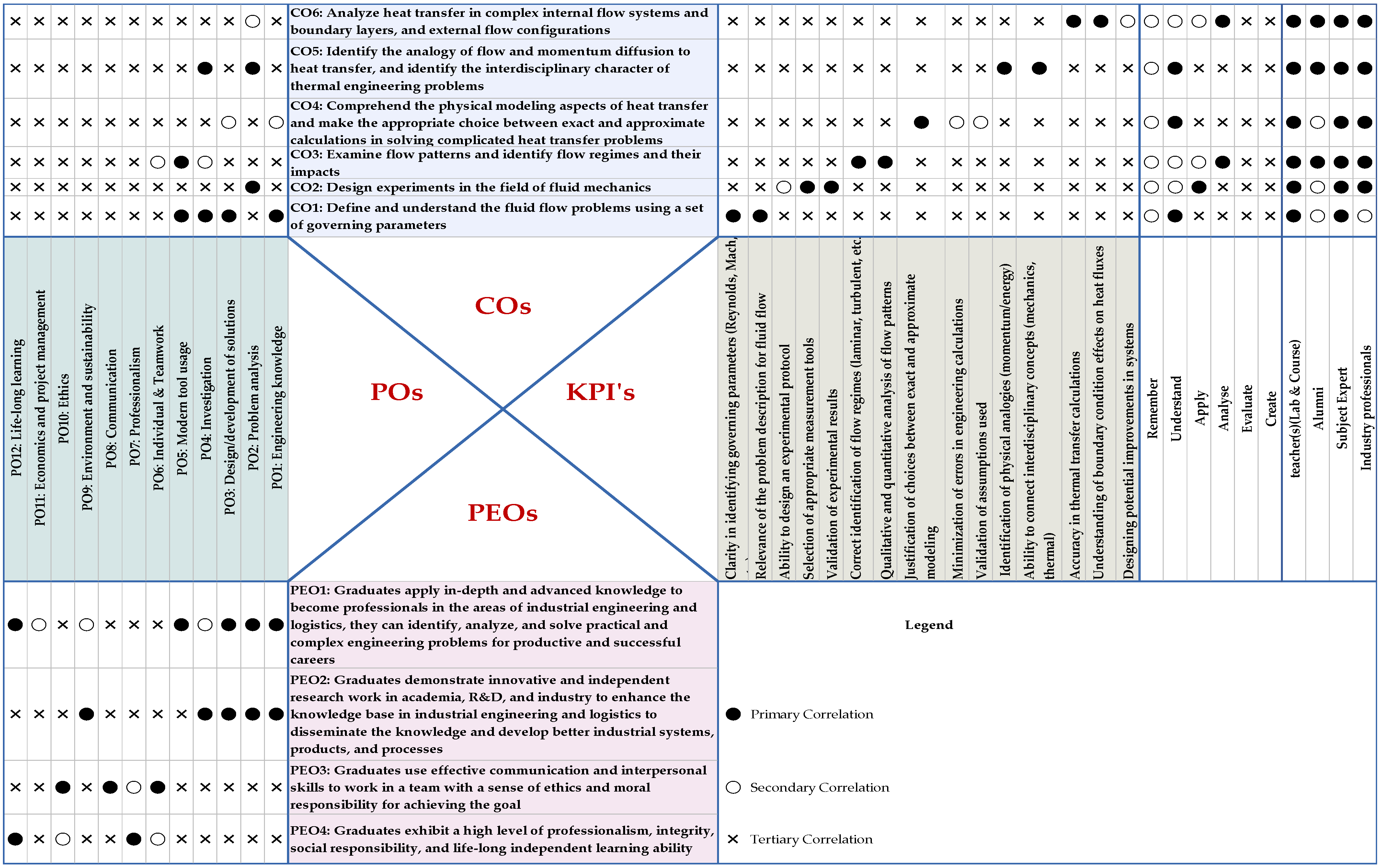
This layer specifies the correspondence between COs, POs, and PEOs; a specified CO may be linked to multiple POs (Figure 3). The mapping provides a consistent, efficient path to achieve the institution’s overall vision. Applying the X-Matrix throughout the mapping process ensures alignment between educational outcomes and provides coherence and continuity across all levels of learning. Through a visual connection among COs, POs, and PEOs, the X-matrix has been carefully adapted to enable the correlation of specific course-centered outcomes with longer-term, more general educational outcomes. As a pilot tool, X-Matrix promotes continuous improvement and flexibility, enabling teachers to adjust their course content and delivery methods based on assessment results. By using assessment data as a basis for improvement, X-Matrix reveals the alignment between instructional programs and industry/job/labor expectations.
X-Matrix is divided into four key quadrants, which explains why it is called “X” Matrix: at the bottom, the long-term goals (strategic objectives) are listed. The annual goals are aligned on the left side. The top priorities for improvement appear in the top quadrant, and the metrics are aligned on the right side. The far-right side lists individuals responsible for executing various components of the educational program. In the context of OBEE, the PEOs fall within the strategic objectives quadrant, as they reflect the program’s long-term aspirations and stakeholders’ expectations. The annual objectives quadrant is linked directly to the POs, which articulate the strategic plans into competencies that students can attain upon graduation. The quadrant of continuous improvement initiatives is mapped to COs, which constitute the operational and fundamental elements through which POs and ultimately PEOs are achieved.
  • Bottom Row: Long-term outcomes (PEOs)
The PEOs articulate the intended outcomes for graduates in their chosen professions within the first few years after graduation. PEOs are the basic goals that guide the design and curriculum development to meet industry and future professional needs.
  • Left Column: POs
POs outline the abilities and knowledge students need to achieve to complete a program. Each PO may serve to measure progress toward the broader PEO.
  • Top Row: COs
COs identify the specific skills and knowledge the students would acquire from a particular course. Every CO is tied to at least one PO, which focuses on the achievement of POs in terms of skills within the given context of a course. Instead, COs contribute to fulfill both POs and PEOs. Each CO’s achievement is matched to a level of Bloom’s Taxonomy to ensure clear progression in cognitive development [67]. Teachers can define activities and assessments that progressively challenge students to develop a deeper understanding of the content. This alignment is used to communicate educational expectations, thus setting up a more structured learning environment for students.
  • Key Performance Indicators (KPIs)
KPIs measure the effectiveness of the curriculum to achieve the COs, POs, and PEOs. By designing KPIs, teachers evaluate performance, monitor the broader picture of success, and make data-driven decisions to align curriculum improvements with long-term educational outcomes.
  • Teams and Responsibilities
The X-Matrix identified teams or faculty members responsible for developing and achieving COs, POs, and PEOs, ensuring follow-up accountability for each outcome.
  • Correlations and Legend
Correlational strengths between each CO, PO, and PEO are visually represented in the form of a color-coded range carried out in a legend placed in the lower margin. In other words, a solid symbol denotes strong alignment, while the light symbol stands for weak alignment. This helps teachers identify the COs that are more effective at meeting the POs and PEOs. As a result, the educational outcomes are both targeted and well-supported.

3.4. Assessment Layer

Two key aspects characterize the assessment layer: Content delivery and assessment tools. The primary purpose is to ensure that each class is efficiently organized and standardized to achieve the intended learning outcomes. A well-defined activity, a teaching flow, and assessment tools create a dynamic and coherent learning environment.

3.4.1. Content Delivery: Classroom Structure

The fifth principle of Lean Management is the Pursuit of Perfection. It relates mainly to PDCA and standard work. Each course session is designed and delivered according to the PDCA cycle, which encourages a systematic, iterative learning process (Table 2).
Plan: Each class is expected to follow a standard format: course material, active learning activities, case studies, and a work project. This stage of planning involves ensuring there is sufficient time for student participation throughout the class. Once confirmed, the set time should be followed as closely as possible. Where it is not possible to adhere to the time plan, more detailed planning would be required for subsequent classes.
Do: The lesson is delivered according to the established plan. Time needs to be managed fairly strictly.
Check: In this stage, the evaluation is conducted for both the product/outcomes and the process. To do so, two questionnaires are typically used: one is given to students at the end of each session, and the other is given after the course is completed. These surveys serve two functions: they provide students with an opportunity to reflect on lessons learned and enhance their learning progressively. Secondly, they help assess the environment in which the effects are produced, specifically the new classroom model that has been set up.
Act: Based on students’ questionnaire responses, the evaluative process, feedback from end-of-class open discussions, and teachers’ perceptions of the learning activity, standards, or pedagogical practices, adjustments or improvements might be made in preparation for the next class.
Flow, as a principle of Lean, is achieved because once new knowledge is introduced in class, students must work through it, discuss it, and then be tested on it to demonstrate their understanding. Flow is also promoted in the project work students carry out outside the classroom. The study groups update their project status weekly to avoid a backlog that builds up over long periods. The principle of “Muri” is also incorporated by having students complete a small amount of work each week, rather than doing none for many weeks, then flooding them with a large amount of work at the end.
Another Lean principle used in the manufacturing sector is Poka-Yoke, or error-proofing. This would not be adopted for education, as it would be for manufacturing systems, and might be adapted. Assume that each time a student in the industrial and logistics engineering major enrolls in Fluid Mechanics and Heat Transfer (FMHT), one condition for passing the subject is that they must have passed the laboratory experiments. Indeed, the Poka-Yoke concept is adapted in lab sessions in the form of progressive checkpoints, as illustrated in Table 3. The prerequisite knowledge and safety rules are verified through short pre-lab quizzes before performing experiments. Process errors are avoided with step-by-step direction and real-time feedback as the experiment unfolds. Finally, post-lab discussions analyze mistakes and consolidate correct practices. This approach enables errors to be detected and corrected in the earlier stages. Thus, supporting the experimental learning flow and creating professional habits that promote scientific and technical practice in the real world.
The concept embodies a pedagogical preventive tool that helps students acquire and verify the competencies they need before progressing further in the course. Lab work allows students to practice in a controlled context where they can investigate and find confusion and mistakes before applying the theoretical knowledge in more complex problems, especially in professional environments.
Lean management defines Takt Time as the pace at which activities must be performed to meet demand efficiently. Takt Time is the ratio of available production time to the required production output. It harmonizes production capacity with customer demand while maintaining a stable operational rhythm. Mathematically, the industrial formulation of Takt Time can be expressed as:
T a k t   T i m e = A v a i l a b l e   P r o d u c t i o n   T i m e C u s t o m e r   D e m a n d
In the educational context, Takt Time is used as a pedagogical guideline for structuring the flow and pacing of classroom activities. The available production time matches the available time for instruction, while customer demand is replaced by the number of learning units to be completed in the instruction or instructional segments that must be achieved during the session. Therefore, the pedagogical “Takt Time” can be formulated accordingly:
P e d a g o g i c a l   T a k t   T i m e = A v a i l a b l e   I n s t r u c t i o n a l   T i m e N u m b e r   o f   L e a r n i n g   U n i t s
The above formulation enables the instructor to organize the learning process by assigning a balanced time interval to each instructional unit, thereby maintaining the pace of learning for the entire session. This adaptation could be illustrated through the instructional session in four stages, which takes 120 min, as shown in Table 2. The session is structured into an introduction (10 min), content delivery (90 min), students’ presentation for the group project (15 min), and session closure (5 min). The time allocated for the instruction of the learning material is the execution phase. Accordingly, the available instructional time is consequently calculated as follows:
A v a i l a b l e   I n s t r u c t i o n a l   T i m e = 120 ( 10 + 15 + 5 )
A v a i l a b l e   I n s t r u c t i o n a l   T i m e = 90   m i n
During this execution phase of the teaching process, four instructional units are organized around the knowledge acquisition process, each covering a different stage of understanding: concept introduction, conceptual explanation, guided practice (tutorial classes, case studies…), and knowledge consolidation. Therefore, the pedagogical Takt Time is:
P e d a g o g i c a l   T a k t   T i m e = 90 4   22.5   m i n
The outcome suggests that the length of each instructional unit should be about 22 min for an appropriate instructional rhythm to occur during the execution phase. By structuring the teaching session into regular instructional cycles based on this calculated pedagogical Takt Time, time will be invested in a more productive, predictable, and consistent way. Students are encouraged to manage their time effectively and stay actively engaged in the learning process. Takt Time in production processes helps to develop the line workflow and reduce delays and waiting. In the educational setting, Takt Time promotes students’ focus and participation, creating a structured, efficient learning experience, smooth transition of learning tasks, and the development of organizational skills that are essential for academic and workplace success.
To avoid a purely operational interpretation of these principles, it is critical to note that Takt Time and Poka-Yoke are adopted as complementary mechanisms in this study, promoting a process-oriented reconfiguration of instructional design. Instead of organizing teaching as a sequence of isolated activities, Takt Time structures learning as a continuous and regulated flow, where each instructional unit contributes to synchronized knowledge construction. Poka-Yoke is presented as a preventive mechanism integrated into the learning process, ensuring early identification and regulation of learning difficulties while supporting progressive knowledge acquisition. Lean Management, as a philosophy, is grounded in incremental, iterative, and systematic actions to steady processes, improve workflows, and enhance overall system performance. From a theoretical perspective, the integration of Lean Management positions instructional design as a process-oriented system where the teaching and learning activities are embedded into a consistent and regulated flow. In this perspective, Lean principles restructure the teaching process to move from content-centered delivery to process-oriented pedagogy, where the teacher is a learning process designer and the student is an active participant engaged in constructing knowledge through participation, reflection, and collaboration in a structured and coherent flow. Such adaptation reflects the broader objective of this study, which is not simply reframing Lean principles, but rather providing an integrated framework to formalize and structure best teaching practices that streamline and stabilize the educational process.
Lean uses methods through which staff members regularly gather to identify and resolve workplace issues. Lean methods are designed to foster knowledge sharing and collaboration, which provide opportunities for inquiry, observation, communication, and discussion to collaboratively enhance processes through the structured engagement of staff. Based on that, a heterogeneous team project is established as shown in Table 4. The purpose is to promote personal accountability and ownership through teamwork and learning.
In this framework, the teacher is a facilitator rather than a mere knowledge provider. Supporting and promoting critical thinking, teamwork, and accountability in the classroom are all part of this position. This entails adapting the teaching method to students’ needs, stimulating students’ curiosity through open-ended questions, providing opportunities for group interaction during class, and emphasizing problem-solving.
The syllabus: Each course must have a syllabus prepared and distributed to students at the beginning of the semester. The course syllabus provides a systematic overview of the topics to be covered each week, along with the assessment tools used to gauge students’ learning. This syllabus provides teachers and students with a roadmap to guide them through planned sessions and achieve the course outcomes.

3.4.2. Assessment Tools

In order to promote transparency, the assessments for the course focused on a structured framework combining complementary tools: written exams, laboratory work, a laboratory exam, and a collaborative group project. Each aspect was measured by clearly established standards and scoring rules. The evaluation scheme and evaluation criteria are presented in Table 5. The table presents the evaluation criteria, the maximum score allocated to each evaluative component, and the pedagogical justification behind the assessment design.

4. Results

4.1. Study Context and Sample

The study was carried out at the National School of Applied Sciences of Marrakesh, which is part of the National Network of the Schools of Applied Sciences of Morocco (ENSA). The participants of the study (n = 33) represent the entire first-year engineering cohort enrolled in the industrial and logistics engineering major. Thus, the study did not rely on selective sampling but rather on a full-cohort pedagogical deployment within a bounded academic environment.

4.2. Reliability Test and Inferential Analysis

Statistical analyses of the reliability and consistency of data obtained in the assessment layer through the two questionnaires were performed using the Statistical Package for the Social Sciences (SPSS) software (IBM Corp., Armonk, NY, USA, version 26). The internal consistency of the collected data was evaluated through the calculation of the Cronbach’s Alpha coefficient for each questionnaire. The first questionnaire, “questionnaires filled out at the end of each class over nine sessions,” exhibited a Cronbach’s alpha of 0.89, while the second questionnaire, “final questionnaire at the end of the course,” yielded a value of 0.72, which exceeds the standard reliability threshold of 0.70 [68]. This demonstrates satisfactory reliability and indicates that the items coherently measured the dimensions targeted.
Moreover, the non-parametric Friedman test was conducted to examine variations in the responses of participants within the nine sessions of the given course. The test yielded a Chi-square value of 92.203 with 8 degrees of freedom, resulting in a highly significant Asymptotic Significance (p < 0.001) [69]. The results demonstrate that participants exhibited distinct response patterns that changed throughout the nine sessions, showing how their perceptions and experiences evolved. The analysis establishes strong empirical evidence that demonstrates time-based variations, while it additionally supports the reliability assessment obtained through Cronbach’s alpha.

4.3. Rationale of Case Study Selection

The FMHT was chosen as the pilot study for several reasons. It is a central course in industrial engineering education training. The course covers basic understanding of transport phenomena, where concepts such as fluid flow and heat transfer are fundamental elements for the design and operation of industrial systems (production systems, industrial networks, thermal equipment, and manufacturing processes). It has a multidisciplinary focus as well, building upon relevant knowledge from applied mathematics, physics, and thermodynamics. Furthermore, the course is delivered during the first year of the engineering cycle, a transitional stage where students move from theoretical learning toward more applied engineering concepts. The combination of theoretical instruction, problem-solving, experimental, and simulation activities provides an appropriate context in which to examine how learning is being conducted and how to further improve pedagogical approaches.

4.4. Lean-OBEE Implementation: Target and Assessment Layers

This section showcases the results of the target and assessment layers. Figure 4 presents the X-Matrix developed for the course FMHT. The proposed X-Matrix provides a structural mapping among PEOs, POs, and COs previously defined. Each CO is aligned with the appropriate level of Bloom’s taxonomy and its performance indicators, creating an organized, coherent representation of learning expectations and evaluative criteria. In addition, the X-Matrix explicitly captures each panel member’s responsibilities throughout the outcome mapping process. This structured alignment is intended to outline the overall interconnections among the programs and courses, serving as the core product of the second phase of the proposed model.
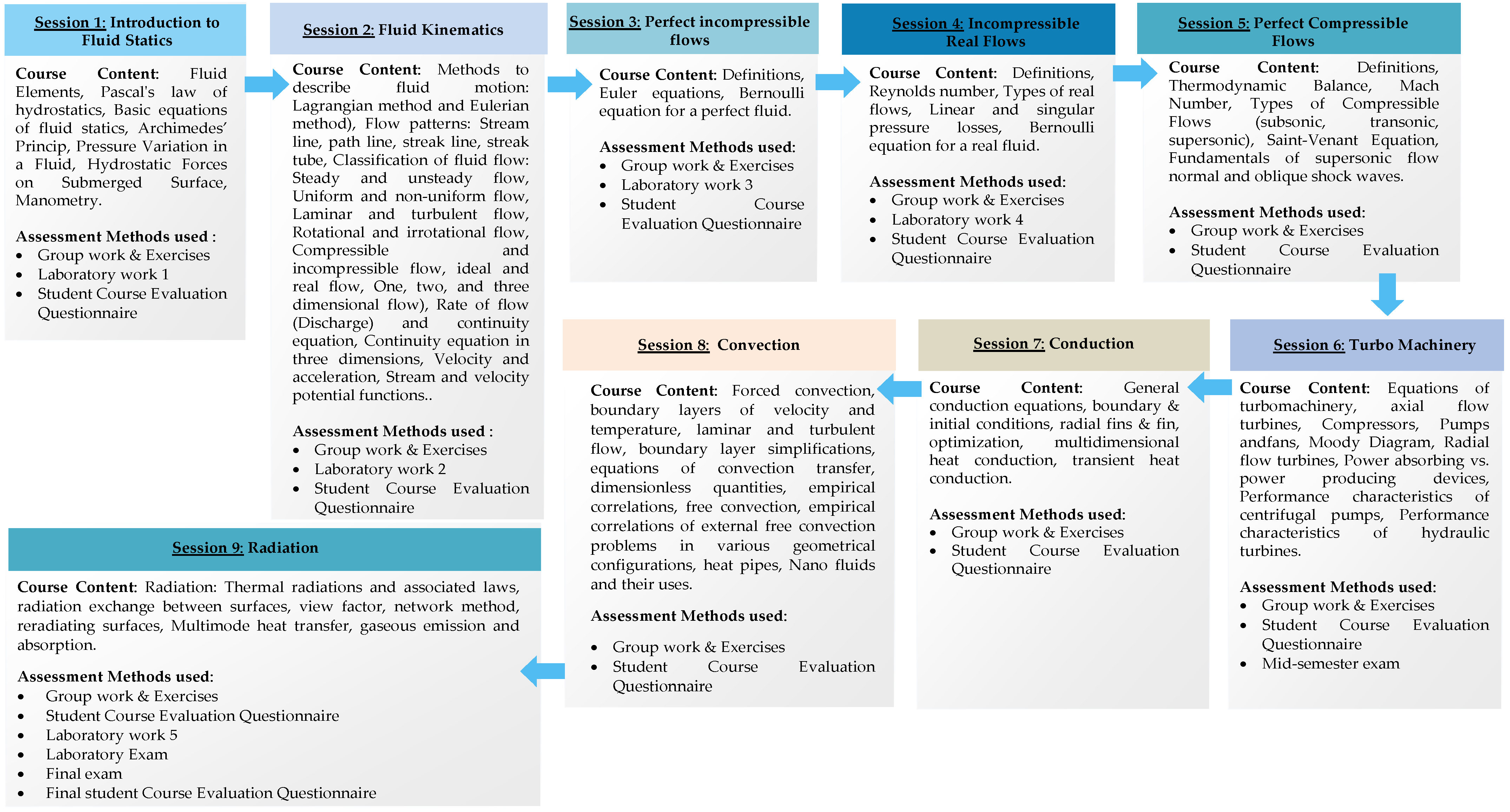
FMHT is considered a case study. The total duration of the course is 36 h. The detailed syllabus of the course is presented in Figure 5 below. On the whole, there are 9 units, in which units 1, 2, 3, 4, 5, 6 come under the sub course “Fluid Mechanics”, units 7, 8, 9 are on “Heat Transfer”.
The results of all assessment methods applied in this layer are presented in Table 6, which illustrates attainment for COs (CO1 to CO6) across four complementary assessment tools: Exam (combining mid-semester and final examinations), Laboratory Work (reports), Laboratory Exam, and Group Project. Each CO is linked to the assessment tools used to provide coverage of the intended competencies in different contexts of assessment (Table 7). Each of the assessment tools includes evaluation items that are related to the stated COs, specifically with regard to conceptual understanding, problem solving, experimental practice, analysis, and reliability of results (Table 5). Students are deemed to have passed the course if they achieve at least a score of 12/20 based on scoring rubrics (Table 5).
To provide a comprehensive assessment of the multidimensional COs, we first computed each CO’s attainment for all 33 students. Each CO was considered achieved if the student obtained a minimum score of 12/20. The overall score for each CO was calculated using a weighted combination of the four assessment methods used. As for CO1, CO3, CO4, CO5, and CO6, the overall student CO score is described as:
C O i = 0.4   ×   E x a m i +   0.2   ×   L a b   W o r k i +   0.2   ×   L a b   E x a m i +   0.2   ×   G r o u p   P r o j e c t i
For CO2, the weighting differs to reflect its specific focus on practical experimentation and applied skills:
C O   2 i = 0.3   ×   E x a m i +   0.2   ×   L a b   W o r k i +   0.3   ×   L a b   E x a m i +   0.2   ×   G r o u p   P r o j e c t i
This weighting ensures that the evaluation takes into account the specific nature of CO2 that is related to the practical and experimental skills, while the other COs are based on a more blended theoretical and applied aspects.
For a more detailed understanding of COs, statistical analyses were conducted. For reliability, Cronbach’s alpha was used. Spearman correlation coefficients were calculated to examine relationships among COs. Multiple regression analysis was carried out, with R2 reported, and Principal Component Analysis (PCA) and exploratory Factor Analysis were performed to examine the underlying structure of the data. Such analyses go beyond descriptive and non-parametric comparisons and provide a comprehensive view of the observed COs.
A Cronbach’s alpha coefficient of 0.81 was recorded for the six COs, suggesting a satisfactory level of internal consistency. This confirms the reliability of the measurement for further statistical analysis.
A Spearman correlation analysis identified several statistically significant relationships among COs. In particular, significant correlations were observed for CO6 and CO5 (ρ = 0.581, p < 0.01), CO4 and CO1 (ρ = 0.563, p < 0.01), CO5 and CO1 (ρ = 0.491, p < 0.01), CO3 and CO6 (ρ = 0.513, p < 0.01), CO4 and CO6 (ρ = 0.555, p < 0.01), CO2 and CO4 (ρ = 0.405, p < 0.05). CO2–CO5 were not significant in contrast. In sum, these data suggest the presence of meaningful relationships among several COs, while others remain relatively independent.
The regression models were constructed based on the correlation findings with explanatory variables that showed statistically significant relationships with the dependent variables. The selection of the two regression models below was based on pedagogical relevance and the conceptual relationships around the COs. Together, these models provide complementary insights about the interaction between basic and advanced learning outcomes. For the first model, CO6 was defined as the dependent variable with CO4 and CO5 as the explanatory variables. Overall, the model was significant (F (2,30) = 15.124, p < 0.001), explaining 50.2% of the variance in CO6 (R2 = 0.502). CO4 (β = 0.432, p = 0.006) and CO5 (β = 0.393, p = 0.012) both contributed significantly to the prediction of CO6, suggesting that higher scores in CO4 and CO5 are positively associated with greater attainment of CO6. Indeed, students who possess strong skills of heat transfer modeling and problem-solving (CO4) and can recognize interdisciplinary analogies in fluid flow and heat transfer (CO5) tend to achieve a higher outcome in heat transfer analysis for complex systems (CO6), while controlling for the effect of the other predictor. In the second model, CO1 was used as the dependent variable, and CO5 and CO6 were used as explanatory variables. This model was also statistically significant (F (2,30) = 6.719, p = 0.004) and explained 30.9% of the variance in CO1 (R2 = 0.309). CO5 (β = 0.493, p = 0.014) only represented a statistically significant contribution, and CO6 did not reach statistical significance (β = 0.096, p = 0.615). The results suggest that CO5 has a significant role to play in the prediction of CO1, while CO6 seems to have no significant effect. Consequently, students who comprehend analogies in interdisciplinary thermal engineering (CO5) have higher competence in defining fluid flow problems (CO1).
Finally, a Principal Component Analysis (PCA) was performed to find out the structure between six COs. CO communalities calculated after extraction varied from 0.510 (CO3) to 0.923 (CO2), showing that most COs are adequately represented within the extracted components. Initially, the eigenvalues revealed that two factors > 1 were present, and together they explained 68.8% of variance. After Varimax rotation, both factors accounted for 47.2% and 21.5% of the variance, respectively, indicating the two-factor solution can accommodate the relationships among the COs well. In general, the PCA illustrates that there are structured associations among the COs and it highlights the latent dimensions that organize student performance across different learning outcomes.
It should be noted that this analysis was based on a sample size of 33 and represents the first application of the proposed model. The specific nature of COs and students’ individual performance levels could have affected the findings. Such considerations support the conclusion that although the analyses contribute substantial information on reliability, correlations, predictive relationships, and the underlying structure of learning outcomes, further studies with larger samples are recommended to provide further evidence of these results.
Globally, the results suggest an acceptable level of attainment of the COs using all the assessment tools. The achievement percentages exceed 61%, indicating that students have met the learning outcomes. However, the results indicate that there are some variations based on the factors of the assessment tool used and the specificities of CO.
The 100% attainment rate for CO3 relevant to the “Group Project” indicates that all students scored at least 12/20 in this assessment tool, which is only part of the overall CO3 calculation. As mentioned above, CO3 attainment is determined through weighted assessment components consisting of 40% Exam, 20% Lab Work, 20% Lab Exam, and 20% Group Project. As a result, this attainment rate represents students’ achievement specifically in the Group Project and not consistency in performance on all components of the assessment. In addition, the high concentration of Group Project scores may suggest limited discriminatory power of the evaluation criteria, another element that needs to be considered when interpreting the results, without diminishing the preliminary insights obtained from such assessment.
The high attainment value of approximately 91% in Laboratory work also supports the claim that students perform in practice-oriented assessment settings. The lowest recorded attainment is found in the Laboratory work and exam of CO6, with an average of 61%. However, the relatively poor result would indicate that students found it difficult to demonstrate the expected competencies of CO6. The relatively lower attainment rates noted for CO6, especially on laboratory-based assessments, can be attributed to the analytical difficulty that is present with the learning tasks associated with this outcome. CO6 requires students to analyze heat transfer phenomena occurring in complex internal flows, boundary layers, and external flow configurations. In addition to measurements, students are inextricably involved in the investigation of thermal and fluid dynamic behavior, connecting direct experimental study results to theoretical modelling throughout laboratory activities. A persistent challenge seen with students is the understanding of boundary layer formation and the analysis of the behavior of heat transfer in internal and external flow configurations. Most students follow the entire experiment successfully, but some students have problems explaining the physical meaning of the obtained results and relating them to the theoretical framework, which makes the attainment of this outcome slightly lower.
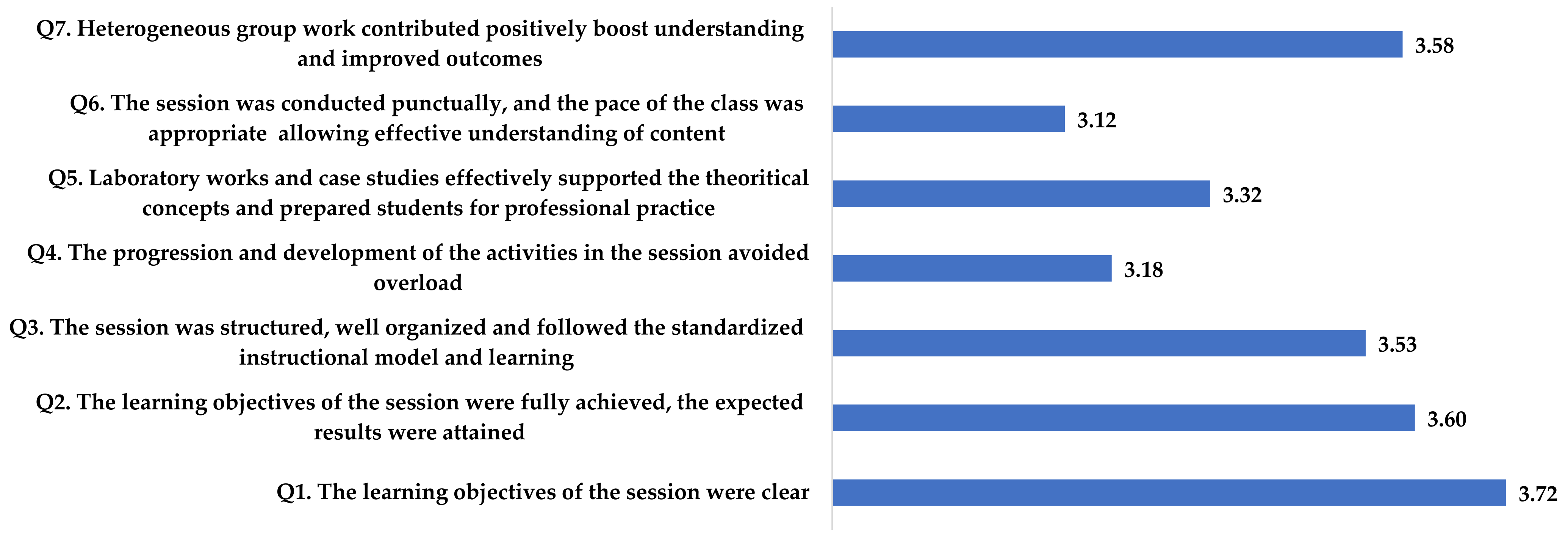
In each session, students were asked to provide feedback on the class’s performance through a brief questionnaire with seven questions. The global average score for all classes across all questions is presented in Figure 6.
The analysis of the average scores for the 4-point Likert-scale questionnaire shows that students are generally satisfied with the new class session model, as all items scored above 3, indicating general agreement. The highest mean value (3.72) relates to the clarity of the learning objectives, indicating that students clearly understood the session outcomes, while the high score for achieving these objectives (3.60) suggests that the expected learning outcomes were attained. The sessions were also rated well-structured and organized (3.53), indicating consistent alignment of content coverage with the standardized instructional model. Moreover, working in heterogeneous groups was also highly valued (3.58), and its importance in fostering a deeper understanding was well noted. Laboratory work and case studies were found to be beneficial (3.32) for anchoring theoretical learning and preparing future professionals. Slightly lower, although still positive, mean scores were observed concerning the pace and punctuality of the class (3.12) and the development of the activities to avoid overload (3.18), which point indirectly to minor educational refinement and not major shortcomings. The findings reveal that satisfaction levels remain acceptable, supporting the pedagogical effectiveness of the sessions in meeting the desired educational objectives.
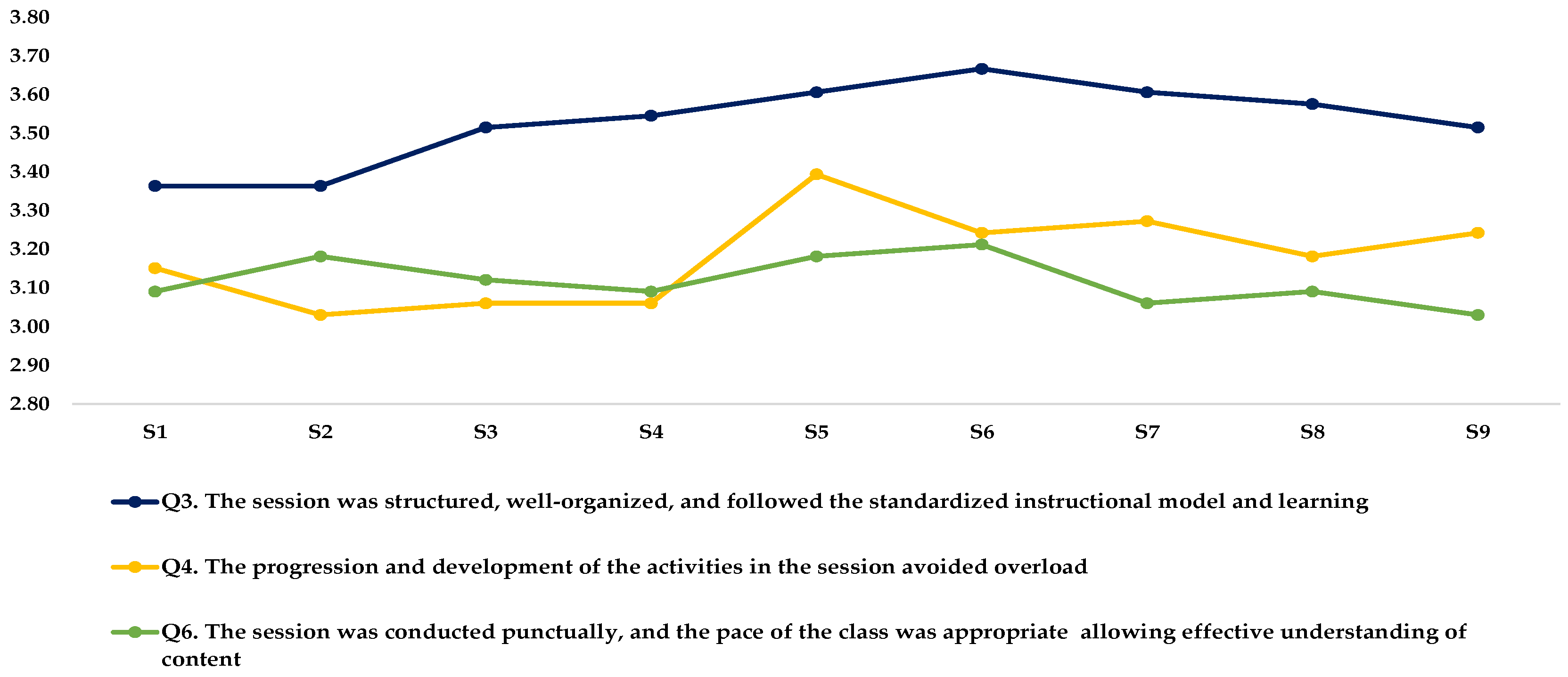
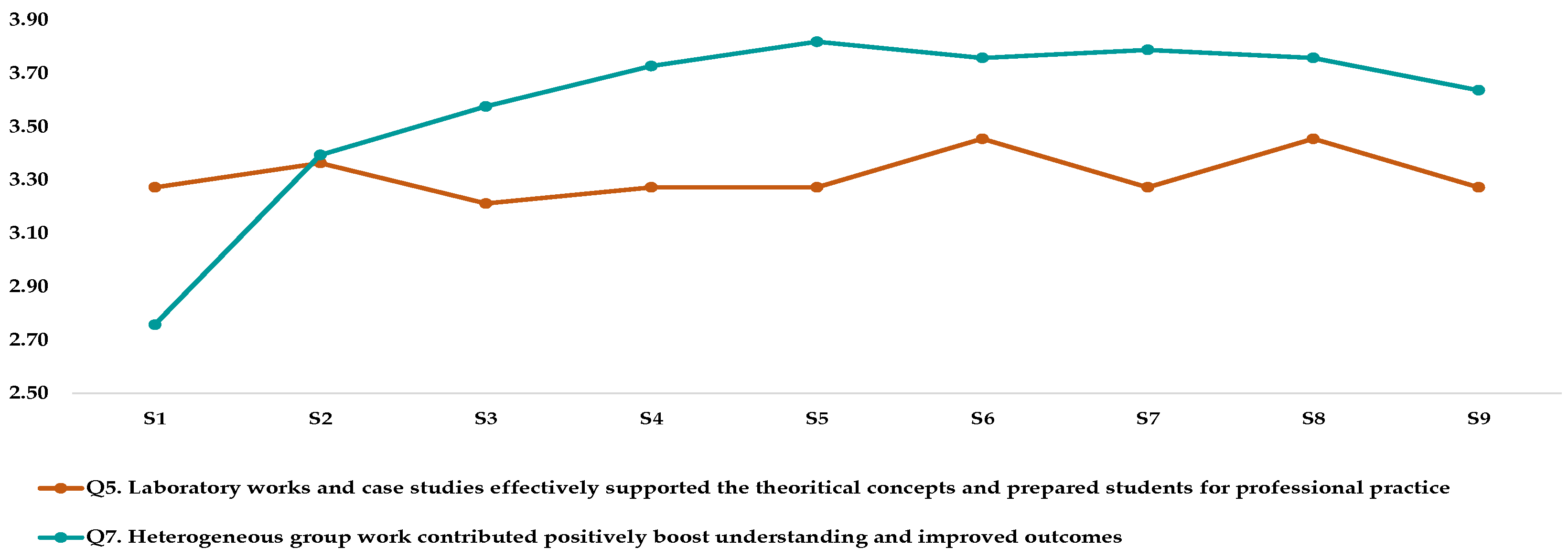
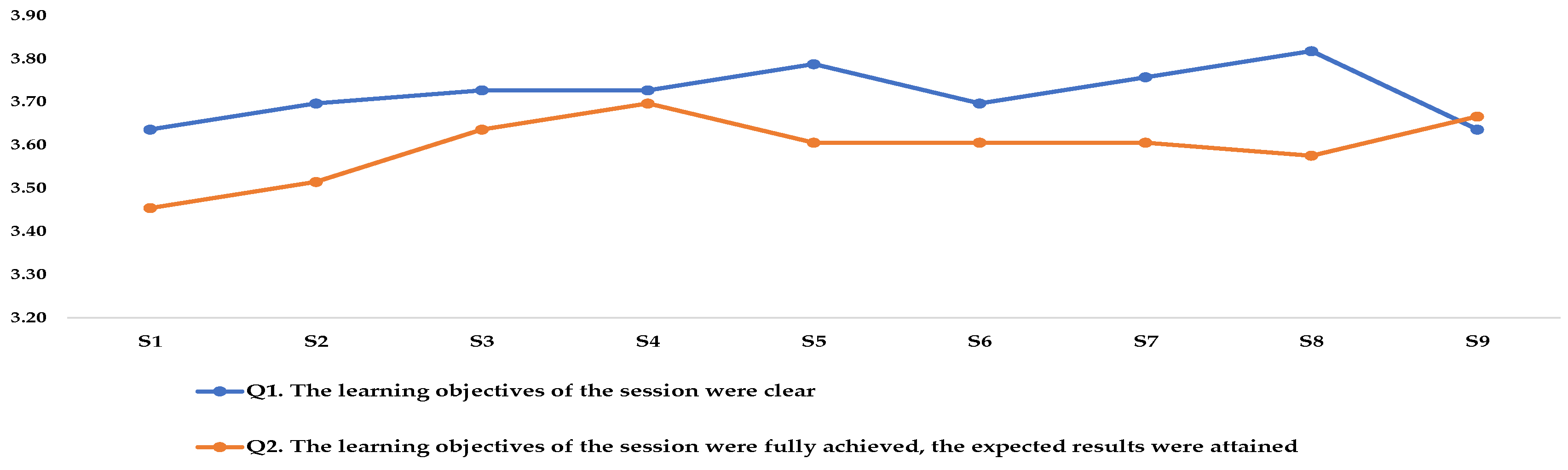
Below are the overall responses to the questions gathered at the end of each of the nine sessions (Figure 7, Figure 8 and Figure 9).
The perceived clarity of COs was generally positive throughout the nine sessions, with scores ranging from 3.64 to 3.82. The consistency of the results suggests that the teacher presented the COs clearly and coherently. Initial sessions increased progressively until session 8, with a score of 3.82. COs were aligned with the course activities. Performance decreased slightly to 3.64 at session 9 due to more challenging course material, but this does not contradict the gradual increase. Overall, there is a notable satisfaction with the clarity of the expected outcomes, which creates a favorable environment for student learning, according to the OBEE principles.
Scores for question 2 indicate a consistent perception that the COs were effectively met and that the expected learning outcomes were attained. Responses also indicated substantial stability, showing that not only were COs clearly defined and thoughtfully constructed, but also that they were effectively transformed into tangible results through the course’s content, activities, and pedagogical design, enabling students to acquire the competencies they sought.
In addition, the results emphasize the significant contribution of the X-Matrix for unfolding strategic educational objectives into more operational learning and teaching activities at the course level. As for each CO, the X-Matrix outlines the corresponding KPI and the associated Bloom’s taxonomy level. This mapping explicitly serves as a systematic reference for the design of instructional material, course activities, and assessments in the curriculum, based on the principles of OBEE (clarity of focus and design down). Such strategic alignment acts as a pedagogical support that allows instructors to clearly communicate how the course outcomes contribute to broader program and educational objectives. This transparency helps students better understand the purpose of the learning activities and situates their work within a coherent competency development framework.
Perceptions of structure and standardized sessions show steady, progressive improvement over nine sessions. Early sessions indicate moderate satisfaction levels, and students were mainly adapting to the new class. The peaks in sessions 5, 6, and 7 reveal successful structure and coherent progression of the learning activities. The slight variations in the perception during the last class sessions can be attributed to differences in the delivery of the content or the pacing of the class, which are usual in a dynamic instructional setting, especially at the end of the given course.
Management of cognitive load received a range of scores from 3.03 to 3.39, indicating a moderate but mostly positive perception of workload balance. The first sessions show slight decreases, suggesting difficulty with adaptation. Session 5 peaks at 3.39, indicating that the activities were well balanced and effectively organized. The subsequent sessions show consistent scores, suggesting that the course generally avoided overload, though students’ perceptions varied occasionally. Overall, the students considered the workload manageable, the variation in scores shows areas in which further optimization of task distribution and pacing is needed.
Students’ perceptions of punctuality and pacing remain moderately positive, with scores ranging from 3.03 to 3.21. The small rise in scores suggests continuous adjustments were made to session management time to improve session Takt Time, while the low ratings in sessions 9 and 7 indicate that the inconsistency in pacing was slightly greater than the trend. The average stability reflects mainly acceptable time management and pacing, but further development is needed to consistently achieve optimal conditions across all sessions. The collected data highlight the need for a proper balance between content delivery and an appropriate pace that maintains both engagement and efficient comprehension.
Overall, the assessment of laboratory work and case studies has consistently yielded positive impressions, with scores ranging from 3.21 to 3.45. Sessions 6 and 8, which received a score of 3.45, are the best and most effective in demonstrating how laboratory work and case studies made the theoretical concepts clear and prepared students for professional practice. The others are still around 3.27, indicating moderate but steady support for learning. The effectiveness would likely depend on the relevance, organization, and alignment of the activities with the COs, underscoring the need to consistently provide high-quality, practical experiences.
The evolution of how heterogeneous groups work has significantly increased. The group scores during the first session were rather low. By session 5, they had achieved a score of 3.82, which was the highest score. This demonstrates the benefits of heterogeneous group membership, as students shared their knowledge with other members of their respective groups through conversation, communication, exchange, and discussion. This finding continues through sessions 6, 7, 8, and 9, demonstrating that teamwork provides a range of benefits, including collective intelligence, productivity, and innovation. These results indicate that working in heterogeneous groups is an effective way to promote creativity and problem-solving by fostering the exchange of diverse perspectives. It also develops mutual support (advanced students lend a hand, while the rest gain knowledge), reduces the stigmatization of students with difficulties, and strengthens social skills and self-confidence by appreciating diverse talents.
Together, the outcomes obtained from the four assessment tools and the end-of-class student questionnaire offer complementary insights into the effectiveness of the proposed classroom model inspired by the Lean Management approach. Indeed, the analysis of the results from the exams, lab work, and group projects gives preliminary evidence on the achievement of the intended COs, while survey results across the nine sessions provide useful additional information on how students perceived organization and delivery of the course. Specifically, the questionnaire assessed several aspects that are closely connected with the instructional design of the class that has been adopted: the clarity of the session objectives, the extent to which they had been reached, the contribution of standardized classroom format to effective teaching and learning, the role of the laboratory activities for strengthening the association between the theory and real professional contexts, the suitability of the pace of the class for preventing cognitive overload, as well as the effect of the heterogeneous group work on the students’ comprehension. In particular, these dimensions are directly related to the Lean principles integrated into the course design. Takt Time was used to manage the rhythm of activities in the classroom and keep students learning at an appropriate pace, whereas Standard Work was designed as a structured framework for every session. Moreover, within laboratory sessions, Poka-Yoke mechanisms were adapted to avoid common errors and provide students with the guiding means for performing their experiments correctly, ensuring the congruity between theory and practice. The Muri principle is taken into account to prevent excessive cognitive load for students. Heterogeneous group work and the implementation of collective intelligence facilitated peer-assisted understanding and collaborative learning. Moreover, the use of X-Matrix ensures the strategic deployment of educational objectives, translating higher-level educational goals into clear and operational learning outcomes at the course level. Overall, along with the results of the course assessment methods, the questionnaire findings indicate that most of the intended learning outcomes were achieved. The correlation between the objective performance (COs attainment) and the perception of the students supports the pedagogical value of the Lean classroom model suggested.
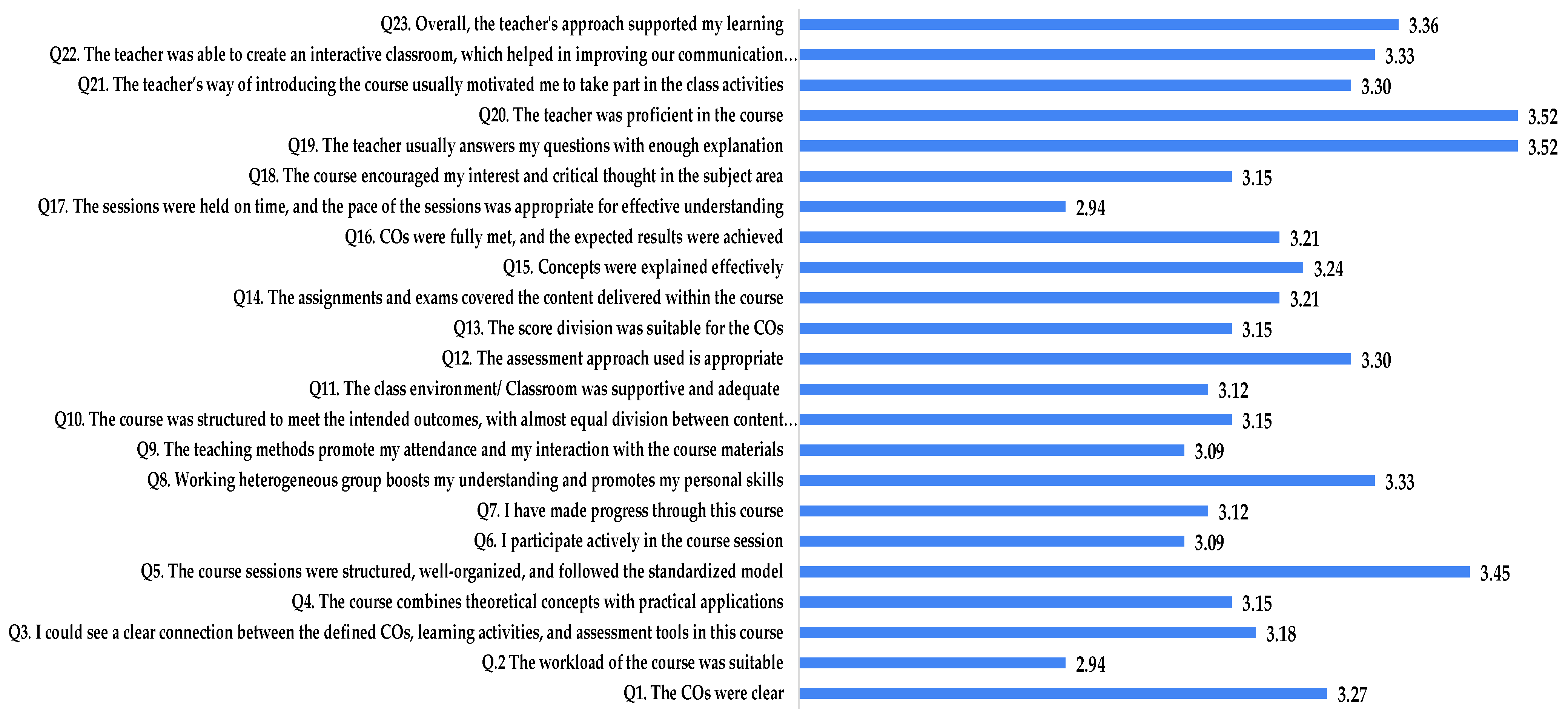
Upon completing the course, students are asked to provide feedback through an online questionnaire on the quality of content delivery and the educational practices of the course (Figure 10). It consists of 23 questions grouped into six evaluation aspects: course content and organization (Q1–Q5), student contributions (Q6–Q8), learning environment and teaching methods (Q9–Q11), assessment methods (Q12–Q14), quality of delivery (Q15–Q18), and course teacher (Q19–Q23). Each statement is scored on a four-point Likert scale ranging from Strongly Disagree (1) to Strongly Agree (4).
The findings reveal overall positive attitudes toward the course and the teacher’s instructional methodology, as most items scored above the midpoint of the scale. The questions with the highest scores relate to the teachers’ mastery of content and the explanations provided in class (Q19, Q15, and Q20). The environment was conducive to engagement and learning, as reflected by higher scores in class organization and structure (Q5) and interactive classroom practices (Q22). Teaching effectiveness is also supported by positive perceptions of consistency between what is covered in class, laboratory work, and exams (Q14) and the appropriateness of the evaluation methods employed (Q12). These results indicate effective instructional design aligned with the specified COs. Moreover, the students recognized the importance of heterogeneous group work (Q8) and practical activities (Q4), as they support the development of applied knowledge and collaborative skills. On the other hand, low scores were reported for session pacing (Q17) and workload suitability (Q2), indicating potential challenges with time management and workload balance.
Overall, the findings suggest successful instructional delivery. However, opportunities exist for improvement; specifically, recommendations are provided for optimizing workload and session pacing. The insights gained from this research are expected to guide sustainable development in course delivery within the proposed Lean-OBEE framework.

4.5. Preliminary Findings from Course Alumni and Employers

For preliminary empirical evidence supporting long-term relevance and effectiveness of the proposed framework, initial data were gathered from two stakeholders: course alumni (n = 33) who previously completed the FMHT course, and employers (n = 34) who had directly worked with students in professional settings.
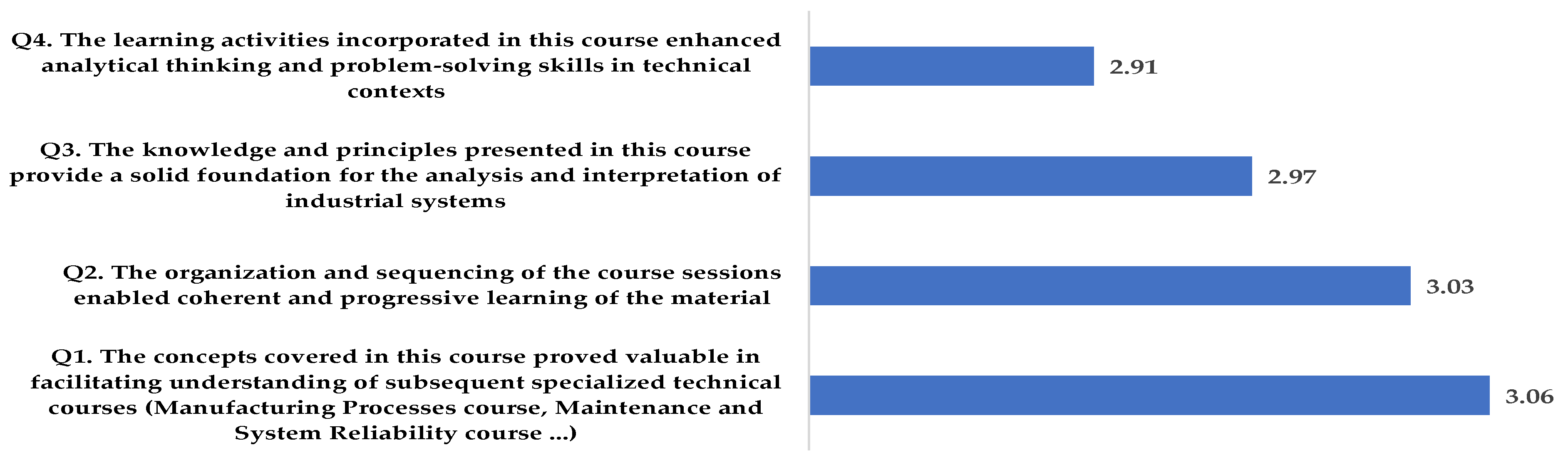
In the survey conducted among the course alumni, four items were used, mostly measuring the perceived relevance of the course content and its contribution to subsequent specialized courses (Figure 11). The collection of course alumni data followed a cohort-based approach, which included all students from the academic years subsequent to the implementation of the proposed model at ENSA Marrakesh. The approach establishes a complete census of former students from the same course who studied under similar conditions, including the same content delivery, teacher, and class structure. The aim was to ensure that assessment conditions match the teaching environment, reducing the risk of sampling bias.
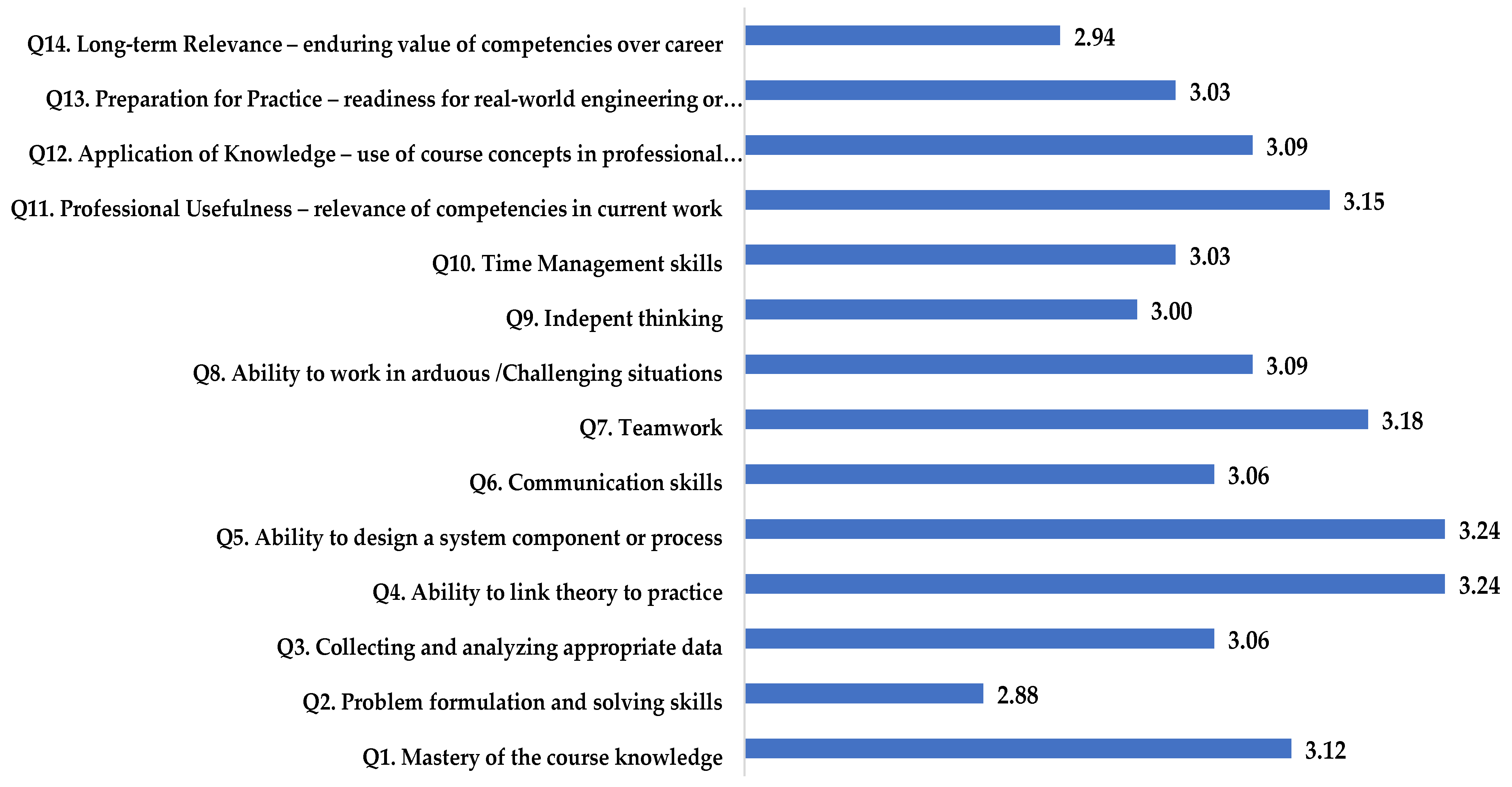
The second questionnaire was administered to industrial employers with fourteen questions grouped into three primary categories: knowledge acquisition, soft skills, and professional practice (Figure 12). Data was gathered through a select group of employers who had directly supervised or closely collaborated with engineering students from the industrial engineering program at ENSA Marrakesh to ensure contextual relevance and internal consistency of the findings. Both our professional network and alumni-mediated contacts were used for data collection and dissemination. Former students served as intermediaries to enable contact with employers they had previously collaborated with. The employer sample largely overlaps with that of the previous study [13], as most of the same employers were consulted a second time to respond to the current questionnaire, supporting continuity and enabling comparability within the analytical framework. The questionnaire was administered to 57 employers, with 33 valid responses, yielding an overall response rate of 57.90%. This level of participation is considered acceptable for targeted professional surveys involving specialized respondent profiles.
Although these results are exploratory, they provide early indications of how the skills built in the course are perceived both academically and professionally, thereby providing an initial insight into the impact of the course beyond its immediate educational outcomes. Both responses from the surveys were collected using a 4-point Likert scale ranging from ‘Excellent’ to ‘Poor’. These results also offer a foundation for more extensive studies to be reported in future research.
The reliability of both questionnaires was evaluated with Cronbach’s alpha in SPSS (IBM Corp., Armonk, NY, USA, version 26). The alumni questionnaire (4 items, α = 0.81), along with the employer questionnaire (14 items, α = 0.82), showed reliable and comparable internal consistency.
Preliminary feedback from the course alumni and employers surveys suggests that the course contributed to understanding subsequent specialized and technical courses and applying the knowledge gained from this course in real industrial contexts. The results provide early indications of the model’s potential long-term value in supporting students’ academic progression and real professional practices. While the initial findings are generally positive, respondents also pointed out opportunities for improvement. The open-ended sections of both questionnaires contributed to exploring more areas for development. Some suggestions gathered are shown in Table 8.
However, it is important to recognize that the employer survey is mostly perceptual and does not, at this point, involve fully objective or longitudinal performance indicators. These findings should be viewed as preliminary evidence within a broader, multi-layer evaluation framework, which will address long-term sustainability through more objective measures in future analyses.

5. Discussion and Limitations

The research aimed to introduce a new educational Lean-OBEE framework to boost student engagement and improve academic outcomes. The preliminary study results suggest that the model implementation yields beneficial outcomes across multiple essential aspects of the educational system, including competency mapping, learner autonomy, and the acquisition of transversal skills for sustainable education. The most important contribution of the proposed model is its learner-centric approach. Unlike the conventional, primarily transmissive pedagogical approaches, the proposed model promotes learner participation, critical thinking, collaboration, and self-regulated learning. These results align with prior studies that emphasize the efficacy of active and sustainable learning pedagogies.
Alignment between learning outcomes and curriculum design has been a focus in prior studies. The implementation of the adapted X-Matrix in the OBEE system has shown positive results as a strategic alignment and monitoring tool in different educational levels. The X-matrix, by linking OBEE outcomes, has also enabled greater coherence between long-term strategic intentions and daily pedagogical practice. This mapping has improved transparency in decision-making and has facilitated a more systematic identification of potential gaps and misalignments in the program.
Moreover, this study shows that operating in a standardized form of classroom setting, with the strategic incorporation of Lean Management, can improve the teaching and learning process. The proposed new model builds on established classroom traditions without disrupting them. As a result, teachers and students find it easier to adopt Lean Management concepts and methods in their new classrooms, especially since most teachers already have an industrial background, particularly in Lean Management. A standard classroom format also provides structural stability and predictability for students, both of which are necessary for effective classroom management and maintaining cognitive attention. The application of Lean Management concepts, such as PDCA cycles, Poka-Yoke, flow, muri, standard, Takt Time, and collective intelligence, helps develop an efficient and purposeful learning environment. This is because these concepts enable optimization and align learning activities with learning objectives.
From the learners’ perspective, implementing Lean Management principles in the classroom settings increases their engagement and autonomy. Learners can better grasp the routine and goals of the learning process, enabling them to participate more effectively in their own learning. The standard classroom format minimizes the adaptation costs learners may incur when adopting a new pedagogical approach. Learners can focus on the learning process rather than the structural arrangements. For teachers, integrating Lean Management principles improves the organization of the instructional process, the allocation of time and resources, and the visibility of learners’ progress. Lean Management principles minimize non-value-adding activities in the classroom, enabling the teacher to focus on instructional interactions with learners. The Lean-OBEE achieves a potential balance between innovation and continuity, which is the key to its positive effects on teaching effectiveness and learner outcomes.
The pedagogical intervention was carried out as part of a core course in the official industrial engineering curriculum at ENSA Marrakesh. This course was taught by a professor–researcher in industrial engineering, with a multidisciplinary academic staff composed of industrial engineers and researchers. This academic collaboration, with an industrial background of Lean Management implementation, led to the thorough alignment and validation of course design, learning activities, and evaluation mechanisms, directly supporting Lean-OBEE to guide a structurally sound implementation of the theoretical framework. Though positive, the observed enhancements in course outcome attainment and student engagement have to be taken with caution. However, since the study was conducted in one cohort, alternative explanations such as natural learning over time, classroom dynamics, and instructor-related factors cannot be ruled out completely. Nevertheless, the systematic and collaborative implementation of the Lean-OBEE framework represents a plausible pedagogical mechanism that most likely played a role in the initial findings that have been identified.
The proposed model is mainly designed for industrial engineering students with a combination of theoretical and technical courses. It involves practical aspects, including simulations, laboratory work, case studies, and group work that might not be used in other educational programs, and could thus require some adjustments when applied in different contexts. Students’ characteristics, such as prior knowledge, skills, and learning habits, will also differ, making some activities too easy or too difficult in other learning environments. The effectiveness of the model and its modifications may be affected by institutional factors like evaluation methods, pedagogical flexibility, and resource availability. Moreover, the successful implementation of the Lean approach would require a basic knowledge of its methods and principles among teachers, students, and academic staff. Although Lean Management is being explored outside the industrial field, a successful implementation in new domains would necessarily rely on such foundational knowledge. The framework is a useful base, but its application in general should be tailored with special reference to the disciplinary content, the profile of the student, and the culture of the institution to ensure pedagogical effectiveness and relevance.
The proposed educational model within this study functions as a multi-layered framework that enables the sustainable implementation of OBEE through the integration of Lean Management. This article specifically presents the second and third layers of the Lean-OBEE. These two layers focus on the alignment between program educational outcomes and the course content delivery process through sustainability-oriented continuous improvement. The final subsequent layers of the model extend evaluation beyond the course level. The fourth layer, namely the Feedback layer, includes short- and long-term surveys and assessments, has been implemented, and initial results have been gathered. This layer is intended to capture longitudinal outcomes of academic performance, professional development, and employer feedback, which are critical in evaluating long-term sustainability and relevance of the model in the real world. The Final layer, the Time Management Layer, integrates planning and management tools with performance dashboards and automated reporting mechanisms. This layer supports continuous monitoring of the different components of the Lean-OBEE model and enables data-driven decision-making at the program level for continuous and sustainable performance. Those layers are beyond the reach of the present manuscript and will be reported in a separate future publication.
The model, as proposed, is limited to engineering education, with particular emphasis on the industrial engineering program. This is because the present study represents the first application of the model, and the results should be considered exploratory. As the model is further refined and the database is enriched through its use in subsequent academic years, its scope will expand. In the long term, this data will be instrumental in developing a decision support tool capable of transforming educational information into meaningful insights [70]. This will promote more efficient, equitable, and coherent decision-making processes, thereby enhancing the efficiency and sustainability of the educational system.

6. Conclusions

This paper introduces the second and third layers of an innovative educational model to effectively implement the OBEE approach. The Target layer proposed adapting X-Matrix as a lean tool for a systematic mapping of educational outcomes. The assessment layer provides a standard framework for content delivery and the assessment process, incorporating a set of Lean methods and principles. The results for course coherence, clarity, and alignment between learning activities and assessments indicate that X-Matrix can be effectively used to guide the development of curriculum towards educational outcomes. This layer closes the gap that might appear between the objectives designed and educational activities by making this relationship transparent, organized, and measurable. This implies the appropriateness of integrating strategic planning principles from industry into educational settings to increase transparency in outcomes. The assessment layer proposes a standardized teaching framework that applies Lean concepts and methods to enhance course delivery and learning effectiveness. Analysis of teaching practices and the learning process, conducted through two questionnaires, shows that the adopted teaching model can potentially affect students’ performance and learning environment, but also highlights areas for improvement, particularly in pacing and workload. This research is applied to engineering education, especially the industrial and logistics engineering section.

Author Contributions

Conceptualization, F.-E.A.; methodology, F.-E.A.; validation, F.B.; formal analysis, F.-E.A.; data curation, F.-E.A. and F.B.; writing—original draft preparation, F.-E.A.; writing—review and editing, F.-E.A. and F.B.; visualization, F.B.; supervision, F.B.; project administration, F.B. All authors have read and agreed to the published version of the manuscript.

Funding

This research received no external funding.

Institutional Review Board Statement

The study was conducted in accordance with the Declaration of Helsinki, in accordance with the Code of Ethics of the National School of Applied Sciences, Cadi Ayyad University of Marrakesh, with the approval of the Ethics Committee (approval number: CLASS: GIL-1 on 3 February 2025) for studies involving humans.

Informed Consent Statement

Informed consent was obtained from all subjects involved in the study.

Data Availability Statement

The data presented in this study are available on request from the corresponding author.

Conflicts of Interest

The authors declare no conflicts of interest.

References

  1. Silva, P.; Felgueiras, C.; Caetano, N.S.; Martins, F.; Onofrei, G.; Blue, J.; Sintejudeanu, M.; Acitores, A.; Cruz, F.; Erro, A.M.; et al. Engineering Education for a Sustainable Future—A Systematic Literature Review and a Perspective. In Proceedings of TEEM 2024; Springer Science and Business Media Deutschland GmbH: Singapore, 2025; Volume Part F642, pp. 1207–1215. [Google Scholar] [CrossRef]
  2. Sidnyaev, N.I.; Opletina, N.V.; Butenko, Y.I.; Bolotova, E.E. Development of the Future Engineering Education System: New Solutions and Predictions. ITM Web Conf. 2020, 35, 07004. [Google Scholar] [CrossRef]
  3. Caratozzolo, P.; Chans, G.M.; Dominguez, A. Editorial: Continuing Engineering Education for a Sustainable Future. Front. Educ. 2025, 10, 1629507. [Google Scholar] [CrossRef]
  4. Fahim, A.; Tan, Q.; Bhatti, U.A.; Nizamani, M.M.; Nawaz, S.A. The Nexus between Higher Education and Economic growth in Morocco: An Empirical Investigation UsingVaR Model and VECM. Multimed. Tools Appl. 2022, 82, 5709–5723. [Google Scholar] [CrossRef]
  5. El Foutoun, M.; Kchikeche, A.; Mafamane, D. Exploring Youth Unemployment in Morocco: Evidence from Micro-Level Data. Econ. Horiz. 2023, 25, 49–62. [Google Scholar] [CrossRef]
  6. The Labor Market Situation in the Second Quarter of 2025. Available online: https://www.hcp.ma/ (accessed on 16 February 2026).
  7. Oustous, O.; Ihichr, A.; Idrissi, Y.E.B.E.; Lahcen, A.A. Evaluation and Quality Assurance for Higher Education in Morocco: The ANEAQ as the Main Actor. In Proceedings of the International Conference on Humanities, Social and Education Sciences, New York, NY, USA, 22–25 April 2021; Available online: https://files.eric.ed.gov/fulltext/ED626609.pdf (accessed on 20 February 2026).
  8. Pholphirul, P. Educational Mismatches and Labor Market Outcomes: Evidence from Both Vertical and Horizontal Mismatches in Thailand. Educ. Train. 2017, 59, 534–546. [Google Scholar] [CrossRef]
  9. Trajkov, A.; Kurunovski, S.; Karadjova, V.; Dicevska, S. Education and Labor Market Mismatch. In Proceedings of the ICEMIT, Blace, Serbia, 21–23 September 2023; pp. 105–116. [Google Scholar] [CrossRef]
  10. Marois, G.; Potančoková, M.; Bezat, A.; Crespo Cuaresma, J. Projecting Labour Market Imbalances and Skill Mismatch Under Demographic Change in the EU. Eur. J. Popul. 2026, 42, 4. [Google Scholar] [CrossRef]
  11. Rikala, P.; Braun, G.; Järvinen, M.; Stahre, J.; Hämäläinen, R. Understanding and Measuring Skill Gaps in Industry 4.0—A Review. Technol. Forecast. Soc. Change 2024, 201, 123206. [Google Scholar] [CrossRef]
  12. De, D.; Chowdhury, S.; Dey, P.K.; Ghosh, S.K. Impact of Lean and Sustainability Oriented Innovation on Sustainability Performance of Small and Medium Sized Enterprises: A Data Envelopment Analysis-Based Framework. Int. J. Prod. Econ. 2020, 219, 416–430. [Google Scholar] [CrossRef]
  13. Afif, F.-e.; Bouyahia, F. Waste Assessment Model for an Innovative Engineering Educational Framework: Integrating Lean Management into Outcome-Based Engineering Education (OBEE). Int. J. Eng. Trends Technol. 2025, 73, 127–146. [Google Scholar] [CrossRef]
  14. Qadir, J.; Shafi, A.; Al-Fuqaha, A.; Taha, A.; Yau, K.A.; Ponciano, J.; Hussain, S.; Imran, M.; Muhammad, S.S.; Rais, R.N.B.; et al. Outcome-Based (Engineering) Education (OBE): International Accreditation Practices. In Proceedings of the 2020 ASEE Virtual Annual Conference Content Access Proceedings, Online, 22–26 June 2020. [Google Scholar] [CrossRef]
  15. Heinzova, R.; Hoke, E.; Jánová, N. Lean Management Methods: Evidence from the Manufacturing Industry in the Czech Republic. Probl. Perspect. Manag. 2024, 22, 517–527. [Google Scholar] [CrossRef]
  16. Oliveira, K.B.; dos Santos, E.F.; Junior, L.V.G. Lean Healthcare as a Tool for Improvement: A Case Study in a Clinical Laboratory. In Proceedings of the Advances in Intelligent Systems and Computing; Springer: Cham, Switzerland, 2017; Volume 482, pp. 129–140. [Google Scholar] [CrossRef]
  17. Marsilio, M.; Pisarra, M. Lean Management in Health Care: A Review of Reviews of Socio-Technical Components for Effective Impact. J. Health Organ. Manag. 2021, 35, 475–491. [Google Scholar] [CrossRef] [PubMed]
  18. Aureliano, F.S.; Costa, A.A.F.; Júnior, I.F.; Rodrigues, R.A. Application of Lean Manufacturing in Construction Management. In Proceedings of the Procedia Manufacturing; Elsevier B.V.: Amsterdam, The Netherlands, 2019; Volume 38, pp. 241–247. [Google Scholar] [CrossRef]
  19. Garcés, G.; Peña, C. A Review on Lean Construction for Construction Project Management. Rev. Ing. Constr. 2023, 38, 43–60. [Google Scholar] [CrossRef]
  20. Cabrita, M.D.R.; Santos, J. Lean Banking: Application of Lean Concepts and Tools to the Banking Industry. In Proceedings of the 2016 International Conference on Systematic Innovation, Lisbon, Portugal, 20–22 July 2016; pp. 1–16. [Google Scholar]
  21. Grozdić, V.; Demko-Rihter, J.; Benković, S. Lean Management in the Banking Industry: A Case Study. Int. J. Ind. Eng. Manag. 2023, 14, 336–348. [Google Scholar] [CrossRef]
  22. Höfer, S.; Naeve, J. The application of lean management in higher education. Int. J. Contemp. Manag. 2017, 16, 63–80. [Google Scholar] [CrossRef]
  23. Klein, L.L.; De Guimarães, J.C.F.; Severo, E.A.; Dorion, E.C.H.; Schirmer Feltrin, T. Lean Practices toward a Balanced Sustainability in Higher Education Institutions: A Brazilian Experience. Int. J. Sustain. High. Educ. 2023, 24, 259–278. [Google Scholar] [CrossRef]
  24. Mira, A.; Kuşakcı, A.O. Lean Service Operations and A Lean Management Application at a Foundation University. Unisia 2022, 40, 161–186. [Google Scholar] [CrossRef]
  25. Bhat, S.; Bhat, S.; Raju, R.; D’Souza, R.; Binu, K.G. Collaborative Learning for Outcome Based Engineering Education: A Lean Thinking Approach. In Proceedings of the Procedia Computer Science; Elsevier B.V.: Amsterdam, The Netherlands, 2020; Volume 172, pp. 927–936. [Google Scholar] [CrossRef]
  26. Yan, Q.; Li, L.; Chen, M.; Gu, X. Research on the Sustainable Improvement Mechanism of the Chemical Engineering and Technology Major Based on the Concepts of Outcome-Based Education–Plan-Do-Check-Act (OBE–PDCA) in Engineering Education. Sustainability 2025, 17, 4051. [Google Scholar] [CrossRef]
  27. Augustine Bull, D. Impact of Curriculum Misalignment and Assessment Practices on Student Learning Outcomes in Higher Education: A PRISMA-Guided Qualitative Content Synthesis. Int. J. Interdiscip. Res. Innov. 2025, 13, 65–87. [Google Scholar] [CrossRef]
  28. Syeed, M.M.; Shihavuddin, A.; Faisal Uddin, M.; Hasan, M.; Hayat Khan, R. Outcome Based Education (OBE): Defining the Process and Practice for Engineering Education. IEEE Access 2022, 10, 119170–119192. [Google Scholar] [CrossRef]
  29. Pradhan, D. Effectiveness of Outcome Based Education (OBE) toward Empowering the Students Performance in an Engineering Course. J. Adv. Educ. Philos. 2021, 5, 58–65. [Google Scholar] [CrossRef]
  30. Zhang, X.; Ma, Y.; Jiang, Z.; Chandrasekaran, S.; Wang, Y.; Fofou, R.F. Application of Design-Based Learning and Outcome-Based Education in Basic Industrial Engineering Teaching: A New Teaching Method. Sustainability 2021, 13, 2632. [Google Scholar] [CrossRef]
  31. Zheng, W.; Wen, S.; Lian, B.; Nie, Y. Research on a Sustainable Teaching Model Based on the OBE Concept and the TSEM Framework. Sustainability 2023, 15, 5656. [Google Scholar] [CrossRef]
  32. Wu, Y.; Xu, L.; Philbin, S.P. Evaluating the Role of the Communication Skills of Engineering Students on Employability According to the Outcome-Based Education (OBE) Theory. Sustainability 2023, 15, 9711. [Google Scholar] [CrossRef]
  33. Hu, A.; Mao, X.; Fu, C.; Wu, M.; Zhou, S. Engineering Curriculum Reform Based on Outcome-Based Education and Five-Color Psychology Theory. Sustainability 2023, 15, 8915. [Google Scholar] [CrossRef]
  34. Spady, W.G. Outcome-Based Education: Critical Issues and Answers; American Association of School Administrators: Alexandria, VA, USA, 1994. Available online: https://files.eric.ed.gov/fulltext/ED380910.pdf (accessed on 20 February 2026).
  35. Tunde Oladiran, M.; Pezzota, G.; Uziak, J.; Gizejowski, M. Re-Engineering an Engineering Education Programme: Example of the University of Botswana. In Proceedings of the AAEE 2012 CONFERENCE, Melbourne, Australia, 3–5 December 2012. [Google Scholar]
  36. Klein, L.L.; Vieira, K.M.; Feltrin, T.S.; Pissutti, M.; Ercolani, L.D. The Influence of Lean Management Practices on Process Effectiveness: A Quantitative Study in a Public Institution. SAGE Open 2022, 12, 21582440221088837. [Google Scholar] [CrossRef]
  37. Nikiforova, A.; Bicevska, Z. Application of LEAN Principles to Improve Business Processes: A Case Study in a Latvian IT Company. Balt. J. Mod. Comput. 2018, 6, 247–270. [Google Scholar] [CrossRef]
  38. Andrés-López, E.; González-Requena, I.; Sanz-Lobera, A. Lean Service: Reassessment of Lean Manufacturing for Service Activities. In Proceedings of the Procedia Engineering; Elsevier Ltd.: Amsterdam, The Netherlands, 2015; Volume 132, pp. 23–30. [Google Scholar] [CrossRef]
  39. Correia, B.M.; Gomes, J.; Romão, M.J.B.; Ferreira, J.L. The X-Matrix as an Integrating Element Between Definition and Strategic Implementation. Int. J. Proj. Manag. Product. Assess. 2022, 10, 1–16. [Google Scholar] [CrossRef]
  40. Ennals, R. Hoshin Kanri: The strategic approach to continuous improvement. AI Soc. 2010, 25, 371–372. [Google Scholar] [CrossRef]
  41. Souad, D.; Messaouda, C.; Maazouzi, K. Planning Using Hoshin Kanri. Int. J. Acad. Res. Econ. Manag. Sci. 2017, 6, 1–13. [Google Scholar] [CrossRef]
  42. Pavlíčková, M.; Mojžišová, A.; Pócsová, J. Hoshin Kanri Process: A Review and Bibliometric Analysis on the Connection of Theory and Practice. Processes 2022, 10, 1854. [Google Scholar] [CrossRef]
  43. Dombrowski, U.; Krenkel, P.; Richter, T. Dynamic Coordination within a Lean Enterprise. In Proceedings of the Procedia Manufacturing; Elsevier B.V.: Amsterdam, The Netherlands, 2017; Volume 11, pp. 2147–2155. [Google Scholar] [CrossRef]
  44. Marques, P.A.; Guerreiro, F.F.; Saraiva, P.M. Lean Six Sigma methods and tools in ISO 9001:2015 management systems. J. Eng. Sci. Res. 2019, 3, 28–35. [Google Scholar] [CrossRef]
  45. Isniah, S.; Hardi Purba, H.; Debora, F. Plan Do Check Action (PDCA) Method: Literature Review and Research Issues. J. Sist. Manaj. Ind. 2020, 4, 72–81. [Google Scholar] [CrossRef]
  46. Lazarevic, M.; Mandic, J.; Debevec, M.; Sremcev, N. A Systematic Literature Review of Poka-Yoke and Novel Approach to Theoretical Aspects. J. Mech. Eng. 2019, 65, 454–467. [Google Scholar] [CrossRef]
  47. Febri Prabowo, R.; Aisyah, S.; Prabowo, R.F. Poka-Yoke Method Implementation in Industries: A Systematic Literature Review. Indones. J. Ind. Eng. Manag. 2020, 1, 12–24. [Google Scholar] [CrossRef]
  48. García-Alcaraz, J.L.; Díaz Reza, J.R.; Sánchez Ramírez, C.; Limón Romero, J.; Jiménez Macías, E.; Lardies, C.J.; Rodríguez Medina, M.A. Lean Manufacturing Tools Applied to Material Flow and Their Impact on Economic Sustainability. Sustainability 2021, 13, 10599. [Google Scholar] [CrossRef]
  49. Kozlovská, M.; Klosova, D. Influence of Takt Time Planning on Construction Efficiency. IOP Conf. Ser. Mater. Sci. Eng. 2022, 1252, 012044. [Google Scholar] [CrossRef]
  50. Hosen, M.I.; Tushar, S.R.; Alam, M.F.B.; Syduzzaman, M. Strategies for Economic Sustainability: An Empirical Study on Muri, Mura, and Muda in the Readymade Garment Sector. Green Technol. Sustain. 2025, 3, 100115. [Google Scholar] [CrossRef]
  51. Mogaramedi, M.; Nel, H.; Marnewick, A. Impact of Standard Work for Leaders on Reducing Unused Employee Creativity during Lean Implementation. S. Afr. J. Ind. Eng. 2020, 31, 1–10. [Google Scholar] [CrossRef]
  52. Dos Santos, D.M.C.; Dos Santos, B.K.; Dos Santos, C.G. Implementation of a Standard Work Routine Using Lean Manufacturing Tools: A Case Study. Gest. Prod. 2021, 28, e4823. [Google Scholar] [CrossRef]
  53. Stein, J.M. Utilizing Collective Intelligence to Combine Theory of Constraints with Lean Six Sigma. Int. J. Bus. Manag. 2022, 17, 34. [Google Scholar] [CrossRef]
  54. Emiliani, M.L. Improving Business School Courses by Applying Lean Principles and Practices. Qual. Assur. Educ. 2004, 12, 175–187. [Google Scholar] [CrossRef]
  55. Emiliani, M.L. Using Kaizen to Improve Graduate Business School Degree Programs. Qual. Assur. Educ. 2005, 13, 37–52. [Google Scholar] [CrossRef]
  56. Alagaraja, M. Lean Thinking as Applied to the Adult Education Environment. Int. J. Hum. Resour. Dev. Manag. 2010, 10, 51–62. [Google Scholar] [CrossRef]
  57. Doman, M.S. A New Lean Paradigm in Higher Education: A Case Study. Qual. Assur. Educ. 2011, 19, 248–262. [Google Scholar] [CrossRef]
  58. Mota, A.C.; Shenoy, D.; Cárdenas-Barrón, L.E. Application of Lean Manufacturing Concepts to Evolving a Policy for Engineering Education. Educ. Sci. 2021, 11, 755. [Google Scholar] [CrossRef]
  59. Sanahuja, S.M. Towards Lean Teaching: Non-Value-Added Issues in Education. Educ. Sci. 2020, 10, 160. [Google Scholar] [CrossRef]
  60. Dinis-Carvalho, J.; Fernandes, S. Applying Lean Concepts to Teaching and Learning in Higher Education: Findings from a Pilot Study. Int. J. Eng. Educ. 2017, 33, 1048–1059. [Google Scholar]
  61. Bednarek, M.; Buczacki, A.; Bielakowski, L.; Gladysz, B.; Bryke, M. Postgraduate Studies on Lean Management—A Review of Initiatives. Educ. Sci. 2020, 10, 197. [Google Scholar] [CrossRef]
  62. Mulyana, I.J.; Hartanti, L.P.S.; Herdianto, V.A.; Gunawan, I.; Herwinarso, H. Lean Waste Identification in Higher Education Institution Using Waste Assessment Model. Manag. Syst. Prod. Eng. 2022, 30, 200–206. [Google Scholar] [CrossRef]
  63. Mulyana, I.J.; Singgih, M.L.; Partiwi, S.G.; Hermanto, Y.B. Identification and Prioritization of Lean Waste in Higher Education Institutions (HEI): A Proposed Framework. Educ. Sci. 2023, 13, 137. [Google Scholar] [CrossRef]
  64. Katipoglu, G.; Utku, S.; Mijailović, I.; Mekić, E.; Avdić, D.; Milić, P. Action Research Approach to Analysis of Teaching of Blockchain Web 3.0 Application Based on MACH Architecture. Appl. Sci. 2024, 14, 11158. [Google Scholar] [CrossRef]
  65. Aisha Annet, K. Action Research in Educational Management. Eurasian Exp. J. Humanit. Soc. Sci. (EEJHSS) 2025, 7, 7–13. [Google Scholar]
  66. Rahani, A.R.; Al-Ashraf, M. Production Flow Analysis through Value Stream Mapping: A Lean Manufacturing Process Case Study. In Proceedings of the Procedia Engineering; Elsevier Ltd.: Amsterdam, The Netherlands, 2012; Volume 41, pp. 1727–1734. [Google Scholar] [CrossRef]
  67. Momen, A.; Ebrahimi, M.; Hassan, A.M. Importance and Implications of Theory of Bloom’s Taxonomy in Different Fields of Education. In Proceedings of the 2nd International Conference on Emerging Technologies and Intelligent Systems; Springer Science and Business Media Deutschland GmbH: Cham, Switzerland, 2023; Volume 573, pp. 515–525. [Google Scholar] [CrossRef]
  68. Tavakol, M.; Dennick, R. Making Sense of Cronbach’s Alpha. Int. J. Med. Educ. 2011, 2, 53–55. [Google Scholar] [CrossRef]
  69. Kim, H.-Y. Statistical Notes for Clinical Researchers: Nonparametric Statistical Methods: 2. Nonparametric Methods for Comparing Three or More Groups and Repeated Measures. Restor. Dent. Endod. 2014, 39, 329. [Google Scholar] [CrossRef]
  70. Afif, F.-e.; Bouyahia, F.; Rafouk, L. Enhancing Student Outcomes Through Educational Big Data and Data Mining: A Systematic Literature Review. In Industrial and Logistics Systems Design and Efficient Operation. SIL 2024; Benmoussa, R., Benazzouz, T., Dahbi, S., Eds.; Lecture Notes in Networks and Systems; Springer: Cham, Switzerland, 2025; Volume 1332. [Google Scholar] [CrossRef]
Figure 2. VSM of the educational process.
Sustainability 18 03515 g002
Figure 3. The Lean-OBEE model architecture.
Sustainability 18 03515 g003
Figure 4. X-Matrix of the course ‘FMHT ‘.
Sustainability 18 03515 g004
Figure 5. Syllabus of the course ‘FMHT’.
Sustainability 18 03515 g005
Figure 6. Average results from all questionnaires filled out at the end of each class session.
Sustainability 18 03515 g006
Figure 7. Scoring evolution for questions Q1 and Q2.
Sustainability 18 03515 g007
Figure 8. Scoring evolution for questions Q3, Q4, and Q6.
Sustainability 18 03515 g008
Figure 9. Scoring evolution for questions Q5 and Q7.
Sustainability 18 03515 g009
Figure 10. Average results of the final questionnaire at the end of the whole course sessions.
Sustainability 18 03515 g010
Figure 11. Alumni feedback on course effectiveness.
Sustainability 18 03515 g011
Figure 12. Preliminary employer feedback.
Sustainability 18 03515 g012
Table 1. OBEE principles.
OBEE PrinciplesFeatures
Clarity of focus: Concentrate on what learners will achieve effectively
  • Ensure that both teachers and students have a clear picture of the specific goals of the educational process
  • Priority is given to both curriculum design and learner evaluation
  • The clear picture of the stated outcome serves as the foundation for curriculum design, assessment planning, and execution, all of which must align precisely with the intended result
  • The classroom process begins when the teacher actively demonstrates the expected learning results through continuous sharing and explanation of these results
Design down: Begin designing the curriculum by clearly defining the desired outcomes that students should have achieved by completion of their formal education
  • Encourage teachers and educational staff to start with the intended outcomes and work backward to develop curriculum and instructional strategies that align with these goals
High expectations: Set ambitious and challenging performance expectations
  • More challenges faced by students and higher acceptable standards of performance that students need to meet to be considered “done” or “successful”
  • Setting ambitious performance standards, which challenge students to achieve their best work, creates a learning environment that drives students to succeed while they study educational materials
Expanded opportunities: Present a requirement to learn through different methods
  • Students need multiple learning opportunities that enable them to show what they have learned
  • The principal recognizes that students learn differently, thus it supports the use of multiple teaching methods and assessment techniques
Table 2. Standard structure of the course session (120 min).
Introduction
(10 min)
  • Discuss the results of the evaluation gathered from students of the previous class (Student course evaluation questionnaire of the previous session)
  • Remember the main points covered in the previous class
  • Present the course session plan to the students
  • Identify the course outcomes (especially lesson/course outcomes) for the current class
Execution
(90 min)
Present the course content planned for this session: Concepts and knowledge related to the given session, tutorial classes, or group work (practical work is scheduled in parallel with the progress of the course, in sessions separate from the regular course sessions)
Students’ Presentations (15 min)In the project presentation, all teams provide a brief update on the work done since the last presentation. Feedback is given by the teacher and other students. Project work is assessed at the end of the course
Conclusion
(5 min)
Open discussion regarding lessons learned, improvement opportunities, and future steps
Table 3. Error-Proofing mechanisms in laboratory instruction.
Pedagogical MechanismImplementation in the LaboratoryExpected Effect/Professional Competency
Validation of prerequisitesPre-lab short quiz on key concepts, safety procedures, and background knowledge
  • Prevents errors due to a lack of theoretical knowledge
  • Makes sure students are prepared for experiments
Guided executionProtocols for experiments step by step with mandatory checkpoints, annotated diagrams, and color-coded equipmentPrevents procedural errors, wrong connections, or omission of procedures
Immediate feedbackMonitoring of measurements by the teacher or through the use of software, with an instant alert to identify out-of-range readingsInstant detection of errors, which allows correction before affecting the result
Post-lab reflection and consolidationDiscussion session to analyze errors, correct procedures, and proper procedures, along with the difficulties faced in the experimentEnhances learning and reduces the chance of repeating mistakes
Structured data recordingPre-formatted lab sheets or templates to record data, which need to be filled in accurately
  • Prevents transcription and recording errors
  • Provides reliability and traceability
Error simulation and scenario explorationControlled introduction of regular experimental mistakes as learning challenges with guided correctionStudents identify mistakes, which are then corrected while keeping the experiment safe
Checklists & verification pointsStepwise verification in the major stages: installation, measuring, and recording…
  • Ensures that essential steps are not missing
  • Reduces cumulative procedural error
Table 4. Heterogeneous group members composition.
CompositionRationaleMethodology for Selection
Member 1A student who may have achieved academic success in the present semester or the previous academic yearSelect the highest-performing students based on their overall grades throughout the years
Member 2A student who excels in technical subjectsIdentify the top-achieving ten students based on their grades as reflected in their marks register or portfolio
Member 3Students who have a good knowledge of technology or good communication abilitiesIdentify students proficient in both French and English or who have strong software skills, based on their grades in subjects related to information technology and communication
Member 4A student who is a scholarship recipient or a residentIdentify students who live nearby
Member 5A student who does not fit into any of the mentioned categoriesThe rest of the students
Table 5. Detailed assessment criteria for each assessment method.
Assessment MethodSub-CriteriaMax PointsNotes/ScoringPedagogical Justification
Exam (Average of Two Exams)1st Exam: Fluid Mechanics (Max pts: 20)Conceptual understanding 9Correctness and depth of answers (scored 0 to 9) Assesses students’ individual understanding of fundamental concepts
Problem-Solving and correctness of response9Correctness and depth of answers (scored 0 to 9)Measures individual analytical skills and problem-solving abilities
Clarity and presentation of responses/solutions2Organization, notation, clarity (scored 0 to 2)Encourages clear expression and scientific communication
2nd Exam: Heat Transfer (Max pts: 20)Conceptual understanding9Correctness and depth of answers (scored 0 to 9)Assess students’ individual understanding of fundamental concepts
Problem-Solving and correctness of response9Correctness and depth of answers (scored 0 to 9)Measures individual analytical skills and problem-solving abilities
Clarity and correctness of responses/solutions2Organization, notation, clarity (scored 0 to 2)Encourages clear expression and scientific communication
Final Exam Score20The final score is determined by calculating the average of the two exams
(scored 0 to 20)
Ensures a balanced evaluation of students’ knowledge across the key theoretical topics covered in the course
Laboratory WorkExperimental Setup3Assessment of the correct utilization of laboratory tools and adherence to experimental procedures and laboratory protocol (scored 0 to 3)Provides methodological rigor and proper practice of experimental equipment
Data Collection and Accuracy4Precision and reliability of recorded experimental data (scored 0 to 4)Assesses students’ capacity to produce valid and accurate experimental results
Simulation Exercises4Execution and interpretation of simulation activities related to course topics (scored 0 to 4)Builds computational and analytical abilities by simulation-based investigation of physical phenomena
Quality of Lab Reports5Analysis of clarity, completeness, structure, and discussion in the provided reports of experimental results (scored 0 to 5)Promotes scientific communication skills and proper documentation of experimental work
Attendance and Participation4Based on students’ presence, engagement, and active participation during laboratory sessions (scored 0 to 4)Encourages regular interaction in practical learning activities and collaborative work
Laboratory ExamApplied Case Study8Students work on a practical case study as their final applied laboratory exam (integrates both Fluid Mechanics and Heat Transfer)Evaluates the ability to use theoretical knowledge in a real experimental situation (Individually)
Accuracy and Reliability of Results6Analysis and verification of accuracy, correct units, and validity of measurements takenEnsures high technical accuracy and reliability in experimental analysis
(Individually)
Methodology and Procedural Correctness4Check that students correctly follow the experimental protocol and that the steps are carried out in a logical sequenceConfirms the mastery of experimental methodology and experimental thinking
(Individually)
Safety and Laboratory Conduct2Follow safety regulations and use of equipment responsibly as prescribed for the lab examinationReinforces safe practice and professional conduct in the lab
(Individually)
Group ProjectTeamwork & Collaboration5Assessment of the group’s ability to coordinate their tasks, leverage complementary skills, and collaboratively solve the assigned problemPromotes learning amongst peers and the creation of collective knowledge through heterogeneous group work
Technical Solution5Evaluation of the accuracy, completeness, and technical quality of the suggested solution created by the teamMeasures the integration of theoretical and practical knowledge within the group project
Report Quality4Assessment of the project report written, including structure, clarity, and documentation of the work conductedMakes sure the group communicates and documents project outputs
Presentation Skills & Individual Contribution6At the end, each group gives a 15 to 20 min presentation on the project. Every student delivers a specific part of the work individually, and the instructor evaluates individual performance based on communication skills, clarity of explanation, and justification of results during the presentation Ensures individual accountability within collaborative work while assessing communication and scientific presentation skills
Table 6. COs attainment through assessment methods.
Total Students: 33CO1CO2CO3CO4CO5CO6
Exam (Mid-semester exam + Final exam)2679%2370%2267%2885%2164%2164%
Laboratory Work3091%2782%2164%2576%2576%2061%
Laboratory Exam2885%2679%2164%2267%2473%2061%
Group Project3091%3194%33100%2988%2782%2782%
COs attainment2885%2473%2164%2576%2061%2164%
Table 7. Mapping of assessment tools to COs.
Assessment ToolCO1CO2CO3CO4CO5CO6
ExamFluid Mechanics
Heat Transfer
Lab WorkLaboratory Work 1
Laboratory Work 2
Laboratory Work 3
Laboratory Work 4
Laboratory Work 5
Final Laboratory Exam
Group project (Final Presentation)
Table 8. Improvement suggestions from Alumni and Employers.
Suggestions from “Course Alumni”Suggestions from “Employers”
Some parts of the course need better additional examples to clarify complex principles and methodsCore competencies associated with particular industry-specific tools or professional practices could be further developed to improve alignment with workplace expectations
A short review session before assessments would enable students to better synthesize the key concepts covered throughout the courseHaving students engaged in multidisciplinary projects can provide them with better skills in how to collaborate in a professional environment
Some of the course components could be more engaging and interactive by integrating digital tools.A specific focus on project management skills throughout the course might be more effective in equipping students to deal with the constraints encountered in professional settings
Some of the topics were dense; adding extra time or complementary exercises might be helpful to strengthen students’ understanding of some key conceptsSystematic feedback from professionals can better align learning with workplace expectations
Disclaimer/Publisher’s Note: The statements, opinions and data contained in all publications are solely those of the individual author(s) and contributor(s) and not of MDPI and/or the editor(s). MDPI and/or the editor(s) disclaim responsibility for any injury to people or property resulting from any ideas, methods, instructions or products referred to in the content.