Article

Assessing Progress and Disparities in SDG Performance Across EU Countries: Evidence from a Taxonomy-Based Approach

by
Julia Koralun-Bereźnicka
1,
Ewa Majerowska
1 and
Beata Bieszk-Stolorz
2,*
1
Department of Corporate Finance, Faculty of Management, University of Gdańsk, 81-824 Sopot, Poland
2
Institute of Economics and Finance, University of Szczecin, 71-101 Szczecin, Poland
*
Author to whom correspondence should be addressed.
Sustainability 2026, 18(7), 3487; https://doi.org/10.3390/su18073487
Submission received: 1 March 2026 / Revised: 24 March 2026 / Accepted: 31 March 2026 / Published: 2 April 2026

Abstract

This paper examines the evolution of Sustainable Development Goal (SDG) performance among European Union (EU) countries from 2000 to 2024 using a taxonomy-based approach. It aims to identify changes in sustainability performance, investigate regional disparities between Western Europe (WE) and Eastern Europe (EE), and assess progress across the social, economic, and environmental dimensions. A panel dataset comprising multiple SDG indicators was employed, with variables aggregated into the Taxonomic Measure of Sustainable Development (TMSD). Based on this measure, countries were classified into performance categories—pioneers, challengers, below-average performers, and underperformers—allowing for the analysis of long-term structural trends. The results indicate an overall improvement in SDG performance across the EU, reflected in an increasing share of countries classified as pioneers and a declining share of underperformers. WE countries more often occupy higher performance categories, although the gap with EE has recently narrowed. Progress is found to be uneven across SDG dimensions, with more pronounced improvements in the economic and environmental areas than in the social dimension. The study contributes by providing a comprehensive and longitudinal assessment of SDG implementation in the EU over a 25-year period, identifying persistent regional disparities, and supporting systematic monitoring and policy coordination at the European level.

1. Introduction

The adoption of the 2030 Agenda for Sustainable Development by all United Nations (UN) member states in 2015 marked a global commitment to address pressing environmental, economic, and social challenges. The agenda outlined 17 SDGs, intended to guide countries toward inclusive and sustainable progress across critical areas such as poverty reduction, economic growth, and environmental protection.
Although the goals are universal, countries entered this shared commitment with highly uneven starting conditions. Within the EU, long-standing differences between WE and EE—shaped by historical, political, and institutional factors—have influenced the capacity of member states to achieve the SDGs. These disparities include variations in institutional quality, technological development, and socio-economic structures.
Post-socialist countries faced structural challenges in rebuilding governance frameworks and financial systems, which affected their ability to align quickly with EU sustainability goals [1,2]. Although EU membership has accelerated development and convergence in some areas, significant differences remain in the pace and scope of SDG implementation across the Union. For example, EE countries such as Bulgaria and Romania entered the 2000s with lower levels of institutional capacity, higher poverty rates, and less developed infrastructure compared to WE countries like Sweden or Germany [3,4]. Differences are also evident in education quality, research investment, and environmental outcomes, where nations like Finland consistently outperform newer member states in the east [5,6]. Similarly, the Scandinavian countries are distinguished by a high quality of life, gender equality, low levels of poverty, and social exclusion [7]. These regional differences highlight the need to understand not only absolute performance but also the dynamics of change over time.
This study examines how SDG performance has evolved across EU countries from 2000 to 2024, with an emphasis on regional convergence or divergence. The aim of this paper is to track and classify changes in SDG performance across all EU countries from 2000 to 2024, with particular focus on identifying long-term trends, assessing regional disparities between WE and EE, and evaluating progress within the three core dimensions of sustainability: economic, social, and environmental. The analysis aims to assess not only whether progress is being made but also how evenly it is distributed across the EU.
To achieve this, the study employs a taxonomy-based approach, which is particularly well-suited for capturing structural differences and temporal evolution across a large, multidimensional dataset. Taxonomic analysis enables the synthesis of multiple indicators into a single composite measure—the Taxonomic Measure of Sustainable Development (TMSD)—while preserving the relative positioning of countries. This methodology allows for the dynamic classification of countries into performance categories (pioneers, challengers, below-average performers, and underperformers), which in turn facilitates comparative analysis both over time and across regions. It also provides a robust framework for monitoring convergence or divergence in sustainable development across the EU, which simpler ranking or index-based approaches often fail to capture effectively.
The contribution of this study to the existing literature is threefold. First, it provides a comprehensive and long-term assessment of SDG implementation across EU member states, incorporating a wide set of indicators for each SDG and covering a 25-year period. This broader analytical scope allows for capturing persistent and structural patterns of change rather than short-term fluctuations. Second, by systematically comparing WE and EE countries, the study offers evidence relevant for the coordination of EU-wide sustainable development policies, particularly in identifying areas where additional support or targeted interventions are necessary. Third, the taxonomy-based classification makes it possible to distinguish groups of countries with similar performance patterns and to pinpoint specific areas where progress remains limited, thereby offering practical insights for policymakers aiming to reduce intra-EU sustainability gaps. The remainder of the paper is structured as follows: Section 2 provides the theoretical background and literature review, including the research hypotheses. Section 3 outlines the data and methodology. Section 4 presents the results and discussion. Section 5 concludes with key findings and policy implications.

2. Theoretical Background, Literature Review, and Hypotheses Development

The development of industrial production, modern agriculture and population growth has left humanity facing many problems. Among them, environmental pollution, energy crisis, food shortage, and increased social inequality are the most important [8]. These problems bring with them many risks such as slowing economic growth and even the emergence of local social unrest [9]. The concept of Sustainable Development has emerged as a basis for global socio-economic transformation. Its initial goal is to seek a new path for long-term survival and development [10].
Most economic theories had developed before society achieved a common awareness and agreement on global environmental challenges. The theories of Adam Smith [11] and John M. Keynes [12] are missing important variables related to environmental challenges and the negative consequences of industry. Today’s unsustainable situation proves that Adam Smith’s ‘Invisible Hand’ has not guided our development towards sustainability. According to Keynes, the economy should be based on fiscal and monetary policy. However, in the long run, individuals primarily aim to maximise marginal utility—that is, to obtain the greatest possible benefit from given resources. Smith and Keynes also believed that once a certain level of consumption was reached, people’s needs would be satisfied, their desire for more would diminish, and they would become more willing to help others. Unfortunately, this is not the case in practice. Milton Friedman [13], like Adam Smith, was a great supporter of the market economy. Sustainability and corporate responsibility were not explicitly part of his field of research. However, his views on the purpose and responsibilities of corporations became the basis for corporate responsibility issues [14]. The contributions of Keynesian, neoclassical and classical economists have been instrumental in shaping modern economic thought. The integration of these theories has provided valuable insights into market dynamics, resource allocation and government intervention. These theories continue to offer an important framework for analysing economic challenges in the context of globalisation, inequality and environmental sustainability [15].
In addition to basic economic theories, there were many others that could be considered as foundations for sustainable development. The reflections of John Maurice Clark, an American economist, indicated that businesspeople had a social responsibility beyond making money [16]. These days, employees are the key stakeholders, and poor working conditions are the main problem. At that time, environmental degradation and its international consequences were not within the scope of academic interest. Today, what Clark suggested in 1916 about social responsibility is widely expected of corporations, even if this responsibility is not always fully realised in practice. Howard Bowen, another American economist, in his book Social Responsibilities of the Businessman [17] included considerations important for sustainability and corporate responsibility. Bowen understood the social responsibility of the entrepreneurs as the obligation of entrepreneurs to undertake activities that are desirable in terms of the goals and values of our society. He argued, to some extent in line with Adam Smith, that companies should take responsibility and not rely on government regulations.
Theories of social inequality and economic disparity began to emerge as early as the late 19th century [18,19,20]. Amartya Sen, in his works [21,22], emphasises that true economic development cannot be measured by material wealth alone. Development must also consider the capabilities of individuals and their freedom to live satisfying lives. John Stuart Mill warns against uncontrolled economic growth, advocating a stable state economy to mitigate resource depletion and promote the equitable distribution of income through innovative social institutions [23,24].
Due to its intrinsic complexity and subjectivity, sustainable development is an ambiguous and sometimes contentious concept [25]. The term ‘sustainable development’ in the form of a stable compound expression with established semantics started to be used systematically from 1987 onwards in the UN Brundtland Report [26]. Some authors emphasise the difference between the terms ‘sustainable development’ and ‘sustainability’ [27,28]. According to them, ‘sustainability’ is commonly understood as a destination or end-state, whereas ‘sustainable development’ is a means of getting there. The World Commission on Environment and Development [29] states that ‘sustainable development is development that meets the needs of the present without compromising the ability of future generations to meet their own needs’.
The concept of sustainability is based on a paradigm of three pillars: economic, environmental and social. A cultural element can be seen as the fourth pillar [30]. On 25–27 September 2015, the leaders of 193 UN member states signed the document ‘Transforming Our World: The 2030 Agenda for Sustainable Development’ [31]. In doing so, they pledged to take action to protect the environment, mitigate climate change, ensure access to education, food and clean water, reduce poverty in all its forms, act for equal opportunities, promote human rights, access sustainable energy sources, and ensure global peace and stability. These actions have been brought together in the form of 17 Sustainable Development Goals (SDGs) and associated 169 actions to be achieved by all parties. One of the activities related to achieving these goals is the development of sustainable finance. A form of socially responsible investing that promotes sustainability is the idea of ESG [32]. It consists of three factors: environmental, social and governance (ESG). This idea can offer an innovative new approach to the study of sustainability [33]. Companies, regardless of nationality, follow the guidelines of integrating ESG criteria, and such a procedure is supposed to be beneficial [34]. The level of achievement of the SDGs is monitored. The goals are then analysed jointly (groups of goals) or individually using various statistical and econometric methods, e.g., cluster analysis [35], structural equations modelling [36,37], time series analysis [38], panel regression [39], multi-criteria decision making [40], or sensitivity analysis [2].
Building on the insights from the literature review, the following hypotheses are formulated to examine the evolving classification of EU countries in terms of sustainability performance, the regional disparities between WE and EE, and the varying progress across different SDG dimensions:
H1. 
The share of EU countries classified as pioneers increases over time, while that of underperformers decreases.
H2. 
WE countries are more frequently classified as pioneers and challengers compared to EE countries.
H3. 
The progress across the individual SDG dimensions (social, economic, and environmental) is not uniform; improvements in the economic and environmental dimensions are more pronounced than those in the social dimension.
H4. 
The improvement rate in SDG performance is significantly higher among EE countries than among WE countries, leading to a gradual narrowing of the performance gap over time.

3. Data Characteristics and Methodology

This study utilises a panel dataset tracking the SDG performance across 27 EU countries [6]. The dataset spans 25 years (2000–2024), enabling longitudinal analysis of sustainability trends. It includes all EU member states, with classifications based on regional groupings into EE and WE to facilitate comparative assessments. For the purposes of this study, EU countries are grouped into Western Europe (WE) and Eastern Europe (EE), where EE includes post-socialist EU member states (i.e., Bulgaria, Croatia, Czechia, Estonia, Hungary, Latvia, Lithuania, Poland, Romania, Slovakia, and Slovenia), and WE comprises the remaining EU countries. Indicators are categorised into three main areas—social, economic, and environmental—providing a comprehensive framework for evaluating sustainable development progress. The social dimension covers key aspects of well-being, including poverty reduction, health, and education. Indicators in this category include variables listed in Table 1 according to goals allocated to the social area. All variables were classified as stimulants or destimulants depending on their impact on sustainable development, where stimulants contribute positively to progress and destimulants indicate negative effects according to [6]. In Table 1, Table 2 and Table 3, the classification of each variable as a stimulant or destimulant is indicated next to its identifier. The first number refers to the SDG, the second denotes the specific variable within that goal, and the final letter (S or D) signifies its classification.
The economic dimension encompasses key aspects of energy access, labour market conditions, industrial development, and urban sustainability. Table 2 presents the indicators assigned to this category, aligned with the relevant SDGs.
The environmental dimension evaluates progress on clean water and sanitation, climate action, and biodiversity conservation. Table 3 outlines the indicators associated with this category, organised according to the relevant SDGs.
The variables included in Table 1, Table 2 and Table 3 do not directly correspond to all 169 SDG targets; instead, they represent selected measurable indicators that serve as proxies for key targets within each goal, reflecting data availability and comparability across countries and over time.
Given the number of variables included in the study, a natural procedure for identifying regularities is to reduce the dimensionality of the dataset. One approach to achieving this is the construction of a taxonomic measure, which in this case would serve to illustrate the overall level of achievement across all SDGs. This aggregated measure can be referred to as the Taxonomic Measure of Sustainable Development (TMSD).
The construction of the TMSD, which enabled the classification of EU countries based on their SDG performance from 2000 to 2024, is based on the matrix X, which contains the values of diagnostic features, represented by the variables listed in Table 1, Table 2 and Table 3. The first step in the procedure for determining the synthetic SDG performance measure involves standardising the variables to eliminate their units, ensuring comparability across all diagnostic variables. Standardisation was carried out according to the following formula [41]:
z i j t * = z i j t z j t ¯ S j t
where
  • z i j t * —standardised value of the i-th country for the j-th variable in year t,
  • z i j t —original value of the i-th country for the j-th variable in year t,
  • z j t ¯ —mean value of the j-th variable in year t,
  • S j t —standard deviation of the j-th variable in year t.
The standardisation procedure ensures that all variables are on a comparable scale over time, facilitating longitudinal analysis.
After calculating the standardised values of the variables that constitute matrix X, a reference object (pattern) was constructed. This involved selecting, from each column of matrix X, the maximum value for stimulant variables and the minimum value for destimulant variables. In this way, a pattern was created whose coordinates represent the best values observed. The TMSD was then determined using the following formula [41]:
T M S D i t = 1 d i t d 0 t   ,   ( i = 1,2 , , n )  
where
  • T M S D i t —the synthetic measure of sustainable development for the i-th country in year t,
  • dit—the distance of the i-th country from the reference object in year t, calculated as:
d i t =   j = 1 n   ( z i j t z 0 j t ) 2   ,   ( i = 1,2 , , n )
with z 0 j t representing the reference value of the standardised j-th variable in year t. The term d 0 t is a normalisation factor ensuring that the TMSD takes on values between 0 and 1. It is defined as:
d 0 t = d ¯ t + a t × S d , t
where
  • d ¯ t —the mean of the d i t values in year t,
  • S d , t —the standard deviation of the d i t in year t,
  • a t —a constant determined to ensure 0 ≤ TMSD ≤ 1 given that dit > 0.
Based on the requirement that 0 ≤ TMSD ≤ 1 and dit > 0, the boundary condition for the constant a t is given by:
a t d i m a x   t d ¯ t S d , t
where
  • d i m a x   t —the maximum dit value in year t,
  • d ¯ t —the mean of the dit values in year t,
  • S d , t —the standard deviation of the dit values in year t.
As noted, the TMSD indicator is normalised to range from 0 to 1; the closer a country’s measure is to 1 each year, the better its overall performance in terms of achieving the SDGs.
By synthesising multiple indicators into a single index, the TMSD provides a comprehensive assessment of sustainability performance, facilitating cross-country comparisons and trend analysis. This approach allows for a more interpretable evaluation of progress, helping to identify areas requiring policy intervention and strategic prioritisation.
While the synthetic measure facilitates cross-country comparisons and the identification of overall trends, the assessment of priority areas is supported by the decomposition of the index into its component dimensions (social, economic, and environmental) and the analysis of the underlying indicators.
The final stage of the analysis involves classifying the examined countries based on their synthetic measure of sustainable development (TMSD). For this purpose, the standard deviation and mean of the synthetic indicator were utilised. The set of examined countries was divided into the following groups based on the value of TMSD, with the classification performed separately for each year [42]:
  • group 1 (pioneers): T M S D T M S D ¯ + S T M S D
  • group 2 (challengers): T M S D ¯ T M S D < T M S D ¯ + S T M S D
  • group 3 (below-average performers): T M S D ¯ S T M S D T M S D < T M S D ¯
  • group 4 (underperformers): T M S D < T M S D ¯ S T M S D
where:
  • T M S D ¯ —the mean value of the TMSD,
  • S T M S D —the standard deviation of the TMSD.
Group 1 comprises countries with the most favourable SDG indicators, which, in terms of overall sustainability, qualify them as pioneers. Group 2 consists of countries with a good, above-average SDG performance; these are referred to as challengers. Group 3 includes countries with below-average SDG performance—typically the largest group—which are designated as below-average performers. Group 4 contains countries with the poorest SDG evaluations, the underperformers.
To obtain a more detailed picture of SDG fulfilment in various areas while still using an aggregated synthetic measure, analogous measures were also calculated for the individual areas (social, economic, and environmental) by considering only the variables from the respective area. In this manner, the taxonomic measures TMSOC, TMECO, and TMENV were obtained.

4. Results

This section presents the empirical findings of the study, discussing the evolution of the synthetic measure of sustainable development (TMSD) for EU countries between 2000 and 2024. The discussion is structured around the proposed hypotheses concerning the dynamic evolution of group composition, regional disparities between WE and EE, and the differential performance across social, economic, and environmental dimensions. Such a long-term and multidimensional perspective is largely absent in existing comparative studies, which typically concentrate either on a narrower subset of goals or shorter time intervals.
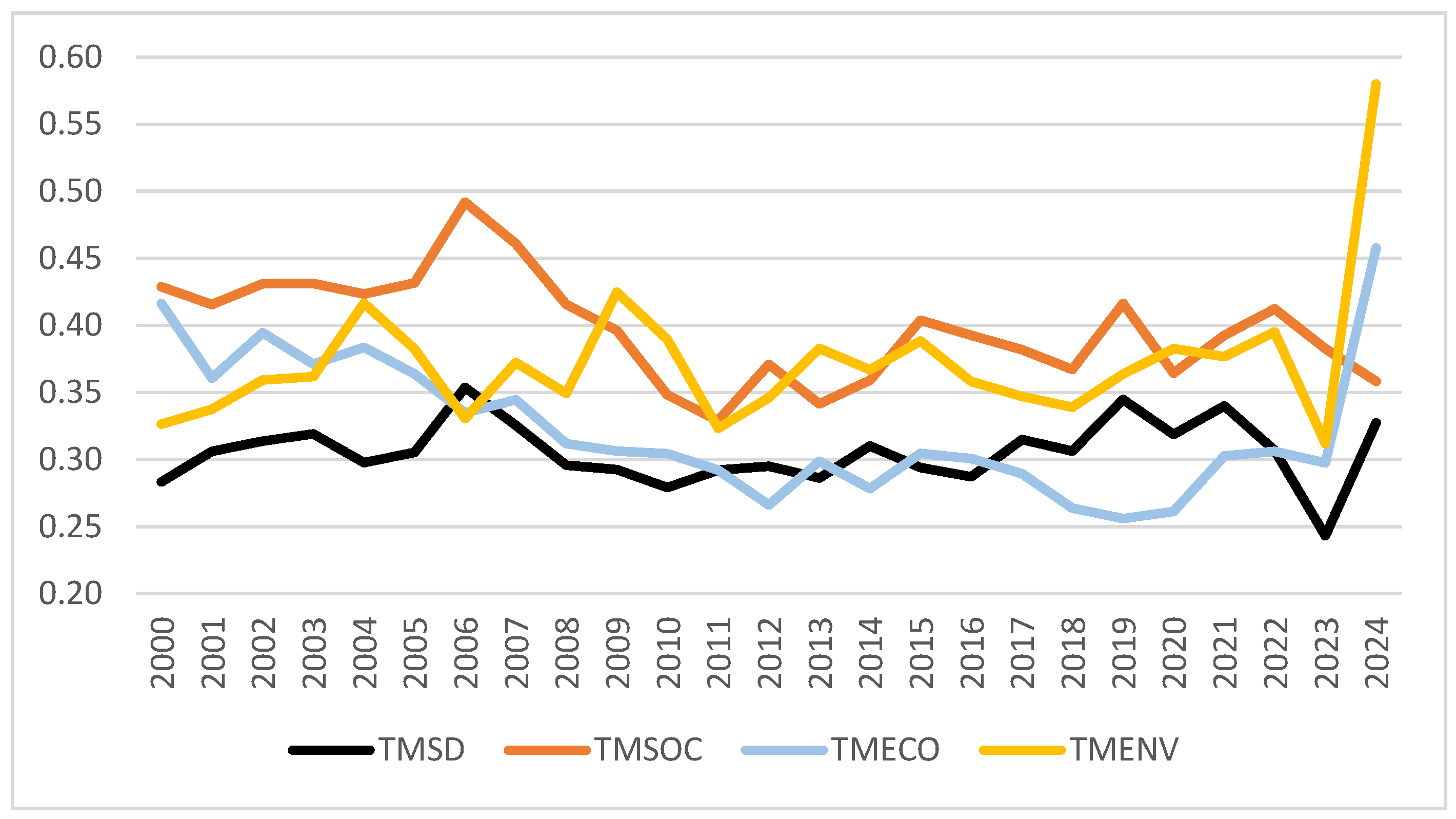
Figure 1 presents the average values of the synthetic measure of sustainable development (TMSD) and its three main components: social (TMSOC), economic (TMECO), and environmental (TMENV) across all analysed countries over the period 2000–2024. It should be noted that TMSD is not computed as the mean of TMSOC, TMECO, and TMENV. Instead, it is estimated independently on the basis of the full set of indicators, while the three component indices are calculated separately for subsets of variables. Hence, the overall measure is not expected to lie within the range of the three component indices. The trends suggest fluctuations in all dimensions, with the social component generally outperforming the others, indicating relatively stronger institutional and social development. While the social dimension generally exhibits a higher overall level of performance, the economic and environmental dimensions demonstrate more dynamic improvements over time. This distinction reflects differences between the level and the pace of change across SDG dimensions. The social component remains relatively consistent over time, suggesting stable performance in social sustainability indicators. In contrast, the economic component displays pronounced volatility, which may be attributed to cyclical economic fluctuations and external shocks. The environmental component is generally stable over the analysed period, with a noticeable increase in 2024. The increase observed in 2024 should be interpreted with caution, as it is likely influenced by missing data for some indicators and countries in the most recent year, which may affect the calculation and normalisation of the synthetic measure rather than reflect a genuine improvement in environmental performance. Since the synthetic measure is calculated relative to a reference pattern and normalised each year, missing data in the most recent period may affect the position of the reference object and the normalisation factor, which can influence the final values of the synthetic measure. This divergence in behaviour across the three dimensions highlights the complex nature of sustainable development and suggests that different sustainability dimensions progress at different rates.
Table 4 presents a classification of EU countries based on the synthetic measure of sustainable development (TMSD), computed as a 5-year average. For brevity, as well as to capture the main long-term changes in sustainable development performance while reducing the influence of short-term fluctuations, the classification is provided for consecutive 5-year periods rather than for each individual year.
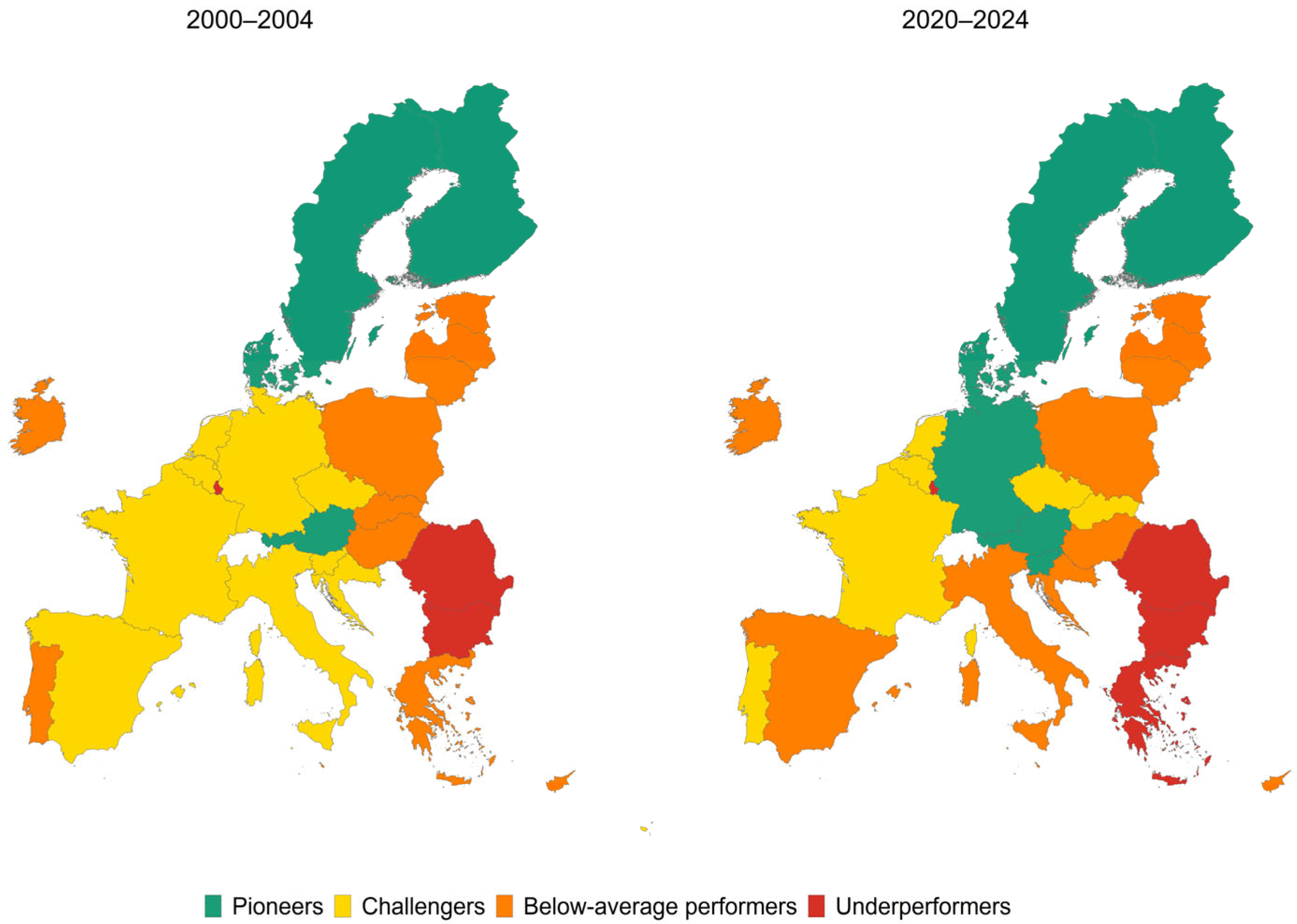
To complement the classification presented in Table 4 and to provide a clearer spatial perspective on SDG performance across the EU, Figure 2 presents a cartographic visualisation of countries grouped into performance categories for two reference periods: 2000–2004 and 2020–2024. This representation allows for a more intuitive assessment of regional disparities as well as changes in the distribution of performance levels over time.
The classification reveals some long-term trends in the sustainable development performance of EU countries. In the earliest period (2000–2004), for example, there were no pioneers from EE, whereas later periods, such as 2020–2024, show an increased share of pioneers (22.2%) with representation from both regions. Over time, the proportion of countries in the higher-performing categories appears to be growing relative to those in the lower-performing groups.
Regional differences are also apparent throughout the period. WE countries tend to be more frequently found in the challengers and below-average performers categories, while EE countries have a stronger presence among underperformers. However, as the periods progress, the regional imbalance becomes less pronounced, with both regions increasingly represented in the higher-performing categories.
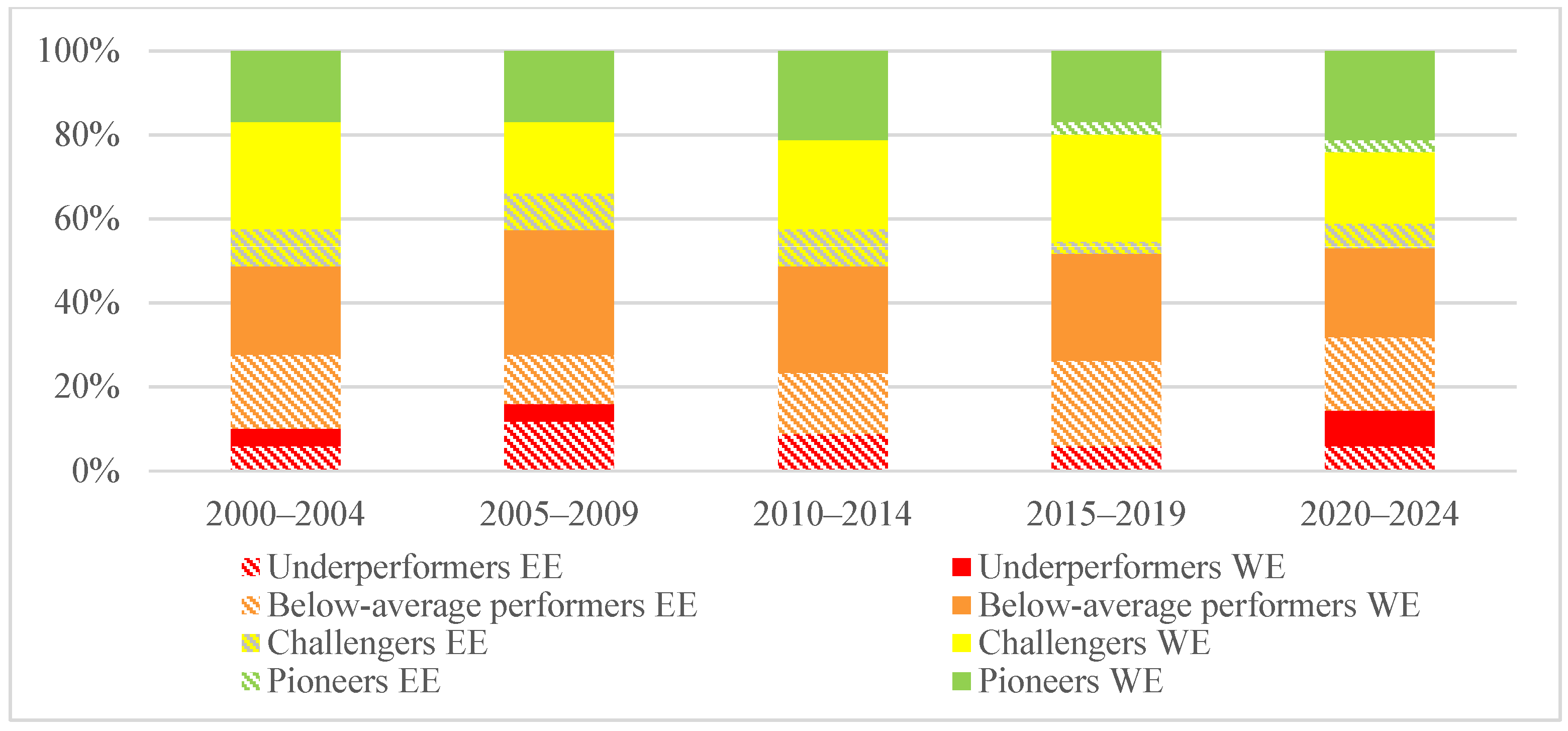
To complement the classification presented in Table 4, Figure 3 illustrates the distribution of EU countries across the four performance categories over time. The methodology used to adjust and normalise regional shares across categories and years involved combining the initial percentage shares for each region (EE and WE) within performance categories with the number of countries in each region and the total number of countries. This allowed for an adjustment that accounted for the different sizes of the European regions. To adjust the shares, the original percentages were scaled proportionally to the number of countries in each region. This was done by multiplying the original share for a given region, category, and period by the number of countries in that region and dividing by the total number of countries. This adjustment ensured that the shares reflected the actual size and composition of the markets. Following this, the adjusted shares were normalised to ensure that the total across all categories and regions for each 5-year period summed to 100%. Normalisation was achieved by dividing each adjusted share by the total adjusted shares for the period.
As shown in Figure 3, the distribution of countries across the four categories evolves over time. The proportion of countries in the pioneers’ group, defined by TMSD values exceeding the threshold of the mean plus one standard deviation, has increased, while the proportion of underperformers fluctuated. Moreover, the data indicate a structural imbalance in SDG performance between EE and WE. WE countries are not only less likely to be classified as underperformers but are also significantly more prevalent among the higher performance categories (challengers and pioneers). In contrast, EE countries are disproportionately represented among underperformers and, to a lesser extent, below-average performers. While there is a slight improvement in EE’s presence among the highest performing categories in the most recent periods, the overall regional disparity persists.
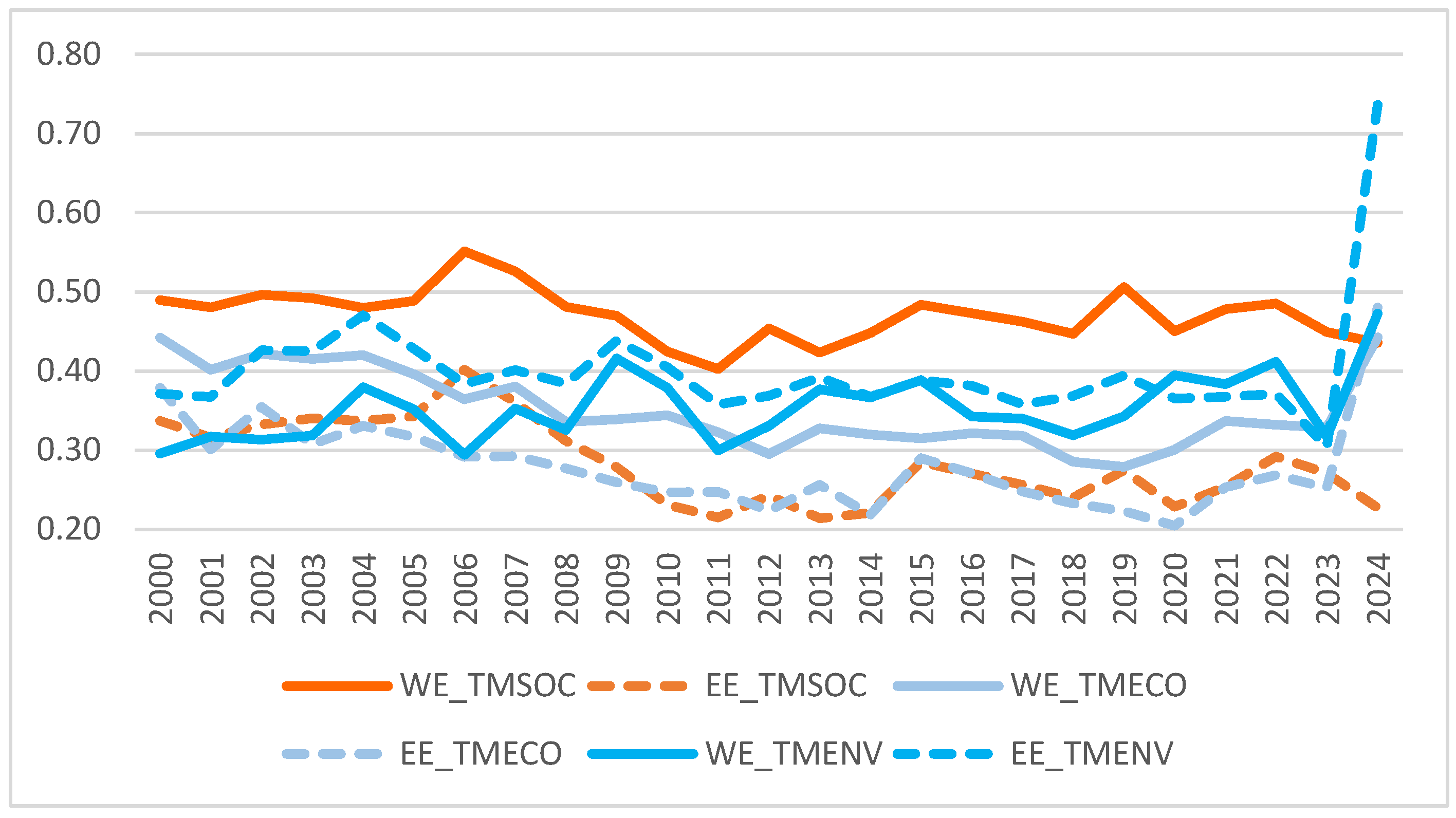
It is also purposeful to examine how WE and EE countries perform across the distinct component areas of the SDGs. Figure 4 displays six time series illustrating the average SDG performance scores in social (TMSOC), economic (TMECO), and environmental (TMENV) dimensions for WE and EE from 2000 to 2024. Each series represents an average of performance scores for a given region over time, showing regional trends and disparities in achieving SDG targets across these three pillars.
WE consistently outperforms EE in the social dimension. Although performance in the West experiences some fluctuations and periods of decline followed by recovery, EE’s scores remain comparatively lower throughout the period. This persistent disparity highlights a continuing gap in social SDG achievements between the regions. In the economic dimension, WE begins with a moderate advantage, yet both regions experience a similar downward trend in the earlier years before showing a noticeable recovery in more recent periods. This rebound, particularly pronounced in EE, may be attributed to both policy developments and methodological factors, including increased EU-funded investments (e.g., Cohesion Policy and the Recovery and Resilience Facility) as well as updates in SDG measurement frameworks, such as improved data coverage and revised indicator definitions. In contrast, EE initially demonstrates higher environmental performance than WE, although both regions undergo fluctuations and periodic improvements. Ultimately, the recent upturn in environmental outcomes for both regions could indicate rapid progress or reflect refinements in data collection methodologies.
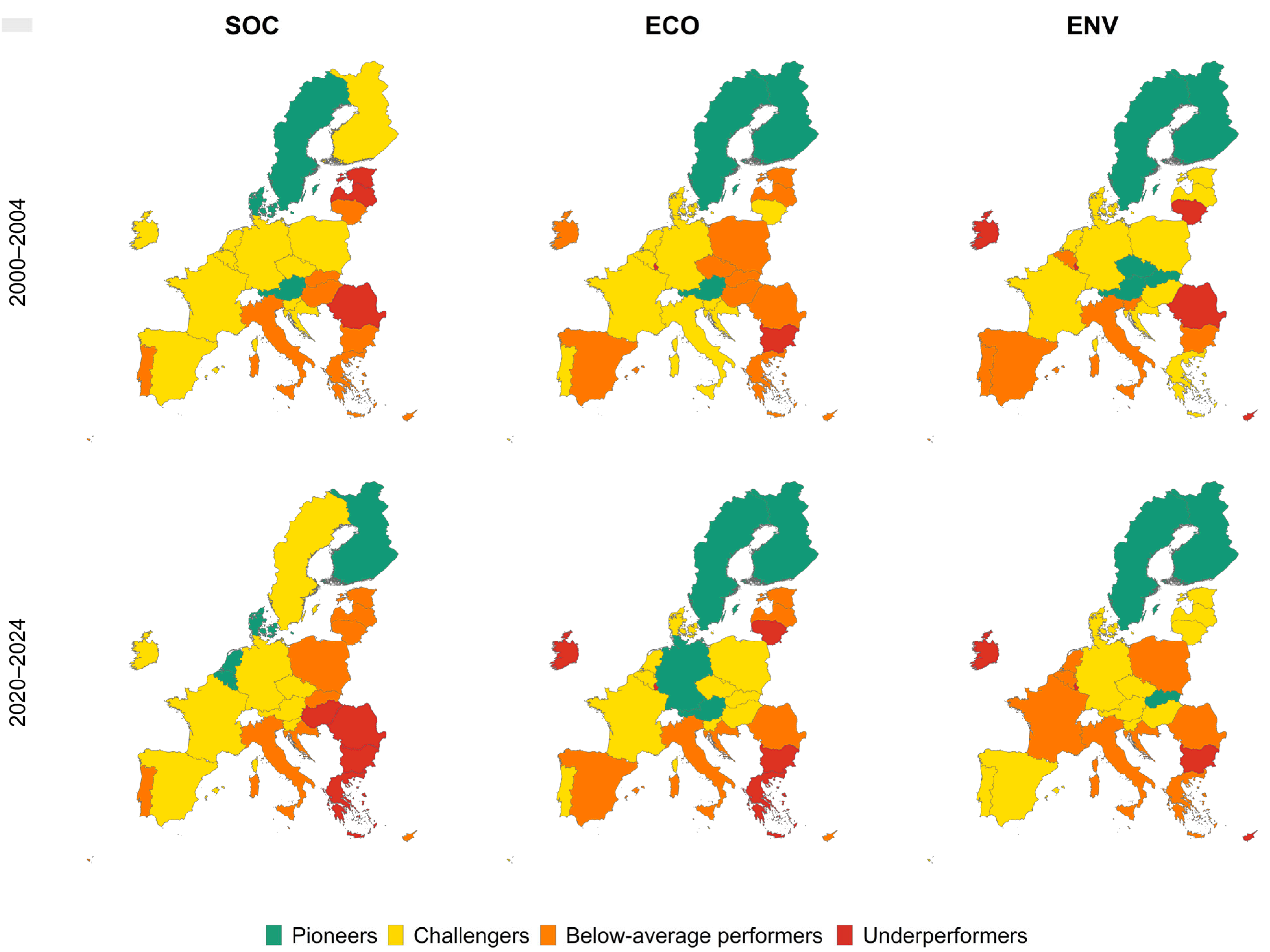
As an extension and complement to Table 4, which presents a classification of EU countries based on overall SDG performance, it is equally valuable to examine how this classification is represented in relation to the three SDG components: social, economic, and environmental. Table 5 classifies EU countries based on five-year averages of TMSOC, TMECO, and TMENV, offering a detailed categorisation into four performance categories for each SDG component area.
Additional maps for the social, economic, and environmental dimensions are provided in Appendix A (Figure A1), illustrating the spatial distribution of performance categories in 2000–2004 and 2020–2024.
In the social domain, EE shows a gradual improvement, with countries such as Slovenia and the Czech Republic emerging as remarkably progressing performers, while WE is consistently anchored by core countries like Austria, Sweden, and Denmark. Regarding economic performance, EE remains generally behind—with Bulgaria consistently in the underperforming category—whereas WE’s core economic performance is supported by Finland, Austria, and Sweden, alongside other nations demonstrating steady progress. In environmental performance, EE’s leading role is evidenced by the strong positioning of the Czech Republic and Slovakia, while WE’s environmental progress is primarily driven by Austria, Finland, and Sweden, with additional upward movement observed among countries such as Denmark and Germany. This classification thus highlights the core performers and the countries showing significant progress within each SDG area.

5. Discussion

Considering the complexity of SDG assessment and the linkages between goals and targets, which can both support and constrain progress [43], this section examines the study’s results with respect to the proposed hypotheses and the overall objective of analysing long-term SDG dynamics in the EU.
The empirical findings largely support the research hypotheses. First, in line with H1, the analysis revealed that the share of countries classified as pioneers has increased over time, while the proportion of underperformers has declined. This trend suggests a gradual improvement in overall SDG performance among EU nations, thereby confirming the anticipated shift in group composition.
Second, regarding H2, the comparative regional analysis indicated that WE countries are more frequently classified as pioneers and challengers compared to their EE counterparts. Although certain EE nations have shown marked improvements in recent periods, the persistent regional disparity indicates that WE continues to hold a comparative advantage in achieving higher SDG performance.
Third, the investigation into the three SDG dimensions confirms H3 by demonstrating that progress is not uniform across these areas. The economic and environmental dimensions exhibited more pronounced improvements—characterised by considerable increases in performance—whereas the social dimension remained relatively stable over the study period. These varied patterns highlight the complexity of sustainable development, suggesting that while policy initiatives and economic recovery measures are associated with improved economic and environmental outcomes, the social dimension follows a distinct trend.
The analysis did not fully confirm H4, as the performance gap between WE and EE countries remained visible throughout the study period. While some EE countries showed considerable progress, particularly in the economic and environmental dimensions, the overall rate of improvement was not consistently higher than that of WE. As a result, the expected convergence in sustainability performance was only partial, with regional disparities persisting, especially in the social dimension.
To further illustrate the observed trends, it is useful to refer to selected indicators and country-level developments between 2000 and 2024. In the social dimension, improvements were particularly visible in life expectancy and education-related indicators. For example, in Poland, life expectancy increased from approximately 73 years in 2000 to around 78 years in 2024, while in Romania, the post-transfer poverty rate declined substantially over the same period, reflecting improvements in living conditions despite remaining below Western European levels.
In the economic dimension, strong progress was observed in digitalisation. Internet usage in countries such as Poland increased from below 20% in the early 2000s to over 90% in recent years, while similar convergence patterns were observed in the Czech Republic. In contrast, Western European countries such as Germany already exhibited relatively high levels in the early period, increasing from approximately 60–70% to above 90%, indicating a smaller but still positive change.
In the environmental dimension, improvements were evident in renewable energy and environmental infrastructure. For instance, in Germany, the share of renewable energy in final energy consumption increased from approximately 6–7% in 2000 to over 20% in recent years, while in Estonia, wastewater treatment and environmental management indicators improved significantly. However, CO2 emissions per capita showed more uneven trends, remaining relatively high in several countries despite gradual reductions.
Overall, both Western and Eastern European countries experienced improvements across multiple indicators, although the pace of change was generally stronger in Eastern Europe, contributing to partial convergence while maintaining observable regional disparities.
A more detailed comparison also reveals both similarities and contrasts between countries in terms of specific indicators. In the social dimension, both Western and Eastern European countries experienced improvements in life expectancy and education outcomes; however, Western European countries such as Sweden and Germany maintained consistently higher levels, while countries such as Romania and Bulgaria, despite considerable progress, continued to lag behind.
In the economic dimension, convergence is particularly visible in digitalisation indicators. Countries such as Poland and the Czech Republic showed rapid increases in internet usage and infrastructure quality, narrowing the gap with Western European countries like Germany and the Netherlands, where initial levels were already high. At the same time, differences persisted in labour market indicators, with higher volatility observed in several Eastern European economies.
In the environmental dimension, similarities can be observed in the growing share of renewable energy across both regions, with countries such as Germany and Denmark leading the transition, while countries like Estonia and Slovenia also recorded noticeable improvements. However, contrasts remain in emissions-related indicators, where reductions were more gradual and uneven, particularly in economies with a stronger reliance on carbon-intensive energy sources.
The patterns identified in this study are broadly consistent with earlier assessments of SDG performance in the EU, which document persistent differentiation between groups of countries and emphasise the dominant role of economic factors in shaping overall sustainability outcomes. Previous research based on composite indicators and SDG dashboards shows that Western and Northern European countries consistently achieve higher SDG scores, while Central and Eastern European countries tend to lag behind, particularly in the social and economic dimensions [44,45,46,47,48]. Our results confirm this general spatial pattern, while also indicating that recent improvements in some EE countries have contributed to a modest narrowing of the performance gap, lending support to findings that point towards partial, rather than full, convergence in SDG outcomes across the EU [49].
Consistent with the existing literature, the analysis also highlights pronounced differences in the pace of progress across sustainability dimensions. Several studies stress that economic and environmental SDGs tend to exhibit stronger and more rapid improvements, whereas social goals evolve more slowly and remain structurally constrained, especially in post-transition and lower-income EU member states [44,46,48]. Moreover, research focusing on SDG interlinkages and trade-offs demonstrates that progress in individual goals is strongly conditioned by their interactions, with economic-oriented goals often acting as key drivers of aggregate performance [50,51,52]. Our findings align with these conclusions by showing that improvements in overall SDG performance are unevenly distributed across dimensions, and that social sustainability remains the most persistent constraint despite general upward trends.
While the direction of the results is in line with previous evidence, this study extends the literature in several important respects. Existing analyses frequently rely on static rankings, selected reference years, or limited time horizons, which restrict their ability to capture structural shifts in sustainability performance [46,47,53]. By contrast, the taxonomy-based framework applied here enables a dynamic classification of EU countries over a 25-year period, allowing for the identification of movements between performance categories and long-term changes in relative positions. In this sense, the contribution of the present study lies not in challenging previous findings but in integrating insights from composite indicator approaches, interlinkage analyses, and convergence studies into a coherent longitudinal perspective. This approach provides a more detailed understanding of divergence and convergence processes in SDG implementation and offers a robust basis for systematic monitoring and targeted policy coordination at the European level.

6. Conclusions

This study examined the evolution of Sustainable Development Goal (SDG) performance among EU countries over a 25-year period using a taxonomy-based approach. It focused on identifying changes in overall sustainability performance, examining regional disparities between WE and EE, and assessing the varying progress across the social, economic, and environmental dimensions.
In contrast to previous studies, the analysis incorporates a substantially broader set of SDG indicators and covers a longer time horizon, enabling the identification of structural changes in sustainability performance that are not detectable in shorter-term or goal-specific studies. The approach adopted here also allows for systematic monitoring of differences between EU countries and supports policy coordination at the level of the European Union.
Overall, the taxonomy-based approach proved effective in synthesising a large set of indicators into a coherent framework for monitoring SDG performance over time. The study’s findings provide policymakers with a comprehensive overview of performance trends across dimensions, enabling a clearer understanding of the differences among economic, environmental, and social outcomes. By applying a taxonomy-based approach to a long-run and multidimensional dataset, this study generates evidence that is directly relevant to the ongoing development of a coordinated EU sustainability strategy. The identification of distinct country groups and areas where progress remains uneven provides a sound foundation for targeted policy actions and resource allocation. In this way, the study addresses a gap in the literature where comprehensive, longitudinal, and policy-oriented assessments of SDG implementation across the EU remain limited.
The study faces several limitations, including gaps in data for the most recent years, which affect the robustness of the analysis. Additionally, aggregating diverse indicators into a single measure may overlook important variations within each sustainability dimension. Future research could further refine measurement frameworks and explore the underlying drivers of regional and dimensional disparities, thereby supporting the strategic design of sustainable development policies across the EU.

Author Contributions

Conceptualization, J.K.-B., E.M. and B.B.-S.; methodology, J.K.-B. and E.M.; software, J.K.-B. and E.M.; validation, J.K.-B. and E.M.; formal analysis, J.K.-B. and E.M.; investigation, J.K.-B. and E.M.; resources, J.K.-B., E.M. and B.B.-S.; data curation, J.K.-B. and E.M.; writing—original draft preparation, J.K.-B., E.M. and B.B.-S.; writing—review and editing, J.K.-B., E.M. and B.B.-S.; visualization, J.K.-B., E.M.; supervision, J.K.-B., E.M. and B.B.-S. All authors have read and agreed to the published version of the manuscript.

Funding

This research received no external funding.

Institutional Review Board Statement

Not applicable.

Informed Consent Statement

Not applicable.

Data Availability Statement

All data come from the SDG Transformation Center: https://sdgtransformationcenter.org/reports/sustainable-development-report-2024 (accessed on 10 June 2025).

Acknowledgments

The research was carried out as part of a research internship (December 2024–June 2025)—cooperation between the University of Gdańsk and the University of Szczecin.

Conflicts of Interest

The authors declare no conflicts of interest.

Appendix A

Figure A1. Spatial distribution of EU countries by SDG performance categories across three dimensions: social (TMSOC), economic (TMECO), and environmental (TMENV), for two periods: 2000–2004 and 2020–2024. Source: Authors’ calculations based on [6].
Sustainability 18 03487 g0a1

References

  1. Monastiriotis, V. Regional Growth and National Development: Transition in Central and Eastern Europe and the Regional Kuznets Curve in the East and the West. Spat. Econ. Anal. 2014, 9, 142–161. [Google Scholar] [CrossRef]
  2. Kuc-Czarnecka, M.; Markowicz, I.; Sompolska-Rzechuła, A.; Stundziene, A. Assessing sustainable development goal 7 implementation and its nexus with social, economic and ecological factors in EU countries. Sustain. Dev. 2024, 33, 847–860. [Google Scholar] [CrossRef]
  3. EBRD. Transition Report 2020–21: The State Strikes Back. Available online: https://www.ebrd.com/content/dam/ebrd_dxp/assets/pdfs/office-of-the-chief-economist/transition-report-archive/transition-report-2020/Transition-Report-2020-21.pdf (accessed on 10 July 2025).
  4. Eurostat. Eurostat Regional Yearbook: 2023 Edition. Available online: https://ec.europa.eu/eurostat/documents/15234730/17582411/KS-HA-23-001-EN-N.pdf (accessed on 4 July 2025).
  5. OECD. OECD Regional Outlook 2023: The Longstanding Geography of Inequalities. Available online: https://www.oecd.org/content/dam/oecd/en/publications/reports/2023/10/oecd-regional-outlook-2023_3a6174ba/92cd40a0-en.pdf (accessed on 3 July 2025).
  6. Sachs, J.D.; Lafortune, G.; Fuller, G. The SDGs and the UN Summit of the Future. Sustainable Development Report 2024; Dublin University Press: Dublin, Ireland, 2024. [Google Scholar]
  7. Mechitov, A.I.; Moshkovich, H.M. Nordic model: What makes Scandinavia so special. J. Acad. Bus. Econ. 2021, 21, 27–40. [Google Scholar] [CrossRef]
  8. Shi, L.; Han, L.; Yang, F.; Gao, L. The Evolution of Sustainable Development Theory: Types, Goals, and Research Prospects. Sustainability 2019, 11, 7158. [Google Scholar] [CrossRef]
  9. Lyons, R.A.; Rodgers, S.E.; Thomas, S.; Bailey, R.; Brunt, H.; Thayer, D.; Bidmead, J.; Evans, B.A.; Harold, P.; Hooper, M.; et al. Effects of an air pollution personal alert system on health service usage in a high-risk general population: A quasi-experimental study using linked data. J. Epidemiol. Community Health 2016, 70, 1184–1190. [Google Scholar] [CrossRef]
  10. Klarin, T. The concept of sustainable development: From its beginning to the contemporary issues. Zagreb Int. Rev. Econ. Bus. 2018, 21, 67–94. [Google Scholar] [CrossRef]
  11. Smith, A. An Inquiry into the Nature and Causes of the Wealth of Nations; W. Strahan and T. Cadell: London, UK, 1776; Volume 1. [Google Scholar]
  12. Keynes, J.M. The General Theory of Employment, Interest and Money; Macmillan and Company: London, UK, 1936. [Google Scholar]
  13. Friedman, M.; Friedman, R.D.; Gardner, G. Capitalism and Freedom; University of Chicago Press: Chicago, IL, USA, 1962. [Google Scholar]
  14. Ditlev-Simonsen, C.D. A Guide to Sustainable Corporate Responsibility: From Theory to Action; Springer Nature: Cham, Switzerland, 2022. [Google Scholar] [CrossRef]
  15. Sunny, F.A.; Jeronen, E.; Lan, J. Influential Theories of Economics in Shaping Sustainable Development Concepts. Adm. Sci. 2025, 15, 6. [Google Scholar] [CrossRef]
  16. Clark, J.M. The changing basis of economic responsibility. J. Political Econ. 1916, 24, 209–229. [Google Scholar] [CrossRef]
  17. Bowen, H.R. Social Responsibilities of the Businessman; Harper: New York, NY, USA, 1953. [Google Scholar]
  18. Marx, K. Capital, 1st ed.; Progress Publishers: Moscow, Russia, 1887; Volume 1. [Google Scholar]
  19. Prebisch, R. Raul Prebisch on Latin American development. Popul. Dev. Rev. 1981, 7, 563–568. [Google Scholar] [CrossRef]
  20. Todaro, M.P.; Smith, S.C. Economic Development, 11th ed.; Prentice Hall: Harlow, UK, 2011. [Google Scholar]
  21. Sen, A. On Ethics and Economics; Basil Blackwell Publishing: Oxford, UK, 1987. [Google Scholar]
  22. Sen, A. Inequality Reexamined; Oxford University Press Inc.: Oxford, UK, 1992. [Google Scholar]
  23. Mill, J.S. Of the stationary state. In Principles of Political Economy with Some of their Applications to Social Philosophy; Ashley, S.W.J., Ed.; John W. Parker: London, UK, 1848; pp. 750–752. [Google Scholar]
  24. Mill, J.S. Utilitarianism, 1st ed.; Parker, Son & Bourn: London, UK, 1863. [Google Scholar]
  25. Loorbach, D.; Rotmans, J. Managing transitions for sustainable development. In Understanding Industrial Transformation; Olsthoorn, X., Wieczorek, A., Eds.; Springer: Dordrecht, The Netherlands, 2006; pp. 187–206. [Google Scholar] [CrossRef]
  26. Zavřelová, V.; MacGregor Pelikánová, R. The Ephemeral Term “Sustainable Development” in Current EU Policies. Folia Oecon. Stetin. 2024, 24, 389–418. [Google Scholar] [CrossRef]
  27. Mebratu, D. Sustainability and sustainable development: Historical and conceptual review. Environ. Impact Assess. Rev. 1998, 18, 493–520. [Google Scholar] [CrossRef]
  28. Ruggerio, C.A. Sustainability and sustainable development: A review of principles and definitions. Sci. Total Environ. 2021, 786, 147–481. [Google Scholar] [CrossRef]
  29. United Nations. Report of the World Commission on Environment and Development: Our Common Future. Available online: https://www.brundtland.co.za/wp-content/uploads/2022/08/Brundtland-Report-1987-Our-Common-Future.pdf (accessed on 12 June 2025).
  30. Leonavičienė, E.; Burinskienė, A.; Peleckis, K. The Role of National Culture as an Indicator of Evidence of Sustainable Development. Folia Oecon. Stetin. 2022, 22, 146–167. [Google Scholar] [CrossRef]
  31. Transforming Our World: The 2030 Agenda for Sustainable Development. Available online: https://docs.un.org/en/A/RES/70/1 (accessed on 29 June 2025).
  32. Gupta, A.; Sharma, U.; Gupta, S.K. The Role of ESG in Sustainable Development: An Analysis Through the Lens of Machine Learning. In Proceedings of the 2021 IEEE International Humanitarian Technology Conference (IHTC), Virtual, 2–4 December 2021; pp. 1–5. [Google Scholar] [CrossRef]
  33. Ongan, S.; Goce, I.; Işık, C. Introducing the New ESG-Based Sustainability Uncertainty Index (ESGUI). Sustain. Dev. 2025, 33, 4457–4467. [Google Scholar] [CrossRef]
  34. De Souza Barbosa, A.; da Silva, M.C.B.C.; da Silva, L.B.; Morioka, S.N.; de Souza, V.F. Integration of Environmental, Social, and Governance (ESG) criteria: Their impacts on corporate sustainability performance. Humanit. Soc. Sci. Commun. 2023, 10, 410. [Google Scholar] [CrossRef]
  35. Rozmus, D. Clustering Poland Among EU Countries in Terms of a Sustainable Development Level in the Light of Various Cluster Stability Measures. Folia Oecon. Stetin. 2020, 20, 319–340. [Google Scholar] [CrossRef]
  36. Stawicka, E. The Impact of Innovation on the Sustainable Development of Enterprises. Folia Oecon. Stetin. 2023, 23, 370–386. [Google Scholar] [CrossRef]
  37. Gariba, M.I.; Rehman, F.U.; Prokop, V.; Giglio, C. Be digital to be sustainable! The mediating role of sustainable supply chain practices in triggering the effects of digitalisation on Sustainable Development Goals in the European Union. Oecon. Copernic. 2024, 15, 1383–1425. [Google Scholar] [CrossRef]
  38. Dmytrów, K.; Bieszk-Stolorz, B.; Landmesser-Rusek, J. Sustainable Energy in European Countries: Analysis of Sustainable Development Goal 7 Using the Dynamic Time Warping Method. Energies 2022, 15, 7756. [Google Scholar] [CrossRef]
  39. Peña, I.; Andrade, S.M.; Muñoz, R.M.; Martínez, I. A grouping of the Sustainable Development Goals (SDGs) and their influence on business results: An analysis for Spanish companies. Oecon. Copernic. 2023, 14, 551–583. [Google Scholar] [CrossRef]
  40. Brodny, J.; Tutak, M. The level of implementing sustainable development goal “Industry, innovation and infrastructure” of Agenda 2030 in the European Union countries: Application of MCDM methods. Oecon. Copernic. 2023, 14, 47–102. [Google Scholar] [CrossRef]
  41. Tarczyński, W.; Łuniewska, M. Dywersyfikacja Ryzyka na Polskim Rynku Kapitałowym; Placet: Warsaw, Poland, 2004. [Google Scholar]
  42. Strzała, K.; Przechlewski, T. Ekonometria Inaczej; Wydawnictwo Uniwersytetu Gdańskiego: Gdańsk, Poland, 2002. [Google Scholar]
  43. Anderson, C.C.; Denich, M.; Warchold, A.; Kropp, J.P.; Pradhan, P. A systems model of SDG target influence on the 2030 Agenda for Sustainable Development. Sustain. Sci. 2022, 17, 1459–1472. [Google Scholar] [CrossRef] [PubMed]
  44. Cling, J.P.; Eghbal-Teherani, S.; Orzoni, M.; Plateau, C. The interlinkages between the SDG indicators and the differentiation between EU countries: It is (mainly) the economy! Stat. J. IAOS 2020, 36, 455–470. [Google Scholar] [CrossRef]
  45. Hametner, M.; Kostetckaia, M. Frontrunners and laggards: How fast are the EU member states progressing towards the sustainable development goals? Ecol. Econ. 2020, 177, 106775. [Google Scholar] [CrossRef]
  46. D’Adamo, I.; Gastaldi, M.; Morone, P. Economic sustainable development goals: Assessments and perspectives in Europe. J. Clean. Prod. 2022, 354, 131730. [Google Scholar] [CrossRef]
  47. Ricciolini, E.; Rocchi, L.; Cardinali, M.; Paolotti, L.; Ruiz, F.; Cabello, J.M.; Boggia, A. Assessing progress towards SDGs implementation using multiple reference point based multicriteria methods: The case study of the European countries. Soc. Indic. Res. 2022, 162, 1233–1260. [Google Scholar] [CrossRef]
  48. Huang, R. SDG-oriented sustainability assessment for Central and Eastern European countries. Environ. Sustain. Indic. 2023, 19, 100268. [Google Scholar] [CrossRef]
  49. Özen Atabey, A.; Gümüş Özuyar, S.E.; Özen, E.; Grima, S. Divergent Pathways to Sustainability: Club Convergence Analysis of EU Progress on the Sustainable Development Goals. Chall. Sustain. 2025, 13, 207–235. [Google Scholar] [CrossRef]
  50. Miola, A.; Schiltz, F. Measuring sustainable development goals performance: How to monitor policy action in the 2030 Agenda implementation? Ecol. Econ. 2019, 164, 106373. [Google Scholar] [CrossRef]
  51. Kostetckaia, M.; Hametner, M. How sustainable development goals interlinkages influence European Union countries’ progress towards the 2030 agenda. Sustain. Dev. 2022, 30, 916–926. [Google Scholar] [CrossRef]
  52. Kuc-Czarnecka, M.; Markowicz, I.; Sompolska-Rzechuła, A. SDGs implementation, their synergies, and trade-offs in EU countries–Sensitivity analysis-based approach. Ecol. Indic. 2023, 146, 109888. [Google Scholar] [CrossRef]
  53. D’Adamo, I.; Di Leo, S.; Gastaldi, M.; Paris, A. Evaluating sustainability in Europe with composite indicators. Discov. Sustain. 2025, 6, 1251. [Google Scholar] [CrossRef]
Figure 1. Average TMSD and its components for EU countries (2000–2024). Source: Authors’ calculations based on [6].
Sustainability 18 03487 g001
Figure 2. Spatial distribution of EU countries by SDG performance categories based on the Taxonomic Measure of Sustainable Development (TMSD) in two periods: 2000–2004 and 2020–2024. Source: Authors’ calculations based on [6].
Sustainability 18 03487 g002
Figure 3. Normalised adjusted shares of WE and EE countries in SDG performance categories based on 5-year average TMSD. Source: Authors’ calculations based on [6].
Sustainability 18 03487 g003
Figure 4. Social, economic, and environmental SDG performance in WE and EE (2000–2024). Source: Authors’ calculations based on [6].
Sustainability 18 03487 g004
Table 1. SDG variables included in the social area.
GoalIndicators
1: No Poverty1.1. D. Extreme poverty rate ($2.15 PPP, %)
1.2. D. Poverty rate ($3.65 PPP, %)
1.3. D. Post-transfer poverty rate (%)
2: Zero Hunger2.1. D. Undernourishment rate (%)
2.2. D. Child stunting (under 5) (%)
2.3. D. Child wasting (under 5) (%)
2.4. D. Adult obesity (BMI ≥ 30) (%)
2.5. D. Dietary trophic level (index)
2.6. S. Cereal yield (t/ha)
2.7. D. Nitrogen Management Index
2.8. S. Yield gap closure (%)
2.9. D. Hazardous pesticide exports (t per million)
3: Good Health and Well-being3.1. D. Maternal mortality (per 100,000 live births)
3.2. D. Neonatal mortality (per 1000 live births)
3.3. D. Under-5 mortality (per 1000 live births)
3.4. D. Tuberculosis incidence (per 100,000 population)
3.5. D. HIV incidence (per 1000 uninfected population, all ages)
3.6. D. Premature NCD mortality (30–70) (%)
3.7. D. Air pollution mortality (per 100,000 population)
3.8. D. Road traffic mortality (per 100,000 population)
3.9. S. Life expectancy (years)
3.10. D. Adolescent fertility (per 1000)
3.11. S. Skilled birth attendance (%)
3.12. S. Basic vaccination coverage (%)
3.13. S. (UHC) service coverage (index)
3.14. S. Life satisfaction score (score)
3.15. D. Regional life expectancy gap (years)
3.16. D. Income health gap (percentage points)
3.17. D. Daily smoking rate (%aged 15+)
4: Quality Education4.1. S. Pre-primary participation (%)
4.2. S. Primary enrollment rate (%)
4.3. S. Lower secondary completion (%)
4.4. S. Youth literacy rate (%)
4.5. S. Tertiary educational attainment (% of population aged 25 to 34)
4.6. S. PISA (0–600 score)
4.7. D. Math performance variation by SES (%)
4.8. D. Low achievers in math (%)
5: Gender Equality5.1. S. Family planning coverage (%)
5.2. S. Gender gap in years of schooling (%)
5.3. S. Gender labour force gap (%)
5.4. S. Female parliamentary representation (%)
5.5. D. Gender pay gap (%)
10: Reduced Inequalities10.1. D. Income inequality: Gini index
10.2. D. Palma income ratio
10.3. D. Poverty rate (66+) (%)
16: Peace, Justice, and Strong Institutions16.1. D. Homicide rate (per 100,000)
16.2. S. Crime control index
16.3. D. Pre-trial detention rate (%)
16.4. S. Birth registration coverage (%)
16.5. S. CPI score
16.6. D. Child labour rate (%)
16.7. D. Arms exports (TIV per 100,000)
16.8. S. Press freedom score
16.9. S. Access to justice index
16.10. S. Administrative timeliness index
16.11. S. Expropriations protection index
16.12. D. Prison population rate (per 100,000)
Source: authors’ compilation based on [6].
Table 2. SDG variables included in the economic area.
GoalIndicators
7: Affordable and Clean Energy7.1. S. Access to electricity (%)
7.2. S. Access to clean cooking fuels (%)
7.3. D. CO2 intensity of electricity generation (MtCO2/TWh)
7.4. S. Renewable energy share (final energy) (%)
8: Decent Work and Economic Growth8.1. S. Real GDP growth (%)
8.2. D. Modern slavery prevalence (per 1000)
8.3. S. Financial account ownership (15+) (%)
8.4. D. Unemployment rate 15+ (%)
8.5. S. Labour rights protection index
8.6. D. Fatal accidents embodied in imports (per million)
8.7. D. Slavery embodied in imports (per 100,000)
8.8. S. Employment rate (%)
8.9. D. NEET rate (15–24) (%)
9: Industry, Innovation, and Infrastructure9.1. S. Rural access to all-season roads (%)
9.2. S. Internet usage rate (%)
9.3. S. Mobile broadband usage (per 100)
9.4. S. LPI—infrastructure quality (index)
9.5. S. Top 3 universities—average THE score
9.6. S. Scientific publications (per 1000)
9.7. S. R&D expenditure (GERD) (% of GDP)
9.8. S. Researcher density (per 1000 employed)
9.9. S. Triadic patents (per million)
9.10. D. Income-based internet gap (pp)
9.11. S. Female STEM graduates (%)
11: Sustainable Cities and Communities11.1. D. Urban population in slums (%)
11.2. D. PM2.5 concentration (annual mean) (μg/m3)
11.3. D. Urban piped water access (%)
11.4. D. Rent overburden rate (%)
11.5. S. 15-min access to amenities (%)
11.6. S. Urban access to public transport (%)
12: Responsible Consumption and Production12.1. D. Municipal waste generation (kg/capita/day)
12.2. D. E-waste (kg/capita)
12.3. D. Air pollution burden (production-based) (DALYs per 1000)
12.4. D. Air pollution burden (imports) (DALYs per 1000)
12.5. D. Nitrogen emissions (production-based) (kg/capita)
12.6. D. Nitrogen emissions (imports) (kg/capita)
12.7. D. Plastic waste exports (kg/capita)
12.8. D. Non-recycled municipal waste (kg/capita/day)
17: Partnerships for the Goals17.1. S. Public spending on health & education (% of GDP)
17.2. S. Concessional public finance (% of GNI)
17.3. S. Government revenue (excl. grants) (% of GDP)
17.4. D. Corporate tax haven index(score)
17.5. D. Financial secrecy index(score)
17.6. S. Profit shifting (multinationals) (US$ billion)
17.7. S. Statistical Performance Index
17.8. S. Support for UN multilateralism
Source: authors’ compilation based on [6].
Table 3. SDG variables included in the environmental area.
GoalIndicators
6: Clean Water and Sanitation6.1. S. Basic drinking water access (%)
6.2. S. Basic sanitation access (%)
6.3. D. Freshwater withdrawal rate (%)
6.4. S. Wastewater treatment rate (%)
6.5. D. Water scarcity embodied in imports (m3 H2Oeq/capita)
6.6. S. Safely managed water access (%)
6.7. S. Safely managed sanitation access (%)
13: Climate Action13.1. D. CO2 emissions (fossil & cement) (tCO2/capita)
13.2. D. GHG embodied in imports (tCO2/capita)
13.3. D. CO2 embodied in fossil exports (kg/capita)
13.4. S. Carbon pricing score (EUR60/tCO2)
14: Life Below Water14.1. S. Protected marine biodiversity areas (%)
14.2. S. Ocean health—clean waters score
14.3. D. Overexploited fish stocks (%)
14.4. D. Trawling/dredging catch share (%)
14.5. D. Discarded fish catch (%)
14.6. D. Biodiversity threats embodied in imports (per million)
15: Life on Land15.1. S. Protected terrestrial biodiversity areas (%)
15.2. S. Protected freshwater biodiversity areas (%)
15.3. S. Species survival (Red List Index)
15.4. D. Permanent deforestation rate (%)
15.5. D. Imported deforestation (m2/capita)
Source: authors’ compilation based on [6].
Table 4. Classification of EU countries based on 5-year average TMSD.
PeriodRegionCategory
PioneersChallengersBelow-Average PerformersUnderperformers
2000–2004EEnoneSVN, HRV, CZESVK, HUN, POL, EST, LTU, LVABGR, ROU
WESWE, AUT, FIN, DNKDEU, NLD, FRA, BEL, ESP, ITAGRC, PRT, IRL, MLT, CYPLUX
2005–2009EEnoneSVN, CZE, HRVSVK, HUN, POL, ESTLTU, LVA, BGR, ROU
WESWE, FIN, AUT, DNKDEU, NLD, FRA, BELESP, PRT, ITA, IRL, GRC, MLT, CYPLUX
2010–2014EEnoneSVN, CZE, HRVSVK, POL, HUN, EST, LVALTU, ROU, BGR
WESWE, FIN, AUT, DNK, DEUNLD, FRA, BEL, IRL, ESPPRT, MLT, ITA, CYP, GRC, LUXnone
2015–2019EESVNCZEHRV, POL, SVK, EST, HUN, LTU, LVAROU, BGR
WESWE, AUT, FIN, DEUDNK, NLD, BEL, FRA, PRT, ESPIRL, MLT, CYP, ITA, LUX, GRCnone
2020–2024EESVNCZE, SVKPOL, HRV, HUN, LVA, EST, LTUROU, BGR
WEFIN, SWE, DEU, AUT, DNKBEL, NLD, PRT, FRAESP, IRL, MLT, ITA, CYPLUX, GRC
Notes: Country codes according to ISO 3166-1 alpha-3. Countries are listed in order from worst to best within each category. Countries from the prevailing region in each category are highlighted in bold.
Table 5. Classification of EU countries based on 5-year average TMSOC, TMECO and TMENV.
PeriodRegionSDG AreaCategory
PioneersChallengersBelow-Average
Performers
Underperformers
2000–2004EESOCnoneSVN, HRV, CZE, POL, SVK, HUN, BGR, LTUEST, LVA, ROU
ECOnoneSVN, LTU, HRVEST, LVA, CZE, HUN, ROU, SVK, POLBGR
ENVSVK, CZEHUN, LVA, POL, HRV, ESTSVN, BGRROU, LTU
WESOCDNK, SWE, AUTBEL, DEU, NLD, ESP, FIN, LUX, FRA, IRLGRC, ITA, CYP, PRT, MLTnone
ECOSWE, FIN, AUTDEU, FRA, DNK, PRT, BEL, NLD, ITAESP, MLT, GRC, IRL, CYPLUX
ENVSWE, FIN, AUTFRA, DNK, DEU, NLD, GRCITA, ESP, PRT, BELMLT, IRL, LUX, CYP
2005–2009EESOCnoneSVN, CZE, HRVPOL, HUN, SVK, ESTBGR, LTU, LVA, ROU
ECOnoneSVN, CZE, LTU, EST, HRVLVA, HUN, ROU, SVK, POLBGR
ENVSVK, CZEHUN, EST, LVA, SVN, POL, HRVBGRLTU, ROU
WESOCDNK, SWE, BELNLD, DEU, AUT, FIN, LUX, ESP, IRL, FRAGRC, ITA, PRT, CYP, MLTnone
ECOSWE, FIN, AUTDEU, DNK, FRA, NLD, PRTBEL, ESP, MLT, ITA, CYP, IRL, GRCLUX
ENVSWE, FIN, AUTFRA, DNK, GRC, DEU, ITAESP, NLD, PRTCYP, BEL, IRL, MLT, LUX
2010–2014EESOCnoneSVN, CZEPOL, HRV, HUN, SVKEST, LTU, LVA, BGR, ROU
ECOnoneSVN, HRV, CZELVA, EST, SVK, POL, HUN, ROU, LTUBGR
ENVSVK, CZEHUN, SVN, HRV, ESTLVA, POL, LTUROU, BGR
WESOCDNK, SWE, NLD, AUT, BELIRL, DEU, LUX, FIN, ESP, FRACYP, MLT, GRC, ITA, PRTnone
ECOSWE, FIN, AUTDEU, FRA, DNK, NLD, BEL, MLTPRT, ITA, IRL, CYP, ESPGRC, LUX
ENVFIN, SWE, AUTFRA, DEU, DNK, ESPITA, GRC, PRT, NLD, CYP, MLTIRL, BEL, LUX
2015–2019EESOCSVNCZEPOL, HRV, EST, SVK, HUNLTU, LVA, BGR, ROU
ECOnoneSVN, CZEEST, SVK, HRV, LVA, POL, LTU, HUN, ROUBGR
ENVSVK, HUNCZE, HRV, LTU, SVNLVA, EST, POL, ROUBGR
WESOCDNK, SWE, BEL, AUT, NLDIRL, FIN, DEU, LUX, ESP, PRTFRA, CYP, MLT, GRC, ITAnone
ECOSWE, AUT, FINDEU, FRA, NLD, DNK, BEL, MLT, PRTCYP, ITA, ESPIRL, GRC, LUX
ENVFIN, SWE, AUTDEU, FRA, DNKGRC, ITA, ESP, PRT, NLD, MLTCYP, IRL, BEL, LUX
2020–2024EESOCnoneSVN, CZEHRV, POL, SVK, LTU, EST, LVAHUN, BGR, ROU
ECOnoneSVN, POL, CZE, SVK, HUNHRV, LVA, ROU, ESTLTU, BGR
ENVSVKHUN, SVN, CZE, LTU, LVA, ESTHRV, POL, ROUBGR
WESOCFIN, BEL, LUX, DNK, NLDDEU, IRL, AUT, SWE, FRA, ESPPRT, CYP, MLT, ITAGRC
ECOSWE, DEU, AUT, FINPRT, DNK, MLT, FRA, NLD, BELITA, CYP, ESPIRL, GRC, LUX
ENVSWE, FINDEU AUT, PRT, DNK, ESPITA, GRC, BEL, FRA, NLD, MLTIRL, CYP, LUX
Notes: Country codes according to ISO 3166-1 alpha-3. Countries are listed in order from worst to best within each category. Countries from the prevailing region in each category for each SDG area are highlighted in bold. Source: Authors’ calculations based on [6].
Disclaimer/Publisher’s Note: The statements, opinions and data contained in all publications are solely those of the individual author(s) and contributor(s) and not of MDPI and/or the editor(s). MDPI and/or the editor(s) disclaim responsibility for any injury to people or property resulting from any ideas, methods, instructions or products referred to in the content.