The Environmental Benefits of New Energy Vehicle Promotion and Their Mediation Pathways: Evidence from Chengdu in China


Abstract
1. Introduction
- (1)
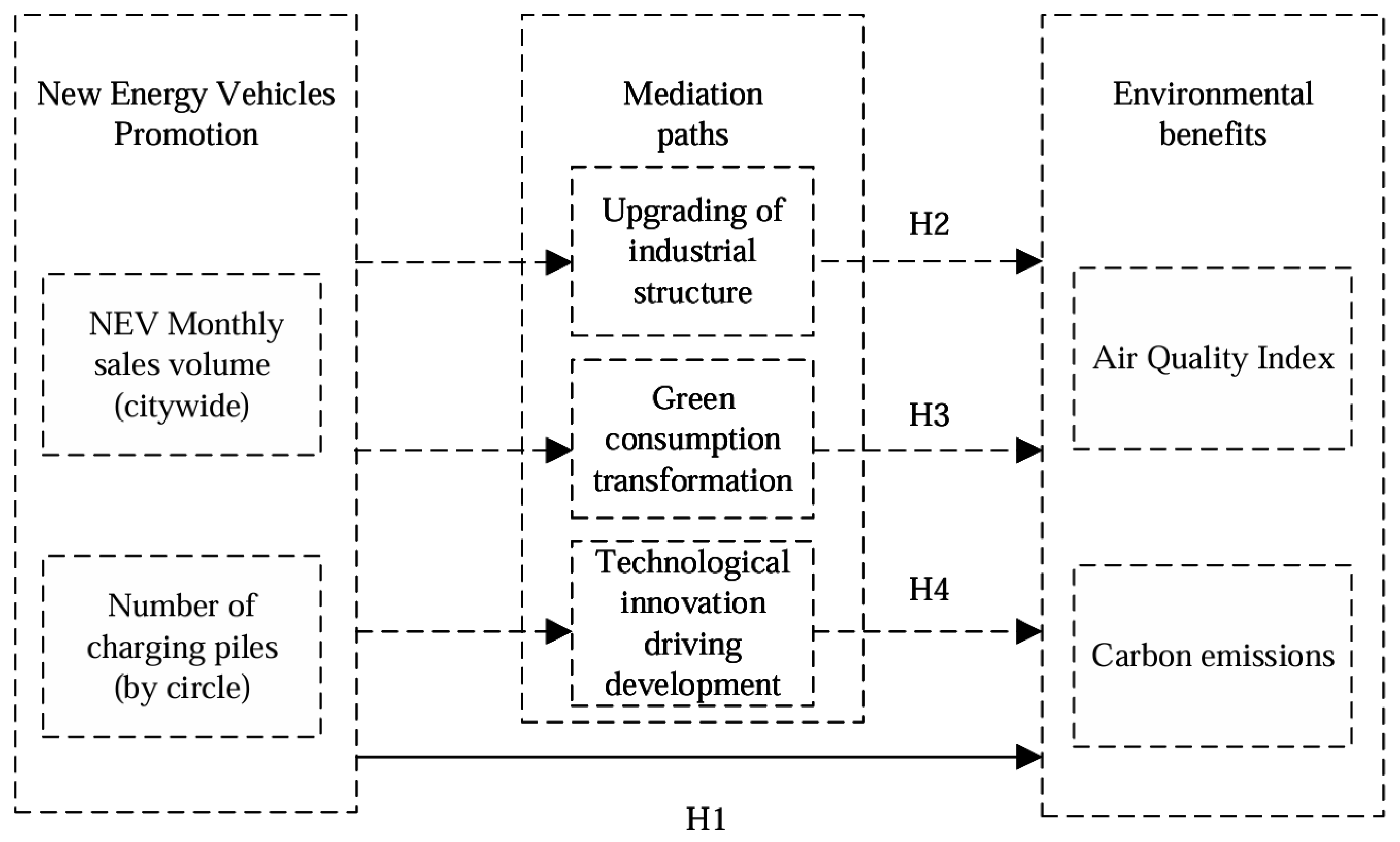
- The existing literature mainly empirically studies NEVP based on cross-country data or cross-province data. Based on city panel data, this paper explores the micro-transmission pathways of the environmental benefits of NEVP at the city scale by the multiple mediation model.
- (2)
- Previous studies regard cities as homogeneous spaces, ignoring the spatial heterogeneity of urban circles. Based on the data of charging piles, this paper studies the heterogeneity of the environmental benefits of NEVP among different urban circles, and finds that it has the characteristics of a decreasing circle.
- (3)
- Most existing studies focus on the WTW emissions as the outcome variable. This paper introduces the distributed lag model to test whether there is a time lag, and its long-term sustainability in the environmental benefits of the NEVP. We find that the environmental benefits of NEVP exhibit distinct characteristics of time lag and long-term persistence. Among them, carbon emission shows a significant decline in the current period, 1-period lag and 2-period lag, and long-term effect. The air quality shows a significant improvement in the 3-period lag and long-term effect.
2. Literature Review
2.1. The Cross-Country Evidence of NEVP’s Environmental Benefits
2.2. The Implementation Pathways About Carbon Reduction Benefits of NEVP
2.3. Regional Heterogeneity of NEVP’s Environmental Benefits
2.4. Literature Summary
- (1)
- There is a paucity of research on the specific pathways through which the environmental benefits of NEVP are realized, and the main research findings have focused on the environmental benefits of “direct emission reductions”.
- (2)
- There is a lack of research on samples from specific cities and their sub-circles, as research on the impact of NEVP on environmental benefits has mostly relied on cross-country or cross-provincial data.
3. Current Situation Analysis
3.1. The Sales Situation of New Energy Vehicles in Chengdu
3.2. Layout and Policy Support for the New Energy Vehicles Industry in Chengdu
3.2.1. Overall Layout of the New Energy Vehicles Industry Chain in Chengdu
3.2.2. Layout of Charging Piles in Chengdu
3.2.3. Support Policies for NEVP in Chengdu
- (1)
- For vehicle purchase incentives, the production and sales of new energy vehicles are eligible for rewards, with a maximum of 50 million CNY for a single model, and the exemption from vehicle purchase tax has been extended, according to the Implementation Opinions of Chengdu on Promoting the Development of the New Energy Vehicles Industry. In 2024, the total exemption amount reached 5.49 billion CNY, and some districts (counties), such as Qingyang District, also offer a maximum 5000 CNY “instant payment subsidy”.
- (2)
- For ease of use, new energy vehicles enjoy preferential policies such as exemption from license plate number restrictions, free parking within 2 h in public parking lots, a 50% discount on parking fees for overtime stays, relaxed traffic access rights for new energy freight vehicles, and the availability of a 30 day electronic access permit.
- (3)
- For industrial coordination policies, Chengdu is planned to achieve a 50% local supporting rate by 2025, establish large local automobile groups through mergers and acquisitions, and actively work towards jointly building the “hydrogen corridor” and “electricity corridor” between Chengdu and Chongqing.
- (4)
- For charging pile construction, it is to be promoted in accordance with the “Special Planning for Electric Vehicle Charging and Battery Swapping Infrastructure in Chengdu (2023–2025)”. By 2025, 160,000 charging piles and 3000 battery swapping stations are to be built. Public (dedicated) charging piles will be subsidized according to their star ratings, with a maximum subsidy of 200,000 CNY per station. New residential buildings are required to reserve 100% of the installation conditions for charging piles.
- (5)
- For electrification in the public sector, all newly added or renewed public transport vehicles, taxis, and sanitation vehicles shall be electrified in principle, in accordance with the Work Plan of Chengdu for Implementing Clean Energy Substitution and Accelerating Energy Consumption Structure Adjustment (2021–2025). The electrification rate of official vehicles (except special purpose vehicles) shall reach 100%, and the electrification rate of concrete transport vehicles and cold chain vehicles within the Third Ring Road shall also reach 100%.
- (6)
- For technological innovation support, enterprises qualify for R&D expense super deduction, single battery swap stations are eligible for a maximum subsidy of 1 million CNY, and Chengdu has been selected as one of the first batch of national vehicle-to-grid (V2G) technology pilot projects.
- (7)
- For second-hand vehicles and vehicle replacement, the city encourages “trade in” programs with subsidies of up to 15,000 CNY and exemption from partial vehicle purchase tax, and promotes the phaseout and replacement of fuel-powered vehicles complying with the National IV Vehicles Emission Standard (hereinafter referred to as “National IV”) or lower with new energy vehicles.
4. Methodology
4.1. Hypotheses
4.1.1. The Direct Environmental Benefits of NEVP
4.1.2. The Indirect Environmental Benefits of NEVP
- (1)
- The Pathway of Industrial Structure Upgrading
- (2)
- The Pathway of Green Consumption Transformation
- (3)
- The Pathway of Technological Innovation Driving Development
4.2. Modeling
4.2.1. Baseline Regression Model
4.2.2. Lagged Variable Models
4.2.3. Multiple Mediation Model
4.3. Variable Selection and Data Sources
4.3.1. Variable Selection
- (1)
- Dependent Variables
- (2)
- Core Explanatory Variable
- (3)
- Control Variables
- (4)
- Mediation Variables
4.3.2. Data and Variables
- (1)
- New Energy Vehicles Sales
- (2)
- Charging Pile Data
- (3)
- Air Quality and Carbon Emission Data
- (4)
- Mediation and Control Variables
5. Results and Analysis
5.1. Sample Descriptive Statistics
5.2. Analysis of Baseline Regression Results
5.3. Distributed Effects Model Analysis
5.4. Multiple Mediation Model Analysis
5.5. Endogeneity Discussion and Robustness Test
5.5.1. Endogeneity Discussion
- (1)
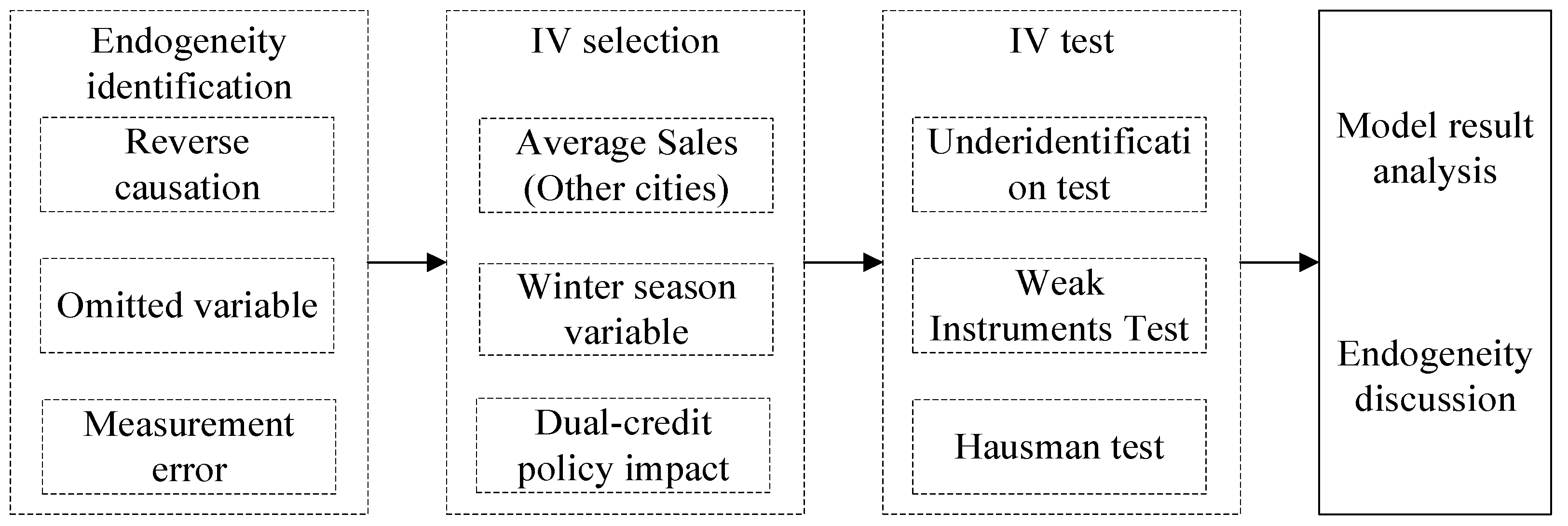
- The sales of new energy vehicles in other cities influence the sales in the local city through competition and learning mechanisms, which satisfies the relevance restriction. The sales in other cities do not directly affect the local air quality, which satisfies the exclusion restriction.
- (2)
- In winter, new energy vehicle manufacturers offer substantial discounts to achieve record annual sales, thereby influencing new energy vehicle sales, which satisfies the relevance restriction. Winter is an exogenous natural phenomenon. Its impact on air quality is controlled by month fixed effects, which ensures that the exclusion restriction is satisfied.
- (3)
- The dual-credit policy in 2018 directly promotes enterprises to increase new energy vehicle sales, which satisfies the relevance restriction. The policy implementation is determined by the central government and has no direct relationship with the air quality of individual cities, only indirectly affecting air quality through its influence on sales, which satisfies the exclusion restriction.
5.5.2. Robustness Test
- (1)
- We replace the carbon emissions (lnCE) with the green development level (GD), the industrial structure upgrading with the overall industrial structure upgrading, the green consumption level with the digital economy level, the new energy vehicle invention patent authorization with the new energy transportation infrastructure development level, and the carbon emissions and air quality index with the specific pollutant indicators (PM2.5, PM10, SO2, CO2e) to test whether the regression results can support the conclusions drawn from baseline regression.
- (2)
- We test whether the core conclusions are sensitive to sample selection by changing the sample cycle, randomly excluding months (excluding 36 months of sample data in 2016, 2019 and 2020), and excluding the special period of the COVID-19 epidemic.
- (3)
- We compare the estimation results of fixed effects (FEs) and random effects (REs) models based on panel data from 2014 to 2024 (including six cities of Beijing, Shanghai, Guangzhou, Shenzhen, Chongqing, and Chengdu) to test whether the results are affected by data frequency and model specification.
5.6. Heterogeneity Analysis of Sub-Circles
- (1)
- The time aggregation bias. As the annual stock data of charging piles will smooth the monthly stock data, if the incremental distribution of charging piles in each month is uneven, using the annual average value may lead to biased regression results.
- (2)
- The measurement error bias. The annual stock data cannot accurately observe the actual stock data of charging piles in each month. The actual number of charging piles may show significant seasonal or monthly changes due to weather, travel behavior and other factors, and these changes cannot be reflected in the annual stock data.
- (3)
- Reverse causality bias.
6. Conclusions and Suggestions
- (1)
- New energy vehicle trade in subsidy schemes should be further optimized, and policy support for the three electric systems enterprises (power batteries, motors, and electronic control systems) should be enhanced. The environmental benefits of energy conservation and emission reduction can be sustained and strengthened by synergizing the pathways of industrial structure upgrading, green consumption transformation, and technological innovation driving development.
- (2)
- Enterprises related to new energy vehicles should be encouraged to intensify investment in technological R&D, and a multi-year environmental benefits evaluation system should be established, in which long-term carbon emission reductions are incorporated as a core assessment indicator, thereby guiding enterprises toward sustained green innovation.
- (3)
- Differentiated policies for charging infrastructure construction should be advanced in light of local conditions. In the first circle (central urban), the spatial layout and density of charging networks should be optimized. In the second circle (suburbs) and the third circle (outer suburbs), the construction of charging infrastructure should be accelerated to increase new energy vehicle penetration. Meanwhile, differentiated traffic rights policies should be promoted, such as stricter driving and parking restrictions for fuel-powered vehicles in the first circle, and toll exemptions on ring expressways for new energy freight vehicles in the third circle, so as to further amplify the environmental benefits of NEVP.
- (1)
- The NEV purchase subsidies and price preferential policies are more conducive to low- and middle-income groups, to a certain extent.
- (2)
- The spatial layout of charging infrastructure may affect the use and convenience of different income groups.
- (3)
- NEVP may have a structural employment impact on workers utilizing fuel-powered vehicles.
Author Contributions
Funding
Institutional Review Board Statement
Informed Consent Statement
Data Availability Statement
Conflicts of Interest
References
- Gu, X.; Wang, M.; Wu, J. An empirical study on the green effects of new energy vehicle promotion in the context of global carbon neutrality. China Popul. Resour. Environ. 2022, 32, 332–340. [Google Scholar] [CrossRef]
- He, P.; Pan, Y.; Peng, Y.; Chen, L.; Zuo, L.; Song, H. Exploring the Development Potential of Critical Metals in New Energy Vehicles: Evidence from Megacity Shanghai, China. Sustainability 2025, 17, 8388. [Google Scholar] [CrossRef]
- González Palencia, J.C.; Araki, M.; Shiga, S. Energy, environmental and economic impact of mini-sized and zero-emission vehicle diffusion on a light-duty vehicle fleet. Appl. Energy 2016, 181, 96–109. [Google Scholar] [CrossRef]
- Awan, A.; Alnour, M.; Jahanger, A.; Onwe, J.C. Do technological innovation and urbanization mitigate carbon dioxide emissions from the transport sector? Technol. Soc. 2022, 71, 102128. [Google Scholar] [CrossRef]
- Holland, S.P.; Mansur, E.T.; Muller, N.Z.; Yates, A.J. Are there environmental benefits from driving electric vehicles? The importance of local factors. Am. Econ. Rev. 2016, 106, 3700–3729. [Google Scholar] [CrossRef]
- Ferrero, E.; Alessandrini, S.; Balanzino, A. Impact of electric vehicles on air pollution from a highway. Appl. Energy 2016, 169, 450–459. [Google Scholar] [CrossRef]
- Marmiroli, B.; Venditti, M.; Dotelli, G.; Spessa, E. The transport of goods in the urban environment: A comparative life cycle assessment of electric, compressed natural gas and diesel light-duty vehicles. Appl. Energy 2020, 260, 114236. [Google Scholar] [CrossRef]
- Teixeira, A.C.R.; Sodre, J.R. Impacts of replacement of engine-powered vehicles by electric vehicles on energy consumption and CO2 emissions. Transp. Res. Part D Transp. Environ. 2018, 59, 375–384. [Google Scholar] [CrossRef]
- Jochem, P.; Babrowski, S.; Fichtner, W. Assessing CO2 emissions of electric vehicles in Germany in 2030. Transp. Res. Part A Policy Pract. 2015, 78, 68–83. [Google Scholar] [CrossRef]
- Trost, T.; Sterner, M.; Bruckner, T. Impact of electric vehicles and synthetic gaseous fuels on final energy consumption and carbon dioxide emissions in Germany based on long-term vehicle fleet modelling. Energy 2017, 141, 1215–1225. [Google Scholar] [CrossRef]
- Lane, B.; Shaffer, B.; Samuelsen, S. A comparison of alternative vehicle fueling infrastructure scenarios. Appl. Energy 2020, 259, 114128. [Google Scholar] [CrossRef]
- Kobashi, T.; Yoshida, T.; Yamagata, Y.; Naito, K.; Pfenninger, S.; Say, K.; Takeda, Y.; Ahl, A.; Yarime, M.; Hara, K. On the potential of “photovoltaics + electric vehicles” for deep decarbonization of Kyoto’s power systems: Techno-economic-social considerations. Appl. Energy 2020, 275, 115419. [Google Scholar] [CrossRef]
- Song, K.; Li, F.; Hu, X.; He, L.; Niu, W.; Lu, S.; Zhang, T. Multi-mode energy management strategy for fuel cell electric vehicles based on driving pattern identification using a learning vector quantization neural network algorithm. J. Power Sources 2018, 389, 230–239. [Google Scholar] [CrossRef]
- Girardi, P.; Gargiulo, A.; Brambilla, P.C. A comparative LCA of an electric vehicle and an internal combustion engine vehicle using the appropriate power mix: The Italian case study. Int. J. Life Cycle Assess. 2015, 20, 1127–1142. [Google Scholar] [CrossRef]
- Ju, X.; Sun, B.; Jin, J. The effect of new energy vehicle policies on traffic congestion: Evidence from Beijing. Bus. Manag. Res. 2018, 7, 9–21. [Google Scholar] [CrossRef]
- Quddus, M.A.; Yavuz, M.; Usher, J.M.; Marufuzzaman, M. Managing load congestion in electric vehicle charging stations under power demand uncertainty. Expert Syst. Appl. 2019, 125, 195–220. [Google Scholar] [CrossRef]
- Wu, Z.; Cai, X.; Li, M.; Hu, L. Optimal mixed charging schemes for traffic congestion management with subsidy to new energy vehicle users. Int. Trans. Oper. Res. 2022, 29, 6–23. [Google Scholar] [CrossRef]
- Richardson, D.B. Electric vehicles and the electric grid: A review of modeling approaches, impacts, and renewable energy integration. Renew. Sustain. Energy Rev. 2013, 19, 247–254. [Google Scholar] [CrossRef]
- Dixon, J.; Bukhsh, W.; Edmunds, C.; Bell, K. Scheduling electric vehicle charging to minimise carbon emissions and wind curtailment. Renew. Energy 2020, 161, 1072–1091. [Google Scholar] [CrossRef]
- Sheldon, T.L.; Dua, R. Measuring the cost-effectiveness of electric vehicle subsidies. Energy Econ. 2019, 84, 104545. [Google Scholar] [CrossRef]
- Beak, Y.J.; Kim, K.Y.; Maeng, K.; Cho, Y. Is the environment-friendly factor attractive to customers when purchasing electric vehicles? Evidence from South Korea. Bus. Strategy Environ. 2020, 29, 996–1006. [Google Scholar] [CrossRef]
- Zhang, H.; Xue, B.; Li, S.; Yu, Y.; Li, X.; Chang, Z.; Wu, H.; Hu, Y.; Huang, K.; Liu, L.; et al. Life cycle environmental impact assessment for battery-powered electric vehicles at the global and regional levels. Sci. Rep. 2023, 13, 7952. [Google Scholar] [CrossRef]
- Zhang, X.; Xie, J.; Rao, R.; Liang, Y. Policy incentives for the adoption of electric vehicles across countries. Sustainability 2014, 6, 8056–8078. [Google Scholar] [CrossRef]
- Tang, G.; Zhang, M.; Bu, F. Vehicle environmental efficiency evaluation in different regions in China: A combination of life cycle analysis (LCA) and two-stage data envelopment analysis (DEA) methods. Sustainability 2023, 15, 11984. [Google Scholar] [CrossRef]
- Preacher, K.J.; Hayes, A.F. Sourcebook for Political Communication Research: Methods, Measures, and Analytical Techniques; Routledge: New York, NY, USA, 2010. [Google Scholar]
- Hayes, A.F.; Preacher, K.J. Statistical mediation analysis with a multicategorical independent variable. Br. J. Math. Stat. Psychol. 2014, 67, 451–470. [Google Scholar] [CrossRef]
- Hayes, A.; Preacher, K. Mediation and the estimation of indirect effects in political communication research. In Sourcebook for Political Communication Research: Methods, Measures, and Analytical Techniques; Routledge: New York, NY, USA, 2011; pp. 1–30. [Google Scholar]



| Business District | Main Features | Representative Brands | Development Trend |
|---|---|---|---|
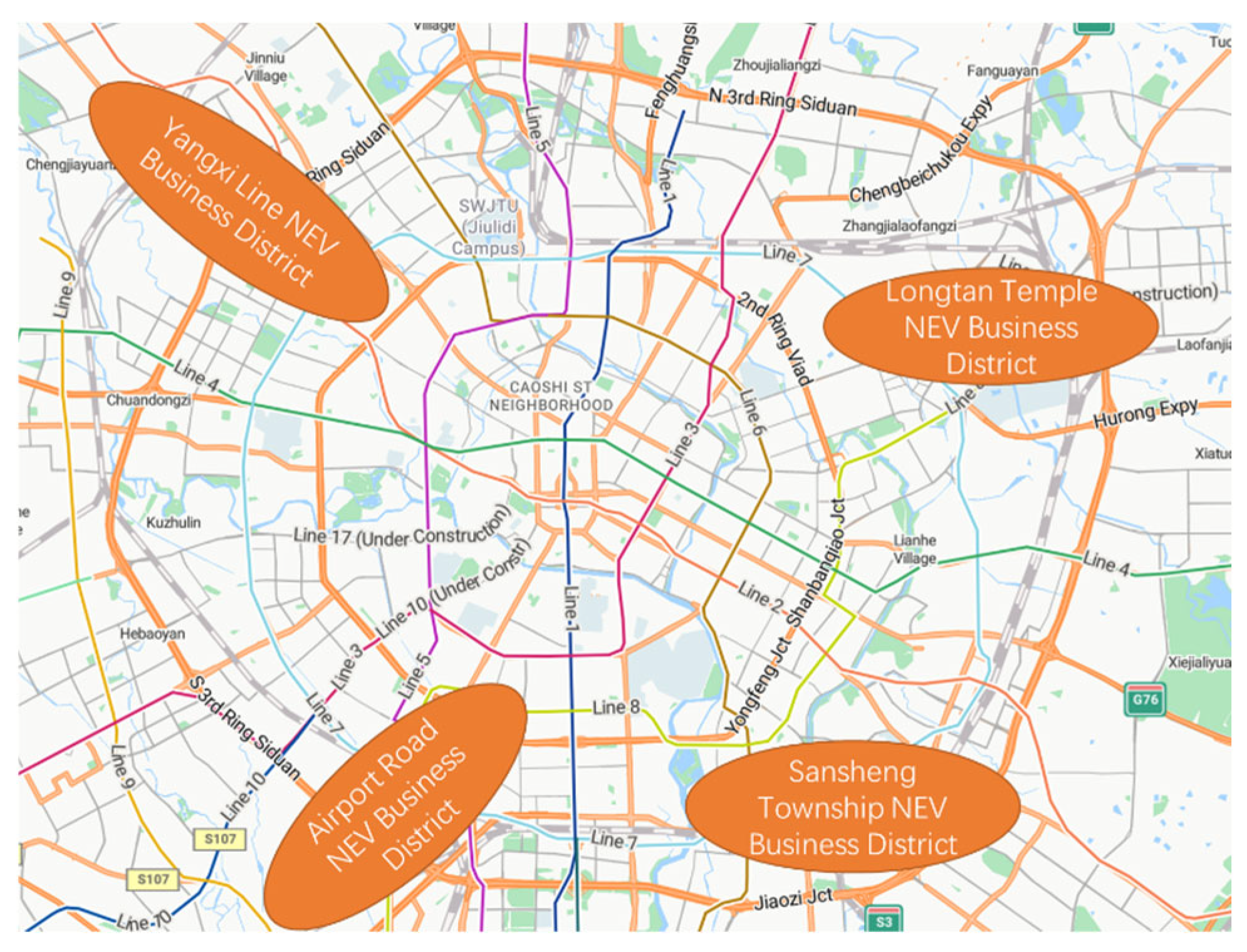
| Airport Road | High-end, internationalization | Tesla NIO BMW i-series | Focus on luxury new energy vehicles, equipped with supercharging stations, attracting high net worth customers |
| Sansheng Township | Policy pilot zone, emerging market | BYD GAC Aion Shenye Auto | Government subsidies favoring the creation of a “new energy vehicles mall” integrating culture and tourism experiences |
| Yangxi Line | Traditional transformation, hybrid sales | Xiaomi XPeng Ganghong | Fuel-powered vehicles dealers accelerating new energy vehicles transformation, offering one stop “oil to electric” services |
| Longtansi | Industrial synergy, supply chain advantage | Volkswagen ID series Volvo new energy vehicles | Leveraging local automobile manufacturing to develop a “front store–back factory” model, reducing logistics costs |
| Administrative District | Charging Units (Count) | Range of Charging Piles (Units) | Total Power Range (kW) | Regional Characteristics |
|---|---|---|---|---|
| Chenghua District | 11 | 3466–4350 | 207,960–261,000 | Industrial transformation zone; CH-5 unit exceeds 1000 piles |
| Eastern New Area | 14 | 2666–3345 | 159,960–200,700 | Emerging area with uneven distribution |
| Dujiangyan City | 6 | 832–1046 | 49,920–62,760 | Tourist destination with prominent unit power capacity |
| High-Tech South Zone | 5 | 2068–2603 | 124,080–156,180 | Business center area with high power demand |
| High-Tech West Zone | 2 | 1262–1582 | 75,720–94,920 | Industrial park area with centralized large stations |
| Jianyang City | 7 | 1092–1371 | 65,520–82,260 | Suburban county/city with relatively concentrated distribution |
| Jinniu District | 13 | 3768–4728 | 226,080–283,680 | Transportation hub area |
| Jintang County | 5 | 1902–2384 | 114,120–142,080 | Ecological area with dispersed layout |
| Jinjiang District | 11 | 2022–2538 | 121,320–152,280 | Old urban area with mixed distribution |
| Longquanyi District | 9 | 4865–6104 | 291,900–366,240 | Automobile industry base; largest unit scale |
| Pidu District | 6 | 2671–3353 | 160,260–201,180 | University cluster area |
| Qingbaijiang District | 5 | 2161–2712 | 129,660–162,720 | Logistics center area |
| Qingyang District | 12 | 2319–2910 | 139,140–174,600 | Balanced distribution |
| Qionglai City | 3 | 1304–1637 | 78,240–98,220 | Industrial county/city |
| Shuangliu District | 8 | 4033–5060 | 241,980–303,600 | Airport radiation area |
| Tianfu New Area | 9 | 2329–2920 | 139,740–175,200 | Core development area with high-density coverage and large single-station power |
| Wuhou District | 11 | 2716–3408 | 162,960–204,480 | Commercial and residential mixed area |
| Xinjin District | 8 | 1307–1640 | 78,420–98,400 | Low-density suburban area |
| Policy Category | Specific Measures | Policy Source |
|---|---|---|
| Purchase Incentives | Provide production and sales rewards for new energy vehicles models, with a maximum reward of 50 million CNY per model | Implementation Opinions on Promoting the Development of the New Energy Vehicles Industry in Chengdu |
| Continuing exemption from vehicle purchase tax (total exemption of 5.49 billion CNY in 2024) | ||
| District-/County-level supporting subsidies (e.g., up to 5000 CNY “instant discount” in Qingyang District) | ||
| Convenience of Use | New energy vehicles are exempt from tail number traffic restrictions | |
| Public parking lots are free for up to 2 h, with half-rate charges after that | ||
| Relaxed access permits for new energy vehicle freight vehicles (30 day electronic pass) | ||
| Industrial Synergy | Target of 50% local component matching rate by 2025 | |
| Establishment of large local automotive groups (through mergers and acquisitions) | ||
| Joint construction of the “hydrogen corridor” and “electric corridor” between Chengdu and Chongqing | ||
| Infrastructure | Build 160,000 charging piles and 3000 battery-swapping stations by 2025 Subsidies for public (or dedicated) charging stations based on star ratings (maximum 200,000 CNY per site) 100% of new residential buildings must reserve installation conditions for charging facilities | Special Plan for Electric Vehicle Charging and Battery-Swapping Infrastructure in Chengdu (2023–2025) |
| Public Sector Electrification | Newly added or renewed buses, taxis, and sanitation vehicles shall in principle be fully electrified | Chengdu Clean Energy Substitution and Energy Consumption Structure Adjustment Implementation Plan (2021–2025) |
| 100% electrification ratio for government vehicles (except for special purpose vehicles) | ||
| 100% electrification ratio for concrete mixer trucks and cold chain vehicles within the Third Ring Road | ||
| Technological Innovation Support | Additional deduction of R&D expenses (e.g., Teld Power enjoyed a deduction of 1.3 million CNY) | Detailed Implementation Rules for the Construction and Operation of Chengdu’s Electric Vehicle Charging and Battery-Swapping Infrastructure |
| Encourage battery-swapping business models (maximum subsidy of 1 million CNY per station) | Notice on the Publication of the First Batch of Large Scale V2G Pilot Projects | |
| Pilot vehicle-to-grid (V2G) interactive technology (selected as one of the first national projects) | ||
| Used Car and Replacement Policy | Encourage “trade in” purchases (maximum subsidy of 15,000 CNY + partial purchase tax exemption) | Sichuan Province Passenger Vehicle Replacement Subsidy Scheme for Individual Consumers |
| Promote the replacement of National IV and below fuel vehicles with new energy vehicles |
| Variable Name | Variable Type | Variable Definition | Sample Size | Mean | Standard Deviation (SD) | Minimum | Maximum |
|---|---|---|---|---|---|---|---|
| lnES | Explanatory Variable | Log of New Energy Vehicles Sales | 132 | 7.19 | 2.251 | 2.303 | 10.772 |
| lnCR | Explanatory Variable | Log of Charging Pile Stock by Circle Layer | 18 | 10.123 | 1.199 | 6.59 | 11.714 |
| AQI | Dependent Variable | Air Quality Index | 132 | 85.515 | 25.476 | 43.9 | 222.39 |
| lnCE | Dependent Variable | Log of Carbon Dioxide Emissions | 132 | 3.651 | 0.358 | 2.553 | 4.297 |
| lnFS | Control Variable | Log of Fuel-Powered Vehicles Sales | 132 | 6.157 | 0.214 | 5.817 | 6.507 |
| GS | Control Variable | GDP Growth Rate | 132 | 0.068 | 0.019 | 0.028 | 0.089 |
| SR | Control Variable | Proportion of Secondary Industry Added Value | 132 | 0.279 | 0.03 | 0.244 | 0.349 |
| TR | Mediation Variable | Proportion of Tertiary Industry Added Value | 132 | 0.72 | 0.029 | 0.657 | 0.755 |
| lnAC | Mediation Variable | Log of Per Capita Green Consumption Expenditure | 132 | 10.652 | 0.137 | 10.39 | 10.81 |
| lnZL | Mediation Variable | Log of Authorized Patents for New Energy Vehicles-Related Technological Inventions | 132 | 10.177 | 0.389 | 9.575 | 10.814 |
| Variables | lnCE | AQI |
|---|---|---|
| lnES | −0.276 *** | −10.814 * |
| (0.0692) | (6.279) | |
| lnFS | 2.839 *** | 19.637 |
| (0.866) | (86.779) | |
| GS | 2.815 * | −151.752 |
| (1.551) | (75.875) | |
| SR | −7.769 | −219.637 |
| (6.147) | (285.782) | |
| Constant | 18.516 ** | 764.792 * |
| (7.051) | (648.070) | |
| Mean VIF | 3.090 | 5.961 |
| White Test | 16.73 ** | 32.44 ** |
| ADF Test | −3.874 *** | −8.102 *** |
| Variables | Current Period (β0) | 1-Period Lag (β1) | 2-Period Lag (β2) | 3-Period Lag (β3) | Long-Term Effects (∑β) |
|---|---|---|---|---|---|
| lnCE | −0.205 *** | −0.0393 * | −0.0686 ** | 0.0177 | −0.1189 ** |
| (0.029) | (0.021) | (0.019) | (0.164) | (0.017) | |
| AQI | −0.941 | 2.969 | 0.225 | −5.586 ** | −3.332 ** |
| (2.496) | (2.496) | (2.694) | (2.672) | (2.466) | |
| Controls | Yes Yes | ||||
| Time trend | |||||
| Variables | Industrial Structure Upgrading Pathway | Green Consumption Transformation Pathway | Technological Innovation Pathway | |||||
|---|---|---|---|---|---|---|---|---|
| lnCE | AQI | lnCE | AQI | lnCE | AQI | |||
| Explanation Variable | lnES | −0.071 *** | −2.593 | −0.078 *** | −1.056 | −0.017 ** | −4.948 ** | |
| (0.020) | (1.854) | (0.021) | (1.940) | (0.009) | (2.044) | |||
| Mediation Variable | TR | −3.597 ** | −164.321 | - - | - - | - - | - - | |
| (1.571) | (145.176) | |||||||
| lnAC | - - | - - | −0.598 * | −62.368 * | - - | - - | ||
| (0.351) | (31.835) | |||||||
| lnZL | - - | - - | - - | - - | −0.603 *** | 3.418 | ||
| (0.119) | (11.827) | |||||||
| Bootstrap test | Industrial Structure Upgrading Pathway | Green Consumption Transformation Pathway | Technological Innovation Pathway | |||||
| Mediation Pathways | Upper limit | 88.990 | 23.092 | 87.795 | 24.789 | 118.423 | 21.400 | |
| Lower limit | 41.412 | 1.635 | 38.082 | 2.954 | 51.806 | 1.913 | ||
| Mediation Effect | Partial | Not significant | Partial | Not significant | Partial | Not significant | ||
| Controls | Yes | |||||||
| Variables | (1) AQI | (2) lnCE | (3) AQI | (4) lnCE | (5) AQI | (6) lnCE |
|---|---|---|---|---|---|---|
| FE | FE | IV-FE | IV-FE | IV-FE(Full) | IV-FE(Full) | |
| lnES | −1.813 *** | −0.037 *** | −2.732 *** | −0.060 *** | −2.825 *** | −0.063 *** |
| (0.312) | (0.008) | (0.419) | (0.006) | (0.414) | (0.006) | |
| L1.AQI | 0.455 *** | - | 0.422 *** | - | 0.419 *** | - |
| (0.037) | - | (0.033) | - | (0.032) | - | |
| L1.lnCE | - | 0.662 *** | - | 0.568 *** | - | 0.556 *** |
| - | (0.062) | - | (0.032) | - | (0.032) | |
| Time Fixed Effect | Yes | Yes | Yes | Yes | Yes | Yes |
| Individual Fixed Effect | Yes | Yes | Yes | Yes | Yes | Yes |
| Controls | Yes | Yes | Yes | Yes | Yes | Yes |
| R2 (within) | 0.360 | 0.795 | 0.355 | 0.788 | 0.354 | 0.786 |
| Hausman Test | p < 0.001 | p < 0.001 | p < 0.001 | p < 0.001 | p < 0.001 | p < 0.001 |
| Cragg–Donald F | - | - | 110.86 *** | 11.03 *** | ||
| LM | - | - | 273.423 *** | 1191.225 *** | 297.438 *** | 665.606 *** |
| IV | - | - | Average Sales Policy Impact | Average Sales Policy Impact | Full IV | Full IV |
| Variables | Replacement of the Explanatory and Mediation Variables | ||
|---|---|---|---|
| GD | GD | GD | |
| lnES | 0.007 *** | 0.009 *** | 0.017 *** |
| (0.002) | (0.002) | (0.001) | |
| TR_new | 0.150 *** | - | - |
| (0.017) | - | - | |
| lnAC_new | - | 0.284 *** | - |
| - | (0.049) | - | |
| lnZL_new | - | - | 0.028 *** |
| - | - | (0.007) | |
| Controls | Yes | Yes | Yes |
| Variables | Replacement of the Explanatory Variable | |||
|---|---|---|---|---|
| lnPM2.5 | lnPM10 | lnSO2 | lnCO2e | |
| lnES | −0.007 *** | −0.009 *** | −0.017 *** | −0.244 *** |
| (0.002) | (0.002) | (0.001) | (0.001) | |
| Controls | Yes | Yes | Yes | Yes |
| Methods | Change Sample Period (lnCE) | Randomly Eliminate Months (lnCE) | Eliminate the COVID-19 Period (lnCE) |
|---|---|---|---|
| lnES | −0.031 *** | −0.026 *** | −0.111 *** |
| (0.002) | (0.001) | (0.016) | |
| Controls | Yes | Yes | Yes |
| Variables | AQI | lnCE | ||
|---|---|---|---|---|
| FE | RE | FE | RE | |
| lnES | −5.627 *** | −5.610 *** | −0.133 *** | −0.132 *** |
| (0.696) | (0.690) | (0.014) | (0.014) | |
| Constant | 134.123 *** | 133.937 *** | 2.666 *** | 2.660 *** |
| (7.494) | (9.834) | (0.148) | (0.163) | |
| Controls | Yes | Yes | Yes | Yes |
| Number of cities | 6 | 6 | 6 | 6 |
| R2 (within) | 0.526 | 0.526 | 0.614 | 0.614 |
| F-test | F = 65.35 *** | χ2 = 66.12 *** | F = 93.81 *** | χ2 = 95.41 *** |
| Hausman test | 0.151 (p = 0.701) | 0.160 (p = 0.688) | ||
| Urban Circles | Districts/Counties |
|---|---|
| The First Circle (Central Urban) | Jinjiang District, Qingyang District, Jinniu District, Wuhou District, Chenghua District, High-Tech Zone, Tianfu New Area (Directly Managed by Chengdu) |
| The Second Circle (Suburbs) | Longquanyi District, Qingbaijiang District, Xindu District, Wenjiang District, Shuangliu District, Pidu District |
| The Third Circle (Outer suburbs) | Jianyang City, Dujiangyan City, Pengzhou City, Qionglai City, Chongzhou City, Jintang County, Dayi County, Pujiang County, Xinjin District |
| Variables | The First Circle | The Second Circle | The Third Circle | |||
|---|---|---|---|---|---|---|
| lnCEaverage | AQIaverage | lnCEaverage | AQIaverage | lnCEaverage | AQIaverage | |
| lnCR | −0.312 *** | −12.217 *** | −0.258 *** | −10.965 ** | −0.021 | 1.266 |
| (−0.031) | (3.361) | (−0.030) | (2.733) | (0.020) | (1.680) | |
| Controls | Yes | Yes | Yes | |||
Disclaimer/Publisher’s Note: The statements, opinions and data contained in all publications are solely those of the individual author(s) and contributor(s) and not of MDPI and/or the editor(s). MDPI and/or the editor(s) disclaim responsibility for any injury to people or property resulting from any ideas, methods, instructions or products referred to in the content. |
© 2026 by the authors. Licensee MDPI, Basel, Switzerland. This article is an open access article distributed under the terms and conditions of the Creative Commons Attribution (CC BY) license.
Share and Cite
Cai, L.; Ye, B.; Wang, M.; Wu, J. The Environmental Benefits of New Energy Vehicle Promotion and Their Mediation Pathways: Evidence from Chengdu in China. Sustainability 2026, 18, 3484. https://doi.org/10.3390/su18073484
Cai L, Ye B, Wang M, Wu J. The Environmental Benefits of New Energy Vehicle Promotion and Their Mediation Pathways: Evidence from Chengdu in China. Sustainability. 2026; 18(7):3484. https://doi.org/10.3390/su18073484
Chicago/Turabian StyleCai, Luyao, Beibei Ye, Meng Wang, and Jiang Wu. 2026. "The Environmental Benefits of New Energy Vehicle Promotion and Their Mediation Pathways: Evidence from Chengdu in China" Sustainability 18, no. 7: 3484. https://doi.org/10.3390/su18073484
APA StyleCai, L., Ye, B., Wang, M., & Wu, J. (2026). The Environmental Benefits of New Energy Vehicle Promotion and Their Mediation Pathways: Evidence from Chengdu in China. Sustainability, 18(7), 3484. https://doi.org/10.3390/su18073484