Building Climate-Resilient Development Pathways Through Drought Adaptation in Vulnerable Pastoral Systems of Botswana

Abstract
1. Introduction
Climate-Resilient Development Pathways (CRDPs)
- What are the long-term effects of recurrent drought on pastoralism and pastoral livelihoods in the Lake Ngami basin?
- What adaptation and coping strategies do pastoralists employ in response to drought and climate variability?
- How do existing institutional frameworks influence drought adaptation and climate resilience in vulnerable pastoral systems?
- How can pastoralists’ experiences, adaptation strategies, and institutional responses inform the development of locally grounded Climate-Resilient Development Pathways (CRDPs) in Botswana?
2. Materials and Methods
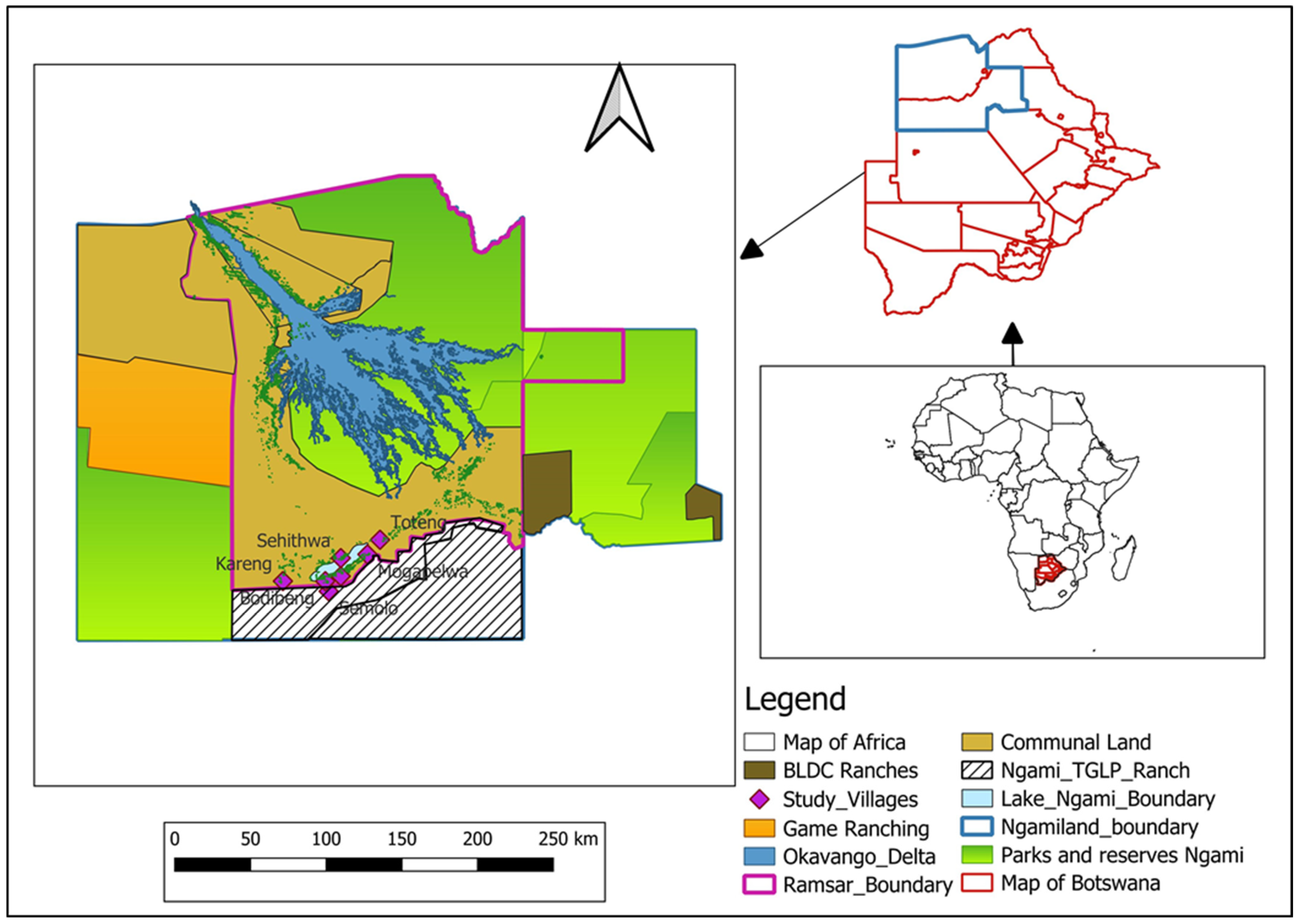
2.1. Description of the Study Area
2.2. Research Methodology and Data Analysis
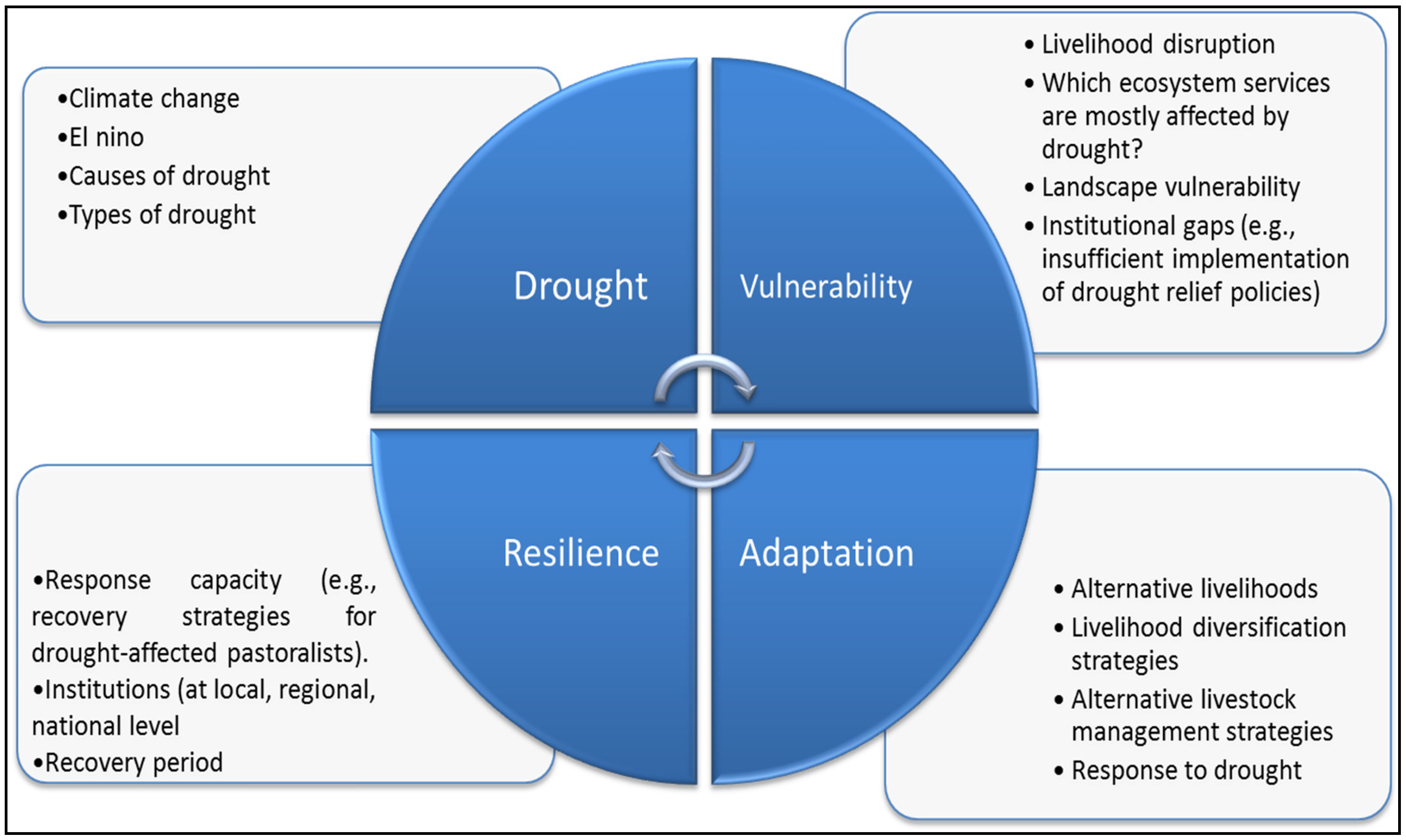
2.2.1. Conceptual Framework
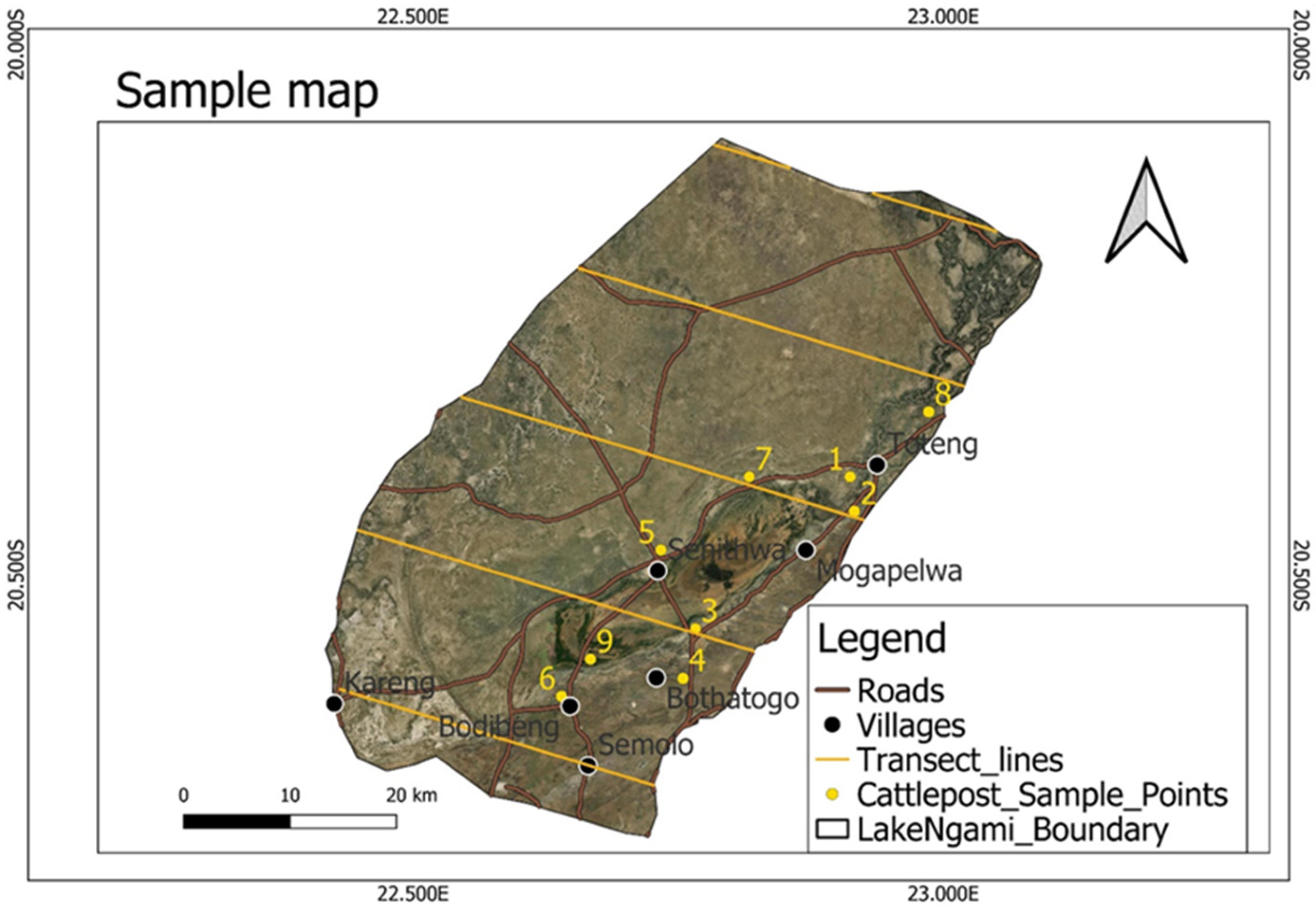
2.2.2. In-Depth Community Interviews, Focus Group Discussions and Participant Recruitment
2.2.3. Policy Content Analysis
Criteria for Determining Policy Stance on Adaptation and Resilience
- No support for adaptation and resilience (−): Policies in this category either do not mention climate change adaptation and resilience at all, or they focus solely on disaster response without linking to proactive, long-term adaptation strategies.
- Weak support for adaptation and resilience (+): These policies acknowledge the need for adaptation or resilience but provide only broad, non-specific objectives.
- Medium support for adaptation and resilience (++): Policies here include explicit adaptation and resilience measures and show stronger political will to address climate change. However, they remain largely centralized, with insufficient mechanisms to localize or operationalize interventions at the community level.
- Strong support for adaptation and resilience (+++): Policies in this category integrate adaptation and resilience comprehensively, with clear objectives, targeted strategies, and well-defined implementation pathways.
3. Results
3.1. Impacts of Recurrent Drought on Pastoralism and Pastoral Livelihoods
3.1.1. Drought and Climatic Variability
3.1.2. Pastoralists’ Vulnerability
Landscape Vulnerability
Ecosystem Service Disruption
Institutional Gaps
3.1.3. Pastoralists’ Adaptation and Coping Strategies to Drought and Climate Variability
Coping Strategies
Livelihoods Diversification Strategies and Resilience Measures
3.2. Policy and Institutional Frameworks and Their Implications for Drought Adaptation in Vulnerable Pastoral Systems
3.3. Locally Grounded Climate-Resilient Development Pathways (CRDPs) for Vulnerable Lake Ngami Pastoral Systems
- i.
- Financial access
- ii.
- Infrastructure Development
- iii.
- Education and Capacity Building
- iv.
- Social Protection Systems
- v.
- Inclusive governance
- vi.
- Equity and justice
- vii.
- Risk management
- viii.
- Health
4. Discussion
5. Conclusions
- Repair and maintain water infrastructure, as functional boreholes are critical to herd survival and community resilience.
- Strengthen participatory governance and institutional coordination, including VDC integration and district-level collaboration, to ensure timely, context-specific interventions.
- Implement tailored climate information services to support anticipatory planning for mobility, grazing, and water management, complementing the infrastructure and governance improvements.
Author Contributions
Funding
Institutional Review Board Statement
Informed Consent Statement
Data Availability Statement
Acknowledgments
Conflicts of Interest
Abbreviations
| AR6 | IPCC Sixth Assessment Report |
| CBPP | Contagious bovine pleuro-pneumonia |
| CRDP | Climate-Resilient Development Pathway |
| FGD | Focus Group Discussion |
| IPCC | Intergovernmental Panel on Climate Change (IPCC) |
| LIMID | Livestock Management and Infrastructure Development (LIMID) program |
| NAMPAAD | National Master Plan for Arable Agriculture and Dairy Development |
References
- Rass, N. Policies and Strategies to Address the Vulnerability of Pastoralists in Sub-Saharan Africa; Pro-poor Livestock Policy Initiative (PPLPI) Working Paper Series; FAO: Rome, Italy, 2006; Volume 37. [Google Scholar]
- Ahmed, M.; Hayat, R.; Ahmad, M.; Ul-Hassan, M.; Kheir, A.M.S.; Ul-Hassan, F.; Ur-Rehman, M.H.; Shaheen, F.A.; Raza, M.A.; Ahmad, S. Impact of climate change on dryland agricultural systems: A review of current status, potentials, and further work need. Int. J. Plant Prod. 2022, 16, 341–363. [Google Scholar] [CrossRef] [PubMed]
- Berdugo, M.; Delgado-Baquerizo, M.; Soliveres, S.; Hernández-Clemente, R.; Zhao, Y.; Gaitán, J.J.; Gross, N.; Saiz, H.; Maire, V.; Lehmann, A. Global ecosystem thresholds driven by aridity. Science 2020, 367, 787–790. [Google Scholar] [CrossRef] [PubMed]
- Stringer, L.C.; Mirzabaev, A.; Benjaminsen, T.A.; Harris, R.M.B.; Jafari, M.; Lissner, T.K.; Stevens, N.; Tirado-von Der Pahlen, C. Climate change impacts on water security in global drylands. One Earth 2021, 4, 851–864. [Google Scholar] [CrossRef]
- Campbell, B.M.; Hansen, J.; Rioux, J.; Stirling, C.M.; Twomlow, S. Urgent action to combat climate change and its impacts (SDG 13): Transforming agriculture and food systems. Curr. Opin. Environ. Sustain. 2018, 34, 13–20. [Google Scholar] [CrossRef]
- Küfeoğlu, S. SDG-13: Climate Action. In Emerging Technologies: Value Creation for Sustainable Development; Springer: Berlin/Heidelberg, Germany, 2022; pp. 429–451. [Google Scholar]
- Schipper, E.L.F.; Revi, A.; Preston, B.L.; Carr, E.R.; Eriksen, S.H.; Fernandez-Carril, L.R.; Glavovic, B.; Hilmi, N.J.; Ley, D.; Mukerji, R. Climate Resilient Development Pathways; Cambridge University Press: Cambridge, UK, 2022. [Google Scholar]
- Arfanuzzaman, M. Bangladesh's pathways to climate-resilient development: A methodical review. World Dev. Sustain. 2024, 4, 100144. [Google Scholar] [CrossRef]
- Favretto, N.; Stringer, L.C. Climate resilient development in vulnerable geographies. Mitig. Adapt. Strateg. Glob. Change 2024, 29, 90. [Google Scholar] [CrossRef]
- Jerneck, A.; Olsson, L. Adaptation and the poor; development, resilience and transition. In Development Policy as a Way to Manage Climate Change Risks; Routledge: Oxfordshire, UK, 2015; pp. 170–182. [Google Scholar]
- Dang, H.L.; Li, E.; Nuberg, I.; Bruwer, J. Factors influencing the adaptation of farmers in response to climate change: A review. Clim. Dev. 2019, 11, 765–774. [Google Scholar] [CrossRef]
- Mehran, A.; Mazdiyasni, O.; AghaKouchak, A. A hybrid framework for assessing socioeconomic drought: Linking climate variability, local resilience, and demand. J. Geophys. Res. Atmos. 2015, 120, 7520–7533. [Google Scholar] [CrossRef]
- Solomon, S.; Qin, D.; Manning, M.; Marquis, M.; Averyt, K. Climate Change 2007, the Fourth Assessment Report (AR4); The Intergovernmental Panel on Climate Change (IPCC): Geneva, Switzerland, 2007. [Google Scholar]
- Denton, F.; Wilbanks, T.J.; Abeysinghe, A.C.; Burton, I.; Gao, Q.; Lemos, M.C.; Masui, T.; O’Brien, K.L.; Warner, K. Climate-resilient pathways: Adaptation, mitigation, and sustainable development. In Climate Change; Cambridge University Press: Cambridge, UK, 2014; pp. 1101–1131. [Google Scholar] [CrossRef]
- Middleton, N.J.; Sternberg, T. Climate hazards in drylands: A review. Earth-Sci. Rev. 2013, 126, 48–57. [Google Scholar] [CrossRef]
- Safriel, U.; Adeel, Z. Development paths of drylands: Thresholds and sustainability. Sustain. Sci. 2008, 3, 117–123. [Google Scholar] [CrossRef]
- Gu, L.; Chen, J.; Yin, J.; Sullivan, S.C.; Wang, H.-M.; Guo, S.; Zhang, L.; Kim, J.-S. Projected increases in magnitude and socioeconomic exposure of global droughts in 1.5 and 2 C warmer climates. Hydrol. Earth Syst. Sci. 2020, 24, 451–472. [Google Scholar] [CrossRef]
- Ullah, A.; Bavorova, M.; Shah, A.A.; Kandel, G.P. Climate change and rural livelihoods: The potential of extension programs for sustainable development. Sustain. Dev. 2024, 32, 4992–5004. [Google Scholar] [CrossRef]
- Habte, M.; Eshetu, M.; Maryo, M.; Andualem, D.; Legesse, A. Effects of climate variability on livestock productivity and pastoralists perception: The case of drought resilience in Southeastern Ethiopia. Vet. Anim. Sci. 2022, 16, 100240. [Google Scholar] [CrossRef] [PubMed]
- Basupi, L.V. Pastoralism and Land Tenure Transformation: Policy Implications and Livelihoods Adaptations in Botswana. Ph.D. Thesis, University of Leeds, Leeds, UK, 2018. [Google Scholar]
- Auma, J.; Radeny, M.A.O. Strengthening Adaptive Capacity of Extensive Livestock Systems for Food and Nutrition Security and Low-Emissions Development in Eastern and Southern Africa. 2022. Available online: https://cgspace.cgiar.org/items/c7f0a7ad-278b-4a58-9a13-26663bc9fb5e (accessed on 3 March 2026).
- Dietz, A.J.; Ruben, R.; Verhagen, A. The Impact of Climate Change on Drylands: With a Focus on West Africa; Springer: Berlin/Heidelberg, Germany, 2004. [Google Scholar]
- Otto, F.E.L.; Zachariah, M.; Wolski, P.; Pinto, I.; Nhamtumbo, B.; Bonnet, R.; Vautard, R.; Philip, S.; Kew, S.; Luu, L.N.; et al. Climate Change Increased Rainfall Associated with Tropical Cyclones Hitting Highly Vulnerable Communities in Madagascar, Mozambique & Malawi; World Weather Attribution: London, UK, 2022; 41p. [Google Scholar]
- Ofori, S.A.; Cobbina, S.J.; Obiri, S. Climate change, land, water, and food security: Perspectives From Sub-Saharan Africa. Front. Sustain. Food Syst. 2021, 5, 680924. [Google Scholar] [CrossRef]
- Padgham, J.; Abubakari, A.; Ayivor, J.; Dietrich, K.; Fosu-Mensah, B.; Gordon, C.; Habtezion, S.; Lawson, E.; Mensah, A.; Nukpezah, D. Vulnerability and Adaptation to Climate Change in the Semi-Arid Regions of West Africa. 2015. Available online: https://idl-bnc-idrc.dspacedirect.org/items/2d78c92f-806e-4adb-9c35-6b2d4937d611/full (accessed on 3 March 2026).
- Giannini, A.; Krishnamurthy, P.K.; Cousin, R.; Labidi, N.; Choularton, R.J. Climate risk and food security in Mali: A historical perspective on adaptation. Earth's Future 2017, 5, 144–157. [Google Scholar] [CrossRef]
- Huho, J.M.; Ngaira, J.K.; Ogindo, H.O. Living with drought: The case of the Maasai pastoralists of northern Kenya. Educ. Res. 2011, 2, 779–789. [Google Scholar]
- Motsumi, K.O.; Ziervogel, G.; New, M. Drought governance: A cross-level governance analysis in botswana. Clim. Risk Manag. 2023, 42, 100557. [Google Scholar] [CrossRef]
- Juana, J.S.; Makepe, P.M.; Mangadi, K.T.; Narayana, N. The socio-economic impact of drought in Botswana. Int. J. Environ. Dev. 2014, 11, 43–60. [Google Scholar]
- Nicholson, S.E.; Kim, J. The relationship of the El Niño–Southern oscillation to African rainfall. Int. J. Climatol. A J. R. Meteorol. Soc. 1997, 17, 117–135. [Google Scholar] [CrossRef]
- Byakatonda, J. Climatological Droughts and Their Implications on Water Resources and Agricultural Production in Semiarid Regions: The Case of Botswana. Ph.D. Thesis, 2018. Available online: https://www.semanticscholar.org/paper/Climatological-droughts-and-their-implications-on-Byakatonda/cca5a4a212bd76793bc9b7702d3b2598975ab2de (accessed on 3 March 2026).
- Seleka, T.B. Sources of declining beef export competitiveness under preferential trade arrangements: The case of Botswana. Appl. Econ. 2026, 1–14. [Google Scholar] [CrossRef]
- Serdeczny, O.; Adams, S.; Baarsch, F.; Coumou, D.; Robinson, A.; Hare, W.; Schaeffer, M.; Perrette, M.; Reinhardt, J. Climate change impacts in Sub-Saharan Africa: From physical changes to their social repercussions. Reg. Environ. Change 2017, 17, 1585–1600. [Google Scholar] [CrossRef]
- Dougill, A.J.; Fraser, E.D.G.; Reed, M.S. Anticipating vulnerability to climate change in dryland pastoral systems: Using dynamic systems models for the Kalahari. Ecol. Soc. 2010, 15, 17. [Google Scholar] [CrossRef]
- Panin, A.; Mahabile, M. Profitability and household income contribution of small ruminants to small-scale farmers in Botswana. Small Rumin. Res. 1997, 25, 9–15. [Google Scholar] [CrossRef]
- Bahta, S.; Wanyoike, F.; Katjiuongua, H.; Marumo, D. Characterisation of food security and consumption patterns among smallholder livestock farmers in Botswana. Agric. Food Secur. 2017, 6, 65. [Google Scholar] [CrossRef]
- Magole, L. The ‘shrinking commons’ in the Lake Ngami grasslands, Botswana: The impact of national rangeland policy. Dev. South. Afr. 2009, 26, 611–626. [Google Scholar] [CrossRef]
- Moliner Cachazo, L.; Makati, K.; Chadwick, M.A.; Catford, J.A.; Price, B.W.; Mackay, A.W.; Guiry, M.D.; Murray-Hudson, M.; Murray-Hudson, F. A review of the freshwater diversity in the Okavango Delta and Lake Ngami (Botswana): Taxonomic composition, ecology, comparison with similar systems and conservation status. Aquat. Sci. 2023, 85, 1–19. [Google Scholar] [CrossRef]
- Taillandier, C.; Cörvers, R.; Stringer, L.C. Growing resilient futures: Agroforestry as a pathway towards climate resilient development for smallholder farmers. Front. Sustain. Food Syst. 2023, 7, 1260291. [Google Scholar] [CrossRef]
- Barnet, A.F.; Ciurana, A.B.; Pozo, J.X.O.; Russo, A.; Coscarelli, R.; Antronico, L.; De Pascale, F.; Saladie, O.; Anton-Clave, S.; Aguilar, E. Climate services for tourism: An applied methodology for user engagement and co-creation in European destinations. Clim. Serv. 2021, 23, 100249. [Google Scholar] [CrossRef]
- Coulibaly, J.Y.; Mango, J.; Swamila, M.; Tall, A.; Kaur, H.; Hansen, J. What Climate Services do Farmers and Pastoralists Need in Tanzania? 2015. Available online: https://cgspace.cgiar.org/items/16cb422b-eccf-4234-8e9d-240b7cb2aa24 (accessed on 3 March 2026).
- Kikstra, J.S.; Nicholls, Z.R.J.; Smith, C.J.; Lewis, J.; Lamboll, R.D.; Byers, E.; Sandstad, M.; Meinshausen, M.; Gidden, M.J.; Rogelj, J. The IPCC Sixth Assessment Report WGIII climate assessment of mitigation pathways: From emissions to global temperatures. Geosci. Model Dev. 2022, 15, 9075–9109. [Google Scholar] [CrossRef]
- Dixon, J.L.; Stringer, L.C. Towards a theoretical grounding of climate resilience assessments for smallholder farming systems in Sub-Saharan Africa. Resources 2015, 4, 128–154. [Google Scholar] [CrossRef]
- Werners, S.E.; Sparkes, E.; Totin, E.; Abel, N.; Bhadwal, S.; Butler, J.R.A.; Douxchamps, S.; James, H.; Methner, N.; Siebeneck, J. Advancing climate resilient development pathways since the IPCC’s fifth assessment report. Environ. Sci. Policy 2021, 126, 168–176. [Google Scholar] [CrossRef]
- McEvoy, S.; Langendijk, G.; Jeuken, A.; Haasnoot, M. What is needed to make climate resilient development pathways planning actionable in cities? Environ. Res. Commun. 2025, 7, 082501. [Google Scholar] [CrossRef]
- Thomas, R.; Reed, M.; Clifton, K.; Appadurai, N.; Mills, A.; Zucca, C.; Kodsi, E.; Sircely, J.; Haddad, F.; Hagen, C. A framework for scaling sustainable land management options. Land Degrad. Dev. 2018, 29, 3272–3284. [Google Scholar] [CrossRef]
- Stringer, L.C.; Simpson, N.P.; Schipper, E.L.F.; Eriksen, S.H. Climate resilient development pathways in global drylands. Anthr. Sci. 2022, 1, 311–319. [Google Scholar] [CrossRef]
- Cordova, C.E.; Scott, L.; Chase, B.M.; Chevalier, M. Late pleistocene-holocene vegetation and climate change in the middle Kalahari, lake Ngami, Botswana. Quat. Sci. Rev. 2017, 171, 199–215. [Google Scholar] [CrossRef]
- Cumming, G.S.; Henry, D.A.W.; Mutumi, G.L.; Ndlovu, M. Understanding arid-region waterbird community dynamics during lake dry-downs. Ecosphere 2021, 12, e03668. [Google Scholar] [CrossRef]
- Shaw, P. The desiccation of Lake Ngami: An historical perspective. Geogr. J. 1985, 151, 318–326. [Google Scholar] [CrossRef]
- Mokgedi, L.; Nobert, J.; Munishi, S. Assessment of lake surface dynamics using satellite imagery and in-situ data; case of Lake Ngami in North-West Botswana. Phys. Chem. Earth Parts A/B/C 2019, 112, 175–186. [Google Scholar] [CrossRef]
- Ndobochani, N.M. The Kwena of Botswana and the cattle post institution. Azania Archaeol. Res. Afr. 2020, 55, 258–289. [Google Scholar] [CrossRef]
- Oba, G. The sustainability of pastoral production in Africa. In Pastoralism and Development in Africa; Routledge: Oxfordshire, UK, 2013; pp. 29–36. [Google Scholar]
- Van Eeuwijk, P.; Angehrn, Z. How to… conduct a focus group discussion (FGD). Methodol. Man. 2017, 10, 1–15. [Google Scholar]
- Cornwall, A.; Jewkes, R. What is participatory research? Soc. Sci. Med. 1995, 41, 1667–1676. [Google Scholar] [CrossRef] [PubMed]
- Basupi, L.V.; Quinn, C.H.; Dougill, A.J. Historical perspectives on pastoralism and land tenure transformation in Ngamiland, Botswana: What are the policy and institutional lessons? Pastoralism 2017, 7, 1–14. [Google Scholar] [CrossRef]
- Basupi, L.V.; Quinn, C.H.; Dougill, A.J. Adaptation strategies to environmental and policy change in semi-arid pastoral landscapes: Evidence from Ngamiland, Botswana. J. Arid. Environ. 2019, 166, 17–27. [Google Scholar] [CrossRef]
- Mogotsi, K.; Nyangito, M.M.; Nyariki, D.M. The role of drought among agro-pastoral communities in a semi-arid environment: The case of Botswana. J. Arid. Environ. 2013, 91, 38–44. [Google Scholar] [CrossRef]
- Serame, P. 2022 Budget Speech. 2024. Available online: https://www.cabri-sbo.org/uploads/bia/Botswana_2024_Approval_External_BudgetSpeech_MinistryOfFinance_SADC_English_02b387.pdf (accessed on 3 March 2026).
- Yindenaba Abor, J. Agricultural financing in Africa: The role of national development banks. In The Changing Role of National Development Banks in Africa: Business Models, Governance and Sustainability; Springer: Berlin/Heidelberg, Germany, 2023; pp. 97–123. [Google Scholar]
- Thakadu, O.T.; Reetsang, N.P. Communicating livestock disease risks in Ngamiland: The case of contagious bovine pleuropneumonia. S. Afr. Geogr. J. = Suid-Afr. Geogr. Tydskr. 2019, 101, 192–209. [Google Scholar] [CrossRef]
- Bett, B.; Kiunga, P.; Gachohi, J.; Sindato, C.; Mbotha, D.; Robinson, T.; Lindahl, J.; Grace, D. Effects of climate change on the occurrence and distribution of livestock diseases. Prev. Vet. Med. 2017, 137, 119–129. [Google Scholar] [CrossRef]
- Motoshita, M.; Itsubo, N.; Inaba, A. Development of impact factors on damage to health by infectious diseases caused by domestic water scarcity. Int. J. Life Cycle Assess. 2011, 16, 65–73. [Google Scholar] [CrossRef]
- Engelbrecht, F.A.; Monteiro, P. The IPCC assessment report six working group 1 report and southern Africa: Reasons to take action. S. Afr. J. Sci. 2021, 117, 1–7. [Google Scholar] [CrossRef]
- Ndhlovu, E.; Dube, K. Droughts, displacements, and human implications: A southern Africa perspective. Futur. Soc. Sci. 2024, 2, 154–178. [Google Scholar] [CrossRef]
- Inman, E.N.; Hobbs, R.J.; Tsvuura, Z. No safety net in the face of climate change: The case of pastoralists in Kunene Region, Namibia. PLoS ONE 2020, 15, e0238982. [Google Scholar] [CrossRef]
- Piemontese, L.; Terzi, S.; Di Baldassarre, G.; Menestrey Schwieger, D.A.; Castelli, G.; Bresci, E. Over-reliance on water infrastructure can hinder climate resilience in pastoral drylands. Nat. Clim. Change 2024, 14, 267–274. [Google Scholar] [CrossRef]
- Tilahun, M.; Angassa, A.; Abebe, A. Community-based knowledge towards rangeland condition, climate change, and adaptation strategies: The case of Afar pastoralists. Ecol. Process. 2017, 6, 29. [Google Scholar] [CrossRef]
- Sintayehu, D.W.; Alemayehu, S.; Terefe, T.; Tegegne, G.; Engdaw, M.M.; Gebre, L.; Tesfaye, L.; Doyo, J.; Reddy, R.U.; Girvetz, E. Effects of drought on livestock production, market dynamics, and pastoralists’ adaptation strategies in semi-arid Ethiopia. Climate 2025, 13, 65. [Google Scholar] [CrossRef]
- Bogale, G.A.; Erena, Z.B. Drought vulnerability and impacts of climate change on livestock production and productivity in different agro-Ecological zones of Ethiopia. J. Appl. Anim. Res. 2022, 50, 471–489. [Google Scholar] [CrossRef]
- Nwafor, I.C.; Nwafor, C.U. African smallholder farmers and the treatment of livestock diseases using ethnoveterinary medicine: A commentary. Pastoralism 2022, 12, 29. [Google Scholar] [CrossRef]
- Adams, F.; Ullah, A.; Nimoh, F.; Mensah, A.; Quaye, J.; Kanzoni, E. Enhancing food security and livelihoods through dry season farming as a climate resilience strategy: A study in the Upper East Region of Ghana. J. Environ. Manag. 2025, 384, 125377. [Google Scholar] [CrossRef]
- Tofu, D.A.; Fana, C.; Dilbato, T.; Dirbaba, N.B.; Tesso, G. Pastoralists’ and agro-pastoralists’ livelihood resilience to climate change-induced risks in the Borana zone, south Ethiopia: Using resilience index measurement approach. Pastoralism 2023, 13, 1–14. [Google Scholar] [CrossRef]
- Catley, A.; Lind, J.; Scoones, I. Pastoralism and Development in Africa: Dynamic Change at the Margins; Taylor & Francis: Abingdon, UK, 2013. [Google Scholar]
- Santos, E. Thirst for Change in Water Governance: Overcoming Challenges for Drought Resilience in Southern Europe. Water 2025, 17, 2170. [Google Scholar] [CrossRef]



| Variables | Localities (n = 32) | ||||
|---|---|---|---|---|---|
| Komana/ Toteng (n = 11) | Bothatogo/ Ramosuana (n = 6) | Legothwana/ Menomasweu (n = 3) | Phiriyatsena/ Matsintsila (n = 5) | Dithotwana/ Sehithwa (n = 7) | |
| Gender | |||||
| (i) Male | 7 | 2 | 1 | 3 | 5 |
| (ii) Female | 4 | 4 | 2 | 2 | 2 |
| Total | 11 | 6 | 3 | 5 | 7 |
| Age group | |||||
| (i) 21 to 40 years | 1 | 5 | 1 | 0 | 3 |
| (ii) 41 to 60 years | 6 | 1 | 1 | 4 | 2 |
| (iii) 61–80 years | 4 | 0 | 1 | 1 | 2 |
| Total | 11 | 6 | 3 | 5 | 7 |
| Thematic Code | Komana/ Toteng (n = 11) | Bothatogo/ Ramosuana (n = 6) | Legothwana/ Menomasweu (n = 3) | Phiriyatsena/ Matsintsila (n = 5) | Dithotwana/ Sehithwa (n = 7) | Total (n = 32) |
|---|---|---|---|---|---|---|
| Rainfall changes | 11 | 5 | 3 | 4 | 6 | 29 |
| Severe drought | 10 | 5 | 3 | 5 | 7 | 30 |
| Livestock losses | 11 | 6 | 3 | 5 | 7 | 32 |
| Livelihood impacts | 11 | 6 | 3 | 5 | 7 | 32 |
| Ecosystem services decline | 11 | 6 | 3 | 5 | 7 | 32 |
| Coping strategies & livestock management | 0 | 2 | 1 | 2 | 3 | 8 |
| Alternative livelihoods | 0 | 0 | 0 | 0 | 1 | 1 |
| Success of strategies | 0 | 1 | 0 | 1 | 1 | 3 |
| Institutional support & recovery | 5 | 3 | 2 | 2 | 3 | 15 |
| Policy recommendation | 8 | 5 | 3 | 3 | 7 | 26 |
 Very low Very low  Low Low  Medium Medium  High High  Very High Very High | ||||||
| Instrument/Strategy | Objective/Policy Problem Definition | Policy Stance on Adaptation and Resilience | Support for Adaptation and Resilience | Comments on Policy Effects and Implementation |
|---|---|---|---|---|
| National Disaster Risk Reduction Strategy: 2013–2018. (National Disaster Management Office [NDMO], 2013). p.9 | 1. To establish and incorporate the foundational guiding arrangements for disaster risk reduction in the country. 2. To increase awareness and knowledge of disaster risk reduction methods and opportunities. 3. To inform the legal and institutional basis for efficient disaster risk reduction planning and implementation. 3. To contribute towards the inclusion of disaster risk reduction into development policy, programs and projects. 4. To contribute to community resilience against the threats and effects of disasters. | + | Encourages multi-level preparedness and coordination but lacks explicit focus on drought resilience. | Focus is broader than climate-induced droughts; lacks community-specific interventions; limited implementation at local/rural levels. “We hear about disaster programs, but they rarely reach us during drought.”—FGD participant |
| National Disaster Risk Management Plan 2009. (National Disaster Management Office [NDMO], 2009). p5 | 1. To establish a set of working definitions for the integral components of disaster risk management in Botswana. 2. To define measures to reduce vulnerability to disasters and build capacity and resilience at national, district and community levels. 3. To outline structures for organizing and coordinating disaster risk management functions. 4. To outline functional responsibilities and the requirements for implementing the various elements of disaster risk management. These include mitigation, preparedness, response, recovery, rehabilitation, reconstruction and disaster-safe development. | ++ | Supports integration of climate risks and disaster management in planning frameworks. | Practical in scope but lacks strong alignment with local adaptation needs; implementation remains largely centralized and reactive. “Support usually comes late, after we have already lost livestock.”—Ramosuana Interview respondent |
| Botswana’s climate change policy 2021 (Department of Meteorological Services, Ministry of Environment, Natural Resources Conservation and Tourism, 2021). p10 | To mainstream sustainability and climate change into development planning and, in so doing, enhance Botswana’s resilience and capacity to respond to existing and anticipated climate change impacts. The policy also promotes low-carbon development pathways and approaches that significantly contribute to socio-economic development, environmental protection, poverty eradication and global goals for reduction in Greenhouse Gases (GHG) from the atmosphere and SDGs. | +++ | Strong support for adaptation and resilience in agriculture, ecosystems, and food systems. | Lacks integration of indigenous knowledge; limited operational reach in remote and pastoral communities. “Policies are there, but in our area we depend on our own ways to survive.”—Dithotwana interview respondent |
| National Committee on Climate Change (NCCC) Revised in 2014 (Ministry of Environment, Natural Resources Conservation and Tourism [MENRCT], 2014). p1 | The NCCC is intended to be an advisory body to assist the Department of Meteorological Services in implementing climate change-related processes, particularly at a technical level. | ++ | Supports national coordination and research but lacks operational authority. | Mainly advisory; lacks enforcement authority; weak linkages to district and community-level implementation |
| National Adaptation Plan Framework for Botswana (Ministry of Environment, Natural Resources Conservation and Tourism, 2020). p2 | The purpose of the National Adaptation Plan (NAP) Framework is to give direction and guidance to the development, implementation, and monitoring of the country’s NAP process. It aims to achieve this ambitious task by highlighting fundamental and critical aspects that should guide the development and implementation of the NAP process. | +++ | Provides a strong framework for mainstreaming adaptation at multiple levels. | Strong on vision and alignment with global frameworks (e.g., IPCC), but lacks measurable indicators. |
| Temo Letlotlo. (Ministry of Agriculture, 2024 Budget Speech). p13 and 35. | 1. Promote self-reliance and improve household and national food production. 2. Address dependency on imports through increased local crop production. 3. Facilitate access to productive land, inputs, and markets for both subsistence and commercial farmers. | +++ | Provides grants, weather-based crop insurance (under transition to the private sector), and input support and facilitates market access through cluster infrastructure (roads, boreholes, irrigation, etc.). | Strong emphasis on productivity and resilience; success depends on effective coordination with stakeholders (e.g., NDB, private insurers); risks in uptake and affordability of insurance; targeting remote or vulnerable farmers may remain a challenge. |
| Thuo Letlotlo. (Ministry of Agriculture, 2024 Budget Speech). p13 and 14. | 1. Expand the national herd and improve livestock quality. 2. Revive animal production through breed improvement (e.g., artificial insemination). 3. Support commercialization of livestock farming. | ++ | Supports resilience in livestock systems through genetic improvement, technical support, and eventual linkage to markets and veterinary services. | Still in early stages of implementation; potential to strengthen the livestock sector, but effectiveness will depend on outreach and farmer awareness. |
| Impacts | Adaptation/Mitigation Responses | Arenas of Engagement | CRDP Enablers |
|---|---|---|---|
| 1. Reduced water availability | - Use of community/private boreholes | Infrastructure | 1 |
| 3 | |||
| 8 | |||
| 2. Land degradation and bush encroachment | - Seasonal migration to greener zones - Temporary leasing of pasture (in the ranches) - Reduced herd sizes | Ecological | 2 |
| Economic | 6 | ||
| Institutional | 7 | ||
| 3. Livestock mortality and livelihood loss | - Selling livestock for income - Informal income (welding) - Accessing government support (e.g., LIMID, Ipelegeng) | Economic | 2 |
| Social | 4 | ||
| Institutional | 6 | ||
| 4. Food insecurity | - Social grants, money for the destitute, old-age pension - Household food aid during drought year | Health | 4 |
| Community | 5 | ||
| Institutional | 6 | ||
| 5. Community stress and migration | - Sending youth to towns for work - Informal migration to relatives’ farms - Shared reliance on overstressed resources | Socio-cultural | 2 |
| Economic | 4 | ||
| Political | 6 |
Disclaimer/Publisher’s Note: The statements, opinions and data contained in all publications are solely those of the individual author(s) and contributor(s) and not of MDPI and/or the editor(s). MDPI and/or the editor(s) disclaim responsibility for any injury to people or property resulting from any ideas, methods, instructions or products referred to in the content. |
© 2026 by the authors. Licensee MDPI, Basel, Switzerland. This article is an open access article distributed under the terms and conditions of the Creative Commons Attribution (CC BY) license.
Share and Cite
Luka-Chikwenya, S.; Basupi, L.V.; Tsidu, G.M. Building Climate-Resilient Development Pathways Through Drought Adaptation in Vulnerable Pastoral Systems of Botswana. Sustainability 2026, 18, 3482. https://doi.org/10.3390/su18073482
Luka-Chikwenya S, Basupi LV, Tsidu GM. Building Climate-Resilient Development Pathways Through Drought Adaptation in Vulnerable Pastoral Systems of Botswana. Sustainability. 2026; 18(7):3482. https://doi.org/10.3390/su18073482
Chicago/Turabian StyleLuka-Chikwenya, Shirley, Lenyeletse Vincent Basupi, and Gizaw Mengistu Tsidu. 2026. "Building Climate-Resilient Development Pathways Through Drought Adaptation in Vulnerable Pastoral Systems of Botswana" Sustainability 18, no. 7: 3482. https://doi.org/10.3390/su18073482
APA StyleLuka-Chikwenya, S., Basupi, L. V., & Tsidu, G. M. (2026). Building Climate-Resilient Development Pathways Through Drought Adaptation in Vulnerable Pastoral Systems of Botswana. Sustainability, 18(7), 3482. https://doi.org/10.3390/su18073482