1. Introduction
Agriculture plays a crucial role in the economic development of Sri Lanka, where rice serves as the staple food for 22.15 million individuals [
1]. The country predominantly depends on imported chemical fertilizers, and their excessive use has led to significant environmental degradation. The abrupt transition to organic farming in Sri Lanka has exposed significant deficiencies in the existing policy framework, particularly in terms of ensuring a stable supply of organic fertilizers.
Municipal solid waste (MSW) is inherently heterogeneous in composition, comprising biodegradable organic matter and non-biodegradable fractions. The composition of MSW varies significantly across income statuses and locations and changes with the seasons, economic conditions, and sociocultural factors. Globally, low-income countries generate more biodegradable waste, while high-income countries produce more packaging waste. Moreover, food and garden waste constitutes the largest single component of MSW, accounting for approximately 54% of the global average waste stream, with this fraction rising substantially in developing regions such as Sub-Saharan Africa, Central and South Asia, and East and South-East Asia, where the organic content frequently exceeds 60–70% of the total waste generated [
2].
In the context of Sri Lanka, recent national estimates reveal that approximately 62% of the country’s MSW consists of biodegradable organic material, with the remainder comprising non-biodegradable substances [
3]. The highest waste generation occurs in urban areas, amounting to 0.75 kg per person, whereas semi-urban and rural areas produce significantly lower per-capita volumes, at 0.4 kg per person. In semi-urban and rural regions, the organic fraction is typically higher due to the predominance of an agricultural economy and related household activities, coupled with limited commercial and industrial waste. These compositional and operational characteristics render semi-urban areas critically important, yet they are underrepresented in governance concerning MSW management and greenhouse gas (GHG) emission research.
Sri Lanka, like many developing countries, faces significant challenges in municipal solid waste management (MSWM) due to rapid urbanization and population growth, inadequate infrastructure, and limited government resources. The nation is producing more waste than ever before [
3], but its management remains inadequate. The current waste management practices face significant challenges, primarily due to the restricted capacity for waste treatment and disposal. This issue is further exacerbated by inadequate public participation in waste management efforts. Moreover, there are substantial obstacles in effectively applying the strategies of reducing, reusing, and recycling [
4]. This issue is most pronounced in the Western Province (WP), which accounts for 60% of the total waste generated in Sri Lanka (7500 tonne/day) [
5]. The local authorities (LAs) are statutorily responsible for the management of waste generated within their jurisdictions in Sri Lanka, while waste collection by LAs amounts to about 60% in the WP and 30% in other provinces [
3].
Although most LAs collect both biodegradable and non-biodegradable waste, mixed waste collection persists. Recent national projections indicate an upward trend in the volume of MSW from 2021 to 2030, thereby increasing the burden on current waste management systems and challenging the capacity of LAs [
5].
Open dumping continues to dominate MSWM strategies in Sri Lanka, accounting for approximately 85% of waste, while composting and recycling represent about 10% and 5%, respectively, with overall national collection efficiency of 27% [
3,
6,
7]. As more than 62% of Sri Lanka’s MSW is biodegradable [
4], diverting biodegradable waste (BDW) to composting represents a potential pathway to reduce environmental impacts. However, this option has received limited attention.
The inclusion of BDW in open dumps significantly increases GHG emissions. The waste sector is responsible for about 20% of the global anthropogenic methane emissions, with open dumps and unmanaged landfills being major contributors in low- and middle-income nations. As per Sri Lanka’s GHG profile (2021), the waste sector is the fourth-largest source of national emissions, with the figure rising from 596.0 to 657.9 Gg CO
2 eq between 2011 and 2021 [
8,
9]. The diversion of BDW to compost production directly contributes to the Sustainable Development Goals (SDG), namely (i) SDG 2—supporting soil health and organic agriculture, (ii) SDG 11—improving urban environmental management, (iii) SDG 12—promoting resource efficiency, and (iv) SDG 13—methane mitigation. In this scenario, diverting biodegradable waste to controlled composting presents a dual benefit of reducing greenhouse gases and recycling nutrients within circular bioeconomy systems.
We acknowledge that numerous studies have examined the environmental impacts of MSW composting globally, and most assessments focus on engineered facilities and controlled composting facilities in developed or urban settings, where the waste collection efficiency, technological inputs, and institutional capacity are relatively high [
10,
11,
12,
13,
14]. Meanwhile, [
15] underscores that developing and semi-urban governance contexts are underexplored. LAs in the Global South often depend on mixed waste collection, incomplete source segregation, basic windrow composting practices, and open dumping, yet they remain underrepresented in the literature. Thus, it is evident that the absence of structured system-level transition modeling for semi-urban local government contexts represents a critical research gap.
In the Sri Lankan context, the few existing studies have primarily quantified methane emissions from open dumpsites, underscoring the environmental implications of prevailing waste management practices. Herath, P.L., Jayawardana, D., and Bandara, N. [
16] revealed average emission rates of 10,672 mg/m
2/h for CH
4 and 40,827 mg/m
2/h for CO
2, with total daily emissions estimated at 7436 kg for CH
4 and 21,653 kg for CO
2. Himanujahn, S., Fonseka, W.A.K.S., and Athapattu, B.C.L. [
17] found that CH
4 emissions have increased because of population growth and urbanization. Additionally, Weligama Thuppahige, Gheewala, and Babel [
18] conducted a comprehensive study to assess the environmental impacts of composting the organic fraction of municipal solid waste, focusing on the Kaduwela municipal council compost plant in Sri Lanka. The findings suggest that the composting system contributes to global warming, with an impact of 218 kg CO
2 eq per tonne of organic waste. The primary contributing factors to this impact are emissions of ammonia (NH
3), methane (CH
4), and nitrous oxide (N
2O). The Ministry of Environment, Sri Lanka, together with the Institute for Global Environmental Strategies (IGES) [
19], has presented a strategic and technical plan aimed at transitioning from open dumping practices to appropriate sanitary disposal. However, even the most recent Sri Lankan study by Bandaranayaka et al. [
20] remains focused on urban and engineered systems, leaving the semi-urban, data-constrained, local-authority-level governance context distinctly unaddressed.
While prior research within the Sri Lankan context has predominantly examined waste management processes in isolation, this study contributes novel insights to the literature by introducing a structured, system-level transition framework that explicitly models operational constraints such as mixed waste collection, partial segregation, and limited facility capacities, thereby mirroring real-world governance conditions. Additionally, this study provides site-specific, scenario-based quantification of greenhouse gas emissions using the Intergovernmental Panel on Climate Change (IPCC) default emission factors, alongside a policy-relevant comparison of feasible transition strategies under data-constrained conditions.
The principal contributions of this study are threefold: (1) the integration of MSWM with national organic agriculture policy objectives, addressing a gap between typically separate policy areas in developing countries; (2) the development of a structured scenario-based transition modeling framework for semi-urban waste systems; and (3) the provision of a replicable decision support approach utilizing IPCC Tier 1 methods under data-constrained conditions. This approach addresses an identified research gap by providing a structured, transparent, and policy-relevant scenario framework for semi-urban waste governance contexts. While the methodology is transferable in principle, its application in other settings would require adaptation to the local waste composition, institutional capacity, and data availability.
2. Materials and Methods
2.1. Study Area
Semi-urban Sri Lanka was selected as the study context for three reasons. First, semi-urban LAs in Sri Lanka manage a significant proportion of the country’s MSW generation yet remain absent from the composting and GHG literature. Second, the conditions in semi-urban settings (e.g., mixed waste collection, incomplete segregation, manual windrow composting, and open dumping) represent typical waste management across the Global South, making this context broadly illustrative. Third, Sri Lanka’s organic farming policy transition creates an urgent need for local organic fertilizer supply, positioning MSW compost as a strategic resource whose GHG benefits remain unquantified at the semi-urban level.
Given the above, this study focused on MSWM in the Attanagalla Pradesheeya Sabha (APS) area, in the Attanagalla Divisional Secretariat, Gampaha, Western Province. The average daily waste generation in the study area amounts to eighty-four tonnes, and the APS can collect only fifteen tonnes/day using collection tractors. The APS operates its own composting plant (windrow composting is practiced with manual turning), with a design capacity of 6 tonnes/day, utilizing their own resources, including labor and machinery (a bobcat machine and a huller), and the average compost production is 0.43 tonnes/day [
21]. Wastewater released from the compost piles is collected in a separate tank, diluted with water at a ratio of 1:100, and returned to the piles. Accordingly, no nutritional loss was assumed. However, the APS has no official data on the waste streams or waste composition of the area. The lack of systematic waste characterization data is a prevalent limitation in many semi-urban LAs within developing contexts. Consequently, we propose that integrating national-level data with site-specific operational parameters constitutes a pragmatic approach to conducting comparative environmental assessments under data constraints. To address this limitation, the study employs nationally reported waste composition averages as proxies for BDW and non-biodegradable fractions [
8], alongside IPCC default values, which are widely utilized in data-limited contexts. This methodology aligns with the IPCC Tier 1 guidance [
22] and enables a scientifically comparable assessment of GHG emissions across different scenarios. However, site-specific operational parameters, such as waste collection volumes, composting capacity, material flow pathways, and facility practices (e.g., windrow composting, manual turning, and animal feed diversion), were directly obtained through field observations and APS waste management records [
23] and through discussions with authorized personnel.
We conducted a site visit to the APS composting facility from 17 August 2023 to 20 August 2023 to examine and validate its operational practices, including waste handling procedures, composting methodologies, and material flow distribution. Although the duration of the visit was limited, it was supplemented with secondary data and discussions with local authority personnel to ensure alignment with actual operational conditions. We used Generative artificial intelligence such as ChatGPT only to check the originality of research concept and to validate the related references. Authors take the sole responsibility of originality, integrity and accuracy of this manuscript.
2.2. Analysis Framework
This study adopts a scenario analysis approach, systematically analyzing the feasibility of the enhancement of solid waste compost (SWC) and its integration into organic paddy farming, since this enables a comprehensive comparison between the existing scenario and proposed alternative models. Three scenarios were considered for this study: (1) S0—current scenario, (2) S1—maximum SWC production under the existing facility capacity, and (3) S2—SWC production under extended facility capacity. Scenario-based approaches are widely used in environmental management as decision support tools to evaluate alternative system configurations under uncertainty. In the context of municipal solid waste management, such approaches enable the comparison of treatment pathways and support policy-relevant planning, particularly in data-constrained settings.
We relied on the IPCC Tier 1 methodology, which is explicitly recommended for developing countries by the IPCC, and used default emission values, since there are no site-specific data on emissions. While the IPCC Tier 1 methodology has been extensively utilized in previous research, this study expands its application through a structured, scenario-based modeling approach using alternative MSWM pathways, enabling comparisons within a unified operational system. This approach contrasts with traditional applications that evaluate isolated processes or individual treatment options. We believe that the Tier 1 approach enables a transparent, replicable comparison of the GHG reduction potential, and it has policy relevance. Assumptions such as “no seasonal variation” and “constant waste generation” represent methodological simplifications adopted due to site-specific data limitations. Accordingly, we interpret the results as indicative but not deterministic.
GHG emissions (CO
2, CH
4, and N
2O) were calculated for a month against the total monthly waste collection, followed by composting, transportation, and open dumping. Biogenic CO
2 and fossil CO
2 from open burning by residents were excluded, and emissions from animal feed were also excluded. Food waste, garden waste, and straw are used as BDW at the APS composting facility. Long-term biodegradables such as wood and paper are not used for composting and are segregated under the non-degradable category. The default percentages in
Table 1 were used to estimate the available waste fractions of the biodegradable and non-degradable portions of waste disposed of in dumpsites based on the typical waste composition in Sri Lanka. The IPCC default Degradable Organic Carbon (DOC) values for related waste fractions were used to calculate each DOC.
2.3. Emission Factors (EF)
The emission factors for diesel combustion shown in
Table 2 were considered for the calculations in this study [
21,
22,
24]. The CO
2 emitted during aerobic composting is biogenic in origin, derived from organic matter that recently fixed atmospheric carbon through photosynthesis. Consistent with the IPCC waste sector guidance [
22,
24] and standard practice in composting GHG assessments [
10,
11,
12], biogenic CO
2 is excluded from the GHG emission totals, as it does not constitute a net long-term addition to atmospheric carbon stocks. Only CH
4 and N
2O emissions from the composting process are included, as these gases represent genuine climate-forcing additions beyond the biogenic carbon cycle. The implications of this exclusion for total carbon flux interpretation are discussed in
Section 4. We have calculated only CH
4 emissions and N
2O emissions (IPCC default values for aerobic composting: 4 Kg CH
4 and 0.24 Kg N
2O/tonne (T) of biodegradable fraction of MSW). The IPCC default composting emission factors for CH
4 (4 kg/tonne) and N
2O (0.24 kg/tonne) represent average values derived from various composting systems and operational conditions, and they are associated with recognized uncertainty. Empirical studies indicate that CH
4 emissions from windrow composting can vary significantly, ranging from negligible under well-aerated conditions to substantially higher levels when anaerobic zones develop within the pile [
11,
12]. The APS facility employs manual windrow composting without forced aeration, which increases the likelihood of anaerobic pocket formation and the consequent generation of CH
4. In this context, the IPCC default factor of 4 kg CH
4/tonne is considered a reasonable and conservative central estimate rather than an optimistic one, making it suitable for this low-technology operational setting. Similarly, N
2O emissions from composting are driven by nitrification–denitrification processes, influenced by nitrogen content, moisture, and aeration status parameters not measured at the APS site. Consequently, the IPCC default value of 0.24 kg N
2O/tonne is applied as a standardized proxy. The uncertainty associated with both emission factors is systematically evaluated in the sensitivity analysis presented in
Section 2.5, where the composting emission factors are varied by ±25% to assess their impacts on overall GHG estimates.
The global warming potential (a 100-year time horizon) for CH
4 is considered as 27 CO
2 eq and that for N
2O as 273 CO
2 eq, as per the IPCC Sixth Assessment Report (AR6) [
22,
23]. The GHG emission factor for electricity for Sri Lanka is considered as 0.52 kg CO
2 eq/kWh (kilowatt/hour), as per the Sri Lanka Energy Balance 2024 report [
25].
Table 2.
Emission factors for diesel combustion used for this study.
Table 2.
Emission factors for diesel combustion used for this study.
| Emission Factors for Diesel Combustion (per Liter Diesel) |
|---|
| CO2 | 2.68 kg | IPCC (2006) [22,24] and USA EPA (2024) [26] |
| CH4 | 3 × 10⁻⁶ kg (negligible) |
| N2O | 6 × 10⁻⁷ kg (negligible) |
2.4. Scenarios and System Boundaries
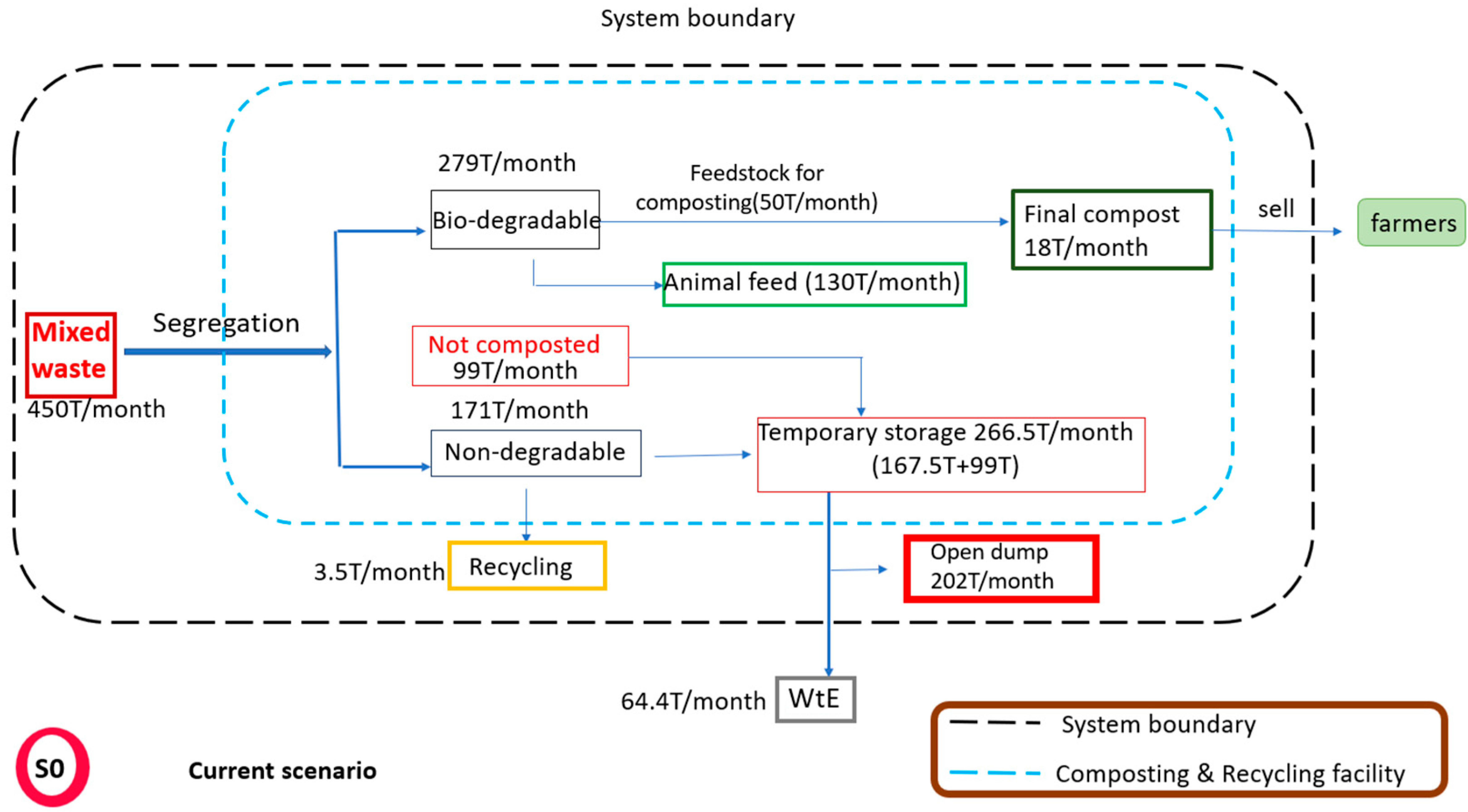
In S0, mixed waste is collected, with monthly waste collection of 450 T, utilizing 10 collection tractors. The collected waste is transported to the facility, where it undergoes segregation into BDW (279 T/month) and non-BDW (171 T/month); a portion of BDW is formed into windrow piles (50 T/month). A fixed quantity of BDW (130 T/month) is allocated as animal feed for piggeries, where pre-identified farm owners retrieve this 130 T from the facility at no cost, serving as a mutually beneficial strategy for both parties. The uncomposted BDW portion (99 T/month) and remaining non-BDW portion after recycling (167.5 T/month) are temporarily stored (266.5 T/month), with the majority (202 T/month) being open-dumped using a 2 T truck. A constant volume of 64.4 T/month of mixed waste is transported to the Waste-to-Energy (WtE) facility in Sri Lanka, located in Kerawalapitiya, in the WP (outside the target area), and is excluded from the system boundary. The final SWC production is 13 T/month.
Figure 1 shows the system boundary for S0.
Maximum SWC production scenario under existing facility capacity (S1)
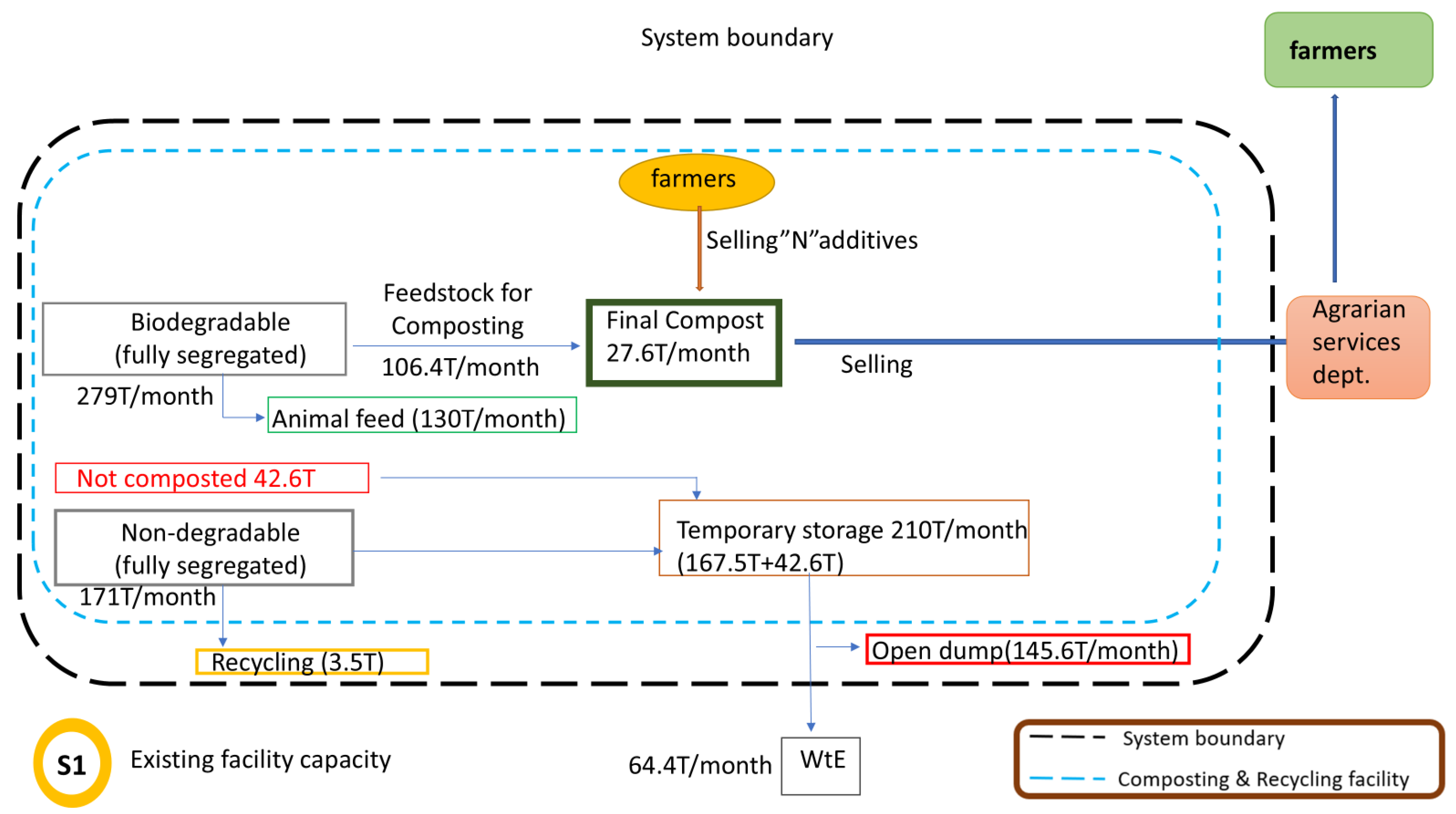
The system boundary was established based on the available secondary data, and our estimations were based on key assumptions and considerations, including that fully segregated waste at the source is collected from the beginning as a turning point. We assumed constant waste generation and no seasonal variations due to data constraints, and animal feed supply is carried out as is. The number of workers involved in waste collection is increased to 40 and the composting plant is proposed to employ only 5 workers compared to S0. The system boundary for S1 is shown in
Figure 2.
SWC production scenario under extended facility capacity (S2)
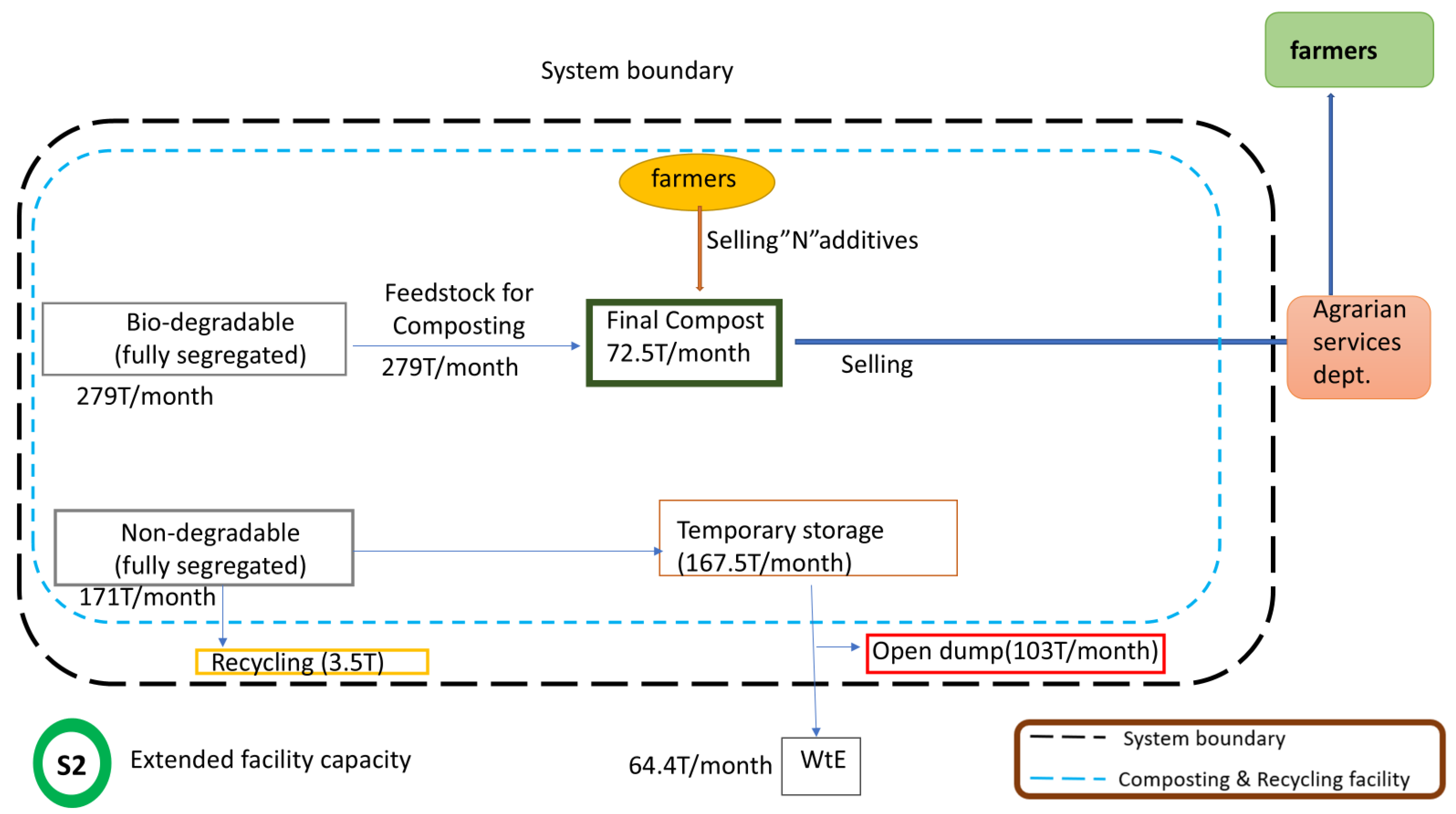
Figure 3 shows the system boundary for S2, and it is assumed that all collected segregated BDW is subjected to composting, eliminating the animal feed supply. A new huller machine with a 5-ton capacity is employed for the increased composting process.
In the context of waste collection and transportation to the Waste-to-Energy (WtE) facility, it is assumed that existing collection tractors and trucks are utilized across all three scenarios. For scenario 2 (S2), it is posited that an additional 5-ton-capacity huller machine is integrated into the process, in contrast to S0 and S1. Furthermore, for waste collection, an additional 10 workers are expected to be employed for both S1 and S2, compared to the 30 workers employed in S0. These figures provide a schematic illustration of the material flows, while
Table 3 serves as the primary quantitative reference for scenario comparison. All scenarios are evaluated within a consistent system boundary, which includes waste collection, transport, composting, and open dumping within the APS-managed system. While the boundary remains identical across scenarios, material flow allocations and treatment intensities vary depending on the scenario configuration.
In all three scenarios, the diversion of biodegradable waste to piggery farms constitutes a material recovery pathway rather than a disposal process. Given that pigs are non-ruminant animals, the enteric methane emissions associated with this pathway are relatively low compared to methane emissions from open dumping. Although emissions may result from manure management, these occur outside the defined system boundary of municipal waste treatment and were therefore not included in the inventory. Consequently, this pathway is anticipated to contribute positively to overall emission reduction, despite not being explicitly quantified in this study. Waste streams diverted to external pathways, including biodegradable waste used as animal feed (130 tonnes/month) and waste transported to WtE facilities (64.4 tonnes/month), were excluded from the core emission inventory. This exclusion is due to these pathways occurring outside the direct operational control and data availability of the APS and the lack of reliable activity data necessary for emission estimation. However, these flows were explicitly accounted for in the mass balance (
Table 3) to ensure the transparency of the overall waste system. Their exclusion from emission calculations reflects a defined system boundary approach, rather than an omission.
2.5. Sensitivity and Uncertainty Analysis
To evaluate the robustness of scenario-based greenhouse gas estimates under conditions of limited data and a lack of consideration of seasonal variations, a deterministic sensitivity analysis was performed to examine structural stability. The analysis concentrated on four key parameters: (1) total waste generation (±20%), (2) degradable organic carbon (DOC) values (±10%), (3) methane correction factors (MCFs) (0.4–0.8, with a baseline of 0.6), and (4) composting emission factors for CH4 and N2O (±25%), reflecting the operational variability inherent in manual windrow composting systems without forced aeration. The selected variation ranges (±20% for waste quantities, ±10% for DOC values, and ±25% for composting emission factors) align with the uncertainty magnitudes commonly recognized in the IPCC default parameters and empirical composting studies within data-constrained governance contexts.
In this study, emissions from composting were estimated utilizing the IPCC Tier 1 default emission factors for methane (CH4) and nitrous oxide (N2O). This methodology offers a simplified depiction of emissions and does not explicitly consider process-level variations such as in aeration efficiency, moisture content, temperature control, or turning frequencies. Nevertheless, the application of the Tier 1 methodology is suitable for contexts with limited data and facilitates consistent comparisons across different scenarios. The primary aim of this study was to evaluate relative differences between scenarios, rather than to generate precise absolute emission estimates.
2.6. GHG Emission Calculation Procedure
GHG emissions were quantified across three stages—waste collection, composting, and open dumping—for each scenario. The following equations and parameters were applied consistently across all scenarios.
Stage 1—Waste Collection and Transportation (Diesel Combustion)
Emissions from diesel combustion were calculated as follows:
Stage 2—Composting (CH4 and N2O Emissions)
Emissions from the aerobic windrow composting process were calculated using the IPCC Tier 1 default emission factors as follows:
where Mass_BDW is the monthly mass of biodegradable waste subjected to composting (tons). GWP values are based on the IPCC AR6 100-year time horizon [
22,
23].
Stage 3—Open Dumping (CH4 Emissions)
Methane emissions from open dumping were calculated using the IPCC Tier 1 mass balance approach:
where
DOC_f = fraction of DOC that decomposes = 0.5 (IPCC Tier 1 default);
F = fraction of CH4 in landfill gas = 0.5 (IPCC Tier 1 default);
16/12 = molecular weight conversion factor from carbon to CH4;
MCF = methane correction factor = 0.6 (baseline, representing unmanaged shallow dump; range 0.4–0.8 evaluated in sensitivity analysis);
OX = oxidation factor = 0 (IPCC Tier 1 default for open dumps);
GWP_CH4 = 27 (IPCC AR6).
Emissions from Electricity Consumption (At Composting)
where E_kWh is the monthly electricity consumption of the huller machine, and EF_electricity is the Sri Lankan national grid emission factor [
25].
Total Monthly GHG Emissions (E_total)
Total GHG emissions per scenario were calculated as the sum of emissions from all three stages:
4. Discussion
The focus on plant location in this study does not suggest that geography alone dictates greenhouse gas emissions. Instead, location serves as a proxy for operational, institutional, and technological constraints, such as manual turning and the absence of forced aeration, which significantly impact waste management practices. In semi-urban and rural areas of Sri Lanka, there is a heavy reliance on mixed waste collection and open dumping, basic windrow composting with limited mechanisms, and specific emission pathways. These conditions at the plant location differ markedly from those at urban or engineered composting facilities, even within the same climate, thereby increasing the risk of anaerobic pocket formation and directly influencing greenhouse gas emissions. These context-specific conditions warrant an emphasis on plant location and restrict direct comparability with urban or engineered facilities operating under different technological and governance frameworks.
Overall, the total GHG emissions considered drastically decline from S0 (163.10 tonne CO
2 eq) to S2 (99.31 tonne CO
2 eq), with S1 (113.08 tonne CO
2 eq) being the moderate option. The significant reduction in landfill CH
4 emissions indicates that diverting BDW to composting considerably mitigates climate impacts. In the composting process, CH
4 emissions from anaerobic decomposition increase as more BDW is processed. To enable a methodological comparison with prior studies in the literature, system-level GHG emissions were additionally calculated per unit of compost produced, as presented in
Table 7 (
Section 3.3). On the other hand,
Table 8 (
Section 3.3) displays the process-level GHG emission intensity per ton of waste composted, facilitating a direct comparison across plants and countries and reflecting differences in evaluation scope.
The system-level GHG emission intensity declines substantially from 12.55 tonne CO
2 eq/tonne SWC in S0 to 4.10 tonne CO
2 eq/tonne SWC in S1 and 1.37 tonne CO
2 eq/tonne SWC in S2. However, this metric must be interpreted with care. Because the numerator encompasses total municipal waste system emissions, including collection, transportation, and open dumping across the full 450 tonne/month waste input, while the denominator reflects only compost output, the ratio is sensitive to the compost yield, rather than being a direct measure of composting process efficiency. The steep decline across scenarios is therefore driven primarily by the substantial increase in compost production (from 13.0 to 72.5 tonne/month), rather than by proportional reductions in total system emissions alone. This ratio is best understood as a system burden allocation indicator: it quantifies how much of the total GHG burden the municipal waste system must bear per unit of beneficial compost output and demonstrates that scaling up composting progressively improves the productive return on the system’s overall emission footprint. For process-level efficiency comparisons,
Table 8 provides a more appropriate metric, isolating composting-specific emissions from the broader system boundary.
The consistent emission intensity of 0.18 tonne CO
2 eq/tonne at the process level across all three scenarios is not due to operational uniformity but is a structural outcome of the IPCC Tier 1 methodology. This approach calculates composting emissions using fixed default factors that are directly proportional to the mass of the feedstock. As a result, dividing these emissions by the same feedstock mass results in the same ratio, regardless of specific operational conditions like the turning frequency, aeration, pile sizes, or moisture management. Therefore,
Table 8 does not offer insights into the efficiency of the composting process for different scenarios and should not be interpreted in this way. Its value lies solely in allowing for process-level comparisons with composting emission intensities reported in other studies, especially those employing similar Tier 1 methods, as discussed in
Section 4. This is a recognized limitation of the Tier 1 methodology when it comes to comparing operations across scenarios, and more detailed, site-specific assessments would be necessary to obtain process-level insights that are truly sensitive to different scenarios.
We acknowledge that the emission intensity values observed in the present study are comparatively higher than those reported in studies of engineered composting facilities situated in urban environments. Specifically, Boldrin et al. [
9] documented GHG emission intensities ranging from approximately 0.1 to 0.6 tonne CO
2 eq per tonne of compost produced for facilities utilizing forced aeration and optimized operational control such as regulated moisture levels in the compost piles and minimal reliance on landfill disposal. In contrast Amlinger et al. [
11] reported values typically below 1 tonne CO
2 eq per tonne of compost for mechanically aerated composting systems. Furthermore, in Sri Lanka, Weligama Thuppahige et al. [
17] corroborated a composting-related emission intensity of approximately 0.218 tonne CO
2 eq per tonne of treated organic waste in a mechanized full-scale composting plant operating under an urban context. Nonetheless, the observed reduction in the greenhouse gas (GHG) emission intensity from S0 to S2 indicates that enhancing composting processes while minimizing open dumping can significantly improve GHG emission mitigation, even in resource-constrained semi-urban settings. However, this trade-off can be mitigated through proper facility operation and maintenance, including adequate aeration, regular windrow turning, and moisture control, which reduce the likelihood of anaerobic conditions and associated methane generation. Despite the moderate increase in composting-related emissions, the overall GHG balance remains favorable, as methane emissions avoided through diversion from open dumping substantially outweigh the additional process-level emissions from composting operations. Overall, the cumulative GHG emissions from all sources, including collection, composting, and open dumping, exhibit a downward trend, with the most substantial reductions occurring due to decreased landfill CH
4 emissions.
While Weligama Thuppahige et al. [
17] assessed a mechanized urban composting facility and reported composting-related GHG emissions per unit of treated organic fraction of municipal solid waste, capturing entire system-level emissions, including upstream collection and downstream disposal, our analysis adopts a scenario-based system and provides a simpler tool for semi-urban and rural decision-makers, emphasizing key emission points. Moreover, our study differs from [
17] due to differences in the system boundaries and operational contexts adopted. Similarly, Herath, P.L., Jayawardana, D., and Bandara, N. [
15] concentrated on CH
4 and CO
2 emissions from a landfill in Sri Lanka. In contrast, our study offers a transition-oriented framework that facilitates the comparison of alternative system configurations, rather than focusing solely on isolated emission sources. While Himanujahn et al. [
16] provide landfill insights using national data, this study presents a semi-urban and rural case study to guide waste management policies and circular economy promotion.
We acknowledge that the reliance on IPCC Tier 1 default factors introduces uncertainty in the absolute emission values. To address this, the sensitivity analysis presented (see
Table 6) further demonstrates that the comparative mitigation advantage of S2 remains consistent across the tested plausible parameter ranges. Furthermore, the application of fixed IPCC Tier 1 default emission factors at the composting stage means that the process-level emission intensity is invariant across scenarios by methodological construction, precluding any scenario-sensitive operational comparison at the composting stage. This represents a structural limitation of the Tier 1 approach that cannot be resolved through sensitivity analysis alone, and it is explicitly acknowledged as a boundary condition of the analytical framework presented. This confirms the structural stability of the BDW diversion pathway and provides a foundation for evidence-based policy implications.
This study should be interpreted as a case study designed to reflect the constraints of semi-urban Sri Lanka, which relies heavily on open dumping and where biodegradable waste is a major fraction of the dumped waste, where methane emissions dominate environmental impacts. These context-specific results demonstrate that diverting BDW from open dumping to composting leads to substantial reductions in net GHG emissions, despite moderate increases in emissions associated with composting operations. The scenario-based approach adopted in this study reflects realistic operational constraints faced by semi-urban local authorities, such as limited collection efficiency, incomplete source segregation, and the use of basic windrow composting systems with limited technological inputs. The findings offer indicative relevance for other semi-urban regions where open dumping predominates and the composting capacity is limited. However, direct transferability is constrained by the study’s regional focus, the reliance on national average waste composition data, the absence of a seasonal resolution, and the exclusion of leachate, particulate matter, and socioeconomic dimensions. Municipalities seeking to apply this framework should therefore treat these results as directional reference points rather than prescriptive targets, and they should supplement the analysis with site-specific measurements and higher-tier assessments where data and resources permit. It supports gradual transition pathways for waste managers and planners who have limited data.
To this end, under the integration of MSWM and sustainable agriculture, SWC that is derived from BDW can bolster organic farming policies by providing a locally available, low-cost organic fertilizer while reducing the reliance on imported chemical inputs. In countries such as Sri Lanka, where MSWM and organic agriculture operate at separate silos, such integration helps to close nutrient loops, enhance soil organic matter, and lead to smooth organic farming transitions.
We acknowledge that this study is limited by its regional focus, lack of national generalization, and reliance on self-reported data, which introduces potential biases. Seasonal variation is acknowledged as another limitation, and GHG calculations were performed monthly using average waste flows obtained from local authority records and published secondary sources. Future studies could incorporate dynamic routing and fuel optimization to better reflect operational changes. This environmental analysis was confined to GHG emissions, which represent universally comparable and policy-relevant indicators in climate-related waste governance. Although leachate and air pollutants such as particulate matter (PM2.5) from backyard burning were not quantitatively assessed due to data limitations and the defined scope of this study, their environmental significance is acknowledged as an area warranting future investigation. Consequently, this study should be interpreted as an assessment of climate-related impacts rather than a comprehensive assessment of all environmental effects associated with MSW composting. Nevertheless, we acknowledge that the waste composition data derived from national data may introduce limitations; however, this does not affect the comparative structure of the scenario analysis. Thus, future studies should incorporate site-specific waste characterization data with higher-tier methodologies, which would further refine and strengthen the analysis, including variations in local climate, operational practices, and facility design.
We further acknowledge that the exclusion of emissions and potential offsets associated with waste diverted to animal feed and WtE pathways is another limitation of this study. While these flows are operationally significant, insufficient site-specific data prevented their inclusion in the emission inventory. Future studies should incorporate a full life-cycle assessment of these pathways to provide a more comprehensive system-wide evaluation.
Additionally, economic and social dimensions, including a cost–benefit analysis, farmers’ adoption of SWC, and institutional capacity and challenges were not explicitly explained, yet they are crucial for evidence-based policy implementation and pragmatic compost-based organic farming strategies.