Article

Building Climate-Resilient Development Pathways Through Drought Adaptation in Vulnerable Pastoral Systems of Botswana

by
Shirley Luka-Chikwenya
*,
Lenyeletse Vincent Basupi
and
Gizaw Mengistu Tsidu
Department of Earth and Environmental Science, Botswana International University of Science and Technology (BIUST), Palapye 10071, Botswana
*
Author to whom correspondence should be addressed.
Sustainability 2026, 18(7), 3482; https://doi.org/10.3390/su18073482
Submission received: 3 March 2026 / Revised: 20 March 2026 / Accepted: 26 March 2026 / Published: 2 April 2026

Abstract

Projected climate change indicates that drought intensity will increase across much of the Global South, intensifying water stress in semi-arid regions. In Botswana, rising temperatures and increasingly variable rainfall are exacerbating drought conditions, particularly for livestock-based systems that depend on reliable grazing and water resources. This study was conducted in the Lake Ngami basin, Botswana, a predominantly pastoral community, to examine the adaptation and resilience of pastoralists to drought and climate change. The study examines the extent to which current coping strategies and institutional frameworks in the Lake Ngami basin contribute to long-term climate resilience among pastoral communities. It also assesses combinations of Climate-Resilient Development Pathways (CRDPs) that are most critical for enabling a transition from reactive coping to proactive and sustainable adaptation. We utilized in-depth community interviews, focus group discussions, and policy content analysis guided by the Climate-Resilient Development Pathways (CRDPs) framework to gather and analyze data using thematic analysis. Key findings indicated that droughts, intensified by factors like El Niño, have negatively affected the community’s livelihood, including grazing systems, access to water, and livestock productivity. The effectiveness of coping strategies was assessed through triangulation of thematic frequency, participant narratives of livelihood recovery, and analysis of policy implementation gaps. Pastoralists employed coping methods such as herd reduction, seasonal migration, and informal alternative livelihoods, but these were largely ineffective in promoting long-term resilience. While seasonal mobility provided short-term relief through access to distant grazing areas, forced livestock sales and herd reduction reduced herd size, weakening households’ long-term recovery capacity and increasing vulnerability. Institutional support programs such as the National Disaster Risk Reduction Strategy and the National Committee on Climate Change were found not adequate to build the necessary long-term pastoralists’ resilience. The study emphasizes that enhancing climate resilience in dryland pastoral systems necessitates combining traditional knowledge with improved infrastructure, climate information, and inclusive governance in comprehensive CRDPs.

1. Introduction

Climate change occurs on a range of temporal and spatial scales and affects almost every aspect of livelihoods in drylands [1,2]. It affects the structure and functioning of various ecosystems across the world’s drylands [3], with substantial implications for agriculture, vegetation productivity, and the livelihoods they support [4]. The Sustainable Development Goal (SDG) 13: Climate action, emphasizes strengthening resilience and adaptive capacity, integrating climate strategies into national policies, and promoting climate awareness and action [5,6]. By linking climate action with broader sustainable development objectives, the SDGs reinforce Climate-Resilient Development Pathways (CRDPs), demonstrating that leveraging the interdependence between development and climate adaptation is essential for achieving long-term resilience [7,8].
The Intergovernmental Panel on Climate Change (IPCC) Working Group II’s Sixth Assessment (AR6) devoted a whole chapter to pursuing CRDPs, emphasizing the need for mitigation and adaptation measures to secure a safe climate, meet human needs, and enable sustainable development [7,9]. In the context of climate change, resilience has become a common concept related to vulnerability and adaptation [10]. Adaptation refers to the process, actions, or results within a system that enable that system to more effectively cope with, respond to, or adjust to changing conditions, stresses, hazards, risks, or emerging opportunities [11]. Vulnerability is a system’s susceptibility and inability to cope with climate variability and extreme weather events [12,13]. On the other hand, resilience is the ability of an ecological, social, or socio-ecological system and its constituent elements to anticipate, mitigate, adapt to, or recover from the repercussions of a risky occurrence or trend in a timely and effective manner [14].
Dry lands are home to over 2 billion people [15,16]. They have limited water resources due to scarce and variable precipitation, as well as rapid evaporation [15]. Water scarcity already affects between 1 and 2 billion people worldwide, the vast majority of whom live in dry lands, where the water demand exceeds the available supply [4] and drought severity is projected to escalate in the tropics and high-latitude areas [17].
Pastoral communities are at risk from climate change, especially from altered rainfall patterns and extreme weather events such as droughts [18], due to the over-reliance on livestock, particularly cattle farming [19]. This is also because pastoral livelihoods in drylands rely heavily on access to grazing and water resources [20]. Livestock ownership is both a primary livelihood strategy and a key indicator of wealth and social status in pastoral societies [21]. In Sub-Saharan Africa, extensive livestock systems dominate, with the majority of cattle, sheep, and goats raised in climate-sensitive dry and semi-arid areas, supporting nearly 50 million pastoralists [1,21].
Across the Sahel, Eastern Africa, and Southern Africa, recurring and intensified droughts have caused severe socio-economic and environmental impacts [22,23,24]. In the Sahel, extreme aridity mixed with highly variable rainfall has caused catastrophic events such as the late 1970s to the 1990s drought, which killed over 100,000 people and displaced three-quarters of the population [25]. Recent droughts in Mauritania (2011), Mali (2015), and Côte d’Ivoire (2018) led to crop failures, livestock losses, and even the drying up of 70% of urban water-supply dams [26]. In Eastern Africa, drought occurrences have risen from one every six years to one every three years, with 13 million individuals impacted during the 2008–2010 timeframe [24]. The Horn of Africa drought of 2010–2011 drove more than 20 million into extreme food insecurity [24]. In Southern Africa, recurrent droughts continue to undermine economic stability. In 2018, insufficient rainfall impacted 3.7 million people in South Africa [23]. The 1990–91 drought reduced agricultural output by 45% in Zimbabwe, leading to significant reductions in manufacturing and stock market value, along with an 11% decrease in GDP [27].
Botswana is very susceptible to climate change and recurrent droughts driven by elevated temperatures that lead to increased runoff, evaporation rates and water scarcity [28,29]. These severe droughts are strongly linked to ENSO events [29,30]. In 2015/2016, the nation faced the most severe drought in thirty years, leading to a total depletion of Gaborone Dam, the main water supply for the capital [31]. Cereal production declined by 58% relative to the five-year average, meeting only 14.6% of national requirements, while livestock mortalities reached 20% [28]. In the 2025 State of the Nation Address, the President of Botswana noted that the national cattle herd has declined from about three million in the 1970s to an estimated 1.7 million in recent years, highlighting challenges such as recurring droughts, disease outbreaks and production inefficiencies that have eroded livestock productivity and rural livelihoods. He also articulated a government aspiration to expand the national herd to around five million by 2030, a target reflected in policy planning documents and national development discussions but presented as a government ambition according to the SONA Detailed Report, 2025 [32].
Pastoral agriculture is the primary source of income for more than 40% of Botswana’s population [33,34]. Livestock is a significant source of capital in the majority of Botswana rural households [35,36]. However, projections indicate continued declines in cattle herds and pastoral incomes on communal lands, driven by land degradation, climate change, and increasing privatization of land [34].
In Ngamiland District, cattle hold strong cultural and economic value, with Lake Ngami providing critical grazing and water resources for the local pastoral communities [37,38]. When the lake dries up, the surrounding communities and animals are impacted as the water supply is interrupted. In this study, the Climate-Resilient Development Pathways (CRDPs) were applied through a resilience framework integrating adaptation, vulnerability, and system resilience. Interviews were designed to capture household coping strategies, exposure to climate risks, and recovery capacities. The data from interviews and evaluation of the effectiveness of existing policies were then used to identify gaps in CRDP enablers in the Lake Ngami context and to inform the development of a locally tailored CRDP.

Climate-Resilient Development Pathways (CRDPs)

CRDPs are defined by the reactive and proactive measures that key stakeholders, for example, government and civil society, can take to enhance resilience to climate change without compromising their development [39]. Climate services (CS), as defined by the Global Framework for Climate Services (GFCS), are designed to deliver practical and actionable information to a variety of users about climate variability, the impacts of climate change, and the associated risks, opportunities, and uncertainties [40]. Involving stakeholders and building partnerships can assist in crafting Climate-Resilient Development Pathways by drawing from various knowledge sources, including insights from scientific studies, indigenous wisdom, local expertise, and hands-on experience [4]. The development of effective climate services relies on co-creation with end-users to ensure that the information produced is relevant, usable, and responsive to local needs. Engaging communities, governmental agencies, and the private sector in the design and implementation of climate services enhances their utility for adaptation planning, particularly in sectors that are highly climate-dependent, such as agriculture, livestock management, and natural resource use [40,41]. By integrating climate services into CRDPs, communities are better equipped to make informed decisions, reduce vulnerability to climate extremes, and strengthen resilience. CRDPs are achieved through outlined pathways on how societal decisions on adaptation, mitigation, and sustainable development play out across all arenas through interactions between key actors (civil society, private sector, and government) [39]. These decisions are referred to as ‘enablers’ and manifest themselves as political, economic and financial, ecological, knowledge and technology, socio-cultural, and community ‘arenas of engagement’ [39]. Placing pathways and climate actions within development processes implies a broadening of enablers to include the ethical–political quality of socio-environmental processes that are required to shift such processes in directions that support CRD and the pursuit of sustainability outcomes [42].
Although resilience-oriented frameworks have expanded globally, significant challenges persist in smallholder and pastoral systems, which are increasingly strained by recurrent and prolonged droughts [43]. In Botswana, especially in Ngamiland, pastoral livelihoods remain highly dependent on climate-sensitive resources, yet drought impacts are compounded by weak institutional coordination. There is limited localized empirical evidence on how drought interacts with institutional frameworks to shape household-level adaptation, recovery, and resilience pathways.
Existing literature lacks context-specific CRDPs that reflect local realities. The declaration of 2023/2024 as a severe agricultural drought year by the Government of Botswana indicates the urgent need for community-level resilience-building in pastoral communities such as those around Lake Ngami.
The overarching aim of this study is to identify sustainable adaptation strategies that enable Botswana’s vulnerable pastoral systems to transition from reactive crisis management to proactive CRDPs. Given the exploratory and qualitative nature of this study, the research does not test predefined hypotheses. Instead, it seeks to generate context-specific insights into drought impacts, adaptation strategies, and institutional dynamics to inform the development of CRDPs. The general question for this study is: To what extent do current coping strategies and institutional frameworks in the Lake Ngami basin contribute to long-term climate resilience among pastoral communities, and which combinations of CRDP enablers are most critical for enabling a transition from reactive coping to proactive and sustainable adaptation?
Specific research questions are as follows:
  • What are the long-term effects of recurrent drought on pastoralism and pastoral livelihoods in the Lake Ngami basin?
  • What adaptation and coping strategies do pastoralists employ in response to drought and climate variability?
  • How do existing institutional frameworks influence drought adaptation and climate resilience in vulnerable pastoral systems?
  • How can pastoralists’ experiences, adaptation strategies, and institutional responses inform the development of locally grounded Climate-Resilient Development Pathways (CRDPs) in Botswana?
Existing literature highlights that CRDP still requires further theoretical development while also needing to be operationalized in ways that can effectively inform planning and decision-making processes [44,45]. Establishing practical frameworks or approaches is therefore necessary to guide policymakers and practitioners who must navigate uncertainty and complex socio-ecological challenges associated with climate-resilient development [45]. Furthermore, even where localized adaptation successes have been documented, such as in dryland regions of northern Nigeria, scaling up these initiatives to broader CRDPs remains challenging [46]. This highlights persistent uncertainties regarding what specific actions are required, where, and by whom they should be implemented [47].

2. Materials and Methods

2.1. Description of the Study Area

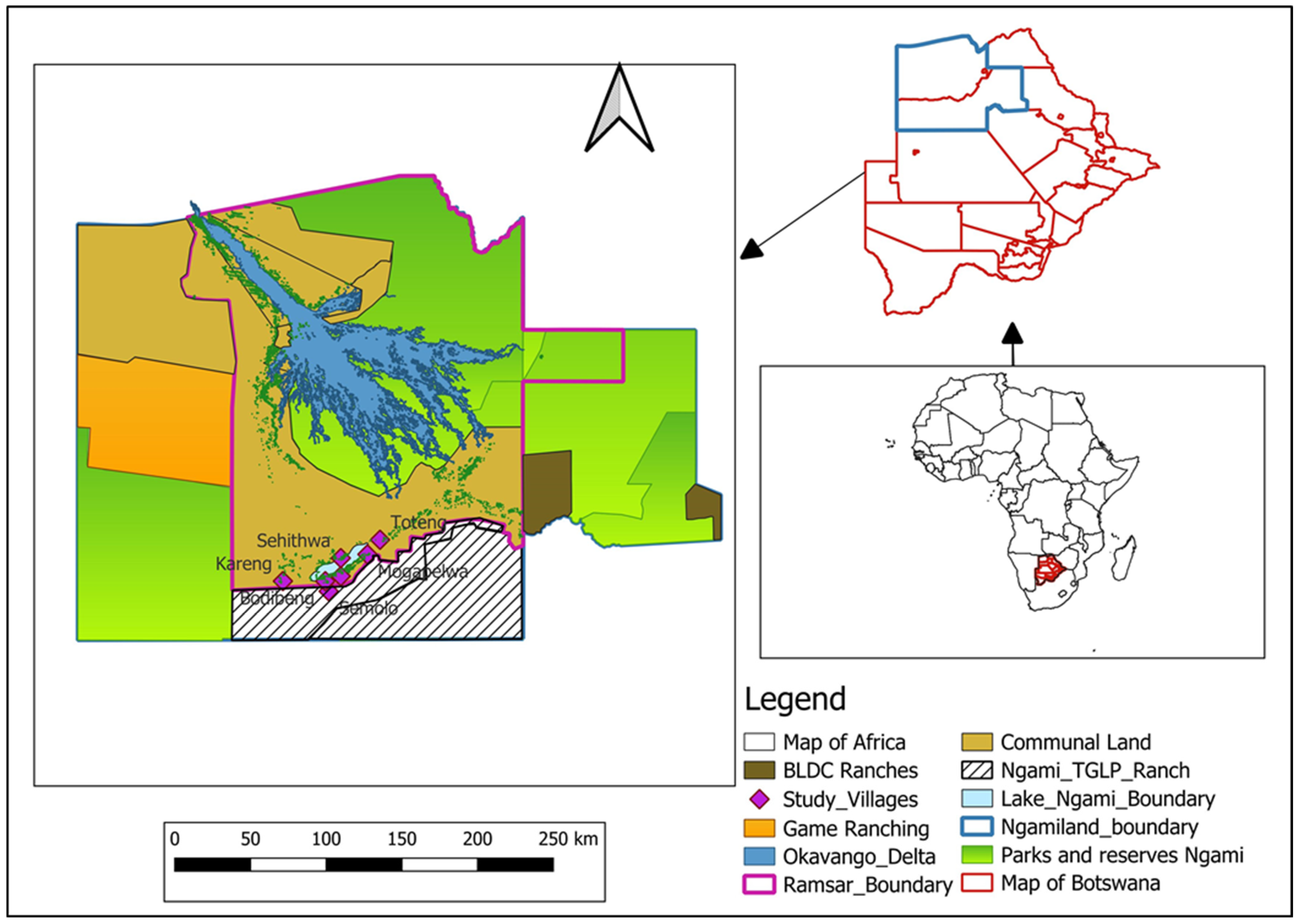
Botswana is a semi-arid country in the center of Southern Africa, with an area of 581,730 km2 [29]. Lake Ngami is found in the northwest part of Botswana (Figure 1), within the Okavango Delta Ramsar Site of Ngamiland District, an area known for its diverse biodiversity that includes both aquatic and terrestrial species, along with its vibrant traditional cultures [38]. Lake Ngami (20°28′49″ S; 22°45′39″ E) is an endorheic (no outflow) seasonal lake [48]. Its largest known size is 277 km2 [49]. The climate of the study area is semi-arid and warm, with an annual average rainfall of 450 mm, primarily occurring during the austral summer [48]. Temperature records show an average annual temperature of 22.3 °C, with mean temperatures of 26.7 °C in January and 15.8 °C in July [48]. Approximately 80% of the lake’s water originates from the Okavango Delta’s inflow, while the remaining 20% comes from nearby precipitation [48,50].
The study area encompasses the villages and cattle posts surrounding Lake Ngami, which fall under the Ngamiland West and Ngamiland East administrative units. The lake is particularly vital to the local economy because it is one of the key sources of water for agro-pastoral farming and fishing, both of which are substantial sources of income in the area [51]. For communities around Lake Ngami, cattle hold significant cultural and economic importance, and the lake provides grazing for the livestock of the surrounding communities. Some of the localities and cattle posts found around the lake include Komana, Sehithwa, Toteng, Bothatogo, Ramosuana, Legothwana, Menomasweu, Phiriyatsena, Matsintsila and Dithotwana. Approximately 1400 km2 has been asserted by the pastoral and gathering tribes of Lake Ngami, covering the whole lake and reaching about 40 km south into the commercial farming areas [37]. The Ngamiland District is the most ethnically diverse in Botswana; this is evident in the many languages spoken in the district. San groups (Basarwa), BaYeyi, Bambukushu, Ovaherero, Ovambanderu, Batawana, Bakgalagadi, and Basubiya are sometimes listed as the native inhabitants of Ngamiland. Ovambanderu created a grazing control system based on the relationship between small kinship groupings and comparatively small, well-defined grazing zones [37].

2.2. Research Methodology and Data Analysis

2.2.1. Conceptual Framework

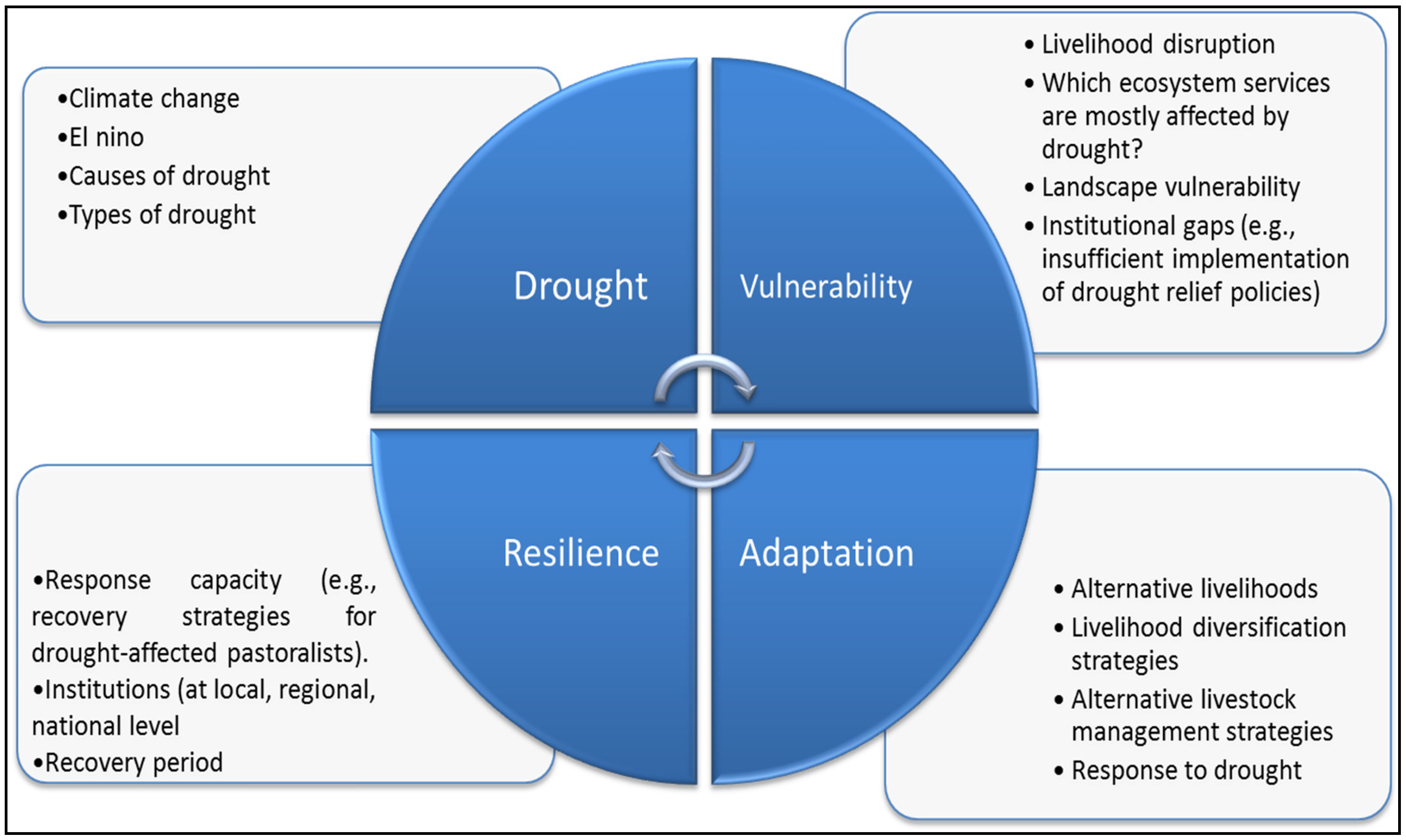
The resilience framework adopted for this study is conceptually grounded in the Climate-Resilient Development Pathways (CRDPs) framework developed by [9]. Their framework builds on the IPCC Sixth Assessment Report, AR6, and focuses on current and future climate change impacts, enabling conditions for CRDPs, and long-term transitions towards climate-resilient development. An in-depth screening of AR6 Working Group II chapters was undertaken to identify concepts, indicators, and enabling conditions relevant to pastoral livelihoods and drought-prone environments. This screening was used to inform the conceptual framework only. The screening process involved a systematic search using the terms “climate AND resilient AND development”, which enabled the identification of AR6 content related to resilience, vulnerability, adaptation, and climate-resilient development. Relevant chapters were examined to extract insights on (i) climate impacts and risks, particularly drought; (ii) vulnerability and exposure of social ecological systems; (iii) adaptation strategies at different scales; and (iv) institutional and policy-related enabling conditions for CRDPs. Findings from this screening provided the theoretical and empirical foundation for defining the four core components of the study’s resilience framework (Figure 2): drought, vulnerability, adaptation, and resilience. The [9] framework is intentionally broad: it spans multiple sectors, including agriculture, water, energy, health, and ecosystems; operates across global, national, and sub-national governance levels; and integrates short-, medium-, and long-term climate risks. The framework also incorporates mitigation–adaptation interactions, development trade-offs, equity considerations, institutional enabling conditions, and long-term socio-economic transitions. Central to the framework is the identification of CRDP enabling conditions, which include political and institutional capacity, governance and policy coherence, access to finance, knowledge and technology systems, equity and justice, inclusive decision-making, and ecosystem stewardship. These enabling conditions shape how adaptation and mitigation actions interact with development trajectories over time.
We adopted this framework and modified it for Botswana’s environmental context (Figure 2). Our modified resilience framework provides a structure for studying and understanding Botswana’s drought scenarios. It is grounded on four pillars: drought, vulnerability, adaptation and resilience. Drought: The drought pillar is basically explored within the introduction section under which we explore drought trends and causes in sub-Saharan Africa, including the different types of drought and the impacts of climate change. Vulnerability: under this pillar, we explore the system’s susceptibility to drought’s negative impacts, assessing its exposure and sensitivity. Adaptation: Under this pillar we explore the integrated multi-pronged strategies to reduce vulnerability and build capacity to cope with dry conditions, moving beyond emergency responses to transform systems through better monitoring, risk sharing and appropriate institutional and policy responses. Resilience: This is the central pillar in this framework. Under this pillar we try to understand the pastoral system through a shift from reactive crisis management to a more proactive risk reduction through a multi-pillar system. It is through this pillar that the concept of CRDPs, which is central to this study, is assessed and understood.
Resilience might involve strategic planning to build societal capacity to withstand, adapt to, and recover from drought by linking short-term management with long-term sustainable development goals. The framework guided the framing of the objectives and data collection tools: in-depth interviews, focus group discussions and policy content analysis. Collectively, the framework ensures coherence across research design and data analysis and directly supports the study objectives by translating empirical evidence into context-specific CRDPs for Ngamiland’s dryland pastoral systems. Consequently, examining policies and institutional frameworks is a key component of this framework.

2.2.2. In-Depth Community Interviews, Focus Group Discussions and Participant Recruitment

Livestock production in the Lake Ngami basin is organized around cattle posts (Setswana: moraka, plural: meraka), which are satellite livestock holding sites located away from main village settlements [52]. Cattle posts are typically widely dispersed across the rangeland landscape, often separated by 10 km or more, depending on grazing and water availability. They are sparsely populated and frequently inhabited by only one adult household member or herdboys, with the main household residing in village centers [52]. Structurally, cattle posts consist of semi-permanent housing units, relatively small residential yards, and multiple kraals used for livestock enclosure.
We employed a qualitative method grounded in empirical data gathered from semi-structured interviews and focus group discussions conducted in the Ngamiland areas close to Lake Ngami. This approach was selected to offer a thorough understanding of the intricate social realities and local viewpoints. The spatial knowledge systems employed by herdsmen are vital for maintaining sustainable pastoralism [53].
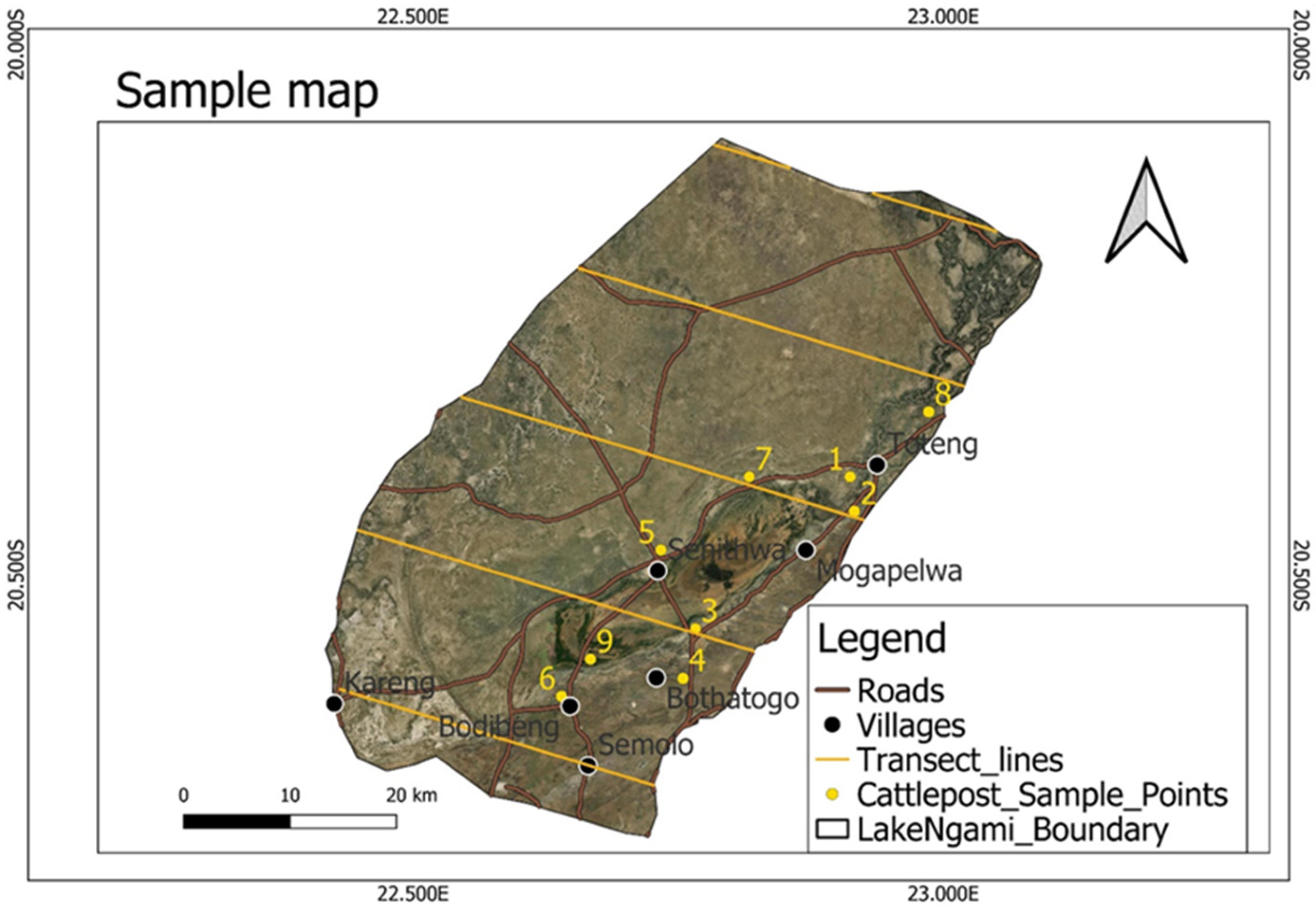
The localities, especially the cattle post areas, are sparsely populated and inhabited by semi-mobile pastoral households, which limited the number of potential participants. In addition, some pastoralists had temporarily migrated due to water shortages and reduced grazing areas, further reducing the available population at the time of data collection. To ensure spatial representativeness, a systematic random sampling approach was applied within designated cattle post areas identified along 20 km-spaced transect lines (Figure 3). The uniform spacing ensured consistent spatial coverage of the landscape while minimizing clustering bias and allowing for adequate representation of environmental variability across the basin. The transect lines were oriented to intersect major landscape gradients and were overlaid with existing road networks to enhance field accessibility. The integration of accessible dusty road networks into the sampling design was intentional, as it improved safety and ensured practical access to remote cattle posts without compromising spatial distribution.
Sampling points for cattle posts were then systematically established along the transect lines at 10 km intervals. These points were selected based on their proximity to both transects and accessible roads, ensuring that the sampling strategy remained spatially structured and unbiased, field navigation was efficient and feasible, and remote and peripheral areas of the basin were adequately represented.
Recruitment began with a random starting point, after which every third cattle post was selected for participation. At each selected cattle post dwelling, the head or an adult member was approached, the purpose of the study was explained, and informed consent was sought prior to participation. Where more than one eligible respondent was present, the individual considered most knowledgeable about past drought events and adaptation strategies was purposively selected for interview. Participant eligibility was guided by the following criteria: (i) being a pastoralist or agro-pastoralist and (ii) possessing knowledge of past drought events and adaptation strategies.
All interviews were conducted face-to-face in December 2024, audio-recorded with consent, and lasted approximately 30 min. The interview process was intensive, involving questionnaire administration, discussions within household yards and kraals, and observation of spatial organization to understand adaptation practices and livestock management strategies. Owing to the depth and duration of engagement required at each site, the overall sample size was intentionally modest but geographically distributed. In-depth interviews were conducted in 10 different study localities: Komana, Toteng, Bothatogo, Ramosuana, Legothwana, Menomasweu, Phiriyatsena, Matsintsila and Dithotwana/Sehithwa. Out of a total of 32 informants, the majority (n = 28) were pastoralists aged between 21 and over 50 years, as shown in Table 1. The remaining participants included four chiefs (n = 4) from Komana, Toteng, Bothatogo and Sehithwa.
Given the qualitative and exploratory nature of this study, the aim was not to achieve statistical representativeness but rather to capture in-depth, context-specific insights into pastoral livelihoods and drought experiences. As such, the sample size and sampling approach may limit the generalizability of the findings beyond the Lake Ngami basin. However, the findings provide valuable insights into similar dry land pastoral systems facing comparable climatic and institutional challenges.
In addition, four focus group discussions were conducted, each consisting of five to eight participants. The participants for the FGDs were drawn from the same individuals who had participated in the in-depth interviews, ensuring continuity and allowing deeper discussion of topics already introduced during the interviews. A focus group discussion is a strategy in which a researcher assembles a group of people to discuss a certain problem, seeking to draw on the members’ complex personal experiences, beliefs, perceptions, and attitudes through a mediated interaction [54,55]. Neighboring cattle post localities were grouped together for logistical and discussion purposes, rather than conducting separate FGDs in each locality. This resulted in four FGDs, composed as follows: Komana and Toteng (FGD 1), Bothatogo and Ramosuana (FGD 2), Legothwana and Menomasweu (FGD 3), and Dithotwana, Phiriyatsena, and Matsintsila (FGD 4). Each locality contributed one to three participants, depending on availability, resulting in five to eight participants per FGD. The focus group discussions were guided by a semi-structured discussion guide, designed to align directly with the study objectives. The guide included open-ended questions and scenarios designed to elicit participants’ perspectives on drought impacts, livelihood challenges, adaptation strategies, and resilience practices. We used audio recorders with consent to capture information for later analysis.
English and the native Setswana dialect were employed as means of communication to obtain information. Interviews were recorded, transcribed, and evaluated in accordance with the study’s research questions and objectives. Interviews conducted in Setswana were first transcribed verbatim in Setswana and subsequently translated into English by the authors, who are fluent in both languages. To enhance translation accuracy, a subset of transcripts was randomly selected and cross-checked against the original audio recordings and field notes. The cross-checking process was conducted collaboratively between the authors to ensure consistency in meaning and interpretation. Where discrepancies in translation arose, these were discussed and resolved through consensus, with reference to the original Setswana phrasing to retain contextual and cultural meaning. Transcripts were manually coded inductively, and themes were iteratively created based on indicators of adaptation and resilience. Field observations were utilized to confirm the details obtained from interviews and focus group discussions. The participating elderly pastoralists directed the field observations.
Our qualitative analysis was conducted using thematic analysis, following established principles for identifying, coding, and interpreting patterns within qualitative data [56]. The analysis was carried out through manual coding, involving the following steps: (i) identifying major themes emerging from the discussions; (ii) assigning codes to major themes; (iii) classifying responses under the identified themes; (iv) writing the research narratives and discussions. The semi-interviews and FGDs were transcribed into text using Microsoft Word, with the researcher frequently listening to the audio and cross-checking it against the field notes to maintain accuracy. Themes were arranged in Microsoft Excel according to their frequency of occurrence across the interviews and FGD. The data was additionally reorganized by classifying it into coping or adaptation strategies, enabling cross-verification with the objectives to preserve the most pertinent findings. To strengthen analytic rigor, a subset of transcripts was recoded after an interval to check for coding consistency. Coding decisions, theme development, and revisions were documented to create an audit trail. Reflexive notes were maintained throughout the analysis to acknowledge the researcher’s positionality and prior knowledge of drought issues in the study area, thereby reducing interpretive bias.
Data were categorized into four thematic areas according to the conceptual framework as follows: drought and climate variability, vulnerability of pastoralists, strategies for diversifying livelihoods, resilience measures, and CRDP enablers. The interviews and FGDs highlighted the local expression of these enablers, and the results assisted in customizing the CRDPs for the Lake Ngami basin while assessing how community resilience aligns with or differs from crucial CRDP enablers: knowledge diversity, equity and justice, inclusion, and ecosystem stewardship [9].
Findings from the qualitative analysis were then used to provide insights for the policy analysis looking at the pastoralists’ vulnerability, adaptation strategies and resilience gaps.

2.2.3. Policy Content Analysis

Policies and institutional frameworks relevant to pastoralism and drought management in the district were retrieved from official records at district offices and the government publishing agency. These documents include sectoral policies, development plans, drought relief frameworks, and livestock-related institutional programs. These sources were selected for two primary reasons. First, official government publications provide the most authoritative articulation of national and district policy priorities, institutional mandates, and implementation frameworks. Using formally gazetted or government-issued documents ensured consistency, legitimacy, and traceability of policy content. Alternative sources such as NGO documents or secondary summaries were excluded to avoid interpretive bias and inconsistencies in scope or detail. Second, government policy documents serve as formal statements of adaptation intent and institutional commitment. While such documents may not capture the entirety of the on-the-ground adaptation practice, they provide structured insight into how drought risk, pastoral livelihoods, and resilience are conceptualized and operationalized within formal governance systems.
The documents were systematically screened for relevant content using keyword searches for terms such as drought, climate variability, pastoralism, livestock, adaptation and resilience. Documents were included if they: (a) Contained provisions directly or indirectly related to drought management or pastoral livelihoods; (b) articulated institutional responsibilities or implementation mechanisms relevant to adaptation; (c) were active or operational during the study period. Documents lacking substantive relevance to climate variability or pastoral systems were excluded. To enhance completeness and contextual validity, policy relevance was cross-checked during focus group discussions and key informant interviews. Participants were asked to identify institutional programs or regulations influencing drought response and pastoral livelihoods. This triangulation ensured that locally significant policies were not overlooked and that formal policy provisions aligned with community-level experience.
Several limitations must be acknowledged. First, policy documents represent formal governmental intent and may not reflect the full scope of informal, customary, or locally implemented adaptation practices. Second, district-level implementation dynamics may not be fully captured within national policy texts. Finally, variations in document detail and periodic revisions may influence the depth of adaptation content identifiable through document review. As such, findings should be interpreted as indicative of institutional commitment and policy framing rather than exhaustive inventories of adaptation action.
The documents were analyzed using iterative content analysis, examining narratives in relation to drought resilience and climate within each document. The policy evaluation and appraisal criteria in Table 2 were identified based on decision support needed for upscaling pastoralists’ resilience and best adaptation practices in pastoral landscapes [57], addressing the root cause of pastoralists’ vulnerability as identified in the resilience framework, multi-stakeholder involvement, and multi-sectorial approaches.
A scoring criterion was applied to assess policy positions in a consistent and comparable manner. The evaluation focused on four main components: (1) the clarity of policy goals, objectives, and problem definitions; (2) the policy stance towards adaptation and resilience; (3) the extent of institutional support provided; and (4) evidence related to implementation, practical outcomes, and observed results. Finally, the analyzed policies were compared to identify policy-based opportunities and constraints influencing community-level adaptation, drought management, and the implementation of Climate-Resilient Development Pathways (CRDPs). Particular emphasis was placed on examining provisions that support cross-sectoral and collaborative management of drought in communal pastoral landscapes.
Criteria for Determining Policy Stance on Adaptation and Resilience
A scoring criterion that allowed for a systematic and comparable assessment was applied to evaluate the extent to which the policies and institutional programs support climate adaptation and resilience in the Lake Ngami basin. The scoring criteria were defined as follows:
  • No support for adaptation and resilience (−): Policies in this category either do not mention climate change adaptation and resilience at all, or they focus solely on disaster response without linking to proactive, long-term adaptation strategies.
  • Weak support for adaptation and resilience (+): These policies acknowledge the need for adaptation or resilience but provide only broad, non-specific objectives.
  • Medium support for adaptation and resilience (++): Policies here include explicit adaptation and resilience measures and show stronger political will to address climate change. However, they remain largely centralized, with insufficient mechanisms to localize or operationalize interventions at the community level.
  • Strong support for adaptation and resilience (+++): Policies in this category integrate adaptation and resilience comprehensively, with clear objectives, targeted strategies, and well-defined implementation pathways.

3. Results

3.1. Impacts of Recurrent Drought on Pastoralism and Pastoral Livelihoods

Table 2 shows a heat map that displays the thematic codes and the different localities where the interviews were conducted around Lake Ngami. As shown in Table 2, the most frequently reported issues across the 32 interviews were livestock losses (n = 32), ecosystem services decline (n = 32), and impacts on livelihoods (n = 32), closely followed by severe drought experiences (n = 30) and reported shifting rainfall patterns (n = 29).
These frequencies clearly indicate that the effects of drought on livestock and livelihoods were nearly widespread in all areas, whereas coping strategies, alternative livelihoods, and successful recovery were significantly less prevalent. This disparity is closely linked to the community’s susceptibility and capacity for adaptation, which are subsequently demonstrated in the resilience framework (Figure 2).

3.1.1. Drought and Climatic Variability

Rising temperatures and altered rainfall patterns are some of the various factors caused by climate change that result in increased droughts and extreme events such as heat waves impacting vulnerable socio-ecological systems [9]. Across all study villages, perceived reductions in rainfall were unanimously reported, with 29 participants noting that rainfall had significantly declined over the past 30 years. Many respondents highlighted a shift in the timing and reliability of rains, contributing to a sense of increasing climatic uncertainty. “…rainfall has decreased significantly in the past 30 years…” (ID Bothatogo). Severe drought years were observed as early as 1933, mid-1960s, mid- to late-1980s, early-1990s, and as recently as 2004 and 2007. These years show how frequently agro-pastoralists in semi-arid Botswana are subjected to dry extremes in an effort to maintain their livelihoods [58]. Communities around Lake Ngami also recalled multiple severe drought episodes, such as those of 1987, 2003/4, 2011/12, 2019, 2023, and 2024. These droughts were marked by prolonged heat and the near-total absence of rainfall; “…the droughts in 1987, 2003/4, 2011/12, 2019, 2023, 2024 were the worst due to no rain and high temperatures…” (ID Sehithwa).

3.1.2. Pastoralists’ Vulnerability

Landscape Vulnerability
Vulnerability describes pastoralists’ limited resilience to withstand shock events, such as droughts, livestock diseases, market exclusion, resource shortages in the form of restricted access, or rangeland degradation [1,56]. Interview responses revealed that the local community perceives an increasing landscape vulnerability, particularly in the form of degraded grazing lands, drying water points, and the loss of native vegetation. The interviews and FGDs attributed these changes to recurring droughts, overgrazing, and uncontrolled bush encroachment in communal grazing lands.
Ecosystem Service Disruption
Lake Ngami has been an essential source of provisioning services, such as vegetation for grazing and fuel wood, fish for food, and water for livestock [37]. The decline in ecosystem services such as water provision and forage availability was seen as directly affecting livestock productivity and mobility. Every respondent reported livestock losses “…I lost 87 cattle in the last two years because of the drought…” (ID Matsintsila). Respondents also noted that traditional resource-use practices, such as seasonal grazing patterns and the use of communal water points, were becoming less effective as rainfall predictability decreased.
Institutional Gaps
Respondents frequently indicated dissatisfaction with institutional support mechanisms, emphasizing deficiencies in drought response coordination, communication, and delivery. Many pastoralists reported that early warning systems were unavailable to them, and drought relief programs, such as LIMID or SLOCA, frequently failed to reach those in greatest need due to bureaucratic delays. This limited institutional reach is also reflected in Table 2, where only 15 responses cited institutional support and recovery, compared to 26 responses calling for policy recommendations, indicating frustration with policy implementation at the community level.

3.1.3. Pastoralists’ Adaptation and Coping Strategies to Drought and Climate Variability

Coping Strategies
Coping strategies among livestock-dependent communities were minimal. Only 8 out of 32 participants reported any form of adaptation. This encompassed the movement of livestock and the informal sharing of boreholes “…we share with/rent from those who have boreholes to provide water for livestock…” (ID Sehithwa) “…I moved my cattle to Zowu, an area close to the Okavango Delta’s buffalo fence, in search of better grazing and water…” (ID Dithotwana).
Livelihoods Diversification Strategies and Resilience Measures
Pastoralists reported that prolonged droughts have compelled many households to explore alternative livelihood options beyond cattle farming. However, as shown in Table 2, only one respondent reported “alternative livelihoods” as a coping mechanism “…I do welding as a side hustle to help sustain my family of 4…” (ID Dithotwana)”, and merely three responses within the sample outlined the “effectiveness of strategies”. Interviewees noted that they depend on government food assistance programs, particularly the Labor Intensive Public Works (LIW) initiative, locally known as ‘Ipelegeng’, which lasts only one month for each individual over a span of three months. The absence of structured assistance for diversifying livelihoods was recognized as an obstacle to developing adaptive capacities.
The loss of livestock due to drought has had a devastating effect on the resilience of livelihoods in the Lake Ngami region. Every respondent reported livestock losses “…I lost 87 cattle in the last two years because of the drought….” (ID Matsintsila). Recovery from drought was reported to be slow and mostly dependent on rainfall. Government interventions, such as food aid and public works programs like Ipelegeng, were acknowledged but considered inadequate “…we got food aid and Ipelegeng program from the government, but it is not enough…” (ID Phiriyatsena). The LIMID program was mentioned once as a helpful intervention in the past. A local social worker detailed how a new program began in November 2024, offering food aid worth BWP 700.00 (USD 54) per month for the most severely affected households “…the program which started on November 24 gives food worth BWP 700.00 to people who are extremely affected as per the assessment conducted through the Northwest District Council …” (ID, Komana). Lack of planning, financial services, or institutional frameworks severely limits longer-term resilience.
Policy recommendations primarily focused on enhancing water access and extending borehole drilling rights to people without land titles “…the government should also give permission to drilling of boreholes to people with no land rights…” (ID, Phiriyatsena).

3.2. Policy and Institutional Frameworks and Their Implications for Drought Adaptation in Vulnerable Pastoral Systems

Table 3 below shows the policy analysis, which indicates that Botswana’s institutional framework contains multiple instruments that, collectively, aim to enhance adaptation and resilience, but their effectiveness varies significantly across levels. The National Disaster Risk Reduction Strategy (2013–2018) and the Disaster Risk Management Plan (2009) provide important foundations for preparedness and vulnerability reduction, yet they remain broad, hazard-generic, and weakly localized, limiting their ability to address drought-specific adaptation needs in pastoral areas. More recent instruments such as the Climate Change Policy (2021), the National Committee on Climate Change, and the National Adaptation Plan Framework demonstrate a stronger policy orientation toward long-term adaptation and resilience through mainstreaming climate risks, strengthening coordination, and aligning with global frameworks.

3.3. Locally Grounded Climate-Resilient Development Pathways (CRDPs) for Vulnerable Lake Ngami Pastoral Systems

Table 4 presents the CRDP transition to climate-resilient development, incorporating the impacts and adaptation responses documented from interviews, policy content analysis, and focus group discussions, including the arenas of engagement and CRDP enablers.
The following subsections discuss each CRDP enabler in the local context, reflecting evidence from fieldwork, interviews, focus groups, policy content analysis, and observations:
i.
Financial access
Access to finance in pastoral areas can be achieved by providing community financing, subsidizing animal feed and medication, and extending assistance through loans and grants. In the Lake Ngami basin, most livestock owners operate under low-income, resource-constrained conditions. In the 2024 budget speech, the finance minister announced that the government, through programs such as Temo Letlotlo and Thuo Letlotlo, will support micro, small, medium, and large-scale farmers by offering financial assistance and agricultural inputs [59]. Additionally, government-backed credit schemes, such as the National Development Bank (NDB), are designed to provide accessible financing and promote agricultural productivity and resilience [60]. However, access to these financial instruments remains limited in the Lake Ngami region. Few pastoralists reported having successfully secured loans or grants through Thuo Letlotlo or the NDB. Several challenges contribute to this gap, including strict eligibility criteria, a lack of collateral among small-scale farmers, limited awareness of available programs, and bureaucratic bottlenecks in the application and approval processes.
During drought periods, the cost of livestock feed and veterinary supplies escalates sharply, yet there are limited subsidies to cushion these shocks. Informal saving schemes (motshelo) exist within some villages, but their scope is too narrow to fund large-scale recovery efforts. Motshelo is a traditional, informal savings scheme where community members contribute money regularly and take turns receiving the pooled funds. The absence of targeted financial packages for pastoralists exacerbates their vulnerability during prolonged periods of drought.
ii.
Infrastructure Development
Poor infrastructure continues to constrain adaptive capacity across Lake Ngami’s grazing areas. While some boreholes have been rehabilitated, most remain poorly maintained or non-functional. Livestock often have to travel long distances to reach operational water points, increasing their exposure to heat stress and reducing productivity. Improving infrastructure, such as expanding and maintaining existing boreholes and installing new water sources, is a significant CRDP enabler in pastoralists’ communal areas.
iii.
Education and Capacity Building
Most livestock owners rely on indigenous knowledge passed down through generations, but this is increasingly insufficient against the backdrop of intensifying droughts. Formal training on modern rangeland management, herd diversification, or pasture restoration is largely absent.
iv.
Social Protection Systems
This includes boosting government relief measures like food handouts and drought relief programs, for example, Labor Intensive Public Works (Ipelegeng). These programs provide short-term support but are inconsistently accessed and poorly aligned with pastoralist needs. Food aid is often delayed and limited to human consumption, offering no support for livestock during critical feed shortages. Ipelegeng functions as a temporary employment safety net, with short work cycles usually of a month and low wages, and does not address structural drivers of vulnerability such as livestock loss, land degradation, or climate variability. Consequently, participants gain no lasting capacity or adaptive benefit from the program.
v.
Inclusive governance
Decision-making processes regarding drought response and land use planning are often top-down, with minimal representation from communal livestock keepers. Local institutions, such as Village Development Committees (VDCs) and Farmers’ Committees, rarely engage in structured dialogues with national planners and government officials, despite being closer to the impacts. Interview responses indicated that many residents feel side-lined in policy planning and implementation and that existing consultative platforms are not participatory. This exclusion undermines community trust and discourages participation in adaptation and climate resiliency programs.
vi.
Equity and justice
Equity and justice in communal areas depend on fair access to grazing land, water resources, and government support. In Lake Ngami’s communal rangelands, access to resources is highly uneven, with wealthier farmers more likely to own private boreholes, multiple herds, and ranches and to exploit policy loopholes through dual grazing in communal areas. In contrast, small-scale pastoralists face land fragmentation, bush encroachment, and competition over water, challenges that intensify during droughts and increase their vulnerability.
vii.
Risk management
Formal drought monitoring and early warning systems are largely absent at the community level. While the Department of Meteorological Services issues seasonal forecasts, these are rarely translated into actionable information for pastoralists. There are no structured risk plans or contingency mechanisms tailored to the needs of communal grazing areas, and community-based disaster preparedness committees are largely non-functional or absent.
viii.
Health
Droughts have direct and cascading effects on humans and livestock health in Ngamiland, affecting pastoral livelihoods. For instance, the whole district herd was culled in 1995 due to a severe outbreak of contagious bovine pleuro-pneumonia, or CBPP, a cattle lung disease that left many households on the verge of poverty and reliant on government social welfare programs [61]. Recurrent outbreaks of foot-and-mouth disease have further constrained herd recovery. Growing evidence links the increased frequency and severity of such diseases to climate change through rising temperatures, erratic rainfall, and prolonged droughts that alter disease transmission pathways [62]. Livestock losses reduce access to milk, meat, and income, increasing food insecurity, while water scarcity heightens the incidence of human diseases such as diarrhea and respiratory infections [63]. Respondents also reported significant psychosocial stress associated with repeated livelihood losses.

4. Discussion

This study contributes to the growing body of literature on climate vulnerability and resilience in pastoral dryland communities. Climate variability, particularly droughts caused by El Niño, has significantly impacted pastoral livelihoods, water availability, ecosystem services, and animal health [57]. Evidence from interviews indicates that these drought impacts are not isolated incidents but widespread lived experiences. These results are consistent with regional studies showing Southern Africa’s increasing aridity and vulnerability to climate-induced shocks [64,65].
Ngamiland pastoralists demonstrated adaptability by migrating seasonally, diversifying herds, destocking, and engaging in informal economic sectors as alternate livelihoods. They relocated their livestock to areas with better pastures, near the buffalo fence during dry seasons. A study conducted in Namibia showed that only a limited set of adaptation strategies were identified, including livestock mobility to access better grazing areas, the adoption of drought-resistant crops and livestock, early planting practices, and temporary relocation to other villages [66]. Pastoralists in Borana also use mobility as their main strategy to respond to recurrent droughts [67]. In the same study, it shows that destocking is seen as a last option for ensuring the survival of livestock during drought. This also aligns with the practices of Afar pastoralists, which show that mobility is their first choice in terms of adapting to the impact of climate change [68]. However, this mobility has recently become severely limited due to the widespread and recurrent nature of droughts across the Afar region, the reduction in rangeland caused by the expansion of commercial farms, and bush encroachment, such as Prosopis juliflora [68]. A similar trend was observed in the Lake Ngami area, where respondents reported bush encroachment by Vachellia tortilis as a driver of reduced grazing areas and ecosystem service decline.
The pastoralists in this study noted that grasslands were gradually replaced by bushes and shrubs due to bush encroachment and prolonged, recurring droughts. As a result, most households expanded their livestock by adding more goats, since these animals can flourish by browsing on trees and shrubs. This adaptation strategy aligns with findings from pastoral systems such as the Borana region, where households have diversified their livestock by incorporating more drought-resistant species, including goats and camels, to enhance resilience under increasing climate variability [69]. This expansion of goats and loss of cattle has significantly reduced the quantity of cows per household, and now, many pastoralists in the area depend on government labor-intensive public works for their survival. However, only one of thirty-two respondents pursued welding as an alternative livelihood. This is because livestock rearing represents their primary way of life and the livelihood strategy they know best. The spatial variation in drought impacts and adaptive responses, as shown in Table 2, reflects local differences in infrastructure, water access, and land degradation, highlighting that vulnerability is context-specific.
The quantity of water in natural sources today decreases because of extended droughts impacting livestock and pastoral communities [70]. Thus, investing in livestock water infrastructure, like drilling boreholes, is essential for fostering CRDPs in Ngamiland. Most respondents emphasized the urgent need for additional boreholes, noting that they are often forced to spend scarce financial resources renting access from private owners, as many syndicate boreholes remain non-functional due to inadequate maintenance. However, infrastructure investments alone are insufficient without complementary climate information services. Embedding climate services within district planning processes would allow infrastructure expansion to align with projected drought hotspots and long-term rainfall variability trends. For example, firstly, by localized seasonal forage forecasts: by predicting periods of low pasture availability, pastoralists could plan herd mobility or supplementary feeding in advance. These forecasts could be delivered through mobile phone SMS alerts and local radio platforms. Secondly, early warnings for borehole water yields: predictive information on borehole performance during the dry season could help communities prioritize water allocation, schedule water for livestock, or arrange for temporary water trucking. Delivery could involve district water offices coordinating with Village Development Committees (VDCs) to disseminate alerts through local radio or VDC meetings.
Additionally, the road connections between villages and urban centers, as well as those among villages, were poorly developed, and the entire road infrastructure remains insufficient, limiting access to veterinary services, especially during the rainy season. This limited access to veterinary services makes them resort to using traditional medicinal plants such as Terminalia sericea and okatari in the Otjiherero language, as gathered in the interviews. This aligns with scholars who note that many livestock owners in Sub-Saharan Africa rely on traditional remedies in situations where conventional veterinary knowledge is limited, veterinary services are inaccessible, or the cost of professional care is too high [71].
Traditional coping strategies and ecological zone knowledge in Ngamiland remain prevalent as shown above but are poorly supported. They continue using strategies they recognize as ineffective because these practices have been passed down through generations and constitute the only survival methods they are familiar with. These solutions adopted by pastoralists in Ngamiland were frequently short-term, showing weak transformative adaptation capacity.
The study also identified significant institutional gaps as mentioned in the interviews and FDGs, including the limited reach and effectiveness of government initiatives such as LIMID and NAMPAAD. Although these efforts aim to help rural areas, variations in delivery and a lack of localized adaptation approaches limit their effectiveness. Similar to other sub-Saharan African contexts, adaptation among many agro-pastoral societies is constrained by weak institutions and fragmented policies [72], including limited financial access [73]. While national instruments such as the Climate Change Policy (2021) and the National Adaptation Plan Framework reflect strong political will and alignment with global climate goals, their limited penetration into remote pastoral areas reflects weak decentralization, bureaucratic bottlenecks, and misalignment between policy timelines and community needs. For instance, top-down policy designs often fail to account for local ecological and social realities, such as dispersed cattle posts, seasonal mobility patterns, and reliance on indigenous knowledge for grazing and water management. Additionally, delays in resource allocation and limited staffing at veterinary offices as indicated by pastoralists during interviews prevent timely delivery of adaptation support, leaving communities to rely on traditional coping mechanisms even during extreme droughts. These frameworks support resilience in principle, but their operational reach falls short of penetrating remote pastoral areas like Ngamiland, where localized drought impacts are most severe. As reflected in community testimonies, one participant noted, “We hear about these government programs, but they do not reach us here, especially during drought.” Similarly, the National Disaster Risk Management Plan (2009) and the Disaster Risk Reduction Strategy (2013–2018) provide generic preparedness strategies but neglect the specificity of climate-induced droughts, undermining their relevance to pastoral systems that are highly sensitive to water scarcity, livestock loss, and land degradation.
A critical gap across policies is the lack of integration of indigenous knowledge systems and local coping strategies, which are essential in guiding context-specific adaptation. This is reflected in one of the responses from the pastoralists from Dithotwana who noted, “Policies are there, but in our area we depend on our own ways to survive.” Strengthening resilience in smallholder systems requires participatory policy development, informed by the lived experiences of local communities, as noted in a study conducted by [43]. Pastoralists often perceive these programs as being misaligned with their traditional coping mechanisms [74]. This misalignment therefore hinders the effectiveness of CRDPs, which relies on inclusive, equity-based, and locally informed decision-making. Targeted combinations of governance attributes (such as stakeholder involvement and community engagement) along with investments in infrastructure, health, and education that address the key underlying vulnerabilities are essential in determining the required focus on each enabler to implement CRDPs effectively [9]. When implementing these enablers, efforts directed at tackling a particular set of effects should not weaken the ability to adjust to and lessen other impacts. Therefore, coordinated actions addressing climate change are vital to advance the CRDPs, as areas of involvement should promote improved governance, policies, and institutions, enhance economic systems, aid in monitoring and evaluation, develop human resources, and support engagement among diverse stakeholders [39].
The empirical findings of this study indicate that three resilience enablers were particularly salient in the Lake Ngami basin: infrastructure development, institutional effectiveness, and social protection and financial access systems. First, water infrastructure emerged as the most immediate and visible resilience enabler. As illustrated in Table 4 under the impact of reduced water availability, participants consistently identified boreholes as central adaptive responses. However, uneven distribution, delayed maintenance, and limited integration of climate projections into infrastructure planning reduce their long-term effectiveness.
Second, institutional effectiveness underpins mobility and rangeland management responses associated with land degradation and bush encroachment. While seasonal migration, temporary pasture leasing, and herd adjustments reflect strong ecological knowledge, their sustainability depends on supportive governance structures. This aligns with recommendations that governments in semi-arid regions should implement programs promoting sustainable climate change adaptation options for pastoralists. Table 4 highlights the arenas of engagement (ecological, institutional, and economic) through which these responses operate. Without coordinated land-use planning, participatory governance, and integration of local knowledge systems, mobility risks becoming reactive rather than anticipatory.
Third, social protection systems and financial access mechanisms are critical in addressing livestock mortality, livelihood loss, and food insecurity. Participants reported reliance on informal income activities, government labor-intensive programs such as Ipelegeng, and limited support from initiatives like LIMID and NAMPAAD. However, uneven implementation and limited localization constrain their transformative potential. Strengthening inclusive governance, financial access, and equity-based policy delivery therefore represents a structural enabler of CRDPs.
The findings demonstrate that advancing CRDPs in Ngamiland requires coordinated action across these enablers. This highlights the importance of integrated approaches, as addressing barriers in isolation tends to produce only partial gains, whereas coordinated reform strategies generate compounded improvements in performance, participation, and overall system resilience [75].

5. Conclusions

Pastoral communities around Lake Ngami are significantly affected by droughts, which are exacerbated by climate change and institutional shortcomings. While local adaptation practices such as the use of boreholes, herd adjustments, and informal income diversification provide some buffering capacity, these strategies are largely insufficient in the face of increasing drought frequency and severity. The study revealed that communal and private boreholes play a significant role as adaptive infrastructure, emphasizing the necessity of water access in resilience initiatives. Equally important is the condition of the roads, which are mostly dusty, unpaved gravel tracks that significantly affect resilience efforts. Poor road infrastructure limits timely access to markets where pastoralists sell livestock and livestock products, as well as access to veterinary services and agricultural inputs. Improving both water infrastructure and road networks is therefore critical to enhancing adaptive capacity and enabling pastoralist communities to better cope with drought and climate variability within the Lake Ngami basin.
Building actual resilience in this context necessitates a transition to Climate-Resilient Development Pathways that combine local knowledge, institutional support, and infrastructure investment. The findings of this study suggest that improved water infrastructure, inclusive governance, and social protection systems, as well as focused education and capacity-building activities, are all important drivers. In addition, climate services (CS) can play a pivotal role by providing actionable and locally relevant information on climate variability, drought forecasts, and water availability. For example, firstly, through integrating Village Development Committees (VDCs) into district-level drought planning, VDCs can act as a local coordination mechanism for early warning dissemination, water allocation, and seasonal mobility planning. Secondly, strengthen coordination between district-level agricultural and water authorities: Regular monitoring and reporting of borehole yields and forage availability should inform adaptive interventions, such as water trucking, mobility planning, and ensuring timely support to pastoral households. By integrating CS into CRDPs, communities can shift from reactive responses to anticipatory adaptation, planning mobility, grazing, and water management strategies based on early warnings and seasonal forecasts. Like in many pastoral areas, mobility and temporary migration during drought years are the most common practices among pastoral communities in the study area. There is therefore a need to design better ways of seasonal mobility, especially planning special areas for animal movement with specified animal routes as well, to review current multi-sectoral policies and laws to include this aspect.
Based on the findings, three prioritized actions are recommended to optimize resource use and impact:
  • Repair and maintain water infrastructure, as functional boreholes are critical to herd survival and community resilience.
  • Strengthen participatory governance and institutional coordination, including VDC integration and district-level collaboration, to ensure timely, context-specific interventions.
  • Implement tailored climate information services to support anticipatory planning for mobility, grazing, and water management, complementing the infrastructure and governance improvements.
Coordinated action across multiple levels of governance is important for advancing CRDPs in similar dry land contexts. While this study focuses on the Lake Ngami basin, the findings may offer insights for broader pastoral systems facing comparable climatic and institutional challenges. Strengthening governance frameworks, enhancing institutional coordination, and promoting collaboration among government, non-governmental, and private sector actors may support more effective adaptation, mitigation, and development outcomes. The findings highlight both Lake Ngami-specific and general patterns. The challenges of sparse roads, reliance on communal boreholes, and seasonal herd mobility are particular to Lake Ngami, shaped by local settlement patterns and geography. However, many semi-arid pastoral systems in Botswana and across Southern Africa face similar drought risks, livestock-based livelihoods, and institutional gaps. Therefore, the prioritization framework, water infrastructure, participatory governance, and climate information services, may be applicable to other dry land contexts with comparable ecological and social conditions.
These findings point to opportunities for future research. One potential hypothesis is that “Combining targeted seasonal mobility planning with water infrastructure rehabilitation will enhance pastoralist resilience more effectively than infrastructure investments or mobility planning alone.” Testing such hypotheses could guide subsequent interventions and provide evidence for integrated, context-specific adaptation strategies in semi-arid pastoral systems.

Author Contributions

S.L.-C.: Writing—original draft, Visualization, Investigation, Formal analysis, Data curation, L.V.B.: Conceptualization, Writing—review and editing original draft, Supervision, G.M.T.: Writing—review and editing, Supervision, Resources and funding acquisition. All authors have read and agreed to the published version of the manuscript.

Funding

The authors express gratitude for the funding provided by the O.R. Tambo Africa Research Chairs Initiative as supported by the Botswana International University of Science and Technology, the Ministry of Tertiary Education, Science and Technology; the National Research Foundation of South Africa (NRF); the Department of Science and Innovation of South Africa (DSI); the International Development Research Centre of Canada (IDRC); and the Oliver & Adelaide Tambo Foundation (OATF).

Institutional Review Board Statement

The research was carried out under research permit number ENT 8/36/4 LVIII (17) of the Government of Botswana, Ministry of Environment and Tourism. Ethical clearance was provided by the Botswana International University of Science and Technology; Ethical clearance number: HREC—014.

Informed Consent Statement

Informed consent was obtained from all subjects involved in the study. Written informed consent has been obtained from the patient(s) to publish this paper.

Data Availability Statement

The data presented in the study are available upon request from the corresponding author.

Acknowledgments

We would like to thank Patience Mashaire (colleague) for assistance during field interviews.

Conflicts of Interest

The authors declare that they have no known competing financial interests or personal relationships that could have appeared to influence the work reported in this paper.

Abbreviations

The following abbreviations are used in this manuscript:
AR6IPCC Sixth Assessment Report
CBPPContagious bovine pleuro-pneumonia
CRDPClimate-Resilient Development Pathway
FGDFocus Group Discussion
IPCCIntergovernmental Panel on Climate Change (IPCC)
LIMIDLivestock Management and Infrastructure Development (LIMID) program
NAMPAADNational Master Plan for Arable Agriculture and Dairy Development

References

  1. Rass, N. Policies and Strategies to Address the Vulnerability of Pastoralists in Sub-Saharan Africa; Pro-poor Livestock Policy Initiative (PPLPI) Working Paper Series; FAO: Rome, Italy, 2006; Volume 37. [Google Scholar]
  2. Ahmed, M.; Hayat, R.; Ahmad, M.; Ul-Hassan, M.; Kheir, A.M.S.; Ul-Hassan, F.; Ur-Rehman, M.H.; Shaheen, F.A.; Raza, M.A.; Ahmad, S. Impact of climate change on dryland agricultural systems: A review of current status, potentials, and further work need. Int. J. Plant Prod. 2022, 16, 341–363. [Google Scholar] [CrossRef] [PubMed]
  3. Berdugo, M.; Delgado-Baquerizo, M.; Soliveres, S.; Hernández-Clemente, R.; Zhao, Y.; Gaitán, J.J.; Gross, N.; Saiz, H.; Maire, V.; Lehmann, A. Global ecosystem thresholds driven by aridity. Science 2020, 367, 787–790. [Google Scholar] [CrossRef] [PubMed]
  4. Stringer, L.C.; Mirzabaev, A.; Benjaminsen, T.A.; Harris, R.M.B.; Jafari, M.; Lissner, T.K.; Stevens, N.; Tirado-von Der Pahlen, C. Climate change impacts on water security in global drylands. One Earth 2021, 4, 851–864. [Google Scholar] [CrossRef]
  5. Campbell, B.M.; Hansen, J.; Rioux, J.; Stirling, C.M.; Twomlow, S. Urgent action to combat climate change and its impacts (SDG 13): Transforming agriculture and food systems. Curr. Opin. Environ. Sustain. 2018, 34, 13–20. [Google Scholar] [CrossRef]
  6. Küfeoğlu, S. SDG-13: Climate Action. In Emerging Technologies: Value Creation for Sustainable Development; Springer: Berlin/Heidelberg, Germany, 2022; pp. 429–451. [Google Scholar]
  7. Schipper, E.L.F.; Revi, A.; Preston, B.L.; Carr, E.R.; Eriksen, S.H.; Fernandez-Carril, L.R.; Glavovic, B.; Hilmi, N.J.; Ley, D.; Mukerji, R. Climate Resilient Development Pathways; Cambridge University Press: Cambridge, UK, 2022. [Google Scholar]
  8. Arfanuzzaman, M. Bangladesh's pathways to climate-resilient development: A methodical review. World Dev. Sustain. 2024, 4, 100144. [Google Scholar] [CrossRef]
  9. Favretto, N.; Stringer, L.C. Climate resilient development in vulnerable geographies. Mitig. Adapt. Strateg. Glob. Change 2024, 29, 90. [Google Scholar] [CrossRef]
  10. Jerneck, A.; Olsson, L. Adaptation and the poor; development, resilience and transition. In Development Policy as a Way to Manage Climate Change Risks; Routledge: Oxfordshire, UK, 2015; pp. 170–182. [Google Scholar]
  11. Dang, H.L.; Li, E.; Nuberg, I.; Bruwer, J. Factors influencing the adaptation of farmers in response to climate change: A review. Clim. Dev. 2019, 11, 765–774. [Google Scholar] [CrossRef]
  12. Mehran, A.; Mazdiyasni, O.; AghaKouchak, A. A hybrid framework for assessing socioeconomic drought: Linking climate variability, local resilience, and demand. J. Geophys. Res. Atmos. 2015, 120, 7520–7533. [Google Scholar] [CrossRef]
  13. Solomon, S.; Qin, D.; Manning, M.; Marquis, M.; Averyt, K. Climate Change 2007, the Fourth Assessment Report (AR4); The Intergovernmental Panel on Climate Change (IPCC): Geneva, Switzerland, 2007. [Google Scholar]
  14. Denton, F.; Wilbanks, T.J.; Abeysinghe, A.C.; Burton, I.; Gao, Q.; Lemos, M.C.; Masui, T.; O’Brien, K.L.; Warner, K. Climate-resilient pathways: Adaptation, mitigation, and sustainable development. In Climate Change; Cambridge University Press: Cambridge, UK, 2014; pp. 1101–1131. [Google Scholar] [CrossRef]
  15. Middleton, N.J.; Sternberg, T. Climate hazards in drylands: A review. Earth-Sci. Rev. 2013, 126, 48–57. [Google Scholar] [CrossRef]
  16. Safriel, U.; Adeel, Z. Development paths of drylands: Thresholds and sustainability. Sustain. Sci. 2008, 3, 117–123. [Google Scholar] [CrossRef]
  17. Gu, L.; Chen, J.; Yin, J.; Sullivan, S.C.; Wang, H.-M.; Guo, S.; Zhang, L.; Kim, J.-S. Projected increases in magnitude and socioeconomic exposure of global droughts in 1.5 and 2 C warmer climates. Hydrol. Earth Syst. Sci. 2020, 24, 451–472. [Google Scholar] [CrossRef]
  18. Ullah, A.; Bavorova, M.; Shah, A.A.; Kandel, G.P. Climate change and rural livelihoods: The potential of extension programs for sustainable development. Sustain. Dev. 2024, 32, 4992–5004. [Google Scholar] [CrossRef]
  19. Habte, M.; Eshetu, M.; Maryo, M.; Andualem, D.; Legesse, A. Effects of climate variability on livestock productivity and pastoralists perception: The case of drought resilience in Southeastern Ethiopia. Vet. Anim. Sci. 2022, 16, 100240. [Google Scholar] [CrossRef] [PubMed]
  20. Basupi, L.V. Pastoralism and Land Tenure Transformation: Policy Implications and Livelihoods Adaptations in Botswana. Ph.D. Thesis, University of Leeds, Leeds, UK, 2018. [Google Scholar]
  21. Auma, J.; Radeny, M.A.O. Strengthening Adaptive Capacity of Extensive Livestock Systems for Food and Nutrition Security and Low-Emissions Development in Eastern and Southern Africa. 2022. Available online: https://cgspace.cgiar.org/items/c7f0a7ad-278b-4a58-9a13-26663bc9fb5e (accessed on 3 March 2026).
  22. Dietz, A.J.; Ruben, R.; Verhagen, A. The Impact of Climate Change on Drylands: With a Focus on West Africa; Springer: Berlin/Heidelberg, Germany, 2004. [Google Scholar]
  23. Otto, F.E.L.; Zachariah, M.; Wolski, P.; Pinto, I.; Nhamtumbo, B.; Bonnet, R.; Vautard, R.; Philip, S.; Kew, S.; Luu, L.N.; et al. Climate Change Increased Rainfall Associated with Tropical Cyclones Hitting Highly Vulnerable Communities in Madagascar, Mozambique & Malawi; World Weather Attribution: London, UK, 2022; 41p. [Google Scholar]
  24. Ofori, S.A.; Cobbina, S.J.; Obiri, S. Climate change, land, water, and food security: Perspectives From Sub-Saharan Africa. Front. Sustain. Food Syst. 2021, 5, 680924. [Google Scholar] [CrossRef]
  25. Padgham, J.; Abubakari, A.; Ayivor, J.; Dietrich, K.; Fosu-Mensah, B.; Gordon, C.; Habtezion, S.; Lawson, E.; Mensah, A.; Nukpezah, D. Vulnerability and Adaptation to Climate Change in the Semi-Arid Regions of West Africa. 2015. Available online: https://idl-bnc-idrc.dspacedirect.org/items/2d78c92f-806e-4adb-9c35-6b2d4937d611/full (accessed on 3 March 2026).
  26. Giannini, A.; Krishnamurthy, P.K.; Cousin, R.; Labidi, N.; Choularton, R.J. Climate risk and food security in Mali: A historical perspective on adaptation. Earth's Future 2017, 5, 144–157. [Google Scholar] [CrossRef]
  27. Huho, J.M.; Ngaira, J.K.; Ogindo, H.O. Living with drought: The case of the Maasai pastoralists of northern Kenya. Educ. Res. 2011, 2, 779–789. [Google Scholar]
  28. Motsumi, K.O.; Ziervogel, G.; New, M. Drought governance: A cross-level governance analysis in botswana. Clim. Risk Manag. 2023, 42, 100557. [Google Scholar] [CrossRef]
  29. Juana, J.S.; Makepe, P.M.; Mangadi, K.T.; Narayana, N. The socio-economic impact of drought in Botswana. Int. J. Environ. Dev. 2014, 11, 43–60. [Google Scholar]
  30. Nicholson, S.E.; Kim, J. The relationship of the El Niño–Southern oscillation to African rainfall. Int. J. Climatol. A J. R. Meteorol. Soc. 1997, 17, 117–135. [Google Scholar] [CrossRef]
  31. Byakatonda, J. Climatological Droughts and Their Implications on Water Resources and Agricultural Production in Semiarid Regions: The Case of Botswana. Ph.D. Thesis, 2018. Available online: https://www.semanticscholar.org/paper/Climatological-droughts-and-their-implications-on-Byakatonda/cca5a4a212bd76793bc9b7702d3b2598975ab2de (accessed on 3 March 2026).
  32. Seleka, T.B. Sources of declining beef export competitiveness under preferential trade arrangements: The case of Botswana. Appl. Econ. 2026, 1–14. [Google Scholar] [CrossRef]
  33. Serdeczny, O.; Adams, S.; Baarsch, F.; Coumou, D.; Robinson, A.; Hare, W.; Schaeffer, M.; Perrette, M.; Reinhardt, J. Climate change impacts in Sub-Saharan Africa: From physical changes to their social repercussions. Reg. Environ. Change 2017, 17, 1585–1600. [Google Scholar] [CrossRef]
  34. Dougill, A.J.; Fraser, E.D.G.; Reed, M.S. Anticipating vulnerability to climate change in dryland pastoral systems: Using dynamic systems models for the Kalahari. Ecol. Soc. 2010, 15, 17. [Google Scholar] [CrossRef]
  35. Panin, A.; Mahabile, M. Profitability and household income contribution of small ruminants to small-scale farmers in Botswana. Small Rumin. Res. 1997, 25, 9–15. [Google Scholar] [CrossRef]
  36. Bahta, S.; Wanyoike, F.; Katjiuongua, H.; Marumo, D. Characterisation of food security and consumption patterns among smallholder livestock farmers in Botswana. Agric. Food Secur. 2017, 6, 65. [Google Scholar] [CrossRef]
  37. Magole, L. The ‘shrinking commons’ in the Lake Ngami grasslands, Botswana: The impact of national rangeland policy. Dev. South. Afr. 2009, 26, 611–626. [Google Scholar] [CrossRef]
  38. Moliner Cachazo, L.; Makati, K.; Chadwick, M.A.; Catford, J.A.; Price, B.W.; Mackay, A.W.; Guiry, M.D.; Murray-Hudson, M.; Murray-Hudson, F. A review of the freshwater diversity in the Okavango Delta and Lake Ngami (Botswana): Taxonomic composition, ecology, comparison with similar systems and conservation status. Aquat. Sci. 2023, 85, 1–19. [Google Scholar] [CrossRef]
  39. Taillandier, C.; Cörvers, R.; Stringer, L.C. Growing resilient futures: Agroforestry as a pathway towards climate resilient development for smallholder farmers. Front. Sustain. Food Syst. 2023, 7, 1260291. [Google Scholar] [CrossRef]
  40. Barnet, A.F.; Ciurana, A.B.; Pozo, J.X.O.; Russo, A.; Coscarelli, R.; Antronico, L.; De Pascale, F.; Saladie, O.; Anton-Clave, S.; Aguilar, E. Climate services for tourism: An applied methodology for user engagement and co-creation in European destinations. Clim. Serv. 2021, 23, 100249. [Google Scholar] [CrossRef]
  41. Coulibaly, J.Y.; Mango, J.; Swamila, M.; Tall, A.; Kaur, H.; Hansen, J. What Climate Services do Farmers and Pastoralists Need in Tanzania? 2015. Available online: https://cgspace.cgiar.org/items/16cb422b-eccf-4234-8e9d-240b7cb2aa24 (accessed on 3 March 2026).
  42. Kikstra, J.S.; Nicholls, Z.R.J.; Smith, C.J.; Lewis, J.; Lamboll, R.D.; Byers, E.; Sandstad, M.; Meinshausen, M.; Gidden, M.J.; Rogelj, J. The IPCC Sixth Assessment Report WGIII climate assessment of mitigation pathways: From emissions to global temperatures. Geosci. Model Dev. 2022, 15, 9075–9109. [Google Scholar] [CrossRef]
  43. Dixon, J.L.; Stringer, L.C. Towards a theoretical grounding of climate resilience assessments for smallholder farming systems in Sub-Saharan Africa. Resources 2015, 4, 128–154. [Google Scholar] [CrossRef]
  44. Werners, S.E.; Sparkes, E.; Totin, E.; Abel, N.; Bhadwal, S.; Butler, J.R.A.; Douxchamps, S.; James, H.; Methner, N.; Siebeneck, J. Advancing climate resilient development pathways since the IPCC’s fifth assessment report. Environ. Sci. Policy 2021, 126, 168–176. [Google Scholar] [CrossRef]
  45. McEvoy, S.; Langendijk, G.; Jeuken, A.; Haasnoot, M. What is needed to make climate resilient development pathways planning actionable in cities? Environ. Res. Commun. 2025, 7, 082501. [Google Scholar] [CrossRef]
  46. Thomas, R.; Reed, M.; Clifton, K.; Appadurai, N.; Mills, A.; Zucca, C.; Kodsi, E.; Sircely, J.; Haddad, F.; Hagen, C. A framework for scaling sustainable land management options. Land Degrad. Dev. 2018, 29, 3272–3284. [Google Scholar] [CrossRef]
  47. Stringer, L.C.; Simpson, N.P.; Schipper, E.L.F.; Eriksen, S.H. Climate resilient development pathways in global drylands. Anthr. Sci. 2022, 1, 311–319. [Google Scholar] [CrossRef]
  48. Cordova, C.E.; Scott, L.; Chase, B.M.; Chevalier, M. Late pleistocene-holocene vegetation and climate change in the middle Kalahari, lake Ngami, Botswana. Quat. Sci. Rev. 2017, 171, 199–215. [Google Scholar] [CrossRef]
  49. Cumming, G.S.; Henry, D.A.W.; Mutumi, G.L.; Ndlovu, M. Understanding arid-region waterbird community dynamics during lake dry-downs. Ecosphere 2021, 12, e03668. [Google Scholar] [CrossRef]
  50. Shaw, P. The desiccation of Lake Ngami: An historical perspective. Geogr. J. 1985, 151, 318–326. [Google Scholar] [CrossRef]
  51. Mokgedi, L.; Nobert, J.; Munishi, S. Assessment of lake surface dynamics using satellite imagery and in-situ data; case of Lake Ngami in North-West Botswana. Phys. Chem. Earth Parts A/B/C 2019, 112, 175–186. [Google Scholar] [CrossRef]
  52. Ndobochani, N.M. The Kwena of Botswana and the cattle post institution. Azania Archaeol. Res. Afr. 2020, 55, 258–289. [Google Scholar] [CrossRef]
  53. Oba, G. The sustainability of pastoral production in Africa. In Pastoralism and Development in Africa; Routledge: Oxfordshire, UK, 2013; pp. 29–36. [Google Scholar]
  54. Van Eeuwijk, P.; Angehrn, Z. How to… conduct a focus group discussion (FGD). Methodol. Man. 2017, 10, 1–15. [Google Scholar]
  55. Cornwall, A.; Jewkes, R. What is participatory research? Soc. Sci. Med. 1995, 41, 1667–1676. [Google Scholar] [CrossRef] [PubMed]
  56. Basupi, L.V.; Quinn, C.H.; Dougill, A.J. Historical perspectives on pastoralism and land tenure transformation in Ngamiland, Botswana: What are the policy and institutional lessons? Pastoralism 2017, 7, 1–14. [Google Scholar] [CrossRef]
  57. Basupi, L.V.; Quinn, C.H.; Dougill, A.J. Adaptation strategies to environmental and policy change in semi-arid pastoral landscapes: Evidence from Ngamiland, Botswana. J. Arid. Environ. 2019, 166, 17–27. [Google Scholar] [CrossRef]
  58. Mogotsi, K.; Nyangito, M.M.; Nyariki, D.M. The role of drought among agro-pastoral communities in a semi-arid environment: The case of Botswana. J. Arid. Environ. 2013, 91, 38–44. [Google Scholar] [CrossRef]
  59. Serame, P. 2022 Budget Speech. 2024. Available online: https://www.cabri-sbo.org/uploads/bia/Botswana_2024_Approval_External_BudgetSpeech_MinistryOfFinance_SADC_English_02b387.pdf (accessed on 3 March 2026).
  60. Yindenaba Abor, J. Agricultural financing in Africa: The role of national development banks. In The Changing Role of National Development Banks in Africa: Business Models, Governance and Sustainability; Springer: Berlin/Heidelberg, Germany, 2023; pp. 97–123. [Google Scholar]
  61. Thakadu, O.T.; Reetsang, N.P. Communicating livestock disease risks in Ngamiland: The case of contagious bovine pleuropneumonia. S. Afr. Geogr. J. = Suid-Afr. Geogr. Tydskr. 2019, 101, 192–209. [Google Scholar] [CrossRef]
  62. Bett, B.; Kiunga, P.; Gachohi, J.; Sindato, C.; Mbotha, D.; Robinson, T.; Lindahl, J.; Grace, D. Effects of climate change on the occurrence and distribution of livestock diseases. Prev. Vet. Med. 2017, 137, 119–129. [Google Scholar] [CrossRef]
  63. Motoshita, M.; Itsubo, N.; Inaba, A. Development of impact factors on damage to health by infectious diseases caused by domestic water scarcity. Int. J. Life Cycle Assess. 2011, 16, 65–73. [Google Scholar] [CrossRef]
  64. Engelbrecht, F.A.; Monteiro, P. The IPCC assessment report six working group 1 report and southern Africa: Reasons to take action. S. Afr. J. Sci. 2021, 117, 1–7. [Google Scholar] [CrossRef]
  65. Ndhlovu, E.; Dube, K. Droughts, displacements, and human implications: A southern Africa perspective. Futur. Soc. Sci. 2024, 2, 154–178. [Google Scholar] [CrossRef]
  66. Inman, E.N.; Hobbs, R.J.; Tsvuura, Z. No safety net in the face of climate change: The case of pastoralists in Kunene Region, Namibia. PLoS ONE 2020, 15, e0238982. [Google Scholar] [CrossRef]
  67. Piemontese, L.; Terzi, S.; Di Baldassarre, G.; Menestrey Schwieger, D.A.; Castelli, G.; Bresci, E. Over-reliance on water infrastructure can hinder climate resilience in pastoral drylands. Nat. Clim. Change 2024, 14, 267–274. [Google Scholar] [CrossRef]
  68. Tilahun, M.; Angassa, A.; Abebe, A. Community-based knowledge towards rangeland condition, climate change, and adaptation strategies: The case of Afar pastoralists. Ecol. Process. 2017, 6, 29. [Google Scholar] [CrossRef]
  69. Sintayehu, D.W.; Alemayehu, S.; Terefe, T.; Tegegne, G.; Engdaw, M.M.; Gebre, L.; Tesfaye, L.; Doyo, J.; Reddy, R.U.; Girvetz, E. Effects of drought on livestock production, market dynamics, and pastoralists’ adaptation strategies in semi-arid Ethiopia. Climate 2025, 13, 65. [Google Scholar] [CrossRef]
  70. Bogale, G.A.; Erena, Z.B. Drought vulnerability and impacts of climate change on livestock production and productivity in different agro-Ecological zones of Ethiopia. J. Appl. Anim. Res. 2022, 50, 471–489. [Google Scholar] [CrossRef]
  71. Nwafor, I.C.; Nwafor, C.U. African smallholder farmers and the treatment of livestock diseases using ethnoveterinary medicine: A commentary. Pastoralism 2022, 12, 29. [Google Scholar] [CrossRef]
  72. Adams, F.; Ullah, A.; Nimoh, F.; Mensah, A.; Quaye, J.; Kanzoni, E. Enhancing food security and livelihoods through dry season farming as a climate resilience strategy: A study in the Upper East Region of Ghana. J. Environ. Manag. 2025, 384, 125377. [Google Scholar] [CrossRef]
  73. Tofu, D.A.; Fana, C.; Dilbato, T.; Dirbaba, N.B.; Tesso, G. Pastoralists’ and agro-pastoralists’ livelihood resilience to climate change-induced risks in the Borana zone, south Ethiopia: Using resilience index measurement approach. Pastoralism 2023, 13, 1–14. [Google Scholar] [CrossRef]
  74. Catley, A.; Lind, J.; Scoones, I. Pastoralism and Development in Africa: Dynamic Change at the Margins; Taylor & Francis: Abingdon, UK, 2013. [Google Scholar]
  75. Santos, E. Thirst for Change in Water Governance: Overcoming Challenges for Drought Resilience in Southern Europe. Water 2025, 17, 2170. [Google Scholar] [CrossRef]
Figure 1. Study area map created using QGIS software 3.36.0.
Sustainability 18 03482 g001
Figure 2. Resilience framework developed for this study, which guides the data collection and the tailoring for CRDPs using findings from the thematic analysis of interviews. The circular arrows at the center represent the dynamic, iterative feedback processes among these components, where drought influences vulnerability, which in turn shapes adaptation and resilience responses.
Sustainability 18 03482 g002
Figure 3. Sample map. Numbered points (1–9) represent sampled cattlepost locations used for field data collection.
Sustainability 18 03482 g003
Table 1. Informants per locality, gender, age category.
VariablesLocalities (n = 32)
Komana/
Toteng (n = 11)
Bothatogo/
Ramosuana (n = 6)
Legothwana/
Menomasweu (n = 3)
Phiriyatsena/
Matsintsila (n = 5)
Dithotwana/
Sehithwa (n = 7)
Gender
(i) Male72135
(ii) Female44222
Total116357
Age group
(i) 21 to 40 years15103
(ii) 41 to 60 years61142
(iii) 61–80 years40112
Total116357
Table 2. Entries (counts) identifying thematic codes in the study localities around the lake.
Thematic CodeKomana/
Toteng (n = 11)
Bothatogo/
Ramosuana (n = 6)
Legothwana/
Menomasweu (n = 3)
Phiriyatsena/
Matsintsila (n = 5)
Dithotwana/
Sehithwa
(n = 7)
Total (n = 32)
Rainfall changes11534629
Severe drought10535730
Livestock losses11635732
Livelihood impacts11635732
Ecosystem services decline11635732
Coping strategies & livestock management021238
Alternative livelihoods000011
Success of strategies010113
Institutional support & recovery5322315
Policy recommendation8533726
Sustainability 18 03482 i001 Very low Sustainability 18 03482 i002 Low Sustainability 18 03482 i003 Medium Sustainability 18 03482 i004 High Sustainability 18 03482 i005 Very High
Table 3. Analysis of policy content.
Instrument/StrategyObjective/Policy Problem DefinitionPolicy Stance on Adaptation and Resilience Support for Adaptation and ResilienceComments on Policy Effects and Implementation
National Disaster Risk Reduction Strategy: 2013–2018. (National Disaster Management Office [NDMO], 2013). p.91. To establish and incorporate the foundational guiding arrangements for disaster risk reduction in the country.
2. To increase awareness and knowledge of disaster risk reduction methods and opportunities.
3. To inform the legal and institutional basis for efficient disaster risk reduction planning and implementation.
3. To contribute towards the inclusion of disaster risk reduction into development policy, programs and projects.
4. To contribute to community resilience against the threats and effects of disasters.
+Encourages multi-level preparedness and coordination but lacks explicit focus on drought resilience.Focus is broader than climate-induced droughts; lacks community-specific interventions; limited implementation at local/rural levels. “We hear about disaster programs, but they rarely reach us during drought.”—FGD participant
National Disaster Risk Management Plan 2009. (National Disaster Management Office [NDMO], 2009). p51. To establish a set of working definitions for the integral components of disaster risk management in Botswana.
2. To define measures to reduce vulnerability to disasters and build capacity and resilience at national, district and community levels.
3. To outline structures for organizing and coordinating disaster risk management functions.
4. To outline functional responsibilities and the requirements for implementing the various elements of disaster risk management. These include mitigation, preparedness, response, recovery, rehabilitation, reconstruction and disaster-safe development.
++Supports integration of climate risks and disaster management in planning frameworks.Practical in scope but lacks strong alignment with local adaptation needs; implementation remains largely centralized and reactive. “Support usually comes late, after we have already lost livestock.”—Ramosuana Interview respondent
Botswana’s climate change policy 2021 (Department of Meteorological Services, Ministry of Environment, Natural Resources Conservation and Tourism, 2021). p10To mainstream sustainability and climate change into development planning and, in so doing, enhance Botswana’s resilience and capacity to respond to existing and anticipated climate change impacts. The policy also promotes low-carbon development pathways and approaches that significantly contribute to socio-economic development, environmental protection, poverty eradication and global goals for reduction in Greenhouse Gases (GHG) from the atmosphere and SDGs.+++Strong support for adaptation and resilience in agriculture, ecosystems, and food systems.Lacks integration of indigenous knowledge; limited operational reach in remote and pastoral communities. “Policies are there, but in our area we depend on our own ways to survive.”—Dithotwana interview respondent
National Committee on Climate Change (NCCC) Revised in 2014 (Ministry of Environment, Natural Resources Conservation and Tourism [MENRCT], 2014). p1The NCCC is intended to be an advisory body to assist the Department of Meteorological Services in implementing climate change-related processes, particularly at a technical level.++Supports national coordination and research but lacks operational authority.Mainly advisory; lacks enforcement authority; weak linkages to district and community-level implementation
National Adaptation Plan Framework for Botswana (Ministry of Environment, Natural Resources Conservation and Tourism, 2020). p2The purpose of the National Adaptation Plan (NAP) Framework is to give direction and guidance to the development, implementation, and monitoring of the country’s NAP process. It aims to achieve this ambitious task by highlighting fundamental and critical aspects that should guide the development and implementation of the NAP process.+++Provides a strong framework for mainstreaming adaptation at multiple levels.Strong on vision and alignment with global frameworks (e.g., IPCC), but lacks measurable indicators.
Temo Letlotlo. (Ministry of Agriculture, 2024 Budget Speech). p13 and 35.1. Promote self-reliance and improve household and national food production.
2. Address dependency on imports through increased local crop production.
3. Facilitate access to productive land, inputs, and markets for both subsistence and commercial farmers.
+++Provides grants, weather-based crop insurance (under transition to the private sector), and input support and facilitates market access through cluster infrastructure (roads, boreholes, irrigation, etc.).Strong emphasis on productivity and resilience; success depends on effective coordination with stakeholders (e.g., NDB, private insurers); risks in uptake and affordability of insurance; targeting remote or vulnerable farmers may remain a challenge.
Thuo Letlotlo. (Ministry of Agriculture, 2024 Budget Speech). p13 and 14.1. Expand the national herd and improve livestock quality.
2. Revive animal production through breed improvement (e.g., artificial insemination).
3. Support commercialization of livestock farming.
++Supports resilience in livestock systems through genetic improvement, technical support, and eventual linkage to markets and veterinary services.Still in early stages of implementation; potential to strengthen the livestock sector, but effectiveness will depend on outreach and farmer awareness.
The level of support for adaptation and resilience is classified as: Weak support for adaptation and resilience (+); Medium support for adaptation and resilience (++); Strong support for adaptation and resilience (+++).
Table 4. Climate Resilience Development Pathways in the Lake Ngami region. This table builds on Figure SPM.9 in AR5 WGII [9] (depicting climate-resilient pathways) by describing how CRD pathways are the result of cumulative societal choices and actions within multiple arenas. It shows the different adaptation responses from the interviews and the arenas of engagement for each major impact caused by drought. The CRDP enablers will pave a way for resilience.
ImpactsAdaptation/Mitigation ResponsesArenas of EngagementCRDP Enablers
1. Reduced water availability- Use of community/private boreholes Infrastructure1
3
8
2. Land degradation and bush encroachment- Seasonal migration to greener zones
- Temporary leasing of pasture (in the ranches)
- Reduced herd sizes
Ecological2
Economic6
Institutional7
3. Livestock mortality and livelihood loss- Selling livestock for income
- Informal income (welding)
- Accessing government support (e.g., LIMID, Ipelegeng)
Economic2
Social4
Institutional6
4. Food insecurity- Social grants, money for the destitute, old-age pension
- Household food aid during drought year
Health 4
Community5
Institutional6
5. Community stress and migration- Sending youth to towns for work
- Informal migration to relatives’ farms
- Shared reliance on overstressed resources
Socio-cultural2
Economic4
Political6
No. CRDP Enabler: 1. Improve infrastructure. 2. Financial access/incentives. 3. Education and capacity building. 4. Social protection systems. 5. Inclusive governance and participation. 6. Equity and justice. 7. Integration of local/spatial knowledge. 8. Risk management and early warning systems.
Disclaimer/Publisher’s Note: The statements, opinions and data contained in all publications are solely those of the individual author(s) and contributor(s) and not of MDPI and/or the editor(s). MDPI and/or the editor(s) disclaim responsibility for any injury to people or property resulting from any ideas, methods, instructions or products referred to in the content.