Enhancing Carbon Sequestration in Barley via Silicon-Induced Phytolith Accumulation for Climate Change Mitigation

 , , , and
Abstract
1. Introduction
2. Materials and Methods
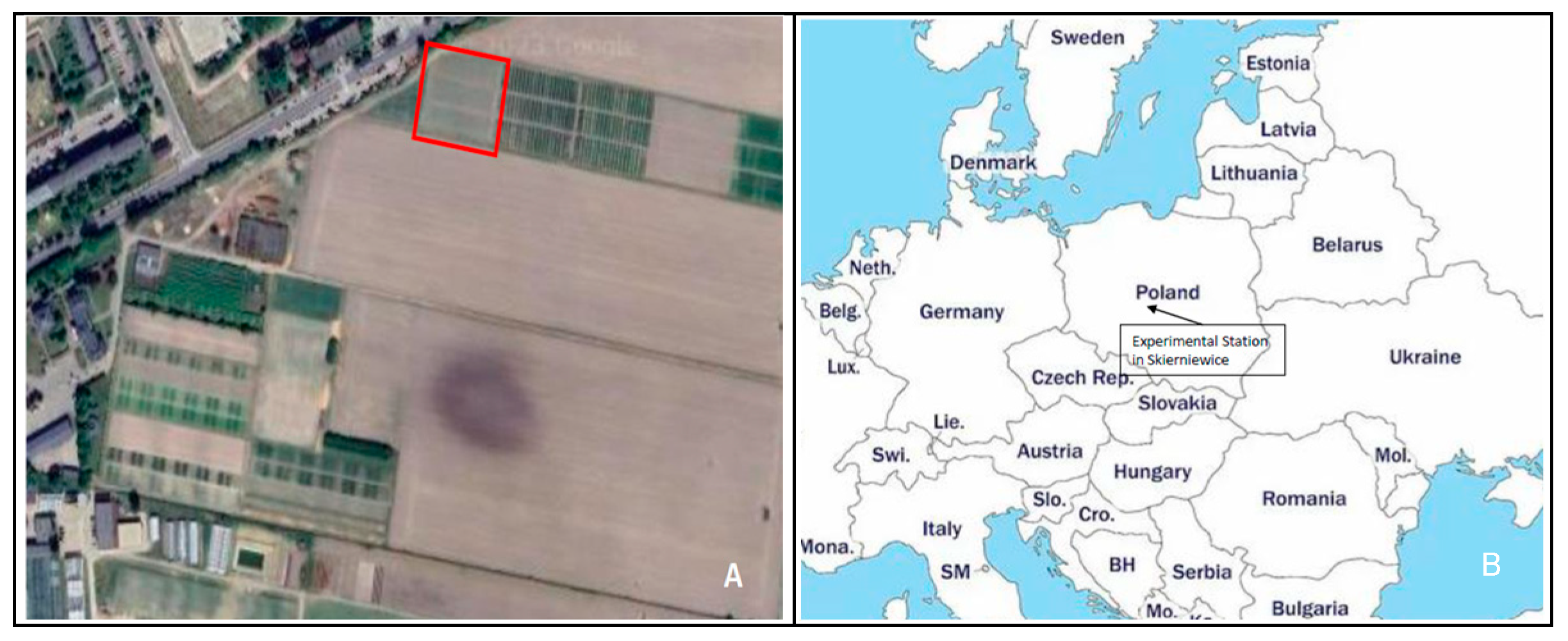
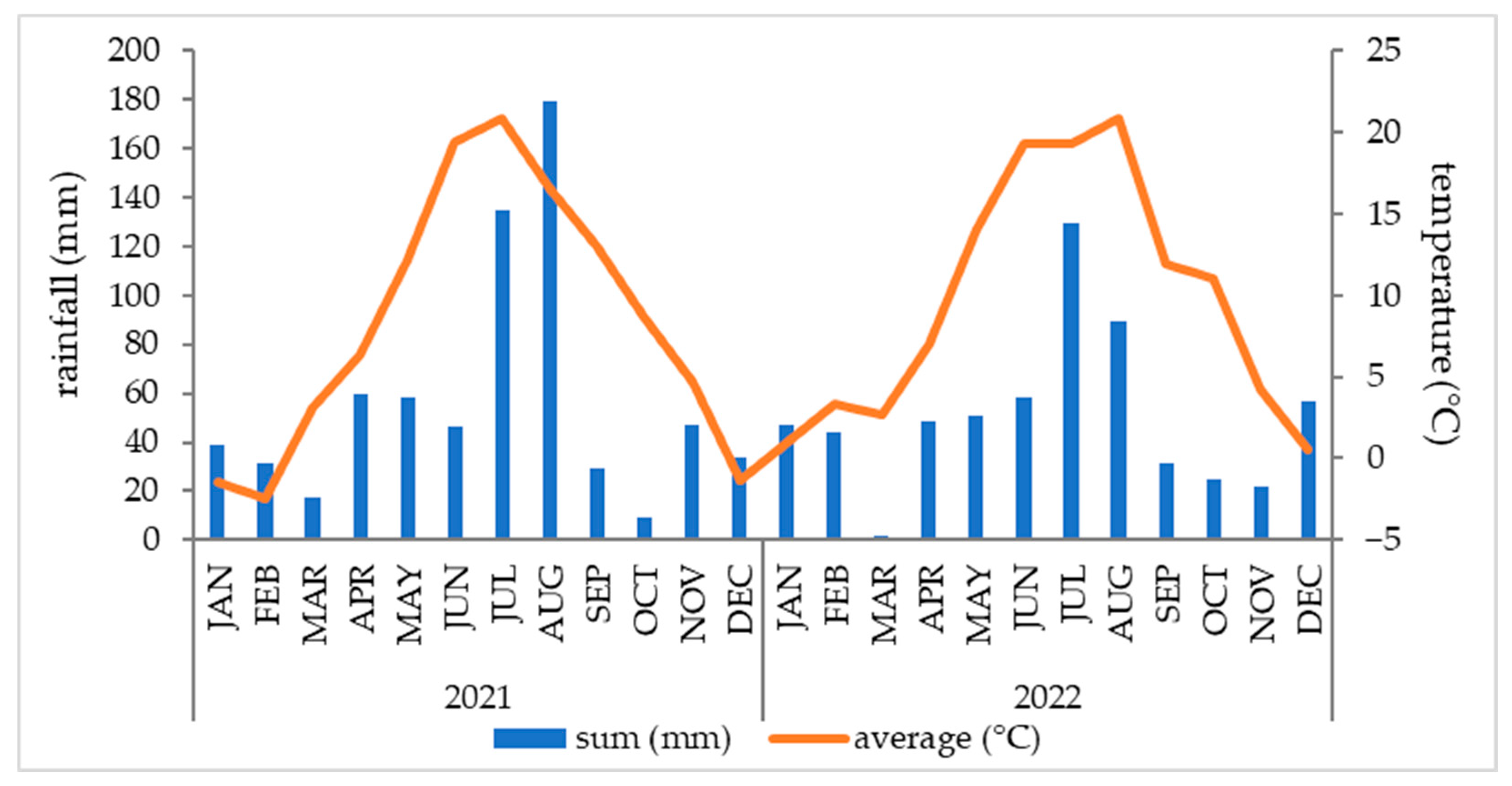
2.1. Study Area and Site Descriptions
2.2. Experimental Design
- -
- Control (fertilization 0 kg ha−1);
- -
- NPK (100 kg Nmin ha−1—CO(NH2)2, 35 kg P ha−1—Ca(H2PO4)2, and 100 kg K ha−1—KCl);
- -
- NPK + Si (100 kg Nmin ha−1—CO(NH2)2, 35 kg P∙ha−1—Ca(H2PO4)2, and 100 kg K ha−1—KCl and 139.8 g Si ha−1);
- -
- Compost170 (170 kg Norg ha−1, Table 2);
- -
- Compost170 + Si (170 kg Norg ha−1 and 139.8 g Si ha−1);
- -
- Compost120 + Nmin (120 kg Norg ha−1 and 30 kg Nmin ha−1);
- -
- Compost120 + Nmin + Si (120 kg Norg ha−1 and 30 kg Nmin ha−1 and 139.8 g Si ha−1).
2.3. Analyses
2.4. Calculations
- (1)
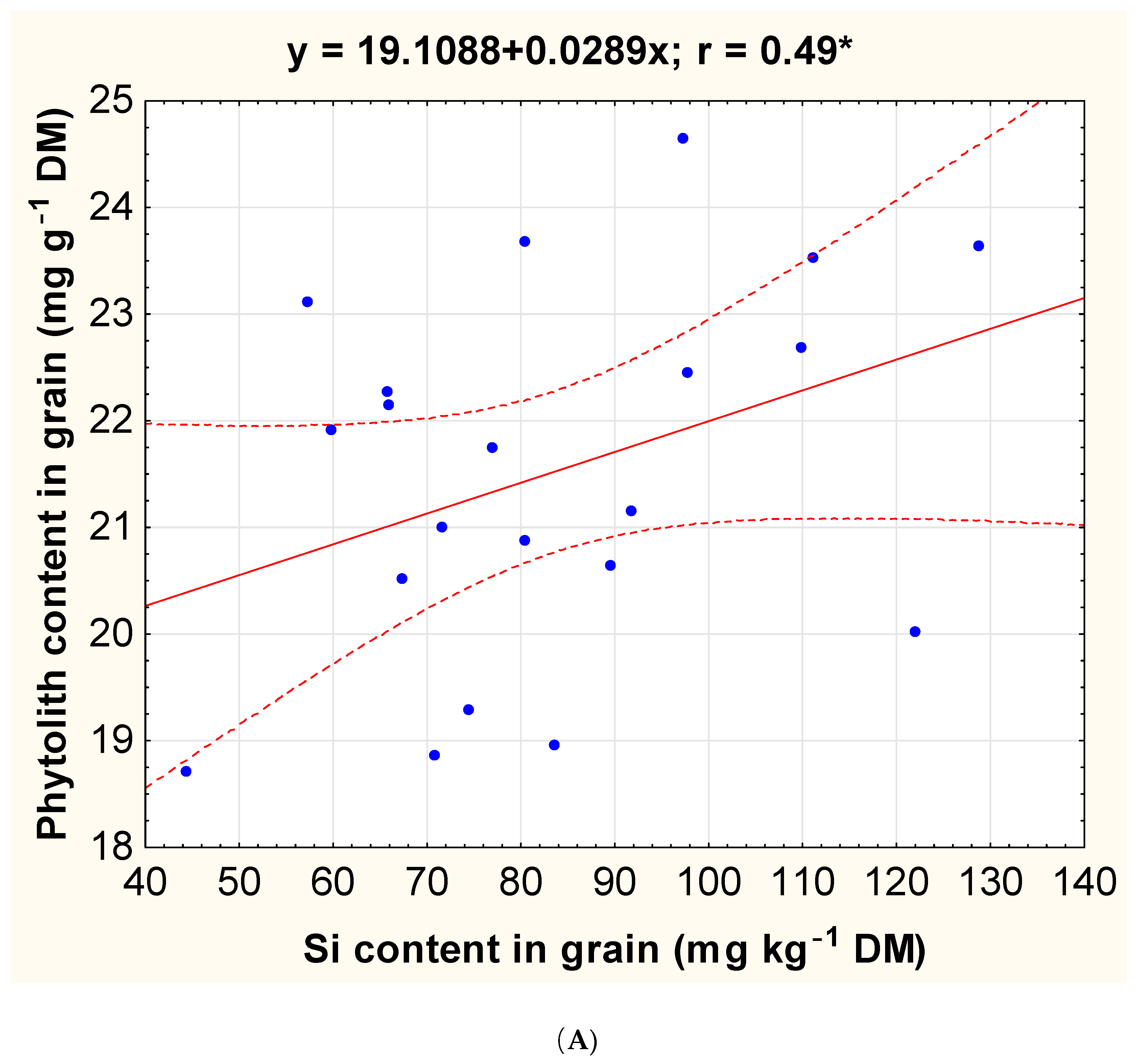
- The concentration of phytolith-occluded carbon (mg g−1 DM) was determined as the product of phytolith concentration and carbon concentration within phytoliths:where phytolith content refers to the mass of phytoliths per unit dry matter of plant material (mg g−1 DM), while carbon concentration in phytoliths indicates the amount of carbon contained in phytoliths per unit dry matter.PhytOC content of organ = phytolith content × carbon concentration in phytoliths
- (2)
- Annual phytolith accumulation in aboveground crop biomass, expressed as phytolith production flux (kg ha−1 year−1), was estimated by multiplying phytolith concentration by aboveground net primary productivity (ANPP):where phytolith content represents phytolith concentration in aboveground dry biomass (mg g−1 DM), and ANPP corresponds to crop aboveground biomass production per hectare per year (kg ha−1 year−1).Phytolith production flux = phytolith content × ANPP
- (3)
- Annual sequestration of carbon dioxide through PhytOC in aboveground biomass (kg CO2 ha−1 year−1) was calculated from phytolith production flux using the carbon-to-carbon dioxide conversion coefficient:where the phytolith production flux (kg ha−1 year−1) was derived using Equation (2), whereas PhytOC content refers to the amount of occluded carbon contained within phytoliths, expressed on a dry matter basis (mg g−1 DM); 44/12 is the molecular weight ratio of CO2/C to C used for conversion.PhytOC production flux = phytolith production flux × 44/12
2.5. Analysis of Experimental Data
3. Results
4. Discussion
5. Conclusions
Author Contributions
Funding
Institutional Review Board Statement
Informed Consent Statement
Data Availability Statement
Conflicts of Interest
References
- Liu, Z.; Deng, Z.; Davis, S.; Ciais, P. Monitoring global carbon emissions in 2022. Nat. Rev. Earth Environ. 2023, 4, 205–206. [Google Scholar] [CrossRef]
- Ritchie, H.; Roser, M.; Rosado, P. CO2 and Greenhouse Gas Emissions. 2020. Available online: https://ourworldindata.org/co2-and-greenhouse-gas-emissions (accessed on 5 March 2026).
- Ritchie, H. Global Inequalities in CO2 Emissions. 2023. Available online: https://ourworldindata.org/inequality-co2 (accessed on 5 March 2026).
- European Commission. The Share of Agri-Food Systems in Total Greenhouse Gas Emissions—Global, Regional and Country Trends—1990–2019. 2021. Available online: https://knowledge4policy.ec.europa.eu/publication/share-agri-food-systems-total-greenhouse-gas-emissions-global-regional-country-trends_en (accessed on 5 March 2026).
- Yan, M.; Zhang, X.; Jiang, Y.; Zhou, G. Effects of irrigation and plowing on soil carbon dioxide efflux in a poplar plantation chronosequence in northwest China. Soil Sci. Plant Nutr. 2011, 57, 466–474. [Google Scholar] [CrossRef]
- Buivydienė, A.; Deveikytė, I.; Veršulienė, A.; Feiza, V. The Influence of Cropping Systems and Tillage Intensity on Soil CO2 Exchange Rate. Sustainability 2024, 16, 3591. [Google Scholar] [CrossRef]
- Gerke, J. Reducing Greenhouse Gas Emissions from Arable Land and Grassland: The Case for Organic Farming—A Critical Review. Sustainability 2025, 17, 1886. [Google Scholar] [CrossRef]
- Wani, A.H.; Mir, S.H.; Kumar, S.; Malik, M.A.; Tyub, S.; Rashid, I. Silicon en route-from loam to leaf. Plant Growth Regul. 2023, 99, 465–476. [Google Scholar] [CrossRef]
- Parr, J.F.; Sullivan, L.A. Phytolith occluded carbon and silica variability in wheat cultivars. Plant Soil 2011, 342, 165–171. [Google Scholar] [CrossRef]
- Wenjuan, L.; Tan, L.; Peng, M.; Chen, H.; Tan, C.; Zhao, E.; Zhang, L.; Peng, H.; Liang, Y. The spatial distribution of phytoliths and phytolith-occluded carbon in wheat (Triticum aestivum L.) ecosystem in China. Sci. Total Environ. 2022, 850, 158005. [Google Scholar] [CrossRef]
- Xu, R.; Huang, J.; Guo, H.; Wang, C.; Zhan, H. Functions of silicon and phytolith in higher plants. Plant Signal. Behav. 2023, 8, e2198848. [Google Scholar] [CrossRef]
- Guo, F.; Song, Z.; Sullivan, L.; Wang, H.; Liu, X.; Wang, X.; Li, Z.; Zhao, Y. Enhancing phytolith carbon sequestration in rice ecosystems through basalt powder amendment. Sci. Bull. 2015, 60, 591–597. [Google Scholar] [CrossRef]
- Rehman, I.U.; Malik, M.A.; Rashid, I. Silicon Fertilization Increases Carbon Sequestration by Augmenting PhytOC Production in Wheat. J. Soil Sci. Plant Nutr. 2023, 23, 1149–1155. [Google Scholar] [CrossRef]
- Hodson, M. The Relative Importance of Cell Wall and Lumen Phytoliths in Carbon Sequestration in Soil: A Hypothesis. Front. Earth Sci. 2019, 7, 167. [Google Scholar] [CrossRef]
- Song, Z.; Liu, H.; Strömberg, C.A.; Yang, X.; Zhang, X. Phytolith carbon sequestration in global terrestrial biomes. Sci. Total Environ. 2017, 603, 502–509. [Google Scholar] [CrossRef]
- de Tombeur, F.; Hodson, M.J.; Saunders, M.; Clode, P.L. How important is carbon sequestration in phytoliths within the soil? Plant Soil 2024, 505, 185–198. [Google Scholar] [CrossRef]
- Song, Z.; McGrouther, K.; Wang, H. Occurrence, turnover and carbon sequestration potential of phytoliths in terrestrial ecosystems. Earth-Sci. Rev. 2016, 158, 19–30. [Google Scholar] [CrossRef]
- Liu, L.; Chang, S.X.; Huang, C.; Zhi, Y.; Jie, Y.; Yu, X.; Jiang, P. Enhancement of phytolith-occluded carbon accumulation of Moso bamboo response to temperatures elevation and different fertilization. Front. Plant Sci. 2023, 14, 1144961. [Google Scholar] [CrossRef]
- Rehman, I.U.; Rashid, I. Role of silicon in phytolith-occluded carbon (PhytOC) sequestration. Vegetos 2023, 37, 1221–1231. [Google Scholar] [CrossRef]
- Reyerson, P.E.; Alexandre, A.; Harutyunyan, A.; Corbineau, R.; Martinez De La Torre, H.A.; Badeck, F.; Cattivelli, L.; Santos, G.M. Unambiguous evidence of old soil carbon in grass biosilica particles. Biogeosciences 2016, 13, 1269–1286. [Google Scholar] [CrossRef]
- Katz, O.; Puppe, D.; Kaczorek, D.; Parkash, N.B.; Schaller, J. Silicon in the Soil–Plant Continuum: Intricate Feedback Mechanisms within Ecosystems. Plants 2021, 10, 652. [Google Scholar] [CrossRef] [PubMed]
- Szulc, W.; Rutkowska, B.; Hoch, M.; Ptasiński, D.; Kazberuk, W. Plant available silicon in differentiated fertilizing conditions. Plant Soil Environ. 2015, 65, 233–237. [Google Scholar] [CrossRef]
- Szulc, W.; Rutkowska, B.; Hoch, M.; Spychaj-Fabisisk, E.; Murawska, B. Exchangeable silicon content of soil in a long-term fertilization experiment. Plant Soil Environ. 2015, 61, 458–461. [Google Scholar] [CrossRef]
- Prabha, A.M.; Mary, P.C.N.; Saravana Pandian, P.; Sivakumar, T.; Shanthi, M. Sway of silicon fertilizers on carbon sequestration in maize crop ecosystem. J. Pharm. Innov. 2021, 10, 1219–1222. [Google Scholar]
- Khan, A.L. Silicon: A valuable soil element for improving plant growth and CO2 sequestration. J. Adv. Res. 2025, 71, 43–54. [Google Scholar] [CrossRef] [PubMed]
- Barão, L. The Use of Si-Based Fertilization to Improve Agricultural Performance. J. Soil Sci. Plant Nutr. 2023, 23, 1096–1108. [Google Scholar] [CrossRef]
- Li, Z.; Guo, F.; Cornelis, J.T.; Song, Z.; Wang, X.; Delvaux, B. Combined Silicon-Phosphorus Fertilization Affects the Biomass and Phytolith Stock of Rice Plants. Front. Plant Sci. 2020, 11, 67. [Google Scholar] [CrossRef]
- Huang, C.P.; Wang, L.; Gong, X.; Huang, Z.; Zhou, M.; Li, J.; Jiang, P. Silicon fertilizer and biochar effects on plant and soil PhytOC concentration and soil PhytOC stability and fractionation in subtropical bamboo plantations. Sci. Total Environ. 2020, 715, 136846. [Google Scholar] [CrossRef]
- Prabha, A.M.; Mary, P.C.N.; Saravana Pandian, P.; Sivakumar, T.; Shanthi, M. Silicon Fertilizer—An Imperative Source for Enhancing Yield and Phytolith Content of Maize Hybrid in Desilicated Soil (Typic Rhodustalf). Ecol. Environ. Conserv. 2022, 28, 879–885. [Google Scholar] [CrossRef]
- Song, Z.; Wu, Y.; Yang, Y.; Zhang, X.; Van Zwieten, L.; Bolan, N.; Wang, H. High potential of stable carbon sequestration in phytoliths of China’s grasslands. Glob. Change Biol. 2021, 28, 2736–2750. [Google Scholar] [CrossRef] [PubMed]
- IUSS Working Group WRB. World Reference Base for Soil Resources 2014, Update 2015. International Soil Classification System for Naming Soils and Creating Legends for Soil Maps; World Soil Resources Reports No. 106; FAO: Rome, Italy, 2015; Available online: https://www.fao.org/3/i3794en/I3794en.pdf (accessed on 14 August 2023).
- ISO 10390:2021; Soil, Treated Biowaste and Sludge—Determination of pH. International Organization for Standardization: Geneva, Switzerland, 2021. Available online: https://www.iso.org/standard/75243.html?utm (accessed on 5 March 2026).
- ISO 11261:1995; Soil Quality—Determination of Total Nitrogen Modified Kjeldahl Method. International Organization for Standardization: Geneva, Switzerland, 1995. Available online: https://www.iso.org/standard/19239.html?utm (accessed on 5 March 2026).
- ISO 10694:1995; Soil Quality. Determination of Organic and Total Carbon After Dry Combustion (Elementary Analysis). International Organization for Standardization: Geneva, Switzerland, 1995. Available online: https://www.iso.org/standard/18782.html?utm (accessed on 5 March 2026).
- Artyszak, A.; Gozdowski, D.; Siuda, A. Effect of the Application Date of Fertilizer Containing Silicon and Potassium on the Yield and Technological Quality of Sugar Beet Roots. Plants 2021, 10, 370. [Google Scholar] [CrossRef]
- PN-R-04020:1994/Az1:2004; Chemical and Agricultural Analysis-Determination of the Content Available Magnesium in Soil. Polish Committee for Standardization: Warsaw, Poland, 2004. Available online: https://sklep.pkn.pl/pn-r-04020-1994-az1-2004p.html (accessed on 5 March 2026).
- Datnoff, L.E.; Snyder, G.H.; Korndörfer, G.H. (Eds.) Silicon in Agriculture; Elsevier Science: Amsterdam, The Netherlands, 2001; Available online: https://shop.elsevier.com/books/silicon-in-agriculture/datnoff/978-0-444-50262-9 (accessed on 5 March 2026).
- Klute, A. (Ed.) Methods of Soil Analysis. Part 1: Physical and Mineralogical Methods; American Society of Agronomy—Soil Science Society of America: Madison, WI, USA, 1986; Available online: https://acsess.onlinelibrary.wiley.com/doi/book/10.2136/sssabookser5.1.2ed (accessed on 5 March 2026).
- Sparks, D.L. (Ed.) Methods of Soil Analysis. Part 3: Chemical Methods; Soil Science Society of America: Madison, WI, USA, 1996; Available online: https://acsess.onlinelibrary.wiley.com/doi/book/10.2136/sssabookser5.3 (accessed on 5 March 2026).
- Li, Z.; Song, Z.; Parr, J.F.; Wang, H. Occluded C in rice phytoliths: Implications to biogeochemical carbon sequestration. Plant Soil 2013, 370, 615–623. [Google Scholar] [CrossRef]
- Yang, Y.; Wang, F.; Jin, J.; Hu, S.; Gao, Y. Carbon storage potential and seasonal dynamics of phytolith from different vegetation types in a subtropical region, China. Environ. Sci. Pollut. Res. 2019, 26, 29834–29844. [Google Scholar] [CrossRef] [PubMed]
- Liu, L.; Wang, L.; Song, L.; Sheng, M. Carbon sequestration law by phytoliths in the bamboo forests: Insights for the management of phytolith carbon sink. Glob. Ecol. Conserv. 2025, 58, e03491. [Google Scholar] [CrossRef]
- Walkley, A.; Black, I.A. An examination of the Degtjareff method for determining soil organic matter, and a proposed modification of the chromic acid titration method. Soil Sci. 1934, 37, 29–38. [Google Scholar] [CrossRef]
- Stephano, M.F.; Geng, Y.; Cao, G.; Wang, L.; Meng, W.; Meiling, Z. Effect of Silicon Fertilizer and Straw Return on the Maize Yield and Phosphorus Efficiency in Northeast China. Commun. Soil Sci. Plant Anal. 2021, 52, 116–127. [Google Scholar] [CrossRef]
- Anjum, M.; Prakash, N.B. Production of phytolith and PhytOC and distribution of extractable Si pools in aerobic rice as influenced by different Si sources. Front. Plant Sci. 2023, 14, 1146416. [Google Scholar] [CrossRef]
- Chen, Y.; He, D.; Wu, H.; Li, Y.; Li, P.; Huang, H.; Liao, X.; Qiu, Q.; Liu, J.; Liu, Y.; et al. Silicon fertilizer application increases the terrestrial carbon pool by enhancing plant productivity and soil carbon storage. Geoderma 2024, 442, 116806. [Google Scholar] [CrossRef]
- Majumdar, S.; Prakash, N.B. Relationship of Properties of Rice and Sugarcane Soils and Plant Available Silicon in Karnataka, South India. Silicon 2022, 14, 5647–5660. [Google Scholar] [CrossRef]
- Li, W.; Tan, L.; Zhang, N.; Chen, H.; Fan, X.; Miao, P.; Ye, M.; Yan, G.; Peng, H.; Nikolic, N.; et al. Phytolith-occluded carbon in residues and economic benefits under rice/single-season Zizania latifolia rotation. Sci. Total Environ. 2022, 836, 155504. [Google Scholar] [CrossRef]
- McCarty, J.S.; Sharma, N.; Kumar, R.; Lalrammawii, C.; Dwivedi, N.; Srivastava, H.; Farooq, F.; Mehta, S. Impact of silicon fertilization on crop growth, productivity and nutrients enhancement in rice: A review. Plant Sci. 2025, 12, 1. [Google Scholar] [CrossRef]
- Sun, X.; Liu, Q.; Tang, T.; Chen, X.; Luo, X. Silicon Fertilizer Application Promotes Phytolith Accumulation in Rice Plants. Front. Plant Sci. 2019, 10, 425. [Google Scholar] [CrossRef]
- Davamani, V.; Piriya, R.S.; Rakesh, S.S.; Parameswari, E.; Sebastian, S.P.; Kalaiselvi, P.; Maheswari, M.; Santhi, R. Phytolith-occluded carbon sequestration potential of oil palm plantation in Tamil Nadu. ACS Omega 2022, 7, 2809–2820. [Google Scholar] [CrossRef] [PubMed]
- Qi, L.; Sun, T.; Guo, X.; Guo, Y.; Li, F.Y. Phytolith-occluded carbon sequestration potential in three major steppe types along a precipitation gradient in Northern China. Ecol. Evol. 2021, 11, 1085–1475. [Google Scholar] [CrossRef]
- Rajendiran, S.; Vassanda Coumar, M.; Kundu Ajay, S.; Dotaniya, M.L.; Subba Rao, A. Role of Phytolith Occluded Carbon of Crop Plants for Enhancing Soil Carbon Sequestration in Agro-Ecosystems. Cur. Sci. 2012, 103, 911–920. [Google Scholar]
- Malik, M.A.; Wani, A.H.; Mir, S.H.; Rehman, I.U.; Tahir, I.; Ahmad, P.; Rashid, I. Elucidating the role of silicon in drought stress tolerance in plants. Plant Physiol. Biochem. 2021, 165, 187–195. [Google Scholar] [CrossRef] [PubMed]
- Parr, J.; Sullivan, L.; Quirck, R. Sugarcane phytoliths: Encapsulation and sequestration of a long-lived carbon fraction. Sugar Tech 2009, 11, 17–21. [Google Scholar] [CrossRef]
- Lv, W.; Zhou, G.; Chen, G.; Zhou, Y.; Ge, Z.; Niu, Z.; Shi, Y. Effects of different management practices on the increase in phytolith-occluded carbon in Moso bamboo forests. Front. Plant Sci. 2020, 11, 591852. [Google Scholar] [CrossRef]
- Rutkowska, B.; Schröder, P.; Mench, M.; Rineau, F.; Szulc, W.; Szulc, W.; Pobereżny, J.; Tiideberg, K.; Niedziński, T.; Loit, E. Role of phytolith occluded carbon of cereales plants for climate change mitigation. J. Water Land Dev. 2024, 60, 50–58. [Google Scholar] [CrossRef]
- Qiu, S.; Yang, H.; Zhang, S.; Huang, S.; Zhao, S.; Xu, X.; He, P.; Zhou, W.; Zhao, Y.; Yan, N.; et al. Carbon storage in an arable soil combining field measurements, aggregate turnover modeling and climate scenarios. CATENA 2023, 220, 106708. [Google Scholar] [CrossRef]
- Chen, Y.; Zhao, X.; Zhang, J.; Wang, H.; Ye, Z.; Ma, W.; Mao, R.; Zhang, S.; Dahlgren, R.A.; Gao, H.; et al. Combined application of nitrate and schwertmannite promotes As(III) immobilization and greenhouse gas emission reduction in flooded paddy fields. J. Environ. Chem. Eng. 2025, 13, 119845. [Google Scholar] [CrossRef]



| Properties * | Unit | Content |
|---|---|---|
| Soil texture 1 | % | sand 76, silt 8, clay 16 |
| pH 2 | - | 4.75 |
| Total nitrogen (TN) 3 | g kg−1 | 0.76 |
| Total organic carbon (TOC) 4 | g kg−1 | 8.40 |
| P available 5 | mg kg−1 | 38.57 |
| K available 5 | mg kg−1 mg | 70.60 |
| Mg available 6 | kg−1 | 26.10 |
| Control | Compost170 | NPK + Si | Compost170 + Si | NPK | Compost120 + Nmin | Compost120 | Compost120 + Nmin + Si |
|---|---|---|---|---|---|---|---|
| Compost120 | Compost120 + Nmin | Control | NPK | Compost170 + Si | NPK + Si | Compost120 + Nmin + Si | Compost170 |
| Compost170 | Compost170 + Si | Compost120 | NPK + Si | Compost120 + Nmin + Si | Control | NPK | Compost120 + Nmin |
| pH | Corg | Si | N | S | P | Na | Ca | Mg | K |
|---|---|---|---|---|---|---|---|---|---|
| 6.7 | 158.7 | 40.2 | 12.8 | 1.49 | 11.05 | 1.02 | 84.6 | 5.4 | 10.7 |
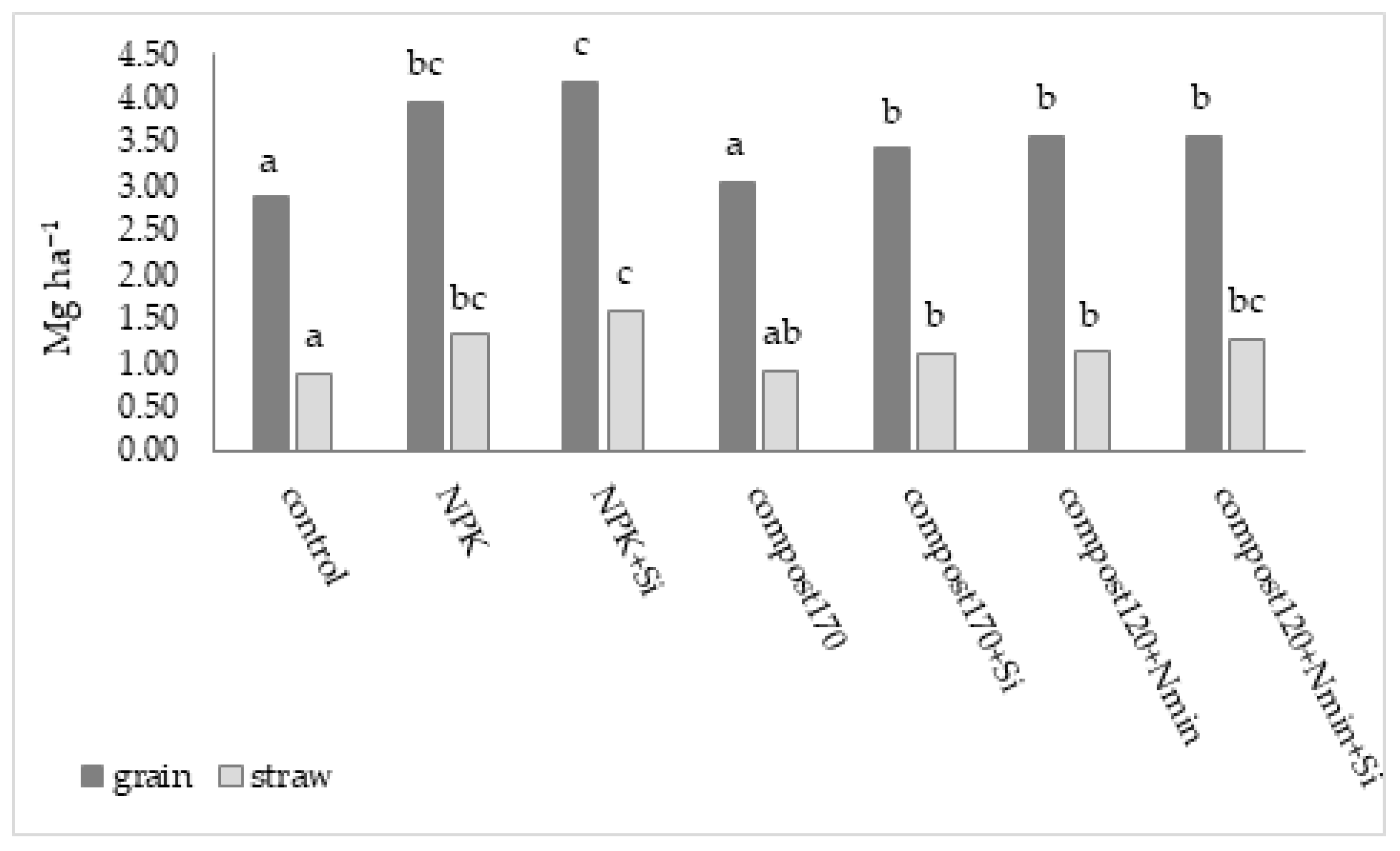
| Treatment | GRAIN—Phytoliths | GRAIN— C Occluded in Phytoliths | GRAIN— PhytOC Yield | STRAW— Phytoliths | STRAW— C Occluded in Phytoliths | STRAW— PhytOC Yield | GRAIN + STRAW Total PhytOC Yield | ||||
|---|---|---|---|---|---|---|---|---|---|---|---|
| mg g−1 DM | mg g−1 * | mg g−1 DM | G ** | kg CO2 eq ha−1 | mg g−1 DM | mg g−1 * | mg g−1 DM | G ** | kg CO2 eq ha−1 | kg CO2 eq ha−1 | |
| 1. Control | 22.38 b | 8.97 d | 0.201 c | 0.576 b | 2.11 ab | 63.72 b | 48.83 a | 3.11 b | 2.74 a | 10.04 a | 12.15 a |
| 2. NPK | 20.16 a | 5.96 a | 0.120 a | 0.476 a | 1.74 a | 73.01 d | 46.97 a | 3.43 c | 4.49 d | 16.47 d | 18.22 d |
| 3. NPK + Si | 20.45 a | 7.42 c | 0.152 b | 0.635 c | 2.33 b | 66.45 c | 52.04 a | 3.46 c | 5.50 e | 20.16 e | 22.49 e |
| 4. Compost170 | 20.75 a | 10.21 e | 0.222 d | 0.680 c | 2.49 b | 52.53 a | 46.30 a | 2.68 a | 2.44 a | 8.95 a | 11.44 a |
| 5. Compost170 + Si | 21.73 ab | 7.85 c | 0.163 bc | 0.558 b | 2.05 a | 57.70 a | 51.06 a | 2.67 a | 2.94 a | 10.77 b | 12.82 a |
| 6. Compost120 + Nmin | 21.51 ab | 6.97 b | 0.150 b | 0.534 b | 1.96 a | 62.71 b | 48.46 a | 3.30 b | 3.70 b | 13.56 c | 15.51 b |
| 7. Compost120 + Nmin + Si | 22.79 b | 6.01 a | 0.137 a | 0.502 a | 1.84 a | 64.43 bc | 52.65 a | 3.12 b | 4.00 c | 14.66 d | 16.49 c |
| Mean | 21.40 ± 0.92 # | 7.63 ± 1.43 | 0.164 ± 0.03 | 0.566 ± 0.07 | 2.07 ± 0.24 | 62.94 ± 6.05 | 49.47 ± 2.29 | 3.11 ± 0.30 | 3.69 ± 1.02 | 13.52 ± 3.68 | 15.59 ± 3.63 |
Disclaimer/Publisher’s Note: The statements, opinions and data contained in all publications are solely those of the individual author(s) and contributor(s) and not of MDPI and/or the editor(s). MDPI and/or the editor(s) disclaim responsibility for any injury to people or property resulting from any ideas, methods, instructions or products referred to in the content. |
© 2026 by the authors. Licensee MDPI, Basel, Switzerland. This article is an open access article distributed under the terms and conditions of the Creative Commons Attribution (CC BY) license.
Share and Cite
Szulc, W.P.; Szymański, M.; Szulc, W.; Wszelaczyńska, E.; Pobereżny, J.; Rutkowska, B. Enhancing Carbon Sequestration in Barley via Silicon-Induced Phytolith Accumulation for Climate Change Mitigation. Sustainability 2026, 18, 3403. https://doi.org/10.3390/su18073403
Szulc WP, Szymański M, Szulc W, Wszelaczyńska E, Pobereżny J, Rutkowska B. Enhancing Carbon Sequestration in Barley via Silicon-Induced Phytolith Accumulation for Climate Change Mitigation. Sustainability. 2026; 18(7):3403. https://doi.org/10.3390/su18073403
Chicago/Turabian StyleSzulc, Wiesław Piotr, Maciej Szymański, Witold Szulc, Elżbieta Wszelaczyńska, Jarosław Pobereżny, and Beata Rutkowska. 2026. "Enhancing Carbon Sequestration in Barley via Silicon-Induced Phytolith Accumulation for Climate Change Mitigation" Sustainability 18, no. 7: 3403. https://doi.org/10.3390/su18073403
APA StyleSzulc, W. P., Szymański, M., Szulc, W., Wszelaczyńska, E., Pobereżny, J., & Rutkowska, B. (2026). Enhancing Carbon Sequestration in Barley via Silicon-Induced Phytolith Accumulation for Climate Change Mitigation. Sustainability, 18(7), 3403. https://doi.org/10.3390/su18073403