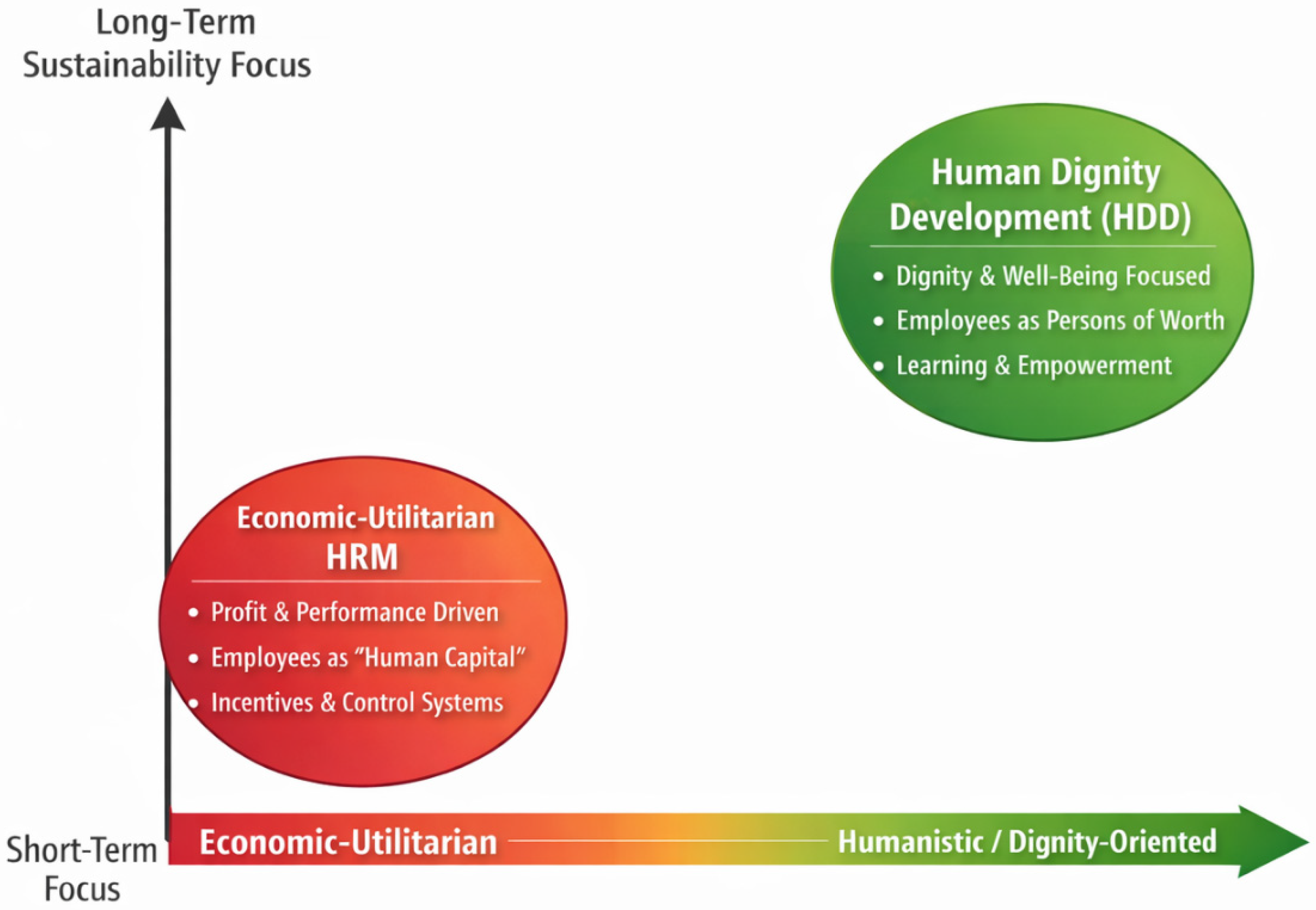
A Human Dignity Perspective on Sustainable Human Resource Management: From Utilitarian to Dignified Approaches


Abstract
1. Introduction
2. Theoretical Development
2.1. Dignity and Sustainable Human Resource Management
2.2. An Alternative to Contemporary Sustainable HRM
2.3. Human Dignity as an Alternative
2.4. Dignity and Sustainable HRM
2.5. Core Assumptions
2.6. Principles
2.7. Starting Point
2.8. Focus
2.9. Theories and Models
2.10. Topics
3. Sustainable HRM Practices in a Dignity Paradigm
3.1. Recruitment, Selection and Long-Term Employability
3.2. Training and Development
3.3. Performance Management
3.4. Reward Distribution
3.5. Involvement and Participation
3.6. Exit
3.7. Outcomes
3.8. Dignity in Context
4. Implications of Dignity for Sustainable HRM
4.1. Practical Implications
4.2. Research Implications
5. Conclusions
Author Contributions
Funding
Institutional Review Board Statement
Informed Consent Statement
Data Availability Statement
Conflicts of Interest
Abbreviations
| HRM | Human Resource Management |
| HDD | Human Dignity Development |
| SDG | Sustainable Development Goal |
| CSR | Corporate Social Responsibility |
References
- Blühdorn, I. Post-capitalism, post-growth, post-consumerism? Eco-political hopes beyond sustainability. Glob. Discourse 2017, 7, 42–61. [Google Scholar] [CrossRef]
- Byrd, M.Y. Does HRD have a moral duty to respond to matters of social injustice? Hum. Resour. Dev. Int. 2018, 21, 3–11. [Google Scholar] [CrossRef]
- Bal, P.M.; Dóci, E. Neoliberal ideology in work and organizational psychology. Eur. J. Work. Organ. Psychol. 2018, 27, 536–548. [Google Scholar] [CrossRef]
- Alhnaity, R. The Impact of International Employment Agreements for Migrant and Syrian Refugee Workers on the Jordanian Workforce: The Role of Human Resources Management in Providing Decent Working Conditions. Ph.D. Thesis, University of Lincoln, Lincoln, UK, 2023. [Google Scholar]
- Ping Hung Li, E.; Qi, X.Z.; Taji, A.; Man-Lok Lam, M. Corporate Social Responsibility (CSR), Environmental, Social, and Governance (ESG), and Sustainability Development Goals (SDGs) as ideological apparatuses: Sustainability and the new hegemony in emerging markets. Manag. Learn. 2025, 13505076251380390. [Google Scholar] [CrossRef]
- Bal, M.; Brookes, A. How sustainable is human resource management really? An argument for radical sustainability. Sustainability 2022, 14, 4219. [Google Scholar] [CrossRef]
- Bal, P.M.; De Jong, S.B. From human resource management to human dignity development: A dignity perspective on HRM and the role of workplace democracy. In Dignity and the Organization; Palgrave Macmillan UK: London, UK, 2016; pp. 173–195. [Google Scholar]
- Kostera, M.; Pirson, M. (Eds.) Dignity and the Organization; Palgrave Macmillan UK: London, UK, 2017. [Google Scholar]
- Mitchell, L. Rethinking Dignity in the Workplace: A Relational Approach; Routledge: London, UK, 2025. [Google Scholar]
- Fukuda-Parr, S. The human development paradigm: Operationalizing Sen’s ideas on capabilities. Fem. Econ. 2003, 9, 301–317. [Google Scholar] [CrossRef]
- Nussbaum, M.C. Capabilities as Fundamental Entitlements: Sen and Social Justice. Fem. Econ. 2003, 9, 33–59. [Google Scholar] [CrossRef]
- Macke, J.; Genari, D. Systematic literature review on sustainable human resource management. J. Clean. Prod. 2019, 208, 806–815. [Google Scholar] [CrossRef]
- Bierema, L.L. Critiquing human resource development’s dominant masculine rationality and evaluating its impact. Hum. Resour. Dev. Rev. 2009, 8, 68–96. [Google Scholar] [CrossRef]
- Ul-Haq, S. Spiritual development and meaningful work: A Habermasian critique. Hum. Resour. Dev. Int. 2020, 23, 125–145. [Google Scholar] [CrossRef]
- Warhurst, R.P.; Black, K. Meaning in mentoring: More than meets the eye/“I”. Hum. Resour. Dev. Rev. 2019, 18, 349–375. [Google Scholar] [CrossRef]
- Thomas, B.; Lucas, K. Development and validation of the workplace dignity scale. Group Organ. Manag. 2019, 44, 72–111. [Google Scholar] [CrossRef]
- Bierema, L.L.; D’abundo, M.L. HRD with a conscience: Practicing socially responsible HRD. Int. J. Lifelong Educ. 2004, 23, 443–458. [Google Scholar] [CrossRef]
- Bierema, L.L. Critical human development to enhance reflexivity, change discourse, and adopt a call-to-action. Hum. Resour. Dev. Rev. 2015, 14, 119–124. [Google Scholar] [CrossRef]
- Stewart, J.; Callahan, J.; Rigg, C.; Sambrook, S.; Trehan, K. Realizing the critical in CHRD: Strategies for research and practice. Hum. Resour. Dev. Int. 2014, 17, 379–383. [Google Scholar] [CrossRef]
- Hassard, J.; Wolfram Cox, J. Can sociological paradigms still inform organizational analysis? A paradigm model for post-paradigm times. Organ. Stud. 2013, 34, 1701–1728. [Google Scholar] [CrossRef]
- Shuck, B.; Collins, J.C.; Rocco, T.S.; Diaz, R. Deconstructing the privilege and power of employee engagement: Issues of inequality for management and human resource development. Hum. Resour. Dev. Rev. 2016, 15, 208–229. [Google Scholar] [CrossRef]
- Melé, D. The firm as a “community of persons”: A pillar of humanistic business ethos. J. Bus. Ethics 2012, 106, 89–101. [Google Scholar] [CrossRef]
- Bal, M. Dignity in the Workplace: New Theoretical Perspectives; Springer: Amsterdam, The Netherlands, 2017. [Google Scholar]
- Farquhar, H. Migration with dignity: Towards a New Zealand response to climate change displacement in the pacific. Vic. Univ. Wellingt. Law Rev. 2015, 46, 29. [Google Scholar] [CrossRef]
- Dawson, M. Late Modernity, Individualization and Socialism: An Associational Critique of Neoliberalism; Springer: Amsterdam, The Netherlands, 2013. [Google Scholar]
- Harvey, D. A Brief History of Neoliberalism; Oxford University Press: Oxford, UK, 2005. [Google Scholar]
- Peck, J.; Theodore, N.; Brenner, N. Postneoliberalism and its malcontents. Antipode 2010, 41, 94–116. [Google Scholar] [CrossRef]
- Syed, J.; Metcalfe, B.D. Under western eyes: A transnational and postcolonial perspective of gender and HRD. Hum. Resour. Dev. Int. 2017, 20, 403–414. [Google Scholar] [CrossRef]
- Guest, D.E. Human resource management—The workers’ verdict. Hum. Resour. Manag. J. 1999, 9, 5. [Google Scholar] [CrossRef]
- Storey, J. From personnel management to HRM: The implications for teaching. ASIA Pac. J. Hum. Resour. 1996, 33, 4–14. [Google Scholar] [CrossRef]
- Legge, K. What is Human resource management? In Human Resource Management: Rhetorics and Realities; Macmillan Education UK: London, UK, 1995. [Google Scholar]
- Brown, T. Sustainability as empty signifier: Its rise, fall, and radical potential. Antipode 2016, 48, 115–133. [Google Scholar] [CrossRef]
- Thompson, P. The trouble with HRM. Hum. Resour. Manag. J. 2011, 21, 355–367. [Google Scholar] [CrossRef]
- Baek, P.; Kim, N. Exploring a theoretical foundation for HRD in society: Toward a model of stakeholder-based HRD. Hum. Resour. Dev. Int. 2014, 17, 499–513. [Google Scholar] [CrossRef]
- Becker, W.S.; Carbo, J.A.; Langella, I.M. Beyond self-interest: Integrating social responsibility and supply chain management with human resource development. Hum. Resour. Dev. Rev. 2010, 9, 144–168. [Google Scholar] [CrossRef]
- Rosen, M. Dignity: Its History and Meaning; Harvard University Press: Boston, MA, USA, 2012. [Google Scholar]
- Barresi, J. On seeing our selves and others as persons. New Ideas Psychol. 2012, 30, 120–130. [Google Scholar] [CrossRef]
- Mendy, J. Rethinking the contribution of organizational change to the teaching and learning of organizational behaviour and human resource management: The quest for balance. In Research Anthology on Digital Transformation, Organizational Change, and the Impact of Remote Work; IGI Global: Hershey, PA, USA, 2021; pp. 93–115. [Google Scholar]
- Donaldson, T.; Walsh, J.P. Toward a theory of business. Res. Organ. Behav. 2015, 35, 181–207. [Google Scholar] [CrossRef]
- Ajari, N. Dignity or Death: Ethics and Politics of Race; John Wiley & Sons: Hoboken, NJ, USA, 2022. [Google Scholar]
- McGowan, T. Capitalism and Desire: The Psychic Cost of Free Markets; Columbia University Press: New York, NY, USA, 2016. [Google Scholar]
- Lucas, K. Workplace dignity: Communicating inherent, earned, and remediated dignity. J. Manag. Stud. 2015, 52, 621–646. [Google Scholar] [CrossRef]
- Kant, I. Groundwork of the Metaphysics of Morals; 1785/2012; Cambridge University Press: Cambridge, UK, 2013. [Google Scholar]
- Hassan, A. Human resource development and organizational values. J. Eur. Ind. Train. 2007, 31, 435–448. [Google Scholar] [CrossRef]
- Cooper, R. Peripheral vision: Relationality. Organ. Stud. 2005, 26, 1689–1710. [Google Scholar] [CrossRef]
- Mendy, J. Employees’ witnessed presence in changing organisations. AI Soc. 2012, 27, 149–156. [Google Scholar] [CrossRef]
- Lawless, A.; Sambrook, S.; Stewart, J. Critical human resource development: Enabling alternative subject positions within a master of arts in human resource development educational programme. Hum. Resour. Dev. Int. 2012, 15, 321–336. [Google Scholar] [CrossRef]
- Kuchinke, K.P. Human development as a central goal for human resource development. Hum. Resour. Dev. Int. 2010, 13, 575–585. [Google Scholar] [CrossRef]
- Huijser, D.; Nullens, P. An Anatomy of Human Dignity; Dissecting the Heart of Humanistic Management. Humanist. Manag. J. 2024, 9, 203–230. [Google Scholar] [CrossRef]
- Narayanan, A.; Rajithakumar, S.; Menon, M. Talent management and employee retention: An integrative research framework. Hum. Resour. Dev. Rev. 2019, 18, 228–247. [Google Scholar] [CrossRef]
- Kilroy, R. A theatre of shadows: Saving, critiquing, psychoanalyzing Žižek. Int. J. Žižek Stud. 2019, 13, 1–36. [Google Scholar]
- Lamers, L.; Meijerink, J.; Jansen, G.; Boon, M. A capability approach to worker dignity under algorithmic management. Ethics Inf. Technol. 2022, 24, 10. [Google Scholar] [CrossRef]
- Tilton, J.; Lucas, K.; Kish-Gephart, J.J.; Kent, J.K. Enduring, strategizing, and rising above: Workplace dignity threats and responses across job levels. J. Bus. Ethics 2024, 195, 353–374. [Google Scholar] [CrossRef]
- Suzman, J. Affluence Without Abundance: The Disappearing World of the Bushmen; Bloomsbury Publishing: New York, NY, USA, 2017. [Google Scholar]
- Laaser, K.; Bolton, S. Absolute autonomy, respectful recognition and derived dignity: Towards a typology of meaningful work. Int. J. Manag. Rev. 2022, 24, 373–393. [Google Scholar] [CrossRef]
- Sheehan, M.; Garavan, T.N.; Carbery, R. Innovation and human resource development (HRD). Eur. J. Train. Dev. 2013, 38, 2–14. [Google Scholar] [CrossRef]
- Lucas, K.; Manikas, A.S.; Mattingly, E.S.; Crider, C.J. Engaging and misbehaving: How dignity affects employee work behaviors. Organ. Stud. 2017, 38, 1505–1527. [Google Scholar] [CrossRef]
- Landemore, H.; Ferreras, I. In defense of workplace democracy: Towards a justification of the firm–state analogy. Political Theory 2016, 44, 53–81. [Google Scholar] [CrossRef]
- Aust, I.; Muller-Camen, M.; Poutsma, E. 19. Sustainable HRM: A comparative and international perspective. In Handbook of Research on Comparative Human Resource Management; Edward Elgar: Cheltenham, UK, 2018; p. 358. [Google Scholar]
- Kramar, R. Beyond strategic human resource management: Is sustainable human resource management the next approach? Int. J. Hum. Resour. Manag. 2014, 25, 1069–1089. [Google Scholar] [CrossRef]
- Anderson, V. Human resource development and sustainability. In Ethics and Human Resource Development: Societal and Organizational Contexts; Springer International Publishing: Cham, Switzerland, 2024; pp. 203–229. [Google Scholar]
- Garavan, T.N.; McGuire, D.; Lee, M. Reclaiming the “D” in HRD: A typology of development conceptualizations, antecedents, and outcomes. Hum. Resour. Dev. Rev. 2015, 14, 359–388. [Google Scholar] [CrossRef]
- Allen, T.D.; Smith, M.A.; Mael, F.A.; Gavan O’Shea, P.; Eby, L.T. Organization-level mentoring and organizational performance within substance abuse centers. J. Manag. 2009, 35, 1113–1128. [Google Scholar] [CrossRef]
- Matthew, R.A.; Bransburg, V. Democratizing caring labor: The promise of community-based, worker-owned childcare cooperatives. Affilia 2017, 32, 10–23. [Google Scholar] [CrossRef]
- Sambrook, S. Critical HRD: A concept analysis. Pers. Rev. 2008, 38, 61–73. [Google Scholar] [CrossRef]
- Buchner, T.W. Performance management theory: A look from the performer’s perspective with implications for HRD. Hum. Resour. Dev. Int. 2007, 10, 59–73. [Google Scholar] [CrossRef]
- McDonald, K.S.; Hite, L.M. Conceptualizing and creating sustainable careers. Hum. Resour. Dev. Rev. 2018, 17, 349–372. [Google Scholar] [CrossRef]
- Killmister, S. Dignity: Not such a useless concept. J. Med. Ethics 2010, 36, 160–164. [Google Scholar] [CrossRef]


| Paradigm | ||
|---|---|---|
| Elements | Human Dignity | |
| Societal Level | Responsibility of the state | Protection of the dignity of the most vulnerable in society |
| Income and employment security | ||
| Universal health care | ||
| Education | ||
| Decent work | ||
| Collective representation (political and trade unions) | ||
| Responsibility of the individual | Struggle for dignity | |
| Democratic citizenship | ||
| Organizational Level | Organization | Decent work |
| Community and democracy | ||
| Governance | Stakeholder-based governance | |
| Management | Respecting, protecting and promoting the inherent dignity of workers | |
| Recognizing the earned dignity of workers | ||
| Goals | Participation and meaning | |
| Time perspective | Short and long term | |
| Outcomes | Dignity protection and promotion | |
| Individual Level | Philosophy | Inherent and earned human dignity |
| Goals | Living to one’s capabilities | |
| Disposition | Relational and divided |
| Theoretical Perspective | |
|---|---|
| Elements | Human Dignity in Sustainable HRM |
| Aspect | |
| Core assumptions | Intrinsic worth |
| Autonomy | |
| Respect, protection and promotion of dignity | |
| Principles | Cooperation |
| Relational | |
| Starting Point | Sustainable HRM has intrinsic meaning |
| People have inherent dignity | |
| Focus | Individual human being within a community |
| Theories and Models | Sustainability theory |
| Workplace dignity theory | |
| Psychoanalytic theory | |
| Topics | Involvement and meaning |
| Dignity violation | |
| Resistance | |
| Parallax view | |
| Recruitment, Selection and Long-term Employability | No job applications with the exclusive aim of excluding applicants |
| Open hiring | |
| Respecting the dignity of applicants | |
| Democratic hiring and selection processes | |
| Hiring and selection practices organized beyond organizations | |
| Training and Development | Training and developing people for long-term future, beyond current job and organization |
| Training and developing for capability development | |
| Participatory development systems | |
| Mentoring for dignity | |
| Workers training each other | |
| Access to training is amplified | |
| Performance Management | Performance requirements are democratically negotiated |
| Performance is inherently tied to decent work experiences | |
| Performance is evaluated inversely and in democratic ways | |
| Reward Distribution | Rewards are democratically negotiated |
| Any increase in rewards has to be conducted with special attention to the lowest pay scales | |
| Upper limits are set for salaries in organizations | |
| Financial savings are made for economically difficult times | |
| Involvement and Participation | Democratic principles govern organizational life |
| Workers can directly or indirectly participate through direct or representative democracy | |
| Empowerment | |
| Exit | Workers have employment/job security |
| Worker exit from organizations needs to be focused on dignity protection | |
| Financial pressures should not lead to layoffs as the natural solution | |
| Outcomes | Experienced dignity protection and promotion |
| Meaning and learning | |
| Health and well-being | |
| Democratic citizenship | |
| Decent work | |
| Financial sustainability | |
| Community | |
| Planetary health and restoration of broken space |
Disclaimer/Publisher’s Note: The statements, opinions and data contained in all publications are solely those of the individual author(s) and contributor(s) and not of MDPI and/or the editor(s). MDPI and/or the editor(s) disclaim responsibility for any injury to people or property resulting from any ideas, methods, instructions or products referred to in the content. |
© 2026 by the authors. Licensee MDPI, Basel, Switzerland. This article is an open access article distributed under the terms and conditions of the Creative Commons Attribution (CC BY) license.
Share and Cite
Alhnaity, R.; Bal, M.; Mendy, J. A Human Dignity Perspective on Sustainable Human Resource Management: From Utilitarian to Dignified Approaches. Sustainability 2026, 18, 3385. https://doi.org/10.3390/su18073385
Alhnaity R, Bal M, Mendy J. A Human Dignity Perspective on Sustainable Human Resource Management: From Utilitarian to Dignified Approaches. Sustainability. 2026; 18(7):3385. https://doi.org/10.3390/su18073385
Chicago/Turabian StyleAlhnaity, Roxana, Matthijs Bal, and John Mendy. 2026. "A Human Dignity Perspective on Sustainable Human Resource Management: From Utilitarian to Dignified Approaches" Sustainability 18, no. 7: 3385. https://doi.org/10.3390/su18073385
APA StyleAlhnaity, R., Bal, M., & Mendy, J. (2026). A Human Dignity Perspective on Sustainable Human Resource Management: From Utilitarian to Dignified Approaches. Sustainability, 18(7), 3385. https://doi.org/10.3390/su18073385