Article

Policy Regulation and Farmers’ Intention to Adopt Green Production Technologies: A TAM–TPB Analysis

1
College of Public Management (Law), Xinjiang Agricultural University, Urumqi 830000, China
2
College of Economics and Management, Xinjiang Agricultural University, Urumqi 830052, China
*
Author to whom correspondence should be addressed.
Sustainability 2026, 18(7), 3379; https://doi.org/10.3390/su18073379
Submission received: 29 January 2026 / Revised: 19 March 2026 / Accepted: 26 March 2026 / Published: 31 March 2026

Abstract

Green production technologies are pivotal for achieving agricultural ecological sustainability; however, farmers’ adoption intention remains sluggish under current policy frameworks. This study integrates the Theory of Planned Behavior (TPB) and the Technology Acceptance Model (TAM) to build a policy regulation–cognitive transformation–intention analytical framework. Based on 498 survey responses collected from June to October 2024 in Guizhou Province, Structural Equation Modeling (SEM) and the DEMATEL method were employed to quantify influence paths and causal attributes. (1) The results reveal that policy regulation, perceived usefulness, perceived ease of use, behavioral attitude, subjective norm, and perceived behavioral control all have notable direct positive impacts on farmers’ intention to adopt eco-friendly agricultural technologies. (2) Perceived usefulness plays a pivotal role in the direct impact path, while perceived ease of use exerts the strongest indirect influence, driving farmers’ ultimate adoption intentions by being transformed into perceived usefulness and positive attitudes. (3) Based on the causal network analysis, policy regulation is identified as the core source factor with the highest centrality, and it provides foundational support by driving key mediating factors such as behavioral attitudes, Subjective Norms, and perceived behavioral control. Consequently, this study proposes policy recommendations, such as optimizing policy formulation, enhancing the pragmatic perception of technological usefulness, dismantling behavioral and cognitive barriers, and eliminating resource bottlenecks, to provide decision-making references for the green transformation of agriculture.

1. Introduction

1.1. Research Background and Questions

From the perspective of the global carbon emissions landscape, the agricultural sector plays a pivotal role in achieving carbon peaking and carbon neutrality goals. As highlighted in the Intergovernmental Panel on Climate Change’s (IPCC) Sixth Assessment Report, agricultural carbon emissions rank second only to those from fossil fuels, making up 13. 5% of global anthropogenic emissions [1]. Specifically, for China as a leading developing nation, this figure exceeds 17% [2]. China serves as a critical global case for studying these dynamics due to its massive agricultural scale, the implementation of diverse policy instruments, and the profound pressure to achieve carbon neutrality by 2060. Given the prominence of these agricultural issues, facilitating a low-carbon transformation in agriculture has become a pressing priority. Green agricultural production technology refers to a sustainable technology system that takes resource conservation, environmental friendliness, ecological recycling, and quality and safety as its core, and includes specific means such as no-till farming and crop rotation, soil testing and formula fertilization, and biological control, with the aim of achieving coordinated development of agricultural production and ecological environmental protection. These technologies exhibit distinct variations in implementation difficulty: green pest control (e.g., biological agents and insect lamps) presents a higher technical cognitive threshold for farmers, whereas mechanized techniques such as no-tillage and subsoiling are primarily constrained by the economic investment costs associated with mountainous terrain. Compared to large-scale mechanized farms internationally, the adoption threshold within China’s fragmented smallholder economic environment is chiefly limited by technology acquisition costs and farmers’ cognitive preferences. Studies indicate that green production technologies can mitigate up to 80% of carbon emissions [3]; faced with the dual uncertainties of production and income triggered by global climate change, smallholders exhibit a pronounced risk-aversion tendency due to their perception of technical complexity and market volatility [4]. Consequently, the adoption rate of green technologies such as no-till farming and straw incorporation into fields remains at only 7.27% [5].
Promoting green agricultural production is an inevitable path forward, and there is an increasing need to adopt environmentally friendly production methods [6]. To break the deadlock in technology adoption, countries have adopted differentiated measures for green agricultural transformation. For example, the EU promotes green reforms through the Common Agricultural Policy (CAP), focusing on crop rotation and decarbonization [7]. The US emphasizes voluntary fallow compensation and subsidies for regenerative agriculture [8]. Japan relies on the Geographical Indications (GI) certification system and precision agriculture technologies [9]. Through hybrid policies, developed countries have gradually established comprehensive policy frameworks that combine mandatory regulatory constraints with incentive-based promotion. Meanwhile, China has established clear legal restrictions on the use of high-residue pesticides through regulations such as the Agriculture Law and the Regulation on the Administration of Pesticides, complemented by mandatory systems like the straw-burning ban, which together form a robust external constraint. Simultaneously, the government has implemented a green premium compensation mechanism; through precision subsidies, such as allocating a specific amount for green pest control per mu (approx. 0.067 hectares), it aims to offset the economic losses incurred by farmers when transitioning away from traditional chemical control methods [10]. Given China’s unique national circumstances—a weak agricultural foundation coupled with environmental pressures—and the limited financial resources of developing countries like China, the effectiveness of such policies is constrained. Single policy tools are insufficient to break the deadlock in technology adoption. Therefore, it is urgent to learn from international experience and promote hybrid policies to effectively transform adoption intentions into green production behaviors, bridging the gap between awareness and technology application [11,12]. However, macro-level policy intentions have not been fully translated into micro-level implementation, thereby constraining policy effectiveness [13]. Additionally, there is a marked divergence between the stated intentions and actual behaviors of the implementers [14]. How can policy implementation deviations be rectified? How do policy regulations of varying attributes influence farmers’ behavioral intentions by reshaping their cognitive structures? And how can the dual constraints of resources and cognition be overcome? These critical questions remain to be thoroughly addressed. Therefore, conducting an in-depth analysis of the key factors influencing farmers’ intention to adopt green production technologies and fundamentally overcoming endowment constraints holds significant practical and policy value for establishing a long-term mechanism for green agricultural development and advancing sustainable agriculture.

1.2. Theoretical Perspectives and Research Gaps

In the context of Chinese agriculture, individual farmers serve as both the implementers and beneficiaries of green technologies. While extensive studies have explored actual green production behaviors, this research focuses on intention rather than actual behavior because intention represents the most proximal psychological antecedent and a vital diagnostic tool for predicting technology diffusion during its early stages, particularly in regions where green production methods are still being introduced. However, the transformation from intention to action is often hindered by various factors, beginning with internal obstacles originating from individual characteristics and cognitive limitations. Specifically, education level, age, income, and health status are identified as primary determinants of farmers’ intention to adopt green practices [15,16], For instance, a higher level of education can help dismantle technical information barriers and bolster farmers’ confidence in mastering new technologies [17]; Similarly, households with higher income possess stronger risk-buffering capabilities, resulting in a greater willingness to engage in trial-and-error behaviors [18]. Furthermore, cognitive limitations [19,20,21], capital constraints [22,23], and risk considerations [24] are also critical variables inhibiting farmers’ willingness. Huang et al. further point out that, acting as rational economic agents, farmers will only increase their attention to agricultural production technologies when the associated constraints are minimized and the benefits are maximized [25]; simultaneously, farmers’ willingness to make decisions depends on the influence of the external environment, primarily involving two key actors: the government and the market [26]. Research confirms that relevant government policies can enhance awareness and strengthen subjective willingness through incentive-based approaches, restrict behavior and regulate green development through mandatory measures, and reinforce outcomes and increase acceptance through guidance-oriented methods. By addressing these structural barriers, policy implementation can more effectively bridge the gap between psychological intention and actual behavior; therefore, prioritizing the intention of farmers to participate in green technology programs serves as a critical prerequisite for achieving actual technology adoption [27,28,29,30].
Research on farmers’ intention to adopt green production technologies under policy regulations should not be confined to a single perspective. It necessitates the integration of factors such as the heterogeneity of farmers’ endowments, green cognitive abilities, and social capital [31,32,33]. The academia has increasingly focused on the integrated application of the Technology Acceptance Model (TAM) and the Theory of Planned Behavior (TPB), particularly in the domain of green agricultural production technologies. Specifically, state-of-the-art research has not only confirmed the driving effects of perceived usefulness, attitude, and Subjective Norm on behavioral intention, but also rebutted the arguments that the role of attitude can be substituted or that Subjective Norm is of secondary importance. These findings underscore the pivotal status of both constructs within the context of policy intervention [34,35]. Furthermore, existing research has revealed the dynamic evolution of farmers’ behavior, indicating that incentive-based and coercive policies generate a dual driving effect by reconstructing psychological cognition. Moreover, the continuity and regional adaptability of these policies are essential for maintaining the stability of behavioral adoption [30]. Such a holistic approach enables a profound exploration of the differentiated impacts of policy regulations and their specific operational mechanisms. Simultaneously, it gives rise to multi-dimensional frontier topics; for instance, at the level of policy design, a critical issue involves how to dynamically optimize the combination of incentive-based and coercive instruments to align with the evolutionary patterns of farmers’ behavior [36]. At the micro-mechanism level, there is an urgent need to further decipher the psychological intervention logic by which external stimuli, such as publicity and guidance, influence farmers’ perceived usefulness and perceived ease of use [37]. Additionally, fostering collaborative innovation between technology and policy, particularly through the integration of smart agriculture, alongside conducting policy adaptability research tailored to heterogeneous regional, cultural, and social backgrounds, has emerged as a critical direction for refining the integrated TAM-TPB framework [38].
At the methodological level, the integrated application of SEM (Structural Equation Modeling) and DEMATEL (Laboratory Method for Experimentation and Evaluation of Decisions) has become a cutting-edge trend in analyzing complex decisions. The application of SEM not only validates the effectiveness of the TAM-TPB model but also effectively reveals the complex changes in farmers’ adoption behavior caused by policy factors such as subsidies and regulations through mediating variables like perceived usefulness, perceived ease of use, and policy response. Causal networks can better identify the interaction logic between core driving elements such as policy support and environmental awareness, thus forming a more comprehensive research framework. For example, research shows that farmers’ digital information capabilities not only directly affect green technology adoption behavior but also indirectly influence behavioral intentions by influencing farmers’ attitudes. This complex relationship can be more comprehensively explained through the combined application of SEM and DEMATEL, overcoming the limitations of single models in assessing technological attributes and external constraints, and providing a precise analytical tool for dynamically characterizing farmer behavior and, consequently, policy [38,39].
However, this holistic approach still has limitations in terms of depth: First, the exploration of internal mechanisms remains insufficient. While significant attention has been paid to the direct influence of policies on adoption behaviors, the mediating role of factors such as farmer cognition between policy regulation and farmer behavior has not been sufficiently explored. This is a critical oversight, as farmers’ perceptions not only reflect their policy endorsement, technology acceptance, and willingness to cooperate, but are also pivotal for comprehending the behavioral logic of green production. Second, the perspective on policy dimensions tends to be singular. The majority of studies treat policy as a monolithic exogenous variable, lacking a nuanced examination of the internal attributes of policy regulations. Specifically, there is a scarcity of research that categorizes policies into incentive-based, mandatory, and guidance-based types to elucidate the differential effects of various policy instruments. Third, there is a lack of systematic research that integrates both into the specific context of policy implementation. Relying exclusively on the Theory of Planned Behavior (TPB) often overlooks the impact of technical attributes such as implementation costs, complexity, and anticipated benefits on farmers’ perceptions. Conversely, the singular application of the Technology Acceptance Model (TAM) tends to underestimate external environmental constraints, particularly social norms and policy pressures. Policy regulation typically drives adoption intention by reshaping the perceived usefulness and ease of use of technology, while simultaneously bolstering Subjective Norm, behavioral attitudes, and perceived behavioral control. The lack of such systematic research hinders the precise identification of how different policy attributes (incentive, coercive, and guided) influence final intentions through specific psychological mediating paths (usefulness, ease of use, norms, etc.), which significantly constrains the precision and effectiveness of green agricultural policy formulation.
The decoupling of intention and behavior often stems from a lack of precise mapping between policy tools and cognitive shifts. To address these limitations, this study integrates the TAM and TPB frameworks with policy regulation divided into three dimensions. By decomposing policy attributes and examining how they reinforce psychological antecedents, such as guided policy improving perceived ease of use or regulatory policy strengthening Subjective Norms, this systemic approach identifies the specific pathways through which external policy stimuli stabilize internal intentions. This provides a more robust mechanism to minimize the friction between farmers’ willingness and their actual green production practices.

1.3. Objectives and Contributions of This Study

To address these limitations, this study utilizes Structural Equation Modeling (SEM) to incorporate policy regulations into the TAM-TPB framework. Based on survey data from 498 respondents in Qixingguan District, Bijie City, Guizhou Province, this study aims to fill the research gap in the integrated analysis of policy regulation and farmers’ psychological cognitive paths: First, this study examines how three distinct categories of policy regulations, namely incentive-based, mandatory, and guidance-based, differentially drive farmers’ intention to adopt green production technologies. Second, it elucidates the mediating mechanisms of farmers’ psycho-cognitive factors, including perceived usefulness, perceived ease of use, Subjective Norm, behavioral attitudes, and perceived behavioral control, within the relationship between policy regulations and adoption intention. Third, adopting a holistic perspective, this research validates the influence pathway of ‘External Regulation→Internal Cognitive Transformation→Behavioral Intention’ to reveal the underlying logic governing farmers’ decision-making processes.
This study selected typical ecologically fragile areas in western China as observation samples, providing a valuable diagnostic tool for understanding the psychological mechanisms of farmers under policy regulation. Its contribution lies in revealing how diversified policy regulations reshape the cognitive structure of micro-agents under the dual pressures of smallholder farming and low-carbon transition, specifically including: (1) Qixingguan is a typical example of an underdeveloped agricultural region in western China, characterized by small-scale farming and a shift towards green practices. Therefore, how policy regulation reshapes internal cognitive structures is highly universal for other regions in China under similar administrative governance. (2) By revealing the logic of ‘external regulation → internal cognition,’ this not only fills the gap in the study of the evolution of farmers’ behavior in karst areas but also provides international reference for developing countries committed to green agricultural production and environmental sustainable development. (3) These conclusions offer both theoretical and empirical support for optimizing green agricultural policy designs and enhancing the precision and efficacy of policy implementation, thereby enhancing its external validity.

2. Theoretical Framework and Research Hypotheses

2.1. Analysis of Farmers’ Intention to Adopt Green Production Technologies Based on the TPB

The Theory of Planned Behavior (TPB) is a seminal framework in social psychology for predicting human behavioral intentions. Its core premise posits that behavioral intention serves as the primary determinant of individual behavior, which is jointly influenced by behavioral attitude, Subjective Norm, and perceived behavioral control [40]: that is, when individuals hold a favorable attitude, perceive higher levels of social support, and possess a strong capacity for control, their intention to perform the behavior intensifies. This theory has been widely applied across various behavioral domains, such as daily consumption [41], green development [42], and rural development [43]. Given its structural characteristics, farmers’ intention to adopt green production technologies can be conceptualized as a form of planned behavior. In this context, individual behavioral intention is jointly influenced by external policies, internal cognition, and individual characteristics.
In the field of low-carbon agriculture, behavioral attitude (BA) manifests as farmers’ value judgments regarding their cognition of green production technology policies. It reflects their subjective evaluations and preferences toward green production. Policies can influence behavioral attitude, thereby shaping farmers’ behavioral intentions, which further determine whether they adopt green production technologies [44]. As evidenced by Xu et al., there is a significant positive correlation between rice farmers’ cognitive levels regarding green production technologies and their likelihood of adoption [22]. Furthermore, studies focusing on farmers’ concerns regarding the convenience, effectiveness, and risks of the technology consistently substantiate that the more positive the farmer’s attitude, the stronger their intention to adopt green production technologies [19,45,46]. Based on the foregoing analysis, this paper advances the hypothesis below:
H1. 
Farmers’ behavioral attitude (ATT) positively facilitates their intention to adopt green production technologies (INT).
Subjective Norm (SN) refers to the perceived external pressure and behavioral expectations from significant social relationships or groups [47]. It can be categorized into two dimensions: injunctive norms and descriptive norms [48]. In the context of farmers’ green production behaviors, this normative pressure primarily stems from three levels. First, regarding the policy and institutional environment, government-led policy advocacy and regulatory measures can effectively and directly enhance farmers’ intention to adopt green production technologies [14]. Second, regarding social interaction, farmers’ decision-making is subject to normative pressures from surrounding groups, such as neighbors, kin, and village cadres. The demonstration effects and peer pressure generated by these groups actively drive the willingness to adopt agricultural technologies [49,50]. Third, regarding the internalization of norms at the individual level, factors such as moral obligation and environmental values act to shape farmers’ willingness to engage in green production. This internal alignment further promotes the actual adoption of green production technologies [43]. Research confirms that Subjective Norm acts as a core driving force for farmers’ willingness to engage in green production. Specifically, the stronger the social support perceived by the individual, the more positive their behavioral intention becomes [44]. Therefore, strengthening policy guidance and cultivating a green social atmosphere are crucial pathways for promoting farmers’ technology adoption. Based on the foregoing analysis, this paper advances the hypothesis below:
H2. 
Farmers’ Subjective Norm (SN) positively facilitates their intention to adopt green production technologies (INT).
Perceived Behavioral Control (PBC) refers to an individual’s self-efficacy and perceived controllability regarding the execution of specific behavior. In the context of green production technology adoption, it manifests as farmers’ subjective evaluations concerning whether they possess the requisite knowledge, skills, resources, and environmental support to implement new technologies [51,52,53,54,55], reflecting a comprehensive assessment of their operational capability [40]. Perceived Behavioral Control (PBC) directly affects farmers’ willingness to adopt by shaping their perception of the ease or difficulty associated with green production technologies. Consequently, it exerts a significant influence on both their behavioral intention and actual behavior [56]. Based on the foregoing analysis, this paper advances the hypothesis below:
H3. 
Farmers’ Perceived Behavioral Control (PBC) positively facilitates their intention to adopt green production technologies (INT).

2.2. Analysis of Farmers’ Intention to Adopt Green Production Technologies Based on TAM

The Technology Acceptance Model (TAM) primarily elucidates the psychological mechanism underlying individuals’ acceptance and usage of new technologies. Its central tenet is that behavioral intention is jointly determined by two key constructs: perceived usefulness (PU) and perceived ease of use (PEOU) [57]. Notably, PEOU not only positively influences PU, but both constructs also collectively shape individuals’ attitudes toward acceptance, thereby determining their behavioral intention [58]. The Technology Acceptance Model (TAM), when integrated with external variables such as policy regulations, educational attainment, and individual characteristics, offers significant utility in examining farmers’ intention to adopt green production technologies. It effectively explains and predicts the mechanisms underlying farmers’ acceptance of green production technologies.
As defined by Davis [57], perceived usefulness (PU) entails the consideration that a specific action will result in tangible benefits for the actor. Applied to the realm of green agriculture, this variable represents farmers’ subjective judgment that adopting green technologies will boost income levels and improve operational productivity. For example, studies on abatement technologies for rice farmers demonstrate that a one-unit increment in farmers’ perception of the technology’s cost-saving and efficiency benefits corresponds to an increase of over 20% in their adoption intention [59]. Regarding social considerations, this perceived usefulness manifests in the technology’s capacity to ameliorate living environments and stimulate local economic development. When farmers perceive sufficiently high expected returns and recognize the long-term viability of a technology, they are more inclined to proactively acquire relevant knowledge or invest necessary capital. This benefit-driven cognition effectively enhances farmers’ sense of self-efficacy, enabling them to demonstrate greater mastery and control when facing technical challenges. Consequently, this increased perceived behavioral control significantly strengthens their overall adoption intention [34,60,61]. Therefore, perceived usefulness significantly influences farmers’ behavior and their intention to adopt the technology. Based on the foregoing analysis, this paper advances the hypothesis below:
H4. 
Farmers’ Perceived Usefulness (PU) positively facilitates their behavioral attitude toward the behavior (ATT).
H4a. 
Policy Regulation (PR) positively influences Adoption Intention (INT) through a serial mediation effect of Perceived Usefulness (PU) → Behavioral Attitude (ATT) (i.e., PR → PU → ATT → INT).
H5. 
Farmers’ Perceived Usefulness (PU) positively facilitates their Perceived Behavioral Control (PBC).
H6. 
Farmers’ Perceived Usefulness (PU) has a significant positive impact on their intention to adopt green production technologies (INT).
Perceived ease of use (PEOU) refers to farmers’ subjective evaluation regarding the difficulty of mastering and utilizing green production technologies. For smallholders possessing constrained knowledge bases, highly complex systems like those involving precision fertilization or digital monitoring often trigger psychological resistance. Such barriers substantially undermine the formation of a positive behavioral attitude. In contrast, high-usability technologies reduce cognitive burdens and conserve operational costs. Farmers perceive these time and energy savings as implicit utility, which fundamentally strengthens their appreciation of the technology [21,60]. Therefore, the farmers comprehensively evaluate their familiarity with relevant policies, their mastery of requisite knowledge and skills, and whether the effort and risk costs associated with usage are within controllable limits. When these factors are favorable, farmers exhibit a more positive attitude toward utilizing green production technologies. Simultaneously, their perceived usefulness regarding ecological environmental protection becomes significantly heightened [47,62,63,64]. Based on the foregoing analysis, this paper advances the hypothesis below:
H7. 
Farmers’ Perceived Ease of Use (PEOU) positively facilitates their Perceived Usefulness (PU).
H7a. 
Policy Regulation (PR) positively influences Adoption Intention (INT) through a serial mediation effect of Perceived Ease of Use (PEOU)→Perceived Usefulness (PU) (i.e., PR→PEOU→PU→INT).
H8. 
Farmers’ Perceived Ease of Use (PEOU) positively facilitates their Behavioral Attitude toward the behavior (ATT).

2.3. Analysis of Policy Regulation on Farmers’ Intention to Adopt Green Production Technologies

In the realm of policy regulation, incentive-based, guidance-based, and constraint-based government regulations plays pivotal role in promoting the adoption of green production technologies among farmers [18]. Specifically, incentive-based regulation utilizes subsidies to mitigate economic pressure and compensate for implementation costs. Additionally, demonstration effects serve to bolster farmers’ recognition and acceptance of the technology, acting as a primary driver for behavioral change; guidance-based regulation reduces information asymmetry via publicity, promotion, and technical guidance. By deepening farmers’ understanding of the technology, it enables compensation policies to function more effectively; constraint-based regulation standardizes farmers’ production behaviors through supervision and penalties. This approach heightens farmers’ cognitive awareness regarding the urgency of environmental governance, thereby achieving the objective of reinforcing the perceived value of green technologies [19,20,21]. Based on the preceding analysis, policy regulation facilitates farmers’ perceived usefulness and ease of use regarding green production technologies, while also strengthening their active adoption intention. Accordingly, this study proposes the following hypotheses:
H9. 
Policy Regulation (PR) positively facilitates farmers’ Perceived Usefulness (PU).
H9a. 
Perceived Usefulness (PU) significantly mediates the relationship between Policy Regulation (PR) and farmers’ adoption intention (INT).
H10. 
Policy Regulation (PR) positively facilitates farmers’ Subjective Norm (SN).
H10a. 
Subjective Norm (SN) significantly mediates the relationship between Policy Regulation (PR) and farmers’ adoption intention (INT).
H11. 
Policy Regulation (PR) positively facilitates farmers’ Perceived Ease of Use (PEOU).
H12. 
Policy Regulation (PR) positively facilitates farmers’ intention to adopt green production technologies (INT).

2.4. Theoretical Integration and Framework Construction

Both the Theory of Planned Behavior (TPB) and the Technology Acceptance Model (TAM) are theoretical extensions rooted in the Theory of Reasoned Action (TRA). Consequently, these two frameworks exhibit inherent complementarity and structural nestedness. While the Theory of Planned Behavior (TPB) primarily focuses on individual rational decision-making processes, the Technology Acceptance Model (TAM) is specifically tailored to explain and predict the adoption of new technologies. In the process of theoretical selection, this study also evaluated several other widely used frameworks. Although the Innovation Diffusion Theory (IDT) and the Unified Theory of Acceptance and Use of Technology (UTAUT) have been extensively applied in technology adoption research, this study posits that the integration of TPB and TAM offers superior fitness for the current research context. Specifically, IDT emphasizes objective technological characteristics such as relative advantage and compatibility, yet it pays insufficient attention to individual psychological attitude and social pressure. Consequently, it struggles to comprehensively capture the subjective psychological transition of farmers under policy intervention. Furthermore, although UTAUT integrates a wide range of factors, its structural framework is overly complex and prone to conceptual redundancy. For instance, ‘effort expectancy’ largely overlaps with ‘perceived ease of use’ in this study. In contrast, the ‘perceived behavioral control’ dimension provided by TPB more accurately characterizes the actual decision-making of farmers in underdeveloped regions facing significant resource constraints. By simultaneously incorporating internal subjective factors and external policy regulation variables, this integrated framework demonstrates superior logical consistency in analyzing the transmission pathway of policy intervention on farmers’ psychological cognition. Furthermore, it significantly enhances the explanatory power regarding farmers’ intention to adopt green production technologies within the specific socio-economic context.
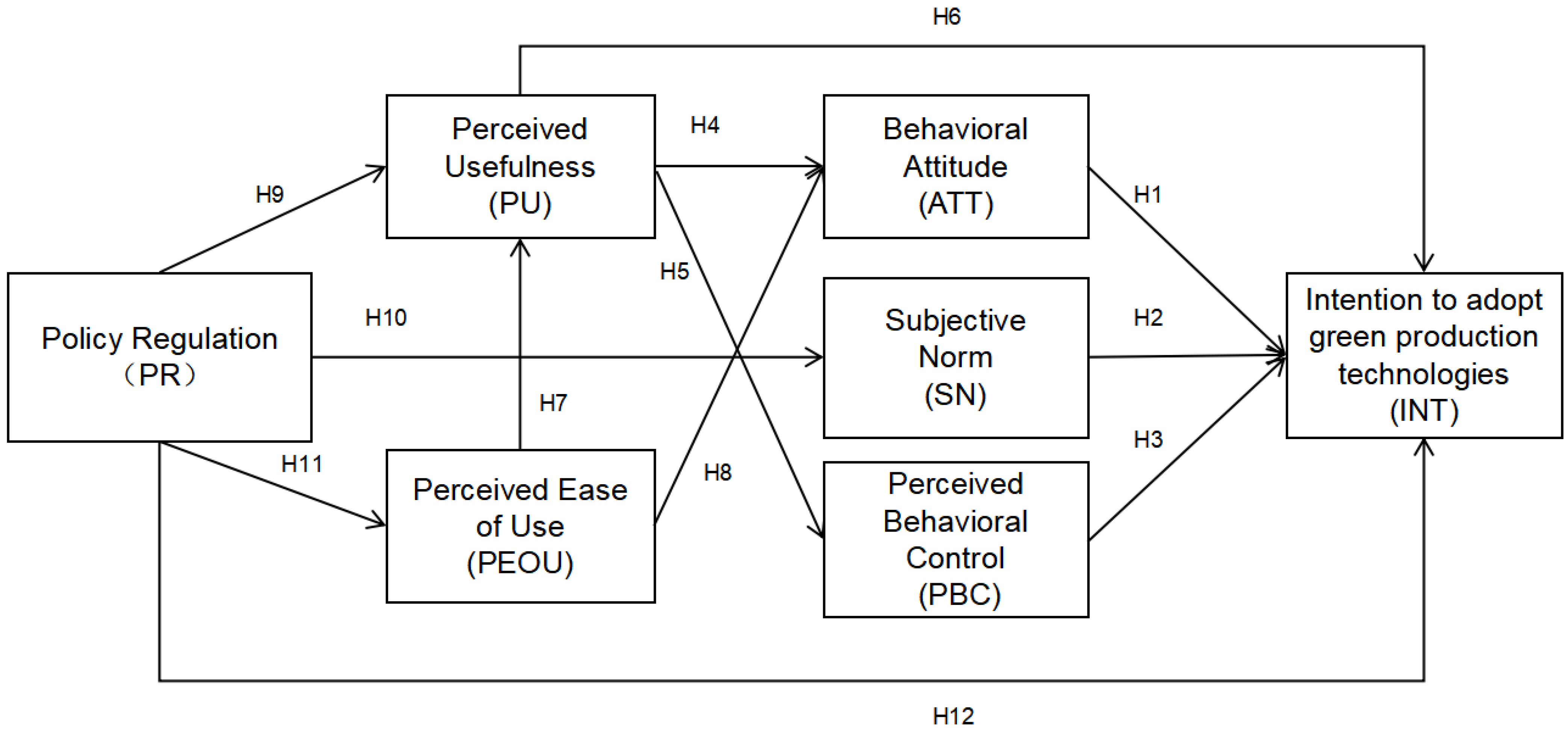
To construct the theoretical model for this study, we first systematically reviewed the integrated application of the Technology Acceptance Model (TAM) (PU and PEOU) and the Theory of Planned Behavior (TPB) (ATT, SN, and PBC) within the context of green agricultural production. To ensure the rigor and explanatory power of the model, we refined and perfected the hypothetical paths after a comprehensive review of existing empirical studies and consideration of the practical agricultural production conditions in karst areas. Consequently, twelve research hypotheses were proposed, aiming to characterize the complex logical associations among policy regulation, cognitive transformation, and farmers’ green adoption intentions. Ultimately, the integrated TAM–TPB framework, as illustrated in Figure 1, captures both the cognitive process of technical attributes emphasized by TAM and the socio-psychological and environmental constraints focused on by TPB, while incorporating Policy Regulation (PR) as an exogenous antecedent. This integrated approach effectively reveals the heterogeneous impacts of various policy regulations on farmers’ intentions to adopt green production technologies and the underlying transmission mechanisms involved.

3. Survey Design, Data Description, and Model Validation

3.1. Study Area

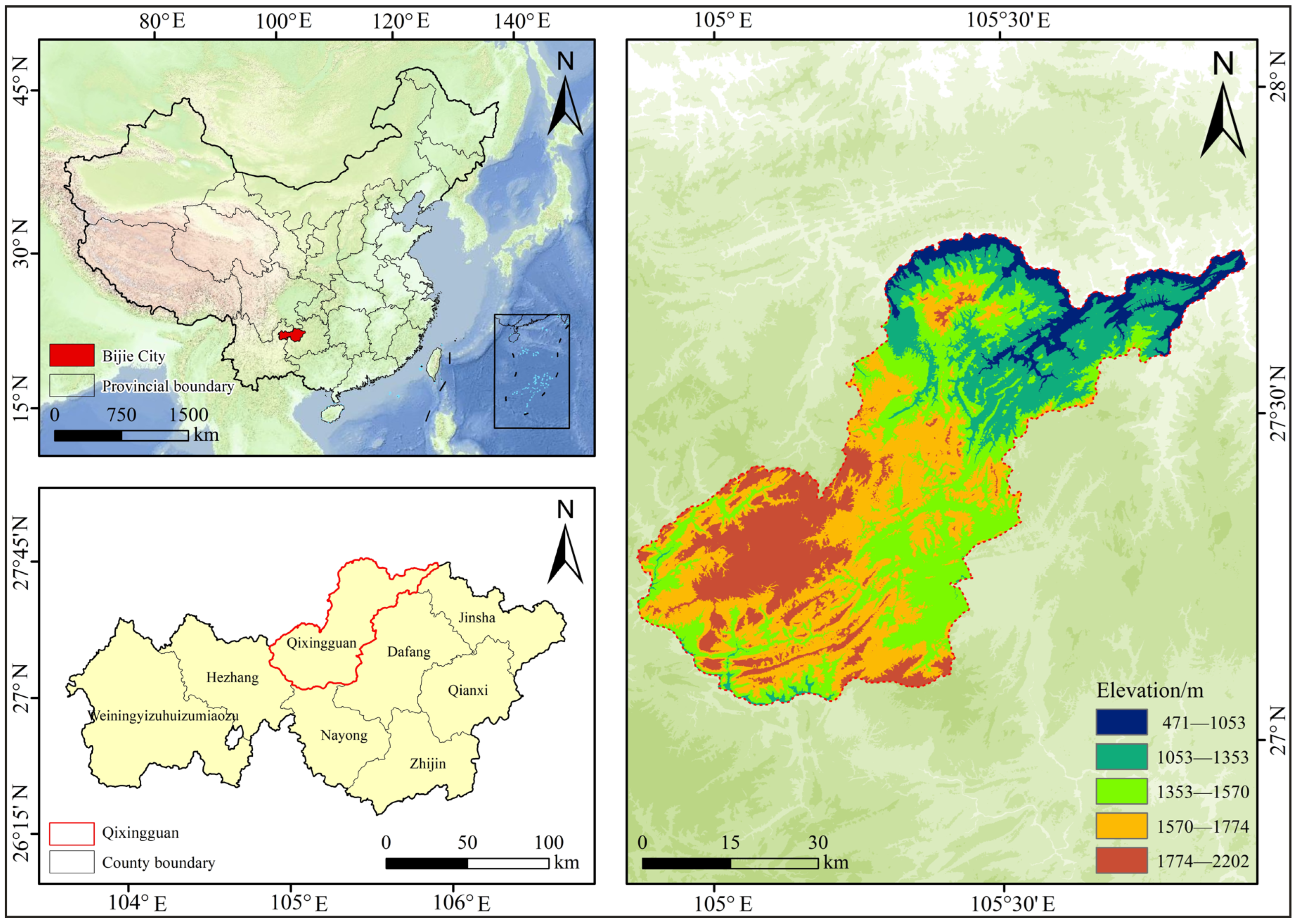
Qixingguan District, Bijie City, is situated in the core area of the karst landform, characterized by high ecological fragility, and serves as a national pilot zone for development-oriented poverty alleviation and ecological construction. According to the latest data as of the end of 2024, the permanent population of the district reached 1.3051 million, with the rural population accounting for 46.73% and the number of households totaling 1.2262 million [65]. Qixingguan District has vigorously developed modern and high-efficiency mountain agriculture with distinct local characteristics. The local government has established a diversified policy regulation system integrating guidance, incentives, and constraints, encompassing measures such as technical training, financial subsidies, and carbon emission trading. Consequently, the dual requirements of ecological protection and industrial income generation in this region align highly with the core objective of promoting green production technologies.
Regarding green production outcomes, the coverage rate of soil testing and formula fertilization in the district has exceeded 90%, while the green prevention and control rate for major crops has reached 56%. Significant breakthroughs have been achieved in non-point source pollution control; the utilization rate of crop straw over 86% and the recovery rate of waste agricultural film have both stabilized above 80% [66,67]. These efforts have effectively realized the organic integration of ecological preservation and economic benefits. The region exhibits distinctive policy practices and a unique trajectory of green transformation. It not only elucidates the inherent logic of agricultural transition in underdeveloped areas but also provides a referential case for other ecologically fragile regions. The ‘Bijie Experience’ serves as a highly valuable case for validating theoretical models and analyzing the specific impact pathways of policy interventions.

3.2. Data Sources

The research team collected data using a questionnaire survey method between June and October 2024. This concentrated time period ensured the stability of the external policy environment and minimized the confounding effects that policy changes during the research period might cause. A multi-stage stratified random sampling method was employed to ensure representativeness. First, 10 survey units were randomly selected from a total of 53 townships and sub-districts. Second, two administrative villages were randomly chosen from each selected township. Finally, households were randomly selected from the village registration rosters. To ensure sample representativeness, this study focused on permanent residents who are actively involved in household agricultural management. During the random sampling process, long-term migrant workers were excluded to focus on actual onsite practitioners. Descriptive statistical results indicate that 51% of the respondents were middle-aged (31–50 years old), a group that serves as the primary labor force and decision-making body in local agricultural production. While senior residents were also included in the random sampling to maintain procedural integrity, they are generally regarded as auxiliary laborers rather than primary decision-makers due to the high technical demands of new green production policies. Thus, the sample distribution reflects the actual demographic structure of agricultural decision-makers in the region without compromising the randomness of the sampling process or biasing the results.
To control for potential acquiescence bias and social desirability bias, a small-scale pilot survey was conducted beforehand. Meanwhile, the survey team underwent professional training to refine the phrasing of the questionnaire, ensuring that the content could be easily understood by the farmers with varying education levels. The order of items in the psychological construct section of the questionnaire was randomized to prevent the respondent from following a fixed response pattern. During the survey, the anonymity and confidentiality of the response were emphasized to the participant to encourage honest feedback. Furthermore, specific time nodes were clarified, and detailed scenario descriptions were provided during the interview process to ensure that each question was clear and explicit, thereby minimizing recall bias. Post hoc analysis using Harman’s single-factor test further verified that the data is free from severe common method bias. A total of 520 questionnaires were recovered in this survey. After proofreading, 22 invalid questionnaires, characterized by missing content, patterned responses, or conflicting information, were excluded, resulting in 498 valid questionnaires with an effective recovery rate of 95.8%.

3.3. Questionnaire Design

In accordance with the model specifications, the measurement design for the core independent variable draws upon established methodologies regarding indicator selection and scale construction from prior studies. The entire measurement scale included 498 respondents and 21 observed variables, a ratio of approximately 24:1, exceeding the recommended 10:1 threshold. Post hoc data validation also confirmed that, for a model with 7 latent structures and 21 indicators, all samples provided statistical power well above the 0.80 significance level at a significance level of 0.05, thus ensuring the robustness of our path analysis. Specifically, policy regulation is operationalized through three dimensions: incentive-based regulation, constraint-based regulation, and guidance-based regulation [47,64,68,69]. The mediating variables encompass perceived ease of use (PEOU) and perceived usefulness (PU) from the Technology Acceptance Model (TAM), as well as behavioral attitude (ATT), Subjective Norm (SN), and Perceived Behavioral Control (PBC) from the Theory of Planned Behavior (TPB). Each of these latent constructs is measured by three observed items [70,71,72,73,74]. Regarding the dependent variable, farmers’ intention to adopt green production technologies is measured through three indicators: willingness to act, willingness to prioritize, and willingness to recommend [25]. To ensure respondents had a clear technical focus when evaluating their willingness, this study classified green production technologies into five specific technical packages based on the United Nations Environment Programme’s classification and tailored to the characteristics of mountainous agriculture in Bijie City: green pest and disease control, soil testing and formula fertilization, no-till seeding, deep loosening, and straw incorporation. To ensure the representativeness of the research sample and account for potential background interference, this study collected data on respondent characteristics, including gender, age, education level, and health status [75,76,77,78]. These variables are incorporated into the analysis as descriptive background items to illustrate the distribution of the sample; they are not intended to serve as core model paths for formal hypothesis testing.
The questionnaire employed a five-point Likert scale for assessment, anchored as follows: 1 = strongly disagree, 2 = disagree, 3 = neutral, 4 = agree, and 5 = strongly agree. The mean scores for most observed indicators clustered between 3.63 and 3.94. This relative consistency reflects the specific socio-political context of the Qixingguan District, a national ecological construction pilot zone. Long-term, high-intensity, and standardized policy promotion in this region has likely fostered a relatively unified baseline perception of green production among local farmers. However, as shown in Table 1, the standard deviations (SD) ranging from 1.04 to 1.22 indicate sufficient variability and a healthy distribution across the Likert scale. This suggests that respondents provided diverse individual evaluations rather than exhibiting a simple compliance bias or a tendency toward neutral responses. The specific measurement items and descriptions for each variable are detailed in Table 1.

3.4. Sample Features

A descriptive statistical analysis was conducted on the basic characteristics of the surveyed farmers, as presented in Table 2. The descriptive statistical result indicates that the gender ratio of the respondents is relatively balanced, which is basically consistent with the gender distribution in the census data of Qixingguan District. In terms of age, the sample is dominated by middle-aged farmers between 31 and 50 years old, accounting for 51.00% of the total respondents. This is followed by farmers over 50 years old, accounting for 30.52%, while farmers under 30 years old account for the smallest proportion at only 18.47%. Regarding ethnic composition, the Han ethnicity accounts for 68.88%, and ethnic minority accounts for 31.12% in the sample; this is highly consistent with the official population proportion of Bijie City as a multi-ethnic settlement, reflecting the representativeness of the sample in terms of regional culture. The education level of the respondents is generally low, with 75.90% of the farmers having only completed junior high school or below. This proportion is slightly higher than the national rural average, but it conforms to the historical background of relatively scarce educational resources in Bijie City as an underdeveloped area.
From the perspective of social participation and health, 38.76% of the farmers participate in agricultural cooperatives, and a significant 85.34% report their health status as average or better, with only 2.61% identifying as having very poor health. Economically, most households focus on pure agriculture; 45.58% report an annual income between 40,000 and 60,000 RMB, while only 17.47% earn exceeding 60,000 RMB. Additionally, 67.27% of families operate with a labor force of zero to two persons. Overall, the survey sample aligns with the typical characteristics of rural China at present and possesses high representativeness.

3.5. Research Methods

To explore the complex mechanisms underlying farmers’ adoption of green production technologies, this study follows the methodologies of Guo et al. and Wei et al. [74,79]. Data analysis was performed using SPSS 27.0 for descriptive statistics and collinearity diagnostics, while AMOS 28.0 was employed to construct the Structural Equation Model (SEM). Structural Equation Modeling (SEM) is capable of simultaneously examining the relationships between latent constructs and observed indicators, as well as the interrelationships among latent constructs themselves. Compared to traditional regression models, SEM serves as a highly flexible and comprehensive statistical method. To systematically elucidate the path relationships among the seven latent variables, including behavioral attitude and Subjective Norm, as well as their 21 corresponding observed indicators, and to deeply reveal the intrinsic logic governing farmers’ intention to adopt green production technologies, this paper establishes the fundamental equations of the SEM model as follows:
X = Λ x ξ + δ
Y = Λ y η + ε
η = B η + Γ φ + ξ
Equations (1) and (2) constitute the measurement models, while Equation (3) represents the structural model. In these equations: X represents the measurement indicators of the exogenous latent variables; Y represents the measurement indicators of the endogenous latent variables; Λx denotes the factor loading matrix between X and ξ; Λy denotes the factor loading matrix between Y and η; δ, ε represent the error terms for the exogenous and endogenous measurement indicators, respectively; η represents the endogenous latent variables; φ represents the exogenous latent variables; B denotes the path coefficients among endogenous latent variables; Γ denotes the path coefficients from exogenous latent variables to endogenous latent variables; and ξ represents the unexplained component in the structural equation.
On the basis of using the Structural Equation Model (SEM) to verify theoretical hypotheses, this study introduces the Decision-making Trial and Evaluation Laboratory (DEMATEL) method for in-depth quantitative analysis. The former focuses on verifying the theoretical model and revealing the causal path and feedback relationship, while the latter emphasizes the systemic influence intensity between variables and the construction of the causal network. By utilizing centrality and cause degree, complex systemic factors are classified into the cause group and the result group, thereby revealing the influence status and influence degree of each variable in the behavioral system. The combined application of these two methods not only helps to comprehensively reveal the direct and indirect driving mechanisms of policy regulation on the adoption intention of the farmer but also enables further quantitative analysis of the centrality and influence path of each latent variable in the model. It can accurately identify the key node in the behavioral intention of the farmer, and its core calculation steps are as follows:
(1)
Construct the direct influence matrix X: the standardized path coefficient of the significant path from the SEM analysis is utilized as the matrix element.
(2)
Calculate the normalized direct influence matrix N:
N = X m a x ( j = 1 n   x i j )
(3)
Calculate the total influence matrix T:
T = N ( I N ) 1
where I represents the unit matrix. The influence degree (D) and the blocked degree (R) are obtained by summing the row and column of the T matrix, respectively. Subsequently, the centrality (D + C) and the cause degree (D − C) are calculated. Where (D + C) is defined as centrality, with higher values indicating a greater degree of importance and proximity to the core of the causal network; (D − C) is defined as net causality, measuring a factor’s driving attributes: a positive value identifies it as part of the ‘cause group’ that predominantly drives other factors, while a negative value classifies it into the ‘effect group’ that is primarily influenced by others.

3.5.1. Reliability and Validity of the Model

The Maximum Likelihood (ML) method was employed for parameter estimation, and the bias-corrected Bootstrap method with 5000 resamples was used to test the significance of mediating effects. Pre-estimation diagnostics revealed that the absolute values of skewness and kurtosis for all observed variables were below 2 and 7, respectively, thereby satisfying the requirements for a multivariate normal distribution. Furthermore, the Variance Inflation Factor (VIF) for all variables was less than 5, indicating the absence of serious multicollinearity and confirming a sound linear relationship among the variables.
Reliability and validity tests were performed on the survey data, with the results presented in Table 3. The results indicate that the Cronbach’s a coefficients for all latent variables range from 0.759 to 0.831. All values exceed the standard threshold of 0.7, demonstrating that the data possesses high internal consistency. Confirmatory Factor Analysis (CFA) was conducted on the dataset. The results indicate that the standardized factor loadings for all observed variables exceed 0.6. This suggests a strong correlation between the observed variables and their corresponding latent variables. The Composite Reliability (CR) values for all latent variables exceeded 0.7, confirming satisfactory internal consistency. Furthermore, the Average Variance Extracted (AVE) values were all above 0.5, indicating that the data possesses robust convergent validity.
Validity testing revealed an overall KMO value of 0.893 and Bartlett’s Test statistic of 4353.02 (Sig < 0.001). For individual latent constructs, KMO values fell between 0.690 and 0.723, all surpassing the 0.5 rule of thumb. The significant significance level indicates strong correlations between variables, thereby justifying the application of factor analysis. Additionally, to assess potential common method bias (CMB), Harman’s single-factor test was performed. The results showed that the variance explained by the first unrotated principal factor was 33.792%, which is well below the 40% threshold. Meanwhile, the Common Latent Factor (CLF) analysis showed that the changes in the coefficients of each path after adding this factor were all less than 0.2. These results collectively demonstrate that this study does not exhibit serious common method bias.
To address the requirement for discriminant validity, the Fornell–Larcker criterion was applied by comparing the square root of the Average Variance Extracted (AVE) for each construct with its correlations with other constructs. As shown in Table 4, the square roots of the AVE range from 0.716 to 0.789. Each diagonal value is significantly greater than the off-diagonal correlation coefficients in its corresponding row and column. These results confirm that all constructs in the integrated TAM-TPB model possess sufficient discriminant validity and are statistically distinct from one another.

3.5.2. Model Fitness Test

This study evaluated the goodness-of-fit of the Structural Equation Model (SEM). A comprehensive assessment of various indices reveals that, with the exception of a marginally elevated RMR, the overall model fit is outstanding. The vast majority of indicators, particularly critical metrics such as RMSEA, CFI, and GFI, far exceed accepted academic benchmarks [80,81,82]. Although the RMR (0.102) is slightly above the recommended 0.08 threshold, it remains statistically acceptable, given the complexity of the behavioral constructs and the sensitivity of RMR to scale variance. Furthermore, as model modifications based on modification indices lacked sufficient theoretical justification, the original model was retained to maintain theoretical parsimony and avoid over-fitting. Consequently, the model is deemed successful and suitable for subsequent path analysis.

4. Results and Discussion

4.1. Model Hypothesis Test

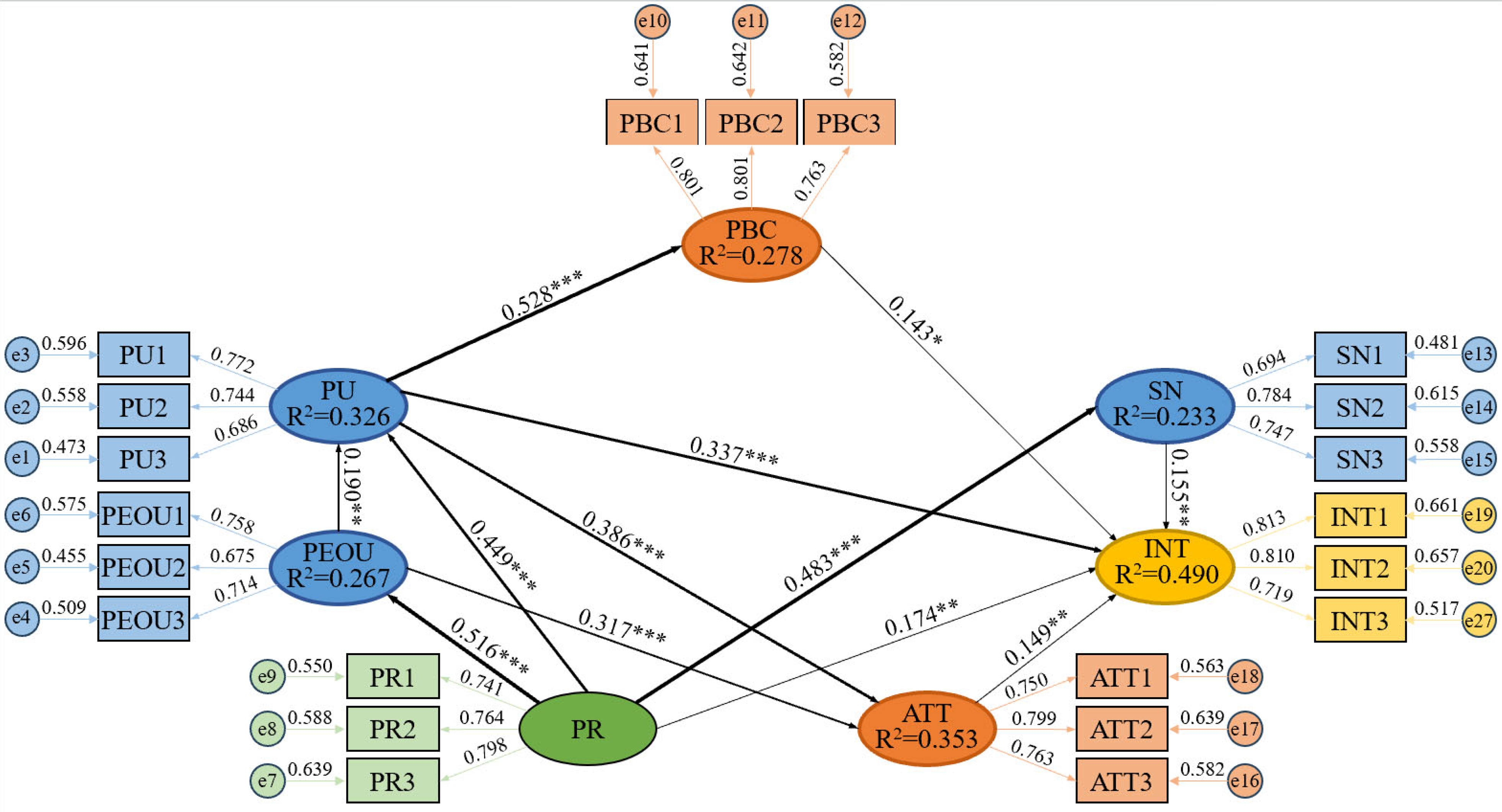
This study formally tested the mediation effect using the Bootstrap method (5000 iterations). The results indicated that the 95% confidence intervals for all indirect paths did not include zero, confirming the significance of the mediating effects. Furthermore, all path coefficients were statistically significant at the 0.05 level. Consequently, all proposed hypotheses have passed significance testing and are supported. Table 5 and Table 6 present the parameter estimates and test results for the direct and indirect effect paths, respectively. Additionally, Figure 2 visually illustrates the standardized path relationships and the magnitude of influence among the core variables. A specific analysis of these results follows:
  • Regarding Behavioral Attitude:
Farmers’ behavioral attitude exerts a significant positive influence on the intention to adopt green production technologies, with a direct effect coefficient of 0.149. Consequently, Hypothesis H1 is supported. This indicates that when farmers hold a rational value judgment regarding green technologies, their adoption intention is significantly enhanced. Simultaneously, behavioral attitude serves as a pivotal mediating bridge in the relationship between policy regulation and farmers’ intention to adopt green production technologies. Furthermore, both perceived usefulness (PU) and perceived ease of use (PEOU) exert indirect effects on the intention to adopt green production technologies via their influence on behavioral attitude. Among the observed variables, the influence coefficients for ATT1 (value judgment), ATT2 (policy identification), and ATT3 (Positive Evaluation) are 0.750, 0.799, and 0.763, respectively. This result differs from that of previous research that predominantly emphasizes individual technical benefits. Our findings highlight that the shaping power of policy orientation on farmers’ attitude formation far outweighs individual subjective judgment. This is not merely a regional discrepancy but stems from the high policy dependence of green production technologies, which elevates policy identification to a core constituent of attitude. This shift from ‘technical rationality’ to ‘policy-driven rationality’ explains why, in rural areas under transition, the external policy environment can supersede individual economic considerations to become the most critical factor influencing attitude. Therefore, prioritizing the enhancement of policy identification and execution satisfaction is a critical strategy for optimizing farmers’ attitudes and boosting adoption willingness.
2.
Regarding Subjective Norm:
Farmers’ Subjective Norm exerts a significant positive influence on their intention to adopt green production technologies, with a direct effect coefficient of 0.155. Consequently, Hypothesis H2 is supported. This suggests that social support and demonstration effects effectively drive farmers’ willingness to act. Simultaneously, it confirms the validity of the indirect effect of policy regulation (PR) on farmers’ adoption intention mediated by Subjective Norm. Among the observed indicators, the factor loadings for SN2 (Expectations of Important Others) and SN3 (Authority Influence) are relatively high at 0.784 and 0.747, respectively, whereas SN1 (demonstration effect) is comparatively weaker at 0.694. This data characteristic profoundly reflects the ‘differential mode of association’ prevalent in rural China [83]. The differentiated connections in rural China are social networks formed by a differential order pattern as the underlying structure, superimposed with differences in regional social structures, resulting in “different degrees of closeness, tightness, and internal and external relationships.” Unlike the universality of traditional acquaintance-based societies, this result shows that in decision-making for high-tech barriers such as green production, the transmission of social influence follows the logic of prioritizing strong relationship support and giving equal importance to administrative guidance. It suggests that relying solely on neighborhood demonstration is insufficient to generate a sustained and effective behavioral drive for green technology promotion. Conversely, leveraging strong-tie networks based on blood and kinship—such as support from relatives—and utilizing grassroots authority like village committees for institutionalized guidance and constraint is more effective in helping farmers overcome psychological barriers, thereby significantly enhancing their adoption intention.
3.
Regarding Perceived Behavioral Control:
Perceived Behavioral Control exerts a significant positive influence on farmers’ intention to adopt green production technologies, with a direct effect coefficient of 0.143. Consequently, Hypothesis H3 is supported. This suggests that the stronger the farmers’ confidence in allocating time, mastering technology, and bearing risk, the higher their adoption intention. While statistically significant, this path demonstrates the weakest direct impact. This highlights that the farmer places greater emphasis on practical outcomes. Being ‘able to adopt’ is considered a basic entry barrier, but being ‘worth adopting’ is the key determinant. As a result, the direct effect of perceived usefulness (PU) reached 0.337, significantly surpassing that of Perceived Behavioral Control. Furthermore, the path diagram reveals that perceived usefulness (PU) exerts an indirect effect on farmers’ adoption intention via Perceived Behavioral Control (PBC). This suggests that the perception of technological utility reinforces farmers’ sense of behavioral control. Among the observed variables, the factor loadings for PBC1 (time availability) and PBC2 (knowledge reserve) both stand at a high 0.801, slightly exceeding the 0.763 of PBC3 (Risk Tolerance). These data unveil the realistic predicament of ‘dual resource constraint currently faced by the farmer: More so than the fear of operational risk,’ ‘insufficient learning time,’ and ‘high technical cognitive barrier represent the critical bottleneck for technology adoption.’ Against the backdrop of an aging rural workforce and the prevalence of part-time farming, farmers’ demand for labor-saving and user-friendly technology has become increasingly intense. Consequently, this necessitates a policy shift from merely reducing risk to minimizing technical barriers and offering precision skills training.
4.
Regarding Perceived Usefulness (PU):
Perceived usefulness exerts the most significant direct effect on farmers’ adoption intention, with a path coefficient of 0.337. This indicates that farmers’ assessment of the practical efficacy of green technology directly determines the strength of their intention. Consequently, Hypothesis H6 is supported. In terms of observed variables, the factor loadings for PU1 (economic benefits), PU2 (Social Benefits), and PU3 (Environmental Benefits) are 0.772, 0.744, and 0.686, respectively. This distribution reflects the pragmatic logic of the farmers acting as ‘Rational Economic Men’: compared to macro-level environmental protection, the farmers place greater weight on the input cost and expected return of the technology during their decision-making process. Regarding indirect effects, perceived usefulness (PU) exerts a significant positive influence on both behavioral attitude (ATT) and Perceived Behavioral Control (PBC), with path coefficients of 0.386 and 0.528, respectively. Perceived usefulness (PU) significantly mediates the relationship between policy regulation (PR) and farmers’ adoption intention (INT). Furthermore, the cumulative indirect effect of PU, transmitted through the mediation of behavioral attitude (ATT) and Perceived Behavioral Control (PBC), reaches 0.133. Consequently, hypotheses H4, H5, and H9a are fully supported. This indicates that perceived usefulness (PU) stimulates farmers’ subjective initiative. When the farmer perceives the technology as profitable, he or she is motivated to overcome resource constraints such as learning difficulty or time scarcity. Ultimately, this indirectly reinforces adoption intention by enhancing his or her sense of control. Consequently, the total effect of PU remains at a relatively high level among all variables, with a total effect coefficient of 0.469.
5.
Regarding Perceived Ease of Use (PEOU):
The analysis indicates that PEOU impacts ecological protection intention through two distinct indirect channels: the impact is transmitted via perceived usefulness (PU), following the path PEOU→PU→PBC→INT, as well as via behavioral attitude (ATT), following the path PEOU→ATT→INT. The total indirect effect amounts to 0.136. In terms of specific paths, perceived ease of use (PEOU) exerts the strongest direct driving force on behavioral attitude (ATT), with a direct effect coefficient of 0.317. Hypothesis H8 is supported. Furthermore, PEOU exerts a significant positive influence on perceived usefulness (PU), with a direct effect coefficient of 0.199, thereby supporting Hypothesis H7. This indicates that clear policy, low learning difficulty, and minimal cost significantly enhance farmers’ expectation of return, reinforce their perception of the technology’s usefulness, and directly alleviate their apprehension, thereby fostering a positive attitude toward adoption. Among the three observed variables, PEOU1 (Policy Understanding), PEOU2 (learning difficulty), and PEOU3 (Usage Cost) all exhibit significant factor loadings on perceived ease of use (PEOU), with values of 0.738, 0.675, and 0.714, respectively. Notably, PEOU1 (Policy Understanding) displays the highest loading. This indicates that, beyond merely lowering technical barriers, the government must translate obscure policy documents into accessible language that clearly communicates benefits to the farmer. By reducing the ‘cognitive cost’ of information, technical detail becomes easier to comprehend and accept, thereby reinforcing the core driver of perceived ease of use.
6.
Policy Regulation
Policy regulation (PR) is the most significant external factor driving farmers’ intention to adopt, with a total effect of 0.530. Its impact encompasses both direct and indirect pathways. Regarding direct effects, policy regulation directly and significantly enhances farmers’ adoption intention, with a direct effect coefficient of 0.174. This suggests that policy measures, including subsidies, supervision, and guidance, can be directly transmitted to the farmer. Consequently, Hypothesis H12 is supported. Regarding indirect effects, policy regulation (PR) exerts the strongest positive driving force on perceived ease of use (PEOU) with a coefficient of 0.516, followed by Subjective Norm (SN) and perceived usefulness (PU) with coefficients of 0.483 and 0.449, respectively, indicating that robust policy primarily addresses farmers’ apprehension, and secondly, positively guides farmers’ behavioral intention through social norm and reinforcing perceived usefulness, thus supporting Hypotheses H11, H10, and H9.
The empirical results demonstrate that policy regulation (PR) not only exerts a significant simple mediation effect through Subjective Norm (SN) (PR → SN → INT) but also influences adoption intention through more complex cognitive serial mediation. Specifically, these are manifested in the paths of “PR → PU → ATT → INT” and “PR → PEOU → PU → INT.” The significant mediating role of Subjective Norm (SN) between policy regulation (PR) and farmers’ adoption intention (INT) is confirmed, thus supporting hypotheses H4a, H7a, and H10a. The synergistic effect of these three indirect pathways results in a total indirect effect of 0.356 for policy regulation on adoption intention, which exceeds its direct effect of 0.174. This indicates that policy regulation primarily drives and amplifies farmers’ intentions through the transmission of these mediating variables. In terms of observed variables, the factor loadings for incentive-based (PR1), constraint-based (PR2), and guidance-based (PR3) regulation are 0.741, 0.764, and 0.798, respectively, all of which are significant. Notably, guidance-based regulation (publicity and training) exhibits the highest loading. This indicates that policy publicity accessible to farmers more effectively reinforces their perception of regulation. It suggests that farmers are not motivated solely by profit; compared to a limited financial subsidy, they have a more urgent need for technical empowerment to eliminate information asymmetry. This implication suggests that policy needs to combine the incentive, constraint, and guidance instruments, with a particular emphasis on strengthening guidance measures such as publicity and training. This marks a transition from purely financial handout to ‘intellectual empowerment.’ By reinforcing publicity guidance and skills training, the goal is to construct a policy support system that integrates both hard and soft measures, with a priority on the ‘soft’ approach.
7.
Regarding Intention to Adopt Green Production Technology
In terms of observed variables, Action Intention (INT1), Priority Intention (INT2), and Recommendation Intention (INT3) all effectively reflect farmers’ intention to adopt green production technology, with factor loadings of 0.813, 0.810, and 0.719, respectively. This indicates that adoption intention encompasses both the inclination for personal agricultural practice and the willingness to recommend the technology to relatives and friends, exhibiting the dual characteristic of ‘individual practice’ and ‘social transmission.’ However, the relatively weaker loading of Recommendation Intention suggests that the farmer does not easily leverage his or her social capital to make a recommendation, reflecting an avoidance of social relational risk.
Synthesizing the structural model, perceived usefulness (PU), policy regulation (PR), Subjective Norm (SN), behavioral attitude (ATT), and Perceived Behavioral Control (PBC) all exert a significant direct effect. Notably, PU is the primary driver of intention, exhibiting the largest direct coefficient of 0.337, while PR achieves the highest total effect of 0.530 across the entire model due to its profound influence on perceived value, ease of use, and social norm. This establishes a driving mechanism with ‘policy guidance as the cornerstone and benefit perception as the core,’ demonstrating that policy not only provides direct incentive but also indirectly amplifies adoption intention by reshaping farmers’ value judgment and social cognition regarding the technology.

4.2. DEMATEL Causal Relationship Outcome

Given that the standardized coefficients in Structural Equation Modeling (SEM) consistently fall within the [0, 1] interval, this study utilizes them as input parameters for the direct influence matrix in the DEMATEL method. This approach aims to eliminate the subjective bias inherent in expert scoring associated with the traditional DEMATEL application. In the specific operation, only the absolute value of the path coefficient with statistical significance in the SEM analysis was populated into the matrix, while the coefficient of the non-significant path was assigned a value of 0, thereby ensuring the objectivity of the causal network construction. As shown in Table 7 and Figure 3, the coefficient driven by large-sample empirical data was utilized as the weight, which made the construction of the causal network more objective and provided it with stronger statistical support.
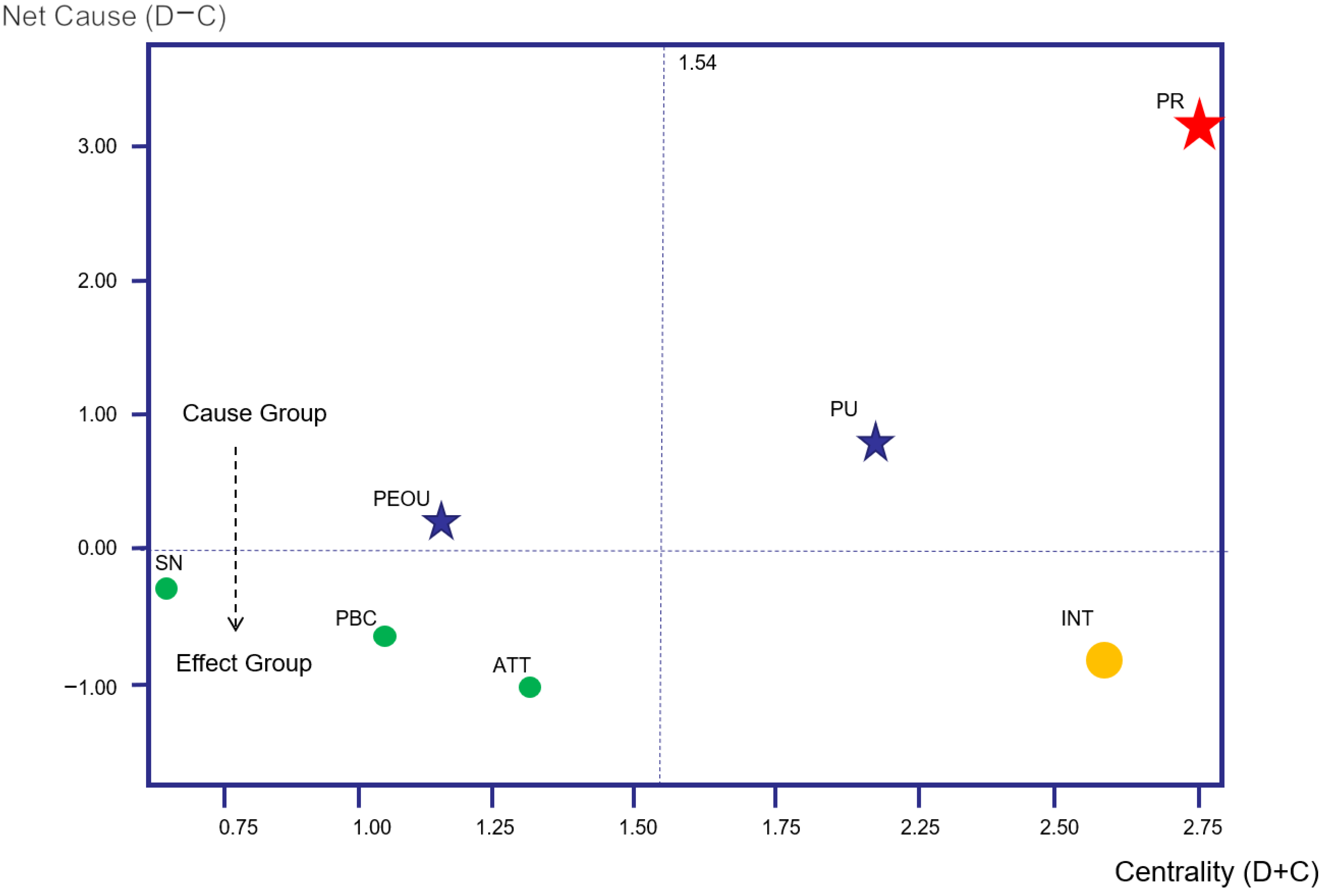
To visually demonstrate the complex interactions among factors, a cause–effect diagram was constructed (Figure 4). The horizontal axis (centrality) reflects the comprehensive contribution of each indicator to farmers’ adoption decisions, while the vertical axis (net causality) clearly distinguishes between active driving factors and passive outcome factors. The results indicate that policy regulation (PR) exhibits the highest centrality (2.740), followed by perceived usefulness (PU, 2.121), intention to adopt green production technologies (INT, 1.584), perceived ease of use (PEOU, 1.333), behavioral attitude (ATT, 1.300), Perceived Behavioral Control (PBC, 1.060), and Subjective Norm (SN, 0.638). Policy regulation (PR) exerts a decisive, unidirectional driving effect on farmers’ adoption of green production technologies, serving as the core driving source of the system (see Table 8). This conclusion aligns closely with the SEM analysis finding that PR has the largest total effect (0.530) among all variables.’ Collectively, these results underscore the dominant role of the Chinese government in the agricultural green transition.
Regarding the degree of net cause, policy regulation (PR) has a value of 2.740 (>0), with an influence degree of 2.740 and an influenced degree of 0, identifying it as a strong causal factor. Synthesizing this with previous analyses, PR not only directly impacts adoption intention through incentive subsidy, constraint regulation, and guidance publicity, but also amplifies its influence via mediating variables—perceived usefulness (PU), perceived ease of use (PEOU), and Subjective Norm (SN). Thereby, it activates the entire behavioral intention system at its source. In addition, the net cause values for perceived usefulness (PU) and perceived ease of use (PEOU) are 0.647 and 0.301, respectively (both >0), identifying them as weak causal factors. This level of analysis profoundly reveals the internal logic of ‘Policy Guidance—Cognitive Transformation—Intention Generation.’ It indicates that the farmer first rationally evaluates the value of the technology before assessing its difficulty. Since PU and PEOU represent subjective feedback following the external intervention of policy regulation, they inherently serve as weak causal factors.
The intention to adopt green production technologies (INT) presents a net cause value of −1.584 (<0), with an influence degree of 0 and an influenced degree of 1.584, categorizing it as a strong effect factor. This result indicates that adoption intention acts as a cumulative outcome, comprehensively reflecting the composite impact derived from multiple factors, including the policy environment, perceived usefulness, and behavioral attitude. Behavioral attitude (ATT) and Perceived Behavioral Control (PBC) present net cause values of −1.002 and −0.774, respectively (both <0). Given that their influenced degrees far exceed their influence degrees, they are classified as strong result factors. Synthesizing this with prior analysis, it is evident that farmers’ positive attitude and sense of control are highly contingent upon the robust stimulation of policy regulation (PR) and the pragmatic assessment of perceived usefulness (PU). Specifically, they are primarily driven by external conditions such as technological economic benefit (PU1) and government-provided technical training (PR3). Subjective Norm (SN) presents a net cause value of −0.328 (<0), with an influence degree of 0.155 and an influenced degree of 0.483, categorizing it as a weak result factor. Comparatively, SN is highly contingent upon the empirical reality of policy efficacy and technological utility. Its formation is driven by the indirect transmission of multi-dimensional external support conditions, thereby exhibiting a more pronounced indirect influence mechanism.

5. Discussion and Policy Insights

5.1. Theoretical Contributions and Mechanistic Insights

By integrating the Theory of Planned Behavior (TPB) and the Technology Acceptance Model (TAM), this study constructs a mechanism model of farmers’ intention to adopt green production technologies by incorporating policy regulation as an external variable.
This effectively enhances the explanatory power of the integrated TAM-TPB framework within the context of agricultural green transformation. This integrated framework not only responds to the requirements of the United Nations Sustainable Development Goals (SDGs)—specifically regarding Zero Hunger and the promotion of sustainable agriculture (SDG 2), Responsible Consumption and Production (SDG 12), and Climate Action (SDG 13)—but also provides empirical support for driving the green transition of smallholder farmers through institutional innovation. Unlike previous studies that treat the perceptual factors of TAM and the socio-psychological factors of TPB as parallel paths, our results demonstrate that during a government-led transition period, policy regulation (PR) serves not only as a direct driver but also as the foundation for activating other cognitive variables. This provides a new perspective for future modifications of the integrated TAM-TPB model by positioning external policy as a foundational antecedent. Empirical data further reveal the multi-path synergistic characteristics of the mediation mechanism: the indirect effect of policy regulation (PR) is 0.356, which significantly outweighs its direct effect, thereby confirming the decisive role of mediation paths. Policy regulation (PR) exerts its influence not only through a significant simple mediation effect via Subjective Norms (SN) but also through a more complex chain mediation involving perceived ease of use (PEOU) and perceived usefulness (PU). This demonstrates that policy-driven adoption depends not only on psychological internalization but also on systemic support for overcoming technical thresholds and ensuring resource security. Future research should focus on testing whether Subjective Norms (SN), rooted in the differential mode of association, can generate an alternative and sustained pull once guidance-based policies (PR3) are phased out. Additionally, it is essential to verify whether the chain mediation of perceived ease of use (PEOU) will undergo a path shift due to diminishing marginal utility. It is worth noting that while this framework originates from the Karst mountain area, its core logic of policy-driven cognitive reshaping possesses generalizability across global smallholder regions facing similar resource constraints. However, the strength of specific pathways may undergo moderating shifts due to variations in topography (e.g., plains versus mountains) and socioeconomic conditions (e.g., peri-urban versus remote mountainous areas).

5.2. Research Conclusions

(1) Multi-dimensional factors significantly drive adoption intention. Factors including policy regulation (PR), perceived usefulness (PU), behavioral attitude (ATT), Subjective Norm (SN), and Perceived Behavioral Control (PBC) all exert positive effects on farmers’ intentions. Specifically, PU possesses the largest direct effect, while PR acts as the primary external driver with the highest total effect, characterized by a mechanism of policy guidance as the cornerstone and benefit perception as the core. (2) Policy regulation operates through complex psychological mediation. PR functions by influencing ATT, SN, and PBC. Farmers’ attitudes are highly contingent upon policy identification, while Subjective Norms reflect the differential mode of association typical of rural societies. Furthermore, Perceived Behavioral Control is primarily constrained by the dual resources of time availability and knowledge reserves. (3) Perception of technological value is the fundamental decision-making driver. PU generates a significant indirect effect through the mediation of PBC and ATT, confirming that anticipated benefits are central to decision-making. Additionally, perceived ease of use (PEOU) influences intention via a chain mediation of PU and ATT, indicating that operational simplicity must translate into perceived usefulness to drive adoption. (4) The system exhibits a clear Cause–Result hierarchical structure. DEMATEL analysis identifies PR as the core causal factor, driving the entire system. Conversely, adoption intention, ATT, and PBC are strong result factors, whose formation depends on policy stimulation and pragmatic utility assessment. Subjective Norm (SN) serves as a weak result factor, indirectly shaped by multi-dimensional external conditions.

5.3. Policy Insights

Based on the aforementioned conclusions, this study scientifically defines the implementation priorities for policies according to the causal status and centrality influence of each variable within the system. Since policy regulation (PR) exhibits the strongest source-driving attributes in the DEMATEL analysis and its total effect ranks first, optimizing the policy regulation system should be regarded as the most urgent strategic task at present. Meanwhile, given that perceived usefulness (PU) is the core influential factor, second only to policy, enhancing pragmatic perceptions of technology should serve as a key lever for achieving the transformation of intentions. Particularly in the ecologically fragile karst regions of Guizhou, green pest control technology goes beyond improving product quality; it performs an irreplaceable restorative function in protecting underground water systems and maintaining ecological balance by mitigating the infiltration of chemical fertilizer and pesticide residues into mountainous runoff. Interventions targeting attitudes (ATT), Subjective Norms (SN), and Perceived Behavioral Control (PBC) should be advanced simultaneously as supporting guarantee measures. The specific recommendations are as follows:
First, optimize a ‘Guidance-Led, Hard-and-Soft Integrated’ Policy Regulation System. Since policy publicity is more effective in reinforcing regulatory perception and indirectly amplifying adoption intention by reshaping farmers’ value judgment and social cognition, the government should fully leverage the source driving role of the ‘visible hand’. Primarily, the policy focus should transition from purely financial handouts to technical empowerment. It is crucial to intensify technical publicity and skills training, leveraging channels such as village bulletin boards, WeChat communities, and agricultural technology APP to disseminate green production technology. Training content should be tailored to the farmer with varying planting scales and crop types. Centering on core technology such as the green prevention and control of pest and disease and straw returning, the government should construct a blended learning platform that integrates online micro-courses with offline practical training to effectively eliminate information asymmetry. Secondly, it is necessary to optimize incentives and constraints by exploring flexible incentive mechanisms such as ‘ecological credits’ and ‘awards instead of subsidies.’ Meanwhile, it is essential to clarify the punishment standards for harmful production behaviors to rectify farmers’ behavioral concepts. It should be noted that a progressive regulation mechanism should be established during implementation, prioritizing positive incentives in the early stages of transition to reduce institutional resistance, and gradually strengthening rigid punishment standards as technology matures to achieve a trade-off between incentives and constraints at different stages. To address the high costs associated with the large-scale implementation of online micro-courses and hybrid learning platforms, the government should explore “government–enterprise cooperation” models. By introducing social service organizations to share the expenses of platform development and daily maintenance, the fiscal sustainability of technology promotion can be ensured.
Second, enhance farmers’ pragmatic perception of technological usefulness. It is essential to unlock economic value by promoting the integration of green production technology with agricultural branding and e-commerce, thereby establishing a market channel that ensures a premium price for superior quality. Concurrently, the government should explore mechanisms for realizing the value of ecological products, such as carbon sink trading and eco-tourism, to allow the farmer to directly perceive the premium return derived from green production, thus stimulating a profit-oriented positive attitude. Furthermore, it is necessary to amplify ecological value by creating high-standard green production demonstrations, disclosing ecological data, and leveraging typical cases to reinforce farmers’ perception of the technology’s economic value.
Third, dismantle the behavioral and cognitive barriers of the farmer. It is crucial to optimize policy transparency by regularly disclosing information on subsidy distribution and project progress, thereby enhancing farmers’ trust and policy identification. The government should translate obscure policy text into farmer-friendly language and utilize channels like short-form video and dialect broadcasts to reduce information acquisition cost and eliminate knowledge blind spots. To target farmers with lower education levels or older ages, emphasis should be placed on the role of rural “elite demonstration.” “By subsidizing early adopters to serve as field teachers” and utilizing the trust networks of a “society of acquaintances,” the distrust of new technologies can be dismantled, thereby enhancing farmers’ motivation to participate in training. Furthermore, by leveraging the ‘differential mode of association’ characteristic of rural society, the policy should rely on subjects with strong ties such as village cadre to promote technology. Through the guidance of grassroots authority, persuasion by kinship, and support from a significant other, external norms can be internalized into conscious action, forming a top-down mechanism of social pressure and demonstration.
Fourth, tap into the potential of Perceived Behavioral Control (PBC) to eliminate the resource constraint bottleneck. For part-time farmers constrained by a lack of time, an online learning platform should be established to provide fragmented, bite-sized technical courses. For the aging farmer concerned about an inability to learn, the promotion of ‘foolproof’ smart equipment is recommended to lower the threshold of technical usability. Furthermore, the government should vigorously develop agricultural production trusteeship service and promote labor-saving green production models. These measures aim to fundamentally eliminate psychological barriers related to difficulty and inconvenience, thereby enhancing farmers’ sense of efficacy and confidence in performing green production tasks.
The aforementioned policies aim to construct a multi-dimensional support system, which not only directly facilitates the green transition of Chinese agriculture but also provides a practical pathway at the micro-level for achieving the Global Sustainable Development Goals (SDGs): By enhancing land productivity through technological empowerment (SDG 2), reducing agricultural non-point source pollution and improving resource utilization efficiency through policy optimization (SDG 12), and strengthening the climate resilience of agricultural systems by promoting green production modes, these efforts demonstrate a commitment to addressing global climate challenges and implementing the sustainability agenda (SDG 13). In the future, with the deepening of the government-enterprise cooperation model, this multi-dimensional guarantee system will further unleash the potential of small farmers to participate in green development and contribute Chinese wisdom to the sustainable growth of global agriculture.

5.4. Limitations and Future Research

Although this study reveals the driving mechanism of policy regulation on farmers’ intention through an integrated model, certain limitations remain:
First, the sample is restricted to Qixingguan District, Bijie. As a typical Karst ecologically fragile area characterized by mountainous agriculture, its unique geography provides a representative case, but the significant differences in resource endowments and management models may limit the external validity of the findings. Specifically, while our policy-driven mechanisms are applicable to smallholder-dominated areas, measures for enhancing perceived ease of use (e.g., labor-saving farming) are tailored to fragmented land. Therefore, these conclusions should be adapted when applied to large-scale mechanized plains or market-driven peri-urban agriculture. Second, this study focuses on adoption intentions rather than actual behavior. It must be acknowledged that intentions do not necessarily translate into action; there is often a gap between the two. However, as the direct antecedent of behavior, exploring intention mechanisms remains theoretically valuable for understanding decision logic. Third, there is room for improvement in data and methodology. Since all data were collected cross-sectionally at a single point in time, Common Method Bias (CMB) may exist. Specifically, when independent and dependent variables are self-reported by the same respondents, internal consistency or social desirability bias could potentially inflate observed correlations. To mitigate this, we employed procedural controls (anonymity and question shuffling) and Harman’s single-factor test, which indicated that CMB was within an acceptable range. Additionally, the DEMATEL model primarily assumes linear interactions, which may not fully capture the non-linear or dynamic evolutionary relationships within complex agro-socio-ecological systems. Finally, the definition of green technologies needs further refinement, and the lack of a control group may affect the precision of the results.
As this study focuses on the Karst mountain area, future research could employ stratified sampling to expand the survey scope to diverse agricultural regions. This includes comparing different provinces and major plain production areas, such as Shandong and Henan, the major grain-producing provinces, to verify the robustness of the model across various agricultural backgrounds. Second, since cross-sectional data struggle to reflect dynamic changes, future studies should construct annual longitudinal panel data over a period of 3–5 years. This would capture the dynamic evolution of farmers’ adoption intentions and their actual green production behaviors under the continuous influence of policies. Third, while this study utilizes an integrated TAM-TPB framework to examine the mechanisms by which psychological cognition drives behavioral intentions under policy regulation, farmers’ decision-making is constrained by multi-dimensional factors. Subsequent research should integrate the TAM-TPB framework with market variables, such as agricultural product price fluctuations and market access for green certification, as well as climate risk factors. This will help further elucidate the interaction mechanisms between internal psychological processes and external multidimensional situational conditions. Finally, future research could benefit from methodological innovations beyond traditional surveys. For instance, randomized controlled trials (RCTs) could be introduced to rigorously identify causal effects of policy interventions, while Agent-Based Modeling (ABM) could simulate behavioral evolution under various policy scenarios. Additionally, machine learning algorithms could be utilized to identify potential non-linear interactions among complex variables.

Author Contributions

Q.T.: conceptualization, validation, formal analysis, investigation, resources, data curation, writing—original draft preparation, and visualization. H.W.: conceptualization, methodology, formal analysis, resources, and writing—review and editing. Y.C.: investigation, data curation, writing—review and editing, and project administration. Z.W.: resources, supervision, project administration, and funding acquisition. H.T.: methodology, software, validation, data curation, and visualization. All authors have read and agreed to the published version of the manuscript.

Funding

This research was funded by the National Social Science Foundation of China, Grant No. 72164035, Grant No. 2022D01A85 and No. 21BGL115.

Institutional Review Board Statement

According to China’s regulations, ethical approval can be exempted for this research, as it uses anonymized data. This exemption aligns with the Ethical Review Methods for Life Sciences and Medical Research Involving Humans, issued by the National Health Commission in 28 February 2023. The full text of the regulation can be accessed at: https://www.gov.cn/zhengce/2023-02/28/content_5743660.htm (accessed on 1 January 2025).

Informed Consent Statement

Informed consent for participation was obtained from all subjects involved in the study.

Data Availability Statement

The raw data supporting the conclusions of this article will be made available by the authors on request.

Conflicts of Interest

The authors declare no conflicts of interest.

References

  1. Canton, H. Food and agriculture organization of the United Nations—FAO. In The Europa Directory of International Organizations; Routledge: London, UK, 2021; pp. 297–305. [Google Scholar]
  2. Wu, H.; Yue, Y.; Shen, Y. Agricultural carbon emissions in China: Estimation, influencing factors, and projection of peak emissions. Pol. J. Environ. Stud. 2024, 33, 4791–4806. [Google Scholar] [CrossRef]
  3. Liu, F.; Li, C.; Zhang, H. Farmers’ environmental awareness and low-carbon production behavior model. Soc. Sci. Yunnan 2017, 6, 58–63. [Google Scholar]
  4. Monteiro, M.A.; Bahta, Y.T.; Jordaan, H. A systematic review on drivers of water-use behaviour among agricultural water users. Water 2024, 16, 1899. [Google Scholar] [CrossRef]
  5. Guo, Z.; Zhang, X. Carbon reduction effect of agricultural green production technology: A new evidence from China Sci. Total Environ. 2023, 874, 162483. [Google Scholar] [CrossRef]
  6. Yao, J.; Liu, L.; Fan, X.; Jia, W.; Yang, X. Influence of technological cognition and promotion on farmers’ adoption of low-carbon agricultural techniques. J. Arid. Land. Resour. Environ. 2023, 37, 21–30. [Google Scholar]
  7. Nagaj, R.; Gajdzik, B.; Wolniak, R.; Grebski, W.W. The Impact of Deep Decarbonization Policy on the Level of Greenhouse Gas Emissions in the European Union. Energies 2024, 17, 1245. [Google Scholar] [CrossRef]
  8. Kortleve, A.J.; Mogollón, J.M.; Harwatt, H.; Behrens, P. Over 80% of the European Union’s Common Agricultural Policy supports emissions-intensive animal products. Nat. Food 2024, 5, 288–292. [Google Scholar] [CrossRef]
  9. Fuhrmann-Aoyagi, M.B.; Miura, K.; Watanabe, K. Sustainability in Japan’s Agriculture: An Analysis of Current Approaches. Sustainability 2024, 16, 596. [Google Scholar] [CrossRef]
  10. He, P.; Zhang, J.; Li, W. The role of agricultural green production technologies in improving low-carbon efficiency in China: Necessary but not effective. J. Environ. Manag. 2021, 293, 112837. [Google Scholar] [CrossRef]
  11. Du, X.Y. Enlightenment of agricultural subsidy policies in developed countries to China. Economic Research Guide. Jingji Yanjiu Daokan 2024, 17, 9–12. [Google Scholar]
  12. Bai, J.; Wang, Y.; Sun, W. Exploring the role of agricultural subsidy policies for sustainable agriculture Based on Chinese agricultural big data. Sustain. Energy Technol. Assess. 2022, 53, 102473. [Google Scholar] [CrossRef]
  13. Shani, F.K.; Joshua, M.; Ngongondo, C. Determinants of smallholder farmers’ adoption of climate-smart agricultural practices in Zomba, Eastern Malawi. Sustainability 2024, 16, 3782. [Google Scholar] [CrossRef]
  14. Manono, B.O.; Khan, S.; Kithaka, K.M. A review of the socio-economic, institutional, and biophysical factors influencing smallholder farmers’ adoption of climate smart agricultural practices in Sub-saharan Africa. Earth 2025, 6, 48. [Google Scholar] [CrossRef]
  15. Musafiri, C.M.; Kiboi, M.; Macharia, J.; Ng’etich, O.K.; Kosgei, D.K.; Mulianga, B.; Okoti, M.; Ngetich, F.K. Adoption of climate-smart agricultural practices among smallholder farmers in Western Kenya: Do socioeconomic, institutional, and biophysical factors matter? Heliyon 2022, 8, e08677. [Google Scholar] [CrossRef]
  16. Wu, F. Adoption and income effects of new agricultural technology on family farms in China. PLoS ONE 2022, 17, e0267101. [Google Scholar] [CrossRef]
  17. Qing, C.; Zhou, W.F.; Song, J.H. Impact of outsourced machinery services on farmers’ green production behavior: Evidence from Chinese rice farmers. J. Environ. Manag. 2023, 327, 116843. [Google Scholar] [CrossRef] [PubMed]
  18. Gao, Y.; Liu, B.; Yu, L. Social capital, land tenure and the adoption of green control techniques by family farms: Evidence from Shandong and Henan Provinces of China. Land Use Pol. 2019, 89, 104250. [Google Scholar] [CrossRef]
  19. Zhou, W.; He, J.; Liu, S.; Xu, D. How does trust influence farmers’ low-carbon agricultural technology adoption? Evidence from Rural Southwest, China. Land 2023, 12, 466. [Google Scholar] [CrossRef]
  20. Ataei, P.; Gholamrezai, S.; Movahedi, R.; Aliabadi, V. An analysis of farmers’ intention to use green pesticides: The application of the extended theory of planned behavior and health belief model. J. Rural. Stud. 2021, 81, 374–384. [Google Scholar] [CrossRef]
  21. Li, M.; Wang, J.; Zhao, P.; Chen, K.; Wu, L. Factors affecting the willingness of agricultural green production from the perspective of farmers’ perceptions. Sci. Total Environ. 2020, 738, 140289. [Google Scholar] [CrossRef]
  22. Xu, D.; Liu, Y.; Li, Y.; Liu, S.; Liu, G. Land Use Policy Effect of farmland scale on agricultural green production technology adoption: Evidence from rice farmers in Jiangsu Province, China. Land. Use Policy 2024, 147, 107381. [Google Scholar] [CrossRef]
  23. Xu, X.; Wang, F.; Xu, T.; Khan, S.U. How does capital endowment impact farmers’ green production behavior? Perspectives on ecological cognition and environmental regulation. Land 2023, 12, 1611. [Google Scholar] [CrossRef]
  24. Foguesatto, C.R.; Borges, J.A.R.; Machado, J.A.D. A review and some reflections on farmers’ adoption of sustainable agricultural practices worldwide Sci. Total Environ. 2020, 729, 138831. [Google Scholar] [CrossRef]
  25. Huang, Y.; Luo, X.; Li, R.; Zhang, J. Farmers’ Perceptions, External Environment, and Willingness to Adopt Green Agricultural Production: Based on Survey Data from 632 Farmers in Hubei Province. Resour. Environ. Yangtze River Basin 2018, 27, 680–687. [Google Scholar]
  26. Lin, L.; Li, J.; Xiao, B. Determinants of Farmers’ Willingness to Adopt Green Production Technologies: Market-Driven or Government-Driven? Econ. Issues 2021, 12, 67–74. [Google Scholar] [CrossRef]
  27. Shen, Y.; Shi, R.; Yao, L.; Zhao, M. Perceived value, government regulations, and farmers’ agricultural green production technology adoption: Evidence from China’s Yellow River Basin. Environ. Manag. 2024, 73, 509–531. [Google Scholar] [CrossRef] [PubMed]
  28. Ma, J.; Gao, H.; Cheng, C.; Fang, Z.; Zhou, Q.; Zhou, H. What influences the behavior of farmers’ participation in agricultural nonpoint source pollution control?—Evidence from a farmer survey in Huai’an, China. Agric. Water Manag. 2023, 281, 108248. [Google Scholar] [CrossRef]
  29. Tian, M.; Zheng, Y.; Sun, X.; Zheng, H. A research on promoting chemical fertiliser reduction for sustainable agriculture purposes: Evolutionary game analyses involving ‘government, farmers, and consumers’. Ecol. Indic. 2022, 144, 109433. [Google Scholar] [CrossRef]
  30. Liu, M.; Liu, H. Farmers’ adoption of agriculture green production technologies: Perceived value or policy-driven? Heliyon 2024, 10, e23925. [Google Scholar] [CrossRef]
  31. Tran, N.L.D.; Rañola, R.F., Jr.; Ole Sander, B.; Reiner, W.; Nguyen, D.T.; Nong, N.K.N. Determinants of adoption of climate-smart agriculture technologies in rice production in Vietnam. Int. J. Clim. Change Strateg. Manag. 2020, 12, 238–256. [Google Scholar] [CrossRef]
  32. Ma, W.; Rahut, D.B. Agriculture: Adoption, impacts, and implications for sustainable development. Mitig. Adapt. Strateg. Glob. Change 2024, 29, 44. [Google Scholar] [CrossRef]
  33. Sui, Y.; Gao, Q. Farmers’ endowments, technology perception and green production technology adoption behavior. Sustainability 2023, 15, 7385. [Google Scholar] [CrossRef]
  34. Dong, H.; Wang, H.; Han, J. Understanding ecological agricultural technology adoption in China using an integrated technology acceptance model—Theory of planned behavior model. Front. Environ. Sci. 2022, 10, 927668. [Google Scholar] [CrossRef]
  35. Li, Q.; Zeng, F.; Mei, H.; Li, T.; Li, D. Roles of motivation, opportunity, ability, and trust in the willingness of farmers to adopt green fertilization techniques. Sustainability 2019, 11, 6902. [Google Scholar] [CrossRef]
  36. Li, M.; Zhao, P.; Sun, Y. Impacts of Green Perception Benefits and Environmental Regulation Intensity on Farmers’ Agricultural Green Production Willingness: A New Perspective of Technology Acquisition. Agriculture 2025, 15, 1414. [Google Scholar] [CrossRef]
  37. Nguyen, T.P.L.; Doan, X.H.; Nguyen, T.T.; Nguyen, T.M. Factors affecting Vietnamese farmers’ intention toward organic agricultural production. Int. J. Social. Econ. 2021, 48, 1213–1228. [Google Scholar] [CrossRef]
  38. Ren, Z.; Guo, Y. The effect of environmental regulation and social capital on farmers’ adoption behavior of low-carbon gri-cultural technology. J. Nat. Resour. 2023, 38, 2872–2888. [Google Scholar] [CrossRef]
  39. Zhu, H.H.; Zhang, Y.; Yin, X.J. Identification of influencing factors on the divergence between farmers’ intention and behavior of using green ecological agri-cultural technology based on DEMATEL-ISM model. Math. Pract. Theory 2021, 51, 293–304. [Google Scholar]
  40. Ajzen, I. The theory of planned behavior. Organ. Behav. Hum. Decis. Process. 1991, 50, 179–211. [Google Scholar] [CrossRef]
  41. Yang, X.; Campbell, C.G.; Gusto, C.; Kelsey, K.D.; Haase, H.; Robertson, K.; Cohen, N.; Kiker, G.A.; Boz, Z. Household Food Waste Patterns Across Groups: A Clustering Analysis Based on Theory of Planned Behavior Constructs and Shopping Characteristics. Foods 2025, 14, 3883. [Google Scholar] [CrossRef] [PubMed]
  42. Beuria, R.K.; Kondasani, R.K.R.; Mahato, J. Unraveling the impact of minimalism on green purchase intention: Insights from theory of planned behavior. Res. J. Text. Appar. 2025, 29, 1038–1052. [Google Scholar] [CrossRef]
  43. Zhang, Y.; Oyetunde-Usman, Z.; Willcock, S.; Zhang, M.; Jiang, N.; Zhang, L.; Zhang, L.; Su, Y.; Huo, Z.; Xu, C.; et al. Farmers’ Willingness to Adopt Maize-Soybean Rotation Based on the Extended Theory of Planned Behavior: Evidence from Northeast China. Agriculture 2025, 15, 2264. [Google Scholar] [CrossRef]
  44. Cheng, H.; Rui, Q.; Yu, K.; Li, X.; Liu, J. Exploring the influencing paths of villagers’ participation in the creation of micro-landscapes: An integrative model of theory of planned behavior and norm activation theory. Front. Psychol. 2022, 13, 862109. [Google Scholar] [CrossRef]
  45. Ng’ang’a, S.K.; Jalang’o, D.A.; Girvetz, E.H. Adoption of Technologies That Enhance Soil Carbon Sequestration in East Africa. What Influence Farmers’ Decision? Int. Soil. Water Conserv. Res. 2020, 8, 90–101. [Google Scholar] [CrossRef]
  46. Caffaro, F.; Micheletti Cremasco, M.; Roccato, M.; Cavallo, E. Drivers of Farmers’ Intention to Adopt Technological Innovations in Italy: The Role of Information Sources, Perceived Usefulness, and Perceived Ease of Use. J. Rural. Stud. 2020, 76, 264–271. [Google Scholar] [CrossRef]
  47. Cao, H.; Li, F.; Zhao, K.; Qian, C.; Xiang, T. From value perception to behavioural intention: Study of Chinese smallholders’ pro-environmental agricultural practices. J. Environ. Manag. 2022, 315, 115179. [Google Scholar] [CrossRef]
  48. Cialdini, R.B.; Kallgren, C.A.; Reno, R.R. A focus theory of normative conduct: A theoretical refinement and reevaluation of the role of norms in human behavior. In Advances in Experimental Social Psychology; Academic Press: Cambridge, MA, USA, 1991; Volume 24, pp. 201–234. [Google Scholar]
  49. Ma, R.; Xiao, H.; Gao, B.; Qiao, G. Research on the farmers’ resource conservation technology adoption behavior: Dual perspectives of endogenous drive and external situation. J. Arid. Land. Resour. Environ. 2023, 7, 28–36. [Google Scholar]
  50. Zhang, R.; Tang, R.; Yao, Y.; Wang, Y.; Shi, Y.; Hua, Q.; Ji, G.J. Study on the willingness of large-scale farmers to produce green and high-quality agricultural products under TPB-NAM framework–Based on survey data of Jiangsu Province. Chin. J. Agric. Resour. Reg. Plan. 2023, 44, 184–194. [Google Scholar]
  51. Cui, C.; Li, T.; Li, T.; Ji, M. A Study on the Decision Factors of Farmers’ Pesticide Reduction Behavior under the TPB and NAM Frameworks—Empirical Evidence from 870 Cash Crop Farmers in Five Provinces/Regions of Central and Western China. Chin. J. Agric. Mech. 2025, 46, 79–86+92. [Google Scholar] [CrossRef]
  52. Li, F.; Zhang, K.; Ren, J.; Yin, C.; Zhang, Y.; Nie, J. Driving mechanism for farmers to adopt improved agricultural systems in China: The case of rice-green manure crops rotation system. Agric. Syst. 2021, 192, 103202. [Google Scholar] [CrossRef]
  53. Hang, X.; Geng, G.; Sun, P. Determinants and implications of citizens’ environmental complaint in China: Integrating theory of planned behavior and norm activation model. J. Clean. Prod. 2017, 166, 148–156. [Google Scholar] [CrossRef]
  54. Shan, Y.; Wang, L.; Liu, M. Path analysis of socializing household farmers’ lower-carbon management: Take Hubei Province as a case study area. Resour. Environ. Yangtze Basin 2020, 29, 2479–2487. [Google Scholar]
  55. Wei, L.; Gao, S.; Wu, Y.; Liu, X.; Xi, B. Research on farmer technology adoption behavior based on MOA Theory–Taking rice fertilizer reduction technology as an example. Chin. J. Agric. Resour. Reg. Plan. 2022, 43, 58–66. [Google Scholar]
  56. Zhang, M.; Wang, H. Exploring the factors affecting farmers’ willingness to cultivate eco-agriculture in the Qilian Mountain National Park: Based on an extended TPB Model. Land 2024, 13, 334. [Google Scholar] [CrossRef]
  57. Davis, F.D.; Bagozzi, R.P.; Warshaw, P.R. User acceptance of computer technology: A comparison of two theoretical models. Manag. Sci. 1989, 35, 982–1003. [Google Scholar] [CrossRef]
  58. Lee, Y.; Kozar, K.A.; Larsen, K.R.T. The Technology Acceptance Model: Past, Present, and Future. Commun. Assoc. Inf. Syst. 2003, 12, 1250. [Google Scholar] [CrossRef]
  59. Suvedi, M.; Ghimire, R.; Kaplowitz, M. Farmers’ Participation in Extension Programs and Technology Adoption in Rural Nepal: A Logistic Regression Analysis. J. Agric. Educ. Ext. 2017, 23, 351–371. [Google Scholar] [CrossRef]
  60. Cui, S.; Li, Y.; Jiao, X.; Zhang, D. Hierarchical linkage between the basic characteristics of smallholders and technology awareness determines Small-Holders’ willingness to adopt green production technology. Agriculture 2022, 12, 1275. [Google Scholar] [CrossRef]
  61. Wu, S.; Xiao, Y.; Pacala, A.; Badulescu, A.; Khan, S. Understanding Chinese farmers’ behavioral intentions to use alternative fuel machinery: Insights from the technology acceptance model and theory of planned behavior. Sustainability 2024, 16, 11059. [Google Scholar] [CrossRef]
  62. Cui, Y.; Cao, N. Moderating Effect of Social Trust on the Correlation between Environmental Intention and Pro-environmental Behavior. Areal Res. Dev. 2021, 40, 136–140. [Google Scholar]
  63. Falcon, W.; Schultz, T. Transforming Traditional Agriculture. J. Am. J. Agric. Econ. 1988, 70, 198–201. [Google Scholar] [CrossRef]
  64. Yu, X.; Sheng, G.; Sun, D.; He, R. Effect of digital multimedia on the adoption of agricultural green production technology among farmers in Liaoning Province, China. Sci. Rep. 2024, 14, 13092. [Google Scholar] [CrossRef] [PubMed]
  65. Qixingguan District Bureau of Statistics. Statistical Bulletin of National Economic and Social Development of Qixingguan District in 2024. 2025. Available online: https://www.bjqixingguan.gov.cn/zfxxgk/fdzdgknr/tjxx_5620533/tjgb_5620535/202509/t20250929_88666140.html (accessed on 12 March 2026).
  66. Bijie Municipal Agriculture and Rural Affairs Bureau. Key Points of Work for the Bijie Municipal Agriculture and Rural Affairs Bureau in 2025. 2025. Available online: https://www.bijie.gov.cn/bm/bjsnyncj/zwgk/ghjh/202505/t20250513_87863054.html (accessed on 12 March 2026).
  67. Weining Release. Let Agricultural Development be “Full of Green”—The Green Transformation of Bijie’s Agriculture Continues to Deepen WeChat Article. 2025. Available online: https://mp.weixin.qq.com/s?__biz=MzAwNzEzMjk1NA==&mid=2660921664&idx=1&sn=404ba68cab525289109d1121f8f2c545&chksm=81358cfd4ddfde0a5c85688f38423d257c23e43f8509d66d9ffb96f41c3020a4b75b457e55b1&scene=27 (accessed on 12 March 2026).
  68. Li, M.; Liu, Y.; Huang, Y.; Wu, L.; Chen, K. Impacts of Risk Perception and Environmental Regulation on Farmers’ Sustainable Behaviors of Agricultural Green Production in China. Agriculture 2022, 12, 831. [Google Scholar] [CrossRef]
  69. Guo, Z.; Chen, X.; Zhang, Y. Impact of environmental regulation perception on farmers’ agricultural green production technology adoption: A new perspective of social capital. Technol. Soc. 2022, 71, 102085. [Google Scholar] [CrossRef]
  70. Zhang, S.; Luo, Y.; Xie, X.; Sun, D.; Zhao, M. Analysis of factors influencing farmers’ fallow willingness based on Theory of Planned Behavior and the Protection Motivation Theory. J. Arid. Land. Resour. Environ. 2023, 37, 61–68. [Google Scholar]
  71. Wan, X.; Wang, H.; Wang, R.; Li, H.; Hu, Y. Determinants of public intentions to participate in waste incineration power projects: An integrative model of the Theory of Planned Behavior and the Norm Activation Theory. J. Arid. Land. Resour. Environ. 2020, 34, 58–63. [Google Scholar]
  72. Liu, Y.; Shi, R.; Peng, Y.; Wang, W.; Fu, X. Impacts of Technology Training Provided by Agricultural Cooperatives on Farmers’ Adoption of Biopesticides in China. Agriculture 2022, 12, 316. [Google Scholar] [CrossRef]
  73. Li, W.; Liu, H. A Study on the Impact of Ecological Protection Compensation in National Key Ecological Function Zones on Residents’ Willingness to Protect the Environment—Based on the TPB-TAM Framework. J. Manag. Sci. 2025, 38, 122–134. [Google Scholar] [CrossRef]
  74. Wei, H.; Yao, J.; Li, R. The Impact of Social Support on Farmers’ Willingness to Continuously Utilize Crop Residues: A Mediating Effect Based on Perceived Usefulness and Perceived Ease of Use. Arid. Zone Resour. Environ. 2025, 39, 99–109. [Google Scholar]
  75. Sarkar, A.; Wang, H.; Rahman, A.; Qian, L.; Memon, W.H. Evaluating the roles of the farmer’s cooperative for fostering environmentally friendly production technologies-a case of kiwi-fruit farmers in Meixian, China. J. Environ. Manag. 2022, 301, 113858. [Google Scholar] [CrossRef]
  76. Abay, K.A.; Barrett, C.B.; Kilic, T.; Moylan, H.; Ilukor, J.; Vundru, W.D. Nonclassical measurement error and farmers’ response to information treatment. J. Dev. Econ. 2023, 164, 103136. [Google Scholar] [CrossRef]
  77. Hasibuan, A.M.; Gregg, D.; Stringer, R. Risk preferences, intra-household dynamics and spatial effects on chemical inputs use: Case of small-scale citrus farmers in Indonesia. Land. Use Policy 2022, 122, 106323. [Google Scholar] [CrossRef]
  78. Abdulai, A. Information acquisition and the adoption of improved crop varieties. Am. J. Agric. Econ. 2023, 105, 1049–1062. [Google Scholar] [CrossRef]
  79. Guo, S.; Zhong, S.; Li, D.; Guo, H. A Study on Food Waste in Rural "Mobile Banquets" Based on Norm Activation Theory. China Popul. Resour. Environ. 2024, 34, 196–207. [Google Scholar]
  80. Browne, M.W.; Cudeck, R.; Bollen, K.A.; Long, J.S. Alternative ways of assessing model fit. Test. Struct. Equ. Models 1993, 154, 136–162. [Google Scholar] [CrossRef]
  81. Hu, L.T.; Bentler, P.M. Cutoff criteria for fit indexes in covariance structure analysis: Conventional criteria versus new alternatives. Struct. Equ. Model. A Multidiscip. J. 1999, 6, 1–55. [Google Scholar] [CrossRef]
  82. Mulaik, S.A.; James, L.R.; Van Alstine, J.; Bennett, N.; Lind, S.; Stilwell, C.D. Evaluation of goodness-of-fit indices for structural equation models. Psychol. Bull. 1989, 105, 430. [Google Scholar] [CrossRef]
  83. Fei, X.; Hamilton, G.G.; Zheng, W. From the Soil: The Foundations of Chinese Society; Univ of California Press: Berkeley, CA, USA, 1992. [Google Scholar]
Figure 1. Theoretical Model of Farmers’ Intention to Adopt Green Production Practices Based on the TPB-TAM Framework.
Sustainability 18 03379 g001
Figure 2. The map of the research area. The red dashed line represents the boundary of the study area.
Sustainability 18 03379 g002
Figure 3. Structural Equation Model Path Diagram. Note: *** p < 0.001; ** p < 0.01; * p < 0.05.
Sustainability 18 03379 g003
Figure 4. Dematel causal relationships of each variable.
Sustainability 18 03379 g004
Table 1. Variables and Question Descriptions.
Variable CategoryLatent ConstructObserved IndicatorMeasurement ItemMean ValueSD
Core VariablePolicy Regulation (PR)Incentive-based RegulationI am satisfied with the subsidies provided by the government for green production technologies.3.671.19
Constraint-based RegulationThe government implements strict supervision and punitive measures against harmful production behaviors (e.g., straw burning).3.791.19
Guidance-based RegulationThe publicity and training organized by the government effectively guide me to understand green production technologies.3.731.12
Mediating VariablePerceived Usefulness
(PU)
Economic BenefitsGreen production technologies help improve agricultural production efficiency and income.3.721.22
Social BenefitsGreen production technologies can improve the rural public environment.3.691.18
Environmental BenefitsGreen production technologies help reduce agricultural pollution and improve farmland ecology.3.731.13
Perceived Ease of Use
(PEOU)
Policy UnderstandingI am very clear about the local support policies regarding green production technologies.3.801.11
Learning DifficultyEven with a limited educational level, I can master the relevant production skills and knowledge well.3.761.04
Usage CostAdopting green production technologies will not impose an excessive economic and labor burden on me.3.761.08
Behavioral Attitude (ATT)Value JudgmentI believe that adopting green technologies in agricultural production is a wise choice.3.771.15
Policy IdentificationI agree with and support the national policies promoting green production technologies.3.821.15
Positive EvaluationI am satisfied with the local promotion work for green production technologies.3.631.12
Subjective Norm (SN)Demonstration EffectNeighbors with adjacent plots encourage and support my adoption of green production technologies.3.721.11
Expectations of Important OthersMy relatives, spouse, and friends all support my adoption of green production technologies.3.631.15
Authority InfluenceThe village committee or township government encourages and supports my adoption of green production technologies.3.721.16
Perceived Behavioral Control
(PBC)
Time AvailabilityI have the time to learn green agricultural production technologies.3.731.09
Knowledge ReserveI possess the necessary knowledge and ability to apply green production technologies.3.781.13
Risk ToleranceI am capable of bearing the operational risks associated with green production technologies.3.811.11
Dependent VariableIntention to adopt green production technologies (INT)Action IntentionI will actively adopt green production technologies for agricultural farming.3.941.14
Priority IntentionIf given the opportunity to expand production scale, I will prioritize the use of green production technologies.3.831.13
Recommendation IntentionI will recommend the use of green production technologies to surrounding relatives and friends.3.801.13
Table 2. Basic Characteristics of 498 Sample Data.
ItemsCategorySample Size (N)Percentage (%)ItemsCategorySample Size (N)Percentage (%)
GenderMale26553.21%Health
Status
Very poor132.61%
Female23346.79%Poor6012.05%
Age (years)<309218.47%Average16533.13%
31–5025451.00%Good19338.76%
>5015230.52%Very good6713.45%
EthnicityHan34368.88%Annual Household Income (10,000 RMB)0–26513.05%
Minority15531.12%2–411923.90%
Education LevelPrimary school and below18637.35%4–622745.58%
Junior high school19238.55%>68717.47%
Senior high school489.64%Labor Force Size (persons)0–15911.85%
Junior college and above7214.46%227655.42%
Cooperative MembershipYes19338.76%3–412124.30%
No30561.24%>4428.43%
Note: The data is compiled based on survey questionnaires.
Table 3. Results of reliability and validity tests.
Latent VariableItem SymbolFactor LoadingCronbach’s αKMOCRAVE
Policy RegulationPR10.7410.8170.7160.8120.590
PR20.764
PR30.798
Perceived UsefulnessPU10.7720.7880.6950.7780.540
PU20.744
PU30.686
Perceived Ease of UsePEOU10.7580.7590.6900.7590.513
PEOU20.675
PEOU30.714
Behavioral AttitudeATT10.7500.8140.7160.8150.594
ATT20.799
ATT30.763
Subjective NormSN10.6940.7850.7010.7860.551
SN20.784
SN30.747
Perceived Behavioral ControlPBC10.8010.8310.7230.8310.622
PBC20.801
PBC30.763
Intention to adopt green production technologiesINT10.8130.8300.7180.8250.611
INT20.810
INT30.719
Note: Data source: AMOS 28.0 analysis.
Table 4. Discriminant validity analysis table.
AVEPRPUPEOUATTSNPBCINT
PR0.5900.768
PU0.5400.5470.735
PEOU0.5130.5160.4220.716
ATT0.5940.3750.5200.4800.771
SN0.5510.4830.2640.2490.1810.742
PBC0.6220.2890.5280.2230.2740.1390.789
INT0.6110.5300.6250.3740.4560.3750.4330.782
Note: Data source: AMOS 28.0 analysis.
Table 5. Model fit assessment.
CategoryIndexValueRecommended CriteriaResult
Absolute Fit IndicesGFI0.971≥0.9 Excellent; ≥0.8 AcceptableExcellent
AGFI0.929≥0.9 Excellent; ≥0.8 AcceptableExcellent
RMR0.102<0.08Acceptable
RMSEA0.037<0.05Excellent
x2/df1.688<3Excellent
Parsimonious Fit IndicesPCFI0.819≥0.5Excellent
PNFI0.786≥0.5Excellent
PGFI0.725≥0.5Excellent
Incremental Fit IndicesIFI0.971≥0.9 Excellent; ≥0.8 AcceptableExcellent
CFI0.971≥0.9 Excellent; ≥0.8 AcceptableExcellent
TLI0.966≥0.9 Excellent; ≥0.8 AcceptableExcellent
NFI0.932≥0.9 Excellent; ≥0.8 AcceptableExcellent
Note: Data source: AMOS 28.0 analysis.
Table 6. Hypothesis test results.
Path HypothesisStandardized Estimator CoefficientS.E.C.R.Conclusion
H1: ATT → INT0.149 **0.0612.600support
H2: SN → INT0.155 **0.0662.803support
H3: PBC → INT0.143 *0.0532.513support
H4: PU → ATT0.386 ***0.0706.224support
H5: PU → PBC0.528 ***0.0778.758support
H6: PU → INT0.337 ***0.0854.782support
H7: PEOU → PU0.190 **0.0652.910support
H8: PEOU → ATT0.317 ***0.0695.116support
H9: PR → PU0.449 ***0.0596.515support
H10: PR → SN0.483 ***0.0537.894support
H11: PR → PEOU0.516 ***0.0528.618support
H12: PR → INT0.174 **0.0652.755support
Note: *** p < 0.001; ** p < 0.01; * p < 0.05. Data source: AMOS28.0 analysis.
Table 7. The impact effects of various variables on farmers’ intention to adopt green production technologies.
Latent VariableMediating VariablesDirect EffectIndirect EffectTotal Effect
PRPU, PEOU, SN, PBC, ATT0.1740.3560.530
PUPBC, ATT0.3370.1330.469
PEOUPU, ATT-0.1360.136
ATT-0.149 0.149
SN-0.155 0.155
PBC-0.143 0.143
Note: Data source: AMOS28.0 analysis.
Table 8. The calculated index values of the DEMATEL method.
VariableInfluence Degree (D)Influenced Degree (C)Centrality (D + C)Net Cause (D − C)Factor Attribute
PR2.7400.0002.7402.740Cause factor (core source factor)
PU1.3840.7372.1210.647Cause factor
PEOU0.8170.5161.3330.301Cause factor
ATT0.1491.1511.300−1.002Effect factor
SN0.1550.4830.638−0.328Effect factor
PBC0.1430.9171.060−0.774Effect factor
INT0.0001.5841.584−1.584Effect factor (core effect factor)
Note: Source: Authors’ calculation.
Disclaimer/Publisher’s Note: The statements, opinions and data contained in all publications are solely those of the individual author(s) and contributor(s) and not of MDPI and/or the editor(s). MDPI and/or the editor(s) disclaim responsibility for any injury to people or property resulting from any ideas, methods, instructions or products referred to in the content.