1. Introduction
Freshwater contamination by cyanobacteria, particularly
Microcystis spp., is a major ecological and public health concern due to the production of potent toxins known as microcystins (MCs) [
1]. MCs are cyclic heptapeptide hepatotoxins that can accumulate in aquatic organisms and drinking water supplies, posing risks to livestock and human populations, including acute hepatotoxicity and chronic carcinogenic effects [
2,
3,
4]. The proliferation of cyanobacterial blooms, driven by nutrient enrichment and climate change, has increased the frequency, intensity and geographic spread of MC contamination in freshwater ecosystems worldwide [
5,
6]. Effective and sustainable remediation strategies are therefore urgently needed to protect ecosystem functioning and safeguard water resources used for drinking, irrigation and recreation.
Various water treatment technologies have been investigated to address MC contamination, including constructed wetlands, bank filtration and sand filtration [
7,
8,
9]. Constructed wetlands and related systems have shown efficient removal of MCs and other cyanotoxins through combined sorption and biodegradation processes [
10,
11]. Bank filtration and artificial recharge can retain cyanobacteria and promote in situ biodegradation of dissolved MCs in biologically active sediment layers [
7]. Slow sand filtration has also been demonstrated as a robust household-scale technology for the removal of
Microcystis aeruginosa cells and MC-LR from drinking water [
9,
12]. Among these approaches, nature-based solutions (NBS) have gained prominence as sustainable strategies that rely on natural processes—such as microbial biodegradation, adsorption and sedimentation—to remove MCs from contaminated water [
13,
14].
One such NBS, the Multi-Soil-Layering (MSL) system, consists of alternating permeable layers (PL) and soil mixture layers (SML) arranged vertically in a compact filter bed [
14]. In typical designs, PL are composed of granular materials such as pozzolan with a defined grain size, providing high hydraulic conductivity and strong sorption capacity for particulate and dissolved pollutants, whereas SML combine local soil, iron, charcoal and sawdust to create a reactive matrix rich in organic matter and redox-active surfaces [
13]. Previous studies have shown that MSL systems can effectively remove
M. aeruginosa cells and MC-LR from synthetic and natural waters, achieving MC-LR removals above 95–99% at relatively low hydraulic loading rates [
12,
13]. Compared with conventional constructed wetlands or slow sand filters, MSL eco-technology offers high treatment efficiency in a relatively small footprint and requires minimal energy and maintenance, making it a promising NBS for cyanotoxin-impacted surface waters [
13].
Recent studies also emphasize that the performance of MC removal technologies can vary substantially depending on the fate of intracellular toxins during treatment. Processes such as coagulation–flocculation or membrane filtration may efficiently remove cyanobacterial cells but can also promote cell lysis, potentially releasing dissolved microcystins into the treated water if subsequent removal steps are insufficient [
13,
14]. In contrast, biologically active filtration systems provide a treatment environment where released toxins may be further degraded within the filter matrix. Additionally, soil-based filtration technologies can operate under fluctuating environmental conditions and variable toxin loads, which enhances their suitability for decentralized or resource-limited water treatment applications [
5,
7].
Despite this promising performance, the biological mechanisms governing MC removal in MSL systems remain poorly understood. MC Biodegradation in aquatic and engineered environments is primarily mediated by bacteria harbouring the
mlrABCD gene cluster, which encodes a set of enzymes responsible for the stepwise breakdown of the cyclic MC structure into less toxic linear and smaller peptides [
14,
15]. The
mlrA gene encodes a metalloprotease (microcystinase) that catalyses the initial ring-opening of MCs at the Adda–Arg bond, while
mlrB and
mlrC further cleave the linearised intermediates and
mlrD is thought to encode a membrane transporter involved in peptide export [
4,
16,
17]. Because
mlrA catalyses the key ring-opening step and is widely used as a molecular marker of MC-degrading bacteria in environmental and engineered systems, its abundance is often quantified by quantitative polymerase chain reaction (qPCR) to assess the genetic potential for MC biodegradation [
14,
17,
18]. At the same time, it is increasingly recognised that some MC-degrading bacteria may employ alternative, non-
mlr pathways, so combining
mlrA quantification with culture-based assays provides a more comprehensive view of the biodegradation potential [
19,
20].
Despite the central role of the
mlr gene cluster in MC biodegradation, growing evidence indicates that the degradation potential of microbial communities extends beyond the canonical
mlr-dependent pathway. Several studies have reported MC transformation in microbial assemblages where
mlr genes were absent or detected at very low abundance, suggesting the existence of alternative enzymatic pathways capable of transforming MC molecules through different biochemical mechanisms [
19,
20]. These mechanisms may involve oxidative or hydrolytic reactions mediated by non-specific peptidases, proteases, or other extracellular enzymes capable of cleaving peptide bonds within the MC molecule. In addition, cometabolic processes occurring during the degradation of natural organic matter may facilitate the partial transformation of MCs, particularly in complex microbial consortia where metabolic interactions between different functional groups enhance the overall biodegradation capacity of the community.
Furthermore, MC degradation in natural and engineered environments often results from the collective activity of diverse microbial populations rather than from a single specialized degrader. In biologically active filtration systems such as multi-soil-layering (MSL) systems, microbial communities involved in heterotrophic metabolism, organic matter turnover, and nutrient cycling may create physicochemical and metabolic conditions that favour MC biodegradation. For instance, microbial processes associated with carbon mineralization and nitrogen transformations can influence oxygen availability, redox conditions, and the production of extracellular enzymes, all of which may indirectly enhance toxin degradation. Consequently, understanding the structure and functional potential of microbial communities within MSL systems is essential to elucidate the biological processes supporting MC removal and to determine whether both mlr-dependent and alternative degradation pathways contribute to the overall detoxification performance of the system.
Advanced molecular tools, including next-generation sequencing (NGS), offer powerful means to characterise the taxonomic composition and diversity of microbial communities associated with MC-contaminated waters and treatment systems [
21,
22,
23]. In addition, bioinformatics frameworks such as FAPROTAX can infer putative functional traits (e.g., chemoheterotrophy, methylotrophy, nitrogen cycling) from 16S rRNA gene profiles, thereby providing insight into ecosystem-level processes that may support MC degradation and cyanobacterial bloom attenuation [
24,
25]. However, the integration of these tools to unravel microbial mechanisms in MSL systems treating MC-contaminated influents has received little attention.
In order to address this knowledge gap, the present study investigates the dynamics and functional characteristics of microbial communities in two MSL systems with different clay contents (8% and 54%) exposed to MC-contaminated water. Authors have demonstrated that soils with a high content of clay are suitable for cyanobacteria removal, with studies showing significant adsorption and degradation capabilities [
26,
27,
28,
29,
30]. The mesocosms were operated with two types of influent—an artificial bloom prepared from
M. aeruginosa and a natural bloom collected from an eutrophic lake—to assess the influence of influent source on microbial structure and function. We quantified the abundance of
mlrA genes and enumerated MC-degrading bacteria by qPCR and culture-based approaches, characterised microbial diversity and community composition using NGS on an Illumina MiSeq platform (LGC Genomics GmbH, Berlin, Germany), and applied FAPROTAX [
24] to infer functional traits related to carbon and nutrient cycling. By linking MC distribution,
mlrA abundance, MC-degrading bacteria and community-level functions across layers and influent types, this work provides new insight into the microbial mechanisms underlying MC removal in MSL systems and supports the optimisation of nature-based water treatment strategies for cyanotoxin mitigation.
2. Materials and Methods
2.1. Experimental Setup of MSL Mesocosms
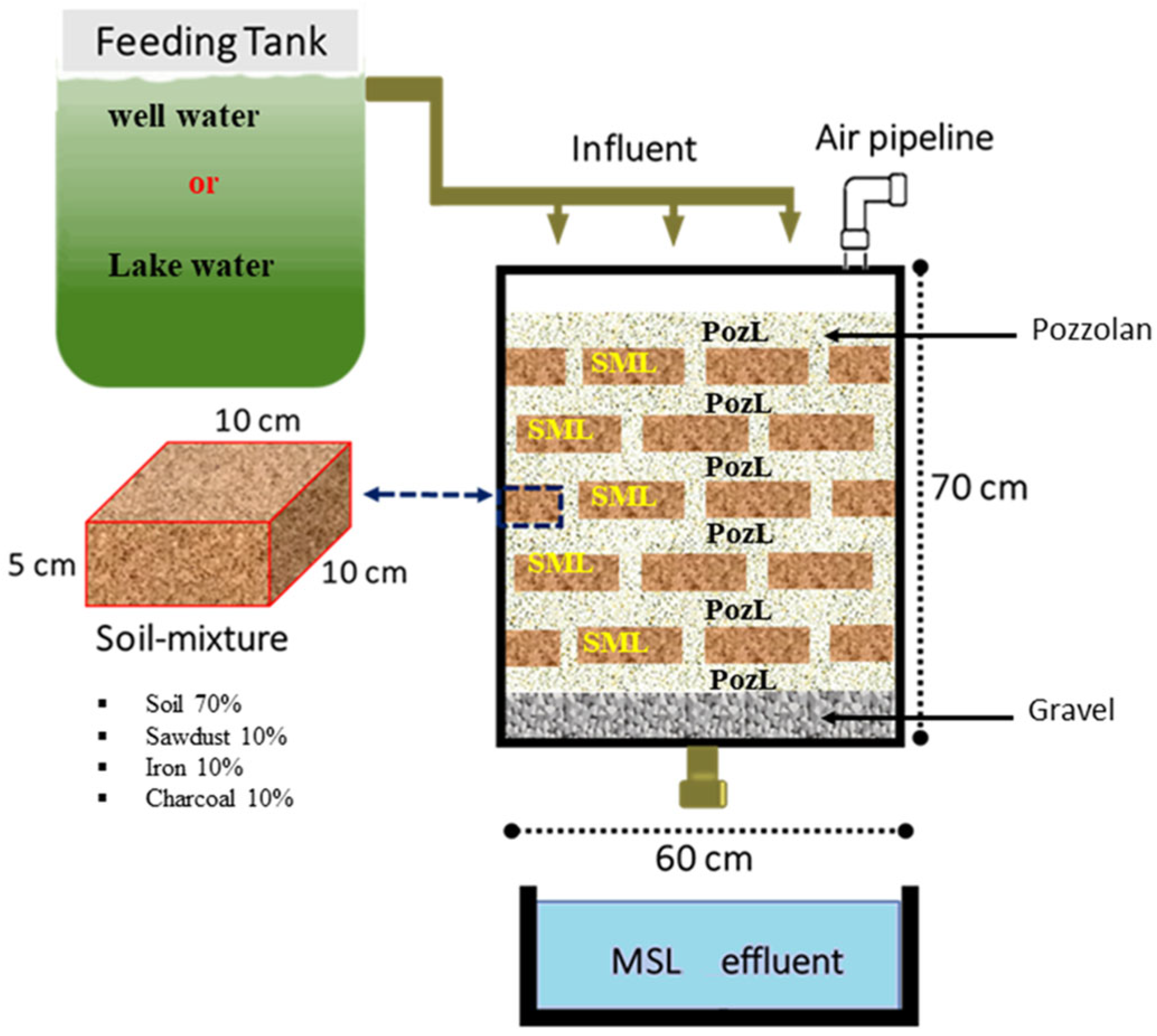
Two vertical-flow Multi-Soil-Layering (MSL) mesocosms were used in this study. Each system consisted of a rectangular glass tank with internal dimensions of 60 × 10 × 70 cm (length × width × height). The permeable layers (PL) of both MSL systems were constructed using pozzolan with a particle size of 3.5–5 mm. The only difference between the two mesocosms was the composition of the soil mixture layers (SML). The soil mixture layer is a mixture of local soil, charcoal with a particle size of 3–5 mm, sawdust with an average particle size between 0.5 and 3 mm and iron metal commonly used in carpentry with a size of approximately 3–4 cm. In MSL1, the SML consisted of a mixture of local sandy soil, iron metal, charcoal and sawdust in dry weight ratios of 70:10:10:10, as previously described by [
13]. In MSL2, the SML contained local clay soil instead of sandy soil, with the same mixing ratios (70:10:10:10).
The local sandy soil used in MSL1 contained 8% clay, whereas the local clay soil used in MSL2 contained 54% clay. The initial total organic matter contents of the sandy and clay soils were 8.72% and 4.12%, respectively. After mixing with sawdust and charcoal, the total organic matter content increased to 24.89% in the sandy soil mixture (MSL1) and 22.21% in the clayey soil mixture (MSL2). Because full-scale MSL systems are typically installed underground, both mesocosms were wrapped with opaque material to prevent light penetration and avoid photodegradation of microcystins. A transparent glass feed tank (65 × 50 × 51 cm, length × width × height; capacity 165 L) was used to supply influent to the MSL systems.
The systems were acclimated with well water for 2–3 weeks prior to the start of the experiment, without pH adjustment. During this acclimation phase, MCs remained below the LC–MS/MS detection limit and mlrA gene copies and culturable MC-degrading bacteria were at or below detection in both pozzolan and SML.
2.2. Influent Preparation, Operation and Sampling
Two types of influent were used: (i) an artificial cyanobacterial bloom prepared in the laboratory and (ii) a natural cyanobacterial bloom collected from an eutrophic reservoir (Lalla Takerkoust, Morocco).
The artificial bloom was prepared by diluting 5 L of
Microcystis aeruginosa culture (1.9 × 10
7 cells mL
−1) into 90 L of well water, resulting in a final concentration of 10
6 cells mL
−1 [
26]. Previous work has shown that the laboratory-cultured Microcystis strain can produce intracellular MCs up to 10.20 μg L
−1 MC-LR equivalents, whereas extracellular MCs remain below the limit of detection (0.15 μg L
−1) [
30]. To ensure an environmentally relevant and detectable toxin concentration, MC-LR was added to the artificial influent at 25 μg L
−1, corresponding to the average MC concentration previously observed in Lalla Takerkoust reservoir [
31,
32]. The artificial influent was freshly prepared each week.
The natural bloom influent was collected weekly from Lalla Takerkoust Lake during the cyanobloom season and contained cyanobacterial blooms dominated by
Microcystis aeruginosa, as reported in previous studies [
31,
32]. MCs in the natural bloom influent used in this study were quantified by LC–MS/MS as described below.
In both experiments, manual agitation of the feed tank and careful placement of the inlet tube ensured homogeneous mixing within the influent. The hydraulic loading rate was adjusted to 200 L m−2day−1 using a peristaltic pump. The mesocosms were operated continuously for 12 weeks during the bloom season (October–January), with weekly renewal of artificial and natural bloom influents.
At the end of the 12-week operational period, samples of influent water, treated effluent, pozzolan, and Soil Mixture Layers (SML) were collected from each MSL mesocosm. Substrate samples were taken from all layers following the direction of water flow using a soil sampling probe. For each layer, several subsamples were collected and subsequently homogenized to obtain a single composite sample representative of that specific layer. This composite sampling approach was used to capture the overall microbial community present within each layer while minimizing small-scale spatial heterogeneity.
Each composite sample therefore represented one environmental sample corresponding to a specific layer within the MSL system. These composite samples were then subjected to high-throughput sequencing analysis. No technical sequencing duplicates were generated; consequently, each sequencing dataset corresponds to a unique composite environmental sample from a given layer of the system. Analyses were performed on composite samples collected from the pozzolan layers and the Soil Mixture Layers (SML) of each MSL system and for each influent type (
Figure 1).
For clarity, sample codes combine the medium, system and influent type. PozL0, SML10 and SML20 denote pozzolan and SML materials before treatment. PozL1w and PozL2w refer to pozzolan layers in MSL1 and MSL2, respectively, after treatment of the artificial bloom prepared with well water; SML1w and SML2w refer to the corresponding SML. PozL1L and PozL2L, and SML1L and SML2L denote the same layers after treatment of natural lake blooms.
2.3. DNA Extraction, mlrA Quantification and Enumeration of MC-Degrading Bacteria
DNA extraction,
mlrA gene quantification and enumeration of MC-degrading bacteria followed the procedures described in [
16], with minor adaptations. Briefly, DNA was extracted from 0.5 g of lyophilised substrate or from biomass collected on filters from 0.5 L of water using a commercial soil DNA extraction kit (Qiagen DNA easy mini kit; Qiagen, Germantown, MD, USA), following the manufacturer’s instructions. Extracted DNA was quantified spectrophotometrically using DeNovix DS-11 FX (DeNovix Inc., Wilmington, DE, USA) and stored at −20 °C until analysis.
The abundance of the
mlrA gene was determined by quantitative PCR (qPCR) using
mlrA-specific primers and plasmid standards containing the
mlrA gene from a known MC-degrading strain [
17,
18]. The amplification protocol consisted of an initial denaturation step of 2 min at 95 °C, followed by 45 cycles of 5 s of denaturation at 95 °C and 25 s of annealing. After amplification, melting curve analysis was performed by heating the samples for 1 min at 95 °C, followed by increasing the temperature in increments of 0.5 °C every 30 s, starting at 62 °C and ending at 95 °C for 5 s. qPCR assays were performed in triplicate for each sample, and amplification efficiencies and standard curves were checked to ensure reliable quantification.
mlrA copy numbers were expressed per g dry substrate or per mL of water.
MC-degrading bacteria were enumerated by culture-based enrichment followed by plate counting, as described by [
14]. Briefly, samples were inoculated into liquid medium supplemented with MC-LR as the sole or main nitrogen source and incubated under aerobic conditions. After enrichment, serial dilutions were plated on selective agar, and colonies able to grow in the presence of MC were counted. Counts were expressed as log
10 CFU g
−1 (substrates) or log
10 CFU mL
−1 (water). It is important to note that this operational definition of “MC-degrading bacteria” is not restricted to
mlr-type degraders, and that some MC-degrading bacteria may lack the
mlrABCD cluster; conversely,
mlrA qPCR specifically targets
mlr-harbouring populations [
19,
20].
2.4. 16S rRNA Gene Amplification, Sequencing and Bioinformatics
High-throughput amplicon sequencing was used to characterise the bacterial communities associated with MSL layers and influent water. For bacterial analysis, the modified primer set 341F (5′-CCTACGGGNGGCWGCAG-3′) and 785R (5′-GACTACHVGGGTATCTAAKCC-3′) was used to amplify the V3–V4 hypervariable region of the 16S rRNA gene [
33]. Amplicons were barcoded and sequenced on an Illumina MiSeq platform (LGC Genomics GmbH, Berlin, Germany).
Raw sequencing reads were processed using a standard bioinformatics pipeline. Illumina TruSeq adapters were removed with Cutadapt v4.4 [
34], and reads were quality trimmed using Trimmomatic v0.39 [
35]. Forward and reverse reads were merged using FLASH2 v2.2.00 [
36]. Downstream processing, including quality filtering, chimera removal, inference of amplicon sequence variants (ASVs) and taxonomic assignment, was performed using the DADA2 v1.28 algorithm implemented in R v4.3.1 [
37] and the SILVA reference database v138. Additional community analyses were conducted with the microeco package v0.10.0 in R [
38]. Fungal primers and data were initially tested but not further analysed due to insufficient sequencing depth and lack of relevance to MC degradation; only bacterial 16S rRNA gene data are reported here.
2.5. Extraction and Quantification of Microcystins
Extraction and quantification of MCs from SML and pozzolan samples followed the protocol described by [
13]. Briefly, 2 g portions of lyophilised substrate were extracted three times with 15 mL of a mixed solution containing 0.1 M ethylenediaminetetraacetic acid (EDTA), 0.1 M sodium pyrophosphate and 0.002 M trifluoroacetic acid (TFA). Samples were sonicated at 60 Hz on an ice bath for 10 min and left overnight at 4 °C. After this step, the extract was centrifuged (6000
g) at 4 °C for 10 min and subjected to repeated extraction cycles.
Combined extracts were purified using LiChrolut RP-18 octadecyl silica cartridges (40–63 μm, 1000 mg, 6 mL; Merck, Munich, Germany). After conditioning with methanol and water, samples were loaded onto the cartridges, washed and eluted with aqueous methanol. MCs were quantified using a Waters Alliance e2695 HPLC system coupled with a triple quadrupole spectrometry detector (Micromass® Quattro micro TM API, Milford, MA, USA), with electrospray ionisation (ESI) interface (Waters, Manchester, UK) MassLynx version 4.1 was used for data acquisition and processing. Quantification was based on calibrated responses of purified standards (96–99% purity, Cifga, Lugo, Spain). The method’s limit of detection was 4 ng g−1 and the limit of quantification was 5 ng g−1. MCs in influent water were analysed using the same LC–MS/MS method, and results are reported as total microcystins expressed as MC-LR equivalents.
2.6. Statistical Analyses
The effects of the MSL system, influent type and sampled layer on MC degradation were evaluated using
mlrA gene copy numbers and abundances of MC-degrading bacteria (log
10 values), together with MC concentrations in solid media and water. All statistical analyses and visualisations were performed in R v4.3.1 [
38] using appropriate packages. Descriptive statistics were used to summarise the ranges of values for each variable and factor. Differences between groups (system, influent type, layer) were tested using Kruskal–Wallis non-parametric tests followed by Dunn’s post hoc tests with Benjamini–Hochberg correction (α = 0.05), rejecting the null hypothesis when
p < 0.025.
Alpha diversity indices (Observed species, Chao1, ACE, Shannon, Simpson, Inverse Simpson, Fisher, Pielou and Coverage) were calculated from ASV tables to assess richness and evenness, and differences between groups were tested using ANOVA with Duncan’s post hoc test, where assumptions were met. Beta diversity was evaluated using Bray–Curtis and Jaccard dissimilarity matrices, and community patterns were visualised by Principal Coordinate Analysis (PCoA).
Functional traits were predicted from 16S rRNA gene data using the FAPROTAX database [
24], focusing on functions related to chemoheterotrophy, methylotrophy and nitrogen and sulfur cycling. Predicted function abundances were compared across systems and layers to infer potential links between microbial functional capacity and MC degradation.
3. Results & Discussion
3.1. Influence of MSL Systems, Influent Type and Layers on MC Distribution, mlrA and MC-Degrading Bacteria
Initial measurements in MSL materials (PozL0, SML10, SML20) and influent well water showed no detectable MCs and
mlrA gene copies and culturable MC-degrading bacteria at or below the detection limit, confirming the absence of prior MC contamination in the systems. After 12 weeks of operation with MC-contaminated influents, both MSL systems retained substantial amounts of MCs in the solid media, with similar ranges of MCs in substrates (1.46–4.77 μg g
−1 in MSL1 and 1.39–4.68 μg g
−1 in MSL2), but with higher
mlrA gene copy numbers and MC-degrading bacteria in MSL1 (27–891 copies g
−1, 2.78–4.33 log
10 CFU g
−1) than in MSL2 (1–317 copies g
−1, 0.98–3.88 log
10 CFU g
−1) (
Figure 2).
Kruskal–Wallis tests confirmed significant effects of system, influent type and layer on MCs,
mlrA and MC-degrading bacteria (
p < 0.001), with post hoc tests showing that MSL1 and its SML (SML1w, SML1L) consistently hosted higher
mlrA copy numbers and MC-degrading bacteria than MSL2 and SML2 layers. These differences indicate that the low-clay SML1 matrix, with higher organic matter and lower clay content, supports more abundant MC-degrading communities than the high-clay SML2 matrix, in agreement with previous observations that organic-rich, well-aerated matrices favour MC biodegradation in nature-based systems [
14].
The influent type also strongly influenced microbial responses. Systems treating natural lake blooms exhibited higher
mlrA gene copies and MC-degrading bacteria than those treating artificial blooms, both in pozzolan and SML (
Figure 2). This is consistent with reports that eutrophic lakes frequently exposed to cyanoblooms harbour established MC-degrading communities and
mlr-positive bacteria, which can rapidly colonise treatment systems and enhance biodegradation capacity [
39,
40,
41,
42].
Across layers, MCs accumulated predominantly in pozzolan (PozL1w, PozL1L, PozL2w, PozL2L), whereas
mlrA and MC-degrading bacteria were more abundant in SML, especially in SML1w and SML1L. This spatial separation suggests that pozzolan functions mainly as an adsorptive medium concentrating MCs, while SML provides a nutrient-rich environment supporting dense biofilms and active MC-degrading communities, as reported for sand filters and constructed wetlands where adsorption and biodegradation often occur in different layers [
18,
43].
Although influent MCs were 25 μg L
−1 MC-LR in artificial blooms and of the same order of magnitude in natural blooms, MCs in solid media reached 1.39–4.77 μg g
−1, reflecting accumulation and concentration of MCs in pozzolan and SML rather than an increase in total MC mass. Similar enrichment in μg g
−1 has been reported for MCs in filter media and sediments, where adsorption and retention lead to higher solid-phase concentrations despite overall removal from the water column [
9,
12].
Weekly monitoring of influent and effluent MCs (where available) indicated an initial increase in removal efficiency over the first 3–4 weeks, followed by stabilisation at high removal levels, suggesting a transition from a phase dominated by adsorption and microbial adaptation to a quasi-steady state in which MCs are both adsorbed and biodegraded. Longer-term experiments are needed to assess whether pozzolan adsorption reaches saturation and how this affects MC removal under field conditions.
The chemical composition of the influent plays a crucial role in shaping microbial community structure and activity within the MSL system. Environmental parameters such as nutrient concentrations, dissolved organic carbon, MC levels, and oxygen availability can act as selective pressures influencing microbial growth and metabolism. Elevated organic matter inputs may stimulate heterotrophic microbial populations capable of cometabolic degradation processes, while the presence of MCs themselves may select for toxin-degrading bacteria. Moreover, the layered configuration of the MSL system creates gradients in oxygen and nutrient availability, generating micro-niches that support diverse microbial populations. Such environmental heterogeneity may promote functional diversity and enhance the overall biodegradation capacity of the treatment system.
The preferential adsorption of MCs in the pozzolan layers can be explained by the high porosity and large specific surface area of this material, which facilitates the physical adsorption of organic molecules. Pozzolanic substrates also possess mineral surfaces capable of interacting with MC molecules through electrostatic and hydrophobic interactions.
In contrast, the soil layers provide a biologically active environment rich in organic matter and microbial biomass, which supports the establishment of diverse microbial communities. These conditions promote the development of bacteria capable of enzymatic degradation of MCs, explaining why biodegradation processes appear to occur predominantly in the soil compartments of the MSL system.
3.2. Microbial Diversity Patterns in MSL Systems
At the kingdom level, bacteria dominated all samples, accounting for more than 90% of the detected sequences, whereas archaea were detected only at low relative abundance (<10%). Preliminary analysis of the NGS data revealed clear differences in microbial richness between the two MSL systems. The MSL1 system, characterized by a sandy soil mixture layer with 8% clay, consistently exhibited higher taxonomic richness across all taxonomic ranks compared with MSL2, which contained a clay-rich soil mixture layer (54% clay). Taxonomic richness also varied among the different system layers and between the initial materials (PozL0, SML10, SML20) and samples collected after treatment of artificial or natural cyanobacterial blooms. As shown in
Table 1, the soil mixture layers (SML) generally harbored a substantially greater number of detected taxa than the pozzolan layers (PozL), particularly at the family and genus levels, indicating that these compartments provide more favorable niches for microbial diversification within the MSL systems.
Alpha diversity indices (Observed species, Chao1, ACE, Shannon, Simpson, Inverse Simpson, Fisher, Pielou, Coverage) revealed significant differences between groups (ANOVA with Duncan’s post hoc test), with MSL1 and SML10 showing higher richness and evenness than MSL2, SML20 and pozzolan (PozMSL1or2) (
Figure 3). This pattern indicates that the low-clay SML1 matrix supports more diverse and even bacterial communities than the high-clay SML2 matrix, which may have a more selective environment and reduced habitat heterogeneity. Similar changes in diversity have been reported in sediments and biofilms exposed to MCs, where diversity can decrease due to toxin stress or increase when specialised MC-degrading consortia develop [
19,
44,
45].
In our system, the higher alpha diversity of MSL1 and SML10 coincided with higher mlrA gene copy numbers and MC-degrading bacteria, suggesting that a more diverse community may offer greater functional redundancy and flexibility for MC degradation. Conversely, lower diversity in MSL2 and SML20 may reflect the dominance of a narrower set of taxa adapted to high clay content and limited pore space, potentially constraining the range of MC-degrading metabolisms present.
3.3. Beta Diversity and Community Structure
Beta diversity analysis using Bray–Curtis and Jaccard indices, visualised by PCoA, revealed consistent clustering patterns among samples (
Figure 4). For Bray–Curtis, samples from initial materials (PozL0, SML20, SML2L) clustered together, while post-treatment pozzolan layers (PozL1L, PozL2L, PozL2w) formed another cluster, and SML1 samples (SML10, SML1w, SML1L) clustered separately, reflecting differences in community composition between systems and layers.
Jaccard-based PCoA showed similar groupings, with SML1 samples treated with different influent types clustering together and SML2w and PozL1w appearing more distinct, indicating that both system properties and influent source shape community composition. Clustering of samples according to contact with MCs and exposure duration has also been reported in other MC-impacted systems, suggesting that MC exposure and bloom history are strong drivers of community structure [
23,
46].
These patterns indicate that (i) MSL1 and MSL2 develop distinct microbial communities, (ii) pozzolan and SML harbour different assemblages, and (iii) influent type (artificial vs. natural bloom) further differentiates communities, particularly in SML, where most biological activity is concentrated.
3.4. Taxonomic Composition and Links to MC Degradation
At the phylum level, Proteobacteria and Actinobacteriota dominated across systems, layers and influent types, followed by Firmicutes, Chloroflexi and Bacteroidota (
Figure 5A). In MSL2, Proteobacteria were especially predominant in lake-influent samples such as SML2L and PozL2L (80.25% and 52.93% of total abundance, respectively), while Actinobacteriota were particularly abundant in SML10 (61.14%) and remained important in SML20 and PozL1w. Firmicutes were more abundant in SML20 (34.46%) but decreased in other layers, and Chloroflexi tended to be more abundant in well-influent samples such as PozL1w and SML1w.
These patterns are consistent with previous findings showing the dominance of Proteobacteria and Bacteroidota in cyanobacteria-associated water bodies and engineered systems impacted by MCs, where these phyla include many taxa involved in organic matter and MC degradation [
40,
47,
48]. By contrast, Actinobacteriota and Chloroflexi are often associated with soils and sediments and can be sensitive to MCs, with decreased abundance reported upon exposure in some studies [
49,
50,
51].
At the class level, Gammaproteobacteria emerged as a dominant group, particularly in MSL2 lake-influent samples SML2L and PozL2L (78.49% and 27.97% of total abundance, respectively), while Actinobacteria were abundant in SML10 (35.15%) (
Figure 5B). Bacilli and Alphaproteobacteria were also prevalent in several layers, with Bacilli reaching 34.46% in SML20 and Alphaproteobacteria contributing substantially across both systems and influent types. Gammaproteobacteria, Bacilli and Actinobacteria include genera such as Pseudomonas, Bacillus and Streptomyces that have been reported to exhibit algicidal activity against Microcystis and other bloom-forming cyanobacteria and, in some cases, to degrade MCs, suggesting a potential role in both biomass and toxin removal [
16,
41,
52].
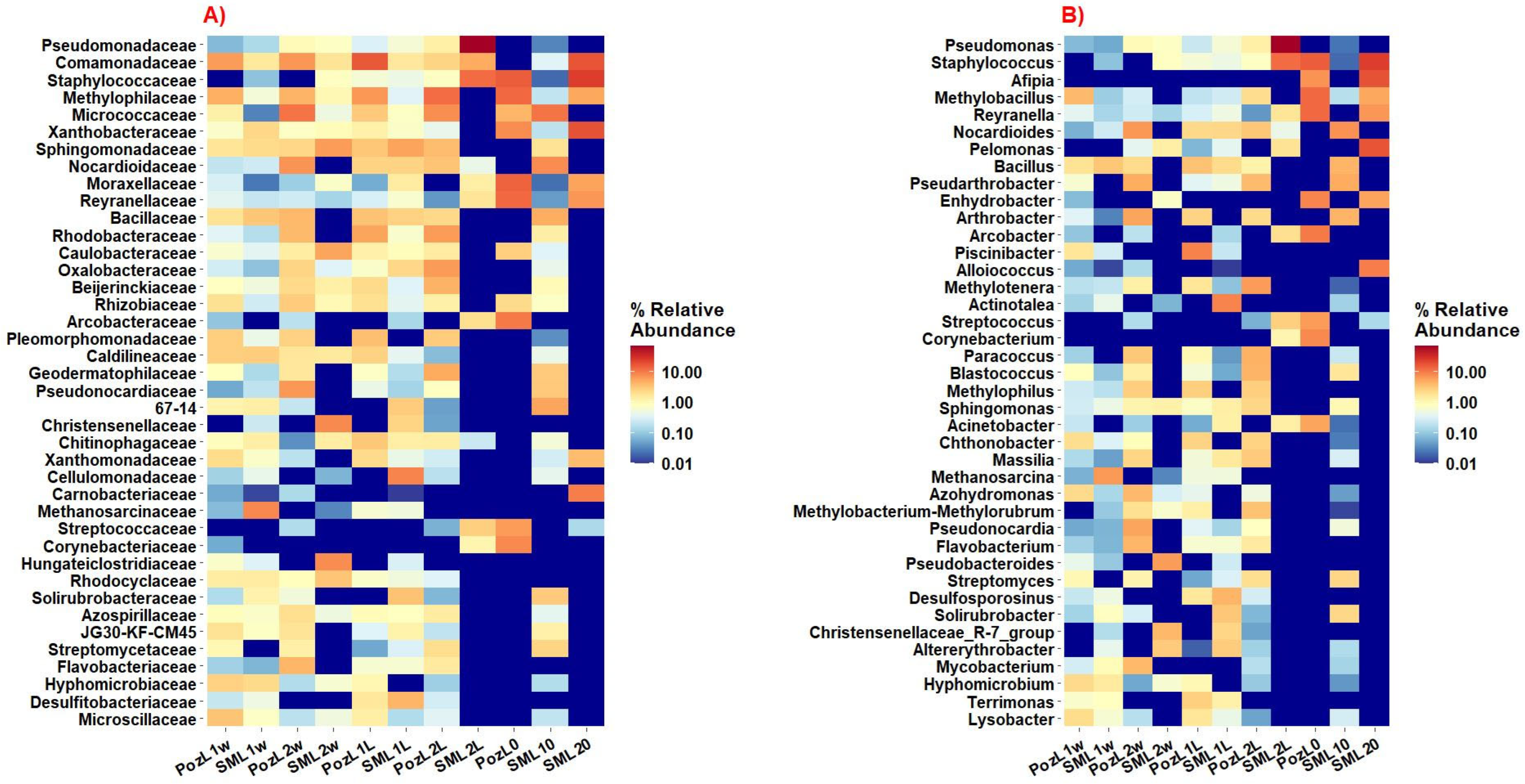
At the family level, Pseudomonadaceae were particularly dominant in MSL2 SML2L (69.97% of total abundance), while Staphylococcaceae and Comamonadaceae were abundant in SML20 (24.59% and 17.82%, respectively) (
Figure 6A). Micrococcaceae and unidentified families were more abundant in SML10, whereas Methylophilaceae and Reyranellaceae were prevalent in PozL0, indicating the presence of methylotrophic and other specialised taxa in initial materials. Families such as Methanosarcinaceae and Christensenellaceae were more abundant in well-influent SML1w and SML2w, reflecting the occurrence of anaerobic and syntrophic communities in some layers.
At the genus level,
Pseudomonas dominated several samples, particularly MSL2 SML2L (69.97% of total abundance), while
Staphylococcus and
Afipia were important in SML20 (24.59% and 18.41%, respectively) (
Figure 6B). Several genera remained unidentified, accounting for 26–42% of reads in some layers, especially in SML10 and SML2w, underscoring the presence of uncharacterised bacteria in MSL systems.
Of particular interest,
Sphingomonas, a well-known MC-degrading genus, was detected in MSL2 lake-influent pozzolan (PozL2L, 2.41% of total abundance), and genera such as
Bacillus,
Paracoccus,
Flavobacterium and
Pelomonas, previously associated with cyanobacterial blooms or pollutant biodegradation, were enriched in various SML [
16,
19,
53,
54,
55]. These observations support the conclusion that MSL systems select for communities containing both known and potentially novel MC-degrading taxa, particularly in SML, where
mlrA and MC-degrading bacteria are highest.
3.5. Predicted Functional Traits and Implications for MC Biodegradation
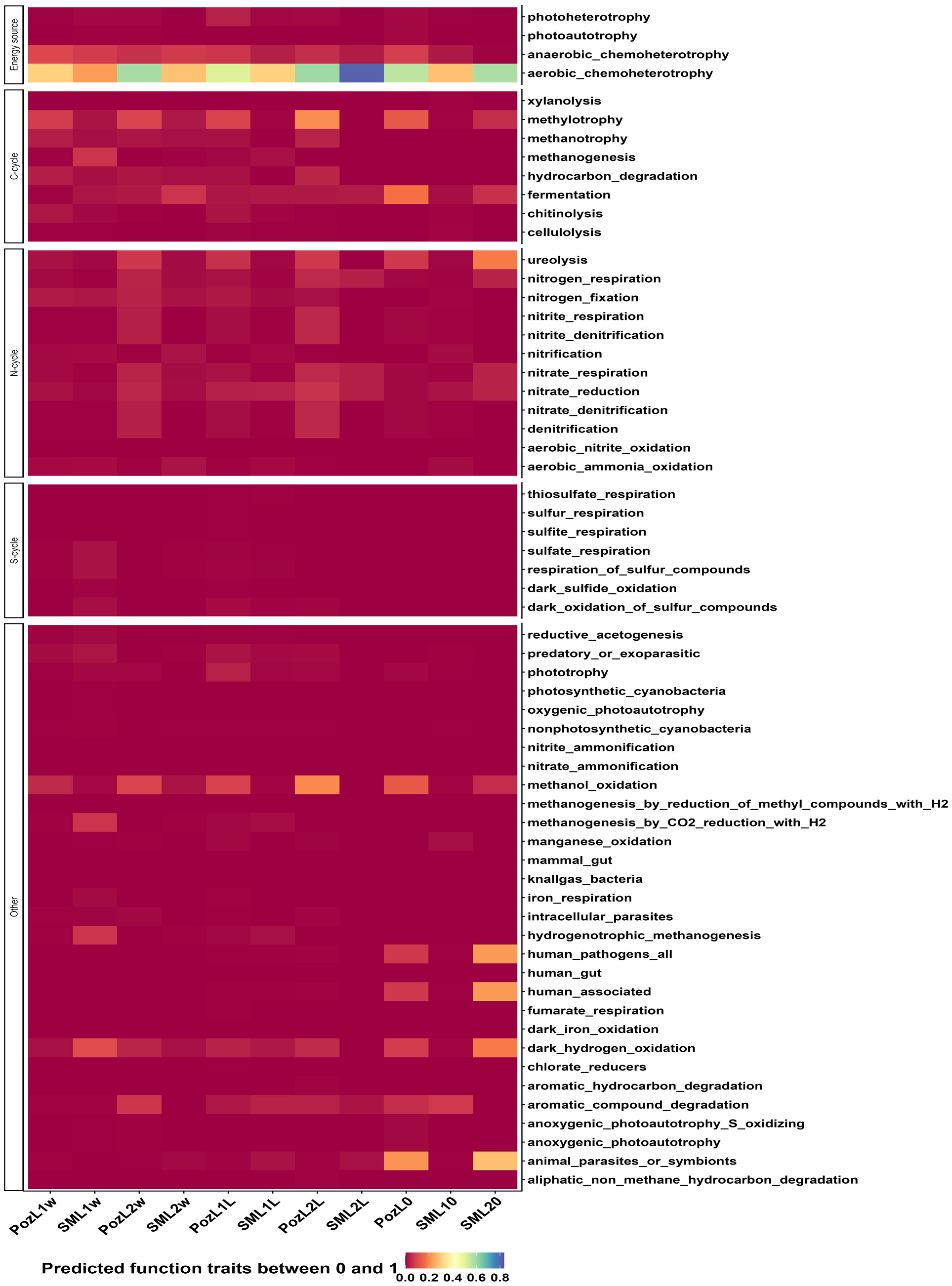
FAPROTAX-based functional profiling revealed a diverse set of predicted biogeochemical functions across layers and systems, with particular emphasis on energy sources, carbon cycling and nitrogen cycling (
Figure 7). Chemoheterotrophy and aerobic chemoheterotrophy were dominant functions in most samples, with notable abundances in PozL1w (33.87%) and SML2L (42.75%) for chemoheterotrophy and in SML1w (33.06%) and SML2L (41.35%) for aerobic chemoheterotrophy. These functions are consistent with intensive degradation of organic matter derived from cyanobacterial biomass and associated extracellular organic compounds, as observed in other MC-impacted aquatic systems and treatment technologies [
20,
25,
56].
Methylotrophy was also predicted in several layers, with higher relative abundances in PozL1L (7.24%) and SML1L (3.79%), indicating the presence of microorganisms capable of using single-carbon substrates such as methanol and methylamines. Methylotrophic and related metabolisms have been linked to sphingomonads and other MC-degrading bacteria that can exploit MC-derived organic structures or co-metabolise them with simple carbon sources [
19,
55]. Anaerobic chemoheterotrophy, fermentation and methane-related processes (methanotrophy and methanogenesis) were predicted mainly in SML10 and SML20, with relative abundances between 1.12% and 5.31%, reflecting the development of anaerobic micro-niches within the SML matrix under sustained organic loading [
57,
58,
59].
Functions associated with degradation of aromatic compounds and chitinolysis appeared in several layers, including PozL1L and SML10, emphasising the potential for complex organic pollutant and structural polymer breakdown, which may contribute to the degradation of MCs and cyanobacterial cell walls [
20,
56]. Nitrogen-cycling functions, such as nitrate reduction, nitrate denitrification and nitrite denitrification, were prevalent in pozzolan layers receiving lake influent (PozL1L, PozL2L), highlighting the importance of anaerobic nitrogen metabolism in MSL ecosystems and the capacity of these systems to simultaneously treat nutrients and MCs [
43,
60].
Notably, SML1 layers exhibited higher relative abundances of heterotrophic and methylotrophic functions than SML2 layers, mirroring the higher mlrA gene copy numbers and MC-degrading bacteria observed in MSL1. This suggests that the SML1 matrix supports a more functionally diverse community capable of both degrading cyanobacterial biomass and transforming MCs, whereas the SML2 matrix promotes a more constrained functional repertoire.
Microbial diversity likely plays an important role in the degradation of MCs within the MSL systems. Highly diverse microbial communities generally exhibit greater functional redundancy and metabolic flexibility, increasing the likelihood that specialized toxin-degrading microorganisms are present. Such metabolic versatility may facilitate the cometabolic transformation of cyanotoxins such as MCs. These results suggest that microbial diversity in the MSL system may contribute indirectly to MC degradation by maintaining robust and multifunctional microbial communities capable of sustaining complementary biodegradation pathways.
Predicted traits associated with pathogenicity and human pathogens were also detected, particularly in SML2L and PozL2L, where “human pathogens associated with pneumonia” reached relative abundances up to 8.75%, and in SML10 and SML20, where “animal parasites or symbionts” reached up to 11.01%.
Because FAPROTAX predictions rely on known associations between taxonomy and ecological functions, the results should be interpreted with caution. These annotations reflect potential functional capabilities inferred from taxonomic identity rather than direct measurements of metabolic activity. Functional predictions in this study also indicated the presence of categories associated with human-associated microorganisms and potential pathogens. However, the detection of these categories does not necessarily imply the presence of active pathogenic organisms within the system. Many bacterial taxa commonly found in environmental matrices share phylogenetic relationships with organisms reported from host-associated environments but perform different ecological roles in natural ecosystems. Moreover, the relative abundance of these predicted functions was generally low, suggesting that they represent only a minor fraction of the microbial community in the MSL system. Further investigations using metagenomic approaches or culture-based analyses would be necessary to confirm the presence and activity of specific genes related to pathogenicity or MC degradation.
Overall, the integration of MC distribution, mlrA abundance, MC-degrading bacteria, community composition and predicted functions demonstrates that (i) MSL1, with lower clay content, supports a more diverse and functionally versatile microbial community than MSL2; (ii) pozzolan layers act mainly as adsorptive sinks concentrating MCs, while SML host the main biodegrading consortia; and (iii) influent type, particularly repeated exposure to natural lake blooms, enhances the abundance of mlrA-harbouring and MC-degrading bacteria. These findings provide mechanistic insight into how MSL systems can be optimised as nature-based solutions for MC-contaminated waters and highlight the need for future field-scale studies to validate long-term performance under fluctuating environmental conditions.
4. Conclusions and Future Directions
This study shows that Multi-Soil-Layering systems can effectively retain and transform MCs, with a clear spatial separation between adsorption and biodegradation processes. MCs accumulated mainly in pozzolan layers, whereas mlrA gene copy numbers and MC-degrading bacteria were consistently higher in soil mixture layers, particularly in the low-clay, organic-rich SML1 matrix. The type of influent strongly influenced microbial responses: systems receiving natural lake blooms exhibited higher abundances of mlrA and MC-degrading bacteria than those supplied with artificial blooms, reflecting the contribution of bloom-adapted communities from eutrophic waters.
High-throughput sequencing revealed that MSL1 supported richer and more even bacterial communities than MSL2 and contained higher relative abundances of Proteobacteria, Actinobacteriota and genera such as Pseudomonas, Sphingomonas, Bacillus and Streptomyces, which are associated with algicidal activity and MC degradation. Functional predictions indicated that chemoheterotrophy, aerobic chemoheterotrophy, methylotrophy and nitrogen-cycling processes were enriched in SML1, aligning with the higher mlrA gene abundance and MC-degrading bacteria observed in this system. These results suggest that low-clay, organic-rich SML media can be engineered to enhance both cyanobacterial biomass degradation and MC Biodegradation while contributing to nutrient removal.
Future work should validate these findings in replicated pilot- and full-scale MSL systems operating under variable field conditions, with comprehensive monitoring of physicochemical parameters, MC speciation and long-term adsorption–desorption dynamics. Metagenomic and metatranscriptomic approaches, combined with targeted isolation of key taxa, are needed to resolve the diversity of MC degradation pathways beyond mlrA and to directly link specific functional genes to observed treatment performance. In addition, potential risks associated with predicted pathogenic traits in some layers should be assessed through targeted pathogen and antibiotic-resistance monitoring, particularly where MSL systems are considered for drinking-water applications.
Overall, the integration of MC distribution, mlrA abundance, microbial community structure and functional traits presented here provides a basis for optimising MSL eco-technology as a robust, low-energy, nature-based solution for mitigating microcystin contamination in freshwater ecosystems.




 ,
,