Conservation, Sustainable Use and Equity in Biological Resource Research and Development Governance: Australian Scientists’ Perspectives

 , , , , and
Abstract
1. Introduction

| ABS Regime | Objectives | Scope |
|---|---|---|
| (1) CBD [8] | (1) Conservation of biodiversity; (2) Sustainable use; (3) Fair and equitable benefit-sharing (article 2) | Non-human biological resources and associated traditional knowledge within national jurisdiction |
| (2) Nagoya Protocol [26] | (1) Fair and equitable benefit-sharing that contributes to conservation and sustainable use (article 2) | Non-human biological resources and associated traditional knowledge within national jurisdiction |
| (3) Plant Treaty [35] | (1) Conservation; (2) Sustainable use; (3) Fair and equitable benefit sharing; (4) Sustainable agriculture and food security (article 1) | Plant genetic resources for food and agriculture |
| (4) DSI Multilateral Mechanism [39] (non-binding UN decision) | (1) Support generation, access and use of DSI; (2) Fair and equitable benefit-sharing; (3) Achieve CBD objectives and sustainable development | DSI of genetic resources within publicly accessible databases |
| (5) BBNJ Agreement [36] | (1) Fair and equitable benefit-sharing; (2) Capacity building (3) Generation of knowledge, scientific understanding and technological innovation; (4) Transfer of marine technology (article 9) | Marine genetic resources of areas beyond national jurisdiction and associated digital sequence information and traditional knowledge |
| (6) PIP Framework [37] | (1) Improve pandemic influenza preparedness and response; (2) Protect against pandemic influenza; (3) Fair, transparent, equitable, efficient and effective system for the sharing of influenza viruses with pandemic potential and access to vaccines and sharing other benefits (article 2) | H5N1 influenza virus and other influenza viruses with pandemic potential (but not seasonal influenza viruses) |
- subject matter scope—differences in regulated objects, regulated R and D activities (commercial and non-commercial) and exclusions from scope;
- geographic scope—differences in whether public or private lands, waters and repositories are regulated;
- providers entitled to benefits—providers are mostly government, Indigenous peoples and communities and traditional knowledge holders, but they can be private landowners in the Northern Territory; and
- stakeholder engagement with ABS laws, comprising such things as motivation to engage with ABS procedures; perceptions of regulatory complexity and associated uncertainty about how to engage in benefit sharing and ABS procedures (e.g., [54,62]); non-compliance with ABS procedures due to lack of enforcement and regulatory loopholes (e.g., [16,23]); and avoidance of ABS procedures (e.g., engagement in forum shopping; e.g., [18]);
To what extent are ABS frameworks perceived as ‘effective’ by users of biological resources, DSI and associated traditional knowledge?
2. Methodology
2.1. Participants
2.2. Measures
2.3. Procedure
3. Results
3.1. The Nature of Australian Bio-R and D: Patterns of Subject Matter Use
3.2. The Nature of Australian Benefit Sharing: Patterns and Motivations
3.3. Measures of Effectiveness: Awareness, Engagement and Efficiency of ABS Processes
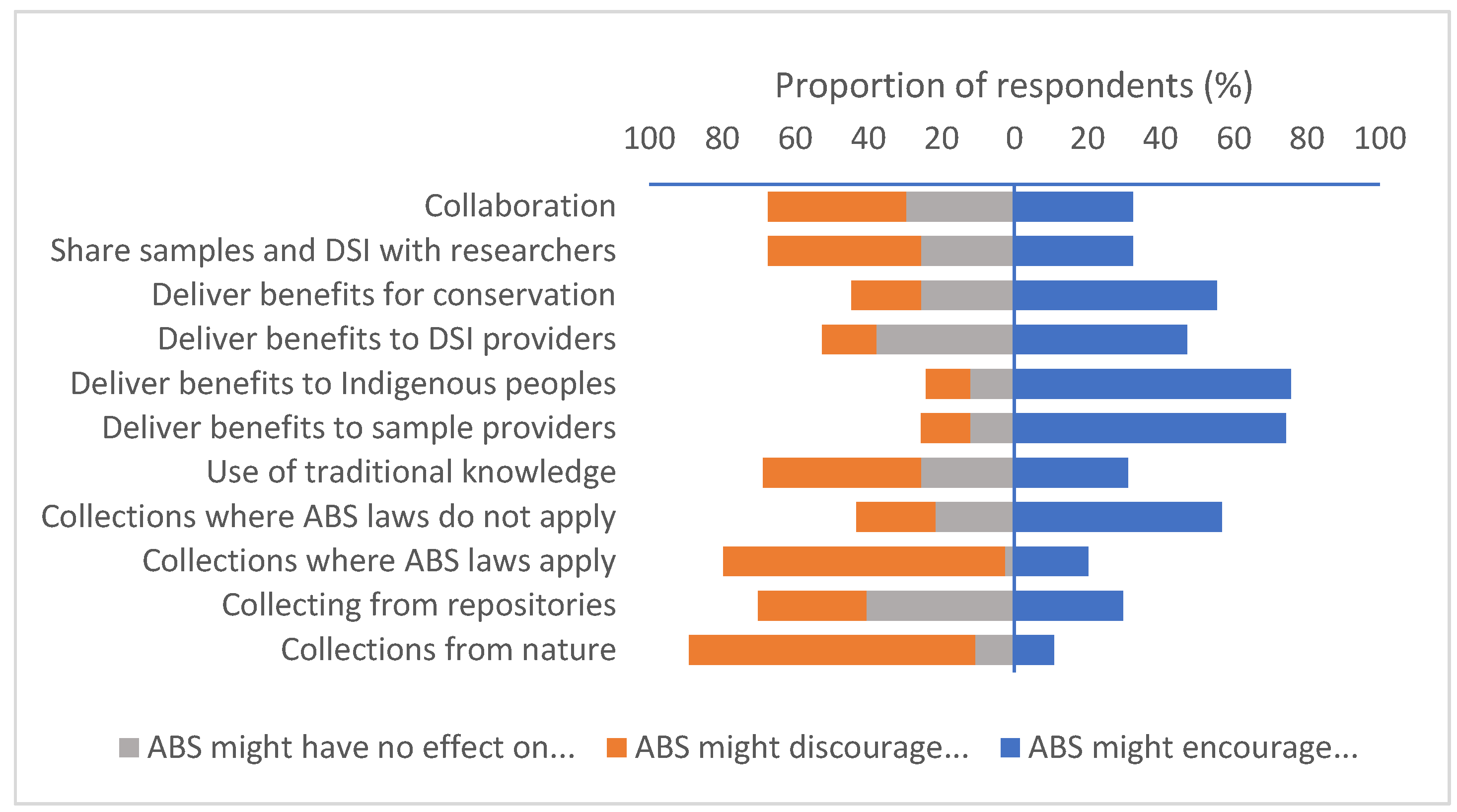
3.4. Measures of Effectiveness: Positive and Negative Impacts of ABS Laws
- fairly and equitably sharing benefits from the use of genetic resources with resource and knowledge owners (73%), nearly half of which emphasised benefits for Indigenous peoples;
- sharing Australia’s resources and knowledge about them (7%);
- protecting the environment and its resources (5%);
- having uniform and clear procedures for clarifying ownership (4%); and
- to preserve the credibility of science (1%).
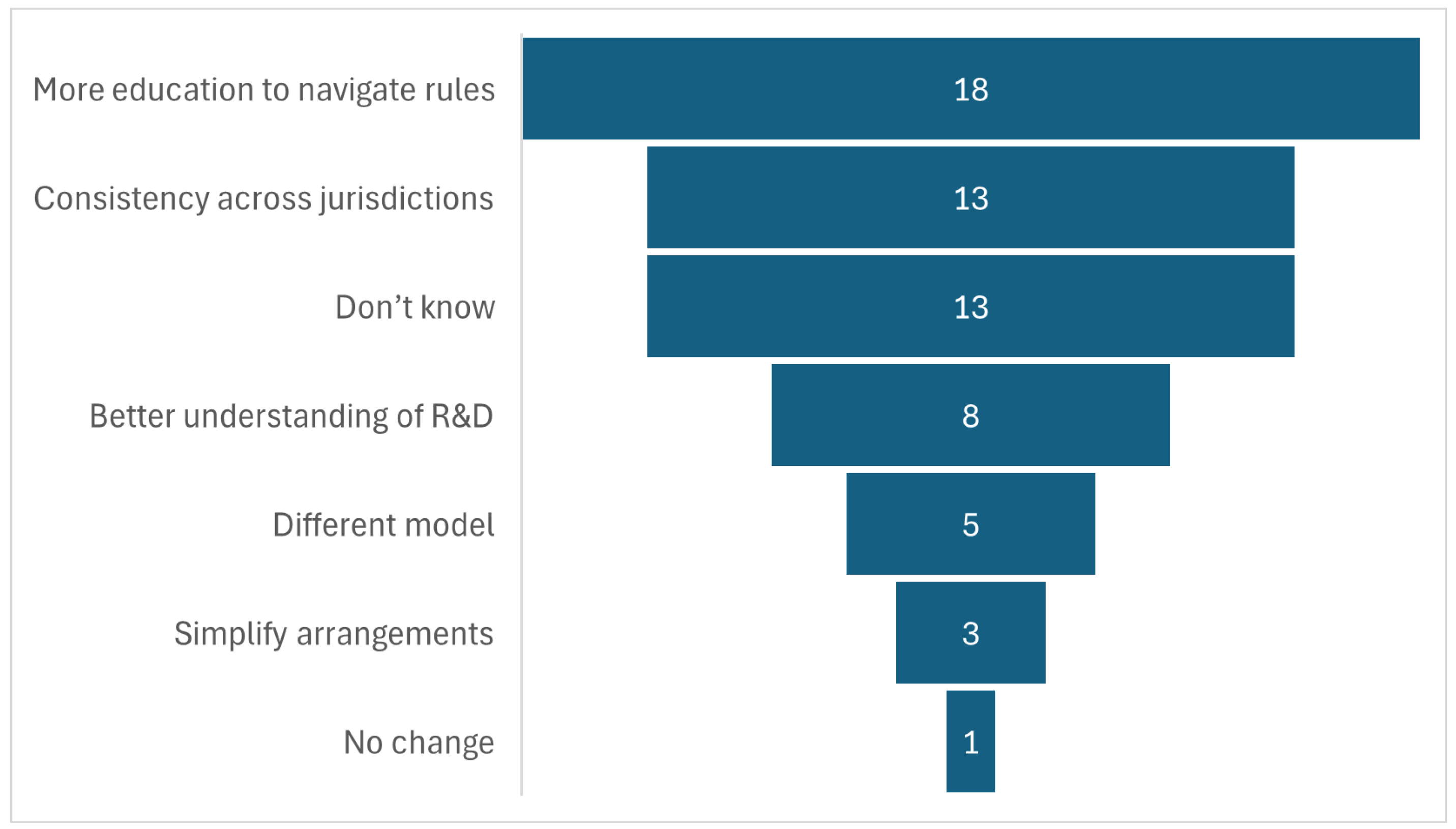
3.5. Perspectives on Regulatory Reform
3.6. Summary
4. Discussion
4.1. Efficiency
4.2. Engagement
4.2.1. Engagement with Benefit Sharing
4.2.2. Engagement with ABS Laws and Procedures
4.3. Impacts
4.3.1. Impacts on Biological Resource Users and R and D
- The procedures are a disproportionate dampener on R and D and innovation at a time when science is needed to address conservation, food and health emergencies [4]; and
4.3.2. Impacts on Conservation and Sustainable Use of Biodiversity
4.4. Reform and Indicators of Effectiveness
- direct participation in policy, law and decision-making processes relevant to the use of cultural resources and traditional knowledge (self-determination);
- a flexible framework supporting legal pluralism, recognising the diversity in governance and customary laws of Australia’s indigenous communities;
- policy support for indigenous led enterprises and partnerships in bio-innovation (Less than 2% of Australian bush food and botanicals activities are by Indigenous led or owned businesses: [23] (p. 314));
- relationship-building and partnerships based on trust and mutual respect;
- compliance with local community protocols for free prior and informed consent and preserving and recording traditional knowledge;
- negotiations with all or most of the community rather than a process involving a representative person or entity;
- a focus on Indigenous data sovereignty, including operationalising the CARE principles (Collective benefit, Authority to control, Responsibility and Ethics);
- modification of data management systems to ensure culturally appropriate management and protection of traditional knowledge.
5. Conclusions
Supplementary Materials
Author Contributions
Funding
Institutional Review Board Statement
Informed Consent Statement
Data Availability Statement
Acknowledgments
Conflicts of Interest
References
- Laird, S.; Wynberg, R.; Rourke, M.; Humphries, F.; Ruiz Muller, M.; Lawson, C. Rethink the expansion of access and benefit sharing. Science 2020, 367, 1200–1202. [Google Scholar] [CrossRef]
- Wynberg, R. Biopiracy: Crying wolf or a lever for equity and conservation? Res. Policy 2023, 52, 104674. [Google Scholar] [CrossRef]
- Sara, R.; Wyss, M.; Custers, R.; In’t Veld, A.; Muyldermans, D. A need for recalibrating access and benefit sharing: How best to improve conservation, sustainable use of biodiversity, and equitable benefit sharing in a mutually reinforcing manner? EMBO Rep. 2022, 23, e53973. [Google Scholar] [CrossRef] [PubMed]
- Michiels, F.; Feiter, U.; Paquin-Jaloux, S.; Jungmann, D.; Braun, A.; Sayoc, M.A.P.; Armengol, R.; Wyss, M.; David, B. Facing the harsh reality of access and benefit sharing (ABS) legislation: An industry perspective. Sustainability 2022, 14, 277. [Google Scholar] [CrossRef]
- Sherman, B.; Adhikari, S.; Balaji, S. The Impact of Access and Benefit-Sharing Measures on Use and Exchange of Genetic Resources for Food and Agriculture and Associated Traditional Knowledge; CGRFA-20/25/3.2/Inf.1; Commission on Genetic Resources for Food and Agriculture, Food and Agriculture Organization of the United Nations: Rome, Italy, 2025; Available online: https://openknowledge.fao.org/server/api/core/bitstreams/004b4aac-7a92-41be-9ef3-2c693023a557/content (accessed on 23 December 2025).
- Cresswell, I.D.; Janke, T.; Johnston, E.L. Australia State of the Environment 2021: Overview; independent report to the Australian Government Minister for the Environment; Commonwealth of Australia: Canberra, Australia, 2021. [Google Scholar] [CrossRef]
- Mgbeoji, I. Global Biopiracy: Patents, Plants and Indigenous Knowledge; UBC Press: Vancouver, BC, Canada, 2006. [Google Scholar]
- United Nations (UN). Convention on Biological Diversity; UNTS, 1760, 79; (CBD), Opened for Signature June 5, 1992, (Entered into Force 29 December 1993), 1992. Available online: https://www.cbd.int/convention/text/ (accessed on 6 February 2026).
- Lawson, C. Regulating access to biological resources: The market failure for biodiversity conservation. Law Context 2006, 24, 137–163. [Google Scholar]
- Oldham, P.; Hall, S.; Forero, O. Biological diversity in the patent system. PLoS ONE 2013, 8, e78737. [Google Scholar] [CrossRef]
- Verma, M.; Chauhan, I.; Kumari, R.; Sharma, M. India-victim of biopiracy. Indo Am. J. Pharm. Res. 2014, 4, 329–342. [Google Scholar]
- Lightbourne, M. Of rice and men: An attempt to assess the basmati affair. J. World Intellect. Prop. 2003, 6, 875–894. [Google Scholar] [CrossRef]
- Joubert, E.; de Beer, D. Rooibos (Aspalathus linearis) Beyond the farm gate: From herbal tea to potential phytopharmaceutical. S. Afr. J. Bot. 2011, 77, 869–886. [Google Scholar] [CrossRef]
- Shiva, V.; Holla-Bhar, R. Intellectual piracy and the neem tree. Ecologist 1993, 23, 223–227. [Google Scholar]
- Poelina, A.; Webb, B.; Wooltorton, S.; Godden, N.J. Waking up the snake: Ancient wisdom for regeneration. In Planetary Justice; Lobo, M., Mayes, E., Bedford, L., Eds.; Bristol University Press: Bristol, UK, 2024; pp. 25–38. [Google Scholar]
- Dawkins, V. Combating biopiracy in Australia: Will a disclosure requirement in the Patents Act 1990 be more effective than the current regulations? J. World Intellect. Prop. 2018, 21, 15–31. [Google Scholar] [CrossRef]
- Robinson, D.; Raven, M. Identifying and preventing biopiracy in Australia: Patent landscapes and legal geographies for plants with Indigenous Australian uses. Aust. Geogr. 2017, 48, 311–331. [Google Scholar] [CrossRef]
- Robinson, D.; Raven, M.; Hunter, J. The limits of ABS laws: Why Gumbi Gumbi and other bush foods and medicines need specific Indigenous knowledge protections. In Biodiversity, Genetic Resources and Intellectual Property: Developments in Access and Benefit Sharing; Lawson, C., Adhikari, K., Eds.; Routledge: London, UK, 2018; pp. 185–207. [Google Scholar] [CrossRef]
- Janke, T. True Tracks: Respecting Indigenous Knowledge and Culture; Newsouth Publishing: Sydney, Australia, 2021. [Google Scholar]
- Bubna-Litic, K. The impact of access and benefit sharing programmes on Indigenous people in Australia. In Concepts and Values in Biodiversity; Lanzerath, D., Friele, M.B., Eds.; Routledge: London, UK, 2014; pp. 199–224. [Google Scholar]
- Humphries, F.; Robinson, D.F.; Loban, H. Implications of Indigenous land tenure changes for accessing Indigenous genetic resources from northern Australia. Environ. Plan. Law J. 2017, 34, 560–579. [Google Scholar]
- Lingard, K. The potential of current legal structures to support Aboriginal and Torres Strait Islander interests in the Australian bush food industry. Int. J. Sustain. Dev. World Ecol. 2016, 23, 174–185. [Google Scholar] [CrossRef]
- Ohlin, G.; Trueb, L.; Raven, M.; Robinson, D.F. Towards a fairer and more equitable bushfoods industry: Access and benefit-sharing and certification frameworks. Aust. Geog. 2024, 55, 309–327. [Google Scholar] [CrossRef]
- Rosendal, G.K.; Myhr, A.I.; Tvedt, M.W. Access and benefit sharing legislation for marine bioprospecting: Lessons from Australia for the role of Marbank in Norway. J. World Intellect. Prop. 2016, 19, 86–98. [Google Scholar] [CrossRef]
- Janssen, J. Property rights on genetic resources: Economic issues. Glob. Environ. Change 1999, 9, 313–321. [Google Scholar] [CrossRef]
- Nagoya Protocol on Access to Genetic Resources and the Fair and Equitable Sharing of Benefits Arising from Their Utilization; Opened for Signature 29 October 2010 (Entered into Force 12 October 2014); Issued by the Secretariat of the Convention on Biological Diversity (SCBD). 2010. Available online: https://www.cbd.int/abs/ (accessed on 6 February 2026).
- Australian Government. Australia’s Indigenous Land and Forest Estate (2024); Department of Agriculture, Fisheries and Forestry, ABARES: Canberra, Australia, 2024. Available online: https://www.agriculture.gov.au/abares/forestsaustralia/forest-data-maps-and-tools/spatial-data/indigenous-land-and-forest (accessed on 23 December 2025).
- Blakeney, M. Bioprospecting and Traditional Knowledge in Australia. In Routledge Handbook of Biodiversity and the Law; McManis, C., Burton, O., Eds.; Routledge: London, UK, 2017; pp. 254–275. [Google Scholar]
- Australian Government. Australia’s Strategy for Nature 2024–2030: Australia’s National Biodiversity Strategy and Action Plan; Department of Climate Change, Energy, the Environment and Water: Canberra, Australia, 2024. Available online: https://www.dcceew.gov.au/environment/biodiversity/conservation/publications/australias-strategy-for-nature (accessed on 6 February 2026).
- Robyn Prior, R.; Brennan, T. R&D and Innovation in Australia: 2024 Update; Research Paper Series 2024-5; Parliament of Australia, Department of Parliamentary Services: Canberra, Australia, 2025. [Google Scholar]
- Speight, R.E. Synthetic and engineering biology in Australia: Advances in infrastructure, coordination and impact. Eng. Biol. 2025, 9, e70000. [Google Scholar] [CrossRef]
- Smith, M.; Ramirez, J.; O’Hara, I. Growing Australia’s Bioeconomy: Building a Sustainable Economic Future; Queensland University of Technology: Brisbane, Australia, 2025. [Google Scholar]
- Humphries, F. Just and enduring benefit sharing under the Biodiversity Beyond National Jurisdiction (BBNJ) Agreement. Front. Mar. Sci. 2026, 12, 1727000. [Google Scholar] [CrossRef]
- Humphries, F. A circular bio-economy approach to regulating genetic resource research: Rethinking access and benefit sharing. J. Law Biosci. 2025, 12, lsaf019. [Google Scholar] [CrossRef]
- Food and Agriculture Organization of the United Nations (FAO). International Treaty on Plant Genetic Resources for Food and Agriculture; UNTS, 2400, 303; (Plant Treaty), Opened for Signature Nov.3, 2001, (Entered into Force June 29, 2004), 2001. Available online: https://www.fao.org/plant-treaty/en (accessed on 9 February 2026).
- United Nations. Agreement Under the United Nations Convention of the Law of the Sea on the Conservation and Sustainable Use of Marine Biological Diversity of Areas Beyond National Jurisdiction; A/C ONF.232/2023/4; (BBNJ Agreement), 2023. Available online: https://www.un.org/bbnjagreement/en (accessed on 9 February 2026).
- World Health Organisation (WHO). Pandemic Influenza Preparedness: Sharing of Influenza Viruses and Access to Vaccines and Other Benefits; Sixty-Fourth World Health Assembly. Report by the Open-Ended Working Group of Member States on Pandemic Influenza Preparedness: Sharing of Influenza Viruses and Access to Vaccines and Other Benefits A64/8; (PIP Framework), 2011. Available online: https://apps.who.int/gb/ebwha/pdf_files/WHA64/A64_8-en.pdf (accessed on 9 February 2026).
- World Health Organisation (WHO). WHO Pandemic Agreement; Seventy-Eighth World Health Assembly, WHA78.1; 2025. Available online: https://apps.who.int/gb/ebwha/pdf_files/WHA78/A78_R1-en.pdf (accessed on 9 February 2026).
- United Nations Environment Program (UNEP). Decision Adopted by the Conference of the Parties to the Convention on Biological Diversity: 15/9 Digital Sequence Information on Genetic Resources; CBD/COP/DEC/15/9; Conference of the Parties to the Convention on Biological Diversity, 2022. Available online: https://www.cbd.int/doc/c/3119/8611/72d7962a5b058cc30e2299c7/cop-15-17-en.pdf (accessed on 9 February 2026).
- United Nations Environment Program (UNEP). Digital Sequence Information on Genetic Resources: Draft Decision Submitted by the President; CBD/COP/16/L.32/Rev.1; Conference of the Parties to the Convention on Biological Diversity, 2024. Available online: https://www.cbd.int/doc/c/bd4f/2861/9dce4f46d43a637231a442e0/cop-16-l-32-rev1-en.pdf (accessed on 9 February 2026).
- Burton, G.C. ABS in Australia: A story of early success and faltering progress. In Global Transformations in the Use of Biodiversity for Research and Development; Kamau, E.C., Ed.; Springer Nature: Cham, Switzerland, 2022; pp. 393–418. [Google Scholar] [CrossRef]
- Collings, N. Indigenous Governance of Traditional Knowledge: The Legal Implementation of Access and Benefit-Sharing in Australia; Routledge: London, UK, 2023. [Google Scholar] [CrossRef]
- Lawson, C.; Rourke, M.; Humphries, F.; Ruiz Muller, M. Legislative, administrative and policy approaches to access and benefit sharing (ABS) genetic resources: Digital Sequence Information (DSI) in New Zealand and Australian ABS laws. Intellect. Prop. Forum 2019, 118, 38–50. Available online: http://hdl.handle.net/10072/394991 (accessed on 9 February 2026).
- Jocelyn Bosse, J. The making or breaking of the Queensland Biodiscovery Act. Aust. Environ. Rev. 2018, 33, 63–67. [Google Scholar] [CrossRef]
- Rourke, M.; Lawson, C.; Humphries, F. Access and Benefit-Sharing for Australian Synthetic Biologists: A Tool for Risk Management; CSIRO: Canberra, Australia, 2023. [Google Scholar]
- National Health and Medical Research Council; Australian Research Council; Universities Australia. National Statement on Ethical Conduct in Human Research (2025); National Health and Medical Research Council: Canberra, Australia, 2023. Available online: http://www.nhmrc.gov.au/about-us/publications/national-statement-ethical-conduct-human-research-2025 (accessed on 9 February 2026).
- Australian Institute of Aboriginal and Torres Strait Islander Studies (AIATSIS). A Guide to Applying the AIATSIS Code of Ethics for Aboriginal and Torres Strait Islander Research; AIATSIS: Canberra, Australia, 2020. Available online: https://aiatsis.gov.au/sites/default/files/2022-02/aiatsis-guide-code-ethics-jan22.pdf (accessed on 9 February 2026).
- National Health and Medical Research Council (NHMRC). Ethical Conduct in Research with Aboriginal and Torres Strait Islander Peoples and Communities: Guidelines for Researchers and Stakeholders; IND2; National Health and Medical Research Council: Canberra, Australia, 2018. Available online: www.nhmrc.gov.au/guidelines-publications/ind2 (accessed on 9 February 2026).
- National Health and Medical Research Council (NHMRC). Keeping Research on Track II: A Companion Document to Ethical Conduct in Research with Aboriginal and Torres Strait Islander Peoples and Communities: Guidelines for Researchers and Stakeholders; IND3; National Health and Medical Research Council: Canberra, Australia, 2018. Available online: www.nhmrc.gov.au/guidelines-publications/ind3 (accessed on 9 February 2026).
- Woodward, E.; Hill, R.; Harkness, P.; Archer, R. (Eds.) Our Knowledge Our Way in Caring for Country: Indigenous-Led Approaches to Strengthening and Sharing our Knowledge for Land and Sea Management; Best Practice Guidelines from Australian Experiences; NAILSMA and CSIRO: Canberra, Australia, 2020; Available online: www.csiro.au/ourknowledgeourway (accessed on 9 February 2026).
- Wissing, K.; Scanlan, L.; Maclean, K.; Webb, T. Recommendations for Partnering with Aboriginal and Torres Strait Islander Peoples in Synthetic Biology in Australia; CSIRO: Canberra, Australia, 2025. [Google Scholar] [CrossRef]
- Australian Institute of Aboriginal and Torres Strait Islander Studies (AIATSIS). AIATSIS Code of Ethics for Aboriginal and Torres Strait Islander Research; AIATSIS: Canberra, Australia, 2020. Available online: https://aiatsis.gov.au/research/ethical-research/code-ethics (accessed on 9 February 2026).
- National Health and Medical Research Council. Guide to Managing and Investigating Potential Breaches of the Australian Code for the Responsible Conduct of Research; R42; National Health and Medical Research Council: Canberra, Australia, 2018. [Google Scholar]
- Terri Janke and Company. Indigenous Knowledge: Issues for Protection and Management; Discussion paper commissioned by IP Australia and the Department of Industry, Innovation and Science; IP Australia: Canberra, Australia, 2018; Available online: https://www.terrijanke.com.au/indigenous-knowledge (accessed on 9 February 2026).
- Kloppenburg, J.; Calderón, C.I.; Ané, J.-M. The Nagoya Protocol and nitrogen-fixing maize: Close encounters between Indigenous Oaxacans and the men from Mars (Inc.). Elem. Sci. Anth. 2024, 12, 00115. [Google Scholar] [CrossRef]
- Watanabe, M. The Nagoya Protocol: Big steps, new problems. Bioscience 2017, 67, 400. [Google Scholar] [CrossRef]
- Semple, S.J.; Staerk, D.; Buirchell, B.J.; Fowler, R.M.; Gericke, O.; Kjaerulff, L.; Zhao, Y.; Pedersen, H.A.; Petersen, M.J.; Rasmussen, L.F.; et al. Biodiscoveries within the Australian plant genus Eremophila based on international and interdisciplinary collaboration: Results and perspectives on outstanding ethical dilemmas. Plant J. 2022, 111, 936–953. [Google Scholar] [CrossRef]
- Prip, C.; Rosendal, G.K.; Andresen, S.; Walløe, M. The Australian ABS Framework. A Model Case for Bioprospecting? FNI Report 1/2014; Fridtjof Nansens Institutt: Lysaker, Norway, 2014; Available online: https://www.fni.no/publications/the-australian-abs-framework-a-model-case-for-bioprospecting (accessed on 9 February 2026).
- Munoz-Garcia, M.; Lago, A.; Scholz, A.H. Study on Access and Benefit-Sharing Indicators as They Relate to Target 13 and Goal C of the Kunming-Montreal Global Biodiversity Framework; CBD/SBSTTA/26/INF/12; Subsidiary Body on Scientific, Technical and Technological Advice, 2024. Available online: https://www.cbd.int/doc/c/6920/4e1e/8a6ba925279ea19033eb8ed2/sbstta-26-inf-12-en.pdf (accessed on 9 February 2026).
- Bosse, J. Fragmentation of access and benefit sharing laws in Australia. Aust. Law Stud. Assoc. Acad. J. 2017, 4–19. [Google Scholar]
- Janke, T. From smokebush to spinifex: Towards recognition of Indigenous Knowledge in the commercialisation of plants. Int. J. Rural. Law Policy 2018, 1, 1–37. [Google Scholar] [CrossRef][Green Version]
- Sherman, B.; Bosse, J. Regulating Access and Benefit-sharing in Australia. In Proceedings of the International Workshop on Access and Benefit-Sharing for Genetic Resources for Food and Agriculture, Rome, Italy, 10–12 January 2018; FAO: Rome, Italy, 2018; pp. 89–102. Available online: https://openknowledge.fao.org/server/api/core/bitstreams/95905cba-ebbf-4efc-a8f6-e8762bd6ced1/content (accessed on 9 February 2026).
- Sutherland, L.A.; Shepheard, M.L. Implementing access and benefit sharing for seed banking. Ann. Missouri Bot. Gard. 2017, 102, 386–396. Available online: https://www.jstor.org/stable/26379608 (accessed on 9 February 2026). [CrossRef]
- Lingard, K.; Martin, P. Strategies to support the interests of Aboriginal and Torres Strait Islander Peoples in the commercial development of gourmet bush food products. Int. J. Cult. Prop. 2016, 23, 33–70. [Google Scholar] [CrossRef]
- Stoianoff, N.; Roy, A. Indigenous knowledge and culture in Australia-the case for sui generis legislation. Monash Univ. Law Rev. 2015, 41, 745–784. [Google Scholar] [CrossRef]
- Rosenthal, R. The volunteer subject. Hum. Relat. 1965, 18, 389–406. [Google Scholar] [CrossRef]
- Schles, R.A.; Deheck, C.M. Identifying and mitigating the influence of invalid responses in online surveys: A longitudinal case study. Qual. Quant. 2026, 60, 1–19. [Google Scholar] [CrossRef]
- Camp, D.; Newman, S.; Pham, N.B.; Quinn, R.J. Nature Bank and the Queensland Compound Library: Unique international resources at the Eskitis Institute for Drug Discovery. Comb. Chem. High Throughput Screen. 2014, 17, 201–209. [Google Scholar] [CrossRef] [PubMed]
- Tualima, S.S.H.Y.F.M.; Bowrey, K. ABS or access before service: A Samoan perspective. In Access and Benefit Sharing of Genetic Resources, Information and Traditional Knowledge; Lawson, C., Rourke, M., Humphries, F., Eds.; Routledge: London, UK, 2022; pp. 209–220. [Google Scholar] [CrossRef]
- Mitchell, K.J.; Cheney, N. The genomic code: The genome instantiates a generative model of the organism. Trends Genetics 2025, 41, 462–479. [Google Scholar] [CrossRef] [PubMed]
- Aubry, S.; Frison, C.; Medaglia, J.C.; Frison, E.; Jaspars, M.; Rabone, M.; Sirakaya, A.; Saxena, D.; Van Zimmeren, E. Bringing access and benefit sharing into the digital age. Plants People Planet 2022, 4, 5–12. [Google Scholar] [CrossRef]
- Yeshi, K.; Wangchuk, P. Bush medicinal plants of the Australian Wet Tropics and their biodiscovery potential. In Bioprospecting of Tropical Medicinal Plants; Arunachalam, K., Yang, X., Puthanpura Sasidharan , S.P., Eds.; Springer Nature: Cham, Switzerland, 2023; pp. 357–379. [Google Scholar] [CrossRef]
- United Nations Environment Program (UNEP). Assessment and Review of the Effectiveness of the Nagoya Protocol; CBD/SBI/2/L.3; Subsidiary Body on Implementation; Convention on Biodiversity Conservation: Montreal, QC, Canada, 2018; Available online: https://www.cbd.int/doc/c/7f9f/3d30/46a50d2e3f693bb57895d882/sbi-02-l-03-en.pdf (accessed on 9 February 2026).
- Pena-Neira, S.; Coelho, L.F. Traditional knowledge associated with marine genetic resources in areas beyond national jurisdiction. In Decoding Marine Genetic Resource Governance Under the BBNJ Agreement; Humphries, F., Ed.; Springer Nature: Cham, Switzerland, 2025; pp. 201–210. [Google Scholar] [CrossRef]
- Saltmere, C.; Memmott, P.; Amiralian, N. Learning about nanotechnology and spinifex grass. In Indigenous Engineering for an Enduring Culture; Kutay, C., Leigh, E., Prpic, J.K., Ormond-Parker, L., Eds.; Cambridge Scholars Publishing: Newcastle upon Tyne, UK, 2022; pp. 377–388. [Google Scholar]
- Ranjan, M. ABS from the perspective of an intellectual property professional at a public research institution. In Access and Benefit Sharing of Genetic Resources, Information and Traditional Knowledge; Lawson, C., Rourke, M., Humphries, F., Eds.; Routledge: London, UK, 2022; pp. 223–248. [Google Scholar] [CrossRef]
- Martinez, S.I.; Biber-Klemm, S. Scientists–take action for access to biodiversity. Curr. Opin. Environ. Sustain. 2010, 2, 27–33. [Google Scholar] [CrossRef]
- Commission on Genetic Resources for Food and Agriculture (CGRFA). Impact of Access and Benefit-Sharing Country Measures on Genetic Resources for Food and Agriculture and Associated Traditional Knowledge; CGRFA-20/25/3.2; Commission on Genetic Resources for Food and Agriculture, Food and Agriculture Organization of the United Nations: Rome, Italy, 2025; Available online: https://openknowledge.fao.org/server/api/core/bitstreams/905c1278-8241-4d5e-89d4-2f576938e2ef/content (accessed on 9 February 2026).
- Humphries, F.; Laird, S.; Wynberg, R.; Morrison, C.; Lawson, C.; Kolesnikova, A. Survey of Access and Benefit Sharing Country Measures Accommodating the Distinctive Features of Genetic Resources for Food and Agriculture and Associated Traditional Knowledge; First revision; Commission on Genetic Resources for Food and Agriculture, Food and Agriculture Organization of the United Nations (FAO): Rome, Italy, 2023. [Google Scholar] [CrossRef]
- Amos, R.A. Critical analysis of the Global Biodiversity Framework. J. Int. Wildl. Law Policy 2025, 28, 123–192. [Google Scholar] [CrossRef]
- Jaspars, M.; Humphries, F.; Rabone, M. Tracing Options for Marine Genetic Resources from Within National Jurisdictions; Commonwealth Secretariat: London, UK, 2021; Available online: https://eprints.qut.edu.au/227075/ (accessed on 9 February 2026).
- Oldham, P.; Kindness, J.; Davidson, E.; Westmoreland, A.; Vanagt, T.; Jaspars, M. Study on ‘Marine Genetic Resources’ Market Value and State of the Art of Commercialisation of Related Products in the Context of the BBNJ Negotiations; European Commission, European Climate, Infrastructure and Environment Executive Agency, Publications Office of the European Union: Brussels, Belgium, 2025. [Google Scholar] [CrossRef]
- Beutler, J.A. Natural products as a foundation for drug discovery. Curr. Protoc. Pharmacol. 2019, 46, 9–11. [Google Scholar] [CrossRef]
- Wynberg, R.; Laird, S. Access and benefit sharing and biodiversity conservation: The unrealised connection. In Access and Benefit Sharing of Genetic Resources, Information and Traditional Knowledge; Lawson, C., Rourke, M., Humphries, F., Eds.; Routledge: London, UK, 2022; pp. 50–70. [Google Scholar] [CrossRef]
- Hampton, A.R.; Eccleston-Turner, M.; Rourke, M.; Switzer, S. Equity in the Pandemic Treaty: The false hope of ‘access and benefit-sharing’. Int. Comp. Law Q. 2023, 72, 909–943. [Google Scholar] [CrossRef]
- Harden-Davies, H.; Humphries, F.; Maloney, M.; Wright, G.; Gjerde, K.; Vierros, M. Rights of nature: Perspectives for global ocean stewardship. Mar. Policy 2020, 122, 104059. [Google Scholar] [CrossRef]
- Carroll, S.R.; Garba, I.; Figueroa-Rodríguez, O.L.; Holbrook, J.; Lovett, R.; Materechera, S.; Parsons, M.; Raseroka, K.; Rodriguez-Lonebear, D.; Rowe, R.; et al. The CARE Principles for Indigenous Data Governance. Data Sci. J. 2020, 19, 43. [Google Scholar] [CrossRef]
- Lawson, C.; Humphries, F.; Rourke, M. Genetic resources as culture and heritage: Repatriation and benefit sharing. Melb. J. Int. Law 2023, 24, 27–53. [Google Scholar]
- Jefferson, D.J. Certification marks for Australian native foods: A proposal for Indigenous ownership of intellectual property. Altern. Law J. 2021, 46, 53–57. [Google Scholar] [CrossRef]
- Janke, T. Guarding ground: A vision for a national Indigenous cultural authority. In The Wentworth Lectures: Honouring Fifty Years of Australian Indigenous Studies; Tonkinson, R., Ed.; Aboriginal Studies Press: Canberra, Australia, 2015; pp. 258–280. [Google Scholar]
- United Nations Environment Program (UNEP). Monitoring Framework for the Kunming-Montreal Global Biodiversity Framework; CBD/COP/16/L.26; Conference of the Parties to the Convention on Biological Diversity: Montreal, QC, Canada, 2024; Available online: https://www.cbd.int/doc/c/5044/ea79/105d29801a3efae8df742c93/cop-16-l-26-en.pdf (accessed on 9 February 2026).
- United Nations Environment Program (UNEP). Decision Adopted by the Conference of the Parties to the Convention on Biological Diversity: Decision 15/5 Monitoring Framework for the Kunming-Montreal Global Biodiversity Framework; CBD/COP/DEC/15/5, Annex 1; Conference of the Parties to the Convention on Biological Diversity: Montreal, QC, Canada, 2022; Available online: https://www.cbd.int/doc/decisions/cop-15/cop-15-dec-05-en.pdf (accessed on 9 February 2026).
- United Nations Environment Program (UNEP). Decision Adopted by the Conference of the Parties to the Convention on Biological Diversity, 15/4 Kunming-Montreal Global Biodiversity Framework; CBD/COP/DEC/15/4, Annex; Conference of the Parties to the Convention on Biological Diversity: Montreal, QC, Canada, 2022; Available online: https://www.cbd.int/doc/decisions/cop-15/cop-15-dec-04-en.pdf (accessed on 9 February 2026).
- Morgera, E. Fair and Equitable Benefit-Sharing in International Law; Oxford University Press: Oxford, UK, 2024. [Google Scholar]
- Zakieh Taghizadeh, Z. Intergenerational and intra-generational equity under the BBNJ Agreement: Advancing accountability towards sustainable management of the marine environment. Environ. Manag. 2025, 75, 3688–3706. [Google Scholar] [CrossRef]



| Part | Theme | Summary of Questions/Stimulus |
|---|---|---|
| 1 | Patterns of subject matter use | Form, source, quantity, use and applications of biological resources, DSI and traditional knowledge |
| 2 | Patterns of, and motivations for, benefit sharing | Frequency of listed benefits shared/received, sharing pathways and free text reasons for sharing/not sharing |
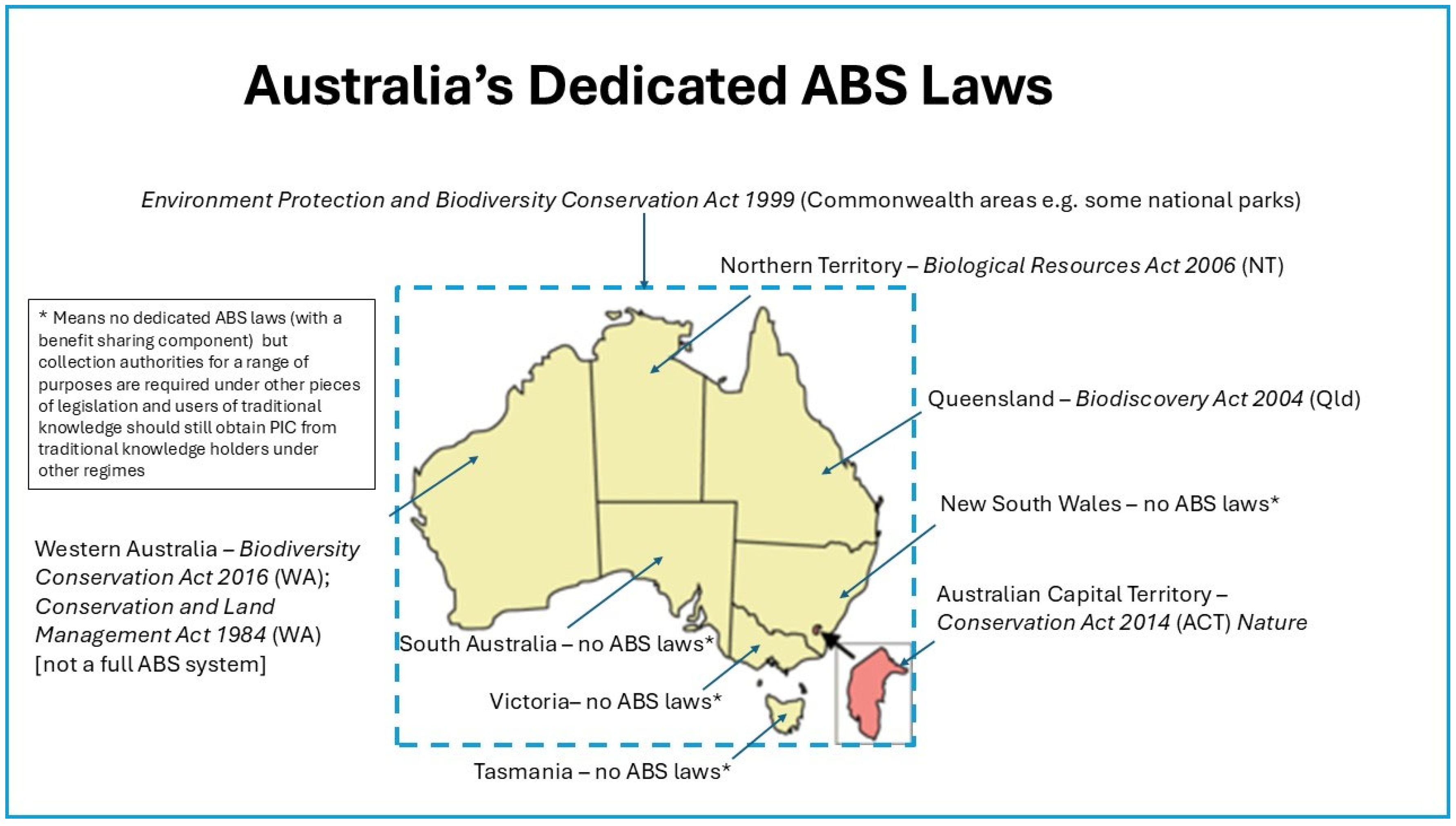
| Information insert | Brief explanation of the ABS concept and Australia’s ABS landscape, including the provision of a map (Figure 1) | |
| 3 | Engagement with, and impact of, ABS laws | Knowledge: Extent of knowledge and views on the purpose of ABS and the extent to which they achieve their purpose (free text) Engagement: Organisational culture on engagement, participant engagement with ABS procedures Impacts: Effects of ABS on listed research decisions and behaviour, free text response about the positive and/or negative effects of laws on Australian R and D and how Australia’s approach to ABS could be improved to support deliver of more practical benefits |
| 4 | Demographic information | Sector, institutional role, fields of research |
| Global Biodiversity Framework Headline Indicator | Quantitative Indicators | Qualitative Indicators |
|---|---|---|
| Monetary benefits received in accordance with applicable internationally agreed access and benefit sharing instruments |
|
|
| Non-monetary benefits arising from applicable international access and benefit-sharing instruments |
Disclaimer/Publisher’s Note: The statements, opinions and data contained in all publications are solely those of the individual author(s) and contributor(s) and not of MDPI and/or the editor(s). MDPI and/or the editor(s) disclaim responsibility for any injury to people or property resulting from any ideas, methods, instructions or products referred to in the content. |
© 2026 by the authors. Licensee MDPI, Basel, Switzerland. This article is an open access article distributed under the terms and conditions of the Creative Commons Attribution (CC BY) license.
Share and Cite
Humphries, F.; Mankad, A.; Hobman, E.V.; Bandari, R.; Okello, W.; Loechel, B.; Morrison, C. Conservation, Sustainable Use and Equity in Biological Resource Research and Development Governance: Australian Scientists’ Perspectives. Sustainability 2026, 18, 3293. https://doi.org/10.3390/su18073293
Humphries F, Mankad A, Hobman EV, Bandari R, Okello W, Loechel B, Morrison C. Conservation, Sustainable Use and Equity in Biological Resource Research and Development Governance: Australian Scientists’ Perspectives. Sustainability. 2026; 18(7):3293. https://doi.org/10.3390/su18073293
Chicago/Turabian StyleHumphries, Fran, Aditi Mankad, Elizabeth V. Hobman, Reihaneh Bandari, Walter Okello, Barton Loechel, and Clare Morrison. 2026. "Conservation, Sustainable Use and Equity in Biological Resource Research and Development Governance: Australian Scientists’ Perspectives" Sustainability 18, no. 7: 3293. https://doi.org/10.3390/su18073293
APA StyleHumphries, F., Mankad, A., Hobman, E. V., Bandari, R., Okello, W., Loechel, B., & Morrison, C. (2026). Conservation, Sustainable Use and Equity in Biological Resource Research and Development Governance: Australian Scientists’ Perspectives. Sustainability, 18(7), 3293. https://doi.org/10.3390/su18073293