1. Introduction
Urban mobility is usually associated with travel by private vehicles, public transport, or taxis. In recent years, however, various types of so-called micromobility devices (MMDs) have gained substantial popularity [
1]. One of the most widely used MMDs is the bicycle; however, the development of low-power electric drives has significantly expanded the range of alternatives for short-distance travel [
2,
3]. In some countries of North America and Europe, the use of MMDs has increased by up to 40% within a few years during the post-pandemic period, and further growth is expected [
4,
5]. In this research, MMDs include walking, electric scooters (e-scooters), bicycles, electric bicycles (e-bikes), and a group of other devices (e.g., hoverboards, electric unicycles). Although walking is not typically considered an MMD, it is included in this research as a viable alternative to motorized transport and public transport. While previous research shows that mini electric vehicles and various modified powered scooters represent some of the most promising forms of micromobility [
6], such vehicles are not considered in this research. This exclusion is justified by the fact that mini electric vehicles do not provide a distinct alternative form of mobility and require the same road infrastructure as conventional cars.
Although traffic congestion and the need of flexible mobility are the primary drivers of MMD deployment, micromobility also contributes to reducing transport-related pollution in cities [
7,
8]. This trend is transforming both the concept of urban transport and the efficiency of transport systems, supporting a shift toward more sustainable transportation models, including new hydrogen-powered bicycles based on fuel cell technology [
9,
10]. At the same time, urban transport is becoming more diverse and less predictable, thereby creating new challenges for traffic management and organization. However, the use of various MMDs requires the development and rapid expansion of dedicated infrastructure that ensures comfortable and safe mobility [
11,
12]. Safety is a particularly critical aspect, as MMD users are considered vulnerable road users and are therefore susceptible to injuries even in minor collisions [
13]. Unfortunately, the number of injuries, various types of trauma, and fatalities have increased alongside the expansion of MMD use [
14,
15]. Due to their small wheels and lightweight construction, e-scooters are subject to intense vibrations, which reduce riding comfort and may compromise stability [
16,
17]. Consequently, road safety authorities have introduced several regulatory measures, including restricted-access urban areas and speed control measures [
18,
19].
Ignaccolo et al. [
20] grouped different criteria into five categories (coherence and accessibility, linearity, safety and security, attractiveness and intermodality, and comfort) together with corresponding design recommendations to enable the redesign of urban spaces so they can accommodate this new form of mobility as MMDs feature different size and technology. These recommendations were developed for Italian cities; however, they are consistent with general European guidelines. Four expert-based evaluation methods have shown that road surface type and quality, along with road and street design, are the primary factors affecting e-scooter safety [
21]. These findings are strongly related to the design characteristics of e-scooters, which typically feature small-diameter wheels and a short steering-axis caster, resulting in high sensitivity to pavement irregularities. Moreover, vibration levels caused by the riding surface and e-scooter construction (e.g., frame design and tire inflation pressure) directly affect rider comfort sensation [
22]. Prolonged discomfort has been associated with increased fatigue and reduced attentiveness.
Several aspects are associated with the risky use of MMDs. Firstly, these devices are often equipped with relatively powerful electric drives, enabling users, regardless of their physical fitness level, to travel very dynamically and smoothly [
22,
23]. In addition, electric drives operate very quietly, which may lead to sudden and unexpected encounters with pedestrians, thereby increasing the risk of collisions [
24].
In addition to infrastructure and technical factors, the safe use of micromobility devices also depends on user behavior and cultural aspects. Based on e-survey data from 39 countries, Delavary et al. [
25] found that younger individuals and males are more likely to use MMDs and engage in risky behaviors, which are further associated with student status, prior crashes, and permissive safety attitudes. The findings emphasize the need for targeted safety interventions that combine infrastructure improvements with behavior-focused strategies.
The specifics of using micromobility devices, especially dynamic ones such as e-bikes or e-scooters, differ across age groups. Promoting e-bikes for sustainable transport among adults aged 65 and older has potential but faces several challenges [
26]. A Flemish survey revealed key benefits like less physical effort, longer travel distances, and substitution for regular bikes or cars. However, challenges include the bikes’ heavy weight and safety concerns, with notable gender differences. These results highlight the importance of policies that enhance benefits, improve safety, and assess the feasibility of e-bikes in areas less conducive to cycling.
In recent years, numerous studies have examined the experiences of different cities and regions in integrating micromobility measures into their transport systems [
27,
28,
29,
30,
31,
32,
33,
34]. These studies indicate that micromobility usage patterns are strongly influenced by general factors such as weather conditions, fleet size, infrastructure quality, and local regulations, with precipitation consistently reducing demand. User preferences also exhibit considerable variation: while some travelers embrace micromobility as part of a multimodal travel lifestyle, others remain hesitant due to safety concerns or lack of familiarity with these modes. Despite such differences, existing research highlights that well-planned micromobility systems, supported by appropriate infrastructure and regulation, can significantly improve urban mobility and reduce dependence on private cars. Conversely, the growing popularity of e-scooters has intensified debates over regulatory measures aimed at mitigating their negative externalities [
35]. The findings suggest that mixed regulatory effects–safety measures increase inclination of e-scooter use, whereas parking restrictions, high fares, and fines reduce it. Moreover, perceived road unsafety lowers usage intentions, with stronger policy support observed among individuals who consider e-scooters unsafe. Additionally, data collected from micromobility users is increasingly employed to develop methodologies for identifying the most hazardous infrastructure nodes, thereby informing targeted safety interventions [
36].
A variety of mathematical and analytical methods are applied to refine and prioritize smart city features and to advance MMDs. These urban-related indicators cover pollution control, energy and environmental resources, community well-being, eco-friendly transport, and social cohesion [
37,
38]. Research on micromobility increasingly relies on socio-technical and configurational methods, particularly the Multi-Level Perspective (MLP) combined with Qualitative Comparative Analysis (QCA), to explain complex causal mechanisms underlying the use and non-use of micromobility services [
39]. Multi-criteria decision-making (MCDM) approaches—such as APPRESAL, fuzzy BWM–CoCoSo, AHP/Fuzzy, Fuzzy TOPSIS, Fuzzy VIKOR, and Fuzzy GRA—are widely applied to evaluate micromobility performance, user satisfaction, sustainability, and policy alternatives under conditions of uncertainty [
40,
41,
42]. In general, modern practice records the application of over 200 MCDM methods to evaluate and identify the optimal alternative across diverse fields [
43]. Sustainability assessments of broader mobility projects also employ fuzzy ideal-solution methods to rank alternatives in situations where precise data are limited and stakeholder perspectives differ [
44]. At the neighborhood-scale, suitability analyses commonly apply multicriteria indices to identify optimal locations and system types (e.g., station-based vs. free-floating), using simple scoring schemes that facilitate practical decision-making even when data are scarce [
45]. Several studies emphasize that integrating micromobility within Mobility-as-a-Service (MaaS) ecosystems requires dedicated MCDM assessment frameworks to ensure accessibility for vulnerable social groups [
46].
The Classical Analytic Hierarchy Process (AHP) was applied to support decision-making in selecting the most appropriate micromobility system type for a given study area [
45]. For further analysis, the following categories were established: population characteristics, travel behavior characteristics, land-use features, weather conditions, esthetic attractiveness, road network and comfort, road safety, security, connectivity and intermodality, attractiveness compared to alternative modes, health and environmental benefit; however, weather conditions maintained the same relative importance when the AHP method was applied across different types of urban areas.
Many methods prioritize structured evaluation but lack integration with real-world usage data, resulting in potential gaps between modeled insights and actual rider behavior or operational realities. Moreover, most frameworks concentrate on early-stage planning or high-level assessment, providing limited guidance for the continuous monitoring or adaptation of micromobility systems over time.
Alternative research employing surveys, in situ tests with GPS/GIS and traffic analysis was conducted to identify the factors influencing route and infrastructure choices in micromobility [
47]. The study highlights key determinants such as safety, comfort, connectivity, and infrastructure quality, while also identifying significant gaps, particularly regarding e-bikes and e-scooters. Taiwan-focused research, in one of the world’s highest scooter-density regions, was conducted by integrating four key dimensions and 16 criteria through a rigorous combination of literature review, expert input, and advanced analytical methods [
48]. The analysis indicates that service attributes related to user convenience, trust, and responsiveness should be prioritized; moreover, consumers appreciate convenient and secure payment systems and loyalty programs. Finally, a decision tree algorithm from a machine learning approach was applied to identify the factors contributing to risky use of MMDs [
49]. After processing survey data, the results show that helmet use and trip type are the primary safety factors, following age, gender, and riding location.
The issue of micromobility in urbanized areas is relatively new, with its development policy reaching cities only in the past decade and gaining momentum in the post-pandemic period, when different modes of mobility acquired broader significance. Therefore, expert opinions and their alignment in proposing the most appropriate directions for policy development are particularly important in urban life. Moreover, addressing this multifaceted issue involves the advancement of the integrated application of MCDM methods, which also highlights the scientific relevance of the research. During the deployment of MMDs, it is important to recognize that MMDs do not function solely as substitutes for public transport, but can also be effectively incorporated into public transportation networks. From this perspective, a survey conducted with 25 transportation and urban professionals in Europe and North America indicated that high-quality public transport, dedicated micromobility lanes, supportive land-use patterns, and appropriate policy frameworks form the foundation for the successful integration of these urban mobility elements [
50]. In their research, Nogueira et al. [
51] predict that the success of MMD deployment is associated with public participation beyond consultation and robust monitoring; however, challenges remain regarding the durability of temporary measures, political risk, and limited administrative capacity.
The aim of the research is to develop a structured system of criteria influencing the deployment of urban micro-mobility devices and, based on expert-driven quantitative assessment using multi-criteria decision-making (MCDM) methods, to determine the relative weights of these criteria and conduct a comparative analysis. The impact of the research is directly linked to urban transport system challenges—reducing traffic congestion, as well as transport-related pollution and noise. These issues can be addressed through the effective implementation of micromobility solutions that are convenient and accessible for as large a share of urban residents as possible.
3. Results and Discussion
3.1. Consistency of Expert Judgements
The significance of the criteria influencing the deployment of MMDs in the city of all experts is presented in
Appendix A, where the sums of ranks
, skewness (
Sk) and kurtosis (
Ku) assigned to each
i-th criterion are calculated. The mean ranks
, standard deviations
and the limits of interval
outside of which
values are considered outliers (
Table 2), for each criterion were calculated using Equation (1).
Using the rank correlation method, Kendall’s coefficient of concordance
W was calculated according to Equation (2), based on the rankings of 15 criteria provided by 16 experts:
The deviation of the sums of criterion ranks
from the overall mean rank
, expressed by the sum of squares
S and calculated according to Equation (3), is presented in
Table 2 and equals 29,074.
To assess the consistency of expert judgements, the chi-square statistic χ
2, calculated according to Equation (4), was applied in the classical manner, as the number of evaluated criteria exceeds
m = 7:
For a significance level of α = 0.05 and the corresponding number of degrees of freedom
ν =
m − 1 = 15 − 1 = 14, the critical value of the chi-square statistic obtained from statistical tables [
68] is
. The ratio of the empirical χ
2 value to the critical value
, calculated according to Equation (6) equals 3.84.
The minimum value of the coefficient of concordance
Wmin, calculated according to Equation (5), enables direct comparison with the empirical value of
W:
The results of the expert questionnaire show that the empirical value of the concordance coefficient, W = 0.4056, is 3.84 times greater than the minimum value . This allows a well-founded basis for concluding that the expert assessments of criterion significance are consistent (i.e., not contradictory). Consequently, the average ranks can be regarded as reliable indicators of the average significance of the criteria influencing the deployment of MMDs in the city.
The standard deviation of ranks
calculated for each criterion was used to determine the interval limits
, within which the rank values
are considered acceptable, in accordance with the CIBRO method principle. Rank values falling outside these interval limits would be classified as outliers. In this study, the lower
and upper
threshold values defining the outlier intervals are presented in
Table 2. The results indicate that the rank-based significance values of all criteria fall within the specified interval limits. Consequently, no outliers were identified, and all rank values
provided by the experts were retained for further analysis.
3.2. Criterion Weights Calculated Using the ARTIW-L Method
The criterion weights
calculated from the average ranks of each criterion
according to Equation (7) are presented in
Table 2. The normalized relative weight of the first criterion (A) is
The relative weight of the most important criterion, B (travel time) , is 3.4 times greater than that of the least important criterion, N (possibility of carrying multiple users), . The relative weights of the remaining criteria fall within the interval defined by the maximum and minimum values, i.e., 0.1109 − 0.0323 = 0.0786. The differences between the average relative weights of adjacent criteria are not uniform. In contrast, the differences between the ranks Rᵢₑ assigned to adjacent criteria by an individual expert are equal and amount to one rank unit. Based on the relative weights calculated using the ARTIW-L method, the following priority order of criteria is obtained: BEJADFOKLCIMGHN.
Table 2.
Significance of 15 criteria influencing the deployment of micromobility devices, ranked by relative weights and priorities, calculated using four MCDM methods based on the judgements of a panel of 16 experts.
Table 2.
Significance of 15 criteria influencing the deployment of micromobility devices, ranked by relative weights and priorities, calculated using four MCDM methods based on the judgements of a panel of 16 experts.
| Calculation Method | Criterion i = 1, 2, …, m | Sum |
|---|
| A | B | C | D | E | F | G | H | I | J | K | L | M | N | O |
|---|
| 99 | 43 | 145 | 106 | 44 | 118 | 172 | 182 | 157 | 94 | 136 | 142 | 160 | 194 | 123 | 1920 |
| 6.188 | 2.688 | 9.062 | 6.625 | 2.750 | 7.357 | 10.750 | 11.688 | 9.812 | 5.875 | 8.500 | 8.875 | 10.000 | 12.125 | 7.687 | 120 |
| Standard deviation of ranks σRi | 3.763 | 1.923 | 3.255 | 2.778 | 1.983 | 3.900 | 3.215 | 2.549 | 4.037 | 3.948 | 3.596 | 3.160 | 4.131 | 3.096 | 4.895 | – |
| −5.1 | −3.1 | −0.7 | −1.7 | −3.2 | −4.3 | 1.1 | 4.0 | −2.3 | −6.0 | −2.3 | −0.6 | −2.4 | 2.8 | −7.0 | − |
| 17.5 | 8.5 | 18.8 | 15.0 | 8.7 | 19.1 | 20.4 | 19.3 | 21.9 | 17.7 | 19.3 | 18.4 | 22.4 | 21.4 | 22.4 | – |
| −29 | −85 | 17 | −22 | −84 | −10 | 44 | 59 | 29 | −34 | 8 | 14 | 32 | 66 | −5 | 0 |
| 841 | 7225 | 289 | 484 | 7056 | 100 | 1936 | 3481 | 841 | 1156 | 64 | 196 | 1024 | 4356 | 25 | 29,074 |
ARTIW-L method:
| 0.0818 | 0.1109 | 0.0578 | 0.0781 | 0.1104 | 0.0719 | 0.0438 | 0.0359 | 0.0515 | 0.0844 | 0.0625 | 0.0594 | 0.0500 | 0.0323 | 0.0693 | 1 |
| ARTIW-L priority | 4 | 1 | 10 | 5 | 2 | 6 | 13 | 14 | 11 | 3 | 8 | 9 | 12 | 15 | 7 | 120 |
ARTIW-N method:
| 0.4342 | 1 | 0.2965 | 0.4056 | 0.9771 | 0.3643 | 0.2499 | 0.2299 | 0.2738 | 0.4575 | 0.3161 | 0.3028 | 0.2687 | 0.2216 | 0.3495 | 6.1474 |
| 0.0706 | 0.1627 | 0.0482 | 0.0660 | 0.1589 | 0.0593 | 0.0407 | 0.0374 | 0.0445 | 0.0744 | 0.0514 | 0.0493 | 0.0437 | 0.0360 | 0.0569 | 1 |
| ARTIW-N priority | 4 | 1 | 10 | 5 | 2 | 6 | 13 | 14 | 11 | 3 | 8 | 9 | 12 | 15 | 7 | 120 |
DPW method:
| 138.24 | 182.4 | 79.96 | 112.13 | 197.4 | 113.9 | 68.97 | 57.76 | 69.9 | 131.8 | 95.97 | 93.5 | 82.8 | 55.8 | 119.47 | 1600 |
| 0.0864 | 0.1140 | 0.0500 | 0.0701 | 0.1234 | 0.0712 | 0.0431 | 0.0361 | 0.0437 | 0.0823 | 0.0600 | 0.0584 | 0.0517 | 0.0349 | 0.0747 | 1 |
| DPW priority | 3 | 2 | 11 | 7 | 1 | 6 | 13 | 14 | 12 | 4 | 8 | 9 | 10 | 15 | 5 | 120 |
AHP method:
| 1.3307 | 2.1331 | 0.7831 | 1.1372 | 2.2648 | 1.1352 | 0.5729 | 0.4356 | 0.6671 | 1.5251 | 0.8945 | 0.7877 | 0.7053 | 0.4354 | 1.1930 | 16.0007 |
| 0.0832 | 0.1333 | 0.0789 | 0.0711 | 0.1416 | 0.0710 | 0.0358 | 0.0272 | 0.0417 | 0.0953 | 0.0559 | 0.0492 | 0.0441 | 0.0272 | 0.0746 | 1.0001 |
| AHP priority | 4 | 2 | 10 | 6 | 1 | 7 | 13 | 14 | 12 | 3 | 8 | 9 | 11 | 15 | 5 | 120 |
3.3. Criterion Weights Calculated Using the ARTIW-N Method
The significance of each criterion influencing the deployment of MMDs in the city was calculated from the average ranks
using the ARTIW-N method. The relative weight of each criterion
(
Table 2) was obtained using Equation (8) through a two-step procedure. First, the lowest average rank
was divided by the average rank of each
i-th criterion
and the resulting ratio was denoted as
uᵢ. For the first criterion, A (impact of MMDs on health), this ratio is
Next, the value
uᵢ for each criterion
i, divided by the sum
of all
uᵢ values, represents the normalized relative weight of the criterion obtained using the ARTIW-N method. The relative weight of the first criterion, A, is
The relative weight of travel duration , identified by experts as the most important criterion (B), is 4.5 times greater than that of the least important criterion (N) . The difference between the relative weights of these criteria, 0.1627 − 0.0360 = 0.1267, is 1.6 times greater than the corresponding difference obtained using the ARTIW-L method (0.0786). The relative weights calculated using the ARTIW-N method yield the following priority order of criteria, BEJADFOKLCIMGHN, which is identical to the priority order obtained using the ARTIW-L method.
3.4. Criterion Weights Calculated Using the DPW Method
The percentage weights
Pᵢₑ assigned by all 16 experts to the 15 criteria are presented in
Appendix B, where the corresponding standard deviations, skewness (
Sk) and kurtosis (
Ku) values are also calculated. Based on the significance values
Pᵢₑ assigned by each expert to the criteria in the form of percentage weights, the normalized relative weights
for all
i-th criteria were calculated according to Equation (9). The mean relative weight of criterion A is provided in
Table 2:
The relative weight of the most important criterion, E (travel safety) , is 3.5 times greater than that of the least important criterion N, which shows the possibility of carrying multiple users, relative weight . The relative weight of criterion B , calculated using this method, indicates that it ranks second in priority. Based on the relative weights obtained using the DPW method, the following priority order of criteria is established: EBAJOFDKLMCIGHN.
3.5. Criterion Weights Calculated Using the AHP Method
Assessing the significance of 15 criteria for the deployment of MMDs in the city using the AHP method represents a demanding task for experts. Consequently, the consistency ratio (C.R.) of a completed pairwise comparison matrix does not always fall below the acceptable threshold of 0.1. If a matrix is inconsistent (C.R. > 0.1), it must be either revised or rejected. The matrix may be revised either by the expert (provided they are able to perform the correction) or by a skilled researcher, while preserving the priority order (ranks) originally assigned by the expert. In accordance with the transitivity condition, selected elements of the pairwise comparison matrix aij are adjusted, after which the consistency ratio (C.R.) is recalculated and typically reduced to a value below 0.1. A corrected matrix that satisfies this condition is considered acceptable, and its priority vector , calculated according to Equation (10), is adopted as the relative weight assigned to the i-th criterion by the e-th expert.
The elements of the pairwise comparison matrix
aij constructed by the first expert (E1), together with the corresponding priority vector
(relative weights) and the matrix consistency ratio (
C.R. = 0.0262), are presented in
Table 3. The left-hand side of the matrix displays the criterion ranks, while the bottom of the table shows the sequence of criteria ordered from the most important to the least important. This layout supports the expert in maintaining internal consistency during the pairwise comparison process.
The relative weights
of all criteria, the consistency ratios (
C.R.), standard deviations
, skewness coefficients (
Sk), and kurtosis coefficients (
Ku) are presented in
Appendix C. The averages of the relative weights
, calculated according to Equation (13), are presented in
Table 2. The average relative weight of the first criterion (A), calculated using the AHP method based on the assessments of 16 experts, is
The relative weight of the most significant criterion, E , is 5.2 times greater than that of the least significant criterion, N . The relative weight of the second most important criterion, B, is . The average relative weights of the criteria calculated using the AHP method indicate the following priority order: EBJAODFKLCMIGHN.
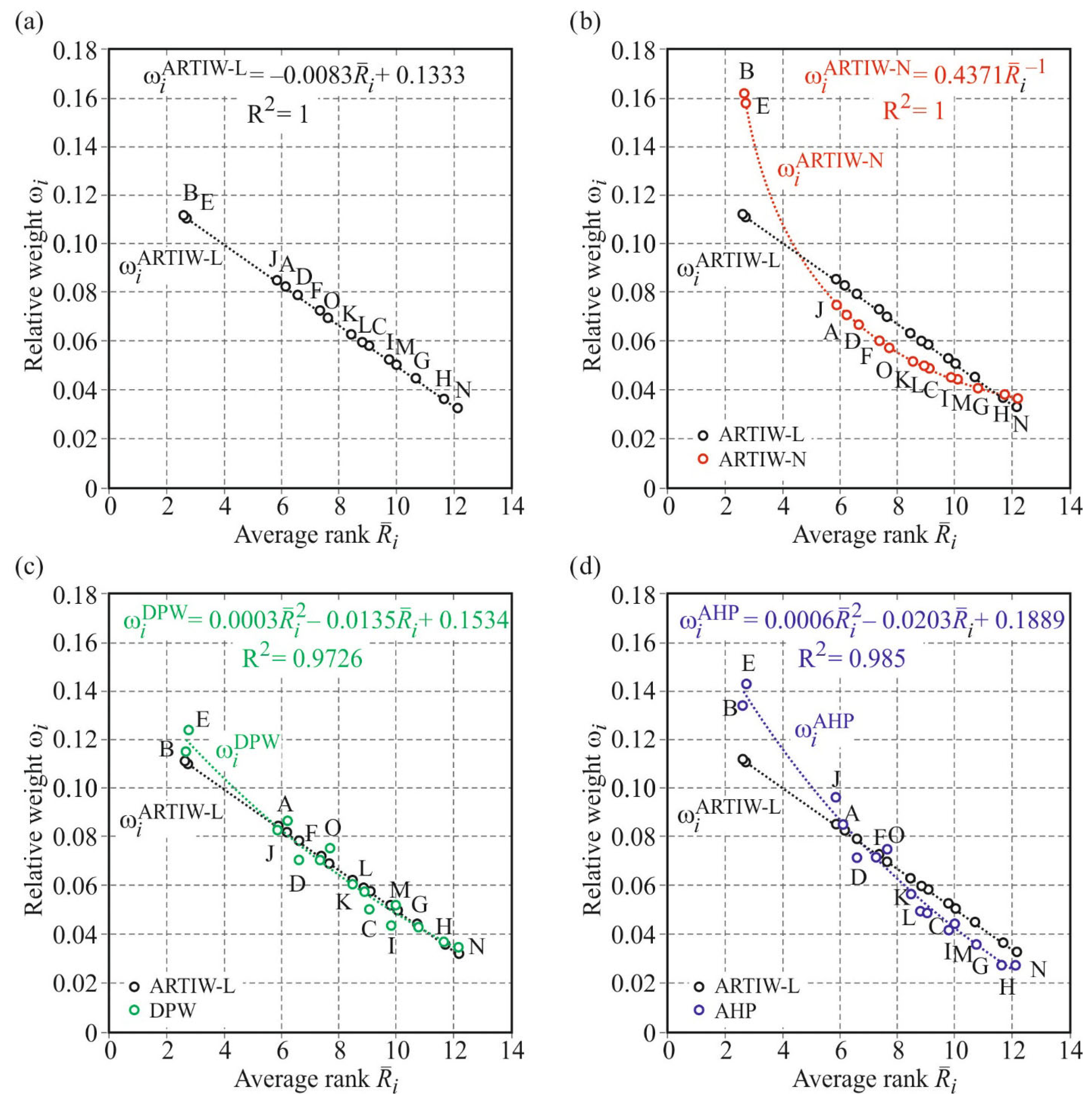
3.6. Correlation Between Relative Weights and Average Criterion Ranks
The correlation between the relative weights ω
ᵢ of the criteria calculated using different MCDM methods and the average ranks
of these criteria is illustrated in
Figure 1. The relative weights of the criteria (
and
) obtained from the average ranks
using the ARTIW-L and ARTIW-N methods are functionally related to the average ranks, with a coefficient of determination R
2 = 1 (
Figure 1a,b). The ARTIW-N method assigns higher relative weights to the most important criteria (B and E) while assigning lower relative weights to criteria of moderate importance.
The relative weights of criteria (
and
) calculated using the DPW and AHP methods and their relationship with the average criterion ranks
exhibit inverse curvilinear correlations, with coefficients of determination R
2 = 0.9726 and R
2 = 0.985, respectively (
Figure 1c,d). This close functional relationship is well described by a quadratic regression model:
. The relative weights of criteria
and
calculated using the DPW method are most similar to those obtained using the ARTIW-L method (
Figure 1c). In contrast, application of the AHP method assigns higher relative weights
for the most important criteria (B and E), while reducing the relative weights of the least significant criteria (N, H, G, and I) (
Figure 1d). These regression models derived in this research enable systematic comparison of the results obtained using different MCDM methods and facilitate prediction of numerical estimates of criterion significance.
As can be seen, each applied method yields different results for criterion weights; therefore, there is no theoretical justification for considering any single MCDM method superior to others. For this reason, the average of the results obtained from four methods, as applied in this study, is considered the most reliable solution to the problem.
Figure 1 presents a comparison in which the ARTIW-L (linear) method is used as the reference point. As can be observed, significant differences are obtained when comparing criteria B and E; however, the trends in the variation in relative weights remain consistent.
3.7. Average Criterion Weights Obtained Using Four MCDM Methods
In practice, no benchmark exists against which the results obtained using individual MCDM methods can be directly compared. Therefore, the significance of each criterion
i was determined according to Equation (14) by calculating the average relative weight ω
i across all MCDM methods applied in the current research. The final relative weight of the first criterion (A) is
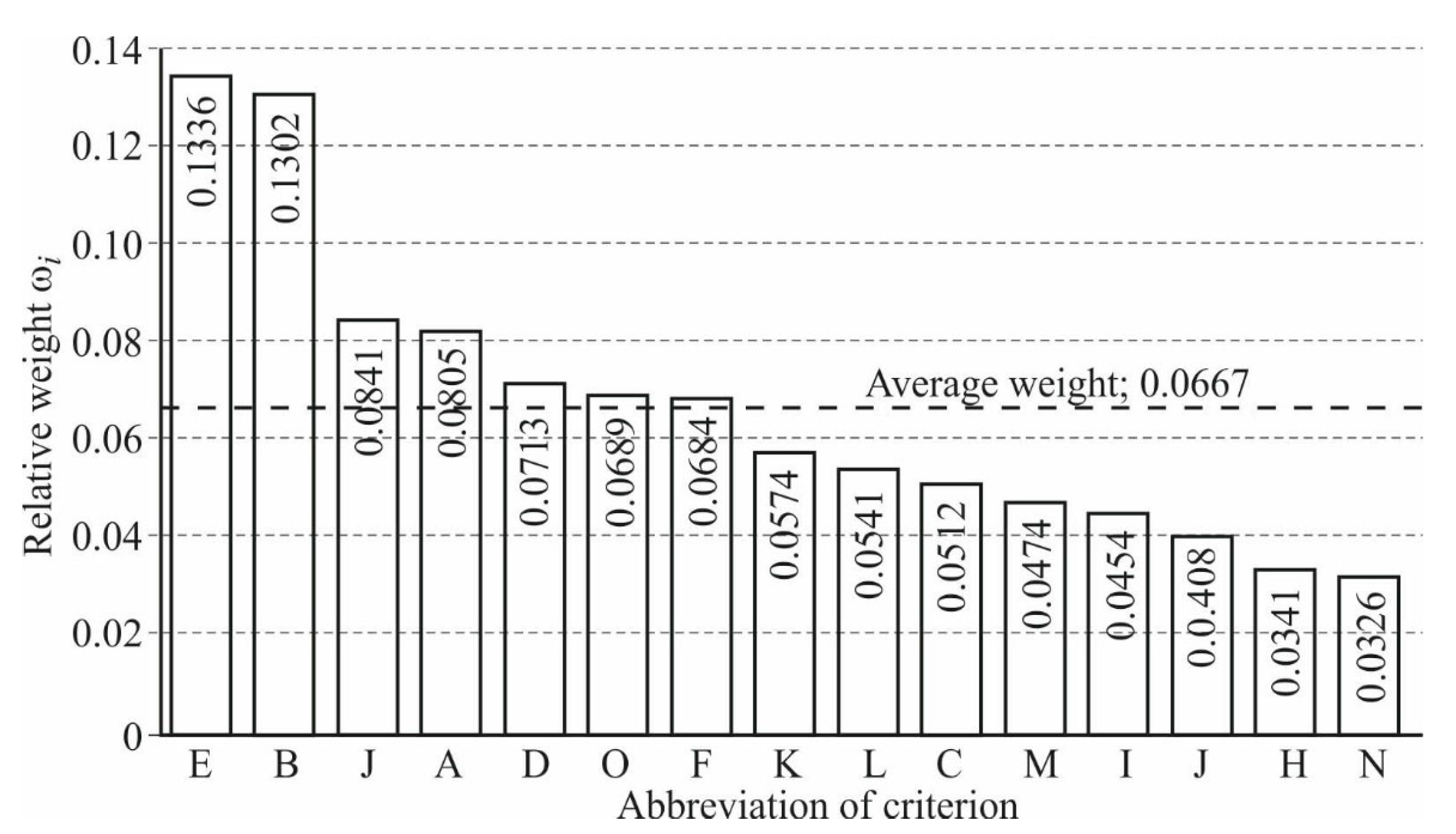
The final relative weights ω
i calculated for all criteria, along with the resulting priority order, are presented in
Figure 2. Among all criteria, travel safety (E) and travel time (B) are identified as the most important, with relative weights of 0.1336 and 0.1302, respectively.
The relative weight ωᵢ of a criterion, calculated by averaging the results obtained using four MCDM methods applied in this research, is considered more reliable than a relative weight derived using any single method. The current research assumes that none of the applied methods has a theoretical advantage (dominance) over the others.
The relative weights of all criteria, indicating how many times one criterion is more important than another, are presented in
Table 4. In this table, all 15 criteria are arranged from the most important criterion, E, to the least important criterion, N. The ordering is shown along the left-hand column from bottom to top, along the top row from left to right. The results show that travel safety is 4.1 times more important than the possibility of carrying multiple users by an MMD.
3.8. Sample Size and Result Accuracy
The conformity of the criterion ranks
Rᵢₑ to a normal distribution was assessed by comparing the absolute values of the empirical skewness
and kurtosis
coefficients for each criterion with their corresponding standard deviations
sSk and
sKu, calculated according to Equations (16) and (17). The values of
sSk and
sKu, which depend solely on the sample size
n (i.e., the number of experts in the panel), are equal to 0.564 and 1.091, respectively, for
n = 16. The obtained skewness
and kurtosis
values for each criterion do not exceed the corresponding
and
threshold values, indicating that the criterion ranks conform to a normal distribution. The results (
Appendix A) confirm that, for all 15 criteria, the absolute values of skewness
and kurtosis
remain below the respective thresholds, thereby validating the assumption of normality for the rank distributions.
The homogeneity of rank variances, calculated from samples of equal size and assumed to follow a normal distribution, was assessed using Cochran’s test
, calculated according to Equation (18):
The critical tabulated value of the Cochran’s test statistic,
(0.05; 15, 15) = 0.1469 [
66], was obtained by linear interpolation between the values 0.1429 (for
= 16) and 0.1671 (for
= 10). Therefore, it can be concluded that the variances of the ranks
of all 15 criteria are statistically equal.
Accordingly, the average variance of the ranks
for all criteria was calculated using Equation (15):
The corresponding standard deviation of the ranks across all criteria is .
The accuracy of the research results was determined using Equation (19) by calculating the marginal sampling error Δ
R, assuming a significance level of α = 0.05, a Student’s
t-distribution value of
t = 1.96, and a sample size of
n = 16:
The calculated margin of error, ΔR = 1.68, shows that the average rank of any criterion in the population lies within the interval , with a confidence level of 95%. Increasing the number of experts n narrows this interval, as the value of ΔR decreases. For example, assuming the same rank variance and t = 1.96, increasing the sample size to n = 30 reduces the margin of error to ΔR = 1.23. Further increasing the number of experts to 50 results in a margin of error of 0.95.
The following conclusions are drawn from the results of the research and their analysis.
4. Conclusions
The deployment of micromobility devices (MMDs) contributes significantly to the improvement of road transport performance indicators in urban areas. However, this deployment is influenced by a set of criteria whose significance has so far been insufficiently investigated and, consequently, has not been quantitatively assessed. Expert-based research methods are therefore appropriate for determining the significance of these criteria, as they enable the competence, knowledge, and experience of specialists (experts) to be used to quantitively evaluate systematized criteria by comparing them either pairwise or collectively. Each expert independently assesses the significance of the criteria using ranks, percentage weights, and intensity values derived from AHP pairwise comparison matrices, while the researcher subsequently processes these assessments using appropriate multi-criteria decision-making (MCDM) methods.
The current research systematizes 15 criteria influencing the deployment of MMDs, the significance of which was assessed by a panel of 16 highly qualified experts. Statistical analysis revealed that no rank outliers were identified and that expert judgements are aligned, as the coefficient of concordance 0.405 is 3.8 times greater than the minimum threshold value 0.106. This justified the use of arithmetic mean ranks as quantitative estimates of criterion significance, despite certain differences and variability in the assessments provided by individual experts.
The relative weights of criteria were calculated from the average ranks using the ARTIW-L and ARTIW-N methods, while percentage weights were applied to determine criterion weights using the DPW method. In addition, criterion significance was assessed using the AHP method by calculating the priority vectors of the criteria and the consistency ratios of all 16 pairwise comparison matrices, all of which were below the accepted threshold of 0.1. The criterion weights obtained using the four MCDM methods differ only slightly, and the resulting priority orders of the criteria are nearly identical. Consequently, the arithmetic mean of the relative weights calculated for each criterion using the four methods was adopted as the final solution. According to the expert assessments, the most important criteria influencing the deployment of MMDs are travel safety (0.1336), travel time (0.1302), the influence of infrastructure quality on comfort (0.0841), impact on health (0.0805), and the cost of purchasing an MMD (0.0713), while the remaining ten criteria are of lower significance. Notably, the relative weight of the most significant criterion, E (travel safety), is 4.1 times greater than that of the least significant criterion N (possibility of carrying multiple users). The prioritization of travel safety (0.1336) and travel time (0.1302) aligns with the literature, which identifies these factors as key determinants of user adoption and system efficiency [
20,
69,
70]. However, this research extends previous studies by quantitatively demonstrating that travel safety is 4.1 times more significant than the least important criterion, providing a clearer basis for policy and infrastructure planning decisions.
In addition, based on the obtained results, strategies for urban infrastructure and resident mobility development can be formulated, taking into account travel safety and duration criteria. Politically independent experts assessed these criteria as exceptionally significant, and thus they cannot be ignored when making policy decisions regarding the expansion of micromobility solutions in cities. The results are applicable to medium- and large-sized cities where micromobility options are insufficiently available and where urban infrastructure developers allocate inadequate investments for planning and implementing such solutions.
The ranks of all criteria follow a normal distribution, as the absolute values of the empirical skewness and kurtosis are lower than the corresponding threshold values, calculated as three times the standard deviation of skewness and five times the standard deviation of kurtosis, respectively. This allowed Cochran’s test to be applied to calculate the test statistic and compare it with the corresponding critical value . The calculated value is lower than the critical value GC (0.05; 15; 15) = 0.1469, indicating that the variances of the ranks are statistically equal and that the mean value can be considered a valid measure of variability in the significance of all criteria. The accuracy of the study results, calculated using the sample size-based equation, is equal to 1.68. When the criteria influencing the deployment of MMDs were evaluated by 16 experts with a 95% confidence level (significance level of 0.05), the mean variance of ranks across all criteria was 11.82.
The originality of this research is demonstrated by the integrated application of the selected methods and the identification of results that are highly relevant to contemporary society. It should be noted that the experts involved in the study are from the same region; therefore, the findings can be effectively applied to urbanized areas of a similar nature. Results are based on expert judgment rather than empirical operational data; therefore in future research it is planned to use real flow data already collected within cycling infrastructure, as well as to conduct a dedicated survey of urban residents using micromobility solutions and integrate these findings into the overall research framework.
In addition, in future research, five MMD alternatives will be compared based on the 15 identified criteria, their priorities will be determined, and the most suitable overall MMD will be identified. Future research is also planned to examine the sensitivity of the ranking of criteria to changes in criterion weights or stakeholder assumptions, i.e., to conduct a sensitivity analysis by applying alternative approaches to calculating the weighted average of expert evaluations.