Navigating the Current Sustainability Practices of the Bangladesh Garment Industry




Abstract
1. Introduction
2. Literature Review
2.1. Sustainability Practices
2.2. The Bangladesh Ready-Made Garment Industry and Its Sustainability
3. Method
3.1. The Study Sample
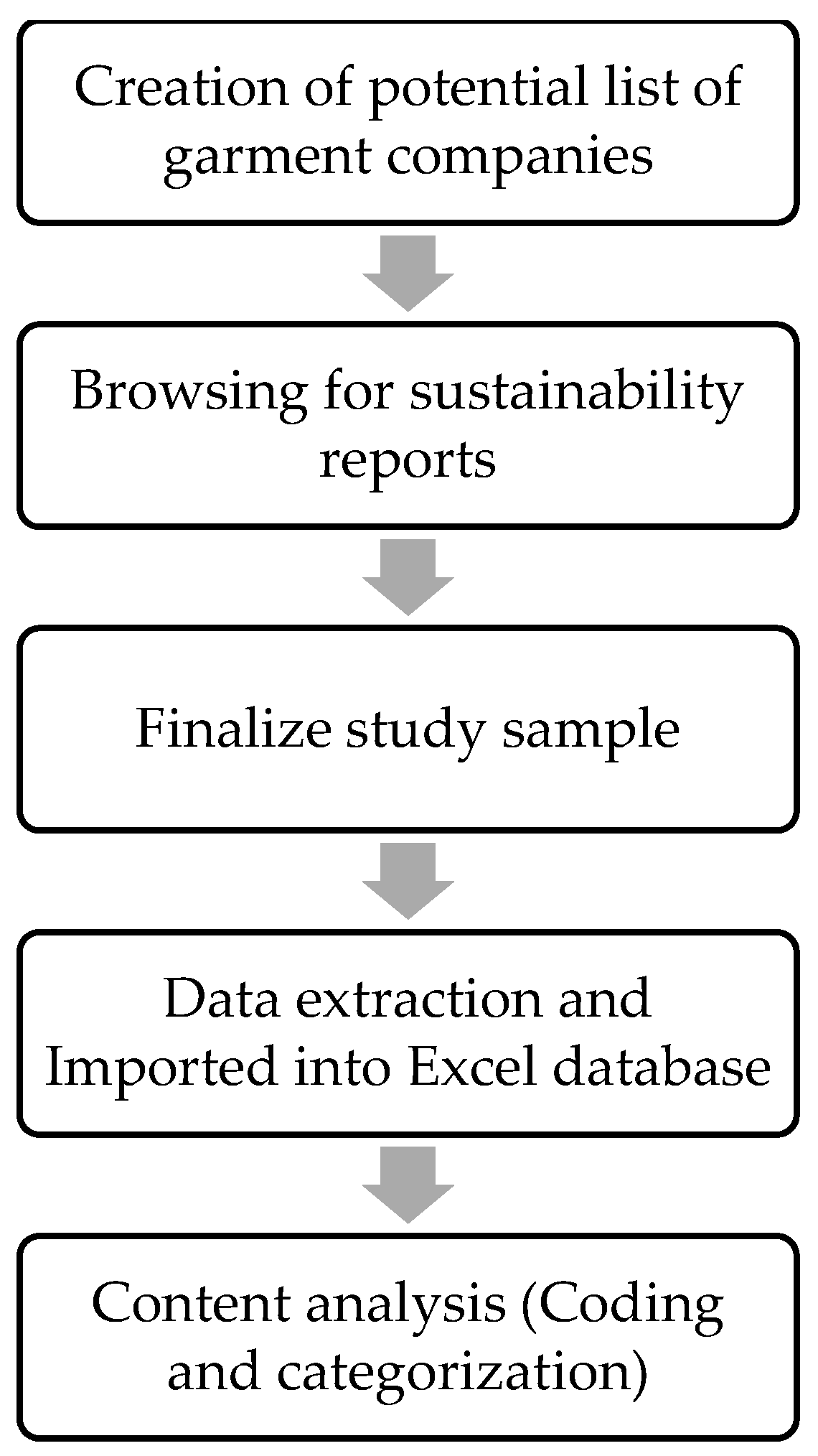
3.2. Data Analysis Procedure
3.3. Validity
4. Findings
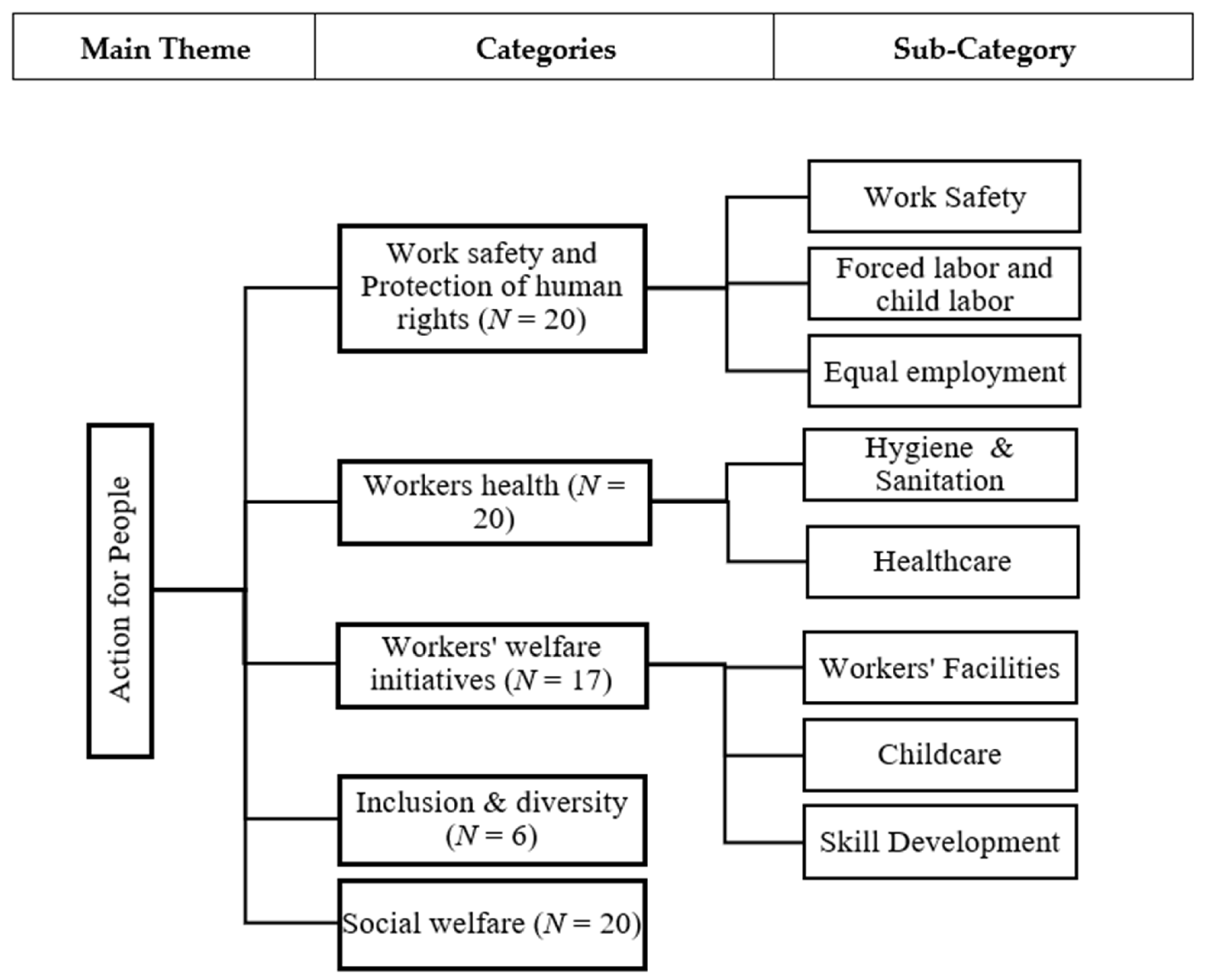
4.1. Actions for People
4.2. Worker Safety and Protection of Human Rights
4.3. Workers’ Health
4.4. Workers’ Welfare Initiatives
4.5. Inclusion and Diversity
4.6. Social Welfare
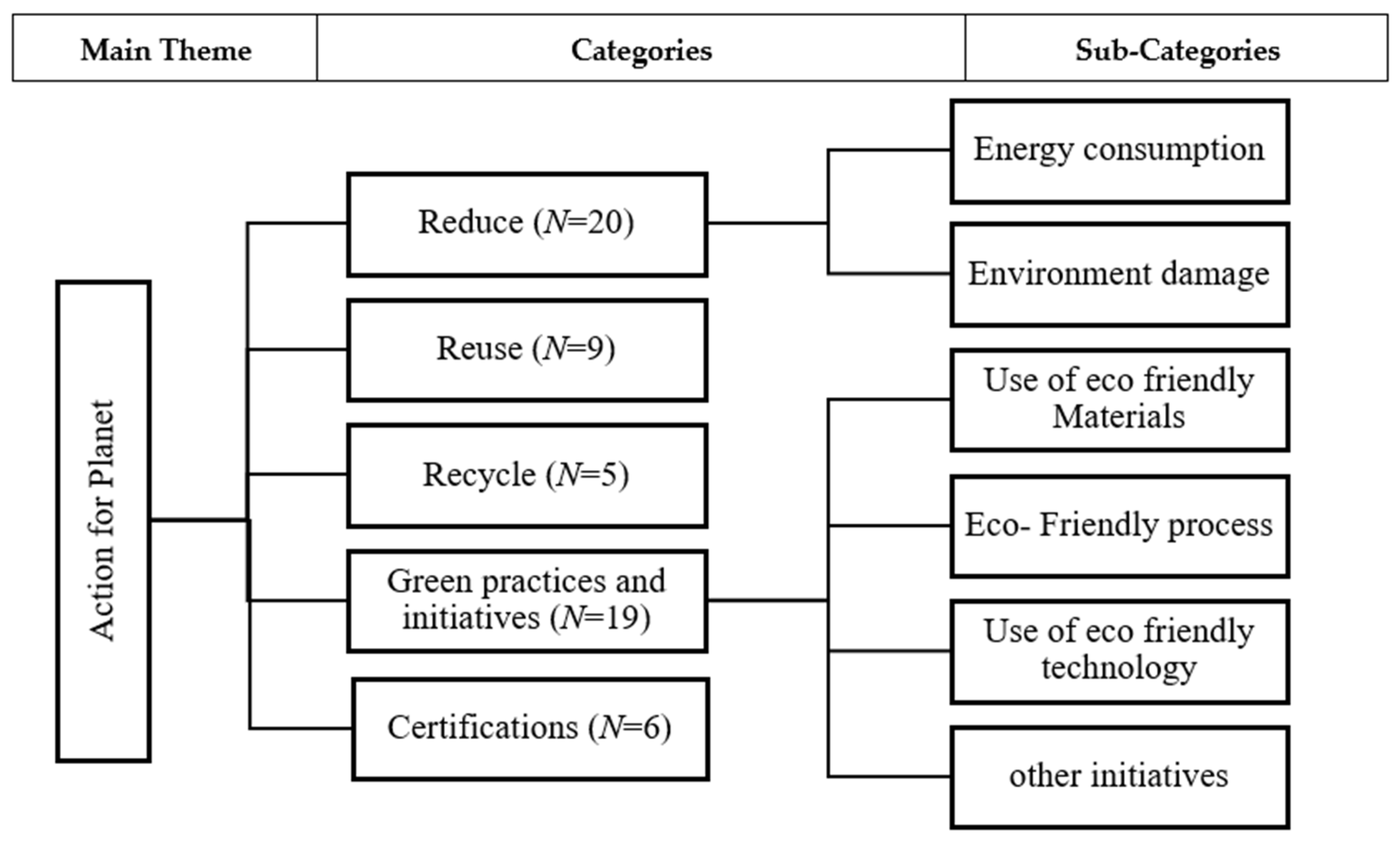
4.7. Actions for the Planet
4.8. Reduce
4.9. Reuse and Recycle
4.10. Green Practices and Initiatives
4.11. Certifications
4.12. Action for Profit
- Key Findings of the Study
- There is a strong emphasis on the garments company’s initiatives related to social sustainability (people), including worker safety, healthcare, social welfare programs, and community development.
- Environmental sustainability practices are widely communicated, incorporating the company’s actions related to energy reduction, wastewater treatment (e.g., ETP), sustainable materials, and green technologies.
- Economic sustainability (profit dimension) is under-reported, as only a small number of companies disclosed information related to economic performance or responsible profit within the sustainability context.
5. Discussion
Limitations and Implications for Future Research
6. Conclusions
Supplementary Materials
Author Contributions
Funding
Institutional Review Board Statement
Informed Consent Statement
Data Availability Statement
Conflicts of Interest
References
- Kafi, M.A.; Romeo, L.D. Evaluating sustainable practices of bangladeshi apparel and textile industry: Triple bottom line approach. In Proceedings of the International Textile and Apparel Association Annual Conference Proceedings; Iowa State University Digital Press: Ames, IA, USA, 2017; Volume 74. [Google Scholar]
- Kumar Saha, P.; Ng, B.-K.; Fung, H.-N. Revolutionising the Ready-Made Garments Firms in Bangladesh: Strategies for Transformative Change towards Sustainable Product Innovation. Asian J. Technol. Innov. 2025, 33, 780–804. [Google Scholar] [CrossRef]
- Hossain, K. Sustainable System Transition of Bangladeshi Textile Industry. Master’s Thesis, Lappeenranta-Lahti University of Technology (LUT), Lappeenranta, Finland, 2020. [Google Scholar]
- Ashraf, H.; Prentice, R. Beyond Factory Safety: Labor Unions, Militant Protest, and the Accelerated Ambitions of Bangladesh’s Export Garment Industry. Dialect. Anthropol. 2019, 43, 93–107. [Google Scholar] [CrossRef]
- Pouillard, V.; Dubé-Senécal, V. Bangladesh Garment Industry. In The Routledge History of Fashion and Dress, 1800 to the Present; Routledge: London, UK, 2023; ISBN 978-0-429-29560-7. [Google Scholar]
- Ahmed, S. Wage Theft, Secrecy, and Derealization of ‘Ideal Workers’ in the Bangladesh Garment Industry. Organ. Stud. 2024, 45, 881–901. [Google Scholar] [CrossRef]
- Haque, M.Z.; Azmat, F. Corporate Social Responsibility, Economic Globalization and Developing Countries: A Case Study of the Ready Made Garments Industry in Bangladesh. Sustain. Account. Manag. Policy J. 2015, 6, 166–189. [Google Scholar] [CrossRef]
- Muthu, S. (Ed.) Sustainability in the Textile Industry, 1st ed.; Springer: Singapore, 2017; ISBN 978-981-10-2638-6. [Google Scholar]
- Kabish, A.K. Textile and Clothing Production and Trading- the Way to Industrial Economy Development. Ethiop. J. Sci. Technol. 2023, 16, 1–12. [Google Scholar]
- Amutha, K. Sustainable Practices in Textile Industry: Standards and Certificates. In Sustainability in the Textile Industry; Muthu, S.S., Ed.; Springer: Singapore, 2017; pp. 79–107. ISBN 978-981-10-2639-3. [Google Scholar]
- Dzhengiz, T.; Haukkala, T.; Sahimaa, O. (Un)Sustainable Transitions towards Fast and Ultra-Fast Fashion. Fash. Text. 2023, 10, 19. [Google Scholar] [CrossRef]
- Alam, M.S.; Natsuda, K. The Competitive Factors of the Bangladeshi Garment Industry in the Post-MFA Era. Can. J. Dev. Stud./Rev. Can. D’études Du Dév. 2016, 37, 316–336. [Google Scholar] [CrossRef]
- Fontana, E.; Dawkins, C. Contesting Corporate Responsibility in the Bangladesh Garment Industry: The Local Factory Owner Perspective. Hum. Relat. 2024, 77, 1003–1036. [Google Scholar] [CrossRef]
- Swazan, I.S.; Das, D. Bangladesh’s Emergence as a Ready-Made Garment Export Leader: An Examination of the Competitive Advantages of the Garment Industry. Int. J. Glob. Bus. Compet. 2022, 17, 162–174. [Google Scholar] [CrossRef]
- Harris, F.; Roby, H.; Dibb, S. Sustainable Clothing: Challenges, Barriers and Interventions for Encouraging More Sustainable Consumer Behaviour. Int. J. Consum. Stud. 2016, 40, 309–318. [Google Scholar] [CrossRef]
- Hasanspahic, M. Sustainable Fashion—Practices, Strategies and Meanings. Master’s Thesis, Lund University, Lund, Sweden, 2016. [Google Scholar]
- Peters, G.; Li, M.; Lenzen, M. The Need to Decelerate Fast Fashion in a Hot Climate—A Global Sustainability Perspective on the Garment Industry. J. Clean. Prod. 2021, 295, 126390. [Google Scholar] [CrossRef]
- Uddin, M.H.; Razzak, M.R.; Rahman, A.A. Sustainable Supply Chain Management Practices, Dynamic Capabilities and Competitive Advantage: Evidence from Bangladesh. Bus. Strat. Dev. 2023, 6, 176–188. [Google Scholar] [CrossRef]
- Julie, S.; Potter, A.; Geng, R. Examining the Effects of Stakeholder Forces on Sustainable Practices in the Bangladeshi Garment Industry. Clean. Logist. Supply Chain 2024, 12, 100162. [Google Scholar] [CrossRef]
- Elkington, J. Partnerships from Cannibals with Forks: The Triple Bottom Line of 21st-Century Business. Environ. Qual. Manag. 1998, 8, 37–51. [Google Scholar] [CrossRef]
- Chakrabarty, S.; Wang, L. The Long-Term Sustenance of Sustainability Practices in MNCs: A Dynamic Capabilities Perspective of the Role of R&D and Internationalization. J. Bus. Ethics 2012, 110, 205–217. [Google Scholar] [CrossRef]
- Miska, C.; Szőcs, I.; Schiffinger, M. Culture’s Effects on Corporate Sustainability Practices: A Multi-Domain and Multi-Level View. J. World Bus. 2018, 53, 263–279. [Google Scholar] [CrossRef]
- Svensson, G.; Wood, G.; Callaghan, M. A Corporate Model of Sustainable Business Practices: An Ethical Perspective. J. World Bus. 2010, 45, 336–345. [Google Scholar] [CrossRef]
- Moursellas, A.; De, D.; Wurzer, T.; Skouloudis, A.; Reiner, G.; Chaudhuri, A.; Manousidis, T.; Malesios, C.; Evangelinos, K.; Dey, P.K. Sustainability Practices and Performance in European Small-and-Medium Enterprises: Insights from Multiple Case Studies. Circ. Econ. Sust. 2023, 3, 835–860. [Google Scholar] [CrossRef]
- Høgevold, N.M.; Svensson, G.; Klopper, H.B.; Wagner, B.; Valera, J.C.S.; Padin, C.; Ferro, C.; Petzer, D. A Triple Bottom Line Construct and Reasons for Implementing Sustainable Business Practices in Companies and Their Business Networks. Corp. Gov. 2015, 15, 427–443. [Google Scholar] [CrossRef]
- Kealy, T. (Ed.) Review of the Interlinked Environmental, Economic and Social Realms of Sustainability. In Empirical Evaluation of Renewable Energy Projects for Sustainable Development; Springer Nature: Cham, Switzerland, 2024; pp. 1–33. ISBN 978-3-031-65191-5. [Google Scholar]
- Li, M.; Zhao, L. Exploring Global Fashion Sustainability Practices through Dictionary-Based Text Mining. Cloth. Text. Res. J. 2023, 41, 175–190. [Google Scholar] [CrossRef]
- López, M.V.; Garcia, A.; Rodriguez, L. Sustainable Development and Corporate Performance: A Study Based on the Dow Jones Sustainability Index. J. Bus. Ethics 2007, 75, 285–300. [Google Scholar] [CrossRef]
- How Bangladesh Offers Lessons for Sustainable Industrialization in Africa. Available online: https://www.weforum.org/stories/2024/02/how-bangladesh-offers-lessons-for-sustainable-industrialization-in-africa/ (accessed on 21 September 2025).
- Gambhir, D. Major Apparel Exporting Countries in Asia: A Study of Technical Efficiency and Its Determinants. Jindal J. Bus. Res. 2023, 12, 44–57. [Google Scholar] [CrossRef]
- Rahman, I. The Interplay of Product Involvement and Sustainable Consumption: An Empirical Analysis of Behavioral Intentions Related to Green Hotels, Organic Wines and Green Cars. Sustain. Dev. 2018, 26, 399–414. [Google Scholar] [CrossRef]
- Hoque, A.; Clarke, A. Greening of Industries in Bangladesh: Pollution Prevention Practices. J. Clean. Prod. 2013, 51, 47–56. [Google Scholar] [CrossRef]
- Islam, M.S.; Rubel, M.R.B.; Rimi, N.N.; Amin, M.B.; Quadir, P. Attaining Sustainable Excellence: Investigating the Impact of Sustainable Scm and Circular Economy on Green Garment Industry in Bangladesh. Sustain. Futures 2024, 8, 100234. [Google Scholar] [CrossRef]
- Barua, U.; Ansary, M.A. Workplace Safety in Bangladesh Ready-Made Garment Sector: 3 Years after the Rana Plaza Collapse. Int. J. Occup. Saf. Ergon. 2017, 23, 578–583. [Google Scholar] [CrossRef]
- Shen, B. Sustainable Fashion Supply Chain: Lessons from H&M. Sustainability 2014, 6, 6236–6249. [Google Scholar] [CrossRef]
- Islam, M.T.; Hassan, M.N.; Kabir, M.; Robin, M.A.H.; Farabi, M.M.H.; Alauddin, M. Sustainable Development of Apparel Industry in Bangladesh: A Critical Review. J. Manag. Sci. Eng. Res. 2022, 5, 45–62. [Google Scholar] [CrossRef]
- Hossain, L.; Sarker, S.K.; Khan, M.S. Evaluation of Present and Future Wastewater Impacts of Textile Dyeing Industries in Bangladesh. Environ. Dev. 2018, 26, 23–33. [Google Scholar] [CrossRef]
- Jani, S.A.; Jatmika, S. Impact of Fast Fashion in Bangladesh: An Analysis of the Role of the UN Alliance for Sustainable Fashion. Int. J. Multicult. Multireligious Underst. 2023, 9, 592–605. [Google Scholar]
- Curran, L.; Nadvi, K. Shifting Trade Preferences and Value Chain Impacts in the Bangladesh Textiles and Garment Industry. Camb. J. Reg. Econ. Soc. 2015, 8, 459–474. [Google Scholar] [CrossRef]
- Christofi, A.; Christofi, P.; Sisaye, S. Corporate Sustainability: Historical Development and Reporting Practices. Manag. Res. Rev. 2012, 35, 157–172. [Google Scholar] [CrossRef]
- Moodaley, W.; Telukdarie, A. Greenwashing, Sustainability Reporting, and Artificial Intelligence: A Systematic Literature Review. Sustainability 2023, 15, 1481. [Google Scholar] [CrossRef]
- Janik, A.; Ryszko, A. Greenwashing in Sustainability Reporting: A Systematic Literature Review of Strategic Typologies and Content-Analysis-Based Measurement Approaches. Sustainability 2025, 18, 17. [Google Scholar] [CrossRef]
- Sundarasen, S.; Zyznarska-Dworczak, B.; Goel, S. Sustainability Reporting and Greenwashing: A Bibliometrics Assessment in G7 and Non-G7 Nations. Cogent Bus. Manag. 2024, 11, 2320812. [Google Scholar] [CrossRef]
- Kamal, Y.; Deegan, C. Corporate Social and Environment-Related Governance Disclosure Practices in the Textile and Garment Industry: Evidence from a Developing Country. Aust. Account. Rev. 2013, 23, 117–134. [Google Scholar] [CrossRef]
- Global Reporting Initiative. Sustainability Reporting and Integration of SDGs—The Bangladesh Status; Global Reporting Initiative: Amsterdam, The Netherlands, 2024; Available online: https://www.globalreporting.org/media/0g3ivp35/final-status-of-sustainability-reporting-in-bangladesh.pdf (accessed on 14 March 2026).
- Auke, E.; Simaens, A. Corporate Responsibility in the Fast Fashion Industry: How Media Pressure Affected Corporate Disclosure Following the Collapse of Rana Plaza. Int. J. Entrep. Innov. Manag. 2019, 23, 356–382. [Google Scholar] [CrossRef]
- Sinkovics, N.; Hoque, S.F.; Sinkovics, R.R. Rana Plaza Collapse Aftermath: Are CSR Compliance and Auditing Pressures Effective? Account. Audit. Account. J. 2016, 29, 617–649. [Google Scholar] [CrossRef]
- Hsieh, H.-F.; Shannon, S.E. Three Approaches to Qualitative Content Analysis. Qual. Health Res. 2005, 15, 1277–1288. [Google Scholar] [CrossRef]
- Landrum, N.E.; Ohsowski, B. Identifying Worldviews on Corporate Sustainability: A Content Analysis of Corporate Sustainability Reports. Bus. Strategy Environ. 2018, 27, 128–151. [Google Scholar] [CrossRef]
- Dobbs, S.; van Staden, C. Motivations for Corporate Social and Environmental Reporting: New Zealand Evidence. Sustain. Account. Manag. Policy J. 2016, 7, 449–472. [Google Scholar] [CrossRef]
- Kozlowski, A.; Searcy, C.; Bardecki, M. Corporate Sustainability Reporting in the Apparel Industry: An Analysis of Indicators Disclosed. Int. J. Prod. Perform. Manag. 2015, 64, 377–397. [Google Scholar] [CrossRef]
- Manetti, G.; Toccafondi, S. Defining the Content of Sustainability Reports in Nonprofit Organizations: Do Stakeholders Really Matter? J. Nonprofit Public Sect. Mark. 2014, 26, 35–61. [Google Scholar] [CrossRef]
- Roca, L.C.; Searcy, C. An Analysis of Indicators Disclosed in Corporate Sustainability Reports. J. Clean. Prod. 2012, 20, 103–118. [Google Scholar] [CrossRef]
- Kiron, M.I. List of Top Ten Textile Industries in Bangladesh. Available online: https://textilelearner.net/textile-industries-in-bangladesh/ (accessed on 25 October 2021).
- Report, S.B. Bangladesh Now Has 150 Green Garment Factories—Highest in the Globe. Available online: https://www.thedailystar.net/business/news/bangladesh-now-has-150-green-garment-factories-highest-the-globe-2200791 (accessed on 20 December 2025).
- Bangladesh Leads World in Green Garment Factories. Available online: https://www.tbsnews.net/economy/rmg/bangladesh-leads-world-green-garment-factories-1166351 (accessed on 20 December 2025).
- Calace, D. Battle of Giants: GRI vs SASB vs IR|Greenbiz. Available online: https://www.greenbiz.com/article/battle-giants-gri-vs-sasb-vs-ir (accessed on 21 October 2022).
- Tavanti, M. Global Sustainability Reporting Initiatives: Integrated Pathways for Economic, Environmental, Social, and Governance Organizational Performance. In Corporate Social Performance: Paradoxes, Pitfalls and Pathways to the Better World; Stachowicz-Stanusch, A., Ed.; Emerald Publishing Limited: Leeds, UK, 2015; p. 265. ISBN 978-1-68123-165-5. [Google Scholar]
- Elo, S.; Kyngäs, H. The Qualitative Content Analysis Process. J. Adv. Nurs. 2008, 62, 107–115. [Google Scholar] [CrossRef]
- Lincoln, Y.S.; Guba, E.G. Naturalistic Inquiry; SAGE: Thousand Oaks, CA, USA, 1985; ISBN 978-0-8039-2431-4. [Google Scholar]
- Flyvbjerg, B. Making Social Science Matter: Why Social Inquiry Fails and How It Can Succeed Again; Cambridge University Press: Cambridge, UK, 2001; ISBN 978-0-521-77568-7. [Google Scholar]
- Turletti, P. Sustainability and Profitability: Why They Can and Should Go Hand in Hand. Available online: https://www.forbes.com/sites/forbescommunicationscouncil/2022/05/20/sustainability-and-profitability-why-they-can-and-should-go-hand-in-hand/ (accessed on 27 October 2022).
- Awa, H.O.; Etim, W.; Ogbonda, E. Stakeholders, Stakeholder Theory and Corporate Social Responsibility (CSR). Int. J. Corp. Soc. Responsib. 2024, 9, 11. [Google Scholar] [CrossRef]



| Category | Subcategories | Code |
|---|---|---|
| Workers’ health | Hygiene & sanitation | Providing showers and washing facilities for staff Free sanitary products are provided for all female workers Supports menstrual hygiene |
| Healthcare | Medical care with insurance Regular health checkups Free drugs Family planning corner Full-time doctor Check-up camp Free, biannual eye camps for examination and treatment Standby ambulance Comprehensive health insurance | |
| Workers’ welfare initiatives | Workers’ facilities | Annual picnics & sports day Accommodation facilities Large space for recreational activities, in-house gym, sports, cultural programs Annual bonuses Fair price shop Compensation and benefits Lifestyle center Education for family members and children, Cultural club Improve productivity and quality of occupants A provident fund scheme Proper casual and annual leave Free meals for all To introduce a 1-week paid paternity leave along with the existing 16-weeks paid maternity leave Supports girl education Wage digitization Dedicated transport Adequate open area |
| Childcare | Daycare facilities Clinic for workers’ children Day care center | |
| Skill development | Technical and vocational education training Training center for underprivileged minorities Professional development training | |
| Protection of human rights | Follows buyers’ code of conduct of human rights Respect towards employee rights & fairness Prohibition of child labor & forced labor Compliance with all laws and regulations Respect towards employee rights & fairness zero tolerance for sexual harassment Active with CSR Activities | |
| Inclusion & diversity | Women empowerment Gender equality Equal employment opportunities and non-discrimination Employing physically challenged people Differently abled human resource inclusion Employed senior citizen | |
| Safety & protection assurance | Committed to zero occupational accidents and diseases keep our internal and external ambiance hazard-free Occupational health & safety assessment series Prohibition of sexual harassment & abuse Security Modern fire-fighting equipment and training Worker’s safety accident prevention Fire, building and electrical safety Risk management assuring safety for employees | |
| Social welfare | Donates to charitable causes Keeping society healthy Community school School for the unprivileged child Community engagement and development, Social fingerprint Community development Annual blood donation programs Organizing annual eye camp Donated to CRP for its pediatric unit Established—IT laboratory in Dhaka university -Computer and science laboratory for BAF Shaheen school Monthly blood collection and donation from employees Scholarship Program Relief & Rehabilitation Publication & Library Entertainment & Welfare Tree plantation program in community |
| Category | Subcategory | Code |
|---|---|---|
| Reduce | Energy consumption | Energy management (solar panel) Saving power consumption Energy save/husk/husk burn Saving energy for the gen-x Tracking water consumption Water saving per pc Auto water waste control system Low-flow water dispensing Normal taps replaced push taps Maximum day lighting |
| Environment damage | Waste treatment process Wastewater treatment facilities (ETP) Reduced heat-based emissions and CO2 CRP/Caustic recovery plant Sustainable chemical management Zero discharge of hazardous chemicals Chemical management Electrical safety management Climate action Reduce ozone depletion Light pollution reduction Biological effluent treatment plants LED and Energy efficient sewing machines saves energy and prevents compressor burn-out CO2 monitoring system | |
| Reuse | Reusing water & energy Reusing 30% water of the total ETP Reusing utility water Rainwater harvesting Reusing wastage | |
| Recycle | Water Recycling Recycling organic waste Upcycling Products made with recycled material Recycling wastage Recycled polyester | |
| Green practices and initiatives | Use of eco-friendly materials | Sustainable fibers Sustainable cotton organic and sustainable fibers Green chemicals replacement Eco enzyme Eco stones Eco bleach Green softener Certified woods and paints Use of local materials |
| Eco-friendly process | Sustainable laundry machines Sustainable wash Indoor environmental comfort Low-impact laundry Cleaner production & PaCT | |
| Use of eco-friendly technology | Advanced energy-efficient technologies Using sustainable technologies, Green technologies, Energy efficient machineries Onsite renewable energy Innovative use of technology the solar panels as a renewable energy | |
| Other initiatives | Promoting sustainable fashion, Research and development on sustainable issues Planting trees for fewer carbon emissions Green bustle Green vegetation | |
| Certification | LEED-certified factory Lean manufacturing Climate action Upstream supply chain through sustainable apparel coalition’s Higg facility environmental module assessment 3rd party social compliance audits Certifications from—Global Organic Textile Standard (GOTS) Better Cotton Initiative (BCI) Forest Stewardship Council (FSC) Organic Content Standard (OCS) OEKO-TEX® |
Disclaimer/Publisher’s Note: The statements, opinions and data contained in all publications are solely those of the individual author(s) and contributor(s) and not of MDPI and/or the editor(s). MDPI and/or the editor(s) disclaim responsibility for any injury to people or property resulting from any ideas, methods, instructions or products referred to in the content. |
© 2026 by the authors. Licensee MDPI, Basel, Switzerland. This article is an open access article distributed under the terms and conditions of the Creative Commons Attribution (CC BY) license.
Share and Cite
Barsha, U.H.; Vilches, S.; Lee, Y.-A. Navigating the Current Sustainability Practices of the Bangladesh Garment Industry. Sustainability 2026, 18, 3234. https://doi.org/10.3390/su18073234
Barsha UH, Vilches S, Lee Y-A. Navigating the Current Sustainability Practices of the Bangladesh Garment Industry. Sustainability. 2026; 18(7):3234. https://doi.org/10.3390/su18073234
Chicago/Turabian StyleBarsha, Ummey Hani, Silvia Vilches, and Young-A Lee. 2026. "Navigating the Current Sustainability Practices of the Bangladesh Garment Industry" Sustainability 18, no. 7: 3234. https://doi.org/10.3390/su18073234
APA StyleBarsha, U. H., Vilches, S., & Lee, Y.-A. (2026). Navigating the Current Sustainability Practices of the Bangladesh Garment Industry. Sustainability, 18(7), 3234. https://doi.org/10.3390/su18073234