
Review

Happiness in the Sustainable Development Goals: Adding to the Quagmire of Quantification?

Centre for Environment and Sustainability (CES), University of Surrey, Guildford, Surrey GU2 7XH, UK
Sustainability 2026, 18(7), 3233; https://doi.org/10.3390/su18073233
Submission received: 13 February 2026 / Revised: 13 March 2026 / Accepted: 23 March 2026 / Published: 26 March 2026
(This article belongs to the Section Social Ecology and Sustainability)

Abstract

This review paper takes as its starting point a number of intriguing conundrums. Firstly, there is much interest in the research community in the assessment of happiness as a part of sustainability, including the development of indicators and indices, although it is often acknowledged that quantifying something as subjective as happiness is a challenge. Secondly, despite this compelling and oft-repeated case, the Sustainable Development Goal (SDG) indicator framework has just one mention of ‘happiness’ in all the 267 indicator metadata documents. While ‘sustainable happiness’ is often stated as a desired outcome of the SDGs, it seems that happiness has not been regarded as part of the ongoing assessment process. The review answers the question as to why that should be so. The methodology is founded on a review of the existing literature on SDG indicators and happiness, especially the insights gained from established examples of happiness indices, such as the Gross National Happiness Index (GNHI) of Bhutan and the Happy Planet Index (HPI), as well as other initiatives to create such indices in parallel to the SDGs, such as the ‘SDGs for Happiness’ and the ‘Sustainable Wellbeing Index’. Given that indicators and indices are typically intended to attract attention from the media, the paper explores the reporting of various happiness indices in one form of media—newspapers. One would expect that happiness indicators and indices would have an attraction for journalists, but do they? The review concludes that the complexity of measuring happiness on top of a ‘quagmire’ (as some authors put it) of quantification challenges with the SDG indicators seems the most likely explanation for its absence to date. But with experience gained by 2030, maybe there will be an opportunity to consider the inclusion of happiness, drawing insights in particular from the GNHI and HPI, for a successor SDG indicator framework.

1. Introduction

1.1. A Curious Combination

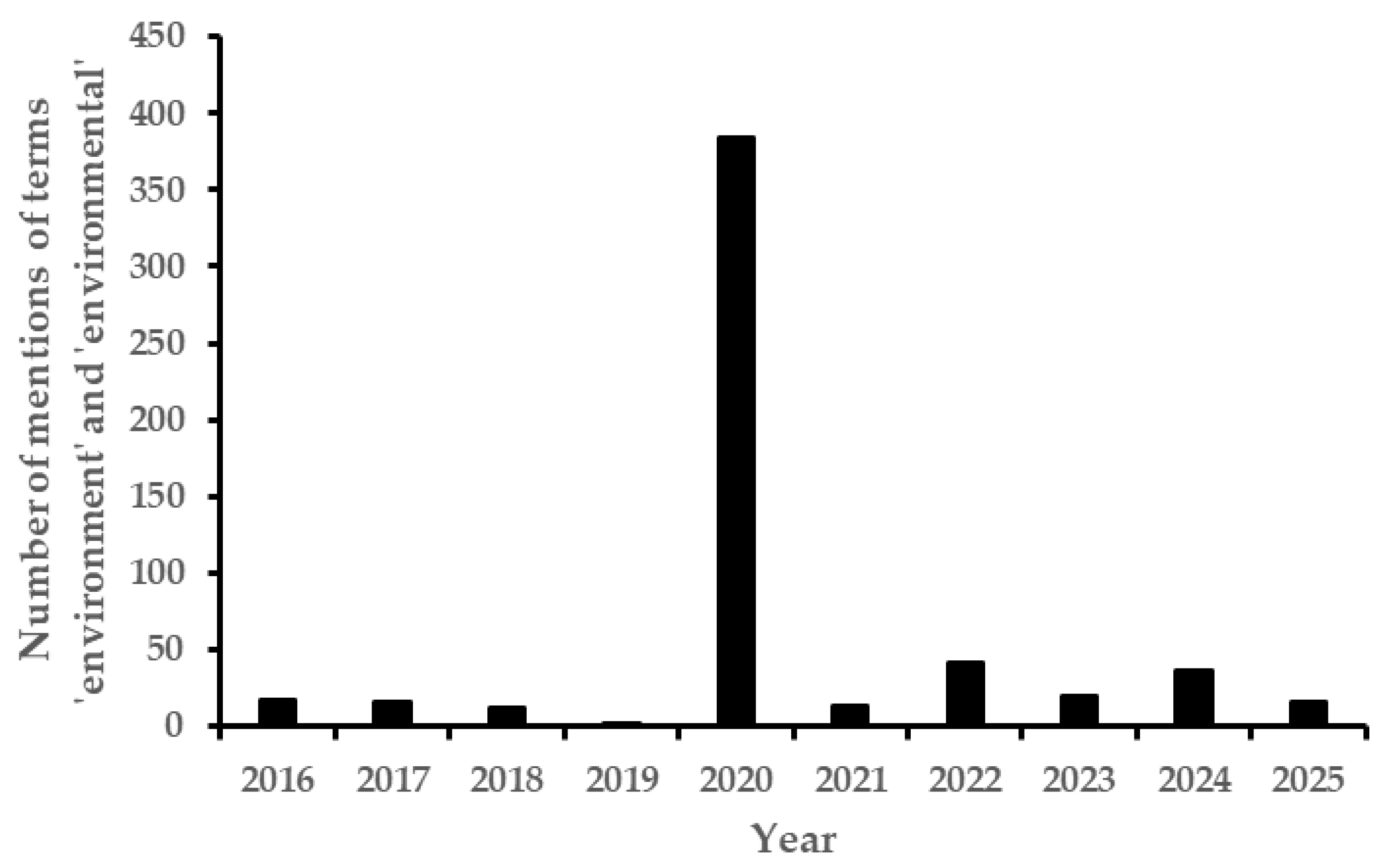
There was a curious combination of events in the early 2020s that shed some light on the intriguing nexus between happiness and the natural environment. First, there was the publication of the latest iteration, 8th in the series, of the World Happiness Report in 2020 [1]. The WHR was first published in 2012 [2] as a foundational text for a United Nations High Level Meeting entitled ‘Wellbeing and Happiness: Defining a New Economic Paradigm’ co-convened by the Royal Government of Bhutan and having more than 800 participants including ‘political and government leaders, representatives of governments, international organizations, civil society organizations, media, and business, as well as leading economists, scholars, academics, and spiritual leaders from the worlds major faiths’ [3], and the report of the UN meeting is available at [3]. Since 2012, the WHRs have been published in 2013 and every year since 2015. The reports include rankings of countries based on their ‘happiness’, and in common with many country-level index reports published on a regular basis, each of the reports has a ‘theme’. In 2020, the theme of the WHR was the link between happiness and what was referred to as the ‘environment’, although this term covered the social, urban, and natural environments [1]. But except for the 2020 iteration of the WHR, the ‘natural environment’ rarely featured in the WHRs. Figure 1 is a graph showing the number of mentions of variants of the word ‘environment’ (e.g., environments and environmental) in all the WHRs from 2016 to 2025, and 2020 does indeed stand out relative to the other years both prior to and after 2020.
In the WHR 2020, there is only one chapter dedicated to the link between happiness and some dimensions of the natural environment, notably air pollution and per capita area of natural forests [4]. Indeed, even in that WHR, there are 36 mentions of ‘natural environment’ but 76 mentions of ‘social environment’. The terms ‘sustainability and ‘sustainable development’ rarely appear in all the WHRs other than in the reference lists and references to sources of data, such as the Sustainable Development Solutions Network (SDSN), which is also a sponsor of the WHRs. The relative paucity of association between the natural environment, let alone sustainable development, and happiness in the WHRs is perhaps surprising, especially as the authors of the WHR 2020 make the point that ‘There is indeed evidence in psychology suggesting that being exposed to green, natural environments improves mental well-being. Mechanisms include a reduction in stress, a rise in positive emotions, cognitive restoration, and positive effects on self-regulation’ [1] (p. 99).
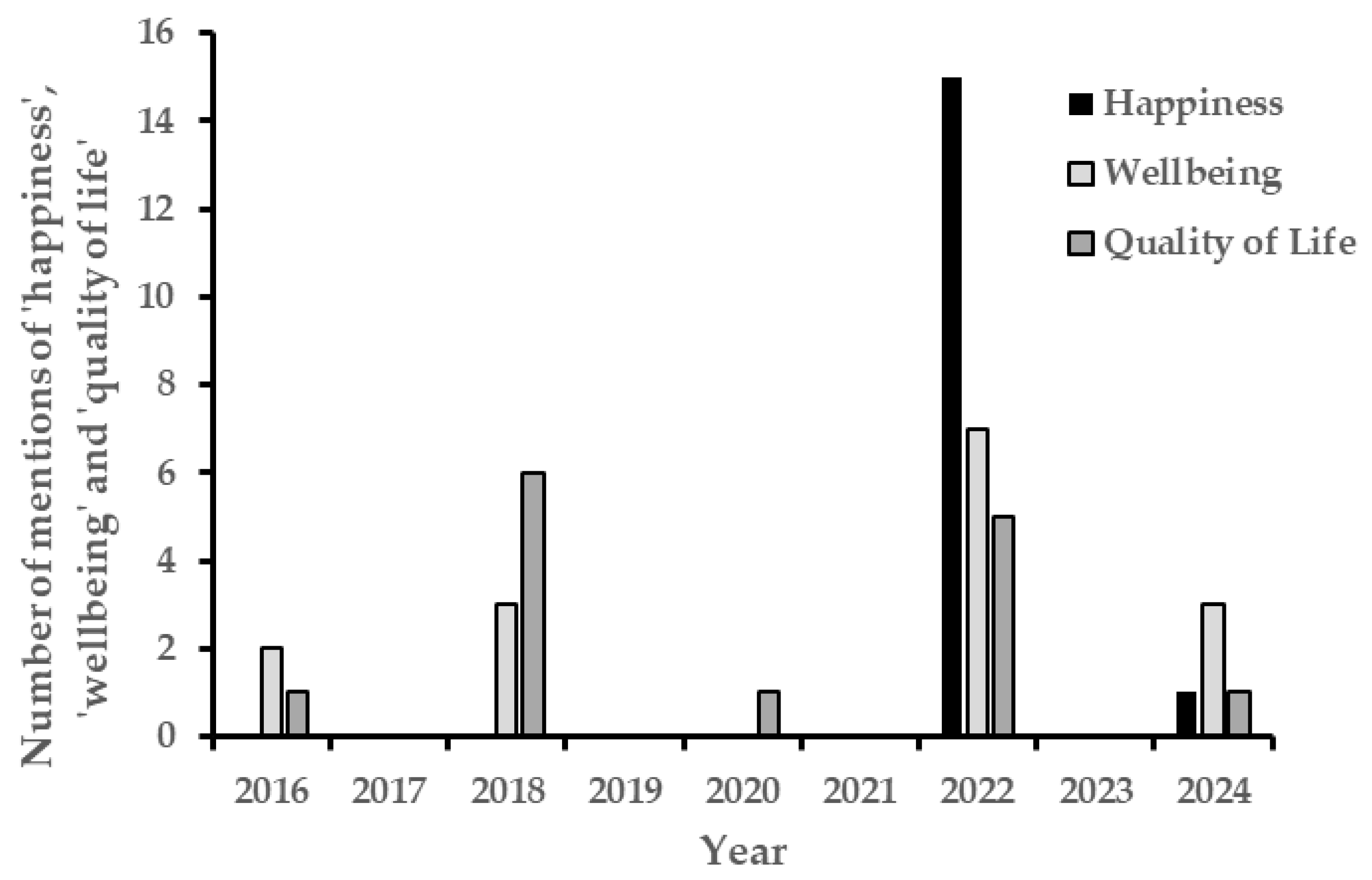
However, WHR 2020, with its focus on the links between the natural environment and happiness, had some impact, as in 2022, the latest iteration of the Environmental Performance Index (EPI) [5] was published, and this took as one of its themes the link between environment and wellbeing, with the latter including happiness as one of its dimensions. Indeed, the EPI 2022 report makes various links to the WHR 2020. In fairness, the EPI reports have often referred to related aspects such as ‘quality of life’, ‘wellbeing’, and happiness, and a graph showing the number of mentions of these terms in the EPI reports from 2016 to 2024 is shown as Figure 2.
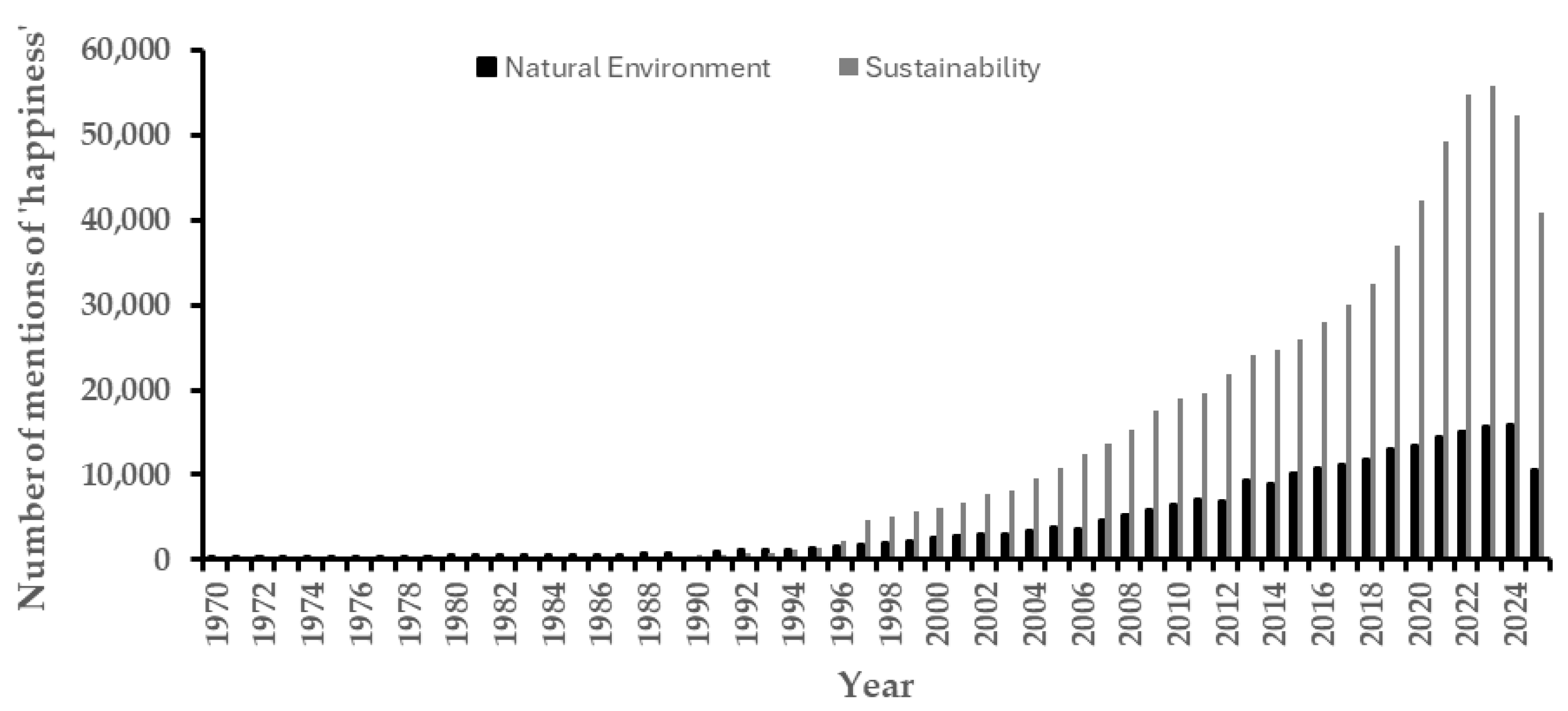
References to quality of life, wellbeing, and happiness in the EPI reports are perhaps understandable given that the EPI is a complex index comprising dozens of indicators spanning a wide range of environmental issues from water and air pollution, recycling, fish stocks, and biome and species protection [6]. These are weighted and aggregated through a series of steps to generate the published EPI for each country, and the result is a complex amalgam of indicators that have also varied significantly over time, including over the years, as shown in Figure 2. Even so, the standout in Figure 2 is the surge in mentions of happiness in 2022 that appears to have been catalyzed by the WHR published in 2020. Both reports came to much the same conclusion, namely that happiness does have a relationship with the natural environment, but when these reports were published, this relationship was by no means a novel or underexplored idea. By that time, the academic literature was already replete with studies that explored all kinds of dimensions to the association between ‘happiness’ and the ‘natural environment’ and indeed ‘sustainability’. As an illustration, Figure 3 provides a summary of the number of publications accessible via Google Scholar that mention ‘happiness’ in association with the natural environment and sustainability (e.g., happiness AND sustainability as the search term). The Google Scholar database has certain advantages when it comes to providing a gauge of academic interest in a topic, including ease of use and the inclusion of what is often called the ‘grey literature’ (i.e., the literature that is typically not peer-reviewed), such as some books and book chapters, conference proceedings, and technical reports. However, there are also disadvantages, as material generated from a search may not necessarily be peer-reviewed, and research can be double-counted (e.g., research results may first be published as a conference paper or discussion piece before appearing as a peer-reviewed paper). There are alternatives to Google Scholar, such as Web of Science, Scopus, and SciSpace, but these also have their respective advantages and disadvantages. The intention with Figure 3 is just to provide a sense of the rise in interest in happiness associated with sustainability and ‘natural environment’, and even with this rather simplistic analysis, it is readily apparent how interest in the association between these topics has grown. By the early 2020s, the number of publications including happiness alongside sustainability grew to more than 40,000 each year, which represents a very significant effort. Even with a more limited focus on happiness and the natural environment, the analysis suggests an output above 10,000 publications each year by the early 2020s. Hence, the WHR 2020 and EPI 2022 reports were by no means exploring new territory, and in fairness, the discussions in these reports do make this very point and include numerous references to the literature on the topic.

1.2. The Sustainable Development Goals and Happiness: The Need for and Aim of the Review

The surge in interest in the association between happiness and sustainability shown in Figure 3 provides one foundation stone of the case for a review of the latest developments in this field, especially as another review written by Jain et al. [7] (p. 277) calls for more reviews on what they refer to as ‘the human–rest-of-nature relationship’ when it comes to happiness. But there is another intriguing issue, linked to the Sustainable Development Goals (SDGs) framework and its suite of indicators, that provides an additional foundation to the case for a new review.
The Sustainable Development Goals (SDGs), first published in 2016, comprise a set of 17 goals, along with targets and associated indicators [8], and are the prominent international agenda for helping with the achievement of sustainable development [9]. Understandably, they have attracted much interest from the research community [9,10]. Also, as would perhaps be expected given that the UN is the lead agency with the SDGs, there is an abundance of information available online on the indicators, including descriptions of all of them set out in ‘metadata’ documents that span indicator ‘definition, concepts, and classifications’ as well as methodology and data sources [11]. Only one of the indicator metadata documents mentions ‘happiness’, while 21 mention ‘wellbeing’ and 15 mention ‘Quality of Life’ (Appendix A Table A1). The distribution of these mentions across the SDGs is uneven (Appendix A Table A2). The terms ‘wellbeing’ and ‘quality of life’ are more commonly mentioned in indicators associated with SDG 16 (Promote peaceful and inclusive societies for sustainable development, provide access to justice for all, and build effective, accountable, and inclusive institutions at all levels), while some of the SDGs (7, 9, 13, 14, and 17) have indicators that make no mention of them. Hence, the fact that only one of the 267 SDG indicator metadata documents mentions happiness is highly intriguing. The numbers for wellbeing and quality of life are slightly higher, but given how important these concepts are to people, the numbers do seem very low. The relative lack of reference to happiness in the SDGs has been noted by others [12], but there has been no published analysis of the reasons why this may be the case.
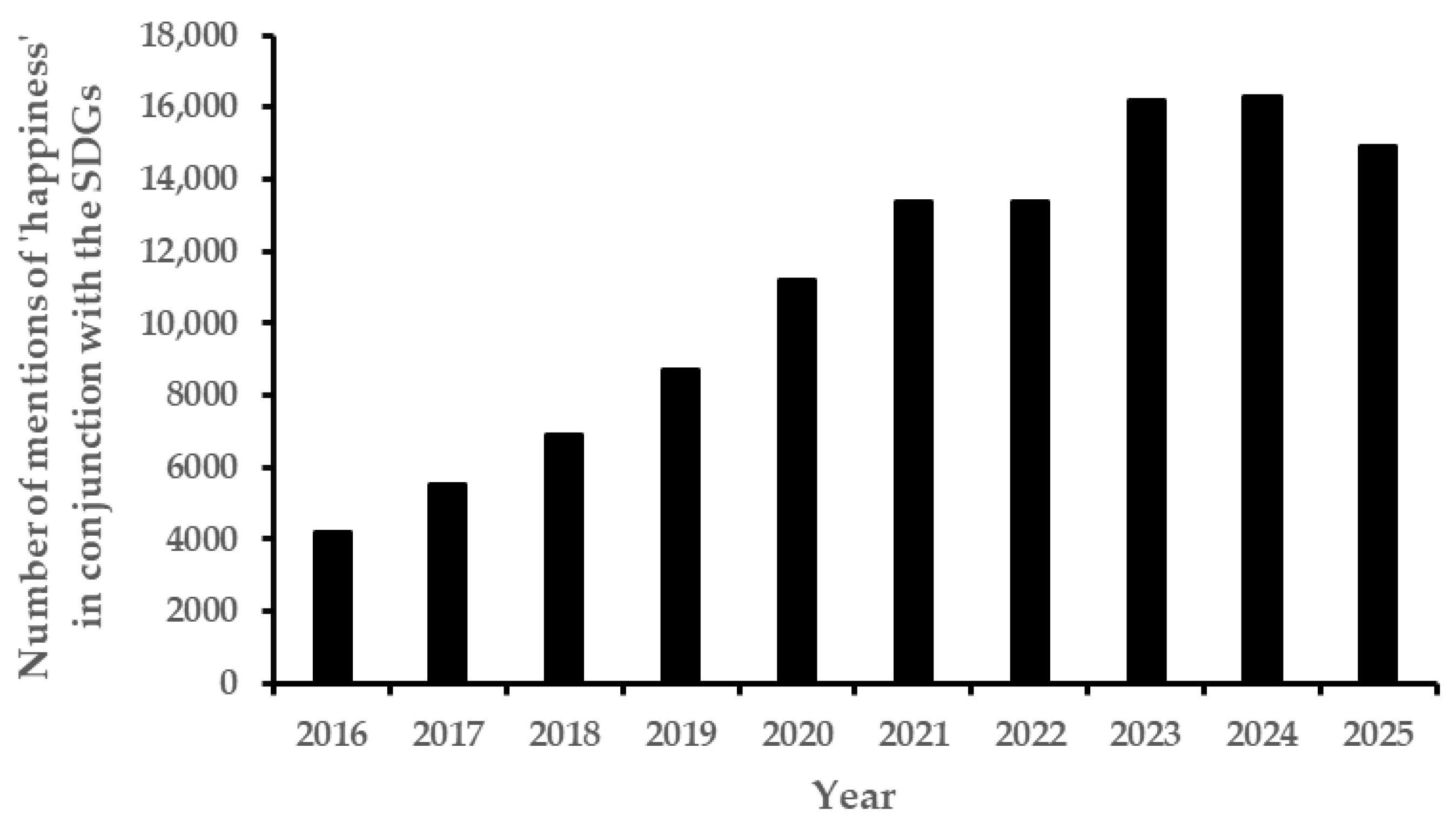
The lack of any mention of happiness in the SDG indicator metadata is especially interesting, as a search of the literature via Google Scholar does point to a significant degree of interest in the association between happiness and the SDGs, as shown in Figure 4. The same caveats over the use of Google Scholar highlighted above apply equally here, of course, and again it should be noted that the intention is only to illustrate a trend in interest. The graph in Figure 4 presents the number of publications mentioning both these terms between 2016 and 2025, and the number of publications covering this association is not insignificant, with well over 10,000 published each year since 2020. However, it should be noted that the publications are not necessarily focused on the inclusion of happiness in the SDG framework. Instead, the coverage is typically focused on how the attainment of the SDGs can help underpin happiness as an outcome. Nonetheless, in many of these publications, the authors do also note a relative absence of happiness (and wellbeing and quality of life) in the SDG framework itself, not only its indicators. A narrower search, which looked for publications from 2016 onwards that included happiness in conjunction with ‘SDG indicator’ (and variant terms) in the same publication, yielded no hits whatsoever, and perhaps this is unsurprising given that happiness is only mentioned once in all the SDG indicator metadata documents.
Therefore, while there have been regular calls for more reviews of the nexus between happiness and sustainability [7], it is this apparent absence of happiness within the SDG indicator framework that provides the main rationale for the review paper. There would seem to be something of a conundrum here. On the one hand, much of the literature focuses on the importance of assessing happiness, and this includes, as the WHR and EPI examples have shown, the importance of understanding the relationship between happiness and sustainability. Yet the evidence appears to suggest that an assessment of happiness features very little in the SDG indicator framework, and while there is much coverage within the academic literature of happiness as an outcome of the SDGs, it seems that few questions are raised about its lack of formal inclusion as a component of the SDG indicators. This leads to the important question of why this should be the case. For example, one hypothesis is that happiness is just too challenging to assess and thus incorporate into the SDG indicators. Whatever the reasons may be, it is certainly not due to a lack of interest from researchers in the SDGs, happiness, or indeed efforts to combine them, as shown in Figure 4, so what factors may be at play here?

1.3. Some Boundaries

A couple of ‘boundary’ issues need to be set out at the beginning of the review. The review does not include an analysis of the literature that focuses on how attainment of the SDGs helps support or enhance human happiness, wellbeing, or quality of life. In other words, how sustainable happiness [13,14,15,16] and other related concepts (e.g., sustainable wellbeing) [17,18] are desired achievements or outcomes of the SDGs. This is an important topic, of course, as in many ways it strikes at the entire ethos of the SDGs. Instead, the focus here is more on the absence of happiness within the SDG framework itself, and in particular, its list of indicators.
Second, there is, of course, the issue as to what is meant by happiness and how that overlaps with and differs from related concepts such as wellbeing and quality of life. Unfortunately, these terms are often used interchangeably [19] to mean much the same thing, and that can complicate an analysis of the literature. It certainly does not help when some of the definitions of these terms can be rather vague, and happiness is often claimed to be the least well-defined of them [19], and there can be elements of circularity. For example, happiness is often defined as the ‘state of being happy’, while ‘happy’ is a ‘feeling or showing pleasure or contentment’ [20]. This lack of focused definitions and the interchangeability of related terms provide a challenge for any review, especially as in the WHRs, the measure of happiness that is employed is technically an assessment of ‘self-reported wellbeing’. In this review, the term ‘happiness’ is used to help simplify the language, but these caveats do need to be noted.

1.4. Review Structure

As illustrated with both Figure 3 and Figure 4, the literature on happiness and its assessment is a large one, and a review can only cover a relatively small segment of that material. The paper begins with a brief review of a few of the main efforts to assess happiness and to include that assessment within indicators and indices designed to focus on sustainability. Perhaps the two most notable efforts here are the Gross National Happiness Index (GNHI) of Bhutan and the more global ‘Happy Planet Index’ (HPI). Both these indices provide points of interest, especially in terms of how happiness is conceptualized within sustainability as well as how they are measured to match that conceptualization. These two approaches also have their respective advantages and disadvantages, which help to illustrate some of the challenges in this field. Indeed, one of the important dimensions of such indices is that they are not necessarily designed primarily as tools for researchers but are intended to attract the attention of governments, pressure groups such as non-governmental organizations, and indeed the public. Hence, the discussion of the two indices of happiness is followed by a brief analysis of their reporting over time within an important form of the media—newspapers. The question being tested here is whether these happiness indices are picked up and reported on by newspapers. The sections devoted to the two happiness indices are followed by a wider review of the literature on happiness and its assessment within the context of the SDG indicator framework. The paper ends with a discussion of the main findings, conclusions, and suggestions for further research. Some of the data from the analysis has been provided in Appendix A.

2. Materials and Methods

The review was based on the literature published on happiness and the SDG indicators, and the search engine employed for the search was Google Scholar. The primary search terms used in the analysis were ‘Sustainable Development Goal(s) Indicator’ AND ‘Happiness’, and the search focused on the period from 2016 (the year when the SDGs were introduced) onwards. In contrast to some other search engines (e.g., Web of Science, Scopus, and SciSpace), Google Scholar includes a wide range of publication types, including academic journal papers, but also technical reports, books, book chapters, and conference/workshop papers. This breadth of type of publication is an important consideration, given that the SDG framework of indicators is intended as a basis for action at many levels in society, rather than research, and it was also important to search other materials rather than focus solely on academic journal papers, which tend to be the only type of publication included in many other databases. However, Google Scholar does have its disadvantages, as noted above, especially as it can include research that has not been peer-reviewed, and care needs to be taken. The approach taken here was to focus primarily on journal papers but also, especially with the two examples of happiness indices, to consider related formats, as they often provide more background information.
For the analysis of newspaper reporting of some of the prominent happiness and wellbeing indicators and indices, the source of the data was the Nexis database [21]. The search was only focused on what the Nexis database classified as ‘newspaper’ articles published between 1 January 1990 and 31 December 2024. There is something of a lag in updating the database, and that is why 2025 was not included. The search terms used were the respective names of the indices, namely, Human Development Index, Social Progress Index, Better Life Index, Happy Planet Index, Gross National Happiness Index, and World Happiness Report. While the search terms are the English names of the indicators/indices, the search encompassed newspapers published in all countries of the world. At the time of writing, the list of newspapers included in the database was 2131, and a full list is available at the Nexis website [21]. Articles that included the search term at least once were counted, and multiple mentions of the search term within the same article were still counted as one. However, it does need to be noted that a single article may be published in a number of outlets (i.e., syndicated), and a decision was made to include these as separate mentions of the index rather than count them as one. The logic adopted here is that syndicated articles are still part of the exposure of an index, precisely because they appear in a variety of outlets, often spanning different countries.

3. Indicators Linking Happiness and Sustainability

3.1. The Relationship Between Happiness and the Environment: A Brief History

Research on happiness has a long history [22,23,24,25,26], but empirical studies of happiness in a utilitarian sense are often said to have one of their origins in the work of the 18th-century social reformer and radical in England named Jeremy Bentham [22]. Bentham was regarded as one of the founders of utilitarianism, especially when it comes to government policies, and he saw this as ‘a principle based on the notion that the correct action is one which results in the greatest good or happiness for the greatest number of people’ [27] (p. 27). Bentham was a public-sector innovator and espoused a wish to see the function and performance of the British government improve, especially in terms of its management of the country’s finances. He saw the need for performance measures and provision of information as being central to that mission and regarded the happiness of its citizens as an important goal for the government to pursue, and thus something that needed to be measured. Research designed to explore the association between happiness and the environment became one of the strands in the field of environmental psychology, which emerged in the 1960s and brought together insights from psychology, sociology, architecture, and urban planning.
It is not hard to imagine that having access to green spaces can engender a sense of pleasure and happiness, and indeed, this has long been explored. Kellert and Wilson [28] point to the ‘biophilia hypothesis’, first set out in the 1960s and founded on the notion that people have an innate, biological affinity for nature, which can result in happiness. Hence, it can be expected that people having access to green spaces and an unpolluted environment will have a greater degree of happiness compared to those who do not. Other reasons besides an innate biophilia may explain why people are happier in natural spaces, and MacKerron and Mourato [29] suggest that natural environments are also lower in ‘environmental bads’ (e.g., pollutants), which have negative impacts on health and mental wellbeing, and that natural environments facilitate healthy behaviors such as exercise, recreation, and social interaction.
Studies designed to explore the nexus linking happiness and the natural environment can be broadly categorized into two types, and interestingly, these map neatly onto a key question raised by Graham [19] (p. 3) at the very beginning of her book on the utility of happiness: ‘How can more happiness not be a good thing? And what is this new ‘science’ of happiness all about? What do we mean, for example, when we use the term ‘happiness’? Do we care about happiness per se or about the pursuit of happiness? Should policymakers be in the business of telling people what will make them happy? And whose happiness do we care about? Do we care about the happiness of isolated individuals? The happiness of nations? Or about happiness in some broader global sense?’ There are, of course, many scales (village, city, region) from the individual to the nation, but it does provide a useful starting point. At the level of the individual, there are studies, often based on self-assessment, on how happy they feel when in different places, including natural habitats and green spaces (urban parks, etc.). As technology has progressed, the mobile phone and software provide a useful tool that allows people to record their level of happiness, and their location can be georeferenced [29]. The results of these assessments, based on individual self-reporting linked to location, tend to be very clear and unambiguous. As perhaps would be expected, people do tend to feel happier when they are in natural habitats and green spaces, at least when compared to very urbanized settings, and the reasons for this may be varied [29]. Happiness at the level of the nation, mentioned by Graham [19], is more in line with the thrust of this paper. This has also been of much interest to economists, with the pioneering work of Richard Easterlin and his 1974 publication entitled ‘Does Economic Growth Improve the Human Lot? Some Empirical Evidence’ [30], still regarded as a significant waypoint in the growth of ‘happiness economics’. In those early studies, the focus was often on the association between income and happiness, although the latter was often expressed with terms such as ‘life satisfaction’. Indeed, Easterlin was the first to note that happiness increases with the average income of countries, but only up to a point, after which it tends to flatten. It seems that money can buy happiness, but only up to a point, and today this ‘leveling off’ is referred to as the ‘Easterlin Paradox’ [31]. That work has blossomed, and some reviews linking economics to happiness at the scale of the nation can be found in [7,24,25,32,33]. But the research focus widened, and especially since the 1990s, economists have utilized datasets collected at the scale of nations to identify an association between happiness, wellbeing, etc., and a variety of indicators designed to capture aspects of environmental quality, including how these vary between countries and over time [34,35].
As Graham [19] has noted, given the importance of happiness (how can it not be a good thing?), it is understandable that various efforts have been made by international agencies, governments, and non-government organizations to develop indicators that can capture it at various community scales, including the nation-state. As with all such indicators, the intention is typically to have them as tools to allow for comparisons between countries but also to facilitate exploration of factors that influence the values of the indicators. Indicators designed to capture related concepts such as wellbeing have been around for a long time, and a group of prominent researchers in this field—Joseph Stiglitz, Jean Paul Fitoussi, and Amartya Kumar Sen—were asked by the then President of France (Nicolas Sarkozy) to produce a report on the measurement of economic performance and social progress [36]. The report was published in 2009, and among its list of recommendations is one (recommendation 11) that notes: ‘Research has shown that it is possible to collect meaningful and reliable data on subjective as well as objective well-being. Subjective well-being encompasses different aspects (cognitive evaluations of one’s life, happiness, satisfaction, positive emotions such as joy and pride, and negative emotions such as pain and worry): each of them should be measured separately to derive a more comprehensive appreciation of people’s lives. Quantitative measures of these subjective aspects hold the promise of delivering not just a good measure of quality of life per se, but also a better understanding of its determinants, reaching beyond people’s income and material conditions’ [36] (p. 16).
Of course, even by the time this report was published in 2009 there existed a number of well-established indices such as the Human Development Index (HDI) and variants of the GDP groups of economic indicators (Index of Sustainable Economic Welfare, Genuine Progress Indicator) that were claimed, at least by some, to capture a sense of wellbeing, even if they were not necessarily designed to do this [6]. Nonetheless, while the quotation above acknowledges an inevitable degree of subjectivity, it does emphasize a need to have indicators and indices that capture happiness [36]. The WHRs followed as of 2012, and in parallel a number of indices were designed to help capture dimensions of wellbeing and quality of life at the scale of the nation, and examples include the Better Life Index (BLI) published in 2011 [37] and the Social Progress Index (SPI) first published in 2013 [38,39], which itself was designed to address some perceived failings in the quantification of happiness in the WHRs as well as what some saw as a widespread (mis)interpretation of the HDI as capturing wellbeing [40]. But in addition to the values for ‘happiness’ reported for countries in the WHRs, the two indices that at least have ‘happiness’ in their names and which have received the most attention in recent years are the Gross National Happiness Index (GNHI) and the Happy Planet Index (HPI).

3.2. First Example of a Happiness Index: Gross National Happiness Index (GNHI)

An often-cited example of the use of an indicator to assess happiness is the Gross National Happiness Index (GNHI) of Bhutan [41,42,43]. ‘Gross national happiness’ (GNH) as a concept in Bhutan dates from the 1970s and is founded on the Buddhist concept of ‘The Middle Path’ [44]. The concept is embedded in the constitution of Bhutan, as noted by Ura et al. [45] (p. 6): ‘The goal of Gross National Happiness—or GNH—was first articulated by the Fourth King, His Majesty Jigme Singye Wangchuck. He built upon the legacy of Bhutan’s government since the 1729 legal code by Zhabdrung Rimpoche, which dates from the unification of Bhutan. The legal code stated that ‘if the government cannot create happiness (dekidk) for its people, there is no purpose for the government to exist’ (Ura 2010). The Constitution of Bhutan (2008, Article 9) directs the State to promote those conditions that will enable the pursuit of Gross National Happiness’.
The GNHI is intended to translate this high-level emphasis on happiness to a quantitative index that allows the tracking of progress [45,46], and the current version involves a total of 38 sub-indexes, 72 indicators, and 151 variables that span nine domains considered to be important for influencing happiness: psychological wellbeing, health, education, time use, cultural diversity and resilience, good governance, community vitality, ecological diversity and resilience, and living standards. These are weighted equally, but the number of indicators that comprise each of them is unequal. For each of the aggregated domain indicators, the curators of the GNHI apply a ‘sufficiency cutoff’; in essence, they define a value of the domain-aggregated indicators deemed by them to represent sufficiency for happiness. Every value at or above that line is classified as ‘sufficient’ in happiness, while any value below the cutoff indicates an ‘insufficiency’ in happiness (‘not fully happy’). A key assumption here, of course, is that the nine domains and the indicators and variables that comprise them are sufficient for capturing happiness. Values above 50 for the GNHI are deemed as representing ‘happy’, while anything below 50 is ‘unhappy’. For values in the ‘happy’ category, there are subdivisions into deeply happy, extensively happy, and narrowly happy.
The GNHI has been claimed to have significant advantages over the HDI and the BHI, and some have suggested that there is scope for a hybridization approach to bring these indices together [47]. Its relevance in terms of sustainability has been noted by many [48,49,50], and the ‘gross national happiness’ approach has also generated interest amongst politicians in other countries, including the UK [51]. Indeed, some have even argued that the GNH has advantages over the Western-modernistic approach as encapsulated by the SDGs: ‘Bhutan’s GNH policy represents an exemplary case, seeking to transcend the orthodox paradigm of development that besets the SDGs. It explores an alternative, vernacular pathway to sustainable development, founded on the country’s tradition of Mahayana Buddhism and its holistic view of well-being. The major issues concerning the SDGs have thus been addressed as follows: GNH refrains from status quo policies prioritizing the pursuit of economic growth, or more broadly, ‘Western modernism’, and instead adopts a more holistic approach to sustainable transition’ [52] (p. 211). The replacement of the SDG framework by the GNH is intriguing, and indeed, at least superficially, they have some similarities. For example, both are large and complex frameworks of high-level aims, be they expressed as goals for sustainable development or domains for influencing happiness, with associated indicators and methodologies, and of course, a need for data to populate them.

3.3. Second Example of a Happiness Index: Happy Planet Index (HPI)

The Happy Planet Index (HPI) [53,54] builds upon the concept of ‘happiness’ as set out in the WHRs but seeks to also include the environmental cost of ‘happiness’ on a country-by-country basis. The HPI tries, in essence, to capture the environmental cost of living a happy life. The HPI was conceived and is curated by a non-governmental organization called the ‘New Economics Foundation’ (NEF), having the intriguing strapline of ‘Economics as if the people and the planet mattered’. Abdallah et al. [54] (p. 4) claim that the HPI ‘is based on a simple idea: The ultimate outcome for societies should be sustainable wellbeing for all. And the fundamental input is environmental resources. If we want one single indicator to get an overall sense of how we are doing, that indicator should be a measure of how much wellbeing is achieved per unit of environmental resources, in effect a measure of socio-ecological efficiency’. With such ‘efficiency’ (output relative to input) in mind, the HPI is found for each country based on the following calculation:
H a p p y   P l a n e t   I n d e x L i f e   E x p e c t a n c y   ×   S e l f   R e p o r t e d   W e l l b e i n g E n v i r o n m e n t a l   i m p a c t
Note that the equation states that HPI is assessed only approximately (≈) by the components on the right-hand side of the equation.
In earlier versions of the HPI, the ecological footprint was used as a measure of environmental impact, while in later versions this was switched to carbon footprint and thus linked more directly to global warming. Therefore, the HPI can be thought of as a sort of benefit:cost ratio with ‘happy life expectancy’ (the numerator) being the ‘benefit’ and environmental impact (denominator) being the ‘cost’, with higher values representing a better return in ‘happy life expectancy’ per unit impact on the environment.
The ‘self-reported wellbeing’ in the HPI is the values for ‘happiness’ published in the WHRs, and the principal source of data in the reports is provided via a survey conducted by an American research company called Gallup, which since 2005 has undertaken a major international survey called the Gallup World Poll (GWP), which spans various matters of interest [55]. Interviews are conducted via telephone or face-to-face, and respondents (all over 15 years of age) are selected using a sampling frame to generate a sample that is ‘probability-based and nationally representative of the resident population’ [55]. The sample size per country is typically around 1000, but can vary from 500 to 2000. For example, the 2022 survey for the UK was undertaken using a combination of telephone and face-to-face methods between May 30 and June 27, with a sample size of 1000 individuals. The key question in the GWP survey used to assess ‘happiness’ is as follows (English version of the wording): ‘Please imagine a ladder, with steps numbered from 0 at the bottom to 10 at the top. The top of the ladder represents the best possible life for you, and the bottom of the ladder represents the worst possible life for you. On which step of the ladder would you say you personally feel you stand at this time?’ [56] (Appendix 1 p. 1).
The respondent is asked to provide a score from 0 (worst possible life) to 10 (best possible life). The device being used here is called the Cantril ladder [57] based on the notion of ‘self-anchoring’, where each respondent has their own sense of what the ‘best’ and ‘worst’ possible lives are for them, and their scoring from 0 to 10 is relative to those self-determined ‘anchors’. Hence, it cannot be assumed that a score given to an attribute means the same across all respondents; they are all ‘self-anchoring’ relative to their own sense of ‘best’ and ‘worst’ [58]. However, the wording of the question is arguably not directly about happiness but is asking respondents to provide a ‘self-reported well-being’; they are scoring relative to a ‘best possible life’ and ‘worst possible life’. Is a ‘best possible life’ the same as being ‘very happy’ and vice versa? After all, it is not inconceivable that one can have a good ‘possible life’, interpreted as having ownership of goods and not wanting for food, etc., but not necessarily regard it as being equivalent to being ‘happy’. In fairness, the authors of the WHR do make it clear that the answers to the question above from the GWP are not a direct indicator of ‘happiness’, but nonetheless, the data are used as a measure of happiness in the WHRs.

3.4. Read All About Happiness: Newspaper Reporting of Happiness Indices

The curators of indicators and indices often intend for them to be tools to attract media attention to an issue [59], and this applies equally to the GNHI and HPI. The same is also true of the SDG framework, and indeed the UN has what it refers to as a ‘Media Compact’ on its SDG website, which ‘seeks to inspire news and entertainment organizations to leverage their resources and talent to amplify and accelerate progress towards achieving the Goals’ [8]. The eventual target audiences for all this effort to engage with the media may well be diverse and include policy actors, civil servants, members of the public, non-governmental organizations (national and international), social movements, and the private sector [60,61,62]. Indeed, evidence does suggest that the media is keen to cooperate in spreading the message represented by indicators and indices, as well as any rankings based upon them, across a wide range of contexts, from ranking the providers of goods and services, including schools and hospitals, to ranking countries [63,64,65]. As well as the usefulness of indicators and indices for summarizing complexity to a lay audience, another attraction for the media rests with the authoritative credibility that goes with many of the curators of indicators and indices [66]. There may be dangers here as well, of course, in that journalists may simply accept the messaging behind indicators and indices without questioning them, but the availability of such tools from highly respected and authoritative sources has an understandable attraction for the media [66]. Hence, it can be instructive to examine the extent of reporting in the media of indices designed to assess happiness, and one form of media that can be searched is newspapers. This is, admittedly, just one type of media, and it may not even be the one most read these days, but extensive databases of newspaper reports do exist (e.g., the Nexis database), and these can be readily searched.
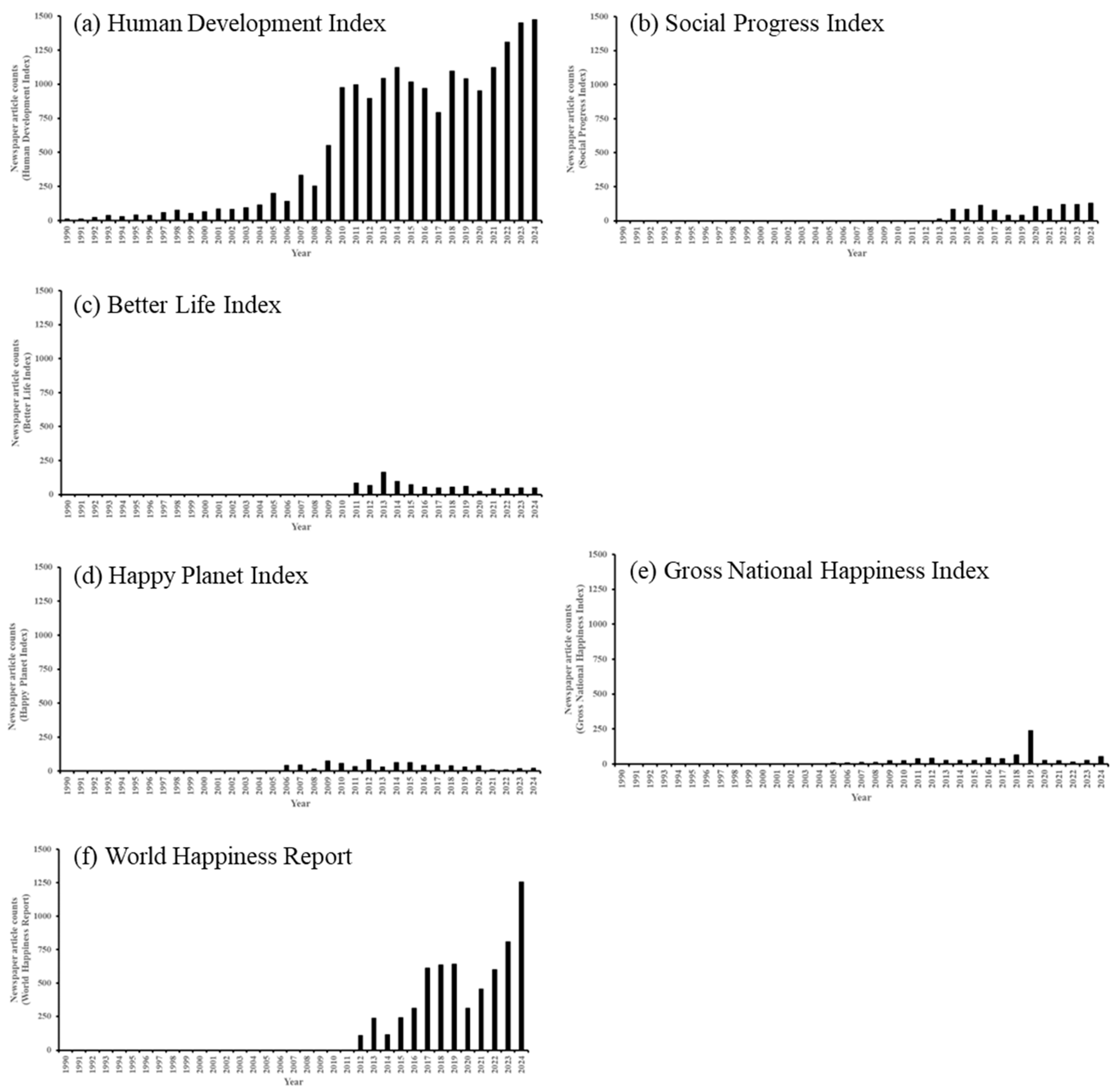
Figure 5 presents the number of newspaper articles (globally) published each year between 1990 and 2024 that mention various happiness-based and related indices, including the GNHI and HPI, at least once. Figure 5a–c shows the number of articles for three indices designed to capture wellbeing (Social Progress Index and Better Life Index; SPI and BLI, respectively) or often interpreted, rightly or wrongly, as capturing wellbeing (Human Development Index; HDI). The HDI is clearly far ahead in terms of reporting than the SPI and BLI. Figure 5d and Figure 5e show the number of articles for the HPI and GNHI, respectively, and these are also far lower than for the HDI and comparable to the annual counts for the SPI and BLI. The final graph, Figure 5f, presents the number of newspaper articles that refer to various iterations of the ‘World Happiness Report’, which uses ‘self-reported wellbeing’ as its measure of ‘happiness’, and the counts, while still lower than those for the HDI, do show an increase over time. Nonetheless, the lower counts for the HPI and GNHI, as well as SPI and BLI, especially when compared to the HDI, are perhaps surprising given the presumed newsworthiness of happiness. It may well be that the HDI, which has been published since 1990 and is well-established, has managed to capture most media attention as an index of wellbeing and what some may even regard as ‘happiness’, although these interpretations of the index are disputed [59]. But perhaps the increasing newspaper reporting of the WHR does suggest that there is an appetite for happiness indicators and indices, and maybe this should be a consideration for its inclusion within the SDG framework—a point that will be returned to in the discussion.

3.5. Happiness in the SDGs

As noted in the introduction, the SDG indicators have little mention of happiness, and even related terms such as wellbeing and quality of life (Appendix A) are not as prevalent as one would perhaps expect within the indicators. Indeed, indicators from five of the SDGs make no mention of any of these terms. Yet the SDGs are clearly intended to help people’s lives in so many ways, and the case is often made that attainment of the SDGs will help with enhancing happiness [67], life satisfaction [68], wellbeing [26,69], addressing mental disorders [70], and quality of life, but why are these only seen through a lens of ‘outcomes’? Why are they not central to the SDG indicators? Also, as some have noted, rather than progress with the SDGs being seen as leading to better happiness, etc., could the causality not be reversed? Could better happiness and wellbeing help enhance progress towards attaining the SDGs? [71]. If so, then this causality would surely provide a case for the inclusion of indicators of happiness within the SDG framework.
For all its widespread adoption, there are criticisms of the SDG approach as being too much in tune with a modernist and mechanistic perspective of sustainable development, which perhaps explains a paucity of emphasis on less quantifiable aspects of being human, such as culture, wellbeing, and happiness [72]. The following quotation from van Norren [72] (p. 453) summarizes the stance that many others have taken: ‘the SDGs have a human right approach and are oriented to linear result-based management and modernist ‘development’, with indicators (a natural science derived method) representing ‘reality’, and not a social science power-oriented discourse of the economic and legal systems hampering sustainable well-being… The SDGs are underpinned by strong (Western) modernist notions of development: Sovereignty of humans over their environment (anthropocentricism), individualism, competition, freedom (rights rather than duties), self-interest, belief in the market leading to collective welfare, private property (protected by legal systems), rewards based on merit, materialism, quantification of value, and instrumentalization of labor (for the market and productions process)’. Hence, it would seem that the relative absence of happiness and wellbeing from the SDG list of indicators can be understood simply from this drive for ‘linear result-based management’ with modernization at its core. But even adopting such a mechanistic vision of sustainable development as set out by the SDGs, there have been calls over many years for a focus on ‘sustainable happiness’ [14,15,16], defined as ‘the pursuit of happiness that does not exploit other people, the environment, or future generations’ [67] (p. 389) or, put another way, ‘The happiness of us−contemporaries−cannot be achieved at the expense of future generations’ [73] (p. 76). Given that happiness is often linked to consumption, then attainment of ‘sustainable happiness’ requires a decoupling between them [69,74]. Petrovič and Murgaš [73] make the related point that there are two types of happiness—hedonic and eudemonic—and we need to frame any analysis of ‘sustainable happiness’ with those in mind. The former of these is short-lived, while the latter is ‘long-lasting, usually associated with life wisdom’ [73] (p. 76). They argue that the concept of ‘sustainable happiness’ can only apply to eudemonic happiness, and arguably, it is this form that the SDGs aim to achieve. But the challenge is that for most people, it is the hedonic form of happiness that they constantly seek, yet this cannot be sustainable [73].
Nonetheless, the fact that the literature that blends happiness within the SDGs exists does at least suggest there is potential for inclusion. Indeed, it is perhaps unsurprising that many studies have attempted to correlate the SDG indicators with measures of happiness and, indeed, wellbeing, and the results often point to significant relationships, at least for some of the SDG indicators [12,26,75]. Some have also gone as far as to propose ways in which measures of happiness and wellbeing could be included alongside the SDG suite of indicators to create what they call ‘SDGs for Happiness’ [12] and the ‘Sustainable Wellbeing Index’ [76]. Yet for all these calls for indicators of happiness and wellbeing to be included within the SDG suite of indicators, or even in parallel to them, there has been no move by the UN to do so. This is certainly not due to a lack of stated flexibility on the part of those who curate the SDG indicators.

4. Discussion

The analysis of the literature on the SDGs and happiness does appear to generate some intriguing, perhaps even confusing and contradictory, insights. Firstly, there does seem to be a broad consensus that happiness should be an important consideration when it comes to what the SDGs are meant to achieve for humanity; there are no publications that were accessed in the review that implied that the SDGs should not aim to support happiness. There is much discussion about the best means for ensuring that such benefits should apply to all rather than some, and indeed the need to decouple resource consumption from its association with feelings of happiness and thus to aim more for eudemonic happiness than its hedonic form. But as an outcome of what the SDGs should help achieve, there appears to be widespread agreement. Although it is perhaps a little ironic that the brief foray into the newspaper reporting of various happiness and wellbeing indices does not suggest they are being widely used by that group of index ‘consumer’. The standout index of wellbeing is, for all its faults, still the HDI. While the newspaper reporting of the WHRs is beginning to approach that of the HDI, none of the other indices, such as the GNHI and HPI, suggest any significant traction with the media as yet. But the WHRs do seem to be attracting more interest from newspaper reporters, and the trajectory is certainly moving in the right direction, at least till the end of 2025. If that continues, then it would provide additional rationale for the inclusion of indicators and indices of happiness in a future version of the SDG indicator framework.
Even so, there are voices that are more critical of the SDG framework. For example, van Norren [72] (p. 453) views them as ‘linear result-based management and modernist ‘development’’, and indeed quite at odds with the approach taken with gross national happiness in Bhutan. But having said that, could the GNHI, which is, after all, designed to be a practical expression of GNH to help the Bhutan government with its policy decisions, equally be criticized as ‘linear result-based management’? That is indeed the central ethos of many indicators and indices [6]. There are those who have provided suggestions to bring happiness into the SDG framework, but this is typically framed more as the design of indices intended to be used in parallel with the SDG indicators than to include them within the framework. Nonetheless, some have seen the absence of happiness within the SDG framework as noteworthy and requiring attention [12,76].
In general, while indices and indicator-based frameworks are often claimed to be open to change, these are arguably more around the edges rather than at the core. For example, the HDI, created by the United Nations Development Program (UNDP) and published more or less annually in its Human Development Reports (HDRs), has been through various changes, especially in terms of how the education and income components are assessed [77], but these have not been radical. The income component has involved changes in how GDP/capita is transformed (Logarithm to Atkinson—back to Logarithm), and more recent versions use Gross National Income (GNI) rather than GDP. The education component of the HDI has also seen some changes in the way it is calculated. The HDI has certainly received much criticism, especially in the 10 years or so immediately following its first release in 1990, and many of the critics provided suggestions for improving the index [78,79,80,81,82,83,84,85,86,87,88,89,90]. One of the many threads within these critiques has been the absence of an ‘environmental’ cost to achieving the elements of the HDI. The UNDP showed signs of being alert to this issue and indeed made some promises to develop an ‘environmentally sensitive HDI’ [91] (p. 24) or what has sometimes been referred to by some as a ‘Sustainable Human Development Index’ [53], and HDRs published from 2020 onwards have included a Planetary pressures-adjusted Human Development Index (PHDI) which is described by the UNDP as being ‘experimental’, but as yet no such ‘headline’ variant of the HDI has emerged in the HDRs even if sustainability is often covered. As a result, the ‘headline’ version of the HDI has remained much the same in terms of its core approach and indeed ethos as it was when it was first released, albeit with some relatively minor changes, and there has been resistance to broadening its scope by including other dimensions. As the UNDP noted in the HDR of 1994 in response to all the suggestions it had received up to that point, ‘The ideal would be to reflect all aspects of human experience. The lack of data imposes some limits on this, and more indicators could perhaps be added as the information becomes available. But more indicators would not necessarily be better. Some might overlap with existing indicators: infant mortality, for example, is already reflected in life expectancy. And adding more variables could confuse the picture and detract from the main trends’ [92] (p. 91). This is certainly not to say that the changes that have been introduced have had no impact in terms of the values given to the HDI for each country and indeed their rankings. There have been such impacts, and a country may find itself going up and down the rankings for no other reason than the HDI methodology has changed [77], and these shifts in rank can be noticed by the media and lead to questions for governments [59]. None of this is caused by a lack of transparency on the part of UNDP. On the contrary, they do make every effort to present past values of the HDI based on changes made to the methodology, and tables of revised values for the HDI are occasionally provided in the HDRs. But it is the headline values of the HDI—the first table that appears at the end of the reports—that tend to be the focal point for many readers. It appears that a desire to limit any change to the core design of the HDI is driven primarily by a perceived need to maintain its relatively simple and straightforward structure of three components that capture what the UNDP regards as human development. In fairness, it does need to be noted that such resistance to major change is not necessarily reflected in other indices and indicator frameworks. The EPI, for example, has witnessed significant change in terms of the indicators used to create it and how these are weighted. Hence, a willingness to introduce fundamental changes within the methodology and data sources of indicators and indices does appear to vary, and this would be an interesting topic to explore. To what extent do indicators and indices change in terms of their methodology and where they source their data, and why is it that some curators are more open to major change than others?
The selection of the SDG indicators was made by the Inter-Agency and Expert Group on SDG Indicators (IAEG-SDGs), based on a set of criteria such as availability of data of the required quality [93], the need for comparability across countries, and, of course, the relevance of the indicators to the SDG targets. The IAEG-SDG comprises various expert working groups, and part of its mandate is to review the list of indicators and their values on a regular basis, and the process has not been without criticism. For example, there have been calls for a broader representation of people to be included in the process [94]. Nonetheless, it is noteworthy that the most recent (at the time of writing) 2025 review of the SDG indicators framework made the following points with emphases (bold text) provided by this author:
1. ‘The aim of the review is to maintain the same number of indicators currently in the framework to not alter significantly the original framework, which is already being implemented in most countries and to not increase the reporting burden on national statistical systems;
2. The proposed indicator must have an agreed methodology (tier III indicator proposals will not be considered) and data available for at least 40% of countries and of the population across the different regions where the indicator is relevant and be suitable for global monitoring;
Taking into account the first two criteria,
An additional indicator may be considered only in exceptional cases when a crucial aspect of a target is not being monitored by the current indicator(s) or to address a critical or emerging new issue that is not monitored by the existing indicators;
A deletion may be considered when a tier II indicator has not been able to submit any data to the global SDG monitoring or is proven to be challenging for countries to implement, and a replacement will be proposed if the deleted indicator is the only indicator monitoring the corresponding target;
Adjustments or replacements will be considered when the indicator does not map well to the target or does not track the target well’ [95].
While there are repeated claims that the framework is a flexible one, and indeed changes have been introduced for some indicators within the boundary conditions set out within the quotation above, there is also an understandable desire to keep a degree of core consistency. Hence, given the list of points above and the stated desire not to alter the original framework, at least significantly, it may well be that the inclusion of happiness as part of the ongoing process would be perceived as being far too much of a ‘significant’ change, which perhaps also helps explain why ‘parallel’ indices advocated by some have not been formally adopted by the IAEG-SDGs.
However, the point made above about the criteria for making changes to the existing SDG indicator framework does not, of course, address the question as to why assessments of happiness were not included from the start. Based upon the review of the literature, it seems likely that the answer rests more with the challenges involved in measuring happiness. There has certainly been much discussion in the literature about the practical challenges of measuring happiness as the basis for indicators: ‘using happiness as a way of evaluating progress involves many problems arising from disagreements about definitions, measurement problems arising from differences in how people answer questions according to the nature of the question, age and even time of day, as well as culture; problems of adding up answers across people to arrive at a national figure; and the weak basis for distributional judgements’ [96] (p. 297). This is certainly an active field of research, but the GNHI and HPI do provide tangible and persistent examples of attempts to address these issues, even if the indices are imperfect. After all, even when these challenges are highlighted, one often sees statements that emphasize that happiness is important and deserves to receive more attention within sustainable development. For example, in one such analysis, which raised numerous challenges associated with measuring happiness, a key conclusion reached was that ‘Happiness indicators should be at the core of both public debates and academic research’ [97] (p. 29). One cannot help but feel that maybe this methodological challenge goes some way to explaining the absence of happiness indicators and indices from the SDG framework, which itself represents a major challenge in terms of quantification for many reasons [98]. As Bali Swain and Yang-Wallentin [99] (p. 104) have noted, ‘The path to quantifying and monitoring SDGs is a quagmire. It requires a profound understanding of sustainable development, commitment and ability to operationalize and implement the multi-dimensional SDGs, access to all forms of data and the expertise to analyze and interpret the results’. It is perhaps unsurprising that Gennari and Navarro [100] (p. 741) have concluded that ‘In many ways, the SDG indicators provide a testing ground for new approaches, modalities and procedures in data flows and global reporting’.
Therefore, when it comes to answering the research question set out at the start of this review as to why happiness does not feature within the SDG framework of indicators, it seems likely that the complexity of measuring happiness on top of such a ‘quagmire’ of quantification challenges is the most likely explanation. This does not prevent, of course, the development of parallel indices that attempt to work alongside the SDG framework, but whether these will have much traction with national and international agencies seems debatable, given the immensity of the tasks they already face. Perhaps the formal inclusion of happiness in the SDG indicators is a challenge too far, at least for now. However, and this should be a key focus of future research, maybe there is an opportunity to begin to consider how happiness indicators could be formally included within a new SDG framework that will hopefully come to pass after 2030. A new indicator framework would no doubt build on the wealth of experience and insights gained with the current SDG framework. This research could include the knowledge gained to date with happiness indices such as the GNHI and the HPI, as these are relatively well-established, even if they have attracted very little in the way of media attention. These two indices take very different approaches to the assessment of happiness, but they do offer avenues for inclusion into a new SDG framework. The GNHI is a somewhat complex framework of indicators spanning nine domains and does have at least a superficial resemblance to the SDG framework, even though it is described as representing an alternative pathway to sustainable development [52]. While the GNHI framework may not necessarily be incorporated in its entirety into a new post-2030 SDG framework, there may be potential for researchers to consider whether there are insights from the GNHI that could perhaps be taken on board. The HPI offers a simpler route for incorporation within the SDGs, given that it is, in essence, an index based on benefit (happy life):cost (environmental impact) that is already applied by the NEF to provide rankings of countries. The HPI makes use of the same score data from the GWP as that employed in the WHRs to assess happiness and should, in theory, provide the basis for various HPI-type indicators in the SDG framework. Hence, while the GNHI and HPI are quite different, they do provide the beginnings of a path through the ‘quagmire’ of quantification challenges that will be associated with a post-2030 version of the SDGs, and further research is needed to help chart that path so happiness can best be included.

5. Conclusions

Various conclusions can be drawn from this review. Firstly, the relative paucity of happiness as part of the SDG framework of indicators is certainly not due to any lack of interest in happiness and its quantification amongst researchers. The literature is replete with such studies, including efforts to develop what can be called parallel indices to the SDG indicator framework intended to address the gap. Some examples are the GNHI developed by Bhutan and the HPI, but there are others that have been proposed. Secondly, the existing happiness indices do not appear to have had much traction to date with the media relative to other indices often interpreted, rightly or wrongly, as capturing wellbeing, such as the HDI; at least in one segment of the media, newspapers. But the HDRs do seem to be gathering momentum in terms of newspaper reporting. Thirdly, the SDG indicators framework has proven to be very challenging in terms of the demands it has placed on those charged with collecting and processing the data required. Adding more complexity and demands in terms of capturing something as innately subjective as happiness, even if highly desirable, has perhaps been seen as a step too far. Given the urgency of attaining sustainability, perhaps the best is sometimes the enemy of the good.
In terms of future research, while the inclusion of happiness within the current suite of SDG indicators may not be possible, maybe there is an opportunity to consider it for the SDG framework, which will hopefully follow 2030. The challenges of including measures of happiness within an SDG indicator framework will remain, but by that point, maybe there is an opportunity to go beyond the testing ground witnessed since 2016 and be more adventurous—maybe even more human.

Funding

This research received no external funding.

Institutional Review Board Statement

Not applicable.

Informed Consent Statement

Not applicable.

Data Availability Statement

The data used in the research are all openly available online via various sources, and these have been outlined in the paper with links provided.

Conflicts of Interest

The author declares no conflicts of interest.

Abbreviations

The following abbreviations are used in this manuscript:
BLIBetter Life Index
EPIEnvironmental Performance Index
GDPGross Domestic Product
GNHIGross National Happiness Index
GNIGross National Income
GPIGenuine Progress Indicator
GWPGallup World Poll
HDIHuman Development Index
HDRHuman Development Report
HPIHappy Planet Index
IAEG-SDGsInter-Agency and Expert Group on SDG Indicators
ISEWIndex of Sustainable Economic Welfare
SDGSustainable Development Goal
SDSNSustainable Development Solutions Network
SPISocial Progress Index
UNDPUnited Nations Development Program
WHRWorld Happiness Report

Appendix A

Table A1. List of SDG Indicators That Mention ‘Happiness’, ‘Wellbeing’ and ‘Quality of Life’ at Least Once in Their Metadata [11].
HappinessWellbeingQuality of Life
1.2.2: Proportion of men, women, and children of all ages living in poverty in all its dimensions according to national definitions
1.4.1: Proportion of population living in households with access to basic services
2.2.1: Prevalence of stunting (height for age <−2 standard deviation from the median of the World Health Organization (WHO) Child Growth Standards) among children under 5 years of age
2.2.2(a and b): Prevalence of malnutrition (weight for height >+2 or <−2 standard deviation from the median of the WHO Child Growth Standards) among children under 5 years of age, by type (wasting and overweight)
2.2.4(a): Prevalence of minimum dietary diversity, by population group (children aged 6 to 23.9 months and non-pregnant women aged 15 to 49 years)
3.5.1: Coverage of treatment interventions (pharmacological, psychosocial, and rehabilitation and aftercare services) for substance use disorders
3.7.2: Adolescent birth rate (aged 10–14 years; aged 15–19 years) per 1000 women in that age group
4.2.1: Proportion of children aged 24–59 months who are developmentally on track in health, learning, and psychosocial wellbeing, by sex
5.2.1: Proportion of ever-partnered women and girls aged 15 years and older subjected to physical, sexual, or psychological violence by a current or former intimate partner in the previous 12 months, by form of violence, and by age
5.3.1: Proportion of women aged 20–24 years who were married or in a union before age 15 and before age 18
5.3.2 Proportion of girls and women aged 15–49 years who have undergone female genital mutilation, by age
5.4.1: Proportion of time spent on unpaid domestic and care work, by sex, age, and location
6.1.1: Proportion of population using safely managed drinking water services
6.2.1 (a and b): Proportion of population using (a) safely managed sanitation services and (b) a hand-washing facility with soap and water
6.4.2: Level of water stress: freshwater withdrawal as a proportion of available freshwater resources
8.9.2: Employed persons in the tourism industries
10.4.1: Labor share of GDP
10.7.4: Proportion of the population who are refugees, by country of origin
11.7.1: Average share of the built-up area of cities that is open space for public use for all, by sex, age, and persons with disabilities
11.7.2: Proportion of persons victim of non-sexual or sexual harassment, by sex, age, disability status, and place of occurrence, in the previous 12 months
12.1.1: Number of countries developing, adopting, or implementing policy instruments aimed at supporting the shift to sustainable consumption and production
12.7.1: Number of countries implementing sustainable public procurement policies and action plans
15.3.1: Proportion of land that is degraded over the total land area
16.1.3: Proportion of population subjected to (a) physical violence, (b) psychological violence, and/or (c) sexual violence in the previous 12 months
16.1.4: Proportion of the population that feels safe walking alone around the area they live in after dark
16.2.1: Proportion of children aged 1–17 years who experienced any physical punishment and/or psychological aggression by caregivers in the past month
16.2.3: Proportion of young women and men aged 18–29 years who experienced sexual violence by age 18
16.3.1: Proportion of victims of (a) physical, (b) psychological, and/or (c) sexual violence in the previous 12 months who reported their victimization to competent authorities or other officially recognized conflict resolution mechanisms
16.3.3: Proportion of the population who have experienced a dispute in the past two years and who accessed a formal or informal dispute resolution mechanism, by type of mechanism
16.6.2: Proportion of population satisfied with their last experience of public services
16.7.2: Proportion of population who believe decision-making is inclusive and responsive, by sex, age, disability, and population group
16.9.1: Proportion of children under 5 years of age whose births have been registered with a civil authority, by age
Table A2. Summary of Indicators Across the SDGs That Mention ‘Happiness’, ‘Wellbeing’ and ‘Quality of Life’ at Least Once in Their Metadata.
Number of Indicators
SDGTitleHappinessWellbeingQuality of Life
1End poverty in all its forms everywhere112
2End hunger, achieve food security and improved nutrition, and promote sustainable agriculture 4
3Ensure healthy lives and promote wellbeing for all at all ages 2
4Ensure inclusive and equitable quality education and promote lifelong learning opportunities for all 1
5Achieve gender equality and empower all women and girls 31
6Ensure availability and sustainable management of water and sanitation for all 4
7Ensure access to affordable, reliable, sustainable, and modern energy for all
8Promote sustained, inclusive and sustainable economic growth, full and productive employment and decent work for all 1
9Build resilient infrastructure, promote inclusive and sustainable industrialization, and foster innovation
10Reduce inequality within and among countries 2
11Make cities and human settlements inclusive, safe, resilient, and sustainable 2
12Ensure sustainable consumption and production patterns 2
13Take urgent action to combat climate change and its impacts
14Conserve and sustainably use the oceans, seas, and marine resources for sustainable development
15Protect, restore, and promote sustainable use of terrestrial ecosystems, sustainably manage forests, combat desertification, and halt and reverse land degradation and halt biodiversity loss 1
16Promote peaceful and inclusive societies for sustainable development, provide access to justice for all, and build effective, accountable, and inclusive institutions at all levels 46
17Strengthen the means of implementation and revitalize the Global Partnership for Sustainable Development
Total 12115

References

  1. Helliwell, J.F.; Layard, R.; Sachs, J.; De Neve, J.-E. (Eds.) World Happiness Report 2020; Sustainable Development Solutions Network: New York, NY, USA, 2020. [Google Scholar]
  2. Helliwell, J.F.; Layard, R.; Sachs, J. (Eds.) World Happiness Report 2012; UN Sustainable Development Solutions Network: New York, NY, USA, 2012. [Google Scholar]
  3. Bhutan. Defining a New Economic Paradigm: The Report of the High-Level Meeting on Wellbeing and Happiness. Available online: https://sdgs.un.org/publications/defining-new-economic-paradigm-report-high-level-meeting-wellbeing-and-happiness-17467 (accessed on 22 March 2026).
  4. Krekel, C.; MacKerron, G. How Environmental Quality Affects Our Happiness. In The World Happiness Report 2020; Helliwell, J.F., Layard, R., Sachs, J.D., De Neve, J.-E., Eds.; Sustainable Development Solutions Network: New York, NY, USA, 2020; Chapter 5. [Google Scholar]
  5. Environmental Performance Index Reports (Except 2024). Available at NASA Earth Repository. Available online: www.earthdata.nasa.gov/data/catalog (accessed on 13 February 2026).
  6. Morse, S. The Rise and Rise of Indicators: Their History and Geography; Routledge: London, UK, 2019. [Google Scholar]
  7. Jain, M.; Sharma, G.D.; Mahendru, M. Can I Sustain My Happiness? A Review, Critique and Research Agenda for Economics of Happiness. Sustainability 2019, 11, 6375. [Google Scholar] [CrossRef]
  8. Sustainable Development Goals. Available online: https://sdgs.un.org/goals (accessed on 13 February 2026).
  9. Mishra, M.; Desul, S.; Santos, C.A.G.; Mishra, S.K.; Kamal, A.H.M.; Goswami, S.; Kalumba, A.M.; Biswal, R.; da Silva, R.M.; dos Santos, C.A.C.; et al. A bibliometric analysis of sustainable development goals (SDGs): A review of progress, challenges, and opportunities. Environ. Dev. Sustain. 2024, 26, 11101–11143. [Google Scholar] [CrossRef] [PubMed]
  10. Yamaguchi, N.U.; Bernardino, E.G.; Ferreira, M.E.C.; de Lima, B.P.; Pascotini, M.R.; Yamaguchi, M.U. Sustainable development goals: A bibliometric analysis of literature reviews. Environ. Sci. Pollut. Res. 2023, 30, 5502–5515. [Google Scholar] [CrossRef] [PubMed]
  11. Sustainable Development Goals. Indicator Metadata. Available online: https://unstats.un.org/sdgs/dataportal (accessed on 22 March 2026).
  12. Iriarte, L.; Musikanski, L. Bridging the Gap between the Sustainable Development Goals and Happiness Metrics. Int. J. Community Well Being 2019, 1, 115–135. [Google Scholar] [CrossRef]
  13. Boehm, J.K.; Lyubomirsky, S. The promise of sustainable happiness. In The Oxford Handbook of Positive Psychology; Snyder, C.R., Lopez, S.J., Eds.; Oxford University Press: Oxford, UK, 2009; pp. 667–677. [Google Scholar]
  14. O’Brien, C. Planning for sustainable happiness: Harmonizing our internal and external landscapes. In Proceedings of the Rethinking Development: 2nd International Conference on Gross National Happiness, Antigonish, NS, Canada, 20–24 June 2005; pp. 1–22. [Google Scholar]
  15. O’Brien, C. Sustainable Happiness: How Happiness Studies Can Contribute to a More Sustainable Future. Can. Psychol. 2008, 49, 289–295. [Google Scholar]
  16. O’Brien, C. Happiness and Sustainability Together at Last! Sustainable Happiness. Can. J. Educ. Rev. Can. Éduc. 2013, 36, 228–256. [Google Scholar]
  17. Pachauri, R.K. Sustainable Well-Being. Science 2007, 315, 913. [Google Scholar] [CrossRef]
  18. Kjell, O.N.E. Sustainable Well-Being: A Potential Synergy Between Sustainability and Well-Being Research. Rev. Gen. Psychol. 2011, 15, 255–266. [Google Scholar] [CrossRef]
  19. Graham, C. The Pursuit of Happiness. An Economy of Wellbeing; Brookings Institution Press: Washington, DC, USA, 2011. [Google Scholar]
  20. Oxford Dictionary Definition of Happiness. Available online: https://www.oed.com/dictionary/happiness_n?tl=true (accessed on 13 February 2026).
  21. Nexis Database. Available online: https://www.lexisnexis.com/en-gb/products/research-insights/nexis (accessed on 13 February 2026).
  22. Bruni, L. Economics, wellbeing and happiness: A historical perspective. In Handbook on Wellbeing, Happiness and the Environment; Maddison, D., Rehdanz, K., Eds.; Edward Elgar Publishing Limited: Cheltenham, UK, 2020; pp. 13–24. [Google Scholar]
  23. Lomas, T.; Case, B.W.; Cratty, F.; VanderWeele, T.J. A global history of happiness. Int. J. Wellbeing 2021, 11, 68–87. [Google Scholar] [CrossRef]
  24. Agrawal, S.; Sharma, N.; Bruni, M.E.; Iazzolino, G. Happiness economics: Discovering future research trends through a systematic literature review. J. Clean. Prod. 2023, 416, 137860. [Google Scholar] [CrossRef]
  25. Uchida, Y.; Rappleye, J. An Interdependent Approach to Happiness and Well-Being; Palgrave Macmillan: Cham, Switzerland, 2024. [Google Scholar]
  26. Bernardo, S.; Vasconcelos, M.L.; Rocha, F. SDG progress and well-being across the EU. Are we happier yet? Humanit. Soc. Sci. Commun. 2025, 12, 1796. [Google Scholar] [CrossRef]
  27. Bowrey, G.D.; Smark, C.J. The influence of Jeremy Bentham on recent public sector financial reforms. J. New Bus. Ideas Trends 2010, 8, 25–35. [Google Scholar]
  28. Kellert, S.R.; Wilson, E.O. (Eds.) The Biophilia Hypothesis; Shearwater/Island Press: Washington, DC, USA, 1993. [Google Scholar]
  29. MacKerron, H.; Mourato, S. Happiness is greater in natural environments. Glob. Environ. Change 2013, 23, 992–1000. [Google Scholar] [CrossRef]
  30. Easterlin, R.A. Does Economic Growth Improve the Human Lot? Some Empirical Evidence. In Nations and Households in Economic Growth: Essays in Honor of Moses Abramowitz; David, P.A., Reder, M.W., Eds.; Academic Press: New York, NY, USA, 1974; pp. 89–125. [Google Scholar]
  31. Easterlin, R.A. Paradox Lost? Rev. Behav. Econ. 2017, 4, 311–339. [Google Scholar] [CrossRef]
  32. Lang, J. The Most Influential Factors in Determining the Happiness of Nations. Major Themes Econ. 2012, 14, 33–54. [Google Scholar]
  33. Arcidiacono, C.; Di Martino, S. A critical analysis of happiness and well-being. Where we stand now, where we need to go. Community Psychol. Glob. Perspect. 2016, 2, 6–35. [Google Scholar]
  34. Majeed, M.T.; Mumtaz, S. Happiness and environmental degradation: A global analysis. Pak. J. Commer. Soc. Sci. 2017, 11, 753–772. [Google Scholar]
  35. Frey, B.S.; Stutzer, A. What can economists learn from happiness research? J. Econ. Lit. 2002, 40, 402–435. [Google Scholar] [CrossRef]
  36. Stiglitz, J.; Sen, A.; Fitoussi, J.-P. Report by the Commission on the Measurement of Economic Performance and Social Progress. 2009. Available online: https://ec.europa.eu/eurostat/documents/8131721/8131772/Stiglitz-Sen-Fitoussi-Commission-report.pdf (accessed on 22 March 2026).
  37. Brzezińska, J. A study on the OECD Better Life Index using multivariate statistical analysis. Argum. Oecon. 2022, 1, 235–245. [Google Scholar] [CrossRef]
  38. Greve, B. How to Measure Social Progress? Soc. Policy Adm. 2017, 51, 1002–1022. [Google Scholar] [CrossRef]
  39. Krylova, P.; Harmacek, J.; Htitich, M. Social Progress Index 1990–2020: Measuring societal wellbeing over 31 years. Int. J. Soc. Res. Methodol. 2026, 29, 107–122. [Google Scholar] [CrossRef]
  40. Bishop, M. Beyond GDP. The Economist, 18 April 2013.
  41. Monaco, E. Notes on Bhutan’s Gross National Happiness and its Measurement. J. Manag. Dev. Stud. 2016, 27, 1–15. [Google Scholar] [CrossRef]
  42. Thinley, J.Y.; Hartz-Karp, J. National progress, sustainability and higher goals: The case of Bhutan’s Gross National Happiness. Sustain. Earth 2019, 2, 11. [Google Scholar] [CrossRef]
  43. Acharya, M.; Dumre, A.; Poudel, P.; Dhakal, S.C. Happiness Index; Current Status, Global Ranking and its Importance in the Government’s Agenda “Prosperous Nepal, Happy Nepali”. Acta Sci. Agric. 2020, 4, 1–3. [Google Scholar] [CrossRef]
  44. Brooks, J.S. Avoiding the Limits to Growth: Gross National Happiness in Bhutan as a Model for Sustainable Development. Sustainability 2013, 5, 3640–3664. [Google Scholar] [CrossRef]
  45. Ura, K.; Alkire, S.; Zangmo, T.; Wangdi, K. An Extensive Analysis of GNH Index; Centre for Bhutan Studies: Thimphu, Bhutan, 2012. [Google Scholar]
  46. Alkire, S.; Foster, J. Counting and Multidimensional Poverty Measurement, OPHI Working Paper 07 (Revised in 2008); Oxford Poverty and Human Development Initiative (OPHI), University of Oxford: Oxford, UK, 2007. [Google Scholar]
  47. Metz, T. Gross National Happiness: A Philosophical Appraisal. Ethics Soc. Welf. 2014, 8, 218–232. [Google Scholar]
  48. Lamberton, G. Ethics and Energy: A Comparative Study of Gross National Happiness and Sustainability. Int. J. Environ. Cult. Econ. Soc. Sustain. 2009, 5, 151–164. [Google Scholar] [CrossRef]
  49. Tideman, S.G. Gross National Happiness: Lessons for sustainability leadership. South Asian J. Glob. Bus. Res. 2016, 5, 190–213. [Google Scholar] [CrossRef]
  50. See, H. The Two Faces of Gross National Happiness: Can Bhutan’s Nation-Building Strategy Also Be a Sustainable Alternative Development Paradigm? J. Contemp. Asia 2022, 52, 452–470. [Google Scholar]
  51. Alessandrini, D.; Jivraj, S.; Zokaityte, A. Exploring Well-Being and Gross National Happiness in Sustainable Development Policy Making. Indian J. Int. Econ. Law 2015, 7, 52–88. [Google Scholar]
  52. Masaki, K. Reorienting the Sustainable Development Goals: Lessons from Bhutan’s Gross National Happiness. J. Dev. Soc. 2024, 40, 195–216. [Google Scholar] [CrossRef]
  53. Brulé, G. Evaluation of Existing Indexes of Sustainable Well-Being and Propositions for Improvement. Sustainability 2022, 14, 1027. [Google Scholar] [CrossRef]
  54. Abdallah, S.; Hoffman, A.; Akenji, L. The 2024 Happy Planet Index; Hot or Cool Institute: Berlin, Germany, 2024. [Google Scholar]
  55. Gallup World Poll. Available online: https://www.gallup.com/analytics/318875/global-research.aspx (accessed on 13 February 2026).
  56. Helliwell, J.F.; Layard, R.; Sachs, J.D.; De Neve, J.-E.; Aknin, L.B.; Wang, S. (Eds.) World Happiness Report 2024; University of Oxford, Wellbeing Research Centre: Oxford, UK, 2024. [Google Scholar]
  57. Cantril, H. The Pattern of Human Concerns; Rutgers University Press: New Brunswick, NJ, USA, 1965. [Google Scholar]
  58. Kilpatrick, F.P.; Cantril, H. Self-anchoring scale: A measure of the individual’s unique reality world. J. Individ. Psychol. 1960, 16, 158–170. [Google Scholar]
  59. Morse, S. Ranking Nations: The Value of Indicators and Indices; Edward Elgar: Cheltenham, UK, 2023. [Google Scholar]
  60. Holt, D.; Barkemeyer, R. Media coverage of sustainable development issues—Attention cycles or punctuated equilibrium? Sustain. Dev. 2012, 20, 1–17. [Google Scholar]
  61. Mekelberg, D. The influences of global news messages on national governability: An environmental case study. Isr. Aff. 2012, 18, 268–285. [Google Scholar] [CrossRef]
  62. Schmidt, A.; Ivanova, A.; Schafer, M.S. Media Attention for Climate Change Around the World: A Comparative Analysis of Newspaper Coverage in 27 Countries; Global Environmental Change; Pre-Publication Paper. 2013. Available online: www.sciencedirect.com/science/article/pii/S095937801300126X# (accessed on 13 February 2026).
  63. Frønes, I. Theorizing indicators. On indicators, signs and trends. Soc. Indic. Res. 2007, 83, 5–23. [Google Scholar]
  64. Saltelli, A. Composite indicators: Between analysis and advocacy. Soc. Indic. Res. 2007, 81, 65–77. [Google Scholar]
  65. Saisana, M.; d’Hombres, B.; Saltelli, A. Rickety numbers: Volatility of university rankings and policy implications. Res. Policy 2011, 40, 165–177. [Google Scholar] [CrossRef]
  66. Lowrey, W.; Hou, J. All forest, no trees? Data journalism and the construction of abstract categories. Journalism 2021, 22, 35–51. [Google Scholar]
  67. Aksoy, F.; Bayram Arlı, N. Evaluation of sustainable happiness with Sustainable Development Goals: Structural equation model approach. Sustain. Dev. 2020, 28, 385–392. [Google Scholar]
  68. da Silva, F.R.; De Paula, T.M.; Gerhard, F.; Victor, C.; de Freitas, A.A.F. Does tackling the sustainable development goals lead to life satisfaction? Environ. Dev. Sustain. 2005, 27, 16797–16818. [Google Scholar]
  69. De Neve, J.-E.; Sachs, J.D. The SDGs and human well-being: A global analysis of synergies, trade-offs, and regional differences. Sci. Rep. 2020, 10, 15113. [Google Scholar] [CrossRef] [PubMed]
  70. Lund, C.; Brooke-Sumner, C.; Baingana, F.; Baron, E.C.; Breuer, E.; Chandra, P.; Haushofer, J.; Herrman, H.; Jordans, M.; Kieling, C.; et al. Social determinants of mental disorders and the Sustainable Development Goals: A systematic review of reviews. Lancet Psychiatry 2018, 5, 357–369. [Google Scholar] [CrossRef] [PubMed]
  71. Man, Y. Psychological drivers of Sustainability: Examining happiness and progress toward the SDGs. Clean. Prod. Lett. 2025, 9, 100103. [Google Scholar] [CrossRef]
  72. van Norren, D.E. The Sustainable Development Goals viewed through Gross National Happiness, Ubuntu, and Buen Vivir. Int. Environ. Agreem. Politics Law Econ. 2020, 20, 431–458. [Google Scholar]
  73. Petrovič, F.; Murgaš, F. Linking sustainability and happiness. What kind of happiness? GeoScape 2020, 14, 70–79. [Google Scholar] [CrossRef]
  74. Chen, C.-W. Can Happiness Be Sustainable? Monitoring Global Consumption Footprints From 2015 to 2024. Sustainable Development. 2025. Available online: https://onlinelibrary.wiley.com/doi/full/10.1002/sd.70470 (accessed on 13 February 2026).
  75. Detrinidad, E.; López-Ruiz, V.-R. The Interplay of Happiness and Sustainability: A multidimensional Scaling and K-Means Cluster Approach. Sustainability 2024, 16, 10068. [Google Scholar] [CrossRef]
  76. Costanza, R.; Daly, L.; Fioramonti, L.; Giovannini, E.; Kubiszewski, I.; Mortensen, L.F.; Pickett, K.E.; Ragnarsdottir, K.V.; De Vogli, R.; Wilkinson, R. Modelling and measuring sustainable wellbeing in connection with the UN Sustainable Development Goals. Ecol. Econ. 2016, 130, 350–355. [Google Scholar] [CrossRef]
  77. Morse, S. To rank or not to rank with indices? That is the question. Sustainability 2020, 12, 5572. [Google Scholar] [CrossRef]
  78. Kelly, A.C. The Human Development Index: “Handle with care”. Popul. Dev. Rev. 1991, 17, 315–324. [Google Scholar] [CrossRef]
  79. McGillivray, M. The Human Development Index: Yet another redundant composite development indicator? World Dev. 1991, 19, 1461–1468. [Google Scholar] [CrossRef]
  80. Lind, N.C. Some thoughts on the Human Development Index. Soc. Indic. Res. 1992, 27, 89–101. [Google Scholar] [CrossRef]
  81. Lind, N.C. A compound index of national development. Soc. Indic. Res. 1993, 28, 267–284. [Google Scholar] [CrossRef]
  82. Srinivasan, T.N. Human development: A new paradigm or reinvention of the wheel? Am. Econ. Rev. 1994, 84, 238–243. [Google Scholar]
  83. Carlucci, F.; Pisani, S. A multivariate measure of human development. Soc. Indic. Res. 1995, 36, 145–176. [Google Scholar]
  84. Sharma, S.D. Making the Human Development Index (HDI) gender-sensitive. Gend. Dev. 1997, 5, 60–61. [Google Scholar] [CrossRef]
  85. Ravallion, M. Good and bad growth: The Human Development Reports. World Dev. 1997, 25, 631–638. [Google Scholar] [CrossRef]
  86. Noorbakhsh, F. A modified Human Development Index. World Dev. 1998, 26, 517–528. [Google Scholar] [CrossRef]
  87. Sagar, A.D.; Najam, A. The human development index: A critical review. Ecol. Econ. 1998, 25, 249–264. [Google Scholar] [CrossRef]
  88. Sagar, A.D.; Najam, A. Shaping human development: Which way next? Third World Q. 1999, 20, 743–751. [Google Scholar] [CrossRef]
  89. Lai, D. Temporal analysis of human development indicators: Principal component approach. Soc. Indic. Res. 2000, 51, 331–366. [Google Scholar] [CrossRef]
  90. Lüchters, G.; Menkhoff, L. Chaotic signals from HDI measurement. Appl. Econ. Lett. 2000, 7, 267–270. [Google Scholar] [CrossRef]
  91. United Nations Development Programme (UNDP). Human Development Report 1992. Global Dimensions of Human Development; Human Development Report Office UNDP: New York, NY, USA, 1992. [Google Scholar]
  92. United Nations Development Programme (UNDP). Human Development Report 1994. New Dimensions of Human Security; Human Development Report Office UNDP: New York, NY, USA, 1994. [Google Scholar]
  93. Ordaz, E. The SDGs Indicators: A Challenging Task for the International Statistical Community. Glob. Policy 2019, 10, 141–143. [Google Scholar] [CrossRef]
  94. Iversen, T.O. Boundary experts: Science and politics in measuring the Sustainable Development Goals. Glob. Policy Next Gener. 2023, 14, 600–610. [Google Scholar]
  95. Inter-Agency and Expert Group on SDG Indicators (IAEG-SDGs). 2025 Comprehensive Review Process. Available online: https://unstats.un.org/sdgs/iaeg-sdgs/2025-comprehensive-review (accessed on 13 February 2026).
  96. Stewart, F. Against Happiness: A Critical Appraisal of the Use of Measures of Happiness for Evaluating Progress in Development. J. Hum. Dev. Capab. 2014, 15, 293–307. [Google Scholar] [CrossRef]
  97. Landes, X. Building Happiness Indicators Some Philosophical and Political Issues. Ateliers Éthique Ethics Forum 2015, 10, 4–37. [Google Scholar] [CrossRef]
  98. MacFeely, S. Measuring the Sustainable Development Goal Indicators: An Unprecedented Statistical Challenge. J. Off. Stat. 2020, 36, 361–378. [Google Scholar] [CrossRef]
  99. Bali Swain, R.; Yang-Wallentin, F. Achieving sustainable development goals: Predicaments and strategies. Int. J. Sustain. Dev. World Ecol. 2020, 27, 96–106. [Google Scholar]
  100. Gennari, P.; Navarro, D.K. Validation of methods and data for SDG indicators. Stat. J. IAOS 2019, 35, 735–741. [Google Scholar] [CrossRef]
Figure 1. Number of mentions of the terms ‘environment(s)’ and ‘environmental’ in the World Happiness Reports from 2016 to 2025.
Sustainability 18 03233 g001
Figure 2. Mentions of the terms ‘happiness’, ‘wellbeing’, and ‘quality of life’ in the Environmental Performance Index reports from 2016 to 2024.
Sustainability 18 03233 g002
Figure 3. Number of publications between 1970 and 2025 that mention ‘happiness’ in association with the natural environment and sustainability.
Sustainability 18 03233 g003
Figure 4. Number of publications between 2016 and 2025 that mention ‘happiness’ in association with the Sustainable Development Goals.
Sustainability 18 03233 g004
Figure 5. Counts of newspaper articles published each year between 1990 and 2024 that mention a selection of indicators of happiness and wellbeing at least once. Also included are counts of newspaper articles that mention the ‘World Happiness Report’ at least once.
Sustainability 18 03233 g005
Disclaimer/Publisher’s Note: The statements, opinions and data contained in all publications are solely those of the individual author(s) and contributor(s) and not of MDPI and/or the editor(s). MDPI and/or the editor(s) disclaim responsibility for any injury to people or property resulting from any ideas, methods, instructions or products referred to in the content.