Rule-Based Expert System for Resource Planning in Liquid Transportation


Abstract
1. Introduction
1.1. Literature Review on Transportation
1.2. Literature Review on Expert Systems
1.3. Literature Review on Expert Systems in Resource Planning Problems
1.4. Motivation of the Study
1.4.1. Research Gap
1.4.2. Main Contributions of the Study
- Introduction of a rule-based expert system for dispatch planning in liquid transportation, providing a structured decision-support mechanism for resource selection and allocation.
- Support for human-centered decision-making in dispatch planning by integrating expert knowledge into a transparent rule-based system that assists planners in generating consistent and explainable operational decisions.
- Evaluation of expert system performance using real-world data, based on a leading logistics company in Turkey, reveals superior cost efficiency and more balanced resource utilization compared to manual planning.
- Development of a scalable decision-support system applicable not only to liquid transportation but also to various logistics sectors.
2. Materials and Methods
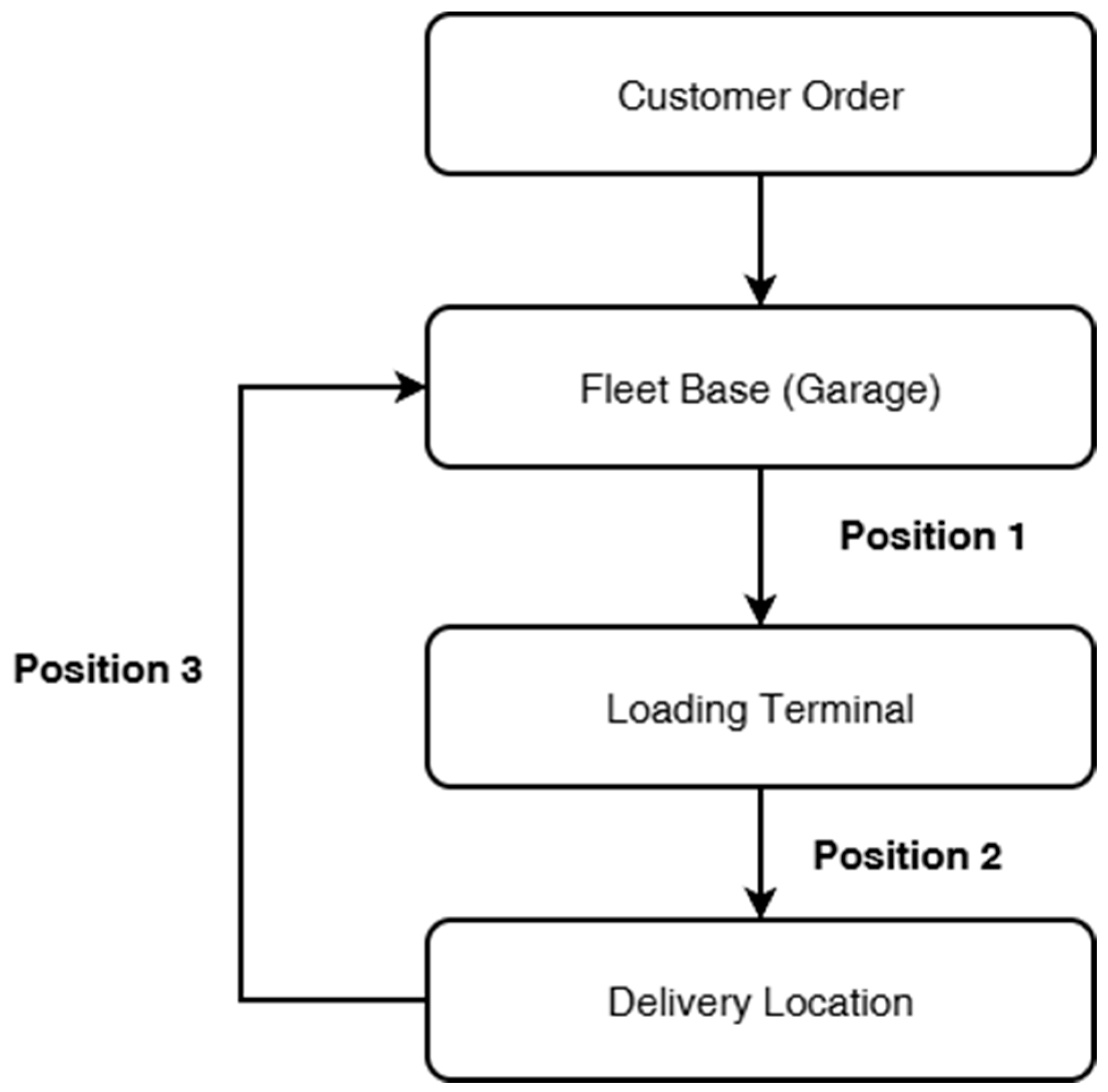
2.1. Resource Planning in Liquid Transportation
2.2. Expert System
- 1.
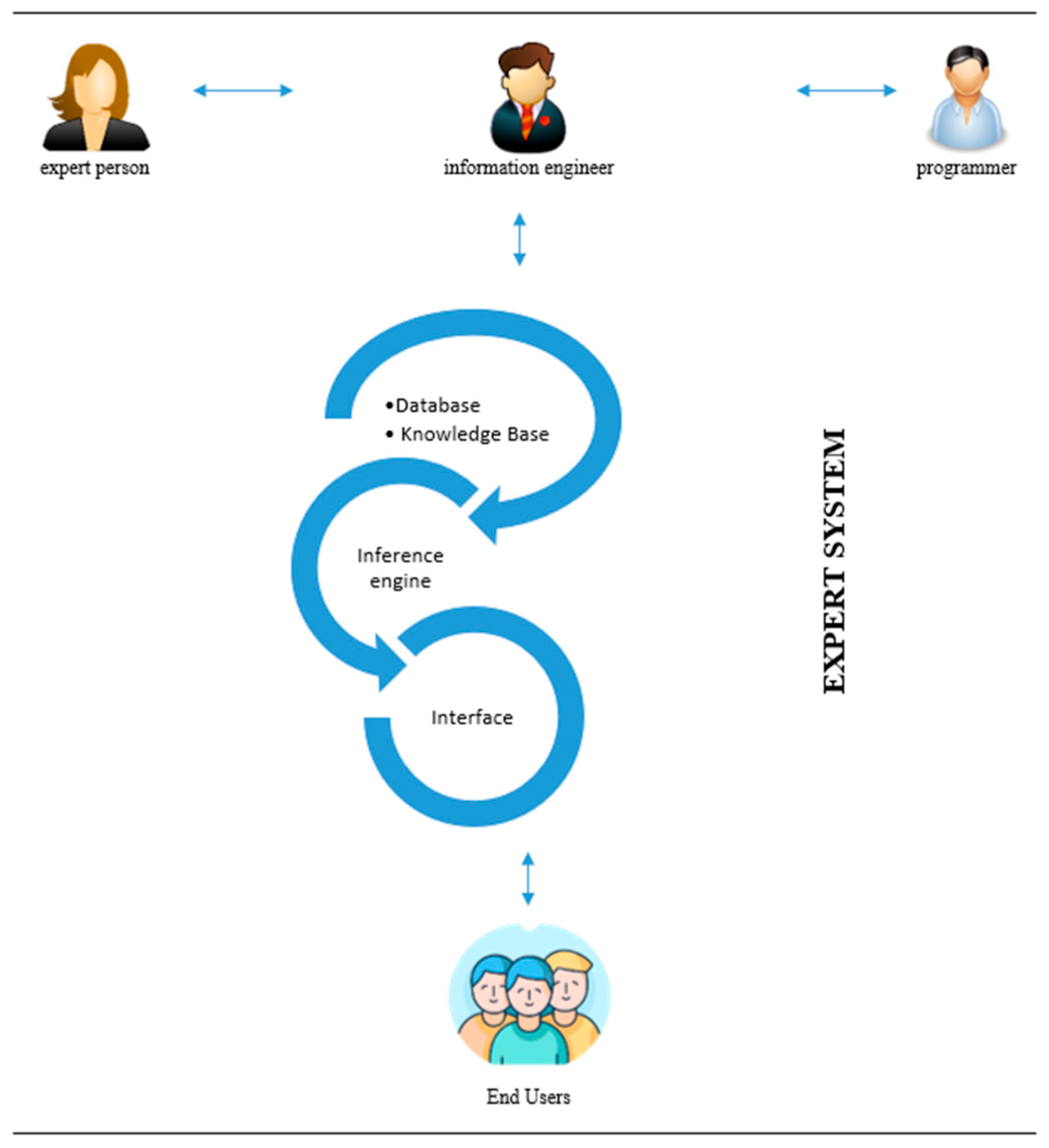
- Database: This is where the data related to the field of study is stored. The stored data may include case studies where the ES is applied, actual situations, or variables specific to the field. The database helps the ES learn and make decisions by retaining past experiences in the field of study. The data stored in the database is kept in a specific format and is then used by the knowledge base and inference engine.
- 2.
- Knowledge Base: The knowledge base plays a crucial role in the successful operation of ESs. It represents a storage and processing section that contains the information, rules, and relationships typically provided by domain experts [63]. The primary factor contributing to the success of ESs in various fields is their reliance on a broad spectrum of knowledge [27]. Solving complex problems requires a significant amount of information, and the ES can achieve successful results by utilizing this knowledge effectively. Consequently, researchers and organizations use ESs to develop and implement various systems across different fields [61]. Domain experts are interviewed to acquire knowledge. This process is quite laborious and time-consuming. However, when knowledge is successfully obtained from experts and applied to the ES, the system can assume a consultative role, guiding and providing information to users by leveraging expert knowledge [50]. In this way, the knowledge base supports the ES’s ability to act as a consultant, enabling researchers and organizations to solve complex problems and develop systems in various fields [61]. The knowledge base can be examined under various classification systems, including Rule-Based Systems (RBSs), Frame-Based Systems (FBSs), Object-Oriented Systems (OOSs), and Case-Based Reasoning (CBR) systems [27]. In this study, the widely used RBS was employed.
- 3.
- Inference Engine: Also known as the interpreter, the inference engine has the ability to make logical inferences using the information in the knowledge base, making it a critical component that constitutes the “brain” of ESs. The inference engine applies rules to inputs and the information in the knowledge base to derive conclusions. In this way, it provides information to the user, evaluates various situations, and offers solutions to problems.
- 4.
- Interface: The interface facilitates communication between the user and the ES. It allows users to input data, ask questions, and receive responses. The interface processes user inputs, transmits them to the inference engine, and presents the obtained results in a comprehensible manner. It can be implemented in various formats, such as graphical interfaces, text-based systems, or voice-command systems.
2.3. Mathematical Formulation of the Dispatch Planning Problem
2.3.1. Sets
2.3.2. Decision Variable
2.3.3. Operational Constraints
2.3.4. Combinatorial Solution Space
2.3.5. Evaluation Function
3. Implementation of Expert System for Liquid Transportation
3.1. Knowledge Acquisition Process
- If the planner selects an ISO tank that has been frequently used, the usage balance of other tanks will be disrupted. However, selecting less frequently used tanks may lead to transportation safety and compatibility issues. (There is a conflict between Items 2 and 3, 4, 5, 20.)
- When the closest vehicle to the order location is selected, some vehicles will be overutilized while others will remain underutilized, leading to an imbalance in mileage distribution. (There is a conflict between Items 9, 10, and Items 16, 17, 18.)
- A returning driver should ideally be assigned to another order to avoid an empty return trip. However, this may result in excessive working hours for certain drivers. (There is a conflict between Items 11, 12, 13, and Item 17.)
- Reallocating connected tanks may help maintain usage balance. However, this detachment process incurs additional costs. (There is a conflict between Item 20 and Items 2, 3, and 6.)
3.2. Data Preprocessing
3.3. Development of the Expert System
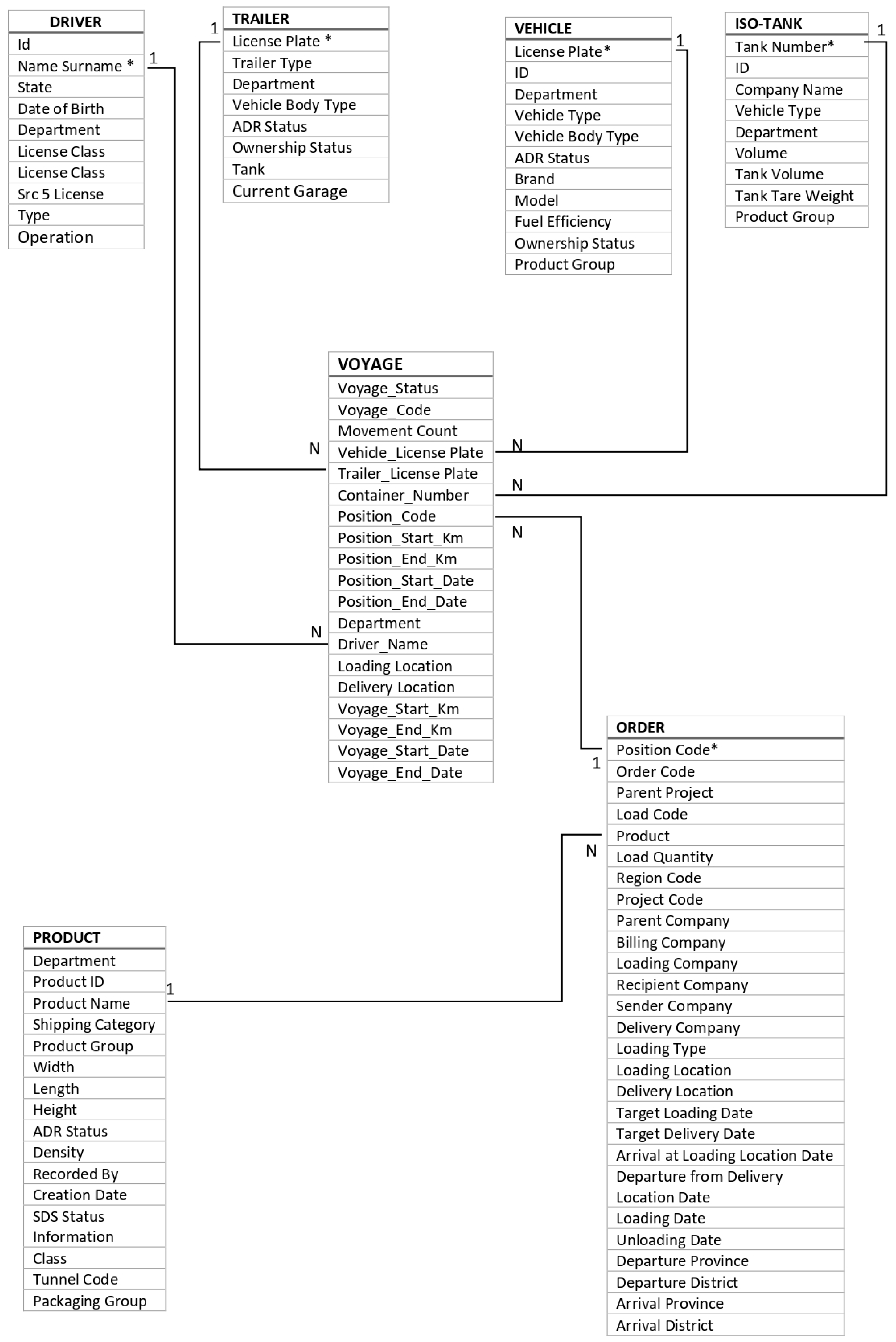
3.3.1. Database
3.3.2. Preparation of the Rule Base
- If the liquid product to be transported is a flammable substance, then select a driver who is certified to transport flammable materials.
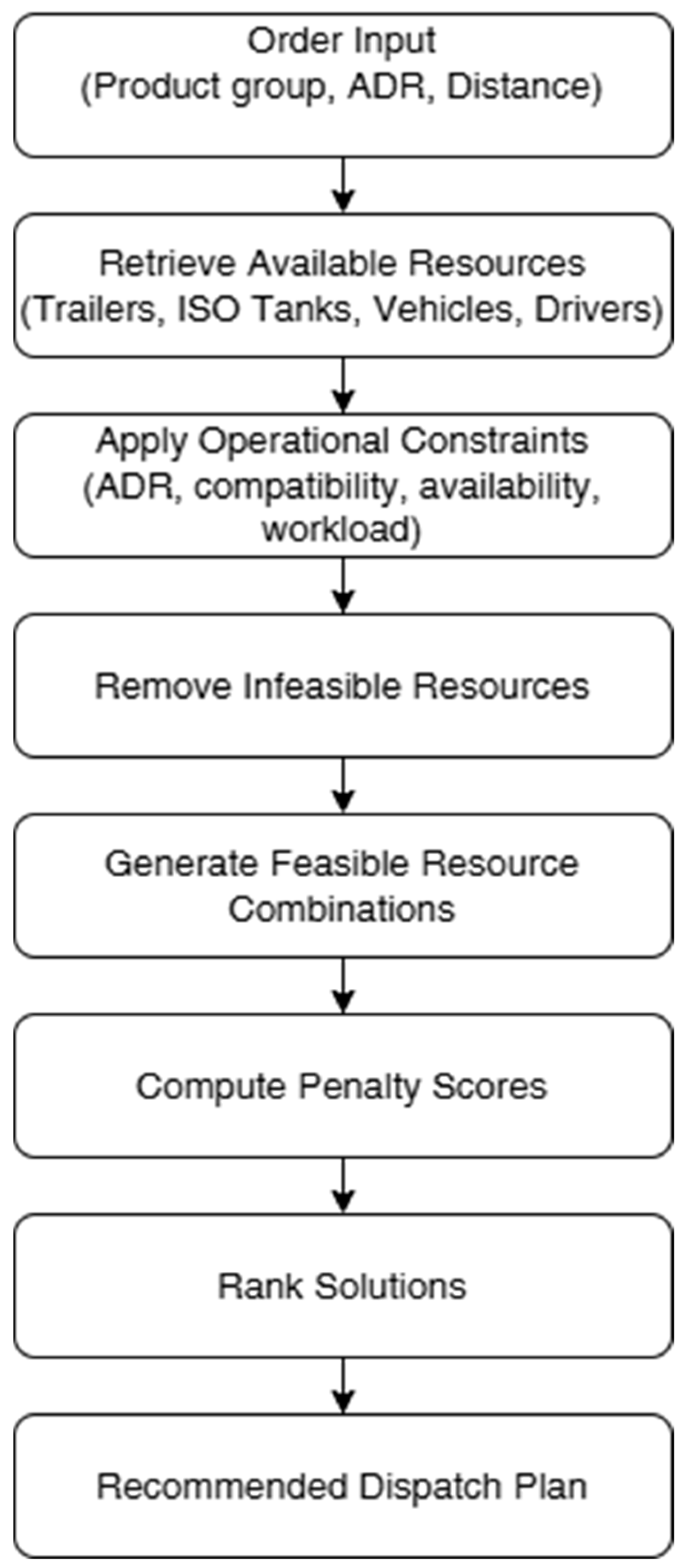
3.3.3. Inference Engine Design
- First, in the case where the trailer and ISO tank are combined, the system presents them as the same resources in the planning process without separating them.
- The second case is when the trailer is a self-contained tanker. Such trailers will not be included in the Cartesian product with ISO tanks; instead, the trailer will undergo a Cartesian product with the other drivers and vehicles separately.
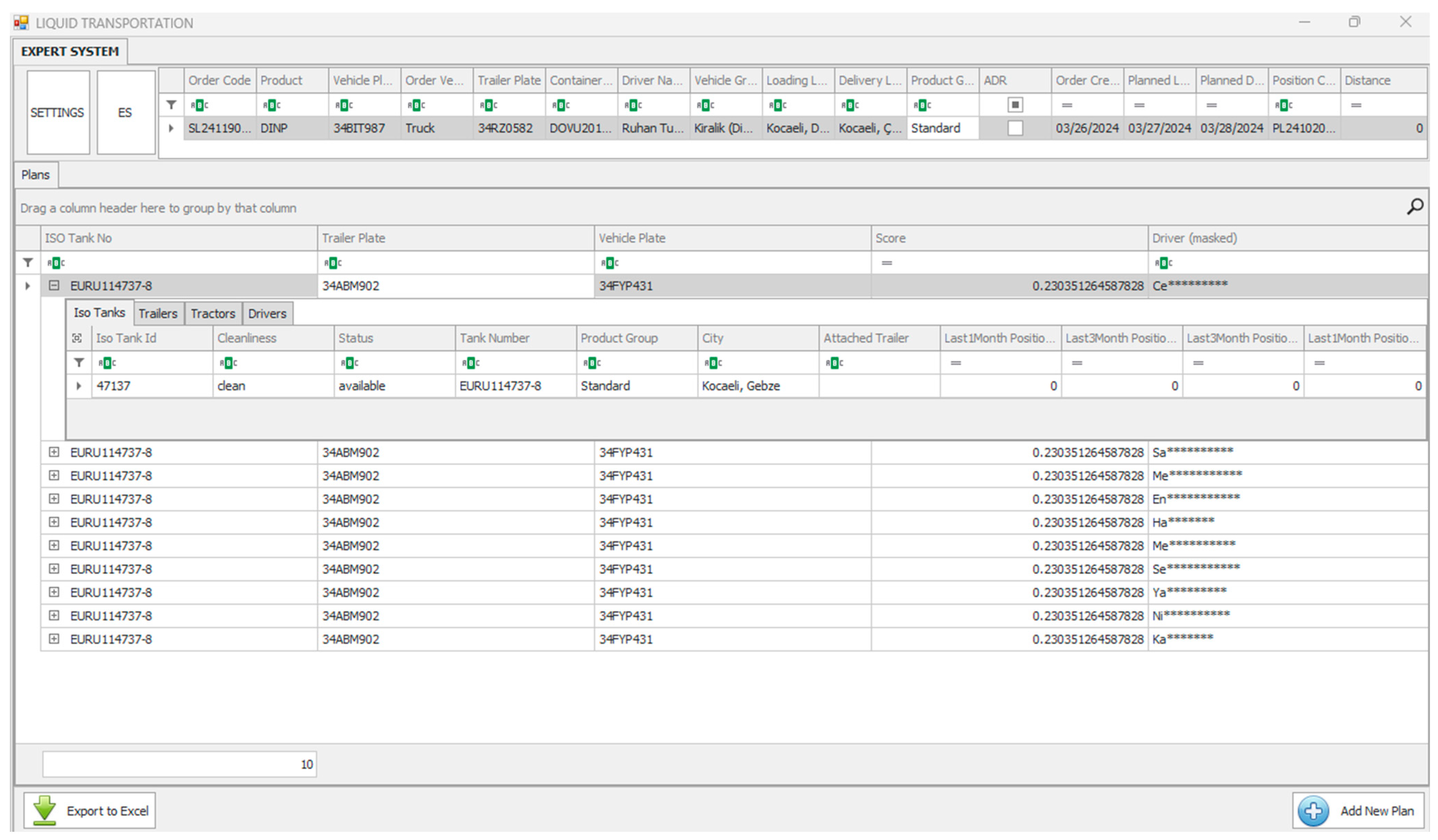
3.3.4. Interface
4. Results and Discussion
4.1. Sensitivity Analysis
4.2. Expert System Application and Analysis on a Single Order
4.3. Comparison of Expert System Results
4.4. Discussion
5. Conclusions
Author Contributions
Funding
Institutional Review Board Statement
Informed Consent Statement
Data Availability Statement
Acknowledgments
Conflicts of Interest
Appendix A
| Algorithm A1. Rule-Based Feasible Resource Selection and Evaluation |
| Input: Order o with attributes {PG(o), ADR(o), Dist(o), L(o)} Resource sets: T = set of trailers I = set of ISO tanks V = set of vehicles D = set of drivers Constraint set R = {r1, r2, …, r_q} Output: Ranked list of feasible resource combinations Step 1: Initialization Set T′ ← T, I′ ← I, V′ ← V, D′ ← D Step 2: Sequential Constraint Application For each constraint r ∈ R do Apply r to the corresponding resource set Remove all infeasible resources End for Step 3: Feasible Set Reduction Obtain reduced feasible sets: T′ ⊆ T, I′ ⊆ I, V′ ⊆ V, D′ ⊆ D Step 4: Combination Generation Generate feasible combinations using the Cartesian product: Ω = T’ × I’ × V’ × D’ Step 5: Penalty-Based Evaluation For each combination x ∈ Ω do Compute Score(x) using the penalty function End for Step 6: Ranking and Recommendation Rank all combinations according to ascending Score(x) Present the top-ranked solutions to the dispatch planner |
References
- Bowersox, D.J.; Closs, D.J.; Cooper, M.B.; Bowersox, J.C. Supply Chain Logistics Management; Mcgraw-Hill: New York, NY, USA, 2020. [Google Scholar]
- McKinnon, A. Integrated logistics strategies. In Handbook of Logistics and Supply-Chain Management; Emerald Group Publishing Limited: Leeds, UK, 2017; Volume 2, pp. 157–170. [Google Scholar]
- Kumar, G.S.; Shirisha, P. Transportation the key player in logistics management. J. Bus. Manag. Soc. Sci. Res. 2014, 3, 14–20. [Google Scholar]
- Hanne, T.; Dornberger, R.; Hanne, T.; Dornberger, R. Introduction to logistics and supply chain management. In Computational Intelligence in Logistics and Supply Chain Management; Springer International Publishing: Cham, Switzerland, 2017; pp. 1–12. [Google Scholar] [CrossRef]
- Tseng, Y.-Y.; Yue, W.L.; Taylor, M.A. The role of Transportation in Logistics Chain. 2005. Available online: https://www.researchgate.net/publication/281230908_The_role_of_transportation_in_logistics_chain (accessed on 19 March 2026).
- Siluthanyi, M.M. The Role of Transport in Logistics and Freight Movement of Liquid Fuels in Gauteng Province. Master’s Thesis, University of Johannesburg, Johannesburg, South Africa, 2017. [Google Scholar]
- Ross, D.F. Distribution Planning and Control: Managing in the Era of Supply Chain Management; Springer: Berlin/Heidelberg, Germany, 2004; Volume 101. [Google Scholar]
- Sen, İ.K. Lojistik faaliyetlerin yönetimi ve maliyetleme yaklaşımları. Çankırı Karatekin Üniversitesi İktisadi Ve İdari Bilim. Fakültesi Derg. 2014, 4, 83–106. [Google Scholar]
- Gorcun, O.F.; Senthil, S.; Küçükönder, H. Evaluation of tanker vehicle selection using a novel hybrid fuzzy MCDM technique. Decis. Mak. Appl. Manag. Eng. 2021, 4, 140–162. [Google Scholar] [CrossRef]
- Lee, Y.; Pinto, J.M.; Papageorgiou, L.G. Optimisation frameworks for integrated planning with allocation of transportation resources for industrial gas supply chains. Comput. Chem. Eng. 2022, 164, 107897. [Google Scholar] [CrossRef]
- Feng, M.; Cheng, Y. Solving truck-cargo matching for drop-and-pull transport with genetic algorithm based on demand-capacity fitness. Alex. Eng. J. 2021, 60, 61–72. [Google Scholar] [CrossRef]
- Aliano Filho, A.; Melo, T.; Pato, M.V. A bi-objective mathematical model for integrated planning of sugarcane harvesting and transport operations. Comput. Oper. Res. 2021, 134, 105419. [Google Scholar] [CrossRef]
- Emre, T.; Erol, R. A Vehicle Routing Problem Based on a Long-Distance Transportation Network with an Exact Optimization Algorithm. Mathematics 2025, 13, 3397. [Google Scholar] [CrossRef]
- Rossi, T.; Pozzi, R.; Pirovano, G.; Cigolini, R.; Pero, M. A new logistics model for increasing economic sustainability of perishable food supply chains through intermodal transportation. Int. J. Logist. Res. Appl. 2021, 24, 346–363. [Google Scholar] [CrossRef]
- Çabuk, S.; Erol, R. Solving Dynamic Full-Truckload Vehicle Routing Problem Using an Agent-Based Approach. Mathematics 2024, 12, 2138. [Google Scholar] [CrossRef]
- Roy, N.; Mannan, M.S.; Hasan, M.M.F. Systematic incorporation of inherent safety in hazardous chemicals supply chain optimization. J. Loss Prev. Process Ind. 2020, 68, 104262. [Google Scholar] [CrossRef]
- Kaiser, J.; Hernández, M.P.; Kaupe, V.; Kurrek, P.; McFarlane, D. An agent-based approach for energy-efficient sensor networks in logistics. Eng. Appl. Artif. Intell. 2024, 127, 107198. [Google Scholar] [CrossRef]
- Zhang, T.; Yang, X.; Shen, Y.; Liu, Y.; Wang, H.; Bi, S. A sky-hook positive real network based ISD seat suspension for commercial vehicle. J. Vib. Control, 2026; in press. [Google Scholar] [CrossRef]
- Yu, M.; Evangelou, S.A.; Dini, D. Advances in Active Suspension Systems for Road Vehicles. Engineering 2024, 33, 160–177. [Google Scholar] [CrossRef]
- Özdemir, A.; Erdem, M.; Kosunalp, S.; Iliev, T. Evaluation of Sustainable and Intelligent Transportation Processes Considering Environmental, Social, and Risk Assessment Pillars Employing an Integrated Intuitionistic Fuzzy-Embedded Decision-Making Methodology. Sustainability 2025, 17, 2945. [Google Scholar] [CrossRef]
- Semanjski, I.; Gautama, S. A Collaborative Stakeholder Decision-Making Approach for Sustainable Urban Logistics. Sustainability 2019, 11, 234. [Google Scholar] [CrossRef]
- Chupin, A.; Ragas, A.A.M.A.; Bolsunovskaya, M.; Leksashov, A.; Shirokova, S. Multi-Objective Optimization for Intermodal Freight Transportation Planning: A Sustainable Service Network Design Approach. Sustainability 2025, 17, 5541. [Google Scholar] [CrossRef]
- Moretto, E.C.; Júnior, A.S. Multicriteria Model to Support the Hiring of Road Freight Transport Services in Brazil. Sustainability 2024, 16, 3804. [Google Scholar] [CrossRef]
- Hwang, T.; Ouyang, Y. Urban freight truck routing under stochastic congestion and emission considerations. Sustainability 2015, 7, 6610–6625. [Google Scholar] [CrossRef]
- Zhang, X.; Lam, J.S.L.; Iris, Ç. Cold chain shipping mode choice with environmental and financial perspectives. Transp. Res. Part D Transp. Environ. 2020, 87, 102537. [Google Scholar] [CrossRef]
- Bilican, M.S.; Iris, Ç.; Karatas, M. A collaborative decision support framework for sustainable cargo composition in container shipping services. Ann. Oper. Res. 2024, 342, 79–111. [Google Scholar] [CrossRef]
- Leo Kumar, S. Knowledge-based expert system in manufacturing planning: State-of-the-art review. Int. J. Prod. Res. 2019, 57, 4766–4790. [Google Scholar] [CrossRef]
- Bookbinder, J.H.; Gervais, D. Material-handling equipment selection via an expert system. J. Bus. Logist. 1992, 13. Available online: https://papers.ssrn.com/sol3/papers.cfm?abstract_id=2801643 (accessed on 19 March 2026).
- Marvel, J.H. A Rules-Based Expert System for Determining Inventory Location in a Distribution Warehouse; University of Cincinnati: Cincinnati, OH, USA, 1995. [Google Scholar]
- Allen, M.K. The Development of an Artificial Intelligence System for Inventory Management Using Multiple Experts; The Ohio State University: Columbus, OH, USA, 1986. [Google Scholar]
- Samaddar, S.; Rai, A.; Sharma, S. Combining OR/MS and expert systems for inventory management. Int. J. Comput. Appl. Technol. 1993, 6, 155–162. [Google Scholar] [CrossRef]
- Subramoniam, S.; Krishnankutty, K. EDSIM: Expert database system for inventory management. Kybernetes 2005, 34, 721–733. [Google Scholar] [CrossRef]
- Aktepe, A.; Turker, A.; Ersoz, S.; Dalgic, A.; Barisci, N. An inventory classification approach combining expert systems, clustering, and fuzzy logic with the ABC method, and an application. S. Afr. J. Ind. Eng. 2018, 29, 49–62. [Google Scholar] [CrossRef]
- Potvin, J.-Y.; Lapalme, G.; Rousseau, J.-M. ALTO: A computer system for the design of vehicle routing algorithms. Comput. Oper. Res. 1989, 16, 451–470. [Google Scholar] [CrossRef]
- Waters, C.D.J. Expert Systems for Vehicle Scheduling; Springer: Berlin/Heidelberg, Germany, 1992. [Google Scholar]
- López-Santana, E.; Rodríguez-Vásquez, W.; Méndez-Giraldo, G. A hybrid expert system, clustering and ant colony optimization approach for scheduling and routing problem in courier services. Int. J. Ind. Eng. Comput. 2018, 9, 369–396. [Google Scholar] [CrossRef]
- Del Vecchio, A.; Towill, D.R. The use of expert systems in the design of multi-echelon production distribution systems. Int. J. Adv. Manuf. Technol. 1988, 3, 141–158. [Google Scholar] [CrossRef]
- Kusiak, A. Intelligent manufacturing. In Object-Oriented Software for Manufacturing Systems; Springer: Dordrecht, The Netherlands, 1993. [Google Scholar] [CrossRef]
- Metaxiotis, K.S.; Psarras, J.E.; Askounis, D.T. GENESYS: An expert system for production scheduling. Ind. Manag. Data Syst. 2002, 102, 309–317. [Google Scholar] [CrossRef]
- Li, K.; Chen, G.; Chung, T.; Tang, G. Distribution planning using a rule-based expert system approach. In 2004 IEEE International Conference on Electric Utility Deregulation, Restructuring and Power Technologies. Proceedings; IEEE: Piscataway, NJ, USA, 2004; pp. 814–819. [Google Scholar]
- KAluđer, S.; FeKete, K.; Jozsa, L.; Klaić, Z. Fault diagnosis and identification in the distribution network using the fuzzy expert system. Eksploat. I Niezawodn. 2018, 20, 621–629. [Google Scholar] [CrossRef]
- Allen, M.K.; Helferich, O.K. Putting Expert Systems to Work in Logistics; Council of Logistics Management: Lombard, IL, USA, 1990. [Google Scholar]
- Lau, H.C.; Tsui, W. An iterative heuristics expert system for enhancing consolidation shipment process in logistics operations. In Intelligent Information Processing III (IIP 2006); Springer: Boston, MA, USA, 2007; pp. 279–289. [Google Scholar]
- Shen, Y.; Qian, Y. Expert system and entropy-ordered weighted average method in cold supply chain risk evaluation. Expert Syst. 2023, 40, e13163. [Google Scholar] [CrossRef]
- Heumann, M.; Pump, R.; Breitner, M.H.; Koschel, A.; Ahlers, V. Towards Sustainable Transport: A Strategic Decision Support System for Urban Logistics Operations. In Innovation Through Information Systems (WI 2021); Springer: Cham, Switzerland, 2021; pp. 367–381. [Google Scholar]
- Sawicki, P.; Sawicka, H.; Karkula, M.; Zajda, K. Combined Rough Sets and Rule-Based Expert System to Support Environmentally Oriented Sandwich Pallet Loading Problem. Energies 2025, 18, 268. [Google Scholar] [CrossRef]
- Pratama, A.A.; Mara, S.T.W.; Rifai, A.P.; Lusiantoro, L. A Decision Support System for Multi-Echelon Blood Logistics System. In Proceedings of the 2024 IEEE Technology & Engineering Management Conference-Asia Pacific (TEMSCON-ASPAC), Denpasar, Indonesia, 25–27 September 2024; pp. 1–8. [Google Scholar]
- Gasimov, Y.; Pashayev, A.; Azizov, B.; Agamalieva, L.; Lacinová, V.; Šmerek, M. Application of decision-making expert systems in transportation. NAŠE MORE Znan. Časopis Za More I Pomor. 2019, 66, 130–134. [Google Scholar]
- Haklı, H.; Uğuz, H.; Cay, T. Genetic algorithm supported by expert system to solve land redistribution problem. Expert Syst. 2018, 35, e12308. [Google Scholar] [CrossRef]
- Alkass, S.; Harris, F. Expert system for earthmoving equipment selection in road construction. J. Constr. Eng. Manag. 1988, 114, 426–440. [Google Scholar] [CrossRef]
- Ganguli, R.; Bandopadhyay, S. Expert system for equipment selection. Int. J. Surf. Min. Reclam. Environ. 2002, 16, 163–170. [Google Scholar] [CrossRef]
- Chtourou, H.; Masmoudi, W.; Maalej, A. An expert system for manufacturing systems machine selection. Expert Syst. Appl. 2005, 28, 461–467. [Google Scholar] [CrossRef]
- Zarandi, M.H.F.; Mansour, S.; Hosseinijou, S.A.; Avazbeigi, M. A material selection methodology and expert system for sustainable product design. Int. J. Adv. Manuf. Technol. 2011, 57, 885–903. [Google Scholar] [CrossRef]
- İpek, M.; Selvi, İ.H.; Findik, F.; Torkul, O.; Cedimoğlu, I. An expert system based material selection approach to manufacturing. Mater. Des. 2013, 47, 331–340. [Google Scholar] [CrossRef]
- Prasad, K.; Mahanty, S.; Maity, S.R.; Chakraborty, S. Development of an expert system for materials selection. J. Mater. Educ. 2014, 36, 117–138. [Google Scholar]
- MD Hassan, M. An evaluation of input and output of expert systems for selection of material handling equipment. J. Manuf. Technol. Manag. 2014, 25, 1049–1067. [Google Scholar] [CrossRef]
- Gwalani, H.; Helsing, J.; Alshammari, S.M.; Tiwari, C.; Mikler, A.R. A distributed algorithm for solving large-scale p-median problems using expectation maximization. PeerJ Comput. Sci. 2024, 10, e2446. [Google Scholar] [CrossRef] [PubMed]
- Kariv, O.; Hakimi, S.L. An algorithmic approach to network location problems. I: The p-centers. SIAM J. Appl. Math. 1979, 37, 513–538. [Google Scholar] [CrossRef]
- Tuna, O. Türkiye için Lojistik ve Denizcilik Stratejileri: Uluslararası ve Bölgesel Belirleyiciler. 2001. Available online: https://avesis.deu.edu.tr/yayin/2862845d-bd62-4f8b-8ccc-abc9347ab572/turkiye-icin-lojistik-ve-denizcilik-stratejileri-uluslararasi-ve-bolgesel-belirleyiciler (accessed on 19 March 2026).
- Durusu, A. Türkiye’de Lojistik Sektörünün Gelişimi ve Örnek Uygulamaların Incelenmesi; İstanbul Arel Üniversitesi Sosyal Bilimler Enstitüsü: Istanbul, Turkey, 2011. [Google Scholar]
- Mohammed, A.A.; Ambak, K.; Mosa, A.M.; Syamsunur, D. Expert system in engineering transportation: A review. J. Eng. Sci. Technol. 2019, 14, 229–252. [Google Scholar]
- Yildiz, D. Bilgi Yönetiminde Kural Tabanlı Uzman Sistem Geliştirme Adımları Ve Başarı Faktörleri. Uluslararası Yönetim Bilişim Sist. Ve Bilgi. Bilim. Derg. 2021, 5, 28–43. [Google Scholar]
- Ristić, M.; Manić, M.; Mišić, D.; Kosanović, M.; Mitković, M. Implant material selection using expert system. Facta Univ. Ser. Mech. Eng. 2017, 15, 133–144. [Google Scholar] [CrossRef]
- Amirkhanian, S.N.; Baker, N.J. Expert system for equipment selection for earth-moving operations. J. Constr. Eng. Manag. 1992, 118, 318–331. [Google Scholar] [CrossRef]




| Driver | Iso-Tank | Trailer | Vehicle |
|---|---|---|---|
| Department | Department | Department | Department |
| ID | ID | ID | ID |
| Name Surname | Company Name | License Plate | License Plate |
| State | Vehicle Type | Trailer Type | Vehicle Type |
| Date of Birth | Tank Number | Transportable Weight | Vehicle Body Type |
| License Class | Volume | Ownership Status | ADR Status |
| Driver’s License Expiry Date | Tank Volume | Product Group | Brand |
| Src 5 License | Tank Tare Weight | ADR Status | Model |
| Type | Product Group | Fuel Efficiency | |
| Ownership Status | |||
| Product Group |
| Symbol | Description |
|---|---|
| Set of available trailers | |
| Set of available ISO tanks | |
| Set of available vehicles | |
| Set of available drivers | |
| Set of transportation orders | |
| Reduced feasible trailer set after rule filtering | |
| Reduced feasible ISO tank set after rule filtering | |
| Reduced feasible vehicle set after rule filtering | |
| Reduced feasible driver set after rule filtering | |
| Set of feasible resource combinations generated from |
| Group | Restriction Demand Number | Content of Restriction/Demand | Areas of Impact | Conflict Contradiction |
|---|---|---|---|---|
| Law | 1 | The transported product must comply with domestic transportation laws | ISO Tank | - |
| ISO Tank | 2 | Appropriate ISO Tanks must be selected according to the product group planned for transportation. | Trailer, Vehicle, ISO Tank, and Driver | 3, 4, 5, 20 |
| 3 | The balance of usage count for the selected ISO tank over the last three months | ISO Tank | 2, 16, 17, 20 | |
| 4 | Ensure at least 9 average positions per month | ISO Tank | 2, 16, 17 | |
| 5 | A maximum of 40% of total positions should be within city positions | ISO Tank | 2, 16, 17 | |
| Trailer | 6 | Balanced usage count of all trailers in the last three months | Trailer | 16, 17, 20 |
| 7 | Ensure at least 9 average positions per month | Trailer | 16, 17 | |
| 8 | A maximum of 40% of total positions should be within city positions | Trailer | 16, 17 | |
| Vehicle | 9 | Balance of kilometers traveled by vehicles in the last three months instead of usage count | Vehicle | 16, 17, 18 |
| 10 | Ensure at least 12,000 km per month | Vehicle | 16, 17, 18 | |
| Driver | 11 | Balance the number of hours worked among drivers in the last month | Driver | 16, 17 |
| 12 | Balance the kilometers traveled among drivers in the last month | Driver | 16, 17 | |
| 13 | Balance the ratio of short and long-distance trips among drivers in the last month. | Driver | 16, 17 | |
| 14 | Drivers should work in the liquid department | Driver | ||
| 15 | Drivers should have an SRC certificate for transporting flammable materials. | Driver | ||
| Fuel Savings | 16 | Select resources that are close to the order location on the dates of planning. | Trailer, Vehicle, ISO Tank, and Driver | 3, 4, 5, 6, 7, 8, 9, 10, 11, 12, 13 |
| 17 | Assign returning resources to another order if possible | Trailer, Vehicle, ISO Tank, and Driver | 3, 4, 5, 6, 7, 8, 9, 10, 11, 12, 13 | |
| 18 | Use low fuel-consuming vehicles for long distances and high fuel-consuming vehicles for short distances. | Vehicle | 9, 10 | |
| General | 19 | Select available resources | Trailer, Vehicle, ISO Tank, and Driver | - |
| 20 | Take the detachment costs of connected trailers and tanks into account | Trailer and ISO Tank | 2, 3, 6 | |
| 21 | Consider self-tank trailers during trailer selection | Trailer and ISO Tank | - |
| Fact Name | Description |
|---|---|
| Short Distance | 100 km or less |
| Suitable ISO Tank | An ISO Tank that is suitable for transporting the incoming order |
| Suitable Trailer | Trailers that are suitable for transporting the incoming order |
| Suitable Driver | The driver who is suitable for transporting the incoming order |
| Suitable Vehicle | Vehicles that are suitable for transporting the incoming order |
| Planning | The Cartesian product of Suitable ISO Tank, Suitable Trailer, Suitable Vehicle, and Suitable Driver variables |
| Order Loading Location | The location where the product ordered by the customer will be loaded onto the resource |
| Order Delivery Location | The location where the product ordered by the customer will be delivered |
| Fuel Efficiency | Information on how much fuel the vehicle consumes |
| Vehicle Model | The year of the vehicle model |
| Available ISO Tank | ISO Tank that is clean and idle in the garage |
| Available Trailer | Trailer that is clean and idle in the garage |
| Available Vehicle | Vehicle that is clean and idle in the garage |
| Available Driver | The driver who is idle and available in the garage |
| Product Group | Group information of the ordered product |
| Flammable Product: | Products with an ADR label are considered flammable. |
| Self-Tank Trailer | Trailers where the tank and trailer are combined and inseparable |
| Nearest First garage | The garage closest to the loading location |
| Nearest Second garage | The second closest garage to the loading location |
| Position Count | The movement of resources from one place to another is referred to as a position. |
| Intra-City Order | If the loading and delivery locations are in the same city, it is an intra-city order. |
| Inter-City Order | If the loading and delivery locations are in different cities, it is an inter-city order. |
| Product Category | Classification of liquid products (e.g., food-grade, hazardous, volatile chemical) |
| Tank Cleaning Status | Indicates whether the ISO tank has been cleaned and certified for the next product category |
| Rule Number | Rules | |||
|---|---|---|---|---|
| 1 | If | There is an available and clean ISO tank | Then | Assign the ISO tanks to the SuitableISOtank variable |
| 2 | If | There are ISO Tanks among the suitable ISO tank variables that can transport the ordered product group | then | Select from them and update the SuitableISOtank variable. |
| 3 | If | There are available and idle trailers | then | Assign the available trailers to the SuitableTrailer variable. |
| 4 | If | The ordered product is a flammable product | then | Select trailers that can transport flammable materials from the SuitableTrailer variable and update it. |
| 5 | If | There are self-tank trailers in the SuitableTrailer variable | then | remove trailers that cannot transport the ordered product group from the SuitableTrailer variable. |
| 6 | If | There are available and idle vehicles | then | Assign the available vehicles to the SuitableVehicles variable. |
| 7 | If | The ordered product is a flammable product | then | Select vehicles that can transport flammable materials from the SuitableVehicles variable and update it. |
| 8 | If | There are available and idle drivers | then | Assign the available drivers to the SuitableDrivers variable. |
| 9 | If | The ordered product is a flammable product | then | Select drivers that can transport flammable materials from the SuitableDrivers variable and update it. |
| 10 | If | There are trailers, ISO Tanks, drivers, and vehicles at the nearest first garage. | then | Assign them to the SuitableTrailer, SuitableISOtank, SuitableDrivers, and SuitableVehicles variables, respectively. |
| 11 | If | None of the trailers, ISO Tanks, drivers, or vehicles are at the nearest first garage, but are at the nearest second garage | then | Assign those to the respective variables. |
| 12 | If | None are at the first or second yard, but are at the third nearest garage | then | Assign them to the respective variables. |
| 13 | If | There are ISO Tanks in the SuitableISOtank variable with a lower average position count in the last month | then | Select them and update the SuitableISOtank variable. |
| 14 | If | The order is intra-city, and there are ISO Tanks with a city position rate lower than 40% | then | Bring those ISO Tanks and update the SuitableISOtank variable. |
| 15 | If | The order is inter-city, and there are ISO Tanks with an inter-city position rate lower than 60% | then | bring those ISO Tanks and update the SuitableISOtank variable. |
| 16 | If | There are trailers in the SuitableTrailer variable with a lower average position count in the last month | then | Select them and update the SuitableTrailer variable. |
| 17 | If | The order is intra-city, and there are trailers with a city position rate lower than 40% | then | Bring those trailers and update the SuitableTrailer variable. |
| 18 | If | The order is inter-city, and there are trailers with an inter-city position rate lower than 60%. | then | Bring those trailers and update the SuitableTrailer variable. |
| 19 | If | There are vehicles in the SuitableVehicles variable with a lower average kilometer traveled in the last month | then | Select them and update the SuitableVehicles variable. |
| 20 | If | The distance between the loading and delivery location is more than 100 km | then | Select vehicles with a lower fuel efficiency rate and assign them to the SuitableVehicles variable. |
| 21 | If | The distance between the loading and delivery location is less than 100 km | then | Then select vehicles with a higher fuel efficiency rate and assign them to the SuitableVehicles variable. |
| 22 | If | The distance between the loading and delivery location is more than 100 km | then | Select newer model vehicles and assign them to the SuitableVehicles variable. |
| 23 | If | The distance between the loading and delivery location is less than 100 km | then | Select newer model vehicles and assign them to the SuitableVehicles variable. |
| 24 | If | The distance between the loading and delivery location is more than 100 km | then | Select drivers with a lower ratio of trips over and under 100 km and update the SuitableDrivers variable. |
| 25 | If | The distance between the loading and delivery location is less than 100 km | then | Select drivers with a higher ratio of trips over and under 100 km and update the SuitableDrivers variable. |
| 26 | If | There are drivers in the SuitableDrivers variable with a lower average number of kilometers traveled in the last month | then | Select them and update the SuitableDrivers variable. |
| 27 | If | The tank and trailer are combined | then | They will not be combined with other tanks or trailers in the planning variable. |
| 28 | If | The trailer is self-contained | then | No ISO Tank matching will be made with it in the planning. |
| Number | Product Name | Loading Location | Delivery Location | Product Group | ADR Status | Distance Status |
|---|---|---|---|---|---|---|
| 1 | VORANATE™ M 229 Polymeric MDI | Dilovasi, Kocaeli, Turkey | M.Kemalpaşa, Bursa, Turkey | MDI | Non-ADR | Long |
| 2 | Texapon N 70 | Cayirova, Kocaeli, Turkey | Ankara, Elmadag, Ankara, Turkey | Standart | Non-ADR | Long |
| 3 | VORANATE T-80 TYPE | Dilovasi, Kocaeli, Turkey | Odunpazari, Eskisehir, Turkey | TDI | ADR | Long |
| 4 | DINP | Dilovasi, Kocaeli, Turkey | Cayirova, Kocaeli, Turkey | Standart | Non-ADR | Short |
| 5 | CIKOLATA | Odunpazari, Eskisehir, Turkey | Selcuklu, Konya, Turkey | Chocolate | Non-ADR | Long |
| 6 | POLIPOL 764 (DOKME) | Crkezkoy, Tekirdag, Turkey | Tuzla, Istanbul, Turkey | Rosin | ADR | Long |
| 7 | BUTYL ACRYLATE | Dilovasi, Kocaeli, Turkey | Dilovasi, Kocaeli, Turkey | Standart | ADR | Short |
| 8 | LABSA(Linear Alkyl Benzene Sulphonic Acid) | Corlu, Tekirdag, Turkey | Gebze, Kocaeli, Turkey | Standart | ADR | Long |
| Scenario | w1 | w2 | w3 | w4 | w5 | w6 | w7 | Top-Ranked Solution Changed? |
|---|---|---|---|---|---|---|---|---|
| S1 (Baseline) | 1 | 1 | 1 | 1 | 1 | 1 | 1 | Baseline reference |
| S2 (Fuel-focused) | 1 | 1 | 2 | 1 | 2 | 1 | 1 | Top-ranked solution changed (trailer selection only) |
| S3 (Driver-focused) | 1 | 1 | 1 | 2 | 1 | 1 | 2 | Same top-ranked solution as S2 |
| S4 (Equipment-focused) | 2 | 2 | 1 | 1 | 1 | 1 | 1 | Same top-ranked solution as S2 |
| Rule Number | Affected Resources | Description | Number of Trailers | Number of ISO Tanks | Number of Vehicles | Number of Drivers |
|---|---|---|---|---|---|---|
| - | Initial values | 214 | 187 | 184 | 164 | |
| 1 | ISO Tank | Containers that are full are eliminated | 214 | 177 | 184 | 164 |
| 2 | ISO Tank | Elimination based on product group | 214 | 5 | 184 | 164 |
| 3 | Trailer | Trailers that are full are eliminated | 202 | 5 | 184 | 164 |
| 4 | Trailer | Elimination based on ADR information | 176 | 5 | 184 | 164 |
| 5 | Trailer | Elimination based on product group for self-tank trailers | 111 | 5 | 184 | 164 |
| 6 | Vehicle | Vehicles that are full are eliminated | 111 | 5 | 177 | 164 |
| 7 | Vehicle | Elimination based on ADR information | 111 | 5 | 92 | 164 |
| 8 | Driver | Drivers who are full are eliminated | 111 | 5 | 92 | 157 |
| 9 | Driver | Elimination based on ADR information | 111 | 5 | 92 | 66 |
| 10, 11, 12 | All | Resources close to the order’s loading location are selected | 80 | 5 | 71 | 66 |
| 13 | ISO Tank | Containers with position counts below the average are selected | 80 | 2 | 71 | 66 |
| 14, 15 | ISO Tank | Elimination based on a 40% intra-city position rate for containers | 80 | 2 | 71 | 66 |
| 16 | Trailer | Trailers with position counts below the average are selected | 44 | 2 | 71 | 66 |
| 17, 18 | Trailer | Elimination based on a 40% intra-city position rate for trailers | 8 | 2 | 71 | 66 |
| 19 | Vehicle | Vehicles with kilometers below the average in the last month are selected | 8 | 2 | 32 | 66 |
| 20, 21 | Vehicle | Elimination based on fuel efficiency for long and short distances | 8 | 2 | 20 | 66 |
| 22, 23 | Vehicle | Vehicle model selection based on order distance | 8 | 2 | 8 | 66 |
| 24, 25 | Driver | Drivers are selected based on their long-distance and short-distance ratios | 8 | 2 | 8 | 48 |
| 26 | Driver | Drivers with kilometers below the average in the last month are selected | 8 | 2 | 8 | 25 |
| Number | Vehicle License Plate | Status | Last 1 Month km | Last 3 Months km | Fuel Efficiency | Model Year | Current City |
|---|---|---|---|---|---|---|---|
| 1 | 34***057 | Idle/Available | 0 | 0 | 0.33072279 | 2020 | Gebze, Kocaeli, Turkey |
| 2 | 34***938 | Idle/Available | 0 | 2653 | 0.33995724 | 2020 | Gebze, Kocaeli, Turkey |
| 3 | 34***881 | Idle/Available | 0 | 0 | 0.33559452 | 2018 | Gebze, Kocaeli, Turkey |
| 4 | 34***618 | Idle/Available | 0 | 0 | 0.35519536 | 2018 | Gebze, Kocaeli, Turkey |
| 5 | 34***416 | Idle/Available | 0 | 0 | 0.3587721 | 2018 | Gebze, Kocaeli, Turkey |
| 6 | 34***685 | Idle/Available | 0 | 0 | 0.30928028 | 2018 | Gebze, Kocaeli, Turkey |
| 7 | 34***877 | Idle/Available | 3205 | 13211 | 0.31495547 | 2011 | Gebze, Kocaeli, Turkey |
| 8 | 34***177 | Idle/Available | 40 | 97 | 0.35286215 | 2011 | Gebze, Kocaeli, Turkey |
| Number | Tank Number | Product Group | Attached Trailer | Last 1 Month Position | Last 3 Month Position | Last 1 Month Position (Intra City) | Current City |
|---|---|---|---|---|---|---|---|
| 1 | EUR***11-8 | TDI | - | 14 | 59 | 0 | Gebze, Kocaeli, Turkey |
| 2 | EUR***20-5 | TDI | - | 13 | 58 | 0 | Gebze, Kocaeli, Turkey |
| Number | License Plate | ADR Status | Current City | Attached Tank | Last 1 Month Position | Last 3 Month Position | Last 1 Month Position (Intra City) |
|---|---|---|---|---|---|---|---|
| 1 | 34B*****1 | ADR | Gebze, Kocaeli, Turkey | EUR***98-8 | 0 | 3 | 0 |
| 2 | 34A*****2 | ADR | Gebze, Kocaeli, Turkey | 0 | 2 | 0 | |
| 3 | 34H*****9 | ADR | Gebze, Kocaeli, Turkey | EUR***08-0 | 0 | 6 | 0 |
| 4 | 34R*****3 | ADR | Gebze, Kocaeli, Turkey | 0 | 44 | 0 | |
| 5 | 34R*****5 | ADR | Gebze, Kocaeli, Turkey | 0 | 67 | 0 | |
| 6 | 34R*****0 | ADR | Gebze, Kocaeli, Turkey | 0 | 15 | 0 | |
| 7 | 34R*****2 | ADR | Gebze, Kocaeli, Turkey | 0 | 39 | 0 | |
| 8 | 06A*****6 | ADR | Gebze, Kocaeli, Turkey | 0 | 0 | 0 |
| Driver Name | Src_5 License | Current City | Last 1 Month km | Short Distance | Long Distance | |
|---|---|---|---|---|---|---|
| 1 | Ne*** O*** | Yes | Izmit, Kocaeli, Turkey | 831 | 26 | 3 |
| 2 | Ne*** Bi*** | Yes | Izmit, Kocaeli, Turkey | 3642 | 9 | 19 |
| 3 | Re*** S*** | Yes | Izmit, Kocaeli, Turkey | 326 | 57 | 0 |
| 4 | Se*** Yu*** | Yes | Izmit, Kocaeli, Turkey | 3426 | 11 | 14 |
| 5 | Mu*** Ba*** | Yes | Izmit, Kocaeli, Turkey | 4763 | 13 | 20 |
| 6 | Ze*** Kı*** | Yes | Izmit, Kocaeli, Turkey | 1992 | 17 | 12 |
| 7 | Ha*** Cel*** | Yes | Izmit, Kocaeli, Turkey | 2107 | 15 | 6 |
| 8 | Tu*** Ko*** | Yes | Izmit, Kocaeli, Turkey | 5015 | 14 | 14 |
| 9 | Yu*** Ba*** | Yes | Izmit, Kocaeli, Turkey | 3953 | 25 | 20 |
| 10 | Ra*** Gu*** | Yes | Izmit, Kocaeli, Turkey | 5087 | 16 | 20 |
| 11 | Se*** Mu*** | Yes | Izmit, Kocaeli, Turkey | 3803 | 8 | 13 |
| 12 | Ta*** Ca*** | Yes | Izmit, Kocaeli, Turkey | 5177 | 19 | 22 |
| 13 | Re*** Er*** | Yes | Izmit, Kocaeli, Turkey | 3456 | 20 | 8 |
| 14 | Ta*** Gu*** | Yes | Izmit, Kocaeli, Turkey | 4718 | 6 | 22 |
| 15 | Bi*** Yi*** | Yes | Izmit, Kocaeli, Turkey | 1116 | 5 | 3 |
| 16 | Se*** Bi*** | Yes | Izmit, Kocaeli, Turkey | 4826 | 13 | 22 |
| 17 | Ol*** Ko*** | Yes | Izmit, Kocaeli, Turkey | 550 | 8 | 2 |
| 18 | Ha*** Gu*** | Yes | Izmit, Kocaeli, Turkey | 4316 | 29 | 10 |
| 19 | Re*** Ay*** | Yes | Izmit, Kocaeli, Turkey | 4987 | 38 | 9 |
| 20 | Me*** Di*** | Yes | Izmit, Kocaeli, Turkey | 2126 | 59 | 0 |
| 21 | Mu*** Ay*** | Yes | Izmit, Kocaeli, Turkey | 4714 | 16 | 24 |
| 22 | Er*** Si*** | Yes | Izmit, Kocaeli, Turkey | 5153 | 29 | 15 |
| 23 | Zi*** Ki*** | Yes | Izmit, Kocaeli, Turkey | 4415 | 11 | 18 |
| 24 | Se*** Oz*** | Yes | Izmit, Kocaeli, Turkey | 4908 | 14 | 15 |
| 25 | Ha*** Az*** | Yes | Cerkezkoy, Tekirdag, Turkey | 4663 | 18 | 14 |
| Plan Number | ISO Tank Number | Trailer Number | Vehicle Number | Driver Number |
|---|---|---|---|---|
| 1 | 2 | 1 | 1 | 3 |
| 2 | 2 | 2 | 1 | 3 |
| 3 | 2 | 3 | 1 | 3 |
| 4 | 2 | 4 | 1 | 3 |
| 5 | 2 | 5 | 1 | 3 |
| 6 | 2 | 6 | 1 | 3 |
| 7 | 2 | 7 | 1 | 3 |
| 8 | 2 | 8 | 1 | 3 |
| 9 | 1 | 1 | 1 | 3 |
| 10 | 1 | 2 | 1 | 3 |
| Order Number | Manuel | ES | ||
|---|---|---|---|---|
| Rule Number | Description | |||
| 1 | ISO Tank | EUR***50-3 | 13 | Position Count: 15 Average Position Count: 3.833 |
| Trailer | 34H***91 | 17, 18 | Intercity Position Count: 15 60% Intercity Position: 9 | |
| Vehicle | 34E***61 | 19 | km: 3709 Average km: 3246.288 | |
| Driver | Tu*** Ko*** | Included in the planning | ||
| 2 | ISO Tank | DOV***25-5 | 14, 15 | Intercity Position Count: 5 60% Intercity Position: 3 |
| Trailer | 34B***63 | 17, 18 | Intercity Position Count: 6 60% Intercity Position: 3 | |
| Vehicle | 34B***46 | 10, 11, 12 | Ordered City: Kocaeli The city where the vehicle is located: İzmir | |
| Driver | Ni*** As*** | 26 | km: 5701 Average km = 5248.118 | |
| 3 | ISO Tank | EUR***11-8 | - | Included in the planning |
| Trailer | 34H***45 | 17, 18 | Intercity Position Count: 14 60% Intercity Position: 8 | |
| Vehicle | 34B***71 | 19 | km: 5177 Average km: 3475.830 | |
| Driver | Ta*** Ça*** | - | Included in the planning | |
| 4 | ISO Tank | DOV***50-2 | 13 | Position Count: 17 Average Position Count: 14.766 |
| Trailer | 34R***82 | 16 | Position Count: 22 Average Position Count: 17.571 | |
| Vehicle | 34B***87 | 10, 11, 12 | Ordered City: Kocaeli The city where the vehicle is located: Tekirdağ | |
| Driver | Ru*** Tu*** | 26 | km: 6133 Average km = 3800.441 | |
| 5 | ISO Tank | ASN***03-0 | 13 | Position Count: 27 Average Position Count: 26.333 |
| Trailer | 34R***08 | 16 | Position Count: 27 Average Position Count: 23 | |
| Vehicle | 34E***62 | 19 | km: 5059 Average km: 3783 | |
| Driver | Şe*** Mü*** | - | Included in the planning | |
| 6 | ISO Tank | DOV***46-2 | - | Included in the planning |
| Trailer | 34L***16 | 10, 11, 12 | Ordered City: Tekirdağ The city where the trailer is located: Kocaeli | |
| Vehicle | 34C***89 | 10, 11, 12 | Ordered City: Tekirdağ The city where the vehicle is located: Kocaeli | |
| Driver | Se*** Öz*** | - | Included in the planning | |
| 7 | ISO Tank | EUR***00-9 | 13 | Position Count: 37 Average Position Count: 14.766 |
| Trailer | 34R***79 | 16 | Position Count: 37 Average Position Count: 16.5125 | |
| Vehicle | 34H***68 | 10, 11, 12 | Ordered City: Kocaeli The city where the vehicle is located: Tekirdağ | |
| Driver | Ha*** Az*** | 26 | km: 4663 Average km = 4301.3833 | |
| 8 | ISO Tank | DOV***71-3 | 13 | Position Count: 39 Average Position Count: 27.333 |
| Trailer | 34F***26 | - | Included in the planning | |
| Vehicle | 34E***53 | 19 | km: 6282 Average km: 5508 | |
| Driver | Ca*** Uy*** | 26 | km: 6282 Average km = 5252.770 | |
| Order Code | Manual Penalty Points | ES Penalty Points |
|---|---|---|
| 1 | 0.03790 | 0.00973 |
| 2 | 0.03651 | 0.00973 |
| 3 | 0.04414 | 0.01619 |
| 4 | 0.04615 | 0.00792 |
| 5 | 0.05058 | 0.03240 |
| 6 | 0.04319 | 0.03187 |
| 7 | 0.05976 | 0.00792 |
| 8 | 0.06621 | 0.02866 |
| Order | Method | Fuel | Vehicle km | Driver Workload | Tank Position | Trailer Position |
|---|---|---|---|---|---|---|
| 1 | ES | 0.33 | 0 | 5.5 | 0 | 0 |
| Manual | 0.32 | 3709 | 230.82 | 15 | 15 | |
| 2 | ES | 0.33 | 0 | 5.5 | 0 | 0 |
| Manual | 0.36 | 5701 | 275.1 | 5 | 6 | |
| 3 | ES | 0.37 | 0 | 5.5 | 24 | 1 |
| Manual | 0.27 | 4789 | 71.77 | 0 | 0 | |
| 4 | ES | 0.33 | 0 | 5.5 | 0 | 0 |
| Manual | 0.34 | 830 | 153.67 | 14 | 14 | |
| 5 | ES | 0.33 | 0 | 5.5 | 0 | 0 |
| Manual | 0.34 | 0 | 241.02 | 19 | 20 | |
| 6 | ES | 0.29 | 3721 | 259.17 | 18 | 1 |
| Manual | 0.32 | 4909 | 245.38 | 19 | 7 | |
| 7 | ES | 0.41 | 0 | 0 | 0 | 0 |
| Manual | 0.29 | 3721 | 430.73 | 37 | 37 | |
| 8 | ES | 0.29 | 3721 | 259.17 | 18 | 1 |
| Manual | 0.40 | 6282 | 240.2 | 39 | 39 |
| Order | km Reduction (%) | Fuel Reduction (%) | Driver Workload Reduction (%) | Tank Position Reduction (%) | Trailer Position Reduction (%) |
|---|---|---|---|---|---|
| 1 | 100.00 | −3.13 | 97.62 | 100.00 | 100.00 |
| 2 | 100.00 | 8.33 | 98.00 | 100.00 | 100.00 |
| 3 | 100.00 | −37.04 | 92.34 | - | - |
| 4 | 100.00 | 2.94 | 96.42 | 100.00 | 100.00 |
| 5 | 0.00 | 2.94 | 97.72 | 100.00 | 100.00 |
| 6 | 24.20 | 9.38 | −5.62 | 5.26 | 85.71 |
| 7 | 100.00 | −41.38 | 100.00 | 100.00 | 100.00 |
| 8 | 40.77 | 27.50 | −7.90 | 53.85 | 97.44 |
| Metric | Mean Difference (Manual − ES) | t-Value | p-Value | Interpretation |
|---|---|---|---|---|
| Vehicle km | 2812.38 | 3.95 | 0.0055 | Significant |
| Driver Workload | 167.86 | 3.08 | 0.017 | Significant |
| Tank Position | 11 | 1.75 | 0.123 | Not significant |
| Trailer Position | 16.88 | 3.34 | 0.012 | Significant |
Disclaimer/Publisher’s Note: The statements, opinions and data contained in all publications are solely those of the individual author(s) and contributor(s) and not of MDPI and/or the editor(s). MDPI and/or the editor(s) disclaim responsibility for any injury to people or property resulting from any ideas, methods, instructions or products referred to in the content. |
© 2026 by the authors. Licensee MDPI, Basel, Switzerland. This article is an open access article distributed under the terms and conditions of the Creative Commons Attribution (CC BY) license.
Share and Cite
Haber, Z.; Hakli, H.; Uguz, H.; Gerz, S. Rule-Based Expert System for Resource Planning in Liquid Transportation. Sustainability 2026, 18, 3156. https://doi.org/10.3390/su18063156
Haber Z, Hakli H, Uguz H, Gerz S. Rule-Based Expert System for Resource Planning in Liquid Transportation. Sustainability. 2026; 18(6):3156. https://doi.org/10.3390/su18063156
Chicago/Turabian StyleHaber, Zeynep, Huseyin Hakli, Harun Uguz, and Serkan Gerz. 2026. "Rule-Based Expert System for Resource Planning in Liquid Transportation" Sustainability 18, no. 6: 3156. https://doi.org/10.3390/su18063156
APA StyleHaber, Z., Hakli, H., Uguz, H., & Gerz, S. (2026). Rule-Based Expert System for Resource Planning in Liquid Transportation. Sustainability, 18(6), 3156. https://doi.org/10.3390/su18063156