1. Introduction
Against the backdrop of the global energy system transitioning toward low-carbon development, PV power generation, as one of the most promising renewable energy technologies, is playing an increasingly important role [
1,
2]. As the core country in global PV manufacturing, China contributes more than 80% of global solar component production capacity, with its export share accounting for over 80% of global PV trade volume [
3,
4]. However, the upstream segments of the PV industry chain—such as polysilicon production and solar cell manufacturing—are still energy-intensive processes, and the issue of embodied carbon emissions from their production has not yet received sufficient attention [
5]. Studies have shown that the embodied carbon emissions in PV exports from China and Japan account for 43.85% of the total embodied carbon emissions in global PV trade [
2]. This paradoxical phenomenon means that while China contributes to global emission reductions through PV technology, it also faces the challenge of “high-carbon green industries” [
6]. Therefore, studying the decarbonization pathways of China’s PV power generation sector is not only crucial for achieving China’s dual carbon goals but also holds significant implications for the sustainable development of the global PV industry. These goals, often termed the ‘3060 goals,’ aim for China to peak carbon emissions by 2030 and achieve carbon neutrality by 2060 [
7,
8].
Currently, research on industrial decarbonization has mainly focused on high-carbon industries (e.g., steel and cement) or the overall domain of goods trade [
9,
10,
11]. These studies have generally employed input–output models and lifecycle assessment methods to explore the impacts of technological advancement, energy structure adjustment, and policy interventions on industrial carbon emissions [
12,
13,
14,
15]. However, there remains a clear lack of attention to the embodied carbon emissions within so-called “green” industries such as the PV sector.
A small number of existing studies focusing on the PV industry have primarily concentrated on product-level decarbonization—for instance, reducing silicon material energy consumption through improved production processes [
16], optimizing PV module design to enhance power generation efficiency [
17], or quantifying past and future carbon footprints based on lifecycle assessments [
18,
19]. Although these studies provide technical pathways for reducing the carbon intensity of PV products, they fail to reveal the decoupling mechanisms between industrial growth and carbon emissions from a macro-level perspective. Moreover, product-level research cannot fully capture the broader industry picture and is often limited to partial analysis of the value chain [
20,
21]. As a key indicator for measuring the full lifecycle carbon emissions of products, embodied carbon can comprehensively reflect the true carbon footprint of the PV industry. However, research on decarbonization in the PV industry remains limited, and there is an urgent need for a systematic analytical framework and quantitative evaluation [
22].
These research gaps can be grouped into two main categories. First, the research perspective is limited: most studies either focus on micro-level technological improvements or examine trade-related embodied carbon at the national level [
23], with a lack of systematic analysis at the meso-industry level. Second, there is a lack of policy scenario forecasting—while many decoupling studies only analyze historical data, they fail to simulate future decarbonization pathways in the context of carbon neutrality goals. These deficiencies make it difficult for current research to provide decision-making support for policymakers that integrates industrial development and carbon emission reduction. Specifically, overlooking the unique characteristics of the PV industry may lead to biased policy design: on one hand, overemphasizing terminal applications while neglecting carbon emissions from manufacturing could result in the dilemma of “high-carbon green industries”; on the other hand, the absence of a quantitative decomposition of technological effects, scale effects, and structural effects makes it difficult to identify the most effective points for policy intervention.
To address these research gaps, this study investigates three core scientific questions: RQ1: To what extent has China’s photovoltaic industry achieved decoupling between economic growth and embodied carbon emissions over the 2000–2022 period, and how has this decoupling status evolved over time? RQ2: What are the key driving factors—technological, structural, and scalar—that have shaped this decoupling trajectory, and what are their relative contributions? RQ3: Under different policy and technological scenarios, can strong decoupling (absolute emissions reduction alongside continued economic growth) be achieved by 2030, and what residual emissions challenges remain?
This study makes several novel contributions to the literature. First, methodologically, we integrate multi-regional input–output analysis with Tapio decoupling framework and structural decomposition analysis within a single analytical framework—an approach that allows us to not only quantify the decoupling status but also systematically identify its underlying drivers. Second, empirically, we provide the first long-term (2000–2022) comprehensive analysis of embodied carbon in China’s PV manufacturing sector, revealing the critical transition from ‘scale-driven’ to ‘technology-driven’ growth that previous studies, focused on shorter timeframes or aggregate power sector analysis, have missed. Third, methodologically, we advance scenario analysis in this domain by incorporating Monte Carlo simulations to explicitly account for parameter uncertainty, generating probabilistic projections rather than deterministic point estimates. Fourth, theoretically, our findings refine the application of decoupling theory to green industries, demonstrating that even sectors enabling global decarbonization face persistent upstream carbon challenges—what we term the ‘green paradox’ of clean energy supply chains. Together, these contributions provide both a robust empirical foundation and a replicable analytical framework for understanding and guiding the decarbonization of PV manufacturing.
The results show that China’s PV industry has experienced a transition from no decoupling in its early stages to a state of weak decoupling since the mid-2000s, characterized by positive but diverging growth rates of output and emissions. Technological progress, particularly after 2015, has been the primary driver of this decoupling, contributing 78% of the cumulative emission reductions. This marks a critical shift from a ‘scale-driven’ to a ‘technology-driven’ growth model. Scenario analysis further indicates that a transition to strong decoupling (economic growth with absolute emission reductions) is achievable by 2030 under ambitious policy and technology scenarios, with the Technological Breakthrough (TB) scenario projecting a 103% increase in output value alongside a 39% decrease in carbon emissions. However, due to the persistent energy demands of upstream processes like polysilicon production, approximately 29,000 tons of residual carbon emissions are projected to remain even in the most optimistic scenario. These findings provide important evidence for formulating differentiated policies. This study fills the research gap in embodied carbon decoupling in green industries and offers a new analytical framework and practical pathway for the low-carbon transition of the global PV supply chain.
The remainder of this paper is organized as follows.
Section 2 provides a comprehensive theoretical background, reviewing the evolution of PV carbon footprint research, key analytical frameworks, and international perspectives on renewable energy challenges.
Section 3 describes the materials and methods, including the EXIOBASE database, MRIO model specification, Tapio decoupling index, structural decomposition analysis, and Monte Carlo scenario design.
Section 4 presents our empirical results, examining historical trends in output, emissions, and carbon intensity; analyzing decoupling dynamics; and identifying driving factors through SDA.
Section 5 discusses the implications of our findings, their limitations, and directions for future research.
Section 6 concludes with key findings and policy recommendations.
2. Theoretical Background
The relationship between photovoltaic technology and carbon emissions has been examined through multiple theoretical lenses and methodological approaches (
Table 1). This section reviews the evolution of research on PV carbon footprints, identifies key analytical frameworks, and situates our study within the broader scholarly discourse.
2.1. Evolution of PV Carbon Footprint Research
Early research on photovoltaic systems focused primarily on technical efficiency and cost reduction, with limited attention to lifecycle environmental impacts [
28,
29]. As PV deployment scaled globally, researchers began applying Life Cycle Assessment (LCA) methodologies to quantify the carbon footprint of PV modules from raw material extraction to end-of-life disposal [
30,
31]. These studies revealed that while PV generates clean electricity during operation, upstream manufacturing processes—particularly polysilicon production—are energy-intensive and carbon-emitting [
32,
33].
More recently, scholars have employed environmentally extended input–output analysis to capture the embodied carbon flows embedded in PV supply chains [
34,
35]. This approach addresses limitations of process-based LCA by accounting for economy-wide indirect emissions and inter-sectoral linkages. Studies using multi-regional input–output (MRIO) models have demonstrated significant carbon transfers through international PV trade, with China as both the dominant manufacturer and a major source of embodied emissions [
36,
37].
Parallel research in European Union countries has examined both the benefits and potential drawbacks of PV deployment. Gajdzik et al. (2024) analyzed the net impact of photovoltaics on CO
2 emissions in EU countries, revealing that while PV contributes to decarbonization, it also generates ‘energy waste’—some of which cannot be recovered and may negatively affect overall emission balances [
24]. This finding underscores that PV development does not solely produce environmental benefits; careful consideration of lifecycle impacts, including waste management and grid integration challenges, is essential for accurate carbon accounting.
2.2. Key Theoretical Frameworks
Three theoretical frameworks dominate the analysis of PV carbon emissions:
Life Cycle Assessment (LCA) provides a product-level perspective, tracing environmental impacts across all stages of a PV module’s life. LCA studies have generated widely cited metrics such as energy payback time (EPBT) and greenhouse gas emission intensity for various PV technologies [
38,
39]. However, LCA faces challenges including data availability, methodological choices, and system boundary definitions [
40].
Environmentally Extended Input–Output Analysis (EEIOA) captures economy-wide interdependencies and tracks embodied emissions through supply chains. When combined with multi-regional models, EEIOA reveals how PV manufacturing in one country creates carbon burdens elsewhere [
41,
42]. This framework is particularly suited for analyzing the ‘carbon leakage’ phenomenon where emission reductions in consuming countries are offset by increases in producing countries.
Decoupling Theory, originating from environmental economics, examines the relationship between economic growth and environmental pressure. Tapio’s (2005) elasticity-based framework has been widely applied to assess whether industries can grow while reducing emissions [
43]. Studies of China’s power sector have identified weak decoupling trends, with emissions growing slower than output but absolute emissions continuing to rise [
44,
45].
Beyond these core frameworks, a growing body of literature examines the barriers to renewable energy adoption as critical determinants of energy transition outcomes. Gajdzik et al. (2023) identified four key categories of RES development barriers in the European Union: political (e.g., inconsistent policy support), administrative (e.g., lengthy permitting procedures), grid infrastructural (e.g., inadequate transmission capacity), and socioeconomic (e.g., public acceptance, financing constraints) [
25]. Their analysis across 27 EU countries revealed significant heterogeneity, with administrative barriers exerting particular influence in less affluent EU nations, while grid-related obstacles were prevalent in Southern-Central Europe. This barrier-focused framework provides valuable context for understanding why even well-designed renewable energy policies may face implementation challenges.
2.3. International Perspectives and Parallel Challenges
The challenges facing China’s PV manufacturing sector are not unique but reflect broader tensions in the global energy transition. Research from diverse national contexts illuminates common themes and context-specific variations.
In the European Union, studies have highlighted the paradox of renewable energy deployment: while expanding PV capacity reduces operational emissions, upstream manufacturing and end-of-life management create new carbon challenges. Gajdzik et al. (2024) documented that energy waste from PV systems—including curtailment losses and inefficiencies in grid integration—can partially offset emission reductions, particularly in countries with rapid PV expansion but inadequate storage infrastructure [
24]. This finding resonates with our analysis of China’s situation, where domestic manufacturing emissions persist despite technological improvements.
Systematic reviews of renewable energy transitions have identified persistent barriers across multiple dimensions. Jafarizadeh et al. (2024) found that 60% of renewable energy projects cite energy storage limitations, 70% highlight economic barriers, and 40% note environmental concerns related to material disposal [
26]. Similarly, a multi-dimensional review by Chigbu and Umejesi (2024) synthesized technical, economic, regulatory, social, and environmental challenges, emphasizing that lithium-ion battery scalability is constrained by raw material availability and recycling challenges, while hydrogen storage—though offering higher capacity—faces cost and infrastructure barriers [
27].
These international perspectives reinforce the central insight of our study: PV decarbonization is not a simple story of technological progress automatically yielding emission reductions. Rather, it requires systemic integration of technological innovation, supportive policies, infrastructure development, and attention to unintended consequences such as energy waste and supply chain emissions. China’s experience as the world’s dominant PV manufacturer offers critical lessons for other nations pursuing renewable energy transitions, while international research provides valuable benchmarks and cautionary tales for China’s ongoing decarbonization efforts.
2.4. Research Gaps and Our Contribution
Despite growing scholarly attention, significant gaps remain. First, most PV carbon research focuses on either product-level LCA or economy-wide trade flows, with limited integration of industry-level analysis. Second, existing decoupling studies treat the power sector as a homogeneous whole, overlooking technological heterogeneity within renewable energy sub-sectors. Third, scenario-based projections of PV decarbonization pathways remain scarce, particularly those incorporating uncertainty through Monte Carlo simulation.
Our study addresses these gaps by: (1) focusing specifically on China’s PV manufacturing sector using MRIO analysis; (2) applying structural decomposition to identify driving factors of embodied carbon changes; (3) integrating Tapio decoupling analysis to assess historical trends; and (4) developing probabilistic scenarios to explore future decarbonization potential under different policy and technological assumptions.
3. Materials and Methods
This study focuses on the low-carbon transition mechanism of China’s PV manufacturing industry across the entire industrial chain. Based on a multi-regional input–output model (MRIO), it systematically analyzes the development trajectory from 2000 to 2022 from three dimensions: industrial scale expansion, evolution of embodied carbon emissions, and changes in carbon intensity. By constructing the Tapio decoupling index, the study quantitatively assesses the evolution of the decoupling status between economic growth and carbon emissions within the PV industry. Furthermore, structural decomposition analysis is employed to identify key driving factors. Four development pathways—business-as-Usual (BAU), International Synergy (IS), Low-Carbon Orientation (LC), and Technological Breakthrough (TB)—are established. Using Monte Carlo simulation, the study projects the decarbonization potential and industrial growth prospects from 2023 to 2030 under different policy combinations. All Monte Carlo simulations were performed using MATLAB R2023b (The MathWorks, Inc., Natick, MA, USA) with the Statistics and Machine Learning Toolbox (version 12.5).
3.1. Data
This study employs EXIOBASE 3 (version 3.8.2) as the core data source [
42]. EXIOBASE is a global Multi-Regional Environmentally Extended Input–Output database developed through EU-funded projects and freely available through Zenodo (
https://zenodo.org/records/5589597 accessed on 6 June 2025). The database provides time-series data from 1995 to 2022 with 163 sectors and 200 products. For our analysis of China’s photovoltaic manufacturing sector, we specifically extract data for sector 103: ‘Production of electricity by solar photovoltaic’. This sector is uniquely distinguished in EXIOBASE, unlike other MRIO databases (WIOD, GTAP, Eora) that aggregate all electricity generation. EXIOBASE offers three key advantages for our study: (1) detailed sectoral disaggregation enabling focus on PV specifically; (2) comprehensive environmental satellite accounts including CO
2 and other greenhouse gas emissions; (3) consistent time-series methodology ensuring reliable longitudinal comparison. To ensure comparability across the 2000–2022 study period, all monetary flow data were converted to constant 2015 euros (million EUR). The year 2015 was selected as the base year as it represents the midpoint of the study period and aligns with the release of a major EXIOBASE database update [
42]. Our analysis ends in 2022 as this is the most recent year for which complete EXIOBASE data were available at the time of the study. MRIO databases typically have a 2–4 year publication lag due to data compilation requirements. The 2023–2030 projections are based on scenario analysis, not actual data. The data input, sources, and processing steps for embodied carbon analysis are given in
Table 2.
3.2. MRIO Model and Calculation of Carbon-Embodied Emissions
The MRIO model can be expressed by Equation (1) as follows:
In this equation,
represents the output column vector,
represents the direct consumption coefficient matrix, and
represents the final demand column vector. From this, we can obtain Equation (2):
where
is
inverse matrix.
To calculate the embodied carbon emissions of PV power generation in China, we introduce a carbon emission coefficient matrix
[
46]. Let
be a column vector where each element
represents the total direct carbon emissions from sector
. Let
be a column vector where each element
represents the total output of sector
. We then define a diagonal matrix
, where the diagonal elements are the sectoral carbon intensities:
where each diagonal element
is calculated as:
This diagonal matrix
represents the carbon emissions per unit of output for each sector, derived from the environmental accounts and input–output tables in the EXIOBASE database. The total embodied carbon emissions
can then be obtained by pre-multiplying the total output vector by this carbon intensity matrix:
where
is a vector representing the embodied carbon emissions in the final demand of each sector.
3.3. Tapio Decoupling Model
The Tapio decoupling model is a widely used analytical tool to assess the relationship between economic growth and environmental pressure. In this study, ‘decoupling’ refers to the situation where the growth rate of embodied carbon emissions (environmental pressure) is slower than that of the economic output (industrial growth) of the PV sector, or where emissions decline while the economy grows. The model provides a clear index to categorize different decoupling states [
43]. This study uses the Tapio decoupling model to calculate the decoupling index between economic growth and embodied carbon emissions in China’s PV power generation sector (Equation (6)).
where
denotes the implicit carbon decoupling index for the power generation sector in year
. The superscript
represents the target year, while the superscript
represents the base year.
denotes the rate of change in implicit carbon emissions, and
denotes the rate of change in the scale of sector output. This study uses 2000 as the base year.
According to the magnitude of the decoupling index, Tapio (2005) classified decoupling states into eight categories [
43].
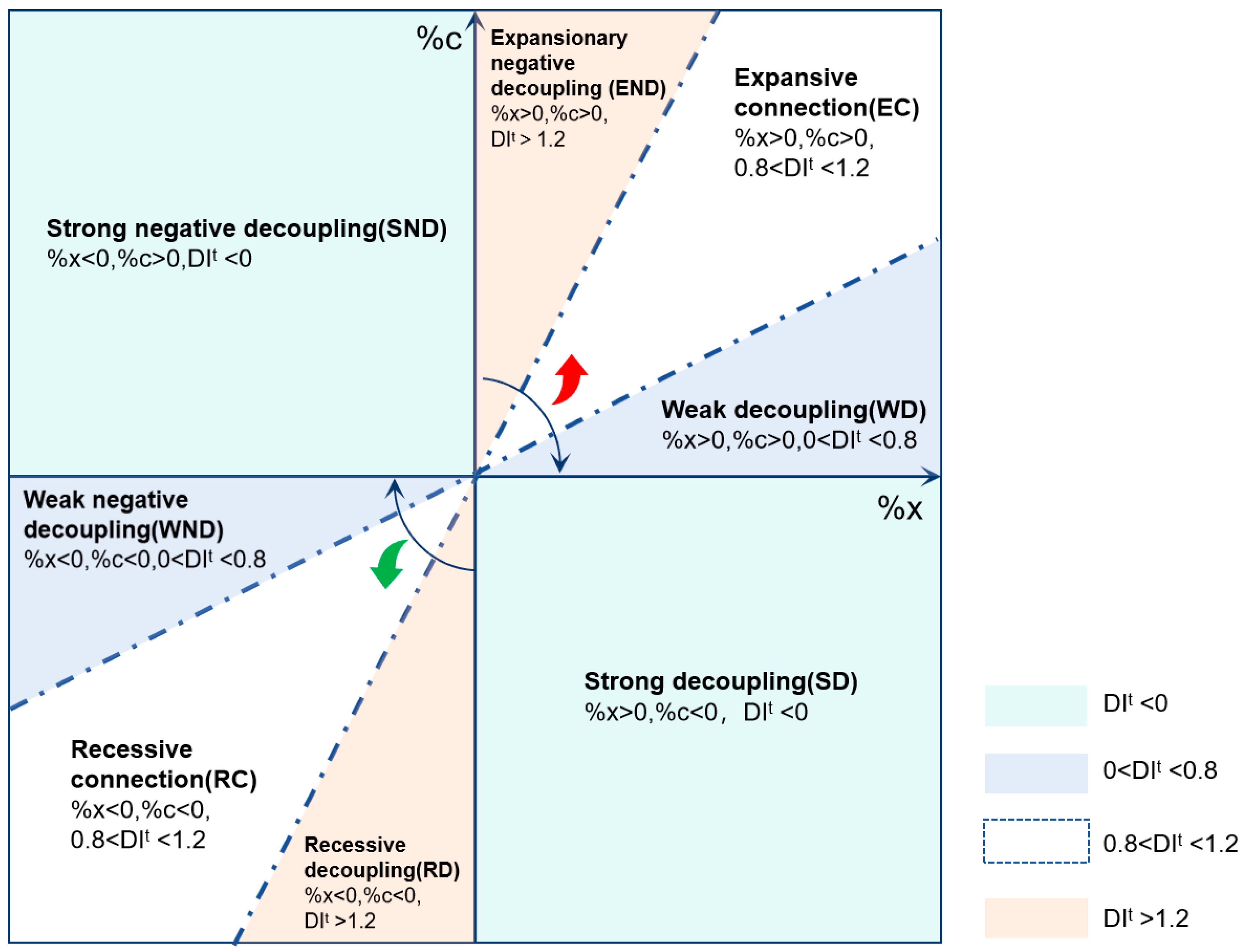
In the context of positive output growth ( > 0)—which characterizes China’s PV sector throughout our entire study period—a positive decoupling index ( > 0) indicates that emissions are also growing. However, the magnitude of reveals the nature of the growth relationship: > 1.2 (Expansive Negative Decoupling): Emissions grow faster than output; 0.8 ≤ ≤ 1.2 (Expansive Connection): Emissions grow at approximately the same rate as output; 0 < DI < 0.8 (Weak Decoupling): Emissions grow slower than output.
A transition from expansive negative decoupling ( > 1.2) to expansive connection (0.8 ≤ ≤ 1.2) to weak decoupling (0 < < 0.8) represents a continuous improvement in decoupling performance. This is because the carbon intensity of economic growth—the emissions generated per unit of output expansion—is progressively declining, moving the sector closer to the ultimate goal of strong decoupling.
The most desirable state is strong decoupling ( < 0, > 0, < 0), where the sector’s output grows while its embodied carbon emissions decline. The least desirable, or worst-case, state is strong negative decoupling ( < 0, < 0, > 0), which signifies economic contraction concurrent with an increase in carbon emissions.
For completeness, when output is declining (
< 0), other states exist: Recessive decoupling (
> 1.2,
< 0,
< 0): Emissions decline faster than output; Recessive connection (0.8 ≤
≤ 1.2,
< 0,
< 0): Emissions and output decline at similar rates; Weak negative decoupling (0 <
< 0.8,
< 0,
< 0): Emissions decline slower than output. The specific criteria and classification of all eight decoupling states are illustrated in
Figure 1.
3.4. Structural Decomposition Analysis
This study employs structural decomposition analysis (SDA) to systematically examine the driving mechanisms of embodied carbon emissions in China’s PV power generation industry. To address the non-uniqueness issue inherent in traditional SDA methods during variable decomposition [
47], this study adopts the average two-tier decomposition approach to factorize the driving forces [
48]. The specific mathematical formulation is presented in Equation (7). This study employs structural decomposition analysis (SDA) to systematically examine the driving mechanisms of embodied carbon emissions in China’s PV power generation industry. The total embodied carbon (
EEC) can be expressed as an identity of four multiplicative factors:
where
is a vector representing the carbon emission coefficients (the diagonal of matrix F from Equation (3), reflecting the carbon intensity of production technologies.
is a vector derived from the Leontief inverse matrix, representing the intermediate input structure and reflecting the production linkages between the PV sector and other sectors.
is a vector representing the final product demand structure (the composition of demand for PV products, e.g., domestic vs. export, modules vs. systems).
is a scalar representing the total output scale of the PV sector.
To quantify the contribution of changes in each factor to the total change in embodied carbon (
) between a base year (
) and a target year (
), we use SDA. A well-known issue with SDA is its “non-uniqueness” problem: the result depends on the order in which the factors are decomposed [
47]. To address this, we adopt the average two-tier decomposition approach [
48], which provides a more robust estimate by averaging the results from two polar decompositions.
The decomposition starting from the base year is:
The decomposition starting from the target year is:
The final, averaged decomposition, which we use in this study, is the mean of Equations (8) and (9):
This averaged approach ensures that our decomposition results are not dependent on an arbitrary ordering of variables. Each term in Equation (9) has a clear economic interpretation: (1) Terms involving capture the technology effect—emission changes due to improvements in production processes. (2) Terms involving capture the linkage effect—emission changes due to shifts in inter-sectoral supply relationships. (3) Terms involving capture the demand structure effect—emission changes due to changes in the composition of final demand. (4) Terms involving capture the scale effect—emission changes due to the overall expansion or contraction of the sector.
3.5. Scenario Setting and Embodied Carbon Forecasts
This study systematically decomposes the driving mechanisms of embodied carbon emissions into three key effects within the structural decomposition analysis framework: (1) the technical effect, quantified through emission coefficients and intermediate input structures to capture production process improvements; (2) the structural effect, reflecting shifts in final product demand patterns; and (3) the scale effect, representing sectoral economic output expansion. Adopting the parameterization methodology from Lin and Liu (2010) and incorporating the triangular distribution-based stochastic number generation algorithm developed by Shao et al. (2017), this research simulates the output-emission evolution trajectories of the photovoltaic sector during 2023–2030 [
49,
50]. The SDA framework in Equation (7) established that embodied carbon emissions are a product of four factors: the carbon coefficient (
), intermediate input structure (
), final demand structure (
), and output scale (
). To project future emissions, we define annual change rates for each factor. Let
be the annual change rate for
,
for
,
for
, and
for
. If we assume these rates are constant over a period, the value of a factor in year
t is its base-year value multiplied by
, where
is its annual change rate.
Therefore, the ratio of embodied carbon emissions in a future year
t (
) to those in the base year 2022 (
) is:
This simplifies to
,
,
,
. For a single-year projection (e.g., from year
to year
), the multiplicative expression for the change rate
is:
where
,
,
,
are the annual change rates for year
. As expressed in Equation (12), the magnitude of the annual carbon emission change rate is jointly determined by these four factors. This framework allows us to simulate future emission trajectories by applying stochastic annual change rates to the four drivers.This study establishes four scenarios: Business-as-Usual (BAU), International Synergy (IS), Low-Carbon Orientation (LC), and Technological Breakthrough (TB). For each scenario, baseline average annual change rate parameters are assigned to the four key drivers (
,
,
,
), as shown in
Table 3. These parameters are based on historical trends (2000–2022) and a qualitative assessment of future policy and technological landscapes. To account for inherent uncertainty, each parameter is modeled as a triangular distribution, with minimum, median (most likely), and maximum values derived from the range of annual fluctuations observed over the five years preceding 2022, a method supported in the literature for energy and emissions scenario analysis [
29].
Business-as-Usual (BAU) Scenario: This scenario assumes China’s PV industry follows a development trajectory consistent with pre-2022 trends, without major new policy interventions or significant international shocks. Consequently, the median values of the triangular distributions are set to the average annual change rates observed in 2022, with minimum and maximum values reflecting the volatility of the previous five years. This scenario serves as a counterfactual baseline against which the effects of more proactive policies can be compared.
International Synergy (IS) Scenario: This scenario reflects the impact of global dynamics, including the restructuring of green supply chains, the implementation of international carbon tariff mechanisms (e.g., EU CBAM), and deepened renewable energy cooperation under initiatives like the Belt and Road Initiative [
51,
52]. The pressure from international green standards is expected to accelerate domestic process improvements, leading to a faster decline in the carbon emission coefficient (
ci: −0.5% annually) and a more optimized intermediate input structure (
l: −0.4%). Export-oriented growth, driven by global demand, shifts the final product demand structure (
p: +0.3%) and sustains high output growth (g: 9.2%).
Low-Carbon Orientation (LC) Scenario: This scenario focuses on endogenous policy drivers aligned with China’s ‘dual-carbon’ strategic goals. It emphasizes the impacts of strengthened domestic policies, such as mandatory green technology upgrades, comprehensive carbon footprint management, and cleaner production audits [
53]. These policies directly target emission reductions, resulting in more aggressive annual decreases in the carbon coefficient (
ci: −0.9%) and intermediate input structure (
l: −0.6%). While demand structure continues to evolve (
p: +0.2%), the transition may impose short-term costs, leading to a slightly moderated output growth rate (
g: 8.0%) compared to the BAU and IS scenarios.
Technological Breakthrough (TB) Scenario: This scenario assumes critical technological advancements in China’s PV sector over the next eight years, including the commercialization of perovskite PV cells, widespread adoption of HJT high-efficiency cells, and breakthroughs in silicon material recycling technologies [
54]. These innovations would dramatically reduce the unit carbon intensity of manufacturing and enhance product value. This is reflected in the most ambitious annual reduction rates for the carbon coefficient (
ci: −1.2%) and intermediate input structure (
l: −0.8%). The demand structure shift is projected to be modest (
p: +0.1%) as the market focuses on high-value, low-carbon products. Crucially, these technological gains are expected to drive the fastest output growth (
g: 10.0%), demonstrating a synergy between environmental performance and economic competitiveness.
It is important to note that the values in
Table 3 represent the baseline average annual rate of change for each driver over the entire 2023–2030 period. They serve as the central tendency for the triangular distributions used in our Monte Carlo simulations. These baseline rates are then modified by year-on-year adjustments (described in
Table 4) to capture the non-linear nature of technological learning and policy implementation. To capture the realistic, non-linear nature of policy impacts and technological learning, we introduce year-on-year adjustments to the baseline rates, as shown in
Table 4. These adjustments are applied additively to the baseline values from
Table 3 to reflect that changes may accelerate or decelerate over time. For example, in the TB scenario, the rapid adoption of breakthrough technologies is expected to cause a faster decline in the carbon emission coefficient (‘
ci’) in the early phase (2023–2026, with an additional −0.1% adjustment), followed by a period of slower, incremental gains (2027–2030, with a +0.08% adjustment, meaning the rate of decline slows down).
It is important to emphasize that this is a conditional scenario analysis, not a structural modeling exercise. The outcomes under each scenario are mechanically derived from the exogenously imposed assumptions about future parameter values. While these assumptions are grounded in historical trends and qualitative assessments of policy and technological trajectories, the simulation does not endogenously explain why or how these parameter changes would occur. The results should therefore be interpreted as illustrating the logical consequences of specific assumption sets, not as predictions or as demonstrated evidence of decarbonization feasibility.
Based on the scenario settings in
Table 3 and
Table 4, this study adopts a Monte Carlo simulation approach to forecast the embodied carbon emissions and industrial output value of China’s PV sector from 2023 to 2030. The simulation process is as follows:
- (1)
Determine annual rates: For each year
t from 2023 to 2030, the annual change rate for each driver (
ci,
l,
p,
g) is calculated by taking its baseline value from
Table 3 and adding the cumulative adjustment from
Table 4 up to that year.
- (2)
Stochastic draw: For each simulation iteration (n = 10,000), a random value for each driver’s annual change rate is drawn from its triangular distribution, using the values from Step 1 as the new ‘min’, ‘median’, and ‘max’ for that specific year.
- (3)
Project Values: These stochastic annual change rates (, , , ) are then input into Equation (12) to calculate the annual change in embodied carbon emissions. The new emissions and output value for year are calculated recursively from the values of year .
- (4)
Generate simulation intervals: This process is repeated 10,000 times to generate the distribution of possible outcomes for each year. From this simulated distribution, we report the 2.5th and 97.5th percentiles as the 95% simulation interval. It is important to note that this represents the range of outcomes conditional on our scenario assumptions and parameter distributions, not a confidence interval in the statistical inference sense (which would require an underlying data-generating process being estimated from sample data).
4. Results
4.1. The Department’s Historical Development and Current Status of Decarbonisation
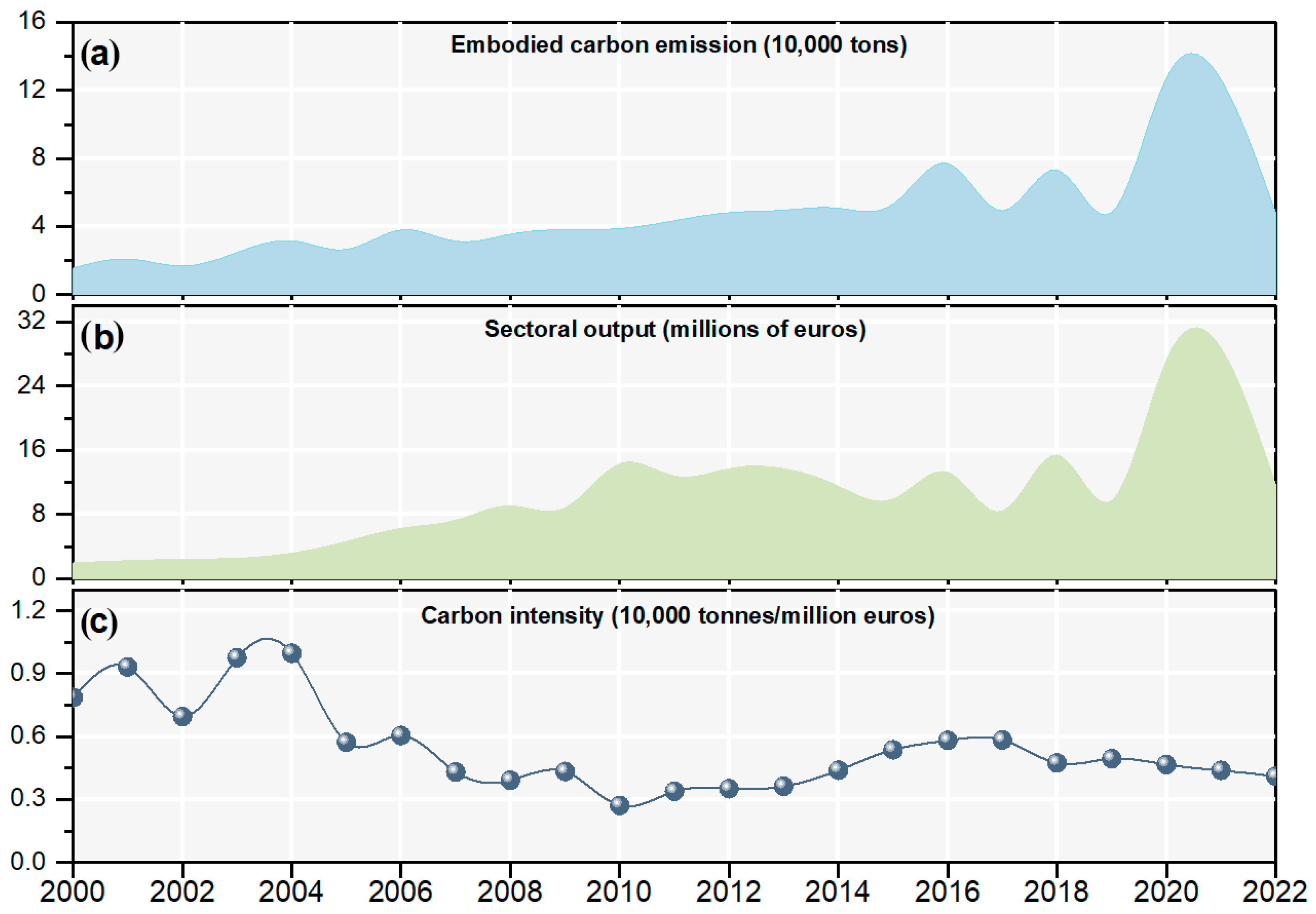
The China’s PV power generation industry exhibited distinct phased development characteristics from 2000 to 2022, as reflected in the trends of embodied carbon emissions, sectoral output value, and embodied carbon intensity (
Figure 2). The total embodied carbon emissions generally showed a fluctuating upward trend, peaking between 2020 and 2021 before declining in 2022. This trajectory was closely linked to industrial scale expansion, technological evolution, and policy cycles. During expansion phases, carbon emissions increased, whereas they decreased during structural adjustment periods. Concurrently, the output value of the PV industry demonstrated continuous growth, with particularly explosive increases between 2019 and 2021. Although a slight contraction occurred in 2022, the overall trend revealed an evolutionary path from initial inception to scaled development, followed by capacity optimization and market demand adjustments.
From the perspective of embodied carbon intensity, a long-term declining trend was observed, indicating significant progress in emission reduction. Between 2000 and 2010, carbon intensity decreased substantially due to breakthroughs in critical technologies. However, from 2010 to 2017, rapid industrial expansion coupled with relative technological stagnation led to a rebound in carbon intensity. Since 2017, sustained technological advancements and increasing industrial maturity have driven carbon intensity downward again. Overall, China’s PV industry transitioned from an early high-carbon input phase to a mid-term carbon-reduction and efficiency-enhancement stage, eventually achieving a balance between scale expansion and technological innovation to establish a low-carbon, high-efficiency development model. The persistent decline in carbon intensity demonstrates the positive outcomes of technological upgrades under the “dual carbon” strategy, while cyclical fluctuations in emissions and output value reflect complex interactions among industrial cycles, policy directives, and market demands. The improved carbon efficiency in PV manufacturing not only accelerates the sector’s green transition but also provides robust support for the broader energy system’s decarbonization.
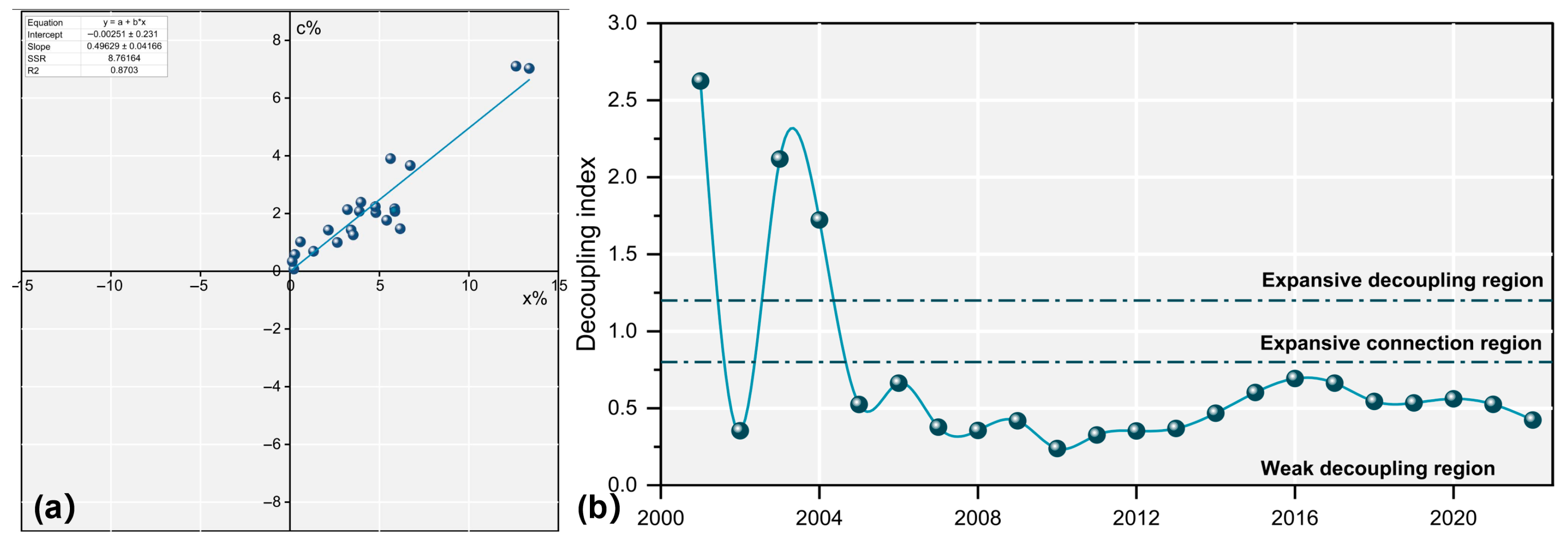
From a dynamic evolution perspective, the decoupling state underwent significant phase transitions based on the calculated DI values (
Table 5 and
Figure 3). Between 2001 and 2004, the industry exhibited expansive negative decoupling, with DI values ranging from 1.72 to 2.63, indicating that emissions grew substantially faster than output during this early development phase. This reflects the industry’s heavy reliance on high-carbon inputs with limited progress in low-carbon transition.
From 2005 onward, the industry entered a sustained period of weak decoupling, with all annual DI values remaining below 0.8. During 2005–2010, DI values ranged from 0.24 to 0.66, showing that emissions grew slower than output despite some year-to-year fluctuations. The low point of 0.24 in 2010 reflects particularly strong decoupling performance following the implementation of the Renewable Energy Law.
In the 2011–2016 period, DI values remained in the weak decoupling range (0.33–0.69), though they were generally higher than the previous period, indicating a slight slowdown in decoupling improvement. This plateau coincided with a period of relative technological stagnation and market adjustments following trade barriers.
Since 2017, the industry has continued to maintain weak decoupling, with DI values declining from 0.66 in 2017 to 0.42 in 2022. This sustained improvement demonstrates how technological advances—particularly the adoption of N-type cells, large-format wafers, and other innovations—have progressively reduced the carbon intensity of growth, moving the sector closer to the ultimate goal of strong decoupling.
4.2. Analysis of Embodied Carbon Drivers by Sector
Before presenting the results, it is important to clarify what structural decomposition analysis can and cannot reveal. SDA is an accounting framework that decomposes observed changes in embodied carbon emissions into contributions from its constituent factors—carbon intensity, intermediate input structure, final demand structure, and output scale. It quantifies how much each factor contributed to the total change, but it does not, by itself, identify the causal mechanisms underlying those contributions. The historical narratives and policy interpretations offered below should therefore be understood as plausible explanations consistent with the data, not as causally validated findings. Alternative explanations may also be consistent with the observed patterns.
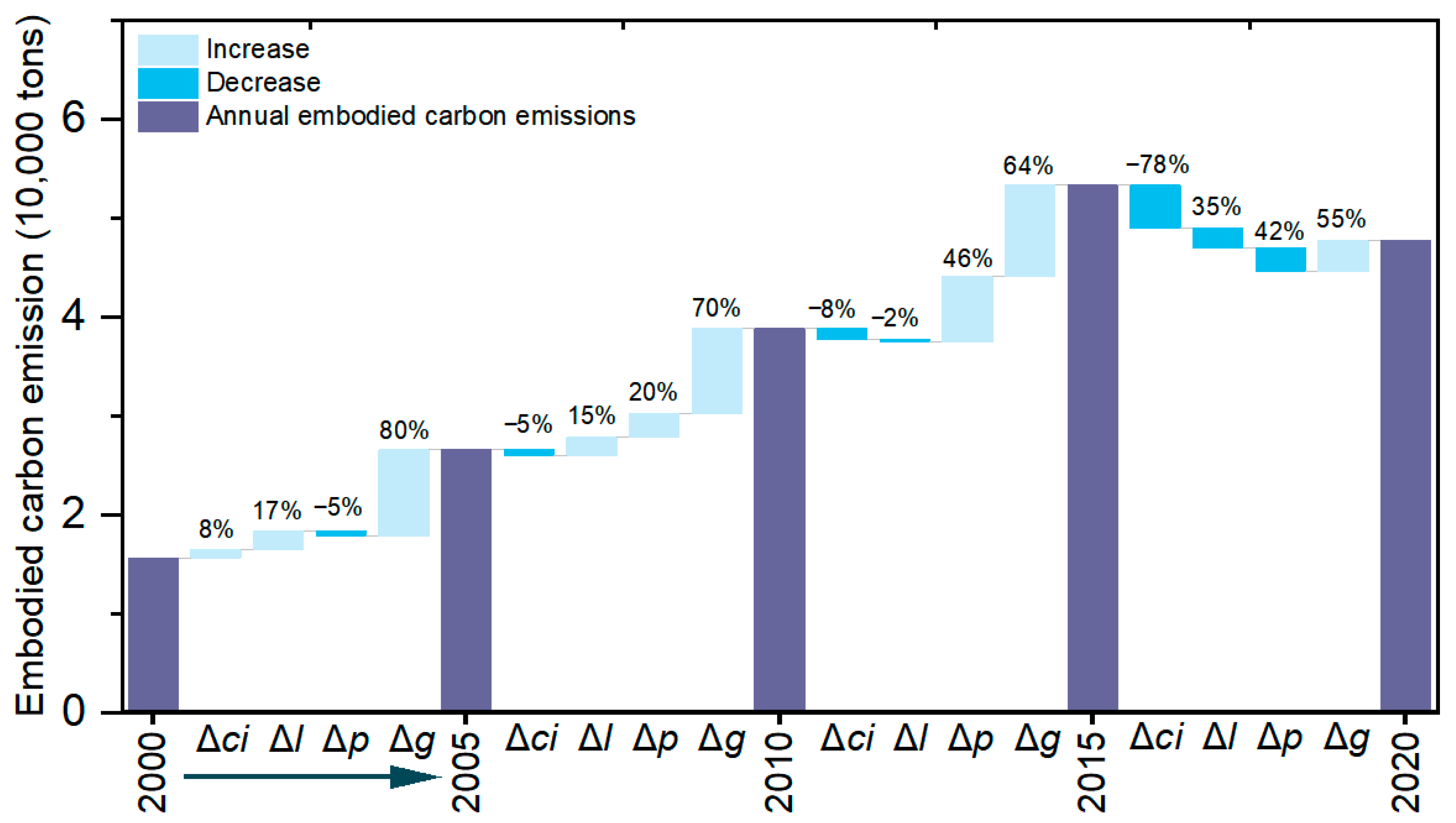
China’s PV power generation industry, as a representative clean energy sector, exhibits dynamic evolution of embodied carbon emissions that reflects the synergistic effects of technological advancement and industrial transformation. Based on the SDA method and aligned with China’s Five-Year Plans for National Economic and Social Development as well as the practical research requirements of this study, the period from 2000 to 2022 is divided into four distinct phases for systematic analysis (
Figure 4).
2000–2005: The embodied carbon emissions of China’s PV power generation sector increased from 15.7 thousand tons to 26.6 thousand tons, marking a 69% rise with an average annual growth rate of 13.8%. This period coincided with the nascent stage of the global PV market, during which China primarily exported low-value-added components, making industrial scale expansion the dominant driver of embodied carbon emissions, accounting for approximately 80% of the increase. Due to reliance on traditional energy-intensive processes such as polysilicon purification, the carbon emission coefficient contributed an 8% upward push, while intermediate input structures (e.g., dependence on imported silicon wafers and silver paste) contributed 17% of the increment. Notably, the final product demand structure exerted a −5% decarbonization effect, which is consistent with the hypothesis that European market premiums for high-efficiency modules may have incentivized technological upgrades.
2005–2010: Embodied carbon emissions rose from 26.6 thousand tons to 38.9 thousand tons (a 46% increase), but the underlying drivers shifted significantly. Following the implementation of the Renewable Energy Law, the contribution of the carbon emission coefficient turned negative (−5%), coinciding with breakthroughs such as monocrystalline silicon replacing polysilicon and diamond-wire cutting. However, post-financial crisis subsidy policies in various countries spurred a surge in exports, keeping industrial scale expansion as the primary growth driver (70% contribution), albeit with a diminished role compared to the previous phase. The contribution of intermediate input structures declined to 15%, indicating improved domestic supply chain localization (e.g., expansion of local silicon production). Meanwhile, final product demand shifted to a positive driver (20%), coinciding with a period of strong U.S. demand for thin-film modules.
2010–2015: Growth further slowed (53.3 thousand tons, 37% increase), exhibiting a “technology-driven decarbonization offsetting scale expansion” pattern. The commercialization of PERC cell technology during this period may have pushed down the negative carbon coefficient effect to −8%, while “anti-dumping” trade barriers coincided with the emergence of the domestic PV installation market, reducing the industrial scale’s contribution to 64%. Vertical supply chain integration led intermediate input structures to generate a −2% decarbonization effect (e.g., silane fluidized bed reactors reducing silicon feedstock energy consumption). Conversely, final product demand rebounded to 46% due to post-Fukushima demand for high-power modules in Japan, elevating emission intensity.
2015–2022: A historic inflection point occurred, with embodied carbon emissions declining to 47.7 thousand tons (a 10.5% reduction). The widespread adoption of N-type technologies during this period is consistent with the carbon coefficient’s record negative contribution of −78%, while the “dual-carbon” policy framework coincided with voluntary phaseouts of inefficient capacity, further lowering industrial scale’s contribution to 55%. Accelerated global carbon neutrality reshaped demand patterns, with final product demand contributing −42% (e.g., the implementation of European carbon border taxes may have incentivized low-carbon certification). Process innovations like large-format silicon wafers pushed intermediate input structures to a −35% contribution. This phase marked China’s PV industry transition from a “scale-driven” to a “technology-driven” paradigm, demonstrating a feasible pathway for lifecycle emission reduction in clean energy.
It is important to note the exceptionally large offsetting contributions observed in the 2015–2022 period, with the carbon coefficient effect (−78%) and scale effect (+55%) representing powerful forces moving in opposite directions, complemented by substantial contributions from final demand (−42%) and intermediate input structure (−35%). Such magnitudes indicate that this period was characterized by intense structural transformation, where multiple fundamental drivers were simultaneously exerting strong but countervailing pressures on embodied carbon emissions. While the SDA framework reliably decomposes the accounting identity, results of this nature should be interpreted with appropriate caution, as large offsetting effects can amplify the sensitivity of the decomposition to small errors or methodological choices. Nevertheless, the consistency of the directional signals—with technology effects consistently negative and scale effects consistently positive across all sub-periods—provides confidence in the robustness of the qualitative findings.
The patterns revealed by SDA tell a compelling story of technological progress gradually offsetting the carbon pressures of industrial expansion. However, it bears repeating that these are accounting decompositions, not causal estimates. The consistency of the directional signals across periods—with technology effects consistently negative and scale effects consistently positive—provides confidence in the broad narrative, but the specific magnitudes and the historical explanations attached to them should be interpreted with appropriate caution. Future research could complement this analysis with econometric methods designed for causal inference.
4.3. Prediction of Future Decarbonisation Potential for Departments
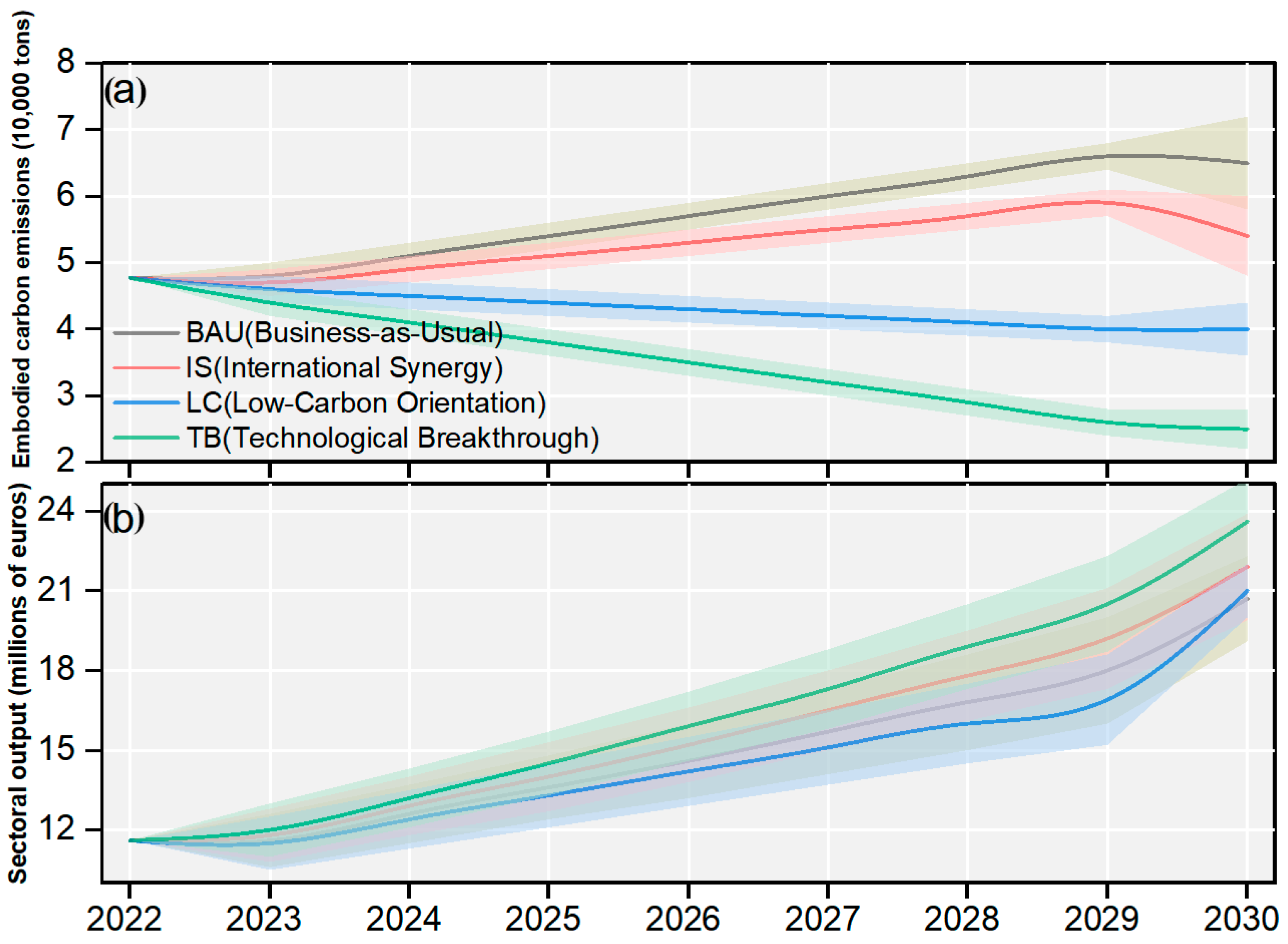
Building upon the exploration of driving factor contribution rates in the PV power generation sector, this study further establishes four scenarios and employs Monte Carlo algorithms to forecast future output scale and embodied carbon emissions, thereby investigating its decarbonization potential (
Figure 5).
The simulation results indicate that under the Business-as-Usual (BAU) scenario, the embodied carbon emissions of China’s PV power generation industry will increase annually from 47.7 thousand tons in 2022 to 65 (58–72) thousand tons by 2030, demonstrating a persistent upward trend that reflects the cumulative carbon pressure under conventional development patterns. Concurrently, the industry’s output value is projected to grow from 11.61 million euros in 2022 to 20.7 (19.1–22.3) million euros by 2030, indicating steady industrial expansion without major interventions, albeit with parallel increases in carbon emissions.
Under the International Synergy (IS) scenario, accelerated declines in carbon intensity driven by global green standards result in more moderate growth of embodied carbon emissions. By 2030, emissions reach 54 (48–60) thousand tons, representing an approximate 25% reduction compared to the BAU scenario, illustrating the potential emission reductions suggested by the IS scenario’s assumptions about international cooperation. Leveraging broader collaborative networks, this scenario achieves slightly faster output growth than BAU, with a projected 2030 output value of 21.9 (19.9–23.9) million euros, showing the output growth that would follow if the IS scenario’s market expansion assumptions were realized.
The Low-Carbon Orientation (LC) scenario demonstrates more pronounced emission control, with embodied carbon emissions declining markedly from 2024 onward to 41 (36–45) thousand tons by 2030, illustrating the outcomes that would follow if the LC scenario’s policy assumptions were realized. Potentially affected by short-term transition costs, output growth remains relatively subdued, reaching 21 (20–22) million euros by 2030—marginally lower than BAU but illustrating a potential trade-off suggested by the LC scenario’s parameter assumptions.
In the Technological Breakthrough (TB) scenario, significant reductions in carbon intensity drive the most rapid decline in embodied emissions, which plummet to just 29 (26–32) thousand tons by 2030 (a > 39% decrease), illustrating the potential contribution of innovation suggested by the TB scenario parameters. Simultaneously, industrial output grows at the fastest rate, projected at 23.6 (20–25.2) million euros by 2030, suggesting that, under the assumed rates of technological progress, substantial emission cuts could coexist with continued output growth and reduce costs to accelerate value creation, illustrating a potential synergy between environmental and economic benefits under the TB scenario assumptions.
Collectively, the TB scenario exhibits the strongest output growth potential alongside emission reduction, while the LC scenario prioritizes balancing decarbonization with economic expansion. The IS and BAU scenarios respectively represent conventional growth pathways under varying degrees of cooperation.
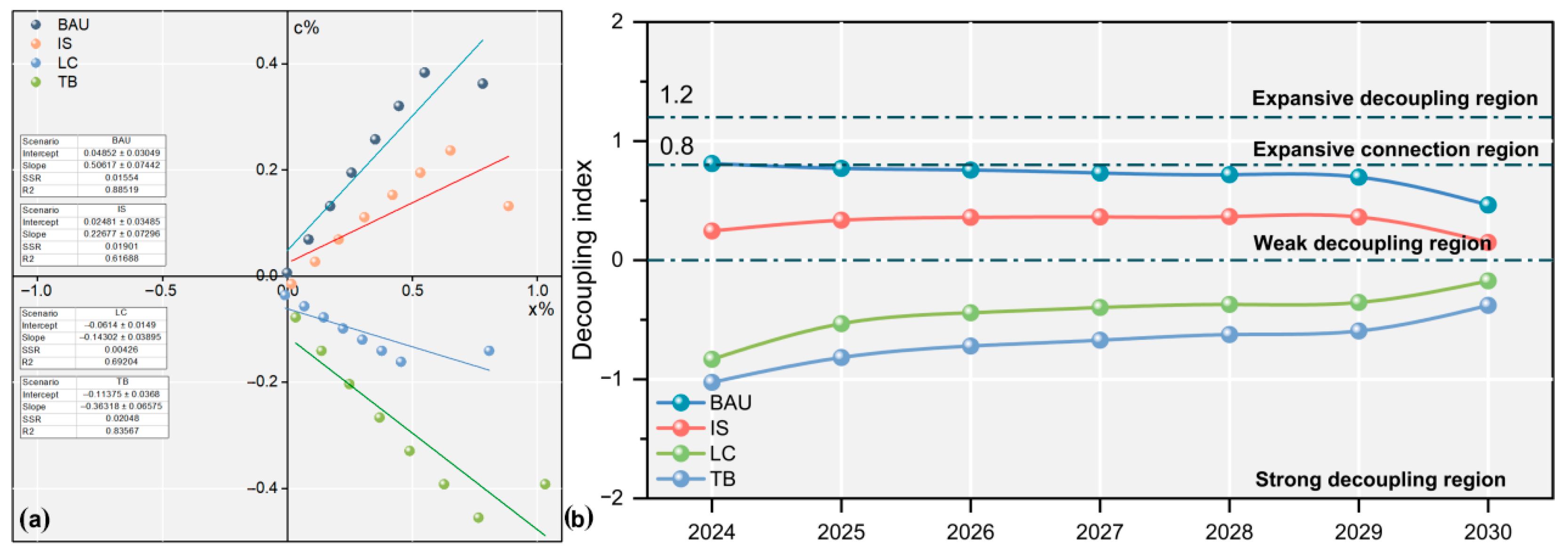
During the 2023–2030 period, distinct decoupling differentials emerge between output growth and embodied carbon emissions in the PV power generation sector under varying policy and technological scenarios (
Figure 6).
In both the BAU and IS scenarios, positive growth rates are observed for both output value and embodied carbon emissions, indicating persistent coupling between economic expansion and emission increases. The decoupling indices remain positive, reflecting sustained weak decoupling since 2024. Specifically, a 1% output growth corresponds to 0.5% emission growth under BAU, while the IS scenario demonstrates slower emission growth (0.23%), highlighting the mitigating effect of global cooperation.
In contrast, the LC and TB scenarios achieve superior decoupling outcomes. Despite maintained output growth, embodied carbon emissions exhibit negative growth rates, with decoupling indices below zero since 2023 (strong decoupling phase). Quantitatively, the LC scenario yields 0.14% emission reduction per 1% output growth, while the TB scenario amplifies this to 0.36%, underscoring technology’s pivotal role in green transition.
Collectively, the BAU scenario shows the highest carbon intensity, followed by the IS scenario. The LC and TB scenarios effectively decouple economic growth from emissions, with the latter demonstrating particularly prominent emission-reduction efficiency.
5. Discussion
Compared to prior research, this study yields significant theoretical insights. Unlike Wang et al.’s (2020) work on traditional high-carbon industries like steel, the PV industry’s decoupling process exhibits greater volatility [
55]. For instance, technological stagnation occurred during 2010–2016 due to “anti-dumping” trade barriers, underscoring green industries’ heightened sensitivity to international policy environments. Scenario projections illustrate that under the technological breakthrough scenario’s assumptions, 2030 emissions could be 39% lower than the baseline while achieving higher output value. This pattern is consistent with an EKC-type relationship where continued economic growth eventually leads to absolute emissions reductions, but our findings suggest that for the PV manufacturing sector—a clean energy industry with upstream carbon intensity—this turning point may occur later than for the sector’s downstream applications. Rather than challenging EKC logic, our results refine its application by highlighting sectoral heterogeneity in decoupling timing [
56]. Notably, even under optimal scenarios, absolute decarbonization in PV manufacturing remains unattainable, indicating that technological progression alone cannot fully resolve carbon lock-in.
Three key tensions are illuminated by the decomposition results. First, the “green paradox”: China’s 80% global PV market share partly relies on coal-dominated energy inputs, inadvertently delaying upstream clean energy transitions. Second, the “technology-scale” dilemma: while innovation reduces unit emissions, surging demand from global carbon neutrality goals drives production ability expansion, creating “energy efficiency rebound effects.” Third, the tension between “international standards and local practices”: policies like the EU’s Carbon Border Adjustment Mechanism pressure Chinese firms to decarbonize, yet insufficient green electricity supply across the value chain constrains progress. These tensions suggest that PV decarbonization may require not only technological progress but also systemic integration with energy transitions and international trade governance—a hypothesis that merits further investigation.
A important methodological caveat bears emphasis: the scenario analysis presented in
Section 3.3 is a conditional exercise, not a structural demonstration of feasibility. The favorable decoupling outcomes in the LC and TB scenarios are mechanically implied by the exogenously imposed parameter assumptions—they illustrate the logical consequences of those assumptions rather than providing independent evidence that such outcomes are achievable. Whether the assumed rates of technological improvement, structural change, and policy effectiveness can be realized in practice depends on a complex array of economic, political, and technological factors that our simple simulation framework does not model. Future research could usefully complement this analysis with structural models that endogenously generate technology adoption, policy responses, and market adjustments. For now, our findings should be read as exploring the implications of different assumption sets, not as demonstrating the feasibility of specific decarbonization pathways.
Before discussing policy implications, it is important to clarify what our analysis does and does not demonstrate. The historical decomposition quantifies the accounting contributions of different factors to embodied carbon changes—it tells us what changed and by how much, but does not identify causal mechanisms. The scenario projections illustrate the logical consequences of specific assumption sets—they show what could happen under different pathways, but do not demonstrate that such pathways are achievable or predict that they will occur. The finding that even optimistic scenarios leave residual emissions highlights the persistent challenge of decarbonizing energy-intensive upstream processes, but does not prove that technological solutions are unavailable or that policy interventions would fail. These distinctions are essential for interpreting our results appropriately. Limitations of this study include EXIOBASE’s insufficient granularity in capturing emission variations across PV technologies (e.g., utility-scale vs. distributed), and inadequate consideration of geopolitical risks. Future research should incorporate firm-level production data for refined carbon accounting, while integrating non-economic variables (e.g., trade conflicts, technology blockades) into decoupling frameworks to better understand green manufacturing dynamics during global energy transitions.
While this study provides a comprehensive analysis of embodied carbon dynamics in China’s PV manufacturing sector, several avenues for future research emerge from our findings and limitations. First, firm-level analysis would complement our industry-level approach by capturing heterogeneity across producers—particularly the growing divergence between industry leaders adopting advanced low-carbon technologies and smaller firms with slower upgrade cycles. Second, technology-disaggregated carbon accounting could refine our understanding of how specific innovations (e.g., perovskite vs. HJT cells) differentially affect embodied emissions, moving beyond the aggregate technological effect captured by SDA. Third, dynamic modeling of technology diffusion would endogenize the adoption rates we treated as exogenous scenario assumptions, potentially revealing feedback loops between policy incentives, cost reductions, and emission trajectories. Fourth, integration of circular economy metrics—particularly silicon recovery rates and end-of-life recycling—would capture the growing importance of material circularity as early PV installations reach retirement age. Fifth, comparative international studies applying our analytical framework to other major PV manufacturing hubs (e.g., Vietnam, India, emerging European facilities) would test the generalizability of our findings and identify context-specific decarbonization pathways. Finally, incorporation of geopolitical risk factors—including trade disputes, technology export controls, and supply chain decoupling—would address a key limitation of our scenario analysis, which assumed stable international cooperation in the IS scenario. Addressing these directions would require enhanced data collection efforts, particularly firm-level emissions reporting and technology-specific input–output tables, as well as methodological innovations in dynamic modeling and uncertainty quantification.
6. Conclusions
This study set out to examine the relationship between economic growth and embodied carbon emissions in China’s photovoltaic manufacturing sector from 2000 to 2022, and to explore potential decarbonization pathways to 2030 through scenario analysis. Our findings provide clear answers to the three research questions posed in the introduction.
Regarding the first question of whether decoupling has occurred, our analysis reveals that China’s PV industry has achieved weak decoupling since 2005, but has never attained strong decoupling. The decoupling trajectory evolved through distinct phases: expansive negative decoupling from 2001 to 2004 (DI > 1.2), when emissions grew faster than output during the industry’s energy-intensive early development; a transitional period from 2005 to 2016 characterized by weak decoupling interspersed with years of expansive connection; and sustained weak decoupling from 2017 to 2022, with DI values declining from 0.66 to 0.42. Throughout the entire two-decade period, however, absolute emissions continued to rise alongside industrial expansion, confirming that strong decoupling—where emissions decline while output grows—remains an aspirational rather than achieved state.
Turning to the second question concerning the key driving factors influencing this decoupling state, structural decomposition analysis identifies four factors with opposing effects. Technological progress, measured through changes in carbon coefficients, has been the dominant force for emission reductions, contributing −78% to emissions changes in the 2015–2022 period. This reflects the cumulative impact of innovations including N-type cell technologies, large-format wafers, and manufacturing efficiency improvements [
57]. Conversely, output scale expansion has consistently pushed emissions upward, contributing +55% over the same period—a testament to the sector’s remarkable growth. Final demand structure (−42%) and intermediate input structure (−35%) have also contributed substantially to emission reductions, reflecting shifts toward higher-value products and more efficient supply chains. The period since 2015 thus marks a fundamental transition from a scale-driven to a technology-driven development model, though scale effects continue to exert strong upward pressure on absolute emissions.
The third question addressed whether policy interventions could enable strong decoupling by 2030. Our conditional scenario analysis suggests that strong decoupling is achievable within this timeframe, but only under ambitious assumptions about technological progress and policy effectiveness. Under the Business-as-Usual scenario, emissions would continue rising to approximately 65 thousand tons by 2030, while the International Synergy scenario would moderate this growth to 54 thousand tons. The Low-Carbon Orientation scenario, incorporating stronger domestic policy measures, would achieve strong decoupling with emissions declining to 41 thousand tons despite continued output growth. Most optimistically, the Technological Breakthrough scenario projects emissions falling to just 29 thousand tons by 2030—a 39% reduction from 2022 levels—while output value increases by 103%. Even under this most favorable scenario, however, approximately 29,000 tons of residual carbon emissions would remain, highlighting the persistent challenge of decarbonizing energy-intensive upstream processes such as polysilicon production.
These findings carry important policy implications. First, continued investment in next-generation PV technologies—including perovskite, heterojunction, and tandem cells—is essential to sustain and accelerate the technology-driven emission reductions observed since 2015. Second, the persistent upward pressure from scale effects must be addressed through complementary measures: mandating green electricity procurement for manufacturing facilities, implementing circular economy practices such as silicon recycling, and extending carbon pricing to cover energy-intensive inputs. Third, international cooperation on carbon standards and green supply chain development can amplify domestic efforts, as suggested by the International Synergy scenario, while also helping to mitigate the risk of carbon border adjustment mechanisms.
In conclusion, China’s PV manufacturing sector has made remarkable strides in reducing the carbon intensity of its growth, successfully transitioning from a scale-driven to a technology-driven development paradigm. Strong decoupling by 2030 is within reach, but its realization depends on sustained policy commitment, continued technological innovation, and systemic integration with broader energy transition efforts. The persistence of residual emissions even under optimistic scenarios underscores that while the sector can dramatically reduce its carbon footprint, complete decarbonization of PV manufacturing remains a long-term challenge requiring ongoing attention from researchers, policymakers, and industry stakeholders alike.