Credible Reserve Assessment Method for Virtual Power Plants Considering User-Bounded Rationality Response


Abstract
1. Introduction
- (1)
- Physical operational boundary models for air conditioning loads, energy storage resources, and distributed PV are established to provide foundational support for the reserve capacity calculation of various flexible resources;
- (2)
- Prospect theory is introduced to characterize users’ loss aversion characteristics, and combined with the logit model, a VPP response probability model reflecting user-bounded rationality is proposed to refine the physical operational boundary model;
- (3)
- Monte Carlo simulation and kernel density estimation techniques are employed to quantify VPP credible reserve capacity under different confidence levels, comprehensively considering both physical-side forecast errors and behavioral-side response randomness;
- (4)
- The correctness and effectiveness of the proposed method are validated through comprehensive case study analysis.
2. Physical Models of VPP Resources
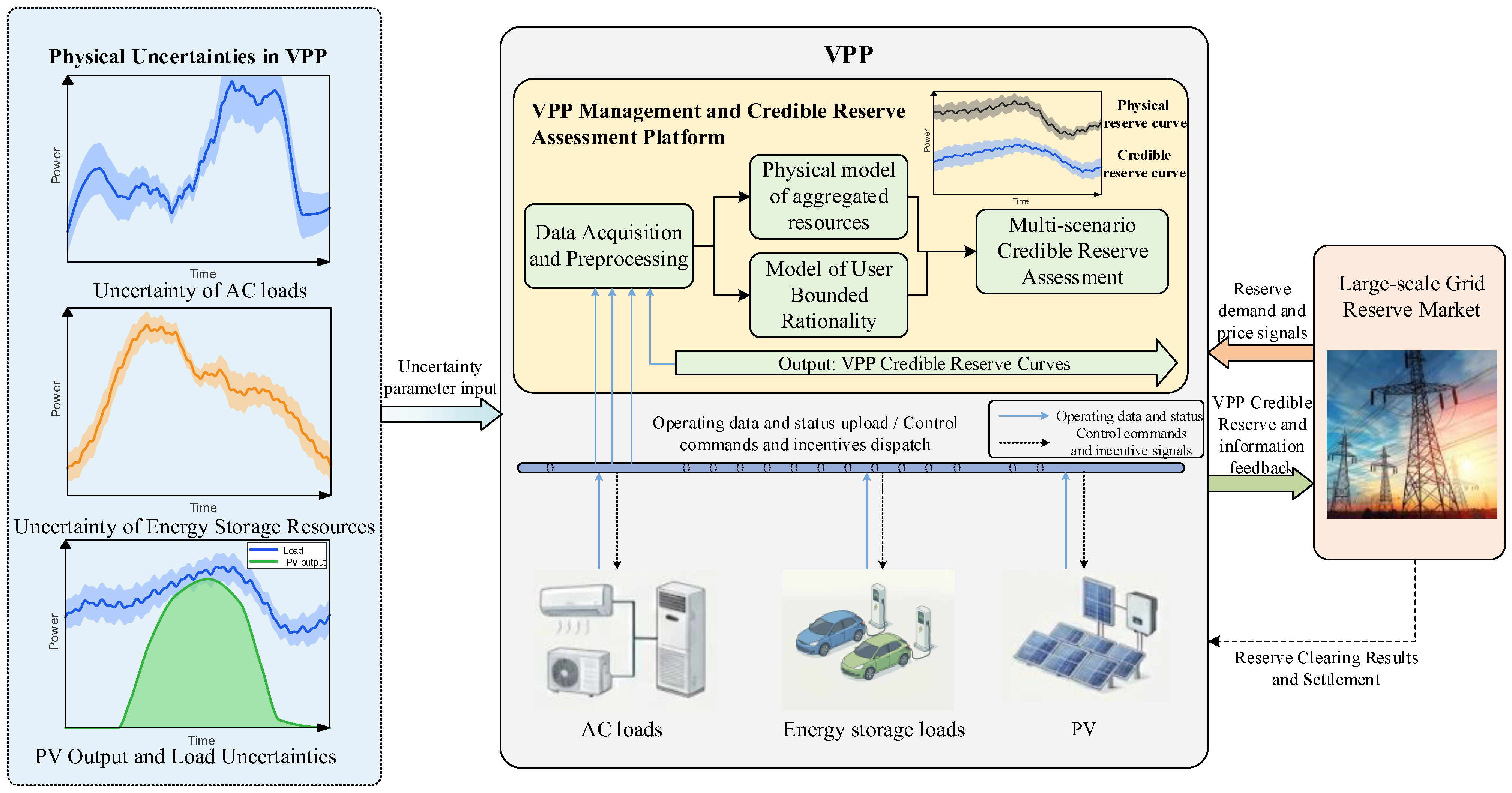
2.1. VPP Architecture
2.2. Physical Modeling of Air Conditioning Loads
2.2.1. First-Order RC Equivalent Thermal Parameter Model
2.2.2. Thermostat Hysteresis Control Logic
2.2.3. Reserve Regulation Capacity and Duration Constraints
2.3. Unified Modeling Framework for Energy Storage Resources
2.3.1. Common Model for Energy Storage Resources
- (1)
- SOC boundary constraints: To prevent overcharging/overdischarging damage, SOC must remain within a safe range:
- (2)
- Power boundary and charge-discharge mutual exclusion constraints:
2.3.2. EV Special Constraints and Reserve Capacity
- (1)
- V1G Reserve Capacity
- (2)
- V2G Reserve Capacity
2.3.3. ESS Constraints and Reserve Capacity
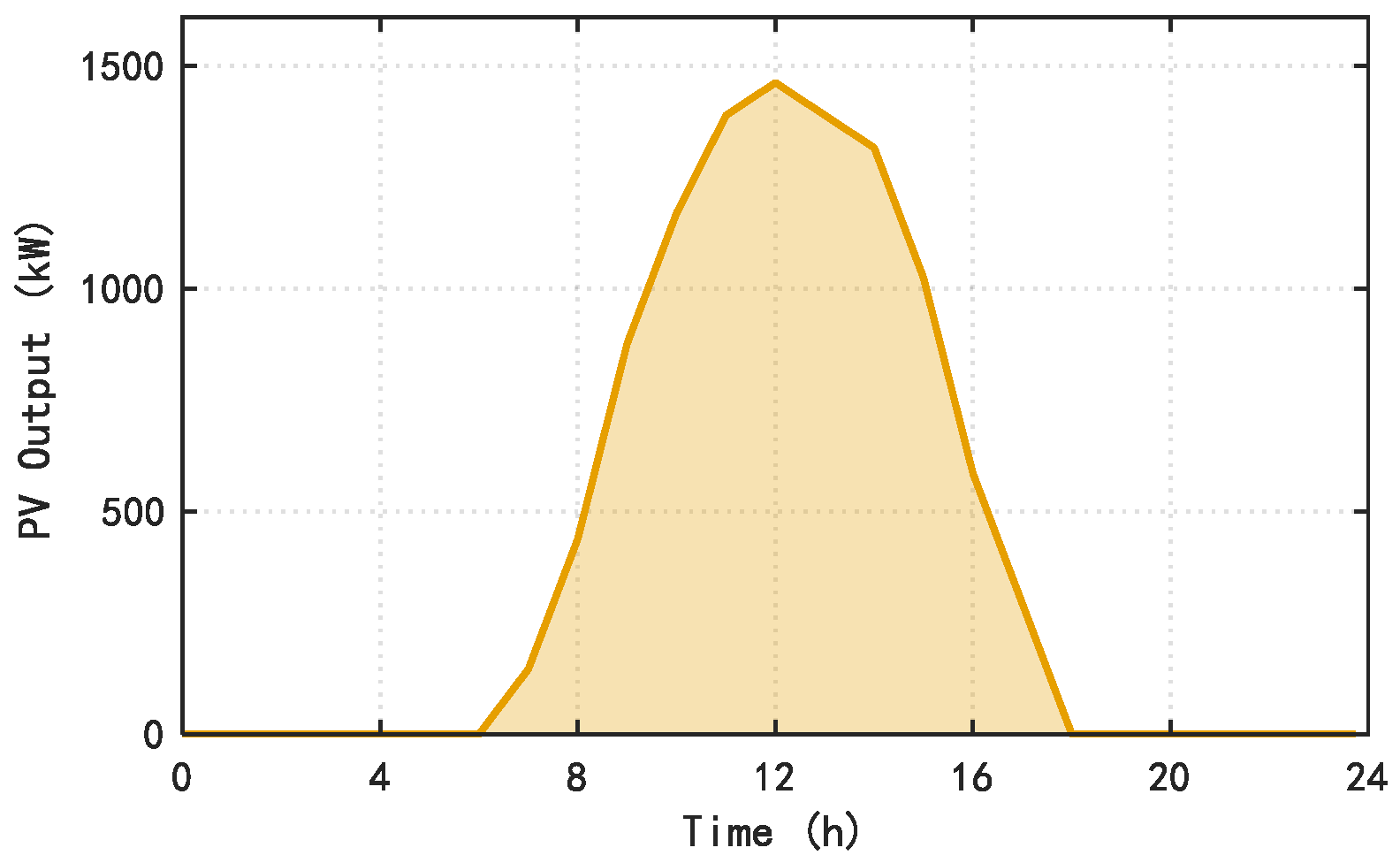
2.4. Distributed Photovoltaic Output Modeling
3. VPP Reserve Modeling Considering User-Bounded Rationality
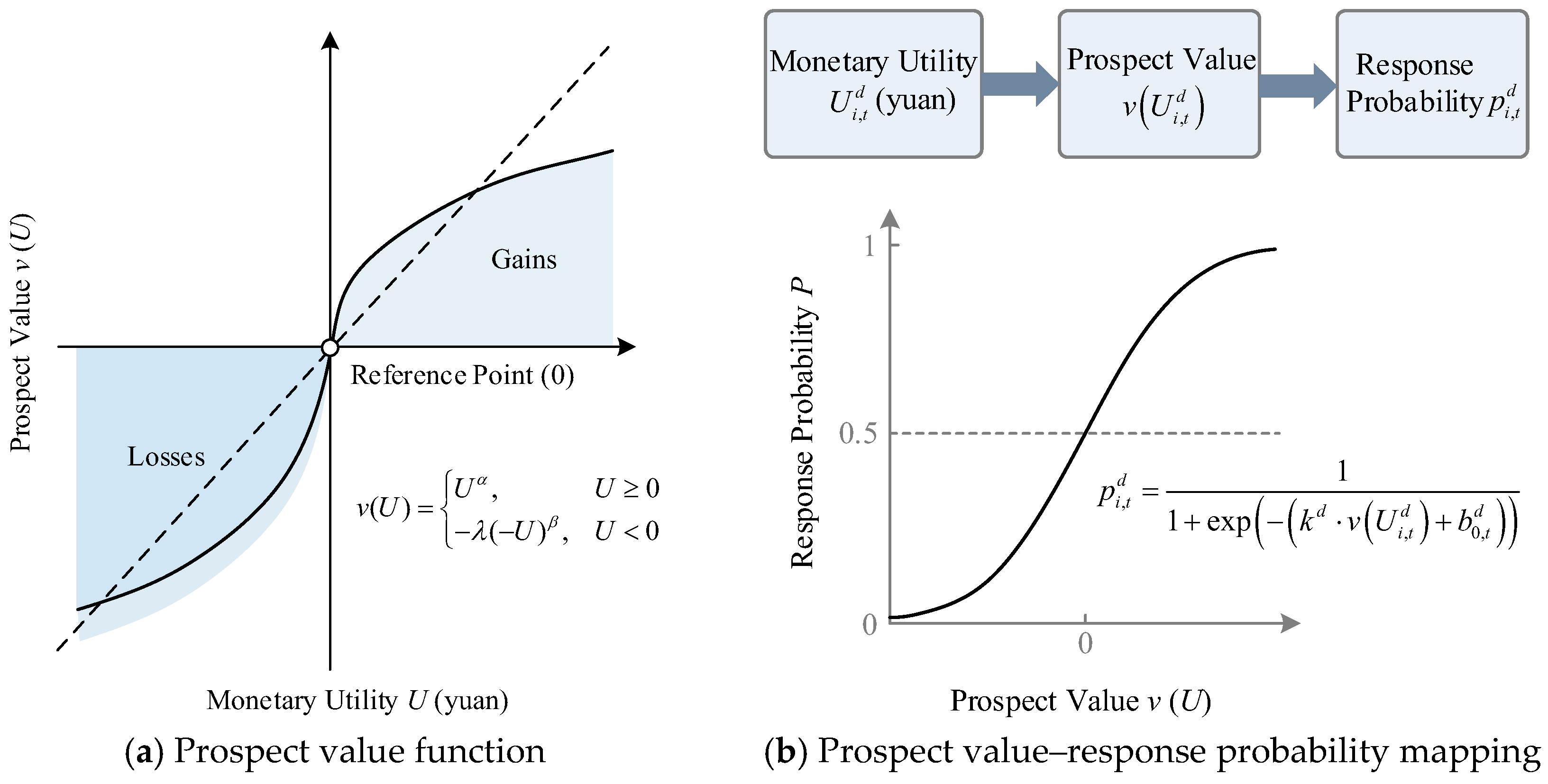
3.1. Prospect Theory Value Function
3.2. Unified Utility Modeling Framework
3.2.1. Air Conditioning Load Utility Calculation
3.2.2. Electric Vehicle Utility Calculation
3.3. Logit Response Probability Model
3.3.1. Prospect Value Calculation
3.3.2. Logit Response Probability Mapping
3.3.3. Parameter Calibration Method
3.3.4. Resource Aggregation Model Considering Stochastic Response
4. VPP Credible Reserve Assessment Method
4.1. VPP Aggregation Model Considering Multiple Uncertainties
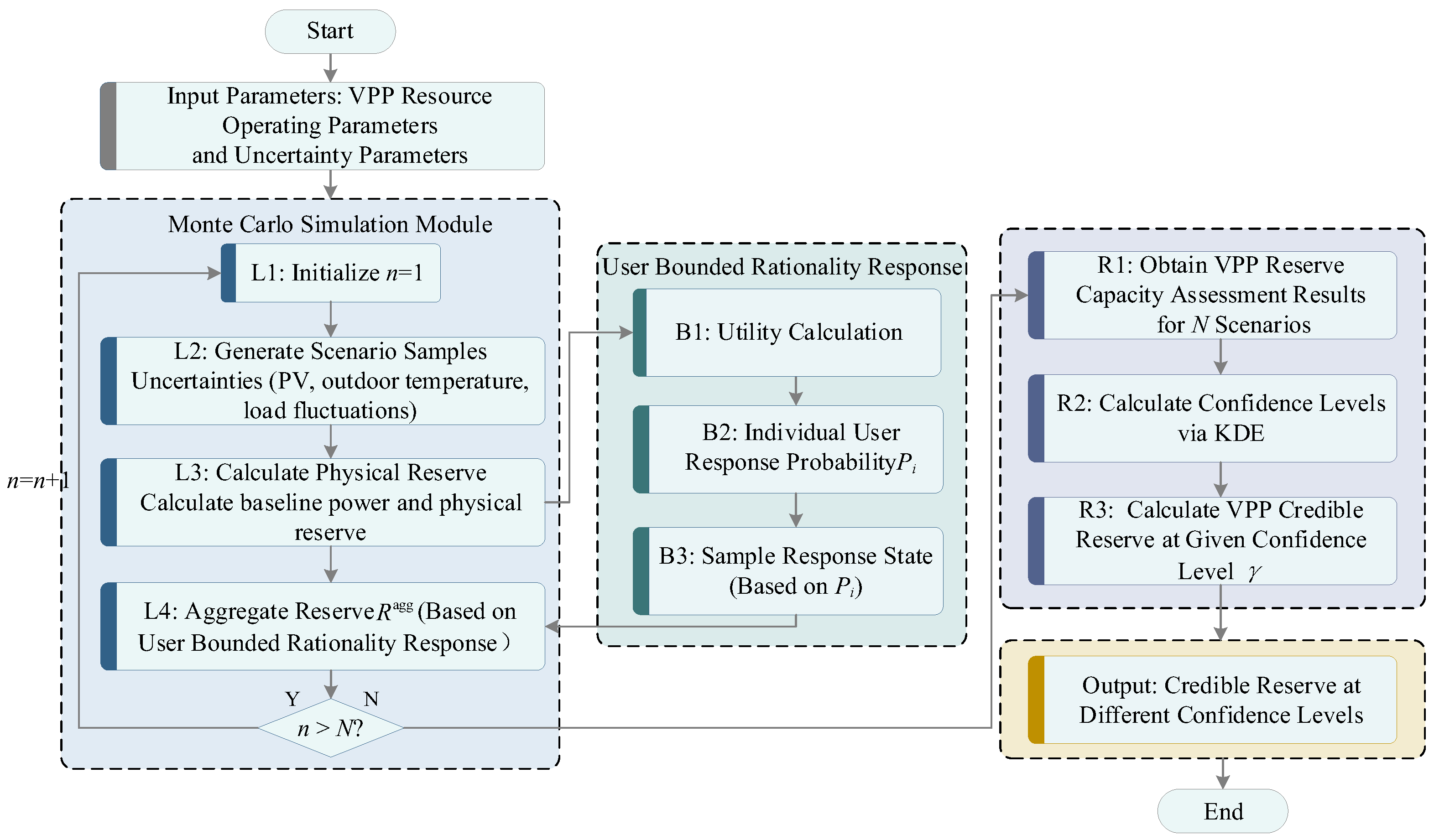
4.2. Credible Reserve Definition and Mathematical Characterization
5. Case Study Analysis
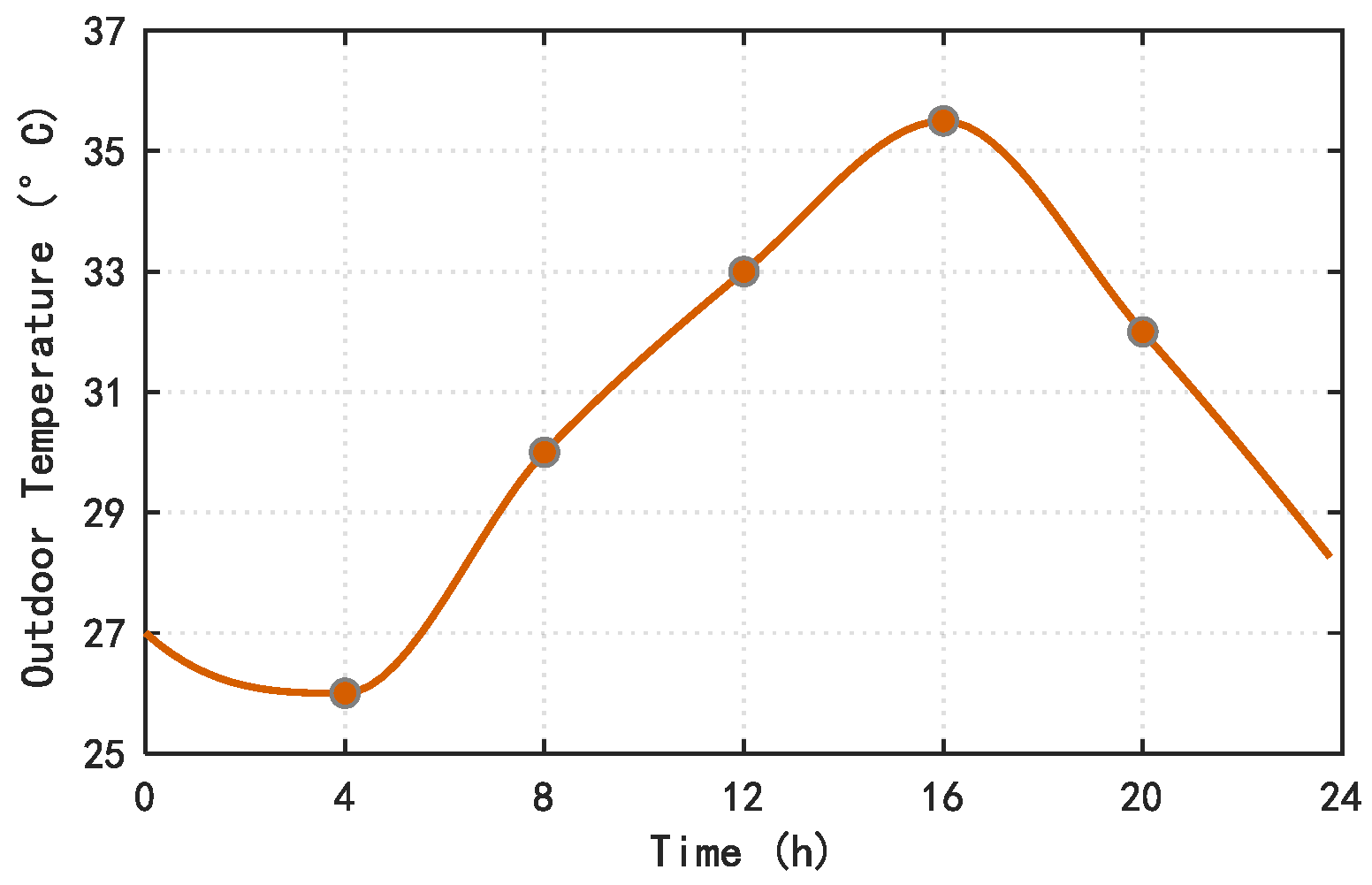
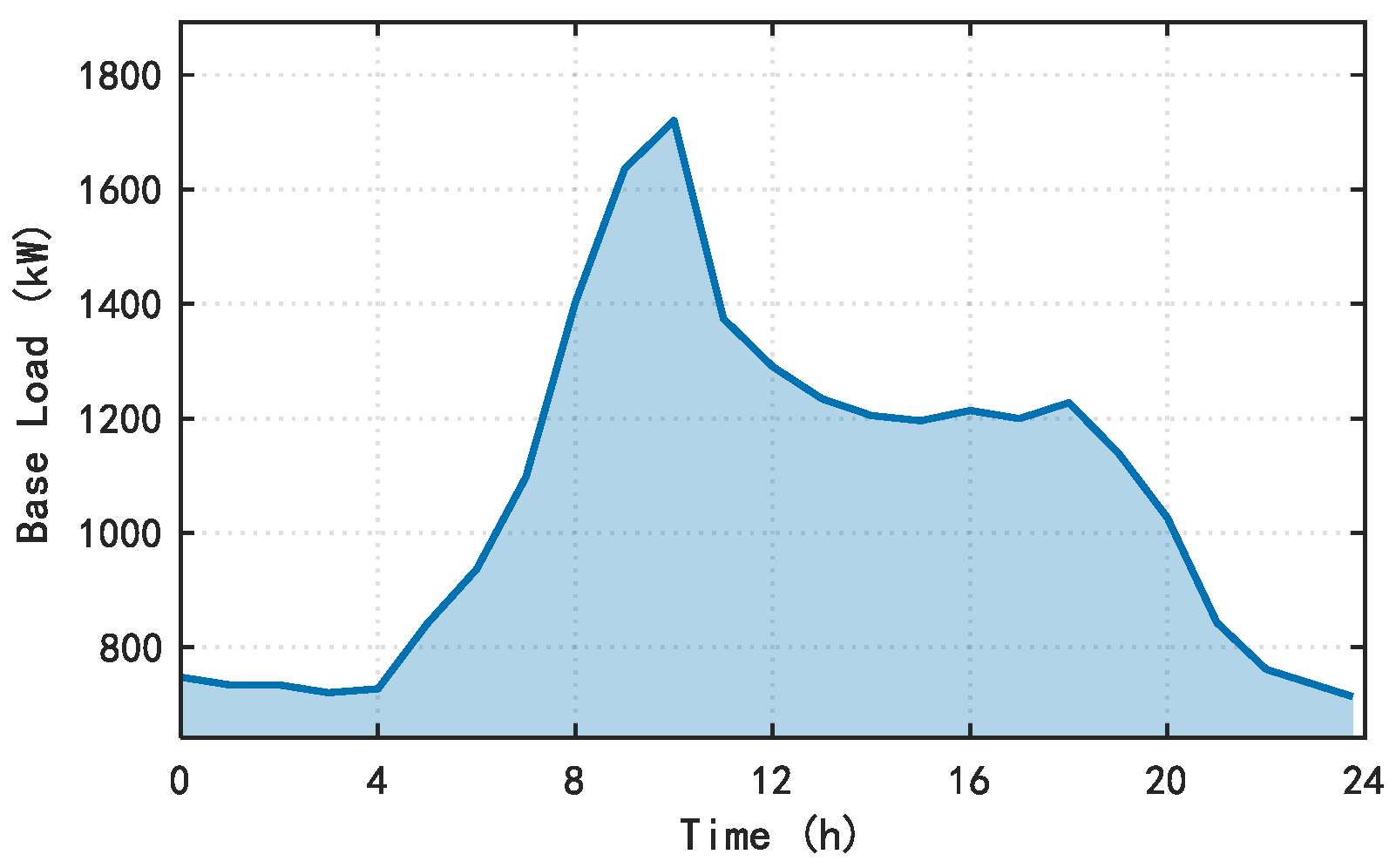
5.1. Case Scenario and Parameter Settings
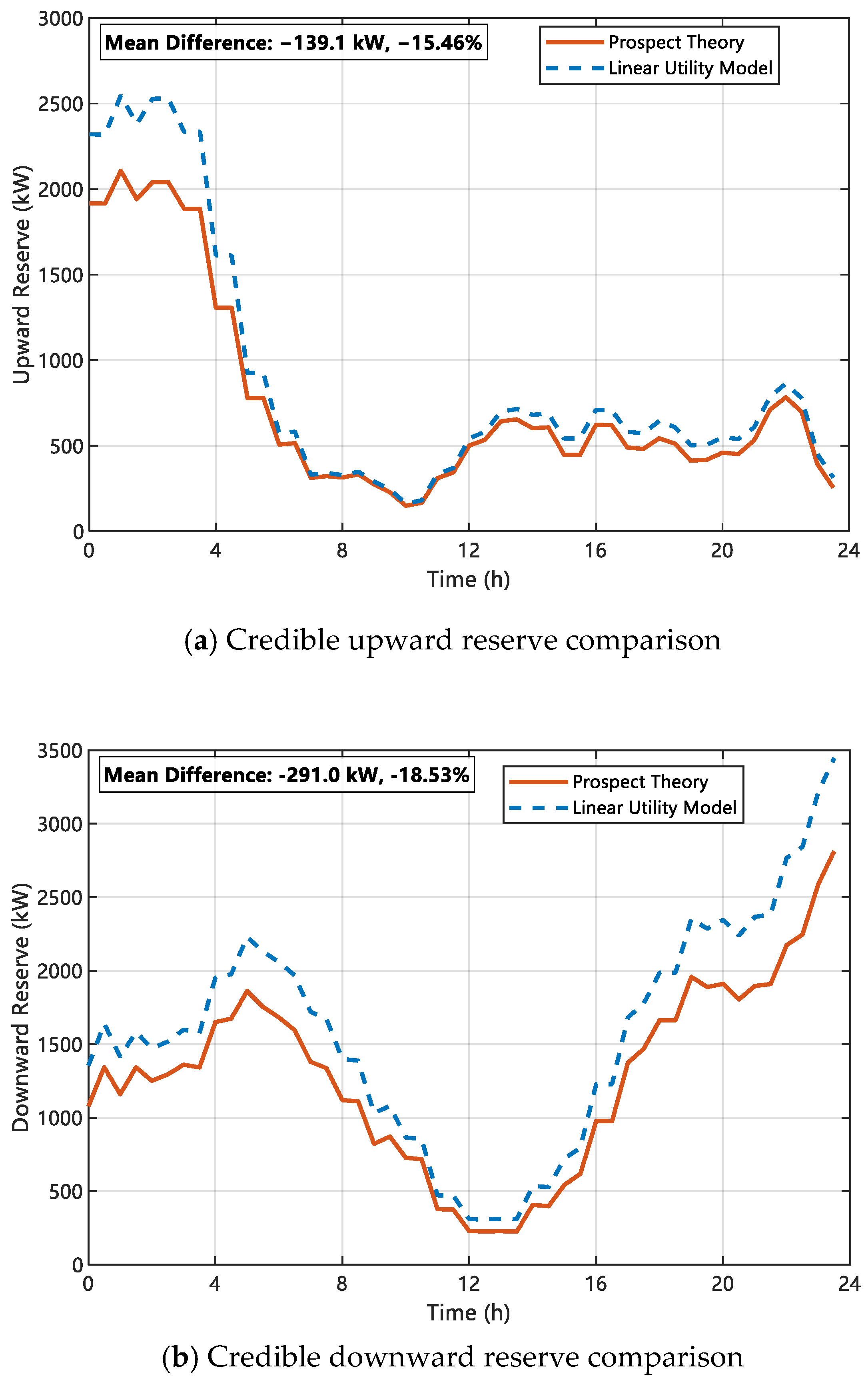
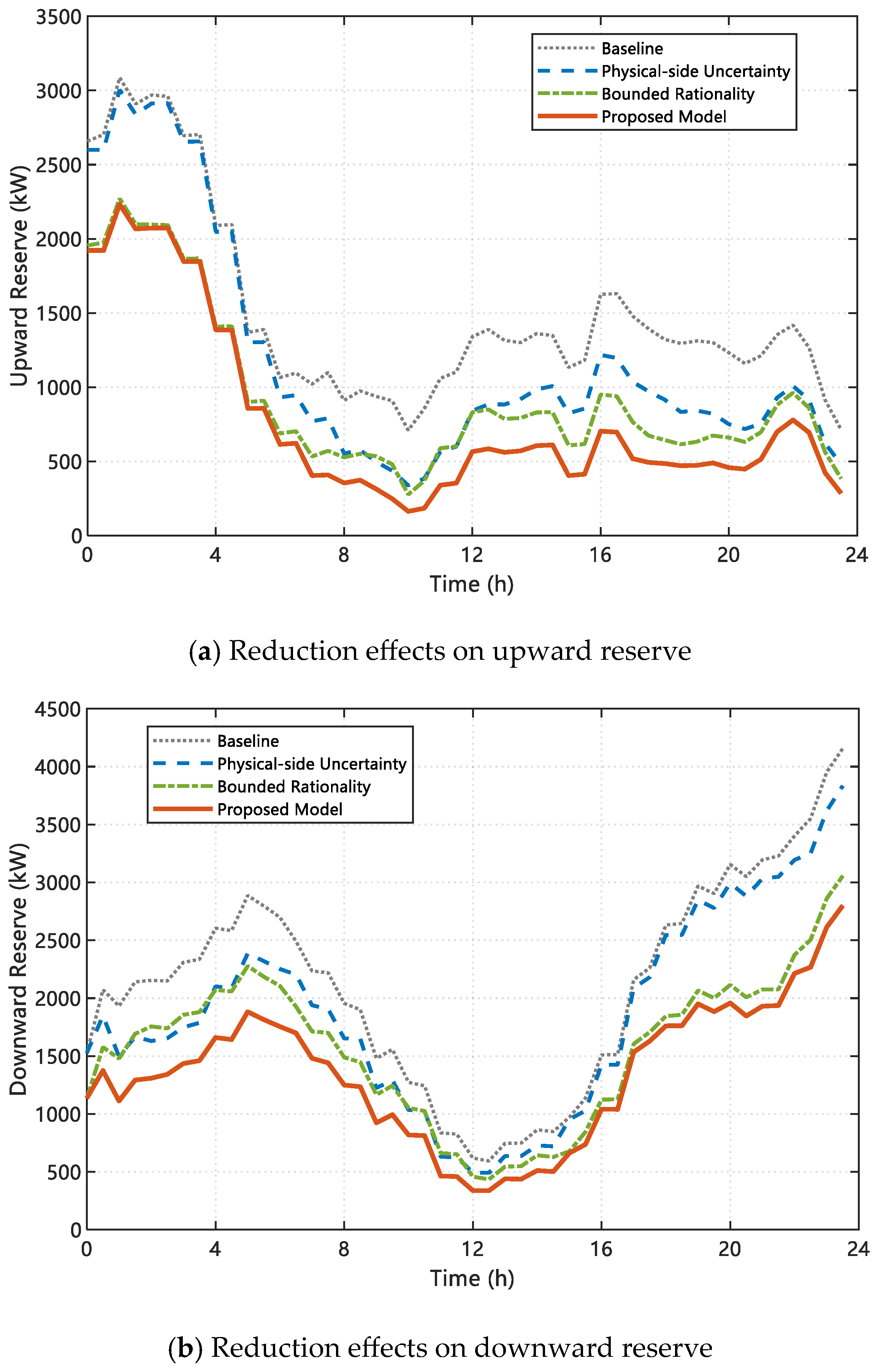
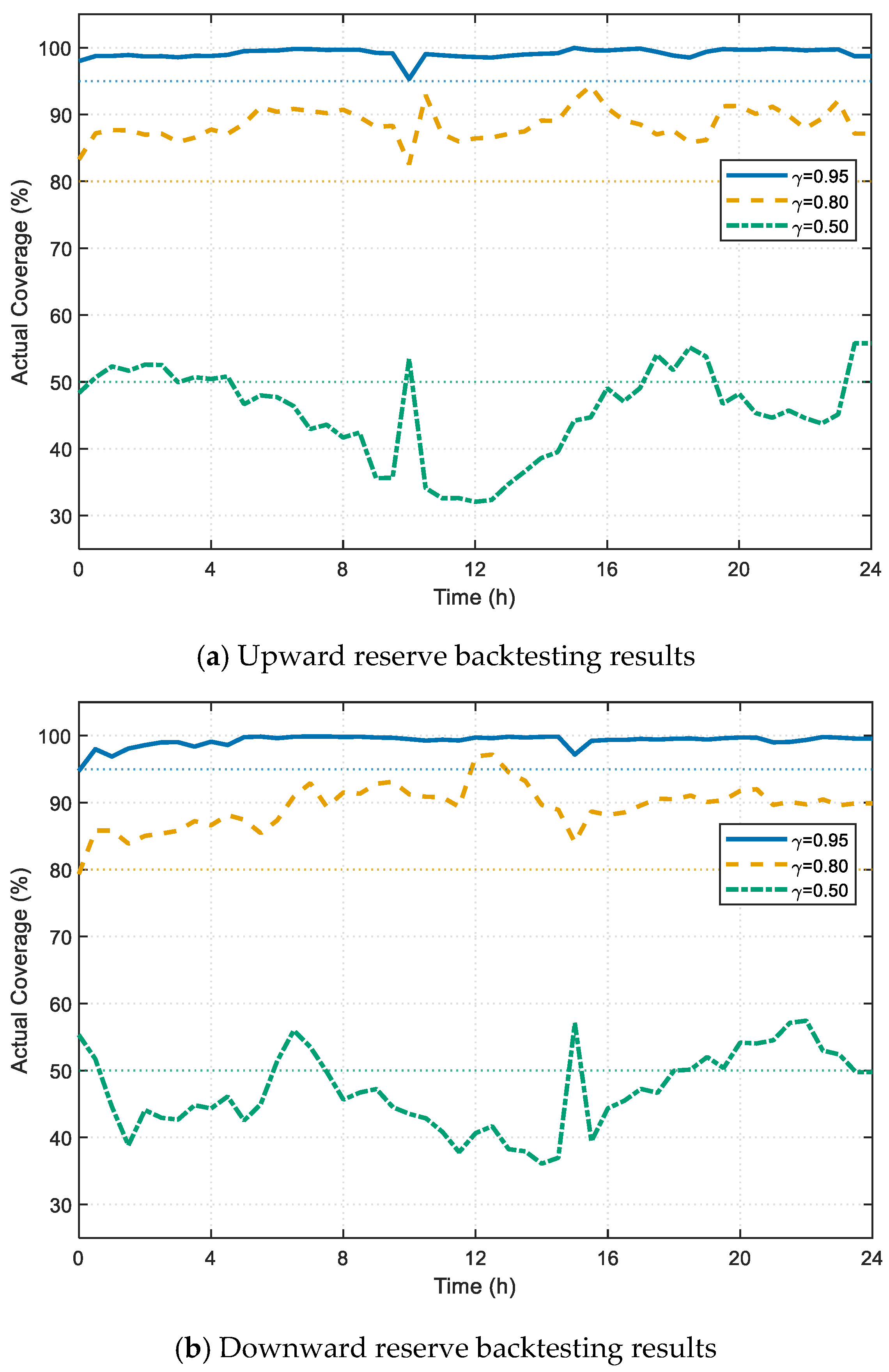
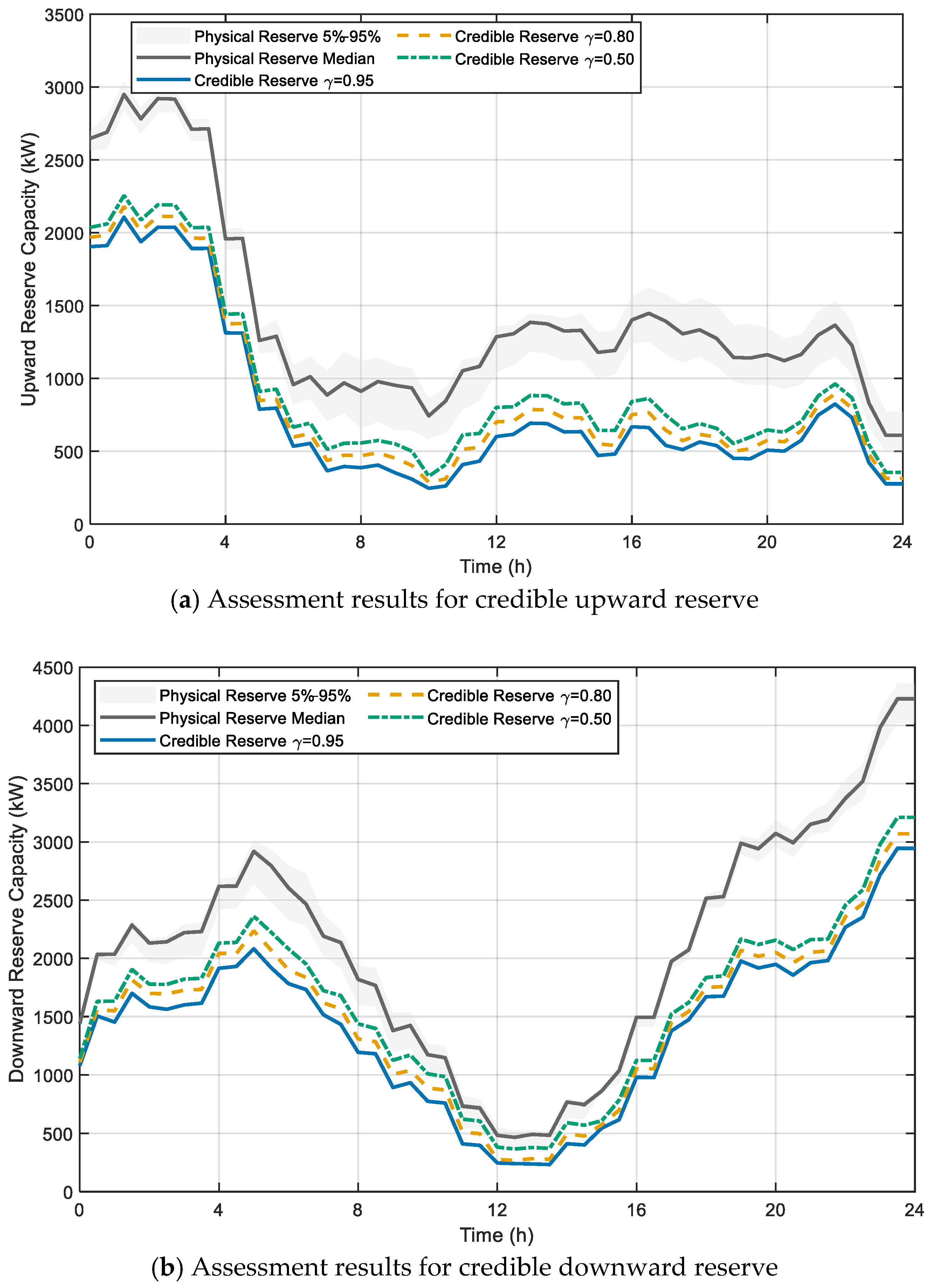
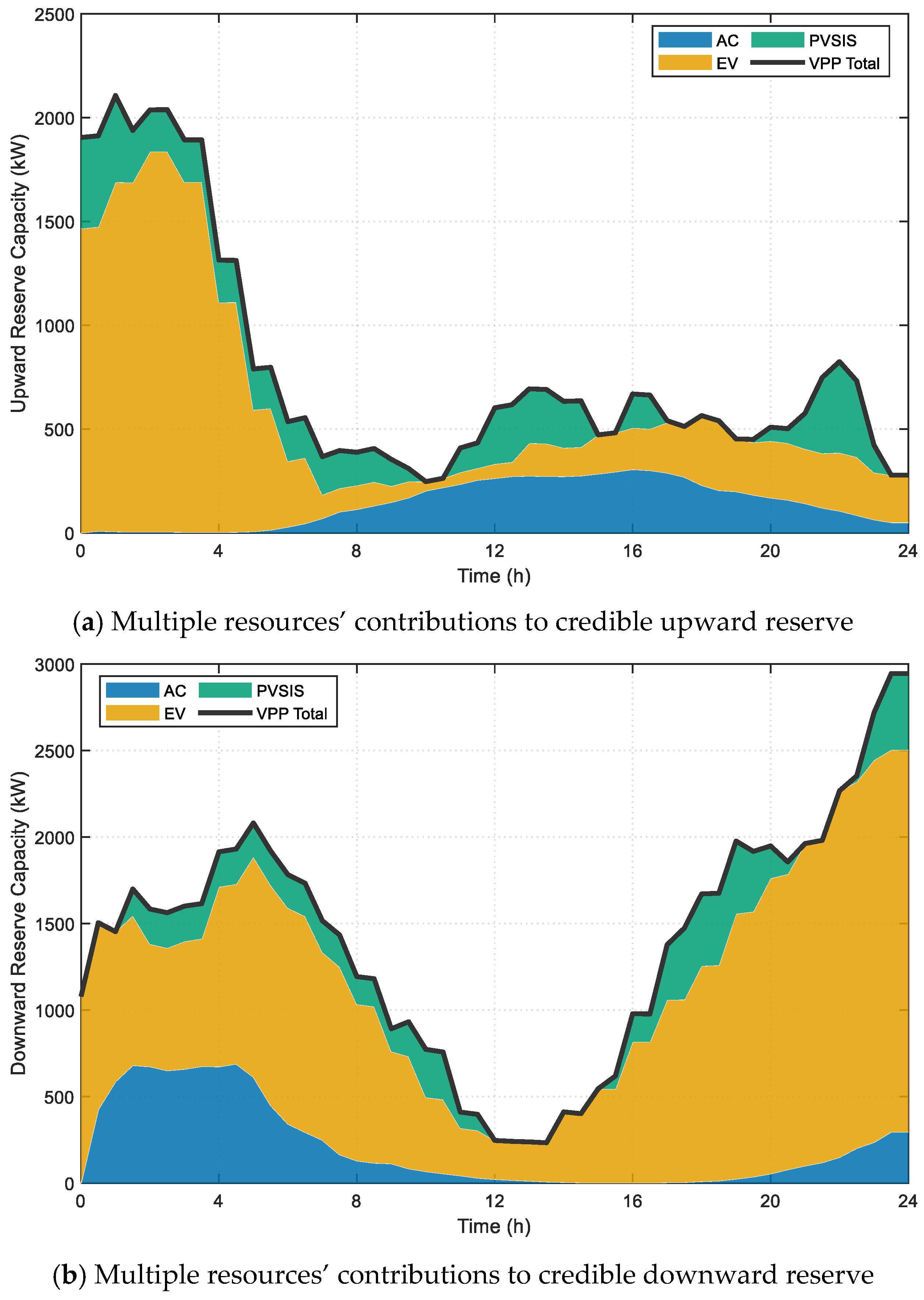
5.2. VPP Credible Reserve Assessment
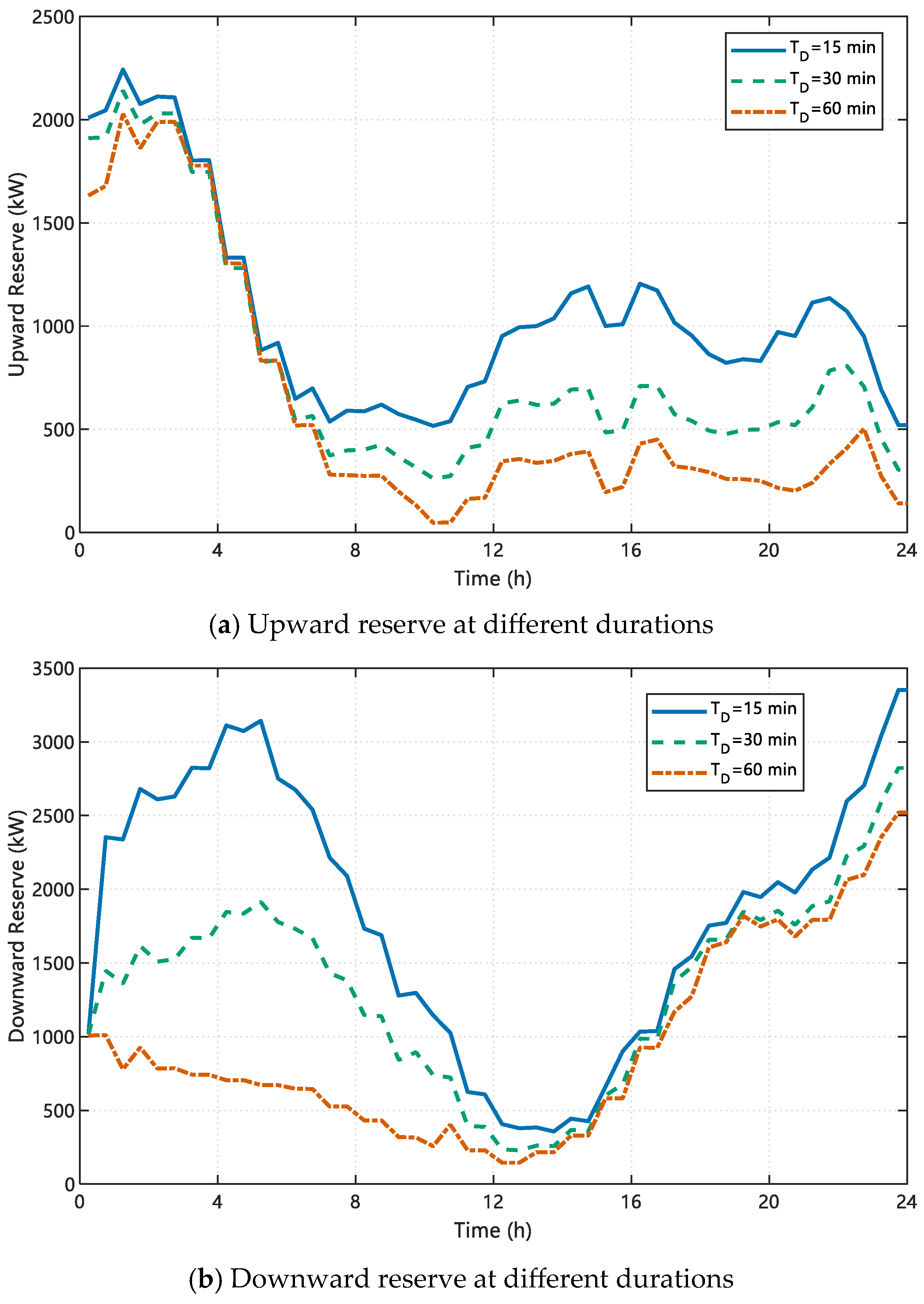
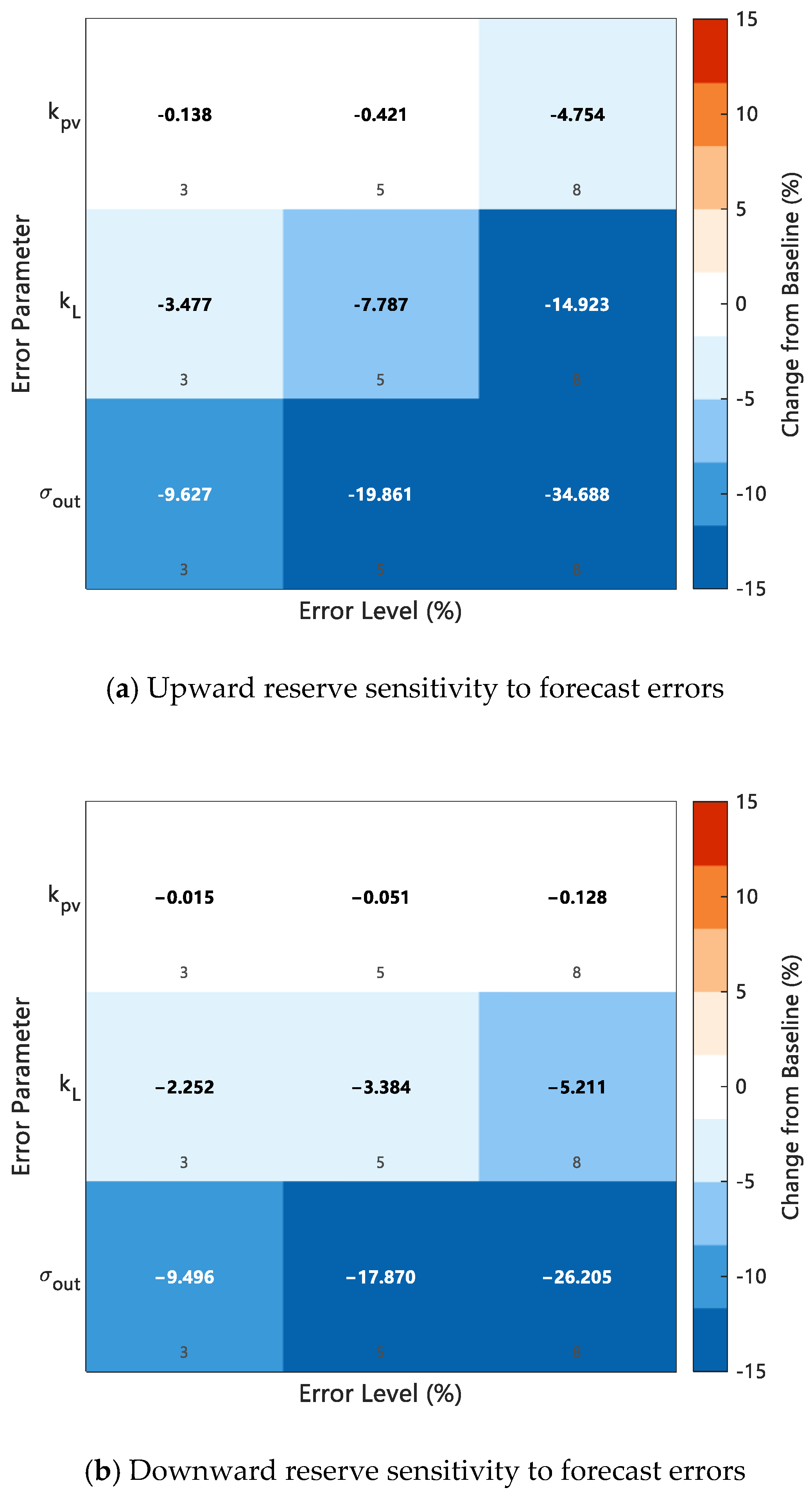
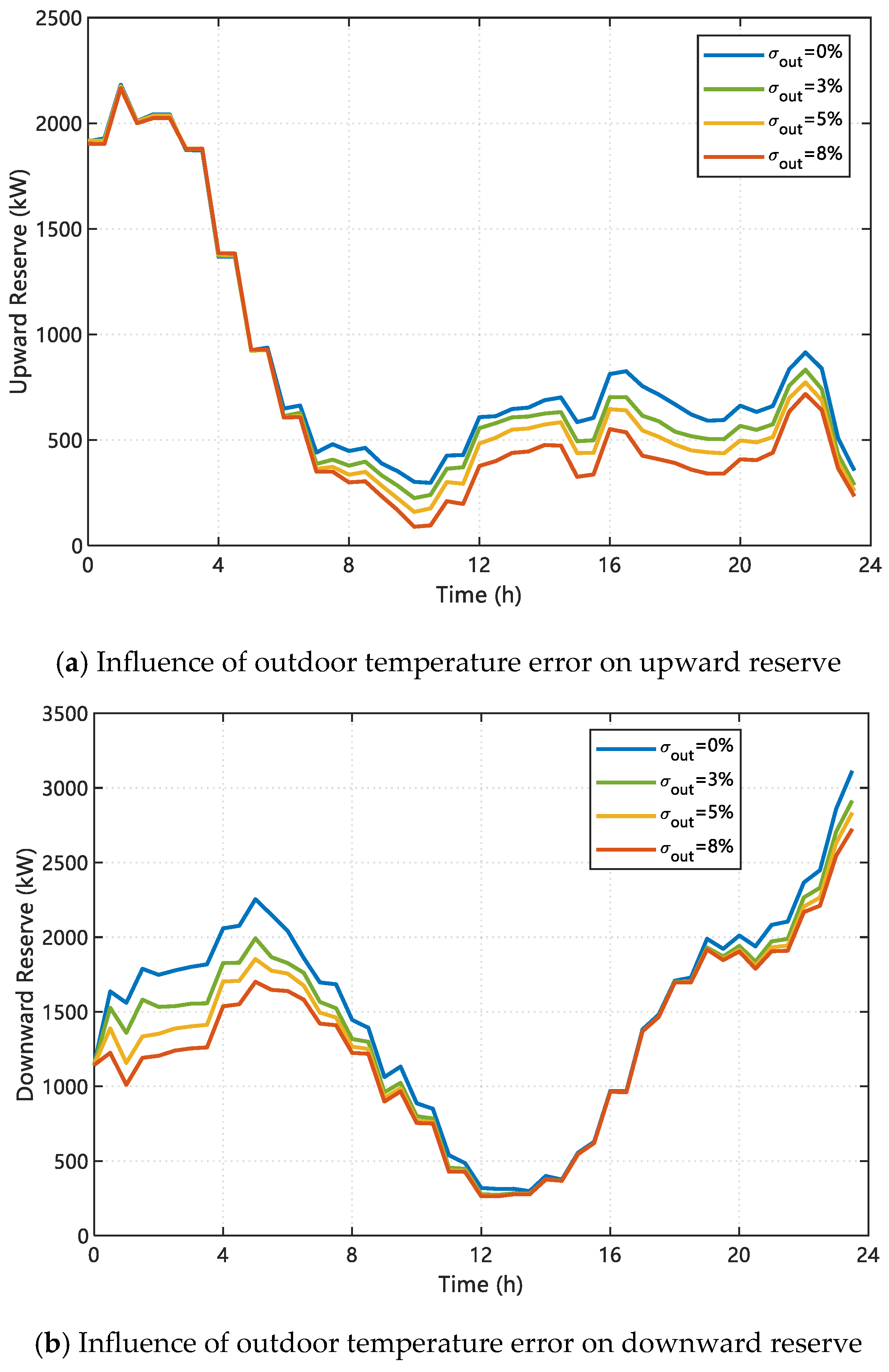
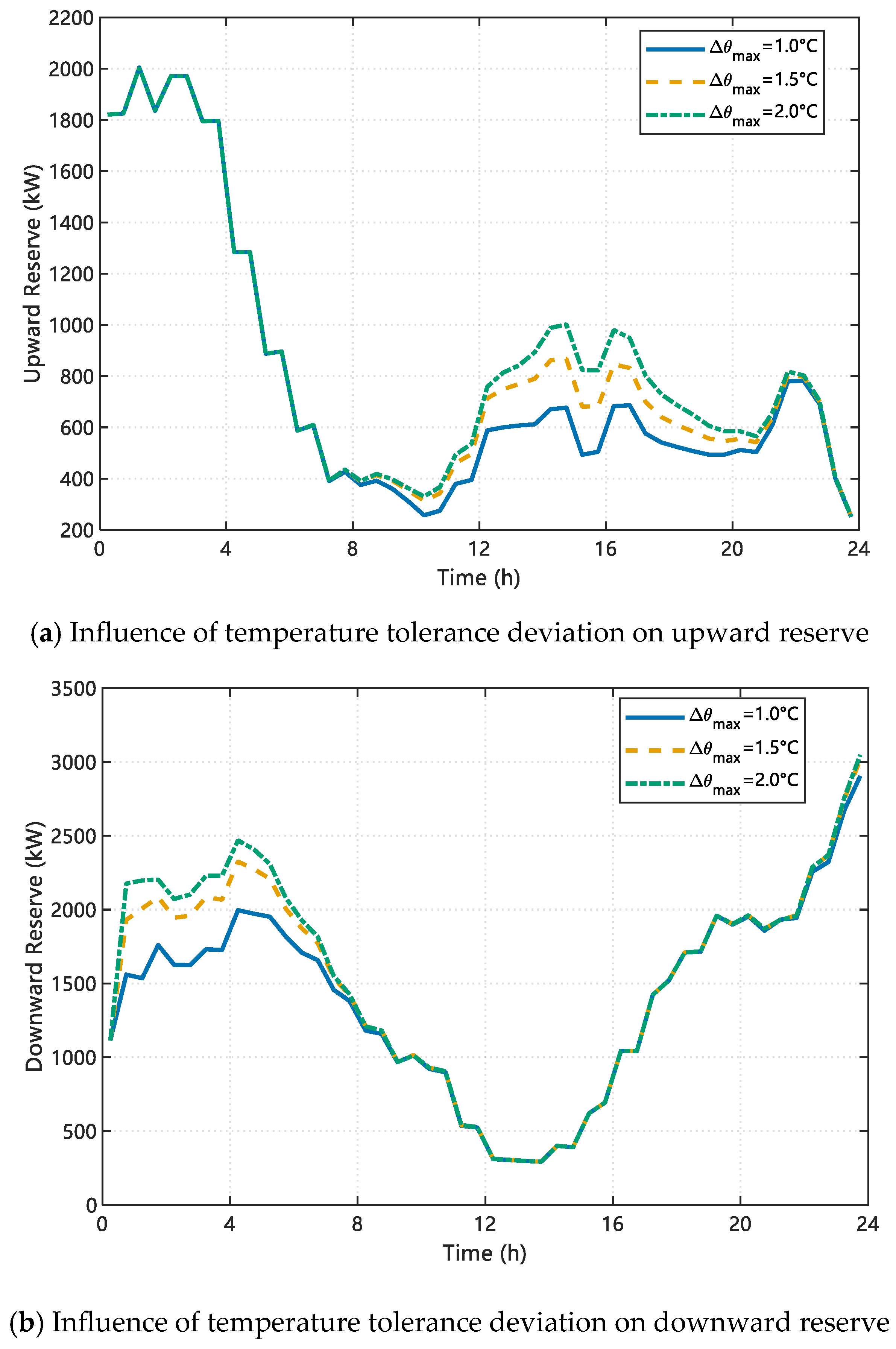
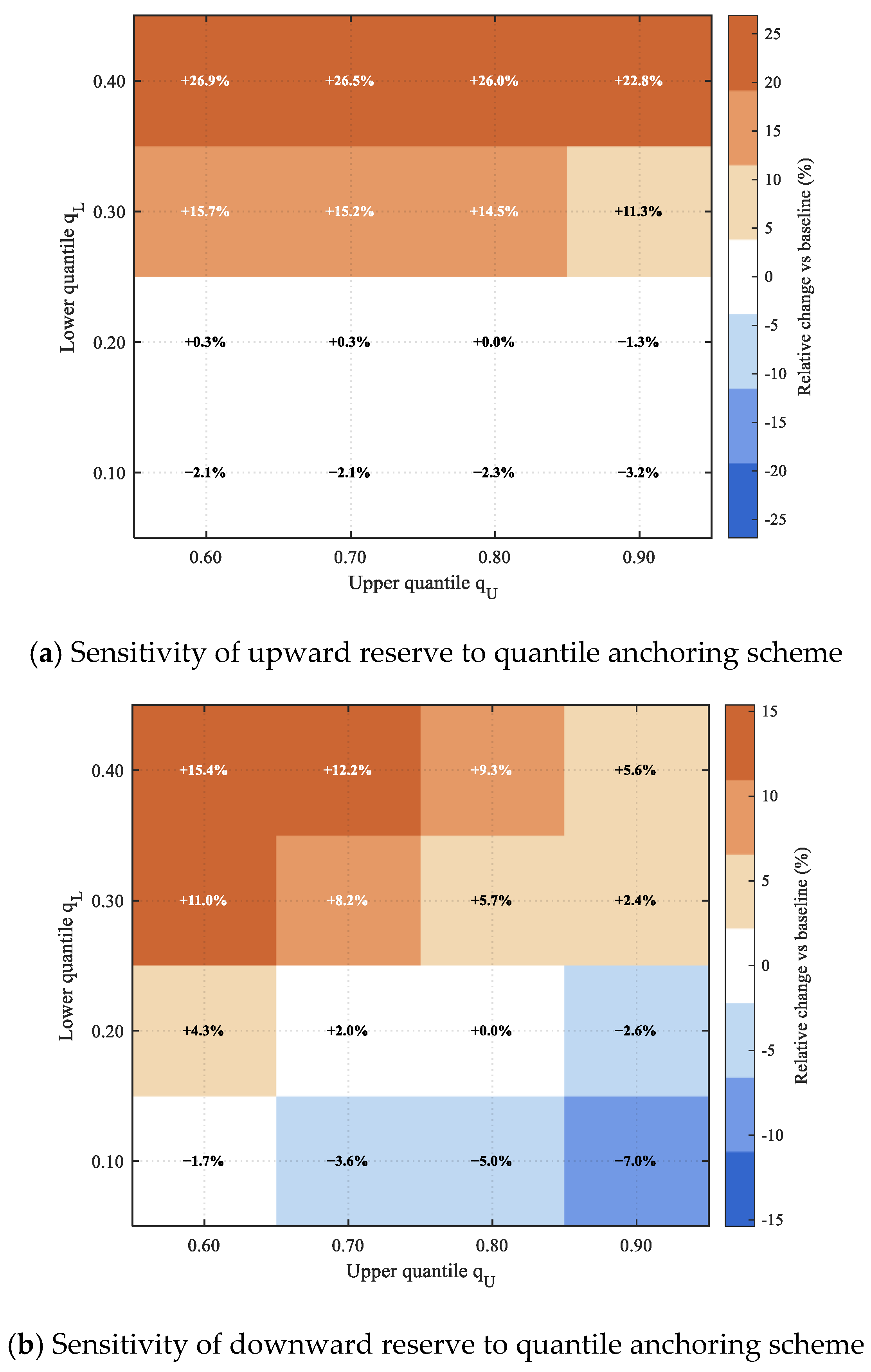
5.3. Physical and Operational Parameter Sensitivity
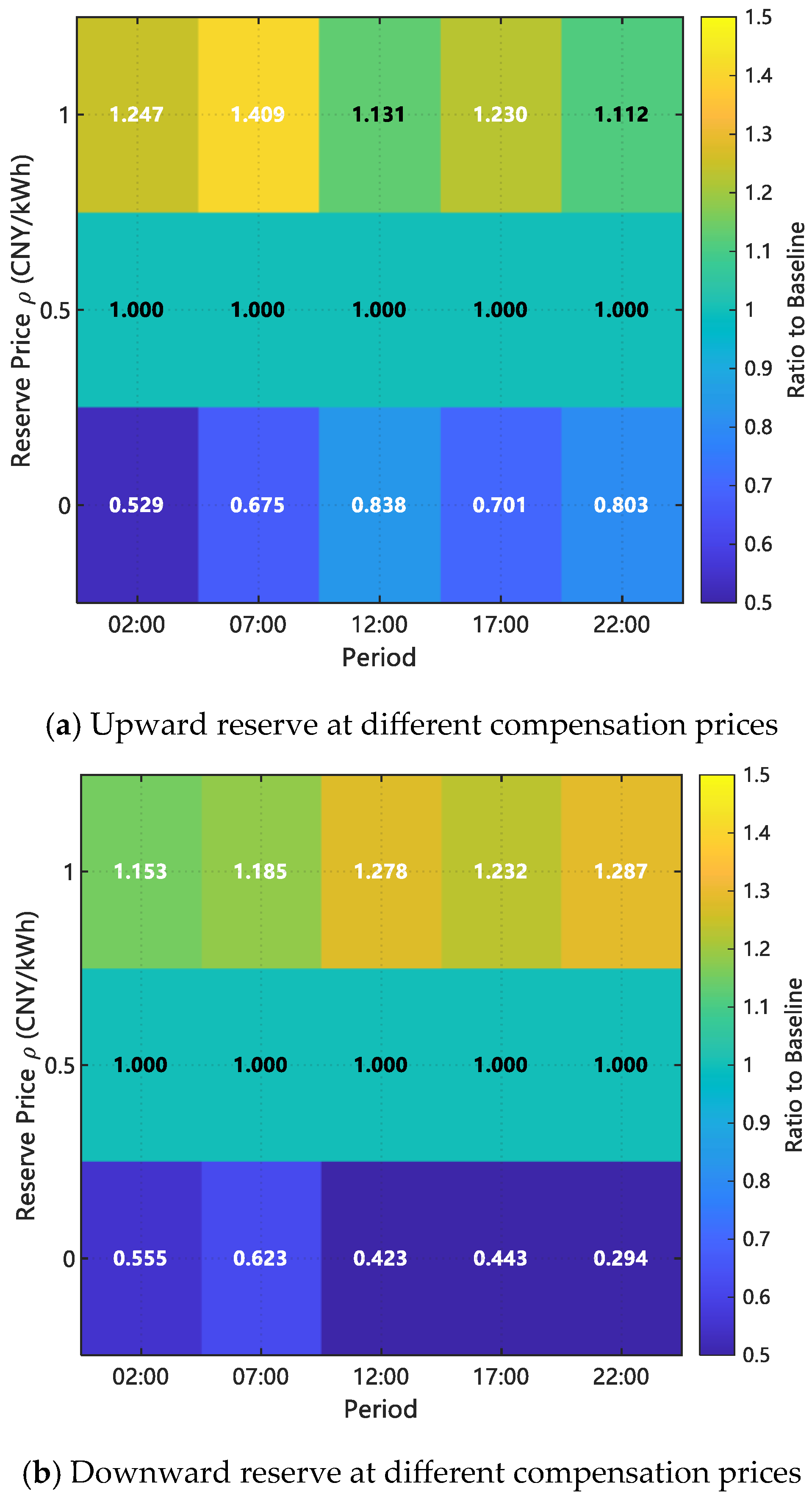
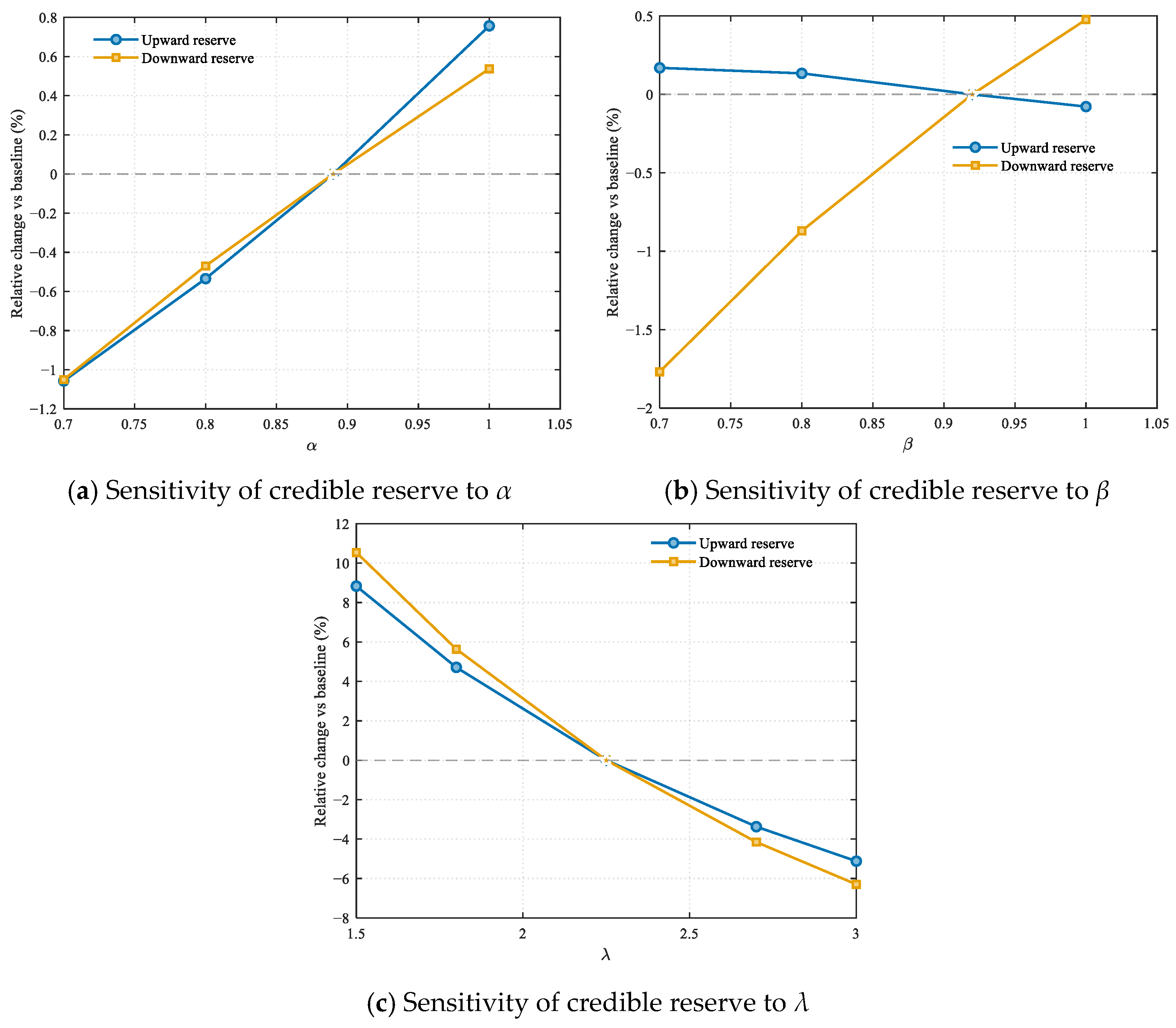
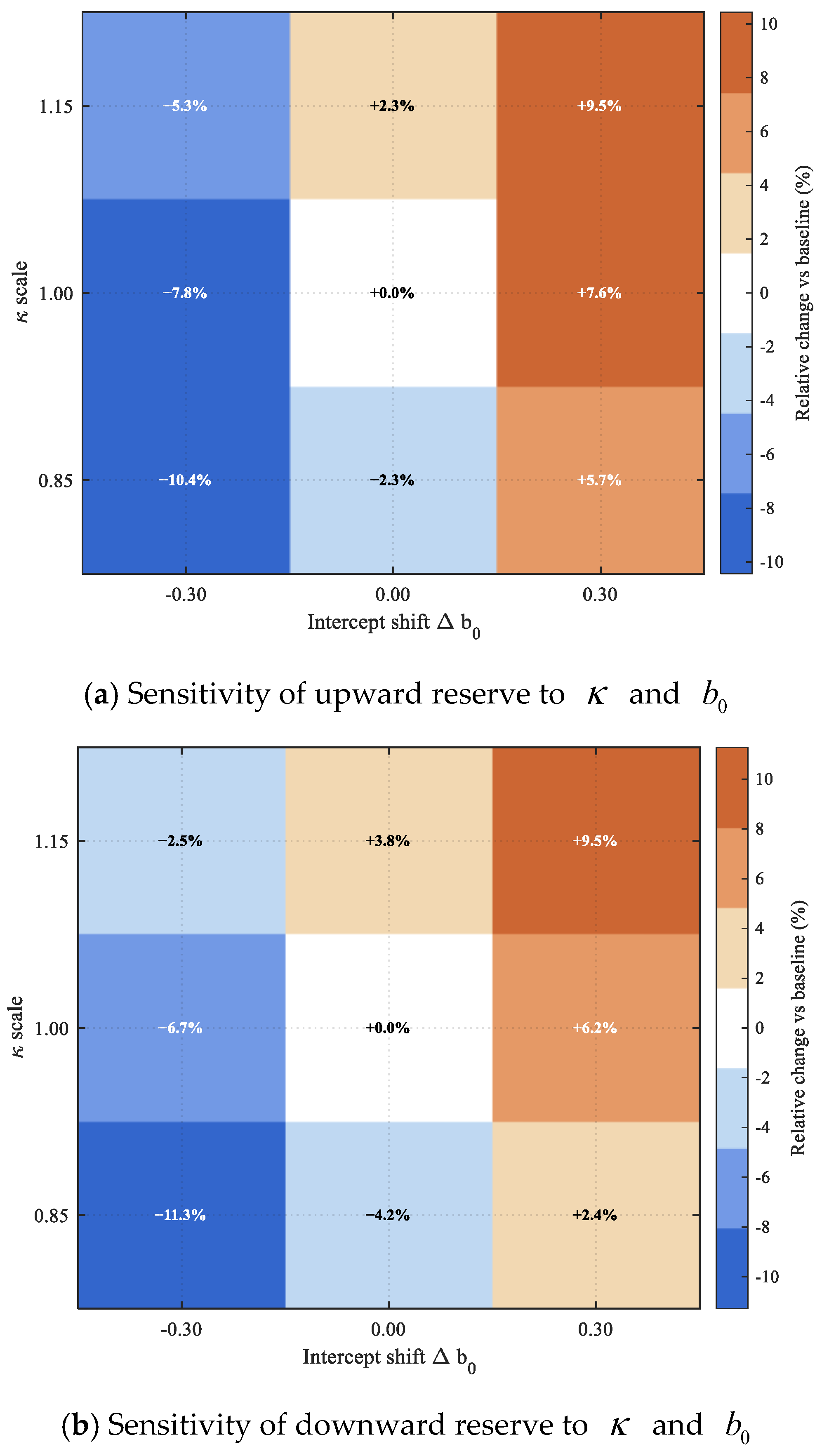
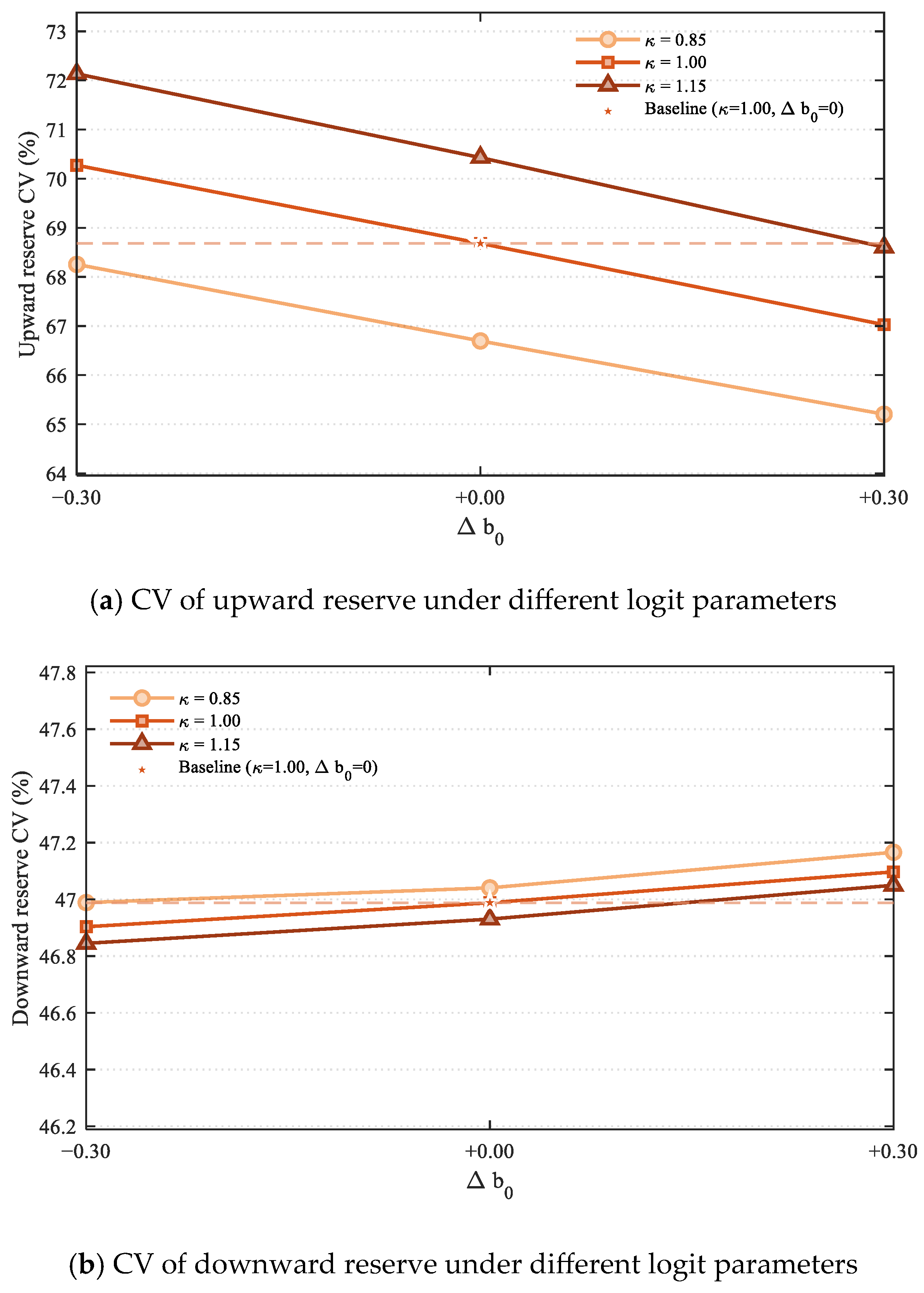
5.4. Behavioral Parameter Sensitivity
6. Conclusions
Author Contributions
Funding
Institutional Review Board Statement
Informed Consent Statement
Data Availability Statement
Conflicts of Interest
Appendix A


| Parameter | Value | Upward CV (%) | Downward CV (%) |
|---|---|---|---|
| α | 0.70 | 67.1 | 47.3 |
| α | 0.80 | 67.9 | 47.1 |
| α | 0.89 | 68.7 | 47.0 |
| α | 1.00 | 69.6 | 46.9 |
| β | 0.70 | 70.0 | 46.8 |
| β | 0.80 | 69.4 | 46.9 |
| β | 0.92 | 68.7 | 47.0 |
| β | 1.00 | 68.3 | 47.0 |
| λ | 1.50 | 71.4 | 46.7 |
| λ | 1.80 | 70.2 | 46.8 |
| λ | 2.25 | 68.7 | 47.0 |
| λ | 2.70 | 67.5 | 47.1 |
| λ | 3.00 | 66.9 | 47.3 |
References
- Feng, Y.; Bian, X.; Cui, Y.; Jia, K.; Zhou, B.; Lin, S. Flexibility assessment and optimal scheduling based on the partition for receiving-end grid with high penetration of new energy. Electr. Power Syst. Res. 2026, 254, 112615. [Google Scholar] [CrossRef]
- Mo, D.; Chen, M.; Li, Q.; Yang, Y.; Wang, Z. Research on joint clearing of energy and ancillary service in the day-ahead market considering the weights of ancillary services. Front. Energy Res. 2025, 13, 1583300. [Google Scholar] [CrossRef]
- Zhong, B.; Yang, J.; Chen, Y.; Fang, H. Research hotspots and development trends of virtual power plant in the energy transition: A bibliometric analysis. Energy Rep. 2025, 14, 371–385. [Google Scholar] [CrossRef]
- Esfahani, M.; Alizadeh, A.; Cao, B.; Kamwa, I.; Xu, M. Bridging theory and practice: A comprehensive review of virtual power plant technologies and their real-world applications. Renew. Sustain. Energy Rev. 2025, 222, 115929. [Google Scholar] [CrossRef]
- Radaideh, A.; Vaidya, U. Sequential set-point control for heterogeneous thermostatically controlled loads through an extended Markov chain abstraction. IEEE Trans. Smart Grid 2017, 10, 116–127. [Google Scholar] [CrossRef]
- Gong, X.; Castillo-Guerra, E. Robust hierarchical control mechanism for aggregated thermostatically controlled loads. IEEE Trans. Smart Grid 2020, 12, 453–467. [Google Scholar] [CrossRef]
- Lin, S.; Liu, D.; Hu, F.; Li, F.; Dong, W.; Li, D.; Fu, Y. Grouping control strategy for aggregated thermostatically controlled loads. Electr. Power Syst. Res. 2019, 171, 97–104. [Google Scholar] [CrossRef]
- Tang, D.; Wang, P. Probabilistic modeling of nodal charging demand based on spatial-temporal dynamics of moving electric vehicles. IEEE Trans. Smart Grid 2015, 7, 627–636. [Google Scholar] [CrossRef]
- Xu, X.; Mi, Z.; Yu, S.; Zhan, Z.; Ji, L. Spatial-temporal response capability probabilistic evaluation method of electric vehicle aggregator based on trip characteristics modelling. IET Gener. Transm. Distrib. 2023, 17, 2192–2206. [Google Scholar] [CrossRef]
- Subramanya, R.; Yli-Ojanperä, M.; Sierla, S.; Hölttä, T. A virtual power plant solution for aggregating photovoltaic systems and other distributed energy resources for northern European primary frequency reserves. Energies 2021, 14, 1242. [Google Scholar] [CrossRef]
- Xue, J.; Shi, X.; Wang, C.; Cao, Y.; Zhang, H. Online evaluation of emergency power regulation capability for virtual power plants considering physical characteristics and user behavior constraints. Proc. CSEE 2023, 43, 2906. [Google Scholar] [CrossRef]
- Wang, Y.; Hug, G.; Liu, Z.; Zhang, N. Modeling load forecast uncertainty using generative adversarial networks. Electr. Power Syst. Res. 2020, 189, 106732. [Google Scholar] [CrossRef]
- Moghadam, A.T.; Bahramian, B.; Shahbaazy, F. Stochastic flexible power system expansion planning, based on the demand response considering consumption and generation uncertainties. Sustainability 2023, 15, 1099. [Google Scholar] [CrossRef]
- Mayer, M.J.; Yang, D. Probabilistic photovoltaic power forecasting using a calibrated ensemble of model chains. Renew. Sustain. Energy Rev. 2022, 168, 112821. [Google Scholar] [CrossRef]
- Darvishi, M.; Tahmasebi, M.; Shokouhmand, E. Optimal operation of sustainable virtual power plant considering the amount of emission in the presence of renewable energy sources and demand response. Sustainability 2023, 15, 11012. [Google Scholar] [CrossRef]
- Wen, Y.; Hu, Z.; You, S.; Duan, X. Aggregate feasible region of DERs: Exact formulation and approximate models. IEEE Trans. Smart Grid 2022, 13, 4405–4423. [Google Scholar] [CrossRef]
- Yi, Z.; Xu, Y.; Wei, X.; Sun, H. Robust security constrained energy and regulation service bidding strategy for a virtual power plant. CSEE J. Power Energy Syst. 2022, 11, 692–704. [Google Scholar] [CrossRef]
- Zeng, Z.; Sun, Q.; Zhao, W.; Bai, Y.; Deng, S.; Guo, J. Joint optimized operation of electricity spot and reserve markets considering bidding strategies for virtual power plants. IEEE Access 2024, 12, 166114–166125. [Google Scholar] [CrossRef]
- Li, W.; Dong, F.; Ji, Z.; Wang, P. Internal and external coordinated distributionally robust bidding strategy of virtual power plant operator participating in day-ahead electricity spot and peaking ancillary services markets. Appl. Energy 2025, 386, 125514. [Google Scholar] [CrossRef]
- Tian, F.; Bao, M.; Hui, H.; Qiu, Y.; Ding, Y. Reserve credit evaluation of virtual power plants considering multiple uncertainties. Power Syst. Prot. Control 2025, 53, 45–56. [Google Scholar] [CrossRef]
- Guo, P.; Lam, J.C.K.; Li, V.O.K. Drivers of domestic electricity users’ price responsiveness: A novel machine learning approach. Appl. Energy 2019, 235, 900–913. [Google Scholar] [CrossRef]
- Zhou, Y.; Shi, Z.; Shi, Z.; Gao, Q.; Wu, L. Disaggregating power consumption of commercial buildings based on the finite mixture model. Appl. Energy 2019, 243, 35–46. [Google Scholar] [CrossRef]
- Vallés, M.; Bello, A.; Reneses, J.; Frías, P. Probabilistic characterization of electricity consumer responsiveness to economic incentives. Appl. Energy 2018, 216, 296–310. [Google Scholar] [CrossRef]
- Gao, R.; Guo, H.; Zhang, R.; Mao, T.; Xu, Q.; Zhou, B.; Yang, P. A Two-Stage Dispatch Mechanism for Virtual Power Plant Utilizing the CVaR Theory in the Electricity Spot Market. Energies 2019, 12, 3402. [Google Scholar] [CrossRef]
- Yang, X.; Li, L. A joint sharing-sharing platform for coordinating supply and demand resources at distributed level: Coupling electricity and carbon flows under bounded rationality. Appl. Energy 2025, 393, 126051. [Google Scholar] [CrossRef]
- Gan, L.; Zhang, P.; Chen, Y.; Yu, K.; Chen, X.; Wang, B.; Hua, H. Residents’ bounded rationality in electricity demand response decision-making considering multidimensional living needs. Proc. CSEE 2025, 46, 595–607. [Google Scholar] [CrossRef]
- Junior, J.G.S.F.; Ohtake, H.; Oozeki, T.; Ogimoto, K. Prediction intervals for day-ahead photovoltaic power forecasts with non-parametric and parametric distributions. J. Electr. Eng. Technol. 2018, 13, 1504–1514. [Google Scholar] [CrossRef]
- Tversky, A.; Kahneman, D. Advances in prospect theory: Cumulative representation of uncertainty. J. Risk Uncertain. 1992, 5, 297–323. [Google Scholar] [CrossRef]
- Möller, A.; Groß, J. Probabilistic temperature forecasting based on an ensemble autoregressive modification. Q. J. R. Meteorol. Soc. 2016, 142, 1385–1394. [Google Scholar] [CrossRef]
- Zhang, W.; Hu, Q.; Yu, X. Analysis on Influence of Residents’ Response Probability Distribution on Load Aggregation Effect. Front. Energy Res. 2022, 10, 951618. [Google Scholar] [CrossRef]
- Makarov, Y.V.; Loutan, C.; Ma, J.; de Mello, P. Operational impacts of wind generation on California power systems. IEEE Trans. Power Syst. 2009, 24, 1039–1050. [Google Scholar] [CrossRef]







| Parameter | Units | Value | |
|---|---|---|---|
| AC | Number of units | 3000 | |
| Room area | m2 | ||
| kW | |||
| kWh/°C | |||
| °C/kW | |||
| 3.0 |
| Parameter | Units | Value | |
|---|---|---|---|
| EV | Number of units | 500 | |
| kWh | |||
| , | kW | 7 | |
| , | 0.95 | ||
| Initial SOC | |||
| expected SOC at departure |
| Parameter | Units | Value | |
|---|---|---|---|
| PVSIS | SOC limits | 0.1, 0.9 | |
| , | kW | 200 | |
| 0.95 | |||
| 0.9 | |||
| kWh | 1200 | ||
| PV installed capacity | MW | 2.0 |
| Time Period | Type | Residential Price (yuan/kWh) | Commercial Price (yuan/kWh) |
|---|---|---|---|
| 10:00–18:00 14:00–20:00 | Peak | 0.620 | 1.125 |
| 08:00–10:00, 12:00–14:00, 20:00–24:00 | Standard | 0.520 | 0.654 |
| 00:00–08:00 | Valley | 0.340 | 0.274 |
| AC | EV | |
|---|---|---|
| Upward reserve P1, P2 | 0.28, 0.78 | 0.20, 0.65 |
| Downward reserve P1, P2 | 0.15, 0.58 | 0.18, 0.65 |
Disclaimer/Publisher’s Note: The statements, opinions and data contained in all publications are solely those of the individual author(s) and contributor(s) and not of MDPI and/or the editor(s). MDPI and/or the editor(s) disclaim responsibility for any injury to people or property resulting from any ideas, methods, instructions or products referred to in the content. |
© 2026 by the authors. Licensee MDPI, Basel, Switzerland. This article is an open access article distributed under the terms and conditions of the Creative Commons Attribution (CC BY) license.
Share and Cite
Yang, T.; Cheng, Q.; Chen, B.; Lu, D.; Wu, H.; Zhu, Y. Credible Reserve Assessment Method for Virtual Power Plants Considering User-Bounded Rationality Response. Sustainability 2026, 18, 3130. https://doi.org/10.3390/su18063130
Yang T, Cheng Q, Chen B, Lu D, Wu H, Zhu Y. Credible Reserve Assessment Method for Virtual Power Plants Considering User-Bounded Rationality Response. Sustainability. 2026; 18(6):3130. https://doi.org/10.3390/su18063130
Chicago/Turabian StyleYang, Ting, Qi Cheng, Butian Chen, Danhong Lu, Han Wu, and Yiming Zhu. 2026. "Credible Reserve Assessment Method for Virtual Power Plants Considering User-Bounded Rationality Response" Sustainability 18, no. 6: 3130. https://doi.org/10.3390/su18063130
APA StyleYang, T., Cheng, Q., Chen, B., Lu, D., Wu, H., & Zhu, Y. (2026). Credible Reserve Assessment Method for Virtual Power Plants Considering User-Bounded Rationality Response. Sustainability, 18(6), 3130. https://doi.org/10.3390/su18063130