Article

Credible Reserve Assessment Method for Virtual Power Plants Considering User-Bounded Rationality Response


School of Electric Power Engineering (School of Shenguorong), Nanjing Institute of Technology, Nanjing 211167, China
*
Author to whom correspondence should be addressed.
Sustainability 2026, 18(6), 3130; https://doi.org/10.3390/su18063130
Submission received: 8 February 2026 / Revised: 16 March 2026 / Accepted: 20 March 2026 / Published: 23 March 2026
(This article belongs to the Special Issue Smart Grid Technology Contributing to Sustainable Energy Development)

Abstract

Virtual power plants (VPPs) aggregate flexible resources, such as distributed photovoltaics (PV), energy storage, and flexible loads, to provide substantial reserve capacity for grid operation. However, the combined effects of renewable energy output uncertainty, load forecast errors, and user-bounded rationality responses lead to significant errors in traditional deterministic VPP reserve assessment methods, severely affecting the balance between system supply and demand. To address this challenge, this paper proposes a credible reserve assessment method that accounts for user-bounded rationality. First, thermodynamic models with on–off constraints for air conditioning loads, energy feasible region, and power constraint models for electric vehicles (EVs) and energy storage systems (ESSs), as well as PV forecast error models are established to characterize physical reserve boundaries. Second, prospect theory is introduced to describe user-bounded rationality and a logit-based response probability model is developed. Monte Carlo sampling and kernel density estimation are employed to derive credible reserve sets under different confidence levels, achieving a probabilistic quantification of VPP reserve capacity distribution. Case studies demonstrate that the proposed method accurately characterizes the probabilistic distribution characteristics of VPP reserve provision under multiple uncertainties, providing comprehensive and reliable assessment information for power dispatching agencies.

1. Introduction

With the deepening implementation of China’s carbon peaking and carbon neutrality goals, the installed capacity of renewable energy, particularly wind and solar power, continues to rise. Their inherent randomness and volatility intensify the pressure on flexibility regulation within the power system, leading to increasingly prominent risks of insufficient flexibility in regulatory resources [1,2]. In this context, VPPs, as an advanced aggregation and control approach, can consolidate massive, distributed resources, such as distributed PV, electric vehicles, thermostatically controlled loads, and energy storage, into controllable units. This serves as a key approach to ensuring a balance between grid supply and demand while enhancing system flexibility [3,4]. However, the resources aggregated by VPPs exhibit significant discreteness and time-varying characteristics, making accurate reserve capacity assessment a fundamental prerequisite for their participation in power system dispatch.
To characterize the reserve capacity of VPPs, it is essential to establish physical models that describe the constraints and dynamic characteristics of sources, loads, and storage. Aggregation models for thermostatically controlled loads have been developed based on equivalent thermal parameter models and population state transition equations. These models enable the analysis of operational reserve capacity while adhering to indoor comfort constraints [5,6,7]. For electric vehicles, stochastic modeling methods and adjustable capacity calculation frameworks have been proposed, derived from statistical analyses of historical charging behavior and traffic characteristics [8,9]. The architecture and key supporting technologies for aggregating building-side PV, energy storage, and loads into VPPs have been discussed, along with online assessment methods for VPP emergency power regulation capacity, which consider equipment safety and user behavior constraints [10,11]. However, these approaches are primarily established under deterministic operating conditions and do not adequately address uncertainties related to source-side output and operating environments.
To address uncertainty factors, generative adversarial networks, statistical machine learning, and probabilistic temperature prediction models have been employed to model the uncertainty distribution and correlations of load and PV output [12,13,14]. Operational business constraints and stochastic fluctuations have been incorporated into VPP aggregation models [15,16]. When VPPs engage in market transactions, three-layer robust optimization, joint energy-frequency regulation bidding models, conditional value at risk, and distributionally robust optimization methods have been applied to handle uncertainties in upper-level control commands, market clearing results, and risk-constrained bidding strategies [17,18,19]. Credible reserve assessment approaches that consider multiple stochastic factors have been proposed, comprehensively modeling PV output, load forecast deviations, and meteorological factor volatility [20]. Despite these advancements, most studies regard VPP-aggregated flexible resources as fully controllable or rationally responsive entities, neglecting to adequately address user-side behavioral deviations and their impact on reserve reliability.
The continuous improvement of demand response mechanisms has established widely distributed residential and commercial loads as significant regulatory resources. User behavioral characteristics and bounded rationality have a substantial influence on the reserve capacity of VPPs. Early research has demonstrated the impact of user behavior on load variation trends through the recognition of electricity consumption behavior and the decomposition of load type [21,22].
As demand response mechanisms continue to mature, widely distributed residential and commercial loads have emerged as significant regulatory resources for VPPs participating in reserve services. However, the accurate assessment of VPP reserve capacity is challenged by multiple sources of uncertainty, including fluctuations in renewable energy output, errors in load forecasting, and variations in user response behavior [23]. Several studies have proposed assessment strategies based on CVaR, robust optimization, and distributionally robust optimization, primarily targeting risk-averse dispatch and bidding [19,24]. These approaches emphasize the incorporation of risk preferences within optimization frameworks to facilitate sound decision-making, rather than characterizing the probability distribution of deliverable reserve capacity. Furthermore, existing studies generally treat VPP-aggregated resources as fully rational responding entities, giving insufficient attention to deviations in user behavior and their impact on reserve reliability.
In practice, residential users participating in demand response are constrained by limited cognitive capacity and varying willingness to self-regulate. Their decisions are influenced not only by energy costs and incentive payoffs, but also by non-economic factors such as thermal comfort requirements, EV charging convenience, and established electricity consumption habits. This paper refers to such deviations from fully rational decision-making as bounded rationality. Compared with classical expected utility theory, prospect theory more accurately captures users’ subjective decision mechanisms when weighing economic gains against comfort losses by incorporating reference dependence, loss aversion, and the asymmetric perception of gains and losses [25,26]. Therefore, it is adopted in this paper to characterize the relationship between user-bounded rationality and behavioral decisions. Building on this foundation, user-bounded rationality responses are introduced probabilistically into the VPP reserve aggregation framework. The logit model is then employed to map the subjective prospect values derived from prospect theory into individual response probabilities, while Monte Carlo simulation, combined with kernel density estimation, is used to obtain the probability distribution of VPP reserve capacity, from which credible reserve capacity at different confidence levels is quantitatively determined.
To address the identified research gap, this paper develops a credible reserve assessment framework for VPPs that explicitly incorporates user-bounded rationality under multiple uncertainties. The main contributions of this paper are as follows:
(1)
Physical operational boundary models for air conditioning loads, energy storage resources, and distributed PV are established to provide foundational support for the reserve capacity calculation of various flexible resources;
(2)
Prospect theory is introduced to characterize users’ loss aversion characteristics, and combined with the logit model, a VPP response probability model reflecting user-bounded rationality is proposed to refine the physical operational boundary model;
(3)
Monte Carlo simulation and kernel density estimation techniques are employed to quantify VPP credible reserve capacity under different confidence levels, comprehensively considering both physical-side forecast errors and behavioral-side response randomness;
(4)
The correctness and effectiveness of the proposed method are validated through comprehensive case study analysis.

2. Physical Models of VPP Resources

2.1. VPP Architecture

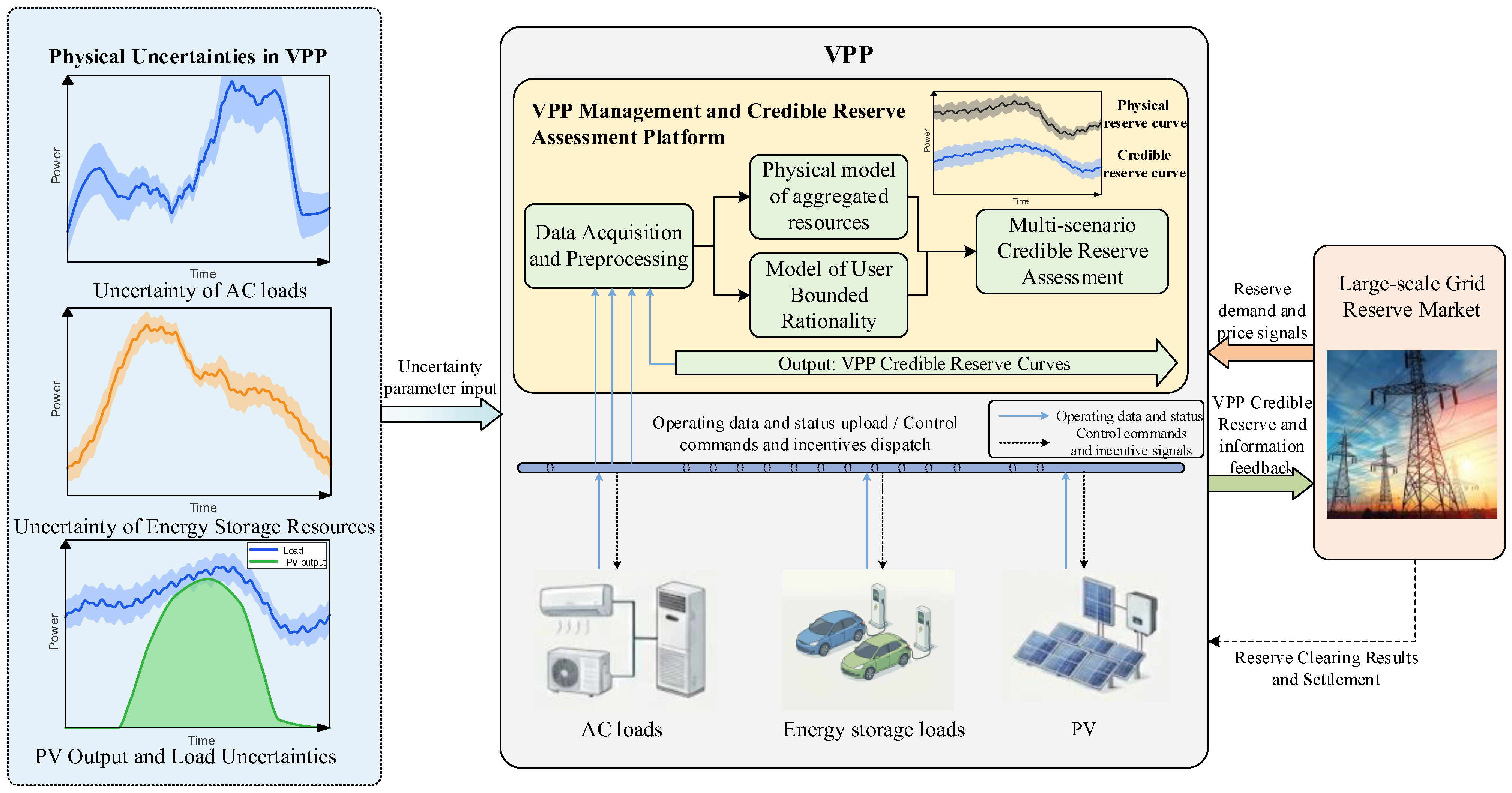
VPPs organize scattered and heterogeneous resources, such as air conditioning loads, electric vehicles, energy storage systems, and distributed photovoltaic systems, into a unified regulatory framework through an aggregation control platform. Acting as a singular market entity, VPPs assume the response and performance responsibilities associated with reserve services externally, as illustrated in Figure 1. The reserve capacity is fundamentally governed by the physical states and duration constraints of the resources, which fluctuate in accordance with environmental conditions and user behavior. Consequently, operational models for flexible resources must be established to delineate physically feasible reserve boundaries, thereby providing unified inputs for the subsequent probabilistic characterization of credible reserves.

2.2. Physical Modeling of Air Conditioning Loads

2.2.1. First-Order RC Equivalent Thermal Parameter Model

Residential air conditioning loads, as typical thermostatically controlled equipment, exhibit operational states that are closely related to both indoor and outdoor temperatures. Considering the thermal inertia characteristics of buildings, a first-order RC equivalent circuit is employed to simulate the thermodynamic process. Let the indoor temperature of the room where the i-th air conditioner is located be θ i ( t ) ; its dynamic evolution follows the differential equation:
C i d θ i ( t ) d t = 1 R i θ i ( t ) θ out ( t ) + m i ( t ) R i Q i
where C i is the equivalent thermal capacitance (kWh/°C); R i is the equivalent thermal resistance (°C/kW); θ out ( t ) is the outdoor ambient temperature; m i ( t ) is the compressor on–off state variable (1 for on, 0 for off); Q i is the equivalent cooling power amplitude, satisfying Q i = η i P i AC with rated electrical power P i AC and energy efficiency ratio η i .
Define the time constant τ i = R i C i , representing the characteristic timescale of room temperature change. When the switch state m i ( t ) remains constant within time step Δt the analytical expression for indoor temperature in the discrete time domain is:
θ i ( t + Δ t ) = θ eq , i ( t ) + θ i ( t ) θ eq , i ( t ) e Δ t R i C i
where θ i , eq is the equilibrium temperature under the current switch state:
θ i , eq ( t ) = θ out ( t ) m i ( t ) R i Q i

2.2.2. Thermostat Hysteresis Control Logic

The operational state of the air conditioner is automatically regulated by the thermostat, which responds to the indoor temperature and the user-set temperature. This system demonstrates typical hysteresis control characteristics. Let the user-set target temperature be θ i , set and the width of the thermostat’s dead zone width be σ i . The lower and upper bounds of the operating temperature are defined as follows:
θ i , min = θ i , set σ i 2 θ i , max = θ i , set + σ i 2
Under this control logic, the switching rule for the on–off state m i ( t ) is determined by the position of the current temperature in relation to the established boundaries:
m i ( t ) = 0 , θ i ( t ) θ i , min 1 , θ i ( t ) θ i , max m i ( t ϵ ) , θ i , min < θ i ( t ) < θ i , max
where ϵ represents an infinitesimal time step, indicating state maintenance within the dead zone.
To exploit the regulatory potential, indoor temperature is permitted to deviate moderately from normal operating boundaries for short periods. The introduction of user-acceptable extreme tolerance deviations Δ θ max and Δ θ min expands both the operational and regulation boundaries:
θ i , max tol = θ i , max + Δ θ max θ i , min tol = θ i , min Δ θ min

2.2.3. Reserve Regulation Capacity and Duration Constraints

The core of air conditioner participation in reserve services lies in assessing the maximum duration for which a specific regulatory state can be maintained without exceeding temperature tolerance limits. The adjustable duration requirement for the equipment is typically referred to as TD, which ranges from 15 to 60 min. This paper specifically focuses on fixed-frequency air conditioners, where the baseline operating state is defined as the natural on–off switching trajectory based on the thermostat dead zone.
For an air conditioner in the on state ( m i ( t ) = 1 ) at time t, the duration function that describes the evolution of indoor temperature to evolve from state θ a to state θ b is defined as follows:
t ( θ a , θ b , θ eq ) = τ i ln θ a θ i , eq θ b θ i , eq
Both the natural remaining on/off time ( t i , on rem , t i , off max ) and maximum off/on holding time ( t i , off rem , t i , on max ) can be obtained by substituting the corresponding temperatures.
Based on the adjustable duration parameter, the physical reserve capacity of a single air conditioner can be quantitatively evaluated under a specific reserve duration, TD. The reserve provided by the air conditioner must satisfy two essential conditions: it must have an adjustment margin in the current state; and the duration of the adjusted state must cover the reserve demand. Consequently, the evaluation model for the reserve capacity of air conditioning loads can be expressed as follows:
R t , up AC ( t , T D ) = P i AC , if   m i ( t ) = 1   and   T D min ( t i , on rem , t i , off max ) 0 , otherwise
R t , down AC ( t , T D ) = P i AC , if   m i ( t ) = 0   and   T D min ( t i , off rem , t i , on max ) 0 , otherwise

2.3. Unified Modeling Framework for Energy Storage Resources

EVs and ESSs exhibit significant similarities in their physical mechanisms, both conceptualized as energy storage and power conversion systems that adhere to the same principles of energy conservation and power limitations. The primary distinction between the two lies in their dispatch flexibility: EVs are constrained by user travel demand and specific access or disconnection time windows, while ESSs can operate continuously but must adhere to periodic operational constraints to prolong their lifespan. This section will first establish a unified model before delineating their differentiated constraints.

2.3.1. Common Model for Energy Storage Resources

For the j-th energy storage unit (EV or ESS) within the time step Δ t , the SOC dynamic evolution follows the energy balance equation:
SOC j ( t + 1 ) = SOC j ( t ) + η j , ch P j , ch ( t ) Δ t E j , rated P j , dis ( t ) Δ t η j , dis E j , rated
where P j , ch and P j , dis are charging and discharging power (kW); E j , rated is rated capacity (kWh); and η j , ch and η j , dis are charging and discharging efficiencies.
Energy storage units must satisfy the following constraints:
(1)
SOC boundary constraints: To prevent overcharging/overdischarging damage, SOC must remain within a safe range:
SOC min SOC j ( t ) SOC max ;   and
(2)
Power boundary and charge-discharge mutual exclusion constraints:
0 P j , ch ( t ) u j ( t ) P j , ch max 0 P j , dis ( t ) 1 u j ( t ) P j , dis max
where P j , ch max and P j , dis max represent maximum charging and discharging power, respectively.
This common model applies to all energy storage resources, establishing a foundation for unified reserve capacity assessment methodology.

2.3.2. EV Special Constraints and Reserve Capacity

As mobile energy storage units with random access characteristics, the regulation capability of EVs is primarily constrained by user travel demands. For the j-th electric vehicle, the evolution of its battery state is limited not only by its physical capacity E j cap , but also by the requirement that the charge at departure time t out meets user expectations E j exp . The baseline operating state of the EV is defined as the minimum electricity cost charging plan P j base ( t ) , satisfies user travel demands and is derived through optimization.
Based on charge–discharge feasible region theory, the energy state Ej(t) at any time t during EV access must be maintained between upper boundary E j max ( t ) and lower boundary E j min ( t ) . The upper boundary represents the energy trajectory of immediate maximum power charging after vehicle access, reflecting the physical energy storage limit. The lower boundary is derived backward from the expected charge at user disconnection:
E j max ( t ) = min E j cap , E j ( t in ) + τ = t in t P j , ch max η j , ch Δ t E j min ( t ) = max E safe , E j min ( t + 1 ) P j , ch max η j , ch Δ t
where t in is vehicle access time; E safe is the baseline charge for safe operation.
The energy feasible region constraint is:
E j , min ( t ) E j ( t ) E j , max ( t ) ,         t [ t in , t out ]
Depending on the bidirectional power transmission capability, the characteristics of EV reserves can be categorized into two modes: unidirectional orderly charging (V1G) and bidirectional charge–discharge (V2G) modes.
(1)
V1G Reserve Capacity
In V1G mode, EVs provide ancillary services only through unidirectional charging power regulation. The upward reserve capacity R j , up V 1 G is:
R j , up V 1 G ( t , T D ) = max 0 , min P j base ( t ) , E j base ( t + T D ) E j min ( t + T D ) η ch T D
The downward reserve capacity R j , down V 1 G is:
R j , down V 1 G ( t , T D ) = max 0 , min P ch , j max P j base ( t ) , E j max ( t + T D ) E j base ( t + T D ) η ch T D
(2)
V2G Reserve Capacity
For EVs equipped with V2G functionality, they can reverse-transmit electrical energy to the grid, significantly expanding upward reserve range.
The energy margin is defined as:
Δ E j avail ( t + T D ) = E j base ( t + T D ) E j min ( t + T D )
where Δ E j avail ( t + T D ) represents the energy margin of vehicle charge relative to minimum charge boundary at reserve response completion time. S j ( t ) is defined as the baseline charging energy over the duration TD:
S j ( t ) = η ch P j base ( t ) T D
Then the V2G upward reserve capacity is defined as:
R j , up V 2 G ( t , T D ) = max 0 , min P j base ( t ) , Δ E j avail ( t + T D ) η ch T D , Δ E j avail ( t + T D ) < S j ( t ) P j base ( t ) + max 0 , min P dis , j max , η dis ( Δ E j avail ( t + T D ) S j ( t ) ) T D , Δ E j avail ( t + T D ) S j ( t )
The V2G mode facilitates a complete interruption of charging while also providing supplementary discharge power support. This approach considers energy utilization efficiency, particularly concerning discharge losses. Furthermore, the downward reserve calculation is consistent with the methodology employed in V1G mode.

2.3.3. ESS Constraints and Reserve Capacity

The ESS operates without travel constraints and can be regarded as a continuously controllable bidirectional energy storage unit. The reserve capacity is primarily determined by SOC safety boundaries, charge–discharge power limits, and mutual exclusion constraints. The baseline operating state of the ESS is derived solving an economic dispatch model that takes into account peak-valley arbitrage.
Based on Equations (10)–(12), the reserve supply capacity within dispatch duration TD assessed. The upward physical reserve R k , up ESS is:
R k , up ESS ( t , T D ) = max 0 , min P k , dis max , ( S k ( t ) S k , min ) E k , r η k , dis T D
The downward physical reserve R k , down ESS is:
R k , down ESS ( t , T D ) = max 0 , min P k , ch max , ( S k , max S k ( t ) ) E k , rated η k , ch T D

2.4. Distributed Photovoltaic Output Modeling

As a stochastic power source, distributed PV output exhibits significant volatility influenced by irradiance and temperature. To accurately quantify its reserve contribution, a probabilistic model that accounts for forecast errors has been constructed. Notably, PV output forecast errors typically adhere to a normal distribution [27]. The actual PV output P pv ( t ) at time t is described as the linear superposition of the deterministic forecast value P pv pre ( t ) and the random forecast error ξ pv ( t ) :
P pv ( t ) = P pv pre ( t ) + ξ pv ( t )
where ξ pv ( t ) N 0 , σ pv 2 ( t ) . PV output has a physical upper bound of rated power and lower bound of 0:
P pv ( t ) = max { 0 , min { P rated , P pv pre ( t ) + ξ pv ( t ) } }

3. VPP Reserve Modeling Considering User-Bounded Rationality

The actual reserve capacity of VPPs is significantly constrained by the bounded rationality of users. Unlike traditional methods that assume a complete response of resources, this section takes into account the nonlinear characteristics of users’ perceptions of benefits, particularly loss aversion, as well as the randomness inherent in decision-making. A mapping model is developed that integrates principles from physics, psychology, and probability.

3.1. Prospect Theory Value Function

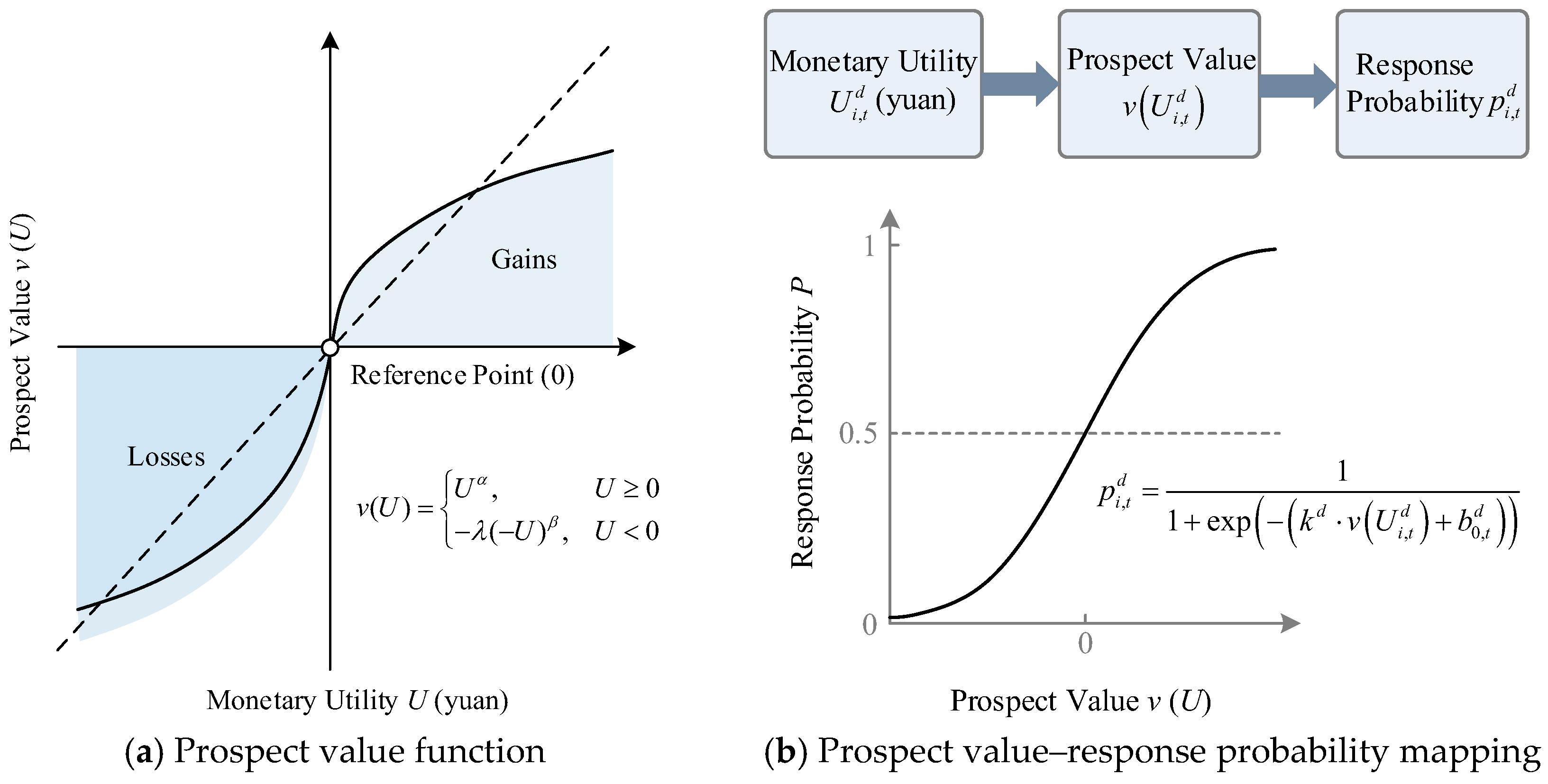
Classical expected utility theory posits that decision-makers are risk-neutral, relying on expected monetary benefit as the foundation for their decisions. However, empirical research indicates that actual decision-makers exhibit systematic biases, including loss aversion and reference dependence, when confronted with uncertain returns. Prospect theory characterizes this nonlinear feature through the value function v ( U ) :
v ( U ) = U α , U 0 λ ( U ) β , U < 0
where U is the net monetary benefit (yuan), with reference point at 0 relative to the non-response situation; α and β are power function exponents controlling marginal sensitivity diminishing in gain and loss regions, with α , β ( 0 , 1 ) ; λ is the loss aversion coefficient, characterizing that users’ sensitivity to losses is significantly higher than it is to equivalent gains. Classic parameters α = 0.89 , β = 0.92 , λ = 2.25 [27] are adopted. The prospect theory parameters are assumed to be homogeneous across users for tractability, which may neglect behavioral heterogeneity in the aggregated response.
This paper employs the prospect theory value function for the nonlinear transformation of monetary utility, while utilizing the logit function for modeling response probabilities. This approach is adopted to circumvent the issue of double-probability distortion, as illustrated in Figure 2.

3.2. Unified Utility Modeling Framework

The monetary net utility of resource i responding to the upward/downward reserve in period t is defined as:
U i , d t = ρ t R i , d t , T D T D Δ C i , d elc t Δ C i , d will t
where ρ t is the reserve compensation price (yuan/kWh); R i , d t , T D is the physical reserve capacity (kW, calculated by Section 1), with superscript d indicating the direction; Δ C i , d elc t is the incremental electricity cost (yuan); Δ C i , d will t is the response resistance cost (yuan).

3.2.1. Air Conditioning Load Utility Calculation

For air conditioners responding to upward reserve TD, after response ends, indoor temperature rises, requiring additional on-time Δ T rec to restore the set temperature:
Δ T rec = τ i ln θ i ( t + T D ) θ i , eq θ i , set θ i , eq
The AC upward reserve response necessitates a forced shutdown for a duration of TD, which results in a temperature increase. Following this response, an additional on-time Δ T rec is required to restore the temperature to the setpoint. Consequently, there is an increment in electricity costs:
Δ C AC , up elc = π ¯ rec P i AC Δ T rec π t P i AC T D
where π t is the electricity price at time t (yuan/kWh); π ¯ rec is the weighted average electricity price during recovery.
For an AC responding to down-reserve TD, the post-response room temperature rises from θ i ( t + T D ) until reaching the upper boundary θ max , i tol , triggering shutdown again. This saved on-time is expressed as:
Δ T sav = τ i ln θ i , eq θ i ( t + T D ) θ i , eq θ i , max tol
The electricity cost increment is defined as:
Δ C AC , down elc = π t P i AC T D π ¯ sav P i AC Δ T sav
where π ¯ sav is the weighted average electricity price during saving.
Traditional methods calculate user response expenses based solely on additional electricity costs. This paper introduces a comfort value theory based on the Weber–Fechner law to construct a response resistance cost model that accounts for user-bounded rationality.
The temperature deviation ratio D i ( t ) is defined as:
D i ( t ) = exp | θ i t θ i , set t | | θ out t θ i , set t | 1
Based on the Weber–Fechner law, normalized comfort is described by exponential decay:
U i AC ( t ) = e D i ( t )
The response resistance cost is defined as the value lost due to decreased comfort:
C AC , d will = P i AC ( t ) π t T D 1 e D i ( t )

3.2.2. Electric Vehicle Utility Calculation

The calculation of EV user utility employs the baseline optimal charging strategy as a reference. For short-term reserves, an approximate method is utilized to significantly reduce computational complexity while maintaining accuracy.
The electricity cost increment is approximated as:
Δ C EV , up elc = ( π ¯ rec π t ) R j , t cut T D + π ¯ rec E def η c π t R j , t dis T D
Δ C EV , down elec = π t π ¯ sav R j , t down T D
where R j , t cut = min ( P j , t base , R j , t up ) represents the charging reduction portion; R j , t dis = R j , t up R j , t cut denotes the V2G discharge portion; and E def = R j , t dis T D / η d represents the energy deficit from discharging (kWh).
In the context of EVs, the cost associated with response resistance primarily arises from the loss of battery lifespan due to cycling. This cost can be equivalently defined as the degradation cost of the battery. Define the degradation cost per unit energy throughput as C deg (yuan/kWh), where C deg = C j bat / E j life , with C j bat being the battery replacement cost (yuan) and E j life being the lifetime allowable throughput (kWh). EVs only incur additional degradation costs when providing an upward reserve:
C EV , up will = C deg 2 E def

3.3. Logit Response Probability Model

3.3.1. Prospect Value Calculation

Substituting monetary utility U i , d into Equation (24) yields the subjective prospect value:
V i , d = v ( U i , d )
This transformation maps objective monetary benefits to subjective perception, accounting for loss aversion and diminishing marginal sensitivity.

3.3.2. Logit Response Probability Mapping

The response probability of i-th user in period t for direction d reserve is mapped from prospect value V i , d through the logit function:
p i , d t = 1 1 + exp { ( κ d V i , d t + b 0 , d t ) }
where κ d is the sensitivity parameter controlling the response probability’s sensitivity to marginal changes in prospect value; and b 0 , d t is a time-varying intercept capturing the baseline response rate.
Given that the magnitudes of prospect values vary significantly among different resource types, utilizing a unified approach for κ d would yield inappropriate response probabilities. Consequently, κ AC , d and κ EV , d are calibrated separately to accommodate their respective value scales and to reflect the heterogeneity of the user group.

3.3.3. Parameter Calibration Method

To capture users’ intrinsic sensitivity to costs, the utility calculation in the calibration excludes the reserve compensation price, retaining only inherent items, such as the electricity cost increment and degradation cost, denoted as U 0 , i , d t . When calculating the actual response probability, the complete utility is substituted into Equations (36) and (37).
The two-point quantile method is adopted to estimate logit parameters κ d and b 0 , d t . Two characteristic quantiles q L and q U are selected, with corresponding prospect values V q L , d and V q U , d . The expected response probability anchor points are set as P1 and P2. Simultaneous solving yields the parameter analytical formula shown in Equation (38):
κ d = logit ( P 2 ) logit ( P 1 ) V q U , d V q L , d
b 0 , d t = logit ( P 1 ) κ d V q L , d

3.3.4. Resource Aggregation Model Considering Stochastic Response

The actual available reserve capacity of VPPs is influenced not only by physical regulatory boundaries but is also governed by the inherent randomness associated with user-bounded rationality. Based on the individual response probability p i , d t calculated in Section 3.3.2, the response state of the i-th participant in period t for direction d reserve is modeled as a Bernoulli-distributed random variable:
s i , d t Bernoulli ( p i , d t ) ,         s i , d t { 0 , 1 }
where s i , d t = 1 indicates actual response, and s i , d t = 0 indicates non-response. Response behaviors are assumed to be mutually independent [28]:
VPP’s actual available reserve capacity R d agg t , T D aggregated at time t is characterized as the random weighted sum of all resource physical capacities:
R d agg t , T D = i = 1 N R i , d t , T D s i , d t

4. VPP Credible Reserve Assessment Method

4.1. VPP Aggregation Model Considering Multiple Uncertainties

Uncertainty in VPP operations arises from both physical forecast errors and behavioral user heterogeneity. Physical uncertainty includes outdoor temperature, PV output, and load forecasts. Conversely, behavioral uncertainty relates to individual variations in user-set temperatures and probabilistic responses influenced by bounded rationality. The set of uncertainty variables is:
y = { θ out , P PV , L , θ set }
Outdoor temperature, PV output, and load forecast errors are assumed to follow normal distributions, whereas user-set temperatures follow a uniform distribution. The total reserve capacity of the VPP is obtained by aggregating the reserve capacities of different resources. At time t, the upward reserve capacity of the VPP is given by Equation (43):
R up agg ( t , T D ) = i = 1 N AC R i , up AC + j = 1 N EV R j , up EV + R up ESS + R up PV
Downward reserve capacity can be calculated according to Equation (44):
R down agg ( t , T D ) = i = 1 N AC R i , down AC + j = 1 N EV R j , down EV + R down ESS + R down PV

4.2. Credible Reserve Definition and Mathematical Characterization

Traditional deterministic methods yield single values for reserve capacity, which inadequately reflect the risks associated with uncertainty. In practical power system dispatch, the optimal scenario involves reserve resources that respond precisely to dispatch commands. If VPPs rely on deterministic reserve assessment results, they may struggle to execute dispatch commands effectively due to operational uncertainties during emergencies, leading to an insufficient actual reserve provision.
VPPs should therefore submit credible reserve estimates that account for uncertainties to dispatching agencies. This enables decision-makers to comprehensively consider both risk and economic factors. At the maximum risk level ω allowed by the system, a credible reserve is defined for a confidence level γ = 1 − ω, representing the reserve capacity VPPs can provide with at least γ probability, denoted as R γ , t , satisfying, as follows:
P r R VPP ( t ) R γ , t = γ
where R VPP ( t ) is the VPP’s actual reserve capacity at time t. From a statistical perspective, R γ , t is essentially the γ-quantile of the reserve capacity probability distribution. The key to accurately assessing credible reserve lies in obtaining the probability density function of R VPP ( t ) .
The kernel density estimation method is employed, utilizing N reserve capacity samples { R ( 1 ) , R ( 2 ) , , R ( N ) } generated by Monte Carlo simulation to fit probability density function f ^ ( r ) . Based on the fitted cumulative distribution function F ^ 1 , credible reserve capacity can be obtained by solving the inverse cumulative distribution function:
R γ , t = F ^ 1 ( 1 γ )
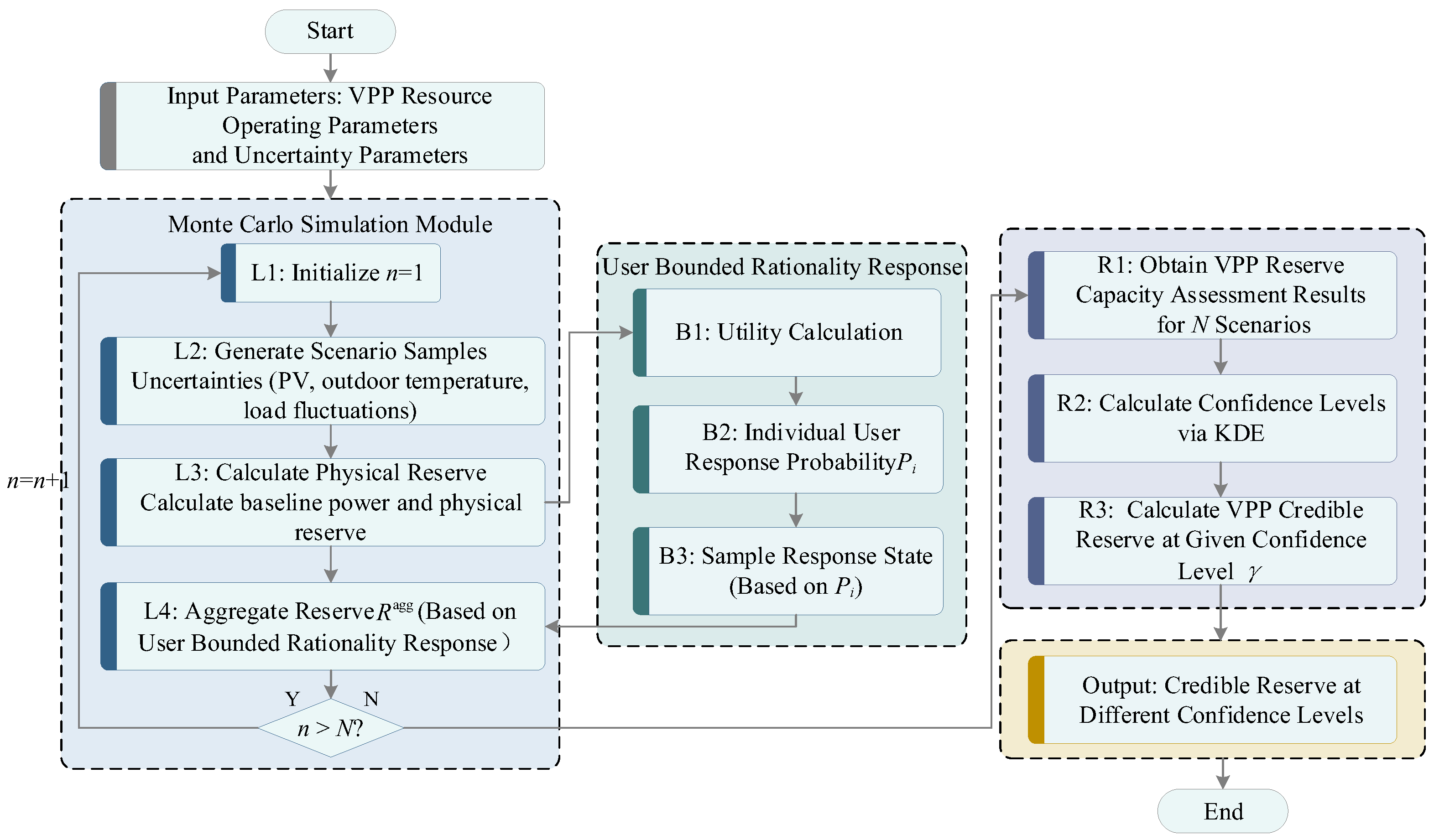
The VPP credible reserve assessment methodology is illustrated in Figure 3.

5. Case Study Analysis

5.1. Case Scenario and Parameter Settings

The VPP in the simulation example of this article comprises three typical types of distributed resources: residential AC loads, energy storage resources, and distributed PV. Although EVs and ESSs can be theoretically unified within the energy storage framework, it is essential to recognize that, in practice, energy storage is often utilized to stabilize the output of distributed PV systems. As a result, ESS is integrated with distributed PV to create a photovoltaic–storage integrated system (PVSIS), which is implemented in commercial complexes.
AC loads are assumed to operate throughout the day, with a difference of 1 °C between users’ maximum and minimum tolerable temperatures and their temperature settings. Additionally, it is assumed that 20% of vehicles participate in V2G systems. Key simulation parameters are summarized in Table 1, Table 2 and Table 3.
The simulation time range is 24 h, the reserve duration TD is 30 min, and the reserve compensation price is ρ = 0.5 yuan/kWh. Time-of-use pricing adopts actual pricing from a Chinese province, as shown in Table 4.
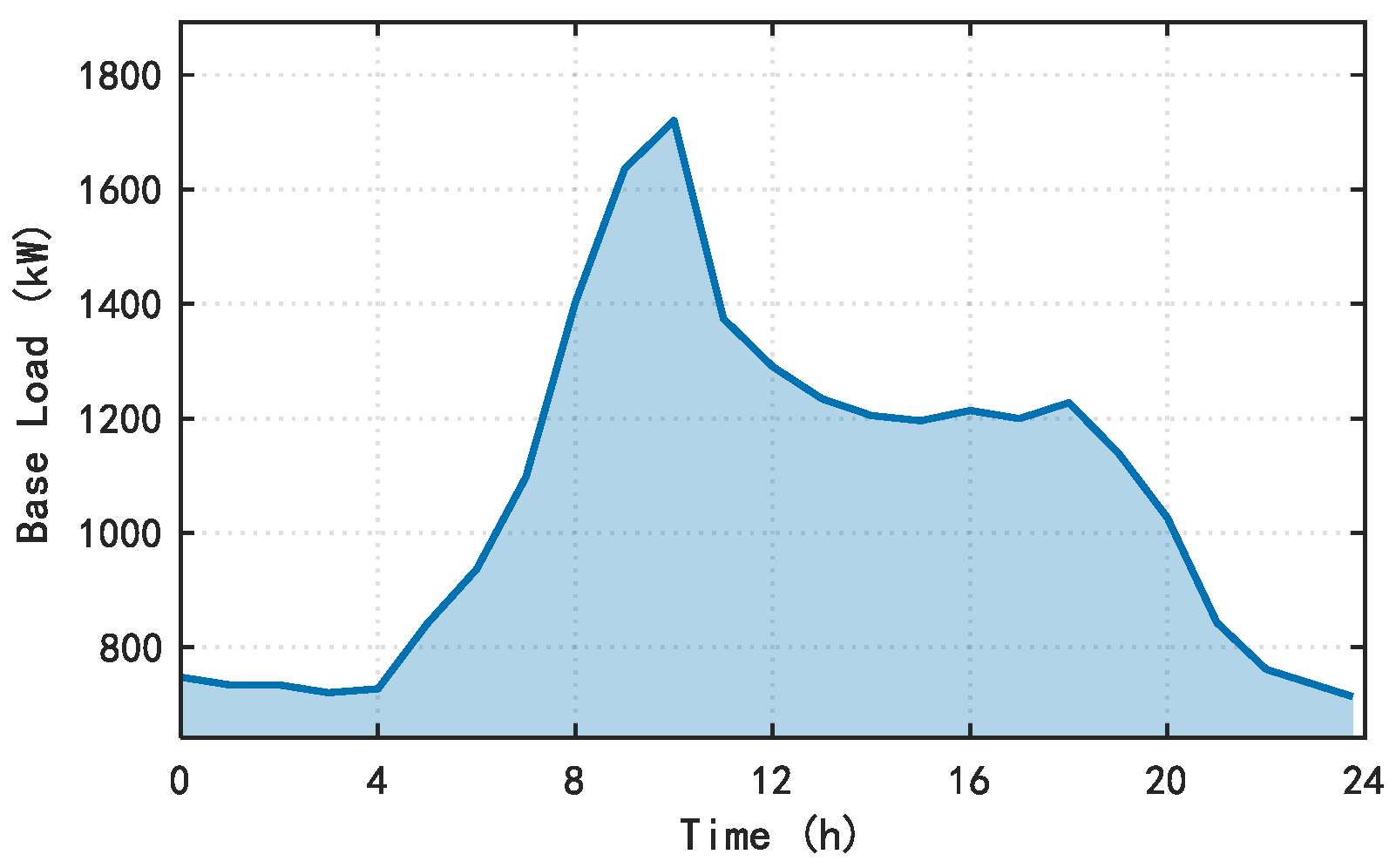
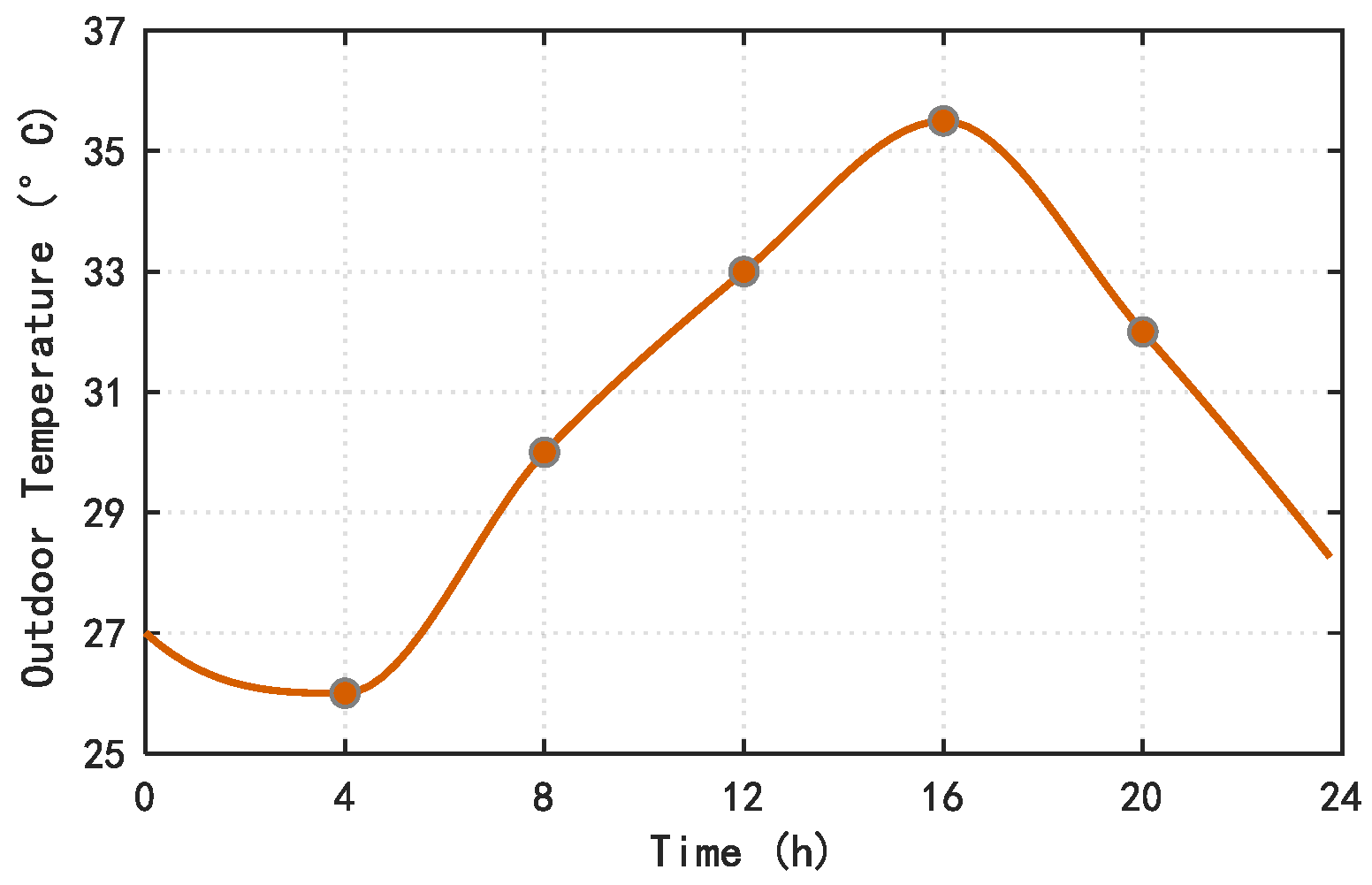
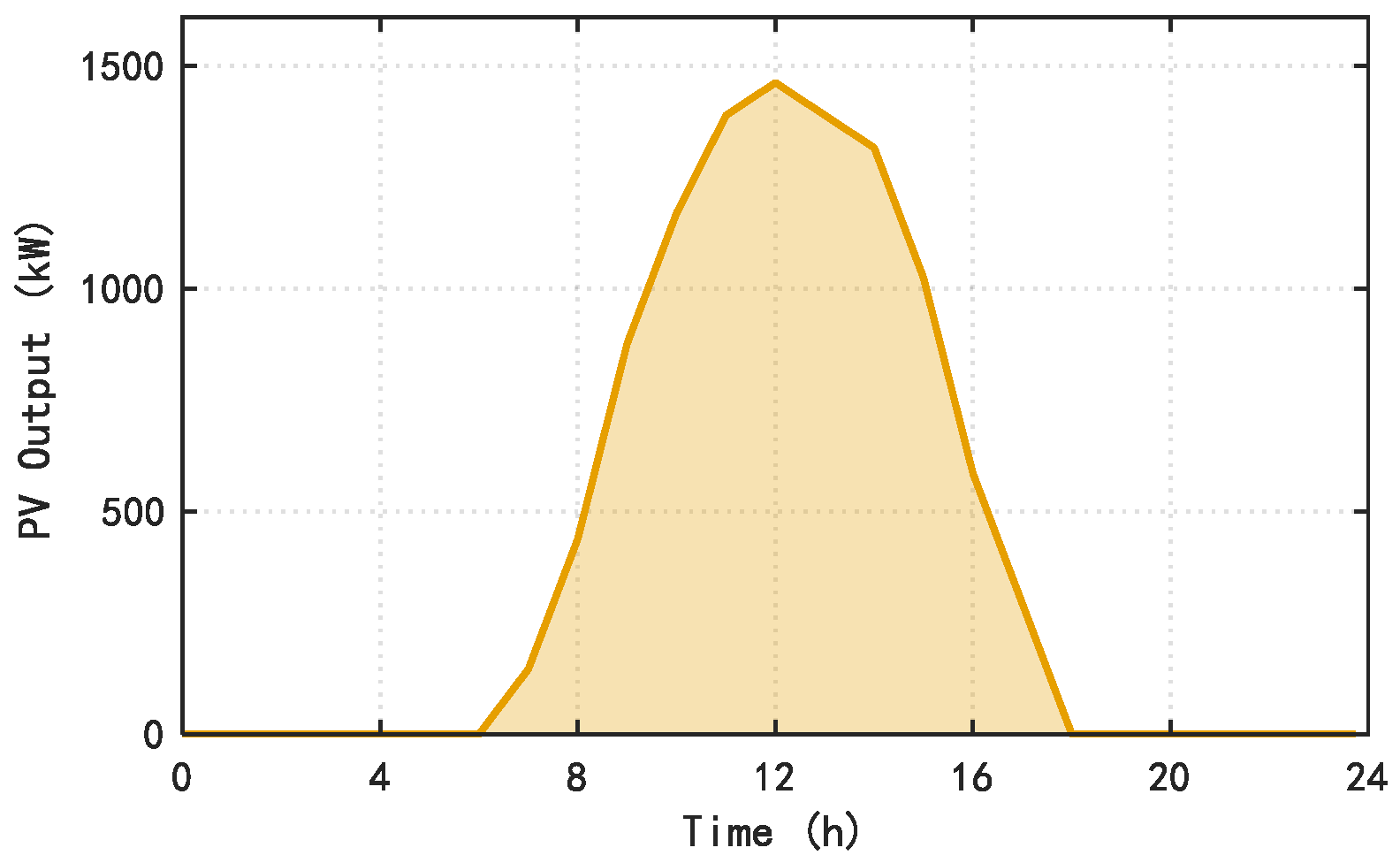
Reasonable assumptions are made regarding forecast error distributions. Environmental temperature forecast error follows a normal distribution, with mean being the preset value in Figure 4 and standard deviation, 2% of the mean [29]. The basic load forecast error is 3% [30,31] (Figure 5). Distributed PV output follows a normal distribution, with the mean being the preset value in Figure 6 and a standard deviation of 5% of the mean. Users’ temperature settings follow a uniform distribution between 22–27 °C.
User-bounded rationality is characterized using prospect theory and mapped to response probability through the logit model. Due to the absence of user behavior survey data, the “utility quantile-probability anchoring” method proposed in Section 3.3.3 is adopted to calibrate logit parameters. Quantiles 0.2 and 0.8 are selected as representative low- and high-utility anchor points to mitigate extreme-tail bias while maintaining adequate contrast for logit calibration. The corresponding response probabilities are denoted as P1 and P2, as illustrated in Table 5. These parameters guarantee a minority response under low utility and a majority response under high utility, thereby reflecting the relatively difficult-to-accept characteristics of EV upward reserve.

5.2. VPP Credible Reserve Assessment

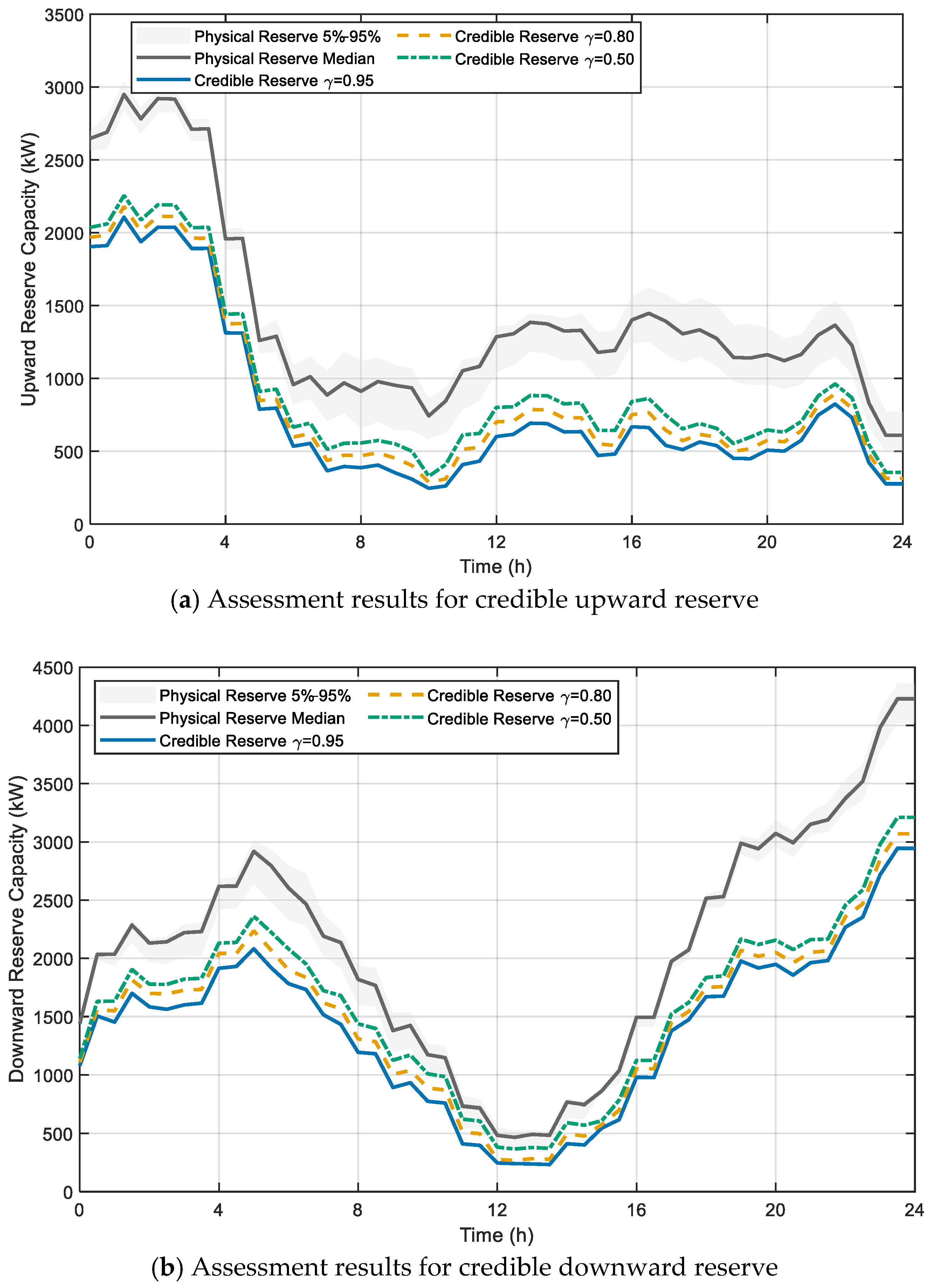
Employing the proposed model, the upward and downward reserve capacity of the VPP was calculated, as illustrated in Figure 7. The analysis reveals that, after accounting for user-bounded rationality, the credible reserve at a confidence level of 0.95 is approximately 60% to 80% of the median physical reserve. The reserve capacity of the VPP exhibits pronounced intraday fluctuations. During daytime, the upward reserve volume is substantial due to strong AC cooling demand, peak PV output, and the majority of EVs being disconnected. In contrast, nighttime displays different characteristics, with a significant number of EVs connected, which become the primary source of upward reserve, a decrease in AC demand, and a relatively abundant downward reserve. Notably, reserve capacity valleys occur between 8:00 and 10:00 due to the disconnection of EVs before AC demand peaks. Figure 7 also presents credible reserve curves under various confidence levels, demonstrating that credible reserve decreases as confidence increases.
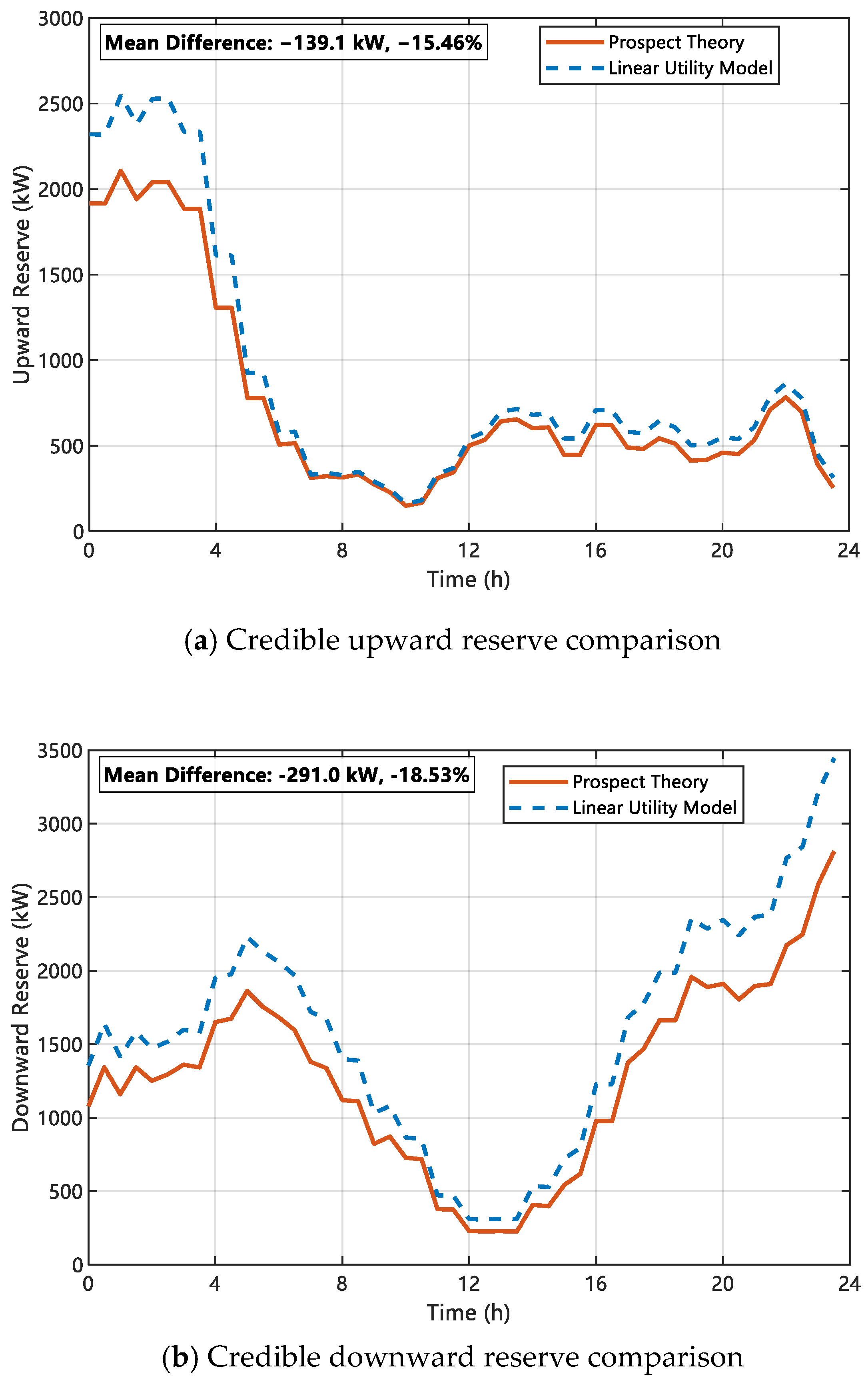
To elucidate the quantitative impact of user-bounded rationality, Figure 8 compares the proposed model with the traditional linear expected utility model. The results of the linear model are significantly higher across all periods, with an upward reserve mean deviation of approximately 139.1 kW, representing a relative deviation of 15.46%. When incorporating prospect theory and logit probability, the users’ asymmetric preferences for gains and losses are reflected in the changes in response probability. The linear model, which assumes risk neutrality, overlooks the concept of ‘loss aversion,’ resulting in an overestimation of user response probability.
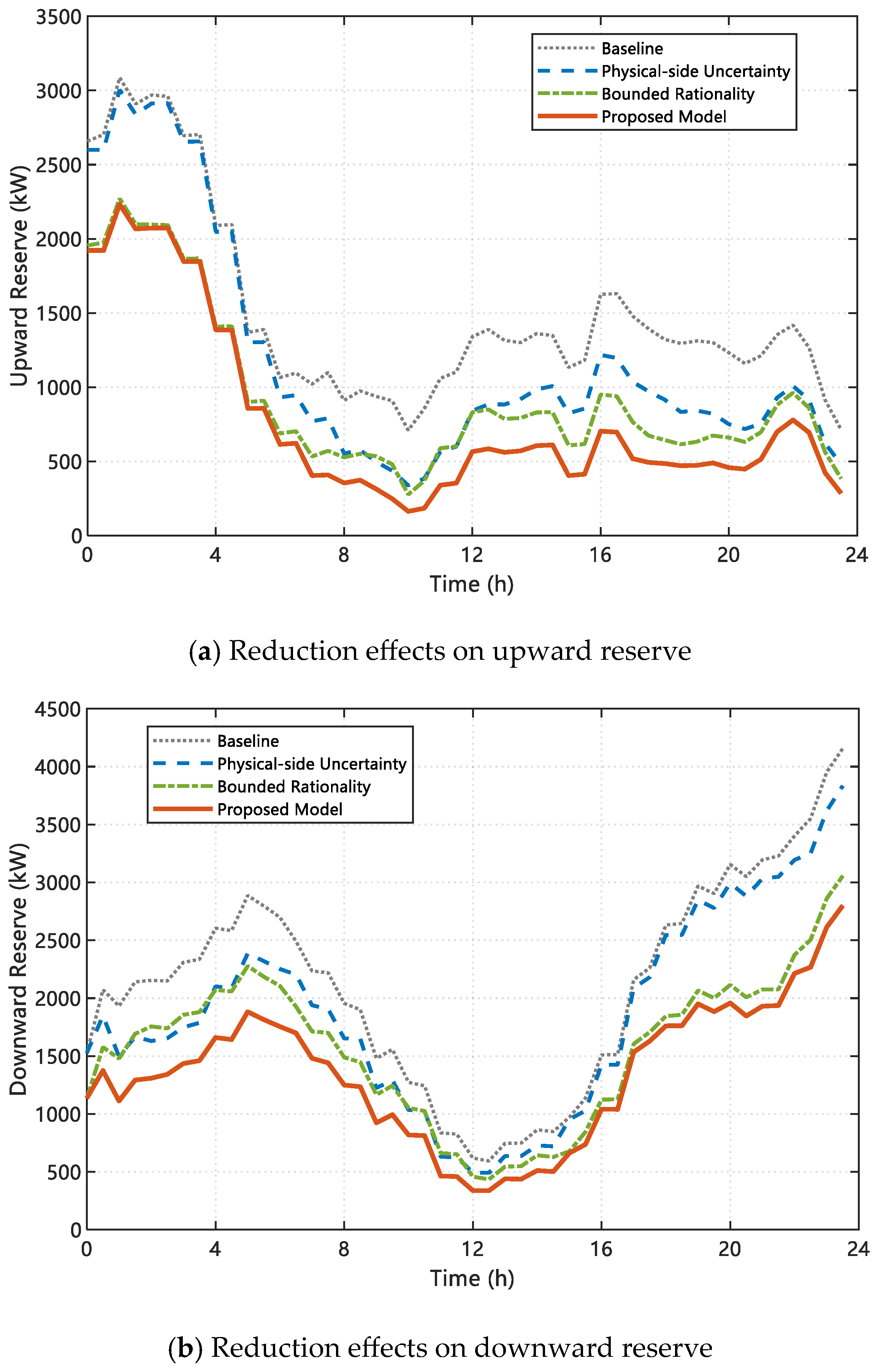
To quantify the impacts of multiple uncertainty factors, Figure 9 compares the reduction effects of physical-side forecast errors and user-bounded rationality. The reduction in reserve capacity after incorporating user-bounded rationality is more pronounced compared to physical forecast errors, with user-bounded rationality accounting for a dominant proportion of the total capacity reduction. This finding underscores the significant practical importance of comprehensively considering both factors to accurately characterize the actual available reserve capacity of VPPs.
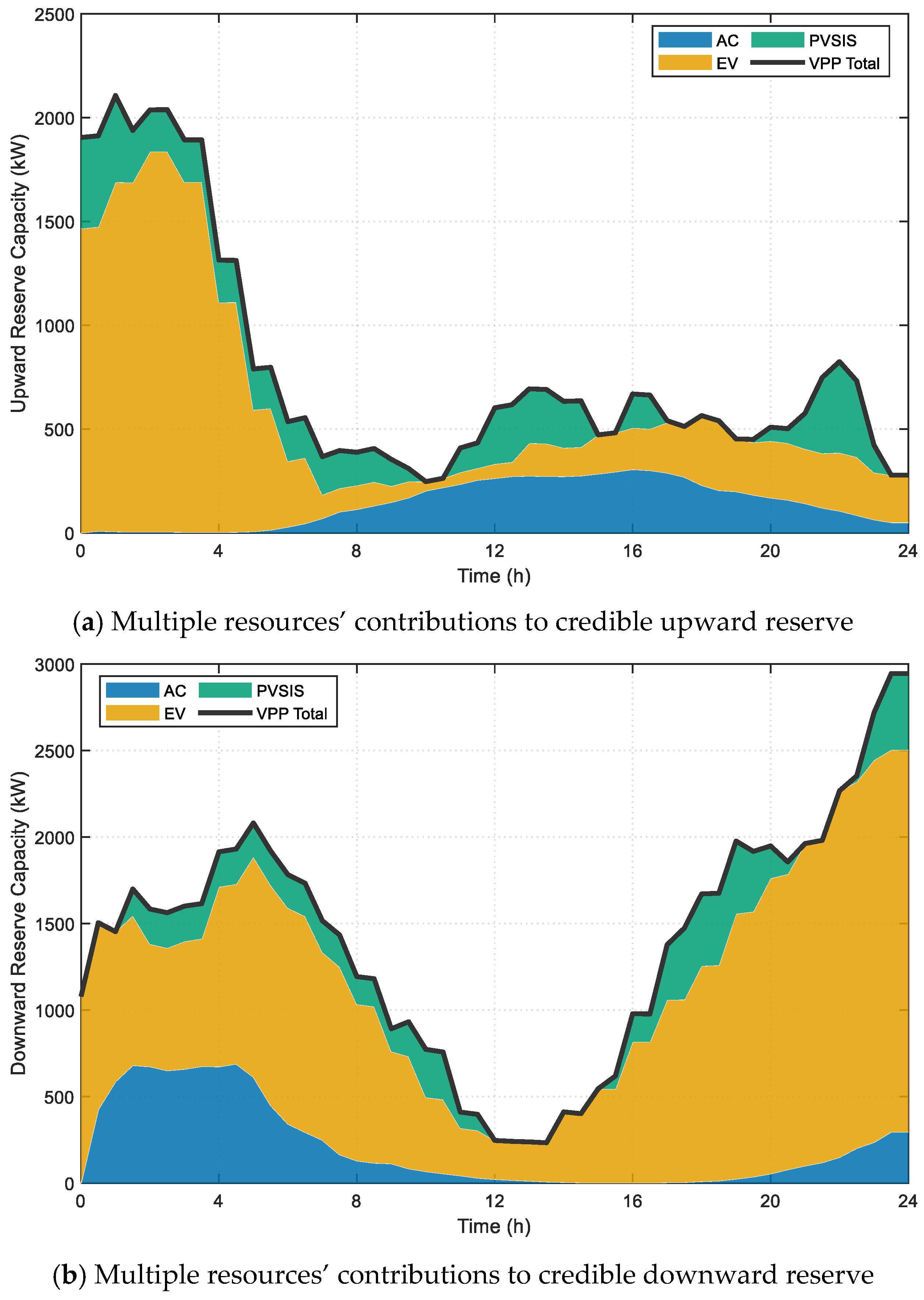
The contribution proportions of AC, EV, and PVSIS to VPP reserve are illustrated in Figure 10. Among these, EV exhibits the highest proportion, with a single vehicle capable of delivering a power output of 7 kW. Furthermore, V2G vehicles contribute upward reserve through reverse discharge, resulting in a regulation capacity that significantly surpasses that of AC. PVSIS, on the other hand, maintains a stable contribution throughout the day; however, its ability to provide downward reserve during peak PV generation is limited by the constraints of full energy storage. In comparison to individual resources, the total reserve curves of the VPP demonstrate a greater degree of smoothness. The aggregation of resources effectively mitigates drastic fluctuations observed in individual resources, while their relative independence further reduces uncertainty fluctuations.
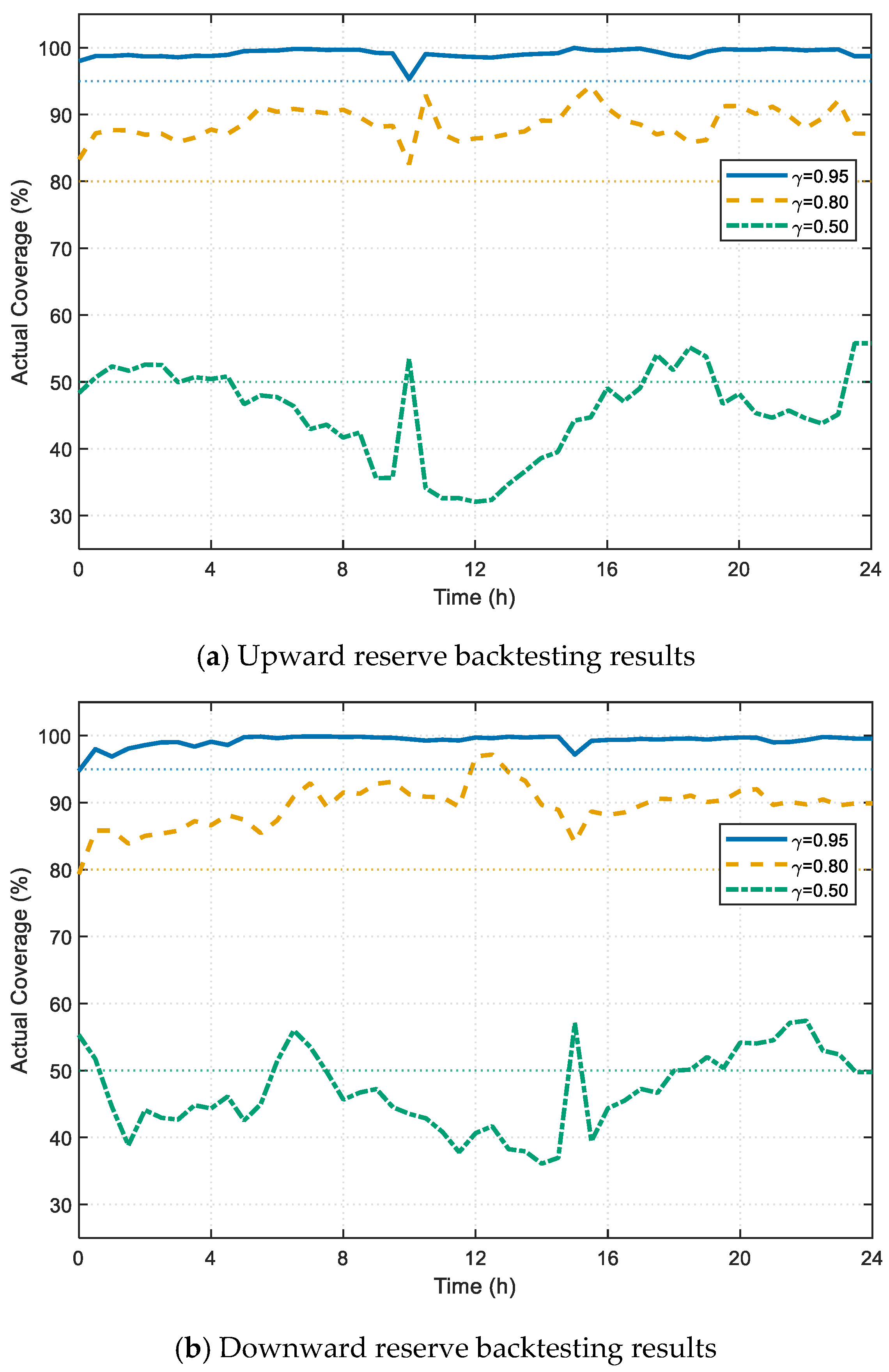
To verify the proposed method’s reliability, backtesting verification was conducted for results in Figure 10. Figure 11 reveals that actual coverage rates are approximately 99% (γ = 0.95), 89% (γ = 0.80), and 46% (γ = 0.50)—all fundamentally consistent with theoretical values. The slightly higher actual coverage rates indicate the conservative characteristics of the method. The upward reserve coverage rate experiences a marginal decrease between 8:00 and 10:00, which is consistent with the increased uncertainty during this transitional period. The backtesting results demonstrate that the deviation of the actual coverage rate remains within ±5%, thereby confirming the reliability of the proposed methodology.

5.3. Physical and Operational Parameter Sensitivity

The assessment of VPP credible reserves represents a multi-dimensional coupling process that involves economic incentives, physical constraints, and uncertainties. To analyze boundary effects and influence mechanisms, this section examines four key parameters: reserve compensation price; reserve duration; forecast uncertainty level; and user comfort tolerance limits.
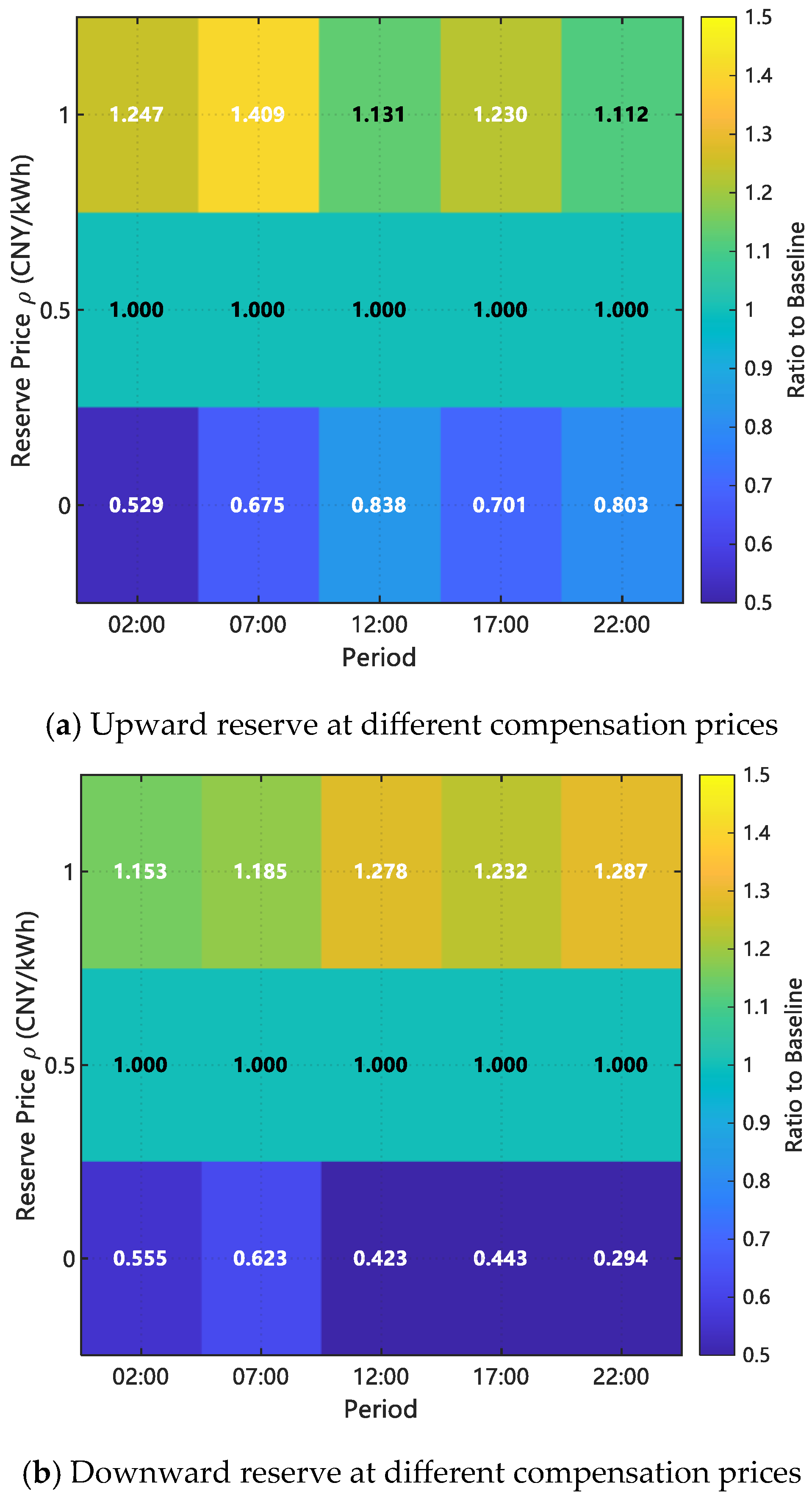
Reserve compensation prices were established at 0, 0.5, and 1.0 yuan/kWh; five typical moments were analyzed. Using the results with 0.5 yuan/kWh compensation and a 95% confidence level as the baseline, the ratios of results at each price level relative to the baseline are illustrated in Figure 12.
Analyzing the results presented in Figure 12 reveals a positive correlation between credible reserve capacity and compensation price, albeit with a marginal decreasing trend. An increase from 0 to 0.5 yuan/kWh results in an approximate 89% average upward reserve increase, while a subsequent increase from 0.5 to 1.0 yuan/kWh yields only about 20%. This suggests that high prices are approaching the limits of physical regulation. Furthermore, the upward reserve exhibits greater price sensitivity during daytime high-temperature periods, primarily due to the high-frequency regulation associated with AC loads. Conversely, downward reserve sensitivity is more pronounced from the afternoon to the evening, attributed to the significant connections of EVs and the corresponding demand for vigorous storage charging.
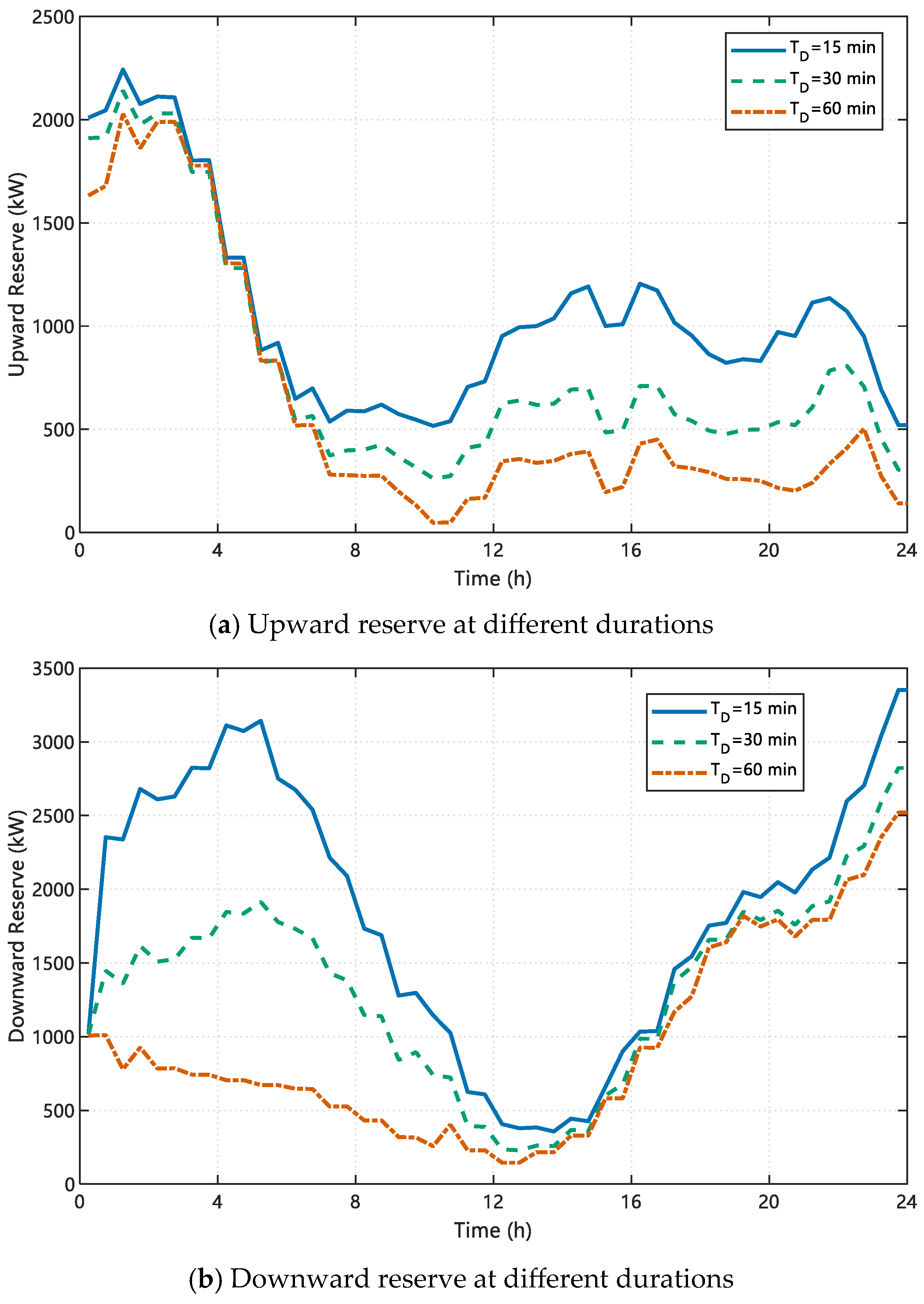
The reserve duration TD was set at 15, 30, and 60 min, with results presented at a 95% confidence level in Figure 13. As the TD extends from 15 to 60 min, the available reserve capacity throughout the day exhibits a significant decline. An increase in reserve duration exacerbates energy constraints, resulting in a substantial portion of resources being unable to satisfy the duration requirements. During periods of high afternoon temperatures, the upward reserve decreases markedly as the reserve duration increases, primarily due to the extensive aggregation of AC loads, which makes the temperature error have a more pronounced effect. Conversely, the downward reserve during nighttime and early morning shows relatively minor variations across different error levels. For downward reserves, during high afternoon temperatures when numerous AC loads are in operation, the temperature error has a diminished impact; however, during the transition from evening to nighttime, as the number of operational units decreases, the impact becomes more pronounced.
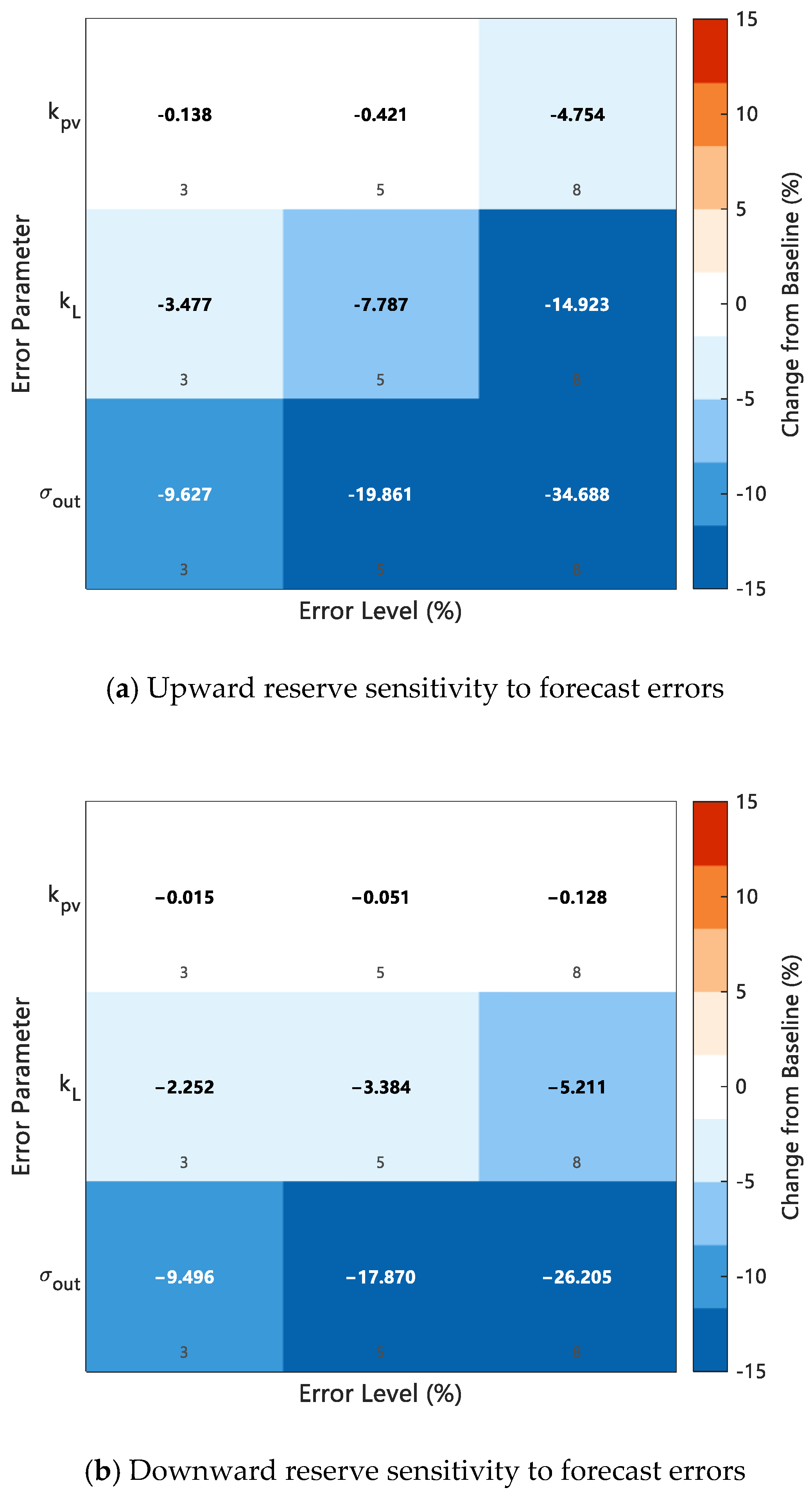
The standard deviations of environmental temperature, load, and PV forecast errors were established at 2%, 5%, and 8%, respectively. Using the results with all errors set at 5% and a 95% confidence level as a baseline, Figure 14 illustrates the differences between the results at each error level and the baseline.
Figure 14 demonstrates that the credible reserve is negatively correlated with forecast error. The vertical variation amplitude significantly exceeds the horizontal variation, indicating that the credible reserve of the VPP exhibits the greatest sensitivity to forecast errors in environmental temperature, while the impacts of load and PV forecast errors are comparatively limited.
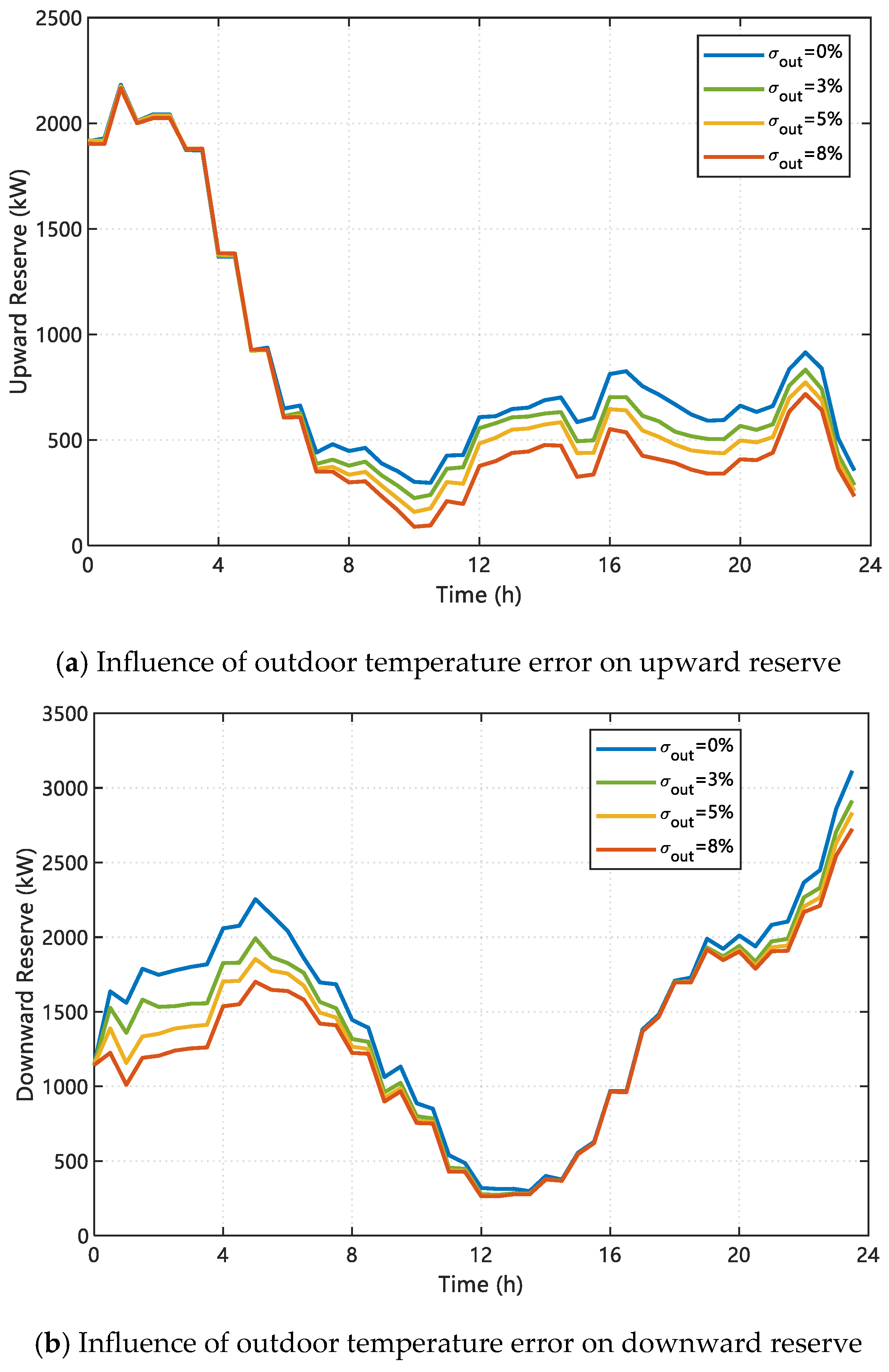
Given the dominant influence of outdoor temperature error, its temporal effects were further analyzed. The thresholds were set at 2%, 5%, and 8%, with results presented at a 95% confidence level in Figure 15. For upward reserve, during periods of high afternoon temperatures, the reserve decreases significantly as the temperature error increases due to the substantial aggregation of AC loads. In contrast, during nighttime and early morning when AC cooling demand is minimal, the differences are less pronounced. For downward reserve, during high afternoon temperatures when many AC units are in operation, the impact of temperature error is minimal; however, during the evening to nighttime, when the number of operational units decreases, the impact becomes more pronounced.
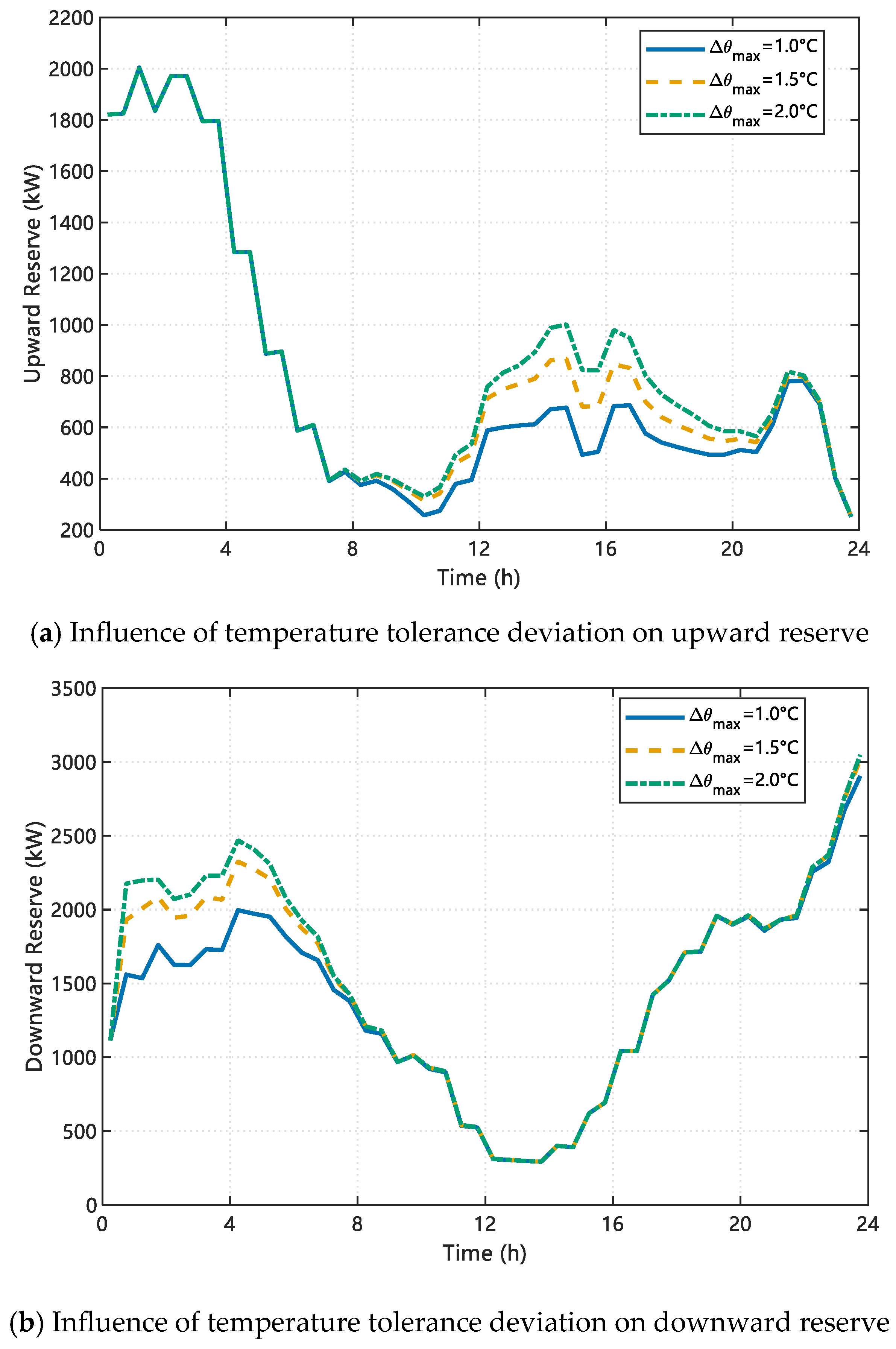
Δ θ max was set at 1.0, 1.5, and 2.0 °C, with results at 95% confidence illustrated in Figure 16. During afternoon high temperatures, the impact on the credible reserves of VPP is most significant. When the temperature deviation relaxes from 1.0 to 2.0 °C, the upward reserve capacity increases by approximately 20%. In high-temperature environments, indoor temperatures rise rapidly after AC units are turned off. Expanding the tolerance range effectively extends the off-state duration, thereby increasing the number of adjustable units that meet duration constraints. Conversely, during nighttime and early morning, changes in tolerance deviation exert a lesser impact on upward reserve but a greater impact on downward reserve.

5.4. Behavioral Parameter Sensitivity

The calibration of behavioral parameters is influenced by the selected quantile anchoring scheme and the values of the prospect theory parameters. In addition, the sensitivity parameter κ and intercept b 0 in the logit response function exert a non-negligible effect on the computed response probabilities. This section investigates the impact of variations in these parameters on the credible reserve assessment, while supplementary results and further discussion are provided in Appendix A.
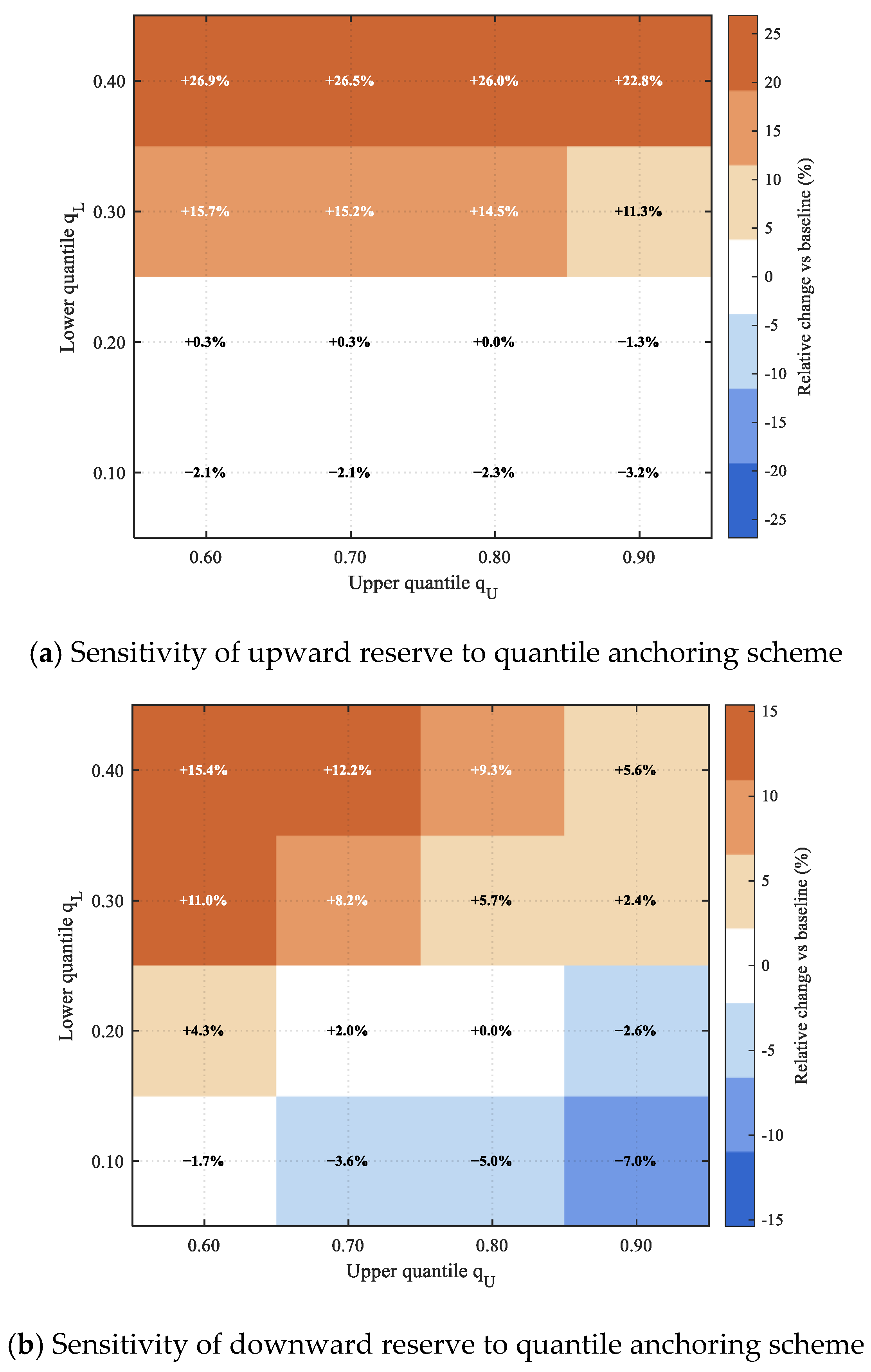
In the quantile anchoring scheme, 16 combinations are formed by selecting q L 0.10 , 0.20 , 0.30 , 0.40 and q U 0.60 , 0.70 , 0.80 , 0.90 , with q L , q U = 0.2 , 0.8 as the baseline. The effect of varying the anchoring interval on the mean credible reserve is illustrated in Figure 17. As shown in Figure 17a, the upward reserve is positively correlated with q L and negatively correlated with q U . The vertical variation across rows in Figure 17a substantially exceeds the horizontal variation across columns: shifting q L from 0.10 to 0.40 produces a maximum difference of approximately 30%, whereas shifting q U from 0.60 to 0.90 yields a maximum difference of only 4.1%. This indicates that the upward reserve is more sensitive to q L than to q U . Similarly, Figure 17b shows that the downward reserve exhibits the same directional relationships—positively correlated with q L and negatively correlated with q U . While the vertical variation again exceeds the horizontal, the downward reserve differs from the upward reserve in that the horizontal difference increases as q L rises, reaching 9.8% at q L = 0.40 and 8.6% at q L = 0.30. This suggests that q U exerts a stronger influence on the downward reserve than on the upward reserve.
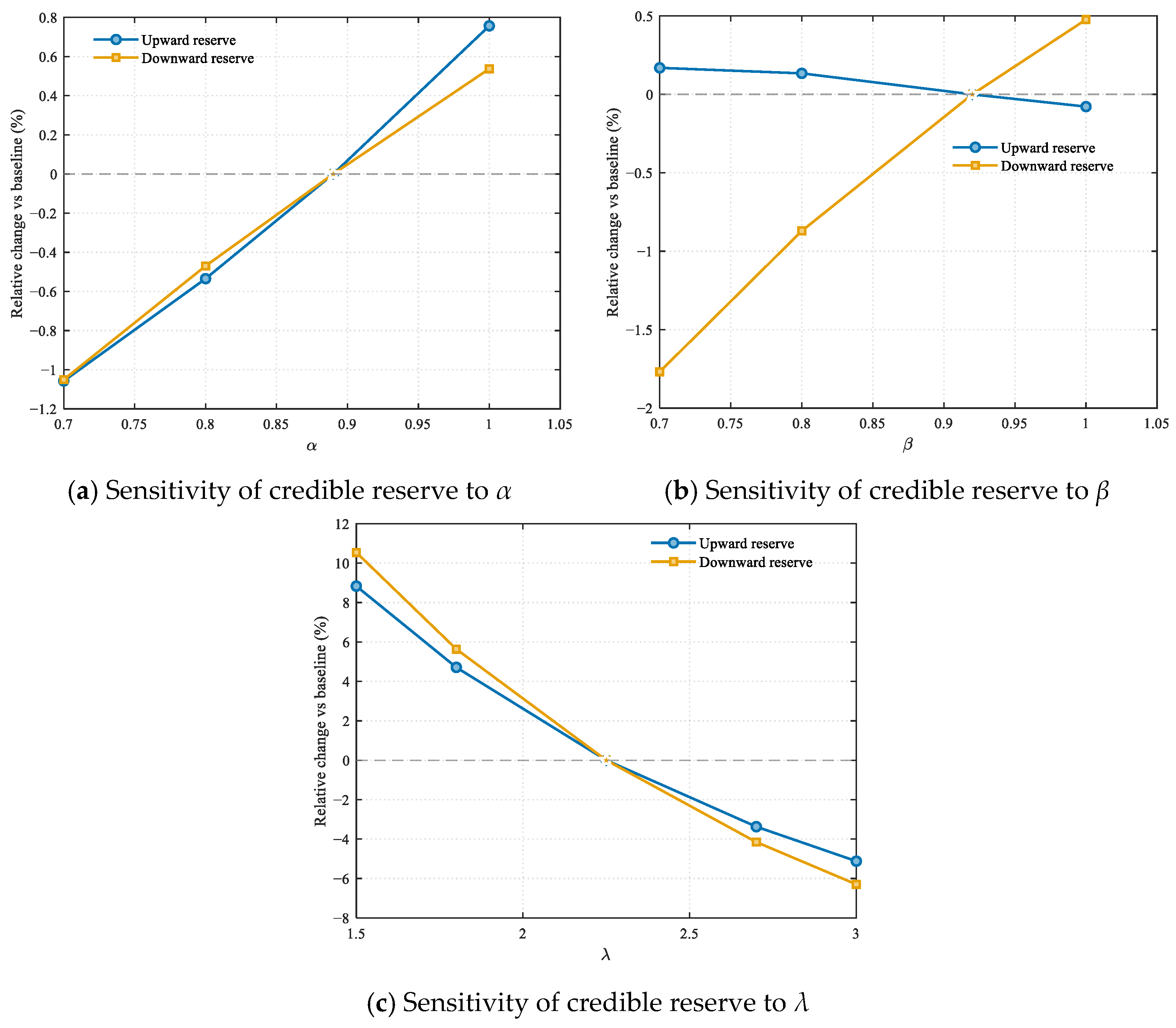
A one-at-a-time sensitivity analysis of the prospect theory parameters α, β, and λ was conducted over their respective typical ranges, utilizing the canonical parameter set (α, β, λ) = (0.89, 0.92, 2.25) as the baseline. The results are illustrated in Figure 18a–c. Figure 18a demonstrates that both the upward and downward reserves exhibit a positive correlation with α, with the two curves closely tracking each other. Increasing α from 0.70 to 1.00 results in changes of approximately 1.7% to 1.9%, representing the smallest effect among the three parameters. Figure 18b reveals that β has a pronounced asymmetric influence: the downward reserve shifts from approximately −1.75% to 0.48% as β increases from 0.70 to 1.00, while the upward reserve fluctuates within ±0.21% across the entire range. Figure 18c indicates that both reserve types are negatively correlated with λ. As λ increases from 1.50 to 3.00, the upward reserve decreases from approximately +9.3% to −5.0%, and the downward reserve declines from approximately +10.5% to 5.5%—the largest variation among the three parameters. Notably, the rate of decline is significantly steeper in the interval λ ∈ [1.50, 2.25] compared to λ ∈ [2.25, 3.00], reflecting a pattern of diminishing marginal effects.
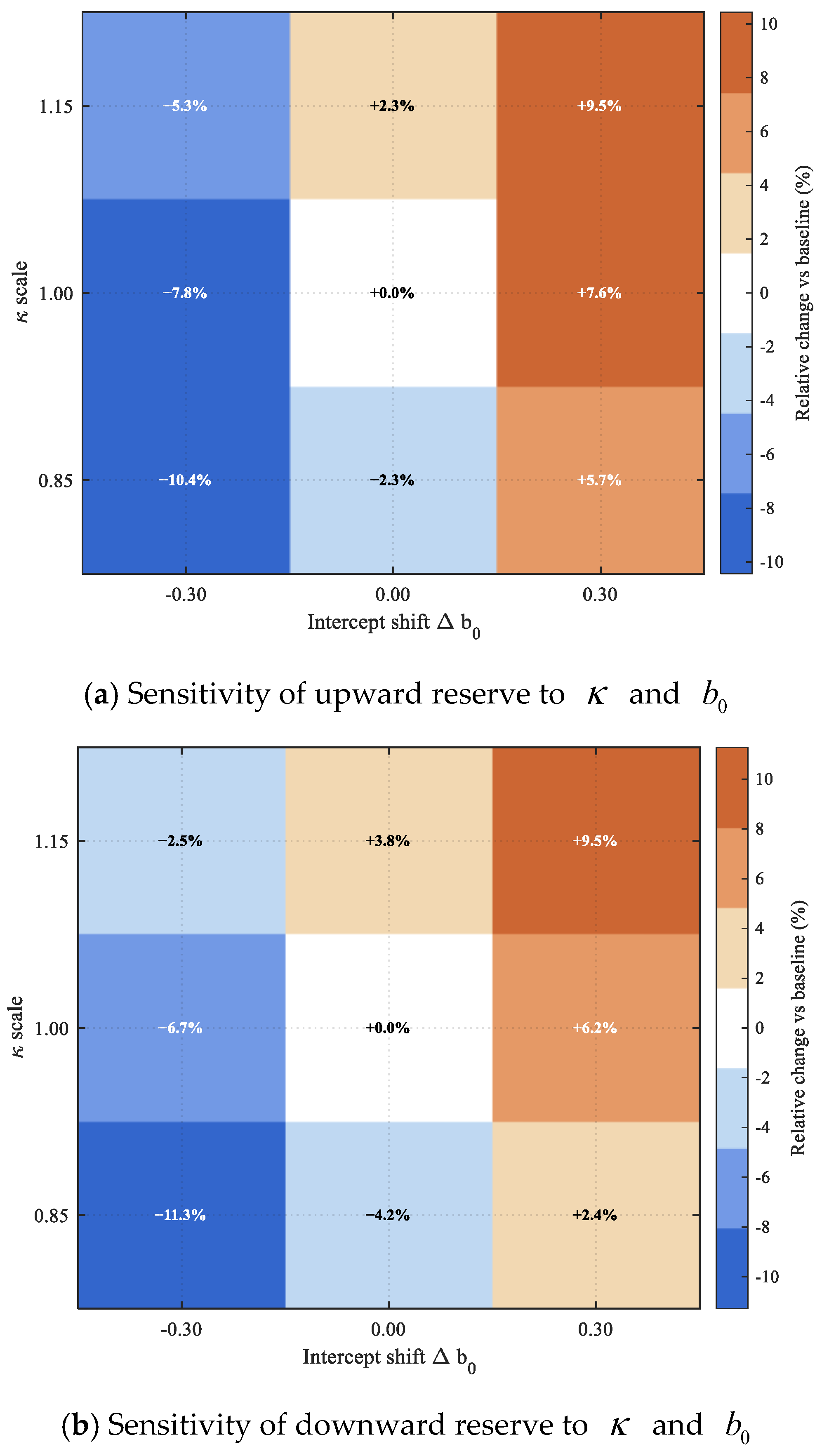
The sensitivity parameter κ and the intercept b 0 govern, respectively, the sensitivity of the response probability to marginal changes in prospect value and the baseline response rate. κ is scaled by factors of 0.85, 1.00, and 1.15; b 0 is subjected to additive shifts Δ b 0 ranging from −0.40 to +0.40, with κ = 1.00 and Δ b 0 = 0 as the baseline configuration. The relative changes in upward and downward reserves at the 95% confidence level are presented in Figure 19.
Figure 19a,b exhibits a pronounced horizontal variation pattern. When κ is held fixed, increasing Δ b 0 from negative to positive values drives a monotonic transition in the relative changes of both upward and downward reserves from negative to positive. When b 0 is held fixed, increasing κ leads to a general upward shift in both reserve types, although the magnitude of this variation is smaller than that observed along the horizontal axis, indicating that b 0 exerts a stronger influence on the credible reserve than κ . At Δ b 0 = 0, the upward reserve varies within a range of −2.3% to 2.3% across the tested scaling factors, while the downward reserve varies between −4.2% and 3.8%.
In summary, sensitivity analysis reveals the influence characteristics and temporal distribution patterns of key parameters. The reserve compensation price is positively correlated with credible reserve but exhibits diminishing marginal effects. Extending the reserve duration significantly reduces available capacity. The reserve capacity demonstrates the greatest sensitivity to environmental temperature forecast errors, while the effects of load and PV forecast error are relatively limited. Expanding user temperature tolerance deviation effectively enhances reserve capacity. The sensitivity analysis of behavioral parameters indicates that narrowing the quantile anchor interval leads to an increase in both upward and downward reserves, with q L having a more substantial effect on upward reserves compared to q U . Among the parameters of prospect theory, α demonstrates the least effect on credible reserves, while β shows a significant asymmetric effect, particularly on downward reserves. Furthermore, a higher loss aversion coefficient, λ, notably suppresses both upward and downward reserves, with the rate of decline exhibiting diminishing marginal effects. Additionally, the intercept parameter b 0 has a more pronounced influence on credible reserves than the sensitivity parameter κ .

6. Conclusions

To quantitatively characterize the impact of user participation willingness on VPP reserve capacity, this paper proposed a credible reserve assessment method that accounts for user-bounded rationality. Physical reserve models for VPP-aggregated resources were established and the prospect theory value function was introduced to characterize user loss aversion. This was combined with the logit model to construct a user-bounded rationality response probability model. Additionally, Monte Carlo simulation and kernel density estimation were employed to calculate VPP reserve capacity at different confidence intervals.
The case study results demonstrate that, after comprehensively considering physical-side uncertainty and user-bounded rationality, the credible reserve at a 95% confidence level is approximately 60–80% of the median physical reserve. Notably, user-bounded rationality plays a dominant role in the total capacity reduction. In comparison to results that consider only physical-side uncertainty, the findings presented in this paper are more reliable. Furthermore, the sensitivity analysis reveals that the influence patterns of key parameters—such as reserve compensation price, reserve duration, forecast errors, and temperature tolerance deviation—on the credible reserve align with practical realities.
It should be noted that, due to the scarcity of empirical VPP response data, large-scale real-world survey data will be needed in future work to support accurate calibration of the behavioral parameters. Given that correlations may exist among different sources of user behavioral uncertainty, incorporating correlation modeling approaches, such as Copula-based methods, could yield probability representations that more closely reflect actual user response behavior, and may further improve the accuracy of VPP credible reserve assessments. Additionally, due to space constraints, the practical implications of the credible reserve assessment results for market bidding strategies have not been explicitly addressed in this paper. These open questions point to promising directions for future research.

Author Contributions

Conceptualization, T.Y. and Q.C.; methodology, T.Y. and Q.C.; software, Q.C.; validation, Q.C., B.C. and Y.Z.; formal analysis, D.L.; investigation, Q.C.; resources, Q.C. and B.C.; data curation, Q.C.; writing—original draft preparation, T.Y. and Q.C.; writing—review and editing, T.Y.; visualization, Q.C.; supervision, D.L.; project administration, T.Y.; funding acquisition, H.W. All authors have read and agreed to the published version of the manuscript.

Funding

This research was funded by the Natural Science Foundation of Jiangsu Province, grant number BK20251067.

Institutional Review Board Statement

Not applicable.

Informed Consent Statement

Not applicable.

Data Availability Statement

All data generated or analyzed during this study are included in this published article.

Conflicts of Interest

The authors declare no conflicts of interest.

Appendix A

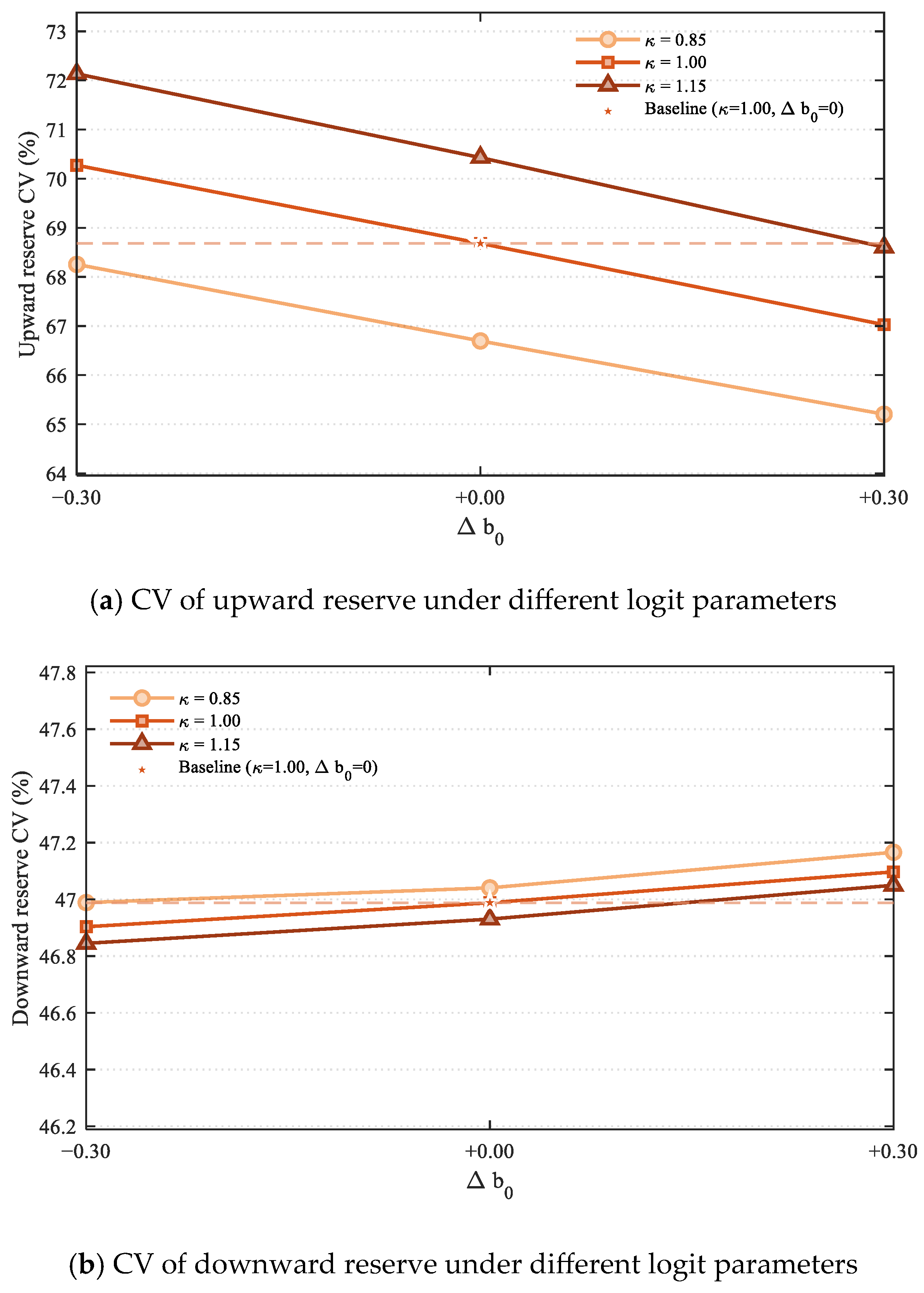
The coefficient of variation (CV) of the credible reserve distribution is adopted as a complementary dimensionless metric for quantifying relative dispersion across different parameter settings. Because upward and downward reserves differ significantly in absolute magnitude, the CV provides a more appropriate basis for cross-sectional comparison than variance alone.
When κ and b 0 vary jointly, the CV of the upward reserve ranges from 65.2% to 72.2%, whereas that of the downward reserve remains within 46.8–47.2%. Under one-at-a-time variation of the prospect theory parameters α, β and λ, the CV of the upward reserve lies between 66.9% and 71.4%, while that of the downward reserve stays within the narrower interval of 46.7–47.3%. These supplementary results are consistent with the sensitivity analysis in the main text, indicating that behavioral parameter changes have a stronger effect on the relative dispersion of upward reserve, whereas downward reserve remains comparatively stable.
Figure A1. CV of credible reserve under different logit parameters.
Sustainability 18 03130 g0a1
Table A1. CV of credible reserve under one-at-a-time variation of prospect theory parameters.
ParameterValueUpward CV (%)Downward CV (%)
α0.7067.147.3
α0.8067.947.1
α0.8968.747.0
α1.0069.646.9
β0.7070.046.8
β0.8069.446.9
β0.9268.747.0
β1.0068.347.0
λ1.5071.446.7
λ1.8070.246.8
λ2.2568.747.0
λ2.7067.547.1
λ3.0066.947.3

References

  1. Feng, Y.; Bian, X.; Cui, Y.; Jia, K.; Zhou, B.; Lin, S. Flexibility assessment and optimal scheduling based on the partition for receiving-end grid with high penetration of new energy. Electr. Power Syst. Res. 2026, 254, 112615. [Google Scholar] [CrossRef]
  2. Mo, D.; Chen, M.; Li, Q.; Yang, Y.; Wang, Z. Research on joint clearing of energy and ancillary service in the day-ahead market considering the weights of ancillary services. Front. Energy Res. 2025, 13, 1583300. [Google Scholar] [CrossRef]
  3. Zhong, B.; Yang, J.; Chen, Y.; Fang, H. Research hotspots and development trends of virtual power plant in the energy transition: A bibliometric analysis. Energy Rep. 2025, 14, 371–385. [Google Scholar] [CrossRef]
  4. Esfahani, M.; Alizadeh, A.; Cao, B.; Kamwa, I.; Xu, M. Bridging theory and practice: A comprehensive review of virtual power plant technologies and their real-world applications. Renew. Sustain. Energy Rev. 2025, 222, 115929. [Google Scholar] [CrossRef]
  5. Radaideh, A.; Vaidya, U. Sequential set-point control for heterogeneous thermostatically controlled loads through an extended Markov chain abstraction. IEEE Trans. Smart Grid 2017, 10, 116–127. [Google Scholar] [CrossRef]
  6. Gong, X.; Castillo-Guerra, E. Robust hierarchical control mechanism for aggregated thermostatically controlled loads. IEEE Trans. Smart Grid 2020, 12, 453–467. [Google Scholar] [CrossRef]
  7. Lin, S.; Liu, D.; Hu, F.; Li, F.; Dong, W.; Li, D.; Fu, Y. Grouping control strategy for aggregated thermostatically controlled loads. Electr. Power Syst. Res. 2019, 171, 97–104. [Google Scholar] [CrossRef]
  8. Tang, D.; Wang, P. Probabilistic modeling of nodal charging demand based on spatial-temporal dynamics of moving electric vehicles. IEEE Trans. Smart Grid 2015, 7, 627–636. [Google Scholar] [CrossRef]
  9. Xu, X.; Mi, Z.; Yu, S.; Zhan, Z.; Ji, L. Spatial-temporal response capability probabilistic evaluation method of electric vehicle aggregator based on trip characteristics modelling. IET Gener. Transm. Distrib. 2023, 17, 2192–2206. [Google Scholar] [CrossRef]
  10. Subramanya, R.; Yli-Ojanperä, M.; Sierla, S.; Hölttä, T. A virtual power plant solution for aggregating photovoltaic systems and other distributed energy resources for northern European primary frequency reserves. Energies 2021, 14, 1242. [Google Scholar] [CrossRef]
  11. Xue, J.; Shi, X.; Wang, C.; Cao, Y.; Zhang, H. Online evaluation of emergency power regulation capability for virtual power plants considering physical characteristics and user behavior constraints. Proc. CSEE 2023, 43, 2906. [Google Scholar] [CrossRef]
  12. Wang, Y.; Hug, G.; Liu, Z.; Zhang, N. Modeling load forecast uncertainty using generative adversarial networks. Electr. Power Syst. Res. 2020, 189, 106732. [Google Scholar] [CrossRef]
  13. Moghadam, A.T.; Bahramian, B.; Shahbaazy, F. Stochastic flexible power system expansion planning, based on the demand response considering consumption and generation uncertainties. Sustainability 2023, 15, 1099. [Google Scholar] [CrossRef]
  14. Mayer, M.J.; Yang, D. Probabilistic photovoltaic power forecasting using a calibrated ensemble of model chains. Renew. Sustain. Energy Rev. 2022, 168, 112821. [Google Scholar] [CrossRef]
  15. Darvishi, M.; Tahmasebi, M.; Shokouhmand, E. Optimal operation of sustainable virtual power plant considering the amount of emission in the presence of renewable energy sources and demand response. Sustainability 2023, 15, 11012. [Google Scholar] [CrossRef]
  16. Wen, Y.; Hu, Z.; You, S.; Duan, X. Aggregate feasible region of DERs: Exact formulation and approximate models. IEEE Trans. Smart Grid 2022, 13, 4405–4423. [Google Scholar] [CrossRef]
  17. Yi, Z.; Xu, Y.; Wei, X.; Sun, H. Robust security constrained energy and regulation service bidding strategy for a virtual power plant. CSEE J. Power Energy Syst. 2022, 11, 692–704. [Google Scholar] [CrossRef]
  18. Zeng, Z.; Sun, Q.; Zhao, W.; Bai, Y.; Deng, S.; Guo, J. Joint optimized operation of electricity spot and reserve markets considering bidding strategies for virtual power plants. IEEE Access 2024, 12, 166114–166125. [Google Scholar] [CrossRef]
  19. Li, W.; Dong, F.; Ji, Z.; Wang, P. Internal and external coordinated distributionally robust bidding strategy of virtual power plant operator participating in day-ahead electricity spot and peaking ancillary services markets. Appl. Energy 2025, 386, 125514. [Google Scholar] [CrossRef]
  20. Tian, F.; Bao, M.; Hui, H.; Qiu, Y.; Ding, Y. Reserve credit evaluation of virtual power plants considering multiple uncertainties. Power Syst. Prot. Control 2025, 53, 45–56. [Google Scholar] [CrossRef]
  21. Guo, P.; Lam, J.C.K.; Li, V.O.K. Drivers of domestic electricity users’ price responsiveness: A novel machine learning approach. Appl. Energy 2019, 235, 900–913. [Google Scholar] [CrossRef]
  22. Zhou, Y.; Shi, Z.; Shi, Z.; Gao, Q.; Wu, L. Disaggregating power consumption of commercial buildings based on the finite mixture model. Appl. Energy 2019, 243, 35–46. [Google Scholar] [CrossRef]
  23. Vallés, M.; Bello, A.; Reneses, J.; Frías, P. Probabilistic characterization of electricity consumer responsiveness to economic incentives. Appl. Energy 2018, 216, 296–310. [Google Scholar] [CrossRef]
  24. Gao, R.; Guo, H.; Zhang, R.; Mao, T.; Xu, Q.; Zhou, B.; Yang, P. A Two-Stage Dispatch Mechanism for Virtual Power Plant Utilizing the CVaR Theory in the Electricity Spot Market. Energies 2019, 12, 3402. [Google Scholar] [CrossRef]
  25. Yang, X.; Li, L. A joint sharing-sharing platform for coordinating supply and demand resources at distributed level: Coupling electricity and carbon flows under bounded rationality. Appl. Energy 2025, 393, 126051. [Google Scholar] [CrossRef]
  26. Gan, L.; Zhang, P.; Chen, Y.; Yu, K.; Chen, X.; Wang, B.; Hua, H. Residents’ bounded rationality in electricity demand response decision-making considering multidimensional living needs. Proc. CSEE 2025, 46, 595–607. [Google Scholar] [CrossRef]
  27. Junior, J.G.S.F.; Ohtake, H.; Oozeki, T.; Ogimoto, K. Prediction intervals for day-ahead photovoltaic power forecasts with non-parametric and parametric distributions. J. Electr. Eng. Technol. 2018, 13, 1504–1514. [Google Scholar] [CrossRef]
  28. Tversky, A.; Kahneman, D. Advances in prospect theory: Cumulative representation of uncertainty. J. Risk Uncertain. 1992, 5, 297–323. [Google Scholar] [CrossRef]
  29. Möller, A.; Groß, J. Probabilistic temperature forecasting based on an ensemble autoregressive modification. Q. J. R. Meteorol. Soc. 2016, 142, 1385–1394. [Google Scholar] [CrossRef]
  30. Zhang, W.; Hu, Q.; Yu, X. Analysis on Influence of Residents’ Response Probability Distribution on Load Aggregation Effect. Front. Energy Res. 2022, 10, 951618. [Google Scholar] [CrossRef]
  31. Makarov, Y.V.; Loutan, C.; Ma, J.; de Mello, P. Operational impacts of wind generation on California power systems. IEEE Trans. Power Syst. 2009, 24, 1039–1050. [Google Scholar] [CrossRef]
Figure 1. Typical VPP framework.
Sustainability 18 03130 g001
Figure 2. User response model based on prospect theory.
Sustainability 18 03130 g002
Figure 3. Flowchart of the VPP credible reserve assessment methodology.
Sustainability 18 03130 g003
Figure 4. Outdoor temperature preset values.
Sustainability 18 03130 g004
Figure 5. Load preset values.
Sustainability 18 03130 g005
Figure 6. Photovoltaic preset values.
Sustainability 18 03130 g006
Figure 7. VPP credible reserve assessment results at different confidence levels.
Sustainability 18 03130 g007
Figure 8. Comparison between proposed model and linear utility model.
Sustainability 18 03130 g008
Figure 9. Multiple uncertainty factors’ reduction effects on credible reserve.
Sustainability 18 03130 g009
Figure 10. Contribution proportions at 95% confidence.
Sustainability 18 03130 g010
Figure 11. Credible-level backtesting at different confidence levels.
Sustainability 18 03130 g011
Figure 12. Credible reserve at different compensation prices.
Sustainability 18 03130 g012
Figure 13. Credible reserve at different reserve durations.
Sustainability 18 03130 g013
Figure 14. Sensitivity analysis of different forecast errors.
Sustainability 18 03130 g014
Figure 15. Outdoor temperature error’s influence on reserve.
Sustainability 18 03130 g015
Figure 16. Temperature tolerance deviation’s influence on credible reserve.
Sustainability 18 03130 g016
Figure 17. Sensitivity of credible reserve to quantile anchoring scheme.
Sustainability 18 03130 g017
Figure 18. Sensitivity of credible reserve to prospect theory parameters.
Sustainability 18 03130 g018
Figure 19. Sensitivity of credible reserve to κ and b 0 .
Sustainability 18 03130 g019
Table 1. Simulation parameters for AC resources.
ParameterUnitsValue
ACNumber of units 3000
Room aream2 N ( 20 , 3 )
P i AC kW U ( 40 A i , 65 A i )
C i kWh/°C 100 / A i
R i °C/kW 0.015 A i
η i 3.0
Table 2. Simulation parameters for EV resources.
ParameterUnitsValue
EVNumber of units 500
E j , rated kWh U ( 50 , 60 )
P j , ch max , P j , dis max kW7
η j , ch , η j , dis 0.95
t in N ( 17.5 , 3.4 ) [ 6 , 24 ]
t out N ( 8.5 , 3.4 ) [ 1 , 20 ]
Initial SOC N ( 0.45 , 0.1 ) [ 0.3 , 0.6 ]
expected SOC at departure U ( 0.9 , 0.95 )
Table 3. Simulation parameters for PVSIS resources.
ParameterUnitsValue
PVSISSOC limits 0.1, 0.9
P k , ch max , P k , dis max kW200
η k , ch 0.95
η k , dis 0.9
E k , rated kWh1200
PV installed capacityMW2.0
Table 4. Time-of-use pricing parameters.
Time PeriodTypeResidential Price (yuan/kWh)Commercial Price (yuan/kWh)
10:00–18:00
14:00–20:00
Peak0.6201.125
08:00–10:00, 12:00–14:00, 20:00–24:00Standard0.5200.654
00:00–08:00Valley0.3400.274
Table 5. AC and EV reserve response probabilities.
ACEV
Upward reserve P1, P20.28, 0.780.20, 0.65
Downward reserve P1, P20.15, 0.580.18, 0.65
Disclaimer/Publisher’s Note: The statements, opinions and data contained in all publications are solely those of the individual author(s) and contributor(s) and not of MDPI and/or the editor(s). MDPI and/or the editor(s) disclaim responsibility for any injury to people or property resulting from any ideas, methods, instructions or products referred to in the content.